“The Graveless Doll of Eric Mutis” by Karen Russell
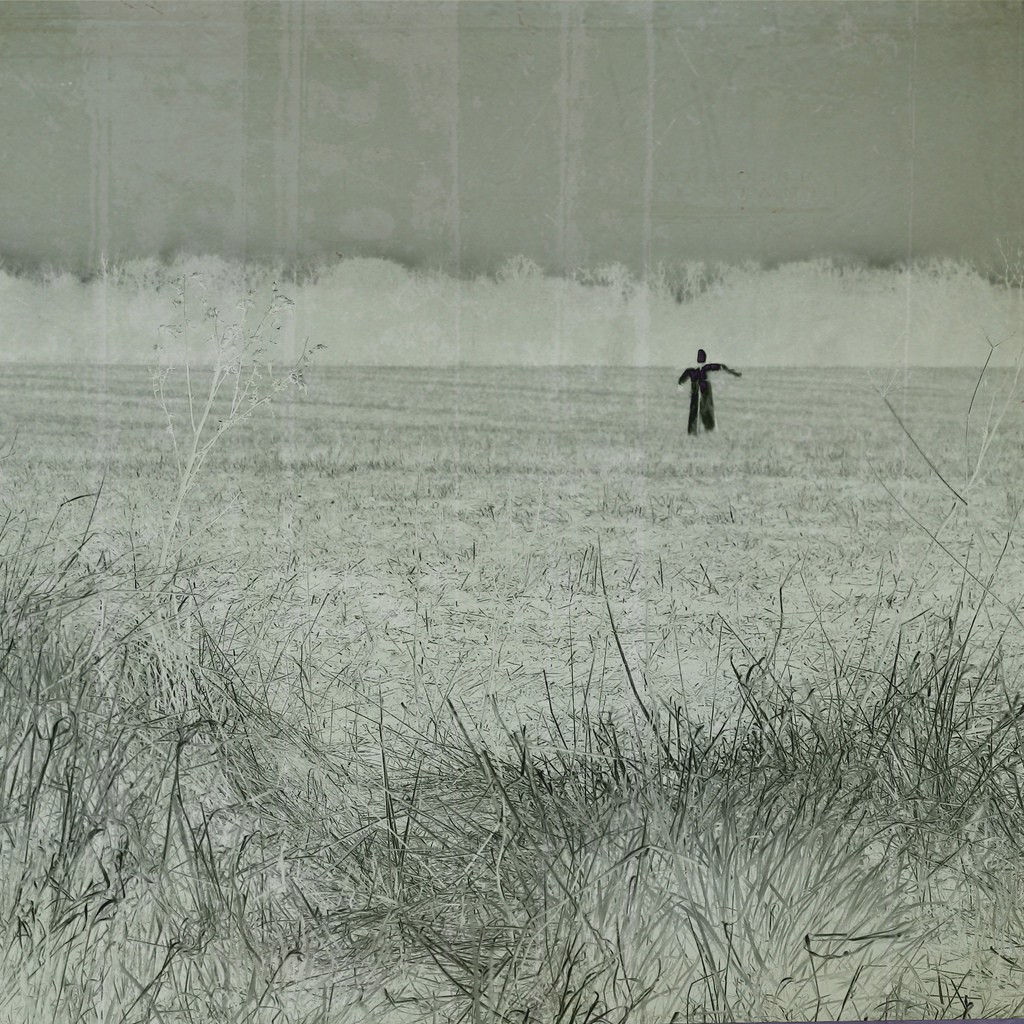
THE SCARECROW THAT WE FOUND lashed to the pin oak in Friendship Park, New Jersey, was thousands of miles away from the yellow atolls of corn where you might expect to find a farmer’s doll. Scarecrow country was the actual country, everybody knew that. Scarecrows belonged to countrymen and women. They lived in hick states, the “I” states, exotic to us: Iowa, Indiana. Scarecrows made fools of the birds, and smiled with lifeless humor. Their smiles were fakes, threads. (This idea appealed to me — I was a quiet kid myself, branded “mean,” and I liked the idea of a mouth that nobody expected anything from, a mouth that was just red sewing.) Scarecrows got planted into the same soil as their crops; they worked around the clock, like charms, to keep the hungry birds at bay. That was how it worked in TV movies, at least: horror-struck, the birds turned shrieking circles around the far-below peak of the scarecrow’s hat, afraid to land. They haloed him. Underneath a hundred starving crows, the TV scarecrow seemed pretty sanguine, grinning his tickled, brainwashed grin at the camera. He was a sort of pitiable character, I thought, a jester in the corn, imitating the farmer — the real king. All day and all night, the scarecrow had to stand watch over his quilty hills of wheat and flax, of rye and barley and three other brown grains that I couldn’t remember (my brain stole this image from the seven-grain Quilty Hills Muffins bag — at school I cheated shamelessly and I guess my imagination must have been a plagiarist too, copying its homework).
This mission had nothing to do with us or with our city of Anthem, New Jersey. Anthem had no crops, no silos, no crows — it had turquoise Port-o-Pottys and neon alleys, construction pits, dogs in purses, bag ladies with powerful smells and opinions, garbage dumps haunted by the wraith white pigeons; it had our school, the facade of which was currently covered with a glorious psychedelic phallus mosaic, a series of interlocking dicks spray painted to the scale of Picasso’s Guernica by Anthem’s tenth-grade graffiti kings; it had policemen, bus drivers, crossing guards; dolls were sold in stores.
And we were city boys. We lived in projects that were farm antonyms, these truly shitbox apartments. If flowers bloomed on our sooty sills, it must have been because of some plant Stockholm syndrome, a love our sun did not deserve. Our familiarity with the figure of the scarecrow came exclusively from watered-down L. Frank Baum cartoons, and from the corny yet frightening “Autumn’s Bounty!” display in the Food Lion grocery store, where every year a scarecrow got propped a little awkwardly between a pilgrim, a cornucopia, and a scrotally wrinkled turkey. The Food Lion scarecrow looked like a broomin a Bermuda shirt, a broomwith acne, ogling the ladies’ butts as they bent to buy their diet yogurts — once I’d heard a bag boy joke that it was there to spook the divorcees. What we found in Friendship Park in no way resembled the Food Lion scarecrow. At first I was sure the thing tied to the oak was dead, or alive. Real, I mean.
“Hey, you guys,” I swallowed. “Look — ” And pointed to the pin oak, where a boy our age was belted to the trunk. Somebody in blue jeans and a T-shirt that had faded to the same earthworm color as his hair, a white boy, doubled over the rope. His hair clung tight as a cap to his scalp, as if painted on, and his face looked like a brick of sweating cheese.
Gus got to the kid first. “You retards.” His voice was high with relief. “It’s just a doll.” He punched its stomach. “It’s got straw inside it.”
“It’s a scarecrow!” shrieked Mondo.
And he kicked at a glistening bulb of what did appear to be straw beneath the doll’s slumping face. A little hill. It regarded its own innards expressionlessly, its glass eyes twinkling. Mondo shrieked again.
I followed the scarecrow’s gaze down to its lost straw: dark gold and chlorophyll green strands were blowing loose, like cut hair on a barbershop floor. Some of the straw had a jellied black look. How long had this stuff been outside of him, I wondered — how long had it been inside of him? I looked up, searching the boy scarecrow for a rip. A cold eel-like feeling was thrashing in my belly. That same morning, while eating my Popple breakfast tart, I’d seen a news shot of a U.S. soldier calmly watching blood spill from his head. Calm came pouring over him, at pace with the blood. In the next room, I could hear my ma getting ready for work, singing an old pop song, rattling hangers. On TV, one of the soldier’s eyes was lost behind the sticky pink sheet. The camera closed in; a second later the footage switched to the trees of a new country under an ammonia blue sky. I couldn’t understand this — where was the cameraman or the camerawoman? Who was letting his face dissolve into calm?
“Let’s cut it down!” screamed Mondo. I nodded.
“Nah, we better not.” Juan Carlos looked around the woods sharply; he looked up, as if there might be a sniper hidden in the pin oak. “What if this” — he pushed at the doll — “belongs to somebody? What if somebody is watching us, right now? Laughing at us…”
It was late September, a cool red season. The scarecrow was hung up on the sunless side of the oak. The tree was a shaggy pyramid, sixty or seventy feet tall, one of the “famous” landmarks of Friendship Park; it overlooked a ravine — a split in the seam of the bedrock, very narrow and deep — that we called “the Cone.” Way down at the bottom you could see a wet blue dirt with radishy pink streaks along it, as exotic looking to us as a sea floor. Condoms and needles (not ours) and the silver shreds of Dodo Potato Chip bags and beer bottles (mostly ours) had turned the Cone into a sort of sylvan garbage can. The tree spread above it like a girl playing at suicide, quailing its many fiery leaves.
Years ago, before we started loitering here in a dedicated way, the pin oak had been planted to commemorate an Event — there was an opal plaque nestled in its roots. We knew this much but we didn’t know more — some delinquent, teenaged forefather of ours had scratched out everything but the date, “1957.”
The plaque looked like a lost little moon in the grip of the tree’s arachnid roots. I always felt a little cheated by the plaque; it was a confusing kind of resentment; I didn’t really care about the “why” of the tree at all but I didn’t like how this plaque was an open secret either, a mystery that was always itching at us. It bothered me that we were so poorly informed about the oak’s first purpose that we did not even have the option of forgetting it, using our patented June 1 method, whereby we expulsed a year of school facts from our brains in spasms of summer amnesia. (Harriet Tubman — did he invent something? The War of 1812 — why did we fight that one? For tea? Against Mexico or Sicily?) Forgetting was one of my favorite things to do at Camp Dark; I felt like a squid, sending jets of inky thoughts into the Cone. The plaque was illegible, but the oak’s glossy trunk was covered in gougings that you could easily read: V hearts K; Death 2 Asshole Jimmy Dingo; Jesus Saves; I Wuz Here!!! We’d added ourselves:
MONDO + GUS + LARRY + J.C. = CAMP DARK
The “deep end” of Friendship Park we called Camp Dark. Camp Dark was Anthem’s lame try at an urban arboretum, a sort of surprise woods bordered by gas and fire stations and a condemned pizza buffet. THE PIZZA PARTY IS CANCELED read a sign above a bulldozer. These central acres of Friendship Park were filled with young deciduous trees and naive-seeming bluish squirrels. They chittered some charming bullshit at you too, up on their hind legs begging for a handout. They lived in the trash cans and had the wide-eyed innocent look and threadbare fur of child junkies. Had they wised up, our squirrels might have mugged us and used our wallets to buy train tickets to the true woods, which were about an hour north of Anthem’s depressed downtown, according to Juan Carlos — only Juan Carlos had been out there. (“There was a river with a purple fish shitting in it,” was all we got out of him.)
Recently, the Anthem City Parks & Recreation had received a big grant, and now the playground looked like a madhouse. Padded swings, padded slides, padded gyms, padded seesaws and go-wheelies: All the once-fun equipment had gotten upholstered by the city in this red loony-bin foam. To absorb the risk of a lawsuit, said Juan Carlos; one night, at Juan Carlos’s suggestion, we all took turns pissing hooch onto the harm-preventing pillows. Our park had a poopstrewn dog run and an orange baseball diamond; a creepy pond that, like certain towns in Florida, had at one time been a very popular winter destination for geese and ducks but which had for some reason fallen out of fashion in the waterfowl society; and a Conestoga-looking covered picnic area. Gus claimed to have had sex there last Valentine’s Day, on the cement tables — “pussy sex,” he said, authoritatively, horrifying us, “not just the mouth kind.” Our feeling was, if Gus really had tricked a girl into coming to our park in late February, they most likely talked about noncontroversial subjects, like the coldness of snow and the excellence of Gus’s weed, while wearing sex-thwarting parkas.
We’d started hanging at Friendship Park four years ago, when we were ten years old. Back then we played actual games.We hid and we sought. We did benign stuff in trees. We amassed a stupidly huge plastic weapons cache in the hollow of the pin oak, including a Sounds of Warfare Blazer that as I recall required something like sixteen triple-A batteries to make a noise like a female guinea pig putting a brave face on her tuberculosis. Those were innocent times. Then we got shunted into Anthem’s combo middle-and-high school, and now we came here to drink beers and antagonize one another. Biweekly we shoplifted liquor and snacks, in a surprisingly orderly way, rotating this duty. (“We are Communists!” shrieked Mondo once, pumping a fistful of red-hot peanuts into the sky, and Juan Carlos, who did homework, snorted, “You are quite confused, my bro.”)
Participation levels varied, but usually it was the core four of us at Camp Dark: Juan Carlos Diaz, Gus Ainsworth, Mondo Chu, and me, Larry Rubio. Pronounced “Rubby-oh” by me, like a rubber ducky toy, my own surname. My dad left when I turned two and I don’t speak any Spanish unless you count the words that everybody knows, like “hablo” and “no.” My ma came from a vast hick family in Pensacola, pontoon loads of uncle-brothers and red-haired aunts and firecrotch cousins from some nth degree of cousindom, hordes of blood kin whom she renounced, I guess, to marry and then divorce my dad. We never saw any of them. We were long alone, me and my ma.
Juan Carlos had tried to tutor me once: “Rooo-bio. Fucker, you have to coo the ‘u’!”
My ma couldn’t pronounce my last name either, making for some awkward times in Vice Principal Derry’s office. She’d reverted to her maiden name, which sounded like an elf municipality: Dourif. “Why can’t I be a Dourif, like you?” I asked her once when I was very small, and she poured her drink onto the carpet, shocking me — this was my own kindergarten trick to express a violent unhappiness. She left the room and my shock deepened when she didn’t come back to clean up the mess. I watched the stain set on the carpet, the sun cutting through the curtain blades. Later, I wrote LARRY RUBIO on all of my folders. I answered to RUBIO, just like the stranger my father must be doing somewhere. What my ma seemed to want me to do — to hold onto the name without the man — felt very silly to me, like the cartoon where Wile E. Coyote holds on to the handle (just the handle) of an exploded suitcase. Latching into pure space.
The scarecrow boy was my same height, five foot five. He had pale glass eyes and a molded wax or plastic face; under his faded brown shirt his “skin” was machine-sewn sackcloth, straw stuffed. So: He had a scarecrow’s body but a boy’s head. I took a step forward and punched his torso, which was solid as a bale of hay; I half expected a scream to roll out of his mouth. I looked down — I was standing on a snarl of his guts. Would a scarecrow’s organs look like this? I wondered. Like birds’ nests. A grass kidney, a flammable heart. Now I understood Mondo’s earlier wail — when the scarecrow didn’t cry out, I wanted to scream for him.
“Who stuck those on its face?” Mondo asked. “Those eyes?”
“Whoever put him here in the first place, jackass.”
“Well, what weirdo does that? Puts eyes and clothes on a giant doll of a kid and ropes him to a tree?”
“A German, probably,” said Gus knowingly. “Or a Japanese. One of those sicko sex freaks.”
Mondo rolled his eyes. “Maybe you put it here then, Ainsworth.”
“Maybe he’s a theater prop? Like, from our school?”
“He’s wearing some nasty clothes.”
“Hey! He’s got a belt like yours, Rubby!”
“Shut up.”
“Wait — you’re going to steal the scarecrow’s belt? That ain’t bad luck?”
“Oh my God! He’s got on underwear!” Mondo snapped the elastic, giggling.
“He has a hole,” Juan Carlos said quietly. He’d slid his hand between the doll’s sagging shoulders and the tree. “Down here, in his back. Look. He’s spilling straw.”
Juan Carlos was jerking stuffing out of the scarecrow and then, in the same panicky motion, trying to cram it back inside the hole; all this he did with a sly, aghast look, as if he were a surgeon who had fatally bungled an operation and was now trying to disguise that fact from his staff. This straw, I recognized with a chill, was fresh and green.
“You got your ‘oh shit!’ face on, J.C.!” Gus laughed. I managed a laugh too, but I was scared, scared. The straw was scary to me, its pale colors and its smell. A terrible sweetness lifted out of the doll, that stench you are supposed to associate with innocent things — zoos and pet stores, pony rides. He was stuffed to the springs of his eyeballs. Put it all back, Juan, I thought hopefully, and we’ll be OK.
“Uh. You dudes? Do scarecrows have fingers?” Mondo held the scarecrow’s left hand, very formally, as if he were suddenly in a cummerbund accompanying the scarecrow to the world’s scariest prom.
“I mean, usually,” he added lamely, as if this were a normal topic to solicit our opinions on, the prevalence of scarecrow fingers.
“His body is soft.” Gus demonstrated this for us, punching it. “But his face is, like, a wax? Not-straw. Some other shit. Plastic.”
Only it wasn’t generic, like a mall mannequin. Even the dark blue eye color looked particular, familiar. His features were weird and specific, like the face of a wax actress in a museum. Someone you were supposed to recognize.
“What the hell?” Gus whispered, twisting the scarecrow’s face by its plastic chin. The chin was pocked with a fiery braille of blemishes and cuts, so convincingly nasty that you half expected them to ooze. The longer I stared at him, the less real I myself felt. Was I really the only one who remembered his name?
“Weird. His face is cold.” Juan Carlos ran a long finger down the scarecrow’s crooked nose.
“He’s not wearing his glasses,” I mumbled. Now that I knew who this was I was afraid to touch his face, as if the humid wand of my finger might bring him to life.
“His face is hard,” Mondo confirmed, knocking on the scarecrow’s forehead. “His eyes are…uh-oh. Oops.”
Mondo turned to us, grinning.
“Oh shit!” Gus shook his head. “Put them back in.”
“I can’t. The little threads broke.” Mondo held out the eyes: two grape-sized balls, an amethyst glass soaked blue by the last light of day. “Any of you bitches know how to sew?” Intense pinks were filtering through the autumn mesh of the oak. It was dusk, sunset; the park was now officially closed. “Seriously?” Mondo asked, sounding a little panicky now. “Anybody got glue or something?”
I stared at the sprigs of thread where the scarecrow’s eyes had been. Now his face was putty white from the “T” of his nose to his forehead. A little firefly was lighting up the airless caves of the doll’s nostrils, undetected by the doll. You’re even blinder now, I thought, and a heavy feeling draped over me.
Then I heard the question I’d been dreading: “Don’t we know this kid?”
Now Mondo stood on his toes and peered into the scarecrow’s eyes with a shrewdness that you did not ordinarily expect from Mondo Chu — his mind was lost inside one of those baby-fat faces that he couldn’t seem to age out of, with big slabby cheeks that squeezed his eyes into a narcoleptic squint, although outside of school Mondo could get pretty annoyingly energetic. There was some evidence that Mondo did not have the happiest home life. Mondo was half Chinese, half something.We’d all forgotten, assuming we’d ever known.
In fact, as a “we,” Camp Dark was pretty fiercely uninterested in the details of its members’ lives outside of school or beyond the fenced urban woods of Friendship Park. Silence policed the shady meeting point under our oak. I didn’t know, for example, if Juan Carlos’s big sister was pregnant or just getting large on Hershey’s Kisses, or how Mondo got the yellowish bruises that covered his flabby upper arms. Inside of our “we,” nobody would ask you about your ma’s cancer or your alcoholic aunt, your moon-eyed half sister, your family’s debts, nobody commented on the emotions that might fly across your face and raise your fists and nobody demanded a bullshit weather report from you either, a reason for your anger — not like the teachers, who were always demanding that sort of phony meteorology from us. We cracked jokes together in Camp Dark, but I think it was the silence, all those unasked questions, that bound us. At school we beat down kids as a foursome and this too we did in an animal silence. We’d drag a hysterical kid behind the red-brick Science Building — this march could look a little medieval, like some Gallows Day parade, each of us taking up an arm or a leg — and then we would hammer and piston our fists into his clawing, shrilling body until the kid went slack as rags. For us, this process was a necessary evil. We were like four factory guys, manufacturing the quiet, a calm that was not available to us naturally anywhere in Anthem. We’d kneel there, panting together, and let the good quiet bubble around our fists like glue.
It was Mondo who cracked the mystery. He didn’t solve it, I don’t mean that — in fact he made the mystery much worse. That’s what I pictured anyhow, when Mondo tapped the mystery with his little eureka! hammer — hairline cracks appearing in a round, solid shell. Yolk came oozing out of the mystery, covering all of our hands, so that we became involved.
“Oh!” Mondo fell back on his heels and let out a bee-stung cry. “It’s Eric.”
“Oh.” I took a step away from the tree.
Juan Carlos paused with one hand lost in the doll’s back, still wearing a doctor’s distant, guileful expression.
“Who the fuck is Eric?” Gus snarled.
Then Mondo, grinning loonily like a Jeopardy! champ, grabbed the scarecrow’s left arm by the wrist and made it shake hands with the cold air between us. “Don’t you assholes remember him? Eric Mutis.”
Sure, we remembered him now: Eric Mutis. Eric Mutant, Eric Mucus, Eric the Mute. Paler than a cauliflower, a friendless kid who had once or twice had seizures in our class. “Eric Mutis is an epileptic,” our teacher had explained a little uncertainly, after Mutant got carried by Coach Leyshon from the room. Eric Mutis had joined our eighth-grade class in October of the previous year, a transfer kid. One day Mutant was sitting in the back row of our homeroom; the teacher never introduced him. Kids rarely moved to Anthem, New Jersey, and generally the teachers made the New Boy or the New Girl parade their strangeness for us; but Eric Mutis, who seemed genuinely otherworldly, much weirder even than the Guatemalan New Boy, Eric Mutis arrived in exile. He sank like a stone to the bottom of our homeroom. One day, several weeks before the official end of our school term, he vanished, and I honestly had not spoken his name since. Nobody had.
In the school halls, Eric Mutis had been as familiar as air; at the same time we never thought about him. Not unless he was right in front of our noses. Then you couldn’t ignore him — there was something provocative about Eric Mutis’s ugliness, something about his oblivion, his froggy lashes and his worse-than-dumb expression, that filled your eyes and closed your throat. He could metamorphose Jilly Lucio, the top of the cheer pyramid, a dog lover and the sweetest girl in our grade, into a harpy. “What smells?” she’d whisper, little unicorn-pendant Jilly, thrilling us with her acid tone, and only Eric Mutis would blink his large, bovine eyes at her and say, “I don’t smell it, Jilly,” in that voice like thin bluemilk. Congenitally, he really did seem like a mutant, incapable of shame. Even then, at age twelve, before our glands made us all swell into monsters, I felt allergic to the kid. His ugliness panned into a weird calm, and this combination was like a bully allergen. A teacher’s allergen, too — the poor get poorer, I guess, because many of our teachers were openly hostile to Eric Mutis; by December, Coach Leyshon was sneering, “Pick it up, Mutant!” on the courts.
The courts, the grass behind them — that was where Camp Dark came to order. We did what you might call these “alterations” on the blacktop. At recess we’d descend on Eric Mutis like deranged tailors, trailing these little threads of Eric’s spittle and Eric’s blood. But his costume — the smoggy yellow cloud of his hair, his sickly bus-terminal complexion — it was his skin. We could not free him, we could not torch the costume off him. He wouldn’t change, no matter how often we encouraged him to do so with our insults and the instruction of our “pranks” and fists. We stole his Hoops sneakers, hung them up on the flagpole, we smashed his gray Medicaid glasses three times that year, his hideous glasses, with frames the width of my TV set; and then he’d come to school in a new pair of the same eyesore frames, the same nine-dollar Hoops sneakers, fresh from the Starmart box. How many pairs of Hoops did we force him to buy — or, most likely, since Eric Mutis queued up with us for the free lunch program, to steal?
“Why are you so stubborn, Mutant?” I hissed at him once, when his face was inches away from mine, lying prone on the blacktop — closer to my face than any girl’s had ever been. Closer than I’d let my ma’s face get to me, now that I’d turned thirteen. I could smell his blue bubblegum, and what we called “Anthem cologne” — like my own clothes, Mutant’s rags stunk of diesel and fried doughnut grease and the sweet, fecal waft off manhole covers.
“Why don’t you learn?” And I Goliath crushed the Medicaid glasses in my hand, feeling sick.
“Your palms, Larry.” Eric the Mute had shocked me that time, calling me by name. “They’re bleeding.”
“Are you retarded?” I marveled. “You are the one bleeding! This is your blood!” It was our blood actually, but his voice and his monotone blue eyes made me furious. “WAKE UP!” I backed away to give Gus space to deliver an encore kick. “Listen, Mutant: DO…NOT…WEAR THAT UGLY SHIT TO SCHOOL!”
And Monday came, and guess what Mutant wore?
Was he wearing this stuff out of rebellion? A kind of nerd insurrection? I didn’t think so; that might have relieved us a little bit, if the kid had the spine and the mind to rebel. But Eric Mutant seemed terribly oblivious of his own appearance — that was the problem — he wore that stuff witlessly, shamelessly. We couldn’t teach him how to be ashamed of it. (“Who did this? Who did this?” our upstairs neighbor, Miss Zeke from 3C, used to holler, grinding her cross-eyed dachshund’s nose into a lake of urine on the stairwell, while the dog, a true lost cause, jetted another weak stream onto the floor.) When we took Eric Mutis around behind the red-brick Science Building, he never seemed to understand what his crime had been, or what was happening, or even — his blue eyes drifting, unplugged — that it was happening to him.
In fact, I think Eric Mutis would have been hard-pressed to identify himself in a police lineup. In the school bathroom he always avoided mirrors. The school bathroom was tiled, naval blue for boys, which made the act of pissing into a bowl feel weirdly perilous, as if at any moment you might get plowed under by an Atlantic City wave. Teachers used a separate faculty john; I’d cracked younger kids’ skulls on those tiles before. Eric the Mute knew this much about me — that was the one lesson he took.
“Well, hallo there, Mutant,” I’d whistle at him.
More than once I watched him drop his dick and zip up and sprint past the bank of sinks when I entered the bathroom, his homely face pursuing him blurrily and hopelessly in the mirrors. This used to make me happy, when kids like Eric Mucus were afraid of me. (Really, I don’t know who I could have been then either.)
“Well,” Gus sighed, dragging down his dark earlobes, which was his baseball signal to the rest of us that he’d lost it, his patience with our dithering voices, his faith in debate fertilizing an action. “We could do an experiment, like. Seems pretty simple. One way to find out what old Eric Mutant here — ”
“The scarecrow,” Mondo hissed, as if he regretted ever naming it.
Gus rolled his eyes. “What the scarecrow is doing in the park? One way to learn what he is supposedly protecting us from? Would be to cut him down.”
“But, Gus.” I swallowed. “What if something does come to Anthem?”
“Well, Rubby…” Gus shrugged. “Then we’ll have some fascinating new information about this scarecrow, won’t we?”
We had been riffing on this: What threat, exactly, was this scarecrow keeping away from Friendship Park? Not crows, that was for sure; but what was the Anthem equivalent, the urban crow? Rabid cats? A flock of mob gunmen, or sewer rats? Those poor Canada geese that kept getting sucked into the engines of jet planes at the Anthem airport? (That one was my idea.) What could a doll of a child scare away, a freak like Mutant?
The oak shivered above us; it was almost nine o’clock. Police, if they came upon us now, would write us up for trespassing. Come upon us, officers. Maybe the police would know the protocol here, what you should do if you found a scarecrow of your classmate strung up in the woods.
“I’m with Larry. I don’t think that’s a good idea anymore, either,” said Mondo. “To cut him down. What if something really bad happens? It would be our fault.”
Juan Carlos nodded. “Look, whoever put this up is one sick fuck. I don’t want to mess with the property of a lunatic…”
Juan was still enumerating his understandable concerns when Gus, who had fallen quiet, walking around the tree and finishing everybody’s brews, stood up. A knife sprang out of Gus’s pocket, a four-inch knife that nobody had known Gus carried with him, one of the kitchen tools we’d seen used by Gus’s pretty mom, Mrs. Ainsworth, to butterfly and debone chickens. Down went Eric.
“GUS!”
We stood up just as the scarecrow shucked the oak permanently, and plummeted into the sky.Watching him go over, I felt dread without a drop of surprise — it felt like we were watching a horror movie that we’d seen a thousand times before, The Scarecrow of Eric Mutis Dives Into the Cone! I can still see the stars swarming around the pin oak and Gus sawing at the rope, Gus giving Eric Mutis’s doll a little push — joylessly, dutifully, like a big brother behind a swingset — the plaque catching at him like a stumbling stone, illegibly flashing, the doll launching over the roots, headfirst, into a night that shrank him, into the Cone’s collapsing sky, the doll falling and falling and then, not. He landed on the rocks with a baseball crack. I don’t know how to describe the optical weirdness of the pace of this event — because the doll fell fast — but the doll’s descent felt unnaturally long to me, as if the forest floor were, just as quickly, lunging away from Eric Mutis. Somebody almost laughed. Mondo was already on his knees, peering over the edge, and I joined him: The scarecrow looked like a broke-neck kid at the bottom of a well. Facedown, his limbs all scrambled on an oily soak of black and maroon leaves and strata of our glass. Had it lost more straw? Black plants waved down there and I couldn’t tell which weeds might have belonged to the scarecrow. One of his white hands had gotten twisted all the way around. He waved at us, palm up, spearing the air with his long, unlikely fingers.
“OK,” Gus said, sitting back down next to where he’d dug his red beer can into the leaves, as if we were at the beach. “You’re all welcome. Everybody needs to shut up now. Let’s start the clock on this experiment.”
We emerged from the park at Gowen Street and Forty-eighth Avenue. A doorman waved at us from a fancy apartment building. Awnings sprouted above all of the windows like golden claws. When the streetlights clicked on without warning, I think we all stifled a scream. We stood on the dirty tarmac of the sidewalk, bathed in a deep-sea light. Even on a nonscarecrow day I dreaded this, the summative pressure of the good-bye moment — but now it turned out there was nothing to say. We split off in a slow way, a slow ballet — a moth, watching the four of us from above, would have seen us as a knot dissolving over many moth centuries underneath the green air. It occurred to me that, given the lifespan of a moth, one kid’s twitch would occupy a year of insect time. The scarecrow of Eric Mutis would have twirled down for moth aeons.
“What the hell is so funny, kid?” the doorman shouted. I had been spawning a slow smile on my face, imagining the decades of moth time going by as my smile grew: Merry Christmas, Happy New Year, sleigh bells ring, Mr. Moth, here comes spring…
That night marked a funny turning point for me; I started thinking about Time in a new way, Time with a capital “T,” this substance that underwent mysterious conversions. On the walk home I watched moths go flitting above the stalled lanes of cars. I called Mondo on the phone, something I never did — I was surprised I even had his number. We didn’t talk about Eric Mutis, but the effort of not talking about him made our actual words feel like fizz, just a lot of speedy emptiness. You know, I never tried to force Eric Mutis from my mind — I never had to. Courteously, the kid had disappeared from my brain entirely, about the same time he vanished from our school rolls. Were it not for the return of his scarecrow in Camp Dark, I doubt I would have given him a second thought.
I am in the shower, Eric Mutis is where? I tied myself to mental train tracks, juxtaposing my activities against Eric Mutis’s imaginary ones — was he blowing out twisty red and white birthday candles, doing homework? What hour of what day was it, wherever Eric Mutis had moved? I pictured him in Cincinnati squiggling mustard on a ballpark frank, in France with an arty beret (I pictured him dead too, in a dreamy, compulsive way, the concrete result of which was that I no longer ate breakfast). “You don’t want your Popple, Larry?” my ma screamed. “It’s a Blamberry Popple!” The Blamberry Popple looked like a pastry nosebleed to me. What was Eric eating? How soundly was he sleeping? (“Did we break Mutant’s nose?” I asked Gus in homeroom. “At least once,” Gus confirmed.) Now each of my minutes cast an hourglass shadow and I divided into two.
But inside the Cone, as it turned out, the scarecrow of Eric Mutis was subdividing even faster.
Every day for a week, we went back to stare at the facedown scarecrow of Eric Mutis in Friendship Park. It lay there in the sun, sleeping it off. Nothing much happened. There was a mugging at the Burger Burger; the robber got a debit card and a quart of milkshake. Citywide, bus fare went up five cents. A drunk driver in the Puerto Rican day parade draped a Puerto Rican flag over his windshield like a patriotic blindfold and crashed through a beautiful float of the island of Puerto Rico. Nothing occurred on the crime blotter that seemed connected to Eric Mutis, or Eric Mutis’s absence. No strange birds flew out of exile, no new shapes came to roost in the oaks of Friendship Park now that the scarecrow’s guard was down. Downed by us, I thought angrily, like a cut power line. Drowned in air, like the world’s stupidest experiment.
Had Eric Mutis’s scarecrow been babysitting a crop? Some Jersey version of the Amish seven grains? Years of city trash and plastic guns, that was Camp Dark’s harvest. I thought of the slippery weeds crushed underneath his face, the rocks and cans glowing like blind fish in the ravine.
“Did Eric have a dad? A mom?”
“Wasn’t he a foster kid?”
“Where did he move to again?”
“Old Mucusoid never said — did he? He just disappeared.”
At school, the new guidance counselor could not help us find our “little pal” — the district computers, she said, had been wiped by a virus. Mutis, Eric: no record. His yearbook slot was an empty navy egg between the school-mandated grimaces of Omar Mowad and Valerie Night. ABSENT, it read in red letters. We consulted with Coach Leyshon, whom we found face deep in a vending-machine cheeseburger behind the dugout.
“Mutant?” he barked. “That dipshit didn’t come back?” We broke into Vice Principal Derry’s file cabinet and made depressing, irrelevant discoveries about the psychology of Vice Principal Derry — his top drawer contained about five million pointless green pencils, a Note to Moi! memo, in pen, that read BUY PENCIL SHARPENER, and a radiant mélange of glues.
Next we consulted the yellow pages at the city library, Ma Bell’s anthology of false alarms — we thought we found Mutant in Lebanon Valley, Pennsylvania. Voloun River, Tennessee. Jump City, Oregon. Jix, Alaska, a place that sounded like a breakfast cereal or an attack dog, had four Mutis families listed. We called. Many dozens of Mutises across America hung up on us, after apologizing for their households’ dearth of Erics. America felt vast and void of him.
Gus whammed the phone into its receiver, disgusted. “It’s like that kid hatched out of an egg. What I want to know is: Who made him into a scarecrow?”
Again the yellow pages got consulted. This time we weren’t even sure what sort of listing to scout for. Who made a doll of a boy — some modern Mary Shelley? An artist, a child taxidermist? We looked for ridiculous things: SCARECROW REPAIR, WAX KIDS.
I found an address for a puppeteer who had a workshop in Anthem’s garment district. Gus biked out there and did reconnaissance, weaving around the bankers’ spires of downtown Anthem and risking the shortcut under the overpass, where large, insane men brayed at you and haunted shopping carts rolled windlessly forward. He spent an hour circling the puppeteer’s studio, trying to catch him in the act of Dark Arts — because what if he wasmaking scarecrows of us? But the puppeteer turned out to be a small, baldman in a daffodil print shirt; the puppet on his table was a hippopotamus, or perhaps some kind of lion. This Gus learned on his twentieth revolution around the workshop, at which time the puppeteer lifted the window, gave a friendly wave, and told Gus that he had just telephoned the police.
“Great,” sighed Juan Carlos. “So we still have no clue who made that doll.”
“But how the fuck you going to confuse a hippo and a lion, bro!” Mondo grumbled. Often Mondo’s reactions would miss the mark entirely and slam into a non sequitur, as if his rage were a fierce and stupid bird that kept landing on the wrong tree, whole woods away from the rest of us.
“Chu, you have a brain defect.” Gus stared at him. “Something that cannot be helped.”
“Maybe Mutant did it,” I said, almost hopefully. I wanted Eric to be safe and alive. “Did he know that we hang out in the park? Maybe he roped the scarecrow there to screw with us.”
“Maybe it was Vice Principal Derry,” said Juan Carlos. “One time, I’m walking to the bus, and I see Mutant in Vice Principal Derry’s office. Through that window that faces the parking lot, right? And I sort of thought, ‘Oh, good, he’s getting some help.’ But then Derry catches me looking, right? And he stands up, he’s fucking pissed, he shuts the blinds. It was so weird. And I saw the Mute’s mug — ” I could see it too, Mutant’s leech white face behind the glass, I had seen it framed in Derry’s office window, Eric Mutis swallowed in Derry’s leather chair, wearing his queer gray glasses. “And he looked…bad,” he finished. “Like, scared? Worse than he did when we messed with him.”
“Why was he in Derry’s office?” I asked, but nobody knew.
“I saw him get picked up from school,” Mondo volunteered. “After second period, you know, cause he had one of his twitch fests? The, uh, the seizures? And this dude in the car looked so old! I was like, Mutant, is Darth Vader there your dad?”
This too was something we all suddenly remembered seeing: a cadaverous man, a liver-spotted hand on the steering wheel of a snouty green Cadillac, tapping a cigar, and then Mutant climbing into the backseat, the rear window as foggy as aquarium glass and the Mute’s head now etched dimly behind it. He always climbed into the backseat, never used the passenger door, we agreed on that. We all remembered the cigar.
Gus hadn’t stopped frowning — it had been days since he’d told a truly funny joke. “Where did Mutis live in Anthem? Does anybody remember him saying?”
“East Olmsted,” said Mondo. “Right? With a crazy aunt.” Mondo’s eyes widened, as if his memory were coming into focus. “I think the aunt was black!”
“Chu,” Juan Carlos sighed. “That is not your memory. You are thinking of a Whoopi Goldberg movie. Nah, Mutant’s parents were rich.”
“Oh my God!” Mondo clapped a hand to his face. “You’re right! That was a great movie!”
Juan Carlos directed his appeal to Gus and me. “Kid was loaded. I just remembered. I’m, like, ninety percent sure. That’s why the Mute pissed us off so bad…wasn’t it? Dressing like he was on welfare and shit. I think they lived in the Pagoda. Serious.”
I almost laughed at that — the Pagoda was an antislum, a castle of light. Eric Mutis had never lived in the Pagoda’s zip code. In fact, I had visited the house where Eric lived. Just one time. This knowledge was like a wild thumper of a rabbit inside me. I was amazed that no one else could hear it.
Wednesday morning, I went to Friendship Park on an empty stomach, alone. The sun came with me; I was already an hour late for songs with Miss Verazain in Music I, a class that I was certainly failing, since I stood in the back with Gus and made a Clint Eastwood seam with my lips and sang only in my mind. It was the class I loved.
That day we were set to sing some classical stuff, words floating uselessly on the surge of one of those “B” or “C” composers, Bach or maybe Chopin, these dead men whose songs sawed through time with violins and uncorked a forest to let a soft green light flood out, and into the voices of my friends — back then I would have said that Music I calmed me down better than pot and I didn’t like to miss it. But I had my own business with the scarecrow of Eric Mutis. I’d been having dreams about both Erics, the real one and the doll. I twisted on my pillow and imagined it loaded with straw. In one dream, I got Coach Leyshon’s permission to sub myself in for him, lashing my body to the pin oak and eating horsey fistfuls of a bloodred straw; in another, I watched the doll of Eric Mutis go plunging into the Cone again, only this time when his scarecrow hit the rocks, a thousand rabbits came bursting out of it. Baby rabbits: squeamish, furless thumbs of pink in the night, racing lemming quick under the oaks of Camp Dark.
“Eric?” I called softly, well in advance of the oak. And then, almost inaudibly: “Honey?” in a voice that was not unlike my own ma’s when she opened my bedroom door at night and called my name but clearly didn’t want to wake me, wanted instead who-knows-what? A squirrel watched me with an aggravating fearlessness as I entered Camp Dark, scratching its chest fur like a man in a soiled little shirt. I kicked it away and got on my knees and held on to the oak’s roots like my bike’s handlebars, peering down into the Cone.
“Oh my God.”
Whatever had attacked the scarecrow in the night had been big enough to tear his arm off at the root. Green and beige straw spewed out of the hole. You’re next, you’re next, you’re next, my heart screamed. I straightened and ran and I didn’t slow down until I passed under the stone arch of Friendship Park and saw the violet-gray speck at the bottom of the hill that became the glass umbrella of the #22 bus stop. I did not stop until I burst into Music I, where all of my friends were doing their do re mi work. I pushed in next to Gus and collapsed against our wall.
“You’re very late, Señor Rubio,” said Miss Verazain disgustedly, and I nodded hard, my eyes still stinging from the cold. “You’re too late to be assigned a role.”
“I am,” I agreed with her, hugging my arm.
There was one day last December, right before the Christmas break, where we got him behind the Science Building for a game that Mondo had named Freeze Tag. The game was pretty short and unsophisticated — we made a kid “It,” the way you’d identify an animal as a trophy kill, if you were a hunter, or declare a red spot “the bull’s eye,” so that you could shoot it:
“Not it!”
“Not it!”
“Not it!”
“Not it!”
We’d grinned and our four bodies in our white gym shirts made a grin too, where we’d gathered in the witchy grass of the back-lot ball field. We were up to our knees in the grass, advancing. Two halves of a circle. We didn’t corner the kid, Mutis, we made actual lips around him. From above we would have looked like a mouth, closing. The rules were simple and yet Eric Mutis stared at us with his opaque blue eyes, staked to the field, and gave no sign of understanding it.
“You’re it,” I’d explained to Eric.
Everybody followed me toward Camp Dark in a line.
“Here comes the army!” cackled a bum with whom we sometimes shared beers, one of a rotating cast of lost men whom Gus called the Bench Goblins. He had a long stirrup-shaped face that grinned and grinned at us when we told him about the scarecrow of Eric Mutis. Long fingers brushed at the oatmeal of wet newspapers that covered his cheeks.
“No,” he said, “I don’t see nobody come this way with no doll.”
“One week ago,” I prodded, but you could tell that this unit didn’t mean much to the guy. He had amassed a slippery skin of newspapers on his legs with headlines from early August.
All last night it had rained; the leaves were shining, the red playground foam looked like a giant’s dental equipment. We marched forward. I wasn’t the oldest or the tallest but I was the leader now, and why? Just because I knew the bad scene waiting for us behind the treeline. And, in fact, I knew a little more about the real Eric Mutis than I was letting on. I had some brewing theories, nothing I was ready to voice, about why the scarecrow had arrived in our city. It is a very good thing that we elect our presidents in America, I thought, because this had to be the wrong basis for picking a leader — if I was at this particular moment the best informed about the danger we were heading toward, I was also the worst scared.
“So what do you think did it, Rubby?” Gus asked.
“Yeah. An animal, like?” Mondo’s eyes were gleeful. “Is it all clawed up?”
“You’ll see. I dunno, guys,” I mumbled. “I dunno. I dunno.” Each word crawled like a gray mouse up the bars of my ribs to my throat. Mice dug their pink claws into my belly and my heart. (Could mice have done that to the scarecrow of Eric Mutis? Chewed off and carried away a whole arm? Could ants? Maybe the threat was multiple, pestilential, and smaller than I’d thought.)
Hypothesis 1: A human is doing this.
Hypothesis 2: An animal, or several animals, are doing this. Smart animals. Surgical animals. Animals with claws. Scavengers — opossums or something, the waddlesome undertakers of the park.
Hypothesis 3: This is being done by…Something Else.
But when we reached the Cone and they peered over the edge — I hung back, leaning on the oak — everybody started to laugh. Hysterically, a belly-clutching laugh, like three hyenas, Gus first and then the other two.
“Good one, Rubby!” they called.
I was shocked. “Why are you laughing?”
“Oh, shit, that is a good one, Rubby-oh. This is a classic.”
“This is your best yet,” Juan Carlos confirmed with a gloomy jealousy.
“Dang! Larry. You’re like a goddamn acrobat! How did you get down there?”
Eyes were rolling at me in a semicircle. I found myself thinking of Eric the Mute, Eric the Mutant, and what we must have looked like to him.
“Wait — ” I rolled my wet eyes back at them. “You think I did that?” Everybody nodded at me with a strange solemnity, so that for a disorienting second I wondered if they might be right. How did they think I had managed the amputation? I tried to see myself as they must be imagining me: swinging down into the Cone on a stolen phys ed rope, a knife in my back jeans pocket, the moon hanging over Anthem in a crescent, its light washing over the Cone’s rock walls and making the place feel even more like an unlidded casket; I watched myself approach the doll in the reeds, the doll that had been waiting for my attack with a patience rivaled only by the real Eric Mutis’s; I heard the doll’s right arm ripping away as I grunted the knife into the fabric, the moon shining on, the world watching us out of one slit eye, like a cat, a cracked Anthem stray. And then what? Did my friends think I’d swung the arm back to the surface, à la Tarzan? Carried the arm out of the park in my book bag?
“I didn’t do it!” I gasped. “This is not a joke, you assholes…”
I got up and vomited orange Gatorade into the bushes. It was all liquid — I hadn’t been eating. Days of emptiness rose in me and I dry retched again, listening to my friends’ peals of laughter echo around Camp Dark. Then I surprised myself by laughing with them, so uncontrollably and with such relief that it felt like a continuation of the retching — like disgorging my claims of innocence and crawling on my hands and knees back inside our “we.” My lungs filled with and expelled this relief, which I knew would only last as long as we could loft the joke. After a while the laughter didn’t sound connected to any of us. It was like a thunderhead, a stampede — sound poured all over us. We blinked at each other, under the laughter, our mouths open.
“And the Oscar for puking goes to…Larry Rubio!” said Juan Carlos, still doubled over.
A bird floated softly over the park. Somewhere just beyond the treeline, city buses were wheezing a cargoload of citizens to and from work. Some of these were our parents. I felt a little stab, picturing my ma eating her yellow apple on the train and reading some self improvement book, on a two-hour commute to her job at a day nursery for rich infants in Anthem’s far richer sister county. I realized that I had zero clue what my ma did there; I pictured her rolling a big striped ball, at extremely slow speeds, toward babies in little sultan hats and fat, bejeweled diapers.
“My ma’s name is Jessica,” I heard myself say. I could not stop talking now, it was like chattering teeth. “Jessica Dourif. Gus, you met her once, you remember.” I glared at Gus and dared him to say he’d forgotten her.
“Rubio? Why… ,” Juan Carlos said slowly, picking around my body like an Inquisitor, “…the hell…are you telling us this?”
I was staring down at the scarecrow’s shredded body. A gash down his back had hemorrhaged a dirty-looking straw. A golden bird was hopping around down there, pecking and pecking. Now YOU need a scarecrow, I thought, watching the bird savagely tease out straw from the old hole.
“I’ve never met my father,” I blurted. “I can’t even say my own fucking last name.”
“Larry,” Juan Carlos said sternly, standing over me. “Nobody cares. Now you pull yourself together.”
What followed over the course of the next eight days progressed with the logic of a frightening nursery rhyme:
On Tuesday morning, the scarecrow’s hands were gone. Both of them. I pictured the white fingers crawling through the park, hailing a cab, starting a new and incognito life somewhere, perhaps with a family of unwitting tarantulas in New Mexico. Eric Mutis, the real Eric, he too could be living in a painted desert now, with a new father or a new guardian. Or in a mountain town, maybe. Living at a ludicrous altitude, his body half eaten by the charcoal clouds of Aspen. By the sea. In Salamanca, Spain. In a cold cottage on the moon.
By Wednesday, the scarecrow was missing both coruscating Hoops sneakers and both feet. Everybody but me snickered about that one. We’d stolen Eric Mutis’s Hoops maybe a dozen times last year, we stole Hoops from any kid stupid enough to wear them — Hoops were imitation Nikes, glittered with an insulting ersatz gold, and just the sight of a pair enraged me. The “H” logo was a flamboyant way to announce to your class: Hey, I’m poor! Once Gus and I had gotten a three-day suspension for jerking off the Mute’s Hoops sneakers and his crusty socks and holding an “America the Great” sparkler to his bare feet — just to mess with him.
“Larry!” Gus said, clapping my back. “How did you get out of the Cone with two shoes in your hands? This is some Cirque du Soleil bullshit! You got to try out for the Olympics.” He checked the backs of my arms for fresh nets of scrapes. “What, are you flying down there?”
“I am not doing this,” I said quietly. I was getting hoarse from saying that. I realized with a grim shock that I was leaning against the oak in exactly the spot where we’d found Mutis’s scarecrow.
“Maybe,” I said in a whisper, “we can fish him up…? Hook him out? Maybe we can get down there and, and bury it.”
“Are you crying, bro?”
Everybody complimented me on my “acting.” But they were the actors — believing their easy suspicion, pretending that I was the guy to blame. OnlyMondo would let me see his smile tremble, and I felt a little better, thinking hard at him: Mondo, whatever’s happening down there, I am not behind it, OK?
On Thursday, his second arm was gone. Ripped whole, presumably, from the cloth shoulder, so that you got an unsettling glimpse of the gray straw coiled inside the scarecrow. Not-it, not-it, not-it, I’d been thinking all week, a thorny little crown of thoughts.
“What’s next, Rubby? You going to carry a guillotine down there?”
Not it! I worried I was about to ralph again.
“You bet,” I said. “How well you all know me. Next up, I’m going to climb down there and behead Eric Mutis with an ax.”
“Right.” Gus grinned. “We should follow you home. We’re gonna find Mutant’s arm under your pillow. The fake one, and probably the real one too, you psycho.”
And they did. Follow me home. On a Saturday, after we discovered that the doll’s legs had disappeared — the scarecrow was starting to look like a disintegrating jack-o-lantern, pulpy and crushed, with a sallow vegetable pallor. I was “It.” I was the only suspect. Under a dreary sky we left the scarecrow where it was, everybody but me laughing about how they’d been fucked with, faked out, punked, and gotten.
“You rotten, Rubby-Oh,” grinned Gus.
“Something’s rotten,” agreed Mondo, catching my eye.
Afterward we walked very slowly across the park toward my ma’s apartment on First and Stuckey, where we lived in ear-splitting proximity to the hospital; from my bedroom window I could see the red and white carnival lights of the ambulances. Awake, I was totally inured to the sirens, a whine that we’d been hearing throughout Anthem since birth — that urgent song drilled into us until our own heartbeats must have synced with it, which made it an easy howl to ignore; but I had dreams where the vehicular screams in the URGENT CARE parking lot became the cries of a gigantic, abandoned baby behind my apartment. All I wanted to do in these dreams was sleep but this baby wouldn’t shut up! Now I think this must be a special kind of poverty, low-rent city sleep, where even in your dreams you are an insomniac and your unconscious is shrill and starless.
When we got to my place, the apartment was dark and there was no obvious sustenance waiting for us — my ma was not one to prepare a meal. Some deep-fridge spelunking produced a pack of spicy jerky and Velveeta slices. This was beau food, suitor food, a relic from my ma’s last live-in boyfriend — was it Curtis Black? Manny Somebody? Which one had been the jerky lover? As the son, I got to be on a first name basis with all of these adult men, all of her boyfriends, but I never knew them well enough to hate them in a personal way. We folded thirty-two cheese slices into cold taco shells and ate them in front of the TV. Later I’d remember this event as a sort of wake for the scarecrow of Eric Mutis, although I had never in my life been to a funeral.
They searched my apartment, found nothing. No white hands clapping in my closet or anything. No legs propped next to the brooms in the kitchen.
“He’s clean,” shrugged Gus, talking over me. “He probably buried the evidence.”
“I do think we need to go down into the Cone,” I started babbling again, “and bury him. What’s left of him. Please, you guys. I really, really think we need to do that.”
“No way. We are not falling for that,” said Juan Carlos quickly, as if wary of falling into the Cone himself.
Accusing me, I saw, served a real utility for the group — suddenly nobody was interested in researching scarecrows at the library with me, or trying to figure out where the real Eric Mutis had gone, or deciphering who was behind his doppelgänger doll. They already had a good answer: I was behind it. This satisfied some scarecrow logic formy friends. They slept, they didn’t wonder anymore. That’s where my friends had staked me: behind the doll.
“Let’s go there one night, and just see who comes to shred and tear at him like that. We’ll be the scarecrow’s scarecrow, haha… ,” I gulped, staring at them. “And then we’ll know exactly…”
Mondo winced and snapped the TV on.
“Nice try, Rubby!” Gus crunched through a taco shell. The pepper specks that covered the yellow shell looked exactly like the blackheads on Gus’s broad nose. “Oh, I bet you’d love that. Nighttime. Phase Two of your prank. Get us all good in Camp Dark. I can’t wait to see how this all turns out, kid — what sort of Friday the Thirteenth ending you got planned for us. But we are not just going to walk into it, Rubby.”
It felt like we sat there for hours before somebody asked: “What the hell are we watching?” Nobody had noticed or commented when the station switched to pure static. My ma had an ancient, crappy RCA TV, with oven dials for controls and little rabbit ears; I always thought it looked more authentically futuristic to me than my friends’ modern Toshiba sets. Spazzy rainbows moved up and down, imbuing the screen with an insectoid life of its own. Here was the secret mind of the machine, I thought with a sudden ache, what you couldn’t see when the news anchors were staring soulfully at their teleprompters and the sitcom comedy families were making eggs and jokes in their fake houses.
Eric’s face — the face of scarecrow Eric — swam up in my mind. I realized that the random, relentless lightning inside the TV screen was how I pictured the interior of the doll — void, yet also, in a way that I did not understand and found I could not even think about head-on, much less explain to my friends, alive. My apartment was as silent as the rainbowed screen; with the TV on mute you could hear a hard clock tick.
“Hey! Rubio! What the fuck we watching?”
“Nothing,” I snapped back; a wise lie, I thought. “Obviously.”
For three days, little pieces of the doll of Eric Mutis continued to disappear. Once the major appendages were gone, the increments of Eric’s scarecrow that went missing became more difficult to track. Patches of hair vanished. Bites and chews of his shoulders. By Monday, two weeks after we’d found it, over half of the scarecrow was gone; with a sickening lurch I understood that it was too late now, that we were never going to tell anyone about him. Nobody who saw the wreck in the Cone would believe that it had been a doll of Eric Mutis.
“Well, that’s that,” said Juan Carlos in a funny voice, gazing down at the quartered scarecrow. In the Cone, his light spring-and-autumn straw was blowing everywhere now. All that bodiless straw gave me a nervous feeling, like watching a thought that I couldn’t collect. His naked head was still attached to the sack of his torso, both of these elements of Eric Mutis intact and ghoulishly white.
“That’s all, folks,” echoed Gus. “Going once, going twice! Nice work, Rubby.”
I shook my head, feeling nauseated. I’m still not sure how that silence overtook us. How did we know that we’d missed our window to tell an outsider about the scarecrow? Why didn’t we at least discuss it — bringing the police to Friendship Park, or even V.P. Derry? This might have been an option last week but now, as mysteriously as the parts themselves had disappeared, it wasn’t; we all felt it; we hadn’t acted, and now the secret was returning to the ground. Eric Mutis was escaping us again in this terrible, original way.
That Friday, the scarecrow’s head was gone. Now I thought I detected a little ripple of open fear in the others’ eyes. It was me, I realized, that they were afraid of. All of the laughter at my “prank” had fizzled out. I was afraid of my friends — terrified that they might actually be onto something.
“Where did you put it?” Mondo whispered.
“When are you going to stop?” said Juan Carlos.
“Larry,” Gus said sincerely, “that is really sick.”
Hypothesis 4.
I think this knowledge sat on the top of my mind for days and days. But it must have been unswallowed, undigested, like a little white bolus of food on a tongue — because I didn’t exactly know it. Not yet.
“I think we made him,” I told Mondo that night on the phone. I don’t know how, I don’t mean that we, like, stitched him up or anything, but I think that we must be the reason…”
“Quit acting nuts. I know you’re faking, Larry. Gus says you probably made him. My dinner’s ready — ” He hung up.
About the static — sometimes that was all you could see in Eric Mutis’s eyes. Just a random light tracking your fists back and forth, two blue-alive-voids. When we laid him flat in the weeds behind the Science Building, it was that emptiness that made us wild. The overriding feeling I had at these times was that I couldn’t stop hitting him — OK, I shouldn’t be hitting him at all, I’d think, but if I stop I’ll make things worse. The right light would return to his eyes and he would know what I had been doing. Stopping the punishing rhythm, without any warning, I’d risk waking him from a dream. Me too, I’d wake up breathless. Somehow I swear it really did feel like that, like I had to keep right on hitting him, to protect him, and me, from what was happening. Out of the red corner of one eye I could see my own wet fist flying. The slickness on it was our snot and our blood.
Only one time did anybody stop us. “Leave him alone,” said a voice approaching from the awning of the Science Building. We all turned. Eric Mutant, breathing quietly in the weeds below us, rolled his eyes toward the voice.
“You heard me,” the voice repeated, and, miraculously, we had. We stopped. The four of us followed Mutis’s example, and froze. This voice belonged to our librarian, Mrs. Kauder, a woman whose red lipped face and white hair made her shockingly attractive to us. Here she came like a leopardess, flaunting all her bones.
Somebody wiped Eric’s blood onto his own sleeve, a decoy swipe. Now we could credibly asseverate, to the librarian or to Coach Leyshon or to Vice Principal Derry, that our assault on Eric Mutis had been a fight. The librarian fixed her green eyes on each one of us — every one of us except for Eric she had known in elementary school.
“Now you go back to your homerooms,” she said, in this funny rehearsed way, as if she were reading our lives to us from a book. “Now you go to Math, Gus Ainsworth — ” She pronounced our real names so gently, as if she were breaking a spell. “Now you go to Computers, Larry Rubio…” Her voice was as nasally as Eric’s but with an old person’s polished tremble. It was a terribly embarrassing voice — a weak white grasshopper species that we would have tried to kill, had it belonged to a fellow child.
“Remember, boys,” the librarian called after us. “That is a no-no! We do not treat each other that way…” She finished with a liquidy rattle, so that you could almost see the half-sunk moon of her optimism bobbing up and down inside the sentence (this librarian was a forty-year veteran of her carrels and I think that light was going out).
“Now you, Eric Mutis,” the librarian said softly. “You come with me.”
And here’s the thing: That was just a Wednesday. That was nowhere near the worst of what we did to this kid, Mutis. I think we needed the librarian to keep reading us her story of our lives, her good script of who we were and our activities, for every minute of every day — but of course she couldn’t do this, and we did get lost.
“Do you think Eric is alive?” I asked Mondo. We were alone in Camp Dark; Juan Carlos had improbably gotten a job as a Food Lion bag boy and Gus was out with some chick.
Mondo looked up from his Choco-Slurpo, shocked. Even the junior size of the Choco-Slurpo contained a swimming pool of pudding. The junior was like the idiot adult son of the gargantuan “jumbo.”
“Of course he is! He changed schools, Rubby — he’s not dead.” He sucked furiously at chocolate sludge, his eyes goggling out.
“Well, what if he died? What if he was dying all last year? What if he got kidnapped, or ran away? How would we know?”
“Maybe he still lives right around the corner! Maybe he helped you to put the scarecrow up! Is that it, Larry?” he asked, offering me the fudgy backwaters of the Choco-Slurpo.When Gus wasn’t around, Mondo became smarter, kinder, and more afraid. “Are you guys doing this together? You and Eric?”
“No,” I said sadly. “Mutant, he moved. I checked his old house.”
“Huh? You what?” Out of habit, Mondo heaved up to chuck the junior cup into the Cone, our trash can of yore, momentarily forgetting that the Cone was now a sort of open grave for Eric Mutis; with the freakishness of blind coincidence, Mondo happened to look up and notice an inscription on the sunless side of the oak; not new, judging from its scarred and etiolated look, but new to us:
ERIC MUTIS
SATURDAY
The letters oozed beneath an apple green sap and were childishly shaped; the kid had pierced the heart with a little arrow.When I saw this epitaph — because that is how they always read to me, this type of love graffiti on trees and urinals, as epitaphs for ancient couples — my throat tightened and my heart raced in such a way that my own death seemed a likely possibility. Mayday, God! O God, I prayed: Please, if I am going to die, may it happen before Mondo Chu attempts CPR.
“Look!” Mondo was screaming. For a moment he’d forgotten that I was supposed to be the culprit, the engineer of this psychotic joke. “Mutant was here! Mutant had a girlfriend!”
So then I filled in some blanks for Mondo. I offered Mondo the parts of Eric Mutis that I had indeed been hoarding.
Something was alive in the corner. That was the first thing I noticed when I set foot in Mutant’s bedroom: a stripe of motion in the brown shadows near the shuttered window. It was a rabbit. A pet, you could tell from the water bottle wired to its cage bars. A pet was not just some animal, it was yours, it was loved and fed by you. Everybody knows this, of course, but for some reason the plastic water bottle looked shockingly bright to me; the clean good smell of the straw was an exotic perfume in the Mute’s bedroom. “You think this will fit you, Larry?” Eric held out a shrunken, wrinkled sweater that I recognized. “Uh-huh.”
“You better now, Larry?”
“Terrific. Extra super.” I was, in fact, almost out of my mind with embarrassment — I had been riding my bicycle on the suburban side of Anthem, on my way to see a West Olmsted kid who owed me money, when I felt a fierce pain in my side and I went flying over the handlebars — I landed a little way from my bicycle, where I sat in the street watching the front bicycle tire spinning maniacally with a pebble in my fist that turned out to be my tooth. I knew the car — it was the green Cadillac. It was that gargoyle from the school parking lot who had almost killed me. I was still sitting in the road, hypnotized by the blue sea glare on the asphalt, when I watched a pair of Hoops sneakers come jogging toward me.
“Hi, Larry,” he’d said. “You all right? Sorry. He didn’t see you there.”
I had been planning to say: “Is that maniac your dad? Mr. Hit and Run? Your caretaker or whatever? Because I could sue, you know.”
Instead I watched my hand slide inside of Mutant’s hand and form a complicated red-and-white mitt. It was a slippery handshake, my palm bleeding into it, my bike stigmata — I waited for Mutant to say something about that time I smashed his specs. But his ugly, big-eared face lowered to me and then I was on my feet, following him through a scarred wooden door, number 52, the knocker of which was a brass pineapple with filth-encrusted tropical checkers. Tackiness and incoherence, that’s what awaited me in Casa Mutis, as augured by that fruity knocker — the living room was a zombie zone of grime and confusion. Chaos. The furniture was arranged in a way that made it look like a family of illegal squatters, the plaid sofa rearing on its side, even the appliances crouched. Mutant made no apologies but hustled me into a bedroom, his, I guessed; here he was, going through drawers, looking for a change of clothes to lend me. If I went home covered in blood and toting the twisted blue octopus of my bicycle, I explained, my ma, terrified by how close I’d swerved toward death, would murder me. I pulled Mutis’s sweater on. I knew I should thank him.
“That’s a rabbit?” I asked like some idiot.
“Yeah.” Now Eric Mutis smiled with a brilliance that I had never seen before. “That’s my rabbit.”
I crossed the room, in Eric Mutis’s boat-striped sweater, to acquaint myself with Eric Mutis’s caged pet, feeling my afternoon curve weirdly. It was sitting on a little mountain of food, the rabbit. It had piled that food so high that its tall ears had pushed flat against its skull, which I thought made this rabbit look like a European swimmer.
“I think you are spoiling that rabbit, dude.”
Big fifty-pound bags of straw and food pellets filled all the corners of the room, sharing space with less bucolic stuff: a shitty purple tape deck and a vat of roach-zapping spray, grimy cartoon-print pajama pants and underwear that looked like free-range laundry to me, no hamper in sight. Mutis had stocked this place for the apocalypse, turned his room into a bunny stronghold. (Where did Mutis get his rabbit funds from? I wondered. He got the free lunch at school and dressed like a hobo.) Pine straw. Timothy, orchard, meadow. Alfalfa — plus calcium! said one bag below a humongous Swiss cheese–colored rabbit with what must have been, for a rabbit, a bodybuilder’s physique. The rabbit smiled gloatingly at me, flexing muscles you would never suspect a rabbit possessed.
“My Christ, do they put steroids in that alfalfa?” I peeled off the price sticker, feeling like a city bumpkin. “Twenty bucks! You got ripped off!” I grinned. “You need to buy your grass from Jamaica, dude.”
But he had turned away from me, bending to whisper something to the trembling rabbit. Seeing this made me uncomfortable; his whisper was already a million times too loud. I felt a flare-up of my school-day rage — for a second I hated Eric Mutant again, and I hated the oblivious rabbit even more, so smugly itself inside the cage, sucking like an infant at its water nozzle. Did Mutant know what kind of ammo he was giving me? Did he honestly believe that I was going to keep his lovenest a secret from my friends?
I strummed my fingernails along the tiny cage bars. They felt like petrified guitar strings. “What’s his name?”
“Her name is Saturday,” said Eric happily, and suddenly I wanted to cry. Who knows why? Because Eric Mutis had a girl’s pet; because Eric Mutis had named his dingy rabbit after the best day of the week? I’d never seen Eric Mutis say one word to a human girl, I’d never thought of Eric Mutis as a lover before. But he was kicking game to this rabbit like an old pro. Just whispering a love music to her, calling down to her, “Saturday, Saturday.” Behind the cage bars his whole face was changing. Mutant kept changing until he wasn’t ugly anymore. What had we found so repulsive about him in the first place? His finger was making the gentlest circle between the rabbit’s crushed ears, a spot that looked really soft to me, like a baby’s head. The rabbit’s irises were fiery and dust dry, I noted, swiping hard at my own with Eric’s sleeve.
Inside the cage, the rabbit twitched phlegmatically, breathing underneath waves of Eric Mutis’s love. The rabbit didn’t change at all. Not one whisker trembled. This struck me as pretty rude behavior, on the part of the rabbit. I was just a bystander to their little feeding here, and I could feel my heartbeat getting steadily faster. Behind the bars, Saturday was wrinkling her nose into a joyless, princessy expression, as if breathing air were an onerous obligation that she wished she could give up. What was the big attraction here? I wondered. This pet rabbit had all the charm and verve of a pillow with eyes.
“Want to pet her?” Mutant asked, not looking at me.
“No.”
But then I realized that I could do this; nobody was watching me but Mutant and his voiceless rabbit. Some hard pressure flew away from me like air out of a zigzagging balloon. I let Mutant guide my hand through the door of the cage and brushed the green straw off her fur. Still I thought this pet was pretty stupid, until I petted her hide in the same direction that Mutant was going and felt actually electrified — under my palm, a cache of white life hummed.
“Can I tell you a secret?”
“Whatever. Sure.” At that moment, it was my belief that he safely could.
Eric Mutis opened a drawer; there was so much dust on the bureau that his elbow left a big tiger stripe on the wood. There was so much dust everywhere in that room that the clean gleam of Saturday’s cage made it look like Incan treasure.
“Here.” The poster he thrust at me read LOST: MY PET BUNNY, MISS MOLLY MOUSE. PLEASE CALL ###-####! The albino rabbit in the photograph was unmistakably Saturday, wearing a sparkly Barbie top hat someone had bobby-pinned to her ear, the owner’s joking reference, I guessed, to the usual, magical algorithm of rabbits coming out of hats — a joke that was apparently lost on Saturday, whose red eyes bored into the camera with all the warmth and personality of the planet Mars. Even “found,” hugged inside the photograph, the creature was escaping its owner. The owner’s name, according to this poster, was Sara Jo. “I am nine,” the poster declared plaintively. The date on the poster said “Lost on August 22.” The address listed was 49 Delmar, just around the corner.
“I never returned her.” His voice seemed to tremble at the exact same tempo as the rabbit’s shuddering haunches. “I saw these posters everywhere.” He paused. “I pulled them all down.” He stepped aside to show me the bureau drawer, which was filled with every color of the Miss Molly poster. “I saw the girl who put them up. She has red hair. Two of those, what are they called …” He frowned. “Pigtails!”
“OK.” I grinned. “That’s bad.”
Suddenly we were laughing, hard, even Saturday, with her rumpshaking tremors, appeared to be laughing along with us.
Eric stopped first. Before I heard the hinge squeak, Eric was on his feet, hustling across the room on ballerina toes to shut the bedroom door. Just before it closed I watched a hunched shape flow past and enter the maple cavity of their bathroom. It was the same old guy who had almost mowed me down in the snouty green Cadillac on Delmar Street not thirty minutes ago. Relationship to Eric: unclear.
“Is that your father?”
Eric’s face was bright red.
“Your, ah, your grandfather? Your uncle? Your mom’s boyfriend?”
Eric Mutis, whom we could not embarrass at school, did not answer me now or meet my eyes.
“That’s fine, whatever,” I said. “You don’t have to tell me shit about your situation. Honey, I can’t even say my own last name.”
I barked with laughter, because what the hell? Where the hell had that come from, my calling him “honey”?
Eric smiled. “Peaches,” he said, “that’s just fine.”
For a second we stared at each other. Then we roared. It was the first and last joke I ever heard him try to make. We clutched our stomachs and stumbled around, knocking into one another.
“Shh!” Eric said between gasps, pointing wildly at the bedroom door. “Shhh, Larry!”
And then we got quiet,me and Eric Mutis. The rabbit stood on her haunches and drank water, making a white comma between us; the whole world got quieter and quieter, until that kissy sound of a mouth getting water was all you could hear. For a minute or two, catching our breath, we got to be humans together.
I never returned Mutant’s sweater, and the following Monday I did not speak to him. I hid the cuts on my palms in two fists. It took me another week to find a poster for Saturday. I figured they’d all be long gone — Eric said he’d torn them all down — but I found one on the Food Lion message board, buried under a thousand kitty calendars and yoga and LEARN TO BONGO! fliers: a very poorly reproduced Saturday glaring out at me under the Barbie hat and the words LOST! MY PET BUNNY. I dialed the number. Sure enough, a girl’s voice answered, all pipsqueaky and polite.
“I have news that might be of some interest to you.”
She knew right away.
“Molly Mouse! You found her!” Which, what an identity crisis for a rabbit. What kind of name is that? Worse than Rubby-oh. Kids should be stopped from naming anything, I thought angrily, they are too dumb to guess the true and correct names for things. Parents too.
“Yes. That is correct. Something has come to light, ma’am.”
I swayed a little with the phone in my hand, feeling powerful and evil. For some reason I was putting on my one-hundred-year-old voice, the gruff one I used when I ordered pizzas on the phone and requested the Golden Years senior discount. I heard myself reciting in this false, ancient voice the address of the house where Saturday and Eric slept.
At school, I breathed easier — I had extricated myself from a tight spot. I had been in real danger, but the moment had passed. Eric Mutis was not ever going to be my friend. Twice I called Sara Jo to ask how Molly Mouse was doing; her dad had gone to the Mutis house and via some exchange of threats or dollars gotten her back. “Oh,” the girl squealed, “she’s doing beautiful, she loves being home!”
Eric Mutis’s eyes, locked inside the gray corrals of his Medicaid frames, now became a second, dewless glass. Whenever anybody called him Mucus or Mutant, and also when our teacher called him, simply, “Eric M.,” his face showed the pruny strain of a weight lifter, puckering inward and then collapsing, as if he were too weak to hoist up his own name off the mat. When we hit him behind the Science Building, his eyes were true blanks. When we finished with him they had looked like a doll’s eyes — open, staring, but packed solid with frost, like the blue Antarctic. Permafrost around each pupil. Two telescopes fixed on a lifeless planet. Nobody had understood Eric Mutis when he arrived late in October and then by springtime my friends and I had made him much less scrutable.
“Larry — ,” he started to say to me once in the bathroom, several weeks after they’d come for Saturday, but I wrung my hands in the sink disgustedly and walked out, following Mutant’s example and avoiding our faces in the mirror. We never looked at each other again, and then one day he was gone.
Mondo and I crossed the playground in a slow processional. “Jesus H., are we graduating from something?” I grumbled. “Mondo, are we getting married? Dude, let’s pick up the pace. Mondo?”
Mondo had stopped walking in the middle of the playground. One of the few pieces of playground equipment that had survived the city pogrom and the red foaming were the zoo pogos, the little giraffe and the donkey on a stick. Mondo sat on it; the pogo groaned beneath his weight. He turned and looked at me with the world’s most miserable face.
“I am not going.”
I said nothing.
“I am changing my mind,” he said, the little pogo donkey listing east and west beneath him. He leaned a fat hand on its head and broke its left ear off. “Goddamn it!” He stood up, as if some switch inside him had broken off. I was glad that I wouldn’t have to convince him of anything. I was glad, even, that he was afraid — I hadn’t known that you could feel so grateful to a friend, for living in fear with you. Fear was otherwise a very lonely place. We kept walking toward the scarecrow.
“This is stupid,” he mumbled. “This is crazy. No way did we make the scarecrow.”
“Let’s just get this done.”
An idea had come to me last night, after telling Mondo the story of Saturday. An offering to make, a way to satisfy whatever force was feeding on the doll of Eric. It wasn’t a good one, but the other option was to leave the scarecrow untouched down there until it disappeared.
“Get what done?” Mondo was muttering. “You won’t even tell me why you’re going down there…”
“Do you want to go home? Do you want to wait until he’s totally gone?”
Mondo shook his head. His chubby face looked tumescent and red, not unlike the playground foam, as if his cheeks were swelling preemptively to protect him. Far away a plane roared over Anthem, dismissing our whole city in twenty seconds.
“Shut up, Larry!” Mondo yelped near the duck pond, when a car backfired and I jumped and brushed the flabby skin of his arm. “Watch where you’re going!”
Our flashlight beams crossed and blinded one another. After this we did not talk. Night had fallen hours ago — I didn’t want to be interrupted by anyone. Nobody was around, not even the regular bums, but the traffic on I-12 roared reassuringly just behind the treeline, a constant reminder of the asphalt rivers and the lattice of lights and signs that led to our homes. Friendship Park looked one hundred percent different than it did in daylight. Now the clouds were blue and silver, and where the full moon shone, new colors seemed to float up around us everywhere — the rusty weeds on the duck pond looked tangerine, the pin oak bulged with purple veins.
“How’s it going tonight, Mutant?” Mondo asked in a nervous voice when we reached the oak. He chucked something into the Cone — the plaster donkey’s ear. It landed squarely on Eric’s back. This was all that was left of the doll of Eric Mutis, his last solid part. Something had drawn its delicate claws down the scarecrow’s back, and now there was no mistaking what the straw inside it actually was, where it had come from — it was rabbit bedding, I thought. Timothy, meadow, orchard. Pine straw. The same golden stuff I’d seen bagged that day in the Mute’s dark bedroom. I took a big breath; I wished that I could imitate the scarecrow and leap into the Cone, swim down to him, instead of crawling along the rock wall like a bug.
“It’s moving!” Mondo screamed. “It’s getting away.”
I almost screamed too, thinking he meant the doll. But he was pointing at my black knapsack, which I’d slouched against the oak: a little tumor bubble was percolating inside the canvas, pushing outward at the fabric. As we watched, the bag fell onto its side and began to slide away, inch by inch, the zipper twinkling in the moonlight as the pouch pushed over the roots.
“Oh, shit!” I grabbed the bag and slung it over my shoulders. “Don’t worry about that. I’ll explain later. You just hold the rope, bro. Please, Mondo?”
So Mondo, staring at me with real fear as if we’d never met, as if I’d only been impersonating his good friend Larry Rubio for all these years, helped me to tie the eighteen-meter phys ed rope to the oak and loop one end around my waist. It took almost forty minutes to lower myself into the Cone, but in fact my friends’ suspicions had prepared me for this descent — I had already imagined myself backing into the ravine. I stumbled once and let go of the rock wall, swinging out, but Mondo called down that it was OK, I was OK (and I don’t think it’s possible to overstate the love I felt in that moment for Mondo Chu) — and then I was crouching, miraculously, on the mineral blue bottom of the Cone. The view above me I will never forget: the great oak sprawling over the ravine, fireflies dotting the lacunae between its frozen roots like tiny underworld lights. Much farther away, in the real sky, snakes of clouds wound ball round and came loose.
I crouched over the scarecrow’s torso, which at this moment could not have looked less like a scarecrow’s anything — if you didn’t notice the seam of straw, you might have thought it was a battered sofa cushion. Featureless and beige. I plucked up a green straw and felt a lurching sadness. Anybody with a mirror in his house knows the strangeness of meeting himself, his flaws, in light. This doll was almost gone, the boy original, Eric Mutis, was nowhere we could discover, and somehow this made me feel as if I had broken a mirror, missed my one chance to really know myself. I tried to resurrect Eric Mutis in my mind’s eye — the first Eric, the kid we’d almost killed — and failed. A face started to stutter together, shattered whitely away.
“You made it, Rubby!” Mondo called. But I hadn’t, yet. I unzipped my backpack. A little nose peeked out, a starburst of whiskers, followed by a white face, a white body. I dumped it sort of less ceremoniously than I had intended onto the relic of the scarecrow, where she landed and bounced with her front legs out. It wasn’t Saturday — I couldn’t steal Saturday back, I’d figured that would appease or solve nothing, but then this doll wasn’t the real Eric Mutis either. I’d bought this nameless dwarf rabbit for nineteen bucks at the mall pet store, where the Dijon-vested clerk had ogled me with true horror — “You do not want to buy a hutch for the animal, sir?” Many of the products that this pet store clerk sold seemed pretty antiliberation, cages and syringes, so I did not mention to him that I was going to free the rabbit.
Mondo was screaming something at me from the near sky, but I did not turn — I didn’t want to letmy guard down now. I kept my feet planted but sometimes I’d move my arms crazily, as if in imitation of the huge oak dancing its branches far above me. When I thought a bird was coming our way, I hollered it away. Shapes caught at the corner of my eye.Would the thing that had carried off the doll of Eric Mutis come for me now? I wondered. But I wasn’t afraid. I felt ready, strangely, for whatever was coming. The substitute rabbit, I saw with wonderment, was rooting its little head into the pale fibers sprouting out of the scarecrow; it went swimming into the straw, a reversal of its birth from my black book bag — first went with its furry ears, its bunching back, the big, velour skis of its feet. I was there, so no birds dove for it or anything. I was standing right there the whole time. I stood with my arms stretched wide and trembling and I felt as if the black sky was my body and I felt as if the white moon, far above me, unwrinkled and shining, was my mind.
“La-arry!” I was aware of Mondo calling me faintly from the twinkling roots of the oak, lit up all wild by the underworld flies, but I knew I couldn’t turn or come up yet. Owls, I worried, city hawks. The rabbit bubbled serenely through the straw at my feet. Somewhere I think I must still be standing, just like that.