news
Borges and Nabokov Almost Won the 1965 Nobel Prize

by Melissa Ragsdale
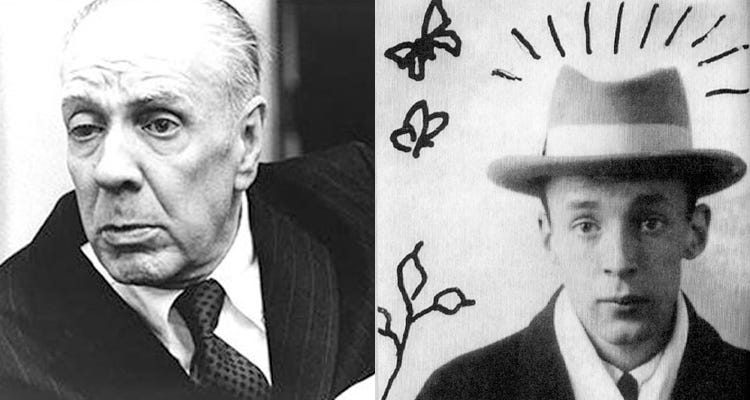
After fifty years, the Swedish Academy has just released the list of writers considered for the 1965 Nobel Prize in Literature. The list of contenders includes some top-tier names, including W.H. Auden, Samuel Beckett, Jorge Luis Borges, Pablo Neruda, E.M. Forster, and Vladimir Nabokov. The prize was ultimately awarded to Soviet author Mikhail Sholokhov for “the artistic power and integrity with which, in his epic of the Don, he has given expression to a historic phase in the life of the Russian people.”
At the time, the decision to award Sholokhov the prize was already controversial, as the author had criticized the Academy’s selection of Boris Pasternak in 1958, and many believed the award had been given to Sholokhov as “an attempt to counterbalance ill-feelings towards the Nobel.” Additionally, Sholokhov has been accused of plagiarizing And Quiet Flows the Don, notably including a public accusation from Alexandr Solzhenitsyn and other writers shortly after Sholokhov received the Nobel Prize. But now, the newly released archives have revealed that the selection of Sholokhov was, in fact, unanimous among the committee.
This new information (released fifty years later as per the practices of the Swedish Academy) gives us an interesting lens on history. As many modern literary prizes are often preempted by the timed-release of long lists and short lists, the Nobel prize is one of the few in which the decision-making process is kept relatively under wraps.
While some of the writers on the newly-released list (such as Beckett and Neruda) would go on to win the prize in the years to come, others never won the prize. On the subject, Borges once remarked: “Not granting me the Nobel prize has become a Scandinavian tradition; since I was born they have not been granting it to me.” Little did he know, he had come very close to receiving it after all.