Reading Lists
12 Must-Read Feminist Books by Icelandic Women Writers
These writers invoke the incongruence of living in country that leads in gender equity but persists in misogynistic disregard
This article is free to read. So is every article Electric Literature publishes. No limits, no paywalls—now or ever. Support from readers like you makes that possible.
Electric Literature is proud to be a space where writers are always paid and reading is always free, and we plan to keep it that way.
Donate now to our spring fundraiser to help ensure the future of free, accessible literature for all.
—————
In 1975, 90 percent of Icelandic women went on strike, though they did not call it that. They called it Kvennafrídagurinn, or Women’s Day Off. A day off from factory work, from housework, from care work, from all kinds of vital work that often goes unacknowledged and unpaid to this day. In the fifty years since then, Iceland has become the global leader in gender equity and the first country in the world to elect a female president. Its government is currently led by women, who serve as prime minister, president, a majority of the cabinet leaders, and nearly half of the members of Althing, the world’s oldest operating parliament, continually running since 930 C.E.
Much work remains to be done. In the fiction and poetry collected below, Icelandic women writers invoke the incongruence of living in a country with gender balanced policies alongside high rates of domestic violence, persistent pay disparities, and other forms of misogynistic disregard.
Literature can catalyze change. Stories embolden readers to plumb the tectonic plates of interior lives and social forces. What paradigm shifts are made possible by friction and fissures? To what extent can the Icelandic love for literature be credited with making their country more welcoming to women?
Below you will find twelve books which form a very contemporary canon of feminist Icelandic literature translated into English. Written by women who will continue to publish for decades to come, this list is by no means complete. As celebrated poet, novelist and playwright Kristín Ómarsdóttir told me, “The story of literature is long. It did not begin ten years ago.” Takk fyrir.
Miss Iceland by Auður Ava Ólafsdóttir, translated by Brian FitzGibbon
Ask any Icelandic writer to recommend a feminist novel, and Miss Iceland appears on their lips first. There’s a good reason for that. In this spare, affecting novel set in 1960s Reykjavík, Auður Ava Ólafsdóttir creates characters of sympathy, verve, and steely self-determination. Hekla moves to the capital to build a literary life, only to find herself trapped between the patriarchal prospect of two fates: to endure misogyny as a waitress or as a married mother. Taking refuge in her writing and the friendship of her roommate Jon, a queer theater aficionado forced by circumstance to work on fishing trawlers, Hekla pursues her chosen destiny against the odds and despite daily harassment by men who confuse her beauty for availability. Will she be allowed, let alone encouraged, to flourish? Winner of the Icelandic Bookseller’s Prize and the Prix Médicis Étranger, Miss Iceland delivers unabashed insights into the costs of freedom for women.
Land of Love and Ruins by Oddný Eir, translated by Philip Roughton
Called “the writer I feel can best express the female psyche of now” by Björk, Oddný Eir uses postmodern fragmentation to portray her narrator’s restless search for steadfast care. Land of Love and Ruins finds an author roaming the countryside of Iceland and streets of Paris, Strasbourg, and Basel, seeking to live in greater connection to the land and her own mind. In this diaristic collage, Eir crafts an intimate conversation with the reader through lyric passages that range from romantic yearning to ecological passion and socioeconomic ire. Anchored by an ancestral commitment to nature, she grieves the capitalist paradigms which gave rise to the 2008 financial crisis that collapsed Icelandic banks and identities. Yet as an artist and political philosopher, she plumbs her own erotic and intellectual energy to sight a liberatory horizon. Winner of the European Union Prize for Literature and the Icelandic Women’s Literature Prize, Land of Love and Ruins is the culmination of an autofiction trilogy whose first two books have yet to be translated into English.
Quake by Auður Jónsdóttir, translated by Meg Matich
Quake begins in crisis. On a sidewalk, a woman named Saga opens her bloodied eyes to learn her three-year-old son is missing. Where did Ívar go? And what happened? In the urgent, meditative novel that follows, Saga pieces her life back together as she spools through the memories which led to her latest epileptic seizure. Fragmented and fatigued, she struggles to reestablish her claim on motherhood while figuring out how to relate to her family of origin. With Quake, now also a film, the acclaimed novelist and journalist Auður Jónsdóttir examines how human memory shapes our behavior even when we seek to deny our own pasts. She asks, “Is there a way to escape inevitability? To be other than what we are?” Winner of the Icelandic Literary Prize for The People in the Basement and the Icelandic Women’s Literature Prize for Secretaries to the Spirits, Jónsdóttir brings tender pathos to understanding why we try to protect ourselves from what we already know.
Magma by Thóra Hjörleifsdóttir, translated by Meg Matich
In her debut novel, accomplished poet Thóra Hjörleifsdóttir channels the youthful impulse toward love that drives her 20-year-old protagonist Lilja into despair during an increasingly abject relationship with a brutal, boyish vegetarian. Yes, you read that right. Abstaining from eating meat does not a good man make. Wielding his lengthy education while withholding real affection, this nameless boyfriend manipulates and undermines Lilja into isolation and sexual exploitation with cruel comments. Like the psychological abuse it so deftly depicts, Magma is iterative and episodic. Hjörleifsdóttir makes excellent use of compression, that most vital source of literary tension, to relate how Lilja breaks down under the pressure of partnering with a man who weaponizes her longing into self-loathing. Inspired by the collective outpouring of grief on comment boards during the #MeToo movement, Magma is a stunning indictment of systemic failures—whether social, psychiatric, or carceral—to recognize the profound violence of interpersonal cruelty.
A Fist or a Heart by Kristín Eiríksdóttir, translated by Larissa Kyzer
There is no escaping the past, only the deferral of its reckonings. In her first novel to be translated into English, award-winning novelist, poet, and playwright Kristín Eiríksdóttir presents an obstinate elderly woman, Elín Jónsdóttir, whose craft—making film and theater props—stops acting as a stave against the memories she has long elided. An outcast by design, Elín had always managed on her own. Long live unruly women. That is, until she attempts to befriend a young playwright with an ill mother, an absent and famous father, and an undisclosed shared history. Grappling with the ravages of age and her tenuous grasp on reality, Elín lures readers into a haunted journey through the veiled traumas which shaped her tenacity. Winner of the Icelandic Literary Prize and Women’s Literature Prize, A Fist or a Heart depicts the stubborn intellect and creative determination of women, reminding us of what we might yet make once we get free.
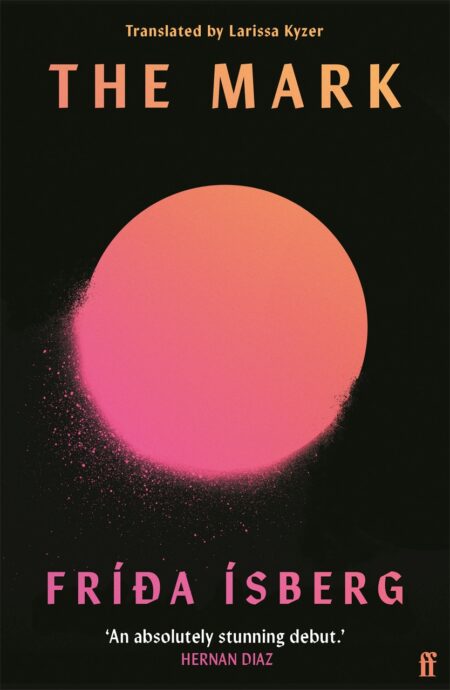
The Mark by Fríða Ísberg, translated by Larissa Kyzer
It is a rare novel that can successfully pair nuanced character development with a big plot and expert pacing, but Fríða Ísberg pulls it off in The Mark. In near future Reykjavík, Iceland is on the cusp of a major vote: whether to require that its citizens take a psychological test to determine if they have enough empathy to be accepted into society. Already used to winnow out potential sociopaths from political, corporate, academic, and other social settings, the empathy test has become a source of anxiety and discord. At the same time, it brings a measure of comfort and safety for women who have experienced domestic violence and sexual assault, and thus can choose to live in apartment buildings that do not allow unmarked people to enter. Such is the case of Vetur, who fears the return of her stalker. The Mark is made more interesting by the fact that Vetur admits her complicity in the dynamics which led to her unhappiness, having seduced a man whose faults she could plainly see, as well as how her trauma leads her to treat others—even another survivor—harshly. Ísberg also shows real compassion for the case of Tristan, an unmarked and housing insecure man whose thievery and drug addiction were brought into being by his father’s violence, his brother’s troubles, and other forces beyond his control. By stress testing the presumptions that empathy can be measured and enforced for civic means, The Mark challenges the liberal tendency to perform inclusive values while extruding those who don’t measure up.
The Creator by Guðrún Eva Mínervudóttir, translated by Sarah Bowen
In The Creator, no moment of serendipity is wasted as two lonely beings entangle. Lóa, the grieving mother of two wayward girls, gets a flat tire in front of the home of Sveinn, who lives alone but for the sex dolls he makes for sale, “a ruler between their ankles” to keep their legs appealingly parted. Sveinn just had his picture printed alongside an article about a man who committed suicide after mutilating one of his dolls, but he disavows responsibility for sowing violence with dehumanized, portable vaginas. Lóa is also in a tough spot: Her father just died, and the flat tire occurs on her way to seek psychological help for her daughters Margrét and Ína, who aren’t doing so well after her divorce. What would decent people do? Sveinn plies Lóa with wine, changes her tire and fondles her hand while she is passed out. Upon waking, Lóa pees in his utility sink and steals one of his dolls to give to her anorexic daughter, for “What was troubling Margrét but an irrational aversion to her own body or a dread of life?” From there, The Creator unfurls in a series of gleaming sentences that illuminate the human condition.
Karitas Untitled by Kristín Marja Baldursdóttir, translated by Philip Roughton
First published in Icelandic in 2004, Karitas Untitled begins in the Westfjords in World War I. Fending for herself after her husband is lost at sea, a mother moves her six children to town to be educated so that they will not be subject to the whims of subsistence farming. The youngest daughter, Karitas Jónsdóttir, has artistic talent. Fortunate enough to find a patron who sends her to the Danish Royal College of Art in Copenhagen, Karitas was also born in a woman’s body. Her creative trajectory is knocked off course by an unexpected pregnancy. Driven by a need to paint, she marries and keeps having babies within a fishing community whose male providers disappear for long swathes of time, leaving the women to support their families and each other through the ceaseless work of rural life. When to make art? Does being a mother mean you must sacrifice who you are for who others could be? Timeless questions hang in the balance of this historical novel, whose concerns for female liberation presaged Embroidery by Sigrún Pálsdóttir, translated by Lytton Smith.
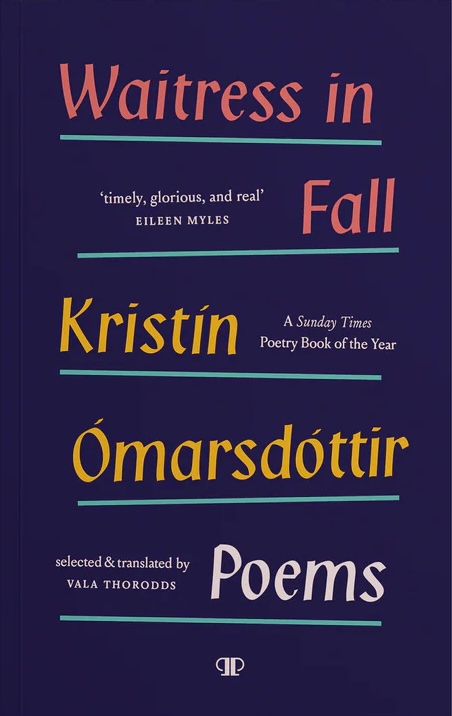
Waitress in Fall and Swanfolk by Kristín Ómarsdóttir, translated by Vala Thorodds
The zany genius of Kristín Ómarsdóttir is apparent across genres. With an alien consciousness akin to that of Anne Carson, Ómarsdóttir traces mycelial connections between imagery and meaning such that each line becomes a portal to a perception both estranged and familiar. I would be remiss not to mention her shimmering novel Swanfolk, a deeply weird modern folktale, but I encountered her verse first. Drawn from seven collections published over three decades, each odd and playful poem of Waitress in Fall is a surreal puzzle that resists being fixed into place. Take “Ode”: “…in a lightless girlhole / I met a mirror that deep-voiced said: / ‘see your beauty!’/ later it drew me a yellow line on the floor: / ‘come no closer!’” The patriarchal structures of lust and power are floodlit by Waitress in Fall, whose insights—bizarre and tender, deeply felt and sensual yet resistant to any common sentiment—are “clear as water in a truthpond.”
Herostories by Kristín Svava Tómasdóttir, translated by K.B. Thors
Much has been made of the intrepid settlers chronicled in Icelandic sagas. Yet when poet and historian Kristín Svava Tómasdóttir sought folkloric glory in the annals, she turned to Íslenskar ljósmæður I–III, which depicted Icelandic midwives from the 18th through the 20th century. Through the process of erasure, she found documentary poems among their triumphs over the limited roles allowed to women and the severe weather and landscapes they braved to bring babies into the world: “she was greatest/when most tested.” Forbidden to become doctors until 1911, these women often proffered their midwifery for as little as a cup of coffee. Winner of the Icelandic Women’s Literature Prize, Herostories brims with portmanteaus that evoke the harsh conditions which midwives endured to claim a place in history for themselves and future generations: Using “bodilyendurance” to conquer the “impassableslog” through “blindingblizzards.” What meaning can be salvaged from being undervalued? Independence requires risk and courage, which the midwives of Herostories exemplified to become ljósmæður, or “mothers of light.”
Bloodhoof by Gerður Kristný, translated by Rory McTurk
Poet and journalist Gerður Kristný scoured the Poetic Edda for insights into her mythological namesake Gerður of Jötunheimar, a giantess abducted into serving as the god Freyr’s bride. Though Kristný studied the eddic poem Skírnismál, preserved within the 13-century Codex Regius, she could not find Gerður’s perspective. Kristný decided to rectify the situation with Bloodhoof. Winner of the 2010 Icelandic Literature Award, her stark retelling of Gerður’s ordeal is an epic poem which refuses misogynist impositions of meaning. Instead, Kristný takes readers into the fierce mind of the giantess whose beauty drew such unwanted attention. When Freyr, the god of fertility, admired Gerður’s shining arms from Óðinn’s throne, he sends his vassal Skírnir to bring her to him by any means necessary. “Love had indeed come / armed to the teeth / with an envoy brandishing / a hateinfused sword / its haft carved in cruelty.” Sacrificing her own wellbeing for the life of her father, who was threatened with death, Gerður endures rape and births a son; for both of their sakes, she plots revenge and escape. A feminist reclaiming of an old Norse legend, Bloodhoof earned its place within millennia of the Icelandic canon.