Reading Lists
7 Darkly Surreal Irish Books to Read This St. Patrick’s Day
These Irish authors use wry humor to navigate desperate times
This article is free to read. So is every article Electric Literature publishes. No limits, no paywalls—now or ever. Support from readers like you makes that possible.
Electric Literature is proud to be a space where writers are always paid and reading is always free, and we plan to keep it that way.
Donate now to our spring fundraiser to help ensure the future of free, accessible literature for all.
—————
How can we cope with despair? I grew up in Northern Ireland in the 80s, when continuous sectarian hatred and state-sponsored violence seemed inevitable. The world was falling apart, so we joked about it. At funerals. In school. How could we not? I read Flann O’Brien’s The Poor Mouth—An Béal Bocht in Irish—and found my first true love in Irish literature. The characters get woefully, superlatively mistreated by the Irish countryside, by the state, each other, by the endless rain and the diabolical “Sea Cat”—and the cruelties both real and exaggerated are handled with an absurdist, roguish surrealism. There was glee in the surreal.
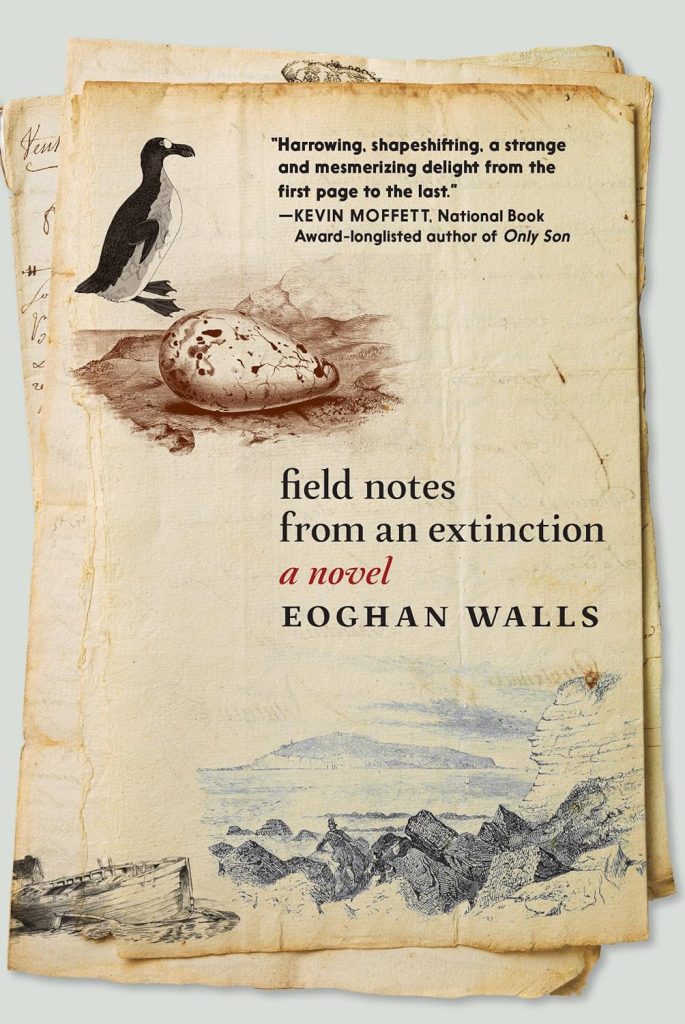
These days the air has a keen edge. A desperate edge. What forms can the imagination take when power seems nonsensical and cruelty deliberate? These questions haunt—and should haunt—our fiction. My new novel, Field Notes from an Extinction, deals with ecological disaster, weaponized starvation, and anti-immigrant sentiment. These are keenly felt today, but the Irish have always been immigrants—we build our souls on emigration and return—and I wanted to remind the Irish of this. But rather than now, I set my novel in the Irish potato famine—when there was money enough for great scientific enterprises, but people were let starve to protect market freedoms. When Irish immigrants were demonized too. My protagonist, Ignatius Green, an English scientist, has to suddenly deal with a starving half-dead child thrust onto his research outpost. The story is dark—with Great Auks and starvation and despair and the faintest hint of a werewolf—as it steps through realist suffering with humor and one eye on the surreal.
How can we dare surreal humor in the face of real desperation? As an Irishman, it’s the first tool I would reach for, and I am not alone in this. Surrealism, wit in the face of desperate times, seems to me everywhere in Irish writing now. Take these seven books as prime examples.
Beatlebone by Kevin Barry
I wouldn’t be the first to say there is a deep vein of insistent surreal urgency that pumps through all Kevin Barry’s work. In Beatlebone, my favorite of his books, the protagonist is John Lennon—unassassinated, wonderfully free of the dirt of actual history, but trapped at an existential dip in his life and marriage, ready to escape the afterwake of his earth-quaking fame and the mundanity of marriage just to scream on an island, releasing his trauma. The Ireland he escapes to—1978, on the west coast, rainy and bizarre—is pitch perfect. The woes he runs from are common as rain. The whole book takes a brazen and bewildering fourth wall lurch right near the apex of tension. You begin the book knowing—maybe loving—John Lennon. You end the book hungover and vaguely bruised.
What Planet by Miriam Gamble
Miriam Gamble’s What Planet is a deeply philosophical and nutrient-rich book of poetry. Each line has a keen sense of cadence, and her pages are full of bitter, hurt animals, each lost in worlds of surreal keening and imminent philosophical abysses—but with a feral will-to-survive. The book holds wonders—from the fish in deep sea trenches who gnaw gristle off sunken carcasses and dream of a sun they will never see to an oak that both is and is not there. There are cats who sample suicide and an elegy for Scotland that baulked at the last leap to independence like a nervous showhorse. It is a book of surreal and impossible dreamscapes, made keenly felt through a drifting, intelligent music.
If All the World and Love Were Young by Stephen Sexton
Stephen Sexton has reinvented the elegy in his first collection, If All the World and Love Were Young. Where most poetry debuts follow a largely biographical arc—my own did—his follows every level in Super Mario World. If this might deter some more traditional readers, it is simultaneously one long elegy for a mother who died when he was young, who bought him the SNES he escaped on. The pain and the beauty in the book is so deeply and achingly real, even as he moves through the Mushroom Kingdom and the Vanilla Dome in all their electric brilliance. The book has changed how poets write of death and computer games and pop culture.
The Wild Laughter by Caoilinn Hughes
The bleak desperation of a more recent Ireland is conjured in Caoilinn Hughes’s The Wild Laughter; a novel set in post-Celtic Tiger Ireland’s financial collapse, where a father in Roscommon, “the Chief,” is dying of age and poor investments and asks his sons to assist in his suicide. The pains in the book have a grand mythic scope—as of Cain and Abel or Saturn and his kids. There are intimate blood ties: Brothers are troubled in wild fields. Dogs howl at the damp horizons. The wild laughter of the title is the absurd—defiant? hopeful? despairing?—response to the new darknesses that drive us into the earth.
Big Girl, Small Town by Michelle Gallen
Michelle Gallen’s Big Girl, Small Town captures this wily surreal note too. Set in Aghybogey (made-up, but Christ it feels real), five years after the Troubles, the small town could be anywhere on the Irish border. A chipper, a pub, the dole. Majella, Jelly—the heroine—is a monumental figure—obese, complacent, and wily—who desires mainly fish supper and an occasional shag, but as life throws a disappeared father, an alcoholic mother, abusive men, and a murdered granny her way, she rises against the rainy hills with an awesome dignity. Here—the absurdity is in her perspective: the clash of a pointlessly cruel universe and the brazen defiance. Majella has majesty in the wildest of places.
Insistence by Ailbhe Darcy
Ailbhe Darcy’s Insistence is a poetry collection that reaches far beyond the shores of Ireland to wider, bleaker horizons. Through the American Rust Belt to the wake of Hiroshima, her voice is everywhere alert to pain and love. Almost pain through love. Everything aches, burns, and will die—human remains and newborn children together, and everywhere life insists, delicate but undefeated. The book reaches for the cosmic in the long poem “Alphabet”; the two poems entitled “After my son was born” frame this pain as the tremulous disjunction that is the basenote at the heart of all primordial love, “as though blood hadn’t always been there, waiting.” The whole act of survival—when even our own children ruin us—becomes weird, beautiful, aching.
We Are Not in the World by Conor O’Callaghan
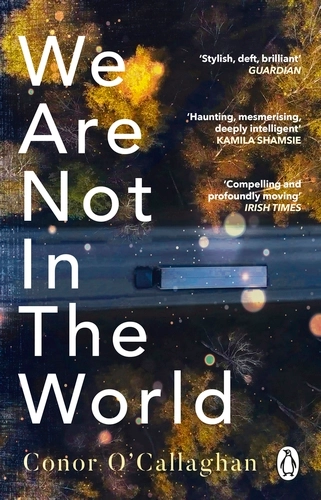
In Conor O’Callaghan We Are Not in the World, the protagonist, Paddy, turns to long distance lorry driving to escape his own past. He drives through refugee camps, away from a failed marriage and a daughter he cannot love adequately. The road he drives on is gritty and real, but he cannot thole the pain, as the story slips eventually, painfully, beyond the realms of the world. Like so much Conor O’Callaghan writes, Paddy is haunted by his own failures—but when his daughter turns up in his lorry, he thinks he might have a chance—however briefly—to right some of the wrongs he has partaken in on the earth.