Reading Lists
9 Books About Retaking and Rebuilding Our Commonwealth
In a country based on pillaging, these authors ask us to consider alternative systems that care for our collective well-being

This article is free to read. So is every article Electric Literature publishes. No limits, no paywalls—now or ever. But we rely on your support to keep it that way.
We need to raise $35,000 by April 15 to keep the lights on, and time is running out.
Help us reach the next milestone—$15,000 by Wednesday—by donating now.
—————
The social fabric of the US is under assault at all scales, from the rapacious rents charged for homes to genocidal and colonialist campaigns in Gaza, Venezuela, Iran, and beyond. This blatant disregard for life has illuminated the necessity of bringing an alternative system into being. Whether via mutual aid for ICE-threatened neighbors or renewed interest in social housing models that put homes before profit, interest in mechanisms that bolster our mutual well-being is on the rise. While these efforts can feel small next to the predominance of militarism and capitalism in the US today, they are growing, popular, and not at all foreign.
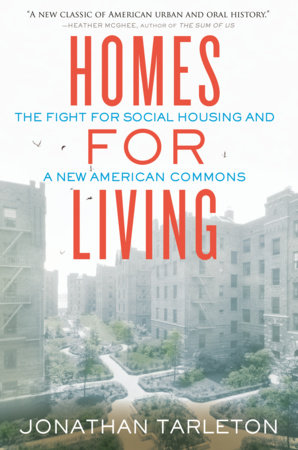
We’re frequently told that something like social housing—permanently affordable, decommodified homes with meaningful resident governance—either runs contrary to the American Dream or simply cannot work in the hypercapitalist US of A. Countering that idea was part of my motivation for writing Homes for Living: The Fight for Social Housing and a New American Commons. In it, I delve into the lives of two affordable housing cooperatives created under arguably the most successful social housing solution in US history, New York’s Mitchell-Lama program. By chronicling fiery debates among cooperators on whether to “privatize” their co-ops and profit from these public goods meant to remain affordable for the next generation, I chart the central ideas that underlie competing American visions for what homes are for and the narrative, strategic, and policy interventions needed to maintain and grow a more just housing system.
The books that follow share a similar concern with the roots of our commonwealth and the means of bolstering an ecosystem of support for its many components, from land and housing to our places of work, respite, and knowledge creation. Amid the seemingly incessant darkness of our current moment, they beckon us with light and purpose toward building a commonwealth—to retake and rebuild a broader commons in a country built on their pillaging.
Solidarity by Leah Hunt-Hendrix & Astra Taylor
The gulf between envisioning transformative ideas and taking action can be frustratingly difficult to bridge for many. Taylor and Hunt-Hendrix, two thinkers and organizers brought together by Occupy Wall Street, do so beautifully in this book that explores both the intellectual history of solidarity and its real potential when mobilized into mass politics. With analysis of solidarity’s workings within a wide range of social movements, they offer blueprints for how focusing on economic justice can bring us together across difference and cultivate the “secular sacred” through collective action.
This Land Is Our Land by Jedediah Purdy
No full consideration of the society we’ve built and one we can aspire to would be complete without going back to its very foundations: the land and environmental systems that form the most basic and most crucial infrastructure of our lives. Worth soaking up in one sitting, Purdy’s ruminations chart how we can remake our relationship with that infrastructure and transform the other material systems that form the architecture of our world. Rather than draw false boundaries between the natural world and human cultures, Purdy integrates them seamlessly in a call for a renewed environmental justice movement that would reconfigure how we value resources and relationships to better support our human and non-human communities.
Emergent Strategy by adrienne maree brown
Inspired in part by the science fiction of Octavia Butler, this “facilitation” in book form offers a framework for understanding and enacting social change, rooted in the rhythms and lessons of the natural world. brown draws from her own work as an organizer to chart a path through this sometimes messy and seemingly chaotic work to teach us how to adapt to change, recover from shocks, and embrace the nonlinear paths of progress. Far from a dry manual, you’ll be treated to poetry, journaling prompts, and wisdom from all manner of sources as you consider how to show up and “move toward life” in broader movements.
In Defense of Housing by David Madden & Peter Marcuse
If you’re looking for a treatise that clearly and forcefully argues for housing as a key site of political formation and struggle, look no further. Madden and Marcuse outline both how the treatment of our homes as commodities is at the root of so many social ills and the opportunities before us to reshape the housing system to prioritize shelter over profit. While it has become increasingly difficult for speculators to ship the story that housing costs and houselessness are somehow mechanical and apolitical, this book leaves no doubts about the policy decisions behind who gets to live where and the indignities they must suffer to do so. By zooming into movements for housing as a right in New York, they suggest how to radically reform a system that’s clearly not working—or rather, working too well for an outcome that harms the many and serves only the few.
Mutual Aid by Dean Spade
For those more interested in the nuts and bolts of good organizing, Spade offers this slim but packed volume on the practicalities of putting solidarity into action through mutual aid efforts to care for one another. Clear-eyed about the difficulties and joys of “working together on purpose,” Spade pulls on his own movement experience to talk through consensus decision-making, key leadership qualities to cultivate, and conflict that will inevitably arise. The section on potential pitfalls of mutual aid is particularly helpful for ensuring efforts at “solidarity, not charity” do not recreate the same structures and concepts they aim to dismantle.
The Sum of Us by Heather McGhee
Building our commonwealth means, among other things, reckoning with the deep and ongoing damage of racial hierarchy. As McGhee shows through dispatches from across the US that blend her perspective as a policy wonk and skill as a natural interviewer, the white supremacy at the core of American life has a cost for everyone, not just Black and Brown communities. Excising the mistaken zero-sum paradigm—the idea that this group only prospers by ensuring that another does not—from our policies offers up an alluring and real solidarity dividend that, McGhee tells us, is there for the taking by coming together to fund and maintain our public goods for the true benefit of all.
Braiding Sweetgrass by Robin Wall Kimmerer
Kimmerer’s “intertwining of science, spirit, and story” combines her training as a botanist and Indigenous ways of knowing to offer a healing meditation on our inextricable relationship with the natural world. While the prevailing American approach to ecosystems is one of dominion and plunder, Kimmerer uses stories of plants to remind us of their self-possession and their gifts. Through a string of essays that loop back on one another in pleasing and self-reinforcing ways, the great rewards of close observation, care, and mutual thriving borne of deep relationships with the basis of life become ever clearer.
Collective Courage by Jessica Gordon Nembhard
Covering three centuries of cooperative economic endeavors across a wide variety of Black communities in the US, political economist Nembhard’s study situates these democratically-controlled, collectively-owned businesses within wider movements for civil rights and self-reliance in the face of white supremacy. Ranging in scale from small businesses to regional federations of farm cooperatives, Nembhard uses the stories of these co-ops to speak to the importance of community support and ongoing education to realize economic independence and political power.
Everything for Everyone by Nathan Schneider
Schneider brings the cooperative conversation fully into the 21st century as he reports on the renewed rise of cooperative forms in the shadow of the 2008 crash. Especially well-versed in how co-ops offer an alternative to the precarity of the gig economy, he takes us inside new co-ops that counter the might of the likes of Uber by putting the ownership of digital platforms in workers’ hands and attempts to build fairer forms of cryptocurrency that don’t just reward existing concentrations of wealth and speculation. Alongside Nembhard’s Collective Courage, Everything for Everyone demonstrates the sectoral—tech, finance, agriculture, transportation, electricity—and geographical breadth that characterize cooperative endeavors today. A healthy antidote to the idea that there is no alternative to the exploitation embedded in our economies.