Reading Lists
9 Memoirs About Dating, Desire, and Reclamation
These authors use heart and humor to explore how our romantic pursuits can lead us back to ourselves

This article is free to read. So is every article Electric Literature publishes. No limits, no paywalls—now or ever. Support from readers like you makes that possible.
Electric Literature is proud to be a space where writers are always paid and reading is always free, and we plan to keep it that way.
Donate now to our spring fundraiser to help ensure the future of free, accessible literature for all.
—————
As someone who has been married for twenty years, I have heard Valentine’s Day dismissed as “a day for amateurs.” And yet for people actively dating or searching for love, it still carries undeniable allure. Long before it became about roses and prix fixe menus, Valentine’s Day was shaped by a legend of devotion and defiance tied to a saint who honored love against social constraint.
The lived experience of wanting, however, is far messier, more revealing, and more instructive than any single night can capture. When I was a magazine editor-in-chief in the 1990s and early aughts, publicly dispensing dating advice as the “Dating Diva” in talk shows and columns, I was also privately navigating my own search for love. I consumed advice books like The Rules and listened to psychics, tarot card readers, and therapists while internalizing cultural tenets about how love was supposed to unfold. My path was circuitous, but eventually and against all odds, I found my “one.”
The following reading list includes books I wish I had access to during that time. Their circumstances vary, but together, they offer a realistic counterpoint to Valentine’s Day myths, and a clearer understanding of what it really meant to search for love. These authors tell deeply personal stories in compelling prose and, in some cases, weave in research or cultural critique. They explore the emotional labor behind first swipes and cultural expectations, the intentional pauses in pursuit, and the hard-won reinventions that follow devastating disappointment. And most of them add in a much-needed dose of humor, because if you can’t laugh about the travails of love, then what are you doing? Most importantly, they remind us that the pursuit of connection should always lead us back to ourselves.
A psychic once told me during my search, “Your love is in you.” The line stayed with me long after I found myself, and love.
Everything I Know About Love by Dolly Alderton
In Everything I Know About Love, British journalist and podcaster Dolly Alderton chronicles the chaotic early years of dating, friendship, disordered eating, partying, and growing up, using sharp humor and emotional candor to capture what it feels like to want love before knowing how to ask for it. Structured as a collage of personal essays, text messages, lists (“The Most Annoying Things People Say”), recipes (“The Seducer’s Sole Meunière”), and “Bad Date Diaries,” the memoir mirrors the messiness of real life and romantic longing. Alderton moves swiftly through breakups, nights out, getting drunk, getting dumped, and intense female friendships, tracing how romantic pursuit often runs parallel to the deeper work of self-definition. Therapy eventually helps her leave behind destructive patterns as she approaches thirty, but the book resists a tidy redemption arc. More than a dating memoir, this is a coming-of-age story that argues that friendship and self-knowledge gained from heartbreak can be just as formative and sustaining as romantic love.
Quirkyalone by Sasha Cagen
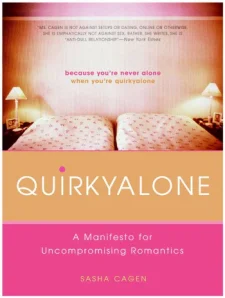
In Quirkyalone, Sasha Cagen challenges a dating culture that treats singlehood as a problem to be solved. After years of navigating a romantic landscape that made her feel single life was a waiting room for love, Cagen began questioning whether romantic partnership was the only measure of fulfillment. Rejecting rules-driven romance and the pressure to pair off, she proposes treating singlehood as a creatively generative state. A “quirkyalone,” she explains, is someone who enjoys being single without rejecting the possibility of partnership. Blending personal reflection with interviews, graphics, pop culture references like Will & Grace and Sex and the City, and profiles of quirkyalones throughout history such as Queen Elizabeth I, Nina Simone, and Gloria Steinem, the book reframes single life as a meaningful chapter rather than a holding pattern. By introducing concepts like “quirkytogether” and “quirkyslut,” Quirkyalone expands the vocabulary around intimacy, sex, and independence and invites readers to cultivate fulfillment now.
When Longing Becomes Your Lover by Amanda McCracken
Amanda McCracken’s memoir examines what happens when romantic fixation replaces intimacy and wanting takes on a life of its own. Writing from the perspective of a journalist and late-in-life virgin, McCracken explores limerence, an obsessive rumination on idealized partners, through personal narrative and research. Drawing from her widely read New York Times essays “Is It a Crush or Have You Fallen Into Limerence?” and “Does My Virginity Have a Shelf Life?” and her experiences with emotionally unavailable “anchor men,” she interrogates the idea of longing as a replacement for real emotional intimacy. The memoir blends storytelling with psychological insight, revealing how fantasy can eclipse presence and real connection. McCracken ultimately reframes longing as something that must be disentangled from inherited scripts and childhood hero fantasies about romance. Rather than offering a quick fix, she traces how this shift reshapes her behavior, expectations, and emotional availability. Learning to imagine love differently allows her to move beyond fixation and into genuine intimacy, ultimately leading to marriage and a relationship grounded in reality.
And You May Find Yourself . . . by Sari Botton
Sari Botton’s memoir-in-essays speaks directly to her experience of reevaluating love, ambition, desire, and reinvention later in life, when familiar romantic narratives no longer fit. The memoir moves between youthful missteps made to fit in with mean girls, misguided efforts to please men, fraught friendships, and professional dissatisfaction, alongside a present-day reckoning with who she has become. Botton writes with humor and clarity about bad therapists, “Mr. Wrongs,” and the exhaustion of contorting herself to meet expectations that were never really hers. As old identities fall away, she explores how desire shifts with age and self-acceptance. Grounded in feminist reflection and emotional honesty, the book offers a reassuring perspective, showing that intimacy and fulfillment can emerge from inhabiting one’s authentic self, flaws and all, with patience and self-awareness. Once Botton reaches that realization, she ultimately finds the intimacy she was seeking in a satisfying relationship and marriage.
Group by Christie Tate
In Group, Christie Tate turns to an unexpected structure to confront her struggles with intimacy: group therapy. After years of emotional avoidance and unsatisfying relationships, Tate tells her therapist, “I suck at relationships and I’ll die alone.” His response is blunt. In group, he tells her, all her secrets will come out. What follows is a memoir that unfolds through therapy sessions and increasingly uncomfortable “prescriptions,” ranging from calling a group member to ask for affirmation to more extreme real-world challenges: telling the man she desires that she is a “cocktease,” celebrating her anger after she leaves the therapist a furious voicemail, and inviting a man over solely to kiss for five minutes. Over time, the group becomes a kind of chorus, offering reflection, resistance, and accountability as Tate learns to sit with discomfort and pain rather than flee it. That work eventually carries into her romantic life, where she builds the secure relationship and marriage she once believed was impossible.
The Dry Season by Melissa Febos
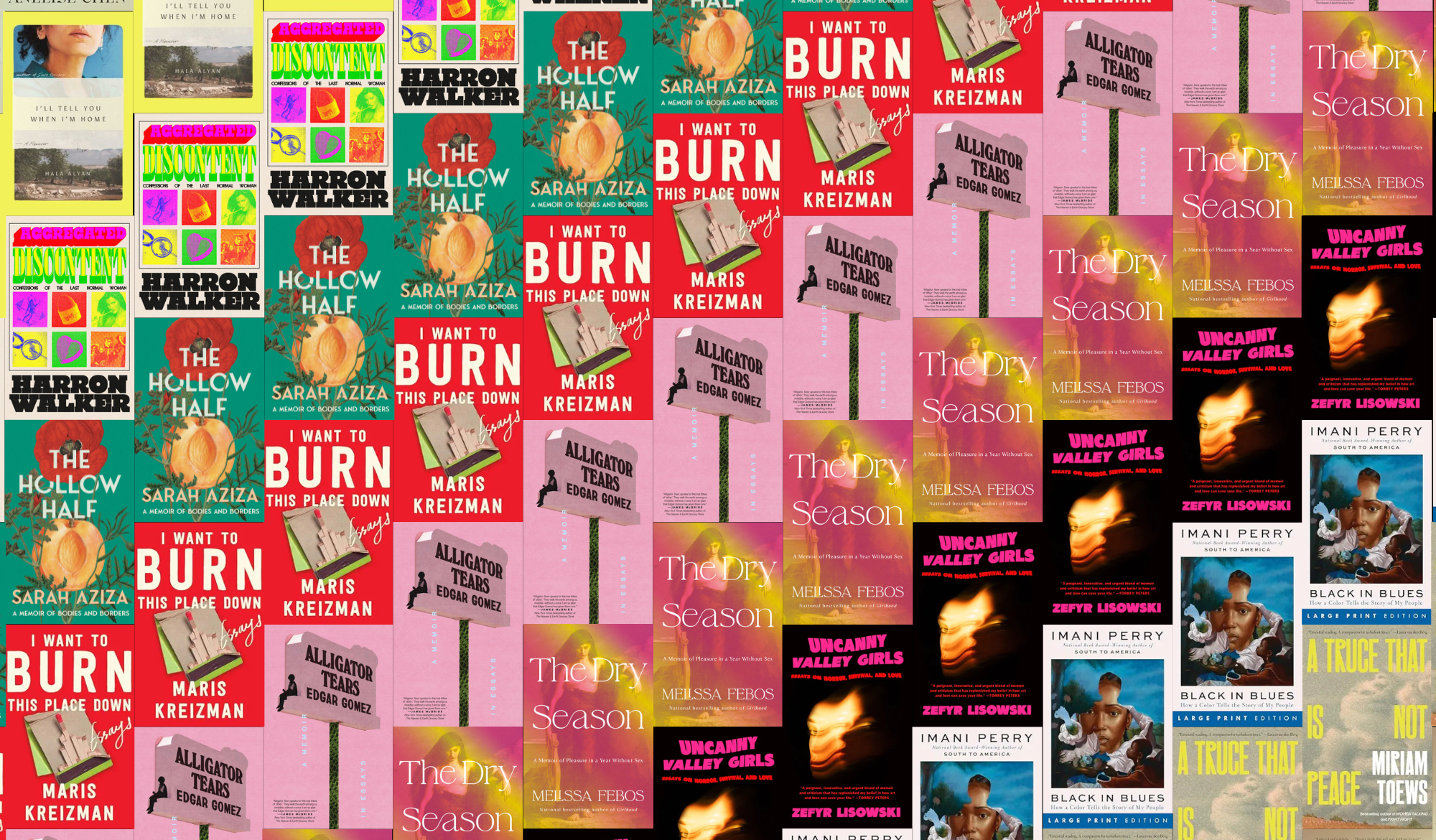
In The Dry Season, Melissa Febos begins with a radical question: What happens when we stop pursuing romance altogether? After a toxic relationship with a woman she calls “The Maelstrom,” Febos commits to a year of celibacy, not as punishment or deprivation, but as a deliberate act of reclamation. Moving between lived experience and reflection, Febos examines how desire, validation, and attachment have shaped her sense of self. When a spiritual advisor tells her she is a “user” of people, Febos confronts shame directly, writing, “The trick of shame is that it only becomes visible once you set it down.” Drawing on religious communities and feminist foremothers, she situates her personal divestment within a lineage of women who pursued autonomy and purpose outside romantic frameworks. By the end, Febos emerges ready to receive love, no longer defined by longing or seduction, but by presence and intention.
Nothing Personal by Nancy Jo Sales
Nothing Personal by Nancy Jo Sales details her midlife immersion into app-based dating culture, blending memoir, reportage, and cultural critique. As she navigates the then new app Tinder, and situationships with men much younger than her at age 49, Sales situates her experiences within a broader examination of how technology reshapes intimacy, often to women’s detriment. In between personal encounters and interviews with app users, app company executives and experts, she exposes the emotional toll of endless choice driven by impersonal algorithms. Sales reveals her addiction to the apps and her endless search for mind-blowing sex, coupled with her sharp observations on dick pics, sexting, and the commodification of desire, while becoming a leading critic of the industry through her journalism at Vanity Fair and her HBO documentary “Swiped.” Rather than offering easy solutions, Nothing Personal asks what intimacy means when connection is mediated by screens, and how self-worth can possibly survive in a culture designed to keep us swiping.
Redefining Realness by Janet Mock
This memoir opens with journalist Janet Mock preparing to tell her boyfriend her most closely held secret: that she is transgender. This is a moment that frames the memoir’s exploration of intimacy, vulnerability, and self-reclamation. Mock weaves personal narrative with social and cultural analysis, examining how race, gender, class, and desire intersect in her life as a trans woman of color. As she traces her path toward womanhood, including the physical transition, first with hormones, later through surgery in Thailand, Mock speaks about dating and romance and sex within a larger reckoning with identity, safety, and belonging. She writes how personal relationships are shaped by expectations, particularly around disclosure and risk, including moments when Mock recognizes how beauty can function as a form of social advantage, and how she uses hers to fit in where other trans people are unable to. Dating is addressed not just as a personal challenge, but as a political and emotional negotiation shaped by economic and societal constraints. Redefining Realness shows how claiming the right to define oneself reshapes not only how we love (and Mock does get her happy ending), but also, how we survive.
Sometimes I Trip on How Happy We Could Be by Nichole Perkins
Nichole Perkins explores desire with humor and a bit of hubris, writing from the perspective of a Southern Black woman navigating sex, longing and power on her own terms. Told as a memoir-in-essays, the book moves between personal experience and pop culture touchstones from Prince and Janet Jackson’s power anthem Control to Niles Crane and his love for Daphne on Frasier. Perkins writes openly about crushes, fantasy, sex, and pleasure without apology, including the ways dominance and submission shape her relationships. She resists packaging her experiences into lessons, allowing longing for love to remain unresolved across essays that cover sexuality, religion, family, mental health, body image, and how misogyny and cultural myths shape how Black women’s desire for love and connection is policed and fetishized. Even the dripping peach on the cover signals what the book insists on naming: sex, pleasure, and the right to claim them for herself.