Interviews
A Cruise Ship Novel Set in the Aftermath of 9/11
In “All the World Can Hold,” Jung Yun positions the cruise ship as a locus of performance, family, and unexpected trauma
This article is free to read. So is every article Electric Literature publishes. No limits, no paywalls—now or ever. Support from readers like you makes that possible.
Electric Literature is proud to be a space where writers are always paid and reading is always free, and we plan to keep it that way.
Donate now to our spring fundraiser to help ensure the future of free, accessible literature for all.
—————
In his essay entitled “Shipping Out,” David Foster Wallace writes about being subjected to 1,500 professional smiles in a single week. He confides that the greatest lie the luxury cruise industry tells is “that enough pleasure and enough pampering will quiet [the] discontented part of you . . . when in fact, all it does is up the requirement.” Jung Yun’s new novel All the World Can Hold confronts this manufactured fun and carnival loneliness with nuanced complexity: namely, numerous characters let down loved ones in pinnacle moments of manufactured fun, while an underclass of employees labors largely in the shadows. In Yun’s spectacular cruise setting, there is endless drinking, entertainment on every deck. “All the freedom, all the waste,” writes Yun.
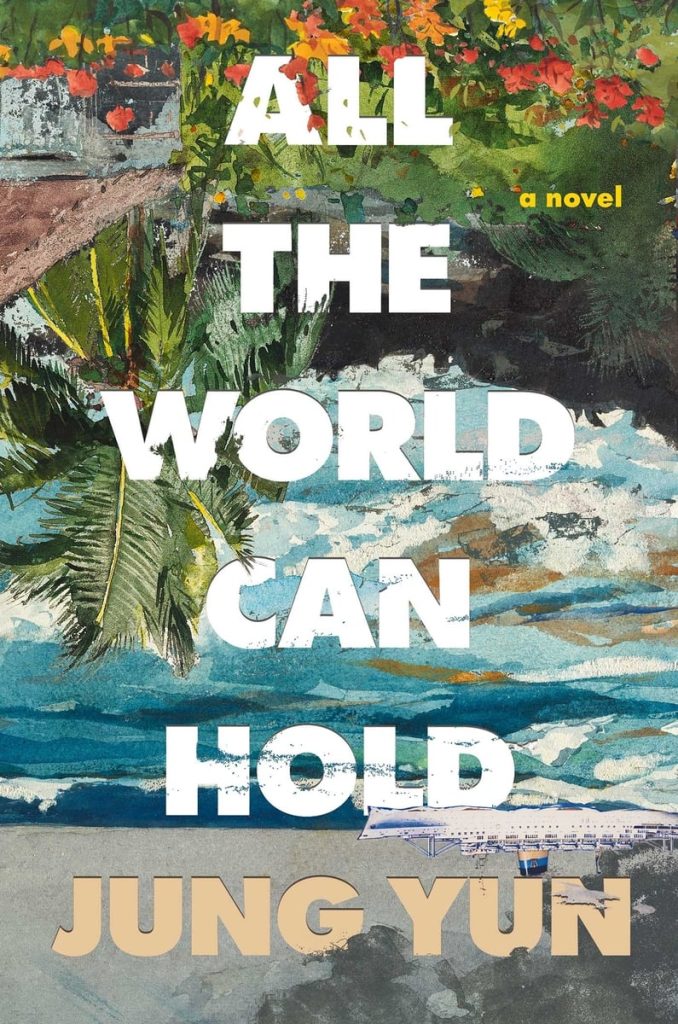
At the heart of the novel is Franny, an estate lawyer who only days ago was present at Ground Zero in 9/11—and who has told no one about what she’s been through, not even her husband. She boards the Sonata to celebrate her mother’s chilsun, her seventieth birthday. Doug Clayton, also aboard, is a recovering actor, and someone who fans talk about as if the best parts of him are in the past. Lucy is perhaps the most alienated on the cruise; a young Black woman contending with the weight of success and making her parents proud, she has to decide between security and selfhood. In this highly public, fabricated setting of a luxury cruise, these characters are all desperately trying to hide their real selves. Thousands of miles away from home, under Yun’s brilliantly blue sky, everything comes to light—especially why destruction makes art urgent.
Jung Yun and I are colleagues at George Washington University. In our second conversation for Electric Lit, we talked about cruise culture, outliers, and what it means to be legible to those we love.
D/Annie Liontas: Much like your three main characters, you went on a cruise in 2001 in the days immediately following 9/11. Can you tell us about it?
Jung Yun: My former mother-in-law—this is my ex-husband’s mother—grew up in California in the 50s and 60s and wanted to be an actress or model, so she was sort of obsessed with a Hollywood that no longer was. I think that’s why she loved that show on ABC, The Love Boat, because every episode featured all these old-timey actors who played passengers on a cruise ship. I grew up watching that show too. I thought it was pretty fun, but I never realized it was filmed on an actual working ship.
Anyway, one day my former mother-in-law calls and says the cruise line is taking the Love Boat out of commission, and she wanted to sail on it and invited us to come. She was excited about the trip, and she bought our tickets and it was a way to spend family time together, I suppose, so my ex and I didn’t want to say no. Of course, after 9/11 happened, I thought nobody in their right mind would be going on a cruise, but I was sort of outvoted there. People have different ways of grieving, and I think for them, it was easier to get away from New York rather than stay and be in the thick of things with everyone else, which is what I would have preferred. The timing of it just seemed so surreal to me. It still does. And in real life, the cruise was actually seven days, so seven really consequential days out at sea, missing everything that happened here—I still can’t believe we did it.
D/AL: One of my favorite moments in the book is when a waiter lifts a dome lid to reveal bananas flambé, and a passenger reacts in a way that makes bananas seem “thrilling.” When Franny looks around, she sees the spectacle is happening at every table. It’s a perfect image! How did you land on bananas flambé?
JY: Most of the desserts they served on our cruise were clearly meant to have some kind of “wow” factor—the kinds of things people would never make at home. The one I have the clearest memory of was Baked Alaska, which is ice cream encased in cake and a bunch of meringue, but all they did was cut slices of it tableside. I wanted to give Johannes and the other waiters more to do, so I researched desserts that had a fire element and eventually landed on bananas flambé. Have you ever had it? It’s disgusting—it’s so sweet because of the bananas and all the added sugar—but it was showy, which is what I was going for. After watching videos of people preparing it, I learned that the combination of cinnamon and fire creates a crackling noise, which made it even more of a spectacle.
D/AL: The scene points to a particular subculture of American consumerist indulgence that is both “infantilizing” and “hollow,” yet we also feel Franny’s longing for real connection. How is a cruise an ideal setting for this tension of spectacle vs. need for connection?
Cruises are a great way to vacation if you feel obligated to spend time with people but don’t really want to talk to them.
JY: I think there’s something so performative about cruising. The crew members often come from countries where working on a cruise ship is some of the best, most lucrative employment they can get. And then they encounter passengers who come from a level of wealth and privilege they can’t even imagine. That’s usually the dynamic that exists on a cruise, no matter how expensive or cheap the fare is. The crew’s primary responsibility is to make sure their passengers are having a good time.
The three main characters—none of them really want to be on this cruise, so I think they have a heightened awareness of the sense of performance that’s going on around them. They kind of try to go with the flow, to connect and do the things they see everyone else doing, but they can’t for various reasons. And that tension exists for all three of them in slightly different ways, and it feels bad.
I mentioned to someone recently that cruises are a great way to vacation if you feel obligated to spend time with people but don’t really want to talk to them. There are so many things on a cruise to entertain you—you can be with your family and perform togetherness but not actually connect in any meaningful way if you don’t want to, or can’t.
D/AL: Following the death of her father and brother, Franny has a fraught relationship with her mother, and even with her brother who, at thirty-five, she says “still behaves like dead weight.” How does Franny understand obligation? How does she understand love? What would it take for her to open herself to it? Claim it?
JY: Franny is really, really dear to me. She’s trying so hard to do the right thing and be a good daughter, but she’s trying to be a good daughter to a parent who comes from a different culture, and I think there’s a lot of misfiring and miscommunication as a result.
Franny assumes a lot about what her mother wants and needs, and she often assumes wrong. Then she feels resentful and sad and frustrated when those efforts aren’t acknowledged or appreciated in the way that she expects. But that’s the nature of her relationship with her mom. They’re so closed off from talking to each other. And Franny constantly thinks that if she does better, works harder, tries more, and is the good adult child that her mother deserves, then there will be an opening. She wants love, but she doesn’t understand her mother’s particular kind of love. And she doesn’t know how to communicate cross-culturally about what her needs are or ask for it in terms that are legible to the people in her life.
D/AL: Legibility is such a great word for this! I would say that’s also true for Doug, who’s recovering after a lifetime of secrecy and denial. I’m wondering how a vessel like the Sonata creates someone like him, but I’m also thinking about how true intimacy cannot exist without letting others witness our suffering. What allows Doug to finally be seen?
JY: I think it kind of goes back to that last question about love. After all these years, Doug still feels such love for someone he lost. On the cruise, he starts to realize that he’d rather hold onto that feeling instead of the regret and sense of failure he’s carried around since the relationship ended. Talking about who he lost with someone like Gideon—his nephew, whom he loves and cares about—will finally let Doug be known and accepted for who he truly is. That, for him, is a big part of what being seen means. He had that once, and with Gideon, who’s probably the closest person to him now, it’s sort of his way of inviting love back into his life.
D/AL: Lucy is very much an outlier and is under such a burden to succeed and make her parents proud. She is forced to choose between her analytical work—which would bring financial security—and her love of art. You write, “Maybe this is just what adulthood is, a series of choices made in doors closed.” What is at risk for Lucy in choosing freedom?
JY: Everything is at risk for Lucy. I mean, in many ways, she’s the character who was closest to me in age and situation at the time that 9/11 happened. It’s no coincidence that Lucy got a lot of the same messages from her family that I got from mine in terms of always working and trying harder than everybody else because that’s the only way to be successful in this country. For someone who’s been raised like that, someone who sees education as a path to success and success as financial stability and a career, at the end of the book, everything is at risk for her. The life that Lucy’s been taught to want and seek and work so hard for—it’s all on the table for her in the same way that it felt like it was all on the table for me when I left New York.
Some of my early readers—they always want to know what happens to Lucy. And I’m like, well, what do you think happens to Lucy? Part of what you assume about her future after she leaves the ship is rooted in one’s sense of optimism or cynicism.
D/AL: In your very touching open letter, you tell readers that this is your most personal novel, and that these characters represent an aspect of who you were in 2001, unfulfilled by work and grappling with regret. At one point you write, “Franny didn’t survive two disasters to return to the life she had before.” How can destruction be a beginning? How is that true not just for your characters, but for you?
JY: With each of these characters, they’re in this confined space—a place they don’t want to be—with people they don’t necessarily want to be with, and they realize that once they get off the ship, everything can continue on exactly as it was before. But I think something about the timing and the close quarters and the forced comingling makes the reality of their lives very stark, in ways they can’t necessarily see in their day to day. It’s all heightened because of the environment they’re in.
D/AL: Like being trapped in a car during a fight!
JY: Exactly! Nobody can walk away. You can take a lap around the ship but you can’t leave.
Because of what happened on 9/11, these characters suddenly understand how short life is, how unpredictable and often cruel life is. And even under the best of circumstances, life is never going to be as long as people want it to be. So here they are living these lives, not fulfilled by their relationships or their work, accepting what passes for love. And I think the destruction kind of serves as a microscope, a reason to look more closely at themselves. It was certainly a microscope for me.
In my 20s, when I was in New York, I was living like I thought I was immortal. I smoked a ton and didn’t sleep and had a terrible diet and worked all the time. I was just so stubborn and so trained to live the kind of life that I was living, it took a full-scale disaster to see that my life was pretty empty. I needed to be doing something different and what was I waiting for? If anything ever happened to me, I decided that I didn’t want to go without love in my life and without people who really knew me and accepted me as I am. And I didn’t want to go without doing the kind of things that mattered to me, like writing. But that’s where I was headed, so something had to change.
D/AL: There are so many stark descriptions of 9/11. The one that stays with me, especially, is the woman whom coworkers judgmentally describe as a clothes horse, not realizing that she carries her jacket down to ground level because she is so badly burned. What did it mean to you to get so many invisible or forgotten stories onto the page, nearly 25 years later?
JY: That meant so much to me, because I got to go back and research the seven days when I was gone. Today, if I miss an issue of The New York Times, I can just go online and find it again. Back then, I couldn’t do that. For twenty-some years, I lost those seven days. So part of my research was going into the archives and actually seeing the papers as they were in 2001 and all the things I missed. I read every single Portrait of Courage in The Times and so many accounts of people who got out of the towers and stories about people who helped in ways big and small. I immersed myself in the stories of that day and the days afterward that I wasn’t around to see, because I wasn’t in a place where I could see.
I didn’t claim being an artist for a very long time.
Having a chance to go back and do that research before starting the book—it put so much into perspective. It reminded me of the strength and goodness of people, how truly kind we can be to strangers and strangers can be to us. Things got complicated afterwards in ways that the final chapter refers to, but for a moment in time, so many stories were about our shared humanity.
D/AL: Most of the novel is written in close third, but you use the omniscient when we get to Bermuda and then again when we’re back on land. Can you talk about what that opened up for you, to follow the passengers as a collective?
JY: While I wanted the book to be really close to these three characters and for readers to know them well by the time they finished their journey together, the book has always been about something bigger. And I think the final chapter in particular is meant to signal how the world changed after this event, just as individual lives did.
D/AL: Lucy recalls her father bringing her to the National Portrait Gallery and asking: Was any of this art made by people who look like us? Lucy has to decide at this moment whether or not she can pursue her dream. What was it like for you to claim being an artist?
JY: I didn’t claim being an artist for a very long time. In my teens and twenties, the path felt more uncharted than it does now. It wasn’t until in my late 20s that I started to see writers who looked like me, who wrote stories that spoke to experiences similar to my own. I was the kind of person who needed examples of people who shared my identity and “made it” as a writer. I think part of the reason why it took so long to do this work is that it felt risky. And I was brought up to avoid risk, you know, coming from an immigrant family.
My parents were all about stability. You don’t come to this country with nothing and then work like they did to take any more risks. They already did that. So my generation was about building on their efforts and seeking stability, status, wealth, et cetera. Being an artist—that didn’t seem like a good bet. For a long time, it didn’t seem like a good bet, and yet it was the thing that I wanted to do more than anything.
Now, it feels like I’m finally doing exactly what I want to be doing, that my whole adult self is acting on my own desires rather than the desires of others.