interviews
A Satire That Captures the Absurdity of Being a Writer in Hollywood
Hallie Cantor’s “Like This, But Funnier” pokes fun at the entertainment industry's incessant appetite for burnt-out screenwriters

This article is free to read. So is every article Electric Literature publishes. No limits, no paywalls—now or ever. But we rely on your support to keep it that way.
We need to raise $35,000 by April 15 to keep the lights on, and time is running out. Donate today.
—————
I spent two years trying to sell TV shows in Los Angeles. Before my first pitch, I asked my agent if I should dress casually or formally. She told me to dress “NYC cool,” which was absolutely not one of the options. I can’t say my memories of my time in Hollywood were “good,” necessarily; I never quite felt like I fit in.
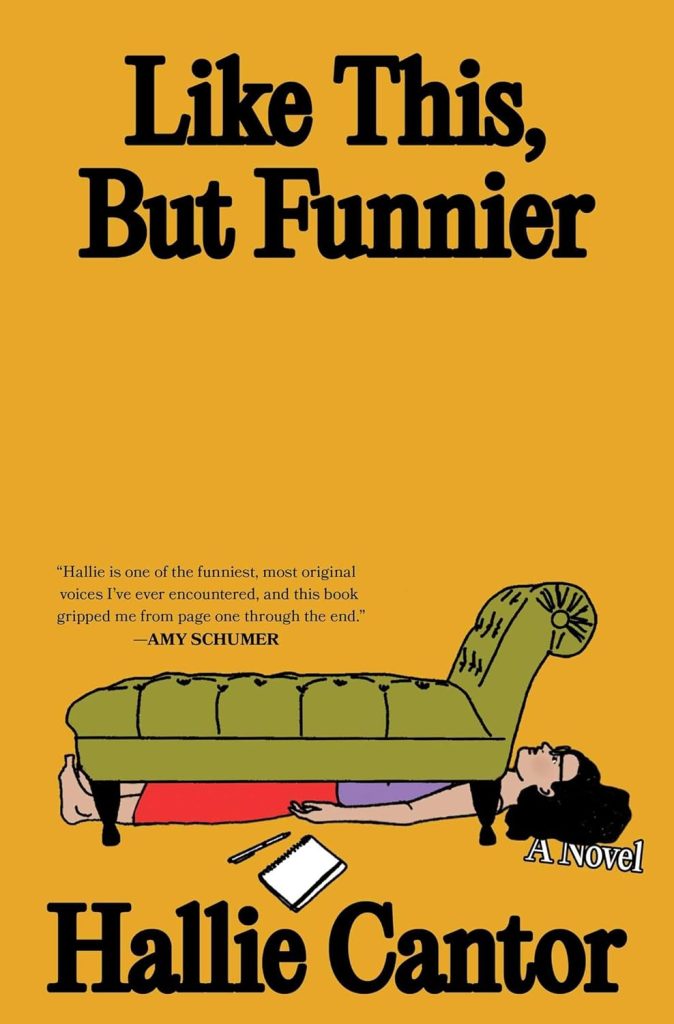
After I left LA, I wasn’t keen to re-enter that world: the world of pitching ideas you never thought would reach viewers, of waiting in “development hell” for months, of never getting an official rejection, but instead just watching the industry slowly ghost you. Because of the sour taste Hollywood left in my mouth, I was particularly struck by how much I enjoyed Hallie Cantor’s Like This, But Funnier, the perfect satire of the TV writing industry. Her protagonist, Caroline, captures exactly what it means to spend your days pitching a nebulous idea for a TV show while wondering if your life is ever going to start moving. Cantor deftly describes the negative space that fills your world when the industry demands you have a close personal connection to your story, but your days are spent in your PJs in front of a laptop, so you don’t think that story is quite that compelling. She skewers how attached execs can be to small, unimportant details of a pitch that become impossible to build a world around. She roasts the industry’s obsession with authenticity while making the same type of show over and over again. All while capturing a complex female protagonist struggling to manage her relationship, her career, and her uncertainty about starting a family.
Cantor and I met over Zoom to discuss the screenwriting industry, letting our characters live in uncertainty, and envying the nine-to-five.
Ginny Hogan: How did the character of Caroline change during the drafting process of Like This, But Funnier?
Hallie Cantor: In my first draft, she was oddly very grumpy and annoyed all the time. And I think that was partly because I was grumpy and annoyed about having to write a first draft. And that came out in the character. It’s also an easy place to find humor: this self-defensive, cynical crouch of like, this is stupid, that’s stupid. But that gets grating over 300 pages. In later drafts, I really pushed myself to find places where she’s more terrified or elated or any other emotion. So she’s not just constantly annoyed.
GH: I imagine that this was very much inspired by experiences that you had as a writer. Did you consider writing a memoir?
HC: I never thought about writing a memoir. I didn’t even think that I was going to be writing about my own experiences at all. I set out looking for an idea for a funny fictional novel. Then, I had this idea about a writer married to a therapist, which I am in real life. Gradually, in my subconscious, I started feeding pieces of my own experiences into Caroline’s, and the story became what it is. But often, when I’m writing, I take a real feeling and hang it on a scaffolding of a bigger premise. That’s not only more fun for the writer, but it’s more fun for the reader to read about somebody who’s lying and stalking, caught in a web of their own deception, instead of a plot that’s more like “she felt bad about herself for a couple years.”
GH: One of the things I loved in the book was Caroline’s TV show pitches. The pitches get worse and worse, but the studio gets more and more excited about them. She gets caught in this web of lies; she’s not sure that it’s ethical for her to pitch the show because the character is inspired by her husband’s patient. And on top of that, she knows the pitches are bad. And I found it very real – it can feel like the industry’s taste is not aligned with your own. But I’m wondering, for a person who is outside of Hollywood, was there anything you wanted to explore that felt too far-fetched? Anything you had to rein in to make it more believable?
I think her journey is about having the self-compassion to not be afraid of her own ambivalence.
HC: Not really. There’s a section that’s just emails from her agents and executives giving her notes on the script. An early reader said, “This section feels like a different tone from the rest of the book. This is a little too heightened.” And I was surprised because a lot of that was taken verbatim. There’s definitely a bit of satirizing, but I didn’t think of the book as a Hollywood satire because the reality of Hollywood is so silly and ridiculous. I just wanted to present that on a plate to people outside of it.
GH: That really comes through. Did you know when you started writing how you wanted Caroline’s story to end?
HC: Not specifics. I had a sense that I wanted her to have a changed relationship by the end, both with herself and with her work. For so much of the book, her fatal flaw is that she feels like to be worthy, she has to be exceptional. She thinks she has to be the most talented, that she has to rise above everybody else in Hollywood. And by the end, she’s open to the idea that her creativity can connect her to other people instead of setting her apart from them. I did note that I didn’t want her to decide one way or the other about the question of whether or not to become a parent, which is also a big thread in the book. I didn’t want the takeaway to be, “yeah, you should have kids,” or, “no, it’s okay not to have kids.” I wanted to honor her ambivalence. And honestly, she’s not even ready to make that decision. I think her journey is about having the self-compassion to not be afraid of her own ambivalence.
GH: That’s so interesting. I know it’s becoming a bigger thing to depict child-free women in books and on TV, which is so cool because that’s definitely been missing. At the same time, I also think it’s so cool to depict a woman who just stays in uncertainty. That is definitely missing from the conversation.
HC: So many articles are like, “I wasn’t sure, but now I have my two-year-old.” Well, okay, you figured it out, but what about the rest of the world?
GH: There are parts of the book that felt so close to home in terms of how people talk in Hollywood, especially with Caroline’s agent. Was there anything that felt almost cringy to write?
With those experiences, you’re carrying the shame, internalizing it,
wondering if you were asking for it.
HC: There’s one scene about a Secret Santa gift exchange in a writer’s room. And it’s not even really necessary for the plot, but I always knew that I wanted to include a moment like it. I’ve had these experiences in the TV writing industry, as people do in a lot of creative industries, where somebody makes a joke or says something that’s a bit off, and you don’t realize until later that it upset you. But at the same time, you don’t wanna say anything because getting along with the other writers is such a big part of the job—you want to be part of a cohesive social unit. But with those experiences, you’re carrying the shame, internalizing it, wondering if you were asking for it. And I wanted to show that. Specifically, how the accumulation of those kinds of experiences could affect Caroline. And could affect the way that she feels about herself and her career. But it was difficult to write. I found myself experiencing this self-doubt of like, is this even anything? Should I not even include this? Is she being a whiner?
GH: Creative careers are so idealized, and Caroline is a woman who’s had a lot of conventional success and is still dissatisfied. So I love that scene because it really shows that she has not had a super smooth ride, and yet, she herself still idealizes this career path and can’t imagine doing anything else.
HC: That’s a big part of it. You do idealize the career, and you don’t want to seem ungrateful because you do love what you’re doing. But then, there are these parts of it that you’re like, this didn’t feel so good.
GH: Is there anyone in Hollywood you were worried would be upset by the book?
HC: There are maybe some people who could see themselves in it, but the honest truth is, I don’t think that they read books. And even for people who have read it, it’s easier to recognize a behavior in others than in yourself. In the meetings I’ve had about the book, people have been like, “Oh, it’s so accurate, everybody I know is like that.” And I’m like, “Yeah, and you.”
GH: Did the process of writing the book change how you view your screenwriting career? Or screenwriting as a field?
HC: If anything, it underscored for me how much free work we’re expected to do as screenwriters. It sounds counterintuitive because, obviously, writing a novel is the ultimate piece of free work. But it felt different; I knew that even if I didn’t sell the novel, it could exist as a piece of art in the world. And that was very satisfying. It also made me reflect on the years I had spent working on pitches and scripts that are basically blueprints for something else. And you have a small chance of getting paid and a very slim chance of the work getting produced. It can be very hard to feel that your work is valued in those circumstances.
GH: Was it easier to get motivated for something that you knew you could make on your own?
HC: Definitely. I had gotten to a point where I was pretty jaded about working on pitches because after enough failures, I was like, well, this is not gonna be anything. I’m just doing this on the off chance that I get paid, but no one’s ever going to read it or enjoy it in the way that an audience is meant to enjoy something. So it was very exciting to work on a novel and think that even if I ended up publishing it on a blog, people could still read it.
GH: Do you want the book to change readers’ perceptions of the TV writing industry?
I don’t think I’m the first person to say that the entertainment industry is tough.
HC: It’s an interesting question. I certainly didn’t set out with that intention. And I don’t think I’m the first person to say that the entertainment industry is tough. In the years since writing the first draft of the book, we had the writer’s strike, which showed people the bigger structural issues facing TV writers. So if anything, the book can function as a magnifying glass. It lets the reader zoom in on what it feels like to work within a system that is constantly demanding that you bang on the door to prove yourself over and over and over. And how easy it is to adopt a worldview about your worth, and value of your labor, and your relationships to other people, and how much you can trust what other people say, and how authentic you can be with other people, and all these things that have a massive impact on us as humans.
GH: The relationship aspect comes through so well in the book. Caroline is married to a therapist. And I know from my own experience that there’s this dynamic between being in a creative career and being married to someone who has a stable job. I’m curious what your thoughts are on it. Does it ever make you envy a nine-to-five?
HC: All the time. And my husband not only has a stable job, but it’s a job that concretely helps people. So it’s very easy to be like, What have I done with my life? But yeah, I’m doing it. I’m telling myself that laughter helps people in its own way.
GH: It does! And I tell myself that all the time too.
HC: And the flip side is that you do get to see the downsides of a nine-to-five, where this person has to go to work every day, even when they feel crappy and wanna take a nap. And as creatives, we do have the freedom to make our own schedule and all those other things that we can appreciate.