Interviews
A Trans Dad Interrogates the Gendered Experience of Domestic Life
In WHAT I MADE FOR DINNER, Krys Malcolm Belc uses celebrity food culture to explore gender, parenthood, and the labor of caregiving
I am a big fan of Krys Malcolm Belc’s writing because he takes binaries like queer:straight male:female and turns them on their heads. In his latest memoir, What I Made for Dinner, he seems to like to live in the gray area, as the title of his essay “I’m a Trans Man, but I’ve Become My Mother” suggests. Originally published in Electric Lit, that essay is now a chapter in What I Made for Dinner, titled for the influencer who inspired him, “Ree.”
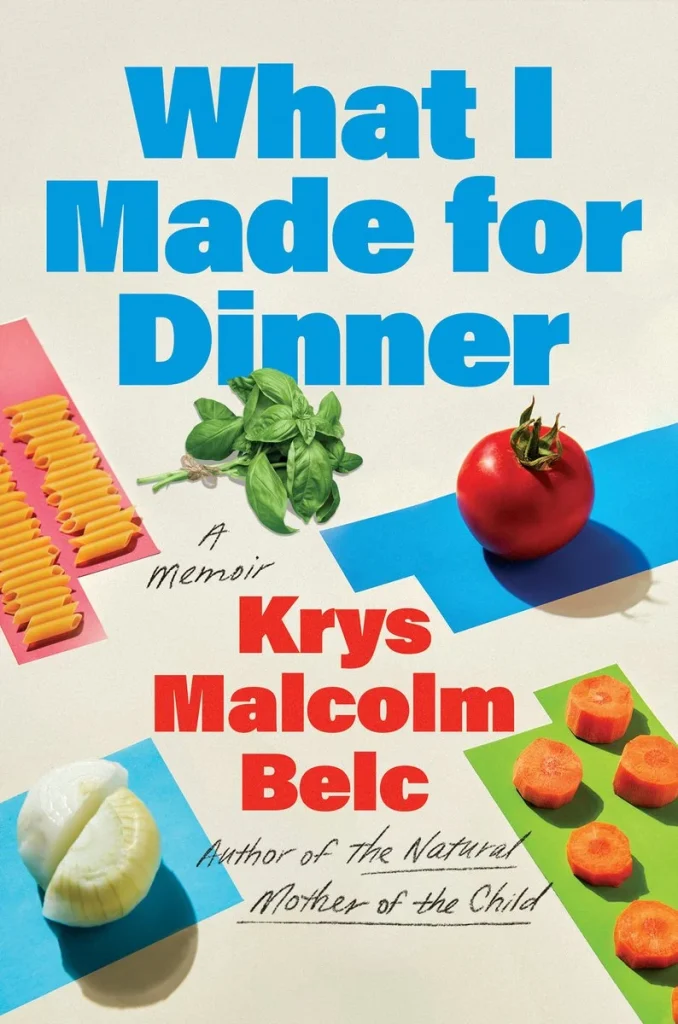
What I love about Belc’s newest book is the way he’s able to hold space for his own trans identity, while still taking his kids, his conservative mother, and even the trad-wife movement he watches on TV seriously. He finds the ways in which his life as a trans man cooking meals for his wife Anna and their four kids overlaps with the stay-at-home wives and mothers we often assume are in opposition to queer politics. He writes with a lot of generosity, and reading his work makes me feel like he’s opening up the conversation, rather than shutting it down.
I’ve known Belc since he was a rugby-playing 19-year-old, just starting college and trying his hand at fiction. It was fun to call him up and ask about all that went into his insightful and luminous new book. Over the phone, a medium he said he hadn’t used this way in a while, we discussed having kids, food culture, and writing a memoir that spans both the frivolous and the dark.
Emily Robbins: All of the chapter titles in this book are women’s names. Can you talk a bit about where this idea came from?
Krys Malcolm Belc: Titling is primarily, for me, a way to subvert expectations about what something is going to be. In terms of gender and the titles of these chapters, when I was writing them as essays, I was thinking a lot about the types of models I had growing up, of what I could turn into, and none of them were men, because that was not the reality of my childhood. So, I think I was interested in looking at these nine women, who have widely varying relationships to the way they present femininity, masculinity, or something that doesn’t neatly fit into those.
A lot of the book is about the decision to divest from all the options I had to become a woman, and still to be very compelled by looking at women and thinking about them as models of a type of person I can be. I am trying to replicate the dishes they’re making, the way they act in the kitchen, the way they’re presenting themselves in the world. I guess I’m caught up on the fact that transitioning didn’t change the way my orientation toward possibility was created as a child.
ER: You quote Stephen Vider: “While the home is not innately freeing, people of various identities and backgrounds have found emancipatory potential within the constraints.” A lot of your book is about homemaking, and when you do and don’t feel comfortable as a homemaker.
KMB: A lot of what I see online about domestic labor, and the way it breaks down in mostly straight households, is very binary. Either you’re someone who loves it and wants to be at home being a trad wife, or you’re someone who doesn’t want to do it at all. I don’t think that captures what anyone is actually like.
I’m caught up on the fact that transitioning didn’t change the way my orientation toward possibility was created as a child.
Most of the people I know have to do domestic labor. Some of it they like and some of it they don’t. People I know who love to cook don’t necessarily love to do it every single day, or love doing it when their kids are going through a picky phase, or when they’re not feeling well, and too bad because your kids still need to eat. There’s a lot of complicated angst around it that is not captured by what I imagined as a kid watching my parents do or not do domestic labor, or by what I’m seeing now in parenting content online.
ER: It is always clear that you love your family. At the same time, you are not afraid to express ambivalence about your relationship with your family, even though your kids are old enough now to read this memoir. Does writing afford you the space to be ambivalent?
KMB: It does, but I think there are many nonfiction writers who find space in their writing to air thoughts that they don’t generally air. That is not me. I think my kids understand that they’re not the center of my universe. I’m not always happy to be with them. Not in a mean way. I want them to have a full range of emotions without feeling like they owe me happiness or devotion because I perform love or labor for them.
We have a lot of fun together. I love having a big family, and a lot of the time I spend with my kids is wonderful. I keep liking parenting more as they age. Hanging out with my teenagers is the best thing ever. But if they say, Do you want to play this game?, I am happy to say, No, I don’t like that game. I’m not doing that. Or, I don’t really feel like watching TV with you tonight. I would rather watch TV with your mom, so you need to go somewhere else.
If my kids read this book, I think they would say, This is an extremely accurate portrayal of how Krys feels about parenting. They don’t understand the degree to which I’ve had mental-health struggles. I tell them I’m tired or having a bad day, but I wouldn’t say, I’m severely depressed. That is my boundary. But something like, Sometimes Krys wishes we would all go take a walk and be gone for an hour. They are well aware that is how I feel, and that’s a kind of humorous thing that our family shares that I don’t think my kids have any negative feelings about.
ER: Have people in your family read it so far?
KMB: Not yet. I was a lot more nervous about that with my first book than with this one. There’s some aspect of writing a first book where you’re trying to figure out how to enact your sensibilities on paper. In memoir writing, for me, part of that was, Who is the me I’m going to put in a book? My first book put a very morose version of me on paper, someone very ruminative about microaggressions he’s experiencing and these negative vibes toward childhood.
I really went in for [the idea that] the speaker of the memoir is not the writer; it is a character you create. That was a shield that helped me write that [first] book. With this book, I was like, What if I could just really actually try to transmit my actual personality in a book? I’m not engaging in the artifice that was so central to my first book. With the second book, I want to be recognizable to people I love.
ER: This book goes from light to very dark.
KMB: Yeah, when I was working on early drafts, the dark stuff started pretty early. The book had a lot less plot. I didn’t know that my life could arrange itself in a plot. I didn’t have that perspective when I started writing the book, so I was writing about the emotional landscape primarily, and not necessarily putting it in a reader-friendly order.
I realized perhaps in this type of book, you want to know the person you’re getting into the deep water with a little better. I don’t think it is primarily a book about being depressed. It is a book about someone who is getting depressed as part of what happens to them in the events of the book, which last a number of years. So, I decided to order the material so that [the depression] came closer to the middle, even some of it closer to the end.
With the second book, I want to be recognizable to people I love.
I could have started with, I’m infertile, I’m depressed, I had a traumatic birth experience. Instead, I was sort of like, I want someone to be fully in it before getting that information, and I want them also to be able to come out of it, and that’s not because I’m “completely healed” or everything’s great, but it is a real experience. Luckily for me, my postpartum depression was contained within one year. So, I think it is an honest representation of what typically happens with postpartum depression, but I didn’t want to descend too quickly.
ER: One scene that struck me is when Anna puts aspirin on the counter and says something like, when you are having thoughts of self-harm, promise me that you will only use this to grind into paste, and not on yourself.
KMB: That scene is something I wrote really early on. It had an interesting voice and intensity, and it was about how you have to make dinner no matter what’s happening, even if you’re struggling. That was one of the early sparks of this book. I was like, I’m making this celebratory dinner while I’m having this really intense interaction and it’s spinning off and making me think [about] all of these other things and communicating with your partner in the midst of that, and trying to keep that conversation out of the larger family sphere. That’s all quite complex and relies on a level of faith that takes a long time to develop. But I would like to think that we have.
ER: You write about going off testosterone to have a child, going through postpartum depression, and Anna encouraging you to get back on it.
KMB: I think Anna was sort of pressuring me to go back on T at five months postpartum, partially because she was like, I know you’ll like the way you look better. It was an outside-in solution. More than, You’ll feel emotionally steady or it will make you stop crying, it was, It will make you more muscly, working out will be more fun, your facial hair will become thicker. You’ll like the way you look, and I can’t offer much, but I can offer insight that you like looking nice and perhaps that will help.
I love a little treat, I operate in my life on the little treat economy. So it is like, it’s a little treat, more hair on my chest. And it did start to help me emotionally. But I started back on T at five months and didn’t feel totally out of that depressive period until my daughter was closer to a year old. It was a slow, slow upswing. But I did feel better once I looked a little better, so she was right in that regard.
ER: There is another vignette where Anna is reading the Edinburgh Postnatal Depression Scale on her phone. She asks if you’ve considered self-harm, you say yes, and she marks no because that is the right answer for the form. Your book interrogates forms and institutional forms. How do you think about forms?
KMB: We both now see forms like the postnatal depression scale, or any of the forms I filled out when I got neuropsychological testing, as something you fill out partly in a way that helps you get what you think you need out of the interaction. I was diagnosed with ADHD, anxiety, and depression, things I had known for a very long time were part of who I was. Nothing changed because I got a diagnosis, except that I wanted stimulant medication for my ADHD and was able to get it.
Similarly, my first book deals a lot with legal forms we had to do for an adoption. We got what we wanted out of the interaction. I think there is also a tie to trans medicine: You say what you need to say in order to get the medication you feel you need. That doesn’t involve exaggerating. It involves knowing how the story is supposed to be presented.
The biggest motivator for transitioning was to look unremarkable.
That particular question on the postnatal depression scale, [Anna] was like, Do you think the kid’s pediatrician is going to help you get something you want out of disclosing that you’re having thoughts of harming yourself? If it’s really bad, you do need to seek help. But in this setting, it is just going to bring additional scrutiny. Not in a harsh way, just, you have to pick who you disclose things to, which is part of the reason why talking about being depressed is probably the scariest part of this book for me. I think she was not dismissing the symptom, but rather being like, We disclose things to people who will support us. This is perhaps not the setting where you’ll get the support you’re looking for.
ER: So much of this book is about presentation: How TV chefs are presenting, and how you present to the world. Yet you almost never mention beauty. Are beauty and attractiveness important aspects of presentation to you? Have your feelings around that changed over time?
KMB: I don’t think I ever thought about those things. The biggest motivator for transitioning was to look unremarkable. It’s interesting the way people talk about queerness in the public sphere because a lot of it is about presentation and choices that we make in presentation, and I think growing up, I had this sense that it didn’t actually matter what I wore or what I did. I was marked. Something about my affect, or the way I looked in clothes, or the way I carried my body, made me stand out and drew attention to me. I did experiment with ways to make that go away. I think I would call it more conforming versus trying to be beautiful, and it didn’t work. It didn’t really matter if I always wore sports clothes or if I wore dresses and skirts. I know how to dress. I think I have a decent sense of style, but I didn’t find an outfit that would work for me, which is why I’m so interested in Ina Garten. She literally wears a uniform on television, and it is not a chef’s coat. It is just an outfit she can buy at the store.
When I transitioned, I was like nobody. I didn’t necessarily stand out anymore, which is wild because I’m very small for a guy. But being a small white guy is very unremarkable. People don’t look at me anymore. I don’t feel scrutiny. And I used to feel like my appearance was quite scrutinized.
A lot of these women [TV chefs] are conventionally attractive white women. If I used words like beautiful or pretty, it would just be repetitive. I was more interested in how to describe people without being a guy who likes women talking about how pretty all these women on TV are. What other kinds of looking can I do, other than that narrowly constrained way of looking?
When I was researching someone like Nigella Lawson, I was struck by how objectified she is by men and by the creepy male gaze people engage in when looking at her. That is not part of this book to me. It’s not that I don’t think about whether people are attractive. It’s just not what is interesting to me. I was interested in how they dress, and what that tells me in combination with the type of space they are in. The way the background interacted with what they wore was more interesting to me than whether they have a nice face, because they all do.