Lit Mags
Her Drama Is Tolerable When It’s Performed Onstage
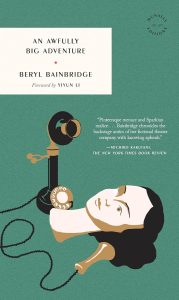
An excerpt from AN AWFULLY BIG ADVENTURE by Beryl Bainbridge, recommended by Lucy Scholes

Introduction by Lucy Scholes
I can’t recall when it was that I first read Beryl Bainbridge. Growing up in the UK, she was always there—on the bookshelves alongside Muriel Spark, Barbara Pym, Anita Brookner, and any number of other literary grande dames. She was a writer known for her macabre, fearless, hugely entertaining, extremely funny, and deliciously clipped novels. Imagine my surprise then when I learned her name doesn’t quite elicit the same recognition in the US. My bewilderment soon turned to glee as my colleagues and I realized the golden opportunity this presented. An Awfully Big Adventure is just the first of Bainbridge’s works that we’re reissuing at McNally Editions, and it’s the perfect introduction to this writer who, in the course of her four-decade career, published 17 novels, five of which were shortlisted for the Booker Prize.
When she was 16, Bainbridge joined the repertory theater in her hometown of Liverpool. She was initially hired as an assistant stage manager, before unexpectedly finding herself the stand-in for a young male actor who’d met with an accident, or so she claimed when regaling the tale of her lucky break in later years . . . I’m hardly the first to point out that Bainbridge was notorious for never letting the facts get in the way of telling a good story. Much of her own life—her experiences, the people who were dear to her, and places she knew well—made its way into the pages of her fiction, but she was never constrained by any sense of fidelity to the absolute truth. Alas, her promising early career on the stage didn’t last. She moved to London in the early 1960s and turned to writing instead—thankfully!—but her experiences were all grist for the mill, and she drew on them heavily when she wrote An Awfully Big Adventure in 1989.
Having sprinkled a liberal measure of make-believe over her memories, the novel is an adults-only tale of calamity, happenstance and buried secrets, as seen (or not seen) through the eyes of Bainbridge’s fictional alter ego, 15-year-old Stella Bradshaw, who lives with her Uncle Vernon and Aunt Lily in Liverpool. It’s the 1950s, so this is a grey, pre-Beatles city, pockmarked with bomb damage from the Second World War, where central heating is an as yet unexperienced luxury, and taking a hot bath is a huge palaver. Kindly but vexing Uncle Vernon’s long dreamt of a life on the stage for his niece, so he’s over the moon when she gets a job with the local rep. Stella herself, meanwhile, isn’t anywhere near as starry-eyed. Instead, she stumbles around among the broken hearts, promises, and dreams that plague this motley company of third-rate thespians as they prepare for their seasonal performance of Peter Pan, more often than not putting her foot in it, not getting the joke, or misreading the room. There’s much hilarity in her fumblings, but there’s a terrible poignancy to her vulnerability too. An Awfully Big Adventure showcases Bainbridge at her blackly comic yet touching best.
– Lucy Scholes
Senior Editor, McNally Editions
Her Drama Is Tolerable When It’s Performed Onstage
Beryl Bainbridge
Share article
This article is free to read. So is every article Electric Literature publishes. No limits, no paywalls—now or ever. But we rely on your support to keep it that way.
We need to raise $35,000 by April 15 to keep the lights on, and time is running out.
Help us reach the next milestone—$7,500 by Friday—by donating now.
—————
An excerpt from An Awfully Big Adventure by Beryl Bainbridge
At first it had been Uncle Vernon’s ambition, not Stella’s. He thought he understood her; from the moment she could toddle he had watched her lurching towards the limelight. Stella herself had shown more caution. ‘I’ll not chase moonbeams,’ she told him.
Still, she went along with the idea and for two years, on a Friday after school, she ran down the hill to Hanover Street and rode the lift in Crane Hall, up through the showrooms of polished pianofortes where the blind men fingered scales, until she reached the top floor and Mrs Ackerley whose puckered mouth spat out ‘How now brown cow’ behind the smokescreen of her Russian cigarettes.
She came home and shut herself in her bedroom off the scullery and spouted speeches. She sat at the tea table and dropped her cup to the saucer, spotting the good cloth with tannic acid, wailing that it might be a poison that the Friar Lawrence had administered. When Uncle Vernon shouted at her she said she wasn’t old enough to control either her reflexes or her emotions. She had always had a precise notion of what could be expected of her.
Lily had imagined that the girl was merely learning to speak properly and was dismayed to hear it was called Dramatic Art. She fretted lest Stella build up hopes only to have them dashed.
Then Stella failed her mock school certificate and her teachers decided it wasn’t worth while entering her for the real thing. Uncle Vernon went off to the school prepared to bluster, and returned convinced. They’d agreed she had the brains but not the application.
‘That’s good enough for me,’ he told Lily. ‘We both know it’s useless reasoning with her.’
He made enquiries and pulled strings. After the letter came Stella spent four extra Saturday mornings at Crane Hall being coached by Mrs Ackerley in the telephone scene from A Bill of Divorcement. Mrs Ackerley, dubious about her accent, had thought a Lancashire drama more suitable, preferably a comedy; the girl was something of a clown.
Stella would have none of it. She was a mimic, she said, and sure enough she took off Mrs Ackerley’s own smoky tone of voice to perfection. Admittedly she was a little young for the part, but, as she shrewdly observed, this would only stress her versatility. The audition was fixed for the third Monday in September.
Ten days before, over breakfast, she told Uncle Vernon she was having second thoughts.
‘Get away with you,’ he said. ‘It’s too late to change things now.’ He wrote out a shopping list and gave her a ten-shilling note. Half an hour later when he came up into the dark hall, jingling the loose coppers in his pocket, he found her huddled on the stairs, one plump knee wedged between the banister rails. He was annoyed because she knew she wasn’t supposed to hang about this part of the house, not unless she was in her good school uniform. She was staring at the damp patch that splodged the leaf-patterned wallpaper above the telephone.
He switched on the light and demanded to know what she was playing at. At this rate there’d be nothing left on Paddy’s vegetable barrow but a bunch of mouldy carrots. Did she think this was any way to conduct a business?
She was in one of her moods and pretended to be lost in thought. He could have hit her. There was nothing of her mother in her face, save perhaps for the freckles on her cheekbones.
‘Carry on like this,’ he said, not for the first time, ‘and you’ll end up behind the counter at Woolworth’s.’ It was foolish of him to goad her. It was not beyond her to run towards such employment in order to spite him.
‘You push me too hard,’ she said. ‘You want reflected glory.’
He raised his arm then, but when she pushed past him with swimming eyes his world was drowned in tears.
He telephoned Harcourt and sought reassurance, in a roundabout way. ‘Three bottles of disinfectant,’ he said, reading from the list in front of him. ‘Four pounds of carbolic soap . . . one dozen candles . . . two dozen toilet rolls . . . George Lipman’s put in a word with his sister. On Stella’s behalf.’
‘’Fraid I can only manage a dozen,’ Harcourt said. ‘And they’re shop-soiled.’
‘Am I doing the right thing, I ask myself?’
‘I don’t see what else is open to her,’ said Harcourt. ‘Not if the school won’t have her back.’
‘Not won’t,’ corrected Vernon. ‘It’s more that they don’t feel she’ll gain any benefit from staying on. And you know Stella. Once her mind’s made up . . .’
‘Indeed I do,’ said Harcourt. Although he had never met the girl he often remarked to his wife that he could take an exam on the subject, if pushed. His extensive knowledge of Stella was based on the regular progress reports provided by Vernon when making his monthly order for bathroom and wash-house supplies.
‘She caused an uproar the other week,’ confided Vernon, ‘over the hoteliers’ dinner dance: Lily got her hands on some parachute silk and took her to that dressmaker in Duke Street to be fitted for a frock. Come the night, with the damn thing hanging up on the back door to get rid of the creases, she refused to wear it. She was adamant. In the end none of us went. I expect you all wondered where we were.’
‘We did,’ lied Harcourt.
‘She took exception to the sleeves. According to her they were too puffy. She said she wasn’t going out looking as if her arms belonged to an all-in wrestler. I never saw her in it, but Lily said she was a picture. She’s burgeoning, you know.’
‘Is she?’ Harcourt said, and thought briefly of his own daughter who, in comparison with Stella, often seemed an imitation of the real thing. He had no idea whether his daughter was burgeoning or not; night and day she walked with rounded shoulders, clutching a handbag to her chest. ‘And how’s the cough?’ he asked. He listened to the faint scratching of Vernon’s moustache as it brushed against the mouthpiece.
‘No problem at all,’ Vernon said. ‘Absolutely none. Kind of you to ask. I’m much obliged to you,’ and he ordered a new bucket and a tin of bath scourer before replacing the receiver.
He told Lily that Harcourt believed they were doing the best thing. She was chopping up a rabbit in the scullery. ‘Harcourt thinks she was born for it,’ he said.
Lily was unconvinced. ‘People like us don’t go to plays,’ she said. ‘Let alone act in them.’
‘But she’s not one of us, is she?’ he retorted, and what answer was there to that?
They came down the steps as though walking a tightrope, Stella pointing her toes in borrowed shoes, Uncle Vernon leaning backwards, purple waistcoat bulging above the waistband of his trousers, one hand under her elbow, the other holding aloft a black umbrella against the rain.
It was a terrible waistcoat, made out of pieces of untrimmed felt that Lily had bought at a salvage sale with the purpose of jollying up the cushions in the residents’ lounge. She had meant to sew triangles, squares and stars onto the covers, only she hadn’t got round to it.
‘Leave me alone,’ the girl said, shaking herself free. ‘You’re embarrassing me.’
‘So,’ Uncle Vernon said, ‘what’s new?’ But his tone was good-humoured.
The three o’clock aeroplane, the one that climbed from Speke and circled the city on five-minute trips, had just bumped overhead. Alarmed at its passage the pigeons still swam above the cobblestones; all, that is, save the one-legged bird who hopped in the gutter, beak pecking at the rear mudguard of the taxi. It was such a dark day that the neon sign above the lintel of the door had been flashing on and off since breakfast; the puddles winked crimson. Later, after he had visited the house, Meredith said that only brothels went in for red lights.
Spat upon by the rain, Stella covered her head with her hands; she knew she was watched from an upstairs window. Earlier that morning Lily had sat her down at the kitchen table and subjected her to the curling tongs. The tongs, fading in mid-air from rust to dull blue, had snapped at the locks of her hair and furled them up tight against her skull. Then, released in fits and starts, the singed curls, sausage-shaped, flopped upon the tacked-on collar of her velvet frock.
‘In the grave,’ Stella had said, ‘my hair and nails will continue to grow.’
Lily had pulled a face, although later she intended to repeat the remark for the benefit of the commercial traveller with the skin grafts. He, more than most, even if it was a bit close to the bone, would appreciate the observation. To her way of thinking it was yet another indication of the girl’s cleverness, a further example, should one be needed, of her ferocious, if morbid, imagination.
Uncle Vernon paid off the cab right away. The arrangement had been struck the night before after a turbulent discussion in which Stella had declared she’d prefer to die rather than tip the driver. ‘I’ll go on the tram instead,’ she said.
‘It’ll rain,’ Uncle Vernon told her. ‘You’ll arrive messed up.’
She said she didn’t care. There was something inside her, she intimated, that would become irretrievably sullied if she got involved with the business of tipping.
‘You just give him sixpence,’ Uncle Vernon had argued. ‘Ninepence at the most. I can’t see your difficulty.’
To which Stella had retorted that she found the whole transaction degrading. In her opinion it damaged the giver quite as much as the receiver.
‘Well, don’t tip him, you fool,’ Uncle Vernon had countered. ‘Just chuck the exact amount through the window and make a run for it.’
Debating anything with the girl was a lost cause. She constantly played to the gallery. No one was denying she could have had a better start in life, but then she wasn’t unique in that respect and it was no excuse for wringing the last drop of drama out of the smallest incident. Emotions weren’t like washing. There was no call to peg them out for all the world to view.
Debating anything with the girl was a lost cause. She constantly played to the gallery.
Mostly her behaviour smacked of manipulation, of opportunism. He’d known people like her in the army, people from working-class backgrounds, who’d read a few books and turned soft. If she had been a boy he’d have taken his belt to her, or at least the back of his hand.
All that costly nonsense of keeping the landing light burning into the small hours. Lily said it was because she remembered that business of the night lights—for God’s sake, the child had been nine months old. He put it down to that poetry she was so fond of, all those rhymes and rhythms, those couplets of melancholy and madness that inflamed her imagination. Nor was he altogether sure she was afraid of the dark. Why, during the blackout, when the whole city was drowned in black ink, she had often gone out into the back yard and stood for an hour at a time, keening under the alder bush. And what about the time he had come home on leave and she had somehow slipped out of the shelter and he and the air-raid warden had found her crouched against the railings of the cemetery, clapping her hands together as the sugar warehouses on the Dock Road burst like paper bags and the sparks snapped like fire crackers against the sky?
She had always been perverse, had always, in regard to little things—things which normal people took in their stride—exhibited a degree of opposition that was downright absurd. He hadn’t forgotten her histrionics following the removal of the half-basin on the landing. She had accused him of mutilating her past, of ripping out her memories. He’d had to bite on his tongue to stop himself from blurting out that in her case this was all to the good. There were worse things than the disappearance of basins. It had brought home to him how unreliable history was, in that the story, by definition, was always one-sided.
Nor would he forgive in a hurry the slap-stick scene resulting from the felling of the alder bush in the dismal back yard, when she had run from the basement door like a madwoman and flung herself between axe and bush. Ma Tang from next door, believing he was murdering the girl, had shied seed potatoes at him from the wash-house roof. Ma Tang’s father, who was put out to roost at dawn with his scant hair done up in a pigtail, had sent his grandson for the police.
The basin had been a liability. More than one lodger, returning late at night and caught short, had utilised it for a purpose not intended. As for the alder bush, a poor sick thing with blighted leaves, it was interfering with the drains. On both occasions, and there had been many others, Stella’s face had betrayed an emotion so inappropriate, assumed an expression of such false sensibility, that it was almost comic. Perhaps it wasn’t entirely assumed; there had been moments when he could have sworn she felt something.
For her part, Lily had tried to wheedle Stella into letting Uncle Vernon accompany her to the theatre. She implied it was no more than his due. If he hadn’t known Rose Lipman’s brother when they were boys growing up rough together in Everton, Stella wouldn’t have got a look-in. And it wasn’t as though he would be intrusive. He was a sensitive man; even that butcher in Hardman Street, who had palmed him off with the horsemeat, had recognised as much. He would just slope off up the road and wait for her, meekly, in Brown’s Café.
‘Meekly,’ Stella had repeated, and given one of her laughs. She’d threatened to lock herself in her room if he insisted on going with her. Her door didn’t boast such a thing as a lock, but her resolution was plain enough. She said she would rather pass up her chance altogether than go hand in hand towards it with Uncle Vernon. ‘I’m not play-acting,’ she assured him.
Stung, though she hadn’t allowed him her hand for donkey’s years, not since he had walked her backwards and forwards from the infant school on Mount Pleasant, he had rocked sideways in his wicker chair beside the kitchen range and proclaimed her selfish. A sufferer from the cold, even in summertime, he habitually parked himself so close to the fire that one leg of the chair was charred black. Lily said he had enough diamond patterns on his shins to go without socks. The moment would come, she warned him, when the chair would give up the ghost under his jiggling irritation and pitch him onto the coals.
‘Keep calm,’ she advised, ‘it’s her age.’
‘I’m forced to believe in heredity,’ he fumed. ‘She’s a carbon copy of bloody Renée.’ It wasn’t true; the girl didn’t resemble anyone they knew.
When he shoved Stella into the cab he hesitated before slamming the door. He was dressed in his good clothes and there was still time for her to undergo a change of heart. She stared straight ahead, looking righteous.
All the same, when the taxi, girdled by pigeons, swooshed from the kerb she couldn’t resist peeking out of the rear window to catch a last glimpse of him. He stood there under the mushroom of his gamp, exaggeratedly waving his hand to show he wished her well, and too late she blew him a grudging unseen kiss as the cab turned the corner and skidded across the tramlines into Catherine Street. She had got her own way but she didn’t feel right. There’s a price to pay for everything, she thought.
Uncle Vernon went back indoors and began to hammer a large cup hook into the scullery door. Hearing the racket, Lily came running, demanding to know what he was doing. He was still wearing his tank beret and his best trousers. ‘It’s to hang things from, woman,’ he said, viciously hammering the screw deeper into the wood, careless of the paint he was chipping off the door.
‘Like what?’ she said.
‘Like tea towels,’ he said. ‘What did you think? Would you prefer it if I hung myself?’
Lily told him he needed his head examining.
The journey into town took less than ten minutes; it was a quarter past three by the Oyster Bar clock when Stella arrived in Houghton Street. She jumped out of the taxi and was through the stage door in an instant. If she had given herself time to think, paused to thank the driver or comb her hair, she might have run off in the opposite direction and wasted her moment forever.
‘Stella Bradshaw,’ she told the door-keeper. ‘The producer expects me. My uncle knows Miss Lipman.’
It came out wrong. All she had meant to say was that she had an appointment with Meredith Potter. While she was speaking, a thin man wearing a duffel coat, followed by a stout man in mackintosh and galoshes, came round the bend of the stairs. They would have swept out of the door and left her high and dry if the doorman hadn’t called out, ‘Mr Potter, sir. A young lady to see you.’
‘Ah,’ cried Meredith, and he pivoted on his heel and stood there, the fist of his right hand pressed to his forehead. ‘We’re just off to tea,’ he said, and frowned, as though he’d been kept waiting for hours.
‘I’m exactly on time,’ Stella said. ‘My appointment was for 3:15.’ When she got to know him better she realised he’d been hoping to avoid her.
‘You’d better come through,’ Meredith said, and walked away down the passage into a gloomy room that seemed to be a furniture depository.
The man in the galoshes was introduced as Bunny. He was the stage manager. Stella wasn’t sure whether he was important or not; his mackintosh was filthy. He gave her a brief, sweet smile and after shaking her hand wiped his own on a khaki handkerchief.
In spite of the numerous chairs and the horsehair sofa set at right angles to the nursery fire-guard, there was nowhere to sit. The chairs climbed one upon the other, tipping the ceiling. A man’s bicycle, its spokes warped and splashed with silver paint, lay upturned across the sofa. There was a curious smell in the room, a mixture of distemper, rabbit glue and damp clothing. Stella lounged against a cocktail cabinet whose glass frontage was engraved with the outline of a naked woman. I’m not going to be cowed, she thought. Not by nipples.
The stage manager perched himself on the brass rail of the fire-guard and stared transfixed at his galoshes. Meredith lit a cigarette and, flicking the spent match into a dark corner, closed his eyes. It was plain to Stella that neither man liked the look of her.
‘Miss Lipman told me to come,’ she said. ‘I’ve not had any real experience, but I’ve got a gold medal awarded by the London Academy of Dramatic Art. And I’ve been on the wireless in Children’s Hour. I used to travel by train to Manchester and when the American airmen got on at Burtonwood they unscrewed the lightbulbs in the carriages. Consequently I can do Deep South American and Chicago voices. There’s a difference, you know. And my Irish accent is quite good. If I had a coconut I could imitate the sound of a runaway horse.’
‘Unfortunately, I don’t seem to have one about me,’ said Meredith, and dropped ash onto the floor. Above his head, skew-whiff on a nail, hung the head of some animal with horns.
‘Actually,’ she amended, ‘I’ve only got the certificate in gold lettering. They stopped making the medals on account of the war.’
‘That damned war,’ murmured Bunny.
‘My teacher wanted me to do something from Hobson’s Choice or Love on the Dole, but I’ve prepared the telephone bit from A Bill of Divorcement instead.’
‘It’s not a play that leaps instantly to the mind,’ Meredith said.
‘Hallo . . . hallo,’ began Stella. She picked up a china vase from the shelf of the cocktail cabinet and held it to her ear.
‘Everyone is always out when you most need them,’ observed Bunny.
‘Kindly tell his Lordship I wish to speak to him immediately,’ Stella said. A dead moth fell out of the vase and stuck like a brooch to her collar. Meredith was undoing the toggles of his coat to reveal a bow tie and a pink ribbon from which dangled a monocle. Save for Mr Levy, who kept the philatelist shop in Hackins Hay, Stella had never known anyone who wore an eye-piece.
‘Tell his Lordship . . .’ she repeated, and faltered, for now Meredith had taken his watch from his vest pocket and was showing it to Bunny. ‘It’s tea-time,’ he remarked. ‘You’d better come along,’ and gripping Stella by the elbow he marched her back up the passage and thrust her out into the rain.
It was embarrassing walking the streets three-abreast. The pavements were narrow and choked with people and Meredith often slid away, dodging in an elaborate figure of eight in and out of the crowd. Stella wasn’t used to courtesy and she misunderstood his attempts to shield her from the kerb; she thought he was trying to lose her. Presently she fell behind, stumping doggedly along: up, down, one foot in the gutter. Meredith, the hood of his duffel coat pulled high, pranced like a monk ahead of her. She listened as he conducted an intense and private conversation, sometimes bellowing as he strained to be heard above the noise of the traffic. Someone or something had upset Bunny. He seemed to be in pain, or else despair.
Stella wasn’t used to courtesy and she misunderstood his attempts to shield her from the kerb; she thought he was trying to lose her.
‘It’s the hypocrisy I can’t stand.’
‘It always comes as a shock,’ agreed Meredith.
‘It hurts. My God, it hurts.’
‘If you remember, I had a similar experience in Windsor.’
‘My God, how it hurts.’
‘You poor fellow,’ shouted Meredith, as a woman trundling a pram, laden with firewood, prised them apart.
On the bomb site beside Reeces Restaurant a man in a sack lay wriggling in the dirt. His accomplice, dressed only in a singlet and a pair of ragged trousers, was binding the sack with chains. When he stood upright the blue tail of a tattooed dragon jumped on his biceps.
‘I shall die under it,’ said Bunny.
They had tea on the second floor of Fuller’s Café. Mounting the stairs, Stella had started to cough, had discreetly wiped her lips on Lily’s handkerchief and studied it, just in case it came away spotted with blood. She had known Meredith was watching. She could tell he was concerned by the urgent manner in which he propelled her through the door.
When Bunny removed his mackintosh the belt swung out and tipped over the milk jug on the table nearest to the hat stand. The pink cloth was so boldly starched the milk wobbled in a tight globule beside the sugar bowl. Bunny didn’t notice. The occupants of the table, three elderly ladies hung with damp fox furs, apologised.
Stella said she needed to keep her coat on.
‘You’re drenched,’ protested Meredith.
‘It’s not important,’ she said. Dressing that morning neither she nor Lily had bargained on her frock being seen. It was her best frock, her party frock, but the velvet attracted the dust. Time enough to buy new clothes, Lily had said, when and if she got the job.
As Meredith advanced between the tables a little shiver of excitement disturbed the room. The women, the afternoon shoppers, recognised him. There was a hitching of veils, a snapping of handbags as they slipped out powder compacts and began to titivate; pretending not to notice, they were all eyes. The manageress made a point of coming over to explain there had been a run on confectioneries. She boasted she was in control of two Eccles cakes. Mr Potter had only to say the word and they were his. ‘How very kind,’ he murmured.
‘I’m not hungry,’ said Stella, and stared into the distance as though she glimpsed things not visible to other people. Almost immediately she adjusted her lips into a half smile; often when she thought she was looking soulful Uncle Vernon accused her of sullenness. She felt ill at ease and put it down to Meredith’s monocle. One eye monstrously enlarged, he was studying the wall beyond her left shoulder. She tried to say something, but her tongue wouldn’t move. It was disconcerting to be struck dumb. Ever since she could remember she had chatted to Lily’s lodgers. Most of them had spoken dully of their homes, of the twin beds with matching valances; the sort of vegetables that grew best on their allotments. They had flourished hazy snapshots of wives with plucked eyebrows, of small children in striped bathing costumes messing about in rock pools. A few, in drink, had overstepped the mark and attempted to kiss her; one had succeeded, in the hall when she was pulling the dead leaves off the aspidistra. Though she had made a face and afterwards scrubbed her mouth on the roller towel, she hadn’t minded. None of them had ignored her.
‘How can I shut my eyes to it?’ moaned Bunny. ‘Disloyalty is unforgivable.’
‘I don’t agree,’ said Meredith. ‘There are worse things. Malice, for instance.’ The monocle jumped from the bone of his brow and bounced against his shirt front.
‘I know a man,’ Stella said, ‘who never closes his eyes. He can’t, not even when he’s asleep. His aeroplane crash-landed in Holland and his face caught fire. They peeled skin from his shoulders to fashion new eyelids, but they didn’t work.’ She opened her own eyes wide and stopped blinking.
‘How interesting,’ said Meredith.
‘When his sweetheart came to visit him she threw him over and omitted to return the ring. Afterwards she sent him a letter saying she knew she was a bad lot but she was afraid the eyelids would get passed on to the children. He says the worst thing is people thinking he looks fierce when most days he’s weeping inside.’
‘Oh hell,’ Bunny said. Scales of Eccles cake drifted from his shocked mouth.
Meredith appeared to be listening, but Stella could tell his mind was wandering. She had the curious feeling she reminded him of someone else, someone he couldn’t put a name to. Earlier she had thought him insipid: his complexion too fair, his expression too bland. He had taken so little notice of her that she suspected he was perceptive only about himself. Now, in the slight flaring of his nostrils, the disdainful slant of his head, she saw that he judged her naive. But for the discoloration of those tapering, nicotine-stained fingers drumming the tablecloth, she might have been afraid of him.
For a moment she considered giving way to another fit of coughing; instead she began to tell him about Lily and Uncle Vernon and the Aber House Hotel. She had nothing to lose. It was obvious he wasn’t going to give her the opportunity to recite her set piece from A Bill of Divorcement.
She admitted it wasn’t exactly an hotel, more of a boarding-house really, in spite of the new bath Uncle Vernon had installed two years ago. The sign had flickered over the door when Lily bought the house, and as the hotel was already known by that name in the trade it would have been foolish to change it. Lily had painted the window-frames and door cream, but the travellers walked past, bemused at the alteration, and Uncle Vernon reverted to red. Lily thought it looked garish. Originally Lily and her sister Renée had intended to run the business together, only Renée soon put the kibosh on the intention by skedaddling off to London. She wasn’t a great loss to the enterprise. Nobody denied she had style, but who needed style in a back street in Liverpool? The travellers, faced with those pictures in the hall, those taffeta cushions squashed against the bed heads, began to drop away. Several regulars, including the soap man with one arm and the cork salesman with the glass eye, were seen lugging suitcases of samples into Ma Tang’s next door.
‘What sort of pictures?’ enquired Bunny.
‘Engravings,’ Stella said, ‘of damsels in distress with nothing on, tied to trees without any explanation. Besides, her voice got on their nerves. It was too ladylike. She came back once and it was a mistake. After that trouble with the night lights, when the neighbours reported her, her days were numbered.’
‘What did the neighbours report her for?’ asked Bunny. He wasn’t the only one intrigued by the conversation. The women at the next table were sitting bolt upright, heads cocked.
‘Things,’ Stella said. ‘Things I can’t divulge.’ She looked at Meredith and caught him yawning. ‘Later on, Uncle Vernon stepped into the breach. He’s the power behind the throne. He says I’ll do least harm if I’m allowed to go on the stage.’
Bunny professed to like the sound of Uncle Vernon. He said he was evidently a man of hidden depths and it was clear Stella took after him rather than her mother.
‘Oh, but you’re wrong,’ she protested. ‘It must be my mother, for Uncle Vernon’s nothing to me.’
Meredith was still yawning. There was a glint of gold metal in his back teeth as he took a ten-shilling note out of his wallet and waved it at the waitress.
Excusing herself, Stella went to the ladies’ room where she made a show of washing her hands. In the mirror she could see the reflection of the attendant, red curls trapped in a silvery snood, slumped dozing on an upright chair beside the toilet door. There was no more than five pence in the pink saucer on the vanity table. It was not enough to pay for a share in a pot of tea for three, not with a tip and two cakes, and how could she slide it into her pocket without being heard?
Which was better, Meredith taking her for a golddigger, or being arrested for theft? She supposed she could faint. Mrs Ackerley had taught her how to make her muscles go limp, and to act a wardrobe. Meredith was hardly likely to demand a contribution to the bill if she was laid out on the floor. But then she might fall awkwardly, exposing her suspender tops like a streetwalker. I’m my own worst enemy, she thought. Uncle Vernon had offered her money but she had turned up her nose.
She managed to slip three pennies up her sleeve, heart thumping, before she lost her nerve and trailed out into the café to find the two men, coats on, waiting for her by the exit.
In the street Meredith said they would meet again when the season started. Bunny would be in charge of her. ‘But you’ve not seen me act,’ she said, startled; already she had reconciled herself to a career at Woolworth’s. He raised his eyebrows and said he rather thought he had. He told her the theatre secretary would be in touch in due course. She blushed when he shook her hand.
‘I look forward to meeting you again,’ said Bunny gallantly. He kissed her cheek and offered to hail a taxi.
‘I’ve some shopping to do,’ she said. ‘I’ll pick one up later. Uncle Vernon never travels by cab because he finds tipping degrading. Isn’t that foolish? Thank you very much for the tea.’
It was no longer raining, and patches of cold sunlight punctured the clouds. She ran over the road as though she had just spotted someone important to her, and continued to race halfway up Bold Street before stopping to look back. A tram, impeded by a coal cart, blocked her view; yet when it had rattled on she imagined she spied Meredith, hood pulled over his head, striding along Hanover Place in the direction of the river. Deep down she knew it wasn’t him. For the rest of my life, she thought, I shall glimpse you in crowds.
She walked on up the hill towards St Luke’s where she fancied her grandfather had once played the organ. There were purple weeds blowing through the stonework of the smashed tower hanging in giddy steps beneath the sky. Uncle Vernon called it an eyesore; he couldn’t see why the corporation didn’t demolish the whole edifice and finish off what the Luftwaffe had begun. She’d argued that the church was a monument, that the shattered tower was a ladder climbing from the past to the future.
Now she realised the past didn’t count and that her future had nothing to do with broken masonry. Love, she told herself, would be her staircase to the stars and, moved as she was by the grand ring to the sentiment, tears squeezed into her eyes.
At the top of the hill, on the corner by the Commercial Hotel, she telephoned Mother, using the three pennies pinched from the saucer in Fuller’s Café. The sun was already beginning to set, bruising the sky above the Golden Dragon.
‘I don’t feel guilty,’ she confided. ‘There are some actions which are expedient, wouldn’t you agree? Besides, nobody saw me.’
Mother said the usual things.