interviews
Being a Soulmate Is Something You Choose
Kelsey L. Smoot’s debut poetry collection “SOULMATE AS A VERB” asks what it looks like to insist upon love as a deliberate choice

Electric Literature must raise $35,000 to fund our next chapter. EL’s incoming Executive Director and Publisher, Denne Michele Norris, plans to grow EL’s reach and influence by every measure, while maintaining our sharp, independent spirit. We need your help to ensure our continued success.
Donate now to join us in building EL’s future.
Kelsey L. Smoot’s debut full-length poetry collection, SOULMATE AS A VERB, is a necessary addition to a long lineage of works beckoning us toward love and liberation. It invites us to examine who or what can be a soulmate and wonders what the world would look like if we were soulmates to not only our partners, but our friends and family, ourselves and community. The collection is equal parts tender and witty, teeming with clear-eyed hope, much like the author themself.
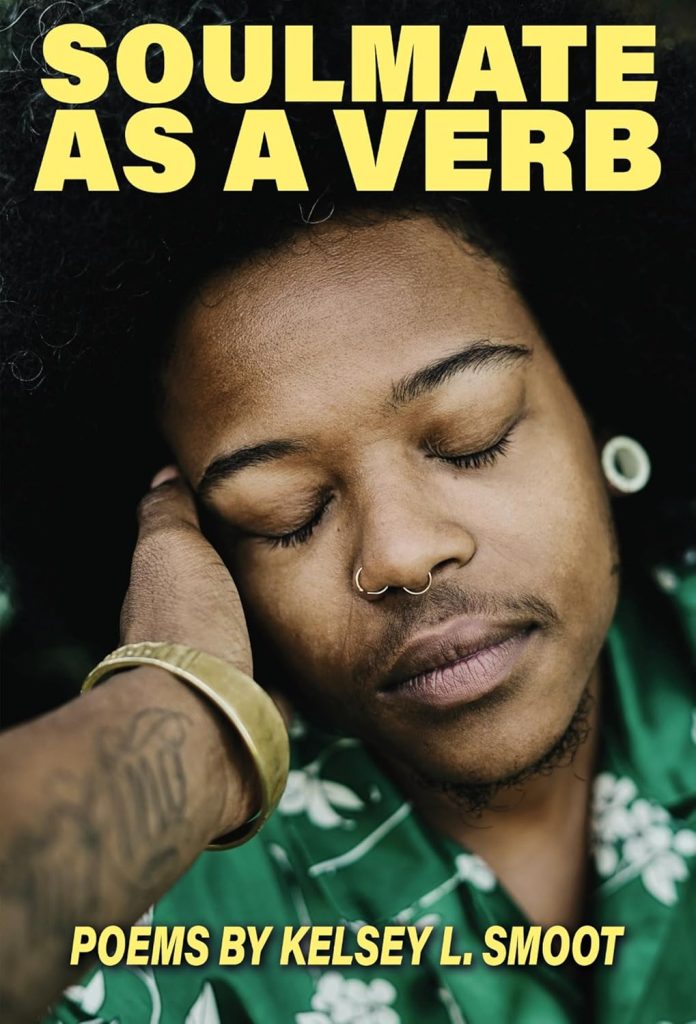
I first met Kelz through a friend who recommended them as an editor saying, “He effed my poem up!” And they did indeed, eff my poems up. From there we built our friendship brick by brick, which we cemented through hours-long conversations on new and vanquished loves, lost friends, Palestine, and weird telemarketing calls. Before I read the book, I had the pleasure of experiencing firsthand how Kelz soulmates as a verb.
Kelz and I met at my home over warm cups of ginger tea to chat late into the evening about bodies, revolution, and poetry.
Nadia Said: Let’s get into SOULMATE AS A VERB. I’m curious about the title.
Kelsey L. Smoot: Actually, it’s a quote from my brother, Spencer, for whom the book is dedicated. He and I were having this conversation about my sordid dating life. We kept having the same conversation over and over, and [I was saying], “God, where is she? Where is my soulmate, my true love?” And one day he was just like, “Bro, I just don’t think that’s a thing, not in the way that you’re saying. I think that to have a soulmate connection requires a level of work and intentionality and choice to lock in with someone. Yeah, there’s chemistry and attraction and butterflies and all the things that would typically conjure the concept of romantic love or attachment, [but] I think that the biggest component is that you just choose. You choose to do a soulmate connection with someone, you choose to soulmate as a verb.”
We have soulmates throughout our lives.
It was a really special moment when he said that to me. He also was just kind of like, “Look: you and I are soulmates.” We have soulmates throughout our lives. And it’s not because we were predestined to run into each other and have this perfect connection. It was because we put in the work and had years and years of scaffolding this big love and trust and mutuality. And so I think when I started to blow that concept out in a macro context, it just made me realize how important it is to view people in all different capacities of our lives as potential soulmates. What does it look like to choose a really embodied and kinetic version of love that insists upon deliberate choice?
So when I was pulling together this collection, when I actually first pitched some of the poems in here to Dopamine/Semiotext(e), I sent some of these poems to Michelle, my publisher, and she was like, “These are great poems, but do you have more? Because we’re not doing chapbooks.” And I had submitted a chapbook. I don’t even remember what it was called. But I always knew my first full length collection was going to be SOULMATE AS A VERB. I just remember looking at my computer being like, oh my god, how am I going to pull together a book? And then there was a lot of writing new poems and rearranging things, but ultimately just as it began to take shape and these other projects that I had previously done started to feel like they were coalescing in a greater story, I knew that that story was SOULMATE AS A VERB.
NS: While reading your book, I was reflecting on this essay by Fargo Tbakhi called “Notes on Craft: Writing in the Hour of Genocide,” in which he speaks on the nature of craft as an institutional tool designed to reinforce systems of oppression and the need to be sharp, direct, and precise with our poetry. I feel like that’s something that you do quite beautifully in SOULMATE AS A VERB. You just really named the things, and I wanted to know if that’s something that you had to labor intensely over, or if it came out organically?
KLS: It’s interesting because I would say that I have nuanced feelings about it, in that as a self-trained poet, I feel like I came to craft later. And so for me, my first stabs at writing poetry felt in some ways unruly but in other ways really stilted. I think that I just thought poems were a bunch of really confusing words put together as word salad. I just didn’t have a deep knowledge of a lineage of poetics. I hadn’t ever studied poetry. I didn’t have an MFA. So because of that, I think I had kind of a layperson’s understanding of poetry. So over time, once I started engaging other poets, reading other poets’ work, being in community with other poets that I admire, [I felt] like their poems really resonated with me in a different way. I think that that did challenge me to really start to take seriously figuring out what my true poetic voice is. I do think that folks who come from different poetic backgrounds, who aren’t trained in academia, can feel an emphasis on craft leaves them out of the conversation. But I definitely urge a querying of craft and a praxis of writing that insists upon both engaging in the lineage and also challenging that lineage or deviating from it to make a particular point or to stylistically identify one’s own social and literary prerogative in writing.
NS: Oh wow, that makes a lot of sense. It also sounds like you were getting these formal tools to help you write the poems, but at the same time, kind of retrofitting them. Being like, no, actually, I’m going to take this and use it toward this purpose.
KLS: Yeah, I definitely felt like I was getting concepts and theories that felt really helpful to understanding things like racial justice and gender ideology and transgender ideology and queer of color critique, but I still was [wondering] how [to] write about these things in a way that is more reflective of how I relate to the world, which is much more creative and imaginative and undefined than maybe some of my more serious prose writings were allowing for at the time.
NS: The book is divided into four sections: chest, ribs, lungs, heart. I would love to hear more about the significance for you about that. Why those body parts specifically?
KLS: I’ve always had a preoccupation with bodies. I like bodies. I think they’re so strange and wonderful. Having a concept like a soul as a main thematic muse in this work [is] like a guiding force or a balustrade for this work to rest on. I also wanted to ground that in something that typically, at least in Western culture, we associate with a soul, like a body. And so I wanted to locate different movements throughout the book in different spaces in the body. I also have a really particular relationship with my chest because I had top surgery four years ago now, and a lot of these poems were written after that timeframe. When I got top surgery, it really punctuated a very particular moment in my life. And I think my chest now has become symbolically really representative of my engagement with the world. I think about the fact that I’m physically closer to the world now than I was before surgery. And I just remember things like putting a seatbelt on in my car, like the weight of it was different against my flat chest. There’s just a way in which having this surgery felt like it brought me closer to the world. But I would also say that my chest feels in some ways like armor. Like it shields me from certain types of transphobia, queerphobia, [and] misogynoir that maybe I used to be more subject to prior to top surgery, because of the meaning that we assign to chests, right? So, it’s this vulnerable space of entry for me, but also this protective space.
By the time 200 years have passed by and whoever’s left on this rock finds this book, are they in a better place? Do they understand the ways in which we needed each other in this moment?
And so, thinking about the way that the poems move throughout the text, I think the poems in the chest section are looking a little bit more externally. They’re more externally facing. They’re kind of toying with this idea of the outside bumping up against me and the ways in which that informs my lived experience, and then each layer becomes more intimate. So then we go into “Ribs” and obviously that’s the kind of protective shell around the organs that are most vital. And then we go into “Lungs,” which are the outer encasement of that really important organ. And once we hit the heart, that’s where we find the life of the body formed and sustained, and that’s also symbolically where the soul lives. It’s the innermost layer, so I wanted to create a feeling of deepening in intimacy but also in conviction, because some of the poems that we get to when it gets to “Heart” are the poems where I’m really like, okay, you know what, fuck all this love shit, I’m saying it’s Free Palestine, bitch, so that to me really symbolizes both getting to the core of the issue and getting to the softest, most tender place in myself that’s fiercely protective of the people that I love, my soulmates, and trying to create that narrative. What does it mean when we get to the end of the book and I say, “throw this shit in the fire?” It doesn’t even matter what this book says. By the time 200 years have passed by and whoever’s left on this rock finds this book, are they in a better place? Do they understand the ways in which we needed each other in this moment? Or, well, I don’t even want to speculate as to alternatives. We’ll say that my descendants, looking at me in the future, will pour one out for an ancestor and know that part of my offering to them is these poems and wanting them to know that I love them already and I think they have everything they need to create a future that we can’t even fathom right now.
NS: As this collection enters the world, how do you hope it participates in conversations beyond poetry, whether on care, liberation, or collective survival?
KLS: That’s such a beautiful question. I really hope that anybody who reads this collection feels emboldened to engage love as an ethics and a practice. I think that love is a really awesome thing that can just happen to you. One day you can just wake up and realize I love this person. And it’s just the chemicals in my brain and how they respond when I look at this person, and that is a wonderful type of love that I’m also totally obsessed with. But then there’s just this other idea of just [giving] a fuck about somebody else, right? Make that choice, whether it’s just growing one’s own capacity for a radical empathy and a concept of love that is not limited by romantic connection or sexual attraction, right? To really go as hard for this person that lives halfway around the world as I would for my best friend. How does that allow for a whole new type of meaning creation between humans, right?
I really hope that anybody who reads this collection feels emboldened to engage love as an ethics and a practice.
One thing I pride myself on with regards to my poems is that a lot of them are calls to action, engaging with the concept that I think we have a human responsibility to bear witness to each other’s suffering, to hold space for each other’s growth, to challenge each other to look in a mirror sometimes and engage in hard truths. I think that just having that orientation to poetry means that I want these poems to do something for people. I don’t want them to just be a fun experience. If it feels good, warm, [and] fuzzy to read one of my poems, cool. That’s wonderful. But I also want these poems to trouble people and to make people feel uncomfortable and challenged. It’s not lost on me that one of my favorite lines in my poem “Bricks” is “I hope white people hate my shit.” It’s not that I don’t fuck with any white people. I have white people in my family! [laughs] That line is a systems critique, right? It’s an idea of no, I’m not going to be your token or a magical, mythical Negro who is writing these really interesting race poems for you to sit around and talk about in these super inaccessible intellectual spaces. I want a white person to get through this entire book and be like, “I love this shit” and get to the last poem and be like, “I don’t know if I love this shit anymore.” I think that’s an important moment. And I always tell people: The types of poems that I like are poems that have enough space in them for the reader to meet me on the page, for them to come to this work with their own predispositions and prejudices and heartbreaks and assumptions. And imbue these poems with their own meaning. Their own interpretations.
NS: What is striking about this book specifically is that you’re not being like, come bear witness to this. You’re like, come get in these motherfucking trenches.
KLS: Hey, get down here and look, and see it, and feel it.
NS: And you’re even like, dig in this mud and you’re gonna be in this shit too!
KLS: Yeah, get dirty with me. I think that’s a beautiful way to put it. I view these poems as very much an invitation. And so, to that end, I do hope that these poems are in conversation with discourse around justice. I hope that these poems are in conversation with community organizers and activists who are actively doing the work of being in resistance to genocide. I hope that these poems feel like they can be a space for Black queer scholarship. I hope these poems find their way into classrooms where students are looking for words to help illuminate their relationships to theory. I hope these poems can be a stopgap for different kinds of silences that exist across the archives. And yeah, I have a lot of lofty goals for these poems, but at the end of the day, I want people to read them. I want people to be excited by them. I want people to sit with them and marinate on them and reflect on them.