news
Brooklyn Trance

1. The hazy walk to Greenlight. 2. Geoff Dyer.


First a confession: I am a huge fan of Geoff Dyer’s work, so I braved a subway, two buses and a car service to get to the Greenlight Bookstore in Ft. Greene where British writer was scheduled to have a Conversation with the indefatigable American editor of The Paris Review, Lorin Stein.
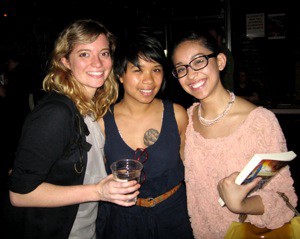
1. “Rose” and “Charles,” who may or may not be writers and may or may not have last names but who are certainly fans of Geoff Dyer. 2. Novelists Jessica Francis Kane and Maile Chapman, who like Dyer, are published by Graywolf.


Usually when I write one of these ledes, I can say novelist or essayist but the plain truth is that Dyer actively evades such categorization. He fictionalized the lives of jazz greats in his novel But Beautiful and turned an academic discourse into an expression of artistic frustration in Out of Sheer Rage. His latest work is a collection of essays from 25 years of “journalism” called Otherwise Known as the Human Condition, and it spans an impressive range of topics: from a discussion of Richard Avedon’s place in the canon of fashion photography to “Def Leppard and the Anthropology of Supermodernity.”
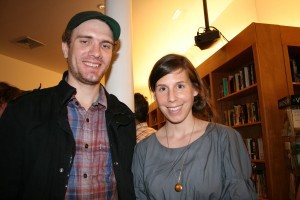
1. Catherine Wirtz (who works in publishing) lives in the neighborhood and her friend Kevin Matre tagged along.
These essays contain a wealth of easy-to-plunder quotes (Dyer is a master at the well-crafted stand-alone sentence) but I’ll share one that seems to best illustrate his philosophy. In the essay, “ My Life as Gate-Crasher,” Dyer writes, “…although great store is set by measuring incremental progress (“research,” in academic parlance) in precisely demarcated areas of knowledge, significant advances are often made by people happy to muddle along within the splendidly vague job description advances by Susan Sontag, whose “idea of a writer [was] someone interested in ‘everything.’ Why in all modesty, would anyone be interested in settling for less?”
Why indeed? Glancing through Otherwise Known as the Human Condition, one surmises that the subject matter explored is unified only by the author’s penetrating enthusiasm for it.
And speaking of sex, Dyer spends a healthy amount of time writing about the finer points of copulation, a fact that didn’t escape Stein’s notice.
“So Geoff, what is it about women’s assholes?” Stein asked point-blank.
Silence. Then:
“Do you see this? This is a look of horror. That you would throw that line at me,” joked Dyer.
Match, set, point.
Oh, and Dyer, in addition to everything else, is a tennis enthusiast. His next book, naturally, blends a study of tennis with a deep analysis of the films of Tarkovsky, primarily Stalker.
–Cassie Hay is a regular contributor to Electric Dish.