interviews
Drafting the Story Until It Proves You Wrong
Bret Anthony Johnston on Corpus Christi, Texas, returning to the short story in “Encounters With Unexpected Animals,” and the infinite similarities between writing and skateboarding

This article is free to read. So is every article Electric Literature publishes. No limits, no paywalls—now or ever. Support from readers like you makes that possible.
Electric Literature is proud to be a space where writers are always paid and reading is always free, and we plan to keep it that way.
Donate now to our spring fundraiser to help ensure the future of free, accessible literature for all.
—————
There aren’t many writers from my hometown of Corpus Christi, Texas—at least not when compared to larger cities and places more proximal to an elite college. So, when I came across a short story collection called Corpus Christi with a photo of a wind-whipped palm tree on its cover, I was eager to know everything about its author, Bret Anthony Johnston. Johnston grew up in Corpus Christi and briefly toured the country on a professional skateboarding team before enrolling in the Iowa Writers’ Workshop. Now serving as the director of the Michener Center for Writers at the University of Texas, he’s been publishing critically acclaimed fiction for two decades, including the novels Remember Me Like This and We Burn Daylight. This spring, Johnston makes a triumphant return to short stories with Encounters With Unexpected Animals (the opening story of which can be read in Recommended Reading!), his first collection since winning the prestigious Sunday Times Short Story Award in 2017 for “Half of What Atlee Rouse Knows About Horses.”
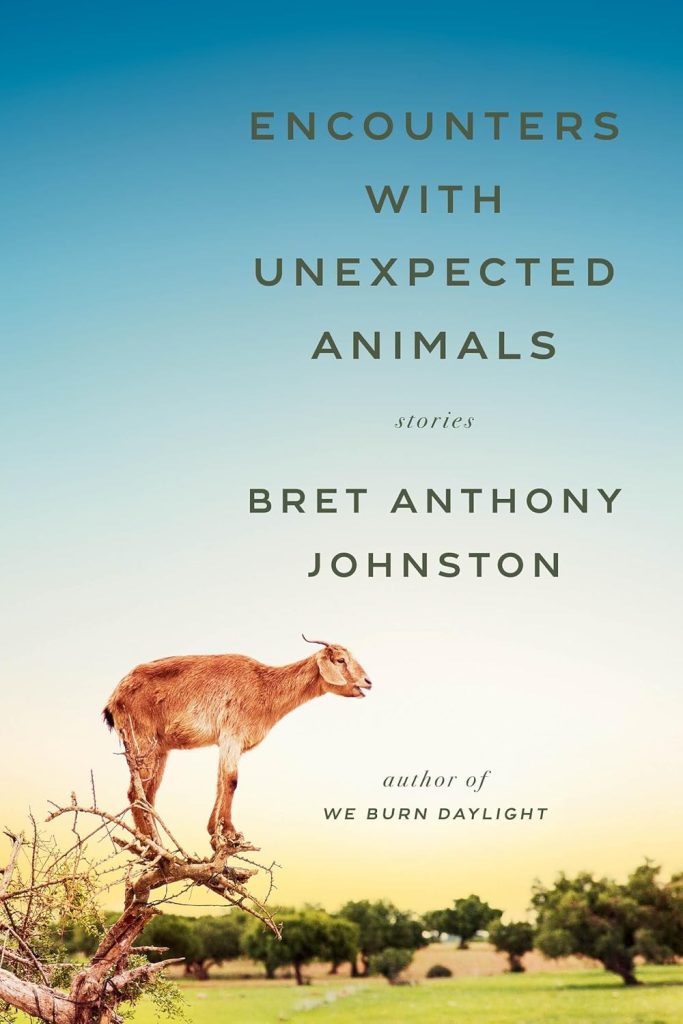
The stories in this collection are cinematic in a gritty but empathic way—think Sean Baker or Chloé Zhao. They drop the reader into the unglamorous lives of deeply flawed people who want to do the right thing, sometimes can, but more often, through some fault of their own, don’t or won’t. His characters lie and steal and hurt and conceal, and despite this, we know they’re doing the absolute best they can. We know this because his characters share aspects of ourselves, or people we love.
I had the pleasure of speaking to Johnston via Google Docs about our shared hometown, the overlap between writing and skateboarding, and drafting towards revelation.
Elizabeth Gonzalez James: This is your first short story collection in almost twenty years. I’ve been expecting a new collection since you won the Sunday Times Award in 2017. I don’t want to seem impertinent, why has it taken so long for you to return to short stories?
Bret Anthony Johnston: I’m a stupidly slow writer. I find writing so difficult—and unlike most everything else in life, it gets harder, not easier, the longer I do it—so any number of these stories took dozens of slow-ass drafts. For example, “Atlee” took almost ten years. I’m also a writer who’s always working on more than one project at time, knowing full well that each will run off a cliff at some point, so most of these stories were written while I was drafting We Burn Daylight. When I’d get fed up with the novel, I’d move to a story. When that story tangled into a knot I couldn’t untie, I’d go back to the novel. For better or worse, I’ve never asked—let alone expected—my writing process to be easy or fast. Efficiency is, I think, antithetical to imagination, experimentation, and empathy.
EGJ: I was happy to see that several of the stories in this collection are again set in our shared hometown of Corpus Christi, Texas. I don’t live there anymore, you don’t live there anymore, and yet, Corpus Christi seems to have this gravitational pull. Is every writer just obsessed with their own hometown?
BAJ: At the risk of sounding like a heady goofball, I’m fascinated by Corpus because it feels like a city that has everything it needs to thrive and yet never quite does. The city feels hopeful, but also maybe tragically flawed. It’s geographically liminal—a weirdly far drive from major cities in Texas and Mexico—which makes it a hassle to reach or leave. There’s a rare and undeniable pressure that radiates from such a place, a sense that the world doesn’t extend beyond the city limits. That isolation shapes everyone who lives there.
Efficiency is, I think, antithetical to imagination, experimentation, and empathy.
And, of course, the city is so multi-faceted—the naval base, the shoreline and beaches, the farms and ranches just outside of town, all the mineral rights money and all the poverty, its beauty and the large-heartedness of its citizens, the terrifying things that are happening to the bay. So many of the struggles that we’re facing as a country have long defined the Coastal Bend. In holding up a mirror to Corpus, you see the whole of America in its reflection.
EGJ: The characters in these stories feel like they want to reach across a great divide and touch the people they love. But for whatever reason—fear, or loneliness, or inexperience—they can’t. Was alienation top of mind to you as you were writing?
BAJ: Not at all, but I’m persuaded by your thoughtful reading; now that you’ve said it, the idea resonates with me and feels true. I’m just not a writer who thinks in those terms; I’m consumed by the matter in the stories, the external and internal landscapes of the characters’ lives, and because the characters aren’t prone to meditating on the aboutness of their situations, I’m not either. I cast my lot with William Carlos Williams’ “no ideas but in things.” So, I’m all the more grateful—and edified—when good readers like you devote such attention to the characters and thus complete the story.
EGJ: In the opening story, “Paradeability,” you take us inside a Houston clown convention. Other stories feature a car salesman, a horse stable manager, a Dairy Queen worker who’s ferrying a truck full of stolen toys up from the Rio Grande Valley. What kind of research do you do for your stories?
BAJ: Ultimately, it feels like an act of paying attention, of noticing, an abiding kind of openness. I do a lot of research—like, a lot—once something has arrested my curiosity. “Paradeability” started on a skate trip to Houston. When I walked into the hotel, there were roughly 400 clowns in the lobby. Anyone with a fear of clowns would have passed out. I was absolutely thrilled. It was an annual convention, so I snuck into a lot of the panel presentations when I wasn’t skating. Then I read everything I could find about clowns. It’s basically the same process for every piece of fiction I’ve ever written. For me, research liberates rather than silences the imagination, and I’d like to believe that it brings a sense of verisimilitude to the stories, that the details immerse the readers in the narrative. Edward P. Jones once told an audience that the key to writing was finding ways to “bamboozle” the reader. If I’ve ever succeeded in said bamboozling, it’s due in large part to how much research I do.
EGJ: One of your stories ends with the line, “He’s waiting, whiling away the hours until a storm gathers and his son can appreciate the painstaking labor of hope, the coded, sheltering lessons of sorrow.” That’s so beautiful. Can you speak a little bit about what you meant?
If the pages are only confirming my own ideas, I haven’t taken them through enough drafts.
BAJ: In my experience, Texans tend not to talk directly about things like loss and grief and fear and hope. Rather, they articulate those emotions through veils and gestures, the understated vocabulary of their proximity or with the currency of their presence, their labor. To a lot of people, such reticence might seem maddening or unhealthy, or it might be mistaken for a lack of emotion. I get that, but for better or worse, the characters that animate my imagination are the ones who are, as you so astutely recognized, alienated, and one stripe of that alienation is voicing their pain. They’re not fluent in the language of themselves.
EGJ: Do you have a favorite story in this collection?
BAJ: I’m a writer—and reader—who longs to be surprised on the page, and each story in the collection surprised me at some point, so I feel indebted to them in different ways. But they were all so damned difficult to write that when I think about the stories now, I mostly remember all the ways they tried to break me. My favorite story or book is always the next one.
EGJ: I recently rewatched The Shining and, when we got to the part of the movie where Shelley Duvall is running for her life and sees the two men—one in a tuxedo and one dressed as a bear—engaged in something behind a partially closed door, I thought that that scene is a perfect distillation of what a short story is. It’s a glimpse into an entire world. We don’t know who these men are, or why they’re dressed the way they are, but we’re shaken to our core.
What appeals to you about short stories? What advantages, if any, do you think they have over novels?
BAJ: The best stories focus our attention just as a photographer’s aperture does. They exclude what isn’t essential or enhancing. There’s an impossible precision in a great short story, even longer ones, and the combination of such imaginative attentiveness and precise language can result in a transformative reading experience. The writer and reader can come away feeling not simply like they’ve written or read the story, but rather like they’ve undergone it. Novels change our lives incrementally; we age with them, which is just so beautiful. Their impact is gradual, almost sedimentary. But there’s an urgency when you’re reading a short story. We read them and experience something akin to alchemy. The elements of our existence are transformed almost in a breath.
EGJ: I read in an early interview that you write something like 20 to 25 drafts of a short story. Is that still true? What is it that you’re drafting towards?
BAJ: Alas, yes. Ultimately, I suppose I’m drafting toward some kind of revelation. Whether emotional or intellectual or narrative or linguistic or even syntactical, I want the work to surprise me. If the pages are only confirming my own ideas, I haven’t taken them through enough drafts. I trust my stories most when they prove me wrong.
Skaters and writers are misfits who aren’t afraid to fall.
But it’s also so much more pedestrian than that. Each draft becomes a bit more readable and, simultaneously, more itself. The story emerges draft by draft, and I’m working to rinse myself out of the pages, to get out of the characters’ way. I have no idea where we’re going, so it’s not even like the character is driving the car while I’m riding shotgun. It’s more as though the character is driving and I’m locked in the trunk. It’s terrifying and dark and bumpy and disorienting and out of my control. Dozens of drafts later, the car stops and the trunk opens and as the light pours in, I realize we’ve arrived at the only place we were ever meant to go.
EGJ: What makes a story collection feel thematically tied together to you? Can you speak about how you chose the stories for this collection and how you decided to order them?
BAJ: In the purest and most satisfying sense, I suppose it’s an overt or intuitive association that binds the stories, some authentic connection that invites the reader into the collection and creates some subtle suspense around how each story will uphold or vary the theme. From Winesburg, Ohio [by Sherwood Anderson] to Lost in the City by Edward P. Jones to The News from Spain by Joan Wickersham to countless others, there are myriad collections where the effect is thrilling and astonishing and moving. In other cases, though, the so-called thematic links can feel market-y and forced, maybe because the industry doesn’t at all trust readers to embrace a collection of disparate fictions. I have more faith in readers than that. I really do. For those of us who love short stories, I don’t think we give a rip how they’re packaged. We just want stories that quicken or break or restore our hearts, stories that deepen rather than solve mysteries.
EGJ: You devote the last paragraph of your acknowledgements to your passion for skateboarding. “[These stories] wouldn’t have even been started if I’d never stepped on a board.” I have this theory that talented people are usually talented in more than one area, and that those talents tend to feed and reinforce one another. Clearly you have a talent for skateboarding. Can you say a little about how skateboarding influences and maybe improves your writing?
BAJ: I’ve had similar observations, which I’ve likened to certain folks having a capacity for learning, a kind of default humility that allows them to commit to the process rather than the product.
As for skating and writing, I see numberless similarities between them. On the comic (but also unassailably true) side, writing is a lot less painful than skating. If a reader or fancy-pants publication skewers your book in a review, it can really wound you. You can get awfully rattled, and it completely sucks. And yet, to my knowledge, a bad review has never knocked anyone’s pelvis out of alignment.
Ultimately, though, skaters and writers don’t fit into mainstream society. We’re always on the fringes, paying attention to what others don’t and prioritizing what most everyone else takes for granted or willfully, callously ignores. What’s worse—(read: infinitely better)—is that we’re choosing the fringes. We’re actively and consistently rejecting what everyone else calls normal, what they’re striving so hard to acquire and consume. We’re willing to try a trick—or a sentence, a paragraph, a story, a book—for years until we ride—or write—away clean. We navigate the world differently, and it can make civilians very uncomfortable. We’re misfits who aren’t afraid to fall. We’re delinquents who break the rules, and we’re dangerous because we’re ready to bleed for what matters, for what we love.