Cover Reveals
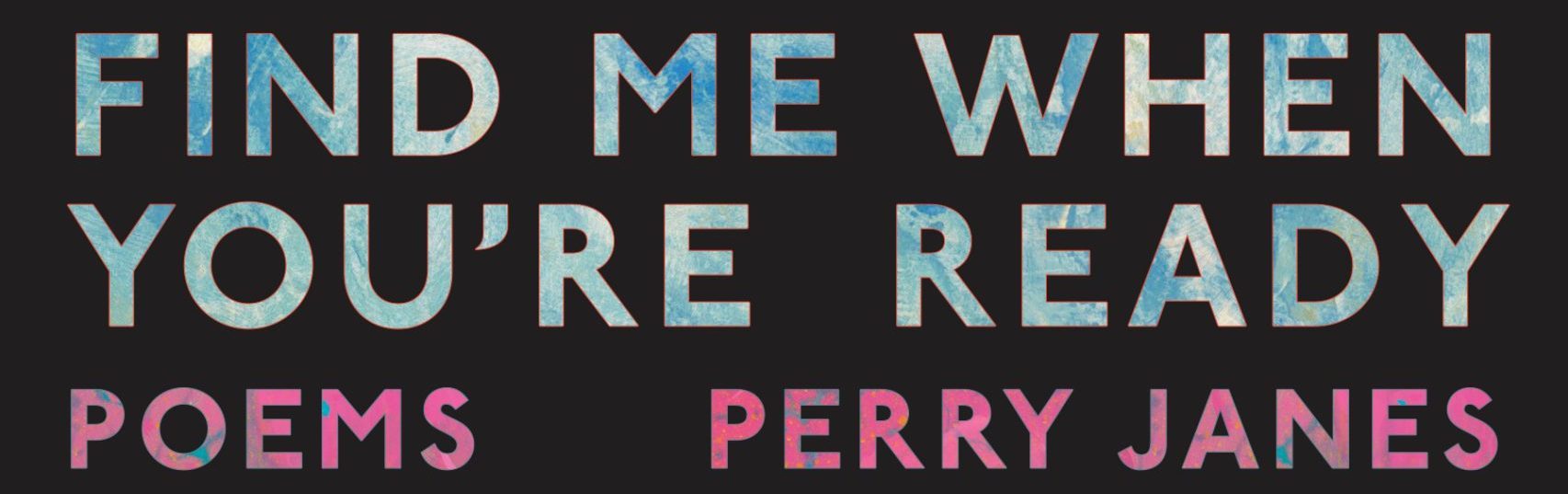
Exclusive Cover Reveal of “Find Me When You’re Ready” by Perry Janes
This poetry collection distills trauma and the travails of young manhood into a journey across the country
This article is free to read. So is every article Electric Literature publishes. No limits, no paywalls—now or ever. But we rely on your support to keep it that way.
We need to raise $35,000 by April 15 to keep the lights on, and time is running out. Donate today.
—————
Electric Literature is pleased to reveal the cover for the poetry collection Find Me When You’re Ready by Perry Janes, which will be published by Northwestern University Press in Sept 15, 2024. Preorder the book here.
In Find Me When You’re Ready, Perry Janes traces a sweeping coming-of-age journey from Detroit to Los Angeles. As he leaves home and forges toward California, the speaker in these poems considers how we learn and mislearn ideas about manhood, confronts the aftershocks of childhood sexual abuse, and questions the human need for belonging. By embracing the touchstones of youth—movies, lore, graphic novels—these poems assert the speaker’s defiant right to childhood even amid damage.
As the collection arcs toward adulthood, the speaker embodies a vision of healing that refuses easy binaries and embraces the joys of intimacy. Across each of its five acts, Perry Janes’s debut collection is driven by an interest in troubling our creation myths, asking who built them, why we carry them, and how we might set them aside.
Here is the cover, designed by Morgan Krehbiel, artwork by James Jean.

Author Perry Janes: “When first asked to describe Find Me When You’re Ready, I found myself replying that it’s both “lonely and playful.” It was important to me to write a book that didn’t concede childhood’s vast swath of experience to a single instance of harm; to uphold the joyous, whimsical, tender, and imaginative; to reflect everything through that lens. I’ve been a fan of James Jean’s art for more than a decade, but when I first saw the illustration here, a piece called Bouquet II, I felt a surge of kinship.
Like Find Me When You’re Ready, the image is full of contrasts and layers. It manages to feel whimsical and violent, playful and menacing, all at once. At a glance, it may look as though the boy is falling backwards into the bouquet of flowers when, upon closer inspection, he is really being pulled by a pair of disembodied hands—but toward safety or danger? The entire composition is awash in deeper textures, as though stirring below the surface is a second image trying to get out. On an emotional level, the image moves me. On a practical level, I continue to marvel at the overlap between Jean’s illustration and the poems themselves: threaded through the book are several motifs, including the image of the maze (brilliantly drawn here in the soles of the boy’s sneakers) and the garden as a recurring site of contemplation. I am forever grateful to Jean for use of this work.
From here, designer Morgan Krehbiel smashed it out of the park. The negative space at the bottom of the frame strikes a contrast to the maximalism of the illustration and lends a further feeling of foreboding. Underneath/inside the text is a subtle swirl of shape and color, hidden but visible. When I look at this cover, the spirit of my debut collection looks back.”
Designer Morgan Krehbiel: “We weren’t sure if we’d be able to use this artwork when kicking off the design process, but it was in the back of my head throughout all the other ideas I explored—so when we got the happy word from the artist, the final cover came together quickly.
I wanted the design to highlight the lush dimensionality of the artwork, so I trimmed it around the organic edge along the bottom of the flowers and chose deceptively simple block letters for the title for contrast. My favorite detail is probably the stroke around the lettering; it’s such a small element but it is brings the text into the world of the image, and our eyes along with it.”