essays
I Rewatch “Gilmore Girls” to Remember my Stepfather
I find echoes of the man who raised me every time I watch the iconic mother-daughter show
This article is free to read. So is every article Electric Literature publishes. No limits, no paywalls—now or ever. Support from readers like you makes that possible.
Electric Literature is proud to be a space where writers are always paid and reading is always free, and we plan to keep it that way.
Donate now to our spring fundraiser to help ensure the future of free, accessible literature for all.
—————
I first heard of Gilmore Girls from the promos airing during the commercial breaks when I watched Buffy the Vampire Slayer. Even at twelve, I was not impressed. I was already tired of the formula followed by popular family dramas like 7thHeaven in the 90s and 2000s, blending themed episodes on hot parenting topics, like peer pressure or teenagers having sex, with didactic, conservative messaging and saccharine moments. The WB’s Gilmore Girls promos made the show seem like it followed the same, worn-out model.
One shows Rory dancing with her boyfriend, Dean, at a school dance while a deep-voiced narrator teases, “Rory Gilmore may repeat her mother’s past.” The screen flashes to Rory asleep on Dean’s chest. Then Emily and Lorelai fight about whether Rory will get herself in trouble like Lorelai did. Rory runs shoeless through the snowy streets in a fancy dress. A Gilmore Girls Christmas, appears on the screen in sparkly text.
The next promo starts with clips from the fight in the previous episode. The narrator says, “A family argument is overshadowed by crisis.” Then Lorelai follows her father, Richard, as he’s wheeled down a hallway in a hospital bed. Emily says she didn’t sign on to watch Richard die while she fights back tears. Lorelai says, “I wonder if he knows I’m here. I wonder if he cares.” Then Lorelai cries. And the drama continues until the same sparkly text appears.
So, when my stepfather, Russ, stood up from the dinner table one night before Mom, my sister, Jamie, and I finished eating and said he had to go because Gilmore Girls was on, I didn’t understand.
“You watch Gilmore Girls?” I asked. How could a man whose main interests were collecting baseball cards and watching sports and war documentaries care enough about the show from those melodramatic promos to not only watch it—which would be understandable if nothing else was on—but to leave dinner early to catch the latest episode.
“It’s a good show,” he answered.
“Even I don’t watch Gilmore Girls,” I mocked. Mom and Jamie laugh. But Russ was used to being teased by us and only shrugged. He grabbed the insulated mug he drank Diet Pepsi from day and night and retreated to his bedroom.
Three years later, Jamie bought the Gilmore Girls DVD box sets, and I needed to watch for myself to see what had my stepfather and sister so transfixed. It only took two episodes before I realized the show was nothing like the promos. The WB’s marketing department clearly didn’t know how to handle a family drama that deviated from the formula and had tried to entice the regular viewers of those types of shows. But Gilmore Girls was like nothing else on TV at the time. The characters were wacky. The dialogue was quick and clever. Heartfelt moments weren’t overly sentimental.
I was hooked and started binge watching the DVDs before bed each night. I don’t remember watching the show as a family, but I often heard the theme song playing behind the closed doors of Russ’s and my sister’s bedrooms and knew, even if we didn’t watch it together, it was a show we’d all come to love. And we weren’t alone. My friends and their families watched it, too. By the time I started college a few months after the original series finale, students joked someone was always watching Gilmore Girls in the dorms, day or night. It had become a cultural phenomenon.
I needed to watch for myself to see what had my stepfather and sister so transfixed.
But with each rewatch, my love for the show transformed into kinship with its characters. When a fellow student took offense at a feature I wrote as a staff writer for my college’s paper, I was consoled by Rory’s cafeteria faceoff with the ballerina in the ballet she reviewed for The Yale Daily News and felt grateful I had only been lambasted by email. When I interned at the local newspaper, I tried to learn from Rory’s mistakes so I wouldn’t be humiliated by a Mitchum Huntzberger. When I became editor of my college’s newspaper, I delusionally dreamed of turning our office—which was empty when our editors weren’t laying out one of our biweekly issues—into a busy hub like The Yale Daily News. When I graduated and became a manager at Target, I identified with Lorelai, balancing a challenging job in customer service with the demands of her friends and family.
The show’s meaning morphed, offering me something new at each stage of my life. But when my stepfather died and I rewatched the show for comfort, I realized my love for Gilmore Girls had never been just about the quirky citizens of Stars Hollow, the fall vibes, the show’s strong women, or its enviable mother-daughter relationship; my love had also grown because I saw my stepfather in the men who filled the role of Rory’s father in Christopher’s absence.
Although Rory and I both grew up without our biological fathers, the reasons differ. My father wasn’t a scared trust-fund teenager like Christopher when his girlfriend became pregnant. No, my father was a member of a notorious outlaw biker gang who had just moved back to his family’s ancestral holler in Kentucky from Detroit to care for his ailing parents. I don’t know what happened between his return and when he met my mother, but I do know he struggled with addiction.
Mom said they met at an Anonymous meeting—she was there for alcohol, and he was there for heroin and other drugs. I was conceived soon after they met. My parents, who barely knew each other, married, and Mom moved to the holler. Once there, my father’s violent, controlling nature emerged. He sold her car for drug money and trapped her in the holler where they lived in a trailer in his parents’ backyard surrounded by neighbors who were all his relatives. There was no escape.
It took five years, at least three attempts to leave, and extended stays in two women’s domestic violence shelters before Mom was able to divorce my father. The nuns and volunteers who ran the second shelter set us up in a government-subsidized apartment in a small town half an hour from the holler. Like Lorelai, Mom used her newfound freedom to create as normal a life as she could in between our visitation weekends with our father. Charities and her friends helped us buy used furniture and clothes and donated food and school supplies. She volunteered in the library at a private school run by the nuns from the shelter so Jamie and I would have a better education. And on her weekends with us, she often drove us to Tennessee to stay in the basement of an elderly couple she knew in order to put as much distance as possible between us and my abusive father.
Mom also took us to church, and before long, our pastor, Russ—who was divorcing his wife—fell in love with Mom. Like Lorelai and Jason, they began a secret relationship, but theirs was hidden from my father because he had threatened to drown Jamie and me if another man raised us. But in the spring of 1995, my father moved back to Detroit, and Mom and Russ, relieved with the distance, married in our living room one night while Jamie and I slept. The next day, Mom explained Russ was joining our family, and we were moving to Tennessee.
Though Christopher is absent, Rory is never without father figures in Gilmore Girls. Through their shared interest in literature, Rory and her grandfather, Richard, form a closer bond than most grandparent-grandchild relationships. He tries to protect her from boys he thinks are bad influences, even at the risk of a fight. And he is one of her biggest supporters, avidly reading every article she writes for her school papers and attending all her major school events.
Mom used her newfound freedom to create as normal a life as she could in between our visitation weekends with our father.
When Lorelai dates Rory’s English teacher, Max Medina, he and Rory form their own relationship. Max asks Lorelai how he should parent Rory and takes offense when Lorelai says he shouldn’t, highlighting how little thought Lorelai puts into Max joining their family and how seriously Max takes his role in Rory’s life. After Paris assigns Rory a feature on Max for The Franklin, viewers see how much they mean to each other when Rory stops recording and tells Max, “I just want you to know, I really wanted you to be my stepfather.”
And Max responds, “I just want you to know, I really wanted to be your stepfather.”
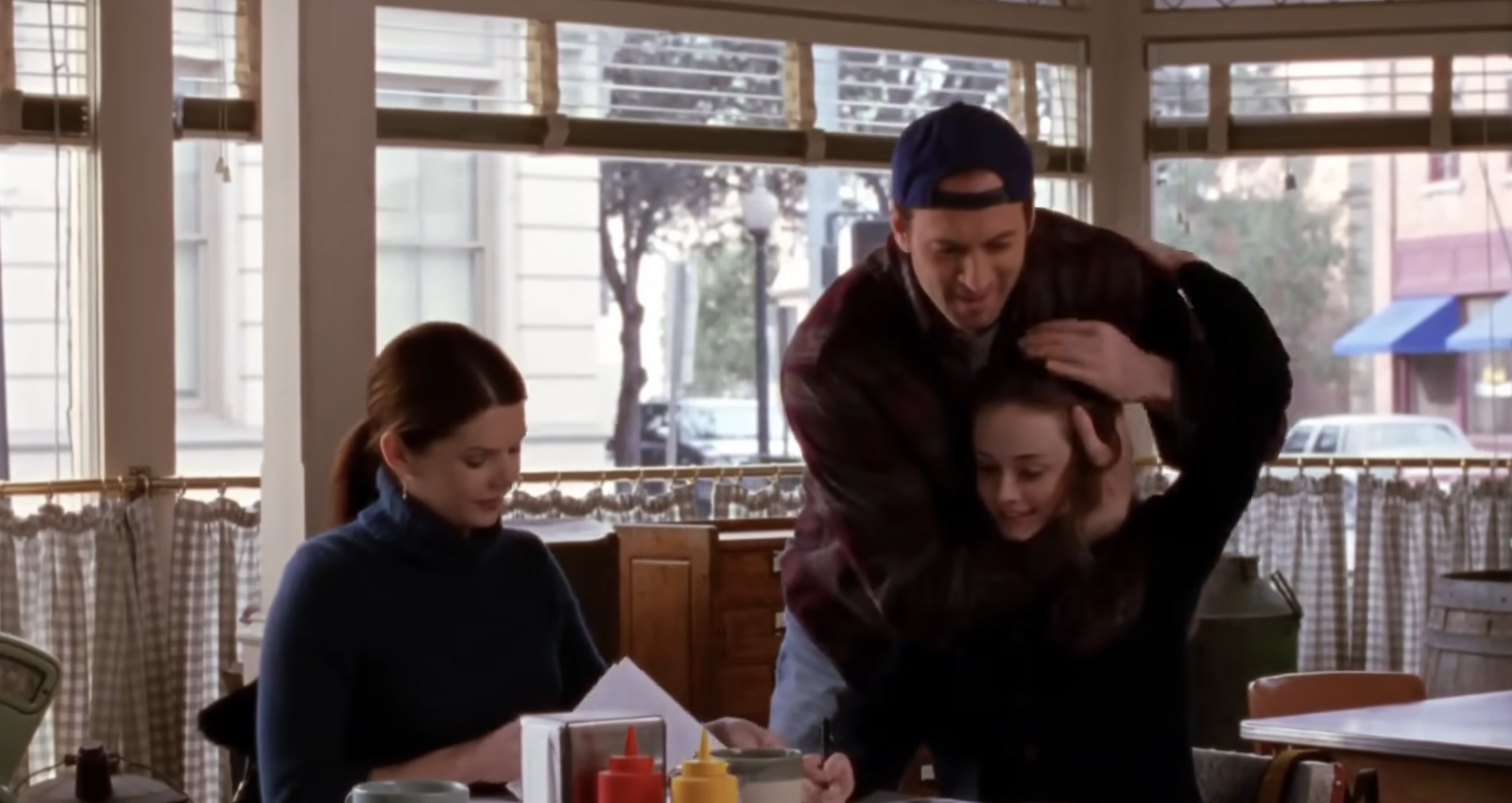
But most of all, Luke Danes supports Rory even before he’s in a relationship with Lorelai. When Rory dates his nephew, Jess, Luke gives Jess rules for dating Rory despite him being Jess’s guardian and not Rory’s. During Rory’s high school graduation, Sookie, Jackson, and Lorelai try not to cry and fail, but Luke cries hardest and says, “I’m blubbering. You’re freaks!” Luke helps move Rory into her dorm at Yale, and when she drops out, he plans to force her to return not just because that’s what Lorelai wants, but because he feels a parental obligation to do what’s best for Rory.
And the relationship is reciprocal. Rory still visits Luke at his diner when she and her mom are fighting. When Luke attends Rory’s twenty-first birthday party, he gives Rory a necklace that belonged to his deceased mother, and when one of the women at the party asks to see it, Rory smiles and introduces Luke not as her mother’s fiancé, but as her “soon-to-be stepfather.”
Luke’s love for Rory is so central to the plot of Gilmore Girls Lorelai tells Sookie she proposed to Luke because of how much he loves Rory. And when Luke needs a character witness for his custody battle, Lorelai writes in a statement so powerful it ends her marriage to Christopher, “He’s always been there for [Rory] no matter what… Luke has been a sort of father figure in my daughter’s life.”
There are many more examples throughout the show and A Year in the Life, but through it all, Luke is always there to support Rory.
Growing up, none of the depictions of stepparents I saw matched my experience with my stepfather. Most shows and movies with stepparents portrayed them as villains, like Cinderella or The Parent Trap. A few movies showed a loving stepparent, such as The Santa Clause, but the stepparent is treated as competition for the absent biological parent. My biological father wasn’t a hero, and my stepfather wasn’t replacing him; Russ was my father. And though there were a couple movies with stepfathers and stepsons who came together, like Man of the House, or stepmothers and stepdaughters, like Stepmom, I never saw any media with positive stepfather-stepdaughter relationships.
Even in the real world, friends whose parents divorced when they were older (and for less violent reasons than my parents) complained about their stepparents and schemed to annoy them, just like in the movies. When my elementary school guidance counselor created a group called “Banana Splits” for children of divorced parents to talk over ice cream, I signed up so I could skip class for an ice cream party. But in the first meeting, our counselor only talked about how it was normal to feel sad when your parents were divorced and asked us to repeat the group’s slogan, “It’s not my fault.”
I never attended again. I knew my parents’ divorce wasn’t my fault. I wasn’t sad because I only saw my biological father a handful of times after the divorce. I didn’t mind when he often forgot to send birthday cards or gifts, nor did I mind that he always mixed my birthday up with my older half-sister’s. I didn’t care because from the time mom and Russ married when I was six, Russ became a constant presence in my life.
Russ was my Richard, a stoic intellectual with whom I bonded over literature, science, and history. He read to me before bed when I was little and saved to buy presents for my birthdays. He questioned my choice of friends and boyfriends and encouraged me to do well in school. When it was my turn to read a story I’d written in my first-grade class’s “Author’s Tea” event, I was nervous looking out at the crowded classroom until my eyes found Russ and he winked at me. After I finished, he hugged me and told me how proud he was. And when I told him I wanted to be a writer when I was in college, he didn’t try to talk me out of it. He asked for copies of every article I wrote.
Luke’s love for Rory is so central to the plot of Gilmore Girls Lorelai tells Sookie she proposed to Luke because of how much he loves Rory.
Russ was my Max, a man who stepped into a family without fear, ready to parent even though he knew nothing about raising girls. He fearlessly tried to style my hair before school when Mom worked the early shift at McDonald’s—an effort I appreciated, even when he used so much hairspray my hair felt like a crunchy helmet. Though he joined our family because he loved my mother, I know he loved being my father, too, because he often told me, “I couldn’t love you any more if you had been my biological daughter.”
But most of all, Russ was my Luke. He was there for me no matter what happened in his relationship with my mother. When Mom and Russ separated for a year, I still visited Russ’s apartment to build a model of the lunar lander. And when my tonsils were removed, he brought me a stuffed black cat with an orange ribbon around its neck, which was so precious to me I slept with it every night for nine years.
Shortly after Mom and Russ reunited, Mom’s mental illness worsened, leading to hospitalization. Russ took care of Jamie and me while she was away, and over the years, as Mom’s mental instability and alcohol and pill addictions grew, Russ became our main parent. We were homeless when I was fifteen because Mom didn’t pay the mortgage and hid the foreclosure notices until a sheriff changed the locks, and we moved into a run-down motel with only the few possessions we could carry in our car until we could find a place to live. Although I was sad to lose our home, I was never afraid because I knew Russ would figure out our situation.
When we learned my fiancé’s mother wouldn’t survive long enough to see our wedding due to cancer, Russ married us in the back yard. Just before the ceremony, he pulled me aside to tell me he was going to use vows that didn’t require me to promise to obey my husband, because he never wanted me to feel like I had to obey a man. And when we held the church wedding we’d planned three weeks later for friends and family, Russ walked me down the aisle. I didn’t bother inviting my biological father.
Gilmore Girls was the first show or movie I’d ever seen with a relationship like the one I had with Russ. Seeing what it looked like onscreen gave me perspective to understand what a great parent my stepfather was. And this depiction came to mean even more to me as Russ’s health failed.
During those binge-watching sessions, I realized how much each of Rory’s surrogate fathers reminded me of Russ.
Like Richard, Russ battled heart disease for years. In 2013, he suffered a massive stroke and transformed into a six-year-old in a sixty-one-year-old man’s body overnight. He no longer read or watched documentaries. He couldn’t discuss science or history. He thought Mom was his mother, asked to be excused from the dinner table, and talked about Frosty the Snowman like he was a real person. He even forgot the names of everyone in our family—everyone except me.
I was so heartbroken when he died a year later, I had no room left to feel anything else. Even when one of my half-sisters from my biological father’s first marriage messaged me five weeks later to tell me our father had choked on a quarter and was braindead, I felt nothing. I didn’t travel to the hospital where my older sisters, who were closer to our father, sat with him as his life support was removed and he died, and neither did Jamie. We’d just lost the stepfather who raised us, and I couldn’t spare any grief for the violent man who was never there.
When both of my fathers died, I was a full-time freelance writer struggling to make a living. Grief turned into insomnia, and instead of sleeping, I spent those long, awful nights watching Gilmore Girls for comfort. During those binge-watching sessions, I realized how much each of Rory’s surrogate fathers reminded me of Russ. And seeing all the ways they had supported Rory inspired me to process my grief by writing about how much my stepfather had meant to me.
When Netflix released A Year in the Life two years later, I watched and was sad Russ would never see it. But I noticed uncanny parallels between my life and Rory’s. In the revival, she is also a struggling freelance writer whose grief keeps her awake at night. And just as I did, she gets her life back on track when she writes the story of her life with her mother and the people who supported.
Now, nine years later, I’m still writing about what Russ meant to me, and I still rewatch Gilmore Girls every fall like millions of other viewers. But I also start the show again every March near the date of Russ’s death, and I never tire of it. Watching Gilmore Girls helps me remember what it felt like to have a man love me like I was his own daughter, even when he had no biological imperative to do so. And each time I watch the show, I wish I could ask Russ if he loved Gilmore Girls because he saw his relationship with his daughter in it, too.