interviews
Lauren J. Joseph’s New Novel Turns the Trans Rock Muse Into an Erotic Phantasmagoria
“Lean Cat, Savage Cat” is fueled by sex, drugs, rock, and the seductive allure of self-creation
This article is free to read. So is every article Electric Literature publishes. No limits, no paywalls—now or ever. But we rely on your support to keep it that way.
We need to raise $35,000 by April 15 to keep the lights on, and time is running out. Donate today.
—————
“I’d like to send this one out to Lou and Rachel,” Lou Reed croons at the end of the title track to his 1975 album Coney Island Baby. At the time, Reed was head over heels with Rachel Humphries, a Mexican-American trans woman who appeared alongside him on album covers, on stage, and through his lyrics during their five year relationship. No ‘70s rock star was complete without a controversial affair with a trans woman, it seems, yet these women have been swept into the footnotes by later biographers. Lauren J. Joseph’s second novel, Lean Cat, Savage Cat, spins this idea of the trans rock muse into an erotic phantasmagoria set in Berlin’s churching queer party world.
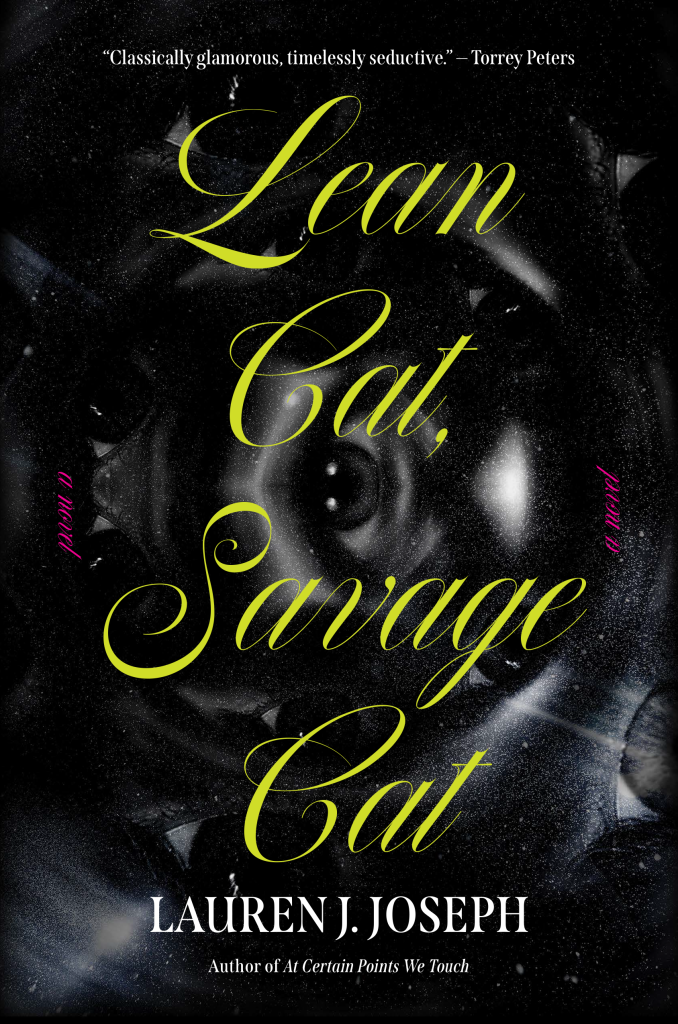
Charli is a trans art student doing everything in her power to avoid her PhD when she meets Alexander Geist, a glamorous and slightly menacing stranger who invites her to come with him to Berlin. Soon she is absorbed into the work of transforming Geist into the next David Bowie — a project fueled by drugs, sex, and the seductive allure of self-creation that quickly turns volatile. Joseph’s writing, at turns lacerating and hysterical, keeps us on our toes questioning not only these characters’ intentions but whether or not they even exist.
Over slices of bara brith, Lauren and I sat down on the sofa in her London flat, flanked by a Beryl Cook throw pillow on one side and a larger-than-life plush Garfield on the other, to discuss the novel, what it means to be haunted by your past personae, and the romance between David Bowie and Romy Haag that inspired it all.
Morgan M Page: Lean Cat, Savage Cat is set in the underground queer milieu of Berlin. You lived there yourself for a time. What is it about Berlin, and especially that strata of Berlin, that holds your interest?
Lauren J. Joseph: I think because it really felt like the Wild West to live there. In my mind, Berlin has the same function as Italy does for Shakespeare. You know, in Shakespeare’s time everything was happening in Italy, all these poisonous plots and backstabbings and great works of art. There’s a lawlessness to it. And the feeling that no matter how unhinged something is, it’s believable if it happens in Berlin. You have a lot of room to write in Berlin.
MMP: And do you feel like the history that pulses through that city also has an effect?
LJJ: Oh very much, yes. One of the anchors is this department store called Karstadt, where the characters are often going shopping or it’s used as a reference point—a club is close to Karstadt, or someone has an apartment close to Karstadt. And I think that’s a really good signifier of the 20th century history of Berlin. It was the largest department store in Europe in the ‘20s, and it was obviously destroyed during the war. It was rebuilt, bought and sold by private equity companies as the neighbourhood around Karstadt gentrified. It keeps shifting position as the thing that was the height of luxury and then the bottom of the market, and now has a sort of a cult position in Berlin’s history and topography.
MMP: This is a novel, in part, about the construction of persona. And interestingly, one of the main characters, Alexander Geist, has a curious history for you. Who is Alexander Geist? And what is this process of working one of your own personae into a novel?
LJJ: I was very inspired by people like Sophie Calle and Lynn Hershman Leeson. Calle did those famous pieces—Suite Vénitienne—where she met a man and then followed him to Venice and around the city taking pictures of him, he didn’t know. Or she did that piece where she became a chambermaid and took pictures of people’s belongings in their rooms (The Hotel). Hershman Leeson had a long term piece called Roberta Breitmore, where she became a character, rented an apartment, went to therapy, went to Weight Watchers, had a whole wardrobe and makeup look—and made this body of work about being this person she wasn’t and then handed off this person to other people. So both of these bodies of work were so interesting to me, and I wanted to create this figure of Alexander Geist maybe around 2010. I thought, wouldn’t it be funny if I made an alter-ego who is a fully functioning alter-ego but I put him in the public sphere as opposed to both of those artists’ work being very private and almost in the world of domestic espionage. I created a body of work—music and music videos—and later shipped him into the novel, basically. I had a whole bunch of other personas. I had one, Anna Mosity.
No matter how unhinged something is, it’s believable if it happens in Berlin.
MMP: [Laughs] Is that two words—Anna Mosity?
LJJ: Yes! And she was like a French couture model turned punk star. I was in a witchhouse band in which she was the lead singer. So there were a bunch of personae that hadn’t functioned for years. Alexander Geist was popular and I always thought there was more to him. Because he’d been relatively successful, he haunted my own life. I couldn’t quite get away from him for a while. Geist meaning ghost or spirit. He sort of haunts the text and becomes a figure of obsession for Charli, the narrator. I like shipping characters between works. I think it’s interesting to build a body of work like that. And my novels all share characters—usually a minor figure in one becomes a more central figure in another.
MMP: The protagonist, Charli, is a young trans art student at loose ends. One of her guiding obsessions is the ‘70s romance between David Bowie and trans nightclub owner Romy Haag. Tell me more about their story. And what is it doing in the novel?
LJJ: Well, the story as Romy tells it is that Bowie came to Berlin and because her nightclub was so popular, people were always begging her to come to concerts and so she said, “Ok, why not.” She went along to the concert and they saw each other and fell madly in love. He went home with her and they’re playing records and he said, “Why don’t you have any of mine?” And she said, “I’ve never heard of you.” [Laughs] The next day he had his record company send all his back catalogue over. From that point, they were inseparable. They lived together for a time. In his “Boys Keep Swinging” video, he’s dressed as her. They had this long relationship that covered the span of his three Berlin records—Lodger, Heroes, and Low. And apparently, they were quietly friends until he died, he still sent her Christmas cards. So she had a very profound impact on him and his work, but I’ve read so many biographies and watched documentaries about Bowie in Berlin, and they’ll always say something like, “Whilst Bowie was experimenting in Berlin, he often spent time with drug addicts and transvestites such as Romy Haag.” She’s always treated with such contempt and disrespect, swept into the corner. When really she’s still a celebrity in Berlin now, but she had this incredibly popular nightclub which everybody had to be at. The hottest spot in Europe. She also sold tons of records [as a disco diva] and had her own TV chat show into the ‘90s. So I sort of wanted to introduce her to people who weren’t familiar with her outside of German pop fans and Bowie obsessives. To make her the obsession for Charli, rather than Bowie. Bowie is kind of Alexander’s obsession. I wanted to use their story to underline the fact that this is a very old and common tale—Amanda Lear as trans muse for Dalí, Rachel the muse for Lou Reed. In rock and roll history, these women were always isolated or disrespected or pushed to the side.
MMP: And is that paralleled in Charli’s character in the same way that Geist has parallels with Bowie’s Thin White Duke persona?
LJJ: I would say so. A lot of Romy’s influence on Bowie was invisibilized, like Angie Bowie’s work or Albert Einstein’s wife or Elsa von Freytag-Loringhoven, the woman who did all the readymade’s before Duchamp. Women whose lovers become much more well-known, basically getting all the credit. And that does happen to Charli, too. She’s the one who’s ironing the shirts, organizing the interviews, giving him his salami and his orange juice. And she gets no thanks, and there’s a strange kind of masochism in that. But it also becomes a resentment for her, where she’s trying to deny the obvious, that he’s not abusing her horribly when he blatantly is.
MMP: The book lends itself to multiple readings. Is there an angle it should be understood from—or is the ambiguity the point?
I’m not in my US era right now—with the obvious exception of Bad Bunny.
LJJ: The ambiguity is definitely the point. There’s probably three theories of what is actually going on in this book, and I wrote them into the book, and then in the edit tried to make sure that each of them holds water. I don’t want this to be a book that has a definitive reading. I don’t think books ever really do. Maybe narratively, if you’re writing Agatha Christie you have to know who did it. But in this book, you definitely don’t. I don’t think a lot of the characters even know what has happened to them. Agatha Christie is sort of a reference point throughout this book, she comes up a couple of times as being the antithesis to this kind of story, to say there will be no clear resolution here. But I like that, it’s one of the things that has brought me back to reading The Turn of the Screw, American Psycho, and Pale Fire. In all of those books, you return to them and they only get richer, and you still don’t know. Is Miss Jessel really seeing ghosts? Do the children see the ghosts? I’ve read the book five times now, and I still don’t know, and that’s why I love it.
MMP: Part of this novel is about the creation of a rock star, a world you’ve dipped your own toes in before. How did you find writing about music? Were you “dancing about architecture,” as it were? And is music an important part of your writing process?
LJJ: Music is a part of my writing process, actually. I find if I get a bit sluggish, then I will stop and have a little boogie. But also a certain piece of music will definitely set the tone for something, and then I find myself listening to the same handful of songs over and over. With this I was listening to [Bowie’s] “I’m Deranged” a lot. And I was also listening to an old Bob Fosse/Gwen Verdon track called “Who’s Got the Pain When They Do the Mambo.” [Laughs] Quite off-kilter little songs but a piece of music can really set the tone. And for a book about music there is relatively little description of music. A lot of song titles come up, people are often listening to music or talking about bands, but the music itself isn’t ever greatly described. There’s one or two times when Alex is singing and the track is described, but for a book that is so much about music, there’s very little writing about music.
MMP: Your book is coming out simultaneously in the UK [with] Bloomsbury and the US [with] Catapult. Neither of these countries are particularly comfortable places to be transsexual in 2026. I have two questions for you about this. The first is about the novel itself. This is a literary novel dealing with psychological thriller elements. It’s got a touch of the Black Swan to it. Breakdowns, doppelgangers, addiction, maybe psychosis—who can say? It’s up to the reader to decide. And it’s entering a real world in which governments on both sides of the Atlantic are stripping us of our rights by labeling trans people as mentally unfit and unstable. Is there a tension here between writing the stories that speak to you and considering the ways they might be received?
LJJ: I think you always have to ignore the way they will be received, otherwise you end up writing for a voice that isn’t yours. I took a class with Shelia Heti once and asked a similar question to her, and she said you don’t have any control over how your work is received. When you’re writing a novel, you don’t even know if it will get published. And if it does get published, how do you know anyone will read it? Your first responsibility is to yourself, and you really have to resist it, otherwise you end up writing the “trans women are women” type of books—
MMP: Right.
LJJ: —where that’s the point of the book and people say that at least once a chapter. And that isn’t what I want to do. Sarah Waters said you can only write the book that calls to you, and this was very much the book that called to me. And I think it’s good to bear in mind that this moment is not the eternal moment. Things will change and this book will be read very differently in five years and in ten years, and beyond that.
MMP: My second trans-Atlantic question is actually a logistical one. Normally, you might travel to America to promote the book. But for many trans people this is an unappealing prospect at the moment. How has this made trying to market the book in the US different? Is it tricky?
LJJ: With my previous book, At Certain Points We Touch, I couldn’t travel because of the pandemic and then this time, my publisher was as generous as to offer to facilitate me financially—or as they say “pay for,” I believe in standard English [laughs]—but I’m not going. I thought that would be a big headache but it’s been picked up by tons and tons of Books You Must Read and these kinds of preview lists already, and I’ve been doing interviews, so it seems as healthy a reception as last time for sure, without having to go there. I’m honestly not desperately interested in American culture right now. There was a long time in my life where I was very much a student of Americana—I think definitely in At Certain Points We Touch, and in Everything Must Go, my novella, they really exist in a space of Americana. A bit like those PJ Harvey albums in the mid-90s that are by somebody British but someone in love with the Southern Gothic. I’m not in my US era right now—with the obvious exception of Bad Bunny.
MMP: USA is no longer A-OK! Changing tracks one last time, something I’m interested in is this idea we have in culture that writing is this lonely, solitary thing. Something you do on your own, you lock yourself in a room, and famously writers are introverts. But conversely, many of us have communities of writers and these communities have a surprising amount of influence on the work itself. What role does having a community of writers play in your process?
LJJ: I think it definitely keeps me updated on what’s happening. If I weren’t talking to other writers, I would have less of an understanding of what’s happening, what people are working on, and on their processes. I think it’s also good to have a community of writers to talk about the logistics and pragmatics of writing. And also because when you are friends with a lot of writers, you do get to share stuff with people, and often you get to see it a long time before anyone else does, which is a real amazing privilege. That influences me, for sure. I think the biggest influence is knowing that somebody will read it. Ultimately, I do know that somebody will read it, but there’s always that moment of thinking what if I write this for myself and it doesn’t go anywhere, my agent says it’s terrible and my publisher doesn’t want it, but you know that you’ll be able to share it with other writers. And those other writers are not really invested in any other way besides as early readers—they don’t get a cut, there’s nothing in it for them but to read it. That’s one of the most exciting things about writing, the moment when you can share it with other writers. They’re your peers, you know? I’m not a very competitive kind of writer, or a jealous kind of writer either, but there’s something of a Renaissance sculptor or painter to it. You do get a feeling that people are excited to say ,“Ta-da! Look what I just created.” Which is a nice feeling, really.