news
Mary Jo Bang’s Inferno II at A Public Space HQ

This article is free to read. So is every article Electric Literature publishes. No limits, no paywalls—now or ever. Support from readers like you makes that possible.
Electric Literature is proud to be a space where writers are always paid and reading is always free, and we plan to keep it that way.
Donate now to our spring fundraiser to help ensure the future of free, accessible literature for all.
—————
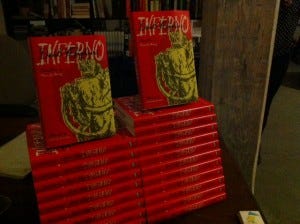
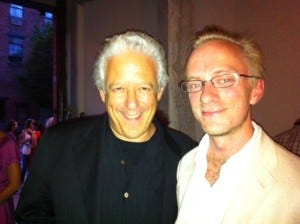
1. Inferno II, ready for you. 2. Academics Peter and Chris (who’s working on a post-doc at University of Chicago), are hot as hell.
It was appropriately hot and stuffy in A Public Space HQ on Friday night, and an entire purgatorial hour passed before award winning poet Mary Jo Bang — tiny and black-clad — approached the microphone to read from her new translation of Dante’s Inferno. Though we were all sweating in the early September heat, we persevered (free wine and snacks helped, as did the metaphorical aptness of waiting for a poem about hell while being stuck in a dark room of unwelcome heat wherein you’re not totally comfortable, with people you don’t know).
1. The crowd spills into the street. 2. Timothy Donnelly, author of The Cloud Corporation and professor at Columbia University, and Mary Jo Bang, in the bathroom (aka the Seventh Circle).
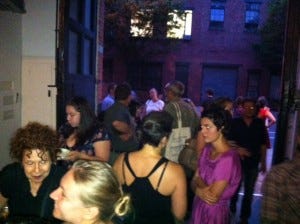
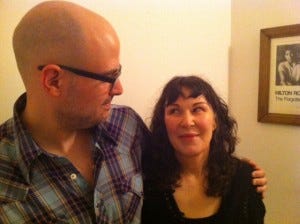
Bang’s pet project for the past few years, this new version of Inferno takes the Italian poet’s great work and recasts it in contemporary English. It makes complete sense to do so — when Dante wrote his original work, in the commoner’s Italian rather than the literary Latin of his day, he was committing a bit of a revolutionary act. So to take the poem and cast it in the common vernacular of now is, in a way, a tribute to the original poet’s intent.
1. Mary Jo Bang, cloaked in darkness.
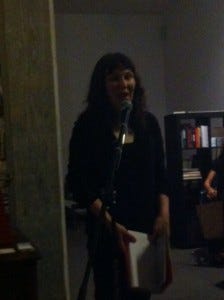
Bang read from Canto III, which, as she put it, “is when Dante first glimpses hell, having just met the poet Virgil.” Before beginning, she thanked the colleagues who had helped her perfect her translations, to whom she was “eternally but not infernally grateful.” In Canto III, Dante and Virgil step into hell, having read the famous line “Abandon all hope, ye who enter here,” written on a rock. The line is recast in Bang’s work as a more subtle, cautionary one, one that urges not abandonment of hope but paying of attention from that moment forward. Bang read the line with a twinkle in her eye, and it drew some thoughtful laughter from the crowd.
Then, having finished the Canto, the diminuitive Bang thanked Dante, and reminded us that this was a poem not about the existence of hell but about “bad behavior,” something we all commit from time to time. Then she was absorbed into a crowd of waiting friends and fans. The room got cooler as people departed; the first notes of “Sympathy for the Devil” followed them out into the night. Good choice. Like Dante, Bang has a sense of humour about the Inferno.
***
— Kaitlin Fontana is a National Magazine award-winning writer and oft-nominee currently living in Brooklyn, NY. Her work has appeared in the Walrus, Maisonneuve, Event, Room, SPIN, RollingStone.com, Sound, and Exclaim! among many other publications. Find her here.