Personal Narrative
My Husband Swears Our Baby Is Out To Murder Us
He's begun to fantasize that our son will wipe my in-laws off the planet
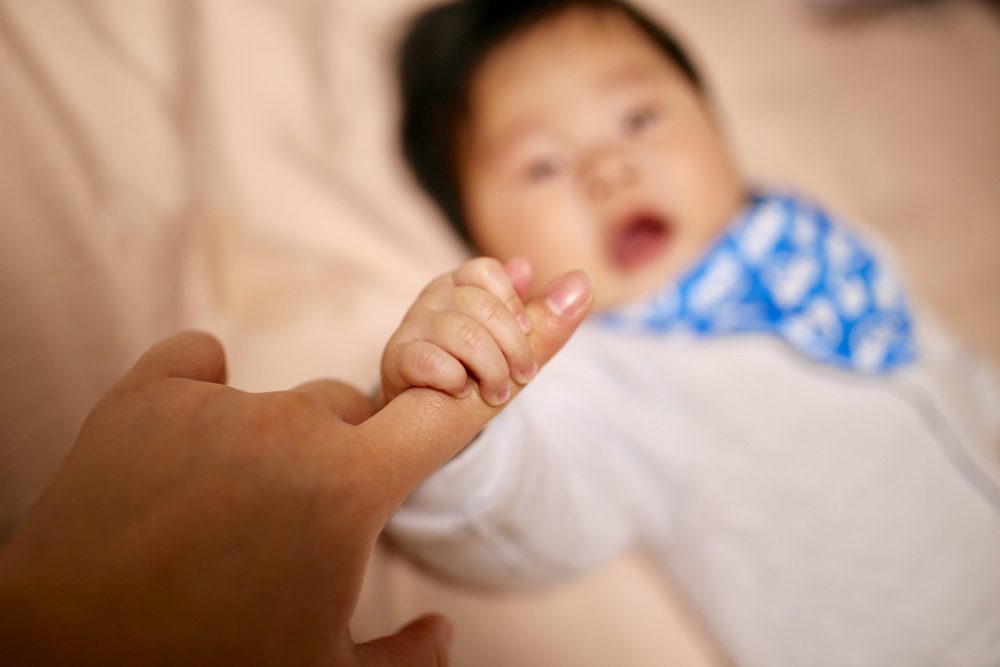
Son Debt by Lucy Zhang
Husband swears to me L is out to murder us. Or at least him. Why else does L projectile pee every time Husband opens the diaper, right after he’d finished wiping away jaundice-colored poop? Why else does L scream like the world has caught fire whenever Husband sets him down on the hard bamboo mat to foster the development of proper motor skills?
I roll my eyes. “He’s not out to murder you,” I say. “That’s called being a baby.”
But my words don’t reach Husband. He has begun to fantasize that maybe our murderous L will wipe my in-laws off the planet—the “one good thing to come out of this human potato.” Husband’s mother possesses the manipulation skills of a viper. She tried to guilt her son into mortgaging a house far beyond our fiscal means simply because it had the guest house she desired for when she made her trip across the ocean to visit. We put our feet down on that one, and the result was several months of radio silence in the WeChat group she once engaged in daily. The one time she emerged from her silent treatment was to ask Husband for his passport information to finish writing her will—passport information she already had for a will she’d already written. Husband was convinced she was passive-aggressively threatening to remove him from her will if we didn’t comply. “We don’t need that money anyway,” he said.
When I can muster the energy in my vocal cords, I read these out loud to L while flipping to the few pages that contain photos for him to take in.
My father-in-law is slightly better. Despite his tantrums and tendency to destroy objects and hit people, he is simple. Wears his emotions on his sleeve. Behaves like a child. His anger simmers at surface level, and after a few punches and throws, he forgets the argument with a good smoke. I don’t want him around for other reasons: he refuses vaccinations, convinced they’re western government propaganda; he will only take a mutant combination of traditional Chinese medicine and metformin for his diabetes instead of correcting his diet; he smokes like he breathes, a poison that Husband hopes will send his father to a quick grave and that I hope will never touch L.
Husband claims my side of the family is easier to deal with since they immigrated to the States decades ago—plenty of time to westernize and assimilate. The best thing they ever did was give birth to me in the United States, according to him. No cutthroat Gaokao culture; no requirement to obey parents for every life decision; no burden of fulfilling elders’ demands while counting down the days until they pass.
“If this little devil were a good murderer, he’d take care of his grandparents real fast,” Husband says.
“Let’s not get ahead of ourselves. Once L gets over this SIDS phase, we can fantasize about his prospects as a criminal or whatever,” I reply. “He needs to live first. Then sit up. Then stand. Then maybe he’ll have the fine motor skills to kill someone.”
“I wish he were eighteen already.”
“Wouldn’t it be a problem though, if L wants to kill you instead of your parents?” I muse. Of course, L will not pursue a career as illustrious and AI-proof as a homicidal felon, but rather tread down one of the surefire, financially secure paths: engineer, doctor, or lawyer.
“You’re right,” Husband nods. “I could be next. The little devil has daily access to me and my jugular.”
“I’m more worried about you ‘accidentally’ feeding L a pack of Buldak sauce to force your palate preference on him when he grows up. Spicy food will become the only thing this household ingests. The toilets will meet their doom.”
Husband shrugs. “High spice tolerance is associated with grit and work ethic.”
I carry L to the bedroom so he can look at white-and-black-colored squares from the Lovevery subscription my coworker gifted me. Black ink printed on cardstock marketed as critical to infant sensory development. The same types of shapes that cover my vision in spells of vertigo. My preference of toy consists of old, dense history textbooks able to concuss someone’s head and pamphlets on the three warring states, which my dad purchased from an old man’s vendor in Xintiandi, the only district in Shanghai not tainted by modern materialism like the rest of the city. When I can muster the energy in my vocal cords, I read these out loud to L while flipping to the few pages that contain photos for him to take in. But today is a low-energy day; Husband’s morbid imagination has depleted any potentially conserved stores.
“You don’t hate your dad, do you?” I ask L, who kicks and swipes at the air like a toppled tortoise. I rattle a neon blue-pink-green contraption that my mom bought from Walmart when L was only three weeks old. I’d told her it made too loud a sound and would overstimulate him, but she still rattled it in front of his face with a vigor I hadn’t seen since she commanded a knuckle-worn seamstress to tailor a qipao for my attendance at a cousin’s wedding. (I don’t remember the cousin’s name, only that her parents spent money like it was water, and my mother forever had to draw comparisons between our schooling, clothing, husbands, and soon child rearing.) Now I shake the toy in front of L like it’s Gandalf’s staff warding off evil: the apocalyptic baby cries.
“Or maybe you do,” I murmur as his kicking evolves into kicking and babbling evolves into kicking and screaming. “But your dad means the best.” Even if Husband currently views L as a responsibility, the way you need to replace tires before they blow out. Better than my father-in-law, whose sense of responsibility lacks the “sense” part.
Husband’s greatest dilemma is when (not if) to allow his parents to visit, a struggle that has resulted in multiple WeChat family group chats being abruptly disbanded and then recreated.
“If I were to post your situation on Reddit, the comments would be clamoring for you to go no-contact,” I muse.
“That’s Western Think for you,” Husband replies. “My parents can’t even conceive of me living independently. I am supposed to give everything up for my family. My birth was an implicit exchange: they raised me in return for an eternity of compliance.”
“We are your family,” I say, pointing to a sleeping L and myself.
“This goes deep, far deeper than anything no-contact can accomplish,” Husband continues without responding to my comment. “There’s all this implicit nonsense that you’re just supposed to get. It stems from imperial China: the emperor will ask his officials what they want as a reward for performing some great deed. And the official is supposed to say some noble shit like ‘nothing, doing service for the country is good enough.’ And if you’re ever honest about wanting or disliking something, you die.” I think the diatribe’s over but he keeps going: “That’s my mom: she’ll say ‘oh, no need to think about visiting me when planning your trip to Japan.’ And then she’ll get upset when I didn’t think of her while planning the trip.”
“Who cares about what long-dead emperors and officials would do? Didn’t you say you’d never let your parents visit again after the last two months’ stay?” I ask.
One year ago, Husband’s parents visited us and occupied the guest room across from the study. “This is your home, there’s no need to treat us special. If there’s something you don’t like or want us to do, just say so. We have to be open with each other,” my mother-in-law had said. She often magicked sweet words that worked on me at the time. I later learned her words served one purpose: to soften the listener’s ears. She’d tell Husband not to preoccupy himself with taking care of them, driving them to Costco, or helping them carry groceries, only to express deep disappointment when he took a Zoom call during the workday instead of dragging the pork chops they’d spontaneously purchased through the garage. Her universe existed in one type of transaction: the one-upping of sacrifices, an exchange that only worked if her sweet talk engraved both obligation and guilt into Husband’s brain. Of course, birthing Husband into existence was the greatest sacrifice one could make, so according to my mother-in-law’s unspoken worldview, Husband owed her an eternal debt. “Tossing an egg and sperm together and then funding the product through college doesn’t guarantee a life of servitude,” Husband would repeat to me whenever one of these gaslighting messages came through. It wasn’t just cellular growth and tuition though. The hot dog links from Costco that my in-laws stuffed our fridge with also demanded an equivalent exchange: “We bought you all this good food, but you won’t even drive us around?” Never mind that we rarely craved hot dogs and the only price we’d pay in exchange was the duty to finish more cancer-causing meat to clear up space in the fridge.
By the time my in-laws were to leave, they’d additionally “helped” by trimming our palm tree, stripping it down to a naked stalk that resembled a sole middle finger protruding from the soil to curse the heavens. After that incident, Husband swore to never let them stay for more than two weeks, a sentiment that later evolved into refusing to let them return at all.
“In an ideal world, they’d never visit. But is this an ideal world? No. Hardly. And once they’re old enough to stumble on the stairs to their apartment, I’ll need to figure out how to cart them off to a senior center while an ocean’s distance away,” he complains.
“That’s still many decades away. Your parents can take care of themselves.”
I rub L’s head simultaneously, feeling the softness of his skull and the subtle dips and protrusions of the fontanelles and immature bone.
“If we’re lucky, they won’t even live long enough to go senile. The smoking and diabetes will end my dad, and the perpetual overthinking, stress, and borderline schizophrenia will end my mom.”
“You shouldn’t wish for someone’s death,” I warn. “That kind of thinking is what gets karma to dump you on your head.” I rub L’s head simultaneously, feeling the softness of his skull and the subtle dips and protrusions of the fontanelles and immature bone.
Husband laughs. “What if my act of wishing for my dad’s death kills him? And then our son kills me? We’d be a bunch of dad killers.”
I frown in a half-hearted attempt to pull him out of his spiral. “Don’t joke about that.” I’m not sure why I’m trying. Perhaps it’s less for Husband and more for my ease of mind that at least I vocalized opposition and thus could not be complicit in any future fallout between dad and son.
“Don’t deny it. It’d be terribly funny,” Husband says between chuckles. “My life is a joke.”
Husband’s delusional scenario would not have been possible had I conceived a girl instead of a boy, to Husband’s disappointment (he wished for a daughter whom he believed he could coddle rather than a boy he’d constantly measure up against society’s definitions of successful) and to my in-laws’ great satisfaction. But the fact that I failed to bear a girl means no relatives clamoring for us to try again for a boy. One experience of over twelve hours of unmedicated contractions is enough for my lifetime. Any more children must be aggregated in a test tube or laid via eggs.
“Good, it looks like you’re still pretty after giving birth,” is the first thing my mother-in-law says during our first WeChat call one month postpartum. She carefully inspects my face through the video camera, her eyes hovering above the lens, only the top half of her face visible through our view.
And then: “Make sure you eat lots of peanuts, dates, and glutinous rice. These things will help your postpartum body recover from everything it lost.”
And then: “China has thousands of years of medical experience in births and postpartum recovery. Don’t rely on Western medicine. In fact, I actively try not to take any of that stuff. People use those drugs too much. It’s better to follow traditional Chinese medicine: balancing the hot and cold of the body, taking our herbal supplements.”
I nod along. Husband holds back a smirk—this is just another one of my mother-in-law’s delusions. “Irrational trust placed in the largely unscientifically proven TCM. Sure, it’s based on generations of Chinese illness and treatment…with the biggest survivorship bias to speak of,” he has told me multiple times.
“I’m eating plenty of healthy things,” I reassure my in-laws. Then I point the phone’s camera at L so they can focus on the baby.
“How cute,” my mother-in-law remarks curtly. My father-in-law nods and says nothing. Husband and I share a quick glance. Classic: the only aspect of our son they care about is the title they can claim as grandparents before their friends whose kids are either still in school earning pennies while wrapping up their infinitely long PhDs, or freshly graduated with their doctorates but struggling to find jobs in the AI-and-layoff-job-obsoleted market. “My son makes good money, is married, has a child, and owns a house,” she often touts as though the accomplishments are all credited to her, never mind that work stress has induced heart palpitations and high blood pressure in Husband before reaching the age of thirty. My mother-in-law had even suggested Husband take one lone week of paternity leave and then return to work so his career growth saw no regressions or slowdowns. “Need money to buy a big house,” she’d repeat like a shaman chanting for a loved one to return from the dead, a ghost who can only live in a residence with six bedrooms and over one acre of land. In turn, I told Husband: “If I’m maximizing my maternity leave, you’d better maximize your paternity leave, else what’s the point of working at a company with good benefits? We are expendable cogs. In turn, we expend corporate resources.”
Then she returns to blabbering about best postpartum practices. I doubt she truly cares about my health as much as she cares about preserving her son’s wife as “pretty” and demonstrating a facade of considerate expertise. She leaves no room for me to interject: “You should try to minimize standing. Don’t go outside if you can help it.”
We’re situated under a clear, San Diego blue sky, surrounded by palm trees and succulents, in the valley of several mountains where an expanse of bushes and rocks stretches between neighbors—you can hardly call them neighbors. I’ve already been outdoors multiple times, feeling the wind blow over my body and the heat of the sun absorbed by my hair. We don’t have an AQI problem like you do, I reply in my head. Inhaling the outdoor atmosphere won’t fill me with those elusive toxins that you believe cordyceps will expel. I continue to nod.
And: “Eat brown sugar congee. It will return the heat to your body.” I wonder what heat needs returning when my night sweats wake me before even my engorged breasts can leak through the linens.
And: “Don’t eat pears or frozen fruit. Definitely no cold water, which you shouldn’t touch at all, postpartum or not, for that matter.” Three bags of Kirkland frozen blueberries sit in our freezer.
I pray for L to cry bloody murder so I can disappear under the guise of feeding him, the only blessing of breastfeeding and my inevitable self-identification as a cow. Husband senses I might simmer over any second. It’s all in my eyebrows. I control every part of my facial expression with ease, except the eyebrows, which twitch and crease and slant and spasm on a face whose smile and gaze remain constant. An improperly wired puppet, Husband describes it.
Husband takes the iPhone and heads to his office to continue chatting with his parents, a family boundary I more than willingly respect. I stand and cross a milk-stained carpet to carry L to the nursery chair. You’d think a white carpet would disguise excessive breastmilk letdown, but instead, I can point out every splotch even at night with the lights dimmed in hopes that L will sleep an hour longer.
The Great Fallout started with a video conference. It ends with Husband triumphantly entering our bedroom to L’s sporadic whimpers culminating in a long wail.
“You successfully declared yourself no-contact with your parents?” I guess, knowing such an outcome is impossible.
“I successfully delayed their visitation indefinitely,” he announces. “Told them that we don’t need urgent help with the baby because your parents are retiring and have that handled, so no rush to travel. You know how my mom is: everything she does is a sacrifice to ‘help’ me. If we don’t need help, she won’t just come out and say we owe her the trip.”
“That doesn’t sound too indefinite to me. It sounds more like you staved off their visit by a year or so.” I shove my nipple into L’s mouth. He latches perfectly and unlatches equally perfectly. OK. Not hungry. I pat his back, rub his head, and bend and stretch his legs to his chest. Anything to appease potentially murderous future tendencies.
Husband senses I might simmer over any second. It’s all in my eyebrows.
“Granted, that’s a full year to try and convince your dad to get vaccinated, or give up smoking,” I continue. “Your mom, though…I’m surprised she didn’t wage World War III.”
Husband sighs. “My dad won’t change his ways; the best we can do is hope he dies within one year.” What a fitting solution coming from him, who chose his English name from too many late nights reading tales the English teacher did not assign because they held no “literary merit.” Husband, the hero. His parents, the tyranny. The noble method of attack: robbing his parents of time and their grandson.
“And it’s less World War III and more of a Cold War. My mom hung up right after I told her that. Classic response: ‘I knew this would happen; there’s nothing more to say.’ Beep. Done,” he continues.
“Sounds like a good thing. If she won’t talk to you, you won’t need to talk to her,” I reason. “Your dad will just follow suit.”
Husband groans. “I hate Chinese people.”
I laugh. “You can’t hate your own people.”
“Liberty and independence. I’m all about that. Not filial piety and self-sacrifice.”
He also envies the neighbors who bought their twenty-something, academically-failing son a Cybertruck in cash, no strings attached. Things surely only white parents would do: love their child unconditionally, give them something “undeserved” as defined by his framing of society. But that Cybertruck son still talks to his parents like they’re best friends. Meanwhile, H is halfway to cutting his parents off for good. Is Husband the failure? Or the Cybertruck son?
He glances at L, who hiccups and looks off into the ceiling corner, this room making up his entire, conceivable world. “See, I have no expectation that L will take care of us or follow our rules when we’re old and need to use text-to-speech for everything that requires a screen. The moment he’s an adult, he becomes his own, individual problem.”
“We’re all our own, individual problems,” I reply. But I’d still save L from ruining his future by committing homicide. I’d also like to save Husband from getting killed. I think about my mother-in-law, languishing in her apartment in Beijing, scrolling TikTok or Taobao, unable to verbalize her version of a mother’s “unconditional love” without passive-aggressive expectations, and her only son an ocean’s distance away and ignoring her texts. I too have been infected with this agonizing “mother’s love.” It grows uncontrollably each day, and with it, this bottomless pity and sorrow for my mother-in-law.
I rock L back and forth in my increasingly sore arms, wondering how I carried this creature for so long in my belly. Maybe he will remember the hearth of my placenta long after he leaves the country for a more affordable university. He may even visit from time to time, asking for advice or sharing new adventures without any intention of murdering his father.