Personal Narrative
The Neighbor Who Stalked Me
I felt hunted by him, but legally, his routine was treated as a hobby, like birdwatching
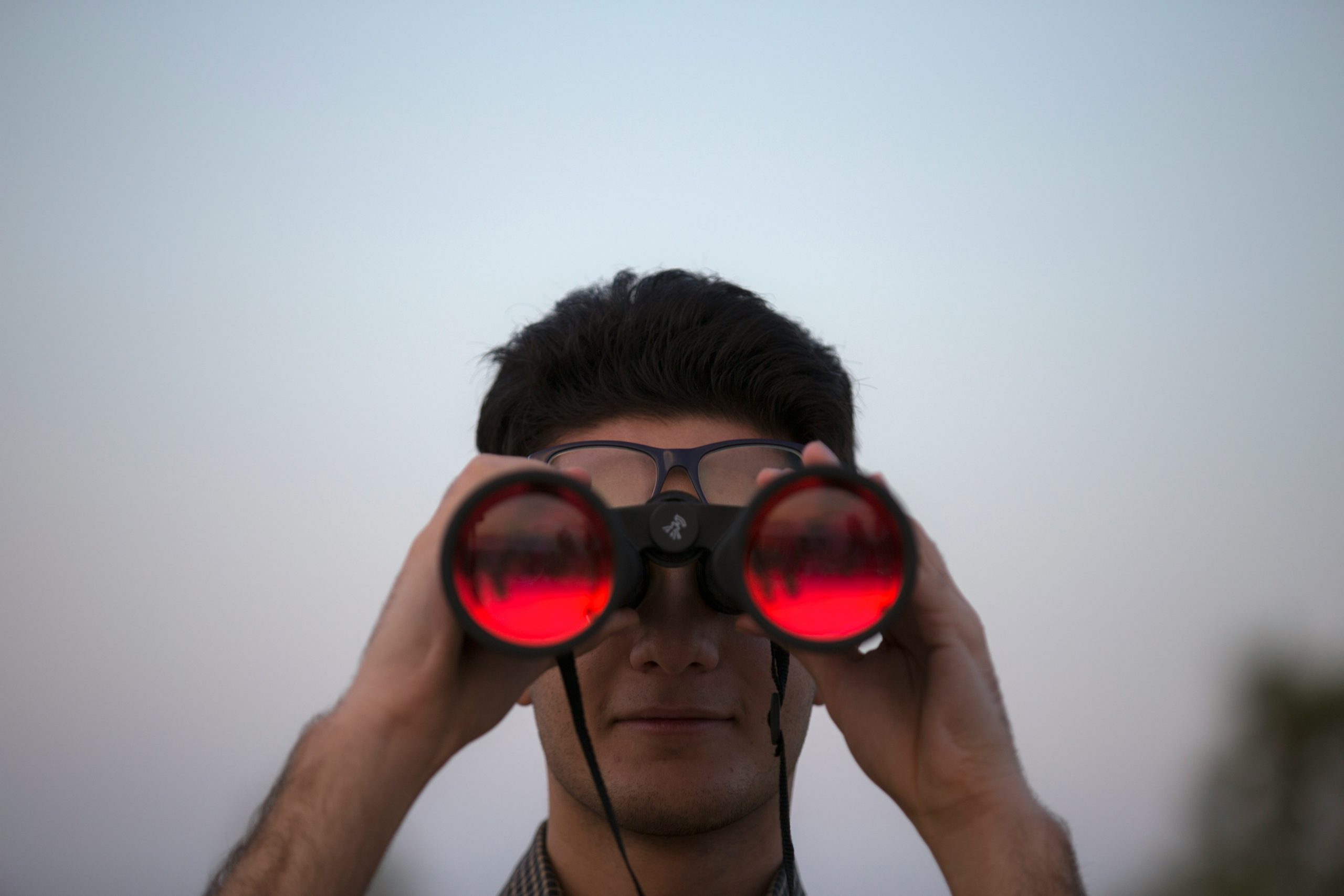
To a Bird Watcher by Faith Palermo
While I sit at my desk to write, you shine a laser pointer through my window. With a fluid motion of your hands, I become segmented. Concentrated green light outlines my chest, my throat, my eyes. I feel the slice, skin turning cold, distanced. You act, and I react. You shine, and I shut my blinds.
Frustrated, I storm out of my bedroom. You follow, green light angled through the sliver of Venetian blind. I round the corner into the kitchen, crouching underneath the island. You know I’m here, projecting the light onto the wall behind me so I know too.
We do some iteration of this for months. Sometimes, I try to break the pattern. When you get particularly close to my eyes, I call the police, nervous that you’ll blind me. They ask you to stop; you laugh loud enough for me to hear it from my window. When I record you, trying to collect proof, you take your shirt off, resting your free hand near your waist. I find ways to navigate my apartment unseen.
To open a window is to perform for an audience.
Later, when explaining what happened, I’ll refer to these months as that time I was stalked by my neighbor. I mean this literally: as prey. Legally, your routine is a hobby, akin to bird watching. If anything, it was my fault. To open a window is to perform for an audience.
These are the things I think you know about me: I am tall. I have big, brown curly hair. Most days, I leave my apartment at 10 AM, walk to my white Subaru with out of state plates, and am gone until dark. I am old enough to not live with my parents but disappear along an academic calendar. I am visibly young. Based on past experiences, I assume you think I’m at least five years younger than I really am. I live with one roommate, who will eventually leave because of you. I do not bring friends home; the only other people you see through the windows are police officers. I am bothered by your actions. After two weeks, I stop opening my windows. You aim between the blinds.
Weeks after you started watching me, a woman pounds on your door. Fists keeping time, she screams through the glass, accusing you of pretending to walk your dog past her house as an excuse to watch her teenage daughter through her bedroom window. Fingers pinching the blinds open, I watch as you throw yourself out of your apartment. You scream denial, pronouncing yourself “the Superman of this bitch.” You are a man; therefore, you are heroic.
I am grateful to live on the second floor.
There’s a difference between looking and watching. I like looking. In New York, a particularly risqué top makes a man in the subway drop his ice cream. In DC, I wear low-cut shirts to free comedy shows, sit in the front row, and watch men with underperforming podcasts stumble through their sets, too nervous to glance up. A look is prompted by my action, by the way I’ve chosen to represent myself. A moment of recognition. Watching is prolonged, calculating. In parking lots, arms full of groceries, eyes track me towards my car. In streets, men honk and bark as I walk past. To look is to be appreciated. To watch is to be consumed. I want to be admired while remaining whole.
I want to be admired while remaining whole.
Though I invite looking in public spaces, at home, I change. I live in oversized t-shirts. I don’t sit on my balcony because it doesn’t feel private enough, the bars of the railing not offering enough protection. I’ve never adjusted to living in a city, a place with so many eyes. So, I keep to myself. I don’t have conversations with neighbors. I don’t look at them. In my apartment, I carve out a private space. I can only feel comfortable when I’m alone.
According to building code guidelines, a bedroom must have a window. “Habitable” is a classification: The space must have access to light, fresh air, and an emergency exit. In exchange for these conditions, I pay $1,200 each month.
When I complain to the leasing office, they calmly explain that you do not exist. There is no man on the lease; therefore, no man must live there. I show them the videos of you with your laser pointer, you performatively undressing to make me uncomfortable, you laughing at me as I rip my blinds shut. They shrug. Maybe I had the wrong apartment number. Maybe I was confused. Maybe I had secretly wanted the attention and didn’t know what to do now that I had it. I ask them to knock on your door. They refuse. This would be a breach of your privacy.
A few weeks in, I begin watching the History Channel’s Alone. Each season, 10 survivalists are placed into the wilderness with limited resources. Whoever is able to sustain themselves the longest wins.
I find myself drawn to seasons filmed in cold environments. Here, shelter outshines the need for food. The survivalists dig trenches into the ground or cut down trees to create cabins, insulate themselves with moss and pine needles. When they get hungry, many elect more passive hunting techniques. Snares balanced in fresh snow catch grouse while the survivalists shiver beside an open flame. In this way, a bird can be killed without humans watching.
You wouldn’t know that I shower in the dark because I’m sensitive to light. Chronic migraine distorts vision, intensifying color until it becomes overwhelming. At night, this amplifies to the point of nausea. Darkness blots it out.
Showering in the dark means shaving in the dark. Without seeing, I almost always manage to slice the skin at my ankles. Gravity drags the blood out, forces it to slide into the contour of foot. I hiss as shampoo slips into the exposed flesh, cleaning the cut. I rub Vaseline into my ankles to contain the bleed.
In my bedroom, I fall into the easy routine of wound care. My leg is dried and covered, elevated and rested. Yet sometimes, if the cut is particularly deep, I begin to worry. How much blood is too much? I defer to Google, stumbling through Quora threads, until I’m able to put myself to sleep, but it’s never restful.
In the moment between bouts of consciousness, I imagine bleeding out through a sliced artery. Alone in an apartment, hundreds of miles away from anyone who might miss me, how might my body be recovered? How many classes would I have to be absent from, shifts would I have to miss, before someone became concerned? Maybe a week or two or three of not responding to Slack messages, avoiding emails. But if I don’t leave my apartment for a couple of days, if I don’t turn on the TV and my car never moves, how long would it take you to tell something is wrong? If I were to die, would you be the first to notice?
On dewy mornings, you stand on the grass that separates our homes to practice your nunchucks. Shirtless and barefoot, you grunt, your body twisting through the exercises. The chain clinks as the handles flail, the sound of a dog pulling against its lead. For days, I try to analyze this routine; had you been trying to intimidate me or are all of your actions just rooted in violence?
I know who you are. You make your dog an influencer, frosting his Instagram @ onto the back right window of your car. I use this to find your other accounts: your personal page, your professional SoundCloud mumble rapper page, and a fake page where you pretend to have an agent that curiously writes with the same diction as you, spells the same words wrong. You are unoriginal in your usernames. I find your Facebook, your Tik Tok, your Reddit. I learn that you’re home all day because you self-identify as a day trader. When the market is down, you turn to the laser pointer. When my window is closed, you make unenthusiastic thirst traps.
Your space is offered. My mine is taken.
I dig through them. A video of you in bed, trying to flex. A video of you in sweatpants two sizes too small. A video of your dog slumped into the corner of your bedroom. I don’t find you attractive, using my thumb to censor out your body. Instead, I want to find you in the same way you found me. Mentally, I collage the backgrounds together. A bed on the left side of the room, mattress on the floor, five sticks of deodorant on a yellow wooden dresser, walls bare. I tell myself that this is only fair, that if you know what my bedroom looks like then I deserve to know what yours looks like too. Still, I know it will never be the same, that you consented to this intrusion.
Your space is offered. My mine is taken.
After two months, all of my plants die. Without sunlight, they starve.
My roommate, the only person I knew before I moved to Virginia, leaves a few weeks in. You shine the laser pointer at her too, but only when I’m not home. In a conversation we have before she moves out, she admits that sometimes she left bigger gaps between her curtains and her windows just to see if you would target her first. I’m confused; if you viewed women as prey, why should she be any different?
We’re sitting on our knees, bodies angled under the protection of the island while I’m on hold with the police. She shakes her head, looks off to the side, “It’s just that—you’re the pretty one.” On the other end, the hold music stops, and the officer asks for our address.
While we wait for them to arrive, still on our knees, I tell my roommate that she’s pretty, but you’re not trying to get my attention because you find me attractive. You want power, the type of temporary possession that men try to take when catcalling, when placing hands on the small of our backs to push past us in grocery stores. You don’t look. You watch.
There’s a pair of Mormon boys who live between our apartments. Their living room overlooks the path that separates us. They learn my routine too, peeking past their gaming monitors, through their glass patio doors when I come home from night classes. Sometimes they would be outside already, white shirts tucked neatly into khaki pants. We never speak, but I could feel them looking to see that your watching remains distanced. When I make it to the door of my building, they nod. I nod back.
After three months, you stop.
At a standup show two years later, a comic asks if a man has hurt me. I shrug, mention that one of my neighbors kind of stalked me, explain the laser and the hunting. With further prompting, I disclose the information about you that I found, the mumble rap, the fake accounts. The comic laughs, cavalier. “I don’t think you were the victim there.” For a second, my smile falters. “A guy shines a laser pointer at your tits, and all of a sudden, you have to fuck his life up? I mean, if anything, you were stalking him.”
I don’t clarify. I know there isn’t anything I can say to a man who thinks that silently screenshotting someone’s socials is enough to fuck their life up. The comic shakes his head performatively, murmurs “psycho-bitch” into the mic. Meeting his eyes, I laugh.
I’ve tried to write about this experience, but everything falls flat. Every couple of months, I scratch out a new piece. A hermit crab essay in the shape of a court case. A poem comparing my body to a kidney stone, another annoyance to be removed with a laser. A braided piece on non-physical violence against women. But nothing quite feels right. A professor refers to it as my defacement, and while the new language resonates, I can’t build something around it.
Somehow, it feels like the stakes are different. Normally, I don’t care what my reader thinks of me. Any analysis they draw from my work is only their reading, their understanding of what I’ve written. Here, I find myself invested in the reader’s perception of me. Can they see all the ways I’ve made myself smaller? Body folding to hide in the shadow of the kitchen island? Shoulders hunched as I walk to my car? When they look at me, my spine curved in on itself, face in my knees, do they think I’ve misread the situation?
I want my world to feel as big as everyone else’s. For weeks, I don’t shut my blinds.
At the thrift store, I buy a shirt that says, “BIRDWATCHING GOES BOTH WAYS,” neon orange letters against an olive green backdrop. It hugs me in the right places, the top snug against my chest without warping the text. Three years, 500 miles later, I know you will never see it.
I guess I’ll just have to describe it for you.