Personal Narrative
Nobody Walks in LA, but I Was Radicalized on Its Streets
I thought the activism I wanted to be a part of was more powerful in Washington D.C. or Oakland, but L.A. kept pulling me back
This article is free to read. So is every article Electric Literature publishes. No limits, no paywalls—now or ever. But we rely on your support to keep it that way.
We need to raise $35,000 by April 15 to keep the lights on, and time is running out. Donate today.
—————
“She was Radical” by Tanzila Ahmed
“But where was she radicalized?” they’ll ask.
“Why here, in the streets of Los Angeles, born and raised,” I’ll say.
1.
My mother said I didn’t cry when I came out of the womb. I suspect I side eyed this world from the get. Though I was born in a hospital in Whittier, technically, I came to this city through LAX, as a four-month-old fetus in my pregnant mother’s belly—who had left Bangladesh for this city of Los Angeles and the land of opportunity. She wasn’t a third world refugee, exactly. She was a new “boah”—a new bride—who married a strange man in a strange land because that was better than the future she had for herself in her homeland. What is home, after all, for a people who are constantly running away from strife?
2.
I was radicalized at my pre-school in San Clemente where I would not use my words. I was quiet. Instead of telling a kid how he upset me when he stole my toys, it seemed more efficient to bite him. This one time, the popular girls in the wooden jungle gym told me I couldn’t play with them because I was Brown, so I kicked sand in their faces. Baby’s first microaggression. It was the first time I got in trouble in school, but it was definitely not my last.
I was radicalized not in the terrorist sense, but in the Malcolm X sense. That is, unless you consider Malcolm X a terrorist.
3.
The “madrassa” I was radicalized in wasn’t a mosque—but the space outside of it. It happened when the pig feet were thrown in the driveway during Ramadan at the Al Noor mosque in Chino. It happened when white supremacists brought big dogs outside the Temecula Mosque while it was being built. It was when hateful graffiti was spray painted at the mosque on Vermont. It was when the FBI informant infiltrated the mosque in Garden Grove and disturbed the congregants so much they reached out to the FBI to report the informant. It was when we had to walk through a metal detector and have our bags searched before going to Eid prayers to keep us safe from threats.
4.
I didn’t find my radical community in online forums on the dark web—I found them in moshpits in dingy punk venues across Southern California. My mohawked crush in my Inland Empire high school wore a backpack with punk rock patches and I was in love with every band on them. The Palladium in Hollywood was my first rock show, the Glasshouse in Pomona my favorite, and the Wreck Room in Costa Mesa the most nostalgic. I took my rage out in mosh pits with fists up to the lyrics of NOFX’s Don’t Call Me White, Pennywise’s God Save the USA, Social Distortion’s Don’t Drag Me Down and Rancid’s Roots Radical. It gave teenaged me a place to funnel my pent-up anger when I was told to be silent. In my 20s, I registered voters at the Pomona Fairplex every time Warped Tour rolled through. Later, I’d organize punk shows myself at various hole-in-the-wall venues on Sunset every time the Desi punk band The Kominas came to town, because I wanted everyone to feel my specific brand of Brown rage.
5.
I was radicalized here. Not in the terrorist sense, but in the Malcolm X sense. That is, unless you consider Malcolm X a terrorist. At UCLA in Westwood—at an institution that didn’t believe in the study of racial injustice—we were hungry to learn so we created our own student-led critical race theory course. In Little Tokyo at Tuesday Night Café we learned how to tell the counternarratives of our Asian American communities. In an old warehouse by the L.A. River, we created a Muslim woman fight club because to learn how to fight with each other, would help us protect each other. We learned for ourselves, we told our stories for ourselves, and we protected ourselves—there’s nothing more radical than that.
“But where are you really from, really?” They will ask, additionally.
6.
I’m really from here, in a city where nobody walks and I was radicalized on these streets. When I didn’t have a car, I took the crosstown bus from West Adams to Westwood, up Crenshaw and West on Wilshire and Sunset. The brown skinned proletariats would slowly make their way on the bus—the women wearing the sensible shoes with cleaning supplies. The men in the corporate mandated polo shirts and Dickies. The kids in school uniform taking the bus to their anti-segregation charter schools. When the lawns became green and homes gated, the people would shift, people getting off the bus to their jobs while others got on to go to college or save gas on their hybrid vehicles. All of L.A.’s disparities on full display in one bus ride.
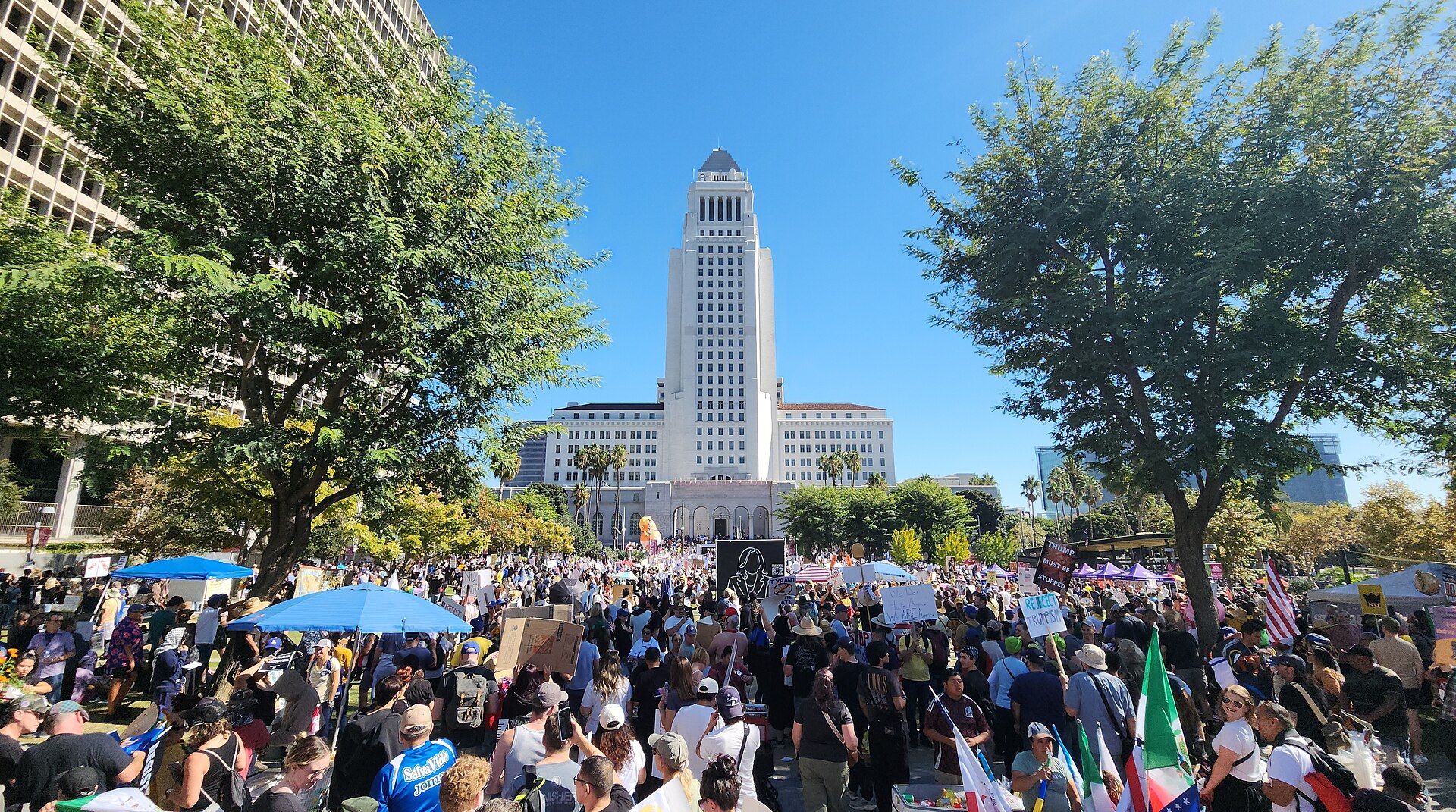
When protesting in Los Angeles, we take over the streets.
7.
The home I grew up in is six houses south of the 60 freeway and is close enough for the windows to tremble when a semi truck blows its horn late at night. Close enough for the leaves of the guava trees to be covered in a thin layer of black soot, till the next rain, if it ever comes. Because of this, my little sister’s asthma attacks are a public health statistic, we lived in a disparity we couldn’t move from.
8.
My mother is buried at the corner of the 57 and the 210 in the city of La Verne. When she died, I fought the imam to pray with the men in the front room of the mosque, to cry graveside with the men, to throw dirt on the grave like the men, to give a eulogy in the men’s section of the main hall. Her untimely death was already an injustice, a case study for how the marginalized are treated with inhumanity until they die. Then injustice again.
9.
A few years ago, when Islamophobes were empowered to display their hate using laminated signs over the 110 freeway overpass, we’d go in the dead of night and steal the signs. The signs would reappear, a few days later, so our network of rebels would keep each other updated on who would rip down the signs next. I’d eventually cut the signs up and turn them into mixed media works of arts.
Maybe my joy made me radical, or maybe it was our collective joy at making change together.
10.
When protesting in Los Angeles, we take over the streets in Los Angeles. I protested at MacArthur Park for the May Day protests in the mid-2000s. I protested for Palestine in 2009 in front of the Federal Building on Wilshire Blvd in Westwood and then again in 2010 in front of the Israeli Consulate on Wilshire Blvd and then again in 2023 in Pershing Square. Each time was same-same, but with better protest signs and improved chants. At the intersection of Crenshaw and MLK we protested for Ferguson, and at the intersection of Grand and Sunset we protested for the lives of Bangladeshi garment workers and against Wal-Mart gentrification. On Pioneer Blvd in Little India we protested for the El Paso 37, and then later to protest Modi’s increased fascism in India. On Hill street I carried a sign with the face of Yuri Kochiyama and the words “Destroy White Supremacy” for the Women’s March after Trump was elected. That International Women’s Day I rode on the float leading the procession with other Muslim activists, reading poems on a microphone when we stopped on Alameda Street, like it would change the mind of the oppressors if they could only hear me. In Grand Park in front of City Hall, we protested for our wombs. In front of the American Apparel factory on San Pedro with a stack of petitions we protested their labor practices until they called the cops. In Little Tokyo we were constantly protesting on 2nd street, for the rights of Muslims to exist. We wrote and performed collective poems, reused electric candles, and recruited everyone to help with organizing our vigils, an innumerable amount of times. One time, eggs were thrown at us from an apartment building as we walked up 2nd street, but it hardly even registered since we were walking on the same sidewalk in the shadows of Japanese Americans waiting to board the bus to Manzanar. A couple years ago, for the India’s Independence Day protest in Irvine, I made cute protest signs with a wide mouth tiger that said “We Won’t be Silenced.” The activists practiced a non-violent protest, walking in silence through the fair in opposition of Modi’s attacks on Muslims in India. They would later send me videos of being chased out and of an old uncle in a lavender polo shirt and a straw sunhat ripping up the protest sign I made in what I can only think he thought was a macho show of aggression. Silly men.
11.
Maybe I was most radicalized at airports—Los Angeles, Burbank, Ontario, Long Beach and Santa Ana—where after 9/11 I wasn’t allowed to fly without a special phone call being made at the front desk because my name was so-called similar to someone on the Watch List. I just happened to get pulled aside for random inspections. Or maybe it was the clicking on the landline back then and how the FBI showed up at my parents’ home and how every brown person had to wave an American flag everywhere.
True radical change happens at the grassroots at home.
12.
Maybe my joy made me radical, or maybe it was our collective joy at making collective change together. The dance parties at Grand Star in Chinatown surrounded by all the activists I had just protested with. Or it was listening to jokes and stories at Family Reunion shows at that one spot under Sunset on Alvarado. Or it’s walking with friends around the Silverlake Reservoir or outdoor pandemic picnics at Angels Point, Echo Park, Will Rogers and the Griffith Observatory Lawn. Maybe it’s my delight at the gorgeous white alponas—Bengali floor paintings symbolizing a welcoming—spray painted on sidewalks on Serrano and 3rd in Little Bangladesh reminding us how we are both here and there. The dynamic Los Angeles poetry readings at Tuesday Night Café, Sunday Jump, Our Mic, and LionLike Mindstate that moved me to realize that we need to witness each other’s stories being told and heard. It’s acting even though you are not an actor in all your friends’ film projects in backyards of La Cañada, or Larchmont, or Studio City because you want to see them all succeed at telling their stories, because if they succeed, we all do.
13.
Here in Los Angeles we walk in the echoes of the Ghadar Party, and we step in the shadows of past revolutionaries. I am radicalized here, now, because they were radicalized a century before me. I didn’t know that the 1910s revolutionaries had secret meetings all across this city to scheme about overthrowing the British colonizers, getting them out of South Asia. At the Port of Long Beach, ammunition was secretly collected and shipped to seditionists in India. On the corner of Beverly and New Hampshire, is where Kala Bagai, one of the few women of the Ghadar Party and fondly referred to as Mother India, lived and died. On the corner of Olympic and the 110, Dalip Singh Saund founded the India Association of America in 1942, to nullify the Alien Land Law and give the right to citizenship back to South Asians. In this city, we move through their shadows, their activism imprinted in ours.
14.
I tried to leave Los Angeles, I really did, because I thought the activism I wanted to be a part of was more powerful like Washington D.C. or more fruitful in a place like Oakland. But L.A. kept pulling me back. I should have known—true radical change of course happens at the grassroots at home. Of course.
15.
To map oneself means to memorialize the echoes of all of our past selves. If time isn’t real, then we are constantly returning to the places we’ve imprinted. If our ancestor’s trauma is imprinted on our DNA through epigenetics, if looking at the stars is time traveling into the past, if the egg we were born from was created in our Nani’s womb, then who is to say what in fact is real? We are but maps of the echoes of our past selves, which is a radical way of thinking, isn’t it?
“Where was she radicalized,” they’ll ask.
And I’ll respond, “Right here. In Los Angeles. At home.”