Lit Mags
A Visit to Our Meanest Relative Can Only End in Tears
“Nuts” by Katie Schorr, recommended by Halimah Marcus for Electric Literature
Introduction by Halimah Marcus
Katie Schorr’s “Nuts” is a salty, loving story told with an anthropological specificity that only comes from insider experience. The characters, a family of four and a great aunt, are the kind that stay with you. Bunny, the narrator’s seven-year-old daughter, is what one might call an old soul. Her deeply held convictions include honesty and people not touching her things. She dresses “every day like she [is] auditioning for Fiddler on the Roof,” layering the “ancient pilling cardigans of a babushka” that make her look “both feral and matronly.” She is equally capable of tantrums and profound insights. When her homework requires Bunny to interview an elder relative, she accepts the assignment with solemn responsibility.
Bunny’s mother, Sadie, hasn’t thought of her great aunt Lillian in years, but Bunny’s need for an interview subject regurgitates her name “like a whorl of reflux from a forgotten meal.” Lillian is properly old, over ninety, but she is also “unassimilated, openly judgmental, Socialist, divorced.” And mean, Sadie warns Bunny, a disposition that won’t be softened even for a child. Bunny promises she can handle it.
Sadie wants reinforcements, so she rallies her affable husband Nat and their three-year-old son Milt for breakfast at Lillian’s apartment in Gravesend. She is nervous about the long overdue visit, replaying a family rift caused by Lillian’s principled obstinacy. In Sadie’s mind, Lillian’s willingness to speak truth to power—or in this case, speak truth to family—casts a judgemental shadow on Sadie’s own propensity to go along to get along.
If Bunny is an old soul, Lillian is a little like a child—ignorant of social cues and skeptical of other people’s feelings. Sadie is the default peacekeeper, hyper-aware of everyone’s comfort level except her own. Bunny may be an impressive child, but when she’s put in the room with an actual old soul—an old person in an old body—it’s evident she isn’t an old soul at all, she is a child putting on a brave face. It’s an unstable dynamic, and once the interview commences, these characters, each carefully guarded in their own way, must grapple with questions beyond those written on Bunny’s crumpled piece of paper.
– Halimah Marcus
Editor, Recommended Reading
A Visit to Our Meanest Relative Can Only End in Tears
Katie Schorr
Share article
“Nuts” by Katie Schorr
Everybody on my father’s side had assimilated in what I’d call the cultural sense: they’d stopped talking Jewish. My father and his progenitors, they put away their deep borough accents, buried their surety of doom, their wryness and their rye. It wasn’t a rejection of god or the Torah, neither of which held any sway, but about not sounding like the kind of person certain other people don’t like. Only the prepubescent Hasids knew to stop me with their lulav and etrog. I could’ve rebuked them, could’ve told them my face in fact belonged mostly to my Protestant mother. But I secretly loved their knowing.
My daughter did too. Unlike me, though, it wasn’t a secret.
Bunny, at seven, dressed every day like she was auditioning for Fiddler on the Roof, mixing orange plaid dresses with woolen tights the color of lichen and the ancient pilling cardigans of a babushka. Bunny sometimes wrapped her hair in one of the old silk scarves I’d inherited from my grandmother, Bunny’s thick dark bangs and both ears sticking out the sides, making her look bedraggled and forlorn, one that was both feral and matronly, a suffering sort of girl from another time. When the boys with their payot asked us if we were Jewish, she didn’t lie the way I did; she said, louder than seemed wise, “Yes!”
On a Thursday, in the small kitchen of our Park Slope apartment, she produced a first-grade worksheet from the bottom of her backpack.
“Bunny, I can’t read this.” Bunny drew on everything, including her own skin, the tops of her hands, and her homework. She’d obscured the directive and questions with a long potato face, arched eyebrows, flat black line of a mouth, and swirling hypnotized eyes. It didn’t seem to matter to her that the artistry was unremarkable; it didn’t seem to be about that.
“I’m the one who has to read it,” she said, snatching the paper from me and squinting at it. “Interview an elder relative. There are eight questions. Who can I talk to?”
“Grandma Shelly is an elder relative.”
Bunny shook her head. “She’s not old.”
Point taken. Nat’s mother dyed her long hair red and got up and down from the floor faster than I did.
“There has to be someone better.”
Like a whorl of reflux from a forgotten meal, up rose my great aunt Lillian, my grandmother’s sister-in-law. Unassimilated, openly judgmental, Socialist, divorced. As bold in her unpleasantness as my own child was about wanting to have been born in another time.
“How old is she?” Bunny demanded.
I calculated. “Over ninety.”
Bunny stood reverently still. “Have I ever met her?”
I shook my head. In fact, I hadn’t really talked to Lillian in two decades. As family lore demanded, I remembered Aunt Lillian as monstrous. Until I brought her up to Bunny, I’d forgotten that I also remembered her fondly—during my childhood visits, she always seemed pleased to see me, interested in whatever words I could eke out, and remarked on certain promising things about me (“Sadie, you have the posture of Philippe Petit”)—at which point the Lillian in my mind began to sway between an unfiltered pariah and a wry, intelligent old lady who could see right through me. This amorphous hovering, like one of those haunted Halloween portraits that turn the living into skeletons or zombies when seen from certain angles, was perhaps even more frightening. I suddenly regretted suggesting a visit to someone who probably had every right to loathe me as much as my family did her.
“Was she in the Holocaust?”
Bunny had recently become intrigued by the Holocaust, had just last week asked a stooped old man in line at the grocery store if he’d been in it.
I shook my head. “You know what, though? I think she could be losing it, mentally. Who knows if she could even answer any of your questions?”
Bunny ignored me. “Is she nice?”
“No,” I said, scooping crumbs and an apple core from the bowels of Bunny’s backpack and dropping them into the compost. “She’s pretty mean.”
“That’s OK,” Bunny said quickly. “I can handle it.”
Already, our hypothetical visit had turned into a dare.
“Don’t we have a birthday party this weekend?”
“We have to go see her, Mom.
I should’ve just said no. I wanted to. But arguing with Bunny always depleted me, which was why I mostly did what my husband did, and avoided it.
Those dark discerning eyes blinked curtly up at me, waiting for my acquiescence. If we were really going to do this, however, to see this woman my parents wouldn’t see, this woman who didn’t really like my parents either, we would need to bring some buffers.
“And Milt can’t come,” Bunny declared.
I closed my eyes. “Your brother is three. Where’s he going to go?”
“Just leave him with Daddy,” she pressed.
Daddy. Everyone liked Nat; he was warm and relaxed and deeply tolerant, for practical reasons (he worked in real estate). My mother would joke that I must’ve had a perfect childhood because I’d married someone so much like my own father. And I would joke that she was right. (In reality, Nat was much harder for me to talk to than my dad, and, yet, much softer with the children, quicker to solve their problems, to break a rule if it meant they’d be happy, a practice that had become the family way.)
Aunt Lillian might not have censored herself in front of me beginning back when I was Bunny’s age, but she was unlikely to do her worst in front of easy, charming Nat.
“If we go, Daddy’s coming. And so’s Milt,” I said as I washed my crumby fingers. “But you should know Aunt Lillian isn’t, she isn’t like your grandparents. At all.”
“OK. How?”
“Well. She’s not a fan of what Israel is…is doing.”
Bunny looked at me. “Neither are you.”
“Right. But I don’t yell about it.”
“Grandma doesn’t yell about it.”
“Well, Grandma sent money to the Israeli army. Aunt Lillian would yell at her for that, if Grandma was on my side of the family.”
I waited for Bunny to say something. “I’m not saying she’s wrong to yell. Maybe I should yell more.”
Bunny looked absently past me.
“Mommy,” she said quietly, her soft palm on my arm, “will she like me?”
I covered her hand with mine. We were on different pages. As usual. “I don’t know.”
Bunny nodded, her upper lip rising gravely. “I’m a lot.”
I was the one who’d told her she could be a lot. But I’d done it less in horror than in wonder. Last year, in kindergarten, Bunny insisted on carrying two large tote bags filled with dress-up clothes and her favorite books to school every day. She said she needed them. Her teacher told me she’d rarely open the bags, but if another student so much as peeked at them, Bunny would instantly panic, sobbing quietly but unabatedly. This teacher was the gentle kind and always shuttled Bunny to the quiet corner, along with the bags, to recover from the affront.
This year, the totes and the meltdowns had been replaced by three separate reports of Bunny calling the same two girls sheep for copying all of each other’s classwork and, at the conclusion of her rants, spitting on the ground next to their shoes.
“They lie for each other, Mommy! They lie.”
Her conviction exasperated me, but I made a point of telling her the opposite. And I wasn’t lying. Exasperated or not, I really was in awe of her.
“So is she,” I admitted. “Which is maybe why we should just call her instead of visiting—”
“Actually, I don’t care if she likes me,” she announced. “Please let’s go. Before she dies. We have to go before she’s dead!”
On the drive down the Belt, I explained to everyone about my great aunt Lillian’s estrangement from our family.
Lillian had delivered an impromptu speech at the Bar Mitzvah of her grandson, my cousin Weston, twenty years back, in a sun-drenched Humanistic Northern California synagogue with more windows than walls. In what had sounded to me at the time like jest, she’d called her ex-husband, my Great Uncle Julius—a former union organizer turned highly paid public speaker and consultant—a sellout, a capitalist, a traitor. He’d traded the ethos of her kind of socialism, the kind that required unending struggle, for what she considered an excess of comfort and security. This was how my parents put it to me anyway. She’d called Julius as much before, of course, but never in front of so many non-Jews (Weston’s father was Chinese and an atheist).
In the ensuing years, I learned from my parents that Lillian’s daughter—my father’s first cousin—had blamed her mother for her father’s headaches, for his ulcerous guilt, but also for the incessant unstitching of her own self-worth. Lillian made her question herself and now she couldn’t stop. After the party that evening, Lillian’s daughter followed in the example of her long-suffering father and went on strike. They stopped speaking to her. My father and the rest of the cousins, company men all, did the same.
At the Bar Mitzvah, I remember the wobbly buzz—nauseating and electric—that I got in my stomach at Lillian’s performance, her exacting tone, and the way my whole extended family went immediately on edge, some stiff, some stiffly smiling, and others, like sweet, pubescent Weston, dopey next to her in his baggy suit, opening his mouth wide and then quickly covering it in an attempt not to laugh.
Great Aunt Lillian was so angry.
But she was also not speaking nonsense.
I remember her saying, in front of everyone, that she could not abide her own kin taking so much more than their fair share. I remember her looking right at her ex-husband and saying, “What happened to you, honey? What happened?”
Occasionally, I’d wonder if it would be me who’d bridge the gap, call her up, make a visit, make amends.
It wasn’t. Well, it hadn’t been.
Lillian lived in a limestone apartment building in Gravesend. She’d been kind but terse over the phone, suggesting we come any day that suited us, that she had nothing on the calendar anymore.
“Does she look like Grandma?” Bunny asked.
“Kind of,” I told her. “She’s little. Always wears red lipstick. Oh my god, why are we doing this?”
Bunny groaned and Milt shouted, “I don’t know!”
I felt Nat’s calloused fingers on my earlobe. I bristled at the contact, shaken from my anxious clench, and then relished it. Nat glanced at the speedometer as I barreled past Staten Island’s humble skyline across the water because going faster might make this all be over sooner.
“You think she’s renovated since you last visited?” mused Nat. “These longtime owners, they die and then they sell for less than they could because nobody’s touched it for forty years. It’s a shame.”
“She rents, Nat.”
He looked at me aghast. “A renter? OK. Got it. Forty years renting.” He whistled, seemed to consider the dark flat New York Bay outside his window as he did the math before looking down at his phone.
“What are you going to ask her, Bun?” I asked. How my aunt could not be even a little charmed by this odd child, I couldn’t imagine. Through the rearview mirror, I watched Bunny’s eyelids drop to keep me out of whatever she was planning.
“You’ll see.”
I imagined my own questions: Were you ever in a bread line? Did you go by yourself to the March on Washington and what kind of shoes did you wear? What did you mean when you asked Uncle Julius what happened to him? Do you ever wonder what happened to me?
There were so many parking spots outside her building, I worried we’d missed a city evacuation.
“Here we are!” I called out brightly.
We rode the birdcage elevator up and turned down a dim hallway at whose eerie end stood the object of our visit.
“And here I am! Ta-da!” Lillian leaned against the doorjamb in a red silk shirt and black slacks.
I’d last seen her, from afar, at my grandmother’s funeral, fifteen years ago. Her skin had been olive then, her bob bottle-dye black, smudged at the hairline. It was a shock to see her now, hair completely white and jaggedly orbiting a face once severe, now mottled as a gratin, her small body bent across the shoulders in a resolute way. She smelled like bottled lily and orange juice.
I nudged my resistant brood forward.
“Hello,” I sang, but Milt seemed to recognize something in my tremolo. At three, he was as tiny as Bunny was tall, as silly as she was defiant and stern. Not so silly then, though, as he wrapped himself around my thigh, which itself was wrapped in black tights, his untended fingernails digging in. I felt my pantyhose rip just below my butt.
Only pausing for a second, I continued on, my flannel dress, tight on top, swung loose over my hips, keeping the tear hidden.
Her eyes were like lights flashing as she blinked up at me. It was impossible to tell, because she’d not yet spoken, not yet smiled, how she felt about us, whether she was pleased we’d at last arrived or dismayed we’d gone through with it.
“Hello, my darling,” she purred at last, that nasal, wizened cat voice tossing itself over me like a fur coat. Three of her teeth were missing, one near the front, the other two, in back, creating airless open tunnels. She reached out to hug me, one of her fat gold earrings cold against my neck. “Sadie.”
It was impossible to tell whether she was pleased we’d at last arrived or dismayed we’d gone through with it.
“I’m sorry. I’m so sorry,” I said, my eyes going blurry.
“Take your shoes off, doll,” she said, letting go of me roughly, as though it was I who was holding on too tight.
The children hurried in behind her, Nat guiding them with a hand on each shoulder.
“And you must be Nat,” she said to him.
Nat looked behind him and then at her. “I guess I must. Wonderful to meet you, Lillian. You’re a legend. According to Sadie.”
Lillian seemed pleased to hear it, her mouth twitching.
“Well, look at this bootlicker you got here, Sadie.”
Nat chuckled.
Lillian took our bland bouquet of coats and carried them down a hallway and out of sight.
Her place was just as I remembered: the bulky gold and brown brocade sofa flanking the wall beside us where I’d been photographed asleep against my mother’s arm, and above it, a window just as wide, its beige doctor’s office blinds half open. On the smooth white horseshoe coffee table were cut glass bowls filled with the peanut M&Ms, pistachios in their shells, and plastic-wrapped sesame candy that’d drawn a molar out of my mouth when I was in fifth grade. Opposite the sofa, to our right, sat the low black lacquered credenza my cousins and I got screamed at for smudging, a bulky television on top, its screen wiped clean.
A matching black China cabinet swathed the entire far wall, inside of which were all of Lillian’s Hummels. My grandmother had had them too, and though I’d never once touched them, I’d badly wanted to. They weren’t quite dolls to me, but tiny emotive creatures contained in porcelain. Lillian had maidens, mostly, in various states of reverie, and a bespectacled pharmacist, a gaunt rosy-cheeked rabbi, a blonde boy holding a blob of balloons in primary colors. It was the rabbi I’d coveted, so tired had I grown of my blithe yellow-haired dolls with their shiny dresses and empty eyes. Mightn’t he change our games in some deep, unknowable way, say vaguely important things like my great uncle, maybe, or snipe cleverly like Lillian herself, but I didn’t have the guts to ask to hold him in my own hands, was afraid I’d seem weird. This? She’d have wrinkled her nose at me. Him you want?
On the highest shelf, a shelf I’d never been tall enough to see before, was a black and white photograph, the only photo in the cabinet. It was Lillian at Bunny’s age, sitting primly between her father, a narrow-faced bald man, and mother, a somber woman with dark hair piled on the top of her head, a woman who was probably the age I was now.
When Lillian returned, Bunny pushed her brother aside.
“Hi, Aunt Lillian. I’m Bunny. Your great-great niece.”
“Me too!” sang Milt.
“Oh my god, Sadie.” Lillian let her mouth hang open as she stared at Milt.
“The eyelashes! That chin, oh my god. Do you see it? Is it just me? This child is gorgeous. He’s Julius. He’s a tiny Julius.”
I summoned Julius’s gleaming hairless head, the black hairs wafting out of his ears, the curl of his upper lip. “Oh. Yeah.”
Lillian looked at me, aghast. “No one’s ever told you that?”
I stroked the orange paisley scarf wrapped around Bunny’s dark hair. “No,” I said, stupidly. For a moment, we all waited for her to say who Bunny looked like.
Lillian bent at the waist and leaned close to my expectant daughter. “My darling. You know, looks aren’t everything.”
I gasped. I closed my eyes a second; I didn’t want to look down to see what this had done to Bunny and for good reason; when I opened them, I saw her little chin flat against her chest, eyes on the floor. She was trying very hard not to cry.
There was a sob. Bunny was crying into her hands.
“Oh look what I did!” Lillian smacked her lips and shook her head. “Listen, as I’ve always said,” Lillian continued, waving one bony blue-veined finger at me, “never trust anyone with a simple nose.”
She had always said that. And I’d listened. I’d lived it, unable to take seriously every milquetoast idiot with a nose of no consequence. The aphorism had sounded profound to me as a child, as though it were truthful enough to root out the bad from the good, but now that she’d just called Bunny plain to her face, I felt only angry and embarrassed, embarrassed I’d crossed the threshold at all.
Bunny, recovered but splotchy-cheeked, dropped to her knees beside the coffee table and began pecking at the sweets.
“Explain this bigotry?” called large-nosed Nat as he stacked the bagels and lox we’d brought onto the dining table. Nat’s parents, like mine, were mixed, but his paternal side was Protestant, and it was his Scottish father’s face he’d inherited. By the time I learned his last name, the day after we met at our mutual friend’s wedding, I’d already made assumptions about his schnoz and how much character it had afforded him.
“Oh, it’s a joke!” Lillian laughed. “Can you not take one?”
I ought to have ignored her and announced to the room how beautiful Bunny was. But I waited a moment too long.
“You can’t trust people who’ve not had to suffer. I’m complimenting you, Nat!”
Bunny was, of course, listening, her eyes darting between us, her head perfectly still, mouth closed as she whittled a peanut M&M down for parts.
Lillian stood up, as fast as my mother-in-law. “Well, what’ve you brought me?” Peering at the table, she turned back. “Egg?”
“Bunny loves an egg bagel,” I said.
“Sadie, she got your mother’s goyim genes.”
I got red and deflected. “You know my mother would never touch a carb.”
When I was around ten and at my urging, my Presbyterian mother told me what we would do if it was ever too dangerous to be Jewish again. She lay beside me in my twin bed and made a list. Though I hadn’t the chutzpah to argue with her, I didn’t want what she was offering: her old last name, a bedroom at my uncle’s house in New Hampshire, church every Sunday. I imagined instead that I’d remain myself, outwitting everybody and surviving.
Last month, Bunny asked me what we were supposed to do now about the people who were being taken from their homes, the immigrants, the new Jews, as she’d heard me call them once at home. I told her I had no idea, save for phone calls and protests. We had no spare room. I had no brother in New Hampshire. And anyway, they couldn’t hide in plain sight like I could’ve. Like I still can.
Bunny marched toward the table with her folder. “Can I start?”
“Just a second, doll,” Lillian said, on her heel. She slid into a seat, her narrow wisp of a body poking out from her chair like a tulip on the verge of a droop.
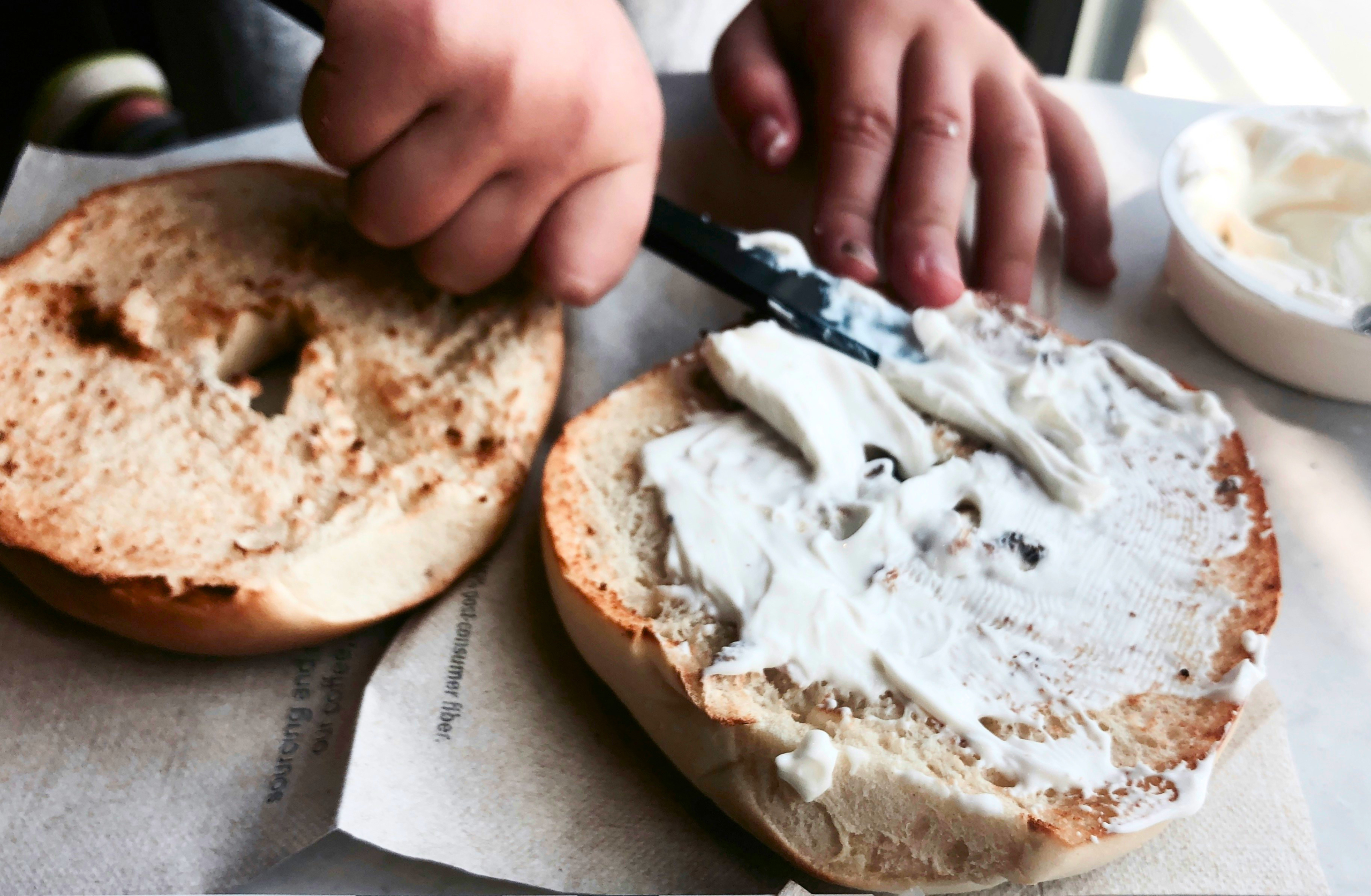
Lillian’s round table was set with gold-rimmed melamine plates, pink and green patterned china cups and saucers, and white paper napkins folded into triangles. She’d folded them neatly, in preparation for us. In addition to our goyim bagels, we’d brought cream cheese and whitefish salad and nearly a pound of lox. From her own refrigerator, Lillian had set out three cans of Diet Cel-Ray, a tub of whipped butter, a jar of capers, and a plum tomato.
Nat had one knee bent into the couch, surveying the street. “It’s interesting, Lillian,” he called to her without turning around. “You’re at the end of the hallway here but you don’t get a corner view. Does anybody? Some people must’ve combined two units, no?”
She shook her head as she plucked a halved bagel from the bunch and dropped it with a smack on her plate. “Not allowed here. Every unit is the same.”
I smiled. “That’s wonderful.”
“Is it?” Lillian cocked her head at me. “I wouldn’t mind a corner view. Nat, maybe you can convince the authorities? Tell them you’re a professional!”
He seemed to be considering this, even though it was clearly a joke. “You should live as well as you can for as long as you can.”
This, Lillian ignored, reaching for the cream cheese.
“Come eat,” I told Nat.
Milt dropped a handful of M&Ms on his plate.
“Not before dinner,” I said.
My son reached to gather the collar of my dress in both hands, one button popping off its thread and plunking against the table with a sound only I heard. “Yes,” he whispered. I smiled, in thrall to his defiance. How could I not?
“Let’s start with a bagel,” Nat said, sitting down beside him.
Milt screamed.
“Quiet!” Bunny commanded. “I’m about to start my interview!”
Lillian spread her cream cheese slowly, forking the glistening lox and setting it on her bagel like a toupee, and on that, a tomato cap festooned with capers.
“Can she…” I looked at my Aunt Lillian, who nodded as she chewed.
“What’s your full name?” Bunny held her folder open with one wavering hand.
“Lillian Hanna Faust.” She pronounced her middle name, a name I’d never known was hers, the Yiddish way: HAH-nuh.
“What year were you born?”
“1931.”
This whole thing could’ve been done over the phone. Why had I bent to Bunny? Why hadn’t we just sent Lillian these questions in a letter? I was sweating. When Bunny got to the last of her questions, we’d still be on the first halves of our bagels and then what would we talk about?
“Where were you born?”
“The Brownsville and East New York Hospital.”
Bunny’s pen stopped moving part of the way through the word brown.
“And that’s gone now, right?” I was stalling, giving her time to catch up.
“Do you want me to write it?” Lillian offered Bunny with surprising tenderness, ignoring me.
“She has to write it,” I said.
Lillian made a face like I’d slapped her. “It’s not her fault I gave her half the alphabet.”
“What did Bunny get?” Milt asked.
“A joke,” Lillian said.
“I want a joke!”
“He can’t have a joke. It’s my interview!” Bunny cried. “I’m writing as fast as I can! They say I have to write it so, so, I’m writing it!”
I watched as she mangled the letters, pressing down so hard, her pencil tip broke.
“I didn’t bring a sharpener,” she mumbled, her chest rising higher and the plates in her face looking like they might unbind themselves.
I found a pen in my purse and handed it to her. She pushed it away.
“Have you eaten your bagel yet, Bun?” I asked, though I knew she hadn’t.
“I wouldn’t blame you,” Lillian breathed into Bunny’s ear. “These bagels are absurd.”
“She’s an absurd girl,” I said, though it didn’t come out in the silly way I wanted; it sounded dismissive. Cruel, even. To make up for my mistake, I placed my hand on Bunny’s and a seam tore below my left arm.
“I never asked for these bagels,” Bunny said quietly. “You just think I like them because I ate them once.”
This wasn’t true but I didn’t want to embarrass her (or myself) any more than I already had.
“When you’re distracted,” I reminded Bunny, “you sometimes forget to eat. And when you don’t eat, you get upset.”
“When I get a lecture, I get upset,” Lillian said out the side of her mouth.
“And when you get upset,” I continued, ignoring Lillian, although, in a way, I was speaking to her too, “it’s hard to know…what to do to help.”
Lillian sized me up from across the table.
“Not to get off topic here,” Nat said, “but can I ask how well you get along with your neighbors?”
“You may and we get along fine. I don’t speak to them and they don’t speak to me,” Lillian said. She gestured toward Bunny. “Does she know Jewish?”
Yiddish, she meant. She meant also for me to perhaps not know what she meant, to have to ask, and I was relieved that I didn’t have to, that I did know, that she couldn’t take me for a fool, or for someone like my mother.
I finished my glass of water and poured myself a Cel-ray. “Who would teach her?”
Bunny raised her writing hand, pen tip pointing at the ceiling fan. Her bagel had a bite out of now. I hadn’t even seen her take it. “How am I related to you?” Bunny asked.
Lillian stood up and shuffled away from us. She hauled a folding stepladder from the front closet, tucking the whole of it inside, and climbing on. Nat ran over and put his hands out lest she topple. Her slacks made meditative shushing sounds I could hear from the table.
“Can I do that for you, Lillian?”
“You cannot!” she said, all but her stockinged calves out of view.
Bunny waited silently, refusing to look at me, while Milt ducked away, for, I knew, more M&Ms, as Lillian reemerged with a thick red leather-bound album.
She pushed her plate aside and opened to the first page. “I was married to him.”
There was young Julius, his sharp chin, full cheeks, those mournful eyes.
Bunny eyed her brother. “He does look like Milt.”
Milt beamed and scrambled over to Lillian, who, without so much as a groan, lifted him into her lap.
“Nice looking guy,” Nat said, peering at the photo from across the table.
“He was!” Lillian snapped. “Nice, polite. He looked how he was.”
“Nice people aren’t necessarily easy to be married to,” I said.
“We’re not?” Nat opened his mouth in mock alarm.
I rolled my eyes, smiled for my great aunt. “Aren’t I the nice one?” It was a joke and an aspiration.
Nat patted my cheek and reached into his pocket for his phone, on which I could see a call from a colleague, silenced after some consideration. I felt my face get hot very fast. It wasn’t the tenderness I was responding to but the condescension. We both knew how much everybody liked him and we both knew how hard I worked to be liked. Just yesterday morning, at the park where I’d brought the kids early, Nat showed up a half hour later to cheers from three or four other fathers, and mothers, too, hovering around the play structure. I’d brought donuts, but it was Nat they were most pleased to see.
Nat noticed all the effort I made to be liked: the times I brought cookies or pizza (or laughed loudly at somebody’s not-so-funny joke), and the times I was easygoing with the kids, letting them stay up late, resolving their arguments without yelling at either one. Nat noticed and he loved it; he told me so. But sometimes I wondered what he would tell me if I didn’t try so hard. Sometimes it was all I thought about.
We both knew how much everybody liked him and we both knew how hard I worked to be liked.
Lillian’s eyes flicked from me to Nat for a second, unreadable, then she seemed to drop away, inside herself again.
“Julius was a doll,” Lillian said. “A hypocrite, but he was easy to come home to, he was an easy man.”
“So what happened?” I asked. “Nobody got divorced back then, right?”
“Not nobody! I drove him out of his mind. I questioned him, I doubted him, I told him he wasn’t interesting enough for me and so he said adieu!”
No one could insult her worse than she could insult herself.
“Adieu?” Milt peered up at her. “Is that a bad word?”
“It means goodbye,” muttered Bunny as she wrote.
Lillian afforded Bunny no extra points for her knowledge, instead smoothing Milt’s hair with her manicured fingers, a stillness on her face I couldn’t read.
None of us spoke.
Our master of ceremonies continued transcribing Lillian’s words, penmanship jagged but clear. Milt had slid off Lillian’s lap and gone under the table. Also under the table were Nat’s hands tapping a message into his phone, too busy with weekend work for another attempt at enticing my aunt to do an impossible apartment upgrade. Milt drifted into the living room, unburdening us.
“He wanted to take care of me,” Lillian explained in a softer voice. “He wanted to give me things.”
I nodded.
“He said when I first met him that I was the smartest girl he’d ever known. Which wasn’t true, no student was I, but I loved hearing it. We’d gone to see The Valley of Decision with Gregory Peck and I think Julius thought of me like the maid, the sweet girl, the loyal girl, the good listener, you understand? I liked that version of me too except she didn’t exist. He wanted me to say it was alright the way he wanted more for himself than the fellows he was negotiating for and I didn’t think it was. He didn’t want to talk about big ideas with me, he wanted to talk logistics, all the time, the plans, the deals, the numbers. He wanted me to be here,” Lillian said, extending a flattened palm out in the air half a foot lower than her shoulder, “his little soldier. Am I making it plain? Every time I opened my mouth, he’d brace himself. At dinner, at breakfast, in bed. He’d flinch! At his own wife! Do you flinch at her, Nat?”
Nat stuck his phone into his pocket after a moment. He had not heard her, didn’t know if he ought to say yes or no.
“Sorry,” he mouthed to me. “Closing got delayed and the seller is pissed.”
Lillian tried again. “Do you mind when she argues with you, Nat?”
I took a slow breath, and then another, waiting for him to answer. “She doesn’t argue with me. We don’t argue with each other.”
Nat rubbed his thumb along the webbing between my fingers. With his thumb, he was telling me that we were not like Lillian and Julius. And we weren’t. I didn’t argue with him, not out loud.
When Milt was six weeks old, I slipped into a frayed, weepy pocket during which it was hard to wash my hair, hard to wear anything but soft pants and a very old pair of dirty sneakers. Nat, without telling me, hired a woman, a night nurse, to stay at our apartment every night for two weeks and get Milt to sleep. It was very generous of him and, I conceded, a relief to put Bunny to bed without Milt in my arms, but it cost more money than we had and it wasn’t what I wanted. I didn’t want it at all. So, every night, I’d agree with Nat about what a boon Teresa the nurse was, and then I’d roll over and cry quietly until I passed out, waking to a wet nightgown, that violent reminder to pump. Things were better now. Nat thought he’d made them better. And I took medicine for the crying.
“That’s a shame,” Lillian murmured.
The air here felt slippery and dangerous, like if we inhaled deeply enough, maybe someone might start arguing. Maybe even me.
“Tell me about your family growing up,” Bunny read from her paper.
“I had two little brothers who I loved, the baby especially. My mother was very bright and quiet and then she got sick.” Lillian pointed to her head. “In her brain. My father was not so bright and always angry. He worked for a tailor. My mother should have gone to college, I think. She read the newspaper every day. Start to finish.”
Bunny wrote all of this down, carefully. Lillian let her and began to eat, relishing one bite, then another, as we sat in silence until I saw Milt dancing in the corner of my eye.
I nudged Nat with my elbow and he looked up from his phone. “Can you…take him?”
“Where’s the bathroom?” Nat asked brightly.
Lillian dropped her bagel and stood up very quickly. “Of course. Let me show you.” Like a cat, she slipped into the hallway, which fed into, ostensibly, the bedrooms and bathroom. “Come, Milt! Come, Nat! I’m going to show you the bathroom!” she sang loudly.
I patted the parts of my dress that had undone themselves. It was an old dress, one I’d worn before kids, before breastfeeding, before Nat, even. I’d gotten it second-hand and worn it to a holiday party where someone had told me I looked like a character in Mad Men. The dress was finished now. Why I’d worn it today, I wasn’t sure.
Lillian returned but did not sit. She hovered with two hands on the table and flicked her chin toward her grand-niece. She must’ve felt that her lipstick had been lost on the lox because she pressed her mouth together in an effort to remake it. “Next!”
“Can you tell me something about our family that I might not know?” Bunny asked.
From the bathroom came Milt’s screams, Nat’s resonant murmuring. I didn’t want to abandon Nat to the meltdown, but I wanted to know what Lillian was going to say. My longing felt at that moment like a day’s worth of unmet hunger, like that Yom Kippur fast I’d only once done as a teenager to test my devotion, my Jewishness, just in case I might one day need to up the ante, though I was yet to be asked, not by Nat, not by anyone. I stayed in my dining chair, my eyes darting toward the hallway, hovering meekly between my progeny.
Lillian took a sip of her cold coffee. “Well, did you know that my children won’t speak to me?”
Bunny shook her head. “Why?”
“They think I’m a monster.”
Bunny looked up at me then back at her. “You’re not a monster,” she said firmly.
“I might be,” Lillian snapped. “I was a difficult wife, a difficult mother. I’m a difficult person. I wanted everybody in my family to understand things as I did. And they didn’t. They don’t.” Her lips like worms had begun to wriggle across her face with something she seemed to want to contain.
Her bitterness was not a shock, but the emotion under it was.
“It’s not so much fun being the bitch,” Aunt Lillian said. We didn’t curse in our house, and I could see Bunny’s eyes widen at the word.
“I’m sorry,” I said. “I’m sorry they shut you out. That we did.”
Aunt Lillian raised her eyebrows.
Bunny interrupted again, heroically, speaking over some detritus in her throat.
“What’s your favorite snack?” she asked.
Good god. We’d dropped into the miscellaneous portion now.
Lillian held her hands up and scoffed. “Nuts?”
Bunny wrote the word slowly, slower than any answer so far.
“OK. Nuts. Now last question. What’s something hard about your life that you don’t really mind?”
“That’s your own question too, right?” I asked her. I was impressed, and I wanted them both to know.
Bunny nodded. “The original was do you have a pet.”
Lillian snorted.
“What’s something hard about your life that you don’t really mind?” I asked Bunny.
I knew the answer. She was going to say Milt, her brother Milt, whose screams had at last abated. If I listened through the silence, I could hear water running. It was having a brother, a brother I’d foisted on her, that was hard but that she didn’t really mind. She wished he’d never been born but she couldn’t help loving him a little bit too.
Bunny lowered her head and spoke to the table.
“You,” she said.
I stared at her. What remained of my dress’s seams pressed into my hot skin. I looked down at my hands.
“Me?” I chirped. “I’m the hard thing about your life?”
“She doesn’t mind!” Lillian shouted. “That’s good news!”
I kept my face as unmoving as I could so my cheeks wouldn’t get wet. “Why am I the hard thing?”
The enveloping softness of the carpet under my feet was not a comfort then, so I pressed harder against it.
In a small voice, she said, “You’re not brave. But it’s OK.”
I was woozy, blood gathering across my collarbone, I could feel it tingling, my tongue solidifying, stomach humming and hollowed out. I kept my eyes open even though I didn’t want to.
“What exactly are you talking about?”
Bunny would not look at me. She shrugged. “You pretend. Like now, you’re acting like you’re not that mad. But you are.”
I saw my aunt’s mouth contort. She was pretending, too.
“So, being brave is, is getting mad?”
“For you, it is,” Lillian spat quietly.
“Hell of a bathroom you got there! Did that clawfoot tub come with the place?” Milton and Nat returned together in lockstep.
“I pooped,” Milton declared with grim pride.
“Not in the tub!” Nat clarified.
“Shut up!” Bunny bellowed at both of them.
“You shut up!” I shouted, as angry as I felt, pretending nothing, the outside of me reflecting my insides so exactly, I felt like my skin had fallen off.
“Sadie,” said Nat.
“Don’t yell just to prove yourself to her,” Aunt Lillian muttered, peering up at me, her brown eyes catching the light and shining. “Or to me.”
“Sorry. I’m sorry, Mommy. I’m really sorry,” Bunny mumbled, shaking her head wildly. She’d dropped deep down into her throne of a dining seat, her nubby blue smock dress folding in on itself and over her.
I shook my head, crying breathlessly and stupidly in front of them all. I wasn’t sure what the right thing to say was and to whom. What I usually said, what I usually did, was what neither my aunt nor my daughter wanted from me, so I said what I’d have rather kept to myself. “Yeah. I do pretend. So I don’t hurt people’s feelings. Like…” I gestured at Lillian.
At this, Lillian made a grunt as loud as a clap, chastening whatever courage I’d just mustered.
I wiped my nose with my ruined dress. “Thank you so much for having us.”
Nat had begun clearing the table. “The coffee was wonderful.”
“It wasn’t.” Lillian gazed at him and then at me. “You’re running away from the fight. Tell her she’s wrong. She’s a kid. She doesn’t know what she’s saying.”
But Bunny did know. She knew more than most kids her age ought to know. Bunny was right.
I shook my head at my great aunt, watching Nat gather three wobbly Cel-Rays. “You told me not to impress you. Now you tell me to fight. What do you want?”
“Honey, you don’t need to be embarrassed,” said Lillian, without a thread of the tenderness she had used to speak to Bunny.
I stacked the plates, my sleeve catching in the cream cheese. “Bunny talks like that when she’s tired.”
“I’m not tired,” Bunny said, her earlier penitence undone.
“Should we leave the bagels?” Nat asked Lillian.
“Please don’t.”
Lillian reached across the table to me and encircled my arm with her cool hand. “You’ll never be like me, Sadie. No matter what you do.” Her consonants were crisp, brutal. She was holding onto me tightly. “You follow the rules. You’re nice. Just like your uncle.”
Tumescent with shame, I nodded dumbly. Lillian’s eyebrows were arched. She did not look like my grandmother. She looked like Bunny’s drawing. And also, maybe, Bunny.
“Take it as a compliment,” Aunt Lillian demanded.
I tucked my hair behind my ear, the busted stitching of my dress exposing my soaked armpits like strings stretched over a guitar’s sound hole, and told Lillian goodnight.
In the car, Milt had fallen asleep, the porcelain of his stolen Hummel (the rabbi, my rabbi!) like a watchful glowing moon in his arms.
Bunny remained alert. She’d held my hand all the way to our parking spot and when I wordlessly buckled her into her car seat, she’d said, over and over, “I’m bad, I’m bad, I’m bad,” to which I’d shaken my head furiously as Nat thundered, uncharacteristically, “Nobody thinks that, Bunny!”
Now, in the back, Bunny seemed to have forgiven herself and me as she gazed ahead.
“Aunt Lillian never answered your last question.” I was picking at a wound that hadn’t even scabbed.
Red and white orbs of tail lights and highway lights guided us north toward home. Beside Nat shone the blackness of Gravesend Bay and just beyond, the Verrazano, regal in its nighttime banner of electrics.
“I hate it about me too,” I told Bunny without turning around. “That I’m not brave.”
“I don’t,” Nat murmured.
“I know you don’t,” I said sharply.
“Isn’t it brave to be sorry? You’re always sorry.” He turned his head sideways and smiled at me with no teeth. “She’s not.”
I didn’t know if he meant Lillian or Bunny, Bunny who listened quietly to us as she gripped her car seat’s armrests, her defiant heart pinned in with five straps to prevent disaster. He meant it as a compliment. But he didn’t know I wasn’t sorry half the times I claimed to be.
“Maybe,” I said because Bunny was right: I didn’t want to fight.
“The hard thing in Lillian’s life that she doesn’t really mind is herself,” said Nat. “Your great great-aunt is the hard thing. Write that, Bunny.”
He sounded so proud of himself.
How could I tell him he was wrong? I didn’t know what the hard thing was that Lillian didn’t mind, but I knew she could hardly bear herself. I could hardly bear myself sometimes. That was what made us both brave.
Bunny stared at me in the rearview mirror, as still and silent as the bridge outside our window.
“I think she’s asleep with her eyes open,” Nat whispered.
I nodded and stared at the road ahead. She was asleep with her eyes open. She had been for a while.
It was too hot now and, as Nat drove, I tried to shuck my coat off from below my seatbelt but it was too bulky. I had to unbuckle. As the car’s alarm rang, I shrugged my arms free. Ignoring Nat’s concerned glances, I slipped my fingers under the torn armpit of my tattered dress and wrenched the sleeve clean off.
“Sadie. You have to buckle.”
I leaned my bare shoulder against the window. “I know,” I said as the alarm dinged and dinged. “I will.”