Books & Culture
“One Battle After Another” Reminds Me What I Want From White Art
Latine activism is an unusual addition to Paul Thomas Anderson's milk-pale oeuvre
This article is free to read. So is every article Electric Literature publishes. No limits, no paywalls—now or ever. But we rely on your support to keep it that way.
We need to raise $35,000 by April 15 to keep the lights on, and time is running out.
Help us reach the next milestone—$7,500 by Friday—by donating now.
—————
When Chicano skateboarder BeeGee skated into the frame of One Battle After Another, on his way to join pro-migrant protests amid police violence, I turned to the friend beside me and whispered, “I want a whole other movie about these skateboarders.” Imagine my delight when BeeGee and his gang reappeared, leading Leonardo DiCaprio through a hallucinatory rooftop escape—my favorite cinematography of 2025. I teared up in the theater recalling Chicago Bike Guy, the worker who went viral when he escaped ICE on his bike. A bike is not a skateboard, but those Latinos, leaping high above the violence below, their long black hair and boards silhouetted against tear gas clouds, converse with Chicago Bike Guy’s victory—one fictional, the other terribly real, yet both symbolizing a Latino escape from the violence of borders.
Afterwards, sifting through my response to the film, I wondered if my standards for Latines onscreen had been lowered too far by lackluster, tokenized representations and the political demonizations of Latin Americans. In a different political moment, would the sequence with Latine skateboarders have moved me less? After all, the film’s Latines are supporting characters and Paul Thomas Anderson is a white director. Yet, though they may play supporting roles, the Latines in One Battle After Another not only impact the narrative, they provide crucial meaning to the film’s visual language and themes. Their presence seems to be the genuine result of an artist creating powerful images rather than a product of representation’s stultifying logic. Was Steven Spielberg preoccupied with the “representation” of white children when he filmed E.T. making those bicycles fly? Or was he creating iconic imagery that takes extra meaning from those kids’ yearning for freedom from the adult world? This begs the question: When a white auteur gives nonwhite characters such sustained attention and we scrutinize the results, what does our scrutiny reveal about the political projects white artists can join? What is it that we want from our white art?
One Battle After Another’s first act follows the relationship between Teyana Taylor’s Perfidia Beverly Hills and Leonardo DiCaprio’s Bob Ferguson and the machinations of their revolutionary group, the French 75. The spectacle of the French 75 blowing up buildings and freeing migrants from detention centers abruptly shifts when, in quick succession, Perfidia gives birth to a baby girl, Willa, rejects motherhood, is captured by the state, and rats out her comrades. From there, the plot revolves around Bob and Willa, who go into hiding in the town of Baktan Cross. There, Bob’s story is woven together with another organization in the film’s second act, an underground Latine resistance network whose tactics tend less towards spectacle, and more towards smuggling migrants to safety and quietly resisting oppression in the borderlands. This group has no official name nor any big speeches to codify their goals, yet they’re consistently shown outsmarting the government, resisting by whatever means necessary while remaining under the radar.
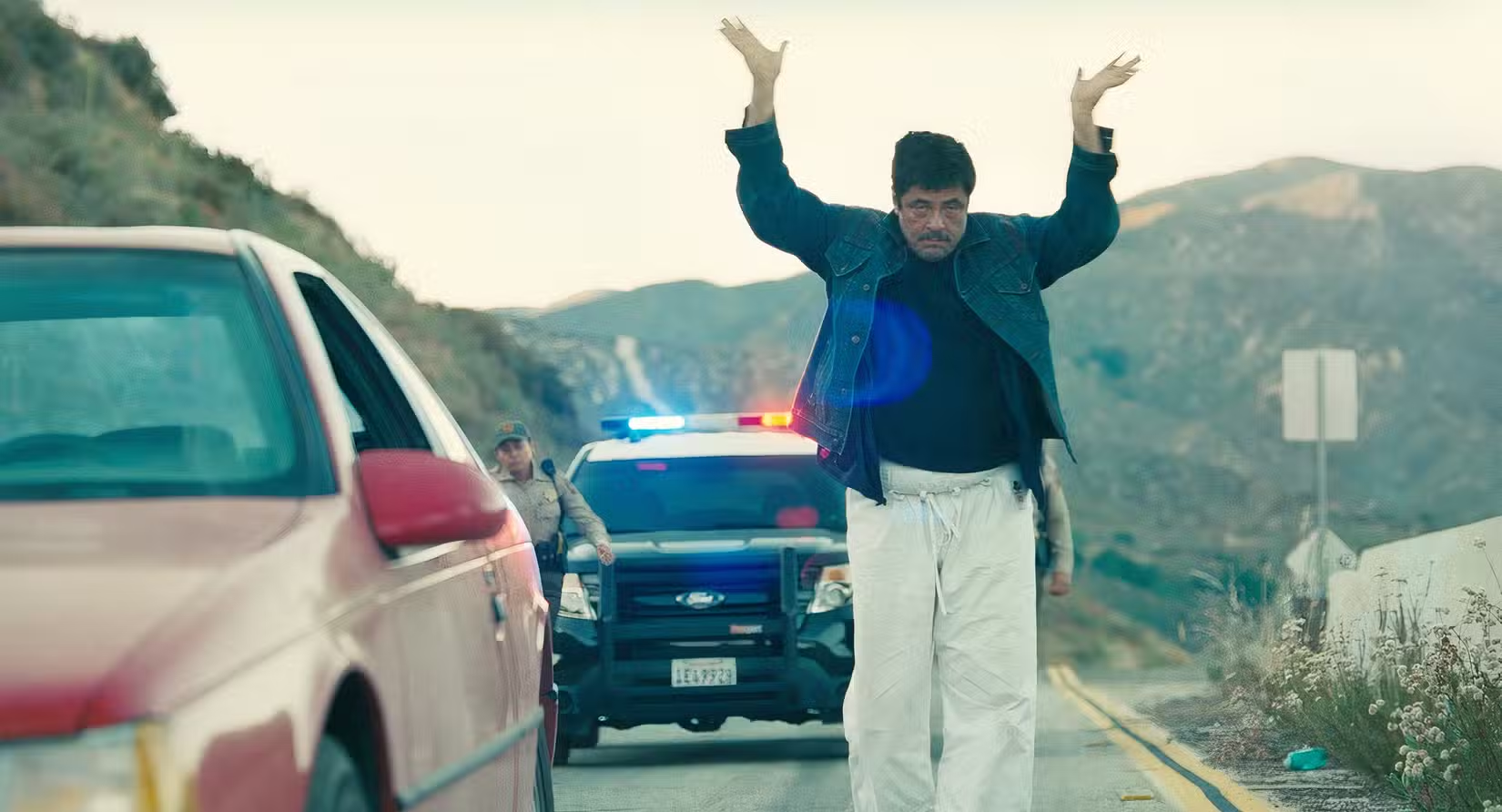
These Latine aspects are encapsulated in Benicio del Toro’s Sensei Sergio St. Carlos, a character who carries the second act of the film with his twin missions of rescuing Bob and a group of Latine migrants. This, what I’ve affectionately dubbed the movie’s “Latinocore” side, is crucial to understanding the whole of One Battle After Another’s complex racial and political messaging, which has provoked surprisingly harsh debate among critics.
Latine activism is unusual subject matter for director Paul Thomas Anderson, in whose milk-pale oeuvre people of color are often sidelined and mined for stereotypical humor (Inherent Vice, Licorice Pizza); omitted because the films are “period pieces” (The Master, Phantom Thread); or, in the best of cases, narrowly escape narrative insignificance thanks to a specific actor’s charisma (Don Cheadle in Boogie Nights, April Grace in Magnolia). One Battle After Another breaks this decades-long pattern by prioritizing Black people and Latines with the idiosyncratic artistry Anderson previously reserved for white roles. Anderson, who has built a reputation for imaginative and powerful set pieces—think Daniel Day-Lewis shouting about milkshakes in There Will Be Blood or the frogs raining down on the cast of Magnolia—strides atop those same creative heights with nonwhite characters in One Battle After Another. In one of its many tour de forces, we follow Sensei Sergio as he leads Bob into his home, the roving camera winding around migrant families clustered in the hall and lingering on their faces before following Sergio and Bob through Sergio’s living room, kitchen, and bedroom in one shot—Bob’s frantic energy at odds with Sergio’s calm as he introduces Bob to his family as a “gringo Zapata.” This entrance into Sergio’s world, with fluid cinematography confidently navigating the chaos as the anxiously repeating piano notes of Johnny Greenwood’s score rise and fall, makes a sequence which stands up to the most intense moments from Anderson’s filmography.
Do we want white filmmakers to steer clear of the risks inherent in telling nonwhite stories?
Rather than labeling the film a success or failure and joining the divisive online discourse it’s stirred up, I’m interested in what these reactions say about our critical orientation towards white auteurs telling less-white stories. If the complex racial politics of One Battle After Another are declared for posterity as a swing and a miss, what does that say about our greatest white auteurs’ ability to confront our present era? Do we want white filmmakers to steer clear of the risks inherent in telling nonwhite stories?
I realize I’m defending a movie that may appear to need no defense. Grossing over $200 million worldwide, its revenue far exceeds Anderson’s previous films, it’s received predictable critical adoration and thirteen Oscar nominations.
Yet among the underrepresented audiences you might expect to love its subject matter—people of color, leftists—it’s been harshly criticized. In broad strokes, these critiques focus upon One Battle After Another’s sensationalistic treatment of its Black characters and on its allegedly-superficial politics, the French 75’s rhetorical shadow of the movements upon which it is modeled.
It’s true that One Battle After Another is more interested in failed revolutions, in activists who can’t get their shit together, than in illustrating social change. And I don’t detract from the Black critics who’ve rightly pointed out stereotypes and misogynoir, most evident in Perfidia, who, despite a masterful performance from Teyana Taylor, is a hypersexualized, delinquent mother who betrays her fellow revolutionaries. Still, I find in Perfidia more than a collection of harmful tropes. The film itself suspends judgment: Her “relationship” with Sean Penn’s Colonel Lockjaw—the villain pursuing her, the French 75, and, later, Bob and Willa—is nonconsensual, post-partum depression complicates her actions, and we see other revolutionaries get captured, questioned, and, each time, cave. Complicity is not uniquely Perfidia’s sin. This universality, of saving oneself when crushed beneath the authoritarian jackboot, demonstrates the power wielded by states, and how, once separated from the collective, individuals struggle to resist it.
However salient, both these lines of critique elide the Latinocore. When the federal government unleashes immigration raids on Baktan Cross, providing cover for their mission to apprehend Bob and Willa, the camera slows down to show us the Latines being detained, underlining the human cost of this assault. But Baktan Cross, a setting where Chicano culture infuses every set piece and shot, is not helpless. As Bob takes refuge with Sergio, it’s revealed that Sergio is a fulcrum in the town’s network of underground Latine resistance. While protesters confront the militarized police, Sergio repeatedly rescues Bob and simultaneously organizes the escape of multiple Latine families living in his building. None of the extensive spoken Spanish is subtitled, a decision which refuses to cater to non-Spanish speakers. These Latinocore scenes and details act as a fly in the ointment for those condemning the movie for illustrating racist tropes or being politically shallow—unsuprisingly, negative critiques ignore these elements.
Positive reviews (largely penned by white critics, with some positive reviews from Latines appearing in Spanish) appreciate del Toro’s performance but seem less comfortable praising the film’s racial representation. Instead, most have analyzed its aesthetics or how it departs from Anderson’s previous work. Critics pointing out that the movie’s biggest departure is its surge in melanin have largely been nonwhite, and since many of them reacted negatively to this departure, there’s a growing critical consensus that while the movie might be well-made, the results are mixed at best concerning Anderson’s ability to tell stories beyond his own whiteness.
In contrast, Anderson has not come under widespread scrutiny for people of color’s absence or sidelining in his previous films. I won’t claim that Phantom Thread or The Master are racist because they tell white stories, but I question why we accept this absence while any significant nonwhite presence opens white auteurs to critique. This critical landscape tells us that the absence of people of color is more acceptable than our presence, and that white auteurs will be lauded for making Great Art across their saltine-tinted bodies of work while keeping people of color outside of the frame. The complaints when white artists do attempt to decenter whiteness send an additional, paradoxical message that our stories are too difficult for even Great (white) Artists to possibly attempt.
Do we want our white artists to solely center white people? Do we want them to do the more “woke” version of staying in their lane, making art about white people with a few inoffensively diverse characters thrown in as shields against racial critique? That seems to be what we, as a culture, are incentivizing, but we should ask our artists to do more than claim “inoffensive” as a virtue.
If artistic discourse and output accepts white artists moving beyond art that centers whiteness, collaboration with nonwhite artists strikes me as essential. That collaboration is evident in One Battle After Another, as Paul Thomas Anderson has vocally credited Benicio del Toro for his creative input to the Baktan Cross scenes. According to Anderson, these scenes went unwritten until del Toro wrote not only his character’s dialogue, but helped formulate the movie’s second act. Everything from the set decoration to the unsubtitled Spanish in these scenes feels connected to lived Latine experience, and this can’t be separated from del Toro’s collaboration.
It’s hard to overstate how wonderful Benicio del Toro is as Sensei Sergio. Where Bob is frantic and paranoid, Sergio is serenely competent. He saves Bob, but never lets this white man derail his own objectives; he calls his activism a “Latino Harriet Tubman situation” and an “Underground Railroad,” one example of how this film links migrant struggles and Black liberation. He is characterized endearingly down to the last detail: He wears cowboy boots in a nod to Latino gauchos and corrido folk heroes; adorning his bedroom walls are paintings of tigers, and Eye of the Tiger is his ringtone; and he doesn’t let Bob trespass on his tatami mats even though Bob is running for his life. Sergio tries to share his Zen attitude, reminding Bob to be like “Ocean Waves,” a useful metaphor when confronting battles that won’t stop coming.
This critical landscape tells us that the absence of people of color is more acceptable than our presence.
Sergio brings to mind Chicana feminist theorist Gloria Anzaldúa’s idea of “la facultad,” as expressed in her seminal work Borderlands/La Frontera: “La facultad is the capacity to see in surface phenomena the meaning of deeper realities . . . an instant ‘sensing,’ a quick perception arrived at without conscious reasoning.” This “sensing” comes to those who’ve been marginalized, who can’t live safely in aboveground society, whose identities have been shaped by violent borders. La facultad starts as the adaptive quick thinking required to survive a hostile world and becomes deep counterknowledge to the ways and means of dominant society.
When Sergio says to Bob, “We’ve been laid siege for hundreds of years,” this is la facultad. He follows up with a needed reminder to Bob, “Don’t get selfish.” The lessons Bob has taken from life in hiding enable him to escape Lockjaw’s first assault. But while Bob’s peril has granted him an inkling of la facultad, he’s still lived as a white man; his paranoia hasn’t become la facultad’s deeper knowing. We can read Bob’s flailing as a white director’s tacit admission that he needs help telling stories about people of color, with Sergio’s expertise standing in for the creative input and guidance of Latino collaborators.
In one example, Bob falls off a roof while following BeeGee and the skateboarders to safety and winds up in jail, where Latine resistance continues to save his ass: In jail, the Latina intake worker suggests that he’s diabetic, sending him to the hospital, where a Latina nurse frees Bob and instructs him to escape to Sergio’s waiting car. Sergio hands him a six-pack of Modelos and takes a selfie with Bob, declaring, “Let’s play offense,” as they drive off.
This escape sequence, with the Latinas’ smooth operation, Sergio’s selfie and seamless switch to offense, demonstrates Latine playfulness and what Anzaldúa calls “serpentine movement,” the movement of Latine political and spiritual activism. This is a reference to the Nahuatl snake goddess, Coatlicue, whom Anzaldúa reclaims as a force representing the path to self-acceptance and evading colonial authority. Embracing Coatlicue enables more than survival, empowering us and making art, playfulness, even the divine accessible through the identities created by life in the metaphoric-and-literal Borderlands. As Anzaldúa puts it, “[L]earning to live with la Coatlicue . . . transforms living in the Borderlands from a nightmare into a numinous experience.”
It seems unlikely that Paul Thomas Anderson and Benicio del Toro read Anzaldúa to prepare these scenes. Nonetheless, they turn the borderland of Baktan Cross into a numinous place, touched by the divine, in which activists move like Coatlicue and the community’s street smarts, its facultad, protects itself.
While I see radical politics illustrated through the film’s Latinocore scenes, other readings suggest little discontinuity in Anderson’s pattern of centering white characters. When I watched the movie again with a friend of mine, she kept exasperatedly asking, “Why are they helping him?” It’s a good question: Why do these Latine activists go out of their way for Bob, who is useless at best and hindrance at worst?
The cynical answer is that they help him because One Battle After Another stars a white man, and therefore requires its nonwhite characters to serve him. We see this repeatedly from white directors, adjacent to if not reiterating White Savior tropes. It’s hard to argue against this metatextual reading, as Bob is the protagonist, and once his arc leaves the Latine characters, so does the narrative.
Yet, Bob is the Latines’ damsel in distress rather than their White Savior. From Bob’s first panicked arrival at his door, Sergio understands: this man needs help, and may not have much to offer in return.
La facultad becomes deep counter-knowledge to the ways and means of dominant society.
A different reading of the film suggests that it would be out of character for Sergio and his allies to not help Bob. In-universe, the principles of solidarity and la facultad of his comrades save him, not his whiteness. When Bob reveals his link to the French 75, Sergio had already saved him once, regardless of revolutionary bona fides. He doesn’t privilege Bob over the migrants (“Don’t get selfish”) but Bob’s precarity is motivation enough.
Another scene, not involving Sergio or his allies, illustrates similar principles. Pursuing Willa and Lockjaw by car, Bob arrives at an intersection with no clue which way they went. He stops to ask for directions at a roadside stand staffed by Latinos. The men point the way, he thanks them, and drives off in the right direction. This whole conversation is spoken in Spanish, clumsy on Bob’s part.
Anderson could have cut this without interrupting the plot, but it justifies its presence by underlining the principles of solidarity that enable Bob and Willa’s survival. Bob isn’t fluent in Spanish, but he can communicate; if he’d learned no Spanish, he’d never find Willa. The Latinos unhesitatingly help him. Anderson breaks with the film’s paranoid atmosphere to show that strangers (including foreigners) are not inherently hostile, they can be trusted, and that Bob—by extension, all revolutionary hopefuls—needs community support and solidarity. That Bob frequently seems undeserving of the help he receives, that it’s sometimes hard to imagine a more incompetent leading man, demonstrates how deep these principles go. Everything this movie has to say about how you keep fighting one battle after another is conveyed through this scene.
In a better world, multiple movies with One Battle After Another’s budget could come from directors of color and star nonwhite actors rather than Leonardo DiCaprio. In that world, I’d get my movie about Latino skateboarders from a Latine director; Perfidia would be explored by a Black woman director who’d give her dimensions beyond aggressive sexuality. But in this world, white artists get the bulk of industry permission and critical acclaim. I don’t want to see those artists lucky enough to be given permission and funding by gatekeepers avoid the risks inherent to writing across difference.
Writing across difference should be a risky endeavor: You risk causing offense and inviting blowback. But any artist worth their accolades should not fear. Artists take risks—different in extent, not in kind—to make any art of lasting value. This doesn’t let auteurs off the hook for risking and failing, nor does it exempt white artists from criticism, but in a white supremacist society, if we tell artists from the dominant racial category to only “write what they know,” we end up with reflections of society’s dominant values through the white faces and stories these artists already know. I prefer to see even flawed attempts to subvert the dominant paradigm.
Gloria Anzaldúa chose not separatism between Latines and whites, but to give artistic direction: Through our art and literature, she wrote, “we must share our history with [whites] . . . They will come to see that they are not helping us but following our lead.” In One Battle After Another, Bob follows Sergio’s lead in all their shared scenes. When the camera briefly returns to Sergio once he’s left Bob’s story, we see Sergio exiting his vehicle by the side of the road, waiting to be arrested. His face relaxed as ever, he finishes his Modelo and doesn’t stand, but dances: hips swaying, feet shuffling and gracefully raising his arms. Is he dancing the Salsa? Samba? Unclear, but the sway of his hips channels Anzaldúa’s serpent movement, Latinocore to the end as he answers stern cop questions with jokes (“I’ve had a few.” “A few what?” “A few small beers”). Despite his circumstances, the film projects little suspense regarding his fate, his cool assuring us that he’ll evade authority’s grasp. Possessing la facultad, we know he’ll walk free.