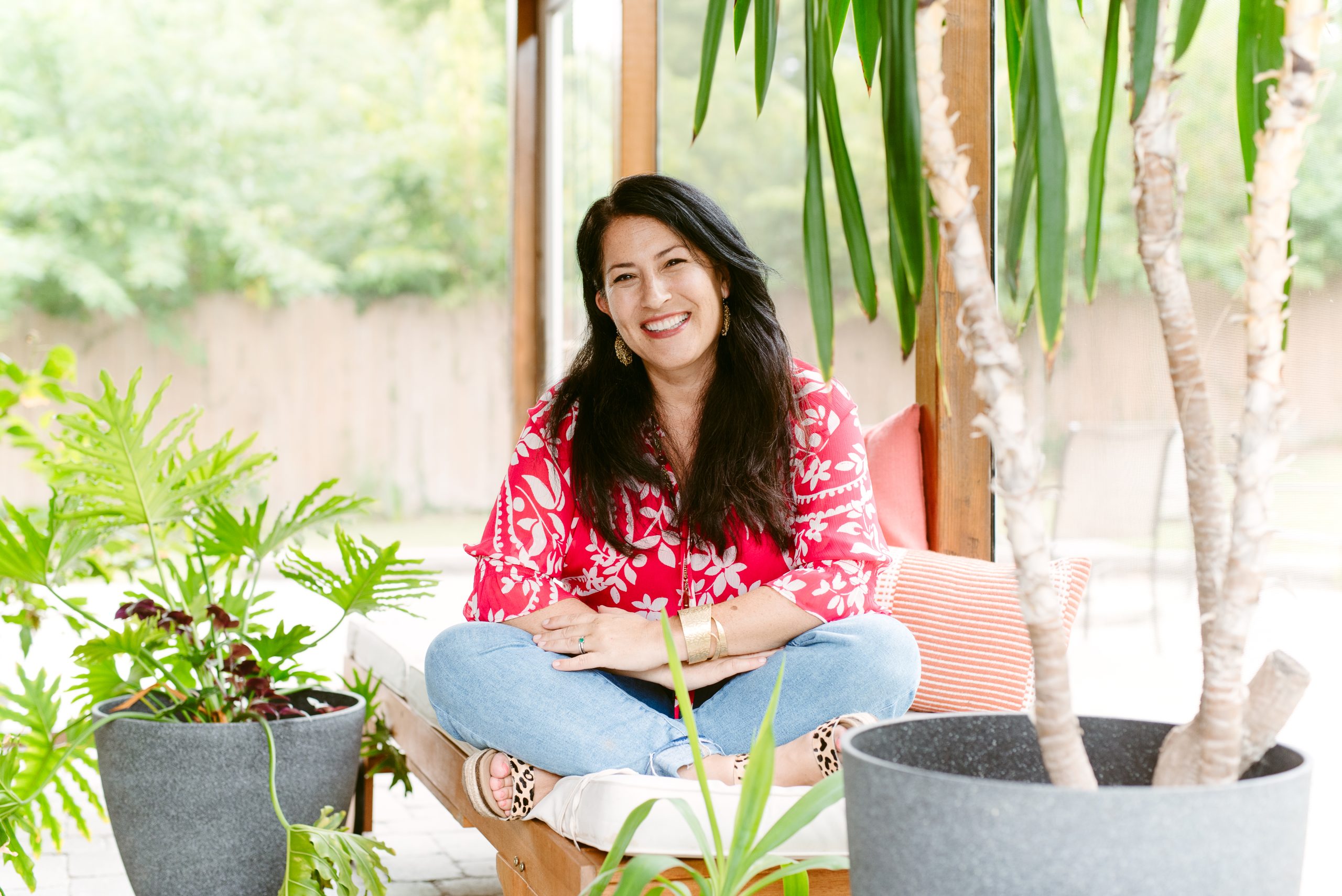
Ada Limón On Finding Poetry In The Natural World

As a poet, Ada Limón needs no introduction, not for being the 24th Poet Laureate of the United States or for having her poem “In Praise of Mystery” commissioned by NASA to be transcribed onto a spacecraft Clipper, and sent into outer space this coming October, traveling 1.8 billion miles to explore Europa, one of Jupiter’s moons; or for being recently selected as one of 2024’s TIME Women of the Year. (Not to mention having a MacArthur Fellowship aka the “genius’” grant and for being awarded a Guggenheim). No, Ada Limón needs no introduction whether it’s to outer space, or with her feet on the ground because of how she has impacted an entire new generation of minds with the weight of her words. 

So when I had the distinguished pleasure to interview Limón over Zoom for her anthology, You Are Here: Poetry In The Natural World, I couldn’t help but revel (and maybe even fangirl) in wonder of how prolific, calm, and level-headed Limón was on my computer screen when discussing the urgency of the climate crisis, and how we are in conversation with it since we are responsible for it. No matter who you are, Limón sees poems as a vessel and a remedy for all kinds of hurt, even for the hurt we cause. And now we need poems and their remedies more than ever to bring us back to earth and back to ourselves. Since poems are a conversation with, and a conduit that allows us all to belong. 


Maria Santa Poggi: What specifically inspired you to put together this anthology of poetry that reflects our relationship with the natural world? 

Ada Limón: I originally thought of the idea of doing something that bound poetry and nature together and there are two elements to the project as a whole. And the first element is this anthology where I asked poets to create an original poem based on the natural world around them. I wanted this anthology to speak back to some of those original nature poems that did not feel like they were representative of the makeup of the United States. I really wanted to also have these poems recognize the crucial moment that we are in as our planet faces the catastrophe of the climate crisis. So when I asked all the poets to be involved in this, it really was a way to allow the poets to give voice to some of their joy and wonder and love of the planet, but also some of the anxiety and fear, the way the planet is shifting underneath our feet and give some voice to those thoughts and feelings as well. I wanted it to be a complex array of beautiful new poems that spoke to this urgent moment. I can’t even tell you how incredible it was every time I got one of these poems, I would just weep, they were so beautiful. 

And the next element of the project is I will be traveling to seven different national parks around the United States and their poetic installations of legacy poets that will be in these incredible parks in our protected lands across the country that will give people access to poetry in the natural world. So they can sit at a picnic table that has a beautiful poem on it, and then be asked to maybe create their own original poem that will speak back to the natural world that they’re looking at. In my mind, it really tries to link the power of poetry, and the power of nature, to not just offer us some kind of healing, but to offer us some sense of reciprocity and a sense of belonging. 

MSP: How did you go about choosing which poets were included and was there a back and forth editorial process with the poems you put into the collection? 

AL: Yeah, it was actually really difficult. If it were up to me this anthology would actually be endless and I think in my heart it is endless. I keep thinking that this is a book, but it also is just a sampling, and a starter for all the poems that will come from all the great poets that are writing today. 

For me, I really wanted to have some geographical diversity. I wanted there to be different landscapes that were honored within the book, I also wanted there to be stylistic and representational diversity so that we can get an opportunity to see poems that are wide-ranging in structure, and also wide-ranging in their voices. Choosing was very difficult, but one of the things that surprised me is that almost everybody said yes. I didn’t really have to do much of anything except stewardessing the order. 

It was important putting together the anthology that it was [from] living contemporary poets, and that it had all new work. I thought there was something to be said for really making it an urgent matter, and not going through older collections and choosing poems that already existed. 

MSG: Earlier you mentioned the precarious climate that our country is in, especially with our relationship with the environment. Why do you think we need a collection like this? 

AL: A lot of people are thinking about the climate and nature all the time. I’m on the road a lot and I talk to young people, and poets, and non-poets on a daily basis. And the climate is on their minds. Folks graduating from college, folks graduating from high school, they are very concerned, and very interested in what is going to happen next. I talk to climate scientists, I work with the National Climate Assessment. This is a huge issue, and what we haven’t yet talked about is how to process our feelings about it. We’re really looking for smart, intellectual ways that we can help mitigate, and adapt to what’s coming. But what we haven’t done is really try to make room for how we’re feeling about nature. How do we fit in nature? I think we need to do some grieving, I think we need to do deep loving, and I think that process will only help lead us to more creative solutions to collectively move toward answers. 

MSP: I saw in one of your TIME 100 Women of the Year interviews, which congratulations on by the way, that you talked about this hunger people have for poetry and what really stuck with me was you were saying that you don’t need to convince anyone to have this hunger. I just wanted to hear your thoughts on through accessibility how we can nourish, you call it this grief people have—this hunger, this grief, people have for poetry? 

AL: I think a lot of it is about giving people permission. I think that as it is with any art form we’re quick to say, oh, that poetry is an intellectual endeavor, that it is an artistic endeavor, and we have a hierarchy of what poems matter, what poems count. And when you’re moving in the world of non-poets, it’s good to remember that hierarchy doesn’t exist. To them all poetry is poetry. I would encourage, especially those of us in the poetic and literary realm to encourage a love of all poetry and to give people permission to skip poems if they want, to move on from a poem that they perhaps might not relate to. 

If Whitman is not your favorite poet, I personally love Whitman, but you might not, then go ahead and read Cesar Vallejo, or go ahead and read Alejandra Pizarnik or Gabriela Mistral or Audre Lorde. The more permission we give for people to seek out what they love, that will enable people to feel more secure in even talking about poems. Poetry can be very intimidating, and poets need to talk to people outside of our realms, and to encourage them to share at a dinner party to share a poem with a friend to share at an occasion for gathering—oh, I wanted to share this poem with you. 

I keep calling it “normalizing poetry,” but not only we need to give people more access to it, but also encourage people to have any response they want to have to it. If someone is loving Instagram poetry, let them love it. There’s so much shaming that happens when we talk about art and the way in which those of us who have a stake in its future talk about it. I, for one, think we shouldn’t shame people for writing poems that may not be the highest art form. That’s like getting mad at flowers. Getting mad at more poems is like getting mad at flowers. 

MSP: This idea of poetry shaming is something you notice at a certain academic level…

I call it ‘normalizing poetry,’ we need to give people more access, but also encourage people to have any response they want.

AL: That’s what makes people scared and that’s what turns them off. We’ve scared people in classrooms, and we’ve scared them on social media. And we just have to remind ourselves that if we want people to use poetry as a type of tool to remember that they are human beings then we have to give them permission to like all sorts of different styles of poetry. 

MSP: In your introduction of the anthology, you liken trees to poems, and poems to trees that connect us together. Do you think if everybody wrote poems it could be a sort of remedy to save us from the hurting? 

AL: Mahmoud Darwish once said “maybe poems only change the writer themself.” I know I’m a better person, a more whole person when I am writing and have written. And if we can tap into not just the creating of poems, but the creating of space to make poems. What that is is allowing breathing room. It’s allowing a certain meditative distance so that we can step back from the world, and step back from ourselves for one minute. And in that reflection see that every single person is going through something. We don’t have a lot of time and space for that. We don’t make a lot of time and space for that in our society. Everything is about the to-do list, checking off the to-do list, what’s next, what I’ve gotten wrong, what I’ve gotten praise for, what I’ve gotten shamed for. If everyone could write even a line, or a reflection of their emotions, it doesn’t even have to be a whole poem, I absolutely think we’d be better off. 

MSP: I don’t know if you’ve seen this on social media, but people joke about notes app poems and venting their feelings. What are your thoughts on that? 

AL: I honestly think it’s great. As long as you’re making it, I travel with my notebook all the time, but it’s a little large. So if I’m on a hike or on a plane, which I often am as you might imagine, I will definitely write a poem in my notes app. Anyway that we can access our own idiosyncratic language in the moment is really useful in terms of not just the final creation of a poem, but recording our day to day movements to allow some kind of reflection.

MSP: What are some of the stereotypes of nature poetry you’re hoping to break with this collection?

AL: Even growing up, I thought about intentional nature or the idea of nature, nature poetry was almost always primarily by white men. It also has a very colonizer mind, it’s this idea of land ownership, this land is here to teach me something. I would love to break those old ideals and really talk about what it is to have every human being having access to nature because we are nature. I want to make sure that we understand that the relationship is reciprocal. That the human being in response to nature, it’s a circle and we’re all in it together. It’s really important for me as a Latina woman to reclaim nature as my own. And to not think of it in the colonizer mindset or the ownership mindset, but to instead imagine the relationship as a reciprocity. 

There’s another idea that to see nature we have to go into it. Like Diane Seuss has a poem in this book, “Nature That Can’t Be Driven To,” and I love that because that’s exactly what I’m trying to get across.I live in Lexington, Kentucky and there’s nature all around me. I can be in the busiest time of my life and look around and go oh, right, I’m looking at the silver maple, I’m witnessing squirrels build a nest, I’m looking at the buds coming out, like all of this is a wonder and a gift. I don’t need to necessarily take myself on a hike or drive to a special spot, but instead I can be a part of nature and recognize my part in nature right now. I lived in Brooklyn for many years, and I remember finding the trees that I loved in certain parks and recognizing when the dandelions would come up through the cement, and when the drainage ditch would fill or empty. All of the ways that seasonality affects us, all of the ways we are in relationship with nature. It’s not always intentional, it’s the dailyness. It is a way of being. 

MSP: There’s this tendency to treat nature as “other,” or you talk about this distance. Why do we distance ourselves from the self in nature? Why do we do that to ourselves? 

There’s so much shaming that happens when we talk about art and the way in which those of us who have a stake in its future talk about it.

AL: One of the reasons is that if you are in relationship to it, you cannot harm it. And you have to rethink the ways of farming practices, and rethink the ways of how we use our watersheds, our water sources. Everything has to shift, and it is easier to not do that work. When we think of it from a colonizer mindset and it’s all about taming and controlling and ownership that is a cleaner and easier relationship because there are no consequences. In shifting that mindset, we have to embrace the consequences, and embrace our own actions and we have to see how we affect nature and how we ourselves are affected by it. That’s a harder, and emotional thing that takes deeper work. 

MSP: Where in nature and the natural world do you find your poetry?

AL: I do like to have a sense of smallness. I love to feel like I’m nothing. Like I could dissolve with one little breath. And I think of that when I’m by the ocean. I think of that when I’m in the woods. How easy it could be to be a part of everything and to de-center myself. There’s a great joy in not being the story’s subject. Sometimes just looking up at the night sky, even in smaller worlds when I’m by a creek and I look at all the different animals and life forms in a little creek and I think all of this is happening without me paying attention to it. I love the ongoingness of it. A few places for me is the Raven Run here in Kentucky, also the Red River Gorge, and also in Sonoma, California in my hometown going to the Mayacamas Mountains and spending time in that valley always feels like it re-connects me to a sense of belonging. 

MSP: On a little bit of a different note. What is it like to have your poem, “In Praise of Mystery” engraved on a spaceship to be launched into outer space and to explore Europa casually? 

AL: It’s still something I’m kinda in awe of…when I was asked by NASA to write that poem I really felt as someone who grew up loving the stars, and the planets, and exploration, even Star Trek, and Star Wars, and all of those space fantasy things—I immediately said yes. And then writing the poem was very, very difficult. It was really hard. It’s one of the hardest tasks that I had to do. A lot of it is because I realized in trying to reach the second moon of Jupiter with a poem, and in trying to think, and imagine what it would be like to travel in all of that space, cold space to find if there is a second moon and any signs of life, the thing that finally got me into the poem was coming back to the earth. I was like no, it has to point back to us. It has to point back to this earth. And every NASA scientist you talk to will say this is the best planet. The one we’re on, this is the best planet. 

Just the other day I got to see it engraved on the vault plate that will be attached to the spacecraft on the Europa Clipper, and I’ll be there at the launch to read the poem. It was a deeply human endeavor, and there is a lot to be said about AI and the use of AI in the literary, and artistic worlds and I’m really happy that it was a human hand that wrote it. I wrote all the drafts in my handwriting and it’s engraved on the spacecraft in my handwriting. 

MSP: In your poem, there’s this line about an “offering of water” is what “unites us” rather than the “darkness” or the “cold distance of space” and I was wondering how when putting together this anthology, how you find the “ordinary” droplets of water that connect us together? 

There’s this endless desire of I want, I want, I want, I want, and sometimes we need to be like wow, I am alive and one day I will die.

AL: When I finally got all of the poems together and I printed them out, I put them on my table, and all over the floor going through [the collection] and they just reached this natural, beautiful order and I realized these are all speaking to each other. The order fell into place like that [snaps her fingers] in maybe two hours, just like bam, bam, bam. I realized we’ve all been in conversation, we’re already doing this. Poets, you and your colleagues, and your classmates are doing this now, we are having a conversation about where we are at in the world. And when these poems came in it was like of course this is happening. To find how they reacted to one another really was a tremendous moving moment for me. Not only because of the generosity of the poets who gave their poems to me and did such beautiful work, but also because it felt like the thing that we often forget is that we are moving in community. And it’s very easy with our social media, and the divisiveness which is encouraged by our immediate social media tools that are designed to divide us so that we can have power as a collective. That we can come together in communion. I needed this book as much as I hope other people need it, or help other people want it. But I needed to be reminded of the power of the collection and what coming together felt like and this book for me did that. 

MSP: My last question for you is that there seems to be this emphasis on the “ordinary” everyday or the “ordinary” natural world around us…and oftentimes it may not seem like the everyday isn’t prolific in poetry. But I think in poetry the ordinary always becomes magical. And I wanted to hear your thoughts on the “ordinary”.

AL: Yeah…what is ordinary? My thoughts are what is ordinary? Because it is so amazing that we are alive. That this planet made us. That we have fingers, toes, and ears with tiny little hairs in them that sense things. I think about evolution and the power of it and how strange it is, and how weird everything is. I don’t know what is ordinary because to be alive is completely a miracle. It’s completely strange, completely a wonder. There’s this endless desire of I want, I want, I want, I want, and sometimes we need to be like wow, I am alive and one day I will die.

On the Origin of An Ending

“An End” by Claire Kohda

The sun doesn’t reach the lowest part of our valley for six months each year. It is the position of the mountains. They are very tall on all sides, and with their height they manage to keep daylight from us, until summer comes. I have my favorite. He is a gray mountain—not the tallest but the baldest. For the sake of this story, we’ll call him Bald. He is hunched and it is easy to imagine, inside, a huge curving spine. Bald was the one who told me, in the midst of the long night: An end is coming. 

For who? I asked, and I waited, but there was no answer. Do you know?

No. Mountains are not talkative. When they do speak, it sometimes takes days. Vowels are drawn out as long rumbles, but it is hard-stop consonants that delay their speech most significantly. They have to be timed with other bangs and crashes in the world so that humans don’t look at their seismographs and worry an eruption or earthquake is underfoot. This time, though, Bald spoke quickly; and as far as Tokyo on the other side of the world, the ‘d’ of ‘end’ was picked up by humans who hurriedly made phone-calls and listened for seismic activity with new intensity. None came though; that was the end of Bald’s prophecy.

Well, a year passed, and another, then a decade, and a half century. Many other things that had heard Bald’s warning died. Only a few of us remembered. And then, at the end of 1999, finally, an end did come. It arrived in the valley via a route travelled by hunters for centuries. It is an old path, and it wriggles around a mountain next to Bald, who himself is too steep to allow a way for humans. Every day that the sun doesn’t reach the valley floor, it does reach the path up there, and so there is a spot on it where humans for centuries have stopped during winter to skin their kills, or behead, or to have lunch and quench their thirst, before their descent into the town on the other side. Snow melts there quickly, while down here we keep winter for a long time. At the deepest part of our valley, very near to where I live, is winter’s last refuge, and so we call it that: Winter’s Refuge. The cold is welcome here long after it is not welcome anywhere else. 

The end came down the hunters’ path, and made across the feet of Bald and Bald’s neighbors, through the woods, right into Winter’s Refuge, where it set up camp right beside one of my banks. Hello, I said. I heard the others around me hold their breath. To most folk down here, ends aren’t to be spoken to. It is better to ignore ends, in case they go off their course and decide to follow after you instead. But I’ve never heard of that actually happening. An end’s course is decided years, if not decades, sometimes centuries before it arrives. Hello, I said again. The end lifted up its head and seemed to hear me, but then returned to what it was doing, which was digging. 

What do you think it’s doing? I asked Bald. Sometimes, I spoke to him, even though I knew I wouldn’t get a reply. His wrinkled, grey face was sometimes enough. As if a mirror, I’d pose a question to it, and then in the echo of my voice that came back to me, I occasionally heard an answer. Not this time, however.

There are hoots and chirrups, squeaks, scurries, scufflings and occasional howls in the valley at night. Things that are awake at night are good at hiding in the shadows, so you hear them before you see them if you ever do. The end, though, didn’t hide. The end did not sleep either. Stooped at the base of a tree in Winter’s Refuge, the end had dug through a thick layer of snow and now dug the earth underneath. The rhythm of the end’s digging was regular and unrelenting. Otherwise, it was a quieter night than usual in the valley; owls held their hoots, and wolves their howls, while all around could be heard the scuff-scuff-scuff of the end’s hands pulling up the earth. Mothers and fathers—bats, birds, goats, frogs, snails—they all said to their little ones: Be as quiet as you can, an end is here tonight.

In the morning, the end was still digging. Only, now, it worked slowly. It had reached the roots of the tree it was digging beneath and picked at the earth between each one. Like a seamstress unpicking embroidery, the end seemed to be unpicking the tree from the earth. Who are you here for? I asked, trying my luck again. Shhh, said the wind, and D-d-don’t, stammered a stone. But the end remained silent. Are you digging a grave? I asked. Which one of us is it for? It was no use. The shadowy body of an end contains muteness, not words; silence, not sounds; a stop, not a start. 

We all got used to the end’s presence after a while. Day after day, the end quietly sat unpicking the tree, occasionally digging further down to get to the deeper roots, but most of the time sitting on the heap of earth and snow it had made, quietly getting on with its work. Gradually, hoots, howls, scurryings and squeaks returned to the nights, and in the days, the bleats of goats and bird song bounced off the mountains again. On Bald’s face, several goats balanced on craggy platforms that to any other animal were mere notches in the rock, tempting death—a sure sign the end’s presence was forgotten since, the story goes, Death and ends are good friends and if an end is near, then so is Death. I got used to the end’s presence too; I continued with my day-to-day existence, quenching and washing and running, as I had for hundreds of thousands of years and would do for hundreds of thousands more. But, sometimes, I looked at Bald’s face, around the time when the sky started to darken and, in the shadows cast on it, I thought I saw an expression of foreboding. 

Soon, it was Christmas time, and Winter’s Refuge was deep with snow. Each day, the end had to dig through new snow to reach the tree roots it had been picking through the day before. The pace of its work changed. Often it checked roots and found they’d already been unpicked, the work already done; I sensed that the end’s job was almost over. Many things in the valley were at the deepest and stillest parts of their hibernation. I was feeling the chill but was still awake, as was Bald, and I decided to travel through the valley on my current and leave the end to its unpicking, and see if there was anything in the valley that was amiss. I didn’t travel long before I reached a small, plump goat, grazing under a tree on a frosty patch of grass. 

She was different from the other goats in the valley and in the mountains, on account of her round barrel-shaped belly, and her little stout legs. I knew her type; this sort of goat’s long C-shaped horns had been carried out of the valley for centuries by hunters. The silhouettes of humans using the hunters’ path often were pronged with those horns, sometimes just a pair sticking up like a fork, other times two pairs, three pairs, making the hunting party look very prickly from a distance. However, even among her kind, this goat was different. Her horns were tiny and rose just slightly out of her head. Her hooves that were supposed to be well-adapted to climbing on mountain faces like Bald’s were pinched into little pouting shapes that she tottered on unsteadily. Hello, I said. 

The goat, like the end, didn’t answer me. 

Hello, I said again. And she turned to face me, chewing absentmindedly, and then turned back to her tree. Her eyes were just like the eyes of other goats—pupils slitted rather than round—but slightly bossed: inward looking, like she was gazing not at what was in front of her but at her nose instead. 

Can you hear me? I asked. Do you understand me? I asked even though I knew that everything in the valley could understand me. When they were thirsty, I called them; when they were hungry for fish, I told them where along my body to go. But I felt like this goat was different, like she flew against what I knew. She seemed to not understand my words. 

Are you alone? I asked, thinking she might be a lost kid. Where are your parents? And the barrel-bellied goat turned to me again and gave me a blank look. That look, it scared me. Never had I had an animal look through me as she did, with no purpose, or meaning. I gave up on questioning her then. And the goat turned back around to her patch of grass. But the grass was now gone and instead of eating she lowered her head and seemed to suck on the snow. As she did, I spotted a collar around her neck. A dark collar with a box affixed, made from one of the materials of humans. Plastic, it was called. Inside, electricity. I wondered if it was this box that was making her mute and strange. 

Never had I had an animal look through me as she did, with no purpose, or meaning.

I stayed with the odd goat for that day; then travelled back to my favourite spot, where Bald was in full view. I said to him, Something’s not right. I found a young goat, but she didn’t seem like a goat anymore. The shadows were on Bald’s face again, and he frowned in my direction. She seemed lost in her own body, I said. 

After that, I spent a little while each day travelling this way and that along my course, searching the valley for other goats of her kind. If I found her herd, I’d be able to lead them to the barrel-bellied goat, and they’d remove her strange collar and, I imagined, she’d gain back her comprehension, and lose her blank expression. Usually, they are easy to spot. Their long horns break up the straight lines of trees, and carve curves into snowy scenes. But, I went all the way through the valley where I flowed, through all of the forests, and their clearings, and couldn’t find a single one. I only found the other type of goat that lived in these areas, a larger species, with less impressive horns, and they just shrugged and sipped at me, and then moved away, like they didn’t want to be involved. 

When I returned to my spot after searching each day, the barrel-bellied goat was often there, grazing on the tufts of grass the end had dug up with the snow and earth. They didn’t pay much attention to each other. Only, sometimes, late at night, I’d notice the goat settle down to sleep close to the edge of the hole the end had dug, and the end would pause its digging, and reach out with a hand, and seem to almost stroke the goat’s body. But at the last minute, it would pull back and turn away from the goat, and keep on its task.   

It was the beginning of the new year, and the goat was grazing, and the end was digging, and I decided I would go up into the mountains, right up to my spring. I don’t go to my beginning often. A river gets used to its power; but when we return to our beginnings, our voices get quieter, and our influence on the earth weaker. However, this was the only place I hadn’t looked. I whispered to the goat, hold on, even though I knew she wouldn’t understand, and left her in the care of the end, happily munching beside it. I made my way up-stream, against my current, while Bald watched. As I went, the stones in my water became bigger with sharper edges, and I became thinner and softer. Plants towered over me, and either side, my banks squeezed me in, until I had no banks, but just rocks that I hurriedly passed over. At the top, my voice reduced to a bubbling babbling, I whispered to all the things that lived their lives there who all had strong and jagged voices, and to the wind that made harsh, knife-cutting sounds over the bare mountain-top, asking if any had seen the goat’s kin. I think an end is here for it, I said weakly. A huge, jagged rock of granite with a face with many sharp angles said, Yes. A while ago. We saw one born.

Since then? I asked.

None.

I left quickly. I descended back into the valley, feeling with relief my power return to me, and the stones respond again to my will, their edges dulled. My voice restored to its usual volume, I returned to my spot opposite Bald, where the end carefully unpicked a tiny feather-like tip of a root, and the goat licked the snow. I recognised the goat, now, as alone. The last of her kind. An “endling”—a fitting name, for with no herd, no parents, no one like her left in the world, she could answer only to an end, like a gosling to a goose, a nurseling to its mother, a foundling to its finder. 

Night came, and the end continued with its work, and the goat settled down to sleep next to it, and I decided to sing to it. I chose the song I sung to living things when they were thirsty. It was a river song that saves lives; the words draw those that still have life in them to me, so they can take water and save themselves. The goat fell asleep. 

Some humans have been known to feed ends. They leave offerings out for them, in the form of skins and antlers, or plants brought from far off lands, and fish from far off oceans. In the valley, we have heard of ends travelling to remote islands on the wind with mosquitoes brought by humans – five, six, even ten, twenty ends, all at once, and half the birds of those islands, gone in an instant. In other places, ends have been left kindling and dry land by humans, with which to start fires with, and so they’ve burned species out of existence that way. Here, we didn’t notice that humans had been leaving bullet casings all over the valley floor and along the hunters’ path for centuries, as offerings to the end that came for this goat. We couldn’t have done anything even if we had known, though. Perhaps I could have lured a couple of the hunters to my edge. Perhaps I could have drowned them so fewer offerings were made, but more hunters would have come, and the end would have followed. 

In the morning, we all gathered around it. It was fine work. The tree had been completely unpicked from the earth so that when it fell, it was as if it had never grown there. It left no roots in the ground, not even a tiny fibrous root-end. The tree had been wholly uprooted, and the earth behind it sealed with no memory, even, of the tree’s existence. And, beneath the now-dead, now-removed tree was the goat and the end, now knotted, tied, pinned down together, under the tree’s thick trunk. 

A smooth, round stone in my current said, There’s a boulder who remembers the little goat’s birth. Stones talk to stones. They knock into each other and pass stories between them; though sometimes the stories change along the way.

There is? I said. 

Yes, near your spring, it said, and I remembered the jagged granite boulder I’d met at my beginning. The mother, though, was mute and stunted. She couldn’t name the child, except with a purring noise deep in her throat. No one can say the name now because none of their kind exists. 

We watched, quietly. Nothing happened for us to see. The nameless goat was dead, the end with it; the tree was down; the earth forgot. 


“Fuck,” said the human. “It’s Celia.”

“No,” said the other one. She crouched down and momentarily hid her face in her hands. 

“She’s dead,” said the first human, a man wearing glasses. The second one, still crouched down, shook her head. She rubbed her eyebrows. Closed her eyes. When she opened them, I sensed she was seeing the world differently, newly. A third human arrived; this one was older with a beard. He covered his mouth and stopped in his tracks. “Oh, Celia,” he said, like the goat was a friend. Then he lowered his hand from his face and stepped forwards. 

A few of us whispered some words of parting into the moment of silence that followed, during which the humans took photos, and solemnly lifted the tree and removed the end-goat’s body from under the trunk. With bloodied hands, the woman fiddled with the goat’s collar, found the box of electricity attached to it, and pressed a button to turn it off. They removed the tracker that was connected to it, and that had led them here, too. They had hoped that the collar was broken, not that the goat was dead; this much we learned from the little conversation they had. The humans all shook from the cold, or from being in the presence of an end, and they carried the end-goat away. And there was nothing after that. Just the tree was left. Snow fell and soon covered it. 


The first month of the new millennium passed. We held onto winter for as long as the sun stayed behind Bald and the other mountains, as usual. Gradually, though, winter left too. My coldest parts defrosted, and hibernating animals woke up, thin, pale and disorientated, and worms and bugs started to move under the earth again. The snow on the end-goat’s tree melted away, too. But, by now, most had forgotten what had happened there, and the barrel-bellied goat the end had come for. It wasn’t surprising, how quickly she was forgotten. Alive, she had been strange and didn’t seem to have a place here anymore; she’d forgotten the way of her own kind, had no herd to herd with, had no mate to mate with; her hooves had grown inward, her horns had remained hidden inside her head, her legs had stayed short and stumpy. She had made no sense here, and it is better to forget things that make no sense. But I remembered her, and Bald remembered her too. Every once in a while, we paid our respects at the tree that the end had unpicked. In my watery voice and Bald’s gentle, low rumbling of a voice, we said out loud not her name, because we did not know it—we knew only the name humans had given her—but that simply a goat had once lived here and that her and her kind were now gone, unpicked from the valley with no trace left. 

When there were tiny changes in the tree that had fallen, Bald and I were first to notice. First, there was just a hint of green along one of the branches; then the green spread, and small leaves started to grow, then a flower bud. Despite being completely unrooted from the ground, life was returning to the tree. Bald said, Something’s changed.

And Bald was right. Mountains, so old, large, connected to so much, are rarely wrong. Something had changed. The flower on the disconnected tree’s branch opened. And, at the same time, elsewhere in the valley, very tiny things reordered themselves. This isn’t my egg, said the black woodpecker who lived in the hollow of an old tree near my first bend. She was looking at her nest of eight eggs; one was smaller than the rest. It’s not mine, she said, when the others asked, Whose is it then? 

Mountains, so old, large, connected to so much, are rarely wrong.

How many eggs did you lay? 

Eight.

How many are there?

Eight. But this one isn’t mine, she said. Eventually it seemed like she was convinced, or mostly convinced, at least. No one had swapped her egg out for another; no one else had visited her nest. But, that night, she kicked the smaller egg out, and it cracked on the floor at the foot of the tree. Along my course, I heard of other, similar changes: an owl egg was changed, too, becoming more speckled than its parents remembered; a frog’s eggs all failed to hatch and rotted amongst the vegetation in my waters, while another frog’s eggs hatched into not tadpoles but mosquitoes. It was as if something in the valley was playing with the beginnings of things. Seeds transformed in the earth: a beech seed grew into a fir tree, and a maple seed into an oak. Then, under the end-goat’s fallen tree, where now a few small flowers grew, a darkness appeared on the earth, like a shadow but without a body to cast it. From that darkness, a hunched bundle emerged; it rose and straightened, becoming a figure. It was an end. Another end, in the same spot the end-goat had died.

What’s happening? I asked Bald. The end now had crouched down, and had started unpicking its feet from the forest floor, in exactly the spot where the end-goat had been pinned down by the tree. Is it the same end as before? Why has it come back? I said.

But Bald was silent. Mountains, if they know the answer to a question, might speak. But if they don’t know, they won’t waste their energy saying that. Bald was expressionless. The sun was high; its light made his face look smooth and empty.

The end got up, and it started making its way across the forest floor, away from me. It was walking slowly, but with purpose, as ends do. But this end, if it was the goat’s end, had already done its duty; it had fulfilled its purpose. Like the eggs and seeds in the valley, something about it was amiss. So, I travelled up my current, meandering this way and that, trying my best to follow the end and… What was I trying to do? Stop it? Drown it? I wasn’t sure. But either way, soon it was on the hunters’ path, stepping slowly up the side of the mountain, and I was unable to follow.

So, I did something I’ve never done. I climbed up the mountain towards my beginning again, all the while keeping an eye on the end that still wound steadily along the hunters’ path; and, then, when I felt I was high enough, I broke my bank. I pushed into the earth, despite being so close to my beginning, and therefore very weak – and first I didn’t make much of a dent, but I did at least make a little notch, and then that notch grew, and as more water filled it, the more power I got behind my push, and soon I’d split from myself, and I’d made a narrow stream that trickled over rocks and plants that had never come in contact with river water before. I was travelling down the other side of the mountain, into the next valley, rushing towards a town, where the hunter’s path also led. 

I wasn’t confident, dribbling down the mountain; I felt nervous and insubstantial. The stones I passed over remained jagged—they’d only ever been eroded by wind and rain, not river water—and they spoke harshly to me as I passed, telling me I didn’t belong, and that I should go back to where I came from. But if a river learns anything from its early life, it is to follow its convictions; a river makes its own path, after all. Soon, rain came, and it supported me on my journey, making me stronger still. In the pitter-patter of its heavy droplets, the rain said it had been a cloud made above Bald. It would disguise me in the town, it said, so the humans would think I was a long trickling puddle in a storm, rather than a river entering into their sanctuary.

I arrived at the university hospital at the same time as the end. I stayed outside. I pooled in a depression in a path just above a basement window of a laboratory. The end, to my surprise, joined me. It sat down on the path next to me in the rain and, together, we watched a group of humans inside the laboratory who were crowded around some sort of animal that was sound asleep. 

The animal was on its side on a table, and tubes came out of its mouth, and a machine was connected to it that beeped. Over its body was a thin blue cloth, with a hole cut like a window over its belly. One of the humans stepped to the side, and I recognized her as the woman who had covered her face at the end-goat’s tree. The two men were there too, and then three others who I’d not seen before who were preparing surgical instruments. All of them wore matching blue gowns, gloves and face masks. Soon, I got a view of the sleeping animal’s head and I saw that it was a goat. Was it the goat? The barrel-bellied end-goat, somehow brought back to life? I glanced up at the end as if it might give me an answer, but it remained still, its gaze fixed. I looked again at the animal and soon saw it had a longer and more elegant face than the end-goat, less stumpy legs, hooves that would make sense on the craggy outcrops of Bald’s face. It was a different type of goat, a kind I’d not seen before. I’d mistaken it as the end-goat because of its belly—it was distended, huge, round. Rounder, even, than the barrel-belly I remembered. But this was a different kind of plumpness. The goat on the table was, I realised, pregnant. A scalpel came down on its stomach.

I had never been so close to an end. As it leaned in to get a better look through the window, I heard a sound coming from deep inside it. I expected maybe a ticking, like the ticking of clocks humans use to tell time. But it was more like the roaring sound inside an empty shell, easily mistaken for the sound of tides turning, but really only the sound of hollowness. I heard at the same time, the tiny fragile heartbeat of the goat’s kid inside her belly through an ultrasound the humans were performing. Those two sounds mingled strangely.

The goat remained asleep while the humans performed the operation. One of them took photos. Soon, the humans had cut through the mother goat, had separated her abdominal muscles, sliced through the wall of the uterus and were lifting a small kid out. It was immediately apparent: this birth was like the frog eggs in the valley that had hatched mosquitoes, and the seeds that grew the wrong trees. In the mother goat was a goat of a different kind. It was the sub-species with the long curling horns, the type that the end-goat had been a stunted version of, the type whose lineage had supposedly ended, whose chapter was closed. An end had already come for this goat. And an end is an end. Once one comes for you, that’s it. You do not come back; you are extinct.

The humans were hurriedly cleaning the kid now. They snipped the umbilical cord, and dipped it in iodine, then stitched up the mother, and gently moved the kid into an incubator and started pressing buttons on various pieces of machinery and plugging the kid in, wiring it up, attaching tubes, taking more photos. A few of the humans in the room high-fived. There was jubilation, mixed in with fear. Fear of losing the kid, perhaps—She’s not out of the woods yet, one of them said; fear of the responsibility of making life where there was supposed to only be barrenness, of turning back extinction, defying an end. 

They’ve defied you, I said to the end, and I looked up at it. I didn’t mean for it to sound like a challenge. I was, I thought, on the side of the humans. There was something very brave, though reckless, about what they’d done; it excited me to see an end defied. Yet, at the same time, I felt uncomfortable. An end is an end, I thought to myself. A beginning is a beginning and an end is an end. These are things not to be messed with. An end isn’t a malicious creature. It doesn’t go against nature. It is, in its own way, to be respected, even if humans bring forward its arrival. But perhaps everything that can be saved from an end should be saved, even if it means going back on an end, undoing its doing. 

While I’d been mulling all of this over, the end beside me had, without me realizing, scooped a little of my water into its hands. It had then stood up and quietly passed through the wall of the laboratory, into the room with the humans, and stepped up to the kid’s incubator. Now I watched helplessly from outside, as it nudged open the incubator with its head and reached in. Deftly, having descended from a long-line of drowning, suffocation, burning and poisoning, the end placed its hands beside the kid’s head, and gently, almost tenderly, turned the kid’s face using its thumbs into the water it still held in its palms. Nose and mouth in my water, the kid breathed in. The humans noticed something was wrong, and rushed around the incubator, pressing buttons and checking tubes. And the woman I’d recognized from the end tree—she barged in and knocked the end sideways, without realizing, without seeing, and picked up the kid, hoping her warm touch might be able to help it. I’d never seen that: an end knocked to the side, or touched at all. It was only a brief moment. The end, perhaps shocked, stumbled, then regained its footing, and while the kid was in the woman’s arms, and the humans shouted instructions around about oxygen and surgery and this and that, the end quickly passed its hand over the kid’s nose again dropping the last of the water into its airways, and then it was done.

The window, in the commotion, had begun to steam up. The rain had picked up, too. I didn’t have a good view anymore. But I saw the kid, dead now, tucked into a bundle of blankets on the table, near its mother who – like the beech to the oak, the pine to the fir – was a different species, and slept comfortably. The kid had lived for seven minutes. Its kind had been brought back for that time; it had re-existed, and for those seven minutes the order of the world, all the beginnings and the ends had been shaken up and undone, and then, at the end, done up again. The end in the laboratory, its duty done for a second time, joined with its new, tiny endling, as is the way. But as it went, as it collapsed onto the table and into the bundle of blankets to join the little kid, I was sure I saw it tremble as if, now, it and maybe all ends had something to fear. The woman closed the kid’s eyes, and started removing her scrubs.

It was easy to leave the town and climb back up the mountain. The rain had strengthened the narrow stream I’d made into a faster and more powerful torrent. I ignored the harsh words of the rocks on my way up and, back at my beginning, I didn’t mind that my voice was weak; I didn’t feel like talking anyway. I rushed down the other side of the mountain towards the valley, passing offerings made by humans to more ends that would eventually come, scraps of rubbish and left-over camping gear, and I kept going. I passed my favorite spot where I usually lived, opposite Bald and the end-tree, and I went on, on and on, until I was out of the valley through a narrow passage between mountains, and on open, flat land, where my current was extremely powerful and my voice roaring. My banks became steep cliffs that cast me in shadow. Here, it would be impossible for me to carve a new path; here, my path only led to one place. And I kept going until the land drifted further out either side of me, and all I could see was water.

There, I met my end. And I saw that my end wasn’t simply an end but was where I became something else, where I became the sea. I spent a moment there, and then rushed back up against my current back to the valley. 


On 6th January 2000, the last Pyrenean ibex (Capra pyrenaica pyrenaica), nicknamed Celia by conservationists, was killed by a falling tree. The sub-species was declared extinct. In 2003, however, 208 clones of Pyrenean ibex embryos were successfully created and transferred into the wombs of Spanish ibex x domestic goat hybrids. One pregnancy reached full term. This clone was born on Wednesday 10th July 2003, making the sub-species ‘de-extinct’. It lived for seven minutes. After that seven minutes, the Pyrenean ibex went extinct for a second time.

7 Novels Featuring Ghost Children

I’ve never seen a ghost. I’ve slept in haunted houses, in haunted hotels. I’ve heard more than one family story about ghostly encounters. But I’ve never myself felt a ghostly chill; I’ve never been unable to explain an odd noise, a wispy miasma. Still, my whole life I’ve been fascinated with them—the idea of ghosts, how they’ve long captivated as fragile gateways to the beyond. Ghosts are often the past made present—something that persists unnaturally when it shouldn’t. It is the spirit of the deceased who cannot find rest, it is repressed trauma resurfacing. 

It is no surprise that someone can be “haunted” by loss or grief, or that the idea of a ghost child would be particularly powerful. Child ghosts imply the most drastic loss of innocence—a life cut tragically short. They are a parent’s nightmare, their absence felt acutely as the supreme form of mourning, an inversion of the natural order: children should outlive their parents. The greatest child ghost in literature is probably the titular character in Beloved by Toni Morrison. Beloved is a ghost at its most powerful—a literal manifestation of horrific suffering and unspeakable grief. Whatever the ghost child represents, metaphorically or literally, it unsettles us, announces that the world is unjust and irreconcilably cruel.

The inspiration for my own novel, All Our Yesterdays, is a ghostly reference in Shakespeare’s Macbeth, wherein Lady Macbeth cryptically refers to knowing “what it is to love” a baby she once nursed. In the play, that child is gone, as the Macbeths have no children. But for Lady Macbeth the idea of her lost baby contains a ghost of history. The historical Lady had a son from a prior marriage, and brought him into her marriage with Macbeth. In my novel, I felt it was important to capture that spectral element, to bring the boy to life. But of course, it wouldn’t do justice to Macbeth if there weren’t those supernatural elements—witches and, of course, ghosts. A child ghost appears at a significant moment in my novel. I wanted it to serve as many ghosts do, ambiguously, as a hallucination or a messenger from the afterlife. Like Shakespeare’s ghosts, like the ghosts of Banquo and King Hamlet, like the ghosts in the novels featuring ghost children listed here, I wanted to tap into the confusion they engender, and the tragedy of childhood lost. 

What follows are seven novels involving literal and metaphorical ghost children.

Sing, Unburied, Sing by Jesmyn Ward

The child ghost in Ward’s haunting generational novel is Richie, sent to Parchman prison farm for stealing for his family when he was twelve. While 13-year-old Jojo and his mother, Leonie, drive the narrative, it is Richie who haunts the family through its patriarch, Pop. As a youth, Pop was responsible for killing Richie—a mercy to spare the boy a brutal beating and death. Richie has haunted Parchman for decades, an embodiment of injustice and racist cruelty. When he hitches a ride with Jojo and Leonie to find Pop again, Jojo can see him, speak to him. He becomes a haunting figure of generational trauma, the past made present. In his transition to the afterlife, “home,” he joins a multitude of tormented souls, singers of the history of brutality.

The Book of Love by Kelly Link

Three high school students discover that they are deceased and have somehow managed to escape the afterlife. They reenter a world as hungry humans. As everyone else believes they’ve merely been to Ireland on musical scholarships, they try to discover how they died and realize they are part of a demonic game—one where the winners will remain alive and the losers will return to death. A fantasy where the children are wiser than they’re given credit for, Link’s novel explores what it means to be young while knowing life hangs by a thread—or even more challengingly, by a decision.

The Snow Child by Eowyn Ivey

Supernatural children have long been a feature of folklore and fairytales. Often a foundling, the child fills a gap in an otherwise loving couple’s marriage—the ghost space that is yet to be filled. Ivey sets her novel in the wilds of Alaska in the 1920s, with all the challenges of the homesteading life that such a place entails. In the fashion of the Russian fairytale the novel is based on, a childless couple, Jack and Mabel, build a child out of snow. The snow child disappears and in its place a girl named Faina comes each winter to visit. Atmospheric and hopeful, the novel plays with the tension of not knowing whether Faina is real or a delusion that binds Jack and Mabel to one another and to the landscape in which they are trying to survive.

Ghost Wall by Sarah Moss

The sacrifice of an Iron Age girl at the novel’s beginning sets up an archaeological experiment in the 1990s at the heart of this novella. Seventeen-year-old Silvia is accompanied by her parents as part of a group in Northumberland trying to reenact an ancient human civilization. The ghosts here are not human, but rather the specters of an imagined nostalgia, a primitive, patriarchal, and misguidedly purer way of living that comes to possess Silvia’s father, Bill. A recurring trope are the sacrificial bog people—often children—who for the ancients were not really dead but wandered among the living and resurface here as reminders of the violent past that some hope to make present.

Hell of a Book by Jason Mott

An unnamed author—also the novel’s narrator—embarks on an increasingly absurd book tour, one that becomes a hellish fantasy removing him from the horrific realities of violence done to Black bodies. Haunted by The Kid, a Black boy with the power to turn himself invisible who also seems to be the victim of a police shooting, the narrator seeks to come to terms with his own voice and imagination. The Kid may be an apparition. He may be real. He may be the author himself—a kind of conscience sitting on his shoulder as his book tour leads him to wild sexual and alcoholic escapes. Ultimately, he must be acknowledged, come to terms with.

In the Night Wood by Dale Bailey

Reminiscent of The Turn of the Screw with a touch of The Yellow Wallpaper, this novel is a fairytale meditation on the loss of a child, a mother’s struggle to cope, and a father’s consuming regret. Following the death of their six-year-old daughter, Lissa, Charles and Erin leave the U.S. for Yorkshire, England to live at Hollow House. Once home to a Victorian-era writer whose only work, In the Night Wood, is as mysterious as its author, the house borders a strange forest from which someone—or something—might be watching. It is there that Erin, medicating with alcohol and pills, sees a child she thinks is Lissa. The fairytale elements—stolen children, doppelgängers—mingle with reality and test it. Charles encounters a horned king who demands he bring a child for sacrifice; Disney’s Frozen is a haunting echo of childhood cut short. But ultimately this story is about remembering and healing, captured in the image of Erin’s birth scar, a “cicatrix of joy and loss.” 

Monstrilio by Gerardo Sámano Córdova

Grieving the death of her eleven-year-old son, Santiago, a mother, Magos—her name recalls the word ‘magus’, meaning ‘sorcerer’—removes the boy’s single, ill-formed lung and nurtures it as it grows into a new child. Maintaining the ghost-child metaphor as a meditation on grieving and loss, the novel also explores the desperation of parental obsession. Magos’ focus on the lung as her son’s defining feature underscores how a parent’s preoccupation with a single aspect of a child can lead to something dreadful or even—as the title implies—something monstrous.

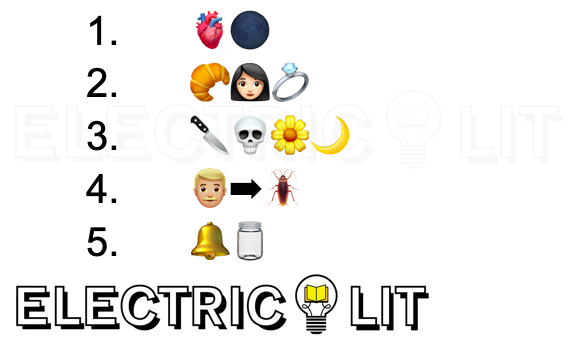
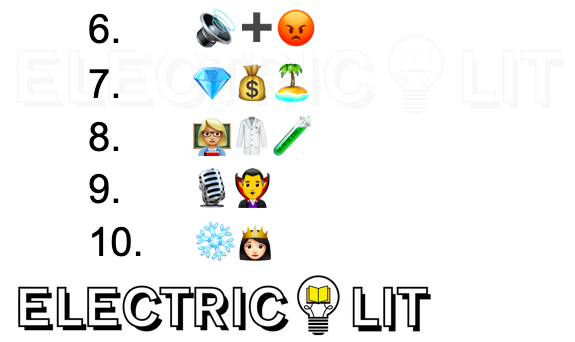
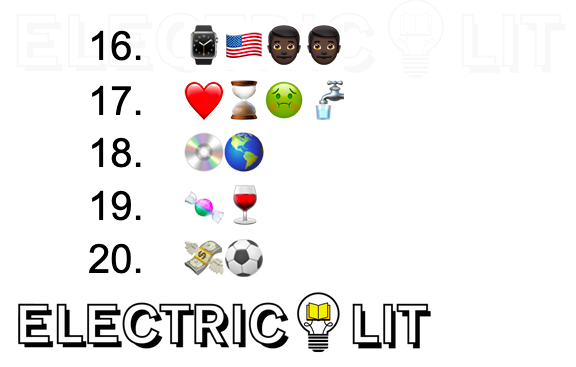
Guess the Book Titles Using Only Emoji

It’s that time of year again, dust off your English Literature degrees and…interpret these emojis? Take our quiz to see how your texting skills help you name these 25 books!

A little rusty? All the answers are at the bottom!

Click here for the first round of guessing the book title and here for more literary trivia.

Answers

  1. Heart of Darkness by Joseph Conrad
  2. Breakfast at Tiffany’s by Truman Capote
  3. Killers of the Flower Moon by David Grann
  4. The Metamorphosis by Franz Kafka
  5. The Bell Jar by Sylvia Plath
  6. The Sound and the Fury by William Faulkner
  7. Treasure Island by Robert Louis Stevenson
  8. Lessons in Chemistry by Bonnie Garmus
  9. Interview with the Vampire by Anne Rice
  10. Snow White by Brothers Grimm
  11. Goodnight Moon by Margaret Wise Brown
  12. Little Women by Louisa May Alcott
  13. American Psycho by Brett Easton Ellis
  14. The 100-Year-Old Man Who Climbed Out the Window and Disappeared by Jonas Jonasson
  15. Red, White & Royal Blue by Casey McQuiston
  16. The Late Americans by Brandon Taylor
  17. Love in the Time of Cholera by Gabriel García Márquez
  18. Discworld by Terry Pratchett
  19. Sweetbitter Stephanie Danler
  20. Moneyball by Michael Lewis
  21. The Plague by Albert Camus
  22. The Dream of the Red Chamber by Cao Xueqin
  23. Nightbitch by Rachel Yoder
  24. Death of a Salesman by Arthur Miller
  25. Angels and Demons by Dan Brown

9 Books to Spark Your Creativity

Of all the craft books I’ve read in my life, perhaps none have stuck with me quite as clearly as the assertion, at the beginning of Mary Oliver’s A Poetry Handbook, that, rather than waiting for inspiration to strike, an aspiring writer must sit down regularly for an appointment with the muse. If you do this, Oliver suggests, inspiration will follow: “if you are reliably there, it begins to show itself—soon it begins to arrive when you do.” And if not, “if you are only there sometimes and are frequently late or inattentive,” the inspiration you’re seeking “will appear fleetingly, or it will not appear at all.”

Even twenty years past the introduction to poetry class in which I first read Oliver’s book, I don’t think this is necessarily bad advice. I don’t write every day, as some scolds insist you must to be a real writer, whatever that means, but I do write regularly, and I’ve got a notebook and a pen stashed in every purse, my gym bag, and my glove compartment, so I can catch inspiration whenever it does strike. (My newsletter, Write More, Be Less Careful, is full of tips for scratching out time to write in the midst of a busy life.) 

But what happens when you sit down to write and inspiration doesn’t follow? What do you do when you’ve dutifully held up your side of the bargain and that creative spark remains elusive?

Below, I’ve rounded up a collection of books that will spark your creativity and make you want to write. They mostly aren’t craft books in the conventional sense—they’re less about learning about line breaks or point of view and more about how to seize on unlikely sources of inspiration and crack open your brain to make space for creative work. 

Make Your Art No Matter What: Moving Beyond Creative Hurdles by Beth Pickens

In Make Your Art No Matter What, Pickens, a therapist and artist coach, guides readers through exercises to overcome common creative hurdles, ranging from the philosophical like time, fear, and other people, to the downright practical, including money and marketing. I interviewed Pickens, a therapist and artist coach, when her book first came out in the summer of 2021, and it’s has remained a warm source of encouragement since then. (It was that interview with Beth that inspired me to finally stop cackling nervously about how anxious I was about the business and self-promotion arm of writing and actually find a therapist, which helped enormously, in case anyone else needs a nudge to stop following therapists on Instagram and see one in real life.) Like a good therapist, she’s sympathetic to your struggles—and she’s also got lots of great resources to help you make your art and get out of your own way.

Syllabus: Notes From An Accidental Professor and Making Comics by Lynda Berry

Even—or maybe especially if—you’re someone who thinks of yourself as “not artistic,” the exercises in Lynda Barry’s books will likely unlock something in your creative brain. Syllabus: Notes From An Accidental Professor, provides a peek into Barry’s classroom at the University of Wisconsin in Madison, where she’s an Associate Professor of Interdisciplinary Creativity, and the follow-up, Making Comics, includes exercises like “Scribble Monster Jam” that can be done in a group as a round robin or on your own. Several of her exercises pair drawing with narrative, a combination that will likely prove fruitful for lots of writers. What I love about Barry’s work is her insistence on practice and playfulness. Once we’ve abandoned something because we fear we’re bad at it, Barry writes, “a certain capacity of the mind is shuttered.” Barry’s exercises point the way toward cracking that creative capacity open again. Even if you, like me, never manage to make a piece of real art through her exercises, there’s something about working visually that can shake out new ideas. 

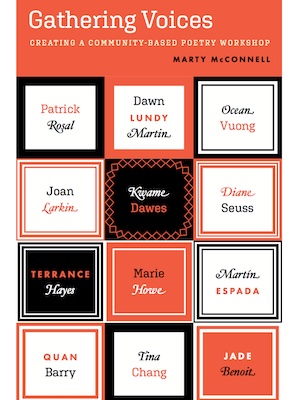
Gathering Voices: Creating a Community-Based Poetry Workshop by Marty McConnell

So often, our image of the writer is someone weeping into their notebook alone, and Marty McConnell’s Gathering Voices provides a useful counter to this image of the solitary artist, reminding us that writing doesn’t have to be a lonely pursuit. Her book, a collection of poems and writing exercises meant to be used in community-based poetry workshops, provides lots of points of entry for collaborative writing and discussion. McConnell developed the Gathering Voices approach through nearly twenty years of creating community writing workshops, including The louderARTS Project in New York and Vox Ferus in Chicago. The exercises, based on poems by Ocean Vuong, Terrance Hayes, Jericho Brown, and more, focus on curiosity, careful reading, and experimentation. Each poem is followed by a series of discussion questions that are open-ended enough to be accessible to even new readers of poetry an exercise related the poem. The exercise that’s paired with Kwame Dawes’s “Death: Baron Samedi,” for example, asks writers to “invent a minor god, deity or demon” then use a Mad Libs-kind of structure to begin their freewrite. It sounds like a little wacky, but it’s a mix of structure and freedom that can be really generative. You could use these exercises with your writing group or just pick them up for your own practice and be reminded that, even if it’s just you and your notebook right now, you’re not actually alone.

1000 Words: A Writer’s Guide to Staying Creative, Focused, and Productive All Year Round by Jami Attenberg

Like many writers, I found Jami Attenberg on twitter through the #1000words project, in which writers sign up to get a daily email of encouragement and write 1000 words a day for 14 days.  Since Attenberg began the project in the summer of 2018, it’s grown to a newsletter, Craft Talk, with more than 37,000 subscribers and a book, published this past January. The magic of the #1000words project is the sense of companionship, that even as you’re sitting down at your desk alone, you can also feel writers all around the world settling in for the same word work. On social media and in the comments on the newsletter, writers chime in to share their word counts, celebrate little breakthroughs, and commiserate on tough days. The book, which includes essays by Attenberg and contributors including Roxane Gay, Lauren Groff, Celeste Ng, Carmen Maria Machado, and more on topics ranging from making writing friends to handling distractions and persisting through rejection, captures that energy. The book works best, I’ve found, as a friendly companion to a writing practice. I keep mine on my desk and flip through it when I need a little burst of encouragement or a reminder to get back to work. 

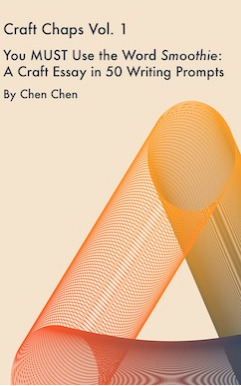
You MUST Use The Word Smoothie: A Craft Essay in 50 Writing Prompts by Chen Chen

In the introduction to this collection, available as a free digital download in Sundress’s Craft Chaps series, Chen writes that he hopes the prompts will “spark some unexpected new writing for you.” Across the sections, which Chen describes as “potential windows,” readers will find prompts ranging from “Write more love poems” to “Rest” and “If you can afford to: go to therapy. (Art can be therapeutic, but is not a substitute for therapy.)” It’s hard to write about this set of prompts without feeling like I’m either giving away the pleasure of its many surprises or making light of how it interweaves the playful and the politically attuned. Perhaps it will be enough to say that these prompts, either worked through individually as you’re inspired, or taken up as a whole across several weeks of writing, will take you on a journey from rest to rage and back.

The Book of Delights and The Book of (More) Delights by Ross Gay

Ross Gay’s Book of Delights and Book of (More) Delights are all about finding delight in the everyday. The brief essays in these two books, which cover experiences ranging from carrying a tomato on a plane and pulling carrots to watching two people share a bag, feel like a kind of field guide to the pleasures of re-engaging with the world around us. (If you haven’t had the chance to see Ross Gay read in person, check out this brief video of him reading “Tomato on a Plane” so you can get that voice and smile in your mind and carry it with you as you read. And then see him read in person the next chance you get!) Though they’re not exercises, reading these essays always inspires me to look for more delight in my own life. Read a couple, then use the guidelines he created—“write them daily, write them quickly, and write them by hand”—to start crafting your own delights. 

Millions of Suns: On Writing and Life by Sharon Fagan McDermott and M. C. Benner Dixon

Millions of Suns is the closest thing in this collection to a conventional craft book, but it distinguishes itself within that category through its expansive approach. Each chapter features a pair of essays written by McDermott and Dixon, followed by a range of prompts that are sure to spark your creative energy. It’s useful for writers working in genres from poetry to prose, and its chapters include topics ranging from imagery and inspiration to metaphor, structure, and revision. It ends not with the advice on publishing or facing rejection or finding a writing group that often seems to end craft books, but with a chapter on Beauty, and McDermott’s essay, which suggests that “beauty is a projection and a reality, both.” The book begins by insisting that “there is joy in writing,” and the essays and writing prompts it includes point the way toward cultivating more of that joy in your own creative life.

In “Devout,” Anna Gazmarian Reconciles a Bipolar Diagnosis With Her Evangelical Faith

When Anna Gazmarian was diagnosed with bipolar disorder while still in college, she expected to be supported by her church community.

Instead of finding support during a dramatic life change, she discovered that many in the church viewed her illness as an affliction of the spirit rather than an actual medical condition. Gazmarian spent the next ten years seeking treatment and compassion within the evangelical community to mixed results, an ordeal she documents in her acclaimed memoir Devout: A Memoir of Doubt.

Gazmarian and I discussed misogyny in the evangelical church, religious trauma, and how both the literary community and the evangelical church can better support mental health.


Deirdre Sugiuchi: After a breakup with your college boyfriend, you are told by a pastor that you are viewed as a spiritual stumbling block in your ex’s relationship with God, and are pushed out of your church. Can you discuss this mindset, of viewing women as being stumbling blocks to men, which may be unfamiliar to secular readers? How do you think that attitude impacted your mental health?

Anna Gazmarian: The idea that women are seductresses and stumbling blocks to God goes back to the Garden of Eden when Eve gives Adam the apple. I’ve listened to many Christians use this story to show how women are temptresses who lead men to stumble and fall away from God. This interpretation fails to account for Adam’s decision to listen to Eve and make his own decisions. From an early age, I thought that it was my job to keep men from sinning. I dressed a certain way and set boundaries because I feared leading men astray. I mean, I refused kissing for several months because I wanted to keep them from desiring just my body.

I thought that it was my job to keep men from sinning. I dressed a certain way and set boundaries because I feared leading men astray.

This continues to impact me. If I find a guy staring at me or complimenting me, I flinch or revert back to my evangelical mindset—even if rationally it doesn’t make sense. It took me until after college to regularly make eye contact with any man because I worried what he thought of me while looking at me, if I was causing him to sin. I followed my modest high school dress code through college because I did not want attention. All of this changed after I had my daughter. I spent so much time thinking what I wanted for her that I did not have. So, shortly after she was born, I embraced crop tops. I wear them proudly without giving a fuck about who looks at me. It makes me feel good. It’s taken years for me to embrace what I love to wear and what is comfortable for me while separating how it might be perceived by men. It’s an endless cycle of distancing myself from the male gaze, which is something every woman eventually grapples with.

All of the conversations were about protecting men from lust and sin but at the expense of women. This is an extension of purity culture where maintaining virginity is seen as the most important thing to do. From an early age, I did repress my sexuality because I was told that was not a part of myself that I could explore until marriage. I was taught not to want sex or desire anything physical but once I got married, it was totally okay. But that did not happen to me. I got married and suddenly felt extremely guilty about my body and sexuality. I had been programmed to do whatever my husband wanted and could not separate that from my own desires.

DS: When you are in religious counseling, you are encouraged to take incidences from the Bible and apply them to your life. What are the pitfalls of this practice, particularly in regards to mental health?

AG: I find it very dangerous how many in the Christian counseling community rely on the bible as a salve for mental conditions. The counselor that I saw never actually mentioned the possibility of me having a mental illness. It is easy to take verses out of context and turn them into a way that serves the purpose you are driving at. This is how many have justified homophobia and slavery. Many therapists would give me verses about joy as comfort to me. But this is the last thing that I needed to hear from a religious person when contemplating my own death. On top of being morbidly depressed, I was overwhelmed with anxiety, guilt, and shame that none of my efforts like prayer led to my symptoms alleviating. I viewed my diagnosis as my own fault and at times, that is still something that I struggle with.

DS: Later, a counselor alludes to your suffering from religious trauma. Can you discuss what this is and how it impacted your life?

AG: This was a therapist who had a theological background in a more progressive seminary than the places I knew about growing up. Spiritual trauma means different things to people but for me it’s about religious institutions being used in a toxic way to manipulate and control individuals in the name of God. For me, certain events did occur that were traumatizing but it was the overall exposure of a rigid and strict environment that sought to take away my personal autonomy in the name of God that stuck with me. Recently, I was diagnosed with Complex Post-Traumatic Stress Disorder because of my experiences with religious trauma.

It impacts me in all sorts of ways. There are still days where ideas that my illness or bad things that happen are because I sinned or don’t have enough faith. Even though I can rationally believe this isn’t true, those old thought patterns often show up. Purity culture impacts the way I relate to my body and sexuality. It’s taking to unlearn how not to be completely detached from myself and not seeing my very self as something that is bad or needs to be hidden.

It is very complicated still identifying as a Christian and struggling to read scripture, participate in church, and pray because of how it’s been previously used. It’s taken many years for me to see God as safe versus a part of my life that I need to approach with fear. I’m still grappling with a lot of guilt and shame. Flannery O’Connor has a quote about the South being Christ-haunted. I definitely feel that both in living where I am but also in my faith journey. It’s frustrating that I can’t participate in faith communities the way that I’ve previously had and felt belonging in. However, finding people outside of the church and building a community has been a reclamation.

DS: You wrote this book while completing your MFA. Did you feel like your cohort understood evangelical culture?

I thought if I strived enough spiritually, that I would get healed. But that’s not the case. Science and faith are not enemies.

AG: It’s funny, because going into my MFA program, I had no intention of writing about my upbringing. If anything, I had so much shame and embarrassment around it. No one in my MFA understood directly, I actually tend to gravitate towards people who live opposite lives as me. But, having them love me in spite of my upbringing, to see how they identified with parts of my story in spite of our differences meant the world to me. I decided to write about my faith journey because I realized I could write it in such a way that people without my upbringing could understand. It’s very important to me to write about my experiences in a way that people outside my world can understand and gain a deeper empathy for those deemed closed minded and problematic. Underlying my story, there’s the desire to belong, the constant striving, anxiety, and inability to accept the uncertainty of life. That’s something anyone can relate to. My two closest friends from the program are a universalist Catholic and ex-Buddhist. They’ve read every draft.

DS: You have a mental health break while at your low-residency MFA, but are saved from spiraling due to the intervention of a friend. Can you discuss how you were helped, and outline best practices for workshops, based on what you learned in your experience?

AG: I see a problem in general with institutions having limited resources to offer long-term mental health resources. I think that any MFA program needs to have therapists available, especially when so many workshops involve traumatic memories coming up. That was the hardest part for me. I would sit in these lectures and so many parts of my spiritual trauma would come up. I had no idea what was going on because things were resurfacing and real time. For a few nights I called public safety to check on me to make sure I didn’t do anything. I called a suicide hotline but hung up on them because I didn’t need strangers telling me that my life mattered. I figured if they knew me they wouldn’t say that.
I also think that workshops need to be more trauma informed. Professors need to be trained to better handle material that is distressing for the writer and ways to navigate discussion. I also think it’s important that MFA programs reassess their culture. I’ve heard from many and witnessed how partying is encouraged and part of the culture. There’s so much still assumed about writers having to be emotionally unhealthy people. I seek to prove that you can be healthy and a good writer.

DS: What do you wish that people in the faith or out understood about mental health?

AG: I wish that we could move away from the idea that faith is about making life more manageable, pain free, happier, and certain. If we changed the way that we confront and grapple with pain, I think that we could make more space for the impacts of mental illness and better love people. I don’t think that can happen until we change the way we view scripture and be willing to accept the painful parts of being human instead of trying to pray it away. Most of my life has involved seeing religious people use religion as a weapon against suffering. But that for me is completely counter to who I believe God is and what I think the church is supposed to be. The reality is that Jesus spent his time with everyone condemned by religious people. I believe that included the mentally ill. He did not dwell with those deemed righteous, he spent his ministry with those seen as untouchable.

[We should see] suffering as part of what makes us human and not something to avoid or a sign of weakness or little faith.

I’m grateful for my depression in a way because it has enabled me to interact with the bible in a different way. Scripture shows the value in accepting where people are at. The reality is that people throughout scripture, including Jesus and those deemed most faithful by God, showed many signs of mental illness. I have a tattoo of an olive branch commemorating the Garden of Gethsemane where Jesus sweated blood and pleaded with God. There’s something really rich and healing for me to live a life of faith that believes that both sorrow and joy can coexist. Even when my sorrow is overwhelming and I see no way through, there’s a comfort in now believing that I am not being condemned for how I feel. I wish that more Christians spent more time reading laments where people throughout scripture plead and question God without often coming to conclusions.

If we saw suffering as part of what makes us human and not something to avoid or a sign of weakness or little faith, that would change how we approach mental illness. I’ve also met several counselors who see mental illness as a spiritual affliction. This was one of the most harmful parts for me. I thought if I strived enough spiritually, that I would get healed. But that’s not the case. Science and faith are not enemies.

DS: I see your book as being one of many that is calling for change in the evangelical church. What kind of conversations do you hope your book will spark within or without the church?

AG: When I wrote this book, it was really important to me that it was written in such a way that people who practice faith and those who don’t could identify with. It was important for me particularly with the opening chapters to encapsulate a depiction of the impact of religious trauma and how it impacted my mental health. Churches need to take religious trauma seriously and take steps to be more trauma informed in how they approach language and biblical interpretations. I utilized the bible throughout the book because I wanted to show how trauma lingers and how these stories have shaped me. I hope that those who grew up similarly can relate. So many religious people have asked me, why can’t you move on from being hurt by churches? Why does this still haunt you? Because that’s what trauma does and we need to be mindful of that in how we approach practicing faith. I want this book to make people discuss the role of leadership in religious spaces, how they are not designed to be intermediaries between us and God.

I hope anyone who reads this will cause them to think about ways to love people well and serve those who are in pain. This book honors the importance of community and I hope it gives people courage to seek after that because I wouldn’t have made it this far without that in my life. I think due to Trump and many other intolerant measures by religious groups, it’s easy to dismiss religion altogether as destructive and damaging. I wanted to depict that pain, to create conversations where people can share their wounds with one another and heal. Most of my favorite memoirs about religion end with denunciation. I wanted to create space for those who struggle and continue to stay in spite of the pain. I also wanted to show and cause people to become open that it is possible to live a life of faith that leads to growth instead of fear.

Black Americans Are Collectively Assumed To Be Socially and Politically Liberal

Black Feminism For Beyonce, Megan, and Me by Jennifer Stewart

When Beyoncé released her self-titled album in 2013, I realized I might be a feminist. “Flawless,” was a self-affirming, feminist anthem complete with a recording of Chimamanda Ngozi Adichie reading from her seminal work We Should All Be Feminists. I was so enamored that I almost ran a red light while listening to it on my way to work in downtown Houston. Hearing themes of empowerment, agency, and autonomy from a black woman shifted something inside me at the tender age of 29. A few years later, Megan Thee Stallion’s “Big Ol’ Freak” audibly rocked my world, causing me to re-examine my experience of sexual pleasure. I’ve remained buckled in for the ride as Megan broadens her lyrical exploration, rapping about pleasure, grief, mental health, body image, and more. It is not hyperbole to say that these two Houstonians have shaped me into the woman I insist on being, as I believe they have for many black women raised in socially conservative society.

Like Beyoncé and Megan, I was born and raised in Houston. I was not born into black feminism, though my upbringing wasn’t too far off. I was directed to speak up at all times, to make my physical presence known, and, much to my chagrin, to “go outside and cut the grass.” Almost everything about the way my mom was reared, and then the way she reared me, was towards becoming the strongest, most independent, best version of myself. White people and men were never named as forces to be feared or motivated by. There was no wink wink at foregoing fun activities like swimming or running in order to preserve my hair style or avoid making my brown skin darker under the sun. If there was any mention of things to do and not to do for the sake of being more attractive to men, I didn’t hear it at home. Yet, neither I, nor Beyoncé, nor Megan Thee Stallion, were shielded from the gendered expectations of the society we were raised in.

Black Americans are collectively assumed to be socially and politically liberal.

Black Americans are collectively assumed to be socially and politically liberal. The 2016 election season was the beginning of America reckoning with this faulty assumption when a surprising 12 percent of black voters voted for a law and order candidate who made a judicial beeline to overturn Roe v. Wade. In 2024, this candidate said black voters can relate to his 19 criminal indictments because they too have been discriminated against. Some polls project 20 percent of black voters will vote for this candidate. A black American might vote democratic straight down the ballot, but this same voter may also also agree with the Southern Baptist Convention, that churches are not to be led by women, nor inclusive of queer people. They may also be against reproductive rights. The Pew Research Center reports that almost one in three black survey respondents believes abortion is illegal in all or most cases. In an unfortunate blend of patriarchy, respectability, and religion birthed during Reconstruction—when black people were determined to get a well-deserved (to say the least) slice of the American dream— social conservatism deeply embedded itself within black culture. My older sister is a great example. She is a Gen Xer who exclusively votes democrat while using styrofoam plates, believing that sex is for husbands and wives, and referring to unruly women as “females.”  

Socially conservative black democrats are proud and protective of their blackness, fighting against racist ills like income inequality, voter suppression, and police brutality. These socially conservative black democrats also abhor what they see as moral deviance that holds black people back from achieving the black American dream, most saliently demonstrated in their own discrimination against queer and sexually free people. Late one uneventful Friday night, I pressed pause on my millionth RENAISSANCE listen while my socially conservative sister offered an abundance of opinions about Beyoncé, Megan Thee Stallion, and feminism.

“Megan Thee Stallion is very very very raw,” she said. “But she’s also very young.” She was trying to be as generous as possible, as if youth must contribute to the way Megan—an adult woman with agency—presents herself sexually. My sister dove into a story about a recent house party with her college friends. Though we are ten years apart, I know the virginal status of each of these women, because it’s how my sister has categorized them over the years. Who “sleeps around” and who doesn’t. Who “waited on God” and who didn’t. A mix of sexual statuses were present at this party. 

Megan’s “Captain Hook” video was projected on the big screen, as a background vibe. Initially, my sister’s friends were hype about the video since it opens with Megan sitting at the head of a table in a recording studio, in charge and calling the shots. My sister has her own home, a master’s degree, and a decades-long career in IT that she’s proud to have earned on her own. I love my sister and admire her many accomplishments. Watching Megan count her stacks of bills, my sister positioned herself as the voice of reason. “I know women are trying to say ‘we don’t need you [men],’ and all this stuff,” she said. “But the truth is that we do need men, yes we do.” For black women like my sister, perhaps independence is less about defying gendered expectations and more about the pursuit of a black American dream, which is rooted in respectability and white supremacist patriarchal standards. 

Even in girlhood, black conservatism is already on the lookout for any sign of sexual impurity.

Wikipedia’s Black Conservatism page only mentions the words “woman” and “women” once. And yet, so much of black conservatism concerns itself with black women and how they ought to be. Margo Jefferson lists the ways Negro girls ought to be in Negroland, her stunning look into black classism. In addition to straight hair and narrow noses, Jefferson writes that respectable girls should avoid having “Obtrusive behinds that refuse to slip quietly into sheath dresses, subside and stay put.” Even in girlhood, black conservatism is already on the lookout for any sign of sexual impurity, and seems to lay the blame on women’s bodies, rather than men and their behaviors. 

It’s hard to untangle my sister’s anger about sexuality and her distrust of feminism. For her and most socially conservative women, everything is rooted in sexual sin. When she thinks of feminism, she arrives here: “The message sent to men is that all women need from men is sex.” She continued talking about a flurry of tangential issues such as abortion rights (“I just can’t get with it”) and gay rights (“the homosexuals”). This person has voted for democrats all of her life, and yet she is a socially conservative woman. 

Socially conservative women have had much to say throughout Beyoncé’s career. The video for “Déja Vu” is celebrated now, but when it was released in 2006, some black women found it problematic. Some fans were so put off by the video—which features Beyoncé running around barefoot in what might be a coastal corn field because she’s so obsessed with Jay Z—that they signed a petition to reshoot the video. I was a senior in college. As though it were yesterday, I remember black women’s second-hand embarrassment. But like the fans who signed the petition, it wasn’t just the dizzying performance that gave them pause. It wasn’t even the worshiping-like, crazed devotion she displayed for Jay Z. “I do not like that video,” I remember a church member saying. “Beyoncé has lost her mind, gyrating all over the place!” Their disgust is rooted in the fact that Beyonceé is wild in the video. She isn’t meek and mild, as the bible calls a good woman to be. Her scenes with Jay Z also suggest an excitement about performing oral sex, which is certainly not what good conservative Black women do.

For most of my adolescence, I scratched my head trying to figure out exactly why—according to the Bible and late night Christian teenage talk shows—we couldn’t have sex outside of marriage. This “will I/won’t I” was at the front of my internal morality line. An obsession, even. A constant measuring of girls perceived as rule followers (Tia and Tamera) and girls perceived as rule benders (Moesha). I always knew I was a blend of both, but there was no space for a non-binary stance as a girl who came of age in the 90s in a socially conservative environment. Now, I see the pop culture black girl offerings of the 90s through a different lens. From Tia and Tamera, to Moesha, Zaria, Laura Winslow, Lisa Turtle and beyond, pop culture finally created black girl characters who could think about having sex without the burden of religiosity or trauma. In hindsight, this seems quietly radical, a necessary step towards a sex positive society. For most of us, sex still stalled at “will I or won’t  I,” rarely going so far as to ask about the larger experience—what sex might actually feel like.

I decided to have sex the summer before graduating college.

After a string of unrequited love rejections and one attempt to be born again (again) at a Lubbock County church, I decided to have sex the summer before graduating college. From the first time I learned about sex, it seemed like a thing that men took from well-behaved women, or that fast, untrustworthy women allowed to be done to them. That doctrine crossed racial, class, and political party lines for my entire life, and I’d grown weary of the premarital sex boogeyman.

During my inaugural romp, I laid there rolling my eyes. This was so forbidden?! Brian, my coworker at the Gap who drove a really cool old Volvo and sang The Killers songs with me on late night drives for beer outside the Lubbock city limits, was going to town, yet all I could think about were the magazines I was going to read at Barnes & Noble later that day. And this felt so deeply correct. By having sex that actually did nothing for me, I felt like I was doing it right. And for Brian and the partners that followed, all raised on a sexual education curriculum of porn, late night HBO, and dirty chat rooms on Napster, boys jabbing my genitals like a jackhammer probably thought they were doing it right too.

One partner used to get upset when my body wasn’t ready to receive him. I was dry as the desert we were having sex in. He didn’t ask“what can I do to get you in the mood?” but rather “why can’t I [the man] make this work?” All of it, even in troubleshooting, was in service to him. If I happened to gain any real sense of pleasure, if any realness resided in my award-winning fake orgasm vocals, it was just a nice add-on. 

All of this changed when Megan Thee Stallion entered my life after my divorce. My socially conservative world avoided talking about sexual pleasure. It seemed that God prioritized two things: male pleasure and childbirth. The woman’s pleasure was never a consideration, and women responded with humor by positioning sex as a sort of relationship tax. From white housewives to black girls from around the way, sex became a way to get what we wanted out of men, whether it be jewelry or a designer bag, or a new kitchen appliance. Sexual pleasure was demoted to a happy, infrequent, surprise. 

But not for Megan Thee Stallion. Her entire catalog turns dysfunctional beliefs about women and sex on their heads. From “Big Ol’ Freak” to “Cash $hit” to “WAP” to the aptly named “Eat It,” Megan centers the universe around her pleasure. In “Girls in the Hood,” Megan raps, “You’ll never catch me calling these niggas Daddy/I ain’t lyin bout my nut just to make a nigga happy.” She is uninterested in placating a man’s ego. She is uninterested in giving a man ownership over her sexual experience. Orgasm-less sex isn’t an option for her. A black woman from Houston who also has broad shoulders and thick thighs and brown skin prioritized her pleasure and it continues to re-mold me with every listen. 

I was toiling over my own suspicion that he thought my black womanness was beautiful but also a burden.

I’d just come out of a situationship that left me feeling red hot with inferiority when I heard “Not Nice” from Traumazine for the first time. I was toiling over my own suspicion that he thought my black womanness was beautiful but also a burden when the lyrics I guess my skin not light enough, my dialect not white enough/Or maybe I’m just not shaped the way that make these niggas givе a fuck shot a bolt of lightning straight through my growing sense of shame, as if to say, “Girl, stand up.” Within seconds, these lyrics reflect the most comprehensive take on what it means to be a black feminist. We stand firm in our blackness and womanness, knowing that doubt and impenetrable confidence are nextdoor neighbors. Pitchfork was taken by the same lyrics, stating that these lyrics are “…shining a light on the rampant misogynoir she endured these past couple of years. Meg’s known for her celebrating her body in visuals and lyrics, but in this context, it becomes a call-out to those who enjoy her sexualized image but refuse to acknowledge her personhood. She continues this thread through multiple mentions of embracing her natural hair and Blackness: ‘I’m Black, Biggie-Biggie Black … my Afro my Powerpuff.’

In a 2020 Pitchfork article examining Megan Thee Stallion’s feminist stance within the entertainment industry, writer Rawiya Kameir considers Angela Davis’s view on the role of black feminist entertainers. “Per Davis, these blues performers modeled a new archetype of Black woman: sexy, independent, cleverly seeking avenues to interrupt male dominance.” That was true of Gertrude “Ma” Rainey’s time, and it remains true today. Both Megan Thee Stallion and Beyoncé are disruptors in a world that runs on misogyny and misogynoir. 

Though capital F feminism evaded me in my formative years, I’d thought about gender equality since I was a young girl. Nothing made me silently seeth quite like sitting at the dinner table watching the food go cold because no one could eat until “the man of the house” (my dad) fixed his food first. Gratefully, my mom seldom uttered the words “man of the house,” but it was absolutely implied. I also thought about gender inequality in the home while I was stuck doing chores late on a Saturday night like a southern Cinderella while my felonious brother was out on the town doing God knows what. I’d thought about the power imbalance for most of my life. It’s actually more accurate to admit that Beyoncé’s entire catalog was chipping away at that, the final chip discarded with her self-titled album. I wouldn’t go so far as to say that Beyoncé’s album was the catalyst for my marriage’s eventual demise, but it certainly provided a great soundtrack as it crumbled. I couldn’t stop hearing Chimamanda’s voice in my head, “‘You should aim to be successful/ But not too successful/ Otherwise you will threaten the man.’” Each of her words were little mirrors and rearview mirrors, forcing me to see my true reflection in the past and present.

The tech industry was not kind to me, so most nights after work, I didn’t feel like sitting down to a big dinner.

Encumbered by his own inability to keep a steady job (despite graduating second in our civil engineering class), my ex-husband started obsessing about gender roles in our two person household within months of our courtroom wedding. “It wouldn’t hurt you to do a load of dishes,” he’d say after I got home from a day full of condescending interactions in my male-dominated industry. “It wouldn’t hurt either of us if we get to the dishes tomorrow,” I’d say with my wobbly tip toes up to feminism. The tech industry was not kind to me, so most nights after work, I didn’t feel like sitting down to a big dinner. I was just too exhausted to commit to a whole plate of food. “We’re supposed to eat a meal together,” he’d say. I knew this was code for “where’s my food.” 

My shoulders shrugged at his burgeoning discontent. He had plenty to say—about women, millennials (we’re born just hours apart, so this was particularly hilarious to me), and millennial women— and how we’re all turning into raging feminists. I didn’t care about what I was called, and for a long time, I thought I wouldn’t have to. I thought our Bonnie and Clyde-type relationship shielded us from such conventional ways of being. “You’re just such a feminist now,” he said one day. “Feminist? Dude, I just want us to balance the housework. It’s not that deep,” I responded, reclining into our sofa with a magazine, unbothered by whatever dishes were in the sink.

I was in college when Destiny’s Child released “Cater 2 U,” a polarizing bop about submitting to [deserving, allegedly] men. Surveying my growing list of failed attempts at love, I consumed the song like a kid forced to eat brussel sprouts and shifted my focus to readying myself for the right boy to come along. I worked out religiously, read a tolerable amount of Cosmo, and kept my afro moisturized. But I drew the line at Food Network. My last roommate cooked Food Network casseroles before class so that her boyfriend—a boy who probably wasn’t enrolled in school and most certainly was not contributing to our rent—would have something to eat while she was gone. I was so disgusted with this unearned and quite literal catering that I blogged about it. I’d think of them years later when I was married and could not understand why my ex-husband could see us as professional equals (we were both civil engineers), but expected me to make casseroles, clean the house, and care for him. I theoretically rejected these warped versions of domestic servitude disguised as partnership, and I actively rejected it while married. My ex-husband’s patriarchal expectations collided with my feminist realizations. My worldview body rolled from “Cater 2 U” to “Flawless” and there was no turning back.

Beyoncé’s self-titled album is almost 10 years old, and in that time, I have not turned back. The only things I abstain from are condescending men and bad sex, all while maintaining my relationship with God. I thank God for my spiritual, emotional, and bodily freedom. I also thank Him for orgasms that require none of my UCB improv training. I’m assuming the “Captain Hook” video was on mute because I doubt my sister supports the my-pleasure-first principles that Megan raps, “I love niggas with conversation/That find the clit with no navigation/Mandatory that I get the head/But no guarantees on the penetration.” Though I’m willing to bet that she—unlike music critics and Beyoncé’s own fans— probably appreciates Beyoncé’s “Jolene” cover on COWBOY CARTER. Defending men against lascivious women is something she can get behind. 

I wouldn’t trade the freedom I feel in myself for the world, but I also would not sell it as easy.

I wouldn’t trade the freedom I feel in myself for the world, but I also would not sell it as easy. Putting my freedom and autonomy first in a world that remains solidly bent towards patriarchy means I have had to consider the possibility of living life without another partner. This possibility was only compounded as I watched men—most of them black, in my social media feeds—slander and mock Megan Thee Stallion for being shot by Tory Lanez. If the Lanez situation was the foundation of the high profile misogynoir Megan indured, Nicki Minaj’s transphobic diss track (and her rabid fans attempting to desecrate Megan’s mother’s grave) is the rickety house built upon it. As black women, the fight for our own humanity feels most cruel when we’re fighting to be seen within our own community.

Before I have time to dwell in the sadness of that, “CHURCH GIRL,” a joyous track from Beyoncé’s RENAISSANCE, comes to mind. Not only is it a celebration of blackness, but  “CHURCH GIRL” embodies the lifelong quest to define black feminism for ourselves in the most sincere, sometimes beautiful, sometimes messy kind of way, despite the pressures of a culture that is sometimes wrapped up in social conservatism. As Beyoncé says, “I’m warning everybody, soon as I get in this party/I’m gon’ let go of this body, I’m gonna love on me/Nobody can judge me but me, I was born free.” Two Texas hotties helped me grow into an awareness of my own freedom. With every subsequent album and single release, Beyoncé and Megan Thee Stallion provide an influential soundtrack to my life as a free, feminist black Texas woman.

7 Books From University Presses You Should Be Reading

There’s a common misconception that university presses only publish academic work–monographs or detailed studies of a single specialized subject or other discipline-specific scholarly books. However, university presses, while housed in universities, also publish a broad range of award-winning books for general audiences, including memoirs, essay collections, novels, short story collections, poetry collections, and hybrid, mixed-genre works.

Even so, this category of creative work published by university presses is huge; I should start out by saying that. I have so many books by university presses that I just love on my bookshelves—both by friends and by strangers. So, this is a wildly incomplete list. To narrow the wide category that is university press books, I decided to choose books that were already on my bookshelves—books I had already read and loved, which I wanted to recommend to others. I also chose books that in some way connected to themes in my story collection, How to Make Your Mother Cry: fictions, which is being published by West Virginia University Press. Though my book is a story collection, I also think of it as genre queer: How to Make Your Mother Cry also contains poems, letters, photographs, drawings, and other ephemera. In my reading list, I looked at books across genre (story collections, poetry collections, essay collections, memoirs, and memoir-in-essays) that grapple with identity, that consider the relationships and journeys of women and girls, and books that explore how we live with loss as well as come to terms with what and who is home. 

The Secret Lives of Church Ladies: Stories by Deesha Philyaw

Deesha Philyaw’s blockbuster 2020 story collection, The Secret Lives of Church Ladies, was a finalist for the National Book Award, and demonstrates that university presses are publishing some of the most exciting and innovative work out there. This West Virginia University Press title delves into the lives of Black women and girls and crackles with wit and energy. The nine stories in Philyaw’s collection feature characters who are figuring out who they want to be in the world, caught between the church’s strictures and their own desires. Two favorite stories of mine are the opening story, “Eula,” about a close and complicated friendship between two women and the poignant epistolary story, “Dear Sister.” 

Meet Behind Mars: Stories by Renee Simms

Meet Behind Mars is an eclectic mix of realist, fabulist, and satirical storytelling illustrating a surprising wit and generous sensibility. In these eleven stories published by Wayne State University Press in 2018, Renee Simms writes a range of characters and highlights character quirks, the relationships between parents and children, the specificity of places, and the kinds of things people say to writers, all with a deft hand. The opening story, “High Country,” sets the tone and many moments of understated humor such as when the protagonist “makes a fuzzy mental note: Tom’s Natural Deodorant does not work in the desert.” Later in the same story, literary characters come to life in a magical realist twist that stands out against some of the title story’s protagonist’s more mundane moves and travel.

Feeding the Ghosts: Poems by Rahul Mehta

There is an appealing plainspokenness and humility in Rahul Mehta’s 2024 poetry collection, Feeding the Ghosts—what seems to me to be a desire to communicate more than obfuscate or keep a distance from the reader, which some contemporary poetry does. Mehta’s first two books are prose and his voice in these poems blends a sensitivity to language’s music as well as a novelist’s fluency with narrative. The combination of these gifts creates a series of gorgeous still lifes that also tell moving stories. In these poems, I sense a camaraderie with some of my stories in that the narrators of both are Gujarati, sometimes in places at some distance from major metropolitan areas. Published by the University Press of Kentucky, these soulful poems are full of flowers and trees, love and fear, moments of quiet resilience and aching heartbreak, and I left them feeling open-hearted and tender toward my own ghosts and those of others. 

The Clearing: Poems by Philip White

The spare, beautiful poems that make up The Clearing are a sustained and quiet meditation on love, loss, and memory. White has written about the deaths of his parents and his first wife and about how one goes on with life after such pain. Published by Texas Tech University Press in 2007, the poems in The Clearing read as timeless in their questioning, urgent in their address. Certainly, there is the quality of elegy and mourning in The Clearing. However, The Clearing explores not only loss, but how we keep living and even find joy in the living that remains. 

Another Appalachia: Coming Up Queer and Indian in a Mountain Place by Neema Avashia

Another Appalachia: Coming Up Queer and Indian in a Mountain Place (2022) is a loving exploration of how a place shapes a person. Neema Avashia examines her identity as a West Virginian Appalachian through essays about food, religion, sports, family, neighbors, social media, gun culture, and more. This collection, published by West Virginia University Press, contains more traditional narrative essays as well as artfully crafted lyric essays. The titles of these essays give a hint of the author’s sensibility with “The Hindu Hillbilly Spice Company: Indolachian Flavors Blend,” “City Mouse/Country Mouse,” and “Nine Forms of the Goddesses.” The acknowledgments in this wonderful book are titled, “Thanks, Y’all.” Avashia mixes nostalgia and humor, sweetness and poignancy, personal reflection and universal questions about home.

I Would Meet You Anywhere: A Memoir by Susan Kiyo Ito

Susan Kiyo Ito’s 2023 memoir, I Would Meet You Anywhere, a finalist for the National Book Critics Circle Award, is a wise, poignant, journey about home, self, and identity stemming from Ito’s search for her birth parents. However, Ito’s book becomes more than just a search: it is a moving memoir about the meaning of family and the desire to own and tell one’s story. Published by The Ohio State University Press, I Would Meet You Anywhere evokes the magnetic pull of a mystery and once you start reading, contains an appealing page turner quality along with being beautifully written, the combination of which was very satisfying to this reader.

The Sum of Trifles by Julia Ridley Smith 

What do we do with the things we inherit? Julia Ridley Smith’s 2021 memoir-in-essays, The Sum of Trifles, grapples with this question as the narrator approaches and must deal with her antique dealer parents’ belongings after their deaths. Published by the University of Georgia Press, Smith’s book is a thoughtful, elegiac look at material culture, love, and grief—at how we live in and with the objects that can deliver to us both the heaviness of the past and the solace of lives well-lived. Smith’s book is a moving inquiry about what we decide to keep and what we let go.

Taxonomy Can’t Classify My Fruiting Body

Self-Portrait as Resurrection Fern

we wonder / what saved us? what for?
—H.D.


When I came to myself again,
I thought yes, this time, yes,
and stretched on the moss

in the forest I’d known for seven
adolescences. Lichens, leaves,
and limbs glistened beneath me,

and I no longer resembled
a cluster of dust, something swept
from a far desert. In the thick of it,

there was no difference between
dormancy and death, no way out
til I found what I needed. Call it

nourishment, or care—the feeling
of being looked after. It is here,
despite, or because of, so much loss.

Lifeblood
is a drop of atmosphere,
small as a spore, colossal

as the ancient oak I clutch—
reaching for immortality,
finding it in the rain.


Slime Mold Exceptionalism

After Lucy Jones’s essay “Creatures that Don’t Conform”

7 Graphic Memoirs by Asian American Writers

Graphic storytelling is a medium that can capture the intricacies of identity and belonging in a way that prose can’t through the use of color, shading, and linework to denote different moods, time periods, and perspectives. 

My book, Advocate, utilizes these techniques to represent the different parts of my identity: the son of Korean immigrants, but also as an artist, an environmental justice lawyer, and a nonprofit worker working with diverse communities. Through Advocate, I wanted to create a persuasive narrative not just for readers, but for my own family, who had always struggled to understand my nonprofit career. Comics allowed me to juxtapose the conflicts within my family and my own ongoing work. Looking back on the wide range of artistic styles in my favorite graphic memoirs also inspired me to explore different visual storytelling techniques. As a self-taught artist working directly on paper, I selected and purchased each color of my Copic markers very carefully, thinking through how color shades denoted the time and mood for different periods of my life (shades of red to symbolize my youth and early passions, purple to symbolize a period of transition and learning). In later pages, these colors mix and meld on the page as I reflect on my past or use flashbacks as a narrative technique. After exploring so many different colors and eras, I’m happy to have settled in a calmer state of mind today, which is reflected in the shades of blue in my final chapter.

My book follows in a rich history of Asian American illustrators and authors, each telling and drawing stories of their family history in their own distinct style. Below are 7 graphic memoirs by Asian American authors that explore coming of age, familial legacy, and inheritance. 

Dragon Hoops by Gene Luen Yang

Acclaimed graphic novelist Yang was a teacher at Bishop O’Dowd High School in Oakland and his latest book dramatizes the basketball team’s journey to the California state championship. With expressive linework by Yang and understated color work by Lark Pien, the book shines a spotlight on the players and coaches, their dreams, struggles, and hopes, while weaving in anecdotes about the history of basketball. A compelling read. 

Messy Roots by Laura Gao

Laura Gao started posting her comics about Wuhan, her home city in China, on Twitter during the pandemic where it became viral. Messy Roots is a love letter to her Wuhanese roots and an exploration of cultural and gender identity, queerness, and combating racism while challenging anti-Asian racism that was at its peak during the early days of the pandemic. The memoir follows her childhood in China to her family’s immigration to Texas, college life, and her eventual move as an adult to California. A thoughtful and illuminating meditation on coming into yourself. 

Continental Drifter by Kathy MacLeod 

With precisely considered panel layout and illustrations, this graphic memoir recounts the tumultuousness of adolescence over the course of a single year. With a Thai mother and American father, MacLeod grew up between Bangkok and Maine, while never quite entirely fitting in either country. Amid scenes of pastoral beauty in New England, MacLeod is constantly reminded of her biracial identity by the callousness (and occasional kindness) of others at her summer camp. A touching story of finding belonging and self-acceptance. 

Family Style: Memories of an American from Vietnam by Thien Pham

Pham’s graphic memoir is told through food and begins with a traumatic pirate attack as their family escapes Vietnam  and progresses to Pham’s early memories of being in a refugee camp in Thailand, and then finally settling in San Jose. Every chapter in the book is named after a dish that represents a pivotal moment in Pham’s journey: “Rice and Fish” is the meal of his childhood on the boat and the refugee camp while “Steak and Potatoes” encapsulates his time in America, while “Strawberries” follows his family’s as laborers on a berry farm. In the final chapter, Pham pursues citizenship, a culmination of his family’s struggles and sacrifice to make it to America for a better life. 

Feeding Ghosts by Tessa Hulls

A story about the reverberations of trauma, Feeding Ghosts pierces family mythology with an in-depth look at three generations of women. Tessa Hulls’ Chinese grandmother Sun Yi, a journalist, escaped from Shanghai to British-ruled Hong Kong with her mixed-race daughter, Rose, after facing persecution from the community party. Hulls’ mother is the product of an affair with a Swiss diplomat, her existence unacknowledged and recognized despite Sun Yi’s desperate entreaties to the Swiss embassy to recognize her paternity and afford her daughter the privileges of legitimacy. In Hong Kong, Sun Yi pens a bestselling memoir that brings her acclaim, respect, and financial security, but the years of struggle manifests in a breakdown. Rose spends her weekdays in an elite British boarding school and the weekends visiting her mother in a psychiatrist ward, before she eventually moves to California for college. Rose’s life-long responsibility as a caregiver leaves her riddled with anxiety, a mercurial figure to Hulls who spends most of her life estranged with her mother.  Tessa Hulls conveys the nonlinear process of healing through the book’s black inks and panels that bleed across the page, allowing for stark and sprawling graphic storytelling that  is a tender and vulnerable exploration of matrilineal legacy. 

Almost American Girl by Robin Ha

Seoul-born Robin Ha’s memoir follows a major turning point in her life: an unexpected move to the United States as a teenager after her mother decides to get married to a man in Huntsville, Alabama. The book charts Ha’s grapple with culture shock, her relationship with her mother, racially motivated bullying in school, and her adjustment to life with an American stepfamily. A contrast to Ha’s narrative is the inclusion of her mother’s perspective on immigration and their struggles. Soft and subdued coloring is used for the majority of the work, with recollections of Korea in sepia tones. 

The Best We Could Do by Thi Bui

Spanning the present day and the past, Bui’s memoir traces her family’s escape after the fall of South Việt Nam in the 1970s, their stint in a refugee camp in Malaysia, and their lives in California. A chronicle of family history and the fall of a country, Bui shows how recollections of shared historical events differ amongst family members, and each memory malleable and shaped by the person’s identity and life experiences. A thoughtful  mediation on war, displacement, and parental sacrifice.