Born, 1968. Misunderstood everything, ‘72 to ‘86. Started pulling it together after that. Eventually I became the first in my family to lie in a field of clover and speak earnestly to cows. Then I fell in love and got married. When she asks if it’s cold outside, my wife doesn’t want to know the temperature; she’s asking how she’ll feel when she leaves the house. I try to earn her trust by thinking about her bare arms, her face. Now we’re on the couch watching episodes of “Cheers” out of order. Coach dies and then comes back. Then he’s gone again. I told my therapist I’m always bracing myself and she said she has a conflict next Saturday morning. We stare at our calendars. The next holiday is Flag Day. The next birthday is today but not for anyone I know. My next meeting is with the Assistant Director of Tomorrow. He has a message for me from the Director of Tomorrow. Before I can read it they both resign so I leave work a little early. Our daughter asks if the money in my pocket belongs to George Washington. Not anymore, I say. Years later we find the dollar tucked inside a small velvet bag which is inside a red purse which is inside a glittery backpack. Where does it end, I wonder? I mean our ability to shrink some things and enlarge other things. The gods never saw that coming. They thought we’d eat, and have sex, and sleep, then pass the time staring out at large bodies of water. I guess the answer is it never ends. I mean how much we love the ocean, always clapping when whales do something normal like breach the tension and take a breath.
Rules for When the Coin Toss Ends in a Tie
All players must immediately call their wives and beg forgiveness. The top scorers have to donate their statistics to the less fortunate. Team captains kiss each other on the cheek and say one thing they admire about the other. It can’t be about their physical strength or muscle tone. Something real. Fathers have to imagine who they’d be if they had better fathers. All the old-time greats are allowed to climb out of their graves. They get to drink a beer and eat a hot dog. Then they have to go back. Every fan gets a time-out to take home. Some use it when the world is too much, others when the world is exactly right. The roar of the crowd is bottled and saved for later, a day when we might really need it.
The Strange Lights in the Sky Are Not For Us
I can’t sleep so I watch the news. First they animate the weather. They play it forward, then reverse it, then play it forward again. Next, they interview an Air Force Brigadier General who waves away evidence of UFOs. We’re all alone here so get used to it, he says. But when pressed he gives a little wink. Then he flies away. I write a poem about what I’ve seen. I put the poem under the bed so it can be alone. The weather outside looks fine one minute and the next it’s made up its mind to darken our day. That’s normal, I say to myself. Tomorrow it will darken the day of those who live to the east of us. I call someone who lives to the east of us and tell them about the UFOs. The weather slips my mind. On the walls of the Air Force recruitment office are posters of jets. In the jets are people who have broken free from gravity so they can be alone. I wonder how the poem is doing. I look under the bed. The poem is gone. Then I find it under something else. I change the title. I call it The Brigadier General’s Big Adventure. I turn off the TV and get into bed. The poem is asleep. I can hear its steady breathing. My wife stirs a little so I tell her everything. The weather will be fine tomorrow, she whispers. Yes, I say, and the strange lights in the sky are not for us.
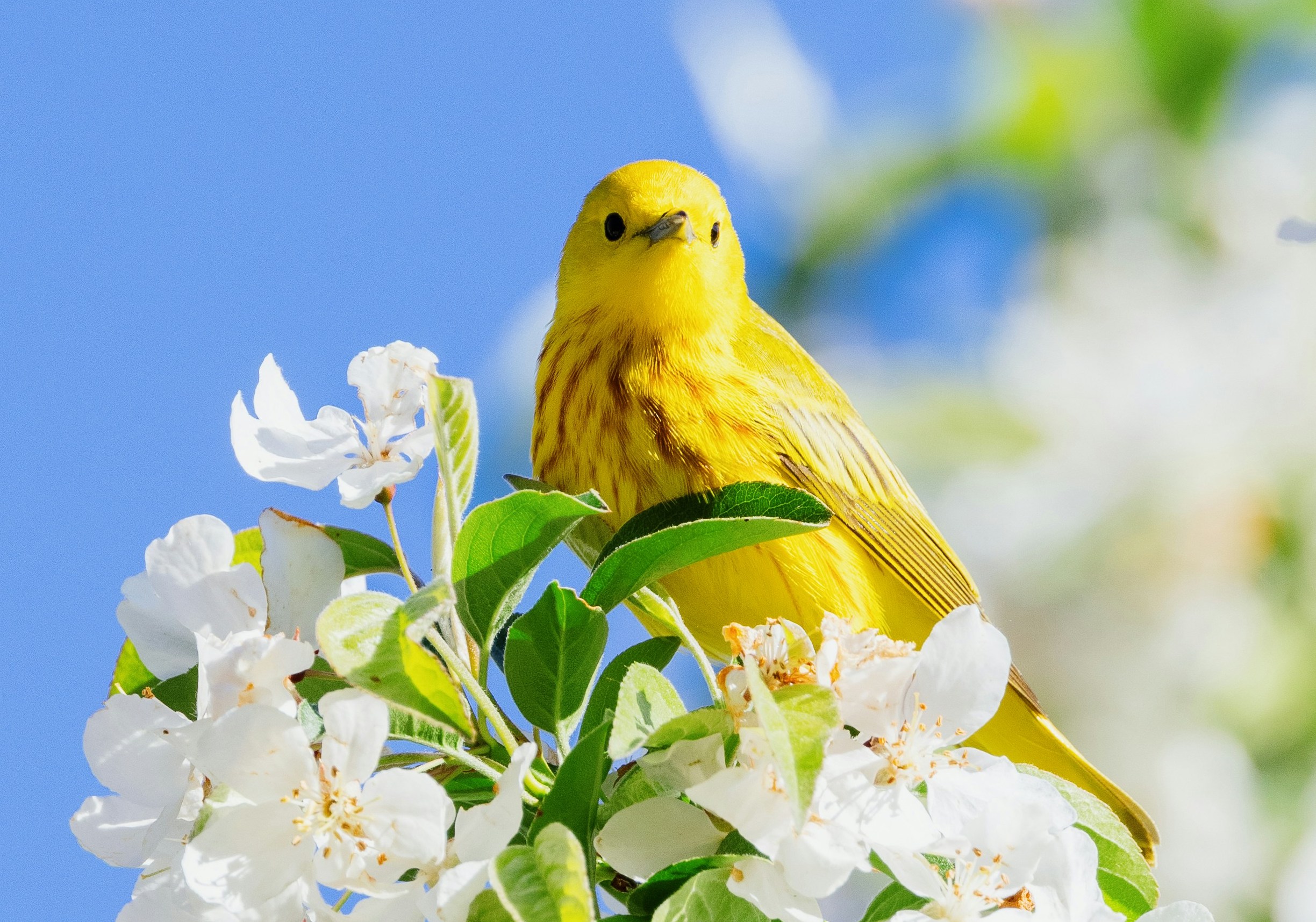
A California Towhee bounced across the deck, its brown feathers tufted like a baby chick’s, proud and naive-looking all at once. I sat very still, fingers poised on my keyboard, silently watching, not wanting to spook it away. I knew its name—towhee—because I had recently become obsessed with birds, despite growing up in New York City and not knowing much beyond the neighborhood street pigeon. Over a year into the pandemic, my partner and I were isolated from friends, perched in our apartment in the Berkeley Hills, with only our dog and the trees and the birds for company. I latched onto the latter with an uncommon fervor.
I set up a bird feeder on our deck and each day, I waited for them to come. As I worked, a brown finch (or was it a sparrow? I was still new to this game) landed its small claws on the edge of the feeder, pecking at the seed inside. Suddenly, a scurry of feathers: a larger Scrub jay swooped in, the neighborhood bully, scaring its smaller competitor off, eating messily, tossing birdfeed to the floor. Meanwhile, hawks soared menacingly, elegantly above, red tail gleaming in the sun. I was mesmerized.
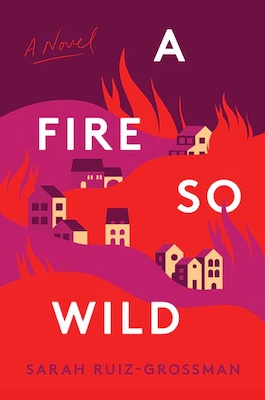
The birds calmed me when the world was in turmoil, my day job as a reporter keeping my mind hovering in grief over the pandemic, nearby wildfires, racial justice protests cracked down upon by violent cops. The birds slowed me down. And as I worked on my debut novel, they snuck their way into my book. In A Fire So Wild, a wildfire approaches Berkeley and three families are forced to reckon with the cracks in the lives they’ve built and the injustices teeming under the city’s surface. Two of the main characters—fed by my obsession—became amateur birdwatchers, high school students passionate about the climate, seeking out an elusive Spotted owl, mourning baby birds frantically leaping from their nests to escape the suffocating smoke. On the page, my bird friends became literal canaries in the coal mine of our world on fire.
In the seven incredible books that follow, the authors find similar refuge in the company of birds, be they clever crows who visit them daily to play, or kingfishers with regal blue crowns to whom their human observers mean nothing at all. In the birds’ elegant flight, readers can find a soaring hope for the future, and in their tweets, an urgent reminder to be present in this very moment.
In this harrowing novel, Franny Stone is haunted by her dark past and risks her life to board a fishing boat with a crew of misfits, guiding them across treacherous oceans, on a mission to track some of the last Arctic terns on the planet, threatened with extinction due to the climate crisis. As the mystery of her past comes to the fore, Franny’s hunger for finding the birds seems to map onto a deeper quest to discover life’s meaning and a chance at making sense of her pain.
In this transporting poetry collection, U.S. poet laureate Ada Limón explores the deep connection between humans and the nature that surrounds us, which can heal ancestral wounds. In her poems, belted kingfishers, fledgling robins and more flit across lines of verse, holding in their claws both the beauty of this world, as well as its deep suffering.
In this smart nonfiction book, Odell shows us how today’s apps and technologies are designed to draw our attention—to the detriment of our presence in our own lives, and fueling our complicity in the exploitative, capitalist economy. Her remedy to this, in part, consists of paying more attention to what surrounds us, including, for her, the nature and birds in her native Bay Area. She befriends crows in her Oakland neighborhood, who recognize human faces and make near-daily visits to see her, among other delights.
In this moving nature memoir, Macdonald recounts the trials of training a wild goshawk to hunt in the wake of her father’s death. As we accompany the author through her grief, we see her find her own wings as the seemingly untameable bird learns from her, and teaches her in turn.
In this classic in the writing advice genre, Lamott guides creatives in how to get out of their own way and get words onto the page. The titular example she points to for those stuck in a rut is that of her older brother, back when they were kids, who had to write a report on birds and felt overwhelmed by the gargantuan assignment. Her father advised him: “Just take it bird by bird.”
In this memoir, Gilmour carves dual narratives of his raising a mischievous magpie, all the while coping with his largely absent father dying. At the same time, Gilmour is deciding with his partner whether they should become parents, and his relationship with the bird creates an opening for him to confront the pain of his father’s estrangement and his own desire to father.
In this transcendent series of essays, Gay delves into the corners of ordinary life, from basketball to gardening, finding joy and grief—and most of all, community and radical solidarity—in our everyday. At one point, Gay imagines his late father watching kids play ball when two cardinals interrupt with their birdsong from a nearby fence: “They wanna watch, too, I guess,” he imagines his father saying, giggling. In another instance, Gay describes a group of people who are exchanging their woes as “a flock of folks with their sorrows, a coven.”
Translated literature is no longer the forgotten, othered cousin of the Anglo-American literary scene. At Electric Literature, we have long been enamored by international frontiers, the global writers who write in their native (or acquired) tongues, and the translators who coax each word into English.
This year’s crop of forthcoming translations is bountiful. To cease endless (and pleasurable) reading and consideration, we narrowed our list to 20 and limited it to titles coming between January and April. In this list, Spanish, Swedish, Ukrainian and other languages feature.
The novels relate stories that cross time and place, from a reimagining of the conquest of Mexico, the friendships and connections between immigrant women in different European countries, and two Ukrainians separated by time but united in their hypochondria, to an Italian Instagram influencer getting influenced, a very odd uncle in France, a transwoman growing up in 1980s Madrid, rarely-old histories of Suriname, and many more fictional worlds.
On the eve of the conquest of Mexico, Sudden Death author Álvaro Enrique trusts us into Hernán Cortés’ entourage, and the character of Jazmín Caldera, a captain who struggles with doubt as the expedition arrives in Tenochtitlan. As he takes in the insides and intricacies of Moctezuma’s palace, Caldera wonders if they will even remain alive. And the author wonders: What if the conquest didn’t succeed? This question follows the novel, translated by Natasha Wimmer, radiantly and with great pace as the expedition gets mired in court intrigues and customs. A wonderful reimagining of the defining episode of Mexico’s existence and a delightful evocation of the capital as it might have been then. Enrigue’s note to Wimmer about Nahuatl words is intriguing and charming; and a reminder of how many languages—and translators—were involved in the moment of conquest.
Ǣdnan: An Epicby Linnea Axelsson, translated by Saskia Vogel (Jan. 9)
Ǣdnan, Linnea Axelsson’s astonishing century-spanning debut translated by Saskia Vogel, opens in 1913 as the Sámi face the destructive, assimilating forces of Scandinavization. Ristin loses one of her sons tragically, as a border is drawn up between Sweden and Finland. The family is soon subjected to the humiliations of racist medical research, and forced to abandon their nomadic life. Three decades later, Ristin’s apartment is inhabited by Lise, who was forced into a residential school in the 1950s. In the 2010s, her daughter “Sandra who has/gone and married a reindeer keeper now” is teaching herself and her family to speak Sámi, and fighting for land rights in the Girjas trial. Truly an epic, the novel offers multitudes on Sámi history, culture, and resistance, in its slim verses. Most devastating of them, however, are the multiple characters’ meditations on their lost language, perhaps since the novel itself was written in Swedish by Axelsson, who is of Sami-Swedish descent. Ristin’s husband Ber-Joná notes:
“The ruling language
Drizzled over us
Swedish words
Impossible to pronounce
–
They penetrated our clothes
Coated our skin”
The Singularityby Balsam Karam, translated by Saskia Vogel (Jan. 17)
The Singularity is Swedish-Kurdish writer Balsam Karam’s first work in English via Saskia Vogel’s translation. The gauzy, poetic novel features two mothers in an unnamed coastal town. The first, a refugee mother is searching for The Missing One, her daughter who disappears while working in the town’s touristy corniche. When she gives up, she decides to throw herself into the sea, leaving behind her remaining children and her own mother. Her suicide is witnessed by a second pregnant mother (in the second person “you” in Karam’s lyrical text), who is on a business trip in the town. When she returns home, she finds that her baby in utero has no heartbeat but refuses induction. Karam then moves into prose-poetry and fragments about the second mother’s own childhood in a war-torn country and her family’s experiences of racism in Sweden. Inventive and devastating.
Forgottenness by Tanja Maljartschuk, translated by Zenia Tompkins (Jan. 23)
In Tanja Maljartschuk’s Forgottenness, two characters are separated by about a century: a young writer who struggles with OCD and agoraphobia, and a real-life Polish-born Ukrainian patriot, Viacheslav Lypynski. They are connected by hypochondria. The novel weaves between the narrator, her multiple health afflictions, and her family’s history, and her imagination of Viacheslav’s existence through the end of the First World War. Despite its heavy shadows, Forgottenness is often hilarious in its wryness in the bumbling and utterly absorbing Viacheslav’s attempts at living and fighting for the Ukrainian state. His courtship of his petulant Polish wife who does not agree with his patriotism, for example, offers many moments of humor. And as Viacheslav’s mother notes: “Fools also evoke pride, sometimes even more so.”
Confrontationsby Simone Atangana Bekono, translated by Suzanne Heukensfeldt Jansen(Jan. 30)
In her debut novel, Dutch poet Simone Atangana Bekono introduces Salomé, a sixteen-year-old of Dutch and Cameroonian parentage, in two raw, jarring stories set apart in time. In the first, Salomé remembers her classmates throwing coins at a Black man at the asylum seekers center across from the school. They taunted him to pick up the coins. Her eyes met the man’s. She hoped he would not pick them up. He doesn’t. In the next scene, we see Salomé entering a prison, where she refuses attempts at therapy and shows no remorse for the violent crime she’s committed. The revelation of what her crime is held back by Bekono while she has the very bookish Salomé considering Camus’ The Stranger and Greek mythology, and imagining what the “other Salomé” is doing (“…sets up a punk band in Paris. She doesn’t do memories. She dwells in light.”) In flashback, there is a childhood trip to Cameroon, the intriguing Aunt Céleste who tells Salomé that she’s special, her father’s firing and illness, and the racism of her village in the Netherlands. Propulsive tautness till the end.
The Other Profile by Irene Graziosi, translated by Lucy Rand (Feb. 6)
In Irene Graziosi’s The Other Profile translated from Italian by Lucy Rand, Maia, a disenchanted 26-year-old waitress in a failing relationship, lands a role as an image consultant to 18-year-old influencer Gloria. Graziosi, a journalist and an Italian YouTube personality, takes into the fluffy highs and dark underbellies of social media influencing via Maia, who hadn’t used an emoji prior to meeting Gloria. A brand meeting with influencers that fetishes “diversity” is lampooned to perfection. From Maia’s initial disdain for Gloria, the novel tracks their relationship against the exploitative wilderness of the algorithm and builds to a culmination of multiple reckless, explosive episodes. A racy Gen. Z take on female friendships bearing the influences of My Brilliant Friend.
Antiquityby Hanna Johansson, translated by Kira Josefsson (Feb. 6)
Translated from Swedish by Kira Josefsson, Hanna Johansson’s debut novel Antiquity follows an unnamed 30-something woman, an isolated character who “started getting used to the disappointment of being left behind, left out” who joins artist Helena and her daughter Olga on vacation in Greece. Johansson distills the threesome’s shadowy dynamics in raw vignettes. At first, the narrator, beholden to Helena, is jealous of Olga: “Olga, a name for the child of an artist. A name for a princess, a violent saint. A name for a little cunt.” Soon, the narrator’s obsession with Helena, an artist she had met when she conducted an interview, transfers to Olga. Obsessively observant and cuttingly internal, the narrator’s meditations on loneliness are crisp, mini poems: “The days came with a new sort of loneliness, the loneliness of being with others, the loneliness of being the other: across from Olga at the table, the coffee, the flies.”
Sisters in Armsby Shida Bazyar, translated by Ruth Martin (Feb. 6)
Shida Bazyar’s first novel to be translated from German by Ruth Martin centers on the friendship of three immigrant women, Hani, Kasih, and Saya, now in their 20s but friends since childhood. From its explosive beginning of a news report about Saya assaulting a man while shouting “Allahu Akbar” and being accused of arson, the novel charts the women’s friendship and experiences with racism on their public housing estate from the perspective of Kasih. A provocative and disconcerting portrait of what it means to be an immigrant of color in Germany.
A Woman Of Pleasure by Kiyoko Murata, translated by Juliet Winters Carpenter (Feb. 27)
Set in 1903, A Woman of Pleasure begins with the sale of fifteen-year-old Ichi to an exclusive brothel, follows her education under the mentorship of the top courtesan or oiran, Shinonome, and ultimately to a strike by the courtesans. Using the frame of incidents from Meiji-era Japan, Murata takes us into brothel life (accounting, calligraphy lessons, bikini depilation using tweezers) via multiple character’s perspectives, including the brother’s owner who rates Ichi as the highest in his hierachy of workers, “exceptional.” The novel especially enchants with its nods to writing (via writing teacher, Tetsuko’s instruction) and Ichi’s journal pages:
May 18 Aoi Ichi
The owner talked to me.
Hes wrong.
I wont die in my bed
III die on the waves.
The Villain’s Dance by Fiston Mwanza Mujila, translated by Roland Glasser (Feb. 20)
Congolese writer of Tram 83, longlisted for the International Booker in 2016, Fiston Mwanza Mujila returns to English readers with this translation by Roland Glasser of late 1990s in Zaire and Angola. In the last days of Mobutu’s reign Sanza wanders the streets of Lubumbashi with a group of street kids until the character of Monsieur Guiliaume enters with an escape. Across the border in Angola, a civil war rages and Molakisi seeks his fortune in a hunt for diamonds, while an Austrian writer Franz in search of material, chronicles the stories of the seer Tshiamuena, “Madonna of the Cafunfo Mines.” A novel that pulses with music (and dance of the title) and wit.
About Uncle by Rebecca Gisler, translated by Jordan Stump (Feb. 24)
Rebecca Gisler’s debut About Uncle begins with a paragraph-long sentence “One night I woke up convinced that Uncle had escaped through the hole in the toilet, and when I opened the door I found that Uncle had indeed escaped through the hole in the toilet…” We soon learn that Uncle, a veteran, is prone to curious habits like disappearing down the plumbing, in addition to fighting moles and peeing into bottles. The unnamed narrator and her brother, have moved in with Uncle in an isolated town, and then the pandemic hits, drawing them further to each other. While the novel is short at just over 160 pages, Gisler is a maximalist with her wild, thrilling sentences. In her description of Uncle’s oceanfront house, Gisler writers: “Even with the ocean so close, Uncle never goes swimming, he tells us the locals never swim, swimming’s only for tourists, and anyway the water’s full of liquid manure these days, full of pig dung and blue-green algae, none of which seems to bother the people who still swim in it, the tourists in question, who still fish in the mudflats where there used to be beautiful red crabs and spider crabs and where there are now only anonymous little crustaceans, translucent, as if worn down by the oily backwash, weary from picking their way through the wads of peat.”
Thirst by Marina Yuszczuk, translated by Heather Cleary (March 5)
In Thirst, the U.S. debut of one of Argentina’s leading contemporary lit figures, Marina Yuszczuk, we are introduced to two women spared by centuries in Buenos Aires. The first unnamed character, a vampire who escapes Europe arrives in the Argentine capital, and has to navigate her desire for blood, human connection, and discretion. In the contemporary moment, the second character lives in the city and grapples with her ailing mother. When the two meet in a cemetery, the novel takes a truly irrepressible turn. Desire, female agency, and love get examined under a gothic lens. Winner of the prestigious Sara Gallardo prize for women writers in its original language, the novel rendered into English by Heather Cleary should be your 2024 vampire novel pick.
Changeby Édouard Louis, translated by John Lambert (March 5)
Édouard Louis’s Change is obsessed with escape, a repeated theme of the French literary sensation’s autobiographical novels (The End of Eddy). In Change, translated by John Lambert, he moves from his provincial working-class background to school in Amiens and then university in Paris, and leaving “Eddy” behind for a classier name, and a new life as someone else. Brutal and beautiful throughout with photographs that illustrate the narrator’s wretched origins and transformation. An example of the narrator reflecting on his younger self: “I don’t know how it’s possible to have such precise and somehow also adult and anachronistic thoughts as a child, but I remember that I wanted to leave the village and become rich, powerful and famous because I thought the power I’d gain through wealth and fame would be my revenge against you and the world that had rejected me. I’d be able to look at you and everyone else I’d known in the first part of my life, and say Look where I am now. You insulted me but today I’m more powerful than you, you were wrong to despise me and call me weak and now you’re going to pay for your mistakes. You’re going to pay for not loving me. I wanted to succeed out of revenge.”
Reinbouby Pedro Cabiya, translated by Jessica Powell (March 12)
“My story begins with a gringo. Yes, with a gringo. That’s as glamorous as it’s going to get.” With that fiery start, the Puerto Rico-born Pedro Cabiya begins his sweeping historical novel of the Dominican Republic’s civil war, known as the April Revolution, and the U.S. invasion of the country. Translated from the Spanish by Jessica Powell, the novel has the ten-year-old Ángel searching for the truth behind his father’s murder, and moves between 1965 and 1976, featuring a cast of unforgettable characters, rendered in energetic prose. Reinbou, part of the country’s contemporary literary canon, was made into a 2017 film.Essential for an intimate understanding of the history of the DR and the US intervention.
The Understory by Saneh Sangsuk, translated by Mui Poopoksakul (March 13)
Utterly lush from its delightful epilogue from the Buddhist text Rasavahini, “Literature has nine flavors: Sringaram the taste of which is love…” The Understory follows Luang Paw Tien, a ninety-three-year-old monk who has transgressive (for his vocation) literary ambitions and spends his time regaling the village children with stories of his wanderings in India and Burma and of life in their paddy farming village when it was still a jungle. With elegant observations and gorgeous winding sentences, Sangsuk, one of contemporary Thai literature’s stars, delivers a gorgeous portrait of nature and change via Mui Poopoksakul’s translation.
Off-Whiteby Astrid Roemer, translated by David McKay and Lucy Scott (April 9)
Recently minted as a 2022 National Book Award finalist for On a Woman’s Madness, Astrid Roemer returns to English readers with this novel of family, race, diaspora and Suriname in the late 1960s translated by David McKay and Lucy Scott. At its heart is the Vanta family and aging matriarch who reflects back on her life. The family’s narratives are laced with the themes of conservative sexual mores, male violence, Dutch colonialism, and ideas of whiteness. A portrait of a family in Suriname and the Netherlands from the prolific author who took a two decade break from publishing before this novel.
Tenderloinby Joy Sorman, translated by Lara Vergnaud (April 16)
Pim, the protagonist of Tenderloin by Joy Sorman, translated from the French by Lara Vergnaud, cries a lot in an involuntary fashion. He is also apprenticing as a butcher. In documentary-style present tense, Sorman takes us sensually into the sights (viscera and guts) and sounds (pigs squealing) and smells (earthy and stomach-turning) of Pim’s world, and into all that goes into bringing meat to our dinner plates. Trying to master butchery, Pim soon unravels himself. Surreal and oddly entertaining in its macabre details, Tenderloin will certainly provoke thoughts on the ethics of meat, even for the most committed carnivores.
Bad Habitby Alana S. Portero, translated by Mara Faye Lethem (April 23)
In Bad Habit, a trans woman comes of age in Madrid in the 1980s and 1990s amid the city’s heroin crisis, political rallies, and its nightlife. This first novel from Spanish writer, activist, and medieval historian tracks the protagonist’s journey of self, alongside a resplendent cast of characters such as Jay, her first love, and the Caramel, who, Portero writes, could be “feisty when she wanted to, a vengeful saint capable of conjuring ghosts who brought humiliation and the evil eye to the very tip of her tongue. That wasn’t incompatible with having the biggest heart in the world. With that surly gaze of hers, somewhat similar at times to María the Wig’s, she could detect tormented souls, sadness, melancholy like a divining rod for loneliness.” Vibrant in its joys, rawness, and violence of trans lives, Portero has a fan in Pedro Almodóvar, who says you should read it ASAP.
During the 2011 butter shortage in Japan, a journalist Rika Machida is assigned to cover Manako Kajii, a serial killer, who lured in her victims with the promise of high-end cooking classes. At the Detention House where Kajii is being held, Rika tries to get her to talk but has no luck until she asks the woman for a recipe for beef stew recipe sets off a conversation between the two women. Food, patriarchy, and the body feature, as does some engaging prose about food, and in particular, butter. On the taste of a mochi, Yuzuki writes: “The hot butter fused the sugar and soy sauce together, clinging to the sweet, soft, shapeless mass in her mouth, swimming around its outside as though to ascertain its contours. The grease of the butter melded with the grit of the sugar and the pungent soy sauce. By the time she’d finished chewing, the roots of her teeth were trembling pleasurably.”
Divided Island by Daniela Tarazona, translated by Lizzie Davis and Kevin Gerry Dunn (April 23)
In this elegant novel by Mexico City-born writer Daniela Tarazona, a woman receives a diagnosis of cerebral dysrhythmia, a neurological disorder, which results in her splitting into two different women. One decides to travel to an island to commit suicide, while the other stays behind. Narrated in the second person, the novel’s fragments poetically move towards a shifting portrait of the disorder and how it impacts perception of time and the world. Translated by Lizzie Davis and Kevin Gerry Dunn, the novel, which won the prestigious Sor Juana Inés de la Cruz prize for novels by women in Spanish, is a potentially speed read that you will be turning over in your mind repeatedly and long after the last page.
South Asian stories are often tales rich in culture and folklore, encapsulating the nuances and intricacies of a long, rich, and complex history. Historical details peppered in with social commentary is often a common thread in many South Asian stories, and this list is no different. We see the impacts of colonialism, social hierarchy, and gender roles sweep through many of these books.
When gods and demons and religious customs still have a place in the everyday life of many South Asians, it’s only natural that it would be a part of our writing as well.
My novel Island Witch is a gothic retelling of Sri Lanka’s most famous folktale. Set in the 1800s, Amara is the daughter of a demon-priest, an ancient tradition now shunned by the villagers. When men start to disappear in the jungle, it’s up to Amara to search for answers.
Below are 7 books that draw inspiration from the myths, lore, and history of India, Sri Lanka, and Pakistan.
In a sweeping fantasy with a captivating romantic core, set against a backdrop inspired by Mughal India, Empire of Sand unfolds through the perspective of Mehr, an illegitimate, highborn daughter of a governor in the Ambham Empire. The mother Mehr barely knew was from the Amrithi people—an outcast community descended from desert spirits who possess powers that are both coveted and persecuted throughout the Empire. When the Emperor’s mystics recognise her Amrithi abilities, they force Mehr into a marriage with one of their own, leaving her entangled in a web of deceit and games between men, gods, and demons.
In this epic retelling from the perspective of the vilified queen from the Ramayana, Kaikeyi is the story of a princess in a patriarchal society, and her journey from discovering her own special skills, to growing them, and then wielding them to achieve her life’s purpose. A must-read for those who enjoy alternate versions of stories they’ve grown up with, especially those that centre around scorned women.
The story begins with our protagonist—professional war photographer, closeted gay and compulsive gambler, Maali Almeida—waking up in the “in-between,” an after-life where he has seven moons (or seven nights) to complete the task of guiding his friends and family to a box of photographs taken during his assignments. These photographs, according to him, will have the power to bring down governments and stop wars. But first he has to navigate his way through the afterlife, rife with ghosts, ghouls, pretas and demons. Narrated in the second person, The Seven Moons of Maali Almeida mixes magical realism, historical fiction, political satire, and dark humor, taking us through one of the darkest, most violent chapters in Sri Lanka’s history.
Kunal, a dedicated soldier, meets Esha, a girl he assumes has lost her way. He helps her, as any chivalrous soldier would do, but the next morning Kunal wakes to find his uncle, the general, dead in bed. Kunal is tasked with hunting down his uncle’s assassin with the promise of being promoted himself. It doesn’t take long for Kunal to piece together that the girl from the night before was the assassin. In this deadly cat and mouse game, filled with lots of witty banter, and spectacular world building inspired by Indian history and Hindu mythology, you’ll find yourself rooting for both Esha and Kunal alike.
Set in the 18th century, this captivating historical novel follows Abbas, a gifted young woodcarver. His exceptional talent catches the eye of Tipu Sultan, leading him into service at the palace. Tasked with constructing a giant tiger automaton as a gift for Tipu’s sons returning from British captivity, Abbas’ story is mirrored in the tumultuous events that shape the landscape across war-torn India and Europe. When Abbas discovers that Tipu’s palace has been pillaged by British forces, and the tiger automaton is nowhere to be found, he embarks on a mission to retrieve the stolen tiger from an English countryside estate, where it is showcased among a collection of plundered art.
Maya always believed she was cursed, an idea that was solidified when her father, the Raja, arranges a wedding of political convenience to quell outside rebellions. Married off to Amar and now the queen of Akaran, Maya is surprised to find independence, and a voice. But both Amar and Akaran are full of secrets—and despite growing to love her husband, Maya is not sure who she can truly trust. Maya must unravel an ancient mystery that spans many reincarnated lives to save those she loves the most, as well as herself. Based on the Greek mythology of Hades and Persephone, Chokshi beautifully integrates Indian lore and history into this magical tale.
Katyani’s primary role in the Chandela kingdom is to serve as an advisor and protector to the crown prince, Ayan. When a series of assassination attempts threatens the royal family, she is sent to the gurukul of Acharya Mahavir, accompanied by the prince and his cousin, for protection and training. Their training is cut short, however, when they are urgently summoned back to Chandela. Tragedy befalls them and Katyani is separated from the only life she has ever known. Alone and betrayed in a land overrun by monsters, she must delve into her past to uncover answers, save her loved ones, and determine her own destiny.
“A New Book of Grotesques” by Jessi Jezewska Stevens
How had we turned out this way? My friend and I were plumbing disappointments over slices of cake. That was one of the best things about this country—people regularly ate Kuchen. It was normal.
Not so normal, alas, were our relationships.
“Are they that harsh with you?” I asked. Of those men who had recently caused me pain—I paused to take stock on my fingers, one, two, three—at least two were mutual acquaintances.
“No,” my friend said. “On the other hand . . . .”
It is easier, I find, to speak about certain topics in a language not your own. For example, the superhuman ability of some people to take a remark you’ve made, twist it like a steel pipe, and thrust the mangled weight back into your stomach with a thump: here you go.
“I think,” I said, groping for vocabulary, “I think the problem is a kind of masochism. I sought out those people who could never be pleased, whose feelings for me grew around a seed of hate. Then I made it my goal to please them, one after the next.”
Everyone has problems. My friend signaled for the check.
If this were a fairy tale, I might have tracked down those ex-friends and -lovers and asked them what they thought. A quest! In a foreign land! But this was no fairy tale. Or rather it was, but of a different type: I was on my very first sabbatical leave with a giant grant to research sixteenth- and seventeenth-century goldsmiths, in particular Christoph Jamnitzer’s Neuw Grotteßken Buch. The fairy tales were in my work, not my life. They manifested in Jamnitzer’s prints, woven into goblets and coats of arms, anthropomorphized in armored crustaceans carrying cornucopias of fruit. They wound round the gilded face of a clock. For the entire history of art history the elaborate collection had been dismissed as nothing more than accomplished frivolity, utterly devoid of an ethic or politics, not to mention a historical conscience—
No one was more surprised that I’d received the grant than me.
This is to say if I could have quested, I would have. Instead I was on my way to the grocery store with a carton of glass bottles to deposit and a birth control prescription to fill. Never mind that I was celibate. It was gray, gray, gray—no one had warned me how perfectly miserable Berlin can be in January—and I was using the pills mostly for off-label purposes, i.e., to skip my period. Once a month struck me as basically all the time. One has to preserve one’s strength.
I took the route past the park, making up etymologies along the way, as was my habit—Schicht is layer, Geschichte is history, time is a mille-feuille pastry in a window display—when one of the very men I would hypothetically have liked to question came round the corner, looking distressed. The tails of a severed bike lock hung limply from his hands. I glanced back over my shoulder, amazed. How did he get here? I’d left him on the other side of the ocean. In fact I’d moved here in large part to leave him behind. Had he forgotten how awful we’d made each other feel? And now he’d been so careless as to return. I was totally unprepared. He waved the ruined halves of the lock.
“Aren’t you going to help me?” he asked.
My ex had been in Berlin for nearly a year, as he explained over beers in the nearest bar. I was taken aback. He smiled cruelly, which is how I knew he was about to mangle my surprise. “Of course I’m in Berlin,” he said. “Everyone’s in Berlin. If you want to be original, try Riga.” I was stung by the comment, jealous to learn he’d never tried to look me up. Those were the unwritten rules of divorce: if the one moves away, the other is obliged to avoid wherever it is she ends up. Furthermore, to feel abandoned either way. Cliché that I am, I said, “But you knew I was in Berlin.” He shrugged and sipped his beer. I noted, with wounded satisfaction, that my German was far better than his.
So much better, in fact, that I wasted upwards of two hours there in the bar fielding phone calls to help him find his stolen bike. In return, my ex told me that I was wasting my life. He implied that I was a cliché, with my nothing interests and public funding and ignorance of contemporary trends. I swallowed it all as unthinkingly as a teenager might a pearly bolus of cum, and left the bar feeling perfectly sick.
Can you believe the mistakes I was already making? My friend and I were back in the café the following day. I ought to have pointed out to him, I lamented, that I was at least one iteration ahead in mass-cliché production, that it was he who’d moved to my current place of residence, that it was I who had left him. These stabs were the basic maneuvers on which our duels had thrived. Touché! He always aimed to draw blood. It was wrong that I let him, worse that I so quickly forgot why he did it, the answer to which was obviously to protect himself. From me.
My friend pushed her plate away. Outside, the street was cloaked in gray. It was three in the afternoon, and already night was beginning to fall. We listened to the sorry sounds of people schlepping by. Outlined in January’s cautious luminosity, her profile nearly broke my heart. She took a huge bite of apple cake. Her cheeks bulged beneath high bones. She’d found herself in a similar situation once, she said, one where it seemed her opponent would always have the upper hand . . . .
“Well, what did you do?”
It was at the party of a friend, she said. A certain Sylvia. They’d been close once, but a sudden chasm had opened between them. It was unclear why my friend had been invited to the party, given this geological event. But there she was. The apartment was chic but tiny with a long, narrow artery of a hall that branched into the ventricles of three small rooms, which on that evening pulsed with music and people and light. It was like one of those dreams, my friend said, where the hallway you’re traversing keeps growing longer and longer and the door at the end ever farther away the more urgently you try to reach it. She set off through the crush of socialites. Half an hour later she found she hadn’t progressed at all. The rooms she was trying to reach—and really something wonderful was happening within them, she was sure, chances at love and enlightenment and beauty were being snatched from the air—seemed even more distant than before. A moment later the hallway was empty, and she was standing alone with Sylvia the host, who was flanked by her famous, much older boyfriend.
And few things are more pitiful, my friend was learning, than swatting limply at your captor’s wrists.
“You,” Sylvia said, like it was the first word of a curse. “I remember the first time I saw you.” She was quite drunk. Her older boyfriend looked on with trepidation as Sylvia described having spotted my friend sitting on the library steps near the office where they worked. “You were wearing strange shoes,” she said. There was something in the memory that gave cause for resentment. Now, at the party, she placed a palm on my friend’s forehead and pushed, pinning her to the wall. The three of them stood there. My friend, the host, the host’s famous boyfriend. They were all waiting for Sylvia to remove her hand, but the moment never came. They might have been three children playing a one-sided game of London Bridge. It was hard to escape. The host stood just out of reach. And few things are more pitiful, my friend was learning, than swatting limply at your captor’s wrists. “Love, that’s not nice,” the boyfriend crooned.
My friend paused her story in the last silvery burst of light. She took a final bite of cake.
“What happened next?”
“Well,” she said, very matter-of-fact, “I grabbed her, too.”
The idea had come to my friend in a flash. Of rage, perhaps. She was angry at being made a fool of by this woman who held some secret grudge against her. She doubted Sylvia herself knew what the problem was. A dull pain gathered behind her third eye, beneath Sylvia’s palm, and so in a quick movement, my friend reached out and seized her breasts.
“That’s not what I was expecting at all,” I said.
My friend sighed. “I didn’t enjoy it nearly as much as I thought I would.” She scraped her fork against the empty plate. “The point is, I don’t recommend revenge.”
I shuffled home through the early whisper of a snowstorm, resolving, for the umpteenth time, to be more like my wonderful friend.
Though my first thought when I woke up the next morning in my ex’s apartment, far too early, was that I never would be like my wonderful friend.
The room was dark and quiet and smelled of sleep. The lofted bed brought the ceiling close, and the empty socket of a chandelier fixed its vacant judgment on my ex-husband and myself. If you could really call him that. A marriage that lasts less than a year might be better described as an annulment.
Outside, the nickel swell of dawn. It was time to go. I carefully descended and shivered across the floorboards, picking out my clothes from precarious stacks of instruments and books. In a previous life, I would have snooped around to see what he was reading, but that morning I had no interest—perhaps people do change after all. I stood in the door for a minute, considering the warmth and the smell of him. Then I was in the stairwell, buttoning my coat, grateful I hadn’t jettisoned the birth control. That’s the problem with living, as I always did, with one foot in the past. I never gave up hope that things would return to the way they’d been.
I didn’t see my friend for two weeks after that. Life intervened. I caught a flu that left me bedridden for a week. Next time we should get sick simultaneously, I suggested over email. Then we could still hang out. We still can, she wrote back. I have an extremely strong immune system. I wasn’t surprised. I was tempted to tell her to come round with juice and lemons and broth, but I still cared what she thought about me too much.
By the time I could sit up, I’d lost three pounds and was due immediately in Zürich for a presentation on my area of research. Or not exactly my area—no one but me was in the area of research that was A New Book of Grotesques—but adjacent enough that I’d been invited to share my thoughts on guilds. The panel was organized around the development (or not) of intellectual property law among artists of the Enlightenment. Can socialist values be adequately expressed through mediums dominated by cults of genius? Toward what does contemporary solidarity flow? The Swiss have funding for everything.
Having walked no farther than the hardwood stretch from bath to bed for over a week, I struggled to make it to the Hauptbahnhof on time. In the station, the salty undertow of currywurst colluded to slow me down. Nauseous and wheezing, I reached the platform just as the night train was beginning to glide.
Thirty minutes outside the city, I caught my breath. I found my cabin and collapsed onto the cot.
“Hallo?” came a voice from the Murphy bed above.
“Entschuldigung,” I choked.
My cabinmate and I went back and forth in German for a time before realizing we were both American. Then a certain cynicism set in. We spoke about our work. He was an architect. “Oh, architects never stop working,” I said—I knew because I’d once roomed with one. “That’s correct,” he replied. In fact he had to work tonight. But where? In the lower bunk immediately across from ours sat the model he was to deliver to the Basel office in the morning. It looked very official, enclosed in a bright white box.
“Try the dining car?”
“That’s a thought.”
He was very stressed about this model and the work that remained to be done. He’d been studying, apprenticing, racking up debts and paying dues for nearly seven years. This was a big opportunity for him. Unlike most architecture apprentices, he did not come from wealth to begin with. His brother was in the Army, his father a vet and trucker who’d died young of a heart attack. They all of them had weak hearts, he said. He knew he shouldn’t be surprised by the sort of person he was now forced to deal with daily, the associates who exploited assistants like him for years, under-paying and overtaxing them. But it was disappointing. I was just beginning to think there was something familiar in the hardships of my cabinmate’s biography when two tube-socked feet appeared on the upper rungs of the ladder, introducing a uniquely shocking stench. I will be the first to admit that I was no paragon of human behavior at the time, but those socks left me newly amazed, putting all stirrings of déjà vu to rest.
We sped through Brandenburg. The architect took a phone call with a colleague back in Berlin. They were redesigning a museum façade, I learned. An exoskeleton for the original building that would lie within. The reading lamp in my berth illuminated my lecture notes, and passing streetlights flickered erratically in the window of the train. I idly reviewed my outline until the tube socks appeared again, this time traipsing down the ladder to the end. It was only then, when the architect was standing right before me on the navy carpet of the night train’s floor—oh, poor carpet, what endless disasters and fluids it had seen, it isn’t right to carpet floors in times like these—that I realized I did in fact recognize the architect. I was ashamed of my delay, also hurt that he still did not recognize me. It’s true I have one of those faces that transforms dramatically, depending on the day, and that it was many years since this man and I had been friends. We’d roomed together, as you’ve probably guessed. It was he who’d taught me how to fry a perfect egg; how to fight without crying; how important it is to keep on top of one’s laundry.
Those years returned to me in a painful rush. Thursday movie nights. Communal dishes. Pasta Fiesta: noodles plus anything that was about to go bad. It was very devastating for our apartment when he was not accepted to architecture school the first time round. I’d tried to remind him that plenty of brilliant people end up applying twice. I found a letter by Henry James: “You will do all sorts of things yet, and I will help you. The only thing is not to melt in the meanwhile.” I knew better than to stick it to the fridge. He slipped away into a bitter depression, eschewing movie nights and communal pastas of any sort, until it seemed we hardly even saw each other in our two-bedroom railroad. We were two more trains passing in the night. I hardly knew if he was alive. One morning, I stormed into his room, not caring if I caught him doing who knows what. “You!” I could have pinned his forehead to the wall. “You,” I said, “have too much talent to waste! Do your laundry and get out of bed!” There was a rule in our apartment, given our platonic situation, that you always knocked. It is a good rule for any living arrangement, but one about which we were especially strict. He was pissed. I’d found him shirtless in bed, the window open to let the stench out and the winter in. A slow, cruel smile spread across his face. “What’s this?” he said. “A pep talk?” A monologue that began this way could not end well for us, I knew. Yet I stood frozen, as if under some spell. He was sick of women like me, he said. Women who skipped through life tilting quotas away from him. He casually stretched his arms overhead, flashing the dark of his pits. The exaggerated gesture revealed just how shocked he himself was by the depths of his resentment. But it was too late to turn back. “After all,” he said. We’d ridden violent waves to the land of Milk and Honey. What right had such mermaids to monopolize the attention of the admissions officers? What right had we to—? I grabbed the nearest book, a coffee-table edition of Bauhaus principles that I’d gotten for his twenty-first birthday, a truly expensive gift, and threw it as hard as I could. It was a fight to end fights. Or at least our friendship. In the resulting scuffle, I punched his exposed pectoral, just above the genetically weakened heart, with a force and conviction that alarmed us both. Ten years later, the slap of my knuckles against his skin returned to me with perfect pitch.
The architect pulled on his shoes without untying them and lifted the model from the cot. He cradled the white case to his chest as tenderly as a wedding cake.
“Dining car for me—want anything?”
I shook my head. He slipped the key from the compartment lock. I cried out, “It’s going to be great!”
He paused in the door, surprised.
“Your presentation, I mean. I have a sense for these things.”
He worked the whole night and didn’t come back.
My talk in Zürich was also a success. I couldn’t have known that beforehand, however, so I arrived at the station a bundle of nerves. And regret. I ordered a coffee at the first kiosk in sight and came away even more thoroughly shaken: six francs fifty. The desk in the hotel room was set with a lamp and a binder titled Useful Information. I sent a picture to my wonderful friend, adding that they ought to include a note on exploitative Swiss pricing. Her response was immediate. That’s just what food is supposed to cost in a protectionist economy with a livable wage and high social trust.
I wondered what percentage of the advice I’d received in life was faulty.
On certain winter days, my hair can take on a reddish tinge. These are lucky days, and this was one. I put on a green, high-collared dress and stood before the mirror to pile my chignon. Outside, the street filled with the contented sounds of people buoyed by social services and trust. I was alone. In quiet moments such as these, preoccupied with tasks like chopping vegetables, editing footnotes, securing a chignon, my mind often wanders toward the people I’ve lost. There is something mollifying about slicing onions or pinning up your hair. It leaves you vulnerable to regret. Perhaps this was why the third man, the one I was afraid of yet longed to see again, who’d broken my heart more thoroughly than all the others combined, had always preferred my hair down. It was he, in fact, who’d first mentioned to me the Neuw Grotteßken Buch. That’s how I’d learned. And here I was, years later, studying it. Out of unrequited love or scholarship, I wasn’t sure. I looked into the mirror. My mother had told me always to pin up my hair in professional settings. You had to think about these things. You had to appear severe and strong. I wondered what percentage of the advice I’d received in life was faulty. There is no advice, really, for getting what you want, except to recognize when it arrives. And then to hold on.
The scholars gathered in the library. No one was in the mood to chat. We crossed and uncrossed our legs, buttoned and unbuttoned our jackets. The moderator tapped a pen against the table’s edge. As we filed into the lecture hall, I recited a few lines from Jamnitzer’s epigraph under my breath: “Useful for everybody, for those who like art / . . . Those who don’t like it can lump it.”
I am not an impressive person day-to-day. But on a stage, with my slides, and my hair pinned just so, I assure you I am in command: “A New Book of Grotesques includes sixty single-page etchings produced as inspiration for gold- and silversmiths in seventeenth-century Nuremberg. The extraordinary alchemy of styles in the Gothic scenes evidence Mannerist, Baroque, and Italian influences. [1] The creatures depicted here have escaped a child’s nightmare. Armored shellfish and spear-wielding sea creatures coil beneath limericks scrawled on floating scrolls. Though best known as a goldsmith at the time of publication, Jamnitzer catapulted himself to the vanguard of the immoderate imagination with these engravings, enjoying wide circulation throughout the land—”
Next slide.
“Up until important work published by certain of my colleagues in the 1960s, [2] Jamnitzer’s engravings were primarily received as whimsical dreams, a cabinet of curiosities amounting to no more than the fantastical sum of its fantastical parts. In The Bug Market, for example, shown here to the right, a robed vendor delivers a snail. Note the inscription: ‘The Bug Market commissioned for this purpose / Take from it what you like!’ Now look at images four and five. In these objects, kilned some fifty years later, one notes the same creatures warping the handles of goblets and the bases of candlesticks. Such figures, wrought from gold, must continually announce their beauty to the world. Their form is a plea not to melt them down. [3,4] They are arguing for their own humanity. And by open-sourcing blueprints for such heirlooms, Jamnitzer went beyond advertising his own talents. [5] Plunder me to make yourself, these etchings say. Please, do not melt me down, say the objects that result. The cast is an existential argument that the objet d’art is worth more than its weight in bullion. And this is the same tension, I argue, of the individual placed in her social context. We make ever more elaborate plans to justify our existence in the face of all that came before.”
I clicked forward to the end of my slides, feeling for all the world like a figurine struggling to justify her existence against the poverty of her form.
The thing to do is not to melt in the meanwhile.
Applause.
My friend and I spent the rest of the winter nibbling cakes and flipping through reproductions from A New Book of Grotesques. We met in the café nearly every day, as if time were running out. I brought copies of rare prints. Whole afternoons slipped away in the gray light and the diseased air—the general malaise of late February. Together, we investigated. We studied the prints for hours, our cheeks nearly touching as we searched for details no one had noticed before. She had a child’s capacity for fascination, my friend, and yet nothing about her was harmless. Her attention was disfiguring. It made me want to start over on myself. Our heads bent low over these ornaments, I was overwhelmed by regret over the person who’d first mentioned to me the Neuw Grotteßken Buch. My friend flipped to a goblet opened wide to the world.
“I’d drink from that.”
I told her about my talk, about what I’d said of the effort to assert the value of one’s form. It was an existential argument. The gray of the street merged with her face. She too had a very mercurial face. It was the source of formal problems of her own. She looked at the goblet. I got up to order more hot water for the tea dregs. We were at our favorite table, sharing our favorite cake at our favorite café, leafing through the pages of our favorite book. I didn’t want the afternoon to end. When I returned, she sat in profile, lost somewhere out the window. I had the terrible feeling that she was disappearing right before me, slowly becoming someone else. Of course she was. We all were. I set the teapot down. The corners of her eyes tightened, as if she’d experienced a sudden pain. The café was very feminine, trading in cakes and candles and vases and décor.
“Let’s get out of here,” she said.
We left just as the snow was beginning to fall. On the boulevard, I turned, surprised to find my friend was already halfway down the block.
“Wait!” I called.
She stopped. A silence passed.
“Tomorrow,” I said, “do you have plans?”
“Of course tomorrow.”
Then she disappeared into the white. I watched her go. Who knew what she meant. I fixed her image in my mind. All that mattered, I thought, was that we’d find each other again.
Wick, Peter. “A New Book of Grotesques by Christoph Jamnitzer.” Bulletin of the Museum of FineArts, vol. 60. (1962): 83–104.
Bakhtin, Mikhail. Rabelais and His World. Rabelais and His World. (MIT Press, 1968).
Brisman, Shira. “Christoph Jamnitzer’s Speechless Defense of the Goldsmith’s Strengths.” Zeitschrift für Kunstgeschichte, vol. 83, no. 3 (2020): 385.
Brisman, Shira. “Contriving Scarcity: Sixteenth-Century GoldsmithEngravers and the Resources of the Land.” West 86th. vol. 27, no. 2 (2020): 147.
Viljoen, Madeleine. “Christoph Jamnitzer’s ‘Neuw Grotteßken Buch,’ Cosmography, and Early Modern Ornament.” The Art Bulletine. vol 98 (2016): 213–236.
My major takeaway when I saw The Texas Chainsaw Massacre as a kid, with its documentary-style intercuts of cattle and the slaughterhouse, that brutal heat, the hick-grotesques: Texas was a scary place. That’s when I fell in love with horror—with any fiction, really—that elevates the world we live in from simple backdrop to an entity itself. Setting is everything, after all—it’s where we make our livings, meet the people who become our lives, weather our cars.
So I made it my goal when writing This New Dark to bring a haunting beyond the fierce, shapeshifting force at the novel’s core: the hardscrabble hills of Eastern Oklahoma. Where the economic, religious, and psychological realities of place are a force as powerful as anything supernatural.
Horror thrives on settings that do more than just house the action—they breathe, they threaten, they embody. Whether haunted houses or desolate forests or the ice fields of the Arctic, the books on this list do just that. These are stories in which the setting lurks in the shadows just as much as the monster.
Post-industrial Detroit: When bodies begin to appear in abandoned buildings around Detroit—not just bodies, but parts of bodies, fused together with parts of animals—Detective Gabriella Versado realizes that she’s after a serial killer like none before. One dreaming of a twisted world. What Versado finds when she catches up with him, though, is something far beyond the scope of regular police work. The gritty, bleak city and its broken dreams becomes a mirror for the horror of the crimes, a world between this one and that of nightmares.
Old-growth forest in Georgia: Nellie Gardner and her eleven-year-old son, Max, leave everything behind when she learns that her estranged grandfather has left her his estate—the Redfern farmhouse, a mill, a thousand acres of forest. A sinister presence in the house and forest forces Nellie to unravel the Redfern’s violent legacy, and she finds she must do everything in her power to protect her son. The blood-soaked and eerie forest is home to much more than the family legacy, though—something ancient and waiting.
The decaying home of a serial killer: When Vera Crowder’s mother tells her to come home, she can’t imagine what awaits her at her infamous childhood house—the home of her serial killer father and the scene of his murders. She must confront his legacy when the house itself begins to manifest it—mysterious notes, hidden rooms, whispers. With unresolved secrets buried in the very foundations, Vera must uncover a series of unsettling truths. The corruption runs so deep it just might have infected the house itself.
Blackfeet Indian Reservation, Montana: Four men—Ricky, Lewis, Cass, and Gabe—have all gone different directions since their childhood on the reservation. Some left, some stayed. Some grew up, some didn’t. One cold November will see them all confront their pasts, though, as they’re each stalked by something malevolent, a vengeful force that embodies the cultural and ancestral spirits tied to the land they once violated. What comes when the force catches up to them is a violent reckoning that echoes their past sins and present fears.
Harlem in the Jazz Age: Hustler and street musician Tommy Tester’s life is upended when he meets a rich and enigmatic man who draws him into darkness and the occult. What he finds when he gets there: ancient rituals, eldritch horrors, and a cosmic showdown that could alter the fabric of reality. New York itself is full of no less horror, though; Tommy must confront poverty, police brutality, and racial injustice as he transforms over the course of the novel. LaValle weaves a gritty tale that at once deconstructs Lovecraft’s racist work and honors his legacy of cosmic horror.
A shadowy estate in the mountains of Mexico: When socialite Noemí Taboada travels to High Place—an eerie mansion with a violent colonial history—to rescue her cousin after a cry for help, she finds her cousin’s new family has secrets and bad memories which seem to live in the walls of the house itself. It breathes with them. Tracing the mysteries, Noemí discovers a family secret so deep and steeped in death that her reality begins to unwind. This isn’t just another Gothic mansion.
The Arctic ice fields: Captain Crozier’s 1845 expedition comes to a halt when his ships become stuck in the Arctic ice. The men endure this frozen isolation for a year, the blinding-white landscape around them a sublime nightmare. Clawing at the edges of the ice is an entirely different threat, too. Something that wants to hunt. Helpless against this ancient hunger and the ferocity of nature, Crozier and his men begin to realize that there are places in this world through which people were not meant to pass.
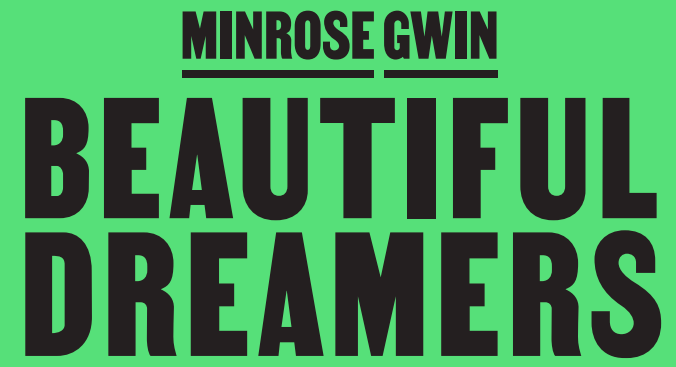
Electric Literature is please to reveal the cover of Beautiful Dreamers, the highly anticipated fourth novel by Minrose Gwin, which will be published by Hub City Press on August 27th, 2024.Preorder the book here.
In 1953, Memory Feather and her mother Virginia are welcomed back to the Mississippi Gulf Coast community of Belle Cote, by Virginia’s childhood friend Mac McFadden, a gay man actively participating in the Civil Rights Movement. The three of them form a loving, if unconventional family. But the arrival of Tony, Mac’s “guest,” brings chaos to their quiet life, forever changing Mem and shattering the bonds of family she thought she had. An adult now, Mem recounts her story, telling of the scars—emotional and physical—that Tony imparted on her teenage years, and seeking accountability for her own part in the catastrophic turn of events from her final summer in Belle Cote.
Praised as sweeping, dramatic, and vividly rendered, Beautiful Dreamers is an incandescent novel of innocence, betrayal, love and intolerance, and the honesty we grant to our chosen family.
“In designing the cover for Beautiful Dreamers I wanted to contrast something visually reflective of this beautiful and moving novel with a sense of the graphic language of protest-era Mississippi,” says the designer, Luke Bird. “The painting by Irma Cook (“Young Woman Seated in a Chair with a Green Backdrop”, The Johnson Collection) is contrasted by a vivid, typographic bottom half which features typefaces designed by Vocal Type (“Martin”) and Brandon Nickerson (“Grainville Script”). Vocal Type are a foundry committed to diversifying design through typography, and the use of “Martin” felt like a perfect fit for this book.”
Meg Reid, publisher of Hub City Press, agrees. “Minrose is a terrific writer and I truly believe this novel, which tackles LGBT issues in midcentury Mississippi, is her finest work to date. She creates a portrait of a Gulf town that is both in flux and ancient, populated by a memorable cast of characters. I knew we wanted a painting to give it a classic, timeless feeling, but I also wanted to frame it with more modern fonts and composition. While I was leaning toward landscapes, Luke found the Irma Cook portrait that so perfectly captured the themes of innocence and betrayal, of sexuality and guilt, that the novel is balancing so well. I love working with Luke because he gives the books a close read and crafts covers that are as complex as the stories they hold.”
I went to a high school with about 1700 students and only 30 of them were Black. My Mama lived in the country—she always had red clay under her nails. She talked with her siblings more than her schoolmates. My Grandma was tugged off the school bus at 14 to help with chores and got her GED when she was 60 years old. As for my grandma on my dad’s side, she grew up in the city surrounded by Black folks; her mother’s experience was the same. Nevertheless, the stereotype, the monolithic western way of looking at the Black women would have you thinking we all grew up the same, that there is no individuality. It’s frustrating to say the least.
These caricatures dehumanize; these falsehoods lack nuance and intersections. When the poems for Thick with Trouble started to stitch themselves together into a collection the personas of the Black woman I had met throughout my life started to animate on the page. Their voices were full of life, pain, joy, anger, sexiness, at times dominating and often flirting with softness—complexity.
All of these poetry collections endeavor to answer the question: What does it mean to be both Black and a Woman? All of the answers are different—Black womanhood is multifaceted and finding a safe passage through it is the challenge of a lifetime.
These collections light a lantern and illuminate a way…
Divided into four sections and brimming with life this debut poetry collection from Ghanaian poet Ama Diaka is both fierce and cerebral. The opening poem, “Ama Nkrumah,” boldly states: “you haven’t been loved well enough until you’ve been loved like a man.” The speaker in this poem is painfully aware of the double standard and pushes against the idea of what Black women are supposed to be. Ama’s meditation on Black womanhood speaks to the restless of the constraints society puts on women.
Woman Eat Me Whole experiments with form using free verse, twitter conversations, reinvented dictionary definitions and more. All which craft a stunning debut collection.
A psalm of girlhood and all its complexities, award-winning essayist and poet Kendra Allen inspects the mundane, the Black church, the brutal and the beautiful in this collection. Documented through overlapping experiences of girlhood the poems utilize space, diction, the colloquial and the deconstruction of form to speak for the underrepresented Black girl. At its heart, the poems sing a song of survival despite conditions.
Imagery of water/wetness is splattered throughout the book—in baptism, sex or through tears, reminding the reader of the necessity and dangerous qualities of water.
The poem, “Sermon Notes,” offers this warning: “Note: Passion is a kind of florescence a water well in its rapture/ and then you find/ your burning man.”
I Done Clicked My Heels Three Times by Taylor Byas
A collection about self-discovery and moving out of South side Chicago, this collection is inspired by the musical The Wiz. Taylor Byas is a master of form in this creative and unique debut collection. The reader is taken on an evolutionally journey into womanhood with searing sonnets and sestinas that haunt.
With poems with titles like, “Men Really Be Menning,” “This Kill Bill Scene Has Me Thinking About Weave and Girl-Fights,” and “On Getting Ate Up By Mosquitoes” an authentic moving picture is painted. One that both loves and critiques the south side of Chicago. Byas is able to evoke whimsy and truth simultaneously leaving the reader in awe. The poem, “Yes, the Trees Sing” does this when it states: “Our backyard’s weeping willow is really a woman with micro braids all the way down her waist.” Now all willows are Black women with mico braids.
I Remember Death By Its Proximity To What I Love by Mahogany L. Browne
Browne inspects the devastating effects of the prison system in America and condemns how that system causes generational harm. The poems speak to vulnerability (a girl misses her father) and generational traumas (incarceration does not simply harm the imprisoned—the pain also ripples through families and can be felt for generations).
The collection is both honest and heart wrenching with moments of levity and despair. Browne also utilizes footnotes to offer deeper insight into the deeper meaning of a poem and her thoughts on poetry in general: “As I am writing this in a time in which poets accuse each other of noncommittal words (like “wonder”), if I may interject.”
Browne speaks on the strength of loved ones left behind and the endurance of Black women: “I am/I am/ I am/ the worst kind of thief/ I steal your swag right in front of your own eyes/ right in front of your own children.”
I practice Hoodoo which means no recommendation list is complete without an ancestor included. How to Carry Water includes some of Cliftons most profound poems about the Black experience includes ten formally unpublished poems.
This collection has all of Clifton’s devastating clarity and stunning directness—everything that makes her timeless.
Often reading like a spell, Witch Wife is striking, mystical and wildly imaginative. This collection also includes sestinas and villanelles that call ancestors to life and speaks to the history hidden in one’s blood. The collection is empowering, honest, haunting and haunted.
In “Little Gals,” Petrosino creates a setting that is both atmospheric and unsettling, like many poems in this collection, often conjuring the unnerving: “They come at night/ on membranous/ wings. I’m a soft deer/ browsing the woods/with strands of willow/ in my pelt.”
This poetry collection, the winner of the Agnes Lynch Starrett Poetry Prize, inspects the difficulties of being a Black woman in the South while also commenting on faith, interracial families and tradition. Clarke considers the subconscious and conscious harm Black folks in the south endure living so close to places where their ancestors were often brutally murdered. In the poem “Soil Horizon” the poet says: “How do we stand on the dead and smile? I carry so many black souls/ in my skin, sometimes I swear it vibrates, like a tuning fork when struck.”
Clarke’s collection is haunted, telling the dark history of Tennessee and often evoking the images of Black bodies swinging from trees. As the title dictates, I can’t talk about the trees without the blood. This collection succeeds in highlighting parts of history that are often skimmed over in sharp, innovated, raw and captivating ways.
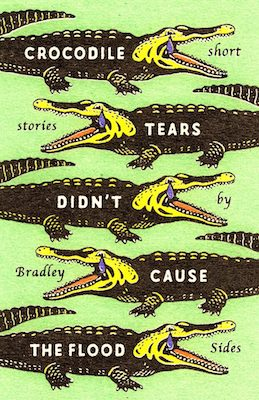
In his 1917 essay “Art as Device,” Russian formalist Viktor Shklovsky coined the term “defamiliarization” as a goal of the artist. To “defamiliarize,” simply stated, means to make the familiar appear strange or new. In other words, art should help us “re-see” our ordinary, mundane surroundings in a different way. In Bradley Sides’ new story collection, Crocodile Tears Didn’t Cause the Flood, the weaving of fabulist and fantastical elements into an ordinary modern world is seamless and persistent, leaving readers to believe that monsters and magic are indeed all around us.
The collection is populated with Pteradons and vampires, shark-children and dragons, people transformed into moths—and yet the primary takeaway for the reader is not escapism, nor magic, nor fantasy, but instead the opposite: these stories usher us into universal emotional states of grief, loss, and desire. The world we recognize is defamiliarized, made strange and new, which works to bring to the surface those conflicts and questions that are part of every human’s experience.
Another way Sides defamiliarizes the world is through the use of forms—recognizable forms like letters, police interview transcripts, instructions, exams, and others that set up the reader’s expectations and then subvert these expectations. The result is an array of storytelling modes and experiences that feels both fresh and original and yet comfortingly familiar.
Sides’ collection, with its playfulness and range, is hard to categorize and a joy to read. Is it realism? Is it fantasy? Is it magical realism? Comedy? Drama? Yes, all of this and more.
Darrin Doyle: I picked up a definite fable vibe in many of these stories. Some feel like allegories, while others employ fairy tale tropes like humans transforming into animals. Were you influenced by myths and fables in writing this collection?
Bradley Sides: Absolutely, but not in a traditional sense. I really love contemporary work, so I find a lot of inspiration in today’s writers. Daniel Wallace, for example, is a huge influence. His novel Big Fish, which has mythic and fable-like elements, was the first time I saw literary magic in the South. I’ve probably read that book fifty times, and I’m serious, too. I’m also influenced by the stories of our best magical realists like Karen Russell, Kelly Link, and Alexander Weinstein. There’s so much good work out there that’s engaging with the elements you mention.
DD: Themes of grief and mortality come up often in these pieces. Do you think about allegorical potential before you begin writing, or is this something you notice only after you’re finished drafting?
BS: Grief and mortality are two of the major focuses of my writing. I might argue they are the major focuses of my work. Many of the texts I hold closest approach both of these things so closely. Just looking back at Big Fish, for instance, the novel is largely about dying and death—our lasting story or legacy, whichever you want to call it. It’s on the first page up until the end, and I think that’s true to life. When we learn what death is, it tends to haunt many of us. We think about not only our own death, but we also think about the death of all the folks we love. It’s always there—and there is no escaping it.
I tend to let my stories develop as I write them. I’m not much of a planner or an outliner. When allegorical elements might enter, they aren’t intentional. I oftentimes learn from readers what my stories are about, and that’s usually something related to grief and/or mortality. When I’m in the process of writing, my stories are, to me at least, just stories.
DD: What draws you to using the fantastic in your stories? Do you think magical realism can address real-world conflicts as effectively as standard realism, and if so, how?
BS: I probably sound ridiculous saying this, but for me, the magic is the truth. I grew up on a farm in very rural Alabama. My company was oftentimes bullfrogs, cows, nighttime’s total darkness, and occasional flickering stars. There was a lot of room to get lost in that world—to let imagination take over. And my imagination felt as real as anything else.
It still does. When I am able to travel and see a volcano, I can’t just admire the volcano. I see what it might contain and what it might be able to do. When I’m at a museum, I can’t just see a skeleton. I imagine where it was and what it did. Maybe even what it wishes it could still do.
The fantastic has power because it can’t really be contained. There’s a truth in that limitlessness that is special.
DD: I love that—the limitlessness and power of imagination. To continue the thread of grief and mortality, a number of the pieces deal with the loss of loved ones, and they show scenarios where the dead are literally brought back or visited. Not to get too philosophical, but do you think fiction is a sort of wish-fulfillment in that regard?
BS: That’s a tough one. I see fiction as being a means to explore possibilities. Maybe it is a way to give people their wishes, but maybe it is also a way to explore their fears.
There’s power in fiction, and as readers and writers, we get some of that power extended onto us.
DD: A number of these stories—“Our Patches,” “Raising Again,” “To Take, To Leave,” and “The Browne Transcript”—hint at the apocalypse through some kind of environmental disaster or other doomsday scenario. Obviously, climate change is a topic of some urgency at the moment. Can you talk about what draws you to this subject?
When we learn what death is, it tends to haunt many of us.
BS: I love this question, Darrin, and I’m just now realizing how apocalyptic this collection really is. Ha! Fear is probably the short answer. The world seems to be dying, and that’s scary. Writing about the world ending gives me a way to harness that fear and maybe try to make sense of it. Or maybe even to prevent it. Or accept it…
DD: Haha, yes. There’s that wish-fulfillment again, or maybe “coping mechanism” is a better way to put it. Your stories also present “monsters” (giant lizards, vampires, dragons, Pteradons, and more) existing in “modern, real-world” settings. You seem to raise questions about what defines a monster —and by extension, what defines a human. Can you talk about this?
BS: I am especially interested in how the two intersect. I always have been. It’s one of my major interests as a writer of weird/speculative/magical things. Humans can certainly be monstrous; they can also be good. Monsters can be humane; they can also be evil. With these stories, I want to show the various sides of humans and monsters, but I want the actual power of classification to extend a bit further to the reader—to give that person experiencing the story the agency to decide if a character is more human or more monster and for them to also create their own evaluation criteria. Maybe humans and monsters aren’t all that different? Maybe they are? As a fiction writer, I like my stories to pose questions that I don’t really answer. I’ll leave that part to the reader because that’s part of the fun.
DD: I love your use of forms throughout the collection. You have a story in instructions, a transcript of a police interview, an exam, a letter, a choose-your-own adventure, and others. What are some advantages and disadvantages to this sort of storytelling?
BS: Thank you. I appreciate you saying so. I wrote most of Crocodile Tears Didn’t Cause the Flood during the peak of COVID. I had to feel like I was having fun in order to write because those were some dark days. If I wasn’t having fun, I wasn’t writing. It’s that simple. Experimenting with form allowed me to truly be excited in what I was creating. I wrote quickly. I was laughing and failing and trying again and succeeding. It was just a really cool writing experience that will probably never be topped, and at the end of the day, the collection does and says what I want it to.
As for disadvantages, that’s tough. Some readers will probably just say, “No thanks.” Or they might shout, “Gimmick!” Haha! The experimentation might not be for them. No book is for everyone, and that’s just how it is. I’ve accepted it, and I’m cool with it.
DD: I’ve written in forms like these, and while it’s liberating and fun, the form itself sometimes dictates that you can’t use certain story elements such as setting or dialogue. For example, in “Nancy R. Melson’s State ELA Exam,” which is in the form of a test, you probably can’t include a lot of dialogue or setting. Was this ever a challenge for you?
BS: Very true. There are limits, but all stories have some brand of limit. Different worlds offer various rules that can and can’t be broken. The same with characters—or a multitude of other elements. As I was writing these stories, the form never came first; instead, the form was a way for me to tell the story I needed to tell. If I would’ve approached each story with a specific form I had in mind that I wanted to showcase, I would have been in bad trouble. I would actually probably still be on the first story. It just wouldn’t have worked.
Writing about the world ending gives me a way to harness that fear and maybe try to make sense of it.
With “Nancy R. Melson’s State ELA Exam,” the lack of usual dialogue could be limiting, but the story finds other ways for voices to come through, especially the titular character’s. The test and, as a result, the story both become extra interactive, and that’s because the form allows additional layers.
Thankfully, the many forms throughout the collection came naturally.
DD: In blurbs for your previous book (Those Fantastic Lives), you’re described as a Southern writer. Do you consider yourself a Southern writer, and if so, what does that mean to your fiction?
BS: I’m glad you asked this question. I fully embrace the label. I am a Southern writer—and a rural one at that. Like I mentioned earlier, I’m from Alabama. I’ve lived here my entire life. I’m sure I’ll die here. I talk slowly—and with a very thick drawl. I sit on my porch and tend to my little garden, all while drinking tea. For me, to be a Southern writer means to respect the place I write of and from. It means to respect the people, too. I try to capture the voices I know from down here as fully and authentically as I can. I try to treat the place with love, while being aware of the problems and flaws as well. I treat the South like it’s a character—a major one. I have to.
With Crocodile Tears Didn’t Cause the Flood, I go even further in being a Southern writer, I think. Many of the stories, including “The Guide to King George,” “Dying at Allium Farm,” and “Nancy R. Melson’s State ELA Exam,” are set explicitly in Alabama and Tennessee, and even the ones that aren’t stated as being in the South still have that Southern feeling.
DD: I did notice that there’s a focus on rural settings in the collection. Aside from this mirroring your own childhood experiences, are there other reasons you gravitate toward the rural over the urban?
BS: The honest answer is that I just don’t know that world. I’ve been fortunate to be able to travel quite a bit as an adult, so I’ve experienced it. But I don’t know it. When I’m in cities, I feel like I don’t belong. It’s like when I try to write a story that doesn’t contain magic; I feel like a phony. Focusing on rural settings that I understand is a way for me to keep a sense of truth in my worlds—and, consequently, my work. I don’t really agree with the famous advice to “write what you know,” but in this case, I stick to it.
DD: How did you decide on the title for the collection?
I see fiction as being a means to explore possibilities. Maybe it is a way to give people their wishes, but maybe it is also a way to explore their fears.
BS: Man, I’m terrible at titles. I got lucky with my first book. Those Fantastic Lives was a good one. With Crocodile Tears Didn’t Cause the Flood, I was near the end, and I was struggling with the title. Like really struggling. None of my stories worked as titles for the larger book. I didn’t want to go outside the stories because it would get bad. Death and Apocalypses isn’t very catchy. It’s probably the opposite of catchy. I was lost. Then, I began working on “Crocodile Tears Didn’t Cause the Flood.” It’s a fairy tale. It has a major flood. There’s lots of magic—and hope in the emptiness. It is a Bradley Sides story in all ways. When I finished it, I knew it had to be the closer for the collection. It feels very definite as it ends, and it just feels right in the spot.
When I stepped away and looked at the shape of my collection, the opening story is about a flood. The closing one is about a flood. There are other kinds of floods, metaphorical and literal, throughout. Crocodile tears, those big, showy, fake things, don’t cause the floods in the collection. Instead, the floods are brought on by truths—painful and beautiful truths. I knew I’d found my title, and I never questioned it.
DD: Which of the stories was the most difficult to write, and why?
BS: I have to cheat and pick two. “Claire & Hank,” which is about a guy and his dinosaur sister, and “Dying at Allium Farm,” which drops readers in on a vampire family’s organic garlic farm. These stories are actually two of my favorites in the book, so I ultimately feel good about the fight they gave me. But the struggle. The struggle…
As a person, I think I’m pretty funny, but as a writer, humor is tough for me to get right. With “Claire & Hank,” I wanted to balance humor and lightness with some real heaviness. With “Dying at Allium Farm,” I wanted the same kind of approach, except with a bit more humor. I wanted readers to laugh, but I also wanted them to feel something a bit heavier at each story’s end. I couldn’t get those endings right. “Dying at Allium Farm” went through roughly 20 edits. “Claire & Hank” didn’t take quite that many, but I kept reworking that last image.
Revision. Revision. Revision. That’s the struggle of all us writers.
The club is situated in a warehouse district near downtown St. Louis, a low building with turn-of-the-century brickwork that looks like every other low brick building in the city, surrounded by weedy parking lots and rusty chain link fences. When my friend Steven invited me to soak in the hot tub with him there, I had to Google it to make sure it was what I thought it was. Honestly, I’d thought that bathhouses were a relic of the Time Before, when men ducked into gay saunas to have anonymous sex without the fear of AIDS. I grew up in the eighties and nineties and knew only the Time After, when the crusades to shut them down in cities like San Francisco and New York underscored the fear of the plague and the drive to exterminate queerness rather than caring for the sick. That fear crept into my Midwestern Southern Baptist existence and made every queer person a gay man, wasting away, an ominous cautionary tale, body poison to everyone around him. I could only see the view from the TV at the Days Inn, where I cleaned rooms; from there, queer joy was as removed—as irrelevant—as Broadway, Wall Street, and Hollywood. It sparkled in this forbidden way.
The Club, a block away from a Mobile station and a Store Space Self Storage, didn’t sparkle. Still, I was curious.
Bathhouses are a quintessential part of gay culture, specifically cis male gay culture. In the last century, these places have served as safe(ish) places for gay men to have intimate time with other men, secluded from the life and career-demolishing eyes of the police. But times had long since changed. Steven is an activist and an irrepressible extrovert who can talk his way into nearly anything; he was determined to break down the barriers for trans and nonbinary people in all places, even decades-old bathhouses. He was in the process of convincing the owners and management of The Club that all people who identify as male should be allowed equal access to the sauna, workout room, lounge and entertainment area, swimming pool, hot tub, and, you know, everything else. While this may not be revolutionary on the coasts, Missouri is different. His success led to an offer of a test mission, and he needed a wingman, which is how I became the first trans man to get naked in this gay bathhouse.
In my mind’s eye, I saw a sort of Queer as Folk situation where hot guys in their twenties walk around in white towels and spontaneously fuck each other, devoid of inhibition. While a lot of this was true, it wasn’t meant for my eyes, the eyes of a man who was assigned female at birth.
He avoided tricky situations like doctors and locker rooms.
Steven and I were both in our forties, both balding with beards (although he had more hair), both having had top surgery. We were different in other ways. Steven surrounded himself with queerness, and nearly every aspect of his life included people in various versions of gender. He avoided tricky situations like doctors and locker rooms, whereas I was, and am still, nearly always the only trans person in the room. I had undressed quickly and guardedly in the YMCA for years, and it amazed me that not one guy in the very straight YMCA locker room had ever looked past my tattoos and bald head to see the incision marks on my chest or the significantly different anatomy between my legs. It seemed like if I kept moving and directed them where to look, they’d see whatever I wanted them to see. Even so, women have an ingrained sense of danger when it comes to male proximity, and I’d spent the first thirty years of my life in a body that housed a uterus and even a child in that uterus. I knew when to be uncomfortable.
Maintaining the illusion that I was just like every other man took up giant swaths of bandwidth in my head. I packed my underwear with all sorts of soft representations of a penis over the years, and when that grew tiresome, I just wore loose pants, sat in a slouch, and walked like the guys I saw at Lowe’s when I bought lumber for woodworking projects. I diverted attention. It wasn’t about being closeted. I had been a very visible trans man for over a decade. It was about something closer. Something infinitely intimate and unknowable.
Sex was complicated. It was all fantasy, like virtual reality where I was all of the avatars—the person touching, the person being touched, the person looking, the person being looked at—while I stayed locked behind the screen. And nowhere was this collection of avatars more present than when I tried strap-ons. As much as I wished I could have wrestled my mind around wearing one, they made me disconnect completely, like I was fucking by proxy. What I wanted was uncomplicated. I didn’t need acrobatic sex or a million orgasms. I just wanted to be in the room.
But every second spent locating the equipment in a drawer, adjusting straps, wiping off the inevitable bit of fuzz from the pouch or stray cat hair that stuck itself to the shaft, and then wrestling it into place on my body was a pace away from being in my actual body. By the time I had suited up, I was already thinking about the grocery list and wishing it was over. It wasn’t just about sex, though. I lived from my shoulders up in pretty much every respect. Even alone in the shower or getting dressed in the morning, I mostly didn’t look down, which over the course of a few years translated to not being able to look in the mirror and then not being able to look at anyone else, at least not directly and not for very long. Sex was the least of my worries. I had nearly erased myself completely.
I’d had anonymous sex in strange places, but those experiences were in a female body.
I drove to The Club and sat in the parking lot with both hands on my steering wheel. A scene from National Lampoon’s Vacation repeated unbidden in my head. Chevy Chase’s dorky dad character is about to go skinny dipping with Christy Brinkley’s character and keeps repeating to himself, “This is crazy. This is crazy. This is crazy.” I texted my sister, not just because I wanted to talk to her about being parked outside a bathhouse, but because she is the only one I know who has memorized the same scenes from movies we watched as kids.
“This is the gayest thing I’ve ever done,” I texted. I looked in my rearview mirror and made eye contact with a middle-aged man walking behind my truck into the building.
“I want details,” she texted back.
It was not the gayest thing I’d ever done. My sexuality has careened widely between asexual and pansexual for as long as I can remember, and even though I struggled with it when I was younger, I don’t stress anymore about where I am on that spectrum at any given time. I’d had anonymous sex in strange places, but those experiences were in a female body, not the very male body I inhabit now. It had been a long time since I felt much of anything besides crushing depression while fighting to have the surgery and then bone-deep fatigue from months of recovery from the surgery. For the past year, I had felt more like a list of symptoms than a human being.
That Tuesday morning, I planned on getting naked in the hot tub, knowing that Steven wouldn’t. In a cis gay bathhouse, trans is transgressive, and cock is, if not required, expected. Unlike me, he had no interest in bottom surgery.
There are a few different kinds of bottom surgeries. Each method gives you different sizes and sensations. Some give you the ability to pee standing up and have penetrative sex. Some are more involved than others. I chose phalloplasty, which is a surgery that constructs a penis out of donated skin, nerve, and arterial tissue from other parts of the patient’s body.
Most trans men don’t have bottom surgery of any kind, and even fewer have phalloplasty. Many don’t feel they need it. Many do feel they need it but can’t afford it or are scared of it. The surgery is a big deal, involving multiple locations on the body—the arm, the thigh, the back, the groin, depending on where the donor site is—and there are almost always complications. People get creeped out by the scar on the donor arm, which looks like a very large burn that extends from your wrist to nearly your elbow, but it’s not just aesthetics. I had physical therapy to get full use of my hand again. I can’t feel anything on the scar. I’ve cut my arm on several occasions and not known it until I noticed blood. But most hesitation is about presentation. Many trans men want a perfectly formed penis with perfect length and girth (a dream of many cis men), and they will settle for no less than flawlessness with zero visible scars (good luck with that). The internet is filled with sites where you can see surgery photos, and those comment sections are filled with people who cringe, or worse, laugh at images of The Results—as if the trans man in question didn’t nail the landing, so points must be deducted.
The bigger truth, though, was that I didn’t just want to be okay. I wanted to be wanted.
I can understand the trepidation. I had a lot of it before my surgery. I had convinced myself that bottom surgery was an option that would give me even more to be self-conscious about. I had built up the Frankenstein’s monster version of The Results in my head, and that kept me distracted until a friend came home from having his own phalloplasty and offered to show it to me. I figured I’d look in real life and definitively close the door on any desire to do it. We sat next to each other on his living room couch, and he unzipped his pants. Instead of the monster I had imagined, I saw a living, breathing, normal person with a very much not scary Result.
Fuck. I thought. The next day I started researching surgeons.
Fifteen years after I started taking testosterone, and ten years after I started pushing my health insurance to cover the surgery, I finally completed and healed from my phalloplasty, which had left me with a penis, scars hidden under scars from other surgeries, scars hidden under hair, scars in plain view, and a skin graft on my arm.
I didn’t look cis, but in a dark room, I might be okay. The bigger truth, though, was that I didn’t just want to be okay. I wanted to be wanted. I thought about the guy in my rearview mirror. I wondered if we’d recognize each other in the dark. I wondered if I’d want to make out with someone. I wondered if I’d feel anything at all.
I wasn’t sure how Steven and I would be received at The Club. This was our inaugural visit, and I had no idea what was required. I was following his lead – and yet I had come without swim trunks. He pulled in just as I was texting an lol to my sister. He clutched his shorts in his hand. He’s a big guy. He carries his weight like a bear daddy, and I’d always thought he was attractive. I carry my weight like a secret and hide it under layers of clothes when I’m heavy. I’d just lost 34 lbs, though, and was feeling as good as I ever have, but my body and I have a complicated relationship.
“I’m nervous,” I said. “Why am I so nervous?” I knew exactly why I was nervous.
“I am too.” He shifted his shorts from one hand to the other. We smiled and shook our heads at each other. This is crazy. This is crazy. This is crazy.
Once we were in, I felt like I had in the dressing room of the strip club where my sister tended bar in her early twenties, the 40-61 Club. Littered with gym bags, lingerie, and drugs, it was easy to slip in the back and hang out with the other dancers while I waited for her shift to be over. Those friendships and flirtations didn’t count because I was a woman. There were rules for that club too. The bouncer never told me to leave but never asked me to dance. The bathhouse felt like slipping into an old pair of jeans.
Porn played on multiple screens. The manager, Mike, gave us a casual tour of the place while I tried to avoid the impulse to take out my phone and take notes.
If I stayed there pleasant and quiet, suffocating for long enough, my stillness would protect me.
“These are useful,” he said. He put his knee up on one of the benches in the hallway and rocked back and forth. “Fuck benches.” He looked at me, expecting me to cringe. When I nodded for him to continue, he took us past the glory holes and the “slurp deck,” which was a platform that a person could stand on and put their crotch at face level for the person standing in front of them. Then he showed us the private rooms. Each stop on the tour was accompanied by a disgruntled look from Mike. I couldn’t tell if he was trying to shock us into leaving or if it was a sort of adolescent dare. We twisted through the dark hallways and made our way back to the locker room. I put my key into the locker and stripped off my shirt and pants.
Standing in The Club in my socks and underwear, I felt the familiar reflex to hurry and to hide. I thought about a night two years earlier, before my surgery, when, in a suicidal depression, I went to the psych ward of a hospital and was confronted by two nurses—one man and one woman—who directed me to strip so they could do a “skin search.” I thought about the time years before that in intensive care when the nurse called me “it” and “forgot” to give me a blood transfusion. I thought about every time I had the instinct to hold my breath, to shrink into the shadows, like the air around me didn’t belong to me, and if I only took a little, if I stayed there pleasant and quiet, suffocating for long enough, my stillness would protect me. Here though, in this locker room in this strange place, the sun came out. The air was okay to breathe again.
I took off my socks and underwear, stowed my clothes in the locker, and looked back at Steven. He was hurrying to put on his swimming trunks in that familiar YMCA gym way, so I looked away and twisted my towel around my waist. I looked back; his body was turned away from mine. I watched him pull the elastic key holder around his forearm, and I did the same with mine. Our guide had left. We were quiet and awkward as we walked down an uncertain hall toward what we hoped was the hot tub.
There were men, maybe ten or fifteen, standing with towels slung around their waists in darkened corners. The screens above us were silent, but the raw sex on them seemed to follow the rhythm of the Studio 54 Spotify playlist that sounded from the speakers. I chuckled. We found the hot tub, and I stripped off my towel in the gang shower. I pointed to the sign that said, “Please shower before using the hot tub.” It was a familiar OCD. I felt like I always did when I passed the front desk at my therapist’s office, where the business card holders and laminated calendar begged to be straightened and re-straightened. I had seen the sign, and now I had to do what it said.
I pumped the soap out of the dispenser and stood under the water. A bearded, naked man walked in and descended into the hot tub without so much as glancing at the shower. I didn’t look at Steven as I rubbed the soap onto my torso, but I saw him from the corner of my eye hesitate, watch the guy pass the showers, look at me, then the sign, then reluctantly pump soap onto his palm and rub it under his arms. This, right here, might be my favorite thing about Steven: I think he’d help me straighten the business card holders and calendar at my therapist’s office if I asked him to.
We finally stepped into the water. From where I sat in the tub, I could see a still frame of a young white guy on his back, his legs spread into the receiving end of the missionary position. Steven’s view was two screens side by side showing slippery fornication on each. One featured young, hairless white guys. The other featured hairy, beefier white guys. I noticed a theme. I also noticed that deep inside, buried under a surgically composed scrotum, my original equipment was aroused. That was new.
After I transitioned, I learned the ways men; straight men, in particular, guard themselves.
It’s hard to explain how phalloplasty works because there are multiple possibilities for constructing a penis, but in my case, my original anatomy is rerouted and buried underneath all the reconstruction. It has all the same feelings and sensations it had before, and these are connected by nerve grafts to the new equipment. Sometimes it feels good, like a deep breath in the woods at the edge of an open field in summer. Sometimes it feels like an unpleasant and raw zap referring back to the original nerve ending—sort of like memory, a little like grief.
Steven popped out of the water and sat on the side of the hot tub.
“I can feel my blood pressure,” he said.
I watched him lean on his elbows and admired his body. He carried his maleness in every cell. I stayed submerged, and when the fifteen-minute timer turned off the jets, I popped up and hit the switch again.
We sat close to each other, he clothed in his trunks, and me shrouded by convulsing water, and talked in low tones under the music and Jacuzzi jets. Outside of that building, we were public figures: He, the executive director of a transgender nonprofit; I, the co-owner of an independent bookstore. Professional Public Trans ™. Right then, though, we talked about things that friends talk about when the trash of the outside world is held at bay, and the only thing that matters is the two of us, stripped down to the essentials.
The men around us were old, young, large, small, muscular, and flabby. Their faces were soft and hopeful. Like they didn’t have to hurry. Like they didn’t have to hide. I almost felt guilty for intruding, and yet I was there in the middle of all of it, as vulnerable as I could have possibly been, and they looked at me like I’d always been there. I suppose they were as vulnerable as they could be, too. After I transitioned, I learned the ways men; straight men, in particular, guard themselves. Physical contact is kept brief – fist bumps and handshakes. Emotional contact is frequently briefer. I once gave condolences to a man for the death of his wife with a nod of the head, to which he responded, “Yeah.”
Steven left to meet someone at the front door. He was on a mission to populate The Club with trans men, and we were so new in this place it was hard to know if the front desk guy would let any more of us in. I sat alone in the churning bath and stared at the porn. The jets relaxed me, and I didn’t notice an older man approaching.
“Sorry?” I said.
“Is it okay if I join you?” he asked again. I knew what it meant, though my inner teenage girl kept looking for another reason a naked man would ask to sit next to me. I did the familiar inner negotiation of my boundaries. Sure, I thought, he can sit next to me. Next to me isn’t inside me. I tensed when he sat. But I knew where I was. I had chosen to be here, in some ways, for this.
“Can I touch your leg?” he asked.
Sure, I thought. He can touch my leg. My leg isn’t my dick. He gently put his hand on my leg and started to touch himself. He didn’t, as I expected from memories of high school and the creepy guy on the church bus when I was ten, grab my hand and guide it to his dick.
“My name’s Sam,” he said. “I have a room if you’d like to go have some fun.”
“I’m here with my friend,” I said. “He’ll be right back.”
“Oh,” he said. His hand moved to my back. He instinctively found the knotted muscles around my lower spine. On the screen, a blindfolded man was giving a blowjob. My breath got shallow. My mouth went dry. His hand lowered to my ass, and he started massaging his way into it. Sure, I thought. His fingers aren’t his dick. But I was curious about his dick. I reached over and stroked it a couple of times, carefully not looking at him but at the TV screens. His hand left my ass, and I realized he was stroking me. I knew the game was over. My body doesn’t operate the same way cis bodies operate. The loud voice in my head that had been quiet since surgery woke up screaming Fraud!
“I have some trouble with that,” I said. “You’re not going to get anything there.” I waited for him to get up and leave, to laugh, to get angry.
“That’s okay,” he said. “I understand.” He put his hand back on my leg and nudged me with his shoulder. “There are lots of other fun ways to play instead.”
I almost cried.
We walked into the nearly empty hallway and made our way around the twisting corridor into the darkest corners.
Steven returned alone, wrapped armpit to thigh in his towel. His swim shorts peeked out from underneath. He dropped into the water beside me, talking about how the person he went to meet didn’t show up. I turned to Sam and said, “This is my friend. I’m sorry.”
Sam smiled and said goodbye.
“You want to go walk around?” Steven asked.
“Absolutely.”
We walked into the nearly empty hallway and made our way around the twisting corridor into the darkest corners. I followed him into another smaller room with a platform and two screens. One man in the room had strapped himself into a sling with his legs spread and was masturbating tentatively. Steven and I looked at him and then looked at each other. We stood beside each other in the dark, listening to dance music and watching anal sex on two screens without looking at each other. Steven remained very still, not taking his eyes off the screen. I looked behind us and saw a man watching us and also watching the man in the sling. He had his hand in his towel too. In the dark, I couldn’t tell if it was the guy from the parking lot. I decided to pretend it was. I kept looking at him.
Before I stopped using women’s restrooms, I was used to people talking and holding the door for each other. It took practice to master the art of men’s rooms. Walk in. Stall. Hurry. Sink. Hurry. Walk out. No looking or talking, especially at Lowe’s or even the YMCA. Maybe I was just like that because I was afraid to stop moving. Maybe they were too busy trying not to be seen to notice me anyway.
But here was a place built for anonymous sex, where looking and touching was the point. It was a temporary ceasefire with rules for those desperate to be touched without consequence, and even though Steven and I hadn’t come here to hook up, I felt a crushing tenderness toward these awkward, average, strikingly beautiful middle-aged men who came to an anonymous place to stop diverting attention, to stop feeling poisonous. Just like me.
The snap of rubber jolted me out of my reverie. I wondered if it was a condom or a rubber glove. I looked at Steven and saw the look of a person who was holding his breath. Shrinking. I wanted to give him air to breathe. I wanted the sun to shine on his face, too.
He reached up and stroked the hair on my chest.
Or maybe I didn’t see anything but what I would have felt a few years prior. I wish I had been a good enough friend to ask, but I didn’t. Steven gripped his towel and moved silently out of the room. I knew we were finished with our visit.
If I never know the touch of a man again, the last touch will have been gentle.
As I followed Steven silently back through the shadowy maze toward the locker room, a stranger emerged from around a corner. We passed each other there in the dark hallway in that bathhouse in a manufacturing district in St. Louis, late morning on a Tuesday in February. This anonymous man’s friend, if he was a friend, had turned away. I slowed to let him pass. He reached up and stroked the hair on my chest, a passing glance before we walked away from each other. I wanted to take his hand. I wanted to touch his face. I wanted to be gentle. I wanted not to be gentle. Every second of my life lived in that tender stroke of my chest in the dim light of the most nakedly male place in the world, where I had trespassed and had been wanted.
I turned and followed Steven to the locker room. I knew that he was comfortable in his body, but I doubted he felt as welcome here in The Club as I had. I wondered if I was only welcomed and wanted because, in a shadowy place, I look enough like a cis man to pass for a while. I wondered if he resented me for it. I wouldn’t blame him if he did.
Behind us, a man put on his pants. I dropped my towel and turned to look at him. I looked at him for a long few seconds and let him look at me before I turned and took my time getting dressed.
DON’T MISS OUT
Sign up for our newsletter to get submission announcements and stay on top of our best work.
YOUR INBOX IS LIT
Enjoy strange, diverting work from The Commuter on Mondays, absorbing fiction from Recommended Reading on Wednesdays, and a roundup of our best work of the week on Fridays. Personalize your subscription preferences here.