My major takeaway when I saw The Texas Chainsaw Massacre as a kid, with its documentary-style intercuts of cattle and the slaughterhouse, that brutal heat, the hick-grotesques: Texas was a scary place. That’s when I fell in love with horror—with any fiction, really—that elevates the world we live in from simple backdrop to an entity itself. Setting is everything, after all—it’s where we make our livings, meet the people who become our lives, weather our cars.
So I made it my goal when writing This New Dark to bring a haunting beyond the fierce, shapeshifting force at the novel’s core: the hardscrabble hills of Eastern Oklahoma. Where the economic, religious, and psychological realities of place are a force as powerful as anything supernatural.
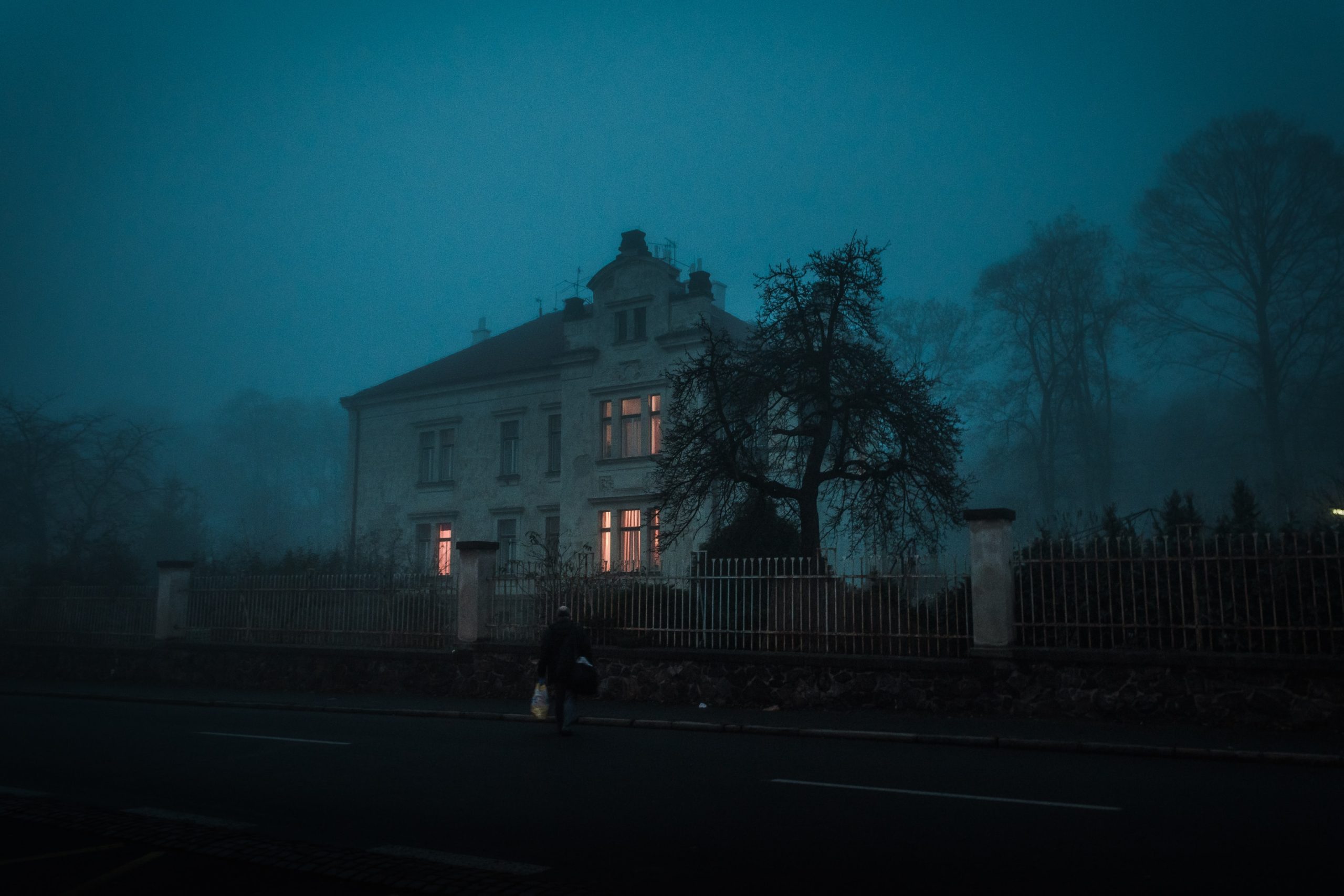
Horror thrives on settings that do more than just house the action—they breathe, they threaten, they embody. Whether haunted houses or desolate forests or the ice fields of the Arctic, the books on this list do just that. These are stories in which the setting lurks in the shadows just as much as the monster.
Post-industrial Detroit: When bodies begin to appear in abandoned buildings around Detroit—not just bodies, but parts of bodies, fused together with parts of animals—Detective Gabriella Versado realizes that she’s after a serial killer like none before. One dreaming of a twisted world. What Versado finds when she catches up with him, though, is something far beyond the scope of regular police work. The gritty, bleak city and its broken dreams becomes a mirror for the horror of the crimes, a world between this one and that of nightmares.
Old-growth forest in Georgia: Nellie Gardner and her eleven-year-old son, Max, leave everything behind when she learns that her estranged grandfather has left her his estate—the Redfern farmhouse, a mill, a thousand acres of forest. A sinister presence in the house and forest forces Nellie to unravel the Redfern’s violent legacy, and she finds she must do everything in her power to protect her son. The blood-soaked and eerie forest is home to much more than the family legacy, though—something ancient and waiting.
The decaying home of a serial killer: When Vera Crowder’s mother tells her to come home, she can’t imagine what awaits her at her infamous childhood house—the home of her serial killer father and the scene of his murders. She must confront his legacy when the house itself begins to manifest it—mysterious notes, hidden rooms, whispers. With unresolved secrets buried in the very foundations, Vera must uncover a series of unsettling truths. The corruption runs so deep it just might have infected the house itself.
Blackfeet Indian Reservation, Montana: Four men—Ricky, Lewis, Cass, and Gabe—have all gone different directions since their childhood on the reservation. Some left, some stayed. Some grew up, some didn’t. One cold November will see them all confront their pasts, though, as they’re each stalked by something malevolent, a vengeful force that embodies the cultural and ancestral spirits tied to the land they once violated. What comes when the force catches up to them is a violent reckoning that echoes their past sins and present fears.
Harlem in the Jazz Age: Hustler and street musician Tommy Tester’s life is upended when he meets a rich and enigmatic man who draws him into darkness and the occult. What he finds when he gets there: ancient rituals, eldritch horrors, and a cosmic showdown that could alter the fabric of reality. New York itself is full of no less horror, though; Tommy must confront poverty, police brutality, and racial injustice as he transforms over the course of the novel. LaValle weaves a gritty tale that at once deconstructs Lovecraft’s racist work and honors his legacy of cosmic horror.
A shadowy estate in the mountains of Mexico: When socialite Noemí Taboada travels to High Place—an eerie mansion with a violent colonial history—to rescue her cousin after a cry for help, she finds her cousin’s new family has secrets and bad memories which seem to live in the walls of the house itself. It breathes with them. Tracing the mysteries, Noemí discovers a family secret so deep and steeped in death that her reality begins to unwind. This isn’t just another Gothic mansion.
The Arctic ice fields: Captain Crozier’s 1845 expedition comes to a halt when his ships become stuck in the Arctic ice. The men endure this frozen isolation for a year, the blinding-white landscape around them a sublime nightmare. Clawing at the edges of the ice is an entirely different threat, too. Something that wants to hunt. Helpless against this ancient hunger and the ferocity of nature, Crozier and his men begin to realize that there are places in this world through which people were not meant to pass.
Electric Literature is please to reveal the cover of Beautiful Dreamers, the highly anticipated fourth novel by Minrose Gwin, which will be published by Hub City Press on August 27th, 2024.Preorder the book here.
In 1953, Memory Feather and her mother Virginia are welcomed back to the Mississippi Gulf Coast community of Belle Cote, by Virginia’s childhood friend Mac McFadden, a gay man actively participating in the Civil Rights Movement. The three of them form a loving, if unconventional family. But the arrival of Tony, Mac’s “guest,” brings chaos to their quiet life, forever changing Mem and shattering the bonds of family she thought she had. An adult now, Mem recounts her story, telling of the scars—emotional and physical—that Tony imparted on her teenage years, and seeking accountability for her own part in the catastrophic turn of events from her final summer in Belle Cote.
Praised as sweeping, dramatic, and vividly rendered, Beautiful Dreamers is an incandescent novel of innocence, betrayal, love and intolerance, and the honesty we grant to our chosen family.
“In designing the cover for Beautiful Dreamers I wanted to contrast something visually reflective of this beautiful and moving novel with a sense of the graphic language of protest-era Mississippi,” says the designer, Luke Bird. “The painting by Irma Cook (“Young Woman Seated in a Chair with a Green Backdrop”, The Johnson Collection) is contrasted by a vivid, typographic bottom half which features typefaces designed by Vocal Type (“Martin”) and Brandon Nickerson (“Grainville Script”). Vocal Type are a foundry committed to diversifying design through typography, and the use of “Martin” felt like a perfect fit for this book.”
Meg Reid, publisher of Hub City Press, agrees. “Minrose is a terrific writer and I truly believe this novel, which tackles LGBT issues in midcentury Mississippi, is her finest work to date. She creates a portrait of a Gulf town that is both in flux and ancient, populated by a memorable cast of characters. I knew we wanted a painting to give it a classic, timeless feeling, but I also wanted to frame it with more modern fonts and composition. While I was leaning toward landscapes, Luke found the Irma Cook portrait that so perfectly captured the themes of innocence and betrayal, of sexuality and guilt, that the novel is balancing so well. I love working with Luke because he gives the books a close read and crafts covers that are as complex as the stories they hold.”
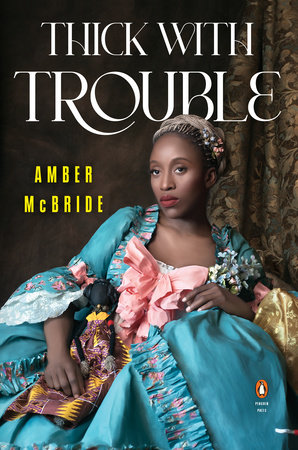
I went to a high school with about 1700 students and only 30 of them were Black. My Mama lived in the country—she always had red clay under her nails. She talked with her siblings more than her schoolmates. My Grandma was tugged off the school bus at 14 to help with chores and got her GED when she was 60 years old. As for my grandma on my dad’s side, she grew up in the city surrounded by Black folks; her mother’s experience was the same. Nevertheless, the stereotype, the monolithic western way of looking at the Black women would have you thinking we all grew up the same, that there is no individuality. It’s frustrating to say the least.
These caricatures dehumanize; these falsehoods lack nuance and intersections. When the poems for Thick with Trouble started to stitch themselves together into a collection the personas of the Black woman I had met throughout my life started to animate on the page. Their voices were full of life, pain, joy, anger, sexiness, at times dominating and often flirting with softness—complexity.
All of these poetry collections endeavor to answer the question: What does it mean to be both Black and a Woman? All of the answers are different—Black womanhood is multifaceted and finding a safe passage through it is the challenge of a lifetime.
These collections light a lantern and illuminate a way…
Divided into four sections and brimming with life this debut poetry collection from Ghanaian poet Ama Diaka is both fierce and cerebral. The opening poem, “Ama Nkrumah,” boldly states: “you haven’t been loved well enough until you’ve been loved like a man.” The speaker in this poem is painfully aware of the double standard and pushes against the idea of what Black women are supposed to be. Ama’s meditation on Black womanhood speaks to the restless of the constraints society puts on women.
Woman Eat Me Whole experiments with form using free verse, twitter conversations, reinvented dictionary definitions and more. All which craft a stunning debut collection.
A psalm of girlhood and all its complexities, award-winning essayist and poet Kendra Allen inspects the mundane, the Black church, the brutal and the beautiful in this collection. Documented through overlapping experiences of girlhood the poems utilize space, diction, the colloquial and the deconstruction of form to speak for the underrepresented Black girl. At its heart, the poems sing a song of survival despite conditions.
Imagery of water/wetness is splattered throughout the book—in baptism, sex or through tears, reminding the reader of the necessity and dangerous qualities of water.
The poem, “Sermon Notes,” offers this warning: “Note: Passion is a kind of florescence a water well in its rapture/ and then you find/ your burning man.”
I Done Clicked My Heels Three Times by Taylor Byas
A collection about self-discovery and moving out of South side Chicago, this collection is inspired by the musical The Wiz. Taylor Byas is a master of form in this creative and unique debut collection. The reader is taken on an evolutionally journey into womanhood with searing sonnets and sestinas that haunt.
With poems with titles like, “Men Really Be Menning,” “This Kill Bill Scene Has Me Thinking About Weave and Girl-Fights,” and “On Getting Ate Up By Mosquitoes” an authentic moving picture is painted. One that both loves and critiques the south side of Chicago. Byas is able to evoke whimsy and truth simultaneously leaving the reader in awe. The poem, “Yes, the Trees Sing” does this when it states: “Our backyard’s weeping willow is really a woman with micro braids all the way down her waist.” Now all willows are Black women with mico braids.
I Remember Death By Its Proximity To What I Love by Mahogany L. Browne
Browne inspects the devastating effects of the prison system in America and condemns how that system causes generational harm. The poems speak to vulnerability (a girl misses her father) and generational traumas (incarceration does not simply harm the imprisoned—the pain also ripples through families and can be felt for generations).
The collection is both honest and heart wrenching with moments of levity and despair. Browne also utilizes footnotes to offer deeper insight into the deeper meaning of a poem and her thoughts on poetry in general: “As I am writing this in a time in which poets accuse each other of noncommittal words (like “wonder”), if I may interject.”
Browne speaks on the strength of loved ones left behind and the endurance of Black women: “I am/I am/ I am/ the worst kind of thief/ I steal your swag right in front of your own eyes/ right in front of your own children.”
I practice Hoodoo which means no recommendation list is complete without an ancestor included. How to Carry Water includes some of Cliftons most profound poems about the Black experience includes ten formally unpublished poems.
This collection has all of Clifton’s devastating clarity and stunning directness—everything that makes her timeless.
Often reading like a spell, Witch Wife is striking, mystical and wildly imaginative. This collection also includes sestinas and villanelles that call ancestors to life and speaks to the history hidden in one’s blood. The collection is empowering, honest, haunting and haunted.
In “Little Gals,” Petrosino creates a setting that is both atmospheric and unsettling, like many poems in this collection, often conjuring the unnerving: “They come at night/ on membranous/ wings. I’m a soft deer/ browsing the woods/with strands of willow/ in my pelt.”
This poetry collection, the winner of the Agnes Lynch Starrett Poetry Prize, inspects the difficulties of being a Black woman in the South while also commenting on faith, interracial families and tradition. Clarke considers the subconscious and conscious harm Black folks in the south endure living so close to places where their ancestors were often brutally murdered. In the poem “Soil Horizon” the poet says: “How do we stand on the dead and smile? I carry so many black souls/ in my skin, sometimes I swear it vibrates, like a tuning fork when struck.”
Clarke’s collection is haunted, telling the dark history of Tennessee and often evoking the images of Black bodies swinging from trees. As the title dictates, I can’t talk about the trees without the blood. This collection succeeds in highlighting parts of history that are often skimmed over in sharp, innovated, raw and captivating ways.
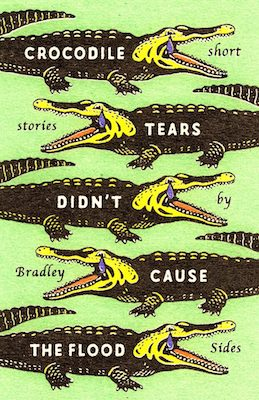
In his 1917 essay “Art as Device,” Russian formalist Viktor Shklovsky coined the term “defamiliarization” as a goal of the artist. To “defamiliarize,” simply stated, means to make the familiar appear strange or new. In other words, art should help us “re-see” our ordinary, mundane surroundings in a different way. In Bradley Sides’ new story collection, Crocodile Tears Didn’t Cause the Flood, the weaving of fabulist and fantastical elements into an ordinary modern world is seamless and persistent, leaving readers to believe that monsters and magic are indeed all around us.
The collection is populated with Pteradons and vampires, shark-children and dragons, people transformed into moths—and yet the primary takeaway for the reader is not escapism, nor magic, nor fantasy, but instead the opposite: these stories usher us into universal emotional states of grief, loss, and desire. The world we recognize is defamiliarized, made strange and new, which works to bring to the surface those conflicts and questions that are part of every human’s experience.
Another way Sides defamiliarizes the world is through the use of forms—recognizable forms like letters, police interview transcripts, instructions, exams, and others that set up the reader’s expectations and then subvert these expectations. The result is an array of storytelling modes and experiences that feels both fresh and original and yet comfortingly familiar.
Sides’ collection, with its playfulness and range, is hard to categorize and a joy to read. Is it realism? Is it fantasy? Is it magical realism? Comedy? Drama? Yes, all of this and more.
Darrin Doyle: I picked up a definite fable vibe in many of these stories. Some feel like allegories, while others employ fairy tale tropes like humans transforming into animals. Were you influenced by myths and fables in writing this collection?
Bradley Sides: Absolutely, but not in a traditional sense. I really love contemporary work, so I find a lot of inspiration in today’s writers. Daniel Wallace, for example, is a huge influence. His novel Big Fish, which has mythic and fable-like elements, was the first time I saw literary magic in the South. I’ve probably read that book fifty times, and I’m serious, too. I’m also influenced by the stories of our best magical realists like Karen Russell, Kelly Link, and Alexander Weinstein. There’s so much good work out there that’s engaging with the elements you mention.
DD: Themes of grief and mortality come up often in these pieces. Do you think about allegorical potential before you begin writing, or is this something you notice only after you’re finished drafting?
BS: Grief and mortality are two of the major focuses of my writing. I might argue they are the major focuses of my work. Many of the texts I hold closest approach both of these things so closely. Just looking back at Big Fish, for instance, the novel is largely about dying and death—our lasting story or legacy, whichever you want to call it. It’s on the first page up until the end, and I think that’s true to life. When we learn what death is, it tends to haunt many of us. We think about not only our own death, but we also think about the death of all the folks we love. It’s always there—and there is no escaping it.
I tend to let my stories develop as I write them. I’m not much of a planner or an outliner. When allegorical elements might enter, they aren’t intentional. I oftentimes learn from readers what my stories are about, and that’s usually something related to grief and/or mortality. When I’m in the process of writing, my stories are, to me at least, just stories.
DD: What draws you to using the fantastic in your stories? Do you think magical realism can address real-world conflicts as effectively as standard realism, and if so, how?
BS: I probably sound ridiculous saying this, but for me, the magic is the truth. I grew up on a farm in very rural Alabama. My company was oftentimes bullfrogs, cows, nighttime’s total darkness, and occasional flickering stars. There was a lot of room to get lost in that world—to let imagination take over. And my imagination felt as real as anything else.
It still does. When I am able to travel and see a volcano, I can’t just admire the volcano. I see what it might contain and what it might be able to do. When I’m at a museum, I can’t just see a skeleton. I imagine where it was and what it did. Maybe even what it wishes it could still do.
The fantastic has power because it can’t really be contained. There’s a truth in that limitlessness that is special.
DD: I love that—the limitlessness and power of imagination. To continue the thread of grief and mortality, a number of the pieces deal with the loss of loved ones, and they show scenarios where the dead are literally brought back or visited. Not to get too philosophical, but do you think fiction is a sort of wish-fulfillment in that regard?
BS: That’s a tough one. I see fiction as being a means to explore possibilities. Maybe it is a way to give people their wishes, but maybe it is also a way to explore their fears.
There’s power in fiction, and as readers and writers, we get some of that power extended onto us.
DD: A number of these stories—“Our Patches,” “Raising Again,” “To Take, To Leave,” and “The Browne Transcript”—hint at the apocalypse through some kind of environmental disaster or other doomsday scenario. Obviously, climate change is a topic of some urgency at the moment. Can you talk about what draws you to this subject?
When we learn what death is, it tends to haunt many of us.
BS: I love this question, Darrin, and I’m just now realizing how apocalyptic this collection really is. Ha! Fear is probably the short answer. The world seems to be dying, and that’s scary. Writing about the world ending gives me a way to harness that fear and maybe try to make sense of it. Or maybe even to prevent it. Or accept it…
DD: Haha, yes. There’s that wish-fulfillment again, or maybe “coping mechanism” is a better way to put it. Your stories also present “monsters” (giant lizards, vampires, dragons, Pteradons, and more) existing in “modern, real-world” settings. You seem to raise questions about what defines a monster —and by extension, what defines a human. Can you talk about this?
BS: I am especially interested in how the two intersect. I always have been. It’s one of my major interests as a writer of weird/speculative/magical things. Humans can certainly be monstrous; they can also be good. Monsters can be humane; they can also be evil. With these stories, I want to show the various sides of humans and monsters, but I want the actual power of classification to extend a bit further to the reader—to give that person experiencing the story the agency to decide if a character is more human or more monster and for them to also create their own evaluation criteria. Maybe humans and monsters aren’t all that different? Maybe they are? As a fiction writer, I like my stories to pose questions that I don’t really answer. I’ll leave that part to the reader because that’s part of the fun.
DD: I love your use of forms throughout the collection. You have a story in instructions, a transcript of a police interview, an exam, a letter, a choose-your-own adventure, and others. What are some advantages and disadvantages to this sort of storytelling?
BS: Thank you. I appreciate you saying so. I wrote most of Crocodile Tears Didn’t Cause the Flood during the peak of COVID. I had to feel like I was having fun in order to write because those were some dark days. If I wasn’t having fun, I wasn’t writing. It’s that simple. Experimenting with form allowed me to truly be excited in what I was creating. I wrote quickly. I was laughing and failing and trying again and succeeding. It was just a really cool writing experience that will probably never be topped, and at the end of the day, the collection does and says what I want it to.
As for disadvantages, that’s tough. Some readers will probably just say, “No thanks.” Or they might shout, “Gimmick!” Haha! The experimentation might not be for them. No book is for everyone, and that’s just how it is. I’ve accepted it, and I’m cool with it.
DD: I’ve written in forms like these, and while it’s liberating and fun, the form itself sometimes dictates that you can’t use certain story elements such as setting or dialogue. For example, in “Nancy R. Melson’s State ELA Exam,” which is in the form of a test, you probably can’t include a lot of dialogue or setting. Was this ever a challenge for you?
BS: Very true. There are limits, but all stories have some brand of limit. Different worlds offer various rules that can and can’t be broken. The same with characters—or a multitude of other elements. As I was writing these stories, the form never came first; instead, the form was a way for me to tell the story I needed to tell. If I would’ve approached each story with a specific form I had in mind that I wanted to showcase, I would have been in bad trouble. I would actually probably still be on the first story. It just wouldn’t have worked.
Writing about the world ending gives me a way to harness that fear and maybe try to make sense of it.
With “Nancy R. Melson’s State ELA Exam,” the lack of usual dialogue could be limiting, but the story finds other ways for voices to come through, especially the titular character’s. The test and, as a result, the story both become extra interactive, and that’s because the form allows additional layers.
Thankfully, the many forms throughout the collection came naturally.
DD: In blurbs for your previous book (Those Fantastic Lives), you’re described as a Southern writer. Do you consider yourself a Southern writer, and if so, what does that mean to your fiction?
BS: I’m glad you asked this question. I fully embrace the label. I am a Southern writer—and a rural one at that. Like I mentioned earlier, I’m from Alabama. I’ve lived here my entire life. I’m sure I’ll die here. I talk slowly—and with a very thick drawl. I sit on my porch and tend to my little garden, all while drinking tea. For me, to be a Southern writer means to respect the place I write of and from. It means to respect the people, too. I try to capture the voices I know from down here as fully and authentically as I can. I try to treat the place with love, while being aware of the problems and flaws as well. I treat the South like it’s a character—a major one. I have to.
With Crocodile Tears Didn’t Cause the Flood, I go even further in being a Southern writer, I think. Many of the stories, including “The Guide to King George,” “Dying at Allium Farm,” and “Nancy R. Melson’s State ELA Exam,” are set explicitly in Alabama and Tennessee, and even the ones that aren’t stated as being in the South still have that Southern feeling.
DD: I did notice that there’s a focus on rural settings in the collection. Aside from this mirroring your own childhood experiences, are there other reasons you gravitate toward the rural over the urban?
BS: The honest answer is that I just don’t know that world. I’ve been fortunate to be able to travel quite a bit as an adult, so I’ve experienced it. But I don’t know it. When I’m in cities, I feel like I don’t belong. It’s like when I try to write a story that doesn’t contain magic; I feel like a phony. Focusing on rural settings that I understand is a way for me to keep a sense of truth in my worlds—and, consequently, my work. I don’t really agree with the famous advice to “write what you know,” but in this case, I stick to it.
DD: How did you decide on the title for the collection?
I see fiction as being a means to explore possibilities. Maybe it is a way to give people their wishes, but maybe it is also a way to explore their fears.
BS: Man, I’m terrible at titles. I got lucky with my first book. Those Fantastic Lives was a good one. With Crocodile Tears Didn’t Cause the Flood, I was near the end, and I was struggling with the title. Like really struggling. None of my stories worked as titles for the larger book. I didn’t want to go outside the stories because it would get bad. Death and Apocalypses isn’t very catchy. It’s probably the opposite of catchy. I was lost. Then, I began working on “Crocodile Tears Didn’t Cause the Flood.” It’s a fairy tale. It has a major flood. There’s lots of magic—and hope in the emptiness. It is a Bradley Sides story in all ways. When I finished it, I knew it had to be the closer for the collection. It feels very definite as it ends, and it just feels right in the spot.
When I stepped away and looked at the shape of my collection, the opening story is about a flood. The closing one is about a flood. There are other kinds of floods, metaphorical and literal, throughout. Crocodile tears, those big, showy, fake things, don’t cause the floods in the collection. Instead, the floods are brought on by truths—painful and beautiful truths. I knew I’d found my title, and I never questioned it.
DD: Which of the stories was the most difficult to write, and why?
BS: I have to cheat and pick two. “Claire & Hank,” which is about a guy and his dinosaur sister, and “Dying at Allium Farm,” which drops readers in on a vampire family’s organic garlic farm. These stories are actually two of my favorites in the book, so I ultimately feel good about the fight they gave me. But the struggle. The struggle…
As a person, I think I’m pretty funny, but as a writer, humor is tough for me to get right. With “Claire & Hank,” I wanted to balance humor and lightness with some real heaviness. With “Dying at Allium Farm,” I wanted the same kind of approach, except with a bit more humor. I wanted readers to laugh, but I also wanted them to feel something a bit heavier at each story’s end. I couldn’t get those endings right. “Dying at Allium Farm” went through roughly 20 edits. “Claire & Hank” didn’t take quite that many, but I kept reworking that last image.
Revision. Revision. Revision. That’s the struggle of all us writers.
The club is situated in a warehouse district near downtown St. Louis, a low building with turn-of-the-century brickwork that looks like every other low brick building in the city, surrounded by weedy parking lots and rusty chain link fences. When my friend Steven invited me to soak in the hot tub with him there, I had to Google it to make sure it was what I thought it was. Honestly, I’d thought that bathhouses were a relic of the Time Before, when men ducked into gay saunas to have anonymous sex without the fear of AIDS. I grew up in the eighties and nineties and knew only the Time After, when the crusades to shut them down in cities like San Francisco and New York underscored the fear of the plague and the drive to exterminate queerness rather than caring for the sick. That fear crept into my Midwestern Southern Baptist existence and made every queer person a gay man, wasting away, an ominous cautionary tale, body poison to everyone around him. I could only see the view from the TV at the Days Inn, where I cleaned rooms; from there, queer joy was as removed—as irrelevant—as Broadway, Wall Street, and Hollywood. It sparkled in this forbidden way.
The Club, a block away from a Mobile station and a Store Space Self Storage, didn’t sparkle. Still, I was curious.
Bathhouses are a quintessential part of gay culture, specifically cis male gay culture. In the last century, these places have served as safe(ish) places for gay men to have intimate time with other men, secluded from the life and career-demolishing eyes of the police. But times had long since changed. Steven is an activist and an irrepressible extrovert who can talk his way into nearly anything; he was determined to break down the barriers for trans and nonbinary people in all places, even decades-old bathhouses. He was in the process of convincing the owners and management of The Club that all people who identify as male should be allowed equal access to the sauna, workout room, lounge and entertainment area, swimming pool, hot tub, and, you know, everything else. While this may not be revolutionary on the coasts, Missouri is different. His success led to an offer of a test mission, and he needed a wingman, which is how I became the first trans man to get naked in this gay bathhouse.
In my mind’s eye, I saw a sort of Queer as Folk situation where hot guys in their twenties walk around in white towels and spontaneously fuck each other, devoid of inhibition. While a lot of this was true, it wasn’t meant for my eyes, the eyes of a man who was assigned female at birth.
He avoided tricky situations like doctors and locker rooms.
Steven and I were both in our forties, both balding with beards (although he had more hair), both having had top surgery. We were different in other ways. Steven surrounded himself with queerness, and nearly every aspect of his life included people in various versions of gender. He avoided tricky situations like doctors and locker rooms, whereas I was, and am still, nearly always the only trans person in the room. I had undressed quickly and guardedly in the YMCA for years, and it amazed me that not one guy in the very straight YMCA locker room had ever looked past my tattoos and bald head to see the incision marks on my chest or the significantly different anatomy between my legs. It seemed like if I kept moving and directed them where to look, they’d see whatever I wanted them to see. Even so, women have an ingrained sense of danger when it comes to male proximity, and I’d spent the first thirty years of my life in a body that housed a uterus and even a child in that uterus. I knew when to be uncomfortable.
Maintaining the illusion that I was just like every other man took up giant swaths of bandwidth in my head. I packed my underwear with all sorts of soft representations of a penis over the years, and when that grew tiresome, I just wore loose pants, sat in a slouch, and walked like the guys I saw at Lowe’s when I bought lumber for woodworking projects. I diverted attention. It wasn’t about being closeted. I had been a very visible trans man for over a decade. It was about something closer. Something infinitely intimate and unknowable.
Sex was complicated. It was all fantasy, like virtual reality where I was all of the avatars—the person touching, the person being touched, the person looking, the person being looked at—while I stayed locked behind the screen. And nowhere was this collection of avatars more present than when I tried strap-ons. As much as I wished I could have wrestled my mind around wearing one, they made me disconnect completely, like I was fucking by proxy. What I wanted was uncomplicated. I didn’t need acrobatic sex or a million orgasms. I just wanted to be in the room.
But every second spent locating the equipment in a drawer, adjusting straps, wiping off the inevitable bit of fuzz from the pouch or stray cat hair that stuck itself to the shaft, and then wrestling it into place on my body was a pace away from being in my actual body. By the time I had suited up, I was already thinking about the grocery list and wishing it was over. It wasn’t just about sex, though. I lived from my shoulders up in pretty much every respect. Even alone in the shower or getting dressed in the morning, I mostly didn’t look down, which over the course of a few years translated to not being able to look in the mirror and then not being able to look at anyone else, at least not directly and not for very long. Sex was the least of my worries. I had nearly erased myself completely.
I’d had anonymous sex in strange places, but those experiences were in a female body.
I drove to The Club and sat in the parking lot with both hands on my steering wheel. A scene from National Lampoon’s Vacation repeated unbidden in my head. Chevy Chase’s dorky dad character is about to go skinny dipping with Christy Brinkley’s character and keeps repeating to himself, “This is crazy. This is crazy. This is crazy.” I texted my sister, not just because I wanted to talk to her about being parked outside a bathhouse, but because she is the only one I know who has memorized the same scenes from movies we watched as kids.
“This is the gayest thing I’ve ever done,” I texted. I looked in my rearview mirror and made eye contact with a middle-aged man walking behind my truck into the building.
“I want details,” she texted back.
It was not the gayest thing I’d ever done. My sexuality has careened widely between asexual and pansexual for as long as I can remember, and even though I struggled with it when I was younger, I don’t stress anymore about where I am on that spectrum at any given time. I’d had anonymous sex in strange places, but those experiences were in a female body, not the very male body I inhabit now. It had been a long time since I felt much of anything besides crushing depression while fighting to have the surgery and then bone-deep fatigue from months of recovery from the surgery. For the past year, I had felt more like a list of symptoms than a human being.
That Tuesday morning, I planned on getting naked in the hot tub, knowing that Steven wouldn’t. In a cis gay bathhouse, trans is transgressive, and cock is, if not required, expected. Unlike me, he had no interest in bottom surgery.
There are a few different kinds of bottom surgeries. Each method gives you different sizes and sensations. Some give you the ability to pee standing up and have penetrative sex. Some are more involved than others. I chose phalloplasty, which is a surgery that constructs a penis out of donated skin, nerve, and arterial tissue from other parts of the patient’s body.
Most trans men don’t have bottom surgery of any kind, and even fewer have phalloplasty. Many don’t feel they need it. Many do feel they need it but can’t afford it or are scared of it. The surgery is a big deal, involving multiple locations on the body—the arm, the thigh, the back, the groin, depending on where the donor site is—and there are almost always complications. People get creeped out by the scar on the donor arm, which looks like a very large burn that extends from your wrist to nearly your elbow, but it’s not just aesthetics. I had physical therapy to get full use of my hand again. I can’t feel anything on the scar. I’ve cut my arm on several occasions and not known it until I noticed blood. But most hesitation is about presentation. Many trans men want a perfectly formed penis with perfect length and girth (a dream of many cis men), and they will settle for no less than flawlessness with zero visible scars (good luck with that). The internet is filled with sites where you can see surgery photos, and those comment sections are filled with people who cringe, or worse, laugh at images of The Results—as if the trans man in question didn’t nail the landing, so points must be deducted.
The bigger truth, though, was that I didn’t just want to be okay. I wanted to be wanted.
I can understand the trepidation. I had a lot of it before my surgery. I had convinced myself that bottom surgery was an option that would give me even more to be self-conscious about. I had built up the Frankenstein’s monster version of The Results in my head, and that kept me distracted until a friend came home from having his own phalloplasty and offered to show it to me. I figured I’d look in real life and definitively close the door on any desire to do it. We sat next to each other on his living room couch, and he unzipped his pants. Instead of the monster I had imagined, I saw a living, breathing, normal person with a very much not scary Result.
Fuck. I thought. The next day I started researching surgeons.
Fifteen years after I started taking testosterone, and ten years after I started pushing my health insurance to cover the surgery, I finally completed and healed from my phalloplasty, which had left me with a penis, scars hidden under scars from other surgeries, scars hidden under hair, scars in plain view, and a skin graft on my arm.
I didn’t look cis, but in a dark room, I might be okay. The bigger truth, though, was that I didn’t just want to be okay. I wanted to be wanted. I thought about the guy in my rearview mirror. I wondered if we’d recognize each other in the dark. I wondered if I’d want to make out with someone. I wondered if I’d feel anything at all.
I wasn’t sure how Steven and I would be received at The Club. This was our inaugural visit, and I had no idea what was required. I was following his lead – and yet I had come without swim trunks. He pulled in just as I was texting an lol to my sister. He clutched his shorts in his hand. He’s a big guy. He carries his weight like a bear daddy, and I’d always thought he was attractive. I carry my weight like a secret and hide it under layers of clothes when I’m heavy. I’d just lost 34 lbs, though, and was feeling as good as I ever have, but my body and I have a complicated relationship.
“I’m nervous,” I said. “Why am I so nervous?” I knew exactly why I was nervous.
“I am too.” He shifted his shorts from one hand to the other. We smiled and shook our heads at each other. This is crazy. This is crazy. This is crazy.
Once we were in, I felt like I had in the dressing room of the strip club where my sister tended bar in her early twenties, the 40-61 Club. Littered with gym bags, lingerie, and drugs, it was easy to slip in the back and hang out with the other dancers while I waited for her shift to be over. Those friendships and flirtations didn’t count because I was a woman. There were rules for that club too. The bouncer never told me to leave but never asked me to dance. The bathhouse felt like slipping into an old pair of jeans.
Porn played on multiple screens. The manager, Mike, gave us a casual tour of the place while I tried to avoid the impulse to take out my phone and take notes.
If I stayed there pleasant and quiet, suffocating for long enough, my stillness would protect me.
“These are useful,” he said. He put his knee up on one of the benches in the hallway and rocked back and forth. “Fuck benches.” He looked at me, expecting me to cringe. When I nodded for him to continue, he took us past the glory holes and the “slurp deck,” which was a platform that a person could stand on and put their crotch at face level for the person standing in front of them. Then he showed us the private rooms. Each stop on the tour was accompanied by a disgruntled look from Mike. I couldn’t tell if he was trying to shock us into leaving or if it was a sort of adolescent dare. We twisted through the dark hallways and made our way back to the locker room. I put my key into the locker and stripped off my shirt and pants.
Standing in The Club in my socks and underwear, I felt the familiar reflex to hurry and to hide. I thought about a night two years earlier, before my surgery, when, in a suicidal depression, I went to the psych ward of a hospital and was confronted by two nurses—one man and one woman—who directed me to strip so they could do a “skin search.” I thought about the time years before that in intensive care when the nurse called me “it” and “forgot” to give me a blood transfusion. I thought about every time I had the instinct to hold my breath, to shrink into the shadows, like the air around me didn’t belong to me, and if I only took a little, if I stayed there pleasant and quiet, suffocating for long enough, my stillness would protect me. Here though, in this locker room in this strange place, the sun came out. The air was okay to breathe again.
I took off my socks and underwear, stowed my clothes in the locker, and looked back at Steven. He was hurrying to put on his swimming trunks in that familiar YMCA gym way, so I looked away and twisted my towel around my waist. I looked back; his body was turned away from mine. I watched him pull the elastic key holder around his forearm, and I did the same with mine. Our guide had left. We were quiet and awkward as we walked down an uncertain hall toward what we hoped was the hot tub.
There were men, maybe ten or fifteen, standing with towels slung around their waists in darkened corners. The screens above us were silent, but the raw sex on them seemed to follow the rhythm of the Studio 54 Spotify playlist that sounded from the speakers. I chuckled. We found the hot tub, and I stripped off my towel in the gang shower. I pointed to the sign that said, “Please shower before using the hot tub.” It was a familiar OCD. I felt like I always did when I passed the front desk at my therapist’s office, where the business card holders and laminated calendar begged to be straightened and re-straightened. I had seen the sign, and now I had to do what it said.
I pumped the soap out of the dispenser and stood under the water. A bearded, naked man walked in and descended into the hot tub without so much as glancing at the shower. I didn’t look at Steven as I rubbed the soap onto my torso, but I saw him from the corner of my eye hesitate, watch the guy pass the showers, look at me, then the sign, then reluctantly pump soap onto his palm and rub it under his arms. This, right here, might be my favorite thing about Steven: I think he’d help me straighten the business card holders and calendar at my therapist’s office if I asked him to.
We finally stepped into the water. From where I sat in the tub, I could see a still frame of a young white guy on his back, his legs spread into the receiving end of the missionary position. Steven’s view was two screens side by side showing slippery fornication on each. One featured young, hairless white guys. The other featured hairy, beefier white guys. I noticed a theme. I also noticed that deep inside, buried under a surgically composed scrotum, my original equipment was aroused. That was new.
After I transitioned, I learned the ways men; straight men, in particular, guard themselves.
It’s hard to explain how phalloplasty works because there are multiple possibilities for constructing a penis, but in my case, my original anatomy is rerouted and buried underneath all the reconstruction. It has all the same feelings and sensations it had before, and these are connected by nerve grafts to the new equipment. Sometimes it feels good, like a deep breath in the woods at the edge of an open field in summer. Sometimes it feels like an unpleasant and raw zap referring back to the original nerve ending—sort of like memory, a little like grief.
Steven popped out of the water and sat on the side of the hot tub.
“I can feel my blood pressure,” he said.
I watched him lean on his elbows and admired his body. He carried his maleness in every cell. I stayed submerged, and when the fifteen-minute timer turned off the jets, I popped up and hit the switch again.
We sat close to each other, he clothed in his trunks, and me shrouded by convulsing water, and talked in low tones under the music and Jacuzzi jets. Outside of that building, we were public figures: He, the executive director of a transgender nonprofit; I, the co-owner of an independent bookstore. Professional Public Trans ™. Right then, though, we talked about things that friends talk about when the trash of the outside world is held at bay, and the only thing that matters is the two of us, stripped down to the essentials.
The men around us were old, young, large, small, muscular, and flabby. Their faces were soft and hopeful. Like they didn’t have to hurry. Like they didn’t have to hide. I almost felt guilty for intruding, and yet I was there in the middle of all of it, as vulnerable as I could have possibly been, and they looked at me like I’d always been there. I suppose they were as vulnerable as they could be, too. After I transitioned, I learned the ways men; straight men, in particular, guard themselves. Physical contact is kept brief – fist bumps and handshakes. Emotional contact is frequently briefer. I once gave condolences to a man for the death of his wife with a nod of the head, to which he responded, “Yeah.”
Steven left to meet someone at the front door. He was on a mission to populate The Club with trans men, and we were so new in this place it was hard to know if the front desk guy would let any more of us in. I sat alone in the churning bath and stared at the porn. The jets relaxed me, and I didn’t notice an older man approaching.
“Sorry?” I said.
“Is it okay if I join you?” he asked again. I knew what it meant, though my inner teenage girl kept looking for another reason a naked man would ask to sit next to me. I did the familiar inner negotiation of my boundaries. Sure, I thought, he can sit next to me. Next to me isn’t inside me. I tensed when he sat. But I knew where I was. I had chosen to be here, in some ways, for this.
“Can I touch your leg?” he asked.
Sure, I thought. He can touch my leg. My leg isn’t my dick. He gently put his hand on my leg and started to touch himself. He didn’t, as I expected from memories of high school and the creepy guy on the church bus when I was ten, grab my hand and guide it to his dick.
“My name’s Sam,” he said. “I have a room if you’d like to go have some fun.”
“I’m here with my friend,” I said. “He’ll be right back.”
“Oh,” he said. His hand moved to my back. He instinctively found the knotted muscles around my lower spine. On the screen, a blindfolded man was giving a blowjob. My breath got shallow. My mouth went dry. His hand lowered to my ass, and he started massaging his way into it. Sure, I thought. His fingers aren’t his dick. But I was curious about his dick. I reached over and stroked it a couple of times, carefully not looking at him but at the TV screens. His hand left my ass, and I realized he was stroking me. I knew the game was over. My body doesn’t operate the same way cis bodies operate. The loud voice in my head that had been quiet since surgery woke up screaming Fraud!
“I have some trouble with that,” I said. “You’re not going to get anything there.” I waited for him to get up and leave, to laugh, to get angry.
“That’s okay,” he said. “I understand.” He put his hand back on my leg and nudged me with his shoulder. “There are lots of other fun ways to play instead.”
I almost cried.
We walked into the nearly empty hallway and made our way around the twisting corridor into the darkest corners.
Steven returned alone, wrapped armpit to thigh in his towel. His swim shorts peeked out from underneath. He dropped into the water beside me, talking about how the person he went to meet didn’t show up. I turned to Sam and said, “This is my friend. I’m sorry.”
Sam smiled and said goodbye.
“You want to go walk around?” Steven asked.
“Absolutely.”
We walked into the nearly empty hallway and made our way around the twisting corridor into the darkest corners. I followed him into another smaller room with a platform and two screens. One man in the room had strapped himself into a sling with his legs spread and was masturbating tentatively. Steven and I looked at him and then looked at each other. We stood beside each other in the dark, listening to dance music and watching anal sex on two screens without looking at each other. Steven remained very still, not taking his eyes off the screen. I looked behind us and saw a man watching us and also watching the man in the sling. He had his hand in his towel too. In the dark, I couldn’t tell if it was the guy from the parking lot. I decided to pretend it was. I kept looking at him.
Before I stopped using women’s restrooms, I was used to people talking and holding the door for each other. It took practice to master the art of men’s rooms. Walk in. Stall. Hurry. Sink. Hurry. Walk out. No looking or talking, especially at Lowe’s or even the YMCA. Maybe I was just like that because I was afraid to stop moving. Maybe they were too busy trying not to be seen to notice me anyway.
But here was a place built for anonymous sex, where looking and touching was the point. It was a temporary ceasefire with rules for those desperate to be touched without consequence, and even though Steven and I hadn’t come here to hook up, I felt a crushing tenderness toward these awkward, average, strikingly beautiful middle-aged men who came to an anonymous place to stop diverting attention, to stop feeling poisonous. Just like me.
The snap of rubber jolted me out of my reverie. I wondered if it was a condom or a rubber glove. I looked at Steven and saw the look of a person who was holding his breath. Shrinking. I wanted to give him air to breathe. I wanted the sun to shine on his face, too.
He reached up and stroked the hair on my chest.
Or maybe I didn’t see anything but what I would have felt a few years prior. I wish I had been a good enough friend to ask, but I didn’t. Steven gripped his towel and moved silently out of the room. I knew we were finished with our visit.
If I never know the touch of a man again, the last touch will have been gentle.
As I followed Steven silently back through the shadowy maze toward the locker room, a stranger emerged from around a corner. We passed each other there in the dark hallway in that bathhouse in a manufacturing district in St. Louis, late morning on a Tuesday in February. This anonymous man’s friend, if he was a friend, had turned away. I slowed to let him pass. He reached up and stroked the hair on my chest, a passing glance before we walked away from each other. I wanted to take his hand. I wanted to touch his face. I wanted to be gentle. I wanted not to be gentle. Every second of my life lived in that tender stroke of my chest in the dim light of the most nakedly male place in the world, where I had trespassed and had been wanted.
I turned and followed Steven to the locker room. I knew that he was comfortable in his body, but I doubted he felt as welcome here in The Club as I had. I wondered if I was only welcomed and wanted because, in a shadowy place, I look enough like a cis man to pass for a while. I wondered if he resented me for it. I wouldn’t blame him if he did.
Behind us, a man put on his pants. I dropped my towel and turned to look at him. I looked at him for a long few seconds and let him look at me before I turned and took my time getting dressed.
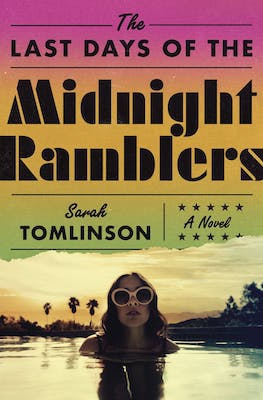
When I was ghostwriting full-time, I produced twenty books in fourteen years. Thanks to a suggestion from my literary agent, I realized a ghostwriter might make a great heroine—they’re under tremendous pressure, often while adjacent to the fame machine—so Mari Hawthorn, the ghostwriter at the center of my debut novel The Last Days of The Midnight Ramblerswas born. Mari is a cash-strapped ghost who lands a gig writing for Anke Berben, legendary model and style icon most famous for her romances with three members of classic rock band the Midnight Ramblers—not to mention, Anke might have had a role in the death of the band’s founder, who was her husband at the time. Mari is hellbent on getting to the bottom of the rock and roll mystery, for the book and for Anke, without getting pulled in too deep herself.
Because I find ghostwriters so intriguing, I compiled this reading list full of ghosts. In it, I discuss what I believe these characters can teach us, not just about the nature of celebrity, authenticity, legacy, and representation, but also, about the subtle power dynamics that go into all relationships—professional and personal.
The seven books gathered here all use the lens of authorship in deft and moving ways that not only gave me a fresh perspective on my own writing, but also complicated my world view, as most successful novels do. Although these works vary in style, tone, and intention, they all share an interest in how who tells a story impacts the veracity of that tale.
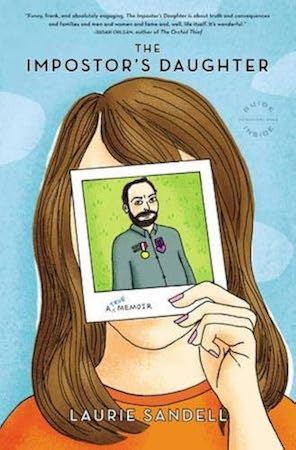
In this graphic memoir, Laurie Sandell describes in troubling but hilarious detail the exciting (and destabilizing) experience of being raised by a narcissistic liar. Her ability to stay close to her dad and make him feel emotionally safe prepped her to excel as a celebrity journalist in the era when women’s magazines ran in-depth and (at least theoretically) intimate profiles of female stars. But while she was scaling impressive career heights, such as a high-cache interview with Ashley Judd, Sandell was unraveling personally. She was crippled by anxiety and self-doubt, which she self-medicated until she needed rehab. While she wasn’t specifically working as a ghostwriter, I was galvanized by the courage and clear-sightedness of her ruminations. A fascinating and deeply moving coming of age story that will resonate with anyone interested in reconsidering our ideas of persona and celebrity.
For me, the thrillers that are especially delicious delve into relationships between women, particularly those that involve matters of intimacy, power, success, and identity. This book delivers a smart, insider look at the publishing world, as experienced by Florence, an editorial assistant and aspiring writer whose deep ambition lands her a plum gig working for the cultishly adored writer Maud Dixon. While Maud is widely admired, she is a pseudonymous recluse, so the job gives Florence unique insider access. While it doesn’t feature a ghostwriter, per se, it does offer plenty of observations on fame and success—who deserves it and why—and to what lengths people might go to maintain it once they’ve arrived. It also looks at what it means to author a story, and to receive credit for it, and how much either ultimately matters to the writer behind it. Overlapping somewhat with the wonderfully dishy and dark Yellowface, although without its meditations on racial appropriation and representation, this book also revels in the inherent drama of a young writer pushed to the brink of morality and sanity by her jealousy and aspirations.
In Verity, Lowen, is rescued from financial oblivion by ghostwriting for a comatose, bestselling novelist who is married to a muscular hottie who behaves chivalrously toward her in the opening scene. When she is tasked with finishing a contracted series while living in his remote home with his injured writer wife and their child, the descriptions of trying to coexist in a client’s household by observing as much as possible without being obtrusive captures a tricky aspect of some ghostwriting assignments. And when Lowen discovers the wife’s secret autobiography filled with terrible confessions just as she begins to fall for the hot husband, the tension mounts with delicious intensity. The book is propulsive and gave me naughty feelings similar to when I snuck home the V.C. Andrews novels that got passed around in elementary school. I read this book during the fraught weeks when my agent had my debut novel out on submission to editors, and it kept my mind and imagination occupied during a tense time when I was finding it hard to do almost anything else.
This book includes neither a ghostwriter nor a character hiding her identity, but I found myself thinking about the story a great deal as I chewed on what the other titles on this list had in common: questions of selfhood, authenticity, story ownership. The heroine Eva is a hilarious and compelling character, even as she struggles with generational trauma, debilitating migraines, raising a precocious pre-teen daughter on her own, shining as a member of Brooklyn’s Black Literati, and blowing the deadline for the latest book in her supernatural erotica series. When a man from her past, Shane, a notoriously gifted and troubled writer, surprises her with a public reunion at a book appearance, the events of the seven days they spent together as teenagers reemerge. The book’s dual timelines are deftly controlled and build equal drama and suspense. Ultimately, as with many of the ghostwriter characters, Eva must make peace with her whole self, which she has hidden behind the persona of her series’ character and her own persona as a writer. At once deep, and a total page turner, this is one of those books you wish you hadn’t read, so you could go back and discover it for the first time.
Allie, the ghostwriter at the heart of Heidi Pitlor’s witty social satire Impersonation is undergoing an awkward personal transition, along with the rest of the country. It’s late 2016 and she and her fellow citizens are adjusting to the new president and what it means to them personally and as Americans. She is a midlevel ghostwriter who has penned eleven books, supporting herself and her son, who she is raising alone. While she has felt a bit squeamish about how she has helped her past clients publish a slightly improved version of their truth, she’s never had her morality tested before. Her world is exploded by two back-to-back projects, the first a TV mega-star stud, who gets brought down in the lead up to the #MeToo movement and the second a feminist influencer, turned Senate candidate, who hires Allie to write a memoir about raising her son to be a feminist ally. Pitlor deftly uses Allie’s own vulnerabilities as a mom on the precipice of financial chaos to help the reader sympathize with her sometimes-questionable choices and to spotlight why women and other disenfranchised members of society would need a politician to take up their causes. Always keenly observed, this book manages to keep its sense of humor, even amid very dark days.
Trust is an intricately constructed, gorgeously written examination of the relationship between a ghostwriter and a turn of the century captain of industry. It uses the elegant-yet-claustrophobic prose of its opening two books-within-a-book to capture the writing of that period and the challenges of being a ghostwriter tasked with a client whose desire to improve the narrative of his life isn’t quite as inconspicuous as he might believe. The book includes many astute lines about human relationships, especially the power dynamics between men and women and ghostwriter and client. It is also wise about ambition—financial, social, and creative—and in particular, the dance a ghostwriter must sometimes do between who their clients actually are and who they wish they were. Ultimately, through its elegant nested-doll construction, Trust manages to get at something deeper about the redemptive power of having control over our own stories, The book’s milieu and characters are very different from anything I have ever lived in my professional life. And yet, it felt true to me, not just about ghostwriting, but about why we seek out the stories of those who have shaped culture, and how we should always remember to examine what narratives they’re putting forth, for whose benefit, and why.
In one sense, books are books are books. From another perspective, there is so much distance between the celebrity memoirs I’ve penned, and the romance novels ghosted by the heroine of this book that I almost felt like I was learning about a different career. For starters, I have only ghostwritten one novel, which in my experience, is harder and more work than ghosting memoirs, which are mostly based on detailed conversations about your clients’ lives. Also, while I always care deeply about my clients and want to do my best for them—not to mention readers—it can be helpful that it’s not my story, as it gives me a bit of distance and perspective that can make the writing and narrative stronger. However, for Florence, the ghost in The Dead Romantics, recent heartbreak means she no longer believes in love, so she keeps writing hilarious scenes where her star-crossed lovers have something like a “meet ugly,” rather than a “meet cute.” What fabulous narrative pressure for her to face. And the character is superbly likeable—funny and down-to-earth with a secret talent that I didn’t see coming and won’t give away. When she must return to her childhood home, in a quaint but modern Southern town, the world building is surprising and delightful. Plus, it’s amusing how her family members keep trying to get her to admit she’s ghosting for Nora Ephron or Stephanie Meyers. And if you’re a Regency period nerd like me, you’ve gotta love Romantic banter about whether the “Shelley” in question would be Mary or Percy Bysshe. For anyone curious about ghostwriting (especially fiction) or interested in complex (but smoking hot) coming of age stories set against a background of family drama.
Every year, on the third weekend in October, there’s a vigil for Caroline. Every year, they use the same easel to prop up the same poster-size photograph of her, the one taken for our sorority composite the fall she disappeared. Shiny curls gleam golden atop tan shoulders, blue eyes sparkle, a careful blend of pink cream blush and highlighter paints her cheeks rosy. Her smile is open-mouthed as though she were caught mid-laugh, and it’s weird to think we’ll never hear her full-throated chuckle again. I get kind of choked up just thinking about it.
Every year, they surround Caroline’s photo with fragrant wreaths of white roses and hand out tall, slender white candles. Our faces streaked with mascara-black tears, we cup our hands around the lighted candles to protect the flames and make tortured comparisons to Caroline’s metaphorical light, extinguished far too soon. Honestly, it’s all a little much.
Every year, they pass a microphone around the crowd, encouraging those of us who knew and loved Caroline to share stories about her. Every year, the same people say the same things—Caroline was beautiful, Caroline was smart, she was kind, she loved animals—and every year, we avoid saying the same things—Caroline was petty, she could be cruel, she stole homework and earrings and boyfriends.
Every year, we stand in a clump of Kappa sisters. Every year, there are fewer of us who actually knew Caroline and more who only know of her. Everyone knows of Caroline these days. She would have freaking loved it.
Every year, people trade theories about what happened to her. She’s being held in a basement, someone says. Just like those women in Ohio.
I don’t think so, someone else says. I think she’s buried in the cornfields outside of town.
Oh, I think she’s on the farms all right, someone else says. But you know those pigs? I heard—
Jesus, someone else interrupts. Don’t say that. Don’t even think that. That’s disgusting and not true anyway.
Besides, someone else says, everyone knows what really happened is that Ian Rogers roofied her drink at that party. But Ian’s an idiot and used too much, and she choked on her own vomit and died. Such a shame.
Every year, Amber bristles when Ian is mentioned. Of course she does—he was her boyfriend, might be still if not for Caroline. Back at the first vigil, when Caroline had been missing for a year and the investigation was still active, Amber attacked some know-it-all townie for calling Ian a murderer. I mean, really just went after her—hair-pulling and nails to the face and all that. I think the lady ended up with stitches. I know she called Amber rabid and was set to press charges until she realized who Amber was.
One of the roommates.
That’s what they call us, you know, the three of us who were living with Caroline the semester she vanished. The roommates. Every year, we face the inevitable stares, the whispered accusations. There are the roommates. You know they lost track of her at frat party. Do you think they feel guilty?
Fuck yes, we feel guilty. That’s why, every year, I hide behind dark sunglasses and Amber clutches mala beads and chants a mantra she picked up from some yoga class. It’s why, every year, Sarah fills her water bottle with vodka and ends up wasted. Every year, I hold Sarah’s meticulously curled and sprayed hair back while she retches and cries that next year, next year will be different. Next year, we’ll tell the truth.
We never do.
We never take that awful microphone and tell the assembled crowd that on that long ago October night the three of us grabbed Caroline. We never tell them that we intercepted her leaving Ian’s room, that we put one of Amber’s floral pillowcases over her head and threw her in the trunk of my car. We never tell them that we cranked up the music to cover the sounds of her screaming, or that we drove past the city limits and then released her, spinning her around to disorient her before speeding away, laughing. We never tell them that it was just a prank. Just something to knock Caroline down a notch, something to remind her that she couldn’t just take what—or who—she wanted all the time. Not without consequences.
So yeah, we feel guilty. But not for the reasons they think, not because we didn’t walk her home or because we let her fall prey to some creep armed with a vial of horse tranquilizer. We feel guilty because we left her alone in the dark, miles from home.
Or that’s why Amber and Sarah feel guilty, at least.
I feel guilty for another reason.
Because I went back. After the three of us had returned to the party, giggling about how furious Caroline must be, and after Amber had assumed her rightful place upon Ian’s lap and Sarah had lost her top in a game of strip poker, I climbed back in the car and drove to where we left her. It’s a cold night, I thought. We should have taken that bitch’s sweater.
But we hadn’t, and so she was still wearing that knee-length black cardigan, wrapping it tightly around herself as she unsteadily made her way along the road. She was still a mile outside of town, still a mile before there were any streetlights or store lights or lights of any kind. Between the near pitch-dark of the country and that goddamn black sweater, she was practically invisible. Totally invisible once you factored in the three cups of trashcan punch I’d consumed.
I drove back to the party with Caroline in the trunk. What else was I supposed to do? I couldn’t just leave her there. People would wonder how a sorority girl in faux leather pants got hit by a car so far outside of town, would wonder why exactly she was strolling along a desolate country road in the middle of the night. And then they would remember the pledge we had pulled the same prank on last year, the stupid one who had walked for two miles in the wrong direction before flagging down the first car she saw and ratting us all out. They would know it was us, that it was our fault somehow, and Caroline would win one final time. I couldn’t let that happen.
This year at the vigil, a new Kappa, some apple-cheeked nineteen-year-old wearing too much lipstick, leans close to me and says, You know, I’ve always wondered if anyone checked the frat’s dumpster after that party. I mean, there could have been evidence or something like that in there, right?
I lower my sunglasses. Hmm, I say. Yeah. Something like that.
Ah yes. Literature. The vehicle through which we may explore faraway lives we would have otherwise never imagined. From my little, rugged armchair, I can witness forbidden love in the 18th century. Peek into a bustling kitchen in New York City. Discover the dramatic betrayal that fractured the hottest band of the ’70s.
But sometimes, I just want to read about someone going through the same shit as me.
Nothing cures a pain quite like finding yourself reflected in a piece of literature. Doesn’t matter if you’re falling into a relationship or out of one. Below is a book for every relationship status:
Of all the romantic relationships, the most traditionally celebrated and arguably the most historically problematic is marriage. Nevertheless, Ayọ̀bámi Adébáyọ̀’s Stay with Me dives headfirst into that can of worms with Yejide and Akin, a monogamous Nigerian couple who become at odds when Akin, pressured by society and family to father a child, brings home a second wife, Funmi. Devastated, Yejide decides the only way to take Akin back is to have his child, even though years of fertility consults have failed them. Though Yejide is eventually successful, the costs might be too much for her to bear.
How to describe the relationship between Greta Work and Big Swiss? I believe it is best encapsulated by the scene in which Big Swiss and Greta lie on their bed, idly chatting, after a session of near-clinical fingering. It’s an affair, its companionship, it’s—a privacy violation? See, Big Swiss is seeing a sex therapist due to the fact that she is unable to climax, while Greta is (secretly) the transcriptionist that works for Big Swiss’s therapist. Greta knows everything about Big Swiss. Big Swiss doesn’t even know Greta’s real name. It’s all very messed up, and yet, somehow, very sweet.
Not all triangles are created equal. There are certainly healthy, congruent triangles, as well as triangles burgeoning into a square. In the case of R.O. Kwon’s The Incendiaries, the triangle can be best approximated as a wispy isosceles growing taller by the minute. For our protagonists, we have Will Kendall and Phoebe Lin, a young couple who meet their first month at the prestigious Edwards University. While Will attempts to leave his evangelical past behind, Phoebe, guilt ridden by her mother’s recent death, seeks comfort in the charismatic John Leal, a former student and the leader of Jejah, an extremist religious cult. Though Will can feel Phoebe slipping away, everything comes to a head when Jejah bombs several buildings, resulting in five deaths. Phoebe disappears. As Will sinks further into his obsession with finding Phoebe, Phoebe and the mysterious John Leal seem to slip further away. Not a love triangle in the traditional, Edward-Jacob sense, but certainly a triangle built on obsession and want.
Online dating is an odd thing. On one hand, you might meet the love of your life. On the other, you might wind up dead in a ditch, or at least short a couple thousand dollars. Kate Folk’s short story collection Out There features two stories set in a world where dating apps are threatened by “blots,” AKA unnaturally handsome artificial men designed by Russian hackers to steal information from unsuspecting women. In the titular story, a young woman attempts to field these blots, while in another story, a woman develops a genuine connection with a blot. In between these two stories are other tales of unsettling, modern relationships, including that between a man and a house, that feel resonant with our time.
I’m going through a break up and working on myself
Do you believe in life after love? Maggie, a self-described Surprisingly Young Divorcée™, attempts to restart her life after her 608 day long marriage to her now ex-husband. It’s… going okay? Maybe? For the most part, she spends her days trying out new hobbies with her other divorcee friends, waking up on the floor, and self-sabotaging her way through new relationships. Equal parts hilarious and Gazing Into The Void, Really Good Actually captures the despairing humor of post-relationship life.
Set in modern-day Japan, Convenience Store Woman follows a woman in her late 30s. Keiko has never understood the conventions of societal norms, or how to act like a “normal person”. But within the fluorescent confines of Smile Mart, she finds order and purpose, a place that makes sense in a world that doesn’t, with the rules neatly laid out line-by-line in a manual. But to her family and peers, she’s a failure for being “still single” and working a “dead-end job.” Keiko doesn’t want or need a husband or a career, but the pressure to conform becomes too overwhelming and she resorts to a fake relationship. Sure he doesn’t leave the room, pay the bills, or do any of the chores, but her family is finally happy that she’s normal. Even though normal includes cohabitating with a misogynist too lazy to even take a shower. It’s strange, Keiko observes, “It appears that if a man and a woman are alone in an apartment together, people’s imaginations run wild and they’re satisfied regardless of the reality.” This weird little novella is for anyone who has ever being shamed for being single, or felt the weight of society telling them that their obligation and their worth depends on getting a job, getting married, and having kids.
Though Our Wives Under the Sea does not depict a long-distance relationship in the literal sense, it does capture the uncertainty of one. The novel begins with marine biologist Leah’s return from a harrowing deep sea expedition, the circumstances of which are not clear to Leah’s wife, Miri. What Miri does know is that Leah is now different. Once a happy, even boring couple, Leah and Miri now live on separate planes, their lives divided by whatever it was Leah witnessed in the deep. Haunting yet tender, Our Wives Under the Sea is about two people changed by their time apart.
There are relationships that fall easily into categories, then there are relationships so clusterfucked it is best not to give it a name at all. In Akwaeke Emezi’s You Made a Fool of Death with Your Beauty, Feyi Adekola is finally ready to venture back out into the dating world after the tragic death of her husband. First, there is Milan, pretty and simple—an easy start, if you will, and then there is Nasir, who falls in love with not only Feyi, but also her artwork. As Nasir helps Feyi’s art career develop, Feyi finds herself falling in love with the one person who should be off limits: Nasir’s widowed father, Alim. A true heroine romance, though without the bowtie ending, You Made a Fool of Death with Your Beauty asks the age old question of what we are willing to give up for love.
Here’s another triangle, but of a different kind. Marissa Higgins’ A Good Happy Girl follows a young attorney named Helen who hooks up with married couple Katrina and Catherine in order to distract herself from her past traumas. What begins as a simple hook-up soon becomes a turbulent, emotional investment as Katrina and Catherine slowly unearth her past.
Quasimodo. Nick Carraway. Luke Skywalker. Phoebe and Joey. Love ‘em or hate ‘em, the third wheels are always there. Is there a third wheel in your relationship? No? Are you the third wheel? Set over the course of a day, The Three of Us by Ore Agbaje-Williams, centers on the longstanding feud between a woman’s husband and her best friend, which comes to a head one afternoon when the best friend comes over for wine and gossip. A comedy told in three parts, The Three of Us examines love and self-narrative between Kim K references and cigarettes.
Though I’m more of a contemporary fiction fan, I can’t resist a Brontë romance. In The Tenant of Wildfell Hall, the beautiful and mysterious Helen Graham moves into town, sparking the intrigue of one Gilbert Markham. Helen is not alone, instead accompanied by her young son. Though Gilbert and Helen quickly strike up a friendship, town gossip has Gilbert doubting Helen’s intentions. Who is she really, and where did she come from? A classic though perhaps lesser known Brontë novel.
“Love is a fire,” Joan Crawford warns us, “but whether it is going to warm your hearth or burn down your house, you can never tell.”
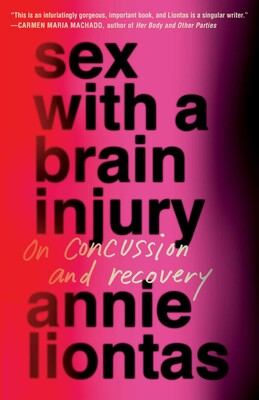
The most dangerous thing we can do—both on the page and in our daily lives—is to take a hard look at how we love, who we give ourselves to, who we are afraid to let in, and why. Any inquiry into the function of love is inherently destabilizing, not only because these relationships are often home, but because they are just as likely essential to our conceptualized self. Writers, take deep dives into the past, but most stay quiet about the present. No one wants to write about their spouse, partner, beloved/s: no one wants to jeopardize what they’ve got. In my memoir Sex with a Brain Injury, I examine my marriage after my wife and I have become strangers to one another, our future together unknown. I interviewed S about the bleakest time in our decades’ long relationship, and we gazed together at what remains. Then I handed S the interview transcript and a black Sharpie and told her she could cross out anything she didn’t want to appear in print. She crossed almost nothing out.
“Love is the whole thing,” says Rumi. “We are only pieces.”
So is love worth it? How do you know? Why do you stay? Is it about need? Sex? Is it February and the edges between you and winter have blurred, and what you want most is to come home to someone who can warm you? Are you simply repeating the patterns you were taught, unable to imagine a freer way of being?
Or maybe she really is your soulmate.
The seven writers below write honestly and openly about intimacy, desire, queerness, loneliness, annihilating marriages, enduring and contradictory love, and, of course, soulmates. Whatever your status, these books might make you feel a little less lonely.
Relationship Status: It’s Over But Only One of Us Knows It
The Bride is about to get married to a man who has “familiar, stale bones.” Then her dead grandmother shows up in the form of a parakeet (remarking on how asses like theirs never leave, not even in the afterlife) and starts making demands. “No one can imagine an ambivalent bride,” writes Bertino, at which point, much like the grandmother, she quickly begins to dismantle sacred ideas like marriage, tradition, patriarchy. The Bride says, “Have you ever missed someone so much that the missing gains form, becomes an extra thing welded to you, like a cumbersome limb you must carry?” When she asks this, she is not at all thinking about the groom. Bertino pushes us to consider, If we give ourselves fully to others, what does that leave us with? And how can we more fully give of ourselves? This is an unapologetic surrealist novel, darkly comic, wickedly sharp and full of heart. Wisdom in love, Bertino reminds us, is hard earned, unearthed, precious—like a diamond.
This epic love story, which spans from Portugal to the United States (and includes a cameo by Abraham Lincoln) is the antidote to gray skies and winter, and might make falling in love possible again. The novel follows John Alves, the son of a Presbyterian martyr, and Mary Freitas, who is thought to be the illegitimate daughter of royalty. Distance, family, religious differences, gambling, gossip, deceit, mean girls, magic berries. The world tries to keep the lovers apart, but John and Mary find one another time and time again—and then John is summoned to the war between the North and South. Vaz’s writing is as exquisite as warm pastel de nata, those Portuguese egg custards her characters are fed from infancy. The novel is reminiscent of Love in the Time of Cholera in its warmth and mystery, and its belief in epic love—which Vaz, herself, knows a thing or two about. In Above the Salt, Vaz makes the poet’s argument that love is inevitable, sublime and enduring.
The Days of Afrekete opens with a dinner party—mushroom tarts, characters no one would actually want to have to sit next to, a smiling hostess who isn’t feeling especially generous. In the narrative present, Liselle is married to a white lawyer and politician who is being indicted for corruption; at any moment, the FBI might arrive and break up the party. At its heart, Solomon’s novel—inspired by Mrs. Dalloway, Sula, and Audre Lorde’s Zami—follows the searing, tempestuous affair between Liselle and Selena, two young Black women who grew up in Philadelphia. Theirs is a complicated love, a buried love, but one that refuses to be forgotten. And yet Liselle tries very hard to forget (so hard, in fact, that we wonder if Liselle is the one who got away—from herself). The Days of Afrekete is a novel that celebrates queer blackness while interrogating the necessity/cost of choosing security and comfort over selfhood. Solomon is mischievous, sly at dialogue, the friend you go to for tea. A novel as sexy as it is heartbreaking.
This award-winning story collection is about queer desire and what gets in the way. Rainbow Rainbow is written from the perspective of outliers, lusty teens, hot breath, engendered embodiment, surviving the homophobic ’90s. It is fleshy, quaking, at times as startling as a sudden wave of attraction. In “Pink Knives,” a nonbinary narrator about to get top surgery begins an open-relationship affair during Covid and allows a stranger to remove their binder, something they denied their girlfriend. In “Ooh, the Suburbs,” Heidi pushes her friend to meet up with an older woman to play out her own complicated impulses. A group of friends flash cars from an overpass, someone secretly masturbates in class. In step with these nonbinary and trans characters, the reader senses there is always potential threat and implied trauma. Conklin, incisive and watchful, resists the convenient cultural narratives that flatten or homogenize the queer experience, and still celebrates queer joy.
I once asked Conklin, if Rainbow Rainbow were a bar, what would the vibe be?
They replied, “Funny and a little unhinged and fun. People dressed in strange bright outfits, kind of joking and laughing. But then in the corner someone would be silently crying.”
Halfway through Rien na va Plus, Karapanou writes, “Every time I want to write, I want to write love stories. But as soon as I pick up the pen I’m overcome by horror.” This is a genre-bending love story about marriage and narrative unreliability, told from two points of view: the self in darkness and the self in light. A man and woman marry, but it ends badly, in cruelty and infidelity. There are strange allegations, sharp words, troubling silences. The wife, Louisa—if that is even her name—tells her version of events in the first half of the book, relaying how controlling and devious her husband Alkiviadis is. Then she tells the story again, giving us an entirely different Alkiviadis, an entirely different her. The falsehoods mean Louisa gets to protect a small part of her freedom, even as she is bound to another. Karapanou, born in Athens in 1946 to the daughter of Greek novelist Margarita Liberak, saw herself as writing outside of national boundaries. Her first novel Kassandra and the Wolf was published during the Greek dictatorship between 1967 and 1974. Even—especially—when Karapanou is writing about intimacy, she is writing about escape, evasion, willingness, culpability. She has been compared to Marguerite Duras, Ingeborg Bachmann, Mary Gaitskill. The Greek novelist Amanda Michalopoulou says of Karapanou, If she had been American, everyone would know her.
Whenever I return to this perfect novel, I read it as a love letter.
Nell and Sula, two Black girls growing up in Bottom, Ohio, are best friends; as adults, they become estranged when Sula sleeps with Nell’s husband. But this story is not about men, it is about Black women’s desire and the intimacy possible when women refuse to be restrained by heteropatriarchy. Toni Morrison, in talking about her second novel, insists that “Female freedom always means sexual freedom…the only possible triumph is that of the imagination.” Nell, who comes from a quiet, confining home, ultimately rejects prescribed roles of matrimony and family; Sula, who is raised by a one-legged woman who it’s rumored let a train sever her leg to collect on insurance, won’t prescribe to Bottom’s rules about sex—but when she goes looking for love she realizes that she’s not going to find it in men. Sula, told to get married and have a baby, replies, “I don’t want to make somebody else. I want to make myself.”
Morrison’s language is sensual, smoldering—erotic for all of the possibility that exists between two Black women who refuse to play by unfair rules. The friendship between the two women is marked by “unspeakable restlessness and agitation,” with scenes of intimacy as provocative as an Alice Munro story. This is a novel that understands that Black queerness is about living authentically at the margins, on one’s own terms.
Sexy, dark, funny—everything you could want. No other poetry collection is as hot to the touch as Human Dark with Sugar. Shaughnessy’s celebrated second collection is addressed to the beloved. Restless, demanding attention, toying, longing, (“Oh, to be ready for it, unfucked, ever-fucked”), refusing to ask if you’ll stay but hoping you’ll still be here in the morning.
“To play without shame. To be a woman
who feels only the pleasure of being used
and who reanimates the user’s
anguished release in a land
for the future to relish, to buy
new tights for, to parade in fishboats.”
Titles like “I’ll go anywhere to Leave You But Come with Me,” “Replaceable Until You’re Not,” and “I’m Perfect at Feelings” tell us everything we need to know. And then, there’s “One Love Story, Eight Takes.”
“To see you again,” asks Shaughnessy—“isn’t love revision?”
Not very long ago, a description of our current moment would have read like a dystopian premise: a planet afflicted with deadly weather events, with rising oceans and global migration crises, with animal species rapidly going extinct, all while a rabid conservative movement flourishes worldwide, distorting facts and profiting off our downfall. Perhaps that is why, in these eight new dystopian novels (all published since last year), the dystopian setting is more or less our own—just nudged into a near future where our current perils have escalated, where the threats we already face can be seen and felt more clearly. This kind of near-future climate fiction (often called “cli-fi” for short) doesn’t read like much of traditional science fiction, with its vast conjectures about humanity’s future. Instead, the settings are based on solid science of where our planet is headed in the next few decades, allowing the writers to explore the human condition in this new and frightening world—a world becoming more familiar to us every year.
My upcoming novel, Plastic, takes place in the same future-present terrain. It is a world ravaged by climate change, beset with floods and hurricanes and wildfires, and also recovering from a recent nuclear war. Instead of human beings, however, this world is filled with plastic figurines, doll-like people with hinges and hollow bodies, polymer skin that leaks toxins in the brutal heat. Erin, the main character, is a reclusive figurine in her twenties, living under a fake last name so that no one will associate her with her older sister, Fiona, a famous ecoterrorist who vanished after bombing her college dorm. For Fiona, the stakes of climate change justify violent action, but Erin abhors violence and sees no hope for the world down that path. At the start of the novel, Erin feels little reason to hope in the future, but this will change when she falls in love with a blind figurine named Jacob, whom she must learn to trust with the traumas of her past.
Hope is a major theme for the novels on this list, a core value that their characters need in order to endure and fight the climate crisis, but difficult to maintain in the face of so many challenges. In some of these novels, a naive or misplaced hope leads the characters to undermine their best intentions; in others, hope is a north star that leads to epochal, world-saving change. Though a few of the titles feature activist groups that are cultic or self-deluded, the books never altogether abandon a hope in collective action, a belief that people working together can make a difference in the crisis. This “difference” might not be an immediate rescue of the planet, but rather preserving enough hope to keep on fighting for the future.
Set in a near-future Florida, this vivid, intimate novel shows several decades in the life of Wanda Lowe, a woman born while a disastrous hurricane bears down on her state. In the years that follow Wanda’s birth, Florida will be largely abandoned and then finally “closed” as a state, “as if it were a rundown theme park with a roller coaster that was no longer safe to ride.” Wanda, however, will remain in Florida, along with her friend and teacher Phyllis, finding ways to survive amid the beauty and danger of a landscape returning to wilderness. A book that shows our deep bonds to nature even in the midst of climate disaster, the novel centers its optimism in Wanda’s enduring links to her environment, which—as the title suggests—remain radiant and luminescent despite the crumbling of human infrastructures.
Stephen Markley spent ten years writing this kaleidoscopic novel, which approaches the climate crisis from a vast array of perspectives, ranging from scientists to ecoterrorists to everyday citizens watching their world collapse. At almost 900 pages, the book also provides an in-depth look at the science and politics behind the crisis, taking the reader on a journey of three decades, from 2013 into the 2040s. Many books on this list look at climate change through the lens of a single person or community, but The Deluge provides a wide-angle view of our current moment and the catastrophes on the horizon, even including future newspaper articles and government reports. Despite the global scope of the book, Markley also gives in-depth portraits of his large cast of characters (a highlight is the impassioned ecoactivist Kate Morris), investing us in their personal lives even as the waters flood in and the old world is swept away. Though Markley doesn’t shy away from the horrors of the crisis—just the opposite, in fact—the novel finds meaning and hope in the fight itself, the struggle to save civilization as it teeters on the brink.
This new novel by the brilliant C. Pam Zhang (author of the Booker-nominated How Much of These Hills Is Gold) tells the story of a talented chef in the near future, a world not only afflicted with climate change but also a planet-wide smog released by agricultural experiments. The chef (never named in the novel) flees her dystopian surroundings for a job at a utopia of sorts: a lush, privileged research facility in the Italian Alps, run by a wealthy capitalist and his geneticist daughter, Aida. Together he and Aida have created a secret biobank, a space to let nature flourish and research a new, sustainable future for the human species. This opulent setting seduces the chef, who is awakened to the pleasures of her body, allowed to bring her culinary dreams to life, and swept into a love affair with Aida. But as secrets in the compound begin to surface, as she cooks for the hypocritical rich, her new pleasures and privilege start to feel hollow, and she is drawn into deeper moral complications. With striking prose and sharply wrought characters, the novel asks crucial, complex questions in the midst of the climate crisis: What is the space for pleasure and the body as the world collapses around us? In what ways can we lose ourselves in the fight to save our planet?
Unlike other books on this list, which are set in the midst of the climate crisis, this novel begins sixteen years after “Day Zero,” the day the Earth’s carbon emissions reached zero. Though the climate crisis wreaked havoc on the world, a more hopeful civilization has emerged in its place, built on mutual aid and the outlawing of private corporations. The main character, Emi, is the teenage daughter of two heroes from “The Great Transition,” the name given to the epic struggle that saved their world in the last generation. Emi lives in a sunnier world than her parents at her age, but she still feels lonely and isolated, in part because her mother, Kristina, will not relax her vigilance and fears a backslide to the past. When Kristina goes missing after the assassination of a group of “climate criminals,” Emi and her father, Larch, head out on a search to find her, which in turn becomes a search to uncover Kristina’s secrets. The novel alternates between past and present, showing the struggles of the Transition and the difficult work of building a sustainable world in the aftermath.
The latest from National Book Award-winner Julia Glass, this sprawling novel is set in a small town on the coast of Massachusetts (the titular Vigil Harbor), an upper-class refuge from the turbulent America of the 2030s. Though the sea levels are rising, Vigil Harbor is built on a high headland that will let it survive centuries longer than many coastal communities. But there is trouble in this paradise, and the privileged residents will not be able to keep the outside world from intruding, whether through eco-terrorism, the arrival of mysterious strangers, or the piercing anxieties of their historical moment. With nine narrators and an intricate plot that includes dissolving marriages, long-hidden secrets, and a tsunami that threatens the Northeast, this ambitious novel takes a deeply human approach to the climate crisis, showing the hope, regret, and uncertainty of people living through unprecedented times.
A novel of linked short stories, How High We Go in the Dark is a powerful meditation on death, using climate disaster as a backdrop to contemplate loss on a global scale. In the melting ice of Siberia, scientists discover a Neanderthal corpse that contains a lethal virus, soon dubbed the “Arctic Plague.” The Plague, which attacks human organs, transforms life across the entire planet, causing mass death in every nation. (If this sounds like a very timely premise, it’s worth noting that many of these stories were written and published long before Covid.) Each story shows this death-stricken world through a different setting, and often with a surreal or hyperreal premise: an amusement park for terminally ill children, with a euthanizing roller coaster ride; robot pets that speak in the voices of lost loved ones; a pig, raised to donate his organs, who becomes sentient and learns to talk; an artist who makes ice sculptures from liquified remains. Though bleak at times, the novel finds hope in the deep love and connection possible in the experience of grief. Its vivid strangeness matches the strangeness of our own historical moment, when the planet itself is rapidly changing around us.
At seventeen, Willa Marks is abruptly orphaned when her survivalist parents commit suicide together. Uprooted from her home, she spends the next five years in a near-future Boston, rife with the escalating problems of climate change. Willa builds a life for herself in Boston—a cafe job; a relationship with an older Harvard professor, Sylvia Gill; a commitment to ecological causes, in part through her involvement with a “Freegans” group—but she abandons all this when, after a fight with Sylvia, she finds a guidebook that tells her about Camp Hope, a utopian compound on the Bahamian island of Eleutheria. Camp Hope, run by the charismatic leader Roy Adams, claims it is devoted to fighting climate change, to “living the solution,” but the reality Willa finds there is far more complex, the atmosphere cult-like. The situation complicates further when Roy disappears after a storm hits the island. Despite the dire realities around her, Willa continues to strive for her ideals, even when she’s let down by the flawed human beings who embody them.
This hilarious (yet dark) satire takes a wildly original approach to the climate crisis, using a fantasy premise to address the all-too-real threat of global warming. As with many cli-fi novels, the book is set in the near future, but this time the protagonist is Sir Kay, an immortal Knight of the Round Table. Whenever the “realm” is in great peril, Sir Kay is brought back from the dead; he has fought to defeat both Napoleon and Hitler. But now he faces his most baffling adversary: the ecological collapse of Britain and the greed and political impasse that fuel the catastrophe. Not only must he go against a corrupt system, but also a resurrected King Arthur planning to “Make Britain Great Again.” With the help of Mariam, a young activist, Sir Kay must fight a different kind of battle for the future—though he still might need Excalibur to triumph. Despite the playful premise, the novel looks with serious gravity at the climate crisis, and gestures toward a hopeful future through the power of collective action.
DON’T MISS OUT
Sign up for our newsletter to get submission announcements and stay on top of our best work.
YOUR INBOX IS LIT
Enjoy strange, diverting work from The Commuter on Mondays, absorbing fiction from Recommended Reading on Wednesdays, and a roundup of our best work of the week on Fridays. Personalize your subscription preferences here.