Animals are all around us; as I write this, stinkbugs are crawling on my office window, squirrels are busy in the white pines and poplar trees, and (though I can’t see them) deer and bobcats are roaming not far away. Culture usually trains us to draw sharp lines between ourselves and all other species. We also differentiate those species we choose to live with (cats, dogs, chickens) from those we term “wild.”
But I’m fascinated by the places where those categories break down. Are the mice who intrude on my cupboards wild? Is my cat wild when he hunts a songbird? Are the songbirds becoming domesticated if I feed them suet? What about the microorganisms that make up much of our body mass?
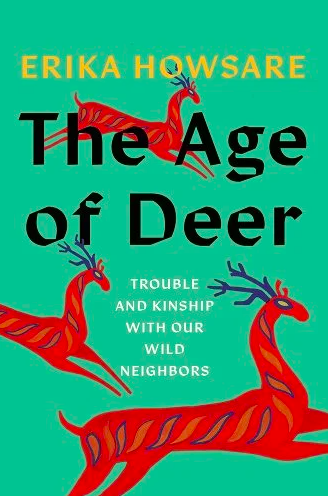
Writing my book, The Age of Deer, was a deep dive into those kinds of questions, prompted by the long and tangled history humans share with deer. We’ve influenced each other so profoundly—ecologically, biologically, culturally—that the more I researched our relationship, the more the conventional lines of division between us began to seem blurry at best. Here are eight other books that examine the interconnections among humans and some of the species—or “nations,” as they’re sometimes called—with whom we share the Earth.
Centered on the Olympic Peninsula, Vap’s recursive, questing book-length poem charts a radical porousness between people and whales, salmon, microorganisms: all the species that are part of our world, that influence us and are influenced (and devastated) by us. But the dissolving boundaries in this book also include those between Vap and her children and husband—the “family animal,” in her phrase, a collective organism that sleeps, eats, nurses, plays, shares thought and speech, seeps in and out of the language of the writing. The project took years to write and contains many layers of personal history and political response, but it constantly circles back to the image of a mother who is as vulnerable to the beloved interruptions of her young sons as she is to the horrors of climate change, extinction and war. The body here becomes a hinge between human and animal existence, a reminder of our inescapable (and why would we want to?) creaturehood.
Animal life is not the overt focus of this book, but in and amongst Mathieu’s explorations of history, family, and her work as a pediatrician, wildlife is a quiet and frequent presence, inviting itself into the human world. Thrush, an infection of the mouth, is also a bird that “lands on the windowsill” and becomes woven into a complex imagistic fabric. Deer tracks are the epicenter of “a kind of country… we drew.” Mathieu’s poetry finds slippages between body and landscape, brain and culture, and locates moments when the domesticated world collides with the feral (a moth, having strayed into a kitchen, cut down by a snapped dishtowel) and those when the human is drawn forward and outward by the more-than-human: “confused animal I am,” she writes, comparing herself to “the small miracle of organization” represented by a flock of geese.
Birds in this book are messengers carrying mystical resonances, like the ruby-throated hummingbird who hovers in front of Williams as she kneels on the ground, grieving a friend. Or the owl who appears, seeming to warn her, as she follows a dangerous man into the wilderness, against her own better judgment. Her world is vibrant and full of signs, and she possesses deep recall of many moments from across her life, like a sunrise she watched with her grandmother in the Uinta Mountains of Utah, when they witnessed a golden eagle silence the dawn chorus of songbirds and grab a mouse. “Voice” here means authentic speech, speaking up or out, and birds are Williams’ guides through a life in art, activism, and family.
Technically, this is an academic work of anthropology. From the first, though, it reads like a poem— fitting, since it brings forth the elegant, living body of literature created by Yaqui people in Arizona and Sonora. Yaqui deer dancers perform in order to invoke another world, the sea ania or flower world, from which deer emerge: mythic figures and key providers for humans. But it’s not as simple as calling forth the deer. The dances and music enter and honor the deer’s own perspective: the dancers wear antlers and imitate the movements of deer, while the lyrics are often cast in the deer’s voice. “With a cluster of flowers in my antlers, I walk.” A native Yaqui speaker and a white academic co-authored the book in 1987; they fill it with images, translations and anecdotes, like a personal tour of the Yaqui world.
From her small house in rural Colorado, the Chickasaw poet Hogan charts a way of listening and co-habiting with wild animals that is often revelatory in its simple lack of dominance. Instead of spraying wasps who nest in her bedroom, she opens the window for them every morning so they can go in and out. “Not being a person… with insect hatred,” she demonstrates that animosity and fear of the wild are choices, just as easy not to harbor. In a lilting, dreamy voice, through the Yaqui deer dances and Hogan’s ties to horses and burros, this book of mostly essays explores the enchantment that brings humans into receptivity toward many species’ intelligence—ants, elk, wolves—“all citizens here.”
Through linked essays, Lanham becomes our guide to the landscape of his South Carolina childhood, where his forebears were farmers and pillars of Black community life. Birds and other wildlife captured Lanham’s attention early; he longed to fly, tempted vultures by playing dead, and gradually realized that his religious feelings were more centered on the outdoors than on church. As an adult, he became a birder and a professor of wildlife ecology—a rarity in both largely white realms. He expands our notion of who belongs in the outdoors and who loves wild places: “I also think about how other Black and Brown folks think about land,” he writes. He’s at his most convincing when he describes becoming a deer hunter, fully and consciously involved in the life and death dance of the land he loves.
Budiansky, a science writer and former Nature editor, makes a case here that domestication of animal species is not a process of enslavement but simply part of evolution. Both parties benefitted, he argues, when humans began to offer food, shelter and protection for species that in turn provided meat, milk, hides and labor. He traces the long, gradual process by which “loose associations” become codified, often hinging on the trait called neoteny — a tendency to retain some juvenile characteristics even in adulthood. Both domesticated animals and humans display neoteny, and collectively it has served our numbers very well: the total biomass of land species on Earth is becoming more and more weighted toward people and the animals we control. “Wild,” then, is a contested and precarious category.
An academic and hunter, Stange investigates a string of questions animated by the presence of the female hunter—who, she points out, is not only a modern phenomenon: in hunter-gatherer societies, women have routinely killed small animals as part of what gets labeled “gathering.” Why does anyone hunt in the modern world? What can hunting tell us about the human presence on earth, and whether “wildness,” as we’ve imagined it, really exists? When the hunter is a woman, Stange argues, she awakens fertile contradictions lying deep beneath our culture: Artemis, for example, is both a death-dealer and a protector, a patron of animals who also embodies the fact that, in Stange’s words, “life feeds on life.”
Emily Raboteau’s essay collection Lessons for Survival: Mothering Against “The Apocalypse”opens in 2011, with the author on her way to a baby shower for her first child. While passing through Times Square, she spots a sign announcing that the world will end on her baby’s due date. She laughs it off, but as her son and his little brother grow up, finds that the sign wasn’t entirely wrong. From the rise of white Christian nationalism and fascism, to a global pandemic that disproportionately killed Black Americans, to increasingly frequent climate catastrophes, Raboteau finds herself a loving mother, engaged citizen, and a compassionate, thoughtful human being in the midst of a set of nested crises, each seemingly insurmountable, with roots deep in American history that have long gone unexamined. Spiritually channeling James Baldwin in his seminal essay on police violence in Harlem, “A Report from Occupied Territory,” Raboteau asked, “What to do?”
This book is her answer: turn to her community for help.
Over the course of 20 essays, each accompanied by photographs she took, Raboteau looks at different ways concerned global citizens are responding to the crises that face us, all of which are undergirded by climate collapse. Like a blanket for a new child, Raboteau’s book quilts together their wisdom. Many pieces stay close to home, as Raboteau travels by foot through various neighborhoods in New York City (most often Harlem, where she and her husband, novelist Victor LaValle, lived for many years), profiling people trying to affect change on a local level. Some are topical, diaries of the months before the pandemic, or reflecting on specific days, like May 25, 2020, when bird watcher Christian Cooper was threatened by a white woman in Central Park because his Blackness frightened her, and, later, George Floyd was murdered by a police officer in Minneapolis. And in one tour-de-force of narrative reporting, Raboteau recounts a 2016 visit to the West Bank of Palestine, where she witnesses virulent Islamophobia and colonialism that today fuels the decimation of Gaza by the Israeli Defense Force.
Rarely have I read a book that speaks so vitally to our current moment, which illustrates how entrenched these social and environmental crises are. I spoke to Raboteau about parenting, resilience, and the emotional journey she took while writing Lessons for Survival.
Brian Gresko: Sometimes when the news gets too awful, I find it negatively impacts my ability to write, so I choose to disengage for a couple of days for the sake of my work. It feels like in Lessons for Survival you’ve done the opposite. I’m curious to know about your emotional journey while composing this book, and what you did to protect yourself from spiraling down while writing. (Or, if such spirals happened, how you moved through them.)
Emily Raboteau: I’m not sure I’ve done the opposite as you, Brian! Choosing to disengage from the news cycle for the sake of your work is choosing engagement of another kind–deep thought instead of reactionary panic. What is apocalyptic thinking, really? The word “Apocalypse” comes from the Greek apokálypsis “uncovering.” My friend, the writer Ayana Mathis, just reminded me of this. It doesn’t actually mean the end of the world. I wish to see things as they are, with the scales wiped from my eyes.
For me, writing these essays, most of which focus on resilience, was a way to engage with others and to keep from doomscrolling or spiraling downward, as you put it. For example, I responded to the news cycle in 2019 by keeping a kind of climate diary that gathered expressions by dozens of people in my social network about how they were experiencing climate change in their bodies and local habitats. I did that because climate scientist Katherine Hayhoe said that one of the most important things we can do to combat the climate emergency is to talk about it widely among family and friends. I feel less despairing and alone when I can study large-scale problems, and possible solutions, in community. Writing is one way of doing that.
That said, while I was editing this book, my therapist prescribed watching fun TV for the sake of my mental health. I watched Love on the Spectrum, an incredibly heartwarming show. I recommend it!
BG: I’m glad you mentioned that essay-as-diary, “It Was Already Tomorrow.” I love how it gives us a taste of your joyously busy social calendar through the year, but there was one small moment that especially stayed with me: when your then eight-year-old asks you to “rummage through my head and take out the fire thoughts and eat them” before bed. This was so sweet, that you held his anxieties in your belly. Can you talk about how you address the climate crisis with your sons, as a mother? And how that’s changed and developed as they’ve aged, and you’ve engaged more directly with the topic via writing these essays?
ER: That was the bedtime ritual for a while. He would name all his fears and ask me to eat them one by one, and I would pantomime doing so. I was his grief eater. We have to be careful about how much grief we consume, don’t you think? A diet like that can make us sick. But I also wanted to validate my kid’s fears and let him know that he didn’t have to carry them alone.
This is how I address climate change with him and his brother, too. By diverting them from the fallacy that they can fight it by themselves. We now know that the idea of the individual carbon footprint, that is, how much we are each contributing to the problem as a way of pushing us to change individual behaviors (drive less, don’t have kids, fly less, recycle, etc..) was a marketing scheme cooked up by British Petroleum. Why? To deflect responsibility from the fossil fuel industry by tricking us into thinking it’s we who need to change. The only way we can take this fight on is in community with others, on local and global scales. So I talk to my kids about what is going on in the community to fight climate change and environmental justice.
For example, in our neighborhood in the Bronx, they are in the process of daylighting (unburying) a stream as an act of climate mitigation. I try to bring the climate emergency down to Earth and out of the realm of cosmic dread. And I talk to them about historical resilience. How we come from a historically resilient community that has survived existential threats before. As they get older, I want them to know more about careers in sustainability, though the paths they will walk are their own to choose. Ours is described as the last generation who can turn things around. Their generation—Alpha—they are inheriting a terrible burden. I think a lot about intergenerational justice; about what we owe them. I’m curious, because you’re such a thoughtful parent yourself, how are you thinking through this?
BG: A lot of this resonates with me as a parent. My son is almost fifteen. His room is verdant with houseplants, terrariums, aquariums. He loves life and science. He’s also a technophile, and he believes that while things are going to get real bad, ultimately technology will allow us to survive, that ingenious humanity will find a way. I appreciate his optimism but I don’t trust capitalism or corporations, especially big tech. Have you experienced anything similar with your boys?
ER: I’d like to hang out in your son’s room. It sounds amazing. Our kids are somewhat younger than yours. They’ll turn eleven and thirteen this spring. We’ve not yet gotten into disagreements or debates about best practices moving forward, like degrowth. Maybe that will come, when they’re truly teenagers, like yours, with strong opinions of their own. Or maybe they’ll want to join task forces, like the Sunrise Movement or Fridays for Future. Who knows. Right now they’re into playing video-games.
We do try to inculcate values, like experiences and relationships matter more than stuff. It helps me to know I’m not the only one educating them, and I hope that solutions-oriented curriculum about the climate crisis will become a bigger and bigger part of their education in middle school, high school, and college. The Ecopsychepedia is a good resource I turn to for current research and thinking on how psychological factors drive the climate crisis, how the worsening crisis affects us psychologically, and what we can do about it. And I’m encouraged by the two New York State climate education bills afoot that would mandate K-12 climate education. I’m also gaining a lot of insight about parenting in these times from Anya Kamenetz’s thoughtful newsletter, The Golden Hour.
BG: This talk of parenting makes me think of Lessons in Survival’s subtitle: “Mothering Against ‘The Apocalypse.’” What does the word mother mean to you and why did you choose to use it in this context?
The only way we can take this fight on is in community with others, on local and global scales.
ER: I’m aligned here with feminist thinkers like Gloria Steinem and Alexis Pauline Gumbs who use “mother” not as a noun, but as a verb. Mothering can be a revolutionary stance on the power of nurture and empathy—an ethics of care. People sometimes forget that when Julia Ward Howe invented Mother’s Day in 1870, it was supposed to be a day of unity for peace and opposition to war. It was about coming together to combat violence. It wasn’t about Hallmark cards and roses. It was in recognition, as Steinem puts it, that “when mother is a verb–as in to mother, to be mothered–then the best of human possibilities come into our imaginations. To mother is to care about the welfare of another person as much as one’s own.” Even if we aren’t biological mothers, we may be mothering.
BG: The essay “Mother of All Good Things,” where you report on the Israeli occupation of Palestine on its fiftieth anniversary, in 2017, is an incredible piece of journalism and artistry. You write that just as W. E. B. DuBois said “the problem of the twentieth century was the problem of the color line, I’d heard it said the problem of the twenty-first century was the question of Palestine.” This hit me differently now, as the occupation and total destruction of Gaza continues unabated, then it would have a few months ago. Can you tell me the circumstances that led to that piece, and also update it for us?
ER: The Question of Palestine, with a hat tip to Edward Said. I was solicited by married writers Ayelet Waldman and Michael Chabon to write that essay for an anthology called The Kingdom of Olives and Ash (along with a lot of other international writers including Anita Desai, Hari Kunzru, Helon Habila, Porochista Khakpour, Eimear McBride, Raja Shehadeh) to examine the human cost of the occupation. It was a partnership with the Israeli NGO Breaking the Silence—a radically humane organization made up of former Israeli soldiers who served in the occupied territories, witnessed firsthand the injustice there, and conscientiously objected to it, often at a high cost.
I wrote specifically about inequitable water and electricity use in one part of the West Bank. I visited with Palestinian shepherds trying to stay on their land. I wasn’t in Gaza. I was in the South Hebron Hills. It was my first explicit piece of environmental writing, and it was about the abuse of power. I am still in touch with many of the folks I profiled in that piece. They say that the settler violence has grown much worse since I was there, and it feels like the world doesn’t care. They’re praying for a ceasefire, yet feeling despair. I’ve been thinking a lot since this war broke out about the words of Lama Hourani, a community activist I met in Ramallah: “Does the US really care about Jewish self-determination? No. They wanted an ally for resources. Their main interest is energy. The main energy is in the Gulf. All of us are suffering because of that.”
I hope this essay gives readers some context about the violence that led up to October 7.
BG: The ways in which water and access to water has been weaponized by the Israeli government rooted that essay into the collection, as so many of the pieces have water on the mind, from rising seawater to hurricanes and floods, and the ancient pond that hides in plain sight in front of your house, returning to swamp the sidewalk whenever it rains. How did you settle on topics for these pieces? They each stand alone and yet speak to one another, with recurring themes and characters, like songs on an album.
ER: Water is one of the book’s leitmotifs. I don’t know. I think I just followed my curiosity. I looked as hard as I could at the places where something was wrong, to understand how it got that way, systemically. You mentioned the pond in the street in front of my house in the Bronx, for example. It’s an eyesore and it’s surely bad for resale value. But why is it there in the first place, and why doesn’t it go away? Well, it turns out I live on backfilled wetlands, and that pond is only one of many ponds in my area, which also floods, in places. It’s the water remembering where it wants to be. And why is flooding of this kind more common in Black and brown neighborhoods like mine, that were historically red-lined? Because plundered peoples are made to live in plundered places.
Mothering can be a revolutionary stance on the power of nurture and empathy—an ethics of care.
I’m glad you feel that the book hangs together like an album, with refrains. There are a lot of visual refrains and echoes. I’m a street photographer as well as a writer and I included over a hundred photos in the book. The majority of these images are of public artworks that reflect on social and environmental issues. As with the pond, I had to ask, what’s that mural doing there? What is it saying? Who made it? Who was it meant for and why?
BG: Can we return to the word resilience? What did you learn about resilience in the process of writing it, and profiling people like Luz, who, after Hurricane Sandy destroyed her home, now lives as a climate migrant in an RV?
ER: Luz, in particular, has taught me a lot about resilience. I credit her for wiping scales from my eyes in terms of the merits of disaster preparedness. One of the essays profiles her story. She didn’t own her home in Staten Island. It was a rental in her brother’s name. She lost everything she owned to that hurricane. So there was no way she could get government funds to “build it back better.” Luz was forced by circumstance to radically change her life, to critique consumer-culture, to downsize. She now lives much more sustainably and happily in an RV. I’m interested in learning from people like Luz, and from frontline and fenceline communities, who have a lot to teach us about survival, and what Anya Kamenetz would call “post-traumatic growth,” even though they’re seldom treated as environmental experts. If we come from a stance of thinking of economics as the chief measure of human welfare, we are missing out on a more wealthy understanding of resilience. Setting aside financial resilience, what does it mean to be spiritually resilient, emotionally resilient? What resources and reserves of strength does it take to make it through calamity?
Are you familiar with the gospel song, “How I Got Over”? Mahalia Jackson recorded it. So did Aretha Franklin. “My soul look back and wonder, how I got over…” I interviewed a lot of survivors in this book about how they got over. I also asked people what they do with their anger.
BG: What do you do with your anger? And how do you nurture hope?
ER: For a long time I internalized it and experienced it as depression. An elder I talked to in Alakanuk, Alaska, a real ground zero of climate collapse, told me that the best thing to do with our anger is to take care of other people. That resonated with me in a deep way, as a mother. As for nurturing hope, this may sound too simple, but the purest practice I’ve found is to garden. To nurture life with my hands in the soil, and be nurtured in return.
Nina Lazris met her husband in the week between arriving in Buenos Aires and discovering the book that punched holes in her personal history. Besides that, she did little of note. She unpacked her bags, set up a writing space in her newly rented apartment, took long walks in the summer heat. She worked, though less than she should have, on the dissertation she had flown halfway across the globe to save. She spent too much money on fancy prepared foods before realizing she’d miscalculated the exchange rate. It didn’t matter—Nina had resources to fall back on—but she tried to live within her grad-student means. It was part of being a serious person, which she worked hard at. Before she stumbled on Guerra Eterna, it was arguably the project of her adult life.
Nina wasn’t positive her presence in Argentina qualified as serious. It was neither fully stipend-funded nor fully planned. In fairness to herself, she could only have planned so much. She’d come to Buenos Aires to study the protest movement arising from the suspicious death of special prosecutor Alberto Nisman, and he’d barely been dead three weeks. Hard to blame herself for not organizing her trip while he was still alive.
If somebody had told Nina a month earlier that she’d be spending her spring semester here, she would have laughed in their face. She had never been to Latin America before. Never traveled alone. Never imagined that, four and a half years into her doctorate, she’d wrench the scope of her dissertation open, shifting from social-media-driven dissent in the United States to social-media-driven dissent in the Americas. Of course, if that same clairvoyant person had added that she’d be making a chaotic last-ditch effort to rescue her dissertation—and with it her poor, shredded belief that she belonged in academia—she would have retracted her laughter. Fine, she would have said. Great. Cross your fingers it works.
She crossed her fingers at her sides now, waiting at the light on Avenida Santa Fe, the main commercial strip in her new neighborhood. Chic girls buzzed past in their giant earrings, hip-length hair flickering in the breeze. Sun bounced off the polished hoods of taxis, glared from bus windows, turned the street itself into a lake of glossy tar. The air smelled like hot asphalt mixed with warm fruit, dog shit, and the pleasant burnt-wood scent that wafted constantly from the pizzeria across Santa Fe. Nina had tried it two nights ago: not awful, but also not good.
She was en route to coffee with Ilán Radzietsky, a graduate of her program who now taught at the Universidad de Buenos Aires. Nina was working on a Ph.D. in communications, but instead of getting funding from her department, she got it from her university’s Center for Media and Social Impact, which adopted a doctoral student every few years. Ilán had been its first. Now he was a rising academic star who researched multilinguistic online identity formation.
Nina wished she knew what type of coffee this would be: semiprofessional? Full professional? Casual but platonic? Or would it be one of those first dates recognizable only in retrospect? She had no reason to even imagine the latter. Her stubborn hope that it would be a pre-date pointed, probably, to her fundamental unseriousness. She’d never met Ilán in person. One of her bosses had introduced them, which led to a flurry of emails, and then Ilán invited her to a welcome-to-the-country coffee. All very ordinary. Nina was thinking in date-or-not-date terms only because (1) she hadn’t had a nontransactional conversation, barring phone calls with her dad, since she landed in Buenos Aires five days ago, (2) she hadn’t had sex since Thanksgiving, and (3) Ilán was hot. In the headshot on his departmental profile page, he glowed like some kind of Modern Orthodox sex prince in his yarmulke and open collar. His mussed curls practically lifted from her laptop screen. His smile was crooked, his skin perfect. Since Google Imaging him, Nina had devoted far too much time to sexual and marital fantasies in which he was the star.
A block from the Facultad de Ciencias Sociales, Nina paused to lift her hair from her sweating neck. She checked her reflection in the plate-glass window of a store that seemed to sell only compressive underwear: girdles, control panties, distressing Velcro-sided bras. She reminded herself that, even if she was not a serious person, she was gifted at small talk, proficient in Spanish, and neither as dumb nor as ill-prepared as she felt. She had read every scrap of Nisman news since he died on January 18. She had educated herself on his eleven-year investigation into the 1994 car bombing of the Asociación Mutual Israelita Argentina, or AMIA, Buenos Aires’s biggest Jewish community center; she’d read his allegations that the sitting president, Cristina Fernández de Kirchner, had concealed Iran’s involvement in the attack. Not even a week after he levied his accusations, he was discovered dead in his bathroom. Online, it had seemed to Nina that all of Argentina was in an uproar. Now that she was here, she couldn’t gauge how many people cared.
She could ask Ilán. In a normal way, not a help-me-my-dissertation-is-dying way. She did not plan to tell him that if her research failed here like it had been failing in D.C., she would quit academia. She would be confident. Not socially starved. Not a freak. She would not ask insensitive or ignorant questions. If she flirted, she would do it subtly. She smoothed her hair, tugged her skirt straight, and texted Ilán that she was close.
In her two weeks of feverish predeparture planning, Nina had imagined herself working in the Facultad library. Looking at the building, she had doubts. It was old and mildly crumbling, with a tiny brown garden, a drooping Argentine flag, and air conditioners dripping from every third window. An engraved stone over the door confirmed that it really was part of the Universidad de Buenos Aires, not a run-down office block. Neon-green flyers wheat-pasted to its walls declared TODOS SOMOS NISMAN; matching hot-pink ones demanded ¡JUSTICIA YA! Beneath them, long black streaks of spray paint declared the pope a fascist and Cristina Kirchner a traitor and suggested that both go suck dicks. Nina was idly considering Cristina’s facial flexibility—she’d plainly had both Botox and a face-lift; could she open her mouth wide enough to admit a penis?—when the Facultad’s iron-barred door swung open and Ilán appeared.
He was, unfortunately, even hotter in person. Significantly hotter. Nina wished she hadn’t just been contemplating oral sex. His shoulders were broad, his prayer-fringed hips narrow. The fringes themselves were somehow seductive—flickering little banners of religiousness, reminding Nina that he was almost certainly off limits. His sleeves were rolled to the elbows, revealing hairy forearms and delicate hands.
“Nina?” he called.
She waved and banished all sexual thoughts, though she did permit herself to appreciate how good he smelled when he kissed her cheek hello. A standard greeting here, but she’d assumed—ignorantly, she guessed—that an Orthodox Jew would skip it. She hadn’t been prepared.
In English, he said, “I have a very serious question to ask.”
“Already?”
He grinned. “You said your apartment is on Azcuénaga, right?”
“Right.”
“Have you been to Rapanui?”
Rapanui was the ice cream place on Nina’s corner. Every time she walked by, cold, sugary air rolled over her, heavy with the smell of caramel or baking sugar cones. She’d vaguely planned to take herself there for academic rewards: first set of research aims written, first interview completed, first real idea.
“Not yet,” she said.
Ilán looked extremely pleased. “Would you like to fix that?”
“Fix?”
“You’ll see.”
He led her down Azcuénaga, past the frightening underwear store, two parking garages, a Subway, a delicious-smelling Lebanese restaurant. Drum-machine cumbia poured from car windows. Persimmons, at the fruit stand, were DE OFERTA; Nina would have to remember to come back. She hadn’t had a persimmon since her best friend, Hazel, moved from California, where they were abundant, to New York.
“Are you liking the neighborhood?” Ilán asked.
“I like it a lot. The buildings are pretty, there’s great people-watching, it’s easy to get groceries, I’m near public transit. What else do I need?”
Ilán shrugged. “There’s not much nightlife. A couple good bars, but no clubs.”
“I can handle that,” Nina said, with a spike of self-consciousness. “Not so much of a club girl.” She’d read online that Buenos Aires was a major clubbing city, but she liked drinking and talking, not drugs and dancing. Besides, who would she go clubbing with? Her seventy-five-year-old landlady? Herself?
“Same,” Ilán said. “I live a couple blocks over there.” He waved his arm loosely toward the Facultad. “Which means I should be ashamed that I had to meet you at work to bully myself into going there.”
Nina laughed. “It’s summer.”
“Exactly. Time to write.”
She wondered if he was performing laziness—a favorite pastime of grad students; presumably young professors did it, too—or if he legitimately had a slacker streak.
She wondered if he was performing laziness—a favorite pastime of grad students; presumably young professors did it, too—or if he legitimately had a slacker streak. She hoped it was the second. It seemed consistent with the ice cream excitement, somehow. “Writing is overrated,” she said lightly.
“My daughter tells me that every day.”
Disappointment shot down Nina’s spine. She willed herself to ignore it. Ilán carried himself like a younger man, but, per her Googling, he was thirty-nine to her twenty-eight. She should have predicted that he’d have a kid. “How old is she?”
“She turned five last month. She’s very proud of it.” Ilán had almost no accent in English, but, Nina noticed now, he hissed the fin of, holding the letter a second too long. Nina knew she had equivalent tells in Spanish: letters she stretched, diphthongs she shortened. Her r-rolling was unreliable, though her dad had drilled her throughout her childhood, rewarding her with Klondike bars when she cleared the great hurdle of “ferrocarril.”
She tried to conjure up a good question to ask about five-year-olds. People liked talking about their kids, she knew, but what did they like to say? The only parent in Nina’s life was her dad. She had no siblings, no cousins on either side, so her family was baby-free. Her friends were all childless. None of them even had dogs.
“Did she have a birthday party?” she tried.
“She wanted to have a fancy dinner instead. We called it Restaurant Party.”
Nina smiled. “I like that.”
“She’s a likeable kid. An odd one.” Ilán’s tone told Nina he was prouder of the second trait than the first, which she found charming. Before she could ask, he launched into a description of his daughter’s ideas and habits: she was obsessed with dolphins and all dolphin-related content, which manifested, in part, as avid Miami Dolphins fandom; she’d struck up an imaginary friendship with Lady Gaga; she thought monsters lived in her closet, but she welcomed them and loaned them toys; she had only recently learned to separate English, Spanish, and Hebrew, all of which Ilán spoke to her at home, and was delighted with herself when she successfully communicated in one unmixed tongue.
Nina whistled. “Trilingual parenting. I knew you did research in a lot of languages, but still, that’s hardcore.”
“Or crazy.”
She waved his self-deprecation off. A small corner of her mind suggested she ask why Hebrew: religion or Zionism? But if he was a Zionist, she didn’t want to know. “Impressive,” she said. “My dad raised me bilingual, and that was tricky enough.”
Down the block, two silky women slipped into a building that Nina had realized yesterday was a plastic surgery clinic. A taxi honked at a jaywalking girl in palm-sized shorts. She swanned serenely onward, as if the noise were tribute, not rebuke. Over the horn’s ongoing blare, Ilán asked, “English and what other language?”
“Spanish. I didn’t tell you I speak it?”
“You did.” His mouth spread into a smile. “But when I lived in D.C., I met a lot of Americans who”—he clawed his fingers into scare quotes—“‘spoke Spanish.’”
Nina laughed. “I know the type. Memorized every verb in AP Spanish but can’t carry on a conversation.”
“Exactly.”
“I’m terrified of people thinking that’s me,” she admitted. “Sometimes I pretend not to know Spanish to avoid giving the wrong impression. But I do speak it, I swear. I wouldn’t call myself fluent, but I’m probably as close as a nonnative speaker can get.”
“Is your dad a native speaker?”
Nina hesitated. She half-regretted bringing her dad up. On the one hand, she and her father were extremely close, and she missed him. Talking about him at length would be nice. On the other, parent talk was unsexy. If she wanted to begin flirting with Ilán, she should steer the conversation swiftly elsewhere.
She felt she had grounds for flirting. Ilán’s elbow was extremely close to her bare arm, and his energy was not what she’d call professional. It was too bad he had a child. He was ringless and hadn’t mentioned a wife, but she still had to accept the high odds he was married. Also, he wore fringes and a yarmulke, which indicated a sincere belief that God could see the top of his head. God would not like to glance down and spot a married Orthodox man, or even a single one, flirting with an ultra-Reform agnostic.
Nina looked briefly upward, checking in. A window air conditioner chose that moment to drip directly onto her forehead. She took the oily water as a sign that God was indeed watching, and would like Nina to desexualize herself to Their servant. “He’s not,” she said, wiping her face, “but he lived in Chile till he was sixteen, so he went to school mainly in Spanish. He always spoke English at home, but he claims he couldn’t read or write it well till college.” She shrugged. “Anyway, he believes in bilingualism. He says Americans only speaking English is rude.”
Ilán made no comment on her dad’s language politics. Instead, he asked, “Have you been?”
“To Chile?”
He nodded.
“I haven’t.”
“It’s an easy trip from here. An hour flight, maybe.” He left the suggestion unspoken, but Nina could fill in the blank. She knew she should go. She also knew she wouldn’t. She wanted to—she’d wanted to visit Chile since she was old enough to know it was real—but it would be cruel to her dad. Bad enough, for him, that she’d come to the country next door.
Rapanui gleamed at the corner. Its windows were wide open, and Nina could hear pop reggaeton streaming from inside. She pointed down the block before Ilán could ask follow-up questions. “See the building with the iron balconies?” she said. “That’s mine.”
Ilán squinted at it. “Who are you living with?”
“Myself.”
She’d gotten exceptionally lucky with her rental. For $200 a month less than she was getting from her subletter in D.C., she’d landed a gorgeous, fully furnished apartment whose owner, a sculptor named Paula Valenzuela, had temporarily moved to a suburb called San Isidro to keep her daughter company through her divorce. Nina had Googled Paula’s work: her sculptures looked like Henry Moore’s, but smaller and sexier. She was very, very good. Nina wondered if she were famous enough that mentioning her would qualify as name-dropping. Always hard to tell with art.
Ilán refused to let Nina pay for her ice cream, which was unspeakably delicious. It was artisanal and somehow Patagonian, and stretched like taffy between bowl and spoon. Nina took four Lactaid pills to eat her single scoop of dulce de leche. The caramel was rich and faintly bitter, as if it had been cooked to the edge of burnt. She forced herself to savor each bite, though what she wanted to do was shove her head into her paper dish like a horse eating oats from its trough.
Their table was inside the shop, but adjacent to a wide-open window. Warm air blew in from the street, tempering the air conditioning’s chill. Behind them, a long display counter sold handmade chocolates. Blown-up photos of wild berry bushes hung by the register. Nina considered breaking her lease and moving in here, or quitting her Ph.D. and apprenticing herself to these ice cream makers, who were clearly geniuses.
“This ice cream,” she informed Ilán, “deserves the Nobel Prize.”
“Good, right?” He licked chocolate from his spoon. “When they opened, Rebeca was a baby. My ex and I brought her so often, we thought her first word would be ‘helado.’”
Nina took a too-big bite of dulce de leche, willing it to glue her mouth shut. She could not visibly or audibly react to the news that Ilán had—she presumed—an ex-wife. She wondered if he’d mentioned the ex on purpose, to alert her to his singleness. She hoped so. She hoped, too, that the ex was no longer relevant. With luck, she’d swiftly remarried and exited the scene like Nina’s mom, who’d waited six months post-divorce, then moved to Napa and married a winemaker named Todd. He exploited migrant labor and never wore socks, but, after a full quarter century, she still seemed to love him enough.
He exploited migrant labor and never wore socks, but, after a full quarter century, she still seemed to love him enough.
Once Nina had swallowed and settled, she asked, “What was her actual first word?”
“‘Gaga.’”
“I think that’s baby talk.”
“So did I. But her second word was ‘lady.’”
Maybe he was gay. A divorced Orthodox Jew whose child had been fixated on Lady Gaga since birth? It would make sense. Nina sat back in her clear plastic chair and considered Ilán’s disheveled curls, his movie-star eyelashes, his kempt stubble. He didn’t seem gay, but the whole idea of seeming gay was bullshit, and why else would a woman divorce a man this hot?
Nina gouged a clot of frozen caramel from her ice cream. She hadn’t mentioned her dissertation. In no way had she demonstrated that she was a serious person. She didn’t especially want to start now. Ilán was easy to talk to, easy to relax around. Nina wasn’t sure she could motivate herself to work at seriousness, or expose her academic insecurities. She wanted to have a nice time.
She and Ilán sat at their little table long after their ice creams, and the espressos that followed, were gone. He was full of ideas for leisure-time activities: museums to visit, neighborhoods to wander, restaurants to eat in, books to read. Nina tried, and failed, to resist being charmed by the associative depth of his suggestions. An indie film set in Montevideo reminded him of a book called Guerra Eterna, written by a Uruguayan Jew who was, basically, Elena Ferrante before Ferrante herself was, that Nina had to read: it was a classic, and, speaking of, if she wanted to read classic Uruguayan writers, she should seek out the Eduardo Galeano books published by Siglo XXI Press, which had a gorgeous office-bookstore in Palermo Soho—not, incidentally, his favorite neighborhood (too trendy), but it did have terrific bookstores, and if she wanted to shop for clothes or find a good yoga studio, it was, without a doubt, the place to go.
After recommendations, they moved on to academic gossip. Ilán was extremely willing to make fun of Thijs Kuiper, Nina’s adviser, whom she’d gotten stuck with after her first adviser went to teach at NYU. Kuiper was not affiliated with the Center for Media and Social Impact, nor was he interested in either of those things. He was Nina’s enemy. He rejected her core belief in connection. Nina, influenced by the French philosopher Simone Weil, felt that the true purpose of studying was to learn to pay real, sustained attention to others. Kuiper felt that it was to win tenure and publish in prestigious journals. He thought scholars should be aloof and dispassionate and not have Twitter accounts. Nina thought he was a Luddite, a misogynist, and a Grinch. One of her major reasons for continuing in her program was that quitting would please him too much. She fully intended to spite-graduate, she said, which was true, and also made Ilán laugh.
To stem aggravating thoughts of Kuiper, she asked how Ilán had liked D.C. He and Nina, it turned out, shared a favorite bar: the Red Derby, which was two doors down from her apartment. While discussing the District’s restaurants, he pried from her the knowledge that she couldn’t cook beyond eggs and pasta, and demanded that she come over for dinner before she got scurvy. She couldn’t quite gauge the nature of the invite, but the mere thought of entering his apartment sent a prickle of heat down her spine.
On her half-block walk home, she told herself to hope Ilán was gay. She felt in her bones that he was not, but also that, if he was straight, she could get herself into big trouble. Heartbreak trouble or, worse, step-maternal trouble. Already, she was imagining ways she might charm Rebeca. Contrary to parental stereotype, Ilán hadn’t shown Nina a single photo. She wondered if they looked alike.
In her building’s echoing staircase, Nina tried to remember herself at five. She remembered loving, in descending order, her dad, Scottie Pippen, and God, who she thought lived in trees. In playgrounds and parks, she’d shove her face into knotholes and root balls, braced to stare the God of her ancestors down. Eventually, she got poison oak on her forehead and renounced her search and, with it, her theological interests. She never lost interest in either her father or Scottie, though.
She wondered if her religious sureness had been a kid thing, or if it was her personality. Until her Ph.D., she had always been highly confident. She still felt that confidence operating below the surface of her mind, but her three failed case studies, combined with Kuiper’s scorn for her project, had done major damage. Once, Nina had been positive that studying social media’s political potential was her calling. Her purpose. She’d had all kinds of lofty ideals about the public benefits of researching internet dissent. Now she worried that her entire academic life was an excuse to dick around on Twitter instead of doing real nine-to-five work.
On the plane here, plunging through the dark sky over Brazil, Nina had promised herself that this was it. She was in the fifth year of her Ph.D., and now she was on her fifth possible dissertation subject. Already she had tried and failed to study Occupy Wall Street, which proved too diffuse; the opposition to the Keystone XL pipeline, which wasn’t sufficiently online; Black Lives Matter, which she’d decided it was not her place to research; and a newly formed Jewish anti-Zionist group headquartered in D.C. and on Twitter, which had been perfect until it abruptly unformed. Not Nina’s fault, but she took it as a bad sign. A cosmic alert that her work was misguided. If the Nisman protests failed to cohere into the movement she predicted and hoped for, she would take the universe’s advice. She’d admit that she was not a serious scholar, that her whole research agenda was baseless bullshit. She’d pack up and go home— and not home to D.C. either, but to Chicago. She’d admit defeat. She’d get a job.
Nina woke, on her first Friday in Buenos Aires, to a text from Ilán. He’d enjoyed spending the afternoon with her, and he’d meant that dinner invitation. Would she like to come over Tuesday? And if so, did she eat meat?
I eat everything, she replied. Briefly, she considered a winking emoji, but thought better. Instead, playing it safe, she asked, What can I bring? Dessert? Wine?Then she screenshotted the exchange, texted it to Hazel—Date or not date??—and pried herself from bed, leaving her phone behind. She would, she decided, do one full hour of work before checking for Ilán’s response.
Ilán proved to be a slow but consistent texter, which meant that Nina, adhering to her one-hour rule all day, was highly productive. She parked herself at her desk and devoted the morning to indexing internet theories surrounding Nisman’s death. In the afternoon, she messaged demonstration organizers to request interviews, then created a list of relevant slogans and hashtags. She tweeted several Nisman-related news stories to prove baseline engagement. She had yet to recapture the whole-body research enthusiasm that had brought her here, but she did feel good.
In the early evening, she quit working and took a beer onto the balcony. The sky was silky and blue, filled with criss-crossing wires and moonlike satellite dishes. Ash trees shook their green branches, stirred by pigeons and passing cars. It occurred to her that, except for her frantic week of work in Chicago, today was the closest she had come in years to the life she’d imagined for herself when she set out to be an academic. Ordinarily, her work-at-home days revolved around guilt, chores, and her vibrator; library days, guilt, Google, and snacks. She had fallen into a bad rut. Maybe coming here had snapped her free.
The next day, she worked till lunchtime, then walked to the used-book market on Avenida Corrientes. The selection was dizzying: art books, plastic-wrapped Penguin paperbacks, spooky biblical tracts, spooky sex manuals, medical sex manuals, woo-woo sex manuals, tarot guides, academic journals, encyclopedias, fancy Nobel-winning fiction, weird small-press fiction, the works. She bought a Henry Moore exhibition catalog as a hostess gift for Paula, who’d invited her to lunch in San Isidro the next day; a first-edition Spanish Valley of the Dollsfor Hazel, who worked in the art department at Simon & Schuster and would love the Creamsicle-orange cover; and half the books Ilán had recommended at Rapanui, all of which she’d noted on her phone. She had to take a snack break halfway down the street, which led to a major discovery: in addition to containing the world’s best ice cream, the city of Buenos Aires was home to the perfect grilled ham-and-cheese. Her sandwich was impossibly thin and crispy, with perfectly salty ham and the exact right amount of mozzarella to pull between bread and teeth without making a mess. She wanted to eat seven more. She hoped Argentine pharmacies sold Lactaid. At this rate, she was going to run out by March.
Nina left Avenida Corrientes content, dehydrated, and weighed down by books. Within days, she would see her walk home as a time of hilarious innocence. She’d had no idea that Guerra Eternawould be any more important to her than the six other books jammed in her New Yorkertote bag. As far as she was concerned, Guerra Eternawas relevant to her life because Ilán had told her it was good; relevant, in other words, because discussing it with him could help demonstrate she was a serious and intellectually engaged person worthy to audition for the role of his temporary girlfriend.
Nina understood that, to a thirty-nine-year-old tenure-track professor with a kindergartner, a six-month relationship might be too trivial to appeal. She understood, too, that it was unfair to hope for. It was not good—was probably objectifying, or tokenizing, or some other bad-ing—to want Ilán to be her tour guide and short-term boyfriend. It was an immature hope, a study-abroad hope. Nina disliked herself for it, and yet.
Months later, she’d admit to Ilán that she had initially wanted to date him for practice. She hadn’t had a real boyfriend since college. She’d thought she could learn adult romance, then take her new expertise back to the U.S., where, presumably, some childless, American, age-appropriate version of Ilán would await. She’d thought her fantasies about marrying him, compelling though they might have been, were just manifestations of a crush.
Walking home, books swinging at her sides, she permitted herself one such fantasy. Beach ceremony, barefoot, very small. Maybe she’d even be pregnant. Nina would love to be pregnant at her wedding. She’d always wanted kids. A whole pack of them, ideally. Her whole life, she’d wished for a bigger family than her little Lazris unit. Growing up, she’d begged for a sister, though she would have gladly accepted a brother had one been offered. Even now, she occasionally imagined her dad falling in love with some younger woman and having a late-in-life baby. Her dad, who hadn’t been on a date since he met her mother in 1983.
Nina wished she could somehow spy on her parents’ courtship. Her mom, Wendy, was perfectly fine—Nina had no bad feelings toward her; she visited her in Napa before the start of every academic year—but strenuously boring. She had the inner and outer smoothness of a morning-show host. It was impossible to picture her attending an anti-Pinochet rally or caring who Pinochet was. Maybe Nina’s dad had found it calming to be with a woman whose concerns didn’t extend past herself. All he ever said about his brief marriage was that it had been ill-advised on both his part and Wendy’s but, because it led to Nina, he was grateful for it every day.
She needed to check on her father. Make sure he wasn’t too lonely. Really, she should email Nico, both to let him know her dad needed some extra support and to invite him to visit Buenos Aires. She’d love to see him. It had been—four years? Five? Too long.
When Nina was a kid, Nico came to Chicago every summer. He brought gifts, planned day trips, hauled them across the city to eat Indian dinners on Devon Avenue, pancake breakfasts at Ann Sather’s, pierogies in the Polish Triangle. He was Nina’s namesake, fake uncle, and role model. He was the only person alive who could reliably make her dad laugh.
Nina often asked Nico for help taking care of her dad. In high school, when she decided she needed to know Andrés’s full story, she bypassed her father completely. She feared asking him to remember. Instead, she called Nico, who explained how Andrés had died, then described him when he was alive. He helped Nina imagine Andrés not as a martyr but as her dad’s wiseass friend. Most importantly, he showed Nina that her dad felt as if he’d been living the wrong life since Andrés had gotten disappeared in 1973, and that she, Nina, did not have to feel the same way. She could love her dad without imitating him. She could know her family’s, and her country’s, past without beating herself up for what she had not personally done.
Only once, in college, had Nina deviated from Nico’s no-self-flagellation doctrine. In her guilt over leaving her dad alone at home, she’d launched herself into researching Cold War–era dictatorships in the Southern Cone, with a special focus on Pinochet. She took every available Latin American history class, did two independent studies, then proposed an honors thesis. Her adviser, a sweet, bearded man named Doug Cope, supported the idea but wanted her to do original research in Chile. He was happy to help set it up, even to wrangle departmental funding. Nina balked. Later, she mocked herself for the whole plan. Studying Chilean history could not possibly have given her more access to her dad’s grief than twenty years as his only child had.
She was approaching the Palacio de Aguas Corrientes, which she’d seen on travel blogs but not yet in real life. It had been, at one time, the world’s most ornate waterworks. Now it was, if she remembered correctly, an archive, and a gorgeous one, all turrets and arabesques, high golden windows and rosy, power-washed bricks. Jacarandas shed purple blossoms on the lawn. A lone balloon bobbed from the fence. The building’s beauty returned Nina to herself. She should have been concentrating on her very lovely and completely unfamiliar surroundings, not rehashing her lifelong worries about her dad. He was, after all, a grown man. Shielding him from his emotions was not Nina’s job.
She admired the water palace a moment longer, reminding herself how lucky she was. Lucky to be here; lucky to love her dad so much, even if it brought complication; lucky to have Nico to help sort that complication out. Luckier than she knew to have met Ilán, and to have Guerra Eternabiding its time at her side. No book would ever be more important to her. In the decades of their marriage, she’d often tell Ilán that no person would ever be more important than him, but she always hoped she was lying. She never gave up believing that her sister could someday matter most.
Here are seven slim collections that do good work!
Kitchen Curse by Eka Kurniawan, translated by Annie Tucker, Benedict Anderson, Maggie Tiojakin and Tiffany Tsao
A ripe and rank collection, full of unspeakable excretions. Ruder and cruder than Beauty Is a Wound, these stories dare you to turn away in disgust, but always go to unexpected, revelatory places.
Lucky Breaks by Yevgenia Belorusets, translated by Eugene Ostashevsky
Sharp and dissonant stories that give voice to women from Ukraine’s Donbas region, whose daily lives and jobs have been upended by war. Belorusets elevates, in her own words, the “insignificant and the small, the accidental, the superfluous, the repressed” in her writing—things that avoid capture by the dominant historical narrative.
A collection of tales, philosophical inquiries, and nighttime ruminations from the Cairo-born, Berlin-based writer that reflect on the meaning of sleep—a potentially subversive activity, El-Wardany suggests, under the twin scourges of authoritarian government and 24/7 capitalism.
Thick City’s visceral, interconnected vignettes introduce us to a host of characters caught up in various entanglements and estrangements, absurd and weird and tender and sometimes gruesome, amounting to a queer city-symphony in miniature.
These voice-driven pieces, which depict an Antiguan childhood full of enveloping mystery, pain, and beauty, burrow deep into the subconscious. Kincaid’s singular style commingles the plainspoken with the rhetorical, the dream and spirit with the corporeal.
A compendium of both banal and horrific anecdotes concerning social life in post-war Austria, rendered in a deadpan, just-the-facts journalistic burlesque. For a brilliant contemporary riff on this book, check out Gabriel Blackwell’s Correction, which lays bare the American predicament with ruthless precision.
An awesome anthology (spanning 1923–1961) of the author’s dreams, offered without analysis or explanation, written with frightening intimacy and a wonderfully detached style.
I’ve always been fascinated by vampire tales, but for all the wrong reasons. Vampire stories are typically allegories about sex and suppressed desires. This is all well and good, and this angle has certainly had its moment in the sun (no pun intended). But I’ve always loved when vampires were used as a literary tool to probe relationships—specifically, relationships among family members.
The bonds of familial love are incredibly strong, much like the bond between a vampire and its maker. Family relationships can also become parasitic, like a vampire and its chosen human prey. I decided to make this the focus of my horror duology, Night’s EdgeandFirst Light, the story of a young girl whose mother gets infected with a vampiric illness.
As I was writing these grounded novels of toxic love and bloody sacrifice, I was scouring the internet for vampire books that also explored themes about family. There weren’t a lot of them, but the ones I did find are all incredibly unique, moving, and a must read for any horror fan looking to expand their vampiric palate.
This remarkable book, one of my favorites of 2023, uses vampire horror to lens deeply personal themes like postpartum depression, motherhood, living with a disability, and antisemitism. It’s a wild ride that touches on a lot of different concepts but remains character-driven and intimate throughout. Its main characters, Ana and Reid, are new parents who have recently won the New York City housing lottery and move into a stunning high-rise uptown. Little do they know that the fraying bonds holding their little family together are about to be tested in ways they can never imagine when they meet their very wealthy—and very old—bloodthirsty neighbors. When their baby daughter starts acting strangely and getting sick, Ana is the only one who thinks it’s an emergency. By the time her husband starts to believe her, it’s too late. I love what this book says about parenthood and all the ways we cannot predict what our children are meant to become. A modern classic for sure.
This book was written in 1995 for young adults, but somehow I missed it back then despite being its target audience. I only heard of it recently, and I think it’s one of those rare books that candidly explores the abusive lure of the mythic vampire and how he chooses his victims. In this book, a lonely teenage girl named Cynda goes to live with her father, his new wife, and their young son in Maine, where they own a charming bed and breakfast. Her new stepmother treats her more like a servant than a member of the family, and she feels misunderstood and neglected. But when an alluring new guest named Vincent checks into the hotel, all of that changes. Vincent is (as I’m sure you’ve predicted) not entirely human. And he’s got his sights set on sweet, lonely Cynda. A dark, secret crush quickly turns violent and terrifying, and Cynda has nowhere to turn because she’s distanced herself from her loved ones so much. Nobody believes her. Like any experienced abuser, Vincent has successfully isolated her from her family. When Vincent starts drinking from Cynda’s little brother too, she knows she has to take action and get this parasite out of their home at all costs. The writing is a little thin and juvenile, but it’s for teens so take that with a grain of salt. It’s an important work of YA horror that should be a prerequisite before any young reader is allowed to pick up Twilight.
This is a fantastic, gruesome jewel box of a novella that just came out in December of 2023. I read it over the course of 24 hours and it was one of those books that made me furious because I had to get up and do stupid stuff like eat and go to work and take a shower. In this world, a dystopian rural community lives and dies by the laws of their vampire “gods.” They sacrifice their children to their supreme leaders and rat each other out for trying to dodge the inevitable. None of them have ever known another way of life. When the story begins, a man named Walter is the last human alive in his community. We come to discover that he abandoned his daughter in the woods many years ago and left her as a sacrifice to the gods. But his daughter wasn’t consumed. She was turned. And all she wants is to be with her father again. She’s determined to lure Walter out of his house so they can be together. She’s still a little girl and has a hold on Walter’s tortured soul. But he knows what she’s become and what the consequences might be for submitting to her. This is a gorgeous, devastating, pitch-dark tale about how much it hurts to ignore the needs of our children if we know they will abuse our trust and do something monstrous. I couldn’t put it down.
I know you don’t need me to tell you about this book. It’s hugely popular, for a good reason. And it definitely qualifies as a complicated vampire family drama. For those who don’t know, the story revolves around Dracula’s first bride, Constanta, and the family/polycule he creates. There are deep familial bonds among the characters, but Dracula rules with an iron fist. This is toxic love at its most deadly. The immortal Constanta, Magdalena, and Alexi are all trapped in an eternal cycle of abuse with their maker. And because of what they are, they fear turning to the outside world for help. If they don’t stand up to their maker, they’ll be trapped under his thumb forever. It’s sexy and smart and queer and gorgeously written. Sure, it’s romance. But it’s got incredible substance and a resonant message.
This qualifies as a vampire family drama due to its lack of family and all the pain that causes our characters. It’s a sleek, modern noir that takes place in a fictional Mexico City that’s got a serious underground bloodsucker problem. Atl is descended from an ancient race of vampires who were once worshipped by the Aztecs, but her entire family has been murdered by a rival coven. She’s an orphan and she doesn’t know who she is without her close-knit immortal clan. She bonds with an orphaned teenage boy named Domingo, who offers his blood to help keep her alive. Both of them are living on the fringes and depend upon each other to survive. They’re not used to trusting others. And Atl is still reeling from the loss of all her loved ones. But found family is what it’s all about, and the two of them go on a dark, whirlwind adventure together, dodging villains both human and supernatural. It’s a really unique twist on the lone wolf vampire trope. Everyone needs someone to lean on—even a deadly, ancient princess.
My last two picks are not explicitly vampire books. But they do explore what it’s like to have a beloved family member with an uncontrollable taste for human flesh and blood. Both of them utilize traditional vampire tropes to incredible dramatic effect, and I think they deserve to be mentioned here.
The Book Eaters takes place in a complex and wholly unique fantasy world in which a secret society of people have survived for thousands of years by (literally) ingesting books. When a young woman gives birth to a baby who would rather consume human brains instead, she’s forced to make a series of dangerous, life-altering decisions that threaten to expose her world and the only family she’s ever known. It’s a creepy, tense, inventive tale about motherhood that asks us how far we will go to save our children from themselves. Devon, the young mother, lures unsuspecting victims to her home so that her son can consume the human flesh he requires. The world believes her child is dangerous—and while that may be true, he is also completely innocent. He didn’t ask for this. It’s a chilling, memorable dark fantasy that shares some common ground with vampire classic Let the Right One In.
Again, this is not explicitly a vampire book. This is about a monster made from grief, brought to life by his devastated mother’s pain. A couple named Magos and Joseph lose their young son Santiago to a tragic illness. After his death, Magos hears an old folktale that says if she keeps a piece of him and feeds it every day, it will grow into something that might fill her void. She keeps a sliver of his diseased lung, feeds it daily, and soon discovers that it’s growing into a sentient being with a ravenous, carnivorous appetite. The lung becomes a monster, who becomes a boy. And the bloodlust remains. He cannot outrun what he is. And as the years go by, his parents cover for his violence toward animals and, occasionally, human beings. Monstrilio, or “M,” is another character who cannot help his true nature and is completely innocent. His family must keep his secret and keep him satiated… or fall back into that abyss of grief and despair. My favorite, rather gruesome part of the book is when M grows up and starts meeting men on dating apps, and at one point he tells a potential match that he likes to bite. Hard. It’s a chilling moment as the reader realizes that this strange little boy has grown into a dangerous yet naïve adult. His parents will no longer be able to protect him. And in fact, we dare to wonder if they even should.
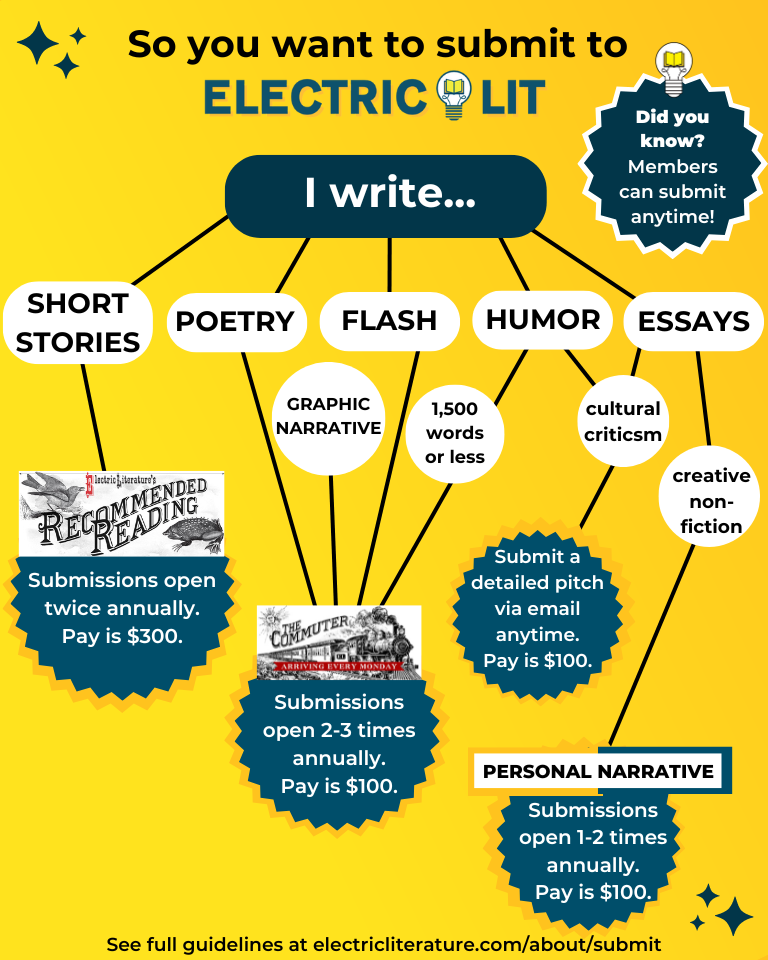
We’re thrilled to announce that Electric Literature is opening for submissions across all categories on Monday, April 1st. This includes our acclaimed literary magazines, Recommended Reading, and The Commuter, as well as the daily site. Below we’ve posted our handy flow chart to help you find the best fit for your writing. Get your submissions ready now, because the window will only be open for two weeks, or until each category hits its cap of 750 submissions. Good luck, and we’re excited to read your work! –Denne Michele Norris, Editor-in-Chief
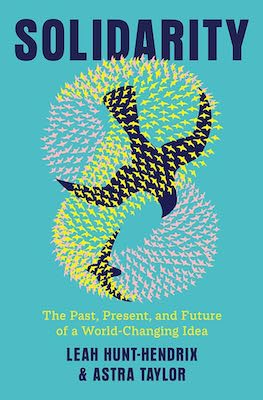
“Impediments to unity are so common and copious,” write Leah Hunt-Hendrix and Astra Taylor, “they appear as an ordinary, even intractable, aspect of life.” But for the authors of the new book Solidarity: The Past, Present, and Future of a World-Changing Idea, division is not some spontaneous or natural thing. Rather, it requires the strategic and sustained pitting of one group against another. Or, as they see it, the division and animosity that defines our political and social landscape is a product of the active effort to sabotage solidarity.
The central mission of their bookis to find a way to overcome division by cultivating its opposite: solidarity. To do so, the authors look to the past, finding there a rich history of seeing solidarity as a political reflection of our absolute dependence on one another. They also look to the history of social movements to offer readers examples of moments when people from all walks of life have built power together. These examples are important because Hunt-Hendrix and Taylor do not want to overcome divisiveness simply for its own sake, nor do they want anything to do with erasing the differences among us. Rather, they believe that solidarity—the type that respects and retains our differences—can transform society. Their book leaves readers with a real sense that solidarity is the only way out of the mess we’re in. As they write, “Either solidarity forever or our time is up.”
We spoke by Zoom about the history of solidarity, how the right uses “reactionary solidarity” to divide people, how we can counter it, and whom they hope to reach with their book.
Lynne Feeley: You say in the introduction that we’ve entered a “new period of instability and change” and that “we sit at a moment of significant opportunity and threat.” I was wondering if you could say a bit about how you see solidarity as an answer to the threat and opportunity of the moment.
Leah Hunt-Hendrix: There are a number of reasons. On a really macro level, we’re writing this in the midst of feeling like neoliberalism is coming to a crisis point. Both of us started our activism work during the period of financialization, the global justice movement, Occupy Wall Street, economic inequality. So it feels like we’re at a moment of paradigm shift, and either it could become worse, or we could enter a new paradigm that is more just and equitable. The neoliberal era was created—we have the power to create the economic systems that we live in. So what is the intellectual history that we need to create new paradigms? If neoliberalism is really grounded in a concept of freedom and the individual—good things—but went to an extreme, can we bring back the idea of solidarity as we think about a next economic paradigm? So that’s like a macro level.
Then on a more visceral, current political level, obviously we are in the midst of a crisis of democracy, with the election of Trump once and maybe twice. We’ve been thinking about the crisis of democracy as a crisis of solidarity. We let ourselves get so fractured, and we’ve succumbed to these “divide and conquer” tactics and politics—it might mean the end of the American democratic experiment. So can we survive those forces of division by identifying and resisting them?
Then a third piece—even more micro—is on the left itself. The left itself has, since the 1800s and 1900s, always been caught up in sectarianism. We’ve seen that today, too. How do we, as progressives, think about our own coalition? How can we work together to create change and not let ourselves be divided from each other?
Astra Taylor: And how do we not let ourselves be divided without adopting a simplistic idea of unity, which is something we really belabor in the book. We’re not after unity for its own sake.
How can we work together to create change and not let ourselves be divided from each other?
—Leah Hunt-Hendrix
I think moments of breakdown can be moments of breakthrough, and it’s telling that right now, we speak of crises, or poly-crises, or intersecting crises, and nobody blinks an eye. But Leah and I take seriously the threats that are put upon us. We take seriously the threat of climate change. We take seriously the threat of intensifying white supremacy. We take seriously the threat of authoritarianism. But we’re also pretty adamant in the book that a kind of centrist liberalism won’t get us out of the mess we’re in and that you do need to have a kind of robust, progressive politics counter to that. And I think you build that progressive politics by speaking to people’s actual experiences of the crises, experiences of oppression, and turning that into solidarity.
So, that’s where it’s a moment of peril, but it’s a moment of possibility because through the alchemy that is organizing, we can turn a lot of this terrible shit into power for ordinary people.
LF: One of the things you are both making me think about is the point you make about solidarity having to be cultivated. On the one hand, you write about solidarity being a reflection of an inherent interdependence. Yet, on the other hand, you write about solidarity having to be actively cultivated through organizing. This duality is in relation to another duality, which you trace in the book, between cohesion and upheaval.
AT: There’s a strong tradition of thinking of solidarity as social cohesion. But we’re also very invested in and inspired by the vision and the fighting spirit of solidarity that you see all through the labor movement. So solidarity, in our definition, isn’t just about cohesion and keeping things how they are. It is very much about transformation. That’s why we felt compelled to name the kind of solidarity we’re after “transformative solidarity.”
As organizers, I think what we aim to do is to create that conflict and upheaval, that transformative energy to bring about a new consensus, a new cohesion. We don’t want to be debating whether trans people are people, or whether we should have a habitable environment. We just want that to be the new common sense, and then the process can go from there. So I think cohesion and upheaval for us are not at odds. They’re part of the inherent process of societal evolution.
LF: Could you define the difference between reactionary versus transformative solidarity? I do think the key intervention of the book is this idea that just as solidarity must be cultivated, division also has to be cultivated and mobilized and maintained and reinvented over again. So I was wondering if you could tell us a bit about reactionary solidarity, how you see it, how it’s different from transformative solidarity.
LHH: I think there is a notion that solidarity can just be sort of mundane and neutral. But on the other side of that, we see reactionary solidarity as exclusionary and really pitting outsiders against insiders to solidify the “we.” You just see that constantly in politics. Often there’s an external enemy—like China or Russia—but often it can be internal: immigrants, people of color.
We see transformative solidarity as an alternative to that. It’s like deciding that we have something in common, that we have a common fate, a need for each other, and deciding to stick together to overcome whatever obstacles are in the way. There is still a polarization, but it’s a much broader sense of the “we.” I think Occupy is a good example of the 99% versus the 1%. 99% of us have a lot in common, and the only people we don’t have a lot in common with are the people who are dividing us for their own profit and for their own benefit. But even they will benefit from a society where there is a stronger social safety net.
So transformative solidarity doesn’t say that these people are enemies that must be demolished or annihilated. It asks: how can we improve conditions for everyone, even the 1%, who right now have to build fortresses around themselves and have private security to fend off the pitchforks? I think the difference between reactive and transformative solidarity is, in part, how we relate to the concept of the other or the outside.
AT: Transformative solidarity is bridging out and trying to build a more inclusive “we” but with the aim of also changing the social structures. We are also channeling that fighting spirit of solidarity that you see historically in the labor movement. Reactionary solidarity is based more on a politics of scarcity and is more about splintering the coalition. But it offers people a real sense of belonging.
Through the alchemy that is organizing, we can turn a lot of this terrible shit into power for ordinary people.
—Astra Taylor
I’m tempted to say that in transformative solidarity, identity is a doorway, and in reactionary solidarity, identity is a destination. Reactionary solidarity is a white, male, working class that does not want to share its gains or a hyper-aggressive nationalism. We did wrestle a lot with where identity fits into all of this. Solidarity is not identity, but I think identity is often the portal through which we have or do not have solidarity with other people and groups. It’s something we couldn’t ignore because it’s so fundamental, but the question of whether it’s a doorway or a destination is key.
LF: I was really interested in the genre and intended audience of the book. I noticed that, in my reading, it moves around various rhetorical modes or even different kinds of study. We’ve been talking about the intellectual history piece, the social movement history, there’s some personal narrative there in how you came to the project and your work in different movements. There’s also organizer strategy. Could you talk a bit about how you were able to fold all of these approaches into the book, or why you did so?
AT: We genuinely wrestled with the theme and were learning as we wrote. We had to figure out: what do we think about solidarity? What is the intellectual schema that we’re going to use? And so, for me, one of my mottos as a writer is to take the reader along on that journey of discovery. And the book kind of does that–it is a document of our investigation and our learning.
I think the mix of different registers and voices is an attempt to hold the reader. Because if it’s all just dry intellectual history we’re gonna only reach a very select audience. And there’s a very select audience for a “how to organize” strategy guide–and Leah and I know those people very well, they’re our comrades, we organize with them. But wouldn’t it be neat to get some liberals reading an “how to organize” guide, who might otherwise never pick that up?
I think the personal elements are important because, as we say in the introduction, solidarity is always invested. It’s not an abstract concept. It’s messy, it’s rooted, it takes a stand, it’s positional. It felt like we had to name our positions and where we’re coming from.
Every writer wants to reach readers, but I think we really do want to put solidarity on the American agenda, as something that’s critical to getting us out of these intersecting crises but also as something that can be institutionalized. When we say we’d love to see someone running on a solidarity state platform, we mean it. Let’s create solidarist policy feedback loops instead of ones that demean and demoralize and divide people. We want to see these ideas taken up and not just put into practice but put into power structures.
LF: It seems like the book is really interested in moments where this almost happened–or these glimmers of the solidarity state. These moments seem to be seeded in the book as moments of real promise and possibility that can be recovered now as examples that we might take a lot from and model on. I’m thinking of, for example, the Community Action Programs and the Black Panthers, the National Welfare Rights Organization, and the citizens’ assemblies on abortion in Ireland.
AT: “Glimmers” is a really good word to describe them. How do you tell the stories of things that broke through but then were shut down? The assemblies in Ireland are ongoing, and I think are a really positive, interesting example of creating forums where citizens can debate across difference and create new kinds of alliances and new space to find common ground. So I find that example really interesting and engaging.
In terms of the Citizen Action Programs, the minute I heard about them, I was like what? The U.S. government was funding, at scale, these organizing initiatives as part of its War on Poverty? In fact, as its premier program. It’s such an interesting example of how the state can create space for citizen engagement and the kind of transformative solidarity we’re talking about. Transformative solidarity on both levels: holding space for people to start organizing but also enabling those folks to then pressure the state to create change.
Transformative solidarity is bridging out and trying to build a more inclusive ‘we’ but with the aim of also changing the social structures.
—Astra Taylor
One thing that we discussed was that we didn’t want all of the examples to be from Sweden and Finland and other Nordic democracies. It was really important to us that we really scoured American history because we don’t believe that it’s impossible here. We think it’s totally possible. The problem is there’s far more investment at the level of the state in reactionary solidarity and division. We wanted to hew close to American examples not out of parochialism but because Americans are so quick to be like, “Well, nothing good can happen here.”
LHH: We are interested in asking, how do we think of each other as citizens and agents and protagonists, and what policies would support that mindset? We can think of mundane things like Vista and AmeriCorp, where there’s much, much more demand to participate in these programs than there is money for them or positions in these programs. Imagine if we had a service program where, instead of going to the army, you did community service or a WPA-like program, working on trails and climate-related things. The state could fund these things, which could be productive, could be good for the economy, good for society, and also could create a feedback loop of educating each other about the different communities that make up America and our different responsibilities to each other.
AT: As imperfect and flawed as they are, and even though they’re factories of student debt, which I now spend my life fighting, public universities are kind of that, right? That’s part of why we’re seeing an intense attack on universities (especially since the war on Gaza started) and this insistence from the right that what universities are doing is dividing people by bringing up issues of race and diversity and equity and inclusion. They’re like, “Why are people going to these schools and turning out liberal?” Because that’s actually where young folks get out of their bubbles, are introduced to new ideas, encounter difference—and it is, imperfectly, state subsidized. So you see a little tiny thing that could be a critical building block of the solidarity state. And the right wing is going after it. I think we are of the position that it’s really important to protect what we have and build on it instead of acting like you could just create utopia ex nihilo. We have to protect what we have and gain new ground.
The Bible and fairytales are the oldest stories we have in the West. They serve as our culture’s myths, providing a familiar, guided path for centuries of writers.
Retellings can breathe a new life into what was once flat and staid. Characters from the Bible and fairytales can feel one-dimensional. With retellings, the writer has the opportunity to transform a pre-renaissance painting into a high-definition, digital photograph for the modern era. These writers want readers to feel a gnawing familiarity, something deep inside saying, “I know where this is heading,” before they’re surprised with a new interpretation. Retellings also allow room for writing detailed settings as well as including better causality concerning plot. Retellings insert key “what ifs,” changing the protagonist’s gender, age, race, or nationality, all the while making the point that the human condition is timeless and transcends circumstance.
I describe my novel, Daughter of a Promise, as a retelling. It draws from an ancient text, the Book of Samuel, and feels perfect for this moment, as we’re riding a cultural wave of recontextualized myths and legends that bring once muted voices to the fore. Think Hadestown, Circe, The Book of V.
More than a retelling, I’ve decided my book is “talking back.” Contrast that with genteel novels “in conversation” with a historical text, Daughter of a Promise’s point of view shift demands recognition. The legend of David and Bathsheba beckoned me in its brevity, its male perspective, its neglect of Bathsheba’s thoughts and feelings. It was practically waiting for a future writer to come along and fill in the gaps. To retell a foundational text may sound like heady stuff, but it gives the writing process an added dimension of fun. The rigor of adhering to critical plot points, while putting the spotlight on Bathsheba made the writing meaningful.
Despite the contemporary setting and revised point of view, these 7 novels based on the Bible that prove love, passion, and jealousy will always be universal.
The Book of Ruth won the 1989 Pen/Hemingway Award for best first novel. Set in the small town of Honey Creek, Illinois, Ruth is a young woman who has never left her rural environment. She experiences difficult family situations including a tense relationship with her mother May and an abusive marriage with her husband Ruby.
The novel borrows its title directly from a book in the Bible, however, is not a retelling in the strictest sense of the word. In the Bible, Ruth marries into a different tribe and instead of returning to her own people after the death of her husband, she stays with her mother-in-law. The novel expands on important themes in the original text including loyalty and family dynamics, struggles and overcoming adversity, as well as journey and redemption.
Weaving three story lines together, the novel follows 3 women across 300 years: Lily is living in 2016 Brooklyn and struggling with reconciling her role as wife and mother with her sexual desires and intellectual ambitions. Vivian is a senator’s wife in ‘70s D.C. who would do anything to advance her husband’s career, until a shocking request becomes the tipping point. In ancient Persia, Esther is a young woman living outside the palace. During Purim, she saves her people by marrying the King after he banishes his first wife Vashti. The Book of V takes the Book of Esther and makes it contemporary, exploring women’s agency and power throughout history.
East of Eden is a classic reimagining of Genesis, the fall from grace that led to the calamitous rivalry between Cain and Abel. Set in the agricultural region of the Salinas Valley in California, this magnum opus portrays the multigenerational dispute between two families, trapped together in a cursed cycle of vengeance and pain.
In the Bible, Exodus is the story of an enslaved people searching for a home for their community: a paradise. Weaving together multiple timelines, Toni Morrison’s Paradise follows former African American slaves who founded the town of Haven, and then Ruby, in Oklahoma as a refuge from racism. The allusion to the Garden of Eden is also obvious in the novel’s title, Paradise, which foreshadows the inevitability of tensions arising between members of the community. Convent, an all-female inhabited house, crops up on the outskirts of town in response to Ruby’s patriarchal governance. Convent becomes both a scapegoat and a threat to the male leaders of Ruby. The novel explores generational trauma, the women of Convent are haunted by their pasts as well as the collective history of the community.
Winner of the Pulitzer Prize, this canon of American literature details a journey of redemption, forgiveness and love through the correspondence of two sisters, Celie and Nettie. The sisters address letters to God, the first clue that Walker intended the novel to be theological commentary. As with many novels depicting slavery, it evokes the story of Exodus, but it is also about a search for God, transcending what is universally “religious” to discovering personal spirituality.
The prophets in the book are references to Samuel and Isaiah, two major prophets in the Bible. A finalist for the National Book Award, this unflinching and painfully wrought tale describes the lives of two enslaved gay men, tending animals on a plantation in Mississippi. It is filled with lyrical interludes told from the perspective of what are presumed to be ancestors, grounding the plot in a broader history and lending it a biblical nature. A tender love story that blossoms, against all odds, in the harshest environment.
This Pulitzer Prize winner is told in the form of a letter from Reverend John Ames to his young son. Gilead is the name of the small town in Iowa in which the family settled many years before and John is a third-generation minister. A retelling of the Parable of the Prodigal Son, so much of this book is about the relationship between fathers and sons, but it is also filled with the theological rumination of an elderly minister who foresees impending death.
Well, well, well. Look at you, @teen-w00lf, back again. You’ve taken this quiz sixteen times. How many times can quiz creator @leavebritneyalone696969 tell you what you are? What are you so afraid of?
It’s up to you if you want to continue. Remember: These quizzes are just for entertainment.
Q: Do you ever buy clothes from the men’s section?
I want my body to be something it can’t be. I want it to be slim, rail-thin. I want the spindly body in so much lesbian media. It isn’t. I force myself into men’s clothing that fits me all wrong, that reminds me, you are not meant for this. I can put together femme outfits, in skirts and tank tops, in clothes that show my cleavage, the curve of my ass. This is what I am supposed to look like, a girl-shape. My body feels like it is something outside of me.
I go to Babeland to buy a strap-on. Next to the dildos is a section of packers, limp and harmless, and I have an immediate urge to buy one, wear tight jeans, make myself into someone between genders, impossible to discern, with all my girl-body and an idea of a penis packed tight in men’s jeans.
Your body, teen-w00lf, is the way you move through time, through sex, through queerness. What do you think it means that you feel so alienated from it? What body do you expect to have? Why do you blame this body?
Q: Have you ever had really short hair?
This is the body I will be living in, my teens, my twenties, my thirties, my forties, until my body moves to menopause.
My mom takes me to her hairstylist when I am eleven. This is a big deal, she tells me. She’s a great hairstylist. Up to this point, my mom cut my hair, scissors in the kitchen, straight across, straight bangs. She realizes that I am beginning to care about the way I look. I am an early bloomer, slouching in math class to hide the breasts that grew too soon, yanking at the hems of my skirts to hide a body I didn’t ask for, didn’t particularly want. I tower over everyone else in my class. I come from a tall family. My dad is so happy that I am a Tall Girl, for now, for now, for now, and he thinks I will still have another growth spurt. Instead, I get my period when I am still in elementary school, and no one tells me to expect it. This is the body I will be living in, my teens, my twenties, my thirties, my forties, until my body moves to menopause. I tell the hairstylist I want a bob, short, to my chin. I have what I don’t know yet is cystic acne, painful and rageful, that scars and blemishes my face. I don’t like how much of my face is visible when the hairstylist shows me the final cut. Even as I start hormonal birth control at twenty-two to assuage my cystic acne, even as I get older and my body and face become an adult’s, I am afraid to cut my hair again. I wear it like a mane. I wear it like a shield. For so much of my life, until I start Lexapro and Lamictal, I want to disappear.
I am twenty-six. I cut my own hair, kneeling in my bathroom in front of the full-length mirror.
This feels right, doesn’t it? Your body is not a fixed object. It is as mutable as you are.
Is sexuality mutable or fixed? How can my body show this in-between-ness? I want to be something fixed. I want to hold on to something, whatever that might be. Can my queerness be this, rise up in me as fierce as a religion?
Gender is part of this question. My body is feminine, soft, curved.
Sometimes I wish I were a man. No—not quite—something outside of it all. Neither man nor woman, something in-between and bigger and more nebulous and mine.
This question will take time to unspool, to learn that gender is a question that asks itself again and again. I walk through the world and I am “yes, girl”-ed and “hot girl”-ed and “yes ma’am”-ed and none of these are right and none of these are wrong and none of them are mine. My gender can be more than how I move through the world; a way of relating to the self. Nonbinary-ness allows for that flexibility, that movement. It takes time to get here.
What are you leaving behind? Who are you leaving behind?
Q: What have your friendships with other girls looked like?
My first best friend is a hockey player who has a GameCube in her basement. My parents are about to split up and I spend most weekends here, playing Mario Kart and Donkey Kong two-player games. She and I both have younger siblings and talk, with disdain, about being oldest sisters. Her mother picks both of us up from school on Wednesdays, and we share bags of grapes, pluck the fruit into our sweaty palms, burst them between our teeth. The two of us go ice skating for her eighth birthday. I slip, fall, and someone else skates over the side of my pinkie finger. I will always carry this scar. On field trips, the two of us curl together in the summer-sticky fake-leather school bus seats, reading from the same book. I read faster than she does, and when she reaches the end of a page, she says, turn, turn, turn. We go to different middle schools. She is an athlete, makes friends easily, and I am writing bad poems on the inside of my history notebooks, talk only over emails we send each other on family computers. I send her long messages about the boy I’ve decided to have a crush on. She responds, have all your brains fallen out?
I’ve decided on a boy to have a crush on and talk about him obsessively.
In my first middle school, I develop a tight, desperate friendship with four girls in my English class. We sit together at lunch and talk about what we’re not eating, how many calories are in bananas and apples. I have already learned this language of thinness, but here, I can speak it fluently, hear it repeated back to me. They teach me how to do makeup in the bathroom before class. I blink and smudge black eyeliner all over my face. They give me clothes that no longer fit them and barely fit me, squeezed over new breasts, and I feel like I am showing a body that hasn’t become mine yet. I go over to their houses for sleepovers and spread out my dad’s camping sleeping bag, feeling distinctly out of place. We talk about all the food we’re not eating, do each others’ makeup, play dress up, talk about the boys we like. I’ve decided on a boy to have a crush on and talk about him obsessively. My mother gets remarried; we move from the mountains to the suburbs. My friends grow older, find boyfriends. I am invited to their birthday parties, then I’m not.
I have a hard time finding footing in high school. My best friend is a Christian girl whose Facebook profile reads proud Jesus Freak <3 and hate-the-sin-love-the-sinner-s me when I come out. Another friend who plays the piccolo in marching band with me says she also thinks girls are pretty sometimes, shrugs, when I come out. One friend is out, queer and nonbinary, and we understand each other without question, playing ping-pong in their basement, volleying the ball back and forth, not talking about all the pain we’re carrying. I have other friends, but they are moments, they are just conversations between lockers, talking during science class, exchanging notes in world history, talking about our AP tests. I make friends easily, but have a hard time letting people in: door open, but kept at an arm’s length. These are years of sloppily undressing and redressing in bathrooms, in bedrooms at 2pm, in the backseats of cars, in church rec rooms, next to riverbeds. I don’t realize you’re supposed to like the people you sleep with until much later, so as a teenager, I offer up my body to anyone who says they think I’m pretty.
Q: What TV shows or movies have you watched obsessively?
16 years old, watching Buffy the Vampire Slayer in bed. I fall asleep with the lights on, laptop humming, sweaty from what I haven’t realized yet is desire, what I excuse as only the Virginia heat panting through screened windows.
Rewatches of But I’m a Cheerleader, in dorm rooms and curled up on twin-sized beds, no shoes, in pajamas our mothers sent in care packages from suburban houses in other corners of Virginia, in Alabama, in Louisiana; trying on the stereotypes of a lesbian life because it’s the only blueprint we have. Smoking Marlboro reds, wearing used Docs, torn flannels. Each of us comes home with tattoos, simple line drawings, ears and noses pierced up and down cartilage. We come back together at the end of weeks of homework. Only one of us has a TV, and all of us, queer eighteen-year-olds, Tinker dorm, first floor, A Hall, congregate, lay our heads on each other.
I spend afternoons at home alone, my siblings at after school care, my dad at work, my mom at work. I guess the PIN he uses to lock channels (it’s my birth year, the year he became a father), and watch Tila Tequila’s Shot At Love, which is where I learn the word “bisexual,” and, a soda I stole from my dad’s Costco stash in the basement in hand – this is before he stops drinking soda, before he starts running eight miles a day, before he sticks to a diet of chicken caesar salads and yogurt – I realize, holy shit, I’m not the only one who ever feels like this.
This is when you first came to this quiz, isn’t it? The family computer in the living room, you, the only one home, before you learn what Incognito Mode is? Well, we can tell you that you like girls. That much seems obvious. But, here’s the catch: the difference between lesbian and bisexual? That’s all you to figure out, teen-w00lf. Come on. You’ve always been like this.
Why does this still feel so wrong? Forbidden? Like I’m stepping into someone else’s clothes?
Q: Do you feel confused about your sexual orientation?
How can this already difficult to define thing also encapsulate gender, which is fluid, too?
Am I a lesbian? Am I bisexual? Am I dealing with comphet? Why do I care so much about a box to fit myself in? Doesn’t that completely miss the point of sexual fluidity? What if I don’t want to be fluid? What if I want to be just one thing? How do I have the language for something as hard to define as sexuality? How can this already difficult to define thing also encapsulate gender, which is fluid, too? Why am I so uncomfortable with fluidity? Am I desperate for male attention? Do I want to be looked at and noticed so badly because of some trauma? Do I have daddy issues even though I have a loving, attentive father? Are step-daddy issues the same thing? Have I ever actually enjoyed straight sex? Have I ever even been present in straight sex? Do I remember having sex from the first person or third person? Does it mean anything that I remember having straight sex only in the third person? What does it mean that I’ve gotten through sex many, many times by imagining their body as someone else’s? What am I giving up by calling myself a lesbian? What am I afraid to lose? A life I don’t want anyway?
What would I gain?
Q: Have you ever kissed a woman? Have you liked it? Is this a gain, the pleasure of a body? Has it been a pleasure?
I left a man I loved to pursue a truer life, a lesbian life.
Kisses in dive bars, kisses on dares, kisses high in the back of nightclubs, kisses while dancing in lesbian bars, kisses immediately pulled back and said, wait, I’m straight, don’t tell my boyfriend, kisses good, kisses bad, kisses sloppy, kisses longing. First kiss with a girl: I am twelve, the summer between seventh and eighth grade, and I am about to move schools. My braces are off, teeth newly slick, and one of my friends wants to practice kissing and practice queerness all at once. We sit together in her attic, fans humming, watching a VHS of The Nightmare Before Christmas, and she tells me that I am the boy, to kiss her. Pecks on the lips, quick, a toe dipped into queerness. I am sweaty palms and greasy bangs and bras that squeeze and full of desire that aches on my tongue, somewhere in my stomach. Kisses in high school, girls who think they might be queer and know I’m a safe bet, that I can be an on-ramp, easy, eager to please. Kisses behind the gym, at the back of the bus after marching band competitions, in practice rooms, in bathrooms, in the unused showers of the locker rooms. Kisses quick, light pecks; kisses long, slippery; kisses that yearn; kisses that beg. In college, I call myself a kiss-slut, work the kissing booth at the drag king show, fifty cents for a kiss on the cheek, a dollar for a kiss on the lips, and I wear bright red lipstick that stains. At the end of the night, a sweaty room full of queer women who carry my kiss-print. At parties, I throw up my hands, drunk, and shout that I want someone to kiss me. Someone always does, femmes in pink and feathers, butches with undercuts and jean jackets. My straight friends are embarrassed by this at brunch the next morning, say I’m developing a reputation, but if my reputation is kissing happily, freely, I want it. I go to the lesbian bar down the street from my apartment, single for the first time, and kiss everyone I dance with. I’m drunk on strawberry dykeiris and loop my fingers in the pockets of a butch I ask to fuck me in the bathroom. The average person spends two weeks of their life kissing. I want so much more, kisses constant, kisses nonstop. I love when a kiss blossoms into a want.
You have a reputation, then, for kissing women, don’t you? Okay, fine. Proof of your queerness. What’s the point of trying to prove this?
I want someone to tell me that I am making the right choice. I want someone to tell me I am labeling myself correctly, that if I do, no one will be able to hurt me again. Does excluding cis men protect me, keep me safe?
What if you’re still just bisexual at the end of this? What if you get hurt in a lesbian relationship, anyway? What are the stakes here?
I left a man I loved to pursue a truer life, a lesbian life. Was this the wrong choice? Here I am again, looking for proof. Tell me I was right to do this. Tell me I was right. Tell me. Tell me.
Q: Do you have fantasies or dreams of having sex with a cis man?
I have been in relationships with a few men, but only fantasized about one.
It would have been kinder, teen-w00lf, to say no, when men asked you back to their apartments, asked you out on dates to share pizzas and bottles of wine. Why do you struggle so much with saying no?
Do I want to call myself a lesbian because it is a no without having to say “no,” in all its intents and implications?
I am twenty and living in Paris. I haven’t had much experience being attracted to men, so because I am, for the first time, I don’t know how to contain myself. He invites me to a threesome. He invites me to do a line off his dick and blow him. I am too scared to say yes and do neither. He comes from money and buys me all the drugs I want, and oh, I want. His French is terrible. We go on a date, kind of, where we both do coke in the bathroom and smoke cigarettes on the patio. He buys an expensive bottle of Bordeaux that we share. We are both so addled with substances, and when we go to the symphony together, I am still trying to be a classical musician, I coke-fast talk about my favorite composers and he tells me about his father, the pressure of growing up rich, while I think to myself that I grew up in the mountains in a house with bats in the attic and a one-bedroom apartment and a house with my stepfather where I was never never alone and whatever part of me that’s not spiraling into substances thinks something like, jesus, we have lived very different lives, but when we both get into the metro it’s crowded and our bodies are pressed together and god I can smell his cologne his soap and he lives in an apartment in Stalingrad and I live in an apartment way out in Porte de Champerret and oh I want to go home with him and he’s got an eighth of weed to share he says but I say no because I’m coming down and feel fucking awful and go home past midnight and walk up the empty rue Guillaume Tell unlock my door kick off my heels and masturbate unsuccessfully lying down in the shower. I never have sex with him. I follow him on Instagram. He becomes a model, marries another model. When I see his posts, I think, well, lesson learned, take the opportunity to be a slut when it presents itself.
Proof, then, in heterosexuality. I can’t be a lesbian if I feel like this for a man, just desire, nothing else clouding judgment.
Right?
Do you think that’s lesbian behavior?
Q: When have you lied during straight sex? What scares you about lesbian sex?
I imagine a woman sitting on my face, pressing my tongue into her. I imagine running my hands over breasts, taking a nipple in my mouth, another between my fingers, rolled like a stack of quarters. In all sorts of settings: my sunny studio, a bedroom in a shared house dark from blackout curtains, in the lesbian bar bathroom, in tents in national parks. Want, heavy. In my dreams, I have a penis.
It’s easy to be a receptacle for straight men; what am I supposed to do, when someone wants all of me?
Can I tell you a secret? Can I trust you? It scares me, the idea of being bad at sex. It’s easy to be a receptacle for straight men; what am I supposed to do, when someone wants all of me?
Think: what are your kinks telling you?
I want to be fucked by a group of women, the center of pleasure. Easy: I want attention. This is all I’ve ever wanted. I was a child smiling for the camera in every home video. I talk to strangers, I make friends everywhere I go. I want to be paid attention to. I want to feel real.
Here’s what scares me: what if these fantasies are only good as fantasies? What if my sexuality is only good in the abstract, and if I admit it, if I know it, if it becomes concrete and real, what if I am wrong?
You want everyone to like you, so much, you want everyone to like you. This isn’t a lesbian thing. This is a you thing.
I want to perform my sexuality in front of a group of people, the exhibition, the voyeured. I want to take my clothes off. I want to go to the sex club on Femme Dominion night, stand on stage in tall, heeled boots, sweating off thick winged eyeliner. Tell me that my body is pleasure, even to look at it is something inviting, that it has worth. I want someone to fuck me in front of an audience, or do it myself. Pay attention to me, please. Tell me I’m beautiful and wantable. Tell me I am worth attention. Tell me I am worth being heard.
No, teen-w00lf. It’s more than being liked. You just, simply, want what every person wants, to be loved, to be seen.
Q: Imagine a hot femme is flirting with you. What is your reaction?
I go to the lesbian bar after the DJ starts, dance close to the front, drink strawberry dykeiris, flirt with absolutely everyone. When people dance with me, stand close, make eye contact, tell me their names, I flirt back, smile soft, curve my body toward theirs. I am electric and hungry.
I know you, teen-w00lf. I know you’re scared of wanting this. How much easier would it be to negate this, erase this? How much easier would it be to push away femme flirtation, to slip into heterosexuality? You could do it. You know you could. It would be so easy. Wanting never goes away, but you are an expert at restriction.
She is as beautiful and longed-for as springtime. I can’t tell her this, it’s too honest.
The artist I’m dating leaves me compliments, buys us lunch, comes with me to art installations and poetry readings, meets me when we both have connections coming back to Seattle through O’Hare, share green smoothies while sitting on the airport tile floor. She stretches out with me on my couch, my cat curled between us, plays Stardew Valley with me. She tells me about queer Appalachian ceramics and I tell her about my opinions on Red Dead Redemption II. She is as beautiful and longed-for as springtime. I can’t tell her this, it’s too honest. The words get all caught up in my throat before I can spit them out. I am only good at flirting and fucking.
She will leave you, you know this. What will you do when femmes disappoint you, too? What will you do when you can’t blame your loneliness on anything other than your own flaws and faults?
Q: Have you ever fallen in love? With whom?
a boy, a saxophonist | a girl, an ice skater | a girl, a fellow tumblr blogger | a woman, the communist next door |a nonbinary person, the poet with a david bowie tattoo across the hall | a woman, the environmental science major in philosophy of art | a woman, the poet I drive home from workshop | the poet, again, when we are in the same city | my longest lover, a man, with rough, tender hands
Did you really love all these people? Or was the only person you really loved the lover you left? Isn’t it proof that you’re not a lesbian at all, that you loved this man so much, that you still worry you made the wrong choice in leaving?
Q: Have you had lesbian sex?
bedrooms // bathrooms // under blankets in basements // dorm hall showers // dorm hall tubs // library bathrooms // bedrooms with a lizard in a cage looking on // bedrooms where one of us bleeds on the comforter // strap-ons from the sex toy store down the street // $120 vibrators // pierced nipples // what do you like? let me tell you exactly what I like // I’ll do you, then we can have a water break, and you can do me (repeat, repeat, repeat, repeat) // do you like this? is this good for you? // sex where I come six times in a night, I tell my friends, and they say that can’t be healthy (they are straight-girl jealous, I say to my lover) // can I take this off? can we cuddle for a little bit? I have to pee first. //
Q: Have you had straight sex?
in bedrooms, unwashed twin sized sheets // backseats of cars // mall family bathrooms // dorm rooms // nightclubs // sex where we simultaneously orgasm // sex where I don’t finish at all // sex where I fake an orgasm just to get him away from me // sweat // come on my toes // come on my tits // come on my ass // please don’t come on my face (comes on my face anyway, I have to wash it out of my hair and eyelashes) // keep your glasses on, keep your skirt on, keep your dress on, keep your heels on //
My het friends talk about their body counts. One goes down the list of names she keeps in her notes app; another friend asks, how many of them did you have real sex with?
I interject, hey, wait a second, what do you mean by “real sex?”
You know. P-in-V.
That’s like, one kind of sex. There are lots of kinds of sex.
Come on. You know what we mean.
They’re telling you exactly how they see you, teen-w00lf. This is exactly how they’ve seen you since you dated your first queer college partner, asking how two people with vaginas even have sex, and you were walking back to your dorm room, just barely eighteen, and thinking – if that’s the only sex you can think of, shit, you sure are missing out.
I have the capacity to love men, love women, people who are both and neither. But, as I undressed for a shower, age 25, sharing an apartment with a man I loved, a realization as clear and bright as lightning: I really thought I’d be living my life with a woman.
I can imagine full, bright, happy lives without loving men. I cannot imagine a life where I do not love women.
Result: You are a lesbian.
The score indicates a high probability that you are homosexual. If needed, you could consult with a relevant sex specialist for further clarification. But you’re not going to do that, are you? No one can clarify this for you but you. How ‘bout that, teen-w00lf, Probably a homosexual.
You’ll be back in a year and a half or so. It’s okay, you know, to just be. To just be a lesbian. To just be queer. This is the life you’re building for yourself, isn’t it? You know leavebritneyalone696969 isn’t the arbiter of queerness. It’s just you.
You left your lover because it was the right thing to do. Being a lesbian can be the reason, if that’s easier. It’s more complicated than that, of course it is, of course all of it is, but this is a life you get to build on purpose. Lovers come and go. It comes down to you, all you, just you.
Just me. Here in front of my computer, I am a lesbian, I am a lesbian. A life building community in book clubs, at the lesbian bar, through lovers and friends. A lesbian life at supper clubs, sharing writing. A lesbian life gardening. A lesbian life with fulfilling, intimate sex. Imagining a life. There is freedom in this imaging. Queer love, too, the love of friends, the love of partners, moves in prisms.
Short stories can do things novels cannot because they’re short. They’re limber and can dart in and out of close-fitting places. They can be weird and daring in ways that novels cannot always sustain. Joy Williams writes in, “8 Essential Attributes of the Short Story (and one way it differs from a novel), “A novel wants to befriend you, a short story almost never.” Between the pages I’m not looking for another friend; I’m seeking an experience of bewitchment. To be possessed by language in full-bodied immersion.
Full-bodied, because… emotion. Emotions as experienced physically in the body. In a woman’s body. My body. As in Dar Williams’ song, “When I was a Boy” I was a kid that you would like/Just a small boy on her bike, until a week after I turned 13, when I got off my bike and discovered a rust-colored stain on the seat announcing that I’d “become a woman.” Fuck! I thought. I was not pleased or proud or relieved or excited to get my first period. To the contrary. What I had outrun until that afternoon had finally caught up to me.
How did I come to terms with growing a woman’s body? I did what I do when faced with something I don’t understand: I read into it, and then I wrote into it; and through this, I found my material. Women’s bodies are all over my collection, Half-Lives—performing, misbehaving, seducing, challenging. All the stories feature women as protagonists. In one, a woman lists her vagina on Airbnb. She uploads her listing, fields inquiries, accepts her first guests… all the while musing on what it means to have a vagina—everything from the makeup marketed to it to the staff it requires. A deeply problematic renter appears, and what she does about it causes the welcome end of the hot dry summer. Another story is a contemporary retelling of “Sleeping Beauty” where Beauty is a yoga instructor in a coma (you’ll just have to read the story). In the title story, a middle school teacher chaperones a trip to a nuclear power plant secretly carrying inside her the unformed body of her identical twin.
To be a woman in the world today is to have a body that is appraised, despised, endangered, and idealized. Medicalized and misdiagnosed, restricted and performed, colonized and commodified. Gendered, dominated, threatened, shamed and all the while, lived.
Here then, are some recommendations of short story collections that complicate the conversation about women’s bodies.
No list of story collections about women’s bodies would be complete without Machado’s dazzling, multi-prizewinning Her Body and Other Parties. Flowing between horror, fantasy and satire, these eight stories examine women’s bodies and psyches in contemporary society. In “The Husband Stitch” a wife’s head is held in place by the green ribbon around her neck; in “Mothers” a protagonist contends with her abusive lover Bad and their alleged daughter. There are ghosts of murdered women, doppelgangers and rapes. Women who slowly lose their bodies are sewn into the dresses sold at a fashionable boutique, and a fat old body lives as a specter in the house of the woman who surgically reduced it. Machado puts women’s bodies front and center tackling deeply rooted issues of sex, trauma, autonomy, and power.
In Svoboda’s latest collection of stories, women’s bodies, especially mothers, upend everything. From the female fetus directing the mother in “Mexican Honeymoon,” to the daughter rubbing lipstick over Mom’s lips at the morgue in “Decorum Stinks.” In between, there are all the missing bodies of women who have disappeared in “The Haight” during its hippy heyday, the bodies of orphans gyrating inside a vending machine trying to attract adopters in “The Orphan Shop,” the nipple fiercely repossessed in “The Last Night,” the abused body of the nude woman seeking sanctuary in “London Boy,” what’s leftover of the woman’s body in “Loose Lion,” the naked woman appearing to convince Mom that it’s her lover visiting in “Rex Rhymes with It,” and the title story of the mothers who applaud the turtles who don’t show up to lay their eggs.
The Black women in Scodellaro’s collection of 35 brilliantly condensed stories experience dislocation in sensual detail. In “A Triangle” as water rises to her thighs in a surreal rainstorm, a woman watches another through a fourth-floor window after following her home because of her hair: “It was the curl of it on her neck and on her forehead, the way it looked like a question mark, circuitous and pleading.” In “The Ethics of Piracy” a woman walks naked through the Holland Tunnel. The stories, some as short as only a paragraph, are cinematic, absurdist and enigmatic, and one emerges from them grateful for the opportunity to enter this author’s hypnogogic world.
In Lima’s debut story collection, a woman sleeps with the Devil at a party in her 20s and is visited by him over the years as she ages and lives her life as a writer. The experience is formative but unrepeatable as her body is completely overcome, and she is lost to lust if their skin ever touches. In the stories Lima writes, women’s bodies are central: an immigrant, reflecting on how her body remakes itself through cell renewal, realizes her whole body has become American; a woman ingests her own body (a miniature version dispensed from a sinister vending machine); another imagines her adult body comforting the memory of herself as a child, running her fingers through her hair. Even the writer within the book is not immune to the embodiment of her own creations as when she attempts to inhabit a ghost she’s writing and experiences her own body losing its shape.
Dragon Palace by Hiromi Kawakami, translated by Ted Goosen
Kawakami is one of Japan’s most popular contemporary fiction writers, and in her latest collection, translated by Ted Goosen, she explores transfigurations and cohabitations in eight otherworldly stories. Bodies in Dragon Palace are regularly freed of the conventions of their forms, and people, animals and spirits come and go with the ease of folk tales. In “Fox’s Den,” a romance between a female caregiver and an elderly man who is sometimes a very small fox, she remarks that her naked body is nothing like those of the women in his pornographic magazines and his response is, “Both are necessary.” Older women parade around naked, a goddess controls her followers with sex, a woman is handed from husband to husband until she can return at last to the sea, and in the titular story a great-grandmother returns in the body of a shrunken teenager that the narrator tosses across the room like a doll.
The twenty formally inventive, poetically charged stories in Double-Check for Sleeping Children record the consciousness and embodiment of women. In “Ambush,” a former dancer finds herself in unfamiliar territory, middle-aged maiden-prey. In “Naiad,” a mother stares up at a lurid, suggestive stain in the cracks in the ceiling above the bed as her young daughter confesses with seething hostility that she’s lost her virginity. In “Stand of the Tide” a woman crouches outside her own bathroom window to watch her sister-in-law bathe. At the end, the narrator says, “I reversed course, backed carefully away from the window of my own house, letting my sister-in-law’s body be.”
Megan Kamalei Kakimoto’s debut collection uses magical realism to center the lives of contemporary Hawaiian women of color in a landscape rich with cultural wisdom and haunted by colonization. In Every Drop Is a Man’s Nightmare, sexuality intertwines with mythology, and generational memory speaks to identity. A woman’s fears around her pregnant body are set into motion from a long-ago encounter with a wild pig; a widow sees her deceased lover in a giant flower, a 12-year-old grapples with her first period while learning about precolonial Hawaiian history, a mother of six finds a Menehune (mythical forest-creature) in her clothes dryer, a woman visits a salon where pubic hair is waxed and then paid for by a “trait exchange.” Kakimoto’s collection is rich, wrenching, and visceral.
Marshall, a playwright, makes her prose debut in Women! In! Peril! a collection of twelve stories that slide slyly between realism and surrealism. In one story a woman must contend with her wife’s mysteriously pregnant body, another is told from the perspective of Annie, a determined sex bot, and yet another illustrates the racialization of an Asian American girl. These stories are darkly funny explorations of queerness, parenting, sex, race, gender, divorce and the state of humanity.
Hill’s debut collection explores the private lives of 16 Black women living in Appalachia and the Deep South. The women in these stories are shown in their multitudes—hungering, escaping, observing, and making sense of their lives. In darkly funny stories women wrestle with weight and pregnancy, as well as parents, police, and evangelism. Hill pairs sex scenes with the frustrations and disappointments and violences that make them all too true. These are stories of Black women’s bodies and interiors seen and witnessed.
DON’T MISS OUT
Sign up for our newsletter to get submission announcements and stay on top of our best work.
YOUR INBOX IS LIT
Enjoy absorbing fiction from Recommended Reading on Mondays, strange, diverting work from The Commuter on Wednesdays, and a roundup of our best work of the week on Fridays. Personalize your subscription preferences here.
Thank You!
Manage Consent
To provide the best experiences, we use technologies like cookies to store and/or access device information. Consenting to these technologies will allow us to process data such as browsing behavior or unique IDs on this site. Not consenting or withdrawing consent, may adversely affect certain features and functions.
Functional
Always active
The technical storage or access is strictly necessary for the legitimate purpose of enabling the use of a specific service explicitly requested by the subscriber or user, or for the sole purpose of carrying out the transmission of a communication over an electronic communications network.
Preferences
The technical storage or access is necessary for the legitimate purpose of storing preferences that are not requested by the subscriber or user.
Statistics
The technical storage or access that is used exclusively for statistical purposes.The technical storage or access that is used exclusively for anonymous statistical purposes. Without a subpoena, voluntary compliance on the part of your Internet Service Provider, or additional records from a third party, information stored or retrieved for this purpose alone cannot usually be used to identify you.
Marketing
The technical storage or access is required to create user profiles to send advertising, or to track the user on a website or across several websites for similar marketing purposes.