Solstice has come and gone, but in addition to the returning of the light, we can also herald another excellent small press publishing season. What I love about these titles is the richness of imagination and inquiry, leading to inventive plots in fiction and deep emotional honesty in non-fiction. There is such a striking contrast between how these amazing authors approach narrative, but what they all have in common is a true attention to craft and a dedication to the story.
Food is an anchor in this coming of age story which explores Tawney’s relationship with his family from childhood to adulthood. Interspersed with the recipes that were staples of growing up with Indian, Puerto Rican, and Italian heritages, the memoir always comes back to the kitchen. Even when teenage Raj is trying to be cool and throws a party so his band can perform, his mother and grandmother cook food from their respective cultures—and the party-goers love it, even though Raj was worried. Later, he bonds with an elderly woman over her grocery-store purchased rainbow cookies. When he actually finds some success as a musician, he’s sent off on tour with Arroz Negro. On the first date with the woman who becomes his wife, they have Korean hot pot, a food Raj has never before tried. This is a book that shows food as emotional, cultural, and sometimes just caloric sustenance—but always centers what it means to share these experiences with the people who make us who we are.
When a chapter of his forthcoming novel is excerpted in a popular Cairo-based magazine, what for many writers is a nice piece of pre-publication publicity becomes a nightmare for Ahmed Naji. After a trial with a dubiously reasoned verdict, Naji is sent to prison for “offending public morality” and eventually serves 10 months of a 2 year sentence in an Egyptian prison. Even against the backdrop of corrupt politics and the chilling consequences for artistic expression, this memoir focuses mostly on connection: the relationships he builds on the cellblock, the support he receives from family and friends, and his own continued engagement with his writing. While Cairo’s Tora prison is a dangerous and dirty place that retains the social hierarchies of the outside world, the inmates also care for one another. The light touch Naji takes with his narrative—he jokes, he earnestly recounts his dreams—buttresses the power of his account rather than diminishes it. He is, along with everyone else, trying to survive. A beautifully written account that also serves as a deep reminder of the importance of a free press.
In Caliban, a small town in the Catskills, worlds collide. Claire and her husband Sebastian are Manhattan transplants, April and her children are locals, and pregnant Anna is a member of a strict religious order that supports themselves through carpentry and running café. The women see themselves as very different from one another, but they are linked by circumstance, by geography, and by the ways that every person in a small town is only one degree of separation from another. It is the local, April, who forms an uneasy alliance with Anna, after she is shunned; and it is April who finds a kind of tentative truce with Claire, who has purchased her family home after April can no longer afford it. Throughout the novel, there is class anxiety, tension around race and religion, but it ultimately is a novel about women trying to find their way. With Upcountry, Chin-Sun Lee establishes herself as a writer to watch.
In this incredible collection of essays, Kim McLarin details everything from earning her motorcycle license at age fifty, to getting a gun permit as violent white nationalism escalates. In many scenarios, she is the only Black person in the room. She also writes of her divorce, of the passing of her dog, and the rejection of travel as a luxury—positing that it is a necessity for people, whether going across town or across the world. Deftly, she both in no uncertain terms underscores how the fight for racial justice is imperative and writes compellingly about hosting dinner parties. The title is after the seminal Lucille Clifton poem won’t you celebrate with me and the book is laced with the legacy of other influential Black writers, in particular Baldwin. The real power of Everyday Something Has Tried to Kill Me And Has Failed is the concise clarity of McLarin’s voice. She is a writer who knows not just what she wants to say, but exactly how and why to say it. Every single page of this book is necessary and should be required reading.
In this collection of a dozen stories, ekphrastic flash fiction is interspersed with longer narratives where the characters find themselves in eerie and unnerving situations. A private detective takes a case that leads him to a nearly abandoned seaside hotel where he and the subject of in investigation are the only guests, but never physically see one another; a locavore tries to kill his chickens humanely, but instead engages in cruelty; a man loans his phone to a woman he does not know, only to receive a series of increasingly alarming messages from an unknown number. There is a deep current of paranoia in these stories, and it’s often like a rip tide. In Other Minds, things usually start off with reasonable calm, until an unseen—or unforeseen—event pulls a character under. Richly imagined and skillfully executed.
In this mixed-media, multi-genre work, the author’s compelling and austere photographs are interspersed with deeply emotionally prose and verse. In a work that does not have a clear categorization, there is a clear thread that runs through it: the world is a hard and sometimes unforgiving place, full of addiction and poverty and violence, despite some moments of mercy. A young man of color confronts his racist step-father, another man is razzed by his friends for living in a shelter. A boy who is young enough to have a He-Man action figure is taken to a sex worker’s house by his biological father. What Halsey captures in a starkly effective way, through both the images and the writing, is the sometimes tiny space between being almost okay and everything falling apart, and the deeply complicated ways that blood and found family love one another. A stunningly original book that defies genre.
Braddock Avenue Books: Heading North by Holly M. Wendt
Viktor Myrnikov wants nothing more than to play in the National Hockey League. In his native Russia, he’s skating at the top of his game—and he’s falling in love. Yet, in a sport that both in the novel and in real life has no openly gay players, Viktor knows that if anyone finds out about him and Nikolai, it could threaten more than just their ice time. When a catastrophic plane crash kills the entire team that Viktor has just been traded from, Nikolai is among the dead, and Viktor is devastated and guilt ridden: he should have been on that plane. Later, playing in San Francisco, a world of LGBTQ acceptance is illuminated for Viktor, and he can’t share it with Nikolai. He also can’t escape Nikolai’s family, who are powerful in the ecosystem of hockey. Viktor has long accepted himself, but will his teammates and the league do the same? A thoughtful debut with a complex and satisfying plot.
This collection of short essays form a strong narrative arc of the reckoning Sheila Squillante has with the loss of her father, a divorce, an ill child. However, while there are challenging experiences and a full spectrum of grief, it is largely a reclamation. In an essay that stands out for braiding many of the themes of the book together, Mother-Out-Law, she tells of visiting her former-mother in law with her new husband, the anxiety about her ex-husband being at the Thanksgiving table, and to top it all off Squillante is newly pregnant and her ex publicly demonstrates he’s found Jesus in an unusual way. Food is central—whether that is exploring what it means to claim the title of “foodie”, giving up dairy for medical reasons, trying new flavors, cooking as care—and offers a tangible, sensory grounding in a collection that often explores unreconciled feelings. All Things Edible is as clear-eyed as it is poetic and impressionistic.
A collection of linked stories, Dressing the Saints tells of the Cuban exile diaspora living in Florida. In many of the stories, the characters are well beyond middle age. The plots are refreshing in the exploration of not only the history of counter-revolutionary Cubans, but also the vibrant lives of women in assisted living, the sex appeal of both long marriages or relationships that come later in life, and the way in which aging and all of the loss—and wisdom—that may come with it can either open up the heart or clamp it down tight. As families handle past traumas and recent ones, and as social norms change, the characters in Dressing the Saints embody the complexity of what it means to exist in a changing world. Asendorf gorgeously offers a lament for what is lost, and a hope for what is to come.
The speaker of Nonfiction—a novel—is a writer who watches her daughter slip into addiction. She and her husband work to navigate the complicated terrain of wanting to help their only child, but also not enable her. None of the characters have names, but names aren’t needed: readers already know the disapproving mother, the old flame who is heady in one moment and non-committal in the next, the husband who can’t take it anymore, the daughter who is bent on destroying herself, and the woman who is trying to tie all of the threads of her life together. There are no answers in Nonfiction. The situations are bleak at best and the outcomes inevitably disastrous. Yet in this beautifully written book, Myserson speaks to the most unspeakable pains, addressing terrifying grief and deep regret. A masterful novel.
Ryan and Jason are best friends and dedicated BMX bikers. As high schoolers, they spend hours hand digging complicated tracks and building jumps, and they are both skilled enough riders to start getting some attention outside of their small Connecticut town. Yet, as high school ends, they find themselves on different paths—and trying to navigate their friendship. Written like non-fiction, with journal entries and photographs, The Dirt in Our Skin is a novel about young men figuring out what it means to love, and how to express it. There are intense parties and sexual dynamics in the BMX scene, and both Ryan and Jason have to figure out their relationship to the culture of the sport they love, and understand their relationship to one another. This voice-driven novel lands big leaps and twisting curves with the same skill and execution of the riders Ryan and Jason admire.
West Virginia University Press: Roxy and Coco by Terese Svoboda
Roxy and Coco are sisters and harpies—mythical bird-women who appear in both Greek and Roman mythology—living in contemporary America and working for Child Protective Services. Over centuries, even though they can still fly at supersonic speeds, they’ve learned to blend in with humans. In their exceptionally long lives, both have become dedicated to guarding children. Yet, when Roxy becomes enamored with their new supervisor at the agency, Coco is suspicious. At the same time, Interpol is investigating Coco for a series of murders that have one strange thing in common: predators of children who seem to have fallen to their deaths from great heights, even when there is no structure nearby. Roxy and Coco is trademark Svoboda, where outsiders are the stars. As action-packed as the novel is, at the core is the deep love for a sibling, and in this case the love has grown for a millennium. A dazzling story that is compulsively readable and deeply relatable.
Aislinn Givens has worked hard to get on the partner track at a NYC law firm. Her husband, Liam, has his own lucrative job in finance. On the surface, Aislinn and Liam are a classic Manhattan power couple. Yet, when Liam accepts a position in Singapore—without consulting Aislinn—the first of many fissures surface. Their union started from an affair, so Aislinn knows her husband can be deceptive, just as she can be. Yet, when they move to Southeast Asia, the cracks widen. Aislinn becomes obsessed with a British colonial-era painter who lived in Singapore nearly a century earlier, and with the shopkeeper who has sold her some of the paintings. Though she does not know it, the painter has lived a parallel life to Aislinn’s, and though many decades separate them, the grip of powerful men has not loosened. The Last Bird of Paradise asks what we will sacrifice for power, for money, and, most importantly, for love.
In a not-so-distant future, Celine, Yochanna, and Paul are an unlikely trio. Celine is the last umbrella maker in a world so ravaged by climate change that rain is a manufactured luxury enjoyed only by the upper class; Yochanna is an office worker saddled with such debilitating student debt she is forced to steal; and Paul is an ex-convict who was sentenced for a brutal crime and now runs flower shop as a front. Yet, what the three have in common is living under the regime of the ultra-rich, with no visible future. When Celine is ensnared in a murder plot, Paul and Yochanna are her allies. They make their way through a constantly surveilled, crumbling, and chemically poisoned New York City, only to have another dangerous encounter in the underworld. C. R. Foster’s The Rain Artist is strikingly written and artfully imagined with characters who are beautifully flawed. There is no other book this season that makes speculative horror feel so close to our everyday lives. Unforgettable.
Santa Fe Writers Project: Horse Show by Jess Bowers
The voices of carnival barkers, old time radio, early Hollywood, and 1970s-era television meet literary fiction in this equine-inspired collection from debut author Jess Bowers. An old mare drowns in a homemade country swimming pool, a young one dies on a film set when a director does not have enough imagination to get his shot without catapulting her into a reservoir. A woman rides a mechanical horse, a poet says goodbye to his saddle mule. Each story is punctuated by vivid imagery and a unique voice, and in the final story, an abandoned gelding is a harbinger of doom for a young couple’s marriage. Horse Show has a sweeping, cinematic quality to it, and a thematic cohesion that tightly ties the stories together. A distinctive accomplishment.
Electric Literature is pleased to reveal the cover for the poetry collection […] by Fady Joudah, which will be published by Milkweed Editions in March 2024. Preorder the book here.
Fady Joudah’s powerful sixth collection of poems opens with, “I am unfinished business,” articulating the ongoing pathos of the Palestinian people. A rendering of Joudah’s survivance, […] speaks to Palestine’s daily and historic erasure and insists on presence inside and outside the ancestral land. Responding to the unspeakable in real time, Joudah offers multiple ways of seeing the world through a Palestinian lens—a world filled with ordinary desires, no matter how grand or tragic the details may be—and asks their reader to be changed by them. The sequences are meditations on a carousel: the past returns as the future is foretold. But “Repetition won’t guarantee wisdom,” Joudah writes, demanding that we resuscitate language “before [our] wisdom is an echo.” These poems of urgency and care sing powerfully through a combination of intimate clarity and great dilations of scale, sending the reader on heartrending spins through echelons of time. […] is a wonder. Joudah reminds us “Wonder belongs to all.”
Here is the cover, designed by Mary Austin Speaker.
Author Fady Joudah: “I wrote the bulk of this collection between October and Decemeber of 2023. I could not imagine a title for the book or for most of its poems in a time of extermination. The text of the poems already says enough. The text also betrays a necessary silence. And yet the silence in the book is the silence that the reader, listener, recipient should practice. In some moments I share this silence with them, and they with me. In many moments, however, the silence is solely their task. The ellipsis in brackets highlight the space in which a Palestinian speaks and others listen. The cover speaks to this silence as well as the survivance of Palestinians.”
Designer Mary Austin Speaker: “I worked closely with Fady on all aspects of […], and as we considered several busier cover designs, we began to see that this book required a minimalist cover in order for the pictographic title to be the focal point. This book is very much about silence— the majority of the poems in the book are titled, simply, “[…],” and we wanted a cover that offered that silence in a very direct, highly visible way.
I designed the package to carry the colors of the Palestinian flag when it’s viewed in full, and added a cloth texture not only to summon the flag but also to signify the interweaving of lives the book illustrates: what appears to be separate is actually woven of the same cloth. The front cover uses only green and black, while the back cover is a red field featuring a single poem. It was Fady’s idea to bisect the cover with two colors, which I agreed lent itself to the very idea of division that this book seeks to subvert with complexity, trouble, history, names, art—all the things that get subsumed by silence—represented here by the ellipsis in brackets as well as Fady’s name in both English and Arabic. The black field offers a space for grief, while the green field below represents land that remains alive despite besiegement. We made the decision to represent Fady’s name in both the English and Arabic letterforms in order not only to render Fady’s presence as Arab and as Palestinian American immediately legible to an American audience, but also to push the boundaries of book cover conventions—Arabic script is beautiful and illustrative, but of what? Printing the author’s name in Arabic invites us to try harder to overcome our gaps in understanding. It’s a start.”
For those of us who love literary fiction, we have the written word and we have the narrated audiobook. But what about fiction that bridges the gap between?
As a writer, I’m often thinking about new ways to tell stories. I’m also a podcaster, so I include audio in my thoughts. And as I considered a new project, I wanted to create something I’d found to be rare: literary fiction that only works in audio form.
My resulting show,Wyrd Woman, is one of just a few audio dramas in this niche. There are many excellent fiction podcasts out there, modern radio dramas that are often based in the genres of mystery, science fiction and more. But it takes a bit of work to find fiction podcasts that bring the lyrical writing, the conceptual nuance, and the complexity and satisfaction of literary fiction into audio drama form.
Wyrd Woman only works as an audio drama. The limited series features an isolated woman recording her dreams of strangers, women across time who become increasingly persistent and desperate through sound. Over nine nights, each woman—old, broken, unnatural, mad, and ugly—becomes a stronger voice and presence through audio production and sound design. And as these women come together, connecting across time and space as worlds die, reality becomes fantasy, past and future meld, and fate binds and beckons.
These seven podcasts also use audio and sound to create stories that are rich, compelling, utterly disquieting, and thoroughly enjoyable. Just like literary novels, these shows use different formats and structures, question the lines between reality and fiction, and push us to think and engage. Some are one-person shows, like mine. Some are slightly bigger. Some use full casts and extensive production. All can be your new favorite stories.
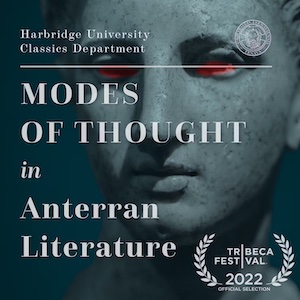
A renowned professor leads a class exploring the culture of a newly-discovered ancient civilization. The only issue: there is no proof of the discovery, or the civilization itself. Has the professor, who disappeared for some time before teaching this class, broken with reality? Or is there really a lost civilization with a rich literary history known only by a few? The show is structured as recordings of each lecture, with occasional interjections from confused or suspicious students and grad assistants. Each episode dives deep into a particular aspect of Anterran literature, with a slowly-advancing plot behind the story. Listeners get deeply erudite lectures on this world, so complete that we stop caring if Anterra is real— because what is real? This feels like a wild literary novel to which you must just submit.
It starts relatively simple. Ana, a home health nurse, is taking care of a 90-year-old woman in an old, isolated house. She calls the woman’s granddaughter, Mabel, to ask about some letters Ana has found. But Mabel doesn’t answer. Even as Ana keeps calling. Even as Ana leaves longer and longer messages, describing strange happenings and discoveries in and around the house. Even as Ana becomes increasingly desperate, and increasingly detached from the world. For the first few episodes, we think we’re witnessing an isolated woman’s descent. But then—we finally hear from Mabel. And things get so much weirder and darker. The show is thoughtful and beautiful, painting the picture of a gothic, fantastical place that may be very real. The use of music and sound is crucial to the story, with each installment ratcheting up the goosebumps and dread.
This is brilliant, ferociously funny satire that’s just bonkers. The show purports to be the online news engine for the Beef and Dairy Network in the UK. In each episode the host talks to a supposed expert in the field, with an interview that goes delightfully off the rails. One episode features a cow wrangler on film sets that contends all major acting is actually done by cows; another includes a former child actress from yoghurt commercials who claims trauma from standing in butter too long; another is a recurring character of a slaughterhouse owner who believes safety guidelines are rubbish, because his employees learn their safety lessons by losing fingers and hands. Each episode skewers the corporate culture behind food, along with the painfully cheerful marketing rah-rah energy demanded by companies today. I don’t know if the creator is vegan like me, but it feels right to say he is.
A woman wakes one morning to find her wife gone, along with all her neighbors. The light and the air feels different. The power starts blinking in and out. She’s cut off from the world, if it still exists. And soon even the sun starts to disappear. She records her experience, and her changes—because as much as she fears for and misses her wife, her anger grows. Why did her wife keep so many secrets? Why did she work such long hours at her research lab? What exactly did she do? And who are the voices and shadows that start to people the narrator’s world? Beyond the fearful concept, the show really drills down into relationships—how we cede ourselves, how we diminish one another. It’s an exploration of our needs for companionship, for safety, for light.
Carpenter and Faulkner are two apostles of an outlawed religion, one that offers sacrifices to their river god. In this world, there are accepted religions and gods—those of commerce, of coffee, of the electric company. And there is illegal worship—those deep rural gods of the poor, displaced by rising waters and religious wars, gods of dirt and land and water. The two apostles are traveling their river to suss out other devotees, and to look for miracles. In their journey they find other dangerous gods (and their even more dangerous acolytes), an investigator looking into illegal deaths for rural religions, and a refugee fleeing her corporate job, which just sacrificed non-performers to their new deity. The episodes are structured with lyrical narration and violent dialogue, with different characters taking the lead. It’s a remarkably dark, rich, fascinating and weird story with exceptional writing and acting. Note: there are many intense elements of horror.
Gloria opened her dream restaurant in Phoenix just before the pandemic. That restaurant failed. So one day she answers an ad for a job at a diner called Midnight Burger. Except this diner is just visiting Phoenix —at the end of the shift, it will travel again, across time, across dimensions, across space.
Gloria joins a bizarre team at the diner, including a couple of old-timey pastors on a radio, a former smuggler who can always MacGuyer a problem’s solution, a physicist who just wants to drink and write in her booth, and a guy named Caspar who’s just… there? And each time they stop, there’s something weird going on, and someone who probably needs help. Trust me—that description barely covers the surface of this show. It is wild, with a fantastic concept, lines that make me cry from laughing, and amazingly deep philosophical and empathetic discussions of humanity. Over their three seasons and 50 episodes so far, the writers create wonderfully rich story lines, hilarious villains (like a space species of capitalists called the Teds), and characters that have me beyond invested.
All of these shows are hard to describe, but this one may be the hardest. Nic is the host of a podcast, a docudrama called Tanis. He is exploring a concept (or place? or person?) called Tanis—chasing it through the historical circles and myths of Alastair Crowley, the pages of a science fiction magazine and a never-published manuscript, the buried classifieds of Craigslist, the hoarded cassette recordings of numbers stations, the conspiracies around the deaths of Eliot Smith and Kurt Cobain, and so much more. Along the way, Nic relies increasingly on a secretive deep web expert named Meercatnip, and a growing list of people who alternately encourage and warn him from his quest. We want to believe in conspiracy and mystery, Nic says, especially in this age of instant info that masquerades as the answers to everything. Tanis, he believes, may be the ultimate and only remaining internet mystery.
Each episode nails the format of a investigative series, one which threatens to fall apart under the weight of all the threads being pulled. Nic himself plays a version of a reporter and enthusiast who may be in over his head. But just as he says—we are fascinated by mystery, and may not really care how everything fits together. The search is all.
In the six years since I began writing the Unfinished Business column here at Electric Literature, I’ve explored the incomplete works of fifteen authors, but these have, until now, always been novels lost decades ago—some over a century gone. That gulf of time tends to soften the loss of the author themselves. While I might find it sad that F. Scott Fitzgerald died at the age of 44, the fact that his fatal heart attack occurred well before I was born tends to take some of the sting out of it.
But this is not the case with writer Anthony Veasna So, who died in December of 2020, from an accidental drug overdose when he was only 28 years old. Here, the sting is never far off.
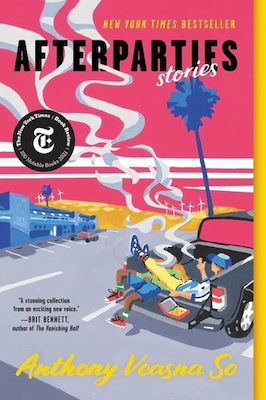
So passed nine months before his first book, Afterparties, would be published. That book would go on to win the NBCC John Leonard Prize for a debut novel and the Ferro Grumley Award for LGBTQ fiction and receive wide acclaim from critics and readers around the world. While some of the stories inside Afterparties had been published previously, such as “Three Women of Chuck’s Donuts” and “Superking Son Scores Again,” most readers were already encountering So’s incredible voice for the first time after he was already gone.
This is especially jarring because So’s writing is so particularly alive, so boisterously funny, so sparklingly real, and so sharply contemporaneous—there’s nothing that feels posthumous about his work. It insists that So is very much here, and very much alive. Only when you come to the end of the last story in Afterparties is it crushing to realize there will be no more.
Except, there is more—at least a little.
This month, Ecco Books is publishing a second book of So’s, Songs on Endless Repeat, a collection of his essays and “outtakes.”
I’d be remiss if I didn’t begin by saying that the essays are their own delight: So’s pop cultural criticism of Crazy Rich Asians and Queer Eye for the Straight Guy come together with deeper, personal memoir pieces about his father’s life as a landlord and the loss of a dear friend to suicide. According to editor Helen Atsma at Ecco books, it had always been So’s goal to publish a book of essays, and his eye had been on doing so after he finished his novel.
His novel, you say?
Indeed, the “outtakes” mentioned earlier are not fragments or drafts of other short stories, but actually eight linked pieces of So’s unfinished novel, Straight Thru Cambotown.
So’s writing is so particularly alive, so boisterously funny, so sparklingly real.
In the foreword, author Jonathan Dee, who served as So’s advisor at Syracuse University’s MFA program, writes beautifully about what it was like to work with So on some of these pieces of Cambotown, which formed the writer’s graduate thesis, submitted only about nine months before his death.
In emails to Dee, So described the book he envisioned as being stylistically and structurally inspired by “Helen Dewitt’s The Last Samurai, Gabriel Garcia Márquez’s One Hundred Years of Solitude, and John Kennedy Toole’s A Confederacy of Dunces.” He wrote that these three were the books he kept coming back to for inspiration as he wrote.
As Dee explains, this high bar that he “cheerfully set for himself” was typical of So. He wonders if, at the time So emailed with this ambitious plan, a single word of the novel had even been written.
But then So wrote—with all the “deceptively casual, humor-cloaked command” that Dee and others at Syracuse had come to admire. As Dee notes, the pieces of the novel that we have are incomplete but never rough. So was a “perfectionist about his writing—not in the self-paralyzing way some writers can be, but just made restless by the idea that something good could almost always be made better.” Knowing that the pieces in Songs on Endless Repeat would have likely undergone extensive revisions still, it is only more remarkable how strong they are.
Dee mentioned that it contains parts of the novel there that he’d never seen before, seemingly newly penned since their work on his thesis had concluded.
In the eight pieces of Straight Thru Cambotown that are included in the collection, readers will get some sense of how So intended to triangulate between DeWitt, Márquez, and Toole, and how the novel would continue the project he began in his short stories, to as one reviewer put it in the LA Times, “immortalize Cambodian California.”
This is a worthy goal, a “hole” that So intended to fill, according to Dee. But So’s work, and Cambotown in particular,doesn’t feel like an act of preservation so much as an invitation (at times a demand) to immerse yourself in the world he loved. If that immortalizes it, in the process, then so much the better.
In an opening section, “We Are All the Same Here, Us Cambos” So writes in a lush first-person plural, present tense. “Just look around and listen to the talk. Him, her, them. Those fools over there blasting Tupac like they actually get it, because in a way, beneath the yellow-brown-light-dark surface of their skin, they do.”
So’s work, and Cambotown in particular,doesn’t feel like an act of preservation so much as an invitation.
Verbally, So soars around Cambotown, hovering over the Mings and Bas and Mais and Pous and Gongs, “Heineken for the humble; Hennesey for the ballers.” He wants to distinguish them from other Asian cultures “two thousand miles away from Cambodia” (look at a map, he urges) even as he outlines what lumps all “Cambos” together: “In Cambotown, we are all the same—same stories, same history. Or lack thereof.” The awful bonds of displacement, and of having descended from the survivors of the genocidal Khmer Rouge regime, are for his generation, badly tangled up with the false promises of the American Dream. He concludes, “That’s why we’ll never leave this place—not truly. […] We’re with you, have always been so. Let’s be messed up Cambos together.”
So addresses the audience in other places in the other fragments of Cambotown, but more rarely, making way for highly specific third-person portraiture of his characters. We settle into the year 2014, a decade after a financial crisis that lingers on in this corner of the world. So introduces a central cast of characters, described in So’s obituary as “three Khmer-American cousins—a pansexual rapper, a comedian philosopher and a hotheaded illustrator.”
These cousins are bound together in their grief over the death of their aunt, Peou. In a fragment named “Peou and her Kmouys,”So describes the legendary Peou, a mathematical prodigy whose skills, others imagined, would have made her a great businesswoman, or possibly a winning contestant on The Price is Right. Her sudden death in a fatal car crash rocks the community and brings her “kmouys” together.
The “comedian-philosopher” is a nephew named Darren, who picks up the next section, set three days after Peou’s crash. At Peou’s funeral he shrewdly observes the art on the walls, the silly minutiae of the ceremony. “There’s a joke in this,” he thinks to himself, as he takes it all in.
Darren’s brother Vinny is “the first Cambo rapper to break into the hip-hop scene.” (One of Vinny’s songs, “Sachkrok Thom” is a rap ballad to Asian dicks, capable of curing all the world’s ills—if only the world would stop marginalizing them.) He is irreverent and headstrong, a fine contrast to the cerebral Danny, and the two read like twin sides of the same coin, perhaps of So himself, whose work never stops ricocheting between those qualities.
The third kmouy is niece Molly, who writes Peou’s eulogy while lamenting her own ongoing forced sabbatical back in Cambotown. After having once escaped to NYU and a Gallatin School bachelor’s degree in “Illustrating the Political Self” that “totally kicked her ass,” she got laid off from the non-profit where she’d worked and sent home saddled with $200k in student loans. Molly is wearier, angrier (justifiably) and sees things a bit more clearly than Darren or Vinny do—a third side of So’s personality that readers will find underlying the essays in the same collection.
The two read like twin sides of the same coin, perhaps of So himself, whose work never stops ricocheting between those qualities.
Later sections, like “The Roses” take us back into Peou’s life, and others go forward to Peou’s funeral and the weeks beyond. Between the eight sections we only get about 130 pages of Cambotown, but it feels like much more. (When I compare it to something like Fitzgerald’s The Love of the Last Tycoon, which was cut off around a similar length, Cambotown feels both technically stronger and far fuller.)
So’s characters crackle with life, humor, pathos, fury, and desperate dreams. Their struggles are generational, historical, local—epic and personal. What we get in 130 pages is so much more than simply track being laid for what never was written. These chapters are full and satisfying, a whole world unto themselves rather than any kind of mere roadmap.
Still, it cannot be denied that it comes to an end that is painfully premature, with incredible potential energy that is still not yet kineticized.
Because So guides our imagination so skillfully towards the future, when the past catches up to us at the end of the final fragment, that loss crashes over us like a tidal wave—maybe not so unlike the way it crashes onto his characters, and onto everyone in Cambotown. It resonates deeply that Peou’s own funeral, and absence, is at the center of this novel, and that the incompleteness it brings cuts through the lives of Daniel, Vincent, and Molly.
You want there to be more, because you want to know that they’ll be OK—what else can you say about the experience of reading a truly great novel but that?
So’s literary agent, Rob McQuilkin recalled how Mark Krotov described the day he first met Anthony at the offices of n+1, where he “came in off the street” and immediately projected the warmth and irreverence found in his fiction. Krotov placed his story “Superking Son Scores Again” at the magazine, a bombastic tale of tough Cambo boys who work out their aggressions through harrowing games of badminton. With an intensely sincere absurdity, the story charmed McQuilkin as much as Anthony himself, and they began working together on the collection of stories that would soon become Afterparties.
It sold to Ecco Books as part of a two-book deal, “heavily tilted” towards the still emerging Straight Thru Cambotown. “At that point Anthony had maybe fifty pages of it written,” McQuilkin recalled. “A couple of chapters and a memo with his intentions for the rest.” The story collection came together rapidly and was, he recalled, a very “light lift” editorially speaking, meaning that the work was already very polished as it went to Ecco.
So’s editor, Helen Atsma, confirmed that very little work had to be done on Afterparties beyond settling on the best ordering of the pieces in it. And yet, So’s instincts as a “hefty reviser” were not settled. Even the story “Three Women of Chuck’s Donuts,” which had already been through extensive editing before publication in the New Yorker, seemed to So in need of another look. Dee recalled how hard So had worked on the piece even before that. “I can’t tell you how many versions of ‘Three Women of Chuck’s Donuts’ I read,” but also that So was never “the type of student who would email something and then email again six hours later with a different version of it.” If So was feeling anxious, Dee said, it was only because of his correct perception “that the stakes were now higher.”
Atsma remembers him as “one of those writers for whom the finished line is hard to accept,” but feels that So’s perfectionism was evidence of how deeply he “loved tinkering at the word level.”
But as the publication process went on, McQuilkin said, Anthony had frantic periods, driven by his own perfectionism, trying to make big changes even as the book headed into production. Anthony was having a hard time during the early months of COVID. Even as his own star was rising rapidly, he was mourning the recent suicide of a dear friend and classmate at Syracuse. The essay So wrote about his friend, originally titled “Songs on Endless Repeat” was later published at n+1 again as “Baby, Yeah” (the name of the Pavement song that he and his friend listened to over and over) and that piece now concludes the collection.
So’s plan, McQuilkin explained, was to get back to work on Cambotown in the new year, once Afterparties was finally set. After So’s overdose that December, McQuilkin said that it took him a long time to finally sit down and go through the work that So had left behind before he passed. There was, understandably, the obstacle of his own grief over the loss of So, but also the significant challenge of dealing with these partial materials all alone.
“Usually there’s this dialogue with the writer,” McQuilkin explained, “instead of me just talking to myself.”
He found significant, new pieces of Cambotown in the papers, along with So’s notes and other writings, enough to begin working on a sampling of the parts that felt the most polished. He estimates that he and Atsma were able to use about two-thirds of what So left behind to form the eight sections now in Songs On Endless Repeat. These were “not remotely ready, in a finished sense,” he felt, but set amongst the essays So had written, there was new “value in the refractions between them” that came out.
“We wanted to touch as little as we could,” Atsma said. Though it was a “minimal edit” she said that she “never felt the weight more,” in knowing the importance of sharing his final work with readers. “It didn’t feel lesser than to me,” she recalled, “If they had, we would never have published them.”
Storytelling persists because our time alive is always too short.
In the end, McQuilkin thinks that the 130 pages of Cambotown might represent about a quarter to a third of the ambitious plans So had for the novel, and, of course, there’s no telling how much of these sections would have endured to the final manuscript, especially as So’s keen, perfectionist eye went through them in future drafts.
How do we face trauma with humor? This is one of the subjects that kmouy Darren says he wants to write his philosophical treatise on. Cambodians love to laugh, he points out to Vinny, as they mill about at Peou’s funeral. Sometimes that’s a reaction to the absurd horrors of the world and of history, but sometimes it’s just for the love of laughing. Vinny, characteristically, cracks a joke back, accusing his brother of selling out, his over-academic analysis is just about “following the money.”
There are themes, in So’s work, McQuilkin said, of reincarnation, and of all the repetitions in all the minutiae of every human life. Storytelling persists because our time alive is always too short, whether it ends after twenty-eight years or a hundred. What we make, and leave behind, at least can always be started over, read again, played on loop.
In the foreword to Songs on Endless Repeat, Jonathan Dee encourages us not to think of So as just another “promising young writer” as these, to be honest, are “never in short supply.”
If So saw a hole in the world that he intended to fill with his words, then his death inarguably leaves too much of that hole still open. But through the writing collected in this second book, So inched his Californian Cambodian characters not just closer to some kind of immortality, but into the world itself. All of this, carried along in So’s unforgettable voice, leaves us all much fuller than we were before.
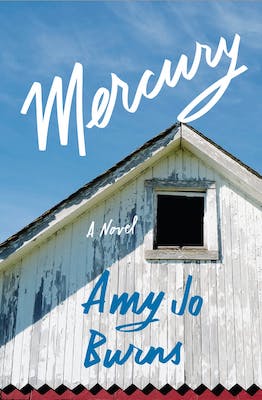
Amy Jo Burns’ second novel, Mercury, is a heartfelt portrait of a working-class family set in an unsuspecting industrial town in Pennsylvania in the 1990s that follows the lives of the Josephs—Mick, Elise, Baylor, Waylon, and Shay—and the light in their darkness, Marley West.
The novel opens with Marley, the wife every man wants, coaching her son’s little league team, while her husband, Waylon, hides beneath the bleachers for reasons yet unknown. The story then thrusts readers back in time, to the fateful day when Marley and her mother, Ruth, rode into town one summer afternoon and changed everything.
While the jagged edges of Marley initially seem like they might not fit into the small town of Mercury, the orbit of the Joseph family is strong enough to pull her in anyway. It soon becomes clear just how much the family was needing her when nearly every Joseph member is impacted by Marley’s sudden arrival. Spanning nine equally heart-warming and heart-breaking years, Marley and the family endure love and loss, desire and betrayal, secrets and celebrations as they try to navigate the unique demands of a family business and a working-class life.
While the story revolves around a murder mystery, after a shocking discovery is made in a local church attic, the pulse of the novel stays with the Joseph family itself. The town of Mercury, based on a real town by the same name, also acts as its own character throughout the novel. Having grown up in a similar once-industrial town in western Pennslyvania, like Burns herself, I was excited to connect and discuss her latest work.
I spoke with Amy Jo Burns over Zoom to discuss working-class family dynamics, the real cost of a family business, what legacy means for women, being the author of your own story, making peace with the past, and much more.
Sam Dilling: Mercury takes place in a small working-class industrial town in Pennsylvania and centers a dynamic family of roofers—the Joseph family. Where did the idea for this book come from and what was the experience of writing it like?
Amy Jo Burns: I come from a roofing family—my dad, my brother, my uncles, my dad’s best friend, my grandfather. I learned how to tell stories from them. They are fantastic storytellers. They’re so funny. They have a real sense of timing and surprise and how to land a punch line.
In terms of what inspired me, I had been working on a separate project for a long, long time and I had to put it aside. I really love to write about my hometown. I don’t know if you feel that way. I find it endlessly inspiring, beautiful, problematic, romantic, and haunting. All of it. So I sat down and I did a writing exercise. It was from this memory I had of being nine years old at the Little League baseball field. There was a man smoking a cigarette behind the bleachers. He said to my mom, “Please don’t tell my wife.” I always remember that. I thought it would be fun to freewrite who that person might be and what led them back there. It was interesting because as soon as I started writing, it all just tumbled out. I said he’s a roofer. He’s got this wife he really loves, but he’s not sure she loves him back anymore. Why would that be?
SD: The family orbits around the business—like it has its own center of gravity. And at times, the lines between the family and the business blur. The business acts as a proxy for the love the family shows each other. And that might sound bad—but that’s just the way of life. When you’re from a working-class family, the dynamics of work or the family business are going to influence the family itself.
AJB: It’s one of those things where I’ve left, but I don’t think that part left me. It’s a double-edged sword for me. When I think about my family, or my dad in particular, running the business like he did—never really taking vacations or days off. I see somebody who is so passionate about what he does. And so artistic, and so dedicated. I find that to be extremely beautiful that he put his unique mark on everything he did. I think that’s something my brother, my sister, and I all do in our own ways. I’m really thankful for that. I feel like that’s become an important part of who I am. But the other side of it is I don’t really know how to take breaks. I’m not very good at that at all. I hope that’s changing. When you own your own business—it’s not a job, it’s who you are. It’s kind of how I feel about being a writer. It’s why I always feel weird when I tell people it’s my job. It feels like it’s more than that and also less than that.
SD: One thing I appreciate, having also come from a working-class family and background, is the spotlight you put on the women in the story. What was important for you to showcase about these women?
AJB: Before I started writing the book, I was thinking a lot about blue-collar women. In my experience, many women who might be considered “blue collar” are women who are entrepreneurs just like their husbands. The difference is they don’t get titles, they don’t get paychecks. That’s the mindset of these women that I grew up with. They don’t even realize how hard it is because they don’t have an expectation that there could be another reality. They are the bookkeeper and they are watching the children and they’re cleaning the house and they’re cooking. These women really make the impossible possible. At least that’s what I witnessed growing up in my mom and my aunts. They don’t complain.
I wanted to show what it looks like when a woman jumps into that with two feet. I also wanted to show what it might be like when a woman says no to that, which is what Elise did. She said no to the business side, but was very entrenched in the family. These women— Ruth, Marley, Elise, Jade—they’re all in a situation where they don’t have that many choices. They’re each taking a different path. It’s not that one is better than the other, but everybody is trying to make their way. I wanted them to still have a real journey and have real pride in what they do. I wanted to talk about the women I know. Women really make it happen.
SD: When talking about family and business, the idea of legacy comes to mind. The Joseph family business very much becomes the legacy for the men in the story, and we get to see how each son feels about this being their legacy, but what about for the women? How do we define a woman’s legacy?
AJB: I think it comes through the paths they are creating for their own children. That was big for Ruth, who is the single mother. She wanted to create a world for her daughter that didn’t have so many stop signs wherever she went. I think for Marley, when she becomes a mother, she wants to teach her son how to be a good life partner. She wants to teach her daughter that she can take chances. I think that’s one piece of what legacy means is they try to give their kids some options they didn’t have.
I also think there’s something about having a legacy of when you say enough is enough. Sometimes that might end up meaning something becomes invisible. For a lot of these women, much of what they do is invisible anyway. All of these women get to a point where they say no. There’s something really powerful about a woman who says yes, and yes, and yes, and then says, “Enough is enough.” Those are quiet moments that don’t get told at Thanksgiving or Christmas. I honestly think family survival depends on that—when [women] say enough is enough. It’s kind of the opposite of the way we think of legacy, but I think it’s very powerful.
SD: Seeing that on the page is almost revolutionary considering the roles women have had to take on, and fit themselves into, for the sake of family.
There’s a cascading cost that comes through generations when a woman doesn’t have a choice.
AJB: One thing that was important to me was I didn’t want to make these women into cautionary tales because I feel like so often, when we are looking for a lesson, the woman becomes collateral damage. I think there is some balance between saying the right “no” at the right time and finding a voice. There’s a cascading cost that comes through generations when a woman doesn’t have a choice. It’s not just the women that it punishes. It punishes the men, too. There’s real value in a woman being able to tell her story—especially to her life partner, her spouse, her kids, and to herself. I think that’s something Marley is trying to do. She’s trying to be the author of her own story in a way that allows other people in, but she’s still the head of it. That’s something I think Elise was never able to allow herself to do. The more a woman is able to share what her life has been is a very powerful thing for the rest of the family to grapple with.
SD: Putting that into practice is a whole different beast. There is a reason so many women aren’t afforded that freedom to carve out their own place or their own story. There are so many systems in place that keep a woman stuck right where she is—that make it difficult for her to rise above her situation. Like in Mercury, when we see a young woman get pregnant and suddenly have fewer options for her own life and future.
AJB: There’s a cost that comes with leaning in. If you’re going to be an entrepreneur, and you’re going to have a career, you either gotta have a best friend or mother-in-law to help you. Or you’re gonna have to pay somebody because time and energy are finite. As much as we want to say [women] are superhuman, they’re not. We’re human. And that’s a good thing.
I am somebody that tries to do it all and then I fail at it. Anytime somebody asks me what it’s like to have this life, the first thing I say is, “Let me tell you everything that I’m not doing.” I am not cooking super creative meals, I am not scrubbing the baseboards of my house, I am not signing up to be a classroom mom. Even as I’m saying this to you, that guilt is streaking down my face. There’s something that’s ingrained in us that says we should be able to do it all. I really don’t think anyone can. I think there’s always something that pays a price. Sometimes it’s our bodies, our relationships. Maybe it is the state of my bathroom right now.
I think, at least for writers, we have to hold and guard that humanity with everything we have. And sometimes that means saying, “I’m really tired, and there’s Paw Patrol, kids.” I do think there’s something about the women that I watched growing up that didn’t expect any different because they had just never seen it. I grew up thinking, “Oh my goodness, these people are superhuman.” What you see and what the reality is are two different things.
SD: It’s interesting because men never seem to feel the need to qualify the things they’re not doing, or the things they’re not doing well. But for women, it’s like we owe the world an explanation for why we can’t magically do it all.
AJB: I would hate to have an interaction with somebody and have them leave feeling they’re missing something important because I just don’t think that’s true. You know, I’m an Enneagram Four. I don’t know if you’re into that. Fours feel like they’ve been born missing some key part of what it means to be okay in life. You’re kind of walking around looking for it. So it’s important to me, if somebody’s like, “Well, how do you do it?” I like to qualify and say, “Whatever you think I’m doing, I’m probably not.” But you’re right, men don’t do that. Men say, “Oh, yeah, I did it.”
SD: It brings me back to that idea of legacy, and even more than that, strength. How does strength look different for men and women?
AJB: When I was writing, I did think about that concept a lot. Especially since roofing is such a stereotypically macho thing to do. You have to be physically strong to be able to do this job. It’s very demanding, it’s dangerous. I think the flip side is that a lot of these characters who are very physically strong are emotionally fragile. I think that is a very authentic and very interesting paradox that exists in a lot of places.
When you’re in it, you can’t see all the pressure that you’re under.
One of the reasons I wrote the youngest brother, Shay, the way I did is that, to me, he is the picture of strength. He is somebody who doesn’t want to fit in this mold and he’s trying to be honest about it. He offers up a perspective that says, “If you do not have a sense of integrity in yourself, then what are we even doing?” He’s really wrestling with: what does it mean to be somebody who is strong? I think where he lands is it means that sometimes you’re weak. And that’s important. It’s important to let people know that you’re not perfect. He represents somebody who doesn’t fit all of these preconceived notions of what it might mean to be a roofer’s son. And yet, he is the beating heart of the book.
SD: We get a glimpse of Marley’s life two years into the future. But let’s say Marley looks back at her life 20 years from now. What does she think?
AJB: I think she is going to be glad she fought the battles that she fought. I think she’s going to look back and see that all those times where she said “no,” or she drew a line in the sand, or she left, she will see all the fruit that came from that hard choice.
Again, it’s not perfect. She apologizes for the mistakes and the things that she maybe got wrong, but there was something really healthy and life-giving in making those hard calls. I hope she feels proud of what she’s built in her business and her expertise.
There’s something really nice about being older and looking back. You can have compassion on your younger self that you didn’t have for yourself at the time.
SD: Do you look back on your own life and feel the same?
AJB: I do. I think sometimes when you’re in it, you can’t see all the pressure that you’re under. You only feel it. Then when you get older, and you look back, you think, “Oh my goodness, look at everything that young person was dealing with.” And they’re doing it. So, absolutely. You give up expecting yourself to be perfect which is a real gift.
My America is skin. Hide. The red
hair periodically in my mustache.
The sun’s inability to burn me
past the color of bread,
whole wheat. My America
is Guatemala. El salvador.
My America is Chile. My America
is unsure whether to pronounce
Chile like the country
or the admonishment you give
the child misbehaving
on the front porch. Chile. The Texas home
my great-great-grandfather built
to be burned down
in my lifetime. The cemetery where
he is buried with all the others
with Mexican last names
in that flea bite of a town.
My America is living almost
every day of my life with a sea of white
& yellow lights called Tijuana, a crack
in my bedroom window. My America
is the hard stone my grandmother
wrapped in a baby blanket
& hid in a Phoenix
basement. My America is the glowing
black waters beside Detroit’s midnight
lights: paradoxical beauty, tide, swift
current. My America is any place
where someone docked their boat
in the sand saying, This
is mine now. Minha. Mijne. Mine.
Once
We will love each other only once. The word for this is cathecting, but we’re young still & high on our own diction, leaving those words sharp with meaning back in the classrooms we were grateful to escape. Lucky. My arm around you, asleep, I imagine what our stories would be like 100 years ago. 100 years ago two people like us would never be in the same city, same province, separated by oceans. Our parents & parents' parents savor these secrets like hard candy clinking against the backs of their teeth, the silent hiss of their mouths refusing to open for the fear of losing something. Their accents something we must summon for certain stories. Would we still share the same tongues? My hair underneath your fingernails, your hair in between my fingers. Our breaths stink of skin, sunlight in dusty blinds. What would we have done to be with one another, then? Would it have been worth it for one night—the coal-fueled train, relentless desert heat, a sailboat passing Greece to a larger vessel ready to cross the Atlantic? The months it would take. The pain of leaving the rivers where your family story started, the pain of the rivers redirected from a homestead where my ancestors live in the form of blue asters. The horses I would have in the burning dust. The horses I would have buried in the ground. The horses we wouldn’t own, either way, together. Touching each other’s faces would risk a necklace made of rope, the judgment of gravity from a tree. Touching each other’s faces always risks something, even now. Together, hours in bed dissolve like sugar in water. There’s more clean water in the kitchen than we can ask for. How many nights did our parents' parents snuff out the light worrying for such things to stay alive, to stay hydrated while outrunning hate? Even still none of us, as children, could imagine having a palm with a blue glow & so much power we could fit the world into our fist, much less them. For once I wish I could explain this to you, to us, to everyone wondering why we’re like this loving someone we know is gone before the body has left the bed, no matter how much our mouths thirsted for each other, sharing stiff drinks & making loose plans to nowhere. No, this isn’t what they imagined for us. Neither did they imagine our chiseled faces, the glow we’ve made of these skins that would surprise them with their smoothness, their color in the dark. Let every night like this be a toast to the names of those before us whose names we don’t know & didn’t have the chance to be this free, committed to finding a future of our own making, even if it’s only once.
How many stories does it take to get to know a place?
Lifelong residents may write confidently of their homeland, but among the travelogs and novels and poems and memoirs that give shape to a city, I’m partial to books written from the perspective of those still calibrating their relationship to a place. These include children, wide-eyed visitors, and locals caught in the midst of historic transformations.
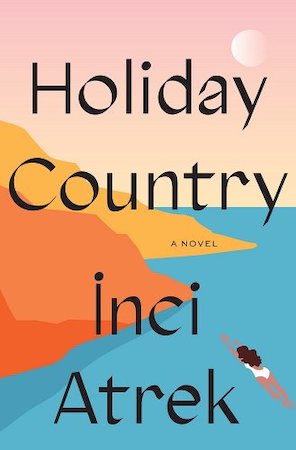
My debut novel Holiday Country follows a young Turkish American woman who spends her summers on the Turkish Aegean. Not yet all that comfortable with the country’s culture and customs, she’s hyper-aware of her surroundings, interactions, and the linguistic nuances she spends an inordinate amount of time picking apart. All this, she hopes, will give her the answers she’s seeking about herself.
Below, I’ve gathered a list of novels, memoirs, and collections in which Turkey is thrown into high relief. In other words, books reflecting the experiences of those getting to know Turkey—or a new Turkey—inch by inch. Everything to them is peculiar, fascinating, worthy of exploration. It’s that time when all the senses are on high alert. Before everything fades into the background, and becomes once again, the setting for life as usual.
Samancı grew up along the Aegean, and her graphic memoir chronicles her burgeoning understanding of her country through an inquisitive child’s eyes. She recalls crushes on teachers, her admiration of Turkey’s first president, and the difficulty of navigating religious differences as a student. There’s a lot packed into this story from girlhood to university graduate, but approaching convoluted topics with a strong dose of innocence offers an entertaining glimpse into the life of a young woman making sense of a convoluted and evolving country—and her place in it.
Yvonne travels from Vermont to Datça, a peninsula in southwestern Turkey, where she and her late husband once honeymooned. Though the area is surrounded by gorgeous beaches and happy vacationers, her experience is more of a harsh and deteriorating environment. Yvonne finds herself often feeling misplaced, on the wrong side of power dynamics, and second-guessing her interactions with various tourists and locals. As an unlikely friendship leads to devastating consequences, Yvonne has to come to terms with her actions—and her past—to escape the heavy sense of loneliness that violently clings to her.
Orga’s memoirs from childhood begin while he’s living in the lap of luxury, with house staff in a konak in the heart of Ottoman Istanbul. In the summer of 1914, his bourgeois world grinds to a halt with the onset of WWI. This book chronicles Istanbul’s transformation as the Ottoman Empire transitions to the Turkish Republic through the lens of a single family. Perhaps most aptly symbolized by Orga’s grandmother, who refuses to abandon her aristocratic airs as life falls apart around her, it’s a tale of pride and survival, and of how to rebuild life again and again without losing hope.
Northern California native and world-traveling diplomat Whitten and her husband become enamored by a trip to Turkey, and eventually make their way once again to Istanbul where they settle on one of the Princes’ Islands, Heybeliada. Whitten’s chronicle of island life is divided into two sections: the first detailing the trials, tribulations, and triumphs of procuring and remodeling an old island home, and the second, an in-depth exploration of life in Istanbul. Written with the friendliness and accessibility of a travel guide, it’s a great read for those unfamiliar with Turkish culture, fans of Peter Mayle’s A Year in Provence, and who love to live vicariously through those building their dream lives abroad.
An expansive and gorgeously detailed novel told through the perspectives of an eclectic cast of characters in a Turkish village. Neighbors of various ethnic and religious backgrounds live lives deeply integrated with one another, until war strikes and brings everyone a jarring new perspective on nationality and religion. As developments in war and legislation shape allies and enemies, the villagers find themselves pulled apart from each other in the most shocking of ways. Brimming with witty proverbs, historical anecdotes, heartfelt love stories, and, ultimately, unimaginable grief.
Turkish-American college student Sibel brings along her American boyfriend for a summer in Istanbul, where she mostly watches soap operas all day. While she juggles taking care of her ailing grandmother, tending to her sister’s eating disorder, and self-diagnosing her own mysterious headaches, she simultaneously avoids and desperately seeks connection with her dead father. As a family secret as complicated as Turkey’s chaotic history begins to unravel, Sibel starts to finally find an end to her grief, and a better understanding of her relationships.
A collection of writing about Turkey’s southwestern coast that includes excerpts from authors and travelers both ancient and contemporary. Perfect to dip in and out of while vacationing on the Turquoise coast, the selections range from explorations of the finer points of Turkish cuisine to underwater discoveries, from chronicles of the plants and animals of the region to the stories behind its archeological ruins. The book also includes excerpts from other writers mentioned in this list, including İrfan Orga and Louis de Bernières.
A confession: I very nearly quit putting this list together.
Throughout the year I keep a running list, adding new names whenever I learn about an upcoming queer book—from Tweets, publicist pitches, endless NetGalley scrolls—and I usually start writing the blurbs for each book a few months before the list is due. Let me also add that, because I am a novelist myself, someone who works very hard to put words on the page in a good-enough order for someone to respond to them, I try and read at least a little of each book featured. And here’s an incredible truth that’s both deeply satisfying and makes my job surprisingly difficult: there are more and more queer books published every year. There was a time when I could complete a list like this in an afternoon; I was lucky to find a dozen explicitly queer titles. Now there’s a pretty solid chance I miss a good number of them.
In mid-December—at the half-way point, and a couple days after my birthday—I looked at the list, halfway done then, and thought, “There’s no way I can do this. There’s no way I can finish putting together this list in a way that does each book justice.” Partly it was the volume, yes, and partly it was the ambient dread of being alive in 2023. Partly it was also because of the lingering emotional hangover from publishing my debut novel and the approaching completion of my second—experiences that have left me excited, enervated, vulnerable, and protective of my own mental health. Partly I’ve become wary—weary?—of continuing to delineate LGBTQ stories from cis-straight ones, as if our identity is a genre, as if I’m daring hetero readers to overlook these books because of who the protagonists and authors choose to fuck. Partly—maybe superficially—I felt a crippling nihilism at the idea of putting so much time into this list only to have to promote it on the hollowed-out shell of an app whose home screen now serves as a violent reminder of how much we’ve lost at the whims of idiotic wannabe despots.
Here’s how I finally finished this list: I read all the other ones. I went through most of the “best of” lists from last year, the “anticipated” lists for this one. And while we’re thrown a couple bones every now and then, given some gestures at progressive appeasement, our stories are still routinely passed over. Queer culture—our fashion, our humor, our art—has always moved everyone forward, toward a better, freer, more-fun world; we are and have been the tide that lifts, so our stories deserve not only to be included but centered.
Here are 42 works of literature that will lift us all this year—bold new books by Judith Butler, Carlos Maurice Ruffin, Brontez Purnell, Lucas Rijneveld, Garrard Conley, R.O. Kwon, and Miranda July; and auspicious debuts from Daniel Lefferts, Emma Copley Eisenberg, and Ursula Villarreal-Moura.
Tom is an architect in his sixties, constructing what he hopes will be his “masterpiece.” But his longtime boyfriend has recently broken up with him, and both his sister and his niece—the latter of whom is the center of his life—are soliciting his help in solving crises of their own. Less author Andrew Sean Greer says McCauley’s “poignant, joyous, explosive” latest is one to cherish: “A book that loves you back. What more could you want, my gosh? Read it!”
Grieving the dual losses of both her father and the end of her first queer relationship, Shiva Margolin, a student of Jewish folklore, embarks on a sojourn to Poland, her family’s ancestral homeland. Danielle Evans calls Fruchter’s debut “a gorgeous and full-hearted exploration of inheritance, grief, desire, and connection, at once a story about what it means to go looking for the ghosts we always knew were there and what it means to be in the right place to encounter the unexpected things we didn’t know we were waiting for.”
The newest from French-Canadian cartoonist Delporte is a beautiful, moving look at coming out later in life, a diary-style graphic memoir about the queer liberation of both the body and mind.
How To Wrestle a Girl, Blackburn’s 2021 story collection, was a revelation, barbed and bold. She writes so well about the weirdness of grief and the grief of being weird. Her new novel centers on a successful speculative fiction author who discovers her brother dead by suicide and carries on pretending he’s still alive, a reality-shattering charade with far-reaching consequences.
Ordorica, a poet, weaves a tapestry of love in loss in his fiction debut, a tenderhearted coming-of-age story about a closeted college student who falls in love with his also-closeted roommate. Fellow poet Eduardo C. Corral calls the novel “majestic.”
The bestselling author of BookTok fave Everyone In This Room Will Someday Be Dead returns with a novel about a partially deaf lesbian obsessed with black holes and true crime podcasts struggling to balance new connections—both with her formerly estranged half-sisters and her first serious relationship.
Antiquity by Hanna Johansson, trans. by Kira Josefsson (Feb. 6)
Imagine a female-fronted version of Call Me by Your Name told from Oliver’s point of view and set on a Greek island and you’ll get something like Johansson’s award-winning novel. Translated from the Swedish, it follows a thirtysomething woman to Ermoupoli as she becomes entangled in a complex relationship between an elegant older artist and her teenage daughter.
Waidner’s last novel, the Kafkaesque Sterling Karat Gold, won the prestigious Goldsmiths Prize, and their latest surreal romp is about an author who wins a prestigious book prize. The catch? The trophy and monetary award are difficult to obtain, possibly impossible, and the quest for it sends the author back and forth through time.
The titular siblings of Reilly’s charming debut are lovelorn flatmates in New Zealand, navigating their own queer heartbreaks and learning what their place in the world is—both as individuals and as members of a multiracial family.
Alistair McCabe, a young gay college student from the Rust Belt, dreams of a career in high finance, a fantasy turned nightmare when he finds himself entangled with an enigmatic billionaire whose nefarious ambition puts Alistair’s life at risk. Lefferts’s debut, an astute examination the complex intersection of money and intimacy, traces Alistair’s descent alongside the dissolution of the relationship between his paramours, an artistic couple with their own financial and existential woes.
The author of last year’s Highsmithian heist dramedy, Confidence, returns with a delirious, thrilling short fiction collection, including one story about a lonely college dropout who reinvents herself as a boom operator for porn shoots, and another about a Twitch streamer whose life is upended by the odd behavior of her best friend and the reply guy fan who’s come to declare his love.
Often it’s easier to think and write about others’ lives, easier to dig for the truth in someone else’s story than it is to search for one’s own. Such as it had been for Sante, an acclaimed chronicler of iconoclastic queer life who found it difficult to confront her own identity, a confrontation made even more difficult by society’s discouragement of gender fluidity. Sante’s achingly poignant memoir charts her late-in-life transition, the shock and euphoria of self-recognition.
100 Boyfriends was a bawdy, brutal, and beautifully raw chronicle of queer Black life, and Purnell’s follow-up, a memoir-in-verse, promises even more of what made that book a must-read.
When I was an editor at O Magazine, I had the pleasure and privilege of publishing the dizzyingly good short story upon which this novel is based. It centers on a woman named Celine who is one of the sole remaining umbrella makers in a world in which water (and rain) has become a rare commodity only available to the uber-wealthy. For such a short story, the world Foster built already felt expansive, and I’m excited to see it expanded further.
The always-inventive author of the Pen/Faulkner finalist We Cast a Shadow returns with an electrifying work of historical fiction centered on a gutsy former slave girl who joins a clandestine band of female spies working to undermine the Confederacy.
Hera, the droll and extremely self-aware narrator of Gray’s debut, knows falling for a married man twice her age is an ill-fated cliche. And yet. Hera, who has only ever slept with women, works as a news outlet’s comment moderator, and it’s in the chilly, subterranean-seeming office she meets Arthur, a journalist who throws into disarray who she believes she is and who she wants to be. It’s Conversations with Friends meets Several People Are Typing.
From the author of The Discomfort of Evening, the first Dutch book to win the International Book Prize, comes a queer and profane take on the Lolita archetype, following a pervy veternarian who becomes infatuated with a fourteen-year-old daughter of a local farmer—a girl who dreams of inhabiting a boy’s body.
Set amid the squalor and splendor of New York media, Lawrence’s debut follows Lily, a staff writer at a glossy fashion magazine who feels stalled both personally and professionally. Enter Billie, a cosmetics mogul who wants to mentor Lily…mostly from the distance of a phone screen. But what transpires in the digital realm seeps into real life until it’s all but impossible to tell where one ends and the other begins.
LaPointe follows up her award-winning memoir Red Paintwith a collection of essays that explore the challenges and triumphs of proudly embracing a queer indigenous identity in the United States today, drawing on both personal experiences and the anthropological work of her great-grandmother. “Sasha taqʷšəblu LaPointe’s essays in Thunder Song are loud, bold, and startlingly majestic,” says Night of the Living Rez author Morgan Talty.
Set in sixteenth century Scotland, Carr’s fascinating work of historical fiction portrays the year-long imprisonment of Mary, Queen of Scots in a remote loch-surrounded castle, her only company a pair of inconspicuous-seeming chambermaids. Together, these three women—and later, a fourth, Mary’s lady-in-waiting—plot a daring path to freedom.
If you haven’t read Honor Girl, Thrash’s heartrending graphic memoir about queer summer camp love, then stop reading this and pick up a copy. Here, the author makes her first foray into prose, a murder mystery set against the backdrop of the 1990s Satanic Panic.
It’s hard to imagine a more important moment for a new Judith Butler book, though their mountain-moving work has always and forever been significant and necessary. Here, Butler examines how authoritarians tie together and blame ideas like “gender theory” and “critical race theory” for the disorienting fear people have about the future of their ways of life, addressing what has become the cornerstone of conservative politics and culture wars: the notion that the very concept of gender—and the questioning of that concept—is a denial of nature and danger to civilization.
Many of you might know Conley as the bestselling memoirist and activist behind Boy Erased, a beautifully written and important book about survival and identity and a complicated family. Get ready now for Conley the novelist. His full-length fiction debut is a lush, epic love story set in Puritan New England. Every one of his sentences is a heaven-sent spectacle.
In this debut novel, Tatum Vega, living a fulfilling life in Chile with her partner Vera, finds her past resurfacing when a reporter contacts her about allegations of abuse against the renowned author M. Domínguez, with whom she had an incredibly complicated relationship.
How can it be true that the world we inhabit so often feels both plagued by stasis and altered by constant, irreversible transformation? And what does this mean for individuals hoping to find and understand their own identities? These are the big questions of fiction, questions Bulling illustrates in this graphic novel about a couple navigating intimacy and transition in an environment ablaze from climate change.
Higgins’s visceral and vivacious debut is about a young, anxiety-ridden, compellingly prickly lawyer who becomes the lover of a married lesbian couple, an arrangement that rearranges her sense of self and her place in the world. I got the chance to blurb this one early, but I’m just going to co-sign Halle Butler’s blurb here: “Sometimes I could not believe how easily this book moved from gross-out sadism into genuine sympathy. Totally surprising, totally compelling.”
An early contender for best title/cover combo. An award-winning playwright makes her prose debut with this collection of short stories, including one in which a lesbian’s wife becomes mysteriously pregnant, and another about an ambitious sexbot.
I first came upon Larson’s work in the queer horror anthology It Came from the Closet, in which he wrote about how John Carpenter’s Halloween—about a boy triggered by heterosexual desire becoming a monstrous masked voyeur—was actually a gay coming out story. I was thrilled, then, to discover the author’s upcoming memoir is a sequel of sorts, exploring how terror on screen sometimes mirrors the terror of queer interiority.
In this graphic novel from the author-illustrator of This is How I Disappear, a French woman who has moved to Montreal to be with her boyfriend begins to uncover dark truths about his past, which forces her to confront who he might be—and who she could become without him.
Two summers ago, at the Sewanee Writers Conference, I had the chance to hear Lilly Dancyger read part of an early version of this book, and I was totally stunned. As soon as the reading was over, I started counting down the days until I—and everyone else—could read the whole thing. And now here it is: a soul-stirring compilation of essays about how our earliest intimacies—sisterly, friendly—so often resemble the intensity of romance, how the delineations between different kinds of relationships can blur, how if and when those relationships change or end it can feel like the most devastating heartbreak.
An early contender for Best Premise: when Myriam and Alison fall in love at a local punk show, their relationship begins to play out as different hypotheticals in different realities. What if the two of them became bestselling lifestyle celesbians? What if they embraced motherhood upon finding an abandoned baby in alley? What if one was a CEO and the other was her lowly employee?
For me, July’s 2007 short story collection No One Belongs Here More than You was a formative reading experience, a book about weirdo women that fundamentally altered my ideas of what kinds of stories were possible—something Sally Rooney and I have in common. In her second novel, July brings her singular brand of sardonic melancholia and wide-eyed wisdom to bear on this tale of a semi-famous middle-aged artist who decides to take a left turn from the left turn she had already planned.
Told through several one-sided telephone conversations between protagonist Luciana and her sister Mari, Mogollon’s inventive debut novel is a unique coming of age story about uncovering family secrets and the secrets of the self.
Parsons’s first book, the wonderful story collection Black Light, was longlisted for the National Book Award, and brimmed with world-weary wit, queer yearning, and Hempel-esque sentences so deftly crafted. Her first novel is just as much a marvel, following a horny housewife and young mother who desperately needs time away for and from herself.
Like the landscape depicted within, Bossiere’s memoir about growing up genderfluid in a Tucson trailer park and navigating the challenges of identity in the American Southwest promises to be both raw and beautiful. Fairest author Meredith Talusan likens the book to This Boy’s Life, “an indelible portrait of American boyhood that is at once typical and extraordinary.”
A few months ago, novelist R.O. Kwon made waves when she read aloud an excerpt from her long-awaited follow-up to The Incendiaries at the Vulture Festival; what better enticement to read something than hearing the author herself warn her own parents against reading it? But if you’ve read The Incendiaries, then you don’t need any further enticement. Kwon’s prose is unlike any other, sensuous and sumptuous and yet razor-sharp. Here, she captures the quick–developing intimacy between a photographer named Jin and a ballerina, to whom Jin spills a family secret—a confession with unforeseen consequences.
Few authors possess the infectious mix of light- and heavy-heartedness that makes every Steven Rowley novel an experience; his gift is to make the reader laugh out loud one minute and clutch their chest the next. Following the success of The Celebrants (a Read with Jenna pick), Rowley returns to the world of the eponymous gay uncle of 2021’s The Guncle, this time sending sitcom star Patrick to Lake Como for his brother’s wedding.
Grattan’s Pen/Hemingway-longlisted first novel, 2021’s The Recent East, was sublime, a book about family and the mundane magic and messiness of everyday life. His second follows a Midwesterner-turned-Brooklynite at the dawn of the new millennium who takes a job as a dog walker for the wealthy, a gig that places him in the orbit of an older couple.
In the new novel from LA Times Book Prize finalist, a “lightly” canceled mid-list author named Astrid attempts to resurrect her fledgling career when an influencer options her previous novel for TV. What seems like manna from heaven turns into a source of tension, assuaged only by a cocktail of Adderall, alcohol, and cigarettes—the Patricia Highsmith special—that also causes blackouts. On top of all that, Astrid just wants to love and be loved—mostly with Ivy, a grad student she meets on Zoom who’s studying lesbian pulp fiction form the 1950s.
Maren’s debut Sugar Run remains one of my favorite novels of the past five years. She is an astute and indispensable chronicler of Appalachian queerness. Her latest centers on two young women in West Virginia—one a teen mother and the other coming to terms with what it means to be trans in rural America.
Rosie is jonesing for a cottagecore life right out of a meticulously curated Instagram feed, a rural fantasy she hopes to turn into a reality when she and her husband purchase a Hudson Valley fixer-upper. When her husband loses his job, they have to rent out part of the property. Their new tenants? An attractive pair of Home Depot queers whose presence throws the house into disarray—even as they help repair it.
There’s something about road trip stories that feel inherently queer: the freedom and desire to be someone else and/or somewhere else, maybe, or the exhilaration of being part of the world while being apart from it. Eisenberg, the acclaimed author of The Third Rainbow Girl, delivers a debut novel that’s partThe Price of Salt and part Just Kids, in which two friends journey across America in pursuit of art and love.
I find the idea of starting something new thrilling. I have learned to embrace the fear that comes along with it. Every time I sit down to begin a project, I always think about those people who go to Coney Island on New Year’s Day—the members of the Polar Bear Club—for a swim. In the chilly sunshine, they rip off their clothes and run into the water. How do they find the courage? I’m sure they don’t think about it too much. You just have to go for it. Don’t psych yourself out. It’s going to sting no matter what—but you’ll feel great afterwards.
When I start a book from scratch, not one page is typed. There are just a few ideas kicking around in my head, some handwritten notes. Usually there’s this sort of vaguely plump feeling in my brain whenever I think about the characters, where they are, mixed with this hazy notion of their conflicts, external and internal both. I think: How the hell am I going to do this again? Go from zero to hundreds of pages.
But I’ve learned to transform the nerves into enthusiasm for the most part. My approach is: “I get to write a novel” versus “I have to write a novel.” And I think about what I desire. What kind of stories I want to tell, what voices I want to give life to in the world.
You may be starting a new project, too. Now might be a good time ask yourself why you want to write it, and what kind of writer you want to be.
You just have to go for it. Don’t psych yourself out. It’s going to sting no matter what—but you’ll feel great afterwards.
And there may be some of you who are trying to finish long-term projects. Dusting off drafts that have been sitting in drawers or trying to push through to the end of something you’ve been toiling on for years. This book can feel heavy in your mind. There are all kinds of feelings already attached to this work from your personal history. You may be thinking to yourself: Why haven’t I finished this already?
Don’t talk yourself out of it. Ask yourself instead: why do I want to finish it?
Whatever happened before this moment is irrelevant. We tear off our clothes and race down the sand to the icy cold water. We embrace the sting. To show ourselves we can. We start anew on our work, together. We just have to try.
I believe in you. You can do this. Now let’s begin.
What Do the Words Do for You?
The words do so many different things for people. If your writing is for comfort, let it comfort you. If your writing is for process, let it be for process. If your writing is to change your life or even the world, let that change roll. If your words are a war cry, for the love of God, please howl.
I know what the words do for me: for an hour or two, when I write, it’s a place I can go to feel safe. It has always worked that way, ever since I was a child. The safety of a sentence. The sensation when I push and play with the words is the purest I will ever feel. The calm space of my mind. I curl up in it. I love when sentences nudge up against each other, when I notice a word out of place and then put it in its correct spot. I can nearly hear a click when I slot it into place. I love making a sentence more powerful, more dramatic or moving or sad, and I love when I make a sentence quiet enough that I can almost hear the sound of my own breath. More than anything, I love when a sentence makes me laugh.
Now might be a good time ask yourself why you want to write it, and what kind of writer you want to be.
The words light up on the page, showing me what to do, where they want to go. They have always been my best friends in the world. All I need is for a few of them to show up. To soothe me.
Yes, yes, it is different for everyone—but we are all still here together. I can only speak of my particular intimacy and hope to connect with you. That’s what writing is: our particular intimacies. I offer up the idea of the safety of a sentence for you right now, the possibility of a place to put yourself, to put your heart. A place to rest for a while from these feverish days.
Today, before you begin your writing, ask yourself: what do the words do for you?
Make a Choice
We often wonder how to know if we’re making the right choice creatively when there are so many possibilities. I understand fear. I understand caution. But at some point, we must shake off the indecision and just move forward with our work. Choose your project. Choose your sentences. Choose your ideas. Choose your ending. It’s your trip and no one else’s.
If you want something, do what it takes to get it. If you decide not to pursue a path, accept your choices.
If your biggest dream was to write for television, you wouldn’t say things like, “I should really write a television pilot.” Instead you would say, “I am writing a television pilot,” and you would get up an hour earlier every day to work and you would lock yourself in your house on the weekends, also to work, and you would read those television writing books and you would buy that impossible software program and you would join a writing group or make friends with someone else who wanted to write for television and you would swap scripts and give each other feedback and go out and get drunk one night and toast each other for being brilliant (and maybe there would be some sort of awkward sexual chemistry between you but that’s your business and not mine) and then you would try and find an agent and then who knows what happens next? But this would be you in fact doing enough to try and achieve this goal.
But what if you don’t do it? Are you the kind of person who lives your life mired in regrets or are you the kind of person who makes your decisions and moves on with them? Can you see the fact that you are not doing these things as choices you are making, to make room for the things you can and want to do? The people doing all the things you want to be doing, for the most part, no one is doing the work for them, no one is handing it to them on a plate.
Certainly, some of them have generational wealth or connections or are over-achievers, but most of them are worker bees like the rest of us, buzzing about the giant hive of creativity. We cannot envy them for trying. We should look to them as role models, instead.
If you want something, do what it takes to get it. If you decide not to pursue a path, accept your choices.
Valuing Your Creativity
It’s important to value your creative self and what it can give you. I don’t think you can be your best without that. We love our friends, we love our family, our partners, too: there is a system of mutual support there. We need these relationships to be healthy and whole. But to feel fulfilled we also need our relationship to be healthy with our creative self. We do this by paying attention to the conscious choices we make to benefit our ideas and artistic output, and what we gain from producing our work. We won’t be as happy as we could be without engaging with that side of ourselves.
Your creative self is comprised of your brain, your heart, and your time. To protect your creativity, you must tend to them all.
I am always excited about witnessing how the creative mind works, both in myself and in my peers. How it solves problems even when we aren’t even necessarily thinking about them. And how it operates beyond our conscious control to give us what we need. It is intimate, the relationship we have with our creative self. It is purely for us and no one else.
Your creative self is comprised of your brain, your heart, and your time. To protect your creativity, you must tend to them all.
The creative self looks out for us—if we look out for it. If we do our work, invest our time in ourselves and our art and our imagination, keep our mind clear for stretches of time just to rest it, balance ourselves between blankness and stimulation, get enough sleep, read, write, think. If we honor that thing that provides us with so much, it just might help us out one day. After the rain stops, it shows up. Quietly slips a solution to a plot problem into your head, for example, and cracks open the narrative of your book. Makes us feel good and sunny and proud and able to communicate with the world.
Are you caring for yourself, the deep, intimate creative self? Are you giving it the nurturing it deserves? The goal is to always be getting closer to the creative self.
Respecting your creativity is respecting yourself.
When Pan Ruliang was studying, he had a bad habit: the pencil in his hand would not stay still—right there in the margins of his book, it was always sketching a little person. He’d never studied drawing and it didn’t interest him much, but the moment his pencil touched paper, a line would start bending around, all on its own, drawing a face in side-view profile. Always the same face, always facing left. He’d been drawing that profile since he was little, it was so familiar it flowed. He could draw it with his eyes closed, or draw it with his left—in which case there’d be one difference only: the profile drawn with the right hand was rounder and smoother, the one drawn with the left more jaggedy, the points sharper, the hollows deeper—a picture of the same person looking thin, after a serious illness of some sort.
No hair, no eyebrows, no eyes, just a line running from the top of the forehead to the underside of the jaw, a simple line really, but you could tell it wasn’t a Chinese—the nose pushed out a bit too much. Ruliang, like the good young man that he was, loved his country, but the people of his country didn’t impress him overmuch. All of the Westerners that he knew were movie stars, or the sparkling, debonair mo-te-er who graced cigarette or soap advertisements; the Chinese that he knew were his father, his mother, and his brothers and sisters. His father was not a bad man, and he was out all day long working at his business; Ruliang saw him so seldom, it couldn’t amount to actual repugnance. But his father, after dinner, would sit in the living room, drinking on his own, with a side of fried peanuts, and then his face would turn all red and shiny and oily, just like a typical small-shop boss. His father did run a shop that made and sold pickles and fermented sauces, and in that sense had to count as a shop boss; but still . . . seeing as the man was his father, he ought be an exception to that type.
It wasn’t the drinking—Ruliang had no problem with that. Someone who’s been dealt a great blow, be it in love or at work, can stumble into a liquor-lined bar, groping walls as he goes, then climb onto a stool and hoarsely call out: “Whiskey, hold the soda.” Bracing his head in his hands, he can fall into a daze, one lock of hair falling forward, dolefully, into eyes that stare straight ahead, unblinking, totally empty . . . all of that makes good sense and merits sympathy. Drinking too much isn’t good, of course, but when it’s done like that, it has to count as a classy kind of degeneracy.
His father, on the other hand, had this miserable way of pouring rice wine out of the tin can in which he’d warmed it and into a teacup with a broken-off handle, and then, sitting with Ruliang’s mother while she ran the day’s accounts, he’d drink his wine while they chattered, he going on about his things, she about hers, neither of them heeding the other. And if he noticed the kids hankering for something to eat, sometimes he’d dole out a few peanuts each.
His mother, as was usual in such a case, had no education and was a piteous woman who, crushed by the oppression of old social norms, had sacrificed her entire life’s happiness; and she loved her son dearly but had no way of understanding him; the only thing she knew how to do was cook for him, urge him to eat more, then sadly see him off at the door, where her thin, wispy white hair was ruffled by a bleak breeze.
Annoyingly enough, Ruliang’s mother’s hair was not white, at least not yet, and if she did get a white hair or two, she plucked it out. And you never saw her crying when she was frustrated; instead, you saw her turning on the children till they were the ones crying. Then, in her spare time, she’d listen to Shaoxing folk opera or clack away at mahjong.
Ruliang’s two older sisters, like him, were in college. They wore face powder and rouge and were not particularly good looking yet refused to accept the obvious. Ruliang rejected any woman of his sisters’ sort.
But it was his younger brothers and sisters who were the most annoying: all those dirty, useless, clueless, utterly childish children. It was their existence that made his parents and older sisters go on lumping him with them, forgetting that he’d already grown up; that, for him, was the most hurtful, distressing part.
He never opened his mouth at home. He was a sole, solitary observer, looking at them with cold eyes, and his eyes, owing to the immensity of his contempt and indifference, turned light blue: it was the greenish blue of a little stone, or of someone’s shadow, early in the morning, on frosty ground.
But nobody noticed. His disapproval did not cause a moment’s discomfort to anyone. He was not a very consequential person.
Ruliang spent almost no time at home. When his classes were over, he went to a language school to study German, partly because he was studying medicine, for which German would be helpful, but also to avoid having dinner with his family—night school classes ran from seven to eight-thirty. Today, for instance, it wasn’t yet six-thirty, and already he was in the student lounge, sitting close to the charcoal brazier and looking over his homework.
A handful of magazines and newspapers were strewn across a long countertop in the lounge, and on the other side, hidden by a newspaper, sat someone who surely was not a student—reading a newspaper in German had to be beyond the level of even the most advanced students. The red nail polish on the fingers holding the paper was cracked and splotchy. It must be the woman typist who worked in the school director’s office, he decided. The woman put the paper down, turned the page, folded it over, and leaned over the countertop to read it. A thick spill of curly yellow hair hung down; her coat, made of light wool in a narrow plaid, had a green pocket-handkerchief that went nicely with her green blouse.
A shadow fell across the newspaper, cast by her own upper body. Furrowing her eyebrows, she turned sideways to get better light. When she turned her face away, Ruliang felt a shock of surprise: she had the exact same profile he’d been sketching here, there, everywhere, ever since he was little, the only profile he knew how to draw—it was unmistakable, that line running from the top of the forehead to the underside of the jaw. No wonder he’d thought that the Russian woman he’d seen when he was registering for class looked somehow familiar. It had never occurred to him that the face he’d been drawing belonged to a woman—and a beautiful woman no less. The line that ran from the top edge of her upper lip to the base of her nose was a bit too short—a sign, people said, that a person wouldn’t live long. The winsome charm of a woman destined not to live long wasn’t something Ruliang had ever mused over, but he could feel right away how the brevity of that line suffused her face with childlike beauty. Her hair was not exuberantly yellow; sunbeams would be needed, probably, to make it the genuinely golden blonde of Mother Mary. But it was that very vagueness of her hair, at the temples and in the eyebrows, that made her profile stand out so clearly. A marvelous feeling of joy rose up high in his heart: it was as if he’d created, with his own hands, this entire person. She was his; whether or not he liked her couldn’t even be a question for him, because she was part of himself. It was as if he could just walk over and say, “Oh, it’s you! You are mine, didn’t you know?” Then gently pluck her head off and press it into his book.
She seemed to have noticed the dazed way he was looking at her. Ruliang hurriedly dropped his gaze and looked at his book. The upper margins of those pages, everywhere filled, on the left and on the right, with a face drawn in profile: he couldn’t let her see that, or surely she’d think it was her face he’d been drawing! Ruliang grabbed a pencil and started scribbling, urgently, over the faces, but the scritch-scratch he was making only drew her attention. She leaned over, took a good look, and smiled. “That looks right, it really does look like me.”
Ruliang mumbled something indistinct and the pencil in his hand went on storming across the page, scribbling and scribbling till a good half of it was blackened out.
She reached over and pulled the book towards her with a smile. “Let me have a look. I wouldn’t have known how I look from the side if I hadn’t had some photos taken the other day and one was a profile pose. That’s why I could see right away that it’s a sketch of me. It’s a nice sketch, but why aren’t the eyes and mouth drawn in?”
Ruliang couldn’t figure out how to tell her he couldn’t draw eyes and mouth, couldn’t draw anything except this one side-view profile. When she looked at him and saw how embarrassed he was, she thought it was because he wasn’t used to speaking English and couldn’t formulate a response. To keep things going, she changed the question: “It’s really cold today—did you come by bicycle?”
Ruliang nodded. “Yes. It will be even colder tonight, after class ends.”
“That’s right. Doesn’t sound fun at all. Who is your teacher here?”
“Schmidt.”
“Is he a good teacher?”
Ruliang nodded again.
“But,” he said, “the class is too slow and I get bored.”
“Yes, but he doesn’t have much choice. The students are at different levels, and some can’t keep up.”
“That’s the trouble with group classes. It’s not as good as having a private tutor.”
Using one hand to prop up her head, she leafed through his book in a causal manner. “How much have you covered already?” She turned back to the first page and read his name aloud: “Pan Ruliang . . . my name is Cynthia Rubashov.” She picked up a pen to write it for him in a blank space somewhere, but there weren’t any left: each and every page of the book was filled up with faces drawn in profile—her profile. Ruliang, staring, was in a fix: he couldn’t just grab the book from her and yet his whole face had turned bright red and his cheeks were burning. Cynthia was blushing too—like a pink-winged moth resting on a lampshade, the faintest, most fleeting hue of rosiness touched her cheeks; she closed the book quickly, with a pretended show of nonchalance, and found a place on the cover where she could write out her name for him.
“Have you lived in Shanghai your whole life?” Ruliang asked.
“I lived in Harbin when I was little. I used to speak Chinese but now I’ve forgotten it all.”
“That’s a pity!”
“I’d like to start learning again, from the beginning. If you’d be willing to teach me, we could do a language exchange and I’ll teach you German.”
“I’d love that!”
The bell rang right then for the start of class. Ruliang stood up and reached for his book; Cynthia pushed down on it and slid it towards him. “How’s this?” she said with a smile. “If you’re free tomorrow at noon, we can try having class together. You can find me at Yih Tung Trading Company in Ssu-shêng Tower, on the ninth floor. That’s where I work during the day. No one’s there at lunchtime.”
Ruliang nodded and repeated, “Ssu-shêng Tower, Yih Tong Trading Company. I’ll be there.”
Then they parted. Ruliang couldn’t sleep that night, not till very late. This Cynthia . . . she had misunderstood, she thought he’d quietly fallen in love with her and was secretly drawing her face in his book, her face only, over and over again. She thought he’d fallen in love with her and yet she was, in a very obvious way, giving him a chance like this. Why was that? Could it be that she . . . .
She was a capable girl, worked in a trading company by day, then part time at a night school—but still she was, at most, his older sisters’ age? And yet she was utterly unlike them. A well-behaved girl, as everyone knows, should stay away from a person whom she is sure likes her, unless she plans to marry him. That’s how things are in China, and in other countries too. But . . . doesn’t everyone like spending time with someone who likes them? How could she be expected to spend time only with those who did not like her? And maybe, for Cynthia, there wasn’t anything more to it than that. He’d better not misunderstand; that’s what she’d already done. Best to avoid heaping even more misunderstanding onto this situation.
But was it really a misunderstanding?
Maybe he did love her but hadn’t even glimpsed that possibility. She’d seen it before he had—women, they say, are more intuitive. The whole thing was rather strange—he’d never been one to believe in foreordained encounters but really, this whole thing was quite strange . . . .
The next day, Ruliang put on his best Western suit then felt a bit of a fool, getting so smartly dressed to go see her; at the last moment, purposely sloppy and nonchalant, he threw on an old faded scarf.
As he headed to school in the early morning, all the little trees’ wintertime leaves seemed to have crystal-gelled into golden beads. He pedaled facing the sun, with his book bag swinging from the handlebar; strapped to the rear rack was a bare bone, T-shaped and chemically preserved. It had, at some point in the past, been the leg of a person—a leg that had once pedaled a bicycle, perhaps. Ruliang, facing the sun, pedaled on, and all around his warm body, the wintry wind blew. The sun that shines on the living doesn’t reach the bodies of the dead.
The sun that shines on the living doesn’t reach the bodies of the dead.
He grabbed hold of a tramcar that was speeding past and spun alongside it, almost flying. He could see, through the window of the tram, two women inside sitting face-to-face, chattering on about something, heads nodding after each sentence or so, their black eyelashes glazed white by the sunlight. Face-to-face they sat, wrapped up in some fascinating story they shared, and their lashes in the sunlight were blinking and white. The sun that shines on the living doesn’t reach the bodies of the dead.
Ruliang had a belly full of bubbling-hot breakfast and a heart full of happiness. He’d often felt it before—this happiness that had no particular reason—but today he thought: it must be because of Cynthia.
From somewhere off in an empty field came the sound of a dog’s loud, repeated barking. From a school, the ringing of bells. The bell sounds were golden, floating aloft in a linked chain, a small, fine line drifting along in the clear sky. In just one lock of Cynthia’s yellow hair, up there, each curling tendril was a little bell. Cynthia, adorable Cynthia.
He skipped the last of his morning classes and raced home to change his scarf instead, the bright white, brand new one now deemed, through dint of much deliberation, the better fit.
On his way he passed, in the middle of some open, unmanaged land, a newly built Western-style house, quite fancy; much to his surprise, this radio too was playing Shaoxing folk opera. Flowing through the curtains of coral-pink lace, a broad, bland voice belted out “Eighteen Pull-Drawers.” The last gasp of a dying culture! Here in these gloriously elegant surroundings the woman of the house was exactly like his own mother. Ruliang did not want a woman who was like his mother. Cynthia, at the very least, was from a world entirely unlike that one. Ruliang put her in the same category as everything clean and lovely, like college scholarships, like football matches, like German-made bicycles, like the New Literature.
Although Ruliang’s studies were in the medical division, he was a lover of literature. He felt sure that if he weren’t so busy, and he drank more coffee, he could write poignant, powerful things. His total faith in coffee was inspired not by its aroma, but by that complexly constructed, scientific silver pot with a crystalline glass lid. In much the same way, it was the constantly bright, brand-new gleam of doctors’ medical devices, when taken out, one by one, from their leather cases—all that ice-cold metal in intricate little shapes that could do anything–that inspired at least half of his devotion to medical science. Most awe-inspiring of all was the electrotherapy machine—its exquisite, toothed gears spun tirelessly, making a spark-lit jazz tune that was crisp, clear, uplifting. Modern science was the only indisputably good thing in an otherwise defective world. Once a person had become a doctor and put on that clean white coat, a father who ate fried peanuts with his rice wine, a mother who liked Shaoxing folk opera, and snobby older sisters in tacky face powder—none of them could have a hold on him.
Ruliang’s sights were set on that future. And now a Cynthia was added to that future. Reaching his dream would require, he knew full well, a great deal of hard work over a long period of time. A medical degree took seven years and he still had far to go: getting into a relationship with a Russian girl while still in the midst of his studies—it didn’t make any kind of good sense, no matter how you looked at it.
He cycled past yet another fancy house where Shaoxing opera was spinning out from the radio, that wide, flat, quavering voice in which nothing could be bright as day or dark as night; it was like a room in broad daylight, with a lamp turned on—confounding, buzzy, not natural.
The Shaoxing opera damsel was singing “The more I pore over it, the more upset I fee-eel!” The beats were steady, entirely predictable. It suddenly struck Ruliang that the world of Shaoxing opera audiences is a steady, predictable world—and he himself was not steady at all.
His mind was a-whirl. When he got to Ssu-shêng Tower on the Bund, he was still fidgety, worried now about a different thing. If he arrived too early and any of her officemates were still there, wouldn’t that be embarrassing? But if all of them had left already, that would be embarrassing too. He loitered about for quite awhile, then finally took the elevator up. When he pushed the door open, there was Cynthia sitting alone at a desk by the window. He was caught off guard—she seemed different from the person he remembered, though it couldn’t count as a memory per se, since it’d only been one day since they’d met. Still, over this short while, he’d been thinking about her intensely and at great length, an over-thinking through which he’d lost touch with reality.
The person he saw now was an ordinary, somewhat pretty young woman whose hair was indeed yellow, but with layers of light and dark yellow and, at the roots, an oily chestnut color. Apparently she’d just finished a quick lunch; when she saw him coming, she crumpled the wrapping into a wad and tossed it in the waste basket. While talking to him, she kept dabbing at the corner of her mouth with a handkerchief, unsure about any breadcrumbs that might’ve gotten stuck in her lipstick. She dabbed carefully to avoid smearing lipstick over the edges of her lips. Her feet, hidden under the desk, were clad only in flesh-colored stockings; for the sake of comfort, she’d kicked off her high-heeled shoes. From where Ruliang sat, on the opposite side of the desk, his own feet kept hitting either her feet or the empty shoes; it was as if she’d grown an extra pair of feet.
He got annoyed, then quickly blamed himself for that: why this resentment towards her? Because she took her shoes off in front of people? Working all day at the typewriter, her feet must get numb from all that sitting, one could hardly blame her for relaxing a bit. She was an actual human being, a person made of flesh and blood, not some phantasmic dream he’d invented: there was a heartbeat in the rose-purple sweater she was wearing—he could see that heartbeat, and feel his own heart beating too.
He decided that from now on he wouldn’t talk to her in English. His pronunciation wasn’t good enough! He didn’t want to give her a bad impression. Once he’d become fluent in German and she in Chinese, they’d be able to talk freely. Right now, all he had at his disposal were phrases from the textbook: “Are horses more expensive than cows? Sheep are more useful than dogs. New things look better than old things. Mice are very small. Flies are even smaller. Birds and flies can fly. Birds are faster than people. Light is faster than anything. There is nothing faster than light. The sun is hotter than anything. There is nothing hotter than the sun. December is the coldest month.” All these solid, unshakeable maxims so sadly lacking in subtlety, wholly inadequate for conveying his meaning.
Will it be sunny tomorrow? Perhaps it will be sunny. Will it be rainy this evening? Perhaps it will be rainy.
They all sounded old, these conversation textbook writers, each and every one of them solemnly droning along.
Do you smoke cigarettes? Not a lot. Do you drink alcohol? Not every day. Don’t you like to play cards? No. I hate gambling. Do you like to go hunting? Yes, I love getting exercise. Read. Read a textbook. Don’t read fiction. See. See a newspaper. Don’t see a play. Listen. Listen to instructions. Don’t listen to rumors.
All day long, and for all he was worth, Ruliang turned these phrases around, back and forth, this way and that, and the lamentable thing was that they couldn’t be made to imply even the barest hint of tenderness. Cynthia, however, was not constrained, the way he was, by textbook talk. Even though her Chinese wasn’t very good, she’d get the general gist and, with no fear of embarrassment, just let her mouth do the talking. If she ran out of things to talk about, she’d tell him about her family. Her mother was a widow who’d remarried, and Rubashov was her stepfather’s name. She had a younger sister named Lydia. Her stepfather worked in a trading company too; his salary wasn’t enough to support the family, so things were hard for them. Cynthia’s vocabulary was limited, her grammar clumsy and bold; this regularly made the things she said a harsh, utterly unvarnished reality.
One day, she started talking about her sister: “Lydia is very worry.”
“Why?” Ruliang asked.
“Because get marry.”
Ruliang was shocked. “Lydia is married already?”
“No, because no boyfriend. In Shanghai, not many good Russian man. British, American, also not have many. And all gone now. German can only get marry with German.”
Ruliang fell silent. After awhile, he finally said, “But Lydia is still young. She doesn’t need to worry.”
Cynthia, with a very slight shrug of her shoulders, said, “Is right. She still young.”
Ruliang was getting some understanding of Cynthia now. It was something he’d rather not be doing, really, because once he did understand her, he wouldn’t be able to go on dreaming.
Sometimes, when they still had time left after class, he’d invite her out for lunch. Dining together in a restaurant was not a big deal, the most anxious moment coming when it was time to pay the bill, because he wasn’t sure how much tip he should leave. Sometimes he bought a box of snacks and brought it to class: she’d spread her book flat and use it as a plate, and after the candy bits and walnut pieces had gotten scattered across the whole desk, she’d close her book with the crumbs still in it, not minding in the least. He didn’t like those sloppy manners of hers, but he forced himself to turn a blind eye to all that. He picked out only what was most poetic about her to notice, and to savor mentally. He knew that what he was in love with wasn’t Cynthia. He was in love with being in love.
He looked up “love” and “marry” in the German dictionary, and secretly taught himself to say, “Cynthia, I love you. Will you marry me?” He never said it aloud to her, but those two sentences were always on the tip of his tongue. If, for a single moment, his attention wavered, he wouldn’t be able to keep those fatal words from slipping out—fatal because, as was perfectly clear to him, it was his own fate at stake. A hasty, rushed marriage could easily ruin his whole life. But…just thinking about it was very exciting. If she heard those words, then no matter how she answered, she too would feel how exciting it was. If she accepted, he’d be provoking, for sure, an enormous uproar in his family; it’d be world-shaking even though he’d never counted for anything before.
Spring came. Even the textbook said: “Spring is the prettiest season in the year.”
One evening, as dusk fell, rain came drizzling down so he didn’t ride his bicycle home from school; he took a tram instead. While on the tram he once again leafed through that German language textbook he carried with him everywhere. It said:
I get up every day at five o’clock. Then I get dressed and wash my face. After I wash my face, I take a walk. After I walk, I eat breakfast. Then I read the newspaper. Then I work. At four o’clock in the afternoon, I stop work and go to exercise. Every day, at around six o’clock, I take a shower. Then, at seven o’clock, I eat dinner. In the evening, I visit friends. At ten o’clock at the latest, I go to bed. I get a good rest so I can work hard the next day.
An entirely standard kind of day. Getting dressed and washing one’s face—that was for the sake of good form at a personal level. Reading the newspaper, absorbing governmental directives and crusades—that was for the sake of fulfilling one’s responsibility to the country. Work—that was for the sake of fulfilling one’s responsibility to family. Visiting friends—that was an “extracurricular activity,” worth a few points as well. Eating, taking walks, exercising, sleeping—all for the sake of maintaining efficiency in one’s work. Showering—that looked to be extraneous. Maybe, for those who had wives, showering was for the wife’s sake?
This schedule could appear to be theoretical, but the truth was that the vast majority of those who’d formed a family and built a career, even though they couldn’t match that pattern exactly, didn’t fall too far out of step with it. And this, Ruliang knew full well, was the root of his criticism of his father: it was because his old dad didn’t care much about good form and good taste. A son had the right to find fault, when his father was like that and, from higher up, so did the man’s wife; and, above that, society.
The textbooks put it this way: “Why are you so slow? Why are you rushing around? You were told to go, why didn’t you go? You were told to come, why didn’t you come right away? Why are you hitting people? Why are you scolding people? Why won’t you listen to me? Why won’t you do things the way we do them? What’s the reason why you do not follow rules? What’s the reason why you do not behave properly?”
After that, the textbooks gave submissive pleas: “I’d like to go out for two hours, would that be okay? I’d like to go home early today, would that be okay?”
And then the sorrowful, self-admonishing lines: “No matter what, don’t let yourself get reckless. No matter what, don’t expect to get everything you want.”
Ruliang put his hand down on the book and, the moment he looked up at the fine rain outside the tram window, saw a movie billboard advertisement that proclaimed in huge lettering: “The Soul of Freedom.”
He fell into a long trance. The tram ran along, shaking and rattling, all the way from Mohawk Road to Avenue Road. There were two willow trees on Avenue Road, their remaining leaves now golden beads, crystal-gelled. Dampness stretched along one great swathe of gray wall. The rain had stopped. The evening sky streamed up and away, into the expanse. Young people’s skies are boundless, young people’s hearts fly away to far-off places. But in the end, human beings are timid. The world is so big, they need to find something in which to get tangled up.
It’s only the young who are free. As people get older they slip, inch by inch, into the swamp of habitual life. Refusing to marry, refusing to have kids, avoiding a fixed way of life: that won’t work either. People who live all alone have their own kind of swamp.
As people get older they slip, inch by inch, into the swamp of habitual life.
It’s only the young who are free. Once they start learning about the world and the rarity of their freedom first dawns on them, they can’t keep it in their grasp. It’s the very preciousness of freedom that makes it seem to burn in one’s hands—a person who has freedom goes around knocking his head on the ground, submissively, to others, begging them to take it from him.
It was the first time Ruliang had seen this far into things. He swore off, immediately, the idea he’d had of asking Cynthia to marry him. He wanted to go on being young for a few years yet.
He couldn’t go on studying German with her, it was too dangerous. He prepared a little speech to explain things to her. That day at noon, he went to her office as usual. When he opened the door, she was at that moment on her way out, hat on head, purse in arm, nearly running straight into his chest. She gasped and put a hand to her mouth. “What a memory I have! I meant to phone you and say not to come today, but I’m so mixed-up I forgot! I have to do some shopping during my lunch break so we’ll have to skip class today.”
Ruliang went out to the street with her. In a nearby dress shop, she looked at nightwear, morning gowns, and slippers, and asked about the prices. There was a three-tiered wedding cake in the display window of a coffee shop, with a price tag of 1500 yuan. She stopped and looked, bit her fingernails awhile, then kept going. After they’d covered a little more distance, she said to him, with a smile, “I’m getting married, you know.”
Ruliang could only stare at her, unable to speak.
“You should say ‘Congratulations to you,’” Cynthia smiled.
Ruliang could only stare at her—was it relief that he felt? or just shock?
“Glückwunsch zur Hochzeit,” Cynthia smiled. “It’s right there in the textbook, have you forgotten?”
“Glückwunsch zur Hochzeit,” Ruliang said, smiling weakly.
“I’m quitting my job at the trading company and at the night school. We’ll have to put our studies aside for now, and later on—”
“Oh, of course,” he said quickly. “We can see about that later on.”
“Anyway, you have my phone number.”
“That’s for your mother’s place. Where will you two live after you’re married?”
“He’ll move into my family’s place.” Cynthia spoke very quickly. “Just for now. It’s hard to find housing these days.”
Ruliang nodded in agreement. They were walking past a shop whose display window had been painted over in green, almost to the top. Cynthia was looking straight ahead, and that profile that he knew so well was cast into sharp relief by that theatrical backdrop of green; it seemed that her face was a little red, but it wasn’t the glow of happiness.
“Tell me, won’t you,” Ruliang said, “what kind of person he is.”
Cynthia’s large, pale eyes could not conceal a small edge of worry. Her reply came with something self-defensive, alert: “He works at a police station in the Ministry of Industry. We’ve been together since we were little.”
“Is he Russian?”
Cynthia nodded.
“He must be good-looking,” Ruliang said with a smile.
“Very,” Cynthia said with a small smile. “You’ll see him at the wedding. You have to come.”
It did seem like the most natural thing in the world—a young, good-looking Russian, a junior-rank policeman, someone she’d known since childhood. But Ruliang knew for a certainty that if something better had come along, she would not be marrying this man. Ruliang was himself sufficiently the fool, what with this falling in love just for the sake of falling in love. Could it be that the woman he’d loved was making a more irreparable mistake—getting married just for the sake of getting married?
A long while passed without an invitation arriving, and he thought she must have forgotten to send him one. But then it did come—for a date in late June. Why had they delayed all this while? Was it finances, or was she struggling with her decision?
He decided he’d go to her wedding feast and drink himself into stumbling stupor. It never occurred to him he’d have no chance to drink at all.
The pointed top of the Russian church dome, seen through the blurry mist of drizzling rain, was like a pale green garlic bulb in a glass jar, steeped in white vinegar. There weren’t many people in the church, but still it was full of rainy-day shoe-leather stink. The priest had thrown on a vestment made of satin that was heavy and gold-brocaded, like a tablecloth; his hair flowed down over his shoulders, long and profuse, intertwining with his gold-yellow beard, and the sweat poured out, making the damp hair stick, in layer after layer, to his face and scalp. He was a big, tall, handsome Russian man, but his face was red and bloated from drinking too much. He was a lover of drink, spoiled by women in bed—and at this moment so close to dozing that his eyes were barely open.
The choirmaster who stood next to the priest had the same look and attire although he was a smaller, shorter man. He had a big voice, though, and led the choral response with such force that his forehead was clenched and the sweat streamed down from a head stripped bald by heat.
An altar boy slipped out silently from behind the altar, bearing a platter. He was a dark, pockmarked Chinese, wearing a black cassock over white hemp-cloth pants, scuffing along in shoes worn without socks. He too had long hair, oily dark and draping down, half-curtaining his cheeks, like a ghost—not the kind of ghost in Tales of the Supernatural from Liaozhai Studio, but the kind in a pauper’s barely interred corpse, with pale grubs wriggling in and out.
After he’d brought the two wine goblets, the boy next brought out two wedding crowns. The crowns were borne aloft, as custom required, several inches above the heads of the bride and groom, by two tall men who’d been chosen from family and friends. There in the shadowy dimness of the odorous church sanctuary, the priest kept on reciting the litany, the choir kept on singing. The groom looked uneasy. He was an impetuous, yellow-haired young man, and while he did have a classically shaped straight nose, he didn’t look like someone with much promise. He’d thrown on an old white suit, faded and fairly ordinary, but the bride was in a magnificent white satin formal. One of the two old women sitting next to Ruliang said the bride’s dress was rented, the other was sure it was borrowed; huddled together, they argued it out for what seemed like hours.
Ruliang had to admire Cynthia—and by extension, had to admire women everywhere. Cynthia was the only beautiful person in that entire wedding ceremony. She seemed determined to make for herself something beautiful to remember. Holding in both hands a white candle, she bowed her head piously, the upper part of her face in shadow cast by the veil, the lower part in light cast by the candle: in the flickering of that shadow and light, a pale smile could be seen, just barely. She had made for herself the air that a bride should have, all that mystery and solemnity, even though the priest was sloppy and listless, even though the altar boy was unbelievably dirty, even though the groom was on edge, and even though the dress was rented or borrowed. This was her day, and she had to make something memorable out of it, something to reminisce about when she’d grown old. Ruliang’s heart ached and his eyes misted over.
When the ceremony was over, everyone rushed forward and, one after another, exchanged kisses with the groom and the bride; then they were gone. A tea was to be held at the home, for a small group of relatives only. Ruliang hung back, far in the back, lost in a trance. He could not kiss her, couldn’t just shake hands either—he was afraid he’d start crying. He slipped out on his own, quietly.
Two months later, Cynthia phoned him to ask if he’d help her find a little work teaching English, German, or Russian, or maybe typing, because she was getting bored from staying at home. He knew she needed money.
A little while later, he had a classmate who wanted a tutor in English so he called back to tell her, but she’d fallen ill, and it was serious.
He hesitated a day and a night, then decided to risk the forwardness of a visit to her place, just this once—knowing full well that a stranger wouldn’t be allowed into her bedroom, but feeling he had to make this attempt, had to do something. As it happened, the only other person home that day was her sister Lydia, a free-wheeling, romantic girl, pressed from the same mold, it seemed, but the dough this time was a little too yeasty; she was bulgy and billowy, not trim and tidy like her older sister. Lydia led him right into Cynthia’s room.
“Typhoid fever,” she said. “The doctor said, yesterday, she’s made it through the critical phase. It was a close call.”
At the head of her bed, on a little chest of drawers, was a photo of her with her husband. They were facing the camera, so the picture didn’t show his straight, classically shaped nose. The room smelled like Russian people. From where she lay on the pillow, Cynthia looked over at him, eyes dim and lethargic, barely open. A filmy indifference coated her gaze as she looked out at the world, turning her light blue eyes colorless. She closed her eyes and turned her head away. Her jaw and neck were extremely thin, like a jujube after it’s been sucked clean, with only a skim of fruit flesh still on the pit. But the line of that profile was still there, it had scarcely changed at all, the same line that he’d drawn till it flowed, all in one stroke, from the top of the brow to under the jaw.
After that, Ruliang no longer made sketches of little people in the margins of his books. His books now were always perfectly clean.
DON’T MISS OUT
Sign up for our newsletter to get submission announcements and stay on top of our best work.
YOUR INBOX IS LIT
Enjoy strange, diverting work from The Commuter on Mondays, absorbing fiction from Recommended Reading on Wednesdays, and a roundup of our best work of the week on Fridays. Personalize your subscription preferences here.




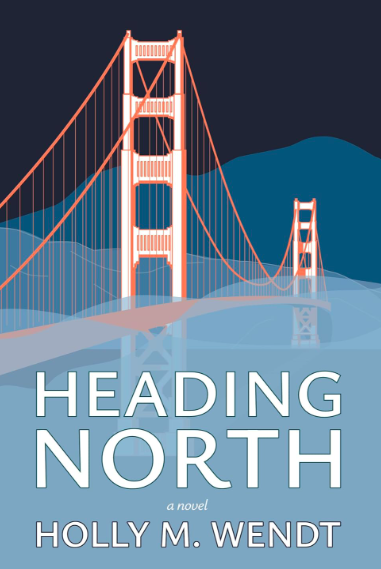
![Exclusive Cover Reveal of […] by Fady Joudah](https://electricliterature.com/wp-content/uploads/2024/01/9781639551286_FC-2.jpg)