Most of my really potent reading memories have less to do with exact books or passages, and more to do with the city I was living in, the people I was surrounded by, and the things happening on the fringes of my life as I read. It’s for this reason, in part, that I tend to keep a near-religious accounting of the books that I’ve read and the movies that I’ve seen and the records that I’ve listened to, each operating as a sort of snapshot of wherever I was in time. Years removed now, and I have no recollection of how House of Leaves ends, but I vividly remember turning the pages feverishly in tandem with an old roommate during the final weeks we lived together, or shotgunning Murakami books at a coffee shop the summer after I finished college, or extending silent reading time by an additional few minutes in my old seventh-grade classroom just so I could finish the last few pages of Sing, Unburied, Sing.
Far and away the most consistent presence across these memories is my cat, Kula, a half-domesticated former stray who’s moved with me now, across the country, from Colorado to Illinois, back to Colorado, back to Illinois, and finally—for now—to Southern California. Kula’s been by my side for each of these moves, and by this point, countless novels and short stories and poetry collections: brushing up against my legs as I combed through Stories of Your Life and Others on the outdoor couch; pretzeled on his cat tree as I shivered reading Friday Black the winter that I couldn’t get my bedroom window to shut all the way; nipping at my hair at the onset of the pandemic as I reread Station Eleven for a preposterously timed speculative fiction class. No matter what I’m reading, Kula always seems to embed himself in the story.
Not all cat people are readers, of course, and not all readers are cat people, but it’s unarguable that reading, a supposedly solitary activity, tends to pair well with this supposedly solitary animal. With that in mind—and with apologies to “Cat Person”—below are seven great, cat-centric Recommended Reading stories published over the years by Electric Literature. A warning: many of these stories are not for the faint of heart, featuring less-than-ideal narrative outcomes for our furry companions.
“One evening, I ran over a cat,” begins Amanda Marbais’ claustrophobic and darkly funny “Horribilis,” which originally appeared in her 2019 short story collection Claiming a Body. “Upon impact, its flat eyes reproached me, like it hadn’t known pain before,” the opening paragraph continues. “I got out of the car, stood in the headlights, and cried . . . I’m a vegetarian!” Following this nightmarish opening for cat lovers (or, hopefully, for anyone), our narrator, already afraid of nearly everything, develops agrizoophobia—the fear of wild animals—with the phobia taking a particular fixation on cats specifically. “To have a cat phobia is not to be able to use the Internet,” our narrator reflects wryly. “It’s all porn and cat videos.”
Can a cat survive falling off a skyscraper? The perennial internet debate/bar trivia question is the catalyst for Olivia Parkes’ “Can a Cat,” in which the opening scene finds an unhappy couple arguing over this exact question. An event of morbid coincidence—a cat plummets from the sky and lands on a nearby table, where it, after an agonizing couple of moments, finally dies—interrupts them. “The idea that our marital strife could have made a cat fall from the sky, though fantastic, was weirdly in keeping with my research, or at least with the wispy thought of the New Age gurus it had led me to on YouTube,” reflects our narrator, surmising that she and her partner’s argument may have summoned the cat to its death. “I did not know what I believed—only that the cowardly and increasingly unreal nature of our discord was having a violent effect.”
The conceit of Nick Otte’s “Eau de Mims” may seem like a relatively straightforward fabulist premise, but it amplifies in strangeness the more time you spend with it. At the start of the story, our narrator realizes that her deceased mother has come to inhabit the mouth of an alley cat named Jodie who lives behind her New York City apartment building. “Jodie is a tabby, marble-eyed with orange peel stripes along her back,” remarks the narrator. “I feed her and the other kitties in the alley beside my building every morning . . . it was fun for a while, that is until Mims took up residence behind Jodie’s sharp little teeth and started carrying on.” Is the narrator’s mother really occupying the stray cat’s mouth, or is the narrator just experiencing a manifestation of her grief?
“She’s an average cat,” our narrator’s roommate informs her, midway through Azareen Van der Viet Oloomi’s “It Is What It Is,” in a refrain that will be familiar to many cat lovers whose friends and family just can’t seem to understand what’s so special about a given pet. “Stop projecting on her.” The plot follows our narrator, who, after seeing a social media post about a cat in Canada whose Iranian owners have been shot down over Tehran, sees a reflection of the traumatic state of global affairs in the cat’s story. She reaches out to the cat sitter about adopting the animal, and, when its arrival at her apartment immediately presages the start of the COVID-19 pandemic, she comes to view it as a kind of omen. “Don’t you think it’s possible that [the cat] was intimating news of the cosmic violence we are engulfed in?” she asks her roommate in April of 2020, as the world around continues to spiral more and more out of control.
Originally published in Tove Ditlevsen’s 1952 short story collection, Paraplyen, “The Cat” follows an unhappy couple who come to blows over, of all things, a cat. “He let it out, and she let it back in,” we’re informed by the narrator. “When they lay in bed in the evening, they heard the faint meowing outside their front door, and she got up to give it something to eat, while an incomprehensible resentment arose in her husband. ‘Don’t let it in,’ he yelled to her. But in the morning there it was down in the living room, jumping elegantly up onto her lap.” The conflict at the center of the story will ring true to anyone who’s ever been in conflict with a significant other over feline affection, as will the lack of a tidy resolution.
“She was a nice wife, even liked me for a time,” begins Steven Barthelme’s “In the Rain.” “I enjoyed her company, and in the early days, when sleeping together had this scorched-earth sort of magic, we mistook that for love . . . this is what I was thinking, standing in the rain, the day the cat came back.” Having been left the cat (“old Rilkey”) by his ex-wife, our narrator finds himself saddled with an animal that he cares for without really meaning to, even as he suspects that it has only been bestowed upon him because of a new boyfriend with an allergy or a distaste for cats (“. . . not that I blame him,” he can’t help remarking). After the cat drags itself back into the house, soaking wet after being out for several days in the pouring rain, our narrator remarks: “I loved him. That’s a feeling, isn’t it?”
In R. L. Maizes’ “A Cat Called Grievous,” a bored, childless couple adopts a cat named Grievous. “People are fond of saying that ‘dogs have masters and cats have servants,’” writes Halimah Marcus in her introduction to the story. “[This] statement [is] mostly true, and, I will argue at the risk of revealing myself as a cat person, makes cats richer subjects for fiction. Dogs are loyal, and cats are indifferent. Give a cat an owner, and there is already a conflict.” And, sure enough, conflict develops for Maizes’ characters quickly. “Sometimes I think you love that cat more than you love me,” one partner says to the other, and we’re off to the races.
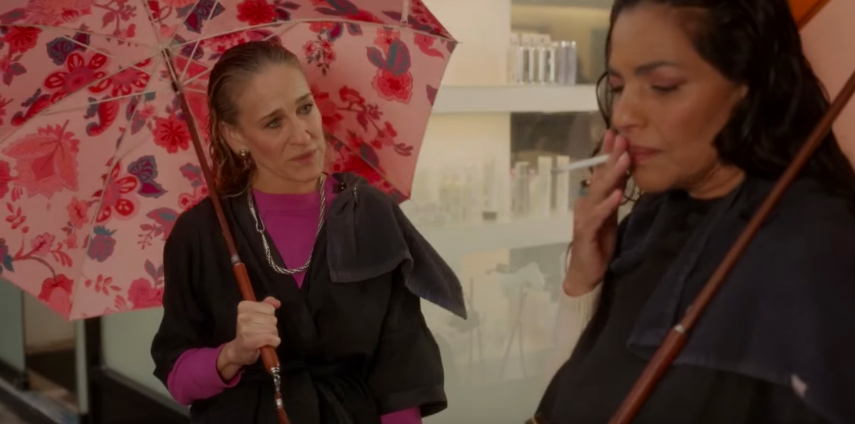
In “A Hundred Years Ago,” the eighth episode of the second season of Max’s Sex and the City spin-off, new addition to the group Seema—played expertly by Sarita Choudhury—tells Carrie what many of us are afraid to utter aloud, lest we make the fear real: there probably isn’t a great love out in the world, waiting for her.
“From everything I’ve heard, it sounds like you’ve had these two great loves. And I’ve had none. No, please, don’t say I will, because I might not, and I can live with that.” She pauses, considering how to tell Carrie she’s not comfortable spending the summer as a plus one to her and her boyfriend, “But I can’t do this summer. That’s not true, I could, but I don’t want to.”
Seema’s mentioning her lack of “great loves” isn’t an admission; she’s not embarrassed by this fact. She doesn’t cry, she doesn’t whisper this declaration—she looks Carrie in the eyes, cigarette in hand, and candidly explains her perspective. Seema Patel gives And Just Like That viewers a visual demonstration of what Joan Didion elucidated in her pivotal essay, “On Self-Respect.” Didion’s essay doesn’t provide a how-to on self-respect; she’s divulging to the reader how those with self-respect conduct themselves.
Didion defines feeling the need to maintain the personae ascribed onto us as “alienation from self.” She writes:
“We are peculiarly in thrall to everyone we see, curiously determined to live out…their false notion of us. […] Every encounter demands too much, tears the nerves, drains the will, and the specter of something as small as an unanswered letter arouses such disproportionate guilt that answering it becomes out of the question. To assign unanswered letters to their proper weight, to free us from the expectations of others, to give us back to ourselves–there lies the great, the singular power of self-respect.”
Seema’s indifferent towards this topic, yet she finds herself avoiding Carrie during the episode’s duration.
Explaining this phenomenon to Carrie invites pity and Seema’s life is not deserving of pity.
Seema lives the dream: she’s rich, beautiful, and successful. Unfortunately, she understands those traits aren’t as impressive for a woman without the most coveted commodity of all—a great romantic love.
It’s rare for a female character to address being alone and not have it act as a plot device, an easy way to get the audience on her side before her love interest bumps into her at a coffee shop or makes fun of her dancing at a club. Seema’s declaration was not one of loneliness—it was her not allowing anyone to make her question the life she’s created for herself. Didion calls this displaying character: “character—the willingness to accept responsibility for one’s own life—is the source from which self respect springs.”
I don’t think I’ve ever seen a woman reconcile with the worst fate of all—loneliness—quite like I saw this one. The most recent iteration of “lonely woman” I can recall is in Greta Gerwig’s Little Women. Saoirse Ronan’s “I Want to be Loved” monologue has a piercing pitch, almost like a dog whistle for women in their twenties: “I’m so sick of people saying that love is all a woman is fit for, I’m so sick of it! But I’m, I’m so lonely!” But Seema’s explanation isn’t romantic: there aren’t books or candles scattered about, she isn’t tearful, and she’s a brown woman in her mid-fifties. She doesn’t feel compelled to smile at Carrie’s well intentioned jokes and she feels no remorse about canceling their summer plans. Seema’s version of loneliness isn’t empowering or aspirational or beautiful, it just is.
The familiarity of Seema and Carries’s conversation sat at the pit of my stomach, anchoring me to my bed after finishing the episode. I’m at a precarious age, one where other twenty-somethings all somehow got the memo: “It’s time to settle!” Everyone’s either moving in with their partners for cheaper rent (though citing love and happiness), or ferociously swiping on dating apps with the hopes that soon, they too will get to move in with someone for cheaper rent. I didn’t get that memo; I was unaware that life had become a race. Social-distancing rendered dating nearly impossible, and that affected my desire to find a romantic relationship. I didn’t realize everyone else wasn’t undergoing that same shift. We are still encouraged to scour the streets for the most conventionally attractive twenty-something guy, faster than the next girl can. Finding a partner has become a full-time job; we’re expected to put hours into dating apps, go on multiple dates a week, and visit the bars with the most men.
At this age, people start to get married and have children, and I’m happily not included in that population.
But I was reminded of something that happened a few months prior. I got an impromptu call from my best friend, asking if his new boyfriend could join us on the trip we’d been planning for months. His asking me that felt like the end of an era. When Seema confronts Carrie she says, “When you invited me to dinner, you said ‘we’ wanna take you to dinner. Carrie, you’re already a ‘we.’” When I wasn’t paying attention, I lost my best friend to a “we.”
It’s a circumstance we think we can ignore out of our lives, the dissolution of our friendships. I was confronted by many fears at once: aging, loneliness, having to share those that mean the most to me. I started to understand the imaginary pressure everyone feels to get tied down. We’re all so lonely, why wouldn’t you always be on the hunt for a person to spend all your time with? Someone who asks you about your day, someone to hang out with, someone who validates you? Why wouldn’t you go out with the sole intention of finding the love of your life when our lives are devoid of it?
The romantic relationships I’ve been confronted with haven’t seemed filled with love and tenderness. Moreover, I see relationships where two former college kids found themselves lost when COVID hit. Couples who live together yet work opposite shifts, openly admitting they rarely see their partners. These kinds of relationships appear to be the product of social pressure. The fear of not having a romantic partner is why people strive to acquire one. Their deepest connections are to their societal roles.
Moving back to Alabama, my home state, from New York has plunged me into an environment of young women whose primary goals are to get married and have children. My coworker gushes about her partner over late night cocktails, but the source of the gushing is what stands out. When discussing rent and capitalism and existentialism—typical Friday night conversation for four zillennials—she lets us know that soon, she’ll be married and money will pose no question to her. Her boyfriend has been begging her to marry him and once he earns enough to grant her stay-at-home-wife status, then she will agree to matrimony.
I realized then how little I know about her partner. He’s often a focal point of our conversations, yet I can’t recall his favorite TV show. His hobbies. His personality traits. But I do know he makes $40,000 a year and is hoping to be a married father before he turns 27. I’ve met many women who boast about their partners wanting a girl who aspires to dote on her husband and children—with no other outstanding qualities—and subsequently how lucky their partners are to have found them at the bottom of the gallery screen in their Zoom class. And the women can’t provide any interesting facts about their partners either—wanting to get married is the primary trait they require. When they talk about their romantic partners, I don’t learn about funny stories or endearing moments.
I get told—with a tone drenched in smug— that their looming marriages will save them from the workforce.
Platonic bonds, in my experience, have been more enriching than romantic ones. Friendships have to be sought out and cultivated, maintained. You choose to go out of your way to sustain them; they’re voluntary. Yet friendship has managed to find itself at the bottom of our list of priorities. On the How to Talk to People podcast from The Atlantic, producer Rebecca Rashid says “the American mainstream culture of individualism and the voluntary nature of friendship is a tough thing to balance.” Having a relationship that feels reciprocated and supportive—that doesn’t involve sex as a major contributing factor—has allowed me the ability to connect deeply with strangers in a post-COVID world, and given me more confidence in myself. But then, why do I feel the same pressure as everyone else?
I’m scared I judge people as a defense mechanism; I want to protect myself from the reality that despite being financially independent, driven, and accomplished, I’m the weird one, and they’re socially on track. Didion’s concept, alienation from self, racks around my brain. Freeing oneself from societal expectations is what Didion considers “the great, the singular power of self-respect.” It’s hard to admit to myself that I am not there yet.
Most embarrassingly, I’m insecure about what people think of my lack of romantic life.
I live in a perpetual state of fear. I am incessantly caught in the throes of grotesque anxiety; I spend my days lying on my bed, staring up at the ceiling, reviewing conversations I’ve had. Reworking them, chastising myself for not coming off as put together or interesting. I am crippled by imposter syndrome. Didion says to “say no without drowning in self-reproach is an alien idea to [alienation from self],” which I’m deeply familiar with—I punctuate every no with an exclamation point. I hope it reads as coquettish and sweet, and not like I spent five minutes rearranging sentences so as to not come off as a mean girl.
The weird looks I may get from sitting at a restaurant alone, or people thinking I’m brave for attending a movie by myself plague me. Being able to divorce myself from any ability to worry about what’s being thought of me is a tenant of self-respect I haven’t conquered.
I found myself overcome with emotion at the episode’s conclusion: Seema surprises Carrie by joining dinner with her and the entire gang, boyfriend included. Seeing her take time for herself, without being portrayed as an antagonist or malicious—something not often afforded to women of color—and reentering Carrie’s life on her own, thoroughly established terms, was simultaneously powerful and loving. While it’s disheartening that this phenomenon might last my entire life, should I choose to remain single, the stunning display of self-respect illustrated by Seema showed that the frustrations are not only manageable, but worth it for other meaningful relationships.
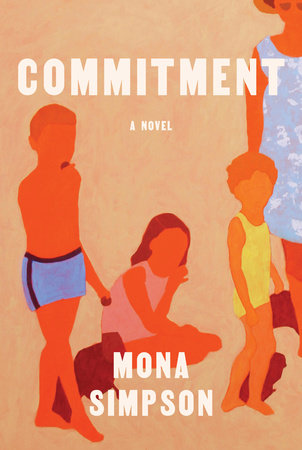
Mona Simpson’s latest novel, Commitment, is a tour de force that takes place in the early 1970s and follows three siblings—Walter, Lina, and Donnie—as they grow up in Los Angeles, into adulthood, and discover themselves while deciding whether to live an artist’s life, or a stable one. Each character uniquely confronts this question after their single mother, Diane, suffers from a debilitating depression and is committed to a long-term stay in a mental hospital, leaving them alone financially and emotionally. As the Aziz children try to stay afloat with part-time jobs at ice cream shops to cover rent and a little help from their friends, Diane lingers in the background of the book, as present as a ghost, and becomes a focal point for the siblings as they intermittently reconcile and reunite in her hospital room after years of living apart.
Commitment is as much about finding one’s identity as it is about losing one’s self. Simpson’s three protagonists experience self-discovery and romantic love, intricately interwoven in its various forms, while simultaneously risking everything they have for art in its many heartbreaking shapes. Throughout their early twenties, Walter dreams of becoming an architect, Lina studies painting without public success in a graduate program at Columbia, and little Donnie gets caught up in a world of addiction. All three are secretly falling apart until they come together in one room where time stands still. In profound, beautiful, and tragic chapters, Commitment shifts between each Aziz child’s perspective and ruminates on economic insecurity, the inheritance of mental illness, growing up, losing innocence, gaining independence, and how to situate that hazy and elusive idea of “adulthood.”
Simpson and I met at Caffe Luxxe in Santa Monica and spoke over Americanos and indie music. Her first novel, Anywhere But Here, was made into a major motion picture in 1999, and now she serves as the publisher of The Paris Review—so we spoke about her thoughts on movie adaptations, the writers’ strike, and where the publishing industry is heading. Throughout the rest of our interview, Simpson discussed writing Commitment with a young consciousness, the perceptions and invisibilities of one’s social class, the secret charms of Los Angeles, and how her perspectives on love and art have changed over the years.
Kyla Walker: Commitment beautifully and, at times, tragically captures the fears, anxieties, dreams that twenty-somethings often have about becoming artists and simply growing up. I was curious—what drew you to write about that specific period in each of the characters’ lives?
Mona Simpson: I think I wanted to write a story about, in part, the mother who struggles with mental illness. And I wanted her to be kind of there, but not there in the book and to see her through each of her kids and how they deal with what happened to her. They accept her loss and her tragedy. That became my organizing principle. I found myself going to the period of their lives where they had to actually come to terms with that. So it was at different times for each of them because they were different ages when it happened. But I think that [one’s twenties] is one of the hardest times of life for various reasons. The two oldest [characters] are especially interested in being artists. The oldest in architecture. The second one in visual art. But I think for those two in particular, especially since the arts are insecure, famously insecure, and they weren’t coming from a world with a lot of stability and safety nets. They really didn’t have any nets. So I think they struggle to do this. It was a risk on top of a risk.
KW: Was it easy for you to access that youthful state of mind again? Did you keep a journal in your early twenties that you returned to?
MS: Oh. No, no, I didn’t think of that. I do remember myself at that age. But also I have two kids at that age, and I teach students [at UCLA]. It is a very tender age. And it’s a brave thing to want to be an artist. It’s interesting now to see enrollment in the humanities drop. Both of my kids are pursuing what they really want to do, and I’m happy although scared for them too. I hope it works out. But at the same time, I also worry about the other group. I’ve seen a lot… I’m always telling my students, I’ve met a lot of unhappy lawyers who construct the whole world and an edifice that they’re going to this job that they essentially do not like, and that is a big problem.
KW: That affects mental health in another way.
MS: Yes, and spiritual health as well.
KW: At times, money feels like another character in the novel and almost feels like the antagonist for the Aziz children. I was thinking about how it serves as a driving force of the plot and a genuine concern for many college students today. How do you think financial concerns shape the narratives differently for Walter than for Lina?
MS: I think it shapes both of them in different ways. It’s funny, I have a friend who said to me, “Your characters are all such believers in education.” And I realized then how far I’ve come from my upbringing. I think that Lina’s and Walter’s mother was a middle class person, but I think that she grew up in a lower class, and she saw education as the only way for her children to have a better life, and yet it’s so intoxicating for Lina when she actually starts working at the department store and has a salary. She found her little niche there. She could decorate windows and was the protégé of the most artistic woman there. It was hard, in a way, for her to give that up.
KW: It seems like all the patients in the mental hospital are treated equally, in terms of resources, no matter what their class is. I found an interesting parallel to the college campuses where Walter and Lina were attending because it seems they were also given the same resources regardless of their socioeconomic status. Was that an intentional parallel to structure the book upon?
MS: Well, in the case of both of them, while they’re there, there might be a kind of equality, but we all bring so much of our past, our constraints, and our anxieties with us. So I think that in a way, Walter felt so close to Ken [his roommate], but his experience in college really was quite different because half of his mind and heart was with his family back in L.A. and with his mother in the hospital. Whereas Ken didn’t have those things to deal with.
KW: It was fascinating too how Walter went all the way to Berkeley to study, yet still fell in love with two girls that went to Palisades High, his old high school.
MS: I know! That was funny.
KW: I was curious if that was maybe because of a deeper insecurity he had. Was it possibly linked to his illegitimate student status and never quite feeling like he belonged at Pali High?
It’s a brave thing to want to be an artist.
MS: Yeah. I think his goal was kind of what he got. He came back, as an adult, to the neighborhood in which he’d never really been a part of, and he’s now a part of it. It’s nice to see that, though. I think that when I was growing up here, everyone in high school just wanted to get out and go far away. I went to Berkeley and friends of mine went East. We all wanted to be away. We never thought we’d come back to L.A. And now, it seems like all the kids I know go away for maybe a year, a couple of years, but they all plan to come back.
KW: Do you think that’s specific to L.A. or just the case with hometowns in general?
MS: I think L.A. has sort of come into its own. It used to be kind of a cultural idea that it had a negative valence. There was a tendency to put down L.A.—it wasn’t New York. It was Hollywood, in a bad way. But I think now it’s kind of a city you can live in. There’s mountains and the ocean. I love L.A. It’s a well-kept secret.
KW: So in the end, each of the Aziz children do end up finding companionship or love in some way, which is in contrast to Diane’s and Julie’s lifestyle. Do you think that they each sought out a partner, or just someone to share their life with, after watching their mother go through this down spiral that they might’ve connected to loneliness?
MS: Yes. Although, I think they each did it a little bit differently. I think Donnie had the most classically romantic story. And Walter really married a friend. He didn’t marry the one he was dreaming of all through college and afterwards. He came to terms with that and felt good about that. He felt he made the right choice for his life. I think they had varying degrees of romantic capability.
KW: That was a beautiful thing about the novel—it shows you all the different ways you can love someone and share a life with them. On a different note, there’s a quote on page 196 that felt like another central idea in the book:
“Getting ready for a party while still debating whether people who loved what they did for a living ought to be paid less because they received nonmaterial compensation, Lina asked, ‘Do I look alright?’ and Lauren said, ‘Of course.'”
That is such an interesting way to put it— that if you love what you do, maybe you should be paid less. I’m just curious about your thoughts on this.
MS: That’s an old Marxist idea. I think I was thinking of that in terms of the last few years, so much of what we’re probably all feeling, is the homelessness crisis. The unhoused crisis. And there has to be a way that we can arrange society that’s better than this. So that’s one thing that people have posited: why should people who love what they do get that benefit and make more money for it? Maybe it’s not the most unfair thing that artists often don’t make as much money as bankers. You know, it’s probably much more exciting to be an artist. You have much more freedom, you have much more agency throughout your day-to-day life.
KW: Do you think that writing this book changed your perspective on that at all?
I always think that art is useful just by being art, not necessarily to serve any particular message or any particular ideology because I think that gets dangerous.
MS: I think my perspective has changed a little as the years have gone by. I think that in my lifetime, not yours probably, but really in my lifetime, I’ve really seen the income gap become incredible. And it wasn’t always so huge. In the last few years in L.A., people who are working essential jobs can’t afford their rent because of the housing laws in this city. It’s become insane. Even the writers’ strike… I think they’re really right. So you see it everywhere. You see the vast distance. I think most of us in the English Department [at UCLA] were probably really backing the graduate students, 100%, when they went on strike last fall because lecturers and adjuncts are—to quote one person who wrote in an article in the New York Review of Books—they’re servicing academe. And often these people are teaching the core courses that most students who come to the major want to take. They want to take Shakespeare. They want to take the Bible. They want to take the 19th-century novel. A lot of these essential courses are being taught by people who have huge teaching loads and are compensated for little.
KW: Yeah, it’s really very sad… Do you see any way that this is changing now or could change in the near future?
MS: Well, the strike, the collective bargaining, made a big change in that. I actually took a hike with a friend of mine who was deep into the housing problem in L.A., and there are a lot of ideas but there are also a lot of things in the way of them too…
KW: So what are your thoughts now on the meaning of art and the role it plays in our society? Can it serve the working class in any way, or is it increasingly designed more for intellectuals and academics?
MS: I always think that art is useful just by being art, not necessarily to serve any particular message or any particular ideology because I think that gets dangerous. But I think that beauty is useful for everyone alive.
KW: My last question is—where do you see literature heading in the next five years?
MS: Well, that’s a hard question! I don’t think it’s under one tent. It’s interesting. I just met with a group of booksellers, and we were talking about how we’re at a point where, even for book people now, a lot of times they go to a dinner party or something and talk about what show they’re watching—whereas ten years ago, five years ago, people would be talking about what book they just read. And now they’re talking about television, which is interesting because the good television shows that we all like are often character-driven and a lot more like the 19th-century novel. I know that I like to be subtle, but I want to make sure that I actually am decode-able and accessible. Because I think we do want to engage people about the most important emotional events of our lives, and we do want to be clear to an extent. There’s no benefit to obscuring. So, I’m not sure where we’ll be. We’ll see.
Before August 2017, most people were more familiar with my home of the past 30-plus years, Charlottesville, Virginia, for its postcard appeal: Thomas Jefferson’s Monticello and the University of Virginia, his “academical village”; charming neo-classical cityscapes; undulating foothills rolling into blue-tinged mountain horizons; and a burgeoning multitude of scenic vineyards, microbreweries, and artisan distilleries, plus a growing reputation as a foodie destination.
Even in the best of times, postcards leave something out. Like how enslaved laborers built all these pretty neo-classic buildings, starting with Virginia red clay, baking it into bricks, laying each one. Like how at least two serial killers have stalked the area since the 1990s along with numbers of rapists who tend to favor small towns with large universities. Like how upside-down the economy is here, with hyper-inflated housing prices and egregious achievement gaps.
As writers, we’re always outsiders looking in, even where we live and belong. We see the postcard and its flipside and often turn to our work to reconcile the two vantages. In my fiction, I’m interested in byways and side streets, lonely spots visitors might never see. If a character belongs to the postcard landscape, they don’t fit there. My poor little characters struggle to fit anywhere in stories that engage with wealth inequity, toxic masculinity, racism, endangered children, and loss. The flipside of the postcard.
These eight story collections feature postcard destinations, too, introducing us to complicated people in troubling situations in places better known for their beaches, their celebrities, their monuments, their Space Center, or their underground gardens.
Charlottesville: My Monticello by Jocelyn Nicole Johnson
I’m far from alone in my gratitude for Johnson’s bold, fresh voice on our shared hometown. The eponymous novella combines environmental apocalypse with a resurgence of Unite the Right style white supremacists, bent on decimating the non-White population of our usually quiet little town. The opening story, “Control Negro,” faces off with a lesser-remembered recent Charlottesville racist incident, in which Alcohol and Beverage Control agents brutally arrested a young Black UVA student, slicing a gash into his forehead that required several stitches. Two years before Unite the Right, images of his bloody arrest landed in newspapers around the world. Our town has a vicious history that we’re only beginning to reckon with. Our postcards need radical updating.
If you’ve visited Washington D.C., no doubt you hit the top tourist draws: monuments to leaders and wars, Smithsonian’s treasury of art and artifacts, the White House. A handful of my D.C. favorites include the Phillips Gallery, the cherry blossoms, and Blues Alley jazz club. All offer plenty to write home about. Edward P. Jones brings us to a different iconic sector of the city—historic Black neighborhoods, whose population the Great Migration boosted. Here, well beyond the shadows of imperious monuments, his characters often interrogate D.C.’s postcard imagery, as in the title story when Lydia’s drive through the city maps touchstones of her life. For her, the National Mall is heritage and struggle versus tourist delight: “In one of the museums white men had allowed her father to make a living pushing a broom, and now she was paid in one year more than her parents had earned in both their lifetimes.” Jones’ D.C. is a rich, layered place, full of history and culture that postcards forget to celebrate.
When the Song family patriarch in Spaulding’s collection of linked stories emigrates from Korea and arrives in Fresno, California, in 1924, it is the horn of plenty, the literally fruitful California that would entice the Joads and legions of others to seek better fortunes there within ten years. Los Angeles, Napa and Sonoma, San Francisco, Palm Springs and other cities beat Fresno in tourist appeal, but it boasts some local beauty and the unique historic Forestiere Underground Gardens. For the Song family, Fresno becomes a new home, with all the complexity of any diasporic family home. There is beauty: “The cactus and juniper are twinkling, while overhead, the dark rim of the desert mountains spills its bowl of stars.” And there is an abiding displacement that flows down the generations, first voiced by the Song matriarch, when she was pondering the plight of migrating birds: “maybe what’s home to me is away for them. Or wherever they alight is home. Or all places are away and no place is home.” Perhaps a postcard could characterize this rootlessness with a hologram, showing California at one angle, Korea at another.
According to an NPR story of yore, someone computed whether Kansas actually is as flat as a pancake and determined that, in fact, Kansas is flatter because of pancakes’ slight natural curvature. The epitome of a flyover state, Kansas makes an apt backdrop for Mandelbaum’s stories of lost love. The landlord in one story sums up the sensibility this way: “It’s either school, a job, or a girl…Or death. Those are the only reasons for coming to Kansas. Unless you’re born here, of course. Then it’s a matter of escaping.” These characters drool over postcards from any destination these other collections inhabit. Their ambivalence about or downright dislike of their non-postcard home so subverts the theme here that, for me, they swing this collection full circle to clinch it.
The idea for this list’s theme arose from a Rumpusinterview with Mohammed after her linked collection came out, when we talked about the weight of understanding the good and bad in our homeplaces. Visitors flock to Trinidad for its beachscapes, cuisine, and music culture without considering the complicated social and political landscape of this post-Colonial, post-slave trade, crossroads nation. In linked stories, Mohammed introduces us to a range of characters from different rungs of the social and economic ladder. In one story, Gail believes her pregnancy will hoist her way up that ladder, imagining her sugar daddy will trade in his old wife for her. Her view of what she hopes to leave flips Trinidad’s postcard and reveals many of the contradictions the other stories further explore: “No more stepping over shit-smelling drains, no more bullets popping all hours of the night, no more wondering when the garbage truck will pass, no more feeling shame to write my address on a form.”
Also known as “Space City,” the vast, cultural melting pot of Houston is the fourth largest city in the U.S. and home to NASA’s Mission Control, where the intergalactic messages of “The Eagle has landed,” and “Houston, we’ve had a problem,” were received then relayed to the rest of the world. Washington’s characters are more concerned with subsistence than outer space, and Houston through their eyes looks more dystopic than space age: “The sky had dimmed into this murky blue, like all of the smog had finally congealed, and our end of the bayou peeked over the mud, slipping straight into the water sloshing beneath it, until the water turned into mud, and the mud congealed into dirt, and that dirt made the bedding for the glossy buildings behind it.” Picture that on a postcard.
Swimming pools across the world: No Diving Allowed by Louise Marburg
Swimming pools anywhere feel postcard appropriate, and each story in Marburg’s collection features one—at a Tanzanian safari resort; a remote French countryside home; a beachside hotel; homes of various unlikable people whose families are at odds. Two pools best suited to the flipside theme are one in which a niece discovers her uncle “floating facedown a couple of inches below the surface,” a victim of suicide, and the other, which belongs to a teenager named Emma. Her parents are divorcing, leaving her and much of the household neglected. Their pool “was empty because there was a crack in its side that needed to be patched, so Emma used it as a hideout when she wanted to get high.” Not quite picture perfect.
The Hollywood and Hollywood-adjacent stories of Schutt’s collection better resemble BoJack Horseman’s dark, dissipated “Hollywoo” than the flashy glitz the seaside celebrity mecca is known for. As a nice segue from Marburg’s collection, a swimming pool in this one captures the mood of Schutt’s often drunk, certainly despairing, frequently erratic characters. This pool belongs to the home Mimi shared with her much older, very famous comedian husband, who died of a heart attack and left her with nothing. It “was not very deep, which might explain the slightly yellow color of the water, and the sky, too, was a creepy kind of yellow, a spreading dread,” an appropriately miasmic depiction to round out this list.
The houses are getting skinnier. By the time Ant can afford to buy one, there is only enough room to stand. His elbows bump up against the walls. His nose hits the front door. He goes outside whenever he has to take a deep breath. He spends a lot of time on his porch listening to The Smiths, but it is worth it to own his home.
Most of his neighbors have bigger houses. They moved in decades ago, before the subdivisions. He is stuck in an upright coffin, but he is proud of his home.
He copes with the lack of real estate by staying longer at work. His office is both tall and wide, with a nice view of downtown and plenty of room to stretch his legs. His job requires him to compile the best books and best microwaves and best beaches into lists. He used to write longer articles, but his company wanted him to make them shorter. Some of them are only twelve words long. He writes many lists so he can stay late. The space makes him feel relaxed. He leaves only to sleep. This makes his new house tolerable.
It all goes well until they make him work from home. Now Ant is stuck in his skinny house. Sometimes the teenagers tip his house. They think it’s funny to tip houses like cows. The houses are so skinny—who could resist? He hopes he’ll be allowed back into the office again soon—it’s hard to work under such conditions—but that day doesn’t come. A couple years pass, and he gets sick of being in his skinny house.
He dreams of moving out of Los Angeles—maybe out to the desert. But it would be a big change for him. He grew up in the city. It is all he knows. He went to college here too. He will miss his family and friends, but he needs a place to sit.
So he packs up. It doesn’t take too long. He doesn’t have many possessions. He wraps his screens in bubble wrap, and then he is done.
But he is on to greener pastures: a desert ranch. Now he has dozens of acres. He can stretch his legs. The first few months he walks his property just so he can bask in the hugeness of what his money has bought. There’s no fence, so he decides to build one. It takes him a while to mark up the boundaries of his property, but there are no neighbors fighting to regain the inches he’s fudged, so he takes a few more.
Even though his new house has six rooms, he spends much of his time sitting on the porch so he can be seen. He wants to feel like somebody. But nobody passes by.
And then he realizes there’s a problem because he has a huge house and doesn’t feel like somebody. He doesn’t feel like somebody because he doesn’t know anyone. He was happier in a skinny city house, he thinks. He has made a mistake. He misses his friends. It is lonely out here. He feels depressed for a few more years, but at least his property value ticks up. He has outpaced inflation. His financial advisor sends screenshots from Redfin. Good work, she says. By the time he returns to Los Angeles, the houses are even skinnier. He can’t fit inside most of them. He wishes he bought a house decades ago—back when they were a normal size.
Eventually he finds a house he can fit in, but it is under a freeway and there is no light. The realtor tells him it will go fast. It is the widest house available in his price range. It would be foolish not to buy it. He makes a good offer that’s accepted.
He likes his new house, but it is noisy living under the freeway—so many cars buzzing overhead, not enough of them electric. He dreams of moving into the old office where he could have twenty-two bathrooms. He dreams of living in a building so large an elevator is required to reach the top floor.
He enquires about returning to the office, but his boss tells him they’ve let go of it. A corporation has converted the old building into thousands of new homes, but these were built too skinny, so the building remains uninhabited. A crime, Ant thinks. Imagine what one could do with all that space. The building remains empty for months and nobody does anything about it even though there is a housing crisis. He passes by it sometimes and stares longingly, thinking of the long aisles and the nice views from his old desk. He would give anything to stroll those aisles again, to feel like a person who has been freed from his packaging.
How could they let the building stand empty when so many need a place to live? He dreams of taking a sledgehammer to the walls and converting the building back into one office space. At first he is joking, but then he thinks maybe he should take matters into his own hands. The space is going to waste. It is only common sense. Buildings are for living in. If he doesn’t knock down the walls, who will?
He waits until midnight to break in and dons a black ski mask. How it’s done in movies, he thinks. He has no experience with break-ins. He is just a regular guy who writes lists for a living. The sledgehammer is heavy. It takes longer than expected to knock down a wall, but he is proud when he does it. Later, he falls asleep on the ground. He is happy to sleep horizontal for once. He sleeps in an X shape on top of the rubble, taking up maximum space. When he wakes up there are police standing over him. They haul him away to a jail cell that is fatter than his house. It is fat enough for him to pace. He can get a lot of work done in here. He continues working from home from his jail cell. Later, he is convicted on all counts. Prison is bigger than his jail cell, much bigger than his house. He receives a promotion while working from prison.
A couple years later, when he gets out, he finds his house tipped. He climbs inside and tries to die, but this doesn’t happen, so instead he lies perfectly still with the front door open so he can look up at the sky. But he can’t see the sky through the freeway, so he spends the next few months trying to drag his house out. It’s hard work, but he feels great once he’s finally out from under the freeway. Now his house is full of light. But the stars are missing from the night sky. He can’t see them because of the city lights. It would be nice to see the stars at night.
So he spends the next few years pushing his house out to the desert where there are no lights to pollute the view. It takes a long time—a few decades, an inch at a time—but finally he gets it there. Now he can see the stars, but he can’t see any of his friends and he is too old to push his house back home. He is stuck in the desert. He lies between the Joshua trees thinking of his old ranch. If he’s going to live in a place that’s so lonely, then why in a house so small? He should have stayed at his ranch. He thought he was a practical person, but he has ended up with the least logical choice: a tiny house in a huge open space. And now he is an age at which a person must accept his choices.
The city eventually fixes the skinny houses problem. The houses are very tall now as if to compensate. Still not much breathing room, but plenty of space for one’s things. Most people live on the bottom floor and store their possessions in the levels overhead. They retrieve their items from the outside, through their windows with a metal claw like in a children’s prize machine. Actually this is more of a solution for corporations who need to sell them things. Still, it would be nice to have one of those houses with the claws. He dreams of the things he would retrieve from his top floor, all the things he could buy with his money, if only he had space.
But he is grateful for his skinny desert house. He makes a list of what he likes:
The Little Dipper
Hikes through Joshua trees
Quiet except for the birds and the wind
He has done alright, he thinks. If he had a tall city house, he would spend all day buying things on his screens. Instead he spends his time with his toes in the dust. Sometimes he takes long walks and forgets he is a person—that he is not the wind and the rocks and the trees. He takes the deepest breath he has taken since he bought his first skinny house and looks up at the sky and he forgets what it feels like to be contained.
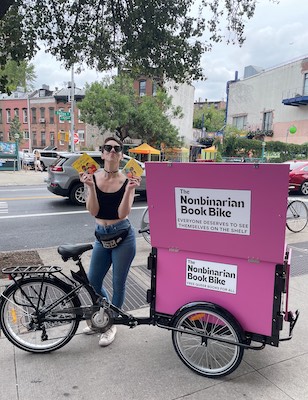
If you live in New York, you may have spotted The Nonbinarian Book Bike. It’s hard to miss—a bicycle carrying a big, bright pink box full of free LGBTQIA+ books for all ages and languages directly to the community.
The initiative was founded by K. Kerimian, and is new on the scene; it’s only been operating in Brooklyn for a few months now. K. began the Book Bike out of the desire to continue their work bringing books to the public without the constraints of a for-profit system nor the red tape of a non-profit. Instead, they’ve focused on mutual aid—an effort for the community, by the community, that builds solidarity while getting queer books into the hands of those who need them and may not have a way to afford or discover them. At a time when book bans are becoming more ubiquitous, and the American landscape is growing increasingly hostile toward queer, trans, and QTBIPOC individuals, accessible queer literature feels more urgent than ever.
K. and I first met as coworkers at Greenlight Bookstore, where we worked together with many others on staff to create Greenlight’s union, an effort that was a stepping stone toward K.’s creation of The Nonbinarian Bike. K. and I spoke over e-mail, discussing the gender euphoria and nonprofit work that inspired The Nonbinarian’s creation, what mutual aid can do that for-profit and non-profit institutions can’t, and why straight allies need to step up to fight against book bans in red states.
Katie Robinson: What inspired you to take on this project, and what went into getting it off the ground?
K. Kerimian: Like many career booksellers, it started with the dream of owning my own bookstore. My dream bookstore had a stage for performances and readings, a studio space for workshops and classes, and a community co-working area for sharing resources. This nebulous creative haven safe space that sure as shit wouldn’t make any money. But from that vision, a few major events shaped The Nonbinarian coming to fruition:
In 2022, I received top-surgery. The first time I got to be without a shirt in public was in the Washington Square Park fountain at Dyke March during Pride. The next day, I went to [the beach at Jacob] Riis. It was the first time I had ever felt comfortable in my body—not just comfortable, but happy. One of the best decisions I have ever made.
That same summer, I was the Bookmobile Manager of Partnerships and Operations for House of SpeakEasy, which played a huge role in shaping what I wanted to see out of book distribution. If you look at our mission and theirs, you can see there’s a lot of overlap: to distribute free books in the NYC area in neighborhoods where few or no bookstores exist via mobile pop-up. But there were limitations too. Some of it was logistical (driving a 27’ box truck in the city), but some of it was structural: SpeakEasy is a 501(c)3.
Just as the bookmobile season was winding down, I celebrated my 34th birthday. See, this was the age I didn’t think I’d made it to. Something about being a trans person, especially someone who uncovered their identity later in life, that I had never allowed myself to picture a future. There just… wasn’t anything beyond 33. I’d felt that way for years. But then I made it. I reached that impossible age. And I had done so with a brand-new flat chest that made me feel gender euphoria like I had never felt. And for the first time, I could finally conceive of a future—and not just my future, but the future I wanted to see out there in the world.
And then there was this urgency to not just idly wonder “wouldn’t it be nice to own a bookstore/performance venue/community space someday” but to take action. All the limits of the bookmobile turned into answers for what I could do with my future vision instead. I wouldn’t be able to change someone else’s nonprofit overnight. But I could start something of my own. Hence, mutual aid, a bike and not a larger vehicle, a queer community focus. No one was going to hand me that dream, so fueled by gender euphoria and inspired by the bookmobile, I asked people to buy queer books from a wishlist for my 34th birthday for a new project: The Nonbinarian.
It started with a Bookshop.org page. And within those first few weeks, the entire mission, identity, the website—everything, came together. Funding for the bike was a passive strategy through affiliates, like Bonfire & Ko-Fi. The focus was really on building a community and a presence so that by the time the bike was fully funded and arrived in Brooklyn, we would already have a foundation of folks involved to hit the ground running. And that’s exactly what we did.
KR: A part of what makes the book bike so special it’s a local Brooklyn community effort, a queer community effort, and an intersectional effort, focused on “solidarity, not charity.” I’d love to hear what that means to you, and what you feel a mutual aid effort like this can do differently from other literary spaces like bookstores or libraries.
KK: There’s a legacy of mutual aid that is at the heart of a lot of movements, especially amongst marginalized communities, but one of the most notable efforts came out of the Black Panthers & the Young Lords. History classes may remember those groups for their radical politics, but both groups were responsible for many programs that have since been recreated all over the world—proof of concept is in how individuals responded to the COVID-19 crisis and how they organized collective actions for basic survival needs. I encourage folks to read more about the history of collective community care, as others have written extensively on the subject, and I cannot do it justice in a few paragraphs.
Mutual aid, as I live it, is if I have the means to show up for my comrade in need of support, then I will, trusting that when I am in need, my comrades will show up for me, too. This is not because of a debt owed to be repaid, but because of respect for relationships built on shared values, where many of us are trying to do our best, but the systems around us are failing us, and if we don’t take care of us, then who will?
Bookstores and libraries want the same things that we want—to reach new readers, to help people feel seen in a book, to build a community—but because bookstores also have to worry about the evil empire and small profit margins in publishing, and public libraries are at the whims of their state and local governments, and both have to worry about payroll and keeping the lights on, those will always have to be priorities that take precedence above ideals. But with mutual aid, you can prioritize people in a way that other literary spaces just can’t.
KR: We were both involved in Greenlight’s unionization efforts, which resulted in the store officially unionizing in 2022. It wasn’t always an easy road, but there was so much love, solidarity, organization, and tons of hard work from a lot of people that made it happen. I know for me, I was really inspired by the continuous shows of solidarity that went into that effort, and it taught me a lot about the power of collective action. Did that experience have any influence on the decision to create the book bike or in helping you see a path forward for building out a community-based mutual aid effort?
KK: Absolutely, 100%. It’s no coincidence that many former Greenlight union worker-organizers are heavily involved with The Nonbinarian.
At the point in which I started at Greenlight, organizing was underway but still sort of hush hush. I remember the first time I hung out with folks outside of work in which they all sort of turned to me in this conspiratorial way to tell me that they were organizing, like they were choosing to let me into this secret club. Those next few months of preparation were a really exciting time for us. Everyone was equally invested in this group effort to improve future working conditions. One night shortly after the march on the boss, a group of us went to queeraoke & we all sang “What’s Up” by 4 Non Blondes & it felt so fucking powerful to share a mic and belt it out.
Like many career booksellers, it started with the dream of owning my own bookstore.
That was about one year before The Nonbinarian was formed. Now, sadly, there’s very few of those original bargaining unit members left at the company. But it’s that feeling of strength in numbers, in solidarity, that I felt in those early months—instilled by the folks who preceded me who put in so much work—that keeps my faith in our union.
One of the things I say to new hires during their union orientation is that being a part of a union means we’re not just fighting for better working conditions for us in the present, but for those who come after us, and that everything we have earned was due to the labor of those who came before us. And that idea of future building is the heart of abolitionist thinking and any sort of justice work. Because it requires not just expressing dissatisfaction for the way things are, but first imagining and then executing new ways of being. That’s what the union is: future building. And in a different way, that’s very closely tied to what we [the Nonbinarian community] do too.
I just realized I became the shop steward shortly before top surgery. 2022 was a big year for some personal revolution, huh.
KR:Fighting against book bans is a part of the book bike’s mission, helping to provide LGBTQIA+ and QTBIPOC folks of all ages access to books they may not have access to otherwise. What are some ways that folks in other states—especially states where book bans are getting increasingly more severe—can start mutual aid efforts of their own to help get important, empowering books into the hands of those who need them?
KK: I speak from a seat of privilege as a New Yorker when I talk about book bans, so I first want to acknowledge that my viewpoint is from a remove.
When I attended [the American Booksellers Association] Winter Institute this past February, my favorite panel was (surprise, surprise) “Book Banning: Stores, Authors, & Communities: What Can We Do?” in which none other than Maia Kobabe, author of Genderqueer, appeared. Putting my fanboi aside for a second, it was one of the other panelists who made a lasting impression: Laura DeLaney, co-owner of Rediscovered Books in Boise, Indiana. Laura shared how the school board near her store banned 23 books, so she decided to push back. In a total badass move, Laura started handing out copies of those titles for free. Laura has stayed true to the cause, but not without risk. So when Laura spoke on that panel, it was from a deeply personal, local, and of-the-moment point of view.
I want to say more folks should respond like Laura and push back with action, I do. But I also do not take lightly the current conditions in some parts of this country. The HRC has issued a travel advisory warning of the dangers of being queer in Florida, for godsakes. I cannot in good conscience recommend actions to folks where people’s lives are quite literally at risk. As much as I would love to empower a gender nonconforming teen in Little Rock to cycle their own Nonbinarian Book Bike, more than anything I want to protect that child during this seriously scary time. But this is where allies come in.
If you are cisgender and heterosexual, and especially if you’re white, you hold keys to rooms that queer folks are not only not welcome in, but are actually warned to stay away from. Most book restrictions come from a very small but loud minority. And I think the responsibility to push back against that loud minority in particularly vulnerable regions should rest with those who hold the most privilege.
I wish my answer were more optimistic. I still encourage any version of resistance in which those books are finding their audiences. Hell, I want to get the books there myself. But the biggest efforts in the riskiest states have got to come from the people who have the least to lose if we’re going to protect queer and trans kids, so yeah. I’m calling in straight people here.
KR:How has the Brooklyn community responded to the book bike? What impacts do you hope it has had and will continue to have?
The idea of future building is the heart of abolitionist thinking and any sort of justice work.
KK: It’s been overwhelmingly positive. There have been a few times I was biking to an outing where I was at a light or something and people would hang out of their car to say “is that a book bike???” and I’d say “yup!” and then suddenly we’re having this conversation about books in the middle of traffic before parting ways. One time I stopped mid-ride because some folks wanted to know if there were actually books in there, and I wound up handing out books on the street for a couple minutes. Recently, I stopped for a moment on a ride and overheard nearby pedestrians say “OMG I follow them on Instagram!” as if it was a celebrity sighting, seeing the book bike in the wild. I’ve had people who’ve shown up to an outing because they said “I saw you biking in such and such neighborhood and it looked so cool I had to check it out.” It helps that the bike is a bright pink box, so it’s kind of hard to miss. But I love that it’s become a hyper local thing as well as an online thing. We’ve been working hard to build our Instagram presence and reach more people that way, but the work begins with our neighbors. For folks to see or hear about the bike on the street and then get to share a moment together feels a bit like magic.
The bike has only been in Brooklyn for two months. My hope is that as we continue to do the work, we’ll become a little bit more rooted, so that we’re not just some novelty passing through, but that folks may actually come to recognize us as a part of their community. My absolute dream reaction would be if The Nonbinarian Book Bike had, like, ice cream truck level of excitement. I want kids to see the bike come by and know who and what we are because they’ve had such positive experiences with us before that they’re excited to see us and to get more books from us every time.
KR: What can people who want to support the book bike do to get involved?
KK: Donate books. We will always, always, always need books.
Get the word out. This has been a crucial part of our growth as a mutual aid initiative as we are stronger in numbers & the more folks who know about us with their own networks of resources, the more likely the Nonbinarian is to survive.
Share your ideas. Is there a service you can offer? Are you a part of a community that could partner with us for an event? Do you have access to resources? Do you imagine something the book bike can do that we aren’t doing yet? Maybe your idea can make it happen (that’s actually how a lot of the Nonbinarian has developed).
KR: What do you hope is in the future for the book bike?
KK: I want to see book bikes like I see Little Free Libraries—where they just crop up & everyone is welcome to contribute & they’re just a lovely thing that exists for no other reason than to bring books to people who may not otherwise have access. You know, one cargo bike can only go so far. If there were bikes in all kinds of places just think of how many more queer people would get to see themselves in a book.
When you hear the phrase “queer history,” how far back does your mind go? For many, there’s a sense that LGBTQIA+ history is fairly recent, starting with Marsha P. Johnson or maybe Oscar Wilde. Beyond that, we start to get into murky territory: stories of “lifelong bachelors” and “happy spinsters” and “historically very good friends.”
But LGBTQIA+ people didn’t spring up out of nowhere in the last 100 years, even if that’s when many history books start the story.
When I started writing Let the Dead Bury the Dead, I was inspired by the popular uprisings that regularly swept through Russia before the Russian Revolution of 1917. It’s a topic that’s always fascinated me, and one I think is essential to understand our world today. At the same time, I knew I wanted the characters navigating this turbulent time to be unapologetically queer. Not to be anachronistic or edgy, but because LGBTQIA+ people have always been here, in every time and under every regime—even if discriminatory laws and biased sources and book bans try to write over us.
The eight books in this list aren’t just gripping historical page-turners, although they’re definitely that. They’re also reminders that every corner of history is queerer than we were taught.
The final book in the Radiant Emperor duology picks up where She Who Became the Sun left off, with the warrior monk Zhu Yuanzhang carving her way through 14th-century China to seize the throne. But to pull it off, she may need to join forces with an old enemy: the ruthless General Ouyang, bent on revenge for his father’s murder. Meanwhile, the clever and calculating Wang Baoxiang has his own plans to win the throne…
There are numerous queer characters in Parker-Chan’s reimagining of the Ming Dynasty, all brilliantly drawn and all an absolute mess. Zhu, Ouyang, and Baoxiang all strive to carve out a place for themselves in a world that others them and considers them less-than, and their striving makes the line between hero and villain increasingly blurry.
This historical fantasy novel is spun straight out of the Icelandic sagas, which give us most of the information we know about Viking history. It’s an imaginative retelling of the story of Gunnhild Górmsdottir, a powerful 10th-century Viking queen rumored to have dark magic powers. (Of course, what powerful woman in history wasn’t rumored to have dark magic powers, really?)
The Weaver and the Witch Queen is an exciting adventure about magic, friendship, destiny, and loyalty. It’s also an absolutely dynamite exploration of what trans history might have looked like before modern, Western ideas about sex and gender really took hold.
When the Angels Left the Old Country opens in the fictitious “everytown” of Shtetl, where the angel Uriel and the small-fry demon Little Ash spend their time in the synagogue arguing the finer points of Talmud. But when one of the young people of Shtetl goes missing, Little Ash and Uriel make it their mission to rescue her. Along the way, they meet Rose Cohen, a fierce young woman who’s on her way to America to forget she’s in love with her best friend Dinah.
This is an immigration story that’s deeply Jewish, deeply queer, and absolutely original: think Good Omens meets Gilded Age labor unions. I physically can’t stop recommending it to people.
A reimagining of a sequence from the Ramayana, Kaikeyi presents the traditionally reviled queen as an independent woman in roughly 500 BCE India who’s determined to be recognized for her talents. Along the way, she learns how to enter the Binding Plane, using threads of magic to exert her influence and gain power. But magic has its darker side, and before long Kaikeyi is faced with a decision that could destroy all she’s built.
I’m constantly on the hunt for books with asexual characters—the oft-ignored A in LGBTQIA+. Kaikeyi is an asexual heroine whose orientation is part of her identity, not a problem to be fixed. The prose is gorgeous, the plot is captivating, and the representation is a triumph.
No list of queer historical fiction would be complete without this one, the BookTok-famous granddaddy of them all. This lush, romantic retelling of Homer’s The Iliadtraces the story of the famous warrior Achilles and his lover Patroclus, from their first meeting through the tragedy of the Trojan War.
Miller’s prose is ludicrously gorgeous, and it’s agonizing and beautiful to watch Achilles and Patroclus fall in love even while the end of their story is all too well known. Highly recommended for fans of lyricism, mythology, and ugly-crying.
The Huntress follows the fearless WWII fighter pilot Nina Markova as she fights the Nazis as part of the Soviet Union’s all-female bomber regiment, the Night Witches. After the war, Nina joins forces with a British war correspondent to track down the Huntress, a notorious Nazi who may be hiding in the most unexpected of places.
All this is already catnip to a huge swathe of historical fiction readers: women pilots! Nazi hunting! A dual-timeline mystery! But what if I told you it’s also gay? Nina’s relationship with her fellow Night Witch Yelena gives the book some of its tenderest moments, and it’s a joy to see Nina’s foul-mouthed, chaotic personality shift in these romantic interludes.
Sivak’s debut novel tells the story of Sylvie de Rosiers, a biracial heiress caught between the privileged world of her rich planter father and the horror and suffering of her enslaved mother. When the Haitian Revolution sweeps through the island, Sylvie and her brother flee to Paris, where Sylvie finds herself pulled between two equally alluring romantic partners: the headstrong Cornélie Duplay, and Cornélie’s political-minded lover Maximilien Robespierre.
Mademoiselle Revolution is a whirlwind adventure through two of the world’s most famous revolutions, with a bisexual love triangle at the center that quickly turns bloody. It’s cinematic and fast-paced—the perfect queer histfic to devour in one sitting.
Empty Theatre is a tongue-in-cheek historical novel with two protagonists: the headstrong and self-destructive Empress Sisi of Austria, and her artistic, neurotic cousin King Ludwig II of Bavaria. Sisi’s been having a bit of a moment lately, with The Empress on Netflix and a few other high-profile biopics. But what made me fall in love with Empty Theatre is Ludwig, which is both of its time and also wildly relatable.
As he struggles to rule a declining country, Ludwig’s attempts to connect with others are thwarted by his social station, his mental illness, his sexuality, his own terrible decisions. By the last page, I found myself urgently wanting to give a 19th-century gay Bavarian monarch a hug. It’s perfect for readers who like their angst to also be lots of fun.
An excerpt from Jonathan Abernathy You Are Kind by Molly McGhee
Abernathy arrives at the office late by three minutes. A harried woman leads him through the cold foyer, down a set of carpeted stairs, into a small basement recently refurbished. The woman deposits him next to a table of bagels, pastries, and the like.
The room is low-ceilinged and has green industrial carpet. In the middle of the room, forty folding chairs are broken into five rows. A white projector screen has been pinned to the wall.
A group of dream collectors, looking superior, chat in the opposite corner with their arms crossed. There’s about ten of them. They talk conspiratorially amongst themselves.
The other people in the room are dispersed in depressed clusters and, like Abernathy, are there for training. They clutch plastic cups of water, murmuring. There are fewer than twenty of them, the auditors. They do not resemble the officers. Most look like Abernathy—dark under-eye bags, rounded bad-posture shoulders. The whole group appears to be stooped low by a potent, subconscious self-hatred. Their lives are too compacted by work (or the search for work) to contain skin-care routines, yoga practices, self-maintenance, or pride. They wear uniforms of varying colors or, if they are not uniformed, they wear ill-fitting clothes that indicate thrift. Most of them carry weight around their gut. They look nice but outdated. These are Abernathy’s people. Immediately, Abernathy is filled with love for them.
There are about thirty souls in the room, total.
“The holidays are our busiest season.” Kai says, coming up behind Abernathy. She surprises him, and to his horror, he jumps, knocking into the table of bagels. A few plastic forks go wonky.
“Kai,” he says, attempting a smile as he straightens the forks. “You surprised me. Hi. How are you?”
“‘Why am I here again,’ you might find yourself asking.” She reaches over Abernathy to take a strawberry. “Why call me back at all? Any guesses?”
“Your team couldn’t resist my charm?”
“No,” says Kai, popping the strawberry in her mouth. “Not your charm. Try again.”
“Your love for me?”
“. . .”
“I have skills the company values?”
“Holiday cycle,” she says. “Noticeable uptick in depressive episodes across the country.”
“Ah.”
“Depressive episodes mean a downturn in productivity. Downturn in productivity means an increased demand for our services hither-to unprecedented during other fiscal quarters. Hence”—she takes another strawberry—“why you are here.”
Simple stuff like saying “hello” would be beneath her, Abernathy thinks.
This, like most of Jonathan Abernathy’s assumptions about other people, is incorrect.
Abernathy does not understand Kai, Kai’s personality, Kai’s life, what Kai has done to get here, or what she has lost to be in this room, standing on a Tuesday morning next to a bagel platter with a lanky new recruit whose doe-eyed excitement just about stabs her in the gut every time she gets near him.
Jonathan Abernathy has no idea how he comes across.
It might not look like it, but Kai is putting in a lot of effort right now. She is trying her best, despite the fact that Abernathy shouldn’t be here at all, really, and that dumbasses like him are shipped in every year by the Archive in an attempt to replace Kai, who, so far, has proven to be irreplaceable. None of these dudes last more than, like, nine months. Do you know what that does to a person? Having to train a new guy exactly like the last guy every nine months?
Abernathy’s lucky Kai remembers his name.
“Right,” he says. “Who doesn’t get a little blue this time of the year. I know I always feel worse.” Abernathy decides not to take her rudeness (it’s not rudeness, but we’ll let him have this one) personally, even though he thinks her eyes are a little too glinty and aggressive for his comfort.
Mostly, he tries to feel lucky to be here.
“That’s why we bring assholes like you back into the fold.” She takes a sip from her tiny cup of water and smiles, tight-lipped. “Even though it’s apparent to anyone who’s met you that you’ve never understood another human being in your life.”
“I’m grateful for the growth opportunity you’ve provided. I know I’ve only completed two night cycles, but both were an honor to audit.”
Kai snorts. “Do you always talk like this?”
“Like what?”
She stares at him.
Abernathy doesn’t understand what she means.
“Are you always so—” she gestures up and down his figure—“earnest?”
They stand next to a beige and buttery pastry platter, a sin of croissants and stale scones. Abernathy has been eyeing the precut bagels and their exposed bellies with some interest for several minutes. There is silence, which Abernathy spends deciding whether or not the platter is only there for show. Is it socially acceptable to disturb the platter by touching one of the croissants? Having skipped breakfast to make it here on time, Abernathy is hungry. No one else has disturbed the platter of bagels. The same is not true for the fruit plate, now mostly melons. Abernathy does not want to be the first to break the pastry seal.
“Can I ask you a delicate question, Kai?” He turns with regret away from the bagels. He is hungry, but not hungry enough to risk shame.
He is hungry, but not hungry enough to risk shame.
“Fine.”
“Are you paid a salary? You mentioned pay grades, when we first met. I’m just wondering if now that I’m being brought on . . . that I might . . . well . . .”
She looks at him as if he is a silverfish. Examining him. Determining whether she should stomp on him or help him escape. He is very stompable. Abernathy’s comfortable acknowledging that.
“You don’t understand what this is, do you?”
“What?” Abernathy has, against his will, reached for a bagel and is now spreading butter across the top. Except the butter is not soft, so it really takes elbow grease to cover the bagel’s surface. He is destroying the bagel he did not consciously decide to eat and he feels horror, a sort of grim defeat and resignation, as crumbs fall like little pebbles from a cliff face to scatter across the table and the floor.
Kai watches him. She chooses her words carefully. “This isn’t corporate employment.”
“Yeah,” says Abernathy. He corrects himself: “Yes. I get that.”
Kai is at the precipice of realizing Abernathy is not the person she expected him to be, either. She baits him. “It’s not an internship to collect on your way to your big-boy job.”
Abernathy is confused. Does she think this is just a first step for him? To him, this is the final goal. The big break.
“I don’t think of this as an internship,” he says. He tries to sound earnest. He is earnest, but he tries to sound earnest, too. He tries to make his eyes sparkle. Usually women like when he does that. “I take my work here very seriously. I’m honored to have been chosen for training.”
Kai stops watching him attack the bagel. She pulls her eyes up to his. “I’m incarcerated,” she says. It’s more like a confession. A very blunt confession. “Formerly, once I finish this program. My pay grade is my freedom.”
Abernathy straightens up, trying to figure out where this conversation is going. The mauled bagel looks less appetizing now.
“Oh,” he says. “That’s cool?”
Kai raises an eyebrow.
“I had a cousin,” Abernathy says. “It took him like twenty years to get out. I met him as a full adult only after I had heard all these stories about him. I bet your family is really relieved.”
Kai stares at Abernathy blankly. In the silence that stretches out awkwardly between them, Kai appears to realize something about him—
“You know what this is, right? I’m working off the remainder of my sentence. Everyone in this room is working something off.” She gestures to the group of people scattered and small-talking throughout the room. “It’s not,” her voice is firm, like she’s explaining something really important, “like, a ‘feel-good’ opportunity—this job.”
“Right, right,” says Abernathy, not sure if this is the appropriate thing to say. He must have hit a nerve.
He smiles at her gently, trying to placate her. Comfort her. “Well, it’s no wonder you’re so good at this,” he says. “You really want it, I bet.” He takes a bite of his bagel. It’s not good. “Do you think,” he ventures, “you might be paid . . . afterwards? Like after you finish working off your sentence?”
“Oh my god,” Kai says. Her eyebrows have ascended even higher. They are now closer to her hairline than Abernathy thought possible. She sounds almost awed. “You are being completely serious.”
“I have a lot to learn still, yes,” Abernathy agrees. He doesn’t want to lay it on too thick, but he wants her to understand he really needs this. “But I am really excited to take on that challenge with you! I think our working relationship has so much potential.”
Before she can answer, the lights dim. A projector light flickers. The screen on the wall is illuminated. So that’s what it’s for.
“Ope,” says Abernathy. “And that’s our cue.”
He salutes her, hand to head, and Kai looks—frankly—astonished. That or completely disbelieving. Hard to know the difference sometimes. Abernathy’s not sure why he saluted, but no time to think about that now. Quickly he shuffles toward one of the empty middle seats, excusing his way across the legs of those already sitting. He comes to rest comfortably on a metal chair positioned between a very angry-looking man and a teenage (or maybe not teenage; Abernathy has a hard time telling) girl in a fast-food uniform.
Kai believes Abernathy to be entitled. Full of himself. Destined to swoop in and boss her to death. She does not realize, yet, that he is a well-meaning dumbass, and that he has no idea of the risks he agrees to by being here and working in this office.
Abernathy, on his part, does not realize the severity of the situation he is in. Nor does he realize that for Kai, as for him, this job is life or death. He thinks she is rude and blunt. He panders to her in an attempt to ignore these elements of her personality, which in turn exacerbates Kai’s assumption that he is a kiss-ass who will throw her under the bus at the first moment of inconvenience. To Abernathy, Kai is simply saying the things everyone thinks about him out loud. Though he finds her honesty grating, he also finds it comforting. In his heart of hearts, Jonathan Abernathy believes that he is a waste of human life.
In his heart of hearts, Jonathan Abernathy believes that he is a waste of human life.
The projector flickers.
Abernathy settles into his seat.
A black-and-white man in a much better astronaut suit than Abernathy’s struts onto the screen. He looks . . . very strapping. He takes off his helmet like an aviator returning from war. Hair shake. Gleaming smile. Very “ta-da, I am here.” I am here, I am a man, I will get things done. Abernathy would like to have a smile like that. Abernathy thinks it is very easy to trust a man whose appearance is that beautiful.
The man on the screen begins to talk.
“So you’re the brave souls who wish to colonize”—the fast food worker next to Abernathy snorts—“the next great beyond. Man’s final frontier: his dreams.”
“Wowww,” says the could-be teenager. The food worker next to him is the youngest in the room by far. Nineteen, maybe? There’s something sad about her that seems nineteen to Abernathy. She is one of maybe four women in the room, including Kai. Her hair is in two long braids and her mouth is set into a hard, unfavorable line. The food worker keeps glancing over at Kai. She’s not the type of teenager who starts smoking due to social pressure. She’s the type of teenager who starts smoking because she wants to die early and soon.
Will Timmy carry this sadness herself in ten years? That’s hard for Abernathy to imagine. Like, hard as in actually painful. He was a smoker, at that age. He desperately wanted to fit in, to have an excuse to stand in little groups. He never inhaled, but it became a habit anyway. He gave up at the request of his first college girlfriend. They dated for three months. She said his mouth tasted like ash. Ash reminds Abernathy of crematoriums. Crematoriums are where dead people are taken. Like his family. It’s not hot to think about family members while you kiss.
The fast-food worker has a notebook and isn’t even looking at the screen.
The man in the projection is walking toward the camera now. He’s saying stuff. (Abernathy is having a hard time turning off his thoughts long enough to pay attention, but the informational video thing has been going on for several minutes now and the man on the screen is talking very assuredly about things like “futures” and “employment” and “personal growth.” Really boring stuff.).
The girl is writing with determination in her notebook as the projection plays. A bunch of dangly bracelets on her left wrist click together as she does so. Click click click click. Of everyone in the room, she’s making the most noise by a pretty big margin. It is very distracting. The rest of the would-be auditors are hushed. What’s the guy on the screen saying? Something about safety. Safety and self-protection and liability. Boring stuff, still. In the dim glow of the
projector, the people in the room are simply a bunch of shadows together, upright in the dark.
Abernathy can’t help himself—he tries to look at what the food worker is writing. He manages to catch a few words at the top of the page before she shoots him a nasty look and scooches as far away from him as she can. The chair seats are not wide at all, so Abernathy decides this must be more for show than an actual desire to get away. Abernathy’s not sure why she does this. In her notebook she only wrote one phrase and it wasn’t exactly illuminating: government sponsored indentured servitude. Very foreboding, except she has doodled little hearts around the sentence.
♥♥♥ government sponsored indentured servitude ♥♥♥
What does that even mean? His neighbor closes the notebook before Abernathy can get a better look.
Was he like this when he was nineteen?
Not really.
He mostly just felt bad for his parents. They were really poor and had outsized personalities that could swing high and low without much notice. As a kid he was too busy navigating their moods to have much of a personality of his own. Jonathan Abernathy never doodled hearts on anything.
In a whisper he asks the teen what she’s writing. The teen ignores him. Another auditor-in-training shushes them from behind.
Abernathy has no choice. He must watch the informational video. The film is boring, in a twentieth-century way. A lot of glamour shots of employees talking about the importance of their job in that slow “I am teaching you” voice. Very official language. Not like how people actually talk at all. Dolly shots as they walk down long corridors. Rigid smiles of enthusiasm from all in the production. A dedication to a false idea of reality that isn’t realistic at all. Merely set pieces. Abernathy suffers through the film, bouncing his leg and occasionally glancing at the food worker, who has since put her journal away. Abernathy has never been one to excel in applying prolonged attention. From what he could gather, the video can be summed up as basically this:
What the dream auditors, officers, and servicemen do in the dreams has real-world impact on their customers. Like any service job, one should conduct oneself with the utmost integrity in the assistance of one’s client. While the technology is still new and there are some difficulties, it is important that one takes every precaution to . . . yadda yadda yadda; Abernathy stopped paying attention at this part.
After what feels like the third excruciatingly long segment about personal liability, which would be particularly illuminating if Abernathy chose to listen, the room’s lights turn back on. The projection whirs off. Abernathy is not really sure what it is he’s supposed to take away from this whole thing. Maybe: be confident in all that you do and you will go a long way to improving your dreamer’s life and, by extension, the economy, and thus yourself.
Abernathy’s colleagues stand up and begin to stretch. He stands with them, cracks one shoulder, then the other. The customary post-video mingling begins. An opportunity to network means it is now the time where Abernathy can assuage his curiosity. Abernathy turns to his seatmate to ask about her notebook again, but she is gone. Quickly he scans the rooms and sees she’s already at the exit shrugging into a jacket.
Abernathy knows this is ridiculous, but he hops over a chair to reach her—not trying to be dramatic, just trying to be efficient—but in the process he knocks the chair over.
Lots of folks turn to look at him.
“Hey,” he calls to the service worker, righting the chair. He is flushed red. “Hey, wait!”
She is already out the door. He rushes to follow, ignoring the stares, but Kai grabs him by the arm. Her grip is surprisingly firm.
“Did you pay attention?” she asks him, searching his eyes. Her glasses are the greenest of green. Something about the way she looks at Abernathy makes him think that her question is important. Maybe, like, really important.
“What?”
“Did you pay attention to the film?”
“Oh,” he says, “right. Right. Very informative. It’s just that I—”
“Good,” she says, relieved. “Follow me.”
She lets go of his arm, turns, and exits through a small door at the back of the room that swings shut behind her. Abernathy did not see the door before. It is hidden partially behind a half-full rack of metal chairs. He hesitates.
All the other folks are putting on their jackets.
A few of the more impressive dream collectors even mingle with the new recruits.
Abernathy looks towards the exiting crowd. Right now really is the perfect opportunity to show his worth to his colleagues, to prove himself capable, to shine, but the fast-food worker is already gone, and besides, Kai has a task for him. A task is good. A task means she must trust him. If she trusts him, that’s a good sign, right?
Electric Literature is thrilled to reveal the cover for acclaimed writer Claire Messud’s new novel, This Strange Eventful History, which will be published by W. W. Norton & Company in May 2024.
Spanning seventy years, Claire Messud’s forthcoming novel, This Strange Eventful History, tells an intimate yet expansive story inspired by the author’s own family history. A family separated in the chaos of World War II, the Cassars live in an itinerant state, constantly on the run from a messy colonial homeland. At the center of this novel is the patriarch, Gaston, and his wife, Lucienne, who strive to maintain an illusion of perfect, gracious love. Their children, though stifled by that mythology, are devoted to one another, François and Denise. Sweeping through generations, it’s Chloe, daughter of François and the result of his cross-cultural union with Barbara, who brings the family’s secrets to the surface, clinging to the belief that telling these long-buried stories will finally bring them all some peace.
This Strange Eventful History is a masterpiece—at once tender and filled with turmoil, immersive, and bringing forward the richly animated interior lives of characters you will fall in love with, all while finding their way amidst the social and political upheaval of a recently vanished world.
Here is the cover, designed by Jaya Miceli.
“A sweeping, ambitious novel inspired by the author’s own family history, This Strange Eventful History travels across seven decades between Salonica, Algeria, New England, Toronto, Australia, and France,” says Ingsu Liu, art director. “Through each unfolding decade, the past and the future simultaneously surround and envelop the Cassar family, expanding the story of one family into a story of the second half of the 20th century. The jacket design explored over 60+ iterations but, in the end, it was an image the author forwarded of her father that took our breath away. The brilliant designer Jaya Miceli distilled the complexity of the story and kept the design simple and cinematic, with the repeated French passport stamp hinting both at the five family perspectives in the novel, and also at how the family comes apart and back together again.”
Claire Messud similarly notes how the cover reflects the expansive nature of the narrative, as well as its connection to her own family history: “I absolutely love the cover. The novel, which spans 70 years from 1940-2010, is inspired by family history, and in particular by the peripatetic trajectory of my father’s life. Born in France, he grew up in the Middle East and North Africa, then studied in the United States and worked in Europe, Australia, and Canada before eventually settling here in the U.S. The characters in the novel are fictional, but that’s my dad on the cover, lighting a cigarette. He’s in Switzerland here, with a lake and vast mountains in a bluish haze behind him—to me, that nature evokes the world entirely, dwarfing the human figure. I love the mottled pale blue of the background, and the bright punctuating red of the French government stamps from the time of the French mandate in Syria and Lebanon—they’re from an earlier moment historically, but that, too, is part of the characters’ lives, and of the novel.”
It would make sense that any history would begin at Stillwater Prison, where so much of the story and mythology of prison in Minnesota also begins. It is where Cole Younger of the famous James-Younger gang did their time, and where they spent their own money to start the Prison Mirror, the world’s oldest and continuously run prison newspaper.
My first experience with a writing community came when I was still near the beginning of my sentence, decades ago, and was welcomed into the Stillwater Poetry Group (spg), the first place where I felt that art was something to be taken seriously. As part of the spg, we met with so many interesting local writers: Desdamona, Wang Ping, Ed Bok Lee, and J. Otis Powell, among others. It was exhilarating, until decision-makers in the facility realized the threat that artists and poets pose to the ideas of the captivity business. After only a year and a half, the group was disbanded. It was my first lesson in how easily good things in prison get discarded. Watching art and culture go away can create a bleak and hopeless landscape that will jade and obscure a person’s faith in creative community. It was a pattern shown to us repeatedly.
Several years later, after a long education shutdown and budget cuts, and years into Minnesota’s own mass incarceration expansion era, a new wave of incarcerated writers/thinkers/persons were emerging at Stillwater. Dr. Deborah Appleman and Dr. John Schmidt volunteered to teach courses on linguistics, literary theory, and creative writing. Out of these classes, a semblance of a new writer’s community was created and a book was published. Letters to a Young Man and Other Writings offered us both the gratification of seeing our words in print and a renewed sense of purpose. Then, collectively, we waited, just as before, for the facility to let the professors back in to cultivate our new community. Again, we were reminded of how good things in these places are rarely allowed to come back once they’ve left.
During those early classes I formed a friendship with Chris Cabrera, a genius young artist with whom I shared similar lofty aspirations for both our work and our lives. We spent hours conversing and arguing over the creative and intellectual visions we had. Cabrera would shout these big, abstract rhetorical questions at me, one after another, as we tried to figure out what so many more years as artists in prison would look like without fundamental change. We argued whether art was enough to free us, and to what extent we might go to make our dreams reality—or if it would even make a difference in a system that had pretty much always disregarded our work and our humanity. In the end, I think we agreed that neither of us wanted to disappear without the chance for our work to be realized, or at least the chance for it to be recognized and embraced by the people about whom we cared most.
Chris envisioned an ongoing writing program facilitated mostly by a collective of incarcerated writers. Ideally, it would harness resources so that it could offer writing classes and opportunities throughout a writer’s incarceration. I thought it was a great idea, but our experiences with administration and abandonment in the past made me suspicious of programming in these places. I wanted to publish and to have a career, even if it had to be behind these walls. I was working on a book project and was constantly worried something administrative would mess it up. We both argued that a collective couldn’t work unless we were ultimately reconnected to the greater, free-world literary community to which we had very little introduction. It was lofty thinking for guys who had sparse writing credits between them, and who really had no formal writing instruction outside an early creative writing course. Our experiences with Dr. Appleman, though, had empowered much of our thinking. Why not think big? Another writer from our community and I had just won the Pen Prison Writing Awards. Why shouldn’t we believe our work and our community had a right to be cultivated?
Ever since human beings began using confinement as a means to control other human beings, there have been writers imprisoned.
It was from these conversations that the Stillwater Writers’ Collective (swc) was born, out of an agreement that our power was as a community, and a realization that if we didn’t support each other, who would? We also realized that it was hard to get our peers, even when they are threatened, to write when there aren’t instructors to read and validate their work. Historically, there just hadn’t been enough support or success in our prison system to warrant that kind of confidence.
The swc was also created because our small cohort agreed that, at some point, someone or something was going to come along with opportunities that we had been waiting for throughout the long stretches of our collective incarcerations. There was agreement that as a community we would need to be ready so that the blessing we felt was supposed to be ours wouldn’t get passed along to somebody else. We believed it would be a crime for the story of writing in the Minnesota state prison system to be told, or written, without us. Just as the foundations of these old structures had been laid by the hands of the imprisoned, we were trying to lay a new literary and intellectual foundation. We were fortunate to have the support we needed from our then-education director, who introduced Jen Bowen and Minnesota Prison Writing Workshop (mpww) to us, and whose own vision made for an ideal partnership for the community at Stillwater, and throughout the state, to grow into what it has.
American Precariat: Parables of Exclusionis the culmination of a special partnership between Coffee House Press and the Minnesota Prison Writing Workshop with an editorial board starting with twelve writers from the prisoner-created collectives of the Minnesota Correctional Facilities at Stillwater, Faribault, and Moose Lake.
For the past decade, mpww has provided a first-of-its-kind ongoing writing program within Minnesota state prisons. What started from a single creative writing course taught by the organization’s founder, Jen Bowen, has expanded from one facility to every prison in the state. The program offers a wide range of writing classes at all levels of the learning spectrum, as well as an extensive mentorship program. The workshop has become a model admired by potential prison writing programs across the country.
We join forces because collectively we are power and possibility and refutation of the hypocrisy of the carceral complex.
Before mpww, there was already a burgeoning community of talented, but mostly unrecognized, artists and writers incarcerated in the state of Minnesota. Mpww’s presence offered opportunities and resources to meet and take instruction from the larger literary community in the state, helping us to grow into a stronger community and to develop as individual writers. The relationship between mpww and the incarcerated writing community has produced numerous awards and countless publishing credits for many of the workshop’s students, as well as for many of the incredible writers that make up the mpww instructor staff and mentor program.
The twelve members of this book’s editorial staff are a small group of the much larger collectives that have grown up in our state, and throughout the country, in the sense that writers and artists always find each other in these kinds of spaces. There are creation stories that connect to make this community possible.
Most of us on the editorial board of this project recognize how exceptional it is to have the opportunities mpww provides. It affords us agency in our work that most incarcerated writing communities in the country do not share. Writing communities have and do exist in other prison systems that don’t have the same kind of programming infrastructure that we have in Minnesota. Ever since human beings began using confinement as a means to control other human beings, there have been writers imprisoned. Writers have risked their safety and their futures to find ways to sneak their words out into the world. The written word matters. Just as likely—and for just as long—writing and intellectual communities have existed in those spaces. Just like we did, artists will always find each other. It’s like a law of nature—if you put a thousand people in a single space, the artists, even with their own divergent energies, will gravitate toward each other.
Time in the life of a writer, or a prisoner, is an emergency. Incarcerated writing communities provide for us what we can only assume they offer to non-incarcerated writing communities: peer support, friend- ship, competition, rivalry, and shared stakes in the success of their members. These communities offer reminders of time and the emergencies time represents. Classes get canceled and cut. In 2005, our whole education department shut down for months and every computer in the joint was wiped and scoured. Stories, essays, poetry, and even an anthology of our work disappeared from the universe. There are lockdowns, seizures of materials, intentionally, and sometimes collaterally. There are surprise transfers that leave us without computer access, and we must figure out how to keep the things we need most. We, who are working hard to mend some of the wounds in the social and familial fabric of our lives, live with a stopwatch to create evidence that will show something redemptive within us.
I published my first memoir, This Is Where I Am, after 17 years in prison with the support of my small but unified family unit. Less than a year later, my mom passed away. She was my last living blood relative. Deadlines, story and book completions fulfill the need to have whole pieces of writing that can speak for the incomplete parts of our lives and families. They are our main emergency.
We build community because we can’t expect, demand, or control the machinations of the captivity business. Likewise, we can’t be sure that the politics of confinement will provide the spiritual and artistic resources we need to transcend our encagements. These collectives are our expression of both community and art. They provide our agency. The carceral state will not feed the kind of hunger an artist in these kinds of places experiences. So, we find ways to feed each other. There is a ceiling to the kinds of programming corrections provides, and this includes education. A member of the collective (and the editorial board) connected me with the right people to be able to finish my bachelor’s in English when the prison system was unable to help me. Most of the computer labs in the system were originally proposed, and in many cases set up, by members of our community who knew their value. There is a constant nourishing in the books and magazines we pass around. There are the friendships—the several successions where one member will encourage the work of a newer writer to keep revising, because they see the genuine value, and then, later, they see these stories win awards or find publication in reputable journals. There are also the rivalries, so strong and ingrained into the history of collectives. They have driven some to become the writers they were never sure they were supposed to become. We join forces because individually we are writers and poets and artists, but collectively we are power and possibility and refutation of the hypocrisy of the carceral complex.
Does your life matter? Does your art matter? I hope so. I know that I could never rely on an ever-constricting prison system at a pivot point of mass incarceration to answer these questions for me.
There is great significance to a panel of incarcerated writers editing an anthology on the precarious class in 2023. We, the editors, are the same population who have been tweaking and revising our work so that our voices might gain acceptance into the journals and anthologies we’ve hoped would validate our efforts. We are trying to make greater sense of our place in the larger, broader world. It matters that this is a volume edited by the imprisoned, because the history of class hasn’t always been written by the powerful, but they have always been its editors. We are a group of human beings who sought out community to consolidate the power of our own work; we, the incarcerated, are editing this most recent chapter on class. As a group, we have come to understand, or have tried to understand, power and class distinctions through the ways we have, as an incarcerated community, categorized and divided ourselves. Incarceration is the extension of the same mechanisms of power and marginalization that Black, brown, queer, and impoverished human beings have been manipulated and oppressed by through the institutions of our society. We are the depository of that pipeline.
We, who are working hard to mend wounds, live with a stopwatch to create evidence that will show something redemptive within us.
Just as the largest of corporations believed that they could drop sewage into nearby rivers, or bury our human footprint in a land-fill or in a plastic swirl in the oceans, without the earth spitting its truth back at all of us, we dispose of human problems into the chasm of the penal system without confronting the socioeconomic circumstances that created the problems in the first place. The power dimensions that are at once manipulative, deceptive, and plain old mean are also cowardly and speak to the fragility of the human place in the eco-system. We have felt for so long—and our social and economic systems support the belief—that human beings must control each other to control the world.
As a broader, new American society in the wake of a global pandemic, we’ve now felt the soft incarceration of being sequestered, a fear of being trapped, and a fear of catching invisible sickness with uncertain consequences. The trapped analogy is obvious. The pathologies in all forms—viral, bacterial, psycho-sociological—well, we’ve been passing them back and forth unknowingly for generations until we are too sick to know any better. We watched, from inside and out, as a knee pushed on a neck and the stop-clock-emergency-of-time ran out, and then, like so often in our history, we have watched the fire and the rage. We bite down because we know that the violence of taking a person’s time and all their hope can’t be represented in a short video clip on tv, or even elicit the flash or rage such violent taking should.
During the course of this project, our editorial board went through two cohorts—the first, pre-pandemic, totaled twelve individual editors in three separate correctional facilities while the second consisted of a much smaller concentration of editors. Covid-19 did just what time in these places does—change and complicate things further. There were expected and unexpected transfers, incongruent security priorities and lockdowns that made it impossible for our cohorts to meet, so we had to depend on individual institutions to relay memos and manuscripts. Institutions have never been known for an ability to make adjustments to benefit the humanity of their inhabitants. In the pandemic, prisons reverted to the answer they knew best—tightened security. Our project went from finding its purpose and personality to frozen indefinitely—and that continued well beyond when the rest of the world started to open and venture out again. Significant effort was made to keep up momentum, but it was extremely difficult to keep twelve humans, all separated in different carceral compartments, connected to each other and to a changing outside world. When we did come back to this work, we were without members from both cohorts and access to the entire group from Stillwater was cut off. We were left with the cohort from Faribault, with participation from a couple of transferred editors in an entirely different facility in Moose Lake. And by that time, the entire world had transformed. Editing a book about class looked, felt, and tasted exponentially different.
It matters that this is a volume edited by the imprisoned, because the history of class hasn’t always been written by the powerful, but they have always been its editors.
We are now a community that has grown up, inside and out, with so many individual careers and successes. There is a pathway for young artists who believe in their work and in their ability to live a creative life in and outside of prison cells. We are also a community that is hyper aware of its own precarity. We’re here—curating, editing, and presenting a series of essays edited by twelve complicated, unique, human writers at different stages of complex lives and incarcerations, with different personal goals and philosophies of the world, working in community, and confronting and arguing over the invisible and not-so-invisible lines that shouldn’t mean anything, but too often draw the borders around what we are all afforded in this lifetime.
As an editorial board, we now represent twelve different voices, split between three prisons. We are made up of African American, Kenyan-born, Hmong, and, not unexpectedly, white males, unfortunately without women because of the structure of prison. There were plenty of voices missing from our tables as there are too many voices missing from any table when we discuss class in America.
In so many ways, prisons are secrets hidden from the rest of the world. Society has always hidden its most disturbing transgressions. Yet, culture still matters in these hidden spaces. We, the incarcerated, are the caretakers of it. If a prison is old enough, it remembers the prisoners that quarried the granite for its walls, or laid the bricks for its cell blocks that we have spent a century inhabiting. The incarcerated have always been more expendable than the buildings that house us, but our ideas echo long after we have left our initials scratched into old slabs of inmate-laid concrete, or scribbled on the walls of holding tanks. The state may maintain the institutions, but we nurture the culture, always—we, the artists, students, musicians, and writers. Prison writing communities are proof of a force stronger than single unread poems or stories. They are proof that there are more of us coming!
Sign up for our newsletter to get submission announcements and stay on top of our best work.
YOUR INBOX IS LIT
Enjoy strange, diverting work from The Commuter on Mondays, absorbing fiction from Recommended Reading on Wednesdays, and a roundup of our best work of the week on Fridays. Personalize your subscription preferences here.