There’s something inherently charged and dramatic about a dinner party—various individuals, couples, or families coming together to share a meal, perhaps several courses over several hours, with everyone trapped in their seats. No escape, interruption, or distraction. Just the food, and each other’s company.
In real life, the drama of these dinner parties is often confined to a mouthy uncle, or a political debate that morphs into a shouting match after too much wine’s been served. In fiction, though, the possible dramas and dangers of a dinner party are almost limitless—the tight, intimate space of contrasting characters with conflicting motivations a perfect setting for writers to enact their very worst. A fictional dinner might be capable of upending a character’s life over the course of just a few pages, for instance. Or the dinner food or invitees themselves could be treacherous. Or, as in my novel, a dinner party could be the very inconvenient situation a character finds herself in on the brink of the apocalypse.
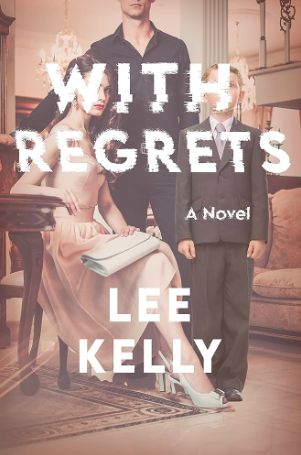
My latest genre-blending suspense novel, With Regrets, chronicles an evening when various friends and frenemies gather, sans kids, for a dinner party at their lifestyle-influencer neighbor’s house, and a world-altering, apocalyptic event occurs during the first course. Trapped inside their host’s home, the group is forced to launch into survival mode, grabbing supplies to take shelter in the wine cellar. But everyone has very different opinions about the best plan to get home to their children… and some of the secrets the guests are keeping may prove just as dangerous as the threats outside.
Here are eight of my favorite recent novels featuring a dangerous dinner, with the term “danger” encompassing quite a variety of threats and menacing situations.
Jack and Grace are the envy of their dinner guests: he’s handsome, successful, and charming; she’s graceful, doting, and a wonder in the kitchen. Little do these dinner guests know, though, that the elaborate three-course meal Grace has prepared is a malicious test designed by Jack, a secret sociopath—and if the beef wellington is undercooked or the souffles overdone, there will be hell to pay.
New parents Anne and Marco can’t find a sitter for their baby, and so they leave their sleeping little one with a monitor and pop by their next-door neighbors’ house for a quick dinner. Anne can’t shake the nagging sense that something is wrong, though, and when she finally pulls Marco away to check on their child, they discover every parent’s worst nightmare: the baby has been stolen.
Protagonist Wallace, a gay, Black, introverted biochemistry graduate student, is pondering leaving his predominately White Midwestern university given the many indignities he’s endured inside his lab and on campus. Wallace’s limits are further tested when he’s invited to a campus dinner party. The danger, here, is overt when one of the other guests makes racist, incendiary remarks to Wallace during the meal. But there are also the more subtle, pervasive dangers of the institutional system in which Wallace is enmeshed, a system that consistently suppresses and permits these types of comments and conversations.
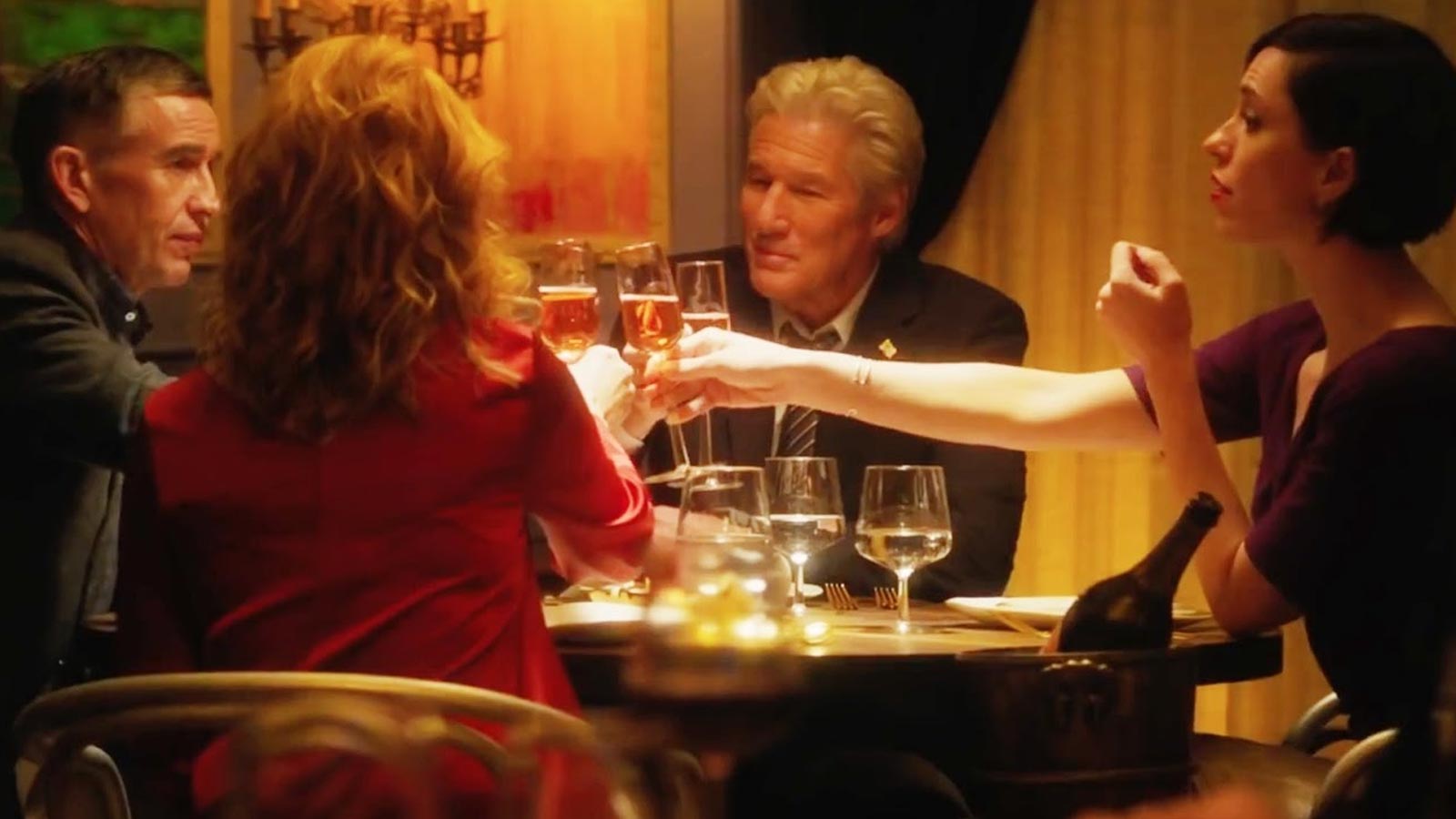
This novel reimagines a dinner party as a malicious escape room, and I was here for every moment of this inventive premise. A quaint neighborhood’s enigmatic new residents invite a group of longtime friends over for dinner. As soon as the drinks are served, though, the guests realize they’re in for a lot more than dinner. What follows is a calculated game seemingly designed for psychological torture: friendships are tested, secrets are revealed, and as the game advances, it becomes clear that not all the invitees might make it out alive.
The dinners featured in this mind-bending, heart-wrenching sci-fi novel dangerously defy the laws of time and space itself. Kin Stewart, a time-traveling agent from 2142, has been secretly marooned in the 1990s. Kin’s given up on being rescued, and has started a new life; he’s now an IT expert with a teenage daughter. When Kin’s rescue team arrives eighteen years too late, Kin becomes torn between two different timelines and realities—hosting dinner parties with his wife in 2142 while simultaneously trying to preserve his relationship with his daughter across the centuries. His attempts threaten to corrupt the entire time-space continuum, and potentially destroy history itself.
What better way to warmly welcome a new neighbor thaninviting him over for dinner? thinks Patricia Campbell, the Southern homemaker protagonist of Grady Hendrix’s unique novel. Unfortunately for Patricia, this neighbor turns out to be a vampire. This genre-blending story takes place in a South Carolina town over the course of the late 1980s and 1990s, and features a women’s book club who ultimately face off with evil incarnate to protect their families and community (and yes, it’s every bit as fun as it sounds).
This page-turning historical fantasy series begins with a university dinner where poison is served. By whom? That’s for Saffron Everleigh to figure out. As a new research assistant at University College London, Saffron is determined to make her way in the field of botany, but systemic misogyny and accusations of nepotism have kept her from getting ahead. When a dinner guest ingests an unknown toxin and her mentor becomes the prime suspect, Saffron works to uncover the true perpetrator.
Tremblay’s horror novel chronicles the dynamics of a New England family that begins to unravel when eldest daughter, Marjorie, starts exhibiting signs of demonic possession. Though is Marjorie the victim of a diabolic hold . . . or is she suffering from acute schizophrenia? Things still aren’t clear when the family sits down to dinner in one of the most unsettling scenes I’ve ever read, a harrowing sequence where, regardless of the truth, Marjorie proves to be an unequivocal danger to herself and her family.
My daughter was ten months old when I abandoned her for the first time, for five days. I went to an academic conference to present on a prestigious panel. I wobbled up to a podium in long-neglected heels, my breasts aching against my navy, polka-dot dress. I tried to blink away the hundreds of faces you rarely see at academic talks and willed my breastmilk to stay put, to not stain the straining fabric, to not bloom in blotches and betray me as not professional, not serious, not someone who deserved to be there.
I wrote my paper for the panel mostly in the very early morning, after my daughter’s 4am feeding, when she latched onto me like a hungry animal after a long stretch of sleep. I’d stay up after lying her gently back in bed, so gently the process took about ten minutes, and sit on a faux black leather Ikea couch to try and finish my dissertation. I was still teaching in the evenings and weekends when my partner was home from his full-time job and able to watch our daughter. I pumped milk at 8pm in a dirty locker room at the City University of New York’s technical college, City Tech, and collapsed into co-sleep upon returning home.
I, myself, am also a bad mother: I work, and I dare to enjoy it.
I was tired, but this was a career-making panel—the Shakespeare Association of America’s Next Generation Plenary, featuring work by the next generation of Shakespeare scholars. A committee selected papers via blind review out of almost one hundred. The first time I attended this panel, years earlier, I knew I could do it. And I did, but as my voice shook and I willed my breasts not to leak, my body reminded me I was not supposed to be away from my daughter.
The talk went well. After, I cried while pumping in my hotel room. The woman I shared it with—a colleague with no children—walked in on me. I still remember her face, a mixture of pity and disgust.
I was at my parents’ house, sitting across from my mother, when I first heard the news that Joe Jonas had filed for divorce from Sophie Turner. My mother announced it, looking up from her phone, and we all gasped—long-time Jonas Brothers fans. Joe used to be my favorite. Nick, my little sister’s, Kevin, my mom’s. I went to one of their concerts years ago and haven’t felt that kind of electricity since. The uncontainable, desirous screams of thousands of young girls rung in my ears for days after.
I looked up the headlines for myself, in utter disbelief. TMZ broke the story, reporting that the couple was headed for divorce and that, for months, they had been experiencing “serious problems” in their marriage. As for why, sources told TMZ that Jonas had been caring for the couple’s daughters “pretty much all the time” over the past three months. Subsequent articles claimed that part of the reason for the divorce was that Turner “likes to party” while Jonas “likes to stay at home.” The source also claimed divorce was a “last resort” for Jonas.
Rage spread through my body as I realized the insinuation behind these articles. I’ve become an expert in bad mothers over the past few years, designing and teaching a college course on the topic. I, myself, am also a bad mother: I work, and I dare to enjoy it; I leave my child with her father for extended amounts of time. Like Edna in Kate Chopin’s The Awakening, I tend to my daughter in an “uneven, impulsive way”—struggling to play with her, to look up from my phone when she calls for me.
When reading the headlines about Turner, I thought about how “partying” signals, in part, unbridled sexuality—and how maternal sexuality has long been demonized in narratives from William Shakespeare’s HamlettoKristen Arnett’sWith Teeth. I thought about how, in 2022, Turner told Elle UK, “I miss England so much… for my mental health, I have to be around my friends and family… I’m slowly dragging my husband back,” and how Euripides’ Medea, a foreigner, is betrayed and banished by her husband. I thought about all the artist-mothers, from Edna in Chopin’s The Awakeningto the mother in Rachel Yoder’s Nightbitch, to Mia in Celeste Ng’s Little Fires Everywhere, that have struggled to marry their desire to create art with the intensive mothering our patriarchal society demands.
‘Turner was trying to make up for her lost youth partying,’ my mother said.
Generations of bad mothers have taught me that, no matter what Turner may or may not have been caught doing on a Ring camera, the dictates of motherhood are painful—violent, even—to bear. Sophie Turner has privileges many mothers cannot even imagine and yet even she cannot escape these narratives, cannot measure up to what patriarchy deems a good, successful mother. As a rich, white woman, she certainly had the opportunity to be seen as a good mother (unlike, Black mothers, for example, who, too often, do not even have the luxury of being presumed good mothers, and who must contend with a whole set of different myths). That Turner did not make use of her endless resources to fully devote herself to her daughters makes her even more villainous in the public eye.
The weight of these expectations, to erase oneself and sacrifice everything for your children, is crushing.
As the titular character sometimes thinks in Nightbitch, “I imagine abandoning my family, abandoning this entire life.” “It’s all on me,” she laments—“every part of it.”
Later, in a group text with me and my sister, my mother reiterated the headlines: Turner was too young to get married, she said. Turner was trying to make up for her lost youth partying, she said. I’m glad the girls are with Joe’s people, she said. In my opinion, she said, mothers shouldn’t be away from their children for more than five days—if they’re under five.
I felt like I’d been slapped. Surely, my mother remembered all of my trips to conferences, all of my invited talks, that one month I traveled twice and my partner sat me down and told me it was really hard on my daughter, really hard on the family.
“Are you saying I’m a bad mother?” I asked her.
“Were you ever away from her for more than five days?” she responded.
About to type back, I remember how my mother had to put me in daycare when I was six weeks old. It’s where I became attached to my baby blanket, the transitional object I fell asleep with until I was twenty-six years old. One time, a worker at my daycare told my mother I was walking along the other cribs, holding onto the bars, stealing blankets from the other babies. One time, they told her nonchalantly that I cried all day.
My mother was always there for us when we needed her. My daughter won’t experience this, and it pains me.
As the story goes, my mother quit her job before she’d have to go back after my sister was born. My father didn’t know how they were going to make it. My mother promised she would use cloth diapers, figure it out. She did figure it out, and proceeded to stay home with her four children, as she wanted, while my father’s career flourished, supporting him along the way. She was always home to bring us something to school we forgot, to drive us to band practice, theater, other appointments. She was always there for us when we needed her.
My daughter won’t experience this, me being on call all hours of the day, and it pains me.
Perhaps this is why I nastily said to my mother, “as your daughters know, some of us can’t up and quit their jobs when they want to.” My sister, a lawyer, and I are both the breadwinners of our families.
“Do you think I wasn’t scared to death?” she responded, then swiftly said, “This is just a fight about celebrity gossip. I’m done.”
A few days after the news of Turner and Jonas’s divorce broke, Jonas was spotted out to breakfast with the couple’s children. “Joe Jonas is spending time with his girls,”People reported. A convenient sighting, to say the least. At Dodger Stadium in Los Angeles, Jonas addressed the crowd before singing “Hesitate,” a song he wrote inspired by his love for Turner: “It’s been a crazy week. I just want to say, if you don’t hear it from these lips, don’t believe it. Okay?”
As the news continued to roll in, I read that Jonas pressured Turner to attend events postpartum, one source saying he “forced” her while she was struggling after giving birth. Sources report she didn’t want to leave her home, didn’t want to be photographed at events, but, still, she attended them with him. At another, that Jonas attended alone, he “complained” that Sophie was MIA, “felt she needed to get out more.”
In the most recent development, Turner has sued Jonas, demanding their children return to England—the filing said he was withholding their passports and that Turner learned of the divorce through the media.
My sister sent me a video of Joe Jonas celebrating his birthday on tour, posted about a month before he filed for divorce. “It’s all about me today. It’s all about me,” he tells the crowd.
As People reports, Sophie Turner is also back at work. In images captured since news of the divorce broke, the edges of her body and face are angular, her eyes narrowed, her lips curled up in a pained, almost smile. In one image, her back—covered in a white-web, a temporary tattoo—faces the camera. She clasps her phone in one hand, facing a forest, her right leg lifted as if to step forward.
It’s a vision that reminds me of Edna in The Awakening swimming out to sea, trying to escape. Unlike Edna, though, I hope Turner turns around and swims back. I hope she feels an iota of freedom being away, being free to create art—and that she relishes it. But I know she is also in pain, even if it is only because the narratives that working mothers are bad mothers live in our own heads as much as they reside in headlines. I hope she’s surrounded by family and friends that will tell her she deserves it all, even if all doesn’t feel quite like what we were promised. I hope her daughters grow up knowing they can be anything, because they watched their mother do it—claim herself, her time, in the face of everything.
I know that there is so much distance between Turner and I, but I feel close to her. I feel a need to protect her. I want to hold her hand and hug her and cry with her and tell her that I get it, that she has it so much worse than I do, that she is subject to a million women who feel they have a right to judge her, to argue that her daughters deserve better.
I want to go out with her and dance as if we never became subject to the scrutiny that accompanies motherhood.
“I think you have doubts within yourself that make you defend Sophie,” my mother texted me, towards the end of our fight. She’s right. Still, there has been an explosion of feminist coverage pushing back on the insinuations in the media’s coverage of this divorce, that Turner is a bad mother. I hope she sees these pieces; they certainly have helped me.
I want to go out with her and dance as if we never became subject to the scrutiny that accompanies motherhood.
I’m writing this piece at 4AM as my daughter sleeps. Many mornings when I get up early to work, however, she gets up with me. I give her an iPad and she watches videos where parents play with their children as I type away and try to block out the sounds of better, more involved parents than I. My partner usually comes downstairs after waking up a bit later and raises his eyebrows, “How long has she been up?” I usually give him a withering glance. This is our routine.
Last night, as my daughter’s eyes grew heavy, I put my phone on the lowest brightness and typed some of this piece, with one hand, into my notes app. Her skull pressed against me, I felt her breathing grow slower against my side, the fuzz from her unicorn lovey tickling my cheek. I raised my arm painfully, slowly, and lifted myself up, ready to go downstairs and type on my computer. Her eyes popped open—“Mommy?” she said, looking at me with betrayal.
“I’m here baby.” I responded, thinking about the dance so many of us do, daily, in order to have it all.
Zimbabwe is a former settler colony and, as such, contains multiples. This is why I have always felt compelled to write about this “small place” that I call home. When I started writing my first novel, The Theory of Flight, in 2007, it was very obvious that Zimbabwe, so full of promise in the 1990s, had become a failed postcolonial experiment and that many writers were eager to examine what that failure meant for contemporary Zimbabweans: NoViolet Bulawayo’s We Need New Names; Brian Chikwava’s Harare North; Valerie Tagwira’s The Uncertainty of Hope. To me what was happening in Zimbabwe in the 2000s seemed both new and uncannily familiar and so I decided to explore the ways in which the past bleeds into the present.
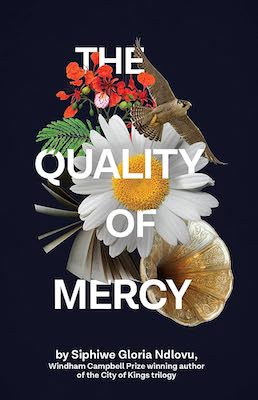
By the time The Theory of Flight was published in 2018 it had become clear to me that all that I wanted to say about my country and its long-contested histories could not be confined in one novel and so the idea for the City of Kings Trilogy was born. The three novels that make up the trilogy—The Theory of Flight, The History of Man, and The Quality of Mercy—focus on the country’s transition from a settler colony to an independent postcolony in order to examine how our understandings and experiences of race, gender, ethnicity and nation are both shaped by, and in turn shape, particular historical moments.
In the five years that I have been working on the trilogy there has been an explosion of Zimbabwean Literature: NoViolet Bulawayo’s Glory; Tsitsi Dangarembga’s This Mournable Body; John Eppel’s A Colonial Boy; Petina Gappah’s Out of Darkness, Shining Light; Fatima Kara’s The Train House on Lobengula Street; Violette Kee-Tui’s Mulberry Dreams; Sue Nyathi’s An Angel’s Demise; Bryony Rheam’s This September Sun; Novuyo Rosa Tshuma’s House of Stone. What I find fascinating about Zimbabwe’s current literary moment is that most of these novels, written from a refreshing diversity of perspectives, are dealing with the ever-present legacies of the country’s colonial past on our received identities and lived experiences.
I see the country’s contemporary literature continuing a conversation that was begun by these 7 classic Zimbabwean (and Rhodesian) novels:
The colonial narrative wrote white women as the epitome of purity, put them on a pedestal and then instructed them to be silently happy with their privileged position. All seemed well until Doris Lessing’s Mary Turner entered the narrative and disturbed and disrupted it.
At first Mary is as she should be: she believes that whites are superior, industrious and gifted and that blacks are inferior, lazy and talentless. But then her husband proves to be an ineffective farmer—could it be that he is lazy, talentless…dare she think it…inferior? Compounding the matter is a black farm laborer named Moses who seems to experience himself as a being with industry, intelligence and agency.
But if Moses has these qualities what does she, Mary—the silent partner in the colonial enterprise—have? Through Mary, Lessing shows that the position of the white woman within the colonial narrative may not be as privileged as purported.
At the center of Charles Mungoshi’s novel is the kind of black man that Mary Turner cannot bring herself to comprehend. Lucifer, the protagonist, is a being with industry, intelligence and agency. He uses these qualities to upwardly maneuver his way from his rural and humble beginnings to a mission school and then on to an unnamed destination overseas.
Although there is cause for celebration because Lucifer is broadening his horizons, there is also occasion to lament because his departure will create a loss (within himself, his family, his community, his country). Written in 1975, Mungoshi’s novel anticipates the type of migration that will become prevalent in 21st century Zimbabwe.
Lucifer (as his name suggests) is a character that Mungoshi treats with ambivalence because the hybridity created by his colonization and migration may end up completely severing him from himself, his family, his community and his country. In one of the most tragically beautiful endings to a novel, Mungoshi writes, “Lucifer leans back and tries to look at his country through the eye of an impartial tourist.”
The House of Hunger by Dambudzo Marechera
Dambudzo Marechera’s novella begins the same way that Charles Mungoshi’s novel ends—with a determined departure. “I got my things and left,” the narrator informs the reader before taking them on a journey through the decrepit, squalid and violent township that the narrator lives in and through the narrator’s painful memories of a people and a country always in turmoil.
The constant, frenetic forward motion of the narrative seems freeing…until you realize that the narrator has never left the house of hunger.
Written on the eve of Zimbabwe gaining its independence, the novella serves as a cautionary tale—settler colonialism, with its many forms of violence has created an alienated people, people who cannot relate or empathize with each other because the various dichotomies of the colonial narrative have always pitted them against each other. If real work is not done to address this legacy, the postcolony will continue to alienate and violate its people and there will be no escape from the house of hunger. Needless to say the novella continues to be a touchstone for many Zimbabweans and writers.
Departures anticipate an arrival and in 1988, Tsitsi Dangarembga made her grand entrance into the world of Zimbabwean literature with one of the most powerful and salient opening lines to a novel: “I was not sorry when my brother died.” All of a sudden, here was a voice that had not been heard before, forcing us to listen. This voice was unapologetic about the space it was clearing and the place that it was occupying.
Lessing’s Mary, Mungoshi’s Lucifer and Marechera’s unnamed narrator all had to contend with and contest the limited space and place that the colonial narrative afforded them. But at least they had a space and place. Tambudzai, Dangarembga’s determined heroine, has no such fortune. She is a young black girl who is expected (by colonialism, capitalism, and patriarchy) to silently and unobtrusively make her way towards black womanhood.
Luckily, Tambudzai refuses to go gently and Zimbabwean women and Zimbabwean writers have been forever enriched since. After Nervous Conditions, Tambudzai has gone on to hold a mirror up to postcolonial Zimbabweans in Dangarembga’s The Book of Notand This Mournable Body. The image reflected back to us is not pretty and makes us uncomfortable, which is as it should be. Tambudzai is not sorry.
Harvest of Thorns by Shimmer Chinodya
Having achieved independence after a protracted war, nationalists encouraged postcolonial Zimbabweans to think that their freedom had come at the hands of valiant victors—the children of the soil—who had fought only for the rightest of reasons: the liberation of the Zimbabwean people.
As well-intentioned as this nationalist narrative seemed to be, its real intention was to erase and silence other experiences of the war years. Shimmer Chinodya decided to voice this silence and make visible this erasure by telling the story of Benjamin who, although seduced by the child-of-the-soil rhetoric of the guerrillas, actually fought the war because he had committed a crime and wanted to escape incarceration. His reasons were, therefore, far from altruistic.
Benjamin is not the valiant victor of the nationalists’ narrative. His selfish reasons for joining the war add a shade of gray to a postcolonial narrative that was, in the 1980s, fast becoming black and white. This may seem like a small feat, but speaking truth to power is never a small feat and Lessing rightfully called Harvest of Thorns “a brave book”.
If in the postcolonial nationalist narrative valiant victors could only be former guerrillas, then what did that make the soldiers they had fought against? How were white Rhodesians supposed to understand themselves in Zimbabwe? Could they only be Rhodesians or was there room for them to become Zimbabweans?
In his memoir Godwin deals with this crisis of identity that has as much to do with the postcolonial nationalist narrative as it has to do with how the colonial Rhodesian way of life was built on the continued exploitation of African land and the continued oppression of African people. Godwin was raised in a country whose injustices, violence, and inequalities were fortified by the laws of the land—laws that made him both privileged and complicit.
As he comes of age, Godwin is increasingly conflicted about his relationship to his country and his place in it, especially as the arrival of independence only leads to the continuation of coloniality in a different guise.
I will end this list the way I began it by looking at the colonial narrative’s construction of race and gender. Phephelaphi, Yvonne Vera’s heroine in this novel, which is set in 1948, is not, according to the colonial narrative, supposed to be on a pedestal. As a black woman in a city where her labor is not required by colonial capitalism she is not supposed to be seen or to exist, and, if she is made visible, it should be clear that she is a dangerous and diseased threat. And yet when Phephelaphi first meets Fumbatha, he sees only her beauty, health and vitality and puts her on a pedestal.
But this narrative that has turned Fumbatha into a laborer and turned Phephelaphi into a potential threat cannot contain their happiness, especially when she starts thinking of herself as a being with intelligence, agency and industry and takes steps towards becoming a nurse. Fumbatha, the laborer, wants in Phephelaphi someone who will provide him with the comforts of home. When he learns of her ambitions he uses the somewhat privileged, even if limited, position that patriarchy and capitalism afford him to punish her for her ambitions.
Trapped by the limited colonial constructions of race and gender, Phephelaphi has to create her own type of emancipation.
Here at Electric Lit, we’re suckers for a good bookshelf. Any kind of bookshelf! Alphabetized shelves, color-coded shelves, shelves that were once organized but have since devolved into a chaotic pile with no rhyme or reason to where anything is placed. Even book stacks can be shelves if you’re determined enough. There’s no wrong way to organize your books (except bookshelves with the spine facing in. That one’s objectively wrong). If there’s anything the entries into our #ShowYourShelf contest showed us, it’s that all shelves—organized or random, tidy or haphazard—are perfect in our eyes. We loved seeing your shelves, and wish you all so many books that these beauties turn into an unmanageable mess that ultimately grows into a second bookshelf (and a third, and a fourth, and a fifth, and…)
Below are some of our favorite entries into the competition.
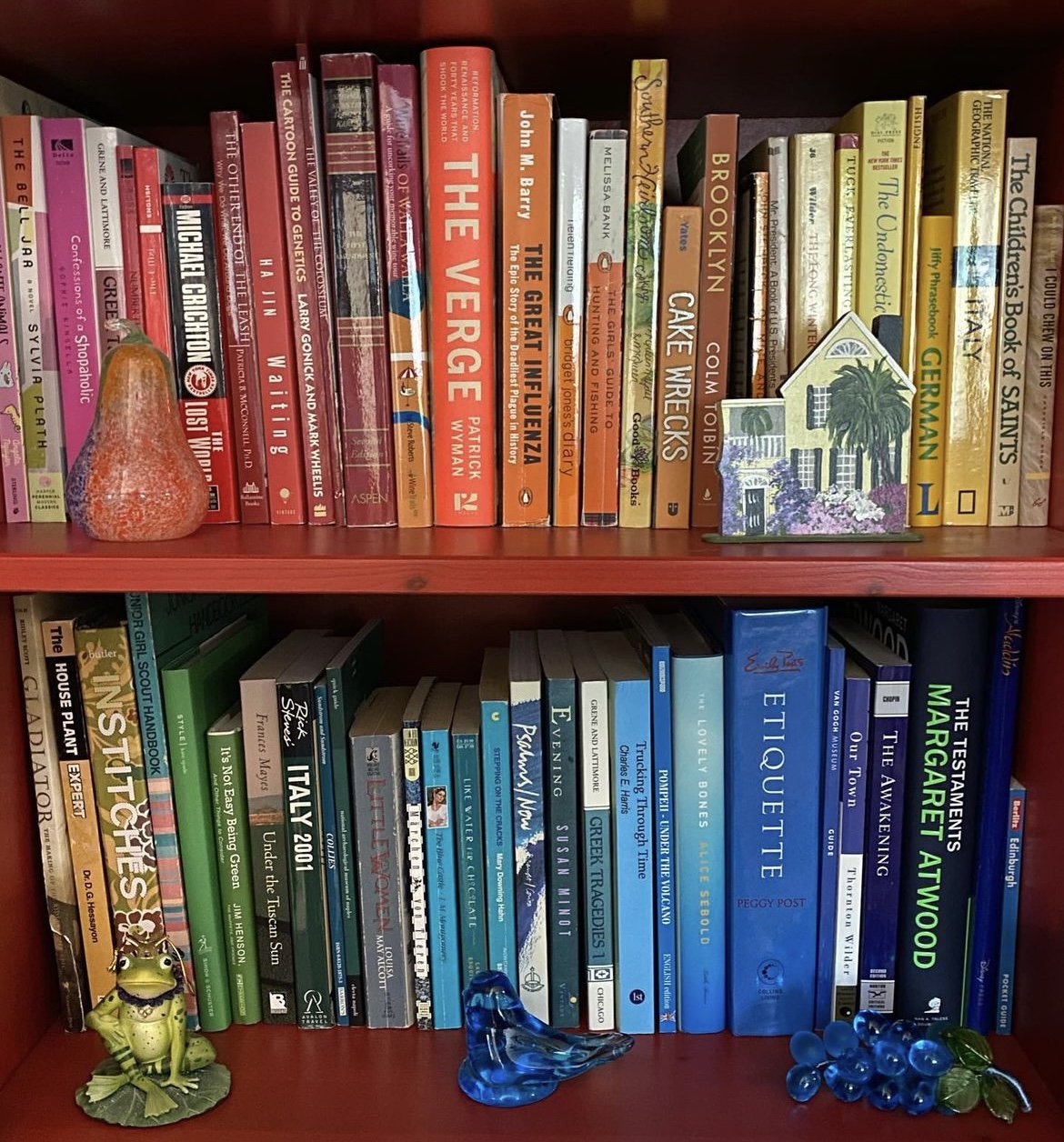
We kicked off the contest with this photo from books editor Jo Lou, who is clearly team color-coded shelves. Look at this rainbow bookcase! This one deserves to be lingering on bookstagram for years to come as aspirational shelf inspo.
And she wasn’t the only vote for color-coded shelves. @Jennyshoe submitted color-coded shelves with colorful decorations to match.
Commuter editor Kelly Luce’s woodland aesthetic featuring a historic stone mill and window view full of trees is the epitome of CottageCore.
We kick off our book stacks submissions with our editor-in-chief, Denne Michelle Norris whose TV space has the feel of an altar devoted to literature.
We love an organized chaos, like these books piled (very neatly, we should say!) on top of contributing writer Laura Schmitt’s shelf.
And we can’t help but include one more submission from Jo Lou, featuring our all-time favorite fluffy employee, Billy, all dressed up in a matching bookish bandana (Thanks, Riverhead, for the swag).
For Sam Hopkins, the best cat perch is a book stack!
Ten Speed publicist Felix Cruz’s vibrant shelves are painted in cobalt blue with a red trim as an homage to Frida Kahlo’s Casa Azul.
We stan a giant bookcase, especially one bursting at the seams like this one from Debutiful’s Adam Vitcavage (which happens to be one of four)! We’re also into this combination of vertical AND horizontal shelving—like a hybrid bookstack-bookshelf!
Executive director Halimah Marcus has a similarly giant bookcase, though this one’s a little more organized (no offense, Adam—we love the mess!).
This shelf from publicist Kathy Daneman is proof that books and plants make the perfect pairing.
A spiky spiral moment from Dawn Poon.
Floor space = more room for books, as shown by @mikelindgren51
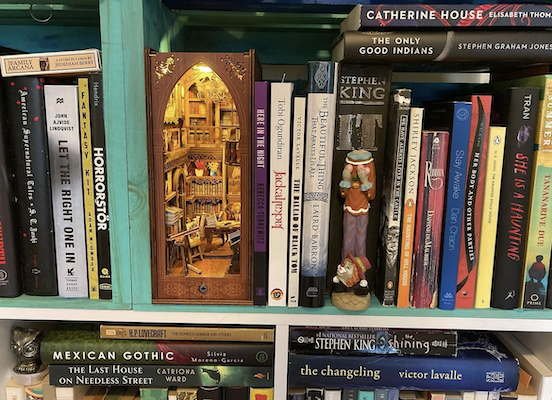
Writer Rebecca Turkewitz’s spooky bookshelf, full of horror novels, gothic fiction, and ghost stories, matches the haunting energy of her short story collection Here in the Night. And we’re obsessed with the miniature bookshop, tucked in the corner, casting a warm glow.
We love the personalization on Jenn Baker’s bookshelf, including the face-out of her book, Forgive Me Not! Also, do we glimpse a photo booth pic from last year’s Masquerade of the Red Death peeking out too? 👀
Sofia Åmark is giving us cosy hygge vibes. And we spy avery cool Lord of the Ring poster.
Novelist Anara Guard’s shelfie has the charm of an old library.
How will we solve the problem of how Father sleeps on his right arm? He is not comfortable, his arm is under him, it hurts him as it presses into his ribs, and it is hurt by the weight of his body pressing down on it. He tells us this, with a gentle smile, as though to say it is not important, and not our problem.
Father died many years ago. But the problem is still there on my mind, unresolved, even though Father no longer tries to sleep comfortably and in fact no longer has an arm.
Wise Old Men
In our society, old men are not considered to be wise, but, rather, eccentric, opinionated, sloppy, foolish, stubborn, weak, confused, etc. This old man in front of me in line, that old man over there trying to open the door, what a bother, get out of our way, with your slow shuffling feet and your hesitation and your uncertainty, we say. Can’t you get all the way across the street before the light changes? In another society, it is different. He is an old man, they say, ask him.
The Stages of Womanhood
It was in the midst of these days when I was struggling to complete the—what would it be?—seventh, no, sixth stage of my growth as a woman, being a year late already with that, according to the (ineffective) anthroposophic doctor I had consulted about my persistent ear infections, when I was awoken yet again during a particularly restless night of being awoken, first, by my child, then by a mosquito, then by my child again, then by the tickling in my ears, then by my child again—when I was awoken yet again, this time by the high-pitched wail of an air-raid siren that I mistook at first for a malfunctioning fan in one window and then a fan in another, going around turning off and unplugging the fans one by one, then finally making my way downstairs and out the back door to stand in the yard looking up until the sound of the siren died abruptly, the wail descending. Of course I thought of war, since our country was in conflict yet again with another country. I thought maybe the mosquito that had been bothering me would live longer than I would. I thought of calling the local police station. I wondered if my husband had heard the siren through his ear plugs. He was sleeping downstairs so that he would not be bothered by me, since I was sleeping so badly these days, or by the child, who was waking so often. The doctor had told me that the next stage, the last stage of womanhood in which a woman is reproductive, was very important creatively. The stage that came after that was very different—also wonderful, she said, but very different. But I had not yet completed this stage, which was supposed to be a growth into full womanhood. As far as I could see, I was exactly the same this year as I had been last year and the year before.
Writing about pop culture and current technology is always a gamble, pitting critique of the present against longevity, a story that will still feel relevant after we’re gone. But for novelists (present company included) who were exposed to the Real World before the, um, real world, reality TV is hardly a trend. We’ve grown up seeing ordinary people use the medium to solve myriad problems–or create them. And who among us hasn’t considered how we’d fare on Survivor, or snarkily judged a dish we’ve only watched being prepared? The past year has seen a notable wave of books that incorporate television—and particularly reality TV—into their premises, though examinations of the medium go back farther than you might expect.
In my novel, The Invisible World, Eve and Ryan Hawthorne suspect their house is haunted, and they reach out to a reality show first. It’s the mid-aughts, the height of paranormal TV fever, and among the glut of shows they end up on one of the more middling options, Searching for… the Invisible World, a late addition to the mix. Perhaps too late—it’s on the verge of cancellation. But Eve and Ryan aren’t looking for renown, only answers. For Eve, who has been experiencing paranormal events her whole life while never fully trusting her perceptions, a little confirmation would go a long way.
Unfortunately for Eve, the TV crew brings with it a confrontation with oneself, as Eve and Ryan are forced to consider how they’ll look to an audience, how the footage of the haunting in their home will stack up against the uncapturable feeling of being in the home. It’s rare for anyone to get a fully objective perspective on their own life, and one of my conjectures is that seeing ourselves on TV can offer a bit of that perspective. But TV is made by folks with their own agendas, and as the following list of books shows, confronting one’s image head-on may not offer solace, but rather create new, previously unconsidered problems. Below, eight novels about characters who are on TV, want to be on TV, or use television to in some way figure themselves out.
While plenty of other novels incorporate found footage, trial transcripts, etc., alongside narration, DiLouie cranks it up to 11—Episode Thirteen is all found footage/found documents: the lost tapes and journals of the crew of Fade to Black, a paranormal investigative show. Fade to Black’s crew is scrappy, and in need of some new stories as they embark on an investigation of Foundation House, a building used in the 1970s by researchers to conduct experiments in the paranormal, metaphysical, and hallucinogenic. The house has never been fully investigated, and it’s on the verge of being torn down. As the team spends more time inside, extending their shoot and the number of episodes they need to air their footage, their findings loop back to the crew themselves in seemingly impossible ways. A found-footage novel in 2023 ought to be self-aware of genre tropes, and one character confirms to the audience that the urge to document, even as their situation grows ever more frightening, persists.
A highly anticipated release of 2023, Adjei-Brenyah’s novel takes place in a near-future in which the most popular form of entertainment is “hard action-sports”: literal death-matches between incarcerated individuals who trade in the remainders of their sentences for the chance at freedom, purchased in Blood Points accumulated by killing one another in gladiator-style battles. Participants, known as Links, team up in Chains named after prisons to fight Chains from other prisons. The matches themselves are ticketed events, only viewed live. But the Links spend days marching between Battlegrounds, trips that are livestreamed via small, floating drone-like cameras/microphones, so that conversations, meals, even baths are captured and viewed by millions. The novel is layered with chapters from the perspectives not only of Links but also those of viewers, protestors who believe that action-sports are inhumane, and board members who oversee the regulations of matches. The narration is sprinkled throughout by footnotes that provide facts and statistics on the prison system, reminding readers of the very real human costs of entertainment.
In Allen’s lively satire, the final four contestants in The Catch, a Bachelor parody, travel to a remote island in the Pacific Northwest for the final eliminations and, hopefully, a union. The novel shifts between perspectives: Amanda, the influencer; Vanessa, set up by the show to be the villain; Lilah-Mae, the Christian girl; and Renee, the final Black contestant who is told, on the ferry ride to Otters Island, that the producers are essentially keeping her on for the optics. Renee is exploring her sexuality, and as far as the Catch himself (a social media investor who has made a yellow tracksuit his entire personality) goes, she’s over him. Meanwhile Casey, The Catch‘s producer, is working to maintain drama between the girls, and she doesn’t have to work too hard. Otters Island has secrets, and the book moves from satire to horror as the contestants and crew are forced to confront something far worse than Instagram vitriol. Everyone has their own reasons for being on the show, whether in pursuit of followers or a corsage, but the book ultimately asks if the most important things in life are the ones that are seen not by millions, but by hardly anyone at all.
Jiménez’s novel also shifts perspectives, between the mother and two daughters in a Puerto Rican family living in present-day Staten Island, more than ten years after the middle daughter, Ruthy, has gone missing. Ruthy was thirteen the day she didn’t come home from school, and despite the family’s tireless efforts to locate her, seems to be gone for good… until her younger sister sees her on a reality show. Whereas in some of the other books on this list, characters grapple with their own identities through the lens of TV, in What Happened… the family of Ruthy has to reconcile the image of the girl they knew with that of “Ruby” on Catfight—a trashy, sinister take on the Real World in which young women live together, perform together, and are encouraged to fight each other physically, with the loser getting booted out of the house. Jimenez’s novel addresses poverty, misogyny, and the ways that people of color bend themselves backwards for acceptance in white society, all while keeping the family at the center of her story.
Perhaps one of the earliest examples of a fictional character appearing on reality TV, D. G. Compton’s 1974 novel (reissued by New York Review Books Classics) centers around a woman living in a future in which no one dies from old age. When Katherine is diagnosed with a terminal brain condition brought about from “information overload,” she is approached to appear on Human Destiny, a show that broadcasts, in nearly real-time, the final days of anyone who is going to die. Katherine turns them away, but the network is unfazed. A new technology, tiny cameras implanted inside eyes, allows a network employee named Roddie to surreptitiously follow Katherine around during her final weeks of life, watching her, filming her, sending footage back to be cut into twenty-four minute chunks to be broadcast. The book shifts between perspectives as Katherine’s symptoms set in and Human Destiny rolls into action. The novel anticipates not just the public’s hunger for witnessing people at their worst, but an omnipresent technology ready to share, with millions, the suffering of others. Nevertheless, the sci-fi elements are a background to the very real relationships between characters, and feels fresh fifty years after publication.
Less about reality TV than one of the many ways television seeps into our consciousness, Hutson’s novel is about Bonnie Lincoln, who wins the lottery and with her winnings constructs a meticulously detailed recreation of the set of Three’s Company in a remote, mountainous area. Her set can turn over with the show’s seasons and she fills it with as many period-appropriate clothes, furniture, and accessories to decorate it as she can find. Bonnie then assumes all the roles on the show, one at a time, including building owners the Ropers. Coming out of a difficult childhood and recent trauma, Bonnie wants to be left alone in her fantasy, but all the money in the world cannot protect her from other people and her own past. Hutson’s novel is reminiscent of Tom McCarthy’s Remainder and recommended for anyone who falls asleep to The Office and wonders what it would be like to really live inside a show—be warned, it may not be as comforting as planned.
While Hutson’s narrator recreates the entirety of a series on her private campus, Bachelder’s 2016 novel centers on a group of men who meticulously reenact just one play from Monday Night Football in 1985: when the Washington Redskins’ Joe Theismann catastrophically collided with the New York Giants’ Lawrence Taylor and Harry Carson, fracturing his tibia and fibula. In The Throwback Special, twenty-two men meet up every year at a motel to bond, then hold a lottery to see which man will play which role on a local school’s football field the following day. Bachelder’s book addresses masculinity, race, middle age, and is engrossing even for folks such as myself who are uninterested in football, as the build-up intensifies to a moment that lasts just a few seconds, but represents something different and powerful to each man on the field.
Scanlon’s novel, out of all the titles on this list, probably has the least to do with actual TV, as the characters in the book watch very little. In an apocalyptic Seattle emptied out by the destructive effects of climate change, Blake has stayed behind to take care of his mother, who has a terminal cancer diagnosis. While his neighbors take anything useful or worth trading and clear out, Blake explores a city populated by an angry Indigenous population and a sort of cult formed around a man named Russell. Russell wants Blake to rewrite the history of Seattle, in a way that will give its survivors hope, with Twin Peaks’s Special Agent Dale Cooper as its central figure. Cooper functions as a symbol for the Guild, his “memory and passion and wonder” values they can cohere around. As Scanlon’s metafictional novel reboots itself mid-stream, Dale Cooper moves from a symbol to a very real person, edging ever closer to Blake and his loved ones as they await disaster.
As we move into the fall reading season, deeply imagined short stories and inventive linked essays are having a moment alongside novels. What’s thrilling about the books coming out from small presses is the breadth of range—there are intentional and accidental murders, family drama and polycules, medical calamity, geopolitics, and a whole lot of finding one’s way through it all. It’s a marvelous time to be a reader.
Ways to Disappear is the rare short story collection that reads with the same weight of a novel while concurrently leaning into the short form. The characters are illuminated and linked through careful description, and tethered together with a desire for connection and for solace. A woman tells her mother-in-law she is leaving his son, and finds unexpected support; a teenage couple is committed to their young love until the hardness of the world undoes them; a sister waits for her brother to die. Each story revolves around a critical moment, which adds up to a compelling collection—Lancelotta has her finger on the pulse of how life consumes us, from moments large to small. A compulsively readable and emotionally affecting book.
Equal parts love letter and lament to Dearborn’s Lebanese diaspora, this collection of short stories chronicles everything from terrifying post-911 ICE raids to a father and son stuffing money into frozen chicken carcasses to avoid the IRS. One story follows a collective of husbands and wives as they size up a mustached and very well-endowed Speedo-clad new patron of their local athletic club; the women are titillated and the men are jealous, but they’re all transported to the 1970s when they were young and living in the village of Sofar. In another, a married woman who is conflicted about her neighbor’s new marriage offers refuge to the abused bride. In this portrait of Arab America, Zeineddine’s scenes are sometimes deadly serious and in other moments, laugh-out-loud funny. Through masterful dialogue and careful characterization, the stories in Dearborn stand in excellence.
Across a dozen stories, Good Women explores the lives of twelve Black women in the Appalachian South. A wife knows her husband is angry and disappointed that she is not pregnant yet, but she hasn’t stopped taking her birth control in secret. A sister tries to help her brother connect with the married man he is seeing; the brutality that follows only brings them closer. A preacher’s daughter finds her father’s stash of pornographic magazines and evidence of an affair after his passing, and in these revelations, discovers something about herself. Good Women surfaces the power of blood and chosen family, the consequence of place, and the sheer power of women acting for themselves in a society that defines them in relationship to men and whiteness. A talented writer to watch.
Penelope lives in a vast and crumbling family estate in England. For twenty years, she has worked as an archivist, eventually partnering with one of the estate’s owners. They live a quiet life, and Penelope continues to catalog the holdings of the property, even though it is scheduled for demolition. As the climate crisis escalates, the trees and gardens have died around her, and the razing of the estate—her partner and his brother’s childhood home—has triggered a visit from the brother, who sexually assaulted her two decades earlier. Landscapes is deftly textured with journal entries, narrative, art history and criticism. What emerges is a hypnotic novel that meditates on loss and violence. A gorgeous and accomplished debut.
After the author of the beautifully layered memoir When My Ghost Sings has a stroke at the young age of 32, she creates a persona for the person she was before her brain betrayed her. Tara’s present ego and her before-ego, who she names Ghost, often battle one another: Tara in the now, trying to thread her frayed memory, and Ghost in the prior time, sure in her own grasp of history. What emerges is a split image of two women who are both right, and both wrong concurrently. As Tara excavates her bodily trauma and reconciles her two egos, her romantic partner is navigating a transition of their own as they begin gender affirming hormone treatment. When My Ghost Sings is detailed, introspective, and reads with a narrative force that asks soul-searching questions about who we are, who we were, and who we could be.
In this memoir-in-essays, Samih-Rotondo juxtaposes her own story with the stories of her matriarchs against the backdrop of forced migration. Just as her grandmother had to flee Palestine during the 1948 Arab-Israeli war, Samih-Rotondo, her mother, and her siblings escaped Kuwait as Iraq invaded in 1990. Her parents have divorced and her father stays behind. At just six years old, young Nada is in Rhode Island, and already beginning to see the expectations placed on women, and especially Muslim women. Yet, for as much family history that she knows, there are also secrets. As she grows up in 1990s America, she learns her mother has an estranged son from a first marriage in Saudi Arabia; by the time Samih-Rotondo has a one-year-old of her own, she discovers her grandmother was also forced to give up a son. All Water Has Perfect Memory touches on war, ancestral homes, and the fierce connections between mothers and daughters, but mostly it touches the heart.
A woman finds someone living in a secret room in their apartment building, a neighbor’s chocolate chip cookies cross-contaminated with peanuts causes a death, a wife announces divorce to her husband via a sticky note. Set in the Pacific Northwest, this collection of stories has some linkage through characters who work at the same company, overlap in polycules, or have mutual friends, but the strongest connection in the stories is in the theme of chosen family. Sleep Tight Satellite is also an entry into post-pandemic literature, with many of the stories capturing the terror, and sometimes the hilarity, of lockdown life. Guess beautifully executes on the tension between surveillance culture—which includes camming and Zoom—and the human desire for wanting to be not just seen, but known. Guess shows her depth as a writer, in stories that are topically, structurally, and linguistically innovative without losing sight of emotional impact, and fans of her work will note that she’s never been better. A truly stunning collection.
In these nuanced stories, often told from a child’s perspective, death is right around the corner and is just as predictable as wintertime snow. Six years after their father’s suicide, a trio of brothers go get milk while their mother is on a date and find a valentine for the oldest boy in the grocery store; a wife and husband reunite after his terminal cancer diagnosis; the ghost of a long gone sister appears to purchase a chair from her living sister; war breaks out over the Illinois cornfields. What Unexpected Weather Events speaks to as a collection is the fragile hold we all have on the scaffolding that props up our lives. Despite the often bleak premises, moments of hope and even joy manage to shine through. Though Pringle’s characters do not always find transcendence, her storytelling does.
Yesteryear by Stephen G. Eoannou (Santa Fe Writers Project)
During the 1930s Depression, radio writer Francis “Fran” Striker has too many mouths to feed on a meager salary, but at least he’s still employed. As the final notice bills pile up on his desk—and his wife’s parents move in with them after losing their home—Fran knows he needs to make more money. Yet, after being robbed and assaulted after a visit to a speakeasy, he can’t get anything down on the page, which is the only way he knows how to get paid. Yesteryear is a wild ride told in the style of radio dramas of the era: Fran is cursed by a madam, the gangsters keep tommy guns stowed in trombone cases, diamond rings are stolen. A gravedigger, bowling pin setter, and prize fighter are pivotal characters. Still, it is Fran, the real-life creator of the Lone Ranger series, that steals the show. Eoannou gives readers a novel that is just as dramatic as it is fun.
In the Missouri Ozarks, Daisy lives with her boyfriend who is an insect breeder—and fetishist—while she works at a chicken processing facility, snipping through dead bird after dead bird with a pair of pneumatic scissors. Though she has left the Pentecostal church, she has not been able to leave behind the feelings of judgment; her religious mother isn’t helping. After a series of heart-aching miscarriages, none of which she received appropriate physical or emotional care for, Daisy is pregnant again. She needs this baby to validate her body, her relationship with her boyfriend, and to get a different kind of attention from her mother. Yet, when her old friend Sloane reappears in her life, the very tenuous threads that hold Daisy’s life together start ripping apart at the seams. With her trademark psychological complexity and unflinching centering of the human body in all its grotesqueness, Deliver Me is Elle Nash at the height of her powers. Riveting from beginning to end.
In these 17 stories set in Virginia lies a sinister undercurrent. A girl at a grown-up party narrowly misses a kidnapping, a toddler nearly drowns in a hotel pool, an insular neighborhood witnesses a murder. Yet, What Makes You Think You’re Supposed To Feel Better also strikes a tender note as the characters work through their heartbreaks and repair their relationships. One misguided man purchases a life-sized M&M statue thinking it will be the perfect gift. There is tension in the collection; it is never clear when the plots will turn toward something better or worse, but Hobbs Hesler ties the stories together with a sense of longing—for stability, for comfort, for lives that could have been. Written with compassion and rich detail, this is a memorable debut.
The River is a rural area in Pakistan that struggles daily with water access in the face of climate disaster. When Badaal leaves his family for The Town, he opens a wound in a family accustomed to loss. Told from different voices over a 30 year period, this family saga coalesces under the theme of hunger—for food, for love, for connection—and freedom, from bad relationships, grief, family strife. As his parents’ marriage crumbles, Badaal marries a much older woman and moves to The City. He quickly becomes estranged from his mother, who is trying to process her own lifelong trauma around the deaths of her siblings and her daughters—and now she faces losing Badaal. The River, The Town is a novel that exists in the intersection between intergenerational trauma and climate change, with The Town and The City as twin tributaries. A complicated and rewarding novel.
Mike Kovacs, an economics professor, has one too many beers. Instead of just going home to his quiet Kalamazoo neighborhood, he takes a long drive—and hits a tandem bike, instantly killing both of the riders. Protected by his own idea of privilege and in a haze of justification about what he deserves (not prison, in his estimation), Mike cleans up the murder scene and doesn’t turn himself in. Even as he recognizes one of the victims as his neighbor Claire’s daughter, he refuses to come clean, choosing instead to forge a relationship with Claire, whose marriage is buckling under the weight of grief for a lost child. Mike is a uniquely terrible person, but under Andy Mozina’s sure hand as a novelist, even a very unlikeable character becomes compelling. This book forces readers to ask: what would you do?
Set mostly in Harare, the capital city of Zimbabwe, Ndima Ndima follows the stories of the four Taha sisters and their mother through the 1990s. The youngest sister, Nyeredzi, has a strong bond with her mother, Zuva, who left her family, two decades earlier, to fight in the civil war, and returned to find she had been betrayed by her fiancé and her siblings. Instead of acting in anger from the violence she has witnessed, Zuva raises her girls—and especially Nyeredzi—with a sense of righteousness and to know their own power. When Nyeredzi sees her brother-in-law touching a woman who is not his wife, she speaks up. When Nyeredzi sees her cousins disrespecting the dwelling of a powerful spirit, she speaks up. In telling stories of the bonds between mothers and daughters, from the playful to the profound, Mapepa delivers a novel with profound emotional resonance.
Once part of a family of five, Beena and her father are the only survivors. A bombing in Bangladesh kills Beena’s mother and middle brother; her youngest brother died as a child years earlier after a car accident when the family was living in Iraq. As Beena completes her studies in literature in Houston, she mourns for the loss of so much of her family and worries over her stubborn, aging father. In the wake of the violence that has left Beena motherless, she marries—in part because she cares for the man, but also to avoid being set up with a Bengali businessman who works for a corporation that profits from war-time conflict. As the 2003 invasion of Iraq escalates, Beena struggles to balance caring for her father, her grief, her new marriage, while wondering where she fits into it all. Told in dual perspectives from Beena and her father over decades, The Children of the Madness captures the destabilizing impact that geopolitical forces have on actual people. Against a backdrop of loss, migration, and an exploration about what it means to find happiness, Wahhaj’s novel is unforgettable.
As a kid confused about gender expression, I found the idea of trying on another body very appealing. Growing up in the eighties meant I had a few stories of people inhabiting other bodies to watch and rewatch—the original Freaky Friday, Big, and Like Father, Like Son. And whether one finds the premise of body swapping as appealing as I did, terrifying, or something in between, it undoubtedly makes for a compelling story. And Isle McElroy’s new novel, People Collide, is a body-swapping tale unlike any I’ve ever seen.
Newly married Eli is living in Bulgaria on a fellowship his wife Elizabeth received when he wakes up one day and discovers he’s in her body. But she (in his body) is nowhere to be found. As Eli searches for his missing wife in a foreign land, he not only contends with gender in ways he’d never considered, but also must appraise himself in the confines of their marriage.The novel somehow manages to be one of ideas—examining identity, sexuality, desire, and marriage—while delivering a strong plot. Like Isle McElroy’s debut, The Atmospherians, this novel is a biting look at gender and performance, with their trademark humor and grace on the line level.
I spoke to McElroy over the phone about the body swap trope, sexuality and desire, and the idea of fate.
Rachel León: Were there any body swap movies or books you were drawn to, even if that was well before coming up with the idea for this novel?
Isle McElroy: I’d seen Freaky Friday growing up, and I returned to it again when I was writing this book. I really liked the movie Freaky with Vince Vaughn, as well, which was a nice take on the genre. But the premise has always interested me—brief moments where you get to experience another person’s body. I think about it especially in relationship to my gender identity, how pleasant and amazing I imagined it would be to swap into another gender without consequences. So a lot of the inspiration for the book was from thinking about my own gender more than it was thinking about the tradition of the body swap. Often, body swap films tend to swap people of the same gender. Freaky Friday, our most prominent one, is more of an age swap. Overall, what really sparked my imagination are the questions at the core of the novel: How would I actually begin to live as this other person? What if I didn’t want to change back?What are the things that I can actually accept and enjoy about this other life? Especially as a trans person, it was something I had been thinking about my entire life. Like how great it would be to have some magical moment that would bring me what I wanted. The book is a fantasy in that manner; it gave me space to engage with that childhood idea.
RL: Yeah, I can’t think of any other body swap story that deals with characters of different genders. And the fact the characters are a couple creates a fascinating dynamic and allows for a deep exploration of how identity factors into a relationship, and how the burdens of being in our bodies can influence how we relate to others. Were those ideas you wanted to explore, or did they rise organically as you wrote it?
The more in touch that I’ve become with my gender identity, the freer I feel to understand my sexuality.
IM: I’m really curious about the level of intimacy that we have with people who are so close to our lives. These are characters who know each other’s bodies intimately. As Eli remarks early on in the book, this is the face that he’s seen every day, but would he be able to identify it before now?
I wanted to explore what would happen with two people who are this close to each other, if they do end up switching roles in their lives, how that intimacy would play out, would that rekindle their curiosity for each other? Or would there almost be a droning sense of familiarity between them because they know each other so well? In some ways they’re the perfect people to switch bodies because of the intimacy they share. But in doing that they must confront how separate and detached they are from each other, which is the thing we often say about being in a relationship—no matter how well you know someone you can never really, reallyknow them. And the book grapples with that question—if this is as close as you can get, what remains unknowable?
RL: I also can’t think of a body swap story where the characters don’t know where the person in their body is, but when Eli realizes he’s in Elizabeth’s body, he has no idea where she/ his body is. And he’s in a foreign country.
IM: Yeah, he’s in a place where everything is unfamiliar to him and he’s still getting the hang of how to exist, even as himself. Not only does he have to learn how to be in Elizabeth’s body—different in scale and height from his own—he also needs to navigate a country where he’s lived for only three months. However, it helps the book plot-wise because he’s able to hide in ways he wouldn’t be able to if he was surrounded by people who know him. The biggest threat to Eli isn’t going unnoticed as Elizabeth, it’s the people who have an understanding of Elizabeth, such as her parents. So it made things a little easier for me as a writer because it gave me more space to allow for mistakes he might make. It gave Eli room to exist in Elizabeth’s body and come to terms with it. But it was also exciting to think about those different levels of unfamiliarity—the physical and the geographical.
RL: One recurring idea in the novel is that Elizabeth is too good for Eli, that in some ways he’s beneath her. The idea that certain people are better than others is one I resist, and yet also can’t argue with in terms of partnerships—people can be on different levels, or rather: different places in their lives. I wondered about your decision to create this dynamic in their relationship.
The idea of a soulmate doesn’t seem true to me.
IM: That dynamic is important because Elizabeth must have something that Eli wants. He feels really insecure and unaccomplished in this relationship, so there are reasons for him to be excited about this transformation, to potentially reap the benefits of existing in Elizabeth’s life. So it was really important for there to be a big distance between the two of them. Whether or not Elizabeth is actually better than Eli is a question that the book asks and tries to unravel. It is a myth perpetuated inside their relationship. Relationships often fall into a narrative that might not be beneficial, and this is the one shaping theirs. It’s a dynamic that’s also played out elsewhere in the book—it shows up a little between Desi and Kiril, and how Eli’s mom thinks of his dad, even though his dad is no longer in the picture, and it comes up between Johanna and Henry. It’s so loud in the relationship between Eli and Elizabeth, but the reverberations reappear in every relationship in the novel.
RL: I loved the way the novel explores sexuality and desire. It’s filtered through the lens of Eli, who has had some bisexual experiences and has wondered if he was asexual. As common as sexual fluidity is, I don’t see it represented much. Why do you think our culture is so fixated on binaries and slow to recognize there’s often a spectrum?
IM: Spectrums are threats, they undermine stability, whereas binaries are safe. Binaries make it easy for people to assume who they are. They oftentimes make it easier to fit into a hetero-patriarchal norm of you’re either this or you’re that. And the book attempts to unsettle that a little, even though it falls into the binary—neither one of these characters ends up being in between. But Eli exists inside Elizabeth’s outside of a traditional gender and sexual spectrum. I wouldn’t say that Eli even has a real grasp of his sexuality, it shifts over the course of the novel, it’s something he questions. But in Elizabeth’s body, he thinks about how he relates to men, and his past experiences, and his relationship to Elizabeth. There are moments when he begins to see women differently, no longer thinking of them romantically but aspirationally, as people to model his appearance after. I didn’t want Eli to simplistically take on Elizabeth’s sexuality once he inhabits her body. Or to suggest his sexuality is rigid and remains exactly how it was. But there is something really unsettled about his sexuality and his gender.
RL: Yeah, the novel beautifully illustrates how our gender and sexuality can shift our identities.
IM: Eli is constantly navigating how this transformation has not only changed his gender but how it’s shifting his sexuality. Both of those are reliant on each other, nothing is fixed in place. It’s something that I’ve thought about a lot. The more in touch that I’ve become with my gender identity, the freer I feel to understand my sexuality. It’s almost as if I’m able to see something that I was unwilling to look at before I was more comfortable with my gender identity. I don’t think that one necessarily leads to the other. But there’s a holistic sense of acceptance that can come out of being more stable in, and thus embracing, them both.
RL: Eli says no one marries for love, that it’s always for some other (pragmatic) reason. I wondered if his feelings on marriage were more generational or situational?
IM: That’s one of the moments in this book where you can’t really take Eli seriously. He is extremely unreliable. His opening line is, “I’m not a responsible man.” He’s not trying to hide the fact that he cannot be trusted. So when he’s making these statements about marriage, about love, the reader shouldn’t take it as dogma. He does think of his marriage as pragmatic, but love is not pragmatic. He believes marriage itself is separate from being in love, but he’s also willing to take advantage of the institution. That seems like a very millennial thing—trying to exploit a system that is already exploiting you. Eli understands that marriage is a pragmatic institution that can fortify or validate love. He’s seen a lot of marriages end in his life, so his cynical understanding of marriage comes out of his own character and his history. Whether or not he’s right, the book doesn’t know, but it is something that he is grappling with: what is this institution that he’s entered? What does it do for the love that he already felt? Does it change it?
RL: One of my favorite paragraphs includes the line the title comes from. It rejects the idea of fate and that people aren’t meant for one another; instead lives collide. I can’t decide if that’s liberating or depressing—maybe it’s both?
IM: I’m going to get very Instagram-therapist right now, but the idea of a soulmate doesn’t seem true to me. That’s something that the book is trying to ask: are these people soulmates, were they meant for each other? They kind of were and they weren’t. And that’s what they have to accept—it is both fate and it’s pure accident. Not the accident of We were meant for each other, but the accident of they could have completely missed each other. So many of the most important relationships of my life weren’t dutifully planned. There were accidents that came about, they were incidental run-ins, and that’s what made them so important and magical. That is what the book is questioning—does it need to be a fated event for it to matter, or can it matter even though it’s an accident?
About the recent tragic and mysterious events here in your outpost, I can now relate this:
Thirty-four days ago, in the middle of the night, I was woken by a loud noise coming from the Korean settlement. It sounded like a drum or a tree falling. Or so I thought because I was dreaming of Father, who you may recall liked to bang two sticks together to keep rhythm when your family played music after dinner. In the dream, however, he was not young but looked the way I imagine he would look if he were with us today: a trim, gray beard and missing his jaw from the Ottoman bullet, but very much alive.
Did you know in other dreams I find that jaw and carry it? Do you dream of such things about your brother?
In any case, I threw on my coat, grabbed my rifle, and hurried down the hill. I was concerned one of their fanzas might have collapsed, or that a bear had come, or both. They are ingenious, those houses—they are, as I learned, in the traditional style of their country with covered windows that protect them from the million biting flies that have altered my skin, and they contain a heating system that keeps the floor and seating area warm during the winters. But a bear, of course, if provoked, could tear down the door or a window and get in.
There was no bear that I could see. I counted all the rooftops as I kept going. The moon was high and bright and everywhere. Grass sparkled. All the fanzas were there. It was when I was closer that I noticed a door open to the one nearest to the river. A crowd of about thirty had gathered in front but no one had gone closer yet.
I made my way through them easily and spotted the man of the house lying halfway out of the space—he was shuddering a little like the last moments of those fish you used to teach me how to catch, and he was clutching his throat. Someone was trying to help and clutching his throat as well.
In the moment I understood what was happening and saw that his body was covered in a dark wetness, I heard more footsteps behind me, more doors opening—the sound I had heard was of a door banging open—and the man stopped shuddering and went completely motionless. There was a collective gasp. The night air cold enough at the start of spring for our breaths to appear in the moonlight.
Then the man’s wife appeared from the house, stepped over her husband’s dead body, and walked out to the grass and faced everyone and lifted the bloody knife she was holding and said in Korean—the neighbor next to me translated as best he could—that her husband tried to take advantage of her as she slept and hit her when she refused him, and hit her again, and she got so tired of it, all of it, every night, every single night, so tired of it, and there, it was done. She threw down the knife. She stared at everyone. And then at me. Her hair was wild. But she wasn’t scared.
“You’re married,” someone shouted at her from the crowd. “What’s there to take advantage of, you bitch?”
There was silence. And then the man who had been trying to help save the husband, his arms all covered in blood—he turned out to be the man’s brother—walked up to his sister-in-law, picked up the knife, and struck her in the head with the handle, once, but hard enough for her to crumple like an ancient twig.
I rushed toward him, or tried to, but I was held. I reminded the men holding me that I was the police to this settlement and that they were under Russian governance, but whether they understood me or cared I didn’t know. They gripped harder the harder I struggled as the brother waved the knife at me and approached and said, in broken Russian, that I had no business here, that this was a family matter, and when I reminded him of who I was, he said, “You are a useless Cossack who is young enough to be drinking his mother’s breast milk, who has done nothing here and will do nothing here, ever, and if you say another word we will do to you what I am about to do to my bitch sister.”
He said this and spat and took my rifle and yelled, or it was more of a bellow. He headed to his house. He came out with a large rope meant for an animal and wrapped one end around his sister-in-law’s neck. At the weight of this and the motion, she woke, but before she could struggle, he was already pulling her toward the tree by the river.
The rest happened quickly. I shouted. I tried to break free once more, but I was no match for the men holding me. The brother threw the rope over the thickest branch, and with the rope over his shoulder he began to walk away from the water. The woman was dragged into the water first, submerged for a moment, and then was lifted. I thought our eyes met again until I realized she was looking just beyond me.
So I looked away in that direction as she died, to where her daughter of around twelve years had come out, the daughter who would later gesture to me, as I knew she would, that she had heard nothing, didn’t know what had happened, because she couldn’t hear, was born unable to hear, she was asleep, she was dreaming.
“What were you dreaming about?” I said in Russian. She had stopped crying and was reading my lips.
Music, she gestured, pretending to play a stringed instrument.
That was the beginning. I was never given my rifle back, but I was let go and told to leave them alone, that I was no police here.
“Leave us in peace,” they said.
“What peace?” I said, pointing first at the man with his throat slit and then at the body hanging from the tree.
Still, I went back up, peering down on occasion at what had transpired below, which alternated between shadow and the moonlight.
Am I a coward for staying up there for the rest of the night? For doing nothing to stop this from happening? Do you think me a coward, Uncle? Your orders after my preliminary years were to dispatch me to this remote region a world away from you where I would report on the goings-on of a) a newly formed Korean settlement of about fifteen houses, and b) the area in general.
And when I asked what exactly you meant by the “goings-on,” you didn’t respond. You passed me the reins of one of your horses, which I know you weren’t supposed to do—was that an act of kindness, or love?—and handed me a matchlock rifle, told me that every thirty or so days a messenger would come to pick up my report, and finally thanked me for my honorable service.
So here is my report, my third, and yet no messenger has come.
I am Andrei Bulavin, twenty-two years old, your nephew and son of Petro Timofeyevich, who died valiantly in the Balkans, and this is my fourth year of service under your command. I have received the highest level as a marksman and as a swordsman, in leadership, penmanship, cartography, languages; I can save a horse’s life a dozen different ways, can build shelters, estimate wind speed, build a fire faster than anyone else in the barracks. . . . Is this a punishment?
The body remained hanging in the tree all night.
The body remained hanging in the tree all night. Then, in the morning, I watched the daughter use an ax to cut her mother down. She plummeted into the water and for a moment the daughter, as though unprepared for what to do next, watched her mother float and twist and roll down the water until she got tangled in an old beaver dam. Then she dragged her mother out and proceeded to dig two graves near her house. No one helped. She grew tired. She kept digging.
I dressed in my uniform and came back down, this time on Timo, and I helped her as my horse drank the river water and grazed. Neighbors watched but did nothing. We wrapped the bodies in blankets but the daughter changed her mind, I think because she would have no more blankets. She covered her parents’ faces with some of their clothes instead and we buried them and I said that I was sorry.
But I forgot she couldn’t hear me, so I faced her and said it again, in Russian, and then in Korean—I had been learning as much as I could—and after a moment she drew what I believed was my matchlock on the dirt. I shook my head. I said, “Someone here has it. There are too many of them.” She considered this. I nodded and said that I was indeed in a predicament, but I didn’t think she knew I was talking.
Timo came up to her and softly pushed his head against her. This made her smile. She was thin and short for her age and I could not read her at all, what held her now, what passed through, whether it was sadness or anger or both or none of this. I knew she wanted little to do with her uncle, and her uncle wanted nothing to do with her. She was an orphan and was now living alone in a fanza that her parents had built a world and a lifetime away from where she was born, a house that was now hers.
My third month here, and I had already forgotten her name, had seen her twice perhaps before last night, was too embarrassed now to ask for it again. I had spent these past months speaking to as many of these settlers as I could, as many as would speak to me, but my picture of them wasn’t complete: I gathered that most had come from a province just across the border that had been suffering from drought. There were no children—except the daughter who had just lost her parents—though it wasn’t clear whether there had once been children in their community elsewhere and whether there were plans for families to begin. Many of them were older than I thought they would be, in the latter half of their lives. Two were wanted thieves who had escaped from a penal colony in Manchuria, a man of an ancient age mentioned matter-of-factly, offering me some of the tobacco he was smoking.
No one cared. Just as no one cared at first why I had come here and what role I was to play for them as long as I wasn’t a hindrance to their daily lives. They resided together peacefully and worked together and grew barley and buckwheat and corn. It wasn’t technically their land; they were tenant farmers for a Russian landowner who now lived in Vladivostok and who had given up trying to cultivate this land.
They weren’t the only ones. There were pockets of them all over, these small Korean settlements scattered up and down the valley.
Are these the goings-on you would like to know about? That they are entirely self-sufficient, seem to be immune to these dreaded flies that have scarred my face, that they have built better houses than ours even in the Cossack lands or those belonging to the indigenous tribes? That they have succeeded where Russians weren’t able to by cultivating this land, that they ferment vegetables by digging down far into the earth? That they are private and say little, but many of them already know Russian, and that there seems to be a school being built somewhere north at a larger settlement?
There is even a missionary who moves from one settlement to the next, selling products from a horse-drawn cart and briefly saying a sermon before he moves on. I have spent time with him, have bought wares from him, a pot of honey, a hammock I can hang over the stove in the winter to sleep in warmth.
That was where I was when the next disturbances started. The cold came back for a few days, and I had hung the hammock back up above the stove and was drifting off when I heard someone scream. In my disorientation and tiredness, I forgot what had befallen the settlement and the mess I had made of things. I put on my boots and flung on my coat, reached for the matchlock that wasn’t there, remembered, hurried down.
Timo the war-horse, whom I had left with the daughter to keep her company, upon recognizing me grew excited, but I told him to stay where he was in front of the house. The screaming was coming from elsewhere. Other members of the settlement had come out. Together we headed into the brother’s house, the one who had hung his sisterin-law.
We found him clutching a blanket and staring off into the distance somewhere beyond his wall. His skin was as pale as ash.
“She’s not dead!” he shouted, and bit the blanket like a child.
I attempted to lead the investigation into this matter, which in truth I thought of as no matter at all. The drunken murderer was having nightmares. I thought: perhaps if he kept having them, he would eventually depart. Good riddance. He was no uncle, either. I should say I had yet to see them interact. More than once, I have heard him call her “the runt” or “the deaf bitch.”
I know in my heart that with one stab of my saber, he is gone swiftly and efficiently, but I feel ill at ease doing so without your permission. Do I have your permission? Will you ever read this? Have I entered a lawless land only to eventually become lawless myself? What is it that you want me to do?
Have I entered a lawless land only to eventually become lawless myself?
The settlement wanted me at first to do nothing. They decided to take charge themselves and at sunrise they helped the brother dig up the bodies once more. They were both there, the bodies. Already rotting. The clothes the daughter had used to cover their faces ruined now from the digging up.
The brother began to shake. “I swear to you,” he said. “She came back.”
As far as everyone could tell, the case was closed. Everyone returned to their work. The following evening, just as the sun set, more screaming was heard. This time from another house. Another man was clutching his blanket and staring at his wall and shouting, “Oh please, oh please, oh please, this isn’t happening.”
When one of the farmers asked the man to describe what exactly he saw, he said “a woman with brightness like fire” and “full of vengeance” approached him before vanishing. (Again, someone obliged and translated this for me.) I wanted to ask how one saw the manifestation of vengeance, but I kept my mouth shut. I thought: someone was playing a cruel joke. Or perhaps it wasn’t cruel at all. I quite liked it, in fact. I was impressed. Good riddance.
I also considered that they were eating too much of the “drunken” bread they make and were having a collective delirium propelled by guilt. They had punished a woman defending herself and sided with the actions of a rapist.
I sneaked away as they kept talking and headed to the daughter’s house. Timo was by the front door, standing guard. I nuzzled his face. I slid open the door slightly to find the girl in deep sleep, wearing her nightclothes, her hair fanned out across the wooden floor, the room undisturbed.
Now it is day thirty-five after the deaths of the parents. Almost every member of the settlement has been visited by what they are calling the apparition. It’s never the husband, always the wife. They describe her in the exact same way. A moving brightness. Anger. The same height and shape as the hanged woman.
It has gone on long enough that I believe other settlements have now heard about it. The missionary has stopped visiting. I no longer see the faint silhouettes of riders on a far ridge. Not even, it seems, the bears want to tread here.
Only the birds keep coming. Hundreds of them. Silent until something startles them and they explode from the river tree as if all the branches have burst.
The day I left for this post, you said, “Be aware and afraid of bandits.”
There are no bandits here. Maybe there were once. Probably someday there will be again. For now, it is only ourselves.
You see, we seem to have become the fear. The settlers try to stay up, afraid to shut their eyes. The settlement has also assigned rotating sentries and they all take turns making their rounds at night. It doesn’t matter. Someone always sees the woman. Now it has been long enough that some have seen her more than once.
They have formed a council of some kind to talk about this ghost, but also, I infer, to discuss other matters pertaining to the land and their homes.
I find these two-headed strands of conversation fascinating. They want to solve the present situation but also to solve, apparition aside, the never-ending hurdle that is the future here for them.
Even through all this, they seem determined to enter it.
Sometime during the unease of these days, my matchlock vanished. I know this because the brother approached me and accused me of taking it back. I almost reached for my sword. I almost brandished it and pointed it at him the way he pointed the knife at me. I told him that he could check my house if he wanted, but he waved his arms, walked away, and then turned.
I expected the burst of anger I was accustomed to from him, but to my surprise his face had grown soft and sincere and broken, and he said calmly, “Please leave us alone. We are trying to live in a land no one wants or thinks about. Everything was fine until you came here, wanting it again.”
I find that hard to believe. That everything was fine.
I have deduced that it is possible someone is lighting the fuse of my matchlock to present a “brightness.” That there is impressive trickery here. But who is it?
I have tactfully begun to speak to those willing to speak to me, the way I began to do when I first came here, but there are few who believe this is not a supernatural event. They believe they are being punished for their role in the woman’s death and this is now the way of things.
“So we scream,” they say. “We lose sleep. There’s still the next day, isn’t there?”
When I ask them if perhaps they should leave a haunted place, that I would be happy to search for another plot of land, that they have all left once for somewhere else and succeeded—when I ask them all this, they all respond with some three-hundred-year-old story about a Japanese invasion and then the history of temples and missionaries and European ships and that a ghost is nothing.
They say, “So we scream. We lose sleep. It’s not killing us. Why should we leave?”
“You’re the police,” they say, finally. “Get rid of the ghost.”
Only two people have remained untouched by this: myself and the daughter. The settlement seems to think this is logical. Why would the mother haunt her daughter? Or haunt the one person who attempted to defend her? No one seems to consider me as the perpetrator for obvious reasons. But the fact that no one seems to consider the daughter is curious to me. I know that neither her height nor her hair length match her mother’s. But perhaps she has figured out a way to alter her appearance so that the settlement believes she is her mother. That is possible.
No one attempts to speak to her. No one acknowledges her as she passes to work her bit of land on her own or to visit her parents. Has it always been this way, all these years, long before I came? In their discrimination, have they failed to see her intelligence, her maturity, and that in a month’s time she has lost both her parents? If she is tormenting them, I do not blame her. But for how long will she do so? I have tried many times to bring it up in a way I feel is appropriate but have failed to do so every time.
So it is a great surprise when one afternoon she walks up to my post, leading Timo. She unwraps the blanket she has been using as a bag and places food she has prepared into tiny bowls and scatters them around us on the floor like a game we are about to play. She begins to eat. She gestures for me to join her, so I do and I eat with her. We eat it all. Every last spoonful. Then she lies down and shuts her eyes. I poke her and point up to the hammock and she climbs up and in, and I light the fire underneath, and she falls asleep. I lie down on the floor and listen to her breathing, thinking that she cannot hear herself ever.
What is a heartbeat to someone who cannot hear it? What is breathing?
Could Father hear himself before he breathed his last breath?
A buzzing flashes over me. For a moment I brace myself, waiting for the woman to appear for the first time in this house, but it is only a bee that has managed to find its way inside. I watch as it flits about, on the scent of something, and then it settles into my teacup where I used the last of my honey today.
It is then I realize, privately, that today is my birthday. Did she know this, and therefore visited and shared a meal with me? That is impossible.
I know nothing. That is how I feel just then. I know fire and horses and how to write and I miss my father.
I am wondering when this will end—and what will be here in a season, a year, ten years—when I hear another scream. The girl shifts in the hammock as I feed the fire. The night is full.
Early next morning, a few of the farmers are outside when I step out to relieve myself. A woman and three men. The woman speaks Russian. A man translates for the others. She shakes her head at me and says that I am a disgusting man for taking to bed with a child and that I am no different than the murdered man.
She says, “Have you no shame?” and then says that it is clear to them I am the cause of all of this. That I am a demon and that I am wreaking havoc and that I have one hour to leave before they set fire to my post. If I refuse to leave, they will come for me, all of them as a group.
She says all this very quickly, and they return down the hill. In my shock, I remain motionless until I feel the wetness in my trousers and realize that I have pissed myself. The daughter steps out, yawning, then looks curiously down at the three settlers marching toward a group of older gentlemen who are the council and who have gathered by the tree.
“It’s nothing,” I say, and smile. “Come. I want to show you something. I learned it from the missionary. We haven’t seen him in a while, yes?”
The daughter eyes my trousers, then yawns once more and nods. I retrieve my teacup where there is a little honey left, and I walk toward the perimeter of the woods and hold it up. I hear her coming up behind me, the slow rustle of her skirt in the grass, but I don’t turn.
A few minutes later, a bee appears, hovering, circling, then dips into the cup. Then it flies away into the woods. I follow it. She follows me. When I can’t see it anymore or hear it anymore, I stand still and hold up the cup and wait for the bee to come back. Which it does. So we move on, and as we head farther into the woods, I tell the daughter that it is a trick I learned from the missionary. We’re creating a trail.
“To the hive,” I say. “And the honey.”
And then I hold the cup out for her to try. Without hesitation she lifts it up, and after the bee leaves the cup, she begins to walk steadily and purposefully. She doesn’t notice that I have stopped and that I am watching her.
The sun has entered the forest and the spaces between the trunks are alight. It is as if the trees vibrate. For a moment, there is no sound. And I know it is a trick of the light, but the farther away she goes, holding the cup in front of her, the taller she becomes. Not once does she turn. Her shoulders widen. Her hair grows long and pale. And then I hear a distant scream coming from behind me and I say out loud, “So it really isn’t you.”
I wonder if the hour has already passed. Whether they are all climbing the hill to burn down my post.
I try to imagine where you are now, Father. And where I should be. Why someone will refuse to leave a cursed place.
She is in the distance now. All sunlight. Only a sliver. The bee comes back from its hidden kingdom, and then it doesn’t.
Queer people have been writing historical fiction since before queerness existed—by which I mean, since before it was hammered into an antithesis to heterosexuality during the long nineteenth century. By the turn of the twentieth, queers looking to write about the past had to grapple with new, rigid identity categories that didn’t necessarily reflect how they saw themselves or their histories.
That’s why I’m so interested in queer historicals from the first half of the twentieth century. My novel Dry Landopens in 1917, twenty-two years after Oscar Wilde’s trial and two before Magnus Hirschfeld founded the Berlin Institute of Sexology. It was a time of fluidity and fear, expansion and repression, at least in Wisconsin, where Dry Land is set. Robust networks of self-identifying queers existed in cities like Milwaukee and were forming in rural areas; the boundary between gay and trans was murky, crossed joyously or dangerously depending on wealth, race, and location; and in the US Army, where my protagonist Rand gets drafted, sodomy (but not, technically, homosexuality) could land you in prison.
Queer writers working in this era and the decades that followed turned to many different pasts to understand their paradoxical present. Some, like Langston Hughes and James Baldwin, examined the immediate history of their own childhoods to chart the origins of the restrictions they faced as adults. Others, like Mary Renault and Bryher, sought the distant past, exploring eras where social constraints on sexuality felt freer because they looked very different.
Today we’re lucky to be living in a golden age of queer fiction, which is especially rich in historicals and SFF (Dry Land is mildly SFF too, since it’s about a man with the magical power to grow plants). In terms of what they offer readers, queer SFF and queer historicals are two sides of the same coin. If queer SFF carves new exterior possibilities from the existing strictures of politics and culture, queer historicals unearth hidden interiors, turning over the stones of the past to find a riot of life, fiery salamanders and jewel-colored beetles. Like their contemporary descendants, the novelists in this list, writing in the muddy margin between the social construction of homosexuality and the formalization of queer rights as a political movement, found great beauty under great pressure.
Glenway Wescott is not well-read today. It’s unfortunate, as he’s an impeccable prose stylist whose 1927 novel The Grandmothers is a closely-observed, semi-autobiographical story of queer ancestry in rural 1800s Wisconsin. Each chapter is told from a different family member’s perspective, but the heart of the book is the kinship that develops between the young, gay Alwyn Towers (a barely-disguised Wescott) and his queer uncles: Hilary, who died in the Civil War; Leander, a veteran bachelor; and Evan, a deserter from the Spanish-American war who takes a new name and adopts Alwyn after reflecting that “he was going to resemble Leander when he grew up.” The book shows how found families are as complicated as biological families, fostering relationships of identity and recognition but not necessarily comfort.
Hughes’s vibrant first novel is, like Wescott’s, a semi-autobiographical bildungsroman. It follows Sandy Rogers, an ambiguously queer black boy growing up in 1912 Lawrence, Kansas. Through Sandy’s eyes, Hughes documents the complex interplay of gender, sexuality, and colorism in poor black communities of the Midwest. Raised by his grandmother and sharing her feminine-coded aesthetics—“He liked to clean things, to make them beautiful, to make them shine. Aunt Hager did, too”—Sandy finds the world of masculine posturing he discovers in barbershops, barrooms, and hotel lobbies jointly disturbing and alluring. The book concludes with Sandy’s move to Chicago, where he’s propositioned by a “womanish” man and admits he’s curious, but declines because “he was afraid.”
Sarah Waters, grand dame of the literate lesbian historical, has called Warner one of the “great under-read British novelists of the twentieth century.” Nowhere is her brilliance clearer than in this exacting, intellectual novel. Set during Paris’s 1848 February Revolution, the warp of Summer Will Show is the romance between Sophia, a fallen English aristocrat, and Minna, a Jewish performer. But the novel’s weave is an unsparing study of different revolutionary temperaments. Even though it seems to retell Warner’s own life-long romance with communist poet Valentine Ackland, the book is mostly an ambivalent account of how those who see revolution as romantic are bound to feel lost when it succeeds. As one barricade-defender remarks, “Whatever one wants, one always has to accept a great deal of rubbish along with it.”
Mary Renault is best-known for her meticulously researched gay novels set in ancient Greece, including The Last of the Wine (1956) and a hagiographic trilogy about Alexander the Great. Her WWII novel The Charioteer(1953) was beloved by gay men at midcentury. The Friendly Young Ladies (or The Middle Mist, its original UK title) is her only book about queer women. Set in the 1930s, the novel’s central couple, gentle Helen and butch Leo, live on a houseboat in the Thames. There they ward off the advances of various slimy men and play disgruntled babysitters to Leo’s runaway sister Elsie. At the book’s striking climax, Leo, who has always considered herself a boy, falls for her cowboy best friend. He writes her a manipulative love-letter claiming he must kill the man in her—“he is you, and has the immortal part of you in his keeping”—in order to love the woman.
In the kind of restrained prose you’d expect from the man who edited The New Yorker for half a century, William Maxwell tells a story of teenage infatuation among college boys in 1920s Illinois. Weedy nerd Lymie Peters falls for oblivious if good-hearted jock Spud Latham. The moment Lymie realizes that what he’s feeling is love is quietly devastating: “Something had burst inside of him, something more important than any organ, and there was a flowing which was like blood.” Lymie’s jealousy over Spud nearly ends in suicide. We don’t normally consider Maxwell a queer writer, and while he disclaimed queer readings of this novel, he also said that “the whole of my youth is in it” and could not complete it until he underwent extensive psychoanalysis. Hmm.
Marguerite Yourcenar was the first woman elected to the Académie Française. Memoirs of Hadrian is her masterpiece, a rigorously researched meditation written from the perspective of the Roman emperor as he awaits death. Its central drama is Hadrian’s love for Antinous, a beautiful Bithynian youth who dies at nineteen, devastating Hadrian and shaping the course of Roman art history. Their love provides occasion for a series of elegant reflections on love, death, and beauty. “That mysterious play which extends from love of a body to love of an entire person has seemed to me noble enough to consecrate to it one part of my life,” Hadrian remarks. “Reason stands confounded in presence of the veritable prodigy that love is.” Such meditations comprise most of the novel, and they’re so comprehensively imagined it’s hard to remember they’re fiction.
Baldwin’s most famous queer novel is the sublime Giovanni’s Room(1956), followed perhaps by the frank, rhapsodic conclusion of Another Country(1962), where Baldwin’s lovers reflect on how men—even straight men—are destroyed by the lack of male touch. The desire in Go Tell it on the Mountain is more sublimated, but still smolders. Baldwin’s first, semi-autobiographical novel recalls growing up in 1930s Harlem beneath the thumb of an abusive father. John Grimes, the Baldwin character, feels at one stymied and electrified by his Baptist faith, which blends with his longing for Elisha, a young preacher at his family’s church. The book’s climax is a hallucinogenic dream vision where John frees himself from his father’s control by opening himself to a religious ecstasy that’s finally indistinguishable from erotic desire: “The light and the darkness had kissed each other, and were married now, for ever, in the life and the vision of John’s soul.”
Gate to the Sea by Bryher (1958)
Bryher was the life-long partner of modernist poet H.D.; in an iconically trans move, she renamed herself after an island. After two early autobiographical novels about feeling like a boy trapped in a girl’s body, Bryher turned to historical fiction. She wrote eleven historicals, all scrupulously researched and set in the distant past (she and Renault were mutual fans). Gate to the Sea follows Harmonia, the temple priestess among the Greek citizens of conquered 4th-century Poseidonia, as she tries to escape her devastated home. Like several of Bryher’s novels rooted in her experience of WWII—she helped refugees flee the Nazis until she had to flee herself—it’s about watching a beloved world become unrecognizable. It’s also notable for including a character who insists on his pronouns: “‘My name is Myron, not Myro,’ the girl said firmly, stressing the masculine form of the name. ‘I am a boy and I am going to be a sailor.’”
Morris’s only novel, this historical travelogue about a fake mid-20th-century European country is rendered with such verisimilitude that when it appeared in 1985, people tried to book tickets. The book is queer in the expanded sense adopted by literary theory in the ‘90s. Hav has refused, on a national scale, what Lee Edelman terms reproductive futurity. It ignores the siren call of historical purpose, ambling on in “its own entirely separate plane of existence” while cultivating its colorful, idiosyncratic traditions (a wild rooftop race; snow raspberries; a thousand-year-old Iron Dog). Hav is a brilliant travel writer’s extended meditation on the queer project of history itself. Near the book’s conclusion, Morris imagines this exchange: “‘What are you running away from?’ Magda asked me once. I said I wasn’t running away from anything. ‘Of course you are,’ she said. ‘In Hav we are all running.’ Perhaps we are, too, each of us finding our own escape in this narrow sultry cul-de-sac. Like many another cage the peninsula of Hav offers its prisoners a special kind of liberation.” So too history: sanctuary and trap, foreign and familiar, the mirror into which we peer and find more self than we bargained for.
DON’T MISS OUT
Sign up for our newsletter to get submission announcements and stay on top of our best work.
YOUR INBOX IS LIT
Enjoy strange, diverting work from The Commuter on Mondays, absorbing fiction from Recommended Reading on Wednesdays, and a roundup of our best work of the week on Fridays. Personalize your subscription preferences here.