Editor’s note: For these poems, the best reading experience will be on a desktop.
Five-Year Reunion
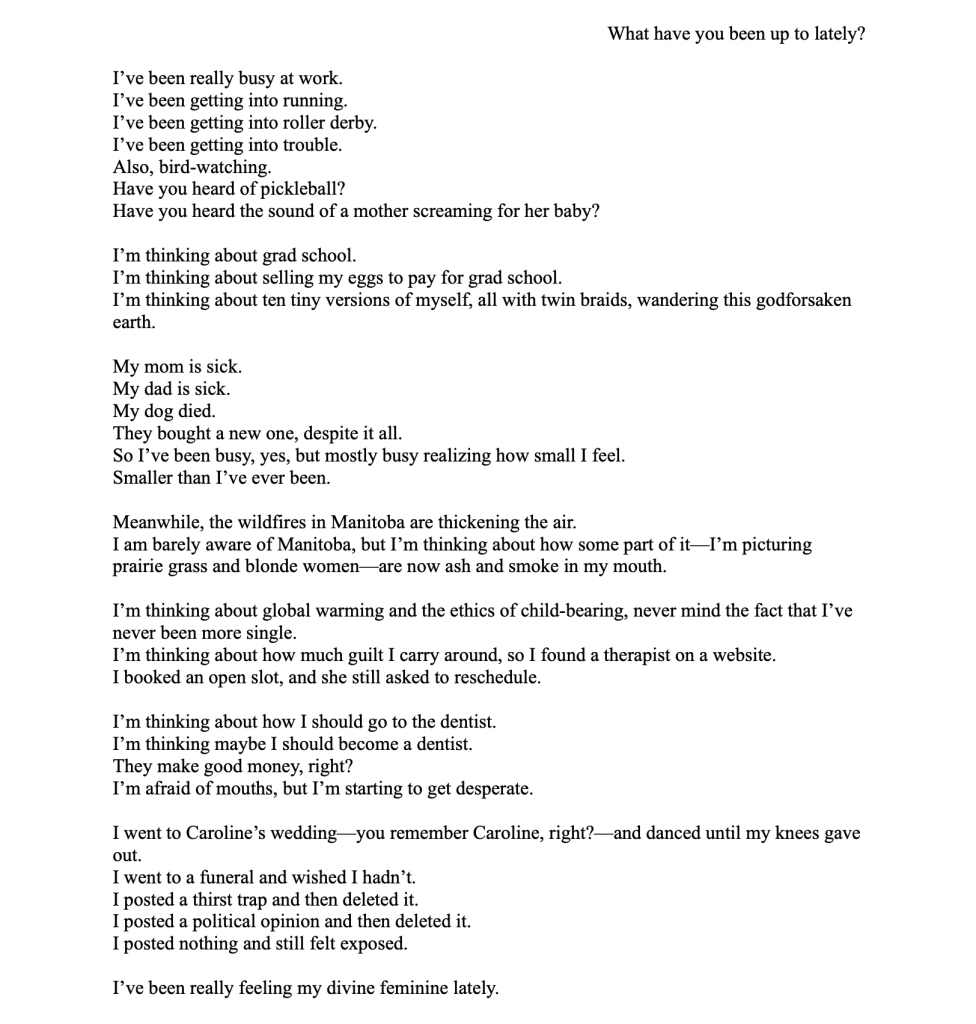
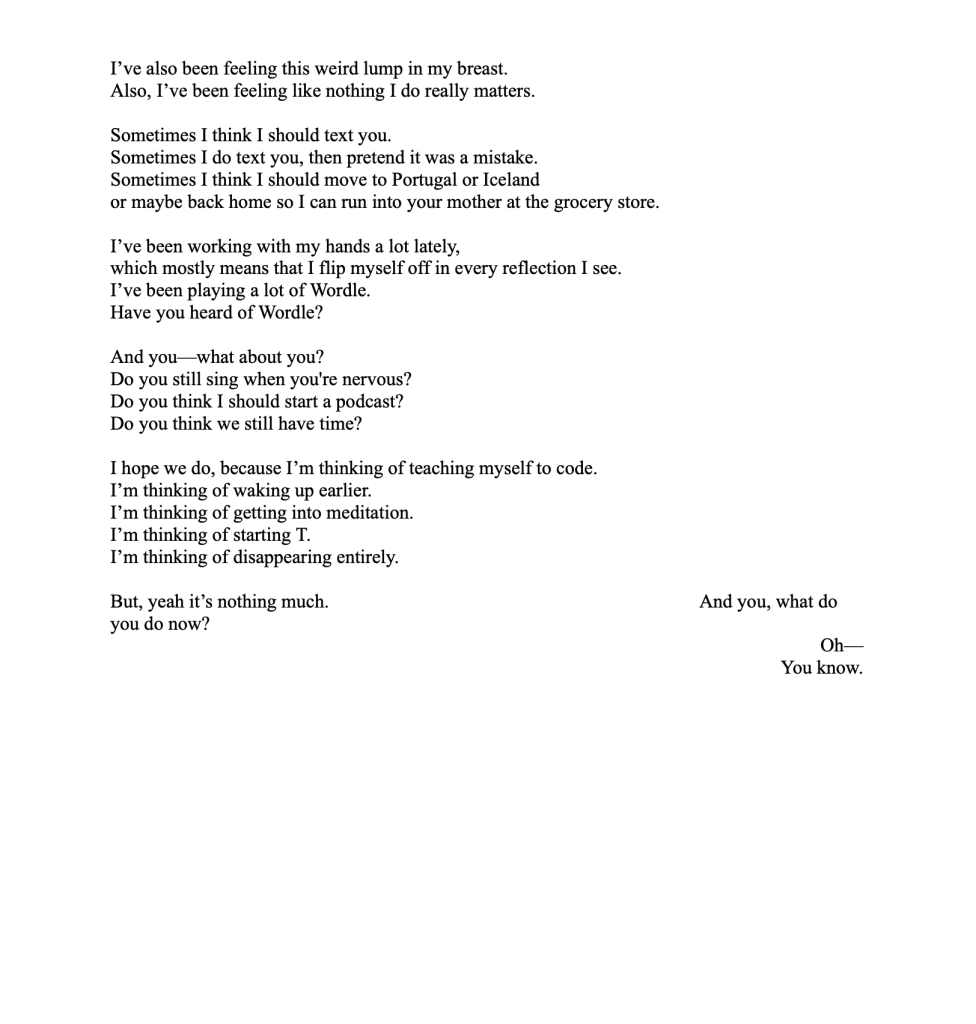
Click to enlarge and scroll
Lapse
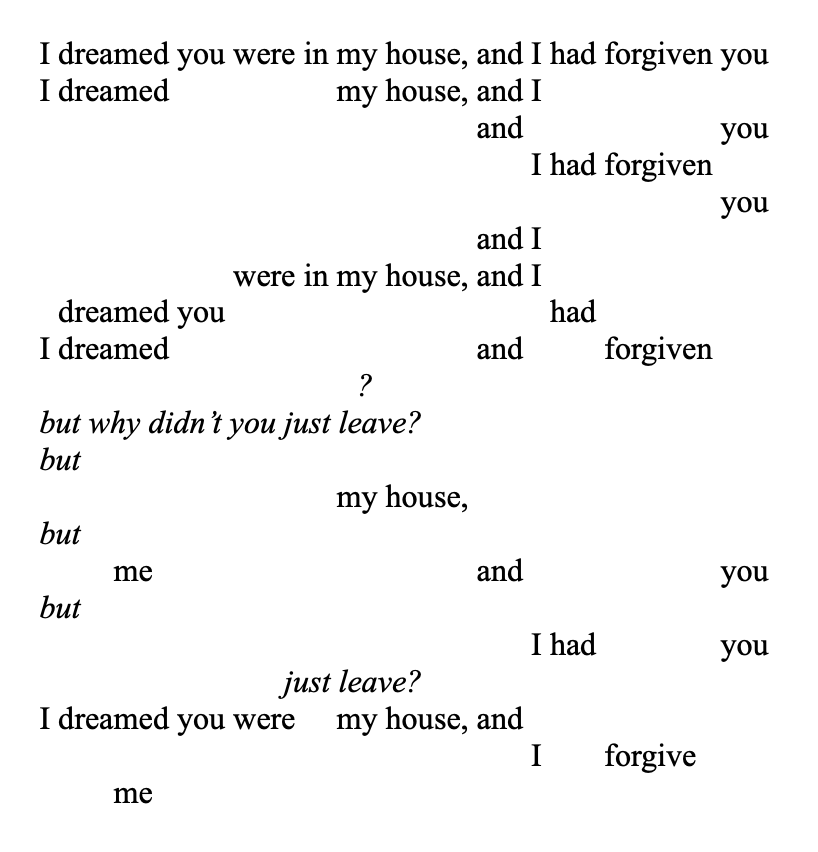
Click to enlarge



Editor’s note: For these poems, the best reading experience will be on a desktop.
Click to enlarge and scroll
Click to enlarge
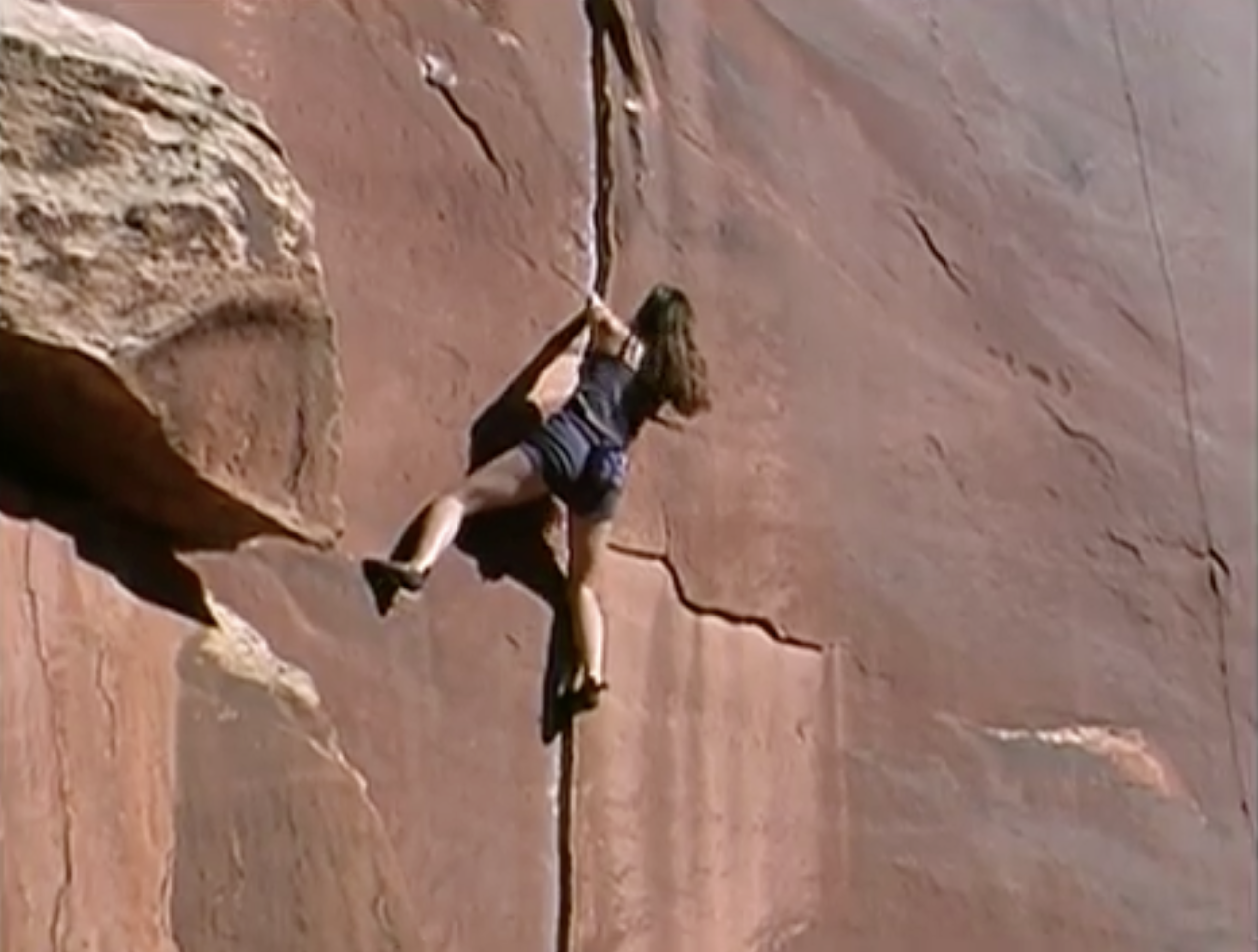
Rock climbing, the niche sport where people scramble up jagged cliff faces and large stones using only the tips of their fingers and toes, is, improbably, having a moment. Dedicated gyms are mushrooming up in stripmalls, warehouses, converted churches, and oversized basements. Pretty much every major city now has a veritable buffet of options for the amateur climber to train and dream of traveling to cliffs in Yosemite, in Arco, in Flatanger. The ultimate stamp of approval came six years ago when the sport was inaugurated into the Olympics. And just last week, one of the popular faces of climbing scaled a Taiwanese skyscraper in a death-defying, ropeless feat, livestreamed on Netflix. Thankfully, Alex Honnold didn’t fall.

Into this chaotic, churning landscape Gabriel Tallent has landed with what is, to my knowledge, the first climbing novel in this new era of the sport. Crux, which is climbing speak for the hardest part of a particular route, is the story of Dan and Tamma, two outcast high schoolers living the Mojave Desert and doing their best to finish school, escape toxic home lives, and keep each other alive. On weekends, at night, whenever they have access to a car, they go into the desert to climb in the most brutal, unsafe conditions because they don’t know any better, and don’t have any money anyways.
But let’s not pigeon-hole Crux. Yes, it turns a sport many people don’t understand into the stuff of riveting high drama, but more than that, it’s a tremendous novel about friendship, family, community, and what it takes to make room for yourself in a world that doesn’t have room for you. Tamma and Dan’s story is about finding paths in a landscape and a life where paths don’t seem to exist. It’s about how we make decisions when there are no good decisions to be made. And it’s about realizing what we truly care about, and then caring deeply enough to not let go, even when it’s impossibly hard. Crux is a big, ambitious book that manages to blend the hard stuff with the wild humor of characters who say things like: “there’s just fundamentally not enough rat shit to be worth your time.”
Gabriel graciously met me via Zoom to talk about climbing, writing, and all the nitty gritty things in between that fed into his sophomore novel.
Willem Marx: Haruki Murakami talks about his daily routine: He writes for four hours, runs 10 kilometers, and somehow that fits together as a life, being a runner and a writer. How does rock climbing fit into your life as a writer?
Gabriel Tallent: It doesn’t fit at all. It’s in total tension. They’re both pastimes that soak up as much time and love as they can. They are not a good compliment.
I stupidly thought that to write a climbing book, one of the most important things was to get extremely strong. It didn’t help. I was working out four hours a day, five days a week, and you can’t sustain that when something happens in your personal life. You can do two things, right? You can have your family and you can climb, or you can have your family and you can write. So, I haven’t gotten back to climbing the way I was when I wrote the book just because of [the birth of my twins] Milo and Kobe.
I also weightlift and that fits much better. I’ll write from nine until one and then lift for an hour, and solve a lot of the problems like that. Climbing is totally different. I’m a terrible climber, so while I’m climbing, I’m just trying not to die. It demands my full attention, which is rewarding in the same way writing is rewarding, but not complimentary.
WM: Thinking about it separately then, what is climbing to you?
GT: I love going out and having adventures. This has always been part of my life. As a young person, I was in the outdoors a lot. So, leaving school, I was like, what the fuck do I do? I was studying cultural history of the 18th century in university and passionate about it and people were like, “You should pursue this.” But there was a part of me that had been abandoned. I wanted to return to that adventuresome part, to the something that was missing. That is what climbing is in my life. It is this outlet for adventure and excitement and to learn more about myself. It’s sort of always what I wanted to do. I always want to be out in the backcountry, seeing new places, and climbing gives that to me. It makes my life rewarding. It isn’t a good fit with writing, but it fulfills a fundamental thing that I want in my life.
WM: Is that a similar impulse to the impulse to write? Do they come from a similar place?
GT: Yeah, I think so. There’s a twist to it, which is that when you’re writing, you’re trying to put down the lesson—a lot of times, what I want when I’m writing is I have some insight and want to put it down on paper. I want it to be legible to another person.
But you’re also filling out the idea, learning more about it, experimenting with it. And that’s kind of what you’re doing as a climber. As a climber, you train, you work on yourself, and then you go out and you climb some big objective. It’s sort of the test of a theory of yourself. It stress tests the person you want to be.
Novels are like a portable wilderness. They’re a wilderness that you have in your pocket—you open it up and you are in some ways on an adventure. Climbing is an adventure in a parallel, though not identical way.
WM: In writing Crux, did the climbing come first, like, I’m going to write about climbing, and then a story comes? Or was it more complicated?
GT: It was horrible. I’ve always wanted to write a novel about climbing and after My Absolute Darling, I undertook to write a giant climbing book. And it was muddled. I didn’t have my story straight, I didn’t understand what the heart of it was. I wrote this huge, 800-page book . . . and it was too much climbing. Climbers complete an objective and then they want the next objective. But when you’re reading that, you don’t care about the third big objective. That, as a story, doesn’t work. So, I set it down and wrote another book about cardiothoracic nursing. Then my editor was like, “What the fuck is this?”
Novels are like a portable wilderness.
And then Hayden was born. When I was going to have a kid, all these writers were like, “You can’t have a kid,” “Every kid takes one novel,” or “Love means nothing compared to novels,” you know? And then I was talking to Benjamin Whitmer, and he was like, “You’ll hold a baby in your hand and you’ll look down and realize what love is. You’ll love him more than you’ve loved anything else in your life, and it will be a transformative moment.” And Benjamin Whitmer, alone of all those people, was right. He was the only person who didn’t pit love and your life against your writing.
[Having a kid] changed how I thought about what a life means. I was thinking about how to articulate what is important in life, and it wasn’t what grade you climb, it wasn’t whether or not you ever climb Fallen Arches. You don’t hold a baby and think, God, I’ll love him one day if he climbs 5.10. That’s not it!
I went back to basics. I was like, what matters about climbing? You can do that and slide into nihilism, right? Because you could be like, “It doesn’t matter what grade you climb . . . maybe climbing doesn’t matter at all.” But that isn’t how I feel. And so, where does the meaning lie? I went back to my gigantic novel, and in it I had this little flashback to the moment before the characters were epic, hard-sending climbers climbing at the limit of the sport. They were just idiot kids climbing sketchy boulders in Joshua Tree without any idea of what to do, and I was like, I’m going to make that the book. Because that’s where I can make the meaning most legible.
WM: I found it interesting that Crux actually doesn’t have romantic love. It centers a friendship, which gives a different tone to the emotions and desires and strivings of the characters. How did you come to make the book about friendship while avoiding romantic love?
GT: Friendship is so central and important in our lives, and it feels underexplored in literature and culture. My climbing life has been defined by great friendships. You go out and you’re hazarding your life with some guy. That strikes me as extraordinary and important in a way that enriches our lives. Collapsing everything to romantic relationships and to nuclear families can have this very isolating effect on ourselves and on our communities.
And I feel like it ups the stakes. We have narratives about risking everything for romantic love and there’s a sort of a knee-jerk way you can think that is a good thing in an unconsidered way. If Dan and Tamma are in love with each other, then the cultural narrative enfranchises the perspective that you should risk everything for this person. But risking everything to undertake something with a friend is a trickier proposition. Also, romantic relationships collapse the logic of things—if you’re doing something for your romantic partner, you’re kind of doing it for yourself too. Doing something for a friend has more of a reckoning with the importance of other lives even if they don’t necessarily owe us anything.
WM: There are a lot of climbing terms and ideas that run through the book— “exposure,” especially, gets woven in as a theme. But what stood out to me is the way you enter the story as an authorial voice to introduce and define climbing language. What was the thinking behind this way of being in the story and handling the terminology?
GT: Well, you try a bunch of different things. How I articulated the problem was, there’s the Hemingway method, like The Sun Also Rises—a novel about bullfighting, where bullfighting is not, for the most part, explained. It’s narrated, beat by beat action, and Hemingway does it in a marvelous, careful way, so you feel like you get it. Then there’s the Melville strategy, where you vamp and explain and elaborate.
Collapsing everything to romantic relationships and to nuclear families can have this very isolating effect.
I don’t think I ever committed to a path [between Hemingway and Melville]. I chose somewhere in the middle because I don’t have a 50-page section about the importance of different ropes, which would be cool. I didn’t go full Melville, but I felt very willing to explain because I just wanted everyone to understand [and] to feel welcomed into the world without watering down its wonder.
WM: That makes me think of this idea of sharing insights or morals with a reader, because I did feel your presence in the book. I felt that there was a person who could step in and sincerely explain something to me. Somehow, that gave weight to the book.
GT: It’s trickier than morals. I do care about things, I do have an argument, but a lot of the things that you would want to explain to someone are killed by saying them. They mean nothing. But if you tell the story, it becomes communicable. I guess what I’m trying to do is create an experience that you can undertake. I’m trying to have a conversation; I’m not trying to tell you something.
WM: I like how you say, “I do care,” because that’s what comes through—this sense of care, this sense of presence and generosity.
GT: I started writing to keep my friends alive. My friends were committing suicide, that’s why I wrote My Absolute Darling, and that has carried down. You are writing for people in trouble. You want people to have a good fucking time, but essentially, there are people out there who are in crisis in their lives, and you want to write a book that takes that seriously.
WM: Tamma and Dan both come to climbing from very bad family situations and in a lot of ways it becomes an escape. But over the course of the book, we see their relationships to climbing, and to themselves, diverge—Tamma approaches a more fruitful place while Dan becomes destructive.
GT: They both go through crucibles. Tamma comes out the other side with some fundamental realizations about her life, how she’s going to undertake things. Dan gets stressed out and panicked about his life. He’s alone and loses sight of what matters. He’s falling apart and undergoing the onset of a major mental illness. But he could ruin his life doing anything, right?
The book is a lot about making choices. I think that works well with climbing because you’re making choices under tremendous duress. Which is an interesting fictional and human problem. Dan comes to this crux in his life and fundamentally doesn’t want to make the decision. He wants to put the decision on something else like, “If I can climb this climb . . .” When we make climbs other than they are, it becomes a wonderful opportunity to die. As soon as the climb stops just being a climb and becomes some testament to who you are, then things have gotten more dangerous. I see people do that with writing, and all of a sudden, you’re fucked up about it.
WM: At a sentence level, you write in these long, rhythmic, lyrical sentences. Sometimes it feels acrobatic, and it’s extremely recognizable. Does that style come in revision and rewriting? Or is it just how the language comes out?
When we make climbs other than they are, it becomes a wonderful opportunity to die.
GT: Who is it that said all style is just imperfection in your communication? I don’t know that it’s something I am trying for as much as much as it’s a fucked up way my weird brain works that I can’t help. The things that I am trying for are clarity and to chase an emotion. I’m always trying to get closer and closer to exactly how something feels. I don’t know that I’m like trying to create a specific style. I feel that it’s accident—something I can’t help about the writing. I’m trying for, and not achieving, transparency.
WM: Another thing that stands out in your writing is how much dialogue you use. It’s everywhere in Crux. There’s one moment when Tamma is talking about how much she loves climbing through bat shit, and says: “Wake up and smell the hantavirus, BITCHES!” I was laughing out loud.
GT: I write hundreds of pages of dialogue and then cut it down to the best. I’ll spend all day writing dialogue and then cut it down to an eight-page chapter. I write an enormous amount of it to catch the rhythm, the best things. Then stop, do like five sets of twelve deadlifts, and the whole time in your head you’re just trying to catch some character.
You’re trying to show something, like: In this chapter I need to show how much Dan and Tamma need each other, almost a certain asymmetry, which is that Dan is willing to die and Tamma is not willing for him to die. You chase that with dialogue, and you try to get funnier, and funnier, and funnier and then cut out all the stuff you don’t need. The primary way that I access the characters is hearing them talk, so I really lean on that.
WM: Reading Crux, I had the old phrase “Great American Novel” popping into my mind. It’s about America in a lot of ways—about who we are, who we were, who we could be. All those themes are there. Do you see the book in that kind of lineage?
GT: I do think a lot about America. To me, America appears to be in crisis. I move in very liberal circles, but for a very long time people have been like, “America is not special.” There’s a sort of anti-American, politically left, progressive discourse that attacks the specialness and the centrality of our institutions. I hate that. I don’t want to lean too much on it, because every country is fucking special, right? But you also have to fucking love your country or it doesn’t work. It is a dream, and only so long as we hold tight to the dream of it does it become a place that it is inhabitable. So, I don’t know that I’m trying to write an American novel, but I am obsessed with the problem.
Not everywhere in the world is doing great, and states fail, right? If we cease to believe, we can lose it. I’m writing about that.
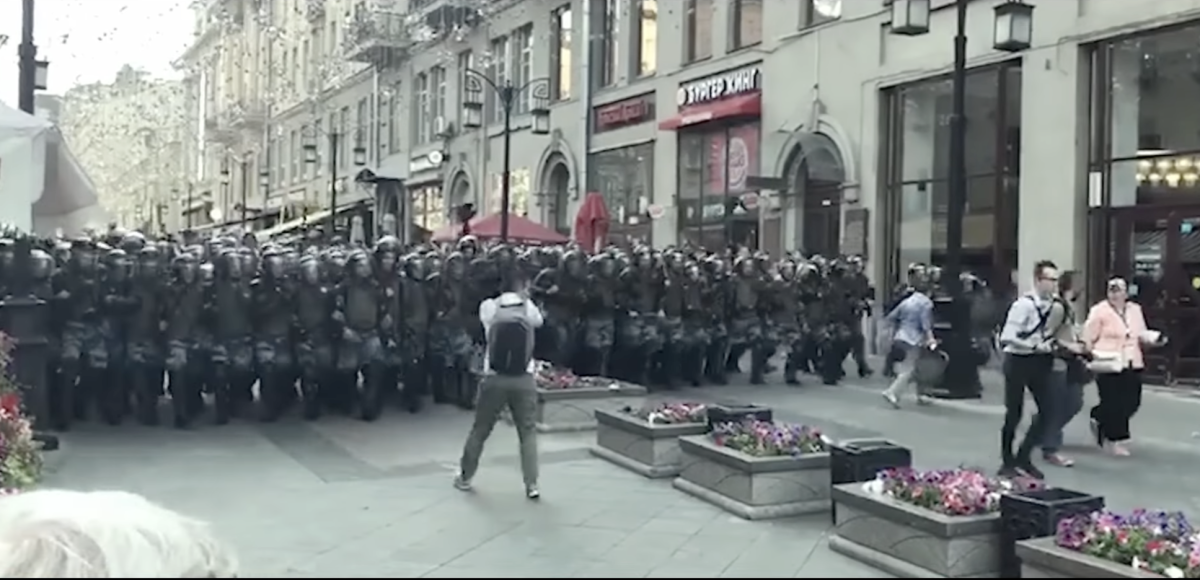
When Chicano skateboarder BeeGee skated into the frame of One Battle After Another, on his way to join pro-migrant protests amid police violence, I turned to the friend beside me and whispered, “I want a whole other movie about these skateboarders.” Imagine my delight when BeeGee and his gang reappeared, leading Leonardo DiCaprio through a hallucinatory rooftop escape—my favorite cinematography of 2025. I teared up in the theater recalling Chicago Bike Guy, the worker who went viral when he escaped ICE on his bike. A bike is not a skateboard, but those Latinos, leaping high above the violence below, their long black hair and boards silhouetted against tear gas clouds, converse with Chicago Bike Guy’s victory—one fictional, the other terribly real, yet both symbolizing a Latino escape from the violence of borders.
Afterwards, sifting through my response to the film, I wondered if my standards for Latines onscreen had been lowered too far by lackluster, tokenized representations and the political demonizations of Latin Americans. In a different political moment, would the sequence with Latine skateboarders have moved me less? After all, the film’s Latines are supporting characters and Paul Thomas Anderson is a white director. Yet, though they may play supporting roles, the Latines in One Battle After Another not only impact the narrative, they provide crucial meaning to the film’s visual language and themes. Their presence seems to be the genuine result of an artist creating powerful images rather than a product of representation’s stultifying logic. Was Steven Spielberg preoccupied with the “representation” of white children when he filmed E.T. making those bicycles fly? Or was he creating iconic imagery that takes extra meaning from those kids’ yearning for freedom from the adult world? This begs the question: When a white auteur gives nonwhite characters such sustained attention and we scrutinize the results, what does our scrutiny reveal about the political projects white artists can join? What is it that we want from our white art?
One Battle After Another’s first act follows the relationship between Teyana Taylor’s Perfidia Beverly Hills and Leonardo DiCaprio’s Bob Ferguson and the machinations of their revolutionary group, the French 75. The spectacle of the French 75 blowing up buildings and freeing migrants from detention centers abruptly shifts when, in quick succession, Perfidia gives birth to a baby girl, Willa, rejects motherhood, is captured by the state, and rats out her comrades. From there, the plot revolves around Bob and Willa, who go into hiding in the town of Baktan Cross. There, Bob’s story is woven together with another organization in the film’s second act, an underground Latine resistance network whose tactics tend less towards spectacle, and more towards smuggling migrants to safety and quietly resisting oppression in the borderlands. This group has no official name nor any big speeches to codify their goals, yet they’re consistently shown outsmarting the government, resisting by whatever means necessary while remaining under the radar.
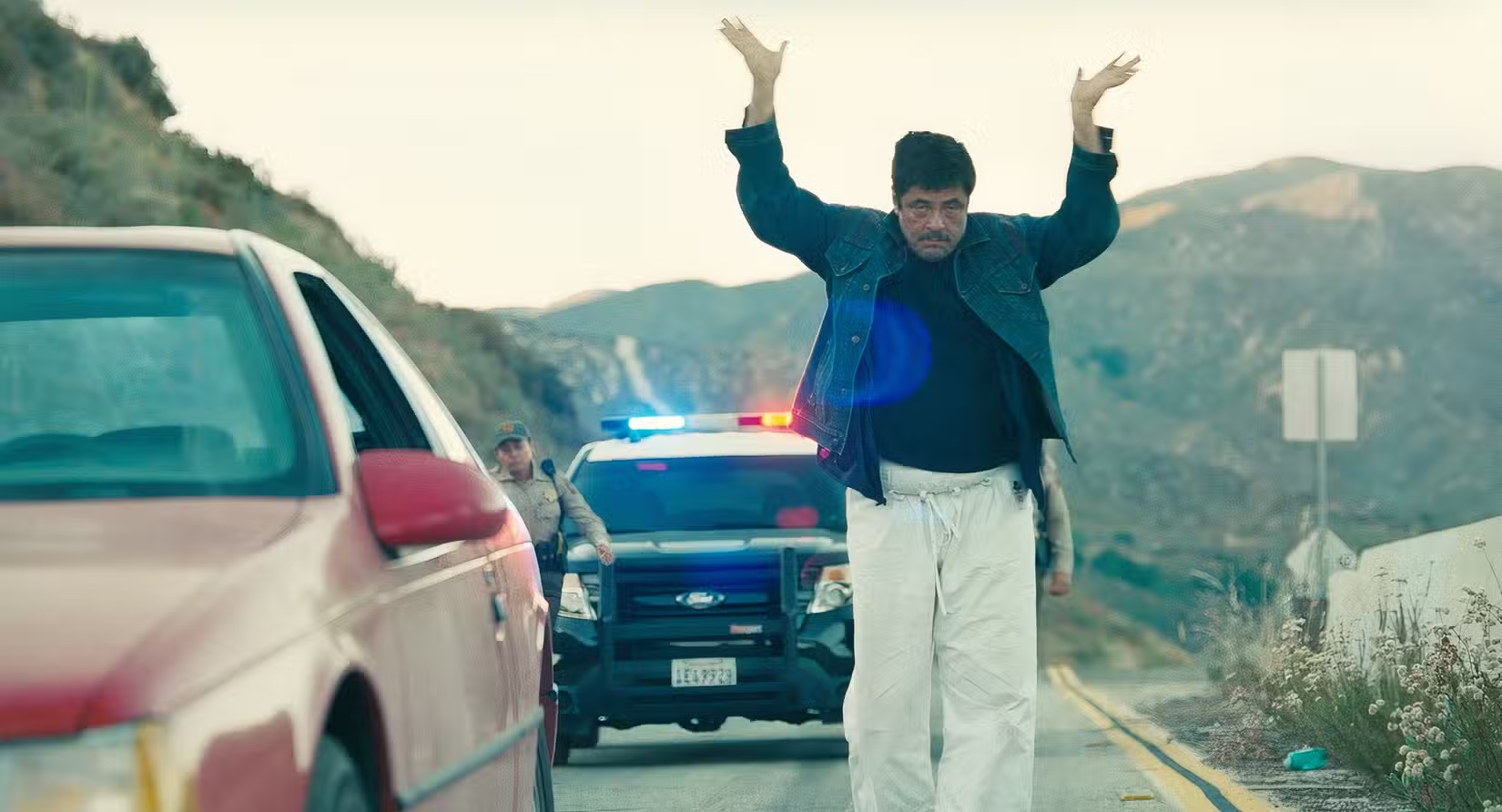
These Latine aspects are encapsulated in Benicio del Toro’s Sensei Sergio St. Carlos, a character who carries the second act of the film with his twin missions of rescuing Bob and a group of Latine migrants. This, what I’ve affectionately dubbed the movie’s “Latinocore” side, is crucial to understanding the whole of One Battle After Another’s complex racial and political messaging, which has provoked surprisingly harsh debate among critics.
Latine activism is unusual subject matter for director Paul Thomas Anderson, in whose milk-pale oeuvre people of color are often sidelined and mined for stereotypical humor (Inherent Vice, Licorice Pizza); omitted because the films are “period pieces” (The Master, Phantom Thread); or, in the best of cases, narrowly escape narrative insignificance thanks to a specific actor’s charisma (Don Cheadle in Boogie Nights, April Grace in Magnolia). One Battle After Another breaks this decades-long pattern by prioritizing Black people and Latines with the idiosyncratic artistry Anderson previously reserved for white roles. Anderson, who has built a reputation for imaginative and powerful set pieces—think Daniel Day-Lewis shouting about milkshakes in There Will Be Blood or the frogs raining down on the cast of Magnolia—strides atop those same creative heights with nonwhite characters in One Battle After Another. In one of its many tour de forces, we follow Sensei Sergio as he leads Bob into his home, the roving camera winding around migrant families clustered in the hall and lingering on their faces before following Sergio and Bob through Sergio’s living room, kitchen, and bedroom in one shot—Bob’s frantic energy at odds with Sergio’s calm as he introduces Bob to his family as a “gringo Zapata.” This entrance into Sergio’s world, with fluid cinematography confidently navigating the chaos as the anxiously repeating piano notes of Johnny Greenwood’s score rise and fall, makes a sequence which stands up to the most intense moments from Anderson’s filmography.
Do we want white filmmakers to steer clear of the risks inherent in telling nonwhite stories?
Rather than labeling the film a success or failure and joining the divisive online discourse it’s stirred up, I’m interested in what these reactions say about our critical orientation towards white auteurs telling less-white stories. If the complex racial politics of One Battle After Another are declared for posterity as a swing and a miss, what does that say about our greatest white auteurs’ ability to confront our present era? Do we want white filmmakers to steer clear of the risks inherent in telling nonwhite stories?
I realize I’m defending a movie that may appear to need no defense. Grossing over $200 million worldwide, its revenue far exceeds Anderson’s previous films, it’s received predictable critical adoration and thirteen Oscar nominations.
Yet among the underrepresented audiences you might expect to love its subject matter—people of color, leftists—it’s been harshly criticized. In broad strokes, these critiques focus upon One Battle After Another’s sensationalistic treatment of its Black characters and on its allegedly-superficial politics, the French 75’s rhetorical shadow of the movements upon which it is modeled.
It’s true that One Battle After Another is more interested in failed revolutions, in activists who can’t get their shit together, than in illustrating social change. And I don’t detract from the Black critics who’ve rightly pointed out stereotypes and misogynoir, most evident in Perfidia, who, despite a masterful performance from Teyana Taylor, is a hypersexualized, delinquent mother who betrays her fellow revolutionaries. Still, I find in Perfidia more than a collection of harmful tropes. The film itself suspends judgment: Her “relationship” with Sean Penn’s Colonel Lockjaw—the villain pursuing her, the French 75, and, later, Bob and Willa—is nonconsensual, post-partum depression complicates her actions, and we see other revolutionaries get captured, questioned, and, each time, cave. Complicity is not uniquely Perfidia’s sin. This universality, of saving oneself when crushed beneath the authoritarian jackboot, demonstrates the power wielded by states, and how, once separated from the collective, individuals struggle to resist it.
However salient, both these lines of critique elide the Latinocore. When the federal government unleashes immigration raids on Baktan Cross, providing cover for their mission to apprehend Bob and Willa, the camera slows down to show us the Latines being detained, underlining the human cost of this assault. But Baktan Cross, a setting where Chicano culture infuses every set piece and shot, is not helpless. As Bob takes refuge with Sergio, it’s revealed that Sergio is a fulcrum in the town’s network of underground Latine resistance. While protesters confront the militarized police, Sergio repeatedly rescues Bob and simultaneously organizes the escape of multiple Latine families living in his building. None of the extensive spoken Spanish is subtitled, a decision which refuses to cater to non-Spanish speakers. These Latinocore scenes and details act as a fly in the ointment for those condemning the movie for illustrating racist tropes or being politically shallow—unsuprisingly, negative critiques ignore these elements.
Positive reviews (largely penned by white critics, with some positive reviews from Latines appearing in Spanish) appreciate del Toro’s performance but seem less comfortable praising the film’s racial representation. Instead, most have analyzed its aesthetics or how it departs from Anderson’s previous work. Critics pointing out that the movie’s biggest departure is its surge in melanin have largely been nonwhite, and since many of them reacted negatively to this departure, there’s a growing critical consensus that while the movie might be well-made, the results are mixed at best concerning Anderson’s ability to tell stories beyond his own whiteness.
In contrast, Anderson has not come under widespread scrutiny for people of color’s absence or sidelining in his previous films. I won’t claim that Phantom Thread or The Master are racist because they tell white stories, but I question why we accept this absence while any significant nonwhite presence opens white auteurs to critique. This critical landscape tells us that the absence of people of color is more acceptable than our presence, and that white auteurs will be lauded for making Great Art across their saltine-tinted bodies of work while keeping people of color outside of the frame. The complaints when white artists do attempt to decenter whiteness send an additional, paradoxical message that our stories are too difficult for even Great (white) Artists to possibly attempt.
Do we want our white artists to solely center white people? Do we want them to do the more “woke” version of staying in their lane, making art about white people with a few inoffensively diverse characters thrown in as shields against racial critique? That seems to be what we, as a culture, are incentivizing, but we should ask our artists to do more than claim “inoffensive” as a virtue.
If artistic discourse and output accepts white artists moving beyond art that centers whiteness, collaboration with nonwhite artists strikes me as essential. That collaboration is evident in One Battle After Another, as Paul Thomas Anderson has vocally credited Benicio del Toro for his creative input to the Baktan Cross scenes. According to Anderson, these scenes went unwritten until del Toro wrote not only his character’s dialogue, but helped formulate the movie’s second act. Everything from the set decoration to the unsubtitled Spanish in these scenes feels connected to lived Latine experience, and this can’t be separated from del Toro’s collaboration.
It’s hard to overstate how wonderful Benicio del Toro is as Sensei Sergio. Where Bob is frantic and paranoid, Sergio is serenely competent. He saves Bob, but never lets this white man derail his own objectives; he calls his activism a “Latino Harriet Tubman situation” and an “Underground Railroad,” one example of how this film links migrant struggles and Black liberation. He is characterized endearingly down to the last detail: He wears cowboy boots in a nod to Latino gauchos and corrido folk heroes; adorning his bedroom walls are paintings of tigers, and Eye of the Tiger is his ringtone; and he doesn’t let Bob trespass on his tatami mats even though Bob is running for his life. Sergio tries to share his Zen attitude, reminding Bob to be like “Ocean Waves,” a useful metaphor when confronting battles that won’t stop coming.
This critical landscape tells us that the absence of people of color is more acceptable than our presence.
Sergio brings to mind Chicana feminist theorist Gloria Anzaldúa’s idea of “la facultad,” as expressed in her seminal work Borderlands/La Frontera: “La facultad is the capacity to see in surface phenomena the meaning of deeper realities . . . an instant ‘sensing,’ a quick perception arrived at without conscious reasoning.” This “sensing” comes to those who’ve been marginalized, who can’t live safely in aboveground society, whose identities have been shaped by violent borders. La facultad starts as the adaptive quick thinking required to survive a hostile world and becomes deep counterknowledge to the ways and means of dominant society.
When Sergio says to Bob, “We’ve been laid siege for hundreds of years,” this is la facultad. He follows up with a needed reminder to Bob, “Don’t get selfish.” The lessons Bob has taken from life in hiding enable him to escape Lockjaw’s first assault. But while Bob’s peril has granted him an inkling of la facultad, he’s still lived as a white man; his paranoia hasn’t become la facultad’s deeper knowing. We can read Bob’s flailing as a white director’s tacit admission that he needs help telling stories about people of color, with Sergio’s expertise standing in for the creative input and guidance of Latino collaborators.
In one example, Bob falls off a roof while following BeeGee and the skateboarders to safety and winds up in jail, where Latine resistance continues to save his ass: In jail, the Latina intake worker suggests that he’s diabetic, sending him to the hospital, where a Latina nurse frees Bob and instructs him to escape to Sergio’s waiting car. Sergio hands him a six-pack of Modelos and takes a selfie with Bob, declaring, “Let’s play offense,” as they drive off.
This escape sequence, with the Latinas’ smooth operation, Sergio’s selfie and seamless switch to offense, demonstrates Latine playfulness and what Anzaldúa calls “serpentine movement,” the movement of Latine political and spiritual activism. This is a reference to the Nahuatl snake goddess, Coatlicue, whom Anzaldúa reclaims as a force representing the path to self-acceptance and evading colonial authority. Embracing Coatlicue enables more than survival, empowering us and making art, playfulness, even the divine accessible through the identities created by life in the metaphoric-and-literal Borderlands. As Anzaldúa puts it, “[L]earning to live with la Coatlicue . . . transforms living in the Borderlands from a nightmare into a numinous experience.”
It seems unlikely that Paul Thomas Anderson and Benicio del Toro read Anzaldúa to prepare these scenes. Nonetheless, they turn the borderland of Baktan Cross into a numinous place, touched by the divine, in which activists move like Coatlicue and the community’s street smarts, its facultad, protects itself.
While I see radical politics illustrated through the film’s Latinocore scenes, other readings suggest little discontinuity in Anderson’s pattern of centering white characters. When I watched the movie again with a friend of mine, she kept exasperatedly asking, “Why are they helping him?” It’s a good question: Why do these Latine activists go out of their way for Bob, who is useless at best and hindrance at worst?
The cynical answer is that they help him because One Battle After Another stars a white man, and therefore requires its nonwhite characters to serve him. We see this repeatedly from white directors, adjacent to if not reiterating White Savior tropes. It’s hard to argue against this metatextual reading, as Bob is the protagonist, and once his arc leaves the Latine characters, so does the narrative.
Yet, Bob is the Latines’ damsel in distress rather than their White Savior. From Bob’s first panicked arrival at his door, Sergio understands: this man needs help, and may not have much to offer in return.
La facultad becomes deep counter-knowledge to the ways and means of dominant society.
A different reading of the film suggests that it would be out of character for Sergio and his allies to not help Bob. In-universe, the principles of solidarity and la facultad of his comrades save him, not his whiteness. When Bob reveals his link to the French 75, Sergio had already saved him once, regardless of revolutionary bona fides. He doesn’t privilege Bob over the migrants (“Don’t get selfish”) but Bob’s precarity is motivation enough.
Another scene, not involving Sergio or his allies, illustrates similar principles. Pursuing Willa and Lockjaw by car, Bob arrives at an intersection with no clue which way they went. He stops to ask for directions at a roadside stand staffed by Latinos. The men point the way, he thanks them, and drives off in the right direction. This whole conversation is spoken in Spanish, clumsy on Bob’s part.
Anderson could have cut this without interrupting the plot, but it justifies its presence by underlining the principles of solidarity that enable Bob and Willa’s survival. Bob isn’t fluent in Spanish, but he can communicate; if he’d learned no Spanish, he’d never find Willa. The Latinos unhesitatingly help him. Anderson breaks with the film’s paranoid atmosphere to show that strangers (including foreigners) are not inherently hostile, they can be trusted, and that Bob—by extension, all revolutionary hopefuls—needs community support and solidarity. That Bob frequently seems undeserving of the help he receives, that it’s sometimes hard to imagine a more incompetent leading man, demonstrates how deep these principles go. Everything this movie has to say about how you keep fighting one battle after another is conveyed through this scene.
In a better world, multiple movies with One Battle After Another’s budget could come from directors of color and star nonwhite actors rather than Leonardo DiCaprio. In that world, I’d get my movie about Latino skateboarders from a Latine director; Perfidia would be explored by a Black woman director who’d give her dimensions beyond aggressive sexuality. But in this world, white artists get the bulk of industry permission and critical acclaim. I don’t want to see those artists lucky enough to be given permission and funding by gatekeepers avoid the risks inherent to writing across difference.
Writing across difference should be a risky endeavor: You risk causing offense and inviting blowback. But any artist worth their accolades should not fear. Artists take risks—different in extent, not in kind—to make any art of lasting value. This doesn’t let auteurs off the hook for risking and failing, nor does it exempt white artists from criticism, but in a white supremacist society, if we tell artists from the dominant racial category to only “write what they know,” we end up with reflections of society’s dominant values through the white faces and stories these artists already know. I prefer to see even flawed attempts to subvert the dominant paradigm.
Gloria Anzaldúa chose not separatism between Latines and whites, but to give artistic direction: Through our art and literature, she wrote, “we must share our history with [whites] . . . They will come to see that they are not helping us but following our lead.” In One Battle After Another, Bob follows Sergio’s lead in all their shared scenes. When the camera briefly returns to Sergio once he’s left Bob’s story, we see Sergio exiting his vehicle by the side of the road, waiting to be arrested. His face relaxed as ever, he finishes his Modelo and doesn’t stand, but dances: hips swaying, feet shuffling and gracefully raising his arms. Is he dancing the Salsa? Samba? Unclear, but the sway of his hips channels Anzaldúa’s serpent movement, Latinocore to the end as he answers stern cop questions with jokes (“I’ve had a few.” “A few what?” “A few small beers”). Despite his circumstances, the film projects little suspense regarding his fate, his cool assuring us that he’ll evade authority’s grasp. Possessing la facultad, we know he’ll walk free.
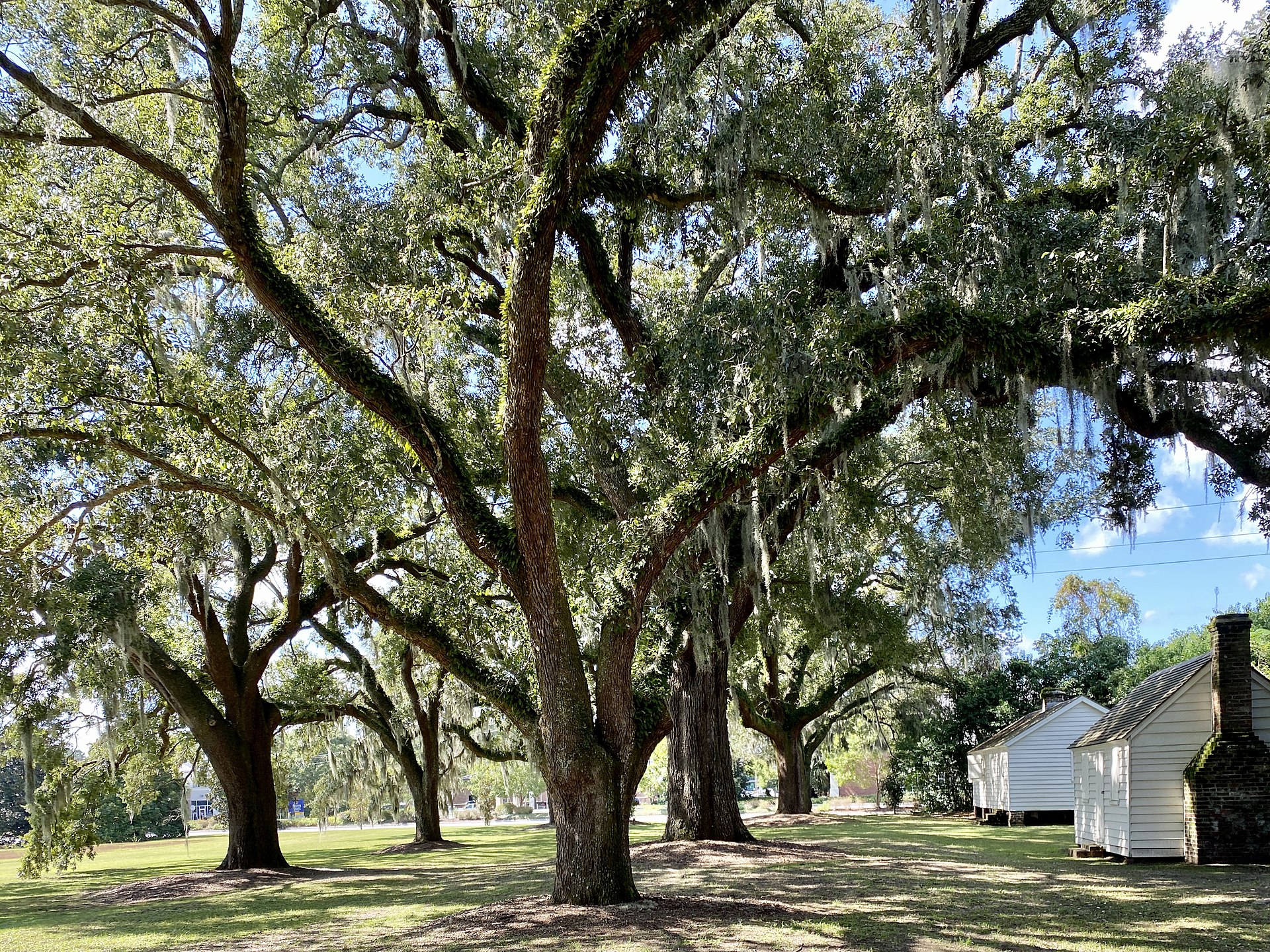
Beronda L. Montgomery, a botanist and a Radcliffe Fellow at Harvard, has made a career of interacting with plants, though her first attempt at communicating with them was kind of a flop. As a child, she had a full-fledged love affair with the wilds of Arkansas, but by the time she was a teenager, Montgomery rolled her eyes at an assignment to talk to a tree and write about it. Three decades later, on a South Carolina plantation, she had a total turnabout. There, she met and spoke with the ancient McLeod Oak, which, she says, “stood in this same place at a time when our enslaved ancestors inhabited and worked the land.” In When Trees Testify: Science, Wisdom, History, and America’s Black Botanical Legacy, Montgomery describes the massive oak and other historic trees as “living witnesses to Black American history.”
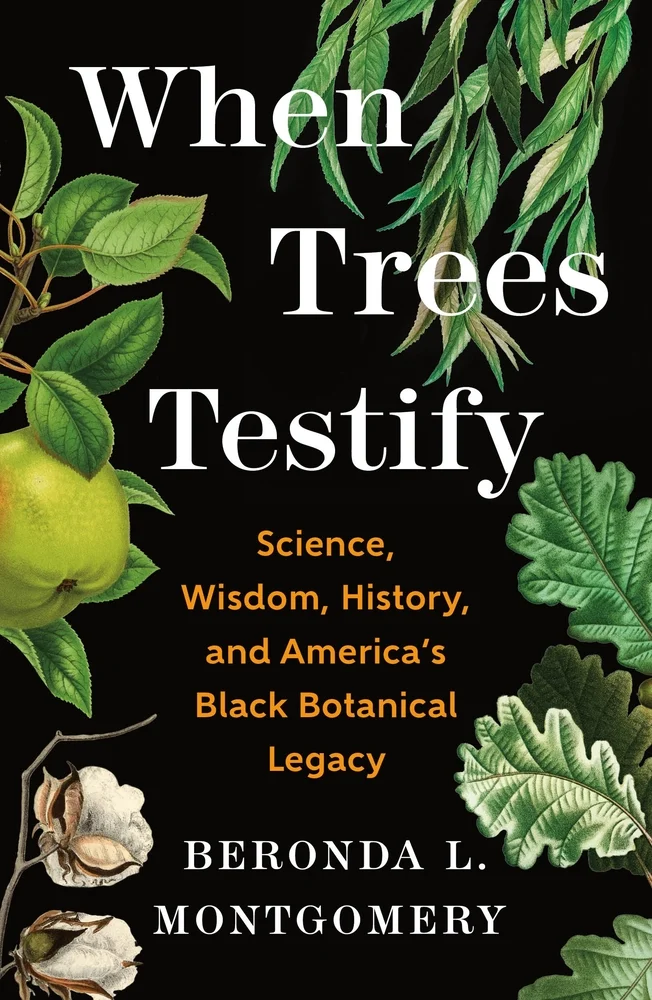
Like Robin Wall Kimmerer’s The Serviceberry—which uses the serviceberry to talk about nature, gratitude, and Potawatomi history—Montgomery structures When Trees Testify around seven trees, plus cotton. Through these botanic figures, she talks about her family, botany, science, and Black culture and history, which, as Montgomery says, “is irrevocably tied up in trees and plants.” Sycamores, for example, loom over other trees and, thanks “to their statuesque size,” served as markers for those who self-emancipated during chattel slavery. And also like Kimmerer, Montgomery conveys the grandeur and drama of flora. Standout nature writing appears throughout, even about plants with infamous pasts, like cotton, which is “stunningly beautiful” when in bloom, with its “delicate white-to-yellow petals that can mature to pink.”
When Trees Testify documents many chilling historical events—the Elaine Massacre of 1919, the Tuskegee Experiment, the murders of Emmett Till and George Floyd. And it documents many Black triumphs, including the 1903 founding of Blackdom, an African American community in New Mexico. While Montgomery looks at trees as historical records, medicine, shelter, food, and architectural marvels, she also considers them to be guides toward a better future. Black botanical knowledge, she says, “is a legacy worthy of recognition, worthy of celebrating, worthy of carrying forward as a mantle and bountiful harvest of ingenuity, resilience, resistance, and intergenerational hope.” I talked with Montgomery about that legacy, stolen knowledge, favorite trees, and her extensive reading list “centered in or proximal to history and botany.”
Chaya Schechner: In the segregated South of your parents’ youth, African Americans weren’t allowed to buy or eat vanilla ice cream, so Black people made butter pecan ice cream, a favorite flavor with, as you say, “sinister roots.” Was it stories like these that led you to a career that blends botany and history?
Beronda L. Montgomery: Apart from reading about this ice cream phenomenon in Maya Angelou’s autobiography I Know Why the Caged Bird Sings, I wasn’t aware of or hearing about such stories when I was young. I truly believed it was by chance that butter pecan and black walnut ice cream were family favorites. I came to know deeply about many of these types of stories and factual events as an adult. I’ve long had a deep interest in African American history, and this intersected with my interest in botany. As I continued to read and engage with documentaries (e.g., High on the Hog: How African American Cuisine Transformed America), largely for leisure or personal interest, I began to take special notice of botanical facts and stories.
CS: You talk about “stolen botanical knowledge.” Cotton and rice were commonly grown in Africa and that knowledge was taken from enslaved Africans in the South. What other knowledge was stolen and how was it taken?
My role as a botanist has given me a special lens into some historical areas.
BLM: I refer to the knowledge associated with growing crops such as cotton and rice, or cultivating trees such the mulberry, as stolen because the enslaved individuals were forced to use their knowledge to support an agricultural industry that financially benefitted those by whom they were enslaved—without compensation or acknowledgement of the source of the botanical expertise.
CS: Have you ever felt that your roles as botanist and historian conflicted?
BLM: I haven’t often felt conflicted. I don’t identify as a historian as much as I identify as a botanist or plant scientist who uses additional avenues or methodologies—history, archival work, etc.—to explore the scientific, cultural, and social roots of botanical themes. Many scientists use methods beyond their primary expertise to explore scientific curiosities. Thus, although it may seem unorthodox for a plant scientist to venture into archives or history, it’s common for me in all areas of my professional and personal life. Indeed, more than feeling conflicted, it feels that my role as a botanist has given me a special lens into some historical areas. That feels like the foundation of writing something like When Trees Testify. I felt uniquely prepared and positioned for this topic.
CS: During chattel slavery, a hollowed-out sycamore could offer a self-emancipating person a place to hide on their way north. The Underground Railroad Tree in North Carolina, a poplar, “served as a literal witness to acts of self-liberation and proverbial symbol of freedom.” But poplars also had terrible associations. Did this complicated history of trees affect your experience of them?
BLM: I think it may very well be the complicated history that has drawn me so deeply to them. It calls for a careful and invested commitment to unearthing and telling the fullness of that history. I’ve learned to hold multiple truths at once: Poplars are beautiful and awe-inspiring trees and cotton is a fascinating plant with lovely flowers and a magically complicated ability to spin cotton fibers even as these plants are also tragically associated with the exploitation and killing of African Americans.
CS: You mention that cotton not only played a large part in chattel slavery, it also led to the wide-scale deforestation of old-growth forests, resulting in the loss of many poplars and oaks. Your family also had its own, more recent, associations with cotton. Can you talk about how the plant impacted your mother and her education?
Memory in plants is not exactly identical to human memory but it certainly exists.
BLM: My mother and late father grew up in the Delta region of Arkansas where cotton was, and continues to be, a major agricultural crop. During their youth, school years were either timed to or interrupted for Black children by the cotton season of planting and harvesting. Many Black children served alongside their parents as low-cost laborers to plant, cultivate, and harvest cotton, as well as other crops. But cotton was king. Thus, although my mom loved school and did very well educationally, each year her school year was disrupted by cotton harvesting duties. The association of cotton with the limiting of her education—limiting because she was ultimately able to attend junior college but may have been able to do more and go further without the educational disruptions—causes her to have a strong aversion to the mere sight of the plant to this very day.
CS: You mention that you’ve “often wondered whether the branch of a hanging tree remembers bearing its strange fruit.” Is there any evidence of trees retaining some kind of biological record, aka, memory?
BLM: Yes, as I explore briefly in the book, there is scientific evidence that plants and trees can retain evidence of prior experiences that influences later responses. Whether this is the ability of some seeds to “remember” exposure to the cold that later impacts their ability to successfully germinate or other plants’ abilities to recall a touch stimulus, plants can retain experience. This type of memory in plants is not exactly identical to human memory, but certainly exists.
CS: Reading When Trees Testify turns a walk in the woods into a history lesson. What led you to organize your book around seven trees?
BLM: The concept of this book was rooted in an experience with a centuries-old oak tree at a former plantation in South Carolina during a visit with family. After that I began to think of other trees that I might explore and gave some serious thought to how I’d organize my writing. I initially considered a temporal walk though my personal life. I also thought of organizing chapters by tree parts—i.e., a journey from roots up through the trunk to the branches and leaves. However, as I began to think about linking the plant science to personal and family history, it was clear that I had stories/memories linked to specific tree types and, thus, the organization in the finalized book seemed more logical for me. I also imagined readers may be drawn to a particular chapter by memories that they themselves had linked to a particular tree species or type.
CS: You quote David George Haskell who describes trees as “nature’s great connectors.” Some of the old oaks that were saplings on plantations during slavery still “carry the breath” of those who were forced to work there. What are some other ways trees connect us?
BLM: As I’ve approached the book’s publication and have begun to talk about it more with others, I find that one of the powerful ways in which trees connect us is through the experiences that so many have with a favorite tree—whether associated with tree type, tree location, or a tree from a childhood or family domicile. Often, individuals share a very specific story about a tree from their memory.
CS: Do you have a favorite historic tree?
BLM: I must say that whenever I’m asked about a favorite plant or favorite tree it seems to vary depending on so many other factors, including what’s going on in my life personally or what’s going on in the world. However, I often return to the Angel Oak near Charleston, South Carolina—which is discussed in the book—as I always recall how awestruck I was when seeing it the first time. Also, on repeated visits, it’s been a different experience depending on the weather—if there’s been enough moisture the resident resurrection ferns are fully unfurled and it’s a completely different experience to engage. I also have favorite historic trees elsewhere, including a purportedly centuries-old silk cotton tree (Ceiba pentandra) near Falmouth, Jamaica, that I came to know recently. It currently holds a dear, sentimental nature for me as I was in Jamaica during Hurricane Melissa and the tree, which survived, will stand as witness to the devastation and hopefully to a full recovery of the island.
CS: What are some of the ways plants enabled enslaved women to fight against their enslavers?
BLM: I think the most shocking way for many is how these women used plants in powerfully subversive ways. These women would use some plants to prevent or eliminate unwanted pregnancy by the enslaver or enslaved men with whom they had been paired. This prevention of pregnancy was to prevent these women from bearing children who would then be subjected to a life of enslavement. There are also accounts of enslaved women using seeds or plants in the foods they prepared for those who had enslaved them to surreptitiously induce sickness or potentially death.
CS: How did Black Americans use their botanical knowledge in post-emancipation freedom, particularly in Blackdom, New Mexico?
One of the powerful ways trees connect us is through the experiences so many have with a favorite tree.
BLM: I was thrilled to learn of Blackdom from Maya L. Shamsid-Deen, a fellow co-founder of Black Botanists Week in 2020. Blackdom was the first Black settlement in New Mexico. Many of the first settlements of emancipated Black Americans were initially built on agricultural expertise—both as a commercial pursuit and to support their own cultivation of plants for food and other uses. Their botanical or agricultural knowledge was not limited to plant growth alone but also drew on extensive knowledge of advanced irrigation practices, dry farming, and other skills needed to cultivate plants or trees.
CS: There are many BIPOC authors/educators currently writing and/or talking about history and botany through a Black or Indigenous lens, including Carolyn Finney, Robin Wall Kimmerer, Alexis Nikole Nelson, Imani Perry, Maria Pinto, and more. Who are you reading and recommending?
BLM: I read work centered in or proximal to history and botany very broadly. I think I read everything Imani Perry writes! I was first introduced to Robin Wall Kimmerer through her legendary Braiding Sweetgrass. Recently, my son and I co-read her latest The Serviceberry, which was phenomenal.
I’ve long engaged the work of culinary historian Michael W. Twitty, author of The Cooking Gene, in whose work I see strong botanical threads. I am currently reading and thoroughly enjoying Maria Pinto’s Fearless, Sleepless, Deathless. I’m also revisiting some works for a developing project including specifically botanical writings by Jamaica Kincaid, especially My Garden and Among Flowers. I’ve also been thrilled to read the work of a number of environmental justice writers centered on plants, including essays by historian Jayson Maurice Porter and Jarvis McInnis’s recent book Afterlives of the Plantation. On my to-be-read list next is The Possibility of Tenderness by Jason Allen-Paisant, among a growing pile that I think will soon call for a reading vacation!
Though Ruchi needed the job, any job, her first impulse when Deepa finally called was to say no. Deepa talked as if no time had passed, like she hadn’t avoided Ruchi’s calls since the housewarming in August, like it wasn’t now January 1985. Deepa went on about Sanjay’s medical suite, the new lady OBGYN. “A Wellness Center, she calls it. As if it’s something fancy,” Deepa said, and Ruchi thought “suite” also sounded fancy. Deepa explained that Dr. Sharma needed an office assistant. Someone good at filing and organizing. Someone fine with a little extra work on Fridays. “It was Sanjay’s idea,” Deepa added. “He gave your name.”
“I called,” Ruchi said. “You never called back. I tried so many times.” She hated the obvious hurt in her voice.
“Don’t become upset,” Deepa said. “I wanted to call. I did.”
And yet she hadn’t. “I’ll have to think about it. I’ll have to see.”
“What do you have to see? Did that neighbor give you some salon job?”
Ruchi considered lying just to hear Deepa cajole. “Nothing like that.”
“You’ll learn quick. You always have.”
It was only flattery, Ruchi reminded herself. It meant nothing. “Why don’t you do it?”
“Sanjay begged me to manage his own practice,” Deepa said with a laugh. “You know I was never an office type. You’ll be much better than me.”
Empty flattery. And yet it warmed.
For work, Ruchi bought long accordion-pleated skirts in geometric print that she thought looked smart with the lab coat Dr. Sharma gave her. The doctor showed her the three exam rooms, the nurse’s station, and the small storage closet that she used as her own office, all of it as flat and unadorned as the waiting room with its bare walls and cushionless chairs. “You can use my Mercedes,” Dr. Sharma said, since on some days Ruchi was expected to deliver samples, collect medical files, and fetch results from other labs and hospitals. “You do know how to drive?” The doctor spoke in an upper-class accented English that reminded Ruchi of Cathedral Prep girls with their hemmed skirts and buckle shoes. Girls who became doctors and actresses, housewives with staff. Dr. Sharma wore fabric bangles on her wrists that didn’t make a sound.
Ruchi nodded. She’d be very careful. “Yes, yes.”
Dr. Sharma didn’t ask about a license, which Ruchi still hadn’t gotten. After the housewarming, she’d hoped Deepa might still follow through on her promise to help her study for the driving test. The activity could’ve restored their equilibrium. The housewarming remained raw in Ruchi’s mind, the rough grain of Deepa’s towel in her fist and the cold that rose off Deepa’s body like steam. The thoughts hurt, wrapped as they were with what came after, which Ruchi blamed on the dress. She’d felt clownish and wrong-footed until she’d washed and folded the ugly dress and tucked it in the back of her closet.
Ruchi drove Dr. Sharma’s Mercedes with care. The seats were navy leather and the windows automatic. It smelled of spiced lotion. She enjoyed handling the samples, urine that sloshed in the biohazard bag, rows of blood vials pressed into a foam case. She double-checked the labels and made sure the black marker was legible, though it wasn’t expected of her.
When she wasn’t delivering or collecting, Ruchi worked at reception. She always wore her lab coat to distinguish herself from the actual receptionist, one Mrs. Gerb, a prim white woman of indeterminate age who sat at the opposite end of the long desk and took her time with every task. The wall behind their desk was a puzzle of pastel green and yellow file cabinets that Ruchi neatly labeled her first week, just as she organized the pamphlets on the counter above their desk where patients checked in. Glossy trifolds about pap tests and period management and polycystic ovaries that Ruchi read cover to cover because it was her job to know more than their patients.
“Aren’t you a thorough one,” Mrs. Gerb commented after two weeks of observing Ruchi’s tidy corner, the ordered stack of patient files, the model ovaries regularly dusted. Mrs. Gerb had offered to drive her to TriCity after work where she waited in front of People’s Bank for Naren to pick her up, but Ruchi preferred to walk. “Call me Pauline,” the woman said. Ruchi felt it too informal, so she used “Excuse mes” and “Ums” and questions that required no direct address.
Because Naren dropped her off before heading to his office Ruchi was perpetually early. Sometimes she’d see Sanjay in the office lobby, though he didn’t see her. He was generally in a rush. She thought she should speak with him; they were, after all, connected. His office was on the second floor, a corner suite with a mauve color scheme, a shelf of miniature cactuses, and ocean landscapes on the walls. Deepa’s touches. Ruchi made a mental note to tell Dr. Sharma about her green thumb and the benefit of plants in the waiting room, or maybe a succulent rock garden, objects pleasant for staring.
“I’d like to speak with Dr. Jain,” Ruchi said to the woman behind the desk. She noticed the quantity of folders not yet filed. Handwriting illegible.
“Do you have an appointment?”
“No. I’m sorry. I’m not a patient.” The woman blinked at her. “His wife’s friend.”
“His wife’s,” said the woman and frowned.
“I’d like to say hello,” Ruchi said. Ruchi had left her lab coat behind and wished she hadn’t. It was early, the waiting room empty. She could’ve said she wanted to thank Dr. Jain for recommending her, but she had no intention of doing so. She didn’t want him to feel overly important, overly helpful. She’d never asked for charity. No, what she intended was to make her presence known, to show that she could speak to him, that he was no better than her, that she was someone of consequence in his life, regardless of whether he thought so or not. She knew his wife. Even now she cared for her.
“I’ll let him know.” But she didn’t get up. She stabbed at a ledger with her horrible handwriting. Ruchi had time. She sat in one of the chairs that Deepa had picked out, both plush and sleek, though it wasn’t as comfortable as it appeared. At last, the woman rose and went to the back. She stayed for several minutes and returned alone.
“He’ll be out in a moment.”
Ten minutes passed, and Ruchi almost left. Then Sanjay burst through the doors with his characteristic smile, a stethoscope draped elegantly around his shoulders. He stood over her with hands on hips, the way he might stand over a patient. “How nice of you to stop by, Ruchi,” he said.
Ruchi stood, but he didn’t invite her to chat in his office. This was both a relief and a slight. She’d only ever seen this man with Deepa, and she realized now that they’d never spoken beyond forgettable pleasantries, though she’d observed him enough to find Naren lacking in confidence and style in comparison. Bitterness coated her throat, though Sanjay had done nothing but what he was supposed to do, and had done it well. He’d made Deepa comfortable, if not satisfied. “Thank you,” she said in a small voice. “For the job.”
“No need! Deepa made the suggestion.”
It was Sanjay’s idea. Deepa had lied on the phone. A small, unnecessary misrepresentation that proved that Deepa needed her. “Give her my thanks, then.”
Deepa and Ruchi’s phone calls became regular again after Ruchi started working. She didn’t understand why but accepted it and fell into a routine of calling Deepa from the bedroom after dinner while Naren watched sitcoms and Moksh retreated to his room. She lay on her bed, lights off, as she told Deepa about the improvements she’d made with new plants and magazines and the special forms patients had to fill out to qualify for free services, which many grumbled about.
“It’s ungrateful to be so bothered about filling out an extra form when Dr. Sharma gives the best possible care,” Ruchi said. “It’s not Trivedi’s Government Clinic where they didn’t even use gloves.” She’d had her first exam a week before marriage. Dust motes cascaded from the ceiling as she lay on the rubber gurney and a clerk-like doctor inserted the cold metal clamp. No, Dr. Sharma’s patients didn’t know how lucky they were. She was the kind of doctor Ruchi might have been.
“I hear you’re diligent,” Deepa said. “Hardworking.”
“Did Sanjay tell you that?”
“Sanjay. Some friends.”
Always some friends. “How can they know?”
“You think people don’t talk? Everyone here is connected.”
Were they? Ruchi had no idea. Mostly, she felt alone. She picked at the flaky, dry skin of her heels, a habit she warned Moksh against though she couldn’t break from the sensorial comfort herself.
“It’s all good things, Ruch.”
“I wish you worked at the office. It would be fun to have lunch together sometimes. Gossip properly.” She said it as if coaxing a shy child out from behind her.
They would have something together, and it mattered less and less what it was.
“You’d outshine me at office work, and I’d be jealous.”
“Don’t be silly,” Ruchi said, but she knew it was true.
“I could do nothing all day and life would pass.”
“Don’t say that.”
“You take everything serious. I’ve found a place for our little cultural center.” Deepa described the empty storefront. “Just a dream,” she said, as if that were true. Maybe this was the plan. Ruchi would learn about administration and budgets while Deepa designed and decorated the space. They would have some endeavor together, and it mattered less and less what it was.
Ruchi brushed the dead skin off her bed. “We have to name it something good.”
The last Friday of the month, Dr. Sharma performed abortions. “I assume you don’t have any objections?” Dr. Sharma had asked during the interview. “We follow the law.” Ruchi saw no reason to object. “We keep this part of the practice quiet. No need for Dr. Jain to know,” Dr. Sharma said, and Ruchi honored the secret, though she wanted badly to tell Deepa, because she considered the work important, perhaps the most important work she did at Wellness. The women, both young and old, cried quietly or twirled their hair on a finger or shared tips with each other. The loud talkers had done it before and tried to reassure the others, but it came out like bragging that put no one at ease.
In the time they were with her in the waiting room, Ruchi offered them care. She fanned out the newest magazines. She clipped brown leaves off the weeping fig and trimmed the spider plant. She spoke in tones meant for theaters and funerals. When it was time for the ultrasound, then the counseling session, then the procedure, Ruchi called names in a low, tender voice.
The skittish men, the ones who came, had to stay behind in the waiting room. They relaxed in the women’s absence, then tensed each time the door opened. Even the meanest-looking ones who smelled of old grease and syrupy cologne were vulnerable then, their faces lost on themselves. The women returned limp and bowed, though Dr. Sharma said that the pain was minimal. “It’s the mind that makes the pain.” Ruchi thought of another office, brown, no windows, and the split second, a second broken in half, less than that, when she’d not wanted her baby. She looked at the women with daya, becharis emptied of what they’d brought.
On paydays, Ruchi deposited her earnings in their account at People’s. A month later, it was gone, like throwing her money down a well. This summer they would need to pay for camp. Ruchi didn’t like to leave Moksh home alone, not just for the usual dangers of home invaders and exploding toasters she’d seen on the news, but also because he would bury himself in solitude.
“You need your own account,” Deepa said. “All women do.” But the minimum balance was too high, and Ruchi feared the fees. She cashed the next paycheck and received hundred-dollar bills. The quantity seemed meager so she exchanged them for twenties, adding a satisfying weight to her purse.
She hid the money in batches in her drawers and behind large glass jugs of rice and lentils in the pantry. She kept careful track of her hiding places and the growing amount in a slim yellow notebook. If Naren noticed that she was no longer making the deposits, he didn’t let on. It was so little, much less than his own deposits. Though that, too, wasn’t much. He remained an assistant despite the new developments that continued to crop up everywhere, as if farmland were in endless supply. Summer came and Ruchi was thirty-five, Naren thirty-six, in the prime of life, living in a still-growing economy. Ruchi read about 8 percent raises and investments that doubled one’s money and felt far outside of it, like she was staring at a wall with rows and rows of identical buttons making it impossible to find the one that might let them in.
But her bundles of cash grew. She paid for camp and dreamed of a second car. After five months of working for Dr. Sharma, Ruchi told Naren, “I need to be able to drive.” They were walking in the summer evening, a new habit, silent but together with their arms pumping and armpits wet with salty crescents.
“You need lessons for that,” Naren said. They walked briskly around a cul-de-sac where the houses were bigger split levels that cut off their view of the setting sun.
“You never have time for lessons.”
“Don’t I drive you to your job? Don’t I pick you up?”
She hated to spend one more minute waiting for him outside People’s at TriCity. The tellers leaving for the day gave her odd looks, like she was there to steal. “Should I not have a license? Deepa got one right away.”
He walked faster to leave her a step behind. “You don’t need to be like Deepa.”
A twinge of satisfaction tickled her skin. No, she didn’t need to be like Deepa, but that wasn’t the point. “I can drop you and pick you up. No need to deal with the TriCity traffic. It’s too much hassle.”
Naren didn’t speak for the rest of the walk, but that weekend, he made a show of driving them to the empty school parking lot and explaining how to reverse and the different speeds of the windshield wiper. Ruchi feigned confusion and did better than anyone expected. She could’ve told him about the lessons with Deepa. He wouldn’t have stopped her. But she hadn’t wanted to.
“Not bad, Ma,” Moksh said and met her eyes in the rearview.
“It’s much harder when there are cars everywhere,” Naren said, but he let Ruchi drive home in the dark. They hadn’t had dinner, and Naren called for pizza, not minding that he had to pick it up, not minding the sudden thunderstorm. Moksh was hungry for once, pleased with the pizza, and Ruchi took pleasure in being the source of his enjoyment, that she had succeeded in making their lives lighter.
She got her license on the first try and a warmth settled into the house. She dropped off Naren at work and Moksh at camp through the summer. She felt more at home among the Cutlass’s detritus than in Dr. Sharma’s Benz. When her piles of money grew too fat, she made new piles. Summer turned to fall in a single day, but she didn’t care. She bought a new Revlon foundation in True Beige that was a better match than her usual, cheaper Maybelline. She surprised Moksh and Naren with sneakers from the Foot Locker in Manchester. Moksh had wanted Nikes that weren’t on sale, and she said it was fine. There was enough. For a full day he wore them in the house, hopping up and down to break them in. At the start of fifth grade he was as tall as her, which neither of them had expected. Tall and wiry. She made plans in her mind—the promotion Naren would ask for next year, maybe a trip, or a trip back, which they’d never done, which they never discussed anymore.
At night, Ruchi checked the piles like they were seedlings. Then she cradled the receiver to her ear in the slatted moonlight, and it didn’t matter what Deepa said or didn’t say. Ruchi wrapped one arm under her breasts as Deepa described her future business with the same energy she’d had about the beach house. On and on she went about the special permits that a commercial space required, the teen patti tournaments they’d play while their kids took Hindi classes, the garbas around Navratri, barbecues for the Fourth with separate grills for meat and vegetables. “Once the place has a full renovation, of course,” Deepa said. “I’ll even add one room for threading and waxing.” She sounded girlish and sweet and Ruchi didn’t ask when she could join, when they’d become partners, like Deepa had promised, like she’d promised so many times before. But it would happen. This time was different. This time was what mattered.
In bed, once she was sure Naren was asleep, his body sinking into the mattress, Ruchi took out her new novel, skimming until she arrived at the part where the hero touched the heroine, taking his time with his fingers. Ruchi let herself imagine the fingers as separate entities detached from the hero on a real woman with uneven breasts and fat deposits in her belly. She let herself think of Deepa in the shadows of a bamboo grove, her tongue flicking at Ruchi’s lip.
She let herself think of Deepa in the shadows of a bamboo grove, her tongue flicking at Ruchi’s lip.
She reached for herself tentatively. First through the cloth before stretching it aside. She thought she wouldn’t know what to do, but she did, she knew herself, she knew where she needed to touch, how much and how fast. The simplicity was shocking, a simple act of imagination, though she stopped right in the middle, afraid Naren might wake or that some djinn might be watching. Or because of the old shame and misgivings, a disgust she couldn’t help. She tiptoed to the kitchen where she scoured the offending hand with Comet and hot water. She got back in bed and rolled to her side and tucked her arm under her cheek.
Every day, Dr. Sharma depended on Ruchi more, trusting her with urgent blood samples and the handling of complicated, last-minute schedule changes. At the Manchester lab Ruchi removed the neat trays of cold blood from the bag with its peeling orange hazard symbol. “We never have problems with yours,” Nurse Magda said, as if the samples were Ruchi’s own blood, her own urine. “Don’t tell me you have nothing to do with it,” the woman said slyly. Ruchi knew better than to accept the compliment too readily and tempt bad omens.
Dr. Sharma added billing to Ruchi’s responsibilities. “Pauline can do more at the front desk,” she said. “I know you cover for her.” She sent Ruchi down the hall to learn about coding from the central billing department. Central billing was one of the unique perks of Connecticut Specialty Suites because it supposedly saved paperwork, which meant it saved time and money. Three women showed Ruchi how to code services to get the most from both insurance and the government. “Make sure you’ve done it right before you send it off to us. Corrections mean time, my time,” one of the women said, her wide, freckled jaw tensed, her blue eyes scowling at Ruchi’s lab coat. “We’ll take it from there.”
“I can also do the filing. To save you the work,” Ruchi offered.
“Oh, what a dear. But what would we do if you did our jobs for us?”
“No, no, not possible,” Ruchi said with a smile. “You are specialists.” But even these women she’d prove wrong. Even these women would realize she was valuable.
On some days, Ruchi took her time delivering samples, driving through soupy black puddles with her window down. She meandered through errands. Images to pick up, mail to be sent, reports to be dropped off. She dialed through stations before switching to AM and listening to traffic reports, the cadence not unlike the priest who had performed her wedding. Each word ran into the next.
After Labor Day, she ate her lunches—chutney and cheese sandwiches that she cut into crustless triangles—in the courtyard behind the building where Sanjay supervised the digging of a pond. She sat on a bench at the far corner and assumed he didn’t see her. Otherwise he would’ve said hello. Over the phone, Deepa judged the pond a ridiculous expense. “All because Anu mentioned she likes pretty fish,” she sneered. “That girl will be spoiled.”
“You’ll never allow it.”
Ruchi drove by Deepa’s cultural center. Their cultural center. Ruchi still imagined they’d name it together and unveil a large sign to hoist in the air and stick over the faded outline of #1 NAILS. She liked seeing Deepa’s Lexus, the taillight fixed, parked in the lot. The Whiskey Store, Coin-O-Mat, and Dress Barn had their own boldfaced signs, happy children shouting their names. Deepa had decorated the windows with orange marigolds and white carnations.
One day a Volvo and BMW were parked next to Deepa’s. Ruchi hesitated before pulling in to the lot. She walked down the concrete plaza that smelled overwhelmingly like detergent. The windows were taped up. Ruchi opened the door without thinking. Inside it was dark and a chemical smell stung her nose. The space was bigger than the outside suggested, a wide, raw space with rows and rows of speckled taupe tile. Light came from a room off to the side, the door ajar to what might have once been a waxing spa. Deepa sat behind a desk talking with her hands. Two women sat across from her, their backs to Ruchi. No one had noticed her. She approached slowly, as if they were a flock that might fly off. At the door, Ruchi cleared her throat.
“Ruchi?” Deepa said, eyes wide, hands in midgesture.
Could it be that they hadn’t seen each other for a year? Since the housewarming? The phone calls made it feel like less. The other women turned in their folding chairs and appraised Ruchi.
“I was in the area,” Ruchi said.
“You haven’t bothered to stop by.” Deepa stood up but didn’t make a show of air-kissing as she had at the party. There was an expression on Deepa’s face that Ruchi couldn’t place. Unsettled, perhaps. Her hair was swept up into a banana clip, revealing the delicate lines of her neck. A thick, hot nostalgia made Ruchi light-headed.
The two women wore crisp kurtas over jeans, one with a stylish headscarf. Ruchi recognized the other as Sonal who had answered the door at the housewarming, that long, creamy arm. “Sonal and Amal are helping with the center.”
Deepa had never mentioned them, not once in all their calls. Ruchi waited for Sonal to recognize her, but she knew it wouldn’t happen, just as she knew that Deepa would fail to introduce her to Amal.
“We’re looking for donations,” Sonal said. “We’re asking all the doctors.”
Deepa pulled at the sleeve of Ruchi’s lab coat. “Oh, this!” It was playful but Ruchi flushed, sweat beading her upper lip. She worried that her new foundation was still off a shade but also noticed that Deepa’s cheeks were pink with irritation. Maybe she’d been using the acne patches too much, or too little. Or maybe it was shame. Sonal and Amal cocked their heads in curiosity, and Ruchi was reminded of footage of the queen on a dais inspecting an elephant tusk carved into the Qutub Minar.
“I’m not a doctor,” Ruchi said. Though both she and Deepa knew she could’ve been. Once upon a time it had been possible.
“But one of the best receptionists,” Deepa said.
“Office assistant,” Ruchi corrected.
Deepa knew the difference. Of course she did. It was just her habit of belittling, of pulling Ruchi down, a habit that would’ve made another friend angry, another friend turn away. But Ruchi forgave her too much. She was too loyal in her unspeakable need.
“I handle the files and specimens. And billing.” The women continued to smile, but Ruchi could feel their interest waning, sapping her own energy. “I should go,” she said.
Deepa sat down again. “How nice you stopped by.” She didn’t ask Ruchi to stay or join them for lunch. Ruchi couldn’t, regardless. There was work to do, and she hadn’t wanted to hear about donors who gave money like it was sport.
She tried not to let disappointment and anger taint the evening and spoil her husband’s extended good mood or Moksh’s old sweetness, newly returned. But her own family seemed lacking to her now, which in turn heightened her rejection. Here they were striving, but for what? They could only just make their mortgage payments and clipped coupons for groceries. How silly it had been to dream, not one dream but many, the multiplicity of dreams that she’d gathered over years into piles as meager as her piles of cash. She’d always lack something, brutality perhaps, a willingness to pursue an end at all costs.
When they spoke that night, Deepa talked about her usual frustrations with the Coin-O-Mat, the pungent, citric detergent they used, her plan to buy it out once she had enough funds, as if Ruchi’s visit that day had never happened. As if it had never been “our project.” Ruchi wasn’t surprised.
“Can’t Sanjay pay for the renovation?” Ruchi asked. “Can’t he buy the Coin-O-Mat? Like he bought the beach house?”
“We aren’t made of money,” Deepa said, but Ruchi could hear a twinge of self-consciousness in her voice, a twinge that only Ruchi would understand, that same twinge she’d known since the day the nuns picked her over Deepa, like her throat was full of paste. It betrayed her doubt and fear.
“Are you not? The medical suite is doing so well. Sanjay is building a pond. I do Dr. Sharma’s billing,” Ruchi said. “I see how everything is handled.”
“Not everything is about money, Ruch. Many things, but not everything.”
It was true. And also it was not.
The end of September brought a second summer, and weather anchors tracked a hurricane over the Atlantic. Gloria, they called it. On slow days, Ruchi listened to the radio while she arranged the magazines and snipped the baby shoots in the pots. Mrs. Gerb pored over Cosmo, licking her thumb between pages. It was unnecessary to keep her for the phones. A waste, really. Ruchi could manage on her own; often she had to remind Mrs. Gerb of what to say, which insurance they took, which needed referrals. The woman was always thankful and smiled solicitously. They were probably paid the same.
Ruchi thought there’d been some mistake that Friday when Sonal appeared at the check-in desk with her daughter, the girl as tall as her mother with an open face, like she would show you anything if you asked. She held her mother’s hand. Mrs. Gerb fiddled with her collar and gave Ruchi a sideways glance as if to say that these people were Ruchi’s responsibility.
“Ruchi, hello,” Sonal said in her cool South Delhite accent. She peered down at Ruchi sitting at the desk.
“Hello,” Ruchi said.
She leaned on the counter and the cord of her neck tensed enough to break. “We have an appointment.”
“We?”
“My daughter. We are here for my daughter.”
The daughter, whose hand was now clasped to her mother’s chest, was glass-eyed. Ruchi could see the veins pulsing along the underside of her forearm, blue like the robin’s egg shells around the dogwood, the last flowering plant still alive in their yard. The hydrangeas had died years ago from too much shade.
“How old is your daughter?”
Sonal pulled at Bhavana’s hand, and the girl startled, as if woken abruptly from sleep. “Tell her how old you are.”
“Fifteen.”
“I see.” She was three years older than Moksh but it was as if Ruchi had never witnessed so young a girl in her life. As if she herself had never been that age. The girl wore shorts that revealed scarred knees.
Sonal slid her insurance card across the counter. It was not one they accepted, and the daughter certainly wouldn’t qualify for federal assistance. Ruchi had learned that the government knew nothing about what the money was for. Dr. Sharma had Ruchi code the procedure as antepartum care or postpartum care or post-hysterectomy care. Reagan had decided that the government should never give money for the procedure. Which meant Dr. Sharma hadn’t been completely truthful about following the law, though Ruchi considered such deceit smart rather than willful. Helpful rather than harmful. The lie of a good person.
Sonal and Bhavana conferred over the confidentiality agreement and the waiver that wouldn’t hold Wellness responsible for future scarring or excessive bleeding, uncommon side effects. Bhavana had to let go of her mother’s hand to sign. The two men left in the waiting room stared at their laps.
Ruchi prepared to turn Sonal and her daughter away. She’d find them somewhere else to go. She, too, was good. She, too, was smart. There were other places that offered services like Dr. Sharma’s. No one saw anyone for free.
“I’m sorry but we don’t accept this,” Ruchi said.
“No?”
Bhavana slipped off her shoes and pressed her heels onto the lip of the hard chair. She had long, veined feet that didn’t match the rest of her. “I can help you find another provider—”
“No need. How much is the service? I’ll pay cash.”
A slim, quartz colored purse hung from Sonal’s wrist. She opened the gold clasp and took out her checkbook. Ruchi told her the amount, and Sonal wrote it in small, perfect cursive with glossy blue ink.
“We will need to call the bank to verify the sum,” Ruchi said. Sonal Mansingh had her own account at People’s and the bank was happy to verify, like it was such a small sum when compared to the balance that its absence wouldn’t be noticed. A sea of money that could swallow whole any eventuality and return to its original, placid form. A sum that Ruchi would never carry in her purse, a sum she could only stow away and keep safe.
Sonal smiled at Ruchi. “I’m sure you’ll not mention this to anyone. Deepa is a dear but a gossip.”
“Of course not. By law it’s confidential,” Ruchi said, but there was something she didn’t understand. Everyone talks. “Why come here? There are other clinics that—”
Sonal reached across the counter to take Ruchi’s hand. “Because,” she said, squeezing hard, “we want the best.”
While many of us watch with dread as American society is rocked by menacing politics, New York-based author Svetlana Satchkova has already lived through the experience of her country becoming more authoritarian. Her debut English-language novel, The Undead, grapples with the fear she experienced as a cultural journalist and novelist in Putin’s Moscow, before moving to the U.S. Her protagonist, Maya, is a 30-something debut film director making a lo-fi movie about ghouls led by an undead Lenin. As an artist, Maya believes it’s important to stay out of politics. The problem is, politics doesn’t plan to stay out of her life. After all, just because you shut your eyes doesn’t mean the ghouls won’t get you.
As a product of the Soviet Union myself, I spent many years staying out of politics until I wrote a novel exploring the repercussions of societal fear. Being apolitical was part of my conditioning (free elections aren’t really a thing in totalitarian states). Upon immigrating to the U.S., I was surprised to discover that here most people voted, went to protests, and generally believed their voice mattered. Americans felt neither scared nor resigned to their fate.
Satchkova’s The Undead portrays a society where fear creeps in until it becomes an indelible part of ordinary life and work decisions. It’s not a darkly intense novel: There is the joy of art-making, friendship, drama, romantic entanglements, and even a bathroom sex scene on a film set. But, like in a classy horror flick, the thrilling undercurrent of dread is there all along. With real events underpinning the fictional plot, The Undead brings to life what we don’t like to think about—that the comfortable reality we know and like may one day betray us.
Sasha Vasilyuk: You were working as a successful journalist for publications like Glamour and Vogue in Russia, interviewing everyone from Helen Mirren to Tommy Hilfiger. What made you want to leave in 2016?
Svetlana Satchkova: My last place of employment was Russian Condé Nast, where I first worked as Deputy Editor in Chief at Allure and later as Features Director at Glamour. I mostly covered culture, and it was a fabulous life—I went to movie premieres, film festivals, parties, and traveled all over the world to interview celebrities like Alicia Keys, Antonio Banderas, Gwyneth Paltrow, et cetera.
But the atmosphere was getting worse. Repressions were increasing as Putin consolidated his power. As a journalist, I made a conscious choice not to write about politics, economics, or social issues because it was dangerous. Many journalists were killed, poisoned, driven out of the country, or imprisoned. I always wanted to cover those topics, but I chose not to because I was a single mom with no relatives in Russia, and I worried about what would happen to my son if I were arrested. It was scary to live in Russia.
SV: Your protagonist Maya doesn’t follow politics. How about you?
SS: I was following politics, but many of my friends weren’t. That’s where the idea for my novel came from. They were successful professionals who couldn’t understand what I meant when I said I didn’t see how I could keep living under a repressive regime. They simply didn’t notice what was happening. And I couldn’t tell whether they were willfully ignoring it or just uninterested in anything outside our bubble of great restaurants, exhibitions, and theater productions. They said, “Our life is great—what else do you need?” And I said, “I need to feel secure in my own country. I need the police to protect me rather than threaten my existence. I need to be able to say what I think.” We kept running into this conflict, and that’s what I wanted to explore when I started writing The Undead: the different coping strategies people develop when living in an autocratic state.
SV: How did you draw on your experience as a journalist for The Undead?
I made a conscious choice not to write about politics because I worried about what would happen to my son if I were arrested.
SS: I did a lot of reporting on the Russian film industry, interviewing most of its major actors and directors. (Readers familiar with Russian pop culture will recognize some of them in my novel, though their portrayals aren’t exactly flattering—which is why I changed their names.) Over the years, I spent time on countless film sets, so I know how the industry operates from the inside. What many people don’t realize is that the Russian film industry is funded almost entirely by the state, through various structures that collect government money and channel it into productions. In a way, Russia simply inherited this model from the Soviet Union, where everything was state-owned.
SV: Is that why you chose the film industry as the novel’s milieu?
SS: I just knew the film industry very well and many of my friends came from it. The story of Maya is taken in part from the experience of a close friend. She was a debut film director who was considered a genius in her graduate program. She signed with a producer, shot her first movie, but then the producer began stalling on the postproduction funding. The film never came out, and that became the tragedy of her life: She never wrote or directed anything again. Eventually, she became a housewife. I wanted to explore how creative people deal with failure, and why some of them can’t find it in themselves to move past it and keep going. But as I was writing, I kept thinking about Navalny, Putin, and the war in Ukraine, and politics worked its way into the story. I couldn’t just write about a small person facing a personal tragedy in times like these. You could almost say the novel had to become political. And I think it’s stronger because of that.
SV: Maya isn’t aware of everything happening around her until it’s too late. How much do you think art matters against power?
SS: It matters to me because my whole life revolves around the arts. But I guess it doesn’t matter so much to people who aren’t interested in them. Maybe film, because it’s so accessible to audiences around the world, can really influence people.
In Russia, nothing can challenge authoritarian power, neither literature nor film. But in a different context, living under democracy, some change can be affected by a work of art, especially if it becomes very popular.
SV: Should art be political?
SS: I think it should. Especially in times like these, it feels important to write about what’s happening, because everything around us is political. And while I published three novels in Russia, I didn’t touch on political topics for the same reason I didn’t cover politics as a journalist: I was too afraid. But once I came here, my fiction naturally became political, simply because it’s what I’m constantly thinking about now.
SV: Fear plays a major role both in your life and in the novel. Maya is making a horror movie and is also afraid of her stalker ex-boyfriend. What does fear do to artists and art-making?
I couldn’t just write about a small person facing a personal tragedy in times like these.
SS: There’s an irony in what happens to Maya: She’s afraid of so many things in her personal life, yet she isn’t afraid of what she really should fear—the state. Under a regime like Putin’s, there is no way to play it safe. Even if you keep a low profile, even if you never speak out, you can still become a target. Maya’s story reflects my own fear of what might have happened to me if I had stayed in Russia, even while making “safe” art.
SV: How did the arrest and sentencing of the Russian poet and playwright Zhenya Berkovich and theater director Svetlana Petriychuk in 2024 affect the writing of your book?
SS: Berkovich and Petriychuk staged a very successful anti-terrorist play about Russian women who married ISIS fighters and were abused. The message was clear: Don’t do this. But everything was turned upside down when prosecutors later claimed the play promoted terrorism. After the invasion of Ukraine, Zhenya began posting anti-war poems on Facebook, and I remember almost pleading with her in my mind: What are you doing? Aren’t you afraid? They’re going to send you to jail. And that’s exactly what happened.
It’s obvious to me that this was the real reason for the prosecution of Zhenya and Svetlana, and that the play, which had received government awards, was just a pretext. I followed the trial closely, and it was completely absurd. Everyone in the courtroom knew they were saying gibberish, but the machine kept going. The women are now in prison, each sentenced to six years. The grotesqueness of it made me think: I have to use this. The trial in my novel follows theirs.
SV: After publishing three novels in Russia, you deliberately stopped writing in Russian, a decision that has been hard and controversial for many Russian writers who now live abroad (not to mention American authors who continue to sell book rights in Russia). Can you talk about your reasoning?
SS: To be clear, no one has offered me a contract in Russia in the last four years, and the journalism I used to do was for independent Russian publications, most of which shut down after the invasion. So the fact that I don’t write in Russian anymore happened organically. But if I were offered a book contract in the Russian publishing industry now, I would turn it down, because the Russian economy benefits from every book that is published. Publishers pay taxes, and those taxes help fund the bombs that fall on Ukrainian cities. I don’t want to be a part of that.
I find myself in this strange position where I escaped a dictatorship and came here, only to see worrisome signs.
Also, censorship there is so intense that books come out redacted. To comply with the various laws that have been passed, some publishers black out sentences, sometimes whole pages. Do I want my books to look like that? No, I do not.
SV: This is making me think of book bans in the U.S.
SS: Of course it reminds me of that. It starts small, but then the appetite usually grows and censorship grows with it. I’m not at all happy about what’s happening with book bans in the U.S. or with freedom of speech in general.
SV: So, you’re worried about what’s happening in the U.S.?
SS: Of course. Some of the things the current administration is doing are completely terrifying to me, especially as someone coming from Putin’s Russia. So I find myself in this strange position where I escaped a dictatorship and came here, only to see worrisome signs. I can’t help wondering what might happen if I say the wrong thing. Which is ironic!
SV: Did you mean for your novel to also serve as a warning to American readers?
SS: I didn’t mean the book as a warning, simply because I don’t think fiction writers should issue warnings or try to teach their readers something. I guess I’m with Chekhov on this rather than Tolstoy. Tolstoy always had an agenda, but he wrote brilliant novels that were brilliant despite that agenda. When you’re a less great writer than Tolstoy and your novel turns into a pamphlet of any sort, it’s going to be worse for it. Meanwhile, Chekhov thought that a writer’s job is simply to tell a story and show life and humanity truthfully. If you read him closely, you’ll never find what the author thinks about his characters or their situations. I just wanted to tell my story truthfully, as I saw it. I thought it was important. Readers are welcome to interpret it however they wish.
You might think this contradicts what I said earlier—that art should be political—but it doesn’t, actually. I think that, as a writer, you should engage with political topics, or any topics that interest you, but you shouldn’t try to impose your own opinion on the reader.
Confession: I binged Apple TV+’s Your Friends and Neighbors even though I’m about to disparage its spineless attempt to indict the corruption of the ultra-rich. I’ve watched Succession, Sirens, all the White Lotuses, Big Little Lies, Nine Perfect Strangers, The Perfect Couple, Saltburn and The Menu. All of these shows attracted me with their real estate, sumptuous clothing and decent storytelling. But then I felt, well, tainted. I tried to justify my interest with “I must watch these shows! After all, I teach film and television writing!” Still, I cringed. I began writing this piece to better understand my complicity in patronizing these shows, but in the process, I uncovered a trend in television shows that lure viewers by portraying the lifestyles of the ultra-wealthy.
All of these narrative series could fit the “Eat the Rich” media classification, a phrase commonly attributed to the French political philosopher Jean-Jacques Rousseau, from a quote popularized during the French Revolution: “When the people shall have nothing more to eat, they will eat the rich.” Many shows from the last decade or so live up to this idea, wherein the super-rich— shameless, amoral strivers and consumers, neglectful of their families, oblivious to their servants—end up suffering consequences of their criminal or self-obsessed behavior.
But of late, not terrible consequences.
Once upon a time, wicked wealthy characters found redemption or met their comeuppance. The last episode of Your Friends and Neighbors tells me there’s been a shift: these characters no longer need a redemptive arc. Morally gray characters have gone black. Greed is okay. Decency is for suckers. This is our America.
Critics would call a show like Your Friends and Neighbors “Wealth Porn.” Their settings feature those twenty-million dollar homes you see on Zillow and characters who wear what most of us can’t afford. As I binged this series, the term “porn” made sense. I watched it privately and with shame, but kept on. If the settings, stories and characters of similar shows were so disconnected from my life, how did I get there?
Gawking at wealth has entranced us since the 1930’s, when films featuring high society provided an escape from economic hardship. But many films of that time, particularly screwball comedies (My Man Godfrey, 1936), ridiculed the wealthy. In the 40’s and 50’s, wealthy primary characters are often unfulfilled by their riches (Citizen Kane, 1941; Sunset Boulevard, 1950), destroyed by their wealth (Written on the Wind, 1956) or ruined by scheming for it (Double Indemnity, 1944). During my film school education, I identified with the “good” boys or girls, not with the greedy, powerful antagonists. Further, I longed for evil characters to find redemption. They usually did.
Then this simple construct shifted: protagonists’ “wicked quotients” increased. The precedent began with film: Michael Corleone in The Godfather (1972), Travis Bickle in Taxi Driver (1976), the The Joker (2019), and V inV for Vendetta (2005). Tony Soprano inThe Sopranos (1999) is a mob boss, sure, but he suffers from anxiety and depression. Breaking Bad’s (2008-2013) Walter White cooks meth and fights drug kingpins but is principally (at least in the first seasons) a family man with whom we sympathize because of his terminal cancer diagnosis and the fact that he built his drug empire to guarantee his family’s financial security. So by the time I arrived at the first iteration of Big Little Lies (2017), I felt comfortable empathizing with morally gray protagonists. I watched ultra-wealthy, privileged, non-diverse characters in their seemingly perfect lives in a gorgeous coastal California town struggle to solve a murder mystery. What fun! Screenwriters know that we’re wired to want to unpack a mystery. I wanted to identify the murderer despite the fact that most of the primary characters seemed to lack redeemable traits. As the show developed, I was thrown the bone of each character struggling with situations that exposed their vulnerability. Wasn’t that “deep” enough?
As I binged this series, the term ‘porn’ made sense. I watched it privately and with shame, but kept on.
Along came The White Lotus (2021), each season of which takes place in a super-luxurious resort and features well-heeled patrons or families struggling with their (oh, dear) personal issues. Each season is also fueled by a murder mystery, which again hooked me into the puzzle. Most primary characters in all four seasons suffer from disconnection, the damages of toxic masculinity, insecurity or perpetual dissatisfaction. Real world issues! But the show’s message doesn’t land as a condemnation of extreme capitalism. While some of the wealthy characters in the series show a tepid arc, the loudest message is that the wealthy killer wins. It was only at the end of the limited series Sirens (2025), which has a similar resolution, that I questioned my own malfeasance in bingeing these shows. Sirens, I concluded, does not advise that we “eat the rich” but perhaps that we should “be the rich.”
So what? It’s entertainment. Escapism. Fantasy. Wish fulfillment? Uh oh. Maybe. Wishing for excess wealth is why so many accept today’s extreme income inequality. Slowly, I’d been enticed into a blithe admiration of, no let’s say, interest in ultra-wealthy protagonists and their lifestyles.
Nowhere is this stunt of beguiling us into moral turpitude more evident than in Your Friends and Neighbors. In the show’s pilot, John Hamm stars as Andrew Cooper (Coop), a divorced hedge fund manager who’s fired by his manipulative boss allegedly because of Coop’s one-night stand with a woman from a distant division of the firm. In truth, Coop’s boss simply wants Coop’s share of profits. Having signed a non-compete, Coop can’t seek work in his specific field, which leaves him with huge expenses and no way to pay them: a mortgage on a palatial house where his ex-wife Mel (Amanda Peet) still lives (even though she was the cheater that ended their marriage), $100K dues for his country club, private-school tuition for his children, and a house rental for himself. More financial stresses emerge: a new drum set for his son, a charity benefit and an expensive skin treatment for his daughter.
The pilot opens with Coop waking up in a pool of blood. Lying beside a dead man, Coop becomes a suspect. We are offered a solid setup for good storytelling with a protagonist who’s unemployed and finagles a sketchy way to get money while proving he’s not a murderer. Ah ha! Another murder mystery! How can one turn away when you need to know who killed so-and-so? Coop doesn’t admit to any of his friends or family that he’s lost his job. Instead, he secretly steals from his friends and neighbors and pawns the goods for cash. Citing his escapades in a Voice Over, Coop says that these people have “piles of forgotten wealth just lying around in drawers where they were doing no one any good” – as if this justifies his theft. Coop does not belabor the decision to steal from his friends. This is no Robin Hood move. This guy feels entitled to his friends’ spoils. A corrupt character, yes, but intriguing because of the puzzle. Further, I was riveted by this protagonist’s quest to prove his innocence. He wasn’t all bad! He was innocent of murder.
Then I thought, “Wait. Get a job, man!” Unless we’re morally bankrupt hustlers, most of us would hit the pavement and seek employment or reach out to family or friends for help. But not this guy. A liar and a thief! Still, I stayed in.
I wanted to watch the thrill of Coop proving he was innocent of murder, sure, but the morally superior schoolteacher in me enjoyed anticipating Coop’s comeuppance. If I couldn’t thieve my way to riches, Coop shouldn’t either. It’s just not fair. Then again, there’s nothing fair about today’s capitalism so I should have predicted his ultimate immorality.
The tense robberies made for great set pieces, but they also exposed issues of story logic: Why don’t people in the community, all of whom attend the same country club, organize a community watch to catch this thief who is preying on all of them? My dispute seemed okay with most viewers. Nielsen data showed that it was Apple TV+’s most watched drama in its first 38 days. Why was I still in? Watching was like eating candy. I craved the sugar, knowing it might make me sick.
I was riveted by this protagonist’s quest to prove his innocence. He wasn’t all bad!
Tonally, we’re reminded that this is a satire, much as we’re supposed to digest the series Succession. For example, when Coop contemplates stealing a Phillipe Patek watch, we are offered a brief sidebar “commercial” about the $200K timepiece: a funny commentary. Same with a Birkin Bag or Richard Mille watch. Further, most of the wealthy characters aren’t deeply rendered and as screenwriters know, characters with meager complexity don’t inspire identification or even sympathy. Shallow characters permit (allegedly) wannabe super wealthy viewers to claim that they’d be nothing like those rich people.
By the fourth episode of the first season, it seems the writers got the message that Coop is losing our loyalty: they shift focus to Coop’s Dominican housekeeper Elena (Aimee Carrero), with whom he collaborates on his thieving antics only after she catches him stealing. In line with the show’s tone, she gets wise: you don’t get what you work for. You get what you’re able to negotiate. The episode also features Coop’s attempts to restore his relationship with his ex-wife, Mel. The episode seemed to find the sweet spot between admiring Coop’s neighbors’ lifestyles and throwing a bone to the working or middle class, hoping to snare both classes of viewers while avoiding true responsibility for their inherent messages. By showing the housekeeper’s limited means, Coop’s alliance with her briefly indicts the corruption of capitalism before the murder mystery and Coop’s robberies distract us from her poverty and again becomes the focus of the rest of the episodes.
In the last episode of the season, Mel and Coop accompany their daughter to Princeton for a college tour. While the daughter is on her own, Coop and Mel break open a chalice in their alma mater’s church and munch on communion wafers with jam before having sex in a pew. For those who haven’t watched the show, yes, this truly happens. The sequence sustains the story line that Coop and Mel might someday reconcile, however it betrays the writers’ staggering lack of awareness of their viewers. Scores of Catholic Reddit users were appalled at the blasphemous incident and pledged not to watch the second season because of it. This story decision shows the writers’ lack of concern with the extent of Coop’s immorality. Sure, moral ambiguity is a natural component of contemporary storytelling, but embarrassing when the writers seem indifferent to a scene’s blasphemy.
The series had the potential to end with a genuine catharsis, but no. In the last episode, Coop is proven innocent of the murder and the entire first season avoids any examination of the consequences of income inequality or excesses of extreme capitalism. Coop and the housekeeper’s robberies are never detected. Instead, Coop is offered back his job, with even better terms. His boss and the woman with whom he enjoyed the one-night-stand wait at the private plane that will fly them to close Coop’s first new deal, but Coop doesn’t show. The plane takes off without him. Where is Coop? He’s burglarizing his malicious boss’s mansion. Cinematography, acting and soundtrack portray this as a victory.
After this, I finally woke up. I vowed not to watch the second season.
When interviewed about this last episode, Tropper defends Coop not taking his former firm’s offer:
“If he took it, he would go back to being the same sleepwalking, suburban, middle-aged man that he was before this happened. The goal of this story was always to wake him up. I think he was planning to take the job until the last possible minute, and it’s the realization that breaking the rules and robbing people and being in their homes became something more than just a means of making money for him. It actually liberated him from a script he’d been following his entire life.”
I sure hope morality still exists.
Liberated? Coop is merely strategizing a new tactic of wealth acquisition. How many of us would feel liberated from a multi-million dollar salary by robbing people? If Tropper is so critical of the racket or malaise of working as a hedge fund manager, why not give Coop a Robin Hood opportunity? Steal from the rich and give to the poor? Or make the radical decision to turn Coop into a 7th grade teacher in the south side of Chicago? Coop’s life was not at all typical of a “sleepwalking, suburban middle aged man.” But this is what the show is teaching us: secure your liberation and wealth by breaking the law. Or perhaps Apple TV+ simply wants to repeat what they see as the first season’s success without caring about the immoral residue.
Tropper continues:
“Morality has taken a backseat right now to self-discovery, and part of what his journey is going to be is reconciling his place as a father and family man with what he’s doing. His journey’s not complete yet, but the first step of his liberation is complete. Then the question is, now that you’ve been freed, are you going to locate your moral compass or not? Is morality a thing that still exists in contemporary society?”
I sure hope morality still exists. I know I’m not alone. Asking this question exposes a deeper malignancy that’s being sold to millions of Americans at exactly the wrong time in our divided society where the poor are getting poorer and the government is justifying why the rich should keep getting richer. If it’s possible that morality isn’t “a thing” that still exists in our society, the ministers of our screen stories should feel some responsibility to envision corrective paths.
Maybe showrunner Jonathan Tropper was only asking a rhetorical question, perhaps he wants us to bellow “of course morality exists!” and root for Coop to correct his path in season two. But we never saw Coop consider an alternative way of life. The first season never dropped a hint that Coop struggled with the morality of his larceny. For example, he could have started a job outside of his field or told his ex, Mel, of his situation and she could have forced him to maintain their lifestyle. She could have encouraged the robberies. It’s another screenwriter trick: to protect your protagonist’s reputation, blame his wrongdoing on another character! But Coop is never given those choices and we can’t blame other characters for his actions. Viewers are anticipating that “second-season Coop” will either get caught trying to one-up his prior boss with greater avarice or connive another scheme. Coop has shown no characteristics that lead us to believe he’ll be reformed.
Before our current film and television era, most protagonists faced with tough choices ultimately chose morally and ethically “good” choices, even if the choice sacrificed their lives or lifestyles. See Spock in the Wrath of Kahn or BoJack Horseman, a deeply flawed anti-hero, who chooses responsibility over self-preservation, or more recently, Joel in The Last of Us as he lies to protect Ellie—an adopted daughter of sorts—from responsibility and heartache.
We’ve emerged out of the simple “good versus bad” anchor of movie and television narratives into something more complex—that, to me, is a good thing. Profound questions are raised when, at a story’s end, our protagonist makes the “bad” choice. We ponder how the character has been damaged by society or by other characters and reject that social/cultural blight. But now, more than ever, when anti-heroes don’t make “good” or redemptive choices, the social message is absent. Does that mean we should finally surrender to the damages, as did Simone in Sirens? I am not yet that hopeless.
I worry that these shows invite me to think that I, too, could have all that, when I, like most of us, can’t.
I strongly believe that we are at a time where we can’t afford to accept capitalism’s costs or allow ourselves to get lured into admiring unredeemable protagonists in our films and literature. Movies and novels are a modern Bible: What would I do if I lost my job and faced colossal expenses? How should I live? Who am I? These sorts of questions surface when reading the finest stories or watching the most resonant films and television shows.
Let’s be real: with a few exceptions, the preponderance of series about the super-rich and their resultant power supports this country’s tilt toward oligarchy. I kept watching these shows and sequestered that truth in my peripheral mind. But after this exploration, I won’t do that again. I worry that by featuring the glossy kitchens and acres of manicured gardens, I’m invited to forgive the one-percenters for protecting their wealth by not paying the taxes they should be paying. I worry that the series’ lukewarm, even ambiguous anti-capitalist messages are buried under the glorious spectacle of possessions. I worry that these shows invite me to think that I, too, could have all that, when I, like most of us, can’t. And I worry that the showrunners, feeling exempt from moral responsibility, know exactly what they’re doing. “Social critique is not our job,” they might answer. “We’re in the entertainment business.” But beneath those justifications, these creators also know: “We can’t upset the oligarchs; they finance our operation.” Showrunners know the hand that feeds them. Just look at what happened with ABC, Disney and Jimmy Kimmel.
It’s interesting to note that Your Friends and Neighbors was renewed for a second season before its first season even aired. This is uncommon for the streamer. Executives are not measuring viewers’ “likes;” they are dictating them.
Are we—the viewers who care about social and ethical justice—okay with this?
73% of Americans subscribe to streaming services. A vast majority of us, regardless of our wealth, have access to wealth porn. We can wish to have all that and wish so badly that we grow angry when we finally learn we can’t. It’s no wonder that countries like the U.S. with the greatest income inequality also have the highest crime rates.
At a time when extreme income inequality lives in tandem with political polarization, social unrest and violence, watching lavish lives corrupts our national psyche. These screen stories’ tender scolding of the crimes of the rich only nourish the cancer of late-stage capitalism.
Our schadenfreude at seeing rich people’s mild misery is no substitute for “eating the rich.” I’m promising to resist my voyeurism and protest television shows that coax us into sympathy for the very individuals who are victimizing the majority of Americans. I will push back against this dehumanizing power of wealth porn. I will avoid any assignments for feature film concepts that fall, lock step, into this trend.
How can the rest of us, who are not television or film writers, register our protest?
One start: make your sentiment known. Stop watching these shows.
Fame used to be something sacred. Back before the internet shattered monoculture into millions of digital pieces, “celebrity” was a title held only by the saintly and untouchable few. The 50s had Marilyn Monroe. The 80s, Michael Jackson. The early aughts, Britney Spears. Try and think of a celebrity that’s defined the 2010s or 2020s, though, and your options are suddenly endless. Might we say, the YouTube star MrBeast? Or maybe the Instagram behemoth, Kylie Jenner? Addison Rae of TikTok fame? There’s also, unfortunately, Elon Musk on Twitter. And—I just looked this up—Lenny Rachitsky, who is apparently the most followed user on Substack. It seems like they’re making just about anyone famous these days.
Sydney Rende’s debut short story collection, I Could Be Famous, is astutely aware of the participation prize that fame has become in the twenty-first century. Read the title out loud and you realize it’s true—you, yes you, really could be famous. In a world where just about anyone can turn a snappy catchphrase into appearances on daytime television, or milk thousands of dollars off of ten second dance videos filmed at home, we’re all technically on the edge of having our lives forever changed. The question, though, is should we?
With a magnetic, fresh voice and an acidic sense of humor, I Could Be Famous dares readers to question the Hollywood Walk of Fame and the trending tab on social media as sites of modern worship. Between hot-shot superstars accused of cannibalism and absolute nobodies turned kleptomaniacs desperate to feel something, Rende tracks our obsession with mass perception as well as our complete unpreparedness for what said perception means for our feeble little lives. Over Zoom, Rende and I discussed LA vs NYC culture, the inclusiveness of modern fame, reality TV-induced delusions, and humor as a way to get close to people.
Jalen Giovanni Jones: These stories feel incredibly Southern Californian. I see it in the rich descriptions of Los Angeles, yes, but also in the characters’ voices—there is this breezy flippancy that is both hilarious and also immediately recognizable. Is there something specific to the culture of Southern California that made you want to focus this collection largely in that region?
Sydney Rende: So many things. I really feel like I should have been born in California. A lot of these stories, and the narrators of these stories, are really just iterations of my own voice. The stories are set in and around LA, and I have such a wild relationship with LA. I’ve visited a ton because I find it fascinating. When I went to LA for the first time, I felt like I was stepping into a simulation. The whole city is so nostalgic for its own past, especially architecturally and culturally, but at the same time it’s so modern. It makes for the best people watching I’ve ever seen. My dream party is one in Los Angeles, where I’m wearing an invisibility cloak and just walking around observing people, seeing what they do when they think no one is paying attention.
People are drawn to LA for very specific reasons, and those reasons really interest me, especially when it comes to fame. The nature of fame is so fluid and changes so much that I’m really drawn to people who, even now, are still after it and romanticize it. And LA is the city that romanticizes fame and celebrity the most. NYC feels like a very serious, hardened place. LA feels very much the opposite. For that reason, I just think it’s a really good time.
You can be really famous and still living in your parents’ house these days.
JGJ: About LA’s simultaneous nostalgia and futurism, I’m wondering if you find that fame operated differently in the past, versus how it operates currently.
SR: Definitely. I grew up obsessed with Perez Hilton and reading Star Magazine and Teen. When we fantasize about fame, it’s often the kind of fame from about 30 years ago, where it was reserved for movie stars and rock stars who were famous for very significant reasons and beloved. Fame now is really different. It’s so much more accessible. There are more famous people now than there were 30 years ago, and “fame” is diluted because of that. It’s very, very fleeting. Most people who crave fame are romanticizing based on the way that fame used to be. Then, because of social media and reality TV and all that, they actually become famous—and maybe are not as prepared for it as they assumed. Celebrities from the past were a little bit shielded from the public. Now, there’s online commenting, DM-ing, and all these ways to access people who are well-known. Also, if you were really famous in 1995, you probably had a ton of money. That’s not the case anymore. You can be really famous and still living in your parents’ house these days.
I was very interested in writing about those people who have those deep fantasies, where ultimately dissatisfaction occurs, where they realize what they wanted isn’t actually real. Fame is now something else entirely. They can’t attain that old, idealized version of fame. The new version of fame is weirder, is way more fleeting, and honestly, is more inclusive—and that makes it more interesting to me as a subject.
JGJ: An aspect of this collection that I really loved was your careful dispersal and withholding of information. You often left it ambiguous whether certain rumors were true or not, for instance.
SR: I don’t think you can really trust any narrator fully, especially a first-person narrator. They’re always hiding something from you. There are definitely certain characters to especially question, like Arlo Banks—is he eating people, or is he not?
JGJ: I read all of “Trick” believing he wasn’t. And then I got to the last line, and everything was thrown into question. That last piece of the puzzle made the entire picture look different all of a sudden.
SR: I’ve actually gotten a lot of criticism of that story, asking for it to be less ambiguous. But I think the nature of this type of situation—which is a satirical exaggeration of how rumors spread about a celebrity’s private life—is ambiguous. I really wanted to explore that ambiguity, and not have to come to a conclusion.
I’m rooting for all the characters that I write about, but at the same time, [Arlo Banks] is definitely bad in a lot of really serious ways. He’s not someone who I would want to hang out with. I got a lot of feedback from people saying “I don’t know if I like this guy or not,” and my only answer is, “me neither.”
JGJ: The character of Arlo Banks specifically reminded me of Claire Dederer’s Monsters—that book, like your stories, dissects the relationship between fans and famous artists that are seen as bad people. Do you feel it’s possible to separate the art from the artist?
I don’t think you can really trust any narrator fully, especially a first-person narrator.
SR: I think a lot about that question too, and there are so many artistic people out there who deserve recognition, who are doing really good work, and who also aren’t terrible people. There are definitely great artists who have done bad things, but I’m in a place right now—especially considering how the world feels so scary these days—where I’m like, “Let’s appreciate the artists who are doing good things too.”
JGJ: Did writing I Could Be Famous change how you saw yourself as a consumer of reality TV and social media?
SR: Definitely. I don’t actually watch much reality TV anymore. I’m not nearly as invested as I used to be, but I may just be aging out of the generation that’s on TV currently. Writing these stories, I got into the mindset of characters who are really obsessive and stalkery. I’m realizing as I’m writing them that these are coming out of my brain; this exists in me. You watch a reality show for 10 years, and you start to think that these people are your friends. But you don’t know them.
It was the first story in the collection, “Nothing Special,” about a girl who befriends an influencer and comes to believe that she’s her close friend—that totally came from a place of me believing deep, deep down that the people on these shows were my friends, and that we would get along famously if we met. And then taking a step back and realizing that’s totally delusional.
JGJ: There’s an undeniable sense of humor that’s very prevalent throughout the book. How do you go about balancing that humor and accessibility while also maintaining the stories’ high literary quality?
SR: Humor is my favorite form of entertainment. Two main things my writing professor George [Saunders] would say were, “Does this sentence make me want to read the next sentence?” and, “Am I entertained?” You can tell when a writer is entertained while they’re writing. My goal when I was writing these stories was always to keep myself entertained, and if I ever felt myself getting bored that meant the reader was going to get bored too—so I needed to change it up somehow.
You watch a reality show for 10 years, and you start to think that these people are your friends.
I’m drawn to humor because I think you can learn so much about a person (and character) from their sense of humor. It helps you relate to them. I really wanted to enjoy my characters’ company. Otherwise, I would be bored and I wouldn’t want to write. So even if they were bad or doing ridiculous things, or not likable in one way or another, I made sure that people wanted to hang out with them through humor.
JGJ: I was impressed by how prevalent the internet and screens were in these stories—people are on social media, they’re checking headlines on phones—and yet the pacing always felt swift. How did you keep the stories moving forward, even while they bounced between the analog and the digital so often?
SR: I actually struggle with pacing a lot, and I think it all comes down to revision. The pacing of a story for me is always messed up the first time around. You can tell where I’m getting bored, or where I want to speed through something. The revision is the only way to get your pacing right.
I took out a lot of the screen stuff because I was like “we don’t need her to call her mom right now, something else physical can happen.” A lot of the screen stuff is the nature of the content. If you’re writing about fame between 2019 and 2025, it’s kind of hard to avoid an iPhone or some kind of app or a headline. That part just comes with the territory. But I like to try to keep the stories as evergreen as I can—so not depending too heavily on Instagram or other fleeting apps and digital stuff that could be really huge right now, but in 10 years could be non-existent for one reason or another. So I thought about that a lot too—not depending too heavily on specific, modern digital stuff, and trying to keep it person to person as much as I could. If you wrote into a story how often we were truly on our phones these days, I think it would be so boring. There’s a little bit of fantasy, at least in the stories that I write, in how the characters are not attached to their phones 100% of the time. I think that’s a flaw in who we are as people now.
JGJ: Would you like to be famous?
SR: I have thought about this a lot. No, today-me, no. I fantasize about being like a rock star in 1970, but in that scenario, I’m not me, you know? I’d be somebody else. I’m afraid to be famous. I love watching other people.
The genius in Victoria Chang’s Obit lies in her turning the obituary into a poetic form. All her other feats—her dazzling flashes of language, her similes and images that feel realer than life—flow from this decision. Her first move is finding a form to turn and return to: Chang is, among many things, a poet’s poet, and she knows how to turn limitation into invention. But her real accomplishment is taking something as cold, factual, and isolating as writing an obituary and turning it into a cathartic experience, not just for herself, but for everyone—especially every poet—who has written one.
Most of Obit’s poems are obituaries of concepts, not people: Language, Memory, Love, My Father’s Hands. These poems orbit two enormous silences: the poet’s parents. Chang’s mother is the parent who dies, over and over, throughout the book, while her father survives a stroke that steals his ability to speak. Obit is all about these barriers and failures of language, especially language’s inherent failure to capture the essence of a person, and their loved ones’ memories of them. As such, each of these obits can only write “around” their subjects. For example,
My Mother’s Lungs—began their
dying sometime in the past.
Doctors talked around tombstones.
About the hedges near the
tombstones, the font.
An obit, even as it takes the narrow shape of a coffin, tombstone, burial plot, or cemetery hedge, can only talk “around” its subject the way the doctors in Chang’s poem only talk around the actual tombstone. Notice that the “font” of a tombstone isn’t even part of it. Even the tombstone isn’t the death itself. The white space around each letter and punctuation mark—and the larger white space around each tombstone of text—is where the actual death is.
“When my mother died,” Chang says in “My Mother’s Teeth,” “I saw myself in the mirror, her words around my mouth, like powder from a donut.” The simile is intentionally insipid, pairing her grief with a useless product someone would buy from a waiting room vending machine. “Her last words were in English. She asked for a Sprite. I wonder whether her last thought was in Chinese. I wonder what her last thought was.” Here is the triple silence of a language barrier, a generation gap, and the inescapable privacy of any death: “I used to think that a dead person’s words die with them. Now I know that they scatter, looking for meaning to attach to like a scent.” Obit tells us that the real death of any person—especially from the perspective of the obituary writer—is forgetfulness. Oblivion. It looks like this.
The week I wrote my mother’s obituary, I read a few sample obits on my local funeral home’s website to get a sense of their rhythms, their contents, and the demands of their form. Even in the midst of this task—writing my mother’s obituary, in the middle of the week, in the middle of a semester—my poetic instincts kicked in: reading preceded writing because the best teachers were texts. The adults in my life who assigned the family English Major the task of writing her mother’s obituary—especially my Aunt Karen, who’d assumed the role of family matriarch after my paternal grandmother died the second day of that year—gave me advice on writing obituaries because they’d written them before. Just like the poetry I was studying in school, I was taking notes from people twice and three times my age who had already done what I was struggling to start. They even told me that, ultimately—just like poetry—I had to do it myself.
The real death of any person—especially from the perspective of the obituary writer—is forgetfulness.
Rule one: Always begin with the announcement of the death. In her case, my mother’s death wrote itself: “Ellen Sue (Richardson) Arble, 57, of Belchertown—loving wife, mother, sister-in-law, cousin, and friend—died Monday, October 3, 2022 at Baystate Medical Center in Springfield after a brief illness.” I let the sentence sound too wordy; I figured the release of information was gradual enough to let those double dashes in. Of course, the most important fact of the sentence, the crown jewel of a verb, was located at the sentence’s center, right at the point of grammatical release: “died.” Ellen Arble died. That was all the reader needed to know. But the reader knew this before they even started reading the obituary. An obit’s very form announces its most important news. This first, crucial piece of information is already redundant. Dead on arrival. All the other information—my mother’s full name, how old she was when she died, where she lived, who she loved—crowded around this one (in)essential fact.
The second paragraph of an obit, the biography, is often the longest. Here is where the writer gathers all the essential facts of a person’s life into chronological order. Grammar school rules apply here: Make sure your paragraph is no more than a few sentences long so as not to bore your reader (your “hook” takes care of itself in the announcement):
Born in Holyoke, Ellen attended John J. Lynch Middle School and Holyoke High School, where she graduated in 1983. She married her husband, James, in 1999. Their only daughter, Robin, was born in 2001. Ellen worked as a Special Education Paraprofessional before leaving her job on September 11 to be a stay-at-home mother. Ellen moved to Belchertown with her family in 2020, where she lived happily for two years.
My aunt and editor Karen went through my obituary draft with me over the phone the night I started it. She asked me if the middle school my mother attended was really necessary to include. I told her that my mother had spoken of it often and fondly. And was the 9/11 reference really needed? Same thing: She’d told me that story my whole life. That was the day she thought the world was ending, and the first thing she thought of doing was going home to me. Obituary biographies are fascinating because they’re mostly written for (and by) unremarkable people, so ideas of necessary information are entirely subjective and therefore inapplicable to the usual rules of writerly etiquette. (Grammar school memories of teachers crossing out digressions and extra details failed me here.) I was proud of myself for crowding every meaningful fact of my mother’s life into one dense paragraph, knowing this paragraph was pure information to strangers. I felt the secret weight of every detail’s meaning. Only I could see what “she lived happily for two years” meant. I could close my eyes and see those first months of the pandemic, building a fire in the backyard every evening, plugging my phone into my father’s garage speaker and taking Spotify requests from them all night. Only I could see the night my mother signed along to Carly Simon’s version of “The Itsy Bitsy Spider” as me and my father watched in stoned discomfort. Only she could see the faces of the students she taught that song to, hovering in front of her from two decades away. Even these details are an open secret. You can’t see them any more clearly than I can.
The second half of an obituary begins with the survivors paragraph. This is where the obituary writer catalogs every friend, family member, and loved one who’s outlived the obituary’s subject. Even though I established this catalog in my announcement, it was bizarre listing my family members in descending order of (posthumous) proximity to my mother. By the time she died, there was no “mother’s side” of my family; almost everyone from it was dead or dead to me. Which brother-in-law should I name first? I decided to keep it as democratic as possible and list every extended family member alphabetically by first name, so Clarke went before William, even though I call him Bill to this day. Karen explained to me that spouses go in parentheses next to the relevant (blood) family member. This struck me as an odd display of grammatical ownership, but she insisted (Karen) goes next to Clark. As the list of survivors broke off, it became impossible to decide which names to include and which to imply. I took the easy way out: My mother is survived by “innumerable friends and acquaintances from her hometown.”
The final paragraph of a standard obituary is the arrangements: when and where the funeral will take place, if there will be one; where to send flowers, if the family wants any; where to make donations, if you can. My father and I were in no shape to throw a funeral; we had no money, and nothing to say. Like its announcement, the obituary’s penultimate sentence wrote itself: “All services for Ellen will be private.”
Rule one: Always begin with the announcement of the death.
Aunt Karen told me over the phone that Ellen often talked fondly about Kate’s Kitchen in Holyoke. My mother had been a prolific phone caller my whole life. If she’d been born fifty or a hundred years earlier—as my father, whenever he was teasing her for their three-month age difference, was convinced she was—she would have written several letters a day. Instead, she began and ended most days with a phone call to her mother-in-law, or my godmother or, when I was young, her own mother. Our floor of the family home was small. I heard my mother’s phone calls my whole life. I never once heard her talk about Kate’s Kitchen in Holyoke. At this point in my phone call with Karen, I realized how strange it felt to trust someone else’s memory of my mother over my own. Maybe I was offended that someone besides my father had a view into my mother’s interiority that I didn’t. Maybe this small fact threatened my sense of narrativity over my mother’s—and my own—life. I trusted Karen. She wrote the last sentence for me: “In lieu of flowers, please consider a donation to Kate’s Kitchen at 51 Hamilton St., Holyoke, MA 01040.”
Chang’s obits rarely, if ever, satisfy the four requirements of a newspaper obituary, but they almost always fulfill the form of the announcement: [Concept]—died on [month, day, year]. The announcement sentence of Chang’s obits act as a prompt for the rest of the poem. Images and narratives—donut powder, time zones, tombstone hedges—leap from the death-dates of concepts: My Mother’s Lungs, Love, Memory, Form. Like anaphora, every obit in this book starts from the formal base of its announcement.
The second demand, the biography, is often where Chang’s obits leap into themselves. Formal restraint gives way to discovery. The first half of “Appetite”:
Appetite—died its final death on
Father’s Day, June 21, 2015,
peacefully and quietly among
family. We dressed my mother,
rolled her down in her
wheelchair. The oxygen machine
breathing like an animal. They
were the only Chinese people in
the facility. The center table was
loud again, was invite-only
again. Like always I filled my
mother’s plates with food. Her
favorite colored puddings
contained in plastic cups. When
we got up to leave, her food still
there, glistening like worms. No
one thought much of it.
The first sentence, the announcement, is largely literal, though there’s a sardonic inversion of obituary jargon in “peacefully and quietly among family.” The real leap comes with the introduction of Chang’s mother in the second sentence, followed by the simile of her oxygen machine breathing “like an animal.” Here, the “biography” of her mother’s appetite is actually a description of its quiet, peaceful death among family: “Like always, I filled my mother’s plates with food.” An actual description of her appetite’s life would be besides the point. Its life (and death) is viewed through her daughter, the obituary’s speaker. Her mother’s appetite is a symptom of her decline, and its quiet death is the exemplary moment to view her decline through.
Because the biography of a Chang obit is where each poem leaps from its prompt, it’s often the place where the poem’s silence starts to take hold. Notice how many similes are hidden in these sentences. Like Chang’s donut simile in “My Mother’s Teeth,” her animal simile mocks the inherent failure of explaining one thing by comparing it to something else. What else breathes besides an animal? Plants? Rocks? A person? An oxygen machine? This simile is visually and emotionally evocative—I can hear the oxygen machine breathing like a tiger hunting its prey—but its juxtaposition of deathly serious and sardonically mundane mocks the very idea of comparison.
The last demand of the obituary’s form is the only one Chang never fulfills. The ending of “Appetite”:
There are moments that
are like brushstrokes, when only
much later after the ocean is
finished, become the cliff’s edge
that they were all along. Death is
our common ancestor. It doesn’t
care whom we have dined with.
What does it mean to read—and write—an obituary with no arrangements? In all of Obit’s hundred-plus pages, we never read a sarcastic play on arrangement jargon, no “All services will be private.” What does “private” mean in the second-to-last sentence of my mother’s obituary? What would it mean to Chang’s Obit? Her mother’s death is a secret she took to her grave: “I wonder whether her last thought was in Chinese. I wonder what her last thought was.” Her father, without his ability to speak, lost a portion of himself to the silence that his wife disappeared into. Death, whether it is full or partial, is just as private as any experience, no matter how fully we try to communicate it. Chang knows that she can’t translate any thought, mood, or emotion directly into her readers’ minds. In “Blame,” “the child cries out loud, makes a noise that is an expression of pain but not the pain itself. I can’t feel the child’s pain but some echo of her pain, based on my imagination.” Notice that Chang chooses “imagination” over “memory.” We all have visceral memories of pain that live in our bodies as much as our psyches, so why does her empathy rely on her imagination? What leap has to be made here? Why is something as obvious and universal as a child’s scraped knee so private to Chang?
My father and I were in no shape to throw a funeral; we had no money, and nothing to say.
The answer is in her craft: Nothing is comparable to anything, not even grief in “Grief”: “A picture of oblivion is not the same as oblivion. My grief is not the same as my pain.” There are no arrangements in Chang’s obits because the deaths they depict are never final. In “Form,” “When we die, we are represented by representations of representations, often in different forms. Memories too are representations of the dead.” Chang leaves the restless arrangements and rearrangements of each obituary to its close cousin, its almost-anagram: oblivion. Funerals, flowers, or donations—like obituaries—only serve to make the dead (in the minds of their survivors) more dead.
There is one demand of the standard obituary that is almost impossible to map onto Chang’s obits. It is difficult to determine when, where, or whether Chang satisfies the poetic catalog of an obituary’s survivors. Obit’s relentless repetition understands that, when someone dies, they die—and you die—over and over again, for the rest of your life. They die into oblivion through daily acts of forgetfulness. The anonymous blurb on the back cover says it best: “When someone you love dies, everything dies. Her blue dress dies. Empathy dies. Friendships die. You, having survived, die.” In Chang’s obits, their subjects’ survivors are better understood as descriptions of each micro-death that flows from the poem’s subject. But of course, the central survivor of any obituary is its writer. Its subject’s biographies, survivors, and arrangements blend into the obituary writer’s private oblivion.
I held on to my mother’s obituary for eight days before I sent it to Barry J. Farrell Funeral Home. I wanted to hold my mother’s memory intact in prose, in a form I spent eight days tinkering with. Like Chang, I was using the formal borders of the obit to give my grief a shape, knowing it will always be shapeless—“Wind in a box,” as Terrance Hayes once wrote. The box is a poem’s form: the narrow rectangle of an obit, coffin, crematory, tombstone, death certificate, and burial plot. The wind is the box’s contents: meaning and memory. Next to nothing. “My mother was a mathematician so I tried to calculate my grief. My father was an engineer so I tried to build a box around my grief, along with a small wooden bed that grief could lie down on.” The borders of grief can also be a bed of flowers forming the hedges of a tombstone, or a bed to collapse in, even if the tears don’t come.
The central survivor of any obituary is its writer.
Three weeks after my mother died—literally, physically died—me and my father spent a weekend at his friend Odie’s camper in the depths of New Hampshire’s wilderness. He’d offered us a weekend away at the campgrounds, “to get away from it all.” That first night, we sat around a bonfire with Odie and his campground friends, middle-aged men and their wives in camouflage Carhartts. They were nothing like me, but I knew they’d all lived enough life to experience deaths as large as ours. When they were done with their cans of beer, they threw them into the fire. I watched the thin metal boil and writhe into nothing. We passed around a Mason jar of moonshine someone had smuggled up from Mississippi. It was the cleanest alcohol I’ve ever tasted. I never got drunk, not even when—at everyone’s insistence—I ate the peach slice at the bottom of the jar.
At the end of the night, Odie set me and my father up on the pullout couch in the living room of his camper. I heard a car door slam, and my father came back in with pillows and blankets in his hands. He held a lumpy gray pillow out to me: “This was your mother’s.”
As I was falling asleep, I buried my face in the smell of my mother’s hair, knowing the smell was fading too slowly for me to notice. I saw her perfectly that night: her hair tied tight in the back of her head, strips of black dye fading into gray. I saw her as I had my whole life, hunched over two or three pillows stacked between her arms and legs, sitting criss-cross, watching TV on her side of the bed. Writing this essay, Chang’s “Language” frames my memory’s memory: “A picture represents a moment that has died. Then every photo is a crime scene. When we remember the dead, at some point, we are remembering the picture, not the moment.” That night in New Hampshire, a pull-out couch measured the dimensions of my grief. Suddenly the Earth was spinning six miles a second. The bed I was laying in was a memory of hers. I refused to sit up. I closed my eyes and looked at her as hard as I could. I knew this was the last time I’d see her this clearly.
The poems quoted in the essay are credited to: Chang, Victoria. “Obit: poems.” Copper Canyon Press, 2020.
Electric Literature is pleased to reveal the cover of A Bad Deal in Mormon Land by T.I.M. Wirkus, which will be published on October 1, 2026 by Type Eighteen Books. You can pre-order your copy here!
It’s 1908, and itinerant spirit medium Madame Ilsa von Hoffmann is at the end of her professional rope, facing down two unappealing options: join an ill-conceived commune founded by some fellow trans ex-vaudevillians, or take on a high-paying but mysterious job offered by a religious extremist in Salt Lake City. Madame Ilsa opts for Utah and the employ of one Roger Marsh who, it turns out, wants her to summon the ghost of Joseph Smith, Mormonism’s founder, to give his blessing to Marsh’s fledgling offshoot of the mainstream church.
Unsure how she’ll pull off this near-impossible task, Ilsa finds an ally in Francie Bream, an East Coast journalist in town to profile Mormon women at the dawn of the twentieth century. Bream’s motives remain obscure to Ilsa, though she begins to suspect the journalist has an agenda far more sinister than she could have imagined. Complicating the situation further are an inept and volatile henchman, a relentlessly orthodox Mormon apostle, a copper magnate with a fetish for polygamists, Marsh’s rogue third wife, and a vengeful private investigator from Ilsa’s past. As dead bodies accumulate around her, Madame Ilsa worries less and less about saving her career, and more about making it out of Salt Lake City alive.
Here is the cover, designed by Roderick Brydon:
T.I.M. Wirkus: One of the hardest parts of writing a novel is getting the finished book into the hands of its ideal readers. Like many novels, A Bad Deal in Mormon Land has elements that are broadly appealing (suspense, murder, intrigue, séances, jokes), as well as more idiosyncratic (its audience exists at the Venn overlap of people who want to read an anti-capitalist novel with a messy trans protagonist, and people looking for a story about a moment in Mormon history that’s obscure even to most Mormons).
How do you even begin to convey all that during the micro-instant of attention any book is likely to receive from a weary reading public?
I was thrilled when I first saw Roderick Brydon’s design, because his cover does that work so beautifully. The colors convey both the drama and playfulness of the novel, the hand-drawn look reflects the weirdness, and the images—the beehive, the angel, the praying figures—evoke Mormonism and Utah at the beginning of the twentieth century. I can only hope people enjoy reading the novel as much as I enjoy looking at this cover.
Roderick Brydon: I set out to create a cover that has both a mystical and humorous tone, incorporating the Mormon elements in a smoky, tarot card-like way. Each element is indicative of either Mormon iconography, the geographical features of Utah, or the themes of the story–framing the protagonist, while the design (quite literally) strangles her, maintaining that sense of unease, urban claustrophobia, and an almost mythical intrigue. The color scheme is to highlight the many layers of themes the story holds, the red (on black) giving a sense of danger, and the warm to cold gradient giving a slight absurd mood . . . providing a modern feel, while also keeping it rooted in the time period with that handcrafted feel. A bonus detail are the words “A Novel” spelt in the Mormon language of Deseret. Just thought that might add something unique to the design.
 Thank You!