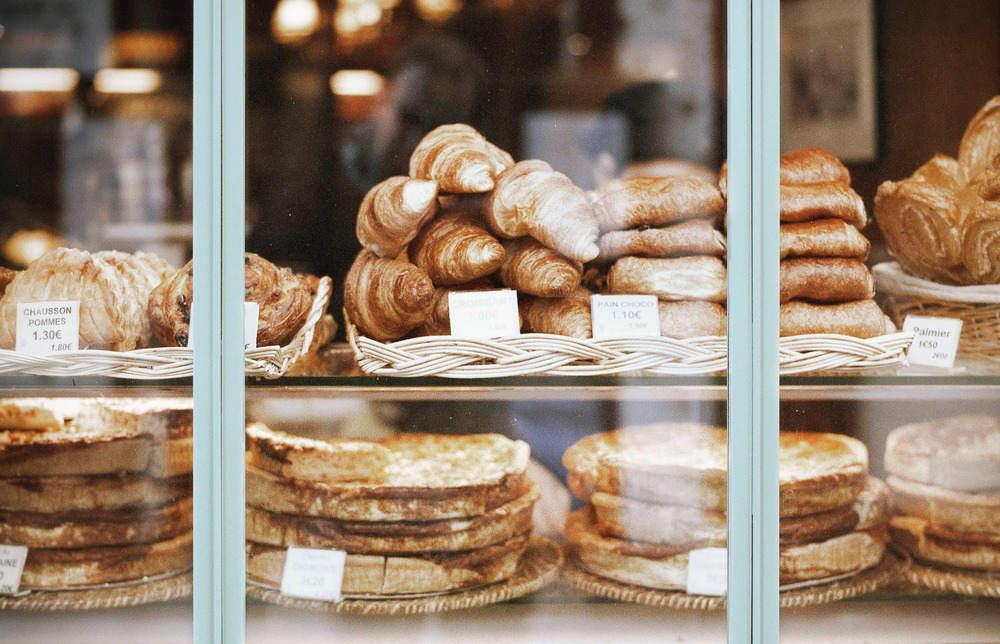
Why is it that, in an era of convenience and online shopping, we still go out of our way to buy our croissants and cupcakes at the mom-and-pop bakery rather than the chain supermarkets? While the custom of buying bread from the baker, meat from the butcher, and cheese from the cheesemonger is an ingrained culture in France, even ultra-pragmatic Americans fall easily for the lure of a little bakery with a pink-striped awning and a window full of toothsome treats.
When I decided to write a novel about Paris, I knew instantly that it had to be set in a bakery. Not only for my own enjoyment—because what author doesn’t want to spend a year researching and writing about baked goods—but also because boulangeries were and always will be a centerpiece of French life and culture.
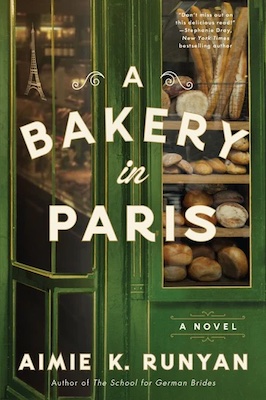
My bookA Bakery in Paris follows two women in two different time periods in Montmartre who have to overcome hardship, grief, and adversity, while running their family business.
Bakeries are more than just shops in which to procure a baguette or a few macarons; they are a gathering space with friends, a place for a celebratory cake to mark a momentous occasion, an opportunity to escape for just a short while with a coffee and a bit of brioche. Here are seven charming books that explore bakery life and all its charms.
The undisputed queen of Wisconsin Foodie Lit, Amy Reichert crafts a magical tale about divorcée Astra Snow who falls in love with a baker at the annual Julemarked, the famed Milwaukee Christmas market. The problem? For Jack Clausen, it’s always December. And every month he is mysteriously transported to a new market. This one will have you reaching for the Cherry-Almond Kringle with a steaming cup of coffee.
Jada is recovering from a very public humiliation on a dating show when she moves back to San Diego. Her new job at the Sugar Blitz isn’t going well thanks to the grumpy bakery owner Donovan (did we mention he’s also a football player?). A fortuitous mixup has the two enemies joining forces to deceive the world into thinking they’re a couple. Their fake relationship to promote the bakery and rehab Jada’s PR is going smoothly but is there more to their chemistry than just pretend?
What would happen if you could actually bake the perfect man? Anna O’Brien inherits a bakery from her late grandmother, and some special gifts as well. With the secret golden sugar bequeathed to her, she creates Elijah. But will everything bake out to perfection? Best enjoyed with an extra-gingery gingerbread man and a cup of tea.
Pastry maker Olivia knows it’s time for a change after a disaster that involves a flambéed dessert and a restaurant fire. While hiding out in rural Vermont at the blissful Sugar Maple Inn, she’s offered a job When a hot local returns to care for his elderly father, she has to decide if country life is really for her. Perfect with a slice of hot apple pie à la mode.
Accomplished pastry chef Simone has always wanted to work at a cookbook publisher. She thinks she has a handle on her career until the advent of video content forces her, unwillingly, into the spotlight with very spotty results. When her relentlessly cheery editor Ray comes out as non-binary at the office and is met with some unwelcoming reactions, Simone faces a tough choice between the job she loves and the person who has come to mean a great deal to her. Enjoyed (carefully) with a flaming dish of Cherries Jubilee.
The Little Beach Street Bakery takes place in a quaint coastal English town in Cornwall. The bakery, over the course of the four-book series, goes from an abandoned shop to a thriving business where four heroines all find love and adventure. Colgan is a master of escapist writing with compelling heroines. A great series for binge reading. Best enjoyed with scones, jam, and clotted cream.
Amy loves her job at her bakery, not so much that it’s owned by conservative Christians who fire her once they realize she’s queer and kind of, not quite out of the closet. What’s a girl to do? She combines her baking experience, craft talent, and passion for Say Yes to the Dress into a side hustle: bridesmaid for hire. A touching tale of self-love and found family, perfect for fans of Red, White, and Royal Blue. Best enjoyed with a slice of delicate white wedding cake with pink rosettes.
Because I was the one to end it,
and so soon, I offered to reimburse her

what I owed. She had covered
most of the wedding, the move,

our rent. I was living on the grace
of a friend, sleeping

in his sunroom on Folsom.
Every morning I opened my account

to see how little I had left.
It wasn’t looking good

until she wrote to say we could forget it
if I would let her claim me

on her taxes. I guessed there was
a rebate for this kind of thing.

I could hear my friend knocking
around in the kitchen, making coffee,

frying eggs. I couldn’t believe
my luck. I let myself be claimed.
Good Deal
Fast light on my hands
as I peel the sticker
from an apple on the train.
Viruses, I read, are
colorless, though lab techs
will blast one with atoms
so we can see its edges.
We slow around a bend,
then gather new speed.
My lender calls to ask
if I feel good. I set my screen
to black-and-white to make
the living world more vivid.
He says to hang tight.
He assures me we can go
lower. In Springfield we swap
the electric engine for diesel,
then drag a small, dark cloud
across the Berkshires.
A stash of apples in my bag:
Galas. An Empire.
We blow through an empty
station in a mechanical wind.
A friend of mine rides
cross-country in the bellies
of emptied-out coal cars
or on a plate of steel
called a porch. He pays
for almost nothing. He’s one
of my very favorite people.
I scroll through the latest
mortgage rates, having no idea
what a good deal looks like.
My sweetheart and I have
a rented apartment the size
of half a train car,
but we have a miniature
dishwasher, so we feel
we live in luxury.
Doors
We get them from warehouses
at the edge of the city, paging through

upright stacks, slumping one
heavily against the others and breaking

out the tape measure to see, or if
it can be made right with a table saw

and a chisel. It’s mostly my thing–
K goes along, even spots the one

for the bedroom, cut-glass knob
catching light as it swings.

She knows the doors we have are fine.
They open freely, they latch closed.

She also knows I’m a maniac who can’t
be stopped. She drags out a paneled turn-

of-the-century oak with mismatched
knobs, a half-length insert of beveled

glass. We lean it against the others,
her outline distorted by the waves.
It was the kind of summer night we’d been craving all week. Easy conversation, endless beers, suburban life drifting on welcome breezes— “Marco?” “Polo!” screamed from a backyard pool, raucous laughter as someone’s bullshit was called out. Six of us sat in a hot tub: my boyfriend, his sister and brother-in-law, and their middle-aged neighbors. I was 23. My boyfriend and I had been cheating on one another since high school. The others were stable, in their thirties. We partied as the kids slept inside.
My boyfriend and I were tourists in this land of adulthood. And like a tourist, or a writer, I hoped to glean some light calamity—say, a dispute over lawn mowing—that I’d spin into fiction from a safe remove. At 23, I was primed for narrative. I was earning my M.F.A. in Fiction and captivated by the subtle, domestic oddity of stories by Raymond Carver and Ann Beattie. The kinds of stories that say, Sure, there are driveways and drinking on the patio, but something is wrong here, something is off. As writer Dan Chaon describes Carver’s fiction, it’s a kind of ghost story in which the ghost fails to appear.
As a young writer, I wanted that eeriness, or so I thought, as we bumped bare legs beneath the surface. The hot tub, bare flesh, neighbors, drinking, sleeping kids inside—all of it was ripe for story. Like a tourist—or a writer—I would capture that ghost.
My writer’s mind listened, gathering storyable details, while my human heart grieved.
So when the neighbors began talking about the funeral for their teenage daughter, held days before, my mind cleaved into two parts: sympathizing, and recording. Or, maybe it’s more like this: my writer’s mind listened, gathering storyable details, while my human heart grieved—and then, as my heart will do upon hearing about parents mourning dead children, my heart hardened so my mind could do its work.
The story I ended up writing, “When Tom and Georgia Come Over to Swim,” was about neighbors in a hot tub talking about their young, newly dead daughter, chattering about constellations when what they’re enduring is unspeakable. It was a ghost story where the ghost appeared in ballet shoes, backpacks, an autopsy report tucked in a routine stack of mail.
The story won me a program scholarship, and years later, found publication. Readers praised the story’s “authentic” details.
And of course they were, because I’d stolen them.
I celebrated my success, but inside, I clenched. I’d never told the real “Tom and Georgia” I’d mined their tragedy for fiction. What if they found out?
The story follows the perspective of Pauline, a mother struggling to comfort her grieving neighbors, whose life path once looked like her future. Georgia’s loss makes Pauline feel grotesque. She yearns for familiar conversation as the neighbors recount coroner’s findings and outfits for trips that never will be taken.
At 23, I was unmarried and about to break up with my no-count boyfriend. I wouldn’t have children or a mortgage for another decade. My short story was definitely fiction. But whenever I thought about the real neighbors suffering real loss, I felt guilty. All my Carver-esque pretensions shriveled to ghoulishness.
Then, one day, the real “Tom and Georgia” read my story.
And they sent me a letter about it.
It’s common knowledge that you should never tell secrets to writers.
Actually, you don’t need to utter a word. We’re just as content to hear your cousin gripe about your Prius, or imagine you’re the dolt who, according to our med school friend, tried weird sex stuff and ended up in traction. Several legends, including one about Raymond Carver, tell of writers competing for the same juicy, real-life tidbit.
When it comes to story—old, new, repressed, overheard, uncovered, expressed, distant, or in-progress—writers are gossips, colonizers, appropriators, vacuums, tornadoes, Great Devouring Beasts, the Borg: absorbing facts and anecdotes at diner counters, combat training, even at the deathbed of a loved one. Once we’ve gathered, we repurpose. So, maybe it’s more like writers are swallows, wasps, termites, crows: scavengers who pluck dog hair pufflets from the lawn, and dirt from ancient ruins, all to craft a kind of nest—a living, and shared, space.
It’s a nifty skill. But does it make you lose your soul?
I’ve chosen to tell you I had a brother—something I’ve not even shared with my own children, not yet.
It’s one thing to harvest your own experience for story. I love the way Ayelet Waldman puts it in her harrowing essay “Rocketship.” Waldman recounts the turning point in her pregnancy when her very loved, very wanted baby tested positive for a rare genetic condition: “And I think, ‘A person really does fall onto the ground screaming… Remember that.’… A writer stands at a distance and watches her heart break.”
Waldman studies her anguish with writerly detachment, repurposing agony into material. And who wouldn’t want distance from their own split heart? To shrink overwhelming pain into something as small as words on a page?
This is what I, and lots of writers, do. Some of my worst experiences have generated fiction: my anorexia at age 12; my ex-husband’s violence and stalking; anxieties over caretaking and alcoholism. One of my current projects is a memoir about the death of my 13-year-old brother when I was four years old.
Here’s the thing: I’m authorizing myself to write these stories for an audience, even now. I’ve chosen to tell you I had a brother—something I’ve not even shared with my own children, not yet. But you, Reader, will learn exactly what I want you to know about me, and whether I call it truth or fiction, when I want you to know it—and not a moment before.
It’s a privilege to be the swallow, the tornado, the gossip—to hold the power of selection, and selectivity.
But what about other people’s experiences that we repurpose—people who might show up at our yard sales? How do we respond when these actual people (and not our characters) realize that their bright strands of hope and hopelessness are, to us, really great material to weave through splendid nests?
It took thirty years and a gossipy headline to remind me of that letter.
The headline: a woman suspected she was, in part, the subject of a New Yorker short story that went viral. Unique details from her life, and a relationship with a boyfriend, were on the published page. The piece was presented as fiction, and yet, she recognized fragments of her truth. She was afraid to confront the story’s writer until one day, outraged, she did. And, it turned out, she was right.
‘Well what do you expect?’ they asked. ‘Stealing is what writers do!’
Alexis Nowicki’s essay about this confrontation is the kind of literary drama that makes Thursday Twitter scrolling—frankly—awesome. Nowicki reveals that in her teens, she dated a much-older man, Charles, renamed “Robert” in the New Yorker story: “So much of the central dynamic in the story rang true to me: Charles’ cryptic communication style; the way I had to work to impress him; the joke rapport we created between our cats early on.” But unlike the real Charles, “Robert” becomes creepy, mean, pathetic. This is important to know. These were real people who lived these lives, she asserts, and they were neither as anxious nor as sinister as depicted in fiction. Yet those impressions will endure. In closing her piece, Nowicki eulogizes two losses: the death of her former boyfriend, Charles, eternally fictionalized into a predator; and the loneliness of being one of the few who knew him to be otherwise.
But Nowicki’s purpose in writing about the real-life experiences that inspired another writer’s fiction is less revelatory than redemptive. In fact, this essay also does something stunning. At one point, Nowicki questions her lived experience:
“Had Charles actually been pathetic and exploitative, and I simply hadn’t understood it because I, like [the character] Margot, was young and naïve? Had he become vengeful and possessive after we broke up, but I’d just blocked it out in order to move on with my life?”
How much of this fiction is accurate about my reality? That’s an unusual question from a person whose life has been written (in part) into fiction. I’ve never seen it asked before. Instead of denial or a screed, Nowicki engages a character created from her experiences and wonders, Was the writer onto something?
She doesn’t have to do this at all, let alone in her own essay. It’s a remarkable gesture of compassion.
Back on Twitter, responses split predictably. Non-Writer Twitter seemed appalled that writers take details from actual humans, living and dead. Writer Twitter couldn’t stomach such piety, such naïveté: Well what do you expect? they asked. Stealing is what writers do! The swallow steals without permission—but swallows gonna swallow.
All valid reactions, but also, rather simplistic.
Because Nowicki hadn’t issued a prohibition against mining real lives, even her own life, for fiction. She’d simply shown one set of consequences when writers do.
Facing these consequences, for some, is a central anxiety. And to be crass, our ambivalence generates even more material. As David Sedaris writes in “Repeat After Me”:
“‘Oh come on,’ I said. ‘The story’s really funny, and, I mean, it’s not like you’re going to do anything with it.’
Your life, your privacy, your bottomless sorrow — it’s not like you’re going to do anything with it. Is this the brother I always was, or the brother I have become?”
And Toni Cade Bambara makes the inevitable laughable in “A Sort of Preface” to Gorilla, My Love:
“It does no good to write autobiographical fiction cause the minute the book hits the stand here comes your mama screamin how could you and sighin death where is thy sting and she snatches you up out your bed to grill you about what was going down back there in Brooklyn when she was working three jobs and trying to improve the quality of your life and come to find on page 49 that you were messin around with that nasty boy up the block and breaks into sobs and quite naturally your family strolls in all sleepy-eyed to catch the floor show at 5:00 A.M. but as far as your mama is concerned, it is nineteen-forty-and-something and you ain’t too grown to have your ass whipped…
So I deal in straight-up fiction myself, cause I value my family and friends, and mostly cause I lie a lot anyway.”
Imagining the aftermath of our creative decisions—our necessary swallowing of human experience—is uncomfortable. Our responses seem to range from self-inhibiting to flinching to screw-you-buddy to N/A.
For a group so trained on imagining outcomes and endings, you’d think we’d be better prepared.
In the early ‘90s, my no-count boyfriend’s sister loved my story, so she gave a copy to the real Tom and Georgia and they sent me a letter.
Already, I’d worried in all ways: I worried they might read the story—but vaguely, someday, like after I’d won the Pulitzer. I worried when they had it. I worried when I opened their letter.
But for all that worrying, I’d never asked their permission. I wouldn’t do so now.
Asking permission could have invited others to tell their story instead of the one I imagined. A dynamic could open, perhaps a collaboration. Collaboration is a lovely word, but it belies an artistic turf war: an exchange with expectations I’d honor someone else’s feelings, their need to get it right. These are timeworn concerns, calling into question how inspiration fuels process and notions of the individual, self-isolating artist.
With a story sourced from another person’s grief, the stakes are higher, sharper. I feared the worst: they’d hate me. They’d sue me. They’d call me a graverobber. They’d call me exploitative. They’d be right.
But for the writer I was in my early 20s, there was another fear I couldn’t yet articulate. I worried that by asking permission, I’d make them talk about their child’s death—something I knew, from experience, to be the hardest thing to speak, and the hardest thing to hear.
I’ve lived forever not wanting to hear, or talk, about my own deep losses, instead imagining them in fiction. I’ve stood at a distance watching my own heart break. I’m fairly good at it. I’ve mostly shut my ears for my entire life, despite the fact that my brother’s best storytellers, my parents, are still living and full of memories to share.
Just like the parents of a teenage girl riding her bike through an intersection one blinding summer evening.
With a story sourced from another person’s grief, the stakes are higher, sharper.
Just like “Tom and Georgia.”
Their letter to me is long-buried, but I wouldn’t quote it here anyway. Here’s what I will share:
The parents of a much-loved child saw their grief take shape in my story. They appreciated my care in rendering it. They were, in a small way, grateful to have their daughter’s life and death recorded. Now, there was a place where a piece of her story, and their story, would always live.
Their words read like forgiveness. Now, I see they were also a guidepost, a way forward in grief and listening. A gesture of connection, recognition, and understanding. An acknowledgment of all the ghosts we carry, even those we may not be ready, or able, to articulate.
Imagining the consequences of our choices as writers, we want to steel ourselves for battle. Prepare for lawsuits. Deflect. Hide. Champion our noble pursuits. Wave our banners. Deprecate ourselves as greedy junkmen. Apologize for our swaths.
But what if we also imagined meeting consequence with compassion? What if we acknowledged our role in someone’s pain? What if we just listened? We have those options, too.
For me, the term “mad scientist” brings to mind images of bubbling beakers filled with neon liquids; elongated, menacing silhouettes; and of course (Pinky and) the Brain. There is a long history of stories from Frankenstein and The Island of Dr. Moreau all the way to Rick and Morty where brilliance tips over into madness and we watch wide-eyed to see the damage.
Science-fiction is based in reality and there is something about the possibility of real miracles or maledictions that draws us in. Frankenstein’s monster may have seemed like more of a thought experiment at the time, but is it so difficult to imagine that there could be a genetically-engineered equivalent being cultured in some secret underground laboratory today?
Scientists are real, respected, even revered, members of our society and they hold a special power—the power to change our world, a little bit at a time. We can’t help but wonder what might happen if they go too far too fast or if they lose their way and the scientific benefits to society become distorted—the literary possibilities are infinite.
My novel, The Brill Pill, follows a research scientist throughout his career as he struggles with medical ethics, dodges his own demons, and creates a few mind-altering treatments along the way. The protagonist is an anti-hero, lost in the world of academia, arrogantly believing he is doing the right thing while digging deeper and deeper into mad scientist territory as he loses all sense of right and wrong.
There is a lesson to be learned from mad scientists in literature. Brilliance and success come with a certain amount of hubris and an unavoidable separation from reality. Individuals at the top of their fields, by definition, have little oversight. They are given free reign over their domain and yet they are still human. If mad scientists are allowed to indulge themselves unchecked, their mistakes may affect us all.
Two college roommates discover during their science research that having a near-death experience can cause some people to develop superpowers. So they decide to try it themselves. They plan to kill each other and hope against hope that they can bring each other back before it is too late. If that isn’t mad, I am not sure what is. Of course, they are successful, and the incredibly addictive story of how they become mortal enemies introduces us to a colorful cast of endearingly gray characters from the bad to the very worst.
Nature and technology collide in this mashup of mad science and magic. Two outcasts in middle school (ugh, middle school) form an unexpected friendship that will be tested time and again by the harsh realities of the world (and all of the typical dramas that come between a witch and a techie). As the planet burns around them, mistakes are made on both sides, but we root for them throughout and wonder whether, if they can just stay friends, we all might be capable of something better. This story is all kinds of dark and all kinds of hopeful, terrifyingly honest and laugh out loud funny. Anders weaves together a brilliant narrative with an amusing dose of snark and pop-culture awareness.
In this speculative tale we are introduced to one the maddest of mad scientists when he is only a kid. By building a dystopia that is unnervingly easy to imagine our world falling into, Atwood makes us wonder if he was always destined for madness or if the environment that he has grown up in has shaped his destiny. In any case, science is the weapon of choice and the consequences are bad. Devastatingly, hysterically bad. We follow our protagonist, Snowman, as he struggles to survive the aftermath of what has occurred, but is survival enough? Incredibly sharp prose carves out the story with sympathy for the characters and repulsion at what has become of them.
In this delightfully creepy and wholly engrossing novel, a scientist who works on clones discovers that her husband has stolen her research and has cloned himself a new wife using her DNA. This is mad enough on its own imho, but the more we learn about the protagonist’s research the more we begin to realize that she herself is a mad scientist as well. Her work with clones raises ethical concerns that seem to be right on the doorstep of our own world, making them all the more eerie. The novel carefully touches on a number of serious issues including marital struggles and domestic violence as well as women in science and toxic academic culture without drowning in them. The narrative maintains the hard-to-put-down plot of a mystery novel with just a touch of horror to really drive it all home.
Is falling in love with a science experiment mad? For the purposes of this listicle, yes. Lack is a physics experiment gone awry or gone a-right depending on who you ask. An emptiness on a table, Lack absorbs some items, rejects others. No one can figure out why. Everyone is obsessed with Lack. Alice is in love with Lack. Philip is in love with Alice. It’s complicated. The story is peppered with eccentric academics, extreme to the point of parody and yet ever so close to reality. Are all scientists a little a mad? Are all humans? Lethem delivers it all in the most entertaining voice that will have you laughing and loving right along with the painfully relatable Philip Engstrand.
This one is a novella, and a scary one. Dr. Jennifer Webb has created a new form of dream therapy, or rather, nightmare therapy. It’s simple. Enter a shared nightmare with one estranged friend or family member, come out with a close, unbreakable bond to that person. The shared trauma brings people closer together, digging deeper than the differences they have on the surface. Ok, it makes some logical sense however creepy it is… But what happens when the scientist enters her own nightmare scenario and someone nefarious takes over while she is under? You get an incredibly creative, darkly suspenseful, page-turner. There’s a lot more packed into this short narrative (lurking in the trapped subconscious) but the premise was enough to get me reading.
In The Candy House, we witness the mad-scientist in its latest form. The tech billionaire. Bix Bouton has brought to the world a new technology: Own Your Unconscious. It sounds great – having all your memories right at your fingertips, you’d never truly forget anything ever again. But some memories fade for a reason, others were never meant to be shared. The Candy House is particularly intriguing because it does not focus on Bix alone. Each chapter is a window into a different life that has been changed in small and large ways by his technology. It is so universal that even people who do not subscribe to it are affected in some way. Hey, that sounds familiar… This one hits a little close to home and that makes it all the more engaging.
Part historical fiction, part coming of age story, part romance, part adventure, part science-fiction, this novel has it all! And on top of all of that it adds a twist on a classic mad-scientist novel. Carlota is the infamous Doctor Moreau’s daughter and we see his mad work to create hybrid creatures through her eyes, first as a doting daughter and eventually as an intelligent, feeling young woman. As we tenderly watch Carlota find herself and her strength throughout the novel, Moreno-Garcia weaves in narratives on colonialism, racism, misogyny, and heartbreak. There is depth to all of the characters in this novel and the mad scientist takes a backseat as we focus on those that have been affected by his work.
Marina, a researcher for a pharmaceutical company, is sent from her quiet life in Minnesota to a remote village in the Amazon. She’s on a quest to uncover the mystery of a colleague who has died in the jungle and to track down her elusive former med school professor who is now in charge of the drug her company is developing. The premise is a lot! But it unwinds slowly and carefully and lets you in a little bit at a time, keeping you hooked on discovering what piece of the plot will unfold next. Scientists make up half of the cast and most of them have gone a little bit mad living in the Amazon, but the longer Marina stays, the more life there begins to make sense to her. This is a winding tale in the best sense, because you will never guess how it ends.
Observer is all about the “Primacy of the Observer.” The theory that if we don’t observe something, it doesn’t exist (and if we do, it does). Wait, what? Yeah, when you walk into a room and see a table it’s there, but before you saw it, it wasn’t there. (It’s a little more complicated than that, but for the purposes of this short paragraph that’s the gist). This is actually true of sub-atomic particles, so it isn’t quite as absurd as it sounds, assuming everything around us is just a sea of quantum foam. The part where the real mad scientist vibes kick in is when we learn that the head of the project, who is dying of cancer, wants to use this theory to create his own universe so that he can essentially live forever. Immortality chasing is a classic mad scientist and literary theme that shrewdly highlights the human condition and makes for characters and conundrums that we can easily relate to.
Jenn Shapland has thin skin, literally. Thin Skin uses her medical diagnosis as a prism to examine the thinning of boundaries between our bodies and the world: “to be thin-skinned is to feel keenly, to perceive things that might go unseen, unnoticed, that others might prefer not to notice.” Mesmerizing and carefully, dutifully written, these essays delve into the weight of capitalism, the negotiation of identity through consumerism, and the misguided and harmful weapon of white womanhood reaching back to US colonization.
“This book begins in the free fall of reality,” Shapland writes early on about humanity’s exposure to radioactive toxins, and I cannot help but agree. Reality often feels like a free fall. I picture the devastation of the pandemic, the recent Canadian wildfires, and Shapland’s literal—and metaphorical—navigation of her relation to the world. It makes me wonder if we are still falling, unable to look at this reality.
Yet Shapland faces it and asks us to do the same. Thin Skin is quintessentially tied to the reader’s, and Shapland’s own, relation to our current landscape from the curation of identity to the uncertainty of our climate. Thin Skin asks us to lean into our own beliefs and choices, reconsider what we knew and engage in new revelations, and open our eyes to the smallest and largest choices that impact the world around us.
In our email correspondences, Shapland spoke to me on the infestation of clothes moths that inspired an essay, what it means to speak out about radioactive chemicals in local environments, and current narratives that perpetuate violence and racism.
Gracie Jordan: In your title essay, you speak about your diagnosis, which is where I read a subtle tension between being diagnosed with thin skin versus having thin skin. When did you realize that your diagnosis could serve as a sort of metaphor for the thinning boundaries between us and the outside world? Had you already started writing the essay collection?
Jenn Shapland: It took me a long time to see the threads of sensitivity and vulnerability running through the collection. The dermatological diagnosis, which I found a bit rude, to be honest, came years before I wrote the title essay, but it stuck around in my mind. Do I have thin skin, literally or figuratively? If so, what does it mean and what does it feel like to look closely at different forms of contamination and toxicity? In what ways can research and writing be forms of self-contamination? Or exposure therapy?
GJ: You talk about the impact that your research on environmental toxins had on you in “Thin Skin.” In passing along this knowledge—which you see as a form of contagion, a way to make everyone see—you speak on the idea that “learning and knowing and thinking are not modes of healing, repair” but a way to cope, and yet you wrestle with the idea of sharing. “Why do I feel like I have to know all of this and tell people about it?” you question. “Who actually wants to know?”
Interrupting the research with your own questions can be a source of comfort, of pause. How did you persevere through your wrestling and conclude that this needed to be shared, even if the audience felt uncertain?
JS: I often find myself wanting to speak out in my writing about something that other people don’t want to talk about, or don’t talk about readily. I think this comes from a childhood of repression, of euphemisms, of things unsaid or talked around. This may be why I wrote a book about lesbian invisibility, an essay about suicides by train, an essay about theft from the archives. But none of those pieces hit me in quite the same way as “Thin Skin.” Because the effects of chemicals, like uranium mine waste, like nuclear waste, like steel mill runoff, like fertilizer plant runoff, are so difficult to trace, difficult to prove, insidious, ever-present.
As I write in the essay, I struggled with how much to tell people, specifically about radioactive chemicals in our local environment. And I was nervous about “Thin Skin” being the first essay in the collection. So many horrible things are happening all the time, and we are aware of them to a greater extent than ever before because of the news, the internet. Who would want to read a whole essay about the things that are poisoning others and us? Rachel Carson and her work became a touchstone for me, because she made this pivot with Silent Spring to writing about chemicals, even though the rest of her work had been quite different. It had to do with what felt most necessary and important to share with others. We don’t really get to choose our subjects.
GJ: I was captivated with the topics surrounding “Strangers on a Train.” So much so that it made me consider my own thought processes as a woman. You explore the idea of fear and safety, particularly growing up as a woman, and how fear “thrives in the absence of clarity and reason.” While you were in NYC alone, where no one walked the same street, you describe it as being “afraid of no one.” This put language to my own experiences. Yet after reading feminist theory and discovering the structures that preach this fear, you decided to pursue and reclaim personal independence and freedom. Throughout the essay, you ask the reader to reconsider the idea of strangers (“stranger danger”) and conclude that “the fear I feel is real, but the threat never is.” I am curious about the in-betweens. What was the catalyst within your readings that led to this realization, and what do you want the reader to consider within these discoveries (on strangers, trust, fear, female safety)?
JS: I kept getting afraid when I took the trash out at night. I wanted to stand around and look at the moon, the stars, but my heart would start pounding, I’d imagine that someone was lurking in the shadows waiting to pounce on me. I tried to understand what was behind that fear, and out of it came “Strangers on a Train.” I revisited significant moments when I’ve felt afraid for my own safety, when I’ve been camping or traveling alone, and alongside those I delved into the history of that fear, why I was made to feel afraid (by my parents, by my community, by the culture at large).
Underneath the messages that governed my life as a girl and as a woman lurked racist, colonialist histories that actually had nothing to do with me or with real threats to my safety. They were cannily crafted and unconsciously developed at significant moments to keep women in their place, but even more than that to justify harming others, from lynching Black and Hispanic men in the South and Southwest to the extermination of Native peoples. If women are seen as threatened, if girls are seen as threatened, almost any kind of violence can be justified within a patriarchal framework.
GJ: It seems that the deeper topic you wish to call attention to is the murdering and kidnapping of Indigenous women that is generally ignored by the public in lieu of protecting the “frailty” of white women. This, in turn, erases and devalues victims of violent crimes and re-centers white women in the discussion. Throughout these ideas, you speak on the culturally embedded, racially charged need to create a controlled narrative. Yet you end with a consideration of these messages that promote your own fears and whether they are necessary to believe, but then we see this fear resurface subconsciously when you were “still a woman alone” while hiking. Can you expand upon this balance of researching and realizing where these controlled narratives come from yet struggling to eradicate them from your own mind, while also wanting to bring light to the violent target against Indigenous women?
JS: The concept of white womanhood was created (consciously and unconsciously) as a weapon to use against people of color, from the earliest days of US colonization. And so my own wrestling with white womanhood, with the fact that I am a white woman, is trying to kill the cop inside my head, to recognize all the ways that construction—which includes the idea that I am fragile, in need of protection, that I am not safe, that I shouldn’t travel alone, that I should protect myself at all costs—is untrue and does damage to others, damage in which I am complicit, especially if I’m not aware of it, vigilant about its effects.
But fear is not part of our prefrontal cortex, our reasoning brain, it’s part of our lizard brain. Which means it moves faster than thought, like when I’m sitting alone and hear a man’s voice and my heart starts pounding. And it’s there, in that moment, that I have the choice to notice it and question it, rather than believe the instinctual fear that’s been ingrained in me by our culture since childhood.
GJ: In the preface, you mention how the essay “The Toomuchness” was inspired by the moths, which you saw as a “metaphor made literal, the ultimate intersection of capitalism’s excess and human mortality.” Though the moths do not infest the essay as they do your clothes, they do begin and end the essay, as well as pop up throughout discussions as if small reminders of where this started. How did you see them as an impetus, a driving force, for this essay? It feels almost summed up in this line: “They made me buy stuff for my stuff, and I already have too much.”
The concept of white womanhood was created (consciously and unconsciously) as a weapon to use against people of color.
JS: I think the essay grew out of confronting my stuff each season, each year, trying to get rid of things, and then the moths, the actual infestation—it was, as Joan Didion once said of the child on LSD, “pure gold.” And it was something that got under my skin, confronting my own excess, our culture’s, this swarm of bugs. The unstoppability of it. The feeling of contamination. Of complicity.
GJ: You use the idea of a closet to represent identity due to consumerism and materialism’s close ties to a sense of self. You see the clothes you cannot part with as a way to access various parts of yourself. How did the closet materialize in this essay to explore identity, whether personal or in reflection of culture?
JS: It’s funny, because I’d been writing about clothes, shopping, and being closeted for awhile before the closet itself rose to the surface. And when I began reflecting on my own closets, I found quite a lot! That my very first office for writing was a closet. The amount of time I spent in the doorway of my closet watching TV as a kid. The endless wrangling with not enough storage space. And I’ve long been haunted by the amount of storage facilities that dot the U.S. landscape, especially in big cities, how strange it is that we store stuff we can’t even use. But the way the closet connected my relationship with shopping and clothes to queer identity came as a surprise to me as I was writing. Often we hide things from ourselves in plain sight!
GJ: Before you end “The Toomuchness,” you suggest that “Our individual carbon footprints are too small to have any real effect” but wonder if your “tiniest actions do have global consequences.” Can you speak more on how this essay shaped this conclusion, especially in reference to the weight of capitalism?
JS: One of the questions that surfaced in writing that essay was “how can I feel so much—feel so bad—and have so little control?” The idea that our individual actions and choices do have effects, both in the world in and in our own lives, our own psyches, helps to make room for that conundrum.
Even if nobody sees it, your actions have meaning, have impact.
In a lot of writing and in a lot of people’s responses to climate change and the role that consumption in industrialized nations contributes to that, I see a pivoting away from the bad feeling toward apathy or helplessness: nothing we do matters, it’s up to the corporations, to the governments to get this under control, my recycling does nothing. Which leads people to like… not recycle? And I find this utterly bizarre, especially given the world I grew up in. This might be a legacy of being raised Catholic (which I no longer am), but even if nobody sees it, your actions have meaning, have impact. Throwing your recyclables in the trash leaves its mark on you, on your beliefs about how you are connected to a larger web of beings. I sound like a narc right now, but come on!
GJ: “Crystal Vortex” explores the tension between art as activity versus product, and your personal need for time—waiting—to write. As your first book, My Autobiography of Carson McCullers, took six years to write and “The Toomuchness” took five years, what tension exists for you in the waiting and producing? How do you navigate the waiting within a culture ravenous for production and instant gratification? How do you let your works realize themselves over time?
JS: This is an ongoing craving for me. I want to wait for the work to come, to develop in its own time, and yet I feel so many external pressures to write quickly. Looking out at the literary landscape, at least as it presents itself on the internet, I see people publishing books every two years, every year and a half, even, and all the while tweeting throughout the day, and putting out Substacks and newsletters. I’m curious about the flip side of that, what it means to sit with a question for a long time before writing about it or publishing anything. Some of the essays in this collection developed over years. Books have always existed on a different timescale than the news, than our everyday lives. They ask us to step outside of that time and enter into this much longer, ongoing conversation.
A metaphor has surfaced in my garden. When I first started trying to grow things in the high desert, I saw that the soil was dry and watered the plants a little every day. Plant after lovingly-selected plant died. Then I learned this is the opposite of what the plants need. They require deep watering, but infrequently. Which means it takes longer to water each plant. You dig a little moat around the plant and fill it with water, and then you have to stand there and wait for the water to seep into the soil, then fill the moat two more times. I’m taking a break from writing projects for the first time since I started the McCullers book (since I wrote my dissertation, technically), and in that space I’m trying to understand what it might look like to approach writing with this kind of depth, a slower pace.
My son, Toby, demands many stories, but it’s the story of the Madwoman he likes best. Because he is part Hawaiian and often forgets, I have made her the Madwoman in the Sea—some foolish attempt to right him with his ‘āina.
I tuck my son into the swaddle of his trundle bed, cup the tender tissue of his cheek, which glows the shade of spoiled milk.
Legend claims Her as its own manic invention—brilliant, beautiful, disillusioned, a little lonely. They say She is a beguiling young thing with tendrils of seaweed for hair and two rows of cuspate teeth like upturned blades wedged in perpetually bleeding gums. Her closest companion is the inimitable tiger shark, Galeocerdo cuvier; Her lover is the spindly wana concealed in the dark coral landscape. She emerges often and at random; a harbinger of death and storms, of illicit activity, of doom. A product of young boys who refuse to brush their teeth before bedtime, boys who defy their mothers or speak ill of their absent fathers.
He demands I slow down and use smaller words. But this is my tale to tell, and I will tell it as I please.
The Madwoman in the Sea bears twelve eyes stippled over a tawny face. She is always watching; when one eye closes, eleven eyes peel open to take notes. For centuries, surfers and divers have composed wild narratives of taming the Madwoman with a soft kiss on her forked tail, which is dressed in millions of diamond scales, each one a dagger poised to slay. Legend claims if you survive this kiss of death, you have not only tamed the Madwoman, but you have also achieved immortality.
(I don’t know where I come up with these lies.)
Creeping along the turquoise undertow, She is all tempest and commotion, an effulgent vapor of light that lures not only miniature fish but also unsuspecting men and children—the very surfers and divers who proclaim with jolly-happy guts to have softened Her spirit. She flashes her beam of light so that it dances along the water’s crystalline surface, watching, waiting, waiting longer. They are so startled by Her speed and agility, the poor bastards never stand a chance.
“Bastards is a bad word,” he says.
“Sorry.” I think: When you meet the Madwoman in the Sea, you’ll understand, too.
This is the tale I tell my son, not only to put him to bed but also as we pace the Diamond Head shoreline, the shallow waters teeming with native coral and fish. He runs his hand through the warm water after I warn him not to, pointing to the red flag flapping just beyond the lifeguard towers, and when the Portuguese man o’ war he sifts through his fingers balloons his hand with its venom, I tell him this is the work of the Madwoman in the Sea, punishing the boy who should have listened to his mother, the boy who is simply no good at all.
The Tale of the Madwoman in the Sea still startles me even as I hear the words spill over my tongue like bile—where do I come up with these lies? We spend half an hour, an hour, every morning, lost in our discourse of the mysterious and atrocious Madwoman, and then an engine outside sputters, and I realize he’s missed the bus.
“Fuck,” I say. My son tells me I’ve said a bad word, as if I’ve never once considered the sound of my own voice. I ignore him, say “fuck” again, softer this time. He waves his arms over his head in giant parabolas. I wedge his too-big feet into his too-tiny sneakers and tug a clean shirt over his head. His hair is feathery, blond and unkempt, like his father’s. As are his thin lips, the dimpled arch of his nose, his cleft chin, the freckles peppering his round keiki cheeks. But his eyes are mine, these terrifying gray orbs holding more promise than one could ever hope to live up to. He’s certainly a disappointing child, but he’s mine, his eyes are mine, I love him dearly.
When we miss the bus, I am responsible. Toby sniffles a little, already resentful of all the ways his friends will cultivate fond memories in his absence, so I am responsible for his distress, just as I am responsible for easing his fears. My son holds entire worlds in his head, dusting off one imaginary catastrophe after another like tugging old books from a shelf. I tell him everything will be okay, an unconvincing argument to raise with a six-year-old. When I fail, I pinch his nose softly, run my thumb along his dimpled chin, smother him with butterfly kisses, call him my strong little warrior, my brave kolohe child. The kolohe, too, he inherited from his father and not from me, though the man is a haole, and probably has no idea what kolohe means.
Toby says kolohe like a haole—ka-low-hay—so I’m slowly retraining his inherent linguistic ills, pulling his father’s spoiled pronunciations from his mouth and dipping him slowly into the cooler, more forgiving waters of ‘ōlelo Hawai‘i, the kanaka maoli tongue. Together we press our palms to our cheeks as we practice elongating our vowels, then lifting the backs of our fingers just under our chins to tighten our i’s as we repeat, lani . . . lani . . . lani . . . lani, until we’re both cackling through our teeth and I’ve fixed him. It’s remarkable, really, the control we have over every unturned stone of our children’s potential.
We rally together, me and Toby, because the bus probably reached the school at this point and Toby is poised to receive his third detention slip of the month on account of tardiness, which means I have failed at a fundamental level to provide my son with proper parental care. That’s the secret message hidden in the cordially written memo from his private school I can’t afford, yet the place I continue depositing him late morning after late morning, a cycle of failures that anchors me, me and Toby both, in its predictable cadence. The detention slip is somewhere in my purse. For some women the contents of their bags are a discreet matter, and they go to great lengths to conceal their cigarettes, their silicone finger vibrators, and all the loose trinkets their spouses advised them not to purchase. Mine is no such bag. Dump it facedown on the floor and all you’ll find are those crumpled pink memos detailing my failures as a parent and also a bottle of Lorazepam, just a few 100 milligram tablets rattling around the plastic casing.
I chase Toby around the house in a friendly dash to the door, and I think about how my greatest failure is that I willingly stepped into the role of parent in the first place without bothering to ask myself or anyone else around me the simple question, How do I go on? I’d assumed going on was just a given, rather than a daily battle ending in punctuating headaches, a dry throat, tears seeping down my face like lazy rivers.
They say the moment you see your baby for the first time makes all the pain and suffering of childbirth worthwhile. After I gave what the doctors called a traumatic birth to Toby, I held him in my arms and loved him instantly, though he resembled an undercooked chicken, all slick and gelatinous and stripped of its beautiful feathers. The drive from our West O‘ahu compound to his private school in Honolulu is an hour-long expedition through the bleakest junctions of meager living and also a daily reminder of my poor decisions. For the vast sweep of families living on the island’s leeward bend, their homes were never a choice. The lilting lānai and sun-bleached exteriors and grime percolating through the wet walls, all this was inherited and no one had any say in the matter. But our story was different, because the moment my husband and I became something, I knew the haole in his blood needed to be diluted, and I was convinced the only way to do so was to rinse it in leeward living. We would be the triumphant melting-pot couple, too good for the comforts of downtown Honolulu. We would buy a shitty plot of arid West O‘ahu land and make it our home.
I was far too young to be married, far too young then to know haole is a stain that never really washes off.
Now my husband is gone, and only me and Toby suffer the consequences of my youthful optimism. We glance out the window and watch the waves unfolding like an old scroll along the waters of Pōka‘ī Bay, and when Toby asks me if She’s there, I say yes. We inch to a crawl somewhere along old Farrington Highway, just on the perimeter of a sleepy plantation town where the Wai‘anae Range surges overhead, an eroded backdrop to a history recited only by dead tongues. The traffic plods forward. I pass the time lost in my own head, and Toby passes the time manufacturing fart sounds with his armpit and cupped palm. His best friend, Justin, taught him. Justin’s mother, Phoebe, is high-class, a senior account exec at a marketing firm in downtown Honolulu who dons a short, slitted skirt to meet with local celebrities and help them with their image. Toby especially likes her because she feeds the boys homemade banana pudding in these gorgeous crystal chalices after school. Phoebe’s saved my ass too many times to count, giving Toby rides and keeping him entertained when I can’t get away from my shifts at the hotel. What I can’t get past, though, aside from her son’s penchant for making his body an instrument of flatulence, is her face’s downward cast when I finally retrieve my son, how even when I’m doing everything right, her eyes still blink glassy with condolences.
Now my husband is gone, and only me and Toby suffer the consequences of my youthful optimism.
“For my birthday, I want a big cupcake tower the size of that!” Toby chews the stiff nylon webbing of his seat belt and points to the Wai‘anae Range. I ask him what flavor of enormous cupcake he’d like, and he screams, “TIRAMISU” in my ear.
“You don’t even know what tiramisu is,” I say, massaging my temples. Every bone and joint in my body is ringing.
“Yeah, I do. Justin had tiramisu for his birthday last month, and that’s what I want for mine.”
The car ahead of us is a sleek cherry Tesla that roves silently forward. Teslas, what a tacky monstrosity.
I tell him, “Tiramisu has alcohol in it. That’s a no-no, remember?”
But he just kicks at the passenger seat until I raise my voice and we both stop talking. In two weeks, Toby will turn seven, which on some days means he will finally stop pissing the bed and I can retire his pull-ups to the closet in the carport, along with the expensive roller skates he’s too chicken to try and all his terrible artwork. Mostly it means his father has been gone for three years, and for this absence I have no one to blame but myself. And maybe the Madwoman in the Sea.
I deliver Toby to the school. The moment his feet hit the parking lot pavement, he is off, a heedless little runt infected with the zoomies. He sprints to the outdoor corridor where his pals gather around a towering lattice wall, night-blooming cereus coiling through the wooden panels. Draped over his back is the fraying JanSport bag my own mother bought me when I was in grade school. But Toby was born two months premature, and the bag is a preposterous weight bearing down on his scrawny limbs. My mind scribbles a note: buy milk. Milk builds strong bones. Against the lattice, Justin Wong folds over himself to exhibit an impressive handstand, pointing his white Nikes toward the limpid sky. The boys ooh and ahh. One of the little shits pretends to nudge him off balance. Another kid, named Hugh Livingston, bends over and shakes his head of feathery blond hair between his legs. I watch Toby slip a hand through the belted waistline of his uniform khakis and massage his fist in front of his groin, a spastic forward and backward motion that takes me quite some time to recognize as my soon-to-be-seven-year-old son mimicking the act of masturbating. He pretends to jerk off until the bell rings, and the boys laugh and laugh.
Here’s something else you must know about the Madwoman in the Sea: She is too capable to fail. Don’t mistake this as a claim of Her perfection, for She is far from perfect. But better than perfection is proficiency, which the Madwoman bears in swells.
“I don’t know what proficiency is,” Toby whines. I shush him. “Hush now; it’s not important.”
Her first sighting: under a pier, surging the tide with flicks of Her forked tail. Striped manini and a family of lau‘ipala skim Her pearlescent skin as they glide around Her in loping, concentric rings. She dives underwater and waves to a collection of toxic wana wedged in the shallow reef slope, resting their spindly limbs until the moon surges overhead and they can comb the reef for algae. She passes parrotfish and rays, but She does not spring, knowing full well what She is waiting for.
The first man who finds Her wears rubber flippers and a fool’s grin, like nothing bad has ever happened to him. He’s snorkeling in a protected marine sanctuary, and with an indelicate hand, he wields a pole for spearfishing, taking infrequent shots and jabs at the pointed kihikihi and resplendent family of uhu‘ahu‘ula, the sheen of their scales suspended like targets in an otherwise muted sea. The man is a hunter; determined, distracted. I don’t need to tell you he’s a haole. Doesn’t see the Madwoman tracking him from behind the blossom of nude finger corals just a few meters off. Stealth, in fact, is just one pillar of Her proficiency, and She springs for him first not with the clutches of Her fingers, or the crack of Her barbed tail, but with Her voice. In a peculiarly elucidated melody, She calls to him underwater, and when he spins around, the man meets Her wicked cuspate grin and Her eyes, all twelve of them fixed and unblinking and famished.
“She’s a bad guy,” accuses Toby.
Always I am correcting him: She is a woman.
It is at this point in the story when the man negotiates facts. With his fellow spearfishers, his surf buddies, he doesn’t like to bring up the instant panic that gripped his belly like a big hand, or the drizzle of piss in his wake. He certainly doesn’t mention he swung at the Madwoman with his spear, a measly plastic thing, or that with a single swipe of Her hand, the spear was shredded to ribbons. He won’t tell them how fast he paddled back to shore, that when he reached the beach, he buried the plastic tatters in the sand, that he bought a cheap one from Walmart a week later, because what deplorable piece of shit deserves a market-grade spear?
After the first sighting, the Madwoman develops a taste for obtuse men and their depressive children. She combs through finger corals, weaves in and out of lobe crests teeming with disease as She pursues divers and snorklers with the precision of a marine huntress. Soured by the first man’s clumsy escape, She makes a habit of taking something away from the ones who follow. She claws skin cells and stores them under Her sharp nails. Strips them of their rashguard sleeves, a pant leg from their ratty board shorts. From the first child, She shears a thicket of soft fibers tinted blond from years passed under the sun.
With a tight grip, I hold a cluster of Toby’s own sun-bleached mop in my hand, pretend to clip it with imaginary finger scissors. He cries into his pillow, leaving a smattering of wet spots on the fabric.
Toby’s father used to smile like nothing bad had ever happened to him. It drove me crazy. So one night, after a few glasses of wine, I told Toby’s father about the Madwoman in the Sea. It’s true I was lolling around the house, my tongue an inflated balloon in my mouth and my better judgment diving into the turbulent sea. His father watched me drink copiously that evening, a sober bystander biding his time until my next inevitable slip-up. He was awful that way, always sitting in silent anticipation of my next misstep and smiling. That grin. I’ll show you.
As for the wine, he refused liquor of all types. Once, I told Toby his father was a teetotaler, for I’d long been fond of the word, and we spent the next two weeks eating dinner around a cheap veneer dining table listening to our three-year-old son recite fabricated words that rhymed with teetotaler.
I’d said, “Peepolar is not a word.”
His father had said, “Why can’t you just play along for once?”
This night in particular was a bad one. Toby’d long fallen asleep among the blankets surging over his trundle bed, and his father and I were alone. We didn’t do so well alone anymore. His father cherished quiet, while I was never happy unless I’d kindled something afire. He’d said once that our relationship lacked synergy, but I think we were both just too lonely to spend any meaningful time with each other.
He didn’t believe me when I first spoke of the Madwoman. Claimed only a psychopath would concoct a tale so grisly in the hopes of delighting her own child. I did a little dance on my tiptoes and splayed out my arms and said, “Ta-da!” in a way that made him flinch and then admit that he no longer loved me, he feared me. I followed him around the house as he prepared for sleep and told him the Madwoman would drown him beneath the weight of her clipped tail, that he’d sink to the ocean floor like a tiny pebble plucked from the shore. I stumbled up the stairs, let something slip between my fingers, shattered my wineglass on the top landing.
“You’re just so different,” he claimed, collecting the shards of glass into a little pool so that I wouldn’t hurt myself. I brought him a plastic trash bag. Kneeling down to help, I hurt myself. The blood made it seem like the stakes had never been so high.
He packed his things a few weeks later. I asked, “What about Toby?” Toby, god, he was still a toddler! Little boys need their fathers.
Toby’s father insisted he would continue to be the very best father he could be. It was me he was leaving, not Toby. Yet Toby and I both watched him withdraw from our family with only a small daypack, we peered out from the driveway until not even a blink of his car was left in the distance. For months I harangued him over the phone, insisting we exhaust all our options, we can do this, we can be a family. Here I was, working double shifts at an extravagant resort that serves fleshy, famished tourists swallowed by the elastic of their bathing suits, huddling in the employee bathroom trying to talk sense into my former husband. My son’s father. This white man. I told him I would try to be better, but he insisted I was doing everything I could. I had no idea what he meant.
For a while, he called Toby before bed every single night, the unequivocal love of a father. When he stopped calling so frequently, it’d felt somehow like my fault.
I no longer love you,I fear you. Still I loved him, his receeding hairline and pockmarked skin and the muted way he moved through the world as though his presence were an inconvenience to be suffered by the poor souls in his path. I loved his exacting scrutiny, and the curious way his jaw would lower ever so slightly when he was concentrating on his research. Toby’s father was a mathematician, a life calculated according to the quiet order of numerals. When Toby was born, I’d sneak into the hall late at night to watch his father cradle him in wobbly arms, arms that weren’t designed to hold delicate things, arms that sought to accommodate this new reality sprung upon him. The truth was splayed out before me in a rocking chair before I could even name it, certain that none of this would last.
He may have feared me, but what I feared most was the explicit way Toby had embodied his father, and how he looked nothing like me. Their resemblance was uncanny, and for years after his birth, I’d pass long after- noons on the sofa with Toby’s paternal grandmother, entertaining her elation as she arranged old photos of Toby’s father on the coffee table, plucked an arbitrary print as though she’d just won the lottery, wielded the thing intimately in my face as she claimed their impossible likeness. As if I didn’t already know. As if I didn’t lie beside the identical twins each night, considering their every wrinkle and cleft chin and blossom of freckles and all their light hair. She was immensely proud, and I was a mother to a hapa-haole son with a haole husband living in the shambles of leeward O‘ahu, where everyone assumed we were in the military. Just another white couple cultivating roots on Hawaiian land.
So maybe Toby’s father and I didn’t love our son in the same way. But the worst part of it all was his father’s abject refusal to acknowledge how sorely I did love him, how when Toby was born premature I cried for twenty hours straight, begging the night nurse not to stow him away in some plastic box, begging her to keep him nestled here in my arms, sobbing and shriveled and safe, with me.
But the night nurse, she took him. Locked him away in the NICU, then when I screamed sedated me with a significant dose of morphine. I relaxed. His father drove fifteen miles west to spend the night in our home rather than crunched in a disfigured recliner beside my hospital bed. Toby wilted away in the tundra of the NICU. Amid the midnight purr and whirl of persistent hospital monitors, I flipped through the same twelve channels on the television and watched beautiful, elegant white people dance and eat and cook and fall in love. A handsome stranger held a woman by her waist as he puffed on a cigar. A chef dutifully narrated the trick to julienne a carrot, then invited someone from the live audience to come onstage and practice. Her blade turned on its side resembled the surface of the ocean where, submerged, something unborn and truly heinous murmurs. If Toby lives, I’d told myself, I will teach my son not to fear the ocean. I will teach him to think audacious thoughts and act with insolence. It doesn’t help to move through the world with timorous steps. If my son lives, he will not be a numbers boy. I will paddle him to the outside breaks and show him what it’s like to swim for your life.
Toby’s father is a good man, perhaps a better man than our son will be. He may have left, but he left me the house, his car, the quilted bedspread I adored, a freezer full of prepared meals, our son. On weekends when it was his turn to father, he taught Toby how to recover from a toppled bike, taught him how to hold a knife while curling his fingers around the skin of a cucumber to avoid slicing off his hand. He supervised soccer games and chauffeured him to and from preschool classes. In the first months of Toby’s life, our baby secured firmly in the back seat of the car, he circled the perimeter of our tiny island for hours and hours, if only to show our son what it meant to attend to a world stained with luminescence, a world that glows. What, then, ultimately drives a good man away from his family? Not power or fame, lust or cowardice, ennui or opportunity. A Madwoman, that’s who.
The son I bore prances through the house like a stotting gazelle, weaving around tables, desks, floor lamps, chairs, stools, swelling the space with the charisma uniquely possessed by a six-going-on-seven-year-old. A fetus. Nothing more than gaunt bones and a clumsy spring in his step. I curl my fingers around the perspiring neck of a Kirin, and when I ask Toby where he learned to make that motion, the one with his hand moving up and down in his pants, he lies.
“The Madwoman,” he insists. “She showed me how.”
I feel the tops of my ears bloom a fiery red like the tip of an iron poker. This curious rage, it always manifests itself in the strangest of places. “That’s not true, Tobs. Remember what I told you about little boys who lie?”
“The Madwoman gets them.”
The bottle I’m clutching feels smooth along its feminine contours, and when I peel my fingers from the glass, drops of condensation prickle my lap. I blink hard, and when I open my eyes, Toby has cornered a baby moth behind the end table, his tiny hands poised to attack.
“Don’t!” I shriek.
He stares at me bug-eyed, as though I’ve misplaced my manners, or my mind.
“Remember what I told you? We don’t kill moths in this house.”
“Why not? They’re bugs.” Then his whole face crunches inward. “They’re disgusting.”
“They’re our ancestors. This is how your grandparents and great-grandparents and everyone who came before you pays us a visit.”
“Gross!” Now his whole face is a plane of punctured tin. “I don’t care.”
He slaps at the wall but is too slow, and the moth flies skyward, ascending to a higher perch.
Toby whimpers and moans; I hold him in my arms until we’re both shaking.
Then Toby is whining for dinner, and the kitchen is the only room in which I am needed. My hands go weeding through the refrigerator, searching for food I haven’t let spoil. Toby sits cross-legged on the floor then springs around again, making those hand-underarm fart sounds, and I don’t understand him, don’t know how to talk to him. Perhaps it’s normal for kids to lie and sprint and pretend to jerk off in front of their friends, and I am simply too antiquated to meet him halfway. Perhaps it’s as his father said, Why can’t you just play along for once? I flip frozen veggie patties bitten by frost on their crisp ends, the hibachi drafting thick fumes through the kitchen, the living room. The smoke detector deploys, a resounding clamor that quiets only when I drag our table fan into the kitchen and cast its rotating blades toward the alarm. Fucking piece-of-shit technology, stupid goddamn house. Toby presses his palms to his ears and grimaces. The alarm stops. I think about how I insisted we move here, the tenements of leeward O‘ahu seductive in their strange deformities. Years later and still I was learning proximity to the slums and the sea would in no way imbue the men I loved most with the kuleana of my own ancestry; no matter where we dropped our anchor, Toby would always be hapa, just as his father would always be haole. Three different people, and none of us really belonging here.
We settle in for dinner. I spoon wilted steamed spinach and a heap of white rice and a burnt veggie burger on a paper plate and sprinkle the dish with a few shriveled carrot sticks. I eat my veggie burger slathered in ketchup and mayonnaise and listen to Toby brag about the mango sticky rice Phoebe Wong served the boys today after school, and I pierce a carrot stick with the tines of my fork and think, Goddamn sea witch, goddamn ocean cunt. I stare at Toby and the braid of spinach unfurling over his bottom lip. Soon he will grow older and massage gel in his hair and his old shoes will compress his feet and his pants will sag past his taut hips. Observing friends like Justin Wong and Hugh Livingstone, he will cultivate a new and foreign language that’s bound to clash with my own grasp of speech, and we will argue. We’ll argue about curfews and girls and grades and his gross inability to wipe scum from the surface of our dishware, and eventually he, too, will no longer love me, he’ll fear me, and then I’ll be alone again.
He will cultivate a new and foreign language that’s bound to clash with my own grasp of speech.
I think, As it should be.
Also, I am afraid.
For dessert, I hand him a pint of his favorite rocky-road ice cream and a clean spoon and encourage him to go to town. Together we curl up on the sofa, and I lay a soft Hawaiian quilt over Toby’s lap and knit a tress of his wispy hair between my fingers while an old Jason Bourne film animates from the television. For a while I proposed Pixar movies, shows on the Disney Channel, PAW Patrol and that Irish animated series with the child veterinarian who nurses anthropomorphic toys. None of it took. But Matt Damon scaling buildings as a CIA assassin riddled with amnesia? This shit captivates Toby like nothing else.
I drift off slowly, one finger spun around my son’s soft curls. Still drinking from a sippy cup, Toby reclines his head against my rib cage, compressing into all the doughy parts I haven’t bothered to condition since well before his father left. I kiss the tiny swirl at the top of his head, kiss his fluttery little eyelashes. My perfect sweet, awful, hapa, kolohe little boy. He clings both hands around his sippy cup, yet I feel the weight of his arms cinch all around me, collapsing into me, and it is a beautiful and bloodcurdling weight that sinks me into slumber.
Another conversation between a mother and son: Setting: the car.
Temperature: 91 degrees, 120 percent humidity.
Mood: tepid, with hints of significant room for improvement.
Topic: preferred guests to attend a seventh birthday, and also cookies.
“But I had cookies last week in the morning at Justin’s!” he cries, hurling his boy feet against the back of the passenger’s seat. Thump, and again.
“You cut that out,” she snaps. “And I don’t care if you had them before, it’s too early for cookies. Period. Now let’s think about your party for a minute. Do you know which of the kids from school you want to invite?”
“I want lemon wafers.”
“I don’t care. Answer my question.”
He huffs. “I dunno. I guess Justin and Hugh, and Kepa and Ryder and maybe Lopaka, but he was sorta making fun of me yesterday.”
“About what?”
“Not knowing how to swim. He said only haoles and popolos can’t swim.”
She sucks air through her teeth. “I don’t want you saying those words, Tobs. I told you that before.”
“Sorry. I forgot.”
“I mean popolo. Don’t use that word, with your friends or with me. Haole is whatever.”
“I said I’m sorry.”
“And that’s not even true. Shit.” She flicks on her left blinker, maneuvers a quick U-turn.
“That’s a bad word,” he says softly.
She sighs. “Sorry. But wait, can we go back to the swimming thing? You want to learn how to swim? I thought you were afraid of the ocean.”
“I’m not afraid of nothing.” He crosses his arms. “I can teach you, you know.”
“I don’t want you, I want swimming class.” “I’m a really good swimmer—”
“Kainoa and Justin and Ryder all take swimming class together. They get to go for shave ice after, too. It’s a friend thing.”
She chuckles. “Well if it’s a friend thing. Though who knows how much this friend thing is gonna cost—oh shit.” She crushes her foot against the brake pedal, the car squealing to a steady crawl.
“That’s a bad word.”
“Sorry. No one knows how to drive in this goddamn city. Baby, this is why we live where we live, okay?”
“I like the city. Justin has a koi pond in his front yard.
And Hugh has a pool.”
“Why should that matter? You don’t even know how to swim.”
When I really want to freak out my son, I tell him something else legend claims: the Madwoman takes the first child when his back is turned to the water. It’s the worst mistake you can make when you’re submerged waist-deep in an ecosystem that doesn’t belong to you.
But the boy is tender, no shining paragons of parent- hood to speak of. He learns mostly by observing others, and when a fellow keiki rolling around in the shallows faces the shoreline, the boy turns to follow suit.
Just a few seconds. The Madwoman in the Sea needs only a few seconds to execute Her ploy, which really is one of power. It is power that propels Her forward, through surging currents that initially restrain Her, inhibit Her charge toward the unsuspecting boy until Her resistance is too much to bear and the waves see Her for who She really is—a crazy fucking madwoman who will always get what she wants.
Toby is livid. “That’s a really bad word!”
I smooth out his baby hairs and shush him.
As She approaches the boy, the water undulates choppily, and a steady hum of sound lapses through the current—the tune that drew the first man to Her, a rousing melody the boy is too young to deem a danger. In fact, the sound reminds him of his grandmother, and the songs she would sing to him late at night while crouched over his bedside. Before she died. This is what the boy is thinking about when his ankle is held hostage by the barbed clutches of something mysterious, something he cannot see.
Suddenly, the boy is overturned. A strong undercurrent flips him on his back and something is still clutching his ankle, something heinous, as he scuffles with the formless water and all its fury. For seconds his nostrils surface, then are tugged back down into the waterworld along with his flailing arms, kicking legs, tufts of unwashed hair, pelvis that pulses almost intuitively to the strange and subdued melody. He doesn’t think, doesn’t really see Her until he does.
The tail, a venomous serpent studded with millions of tiny blades; twelve eyes peering into his own eyes and soul and gut.
There’s no time to sound any alarms, and anyway, the boy has no parents who truly love him in a profound, maddening way, who will give rise to his salvation. Just a few more seconds, he thinks, kicking his legs furiously in an impossible dash to the translucent ceiling of water that is within reach, for he can see it! The soft shimmer of a world that appeared mostly dull and decayed for the few years he spent trampling it until now. Just a few more seconds, he thinks with each futile kick. A few more seconds until I can breathe again, until I can save myself.
The Madwoman in the Sea cackles, a sound that bears no difference to the rousing melody—it is the only sound She knows.
When I cackle, my son wraps one hand over my mouth and tells me to hush, because I’m upsetting him.
Sure, the Diamond Head waters are all good and fine for frolicking, and no one ever turned up their nose to an afternoon submerged in the familiar warmth of Waikīkī Beach, but teaching a child how to swim requires a tranquil privacy one can find only on the North Shore, so this is where we go.
The drive over, and Toby seems excited, if slightly anxious. He wears his inflated arm floaties as accessories even though I’ve reminded him floatation devices will not be allowed once we enter the water, and he keeps cracking his jaw, unhinging his lips as he opens and closes his mouth to the distractive rhythmic clicking while we drive in otherwise silence. It’s a curious habit, and while I’m certain the violent act itself cannot be good for his oral health, I say nothing. I change lanes and think of how Toby’s father no longer loves me, he fears me, even though I’m the one sticking around long enough to teach our hapa child how to swim for his life. This child who doesn’t even look like me, who may not even enjoy my company as much as he enjoys his absent father’s. We take the H-2, weaving through forest beds of acacia and canopies of persimmon trees that blur as an emerald sweep through the glass of the speeding car. When we reach Waialua, the towering acacias give way to the subdued graves of former sugarcane and pineapple plantations, now long-fallow fields in the clutches of wealthy developers and gentleman’s farm estates. Behind the fields, the backside of the eroded Wai‘anae Range rises up to greet us.
I point out the mountain range, explaining that our home is situated on the foothills just over and beyond the tall summit. But Toby isn’t listening. He sucks on the seat belt’s stiff nylon and gapes at his feet dangling from the booster. There is no way to relieve his fear of the ocean without seeing him as a small child I adore deep in my gut and therefore am inclined to protect, so I continue driving the Kam Highway bend through Kahuku until the turquoise bowl of Kawela Bay looms westward in our window and I pull over and park along the side of the road.
Jostling a child in and out of a car and then across a single-lane highway burdened with intermittent traffic is no easy feat. Like always, I do my best, and under the bristling heat of late fall we successfully navigate the highway barrier and all we lose is an arm float.
“Forget it,” I tell him on the beach as we collect our slippers to walk through the sand. “We won’t need floaties anyway. We’re gonna be big kids and stay afloat on our own, right?”
Toby nods then scampers away, spellbound in a vigorous state that emerges only when broiling humidity meets the boundless expanse of softened North Shore sand. The break I’ve chosen is neither crowded nor well known; it is a private lull in the chaos of tourism and crowds that soothes my soul just padding along the springy carpet of sand. Freed from the constraints of the floaties and the car seat, Toby is delighted. I chase him in careening circles while we kick up debris behind our heels and collapse in a cushioned bed of wet sand. Foamy whitewater laps at our splayed legs, and Toby bounds away. A thin scar like a winding loop of string is still stitched across his left palm from his encounter with the Portuguese man o’ war, but I don’t feel sorry for him. I watch him draw organic shapes in the sand with his little kid toes and mostly feel like I will never again experience this moment, how as soon as I print it in my mind, the material, corporeal thing has already passed, and how curiously sad this discovery weighs on me.
“You ready, bud?” I ask, brushing sand from my knees and peeling my shorts over my hips. Tube of sunscreen in my hand, and Toby wears me down with his ceaseless sprinting away, the flutter in his youthful steps and the breezy way he meanders the shoreline with no acknowledgement of my continual efforts to safe- guard his life. I shake my head, yank him by the hem of his board shorts. “Melanoma, do you want melanoma?” I scream, though of course he doesn’t understand the question. He crumples into a little bug ball on the sand. He says my name—Mom—over and over again: “Mom, I’m a little bug ball! Uh itty-bitty bug ball! I’m a bug ball, Mom!” I bite the swollen insides of my cheeks and say, “Nice job, buddy, really nice job.”
Once submerged in the chilly water, though, neither of us is a little bug ball, and especially not Toby, who flounders easily, complains incessantly of exhaustion and heatstroke even though I’m the one kicking my legs furiously to keep us afloat and also he doesn’t know what heatstroke is—probably another life lesson from Justin Wong. I let the current, stronger than I’d expected on such a windless day, steer us where it wills, for there is no rush, we both have so much time. Toby braids his fingers together and wraps them around my neck with force. I tell him, “Ow, Tobs, lighter touch, please. That hurts.” A slight draft drifts us shoreward, and Toby clings tighter. I feel the bruises bloom along my neck without witnessing the injury firsthand, which is the best way I can describe being a mother.
“Water’s cold, Mama. It’s too cold.” Along with his fingers, Toby’s legs wrap my waist like tentacles. I flutter my arms through the water and kick my feet, and somehow we stay upright, me and my son. “It’s cold and I hate this. I don’t, really don’t wanna do it.” Toby starts to groan.
“Don’t worry, bud. You’re fine. We’re fine. It’s cold now, but it’ll get warmer, okay?”
Toby asks, “Are we swimming?”
I say, “Not yet.”
“How do you know when you’re swimming?”
I tell him he’s swimming when he can kick his feet and move his arms and stay afloat without my help. He scrunches his nose, and a lick of saltwater laps at his face. “I got water in my nose!” he shrieks. His hold on my neck slackens, and he bolts upright as if jolted from a terrible nightmare. It confounds me, this clench of panic while bathing in the plenary bliss of the mountains and the sea. Then again, he is his father’s son. Identical as printer copies.
I take great care to carry him farther through the ocean without triggering his attention; it’s the only way we’ll make it anywhere, really. We move as one unit over soft, undulating waves, the whitewater hissing its descent behind us.
“You ready to practice swimming?” I ask him, and over and over again, his answer is no.
“You know I’m not gonna let anything bad happen to you. All you need to do is let go and practice doggy paddling. Remember how we practice in the tub? Kick your legs and move your arms back and forth, like you’re dancing. You’ll be fine.”
A strong, briny mist burrows its way through our nostrils, and a wave careens then breaks just a few feet away from our bobbing bodies. Toby stiffens.
“I wanna go back,” he says, quietly at first, a near whisper, and then again, louder and much louder. “I wanna go back, I wanna go back to the beach. I don’t wanna do this, I wanna go back.” Never, not once, does he say please.
I don’t know why this omission tunnels fury through my blood.
I think, My stubborn, lazy, kolohe, pathetic little child. How did I ever tolerate you? I think his existence is the only thing that anchors my feet to the ground every morning. His fingers are claws penetrating my neck, but then it is me with the cuspate teeth, me with the twelve eyes and tanned skin and forked razor tail and all the spiraled seaweed hair floating around us like a veil. Just as it is my curious melody that catches him in the snarls of my trap, the tune that reassures him over and over again: Everything will be fine, you can trust me, I’m not gonna let anything bad happen to you, I promise. His muscles relax, his grip goes limp.
I release him.
But something about his attempt to swim is faulty, though I can’t distinguish a single point of error; rather, it’s more a cluster of misguided motions that beat the energy from his baby bones yet tug him downward, downward toward the chilly and unnavigable ocean floor. His hands and legs jerk sporadically as though gripped by a seizure, and flecks of saltwater splash me in the face. The brine webs my eyes ruby red. I think, We are most beautiful here, where no one can see us and no one can ever, ever find us. Then Toby’s moppy blond hair emerges from the water, his nostrils and pruned lips surface, and he spouts cries, pleas, promises, apologies, lies. He begs me to help him. But I am helping him, I tell myself as I wade a few paces back, my arms and legs pulsing naturally, like magic. I’m helping him swim for his life, and this is the only way either of us will ever learn.
Just a few more seconds, buddy, I tell him this tale until I, myself, believe it. Just a few more seconds and you’ll be swimming just like me.
Searching for truth, whether at personal level or on a larger scale, has been the subject of many different narratives. I started writing my novel South in 2018 when I was thinking about truth, its relationship to history, and the possibility of accessing reality amid the excess of misinformation and the erasure of historical facts.
The narrator of South is a freelance journalist who is hired for a mission to investigate the labor strikes on an offshore oil rig. Soon after his arrival on the rig, he is pulled into a labyrinth of conspiracies and lies that he is not able to decipher. The book interweaves the narrator’s search for his past and his father with the search for a bigger truth. Censorship and manipulation—by the oil company, by the state—complicate his quest. I was interested in a form and narrative that would mirror the challenges in the narrator’s search for truth. To this effect, the novel integrates other texts: letters and emails, notes from the narrator and his father’s notebooks, excerpts from a (non-existent) religious book (The Book of the Winds).
Issues such as resistance, memory, history, and the possibilities and limitations of language are frequently explored in books whose focus is our relationship to truth. In some of these books, the form of the book becomes a means of reflecting the search and the difficulty of accessing reality.
The Taiga Syndrome by Cristina Rivera Garza, translated by Suzanne Jill Levine and Aviva Kana
The Taiga Syndrome is a short novel written in poetic prose and brief chapters. The female narrator of the novel is a former detective; she is hired to find the client’s wife who has run away with her new lover. The detective and her translator follow the lovers’ path through the Taiga that generates a sense of melancholy and malaise. Things become more surreal when the detective and her translator go deeper into the Taiga in their search. The novel successfully blends suspense with elements of fairy tale; the indirect narration and the added layer of translation between the locals and the detective produce a sense of displacement that heightens the mystery. The novel not only reflects on the difficulty of seeking truth but on the limitations of communication and language itself.
Jesse Ball’s first novel is a mystery thriller written with minimal prose and with white space between its concise sections. One day, the novel’s protagonist, James Sim, finds a dying (murdered) man during his walk at the park who tells him about a conspiracy, including someone called Samedi, which leads him into a self-assigned mission to find Samedi. Among other things, the novel includes an institution called a verisylum for the treatment of chronic liars. In this puzzle-like and enigmatic novel, we share the experience of Sim in his search for truth and his desire to make sense of the proliferating conspiracies around him.
Maggie Nelson’s investigation of the life and officially unsolved murder of her aunt Jane. The book combines poems, account of dreams, excerpts of media accounts and Jane’s journals, among other texts. Through its fragmented and innovative form, the book not only reflects the difficulty of resolution of the murder mystery, but the unknowable aspects of someone else’s life.
This 1992 novel by Argentinian avant-garde master is part detective thriller, part science fiction, but deep down an investigation of truth and history under a totalitarian regime where the accounts of the past monstrosities are erased by the government. Elena, the novel’s heroine, is a machine that is named after the writer Macedonio Fernandez’s wife; she is made after the wife’s death, when the writer tries to save her memories through the creation of this machine. The police are after Elena—she keeps sharing her memories, including the history of atrocities and crimes against humanity—while Junior, a reporter for a Buenos Aires newspaper, is also searching for her. The experience of reading the novel feels like opening a door to only find other doors, each door leading to new and unsolved stories.
The winner of the Prix Goncourt, Missing Person is the story of an amnesiac detective, Guy Roland, who starts a search for his identity and his past after his boss shuts down the detective agency he has been working at for the last eight years. Following elements of a typical detective thriller, the novel is at once an investigation of the nature of self, and a reflection on collective erasure and amnesia in the aftermath of the French occupation.
Missaghi’s hybrid novel interweaves two different narratives: the narrator’s search for disappearing statues in Tehran and an effort for documentation of mysterious political deaths in the wake of the Iranian 2009 post-election protests. Blending fact and fiction, theory, and dreams, the novel is at once a map of a city as well as a reflection on the history, art making, loss, and collective trauma.
Last Days combines detective and horror genres; the story homes in on a religious mutilation cult. Kline is an amputee, ex-detective who is kidnapped by two members of the mutilation cult in order to identify the murderer of their former leader. Kline has to find his way to freedom through the members of the cult and other rival sects, and navigate their web of lies and misinformation. Narrated in Evenson’s stark and vivid prose, the novel is filled with absurd and memorable passages and dialogue.
The narrator of this short novel purchases the house of Fra Keeler and becomes obsessed with the investigation of the former owner’s death. The investigation soon turns inward, getting stranger, as the book reveals the unraveling mind of the unreliable narrator. A novel about reality, perception, and insanity.
A metaphysical detective thriller about the daily life of two young men, Witold and Fuks, who go to stay with an eccentric family and their maid at a boarding house in the country in search of peace and quiet. Unusual things and symbols appear—like a sparrow hanging from a tree with a string as well as arrow marks on the wall—that set Witold on a comic quest while the atmosphere of the boarding house is filled with dread and sexual tension. The strange accumulation of associations and symbols, however, does not cohere into a resolved plot, challenging the effort to simplify reality and make order out of the chaos in which the characters exist.
The debut novel by “Nouveau Roman”novelist Alain Robbe-Grillet may be his most plot-driven novel. The story concerns eight murders that have occurred in various parts of the country. With the ninth murder, police agent Wallas is tasked to investigate the deaths. In this labyrinthine novel, carrying some of the trademarks of Robbe-Grillet’s later work, the detective genre elements are applied to investigate and challenge the limits of reality and certainty.
There’s something inherently magical about reading in the summer. Perhaps it dates back to those formative elementary school days of furiously cataloging summer reads for the chance at winning a free personal pizza, but the words “summer” and “reading” bring only positive associations to mind. With only a few weeks of summer left, indie booksellers from across the country have submitted recommendations for their favorite 2023 beach read and are here to make sure you find the perfect book to close out your summer and capture that summer-reading-magic at least one last time.
The best beach reads never sacrifice emotional complexity, originality, or quality prose: they are simply books that feel perfect to read against the backdrop of summer. Whether in a grassy park, sprawled out on your couch as the AC blasts, or, yes, on a literal beach, a beach read offers an escape within an escape and often matches the vibrant, dreamy, thrilling atmosphere that accompanies the best days of summer. Beach reads are expansive, diverse, thoughtful, and, most importantly, compulsively readable. A truly great beach read is one that fully pulls you into its world, causing you to lose track of time and look up hours later to find the sun is setting.
The books in the roundup below include everything from Hollywood historical fiction and queer campus novels to a surreal, tech-centric story collection and horror novel steeped in movie magic. Peruse this list, add a title to the tail end of your summer reading catalog, and then take yourself out for a personal pizza. We know you’ve read a lot this summer. You deserve it.
“I devoured this debut set in the heyday of the Hollywood studio system. When character actress Edie O’Dare is suddenly unemployed after her contract with FWM Studios ends, she uses her knowledge of industry secrets to become Hollywood’s leading gossip columnist, a decision that turns out to have far-reaching consequences in both her personal and professional life. A strong narrative voice, compassionately drawn characters, and a plot that had me racing to find out what happens next make this my must read of the summer. Perfect for fans of historical fiction and anyone who loves to watch Turner Classic Movies.”
“A young Scot takes a position as a ‘matron’ at an elite boarding school in the English countryside while grappling with her changing relationship to her body and gender identity. While there, she becomes embroiled in an illicit affair with the headmaster’s wife—an intimidating figure of indeterminate age whose attention and grasp on femininity has all of the students clamor for and envy. K Patrick beautifully marries suspense and romance in this tale of queer infatuation and forbidden love, crafting a narrative that is as sultry as it is propulsive. A sexy, thrilling page-turner that is the perfect accompaniment to a day spent in the sun and the sand.”
“This monster rom-com is laugh out loud funny with a diverse cast of monsters. It’s a perfect enemies-to-lovers ‘horror’ that will leave you wanting more monster shenanigans from Camp Clear Creek.”
—Sydne Conant, A Room of One’s Own in Madison, Wisconsin
“This book is one that hit home with me this summer. It has the fun friend group that goes on vacation, a second chance & fake dating romance situation, plus so much more! Happy Place is definitely one of those books that you can binge on the beach, and has something for everyone.”
“A queer, feminist take on the classic Western novel? Count me in! Bridget, penniless and alone, crosses the American prairies and happens upon Dodge City, where she takes up residence in a brothel in order to survive. What follows is a gorgeously written, deeply human, and completely immersive story about queer womanhood, friendship, and freedom. I loved every page.”
—Sarah Arnold, Parnassus Books in Nashville, Tennessee
“This is the lesbian-awakening coming-of-age campus novel I wish existed when I was a teenager! With sparse, lyrical prose, Fischer infuses mundane college scenes with a uniquely resonant light. Perfect for enjoyers of Donna Tartt and Emma Cline.”
—Skylar Miklus, Still North Books & Bar in Hanover, New Hampshire
“Emotionally warm, with themes of found family and healing childhood wounds, The Wishing Game is the perfect book to add to your summertime reading list. Lucy read The Clock Island series as a child but as an adult she’s trying to hold it all together for herself and the seven-year-old boy she desperately wants to adopt. When the author of The Clock Island series announces he is releasing a new book and is hosting a contest to win the single copy in existence, Lucy returns to the joys and traumas of her childhood to solve her adult problems. The Wishing Game made me think about the books I read as a child and how getting lost in an imaginary world was a reprieve from the very real turbulence of adolescence. The Wishing Game was a similar escape and I wish I could’ve lingered longer.”
—Rachel Ford, The Bookshop in Nashville, Tennessee
“This is an EXPLOSIVE little book! Just like the volcano that towers in the landscape’s hills. In Dogs of Summer, we follow two best friends on the brink between girlhood and that terrifying, exciting, electrifying other that is womanhood. Dogs of Summer will eat you up and spit you back out! Read and be mesmerized!”
“I flew through this book. The Rachel Incident is perfect for fans of Sally Rooney (me). It’s perfect for anyone who’s ever been a new adult wondering what exactly it is they’re supposed to be doing with their life (me). It’s perfect for people who love the feeling of looking up from the last page of a book feeling like they’ve just read about and gotten to know real people with real, complicated emotions (me).”
—Maddie Grimes, Parnassus Books in Nashville, Tennessee
“Maine is hot right now, and this is a twisty mystery that features some very cold-hearted Mainers from a guy who gets the accents right. At its heart is a complicated protagonist, just trying to live his life after a prison stint, who gets wrapped up in the offshore murders of some of Maine’s biggest power players. Is the cop trying to help him actually on the level? Will he ever be able to escape the family ties that bind us to small town life? Koryta makes sure we care about the answers.”
—Sam Pfeifle, The Book Shop of Beverly Farms in Beverly, Massachusetts
“Tom Lake is that rare novel that does so many things to absolute perfection. This is Ann Patchett’s masterpiece and any sort of synopsis sells it short. Yes, it’s a pandemic novel about a woman telling her daughters about a youthful fling she had with an actor who would go on to be wildly famous. But that’s like saying sitting outside on the first nice day of spring is refreshing. It’s true but cannot get at the heart of the magic of the experience”
“These short stories are tightly crafted, with not a word wasted. Themes include longing, loneliness, queer desire, Asian identity, self-conception, technology, and modernity. Qian has a great surrealist edge and a unique voice. A noteworthy debut collection that left me wanting more!”
—Skylar Miklus, Still North Books & Bar in Hanover, New Hampshire
“Silver Nitrate is a horror novel that involves literal movie magic, the occult, and bits of film lore. Moreno-Garcia also wrote Mexican Gothic, and she’s great at changing her vibe with each book.”
—Rowan Hawthorn, Gallery Bookshop in Mendocino, California
“This utterly charming novel finds its setting in ‘a wonderland of used books’: Tokyo’s Jimbōchō district, which is populated by hundreds of specialty used bookstores. By the time Takako begins to clean out the small room above her uncle’s bookshop, where she lives in the aftermath of breaking up with her cheating boyfriend and quitting her job, I felt wonderfully ensconced in a Studio Ghibli-esque atmosphere. This book hits all the right beats to be one of Miyazaki’s tender, heart-tugging animations. A perfectly cozy read!” –Chelsea, P&T Knitwear Books and Podcast in Manhattan, New York
I can’t usually stomach full-fledged horror, but give me a flicker of the unsettling or otherworldly in literature and I’m hooked. There’s no idyllic suburb in which I’m not looking for a barbaric ritual, or a new friend whose eyes I’m not searching for some terrible secret.
In the earliest days of the pandemic, unable to leave my London flat and working my day job atop a gradually collapsing cardboard box, I began watching videos of theme park rides breaking down and animatronics malfunctioning. Sitting there, my skin would prickle and my heart would race. I simply couldn’t get enough. Why is it that the more elaborately built our environment is, the more fragile our sanity seems to become? What does that say about the biggest theme parks in the world? And what happens in dark rides when the lights come on?
I wrote At the End of Every Day for people with the same curiosity coursing through their adrenal system, who are addicted to the eerie jolt of an optical illusion gone wrong. In my novel, Delphi has been working at an iconic and beloved theme park ever since she fled her hometown in Nebraska. But when a terrible incident transpires (involving an actress, the opening of a lagoon ride, and very realistic animatronics), the park must shutter for good. While finishing out their last weeks, Delphi and her fairytale-prince-boyfriend begin to notice strange glitches in the park, faces in the shadows, and a pull to a mysterious heat in the corridors beneath their feet.
Here are 7 books with a dark playfulness, with settings of strange innocence or nostalgia.
Kate Folk’s debut collection has already cemented its cult status with stories like “The Bone Ward”, in which romantic entanglements come to a head in a sanatorium for people whose bones turn to goo in the night, and the titular “Out There”, which depicts online dating with only a single flourish of the unreal. Somehow Folk’s debut collection, which is so full of bizarre moments, feels more like a gab session with a beleaguered pal than a work of experimental literature. But beware: once you’ve had a taste of her particular flavor of the bold and the surreal, you’ll be hungry for more.
In a small and unremarkable Flemish village, three lifelong friends on the brink of adolescence come up with a riddle. Fun, right? Wrong. Belgian novelist Lize Spit’s first English translation is a heady and twisted portrait of pastoral boredom and dark mischief. Spit isn’t afraid to turn on her readers, letting them languish in a kind of luxuriant discomfort (Are these simply kids being kids, or is something much darker about to transpire?), drifting toward a punchline that is somehow both shocking and inevitable. The Melting is not for everyone—look up trigger warnings—but for those with an appetite for Benelux stagnation and the thick fog of teen trauma, The Melting is a masterpiece.
Books hyped by HorrorTok that manage to exceed expectations are few and far between— but CJ Leede’s Easton Ellis-esque debut about a deranged flâneuse who moonlights as a theme park princess is a triumph. Maeve Fly—the emotionally bereft granddaughter of a former Hollywood starlet who finds herself navigating friendships and nemeses as she grapples with some, shall we say, troubling compulsions—is a heroine whose hellish laissez faire brings to mind Brand New Cherry Flavor’s Lisa Nova or one of Evelyn Waugh’s eponymous vile bodies—cool and unmoored, the perfect lens through which to view the gorey acid trip that is Leede’s Los Angeles—mouse ears and all.
The question at the core of Kiersten White’s Mister Magic is: What are we to do with half-remembered things? Thirty years after the beloved—but largely forgotten—children’s show Mister Magic aired its last episode, former child stars reunite for a podcast untangling the mystery of the show. But why must they stay in this particular creepy old house? And why can no one—especially not Val, who lacks any memories of her early childhood—remember details about their time on the show? Eerie and addictive, White’s novel has the unmistakable aroma of Creepypasta (of course “Candle Cove” comes to mind) and prods at a truth that most people come to understand when childhood ends and adulthood begins: that communities glued together by devotion can be dangerous places indeed.
A documentary team, journeying from Paris to Switzerland in search of “Arcadia”, discovers that they’re being flanked by a quiet demon named Malasso. At the edge of a beautiful, isolated lake, on-camera host Lao loses his grasp on his girlfriend Mistletoe, who is drawn towards a fantastical elsewhere while out “adventuring” in the quiet town where they’ve camped out: think supernatural festival grounds, ethereal nighttime meandering, and vast etymologies of personal myth-making. As malevolent and beautiful forces respectively contort the psyches of Okri’s band of filmmakers, their collective story becomes a kind of firework show of poetic inner worlds… Labyrinthine and unhurried, The Age Of Magic is perfect for readers who are up for a non-traditional plot and a hefty dose of mesmerism.
There is a wing in Hell where unfinished books live. Claire, a diligent librarian, is charged with maintaining the Unwritten Wing, where much of her day-to-day involves suppressing those characters and entities who might try to materialize and escape from their liminal non-place in the neutral zone of the underworld. But when Claire lets one particular protagonist escape, she—along with a scrappy demon named Leto and her “muse” assistant Brevity—finds herself in the crosshairs of biblical warfare. If Paradise Lost was queer and funny, it would appear in AJ Hackwith’s genre-bending Hell’s Library series, which showcases the best of thoughtful, fantastical worldbuilding, and manages to celebrate the essence of storytelling with a fresh new voice.
Horrorstör takes readers on a chilling and playful journey through the manicured halls of Orsk, a fictional Scandinavian furniture store with deftly painted parallels to you-know-where. At first glance, Orsk appears to be like any other retail space, but as night falls, the store transforms into a chamber of ghostly horrors, and a group of employees, led by weary but pragmatic heroine Amy, must confront demons both metaphorical and very real. It makes sense that BookTok has recently rediscovered Horrorstör, which was originally published in 2014. The book itself takes the form of an IKEA catalogue, it’s playful and captivating, even when riffing on the absurdity of our modern retail compulsions. Only Hendrix could bring such metafictional mischief to a work of social commentary.
Aisha Abdel Gawad’s debut, Between Two Moons, is a striking novel about being an immigrant and Muslim in post-9/11 America, about battling the blasé of youth with the burdens of womanhood.
It’s June. Muslims in Bay Ridge, Brooklyn are ready to welcome with fervor the holy month of Ramadan. Twins, Amira and Lina, are only half prepared for the hunger and thirst pangs as they are days away from graduating high school, their minds swirling with plans to make this summer count. This will be the summer of freedom, before Amira heads for college in the Fall. This will be the summer of possibilities, where Lina finally kickstarts her modeling career. This is the summer they recreate themselves, away from their parents’ gaze, trying on identities like clothes to see what fits. Life, however, has its own plans.
On the first day of Ramadan, the café across from their apartment is raided. The air buzzes with gossip, speculation, and the all-too-familiar Muslim fear of being under surveillance. There’s uproar in the Arab-American community, and for Amira and Lina, there’s turmoil at home too. Their older brother, Sami, has returned from prison. Early parole, good behaviour, his lawyer said. But nothing about his demeanor seems good. Sami is quieter, more withdrawn. The sense of danger lurking around the corner heightens when Lina becomes entangled with a man who promises to launch her modeling career, and Amira meets Faraj, a Pakistani boy who progressively begins to take more interest in Sami.
Aisha Abdel Gawad has been published in The Kenyon Review, American Short Fiction and has also been awarded the 2015 Pushcart Prize. Currently, she’s a high school English teacher in Connecticut, a fact that seems to have lent her some insights into her teenage protagonists and their complicated relationship with social media.
Aisha tells me her ultimate hope with her work is to make people feel seen. To her, I’d say, mission accomplished. As a Muslim writer, raised in a fairly conservative home much like Aisha’s twin protagonists, watching them fumble their way into semi-adulthood and find their own equation with their faith has been affirming. Likewise, my conversation with Aisha felt restorative—on performing gender, authenticity in the age of social media, the anticipated violence of being a woman and being Muslim in a surveillance state.
Bareerah Ghani: I wanted to start with Amira and Sami and their dynamic. I find that it reflects this imbalance in their parents’ treatment of them. As the son, Sami is often seen being given special attention even when he’s not being volatile and causing trouble. It’s sort of disturbing to watch Amira feel like she has to make herself small in front of him. Can you talk about how you perceive such sibling dynamics in connection with Arab familial values? Do you think it’s a product of how in some Eastern/Middle Eastern cultures sons are given an elevated status in the family?
Aisha Abdel Gawad: So Sami does have this sort of precious status as the son and as a son who was taken. His trauma is something that everyone tiptoes around. And of course this idea of sons being particularly prized is a real part of Arab culture, although I’m not sure it’s entirely exclusive to Arab or more Eastern cultures. I think that actually Western societies do the same thing, but in different ways. I was interested in exploring how I think children learn gender, and how siblings often practice on each other before they go out in the world and perform the gender values they’ve been taught.
BG: Speaking of performing, there’s this idea of inauthenticity that forms the undercurrent of the narrative. Everyone’s maintaining a facade. Sami and Faraj are performing the roles they’ve been assigned by their fates. Even between Amira and Lina, they’re twins and they share everything but there are moments where they try to create a certain persona in front of one another. How do you perceive this idea of authenticity? I’m wondering if you can speak to it in connection to Arab culture, the Muslim identity and its various perceptions, and, of course, the age of social media.
AAG: I think of it on a base level in terms of teenage girls of any faith, background, race. Teenage girls are always performing different versions of themselves, testing out different identities, kind of seeing what sticks and also, what do people like? What gets me attention? What feels affirming or validating? And so we see the two sisters doing that a lot in the book, trying to see what’s going to make them feel valued. And unfortunately, as a lot of young women experience, they don’t often feel valued in the world. But one thing that was important for me to show is that they feel valued when they come back together. They kind of serve as mirrors to one another, and they can let down their masks and really show each other what their real value is. I also think there are moments when their parents and even Sammy, later on in the book—the family unit—gives them that value. But you’re right. They’re not the only characters who are sort of performing. I think Sami performs what he thinks a tough, Muslim man should be. He doesn’t really know how to express his emotions, how to be vulnerable. And in the very rare moments where he can let down his guard, that’s where we see him rebuilding these bonds with his family members.
I love that you also asked about social media. I teach high school English, so I watch teenagers all day long. It’s just an element of their coming-of-age that I did not experience—not having social media as a teenager. And there’s this extra layer of almost never being off the clock, like they’re always performing. And then, of course, the social media also adds a layer of surveillance, which is another theme that I was kind of playing with in the book. They sort of surveil and record themselves for the world.
BG: You know, it’s really interesting that you touched upon the girls’ need to try on identities. I found Amira quite relatable in the duality she feels within herself. She wants to be a good daughter, to not “abandon her tribe”. But then there are moments where she’s desperate for room to explore her authentic self outside of, you know, the noise of cultural expectations. I thought this hits home for many young Muslims, particularly women. To what extent do you think it’s possible to reconcile these opposite desires when you’re entrenched in a collectivistic culture?
AAG: So I think there’s two things that Amira can always fall back on—her family unit, and her faith. Those are her safe places. She doesn’t always know that at the beginning. She wonders a lot about what it means to be a good Muslim and if she can be the type of woman she wants to be and be a good Muslim, the way that other people would define it. I think one of the things I was hoping to explore is to take the reader on this journey with her where, even after she does some pretty, self-destructive things she finds safety in her faith, and that it’s always there waiting for her. And so I think this idea of her as a woman in particular, being able to cultivate her own relationship with God that no one else can touch, and that will always be there for her was really important to me. I didn’t want to tell a story about a Muslim woman oppressed by her religion, or has this sort of like, I’m going to rebel against my faith. And I’m going to drink. The girls do drink sometimes, but it’s not so much in rebellion against their religion. It’s more like on their journey to figure out who they are and faith is always there waiting for them to kind of come back on their own terms.
BG: I love that. I was very taken by this idea of the girls trying to balance their faith, but also trying to experiment, and indulge in all these practices that aren’t part of their religious teachings, like alcohol, and premarital sex, and to them this is freedom. And I can understand given that they’re being raised in a fairly conservative Muslim household. I’m wondering how you deconstruct the notion of freedom and agency when it comes to the Muslim experience in a non Muslim state.
Teenage girls are always performing different versions of themselves, seeing what sticks.
AAG: I think at the beginning of the book the girls conflate freedom with things like drinking, dating. At one point Amira has this fantasy of going to Europe and riding on the back of a Vespa with some cute boy, and I think what she discovers is that’s not freedom at all. And, in fact, there are these different cages that she enters as a woman in the world. And that the world is, in fact, a very dangerous place, no matter what your identity is as a woman. Just to be a woman in the world is to be in danger. I think that one of the things she struggles with is redefining what freedom is. And I’m not sure she ever feels free in this book but I think she begins to redirect in thinking about how she can liberate herself by developing her own relationship to God. And how can she develop agency in her own family. And then there’s this sort of wider thread of being a Muslim American at a time when Muslim Americans are facing threats from dominant society. What does resistance to that look like for a young woman?
BG: The novel has a haunting throughline of women of color being violated and exploited. Issues surrounding consent or lack thereof and bodily autonomy surface in different ways. How do you think women of color can assert themselves given that many like Amira are groomed to not take up too much space and how this warped exoticization of women of color can be tackled?
AAG: So these two sisters, as I said, all they want to do is to leave Bay Ridge and discover freedom. But what they discover instead is what I consider the anticipated violence of being a woman. The violence that’s a kind of a threat that’s always out there lurking, like the threat of something that could happen to you that hasn’t yet happened, or the ordinary violence embedded in daily interactions and relationships. The weight of that is something that these two sisters discover.
And you know, you ask, what can women of color do? Well, there’s really no escaping it, right? There’s nowhere they can turn except towards each other. So that’s one of the reasons why I kind of have this movement in the book where the girls kind of go in their separate directions out there in the world, and then sort of collide back into each other. I think the place where they can find some semblance of liberation is in their relationship with each other. So I try to think about how women actually cultivate relationships with each other, and the power of those relationships. And, in fact, there’s even a part in the book where Sami is so isolated. He has no one to share his emotions with. But the girls do. So how can women use the power of their own relationships that I think they forge in a shared trauma? And how can they use that to lift each other up?
BG: This reminds me of that moment in the book where the girls are at a party that’s just for women. That scene is buzzing with this loss of inhibition that I felt occurred because there’s this complete freedom from the male gaze. And at least in my experience and understanding, in this part of the world, there’s almost a cultural necessity for women to be hypersexualized in the public eye, so I was wondering what you think about spaces reserved for just women and feminine energy. Do you think there’s value and sustainability in cultivating in such spaces?
There are these dual ways Arab Muslim women are being surveilled and watched. How can you grow under such intense scrutiny?
AAG: Absolutely. I think in the society that we live in, the idea of a space where women can be, or where women can even just take a momentary break from feeling that threat of violence that’s always lurking, is really essential. I think women have to spend so much energy protecting themselves from these external forces. We can’t always express ourselves, it’s not always safe. We’re not always heard, right? Sometimes the ways that we’re conditioned are to perform what we think men want from us, and of course we do that to an extent among women too. But I do think there’s tremendous power in female friendships and in sisterhoods where women can go inward. So that’s one of the things the girls want—they want to figure out who they are, and they can’t really do that out there in the world, but they can do that sort of inward by kind of reflecting each other back.
BG: I find the novel is powerful in its critique of the US as a surveillance state. Particularly poignant is the depiction of Muslims having to walk on eggshells because we’ve been placed under extreme scrutiny post 9/11. As a writer, how do you contend with this reality where Muslims are always cognizant of being a minority that will most likely not be afforded the same opportunity for justice as we see toward the end of the book?
AAG: It’s one of the reasons why I wanted to write a sort of classic coming-of-age story. I wanted to layer on top of that classic story that we’re all so familiar with, this feeling of surveillance. We talked a little bit about the threats that women face as they go out in the world, as girls become women. But then you layer on top of that the fact that they’re Arab and Muslim women in this post 9/11 America. So there are these dual ways they’re being surveilled and watched. How can you grow under such intense scrutiny? With this feeling that someone’s out there baiting a trap for you, waiting for you to walk into it which is, I think, how a lot of Muslims have felt.
Before 9/11, I think a lot of Brown Muslims in particular wanted to believe they were some sort of model minority, and that dream, which was always a fallacy, has really been punctured by this feeling that the state that we live in, this government, is baiting a series of traps, and we have to try not to fall into them. And that can breed intense paranoia, distrust. It can make you question your own cultural instincts, you know? One of the things I think about is how Arabs and Muslims treat strangers, how they welcome people and my characters question that very impulse, that very value. Can I do this? Is this safe? Who is an enemy?
I wanted to play with the construction of the enemy itself. Muslims have been painted as the worldwide boogey-man for two decades now. And I wanted these Muslim characters to be sort of grappling with, who is our enemy? We can’t see it. We can’t identify it. It’s sort of a specter that lurks in their lives.
BG: Yeah, like a phantom. And it’s ever pressing. I feel like that fear, that anticipation of what’s around the corner has shaped a lot of Muslim lives now, especially Muslims growing up here. It’s made them into a certain kind of person that they wouldn’t be if there wasn’t that fear where you have to think two steps ahead.
Just to be a woman in the world is to be in danger.
AAG: Yeah, exactly. I think about that too. How fearful it has made so many generations of Muslims in America. Sometimes I wish Muslims were more active in solidarity. I think part of what’s successful about the state surveillance project is that it has really made us very afraid. So many of us just sort of try to keep our heads down and accept the treatment that we’ve been dealt, and are also too afraid to stand up for anyone else.
BG: Yeah, because you’re consistently fearful of the consequences.
AAG: Yes, definitely. And there’s also too many examples of people whose lives have been obliterated in these last two decades that sort of serve as this stark warning to Muslims not to fight back
BG: Absolutely. In the book too we reach a point where the three siblings come face to face with this fear and the consequences of having thrown caution to the wind, especially with what happens to Lina in that motel. After that, they impose a self quarantine, and we watch the siblings come toward their faith. Given that we were just talking about how Muslims can contend with our reality, I am curious about your thoughts on faith as a source of healing.
AAG: Yeah, that’s also part of the reason why I wanted to set the book during Ramadan. At the beginning of the book, Amira sees religion, and she sees Ramadan as just a thing she and her family does, a thing people in her neighborhood do. She doesn’t really think too hard about it. One thing I wanted to play with is the fact that Ramadan is an intense time of self-reflection. Of course, there’s an aspect of deprivation, of physical hardship to the fast. But really, it’s about this idea of purifying your mind-body relationship to God. And I wanted to have moments where Amira is seeing that aspect of her faith in a new way, where she’s actually able to feel clarified and cleansed through her own religious practice and through watching her siblings be on their own, parallel journeys with their faith and healing. They’re supporting each other in that healing too. Sami will wander away to the window and the girls will coax him back, and they pray together. And so it’s this idea of creating space for each one of them to heal within their own religious practice.
DON’T MISS OUT
Sign up for our newsletter to get submission announcements and stay on top of our best work.
YOUR INBOX IS LIT
Enjoy strange, diverting work from The Commuter on Mondays, absorbing fiction from Recommended Reading on Wednesdays, and a roundup of our best work of the week on Fridays. Personalize your subscription preferences here.