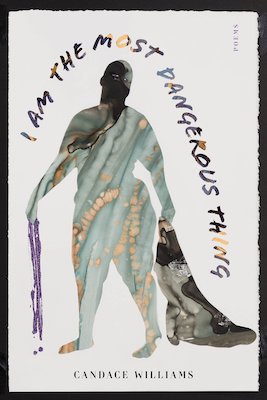
In their debut poetry collection I Am the Most Dangerous Thing, Candace Williams collages identity, political and economics matters to investigate the risks and joys of being Black, female and queer in a society where individuals and institutions are too often focused on their destruction. The seriousness of such topics belies the array of poetic forms and subjects, and especially, the many moments of beauty, and humor juxtaposed and layered to great effect. Consider this excerpt from “Memo”:
“Due to unforeseen circumstances I am forced to lay off 20% of my friends effective immediately.”
This levity belies a deeper reflection on the transactional culture in which we live, directed by organizations, as well as those “voluntary” overlords we choose to engage with, such as social media. Or how in “Desk Lunch Poem” Williams recontextualizes poetry past into a modern and personal setting:
“I eat leftovers
at my desk
because being a Black
woman who can always be found
working is the only reason
they let me eat”
The call back to Frank O’Hara Lunch Poems, without the era-specific whitewashing, takes off from the “I do this, I do that” form and then layers it with intention and a turn that is striking and resonant. Instead of a centralized “white gaze” it pedestals the person of color for whom there is no luxury of strolling about town at lunchtime without care. Yet despite corporate expectations, the speaker takes the agency to still create poetry on their lunch hour, if within the constraints forced upon them.
Mandana Chaffa: In this collection, there are ghazals, sonnets, bops, references to other poems and poets, and though you name some of them, I felt that there’s much under the surface that even the reader wouldn’t be aware of or needs to be, for that matter. Excuse my mangling of metaphor, but such a diversity of form reminds me of the musician who plays several instruments, and in so doing, has a far wider palette which will to improvise.
Candace Williams: The poems in this collection are my earliest poems (besides the bangers I turned in for my 7th-grade poetry project in English class). I started writing in late 2015 after my then-girlfriend (now wife), Laimah Osman, suggested I write poetry. I was lucky enough to find poetry workshops at Brooklyn Poets and the Cave Canem Foundation. Many of these workshops were focused on the concept of form and how certain forms could unlock new ideas and experiences.
The form of the memo helped me explore the life and death power dynamics that exist in the workplace and how these dynamics are reinforced (and betrayed) by language.
The first poem I ever turned in was “Memo” in Wendy Xu’s Against the State workshop at Brooklyn Poets. She suggested we think about the act of writing a memo and where memos tend to be written, and then find a subject to explore in that form. The form of the memo helped me explore the life and death power dynamics that exist in the workplace and how these dynamics are reinforced (and betrayed) by language. I had worked in school, nonprofit, and startup environments where I was called a friend, family member, or community member even though those spaces were designed to coerce and exploit my labor. I’m so thankful that this was my first experience writing a poem because from that poem on, I decided I needed to answer the questions “Why write a poem at all?” and “What experiences and ideas can each poetic form unlock for me?”.
I love thinking about repetition. Repetition can happen on the basis of sound, stanza structure, word, and/or constraint. For example, ghazals and sestinas both employ repetition. The repetition and heritage of the ghazal lends itself to an entirely different kind of rumination than what I achieve with a sestina. Even though some of the themes might repeat themselves, the experience of writing and reading “When I was 12”, a sestina, is much different than the ghazals “After the Rain” and “Fruit”. When I write in blank verse, the sound patterns are almost like a gentle breeze pushing me through something. That something can be a walk through Crown Heights and its history, through a typical Sunday in Kingdom Hall, or through the dying words of John Henry. There are exciting things that happen when I take a form that has been given to me and tinker with it. I get to hold the history of that form and comment on it with my perspective.
Even if I am writing in free verse, I am creating a nonce form for the purpose of that poem. To return to Wendy Xu’s brilliance, one of the earliest lessons she taught me was that the most important line of a poem isn’t the first line or the last line. It’s probably the second line because that is where the reader asks the question “How do these lines relate to each other?”. Wendy taught me that every time I write a poem, I am creating an ecosystem for myself and the reader.
MC: Given the variations of background, font size and document style you employ, readers’ eyes are subtly adjusting to each poem, which is especially cortex-activating. Was this something you were always planning with this collection? How important is the visual experience to your process and output?
CW: One of the core obsessions of my work is exploring how language calcifies physical and social realities. I had a few horrible years in elementary school where I was bullied for being fat, Black, and nerdy. I didn’t realize it then, but the slurs and cruel language children used to address me created a physical, emotional, and intellectual reality. I was too young to think about it then. I started thinking about this concept formally in 10th grade when my teacher introduced me to Plato’s Theory of Forms. He drew a circle on the board and erased it. Then, he reminded me that even though the physical circle is gone, the idea of a circle persists. There’s the concept of incarceration, and there’s the Crow Hill Penitentiary and Rikers Island. There’s the Whren et al v. United States decision that enables the practice of pretextual stops in policing, and there’s the fact that I avoided driving for over a decade because of what can happen to me if I’m pulled over. So, it makes sense that I am using visual forms like erasure. Language and its absence create a visual experience on the page. This helps me explore the physical, social, and intellectual impact that language has on our lives. This is why I erased texts like Heart of Darkness, the New York Times, and Whren et al v. United States. It’s also why I wrote my own death certificate by taking a real death certificate form and writing over it.
MC: There’s so much complexity in style, subject and juxtaposition in this collection. What are some of your influences, across art forms, and how do they influence this collection and what you’re currently working on?
CW: To say I experienced difficulty finding safe housing in Brooklyn and New York City is an understatement. For most of the time I lived in NYC, my apartments were fraught at best and unsafe at worst. This reality, coupled with the fact that I was not given much access to art (outside of music instruction) in school, led me to seek out artistic experiences on a weekly basis. My first job was teaching K-5 science at a school for children in foster care in the South Bronx. Sometimes, after school, I bought single Family Circle seats at The Met Opera (the opera equivalent of nosebleed seats), or saw films at the Film Society at Lincoln Center by myself. When I realized the City of New York offered a Cool Culture arts pass to teachers, and that I could get into MoMA, I started spending a few hours per week there. I would always beeline for the tiny room that holds Jacob Lawrence’s Migration Series. I got to take in the work of artists like Sanja Iveković, Fluxus, and Juliana Huxtable over the course of many visits. I spent quite a bit of time at the Brooklyn Academy of Music. I probably saw at least two concerts, films, operas, or theater productions there per week. The work of Rhiannon Giddens, Tanztheater Wuppertal Pina Bausch, The Creole Choir of Cuba, Phillip Glass, Anne Carson, and William Forsythe influenced me. I took in most of these shows alone, and I’m thankful for that.
Weekly access to visual art and performance is something I really miss about New York City and Brooklyn. Sometimes, moments in a performance that are seemingly disconnected from my life make me think about something in a totally new way. I remember watching Tosca at the Met. I smelled the smoking thuribles that the altar boys carried across the stage during the “Te Deum” and rushed home to write “Nostrand Avenue Dirge.” That scene influenced many of the poems in this collection—You have a solemn, grand Catholic mass filling the stage while a powerful man is using that space and music to engage in his fantasies of dominating Tosca. In that particular Met production, Scarpia kisses a statue of Mary at the end of the aria and onlookers turn their backs to him in horror. That scene highlights the fact that so many people can share space and engage in the same ritual, but have vastly different experiences. You can trace that seed idea through “Crown Heights”, “The Dark Diary”, my New York Times erasures, and many other poems in the collection.
MC: There are a lot of gasps in your work, Candace, following a narrative that swerves the perspective with just a word or two, that shocks a kind of deep clarity demanding one re-read the poem again. Not to mention poems that intensify with each line, each connection, covering topics as diverse as climate change, corporate subjugations, the power of Blackness, and systemic societal oppressions, without ever becoming a lecture, without every losing the poetic line, such as here in “blackbody”:
“Said another way, the whiteness effect is
warming our planet beyond safety. 91% of Fortune 500 CEOs are white men. Outdoor air
pollution has risen 8% in the past five years. The arctic is melting—the white ice is falling
into the dark sea turning reflective surfaces into heat absorbers. It’s getting warmer. By
“it’s getting warmer,” I mean that in 2010, 10,000 scorched to death in Moscow. By “it’s
getting warmer,” I mean that it was 116º in Portland last summer. By “it’s getting
warmer,” I mean that by 2080, 3,300 will scorch to death each year on New York City
streets, and half of those buried will be Black. It’s getting warmer and I wonder about
white men in boardrooms. I wonder about the PowerPoint presentations and profit
diagrams. On the diagram, the blue line is profit. The Black bodies pile under the blue line over the axis of time and the blue line rises. In the boardroom, the Black body is the ideal—we absorb perfectly.”
How important are these illuminations in your work?
No matter what, my poetry has to reflect the totality of my experience.
CW: I write for my real-time experience of the volta—The moment when my mind makes an unexpected jump or turn because the writing took me there. The poem “blackbody” is very important to me. Textbooks are particularly dangerous, and I wanted to mimic their form to explore the tension inherent in the discipline of science. On one hand, I wanted to acknowledge that the study and practice of science has roots in white supremacy (you could argue that white supremacy could not exist without science, but that’s a conversation for another time). On the other hand, I read scientific papers to learn about the impact of global warming, COVID19, and other issues. The moment where the speaker drops the textbook voice and invokes the “I” to comment on current events was an important moment for me as a thinker and someone who has to navigate the fraught history of science in my own life.
MC: Erasure is a meaningful way of interrogating oppression and control structures, and equally, to my mind, it’s a playful way of destabilizing the sentence, or at least the idea that there is one particular order that results in meaning, or in art. “Panther Gets Loose” is a powerful example and ideally closes out the collection, ending on the lines:
“shouts of laughter, joking mer-
riment and carelessness suddenly changed
into fear and dread The panther
liberated himself”
MC:After this close, returning back to the beginning of the book, with the prologue “THIS BOOK IS THE PROPERTY OF:” (and the duality of the word “property” no less). One is reminded anew of the stakes of identity, of individual power, and of the right to declare one’s own narrative, wherein lies liberation. In that sense, I felt not only another of the gasps that your poems engender, but a deep sense of how you’re claiming that liberation, and that agency, through language.
CW: The most liberating thing I did for myself in this collection is to disrupt the idea that I’m a hero or that my speakers or subjects have to be heroes. I’m deeply flawed, just like everyone else. It’s dangerous for me to acknowledge or speak openly about my flaws because the consequences are especially high. I owe quite a large debt to Morgan Parker for teaching me this idea explicitly and through her work. My poems “On Neoliberalism or: Why My Black Ass Is Tired” and “The Dark Diary” helped me advance my thinking on this issue. In “The Dark Diary”, I write “to tell you the truth / I had been striving / without substance / I couldn’t have been / more disgusted / I had travelled all this way / for the sole purpose / of imagined discourse”. I’m proud of myself for letting myself wonder if the act of writing poetry is as noble as people tend to think it is. “Should I write?”, “When should I write?”, and “Are there times when writing wasn’t the appropriate action?” are all important questions.
There is also a lot of love, joy, and humor in this book. Even my bleakest poems have a bit of humor. One of the reasons why I practice reading my poems quite a bit (and even memorize some of them), is that it’s one of the opportunities I have to acknowledge and express humor. This “reading over” of my joy and humor happens because many of my readers have only thought about the Black, queer, and/or fat experience as a single-dimensional site of trauma. I don’t really feel the need to correct these readers, or shy away from or include more trauma in my writing because of them, but I do think about this often. No matter what, my poetry has to reflect the totality of my experience. Then, I can choose which poems readers have access to and which ones are kept close to my chest.
As a reader I want a deeply flawed love interest. A relationship that’s doomed from the start.
My first taste of the deeply flawed love interest was the Byronic hero. I learned about him in the classroom. I saw him in the many TV adaptations of English classics that occupied my youth. He was brooding, aloof, misunderstood. The misunderstood part was key, it meant his despicable behavior was easily forgiven. These doomed affairs were romanticized, held up as examples of great love, something to aspire to (note: I attended an all-girls school so the bar was very low/debatable whether such a bar existed at all). Fortunately, society is far less kind to this man today, and with good reason. We see them for what they are.
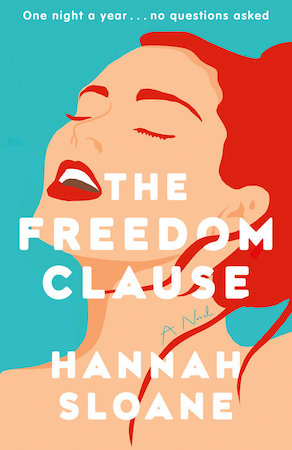
As a writer, I want to create conflict in matters of the heart. My debut novel The Freedom Clause is about a young British couple, Dominic and Daphne, who open up their marriage for one night a year over a period of five years. Daphne follows the rules around this arrangement carefully, respectfully, whereas Dominic does the opposite, the freedom clause only encouraging his worst qualities to surface.
In this reading list, the male love interests have toyed with and broken the hearts of their female counterparts. Once known as the Byronic hero, these men are fuckbois and they’ve reigned supreme in literature, and in real life, for centuries.
This book so perfectly captures a particular type of man—intelligent, literary, seemingly progressive but deeply shallow—that it might be depressing to read if its tone wasn’t so sharp and witty. Nathaniel’s crimes are mostly committed in his head. He harbors unkind thoughts and feelings towards women, believing them: “capable of rational thought; they just didn’t appear to be as interested in it.” And he enjoys a sense of superiority over women: “it was not always unpleasant to deal with a hysterical woman. One feels so thoroughly righteous in comparison.” We watch Nathaniel approach dating in transactional terms (“these emails were invitations to ask her out. If he went along with it sooner or later his dick would be in her mouth.”) But if dating is indeed a transaction, Nathaniel doesn’t offer women much in return, being protective over his time, emotions, and any promise of a commitment.
Hilariously, Nathaniel is so superficial in nature that it bothers him when he finds himself attracted to a woman who isn’t “more obviously hot” and whom one friend ranks: “a seven (coworker material).” But so long as we are ranking people, let’s agree that Nathaniel’s personality is a two, and he will never make a great partner because this f boy is your classic narcissist.
Angel Clare is a classic “nice” guy. He keeps his hypocrisy and double standards hidden from Tess until their wedding night when Angel admits he’s not a virgin. What a relief! Tess reveals that she isn’t either (she was raped). Who wouldn’t hug Tess and tell her she is loved at this point? Angel, it transpires. Inconceivably, Angel cannot move past the news that Tess isn’t a virgin. (“You were one person; now you are another. My God—how can forgiveness meet such a grotesque—prestidigitation as that!”) It’s almost like he’s put Tess up on a pedestal from which she is bound to fall… not that Angel plans to accept culpability. He runs off to Brazil and we can only imagine what he gets up to there, caipirinha in hand.
Modern day Angel would get dumped a lot and seem surprised by this. He would turn angry and unpleasant (think Alec Baldwin) towards any woman who rejects him. He would refuse to see a therapist until a rage incident with a female colleague for “taking too long” at the photocopier and, job in jeopardy, he would relent and go to therapy. For a long time.
Daniel Cleaver is the colleague you must stop flirting with, entire days of productivity lost to witty emails flying back and forth between your inboxes (“You appear to have forgotten your skirt. As I think is made perfectly clear in your contract of employment, staff are expected to be fully dressed at all times”). Yes, Daniel is very charming and attractive and fun, but he’s also a situation-ship. And he cheats. And he only falls hard when a woman is firmly off the market and completely unobtainable.
This type of f boy is everywhere. I will go one step further and say he is a rite of passage in your twenties. He is a total head fuck at the time, and an absolute marvel to reflect on a decade later, as you give a smug and self-congratulatory “look how far I’ve come” wave to your past. And you have come far, you really have.
Heathcliff makes the dating pool look rather bleak. If you do, against your better instincts, go on a date with this man you will notice that he’s moody, obsessive, and definitely not over his ex, Cathy. He lurks around Cathy’s home, looking threatening, and when she dies, Heathcliff decides to open up her grave to hug her, as well as destroy the lives of all those in his orbit (all completely normal behavior).
Incredibly, Heathcliff gets married. You will stumble across his Instagram profile, years after dating him, and see he married a woman named Isabella. Immediately, you will recognize that this woman is miserable and so is Heathcliff, and things not working out between you two was the ultimate lucky escape. This two-minute analysis is bang on. Heathcliff calls his wife, Isabella, a “wicked slut” and throws a knife at her. Isabella says of Heathcliff: “I gave him my heart, and he took and pinched it to death; and flung it back at me.”
In summary, every bad romantic move Heathcliff makes can be linked back to Cathy. Just replace “Cathy” with “art” and this is the modern-day f boy you are dealing with: the tortured artist.
Maxim de Winter is a hot name. And something about him gives you “controlling but it’s hot” vibes (a red flag for some but you are willing to overlook this). Maxim lives at a place called Manderley which is enormous (homes with names always are). You might be tempted, on an early date with Maxim, to daydream about dropping your own name in favor of being called Mrs. de Winter. This daydream mainly features you swanning around the estate in espadrilles and a long floaty dress, martini in hand. Except you don’t want that. The original Mrs. de Winter died in a tragic drowning.
As you get closer to him, Maxim lets you in on a little secret: he shot Rebecca because she was pregnant with another man’s child and she refused to divorce him. He made it look like an accidental drowning. At this point, the fantasy of Manderley loses its appeal, and you remove the espadrilles and put down the martini glass. You say a polite “thanks but no thanks” to this f boy’s anger issues, his murder-y side. It turns out you are very happy to keep your name, and your sixth-floor walk-up.
Stephen DeMarco is a master manipulator. Deceitful and secretive, he uses people with little consideration for their feelings. He has no qualms about cheating on Lucy, going back and forth between her and another woman. His relationships are toxic and dysfunctional, on-again-off-again, because he intends for them to be this way. Naturally, Stephen is excellent in bed.
This engaging book-turned-TV-series perfectly captures the heady, spectacular sensation of falling hard and fast for a f boy. We see why Lucy falls for him even though it’s an emotional train wreck. It is fascinating and horrifying to sit inside Stephen’s mind, and deeply satisfying to watch Lucy finally understand him, and the dark secret he holds inside.
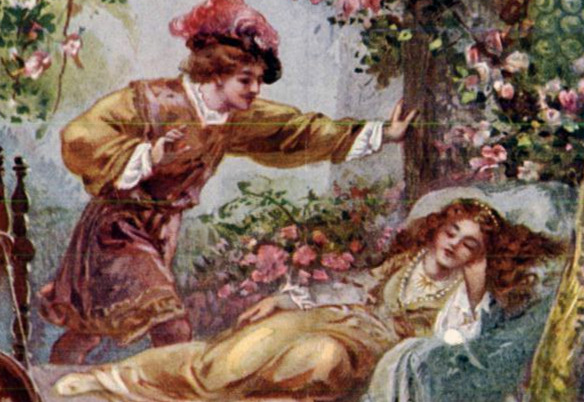
Poor Jane. Initially, Mr. Rochester seems like a total catch (they always do). He’s intelligent and affluent and he treats her as an equal. He only asks that she ignore the strange noises coming from the top floor of his home. But on their wedding day, Jane learns Mr. Rochester is married and—it gets worse—he keeps Bertha, his wife, in the attic. He tries to pass this off with a simple explanation (Bertha is mad!) and proposes a new plan (Jane move to France as his mistress!) but Jane doesn’t find this compelling, and neither do we. Oh sure, Bertha is “mad.” Is she also “shrill” and “hysterical,” Mr. Rochester?
In wonderfully karmic news, Mr. Rochester does pay a price for his behavior, losing an arm and an eye in a fire started by Bertha, making him the lesser known and rarely seen of all the f boys: the reformed f boy. He learned his lesson to treat people nicely the hard way which is why Jane eventually does marry him. He is, at last, worthy of her.
Yes, I’m sure you were wild as a teenager, Linda,
much more than my parents,
Indians, all about their tradition.
                                    Tell me about your private school, Linda.

Did you have a uniform?
Plaid dress, white shirt, knee-high socks?
Did you wear a black skirt?

Did the bad girls duck under the stairwell to hitch their skirts up higher?
Did they get busted or were they too rich? Did you do this?

You tell me how you loved smoking cigarettes in the car with your friends. Were they bad girls too? Were they all white with rhyming names?

Did you have an ethnic friend?

You listen to me lament about being the ethnic friend, tell me you knew some Indian girls in school. But you never thought they had much to lament. Their skin, so tan. Hair so long and black. You admit: you were jealous.

Did you at least spare them a cigarette? I doubt it, since you’re not doing much in the way of sparing me.

(I count the time. My co-pay ticks).

Did you invite the Indian girls on drives out? Scratch that: Did you and your friends all drive around together with the car-top down, the new Madonna loud?

Did you hitch your skirts up to the seatbelt and flick out your cigarette butts? Did you squeal when they burst against the windows of passing cars, lost to highway wind?

I admit: I get a strange pleasure hearing you describe your teen years as something you miss, while I scrub away the minutes remaining in mine.

(You remind me to breathe. You tell me some people like smoking because it makes them realize they’re breathing.)

I breathe. I make a joke so you stop looking at me like the kind of stray dog you’d slow your car for, consider taking to the shelter. (But, ultimately, you wouldn’t. You’d forget it, drive on, congratulating yourself on the original impulse.)

What a blast you must’ve had Linda. I smile, take a sip of my water. It sounds like a John Hughes movie.

Ah, yes, you laugh, smiling. We were so free then.

                                    But, tell me, Linda. Were you, really?

Was the ease really so freeing? Or did the ease of getting anything you wanted stir a sick yearning to feel something?

I imagine drunken nights with your friends, burning cigarette circles into each other’s skin. I imagine you laughing crazy because you didn’t know whether to feel bad.

I imagine you thinking about it years later, how broken those people must’ve been, despite everything they didn’t need but had.

Did you have fun when you did that? Did you like each other hurting? Is pain a way to share something with people that you want to like but can’t?

Were these the best times you had? I wonder if your friends are in therapy now. Do they see, feel seen, by someone like you?

Are you still friends? Is there anything you regret?

                                    Tell me what it was like, Linda.

I want to imagine.
Little Critters
Amma stills me on a black stool, the seat of barbershop wonder.
No wonder. She draws out the lice comb, clucks her tongue.
She says it’s because me and my best friend Deedee bump heads at school too much.

Little critters, the same down to the texture of our hair;
stern, tire-black, thick like rubber. We squish
together, straining the candied library carpet through our fingers,
a book closed before us.

Amma yanks and shushes my hair like an infant. I scream,
Amma	 	thallamudi izhakathai.

Valikirradhu. வலிக்கிறது. It hurts

I imagine Deedee’s amma also pulling a mean comb through her hair after we play,
After we trumpet a raspberry at her mean brother who
twists our fingers between swing-chains, claiming it helps us rise.

We scream, and Deedee spits furious
Spanish at him. I furrow my brow and pretend to feel profound offense when
he spits back, yearning to understand
what it means to feel held in their mess.

The lice comb sings its own doomed verse: shrk shrk shrk;
the sure music of snakes in grass. Shrk shrk. Appa
comes home and ruffles my hair.
Little critters, he says, pointing as one runs
across my shoulder.
Not enough hair for that, he says, kneeling
down to show the shiny bald top
of his penny-bronze head.

I drum my hand on his bald head as the comb’s slender teeth run through me,
like fear or pee, catching against the dull husk of lice, the thick spidered knots.

I remember Ms. Debbie reading us a scary story,
Deedee and me not listening,
about a white-fingered witch who stalks through villages to steal children, cackling
hee hee. But we are the ones witch-cackling
hee hee, picking at candy crumbs with our
small brown fingers,
laughing so close to one another we could smell our Reese’s Pieces breath.

Deedee and me are so close
in shade people ask if we’re sisters,
if we’re from here,
if we speak English.
I wish we were sisters,
I wish Deedee were here with
Amma, Appa and me:
hunched in front of the mirror on a hunt for eggs.

Amma picks one out: translucent, pearly.
She fixes it between her firmest finger nails,
mortar & pestle,
and presses.

It cracks like a nut.
There, she says.
That’s how you know the lice were there,
and now they’re dead.

I imagine whole families curled inside,
mother and father yolks, unlonely seed siblings.
I wonder if they feel the nail and wept,
or just gave out a little creak while dying.

Did Deedee imagine these things?
Amma taps out the comb on the sink. Tick tick.
A small rain of lice. She turns on the tub faucet for my final rinse.

Bringing the water my breeding bush of hair, I cry
for Deedee, for our wonder root-deep,
mourning what leaves, the hair parting.
In “Sundae,” the third episode of the recently-released second season of Hulu’s The Bear, chef Sydney Adamu, played by Ayo Edebiri, spends a day-long culinary journey around Chicago as a palate “reset” for the menu she and her business partner, chef Carmine Berzatto, are developing for their restaurant-to-be. The original plan was for Syd and Carmy to do this together, but he bails at the last minute, and she’s left with the day to herself.
“Can I get the breakfast sandwich with longaniza, and also can I get a hash brown? I’ll also have the mushroom adobo, and, umm, one of these mango tarts. And, umm [thoughtful squint] a matcha latte.” The unselfconscious “ands” and “alsos” of Syd’s order at her first stop of the day are a pleasure in and of themselves. We watch her digging into pasta, ribs, noodles, slices of pizza, and finishing off the day with a glorious banana split. Throughout this, she’s also talking with old friends and connections in the city’s culinary world, getting advice and feeling a growing doubt about Carmine’s reliability as a partner, as well as the massive gamble of opening a restaurant. But the food she eats is clearly the star of the sequence. The whole thing takes about ten minutes of the entire episode.
I couldn’t tell if the staggering volume of what she consumed was a product of television fictionalizing, or a superpower.
In Salon, Kelly Pau writes incisively about the sequence’s “radical” and “empowering” content—that is, the novelty of depicting a woman eating a lot, with gusto, purposefully, and alone, and in the name of her own ambition. And indeed, after finishing the episode, the shots of Sydney sliding a dumpling into her mouth, glistening fish roe, and a golden slab of hash brown being placed into an open breakfast sandwich stayed with me. I couldn’t tell if the staggering volume of what she consumed was a product of television fictionalizing, or a superpower common to chefs and food critics. Either way, I didn’t care—I only knew the very real joy and longing that Sydney’s peregrinations across Chicago’s food landscape instilled in me.
The more I’ve thought about Sydney eating, the more I’ve come to consider how rare it is to see the depiction of a woman just thinking in television or film—let alone a woman of color, a Black woman. And when I say thinking, I’m not talking about a moody montage of the single gal contemplating the future of her relationship (there will be tea, there will be rain), nor of the heroine shuffling through photos of her mother, who is either dying or has just died of cancer (Mom looks so young here!) nor of the depressive artist furiously slashing away at the canvas or guitar (Cue indecorous gulp of red wine, drag on cigarette.). I’m talking about meandering, intellectual reflection—the kind that doesn’t actually look very exciting. The undramatic moments that undergird a lot of creative work—the stuff that isn’t very entertaining. And perhaps because I’m a poet, this kind of representation of creativity is especially dear to me. In her Nobel Laureate speech, Polish poet Wisława Szymborska observes:
“It’s not accidental that film biographies of great scientists and artists are produced in droves. […] But poets are the worst. Their work is hopelessly unphotogenic. Someone sits at a table or lies on a sofa while staring motionless at a wall or ceiling. Once in a while this person writes down seven lines only to cross out one of them fifteen minutes later, and then another hour passes, during which nothing happens … Who could stand to watch this kind of thing?”
Yes, there’s the sensuous drama of the visuals of the food Sydney eats. But the sequence doesn’t seek to push the epiphanic “bite of food=immediate inspiration” moment that we get in, say, a film like Ratatouille. Syd’s face, as she eats, is stoic. She doesn’t swoon. She writes and sketches in her notebook in a methodical way. No impassioned scribbling. The sequence is interspersed with overhead shots of a slowly-building plate which, we come to understand, is a new dish that’s evolving in her mind throughout the day. Even better, there’s no “reward” for her thinking; that night, she tries a version of the dish in her mind, and it’s terrible. And that failure only makes this representation of creativity that much more authentic. A lot of what art-making requires is uncinematic introspection and no payoff.
Sydney’s day reminds me of a recent solo trip I took to my former home of New York—my first time in the city since before Covid. Although I spent many memorable meals with friends and family—sharing a chicken parm the size of life raft with my cousin Patti in Little Italy, the delicate comfort of avgolemono soup with Miles and Laura in Astoria, rich forkfuls of Keema Kaleji with Nate and Amy in Park Slope, soft serve cones and a bottle of rosé with Clark in Central Park—I treasured the solo eating I did as well. Insalata e acciughe and a glass of verdicchio at an outside table at Via Carota, after a nostalgic morning walk around the West Village (I kid you not, the greens tasted happy as I bit down on them). My impromptu Saturday night jaunt for strawberry gelato in SoHo—a summer breeze up one’s skirt is a crucial ingredient. Hunching over the spicy lamb noodles at Xi’an Famous Foods and grunting like a woman possessed. The 1:30am Crunchwrap Supreme at a bustling convivial Taco Bell, one of the only places open for food in the Financial District at that hour. And a great part of what makes me treasure the memory of those moments: eating alone and walking alone means I’m thinking alone.
I was seeing so many people I loved on this trip, people who’ve shaped my mind and heart, people whose company brings me deep joy. But as I made my arrangements for these long-delayed reunions, I knew I would need to just walk around the city for blocks and blocks, to ride the subway, to indulge in the supreme pleasure of being solitary among over 8 million people. To simply watch and listen in a place where I had no habits. But I told no one about needing this solitude. I portioned chunks of time out to others on this rare, expensive trip, but always held back some for myself. I was circumspect about when, exactly, I was seeing whom, and for how long. It’s for my art, I could have explained; my poems, but that wouldn’t have been the entire truth. It’s just for me. My brain; my—am I really going to type this?—spiritual refreshment. This, I think, is why all those shots of Syd just being a woman thinking alone in public are precious to me. And still, needing this time to myself made me feel ashamed.
In the later chapters of Monsters: A Fan’s Dilemma, Claire Dederer contrasts the transgressions of female artists with the violent acts of the Roman Polanskis and Woody Allens she’s examining, and concludes that, for a woman, the biggest sin is one of abandonment. She focuses particularly on artist-mothers (Joni Mitchell, Anne Sexton), and includes her own catalogue of maternal failure. She recognizes that for the female artist:
“You abandon something, some giving part of yourself. When you finish a book, what lies littered on the ground are small broken things: broken dates, broken promises, broken engagements. […] The artist must be monster enough not just to start the work, but to complete it. And to commit all the little savageries that lie in between.”
There’s no ‘reward’ for her thinking; that night, she tries a version of the dish in her mind, and it’s terrible.
I’m not a parent, but the times that I’ve had to set boundaries, say no, not return texts or phone calls immediately, not check in, not drop by, not commit these acts of care and repair in my personal and professional relationships always puts a little twist in my gut. Care, the soft, insinuating voice says (Do I need to clarify that it’s a woman’s voice?). Care more, and more still. What are you good for, if not for this care? Dederer’s ideas extend far beyond art-making; for a woman, the instances in which we refuse the call to care can feel like “savageries.” Even if we’re not mothers, mothering is still expected of us. And let’s not ignore the connotations of the word “savagery,” in terms of all the ways it suggests an abandonment of (white) civilization and society. A woman unemotionally thinking alone must mean she is neglecting someone or something elsewhere. Let me put it more baldly: an autonomous woman is an inherently destructive woman.
The sight of a woman like Sydney calmly, ruminatively taking in the world shouldn’t be so rare on screen. I shouldn’t feel so shocked at seeing reflections of my own hard-won solitary moments. They are as worthy of narrative—and this is where I mention that “Sundae” is written and directed entirely by women—as anything else. These ten minutes of a television show celebrate the life of a woman’s mind. I feel seen, and yet I’m also frustrated by the novelty they represent.
There’s not much ordinary humans love more than ogling rich people. On reality television, on prime time, as they run our governments and corporations, we of humbler socioeconomic status can’t look away from the 1% and the gleam of their golden safety nets. Obviously, there’s vicarious living at play—the question of where we’d go in the private jet and what we’d buy with the unlimited credit. For the most part we can only imagine, but occasionally, two unlikely paths will cross and one of us normies is invited into the fold. But can rich people and poor people actually be friends?
Of all the identity divergence in a friendship, a difference in finances is especially insidious. Money is power, and it can be hard to untangle its influence. Having a rich friend can mean anything from all-inclusive vacations to unwillingly maxing out your own credit card at a group dinner, from networking ins to being fully responsible for the legal ramifications of a joint bad decision. After all, rich people don’t live in the same world as the rest of us, and they certainly don’t suffer the same consequences—just ask F. Scott Fitzgerald.
My new novel, Maddalena and the Dark, features two protagonists of vastly different socioeconomic standing. One, a nameless orphan, befriends the other, a nobly born girl from an influential family. Although both see their fortunes rise and fall over the course of the book, there’s never a question of who stands to suffer most. We like to think our rich friend is just like us, but in literature as in life, the following books show how finite our affinities can be.
Indigo and Azure are best friends—almost like sisters, but for the mansion and enormous fortune Indigo has inherited from her parents, while Azure lives modestly in her mom’s terrible boyfriend’s house. As they grow, the girls navigate the usual growing pains of adolescent friendship, with the additional complexities of fairy tale kingdoms and the occasional private jet. When the book opens, Indigo is an adult drinking diamond martinis, and we’ve no clue what’s happened to Azure. The alternating past and present story lines tighten the woven noose of money and power until the teenage friends are forced into an irrevocable choice.
Callie and Virginia grew up spending summers together in Watch Hill, Rhode Island, where they became fast friends. The fact that Callie lived in a cottage while Virginia lived next door to Taylor Swift doesn’t really seem to matter until they become roommates in their twenties, crashing together at Virginia’s parents’ Upper East Side condo. There, Callie quickly succumbs to the pressures of keeping up with Virginia’s monied crowd, growing ever more resentful as Virginia appears unencumbered by the practical considerations of an average person’s life. Billed as a book about weddings, this clever novel is just as much about the unspoken truths between friends.
In this contemporary reimagining of William Thackeray’s Vanity Fair, Ivy Lin is raised by her struggling immigrant family in a low-income housing complex outside of Boston. When she ends up at an exclusive prep school, she gets a taste for privilege that will guide her every choice moving forward. As an adult she reconnects with the wealthy Sylvia Speyer, whose brother Gideon represents everything Ivy idolizes in the American elite. In this book, it’s the have-nots who claw their way up, no matter the emotional and ethical cost. Friendship struggles to compete with the machinations of successful social climbing.
Scholarship kid Lillian and monied Madison went to boarding school together, good friends until Lillian took the fall for Madison’s mistakes and got expelled in her place. Years later, Madison comes back into Lillian’s life with an unusual request—come nanny her twin stepchildren who are suffering emotional trauma after their birth mother’s death, and also sometimes spontaneously burst into flame. Lillian takes the gig because she’s broke (a classic poor friend move), but as she guides the children through their father’s political aspirations and their stepmother’s selfishness, she starts to wonder if this job isn’t what she’s long been looking for.
Behind every sociopath is a rich kid whose parents just don’t understand them, and their less charismatic but intensely loyal friend. So posits this deliciously creepy novel, in which friends Julian and Paul challenge each other emotionally, intellectually, and sexually into ever more violent situations. Julian comes from money, and a series of scenes in which poor “uncultured” Paul visits the family estate will remain seared in my memory.
Sarah is rich and Lauren is pretty, and together their friendship is a fascinating examination of avoidance and envy and the long leash of familiarity, even as lives diverge. Once inseparable, the two women grow apart as Sarah leans into her paint-by-numbers socialite existence, while Lauren flounders with the realities of an uncertain future. But once friends, always friends—at least nominally—and the two maintain a nuanced and fully human bond in this witty examination of what holds us together despite ourselves.
Can an employer be a friend? That’s the question Ella must ask herself when her relationship with Lonnie, whose child she’s hired to take care of, begins to blur professional lines. Both women are the same age, yet Lonnie has everything—a brownstone, an adoring husband, luxurious vacations—while Ella is literally scrounging for her next meal. Ella’s fascination with Lonnie curdles into obsession, and while her digging around leans somewhat Single White Female, her fixation on Lonnie’s expesnive skincare products is totally understandable.
Sometimes your friend is also your boyfriend, who unbeknownst to you just so happens to be from an obscenely wealthy family. As Rachel follows Nick home to Singapore and the previously undisclosed family palace, she fends off skeptical mothers and snobby friends, navigating wild opulence and old-seated rivalries. Luckily she has Peik Lin, her best friend from college, who might be “unsophisticated” New Money but knows how to shower Rachel with expensive clothing. While Nick’s family sends Rachel on a rollercoaster ride, her bond with Peik Lin stays steady.
Imagine the worst thing that anyone has ever done to you. Now imagine you have one year to seek justice, revenge, punishment. To make them pay.
Of course, you’ll have to confront your torturers. Your nightmares will come back, along with the monsters you’ve keeping at bay. You’ll have to blow up your whole life, in fact—un-forgive, un-forget, seethe with anger. You’ll have to live in the wreckage. In all likelihood, you’ll be humiliated, abandoned, and disappointed along the way. Sometimes by the people you love the most. You’ll have to admit how much you hurt. Loudly and on the record, for everyone. For yourself.
Oh, and—you still can lose. You can lose again.
Do you take your best shot? When you hear the starting gun, are you there, on the line, poised to sprint? Or, do you have a drink, take a nap, take a pill? Do you try to sleep away the year? Was it easier when you didn’t have the choice?
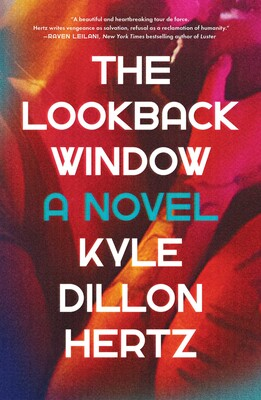
In Kyle Dillon Hertz’s debut novel The Lookback Window, Dylan, a 20-something writer, is presented with the opportunity to seek justice for the childhood sex trafficking he endured, but first he has to decide if it is worth breaking his only rule for survival: “you live through it, but never look back.”
The book is based in reality. In 2019, the New York Child Victims Act temporarily lifted the statute of limitations, allowing survivors of childhood sexual abuse one year to file civil action against their abusers. The Adult Survivors Act, modeled on the Child Victims Act, opened in late 2022. Notably, the ASA was the law that allowed E. Jean Carroll to pursue her recent, successful civil litigation against Donald Trump, for an attack that occurred in the 1990s. By November, that window will also close.
I sat down with Hertz on Zoom to talk about The Lookback Window. Our conversation ranged from discussions of trauma coping strategies to his philosophy on beauty and the redemptive power of love.
Kate Brody: I am curious how you see the relationship between addiction and sexual abuse in the book, because it seems quite complex. On the one hand, Dylan’s rapists drugged him, so his drug use brings him back to that place. On the other hand, he really is self-medicating, because there’s no better alternative for escaping from those same memories.
KDH: The way people treat the addiction aspect—or what I would call the drug aspect—has been interesting. An early review referred to Dylan’s sex addiction, which is something that I would not say exists. One of the lines was like “he has to deal with his promiscuity.” If there is some addiction in the novel, I would say it is mostly to pills. A symptom of PTSD is recreating prior trauma, which Dylan does with crystal. Whereas his use of pills is him blocking out the world.
Should everyone be hitting the pipe? No. But that is the way that Dylan learned how to exist in a world that’s sinister and horrible. I would be so nice if I could say, “he did this because he’s an addict and drugs are bad,” but the reality is these are things that occur in a person’s life.
When I was in therapy at the Crime Victims Treatment Center, my therapist said to me, “this is going to get a lot worse, and then it will get better very fast.” When you block out so much of your life, when you don’t let it hit, when you see it played out in front of your face and you have no reaction—there’s some part of you that really wants to touch that world, once you start letting it in. How else are you going to learn?
I’m a very tactile person. I needed to get married once to have my second marriage be the one that lasts. And I think Dylan is similar. I don’t feel ashamed for him that he had to do all these drugs and fuck up this badly. He did the right thing.
KB: Raven Leilani said of the book, “Hertz writes vengeance as salvation.” Is Dylan after vengeance? Is he after justice? Is there a difference?
KDH: I don’t know that justice exists. I think it’s nice in theory, but for example—E. Jean Carroll. She’s using The Lookback Window law, the Adult Survivors Act, and on one level, it’s this hurray moment. But what is this victory? I understand that money helps, period. Especially when you go through something so fucking awful that years of your life are spent trying to make sense of it. You’re going to be farther behind other people. But it’s not justice.
Trauma is unbearable aloneness in the face of violence, and Dylan wants to be truthful. For him, that requires confrontation and cutting people loose and living in rage.
And why should he not be angry? Why should I not be angry? Why should you not be angry? There’s quite a bit to be angry about.
KB: The anger component is interesting. I’m going to generalize here: a lot of contemporary fiction is in this detached mode, where narrators wander through their lives and things happen at a distance. In the book, there is a very productive anger motivating Dylan to act.
KDH: I love that you brought this up, because there was awhile where millennial literature was detached people lazing away the days. I do not know a single person like that. None of my friends, none of my enemies. None of the strangers I meet. Everyone is working quite hard. So I reject this idea of millennial literature as lazy people letting life happen to them, because the world fucking sucks. That does not ring true for me. Not to put on my tinfoil hat, but it seems like a way to shift the blame from what’s happening in the world. It feels like the opposite of reality. Do you know anyone like that?
KB: My thought is that it’s easier to write someone who doesn’t do anything, because you don’t have to make any choices.
KDH: Whether it’s for money, love, violence—people make choices. Many of us make bad choices. But every single person makes choices that alter the course of their lives on a daily fucking basis.
Trauma is unbearable aloneness in the face of violence, and Dylan wants to be truthful. For him, that requires confrontation and cutting people loose and living in rage.
For Dylan, he knows he has a short period of time to accomplish something, so he makes choices. I mean, this should be the easiest craft decision, which is: make a fucking choice. The consequences happen. Then make another fucking choice.
It drives me so crazy when writers limit wonder to this very small slice of life. I find Dylan’s anger wonderful. I think that part of what makes The Lookback Window the book that it is—the sense of wonder attached to every emotion, not just beauty, but also rage.
KB: Whatever retribution or financial settlement Dylan receives, there’s no clean slate for him. At one point, in therapy, he calls himself “a divorced, insane former child whore on his way to becoming a crackhead.” And he’s obviously saying that tongue-in-cheek, but how does Dylan establish his identity in the wake of this violence?
KDH: What happens to you shapes you. That moment is a funny, fascinating moment, because it touches on this thing that happens to people who have been victimized, which is: It is both easy and difficult to become what others try to make you into. This is the work of a lot of literature: “My parents wanted me to be X. So I did X and I was unhappy.” Everyone struggles with that. Dylan sees that path.
When the book starts, Dylan is in a good place. He’s chill, he’s calm, he’s got a husband. And I think the lookback window is a bomb. The lie of justice is that you’ll be whole again. Bullshit. But it’s on Dylan to kind of define how he’s going to live rather than let the unconscious river of other people’s manipulations deliver him fifty years down the line to what I think of would be his suicide.
KB: Dylan decides quickly that he wants to pursue legal action, but then he comes up against bureaucratic walls, because his abuser was not the Catholic Church or the Boy Scouts. The law functions both as a lifeline and as another punishment, re-traumatizing Dylan by assigning a monetary value to his life.
KDH: He also didn’t get raped by someone famous. That’s the other shitty thing about this Trump case. It’s another tabloid story. It’s—I hate to put it like this—but a privileged rape. It’s crazy that there’s a hierarchy—not, of course, made by the victims themselves, but by the culture—of who we can sue, who we can get money from. You need to have money to give money.
It seems so obvious that the solution to being treated horribly is to learn how to be treated right.
Everyone deserves their lookback window. If everyone had a year where the world said, “here’s your chance, think about what happened to you and decide if you want to take action”—that’s a life-changing experience. And it’s brutal, because it’s limited, and it’s money, and it’s not enough.
I go back and forth between: this is a great law and this is such bullshit that’s being fed to me. Should it exist everywhere? Yes, but not forever. Only as a path toward the complete and total elimination of statute of limitations for a sexual assault, specifically for childhood sexual assault.
I went through my own child victims experience that was similar to Dylan’s, but he makes it much further. I was not interested in the money game, because if I ever heard what my price was, I would kill myself. You have to believe, fundamentally, that your life is priceless. It is a brutal lesson to learn that there is a price that can be paid for you. People learn it all the time, of course. But I never want to know what I am worth. Dylan pushes more than I did, for dramatic reasons and because he is much different than me.
KB: Speaking of your experiences, you wrote a memoir piece for Freeman’s, which is similar to a particular scene in The Lookback Window. It ends with this line: “I needed to give my friends what I could. They had created a portal through which strangers saw the world where I wasn’t tomorrow’s ashes, and I joined the hour of saving.” The implication seems to be that other people have to love you in order for the world to value you.
KDH: It seems so obvious that the solution to being treated horribly is to learn how to be treated right. And to learn how to treat others. There are so many people working in the field of social justice who are pushing community solutions, which are the answer.
For better or worse, the only answer for how to survive is to try to craft a meaningful life and to allow other people to be a part of that. To resist the loneliness and the aloneness that these sorts of violent events enforce. To push against that and love as much as possible within the confines of your life.
You can see this in the relationship between Dylan and Alexander, which is this chance meeting between two people who went through similar things. Dylan has all these people who give him a tiny look at what things could be if he was not destined to be a former child whore.
I don’t know if that really would have occurred to me if not for the Crime Victims Treatment Center, which is a structural organization provided to this very specific type of healing. There should be a Crime Victim Treatment Center in every part of this country, and there’s not, and that’s pathetic.
Between the friendships and the institutional support, you can fuck up, you can do drugs, you can ruin your heart, you can end your marriage, and there is still a path to living. Sometimes you need other people’s belief in your humanity to temporarily suspend your own hatred for yourself.
KB: Since I read the book, I’ve been thinking about this rash of news stories about how dangerous American cities are. This is perennial, the notion that cities are these horrible places filled with wanton behavior and the suburbs are where we keep our white families safe.
The book reverses that. The setting where Dylan’s childhood rape occurs is a suburban idyll. And then, like a lot of marginalized people, Dylan comes to the city and finds home. How did you approach setting? There’s a horror element where the veneer of suburbia makes what happened to Dylan that much more upsetting.
KDH: Things are pretty shitty everywhere. This whole lie of the countryside is beautiful? It’s such a joke. I’ve done road trips across the country, and there are so many places where the person at the hotel says, “whatever you do, don’t get outside the fucking car.” And that’s obviously not an experience that happens in New York because it’s such a public place. Which is not to say that awful things don’t happen here. But it’s a great lie to tell yourself that it can’t happen in a certain place, because—look, there’s a garden!
I reject this idea of millennial literature as lazy people letting life happen to them, because the world fucking sucks.
There’s a weird thing in the book where if there are flowers, something fucked up is about to occur. Right before Dylan confronts one of his rapists, there’s a woman tending her hydrangeas. Look at the pretty flowers.
I obviously love this city. It’s a multicultural place where we can be out in public and not have to worry about being attacked. That is, of course, not to say that rural places are shit. People are shit everywhere. But people are disturbed by the fact that bad things occur in settings like the suburbs, because we learn these lies young. Fuck the suburbs.
KB: At one point, Dylan goes on a rant how neon is not beautiful, because if it were, people would rip it off the walls: “Beauty demanded care and received destruction.” Dylan, of course, is also described as quite beautiful.
KDH: Most things that are beautiful are supposedly sacred, and everybody destroys them. I’m not really interested in the (correct) anti-capitalist take on this, which is that we live in a world of mined resources. Anything that gathers desire is automatically in danger. What’s scary is everything can be wanted, which means every single thing is a target. We know, based on statistics, that most people get attacked in their lives.
KB: What is the impulse to destroy beautiful things? It is the imp of the perverse? Wanting to own something? Understanding beauty as power wanting to defeat?
KDH: I reject the idea that there’s one reason people do these things. Power, sure. That’s the easy answer. I wish it was just “people want power because life is short.”
Every single person makes choices that alter the course of their lives on a daily fucking basis.
I had this terrible moment a while ago—post first divorce, pre new husband—where I was on a date with this guy. And one of the things I absolutely hate doing is showing people what I looked like as a teenager or a child. I don’t even like looking at those pictures, because they upset me knowing what happened. But he was a totally normal person, and I ended up being very honest with him, and I show him a picture of me, as a teenager. And he says, “You were a beautiful child. I understand why somebody might have done that to you.” It was a drunken, nasty, ignorant thing to say, and he was not supporting what happened to me. But he had this honest moment of “Oh I understand why someone may have done to you.”
KB: Somehow it made sense to him.
KDH: Which is a very real thought: “I see why you could have been taken advantage of.” Terrifying to think that it may be common, the implicit understanding that there is much more at work than simply power.
KB: The toughest parts of the book, for me, were the flashbacks, because you as the writer took pains to remind the reader that they’re not with the adult version of the character in those scenes. Dylan has braces, acne, and, of course, no real agency or means. Such an upsetting lack of care from all the adults in his life.
KDH: So you mentioned the line where Dylan refers to himself “whoring.” Matan, his therapist, responds, “There’s no such thing as a child whore.”
One reviewer referred to Dylan as being “prostituted.” And it turned my stomach. How did you read my fucking book? I thought we learned after Jeffrey Epstein that there’s no such thing as a child whore. But there is still some kind of fundamental inability for people to really reckon with vulnerability.
The Victims of Crime Act supports victims assistance programs in every state. If people are looking for support local to them, RAINN.org is the most reliable website for locating victims assistance programs by geographic area. If people are looking to learn more about the Crime Victims Treatment Center, they can go to cvtcnyc.org.
You name it, Lola’s found it in someone’s ear. A green Skittle, a watch battery, the tarnished back of a gold earring, a bunched-up bit of mint floss, a Lego head. Insects—yes, of course. Roaches of various sizes, a wasp, a small beetle. Hardened ear wax (cerumen, Lola insists, avoiding lazy colloquialism) resembling the face of Donald Trump. A polished pebble that might have been from the bottom of a fishbowl. Lola tells me about her discoveries. I devise ways to one-up her, which is difficult because I work from home, hunched over a laptop, scrolling through accounts receivable. Still: there is black mold in my dishwasher, a rotting ham sandwich discovered in the backseat of the car, ingrown hairs morphed to suppurating boils—the world rampant with revulsions when you only pause to look. I feel a little happy surge when I can make Lola groan with laughter. We are constitutionally drawn to the art of grossing each other out. It’s a trait that bonds us. Prior to meeting Lola—despite my marriage, my son—I felt alone.
“You should have seen it, Nell. It looked like a spider leg at first,” Lola says. She’s an audiologist. Her day is spent playing tones of various frequencies, peering into ear canals, testing cochlear implants, and, apparently, extracting foreign objects.
“It was right by his eardrum. I was afraid to pull it out.”
I make a gagging sound. It used to be stories of her first dates that elicited vomit noises from me: the nose-pickers and start-up bros and CrossFit dudes with eye-stinging cologne, the cycling-enthusiast/curriculum-specialist who took her to the fanciest restaurant within a hundred miles, chose the finest wine on the menu, three starters, and two mains, then left her stranded with the bill. Admittedly, with each story, I was a little relieved. She was still mine. Dating is a shit show, Lola assures me. A house of horrors. So, it turns out, is audiology. And human life in general—aging, this mortal coil. Lola and I have recently reached a decade wherein our targeted ads feature luxury compression undergarments and high-end home mustache removal systems.
“It was an overgrown hair. Thick as a wire, like nothing I’d ever seen. About yea big.”
She holds her index fingers at a distance to indicate the length, somewhere between an uncooked spaghetti noodle and an old-fashioned car antenna.
“You’re joking.”
Lola shakes her head. She never jokes, not about ears. External ears—auricles—are beautiful, so elegantly crafted: fossa, helix, lobule, the whole delicate whirled shape. She speaks of them in a way that’s almost fetishistic. Ears are powerful, Lola claims, and also erotic. There’s a special way one of her ex-boyfriends used to touch her ear, caressing it, moving his tongue against it just so. A light flicking movement—Lola has demonstrated, looking like a snake. It’s intimate, Lola’s flickering tongue. I force myself to turn away, though I’m curious. Lola believes in such things—open discussions of sexual appetite, vision boards and crystals, the power of manifesting your dreams, positive mantras, gurus, sound baths, astrology, the totemic ear, summoning up a husband from the mists of your own longing.
“Am I disgusting?” Lola asks.
“A little.”
“I really am disgusting.”
“But I still love you.”
We laugh our sad laughter. There’s an open bottle of rosé sweating on the table between us. It’s dusk, and the deer are encroaching onto the lawn, peering at us from behind the shadows of the overgrown lot across the street. The evening air smells like gasoline and wisteria, the pile of mulch sitting behind our neighbor’s yard. The deer eye us, making a pretense of shyness. There are too many of them here, and they’re no longer afraid of humans. I find them horrifying, unnatural—if someone revealed they were robot deer sent by Jeff Bezos to monitor our every material desire, I would hardly be surprised.
Lola worries she’ll remain single forever. I worry she won’t. Such fear—more accurate to call it panic—can drive a person to do all sorts of things. There is nothing worse than loneliness. Others might not understand but trust me: they have never truly been lonely. Once when Lola and I were at a local brewery, a man with a close-cropped beard came up and started making conversation with us. I could tell it was a great effort on his part. He seemed like someone who hadn’t spoken to very many people, not in a long while, and in this sense, I felt connected to him but also scornful. When Lola went to the restroom, he shyly passed me a card with his name and number to give to her, then fled. I tucked the card into my purse and said nothing to Lola. There was something off about the man, the way he’d looked at her, so greedy for her approval. He wasn’t worthy. I shredded the card into tiny pieces later and threw it away.
I’ve gleaned, however, that there is still someone—or there was. A first love, star-crossed, the outline of whom I can’t quite make out. Lola has alluded to him, to the dark circumstances that keep them apart, almost as if inviting me to ask, and yet I cannot bear to probe further. Something—an instinct to avoid the tragic—warns me away. I make jokes instead. Lola worries about her future, the long, blank line of it stretching before her like an empty corridor. Come to our house, I want to say. Come join us! I can see it—a kind of lopsided family arrangement in which Lola exists as—what, my sister? Danny’s special aunt? But we live in a society that loathes unconventional family arrangements, despite the new, idealistic children’s books promising otherwise. I know this and keep my mouth shut.
Danny walks out of the house, humming to himself, wearing shorts that are far too small. He has grown lately, this boy of mine, in body if not in mind. He’s fifteen—a halfling, carrying the stink and weight of manhood, his interests for the most part still those of a child. He’s come into a mammalian hairiness that unnerves me. I still remember the fragrant sweetness of his once baby-bald limbs. He’s a different creature now. His peers are interested in girls and mean jokes. I fear he cannot keep up; I fear he is keeping up too well. Danny loves Greek mythology and sleight of hand and Magic the Gathering, and, quite possibly, a girl in his class, tawny with long, selkie-soft limbs and caramel-colored hair, impossibly remote in her hierarchical position, a demigoddess among his classmates. Danny was born with certain minor anomalies—congenital defects, although I avoid the phrase. Danny’s differences are small, almost unnoticeable, I remind myself. And yet the savageries of children are real. Already there is a social order established, fixed and unmoving, a Brahmin class of adolescents reckless with ease and excessive beauty, predestined to the life of plenty.
For one thing, Danny was born without a right auricle. Or, rather, the external ear that formed there was small and misshapen, useless. A rudimentary nubbin of pink cartilage like the bulb of a perennial. There was no auditory canal. More common in boys, the ENT told us. His left ear is perfect, pristine.
I took him to every specialist. Like any good mother, I sought to fix things. This is how I met Lola. At the time, I’d felt half-mad—isolated and milk-stained, sleep-deprived, fit to be locked up in an attic. I believed I’d finally revealed the truth of myself to my husband Peter, who’d met me during a year in my life when my skin had been firm and I’d been doing a successful imitation of my most appealing college roommate, Connie Whitaker, a lovely, laughing girl who seemed to be pulled through this world on a gossamer thread of goodwill. But the jig was up; I’d been reduced to a heap of rubble. Lola had touched my wrist that day in such a way, so gently, that I’d burst into tears. She was, is, Danny’s audiologist, from the time he was a baby. One might hardly notice Danny’s asymmetry now. He can hear well enough with his other ear. Not everything, you learn quite quickly as a mother, is within your power to perfect.
“I have no right auricle,” Danny used to say, a child who always preferred precision in his terminology—only back when he was little and first met Lola, he pronounced it “oracle.” “I have no right oracle.” He said it forlornly. A bright child, an early reader, he was interested in fortune telling and airplanes and ancient Egypt, so I pictured the absent ear as a cave in Delphi. Lola has always appreciated his clinical specificity, declaring him from the start to be a remarkable child.
“Hi, Dan,” Lola says, and Danny stops humming. His eyes dart to us, and he gives a little wave. I watch something flicker from his face to Lola’s—a silent exchange that I cannot decipher. She looks down. Danny has already resumed his humming and walked away. They’re close, my son and my best friend. Lola has been like a godmother of sorts since Danny was small, taking him for little outings, tagging along with me for his school events. As he’s gotten older, she’s begun hiring him for little projects around her house—basic landscaping, moving furniture, and the like. I know it’s an excuse for them to spend time together, to make Danny feel helpful, and her efforts—his pleasure in those efforts—pleases me.
“Don’t worry,” I say, feigning obliviousness. “He ignores me, too.”
Lola sighs, as if I require great patience.
“He’s perceptive. He senses things the rest of us miss.”
Lola has always claimed that Danny is wise beyond his years, attuned to reverberations beyond our humdrum day-to-day. It’s a pleasant fantasy. Her belief in my boy moves me, even if I do not share it.
“I don’t know.”
“He’s gifted,” Lola says, and I love her for it.
“The other kids leave him out.”
There are girls in Danny’s grade with the grace and bearing of young duchesses, boys with the stubble of full-grown men. Last week, I heard at carpool that Kevin Riley and Kayla Hutchins were spotted buying Plan B at the Walgreens on Cedar. Peter, attempting to be a progressive-minded parent, one embracing openness, gave a package of condoms to Danny last fall—untouched, I’ve noted. There’s a degree of developmental mischief in adolescence that strikes me as necessary; I am bracing myself for it.
When Danny was eight, there was a trick he learned involving a silver dollar that he did over and over again, for weeks at a time. He’d wave his hands, beaming before us as he made the coin disappear. Then, delighted with himself, he’d reach behind one of our ears and retrieve it, laughing. It was a good trick. He had polish, panache, especially for an eight-year-old. We laughed with him, even while we grew weary of watching.
When Danny stopped performing the trick abruptly, I asked what happened. He lost his special coin, he said. The 1921 Peace silver dollar with a splotch of purple enamel paint that he’d gotten from Grandpa. You could do it with another coin, I suggested. Any coin, really. But he shook his head. No other coin would do. Danny, a child who has always known the power imbued in particular objects.
That same week I saw a group of children standing outside the school awaiting pickup. A group of boys and girls. In one of their hands something silver flashed. The boy made an exaggerated pantomime of a magician before a crowd, stretchy, clownish grin and mincing steps. There was the flash of silver pulled from behind someone’s head. The boy, big and handsome for his age, bowed. The whole thing was overdone. A mockery.
Danny stood at a distance by himself, dragging the toe of one shoe through the dirt in indecipherable patterns. When he got in the car I asked if he knew what had happened to his silver dollar from Grandpa.
I lost it, he said at first. Then, No, I gave it away.
I knew then that one of the other children had taken Danny’s silver dollar from him—my child, my boy. A fury rose within me, wild and winged and taloned, but I said nothing. The list of what must be left unsaid as a parent is endless.
The list of what must be left unsaid as a parent is endless.
“I need your help clearing out the old shed, Dan,” Lola calls. “I’ll pay you.”
Danny lifts his chin slightly in acknowledgment and then returns to what he’s doing: a hole, I see now. A hole in the corner of our yard. There’s no telling this time, I think. Peter says we have to let him follow his interests, even if it means burying chicken bones, waving feathers, making bicentennial silver dollars disappear, creating time capsules, conducting the odd rituals of a juvenile soothsayer. Peter has found porn in Danny’s room, but he promises me it is of an ordinary variety—unconcerning, normal even, Peter tells me. Not the ornately constructed cruelties some men watch, slick and pulsing parodies of ownership. Even so. I still find Danny sleeping with his thumb tucked into his mouth, so I cannot square it.
“How is he?” Lola asks, and she makes a hand motion that suggests she means Danny’s hearing. Danny is prone to cerumen impaction in his working ear, requiring periodic washouts.
“Hard to say given how he ignores me.” The curse of motherhood, I think, is the inevitable derision you accrue, the eventual disregard.
Lola waves a hand, as if brushing my words away. She lifts the bottle of wine gently, topping off my glass. From where we sit, we can see the right side of Danny’s head, the deaf side. There is an ear there now, one crafted painstakingly by a surgeon. A work of art, my husband Peter says. Impressive, agrees Lola. She declares it an excellent imitation, good enough to fool anyone but a connoisseur like herself. I can discern its falseness, though, and the fact of it sometimes bothers me.
“Peculiar children grow up into interesting people,” she says.
I don’t answer.
Lola sips her wine. She studies Danny, the hole he’s dug. The family of deer is rustling in the dimness beyond us, the rabbits growing bolder. If I listen hard enough, I imagine I can discern the sound of growing things, shoots unfurling, the restless soil being churned. We do not know it yet, but things are about to change.
“I want a baby.” She pauses, takes another sip. “I still haven’t given up. It happens all the time to women our age.”
Lola and I have both turned forty. Lola wants a child badly. Her yearning is hard to witness. We do not meet each other’s gaze, the two of us watching Danny work at his hole. He is singing to himself, and the song carries—a song for much younger children, an absurdist song of repetition and escalation, an old lady swallowing a fly and then everything else. Perhaps she is hungry with want too, the poor old lady in the song. I cannot bear its melancholy, hearing the song now sung by my son, who is surely too old for it, the relentless and ridiculous refrain. Danny digs away, arranging something I cannot see in the gloaming. His singing is un-self-conscious, the kind of blithe lack of self-awareness that makes me worry for him, for what the other children might say. What they might do. How it will harden him. Sometimes I think Lola might be the lucky one, but I cannot say this to her—not now, not ever.
“You think I’m crazy?”
I think of Lola’s apartment, the disarray of scattered magazines and shucked t-shirts, socks draped over chairs and half-empty snack containers on the counters, the crystals and patchouli, the tattered yoga mat into which her dog has eaten a large hole—the haphazard overflow of a perpetual adolescent. I cannot quite imagine her cleaning up, boiling bottles, carting around a pink-cheeked infant, but none of this is for me to say.
“I think you’re normal,” I tell her.
“Yeah,” she says. “Something crazier will probably happen at work tomorrow.”
Afterwards, her words feel like foreshadowing. Lola found the first jewel the very next day.
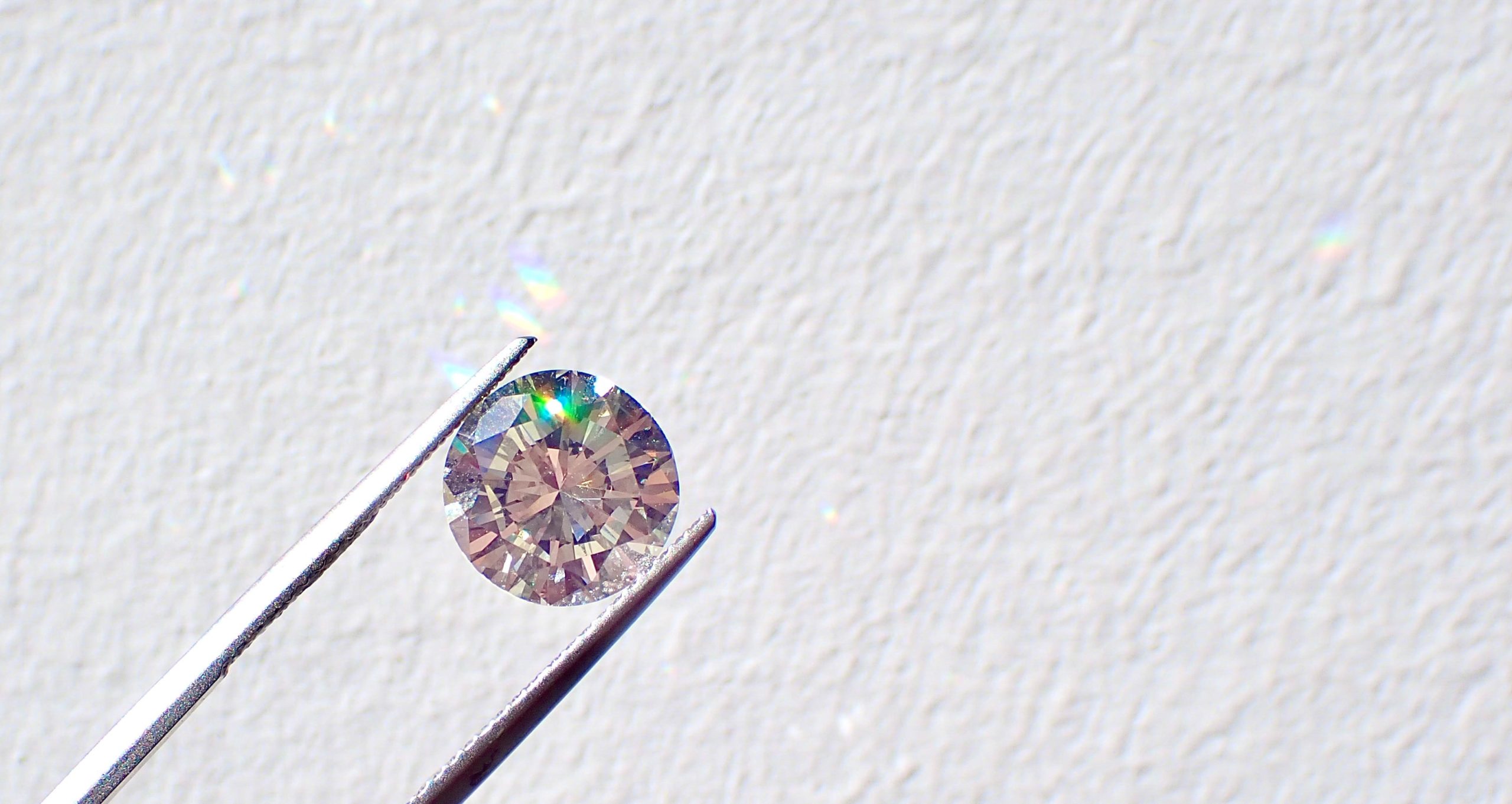
It’s a diamond. Pear-shaped, three carats, flawless as far as Lola can tell. Extracted from the ear canal of an 88-year-old man complaining of unilateral hearing loss.
“How’d it even fit?” I ask her.
She’s giddy, breathless on the phone. Normally we text. Phone calls are for truly notable events. Emergencies.
“He had big ear canals.”
She laughs into the phone. The old man, her patient, she tells me, was a widower. His wife loved jewelry, but he doesn’t think he recognizes this diamond. But it must be hers. Maybe, he speculated, it fell out of its setting, then worked its way over to his pillow, and he slept on it such that it worked his way into his ear.
“Seems improbable.”
She laughs again. It doesn’t matter, her laugh seems to say, because the world holds possibility now. If diamonds the size of acorns can fall out of people’s ears, what else might the future hold?
“It’s the only thing we can come up with,” she says. “He certainly didn’t shove a diamond up there. My patient wanted to give me a reward,” she continues. “He wanted me to keep the diamond at first, but I wouldn’t accept it.”
“Wow,” I say. “It can’t be real. It must be some kind of prank.”
She doesn’t respond, but I can feel it over the phone—sudden, like a storm cloud. Her mood has shifted. An automaton speaks in Lola’s place, with her voice, her intonation, but no feeling.
In the living room, I can hear Danny and Peter’s soft groans and triumphant whoops as they play a video game together. It’s a pastime I hate, but Peter says it’s a source of connection, a way of accessing Danny. What he sees in our boy then—eyes glazed and glistening in the reflected light from the television monitor, the controller slick in his plump hand—I do not know. It’s in those moments, over the blip and bleep and laser zap, the enemy combatants on screen, that my son is most inaccessible to me.
“He can hear better now. Without that diamond in his ear.”
“I’ll bet. It’s a miracle.”
The first time was saw Danny on the ultrasound screen, that ghost-image of him, the whoosh of his hummingbird heart, I said the same thing. It’s a miracle. Miracles, I believe, are fraught. Turn them on their sides and they can look like curses.
Danny’s shriek pierces the silence. He cannot bear it when the space alien hordes or robot intruders—or even Peter, especially Peter—defeat him. He cries out again. Something heavy strikes the floor.
“Like attracts like,” Lola says. One of her sayings. Were we living in a different time, she would be arranging burnt offerings to the gods, gifts of sheep and goats. She’d believe in augury, favorable phases of the moon; in fact, she believes in these things now, in their modern form, delivered via internet astrologers.
We hang up, and Peter comes into the kitchen to pour himself a glass of water. I can hear Danny muttering angrily in the other room. The world has splintered unforgivably into disappointment, lacerating him. It takes so little, I think, to wound this child, my son. Peter glances at me the way he often does—as if I’m a benign shadow, a pleasant person who is hardly there.
“He says he’s not going to the end-of-school dance,” Peter says. “The girl he wants to go with can’t go with him.” There’s the dull thud of something being thrown in the other room, striking the wall and landing on the floor. Peter looks at me meaningfully, as if the dance explains Danny’s current tantrum. In his mind, there’s always a reason behind the reason. Perhaps he’s right. But Danny also simply hates to lose.
“So he can go solo,” I say. I detest the thought of these dances—an infliction of misery. The administrators should know better. I recall my own luckless youth, my terror as I cowered beside those other girls, my peers, who moved with confidence, abashed and proud of their little teacup breasts, girls who kissed their boyfriends by the darkened bleachers. I was sick with fear, alone, and horrified at my aloneness—hideous, it seemed to me at the time, although in retrospect I see I was only shy and utterly ordinary.
“The other kids are all taking dates,” Peter says.
I consider this a moment—my son, who still sleeps with a plush turquoise seal. My son, filled with such a thwarted ache.
“What about Kara?” I ask.
Kara Evans is our neighbor’s child, a sweet, awkward girl one grade below Danny, his friend since preschool. At least, they used to be friends.
Peter shakes his head. “I don’t think so.”
In the living room, I find Danny curled on the couch. His frustration has dissipated, leaving him hollowed, silent. There are dark crescents beneath his eyes like those I’d expect to see on an overworked adult. Like Lola, he seems to have a way of retreating into himself, turning stony and inaccessible, present in body only. Two hardcover books lie on the floor, where Danny has thrown them.
“Hey buddy,” I say, taking the spot next to him on the couch. He shifts his body away from me, almost imperceptibly. He manages a reptilian stillness, his hooded eyes at half-mast, breath barely perceptible. What I wouldn’t give to know what he’s thinking.
“Dad says you aren’t going to the dance?”
His silence hardens. Is it even possible for him to absent himself further from me? I can smell the faint, unwashed musk of his hair, the hint of recently consumed cheese crackers on his breath. As a baby, he was the most impossibly beautiful creature, and although I love him, the ugliness I see in him now surprises me—a measure of his maturation into a wholly separate self.
“You could take Kara, I bet. I could ask her mom.”
He turns to me, and his mouth parts as if he’s about to say something. His lips shift to form not a smile, but a scornful expression. A sneer.
“We used to take friends as dates,” I offer. “No big deal.”
He rises from the couch, shaking his head at me. Like I’m an imbecile, a fool.
“You have no clue,” my son says, and I swear, his voice is an octave lower than the day before.
I check Danny’s laptop sometimes—or, rather, I used to. I did it frequently, hoping I might learn something about him, information he might want me to know on some level, but would never be comfortable sharing. I combed through it all: his browser history, webpages he’d visited, news articles he’d clicked, whatever profiles he’d last viewed on Facebook. Peter installed a parental control app that prevents explicit sites from showing up, but there’s still plenty there to paint a solid picture of Danny’s insecurities. His search history includes: How to tell if she really likes you . . . , easy ways to build muscle mass . . . , is it normal if . . . . “How to Drive Her Wild in Bed” was the headline of one article he’d clicked on several times, and seeing this, I wanted to shrivel up and die—although I wasn’t sure if my embarrassment was for Danny or myself. Normal mischief, I reminded myself. Normal curiosity.
There are, of course, the expected sites: video game reviews, Harry Potter fan fiction, critical essays on The Sun Also Rises, skateboarding videos. This viewing history reassures me. My boy has a boy’s interests.
Each time I snoop, though, I’m overcome with shame at myself, preemptive humiliation on my son’s behalf at what I might find. I dread stumbling on evidence of some darker current—incel chatboards, QAnon threads, all those angry young men yelling into the void. And yet I can’t stop looking. Lately, he’s been reading up on love spells and state marriage law. These facts confound and break my heart.
The other day when I looked, though, his top search phrases were how to get your mom to stop spying on you and what to do if your mom is the gestapo. The rest of the history had already been cleared. Fair play to you, Danny, I thought to myself. Message received. I closed the laptop, putting it back carefully just as it was, and closed the door softly as I slipped out.
Two days later, Lola finds a small ruby in the ear of an eighteen-year-old volleyball player. The next week, she plucks a sapphire from a retired math teacher. That Friday, there’s another ruby inside the ear of a 43-year-old military veteran. It’s wedged in so tightly that the man’s ear bleeds. By the following Tuesday, she’s pulled a freshwater pearl from a seventy-three-year-old former actuary’s left ear, and the local news station wants to interview her. There’s another pearl in the ear of a local orthodontist that afternoon. By Wednesday, the story’s picked up by the Associated Press.
Something strange is happening, an unspooling sequence of events from a fairytale. Danny and I meet Lola for lunch at the deli downtown. We sit at the picnic tables outside with our thick-cut sandwiches and wax cups of lemonade. Lola’s eyes seem too bright, her pupils enormous black holes. She hugs Danny, talking more quickly than usual, like she’s about to laugh or cry, like she’s just inhaled a bunch of nitrous oxide.
Lola’s going to be on Good Morning, America, she tells us. People are saying she has a kind of Midas touch, that she’s been blessed, or that she’s a witch. Or perhaps a charlatan, an illusionist pulling off a riveting prank that will eventually be revealed as the viral marketing campaign for a forthcoming movie. Some people are claiming the stones she’s discovered are fakes, junk-shop glass.
“But they’re real!” she insists to Danny and me, tearing into a bite of her sandwich. A local gemologist has volunteered to verify this fact. “People are so close-minded.”
None of Lola’s recent discoveries compare to the original diamond she found. The newer gems are smaller, mere accent stones rather than centerpieces.
“It must be a copycat thing,” I say. “Ever since that first diamond. It somehow got wedged in that guy’s ear by accident, like a one-in-a-million fluke. And ever since then people have heard about it, and, you know.” I make a gesture as if inserting something tiny and invisible into my ear.
“Stick rocks up their ears then come to see me?” Lola asks.
“Exactly.”
“But why?”
“To perpetuate a story. To be part of it. For attention. The same reason people participate in TikTok challenges.”
“The ear diamond went viral?”
“Exactly.”
“That’d be so weird, though. For people to do that.”
“It’d be absurd. But people are absurd.”
Danny slaps his sandwich back down on his plate so abruptly the plate jumps. Across the way, I see Kara Evans and her mother walking into the deli. Danny seems to glance at them with veiled, feline interest. His lip curls.
“You don’t believe in shit,” he mutters.
I hear him, but I don’t fully believe I’ve heard him.
“What?”
“I said, you don’t believe in shit.”
Danny stares at me hard. He’s delivered each word as a punch this time, puncturing the helium giddiness in Lola’s voice. Her brow crinkles, then softens to a look of concern.
I look at him. I do believe in certain things. I believe there are things we want—that we need—to keep telling ourselves; in the wish to be part of something larger, to experience something exhilarating. Magical. To not feel alone. But somehow, I cannot explain this to Danny.
Danny rises from the picnic bench. He grasps Lola’s hand suddenly, with such urgency I hardly know him.
I believe there are things we want—that we need—to keep telling ourselves.
He stands there a moment, his mouth moving as if he’s going to speak but says nothing. I remember the fairytale about a princess out of whose mouth no words fell, only jewels. Or was it frogs? Lola studies him, and it seems some knowledge is transmitted, something beyond my comprehension. He drops her hand and walks away, leaving his sandwich unfinished.
“Well,” I say after a moment. My gaze follows Danny across the patio, the stoop of his shoulder, the coiled way he carries himself.
When I turn back to Lola, I see that she is slumped in her chair, eyes half-closed. She blows a strand of hair off her forehead. All the pulsing manic energy seems to have dissipated.
“Everything okay?”
Her eyes widen, and she looks startled, almost like she’s forgotten I’m still there.
“Oh, Nell,” she says. “No, it’s all good. I’m manifesting. It’s all coming to fruition.”
She smiles so hard her eyes crinkle into two lines. She looks like she might laugh or cry.
“Oh, Lola.”
I reach for her, awkwardly across the picnic table. Then, thinking better of it, I rise and move beside her, pulling her close to me, my nose in her hair. She smells sweet, like freesia and the bacon from her sandwich. Across the way, Danny has disappeared. Nothing but the moodiness of a teenager, I tell myself.
“I just needed to believe. To commit to my vision. It’s never the way you think, when your prayers are answered.”
She’s smiling and crying, looking at me with such raw joy that I’m terrified to ask her what she means.
“I thank Danny. He’s been crucial, Nell. He’s been my guide in so many ways.”
I check Danny’s room sometimes, too—his drawers and closets, under his bed. Or, rather, I put his laundry away, and when I do, I can’t help but notice things. Inconsequential things, mostly: an empty can of lime La Croix, a half-finished bag of Doritos (despite the fact that I beseech him not to snack in his room), a crumpled trigonometry quiz, notes for a paper on Joseph Heller’s Catch-22, a ticket stub from the local movie theater, scraps of yellow paper with inscrutable messages to himself, words in tiny print, numerals like 1111, 222, 3333 written over and over.
Yesterday, when I was tucking Danny’s folded t-shirts back into his drawer, my hand brushed against something silky. I let my fingers linger and felt the edges trimmed in lace. Hesitantly, I pulled the fabric out and saw a pair of women’s panties. Hanky Panky—the expensive type I know Lola is partial to. They were lavender, buttery soft in my hands. Call it an instinct, a gut feeling: I knew they were hers.
I imagined how it happened: Danny, finding himself with a moment alone over at Lola’s, slipping into her room, pulse quickening as he peered into the drawer of fancy undergarments in sherbet colors rolled tightly into rows, neat as a department store. Danny, allowing the tips of his fingers to brush gently over the fabric. It would be so easy to slip a single pair into his pocket. A reminder. A talisman.
I will tell her, I told myself. About this violation. Completely inappropriate. Danny would have to be confronted. But he was also just a child, a child surging with hormones, yes, but a child nonetheless. It would ruin everything with Lola—perhaps make things so awkward she’d no longer be comfortable coming to our home. And Danny would be humiliated in front of the one person who saw such specialness in him. And what if I was wrong? If the panties were from elsewhere? A school friend, a buddy, some sort of ill-conceived department store shoplifting dare. I would wait and make sure, I told myself. Either way, the fact of it would need to be confronted. I could take my time and make sure I handled it properly.
A single pair of panties would hardly be missed.
Peter is home when I get back, working in the garden. He swipes the back of his hand against his forehead and waves at me. He looks natural out there, handsome—the sort of person who has always existed honestly with himself, to whom things have come naturally. Even the plants seem to curl toward him, flowers unfurling in his presence, as if he is the sun.
“Good lunch?” he asks.
“Have you seen Danny?”
“He’s upset.”
Peter gestures to the little patch of undeveloped land behind our house. The woods, Danny calls this area. The forest. The river. It’s a scraggly patch of land covered in weedy overgrowth, kudzu and muscadine, wisteria and honeysuckle, burs and briars and beggar’s lice. A drainage ditch runs through it. There are copperheads out there. Ticks and mosquitoes. Danny loves it, despite our protests. He’s set up various little encampments beneath the trees since he was little. Neither Peter nor I have the heart to tell him how far this is from a real forest, how pitiful it is by comparison. He’s laid claim to it. It’s his.
“Oh.”
“I think he needs a moment to himself.”
Peter squints again, as if trying to discern a figure just beyond me. The sun is intense, a white-hot beam of heat irradiating my shoulders and back. A wave of nausea passes like a darkening cloud.
“Oh.” I say it again, stupidly, an empty syllable.
“Nell,” Peter says. “Wait. We’ll talk to him this evening.”
“I’m finding him now.”
I’m gone before Peter can answer, through the backyard and down the hill, to the sloping bank. There’s a chain-link fence with a slumped section from people having climbed over and through it so many times. I pull myself over, already starting to sweat.
The trickling drainage ditch almost looks like a stream, but it has the queasy smell of sewage. A fat groundhog startles and moves from my path. I cross the water and haul myself up the other side. There, beneath a large overhanging stone is a flat area, a kind of half cavern. Crouched beneath it, I see Danny, in his bright blue shirt, kneeling on the ground. I’m approaching from his deaf side, so he can’t localize me at first.
“Danny!”
He spots me, scrambling backward, crab-like, trying to conceal whatever’s on the ground behind him. I can see a rough spread of color, objects. Items of clothing. A pair of shoes.
“Leave me alone!”
“Danny.” I’m breathing heavily, climbing the rise. “I just wanted to check on you.”
“Go away!”
He’s flushed, splaying his arms, trying to conceal the ground beneath him. I can see it’s the large dirt drawing of a person, windblown and smudged now—but I can discern legs, arms, a face. There are a pair of shoes where the feet would be, shorts, a shirt, pine straw arranged for hair, crude features carved into the mud that would be the face, runny and distorted by recent rain. A woman, I realize, noting the way the dirt is humped into two discrete mounds for breasts. A mud woman who is, I see now, adorned in belongings I recognize as Lola’s: a running tank top, a hemp bracelet, soft pink panties trimmed in lace. A black bra. There are two small gold hoops I recognize in the spots where the mud woman’s ear lobes would be.
“That’s Lola’s stuff,” I whisper.
A silence follows, suspended between us, iridescent, like a bubble, and then something falls in Danny’s face. He scowls.
“It’s nothing,” he says, answering the question I haven’t asked. “I don’t even need it anymore.” The mud-woman, Lola, lies supine beneath where he sits—a grotesquerie.
“You stole from her,” I repeat, my throat filling with a sour taste. “And this—get rid of it, please.” I gesture to the mud-woman, although I can’t look at her again.
“I didn’t steal from Lola,” he says. His face is defiant now, dark eyes flashing as he rises to stand. He is taller than I am now, this son of mine. It’s hard in this moment to remember that he’s the same child I bore. He could be anyone—a stranger, carrying hatred in the lines of his jaw.
“You did.” I point. The answer is obvious. It’s all there—not just a single pair of undergarments, but a whole treasure trove. A sick shrine. The urge to vomit rises within me.
“These were gifts,” he says.
“Gifts?”
There must be incredulity, confusion on my face, because he scoffs at me, a horrid sound. Hard-edged, like glass.
Then, a look—satisfaction? smugness?—passes over him.
“You’d never understand. You’re jealous.”
I’m parched. I cannot speak.
“You never listen,” he whispers. “You poke and prod, but you never really listen.”
“Get rid of that,” I say, pointing to the horrible drawing.
“And you’re socially awkward—I got that from you. It’s your fault.”
“Get rid of it.”
“I don’t need it now anyway. Not anymore.”
We stand facing one another, wordless. I watch his skinny shoulders rise and fall with his breath. Then I’m tearing back down the slope, letting the sharp grasses slash my ankles and calves, stepping right into the dank, reddish water. Branches slap against my face and arms and tears sting my eyes.
Back at the house, I stop on the patio, gasping for air, a diver surfacing from a dark pool.
Peter is putting away dishes when I go inside. He turns to me.
“How’s Danny?” he asks.
“Fine,” I lie, although there is a flip-flopping in my chest.
He smiles despite the sadness in the corners of his eyes. Peter is an attractive man, good with people, easily liked, quick to make friends with new neighbors and passersby. In this regard, maybe he will never understand me, or Danny—at least not completely.
Here is what happens:
Danny skips the school dance, and Peter and I muster a ferocious good cheer. We insist on watching one of Danny’s old favorite movies as a family, eating takeout pizza and drinking flavored seltzer. There are explosions onscreen, large-bosomed women in sleek outfits, macho bonhomie between the main character and his sidekick. Goofy jokes, an obvious villain, a bank heist. Peter guffaws appreciatively. Danny sits sullenly apart from us in the corner of the room while elsewhere, in a dim gymnasium strewn with multi-colored streamers, all the other sophomores dance with one another, rocking on their heels together to the slow songs beneath strobing lights.
The next day, Lola, appears on Good Morning, America, talking about her discoveries, the gemstones she’s found in the ears of everyday people, like it’s a feat of her own ineluctable willpower. What faith—to believe you’ll find a glowing diamond where none should be and, lo, to pluck it free!
Danny and I watch Lola together on television. Her face appears pale and painted, her smile strained. The skin is stretched too thin. She’s a grinning skull on the LED screen; I think of the jeweled catacombs of kings, piles of treasure with empty-eyed skeleton guards, memento mori. Lola moves her hands quickly, drawing elaborate shapes in the air, making expressions of surprise. She’s describing love vibrations and manifesting, the laws of attracting such good fortune, demonstrating how she worked the first diamond out of the old man’s ear ever so gently. The hosts gush. Speaking of the power of manifestation, they announce, they have a big surprise for Lola.
Before the live audience, out walks an older gentleman in a rumpled suit, looking bashful and handsome, waving to the crowd. Lola gasps with apparent happiness. Her hands are at her mouth. The man smiles and bows, and a rolling script at the bottom of the screen declares him to be Lola’s patient, the one from whose ear she extracted the first diamond. Good Morning, America has arranged all of this. He holds one hand outstretched, offering Lola a small velvet box, inside of which rests a diamond—the very diamond! It is familiar to me, but maybe every diamond looks the same. The old man, a widower and believer in true love, knows—he just knows!—there’s a special someone in Lola’s life. And he wants the diamond to be hers, with all his blessings and well wishes. Unconventional, perhaps, but he wants Lola to have the opportunity to use the diamond to propose!
I watch Lola hug the old man. Yes, there is a special someone, she says. Her soulmate. The hosts gush and ask Lola to tell them more. She describes a man with salt-and-pepper hair, a financial planner with a generous laugh and a penchant for pickleball and Stracciatella gelato. A figment, I realize. A fiction. I watch her perform this dumb show for an audience of millions as slowly, a cool knowledge settles around my throat. Lola’s eyes seem to bore directly into mine from the television, and I realize I know who she really means. I’ve noticed what she’s wearing around her neck—a silver dollar with a splotch of purple enamel hanging on a silver chain. It dangles there, suspended just above her breasts. A lucky charm. Danny’s lost coin. A coldness, a runnel of water on a wall of ice, rolls down my back. I think of every child, Danny included, moving along a conveyor belt into full personhood, into inscrutability.
“There,” I whisper to Danny. “Your coin.”
But Danny has already left the room. He knows. And maybe I know nothing: maybe I have always known. The blood rushes through my head so fast, in such mighty torrents, that it’s deafening.
Peter walks in. He is holding something, his face knotted with concern: an empty bracelet, an anniversary gift that he gave me on the tenth year of our marriage, only now the rubies and sapphires with which it was inlaid are gone. The prongs are splayed, having been pried apart. And where are the pearl earrings I inherited from my great aunt, Peter wants to know? Or better yet, the engagement ring I find too cumbersome to wear, its gem a family heirloom passed down from Peter’s grandmother? Have I checked my jewelry box recently? He’s worried, Peter says, that Danny’s taking things.
I furrow my brow but say nothing. A new solution is rising in my mind—elegant and wrong, but also right. Soon enough, Danny will turn eighteen. I can stay quiet until then. Like an illusionist at a child’s party, I will perform my own magic, will pluck, not jewels or coins, but tiny, folded bits of fortune-cookie paper from their ears—Danny’s, Lola’s, Peter’s. Voilà! They will laugh and applaud, all of us together, right there, in the kitchen. Your true love was right here all along, I’ll read aloud—three identical fortunes, three fates sealed. It will be good, I promise myself. It will. As if I hold authority within me. A prophecy. As if saying it will make it all true.
I have always loved fairy tales. I love their economy of language and all their archetypes. They were the first stories I remember hearing, and they left their mark on me. I’m sure I’m not alone in this. Consider all that you imagine and remember when you read simple, two-word fairy tale phrases: “dark forest,” “magic mirror,” “enchanted sleep.”
As a kid, I was captivated by fairy tales’ ability to normalize the utterly strange. They weave their magic into the fabric of an everyday world where nobody questions that a frog can become a prince or that a grandmother can be eaten by a wolf.
When I became a reader and then also a writer, I saw that fairy tales are capable of the opposite, too. Retold with minor changes, a fairy tale can show that what we take for granted as normal—our everyday world—is, in many ways, utterly strange.
Imagine the dark forest set on a planet mostly destroyed by climate change, the magic mirror in a story of race and identity, or that enchanted sleep in a tale about the unrelenting passage of time. Suddenly, these age-old fairy-tale objects are speaking to us about our real world, showing us how very odd it all is.
In writing my debut novel, it felt natural to draw from fairy tales. So natural, in fact, I didn’t even realize I was doing it until I was almost done with a first full draft. But once I did see it, I leaned into it. The Museum of Human History reimagines the story of Little Brier-Rose, or Sleeping Beauty. It centers on a young girl in a strange coma who stops aging. Though the world of the book is fictional, the fairy tale themes and structures allowed me to examine the peculiarity of being bound in and by time.
Below are seven other books that use fairy tales to reveal the strangeness of our world.
Diane Cook’s The New Wilderness is many things at once: a survival narrative, a climate fiction dystopia, a mother-daughter tale, and a modern fairy tale.
The novel takes place in a futuristic society that feels disturbingly close to our own. Overpopulation and pollution have made cities largely uninhabitable. The children who live there grow increasingly ill. Bea, Cooke’s protagonist, flees with her husband and their daughter Agnes to the Wilderness State.
The Wilderness State is the final piece of untouched, protected land in this otherwise ravaged world. The volunteers who live there are nomadic, surviving off the land. The experiment underway is to see if humans are capable of coexisting with nature without destroying it–but it may destroy them in the process.
Much like a fairy tale forest, the Wilderness State brings Bea and her daughter refuge and danger. It offers freedom while it also confines them. And it shapes who they become and who they are to one another. The novel feels, in some ways, universal and timeless in its depiction of parenthood, and in other words highly specific to this moment–parenthood in the era of climate collapse.
Each story in this collection is its own dark fairy tale with its own magic and normalized strangeness. To focus on just one example, “The Husband Stitch” reimagines a story from the book Scary Stories to Tell in the Dark by Alvin Schwartz. That story–“The Girl with the Green Ribbon”–is itself a retelling that dates back centuries.
In Schwartz’s tale and in Machado’s, a woman wears a ribbon on her neck. She will never say why despite her husband’s questions. Eventually, her husband unties it, and the woman’s head falls off her neck and onto the floor.
Machado mines this story for all that it might say about bodily autonomy, sexism, and consent. She leans into the fairy tale context, too. The opening assigns voices to use for the characters when read aloud, acknowledging both the oral tradition and the archetypes she is evoking. For the character of “all other women,” the narrator–or the storyteller–notes that the voice can be “interchangeable with my own.”
Even for a reader who, like me, can remember reading the Schwartz tale in vivid terror as a child, there is surprise in Machado’s version. It is body horror born of an all-too-real world where a human body frequently is an object other bodies control.
Like all the best fairy tales, The Memory Police resists any one interpretation. The novel takes place on an unnamed island where, periodically, objects disappear from memory: maps, emeralds, ribbons, birds. The residents of the island will wake up knowing something has been forgotten and gather to get rid of any remaining objects they might have. Slowly, they forget the objects ever existed at all. Officers from the Memory Police enforce that all lost objects remain lost.
There is a flatness to the telling, narrated in a detached first person with little emotion. The residents of the island feel very much like one-dimensional fairy tale characters, lacking psychological depth. And why shouldn’t they? They are being further flattened all the time as the depths of their memories are hollowed out. The novel takes this flattening to an extreme that is both absurd and relevant. There’s much to contemplate as it relates to issues of censorship, surveillance, collective memory, and history. The original Japanese was published in 1994, but this story feels like a myth born of this very moment that has also existed forever.
Ausubel’s novel takes place in a remote Jewish village in Romania during the Holocaust. Faced with tremendous fear about the future, the villagers decide to create a new world for themselves rather than flee. Together, they tell the story of their world’s creation and they live inside that story. Everything is new in this Genesis-like storybook era of the book’s first seven days. They must decide if they should still be married to the same spouses, if they should already know of and possess certain tools, if their children should still be their children. In some cases, they decide no. Lena, the eleven-year-old narrator, is an all-knowing storyteller with magical insight into what is happening for everyone inside her village–but no one outside of it.
It’s understandable if a fairy-tale fantasy about the Holocaust sounds like an off-putting premise. In truth, I wouldn’t recommend it if it wasn’t also self-aware of this fact. The power of Ausubel’s novel is that a reader will be keenly aware that on the other side of the whimsical, hopeful story of creation there is destruction and atrocity, the very real horrors of the Holocaust. This history is never very far off, despite the new history that the characters try hard to invent for themselves instead.
In Exit West, Moshin Hamid gives readers a love story and a vision for what the world is and might be. Nadia and Saeed fall in love just as their country descends into civil war. There are rumors of doors that have begun appearing. Stepping through these doors takes you far away, to other, maybe safer, lands. Nadia and Saeed don’t know where they will go, who will meet them there, or what will become of them. But seeing no other options, they find a door and step through.
In Hamid’s immigration tale, these doors are an element of normalized, fairy tale magic. They condense the actual immigration to a matter of steps across a threshold. It’s not an easy journey though. “It was said in those days that the passage was both like dying and like being born,” he writes.
It is not an allegory, but rather, Saeed and Nadia’s world refracts our own like a prism, showing the plight of refugees. It confronts us with the flaws in our immigration systems and the strange power that invisible borders hold over lives.
In Boy, Snow, Bird, Helen Oyeyemi reimagines Snow White. The novel makes its fairy tale connections clear from the outset, with the title nod to the Brothers Grimm. The three common nouns are also its three main characters. In 1950’s New England, Boy marries a widower and becomes stepmom to Snow. Soon, Boy becomes pregnant and gives birth to Bird. Bird’s darker skin reveals her husband’s family secret.
Oyeyemi’s story is deeply rooted in history, politics, and societal issues. Through the fairy tale, we see our own world’s fixation on appearance and on race, and how these constrain our identities, relationships, and families. The very first line delivers a fairy tale object that fits perfectly in this examination of identity: “Nobody ever warned me about mirrors,” Boy begins.
Temporary is a fairy tale about employment. It uses the genre we know from childhood to tell a story distinctly from the world of adults. Leichter’s novel asks us what it is we dreamed of being when we “grew up.” And what are we? It is a surreal novel of transformation and belonging and how what we “do” shapes who we are.
The unnamed narrator is a temp employee who finds all kinds of jobs. She works on a pirate ship, for an assassin, and opening and closing doors, to name just a few positions. She throws herself fully into each of these roles, but none of them last long and she is forced to move on.The book operates in its own weird and fully formed logic. The main character’s quests are broken up periodically by the myth of the First Temp. While there is a sense that this universe is, indeed, an entire universe with its own history and folktales, it is not a parallel universe to ours. It intersects with our reality under late capitalism. After all, in our world, too, we must find a way to “earn” our living.
I can go back to the morning I learned my father was dead moment by moment, exactly as it occurred, like I’m there again. I’m twelve-years-old. I’m supposed to be at school. I creep up the stairs, and I see my sisters and mother sitting on the couch. They stop whispering the moment they see me, so I self-consciously remove the headgear from my teeth. My mother beckons me over to her, which feels strange and out-of-character, but I oblige and sit on the edge of the couch as she kneels in front of me. “Something happened to Dad,” she says, and I know I’ve lost everything.
I spent my youth as my father’s number one fan, diving into sports, watching terrible Adam Sandler movies, crying onto math homework late into the evening because I didn’t want to finish it without his help. Even now, I find myself navigating each day resentful of losing that presence all daughters are supposed to have.
These seven books portray the fragile and complex relationships between fathers and daughters, and the shock as that bond is forever severed.
Almost a decade after the sudden death of her sculptor father, Dancyger revisits his notebooks, piecing together his life and art as she recontextualizes her grief. Hearing stories from old artist friends of his, she learns about a lost love and the beginnings of his heroin addiction, and finds parallels with her tumultuous youth in New York. Dancyger wonders how to reimagine her relationship with her father without him physically there—knowing her adult-self is an entirely new individual he could never meet. Losing a parent at the cusp of teenagerdom means configuring an identity without feeling wholly human. It’s an impossible feat that leaves you feeling guilty and angry. Nevertheless, Dancyger writes, “I started to think of everything he made as a call, waiting for a response. […] I had a moment of crystal clarity that with all of this searching, I was trying to respond.”
Following her father’s suicide, Jessa-Lynn Morton inherits his failing taxidermy business and ever-growing debt. She has a rude awakening when she spots the stuffed animals in the shop’s window posed in kinky positions at the hands of her mother, whose overwhelming grief is finally coming to a head. Jessa does everything to push her feelings aside, refusing to vocalize her pain, instead self-medicating with alcohol while desperately hiding her feelings for her brother Milo’s ex-wife. But this emotional suppression only lasts so long once her mother gets the opportunity to display her erotic taxidermy art publicly. This is a messy, whirlwind of a novel that shows the harshest, ugliest sides of grief, and the sheer power of vulnerability. Mostly Dead Things shows us that no one truly grieves alone, that isolating ourselves in our pain keeps us from holding onto the people who understand our hurt the most.
At the height of the pandemic in 2020, mere days after talking with him via Zoom, Adichie learns that her father has died from complications of kidney failure. The news is paralyzing, and because the Nigerian airports are closed, she is unable to reunite with her family in Abba. As she recounts her father’s life—his courting of her mother, his accomplishments as a renowned professor at the University of Nigeria, the impact of the Biafran war, the pride he held for her—she reveals how much he was adored by the community, his family, and daughter. But how do you put the shock of all-consuming grief into words? Adichie writes, “Grief is a cruel kind of education. […] You learn how much grief is about language, the failure of language and the grasping for language.” Her incredibly visceral writing makes the agony, pain, anger, guilt, and confusion so palpably real, like you’re experiencing the hurt with her, directly by her side. Reading Notes on Grief I thought, this is that exact feeling. This is that pain right on the page.
A departure from the other books in this list is “family tragicomic” Fun Home by cartoonist Alison Bechdel. In this graphic memoir, Bechdel recalls her adolescence in a pristine Victorian house renovated by her father, a volatile man she struggled to connect with. When she comes out to her parents as a lesbian in the form of a letter, she learns that her father had affairs with men. This stuns Bechdel, and things become more complicated when her father dies weeks later after being hit by a truck, which she determines to be suicide and the “effect” of her coming out. In Fun Home, she desires to be truly seen by her father, a man who cannot truly live authentically himself, and seeks out this connection again through the page as she reflects on her childhood and his death. This heart-wrenching, beautifully illustrated book is considered a classic in the sapphic community for good reason.
A novel entirely in verse, Clap When You Land merges the stories of two long-lost sisters, Camino and Yahaira Rios, whose worlds shatter when their father dies in a plane crash. Camino lives in the Dominican Republic with her Tía, a curandera, and dreams of going to Columbia University to become a doctor. With her father gone and reality crushing her like a stone, her aspirations feel impossibly out of reach. In New York, Yahaira is a champion chess player, who abruptly stops competing when she discovers a marriage certificate in her father’s office and learns he had another wife. After the crash, Yahaira shoulders her grief alone as her mother crumbles, not knowing how much longer she can hold onto her father’s secret. After an impulsive Facebook friend request, Camino and Yahaira discover each other for the first time. The novel’s preciseness in verbage and space allows the girls’ overwhelming emotions to be explored to the fullest extent, with all the weight required, even as they feel isolated within their own worlds.
A few weeks after sending her parents a manuscript of her debut memoir All You Can Ever Know, Chung’s father dies from complications with diabetes and kidney disease. At a book festival over nine months later, she receives a call: her mother has ovarian cancer. As her mother’s condition worsens, Chung grapples with facing her mother’s death without her father by her side. Growing up in Southern Oregon as a Korean-American adoptee to white parents, Chung describes the isolation of being the only Asian child in a classroom and the desire to seek out belonging elsewhere. But being miles away from her parents fosters guilt, especially after her father passes and her mother receives her diagnosis. A heart-wrenching exploration of “grieving under capitalism,” this memoir portrays the agony of losing someone as a result of the nation’s costly and inadequate healthcare system.
After the death of her photojournalist father, MacDonald makes a shift in her life and decides to train a young goshawk, a wildly misunderstood species of bird that faced near extinction hundreds of years ago. As she revisits T.H. White’s misguided 1951 book The Goshawk, MacDonald sees her own experience mirroring the author’s: the fear of making a vital mistake and risk the hawk loathing you, the projection of the child-self as the headstrong hawk and the adult-self as its empathetic and patient teacher. In this gripping, unflinching love letter to birds and falconry, MacDonald writes, “Some deep part of me was trying to rebuild itself, and its model was right there on my fist. The hawk was everything I wanted to be: solidarity, self-possessed, free from grief, and numb to the hurts of human life. I was turning into a hawk.”
The last animal lives on, Ramona Ausubel promises. Loss changes us and leaves its imprint in “a reminder of the moment [we] trampled, gathered, built, destroyed, imagined, loved.” Joy abounds on each page, as does curiosity, playfulness, mischief. This is because the novel is told from the perspective of two teen sisters on an unlikely adventure.
Ausubel immerses us in myriad new worlds, from a paleontology lab to frozen tundra to the untamed land of teenage conspiracy. The sisters travel to Siberia, Iceland, and Italy with their mother Jane, “a 38-year-old grad-student sing-mother widow” and “dirt dentist.” 13-year-old Vera, who loves to bake and craves security, revisits her father’s death as a crash that is “always happening in her own mind.” Eve, 15, knows how to be angry out loud. Jane—invisible, overworked, exploited—is part of a team trying to complete a gene sequence that will reverse extinction for the “cold-adapted elephant.” She carts her daughters along because they cannot be left alone, but we intuit that in her mourning, she cannot bear to be away from them even as she constantly creates distance between parent and children. Their dialogue, snappy and warm, turns the family into a herd. The little pack, together imperfectly, confronts grief and sexism to do the unimaginable: bring back the wooly mammoth. This is, as Ausubel tells us, “invention and memory at the same time.” It is also a poignant fantasy: bring back megafauna and the mammoth steppe, heal the planet.
It dawns on us—both reader and character—that when we begin to fantasize about turning back the clock, we’re running out of time. And yet, in this novel, we are reminded constantly of the insistence of living creatures—in “the outline of wild horses,” a fish eagle in the branches with “its white face feathers reddened with blood.” The Last Animal reminds us that this is a world cared for and saved—to whatever extent it can be—by women and girls.
Annie Liontas: Tell us about the wooly mammoth. How is it the quintessential image of extinction? What does it say about us that we fantasize about bringing it back (and that some biotech companies are working to make this possible by 2027)?
Ramona Ausubel: Eight years ago, when a story flash across my laptop that said that humans were preparing to de-extinct the woolly mammoth, I felt very suspicious—like, What? We are destroying everything. Why do we do these things? Why can’t we just take better care of what is already here? But the more I read about it, I also felt a tender sweetness towards the idea that we could bring something back, that we could use our big juicy complicated human brains to make some replacements rather than making deletions all the time.
Of course, any project that we undertake— especially something we’ve truly never tried before—is going to be packed with all sorts of unintended consequences. We have no idea really what will happen. The theory is, you take the Asian elephant genome, which is 90% the same as the woolly mammoth, and you switch out the code that tells it to stay like an elephant and put in the code that tells it to turn into a woolly mammoth. And then we grow that baby in a lab in a big plastic womb. All of this is planned out and probably will happen not very long from now. But we don’t actually know what that animal will be. It won’t be something that’s lived before, it will be a new thing that we have created. And then the idea is to release these creatures in Siberia and let them go on their way. We like to pretend it’s about science, but really we’re in love with the wooly mammoth. It’s like a shaggy, giant, loafy deer-looking Elephant. Maybe it’s Sesame Street, maybe we’re all just going back to that. Desire and want are really what we’re doing it for.
AL: So do you think there is a mythology around the woolly mammoth? Maybe by bringing it back, we think we can return to a better self? Almost like we get to start over?
We like to pretend it’s about science, but really we’re in love with the wooly mammoth.
RA: Yes! We were on the planet at the same time as wooly mammoth. The last ones went extinct only 5,000 years ago. Our two species moved together, we’d migrated north with those animals. In caves in the south of France, there are all these beautiful paintings of wooly mammoths. The skeletons of wooly mammoth were used in early architecture. People lived inside of the skeletons as a safe place. We used their fur. They’re part of our history. So there’s a kind of a feeling that by doing this, we could reset, and start the clock over again. We could go back to when everything was still here, and we were our early selves and could make a slight diversion and head off in a new direction. It’s as much about us and the way we feel about ourselves as it is about the way we feel about the animal.
AL: This is a book about a herd—a little family of three that perseveres even after husband and father Sal has passed. On one hand, the novelist Justin Torres reminds us that three the most volatile number in narrative, but on the other, we see Jane, Vera, and Eve really pulling together. What does this incongruity, born out of loss, allow you to get onto the page?
RA: The herd was supposed to be four. And then when the dad dies, his absence becomes the planet they orbit. They don’t know what they are now, because they have to redefine everything. Each of them has transformed in their grief and in their loss, and their relationships to each other have shifted without him. A lot of what is happening in the book is that they’re trying to figure out what kind of a herd they are now, and how they move, and what their loyalties are, and how they’re going to literally survive. How are they going to make enough money with one working parent who’s really still a postdoc and has no real salary yet? And is she gonna get a job, and how is she going to compete against men in her field who have a much easier road? So there’s the family herd, but then there’s the reality of being an individual in a larger society, one that is prickly and difficult and not built for any of these three people. The girls are well aware of this. The teenagers understand that their mother is not favored in the world that she’s in—in the world of science—and that they aren’t favored, either. And they’re going to have to help her make a leap, and they are gonna have to make that leap themselves. The only ones who are going to be able to solve any of this, if they can solve it at all, is them.
AL: You write grief as vastness, the way we might experience time or the ocean. It’s the bigness, you seem to say, that keeps us from reaching its end. How is grief the last animal?
We’re very impatient with all emotions in our culture, but we’re very, very impatient with grief.
RA: I mean, it is so creaturely, right? Like, it’s such a living thing. To lose something really big births a kind of creature in the person who has lost it, and it doesn’t go away. We think, “Okay, it’s been a month, I should be feeling better now.” But grief is a living beast that won’t follow any of those rules. It’s not just about how big or how small. Is it lying on the floor and chewing on your ankles right now? Is it just sitting in the center of your chest so that you can’t eat your yogurt right? Is it screaming in your ear?
Grief is a relationship. The griever is having to deal with what was lost and who they are now, and the very feeling of the loss itself. And the more that relationship is acknowledged as two real living creatures, the more it is honest and evolves in the ways that it wants to evolve so it can recede—and so that the person can move on and live their life. We’re very impatient with all emotions in our culture, but we’re very, very impatient with grief. That’s its own loss because we learn a lot from that relationship, and the way that grief is maybe a version of the animal that we are.
AL: As much as this book is about grief, it is also about making the world anew. Narrating from the points-of-view of the teenagers, particularly Vera’s perspective, creates possibility, whereas I can imagine that telling this from the adult perspective would make The Last Animal feel far more desperate. How did writing the sisters help you nail the book’s tone?
RA: Part of what the teenagers bring is a sense of that super “emotion-forward” existence that I remember so clearly from being a teenager, where I was feeling first and thinking second—or maybe feeling second, and third, and then thinking fourth. And even my thoughts are feelings, too! I think there’s real wisdom in that, an absolute necessity of living that way, and I don’t think that the adults in our world or the adults in this book could live without it. Jane, at the start of the book, constantly explains things with her brain. She is always having to justify with logic and reason—but that was not what this mission was ever about. With the sisters, the whole story just exploded open and I felt all things were possible, all the crazy choices were possible.
I started the book thinking about extinction and thinking about grief—and it’s still definitely about those things—but partly, because of the time that we’re living in, which is so saturated with loss, I was also writing toward hope and love and connection. And fun and joy and humor. This was an absolute necessity for me. It’s not a side game. To stay in that real joy, to stay in love with the world, and to laugh and feel connected to people is the way we’re going to move ahead. Joy is non-negotiable. The project of the novel is the project of trying to stay on this planet, and the only way we get that is to be in love with the planet and care about it, not just by trying to make the smart choice.
AL: The girls and women in this novel have a shared threat that enrages them: the patriarchy. Jane, who has all the breakthroughs, is forced to capitulate to her male colleagues. How do we see these women—even dubious Helen—subvert patriarchal structures?
RA: Some of this falls along generational differences. Jane is the mom, and she’s in it longer, and she’s kind of accepted things. She’s been indoctrinated into the patriarchy. At the same time, she tries to squiggle over and find another way through. She thinks, “It’s okay, you can put your hand on my shoulder, I’ll find another direction to move.” Whereas her daughters say: “Get your hand off her shoulder.” They’re much more willing to be angry about it and be bratty and upset with people, including their mother. They’re saying, “We can’t have this anymore, you can’t be squiggling like this all the time. We have to push back.” They’re partly angry at their mom, but they also end up helping her by not following the rules and by being willing to make things difficult. Some of the females are able to push against the patriarchy and the systems they’re in by being very sneaky and quiet and staying under the radar, and others take matters into their own hands—literally. In a cooler! They fly it off and find an elephant to put it into. That’s the biggest, most obvious version, but there are tons of other ways resistance happens across the book—how they’re being seen and heard, how they are reacting to those things, how they are making changes in themselves and in the world around them.
AL: Imagination and daring are, in this book, feminist principles. We see Jane and the sisters taking risks for a greater vision, one that will make the world a richer place. How do you experience these ideals in your life, and among feminists you know?
RA: I do feel like imagination and daring absolute necessities, but I don’t think we are told that. Maybe that’s another generational change. I grew up with the feeling that feminism was an argument and a fight and that always necessitates armored strength. I am not the person with the sword and the suit of armor. I’m not really interested in moving that way. I’m not good at it, and it feels like it requires me to put away the person that I actually am. And I think that that approach only one of the ways to do it, and we need all of the ways, because this is an intricate centuries-old system built to last. It is built to keep everything in this exact order forever, and the power structures are still running. In order to defy them, we need every possible tool and way of being that we have. We need the people who have the sword and the armor, and then we also need to have the people who are imagining the many different possibilities, who are paying attention to each other and striving in ways that that are quieter and more intricate and more tender.
DON’T MISS OUT
Sign up for our newsletter to get submission announcements and stay on top of our best work.
YOUR INBOX IS LIT
Enjoy strange, diverting work from The Commuter on Mondays, absorbing fiction from Recommended Reading on Wednesdays, and a roundup of our best work of the week on Fridays. Personalize your subscription preferences here.