Everything began with a tube of dried-out lipstick.
The cat pulled it out from under the fridge.
Julie and I nicknamed the cat The Inspector. She was new and so was the house. We moved in after my third miscarriage, when I was bleeding and desperate for a fresh start.
The Inspector sniffed our old things with suspicion, especially the framed embroidery—a wedding gift—that said Katie & Julie Forever.
Julie had not wanted children when we met. For me, she’d been willing to try.
I had come to suspect she was relieved things had turned out this way.
The dried-out lipstick belonged to neither of us. It was fig flavored.
“Must be a former tenant’s,” Julie said, tossing it in the garbage.
“Unless you’re having an affair,” I joked.
“No mistress of mine would wear fig-flavored lipstick,” Julie retorted.
We hadn’t slept together in months.
The Inspector could reach into spaces we couldn’t see.
Crevices between sink and dishwasher. Openings between stove and counter.
“Who knew our home had so many cracks and gaps,” I said. I was holding an unfamiliar pen the Inspector had surfaced.
The Inspector leapt onto the counter between Julie and me, knocking the pen out of my hand.
Julie was already moving out of the room. These days she worked late and took dinner into her office. She fell asleep on the couch and showered in the guest bathroom.
“I’ll get some caulk this weekend,” she called over her shoulder. “Fill in the fissures.”
But she kept forgetting, and so the fissures remained.
Every day The Inspector found something new.
An earring excavated from beneath the sink.
A frayed dog toy pawed from under the fridge.
One day, she found fragments of expensive-looking china.
The next, a yellowed pacifier.
“They left a lot behind,” I said to Julie, holding the pacifier. “The former tenants.”
I was in my frayed robe. She was sending emails. I put the pacifier in my mouth; she didn’t notice, and so I took it out.
“Probably didn’t get their deposit back,” she said. “Or this stuff is from multiple tenants.”
“The past and present commingle beneath the fridge,” I said.
My capacity for this sort of analysis was one reason Julie married me. But she didn’t laugh or ruffle my hair. She just replaced her earbuds.
I wondered when I’d first ceased to charm her.
For a while, The Inspector brought us nothing.
She sat, crouched and vigilant, staring for hours at the shadows beneath the heavy mahogany piano.
The piano had been a selling point. Neither of us played, but I thought its presence was romantic. I fantasized about duets. I daydreamed of lessons side-by-side.
Julie thought we could sell it. “We can put away the money for a new fridge,” she said. “Or a deep-clean of the place.”
For days, the cat stared into the dusty darkness beneath the piano and I stared at her.
“Maybe we have a mouse,” I said to Julie.
“You worry too much,” she said, before disappearing into the office.
After she locked the door I heard her exhale, relieved in her solitude.
On a winter morning, The Inspector dropped a human finger beside our bed.
I screamed. What else could I do?
Julie was in the office. She didn’t run to me—she walked.
“Is that real?” she said.
It was a pinky finger. There was a tiny tattoo of a palm tree on its knuckle.
The tattoo was badly done—blurry at the edges.
The skin looked all wrong. Like the finger had been detached from its owner for a long time.
But the fake nail was immune to time’s passage.
Gel manicures are indestructible.
The fingernail displayed a sunset in miniature, the darkening sky dotted with tiny rhinestones.
“Let’s get out of here,” Julie said. She grabbed my wrist. It was the first time we’d touched in weeks, and my heart began to pound.
We left the pinky on the floor and called the police.
When the policewoman showed up, I was trembling.
Julie hugged me like it was an inconvenient obligation.
The policewoman was rotund and impatient. She asked a lot of questions as she followed us upstairs.
When we got back to our bedroom, the finger was gone.
“Maybe the cat ate it,” I said.
The Inspector was always trying to eat onion skins and other things I dropped while cooking.
“Maybe it was a fake finger,” Julie said. “We didn’t get too close a look.”
The policewoman rolled her eyes. “You couldn’t tell?”
“My wife worries,” Julie added. “It’s possible she panicked.”
“It was a real human finger,” I said. “I know it was. It was right there. It was real.”
“Maybe it was a finger made of cake,” the policewoman offered. “Like for Halloween.”
“Halloween isn’t for months,” I said. “And who makes cakes that look like fingers?”
“The cat has been pulling out a lot of old things,” Julie said. “Could’ve been from last year.”
“It did notlook like a cake finger,” I said.
“It looked more like cake than flesh,” Julie said, exchanging a glance with the policewoman.
“Jeez,” said the policewoman, “now I want cake.”
Julie chuckled, and I said nothing.
After the policewoman left, The Inspector slunk out from under the couch.
She looked at us with green-eyed suspicion, as if we had tried to sell her pelt.
“Did you put the finger back where you found it?” I asked The Inspector, kneeling towards her.
She ducked out of my reach.
“I need some air,” Julie said. She left.
She was gone until the sun sank behind the buildings. I ate dinner alone.
What happened then? We continued living in the house.
Our silences stretched longer. We kept our different hours.
The Inspector avoided us. She brought us no gifts.
We left the horrible mystery undisturbed at the center of our shared life.
We left it there for so long we forgot we had once lived without it.
Couples performed their easy closeness in the supermarket. They were grotesque with their handholding and intimate whispers.
I became a gel manicure fanatic, knowing that if I died, my nails would live on.
And then, one night, The Inspector went into heat and ran away.
She didn’t go far. A neighbor picked her up along with her kittens. He called the number on our flyer.
Julie said the neighbor could keep the cat.
“The Inspector was not meant to stay with us,” Julie said. “I want to travel. Pets complicate that. This is a sign. She is a free spirit. I am a free spirit.”
“I want to settle down,” I said. “I want to try again.”
“Try again for what?”
“You know,” I said.
“Well,” Julie said, “I booked a trip to Spain for the summer. I’ll be gone for a month.”
“Just you?”
“Just me.”
I didn’t know if The Inspector was a free spirit. But I didn’t want to subject her to the mysteries of our house any longer. Maybe she, like me, was trying to forget.
Summer is here now. Julie is gone.
I see The Inspector in the bay window of that other house sometimes, curled around three orange kittens.
She looks like a different cat. They have a soft teal bed for her, and the bed is embroidered with her new name. When I see her she is always sleeping.
She is fat, and weary, and no longer, apparently, searching for anything.
There’s something fragile, accidental, almost cruel about the literary diary. Some other accident has to bring us into contact with it. Its classics are limited, which is to say there aren’t many of them, but by nature, those that exist are quite long. A great diary or set of notebooks can occupy a scholar or reader for almost a lifetime. Great diarists are, in my opinion, almost inevitably great writers in general. By definition, a literary diary is something you open because you’ve read something else by that writer—because you want to see under the lid of a great mind. This is a circular justification, but it explains why diaries come down to us. I do not know Edmund Wilson the diarist unless I know Edmund Wilson the critic and novelist. We read Kierkegaard and Kafka’s diaries because we love Either/Or and The Trial. We read the diaries of Alice James or Dorothy Wordsworth because we’re obsessed with their brothers.
We may call the names on my highly idiosyncratic list “The Samuel Pepys All-Stars.” We should not forget that Pepys—who commenced the tradition of great diary writing in the Western world in 17th-century England—was inspired by the influx of commerce and activity and science, the explosive world of a booming London. The diary is a way of coping with overstimulation, with modernity, with science, with technology. It’s a wonderful, woolly, strange form. I proudly practice the art of the modern, public diary too, showing that our wonderful, woolly, frightening century is not wholly new—and that its concerns, and the pressure that is exerted on our brains, our consciousness each day, are of the same character, if not of the same intensity, that were exerted on the brains of sensitive literary people in 1950, 1850, or 1750.
Outside the canon, surely, there must be thousands, hundreds of thousands, even millions of fascinating diaries sitting in filing cabinets, stuffed into storage, bookshelves, or in drawers next to nightstands. I have no doubt that a wider and more capacious literary genius lives in the world outside the domain of sanctified “great minds.” Below is a list of diaries that, in a sense, made it: the tip of the iceberg of the human mind.
Robert Musil, most intellectual and critical of novelists, tracks, in his diaries, not only his own novelistic process, but the breakdown of the old world, the world of Franz Joseph, the chaotic world of Weimar. Musil’s diaries reveal not only a novelistic mind, but a philosophical and sociological one; we can see, in a plain, simple sense, how The Man Without Qualities emerged out of a process of deep thinking. “Only when placed in the context of casual observation is such a person irrational. The things he does are irrational, too, the way things happen, indicate sickness, etc. But such people are aware of the open countryside around, after all, knowing that melancholy is caused by a sluggish digestive tract does not tell us anything about it. Unless one wants to destroy it, i.e., heal it.” Musil is urbane, caustic, and dialectical. “Thesis: the difference between a genius and a sharply critical gifted person lies not in their capabilities, but in the objects in which these are expended.”
This diary is one of the great literary projects, one of the great literary works of the post-war West; Gombrowicz is a master of the form. Gombrowicz’s diary was published between 1953 and 1969 in the Polish expat literary journal Kultura, and became a running chronicle of his gripes, readings, rivalries, aphorisms, fears, desires—a blog precursor. Gombrowicz began his diary when he was 49 years old, living in Buenos Aires (he had a fake job at a bank thanks to a sympathetic Polish employer who let him write at work), recreating his Polish homeland and culture through language. His Kultura diary was, in many ways, Gombrowicz’s attempt to refashion himself for the second half of his life, creating his own legend, his myth as a writer. “Yesterday, Thursday, a cretin began to bother and worry me all day. Perhaps it would be better not to write about this, but I do not want to be a hypocrite in this diary.”
I’ve chosen Virginia Woolf’s diaries, Volume I, because they represent, or show us, Woolf’s mind during her apprentice years as a novelist, and during the years of the Great War, when she watched so many of her male friends, including her brother, get exterminated in the trenches. We should see a theme here, that all these great 20th century diaries come from terrible contact with reality, from upheaval and change and destruction. Should we start to think that the diary is a 20th century form? It is very possible. The great and wonderful, the liquid and syllabic prose of Woolf gets developed here in the diary-laboratory. “She led him to describe a Romanian prince, whose voice, he said, was the loveliest in London. He rang him up to account for not coming punctually to dinner, and I listened and heard a soft and hesitating voice stumbling over long words, rather romantic, down the telephone.”
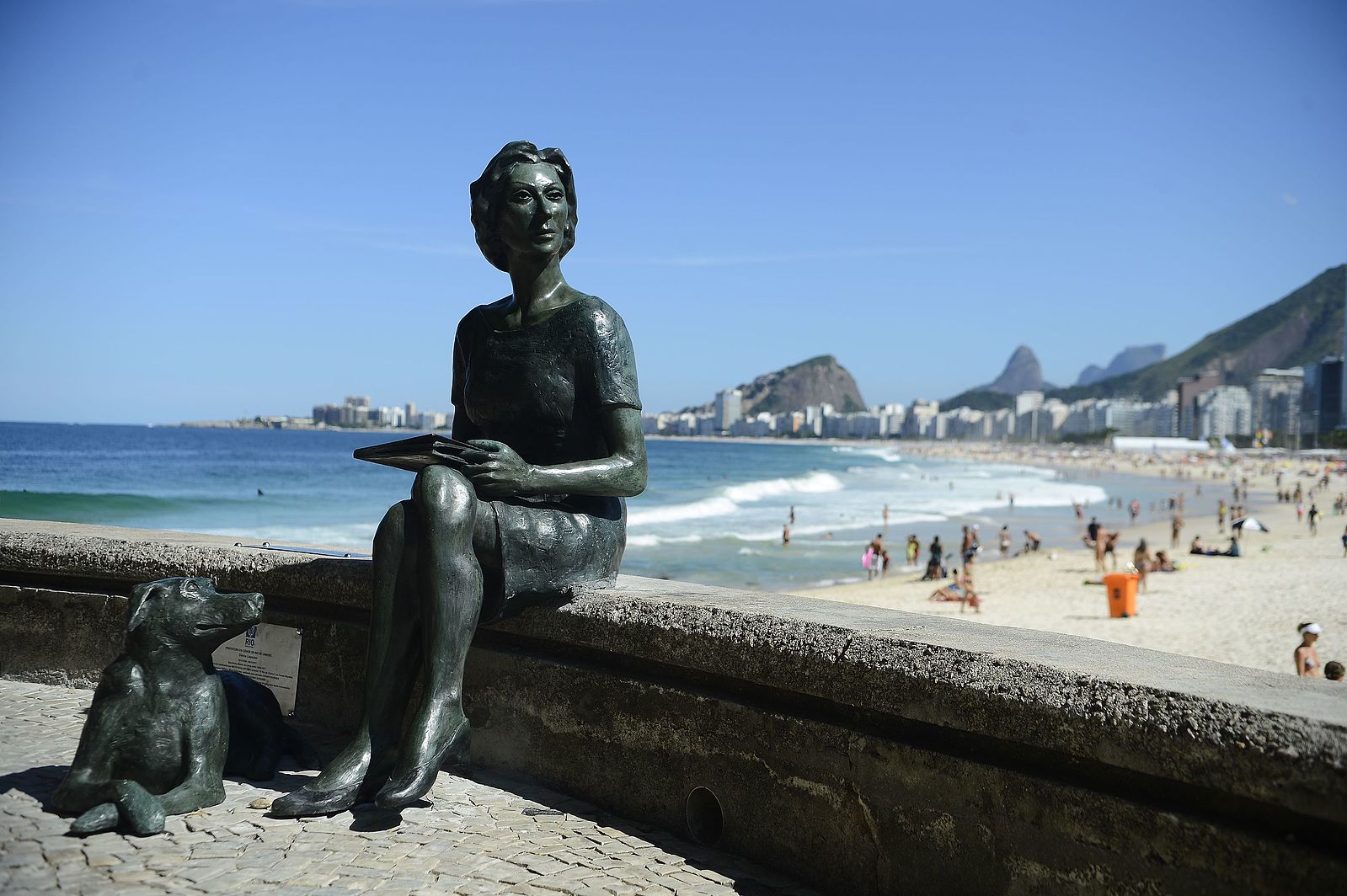
Clarice Lispector’s Crônicas are a perfect companion to Gombrowicz’s diaries. Like Gombrowicz, Lispector was a European (Ukrainian) who fled to South America. The difference between Gombrowicz and Lispector is that Lispector arrived in Brazil as a girl and wrote in Portuguese; Gombrowicz never ceased to be a Polish aristocrat. From what I understand, this liminal quality gives Lispector’s Portuguese an unusual, alien, and unique texture and quality. The language of an almost-native speaker. Crônicas was (like Gombrowicz’s diary) a public project. These chronicles, dashed off for publication in Brazilian newspapers, are a public chronicle of a sinfully profound mind. “How at forty she managed to be so cheerful I really don’t know. She was full of loud laughter. I knew too that she had wanted to kill herself not because she had left the convent but out of love. She explained that at the time she didn’t know love was like that. Like what? She didn’t answer.”
We’ve finally arrived at an American, and one might say, the greatest of all diarists. If you want to understand the heart of what Harold Bloom, by way of Wallace Stevens, calls the American sublime, you have to go here. “Chemistry, entomology, conic sections, medicine—each science, each province of science will come to satisfy all demands. The whole of poetry, mythology, of ethics, of demonology will express by it. A new rhetoric, new methods of philosophy, perhaps new political parties will celebrate the culmination of each one.” Emerson’s great synthesizing slime mold-like mind woke up one day and wrote that down in 1842 and continued in the same journal the same day: “It pains me never that I cannot give you an accurate answer to the question what is God, what is the operation we call providence and the like. There lies the answer, there it exists, present omnipresent to you, to me.”
Anaïs Nin’s diaries are a fantastic confession machine of the twentieth century: desire, psychoanalysis, and artistic ambition. She begins in Paris, in media res in flight from American puritanism, in the process of constructing herself as a literary sensualist. She undergoes analysis with a genius analyst (Otto Rank). Nin’s diary is both performance and erotic meth lab, a mask and a Real Me at the same time. She writes herself into existence daily, hourly. The diary becomes her primary work, the novels disappointing offshoots. “Reality doesn’t impress me. I only believe in intoxication, in ecstasy, and when ordinary life shackles me, I escape, one way or another.”
Susan Sontag’s early journals show us the construction of an American intellectual (and Sontag is the Platonic ideal of an intellectual): the ultra-self-conscious making of a significant critical mind. Beginning at age fourteen, these notebooks track Sontag’s voracious reading, her similarly voracious sex life, her marriage at seventeen, her time at Chicago and Harvard and Oxford. Self-analysis is productive of desire in Sontag’s case. “My desire to write is connected with my homosexuality. I need the identity as a weapon, to match the weapon that society has against me.”
When I picked up Hu Anyan’s memoir, I Deliver Parcels in Beijing, translated by Jack Hargreaves, I expected a window into a life I might not otherwise see. A memoir covering Hu Anyan’s career—or lack thereof—in China’s gig economy, the story unfolds along the contours of a picaresque. Over a scattered timeline, from the late aughts to the dawn of Covid, he does stints as an e-commerce delivery driver, bicycle shop assistant, and a popsicle salesman beset with social anxiety. At one point, he is drinking on the job as a shopping mall security guard of sorts. We follow him through 19 different low-paying jobs before arriving at the conclusion that, basically, in the most thoughtful possible words: Work sucks and capitalism steals our souls, or, at best, severely compromises our humanity. “Work for the sole purpose of making a living is a miserable prison, which is why very few people will confess that this is what they do,” he says in an excerpted journal entry that his elder self describes as “exaggerated and childish today” but true to his former perception.
Described as humorous by its publisher, the book is periodically funny with its deadpan account of on-the-clock misery, but Hu is as much a critic as he is a comic, relaying insights earned through strained contemplation over years of struggling to make ends meet.
I quickly realized, making my way through Hu’s stories, that this supposed “window into another life” also provided a reflection of my own. Nowadays, I’m financially secure, a status which would feel unfathomable to my younger self, who graduated with a liberal arts degree in Florida in 2009, feverishly uploading resumes into a void as the global economy was melting down. Reading Hu’s experiences churned up memories from my own years in the minimal-wage trenches. He delivered parcels, and I delivered pizzas. (For the record, these were respectable thin-crust, New York imitations—a mom-and-pop strip-mall operation which, based on the Google photos, remains as frozen in time as a nuclear bunker.) I was also a school picture-day photographer, restaurant server, tutor, fast-food worker, smoothie-maker, airport check-in agent, enthusiastic market research subject, and a grocery store checkout clerk.
At most points, it was barely possible to live on my wages, though I was generally expected to.
Like Hu—like everyone—I’ve had good workdays and bad, kind bosses and exceedingly awful ones, wonderful colleagues and a few borderline psychopaths. I’ve also encountered irate customers throwing low-stakes tantrums, Karens and Chads before we knew them as Karens and Chads, whose displeasure could verge on harassment. Physical endurance was usually required, although my work was overall far less hazardous than Hu’s. I had the benefit of US labor standards and a car, so I never had to zip around a big city balancing packages on a motorized tricycle, never saw a manager demand pushups as punishment, and never refrained from drinking water for lack of access to a restroom or fear of losing a few bucks. A common denominator across our jobs, for both the author and me, was low pay. At most points, it was barely possible to live on my wages, though I was generally expected to by my parents, who, unlike Hu’s, had the means to help but did so sparingly because they wanted to teach me lessons about self-sufficiency. Also like Hu, I loved literature and harbored aspirations to write, but was raised in an economy and social milieu where creative careers were fantasy; I was an outsider, a state of mind that never really disappears.
Throughout his memoir, Hu approaches his conditions without self-pity, but he is sharp about the basic injustice underlying the demands of his work versus his compensation. “Capitalists aren’t known for sympathizing with slackers,” he says early on. His prose, clean of pretension or posturing, gives the text a sense of raw immediacy and speaks volumes about market-driven despair. In a bizarro Lady Macbeth moment, he writes about the hopeless condition of his work clothes:
The uniform proved impossible to ever get fully clean. We lifted and moved goods for hours on end—grease and oil stains were inevitable. Plus, it was easy to convince ourselves when we were already tired that we didn’t need to make sure our clothes were pristine. They were only going to get dirty again the next day.
Despite my liberal arts education exploding the capitalist-pixie-dust narrative fed to me by my folks, it was only years after I’d independently achieved some measure of economic comfort and security that I could look back at those jobs and think, I hated that not because I was weak, or entitled, or lazy—all the ostensible reasons I believed at the time—I hated it because it was a lousy job without health insurance.I was terrified of poverty. And no, my uniforms were never fully clean.
He indulges few decadent aspirations other than the desire for freedom.
Hu’s memoir illuminates the truth that one can work hard indefinitely and never achieve financial security. This is also the reality for millions of Americans called the “working poor,” defined by the Bureau of Labor Statistics as people who work at least half the year and earn below the poverty line. The federal minimum wage itself ($7.25 an hour) is a poverty wage. With the rise of digital labor platforms, which classify workers as contractors, workers forfeit not only “perks” like employer-sponsored healthcare, but basic rights such as unemployment insurance, minimum wage, and the power to negotiate their compensation. Human Rights Watch, who studied gig-worker exploitation, says that app-based gig companies have “undermined decades of US labor law regulation and enforcement, denying workers hard-won rights to an adequate standard of living and safe and healthy working conditions.” All this is to say nothing of the difficulty scraping by in today’s economy, where, according to Pew Research, the middle class has steadily declined since the 1970s, and the share of total household income held by the middle class has “plunged” from 62 to 43 percent. For most Americans, these are discouraging statistics—and this is to say nothing of ethnic and gender disparities loaded into these numbers. No matter what I’ve done correctly to get my finances out of the gutter, it would be willfully delusional to look around and deny that the bottom-line factor separating my life as it is from a life counting every penny is luck.
Hu Anyan’s rise to Chinese literary success was lucky, too. Part of a growing Chinese movement, sheng zuojia, or “wild writers,” whose careers have developed beyond the nation’s literary establishment, his writing likely would’ve continued into obscurity had his editor not stumbled across his blog. Wild as he may be, Hu is certainly a triumphant author. In May a Financial Times profile reported that I Deliver Parcels in Beijing has sold almost two million copies. Gone are the 12-hour days scraping by on manual labor.
But throughout the book, before Hu could’ve imagined where his writing would take him, he doesn’t seem to consider his proletarian stature an obstacle to overcome so much as a reality into which he must settle. During one job search, he seems resigned to the fact that his options are limited, and the ones that exist are lacking. “Putting lots of hours into finding the best job didn’t seem worthwhile,” he says. “My qualifications would never secure anything with good pay…”
Why exhaust himself with extra handwringing when his baseline is tiring enough? From his recollections of his mother and father, I gather he was not raised to believe he was entitled to a great deal of mobility. “They had spent their whole lives in the same work units,” he writes of his parents, “the market economy was completely alien to them.” He indulges few decadent aspirations other than the desire for freedom. Perhaps this is the influence of a culture which, for better or worse, has placed the collective before the individual, even before the major political revolution of communism.
I wish that people were capable of a better world, where luck matters much less.
Growing up in the United States, I hoped my lowly professional station in life would be temporary. My parents, both of whom grew up blue-collar and built comfortable lives together, had instilled in me the sanctity of honest, hard work and personal responsibility as essential to success. (My father, hand to God, had a framed photo of George H.W. Bush hanging in his office.) Even today, working in a media industry where such logic is not only unfashionable but often inapplicable, I see why my parents raised me how they did: What worked for them surely should work for me. Another generation would further climb the ladder of capitalism. I was going to be the first in my family to graduate from college. On all those nights I spent dragging grey, smelly tentacles of a mop across a floor, I thought of how one day, somehow, with the right attitude, I’d transcend all of it.
Toward the end of the book, Hu draws a dialectical distinction between work (“a concession of our personal will”) and freedom (“the other parts of life…that remain true to our desires”), declaring that few people achieve both at once. “But this kind of luck is rare,” he says. Perhaps, in our work today, with Hu now writing full-time after the success of I Deliver Parcels in Beijing, both of us have found that unicorn.
It’s been about 15 years since I professionally donned a uniform or mopped a floor. What was it that allowed me the leverage to break from the cycle of dead-end employment? I can cobble together a hundred reasons, assemble critiques related to my identity, my personality, the timing of my every step within the procession of history. Underlying every reason is luck. Americans often hesitate admission to the mighty power of good fortune. How many second-generation performers have insisted, amidst “nepo-baby” discourse, upon the supremacy of their talent and hard work as the key to their success? How many family-owned businesses carry into the next generation of scions? Every parent, in their own style, intentional or not—helpful or not—paves the way for their children, so I understand the impulse to defend one’s own labors as vital.
I have not achieved some style of earth-shattering, incandescent superstar success; I am not so terrifically rich that money is a joke or a formality surrounding my world domination. But I think it’s fair to say, objectively, statistically, I’ve done alright for myself. Financial stability was a slow road. I started down a career with an airline, squirreling away enough cash to jump off the corporate cliff, at age 27, into an unexpected opportunity for an unpaid internship in television. Some measure of competence—plus the fact that I’d already burned through my Plan B career as my Plan A career—fueled my upward rise, over the course of a decade, from Production Assistant to a Producer who has won industry awards for doing a job that had once seemed like a dream. Hu Anyan’s rise to financial stability through his writing was likewise unexpected, and somewhat accidental. There is another world, though, a parallel universe where we worked just as hard, sweat just as profusely, wrung our hands with just as much muscle when our bills seemed objectively unpayable, kept our chins just as high. The only element separating us from this world and the world where we did not prosper is luck. I wish, as a body of eight billion human beings, with opposable thumbs and big brains and the gifts of evolution, that people were capable of a better world, where luck matters much less, where even basic survival was guaranteed, where work was synonymous with truly living and nothing less than that.
Work can be such a difficult, deeply personal endeavor; I understand why we protect the narratives which credit all to our individual wherewithal. But the fact of luck does not detract from our individual achievements—it only challenges the myths that seem to be serving fewer and fewer of us, as wealth and power continues concentrating far out of almost everyone’s reach, and gig work grows and grows. The story of our work is the story of our lives, and in that capacity, we are all best served by the truth.
Below is a list of the 431 writers Electric Literature has published so far in 2025. Every single one, from illustrious new voices like Tochi Eze or Kayla Min Andrews, to regular contributors like Greg Mania or Bareerah Ghani. We publish new work every weekday, year round, bringing you an exciting mix of fiction, poetry, essays, and book coverage—without any paywalls. Whether it’s finding your next great read or delivering extraordinary original work, Electric Lit has you covered.
We can’t publish these phenomenal writers without your support, which is why our year-end fundraiser is moving full steam ahead! We’ve raised $20,000 of our $35,000 goal. An anonymous donor has pledged to match the next $12,500 we raise, dollar for dollar. That means any gift you make will have double the impact. Now is the time, so please give today.
An excerpt from The Dream of the Jaguar by Miguel Bonnefoy
On the third day of his life, Antonio Borjas Romero was abandoned on the steps of a church in a street that today bears his name. No one could be sure of the precise date on which he was found. All that is known is that every morning, a destitute woman would sit there, always in the same spot, put down a gourd bowl, and hold out her fragile hand to the passersby on the parvis. When she first set eyes on the infant, she pushed him away in disgust. But her attention was suddenly caught by a little shiny box hidden in the folds of his blanket, which someone had left with him as an offering: a tin rectangle, its silvery surface engraved with fine arabesques. It was a cigarette rolling machine. She filched it, put it into the pocket of her dress, then lost interest in the baby. But she noticed during the morning that the infant’s timid wailing, his hesitant cries were so endearing to the churchgoers, who thought the two of them were together, that one by one they soon filled the bottom of her bowl with copper coins. When evening came, she took the baby to a farmyard, stuck his mouth to the teat of a black goat whose udder was covered in flies, and kneeled under its belly to make him suckle the thick warm milk. The next day, she wrapped him in a kitchen towel and hung him at her hip. After a week, she started saying that the child was hers.
This woman, whom everyone called Mute Teresa because she had a speech impediment, must have been somewhere in her forties, although she herself was incapable of giving her exact age. There was something Indian about her face, and on the left side, a slight paralysis caused by an ancient fit of jealousy. She carried nothing more than spongy skin on her bones, her hands were covered in sores that never healed, and her dirty white hair fell flat beside her face like the ears of a basset hound. She had lost the fingernail on her left thumb when a scorpion hiding in the back of a drawer had stung her hand one day. This did not kill her but formed a kind of sausage of flesh at the end of her thumb, a dead growth, and it was that flap that the child sucked before falling asleep during his first weeks.
She named him Antonio, for the church where she found him was placed under the patronage of Saint Anthony. She fed him with her own rage, with her silent pain. During his first few years, she had him lead a disorderly, shameful, indigent life. She convinced herself that if he should survive this misery, no one other than himself could kill him. At one year old, he could barely walk but could already beg. At two, he spoke sign language before he could speak Spanish. At three, he looked so much like her that she started wondering whether she had actually found him on the church steps, or might in fact have brought him into the world herself, in the backyard of a hovel, in the hollow of a hay bale, between a gray donkey and a lamb. She dressed him in filthy rags, and, to gain sympathy from the passersby, would hold him tight in fake tenderness, drenching him in acrid sweat that the heat turned into a kind of greasy yellow gelatin. She fed him goat cheese rolled by hand, slept with him in her shelter made of faded newspapers at the back of a makeshift sheep pen, and perhaps no woman ever showed so much courage in looking after a child she did not love.
Nevertheless, for Antonio, this lying, miserly, scurrilous, and thievish woman was the best possible mother to whom he could aspire. He took the roughness she showed him and the venomous love that poverty had woven between them to be tenderness. He grew up with her at La Rita, on the shores of Lake Maracaibo, in a place that was so dangerous that it was called Pela el Ojo, “Keep your eyes peeled.”
When Antonio turned six, he no longer believed in miracles but sold jet pebbles as lucky charms and knew how to read cards, for Mute Teresa was adamant that this was the only science that people could be convinced by without it having the inconvenience of being true. When he turned eight, she taught him to recognize the crooked aguadores, the water carriers who sold dirty water from the lake passing it off as clean rainwater. But also the grocers who tipped their scales with a bent paper clip, the workmen who resold screws from the formwork on their building sites, and the trainers who, in the cockfighting pits, hid razor blades under the claws of the roosters’ spurs. She had prepared him for this hard life, full of caution and necessity, of battles and suspicion, to the point that if a pastor suddenly announced during mass that a saint had burst into tears, Antonio was the first to raise his eyes to the church ceiling to see where the water leak was coming from.
In those days, Pela el Ojo was a kind of vast swamp crushed by the heat, with damp shores populated with little houses on stilts whose doors were always open. The dwellings were erected over that murky water, with open-air kitchens, blackened old stoves, and floating trash cans that the city had dumped on its outskirts. Bread was baked there, fuel was trafficked. The children lived naked on the boards, moving over this skeleton of thousands of tree trunks, which were constantly being patched up, wading on the surface of the lake as did the palaces in Venice, a sight which had made the Venetian navigators of long ago, arriving with their fragrances of vellum and sealing wax, say that they recognized it as a “little Venice,” a venezziola, a Venezuela.
However, the immobility of these landscapes no longer conjured dreams of the ancient cities of the Caribbean, of Tamanaco and Mara, populated with women dressed in cotton gowns and mantles embroidered with gold, or young men whose chests were covered in fine silver dust, or newborn babies swaddled in jaguar skins. It was no longer a vision of a nation before all nations, of men dressed as eagles, of children who spoke with the dead and women who transformed themselves into salamanders.
At the time, it was no more than a township lacking in poetry, with roofs of hot palm fronds and teenagers wearing sandals cut out of old pickup-truck tires. The hovels were built from the hoods of old Indiana Trucks, the window handles from tin cans, the chair seats from aluminum posters for Shell. And since the rains were torrential and the palm-frond roofs needed to be protected, people bought old advertising billboards for Chevrolet, stolen at night along the highways, so that all the cladding of the shacks in the shantytowns, where people who could not drive slept, carried the words: “No happiness without Chevrolet.”
Those rains, which were called palo de agua, often made the lake swell and burst its banks. The water flooded the plain in slow advances, drowning the countryside. The downpours could lash away continuously for forty furious nights, covering the fields with dead parrots, and when the tide reached the farms and submerged the crops, thousands of crayfish swam up from the gulf into the cornfields and enjoyed an underwater banquet that decimated the entire year’s harvest in two weeks. People cursed the crayfish in Maracaibo as they cursed the grasshoppers in Egypt.
One day when he was eleven years old, he put his hooks and lines into a bag, went to the village dock, and stole a canoe.
It was in this world that Antonio grew up, fishing on the lake, swimming through the pondweed and the mangroves. His diet was composed only of catfish, white-fleshed stone bass, blue crabs, and giant freshwater shrimp, to the point that Mute Teresa started to believe, in her most intrepid dreams, that Antonio would grow gills and start breathing underwater. One day when he was eleven years old, he put his hooks and lines into a bag, went to the village dock, and stole a canoe. Some children saw him and snitched on him. It did not take long for the owners of the vessel to appear in the distance. These were the rich men of La Rita, those who held power, those whose word was law on that side of the lake: Manu Moro, a tall fellow more than six foot seven, as wide at the waist as he was at the shoulders; Hermès Montero, an agitated little man who was red with anger; and Asdrubal Urribarri, a mixed-race man with green eyes and a clubfoot, wearing a white undershirt and waving his arms with a napkin in his hand, as if he had hastily stood up from the table.
“Antonio, I recognize you!” he shouted. “Come back here!”
On the shore, they were pacing furiously back and forth through the trash littering the beach, casting impetuous looks at Antonio as he paddled away. Asdrubal Urribarri disappeared, then came back again with a rabid dog with foaming jaws, which he threw into the water. The dog swam to the boat as if possessed and with an ease and energy that surprised everyone, climbed onto the boards and sprang at Antonio’s neck. But Antonio had time to dodge it by jumping overboard and escaped by swimming against the current. The dog followed him, letting the boat float off to the horizon as Asdrubal yelled, “The boat! Don’t let it get away!”
The dog persisted in its chase, barking feverishly, biting the waves, growling like mad. Antonio redoubled his efforts, dove underwater, and disappeared. After half an hour, when he felt a strong cramp pull at his thigh and his arms started stiffening with pain, he realized that the dog’s barking had softened to whining, to the wails of the shipwrecked, and after a few minutes there was nothing but its little nose poking out of the water. It was only when the dog properly started to drown, yapping like a puppy, that Antonio decided to slow down. In a last gasp for survival, the dog caught up to him, and instead of biting him, eagerly clasped his shoulders. It was six in the evening. The owners of the boat, holding leather straps and belts, were watching keenly from the shore.
“You’ll get tired in the end,” they shouted. “We’ll be waiting for you here.”
Exhausted, with the dog on his back, Antonio let himself be carried by the current until he arrived at Punta Camacho, and resigned himself to waiting for darkness before getting out of the lake. Night fell only half a mile farther on, at Puerto Iguana, and when at last he was camouflaged by the light of the moon, protected by the darkness, he swam up to a little dock and ran, accompanied by the dog, toward the gates of Camino Real by the free pathway that led to Pela el Ojo.
As he was sighing with relief at the familiar sight of the lights of his hovel, reassured to have arrived home safe and sound at last, he got a sudden fright when he saw the silhouette of Asdrubal Urribarri, with his limping gait, talking to Mute Teresa, still waving his napkin and gesticulating wildly. Although Antonio was about to faint with exhaustion, he thought it was too dangerous to show himself. He found a solid palm tree, climbed up to the top, and waited for the night to be over.
The stars were enormous in the sky, and the world seemed flooded with silt. A group of men started tracking him. At the top of his palm tree, Antonio cried, not out of fear but out of rage. Alone and chilled by the wind from the lake, disturbed by the rustling of the fronds from which he had dislodged two rats nibbling at stalks in the crown, he took two hours to fall asleep while listening to the frogs copulating, and in his dreams he confused their croaking with men’s voices.
He was awoken in the early morning by blows from a stick on his feet. He looked down to see Mute Teresa. She had searched for him all night in every shrub, in every sea grape tree along the shore, in vain. The dog, against all expectations and unbeknownst to its owner, had led her to him out of gratitude at having been saved from drowning. Mute Teresa put two cornmeal arepas and some grated cheese on a napkin on the ground. In her restricted language, she signaled for him to stay up in the tree for another night, maybe two, for Asdrubal Urribarri was keeping watch around their shelter. Antonio hunched over in anger.
“One day I will be a man, and I will no longer be afraid,” he said from the top of the palm tree. “I’ll teach him who’s boss.”
But Mute Teresa did not answer. Seeing him perched up there in that tree, hidden away and forgotten by every one in the desolation of the world, she felt a pain in her soul, for she could conceive of no other future for Antonio than one as a street ruffian, born in the wrong place, dragging his loneliness until his death in the miserable rum joints where only vagrants and delinquents stray, desperate men who expect nothing from beauty and no longer know whom to die for. She imagined him as one of those brutes who was looking for him, who wanted to beat him, those nasty, arrogant men, raised on the lake’s violence and by miserly fathers, whose hearts were thorns without a flower. Worse still, she imagined him like herself, living a life of disasters and frustrations, sitting on the steps of a church holding out a bony hand to strangers, ruminating on the humiliations and errors of her youth, having survived a childhood with no home nor refuge, with no love nor protection, a childhood when no one had taught her how to live.
That was the reason why, three days later, when everyone had forgotten the incident with the boat and Antonio was able to return home, Mute Teresa greeted him with patient gentleness. She was waiting for him there, perched on a little stool, doing her laundry, leaning over a tub, and when she saw him, so pale with hunger and exhaustion, trembling with fear and cold, she could not help wondering how humankind had managed to survive amid so much cruelty. She sat him on the ground in silence, took off his clothes, and gave him a summary wash in the laundry water, rubbing down his body, filling the tub with scraps of lake weed and palm bark, and they never said so much as a word about this incident for the rest of their lives.
The next day, she searched the recesses of her hovel and put a package into his hands. Antonio, who had never received a present before, opened it quickly. It was the little cigarette rolling machine she had found, eleven years earlier on the church steps, in the folds of his blanket. These letters were engraved on the back: Borjas Romero. She looked Antonio straight in the eye, and it was one of the rare occasions he heard her voice.
“If you want to become the boss, don’t steal,” she muttered. “Work.”
And so Antonio got it into his head to sell cigarettes. He got his first handful of tobacco thanks to his cunning. One September morning, a few days after the episode with the boat, he crossed the only square in La Rita and with a determined step entered the La Pioja grocery store belonging to Henri Reille, a fine fellow in his forties with no shady dealings, full of health and vitality, the son of immigrants from Nantes who had come at the beginning of the century and whose French lineage had endowed him with the bold art of commerce. Antonio offered him the following deal: “Give me some tobacco and some paper. I’ll come back this evening with double its price.”
Give me some tobacco and some paper. I’ll come back this evening with double its price.
Antonio left Henri Reille with ten grams of tobacco, rolled thirty cigarettes, and went to the port of Santa Rita, where dozens of men arrived every day from the south of Lake Maracaibo, the mountains of Mérida, and the backwaters of Santander, Trujillo, and Táchira, disembarking on the dock from their dinghies hewn from a single tree trunk and canoes filled with animals whose cries echoed throughout the bay. He sold everything he had until nightfall, handling his machine as if it were a Venetian lute and calculating each gram of tobacco with the care of a goldsmith, economizing each sliver of paper. At around seven, he returned to the grocery store and set down the bounty of the day on the counter, under Henri Reille’s astonished eyes.
“You are richer this evening than you were this morning,” he said. “And so am I. Let’s keep going.”
For three weeks, in the suffocating heat of the coast, he went tirelessly back and forth from Pela el Ojo to La Rita, persuading anyone he crossed paths with on the port to have a smoke. With savage obstinacy, he mingled with the vast community of sellers of crushed ice and guarapo, the cold drink made from sap, sugar paste, and pinole, until the day when a goods porter offered him three pennies to help him unload some sacks of coconuts from a boat.
Antonio, who at that age already had wide shoulders and a muscular back, threw one of the sacks onto his spine with the help of two leather straps, surprised himself with the strength of his arms and the solidity of his legs, then hunched forward and walked off under the weight toward the truck, with a blind tenacity that the other porters ascribed not to his strength but to his youth. Despite the excessive weight that compressed his lungs, he managed to unload everything, and earned in one hour with his arms what it would have taken all day to earn with his cigarettes. From that day onward, he never set foot in Henri Reille’s grocery store again. The following day, he came back to the same spot on the dock, convinced that he would make a fortune with the strength of his muscles, but he quickly understood that there was a hierarchy in all things, even in the world of porters.
He was introduced to an old boatman called Alfaro who was in need of laborers, a hawk-nosed man from Panama whose fingers were covered in rings and was notorious for his abrupt mood swings and choleric character. Antonio was a model of discipline and flexibility, uncomplaining, obedient, and selfless. He was happy to do whatever was assigned to him. In the stifling air of the port, where the docks were covered every day with crates of fragrant spices and cages of flowers, Antonio learned to read, to count, to recognize the maritime flags that the smugglers modified to thwart the coast guard, to calculate by touch alone the worth of the coins he was given, and to file away in his imagination not only all the accents he heard around him but also all the fabulous stories that came to him with the arriving goods and that blended together in his head as in a great ancient novel.
This is how he learned of the existence, in the south, of a village that moved around, a shifting village that gravitated around Barinas as a planet around a star, and that could only be found by chance. He heard about the legend of the solid-gold Virgin of Benito Bonito, about the opera house in Manaus built in the middle of the jungle, about the thirty-eight-minute-long war in Zanzibar and the story of an Andalusian settler who brought four hundred elephants from Nepal to fill his stables in the middle of a desert in the dunes of Coro. These marvelous tales remained etched so profoundly in the marble of his memory that, many years later, when the plaque was unveiled in the street that bore his name, Antonio was able to relive with acute precision that stifling morning in the little port of Santa Rita when all at once, in the middle of the tumult of ropes and heavy chains, he saw the statue of the libertador Simón Bolívar arrive at its port of call in Maracaibo.
It loomed up one Tuesday in November. The lake dwellers saw it in the distance, on the promenade covered in crushed mangoes and rotten fish, an imposing statue four yards high made from six tons of bronze cast in Tuscany. It was of a man on horseback in nineteenth-century dress, looking straight ahead and pointing his sword at the future with an authoritarian air. His elegance was so striking to the children on the beach, boys in rags who had never seen Simón Bolívar, that they ran into their shacks yelling, “God has come down to Maracaibo!” After a perilous traction with iron pullies, weights, and straps, Simón Bolívar was unloaded from the ship and set down between the chicken cages and crates of plantains and dried meat, surrounded by sacks of coffee. The bronze stank of guavas. The statue had come a long way, having made a voyage on the ship down the course of a tumultuous river and survived rust and oxidation as well as the tropical rainstorms that had broken out several times and fifty miles of crocodiles and howler monkeys. It was supposed to stay a few days in Maracaibo before continuing its journey up the Rio Escalante to reach the port of Santa Bárbara del Zulia, across from the city of San Carlos where, one day in 1820, Simón Bolívar, making the most of the abundance of wood in the area, had ordered the construction of five ships to attack the Spanish.
By two o’clock, the whole town had heard about the visit of the libertador. People were crowding around the statue in a carnival of acclamation, carrying children on their shoulders and bringing the elderly out of their rooms to see it, and there were even some Guajiro on the dock, who had come down barefoot from the Sierra de Perijá with birds in their hands and a ruckus of tiny bells, attracted by the rumor that a metal man had been discovered in the middle of their lake. It was not long before the local authorities made an official appearance, with the governor of the province of Zulia at their head, along with other town dignitaries, to render homage to the hero of the nation, by trampling the jumble of rotten fruit.
Eventually the speeches were so long and pompous that, over the course of the ten days that the statue was standing by on the port of Maracaibo, people ended up losing their curiosity. At night, some men who were roaming around the docks tried to paint the horse’s rump, while others threw avocados as big as melons at the libertador’s head, and still others tried to steal his sword by cutting it with a lumber saw, but they managed only to leave a notch an inch deep in the palm of his hand, such that three days later, when the statue was examined, this was believed to be the mysterious trace of a Christlike stigmata.
It was more than five years ago when I first heard Jeremy B. Jones talk about the journals of William Thomas Prestwood. By many accounts, Prestwood might be considered a nineteenth-century everyman—except for a handful of facts. First, Prestwood recorded daily accounts of his life, and those journals miraculously survived almost two hundred years. Second, some of the events Prestwood recorded were a series of sexual relationships that seem scandalous even by current standards. Third, Prestwood attempted to keep his journals secret by encrypting them in his own invented code. But the final fact that drew Jones to this man who almost disappeared into history was that Prestwood was Jones’s great-great-great-great grandfather.
From Prestwood’s salacious appetite for women to the fortuitous way his code was deciphered, the narrative in Jones’s new memoir, Cipher: Decoding My Ancestor’s Scandalous Secret Diaries, is fascinating. So, too, is the sense of place that’s integral to much of Jones’s work. But what resonates even more is the unique way Jones holds his forefather’s life from the nineteenth century as a mirror to better understand his own existence in our also complicated twenty-first century.
Cipher is especially timely in this moment that finds our nation so deeply divided. Prestwood lived during the tumultuous time between the founding of the United States and the Civil War. Using Prestwood’s journals as a catalyst, Jones reflects on how questions of masculinity and racial equality still drive our politics and culture. And yet, Jones’s journey is intensely personal as he seeks to be a good father raising his sons into good men.
Jones and I connected over a series of emails, in which we discussed the process of journaling, what it’s like to be haunted, and whether the past offers any hope for our current times.
Denton Loving: Cipher is an exploration of history—your personal history, your family’s history, and the history of our country. But you also approach your subject from a host of different angles such as science, genetics, and encryption. How do you juggle all of that, both when you’re drafting and when you’re revising?
Jeremy B. Jones: You take ten years to write a book, that’s how. I struggled for a long time to find a shape for Cipher. It started as a long epistolary essay. Then I converted it to a collection of essays. Then I tried dividing it into thematic sections. A lot of the work to find a suitable form was, of course, also me trying to make sense of the content. I needed to figure out what I thought in order to figure out how to arrange it. Ultimately, I found that the more I researched, the more a potential shape appeared, and in the end, the idea of a double helix took hold for me. I conceived of the book as a winding together of my ancestor’s story and mine, each of our strands wrapping around the other. This structure began to tease out connections and parallels between our lives and other subjects that I only sensed at first but then began to find a way into. And because his story is naturally vulnerable—he never expected anyone to decode and read his diaries—my story was pulled in that direction, too: I figured I owed him to be honest and forthright about my life.
DL: What would William think about your extensive interest in his life? What would he think about others reading about his life two centuries later?
I felt compelled to chart possible futures of American masculinity.
JBJ: I’d like to think I know him pretty well after all this time with his recorded life, and yet, I’m not sure what he’d think about the attention. My suspicion is that he’d think it a waste of time. In a list of advice to his sons he writes, “There is more pleasure in private than public life.” It’s clear from his diaries that he never tried to make a name for himself, not in any major way. It is, in fact, a frustration that the codebreaker has. In the codebreaker’s notes, it’s clear he thinks that William is a “remarkable human . . . who never put himself forward.” Afterall, William spent his days dissecting animals and experimenting with atmospheric forces and charting planetary orbits and reading texts in Greek and Latin and inventing new surveying tools. In the codebreaker’s view, William could’ve been an important historical figure had he made an effort. I think, however, that William understood the value in living a contained, simple life. A private life. Because of that, I think he’d have shied away from too much attention on his life, but I also think—I hope—he’d be glad that I didn’t try to make him into something he wasn’t. He was both a “remarkable human” and, as the codebreaker also claims, “an everyman,” and I tried to capture both of those truths.
DL: When I first heard you talk about this project, one of the hooks was about the scandalous nature of William’s journals. Was it always evident to you that William’s sexual exploits were a way to write about masculinity?
JBJ: I’m sure the book would have always moved in that direction, but it became inevitable that masculinity would be a central thread of the book because of the moment in which I started writing. I began work on the book in earnest in the lead up to the 2016 presidential election, when I was home on leave with our two small boys, and after the votes were tallied, I grew worried about what that outcome said about the nature of masculinity in America. What was this place I’d brought my kids into? I had one answer in the past—in the laid-bare life of my adulterous ancestor—and another apparent answer in the present—in the election of an open misogynist—so I felt compelled to chart possible futures of American masculinity. For me and my kids and everybody who comes after us.
DL: In the process of writing Cipher, you discovered white, Black, and multi-racial cousins, many of whom were also seeking answers about their genealogy. How has your family responded to reading and learning about William, who is also their ancestor?
JBJ: Most of my family saw the diaries like I did initially: as a curiosity. They’re interesting in their strangeness, but because they were written two centuries ago, no one seems to feel any real connection to William Prestwood. I’m anxious to see if that shifts for anyone once they finish the book. I have heard from a number of distant relatives who’d stumbled across the essay I wrote for Oxford American, and now that the book is out, more far-off kin are emailing. Most of those interactions have been comparing notes on historical and genealogical research.
The most wide-ranging and compelling conversations I’ve had have been with relatives connected to me by slavery. I write about some of this in the book, but as I encountered Black Americans with whom I share DNA, and we tried to pinpoint our 19th-century shared ancestors, I found so many of my initial questions splintering into more complicated and revealing questions. I continue to think about those conversations.
DL: Towards the end of Cipher, there’s a place where you write that the past rarely stays put, and that there is always more to uncover. How is that idea shaping your new work?
JBJ: I think place and all that it entails—including family history—will forever be a subject I’m exploring. I consider my first book a “memoir of place,” and Cipher is in many ways about how we inhabit spaces over time. I’m working on a novel now, and it’s nothing like Cipher or Bearwallow—it’s contemporary and leaning into conventions of detective fiction—but it’s still exploring unexpected connections to place and history and people. So, I suspect I’m simply tilling the same soil but with new tools and waiting to see what grows.
I tried to provide lots of on-ramps to consider the ways that that history still reverberates all around us.
That said, I’ve been writing some essays (in Garden & Gun and Our Stateso far) about our house. It was built in the 19th-century, and while we didn’t know it when we moved in, it was built by my fifth great uncle. This discovery isn’t quite as scandalous as William’s diaries, but I do continue to turn up surprising bits of family history in the walls and deed books of our home, and I wonder if I’ll find a book in there somehow.
DL: You’ve described Cipher as an American story precisely because it exposes early America’s complicated history with slavery and racial discrimination. What do you hope William’s story—and even more so, the stories of the enslaved people who were a part of William’s life—can contribute to the discourse in a time when museums like the Smithsonian are being criticized by conservatives for focusing too much on the “negative aspects” of slavery?
JBJ: One of the wildest hypocrisies around us right now comes from people who are upset about the removal of Confederate statues while, in the same breath, dismissing any talk of slavery because “it happened so long ago.” While writing this book, I thought often of people I know and love who don’t consider the repercussions of slavery in the 21st century—and don’t even want to engage in those discussions because “I never owned slaves.” In the book, I tried to provide lots of on-ramps to consider, if only for a moment, the ways that that history still reverberates all around us.
Whenever a messy subject comes up these days, people tend to retreat to their camps, digging into the trenches out of some team loyalty more than any real engagement with the issue at hand. I wanted my approach to some of these ideas to discourage that partisan retreat because the issues come within a very particular story—they’re not abstract or “political.”
I was talking to one of my cousins recently about the diaries and family history, and he asked, “So . . . we have this land because all we did was stay put?” We’ve been living on our particular plot of land for five generations—since the diarist’s grandson settled it—and none of us had to do anything to have it except be born. So, yes, our squatting there is, of course, part of the story.
The other part of that story—the part that I hope my book teases out—is that what we have is something most Black Americans can’t. Even if no enslaved people worked our land, this place is still tied to a history of slavery because it is a kind of generational inheritance that most Black Americans can’t access. Once you start to notice these kinds of sustained effects of that “long ago history,” then you start to notice them everywhere, and so my hope is that no matter the political stripe, readers might begin to step into these historical considerations simply by stepping into my own wrestling with them.
DL: William’s journals inspired you to try journaling, but you didn’t continue. What was the difference between daily journaling and the tools you use as a nonfiction writer?
JBJ: I failed at journaling and diary keeping, in part, because I’m not disciplined or consistent enough. But I think another part of this failure is trickier for me to sort out. When I sit to write in a sustained way, I tend to have a public end in mind. The essay or project may fail or go in a drawer, but my intent is always to put it into the world. E.B. White says, somewhat tongue-in-cheek, that the essayist is “sustained by the childish belief that everything he thinks about, everything that happens to him, is of general interest.” So . . . maybe my failure to successfully journal is ego. Unlike William, I want people to read my words. Another answer—one that’s less of a personal indictment—is that writing, and specifically literary nonfiction, is the art form I feel most pulled to, and so it’s not something that I’m also using to track my days or process my internal life. It’d be akin to a painter using canvas and brushes to make a grocery list.
As a country, we’ve survived horrific moments, so we can survive this one too.
I’ve become, despite my best intentions, a writer who needs large blocks of time to write. I have to sit in a space and get my bearings. And even then I move slowly, sentence by sentence. In other words, I’m not a daily writer. I am not currently living in a way that allows me to set aside chunks of time daily to write. Instead, I may block off half of a day once a week or stay up way too late to meet a deadline. I wish I could rush through an early draft or write some throwaway scenes in the car-rider line, but I am a word-by-word writer and so a successful few hours may only result in a few paragraphs. I don’t advise it.
DL: You’ve lived with William for many years now: reading his journals, writing him letters, trying to understand the choices he made in his life. You’ve even described your relationship with William like being haunted. Now that Cipher is out in the world, has it released his hold on you, or do you think he will always occupy as much space in your consciousness?
JBJ: I suspect he’ll always be there, for better or worse. In a very literal, genetic sense, he is a part of me, but in the psychic sense, his life has shaped my perspective and that can’t be undone. I still see things and wonder, “What would William think about that?” His presence is a kind of welcomed haunting, and I think he’ll probably be floating around with me until I’ve passed on behind him.
DL: Has your time exploring William’s life made you more or less hopeful in times like these?
JBJ: I think the oh-so frustrating answer is both. William’s life is bookended by the Revolutionary War and the Civil War, so I see him stepping into the early experiment of a country, and then I see that country arrive to a violent fracture. While I believe we’re living in unprecedented times politically, it has also been helpful to look at William’s life and recognize just how many terrible and unprecedented things were shaking out around him two hundred years ago. Strangely, there’s comfort in seeing that we’ve made it through some darkness.
Of course, making it through wasn’t all butterflies and rainbows. Emancipation, for example, required uprisings and war, so that’s the other side of my both answer. As a country, we’ve survived horrific moments, so we can survive this one too, but William’s diaries also show that this survival may get worse before it gets better. I hope we right the ship sooner than later, but the pendulum swing isn’t always quick.
In one episode of the anime Romantic Killer, a slice of strawberry cake is seen skating across the floor. The voiceover explains that because cockroaches are “unseemly,” the cockroach in the scene has been swapped with a dessert.


The cake is not to be seen, even if it isn’t
the real thing, but a representation,

once removed. Once, an aunt told me
to put a bra on beneath the t-shirt

I changed into after work, for my cake
showed, two dots, if I was to join

the men in the living room—my uncle,
step-father, cousins—for primetime TV.

“Husbands and sons,” she called them.
Cold, my cake bristles; warm, they soften,

turn slumbrous. Despite their wishy-washy
way of appearing, they did not pass

unnoticed. The objection is not to cake,
not to what cake represents,

but to the imprints on a piece of fabric
from which ideas may be conjured.

Cake is delicious—like the ripe,
plump strawberries erect on a bed

of rich cream—but denied airtime,
until they turn into feeding
instruments.
Narcissus
The plant blooms—its crown tugs
its sepals. Under their weight,

the blossom droops, as if to deflect
any advances, tucking in its ovary,

wasting its pollen on the mud.
Likewise, the youth matures

but turns his face away—
He will not concede when pursuers

coax him, “You are too beautiful
to remain celibate.”

Does a flower ever escape from bees
or a hand, like mine, ready to

tilt its head up and rub the stamens?
I get the mythmakers’ sentiment:

recalling the boy who will not
love me back, I, too,

would cast him as a character
that turns vegetable,

would make him lose his favor
with the gods and make him lose it

into the water. I, too, would rather
he fell for himself,

or better yet, died beating
his chest black and blue, alone.
I have a sneaking suspicion that for many of us, 2025 has been an exceedingly difficult year. Though I can’t speak for everyone, I can say with confidence that I am not alone in my eagerness to reach January 1st, 2026. In the first year of a political reboot—which, in the grand tradition of cinematic reboots, has managed to be far worse than the original—this year’s best novels have occupied an essential place in our collective literary imagination.
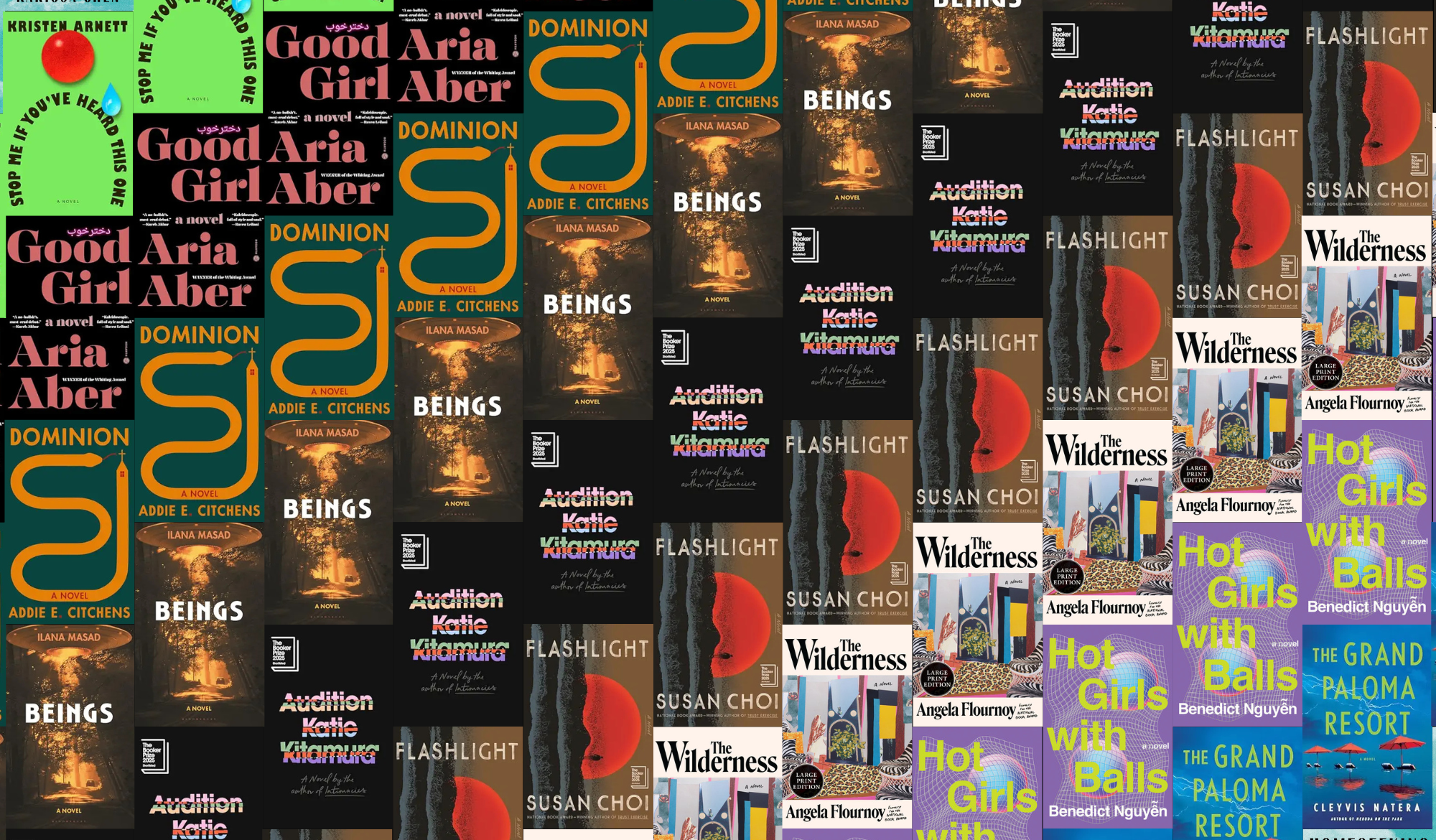
Katie Kitamura’s Booker Prize finalist, Audition, is the sort of slim novel that quietly injects itself into one’s veins, consuming readers, forcing them to navigate the friction between what is said, what is unsaid, what is fixed, and what is fluid. Angela Flournoy’s The Wilderness, which I think might be the Great Millennial Novel, chronicles the friendship and sisterhood of four Black women growing into adulthood over two decades, and all the things they carry into their next era. And Dominion, by Addie Citchens, one of many spectacular debuts published this year, plunges heart—and headfirst—into the drama, humor, and tenderness of small-town Mississippi. These are but a few of the masterful books that populate this list.
While my own debut novel, When the Harvest Comes, published in April, is not eligible for consideration by EL because of a clear conflict of interest, it’s my great pleasure to celebrate so many wonderful novels that were published in a year of truly excellent literary fiction. Every book on the list does what a great novel is supposed to do, particularly during times of shared grief and political turmoil. Each book reminds us of our shared humanity, the aspiration of empathy, and the simple fact that our world is not confined, solely, to the here and now. Our stories must continue to be more imaginative, more expansive, and more beautifully, wondrously, spectacularly human.
—Denne Michele Norris, Editor-in-Chief, Electric Literature
A performance, a love triangle, and an unnamed actress quietly dissecting her internal world. These are the constituent parts of Katie Kitamura’s Booker Prize-shortlisted fifth novel, which opens with a young man declaring himself the nameless narrator’s long-lost son. Quickly, the book plunges into the murky territory of identity, where nothing is quite fixed or true. With sentences sharp as knives, Audition does everything possible to slip up the reader, asking: If identities transform, why shouldn’t stories transform too? Kitamura discussed the volatility of relationships and the reader’s input in her novel with EL here.
Ilana Masad’s brilliant novel follows an interracial couple confronted by an extraterrestrial while driving along a New Hampshire road in 1961. Separately, a lesbian writer of science fiction grapples with alienation and queer yearning in a series of letters she pens to her lover. And, finally, in the present day, an archivist attempts to make sense of those letters alongside the testimony of the first alien abductees. Braiding three interconnected narrative threads, Beings is ambitious, haunting, and filled with heartache and tenderness. You can read an excerpt in Recommended Reading of Masad’s most-loved work yet.
This extraordinary debut begins with the Reverend Sabre Winfrey Jr., his wife, Priscilla, and the youngest of their five sons, Emanuel, also known as Wonderboy. Wonderboy is beloved by everyone in Dominion, Mississippi—no one runs faster, or turns more heads. Caught off guard after an interaction with a stranger, Wonderboy is confronted with questions he’s never considered, and his response sends shock waves through the community. A soaring, yet intimate novel exploring how shame and secrets control and stifle our humanity, Dominion grapples with these forces, illuminating a different, freer path forward.
There’s a special excitement when a National Book Award winner releases a new book. Will it deliver? Won’t it? Flashlight, Choi’s sixth novel, does. It opens with Louisa, a ten-year-old girl, walking with her father, Serk, by the sea. Later, she is found, hypothermic, barely alive, and alone. What follows this strange, quiet tragedy is a multigenerational epic that explores Serk’s broken childhood, moving from Korea to Japan during World War II, to the aftermath of his death, considering the lives touched by such violent change. It is a novel that manages to burrow into the consciousness of a child estranged by geographic displacement and parental loss, while cracking open some of the twentieth century’s most horrific crimes and tragedies.
Sweeping from 2008 to today, this is a story of five Black women navigating the urban landscape of New York and LA, as well as the indelible interior landscapes that define every coming of age. Desiree and Danielle, sisters, alongside January, a banking analyst turned graphic designer, Monique, an aspiring influencer, and Nakia, a budding chef, navigate the acute precarity emblematic of millennials as they step into the proverbial wilderness of adulthood, moving together and apart in a choreography of friendship, chosen family, and familial strife.
Among the swastikas that litter the walls of the public housing where she’s raised, Nila—born in Germany to Afghan parents—develops a love of photography, philosophy, and sex. As she repeatedly disappoints her parents, she continues to search for her own voice as an artist. After meeting American-born writer Marlowe in the haze of Berlin’s party scene, she is quickly absorbed into his tightly controlled orbit as racial tensions grow. Eventually, Nila is forced to face herself and her future, and figure out who she wants to be. A powerful story of love, family, and surviving the foils of youth, Good Girl is a can’t-miss debut of 2025. Aber discusses the transcendence of hiding in nightlife here.
Lydi Conklin calls Hot Girls with Balls a “sharp, funny, lively book about the wildly horrifying transphobic, conservative politics of contemporary American society.” With its witty discussions of athletics, romance, and internet culture, Benedict Nguyễn’s debut novel is compelling, humorous, and genuinely fun to read.
An “unforgettable story of class, family, and community,” The Grand Paloma Resort is another compelling commentary on the wealth, entitlement, gentrification, and luxury associated with tourism and the resort industry. Fans of The White Lotus—which Natera discusses as being in conversation with the book—and Saint X will be stunned by Cleyvis Natera’s suspenseful second novel and its deeply accurate insight into the sinister mechanisms of inequality and exorbitant privilege.
Intelligent and articulate, Stop Me If You’ve Heard This One is further proof that Kristen Arnett always has something insightful to say. In her newest novel, Arnett has become a true magician with a knack for spinning comedic gold and creating a thoroughly entertaining narrative that levitates with the power of its humor and honesty. You can read an excerpt of the book in Recommended Reading.
In Heart the Lover, a college student finds herself in the pull of two young men—a witty, ambitious, passionate pair of best friends—who break open her world. What could be a familiar campus story takes an unexpected turn in Lily King’s hands, launching off campus and into the future, a topic she discusses in her interview with EL. King’s mastery of complex, utterly unique characters and brilliant dialogue shines in this aching novel of love, the passage of time, and how those we meet in our youth continue to stay with us, even when we think we’ve moved on.
For admirers of epic historical narratives that sweep readers into another era, Homeseeking is a layered, fresh take on writing across decades. Bringing together themes of friendship, love, separation, and second chances, Karissa Chen has crafted a detailed debut that poignantly meditates on remembrance and moving forward.
While considering the place of Blackness in an art world entranced by the white gaze, Brandon Taylor’s Minor Black Figures simultaneously paints a compelling portrait of a deeply intelligent and inquisitive artist. This novel celebrates the deep, unique connections and perspectives that can be forged through authentic creativity. In an interview with EL, Taylor, a former senior fiction editor for Recommended Reading, talks about his writing process, love of realism, and the inspiration he pulls from the art world.
When Mitch’s political and economic influence are threatened by a well-known activist aided by Mitch’s estranged sister, a political struggle plunges their homeland and tribe into disarray. The complexities of self-definition, power, politics, and family ties are at the center of this thrilling, quick-moving debut.
As a Nigerian immigrant who once lived in New Orleans, Hurricane Katrina prompted Olufunke Grace Bankole to consider the impact of a devastating disaster on those living far away from home in a storm-ravaged city. The Edge of Water is a result of this consideration and the narrative explores fate and destiny in multiple voices and registers. Folklore, tradition, prophecy, and expansive generational narratives populate this epically complex debut novel, which Bankole discussed in an interview with EL.
As Vi Liu attempts to fit into her small town, her life is altered when she is presented with the opportunity to make a perfect boyfriend out of a sentient blob. With Blob, Maggie Su has crafted a narrative that insightfully intertwines the practicality of everyday routines with the shapeshifting nature of experimental surrealism. Readers of this hilarious and deeply intelligent novel will feel a sincere connection to Vi as she earnestly attempts to achieve love, acceptance, and self-knowledge. Read Maggie Su’s EL interview about Blob here.
Over the course of a year, the lives and dreams of Charo and Sal expand, shift, and adapt as they search for happiness in New York City. Throughout the novel, characters are given opportunities to find joy and resilience amidst instances of love, heartbreak, desire, and struggle. Loca considers what it means to be someone who breaks norms, chases dreams, and reconsiders tradition, as Heredia discussed in an interview with EL
The High Heaven traces the winding life of Izzy Gently—from her orphan childhood in New Mexico to a present existence haunted by the past. Wheeler’s debut novel considers the relationships between exploration and expansion, humanity and the universe, set against the breathtakingly mystical landscape of the American West. Read an excerpt of The High Heaven in Recommended Reading.
Imagine memory is a commodity—something that can be bought, sold, shared, edited, and manipulated. Imagine too, that some memories, the stories and truths they attest to, are banned. They’re too dangerous, too subversive. This is the world of These Memories Do Not Belong to Us. Set in a future dominated by the Qin Empire, Ma’s debut follows a young man who has inherited a collection of forbidden memories from his mother. The memories might be the death of him, but they might also sow the seeds for the empire’s downfall. Read Ma’s discussion of his book’s fragmented cover and the frightening pace of modern technology with EL here!
In Middle Spoon, a heartbroken narrator struggles to cope after being dumped by his boyfriend while simultaneously attending to his husband and children. Described as “visceral” in an EL interview, this epistolary novel will inspire readers to consider the restraints they place on themselves as they witness Varela’s characters remake, rework, and reconsider the limits of life and love.
The Summer House is a novel about Japanese architects quietly building a library. In it, a recent university graduate gets the unexpected honor of an appointment with a prestigious firm led by a Frank Lloyd Wright disciple. The aging master and his team relocate to the titular summer house, as they do every summer, and there, under the shadow of an active volcano, design a building for a competition to construct the National Library of Modern Literature. Locked in this story of quiet observations and fleeting romances is a tale of creation, destruction, and grandeur. Catch a tantalizing snippet of it excerpted in Recommended Reading!
When Emmett moves home to Kentucky and takes a job at Tempo, a fulfillment warehouse resembling another familiar eCommerce giant, his trajectory clashes with his half-brother’s, whose marriage is falling apart. While meditating on class, power, and privilege, Cole’s novel explores desire and the process of building a meaningful, fulfilling life. Read an excerpt of this layered narrative in Recommended Reading.
After a group of powerful witches welcome Wilder into their fold, they are threatened by an AI entity that has the capability to upend the world. Together, the coven considers how to stay united and fight against forces that wish to do them harm. Dedicated to “everyone who feels betrayed by J.K. Rowling,” Awakened is a novel that celebrates its queer and trans characters through magical prose and a fascinating narrative. Read about the creation of its wonderfully witchy cover here.
While others seek romance through dating apps, Linda, who believes it is her destiny to marry an airplane, quenches her lust for love through air travel. This hilariously scandalous novel investigates the turbulent juxtaposition between the merits of achieving our true desires and the risks of encouraging our own self-destruction. Readers should buckle their seatbelts to experience this high-flying story, which Kate Folk discussed in an EL interview.
In Kashana Cauley’s The Payback, the Debt Police are after Jada Williams, but she refuses to go down without a fight. A revenge plot—complete with collective action and plans to erase student debt—ensues. Described as “urgent” and “deeply felt” in Cauley’s EL interview, readers who enjoy heist movies, humorous social critique, and cheering for the antihero will be thrilled with this brilliant sophomore novel.
Earlier this year, I had the chance to listen to Melissa Febos and Alexander Chee talk about Febos’s new memoir, The Dry Season, a book that was voted one of EL’s top five nonfiction titles of the year. At the event, they discussed a common knock against memoir: That it’s so navel-gazey. “Navel-gazing? More like viscera-gazing,” Febos said. To look into oneself and poke and prod and put on the page something honest is challenging and sometimes ugly work—there is nothing easy or light about gazing at one’s own viscera, and we are all so lucky to have authors who are willing to not only do it, but share that process with readers.
Nonfiction does the difficult work of translating real life into something that helps us make sense of each other, of ourselves, of this increasingly chaotic world we are living in. As we wade through an era of intensified loneliness, in which money-hungry corporations want to capitalize on our disconnectedness by selling us AI friendships and therapists and lovers and even, or perhaps especially, AI that does your own thinking for you, nonfiction insists on connecting: to ourselves, to one another, to our personal and political histories. There is power in refusing to accept the idea that offloading the work of thinking to computers has value while the act of navel-gazing—viscera-gazing—is valueless. In Alligator Tears, Edgar Gomez crafts a humorous and graceful queer coming-of-age story that simultaneously unravels the American bootstraps myth. Sarah Aziza’s The Hollow Halfexcavates the links between her recovery from the eating disorder that nearly killed her and her ancestral history of Palestinian displacement and survival. Through harnessing stories only they can tell—their stories—these authors insist on the importance of their own voices and experiences, telling something essential about the world around us in the process.
Good nonfiction books stand as a testament to the value of curiosity and thinking deeply about our lives, our world, and all the people in it. Below are our favorites of the year.
— Katie Henken Robinson, Senior Editor
P.S. Electric Literature’s first anthology, Both/And: Essays by Trans and Gender-Nonconforming Writers of Color, was not eligible for this list due to the conflict of interest. However, I’d be remiss not to mention that it’s a top nonfiction book of the year in our hearts!
The sophomore book by Lambda Literary Award and American Book Award winner Edgar Gomez, Alligator Tears is a collection of linked essays in turns—and often simultaneously—hilarious and heartbreaking. Through tracing their journey of trying to scramble out of poverty, Gomez lays bare the lies sold by the American Dream while also shining a light on the value of community—especially queer community. Whether writing about getting veneers or being kicked out of school, Gomez’s inimitable voice pulls the reader close and doesn’t let go, making each and every essay a knockout.
Melissa Febos’s The Dry Season tells the story of a year spent celibate while simultaneously delving into the history of other women whose journeys inform her own—from nuns and the Shakers to Sappho and Virginia Woolf. Throughout the book, her celibate period grows into something much greater than just abstaining from sex; it’s about Febos learning her desires, her impulses, and how to center herself. This deeply empowering memoir is a sort of map, one that shows how to seek true, sustaining pleasure and fulfillment within oneself and unlearning the tendency to let romantic and sexual connection consume all else. You can read an excerpt from the memoir here, and read Febos discussing exploring pleasure and joy through celibacy in her interview with EL.
I Want to Burn This Place Down by cultural critic Maris Kreizman is a sharp and deeply personal essay collection tracing Kreizman’s political evolution as a leftist. She charts her journey from a faithful believer in American institutions and life as a “good Democrat” to a more radical understanding of power, inequality, and cultural disillusionment. The collection captures one woman’s reckoning with an unraveling nation and her search for a new path forward. Read EL’s interview with Kreizman about the book here.
Lamba Award-winning poet Zefyr Lisowski’s nonfiction debut, Uncanny Valley Girls, is a memoir-in-essays that weaves theory into her nuanced critiques of horror movies—the author’s most constant comfort. A visceral collection of essays tracking Lisowski’s biography starting from her trans childhood in the south, the book explores gender complications, violence, and class ascension with a careful hand. Liswoski discusses these themes and more in her interview with EL.
In October 2019, Sarah Aziza had barely survived after being hospitalized due to anorexia. And then—in the hospital cafeteria—the hauntings begin, starting with the voice of Aziza’s deceased Palestinian grandmother. Finalist for the Palestine Book Awards, The Hollow Half untangles family secrets and traumas passed down from generations of Palestinian displacement and erasure, all with urgency and grace. Read an excerpt of the memoir here.
Aggregated Discontent is the debut essay collection from journalist and cultural critic Harron Walker. Across sixteen sharp, funny, and unflinchingly honest essays, Walker blends memoir, reportage, and cultural critique. Along the way, she examines everything from the gig-economy grind to the failures of U.S. trans healthcare, from the role of art to the messy contradictions of modern life.
Winner of the 2022 National Book Award, Imani Perry’s latest contemplates the color blue’s salient role in Black culture. Reexamining Blackness through the lens of a color so intertwined with melancholy, hope, and heartache, Perry presents readers with a bewitching portrait attuned to the most sublime aspects of our humanity.
Acclaimed poet and novelist Hala Alyan’s debut memoir I’ll Tell You When I’m Home is a profound and lyrical story of addiction, motherhood, and Palestinian exile and displacement. Structured around the growth of her baby during pregnancy, who is being carried by a surrogate many miles away, Alyan prepares for motherhood through looking back on her personal, familial, and cultural histories. In fragmented, hypnotic prose captured beautifully in the memoir’s excerpt in EL’s Personal Narrative, Alyan weaves together an unforgettable narrative of survival in many forms. In an interview with Electric Lit, Alyan discusses the dissonance of writing this memoir during ongoing Palestinian genocide.
Inquisitive, and deeply reflective, Miriam Toews’s A Truce That Is Not Peace traces the path of a writer grappling with creativity and the question once posed to her at a literary festival in Mexico City: Why do you write? Through thoughtful meditations, she returns to family stories, formative moments, and the losses of her father and sister, both by suicide. The memoir offers an intimate portrait of a mind exploring its own patterns, testing ideas, and seeking meaning through the act of making art. Toews discusses the question of why we write in her EL interview.
Clam Down by Anelise Chen is a genre-defying memoir written in the wake of her divorce. When her mother’s repeated typo texts urge her to “clam down,” Chen imagines herself transforming into a clam, retreating, hiding, and protecting herself. Through reflections on mollusks and family history that includes a long-absent father, she explores what it means to withdraw into one’s shell and what true healing might look like. Read an interview about Chen’s process writing the book here.
Caroline Hagood’s Goblin Mode: A Speculative Memoir dives into the chaotic, uncanny terrain of being a woman, mother, and writer in a world teetering on the edge. Over a three-day period, a mysterious goblin pushes her toward chaos, curiosity, and unexpected freedom. Blending humor, surrealism, and the ordinary challenges of daily life, the memoir explores what it means to live with boldness and abandon.
In Nightshining: A Memoir in Four Floods by Jennifer Kabat, the author traces the history of flooding in her home in Margaretville, New York, while reflecting on the recent passing of her father. Along the way, she meditates on Cold War–era weather experiments, the history of the Mohawk Nation, and how Kurt Vonnegut’s brother may have caused her town’s catastrophic flood. The result is a rich meditation on memory, place, and the fragile intersection of nature and human action. Read an interview with Kabat about the book here.
In Searches: Selfhood in the Digital Age, Vauhini Vara blends memoir and cultural critique to examine how the internet, AI, and Big Tech shape the way we understand ourselves. Drawing on her own experiences, including childhood chat rooms, her sister’s death, and her work as a tech journalist, she reflects on the ethics, power, and influence of technological capitalism. By interrogating her internet life—from her Google searches to her use of AI—Vara probes whether it’s possible to reclaim a more humane, thoughtful relationship with technology. Vara discussed AI and its impacts in an interview with EL.
In A Silent Treatment, Jeannie Vanasco confronts her mother’s long, punishing silences, which could stretch on for months at a time. Through detective-like research and introspective reflection, she pieces together their fraught relationship, showing how silence can wound as deeply as words. The memoir is both a personal excavation and a meditation on communication, love, and the void left behind when someone refuses to speak, themes Vanasco discusses in her EL interview.
Known for her eviscerating criticisms of even the most highly-regarded artists, the Pulitzer Prize-winning critic Andrea Long Chu’s latest collects razor sharp reviews, critical essays, and personal essays unafraid to merge the artistic with the political. Acidic, yet exacting, Authority illuminates how to do criticism in an age of constant crisis and instability, something Chu also discusses in her EL Interview.
In Human/Animal, Amie Souza Reilly blends memoir and essay to intertwine a deeply unsettling personal story with reflections on the animal world. After moving into a suburban home with her family, she is stalked by the next-door neighbors—two older brothers whose harassment intensifies over three years. Throughout the book, Reilly employs animal metaphors, etymology, and her own sketches to examine fear, boundaries, violence, and what it means to be human in a world that often feels animalistic. You can read an excerpt of the memoir here.
Chances are you’re connected to the internet right now. Chances are you’re connected most of the time, actually. In her highly-anticipated debut collection of essays, Aiden Arata interrogates the space between our virtual and tangible selves with searing self-awareness and clarity. Grifting, content creation, doom fetishizing—Arata brings the sinister habits of the internet to consciousness, making readers finally start to blink twice at their phone screens. Read an excerpt of the memoir in EL here.
Before he’d become known for writing the National Book Critics Circle Award-winning book Gay Bar, Jeremy Atherton Lin escaped into London fashion shows, Berlin sex clubs, and a “city of refuge” with the boy with his dreams. Set in 1996 as a US Congress was hell-bent on denying same-sex couples federal rights, Atherton Lin’s Deep House questions gay marriage as an object of queer liberation through historical case studies and his own tender, but acerbic lens.
Gaza: The Story of a Genocide, edited by Fatima Bhutto and Sonia Faleiro, is an urgent anthology of personal testimony, frontline reporting, poetry, and art documenting the ongoing devastation in Gaza. Contributors, including survivors, poets, journalists, and academics, share deeply human stories of loss, resistance, and political violence. The collection bears witness and calls for action, with all royalties supporting UNRWA. Read about the meaning behind the anthology’s cover, created in the style of tatreez, a Palestinian embroidery technique.
In How to Be Unmothered, Camille U. Adams explores her fraught relationship with her mother within the context of Trinidad’s colonial history. She reflects on generational trauma, her family’s legacy of abandonment, and her own survival through vivid memories from girlhood to womanhood. The memoir is a powerful reflection on building a self in the absence of maternal care through storytelling and connection.
In Things in Nature Merely Grow, Yiyun Li writes with stark emotional clarity and philosophical rigor about the suicides of her teenage sons, seven years apart. The book offers a moving portrait of two very different boys and the new life Li must build after parenthood. It is an unflinching reflection on living after unimaginable loss and the deliberate choices Li makes to endure. Read an excerpt in EL here.
In Bibliophobia, Sarah Chihaya explores how books have shaped her life, particularly during periods of depression and suicide attempts. She reflects on her cultural identity as a Japanese American and the ways literature intersected with her struggles. Through works ranging from The Bluest Eye to Anne of Green Gables, Chihaya interrogates the power of reading and the narratives that shape who we are. Read an interview with Chihaya about the book here.
In So Many Stars, Caro de Robertis presents an oral-history project featuring the voices of 20 trans, nonbinary, genderqueer, and Two-Spirit elders of color. From trans activists to queer community leaders, the individuals featured in the book share how they survived crises and carved out space for themselves and their communities. The stories not only illuminate the lives that queer elders have built, but also offer lessons to younger generations following in their footsteps. In their EL interview, de Robertis discusses the process of putting together this oral history.
In Somebody Is Walking on Your Grave, Mariana Enriquez chronicles her visits to cemeteries around the world, reflecting on history, memory, colonialism, and mortality. Her essays blend gothic sensibilities with historical and personal insight. The book is a meditation on the living and the dead, exploring what cemeteries reveal about our present.
In The Wanderer’s Curse, Jennifer Hope Choi explores the nature of her mother’s yeokmasal—the “curse” of being a perpetual nomad—and wonders if she’s destined to the same fate. Choi weaves a sharp and often hilarious mother-daughter story that probes questions of identity, belonging, and the places we call home. You can read an excerpt of the book here.
After the car accident the titanium rod they put in my leg got infected. The infection went into the bone. Osteomyelitis. There were twelve surgeries, multiple hospital stays. I lost my job, broke up with my boyfriend, moved back to Texas to live with my brother Jason. I’d just turned thirty-seven, and Jason was forty-two. He’d moved out of our parents’ house after they died, three years ago, Mom of pneumonia and Dad of a heart attack.
I was glad they never had to see me like this. It would have disturbed them, their daughter adrift. They would have wanted to take me in. I probably would have let them. Of course, if they hadn’t died, Jason would still be living with them, so it would have been the four of us together again, surrounded by framed pictures of us as much younger people.
Every Monday and Friday, I rode the bus downtown to the wound clinic of the county hospital, the only place in Austin that would treat people without insurance. There was a wound technician assigned to me named Luka. “Does it hurt?” he asked, kneeling before me as I sat on a chrome chair.
I’d taken my pain pills. I said, “Not too bad.”
When he leaned over me, Luka’s scrubs were loose enough that I could see his chest, which was mostly smooth, only a weedy patch of black hair bridging his pecs. He unwrapped my leg, then fired what looked like a clear water gun with a rubber dish at the tip. It was like a high-pressure car wash. The gun spit and sucked at the same time, through two different barrels. “Look,” said Luka. “That’s granulation tissue. Your wound is healing.”
Was there a tiny, hopeful island of pink in the dark gash of my wound? Maybe so. Maybe not. My brain was blurred by insomnia, my senses blunted. I felt half dead on my best days. I had dark rings under my eyes, bony arms, flabby muscles. The antibiotics loosened my bowels. My periods were long and heavy. Everything tasted sour. I smelled like old banana peels, like wet trash. “Healing” seemed like fantasy-talk, like a fake word.
“You’ll be back on the dance floor in no time,” he said.
I smiled at his little joke.
My wound was red and weepy after the wash-and-dry. “We’ll go for the silver nitrate,” Luka said, rubbing his hands together. He was peppy that way. I could tell he had a robust personality, a strong engine. He wore blue high tops. His biceps flexed as he maneuvered cotton-tipped applicators. His body seemed overengineered for such a detailed and fussy profession. I pictured him working on a dock somewhere, lashing giant metal contraptions together.
After the silver nitrate, he wrapped my leg in medicated patches and gauze. His hands were warm. I closed my eyes and saw purple and red shapes bloom and fold into themselves. Like cigarettes, Luka’s hands kept me going.
I’d read that a severe injury with a prolonged recovery might cause hypnagogic hallucinations—odd sounds, bizarre associations, or, in my case, expansive and shifting images when I closed my eyes. But when Luka touched me, the images changed in a way I can’t explain. Instead of holding me apart, the shapes pulled me toward them, until I became, for long moments, vividly part of them.
Dr. Peters, the rehab doctor who oversaw the wound clinic, walked through the privacy curtain. She had the pale, yellow complexion of a grub worm. She grasped my knee and rotated my hip in its socket, perhaps in order to save herself from having to squat. The way she handled me with her fat fingers made me think of my leg and myself as distinct entities, the former requiring attention and assessment, the latter—the me attached to my leg—superfluous. “Fine,” she said, then swept the curtain aside, left us alone.
Luka looked over his shoulder, adjusted the collar of his scrubs. “I know hospital insurance only covers two visits a week. Three visits would be ideal for this kind of wound. If you want, I could come by in-between.”
“Come by where?” I asked.
“Your place.” Luka clicked a pen and handed me a gauze wrapper. “Why don’t you give me your number?”
I have no idea what my facial expression must have communicated.
“I like to help people,” he said.
I felt a little pang at being lumped in with “people,” though he’d given me no reason to suspect I was dear to him.
I wrote down my number and gave the wrapper back to him. He slid it into his breast pocket. I had a sudden sense of being swallowed by that pocket, which was deep and directionless, an ocean. The baby blue material of his scrubs was so thin and pliable, I thought I could see it shudder with each beat of his twenty-something heart.
We said goodbye, and I limped toward the exit on my crutches. Behind me, Luka greeted a mute obese man in an electric wheelchair. The man grunted. He was a regular, with a fungal infection that turned the skin of his calves to bark. “Incurable,” Luka had once told me, his face boyish and bright, the face of a star pupil.
“Here? He’s coming here?” Jason asked. We sat on my bed, his living room couch in the daytime. In his ratty basketball shorts and yellowed undershirt, his thin hair swept up over his forehead and temples, Jason looked like a blond, washed-up Elvis. Wild gray hairs on his Adam’s apple caught the light from two windows that looked over a small park where a lady with pink hair sometimes cursed at me.
I told Jason that Luka probably felt sorry for me. A normal brother might have taken the opportunity to ask questions about my treatment, how I was doing.
“How old is he?” Jason asked. He had a tendency to fixate on age.
I shrugged. “Young. Twenties?”
His eyebrows shot up. “Sounds like cougar activity,” he said.
“Have you seen my crotchless panties?” I asked, trying not to let him get under my skin.
“That’s disgusting, Maureen.”
“That’s what cougars wear,” I said. “Crotchless everything. No crotches allowed.”
Jason scowled. “Stop saying crotch.”
I rolled my eyes. If I had likened myself to an animal, it would’ve been something less aggressive, more cerebral. Like a praying mantis. The quizzical stare, the bad posture, the pointy elbows.
“I don’t know,” Jason said, as if it were his decision.
“It’s not up to you,” I said.
“This is my apartment.”
I pretended to take this as a threat, though I knew he would never kick me out. “Maybe I’ll leave,” I said.
“You can’t leave, Maureen. Why do you say things like that?”
I felt no shame in threatening Jason. If anything, his anxiety at the idea of my leaving amused me. I was a child.
“Then it’s not up to you,” I said again.
“What you’re telling me is concerning.”
“He’s coming to clean my leg. It’ll take thirty minutes.” I was hoping for more like an hour, but it had been so long since I’d been touched outside the wound clinic, I’d take whatever I could get.
“Where is he getting the supplies?”
“Maybe from the hospital?”
“If he’s stealing them, you’re implicating me in illegal activities by using this apartment.” Jason lived in fear of the law, though I don’t think he’d ever broken it.
“The only way you’d be implicated is if you’re gaining something through the transaction,” I said. “But I’m completely freeloading off you.” I hoped abasing myself would guilt Jason into capitulating, though, of course, what I said was true; in addition to free room and board, Jason gave me a weekly allowance. Usually around one hundred dollars.
“Well, that’s true,” he said. “But what exactly is the transaction?”
“He cleans my leg. That’s it. I’m not paying him.”
“A transaction is a give and take. What does he get?”
“I don’t know,” I said, pretending not to understand.
“What does he want?”
I laughed nervously, surprising myself. “What do you mean? Maybe he just likes to help people.”
“What if he has an expectation, Maureen?” Jason sounded genuinely anxious. I wondered if he’d ever had anyone else in his apartment besides me. Probably not. I’d bought and stashed some new white towels because his had crusty, yellow patches that reminded me of eczema. The toilet hissed day and night. Half the electrical outlets refused to charge my phone.
“Expectation?” I asked. “That’s impossible. Have you looked at me lately?” I spread my arms and tried to rotate on my working leg, picturing a ballerina in a snow globe, but after a quarter-turn, I was completely exhausted. “And anyway, you’re here to protect me.”
“What am I going to do?”
“Kick some ass. Whatever older brothers do.” I smothered a laugh at the thought of Jason protecting anyone.
“This is ridiculous.” Jason got up and went to his room, paused in the threshold for a moment, as though balanced between his world and mine. Behind him, there were piles of poker books stacked nearly floor to ceiling. Three large computer monitors glowed. Pokémon, ninja turtle, and K-pop paraphernalia lined the walls. A life-size model of Beetlejuice stood by the bedside, with a hairstyle very similar to Jason’s; Jason had draped a pair of underwear over its outstretched fingers.
The door clicked behind him.
I had the same feeling watching him disappear that I’d had as a little girl in our childhood home. After all these years, his room was still his sacred place, a replica of the room he’d lived in with our parents for nearly four decades. Why didn’t he ever invite me in?
Luka called on Wednesday, and we agreed on five-thirty. I watched him exit his red coupe from our third-story window. He loped around to the driver’s side to pick up a lumpy bag. I hustled to finish my cigarette, then sprayed air freshener around the room and took a swish of mouthwash. I waited for him to knock before opening the door.
“Hey,” he said, flashing a smile and walking inside. The smell of the wound clinic followed him. He was in his scrubs. I wondered if I’d get to see that patch of chest hair. “Nice apartment,” he said with intimidating ease.
“It’s my brother’s. He’s in his room. Thank you for . . . ” I motioned to the bag.
As he hoisted it onto the hallway table, his sleeves rode up, and I caught the briefest glimpse of those biceps. “They throw out the expired stuff, but it’s still good,” he said, “and I brought the portable suction machine from the storeroom.”
“Aren’t you afraid of getting caught? I mean, if you do this regularly?” I asked, hoping he’d reveal that he’d never actually done a home visit before, that I would be his first.
“It’s a county hospital,” he said.
“Right.” I nodded, though I didn’t understand what he meant. Something about poverty, or waste. The moral underpinnings of social programs, etcetera. His politics didn’t interest me at all. I smiled. “I guess I should change?” I asked.
Luka produced a stack of hospital gowns from the bag. “I’ll set up in the bathroom and you can come in whenever you’re ready.”
I pointed him to the bathroom, and Luka went in and closed the door. There were four gowns, an auspicious number, suggesting multiple visits. I found myself remembering the moment I’d received a promise ring, pink with tiny plastic diamonds in the shape of a heart, from a middle-school crush.
I draped a gown over my shoulders, snapped three buttons, then stepped out of my sweats. I wore my newest underwear, faintly lilac and shimmery. I’d checked to make sure there were no stains. It felt important to keep this part of myself wrapped neatly, almost like a gift.
It was petty, but it felt nice to bring them back and then let them die again.
Jason turned up his music, the same way he had as a kid whenever I’d had friends over, or when our parents were trying to come to terms with each other. I could almost hear them now, yelling about my “defiance” or Jason’s “social problems.”
Sometimes I indulged the strange belief that they had died expressly to forget me and that by reliving some difficult part of our relationship, I could wake them from death, if only long enough for them to acknowledge me. It was petty, but it felt nice to bring them back and then let them die again. I liked that I could still be a daughter whenever I wanted.
I opened the bathroom door. Luka had set up the suction machine and attached the water gun. “Sit on the toilet,” Luka said. I admired the way he was wielding his authority: firm, but with a light touch.
He kneeled on the floor and unwrapped my leg. I’d hoped he’d do it more slowly without the pressure of a full day of patients, but he moved as efficiently as always. Perhaps he couldn’t shake the feeling of Dr. Peters supervising over his shoulder.
“Things are looking good,” he said. “I think the new tissue is a little shinier than last time. Can you see that?” He glanced up at me, full of juvenile enthusiasm. I shrugged. Somewhere down the line my leg had stopped feeling like my own.
I closed my eyes and felt his hands poking, patting, caressing. I willed time to slow down, to move with the same torpid pulse as the shapes that unfolded behind my lids. The whir and slosh of the gun. The crinkle of gauze wrappers. Luka’s breath, low and even. His soles squeaked once or twice as he shifted position. Even Jason’s music couldn’t break my reverie. My mind calmed. I wondered if by cleaning my leg in my bathroom, Luka was in fact claiming me. I opened my eyes in time to see him apply the adhesive tape.
My leg throbbed under its new wrapping. Womp-womp-womp, it went, echoing my heart. I had forgotten my pre-cleaning pain pills, but so what? Not even pain could interfere with this moment.
After bagging up all the trash and equipment, Luka turned and opened the bathroom door. “I’ll drop this in the dumpster on the way,” he said.
With no forethought, I sprung up on my crutches, lurched after him, andgrabbed his shoulder. He seemed startled and spun around. It wasn’t something I would normally do, but maybe the pain made it seem like an acceptable act. I pressed myself against him and nestled my head under his chin. His neck was hot. Had I licked him, I was sure he would have tasted wonderful. I clasped my hands behind his back, pushed my face into his chest, and took a deep breath. He smelled like raw biscuit dough and lime zest. I wanted to clean him like a newborn kitten.
He dropped the bag, which hissed, releasing the scent of my used bandages.
Jason’s door opened and he appeared in wrinkled chinos and a button down, his hair combed and parted on the side. I’d never seen him like that. “Everything okay out here?” he asked.
I backed away from Luka. I felt ashamed, then furious at myself. Was I not allowed to experience desire? “Jason, what are you wearing?” I asked.
Jason’s face turned red. “Regular clothes,” he said. We stood there in uncomfortable silence.
“Jason, this is Luka, from the wound clinic,” I finally said.
Jason stuck out his hand and Luka pumped it a few times. Their bodies making contact disturbed me, as though Jason might leave some kind of disgusting residue on Luka. “It’s so kind of you to help Maureen,” Jason said.
Luka pointed toward Jason’s room. “Hey, is that Beetlejuice?”
The underwear was gone. How odd. Beetlejuice’s naked hand looked like a tree that had lost its leaves. Jason made a weird expression with his eyebrows, like a crime scene investigator in a movie, someone who ponders unforgivable mistakes, coldly stitching them together using bloody clues as thread. “I invest in collectibles,” he said. “I’m a Tim Burton fan, hence Beetlejuice over there. This is my home office.”
Home office? Hence? How long had he rehearsed this speech? And why?
“What a coincidence,” Luka said. “I’m a huge Tim Burton fan. I’ve always had a thing for the Corpse Bride.” Jason snorted, then they both looked at me at the same time, and for a reason I couldn’t quite parse, I felt out of place. Jason’s stare had a particular intensity.
Luka held up the bag of trash. “I guess I’ll head out.”
“You’re leaving?” I asked. He didn’t seem to hear me. I glared at Jason, who followed me with his eyes. At the front door, Luka and I waved at each other, and then he turned awkwardly away. Before I knew it, he’d disappeared down the stairwell.
I closed the door and turned on Jason.
“Why are you doing that?” I asked.
“Doing what? I’m just standing here,” he said. “I was trying to be nice.”
“I can’t believe you would just jump out of your room like that, dressed like that. It feels like I’m in high school and Dad just busted in.”
“Well, to be honest Maureen, it looked like something was going on out here. It looked like you were . . . .”
“Nothing happened.” I located my pill bottle in the abandoned sweats lying crumpled on the floor and shook some out, then swallowed them dry.
“I’m pretty sure something happened,” Jason said.
“Forget it. Stop. Why are you wearing that?”
“Do you have a problem with my clothes?”
“You look just like Dad.” It was meant to be an insult, but Jason seemed oddly immune. Or maybe that been his intention, to look like Dad. The thought made me want to scream.
“I thought you’d like me to meet your friend in some clean clothes,” he said. “Was I wrong?”
“Stop being a meddling dick head!” I shouted. The volume made me feel slightly better.
Jason spread his hands. “What’s going on here? Do you have a problem?”
“Do I have a problem?”
“You’re hurting my ears.” He actually covered them.
“Stop, Jason. Stop being weird. A fucking weirdo.”
“Whatever, Maureen.”
Sensing a slight quaver in his voice, I felt inspired to hurt him even more. “Are you going to cry? Why don’t you cry right in front of me?”
He spun back into his room, slammed the door, and shouted, “Next time forget about me checking up on you! You and your friend can do whatever you want! In my apartment!”
“I know that,” I yelled back.
It was good that we were yelling again. We still had plenty of things to yell about. Since I’d come to live with him, I realized, we’d been pretending to be adults. Maybe now that we were finally yelling again, we could start being normal with each other.
“Sorry about what happened,” I told Luka at our next clinic visit.
“Don’t be,” he said. I waited for more, but he seemed absorbed by my leg. The damn leg always upstaged me. Or maybe he was afraid of being overheard. I strained to listen for the sounds of someone on the other side of the curtain; Dr. Peters usually announced herself with mouth breathing.
“Living arrangements are tricky in times of transition,” I said, hoping to draw his attention toward the rest of me.
“Makes sense,” he said, looking up briefly.
Something about his response and demeanor told me I should give him a little space, but I wasn’t about to heed this sort of intuition now when I had never heeded it before in my life. No, I was going to press Luka, compel him to react. Forcing a negative outcome would at least circumvent the nightmare of uncertainty.
“My brother came out of his room at exactly the wrong time,” I said.
Luka laughed and seemed to concentrate harder on his handiwork, rolling out moist pink gauze that he tightened around my calf in even, overlapping spirals.
What exactly did I want from him at this moment? Humor? Acknowledgement? I felt ravenous for emotional connection of any kind. “Things were just getting interesting,” I said.
He ignored me and instead looked very seriously at my leg. “Let’s talk about your leg,” he said.
“My leg.” Of course. What else would we talk about?
“Are you smoking?”
“No.” Smokers were always being forced into these situations where they had to come clean, but I wasn’t going to buy into all that.
“Are you eating a healthy diet? The one on the nutrition papers we gave you?”
Crackers. Half a can of beans sometimes. Coffee. Some stale candy corn from the laundromat. Were any of these staples allowed in the exclusive company of the four food groups? Probably not, but my stomach hadn’t been able to handle anything else. “More or less,” I said.
“The tissue doesn’t look healthy today. It’s grayer than we like. It feels like we’re backsliding. And if you’re not smoking, and you’re eating a good diet, we need to know what’s causing this.”
He left and came back with Dr. Peters. “We’ll need x-rays and some new lab work,” she said. “Lucky for you, your charity insurance pays for it.” She depressed my eyelid with her thumb, then lifted my hand and pressed my nail. When I yelped in pain, she smiled. “You’re anemic. You might need a transfusion. Transfusions carry risk.” She seemed to have decided to teach me a lesson. “And if you can’t stop smoking,” she continued, “we can’t guarantee your treatment at this clinic. Do you understand?”
I nodded.
“I’m going to need you to tell me you understand.”
Furious, I blinked away tears. “If I don’t get treatment my leg will rot off, and I’ll die,” I said.
“Is that what you want?”
I tried to empty my face of anything resembling emotion. “To clarify, you’re asking if I want to die?”
Her mouth twisted and she straightened her back. “Is this a joke to you? Are you a teenager? Look around. Everything here costs money. Do you get it?”
I imagined stabbing Dr. Peters in the stomach with a scalpel, sewing her lips together, smothering her with saline-soaked gauze.
He needed to understand just how messy I was. Not just my leg, the whole me.
“I’ll talk to her, Dr. Peters,” Luka said. He sounded like a child redirecting an angry parent.
“I’ve heard a lot of talking in here, Luka,” she snapped. “Too much talking.”
She left. Luka handed me a tissue. I let the tears coat my cheeks, the snot congeal between my lips. It was good for Luka to see me like this. He needed to understand just how messy I was. Not just my leg, the whole me.
“I’m sorry,” he said, smiling weakly.
“It’s not your fault,” I said.
On Wednesday evening I took a shower and sat on the corner of the couch, watching the street. No red coupe. No knock on the door. Jason came out in his chinos and button down and stood there like an idiot—saying nothing, thank God—then went back in his room. I chain-smoked half a pack, dumped the rest into the garbage disposal, and flipped the switch. But the disposal only hummed. I’d forgotten it was broken. I found a green rubber glove and extracted the cigarettes, then squeezed them into a clump and threw it in the trash. I heard the thunk as it hit the bottom.
When I lay down for bed, Luka texted.
“I’m downstairs. Do you mind if I come up?”
I jumped up and limped into the bathroom to assess my appearance.
“I’m not really dressed,” I wrote, then erased it. “Sure. Give me five minutes.” I downed a couple pills, splashed water on my face, rubbed my armpits and crotch with a soapy washrag, and brushed my teeth. He knocked. For some reason, I wanted to cry, so I slapped my face a few times until the urge passed, put on a bathrobe, and went to answer the door.
Luka stood there with a little bouquet of blue flowers held together with a twist tie. “Dr. Peters found out I took the portable suction machine and I almost got fired. It’s locked in her office. I drove around to the medical supply stores but I couldn’t find the right kind.”
It had been a while since anyone gave me flowers. They were wilted, but so beautiful, with silky petals, bright yellow stamens. “I stopped smoking for real this time.”
“That’s great,” he said.
“I mean, I think I stopped. I smoked half a pack earlier, actually, but I put the rest down the garbage disposal.”
“Stopping smoking is one of the hardest things anyone can do.” He sounded like an honor roll student parroting some Reagan-era D.A.R.E. commercial, but I supposed it was true enough. I had stopped smoking hundreds of times.
“Do you want to come in?” The flowers seemed like a good sign, but I felt like I needed confirmation. My heart paused as I asked the question. He nodded. It restarted.
In the apartment, I put the flowers in a glass of water and took it with me to the bathroom. Maybe it was sentimental, but as I sat next to them on the toilet, those flowers made everything around them prettier.
As Luka cleaned my leg, I remembered that I used to think I had nice legs, a long time ago. Now even the good one didn’t look great, its muscle gone to fat. And yet, what did it matter what I thought of myself? I closed my eyes. What did it matter?
“Can you slow down a little?” I asked.
“Sure,” he said. His voice sounded round and deep in the cramped room.
“Even a little slower?”
He slowed.
The temperature in the bathroom rose. The humidity skyrocketed. It felt like a sauna. My pits and crotch were all wet.
Then, right outside the door, Jason cleared his throat. I imagined what he would think of the expression on my face if he opened the door, and I kept my eyes closed, hoping he would disappear.
“Come in,” Luka said.
The door handle rattled and the cool air from the hall touched my face. “Hello,” Jason said. “I was wondering if Luka would like to stop by my room for a few minutes.”
I opened my eyes. Jason had that ridiculous side-part again, a smug look on his face. “Go away,” I told him.
“I’d be happy to visit,” Luka said, putting the finishing touches on my new bandage.
“Only if I can come too,” I said.
Jason pursed his lips and then, in a tone suggesting I lacked the grown-up capacity to reason, said, “This is more of a guys-only hang out, Maureen.”
“Oh? What are you guys going to do in there?”
Jason ignored me. I picked up the trash, and we all walked to Jason’s room. They went inside and Jason closed the door, leaving me standing there holding the trash bag. “Hurry up in there,” I said. In a moment I could make out Luka exclaiming over something. Who knew what Jason had shown him.
I opened the trash bag and sniffed—a whiff of dry sweat and death. I put my face inside it, sealing the edges with my fingers so fresh air wouldn’t interrupt whatever it was I thought I wanted. What did I want? I didn’t really know. The smell seemed to want something from me. I breathed deeply until there was no difference between the air in my lungs and the air in the bag. Perspiration, blood, rot, loneliness, and shame: everything equilibrated. I took the elevator downstairs, hobbled outside on my crutches, and arced the bag over the dented lip of the dumpster.
Luka’s coupe was parked nearby. It was so small and red that it looked like a toy. What was it with men and toys? I tried the handle. It opened. I dropped my crutches, bent down, and collapsed into the passenger seat. I closed the door and listened to the sound of my breathing, which seemed too fast. I opened the center console, turned around to survey the backseat. I tried to see everything, memorize it. I closed my eyes, felt the pull of the revolving, the collapsing, the dilating. I felt tired, but I resisted sleep. I would never fall asleep in a car again, I told myself, if only to hold it over the head of the self who had fallen asleep in a car once before. I’d been driving home after a waitressing shift. I had no memory of the accident. I’d ended up in a ditch, apparently, upside down, bleeding from a lacerated liver, ruptured spleen, shattered tibia.
I opened the door, but I didn’t get out of the car. “Fucking bitch,” someone yelled. I jumped. It was the pink-haired lady sitting on a bench across the street. I flipped her off. She seemed surprised to be acknowledged. Maybe she’d thought her voice existed only inside her head. I felt a horrible impulse to cross the street, but then she smiled, and I was afraid that she might see me as a friend.
I sighed and let my head fall back against the headrest.
“Hey,” Luka said. He was kneeling beside the car.
“What is it?” I asked.
“Maureen,” Luka said. “It’s me.”
“What is it?” I repeated. I was still half-asleep. “What time is it?”
“Almost midnight?”
I sat up.
“I haven’t played video games in years,” he said, looking back at the apartment. “I wanted to come out, but I could tell he really wanted me there. What are you doing down here?”
I shrugged. “Looking for a cigarette,” I said. “It’s all I can think about.” It wasn’t really a lie. I was always looking for a cigarette.
“Stopping smoking—”
“Is one of the hardest things anyone can do.” I mimed sucking a cigarette, blowing air in his face.
“That’s right,” he said. “And you were looking in my car?”
“It was unlocked.”
“Did you find any?”
“Not yet. But I haven’t checked the backseat.” A silence passed between us. I let my eyes and shoulders relax completely. I forced myself to keep looking at him. He gulped, held out his hand, and helped me up. He popped the front seat, revealing a tiny compartment, hardly big enough for us both. I followed him in and closed the door. I let him put his hands wherever he wanted. His tongue was hard. Our skin stuck together.
“Hey,” I said. “This isn’t serious.” It was a pathetic reflex, this declaration of non-seriousness, but he didn’t even seem to hear me. He pulled off my clothes, my bandages.
“Is this okay?” he said. He was in a kind of trance. Was it okay? Of course it was. He owned this leg.
“Yes,” I said.
He had so much energy, a sprinter at the starting line. His sweat dripped into my eyes, my mouth. I wondered if he could crush me. How would that feel? Out of nowhere, I made a noise like a dying cow: guttural, unattractive. I couldn’t remember ever having used my vocal cords so honestly. Was this my mating call? When it ended, Luka had stilled. He palmed my face on both sides and smashed his nose against mine. His eyelashes poked the fleshy corners of my eyes. “Can you pretend you’re dead?” he asked.
I could have asked: what? Or maybe: why? What came out of my mouth was: “How?”
He traced a scar on my side with his index finger. “I don’t know,” he said. “I just want you to pretend.”
For the first time, I remembered the accident—really remembered it, not just as a thing that happened, but as a thing that happened to me. I remembered the sound. A roar. I rolled my eyes back, opened my mouth. My body felt very light. Waves of electricity moved down my inner arms to my wrist and the tips of my fingers.
“That’s good,” he panted. “But not justdead—undead.”
Undead. What did he mean? I scratched his chest, yanked his little black patch, hissed and growled. “Like this?” I asked.
“Yes,” he said.
Drool ran down my cheek as my head hit the door rhythmically. I forced my eyes to stay open. I didn’t want to think at all.
Afterwards, we tried to find our clothes. Everything was slimy and smelled like half-price produce. I could barely move. “Can you pull up my underwear?” I asked, weakly lifting my pelvis. With one hand he stabilized my hips in the air, with the other he worked my underwear up my legs, carefully untwisting the material.
We crawled out of the car, and I stood up slowly, trying to straighten myself. Luka handed me my crutches. He seemed to be searching my face for clues.
Back upstairs, I sat on the couch and he rewrapped my leg. He looked uneasy. “That wasn’t too weird, was it?” he asked.
“No,” I said. I felt protective of him. “People are weird,” I said, raising his chin with my finger. I thought maybe I’d say something else, but that was it, all I had, the full extent of my wisdom.
He leaned forward and kissed my knee, turned his cheek and rested it there.
From the window, I watched his taillights blink on and off down the road.
I limped to the kitchen, got on my knees, and reached down into the bottom of the trash, past the coffee grounds and banana peels, and pulled up a dense, damp clump the size of a fist. I only wanted a smoke, but there on the kitchen floor, I held the decomposing heart of a zombie woman. My heart.
I pulled it apart, separating out the wet cigarettes, ordering them from most to least disgusting. I chose the last one, heated it in the microwave until it was dry, then lit it. I inhaled until my lungs hurt, opened the window, stuck my head out, and blew the smoke as far as it would go.
When I woke,Jason was making pancakes. I pulled up a stool. He dropped bits of fruit into each cake as it sizzled on the pan. He sprinkled powdered sugar on a healthy stack and handed me the plate.
“So, I guess you had a lot of fun with Luka last night,” I said.
“It was fine,” Jason said. He flipped a pancake. His tone seemed to indicate he had something more to say.
“Did you like him?”
“We were mostly playing video games.”
“What did you think?”
“I could tell he knows I have a lot to teach him.”
“About what?”
“Life,” Jason said, gesturing to his room.
“He’s not going to come over and hang out with you all the time.”
“You’re not his parents.”
“You’re not his brother.”
He shook his head. “I need to get to work.” He went to his room and shut the door.
He’d left a white envelope in the same place he always put it. I picked it up, opened the flap, and counted the money. I needed a haircut. I needed to go to the laundromat. Maybe I’d buy some new jeans. Some new shoes. Something nice.
I caught the 10:20 bus downtown. The pink-haired lady was on it, and I walked past her and sat a couple rows back. As the bus started again, she turned and said, “Hello.” Her voice sounded completely normal. I thought about whether or not to say hi back, and we looked at each other for too long, as though we had some sort of actual relationship. Finally, I looked away.
A group of girls in school uniforms walking on the other side of the street caught my attention. They were swinging their arms, laughing, dancing. Suddenly, one of them tripped and stumbled toward the curb. I felt sure she would fall into traffic. She would be killed. Her parents’ lives would be ruined. It seemed horrible that I would be the person with this last glimpse of their child.
But just in time, the girl caught herself, and stood perfectly still, her arms spread behind her with their fingers splayed, her toes jutting past the lip of concrete. Then the bus moved forward, and I lost sight of her.
DON’T MISS OUT
Sign up for our newsletter to get submission announcements and stay on top of our best work.
YOUR INBOX IS LIT
Enjoy strange, diverting work from The Commuter on Mondays, absorbing fiction from Recommended Reading on Wednesdays, and a roundup of our best work of the week on Fridays. Personalize your subscription preferences here.