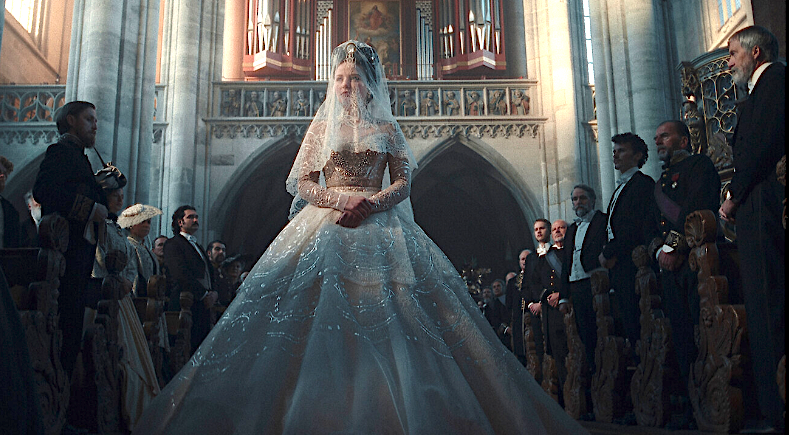
Like its playfully long title, Jemc’s novel gallops across the lives of Ludwig and Sisi, snorting at their royal duties with the irreverence of a wild horse. The cousins don’t take well to monarchal reins, their bodies still lanky with teenage freedom when they reluctantly assume power. Half-feral in her love of forest and field, Sisi becomes engaged to the Emperor of Austria, also her cousin. Her life’s purpose, she is told, is to produce an heir. She gives birth to four children, neglecting all but the last, and travels around Europe’s spa towns, after diagnosing herself with tuberculosis to ensure she’ll remain undisturbed. Ludwig is a misanthropic dreamer who prefers Goethe to geopolitics. He plays hooky anytime he hears the word “military” and recites poetry to avoid signing edicts. A naively devoted patron of the composer Richard Wagner, Ludwig throws money at operas, reaping the benefits when Wagner’s company performs just for him. Both rockstarishly excessive, Ludwig and Sisi’s disinterest only makes their people love them more.
I spoke with Jac Jemc over Zoom in late January 2023. We discussed the erasure of Ludwig’s queerness in royal documents, the relationship between creation and connection, and the cousins’ haunted inheritance.
Elizabeth McNeill: You’ve written six books to date, mainly horror exploring the nature of reality by creating discomfort and instability in the reader. Did this background draw you to Ludwig and Sisi, figures who created discomfort and instability in their own day? Was this fascination at first sight, or a slow burn?
Jac Jemc: Ludwig was the start of this project. The thing that drew me to him was the story of his death, which I talked about in the prologue of the book. So, there’s no spoiler alert needed to say at a certain point he’s declared insane by a doctor who’s never met him, and then found murdered within basically 36 hours. He and his doctor are both found murdered, and no one knows what happened. There’s all of these historical conjectures. I just love the theories and that kind of mysterious element of his life, to say nothing of all of these apocryphal stories and trying to parse what’s actually true, and what are just rumors. That definitely seems related to an interest in horror that runs through some of my work. But also, the fact that he was so obsessed with building these huge castles that he almost saw as stage sets more than architecture. These haunted psychological spaces ties back to my last novel, which was a haunted house story. So, that’s what drew me in and then everything expanded out from that in terms of finding other people in his life I was equally fascinated by and wanted to explore more.
EMcN: Speaking of exploration, in the acknowledgments, you call this “a fiction based on many personal fictions.” Could you elaborate? I really want to know how you gathered all of this data. It’s just so rich!
JK: So many of the characters wrote these self-mythologizing memoirs, or were keeping diaries or writing letters for very specific purposes, where the truth might be slightly obscured behind what they’re trying to attain with the information they’re sharing. And, of course, there are these royal spin doctors deciding what they want to be public about the different kings’ and queens’ lives.
The biggest thing that it’s hard to work through and find factual information about is the fact that King Ludwig was absolutely queer, and the royal documents have tried to erase that to the best of their ability. When I was looking back at the documents, at the diaries that they haven’t destroyed entirely, it’s very easy to see. I think the danger of that, too, is that one of the relationships Ludwig is most well known for is his patronage of the composer Wagner, and everyone I talked to about this project will say, oh, well, he was in love with Wagner, right? Like, he was romantically in love with him? No, I don’t think so. I think that part of his life was so obscured and covered up that we just assume that. I think he was in love with lots of people, but his love for Wagner was really focused on the music and the art Wagner was creating. And so, disentangling the theories and reinterpreting the sources and trying to come to my own understanding of these historical figures was a great challenge and a lot of fun.
EMcN: So, the two monarchs at the novel’s center, as the wonderfully long 19th-century title puts it, are “in pursuit of beauty and connection.” But despite getting everything they could possibly dream up, beauty and connection elude them. How did your own understanding of beauty and connection change over the course of writing about these lonely, yet beloved figures?
JJ: In the beginning of working on the project, I was more focused on the art aspect. The initial title that I wanted for the book was the German word “Gesamtkunstwerk.” It’s a term Wagner coined to mean “total work of art,” that coming together of all the properties, in his case in an opera production. But it could be for any type of art being created. Think of all that goes into it to create that immersive experience. And my agent said, bad idea, an inscrutable word as the title. We sold it as Total Work of Art, just the English translation. As we were working on it more, my editor said, is this the right name for the book? I am grateful to her for that, because I think that, ultimately, the book did become more about this attempt at finding ways to connect more than it was about creating a beautiful world to inhabit, and realizing that connection is a big part of that. And if you’re missing that, you’re missing out on everything. One of the reasons that happened is that, as I was researching Ludwig, I started to bring in all of these women who were present in his life or his family’s life. Sisi, his cousin, is one of his best friends and a parallel iconoclast. At one point, there were two other major threads in the book: Lola Montez, the courtesan who wooed his grandfather and made him abdicate the throne. And a sculptor, named Elisabeth Ney, who’s still in the book but in a more minor role. I started to pull in these other people who are similarly trying to achieve something outside of what was expected of them, but often falling on the human relationships in their lives as a consolation for ways those careers didn’t go as they expected, or not even falling on them as a consolation, but sometimes those relationships suffering because of the effort they were putting into trying to achieve these very large scale goals.
EMcN: It’s a shame you couldn’t keep the title “Gesamtkunstwerk!”
JJ: I know, I love a long German word! If I saw a book with that title on the hardcover table at a bookstore, I would be like, snatch, I want it! But I am attentive to the idea that maybe that is not true of everyone.
EMcN: One of the things that initially struck me was the long title. It’s getting at the same sort of thing as “Gesamtkunstwerk,” without being a German word. It really captures that time.
JJ: I did like that we eventually added the long subtitle and I found a way to make it a little cheeky.
EMcN: Going back to the theme of connection, so much of Sisi and Ludwig’s unhappiness comes from punishing themselves to fit these narrow expectations of gender, sexuality, appearance, and even royal duty. Considering your love of feminist horror, I’d be interested to hear what you think is haunting Sisi and Ludwig, and what the necessary exorcism is, if an exorcism is required at all.
JJ: I think it is the expectations placed on them and their inability to escape them. I think that both of them would have been happier if they weren’t royalty. They were put in positions where they were being asked to do things they were not made to do, or they were not talented at. And so, it meant that they tried to rebel in whatever ways they could, but they still felt like they had failed to a certain extent, because everyone expected one thing, and they did something else. They’re both descendants of this Bavarian line, the Wittelsbachs, and they were very aware of the inbreeding and the line of madness in that ancestry. I am also really curious about the way in which they distrusted themselves. They had an aunt who believed she’d swallowed a glass piano, and they knew there was this possibility something had gone amiss in their genetics. I feel like that was haunting both of them: this fear that their opinions or desires would be discounted because of a certain familial history.
EMcN: I’d love to talk about how art functions as an escape from Ludwig’s kingly duties. He creates this dream world through his patronage of Wagner and his obsession with castle-building. Fittingly, the Ludwig of your novel is such a romantic, operatic character. Do you think Ludwig was an artist in his own right? He seemed to have a unified vision.
They tried to rebel in whatever ways they could, but they still felt like they had failed to a certain extent, because everyone expected one thing, and they did something else.
JJ: People don’t realize that so many aspects of modern-day theater were started by Wagner. The fact that the house lights are dimmed, that the orchestra is put under the stage. Wagner did these things to make everything feel like you’re in the show you’re watching on the stage. There’s a reason Wagner was the one Ludwig attached himself to in terms of the opera or stageplay he wanted to exist in. So, Ludwig is an artist to a certain extent, but he’s more of a producer. He has the money and an idea of what he wants to support and see more of in the world, and he finds the people who are able to to materialize his visions.
EMcN: You’re trapped in the smallest room in Ludwig’s smallest castle for a month. You can’t leave or admit anyone else into the room, except for either Ludwig or Sisi, who is also trapped in the room with you. Whom do you choose and why?
JJ: This is such a hard question. I would have to choose Sisi because I feel like Sisi would at least potentially talk to me or communicate with me in some way. I am not convinced that Ludwig would not just shut down and rock in the corner and ignore the fact that I was there with him. He would be so much more tormented in that situation, and I think Sisi could deal with it a little better. I say that with great difficulty because, when push comes to shove, I am more fascinated by Ludwig. But he’s more of a wild card. And I don’t know if that’s what you want for a month.
Mother finally came for a visit. We don’t know why it’s taken this long.
We were happy like the end of fall. The day glimmered. We went for a walk in the woods with the dog in the all together mode of what was cut out of us.
Sunlight dappled the path, maybe that was it. Roots, of course, bulged irregular veins, maybe that was why. Perhaps it was her unexpected decline.
Mother fell without a sound. We turned when we heard her cry out. She was sitting on the ground, we were holding a handful of her blood. The hand is not a good cup. Good thing I have tissues, Mother said. Mother didn’t have enough tissues. Yet somehow the bleeding stopped. We decided to turn around and go back home. The dog lagged behind to smell and re-smell Mother’s blood and to retrace her fall.
I won’t do that again, Mother said. Her face had swollen. My face is fat, Mother said, I hit my face. Mother said, I’ve had enough of the woods. We decided to stick close to home. That sounds good, we all thought. Let’s not overdo it, we said. There’s nothing worse than overdoing it.
Then Mother fell in the yard. Or rather she stumbled hard. A little foot clip on the grass and she couldn’t walk. She couldn’t sit down. She stood. She hobbled. We supported her as best we could. Mother didn’t say she wanted to go home, but she wanted to go home. We could tell.
Mother said, I’m tough.
Mother took aspirin. Mother took heating pad. Ice pack. Bathtub. Arnica. Gin.
The foot’s worse than the face, Mother said. Right foot, right foot, lead with your right foot, Mother said. Mother will not come back to visit again soon. It’s not our fault, but it happened on our watch. It’s time. Catching up with her. Time to rest. By the time it was time to go home, Mother sat in the back seat. She didn’t say much. We drove her. We wanted to climb inside her. We wanted to steer the rest of her life. We wanted to be her eyes. We wanted to be the light underneath her feet. We wanted to always catch her blood and put it back in. We looked at her in the rearview mirror. She seemed unsteady even within her seat belt. We wanted to be closer. We wanted to be too far away. We wanted it all. At once. It stripped us of ourselves, the way we all used to be. Together. We saw Mother onto a bus. Goodbye, Mother said, it’s time for me to go. We drove away empty of everything. Time got the better of us.
When my father was born there were three astrologers in attendance at the hospital in Kolkata. You could never be too sure, my grandfather said, about who had the most accurate wristwatch, and the good astrologers care about time, deeply. That is their life’s work, of course, to understand when and where the planets move and to extract from these orbits the history of our lives.
But sometimes the paths that we’ve been pre-destined for aren’t the ones we end up taking. We fall outside of the pages of the divine ephemeris, groove away from destinies that have been handed to us. I’m especially drawn to stories where characters are lurched off their well-trodden paths. Expectations are vanquished: the unfamiliar is where we see who they really are.
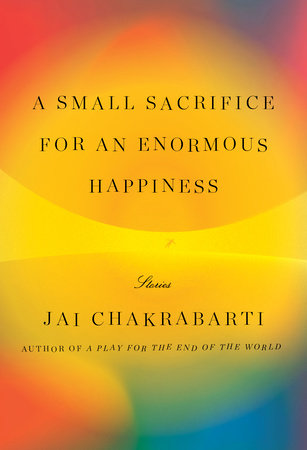
In my story collection A Small Sacrifice for an Enormous Happiness, I explore these rifts in our astrology through characters who through choice or chance transition from their birth families to cultivate chosen families, finding new ways to make it in the margins. I think the short story is a powerful technology for anyone trying to figure out what it means to live a good life, and for any of us for whom that good life is beyond usual boundaries, these story collections illumine possible paths. They reshape personal histories. They welcome dreamers and misfits. They allow us to leave our charts behind.
Alvar understands home isn’t a singular place but rather a constellation that we carry with us. The conflicts in these stories—for instance in the first story, Kontrabida, where a young pharmacist returns to the Philippines to visit his sick, dying father and his mother who may have dark motives—explore moral ambiguities. They defy easy categorizations and allow readers to empathize with characters whose actions might be described as more ethically gray than good. This is something I love about the story form: the speed at which we’re thrown into the woods, as it were, kept away from any surefootedness about what’s wrong or right.
The primary instrument writers have is the sentence. Books are built on these, of course, and writers decide the rhythm of each line, forecast how the words might land in the reader’s brain. Reading Marie-Helene Bertino’s sentences is like watching the world through an alien mirror, with the distortion that’s provided taking us closer to the heart of the heart of the matter. Take a fictionalized Bob Dylan for example, who visits a family for Thanksgiving, and who the narrator eventually describes as, “He was supposed to create some sort of lather, and he barely summoned enough energy to behead a pile of string beans.” What is beheaded in these stories are ordinary expectations and what is revealed is worthy of many rooms of family albums.
Few places remain the same from our youth, and when I visit Kolkata, the city of my birth, I’m especially attuned to the ways in which the old guard rubs up against the new, and in her second collection of short stories I love how Divakurni describes these transitions between the traditional and the modern, and the city beneath the city. In “Mrs. Dutta Writes a Letter,” a widow now living in Sunnyvale struggles to provide a glowing review of her new life in America. What she can offer in the confusion of new devices and disappointing grandchildren is a feeling of living outside the margins that I think many of us have felt in those particularly challenging and liminal moments of our lives.
I’ve always admired how Colm Tóibín refuses to shy away from the most difficult parts of family life. With candor and compassion, he’ll examine choices from years past that may have left characters doomed to their loneliness. Somehow, memory becomes evidence that the heart exists, that it does what it does despite a lifetime of missed consolations. Perhaps my favorite story, and one I return to every few years, is “The Pearl Fishers.” In it our narrator has a meeting with a lover from his past and his lover’s new wife. We explore the complexity of this situation as we do the modern Irish moment, and what it means to be a gay man with the “true Catholic church” casting its judgments.
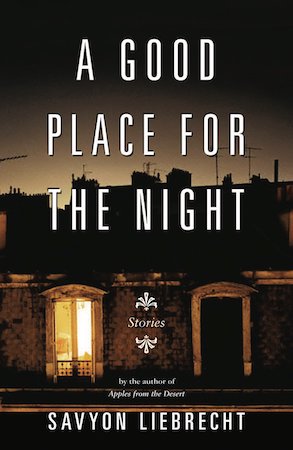
A Good Place for the Night by Savyon Liebrecht, translated by Sondra Silverstein
In Savyon Liebrecht’s sixth story collection, translated from the Hebrew by Sondra Silverstein, characters find themselves away from home: in America, Munich, Hiroshima, Jerusalem, even a futuristic world blighted by nuclear catastrophe. Throughout, Liebrecht explores the sanctity and relevance of place because as those who’ve crossed borders know, nothing holds us more in our orbits than our relationship to what we consider home. These are unsettling stories that ask us to question where and how we find comfort and love. Still, there is always warmth, even in the title story with its apocalyptic landscape where new family bonds are stubbornly formed.
The Boat by Nam Le
What does it mean to write an “ethnic story?” the narrator of Nam Le’s opening story wonders. In fiction, we’re often working to make the familiar unfamiliar, which poses an interesting challenge for writers whose heritage takes them outside of a “conventional” literary milieu. Returning to my starting metaphor, perhaps our astrology is in part a function of our cultural capital, of what is venerated by the world we live in. Except, all the other worlds deserve their due, and Le explores them with a sense of adventure. Columbian assassins, Hiroshima orphans, all get their time on the page, as does the desperately real and the gritty, a thirteen-day boat journey across an unforgiving ocean.
I first came across Nathan Englander’s first short story collection in a dusty bookshop in Jerusalem. So many who come to the holy city are looking for an altogether different sort of life, a reclamation of a spiritual or religious self, which the hallowed old city walls might provide, but in this seminal collection Englander’s characters are often fighting against the social walls that limit their search for love and expression. They are striking out, miserably, honorably, always evoking a great empathy, to make their own life within or outside orthodoxy. No astrologer could predict the turns of fate these characters face and that’s some of the joy of these stories.
So many libraries, so little time! As writers and readers, we here at Electric Literature know there’s nothing quite like stepping into a space that has been specifically designed to invoke and perpetuate a love of reading. With book-banning efforts escalating across the country and funding for these important public institutions often not regarded as a priority, libraries of all ages, languages, and architectures deserve some extra love and admiration. Below is a list of several of the world’s most stunningly beautiful libraries, from Seoul to Melbourne to Rio de Janeiro, to add to your bucket list.
We also encourage the EL community to support your local libraries, which are equally awesome and won’t require a pricey plane ticket to access!
Photo via Wikimedia Commons
Abbey Library of Saint Gall in St. Gallen, Switzerland
Founded in the year 612, the Abbey Library of Saint Gall is the third oldest library in the world. Designated a World Heritage Site in 1983, the library currently houses around 160,000 volumes. Back in the day, Benedictine monks used the library to work on manuscripts by firelight. Now, visitors can walk through the space and admire the beautiful, medieval architecture, but they must wear fuzzy slippers provided by the library in order to preserve the original wooden floor. Mandated library slippers? No resistance here.
Built in 1776 and designed by the architect Joseph Hueber, the Admont Abbey Library is the largest monastery library in the world. Hueber, committed to the Enlightenment period, wanted the library to reflect the expansion of human knowledge, stating, “Like the mind, the rooms should also be filled with light.” The ceiling is painted with exquisite frescoes depicting the stages of human knowledge up to the Divine Revolution. The library is often cited as the inspiration behind the enviable library that the Beast gifts to Belle in Beauty and the Beast. If you want to live out your Disney Princess fantasy and twirl among breathtaking bookshelves, you can do so here!
Photo via Wikimedia Commons
The Bibliotheque Nationale in Paris, France
Located in Paris and established in 1461, this stunning and studious-looking library is the repository of all that is published in France. The library is home to hundreds of thousands of books as well as incredible cultural artifacts, including Charlamagne’s ivory chess pieces, the first globe to use the word “America,” and Mozart’s handwritten score of “Don Giovanni.” After undergoing twelve years of renovations totaling approximately $256 million, the national library is reopened to book lovers and history lovers alike.
Photo via Wikimedia Commons
Biblioteca Vasconcelos in Mexico City, Mexico
Located in the downtown Buenavista neighborhood of Mexico City, the Biblioteca Vasconcelos was established in May 2006 and is named after the philosopher and former president of the National Library of Mexico, José Vasconcelos. The library celebrates contemporary architecture with its primary materials of steel and concrete, and its hanging stacks and catwalks. The space also holds the giant art sculpture “Matrix Móvil” by plastics artist Gabriel Orozco. The sculpture displays the real skeleton of a gray whale, bearing graphite designs on the bones. Suspended from the ceiling, the sculpture has become an iconic part of the library’s identity.
Byeolmadang Library in in Gangnam-gu Seoul, South Korea
Located inside the Starfield COEX Mall in Gangnam-gu Seoul, South Korea, the Byeolmadang Library is massive, awe-inspiring, and will look great on your Instagram story. The two-story library is sprawling and spacious, featuring towering walls of books and a ratating glass art installation. The space is also commonly used for major events, including talk shows, visiting authors, and even concerts.
Photo via Deichman Bjorvika Website
Deichman Bjorvika in Oslo, Norway
Opened in June 2020, the Deichman Bjorvika library is the new and beloved public library of Oslo. Made up of six floors that include literature collections, reading and study spaces, stages, and cinema halls, this library is home to over 450,000 types of media, both print and digital. Each floor of the library has a different atmosphere and offering, with the first floor featuring a cafe and restaurant for those who want to spend the day reading or working while having a hot coffee or bite to eat. The second floor is home to children’s literature, and the third floor features music, film, and comics, and also allows visitors the opportunity to rent out 3D printers, podcast studios, and DJ stations. In short, this library is cool as hell.
Klementinum National Library in Prague, Czech Republic
Located in the heart of Prague’s Old Town, the Klementinum National Library dates back to the 11th Century and is the largest library in the Czech Republic, housing around six million documents. The library’s name comes from the boarding school that monks of the Jesuit Order opened in 1556. Founded in 1837, the library houses a Mozart Memorial that is now a centerpiece of the library’s Music Department. Klementinum also hosts regular classical music concerts put on by the symphony orchestra, such as Vivaldi’s “The Four Seasons”, which will be performed this February.
Photo via Wikimedia Commons
The Morgan Library and Museum in New York, New York
What started as a personal library for collector and cultural benefactor Pierpont Morgan is now a popular and treasured public institution in the heart of Manhattan. Built between 1902 and 1906, the library is majestic yet intimate. The library features three-story inlaid walnut bookshelves and, we kid you not, two staircases concealed behind bookcases. A variety of rare books and artifacts are on display, including writing by Henry David Thoreau and Johann Gutenberg. The library also has a number of rotating exhibitions, making each visit a unique experience.
Photo via Wikimedia Commons
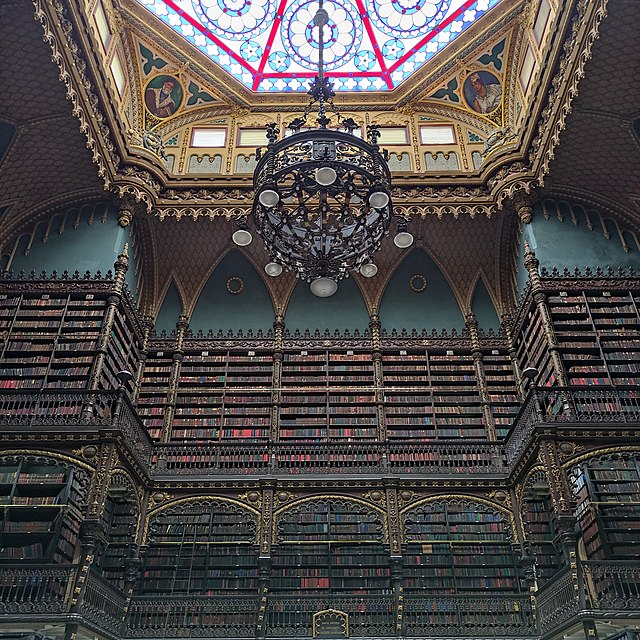
Royal Portuguese Cabinet of Reading in Rio de Janeiro, Brazil
First off, let’s take a moment to admire the name of this library. Cabinet of Reading? How very official and mysterious! Located in the center of Rio de Janeiro, this stunning library was established in 1837 when a group of forty-three Portuguese emigrants gathered at the house of Dr. António José Coelho Lousada and decided to create a library to expand knowledge and instill a taste for reading among their social circle. In 1900, the library became a public institution and remains open to visitors today.
Photo via Wikimedia Commons
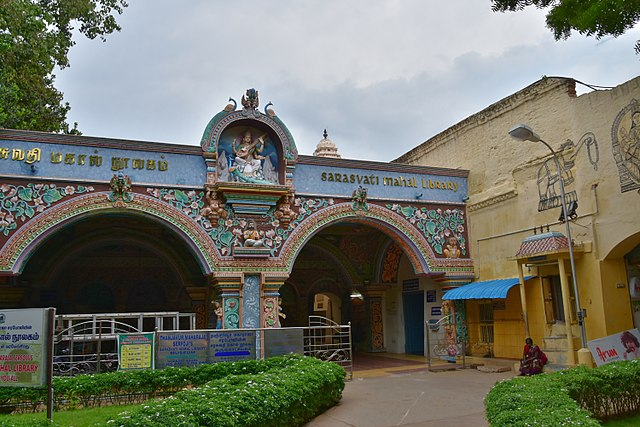
Sarasvati Mahal Library in in Thanjavur, Tamil Nadu, India
Founded in the 16th century, the Saraswathi Mahal Library is one of the oldest libraries in Asia. The name “Saraswathi” comes from the Goddess of Wisdom and Learning. The majority of the collection is written in Tamil and Sanskrit, and all materials are preserved via microfilm, with library officials encouraging attempts to publish rare pieces from the Medieval collection. The library is free and open to the public!
Photo via Wikimedia Commons
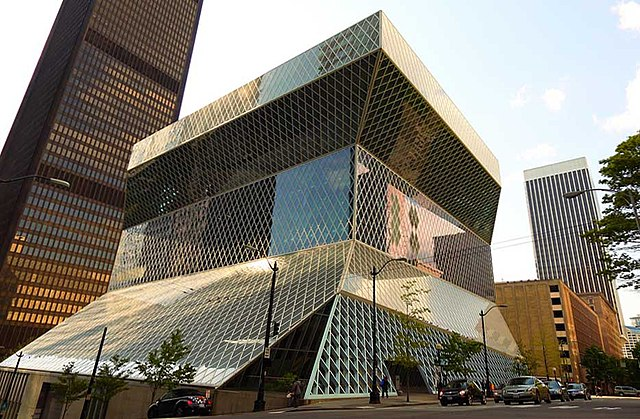
Seattle Central Library in Seattle, Washington
The first thing you’re likely to notice about the Seattle Central Library is its unusual appearance. Coming in at eleven stories tall, the glass and steel building was designed by Rem Koolhaas and Joshua Prince-Ramus to ensure that the building’s architecture served the needs of a library space, rather than forcing the library to cohere to a more generic structure. The architectural gambit has certainly paid dividends to Seattle locals and visitors alike, as the library includes a “Book Spiral” that continuously exhibits the entire nonfiction collection, a massive, 50-foot “living room” reading area, and, of course, its unforgettable exterior.
Taking inspiration from such disparate sources as Noah’s Ark and Stanley Kubrick’s 2001: A Space Odyssey, Stadtbibliothek Stuttgart was designed to be a calming, meditative monolith at the heart of Stuttgart, Germany. The cubic structure is encased by a glass block façade, and the library features a bistro, cafe, and rooftop terrace that provides visitors with a breathtaking, all-encompassing view of the Stuttgart Valley. The future is now, and it rules.
Founded in 1854, the State Library Victoria is not only Australia’s oldest and busiest library, but also one of the first free libraries in the entire world. The library is home to several permanent exhibitions and art galleries, as well as a number of massive and luxurious reading rooms, including a huge collection of Victorian newspapers, a wide-ranging assemblage of reading materials exploring the performing arts, and La Trobe Reading Room and Dome Gallery, commonly referred to as the Dome Gallery. Built to accommodate over a million books and hundreds of readers, the Dome Gallery was the largest in the world when it first opened in 1913, and it’s still a pretty remarkable place to post up with a book.
Photo via Wikimedia Commons
The Library of Strahov in Prague, the Czech Republic
Completed in 1679 inside Prague’s Theological Hall as an addition to the long-standing Strahov Monastery, the Library of Strahov features beautiful stucco ceiling decorations as well as artwork and paintings from the 1700s. Home to approximately 2,000 volumes, the Library of Strahov is one of “the best preserved historical libraries,” and is a dream come true for book lovers and history enthusiasts alike.
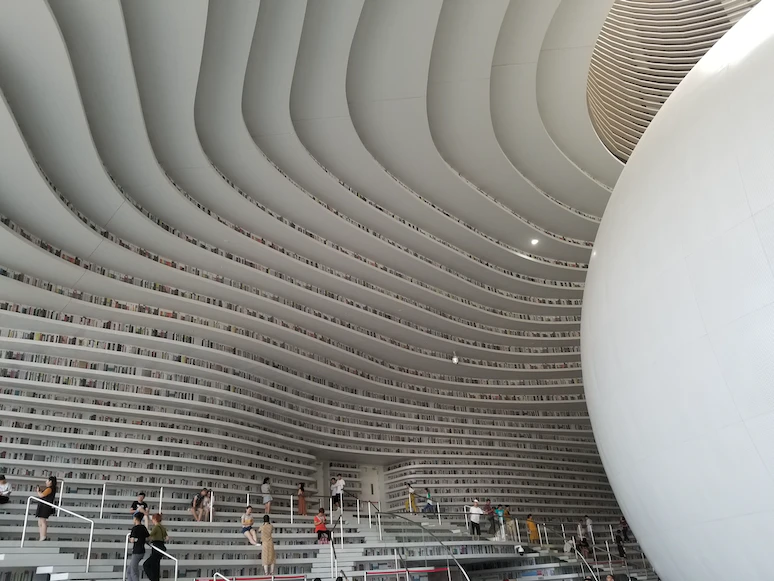
Boasting over 1.2 million books, China’s Tianjin Binhai Library has been nicknamed “The Eye” in honor of the large, spherical auditorium at the center of the building, which, when viewed through an opening at the top of the structure, bears a striking resemblance to an iris. The futuristic, five-story building first opened in 2017 and features rows upon rows of bookshelves that line the walls from the floor to the ceiling. You’ll forgive us if we can’t help eyeing this spot!
I was born a year after the collapse of the Soviet Union in Moscow. My mother and I emigrated to the states in 1996. We were undocumented for 11 years, desperate for our green cards. I often wondered if Mom made the right decision in leaving. America was hard on us. We were alone. We had a whole family in Russia; a community that didn’t exist here.
Every time I asked my mother why we left she would close up. Most times she commented on how I should appreciate America instead of asking stupid questions. I was a freshman in high school when a kid in my English class asked me if Russia was “really that bad,” after our unit on Orwell’s Animal Farm. I didn’t know, so I started reading. I learned about the scarcity everyone living under the Soviet Union seemingly experienced. The paranoia. The isolation. The unknown. I filled in the gaps my mother refused to elaborate on with novels and memoirs. Even still, I couldn’t decide if becoming undocumented immigrants in the U.S. rather than citizens of Russia was worth it.
On February 24, 2022, as headlines of Russia’s invasion of Ukraine shocked the world—I recognized, without a doubt, my mother made the right choice for us.
From the revolution in 1917 to 2022, this reading list contains stories of the decision and journey to leave Russia and the sacrifices that were made along the way.
Weather of the Heart by Nora Lourie Percival
In March 2022 there was an exodus of 300,000 young adults from Russia. In September 2022, that number climbed to 800,000. Commentary on the “brain drain” effect as skilled and educated Russians flee abroad have been splashed across news articles since the beginning of the war. This “brain drain” has been happening since 1915. People have been slowly trickling out of Russia for the last century.
Nora Lourie Percival left Russia in 1922 with her mother. Nora’s memoir starts with her experience in her return k to the place of her birth, Samara, a city on the Volga River, after almost 80 years away. The memories then jump back to the early days of the Russian Revolution. She writes of her arduous journey out of Russia and why she had to leave as a child. The similarities of Russia in 1915 and Russia in 2022 are shocking.
Passages such as: “I am really thinking mostly of our poor Russia. She is losing so many of her best people in these wanton days. If I can save one or two for her, I must do it,” said by Pytor Ivanovich, Nora’s father’s friend, who is trying to convince her father to leave the country, are astonishingly similar to the headlines I read about Russia every day. The first half of the book describes life in Russia before and after the civil war. The memoir follows the trials faced by the author as she survives the civil war and then immigrates to America, taking care to describe both her own experiences and the collective experience of others like her.
The Hottest Dishes of the Tartar Cuisine by Alina Bronsky
The Hottest Dishes of the Tartar Cuisine highlights the desperation that so often accompanies stories of immigration. Told from the perspective of Rosalinda, a critical and narcissistic Tartar woman, the story follows her tumultuous relationships with her daughter, husband, and granddaughter from the late 1970s through the 1990s. While moments of humor—from the sheer absurdity of the protagonist’s lofty opinion of herself and thinly veiled loathing of her family—punctuate most scenes, the core centers around the trauma endured by Aminat, her granddaughter, as her family’s dysfunction spins out of control. As food dwindles and hardships pile on, Rosalinda decides she must do whatever she can to get Aminat out of Russia, no matter the cost.
“’Sulfia,’ I said tenderly, ‘It’s for Aminat’ sake, don’t you see?’ She has no future in this country. It will eat her up and won’t even spit out the bones. You need to find a foreigner, Sulfia.'”
Elena’s Gorokhova’s memoir paints a picture of what growing up in the Soviet Union was like in the 1950s through the 1960s. Her lyrical language is loving and tender when recounting her memories of St. Petersburg, almost as though Russia was a family member. Her book describes her childhood, both lovely and awful. She ruminates on the beauty of her city and her appreciation for the arts and culture of Russia while also acknowleding the problematic parts of her heritage with a child-like lens, curious, but ultimately knowing something is intrinsically unfair about the life she was born into. For example: she asked her English language teacher what the word “private” meant. There is no word for private in the Russian language because the people of the U.S.S.R. had no privacy.
As a young adult, Elena starts considering what her life would look like outside of the iron curtain. In the last part of the book, Elena compares Russia to her mother and ultimately uses this reasoning to leave the U.S.S.R.: “
I want to leave this country, which, it dawns on me, is so much like my mother…They are both in love with order, both overbearing and protective. They’re prosaic; neither my mother nor my motherland knows anything about the important things in life: the magic of theater, the power of the English language, love….You can’t breathe, you can’t move, and you can’t squeeze your way to the door to get out.”
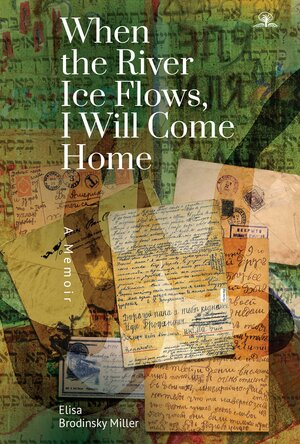
In her memoir, Elisa Brodinsky Miller asks what happens to Russia now? Set between the years 1914-1922, she finds cache of letters from her grandfather Eli written to his wife and children during the Russian revolution. For eight years, the family was broken up and without the resources to reunite with Eli in the United States. The correspondence between her family members helps her piece together what happened with her father’s family during the years they could not be together.
“The situation in Russia right now is such that in general one cannot say anything with certainty… Now Russia is undergoing changing times: what will result? There is no way to know. So in view of that to say anything in the present time about leaving or staying in Russia is very difficult,” written by Eli to Isor (his son) in December 1917. This book unintentionally parallels, through firsthand documents, the same questions Russians ask their country today. Elisa Brodinsky explains the history of Russia and gives context into what was happening historically at the time the letters were written, as well as how her own life mirrors her grandfather’s life in her search for opportunity.
Only One Year, written by Josef Stalin’s daughter, is a memoir which elucidates her decision to leave in 1967. The book starts with her going to India to mourn her Indian partner and spread his ashes in the Ganges. After some time in India, Alliluyev realizes she doesn’t want to go back to her home in the U.S.S.R. and she makes the painful decision to abandon her family and culture and defect to the United States.
“I began to feel any physical pain or injury inflected on others as if it were my own pain. Tears shed by others brought tears to my eyes. I learned to weep and laugh with my whole being. My heart was thrown open now, which previously had been compressed and jammed.”
This memoir is excellent if you want to understand how difficult leaving Russia was right before Glasnost and Perestroika. Told from two perspectives: the mother, Galina, and the daughter, Yelina, the memoir describes the trials and tribulations faced by Galina of getting her family out of the country and the painful sacrifice of doing so. The story starts with Yelina’s mother being sent to a gulag, leaving Yelina with a stranger who later tells her she can no longer care for her. Yelina is alone in Russia and on the cusp of puberty, relying on different people to offer her food and shelter until her mother comes home.
Part two switches to Galina’s perspective as she explains her sentencing and life in a gulag in the first place. The third part of the book, told again from Yelina’s perspective, answers the question of whether the mother and daughter were finally able to leave their motherland.
Best friends Anya and Milka seem to have a typical Russian childhood. As they change and grow together, their motherland also goes through changes, as though Russia was also trying to grow up. At the precipice of the novel, an incident alters the trajectory of the friends’ fate, ultimately leading Anya to emigrate to America, not returning to her country for 20 years.
“I believed in the future of my country and that I was contributing to it by doing my job and raising my family… When the nineties hit, we all understood that it wasn’t enough, that the boat wars rotten through. We were all sinking, no matter how fast or hard we paddled.”
A Terrible Country tells the story of a postgrad Russian American returning to Russia to take care of his ailing grandmother. He struggles to understand the post-Soviet Russian landscape where cute cafes with high priced cappuccinos sit across the street from the KGB building where thousands were killed in the Soviet era. Andrei spends his days in the apartment playing anagrams with his senile grandmother and roaming Moscow to try and find Wi-Fi to work remotely at the university. At night, he looks for hockey games to blow off steam. When the economic crisis of 2007 hits, his brother pushes him to sell the apartment, promising to find another place for their babushka to live. After finding himself in a group that call themselves the “Octoberists,” he finally feels like he’s acclimating and decides to move back to Russia permanently. When the Octoberists are targeted by the police for their political mishaps, Andrei has to decide whether his new life in Russia is worth it, or if he should leave, once again, to America.
When I was in prison in New York in 2011, we had a name for Rikers Island: The Wild West. I’d come from an upstate county several hours north of that, so I’d never been inside the notorious New York City jail complex just across the East River from LaGuardia Airport. But I listened aghast at the tales of a teeming and lawless lockup beset by drugs, sex and violence. From where I sat in an only-mildly chaotic state prison, the place sounded terrifying.
As it turns out, it was probably even worse than I thought—and Reuven Blau and Graham Rayman’s new book of the scandal-plagued correctional complex lays it out in graphic, stomach-churning detail. Rikers: An Oral History opens with some little-known details about the complex’s history: It was founded on top of a literal garbage dump. That was in the 1800s, and since then things have only gotten worse. Violence is rising, guards aren’t showing up for work and more detainees died behind bars last year than in any other year since at least 2013.
Told through the accounts of more than a hundred guards, former prisoners, lawyers and public officials, the book explores the inner workings of a broken system and the ripples of trauma it leaves behind.
Keri Blakinger: Why did this feel like the necessary moment for a book like this?
RB: I’ve been covering Rikers Island for 20 years, and Graham’s done it longer than me. For both of us, there’s a bit of personal frustration, we write about some of these issues over and over and over again. And this was an amazing opportunity to highlight how some of these issues have been going on for decades. It gets some level of coverage, and then the administration makes promises and there’s some level of a solution—but then it just comes back up again. And in this project we were able to highlight how these problems are not necessarily new. There’s a lot of new attention to Rikers Island, but these problems have been there forever.
KB: Even though you have both been doing this for so long, there’s a lot of previously unreported material in here. Are there any stories that particularly stuck with you from your reporting?
GR: There’s a lot, but one of the main ones is the story that Nellie Kelly tells about the reverberations of her brother’s death, 10 years later. Ronald Spear was murdered in 2012 by a correction officer who basically beat him to death, and then there was a massive cover-up. It was an attempt to turn Spear into somebody who had attacked the officers and they were defending themselves—which is ridiculous, because he was frail and ill. And she talked about how ten years later when she’s making spaghetti, she can still hear him telling her to make it spicy. And she’s like, “I’m not making it spicy for you!”
What that illustrates to me is something that I think the public loses sight of: When these horrible incidents happen in the jails, the ripples flow outward for years and years afterwards. It’s not like they just go away once the investigation is over.
RB: It’s hard to remember them all. But for me one of the things that was really eye-opening was the concept of bullpen therapy, which is sort of unique to the New York City process. That’s when detainees are taken out at three or four in the morning for court, and the whole process takes all day. It’s soul-sucking and it plays into trying to convince people to take plea deals. A few people who had done several stints brought up this issue as the worst part of the entire experience. They could be on Rikers Island, they could be around all the other craziness—but not getting dragged to and from court and spending the entire day waiting and waiting and waiting in bullpens.
GR: Bullpen therapy—the idea that people would plead guilty to a crime rather than continue to experience the process of going back and forth to court—is just extraordinary. It illustrates a failed system.
KB: What is the thing that people most commonly misunderstand about Rikers Island?
GR: It’s not just one jail. It’s actually a huge complex of multiple jails. All of them are quite large—each one houses thousands of people when they’re at capacity. There was a time when there were more than 20,000 people in the jails. It’s a city within a city.
RB: For me there’s a couple of things and I think the biggest one is not unique to Rikers: It’s the idea that you do the crime, do the time. And you don’t do the crime if you don’t want to end up in a place like that. But the thing is, no one’s been sentenced to death. And there’s multiple deaths every year, including this year. The inability to just get basic medical care there is insane. There’s a perception that you go to jail and you’re looked after. But there are thousands of missed medical visits every year, and there’s ongoing litigation over that. And I think that speaks to the broader sense that people are not seen as people there. There’s just a lack of humanity.
When these horrible incidents happen in the jails, the ripples flow outward for years and years afterwards.
GR: Following on that, we interviewed an expert on heat-related illnesses who testifies all over the country doing assessments of prisons and jails, named Dr. Susi Vasallo. And she said that New York views itself as this progressive place but she said that what she saw at Rikers was as bad as any of the prisons that she saw in Mississippi or Alabama. To me, that just cuts to the heart of the thing: Here’s a city that thinks it’s so progressive and yet it allows this situation on Rikers—the conditions, the violence, all of the issues—to persist decade after decade after decade without really addressing them.
KB: How did you grapple with the perceptions of credibility of inmates who are typically—if unfairly, in my opinion—viewed as unreliable or untrustworthy, but in this case they are a large part of your narrative?
RB: I think that’s what the book is about. It’s about these stories and letting people know that these are human beings. Sure, some people have done some terrible things—but it doesn’t mean that they’re not human beings, who have experienced this system in this way that’s just inhumane. It doesn’t mean that their experiences are lacking in a way that we shouldn’t take seriously and amplify. And on some level it doesn’t make sense, it belies logic, to say that if somebody committed a crime then we shouldn’t believe their experience. Their experiences are real and they matter and society should be aware of them.
GR: We didn’t want to write this from 10,000 feet—we wanted this to be very intimate. And if you’re writing about a bakery, you go to the bakers.
KB: One of the recurring themes of this book is the incredible amount of violence behind bars. Are you worried about how readers will contextualize that, and whether they will see it as proof that inmates are bad people—or as proof that the system is broken?
GR: Well, I’m hoping they’ll see that the system is broken. That’s very broadly what that violence illustrates—a system that cannot just not be functional.
RB: There is an obsession with you know the fights and the violence—like in Oz, on television. What we tried to do is say, “Look, some of the stuff is probably even worse than you can imagine, worse that could be scripted. But also, there are people who are experiencing this.” And they experience it in the moment —and then it doesn’t leave you.
For example, I interviewed somebody who did time and afterwards would go to the bodega all the time. The woman behind the counter at one point told him, “Oh I know you served some time.” He asked why and she said she could just tell because he never smiled. It’s real experiences and it’s real trauma, and that’s what we were trying to explain to readers.
KB: Did writing this change anything about how you see Rikers?
It doesn’t make sense to say that if somebody committed a crime then we shouldn’t believe their experience.
GR: The main character in the book is obviously Rikers itself and the people who move through it and their experiences. But if you look at the stories, there’s some similarities between the experiences of correctional officers and the experiences of people being held in Rikers. So when I see aggressive folks who want to keep everything the way it is and not move to borough jails and just keep it all status quo, I think: Aren’t you actually subjecting your supporters to the same experiences that people who are being held there are experiencing? So that was one thing that surprised me, but it didn’t particularly change my view overall.
KB: This book spans several decades. After examining Rikers in that sort of long view, do you think that things are getting better at all?
GR: My instinct is it’s hard to tell. And one of the reasons it’s hard to tell is because of the closed nature of its physical location. It’s very hard for us as media to get in there. So we have to rely on external accounts and statistics from the agency, which—as we noted in the stats chapter—have been manipulated in the past to present an inaccurate picture of what was happening. I think the big question is: Should this city support receivership or can it continue to try to improve things as it is? It seems to me that the forces want to keep Rikers right where it is and don’t want to spend the money on [replacing it with] borough jails that are currently in the ascendance.
RB: It’s not so much about getting better or getting worse. It’s that these problems persist. No one is saying that these issues are going away. At any given time there might be a few less deaths. The stabbings might go down. Solitary numbers might be adjusted. The stats are all over the map. One thing that’s very clear from anyone you talk to is that it’s still an absolute nightmare place to be. And major, major problems still exist.
KB: Did writing this change your view of our society’s relationship to incarceration?
GR: It made me feel a lot stronger that Americans need to really think about what it is we want these institutions to do. We should all be considering what we really want out of these institutions.
I’ve lived most of my life somewhere in the murky territory between boy next door and gal pal (this was before people regularly used the word nonbinary). To my parents, I’ve always very clearly been their son. They did a great job of embracing my less-than-traditional version of masculinity, as long as we didn’t talk about it. My queerness could exist, but the minute I described myself as gay, my feminine aspects took on a menacing quality. In the conservative suburban Catholic world I grew up in, it wasn’t ok to be gay especially if you were unapologetic. It had to be hidden, because it was shameful. For years I minimized myself in an effort to make others happy.
While much has changed since I came of age as a queer person in Y2K-era Michigan, what has remained the same is a fundamental human need to be part of a social community with shared values. These standards may never be articulated, and they’re definitely not written down anywhere, but if violated, there are consequences. Anyone who threatens to upend the delicate social balance must know they’ve overstepped. It’s about maintaining an illusion, and once you shatter that mirror, the pieces don’t go back together in the same way.
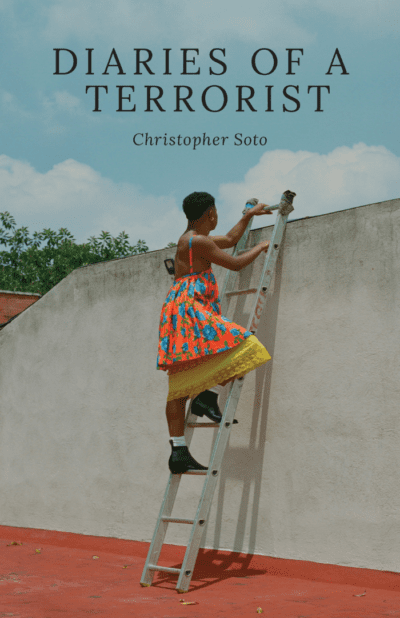
This spring I was introduced to Christopher Soto’s work through his debut collection Diaries of a Terrorist, and what struck me most about the poems was his unapologetic queerness. I’ve often struggled to proudly express queerness in my life, so reading his poetry was like a jolt of electricity to my brain. I was so used to living in an environment where people say one thing and mean another that it felt revelatory to see someone like Soto unapologetically name evils that many “respectable” people have decided to accept as inevitabilities, such as the persecution of minority communities, and the injustice of the American prison system. He uses the collective “we” pronoun throughout, solidifying the notion that for him, poetry is communal – something that is both influenced by the community and also benefits the group. For a long time, I deliberately stayed clear of poetry because it was inaccessible and unnecessarily opaque. It seemed overly formal, holding readers at arms length, and begging them to unravel complex riddles designed to be perplexing. But in this collection, Soto finds poetry in the most everyday moments, even if (and especially when) they’re not pretty. Preconceived notions about poetry are played with and turned on their heads in Diaries of a Terrorist, a queer punk rock rallying cry for activism and abolition.
I deliberately stayed clear of poetry because it was inaccessible and unnecessarily opaque.
I’ve often joked about my hermit-like tendencies as a defense mechanism to hide my loneliness. My childhood spent growing up Catholic has made me inherently distrustful of becoming part of any group where I have to think or feel a certain way to be accepted. I value my independence and ability to form my own opinions more than anything. But during the COVID lockdown, it became clear to me that true isolation was not what I really wanted. I needed support and understanding, and it didn’t have to be all or nothing: even the biggest introvert has to exist in relation to others. As much as politicians love to push the myth of American individualism, it’s a lie. The things that truly benefit us are community action and activism, not wealth hoarding. Social reform, not increased incarceration. It may seem simple, but the way Soto breaks down how deeply we’ve been brainwashed was breathtaking to me—in its directness, and its clarity.
In “To Blow on the Horns of A Bull” Soto illustrates how the violence expressed casually on the internet often leads to real life consequences:
Despite its lack of hands // the internet has such far reach
Behind its quiet blue // A chat room full of noise // Yelling
BREAK THE WALL // OR I’LL BREAK YOUR FACE
“In Support of Violence” asks us why society as a whole is often more obsessed with policing reactions to abuse than working to stop it:
We never wanted to harm // Only to stay alive &
We could no longer wait // Wishing strangers would // Help or empathize
Soto even queers the seemingly untouchable subject of Christianity, making harrowing parallels to the persecution and murder of trans people, in his poem “Transgender Cyborgs Attack”:
Our gender was against the law // But so was your God // Yes Jesus was trans //
// Her hair & her dress // Jesus was trans // How the Roman state crucified her in public
No subject is off limits, because queer people are everywhere, and Soto wants us to step out of the shadows. By directly addressing the violence that has come to be accepted as a “necessary evil” in American life, his poetry advocates for a community mindset, and for the necessity of citizens fighting for it. It’s not possible to willingly watch others be treated with cruelty, and then act shocked when it arrives at your doorstep. Only by actively resisting do any of us experience true liberation.
I’ve spent a lot of time over the past year thinking about what liberation looks like for me. What it means for me to be liberated in a society that values wealth, earning potential, and volume of consumption as the metrics for “success.” And I haven’t found an answer I’m completely happy with. I’m figuring it out, but the more I discover what I don’t want, the closer I feel to an answer that’s the most effective solution for me in the present moment. And that looks like a life where the way I treat the people around me is more important than how much money I make. A life where it is possible to both look after my needs as an individual, but also have time to look out for the collective good of others. A life where accountability can be seen as a necessary step towards personal growth, not a public scourge to be avoided at all costs.
It’s not possible to willingly watch others be treated with cruelty, and then act shocked when it arrives at your doorstep.
None of this is easy. Almost every step I’ve taken recently to reach what feels like a truer version of myself (emotionally, behaviorally, and aesthetically) has been met with resistance by people close to me. Especially if I don’t ask for permission. The more I’ve played with gender expression, the more I see looks that ask “but what was wrong with you before?” Nothing was wrong, things have just changed. And they’ll keep changing. Growth is often awkward and ungainly, and there’s no true end point. Change, as my therapist reminds me weekly, is one of the only constant things in life, so accepting it is really the only option that won’t lead to misery.
Part of this change involves the process of figuring out who I am as a writer and creative after many years of thinking the only value my art had was the money it could make or the clicks it might generate. Yes, writing as a career is a business, but that shouldn’t be the primary factor shaping my artistic sensibility or the content I produce. Content written purely for commercial purposes often reeks of inauthenticity, and readers can sense something missing even if they can’t readily identify it. The only way to succeed is to participate fully. To express oneself in the most authentic way, and take risks that may or may not pay off.
The formal inventiveness in Soto’s poetry is a big risk, one I’m sure many people would say is unorthodox, but as a reader, it was a particularly effective way into the overall narrative. One of my favorite poems in the collection, “Job Opening for Border Patrol Agents,” is formatted like a corporate job listing. It’s an indictment of the corruption that runs rampant in America’s obsession with policing marginalized people, and a takedown of corporate “hustle” culture that has trained people to turn a blind eye to everyday corruption. My first thought was “This is a poem?” but as I read it a second time, I realized I cared more about these everyday subjects than I ever cared while reading Robert Frost in high school (the last time I tried to give a shit about poetry), and that maybe the stuffiness present in so much lyrical poetry was designed to exclude. Soto’s poems are dynamic and confrontational, so those who like to maintain the status quo (whatever their motives) may find some of the poems jarring, the language shocking, and the frankness with which violence, rage, and abuse are discussed to be a little “too much.” But isn’t that what it is to be queer? To create space when the world tells us that we don’t fit in?
In Soto’s hands, poetry is accessible. It takes down all the garbage capitalist culture expects us to accept unthinkingly in order to to keep the machine running. It’s a call to arms, and a plea for justice, and it made me want to more fully embrace queerness in all aspects of my life. I’m tired of waiting to live my own life because it falls outside of what’s been deemed “typical.” I’m single at age 31, living paycheck to paycheck, and I’m nowhere close to owning a home or having a family. Every time a friend tells me I need to have hope and everything will turn out alright, it makes me angry, because hope is not what I need. I need change. I need support. That Hallmark-positive advice neglects the economic and legislative struggles of marginalized people in America, while assuming that the only thing worth aspiring to is being in a “traditional” family unit. I’ve spent a lot of time this year thinking about what I want out of life, and accepting that my life most likely won’t follow the same path my parents’ did. It used to make me sad, but it doesn’t anymore. Because I’m free to lead a life I can be proud of without feeling like a failure if I don’t meet arbitrary guidelines. Reading radical queer texts like Diaries of A Terrorist helped me see that there are people out there who are like-minded, even if I haven’t found them in my life yet.
I realized I cared more about these everyday subjects than I ever cared while reading Robert Frost in high school.
Soto and his work make me want to produce writing that both provokes and inspires. It doesn’t have to be either form or content. By playing with atypical formats, Soto has queered what poetry can be and created something fresh and alive. His freedom and playfulness made me realize that my work doesn’t have to look like anyone else’s. When a writer can authentically jump off the page and grab readers by the throat the way Soto does, there’s nothing quite like it. Being outspoken and radically queer may not be considered “mainstream” by some, but I’d rather create change than be just another person following the mindless status quo of American capitalism.
So fuck it. Don’t wait. I am more than how “respectable” I appear to people I don’t know. I’m more than the amount of money I can make or the content I produce. The most vital part of me is expressed by how I treat others and contribute to the world. Being kind and thoughtful and behaving in a way that aligns with my values will always be more important than any arbitrary measure of success. That doesn’t mean there are never consequences, or that it’s always easy. But at least I won’t be waiting for permission to exist.
“One-Hundred Percent Humidity” by Michelle Lyn King
For dinner, Callie and me stuff our faces with frozen food. Stouffer’s French Bread Pizza, spoonfuls of Reduced Fat Cool Whip, Ham & Cheese Hot Pockets, these health-food enchilada things that Callie’s mom likes. Mouthful after mouthful. It was Callie’s idea. We were tanning out on the roof deck when she turned to me and said, “Let’s do a feast of frozen food for dinner. Doesn’t that sound like fun?” and I nodded, though I wasn’t sure why it sounded like any fun. At that moment, I thought only of my dad and how upset he’d be if I tried that sort of thing at our house. I could imagine the lecture he’d give me on the price of food with such clarity that it was almost as if it had really happened. I could picture his mouth curling around words like “budget” and “waste.” Money is no issue at Callie’s house. It pours out of the air conditioning unit in cool bursts. It sits rotting in the fridge or unworn in the back of some massive closet. It’s everywhere you look.
When the sun sets, we bring all the freezer food out to Callie’s back patio, not even bothering with plates or utensils or napkins. When our hands get sticky from Amy’s Mac and Cheese, we walk to the pool and wash away the clots of orange cheddar from our fingertips.
“Doesn’t it look like baby barf?” I ask.
Callie doesn’t respond, so I repeat myself.
“Yeah, I obviously heard you, Faith,” she tells me. “I just don’t want to think about a baby barfing.” She shudders. “Where do you even come up with this stuff?”
It’s December in Florida, but the air feels more like June. Thick and hot and so full of water that it might as well be the sea. There was a big snowstorm up north a few days ago, in Boston or one of those places. Twenty-six inches. People were barricaded inside their homes, freezing with no power, no heat. Here, nothing changes. No snow, no shovels. Grass yellowed from a recent drought. LED snowflakes hanging from palm tree fronds. On Christmas Eve, the mall hauls in some sort of artificial snow they call snoap. When the temperature dips below 70, people pull out coats and fleece-lined boots from a dust-covered bin they keep out in the garage. We’re all playing make-believe. Nothing here is real.
I put my feet up on the patio’s glass tabletop and feel the stick from the humidity. I was so afraid to touch anything the first time I came over to Callie’s house. It looked like a set from a movie. Grand staircase, marble bathrooms, Tuscan-style columns, the stink of air freshener and cleaning products filling up the whole house. In the living room, there was an aquarium with real fish. Everything looked so new. Untouched. I was afraid I’d ruin it. Now I open the fridge in the middle of the night and grab a snack. I leave my cereal bowl in the sink, makeup on the face towels, my tampons in the bathroom wastebasket soaking through the tissue I’ve wrapped them in.
I’ve been staying here for four days, since Christmas. That’s when I texted Callie that my dad brought a woman to Christmas dinner. I can’t be here. She was at my house within the hour, pulling up our driveway in her dad’s S-Class. When I opened the passenger door, I expected her to reach over and hug me, or at least ask if I was okay. Instead, she turned up the music, some song I dimly registered as popular, and said, “I have my permit, but don’t worry. I’m a really good driver.” We raced down 95, the speedometer inching up to 100.
I knew my dad had been dating. I wasn’t an idiot. Whenever I spent the weekend at Callie’s I’d come home to find the shower drain choked up with blonde hair, the laundry hamper holding underwear that were not my own. I recognized the woman from Christmas as the same one I’d found photographs of in a folder on his computer labeled ‘2006 Taxes.’
“My good friend Deirdre” is how he introduced her to me. Deirdre had these giant boobs. That was the first thing I noticed. Her giant, floppy boobs and how the fact of those boobs seemed directly related to my mother being forced to part with her own boobs. It felt cruel to make this connection, an enjoyable, perverse sensation.
After my dad told me Deirdre would be joining us for Christmas, I went straight up to my room, packed up a bag, and texted Callie.
“You can just say you’re fucking,” I said to both of them on my way out, then fixed my attention on my dad. “Merry Christmas,” I told him. “Enjoy your blowjob.”
I’d meant for it to come off as tough, but as soon as the words were out of my mouth, I could hear how dumb they sounded, like something out of a soapy tween show I would’ve watched back in seventh grade.
Now I keep waiting for my dad to call and ask where I am but each time my phone rings it’s a man trying to get in touch with a woman named Donna. “I know it’s you, Donna,” the man says. “You can stay silent all you like, but I know it’s you and I know what you did.”
I wonder who Donna is, if she’s good or if she’s bad. I wonder what Donna did to make this man so angry. I like to imagine it was something exciting, like kidnapping the man’s child or lighting his house on fire, but I know it’s probably something dumb like owing the man money or breaking his heart.
It was Callie’s idea for me to stay with her. We talk about it like it’ll be forever. She tells me her dad won’t mind. The man Callie calls her dad isn’t her dad at all, but a guy named Harry that her mom’s been dating for the last three years. Callie says she’s never had a one-on-one conversation with him.
It was Callie’s idea to invite Tripp and Danny over while her mom and Harry were on vacation down in Key Largo. It was Callie’s idea to steal 60 dollars from a drawer in Harry’s office and it was Callie’s idea to use the money to buy a fat bottle of Grey Goose from the drive-thru liquor store that doesn’t card. It was Callie’s idea to raid her mom’s closet for her Gucci belt and heavy gold jewelry. Everything we ever do is Callie’s idea.
The two of us move from the patio to the edge of the pool and stick our feet in the water, kicking them around like little kids. We pour packets of pink Crystal Lite into glasses of vodka. We use our index fingers to mix it together. We say cheers to nothing in particular. We wait for the night to begin.
“I’m so bored,” Callie says. I hear a firework pop off from somewhere in the distance. People rehearsing for New Year’s Eve. “I just want them to get here already.” She uses her foot to make a circle in the water.
Danny and Tripp. They’re these 22-year-old guys we met in the parking lot of Chick-fil-A back in October. We told them we were 18. If they thought we were lying, they didn’t care enough to press or stop seeing us. Tripp and Callie started hooking up in November and have been together ever since. That’s the word she uses. Together. She tells me they’re “past labels.” She says it like they’re so evolved.
“Is Danny definitely coming?” I work hard to keep my voice flat. I loved Danny right away, a sort of feral urgency, lodged deep inside of me like a bullet. He has these eyes. Sometimes they’re blue and sometimes they’re green and I like never knowing which color I’m going to get. But it’s more than the color of his eyes. There’s a sensitivity to Danny. He has these giant gauges that he’ll wiggle a finger through whenever he seems nervous or sad. The first time I noticed it was when he told me that his mom had also died from breast cancer.
I know what Callie would say if she knew how I feel. “Really? Danny?You like Danny?” Her voice tilted high to imply that someone like me has no business wanting someone like Danny.
I swallow, hard. Ashleigh LaRocca is Danny’s girlfriend of a few years. They work at Lion Country Safari together, this drive-thru zoo sandwiched between 95 and the Everglades. Danny is a security guard. Ashleigh cares for the giraffes, giving them baths and helping them to deliver their babies.
“I’m wasted,” Callie says. By this point, we’re drinking the vodka straight, passing one glass back and forth between the two of us. Callie pours another shot and hands it to me. I gulp. I gag.
“Me too,” I say, though I feel more numb than wasted. In three days it will be a new year. Last year, the ending felt so huge. My first year without my mom. This next year is just a year, a fact that somehow seems even more sad to me.
“So,” Callie tells me, tracing a constellation of freckles on her thigh. “I think Tripp and I are going to have sex tonight.”
“Really?” I feel my stomach go all jiggly.
“Mhm. It just sort of seems like the perfect night, you know? My parents are out of town. It’s almost the new year—”
“What does it almost being the new year have to do with anything?”
“We’re in love,” she says, and I don’t point out how far this is from an answer to my question.
“Why tonight?” I ask.
She shakes her head. “Forget it. I didn’t really expect you to understand.”
The words hang in the air. I start to ask if this is something she really wants to do, but then her phone dings, breaking the silence between us. She reads the message, smiles, types out a response.
“Who’s it from?” I ask.
“Tripp.” She gives a little laugh.
“What’s he saying?”
“Nothing.” She laughs again.
“Come on. Tell me what he’s saying.”
“It’s nothing.” She smiles at her phone, shakes her head. “It’s just classic Tripp.”
Suddenly, there’s a flash behind Callie. A vein of lightning cuts through the sky, turning it a blink of green and purple. The abruptness of it is disorienting.
“Oh, shit,” Callie says. “Heat lightning.” She wiggles her fingers.
“Heat lightning is a myth. It’s normal lightning. It’s just too far away for the thunder to make a noise. Sound travels slower than light.”
“Ugh.” Callie makes a face. “Literally no one cares, Bill Nye.”
She gets up. “Come on,” she tells me, slapping me on the back of my neck. “Let’s go. It’s time to get ready.”
I knew exactly who Callie Bristow was when she’d first approached me back in September. I was eating lunch in the science lab when she asked me if it was okay to sit with me. Before I could answer, she was already pulling out her lunch—Publix sushi, a can of lemonade, a pack of baby carrots that reminded me of a toddler’s chubby fingers.
I’d heard the rumors about her. Of course I had. Stories about Callie Bristow and the music teacher, Mr. Baker, moved through the halls of Garrison Prep like worksheets passed down rows of desks. At first, people said Callie Bristow had been caught kissing Mr. Baker on the balcony of the auditorium. It sounded believable enough. Mr. Baker, with his greasy ponytail and gold hoop earring. Mr. Baker, who rode a bike to school and encouraged students to protest after the dean said that Spring Awakening couldn’t be the fall musical due to its strong sexual themes. Callie Bristow, the girl who always showed up 15 minutes late to class. Callie Bristow, who was kicked out of Homecoming for bringing a water bottle filled with vodka. Callie Bristow, who wore a sheer white lace dress with no bra to play Emily in Our Town when we were freshmen. You could see her nipples under the stage lights, glowing like a cat’s yellow eyes in the dark.
After a couple of weeks people got tired of that first rumor and said that Callie and Mr. Baker had been seen having sex in the props closet. Pressed up against the Oklahoma! murals, is how the story went. Then, finally, there was talk of a pregnancy. Amanda Moskowitz said she’d heard Callie making a phone call to Planned Parenthood in the nice bathrooms near the dance studios. She swore it.
But I don’t believe rumors just because someone swears that they’re true. After all, there are rumors about me too. If you say my name at Garrison Prep, someone is sure to tell you about how I sent a nude video of myself to Nick Hartstone. They’ll tell you I stuck three fingers into myself, moaning Nick’s name the entire time. I saw the video, a grainy, two-minute cell phone shot of a girl who could have been anyone. Her head was out of frame, her body a blue-gray blur.
But I don’t believe rumors just because someone swears that they’re true. After all, there are rumors about me too.
I learned that people thought I was the girl in the video when Alec Waldman stopped me in the hallway right after spring break last year.
“Hey Faith,” he called out. “I didn’t know you were a puppet.”
“What are you talking about?” I asked.
“You know,” he said, nodding like we were old friends. “A puppet.” Behind him stood four boys, all seniors and all holding back laughter.
I shook my head to indicate that I still didn’t understand. The bell had already rung and we stood alone in the ghost town of the hall.
“When you stick a hand up the cunt of a puppet, it moves around and makes noise.” He smiled wide and hard and mean. “Just like you.”
The group of boys doubled over in laughter. I recognized one of them as John Price, the Student Government President, who danced shirtless in front of the school at pep rallies, his chest painted a garish blue and yellow.
From then on, I was Puppet. When I answered a question in class, someone would shout, Nice one, Puppet. When a teacher called roll, someone would say, She goes by Puppet now. A space cleared around me, like a single tree left in a forest fire. Even the girls who wrote song lyrics on their sneakers and ate lunch in the field of dead grass behind the auditorium stopped their conversation when I tried to sit with them. It was as if I was diseased. By the time school started back up in August, I was old news. But did you hear about Callie Bristow and Mr. Baker?
Being outcasts might be the only thing that Callie and I have in common. The list of ways in which we are different is so long. For one thing, Callie is so beautiful and skinny. Not just skinny but tiny all over, the way a fairy is. Little wrists and little fingers and these size-five shoes. And she’s not on scholarship. Harry pays for her tuition. But what’s more is that Callie is the kind of person who says yes to things. My mom would have said she’s the kind of person who attracts trouble. Before Callie, I didn’t drink. Before Callie, I’d never seen any drug stronger than Benadryl. Before Callie, I spent weekends watching cheese strings melt on a paper plate in the microwave. It’s not that I can’t remember life before Callie Bristow. It’s just that I’d never want to. How could I ever be anything but grateful for her?
Callie hates her bedroom. When she and her mom moved in last year, Harry paid to have it decorated to resemble what he thought a 14-year-old girl might like. A canopy bed with a soft purple duvet and these zebra-print pillows. A framed poster for some CW show that Callie’s never even seen. There’s a sign over the bed in glittering gold letters that reads Wake up and Makeup in glittering pink script. “So gay,” Callie said to me the first time I came over.
Still, I wish it were my room. Callie’s only been to my house once. The AC was off, even though it was September and blistering hot. “Your house smells like cat food and eggs,” she told me. And she was right. My house smells like cat food and eggs.
“I can’t believe you’re going to have sex tonight,” I say. I’m sitting on her bed, stroking a turquoise pillow in the shape of a star while Callie sits at her vanity, smearing on makeup.
“What does it even matter to you?”
I’m not sure what to say to this. What does it even matter to me? There will be a gap, I want to tell her. There will be an even wider gap between us, and I won’t know how to cross it. It’ll be like you passed some threshold and I’ll be on the other side, alone. I’ll reach out to touch you and I won’t be able to.
“I don’t know,” I tell her.
Callie spins around in her vanity chair, only one eye made-up. She looks like a Cyclops.
“Stop making this night about you, Faith.”
I open my mouth to apologize but before I can speak, Callie picks up a lock of her hair and sniffs.
“I still have taco hair from that Mexican place the other night,” she says. “Do you?”
She walks over to me, leans in close to smell my hair, then sticks her tongue inside my ear.
“Stop molesting me, you pervert,” I say, moving away. We’re good again.
“It’s going to be a fun night, Faith.” She holds both my hands and kisses the insides of each of my wrists. “It’s going to be a really fun night.”
The doorbell rings and Callie smiles wide.
“They’re here,” she says and drops my hands.
All four of us are in the dining room, under the crystal chandelier. Danny sits across from me, wearing red basketball shorts and a white undershirt. Tripp and Callie sit at the head of the table, Callie balancing on one of his knees, Tripp’s scale and tiny baggies of weed in front of them. Above us, I can hear the palm trees smacking the skylights in the wind and I think of the rats that live up in them, jumping from tree to tree to tree in the night.
“All right,” Tripp says. “Who wants to do some drugs?”
Everyone laughs. We all use the word drugs like it’s a joke. Pass the drugs. Let’s smoke some drugs. Time to get high on drugs.
Tripp does most of his business through the take-out window at the Chick-Fil-A where he works. If you know how to order the right thing—Chick-Fil-A sandwich with extra special sauce or an Icedream Cup with all the toppings—you’ll get a baggie of weed or coke or a couple of oxys wrapped up in a paper towel. He sells specialty products, too. To the raver kids, Ecstasy and this gelatin form of acid called Windowpane. To the rich kids at Garrison, he colors ketamine with orange food dye and sells it to them as horse tranquilizers for eight times the price. Before I met Tripp, I thought drug dealers were scary. But Tripp isn’t scary. He’s just mean.
Danny begins to roll a joint like it’s an art form. When he’s done, he sets it aside and does this thing with his hands—a fast whipping motion with his wrist that turns his thumb and pointer finger into a clacker. It’s something all the boys here do, or maybe all the boys everywhere.
When the joint gets to me, Callie calls out, “Faith doesn’t want any.”
This is something Callie always does when we’re around the guys. She wants everyone to know I’m more innocent than she is. “We can’t talk about sex,” she’ll say. “Faith’s a virgin.” I want to say, “You’re a virgin too,” but I don’t, and soon I won’t even be able to consider that as a comeback.
“You’re sure you don’t want any, Faith?” Danny asks, his voice going all soft and reedy, the smoke still trapped in his lungs. He holds the joint out to me. I want to take it because it’s Danny, but I can’t. Garrison has started to crack down on their no drugs policy, pulling students out of class at random, conducting blood and follicle tests. Earlier in the semester, Abby Bernstein was almost expelled for traces of weed in her hair until her dad donated a new gymnasium.
I shake my head. “No, thank you. I’m all set.”
As they pass the joint between them, I look around and think, Everyone here except for me and Callie have had sex. Then I think, After tonight, everyone here will have had sex except for me. I try to think of something I have that none of them have. Curly hair, I think to myself after a few minutes. I have curly hair.
“Is Ashleigh still coming?” Callie asks.
At this, Tripp laughs loud enough to startle me.
“Yeah, Danny,” he says. “Is Ashleigh coming? Danny, did you hear the lady? Where’s Ashleigh?”
Danny shoots Tripp the middle finger and Tripp laughs again, rough and nasty.
“Where is Ashleigh, Danny? Why don’t you answer the question? Where is she?”
“You’re a giant dick,” Danny says. “You know that, right?”
“Hey, I know. Maybe she’s fucking another dude in your apartment again.”
Danny hooks a finger through his right gauge. I want to reach out and hold him.
“Wait,” Callie says. “Ashleigh cheated on you?”
“Ding-ding-ding!” Tripp throws his hands up into the air and stands. The chair makes this awful sound as it moves against the marble. Tripp mimes humping the table while making high-pitched, girlish sounds.
“It’s nothing,” Danny says. “Really.”
I know that if I were Ashleigh, I would never cheat on Danny. But I’m not Ashleigh and the world is so different for us. I don’t get to do the things that girls like Ashleigh LaRocca do.
“And whatever,” he continues. “She’ll be here later. She’s just picking up snacks.”
Callie often lies. She’s a liar. She lies about the places she’s been and the people she’s met. She lies about being a child actor, claiming she was almost cast as the youngest daughter in Mrs. Doubtfire but then her mom didn’t want her missing all that school. She lies about who Harry is and where her real dad is. The first time Callie told me about her real dad, she said he died in a motorcycle accident a few months before Callie was born. Two weeks later, she said she walked in on him having a heart attack when she was twelve.
When Callie is lying though, her entire body betrays her. Her chest breaks out in a rash and she makes an obvious effort to look you in the eye. It’s as if she read somewhere that liars avoid eye contact. I knew Callie was telling the truth about not sleeping with Mr. Baker because she looked down at her hands when she told the rumors weren’t true.
“I don’t know why people say those things about me,” she said.
Because of your see-through dress, I wanted to tell her. Because of those flimsy tank tops you wear on dress-down days. Because you show up to class without a notebook and you ask other girls’ boyfriends if they have an extra sheet of paper. Because you laugh too hard when those same boys make a joke. Because there are rules and you don’t abide by them and now this is the price you have to pay.
Confronting Callie about one of her lies is nearly impossible. On her birthday, her mom picked us up early from school and took us to lunch and said, “Hey, kiddo. Your dad sent you a birthday card. I left it on your bed.”
“I thought you said your dad was dead,” I said when we were alone in Callie’s bedroom.
The return address on the envelope said Miami. That’s hardly an hour south of us.
“He is,” Callie said, looking me right in the eyes. “He died of cancer when I was seven.”
Liar, I thought. So often, when Callie speaks, I think Liar.
But I’m a liar too and I’m better at it. When Callie told me she was going to be spending Thanksgiving in Aspen with Harry and her mom, I said, “Oh, Aspen,” as if I’d recently returned from my own trip there and hadn’t found it that impressive. When Callie asked what my dad did, I told her he’s a lawyer, not a Publix General Manager. And I told Callie that I never sent that video to Nick Hartstone.
She said, “Promise it wasn’t you?”
I promised her and I lied.
Ashleigh LaRocca never shows. We’ve all decamped to the pool house, where Danny spends the majority of the night huddled in a corner, talking on the phone to Ashleigh or pounding out texts. Baby, I hear him say. I hear him say, Baby, baby, baby. It’s nearing midnight and I’m still waiting for the night to actually begin. I’m waiting for something real to happen.
Me and Callie and Tripp are splayed out on the floor. Callie’s head is on Tripp’s stomach, his giant hands tangled up in her hair. We’ve already exhausted flip cup and shots and shouting all sorts of nonsense. At some point, Tripp packed another bowl and told me I was a real pussy for turning it down. When he said that, I looked at Callie like, defend me, but she just giggled and coughed into her shoulder.
“He must really love her,” I say to the both of them and to no one in particular. I’m staring up at the popcorn ceiling of the pool house, imagining the small pellets of plaster raining down on me. Danny’s outside now, still on the phone. He paces around the patio. Through the glass doors of the pool house, I can hear the soft muffle of his voice. He throws his hands up. Shouts something about how, That’s crazy. You’re being crazy.
“Whatever,” Tripps says. “She’s a fucking a bitch.”
He sits up and says something about how Ashleigh thinks she’s hot shit because she’s in college. Callie pops up beside him, nods along like this is a great point, even though she’s in AP US History and absolutely will go to college in a few years, probably out of state.
“Plus she dresses so trashy,” Callie says. “She dresses like a ho.”
Her voice is all high. She doesn’t sound like herself. She sounds like a cartoon of a girl. It’s not even true what she’s saying. Whenever we see Ashleigh, she’s dressed in her work uniform or in these long floral dresses that she pairs with lace-up black leather boots. She doesn’t dress sexy at all, which I know is an even bigger threat to Callie because it means Ashleigh has something we can’t compete with. Callie and me are the kind of girls who only get attention if we dress for it.
“I don’t know,” I say. “She seems nice. She’s always been nice to me.”
Callie rolls her eyes. “You would think that.”
“You ladies are too much,” Tripp says. He wags his head and laughs to himself like this idea about us—that we’re too much—contains some secret about who we are that only he has access to. “Y’all are just too, too much.”
Callie asks Tripp if he wants to go see her bedroom in the main house. It’s clear what she’s really asking, and I prepare to spend the rest of the night alone, watching Danny through the window or playing dumb games on my phone.
“Nah,” Tripp says. “I’m all set. We can’t leave your friend alone, can we?” He winks at me. The air stills.
“No,” Callie says, her voice going all tight. “Of course not.”
I know I’ll hear about this later. Later tonight and all tomorrow and maybe even the next day, it will be all about Callie telling me how I messed things up for her. How I was so pathetic that her boyfriend had to take pity on me, and how I messed with her perfect plan to consummate their love or whatever the fuck.
I start to say that it’s fine, I’ll be fine, they should go and do their thing, but then I feel Tripp’s hand on my knee.
“I can’t leave a pretty girl all alone out here,” he says. His voice sounds all dreamy, like he’s just woken up from a long nap.
I look at Callie. I expect her to be mad at me, but she’s staring back at me with these big puppy-dog eyes, a look on her face like, Please just go along with this. Do this for me. Her pupils have taken over her eyes. I nod to tell her I understand, and it’s true. I do understand. I know all about what it’s like not to want to disappoint anyone, and how a situation you don’t quite want is still better than nothing happening at all. It was that way for me with Nick Hartstone. It wasn’t like I’d wanted to send him a nude video of me touching myself. I didn’t even feel anything when I did it. I moaned and whined like I was in a porno. It was just acting. I was playing make-believe. And I could do the same thing now. I could pretend.
I know all about what it’s like not to want to disappoint anyone, and how a situation you don’t quite want is still better than nothing happening at all.
Tripp’s hand is still on my knee. I can feel the sweat of his palm.
“That’s nice,” I say. “That feels so nice.”
With his other arm, he reaches out and pulls Callie on top of him. He grabs her by the wrist and places one of her hands on top of his jeans, where his cock bulges against the mesh of his shorts like it’s trapped and trying to get out.
He kisses her, hard, then kisses me. It’s an impersonal kiss, rough and lifeless. When he pulls away, I look through the glass doors, out to Danny. I imagine him watching all of this happen and how it might make his idea of me change, but Danny’s no longer out there. Probably gone to find Ashleigh. Win her back.
I’m focusing on my breath, inhaling and exhaling. I’m focusing on looking casual, like nothing strange is happening. I understand that I’m on a raft and I have no say about where it goes next. Tripp is the captain and Callie and me are just along for the ride. And the thing is, part of it feels good, the hot rush of attention.
Tripps takes both of us by the neck and pushes our faces together. Up close, all I can see is the foundation caking Callie’s nose, thick like a mask. When we kiss, I’m surprised to find that her lips are chapped and that her breath smells like used dental floss.
“So fucking hot,” Tripp whispers as we kiss. “Twins.”
I have to stop myself from laughing. Twins. Callie and I don’t look anything alike.
When we pull apart, Tripp takes me by the wrist and puts my hand under the waistband of his shorts. He’s not all the way hard yet. The word for what he is is mush. Mush like an uncooked chicken cutlet. The next thing I know, Tripp pulls his shorts down to his ankles and grabs me by the back of the neck like I’m his dog or something. He pushes me into his lap and I take him in my mouth because there doesn’t seem to be any other option, or at least any other option that is as easy and obvious as this one. I look up as I start to suck him off and see that he’s taking off Callie’s shirt. He’s licking her nipples with his pink tongue.
I close my eyes and try to distract myself by naming all fifty states. If I can distract myself, let my mind glaze over, then this will all be over soon and it’ll just be another thing that happened.
One. Florida. Obviously.
Two. Georgia. That’s easy.
Three. South Carolina.
Four. Delaware. That’s a hard one. A lot of people forget about Delaware.
For a moment, I’m proud of remembering Delaware, but then Tripp holds my neck tighter and pushes himself deeper, way back into my throat, to the throat button that makes me gag and cough, and I can’t get my head to go back to counting states.
I hear Callie’s voice whining like she’s in a porno.
“That feels so good,” she says. She lets out a little moan.
“No, it doesn’t,” I say and jerk my head up.
“Oh, come on,” Tripp says. He looks at Callie. “Callie, your friend has a fucking attitude problem.” He says it like my attitude problem is Callie’s fault and that she needs to get her friend in line.
“Don’t be like that, Faith,” Callie says.
When I don’t say anything, her voice grows sharper.
“Listen, if you’re not having fun, you can go back to your own house. If you’re not happy here, I mean.”
I think of my dad, exhausted and aching and passed out on the couch in his work uniform. The blue light of the TV glowing like twilight across his face.
“Is that what you want, Faith?” Callie demands.
She knows it’s not what I want. She’s just holding my arm behind my back, checking to see how long it’ll take for me to say uncle. Suddenly, I see that Callie is not beautiful at all. Her hair hangs lank next to her face and her skin is all pitted up with acne scars like the peel of an orange.
Callie closes her eyes. “Come on, Faith,” she says, her voice laced in desperation. “Please.”
I can tell she really needs me to do this. All she wants to do in this moment is whatever Tripp wants her to do.
But I shake my head. Some spell has been broken and I don’t know how to arrange things back to the way they were, back when I thought I would do anything to keep Callie in my life. Everything about our friendship is so temporary and disposable. A cheap, plastic object that is eventually thrown away. I just couldn’t see it before.
I manage to stand up, open the door, and head toward the main house. Callie calls after me, but I do not turn around. I need to pee, so I head into the downstairs bathroom. That’s where I find Danny. He’s standing by the sink. He’s wearing those red basketball shorts.
“Shit,” I say. “Sorry. Sorry.” I start to close the door, but he motions for me to come in.
“Just close the door behind you,” he says. He’s packing a bowl on the sink counter, placing tiny bits of weed into a glass pipe. His eyes are bloodshot, a swampy green. I can’t tell if he’s been smoking or crying or both.
“I thought you left. What happened with Ashleigh?
His expression makes me immediately regret asking.
“We broke up.” He scratches at the waistband of his shorts.
“I’m sorry,” I say, meaning it.
He shrugs.
“You want to smoke with me, Faith?”
I hesitate. “I don’t—”
He waves his hand. “Yeah, I know, I know. You don’t smoke.” He holds the pipe out to me. “But what if it’s not with everyone else? Nothing bad is going to happen. It’s just me.”
I hesitate. “I’ve never smoked before. I don’t know how to do it.”
“That’s sweet.”
“Sweet means babyish.”
“No, actually, sweet means sweet. It’s cute.”
He steps closer to me and I can see his eyes better. Crying. He’s definitely been crying.
“It’s easy. I’ll light it, all you have to do is inhale and hold it in your lungs. I’ll tell you when to breathe.”
I do as he says, inhaling sharply. The smoke fills my lungs and sears my throat. I exhale when he tells me to and then he smiles.
“Baby’s first hit,” he says, giving me a high-five.
“I’m not a baby,” I tell him but high-five him back.
Danny takes a hit and I take another hit and we go on like this for a while, passing the pipe between us in silence until Danny says it’s cashed and wonders if he can ask me a question. I nod.
“Do you ever think about why all of this is happening?”
“What do you mean? Like Callie inviting everyone over tonight? I think she just wanted to have Tripp over.”
“No, like all of this.” He gestures vaguely at the bathroom, its gold-plated sinks and foiled wallpaper. “Why is it happening?”
I have no idea what he’s talking about.
“It’s like, is this even real life? Do you know what I mean?”
I want so badly for what he’s saying to make any sense.
“Maybe,” I say. “Yeah. I think so.”
“It’s crazy to think about, right?”
“Yeah. Crazy.”
I think, I thought you were smarter than this, then feel bad for thinking it. I shake the thought away. He is smart. He’s smart and he’s sensitive and I know it because I can feel it. I stare at his Adam’s apple bobbing up and down, and then I kiss him. I feel him resist for a moment but then he cradles the back of my head with one of his massive palms. He picks me up, places me on the granite sink, and bites down hard on my neck.
“I’ve wanted to do this forever,” I whisper.
He bites down on my neck again.
I almost say it again because maybe he didn’t hear me, but then he peels off my jeans and I go quiet. Under my jeans are a pair of white cotton panties dotted with purple and pink tulips. He takes those off, too, rolling them in a ball and throwing them across the bathroom floor. Out from the pocket of his red shorts, he pulls a condom wrapped in gold foil.
“Do you always carry those around?” I ask.
He shrugs. “I don’t know if I always do anything.”
I begin to ask what he means by that, only he’s already opening the wrapper with his teeth. He’s already taking off his shorts and rolling the condom over himself.
“We don’t have to do this,” he says. There’s a kindness and a sincerity in his voice that I immediately resent.
I want to tell him that obviously I know we don’t have to do this and that he doesn’t have to say things like that just because he thinks he’s supposed to.
“Don’t worry,” I assure him. “I want to.”
“Is it your first time?”
I shake my head.
I’m the closest I’ve ever been to him and for the first time I can see that his teeth are crooked and yellow. For a moment, I think he’s going to tell me that he loves me. I think he’s going to grab me by my hair and say, “I see you.” Only he pulls me forward and pushes himself into me.
He begins to move inside me, slowly at first and then very quickly. I think, Remember this. I think, Force yourself to remember this. But already I can feel the details of the moment slipping away from me as they’re happening. I focus on a mole behind his ear. I can at least remember that mole.
The entire time, my tailbone is rubbing against the glass of the mirror and it hurts like hell. I tell myself it’s a good kind of pain. I keep trying to stay focused on the present moment, but my thoughts keep floating elsewhere. I think about my mom. I think about Deirdre. I think about Nick, and then about Callie, and wonder if Callie and Tripp will wind up having sex tonight after all.
When he comes, Danny gasps and bites down on my shoulder, hard enough to leave a mark. He pulls himself out of me, peels off the condom and hobbles over to the toilet. The condom hits the water with a dull, heavy sound. He grabs a tissue and wipes himself off. He grabs another tissue and blows his nose.
“Did you finish?” he asks.
I nod. I get the same feeling in my chest that I had when my dad took me out to the Everglades and tried to point out Orion’s Belt. “You see it, right, Faith?” he kept saying. “It’s right there, Faith. It’s right there.” He asked so many times that finally I just said yes. I saw it and it was beautiful.
“How many people have you had sex with?” I ask.
He laughs. “Why do girls always want to know that?”
“I don’t know what girls always want. I’m just asking.”
“Ten, I think. Well. Eleven.” He pulls his shorts back up and scratches at his stomach. “I don’t know. Maybe more. What about you?”
“Same number as you,” I say. “Eleven as of tonight.”
He nods slowly, like he knows exactly how big of a liar I am. Once again, he does that thing with his hands, flicking his wrist and whipping his fingers to make a hard snapping sound, and I think about how the whole entire world is so much easier for boys. We’re both quiet for a few awful seconds.
“I don’t know if I should’ve done that with you,” he says. He drags a palm heavy across his face. “You’re just a kid.” His eyes focus on something in the distance. “How old are you?”
“I’m not a kid,” I say. “I’m 18.”
“Jesus. Come on. Are you even 16? Just tell me you’re 16.”
“I’m 18,” I say again.
He winces. “Okay,” he says. “You’re 18.”
“Maybe we could do this again sometime.”
“Yeah,” he says. “Maybe.” He pops the joints of each of his knuckles. It’s the only sound.
“I should let you pee,” he tells me, walking toward the door. He turns back, his hand on the gold handle. “Girls are supposed to pee after they have sex.”
When he leaves, I turn to the mirror and check my face for evidence that I’m any different. But my face is still just my face. My eyes look back at me unchanged and I stare into them and say out loud, “You are not a virgin.” I say it over and over again, until the word “virgin” starts to sound strange, like something in a language from another planet. Then I just stand there, looking at my face reflecting back at me. I stand in front of that mirror for a long time, until my face starts to distort and I look like someone I’ve never even met before. I blink three times and close my eyes. When I open them back up, there I am again.
Mai Nardone’s dazzling linked story collection’s Welcome Me to the Kingdom exposes the raw wounds beneath the sparkle of Bangkok, his hometown and the original playboy city. Gamblers, bar girls, street kids, sexpats, models, and the model-adjacent populate this stunning debut. Funny, moving, and evocative of the grit of survival without the sheen of the exotic, the characters climb the rungs of a hierarchy they can’t seem to win. In the final story, street kids even join a volunteer rescue squad to make merit so they can be “born into a bed of pearls” in the next life. “It’s understood among the bookkeepers on high that karmic merit is their pay. They’re saving up by saving people.”
Mai is my brother. I could have spoken to him for a long time about a collection that is complex, bewitching, and the worthy fruit of a decade of labor. We discussed building fictional worlds from a shared childhood; the slum behind our townhouse; when sex tourism crossed from being the backdrop of the everyday to something we were consciously aware of; and balancing a narrative so that the rational worldview and the superstitious one are equally plausible interpretations of a story.
I spoke with Mai over Zoom—he in Bangkok, me in Philly—in early 2023, about a month before Welcome Me to the Kingdom hit shelves.
Sunisa Manning: Let’s talk about the title. Where is the kingdom, and who is being welcomed there?
Mai Nardone: What I liked about the title is that it can sound like a plea and it can also sound like a demand, a kind of insistence. The title story is about two women who are trying to find their place in the world geographically and also socially. One is older and one is much younger; it’s the younger one who is reeling from dislocation. In that particular story “the kingdom” is the men’s world of gambling. The title is the older woman joking about entering that kingdom.
At the same time, the title is relevant to one of the larger arcs in the collection which is about a mixed-race daughter trying to find her place in Thailand. This is something that we face a lot, coming from two worlds and trying to prove a certain Thai authenticity and yet being an outsider, and taking advantage of both those worlds. The title is not meant to be representative of the kingdom [of Thailand]—it’s meant to be playing with this idea of Thai-ness.
Like the title of your novel, right?A Good True Thai. Playing with the idea of national identity and what Thai-ness looks like. There has been some pushback on this, but the recent Miss Thailand winners have been mostly mixed race. The ones who aren’t mixed race have, frankly, had plastic surgery so that they look like they’re mixed race.
SM: And yet we’re counted as outsiders.
MN: As outsiders, and there’s the stigma because of sex tourism, like: Okay, well, your dad is white and your mom is Thai. What does that imply about your background?
There’s a shame attached to that. I think a lot of mixed race Thai kids growing up in Thailand go through that, as well as trying to process… again, being in the backseat looking up at these sex parlors going by.
SM: One of the things you do well is capture the wonder and terror of early adolescence. You seem to have a tender spot for vagrant kids, whether it’s “strayboys” in a slum or the kids in “Parade” whose parents channel spirits to try and heal a kid’s karmic imbalance. You create a whole mythology complete with names like “the Fatherless” that yoke young ones into belonging. Is this a theme you mulled over deliberately? Why vagrant kids?
MN: In “Parade” I had the idea to write a story that was set around a cult, or alternate beliefs. In order to tell it from within, it seemed more convincing to tell it from the perspective of the children, because children absorb, even though at age 11 they are starting to question the spirits in that story. To tell it from an adult perspective you would have to either inhabit the belief or inhabit the cynicism, and either way it felt like too much distance.
SM: One of the things that’s so beautiful about “Parade” is that you get both the belief and the cynicism because the characters are early adolescents. So they are not questioning the spirit channeling because they’ve been children and it’s a received belief system, but of course, their growing cynicism doesn’t throw the reader out as far as it might if the character was an adult, because the cynicism is a natural developmental progression. Well chosen.
MN: Right. I don’t know if we want to call it magical realism, but the manifestation that happens at the end of that story doesn’t require as much explanation when it comes from the perspective of children. There’s an entry point there.
The other reason that I ended up with a lot of children was that in the process of linking the collection, I had these stories and had these characters that already existed. I was taking hold of the thread of that child character and drawing it backwards and forwards in time.
“Parade” fills in family biography details around Lara’s family and gives some of her young years. Then for the slum boys, these two characters come from the bottom rung of society. The arc of the story collection is the arc of their friendship. They don’t necessarily move up in the world, but they do move through it, and so they needed an origin story.
SM: We’re talking about “Stomping Ground”?
MN: Yeah. Some of the details there are taken from the slum across the klong, behind the house that we mostly grew up in. Me and my international school friend James used to go riding through on our bikes and spend time getting into trouble and playing with fireworks with the local kids. I was recalling that environment and the common juxtaposition in Thailand of having informal housing beside—well, we were living in a townhouse, but often a slum is beside a glossy condominium.
SM: Do you think of “Pink Youth” and “Parade” as magical realism? Ghost stories? How do they live in your head?
Wherever sex does come up in the story collection, it’s transactional, and it often occurs between people of different hierarchies.
MN: That’s where different narrators give a different reading of what they are. The narrator of “Pink Youth,” by the end of the story, reveals herself to be less reliable, so I think there’s an element in which we doubt what she sees. Whereas we can trust the children in “Parade” a little more, even though we also doubt what they see, because they’re children and they might not entirely understand the situation. There’s enough doubt sewn into the narrative structure, or the type of narrator, to make it plausible whether the reader believes or not.
I remember a driver being like, “Yeah, I couldn’t sleep because I was haunted by ghosts all night.” In Thailand it’s taken at face value. Whereas if you’re writing for an English language audience, you have to bridge that divide a little bit. And part of it is building in these little ways for an English language audience to rationalize the situation that doesn’t involve assuming that there is a supernatural force involved.
SM: I would say you give equal credence to the fact that it could be ghosts. The narrator of “Pink Youth” is a Muslim woman from the South who is in Bangkok carrying on a matrilineal lineage of performing abortions. The narrator Hasmah does this for women in the slum, who are at least nominally Buddhist. Hasmah has also been bullied by the slum community for her work. There’s a mental health argument—maybe Hasmah is being haunted by the children she aborted, who are unborn? But Hasmah has also suffered for her trade.
MN: There’s a deliberate kind of confusion around the children. When they first appear, they seem like Hasmah’s antagonists in the neighborhood, and they’re regular children who are hounding her. They have this kind of nursery rhyme. But then, as the story goes on, the narrator shows herself to be a little less reliable, with another adult coming into the scene. We get the feeling that the children might not be real. Either way, whether they’re real antagonists or imagined antagonists, they are representative of the community. Hasmah is in this place as an outsider in the way that Muslims are in Thailand. They’re treated as outsiders and second class citizens.
SM: I think you capture the hypocrisy of that well. I found it moving to read about abortion at this moment in the U.S., too.
To change the subject a little, a lot of your stories include foreigners, or farang, coming to Thailand for the sex trade. In “Stomping Ground” you write: “Why a house for boys? Because only pretty girls can earn money, and with all the farang men swooping in from the first world, there aren’t many pretty girls left.” Tell us about this dynamic and why you chose to capture it in fiction.
MN: There is the familiar kind of story of foreigners coming to Thailand and marrying Thai women. One of the three arcs of the book is a family of a mixed-race daughter with a white American father and a Thai mother. The father in that context does come over with this presumption, coming out of another marriage, that he will find a Thai girl at a bar.
There’s also the sex trade that is not geared towards foreigners. That’s in some of the other stories, like “Feasts.” Basically wherever sex does come up in the story collection, it’s transactional, and it often occurs between people of different hierarchies. Those inequalities are what I’m playing with throughout the collection. In fact, the only time that there is a sexual moment where it’s not fraught in that way is between two men who are of equal station. Both of them really have nothing. That’s the only moment where the characters are allowed to have a sexual experience that isn’t fraught with the baggage of Thailand’s reputation.
Our friend James Yu did this good review of fiction about Thailand, written by foreigners over the decades. It includes Lily Tuck, Paul Theroux, more recently Lawrence Osborne. It’s a foreigner, usually white foreigner, coming to Thailand and Thailand is the exotic place. Part of the exoticism is also the sense of peril right? Thailand is dangerous in some ways, and maybe foreigners are being swindled out of their money. You can’t rely on the Thais. Along with those books, in the larger Western, English language imagination, Thailand exists as The Hangover or The Beach or Only God Forgives.
Part of writing for an English language audience was trying to get into those assumptions and complicate that view of Thailand. And so like, how do you go into the world of sex tourism and humanize it and try and show different facets of it? That’s one part of it.
The other part of it is to try and show that actually it’s impossible to grow up in Thailand and not have this in your peripheral vision. Even though it’s known as a sex tourism destination, a lot of the ahb-ohb-nuat massage parlors are actually geared towards Thais. It’s the one thing that you see in every province, in every town– you see your karaoke places, you see your sex parlors.
I mean, growing up, our one kind of “meal” was to go downtown to this Italian restaurant, and I remember lying in the back of the car as our dad is driving into town and looking up on Phetburi road and you just see—before I even understood what they were—the same huge concrete monuments that are sex parlors, with these bright neon lights. They are still there today and I pass them all the time. As a child, you kind of absorbed it without really understanding it. Then over time, you start to think about what you’ve seen. So a lot of this is processing that image of Thailand.
SM: That’s actually my next question. A collection that’s linked has this narrative coherence—it has a lot of the satisfaction of the novel, because as you said, we follow this mixed-race family, and then Tintin and Benz and their friendship. I think your third thread, the local sex trade you mentioned, is the Pinky storyline. She goes in and out with Ping. We carry these characters over time and so I grew to care about them a lot. But also, because it’s a story collection, we enter way more worlds than a novel could pull off.
Some of them– this isn’t even an exhaustive list– are a death cafe; breeding prize roosters for cockfights; Muay Thai training; and my favorite, a gambling den masquerading as a noodle house where fish balls are the betting tokens. What was your research process? How did you go so deep into these worlds?
Nothing I’ve written about doesn’t exist on Thai YouTube.
MN: I often say this when I have to explain a really far-fetched idea to any audience. Nothing I’ve written about doesn’t exist on Thai YouTube. The chicken fighting story, which was an entire world that I didn’t know about—that story was written mostly during the lockdowns. I was on a YouTube channel of a guy who makes “How to feed your fighting chicken,” and “How to train your fighting chicken.” Then later I actually went to his farm with my girlfriend who’s a journalist, and was working on a story related to this. As the translator of that story, I got to ask a lot of questions that were angled towards the fiction.
Some of it is hearing an anecdote and going with it. Am I allowed to say this? Your husband, Nat—I don’t know if you remember this—it was years ago—he at one point was telling the story that he was caught in a rainstorm in Bangkok, and he stepped into this bar and it was an Elvis bar.
I don’t remember anything else about what he said. I don’t know if the bar still exists. But that is the germ of the story in the way that Henry James describes it. Once you’ve whittled the grain down to this basic thing, which in this case is a very bizarre premise of an Elvis bar, then okay: where can you go with that?
SM: You went to “Goodbye Big E Bar,” a story about the end of an Elvis bar, right?
MN: That’s the beginning of that story, no research whatsoever. Just an anecdote. I wrote it one time from a different perspective and it didn’t work and the story went somewhere else. Then I tried rewriting it from the perspective of the daughter of the Elvis impersonator who owns the bar. That was the one that worked.
At the same time that I was writing that, Thailand was mourning Rama IX who had recently passed away. There was a lot in the air about inheriting a legacy and maintaining it. The character in the story is maintaining her father’s regalia, which in this case is the Elvis costumes. It’s all mixed up in there.
SM: I love that. The regalia of the king. As you said in the collection, there’s a famous photograph of the real Elvis and the King of Thailand, Rama IX who you just mentioned. The photo is called The King. When Thai people look at it, we only see the Thai King. I have that photo. It’s in my house.
My father has been a sea captain nearly all his life. His home in Midcoast Maine is a museum of artifacts; everywhere, ships are imbued in the house. There is the “hall of ships” with photographs and paintings of the many boats on which he has lived and worked. There are kerosene lanterns on block-and-tackle pulleys, cabinets of scrimshaw, and ragged remnants of flags once flown from topmasts. The upstairs guest room where I sleep he calls the fo’c’sle and the basement is called the bilge. Prints of Winslow Homer—one of my father’s favorite painters—hang on several walls; he loves Homer’s later paintings best, the ones populated by darkly theatrical seascapes, boats, mariners at work.
I’m more secure now in the inexpressible understanding of how my time at sea defined the contours of who I would be…
My father will gladly expound upon the history of Homer at any opportunity—probably over a little after-dinner-something. Life at sea shaped the composition of my family, and, growing up, I couldn’t help but know about Homer. I may not be able or eager to whip out facts about Homer at a party (something my father enjoys requesting of me regardless), but I can recognize most of his maritime paintings at a glance. I appreciate the quality of light in his work, and the implied relationship of respect between working people and the sea. One painting hangs just inside the front door of my father’s house and shows two men in tar-black foul weather gear against a white-capped sea. They are taking a noon sight—a staple in celestial navigation for determining one’s latitude. For me, this painting does not portray an anachronism; it portrays a task that was commonplace in the world I grew up in.
Like my father, I also worked on boats for many years. I learned how to take a noon sight from him—how to select the right filters for the sun, sway the sextant back and forth to better see the alignment of the horizon, and to always say Happy Postmeridian! when calling noon. I used to tire of not being able to fully explain this life to those who had never gone to sea. I felt half-erased without this part of my life made clear, and thought that only those I sailed with would ever know me fully. But now I’ve spent most of the last ten years living and working in the Southwest, and have become familiar with the yearning that comes from belonging to multiple places. I’m more secure now in the inexpressible understanding of how my time at sea defined the contours of who I wouldbe; just because something is not visible doesn’t mean it has no presence.
Still, there is an ease I feel when living alongside the sea. When I return for the summer in 2019, it marks six years since I spent more than a few weeks back in Maine. I am grateful to be living and working with a small field crew on Stratton, a 24-acre island that rests in the cupped hand of Saco Bay. Each day brings the sense that some core part of me is coming back to life. I splice new rope handles onto our dinghy and am relieved to find that my hands have not forgotten how to twist the strands back into the lay and roll the splice between my palms to smooth it. When I do runs ashore in Ardea, our 19-foot launch, I am content as I angle the bow into the waves and maneuver around strings of lobster pots and submerged rocks. I learn when the tide piles up waves at the mouth of the Scarborough River and how far into the harbor the sand bars spread at low tide. I love reading the water in this way. It’s about a mile and a half from Stratton Island to Prout’s Neck, and the channel between has many moods. Mornings in July the water is flat and I skim its back, warming my bare arms under the pale blue sky that displays what my father refers to as typical Maine weather. A different kind of typical Maine weather sends us sticky-hot mornings followed by afternoon squalls that churn the channel into a chop that is impassable in a small boat like Ardea. Then there are the days when the island huddles under a fog bank and I can’t see from one end to the other, let alone the water in the channel. All different, yet all what my father calls typical Maine weather.
[O]ne of my favorites from his Prout’s Neck paintings is an unusually simple watercolor looking out to sea on a pensive, gray evening.
There was one summer when I did my best not to speak to my father. My teenage years were clouded by my father’s long absences at sea followed by his and my mother’s unending arguments when he returned. I was the unseen witness during the years of their fighting. Alone in my room upstairs, I sat stuck to the edge of my bed listening to the surge and crash of their voices and trying to determine the invisible lines which, if crossed, would demand my intervention. Only distance seemed to bring peace; when they eventually tore away from each other, my father would retreat to the pull-out couch in his office above the garage and I would creep downstairs. I would find my mother crying in some corner of the house and I would sit with her until the worries and resentments stopped pouring forth. Six months after my parents’ divorce, I moved to the Southwest to begin college, and finally had enough distance to begin piecing together the story of my family’s dissolution. In my senior year, I wrote a fifty-page memoir about my life at sea in the wake of my parents’ divorce and began to feel like I had a story I could make sense of.
In his late life, Winslow Homer moved to the tip of Prout’s Neck within view of Stratton Island. I can see Homer’s old studio tucked into the treeline on runs ashore. Homer frequently painted the view from his studio overlooking Saco Bay; he, too, must have spent hours watching the channel and the changing water. I imagine my father likes the idea that Homer also appreciated some typical Maine weather as he painted delicate sunsets over Old Orchard Beach, breakers on the rocks of West Point, and the shoreline near his studio shined with moonlight. Not gone from this period is his old flair for theatrics; in another painting from Prout’s Neck the ocean roils so heartily that I first mistook it for clouds. But one of my favorites from his Prout’s Neck paintings is an unusually simple watercolor looking out to sea on a pensive, gray evening. The thick stratus clouds have pulled back just enough to reveal a clear, unobscured horizon.
My partner confides that he can be a little intense. My mother says that he really was a good parent when we were little.
What I find curious about this painting, and all those he made from his studio at Prout’s Neck, is the absence of Stratton and Bluff Islands. It’s not that they are imposing landmarks. Southern Maine isn’t known for dramatic topography, and with a highest point of about ten meters above sea level, both islands appear as one low bank on the horizon from Prout’s Neck. But despite their demure statures, they are still there. Homer was a careful observer. Over the course of his life, it didn’t matter whether the focus of his attention was human or non-human—mundane life, tidal currents, heroic feats, animals in flight, and every type of weather were all given equal attention and respect. I don’t believe that Homer overlooked the islands; he chose not to include them. He curated the reality of his paintings to fit his needs. If something was missing from the narrative, he added it in. If something didn’t fit the image he held in his mind, he omitted it.
There is a scene from my memoir that keeps coming back to me. My father standing at the break in the deck. All hands gathered midships, sitting in a loose coil around a gently swinging lantern. It is evening and there is an easy swell. Plates and pans from dinner have been scrubbed in salt water and stowed below. Flags have been struck for the night. My father wears a black beret at a jaunty angle over his graying hair and plastic red-yellow-green jellies plant him to the deck and speaks of the students’ impending departure. They will be going back to their old college lives in the morning and my brother, mother, and I will be going back to the farm. My father will stay on board for the remainder. An inch of Brugal is poured into outstretched mugs as he tells the ship’s company that this is the last time we’ll truly be together as a crew. In the morning, bags will be packed in anticipation, our minds already beginning to leave the ship, and with the first dock line to the pier full of waiting friends and family—the spell we have built together will break. The dim glow of the lamp illuminates my father in slow arching strokes as he quotes the lines from Joseph Conrad that he always comes back to in the end. He no longer needs the book and recites them from memory: “But you here—you all had something out of life: money, love—whatever one gets on shore—and, tell me, wasn’t that the best time, that time when we were young at sea; young and had nothing, on the sea that gives nothing, except hard knocks—and sometimes a chance to feel your strength—that only….”
Everyone lifts their mugs then empties them all together. I have only been given a drop, but it stings as it goes down. My father walks to the rail and pours a splash over the side to the dark waters below.
“A little something for Neptune,” he says, then takes the last swig himself.
This is a memory drawn from a collection of memories. It happened a dozen times, but it never happened exactly like this. It is a composite dredged up from what I can remember and from what I put down in old journals and notebooks. It is from the stories of captains I later sailed with, from the recapitulation of mannerisms and ritual, from my mother’s handwriting on a wall. It is from the photo albums filled with images of my family at sea in which he is often missing because he was the one behind the camera.
People who have sailed with my father sometimes say that he is as close as they’ve come to a living King Neptune. My partner confides that he can be a little intense. My mother says that he really was a good parent when we were little. My father himself gives me a birthday card this year with the quotation, “A happy childhood is terrible preparation for life.”
Making a narrative out of a life requires a lot of distilling. You gather as much flotsam from the past as you can and try to piece it all together just the way you remember it, only now, all your memories are liquid and volatile and won’t form a complete picture anymore. Eventually, you leave out the parts that you can’t make fit or the ones you don’t like thinking about. With time, these pieces fade until you can’t even remember what you left out anymore and the narrative becomes the memory.
I’m realizing that, within this resurrected scene, I cannot locate myself. I can only see my father surrounded by saltwater with all ears hanging on his next word. My father in his element, his joy, his one true love. Caught between worlds, my father as guardian of customs that he will relay to the next generation. In this draft of my memoir, my parents loom large, but somewhere there was also a young girl, sitting in the swing of the lantern’s light, not yet able to see all the parts of this story that are becoming her own.
My father still displays a wedding photo in his stairwell. In it, my parents stand at the helm of a schooner in the middle of Boston Harbor looking windblown and joyful. When I visit him now, I wonder whether it is there for his sake or mine. For ten years, the memoir I wrote in college has sat unpublished. Time and therapy have dilated my understanding of the burdens I tried to lift from my mother’s shoulders, but it has also eased the sharpness of my memories. I don’t yet know how to write this story of who I was from the perspective of who I am becoming; I’m still in the middle of it. I am creating a life that does not rely on my parents’ absolution. This, too, is the work of revision. Reading the memoir now, the anger I felt towards my father is palpable, but it feels like an artifact from a former self. I find myself thinking that I need a narrative with more room for empathy. When I built the first one, I just wanted to make sense of things; I didn’t realize I was going to have to keep living in it.
I try to paint the waters of Saco Bay from the perspective of Stratton and Bluff, but the rocks never look quite right.
Three years before he died, Winslow Homer supposedly told an art student to “Leave rocks for your old age—they’re easy.” Indeed, as Homer grew older, humans receded from the foreground of his paintings. People are present at times—usually walking the coastline or looking out to sea with their backs to the land—but they are more like bystanders than main characters. Homer seems concentrated on the elemental—land, water, and weather. Emptied of human narrative, the land and sea fill any void that might have appeared.
On Stratton Island, we cook over a two-burner camp stove set inside a lean-to that has weathered gray over the years. When it’s blustery, rain cuts in diagonally through the shelter wetting our dishes, benches, and hammocks of fruit and vegetables. On cold, damp days, we sometimes switch the cooking propane over to a portable heater that we set up in the wall tent that serves as our office. We have a small weather station that runs off solar panels fixed to the roof. We haul water in jugs from the mainland, transport our groceries by boat in enormous waterproof bags, and boil rainwater for dishwashing. In quiet moments, I sometimes try my hand at watercolors. I try to paint the waters of Saco Bay from the perspective of Stratton and Bluff, but the rocks never look quite right. At night, I lie in my tent and listen to the thud of music blaring across the water from Old Orchard Beach. I feel so far from the mainland, but it is right there.
Sometimes, two-masted schooners pass by on the horizon en route between Boston and Portland. I always get out a spotting scope to see if the passing ship is one I know and, often, it is. In another lifetime, I remember the route myself: standing on a wooden deck some calm night watching the alternating white-green flash of Wood Island Light as Stratton and Bluff slid by unnoticed, except perhaps as a dark interruption in the string of lights on the mainland. Maybe my father was there, maybe he wasn’t. The schooners move through the lens of the spotting scope and I keep watching them until they pass out of view, and there is nothing left except the bare, unreliable horizon.
DON’T MISS OUT
Sign up for our newsletter to get submission announcements and stay on top of our best work.
YOUR INBOX IS LIT
Enjoy strange, diverting work from The Commuter on Mondays, absorbing fiction from Recommended Reading on Wednesdays, and a roundup of our best work of the week on Fridays. Personalize your subscription preferences here.