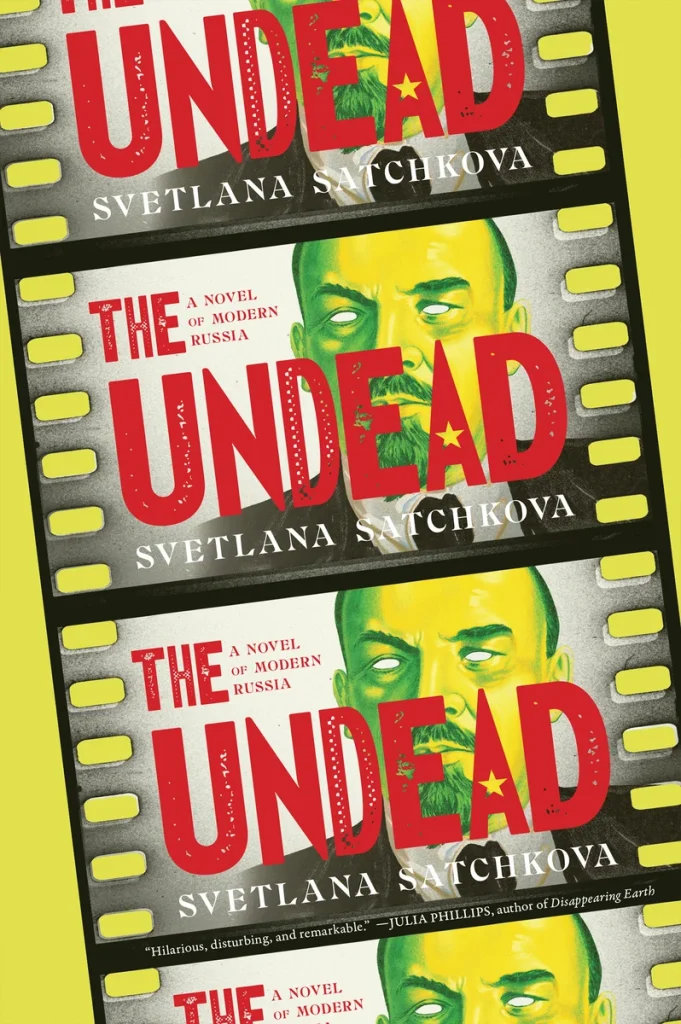
While many of us watch with dread as American society is rocked by menacing politics, New York-based author Svetlana Satchkova has already lived through the experience of her country becoming more authoritarian. Her debut English-language novel, The Undead, grapples with the fear she experienced as a cultural journalist and novelist in Putin’s Moscow, before moving to the U.S. Her protagonist, Maya, is a 30-something debut film director making a lo-fi movie about ghouls led by an undead Lenin. As an artist, Maya believes it’s important to stay out of politics. The problem is, politics doesn’t plan to stay out of her life. After all, just because you shut your eyes doesn’t mean the ghouls won’t get you.
As a product of the Soviet Union myself, I spent many years staying out of politics until I wrote a novel exploring the repercussions of societal fear. Being apolitical was part of my conditioning (free elections aren’t really a thing in totalitarian states). Upon immigrating to the U.S., I was surprised to discover that here most people voted, went to protests, and generally believed their voice mattered. Americans felt neither scared nor resigned to their fate.
Satchkova’s The Undead portrays a society where fear creeps in until it becomes an indelible part of ordinary life and work decisions. It’s not a darkly intense novel: There is the joy of art-making, friendship, drama, romantic entanglements, and even a bathroom sex scene on a film set. But, like in a classy horror flick, the thrilling undercurrent of dread is there all along. With real events underpinning the fictional plot, The Undead brings to life what we don’t like to think about—that the comfortable reality we know and like may one day betray us.
Sasha Vasilyuk: You were working as a successful journalist for publications like Glamour and Vogue in Russia, interviewing everyone from Helen Mirren to Tommy Hilfiger. What made you want to leave in 2016?
Svetlana Satchkova: My last place of employment was Russian Condé Nast, where I first worked as Deputy Editor in Chief at Allure and later as Features Director at Glamour. I mostly covered culture, and it was a fabulous life—I went to movie premieres, film festivals, parties, and traveled all over the world to interview celebrities like Alicia Keys, Antonio Banderas, Gwyneth Paltrow, et cetera.
But the atmosphere was getting worse. Repressions were increasing as Putin consolidated his power. As a journalist, I made a conscious choice not to write about politics, economics, or social issues because it was dangerous. Many journalists were killed, poisoned, driven out of the country, or imprisoned. I always wanted to cover those topics, but I chose not to because I was a single mom with no relatives in Russia, and I worried about what would happen to my son if I were arrested. It was scary to live in Russia.
SV:Your protagonist Maya doesn’t follow politics. How about you?
SS: I was following politics, but many of my friends weren’t. That’s where the idea for my novel came from. They were successful professionals who couldn’t understand what I meant when I said I didn’t see how I could keep living under a repressive regime. They simply didn’t notice what was happening. And I couldn’t tell whether they were willfully ignoring it or just uninterested in anything outside our bubble of great restaurants, exhibitions, and theater productions. They said, “Our life is great—what else do you need?” And I said, “I need to feel secure in my own country. I need the police to protect me rather than threaten my existence. I need to be able to say what I think.” We kept running into this conflict, and that’s what I wanted to explore when I started writing The Undead: the different coping strategies people develop when living in an autocratic state.
SV:How did you draw on your experience as a journalist for The Undead?
I made a conscious choice not to write about politics because I worried about what would happen to my son if I were arrested.
SS: I did a lot of reporting on the Russian film industry, interviewing most of its major actors and directors. (Readers familiar with Russian pop culture will recognize some of them in my novel, though their portrayals aren’t exactly flattering—which is why I changed their names.) Over the years, I spent time on countless film sets, so I know how the industry operates from the inside. What many people don’t realize is that the Russian film industry is funded almost entirely by the state, through various structures that collect government money and channel it into productions. In a way, Russia simply inherited this model from the Soviet Union, where everything was state-owned.
SV:Is that why you chose the film industry as the novel’s milieu?
SS: I just knew the film industry very well and many of my friends came from it. The story of Maya is taken in part from the experience of a close friend. She was a debut film director who was considered a genius in her graduate program. She signed with a producer, shot her first movie, but then the producer began stalling on the postproduction funding. The film never came out, and that became the tragedy of her life: She never wrote or directed anything again. Eventually, she became a housewife. I wanted to explore how creative people deal with failure, and why some of them can’t find it in themselves to move past it and keep going. But as I was writing, I kept thinking about Navalny, Putin, and the war in Ukraine, and politics worked its way into the story. I couldn’t just write about a small person facing a personal tragedy in times like these. You could almost say the novel had to become political. And I think it’s stronger because of that.
SV:Maya isn’t aware of everything happening around her until it’s too late. How much do you think art matters against power?
SS: It matters to me because my whole life revolves around the arts. But I guess it doesn’t matter so much to people who aren’t interested in them. Maybe film, because it’s so accessible to audiences around the world, can really influence people.
In Russia, nothing can challenge authoritarian power, neither literature nor film. But in a different context, living under democracy, some change can be affected by a work of art, especially if it becomes very popular.
SV:Should art be political?
SS: I think it should. Especially in times like these, it feels important to write about what’s happening, because everything around us is political. And while I published three novels in Russia, I didn’t touch on political topics for the same reason I didn’t cover politics as a journalist: I was too afraid. But once I came here, my fiction naturally became political, simply because it’s what I’m constantly thinking about now.
SV:Fear plays a major role both in your life and in the novel. Maya is making a horror movie and is also afraid of her stalker ex-boyfriend. What does fear do to artists and art-making?
I couldn’t just write about a small person facing a personal tragedy in times like these.
SS: There’s an irony in what happens to Maya: She’s afraid of so many things in her personal life, yet she isn’t afraid of what she really should fear—the state. Under a regime like Putin’s, there is no way to play it safe. Even if you keep a low profile, even if you never speak out, you can still become a target. Maya’s story reflects my own fear of what might have happened to me if I had stayed in Russia, even while making “safe” art.
SV:How did the arrest and sentencing of the Russian poet and playwright Zhenya Berkovich and theater director Svetlana Petriychuk in 2024 affect the writing of your book?
SS: Berkovich and Petriychuk staged a very successful anti-terrorist play about Russian women who married ISIS fighters and were abused. The message was clear: Don’t do this. But everything was turned upside down when prosecutors later claimed the play promoted terrorism. After the invasion of Ukraine, Zhenya began posting anti-war poems on Facebook, and I remember almost pleading with her in my mind: What are you doing? Aren’t you afraid? They’re going to send you to jail. And that’s exactly what happened.
It’s obvious to me that this was the real reason for the prosecution of Zhenya and Svetlana, and that the play, which had received government awards, was just a pretext. I followed the trial closely, and it was completely absurd. Everyone in the courtroom knew they were saying gibberish, but the machine kept going. The women are now in prison, each sentenced to six years. The grotesqueness of it made me think: I have to use this. The trial in my novel follows theirs.
SV:After publishing three novels in Russia, you deliberately stopped writing in Russian, a decision that has been hard and controversial for many Russian writers who now live abroad (not to mention American authors who continue to sell book rights in Russia). Can you talk about your reasoning?
SS: To be clear, no one has offered me a contract in Russia in the last four years, and the journalism I used to do was for independent Russian publications, most of which shut down after the invasion. So the fact that I don’t write in Russian anymore happened organically. But if I were offered a book contract in the Russian publishing industry now, I would turn it down, because the Russian economy benefits from every book that is published. Publishers pay taxes, and those taxes help fund the bombs that fall on Ukrainian cities. I don’t want to be a part of that.
I find myself in this strange position where I escaped a dictatorship and came here, only to see worrisome signs.
Also, censorship there is so intense that books come out redacted. To comply with the various laws that have been passed, some publishers black out sentences, sometimes whole pages. Do I want my books to look like that? No, I do not.
SV:This is making me think of book bans in the U.S.
SS: Of course it reminds me of that. It starts small, but then the appetite usually grows and censorship grows with it. I’m not at all happy about what’s happening with book bans in the U.S. or with freedom of speech in general.
SV:So, you’re worried about what’s happening in the U.S.?
SS: Of course. Some of the things the current administration is doing are completely terrifying to me, especially as someone coming from Putin’s Russia. So I find myself in this strange position where I escaped a dictatorship and came here, only to see worrisome signs. I can’t help wondering what might happen if I say the wrong thing. Which is ironic!
SV: Did you mean for your novel to also serve as a warning to American readers?
SS: I didn’t mean the book as a warning, simply because I don’t think fiction writers should issue warnings or try to teach their readers something. I guess I’m with Chekhov on this rather than Tolstoy. Tolstoy always had an agenda, but he wrote brilliant novels that were brilliant despite that agenda. When you’re a less great writer than Tolstoy and your novel turns into a pamphlet of any sort, it’s going to be worse for it. Meanwhile, Chekhov thought that a writer’s job is simply to tell a story and show life and humanity truthfully. If you read him closely, you’ll never find what the author thinks about his characters or their situations. I just wanted to tell my story truthfully, as I saw it. I thought it was important. Readers are welcome to interpret it however they wish.
You might think this contradicts what I said earlier—that art should be political—but it doesn’t, actually. I think that, as a writer, you should engage with political topics, or any topics that interest you, but you shouldn’t try to impose your own opinion on the reader.
Confession: I binged Apple TV+’s Your Friends and Neighbors even though I’m about to disparage its spineless attempt to indict the corruption of the ultra-rich. I’ve watched Succession, Sirens, all the White Lotuses, Big Little Lies, Nine Perfect Strangers, The Perfect Couple, Saltburn and The Menu. All of these shows attracted me with their real estate, sumptuous clothing and decent storytelling. But then I felt, well, tainted. I tried to justify my interest with “I must watch these shows! After all, I teach film and television writing!” Still, I cringed. I began writing this piece to better understand my complicity in patronizing these shows, but in the process, I uncovered a trend in television shows that lure viewers by portraying the lifestyles of the ultra-wealthy.
All of these narrative series could fit the “Eat the Rich” media classification, a phrase commonly attributed to the French political philosopher Jean-Jacques Rousseau, from a quote popularized during the French Revolution: “When the people shall have nothing more to eat, they will eat the rich.” Many shows from the last decade or so live up to this idea, wherein the super-rich— shameless, amoral strivers and consumers, neglectful of their families, oblivious to their servants—end up suffering consequences of their criminal or self-obsessed behavior.
But of late, not terrible consequences.
Once upon a time, wicked wealthy characters found redemption or met their comeuppance. The last episode of Your Friends and Neighbors tells me there’s been a shift: these characters no longer need a redemptive arc. Morally gray characters have gone black. Greed is okay. Decency is for suckers. This is our America.
Critics would call a show like Your Friends and Neighbors “Wealth Porn.” Their settings feature those twenty-million dollar homes you see on Zillow and characters who wear what most of us can’t afford. As I binged this series, the term “porn” made sense. I watched it privately and with shame, but kept on. If the settings, stories and characters of similar shows were so disconnected from my life, how did I get there?
Gawking at wealth has entranced us since the 1930’s, when films featuring high society provided an escape from economic hardship. But many films of that time, particularly screwball comedies (My Man Godfrey, 1936), ridiculed the wealthy. In the 40’s and 50’s, wealthy primary characters are often unfulfilled by their riches (Citizen Kane, 1941; Sunset Boulevard, 1950), destroyed by their wealth (Written on the Wind, 1956) or ruined by scheming for it (Double Indemnity, 1944). During my film school education, I identified with the “good” boys or girls, not with the greedy, powerful antagonists. Further, I longed for evil characters to find redemption. They usually did.
Then this simple construct shifted: protagonists’ “wicked quotients” increased. The precedent began with film: Michael Corleone in The Godfather (1972), Travis Bickle in Taxi Driver (1976), the TheJoker (2019), and V inV for Vendetta (2005). Tony Soprano inThe Sopranos (1999) is a mob boss, sure, but he suffers from anxiety and depression. Breaking Bad’s (2008-2013) Walter White cooks meth and fights drug kingpins but is principally (at least in the first seasons) a family man with whom we sympathize because of his terminal cancer diagnosis and the fact that he built his drug empire to guarantee his family’s financial security. So by the time I arrived at the first iteration of Big Little Lies (2017), I felt comfortable empathizing with morally gray protagonists. I watched ultra-wealthy, privileged, non-diverse characters in their seemingly perfect lives in a gorgeous coastal California town struggle to solve a murder mystery. What fun! Screenwriters know that we’re wired to want to unpack a mystery. I wanted to identify the murderer despite the fact that most of the primary characters seemed to lack redeemable traits. As the show developed, I was thrown the bone of each character struggling with situations that exposed their vulnerability. Wasn’t that “deep” enough?
As I binged this series, the term ‘porn’ made sense. I watched it privately and with shame, but kept on.
Along came The White Lotus (2021), each season of which takes place in a super-luxurious resort and features well-heeled patrons or families struggling with their (oh, dear) personal issues. Each season is also fueled by a murder mystery, which again hooked me into the puzzle. Most primary characters in all four seasons suffer from disconnection, the damages of toxic masculinity, insecurity or perpetual dissatisfaction. Real world issues! But the show’s message doesn’t land as a condemnation of extreme capitalism. While some of the wealthy characters in the series show a tepid arc, the loudest message is that the wealthy killer wins. It was only at the end of the limited series Sirens (2025), which has a similar resolution, that I questioned my own malfeasance in bingeing these shows. Sirens, I concluded, does not advise that we “eat the rich” but perhaps that we should “be the rich.”
So what? It’s entertainment. Escapism. Fantasy. Wish fulfillment? Uh oh. Maybe. Wishing for excess wealth is why so many accept today’s extreme income inequality. Slowly, I’d been enticed into a blithe admiration of, no let’s say, interest in ultra-wealthy protagonists and their lifestyles.
Nowhere is this stunt of beguiling us into moral turpitude more evident than in Your Friends and Neighbors. In the show’s pilot, John Hamm stars as Andrew Cooper (Coop), a divorced hedge fund manager who’s fired by his manipulative boss allegedly because of Coop’s one-night stand with a woman from a distant division of the firm. In truth, Coop’s boss simply wants Coop’s share of profits. Having signed a non-compete, Coop can’t seek work in his specific field, which leaves him with huge expenses and no way to pay them: a mortgage on a palatial house where his ex-wife Mel (Amanda Peet) still lives (even though she was the cheater that ended their marriage), $100K dues for his country club, private-school tuition for his children, and a house rental for himself. More financial stresses emerge: a new drum set for his son, a charity benefit and an expensive skin treatment for his daughter.
The pilot opens with Coop waking up in a pool of blood. Lying beside a dead man, Coop becomes a suspect. We are offered a solid setup for good storytelling with a protagonist who’s unemployed and finagles a sketchy way to get money while proving he’s not a murderer. Ah ha! Another murder mystery! How can one turn away when you need to know who killed so-and-so? Coop doesn’t admit to any of his friends or family that he’s lost his job. Instead, he secretly steals from his friends and neighbors and pawns the goods for cash. Citing his escapades in a Voice Over, Coop says that these people have “piles of forgotten wealth just lying around in drawers where they were doing no one any good” – as if this justifies his theft. Coop does not belabor the decision to steal from his friends. This is no Robin Hood move. This guy feels entitled to his friends’ spoils. A corrupt character, yes, but intriguing because of the puzzle. Further, I was riveted by this protagonist’s quest to prove his innocence. He wasn’t all bad!He was innocent of murder.
Then I thought, “Wait. Get a job, man!” Unless we’re morally bankrupt hustlers, most of us would hit the pavement and seek employment or reach out to family or friends for help. But not this guy. A liar and a thief! Still, I stayed in.
I wanted to watch the thrill of Coop proving he was innocent of murder, sure, but the morally superior schoolteacher in me enjoyed anticipating Coop’s comeuppance. If I couldn’t thieve my way to riches, Coop shouldn’t either. It’s just not fair. Then again, there’s nothing fair about today’s capitalism so I should have predicted his ultimate immorality.
The tense robberies made for great set pieces, but they also exposed issues of story logic: Why don’t people in the community, all of whom attend the same country club, organize a community watch to catch this thief who is preying on all of them? My dispute seemed okay with most viewers. Nielsen data showed that it was Apple TV+’s most watched drama in its first 38 days. Why was I still in? Watching was like eating candy. I craved the sugar, knowing it might make me sick.
I was riveted by this protagonist’s quest to prove his innocence. He wasn’t all bad!
Tonally, we’re reminded that this is a satire, much as we’re supposed to digest the series Succession. For example, when Coop contemplates stealing a Phillipe Patek watch, we are offered a brief sidebar “commercial” about the $200K timepiece: a funny commentary. Same with a Birkin Bag or Richard Mille watch. Further, most of the wealthy characters aren’t deeply rendered and as screenwriters know, characters with meager complexity don’t inspire identification or even sympathy. Shallow characters permit (allegedly) wannabe super wealthy viewers to claim that they’d be nothing like those rich people.
By the fourth episode of the first season, it seems the writers got the message that Coop is losing our loyalty: they shift focus to Coop’s Dominican housekeeper Elena (Aimee Carrero), with whom he collaborates on his thieving antics only after she catches him stealing. In line with the show’s tone, she gets wise: you don’t get what you work for. You get what you’re able to negotiate. The episode also features Coop’s attempts to restore his relationship with his ex-wife, Mel. The episode seemed to find the sweet spot between admiring Coop’s neighbors’ lifestyles and throwing a bone to the working or middle class, hoping to snare both classes of viewers while avoiding true responsibility for their inherent messages. By showing the housekeeper’s limited means, Coop’s alliance with her briefly indicts the corruption of capitalism before the murder mystery and Coop’s robberies distract us from her poverty and again becomes the focus of the rest of the episodes.
In the last episode of the season, Mel and Coop accompany their daughter to Princeton for a college tour. While the daughter is on her own, Coop and Mel break open a chalice in their alma mater’s church and munch on communion wafers with jam before having sex in a pew. For those who haven’t watched the show, yes, this truly happens. The sequence sustains the story line that Coop and Mel might someday reconcile, however it betrays the writers’ staggering lack of awareness of their viewers. Scores of Catholic Reddit users were appalled at the blasphemous incident and pledged not to watch the second season because of it. This story decision shows the writers’ lack of concern with the extent of Coop’s immorality. Sure, moral ambiguity is a natural component of contemporary storytelling, but embarrassing when the writers seem indifferent to a scene’s blasphemy.
The series had the potential to end with a genuine catharsis, but no. In the last episode, Coop is proven innocent of the murder and the entire first season avoids any examination of the consequences of income inequality or excesses of extreme capitalism. Coop and the housekeeper’s robberies are never detected. Instead, Coop is offered back his job, with even better terms. His boss and the woman with whom he enjoyed the one-night-stand wait at the private plane that will fly them to close Coop’s first new deal, but Coop doesn’t show. The plane takes off without him. Where is Coop? He’s burglarizing his malicious boss’s mansion. Cinematography, acting and soundtrack portray this as a victory.
After this, I finally woke up. I vowed not to watch the second season.
When interviewed about this last episode, Tropper defends Coop not taking his former firm’s offer:
“If he took it, he would go back to being the same sleepwalking, suburban, middle-aged man that he was before this happened. The goal of this story was always to wake him up. I think he was planning to take the job until the last possible minute, and it’s the realization that breaking the rules and robbing people and being in their homes became something more than just a means of making money for him. It actually liberated him from a script he’d been following his entire life.”
I sure hope morality still exists.
Liberated? Coop is merely strategizing a new tactic of wealth acquisition. How many of us would feel liberated from a multi-million dollar salary by robbing people? If Tropper is so critical of the racket or malaise of working as a hedge fund manager, why not give Coop a Robin Hood opportunity? Steal from the rich and give to the poor? Or make the radical decision to turn Coop into a 7th grade teacher in the south side of Chicago? Coop’s life was not at all typical of a “sleepwalking, suburban middle aged man.” But this is what the show is teaching us: secure your liberation and wealth by breaking the law. Or perhaps Apple TV+ simply wants to repeat what they see as the first season’s success without caring about the immoral residue.
Tropper continues:
“Morality has taken a backseat right now to self-discovery, and part of what his journey is going to be is reconciling his place as a father and family man with what he’s doing. His journey’s not complete yet, but the first step of his liberation is complete. Then the question is, now that you’ve been freed, are you going to locate your moral compass or not? Is morality a thing that still exists in contemporary society?”
I sure hope morality still exists. I know I’m not alone. Asking this question exposes a deeper malignancy that’s being sold to millions of Americans at exactly the wrong time in our divided society where the poor are getting poorer and the government is justifying why the rich should keep getting richer. If it’s possible that morality isn’t “a thing” that still exists in our society, the ministers of our screen stories should feel some responsibility to envision corrective paths.
Maybe showrunner Jonathan Tropper was only asking a rhetorical question, perhaps he wants us to bellow “of course morality exists!” and root for Coop to correct his path in season two. But we never saw Coop consider an alternative way of life. The first season never dropped a hint that Coop struggled with the morality of his larceny. For example, he could have started a job outside of his field or told his ex, Mel, of his situation and she could have forced him to maintain their lifestyle. She could have encouraged the robberies. It’s another screenwriter trick: to protect your protagonist’s reputation, blame his wrongdoing on another character! But Coop is never given those choices and we can’t blame other characters for his actions. Viewers are anticipating that “second-season Coop” will either get caught trying to one-up his prior boss with greater avarice or connive another scheme. Coop has shown no characteristics that lead us to believe he’ll be reformed.
Before our current film and television era, most protagonists faced with tough choices ultimately chose morally and ethically “good” choices, even if the choice sacrificed their lives or lifestyles. See Spock in the Wrath of Kahn or BoJack Horseman, a deeply flawed anti-hero, who chooses responsibility over self-preservation, or more recently, Joel in The Last of Us as he lies to protect Ellie—an adopted daughter of sorts—from responsibility and heartache.
We’ve emerged out of the simple “good versus bad” anchor of movie and television narratives into something more complex—that, to me, is a good thing. Profound questions are raised when, at a story’s end, our protagonist makes the “bad” choice. We ponder how the character has been damaged by society or by other characters and reject that social/cultural blight. But now, more than ever, when anti-heroes don’t make “good” or redemptive choices, the social message is absent. Does that mean we should finally surrender to the damages, as did Simone in Sirens? I am not yet that hopeless.
I worry that these shows invite me to think that I, too, could have all that, when I, like most of us, can’t.
I strongly believe that we are at a time where we can’t afford to accept capitalism’s costs or allow ourselves to get lured into admiring unredeemable protagonists in our films and literature. Movies and novels are a modern Bible: What would I do if I lost my job and faced colossal expenses? How should I live? Who am I? These sorts of questions surface when reading the finest stories or watching the most resonant films and television shows.
Let’s be real: with a few exceptions, the preponderance of series about the super-rich and their resultant power supports this country’s tilt toward oligarchy. I kept watching these shows and sequestered that truth in my peripheral mind. But after this exploration, I won’t do that again. I worry that by featuring the glossy kitchens and acres of manicured gardens, I’m invited to forgive the one-percenters for protecting their wealth by not paying the taxes they should be paying. I worry that the series’ lukewarm, even ambiguous anti-capitalist messages are buried under the glorious spectacle of possessions. I worry that these shows invite me to think that I, too, could have all that, when I, like most of us, can’t. And I worry that the showrunners, feeling exempt from moral responsibility, know exactly what they’re doing. “Social critique is not our job,” they might answer. “We’re in the entertainment business.” But beneath those justifications, these creators also know: “We can’t upset the oligarchs; they finance our operation.” Showrunners know the hand that feeds them. Just look at what happened with ABC, Disney and Jimmy Kimmel.
It’s interesting to note that Your Friends and Neighbors was renewed for a second season before its first season even aired. This is uncommon for the streamer. Executives are not measuring viewers’ “likes;” they are dictating them.
Are we—the viewers who care about social and ethical justice—okay with this?
73% of Americans subscribe to streaming services. A vast majority of us, regardless of our wealth, have access to wealth porn. We can wish to have all that and wish so badly that we grow angry when we finally learn we can’t. It’s no wonder that countries like the U.S. with the greatest income inequality also have the highest crime rates.
At a time when extreme income inequality lives in tandem with political polarization, social unrest and violence, watching lavish lives corrupts our national psyche. These screen stories’ tender scolding of the crimes of the rich only nourish the cancer of late-stage capitalism.
Our schadenfreude at seeing rich people’s mild misery is no substitute for “eating the rich.” I’m promising to resist my voyeurism and protest television shows that coax us into sympathy for the very individuals who are victimizing the majority of Americans. I will push back against this dehumanizing power of wealth porn. I will avoid any assignments for feature film concepts that fall, lock step, into this trend.
How can the rest of us, who are not television or film writers, register our protest?
One start: make your sentiment known. Stop watching these shows.
Fame used to be something sacred. Back before the internet shattered monoculture into millions of digital pieces, “celebrity” was a title held only by the saintly and untouchable few. The 50s had Marilyn Monroe. The 80s, Michael Jackson. The early aughts, Britney Spears. Try and think of a celebrity that’s defined the 2010s or 2020s, though, and your options are suddenly endless. Might we say, the YouTube star MrBeast? Or maybe the Instagram behemoth, Kylie Jenner? Addison Rae of TikTok fame? There’s also, unfortunately, Elon Musk on Twitter. And—I just looked this up—Lenny Rachitsky, who is apparently the most followed user on Substack. It seems like they’re making just about anyone famous these days.
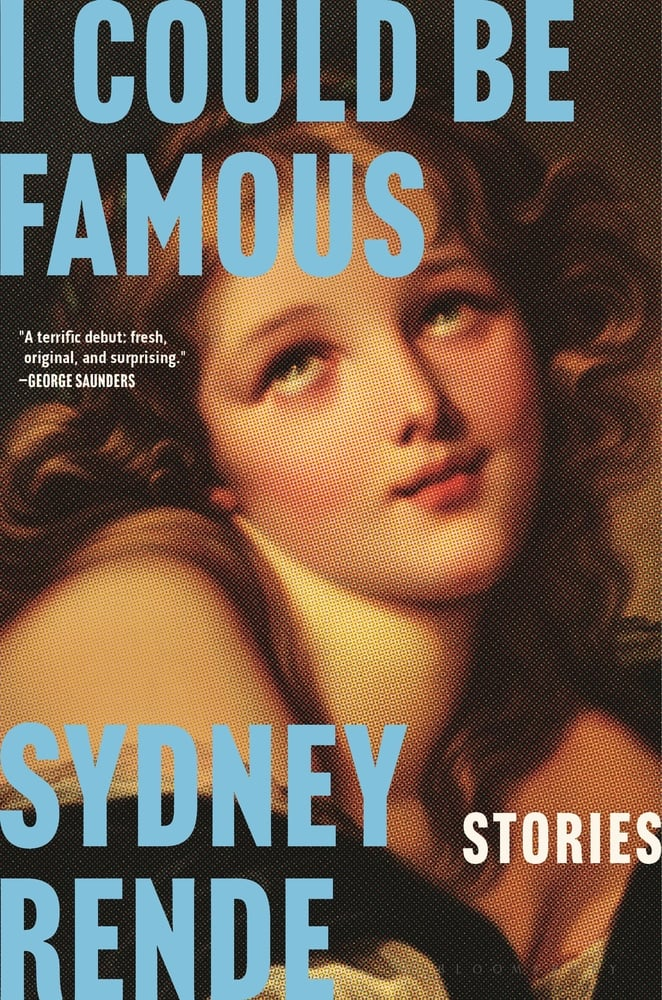
Sydney Rende’s debut short story collection, I Could Be Famous, is astutely aware of the participation prize that fame has become in the twenty-first century. Read the title out loud and you realize it’s true—you, yes you, really could be famous. In a world where just about anyone can turn a snappy catchphrase into appearances on daytime television, or milk thousands of dollars off of ten second dance videos filmed at home, we’re all technically on the edge of having our lives forever changed. The question, though, is should we?
With a magnetic, fresh voice and an acidic sense of humor, I Could Be Famous dares readers to question the Hollywood Walk of Fame and the trending tab on social media as sites of modern worship. Between hot-shot superstars accused of cannibalism and absolute nobodies turned kleptomaniacs desperate to feel something, Rende tracks our obsession with mass perception as well as our complete unpreparedness for what said perception means for our feeble little lives. Over Zoom, Rende and I discussed LA vs NYC culture, the inclusiveness of modern fame, reality TV-induced delusions, and humor as a way to get close to people.
Jalen Giovanni Jones: These stories feel incredibly Southern Californian. I see it in the rich descriptions of Los Angeles, yes, but also in the characters’ voices—there is this breezy flippancy that is both hilarious and also immediately recognizable. Is there something specific to the culture of Southern California that made you want to focus this collection largely in that region?
Sydney Rende: So many things. I really feel like I should have been born in California. A lot of these stories, and the narrators of these stories, are really just iterations of my own voice. The stories are set in and around LA, and I have such a wild relationship with LA. I’ve visited a ton because I find it fascinating. When I went to LA for the first time, I felt like I was stepping into a simulation. The whole city is so nostalgic for its own past, especially architecturally and culturally, but at the same time it’s so modern. It makes for the best people watching I’ve ever seen. My dream party is one in Los Angeles, where I’m wearing an invisibility cloak and just walking around observing people, seeing what they do when they think no one is paying attention.
People are drawn to LA for very specific reasons, and those reasons really interest me, especially when it comes to fame. The nature of fame is so fluid and changes so much that I’m really drawn to people who, even now, are still after it and romanticize it. And LA is the city that romanticizes fame and celebrity the most. NYC feels like a very serious, hardened place. LA feels very much the opposite. For that reason, I just think it’s a really good time.
You can be really famous and still living in your parents’ house these days.
JGJ: About LA’s simultaneous nostalgia and futurism, I’m wondering if you find that fame operated differently in the past, versus how it operates currently.
SR: Definitely. I grew up obsessed with Perez Hilton and reading Star Magazine and Teen. When we fantasize about fame, it’s often the kind of fame from about 30 years ago, where it was reserved for movie stars and rock stars who were famous for very significant reasons and beloved. Fame now is really different. It’s so much more accessible. There are more famous people now than there were 30 years ago, and “fame” is diluted because of that. It’s very, very fleeting. Most people who crave fame are romanticizing based on the way that fame used to be. Then, because of social media and reality TV and all that, they actually become famous—and maybe are not as prepared for it as they assumed. Celebrities from the past were a little bit shielded from the public. Now, there’s online commenting, DM-ing, and all these ways to access people who are well-known. Also, if you were really famous in 1995, you probably had a ton of money. That’s not the case anymore. You can be really famous and still living in your parents’ house these days.
I was very interested in writing about those people who have those deep fantasies, where ultimately dissatisfaction occurs, where they realize what they wanted isn’t actually real. Fame is now something else entirely. They can’t attain that old, idealized version of fame. The new version of fame is weirder, is way more fleeting, and honestly, is more inclusive—and that makes it more interesting to me as a subject.
JGJ: An aspect of this collection that I really loved was your careful dispersal and withholding of information. You often left it ambiguous whether certain rumors were true or not, for instance.
SR: I don’t think you can really trust any narrator fully, especially a first-person narrator. They’re always hiding something from you. There are definitely certain characters to especially question, like Arlo Banks—is he eating people, or is he not?
JGJ: I read all of “Trick” believing he wasn’t. And then I got to the last line, and everything was thrown into question. That last piece of the puzzle made the entire picture look different all of a sudden.
SR: I’ve actually gotten a lot of criticism of that story, asking for it to be less ambiguous. But I think the nature of this type of situation—which is a satirical exaggeration of how rumors spread about a celebrity’s private life—is ambiguous. I really wanted to explore that ambiguity, and not have to come to a conclusion.
I’m rooting for all the characters that I write about, but at the same time, [Arlo Banks] is definitely bad in a lot of really serious ways. He’s not someone who I would want to hang out with. I got a lot of feedback from people saying “I don’t know if I like this guy or not,” and my only answer is, “me neither.”
JGJ: The character of Arlo Banks specifically reminded me of Claire Dederer’s Monsters—that book, like your stories, dissects the relationship between fans and famous artists that are seen as bad people. Do you feel it’s possible to separate the art from the artist?
I don’t think you can really trust any narrator fully, especially a first-person narrator.
SR: I think a lot about that question too, and there are so many artistic people out there who deserve recognition, who are doing really good work, and who also aren’t terrible people. There are definitely great artists who have done bad things, but I’m in a place right now—especially considering how the world feels so scary these days—where I’m like, “Let’s appreciate the artists who are doing good things too.”
JGJ: Did writing I Could Be Famous change how you saw yourself as a consumer of reality TV and social media?
SR: Definitely. I don’t actually watch much reality TV anymore. I’m not nearly as invested as I used to be, but I may just be aging out of the generation that’s on TV currently. Writing these stories, I got into the mindset of characters who are really obsessive and stalkery. I’m realizing as I’m writing them that these are coming out of my brain; this exists in me. You watch a reality show for 10 years, and you start to think that these people are your friends.But you don’t know them.
It was the first story in the collection, “Nothing Special,” about a girl who befriends an influencer and comes to believe that she’s her close friend—that totally came from a place of me believing deep, deep down that the people on these shows were my friends, and that we would get along famously if we met. And then taking a step back and realizing that’s totally delusional.
JGJ: There’s an undeniable sense of humor that’s very prevalent throughout the book. How do you go about balancing that humor and accessibility while also maintaining the stories’ high literary quality?
SR: Humor is my favorite form of entertainment. Two main things my writing professor George [Saunders] would say were, “Does this sentence make me want to read the next sentence?” and, “Am I entertained?” You can tell when a writer is entertained while they’re writing. My goal when I was writing these stories was always to keep myself entertained, and if I ever felt myself getting bored that meant the reader was going to get bored too—so I needed to change it up somehow.
You watch a reality show for 10 years, and you start to think that these people are your friends.
I’m drawn to humor because I think you can learn so much about a person (and character) from their sense of humor. It helps you relate to them. I really wanted to enjoy my characters’ company. Otherwise, I would be bored and I wouldn’t want to write. So even if they were bad or doing ridiculous things, or not likable in one way or another, I made sure that people wanted to hang out with them through humor.
JGJ: I was impressed by how prevalent the internet and screens were in these stories—people are on social media, they’re checking headlines on phones—and yet the pacing always felt swift. How did you keep the stories moving forward, even while they bounced between the analog and the digital so often?
SR: I actually struggle with pacing a lot, and I think it all comes down to revision. The pacing of a story for me is always messed up the first time around. You can tell where I’m getting bored, or where I want to speed through something. The revision is the only way to get your pacing right.
I took out a lot of the screen stuff because I was like “we don’t need her to call her mom right now, something else physical can happen.” A lot of the screen stuff is the nature of the content. If you’re writing about fame between 2019 and 2025, it’s kind of hard to avoid an iPhone or some kind of app or a headline. That part just comes with the territory. But I like to try to keep the stories as evergreen as I can—so not depending too heavily on Instagram or other fleeting apps and digital stuff that could be really huge right now, but in 10 years could be non-existent for one reason or another. So I thought about that a lot too—not depending too heavily on specific, modern digital stuff, and trying to keep it person to person as much as I could. If you wrote into a story how often we were truly on our phones these days, I think it would be so boring. There’s a little bit of fantasy, at least in the stories that I write, in how the characters are not attached to their phones 100% of the time. I think that’s a flaw in who we are as people now.
JGJ: Would you like to be famous?
SR: I have thought about this a lot. No, today-me, no. I fantasize about being like a rock star in 1970, but in that scenario, I’m not me, you know? I’d be somebody else. I’m afraid to be famous. I love watching other people.
Formalizing Grief: On Victoria Chang’s Obit by Robin Arble
The genius in Victoria Chang’s Obit lies in her turning the obituary into a poetic form. All her other feats—her dazzling flashes of language, her similes and images that feel realer than life—flow from this decision. Her first move is finding a form to turn and return to: Chang is, among many things, a poet’s poet, and she knows how to turn limitation into invention. But her real accomplishment is taking something as cold, factual, and isolating as writing an obituary and turning it into a cathartic experience, not just for herself, but for everyone—especially every poet—who has written one.
Most of Obit’s poems are obituaries of concepts, not people: Language, Memory, Love, My Father’s Hands. These poems orbit two enormous silences: the poet’s parents. Chang’s mother is the parent who dies, over and over, throughout the book, while her father survives a stroke that steals his ability to speak. Obit is all about these barriers and failures of language, especially language’s inherent failure to capture the essence of a person, and their loved ones’ memories of them. As such, each of these obits can only write “around” their subjects. For example,
My Mother’s Lungs—began their dying sometime in the past. Doctors talked around tombstones. About the hedges near the tombstones, the font.
An obit, even as it takes the narrow shape of a coffin, tombstone, burial plot, or cemetery hedge, can only talk “around” its subject the way the doctors in Chang’s poem only talk around the actual tombstone. Notice that the “font” of a tombstone isn’t even part of it. Even the tombstone isn’t the death itself. The white space around each letter and punctuation mark—and the larger white space around each tombstone of text—is where the actual death is.
“When my mother died,” Chang says in “My Mother’s Teeth,” “I saw myself in the mirror, her words around my mouth, like powder from a donut.” The simile is intentionally insipid, pairing her grief with a useless product someone would buy from a waiting room vending machine. “Her last words were in English. She asked for a Sprite. I wonder whether her last thought was in Chinese. I wonder what her last thought was.” Here is the triple silence of a language barrier, a generation gap, and the inescapable privacy of any death: “I used to think that a dead person’s words die with them. Now I know that they scatter, looking for meaning to attach to like a scent.” Obit tells us that the real death of any person—especially from the perspective of the obituary writer—is forgetfulness. Oblivion. It looks like this.
The week I wrote my mother’s obituary, I read a few sample obits on my local funeral home’s website to get a sense of their rhythms, their contents, and the demands of their form. Even in the midst of this task—writing my mother’s obituary, in the middle of the week, in the middle of a semester—my poetic instincts kicked in: reading preceded writing because the best teachers were texts. The adults in my life who assigned the family English Major the task of writing her mother’s obituary—especially my Aunt Karen, who’d assumed the role of family matriarch after my paternal grandmother died the second day of that year—gave me advice on writing obituaries because they’d written them before. Just like the poetry I was studying in school, I was taking notes from people twice and three times my age who had already done what I was struggling to start. They even told me that, ultimately—just like poetry—I had to do it myself.
The real death of any person—especially from the perspective of the obituary writer—is forgetfulness.
Rule one: Always begin with the announcement of the death. In her case, my mother’s death wrote itself: “Ellen Sue (Richardson) Arble, 57, of Belchertown—loving wife, mother, sister-in-law, cousin, and friend—died Monday, October 3, 2022 at Baystate Medical Center in Springfield after a brief illness.” I let the sentence sound too wordy; I figured the release of information was gradual enough to let those double dashes in. Of course, the most important fact of the sentence, the crown jewel of a verb, was located at the sentence’s center, right at the point of grammatical release: “died.” Ellen Arble died. That was all the reader needed to know. But the reader knew this before they even started reading the obituary. An obit’s very form announces its most important news. This first, crucial piece of information is already redundant. Dead on arrival. All the other information—my mother’s full name, how old she was when she died, where she lived, who she loved—crowded around this one (in)essential fact.
The second paragraph of an obit, the biography, is often the longest. Here is where the writer gathers all the essential facts of a person’s life into chronological order. Grammar school rules apply here: Make sure your paragraph is no more than a few sentences long so as not to bore your reader (your “hook” takes care of itself in the announcement):
Born in Holyoke, Ellen attended John J. Lynch Middle School and Holyoke High School, where she graduated in 1983. She married her husband, James, in 1999. Their only daughter, Robin, was born in 2001. Ellen worked as a Special Education Paraprofessional before leaving her job on September 11 to be a stay-at-home mother. Ellen moved to Belchertown with her family in 2020, where she lived happily for two years.
My aunt and editor Karen went through my obituary draft with me over the phone the night I started it. She asked me if the middle school my mother attended was really necessary to include. I told her that my mother had spoken of it often and fondly. And was the 9/11 reference really needed? Same thing: She’d told me that story my whole life. That was the day she thought the world was ending, and the first thing she thought of doing was going home to me. Obituary biographies are fascinating because they’re mostly written for (and by) unremarkable people, so ideas of necessary information are entirely subjective and therefore inapplicable to the usual rules of writerly etiquette. (Grammar school memories of teachers crossing out digressions and extra details failed me here.) I was proud of myself for crowding every meaningful fact of my mother’s life into one dense paragraph, knowing this paragraph was pure information to strangers. I felt the secret weight of every detail’s meaning. Only I could see what “she lived happily for two years” meant. I could close my eyes and see those first months of the pandemic, building a fire in the backyard every evening, plugging my phone into my father’s garage speaker and taking Spotify requests from them all night. Only I could see the night my mother signed along to Carly Simon’s version of “The Itsy Bitsy Spider” as me and my father watched in stoned discomfort. Only she could see the faces of the students she taught that song to, hovering in front of her from two decades away. Even these details are an open secret. You can’t see them any more clearly than I can.
The second half of an obituary begins with the survivors paragraph. This is where the obituary writer catalogs every friend, family member, and loved one who’s outlived the obituary’s subject. Even though I established this catalog in my announcement, it was bizarre listing my family members in descending order of (posthumous) proximity to my mother. By the time she died, there was no “mother’s side” of my family; almost everyone from it was dead or dead to me. Which brother-in-law should I name first? I decided to keep it as democratic as possible and list every extended family member alphabetically by first name, so Clarke went before William, even though I call him Bill to this day. Karen explained to me that spouses go in parentheses next to the relevant (blood) family member. This struck me as an odd display of grammatical ownership, but she insisted (Karen) goes next to Clark. As the list of survivors broke off, it became impossible to decide which names to include and which to imply. I took the easy way out: My mother is survived by “innumerable friends and acquaintances from her hometown.”
The final paragraph of a standard obituary is the arrangements: when and where the funeral will take place, if there will be one; where to send flowers, if the family wants any; where to make donations, if you can. My father and I were in no shape to throw a funeral; we had no money, and nothing to say.Like its announcement, the obituary’s penultimate sentence wrote itself: “All services for Ellen will be private.”
Rule one: Always begin with the announcement of the death.
Aunt Karen told me over the phone that Ellen often talked fondly about Kate’s Kitchen in Holyoke. My mother had been a prolific phone caller my whole life. If she’d been born fifty or a hundred years earlier—as my father, whenever he was teasing her for their three-month age difference, was convinced she was—she would have written several letters a day. Instead, she began and ended most days with a phone call to her mother-in-law, or my godmother or, when I was young, her own mother. Our floor of the family home was small. I heard my mother’s phone calls my whole life. I never once heard her talk about Kate’s Kitchen in Holyoke. At this point in my phone call with Karen, I realized how strange it felt to trust someone else’s memory of my mother over my own. Maybe I was offended that someone besides my father had a view into my mother’s interiority that I didn’t. Maybe this small fact threatened my sense of narrativity over my mother’s—and my own—life. I trusted Karen. She wrote the last sentence for me: “In lieu of flowers, please consider a donation to Kate’s Kitchen at 51 Hamilton St., Holyoke, MA 01040.”
Chang’s obits rarely, if ever, satisfy the four requirements of a newspaper obituary, but they almost always fulfill the form of the announcement: [Concept]—died on [month, day, year]. The announcement sentence of Chang’s obits act as a prompt for the rest of the poem. Images and narratives—donut powder, time zones, tombstone hedges—leap from the death-dates of concepts: My Mother’s Lungs, Love, Memory, Form. Like anaphora, every obit in this book starts from the formal base of its announcement.
The second demand, the biography, is often where Chang’s obits leap into themselves. Formal restraint gives way to discovery. The first half of “Appetite”:
Appetite—died its final death on Father’s Day, June 21, 2015, peacefully and quietly among family. We dressed my mother, rolled her down in her wheelchair. The oxygen machine breathing like an animal. They were the only Chinese people in the facility. The center table was loud again, was invite-only again. Like always I filled my mother’s plates with food. Her favorite colored puddings contained in plastic cups. When we got up to leave, her food still there, glistening like worms. No one thought much of it.
The first sentence, the announcement, is largely literal, though there’s a sardonic inversion of obituary jargon in “peacefully and quietly among family.” The real leap comes with the introduction of Chang’s mother in the second sentence, followed by the simile of her oxygen machine breathing “like an animal.” Here, the “biography” of her mother’s appetite is actually a description of its quiet, peaceful death among family: “Like always, I filled my mother’s plates with food.” An actual description of her appetite’s life would be besides the point. Its life (and death) is viewed through her daughter, the obituary’s speaker. Her mother’s appetite is a symptom of her decline, and its quiet death is the exemplary moment to view her decline through.
Because the biography of a Chang obit is where each poem leaps from its prompt, it’s often the place where the poem’s silence starts to take hold. Notice how many similes are hidden in these sentences. Like Chang’s donut simile in “My Mother’s Teeth,” her animal simile mocks the inherent failure of explaining one thing by comparing it to something else. What else breathes besides an animal? Plants? Rocks? A person? An oxygen machine? This simile is visually and emotionally evocative—I can hear the oxygen machine breathing like a tiger hunting its prey—but its juxtaposition of deathly serious and sardonically mundane mocks the very idea of comparison.
The last demand of the obituary’s form is the only one Chang never fulfills. The ending of “Appetite”:
There are moments that are like brushstrokes, when only much later after the ocean is finished, become the cliff’s edge that they were all along. Death is our common ancestor. It doesn’t care whom we have dined with.
What does it mean to read—and write—an obituary with no arrangements? In all of Obit’s hundred-plus pages, we never read a sarcastic play on arrangement jargon, no “All services will be private.” What does “private” mean in the second-to-last sentence of my mother’s obituary? What would it mean to Chang’s Obit? Her mother’s death is a secret she took to her grave: “I wonder whether her last thought was in Chinese. I wonder what her last thought was.” Her father, without his ability to speak, lost a portion of himself to the silence that his wife disappeared into. Death, whether it is full or partial, is just as private as any experience, no matter how fully we try to communicate it. Chang knows that she can’t translate any thought, mood, or emotion directly into her readers’ minds. In “Blame,” “the child cries out loud, makes a noise that is an expression of pain but not the pain itself. I can’t feel the child’s pain but some echo of her pain, based on my imagination.” Notice that Chang chooses “imagination” over “memory.” We all have visceral memories of pain that live in our bodies as much as our psyches, so why does her empathy rely on her imagination? What leap has to be made here? Why is something as obvious and universal as a child’s scraped knee so private to Chang?
My father and I were in no shape to throw a funeral; we had no money, and nothing to say.
The answer is in her craft: Nothing is comparable to anything, not even grief in “Grief”: “A picture of oblivion is not the same as oblivion. My grief is not the same as my pain.” There are no arrangements in Chang’s obits because the deaths they depict are never final. In “Form,” “When we die, we are represented by representations of representations, often in different forms. Memories too are representations of the dead.” Chang leaves the restless arrangements and rearrangements of each obituary to its close cousin, its almost-anagram: oblivion. Funerals, flowers, or donations—like obituaries—only serve to make the dead (in the minds of their survivors) more dead.
There is one demand of the standard obituary that is almost impossible to map onto Chang’s obits. It is difficult to determine when, where, or whether Chang satisfies the poetic catalog of an obituary’s survivors. Obit’s relentless repetition understands that, when someone dies, they die—and you die—over and over again, for the rest of your life. They die into oblivion through daily acts of forgetfulness. The anonymous blurb on the back cover says it best: “When someone you love dies, everything dies. Her blue dress dies. Empathy dies. Friendships die. You, having survived, die.” In Chang’s obits, their subjects’ survivors are better understood as descriptions of each micro-death that flows from the poem’s subject. But of course, the central survivor of any obituary is its writer.Its subject’s biographies, survivors, and arrangements blend into the obituary writer’s private oblivion.
I held on to my mother’s obituary for eight days before I sent it to Barry J. Farrell Funeral Home. I wanted to hold my mother’s memory intact in prose, in a form I spent eight days tinkering with. Like Chang, I was using the formal borders of the obit to give my grief a shape, knowing it will always be shapeless—“Wind in a box,” as Terrance Hayes once wrote. The box is a poem’s form: the narrow rectangle of an obit, coffin, crematory, tombstone, death certificate, and burial plot. The wind is the box’s contents: meaning and memory. Next to nothing. “My mother was a mathematician so I tried to calculate my grief. My father was an engineer so I tried to build a box around my grief, along with a small wooden bed that grief could lie down on.” The borders of grief can also be a bed of flowers forming the hedges of a tombstone, or a bed to collapse in, even if the tears don’t come.
The central survivor of any obituary is its writer.
Three weeks after my mother died—literally, physically died—me and my father spent a weekend at his friend Odie’s camper in the depths of New Hampshire’s wilderness. He’d offered us a weekend away at the campgrounds, “to get away from it all.” That first night, we sat around a bonfire with Odie and his campground friends, middle-aged men and their wives in camouflage Carhartts. They were nothing like me, but I knew they’d all lived enough life to experience deaths as large as ours. When they were done with their cans of beer, they threw them into the fire. I watched the thin metal boil and writhe into nothing. We passed around a Mason jar of moonshine someone had smuggled up from Mississippi. It was the cleanest alcohol I’ve ever tasted. I never got drunk, not even when—at everyone’s insistence—I ate the peach slice at the bottom of the jar.
At the end of the night, Odie set me and my father up on the pullout couch in the living room of his camper. I heard a car door slam, and my father came back in with pillows and blankets in his hands. He held a lumpy gray pillow out to me: “This was your mother’s.”
As I was falling asleep, I buried my face in the smell of my mother’s hair, knowing the smell was fading too slowly for me to notice. I saw her perfectly that night: her hair tied tight in the back of her head, strips of black dye fading into gray. I saw her as I had my whole life, hunched over two or three pillows stacked between her arms and legs, sitting criss-cross, watching TV on her side of the bed. Writing this essay, Chang’s “Language”frames my memory’s memory: “A picture represents a moment that has died. Then every photo is a crime scene. When we remember the dead, at some point, we are remembering the picture, not the moment.” That night in New Hampshire, a pull-out couch measured the dimensions of my grief. Suddenly the Earth was spinning six miles a second. The bed I was laying in was a memory of hers. I refused to sit up. I closed my eyes and looked at her as hard as I could. I knew this was the last time I’d see her this clearly.
The poems quoted in the essay are credited to: Chang, Victoria. “Obit: poems.” Copper Canyon Press, 2020.
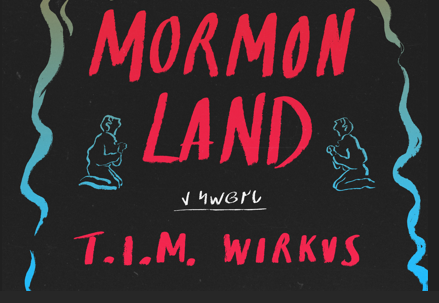
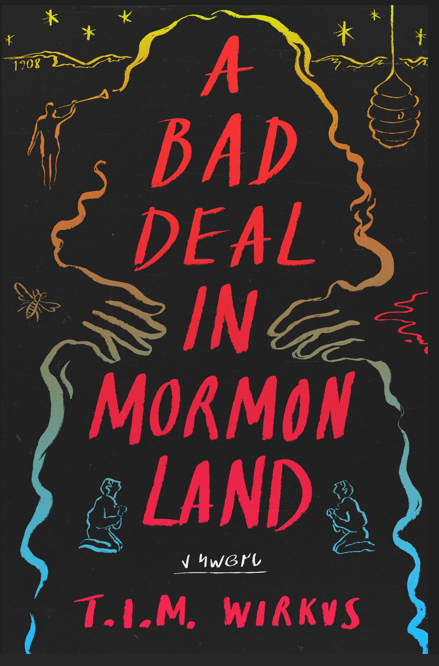
Electric Literature is pleased to reveal the cover of A Bad Deal in Mormon Landby T.I.M. Wirkus, which will be published on October 1, 2026 by Type Eighteen Books. You can pre-order your copyhere!
It’s 1908, and itinerant spirit medium Madame Ilsa von Hoffmann is at the end of her professional rope, facing down two unappealing options: join an ill-conceived commune founded by some fellow trans ex-vaudevillians, or take on a high-paying but mysterious job offered by a religious extremist in Salt Lake City. Madame Ilsa opts for Utah and the employ of one Roger Marsh who, it turns out, wants her to summon the ghost of Joseph Smith, Mormonism’s founder, to give his blessing to Marsh’s fledgling offshoot of the mainstream church.
Unsure how she’ll pull off this near-impossible task, Ilsa finds an ally in Francie Bream, an East Coast journalist in town to profile Mormon women at the dawn of the twentieth century. Bream’s motives remain obscure to Ilsa, though she begins to suspect the journalist has an agenda far more sinister than she could have imagined. Complicating the situation further are an inept and volatile henchman, a relentlessly orthodox Mormon apostle, a copper magnate with a fetish for polygamists, Marsh’s rogue third wife, and a vengeful private investigator from Ilsa’s past. As dead bodies accumulate around her, Madame Ilsa worries less and less about saving her career, and more about making it out of Salt Lake City alive.
Here is the cover, designed by Roderick Brydon:
T.I.M. Wirkus: One of the hardest parts of writing a novel is getting the finished book into the hands of its ideal readers. Like many novels, A Bad Deal in Mormon Land has elements that are broadly appealing (suspense, murder, intrigue, séances, jokes), as well as more idiosyncratic (its audience exists at the Venn overlap of people who want to read an anti-capitalist novel with a messy trans protagonist, and people looking for a story about a moment in Mormon history that’s obscure even to most Mormons).
How do you even begin to convey all that during the micro-instant of attention any book is likely to receive from a weary reading public?
I was thrilled when I first saw Roderick Brydon’s design, because his cover does that work so beautifully. The colors convey both the drama and playfulness of the novel, the hand-drawn look reflects the weirdness, and the images—the beehive, the angel, the praying figures—evoke Mormonism and Utah at the beginning of the twentieth century. I can only hope people enjoy reading the novel as much as I enjoy looking at this cover.
Roderick Brydon: I set out to create a cover that has both a mystical and humorous tone, incorporating the Mormon elements in a smoky, tarot card-like way. Each element is indicative of either Mormon iconography, the geographical features of Utah, or the themes of the story–framing the protagonist, while the design (quite literally) strangles her, maintaining that sense of unease, urban claustrophobia, and an almost mythical intrigue. The color scheme is to highlight the many layers of themes the story holds, the red (on black) giving a sense of danger, and the warm to cold gradient giving a slight absurd mood . . . providing a modern feel, while also keeping it rooted in the time period with that handcrafted feel. A bonus detail are the words “A Novel” spelt in the Mormon language of Deseret. Just thought that might add something unique to the design.
Mom is a groupie, so when Dad has a gig, no matter how big or small, she forces us to go as a family. She’s too dressed up: wearing tights with seams up the back, a low-cut dress and heels that will ensure eyes follow us into every room. I do the opposite: I brush my hair into a low bun, wear a high-neck black T-shirt tucked into black jeans with flats to provide a neutral backdrop. Both of us fussing over our clothes will do no good though; we will attract stares just by being the only Black family at the gig anyway.
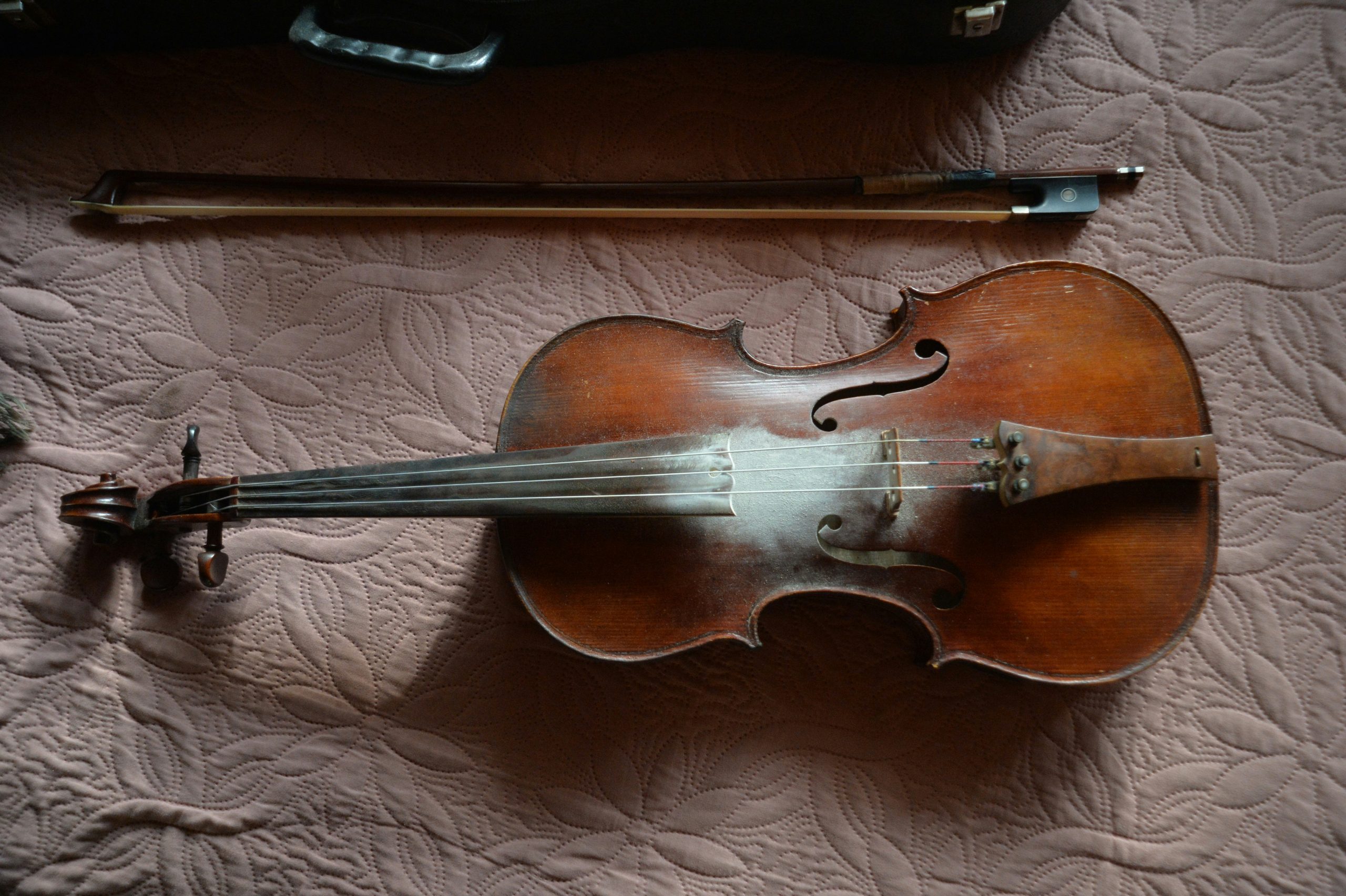
Dad lost his violin last year and we aren’t supposed to ask where it went. He needs to borrow mine. I go to a performing arts high school and just upgraded instruments for myself, and my new instrument is finicky, expensive, but it doesn’t take Dad long to make it work for him. Over the summer Mom and I went to the fancy violin shop downtown after spending weeks doing research, but all of it seemed unimportant in the shop. Everyone there was a great player, even the woman writing up the receipts. She sighed when I asked her any question, but when she tried out violins she was arrestingly good, speaking in the convoluted and beautiful language of expensive objects, a world that it was clear I would never enter. We ended up picking out the cheapest instrument Mom could afford after taking out a modest loan. Mom didn’t even call it the violin anymore, she just called it “college.”
“She’s beautiful,” Dad says after warming up, holding my violin out in front of him and running his hands along the curves of it, winking at me like I just brought a beautiful girl home.
The gig is at a fancy townhouse in Shadyside, a chamber music coaching session where Dad holds court for little old white people with very expensive instruments who aren’t even a quarter as good as Dad. They play a piece for him and then he gives them notes. Even while he insults them they sit there reverently, staring up at him and laughing too loudly at his puns.
During the gig Mom stands in the living room next to the crystal platters of cold fruit, drinking coffee. She usually likes to wait out in the open, hoping to be seen. I see her trying to catch Dad’s eye while he plays, a promise that she wants him to keep, a desire for him to belong just to her for only this night. I’m standing in the kitchen, a little out of sight, in front of the open bottles of wine in case Mom wants any. If Mom drinks too much, she will tell me more than I want to know about Dad. About how she doesn’t know how many women are just like her in other cities where he has gigs, waiting to receive him at the airport, hanging onto his every word.
The group finally does one last play-through for Dad. I can hear them hesitating over his watchful gaze, the violinist making a point to be more showy, overpowering the other players, forcing them to be quiet as she attempts to be more bold. When she’s done he pulls her into a congratulatory hug and she holds him too long. She’s yanking on his arm and yelling, “Let’s keep him!”
Efficiently he slips his hands out from around her and fluidly puts her back in her seat so he can retake center stage. He brings my violin back to his chin, takes a breath in. He plays a concerto that I’ve played the abridged version of, something boxed in and small for my developing abilities, but with him it opens up, it fills the whole room, it seems to reach the glittering chandelier, bigger and mightier than I could ever describe.
By the time he’s done, a hair hangs loose from my new bow. He reaches up and rips it off and the violinist gets up out of her chair to grab it before it can fall to the ground. The room is back to laughing loudly and we all watch as the violinist stuffs the string into her beaded purse.
What are you going to do with that? the cellist says lasciviously, and the violinist winks, says, Never you mind.
Mom emerges behind me and says that it’s embarrassing how people fawn over him, but I can tell she’s annoyed because this is her night, and it’s almost ten. Mom and I help with throwing away the cut fruit and recycling the wine bottles and stacking up the chairs while Dad continues talking, and then finally when he’s released he shows us his bounty: the fated thin white envelope of cash. Dad then puts on his home voice, the voice just for us, and tells us to make a break for it. We run, waiting for him to continue the bit, our next instructions, our part of the night.
To Eat’n Park! Dad says when we are all in the car. Mom hits the gas pedal so the car screeches on our way out. We order burgers and hot chocolate and milkshakes and Mom sends her burger back three times so that they comp it for us. Dad finally can divulge his real thoughts, how terrible they all are as players, these white folks, how embarrassing. He spares nothing of their playing and I join in too, I scan my mind for every moment until it’s wrung dry. My violin sits against my knees, and I pat it while we sit there, run my hand across the top of it, zip the case open and closed. Dad counts the money on the table, crisp twenties directly from the bank. You can tell how rich people are just from how unwrinkled their money is, from how little they use it.
When we get home Mom holds her heels in one hand, and Dad throws a hand around her shoulder and tells her that he loves her. It is hard to believe that he is ever not here, when we are settled in like this, when we have been laughing for hours. Mom bids us good night but Dad and I stay up, we watch movies and then when the movies get boring we play music again. If I don’t stop him, he will keep playing scraps of songs he’s heard, challenging me to guess the song and the composer, making me write out the circle of fifths. He says things like When you go to music school and tells me that I am good. He makes me get out the piece I’m working on with my teacher and he claps out the rhythms, yells when I stumble, marks up the pages in dark gel pen.
In these moments I feel like I know everything that has happened and everything that will happen, because Dad is at once too brief and all at once. I feel like I know how Mom and Dad never got married but produced me, how Dad came back and left his dog with us, how he took our car and crashed it. I know at the end of the night he will take my violin and I will give it to him without fighting. No one will remember me, but they will remember him and that’s enough, isn’t it, for him to be the legendary one and for me to think that by giving him the things I love I will be remembered, too.
Towards the end of The Flower Bearers, we see Rachel Eliza Griffiths visit the papers of Lucille Clifton and Alice Walker at Emory University and the papers of Toni Cade Bambara and Audre Lorde at Spelman College. We see her hands shake over Clifton’s spirit writing, carefully lift the first draft of Bambara’s The Salt Eaters out of a folder, and trace Lorde’s journals.
These visits aren’t research trips, and on this point, Griffiths does not want to be mistaken: “I’m not a scholar. I’m not an academic. I’m a madwoman.” Though the book holds a massive, exquisite and rigorous set of citations, the library trips are the completion of a journey she meant to take with her dear, deceased friend and chosen sister Kamilah Aisha Moon.
The Flower Bearers is born out of two close and tragic encounters in Griffiths’ life—the sudden death of Moon on her wedding day and the nearly-fatal attack on her husband, Salman Rushdie, which happened a few months later. It is a propulsive archive of love, loss, and reparation in lineage and sisterhood with those writers whom Griffiths and Moon aligned themselves.
The book landed on me like a sense memory. I met Griffiths and Moon twenty years ago at a writing conference where Griffiths and I discovered we lived on the exact same street in NYC. The friendship might have been born out of proximity but became a profound part of my twenties, for to know Griffiths and Moon, Rachel Eliza and Aisha, was to know and be part of a sisterhood in letters, to understand that even the smallest of small talk resides, as Griffiths puts it, “somewhere inside the complex language of Black womanhood.”
I knew the book would mean something special to me but I did not realize I’d read it in two days. Grief is a sneaky thing and this book helped me bear its beauty.
Over Zoom, Griffiths and I talked as madwomen do.
Nina Sharma: When I was preparing for this interview I suddenly felt inhibited, shy to share the joy of remembering Aisha through this book. Could you speak about how it feels to share this friendship with the world?
Rachel Eliza Griffiths: While this book was very difficult, the reason why the grief and the trauma of the loss feels so difficult is because the love was, and is, so massive.
It often happens with loss—the first part of your grief is the closest thing to you, their physical death. But, if you can, go back before that part. It takes time and concentration, which you don’t have space for in the beginning. For me, it was like diving into water, getting deeper beneath the surface. You can look up and barely see where you came from. But you feel that the love between you and that person just keeps going.
NS: There’s a journey of getting past the breakers to that ocean of love.
REG: Yes. One of the ways that I got through the breakers was finally being curious about my grief. I’m thinking now of the promise that Aisha and I had made to visit the archives of our literary foremothers, to do that pilgrimage together. So, after Aisha’s passing, rather than feel like, “Well, I’m not gonna do that now,” I thought, no, now I must do it because I didn’t have anything else to hold on to. I was drowning.
Grief can often feel very passive, like being swept along, especially in the beginning. There’s no control. Maybe because I’m looking at the ocean right now as you and I speak, I remember feeling like I was locked inside a riptide. At some point, I began to think about what I could do, in terms of an action. I began with some questions. What did Aisha and I love? What did we care about? What mattered to us? Different things started to sprout and to grow from that.
NS: Realizing your grief is on a different timeline than others is such a real and unsung part of grieving. I think this is especially true with someone like Aisha. So many people feel an intimate connection with her. Thinking about your journey to owning your timeline, when did you feel ready to write about this? Was that even something you had the luxury of thinking about, being “ready” to write?
REG: I don’t think there was a moment when I felt like I was ready to write. My writing was an effect of the panic that I’d start to forget our memories and their textures of our relationship. Because that invariably happens to some extent.
Grief can often feel very passive. I remember feeling like I was locked inside a riptide.
The memoir really began with a lot of questions. Not even, why did this happen? That’s like a “breaker” question. You have to get far beyond that to something more like, how did this love begin? How will it go on? How will I survive?
There’s a clip where Toni Morrison talks about not surviving whole. Something happens to you, but you don’t survive whole. What you can do is go forward with a kind of elegance. Elegance and a deliberate energy about not surviving whole. Morrison doesn’t say that means you’re wounded or less, but I was so deeply wounded. I once had a muscle, many poets do, where poets are asked to stand and hold the line of humanity in the face of loss, injustice, violence, grief, war, fear, and so on. In this instance, which was so personal, I couldn’t hold anything.
NS: Thinking about where the love begins brings me to you and Aisha coming up as writers together. While you and Aisha met in an MFA program, you both sought and found an enduring writing life that was not defined by the program. I love the scenes of your early years in New York together. Can you talk about this part of your sisterhood?
REG: Prior to Sarah Lawrence, I was much more of a loner. When I met Aisha, there was this joy of having my first adult Black girlfriend sister, that kind of joy of discovering someone who feels like kin, that you’re not alone. Aisha and I were deeply committed and deeply serious about developing ourselves as poets. It wasn’t just the work on the page. Poetry is a way of living. You’re expanding. Everything’s at stake. It’s not just sitting down at the MFA table. There’s not just one table.
NS: I remember spending time with you and Aisha in those years in West Village, dancing. Maybe the little sister in me was activated, but it always felt like we were doing something important, like something really important was happening.
REG: Suddenly, I remember the image of James Baldwin dancing with Lorraine Hansbury in somebody’s living room. The joy! Or the photograph of Toni Morrison’s glowing smile as she’s dancing with her arms up in the sky at a party. I love that photograph of Amiri Baraka with Maya Angelou at the Schomburg. They’re dancing on the sacred site of Langston Hughes’ ashes, you know?
Aisha and I could explore all these different spaces and know the functions of those spaces and where they overlapped. I remember nights where you could hear a pin drop sometimes at Bar Thirteen during a Patricia Smith reading. And then other times when you were encouraged to holler, to participate in roll call. All of these spaces were necessary. You could go to a KGB Bar reading, that’s a certain kind of environment. You could go to Louder Arts at Bar Thirteen. You could go to Cornelia Street Cafe, which no longer exists, and that’s a different kind of environment. We would go to all of them.
There were years where the pace of life in New York was heartbreaking. We had to hustle. We were teaching classes from 8 am to evening. We’d call each other, “I’m on the bus,” “I’m getting on the train,” “I’ve got to go to office hours,” “I haven’t gotten a moment to eat yet today.” It was work. The labor could wear you down. To defy the labor, to resist feeling beat down, we’d have to find the party. For us, the best part of the party was the music.
NS: Let’s talk about the music. “Love language” is a corny phrase but anyone who knows Aisha knows music was her love language. It’s there in your “meet-cute” where, grabbing a drink at a campus bar, you and Aisha stitch together life histories in jukebox songs. You write, “Music, good music, was our language.” Can you talk about the place of music in your relationship?
REG: I remember a time when there would be such shyness and risk in sharing your playlist with another person. It was like inviting them into your brain, into your whole being.
Poetry is a way of living. You’re expanding. Everything’s at stake.
The day that I met Aisha, we were immediately offering each other mixtapes. Throughout our friendship, we’d send each other music at all times. Here’s a praise song; here’s a song for the morning; here’s your birthday song; here’s an IDGAF anthem; here’s an I know you’ve had a really rough week song. Here’s a Deep Breath song. Here’s a song to hold you up in joy.
Sometimes, you can get into the patterns or rhythms of knowing someone and their tastes. But with Aisha, you could get really surprised by what she might play.
NS: Oh my god, yes. I have that memory with Aisha—talking about The Human League together.
REG: Aisha loved The Human League, right? And she was from Nashville, so the blues and country too. Aisha could go in all directions with music. Her musical intelligence is in all her poems. It was in her physical voice. It’s also how she often held a vibrational space with people. Aisha could listen to people, listen to their songs, and then offer almost like this expanded version of their song. The extended album cut. She’d add in those things that you were trying to ask or think about or feel out. Aisha put in extra lines for you. And you’d think, oh yeah, that’s what I was missing or oh yeah, you filled the song in for me with what I needed, thank you. It was so beautiful.
NS: I want to sit with that for a minute—the vibrational space that she held, that your friendship held. I want to think about that in relation to the ongoing health conversation you had together. Can you speak to what it meant to create this space?
REG: We really talked about everything. How could we not talk about our bodies particularly as Black women? For example, Lucille Clifton’s work has so much to do with her body, and the bodies of her beloveds—her mother, her daughters, her children, and Black people. Alice Walker, Toni Morrison, and Gayle Jones were all writers who wrote of Black women’s bodies in ways we admired. Sonia Sanchez continues to center her body and its dignity.
Sometimes, while writing, you can almost feel like you’re out of your body because of your mind, your spirit. You’re in this other space. But it’s your body through which you’re receiving language, stories, testaments, tears, laughter, all of it. The entire human collective is in you in that instant.
I remember how Aisha loved talking about her hair and getting her haircuts, curling her hair, deep conditioning her hair, which was beautiful. I miss her hair. It was such a part of her. We were both into tending our eyebrows. You know, things with women are not just a simple conversation.
NS: In this book you come out as being diagnosed with Dissociative Identity Disorder, which is as much an in-the-body as it is an out-of-body experience. Do you think that dissociative identity disorder puts you in touch with your body in ways that you might otherwise not be?
REG: When I was younger, I didn’t have much education about mental health. I just had panic, anxiety, so much shame. I didn’t even hear about the term, “Dissociative Identity Disorder,” until my late twenties. Seeing how DID is often portrayed is really devastating to me. The older language for it orbits multiple personality and horror movie narratives, like Jekyll and Hyde. That’s not an accurate representation. I’ve rarely seen any accurate representations. Even people in psychotherapy don’t really have a standardized language for it and have different opinions about how DID works.
I started Sarah Lawrence in my 20s barely a few months after a very severe suicide attempt where I was in a psych ward. Mental health is extraordinarily important to me. It’s such a private, intimate thing yet it affects every behavior, it affects everything, and I’ll always be interested in it because I have to maintain an active daily practice that pays attention to my inner life beyond writing and art.
NS: It seems like you and Aisha created a space where your health histories became legible. It makes me realize that this book, as much as it’s about grief, and it’s extensively and beautifully about grief, is about the choice to live. I think that you and Aisha together made a choice to live, from the beginning. And that choice flows through the book.
REG: Yes. I think coming from where I was coming, arriving at Sarah Lawrence and just needing to heal—in some way, the last thing I should’ve been doing after being hospitalized was putting myself in a graduate program for creative writing. But it was the best thing to do. When I met Aisha, I felt a new hope in her presence. We wanted to live fully. I feel that way now, wanting to live fully. I believe Aisha still lives now in the ways that so many of us continue to read her poetry and share our memories of our times with her.
NS: This book is both Aisha’s passing and Salman’s attack, that compoundedness of trauma. The way you and Salman care for each other is really special. I was struck by that moment in the book when you say that you and Salman, against your will, realize you’re new people in a new life, a second act becomes a third or fourth. What did meeting each other anew teach you?
REG: When I met Salman, I was at a crossroads in my life. It was in the wake of my mother’s death. I was forced to think about who I was at that moment, aware that my identity was suddenly detached from what I thought I’d been before in roles as a daughter, sister, wife.
It’s very hard to have a book that you write against your will.
Our connection was one of the things that immediately made sense to me. I felt like I was home. I thought, Oh, I don’t have to explain. I don’t have to defend. I don’t have to convince. That was a new, almost uncomfortable feeling because I was used to everything being difficult and overthinking. Suddenly, it was just like, “You’re a grown woman, what do you want?” I wanted a life with this person. It was clear to me.
I also want to go back to the two events occurring with Aisha and with Salman that form this book. It’s very hard to have a book that you write against your will. A former version of me would’ve tried to keep writing more poems, or another novel, or concentrate on visual art and not tell anyone how much I love these two people, not tell anyone how vulnerable I was as a child, or what it’d been like as a young writer going through different experiences and hardships.
Both Aisha and Salman will always be in my work, not necessarily explicitly, and not because of the grief and the trauma. It’s about the love that I hold and carry from each of these individuals.
NS: I always say, “I’m bad at grief,” even though that doesn’t make much sense. Sudden death is uniquely hard to grieve. You write at one point “I don’t need to memorize Aisha’s dying . . . I need to memorize how fearlessly Aisha shone.” I was wondering what advice you have for others who have incomplete endings?
REG: I think most people are bad at grief, right? It’s such an intimate space. And there’s nothing identical in the grieving experience. It’s so surreal and distinct, relative to the loss. When you experience ambiguous loss, you’ll spiral out to sea or space. You must figure out how to stop breathing into what you can’t know. You must breathe into what you do know, which is love. Because love is what is going to rescue you.
I tried to intellectualize my experiences but I learned that for me, I needed to focus on caring for my body. For example, I have a regular practice of immersing myself in sound baths. Vibrations in that environment will often do more for my brain fog than a 200 page book. Reading a book involves a cognitive engagement while the sound bath is doing something deeper that I can’t overthink. I have to surrender and open my body to it.
NS: It’s funny that you say that because we’re writers, we are word people. I think the writing actually comes from that sonic vibrational space, you know? This book really feels like you share a vibrational energy with us.
REG: I could never write this book now. For me, it’s still astonishing that I wrote it at all. I don’t know what I’ll do next, but I know that I gave everything to The Flower Bearers.
Hopefully the book gives its gifts to others. Because I know that there are others grieving and coping with trauma and identity. In a way, this book has already helped me keep going. It is enough. That’s something too, showing up for past selves and past lives. It’s enough. I miss Aisha. I want to call her. I want to talk to her. But it’s enough, what I had for seventeen years. It’s enough.
I love books about women who go off the rails. They can be comic or tragic. Either way there’s something serious underfoot. When a woman loses the plot, she has a good reason. She signed a deal and wants to renege. She may suddenly have some serious second thoughts about her entire life. There are many ways to say it, but it basically comes down to this: A woman can no longer abide. The center will not hold.
In my novel The Hitch, a woman looks after her six-year-old nephew for a week. She’s a secular, atheist Jew with an allergy to anything numinous. So when her nephew announces he’s been possessed by the soul of a recently deceased corgi, her world implodes. Compressed into a single, frantic week, the book accelerates the shift in her worldview from the material to the spiritual. But my main goal was to upset all the premises by which she organized her rational world. That’s what interests me—the shattering of the container in which the protagonist lives.
In the books below, the inciting incidents are familiar enough: a friend’s death, a husband’s betrayal, a move away from home. But the protagonists react in extremes. They lose their grip and things accelerate at an alarming pace. In life, one often moves slowly and clumsily towards a change of mind. These novels celebrate reckless speed, dizzying intensity, audacious rudeness, and the abandonment of social norms. They invite you to consider: What if I lost control?
First published in 1951, Hangsaman is the second, wonderfully strange novel by the American writer Shirley Jackson. Hangsaman begins with a teenage girl living at home with her hilariously awful family. “Natalie Waite, who was seventeen years old but who felt that she had been truly conscious only since she was about fifteen, lived in an odd corner of a world of sound and sight past the daily voices of her father and mother and their incomprehensible actions.” Her father is a pretentious domineering blowhard; her mother is unhappy and weak. Maybe when Natalie goes off to college, she’ll feel a bit better. Maybe she’ll like a professor, make a friend, join a club, give up conversing with an imaginary detective. Instead, Natalie leaves home and descends into new depths of alienation and self-torment. Her psychic collapse leaves little doubt as to how Jackson felt about the gender politics of higher education. And I thought I had a scary freshman year!
Is Mother Dead by Vigdis Hjorth, translated by Charlotte Barslund
Er mor død (translated from Norwegian to English by Charlotte Barslund) tells the story of Johanna, a recently widowed artist, long estranged from her parents and sister, who returns to Oslo for a retrospective exhibit. One night, a little bit drunk, she calls her elderly mother on the phone, but her mother hangs up as soon as she hears her daughter’s voice. Johanna becomes obsessed by the rejection and spins out, wracked by anxiety, longing, fury, mistrust, and shame. One minute she’s trying to remember what her mother said to her before Johanna left Norway, the next she’s stealing her mother’s garbage and stalking the woman as she visits her husband’s grave. Is Mother Dead is the book I recommend people read for Mother’s Day, when the rest of the world grows saccharine about mother-daughter bonds. Part thriller, part meditation, it is strong, sickening, and original.
The narrator of this perfect and criminally underrated novel has no name. The man she meets at a Manhattan dinner party is called Dennis. Being forty, they fall in love promptly, marry hastily, spend an appropriate amount of time eating expensive cheese and gazing at each other with “that lover’s mix of tenderness, gratitude, suppressed anxiety, and lust.” Then she realizes he has flaws. Dennis is weirdly clumsy. Accident-prone. Frankly, a menace. As the disasters pile up (broken bones as well as objects), marriage loses its allure. “It was turning out that my husband’s dishevelment was incomparable, potent, ramifying. It could destroy whole little worlds.” Unless she destroys him first. Determined to save herself, the newlywed hires a hit man to kill her husband. The DangerousHusband shapes a fairy tale marriage into a screwball comedy with horror vibes, in luminous, pitch-perfect prose.
In Katherine Silver’s translation of La diabla en el espejo, Laura Riveria is rich, shallow, gossipy, and totally stunned when her friend Olga Maria is gunned down in her home. “How could such a tragedy have happened, my dear? I just spent the whole morning with Olga Maria at her boutique at the Villa Españolas Mall, she had to check on a special order. I still can’t believe it; it’s like a nightmare.” This is not the voice of Sherlock Holmes, Hercule Poirot, or Jules Maigret, but Laura is determined to solve the mystery of her BFF’s murder (in between catching the latest episode of a telenovela). Chapters change location (The Wake, The Burial, The Balcony, The Clinic), but Laura is the only voice allowed to tell a story that clearly exceeds her grasp. A dazzling, dark, hilariously one-sided account of a woman playing detective in post-civil war San Salvador, unravelling her mind and possibly some truth.
Olga, 38, lives with her family in Turin. One day her husband announces he is leaving. Thinking Mario is experiencing a temporary “absence of sense,” Olga plans to wait it out—until she realizes he’s taken a lover. “Organize your defenses, preserve your wholeness, don’t let yourself break like an ornament, you’re not a knickknack, no woman is a knickknack,” Olga tells herself, but feminist theory can’t keep her intact. The Days of Abandonment is a frenzied chronicle of a woman’s descent into hell, accompanied by two small children and a sick German Shepherd. The details resist summary, but here’s a taste: When Olga bumps into Mario on the street, she throws him against a plate-glass window. “Into what world did I sink, into what world did I re-emerge? To what life am I restored? And to what purpose?” she asks. Eventually Olga ascends. A gripping, unapologetic book, shameless in the best sense.
One day Iris, a writing instructor, receives a package containing documents from her teenage years: a play she wrote and two letters from her father, blaming her for the family’s ruin. After complaining to her friend Ray, who is about to have top surgery, Iris swaps her mildewy house for Ray’s doddering Subaru and drives off to the countryside. Did I mention the trip is poorly planned? Iris suffers from an autoimmune disease, and the funniest parts of this funny American book are the dialogues between Iris’s aching feet, whom she has named Bouvard and Pécuchet (after two characters in an unfinished Flaubert novel). The Subaru dies, and Iris lands in a field where she is stepped on by a herd of cows, then winds up working as a cowherd for a sexy lady who probably murdered her own husband and now operates a museum that’s only open one month a year. Then the story really goes off the rails.
The Vegetarian(ch’aesikchuŭija, translated into English by Deborah Smith) centers on a Korean housewife who abruptly stops eating meat. Told in three sections, the novel is full of surprises, partly because it’s told from three points of view, none of which belongs to the vegetarian herself. Yeong-hye’s husband, a loveless man who views his wife as “completely unremarkable in every way,” begins the story of his recalcitrant wife, but his contribution can’t explain her motives, only document his growing fury that she resembles a “hospital patient” and no longer wears a bra or willingly provides sex. The second part documents her brother-in-law’s erotic obsession with her, even as Yeong-hye descends into psychosis and physically wastes away. The third part turns to her sister, In-hye, a hard-working, well-organized mother who is appalled, for her own reasons, at her sister’s transformation. We’ve all read books about women suffering under patriarchy, but has any protagonist ever responded to the violence by willing herself to become a tree?
When I first discovered Jeanette Winterson, I was struck by the incredible presence of her work; not only her ability to convey the tender, insular reality of love and conflict, but by the way her prose seemed to carry its own life force. Winterson doesn’t shy away from discomfort, from the turbulent landscape of her Pentecostal upbringing and disapproving family, from the question once asked of her: “Why be happy when you could be normal” (which later became the title of Winterson’s wonderfully moving 2011 memoir).
Winterson’s writing is visceral, embodied, and patiently political, capturing the reality of growing up queer in an environment built upon suppression. In spite—or perhaps in response—Winterson’s work transmutes an irreverent, unbridled joy, even amidst the inevitable sorrow and grief that comes with a human life. Her most recent book, One Aladdin Two Lamps, shatters and reassembles Shahrazad’s One Thousand and One Nights, asking ancient questions that feel both timeless and critically important to our contemporary world.
With forty years of writing and publishing experience under her belt, I was thrilled at the opportunity to speak with Jeanette about her routines and insights on the writing life, and all the more charmed by her passion, humor, and recognition of writing’s essential role, now more than ever.
– Lennie Roeber-Tsiongas Editorial Intern
1. What book should everyone read growing up?
Jeanette Winterson: Everyone should read Wuthering Heights, especially before Emerald Fennell’s adaptation comes out on Valentine’s Day next year. I think she’s butchered it. So read the original, then you can watch the movie, and then you can say, Jeanette Winterson knows jack shit.
EL: Did you see a screening? Or is this just an inkling you have?
JW: I’ve been following it closely. I love the costumes—Margot Robbie in red latex does it for me—and I love adaptations, but sometimes as a writer who cares about text and language and all of that stuff, you do die inside. With a movie, you get great sets, wonderful actors; you get the story, but you don’t get the language.
2. Write alone or in community?
JW: Write by yourself. Oh, absolutely. All writing is about discomfort. It’s a lie detector that starts with yourself. If you’re always chatting to somebody else, you don’t get that discomfort and you don’t do the work of the lie detector on what you’re writing.
EL: I’m inclined to agree.
JW: If you’re doing a script or something which starts out as collaborative, a hundred percent. I’m working on a musical at the moment, and that’s really collaborative and I love it. But that’s because it fits the form.
3. How do you start from scratch?
JW: You don’t do it by going into the executive suite and trying to force an idea. It’s not office work, it’s not factory work. You have to work with your unconscious, with your inner self and let ideas bubble up, let images come forward, even images without words, pictures in your mind. Follow them with grace and humility. What I see with my students is a kind of terror—they close everything down and format it way too early on. That’s what I mean about discomfort. Let the thing develop. Let it play with you. And don’t tell it what it is all the time. Wait to see.
4. Three presses you’ll read anything from?
JW: Grove Press, of course. Melville House for the little editions and the essays that they do. I love those. And in Britain, Faber and Faber.
5. Hardcover, paperback, or e-reader?
JW: I always buy new books in hardcover if they exist like that because I can afford it. Somebody’s got to do it to support the industry and it’s a pleasure for me. I don’t want it on e-reader, not least because we all know that they can disappear your books any time they want.
EL: I don’t like not knowing how many pages I have left to go.
JW: Oh, I don’t mind that. That’s interesting. But I still think there’s some perfect forms that haven’t been bettered. It is the progress fallacy. So an egg is a perfect form. An apple is a perfect form. You can’t better them. And for me, a book is a perfect form. It’s not waiting to be updated to an e-reader because some tech nerd who does everything on Blinkist thinks it’s a good idea.
6. If you were a novel, what novel would you be?
JW: I don’t want to be a novel because it’s too big a possibility. I might end up as a 19th century three volume novel, and that would be upsetting because I’d be too long, or I might end up as post-structuralist fiction. What would I be? I think I’d rather be a poem because a poem is contained, it’s pressurized, every word counts, and it’s short. It is amazing to me and kind of glorious that poetry, which everybody thought was the ultimate outdated form, has made such a comeback because it’s short and nobody’s got any attention span anymore. Never say it’s over ‘til it’s over.
7. Describe your ideal writing day.
JW: Oh God, listen, when you’ve been doing it for 40 years, there is no such thing anymore. And that’s kind of great. When I am working, I don’t do anything outside of it. I don’t do events, I don’t do public stuff, which I do a lot of normally. So it’s just me in the country. I get up early, really early. I used to be a night owl, but now that I’m old I’m not. Walk the dog, chop the wood, light the fire, and do a couple of hours. Above all, keep your emails off, keep your Wi-Fi off. Don’t even think about it. When I’m doing real work, I never, ever switch the Wi-fi on until I’ve done the real work. Because it’s just a tsunami of interruptions, isn’t it? You have to deliberately interrupt the interruptions.
8. Typing or longhand?
JW: Never longhand, never did. When I started out, it was a typewriter and that made you look like Kermit or any of the other Muppets. You just sit there bashing it out. I love that because it gives a distance. I’ve never been somebody who carries around a notebook and writes down my thoughts, mostly because they’re garbage. It’s when I sit down and work that good things happen.
9. What’s a piece of writing advice you never want to hear again?
JW: I don’t know. I never look at writing advice. I’m a writer. I can do it. Jesus. I’ve been doing this for 40 years. If I need advice now, you shouldn’t be talking to me.
10. What’s a piece of writing advice you think everyone needs to hear?
JW: The main thing is turn up for work. Just make a pact with yourself on what time you can reasonably spend doing your work. Don’t do magical thinking, but when you’ve made the deal with yourself, stick to it.
11. Realism or Surrealism?
JW: Oh, God, I hate realism. I’ve never written social realism in my life, and I never will. It’s only a partial truth about who we are. I’ve spent all of my time begging people not to get lost in the literal. Without imagination, we’re nothing.
12. What’s your favorite comfort snack for writing?
JW: Salted peanuts. I mean, fortunately, I also have great self-discipline, so I’m not mainlining peanuts, but I do like to have a bowl of them. Probably towards the end, when I feel that I’m in the last hour, which is a feeling thing, then the nuts come out as a kind of reward.
13. Edit as you go or shitty first draft?
JW: Neither. Neither. Every book is different. Again we’re going for these formulae prescriptions that don’t work. You take each piece of work on its own merits in its own right and you give it what it needs. One piece of work might need endless going back over for whatever reason. Another piece of work might just come flying out and you don’t know why as a kind of act of grace.
14. How did you meet your agent?
JW: Oh, well, I’ve had more than one. You’re looking at a long life. My current agent, who’s been my agent for a long time, is Caroline Michelle at P.F.D. in the UK. I met her in 1978 when she was my publicist on The Passion. Now she runs a huge business. We sometimes look at each other and say, you know, we’ve known each other for 38 years. One of the beautiful things about getting older is that, especially if you’re a woman, you know, there are those women who stay with you and really become a kind of living diary of who you are and what you’ve done over all these years. It’s an incredible thing. And it’s something I really value about getting old. I look around and I see these amazing women like Elizabeth Schmitz at Grove, who I’ve known forever and we’re still here, girls!
15. What is your best advice for pushing through writer’s block?
JW: Never had it. It’s a con job. Really, any problem is your friend. It is not a difficulty. If you’re stuck, you need to work out why, because either it’s in your life or it’s in the work. Your unconscious, your creative self is trying to flag something to you and you have to dive deeper and go sideways and find out what’s going on. It might be in your life, it might be that you really need to take a break, or it might be in the work and you’re swerving something or trying to impose something on it.
16. What other art forms and literary genres inspire you?
JW: I love music, and particularly classical music and opera, because it’s so ludicrous. What a ridiculous art form to invent, all those people running around on stage. I love it because it’s this sense of humans at their most gloriously ridiculous. I think with art forms, you look at them and it reminds us that we can do so much more than seeking money and power and land grab and status and starting wars and blowing up the world. Now, whenever I see any art form, it doesn’t matter what it is, I just think this is the best of us. With the way the news works, we’re surrounded all the time with the worst of humans. And that can really get you down. We’ve got to remember that we need nourishment. It’s not elitist, it’s not a luxury item. I would urge anyone to do that every day. Working every day on your deathless prose doesn’t matter, but getting nourishment from somebody else every day, even if it’s just five minutes with a poem in the morning. That matters.
17. Book club or writing group?
JW: Almighty, I’d rather clean out the cesspit without gloves if that answers your question. I’ve already told you about writing groups. And book clubs, no. I can read. I know how to read on my own.
18. Who was the writer who made you want to write?
JW: It didn’t happen like that. I didn’t have an ordinary beginning in life. And the only book I had for a long time was the Bible. So that’s how I learnt to write. If anybody wants to know more, read Why Be Happy When You Could Be Normal. And then all questions will be answered.
19. How do you know when you’ve reached the end of a project?
JW: I think it’s completely obvious. When people say things like that I just think if you’re a writer and you don’t know when it’s the end, you should go and do another job. I am absolutely ruthless about this. By the time you’re well over the halfway mark, which is a different place for everybody, you really should be feeling the momentum of what you’ve done. That applies to a short story as much as it does to long-form fiction. It’s a co-creator with you. You have to let it do its job.If you come to it with humility and you listen, you get the feedback from the work itself.
20. What was the last indie bookstore you went to?
JW: I’ve just been in Bulgaria, and visited an indie bookstore there, but nobody will know about that one. I’m going to cheat and say that the best thing you can do when you’re traveling to a new place is immediately find out where the closest bookstore is, because it’s likely to be independent. And go there and buy a book. You don’t have to announce yourself as a writer if you are one. You just go there, and you support the local bookshop, and I think that really makes a difference.
21. What’s an activity you do when you need to take a writing break?
JW: I live in the country, so I can always just take a walk, which is great. I have to grow my own vegetables here and chop wood and keep the fires going and walk the dogs and so on. I don’t live a city life. In the summer things have to be watered, crops have to be planted, so on and so forth. So it’s a life that works very well for me because it’s art and nature and they do go really well together.
22. What does evolving as a writer mean to you?
JW: All you do is write each book, each set of stories, each non-fiction work, whatever it is that’s bugging you at the time, and that’s what you do. There’s no career progression. There’s just each piece of work as it turns up.
23. Outside of literature, what are you obsessed with?
JW: I’m obsessed with the state of the world at the moment. I believe that where we are now, politically, is a failure of imagination. It’s the 21st century and all we can think of to do is kill each other and trash the planet. The reason I’m always going around and doing my public-facing work and saying to people, “Look, you have to respect and nourish your imaginative capacity” is because what fiction does best of all is to take a situation and ask what if. It’s a way of refusing to be crushed by gravity, by the state of things. The way that we live isn’t a law like gravity. It’s not something that you’re subject to, whether you like it or not. This is a story we’re telling. And we could tell a better story. Anybody who tells stories for a living knows that you don’t have to have an ending you don’t want.
It was just after midnight on the fourth of October, 2016, a Tuesday, when Ben Sullivan stepped off the flight from Berlin and became the happiest person in Keflavik Airport. It was the start of his sixteen-hour vacation from the impending death of his wife.
In the first minutes, on the walk from the gate, Ben looked about himself, enchanted, bewildered: Iceland. A huge banner advertising volcanic hot springs. The eerie turquoise, the white steam. In the middle of the concourse, a life-sized grass-roofed hut, made of fake rocks. It sold plush trolls, wearing adorable hand-knitted sweaters. Trolls!
He turned a corner, and the glaciers and moss gave way to dirty orange plastic tarps over scaffolding and a creaking double escalator, and suddenly it did not look as much like Iceland, but Ben didn’t mind. At the bottom of the escalator, a vast duty-free liquor sprawled, seemingly makeshift, nothing more substantial than metal shelves penned in by plastic yellow emergency barriers. It had the look of a road construction site, or a minor refugee camp, and within it, many exhausted people were loading little carts with bottles. The Icelanders behind him on the escalator pushed past and veered into the duty free, faces all bleak determination. This might have been a sign that Iceland was not what he was expecting, that in Iceland, one drank one’s way through the darkness, but Ben felt no misgivings. Rather, he felt a swell of love for the people of the duty-free. None of them saw him, a tall, pale, paunchy American with an old backpack and a messy red beard, who had been wearing the same Sonic Youth sweatshirt for five days. He had told no one that he was going to Iceland, a place that had absolutely nothing to do with anything in his real life. He had not told Tamara, his wife. He had not slept properly for a long time. He was muttering to himself, taking a childish joy in saying the name again and again: “Iceland, Iceland.”
Heading towards the lone baggage carousel, he passed another banner image of a hot spring, which made him think of the short film “Iceland 101,” which had flashed onto the plane’s monitors just as they descended towards Keflavik Airport. The two major lessons from “Iceland 101” were, first, that if you rented a car, and you accidentally drove off the road, you should not expect to be rescued by Icelanders, or by anyone: you would die alone in the cold and the fog. Second, if you visited a hot spring, before you got into the water, in the locker room, you were to remove all of your clothing. Then, you should shower naked, with soap. Also, use a rag to scrub vigorously at your genitals. Scrub for a meaningful amount of time. To underscore this message, the video had shown a hipster guy scrubbing himself in a shower, with his genitals fuzzed out, but only just, while an Icelander, fully clothed, stood next to him and pointed.
Ben only had sixteen hours in Reykjavik, a layover, and he did not plan to rent a car. However, in his earnest way, as the plane landed in the misty dark, he had resolved that he would scrub his genitals vigorously. It was important to the people of Iceland that he do so. He could tell it was important by how much effort they had put into the video. And with this small act, perhaps he could redeem the United States in their eyes. Though he did not think the United States was all good, it did have some good aspects, such as President Obama, who surely next year would be succeeded by President Clinton. Ben had not slept much in the five days in Berlin, or before that, in the year and a half that Tamara had had cancer. That was why this thought of President Obama, and of Ben’s own small resolve to do the right thing here in Iceland, brought a film of tears to his eyes. Then his phone buzzed.
It must be Tamara. For days, Tamara had not been answering his texts. She was furious at him for going to Europe. But she might text, if something was wrong. What if the results of the bone marrow biopsy had come back early? It was still Monday afternoon at the hospital in Eugene. This text might say that the cancer was back. Ben froze, the baggage carousel behind him creaking, the automatic doors before him whining as they open and closed on a view of an empty parking lot under a pitch-black sky. He knew it, he felt it, as if in his own bones: these biopsy results would not be good. He took a breath, swung the bag down, fumbled the phone out. The text read, “Are you in Iceland?”
No one in the world knew he was in Iceland. He had not told Tamara. He had not told anyone. The number was not saved in his phone. A 310 area code. It wasn’t Tamara. But who?
Two weeks before, Tamara went back to the hospital for tests, one a blood draw, the other a biopsy of her new bone marrow. The blood test results would come in three days, the biopsy would take two weeks. These tests would tell if she was in remission. She had to pass them both.
Like all of her cancer treatment, the tests were at the hospital where Tamara was employed, where she had risen from resident to attending. If she survived, she could never work at the hospital again, because what they called treatment for this disease was no different from long-form torture, and just the sight of the hospital building made her shake with nausea. But the biopsy was easy by comparison. By afternoon, it was done, and when they were about to leave, Penny the oncologist came out to the waiting room to see them off. Ben was gingerly doing up the snaps on Tamara’s jacket; her fingers were too weak for it. Tamara vaguely knew Penny from some hospital committee, and had always disliked her. Tamara loathed optimism. That afternoon, chipper as ever, Penny put a hand on Tamara’s shoulder and said, “Now Tamara, remember, the results will say you’re in remission, but if they don’t, all it means is more chemo.” Tamara had responded in an even voice, “I’m not a fucking idiot, Penny.”
If Ben was being honest about the layover, the truth was that he had not thought it through. Sixteen hours was not enough time to see Reykjavik. Yet sixteen hours was a magic number of hours, the perfect number of hours. Long enough to step out of the life where Tamara had leukemia, and into another. Tamara was alright by herself for a few days. The neighbor kid would walk the dogs.
There was just one problem. Ever since she had gotten sick, he had not missed anything. He had seen every doctor with her, he had waited during her infusions and driven her home, he had missed nothing. He had been the best husband he could be.
He bought the layover the day after the biopsy, a Wednesday, that evening when he came home from teaching. The front door of the house was ajar. Tamara sometimes did that so that the dogs could go in and out. But the dogs didn’t come to greet him. Tamara must be asleep with them in the bed.
He had left her alone for too long. He ought to have come right home after class. Instead he had lingered in his office, dazed, the second lecture of the day having been the one about Poland in 1943, that village. A particularly dark lecture, a negative verdict on all of humanity, that lecture—and though he taught it every year, it had left him, as always, hollow.
But Tamara slept most of the day now.
Ben paused at the open door to the bedroom he no longer shared with his wife. The dogs were curled under the comforter with her. With the blackout curtains drawn, he couldn’t properly make out which nodes of blankets were dogs and which were Tamara. Because of the lecture he had just given, he thought of the humps of earth over shallow graves, then, disgusted at himself, turned and went to the couch. He ought to cook, but she never ate and he wasn’t hungry.
These pasts months, Ben slept in the basement, on a mattress. Before the transplant, Tamara had had a lot of pain at night. The meds they gave for it did shit. Finally, he had decided it was better that he slept. “You can sleep,” she had said at the time. “You take it for granted. You’re not dying.” Tamara’s main response to her own cancer was anger. Which, Ben thought, was a useful response. But it made for some depressing moments. Though, what was the alternative, really. Terror would have been much harder to watch.
If the test results came back shitty, he would get a sleeping bag, sleep on the floor of her hospital room, quit his job, never leave her. Though in its sixth year the marriage had not aged well, though cancer had not made the marriage work any better. But you couldn’t blame someone who was about to die at thirty-six for not loving you anymore.
He went in the living room and slumped into the couch, too tired to turn on any lights. He put his laptop beside him, thinking that he should open it, buy the flight to that conference in Berlin. He’d asked Charlie, his department chair, to get out of it because Tamara was so sick. But Charlie had said, better not to, if at all possible, Ben had missed a lot of things over the last year and a half and this was a really important conference in Holocaust history, a conference that only happened once every two years. At least he could fly back from Berlin in time for Tamara’s biopsy results, thank God. But how to leave her. And he was so tired.
In the living room the darkness buzzed at him. He knew this feeling, sadness so heavy it did not deserve that anodyne name. Ben tried, generally, to think about death only in the abstract, but now he saw, again, in his mind’s eye: the photograph of the market square of that village in central Poland, a snapshot taken by a soldier. It had survived the war, made its way into a museum collection, and he had shown it to his class that afternoon. Ben saw the woman again. She must have been thirty-five, thirty-six. No one from that village had survived to remember her name. There were a variety of possible deaths, some far more violent than others. But the result was the same; the person gone, and in their place, lumps, cinders, gristle. This fate awaited Tamara, too, and of course, it awaited himself. The dark in the room worked its way into his nose, his ears, like black earth.
Yet the room was not completely dark. Out the window were the rust brown oak leaves, now gray in the streetlight. He had always liked this room. They had painted it yellow when they bought the house. Their first house. Lemon yellow and a white mantel piece. (Though a few months later she decided she hated the yellow.) He had painted it. Tamara had cooked, something very complicated, trout, probably. She set the plates on a tablecloth on the floor because they had not bought furniture yet, just the mattress in the bedroom. She laid out all the food. But then she kissed him. He shoved the hyper, yipping teenager dogs, into the kitchen to keep them away from the food. He and Tamara went into the bedroom and shut the door and fucked. “Just quickly,” she had said. “The fish will get cold.” Ben had expected adult life would be mostly about love and sex. But it had turned out to be mostly about death.
For lack of anything else, he reached for his laptop. The screen opened to a white glow. The browser showed the flight search from that morning. He hit refresh, and there it was. Iceland Air. A flight to Berlin, the same price as transferring through Amsterdam. With a sixteen-hour layover in Reykjavik. And a free night in a Reykjavik hotel. Suddenly the darkness evaporated and all Ben saw were the images on the airline website—a very shaggy pony, a hillock of lizard-green grass—fascinating simply because they were so very much alive.
Ben had always wanted to go to Iceland. In high school, in a suburb, he had jacked off a lot to Björk. He wanted to see molten lava through a crack in the earth. He wanted to sit in a thermal hot spring. In high school in Tel Aviv, Tamara had not had any idea who Björk was, but she had always wanted to go to Iceland, too. They had talked about it.
But the return flight was the day Tamara would get the biopsy results. If he flew directly home to Eugene from Berlin, he would be home in time. If he went to Reykjavik for sixteen hours, he would be on a plane thirty thousand feet over the tundra of northern Canada when Tamara found out if she was going to die.
Tamara padded into the living room draped in a blanket.
“Do you want something to eat?” Ben asked.
“You eat,” she said. She went down the hall. The bathroom door clicked shut. He looked again at the flight, the hotel. He had never missed anything for her cancer before. He would not buy a crazy sixteen-hour layover in Iceland.
He heard the toilet flush, the sink running. Then Tamara crossed the living room in the old white comforter. She hesitated in the door of the bedroom, leaned on the door frame. She said, “I got the CBC results.” That was the first test, the blood test.
“What?” He got up, followed her into the bedroom, where she crawled into the bed, amidst the dogs. The blood test results were not supposed to come back till tomorrow. “When?” he said.
“While you were at work,” she said.
Why hadn’t she called him. She propped herself up in the bed with some pillows, pulled her computer from the bedside table to her lap. Then she said, “It was clear.”
He took a step towards her but she put up her hand. “No,” she said. “Don’t. It was clear, but I did something stupid. I googled.”
The entire time she had been sick, Tamara had forbidden him to look things up on the internet, that is, things about her illness. Half the time all the internet did was cough up outdated research she had said, and being a doctor, though a rheumatologist, she would know. But Ben suspected that was not the real reason. The real reason was that the odds of survival were so bleak, he and Tamara were better off not knowing. But now, at the end, she had googled. She must have had hope.
“Everybody gets a clean CBC at this point,” she said. “Here I was terrified about the CBC. But with my genes the odds of a clean biopsy are awful.”
“Sweetie,” he said, an old name for her, it had been months since he had used it.
“Oh, shut up, Ben,” she said. “Don’t try to tell me it’s not true.” She opened the laptop. She was on leave from the hospital, but she still spent hours reading through the resident’s notes; she did not trust residents. Ben stood in the doorway for a long time, watching her click through files. Finally, he decided there was nothing he could say. So he began to explain about the flight, the conference, Berlin. Just as he was about to assure her that he would fly back in time, he would be here when she got the biopsy results, that whatever happened, he would be here, she cut him off. She said, “Yes, fine. Go and talk about the Holocaust in Berlin. You’re into dead Jews. That’s your favorite kind, isn’t it.”
He was gripped, suddenly, by the memory of that summer ten years ago, she came to Berlin, when he was in grad school researching his dissertation and living over a Turkish grocery. He rode her around on the back of his bike, her arms around his waist as they crossed the canal bridge, and he laughed at her black-hearted Israeli Holocaust jokes. Every time they saw the u-Bahn go by she would make a very dark joke about German trains. How he loved her. Maybe she was teasing him again, now. But no, he could tell—the set of her jaw, the clipped, furious way she pronounced the “d” in “dead”—this wasn’t kidding.
A wish came to him, a strong wish, rising up in his chest: that they would divorce. She could move back to Tel Aviv. Apparently—and this he would never understand—she wanted to go back, she had come full circle. When Ben had first met her, she had talked so much about how she would never, ever go back. He had no right to have any opinion about Tel Aviv, beyond admiring the beaches. She would be the first to say so. Never mind that. The wish was that they would get divorced. The biopsy would show no cancer. People got divorced at 36. They didn’t die at 36.
He said, “I’ll get back from Berlin Tuesday night. After you get the biopsy results.”
“I don’t care,” she said.
Years ago, he had broken down about all of the murdered, because there were so many, crowding around. He told her he couldn’t finish the book, ever, because what was a book, why did a book matter. He stopped writing. That Berlin couple in their eighties, the lawyer and his wife who had been a music teacher. After they got the notice to come to the police station the next morning, he had reminded her to bring stamps so when they got to the labor camp they could write their son in England.
He told her he couldn’t finish the book, ever, because what was a book, why did a book matter.
And Tamara had said, but you are writing it down, that means something, you are making it so the murderers cannot hide.
Tamara went on, “It really is. Your favorite kind of Jew. You wrote two books about dead Jews. And lucky you, you don’t have to be one.” She went back to typing, the screen’s glow sharpening the shadows of her spectrally gaunt face.
Ben went back into the living room and bought the flight to Iceland. Because it might be too late for her. But at least he would have those sixteen hours.
On the transatlantic flight, guilt should have eaten him: he was abandoning his wife. Instead, he felt elation: he was abandoning his wife. He did not sleep. He drank coffee and read, a new book about Lichtefelde, the fancy Berlin suburb, the upper-middle-class elite and the years of Nazi rule, filling in the gaps in his knowledge on the middle-class reaction to fascism—understanding it better did not make it better, but it gave him some hope. His was the only light on in the whole plane. He got up and walked the aisle, his feet floating as if gravity had slackened its grip, and he pictured the dark Atlantic, so far below.
At the conference, it was more of the minutia of German history in the 1930s, panel presentation after panel presentation in a lecture hall at the university, fascinating—even after all this time, they were still getting better at understanding why it had happened. He forgot about Tamara for long stretches. He texted but she never texted back. He kept his phone out, face up on the empty chair next to him, or on his knee, in case she texted, in case something happened and she needed him, but she did not. At night, back at the hotel, he called her. She didn’t pick up.
On Monday, the conference’s last day, he sat on a folding chair near a slight man with olive skin and dark hair swept in a wave above his forehead. He wore an expensive coat, a beautiful maroon boiled-wool, with a sharp collar folded up past his ears. Ben recalled that this guy was not a historian. He was the artist-in-residence of the conference, a radio producer researching a podcast, or something. At the podium, one of the senior historians from the Freie Üniversität gave a paper on the Berlin deportations. The radio producer took notes by hand in a palm-sized paperback journal and chewed the end of his pencil. Then his pencil broke, and he asked Ben if he had an extra. Ben only had a pen.
“I’m going to chew it,” he whispered. “Is that OK?”
Ben nodded.
They went back to listening to the paper as the radio producer demolished the end of the pen. When the session ended he handed it back with a long, sheepish look and a little grin. What was it about this guy, Ben wondered. It was as if he had met him somewhere before.
The conference ended with one of those staged conversations, the conference director interviewing the radio producer, his name was Elliott Rosen, about his podcast. He was making a series about the life of a German Jew named Charlotte Charlaque, who was transgender. She survived, got out before the deportations, and lived in Brooklyn for decades. Ben had written two books about Berlin Jews and the Holocaust, but he had never heard of Charlotte Charlaque. Elliott Rosen said how her story had been hidden for so many years, and at times his voice shook ever so slightly in anger. It was one of the most compelling research talks Ben had ever heard.
At the reception afterwards, Ben had three beers and two sausages, standing in a corner with his friends from grad school, Helene and that crowd, who were going on and on about tenure, or, alternatively, about the new book on Operation Reinhardt—“a whisp of a book, three slipshod chapters and a meaningless conclusion,” Helene called it. He was only half listening. Elliott was by the buffet, surrounded by admirers. He reminded Ben of someone, but who? Ben did not often think about what people were wearing, but it was hard not to notice that Elliott was dressed like someone who had money, someone in the movie business, and the historians flocking around him were dressed like historians, that is, as if they had borrowed their parents’ business casual in the 1990s and not returned it.
Ben had been with guys—a fair number of them, in fact. But not since college. He had not been with anyone but Tamara in six years. He realized why Elliott seemed familiar. He reminded Ben of those college bars, those guys, before Tamara. Was Elliott gay? he wondered. Was he trans? He must be. Could a trans guy be gay? Ben had never been with a trans guy. He was not sure he had ever met one.
“Ben,” said Helene, “Go talk to the radio producer.”
“What?” Ben said.
“The, ah, person he’s writing about, it’s just like your second book,” she said. “Minus the transgender part.” She laughed. “That’s a first, isn’t it?”
“Uh,” Ben said.
Helene dragged him through the crowd, elbowing the octogenarian historian bending Elliott’s ear, and introduced Ben as an expert on the Berlin deportations.
“Oh, that’s amazing,” said Elliott. “And I ate your pen! But you’re exactly the person I—”
Two of the conference organizers—nervous junior faculty at the FU—cut in. Elliott had to come for a picture, right now; so-and-so, some very senior person, was leaving. Elliott promised to come back. “You’ll wait, won’t you?” Elliott smiled, a half-smile, and cocked his head. He had dark eyes, and he was looking at Ben so intently that a shiver ran up the back of Ben’s neck, this was not a usual look, not just a friendly look, it was something more, Ben knew that look. He’s gay, he thought. He thinks I’m gay.
“Uh, sure,” said Ben. “I have a flight but—”
“See you in a second.” Elliott squeezed Ben’s forearm. Then the two organizers whisked him off through the crowd.
Helene hissed, “Tell him to put you in the podcast!”
“I have to go,” said Ben, flushing. He had a flight to Reykjavik at 10 pm. And he was married, to someone who was dying. He had to go. Helene walked him out. She asked after Tamara, in that meaningful way that people do when they think someone’s number has come up. Ben lied and said Tamara was doing much better.
At the airport, at the gate, he texted Tamara. She did not text back. He walked up and down the empty concourse, giant, echoing, ominous blond wood and black metal, wondering if Elliott would notice that he had left the reception, wondering if he should email Elliott and determining not to, because he was married, to a dying person. Tomorrow, as he was flying over Canada, the biopsy results would come back, and then, he would get a taxi home, it would be late at night, she would be asleep but the nightmare would begin. If the biopsy was bad, the nightmare would begin. Until then, he had his sixteen hours.
His seat was in the very last row of the plane, snug up by the bathroom. Ben took out the Iceland guidebook. He would get to the hotel, sleep a few hours, wake up at 6 am, and he only had to be back at the airport at 2 pm, he’d have virtually the entire day in Reykjavik. But he should make a plan. That bright blue hot spring in the guidebook photograph, or the hike up the mountain. They got held at the gate for a while, a scrum of commotion way up the aisle toward the front, last-minute passengers boarding late, and a flight attendant got on the PA to announce how everyone was being held up by these late-comers. This was northern Europe, after all, no sympathy at all for the failings of others, a trait Tamara appreciated, he recalled. He put the guidebook into the seat back pocket and gave in, thought about Elliott. Elliott had the look of a bird, somehow. Like if a bird went to the gym a lot and got jacked. Was Elliott trans? He never would have thought so. Did it matter?
Ben had a feeling that he would get to the hotel in Reykjavik and have a wank about this Elliott, even if he got to the hotel at two in the morning. He had not thought about sex since Tamara got sick. He rubbed at his beard, disgusted by himself. It was dumb to get a boner on a plane about an (admittedly good looking, very square-jawed) guy, when your wife was dying. But it didn’t matter. He would be in Iceland soon. A thousand miles away from Elliott the hot radio producer. He should read the guidebook and make a plan, because he only had sixteen hours, and the only way this was going to work is if he made a careful plan. Instead he closed his eyes and thought about Elliott whispering in his ear and giving him a hand job.
Who had a 310 area code? Ben stood there, baffled, between the baggage carousel and the automatic doors and whatever lay ahead, Iceland itself. Then another text from the same number came in, “Are you in the airport in Iceland right now looking at your phone?”
He looked up. “Oh my god.”
Elliott was ten feet away. “I wasn’t sure it was you!” he said. “You look like a Viking but so does every other guy in this airport, but that sweatshirt—that’s your only sweatshirt? Your friend gave me your number!”
Elliott had been on his plane. He had not been able to find Ben at the reception, where had Ben got to? And then Elliott had almost missed the flight. The starstruck historians had not wanted to let him go; he had had to take a cab. “Then I sprinted! They were just about to close the door, the gate agent wasn’t going to let me on the plane, but I smiled at him like this—” Elliott smiled at Ben, eyes narrowed, as if he was smiling at Ben over a nearly empty glass of wine in a Parisian hotel elevator, ascending to a bedroom on the eleventh floor—“And then he did let me on the plane.” Months ago, Elliott had seen the same affordable flight, with the same free hotel. He, however, was wisely staying longer than sixteen hours. Elliott lived in Los Angeles and had a lot of friends, none of whom had cancer, and they had planned a multi-day hiking trip. The friends were renting a car and weren’t getting in till tomorrow.
Out in the drizzle and the dark by the curb, where the only shuttle bus into the city arrived and departed, they learned that there was only one person who sold the bus tickets, loaded all the luggage, and presumably would drive the bus, and that he was unhappy. The shuttle bus line was long, it was 1 am, and so they looked for a taxi, and learned that there was only one cab, for the whole airport, and that it had left already. Elliott huddled into his beautiful coat. They could see their breath in the air. The Icelanders waiting for the bus smoked, their faces clenched, grim. Keflavik, Iceland’s major airport, hunched behind them. It was about the size and look of an art museum in a small city that was surprised and lucky to have an art museum, such as Utica, New York—a small, poorly kept up concrete building, its windows clouded by the grime that had built up over the decades.
When they got on the bus there was no way not to sit next to Elliott. It was much, much farther to the city than Ben expected. They passed through an uninhabited, desolate country.
“I’m so glad I ran into you,” Elliott said. “You wrote a book about the deportations from Berlin, Helene said.”
Ben agreed and decided not to mention that in fact, it was two books, because that might sound excessive, as if he had a thing for dead Jews.
“You must know so much about history!” Elliott said. “You’re married, aren’t you?”
“Not—,” said Ben. “Uh, yes.”
“And you have children,” Elliott said, “and you live in a suburb, and you are happy?”
“I have two dogs,” Ben said. His heart was pounding. “I mean, we have two dogs. They’re old now.” Then he added, and immediately regretted it, “I’m not straight, I mean, I used to date guys. In college.” He flushed, why had he said such a stupid thing?
“And you only have the one sweatshirt?”
“Uh, I don’t have many sweatshirts, no.”
Elliott smiled, reached over, and squeezed Ben’s knee. Then he withdrew his slender hand and launched, too quickly, into what was ostensibly a historical question about Charlotte Charlaque, what she might have had to do to get a visa to the United States, how she had escaped the Holocaust, but was really a long story about her life, resplendent with detail, told in a way that made it plain to Ben how much Elliott loved the subject of his documentary, though she had died before he was born, though she was no gender revolutionary, Elliott allowed, though she was prone to personal drama and kept spending her meager funds on clothing instead of food, though she ignored lots of practical advice from the doctor Harry Benjamin and instead had long cocktail evenings with his wife, Gretchen.
It was dark on the bus. The other passengers slept. Elliott was so close that Ben could smell his hair product. It had a faint, reassuring, manly scent to it, perhaps sage; Ben did not know the names of things that smelled. Elliott’s pants were brown, of that checkered fabric—was it called houndstooth? Ben had an urge to brush the back of his hand against Elliott’s leg. His hand was so close to Elliott’s thigh. It would take almost no more effort to reach out and do it than to simply imagine doing it.
Just then the bus pulled into what looked like an abandoned gas station in the middle of a desolate moor but turned out not to be abandoned at all, and in fact, to be Reykjavik’s major bus terminal. They got out and stamped their feet in the cold and after a while, the tired and defeated bus driver led them to a fleet of sad-looking mini vans. He and Elliott had a van to themselves, the lonely van bound for Íslandshótel Grand Centrum. Now there were one-story houses here and there, and a few streetlights. It was 2 am. Ben had a moment to think.
He had not had sex with anyone but Tamara in six years. But he doubted he had the power of mind not to end up in bed with this guy when they got to the hotel. They were at the same damn hotel! He couldn’t. He couldn’t be in bed with someone on the day she got the biopsy results. He couldn’t be in bed with someone who made podcasts. Tamara hated podcasts.
They were passing a lake. Modest white houses, dark windows. No people, and no trees. Just the dark moor. Ben resolved to look out the window and to think only about leukemia and about what a moral garbage fire he was until his boner receded. He took a deep breath of the fetid van air.
Ben resolved to think only about leukemia and about what a moral garbage fire he was until his boner receded.
“I wanted to ask you something,” Elliott said.
Fuck, thought Ben, but thank god, it was not about sex. Elliott said, “My mom’s mom’s parents, they were from Berlin, but they didn’t get out in time.” His manner had changed. His voice was slow. As if it was an effort to speak. “We don’t really know what happened to them. I was wondering if you could tell me where I could go. To look something like that up. If there are books. I mean, to know how they died.”
Oh no, thought Ben. He had wanted this guy to blow him. He had sat and pictured that, on and off, for an hour, with the guy right next to him. And the whole time, the guy was being friendly because he was working up the nerve to find out how his great-grandparents had died in the Holocaust. I am truly a moral garbage fire, he thought.
Elliott went on, “I know it’s probably not possible. I guess they could have been deported to any number of places—”
“No,” Ben said. “No, it’s easy to find out. I can help you. I just, I just. I mean. I’m sorry.” He was sorry. He would never think of a blowjob again, ever.
Elliott went on, “I thought maybe I could look them up at the Jewish Museum in Berlin but they don’t do that. This guy I’m dating—well, was dating, anyway—he said, did I really want to know, wouldn’t it make it worse? I guess that’s what my mom thinks. But I feel like I owe it to them.”
If you were a historian of the Holocaust, over time, you realized, that part of the job was, people wanted to know things like this, but they didn’t know how to find out. You ran into people, occasionally, who had lost relatives but didn’t know what had become of them. When the war finally ended, there had been no neighbors to write to the relatives who had managed to flee abroad. The whole city had been wiped out, all together, in an afternoon. Now, all these years later, the family members still wanted to know, and they had an old document, and they asked if Ben could translate it, perhaps it was a clue. Or, they had the name of an obscure camp, outside a tiny town in the Ukraine, did he know what kind of camp it was?
The news was never good. Elliott was going to be sad.
The van stopped outside of a two-story building, corrugated steel, and the driver announced: Íslandshótel Grand Centrum. It appeared closed for the night. As they pulled their bags out of the back of the van, the driver recommended that they look behind them, to see the Parliament of Iceland. Then he drove off, the van’s exhaust leaving dragon swirls in the night air. They turned and saw, across a small, grass city square, an elegant but unassuming two-story concrete building, about the size of Ben’s high school: the Parliament of Iceland. Bisecting the grassy square was a footpath, and along it was a single statue and a single bench. On the bench, people in sleeping bags were drinking peacefully.
“That’s the parliament,” said Elliott. “Look at it, Ben Sullivan. Think about it. How many people can live here, if that’s the parliament? Do you know what that means? We actually stand a chance of running into Björk! Is the hotel open?”
They peered in the window of the hotel. No one was at the desk. Ben banged on the door. After a while, a teenager in a hoody came. He checked them in, first Elliott, then Ben. As he did, Ben explained to Elliott about the various databases: one was public, he could send Elliott the link, but the largest was ITS, set up by the Red Cross after the war, and 90% of it wasn’t public. If Elliott could send him his grandparents’ names and birth dates, Ben would look, he had access for work. Now that everything was digital, it was so easy to run names through ITS. The quickness of it still stunned him, every time. Years ago, it took months, an exchange of letters with the office in Bad Arlosen, Germany, it took someone there actually walking to a giant warehouse, pulling paper cards from files. Now it was the work of fifteen minutes, the work of small muscles, fingers only. So quick now, the little path to the abyss.
Their rooms were up a curving staircase set with wall niches. The niches held statues of Vikings battling serpentine monsters, tentacles wrapping around bulky necks and bare legs. Despite their dire circumstances, the Vikings did not seem entirely unhappy. Awkwardly, Ben followed Elliott. His room was right across the hall, of course.
“Maybe I’ll see you tomorrow,” Elliott said. Ben had explained that he had to go back to the airport at 2 pm. “Maybe I won’t, though. You’ll leave early in the morning to climb the volcano, and to sit in the hot spring.” Elliott looked directly into his eyes, as if he knew exactly what Ben felt just then.
What Ben felt was so much lust that for a second, he though his knees would give out. They did not. His face turned that stupid pink again, he could tell, but he nevertheless held it utterly rigid. “I’ll email you,” he said. Then he turned, robot-like, unlocked his hotel door, went inside, and pulled it shut, click.
It was 2:50 am. He got into the shower. He stood for a long time with his head pressed against the tiles, every now and then turning the water temperature down, until it got so cold he began to shake. Then he got out. He wrote Elliott the email about the database. Then he took two Benadryl and four melatonin, set his alarm for 5:55 am, and went to sleep.
His phone woke him. It was 4:18 am. The text was from Elliott. It read, “Are you still awake?”
Fuck, thought Ben. Oh fuck. He couldn’t get one of his eyes to open. How many Benadryl had he taken? He rolled out of the bed and landed on the floor on all fours. Why would a person text from across the hall at 4:18 am? Oh, he knew why, he did. It made him intensely happy, a happy he was not supposed to feel, and really, really was not supposed to feel, because: Tamara’s biopsy results. When, tomorrow? He looked again at the phone. The little dots blinked. “Can I come over,” Elliott wrote.
The glowing words seemed alive, creatures crouching in the Benadryl fog. But why hadn’t he thought before. About how, if the biopsy was bad, the next year of his life was going to be a horror movie, and he would never recover. Just one blowjob. In Iceland. Where sea monsters haunted the freezing black currents. Where the horns were sounding in the forest of life.
“Yes,” Ben typed.
“It’s not about sex,” Elliott wrote.
Ben was crushed. He shook himself. Death, then. The database. Of course. It was always that. Ben got up and began to dress, for death. His boner wilted.
Elliott knocked. He hadn’t even gone to bed. The houndstooth pants remained. “I couldn’t find my great-grandparents in the database,” he said. “I woke you up, didn’t I. I’m sorry.” He was troubled, his wry grin gone. “I couldn’t sleep. I wasn’t sure what time you would leave, if I would miss you in the morning. I wanted to know.”
Ben went to the desk by the bed, to his laptop. “What were their names?”
“Thank you,” said Elliott. After a while, as Ben scrolled through the list of names, looking for people from Berlin, Elliott said, “I guess I didn’t want to be alone with it.”
Ben didn’t know what to say.
He found them. It took longer than fifteen minutes, but not longer than thirty. Then he had a date, the date of their transport from Berlin. December 15, 1941, in the early morning. You could tell so much if you had the date. He could tell where they were sent, how they died. But you could go in the other direction, too, to the before. They must have lived in the western part of the city. In one of those leafy suburbs. Yes, here was an address. Elliott sat on the bed and took notes in his little journal.
“Lichterfelde. They probably had a good life there, before ’33,” said Ben. He told Elliott about life in the suburb. He had read about it on the plane. All the trees, the little shops, the choral societies and the Zionist lectures and the B’nai B’rith lodge. Maybe they were proud of their daughter. She had been a journalist and a communist, had gotten arrested early and then fled the country, had tried to bring them but couldn’t get the visas, Elliott had said. What Ben meant to say was, the end of their lives was not the whole story of their lives. Probably the end was not the only thing they would have wanted their great-grandson to know about them. He tried to say that, in stumbling words. He was OK at dates but so bad at words. Elliott looked down at his journal. Ben felt then that he had said the wrong thing, that he should have said nothing, or that he should say something more. But he could not think of what.
After a while, Elliott said, “To be completely honest, I don’t think you have time to get to a thermal spring without a rental car. There’s a public pool with hot pots in the west town. It’s ten Kroná and it opens at 5:30.”
They walked across the city in the dark and waited outside the public pool, with a cluster of very old people. Ben tried to think of something else to say, something better, about Elliott’s great-grandparents. What he had said had been stupid, but he couldn’t think of anything else. In the face of death, what was there to say. After a few minutes, an older woman unlocked the doors and sold them tickets from behind a Plexiglas shield. She begrudgingly rented them towels. Then she frowned and jabbed her finger towards a large sign. It explained in English how to shower before getting in the pool, how to scrub one’s genitals. There was also a diagram.
As they hung their coats in the wooden lockers and sat on a bench to take off their shoes, Ben said, “You have to really scrub. Scrub so they can see you’re scrubbing, you know, because they hate Americans. And it’s important to them as a nation. The scrubbing is.”
Elliott scowled. “Oh, fuck that.”
“What?” In the midst of stepping out of his underwear, Ben jolted, tripped, jumped on one leg, and saved himself from toppling over.
Elliott, who was still fully dressed, said, “Has it occurred to you, a trans guy might not want to scrub his dick in public?”
It had not.
“Seriously.” Elliott smiled sweetly as he unbuttoned his shirt, but he was pissed, Ben could tell. “This is a plot to see my dick. All the posters, that angry lady, the movie on the plane, all of it. You think that’s paranoia but listen, cisgender people always want to know what transgender people have going on.”
Ben had himself wanted to know that—very intensely, he realized, to his mortification. He began to stammer, but then Elliott said, “Don’t worry, buddy. I bet you will scrub your dick good enough for both of us.”
Ben had no idea how to respond, so instead he kicked off his underwear. Now, he was naked, and it was time. He would do right by the people of Iceland. He could not figure out how to talk to Elliott, and Tamara hated his guts, and he could not fix the whole horrible human world. But he could scrub the hell out of his nuts, perhaps thereby sparking a tiny, fragile hope in the heart of a stranger.
He turned his back on Elliott. He crossed the locker room, hulking past bent, naked old men, into the shower area, where more wrinkled men were scrubbing their genitals raw. Ben turned on a shower, right in the middle where all could see, squared his shoulders, and scrubbed with a towel. He scrubbed his genitals for far longer than he ever had before. Also, he scrubbed his ass. After a while, he glanced up. There was Elliott under the shower in the corner, his back to him, his head up, the water striking the middle of his chest. He was not scrubbing. But his ass and his dark hair were so beautiful that Ben did not care.
Dripping, Ben put on his suit, and he was aware that in his peripheral vision, Elliott was doing the same, though Ben tried not to look. Then they went out barefoot to the pool deck. The sun had not risen, but there were weak electric lights above the big pool, which was empty, save for one very old woman swimming a slow breaststroke. The concrete was cold under his feet. The hot pots were small round pools and the hottest of them made Elliott screech. They settled into one that according to signage, Icelanders considered to be medium-temperature, so hot that just putting his calves in was excruciating. He had to wait a full minute to go to his knees. The walls of the hot pot were painted pale green. The water was absolutely still. Elliott’s shoulders were slight, like the crook of a bird’s wing. Ben set his phone on the deck, a little black stone on the gray, wet concrete. She was asleep now, but in case something happened in the night, in case she texted.
The air smelled like rain and chlorine. There was no wind. Through the chain link fence the streetlights cast soft shadows into the water. It was 6:15 am.
His phone, the little stone, buzzed. But it was midnight in Eugene. Something was wrong. He slid the texting ap open. It was Tamara. He read the words. She was sorry. The biopsy results had come back, they had come back a day early, she had not called, that was why she was sorry. The results were clear. No cancer.
It was as if he had been kicked in the stomach. Ben read the words again. The biopsy was clear, no cancer. The pain in his stomach built into a great black spike. He clenched his jaw but a groan escaped.
“What is it,” Elliott said, his voice coming as if through a mile of cotton.
Then, suddenly, the agony in his gut evaporated. He took a breath. He had to call her. He had to go call her. Why hadn’t she told him? She had known for hours. Hours! He switched off his phone. Through the chain link fence, the sky had gone a faint pink. There was rain coming, he could smell it. It washed over him, then: Tamara would not die of cancer this year. A good thing had happened. She was spared. He had come to this remote land, where beautiful men stood beside him in the shower, and he had gotten away from death.
And he had left her. Could this be the end, then? The end of the marriage?
Elliott was watching him from the opposite bench, the hot pot was so small that their knees almost touched. Elliott said, “Are you OK?”
“Yes,” said Ben.
“What happened?”
“I have to call my wife. But I wanted to, uh, say something to you. I’m sorry about your family. I never know what to say, but I’m sorry.”
“Oh, the Holocaust, you mean?” Elliott laughed. “It’s thoughtful of you to apologize for the Holocaust. You’ve really been very considerate about the Shoah, getting up in the middle of the night with me and all that. But let’s be done with it. It happened before we were born.” He paused, then said, in a quieter voice, “you can go call your wife. I’ll probably be here when you come back.”
Yes, that was right, Ben would call her. Maybe Tamara would feel different now, maybe she would say she loved him. Though he could never truly be there for her, he had tried. Maybe she would see that now, now that she wasn’t going to die. But if she did, if she said as much, would he have to stay married to her? All those hours, she hadn’t called him. She had gone to bed, probably, been unable to sleep.
Ben looked up. Elliott was still watching him. Ben said, “And I’m sorry I was insensitive about your dick.”
“You are apologizing a lot.” Elliott said. Then he leaned across the pool and put his palm against Ben’s cheek. His hand was wet, hot from the pool. “Ugh,” he said. “You’re married. But you’re so, so sad, about the Holocaust. Why do I find that sexy? You’re a bear, a sad bear, sad about the Holocaust. It should creep me out but it’s hot. What is wrong with me.”
Under the water, Ben slid his hand onto Elliott’s thigh.
DON’T MISS OUT
Sign up for our newsletter to get submission announcements and stay on top of our best work.
YOUR INBOX IS LIT
Enjoy absorbing fiction from Recommended Reading on Mondays, strange, diverting work from The Commuter on Wednesdays, and a roundup of our best work of the week on Fridays. Personalize your subscription preferences here.