I’ve been wanting to see Jordan Peele’s Nope in theaters for a while now, but I feel uncertain about it. I’ve never been much of a moviegoer, but I make an exception for iconic Black films. I saw Get Out three times when it first released; currently, I have only seen one movie in theaters since shuttered movie houses reopened from their months-long COVID-19 closures. Yet COVID—and its seeming resurgence—isn’t my main concern. It’s the endless mass shootings that have me on edge. What if a shooting happens in our movie theater? That’s happened before. I had suggested our family watch Nope during an upcoming trip to Rehoboth beach, but news of an Indiana mall shooting quickly had me doom scrolling and looking up Delaware’s gun laws. Were they open carry? Does that even matter? Shooting after shooting, reporters and journalists analyze different factors that led to that day’s unnecessary mass casualty. We never seem to ask—why do so many Americans resort to extremist violence as a solution to social, emotional or mental issues? America’s long history of white supremacy is never factored into discussions of rampant mass shootings.
“If you want to know a place, you talk to its history.” This is what Mama Z—a centenarian who has documented the names of every lynching victim in the US—tells detectives looking to unravel a string of murders at the heart of Percival Everett’s most recent novel. The Trees is a genre-defying revenge fantasy masquerading as detective fiction. Set In Money, Mississippi—the location of the infamous lynching of Emmett Till—the sons of Till’s murderers are mysteriously killed. A body resembling Till’s appears at each crime scene. The novel is crude and graphic, yet absurdly funny. I tore through all 308 pages, finishing in just 2 days. With the recent rogue nature of the supreme court—overturning Roe v. Wade, environmental protections and a longstanding gun law—as well as another police murder (RIP, Jayland Walker)—The Trees felt like the perfect read to “celebrate” our nation’s birth. I spent much of this year’s July 4th holiday reading it. The news of yet another shooting, just as I finished the novel, felt especially telling and sickening. Displays of vitriol and destruction couldn’t even be paused for family enjoyment of a national holiday.
The vengeance that dominates The Trees stayed with me after I finished the book. Had Everett crossed a line? Was it too much? By the end of the novel, the carnage extends beyond retribution for the sins of Emmett Til’s murderers or even the Jim Crow South. Across the country there are multiple homicides alongside violent castrations. The avenged are not only Black. An incident in California is the first to show a string of similar murders outside of the south, but instead an unidentifiable Asian male body is left at the crime scene. The dispossessed and exploited had come to claim their due. Everett writes a truly violent spectacle; at times it made me feel deeply uncomfortable. When the detective first sees the scene of Junior Junior Milam’s death, we’re told: “A long length of rusty barbed wire was wrapped several times around his [Junior Junior’s] neck. One of his eyes had been either gouged out or carved out and lay next to his thigh, looking up at him … His pants were undone and pulled down to below his knees. His groin was covered in matted blood, and it looked like his scrotum was missing.” There were several depictions of grotesque lynching scenes. While I am personally squeamish about all violence and prefer to avoid it at all costs—I understand the grave importance of detailing these scenes. Everett wants an eye for an eye or a testicle for a testicle.
Displays of vitriol and destruction couldn’t even be paused for family enjoyment of a national holiday.
Lynchings in the south were spectacles of racial violence and terror; Everett’s fictional replication only scratches the surface. A 2017 report by the Equal Justice Initiative (EJI), “Lynching in America: Confronting the Legacy of Racial Terror,” describes public spectacle lynchings as “festive community gatherings [where] large crowds of whites watched and participated in the black victims prolonged torture, mutilation, dismemberment and burning at the stake.” Souvenirs from such events could easily be procured such as photographs, pieces of flesh, teeth, fingers and toes. That level of depravity is unfathomable—and yet a tangible part of white America’s 400-plus year reign of terror upon Black Americans.
It is only fitting that Everett envision retribution where white men are tortuously murdered, castrated and their testicles left to sit in the hands of a second racialized body at the murder scene. It is gruesome, yes, but symbolic of a vengeful emasculation, centuries in the making.
This history is directly tied to my family; one I honestly had not thought so much about. Growing up in the NYC metropolitan area, I was fed myths about the north’s colorblind mentality and acceptance of African Americans. When I think of my family’s connection to the South, I usually draw a blank. My family has lived in the NYC area for 100 years. As an adult, I now understand the north is just as complicit in the horrors of slavery, racism and exploitation as the South—northern complicity just looked different. Remember at its peak—in 1730, New York City was only second to Charleston in its population of enslaved persons; they built the city. New York City still has the most segregated school system in the nation, and we watched Eric Garner strangled to death on video in Staten Island. Mama Z tells detectives she “consider[s] police shootings to be lynchings” as we all should. Before Eric Garner there were many others, including Amadou Diallo. New York has never been the safe haven from racial violence we were led to believe it was.
Souvenirs from such events could easily be procured such as photographs, pieces of flesh, teeth, fingers and toes.
My great-grandmother Janie Manley died four years before I was born. I grew up knowing very little about her, except that she came to New York during the great migration from North Carolina not long after the end of World War I. She worked as a domestic for well-off families in the north end of New Rochelle (a suburb just seventeen miles north of NYC). My grandmother fondly referred to her mother as “the sergeant general”; Janie was a woman who “didn’t take no stuff.” Maybe as a young mother, who had lost two earlier daughters as babies, she had to toughen herself for a rough world. As far as my mother could remember, Janie never talked about North Carolina and never went back while my mother was alive. Janie was the first of her siblings to migrate north and the rest–Isabel, Lillian, James and David would follow suit. Even Janie’s mother, Eliza Manley would come north. Eliza, a woman born in the height of the Reconstruction era, 1880, would live out the rest of her life in New York City. My grandmother loved visiting her grandmother in Manhattan. Reading through the EJI report, which, honestly, brought me to tears—I wondered, if my great-grandmother had fled unspeakable violence? Had she seen things that she prayed to forget? For the first time, it occurred to me … economic opportunity may not have been the only factor that pulled my maternal family northward. We may still have family in North Carolina, but we have long since lost touch. I wonder what my great grandmother would say about shootings on the NYC subway or the horrific mass murder in Buffalo.
The most notable and fantastic element of The Trees is the non-existence of white backlash to the ongoing murders. Historically, any kind of racial reckoning in America—particularly the non-violent kind, is met with physical, legislative, political and social counter violence. As Kalli Holloway writes of the response to the summer 2020 protests for George Floyd; “to reestablish unchallenged white dominance, a movement of white resistance or anti-anti-racism is working tirelessly to blot out what it sees as a problematic presence—purging Black folks from democracy by stripping voting rights, erasing Black struggle from history by banning the teaching of slavery and its legacy and prohibiting protests that threaten the white supremacist status quo.” All of that as a response to the demand for justice and equity. I think of the backlash against integration and the national guard escorting Ruby Bridges to school. My own mother was part of the first group of Black students to be bussed and integrated into an all white elementary school in our town. At one point our hometown was known as the Little Rock of the North. While my mother has never mentioned violence while attending elementary school–the north side of our town has talked about secession for years. Realistically, if white Americans were lynched en mass for their abstract culpability in America’s history of racism, it is difficult to imagine that Black and Brown communities wouldn’t immediately suffer counter violence in kind. However, the white America of The Trees is impotent. FBI agents, police officers and other white government officials might curse and say the n-word, but they are powerless to halt the scourge of inexplicable white death.
My own mother was part of the first group of Black students to be bussed and integrated into an all white elementary school in our town.
But perhaps Everett’s interpretation is not so far off from reality. Currently, there are 393 million firearms in the U.S. and nearly fifty-three people are killed a day by a firearm. In 2020, 79% of murders—19,384 involved a firearm. News of mass shootings is endless, and our elected officials are continuously stymied by the gun lobby. The racially motivated shooting in Buffalo tells us that lynchings are no longer the preferred method of racial terror; “such acts of racial barbarity have not been relegated to America’s past, however they are links in an unbroken chain that continue.” Yet, shootings in predominantly white communities like Highland Park on the 4th of July or the Parkland shooting of four years ago mean that white Americans also suffer for America’s lust for violence. Chicago native Tamar Manasseh writes “locals know that Highland Park may as well be a million miles from Chicago’s south side. Some of the wealthiest people, the most expensive real estate and the best schools in the state are there.” Even in my own suburban town, there was a strict divide where violence happened. It was not in the wealthier, whiter north side of town. Or at least, those incidents never made it to the nightly news. But now, America’s love for guns and violence is so pervasive that no one is safe. As a Black woman in Chicago, Tamar was “always aware of the danger [her] family … lived in every minute of every day. It was present as oxygen.” Black mothers have always contended with an ever-present violence both structural and literal. While the kind of gun violence Tamar feared likely was not directly related to racial tension—the reality is that America’s longstanding history of violence endangers us all.
The US is reaping what has long been sewn—from lynchings to mass shootings. The EJI report contends that “avoiding honest conversation about this history [of racial terror and lynching] has undermined our ability to a build a nation where racial justice can be achieved.” I would argue we are undermining not only racial justice but our ability to sustain as a nation. Because we have not reckoned with past violence and brutality baked into the fabric of this country—how can we address the present? We must start connecting the nation’s history of white supremacist violence to mass shootings. The two are not mutually exclusive. The Second Amendment was created at a time when the founding fathers feared rebellions from enslaved Africans and resistance from indigenous people whom they marginalized, oppressed and murdered. Who, now, do Americans feel they must bear arms against? It is an increasing population of people of color and anyone unlucky enough to be at the wrong place at the wrong time. “Many victims of terror lynchings were murdered without being accused of any crime; they were killed for social transgressions or for demanding basic rights or fair treatment.” Emmett Till was brutally murdered for offending a white woman; the idea that he would dare interact with a white woman was his transgression. For Black Americans, our mere existence has always been an encroachment on white America.
Today in the US, anyone can find themselves on the other end of gun violence be it for real or imagined infractions. The acquittal of Kyle Rittenhouse exemplifies America’s determination to uphold capricious white supremacist violence. Increasingly, all Americans live in fear of gun violence—a certain zip code, skin color or economic status can’t protect you. White supremacist violence has done the inevitable, becoming so toxic that it’s now eating itself, and in so doing, promises to destroy us all. But maybe I’ll go see Nope anyway; I can’t let white supremacy steal all my joy.
The first movie I saw in theaters was Disney’s Beauty and the Beast. It’s perhaps my earliest memory, I was two years old. My brother, who was three, was afraid of the beast and had to be escorted out of the theater. I, however, was quite taken with the monster. I think about this experience a lot because I’m fairly certain the movie romanticized unhealthy relationship dynamics and instilled false hope of someday being gifted a library, and because of this line delivered via dramatic voiceover: “For who could ever learn to love a beast?”
This question came back to me over the years—usually when one of my friends or I was dating someone beastly, or when I was feeling beastly myself. It came up once again when I set out to write my werewolf book, Such Sharp Teeth. I began to think about body horror and romance, about how often they intersect and why. There’s the element of monstrous desire, but deeper than that, it seems to me at the core of both is control. A loss of control over the body, over the heart. A forced surrender. Inescapable vulnerability.
What could be more terrifying than revealing your true form and hoping to be loved as you are? Or falling in love with someone who might not be as they appear? And love can be transformative, but is that always a good thing—or could it be a very bad thing?
The books on this list blend elements of body horror and romance, both conventionally and unconventionally, with beautifully grim and sometimes gruesome results.
“It is still comforting, of a fashion, to think about my Leah, though such thoughts come attendant on the usual wave of grief that my Leah is not who I have with me now.”
When Miri’s wife Leah finally returns after a deep-sea mission gone awry, it becomes evident that the wife Miri sent to sea is not the same wife who came back. Armfield’s stunning novel explores the glory of falling in love and the devastation of it slipping through your fingers. There are moments of shudder-inducing body horror, but what’s truly scary is reckoning with the fleeting, mysterious nature of love.
“I stand naked, looking at Jude, concentrating on becoming one hundred percent water so that I could slip down the drain and out to sea or at least I could slip down Jude’s wrong pipe and fill his lungs, lovingly washing away every breath he takes.”
In Samantha Hunt’s The Seas, our 19-year-old unnamed protagonist suspects she’s a mermaid. Her father vanished into the sea years ago and left her to pine in a small, sad coastal town. She’s hopelessly in love with a haunted local veteran, Jude, though their bond proves complicated. More poignant and heart-wrenching than horrifying, The Seas is about how grief, loneliness, and love—especially our first love—can alter us forever.
In Alexis Henderson’s deliciously gothic novel, indentured bloodmaids must dedicate themselves to their noble-class mistress or master by providing their blood for consumption. In exchange, they’re rewarded handsomely. When Marion Shaw leaves the slums behind to work as a bloodmaid for Countess Lisavet, she’s enthralled by her extravagant new lifestyle and striking mistress but unable to shake the nagging suspicion that something is amiss. Lisavet soon takes a special interest in Marion, but is it true love, or will Lisavet (literally) bleed Marion dry? There’s some swoony, sultry gothic romance, some dizzying body horror, but perhaps what’s most riveting about the novel is how it ruminates on toxic relationships.
“He did not have to have him. He just had to be near him. It was enough.”
It’s difficult to distill the sprawling brilliance of Violet Kupersmith’s novel, which weaves together multiple narratives across different timelines, seamlessly incorporates folklore, ghosts, and monsters, and explores themes of love and violence and revenge, of identity and colonialism. To save from spoiling anything, I will only say there are several instances where love—pure, genuine love, and selfish love—prove horrifying and/or transformative. It’s sometimes bittersweet, and sometimes downright terrifying.
“…I only want your happiness your happiness and mine ours both please eat you need our strength.”
Molly Pohlig’s inventive novel, set during the Victorian era, centers around 28-year-old spinster Iseult, who is tortured by the bitter ghost of her mother Beatrice. Beatrice died giving birth to Iseult, and now haunts her daughter’s body, constantly uttering cruelties, driving Iseult to self-harm as a coping mechanism. Iseult’s equally cruel father exercises his control by attempting to marry her off—unsuccessfully, until Jacob Vinke enters the picture. Jacob has silver skin, a side-effect of a medical treatment that has made him, like Iseult, undesirable. Will they be two misfits in love? Maybe. But Pohlig’s novel has more to say about the ghosts that roam under our skin and the struggle of taking full possession over our bodies and our fates.
In LaRocca’s gripping novella, two women connect in a chat room in the early 2000s and form an online relationship. Lost, lonely Agnes is quick to fall for the generous and enigmatic Zoe. Their skewed power balance is clear from the start, but how this dynamic plays out is truly shocking. The dread escalates as love turns to obsession, and both physical and emotional boundaries are tested. The conclusion is as heart-rending as it is stomach-turning. This novella delivers on the body horror, but it also captures something specific and profound about the need for connection and the early aughts of the internet.
As most of us grow up under the impression that Frankenstein’s monster is a big green oaf with bolts sticking out of its neck, reading Mary Shelley’s horror classic for the first time can be jarring. The Creature in the novel is a gentle, intelligent soul trapped in a monstrous form, aware his appearance prohibits the love and connection he craves. The Creature’s dilemma taps into the fear that we won’t be embraced and accepted for who we are because of how we look, that our love won’t be reciprocated because of the superficial. It’s the most obliterating intersection of romance and body horror, where the former can’t exist because of the latter. Reanimation and revenge-plot aside, it’s pretty relatable.
in the back of the museum is the oldest room
the door is always shut but unlocked
when you go in no one will stop you
no one else is ever inside

the ceilings are low    dark
hushed   still air

in the room
a dozen glass boxes
atop a dozen black velvet pedestals
inside each glass box
a specimen of fossilized light

you step closer to the fossils
the room is darker    colder

the room itself accommodates no future
the room’s only time is already past
the room is ending ending ending ending
       andyou      andthelight

andthere are no labels
or titles or descriptions to read
andthere are no names     only
the velvet andthe glass
andthe fossils of light perspiring
their memory of burning and

you
        the memory you’ve already lit
Pregnancy Poem
I am two prophets / I am the space between bones / melted as cheese
/ I am more / but less individual / I am not sorry enough / with my
cupped hands / I am a bucket everyone asks / is that a bucket / I am
sick with questions / I am moonstupid / I am water and mineral / and
mucus and the angriest hair / I am more wounded than ever / I am
giant sadness / I am a raw planet / I am a swollen arrow / I worry the
air
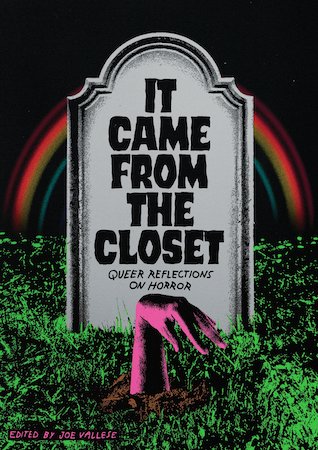
The VHS tapes waited inside a small pull-out cabinet: Frankenstein. Dracula. The Mummy. The Wolf Man. All of these movies had been recorded off Syfy. Early ’90s Sci-Fi Channel, as it was then spelled, was a television treasure. It was dark, it was scary, and to my child’s mind it seemed to reveal the hidden world of unspeakable truths I felt sure existed. Even the channel itself was a secret. Growing up in a working-class family in rural Appalachia, we didn’t always have easy access to nonlocal channels.
My home, like the community around it, was a deeply conservative and religious one. Long before I knew what they thought of queerness, I knew that many in our community, including some of my own family members, believed horror movies were of the devil. The act of watching one opened the viewer up to demonic entities, even Satan himself. That belief makes some warped sense back home, where geographic connections to heaven and hell seem possible. The skies in the mountains are like none I’ve ever seen elsewhere. Looking out in the morning or after a storm, you can see smoke-thick fog rising out of the trees in long plumes to touch the clouds. Valleys and hollows are deep enough, but deeper still are the abandoned mines and runoff lakes that we used to use as playgrounds, both of which have poisoned the dirt and water around them. Pet Sematary doesn’t sound all that unrealistic there. Christian fears of witchcraft coexist with regional folk magic. Phenomena that can only be described as Weird Shit happen all the time, and even many local skeptics believe they’ve personally experienced something that conventional science can’t explain. Sights of unholy form and violence might seem just as likely to open up supernatural contact as staring too long down into one of those howling sulfur-smelling mine shafts.
My father was an anomaly. While he did believe that contemporary, gory horror was wicked, the classics were safe. His only child was allowed to rummage through those tapes freely, and the only movie I was forbidden to watch was, for reasons I never understood, Christine, John Carpenter’s 1983 adaptation of Stephen King’s novel about a killer car.
As a small child, I loved all of the old Universal movies, but it was The Wolf Man, director George Waggner and writer Curt Siodmak’s take on the werewolf, that most captured my heart. The fog rolling over the Welsh countryside in the film reminded me of the fog that embraced our hills. The danger of being caught out at night in the woods where dangerous creatures roam was deliciously familiar. Larry Talbot was kind of an oaf, but he seemed predestined to do wrong, and I pitied him as his life spiraled out of control and he became the monster of the town’s nightmares.
Werewolves have always fascinated me. They combine two of my favorite elements in horror: the monster and grotesque bodily transformations. Walking on two legs and still wearing clothes, Larry Talbot’s werewolf was both man and monster. His transformation into the eponymous creature, though perhaps now low-quality in its cheesy dissolves, slowly strips away his identity to replace familiar human flesh with the fur, claws, and teeth of a creature that defies all norms and violates the rules of what makes a good person. Rather than appearing as simply an animal, Larry embodies the Other. The film emphasizes the ability of a monster to lurk inside a seemingly good man in the poem repeated throughout it: “Even a man who is pure of heart and says his prayers by night may become a wolf when the wolfbane blooms and the autumn moon is bright.” The real horror in the film isn’t really Larry’s attacks on townspeople but his own monstrosity.
Long before I knew what they thought of queerness, I knew that many in our community believed horror movies were of the devil.
By the end of first grade, I was already a Weird Kid, the kind that horror often attracts. Painfully introverted, bookish, constantly afraid I was the butt of some larger joke everyone else was in on—but also drawn to dark things. I scared my cousins with my own made-up horror stories and got into trouble for it. With the Satanic Panic still fresh in their memories, the grownups seemed to pride themselves on warning me about the dangers that lurked around every corner, waiting to prey on little girls. I didn’t tell them I’d already learned that lesson. I kept quiet partly from humiliation, but also partly because I wanted to protect their innocence. For their own safety, I let them think the monsters on my tapes were the only monsters I knew about.
There’s a greatly mistaken belief that there are no queer people in Appalachia. Let me assure you: there are plenty. Their existence has historically been a quiet one: obscure bars and gathering places, gender nonconforming relatives, men who are “funny but mean well,” stony, unmarried women with lifelong “friends.” Appalachia is simultaneously a terrifying and beautiful place to be queer, and it is also contradictory. There’s a deep sense of danger that being outed could mean the end of one’s livelihood or life altogether, yet amid that danger there’s a solace in the cultural value of being left to one’s own business. The bonds of queer community are hard-won there, but they’re strong, or at least stronger than those I’ve experienced elsewhere, including New York. Outside the hypercompetitive metropolitan world I now live in, where financial, social, and cultural capital often dictate even casual friendships, Appalachian queers seem to recognize each other as partners in the same fight despite our individual differences.
With increased attention to queer issues on the news in the ’90s, our churches and families had to actually talk about queerness, and many did so with disgust they learned from conservative media. Ironically, although it would be a few more years before I linked werewolves to lesbianism, I became consciously aware of the word lesbian as a source of horror from a news report about a fatal dog attack. The woman’s death was, I was told, justice for her crime against God. She was in hell now, but her surviving girlfriend might yet be saved if she repented. God was merciful, after all.
The real horror in the film isn’t really Larry’s attacks on townspeople but his own monstrosity.
One Halloween night, my cousins and I ran ahead of our parents as we trick or treated. We’d been going door-to-door, but the Dads shouted for us to stop as we crossed onto one home’s lawn. The porch and interior lights were on, the universal signal that trick or treaters are welcome. But catching up with stern, worried faces, the Dads explained to us that lesbians lived in that house. By this point, I had a much more detailed image of what a lesbian was. In the religious tracts that our parents kept in their Bibles, lesbians were ugly, unlovable women, God-haters, predators, child abusers, every bit as perverse as gay men were thought to be. Who knew what they’d done to the candy they handed out to innocent children that night?
As the Dads led us away from the house, I felt as if I’d been the one to do something wrong. But I also hoped those women hadn’t seen us kids coming through their lawn, hadn’t noticed that we never rang their doorbell.
My father was still my connection to horror even after I’d memorized every image and line of every film in the VHS cabinet. He spent many days away from home hauling freight across the country, then he’d come in off the road, shower, and sleep. Like his own father, he was a disciplinarian with a soft side except where sin was concerned. But Friday nights brought out the best in him as we’d sit in the bedroom, where my parents kept a smaller TV, and watch The X-Files.
[In rural Appalachia,] Christian fears of witchcraft coexist with regional folk magic. Phenomena that can only be described as Weird Shit happen all the time.
Stories of filial piety compromised by the son’s shameful otherness have always resonated with me. The figure of the son is key to that resonance some how. My relationship to this figure clearly owes something to Biblical roles of sons, as well as to pop culture’s typical recognition of shameful Otherness in queer men’s narratives while not-always-but-often presenting only a watered-down acknowledgement of those feelings in queer women. It may also owe something to the fact that most of my friends in the teen years of queer realization were queer boys, who treated me as if there were no difference between us. Yet, even those explanations are inadequate. There’s some kind of truth to that role, and any attempt I could make to codify it is certain to become a complicated mess with disclaimers, footnotes, a song lyric, a collection of images sans context. But there would be no comfortable answers, and certainly no easy ones.
Maybe it would have been different if I’d seen Dracula’s Daughter first. But I didn’t find this gem until college, and so, when I think of my father, I think not of the Count’s sapphic daughter but of the Talbot son.
The conflict of The Wolf Man isn’t just between Larry and himself as he becomes a werewolf, knowing that he can’t resist the monster lurking in his own body, but rather between Larry and his father. Portrayed by Claude Rains, Sir John Talbot represents the elitist traditions from which Larry has fled. He speaks with a crisp British accent and comports himself with poise. Larry, meanwhile, is an American whose speech and movement convey a sense of leisure. He is a large man. Compared to his father’s physical slightness, he almost appears as a naive, graceless giant. Yet they do love each other. As the townspeople realize that Larry is the werewolf that haunts the woods at night, Sir John insists that his son suffers from delusions. To him, Larry is sick, under a pagan influence, but curable and certainly not a monster.
I was a Christian, a model student, a Good Girl. I couldn’t be a monster.
At a family barbecue when I was thirteen, the adults sat on the porch and shared their disgust over two women, clearly a couple, who had been in a doctor’s waiting room with me and my parents earlier that day. I’d recently had the surgery that would leave me permanently hard of hearing, but I was still close enough to hear every word the adults said about the couple. They were sinners, monsters, surely a sign that the End Times were upon us. But I’d felt something for those women—not longing or admiration but a fascinated comfort. One woman’s hair was dyed in a black-and-blond pattern I’d never seen before, and the other was called “Daddy” by their son. In the waiting room, I wanted to sit closer to them.
As host of the barbecue, my father put an end to the talk. “I’m disgusted by it,” he said—it now going beyond the lesbian couple to include all queer people. “And I know everyone here is too.”
I wasn’t sure if the kids counted in that “everyone here,” but my heart fell into my stomach when he said it. I wasn’t like those women. I couldn’t be. I’d already had boyfriends. I hated kissing them, hated the way their tongues poked into my mouth, hated the way their hands felt on my skin, but I was a Christian, a model student, a Good Girl. I couldn’t be a monster. But some thing in me was disgusting, and I begged God to take it from me. Within a year, that feeling in my stomach developed into a chronic pain like a fist squeezing my guts every time I felt anxious.
I also met a girl. The girl.
There is something especially visceral about the werewolf’s violence. The vampire’s bite, at least, looks erotic. The werewolf, though—it doesn’t just want a taste or to remake you as its immortal companion. It wants to tear you apart. Lacking any semblance of human morals or even social codes, the transformed werewolf has no compunctions about killing its victims. And unlike the vampire, the werewolf doesn’t need to kill to survive. But it does. And so the werewolf is irredeemable.
If I looked at [a girl] too long, I could feel the last threads connecting my soul, God, and my family coming unstitched.
The first werewolf of The Wolf Man isn’t Larry Talbot but the fortune teller Bela (portrayed, no less, by Bela Lugosi). Bela looks into Jenny’s palm and sees the pentagram, the in-film sign of the werewolf and a symbol deeply feared within my family. He knows the wolf inside him will want her. Rather than act on the wolf’s desire by allowing her to linger, thus ensuring she is nearby when he transforms, Bela begs her to flee. As she obeys, the camera lingers on Bela, who looks horrified at his own existence—and still attacks her moments later.
His horror is repeated in Larry. The aloof irreverence that so separates Larry from the stuffy old townspeople disappears as he realizes that not only is he a monster but that his condition can’t be reversed no matter what he does. For the rest of the film, his brash American cheer is replaced by depression.
Bela’s mother, Maleva, is the only person who offers Larry real help. Larry watches her deliver a benediction over Bela’s coffin that absolves the werewolf of blame for his own condition. She alone understands that the werewolf isn’t evil. She alone recognizes her son’s and Larry’s suffering under the weight of their own monstrosity. When Larry is caught in a trap, she repeats her benediction and temporarily restores him to his human form. But she can’t offer him any more help. His face is a picture of wild terror as he hears hunting dogs drawing closer. If he is caught, he and Maleva both know, his condition means his death.
Unlike the vampire, who retains enough human consciousness to enjoy the sensations of their new existence, the werewolf has no control over their own body once transformed. Just as they are bitten without consent, werewolves change and succumb to violent animal instincts without any autonomy at all. Despite his masculine posturing and American bravado, Larry is clearly traumatized by being bitten, and his transformations continue to use his own body against him.
To this day, my sexuality remains unspoken between [my father and I]. I pretend most of my daily life doesn’t even exist.
I’m old enough and, as an academic, steeped enough in theory to recognize a link between my love for horror, my sexuality, and my trauma. All of it combines in the werewolf and, in my first favorite movie, in Larry Talbot’s growing awareness of his nature and betrayal by his own body. Without knowing what I was angry at, my church taught me that my anger was a sin. But horror gave me a power to reckon with what happened and with my increasing difference. In those monsters, even those who weren’t as sympathetic as Larry Talbot, I found people and creatures like me. A product of Appalachia himself, Pumpkinhead seemed more like a faithful companion than a demon. Chucky gave me nightmares, but these were somehow more comfortable than many other social interactions. Every year at Halloween, a family near Main Street dressed up as famous horror characters to scare trick or treaters. My cousins screamed when the man dressed as Freddy Krueger moved his knife-fingered glove toward them, but I loved him. I’d stand on the dark wooden porch while candy was being dispensed and stare at him, daring him to move, waiting for that thrill. The irony of liking a child predator isn’t lost on me, but back then, Freddy seemed to be just another one of those dark things to which I felt a kinship. Monsters, not heroes, were my friends.
What did terrify me was myself. In my teens it was the slow sense of separation from God and my parents, the mounting interest in girls who were soft and pretty, girls who looked more like boys, girls who were new and looked lost in the hallways at school, girls who made sure their underwear showed through their gym clothes, girls from homes surrounded by junkyards, girls from the backwoods who cursed and wore dirty boots. If I looked at one too long, I could feel the last threads connecting my soul, God, and my family coming unstitched.
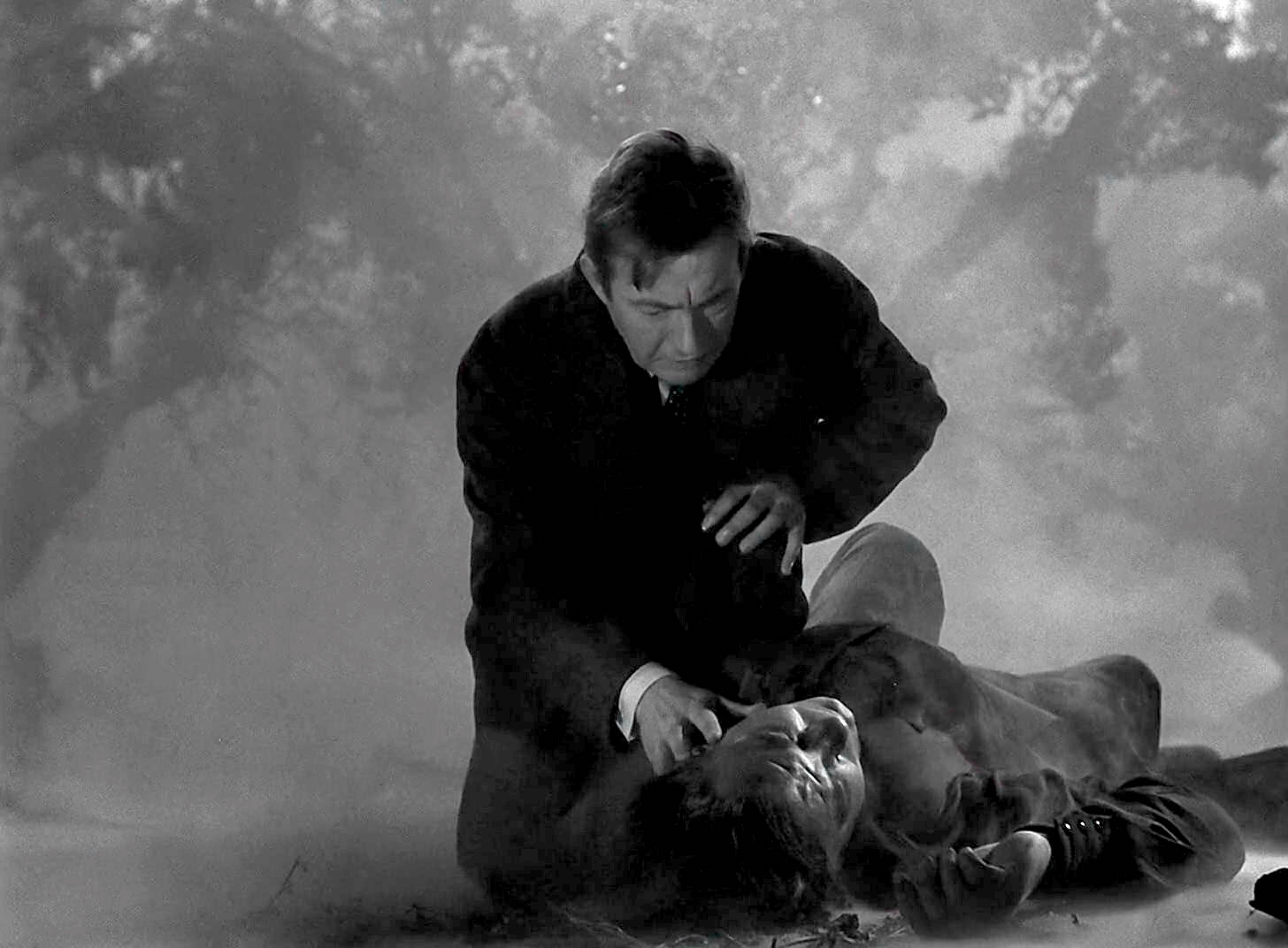
At the end of The Wolf Man, Larry is killed by his own father. Sir John doesn’t know the werewolf he beats to death is Larry until it is too late and he sees the monstrous body transform back into that of his son. He looks at the dead Larry and then the murder weapon—Larry’s own cane—with horror. Though Larry is much larger than his father, his death makes him appear smaller and vulnerable. Sir John sees that his son was indeed the monster terrorizing the countryside, but, rather than recoiling from him, kneels beside his son’s body and strokes his face.
My father and I don’t talk much anymore. I’ve moved several hundred miles away and he’s in poor health. He only rarely mentions old horror movies and The X-Files when I visit, but we haven’t watched either together in over a decade. Instead of classic horror, his choice of entertainment now is right-wing religious conspiracy theories, pro-Trump videos narrated by uncanny automated voices, and evangelical sermons on YouTube. He speaks constantly of the end times. He waits for the Rapture, for Jesus to come take His children away from the evils of this sinful world. Whenever we do speak, he reminds me of the need to get right with the Lord so I won’t be left behind. It would be easy to ascribe this to political antagonism, but he means it. He genuinely wants his family to be with him in eternity in a celestial land where there are no monsters.
Ever fearing that I’d turn out to be a lesbian, my mother warned me once that if I was one, to “never to tell Daddy because it would break his heart.” So, I never told him the truth about the girl who stepped out into the hallway while I was skipping world history. Her face still had smears of pale makeup from a scene she’d been doing in drama class. She wore red eyeliner. She told me she’d played Dracula.
My father knows her, but doesn’t know who she was to me then or who she still is now. To this day, my sexuality remains unspoken between us. I pretend most of my daily life doesn’t even exist. Sometimes I think he must know and that he simply doesn’t acknowledge it because doing so would mean admitting that his only child is bound for hell. Sometimes I think he knows there’s something different about me, the same way other members of our community always seemed to, but can’t identify it because surely a girl who elected baptism at only five years old couldn’t be so sinful.
Recently, the woman who used to be the girl who played Dracula asked me what my favorite part of The Wolf Man is. I told her it’s Larry’s first transformation and night as a wolf, but my second choice is that last moment between Larry and Sir John, when Larry is revealed as both man and monster—and, still, a son. It’s not a happy ending, but it’s a damn good one.
Angie Cruz’s latest novel How Not to Drown in a Glass of Water is a study of a class of forgotten women: the 55 to 65-year-olds who lost their jobs during the Great Recession and were never able to regain long-term employment.
Cara Romero is one of these women. When the factory where Cara has worked for decades closes in 2007, she participates in a Senior Workforce Program through which participants receive unemployment benefits to subsidize prevocational training. Cara, nervous about the unfamiliar interview processes and concerned about her precarious financial circumstances, appropriates her job counseling sessions (12 of them in total) to talk about her life in Washington Heights. She touches on every aspect of her life, from gentrification’s effects on the residents in her building, to her estranged son and her relationships with her sister, mother, and neighbors. While the entire novel takes place in the offices of the job placement agency, Cara’s voice is the only one that readers hear.
Cruz deftly uses the artifacts of Cara’s life—job and citizen application forms, debt collection notices, rental agreements and invoices—to highlight the issues an immigrant like Cara must navigate and how documents like these can also hinder progress.
Cruz, who played the role of language and cultural translator for her family, spoke to me about these cultural barriers and the impact of the Great Recession on immigrant communities.
Donna Hemans: The book is set during the Great Recession, but coming out of COVID, it could very well be set in present day, couldn’t it? Has anything changed since the Great Recession to now?
Angie Cruz: When I started this book, we weren’t in a recession and now it seems like everyone’s talking about a possible recession and inflation. With COVID, it was the high job unemployment. It’s funny how a book suddenly falls into its time.
A lot of women in my life, like my mother, my grandmother, my aunt, all lost their jobs in 2007, 2008 during the Great Recession. And they all had jobs for over 25 years. The economy did have a big boost after the recession and when Obama was president, but a huge percentage of working-class immigrant women in New York City who were between the age of 55 and 65 and who lost their jobs during the Great Recession never returned to long-term employment. And this is probably because of language, the digital divide, but it was interesting.
DH: Reading your novel in the midst of conversations in the media about student loan forgiveness, the predatory nature of student loans and rental agreements was quite interesting. There were so many parallels, so many systems that prevented Cara and the other immigrant women from getting ahead. Were you drawing from your own experiences, stories you heard?
AC: As a daughter of an immigrant who was born in a working class family, some times with a mixed documentation status family, moving through the system and trying to understand what our rights are, getting an apartment or getting a passport or citizenship or green card or workers’ rights—I was the translator for a lot of my family members. Not only a translator of language but cultural translator. I would say that, yes, this book is greatly informed by that experience and how difficult it is to move through these systems that are difficult to understand, even for those that are educated in this country.
There is an expression by Toni Morrison where she says something about the galaxy of a woman. She’s speaking about one of her characters; I think it’s Sula: how you get the galaxy of a Black woman is by adding all the different facets of their lives that are often unseen.
While Cara was telling her story, these forms and the documents work also as a counter narrative to some of the things she’s saying to show the complexity of the situation she is in. So even if she’s really optimistic, we understand that the system is not always generous.
DH:And there was also the language barrier as well reflected in the way Cara answers some of the security questions.
AC: Well, language is always a way in and a way that also keeps you out. In the book, I was making fun also of the system itself and these security questions that ask you something that is impossible to answer because you didn’t grow up in this culture. I thought that it would be satirical to have a character address these questions candidly and playfully. Also to show that you’ve lost even before you’ve begun the process.
DH:I read recently that conversations about debt are always about more than money. And I think that’s the case here, isn’t it?
AC: James Baldwin says it’s expensive to be poor. And this has always felt true to me. When you don’t have any generational wealth, or cultural capital, or anyone in your family to lean on, even if it seems like you’re progressing in a certain way, you’re always in some kind of debt. And I wanted to show that regardless of how hard working so many of these characters are in the book, the hustle is forever because there’s no real way to get out of poverty or money insecurity or housing insecurity when you’re in an extended network of people that are also in trouble in that way. Unless you turn your back on them, maybe. But it’s also an impossible thing, because then you would have familial poverty, emotional poverty and spiritual poverty. And I guess the wealth that I’m trying to center is that even if one is in financial debt, there’s an incredible wealth in having a community that’s taking care of you.
DH: Right. There was so much of that in the way in which Cara was devoted to her neighbors, even rejecting certain jobs because those would interfere with her taking care of the elderly people in her neighborhood. Cara takes care of everyone. Underneath all of her devotion to others is the burning question: who will take care of me? I thought that was a pointed question because it speaks to the unique experience of immigrants or people who have moved away from home. Is that the way you look at it?
AC: Exactly. I grew up in a home where the strong women, despite all the microaggressions they were experiencing, despite all the challenges, still showed up to work. You could put so much on a person and still they get up in the morning and they do this impossible thing every day.
I grew up in a home where the strong women, despite all the challenges, still showed up to work.
I feel like that is actually quite detrimental. Not that it shouldn’t be celebrated, that someone is able to feed their family and pay their rent, but to think always that the strength is one of resilience is also debilitating for so many women that I know and I wanted to kind of show the heaviness of that work, and that it shouldn’t be just one person’s work. It should be everybody’s work to take care of everyone. Cara Romero is “I am strong, I am able to do all these things. I don’t even need anyone to come with me to the doctor when I have surgery. I will never ask for help.” What are we teaching our daughters or sisters or cousins if we always pretend that we don’t need anybody? The truth is we all need somebody and I wanted to illustrate that too. Like, even if there is strength in doing certain kinds of things the celebration of resilience is also killing us.
DH: Talking about relationships, Cara says that she’s learned the difficult way that you have to be gentle with your children or you can lose them forever. In part, it’s an extension of her continuing again to try to do too much. But tell us about her relationship with her son and how you see that relationship fitting in with all the other things that are going on in her life.
AC: Cara loves her son deeply but is estranged from him because he’s not the son that she had hoped to have or doesn’t really understand what’s possible with a son who is not performing the patriarchal macho culture that she understands is masculinity. Because she wants him to survive, she disciplines him in a way that actually pushes him away, possibly forever, we don’t know. I’m really interested in talking about the ways that corporal punishment plays into the family. These kinds of abuses are intergenerational and often socially accepted. I want to show the kind of tension between her sister, Angela, and Cara and how to raise a child without that kind of violence.
I also wanted to show that even though she rejects her son, because he may be queer—it’s not said explicitly in the book—the contradiction is that she’s taking care of her queer neighbors. So you have this contradiction of a mother who is saying one thing, but in truth, she’s still generously taking care of the people around her despite their lifestyles.
DH: The entire story takes place in the offices of a job placement agency, but it’s as much about personal relationships—both community and familial—as it is about gentrification and way systems are sometimes stacked against people. Were you playing with the differences between being in community with people and just being part of a larger community of services and systems.
What are we teaching our daughters or sisters or cousins if we always pretend that we don’t need anybody? The truth is we all need somebody.
AC: I see this as a common thread among a lot of different immigrant groups where we come from cultures that celebrate and lean into interdependence. But then we enter a system in the United States that supports largely the culture of the nuclear family and the individual. In some ways, what’s happening between these characters is that they come in to a culture that is all about you first. If you don’t succeed, you’re totally responsible for your failure. And if you win, you celebrate because you are an exception and wonderful and brilliant. But in a culture of interdependence, when one person wins, everybody wins.
The statistics show that it’s almost impossible to go from working class to middle class to upper class. But there are exceptions. So when I think about the bigger community, the nation and the systems and the laws and the Constitution and the way all that works, and then our interpersonal communities, there is a real tension between the way we move in the world.
DH: Is the outcome for Cara a positive one?
AC: What is an optimistic, positive outcome has so much to do with what you value. Realistically if you think success is that Cara finds a job, statistically that wasn’t what happened for many women. Many women ended up doing gigs like babysitting or moving back to their home countries trying to figure out a way to survive. But if you think optimistically about what is the richness of a life, what I continue to believe is Cara continues to do what she is doing. Even if she is unemployed, she has been employed by the community.
Sometimes the only way to approach history, particularly a history that has excluded you or one which you felt trapped inside, is to deface it. Defacing—like a form of graffiti—can take the form of literally writing or collaging on top of the record so that your words are visible, but so is the history you are reinscribing. The two interact to create a third space. Similarly, sometimes when going in search of a specific history, you can’t help but research your own. Your history creates another layer to the original, adding to it and permanently altering the way it will be understood or interpreted by others.
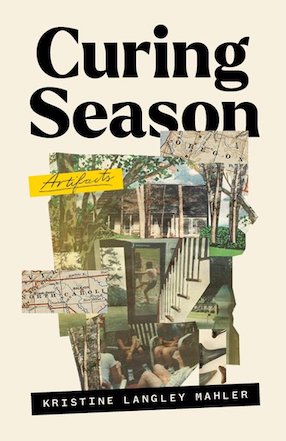
In my debut essay collection, Curing Season, I contend with the history of a county in eastern North Carolina where I moved when I was ten years old and to which I desperately wanted to belong—hello, adolescence!—but I could not find a space for myself. As an adult, obsessed with the county’s book of self-submitted family histories, I approached it as an opportunity to write my own history—on top of theirs.
Nonfiction books leaning against the borders of the genre—which is to say, in that expansive and exciting category called “experimental nonfiction”—continue to illustrate the ways we can work with history while including our own narratives. No one flinches when fiction alters, reshapes, or dismantles historically-agreed-upon narratives. But there are also some incredible experimental nonfiction books doing the work of defacing history, sometimes in a very visceral and visual way, by scratching off the paint, keeping the ghostly outline of what came before, and then making history anew.
The Bear Womanby Karolina Ramqvist, translated by Saskia Vogel
The Bear Woman traces the legend of Marguerite de La Rocque, a 14th-century French noblewoman who was taken to North America and, as punishment for a love affair on the voyage over, abandoned on an island in the St. Lawrence River—a fascinating tale on its own. But Ramqvist’s own motherhood and womanhood are interwoven atop and between Ramqvist’s discoveries (and dead ends) as she combs the brittle archives to learn more about Marguerite, reflecting on how much control a woman has historically not had about the legends of her own life. Ramqvist notes that each person who recorded the details of Marguerite’s story had “their own motives for why they had chosen to tell her story at all, and for how they told it,” acknowledging that she herself must imagine into Marguerite’s narrative as Ramqvist navigates the stormy channel between what is her projection and what is her unveiling of Marguerite’s truth.
A Ghost in the Throat also imagines into a legend grounded in history: “The Keen for Art Ó Laoghaire,” a poem written by the 18th century Irish poet Eibhlín Dubh Ní Chonaill about the death of her husband Art. Dubh—who was pregnant at the time of Art’s death and was raising a young family—parallels Doireann Ní Gríofa, who reencounters Dubh’s poem when she is a young mother herself. Ní Gríofa becomes obsessed with discovering more about Eibhlín Dubh’s life, excavating birth records, hospital records, cemeteries and newspapers, trying to find out what became of Dubh. A poet like Dubh, Ní Gríofa seeks history to reconstruct Eibhlín Dubh’s life and finds herself constructing her own.
Megan Culhane Galbraith is an adoptee whose early history was obscured from her for most of her life. The subtitle of The Guild of the Infant Saviour is “An Adopted Child’s Memory Book,” and like memory itself, the book is truth presented with gaps and alterations. Photographs from the author’s childhood are displayed at the ends of chapters alongside images of those photographs which were recreated by the author, using dolls as stand-ins for herself, as well as the inclusion of images stating “permission not granted.” The process of comparing the created and original images mimics the creation of memory, the re-creation of memory, and the reclamation of both fact and memory. Galbraith’s book starts a fascinating conversation about permission, excision, and the shaping of narrative based on what a nonfiction writer must fabricate in her own book to placate others.
Letter to a Future Lover is centered around other peoples’ history. Ander Monson takes the marginalia and tucked-paper-notes left inside found books and writes around what—and who—he finds. A historical trail has been left behind, but Monson makes new meanings from the artifacts through what he himself brings to the marginalia. Is his interpretation accurate? Does it matter? How much respect is one required to give to graffiti, anyway? Letter to a Future Lover is the ultimate history defacer as it both narrates the defacing others have done, but also leaves a layer of its own.
The Witch of Eye turns its gaze on the witches of history and the multiplicity of narratives about their experiences which nearly always drained into one gutter: the official witch trial court transcriptions. Kathryn Nuernberger reminds us that the women’s forced confessions and shouted-down explanations have become the only “historical” records, but in refusing to accept the voice of a predominantly white male justice system as the singular truth, Nuernberger uses her own experiences—along with contemporary court cases—to offer a voice to those women who also longed to deface the historical record but were not permitted to speak.
Evidence of V culls together erased-and-partial documentation from the 1930s on the little-known practice of incarcerating teenage girls for the crime of “immorality” so that Sheila O’Connor can imagine into the slim case file kept on record for her grandmother, who was one of those incarcerated girls. I’m obsessed with how flexible O’Connor makes facts, how insistently she reminds the reader that documentation is never complete, how many voices are erased even as they are “recorded” by others. Evidence of V is a wildly exciting addition for the nonfiction/hybrid genre as it blurs facts into recorded fictions and reverses fiction into the closest we can get, sometimes, to facts.
Litany for the Long Moment blurs the edges around Mary-Kim Arnold’s adoption from Korea at age two with the twin thumbs of grief and trauma. The memoir is reminiscent of Galbraith’s book as both authors use photographs as a form of evidence to claim facts around their adoptions. Arnold accrues additional sources, like Korean language worksheets and original letters from her social worker, before layering them beside meditations on the work of photographer Francesca Woodman and Korean American artists like Theresa Hak Kyung Cha to question history’s other layer of truth: the one people in diaspora must build for themselves.
The summer after our college graduation, a few friends and I decided to pool our money together and find a stage big enough for our real lives to play out on. We set our sights on leasing a temporary apartment in Atlanta with a self-imposed move-in deadline of early August. The hope was to reclaim that year-and-a-half we had spent apart due to the pandemic.
Apartment hunting looked like fitting semi-weekly video calls into our busy, post-grad schedules so we could browse Zillow and Apartments.com as a group. Instead of in-person showings, we settled for virtual tours of 3D rooms with the same nondescript wooden flooring and beige walls. And no matter what day of the week it was, we could call managers to ask about available units and get their voicemail without fail.
I read these words for the first time under my momma’s roof, the same place I’d been for the past year and some months.
After one person backed out, we refined our search to include two—even one-bedroom—units. The conversations turned into how many of life’s comforts (e.g. balanced meals, disposable income, in-unit washer and dryer, etc) were we willing to give up to make this happen. Summer came to a boiling point and I remember one of us saying, “I don’t think it’s supposed to be this hard.” People move all the time, right? But, without secured employment, a lifetime’s worth of savings, or a potential co-signer, our options were limited. And my desperation to separate from my pandemic pod was palpable, almost blinding.
To leave one place for another, even for a vacation, took more resources and support and money than I had ever considered.
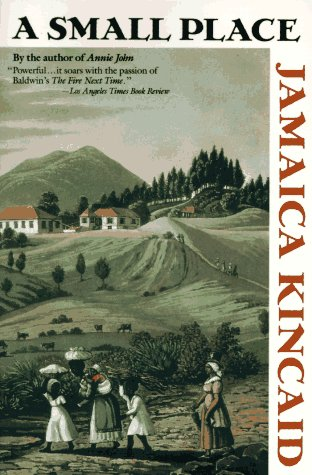
“Every native would like to find a way out, every native would like a rest, every native would like a tour. But some natives—most natives in the world—cannot go anywhere,” wrote Jamaica Kincaid in her book-length essay, A Small Place. She goes on to say that, “They are too poor to escape the reality of their lives; and they are too poor to live properly in the place where they live.”
I read these words for the first time under my momma’s roof, the same place I’d been for the past year and some months. And during that time, I hatched not one but several escape plans, only to witness their execution fall apart before I could slip out the door. Kincaid’s book found me nearing the tailend of my foolhardy plots, when the glamor of escape was diminishing, any plausibility a thing of the past.
In response to critics emphasizing the “angry tone” of A Small Place, Kincaid says in an interview, “In my writing I’m trying to explore the violations people commit upon each other. And the important thing isn’t whether I’m angry. The more important thing is, is it true? Do these things really happen? I think I’m saying something true. I’m not angry.”
Kincaid writes about the impact of European colonization on the small, beautiful island of Antigua—where she grew up—and how modern day tourism acts as a continuation of that legacy. If “tourist” is a robe that the reader wears often, then her use of second person POV may feel like an indictment.
How does truth sound to the one who has done the speaker wrong? I imagined it would sound a lot like anger.
What struck me while reading was how direct and uncompromising the perspective was: “An ugly thing, that is what you are when you become a tourist, an ugly, empty thing, a stupid thing, a piece of rubbish pausing here and there to gaze at this and taste that, it will never occur to you that the people who inhabit the place in which you have just paused cannot stand you.”
In the first section, she takes the tourist, as in you, on a tour of Antigua. She contrasts your perspective of your gorgeous Caribbean vacation with the complex lived experience of the natives. What you learn is that the natives don’t see you as the good and moral person you think you are.
That tug on my feet to leave everyone I love behind as I search for something greater feels distinctly American.
Whenever life in the Western world becomes too mundane or the political atmosphere too unavoidable, our first instinct is to get away from it all. We plan our escape to some faraway, ever-blue island to live out an unaffected fantasy where politics can more easily be ignored. For westerners, the cure for dissatisfaction is mobility. To go or to stay is seen as a choice that anyone can make. That tug on my feet to leave everyone I love behind as I search for something greater feels distinctly American.
Yet, the “you” Kincaid refers to couldn’t mean me. I saw myself not just in the tourist but the native as well—a Black face reduced to the background. Everyone is a native of some place. But, too many of us are unable to escape. Meanwhile, those who can go participate in an industry that relies on the exploitation of the ones who can’t.
While my friends and I scrambled to secure an affordable apartment in the city, Maui was short on water. As a way to regulate water usage, officials restricted the locals from watering their lawns, imposing a $500 fine for those who disobeyed. The hotel and tourism industries experienced little to no limitations.
That specific tension between locals and tourists in Hawaii was explored in the first season of HBO’s The White Lotus which premiered that very summer. The show focuses on the staff at a luxury Hawaiian resort and the mostly white tourists vacationing there. The tourists snorkel and lounge by the pool reading Nietzsche and Ferrante while the resort staffers endure dehumanizing interactions in order to keep their paychecks.
In an interview with TheNew Yorker, the showrunner, Mike White, discusses his intentions behind the portrayal of the tourists when he says, “[I] didn’t feel like I could tell the story of the native Hawaiians and their struggles to fight some of their battles, but I felt like I could kind of come at it from the way I experience.”
Those narratives share one common perspective: that of the traveler.
I’m used to travel narratives that feature endless descriptions of white, sandy beaches beneath a tangerine sunrise and how foreign countries can be the backdrop for one’s self-discovery—or lack thereof. Those narratives share one common perspective: that of the traveler. The result: the native Hawaiians in The White Lotus become “hollow plot devices in service of illuminating the inner lives of the series’s mostly white protagonists,” writes Mitchell Kuga for Vox.
So subtle, and yet so violent and visible is their villainy, that it’s impossible to blame anyone other than the tourists for the suffering of the resort staffers. Any larger discussion of how tourism makes us complicit and turns us into, as Kincaid describes, “ugly things” is buried underneath one wealthy character’s declaration that imperialism is in our human nature.
After weeks of missed calls and unanswered emails, we found an available apartment that wasn’t too far out of our budget and suited our basic needs. We applied, paid the application fee, got approved, and never heard back from them again.
We called.
No answer.
Another week or so passed by. We checked on our application and they had given the unit to someone else. August, in all its blazing disappointment, came to an end. I was still at home.
I’d been watching YouTube vlogs of girls in their twenties moving to New York and Hawaii and living these dreamy, idyllic lives despite the virus claiming thousands of loved ones every day. I envied them.
Talking to a friend, I joked about moving to Hawaii myself. “I might not be able to afford an apartment in Atlanta but I can afford this plane ticket.”
“Maybe,” she hesitated. “Or maybe not. Aren’t the local Hawaiians begging people not to come?”
“Oh, right,” I said. Heat flushed through my body as I realized my mistake.
I had spent the last few weeks scrolling past tweets discussing the water shortage and TikTok videos of locals breaking down how tourism has wrecked their quality of life.
I had spent the last few weeks scrolling past tweets discussing the water shortage and TikTok videos of locals breaking down how tourism has wrecked their quality of life. I had a vague awareness of what she was talking about but my perception of Hawaii came from travel vlogs of influencers on vacation. The footage they took portrayed Hawaii as an island paradise with picturesque landscapes. Looking back, that depiction was so similar to Kincaid’s description of Antigua: “Sometimes the beauty of it seems as if it were stage sets for a play, for no real sunset could look like that; no real seawater could strike that many shades of blue at once.” Later she writes, “It is as if, then, the beauty—were a prison.”
None of their videos mentioned a drought or water restrictions. But, with many travel narratives centered around the tourist experiences, that’s often the case. The natives—their worries, their economy, their reality—are a nuisance compared to the larger narrative of a white person’s self-discovery. And I went along with that erasure just as easily as the girls who made the videos.
Before the pandemic, I always thought that I could go wherever I wanted whenever I wanted to.
That conversation with my friend exposed a blindspot of mine. I hadn’t yet unpacked the American exceptionalism I grew up learning in school or how other parts of the world might perceive me on the basis of nationality. I avoided content that contradicted my fantasy version of Hawaii simply because I could. I had the luxury of distance that being American afforded me. And if I’d followed that instinct to flee all the way to the airport, I’d be the tourist that Kincaid describes, despite my race or gender. Though being a Black woman comes with its own complicated feelings around American identity, how could I deny the ways my nationality has made me culpable? I’d be a part of the problem instead of the solution. Before the pandemic, I always thought that I could go wherever I wanted whenever I wanted to. But, now I can see how that feeling is closely tied to where I was born.
Staying still has never been a part of our American cultural identity. We’re encouraged to leave home as soon as possible because bigger lives are waiting for us far away. We pride ourselves on being rugged individualists who don’t need anyone or anything. But, all of that just makes it easier to dehumanize and violate others for our own benefit. If those early days of the pandemic taught me anything, it’s that the real privilege is choice. The choice to stay or to go.
We can ask, “Why don’t they leave?” But, maybe the better question is: why can’t we stay home?
Read Kincaid’s words long enough and her message becomes clear: “There must have been some good people among you, but they stayed home. And that is the point. That is why they are good. They stayed home.”
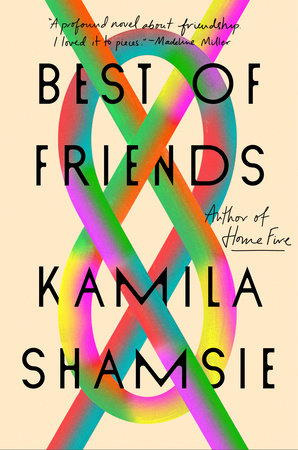
Kamila Shamsie’s latest novel, Best of Friends, explores how a long, complicated friendship is shaped and tried in tumultuous political landscapes. Maryam and Zahra are unlike in several respects—the families and social classes they come from as well as the values they intend to live by could not be any more different. Yet, in ‘80s Karachi, none of these differences seem to matter. Even as the girls move from Karachi to London and the former grows up to be a venture capitalist whereas the latter an advocate for human rights, they remain deeply committed to being there for each other. Neither the passage of time nor the conflicting nature of their professional lives can drive a wedge between them. However, when they confront a shared, painful memory from their Karachi days in present-day London, they can no longer avoid speaking of their differences.
Questions related to justice and loyalty often form the core of Shamsie’s fictions. Her previous novel, Home Fire, winner of the prestigious Women’s Prize for Fiction, dealt with issues of filial loyalty, set against the backdrop of an unjust mandate issued by a nation state. In Best of Friends, Shamsie considers how assumptions of justice and loyalty impact a lifelong friendship. Reading the new book, I was struck by her artful portrayal of two ambitious and powerful women, and the broader cultural contexts changing their relation. When I spoke with Shamsie over Zoom, I asked her about the driving forces behind the novel and the historical moments that were formative for her and her main characters.
Torsa Ghosal: Your novel’s premise reminded me of tweets, memes, and Quora threads pondering if it’s ok to lose friends over politics. The online discussions raise a question: is the place of true friendship outside the sphere of one’s political life? I feel your novel shows how friendships—even childhood friendships—are motivated by belief systems and these belief systems are, in the end, political. I was wondering if you think there’s something about our cultural moment that has made it urgent for us to reassess the meaning of friendship. I guess, this is another way of me asking you why write this book now?
Kamila Shamsie: All those posts about “don’t lose your friends with politics”—I will be surprised if very many of them came from Pakistanis. When I went to university in America, and I was writing, people started to make comments about bringing politics into fiction, as though politics was something that stood outside. But when I was growing up, it wasn’t something standing outside of daily life. Some of my earliest memories include the day Zulfikar Ali Bhutto was hanged when I was six. A friend of my parents came in the middle of the school day to pick up his two sons, my sister, and me and take us to his house. He lived quite near our school. So, as soon as Bhutto was hanged and there was news that there might be trouble in the city, my parents basically got on the phone with him, and he went and picked all of us up. To me at the time, there was something exciting about leaving school in the middle of the school day and going home to my friend’s house. So, I was always aware of political events and how they were, you know, doing something as basic as disrupting the school day.
Many years ago, I was somewhere in the States, and someone asked me this question about bringing fiction and politics together. It was a young woman who asked it and I sort of said to her, not with any prescience at all, but just in a kind of “let me imagine a situation” way, if ever Roe v. Wade is overturned in this country, you’ll see that politics isn’t separate from life. What’s happening now in the U.S., certainly, but I think, also in the U.K. around Brexit, and with the laws that spring up around COVID, is that there’s this greater recognition that what goes on politically is deeply intertwined with the fabric of our society and therefore, our family and friendships. But, to go back more directly to your question, I did notice in 2016 that between Brexit and Trump there were a lot of people saying I can no longer speak to so and so, because we have such divergent views. And again, it’s nothing new to people from the subcontinent. In India I’m sure for a while now over Modi, there have been these kinds of conversations going on between old friends. I had this idea of a novel of childhood friendship which I’d wanted to write for a long time, but now I could see it in the moment, in a very specific kind of way.
TG: A gap of 30 years separates the two major sections of the novel. Did you decide on that gap at the outset, or did you arrive at it later?
What’s happening now… is that there’s this greater recognition that what goes on politically is deeply intertwined with the fabric of our society and therefore, our family and friendships.
KS: I always knew I was going to follow a friendship through several decades. The original idea was that you would see Zahra and Maryam in many more sections. You’d see their 20s and 30s. But at a certain point I realized that the story itself was in the adolescent years and then in the mid-40s and that the other stuff—I had to think through them—but that wasn’t what the novel wanted. So, I started out imagining quite a different shape, but it was always going to be two girls who were absolute best friends. That we would see them at a very early stage and follow their friendship down the stream, see the ways in which they were very different people in a world where they couldn’t ignore the differences anymore.
TG: I noticed Zahra’s and Maryam’s relationship to images—photos and videos floating across media platforms as well as their own self-images. Zahra is committed to projecting a virtuous image of herself, and because she is intelligent, she is aware of what she is doing until she is not. Maryam, on the other hand, takes responsibility for protecting her friend’s image, which in turn contributes to her own ideas of who she is—someone who works behind the scenes to save the people she loves. And the self-images of both Zahra and Maryam are influenced by the political moment in which Benazir Bhutto gets elected Pakistan’s Prime Minister. I wonder why you chose that moment in history—do you have memories of what Bhutto’s election meant to you at the time and what you think of that era in retrospect?
KS: It was such a significant moment. I was 15 at the time, so I have extremely clear memories of the day Zia-ul-Haq died. I was convinced that we would just have another military dictator after him. I was only four years old when Zia-ul-Haq came into power. So, I didn’t know any other reality. I didn’t know how to conceive of any other reality. And much like in the novel when the adults started to say there will be democratic elections I just thought, why are they being so stupid. I really thought they were being unbelievably naïve. Once it happened and Benazir was elected, it was amazing. It felt like the whole city of Karachi became a giant party. Before that only because of cricket I knew that the whole country could feel joyous together, and this was ten times that or hundred times that, just a feeling of change and something new, and things we hadn’t believed possible seemed possible now. It was so dramatic to see a woman there because power had only ever looked male to me. At school parties, we would listen to campaign songs, and they would bring us to the dance floor like nothing else did.
There was a period after that, and maybe this is why I didn’t write about it earlier, I equated the joy with the disillusionment that followed because, of course, nothing can live up to that kind of hype. Also you realize how many old systems remain in place and people can be disappointing. So, it has taken for me to get even older to look back and think, actually, to have lived through a political transformation, to have lived through a moment where what seemed impossible proved possible is an incredible thing. I am very, very grateful that I have that.
TG: Living through such a moment makes you believe that things can change! I wondered about the extent to which Zahra’s and Maryam’s takes on the image of the “woman in power” contribute to their rejection of conventional heterosexual paradigms in their own ways, even though there are questions raised in the novel about whether Maryam is making a “wife” out of her talented sculptor partner and if their domestic arrangement is a radical departure from heterosexual marriages.
KS: Both Zahra and Maryam are very excited by the election of Benazir but for Zahra it’s the fact that there is democracy, and all the people who have been her father’s friends—journalists as well as human rights lawyers—are suddenly on the winning side of history. She does have a wider sense of it, and then beyond that she’s delighted that it’s a woman. But Maryam doesn’t care that much for democracy itself. To her, there’s a woman. That is very significant because Maryam wants to run her family’s business. She wants to take on the roles traditionally associated with men. I don’t think Zahra is rejecting heterosexuality, though she rejects the traditional paradigm of heterosexuality. Whereas Maryam just rejects all of it—heterosexuality and marriage—although she does have the partner and the child, so in that she is hewing close to tradition more than Zahra.
I wanted to show two young girls who see through the figure of Benazir that the paradigm you’ve been taught as the norm doesn’t have to be the norm. And then, at the same moment, as Benazir comes to power, they have the car ride where they see that the world will still treat them as vulnerable. They will still inhabit the bodies of vulnerable fourteen-year-old girls. So, how to navigate that with the idea of the woman being empowered?
TG: Yeah. As for the rejection and replication of paradigms, I was also struck by the older Maryam thinking of herself as a “conqueror” in the U.K. It is deeply problematic and ironic given the colonial history, but Maryam is also a character who you can see thinking in this way. Your novel shows how generational wealth and privilege transfer across borders and the extent to which one’s sense of justice becomes rooted in privilege.
I wanted to show two young girls who see through the figure of Benazir that the paradigm you’ve been taught as the norm doesn’t have to be the norm.
KS: There’s corruption in the world in which Maryam grows up. Corruption comes with the class position they have—in the way they use it to get favors from their friends. They are not above using violence to have their own way. They don’t think that the law applies to them—what matters is who they know and what they can get away with. I think there’s an interesting conversation within Maryam where she justifies everything as looking out for your family or friends. I also wanted to show how easy it is to transport that to another country. I think, very often, class is talked about as being very specific to a place and, of course, the subtexts and nuances of it are. But also because of Maryam’s privilege, she has a sense of entitlement. It doesn’t occur to her that there’s any room she won’t be welcome in. So, she walks into every room and privilege recognizes privilege. In the UK, she’s able to do a lot of replicating of the network she’s grown up with in Pakistan.
TG: Like how easily she blends in with the members of the High Table! I also think your portrayal of a range of class, gender, racial, and social positions in this novel underlines how identity is not ethics. A Pakistani-origin woman making a place for herself in an exclusive club that’s predominantly white and male need not be a moral or virtuous undertaking by default. Could you talk about what it means to differentiate ethics from identity?
KS: That’s particularly relevant at the moment in Britain because you are having the leadership contest for the Conservative Party, and a lot of people are commenting on the fact that the leading candidates were, with one exception, either women or not white. It was sort of like “look.” But these candidates were all saying how they will commit the most cruel acts against refugees and immigrants. So, what difference does it make? It’s such a shallow version of diversity to say it’s essentially about skin color and name. There’s also very little diversity of class, and that doesn’t get talked about. Beyond that, what’s happening is a very old story. It’s a colonial story. You go back to Macaulay’s Minute on Education where he says, we will create a class of Indians who is Indian by blood and color but English by temperament, so they will rule for us. They will do the work of the Empire. For a while you’ve seen people who aren’t white, who look at world where power is defined by whiteness and make decisions about the positions they’ll take to get to the top, which is to basically replicate certain forms of whiteness without being white. That’s very convenient for their political party because no one can accuse them of racism when they enact racist policy.
Years ago, I was listening to an interview with John Edgar Wideman. This was in the ‘90s and I was relatively new to America and much about race in America, I just didn’t understand. I remember listening to John Edgar Wideman talking about how racist societies have these safety valves. If you treat any large group of people only with brutality and oppression, then that will create pressure and the pressure will build and build until they blow the roof off. So, you create a safety valve that allows a little of the pressure to dissipate. You do that by having a few people from that other group who do get to the top and then you can point to them and say we’re not racist. And that in fact helps the racist system to keep going, because the system says, look, we are changing, and their hope is that no one notices if there’s a change in substance or if the change is a cosmetic change. Now Maryam is someone who absolutely sees how she can play the system.
Mims has been complaining a lot lately that Jodie’s breath stinks like dead fish left too long on a hot stoop. She’s not wrong, but I’m tired of hearing about it, so I tell Mims, “You don’t have to haunt Jodie’s mouth, you know. No one invited you—certainly not Jodie—and if you don’t like it, you can go ahead and ascend.” But she won’t. Stubbornness, some have said, is a mark of the women in our family. I guess it’s the kind of mark you carry with you into the next life, as you shuffle up to the great beyond or boogie down into the cat’s mouth. I’d have preferred a big nasty scar across my cheek for all eternity, not that anyone asked.
Jodie is a tabby, marble-eyed with orange peel stripes along her back. I feed her and the other kitties in the alley beside my building every morning. They rely on me to eat, you see. It was fun for a while, that is until Mims took up residence behind Jodie’s sharp little teeth and started carrying on.
Sometimes I wish Jodie would pick another alley, maybe somewhere over by the park where people can afford to give her the good stuff: chicken liver pâté, smoked salmon, sardines swimming in imported Italian oil. Some well-off widower might even snatch her up and let her have the run of a chic park-side pied-à-terre. But I’d miss Jodie if she left. Mims too, I guess, though she’d never catch me saying so.
I know what the other tenants say about me: that I’m a kook, the bat-brained cat lady, the reason the whole block smells like piss. They avoid me in the stairwell and kick around my welcome mat, showing their resentment in small, neighborly ways. 2-B is the worst. One of those young, spoiled transplants who expects the neighborhood to be all curtsies and rosebuds like his parents’ place in Mayberry or Mayfield or wherever it is he came from. He takes out his garbage at the same time every day, just in time to watch me feed the kitties breakfast before heading to my shift at the City Fresh. He lives alone, so no way he makes that much trash. He’s only there to fix me with his disapproving stares and remind me that the landlord has a strict no pets rule that I’m in dire risk of breeching. He asks if I know how many parasites stray cats bring around the building. Says he can show me reports that prove they’re no better than rats. Calls them an affront to his senses. So I say, well excuse me your majesty but I didn’t realize I lived above the Archduke of Brooklyn, which hardly patches things up between us, but gets him off my case for another day. Fancy guy above his knees, 2-B, but he never wears socks with his shiny leather shoes, so what does he know about odor management?
He doesn’t see what I see. He doesn’t see the tourists and the couples out for strolls who stop when they see the kitties perched on handrails or staring from behind the chain link. They coo and giggle or stoop to scratch behind an ear before moving on, taking smiles with them. I feel like the work I do taking care of them is good work. Brightens things.
Anyway, it wasn’t me that started feeding them. Some were here before me, and some will be here when I’m gone, but for now they rely on me, and I’m not going to let them down.
“Good luck with that,” says Mims.
Jodie blinks up at me, tail swishing on the stained pavement. I bend down to her mouth, getting a face full of that low-tide stench, and ask Mims: “Why’d you have to go and bring that up?”
She’s always reminding me of how I left things between us, as if I could forget.
We never had pets growing up. Mims wouldn’t allow it.
“Pets bring mayhem,” she’d say, hipshot, a Salem pinched between two fingers. “They’re impolite by nature. They break and tear and bite and yowl and there’s simply no benefit to having them around.”
Our narrow house in San Francisco’s Presidio Heights was tactfully strewn with various valuables that were to be admired, but never touched. It felt like living in a museum filled with relics of a bygone and presumably superior era—one that surrounded us daily but was hardly ever spoken of aloud. A time called before. Keepsakes and tchotchkes from holidays, framed photos showing semi-alien likenesses of a younger Mims and Fred, all bathing suits and boat decks, arms intertwined beneath marquees, backs to alpine vistas. Snapshots of the whirlwind adventurers they used to be. Sometimes I’d catch Mims sighing over them, bending toward the photographs as if trying to soak up the youthful glow radiating from her erstwhile skin.
I used to wonder what it might feel like to tear at the photographs with my teeth, to overturn her seashell collection, to squat on the oriental rug and leave a puddle to settle into the fibers.
“To invite an animal into the home is to elect chaos,” Mims said on the one occasion that I dared to ask for a puppy. Fred looked up from his paper to remind her that they used to have a very obedient greyhound that liked to sit at their feet and was never any trouble at all, to which Mims replied: “One is plenty.”
She didn’t need to explain what she meant. It’s a wonder she carried me to term.
This morning I wake up and go down to feed Jodie and the others before my shift, same as always. I’m not two steps out the door before Jodie runs up and Mims starts mewling over how cold it’s been getting at night, even though the leaves have barely started to change.
I’m feeling mean so I pat Jodie’s skull all gentle and say: “You know I could bring you inside where it’s all nice and warm, give you a bath and let you sleep on the bed. Wouldn’t that be nice?” Jodie purrs against my knuckles. “It’s just too bad I wasn’t raised that way.”
Mims grumbles something in response, but Jodie has started cleaning herself so I can’t hear what it is.
She always had a knack for slinging insults. If a nervous young hire at Fred’s firm came for dinner she might remark that he had a handshake like a wilted petunia. People that talked too loudly or too much were rattle caps or clack boxes. Politicians were pigeon-livered, toddlers were interminable fussbudgets, and almost everyone other than Mims was, at one point or another, nuttier than fruitcake.
Fred had Mims admitted to the bin in ‘69. I was ten. Fred said he just couldn’t maintain her anymore. He always talked about her like that—like she was an antique car or some faulty appliance.
The bin was actually the San Francisco Towers Mental Health Treatment Facility, but nobody liked to say all those words back then. Words like that put it too plainly. Nut house, loony bin, kook castle … these names just lightened the mood.
We would visit her twice a month. Fred called them confabs. I’d sit in the waiting room and pretend to read while he talked with the doctors, then they would show us to a big room with a couple of card tables and a TV that was never on, and there would be Mims—face upturned to a wire-netted window, dressed all in white, posture perfect. There was always a super big guy watching from the corner who looked ready to intervene if we tried to attempt a daring escape. We sat across a table and never touched. Mims was never big on hugging, but I remember knowing that if the urge should suddenly come over her to scoop me in her arms and hold me, she might be stopped.
She didn’t talk much, just listened to me yammer about school while Fred went about filling an ashtray. I guess I thought that as long as there were words filling the air between us then things were all right. As long as I talked, she would have to sit and listen. The two of us tethered together, solid and whole.
At the end of these meetings Mims would always do two things: politely thank us for coming and ask that next time we bring along a bottle of her perfume.
The place had no smell. Just the flat sharp scent of cleaning chemicals, that subtle sting, as if someone had scrubbed and scrubbed until you could almost forget there were ever human beings there at all.
On the outside Mims had moved on a cloud of the stuff. You could smell her coming rooms away. I never got lost in the grocery store—all I had to do was follow my nose. Fred said she couldn’t have it in the bin on account of the glass bottle. We would bring other things from home—paperback mysteries, the latest National Geographic—but all she wanted was the perfume. I could understand why. The place had no smell. Just the flat sharp scent of cleaning chemicals, that subtle sting, as if someone had scrubbed and scrubbed until you could almost forget there were ever human beings there at all.
When I get home from my shift at City Fresh there’s a note pinned to the building announcement board:
The following tenants respectfully request that anyone involved in unsanitary or otherwise harmful activities within or around the building please desist immediately, or management will be informed.
Below this idiotic proclamation are a couple of signatures, but not too many. 2-B’s name is right at the top, written in a big Hancock flourish.
I tear the note down, crumple it, and leave it at 2-B’s doormat on my way upstairs.
“How’s that for unsanitary,” I say, hoping he’s right on the other side of the door, eye pasted to the peephole.
I’m worked up, so I go to my room and open my sock drawer. I’ve got an old necklace box in there, with a clasp and a neat golden trim. Fred gave it to me as a gift on my eleventh birthday, after a dinner of baked potatoes and Campbell’s cream of whatever was about to turn. I promptly lost the necklace, but I still liked the box. One day I snuck into their bedroom, stole some of Mims’ perfume, and sprayed it over the box’s velvet lining—three quick spritzes—then placed it back on her nightstand so it would be just as she had left it when she came home.
I think about opening up and taking a whiff, but I decide I’d better wait. I’ve only opened it a few times and I don’t know how many good whiffs the box has left. I can’t remember the name of the perfume or I’d buy some more, fill the box up regular or carry it around in my purse All I remember is that it had a bell-shaped bottle and some froufrou little French name. La something. I don’t wear any myself, but sometimes I walk down the aisles at Macy’s and let the ladies spray me, just in case I recognize the scent. Maybe I could cook some up at home with spices and scented candle shavings, bottle it and sell it. Eau de Mims.
It would probably smell better than cat breath.
I’m up before my alarm and can’t keep still, so I go down early to see what sort of mood Mims is in.
2-B is already outside, swiping at the garbage and tufts of kitty hair on the sidewalk with a broom. Sissy, a gray Abyssinian with a bite-sized chunk missing from one ear, comes up to sniff at him, probably thinking he’s got some tuna hidden in his pockets. 2-B whips the broom over his head and stamps his feet and makes a sort of bark-growl-shout, at which point Sissy retreats behind the compost bins.
I feel my face go hot, like it does when you’re close to a fire, skin all shiny and tight. I think I might go over and hiss at him on her behalf, but I don’t like the way his hand looks, wrapped all tight around the handle of the broom, so I wait until he leaves for work before bringing out the kitties’ breakfast. It takes some time, but eventually Sissy comes out and eats with the others.
I’m already late for my shift, but I sit for a while on the stoop to watch them play. When the tins are empty Jodie finds a patch of sun by my feet and spreads her body out all flat so I can scratch her belly. My fingers move through her ginger hair and skate the ridges of her rib cage, visible beneath her shifting skin.
“You really should do something about your nails,” Mims says. “You know how bad biting them is for your teeth, don’t you? And do you know what’s on your hands, what’s on everyone’s hands? Feces. That’s what.”
I tear a ragged chunk from the nail of my left pinky and grin with it clenched between my teeth. A group of kids clatter down the block, scaring Jodie back into the alley. There’s hissing from the shadows. I’m not sure if it’s Mims or Jodie or both.
Mims had good nails, while living. Not super long and colorful, but always very neat and clean. Everything about her was neat and clean, especially after she came home from the bin and Fred took off once and for all. He’d managed to keep her shut away for nearly two years, but they wouldn’t take her off his hands forever. I guess her return was the push he needed. He was packed before Mims walked through the door, his things boxed up and labelled, his life methodically carved from ours. Just like that, like a lancing, he was gone and Mims was there, moving through the rooms of our house, no longer an occasional phantom.
She traded her starchy white bin digs for patterned dresses and pearls, taking time in front of the mirror each day, making sure everything was in its right place. She was quicker to smile and, to my initial horror, even started to laugh. She chatted with neighbors, held marathon phone calls with old acquaintances, greeted me at the front door after school with orders to sit with her as she went about unspooling the fascinating story of her day. I would sit and listen, nodding here and there, noting the way her eyes seemed to widen with a renewed hunger for life and all its little wonders.
I wasn’t buying it.
I knew the real Mims, and this cheery broad was no Mims. This new woman, whoever she was, was trying to prove something. Maybe she thought that if she fixed her hair and sported the latest styles of shoes, she could play her way back into the world, convince herself that she was really a part of it all. It was a performance, and I wanted no part of it.
In fact, I worked to counter and disrupt her efforts wherever possible. I smoked cigarettes by the fence after school. I liberated twenties from her purse and blew them on records. I skipped showers, cut out makeup and tweezing, and pronounced myself philosophically opposed to bras, claiming them as movable prisons. I fashioned myself into a negative reflection of all things correct and polite. An anti-Mims.
The effect wasn’t all I’d hoped. Mims was never shy about showing her disproval of my stained jeans and the way I did my hair, but the only times she really insisted I fly right was on Sundays.
That was another thing: this new, post-bin Mims got all interested in God. We’d never gone to church before—Fred wouldn’t hear of it, said he left God in a river in Korea—so all this holy business was new to me.
Church is where I learned to cover my mouth when I yawned, where I memorized when to stand and sit so I could spend the in-betweens thinking about things other than stoning and plagues and what it might feel like to try and touch your fingertips together with a rusty spike jutting through your palm.
Mims liked the music best. With Fred gone we couldn’t afford opera tickets anymore, so I guess it was the closest she could get. She wouldn’t sing along, of course, but she would shut her eyes and listen every time the organ started up. The sound made me picture a flock of geese being throttled behind the altar, but Mims didn’t seem to mind. Each time we stood for a hymn her breathing would change, get all slow and low. Once or twice, I caught her staring off into the middle distance, lost in the sound of mismatched voices straining to praise in unison.
In those moments—lips pulled together, hands clasped tight before her breast—I could almost believe her.
I feel like I’ve been pretty hard on Mims lately, so on Sunday I dig this old portable radio out of the closet. There’s usually a church service on one of the AM stations. I think maybe I’ll bring it down and ask if Mims might like to hear some music, but when I get outside 2-B is there, spraying down the sidewalk with a hose.
The kitties are nowhere in sight. Probably hiding out so they won’t get blasted. I wonder if he’s blasted them already. I cross my arms on the stoop and clear my throat, loud so he’ll hear.
“Oh,” he says. “Good, it’s you.” He turns a squealing valve and the hose goes limp. “I’ve discussed your behavior with the other tenants. Maybe you saw our note?” I can see he’s practiced this little speech in front of his mirror. “Well. We’ve tried to be civil, but the next time I see you putting out food for these animals I’ll have no choice but to report you.”
I suck my teeth at him like, report me for what, hot stuff?
He points the drooping hose at a tin of yesterday’s Friskies, floating in the gutter.
“Littering fines can get awfully expensive.”
He grins all sly and shiny to match his pressed white button-down shirt.
I wait for him to go off to brunch or wherever before setting out fresh food for the kitties, one extra tin each. A regular Sabbath feast.
After the sun has had a chance to dry the sidewalk Sissy and Jodie and the rest come padding out and soon enough they’re eating and the people on the sidewalk are pointing and smiling. Everything churning happily, working as it should.
“Hose this,” I say, arcing a glob of spit in the direction of 2-B’s window.
“Lovely manners,” Mims says, but I think maybe I can hear a smile in her voice, so I give Jodie a good scratch and tune the radio to a gospel channel. It’s not much like the Lutheran tunes I remember, but I don’t hear any complaints.
I’m not sure if Mims and I ever dropped the act, stepped outside our rival roles and faced each other head on, but if we did, it might have been the day of the whale.
It was all over the news. You might remember: a humpback came wandering into San Francisco Bay and couldn’t find her way out again. Gray whales weren’t uncommon further up the coast, but this one had come right in, started knocking around boats in the marina and doing laps around Alcatraz. The radio said people were flooding to the water’s edge to try and see it. I had been sitting on the floor by the radio, listening with the volume low, one ear pressed against the speaker. I didn’t know Mims was home until I shut it off and saw her standing in the kitchen, watching me.
“Sounds like a bunch of crap,” I said, my face reddening. I didn’t want her to see that I’d been taken in.
Mims removed her spotless apron and hung it on a peg.
“Let’s go have a look.”
It took half the morning and Mims’ makeup was running with sweat, but we eventually made it to the bridge. Hundreds of other people had the same idea, but with some gentle shoving we were able to squeeze into a spot against the railing. I held on tight, stared over the edge. The paint was fresh and left a blush on my palms.
Everyone else was looking out across the bay, pointing and squinting, watching the surface for the littlest break, a fin or plume of mist. Mims was staring straight down. The ridges of her spine stood out along her neck. Her hair, done up with a jade pin, was coming loose, falling around her face. She stared and stared, dream-eyed, into the black water. It was the same way she would gaze at her old pictures, eyes softening wide, as if waiting for something to shift or change, or maybe for a hole to appear, a hole big enough for her to fall into. I could see that she was holding her breath.
I put my elbow in her ribs. She looked up at me with a sharp little gasp.
“Watch this,” I said and stood on tiptoes, leaned over the railing, and spit.
I waited for her to clap me with a cold stare, to grab my arm and haul me back through the crowd. But she didn’t yell, or laugh. She just stood there and watched my saliva silk down through the air toward the water. Our hands clutched at the railing, fixed apart like stubborn magnets.
Over the hum of the crowd I heard her breathe again, clear and even in the salt-sweet breeze.
We watched the water all day, even after most of the other people had given up and gone home, even after the boats that had disappeared beneath us started to return, newly adorned in light.
A piece of paper slides under my door, followed by the sound of shoes clopping down the hall.
Even the shitheel’s walk is smug.
I’m pretty sure I know what the note will say, but I pick it up and read it anyway. It’s a new building memo. This time almost every tenant in the building signed. Traitors. The phrases risk to general well-being and zero tolerance pop out like little hirsute moles. At the bottom is the number for animal control and an extension for our local precinct.
I go to my dresser and take out the necklace box. I bring it to my face and crack it open. I breathe in as deep as I can.
All I smell is clean socks.
Through my window I watch 2-B whistle his way out the door and down the block, then I go into the kitchen and burn the note over the range. My apartment fills with the smell of smoke, black trails of signatures burning. I keep the window closed, locking them in with me, breathing them until there’s nothing in my hand but dancing flecks of ash.
Before I left for college I promised to call Mims every day. We both knew it was a lie, but we went ahead and pretended. It was the polite thing to do. I did manage to call most Fridays before going out with friends or taking weekend trips. I knew she’d be home. She was always home unless there was something special going up at Town Hall or Stern Grove. By then Fred had remarried some young thing named Montana and started sending enough bread so Mims could afford a ticket now and then.
“Montana,” Mims snarled once into the phone, “a perfect name for something big and empty.”
For a while Fred would mail me monthly checks—spending money scrawled in the memo. I sent them back in tiny bits. I didn’t want him getting the idea that I was his to maintain too.
Mims and I kept on all right for a while, a long time really, even after I graduated and moved to New York, trading crisp nights and bay fog for hellfire blasts of subway grates and cancerous curbside snow. If she considered me traitor, she never said so out loud. We did Christmases and birthdays whenever I could swing them. Gradually the visits were replaced by calls, shorter and shorter as we found a script that worked and stuck to it.
Me: How’s things?
Her: Fine, fine.
Me: Miss you.
Her: I you as well.
I promised to see her more. She insisted she was fine all on her own, that, no offense, but she preferred it that way.
Then one day I got a call from someone telling me to take down a number and address where Mims could be reached for the duration of her treatment.
It took me a minute to hear each word, stitch them together. Last I heard Fred was off growing grapes in Mendocino, so I asked how he’d managed to wriggle his nose back in Mims’ pudding. The voice on the other end of line filled me in.
“According to our records, your mother had herself committed. Same as last time.”
This voice probably belonged to a perfectly nice person who was simply doing their job and didn’t deserve what I told them to do to themselves before slamming my phone into the cradle.
I flew out of JFK the next day.
On the plane I imagined what awaited me. I watched the scene unfold again and again, clearer and more certain with each refrain: I would walk inside and there she’d be, just as she had been before, calm, collected, and proper. I’d cross the room and sit with her, only not too close, careful not to take her hand in mine. Then I would say something. The perfect thing. The magic words to make it all okay. I would talk and talk and she would sit and listen and there would always be more to say.
When we landed I got a room at a Holiday Inn for the week, dropped my luggage on the bed, and took a car to the Towers. The place had changed. The sign above the door was painted cheery colors, and the lobby had been dressed in fresh flowers—or convincingly life-like plastic ones—that brightened every corner. It reminded me of Mims’ Sunday getups, and I felt my mouth go dry. Someone noticed me pacing around the waiting room. They handed me some papers, had me sign my name a few hundred times, and walked me down a web of identical halls. We passed the common room without stopping. I peered inside and saw a few people laughing around a card table, and a few more grazing by the sealed windows, but no Mims. Finally, we stopped in front of a door. My guide knocked twice on my behalf then went squeaking back down the hall, leaving me alone. I reached out my hand and pushed inside.
She was in a bed, propped up on a mess of fat white pillows. Her hair was thin and greasy, matted to her forehead, graying at the roots. I must have made a sound because she rolled her head and looked at me. Her eyes seemed to stare right through to the wall behind me, which like all the walls was bare and sickly white. Her hands—could those really be her hands? So vein-riddled, so restless—clutched at the blankets. She looked vacant, and yet exposed. No disguise. No armor. I knew she was waiting for me to speak. I opened my mouth, but shut it again, afraid that I might choke, or scream, or laugh, or say what it was that I was thinking. Out in the hall someone started calling out the name Louise. Over and over, as if trying to conjure them up. Louise, Louise. A last-ditch incantation.
She looked vacant, and yet exposed. No disguise. No armor. I knew she was waiting for me to speak.
Mims’ eyes followed me as I went to the table and switched on the radio; an old AM box that used to live beside her bed. There were no pictures. No keepsakes. No other traces of home. Music leaked from the speaker, throaty with static. A familiar mixture of strings and horns. It mixed grotesquely with the calls of Louise still coming from the hall. I turned it up too high and let it play, grateful for a sound to fill the room.
For a long time we sat and listened, both of us quiet and so still that we were hardly there at all, only the sound and that same smell of nowhere and no one hanging in the air between us.
After a while Mims closed her eyes and pretended to sleep. I let her. I watched her breathe. Watched her eyes move beneath their lids. When I couldn’t watch anymore, I slipped out. Quiet and easy. Halfway down the hall the sounds of the radio and the calling voice faded, and I found that I could breathe again.
I got my things and called the Towers from the airport. I told them my plans had changed, that I had to fly back home immediately. They asked if they could contact me should anything serious come up. I produced a vaguely affirmative grunt, bought a jumbo pretzel, and waited at the gate for my flight home.
The phone rang three days later. It rang again the next day, and the next, regular as church bells. I picked the fabric on my couch until it started to fray. I chewed my thumb down to the quick. I guess I thought, if I don’t answer then nothing can be wrong. As long as I am quiet, and still, and far away everything can stay just as it is. Fine, fine. There would always be time to go back. Time left to say something, anything, the perfect thing.
Then one day the ringing stopped.
That night I opened the necklace box. A shade of her aroma still lingered in the lining, already frail and thin. I breathed in, held her in my lungs until I was dizzy, until little galaxies danced over my eyes. I listened to the noises from the alley outside my window. The hissing and moaning, the million small sounds of things out there, moving in the dark, scrounging for something to see them through the night.
Todd, City Fresh supervisor extraordinaire, comes by my register and slips me a check. Says today’s my last day on the team. Late arrivals, inventory unaccounted for, reports of so-called moodiness from trusted clientele. Asks: is there anything he’s missing? I hand over my name tag. He says keep it, so I leave it on top of the machine by the door, the one that spits out temporary tattoos and handfuls of knockoff M&Ms.
When I get home Jodie is in the alley with the other kitties. They’re all gathered around something, their haunches up, bristling. I step closer and see it, the carcass of a bird. None of them seem to know what to do with it. Each one is waiting for the next to make a move. I grab a plastic cover from a copy of the Times, swaddle its brittle body, and toss it in the dumpster.
The other kitties scatter as a street cleaner belches by. Only Jodie stays put, sniffing at a little stain where the bird had been.
“I should have stayed,” I tell her. “I should have been there with you. To see you off.”
“Please,” Mims says. I picture her disembodied eyes somewhere, rolling. “Don’t be gauche.”
My knees pop as I get down close to Jodie’s face and let her press into my knuckles.
“I wish you would have said something.”
“I didn’t want you to worry yourself.”
I open my arms to scoop her up. She lets me. I’m not sure if I should hug her or throttle her, so I just sort of stand there, holding her, feeling the thin bones beneath her skin squirm against my hands.
“Really,” Mims says. “You must do something about those nails.”
I’m trying to convince myself to sleep when I hear a crash outside my window. Trashcans spilling and rolling in the alley. I think maybe Sissy and the others are wrestling again. People will be mad if they make a mess, so I put on some slippers and head downstairs to pick up and maybe watch them play a while. It beats counting cracks my ceiling.
I come out on the stoop cinching my robe against the wind. 2-B is there, lit beneath a jaundiced streetlight. He’s doing this funny little dance, wheeling his arms, kicking his feet, nearly losing his balance. I wish like hell I had a camera. I think maybe I’ll call out to him, let him know how dumb he looks. Then he swings his foot and it connects with a shape on the ground, fuzzy and dull orange in the half-light. There’s a little whimpering sound and a not so little laughing sound.
I’m not sure, but I think maybe I scream because he jerks his head around and stares straight at me.
“Oh,” he says, words squeezing through his teeth. “It’s you.”
“I saw that, you shit!” I’m trying to sound mean, but I don’t know how convincing it is because he smiles, showing all his teeth, even the tidy bottom row. I’m feeling dizzy and I have to grab onto the stoop railing so I don’t topple over. I manage to look away from his pearly whites long enough to see Jodie. She’s trying to crawl away, back to the shadows of the alley, but her legs keep giving out.
2-B bends down and picks up an empty tin of Friskies. He holds it away from his body, pinching it between two fingers like it’s coated with disease.
“I warned you about this,” he says. “I’m going upstairs and call the landlord.”
He brushes past me on his way inside. I don’t try and stop him. I let go of the railing and go to Jodie, still struggling to stand. She hisses when I reach out a hand to touch her. Her claws curve out. Sharp little moons.
“You okay, Mims?” I ask but I guess she doesn’t hear me because Jodie just goes on hissing, like I’m some stranger. Like she doesn’t recognize me at all.
Pairs of eyes open in the shadows, shining like silver dollars dipped in gasoline. They’re watching me, wide and trembling. It looks like 2-B had a ball out here. I bet he was at it for a while before I woke up. I bet Jodie isn’t the only one he hurt. I feel my face going hot again—shiny, tight, burning.
There’s a brick in the gutter next to an overturned bin. I pick it up, test its weight in my hand, and chuck it straight at 2-B’s second story window.
Glass rains on the sidewalk. There’s a curse from behind the jagged hole in the pane, but I barely hear it because I’m laughing just as loud and as mean as I can. Loud enough that windows come open, framing heads telling me to pipe down. But I can’t. It’s all too much. I’m still laughing when 2-B comes back out on the stoop, his face a deliciously raw salmon pink.
“The police are on their way.” he says tramping down the steps toward me. “I should thank you. You just did me a big favor. I hope they lock you up, you—”
I swipe my ragged nails across his face. They come away with a bit of the skin from his cheek. Blood starts beading on his face before he understands what’s happened. He smacks a hand over his cheek like a bewildered housewife in some old movie, and another laugh leaps out of me.
“You crazy bitch!” He yips, his voice a creaky hinge on an old porch door. The blood is seeping between his fingers, flowing with lewd urgency. I don’t care. I’m watching Jodie drag herself into the alley, which seems so wrong because she loves the sun. But it’s night, I think. No sun. Just these blue and red lights, coming closer, lighting up the alley, bright as ocean glare. The other kitties have scrammed and she’s all alone now. All alone in that narrow dark.
2-B is pointing at me with his free hand, yelling something. I feel two big hands come to rest on my shoulders. I want to explain, to tell them the little shit asked for it, but instead when I open my mouth all that spills out is:
“Mims!”
I yell it like a bell.
The hands clamp down hard, discovering my bones.
“Mims!”
I yell it like trumpet blast, like a cymbal crash.
I feel my body being lifted, dragged. The broken glass from the window blisters beneath my slippered feet.
“Mom!”
I yell it like a hymn, like a flood. I yell it like a sermon.
It’s hard to breathe with the cop’s arm wrapped around me, pulling me toward those flashing lights, pressing me against the cold metal of his car, trying to cram me inside. I lurch forward against the dense wall of his flesh. He bounces me back like I’m nothing and I crack my head against the side of the car. I feel slow warmth move across my eye as he shoves me inside and slams the door.
There’s a woman in the seat beside me. She’s wearing colorful beads and a sequin dress beneath a nest of hair so tall it presses against the roof of the car. Her makeup is running—glittering blues and blacks drawing downward lines on her face, along her chin, staining her neckline. She’s humming to herself. I think I recognize the tune. She catches me staring, bats stick-on lashes that are coming unstuck.
“How do I know that?” I ask. My voice a nail on a far-off chalkboard.
“C’est Debussy.”
A second, smaller cop twists in his seat, says, “Shut it” through the web of metal.
I try and wink but my eye is filled with blood, tacky and thick.
The car keens as the big cop gets behind the wheel and starts the engine. I can smell his sweat, ripe and seeping into his uniform. My head is floating, my body a vague and distant thing somewhere beneath. The world around me sways. Teeters. Whirrs.
I breathe in.
I can smell the expired freshener hanging from the mirror, the scent of Diet Coke, and too many cups of coffee. I can smell them, the cops. In this same car, day after day. I breathe in and taste the big one’s breakfast: French toast with raspberry jam, even though he’s supposed to lay off the sweet stuff. Bad for his heart, his wife says, and he knows it too. I can feel her skin on his, her cheek dusted with too much makeup. I breathe in and I know her worry, her love for him, and his love too. It’s suffocating. Sharp and big as life.
I breathe in and smell the flowery liquor on the breath of the woman beside be, the scent of other bodies still clinging to her skin; I smell the air outside the window, the sting of urine, the bite of fish scraps turning in the alley; I smell 2-B’s fine clothes, the detergent he uses to keep them stiff and spotless, the same kind his mother used when he was a boy.
I breathe in my building, the aroma of soup that fills the stairwell, the dusty carpet in my hall, the box on my dresser sitting open and empty. I breathe in and Mims is there, just as I knew her: upright before a mirror, tipping ashes that go skating the surface of a porcelain ashtray, swaying to the bleating of a detuned church organ, fingering her pearls. As she was before: skinny and sun-kissed in a pale blue swimsuit, leaping from the prow of a boat to search for shells. As a girl: squirming in the velvet chair of some grand opera house, craning her neck and sucking on caramels, unable to contain her joy. I am flooded with all of her, all at once. Notes swelling, colliding: smoke trapped in linens; dusted skin of plums; long dead lavender crushed between pages; salt on a pocketed shell, stolen from the sea—
“Hey,” I say to my new friend. “What’s the French word for ocean?”
She looks at me puzzled and, I think, a little afraid.
“You know,” I suck in my cheeks and purse my lips. “Where the fishes live?”
Her face softens to a lopsided smile.
“La mer,” she says.
That’s right, I think. That’s it.
I want to run and tell Mims. I want to tell her I remember now. I can bring it to her, that little glass bottle she loves. She can have all she wants, cover herself head to toe. Bathe in it if she likes. I’ll wear it too, move on that same cloud. But I can’t get to her. She’s away in the dark and I’m here in the car and the car is moving. My head is pounding. I lean against the shoulder of the woman beside me. She starts to hum again, and then to sing, blessing the redolent air. I close my eyes and press my lips together. I let myself sway, our bodies ebbing in unison as the car bounces on the road beneath us. Like this, we go, and it’s all right, I think. It’s all right because it’s late now and I’m tired, and anyway, she knows.
Moms are weird. Scary, even. You were inside her. She’s still inside you: seeds of dysfunction planted by even the most well-intentioned, over years of clumsy tending. She was a mere mortal, suddenly transformed into a minor god, blessed with raw human material and challenged to shape it into something as close to perfection as possible.
The extent to which mothers and children are capable of destroying one another is so profound that we, as a species, will probably be writing about it right up until the moment the planet extinguishes us. My new novel Motherthing is just such a story—a dark comedy about a woman named Abby, who’s been lucky enough to marry the greatest man in the world, Ralph. She’s working hard to process her relationship with her monstrous mother, both so that she can be a better mother herself one day, and be an excellent partner to Ralph in the meantime. Her plan is thwarted, of course, when she’s thrust into battle with the vengeful ghost of her mother-in-law, Laura, back from the dead to prove once and for all that no one is good enough for her son.
Motherthing is a love story, a comedy, and a horror story, which could probably be said of most mother-daughter relationships as well. We love our moms, sure. Our moms are hilarious, aren’t they? But also our moms can be dark as hell. Like Motherthing, many of the following books don’t fit easily into any one genre, but all of them deal with the unique horrors of creating and sustaining life.
Two years after the shocking suicide of her teenage son, Angela Toussaint returns to the place where it happened—The Good House: an ancient estate in Sacajawea, Washington, passed down by her grandmother, a Creole herbalist who the townsfolk ignorantly regarded as a supernatural doctor. But the tragedy has altered things in The Good House, and in the town as well. Strange disappearances, acts of inexplicable violence, mysterious deaths. The Good House is a genuinely frightening horror novel for true horror lovers about indescribable grief, inherited trauma, and power the past has over us.
Chouette opens with a very funny woman named Tiny realizing that she’s pregnant with an owl baby. Part twisted, feminist fairy tale (à la Angela Carter), part surreal horror (evoked immediately by the book’s epigraph, a quote from David Lynch’s Eraserhead), and sprinkled with just the right amount of heart and humor. In this book, the pregnant woman is a kind of chimera—a creature made up of two distinct beasts. Tiny has special powers, special abilities, but, just like her owl baby, she doesn’t quite fit in. This book makes it heartbreakingly clear that being different isn’t inherently difficult, but rather is made difficult by the failures of society.
Fever Dream by Samanta Schweblin, translated by Megan McDowell
Fever Dream is a marvel, the lovechild of Samuel Beckett and Amelia Gray, and best devoured in one sitting. It takes place in a rural hospital clinic where a woman named Amanda lays dying; a boy named David sits beside her. David pushes Amanda to recall the trauma that put her in the hospital, and in the process opens a vault of maternal dread, body horror, and profound loss. Visceral, thrilling, sad—I may never stop thinking about Fever Dream.
The School for Good Mothers is a nightmarish glimpse into a not-so-distant future in which mothers who’ve failed to meet a certain standard are taken from their children and sent to an abusive rehabilitation center. Chilling, harrowing, and all the more horrifying for its plausibility, this book is about an everywoman fighting to get her child back, and also raises important questions about the limits (or lack thereof) of government control, and the intense pressure society places on mothers.
In the apocalyptic world of Future Home of the Living God, women are suddenly giving birth to earlier, regressed forms of humans. The species is de-evolving, slowly but surely, and pregnant women are at the forefront of its demise. Except for Cedar Hawk Songmaker, an Indigenous woman adopted by well-meaning white parents, whose unborn child might be one of the few “normal” babies left. Structured as letters written by a first-time mother to her unborn child, this book is equal parts funny and grim, making it one of the most heartbreaking pieces of dystopian fiction I’ve ever read.
Coin Locker Babies by Ryū Murakami, translated by Stephen Snyder
In 1980s Japan, an alarming number of babies were left abandoned in coin-operated lockers. Ryu Murakami’s novel is a deranged, genre-bending bildungsroman, about two coin locker babies, saved from the lockers and raised together on a remote island. Though they grow up to lead very different lives, they’re both possessed by finding out the identity of their real mothers, the women who abandoned them to such an awful fate. And, eventually, in gruesome, horrifying twists, they find them.
Molly, an exhausted working mother of two, clutches her infant and her toddler in the corner of her dark bedroom while an intruder may or may not be lurking just beyond the door. The Need starts, and stays, as gripping as its first chapter. As Molly, a paleobotanist working on a mysterious site called The Pit, grapples with parenting’s ceaseless cyclone of labour and guilt and exhaustion and joy, Phillips introduces a menacing stranger who threatens to take it all away. The Need is vivid, creepy, and incredibly engaging.
The Hole by Hye-young Pyun, translated by Sora Kim-Russell
When Oghi wakes from a coma, he discovers that he caused a car accident, which took his wife’s life and left him paralyzed and badly disfigured. His caretaker is his mother-in-law, a lonely widow who is devastated by the loss of her only child. She neglects Oghi, leaves him isolated in his room, and spends all of her time digging up the garden that her daughter worked so hard to cultivate. The Hole is a tense, subtle study of loss, isolation, grief, and the disturbing reality that even those closest to you can be strangers.
DON’T MISS OUT
Sign up for our newsletter to get submission announcements and stay on top of our best work.
YOUR INBOX IS LIT
Enjoy absorbing fiction from Recommended Reading on Mondays, strange, diverting work from The Commuter on Wednesdays, and a roundup of our best work of the week on Fridays. Personalize your subscription preferences here.