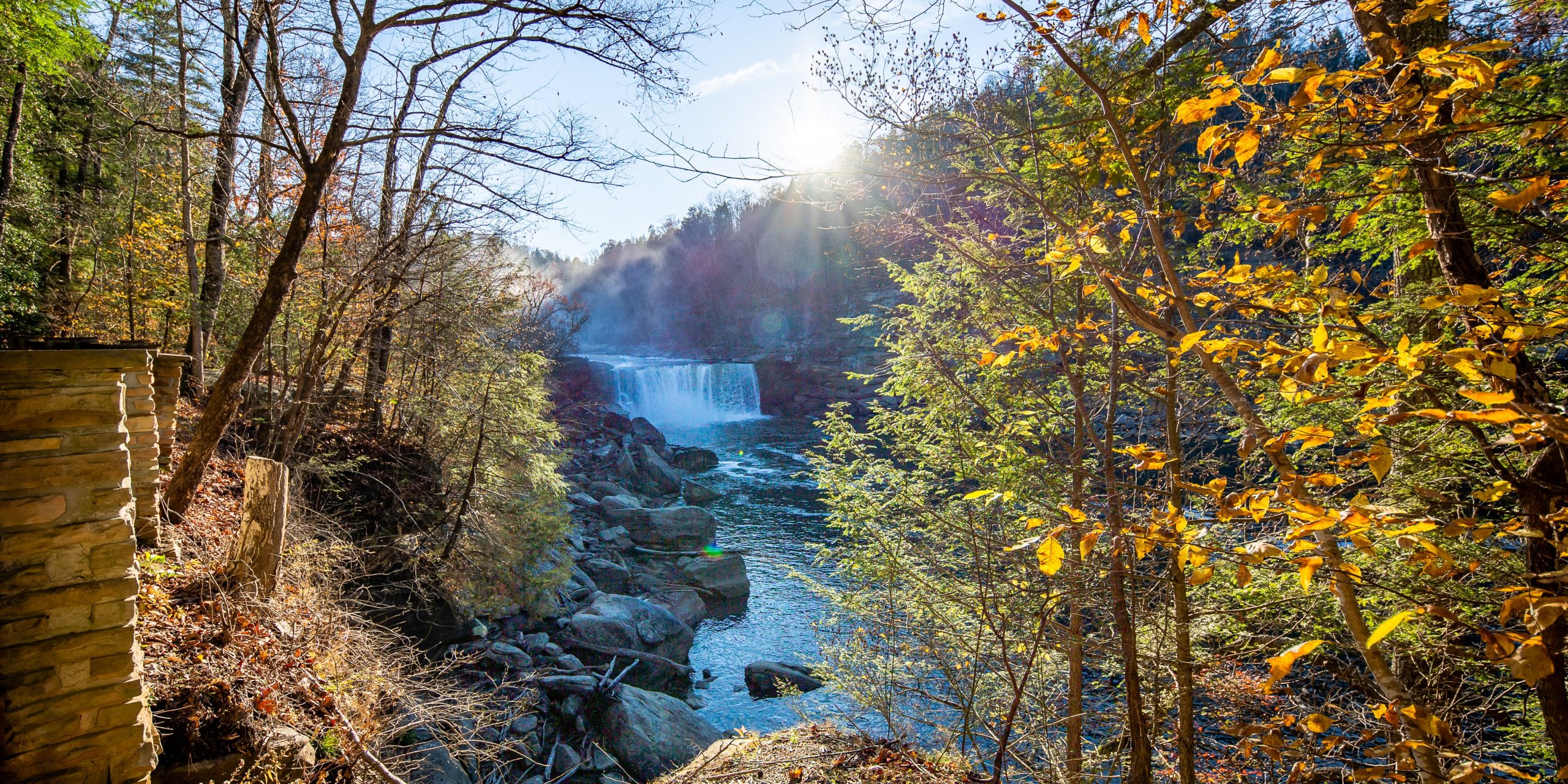
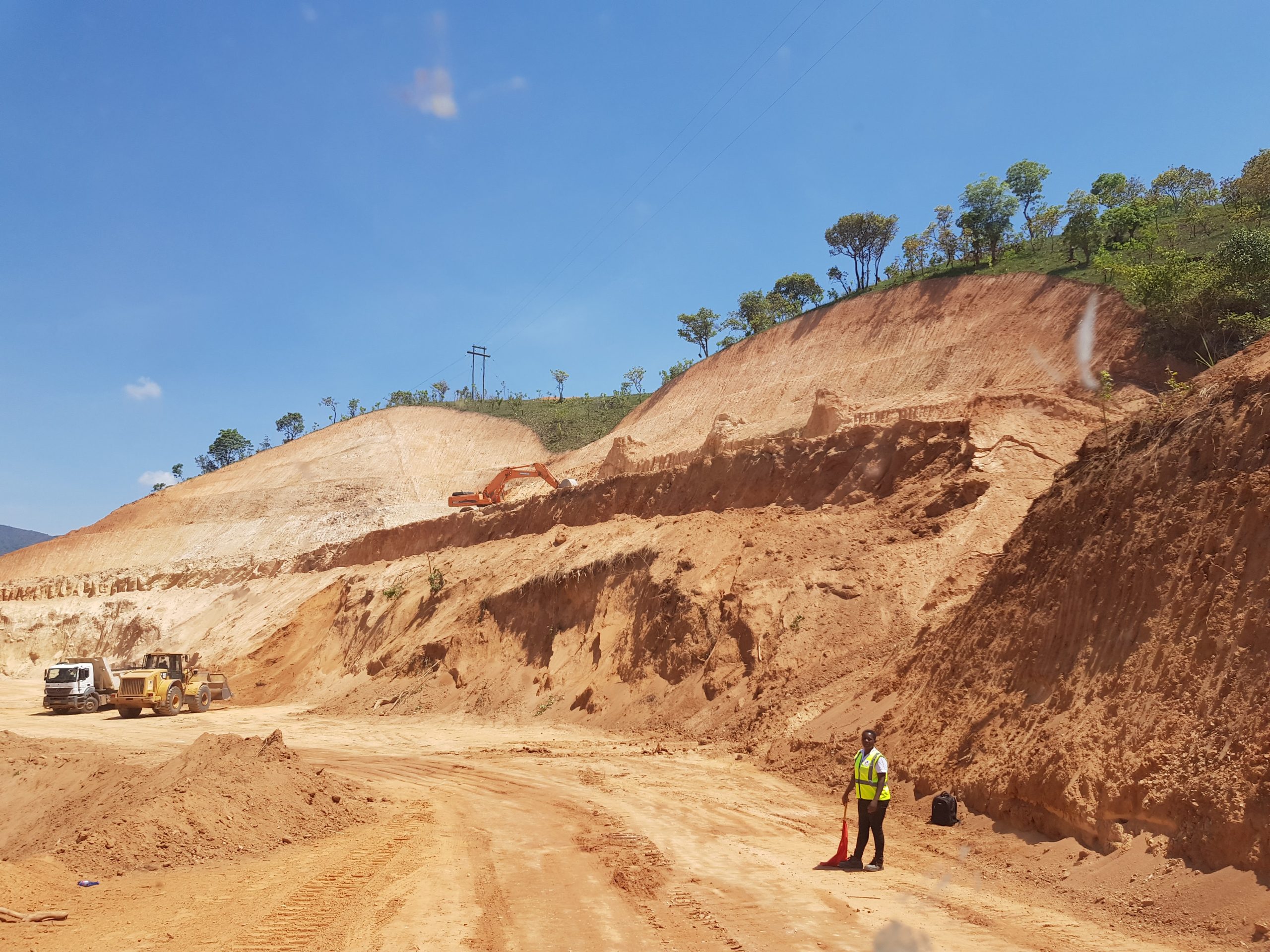
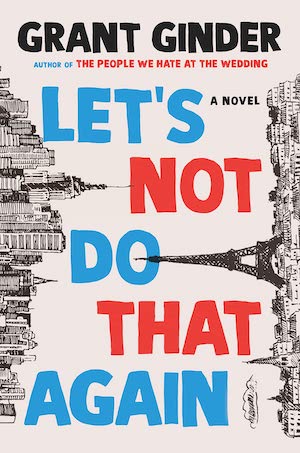
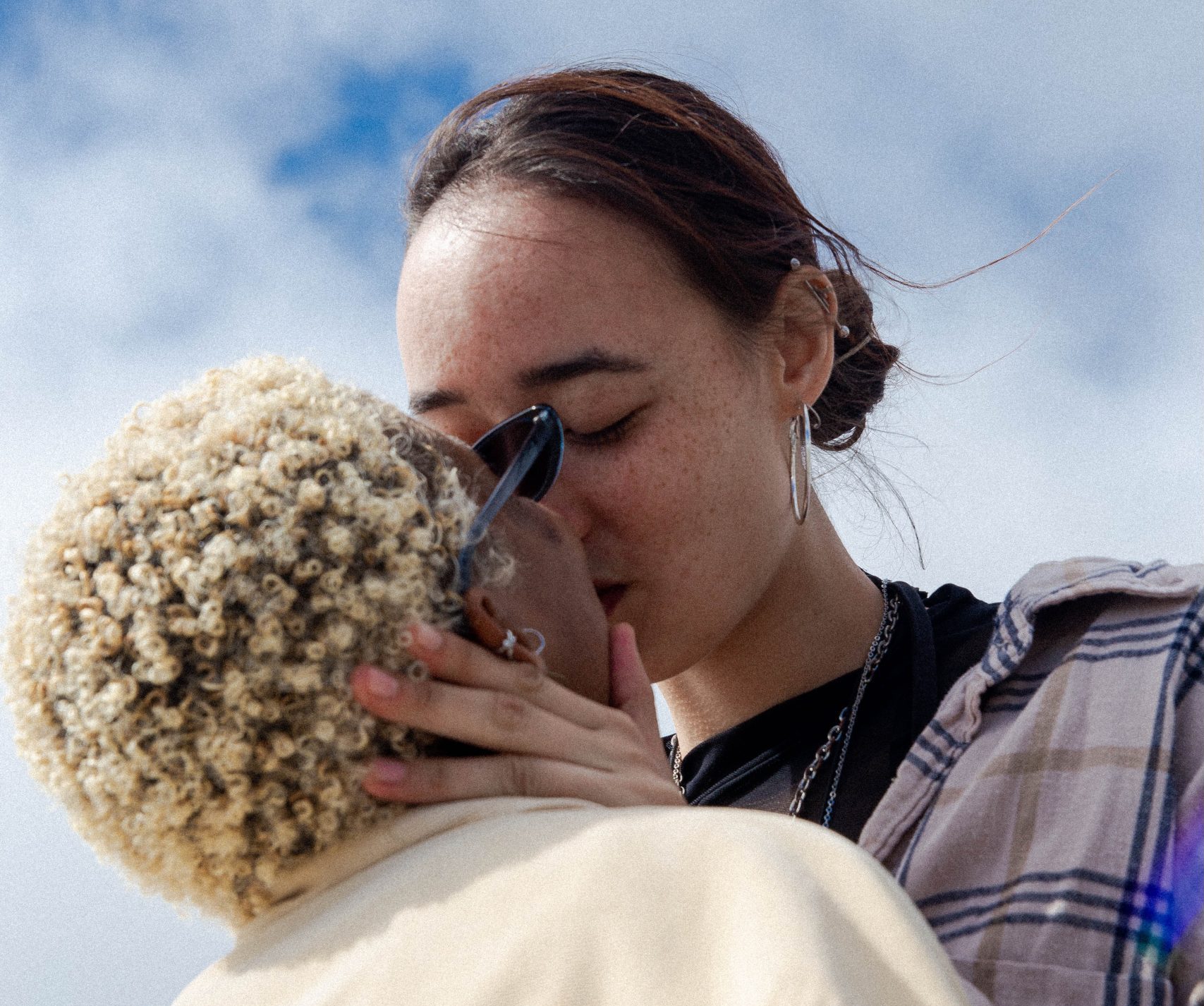
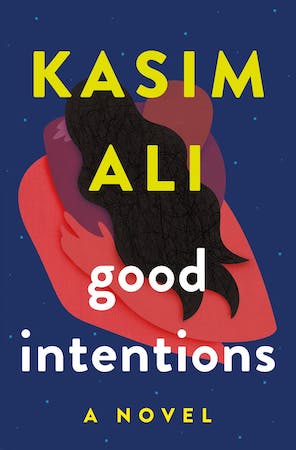
In thinking about this reading list, I considered writing about “overlooked” Kentucky writers. I realized, quickly, that this would be redundant. Even someone like Wendell Berry, who is well known in Southern literary circles, is far from a household name. To make any list of Kentucky writers is to call attention to a kind of “underground” literature. There are those who know, of course, that Wendell Berry is one of the 20th century’s finest writers, but if you ask someone in New York about him, they’re liable to say, “Who?” Likewise for Bobbie Ann Mason. The writers from Kentucky who have managed to transcend the limits of the label—Hunter S. Thompson, Barbara Kingsolver, Robert Penn Warren—have tended to turn, in their work, toward America at large, thereby avoiding the connotation of “regionalism.”
I thought a lot about this regionalism as I worked on my novel, Groundskeeping. At one point, the protagonist, Owen, is asked whether he’d like to be thought of as a Kentucky writer or an American writer. His answer is that Kentucky is America, that it’s microcosmic; its struggles and conflicts are America’s struggles and conflicts. Our country’s most antipodal figures, Abraham Lincoln and Jefferson Davis, were born in Kentucky, and the battles they fought then, both real and ideological, are still with us.
And so, my hope for this list is that readers will turn to the writers I’ve named, not just to learn about Kentucky, but to learn about America—to see our perennial strife reflected in art.
C.E. Morgan
C.E. Morgan is perhaps best known for her novel The Sport of Kings, an epic saga about family, historical trauma, and the beauty and danger of horse racing. But I first encountered her work eight years ago, when I read All the Living. It’s a spellbinding story about a young woman who goes to live with a man who’s inherited a remote tobacco farm in Kentucky. They must struggle not only against the elements, but to understand one another and their fierce, divergent desires. The language is archaic at times, its rhythms almost Biblical, but it never misses the mark, and brings to life the foothills of Appalachia with vivid clarity.
Frank X. Walker
We owe the term “Affrilachia” to Frank X. Walker, and his first poetry collection of the same name interrogates the meaning and the legacy of Black life in Appalachia. The themes of inheritance and history come up again and again in Walker’s poems, specifically the way we inherit narratives that turn out to be false. Two of his most powerful books, When Winter Comeand Turn Me Loose: The Unghosting of Medgar Evers, are retellings of historical narratives that challenge our assumptions and elevate forgotten voices. It’s this motivation—to challenge, to disclose the story beneath the official story—that characterizes Walker’s career. His poems are so important because they treat Kentucky—and by extension, America—as a complex, layered place, a place that can’t be reduced to a simple, univocal story.
Bobbie Ann Mason
It’s always been a mystery to me why Bobbie Ann Mason’s name is not listed alongside Raymond Carver’s and Ann Beattie’s in discussions of the 1980s’ short story renaissance. Her collections Shilohand Love Life are as good as anything the decade produced, and her novel, In Country, is in many ways the definitive story of America’s grief post-Vietnam. Thematically, she often wrote about the confrontation between rural America’s agrarian past and the rapidly metastasizing consumerism of the 1980s. As their culture and traditions disappear, Mason’s characters in small town western Kentucky must reexamine what they believe and how they define themselves. For a sampling of her work, including excerpts from her more recent novels, Patchwork, released in 2018 with an excellent introduction by George Saunders, is a good place to start.
bell hooks
Since her death last year, bell hooks’ work has enjoyed a much-deserved renewal of interest and appreciation. Like many of the writers in this list, the story of her career is a story of coming full circle. She left Kentucky as a teenager, pursued opportunities “out in the world,” and found herself longing to return later in life, to put down roots in the state where she was born. Her collection of essays, Belonging: a Culture of Place, traces this spiritual and artistic journey. All About Love: New Visions, reprinted in 2018, braids many of the wide-ranging interests and themes of her career into one beautiful, culminating text. It’s a book not just about love, but about division and power, and the possibilities for redemption.
Chris Offutt
I think of Chris Offutt as a story writer, first and foremost. Kentucky Straightand Out of the Woods were touchstones for me. The stories are rooted in the concept of home and what it means to belong. Many of his characters try to escape Kentucky, or dream of escape, but find themselves tethered, for better or worse, to the place where they were born. My Father the Pornographer, his memoir from 2017, is a funny, tender book about his father’s career as a writer of erotica. It has, like all of Offutt’s work, a deep generosity and a willingness to look past human foibles. But more than this, it’s a book about the irreducible mysteries of family life and the complicated meaning of home.
Silas House
In the past two decades, Silas House has written some of the finest contributions to Kentucky literature. His ear for dialogue, and for Kentucky’s unique patterns of speech, is unmatched, and his characters are always treated with tenderness and respect. There’s a lot of empathy in his work, but it’s never sentimental. In Southernmost, from 2018, he tells the story of a small town preacher who shelters two gay men in the wake of a flood and must face the judgment and ire of his congregation. It becomes a story about family, acceptance, and forgiveness—themes that run throughout House’s body of work. But it’s the notion of belonging, and what it means to belong to a place, that seems to preoccupy House more than anything. As far as themes go, I can think of none more central to the experience of living in Kentucky.
Crystal Wilkinson
Crystal Wilkinson was named Poet Laureate of Kentucky in 2021, and her collection Perfect Blackcame out the same year. It tells, in fragments, a heart wrenching coming-of-age story about Black girlhood. Her language is often elegiac, but precise, never lapsing into easy nostalgia, and she captures so well how growing up can be a magical, strange, and often frightening experience, especially for a Black girl in the South. One of the things I admire most about her writing is the attention paid to Kentucky’s natural landscapes – not as inert backdrops, but as real, living points of contact. Nature has the power to transform us in her work, to show us glimpses of the mystical embedded in the everyday.
Wendell Berry
No list of Kentucky writers could exclude Wendell Berry, who has written passionately—for more than half a century—about nature, agriculture, and the decline of rural communities in America. There are so many books by Berry I could recommend. The Unsettling of Americais probably his most important work—a fierce indictment of industrial agriculture and the powerful interests that have pillaged our earth, destroying local cultures in the process. But a more complete, and perhaps accessible, compendium of his essays can be found in The World-Ending Fire, which came out in 2017. As the title suggests, Berry has become a kind of prophet among ecologists and advocates for sustainable farming, and his writing has apocalyptic undertones which were not always obvious to me until I read his essays collected in this career-spanning anthology. His message, repeated again and again, is that we’ve lost our way, that there’s a better life available to us beyond consumption and waste, beyond the plunder of nature. It’s a message that transcends the borders of his home state of Kentucky and addresses the world at large. One can only hope that we take it to heart.
Just like we don’t choose who we love, we don’t choose the iconic blockbuster hits of our youth that go on to build up and break down our conceptions of love, relationships, and sexuality. I grew up in rural Texas, in a town so small the high school marching band played when the Home Depot opened. I was surrounded by people who thought they were, pretended to be, or actually were straight. My social calendar was filled with Young Life invites and pep rallies for our dismal football team. I was mainly raised by my closeted gay dad in a homophobic family and I wouldn’t come out myself until I was twenty-three and 2,000 miles away. I look forward to watching the current queer youth grow up with JoJo Siwa and Janelle Monáe to model all the different prefixes to the word “sexual” but for me, queer representation was practically nonexistent. I took what I could get, and that was Meg Ryan.
When people ask me about my sexuality, I say things like: “the friendship to relationship pipeline is big with me” and “I wasn’t interested at all until I read their writing” or “heard her voice” or “saw his passion for esoteric intramural sports” or one of those other million things that draws you to a person regardless of gender expression or initial sexual attraction. Press me further and I’ll ditch the platitudes and throw out words like pansexuality and demisexuality. They line up with my experience well enough.
In my world, physical or sexual attraction almost always comes after the getting-to-know-you phase.
When I tell you I’m pansexual, what I mean is that I don’t care if you identify as a man or a woman or somewhere in-between or beyond—if I’m attracted to you, I’m attracted to you. When I tell you I’m demisexual, I mean that I am seldom physically attracted to someone at first sight. In my world, physical or sexual attraction almost always comes after the getting-to-know-you phase, sometimes years after. Romance wasn’t built in a day. Enter NORA EPHRON.
A name that “sounds like a nasal spray,” a 1978 profile of Ephron declared. These days, it seems that clued-in queers are not meant to like Nora Ephron movies. I’m still waiting for someone to pop out of a dumpster and tell me I’m a bad queer, maybe throw a box set of The L Word in my face. We’re scared of Nora Ephron. There are entire articles written about being too afraid to rewatch Sleepless in Seattle. And it’s a reasonable fear—’90s rom-coms rarely age well and her films, in particular, take place in an almost dystopian world of privilege (full of “New Yorker-reading New Yorkers” wrote The Guardian’s Luke Walpole). But if you’re looking to interrogate the archetypal gender roles and straight white heterosexual cis-gendered bonanza that is every Ephron movie, I’m sure there’s an early 2000s Wesleyan graduate thesis out there for you—this just isn’t it. I won’t deny or excuse the obvious limitations of these movies (read: the invention of the “high-maintenance” woman) but I will wholeheartedly co-opt them for my own queer purposes.
The ‘fact’ of Sally’s attraction is dissociated from a drive for physical intimacy.
Let’s start with my favorite of the Ephron Triple Threat (Sleepless in Seattle, When Harry Met Sally and You’ve Got Mail): the timeless tale of friendship to romantic love, When Harry Met Sally. When Harry Met Sally came out in the summer of 1989 to lukewarm critical acclaim. The New York Times called it “amazingly hollow” and “the sitcom version of a Woody Allen film.” Those critics, however, soon ate their hats as the film came to be regarded as a (if not the) foundational text in the romantic comedy genre. When Harry Met Sally is structured around what Vanity Fair contributor Sonia Saraiya dubs an “inverted” romance. The movie spans twelve years of animosity and friendship until it finally settles into the evergreen promise of the genre — true love.
Physical attraction is addressed and dismissed throughout the film but the two leads have different styles when it comes to swatting away the subject. Harry is blunt from the beginning:
HARRY: You’re a very attractive person.
SALLY: Thank you.
HARRY: Amanda never said how attractive you were.
SALLY: Well maybe she doesn’t think I’m attractive.
HARRY: I don’t think it’s a matter of opinion, empirically you are attractive.
But ultimately the “fact” of Sally’s attraction is dissociated from a drive for physical intimacy: “You know you may be the first attractive woman I have not wanted to sleep with in my entire life,” Harry remarks with his characteristic polish. Sally, however, dodges the question of physical attraction altogether. She disdains Harry from the start. “You think he’s cute?” she quips to her friend, who says she finds him attractive. This is the inverted romance, summed up nicely in the film’s epilogue:
HARRY: The first time we met we hated each other.
SALLY: No, you didn’t hate me, I hated you. And the second time we met you didn’t
even remember me.
HARRY: I did too, I remembered you. The third time we met, we became friends.
SALLY: We were friends for a long time.
HARRY: And then we weren’t.
SALLY: And then we fell in love.
Physical and/or sexual attraction after years of emotional connection. What does it say about straight romance fantasies that one of the most iconic heteronormative romantic comedies of all time is an “inverted” romance? If it looks like a duck, swims like a duck, and quacks like a duck, it’s probably a pansexual love story about the beauty of demisexual romance.
Where When Harry Met Sally dabbles in the realm of physical attraction after emotional intimacy and love after emotional bond, Sleepless in Seattle dives straight in, altogether disregarding the myth of physical attraction as a precursor to intimacy and love. Meg Ryan is recast as Baltimore journalist Annie and Tom Hanks begins his Ephron career as the widowed father and architect Sam.
Sleepless is a story of falling in love. Not with come-hither eyes or love at first sight or even the sting of electricity as two hands brush by each other (“Magic,” as Annie’s mother describes it). It is the story of falling for words, voices, and sighs. Jokes and type-written letters, adolescent interventions, and the unfathomable, embarrassing reality of realizing you might love someone you’ve never met — physically. The film is self-conscious of this “abnormal” method of falling which is primarily elucidated through Annie’s dialogue. To her brother, she confides frantically: “I’m having all these fantasies about a man I’ve never met, who lives in Seattle.” To which he responds, of course, “It rains nine months of the year in Seattle.” Eventually, Annie does get a glimpse of Sam but importantly never comments on his physical appearance. Famously, the first time they truly meet (on top of the Empire State Building, no less) is the final scene in the movie. The leads are onscreen together for about two minutes. But by that point, we know and they know it too — true love.
There’s this amazing line early in Sleepless. The classic Cary Grant vehicle, An Affair to Remember, appears several times throughout the film and is the inspiration for the meeting at the Empire State Building. But before that, before the happy ending, Annie’s best friend (played by Rosie O’Donnell) turns to her pining friend and says, “You don’t want to be in love. You want to be in love in a movie.” She’s talking to me, too. But then I’m reminded of this tweet floating around gay twitter, something like rom-coms are like if straight people acted like lesbians. And I have to think Rosie would be inclined to agree with that one.
Ephron takes the earlier concepts of ‘inverted’ romance and loving someone you’ve never physically met and just absolutely goes to town.
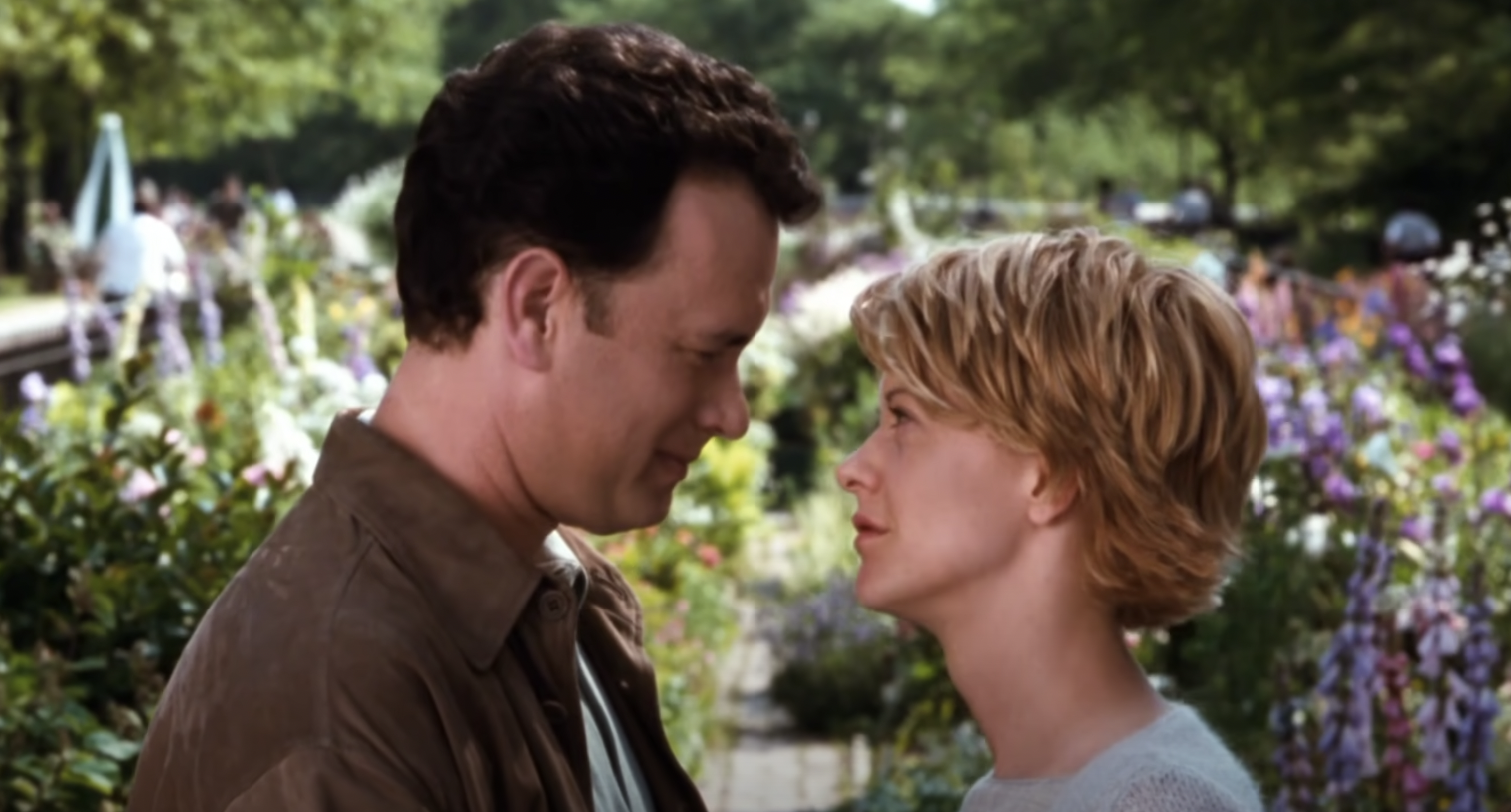
Five years after Sleepless in Seattle, Meg Ryan and Tom Hanks are back with late 90s haircuts to prove it. They reunite as Kathleen and Joe in You’ve Got Mail where Ephron takes the earlier concepts of “inverted” romance and loving someone you’ve never physically met and just absolutely goes to town. It’s 1998 now, so instead of Meg Ryan’s plucky typewritten letter we get dial-up internet, usernames like “Shopgirl” and incoming emails set to the tune of AOL’s not terribly timeless proclamation (and the movie’s namesake): “You’ve got mail!”
If we see these movies as a series, one building off of the other as Ephron refines and calcifies her audience-pleasing depictions of modern romance, You’ve Got Mail is the finale. Here we have two people who fall in love entirely (at least initially) over written communication. Ephron goes to great lengths to emphasize the nature of their romantic connection as something that is cerebral. At the same time that Kathleen and Joe are falling in love over AOL, they are feuding in real life. Of course, the film allows plenty of time for this feud to resolve so that by the time the truth of their identities is revealed, the revelation is that of a desire come true rather than the rude dream-shattering shock it may have been otherwise. The point being that this love, despite the parallel foil plot, is built from something other than physical attraction. Conveniently, of course, they are both extremely attractive people. In the script, Kathleen is described as “pretty and fresh as a spring day” while Joe is “a great-looking guy, full of charm and irony.” What did you expect? Again, this is a late 90s blockbuster we’re talking about.
It is almost impossible to feel out your attraction to someone based on a few photos and some cherry-picked one-liners.
There’s some analogy here to modern dating apps. But mainstream dating apps are sort of a wasteland for the casual demisexual. It’s like peddling around in the ocean searching with your toes for a sandbar that may or not be there. You end up just flopping around for a long time, searching for something solid. It is almost impossible to feel out your attraction to someone based on a few photos and some cherry-picked one-liners. So you text and text and text, waiting for something interesting to happen. Waiting for Meg Ryan in a sweater set to one day meet you at a cafe with a red rose and a copy of Pride & Prejudice because if that’s not gay, I just don’t know what is.
My dad, his husband, and I have a group chat called “Bitches.” (It used to be “bitches” but my dad got bored one day and capitalized all of his group chats.) My dad’s husband sent a photo of his car radio playing the Cranberries’ hit “Dreams.” “Watch out, you’re in a montage in a 90s movie,” I responded. A few days later I realized I was remembering a very specific montage in a 90s movie. At the beginning of You’ve Got Mail, Meg Ryan and Tom Hanks bounce to work, walking within blocks of each other yet blissfully obvious of the other’s true identity while Meg Ryan’s voice-over narrates their latest exchange. “Dreams” plays:
“And oh, my dreams It’s never quite as it seems ‘Cause you’re a dream to me”
I have found that in a small town in Texas, you can say you like You’ve Got Mail. You can’t always say you like like Parker Posey.
Queer storylines may not have been top of mind for Nora Ephron in the 90s. She had other things to worry about like making sure the first half of Sleepless didn’t have the color red in it. But she relinquished these stories into the world where they landed squarely in my queer hands. I have found that in a small town in Texas, you can say you like You’ve Got Mail. You can’t always say you like like Parker Posey. These movies brought me narratives that fit my experience in a format that felt safe for my environment at the time. I didn’t have the words “pansexual” or “demisexual” but I did have these characters performing attraction and desire in ways that felt familiar to me. I know now that these ways of existing in the world – from “inverted romances” to the intangible nature of pansexual attraction – are intrinsic to my queer identity. “Never quite as it seems” indeed.
So the next time you’re on a walk, I dare you: bring a pair of headphones and blast “Dreams” as you walk down the street. Stop and smell the deli flowers, chaotically replay lines of old love letters in your head, and imagine you’re Meg Ryan on her way to get her life smashed to pieces by the promise of true love. Feels pretty gay, right?
Outsiders often perceive truths invisible to the majority. They tend to observe the scene more carefully. Like newborns, they must learn how to fit into a new world.
For me, as with many immigrants, it is not always comfortable to be an outsider. After emigrating from The Bahamas—to the United States, India, Spain—the very idea of “home” has become elusive, forever divided: not there, not here. I relate to the Taiwanese film director, Ang Lee, who says “I’m a drifter and an outsider. There’s not one single environment I can totally belong to.” The Caribbean-English word for a person like me, is Nowherian—a person of no fixed abode.
In addition to being Other (as all immigrants are), being queer places me even further on the outside. Unlike many Black immigrants to the United States and Europe, my reasons for emigrating were not economic, nor was I a refugee. Being gay and “out” in The Bahamas means facing strong social and religious stigmas, the potential loss of a job, family, social status, and most of all, loss of dignity. Yet, having arrived in the gay-friendlier countries, I still find myself an outsider. Being queer means that even among fellow immigrants, I don’t belong. I am Other to the other Others. As both queer and an immigrant, I am doubly removed from the dominant culture. And yet, being a queer outsider is an odd kind of privilege. Poised at an even greater critical distance, our vantage point allows for a bird’s-eye perspective; for visions of novel possibilities—and even for possible novels.
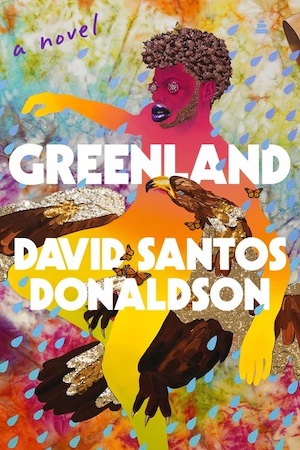
My debut novel, Greenland, is the story of Kip Starling, a young Black author writing a novel about the real-life love affair between E.M. Forster and Mohammed El Adl—in which Mohammed’s story collides with his own. Three of the main characters are queer immigrants struggling to find their own truths while navigating intimate relationships in their new homelands. Each crosses borders of class and race to understand the new territory—with all its burdens and possibilities.
These seven novels collectively give a wide perspective from the queer immigrant’s vantage point. Each has confirmed my own experience, as well as enlightened and inspired me to value this particular and, paradoxically, privileged perspective.
In this groundbreaking novel, Claude McKay—an icon of the Harlem Renaissance, and a Jamaican queer immigrant—fulfilled my fantasies of Marseille as a seedy but beautiful French port city teeming with a vibrant mix of native Francophones and African immigrants (both North and Sub-Saharan).
In Romance in Marseille, we follow Lafala, a Black African immigrant who stows away on a ship from Marseille bound to the United States. On the ship he is discovered, confined, and then tortured to the point of needing one leg amputated upon arrival in New York. With the luck of getting connected to a white lawyer, Lafala wins a lawsuit against the ship company for his torture. Lafala returns to Marseille with the money he’s awarded. He finds America—with its institutional racism and rampant capitalism—uninhabitable for a Black man. Once back in Marseille, Lafala re-enters the world of local immigrants—an array of colorful characters who work in and around the port. Among them are a lesbian couple (an Arabic and an African woman), a gay male couple, and even the protagonist seems open to bisexuality. Romance in Marseille, written in 1933 but not published until 2019 (initially “unpublishable” due to its queer content), is one of the very earliest novels to represent overtly queer people, and queer people of color. McKay’s conversational tone—often poetic, too—manages to entertain and delight while also being a searing commentary on racism, classism, and homophobia.
In this rollicking picaresque novel, Manrique’s protagonist, Santiago Martinez, is a young Colombian poet, navigating his way through the turbulent—and often hilarious—trials of being both gay and a newly-arrived immigrant in New York City in the 1980s. From a rural Colombian upbringing (where bestiality is presented as common place for boys’ sexual initiations), to the social world of the drug-dealing rich Colombian families and their literary politics in Queens, to the life a of a lone gay writer living in Times Square (along with its sex workers and their pimps), we fall in love with Santiago and his take on the new worlds he encounters. In Latin Moon in Manhattan, Manrique brilliantly pulls off a novel that is, at once, literary, social critique, comic, tragic, and heartwarming. Quite a feat.
This novel, set in turn-of-the-20th-century Jamaica, tells the most unusual queer immigrant story I’ve encountered. The protagonist, Lowe, is a Chinese immigrant to the island. Since women were prohibited from traveling alone, Lowe has disguised herself as a man to stow away on a Chinese ship bound for the Caribbean. In order to protect her identity, and for safety, she continues to live as a man in Jamaica. The ensuing action is an intriguing byzantine hall of mirrors. Lowe has children who never realize their father (Lowe) is actually their mother. She/he has lovers who are both male and female—but often present as different genders. And all along, Lowe faces being a triple outsider in the new homeland: Chinese among a Black majority, non-white in a British colonial power structure, and queer. Powell’s writing luxuriates with an unhurried musicality that reminds me of being in the tropics. This novel presents a multilayered look at what it means to be a permanent outsider, and how one survives, or even finds refuge, in such a state.
Salvation Army by Abdellah Taïa, translated by Frank Stock
Abdellah Taïa is a personal hero of mine. In 2006, at 33, he became the first openly gay Arab writer—and the only openly gay Moroccan writer. If you have any appreciation of the courage it takes to come out amidst the virulent homophobia in Taïa’s homeland (and by the time you finish this brutally honest autobiographical novel, you will), you’ll understand why Taïa should be considered a hero. If that were not enough, Taïa is also a writer of exquisite skill. His prose is deceptively simple, even seeming naïve. But he is a powerhouse of a stylist.
In Salvation Army—a work often called “autofiction”—Taïa pulls no punches. He shares the truths of growing up gay in Morocco; his early sexual encounters with older men; his lusting after his older brother; his calculated encounters with European men; and finally, the betrayals from European lovers upon migrating to Switzerland and France. This coming out and coming-of-age novel is an essential milestone in queer history. Taïa’s talent also makes it a powerful, unforgettable literary experience.
Neel Mukherjee may be one of the finest novelists of our day. With his second novel, The Lives of Others, critics compared him to Leo Tolstoy, because of the breadth and depth of his work.
A Life Apart, his first novel, tells the story of Ritwik Ghosh, a gay Bengali man who immigrates to England after the death of his mother. The theme of being orphaned from his family and his home run throughout the novel, both losses ladened with ambivalences. But this novel is not somber. The absurdity and comedy of life with its gritty (often disgusting) details are constantly at play. Mukherjee especially spares no details of Ritwik’s sex life—mostly “cottaging” in London’s public lavatories, or in the cars of anonymous men. But the novel is not pornographic either. The layers are increased by the novel-within-the-novel being written by Ritwik—a mirror to his own migration: the story of an older woman who has emigrated from England to live in India.
In London, Ritwik finds himself “at home” among other immigrants and outsiders. A Life Apart is as complex and layered as the reality of a queer immigrant. In other words, it provides the paradoxically privileged perspective—one capable of revealing some universal truths about the tragicomedy, and sometimes base sensuality, of being alive.
In Chinelo Okparanta’s debut novel, a coming-of-age lesbian story set during the Biafran war in Nigeria, the protagonist, Ijeoma, makes an unusual kind of migration. After her father is killed in the war, and her mother so traumatized she can no longer raise her daughter, Ijeoma is sent off to live with a family in the safety of Nnewi, a town to the south.
Ijeoma’s migration is not from one country to another, yet it is quite another reality into which she is thrust. When she meets a similarly war-displaced Hausa (Muslim) girl, (Ijeoma is Igbo and Christian), they begin a first romance that catapults them into a world of their own—a world they must keep secret since it is not only taboo but punishable by imprisonment or even death. Through the girls’ relationship and its evolution over many decades (being forced to part when discovered, reuniting, marrying men to stay safe), Okparanta gives us a detailed depiction of the myriad difficulties facing queer persons in Nigeria. It is a powerful illustration of what it is like to be an eternal outsider in your own home, forever an immigrant, never truly belonging.
In this widely acclaimed masterpiece, Ocean Vuong has written an autobiographical novel that is as gorgeous and yet brutal as its title suggests. The paradoxes are plentiful: the story is written as a letter to a mother who cannot read; and the narrator is bound by a love to mother who is also his abuser. “You’re a mother, Ma. You’re also a monster. But so am I.”
Vuong’s narrator, Little Dog, is the son of a biracial Vietnamese woman and an American G.I., born after the Vietnam War. After years of trauma in war-torn Saigon, Little Dog’s mother emigrates to the United States with her son and mother. They all move to Hartford, Connecticut, where they live on the fringes of society in poverty.
This novel is slim but dense—both linguistically and with ideas. Two dominant themes are: the complex relationships to mother and motherland (especially when both have been brutalizing and yet sustaining); and the ramifications of being a “monster,” in society’s eyes, and the subsequent tragedy of internalizing that idea (in this novel, both for mother and son). And yet, in a first adolescent sexual relationship with a white American boy—Trevor who lives with his alcoholic father in a trailer—Little Dog experiences moments of surprising tenderness and finds beauty, even in himself. Trevor eventually abandons the relationship, not wanting to be a “fag.” But with this unique story from a queer immigrant, we are left with a deeply human question: Can the beauty and freedom often experienced in youth ever be sustained? This is a book to savor.
It’s not just public catastrophe, like the HIV or COVID-19 pandemic, that drives us to write. A private catastrophe, one just in our own body, can do the same. In 1976, Susan Sontag sat dying or not dying, and she wrote. Sontag had cancer. She wrote about cancer in Illness as Metaphor. She wrote as she was herself ill. The big C. She wrote, “Today, in the popular imagination, cancer equals death.” She wrote, “As long as a disease is treated as an evil, invincible predator, not just a disease, most people with cancer will indeed be demoralized by learning what disease they have.”
Writing seems a reasonable reaction to the possibility of physical disintegration, to the threat of the annihilation of any version of herself not requiring a faith in the hereafter. Writing is forever. This is a human quality, one that becomes stronger as the end feels inevitable. Perhaps this is the writer’s reflexive response to trauma in the world around us or to trauma within our bodies. We don’t understand, and we are afraid, and we feel alone, and so we seek to explicate, if only to ourselves.
She did not write a journal. She did not write a diary. Publicly, she wrote an essay.
She never claimed her own cancer; she didn’t admit in this book that she was ill, facing her end. She could not write herself well. She could not write away her illness. She wrote away the place her illness gave her in society, a double illness in her mind. She could only cure the word cancer of its myths, which were as deadly as the disease itself. She wrote, “Fatal illness has always been viewed as a test of moral character.” She didn’t think she was being tested; she was just sick.
In 1979, Audre Lorde sat dying or not dying of cancer, and she wrote. She wrote for herself, private words. Her work announced itself as private in its very title, The Cancer Journals, when she shared those journals publicly. The stigma of disease, the pain of recovery, the fear, these forces can choke us into silence. She wrote, “I was going to die, if not sooner then later, whether or not I had ever spoken myself. My silences had not protected me. Your silence will not protect you.”
Lorde wrote against and into her pain, against and into her death, against and into her body. Lorde saw other women around her fighting the same disease, but longed for another Black body, a feminist body, a lesbian body, to pull her along. And so she bared her body, her illness, the possibility of her death, publicly. In 1979, breast cancer looked like it did to Sontag in 1976 and to my own grandmother in 1973. Lorde was Black, which made any illness look different, which made and still makes breast cancer more deadly, not because of the biology of race but because of racism.
Lorde saw other women around her fighting the same disease, but longed for another Black body, a feminist body, a lesbian body, to pull her along.
I know stories of my grandmother’s 1970s cancer from my mother watching her mother’s pain, from the matriarchal lineage of memory in my family. I know my grandmother’s almost death, even as her children were just beginning their adult lives. Major surgery, perhaps followed by chemo and/or radiation, or perhaps not.
Lorde was coerced into wearing a puff of lamb’s wool in her bra immediately following her surgery so that her missing breast wouldn’t be apparent to others. My grandmother had a silicone implant put in so that she would look like a “normal person” (her own words) in clothes. Lorde wrote, “I looked strange and uneven and peculiar to myself, but somehow, ever so much more myself, and therefore so much more acceptable, than I looked with that thing stuck inside my clothes. For even the most skilled prosthesis in the world could not undo that reality, or feel the way my breast had felt, and either I would love my body one-breasted now, or remain forever alien to myself.” When my grandmother’s implant burst inside her, the pain was worse than the surgery, worse than the cancer itself. Her daughters caught glimpses of her body rarely, in a mirror. I don’t know if her sons saw her body at all. I know this because her daughters, both, told me.
My fear of cancer, of the ultimate and forever annihilation, of the moment at which all feeling ceases, made me miss one fundamental truth of this particular disease. My research on cancer, how I turned it into a biological problem to be taken apart, to be solved, hid this from me. Or maybe I’m just such a man I couldn’t face the feelings staring me in my face. Cancer hurts. It just fucking hurts. Our bodies are not our own to control. After my grandmother died, I read Audre Lorde on her own cancer, her own almost death. She said what my grandma would not, what my grandma let pass in silence or only told to her daughters. Lorde sat dying or not dying from cancer and she wrote, “There were fixed pains, and moveable pains, deep pains and surface pains, strong pains and weak pains. There were stabs and throbs and burns, gripes and tickles and itches.” My grandmother told her daughters, “It is a pain of 10 out of 10 to lift my neck from the pillow. It is like having a 100 pound weight on me.” My grandmother asked me, “Why am I still alive?”
This level of intimacy and vulnerability models a new way of being in relation not just to writing, but to one another.
Lorde’s private writing showed me things I didn’t know about my own family. This is the power of private writing, of publishing journals, even while we’re living: this level of intimacy and vulnerability models a new way of being in relation not just to writing, but to one another. Our relationship with the text can change how we want to treat, and be treated by, other people, including our family. Sontag explained her choice not to include private writing, or even the details of her own identity as a cancer patient, later in another essay, this time on the metaphors of HIV: “Twelve years ago, when I became a cancer patient, what particularly enraged me and distracted me from my own terror and despair at my doctors’ gloomy prognosis was seeing how much the very reputation of this illness added to the suffering of those who have it.”
“The metaphors and myths,” she writes, “I was convinced, kill.”
She didn’t talk about her own cancer in her book. “I didn’t think it would be useful,” she said, “to tell yet one more story in the first person of how someone learned that she or he had cancer, wept, struggled, was comforted, suffered, took courage… though mine was also that story. A narrative, it seemed to me, would be less useful than an idea.”
But Sontag’s ideas came from her body. For me, as a reader, feeling with Lorde, and seeing the ideas that came from that feeling, changed my mind and body. As a reader, the journal showed me more. Sontag claimed that telling her cancer story would be narrative, common, something we’ve already seen, a story we already know. But I see it differently. It’s not just narrative; it’s embodied feeling. And it’s worth it to feel and think at once.
In her book Funeral Diva, Pamela Sneed writes of attending funerals of Black gay poets lost to HIV in the early 1990s, almost too many to count. But it wasn’t just Black gay men dying of AIDS, it was women, too, like “Pat Parker / The pioneering Black lesbian poet who hailed from San Francisco / [who] like Audre Lorde had died prematurely from cancer.” Parker died in 1989. Audre Lorde died in 1992, at only 58, of breast cancer. Queer Black lives lost from HIV, queer Black lives lost from cancer. A body is a body is a body; White Supremacy produces Black death. How many lives and words were robbed from us not by cancer or by HIV but by homophobia, by racism?
Sontag and Lorde: I cannot read one of these two books without immediately reaching for the other. They are siblings in my mind, twins whose differences seem so stark because the under- lying circumstances are—by definition—so similar. Two women had cancer and wrote it down. One woman wrote an essay, never naming the fact of her cancer. The other wrote a journal, naming it over and over.
And yet, when it comes to signifying illness, I see the vast majority of white writers citing Sontag alone, not even knowing that she has a sibling-book telling an equally essential story.
Scholar José Estaban Muñoz considered Pedro Zamora’s decision to live his private (as queer, Cuban, and HIV positive) life publicly on early reality TV, writing, “subjects like himself never have access to full privacy.” Lorde, a self-described Black, feminist, lesbian, understood that publicly writing the full extent of her private illness was a radical breaking of the public/private binary, a binary that for her—as a queer Black person—had always been a lie.
For Black people, the history of America is one without the possibility of a private life: what right does property have to privacy?
For queer people, as Muñoz writes, privacy is a recent and incomplete right. For Black people, the history of America is one without the possibility of a private life: what right does property have to privacy? Resistance to this dehumanization is a history of languages invented to remain whole as people and a white American public that either violently reacted to or appropriated these languages into the mainstream.
Lorde is, in her book, speaking for herself and on her own terms, sharing her life and world in exactly the ways she wants. She might not have had me as a reader in her mind as she wrote, but I am so immensely grateful that she shared her private life with me in ways that Sontag didn’t seem able to.
Sontag’s book looks exclusively outward, at the world of literature, of ideas. “A narrative, it seemed to me, would be less useful than an idea.” Private writing requires, in my thinking, an ethic and aesthetic of looking inside, of laying the body or life of the writer bare, of looking closely at the self, and claiming that self on the page. If you write it down, it never needs to make its way into public writing; if you don’t write it down, it will never have the option to. The rest is a question of revision, of editing, of choosing what to share. The vastness of life requires editing. You can’t live along- side me; you—the reader—have your own life to live. So what moments from my life birthed ideas? If I want to share boredom with my reader, what bored moments of my life should I focus on and write through? What moments distilled a feeling that meant something to me, or that I learned from?
Our ideas come from somewhere. Lorde’s famous notion that our silences will not protect us, quoted so often and almost always without naming The Cancer Journals as its source? This idea comes from the experience of being a Black lesbian breast cancer patient.
My ideas come from reading Sontag, reading Lorde, and living, and I need to show all that if I want to tell something like the truth.
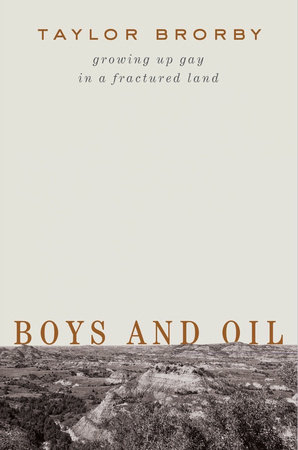
Growing up in Center, North Dakota—a town with 600 people, no stoplights, and boundless grasslands—Taylor Brorby quickly understood that the coal his family members mined kept him housed and fed even at the expense of his home. But this is all too often the way of the American West’s prairies, a place marked by its simultaneous beauty, grandeur, and harsh extremities. In his coming-of-age memoir Boys and Oil, Brorby perfectly captures the longing for a landscape he clung to as a child while also exploring how there is nowhere to hide when the world around you has been ravaged and scarred by our endless demand for energy.
In lyrical and biting prose, Brorby tells the story of his life up to this point—from growing up gay in the harshness of rural North Dakota to pursuing a larger life and becoming an environmental activist protesting at the Dakota Access Pipeline. He shows us moments of male aggression seeking tenderness and secret romances, as well as the heart of the Bakken oil boom and displays of great resistance. Bound at times by violence but more often by a hopefulness toward what’s possible, these narratives of identity and the environment interlace to create an unforgettable picture of the Great Plains and the people that call it home.
I spoke with Brorby about the intersections between the violence done upon his home and the own terror he’s faced as a gay man growing up in the prairie, advocating for the environment in communities economically tied to oil extraction, and his hopes for the future of literature about the American West.
Michael Welch: Boys and Oil tells the parallel stories about your experience growing up gay in rural North Dakota and your path toward become an environmental activist after seeing the ways oil drilling has fractured your home. How did you see these two threads intertwining and informing the other as you wrote?
Taylor Brorby: They’re so related in the sense that when you’re gay or queer, you don’t fit into what we standardly think of as “rural America.” In that culture, if you’re a boy who likes drawing or anything beyond the standard sort of Friday Night Lights fare, you have to find yourself some place else. For me, that was spending a lot of time out in nature. I didn’t come from a particularly bookish family, and if you were inside, it was sort of like you were going to get musty and die, so I would often be sent outside. My eye was trained on landscapes, and I spent a lot of time fishing and roaming the wheat fields and creeks.
When you’re gay or queer, you don’t fit into what we standardly think of as ‘rural America.’
I found that the prairie is such a diverse landscape, but the mental space of the people that tend to occupy the prairie is so monoculture. It’s so odd to me, because even though the prairie is more diverse than the Amazonian jungle because of all the grasses and interwovenness of it, we view it as “flyover country.” I viewed myself as a little diverse, but though it’s supported by the natural world, it’s not in the human imagination in this part of the world. Flyover country gets destroyed; it’s the place where we only have large fields of soybeans, wheat, and corn. Power plants there are the pride of rural America, and it’s true that it supplies necessary power to cities and suburbs, but the destruction of that diverse landscape seems to me directly related to the violence toward queer people in particular.
MW: Early in the book you describe a piece of coal you kept as a kid, saying:
“I’d hold the universe in the making, layer upon layer of Earth’s history—one part dinosaur bone, two parts bird feather, many parts mystery, compressed by millennia.”
I found that view both beautiful and kind of tragic, as it’s something so tied to the Earth that ultimately is used to harm it. How has this view shaped your writing and activism?
TB: You have to remember that coal is actually many lifeforms compressed into a dense form. It’s stunningly beautiful. To me it’s as precious as emeralds or rubies. The hard thing in the landscape of industrial capitalism is that we’re taught to consume things quickly and have shoddy products. I mean, I’m talking with you with my charging cord that’s only two years old and it’s only holding together with electric tape. But coal, like oil, is a precious thing. I don’t see us in a system yet where we can get off of these things, but they should be used sparingly, judiciously, and with reverence. We forget that whenever I start my Prius, that’s starting a fire. We’re all doing it every day when we get in our cars. For coal to be made even more precious, we must burn it to keep the lights on. But as a kid I always kind of knew that there was a deeper sense of time. Not only did coal come from my part of the world, I knew that dinosaurs roamed these lands. I mean, the printing press has barely been around for a half of a millennia, and we’re using a product that has taken thousands and millions of years for us to come and rip from the Earth and burn really quickly. Our sense of time is off, and to think about deep time helps put the times that we’re living in into scale. Coal is worth protecting just like queer children are worth protecting because of the slew of anti-queer legislation upon us. It’s clear as gin in my mind that these are directly from the same source of destruction.
MW: When we talk about environmentalism and the trauma that fracking inflicts, the pessimistic point of “well, this just is how people make their living” always comes up. While your own family’s livelihood came from fossil fuels, you’ve become a devoted environmental activist against projects such as the Dakota Access Pipeline. How do you respond to that tension—if it even is a tension at all?
Coal, like oil, is a precious thing. I don’t see us in a system yet where we can get off of these things, but they should be used sparingly, judiciously, and with reverence.
TB: I think my job is to put my family out of work in that version that I’ve inherited and turn it into something better and cleaner and more perennial. I grew up surrounded by people who bitched about the type of work they had to do, and I thought “that’s how low the bar is.” That’s why we frame things as jobs instead of careers, because jobs are shitty but careers have a longer shelf life. Jobs are like fracking, because it’s an extractive economy. Careers are much more like the prairie; they’re this intermingled relational way of existence. But you can’t have a career as a coal miner because it’s only been around in my part of the world for less than a century. There’s a finite amount of the work, and it brews cancer in the communities where it’s blossoming. None of that is a perk. What you hope is that you’ve been paid a decent enough wage that—God forbid—when cancer comes knocking on your door, you can weather the storm of that. So we need something better. Rural America deserves that. But instead of embracing the diversity of the land, we’ve diminished it to a one-time harvest.
To say that “I’ve grown up in coal country” is an insult because it’s reduced to its lowest common denominator. And that’s not life-honoring work. So for me it’s not tension but instead great sadness, because of course this is how people have to make their life because this is what capitalism does.
MW: It’s really interesting to hear you talk about how closely the human body and the land are tied, and it makes me think about your time in Dickinson in and around the Bakken oil fields where you frequently came across apparel and bumper stickers reading things like “Going Deep,” “Pumping Hard,” and “Frack That Hole.” What do you make of this co-opting of language about sexual violence against the body with what is a violence against the Earth itself?
TB: Well for one thing, North Dakota is always number one for binge drinking. People are very prideful from the part of the world I come from. I grew up with this myth that everyone told me about how people from across the country love the North Dakota work ethic. But having lived in many places across the country now, I can say that most people don’t even know where North Dakota is. It’s just a lie. People must know that their existence is hard scrabble, so they pump themselves full of liquor and cream and unhealthy food. And every bad idea the country has had has been tested in North Dakota. The genocide of Native American people. The reservation system. Hydraulics, the damming of the Missouri River, and the flooding of indigenous land because of that. Monoculture agriculture. Fracking. Homophobia. There are literally nuclear missiles underneath us because during the Cold War, farmers said they’d willingly give up their land so that we could aim missiles across the ice caps toward Russia. The former mascot of the University of North Dakota was the “Fighting Sioux” that all the white people loved, but when there were actual Sioux in 2016 demanding clean drinking water, everybody came out in their racist stripes. In these spaces, it’s very risky to be a woman, to be a person of color, to be queer. It tells you everything in those bumper stickers that this is how we view people and the Earth. They think the Earth is female, and they use and objectify females. It’s violent.
MW: That has me thinking about the ways violence in language becomes violence in action. You explore how you had to live fear as a gay man growing up in the rural West, and you also mention a few times Matthew Shephard, a gay University of Wyoming student who was killed near Laramie in 1998. How did you see these present dangers affect the way you viewed your home?
TB: Let me be clear: you cannot safely be who you want to be in Center, North Dakota come hell or high water. One of the things you have to learn growing up in rural America is how to code switch. It’s not lost on me that even at this late day in 2022 that if I put my hand on a man’s thigh for long enough in that town of 600 people, I probably wouldn’t be safe getting out of the county that night. And I think that’s actually in a majority of America, because this is just where we are, the narratives we tell, and the violence we allow.
Anyone who’s viewed as different can be a death sentence in the wrong place at the wrong time.
When I think about my Grandpa Hatzenbihler, the first and last thing you had to do when you walked into or out of his house was give him a hug. And I remember one time one of my male cousins didn’t give him a hug because he had a girlfriend with him, and my grandpa openly narrated it and berated him—which brought me great satisfaction! To me what that signaled was that love should be physical and tender, and also that men shouldn’t be hardened toward affection.
Speaking of Matthew Shephard, I once got ran down the hallway in Laramie, Wyoming when I was doing a reading because a guy hijacked my conversation with two women and told me “you can’t fucking talk right now.” This is real life still. It’s not really great to be gay if you’re in Great Falls, Montana or Rawlins, Wyoming. You have to learn how to be someone you’re not, because literally the bar is so low that it looks like survival. Anyone who’s viewed as different can be a death sentence in the wrong place at the wrong time.
MW: That makes a lot of sense, because it definitely seems that all the boys you grew up around were coding their affection to one another through shows of aggression. You even write that “nothing, after all, survives on the prairie being tender.” In an environment where tenderness is received with hostility, where did you find your first examples of what non-toxic love looks like?
TB: I had the great benefit of kind grandparents. I had the world’s greatest grandpas, and I continue to do all of my writing at the desk my Grandpa Brorby made for me when I was eight. He loved woodworking, and every summer he performed in the small town musical. He worked at the coal mines and yet loved joking with men and could fit in while still being creative and passionate about art.
To say that ‘I’ve grown up in coal country’ is an insult because it’s reduced to its lowest common denominator.
And my Grandpa Hatzenbihler was a character for the ages. My favorite thing we did was go pick berries together, and when I say that it sounds so queer in the absolute best way. He was this big, sausage and cream-fed man who was so big in my mind, and he’d lower branches that were too tall for me to reach. I also to this day still can’t touch worms, but my grandpa would never belittle me like other men in my life would. It was this sort of gentle thing, like we don’t even have to acknowledge it or make a comment like “you have to be tough because we live on the prairie.” I’d come to understand that beauty is important because my grandparents recognized it, whether it be sanding and staining a piece of myrtlewood or picking berries. In the part of the world I grew up with, those moments had to be private so that you could present yourself in a different way in public, but as I grew up, I learned that those things could be celebrated.
MW:What do you hope to see in narratives about the West and its land moving forward?
TB: I hope to see narratives where it isn’t just Westerners showing their soft underbellies and saying “take everything we have and we’ll be grateful,” because it’s a one-time harvest. I mean, I hope we see a cacophony of voices. We need stories of staying and understanding. And there are regions in the West that I’m not sure we are meant to have permanence in. I mean people in Phoenix will hate me for saying this, but having a green lawn in Phoenix is just like, oh my god. In Lake Mead just last week, one of the water intake systems that gives to Las Vegas is above the water mark. It’s not the future, we’re in it now. We need to have real conversations about the times we’re in and the amount of people a landscape can support.
What’s troublesome is that it’s always the vulnerable that’s going to be screwed by this. I’m hoping that we see voices rise up that challenge the narrative that says that a first line of defense is for people to write narratives where minority groups feel seen. Being seen is not enough. Being seen has to then launch a second wave of saying “yeah, we’re here and now that wave is rising to challenge and subvert things.” I wrote this book because I wanted it to exist and I wanted it to be on a bookshelf and to feel seen. Now I want queer people on the Great Plains not to overthrow in that cliched term, but rise up and say “we are active and deserve a place at the table.” Our perspective is not only valuable, it’s also the way we need to move forward. It’s the model for compassion and safety in a time where everything is on the line.
A boy has died in the crypt. (I’m told this is what they call the bottom of the mine, now: the crypt.) Benji, my surveyor, has come to tell me the news. As he stands before me, I notice that grime has crept into the folds of his face; that his overalls are stained with streaks of mud. The air conditioning in the trailer seems to unnerve him, bringing him to flinch as it cranks to life once more, a steady breeze causing his shirt to flap upon his chest.
“This is a problem,” I tell him.
Benji nods, knowingly.
“When can he be retrieved?”
“The others refuse to go. They are afraid.”
“Afraid?”
He shakes his head, as though disappointed in himself. “They believe there is something evil in the deposits. That the dead boy has been claimed by a monster. That it would be wrong to bring him back up.”
The air conditioner stops and the trailer falls silent.
“I see,” I say, for many of the boys who work in the gold mines are from the bush, and I know their beliefs to be primitive. Even my own father—who grew up under a hut in a village he came to disdain—took to such nonsense on occasion.
What must be understood is that the executives are to arrive later today. They come to tour the grounds periodically, and there cannot be a corpse rotting away, no matter if it is unreachable, no matter if they will never glimpse the horror themselves, for there are many horrors here, and all of them must be hidden on the day these men come.
“Take me to them,” I say. And Benji, his shoulders falling in acquiescence, opens the door to guide me out.
Few are familiar with the brightness of the sun after a morning spent underground: emerging from the deposits, the sudden prick of heat upon the skin building to a burn, as if in time it might torch you to cinder. I worked the mines when I was younger, under the supervision of my father, and so I know the sensation. Nowadays, I mostly see its power on the faces of the miners when I approach them. They work tirelessly, noiselessly, and yet their fatigue can be gleaned from the way their knees buckle when their wheelbarrows falter on a ridge of stone; in the slouch of their shoulders when the pickaxe grows too heavy on their back as they carry it to storage.
The mine shaft is before us, workers steadily flowing out of the elevator in their yellow hats and suspenders like bees exiting a hive. Benji has us turn towards the smelter—its innards, bright as lava, sending swirls of heat into the air as it is fed endless quantities of ore. The boys in question are lined up under the break canopy, awaiting my arrival. Sweat masks their faces, and I know the feeling of wanting to undress under the weight of the heat: to find the nearest source of water and jump. (There is a perversity here, for when their shifts end, they will find only the chill of the night; and by the time they take to their showers in the barracks, the shiver of the cold will be as unwanted as the sweat that came before it.)
There are individuals versed in retrieving bodies from the mine. It happens, perhaps twice a year, and it must be handled with great care and discretion. It is reported to the attorney for the company that backs us, a man I have never met and know only as a voice. It is of the utmost importance that the matter remains confidential–including the payment to the dead man’s next of kin. So in such an instance, when the boys who are trusted with the task are reticent to do it, the occasion has become delicate enough to require my full attention.
“Boys,” I say. Benji stands at my side, his arms tucked into the pouch of his overalls. I pace before them like their superior officer, telling the same story I have told so many other employees, perhaps these same ones. “Did you know that I worked these very mines when I was your age? That what you fear, I once feared? That my own brother died under rock-fall? I had only waved goodbye to him the very morning of the accident. If I had not been holed up with my father, learning how to manage the books, I would’ve died alongside him. In a sense, we, too, are brothers.” I point at them now. “Tethered by this place. But as I did my duty back then, you must now do yours.”
I stop, then. I face a boy who is staring at me with great resolve. The sun has broken his face into a leathered mask like that of a man twice his age. He is so dark that his skin matches the blacks of his eyes, and it is the yellow of his pupils, the ravages of some burgeoning disease, that shines brighter than the rest of him.
“The body is in the crypt,” he says. “Where the scientists go, we do not.”
I look to Benji, who nods in confirmation. “They say he went on a dare,” Benji tells me. “He fell from the path as he descended.”
So this is what they mean by the crypt. Scientists overtake a segment of the mine each winter, examining microbes in an astonishingly deep vein of earth. The dig goes so far underground that it often makes the news. The boys fear what might be found there. It is wholly irrational, for it is merely another cavity of dirt, but I now understand the problem.
“I need this taken care of quickly,” I say. “I will double your wage for the day.”
The boy who spoke stands tall now, defiantly taking the shirt laid upon his shoulder and wrapping it upon his head as he steps into the sunlight from beneath the canopy.
“The Grootslang lives in the crypt. We do not go there.”
“The Grootslang,” I say, under my breath. An elephantine being with a serpent’s tail. Bush folklore. More nonsense in a day far too full of it.
“It will make you see great horrors,” the boy says. “Torment you in ways you cannot imagine.”
I breathe in, and smell the tobacco on the boy’s breath–then there is the stench of the heat, of the day’s work, like hot piss emanating from his being. I turn to the mine elevator. On certain days, exhausting days when I stay long after the rest have gone home, I have eyed my brother there–waving, beckoning, as though I should come to him. The darkness coalesces then, absorbs the specter whole, and it is gone in an instant. Is this their fabled monster? A child’s fear of the dark?
“What is your name?” I ask the boy.
“Felix.”
“Felix,” I say. “We will speak again soon. And Benji.”
Benji turns.
“Make sure the men carry on working as if nothing has happened. As it must be. Appearances and what have you.”
My employer has called to inform me he is on his way, so I know to wait for him in my trailer. I sit there, twirling my pen, thinking. I had asked Benji if there were any others who would retrieve the body, but all those who might take on the job have formed a pact behind Felix; he is, Benji told me, a reformed criminal, a man who knows death and does not flinch from it. I will need his help. I have to reach him, somehow. Make him do what must be done.
There is then a knock at the door, and they do not wait for me to answer before coming in. There are six men in all, led by Ross Fletcher himself, the face of Tibor Holdings, the largest mining outfit in all of South Africa. He is wearing a polo and khakis. They are all wearing polos and khakis. After this meeting, Mr. Fletcher will take them to a golf course two hours away, an idyllic place of combed sand and green fields, and the other men, prospective investors, will tell their colleagues that their money will not be scrutinized once entrusted to such a conscious enterprise as Tibor Holdings.
“Nicholas!” Mr. Fletcher says, his hand springing towards my own.
“Sir,” I say.
His teeth are immense, his pectorals full, and when the air conditioner turns on once more his nipples appear with a sudden wakefulness.
“These men are from London, Nicholas. They’re eager to see the facility.”
The men, wary, hands behind their backs, nod to me. I nod back. Once this is done, Mr. Fletcher’s presentation begins, an exchange we have had so many times it’s taken on the air of theater.
“This photo, behind Nicholas, that is his father. He was a surveyor here, a wonderful worker . . .” The men are nodding again, eager to consume this narrative. I look back at the photo myself. These visits are the only time I do so. My father in his church suit, his bony jowls and thick lips, eyes beaded, like he cannot make out the photographer before him. The pride in the straightness of his back. Look at me, he used to say. A twig of a man. An African from the backcountry. Yet look at what I have done. Think of what you will do . . .
The men are staring in my direction. It is my turn to speak. “Yes,” I say. “I thought nothing would stop my father from working until that tragedy took place. The loss of my brother was too much to bear. He never stepped foot near the mines again.” I do not say that my father was a near-mute after the accident; that the few words he shared after it were put towards the task of getting me to quit my job right alongside him. That my refusal to do so was the greatest shame of his life behind the guilt of letting his firstborn die.
Mr. Fletcher steps forward, now. He is adjacent to my desk, and I allow him the spotlight.
I am an obedient and nothing more, a man paid to own the deaths of others.
“The least we could do was give Nicholas the chance of an education. In short order he returned and took us up on our offer to become the first African captain of a mine. He runs the entire production. His story is remarkable. I would say it’s one of Tibor Holdings’ proudest achievements.”
He does not say that though this is the only mine of its kind, it is a mere token of significance. I am an obedient and nothing more, a man paid to own the deaths of others.
His hand—a fleshy mound, soft and child-like—is on my desk. The thought of this slab of wood, this wood he owns and allows me to borrow, brings to mind my dinner table at home. My father had it made of African Teak, large enough to sit twelve, running the length of the dining room. He would sit at its head, relishing his authority, deciding who would give their thanks before the meal, declaring his need for another helping and expecting the dish to be placed before him. My brother and I would sit on opposite sides of him. Often, as my father told stories, or gave commands, I would rub the swirling knot of wood upon the tables’ underside, as though it might give me strength, some means to escape my father’s scrutiny, the next command I did not wish to answer to, the next piece of wisdom he would quiz me on in the days that followed. I feel for it, now, under my desk, that knot, knowing it is not there; knowing there is no reprieve from the moment that is upon me.
“We’d love to take a tour inside the mine,” Mr. Fletcher says. “Where are the hard hats, Nicholas?”
The room has grown so hot I feel the need to disrobe, to lie upon the floor and discover the coolness of each vinyl tile I might find there. “We are, unfortunately, conducting a safety review of the mines,” I say. “It is a full-scale, top-to-bottom effort. We can’t have any visitors inside.”
Mr. Fletcher’s gaze finds me, and I feel my insides flinch. His coolness, his ability to show no feeling, frightens me.
“Did you not know we were coming, Nicholas?”
“It is a terrible oversight, one for which I apologize. It will not happen again.”
He is still hiding his teeth, and soon begins to crack his knuckles despondently, some vague assertion of power.
“You will be spending the night at the Prince Grant Estate, no?” I say. “Why do you not take the tour tomorrow, when you come back this way? We will be ready, then.”
“The mine is quite a detour . . .” Mr. Fletcher eyes his guests, but they are silently shrugging, for this is vacation for them, and it would appear they don’t wish to take on any further responsibility than that of a guest. “. . . So be it. Tomorrow afternoon, then. We will work off our breakfast with a walk in the mines! What could be better?”
The men laugh at this so loudly the trailer shakes. There is absolutely no reason for them to laugh this loud. Mr. Fletcher squeezes my shoulder—as though pinching a child’s cheek—and leads them out. He does not look back at me—only waves with the back of his hand.
I arrive home at night, the moon bright in the cloudless sky. The veranda sits empty, the wooden shutters on the windows open just enough that I can glimpse movement inside. Although it is beautiful, I have always found this place strange–a white-washed, colonial home my father had built some distance from town, beside a marsh that holds no life. I have no idea why he enjoyed such desolation, but I am of the impression he treated this place as a sanctuary of sorts; a place he could rule when he had so little power to his name.
I exit the car, and at the sound of my daughter’s voice I can feel my shoulders fall limp, a pressure escaping me.
“Who is this intruder at my home?” I ask. “I’m calling the police!”
She runs wildly, wobbling to and fro so recklessly that I nearly break down in tears. It is remarkable that this can happen every day. That I might never grow tired of seeing her sprint towards me with no care except for the wish to feel my arms wrapped around her.
“It’s me, Lila,” she says, her face falling into the crook of my neck.
“Lila?” I act stupefied. “But my daughter could not grow so much in a single day.”
“I have!” she says.
A silhouette is before the door. The child’s nanny. Lila’s mother and I, although not divorced, live apart. She is a nurse in town with a condominium near the hospital. She works in marathon shifts that last days; she then takes Lila for extended periods, however long she wishes. When she brings her back I often mention that she looks fatigued, that she should come in and rest, and she tells me that I should feel the same sympathy for the mine workers who frequent her clinic with such exhaustion that they cannot keep their eyes open long enough to speak in full sentences. I then once more appreciate the distance that separates us.
Imani, the nanny, informs me that Lila finished her homework earlier in the evening. I see my daughter’s books spread out upon the dining room table and nod. The lights are on in the kitchen, in the living room, as I prefer it. There is no reason a house of such bounty, of such beauty, should be shrouded in darkness. I wish to see it all: the family portraits on the wall; the cabinet with my diploma; my father’s medal of service; the bowl of appreciation that Benji delivered to me after his promotion (inscribed as so: To a fine man, my boss); the long couch with fluffed pillows that I often fall into with a tumbler of whisky.
“Would you like some dinner?” Imani asks.
The smell of the spices waft through the air. She is often making some recipe from her home village, some obscure stew with game meat, the sort of offering you envision being stirred in a cauldron.
“What is it?” I ask. “I imagine you have made something . . . unique for us.”
“Not really, no,” she says. “Just tacos. Lila’s favorites. Would you like some?”
“That would be nice.” Lila is pulling on my pant leg. She asks to draw with me in the dining room while I eat. I tell her to go there. That I will join her soon. When she is off, I inform Imani that she may retire for the night when she has prepared my plate. I then excuse myself to go shower, to cleanse myself from the remnants of the day.
As I eat, I watch Lila draw beside me at the dinner table. I wipe the long curls of her hair from her line of sight, smile down upon her as she pokes her tongue from her mouth in concentration.
“Scrunchy, papa.”
I retrieve a scrunchy from the living room, attend to her hair, putting it up before returning to my meal. I love the child’s hands. I think of my father’s hands, as rough as the paws of a feral dog, calloused over as though boils festered at the root of his every finger. My own callouses have disappeared over time, and there appears to be some evolution, some law of good, that will afford my daughter’s hands to be forever soft: saved perhaps, for gesticulating orders to a boardroom full of executives; or for leading a classroom. She will not be dull like her father. She will not have his scars. The opportunities are endless, and it is the income from my work that has allowed this. There is a life of wrongs made right by this fact, and the nature of this truth is something her mother never understood.
I sit back in my chair, the very chair my father once claimed, and take in the sight he assigned himself when building our home–the marshland that faces out from the back of the property, a small bed of murky water that strings itself to the greater body of the Limraso River. It was a walk my father and I would take on occasion, prattling along the river-bed when it was dry, each footstep locked in a vice of mud, our hands playing against the surrounding reeds. If he was in a particularly good mood, our strolls would become a game of tag. I recall him running ahead of me, out of my line of sight, yet I could make out his head atop the grass, floating off in the distance, bobbing as he sprinted away. When he had reached a clearing, he would turn and point to me with a mocking laugh, and I would enter a sprint knowing he would turn and escape me once more.
There is a life of wrongs made right by this fact, and the nature of this truth is something her mother never understood.
The water is high, now, and the marsh appears as a pond might, the surface twinkling, spotted with the reflection of the stars, and it is no coincidence that my father has come to mind in this moment, for there is a figure–right there, if one looks closely— floating above the marsh, a sculpted void that cuts through the darkness, a shadow that presents itself in the shape of a human, lithe and decrepit, wavering, as though it might disintegrate in the wind.
The figure, as though sourcing life from the light of the moon, molds flesh, grows real, and before I can look away, lanky limbs have protruded from this shadow form—a single hand has risen up from its arm. It points to me before vanishing.
“Papa,” I hear my daughter say. “The picture is done.”
I do not look at my daughter, nor at the marsh, but rather I close my eyes, feel under the table, once more seeking the knot of wood from my youth; and when I cannot locate it, as though time has grooved the table’s contours smooth, I abruptly stand, so quickly my daughter drops her marker.
“It’s time for bed!” I say.
“Papa?”
“Come now,” I say.
“You didn’t look at the picture.”
“I will look as I tuck you in.”
Lila waits as I put my dishes in the sink, standing with her head cocked, the picture limp in her hand. I return, leading her upstairs, each step creaking as we ascend. I’m eager to remain calm, to think of anything beyond what I have witnessed. It is a saving grace that there is life in every corner of this home, pleading to be freed; the walls bleed memories, and they consume you at every turn. To take a step, to touch the handrail, to open a door, offers access to endless recollections: my father’s hand upon my backside as I run from punishment; a glimpse of my mother slipping into her bedroom to nap away the afternoon. Even as I enter Lila’s room, meeting the sweet smell of her candy-scented hairspray, the brightness of the walls, a child’s yellow, I cannot help but strip away the paint, the years, and envision the bedroom that was once mine and my brother’s.
I have her under the covers. Safe, her eyes finding my own as I look over the picture she’s set on her nightstand. There is nothing to it. Lila and her mother and I, holding hands, in the manner all children draw families, one row of stick figures. One row of smiles.
“Your hand,” Lila says.
It is trembling.
“Something has come over me,” I say. And once more, as my mind scrambles for relief, I am lost to the past, thinking only of the silence of my home, the strange quality I felt lying where Lila now lies when I was a teenage boy, of how peaceful it was with my brother dead and gone. Not smelling his odor from across the room. My contempt when he would rise for a glass of water, rousing me when I had only just fallen asleep. Such guilt knows no bounds. Even now, I have the urge to sell this place and start anew elsewhere, only for it to be undone by the shame once more, as I envision the home razed to rubble by its future buyer. This image transforms in my mind to that of my brother somewhere in the shaft of the mine, the walls closing in on him. Rock crushing him flat.
I put the picture down and rise up from the bed.
“Shall I leave the night light on?” I ask Lila.
“But you always tell me I must be brave, papa. That I should keep it off.”
I am peering out the window. There is nothing but darkness.
“We can make an exception,” I tell her.
“I’m brave,” she says.
“Of course you are,” I say, leaning down to kiss her forehead.
I turn off the nightlight and say goodnight without even waiting for her to do the same. I walk briskly to my room as though there is something to run from. And yet before I enter, a noise (could it be laughter?) filters out from Imani’s bedroom, opposite mine. I listen to muffled sounds, and before I can stop myself, I find that I am knocking on the door.
The noise quits. There is a shuffling, the sound of objects being moved. I have never done this before, knocked at such an hour, but something has unsettled me. The floor trembles with some unseen fragility, and the walls of the hallway narrow. Sweat has leaked down the span of my back and into the cleft of my behind. I am not well.
“Imani,” I say.
Her voice is nothing more than a peep. “Yes?”
“May I open the door?
The room is spotless, the bed made, the walls unadorned. Imani is on the floor, sitting before the trunk pressed against the front of the bed. The phone, its cord snaking from the wall, sits on her lap. I’m not surprised by the arrangement. I often used to eavesdrop on her conversations. That was until I heard her, once, speak of my marriage. Saying how I was to blame for the dissolution. The certainty in her voice as she gossiped still rings in my ears whenever we speak. Our distance from each other has been sealed ever since, and if it wasn’t for her closeness to Lila, she would no longer be here. But the question at hand feels urgent. It must be asked.
“I have interrupted something,” I say.
“It’s my mother,” she says, pointing to the phone with an index finger. “Is that okay? You told me it would be okay to call once I have finished—”
“It’s fine. Perfectly fine.”
Her eyes are doe-like. Her skin shines pure. She is a different person here, left alone in this space. A young woman that laughs and cries, I am sure; a young woman of great vibrancy, of complicated personality. A young woman I am now intruding on. And just as quickly as I have spotted this hidden person, I notice her eyes contract, her smile fade, and I realize I have worried her. Not by my presence, perhaps, but by what I might need. By the news I might bring.
“I only have a question,” I say. “I wish . . . to have your opinion. I have heard of a beast. A mythic beast. I believe they refer to it as The Grootslang. Do you believe in this thing?”
The phone erupts in noise, and Imani listens for a moment before lowering the volume, apologizing to me for the interruption. “It is nothing.” Her smile is false. “My mother has outbursts.”
I mutter something indescribable even to myself, some show of acknowledgement, realizing in a single instance how little I know of this girl. That she has an aged mother who screams on the phone; the strange quality in the spartan nakedness of her walls; her ability to hide in my own home and remain so quiet.
“You tend to your mother,” I tell her. “It is late. I should get some rest.” I go to leave, but she says, “Sir,” and I turn back.
“I do believe in it,” she says, with a confidence I find haunting. “But I believe in many similar things. It is only part of our tradition, to believe in the evil that is born from our wrongdoing. It is the mark of our people, no? My mother tells the story of when—”
“That’s all and well, Imani,” I say. “I believe I am too tired to hear such things right now. Perhaps save it for Lila, if it is not too frightening. I shouldn’t have asked.
The start of her answer was more ridiculous than my question. She looks down, then. Her legs, lanky and childlike, are sprawled in a knot beneath her. Her pajamas so large the tops curl over her hands, the bottoms fall over her feet. It is unbecoming, to be speaking to such a young woman in so serious a way. And the moment, if there was one, is gone.
“Goodnight, Imani.”
“Sir.”
I leave the light on in the hallway as I head to my bedroom. She will turn it off when she sees it’s been left on; by then, I hope, I’ll be long asleep.
A phone call wakes me. It is Benji. There is trouble, he says. I should arrive as early as I can. I dress in the same clothes I wore the day before to save time. I decline the oatmeal Imani offers me and leave home before Lila wakes.
It is Benji who sleeps in the barracks, overseeing the boys. I can count on one hand the times he has contacted me so early, and almost all of them involved the birth of one of his children or a matter of equal urgency. I can only imagine how much conflict he must deal with on his own, with two hundred young men in such close quarters, and yet not once has he asked me to be involved in a single quarrel.
The sun is only now rising, and one can glimpse it between the twisted forks of the leadwood trees, bright gasps of orange that follow me as I pass other cars. Soon I am on site. I wind down the path into the bowl of the mine, the descent silent enough to feel like I am floating in my car. As I park beside my trailer, Benji is already approaching me. I wait for him, his legs swishing slowly in his overalls, and as he draws near it is difficult to ignore what lies behind him: an endless stretch of yellow uniforms and yellow hard hats—my workers, standing listlessly as one, staring at me.
I step out to greet him. There are whiskers of a mustache, and this is perhaps more foreboding than the sight of the workers. The man is always clean shaven.
“Perhaps we should speak in my trailer,” I say.
Benji nods solemnly. “To keep up appearances, sir.”
“Yes, Benji. To keep up appearances.”
I offer him a bottle of water from the mini fridge. He declines, and is already speaking as I take a seat behind my desk.
“The worker who has died is beloved. Very well thought of. He has a wife, an infant, a little girl. The others are aghast that his family has not been notified. That he has been left in the crypt —”
“Do not call it a crypt,” I say. “It is a site of science. For heaven’s sake, they are returning in a few months to resume their work. I will not surrender to such language. You shouldn’t either.”
Even I realize how strange my outburst is. Benji blinks once, a cautionary measure, before continuing on. “The others cannot believe he has been left to rot in the site of science. The more religious believe a cleansing should take place in the mine. All of them believe the body must be retrieved immediately. They will not work unless it is done. It is a protest, sir. An organized protest.”
The words are supposed to strike fear in me, but I do not share his concern. In fact, I clap my hands together joyously at the development. “Benji!” I say. “This is good news! Let them do their ritual. Let them get the body. Bring the candles, chant the chants. Whatever must be done.” Already I am thinking of the coroner arriving in an hour’s time; that this will be taken care of by mid-morning, before Mr. Fletcher has even finished his brunch at the Prince George Estates. The mere thought has brought me to near ecstasy. “How quickly can they manage the job?”
Yet Benji merely slouches against the wall, his hands clenched in a ball against his chest. The pouches beneath his eyes are so evident, so full, that I wonder if there might exist a procedure to drain them. He appears defeated.
“They won’t do it themselves.” His voice is so low I can hardly hear him speak. “They believe you have made a bargain with The Grootslang. Brought it into existence.”
“Not this again.” I realize that it is pity that drives Benji’s words. That he is worried about my end, not his own. The task before me is clear. My charge as a leader. The call I must answer.
“I will go,” I tell him. “I will retrieve the body myself.”
There is a sense of resignation knowing what lays ahead of me, and I find that my voice is calm as I ask the other workers where I might find Felix. I smile at them politely. I even offer one man a handshake. And yet when my eyes fall upon Felix himself, under the break canopy, casually eating chips, I am quickly overcome by anger. His eyes, still black as night, are strangely tranquil, looking upon me with an empathy so perverse I have the urge to strike him.
“You are leading a protest,” I say. “I should have you fired. I should put your name on a list. Did you know there’s a list? A list of men who will not get hired at any mine. You have made quite the error.”
His eyes are fixed upon me, and his mouth seems to move independently from the rest of his face. He speaks in one tone, a single string of words, as though all of them, each connected to the one before, have been in a line in his mouth, awaiting my arrival to be unspooled.
“It is you that brought The Grootslang upon us. Your conscious lies with Peter, and so the beast calls your name.”
“Who on earth is Peter?” I ask.
He shakes his head, and I realize my mistake too late. “The boy,” he says. “The boy who died.”
“What do you want,” I ask. “If you were to go down with me—to get the body and have the men return to work—what would you ask for in return?”
There is nothing inside that might save me from what is to come.
He speaks so quickly it’s apparent the thought has been on his mind for some time, if not since the beginning of the whole ordeal. “I wish to be a surveyor. To be paid like a surveyor. To have Benji’s power.”
“I could use another. Consider it done.” My willingness to compromise takes him off guard. And for the first time his eyes wander from me, and I know they have landed upon the elevator at my back. His cheekbones, sharp enough to draw blood, suddenly twitch, and I wonder if it is from the fear that courses through him: the same fear now coursing through me.
“The sooner the better,” I say.
He takes the cap lamp at his side and places it upon his helmet. He mumbles what appears to be a prayer and then smiles wickedly.
“Whenever you are ready,” he says.
I turn my face toward the elevator. There is nothing inside that might save me from what is to come.
In the mine, it is always night. Illumination is key, and yet permanent installations of any lighting system are too burdensome a cost. A few lamps are made use of throughout the primary shaft, the active workings. The rest of the journey must be done by the cap-lamp alone, a light which shines forth seemingly from one’s own skull. A third eye, the miners call it. We do not need our lamps yet, but I know we will soon.
Felix is beside me, the folded stretcher tied to his back. The length of the mine runs before us. To stand still, to witness the thing in silence, creates such overwhelming awe that it exacts the dimensions of a living being. To feel the rock wall is to feel it throb, no different from a pounding heartbeat.
“This is it,” Felix says.
The elevator is thirty minutes to our rear. We have walked some ways. And now we see a small brow of the wall, a crevice expanded to the size of a small human, where the scientists made their own way.
We dip through the hole and find ourselves facing what feels to be an impenetrable shroud of darkness. There is no up or down. Before us is infinity, and there is a pull to it, like the tug of a rope around one’s chest. I quickly reach for my cap-lamp, which casts a bright beam down the length of nothingness before me.
I have surveyed the maps left by the scientists, and so I know to follow the path before us, turning once we reach the far wall. The descent is slow, a sloping trail like any other, and yet there is no end to it. Neither of us look to the side, where Peter has surely fallen, for it is clear the light will meet nothing but further darkness, more dust skittering in the air from the wall of the cave like insects in flight.
“Two miles,” I say.
Felix says nothing.
“There is nothing to fear,” I say. “It is a jaunt in the mine like any other. Like all that have come before this one.”
“But you are scared. More than I am.”
“Don’t be ridiculous,” I say. “I do not fear creatures that lurk at the bottom of a mine.”
“It is not just in the mine.” His voice is low and certain. “Is that what you have taken from the legend?”
“I do not know the legend. I do not wish to know the legend.”
“The beast is born from our wrongs. It is in you. Just as it is in me –”
“You must quit. I refuse to believe that you go on like this in your private life. That you speak to those close to you in the manner of an ominous sage, dispensing wisdom. I have no time for it.”
A moment, and then the boy speaks once more in a mutter. “You only ask me to stop because you believe my words are true.”
“Is that so?” I ask, holding a hand upon the wall, moisture dripping under my sleeve.
“It is as I said. It is in you, just as it is in me. And perhaps you fear that more than the rest. That we are no different from one another.”
My legs wobble with fatigue. The temperature rises like a warning. And quite suddenly there is water beneath our feet, puddles and ankle-deep mud, announcing the end of the descent. The bottom of the mine.
We stop at once. Total darkness does not speak to what lays beyond this point, what extends before us. It is an absence. A void. The senses, beyond the mud gripping my feet, have nothing to register. I am afloat, wholly and totally, and I only become bound by the touch of Felix, prodding the small of my back.
“We must backtrack to where he would’ve fallen,” he says.
“Just a moment to rest,” I say.
Felix is asking me if I am alright, and by then it is only my heartbeat I can hear, so loud that I wish to scream so I might mask the noise of my own terror.
But he is already moving. I cannot keep on with conversation. It is as though I am progressing through the cycles of sleep, inching towards a dream, a flurry of babble erupting from some crease of my brain that I cannot access on my own volition. I wish for it to stop but it will not. It is then that the sounds meet me: uproarious laughter, recognizable at once as the men from my trailer, Ross Fletcher’s investors, voices jarring enough to make me turn to seek out the source, and yet in the time it takes me to wheel around the noise has minimized itself to a piercing howl, and then nothing at all, and soon Felix is asking me if I am alright, and by then it is only my heartbeat I can hear, so loud that I wish to scream so I might mask the noise of my own terror.
“Are you okay?” Felix asks again.
“Perhaps we should turn back,” I say. There is a desire to sit down. To scrunch up into a ball and allow the mud to envelope me. To be done with this business. Yet as the thought passes, I hear Felix gasp, and I look up, quickly, to find the outline of an object standing before us.
“The scientist’s equipment,” Felix says.
It is a light of some sort, crane-like, perched against the tunnel face.
“Why would they leave it?” Felix asks.
“They are returning,” I tell him, but the sight has emboldened him, and he is running forward now.
“Felix, wait,” I say.
I do not move. I adjust my line of sight to keep him alight, and he is now upon an enormous box, sturdy as the shell of a turtle, unwieldy upon the ground.
“A generator,” he says. “They have left their generator.”
With my cap-lamp, I can make him out before me. Alone in the abyss. So far from me, yet in the great chasm of darkness that binds us, we are closer than any other humans might possibly manage in so vast a space. He has a cord in hand. I can feel dust coating my throat; my body seize. The sound of a motor, of a howling animal, blows over me like hot air. And in the time it takes to blink, the time it takes to gasp for a single breath, a crushing light illuminates the mine with the force of a detonation. There is Felix, his back to me. Behind him, a table of fathomless dimensions; a table of African teak that runs on endlessly into a darkness that supersedes the light. The table is crowded with men. It is only immediately behind Felix, at its head, that I spot my father facing me, his eyes wide with terror, his lips sewed shut, maggots squirming through the stitching, his finger pointing at my chest. Beside him is my brother, his cheeks broken into his skull, blood spilling from his forehead, beckoning me with fingers limp as noodles, flicking towards me pathetically. There are hundreds of miners behind them, standing stoically in their yellow vests. They are all staring, all silent, rotted and grotesque, and it is as though I am looking in a mirror reflecting itself, for I can see it go on so far that the illusion plays upon itself, and at the far end, a dot lost in a canvas of horrors, I spy a figure that could only be myself, for when I raise my hand up to cover my mouth, it is the only parcel of space that moves, and it is then that the light dies, and darkness consumes the crypt once more.
“The body,” he says. “It is right ahead of us.” I hear then, the sounds of him cranking the generator once more. Yet this is of no use. The crypt remains black.
“Did you not see it? Follow me, Nicholas. This way.”
I turn, then. And the voice I hear, demanding I return, calling me back, is only an echo by the time I have stopped running.
I am home before lunch. Felix has retrieved the body. The coroner, I know, is on his way. Full working production of the mine on offer before Ross Fletcher has arrived; just as I hoped.
And now there is a strange comfort to the sound of gravel crunching beneath my car, the sound that signals my return home, to this small plot of safety. Imani greets me at the front door. Her arms are crossed. A stalled and baking heat lingers in the air and I wipe my brow as I approach her.
“What is wrong?” she asks.
I say no words, but rather turn from her, sit on the steps of the veranda, looking off upon the road from which I have just arrived from.
“Tell me,” she says. “Something is the matter.”
“Please sit,” I say, tapping the tiles of the stairs. I cannot help but smell the scent of flowers that leaves her, so welcome after a day at the mines, and I wish to thank her, and yet of course I do not, knowing she could not even begin to understand how welcome her presence is after all that has come to pass.
“You have me worried.”
“What if nothing is wrong?” I ask. “What if things are finally right?”
“But you are here. You should be at work—”
“I have put Benji in charge. He is a fine man. And he has a new surveyor to lead. A very capable fellow. A brave man who has made right by me. They will work well together.”
The trees in the distance are countless, lifeless, so scorched by the sun as to be left without a single leaf. The expanse of dirt is the color of iron. It is endless. And yet from here there is a remarkable nature to the sight; the landscape in the distance converging with the bank of the sky, like two segments of a painting in contrast. A brilliant design. One that will repeat itself endlessly. And the reassurance I draw from this is so great that I feel my shoulders fall, my neck go slack, for the first time since exiting the mine.
“It is strange,” I say. “I don’t know when Lila comes home. How do I not know?”
“The bus pulls up in an hour,” Imani tells. She points, then. Down the road. “She will run from there. Just as she runs to you when you pull in.”
To think I have not once seen the sight of my daughter running from the road up ahead. I imagine it to be even greater than when she greets me after a long day at work, my little dust devil in motion, her lunch box bouncing against her side, her hair one bobbing mess. I know that I will wait right where I’m sitting until I witness it. There is nothing else I wish to lay my eyes upon. Nothing else that might save me from the terrors I have witnessed.
“I should continue cleaning,” Imani says.
At this, the phone inside begins to ring. I know instantly it is Ross Fletcher, ready for his tour. Wondering, no doubt, where I have wandered off to. I tell Imani to let it ring, repeating myself once more as it goes on, and on, until finally it is quiet once again.
“Stay here,” I then tell her. “Please. Sit. Just . . . just until the bus comes.”
She shifts beside me, the bracelet on her wrist clanging like a chime.
“Tell me,” I say. And the words feel random, yet ordained, and altogether urgent. “Tell me your story. Of this village you hail from. Of your family. To have someone under my roof I know so little of. It seems wrong, no?”
A wind pulls over us. Imani looks at me with uncertainty.
“My grandmother hails from a small village south of here. She’s told me many stories, yet most of them are tall tales, as you might put it, although I often wondered if they were true . . .” She does not know what she is allowed to say, and yet silence will not do. Not now. Not with what I have seen still playing in my head. “You really wish to know, sir?”
My heart is pounding. Yet somehow, so far from the mine, so far from my past, I am at peace.
“Imani, it would be an honor to hear them told,” I say. “Carry on. End only when you find it right to. You have my ear.”
Her voice overtakes the air; the wind. Finally, I am able to close my eyes and keep them so. And all that is left to do is listen.
The first thing Grant Ginder did when we met on Zoom was apologize for his dog being a freak. This was fortuitous, because I was interviewing him from home and my dog is also a freak; I was primed to preempt my dog’s barking once he finished snarfing the peanut butter out of his Kong. If you follow Ginder on social media, you’ll be familiar with his dog, Frankie, as well as his acerbic sense of humor.
A professor at New York University, Grant Ginder writes expansive novels about families, gay men, and settings spanning from Paris to New York, Grecian isles to Buffalo. Let’s Not Do That Again, Ginder’s fifth novel, tells the story of the Harrison family. Congresswoman Nancy Harrison–our Selina Meyer–is running for Senate, but when her daughter throws a bottle of champagne through an iconic brasserie in Paris, all hell breaks loose. Nancy sends her gay son Nick to find her, and he discovers that she’s fallen in with a right-wing troll. Part Veep, part The Other Two, the novel employs wicked humor to ruminate on the politics of family and modern New York while inspecting the precarity of democracy.
We spoke about his newest release, the intersections of the family and political drama with queer fiction, and the gay agenda: camp, Barbara Streisand, and beefcakes.
Michael Colbert: You’re one of my favorite follows on Twitter, and I remember once you tweeted that this book was conceived with a lot of wine in the pandemic. Does anything feel different to you with this novel as a pandemic book?
Grant Ginder: I started writing it before the pandemic happened, but I wrote and certainly edited most of it during the pandemic. So in that way, it was certainly borne of the last two years. And there was definitely a lot of wine involved. I think Hemingway said, “Write drunk and edit sober.” I tend to do it the other way around, which I’m sure is a problem, but usually after I write something, the only way I can stomach it the first time I read it is when I’ve had one or two glasses of wine, and this novel was certainly not an exception. But it became a sort of escape for me. This book is very much a New York novel, and I was able to write about this love-hate relationship I have with New York, mostly love though, as I couldn’t experience any of those things.
The idea itself was conceived probably around the second half of 2018 when we were in the middle of the Trump administration. I saw our democracy being threatened from left, right, and center, and I began asking myself this question, what sort of moral equivocations would a person make to protect this institution that’s currently being threatened?
MC: The comps for this book include Veep, Succession, and The Other Two. Reading, I felt they were so apt. What sorts of narratives are you interested in engaging with? Are TV and film particularly inspirational for your process?
GG: While I was asking that moral question, the thing I was thinking of was Henry James’s The Ambassadors, which gives us the character going to France to bring back a wayward American. That book is very, very different from mine–there’s not the political angle to it–but that premise of someone going to bring someone back, I was playing with that. I’m a very, very scene-driven writer. I get really bored with exposition. I love scenes, I love good dialogue, and I just like watching people. I’m a voracious TV watcher and probably watch too much TV–definitely watch too much TV–but to that end, good shows certainly affect how I think about scenes, how I think about narrative arcs playing out over the course of a book.
This book is very much a New York novel, and I was able to write about this love-hate relationship I have with New York.
MC: Place figures so prominently into your work. Passing through a neighborhood, Greta says it “seemedto me to be less of a place and more of a set, a stage where people were able to act out some imagined, New York-ified version of their lives. I used to know what my place was in that illusion, but now I felt apart from it.” You’ve talked about dispelling and unpacking the mythology of places. How do the mythologies of both New York and Paris help us understand the political realities of these cities today?
GG: Wow, what a good question. I think it’s actually much easier for me to answer that with regards to Paris. For whatever reason, Americans have this incredible mythology and these symbols of Paris–the Arc de Triomphe, the Eiffel tower, the Louvre–but the politics of that place are incredibly complicated. While Macron won the election in April, Marine Le Pen had a stronger showing than she had five years ago, and that’s terrifying, the fact that her fascist politics seem to be increasing in popularity. The beauty of the place with the ugliness of its politics–that tension is fascinating to me, particularly in a place like Paris. With The People We Hate at the Wedding, I wrote a lot about British class. I’d gone to some tony English weddings and I always thought it was absolutely hilarious that these people who were so prim and proper would get absolutely obliterated and shit-faced and would just be vomiting in hedges, and I was in a funny way appalled by it: that tension, right, between how we as outsiders imagine a place and the reality of it.
When it comes to New York I think it’s a little harder for me to answer that question because I’m living in the reality of it. Every day for the past fifteen years, I have been sussing all that out. When you live in New York long enough, I think you understand the complications of the place, which is why you both love and hate it.
MC: There’s a question hovering over the book about how long is too long to live in New York–when do you leave?
GG: That is certainly a question that Nick is dealing with and by extension me. I don’t imagine I’m going to be leaving New York anytime soon, they’re probably going to be carrying me out of here in an urn, but it is a question that over a decade of living here, you start to ask yourself. Hello to All That! is Nick’s musicalbased on Joan Didion’s, “Goodbye to All That,” which is an essay about leaving New York that I absolutely love. This is a line that I ultimately cut from the book, but Joan also came back. Joan left but Joan also came back, and I think that says something about the city’s draw.
MC: You spoke about clash in our ideas about a place, and it seems like, at the core of the Joan Didion musical is such a clash. You’ve said you landed on Didion, so famously unsentimental, as the subject of a musical precisely because they are so characteristically sentimental. I’m curious about that as it sits within the family drama; you have these really powerful, willful characters. What relationship do you see between the Harrisons and sentimentality?
Perhaps growing as a writer for me will mean allowing there to be a little more room for sentimentality.
GG: That’s a good question. I often resist sentimentality. I think that there are moments where it pokes through a little bit. It’s difficult to write family novels without a little bit of sentimentality coming through, but I resist it. I heard someone describe my novel as vicious the other day, and I think, for better or worse, I shield myself from sentimentality with viciousness and willfulness in my characters. Perhaps too much so. I bristle at sentimentality. I don’t necessarily know if sentimentality is the worst thing in the world, like life is occasionally sentimental. It’s why we cry at certain commercials. It’s why my husband and I celebrated last week being together for ten years, and he said something really sweet and I started crying. I guess perhaps growing as a writer for me will mean allowing there to be a little more room for sentimentality. I think right now I save one tiny scene at the very end for a little bit of sentimentality, and then, that’s it. As I’ve experimented more and more with humor as a way of dealing with uncomfortable truths, as a way into those moments of sentimentality that make me as a person and as a writer incredibly uncomfortable, I open myself up a little bit more to those kernels of truth or emotion or honesty and not just relying on the mean joke, which I think is the easy thing to do, but then I think humor becomes clever as opposed to meaningful.
MC: I thought the humor here was so dialed in: gay dating, wellness culture, brunch. I felt so called out when the narrator says the crossword doesn’t count before Thursday.
GG: Tuesday, please, oh my god, I can’t do it on Thursday or Friday.
MC: I stop after Wednesday.
GG: That’s when I stop too. Thursday always has the trick. There’s always some fucking gimmick that I can never get, and I always feel bad.
MC: The humor holds up such a clear mirror to society, and I notice this both in your writing and your tweets. How have you developed that sensibility?
GG: I think I hide behind humor a lot. I think that it provides a safe way occasionally of approaching difficult topics. I also really like the weirdness of life, and I think that life, particularly in New York, is really fucking weird. You’re always seeing and hearing the weirdest fucking things. I really like documenting those things, be it a weird conversation you’re overhearing in the coffee shop, or, I don’t know, you go to an exercise class that you pay an extortionate amount of money for and you’re like, I just paid 45 dollars to be screamed at. What is this life? This is crazy. I think that that often translates as humor, or my way of processing those things is to consider the weirdness of it all. When you have a war raging in Ukraine, and a pandemic, and American democracy falling apart, if I wasn’t able to find humor–and none of those things are funny–in a weird dog on the street or my weird dog, I think I would absolutely go crazy.
MC: This is also a political novel. You’ve said you were looking for fun when you were writing, but the book is obviously in contract with real political circumstances. How did you balance the fun with reaching near our political realities?
GG: That was probably one of the most difficult parts of the book: how do you construct a world that is adjacent and at times dips into the real world with real characters–Chuck Schumer, the Cuomo brothers–without making it just so, so tied to the current moment that the book isn’t allowed to age. This became especially difficult when we were in the full swing of the pandemic because I was suddenly in a situation in the summer of 2020 whereby I had started writing a book that was representative of one world and that world had totally shifted. How do you account for that in a novel? Do you try to predict what’s going to happen and have your book reflect these new realities? That feels like a fool’s errand because we have no idea what’s going to happen. So it was really about not writing a novel that was inextricably tied to absolute political realities but rather adjacent to that so you could dip in and out to give people touchpoints. Who would Nancy be interacting with in Washington? Those people are there, but it is not exactly a replica of Washington right now.
MC: This book is a family and political drama. With Nick’s storyline of gay dating, do you have any hopes for this book as a queer novel?
There’s no question in my mind that I will ever write a straight male protagonist ever again. Those storylines to write don’t particularly interest me.
GG:The People We Hate at the Wedding was the first time I wrote an openly gay character dealing with really gay things–I mean there’s a very messy drugged out gay threesome in that book. It was the first time that I started writing about queer issues. I wrote it after getting my MFA. I’d spent four years writing this other book that was long and historical fiction and I thought was very MFA-ey and then we didn’t sell it. I took a break from it, and I was like, you know what, I just want to write something fun and fucking gay, and so I did. It was like a boulder had been lifted off my chest. It was the first thing that was funny that I’d written. I was like, “This is what I’m fucking supposed to be writing. This feels true to me.” After that, I was like I’m just gonna write about gay people and tough broads. There was no question in my mind ever that Nick was going to be straight. And there’s no question in my mind that I will ever write a straight male protagonist ever again. Those storylines to write don’t particularly interest me.
And so for Nick, I look at him–and I mean this in the best way possible–I look at him as an inevitability: those are the kinds of characters I’m writing now. Gay men who are dealing with the bullshit of living in New York in your thirties. What does it mean to date in New York in your thirties; what does it mean just living in New York in your thirties? I’m hoping that people will be able to come to that character and see a little bit of themselves in terms of the bullshit he’s going through, the dating that he’s going through. Before I met my husband, I went on tons of bad dates in New York. I mean tons. That list of people that he dates, I dated a lot of those people. I hope that he, in the same way that I hope all marginalized characters in literature become inevitabilities–I hope the same thing for Nick, in the same way for Will in the character in Honestly, We Meant Well, and Paul…they’re just inevitable.
MC: Thinking about the humor, Nick’s story, this narrative of mothers and their gay sons, the whole book to me feels very queer.
GG: Nancy is listening to Barbara Streisand. This book is camp.
MC: Yes, camp!
GG: When I was writing it, that was something I always had in mind, knowing where the book was eventually going and knowing what Greta was going to be doing. For that to even work, the book has to constantly be operating at an eleven, at this sort of absurd level for us to be on board when that happens. It’s funny, I very rarely look at Goodreads but occasionally I do, and the other day I saw a comment that was like, “The ending of this book was so unplausible, it was so unrealistic.” And I’m like, obviously it was unrealistic! This does not exist, this is not of the real world, you have someone writing a musical about Joan Didion, for Christ’s sake. I think the book is particularly suited to gay readers who are familiar with camp style.
MC: Are there things that are particularly exciting to you with fiction right now?
I really like creating limitations for myself. You have to write this figuratively with one hand behind your back, now go do it and see what happens.
GG: Right now, this novel that I’m working on is entirely in the first person, set in the ‘90s in Laguna Beach where I grew up in the ‘90s, and it follows this teenager, it’s still very much a family book, the characters and people in his family are very prominent. Let’s Not Do That Again was such an expansive novel that I’m excited by telling a more intimate story. I always really like playing with form. I’m a huge structure nerd. With this, I wanted to have five acts. It’s a classic dramatic structure–how can I play with a classic dramatic structure? This next book I’m working on plays with structure as well as with perspective. Writing the Greta section in LNDTA, which I think weirdly is my favorite section, unlocked an interest in me. I’m excited by the challenges of writing in first person. I really like creating limitations for myself. You have to write this figuratively with one hand behind your back, now go do it and see what happens. I’m excited by that.
MC: I saw that the working title is Beefcake. I’m so excited to read this when it comes out.
GG: When I was a teenager, maybe thirteen, we had AOL, and I would download on our family computer pictures of shirtless men, and I don’t know how I knew the word but the only word I knew to describe hot shirtless men was beefcake. And so I downloaded all these pictures of men without shirts on working on cars, these very softcore erotic pictures of men under waterfalls. They all went into the downloads folder, and my dad one day–I have wonderful parents–asked me, “Who do you think’s been downloading all these pictures of beefcakes on the computer?” because clearly he saw them, they were labeled beefcake 1-5 in the downloads folder. And clearly he knew it was me, but in a moment of panic, I told him that I thought it was my mom, and so I threw my mom under the bus, and my dad was like, sure it was mom. That story itself is not part of the book, but the term beefcake, it’s very much about a gay teenager coming to terms with his sexuality in some ways, so I was like, I have to pay homage to that term that played a part in my life.
MC: I have an unfortunately similar story.
GG: I think a lot of us do. Hearing a lot of these similar stories from my queer friends, I was like oh, yeah okay I need to write this.
What makes stories about interracial relationships so intriguing? Well, maybe it might be the fact that, not that long ago, marriage between people of two different races was illegal in America. Even today, they’re still not that common: 10% of all marriages in the US are interracial, and 7% for the UK, where I live. What is it that keeps us from pursuing them? A myriad of reasons, I imagine: societal, cultural, familial.
It’s why I wrote Good Intentions, to explore an interracial relationship between a Pakistani Muslim man and a Black Muslim woman in the U.K. My novel begins when Nur meets Yasmina at university. They fall in love, with the speed of youth, and begin to commit to one another. But when Yasmina invites Nur into the entirety of her world, introducing him to her family, Nur holds back. He refuses to tell his family about her, because he believes his parents won’t accept her because she is Black.
Unlike all the other relationships I had seen, presented on page or in film and TV, I wanted to remove whiteness from the equation. What does an interracial relationship look like when neither person is white? How does that play out? What specificities does that relationship have that we haven’t been privy to? I wanted, too, to write about Muslims that moved through the world like I did, to write about South Asians in a way that I’d never really seen before.
What follows is a list of books I have read and enjoyed that have interracial romances. Some of them include white people, some do not.
Zadie Smith’s debut novel is also the first Zadie Smith I read, albeit many years after it was first published. In it, we meet Archie as he attempts to process his wife leaving him. By chance, he encounters Clara, a meeting of difference. Archie is old, Clare is not. Clara is Black, Archie is not. So begins their story, which takes place over decades, charting generational gaps, exploring societal expectations, and interrogating the very idea of family itself. Reading White Teeth was the beginning of my journey into reading books that were about people who looked like me, lived like me. It is this book that gave me the permission I sorely needed to write the stories I desperately wanted to read.
Brandon Taylor’s sentences can feel like fire on skin. His dialogue is piercing, his character work insightful. His debut novel follows Wallace, a gay Black PhD student learning how to be in his homogenous Midwestern campus. Taylor paints an intimate portrait of his relationship with Miller, a white classmate, of their push-and-pull, never quite knowing what they are to each other.
I first came across Bryan Washington through his short story collection, Lot. Memorial reads like that collection: intimate, piercingly so.
The novel follows Benson, a Black man in a relationship with Mike, who is Japanese American. Mike returns to Japan to see his dying father just as Mike’s mother has arrived at their apartment in Houston. This could have become a cringe-worthy comedy, but Washington turns it into a beautiful and evocative exploration of modern-day relationships.
Celeste Ng never fails to make me sob. I spent a Sunday afternoon lying in bed, sunbeams pushing their way through the blinds on the windows, crying at the end.
Ng is an expert in relationships, concisely exploring them in impossible depths given that neither of her books break over 400 pages. The catalyst for the novel is the disappearance of Lydia, a beloved teenager living in a small-town in 1970s Ohio. A big theme of the book is race: the father, James, is Chinese, and the mother, Marilyn, is white. This not only affects their children, how they see themselves and how the world sees them, but also the parents themselves, and Ng writes about the complexities beautifully.
Monica Ali starts by introducing the main conceit: there is a South Asian woman, Yasmin, and her lover, a white man by the name of Joe—they are to be married, their families meeting for the first time. Love Marriage looks on the surface to be a comedic meet-the-in-laws story about the clashing of cultures, but hidden within is a mediation on identity, race, and desire in post-Brexit London.
Leilani’s writing is sharp, as is her wit. Her characters piercing and real. More than that, she is funny, a much harder feat to pull off than all those other things. Edie is a 23-year old Black woman, in a situationship with an older white man. She soon finds herself living with him, his wife, and their adopted Black daughter.
Booker-prize winner Girl Woman Other is a tour de force. The novel is a brilliant exploration of today’s Britain through a cast of Black women that force you to accept their depth. These Black women are in all kinds of relationships, with men, with women, with themselves. These tight vignettes are intimate and intense, coming together in a vivid ending. A worthy winner.
Paul Mendez’s Rainbow Milk is a book written in two halves. The first of a young boy leaving the repressiveness of his industrial hometown to find himself in London. In the second, that same young boy turned a man has found something, even if it’s not entirely what he thought he might be. Now in a relationship with a white man, he is trying to understand what it means, to him and to the wider world, to exist in a Black body.
Kiley Reid does the hard thing: she writes about race with humor without ever losing herself in caricature or stereotype. The dynamics between the characters are luscious, filled in with such detail in tight prose. The dialogue sings on the page.
Emira is Black, the couple she babysits for is white. When she takes the child to the supermarket and is accused of kidnapping the baby, so begins the plot. The mother, a feminist blogger called Alix, tries to make things right. She fails. Emira begins to date a white man, who has a history of his own. Things come together only to fall apart to be brought back together again.
Astrology is having a moment, thanks to the phenomenon of Astro Poets, Chani Nicholas, and Jeanna Kadlec. Some of us use it to understand ourselves and our habits, or to make sense of other people and who we might be compatible with. We can look to the stars for the optimal timing for life changes or simply find entertainment in reading about our crushes’ tendencies. Whether we fully believe in its validity or not, it can arguably be a fun distraction—especially when it’s combined with social media. (Hello, memes!)
Emily Forrest, the mastermind behind @Exalted, a popular astrology Instagram account, isn’t sure she believes in astrology anymore. She spends the little money she makes “lying to people online” on lap dances from women. But when she does a reading for Beau Rubidoux, whose chart reveals all his planets are in the signs they’re exalted in, she’s convinced he could be the love of her life. She stalks his Instagram account and begins following him around Los Angeles.
After 48-year-old Dawn Webster is dumped by her girlfriend in Riverside, she’s forced to return to waiting tables. She tips back cheap champagne and scrolls through @Exalted, searching for validation about who she is. After noticing her son’s biological father on the street one day, she becomes determined to track him down.
Told from both Emily and Dawn’s points of view, Anna Dorn’s novelExaltedis a fun, fast paced, and hilarious examination of the projection of love that deals with astrology, social media, and the illusion of perfection.
Rachel León: I apologize if it’s corny to ask, but I’m wondering: what’s your sign?
Anna Dorn: I’m a Virgo. What’s yours?
RL: Gemini. Dawn is a Leo and Emily is a Scorpio. How did you decide their signs?
AD: I go through phases of romanticizing certain signs and demonizing others. I had a phase of romanticizing Gemini and Scorpios. While I was writing this book, I related to Scorpios, and felt like I understood them, so I wanted to play a Scorpio for a while. And with Dawn being a Leo? She was really into her hair, very proud, and had rage issues when it involved loved ones, so Leo made sense.
RL: Dawn and Emily often use their signs’ traits as an excuse for their bad behavior. Do you think astrology is popular because it offers us an explanation for who we are, while justifying our asshole tendencies?
AD: It can be an excuse to hide behind your bad behavior, but it can also be a way to boost your self-esteem. It gives people a reason to love themselves. Virgo isn’t a cool sign, and I was embarrassed about it for a while, but then I found out I was a Leo rising. I started to like myself more, even though nothing about me changed.
Another reason I think people are into astrology is because life is random, and it gives a framework for understanding people and imposing order onto a chaotic world. I use it that way. Since I wrote the book, I’ve been on a journey to think about astrology less. But I find myself explaining people’s behavior based on their birth chart, which obviously that’s not the reason they’re acting that way—or maybe it is, I don’t know—but it’s a way to impose a system for understanding people when there isn’t one.
RL: I relate to that because I also had a bad relationship with my sun sign due to how it’s perceived and once I learned my rising sign I felt different about myself.
AD: Geminis are demonized, but I don’t get it. I love the signs that other people hate—Geminis, Scorpios, Aquarians, Leos. I think people are mean about these signs because they’re threatened by them. It’s like how a book doesn’t get like a bad review unless it’s extremely popular. Nobody’s going to write a mean review about a book that’s mediocre and nobody read. It has to reach a level of fame for somebody to touch it, and I feel it’s like that with the signs. The reason those signs are attacked and demonized is because they’re kind of threatening. Like Scorpios can see everything and nobody really wants to be seen.
Emily and I have really different feelings on the signs. There’s a lot of Libra hate in the book, but I love Libras. And I don’t like Aries, but Aries are exalted, so I had to pretend. That was the hardest part of the book to inhabit a character that glorifies Aries.
RL: Emily makes astrology memes and believes they’re popular because they give people an outlet for their rage, allowing us to hate without feeling like bad people. I found that insight really fascinating since often the things that go viral tend to have a negative or mean streak to them. Do you think that’s the trick to virality—something that allows us to feel morally superior?
Astrology can be an excuse to hide behind your bad behavior, but it can also be a way to boost your self-esteem. It gives people a reason to love themselves.
AD: I wish I knew the trick to virality. I tried to be Instagram-famous many times. I’ve finally given up, but I once had an astrology meme account and even a Kendall Jenner fan account. I’ve attempted to make memes, but I’m not good at it. Maybe that’s partially why I did this character—to live vicariously through her.
Actually, a friend of mine had a subletter who was a meme maker for a famous astrology account and didn’t believe in astrology. She said astrology memes were the easiest to make and it was an easy way to get followers. She never really left her room and would smoke weed all day. I only met her once, but hearing about her sparked the whole novel.
RL: What about the endless scrolling? Research has shown decreasing our social media usage can have a positive effect on our mental health and yet it’s tough to disconnect.
AD: Scrolling feels like one of my more harmless vices but maybe I’m deluded. I mostly look at photos of lizards. Emily doesn’t take Instagram seriously at all; she just sees it as a vehicle to make a living. Dawn just uses it to post pictures of herself in turquoise bathing suits and look for memes about Leos. I don’t think I’m trying to say anything too serious about mental health and technology in my writing. I think I’m just trying to reflect the fact that we’re all living mostly online. I don’t doubt the research regarding social media and its negative impact on mental health, but I’m not sure I could or would try to say anything in that arena that hasn’t already been said. I genuinely love the internet. I’ll spend hours looking at photos of Kate Moss modeling for Prada in the ’90s or rainforest tree frogs and it feels amazing, and maybe it’s not healthy, but I feel like it’s healthier than binge drinking or eating processed foods or getting plastic surgery? I think the characters I write about would have the same issues without the internet. The internet probably just heightens them, the way the internet heightens everything.
RL: Let’s talk about the word “queer.” Dawn hates the word and Prue in Vagablonde also didn’t like it, so I wanted to hear your own feelings on the word and having your work labeled that way.
AD: I used to identify as “queer” because I had serious relationships with men in my early 20s, and then I had a serious relationship with a woman, and didn’t want to trivialize my earlier relationships I’d had by saying I was a lesbian. It felt like saying my past relationships were a sham, and they weren’t—I really was in love—and I thought “queer” was able to fit my experience. It also has ties to academia, which spoke to me in my 20s. And now, eight years later, I’m definitely a lesbian.
People are into astrology because life is random, and it gives a framework for understanding people and imposing order onto a chaotic world.
When I wrote the first draft Vagablonde, I identified as queer and the queer parts in the book were sincere. And in the editing process, I started to make fun of it because at that point I thought “queer” was an obnoxious way to identify. I don’t have the best association with the term. I’m obsessed with lesbian erasure and I think the over-abundance of the word “queer” is a form of lesbian erasure. There’s this trend of creating the illusion that of having a non-conforming sexuality when all evidence points to heterosexuality. I recognize some people have legitimate fluid sexuality because I think my sexuality has been fluid—as are my opinions on the word “queer.”
RL: Speaking of Vagablonde, there are characters that overlap in both your novels. The novels are entirely separate and readers don’t need to read one to enjoy the other, but it’s pretty delightful for those who do. I’d love to hear about your decision to let some of the characters appear in both novels.
AD: I don’t like him so much now, but Bret Easton Ellis was a big influence for me when I started writing because his books are cinematic and take place in Southern California and felt hip in a way a lot of books didn’t. He has these overlapping characters like Patrick Bateman and Clay. Alison Poole is actually a character from one of Jay McInerney’s novels. I like that idea of not writing a series, but still creating a world. Actually, fun fact: I wrote an entire novel from the perspective of Wyatt Walcott, who is in Vagablonde. That was the first book I wrote and it didn’t sell. When I was writing Vagablonde, I was thinking it would be cool to put her in. Beau in Exalted is also in Vagablonde.
RL: Emily is enamored by his chart and essentially decides Beau is perfect. It seems like social media can play a role in the projection of perfection.
I think the over-abundance of the word ‘queer’ is a form of lesbian erasure. There’s this trend of creating the illusion that of having a non-conforming sexuality when all evidence points to heterosexuality.
AD: Yeah,I’m interested in the way that the internet speeds up everything. Pre-internet, those narratives we’re creating would happen six months into knowing somebody, but they’re now happening before even meeting because you have all this digital communication. I was interested in Emily creating an entire narrative about a person that’s completely false. Originally, the other perspective wasn’t Dawn, it was Beau to show how everything Emily thought about him was completely untrue. But my agent said I’m not good at writing straight men.
RL: Emily says she likes how astrology transcends gender, class, and race, allowing us to “skip the bullshit and dive right into the mess of the human condition.” On the flip side, social media is pretty much about tidying up the human condition, or at least not showing things as they actually are. I thought we could wrap up by talking about the convergence of social media and astrology.
AD: I think they’re well matched because the astrological descriptions are so vague, you can pick and choose and create a narrative to your liking. Like me finding out I’m a Leo rising—I’m able to have a new perception of myself that’s probably totally fake. It glosses over the nuances of a person by glomming onto these adjectives.
I want to distinguish the astrology that I’m writing about in the book and the astrology of a legitimate astrologer who really understands the planets. But internet astrology is well-suited to memes and creating a particular suited to your liking or demonizing other people. If you have an ex who’s a Sagittarius, you can find a million memes like how awful Sagittarians are, or if you have a crush who’s a Pisces, you can find a million memes saying how great Pisces are. So it actually kind of goes hand-in-hand.
In thrillers of the past, if queer characters were mentioned at all, they were usually delegated to victims or villains. But in the last few years, mainstream publishers have finally let LGBTQIA+ authors have a voice in the thriller genre, with queer main characters in uniquely queer, bone-chilling situations.
In my own thriller, So Happy for You, Robin is a queer academic who reluctantly agrees to be the maid of honor for her best friend, Ellie, who’d kill for the perfect wedding—literally. It highlights the absurdity of the wedding industrial complex and the intricacies of female friendship between someone who’s queer and someone’s who’s cishet.
When I started writing So Happy for You, I was so grateful there were recent queer thrillers I could turn to for research, and since writing the book I’ve been happy to read even more. The following list isn’t made up of all thrillers, technically—some are more mystery or crime reads—but they’re all guaranteed to keep you up at night!
My elevator pitch for this one is usually “gay boys who wanna do a murder together.” SOLD, right? But more specifically, it’s about Paul and Julian, who meet as college freshman in 1970s Pittsburgh and are drawn to each other, first as intellectual equals, then as something more. In an effort to deepen and sustain their bond, they hatch a violent plan to carry out together. You’ll be violently turning the pages to find out if they go through with it—the novel is both exquisitely plotted and exquisitely written.
When I first started reading this, I wondered why Alam was writing about a white, cishet family on vacation in a swanky Airbnb in Long Island. Bo-ring. But as I got into it, I realized it was because he was going to absolutely fuck up their lives. One night, there’s a knock on the door and it turns out to be the owners, an older Black couple who fled New York City after a sudden blackout—they didn’t know where else to go. The renters and the owners have to decide if they can trust each other, especially as increasingly bizarre and unsettling things start happening. You’ll be gritting your teeth (and having nightmares about them falling out) as you descend further and further into this vacation from hell.
Friday Night Lights meets Stephen King, but queer, in this story. Joel, a gay man living in New York City, returns to the small, football-obsessed Texas town he escaped from years ago after his younger brother, the star quarterback, goes missing. You know the deal: dark, long-buried secrets come to light as Joel tries to figure out the truth of what happened to his brother. The ending will have you SCREAMING.
This one could probably be classified more as a mystery—it’s about Claudia Lin, a Chinese American lesbian who gets recruited by an online dating detective agency that verifies whether people really are who they say they are on their dating profiles. When a client goes missing, Claudia breaks the rules and investigates, unearthing deceit on multiple levels. The central mystery of what happened to the client is only one great part of this book—another is the complex dynamics of Claudia’s family.
I think this one had just about the best premise of the year: after an interracial gay couple is murdered, their (not super accepting) ex-con fathers come together in an action-packed, bloody quest for the truth. If you believe revenge is a dish best served cracked over someone’s skull, you’ll love this ass-kicking crime read.
Billed as a modern queer gothic, Yes, Daddy tells the tale of Jonah, an aspiring writer with big ambitions and his sugar daddy from hell, Richard. After Jonah is invited to stay at Richard’s sprawling Hamptons estate, he thinks his life is finally on track, but—DUN DUN DUNNNN—he couldn’t be more wrong. Be advised, this book needs about 4389242 trigger warnings, but if you can make it through, you’ll be rewarded with a (somewhat, bizarrely) happy ending.
Fans of Yes, Daddy will likely also be fans of Bath Haus, since the two tread similar territory: Oliver, a young recovering addict finally has what seems like the perfect life with his successful, older partner. But one night when his partner is away, temptation gets the better of him and he visits a bath house, where he has a violent encounter that ends up changing everything.
When video game coder Eliza reports harassment at work and it’s not taken seriously, she’s forced to tell a journalist, who spreads her story all over the internet. A mob of angry male gamers begin to threaten Eliza and stalk her every move, online and off. One of the most interesting things about this book is that it’s told in the first person plural of the male gamers, who are of course unreliable. It provides a searing, uncomfortable reflection of the toxic masculinity that pervades gaming culture.
DON’T MISS OUT
Sign up for our newsletter to get submission announcements and stay on top of our best work.
YOUR INBOX IS LIT
Enjoy absorbing fiction from Recommended Reading on Mondays, strange, diverting work from The Commuter on Wednesdays, and a roundup of our best work of the week on Fridays. Personalize your subscription preferences here.