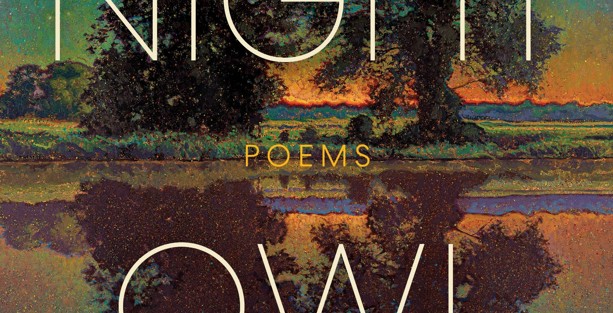
Electric Literature is pleased to reveal the cover ofNight Owl by Aimee Nezhukumatathil, which will be published on March 21, 2026 by Ecco. You can pre-order your copyhere.
From the New York Times bestselling author of World of Wonders and Bite by Bite, Aimee Nezhukumatathil’s fifth collection of poetry explores love, nature, and the transformative powers of the night.
In her latest poetry collection, Aimee Nezhukumatathil plumbs the depths of nighttime, crafting a series of nocturnes that explore the magic, sensuality, and life that emerge as the rest of the world goes to bed.
Night Owl navigates questions and concerns for the environment that envelops us. It meditates on our connections to family and beloveds, and explores our position within the broader beauty of the planet. Just as the night transforms how we see things, so too does love in its many forms transform our understanding of togetherness and the natural world. And these poems are deeply suffused with love—each an expression of Nezhukumatathil’s captivating responses to the animals, plants, and people who have her heart and enliven her world.
Night Owl presents a dazzling vision of nature that celebrates the beautiful noises and silences of this planet, as well as its many complications. Nezhukumatathil provides a singular contribution to writing on the natural world, calling up our sense of love—even in the face of increasing violence to one another and the environment—by focusing on the transformative impact of the dark.
Here is the cover, painted by Charlie Buckley:
Aimee Nezhukumatathil: Our sleepy little college town of Oxford, MS, boasts a bounty of artists and writers. I’ve been a fan of Charlie Buckley’s landscapes for years, often staring perhaps uncomfortably long at his magnificent and giant paintings that are wider than my outstretched arms. But it was always his paintings of night time landscapes that I found especially moving and ethereal.
I simply don’t know another artist who can paint the stars so they seem bright-hot, shimmering off the canvas, you’d almost swear the paint was still wet. I chose his painting, “Flooded Nocturne,” (48”x41”) and when I first saw this cover from the design team at Ecco, I gasped. The painting feels like a secret kept between sky and water, where dusk leans into darkness and a whole new world of possibility begins to hum and chirp with cricket and frogsong. I love how the trees stand both rooted and reflected—echoes of themselves—suggesting the way our inner lives often double and deepen when the sun slips away. That wash of color at the horizon seems to me is neither day nor night, but the charged threshold between, a space where transformation can take hold, much like in the poems and myths of ancient Greece.
The mirrored trees, doubled and glowing, carry the same tenderness and mystery I hope these poems hold: how the world shifts when most are asleep, but for night owls like me, that’s when I work. And of course there are so many plants and other animals that really come alive at night too, so it’s another reminder— especially during these trying times— we’re not alone.
My poems in Night Owl circle around what it means to be a woman with brown skin, a mother, a daughter, and someone who loves the outdoors, especially at night. I also never saw too many poems about the outdoors featuring a woman who cherishes the outdoors and who actually enjoys spending time with their children and/or with their husband. Who is a daughter who loves spending time with her parents. And has her own communities of friends too. I wanted there to be something positive shown about these kinds of relationships. We see so often publishers churn out these books featuring awful family members, and those are important, but dang, it’s also important to show happiness and love and desire and contentment sometimes too, no?
The stars scattered across the sky remind me that what glitters in the dark is not absence but presence, like a chorus of ghosts and memories and wishes waiting to be faced and considered. I wanted to include curiosity and wonder about the night sky. I wanted to showcase that the night is not something to be afraid of, that it could be a place of transformation and wonder. That’s what the ancient Greeks viewed it as before it became associated with criminal activity and scariness. It was actually a place where metamorphosis happens. This is exactly the kind of magic—the kind of noticing and listening— and the kind of astonishment I hope readers will bring with them into these poems.
Allison Saltzman: The cover process started in a very different direction, with me creating a cut-paper owl. I was inspired by several of Aimee’s poems, whose lines were arranged to form animal shapes. I also experimented with images of climbing vines, because one of her poems described her love as leaves that continue to “grow and grow.”
Aimee was enthusiastic about all the covers we shared, but then she visited an art gallery in her hometown, saw this gorgeous painting by Charlie Buckley, Flooded Nocturne, and knew she’d found her ideal book cover. I was unfamiliar with Charlie’s work, but grateful for her introduction. The painting is a perfect match for the wondrous mood of Aimee’s poems.
Riddhi meets Ridhi on a dating app. Ridhi’s name is actually Ridhima but no one calls her that. They laugh about how funny it would be if they were a couple. Hahahah, types Riddhi. Lmao ded, types Ridhi. Our friends would DIE, Riddhi says.
For their first date Ridhi takes Riddhi to a park with her new dog. The dog is not like other dogs, it’s a cool dog. It’s also a dog’s dog; it gets along with the other dogs at the dog park. This dog runs gracefully, long-legged like a hound, with short ears. Riddhi feels all this reflects very well on Ridhi. The only thing is, Ridhi says thoughtfully, she hasn’t been able to decide upon a name yet.
They go to a dog-friendly restaurant with elegant hardwood seating and thousand-rupee eggs in yoghurt on the menu. It’s Turkish, Ridhi says, you have to try it. She’s right, it’s sublime. S-U-B-L-I-M-E. Riddhi spells it out. Ridhi thinks uh-oh, I’m falling in love. Oh no, I’m falling in love again. These are not original thoughts, these are the stupid lyrics of a stupid song she doesn’t even like. Ridhi wishes with some irritation that the scrim of pop culture would not mediate her feelings before she is certain of what she feels.
Riddhi says, what about Cat? Ridhi is in love, now she’s certain of it.
Their friends do indeed think it is very funny. Here come the Ridhs, they say, when they arrive together. Neither enjoys being called Ridhs but they are both aware there is not a better bastardisation of their name. Rids is worse. Rudy sounds like they have internalised postcolonial racism. What’s in a name anyway. In bed they call out: Ridhi. Or is it Riddhi? It doesn’t matter. Riddhi is about to come. So is Ridhi. YES.
They wear matching pajama sets, they wear matching housecoats. Their sex life is adventurous. They are exploring shibari. Ridhi ties Ridhi up. Then they are exploring knife play. Riddhi makes tiny cuts on Ridhi’s soft upper arm, and Ridhi’s eyes roll back in her head. Ridhi opens her mouth and Riddhi grabs her long, long curls and pushes her tongue into Ridhi’s warm, waiting mouth.
They cannot tell who is who anymore. Is this Ridhi’s hand or Riddhi’s? Whose hand is wrapped around whose delicate throat? Who has made that ring of teeth on a shoulder blade? Riddhi and Ridhi are spent. After sex they spend some time slow-breathing in unison. Inhale, exhale, inhale . . . exhale, Ridhi says. Or was it Riddhi?
They have funny arguments about who is the better Riddhi. The real Ridhi. Riddhi argues it’s her because Ridhi is one letter short. Ridhi argues Ridhima is superior because in total it has one more letter. The second d is superfluous, she says. They fight. At first it is a joke, but then Ridhi slashes Riddhi’s left arm with the knife she was using to cut an apple. Ow, Riddhi says, and her face darkens. She says nothing, but at night Ridhi wakes up in terrible pain. Riddhi is drunk and has chopped off her little toe.
They go to the hospital together, carrying the little toe in a Ziploc bag on ice and frozen bananas. Ridhi doesn’t cry, but she keeps mumbling something over and over. Riddhi bends closer to hear. That was my favourite downstairs finger, Ridhi is saying. They sit in the waiting room. My downstairs finger, Ridhi says.
The toe is reattached. For the next month Ridhi is totally reliant on Riddhi. Riddhi helps her go to the toilet, she bathes her tenderly, she cooks all their meals. She even throws away all the whiskey in the house. From now on she will be a teetotaller, she says. She is toxic, she is sorry, she weeps. If Ridhi leaves her she no longer knows who she would be. Is that why you cut off my toe, Ridhi asks her. So I would be with you always? So I would depend on you? No, Riddhi says. I wish it was that, but I was motivated by childish revenge. When I was a child I used to tie up my younger brother and lock him on the balcony. I told him it was a game, but I was just jealous. It was that evil side of me. By the end of the month she is so remorseful, she insists they make it even. Ridhi must choose an appendage to cut off.
It must be something inessential but inconvenient. The tip of her earlobe, Riddhi suggests. The pinnae.
Ridhi is not keen on this plan. Blood makes her nauseous. Besides, she is tired of teetotaller Riddhi. Sober Riddhi is less daring, less bright, less funny, less horny. I don’t care about my stupid toe, she says. Can we please move on, she begs. But Riddhi won’t listen. When I look at you, all I see is a toe, she cries. Ridhi tries to wear sexy lingerie, rolls a giant doob for the both of them to reignite their sex life, but Riddhi is too regretful. She takes off Ridhi’s bra and then she just bursts into tears. Sitting in a thong that is surely cutting into her rectum, Ridhi thinks about what her life has come to. How ugly Riddhi looks crying. Her nose is red, and her cheeks and eyes are swollen. Ridhi thinks with some satisfaction, I am the superior Ridhi.
Okay, Ridhi says, let us compromise. It has been two months since the toe incident. Ridhi can now walk around with a walking stick. She is a freelance content writer, working from home anyway; she gets ChatGPT to write articles on luxury watches for different magazines. They pay her exorbitantly. She is the number three luxury watch specialist in her field. She is the one who has been paying for their drinks, their flat, the dog food. Now Riddhi must walk the dog after she returns from school and before leaving (she is a primary-school teacher). Ridhi stretches out on the couch with her laptop and yells, Riddhi . . . Riddhi . . . Riddhi . . . Riddhi, until Riddhi responds. I need my water refilled. And Cat has peed right outside the litter box again.
What makes everything even more unfair is that Cat loves Ridhi more. He spends most of his time sleeping beside her on the sofa. Riddhi used to think being a primary school teacher made her a better person than Ridhi, but since the toe incident this has changed. The dynamics of their relationship are altered. No longer does Ridhi hold an unspoken resentment about how Riddhi clearly thinks but does not say her work is more important than Ridhi’s. Now she holds an unspoken resentment about how Riddhi has become less fun since she stopped drinking. Ridhi begins to microdose Riddhi with alcohol in her coffee. She insists on doing this one thing—making coffee for them both. At school Riddhi is softer, kinder. She laughs more easily, the kids love her. She gets promoted.
After six months of this Riddhi develops liver problems, and the doctor does not believe her when she says she doesn’t drink. Her eyes have that telltale yellow, and her brain is soft as plasticine. She has become both stupider and nicer than she used to be. Doctors do not mind nice people, they are easier to dismiss. Ridhi holds Riddhi’s hand. Makes eye contact with the doctor, unspeakingly confirming yes, yes she is a drunk. What can I do, you love who you love. Riddhi’s remaining friends have an intervention for her. They are concerned that she always seems drunk. Riddhi is convinced that nobody understands her except Ridhi. She decides that Ridhi is right, she is clearly the superior Ridhi. She drops the second d from her name. She dresses exactly like Ridhi now.
You can see them both on Sunday on either end of the couch. Two braids, a flowered kaftan and round black glasses. Between their feet sits Cat. He is the only non-Ridhi here.
People have been telling me the early aughts are back in style with this gleeful look in their eyes that tells me they must remember the era very differently than I do. Sure, there’s something to be said for the slower, gentler relationship we had with tech in the pre-algorithm, dial-up internet days, when we weren’t constantly being surveilled or sold to. At the same time, I can’t be alone in thinking the Y2K years were pretty messed up. If you were a kid then, you spent half of 1999 being warned that the world would end at the stroke of midnight on January 1. Then midnight came and went, and the life you hadn’t planned for just . . . kept going?
For those of us who survived this imagined doomsday only to go barreling towards the personal apocalypse that is puberty, the aughts live in our memory as a time of dark, unsupervised chaos and the creeping, elated sense that we’d gotten away with something. My debut story collection, Tell Me Yours, I’ll Tell You Mine, captures this feeling through the bizarre rituals of a Y2K sleepover. Children have a folklore all their own that exists outside the realm of adults: games, riddles, superstitions, and rhymes that’ll chill you to the bone if you think about them long enough. In my book, these look like coded jump-rope songs, cootie catchers that tell you who you’re destined to marry, and summer camp pranks every bit as terrifying as the monsters rumored to roam the grounds.
All these secretive games we played under the cover of night, trying to understand our lives better, or to challenge the forces that threatened to take them from us—the forces that dared try to control us at all. Some of the books below explore this post-lights-out world through speculative fiction, like mine does; others in the form of a realist novel, an essay collection, or a book that isn’t even book-shaped. All of them are shot through with the spirit of the Y2K sleepover: caught between centuries, between dusk and dawn, between childhood and adulthood, between the magical and the mortifying everyday.
This is one of the mixed-genre story collections I read to convince myself that I was allowed to write a mixed-genre story collection, everything I knew about publishing trends be damned. These thirteen stories weave horror, fantasy, sci-fi, and folklore together with exactly the kind of urban legends you might hear at a slumber party. A number of the stories are set in schools where girls behave badly, weather betrayals and betray one another, and try desperately to make up for it. “Good Girls” tells of a manananggal, a mythical creature in Filipino folklore who detaches her upper torso from the rest of her body to fly at night, battling a taboo hunger. Another favorite, “Hurricane Heels (We Go Down Dancing),” features five friends trying to have a regular bachelorette party until the celebration takes a turn. Some stories, like “How to Swallow the Moon,” are so gorgeous and atmospheric, they read more like a magic spell.
A voice-y, big-hearted novel told in LiveJournal posts, Log Off opens on an entry dated Tuesday, September 5, 2000, with the words: “Hello, people of the Internet. Let it be known that today, 9/5/Y2K, my legal guardian Brian finally joined the modern world and connected our computer to the great World Wide Web.” The book follows sixteen-year-old Ellora Gao, who lives in a Western New York suburb with her emotionally distant former stepfather and memories of her estranged mother, and goes online in search of the close relationships she feels are missing from her life. I love the intimacy of Ellora’s friendships, and the humor and tenderness with which they’re drawn. One memorable entry contains a choose-your-own-adventure flowchart of an interaction that members of certain diasporas will recognize as the “But where are you from from?” question.
This collection of thoughtful, accessible essays assembles seventeen viewpoints on the social and cultural impact and lasting nostalgia of the American Girl universe. First released in 1986, the American Girl dolls evolved into a full-on craze by the mid-nineties to early aughts. By tapping into multiple disciplines and research areas, this collection manages to cover a lot of ground—from the historical recipes associated with each of the girls, to the dolls’ role in “tag yourself” memes (I’m Samantha), to the struggle to find Asian American representation in the Pleasant Company catalog. Contributors look toward the past, by turns fondly and critically, all while keeping an eye to the future, as the first generation of American Girl devotees become parents themselves.
Imagine getting to hear the freakiest fairy tales from your childhood for the very first time. That’s what reading Nethercott feels like. One of this collection’s fourteen stories follows a pair of teenage girls working a summer job at a mysterious roadside attraction. Another throws us into the midst of conspiratorial middle schoolers as they harness various divination methods, from alomancy (divination by salt) to zoomancy (divination by animal behavior), to get rid of a new classmate. Formally playful, the book also includes a story in the shape of an illustrated bestiary; I feel closest to the Yune, a bog creature who joins a game of spin-the-bottle with disastrous results. Through lush prose, fearlessly out-there premises, and a romantic sensibility, Nethercott explores the venomous, feral nature of girlhood, and why we might refer to a group of girls not as a clique but a pack.
The first Samatar story I ever read was “How to Get Back to the Forest,” and when I heard it was being included in this collection, I knew I had a new title at the top of my TBR. These twenty stories are organized into two sections—Tender Bodies and Tender Landscapes—and range in setting from past to near future, more distant future, and alternate present. “How to Get Back to the Forest” is a dystopian tale in which kids are separated from their families at a young age and sent to a strange summer camp. Dread mounts as the details of the camp are gradually teased out: mood-tracking metal bugs, inanimate objects meant to serve as parental figures . . . It’s a reminder of what any reformed camp kid already knows: Sleepaway camp is like a sleepover with no morning. You don’t get to go home so easily, and the night feels like it might never, ever end.
Set across two timelines, one in 1998 and the other in 2016, this novel follows three queer friends from the time they met online as teenagers and created the video game Saga of Sorceress. Eighteen years later, their lives look very different. Once scattered across the country, Lilith, Sash, and Abraxa now all live in and around New York City—though they still haven’t met in person and fell out of touch long ago. None of them knows the others are nearby, but they haven’t forgotten the game, which remains unfinished in the confines of their respective drives. I appreciate how insistently this book challenges the false dichotomy between “real” friends in the “real” world and “online” friends online.
What says slumber party more than sitting in a circle, sharing scary stories with your friends? The Family Arcana is the story of a doomed family trapped in their decaying farmhouse, told across fifty-two playing cards and designed to be read an infinite number of ways. Which characters you meet—and which of their obsessions, problems, and idiosyncrasies you’re privy to—depends on how the cards fall. The deck is packed with sharp, striking images that linger, like ghosts, long after you’ve read them. There’s the sister “born with dirt under her nails,” the aunt “who cuts pictures of horses from the newspaper,” and the grandfather who says, about the importance of mustaches, “You must have something to tug on when you are wrong, to make it look like you will not be swayed.” The cards are suitable for use in all standard card games and definitely scratch the analog itch. There’s also an audio edition featuring fifty-two different readers.
I’m clearly a sucker for unconventional story structures, and this collection of sixty-one delightful, nervy pieces of flash fiction delivers. It reimagines what a story can look like, just as it interrogates how society teaches us what we, based on ideas about gender, should be. One story, “Vagabond Mannequin,” appears on the page as a crossword puzzle, while another, “So Many Clowns,” takes the form of a letter to a nail-polish manufacturer. Other stories are set in diners and among the cardboard cutouts of the last Blockbuster on Earth, and imbued with the language of girlhood, as is the case with “I Double-Dog Dare You.” They’re filled with dolls, piggy banks, hair ribbons, Sunkist, and secrets, and together feel like sixty-one sparkling gems in a treasure chest.
This essay collection focuses on the past, present, and future of video games, as considered by writers who are also gamers. The list of contributors includes heavy hitters Nana Kwame Adjei-Brenyah, Charlie Jane Anders, Alexander Chee, Elissa Washuta, Hanif Abdurraqib, Larissa Pham, and comic MariNaomi tackling topics of grief, power, language, race, illness, bodies, and technology through the lens of video games. However, this book isn’t only for gamers (I’m not really one—not of the digital variety, anyway), and should appeal to anyone interested in thinking more deeply about the way interactive virtual realms inform how we see and navigate our physical world. I was particularly moved by Jamil Jan Kochai’s reflection on being an Afghan American teenager targeting Afghan insurgents in Call of Duty.
Made up of nine stories linked through the appearance of locked doors and keys, this collection feels a bit like sneaking out past curfew: that sense of mischief, bordering on danger, that comes with being somewhere you shouldn’t be. Many of these stories exist at the threshold between spaces—a library, a garden, the front cover of a diary—and dare you to proceed. If spooky puppets were the subject of your nightmares growing up, you’ll be drawn to (and/or terrified by) “Is Your Blood as Red as This?,” a tale that’s set in a puppeteering school and deals with questions of agency, autonomy, and control. I love surprising, audacious titles that hint at the personality of the story that follows, so “If a Book Is Locked There’s Probably a Good Reason for That Don’t You Think” is a standout for me.
Writer-director Zach Cregger’s Weapons opens with a mysterious and unsettling event: At 2:17 in the morning on an ordinary Wednesday, 17 of the 18 students in Justine Gandy’s suburban Pennsylvania third-grade class run away from home. While we witness the disappearance in flashback, an unseen child narrator assures us that this is a true story, that we’re about to see a lot of people die in “a lot of really weird ways,” and that we’ll never find any mention of it in the official record. The incident has been erased from history, the narrator tells us, because the powers-that-be were “like, so embarrassed” by their inability to solve the case that they covered it all up. “Embarrassed” is a curious word to use in relation to the abrupt disappearance of seventeen eight-year-olds and multiple related strange deaths, and it’s our first clue that the film’s true horror might lie somewhere beyond its jump scares. I walked into Weapons expecting some spooky, paranormal fun; I walked out with a warning about what happens to the children of a society too preoccupied with its imagined enemies to recognize the real threat operating in plain sight.
The film’s central riddle isn’t about what happened. The kids’ eerie departure was captured by multiple families’ alarm systems and outdoor security cameras. We (and the parents, and the authorities) know from the start that each child left home at the exact same time, in the exact same way, seemingly of their own accord. We’re shown the departures at the outset: Each child opens their own front door and runs out into the night, arms pitched down and out to the sides like little airplanes, alone and ostensibly free. The question is why these children have vanished, and whether there’s anything anyone can do about it.
I walked out with a warning about what happens to the children of a society too preoccupied with its imagined enemies to recognize the real threat operating in plain sight.
Weapons circles this question via six overlapping points of view, each from the vantage of a different community member whose respective distance from the disappearance varies. We start with Justine Gandy, the headstrong young teacher whose students vanished; followed by Asher, a middle-aged, hypermasculine construction boss who can barely contain his rage and despair over his missing son, Matthew; Paul, a cowardly and unscrupulous local cop; James, an affable unhoused twenty-something who lives in the woods somewhere downtown; Marcus, the school’s well-meaning, rule-bound principal; and lastly, Alex Lilly, the only child in Ms. Gandy’s third-grade class who didn’t disappear. Each perspective contributes to a mosaic-like reveal of what’s really going on, and the literal fragmentation of the storytelling reflects the fragmentation of the community, offering a close-up view of the various forms of bias and blinkered-ness that both emanate from and are directed toward each character’s particular identity. As this intertwining narrative structure winds toward the film’s shockingly gory conclusion, it spins out a portrait of 21st-century suburban U.S. life more akin to ambitious character-driven opuses like Magnolia and Pulp Fiction (both of which Cregger has cited as influences) than anything in the existing horror canon.
The physical and social isolation built into this suburban milieu is crucial to the plot: The film’s mystery could not hold in a community less marked by separation. Maybrook, Pennsylvania, is itself a fiction, but it’s the kind of indistinct, distinctly American suburb you can find plunked down in metro areas from coast to coast. At pick-up time, the parking lot of its low brick elementary school is filled with top-selling neutral-colored SUVs. The school’s students and administrators live on quiet cul-de-sacs in stately single-family homes with two-car garages and neat green lawns, while its teachers and cops live on shabbier, more densely residential blocks. Its downtown core, presumably once a bustling center of commerce and community, is now home to boarded-up buildings, a pawn shop, and the police station. Meanwhile, the liquor store and the gas station, both situated on busy multi-lane roads, are the closest things to a town square—everyone drives everywhere here, and these two businesses are the only places we see Weapons’ characters casually cross paths.
In the families of the lost children, we see how spectacularly the antiquated 20th-century promise of the suburban good life has failed. Their affluence cannot ease their grief. They’ve bought into a security apparatus that not only failed to prevent their greatest fears, but has in fact hindered the search for the eight-year-olds’ return; because their departures were observably uncoerced, the authorities chalk the disappearances up to voluntary “abandonment” and have little appetite for further investigation. In reality, the children are in desperate need of the adults’ help. They’ve been abducted by an evil old witch named Gladys, who cast a spell that drew them out of their homes and into her enchanted army without ever having to lay a finger on them.
Gladys is the great aunt of Alex Lilly, the only child who didn’t disappear from Ms. Gandy’s class. With her bright orange Emo Phillips-esque hairdo, candy-colored clothing, clown-like makeup, and off-kilter affect, she comes across more like an eccentric buffoon than an agent of terror. But this bumbling persona comes off with her wig: Behind the darkened windows of the Lilly house, she’s barefaced and bald, a shrewd and merciless tyrant whose only interest is accruing strength. Every person she enchants increases her power, and every body becomes a “weapon” in her quest for even more. Once in her thrall, those she bewitches become instruments of her will; she can turn them against their loved ones, and even themselves, with a snap. She starts by mesmerizing Alex’s parents, but their energy isn’t potent enough. So she presses her undersized, bullied great-nephew into her service, demanding his assistance in spellbinding his third-grade classmates.
A despot’s fiendishness becomes palpable to the vulnerable long before it becomes tangible to those closer to power.
Gladys’s garish looks and bizarre rhetoric are so allusive (who’s the first person that comes to your mind when you hear the phrase “orange clown”?) that it’s hard not to see her mystical takeover of this ordinary suburb as an analogue to the current administration’s almost-supernatural sway over a sizeable chunk of the American electorate; and her metaphysical method of capture as a potent metaphor for the insidious effects of algorithm-driven indoctrination. The children’s decision to leave home might appear to have been undertaken freely, but their minds were not their own. The physical and social isolation baked into their (and so many of our) lives are fertile conditions for psychological exploitation, and young people are especially vulnerable to workaday witchcraft of the internet, which can infiltrate even the sturdiest fortress without any outward signs of attack. Indeed, when we’re first shown the moment of “abandonment,” it’s underscored by the film’s most notable needle drop, George Harrison’s 1970 “Beware of Darkness.” Alongside the song’s wistful melody and heartfelt vocals, the surreal, dreamlike image of the children vanishing into the night elicits something closer to melancholy than terror, and the spiritual warnings in its lyrics (“Take care, beware of greedy leaders / They take you where you should not go”) would give the whole game away in advance if only we knew where to look.
Gladys leverages her understanding of Maybrook’s social norms to evade the community’s defenses. She babbles her way past investigators and weasels into the homes of some of her targets by performing the part of a harmless, doddering old white lady. By-the-book bureaucracy is inadequate in the face of such a slippery menace, and much like the machinations underway on Pennsylvania Avenue, her greatest advantage lies in the fact that her aims are simply unimaginable to ordinary, reasonable people. Even those who do notice something is off—like school principal Marcus—aren’t able to apprehend the full scope of the peril she poses, and their reliance on norms of due process and decorum leaves them quickly outmaneuvered. As such, the peril she poses remains unrecognized for too long by those outside her immediate sphere.
And yet, there are signs that the community has some sort of inchoate awareness of the nature of the danger in their midst. Although we don’t meet the evil Gladys head-on until principal Marcus’s penultimate segment, she appears as a disorienting, lightning-quick jump-scare in every other POV (except self-serving policeman Paul’s, which is telling given his occupational proximity to the type of institutional authority she represents, since a despot’s fiendishness becomes palpable to the vulnerable long before it becomes tangible to those closer to power). Grieving father Asher even crazily, but correctly, points to witchcraft as an explanation for his son’s disappearance, although at first he points his accusation at the wrong target.
The vacuum left behind by officials’ inertia leaves Maybrook to find somewhere to lay the blame for what’s gone wrong in their community. The parents find an all-too-easy target for their suspicions in Justine Gandy, the young, single, childless, unruly spitfire of a woman teaching who-knows-what to their kids. Law enforcement focuses their energy on quashing the type of “threat” they can see by relentlessly harassing unhoused meth user James. Meanwhile, administrators like Marcus fall into the self-soothing rituals of procedure and paperwork.
Despite being cast out by the community (or perhaps because she already has nothing left to lose), Justine is the only person who refuses to stop searching for her students. She has a hunch that Alex Lilly holds a clue the authorities have missed, and she won’t stop speaking up about it. But her voice can’t penetrate the wall of misogyny and respectability politics that surrounds her. The men who lead Maybrook—many of whom purport to care about her—are constitutionally unable to take her concerns seriously. Their disregard for her perspective isn’t personal; they’re simply products of a system that has taught them since birth that women are more emotional, less credible, and less competent than men. They believe that their responsibility as leaders is to uphold hierarchical order while keeping rogue elements like Justine in check. When Justine prods pusillanimous policeman Paul for information about the investigation, he scolds her for straying out of her lane. When she finds proof that something strange is indeed going on at Alex Lilly’s house and rushes to Marcus for help, he bats her evidence aside and gives her a lecture on obeying the chain of command.
Asher’s refusal to rationalize the children’s disappearance creates an aperture for change.
Unhoused meth user James takes Justine’s proof a step further when he discovers the missing kids in the Lillys’ basement mid-petty-theft. James’s history of harassment and abuse at the hands of the cops makes him reluctant to reach out, but he swallows his fears and reports what he saw. Instead of leading to a rescue, though, his attempt to collaborate with law enforcement gets him chased, beaten (yet again), and dragged straight back into Gladys’s clutches by the authorities themselves—another gesture that speaks to the disjunct between the priorities of law enforcement and the concerns of the communities they’re supposedly sworn to serve.
Devastated father Asher turns out to be the bridge between the entrenched worldview of the men running the show and the messier, riskier, more interdependent approach that Justine and James instinctively understand is required to save the children. In public, he’s tough and angry—accusing Justine of somehow brainwashing his son and demanding answers from the authorities—but at home, we see him huddled, hollow-eyed, in his missing son’s twin bed, highlighting the disjunct between Asher’s inner anguish and the narrow band of emotions he’s culturally permitted to express. Asher’s turmoil sets him apart from the other men in Maybrook (the powerful ones, at least). Although skilled in his performance of rugged individualism and conventional masculine values, these myths are no balm for the loss of his eight-year-old son. His refusal to rationalize the children’s disappearance as a matter of personal agency—to compartmentalize and move on—creates an aperture for change. When a nightmare leads him to articulate his own guilt, fears, vulnerabilities, and the magnitude of his love for his missing son, Asher becomes able to move from recrimination to productive action. He activates his community, reaching out to other parents, and eventually to Justine. Only when Justine and Asher recognize that they’re fighting against the same set of obstacles in pursuit of a common cause and begin to pool their knowledge are they finally able to pinpoint the monster in their midst.
The film’s climax brings a kind of catharsis, but one that comes at incredible cost. In a moment that feels unnervingly close to the one our democracy is facing now, Justine and Asher are confronted by how difficult it is to combat Gladys now that she’s consolidated so much power. Alex, having witnessed Gladys’s method of enchantment, recognizes that their best chance to defeat her is to mimic her own actions and redeploy the weaponized children against her. They scream wildly as they hunt Gladys down, cannonballing through their neighbors’ windows and smashing through sliding glass doors in hive-minded pursuit. We get a peek into the interiors the children are destroying as they tear through the once-quiet cul-de-sac; the reactions of the occupants (some terrified, some exasperated by their home’s sudden implication in the chaos) remind us that many of the town’s residents’ domestic lives have retained their normalcy until this moment, when the reality of what has been taking place in their community comes (literally) crashing in on them. It’s almost comical—until it reaches its staggeringly brutal end. When Asher catches up to the children, they’re no longer enchanted, yet they’re still standing the same way they did in the basement: stock still, silent, awaiting new instructions.
Ultimately, the film’s greatest horror is that Gladys was able to get as far as she did with the help of Maybrook’s social division and structural complacency. The unthinkable traumas these people have endured could have been prevented if the community had been less fractured, cooperated more, listened better, acted faster. Instead, their children have to carry the memory of living under Gladys’s spell for the rest of their lives, and their elders will reckon forever with the horrors that were allowed to blossom in their blind spots. To heal, they’ll have to confront that reality together. The film’s final line, delivered in voiceover as Asher carries his blank-faced boy home, offers a fragile filament of hope in that regard—the child narrator tells us that after two years, some of the missing kids have finally started to remember how to speak. One can only hope that once they regain the full power of their voices, they’ll never be rendered mute under another’s spell again.
Lily King is interested in love in all its forms. Her seventh book, Heart the Lover, beautifully captures the thrill of a first love, but it’s also about the love between friends, the love between parent and child, and the love of a long-married couple. It’s the perfect companion to her New York Times bestseller Writers and Lovers, but King was actually working on a different book when the idea for Heart the Lover came to her. “I escaped into this novel,” she shared. “And I was so relieved to be in a different place with different people.”
As a reader, you feel that initial joy King experienced while drafting this novel. Heart the Lover is about a young woman called Jordan in her final year of college, and the love triangle that develops between her and two young men: Sam and Yash. Sam and Yash are intellectually ambitious, reading Saint Augustine and James Joyce, and in their company, Jordan begins to find her own voice as a writer. There’s a great pleasure to these sections, in the characters’ whip-smart banter, their infectious curiosity, and the magnitude of their love and heartache.
But as graduation comes and goes, and the characters make decisions that will ripple through the decades to come, their story deepens and complicates. And like many novels that feel effortless, Heart the Lover was actually incredibly complicated to write. The final draft is King at her best: a wise, exquisitely written tale of loss and love.
I spoke with King about the allure of the campus novel, our disappearing canon, and what it takes to write a remarkable love story.
Rowan Beaird: This book perfectly captures the overwhelming nature of first love, but there’s also a depth to the relationship at the novel’s core that makes it impossible to categorize as only that. Why did you want to tell this particular love story?
Lily King: I had two similar relationships when I was younger. Big loves that, for reasons I’d never quite understood, just didn’t work out. And actually, both of these men—who didn’t know each other—died in 2019, a month apart.
It is amazing how the moment you start writing dialogue and characters, they become other people.
I was looking through my notes recently, and I was really struck by how in the first draft of this novel, I was trying to work through all kinds of things. It began with sort of an autobiographical pulse, but it changed really dramatically in the writing and the rewriting of it, and the shaping of it, and the understanding that these emotions alone don’t make for good fiction. It is amazing how the moment you start writing dialogue and characters, they become other people. They leave any sort of real life behind. But the emotions! You know, that’s what I try to do in my fiction—I’m trying to find the fictional form for all of these emotions that I’ve experienced.
RB: The three central characters meet during college, studying literature and religion and philosophy, and throughout the book, there are countless references to all three. How did you want this shared language to function in the book?
LK: As a shared language! Yes, that’s exactly it. It is such a thrill when you encounter someone who speaks the same language and responds to the same things—whatever that may be, whether it’s the mechanics of a car, or a symphony, or literature. And when you can speak that same language, particularly when you’re young and you’re absorbing so much—it’s so exhilarating. I really wanted to capture that feeling.
RB: I sometimes wonder if we as a society, as readers, are losing those points of connection, through no longer having a collective canon. What do you think it means to no longer have common points of reference?
LK: Yes, I fear that now, the shared canon is whatever we see on our phones, and it’s dividing us. It’s not bringing us together in any way, and it’s also not bringing us to a higher level of—I don’t want to say morality—but a higher level of being and thinking. And by higher I certainly don’t mean academic or intellectual or anything like that. I just mean closer to the great pleasures of life, the things that are really important.
RB: The campus novel is its own genre, in certain ways. This book is about much more than that, but why do you think we’re drawn to this particular chapter of life and place?
LK: I’m so surprised by this term! It’s so funny. I mean, initially I thought that the characters would be in college for about 20 pages. I had a whole different concept of how this book would work, but now, suddenly, it’s a campus novel.
I’ve never written about people in college before, and I didn’t know if I could do it. It was the same way I felt with Writers and Lovers—it had been so many years since I’d worked in a restaurant. But it was so fun to go back there, and I didn’t realize how much the language would change and the feel of it would change when you’re writing about a time like that. It was pleasurable for me to go back to that time without cell phones. When everything was new, and the future felt bright.
RB: How did you go back to that chapter in your life? Did you have any journals, or did you read books that you read during that period?
LK: I kept no journal in college, which just wrecks me. I kept a journal every other time of my life. I can’t really account for that except that I was really happy. I think what I was trying to capture in this book, what I was really interested in, is how a person can meet a couple of people, and their life can be transformed by them in ways that they really don’t recognize until years and years later. And I think college is such a great time for that. During those years, you’re formed enough, but you’re not formed completely.
There are also these emotions that we have—particularly close friendships and romantic love—that are so powerful at that time of life. I really wanted to capture how overwhelming a person can be to you at that age, in a way that they really aren’t as you get older and you get more in possession of your full self.
RB: There is a large time leap that happens roughly halfway through the book, and at one point in the novel, a professor mentions that what grants a character revelation is time and distance. Was it difficult to know when to leave these characters and meet them again?
LK: Initially, I was writing those college classroom scenes just to show how the characters met. And then when I started writing them, it just took over. And then, finally, I was able to make the leap of 30 years—the whole reason for my writing the book—and it just kept feeling flat.
I don’t dwell on people’s bodies and on physical attraction. I just try to imply it so that the reader supplies the rest themselves.
I kept on trying to increase the tension and tighten the timeline, to rev up the engine, but I didn’t even have an engine. I revised and I revised, and then I read the last section again, and it was still flat, despite everything I had done to try to make it better. And I remember saying to my husband—twelve days before I had to hand in the draft to my editor—that it still wasn’t working. And he told me something that he told me for a year, which was, “She needs to go to the hospital with a secret.” And I kept on saying, “No, no, stop saying that,” but that day, I just stood up, and I went into my study, and I rewrote everything with that engine.
RB: I never would have guessed that was an eleventh hour edit.
LK: I feel like I need to proselytize now around the country—do not give up. Keep going!
RB: Without giving too much away, this is a book that’s as much about death as love, which is true of many of your novels. Why do you think they feel so intertwined for you as a writer?
LK: I think death has probably always been a preoccupation of mine. I’m really interested in loss, and loss just isn’t as powerful if there is no love, so they are intertwined. And as I get older—I’ve lost a number of people who have been so, so important to me. So I think it’s only going to get stronger in my fiction. I remember, actually in college, reading The Odyssey and The Iliad, and talking about Greek mythology, and how there’s nothing at stake for the gods because they don’t die. That’s such a basic concept, but it is a striking difference. Everything about our own existence is fragile.
RB: Well, there’s that beautiful scene toward the end where Jordan is asked about the role love plays in her books, and it’s posited that she sees love as the ultimate form of hope. Do you think it functions the same way in your books?
LK: I think love works in so many different ways in my books, but I do feel that the strongest strain of it is hope. Our only hope of survival is love.
RB: What is the most difficult part of writing a love story?
LK: I think it’s just getting the characters to connect. You just want to find the chemistry between them so that the reader wants them to be together. I suppose I try to get at it mostly through dialogue. You know, my relationships are mostly verbal. There are little moments of physicality, but I’m not really a descriptive writer in that way. I don’t dwell on people’s bodies and on physical attraction. I just try to imply it so that the reader supplies the rest themselves.
I remember asking Tessa Hadley, who is one of my favorite writers, how she made the attraction between her characters so strong. She has these men that—they just walk in and you’re immediately drawn to them. And she said that one trick was—it’s not necessarily writing about them, but writing about how others are drawn to them. I thought that was really interesting.
RB: I’m always hesitant to ask this question because I’m very conscious that it’s rarely asked of male writers who are fathers, but as this book deals with motherhood, I’m curious if and how being a mother has influenced your writing?
LK: It’s such an interesting question. I feel like being a mother has been so much more important to me than being a writer, to be honest with you. I’m conscious male writers would never say that, but that is where so much of my emotional energy goes on any given day. And I think that my love for my children infuses everything about my writing.
Weirdly, my novel that was most about children was my first novel—when I didn’t have children. I certainly haven’t and will never write directly about my children, but I feel they’re often sort of on the outskirts of my fiction. Motherhood is a completely different form of love, and I’m so interested in all of these different forms of love, and that’s really what I was trying to write about in this book.
Father and son loading the car at dawn. Father loading the car, son in the passenger seat wedging a pillow against the window in hopes of salvaging a few more minutes of sleep. Father notices a red-tailed hawk in the park across the street, strutting in the grass, scrounging for bugs like some common yardbird. It fills him with a muddled feeling he isn’t sure what to do with. Bury it then, pray it stays in the ground. Mother in the window waving goodbye.
The morning air smells liked burnt fruit. Fire danger: extreme. Traffic: backed up near Azusa by a jettisoned mattress. News helicopter: stalled aloft like a dragonfly in a jar. The mountains glow orange as if lit from within. The effect of the morning light on the mountains, the glow, is called alpenglow. Father can’t remember if he’s told his son this. Should he now? Should he point it out as if he’s never told him, or phrase it like a question, or make a joke of it? Well, son, you’ve reached the age when you’re ready to know the German words for things. Seems like only yesterday when my own father sat me down and told me about the zeitgeist . . .
Son slumps in the passenger seat, earbuds in, eyes closed. He stirs awake every few minutes and types something into his phone. Father wants to imagine him keeping a detailed log of what he’s thinking and remembering but he’s probably texting his ex-girlfriend how much he misses her already.
The blitzkrieg? The schadenfreude?
Who is this? son says, removing one of his earbuds and nodding to the radio. Father tells him the Kinks. Sunny Afternoon. It was one of the son’s favorite songs when he was very young, before he had favorites of his own, but father knows it’s tedious to remind sons how much they used to love certain things.
Sounds like circus music, he says, replacing the earbud.
You used to love this song, father says.
They’re driving to Los Angeles. After Los Angeles they’ll head north, like father’s father did forty years ago, following his path, city by city, step by step.
I probably used to love clowns too, son says.
Between them in the center console sits the gray book, palm-sized with a laminated cover and lined paper yellowing at the edges. Father’s been the keeper of it since that night in Kentucky when he and Rusty parted with a clumsy hug and he read it under the dome light in his rental car and again in the motel.
March 1978. His father flew from Florida to Los Angeles alone, drove up the coast, waded in the ocean, visited a castle, drank beer, met people, ate dim sum, went to Alcatraz, and returned eleven days later. The gray book is a record of that trip, a letter from the grave in meticulous block letters.
A letter from the grave? That sounds promising! It’s full of advice then? And fatherly wisdom?
No, neither. The notes are cryptic, perfunctory, repetitive, obsessive about driving times and how much things cost. The father—the son, that is, the father’s son . . . I mean me—I can’t even decode a lot of it.
Landed in LA. Haze. Thrifty, Ford Granada, $116. Pear in the GC.
I’ve had it three years. I’ve shown it to family and friends hoping they’ll see something I don’t. They leaf through it and hand it back with a shrug. I asked my mother about it. I brought it to my creative writing class. I read the first entry and asked, What’s the story here? No response. What can we deduce from his notes?
A man flew to Los Angeles, a student said.
And rented a car, another added. For a hundred and sixteen dollars.
A torpor fell over the room. Spontaneous protective hibernation. It happens when they sense that my point is not going to be worth the work it takes to arrive at it.
The pear in the GC? I said to the only student looking at me. Thoughts on the pear?
No one had thoughts on the pear. Then Jimmy Escalera raised his hand to tell us that his grandfather kept a journal in Vietnam. There were Bible verses and parts of it were written in code. Certain pages had tally marks at the top and these, Jimmy was pretty sure, stood for the people his grandfather killed.
Vietnam, secret code, tally marks. Everyone agreed there was a story here.
When you can’t decipher a sound you move closer to it. That’s my thinking. Plus my son leaves for college at the end of summer. The road is where fathers and sons bond. It’s where they stare meaningfully into the horizon and think things and say them.
He sits around all day watching cartoons, Jimmy Escalera said in class. Without the journal we’d never know he used to be a killing machine.
I couldn’t sleep last night. I never can before a trip. I lay in bed trying to arrange my feelings into something like a viewpoint as coyotes yipped and yawped outside. My wife tries to temper my expectations. Focus on him, she says, meaning our son. Keep it fun. Don’t get all impatient or morose. Her advice is reasonable. This isn’t a quest. I have a route, hotel reservations, six apples, my son in the passenger seat. I have ideas, cobbled from movies and books and pharmaceutical ads, about road trips, fathers, sons, the ocean, self-discovery, messages, buried in notes and letters, hidden for years. I fell asleep charting our route, conceiving scenarios sentimental enough to make a pig blush. Standing atop a cliff in Big Sur and hearing his voice, driving up the coast and finding closure, et cetera. I dreamed of running through the woods toward a faraway light. I woke up before reaching it. Cotton-mouthed, legs sore from the idea of running. I studied myself in the mirror as I brushed my teeth: droopy eyes, sharp nose. Face of a steamed turtle. Still hazily devising scenarios: touring Alcatraz and realizing things, eating dim sum and coming to terms. Yearning for something big and decisive, knowing it’s a deluded feeling and yet feeling it strongly.
Santa Anita: infield passes, pond oysters. Drunks from Phx. Mutual man says GR way up.
My son reads this aloud as we approach the exit for Santa Anita Park. We pull off and drive along streets lined with towering palms and into the racetrack parking lot, which is empty. The gates were supposed to open a half hour ago. I flag down a woman in a golf cart and ask her what’s going on. She says she isn’t sure. She has no connection to the track, she’s just driving her golf cart through the parking lot.
On his phone my son discovers Santa Anita closed after the twenty-seventh horse died this racing year. People are sad, people are angry, but no one can agree on why the horses died. It could be simple negligence. Or drugs. Or rainfall from an atmospheric river that flooded the turf. It could be a man named Felix Concepción, who trained eight of the fallen horses.
That place sucks, my son says as we merge onto the highway. I hope it stays closed.
I make affirming noises. I tell him people are predicting the death of horse racing. Like dog racing and indoor smoking and the set shot in basketball. I imagine my father, ninety years old this year, sitting in his faux-leather recliner, watching the things he knew so well wink out of existence. I know horse racing is inhumane, unnecessary, and I doubt I’ll ever visit another track again, but I’ll be sad to see it go. Tolerably sad, like when you find out someone you thought already died has died.
I tell my son what I remember about the track where my father worked: gamblers and their morning cigars, shredded bits of money on the floor of the betting windows, from cashiers pulling the rubber bands off the bundles. My father gave them to me. Old pennies too. I collected pennies and torn bits of money. It sounds like a Depression-era childhood. Your grandfather fell in love with horses and numbers in college, I say. It’s where you get your talent for math.
What’d he do with numbers? he asks.
Calculated odds, I say. Or payouts based on the odds. He calculated something.
Didn’t they have calculators?
You know, it’s possible he didn’t calculate anything, I say. Maybe he just liked being around them. Numbers.
A few years ago I found out my father needed just one elective class to graduate from college but never ended up taking it. I tell my son this and he says, That’s cool.
You would’ve liked him, I say. Another bland, untrue thing. I want to strike it out the second it leaves my mouth.
What’s seventy-seven times seventeen? I ask a few miles later.
I’m tired, Dad. Then, a minute later: One thousand three hundred and nine.
I was five when my father flew to California. I have no memory of him being gone. I shouldn’t be surprised that he doesn’t mention me in the gray book. What would he have written? There wasn’t much to me at age five. I liked garbage trucks. I liked candy. Most of my dreams were about animals.
He doesn’t mention any trees or birds or premonitions or songs. Or his wife. So I shouldn’t be surprised. But it bothers me. I’ve flipped through the book a hundred times and I still catch myself hoping to find something that’s not there.
GP Observatory. James Dean, planetarium. Barely see Hollywood sign. Oxygen balloon, stepped in gum.
That’s it? my son says after I read the entry. We’ve parked and walked up the hill and are standing outside the Observatory.
Yeah, I say. That’s all he had to say about Griffith Park.
Basic, he says.
Miles south, patches of smog shroud the downtown skyline like scum on stew. Hollywood sign. Planetarium. It’s all here. Even James Dean’s seductive head, mounted to a pillar in bronze. We’re near the spot in Rebel Without a Cause where Plato asks him, You think the end of the world will come at nighttime, Jim? And he answers forlornly: At dawn.
My son asks why my father came to California alone. I wondered the same thing, I tell him. My mother said it was probably a work trip. Plus, she added, families didn’t fly cross-country willy-nilly back then. At least ours didn’t.
Could be he had a second family, he says.
Could be, I say. Oxygen balloon. What’s an oxygen balloon?
He types it into his phone. He scrolls and scrolls, looking for a satisfactory result. He probably meant helium, he says.
He wanders off to the gift shop to buy his ex-girlfriend a souvenir. A young couple asks if I can take their picture next to James Dean’s head and I oblige. I rarely feel as useful as when I’m taking a stranger’s picture for them. I zoom out and zoom in, milking it longer than I need to. When I’m done the man extends his fist, and I bump it with mine and return his phone with the other hand, and our exchange happily concludes.
My son and wife and I used to visit the Observatory once a year. I don’t remember why we stopped—whether we got bored of it or he did. We should’ve continued coming here, I think. We shouldn’t have let boredom stop us.
He returns with a solar system bracelet for his ex-girlfriend. Seeing all those hopeful colored orbs dims my mood.
Nice bracelet, I tell him.
Are we done? he asks.
A lap around the planetarium, another stop at James Dean’s head. A passable likeness but up close I notice he has no eyes. It ended with his body changed to light, says the inscription. I like that. I write it down. I look west. I think about oxygen. I scan the ground for gum. I open the gray book and read the entry one more time. Anything? Anything? Nothing. I might as well try to manufacture a sneeze. I take another lap and head back to the car.
We used to park by the zoo and see the koala before P-22, the wild mountain lion living in Griffith Park, mauled and ate him. Maybe that’s why we quit coming. We visited the koala then hiked up to the planetarium and reclined and watched a light-show rendition of the birth of the universe with disco sound effects. The universe was created in 1977, my wife would say, and I would laugh and he would laugh because I laughed. We’d walk out giddy, veneered with sound and light. We’d eat potpies at a Vietnamese restaurant in Glendale. I don’t know why it served potpies but everyone ordered them. We brought colored pencils with us because the potpies took forty-five minutes to make. He’d draw on his place mat and then ours, whatever heroic figure he was obsessed with at the time: Apollo, Peter Pan, Didier Drogba. He could busy himself for hours conjuring and reconjuring it. We still have giant plastic bins full of his drawings in our garage. And those intricate handdrawn mazes he made after he stopped drawing—he’d give me one and I would work my way in and out of it before realizing there was no solution. Getting lost was the point, or there was no point. The only way to solve it was to turn back around and exit the same way you entered.
We drive in silence, into the smog and stew. I try to quiet my mind. Nature preserve, I say when we pass a nature preserve. Motivate Hollywood, I say when we pass a sign that says MOTIVATE HOLLYWOOD. I point out the site of the hotel where Bobby Kennedy was killed, now a twenty-four-hour gym. There’s Forest Lawn, where Michael Jackson and his chimpanzee are buried. I tell him that the man who built Forest Lawn wanted to make a cemetery like a beautiful park where families would picnic and frolic around their dead loved ones. He thought cemeteries were too sad.
Getting lost was the point, or there was no point.
My son scrolls through his phone. He says it’s true that Michael Jackson is buried there, but Bubbles the chimpanzee is still alive and living in Florida. Is he happy? Does he miss Neverland? It doesn’t say. But you can visit the sanctuary where he lives, about an hour’s drive from where I grew up.
I’m sending Grandmére a link, he says. She loves stuff like this.
Really? I thought animals annoyed her.
Don’t you remember the nest cam? The dolphins behind her condo?
Yeah.
The panda cam.
Okay, you’re right. (I forgot about the panda cam.) She’s an animal lover.
It says he goes totally berserk if he hears a Michael Jackson song. Even someone humming it. It’s too painful. He doesn’t want to be reminded.
My wife had to talk him into coming on this trip. I didn’t hear the conversation but I can imagine—I’ll spare you the reenactment. I don’t blame him. I haven’t been good company lately. I’ve been fretting over my own extinction again. Blood tests, midnight trips to the emergency room, the whole opera. One of my tumors turned out to be a sinus infection. Another was a hernia. I can hardly look my doctor in the eye anymore. There’s pity in her gaze, sure, and something truer and meaner, beneath pity.
I see what she sees: craven insoluble fear. I can marinate in it or try to dull it with a glass of wine or two, usually two, maybe three, rarely four, sometimes four, never five, almost never, and how much is a glass anyway?, it’s an arbitrary measure, and then I’m playing photo roulette on my computer again—think of a date then find a picture as close to it as possible—January 25, 2006, deep winter, Iowa City, our son and a friend bundled up on a freezing train ride by the river, him in his tiny red snow boots, studying the picture then spelunking into the garage through plastic bins to find the boots, I want to hold them for a second, and my son opens the garage door with the remote to pull the car in and sees me, playfully taps the horn, and says, What are you doing, bro?, yes, here he is in the flesh, out of the car, taller than me even though he’s two inches shorter than me, and I feel so chaotic and stilted around him sometimes, like now, and I say, The garage is filthy, bro, and he heads inside without us saying a single meaningful thing to each other, I know I can’t go on like this, and I keep looking for his boots but can’t find them. Instead I content myself with his Peter Pan costume. I don’t caress it against my cheek with tears in my eyes or anything. I’m not a sociopath. I just look at it. I’m spiraling. I have to do something. Which is as close as I have come to a plan. Stop spiraling, do something. So something is exactly what I’m doing.
My reenactment involves my wife detailing all the reasons why he should join me, then offering to pay him, and him holding out for more money. I have no evidence, just a gut feeling. Something about how he sits next to me in the car, biding his time like he knows the meter’s running.
My mother calls. The phone rings in a different language when you know you’re not going to answer it.
Why aren’t you picking up? he says.
My mother cut back on her drinking in her seventies, read a book a week, went to New Zealand, gave away any possession she didn’t use at least once a week except for a grapefruit spoon and a black clambroth marble that reminded her of one she had as a girl. She started fostering retired racing greyhounds. She fostered three of them until she realized it made her too sad. Not parting with them but the dogs themselves, their spindly bodies and meek sensitive faces, which seemed to exude judgment by withholding it. They were like hobbled horses, pinioned birds. She bought two feeders instead, filled them with nectar, hung them on her back porch.
She entered her eighties bright and lucid but now, four years on, she’s begun to flicker. She’s drinking in the mornings again. When we talk on the phone, especially after she’s had a few glasses of wine, we end up arguing over some stupid point of fact. The specifics aren’t important, she tells me when I correct her for confusing the recent past and the distant past. I know I should stop correcting her. She still has her hair done once a week. She still gets annoyed when someone doesn’t bless her after she sneezes. And recently she met a man in the retirement home. His name’s Elias Parker. They eat dinner together every day, then watch old movies in the TV room. She thinks they’re in love. She says they went to high school together, but he looks about ten years older than her and has a vaguely Hungarian accent.
The other day she called to ask if I remembered the girl who lived next door. Not next door to the town house where I grew up but next to the beachside duplex where my mother grew up. Beautiful jet-black hair down to the small of her back, she said. Her father punished her by cutting it off. Remember? Remember how we all cried?
When I read to her from the gray book or ask her about some name, she tells me to quit interrogating her. He’s been dead longer than he was alive, she says.
Not yet, I tell her. Four more years.
See, I don’t think it’s normal that you know that. She no longer thinks about him like she used to. She allows herself to remember him while waiting for a bag of popcorn to finish in the microwave. Three minutes and forty seconds, she says. The perfect amount.
Hollywood Blvd.
Addict on sidewalk
Lady with dummy
Chinese preacher
Sax player in diapers
Met people
The Vietnamese restaurant in Glendale is sorry but it’s closed for repairs. We go to Philippe’s instead where my father might well have eaten forty-five years ago after he went to the Observatory. He might’ve met people here. We order French dips from a guy with a carving knife, who deftly slices meat onto a hoagie roll. We sit at a long table and eat without talking, father, son, and meat. Next to us two old men are talking about something one of them read in the newspaper. A mall Santa in Upland claims he visited the hospital room of a boy whose last wish was to die on Santa’s lap. He held the boy in his arms and described how nice heaven will be, and the boy died right there in his arms. That’s what the man alleges. But now no one in the hospital can corroborate his story. So wait, says one of the men in the restaurant. Did Santa Claus kill that boy?
Hmm, my son says, scrolling as I drive.
What? I say.
Nothing.
Tell me. I’m bored.
Ian posted an old picture of a bunch of us at Poods and Benji commented.
The casket kid?
Nobody calls him that anymore. We look at the world once, in childhood. That’s what Benji wrote. It’s probably from a song.
It’s from a poem. The rest is memory.
What?
That’s the next line.
Yeah. Benji’s pretty fried now. He usually just comments with fire emojis. Beach picture, fire emojis. Your dad died, fire emojis.
I bet he enjoys the ambiguity.
Benji forgot his own birthday last year, he says.
When he scrolls through his phone his face bears the expression of someone in love.
Twelve miles west of Burbank, I try to figure out a way to initiate conversation that isn’t burdensome or annoying. Combing my brain for scraps of poems to recite and remembering only the one about your mum and dad fucking you up. They may not mean to, but they do. Realizing that the degree to which they fuck you up can be measured by how often you think about them once you’ve left home. Something just north of never is ideal. Parents are booster rockets, I think, necessary for takeoff but a burden at higher altitudes. I’m starting to wish we were following our own path. Retracing my father’s is too literal, like in movies when people talk to tombstones. A high school quarterback in West Texas who just won state wants his father to know, so he leaves the game ball next to the tombstone and says, I hope you’re proud, because dead fathers are able to hear you only if you’re within five feet of their graves, and sons can’t celebrate with their teams like normal sons when there’s a dead father somewhere to commune with.
I could ask him to look up what happens to them after takeoff, booster rockets. How are they retrieved, reused? I could ask him to look up the Challenger explosion, Russian space dogs, the Golden Record.
It’s the earbuds. If earbuds weren’t plugging his ears I could remind him how we used to drive around with him in his car seat until he fell asleep and one time as he nodded off a pair of fire trucks overtook us, sirens blazing, and he stirred awake and my wife followed them for miles and when she lost them he said again, again, which he always said when something pleased him or amused him. Once was never enough. I could ask if he’s seen any good movies. I could point to a red Triumph Spider Coupe and say look. It wouldn’t be like talking to a locked door, fashioning sentences into keys.
Then he takes out the earbuds and nestles them into their charger. The silence abides. We could talk about the guys in Philippe’s arguing about the boy who asked to die atop Santa. I could ask him if he remembers when he realized Santa didn’t exist.
He was seven. He read Santa’s letter thanking him for the cookies and noticed it was in my handwriting. He almost admitted he knew but stopped himself and feigned belief for two years because he thought we’d be disappointed he found out. I want to remind him but I won’t. He thinks my wife and I mythologize his childhood—we’ve built a shrine out of only what is sweet and pleasing to us. We forget our experience of his childhood is secondary to his. We have our bouquet of salient moments and he has his. The winter the whole town froze over and I dropped him onto the ice. He swears it’s the first time the world came into focus for him. After that he started having dreams I was a werewolf, which he only recently told me. He had them for years. He said he never actually thought I was a werewolf, but I did act strange sometimes. More like an older brother. Those pressure points you taught me? What was up with that?
The Shah? The Crab Claw? You loved it.
Not really. You told me you knew one that would make somebody instantly shit themselves.
I never said that.
You did.
I probably said crap themselves.
It was weird, Dad.
Those were fake. I made them up.
I know.
I took you fishing. Camping. Remember? Trips to skate parks. Managing your soccer team. Typical dad behavior.
Okay, okay.
Parent-teacher conferences. Career day. Thanksgiving fun run.
I’m not saying you were a bad dad.
But.
But . . .
But what?
Amusing myself at his expense. Pretending I had a second family in Baja California. Going down to Baja, I’d say when I left the house. Embarrassing him accidentally. Embarrassing him on purpose. Standing with other fathers on the touchline of a soccer field, dispirited by the proprietary way they watched their offspring. Praising each other by praising each other’s sons. He loved soccer but hated running. He loved the idea of soccer. Sometimes he’d stop playing altogether to stare off at something only he saw.
A father in a pristine salmon polo kept calling him dude: Get back on defense, dude. Win the ball, dude.
A tidy jolt of rage each time he said it. At halftime I asked him if he played. He said, Soccer?, and I shook my head and pointed to the polo logo on his shirt. His tongue darted in and out of his mouth as if it were a separate creature, something trying to hide and advertise what was inside.
My son was mortified when he found out. He told me to try to be like other dads: happy, neutral, normal. He said whenever he looked over at me watching him play I was always scowling.
That’s just how my face is, I told him.
Being too rigid and too lenient. Saying one thing and doing another. Telling the truth. Telling lies.
Stuck in traffic I think about the graffiti we saw in Oslo: You aren’t in traffic. You are traffic. I want to adjust it into a mantra. I’m not in line. I am line. I’m not in Taco Bell. I am Taco Bell. My son’s at the wheel. I admire his driving style: periodic glances at the rearview and side mirrors, earnest grip on the steering wheel. Because he’s driving I feel like I can say anything, so I’m babbling. That’s the Greek restaurant where Mom talked to Tom Hanks while in line for the bathroom. Huge asshole, I say.
Because he’s driving I feel like I can say anything, so I’m babbling.
Really? he says.
No, just making sure you’re listening. There’s Moonshadows, where Mel Gibson got hammered before his anti-Semitic tirade. That’s where we met the real Gidget.
I ask about the game he and his friend Justin used to play in the car. Where they’d wave to people and try to get them to wave back.
Oh god, he says. Sweet and sour.
If they waved back you’d say sweet. If they didn’t you’d say sour.
I remember.
I wave to a woman with hair the color of antifreeze, who glances over and then stares rigidly ahead. Sour, I say. I wave to a man in a red Toyota. Sour, I say. To a man in a delivery van. Sweet.
Are you going to be like this the whole trip? my son asks.
I’m not sure, I say. Possibly. I wave to a woman on the back of a motorcycle, who waves back. Sweet.
How does that other poem go. Lose something every day. Accept the fluster of lost . . . houses? Cities? Keys? I should’ve memorized more poems when I was younger. I should’ve learned Sanskrit and cultivated an aura. I’m thinking about poor Benji: seventeen years old and already fried and wistful for childhood. I drove him home from the skate park years ago. He seemed like a sweet kid. His parents ran a mortuary business out of their house, or they lived in an apartment connected to the showroom. I asked if he ever got spooked being around so many coffins. Coffins? he said. What’s a coffin? He’d never heard the word in his life. My family sells caskets, he said.
Los Angeles to Santa Barbara: about 100 miles. Free ice.
Yes, Father, you are correct, the distance between LA and Santa Barbara is about one hundred miles. What about the ocean? Cliffs curving and jutting over violet water? Velvet mesquites, wild bougainvillea? Firepits and rainbow-patterned umbrellas? Any messages from the grave? Thoughts on the future? What about your wife at home drinking afternoon wine with her friend Bunny, wistfully reading out itineraries from cruise brochures, all those ports of call they’ll never see?
She calls me ten miles outside Santa Barbara. I let it ring. I’m thinking about a friend whose father taped a list of rules to their refrigerator. No singing in the house was at the top. My mother made no rules or demands. When I behaved badly she would say in an aggrieved voice, You need to act like somebody. She never said who. Again she calls as we’re entering city limits. I pick up this time. Finally, she says, fumbling with the phone. She waits for me to say something. How’s it going? I ask. Not good, she tells me. She’s in the lobby of the wound clinic waiting to see a doctor. How come you didn’t return any of my calls? she asks. Everyone’s hiding from me.
I ask why she’s at the wound clinic but all she wants to talk about is Elias Parker. Why hasn’t he called her back? What’s his problem? His niece thinks I’m after his money, do you believe that? Guess what she does for a living?
Nuclear physicist, I say.
She sighs and says, Where do you come up with this stuff? Most people would say teacher. Lawyer. You like putting knots in everything.
What’s his daughter do for a living, Mom?
Niece. She owns her own business. She makes internal organs out of cloth. Little stuffed animals. Except organs.
How would I have guessed that?
You’re supposed to guess something normal, then I tell you what she really does and we laugh. She releases a long beleaguered breath. The niece, she says, weighs three hundred pounds.
I let her vent. My son is asleep in the passenger seat, missing Santa Barbara’s holy afternoon light. Pale gulls drift above the beach. They make flight look like a sad, heavy talent. I tell her I have to go soon and she asks if I’m writing and I say yes, not right this second, but yes, and she says she’s been meaning to tell me that she tried to start a book club at the retirement home as an excuse to get everyone to buy my book—she even promised they could meet the author—but no one signed up for it.
Finally she tells me why she’s at the wound clinic: walking to the bathroom in the middle of the night, she sliced her shin on the planter in her bedroom. That stupid cactus, she says. Why’s it there? Looking at it gives me such a terrible feeling.
I ask how serious the wound is and she says, Serious enough to end up at the wound clinic. Wouldn’t you think a wound clinic would be nice, by the way? This place is not nice. They don’t even have a TV.
Hold on, she says. The nurse is calling me. I’m gonna act like I don’t hear her.
Talk to the doctor, I say. Call me when you’re back. She sighs and says okay . . . but can you please answer my calls from now on?
When Rusty gave me the gray book I read her one of the entries: Below Presidio. Helped dig. Candy. Good egg.
No idea, she said.
Helped dig?
Not ringing any bells.
What about good egg?
Yeah. That sounds like your father.
How?
He always liked eggs.
I haven’t told her about the trip. She’d say the idea of following his route is kind of morbid, or at least bad luck. She’d say why not visit her instead. Florida has two coasts. We could visit the beach where she saw Elvis. We could see a colony of displaced wolves.
My son opens his eyes and asks where we are. He says he was dreaming about skating in a contest. He kept messing up and could hear me in the crowd, sighing. We’re driving up a mountain and I’m watching the road but out of the corner of my eye I can see him staring. Wonder what it could mean, I say. He isn’t smiling. Can’t be mad at me for something that happened in a dream, I say. Right?
I heard you sighing as you were talking to Grandmére, he says. I think I brought that into sleep with me. He asks, not for the first time, if I’m mad at her and I say no. Then why do I sound like I am?
Long story, I tell him, and he says, Longer than this drive?
We pull off at the Cold Spring Tavern, an old stagecoach stop. The air is cool and clear and it smells like creosote or sagebrush, some nice chaparral smell. We share a basket of fries and watch a woman painstakingly tuning a Dobro. A single metal crutch leans on the chair next to her. If we don’t leave now, I say, we’re going to have to sit through at least one song. My son shakes his head and says, I knew you were going to say that.
As a punishment for saying something predictable I make us sit through a song. A man in electrician boots joins her and they cover a song I can’t place—the O’Jays maybe, or the Isley Brothers. The woman has a lovely voice, but my inability to place the song prevents me from enjoying it. I know there’s a lesson here, one I should heed, about dwelling in the now and the potter becoming his pot, et cetera. Instead I let the displeasure fester until I can’t stand it anymore. I search a lyric on my phone and find the song: You Are Everything by the Stylistics. Covered later by Diana Ross and Marvin Gaye. They’re covering the cover. The relief of not having to think about it anymore is close enough to pleasure. I pay our bill and we drive down the mountain.
Late afternoon and the day’s talent fades as we listen to You Are Everything on repeat. I’ve got nothing incisive to say about it except that it’s perfect. Better than Beowulf. Better than key lime pie. My son fiddles with the solar system bracelet in his lap. I remember I used ask him what he was thinking and he’d tell me without hesitation. He scrutinizes each colored orb. After some false starts and throat clearing, phrasing and rephrasing it in my head to make sound as neutral as possible, I ask him why he bought the bracelet for his ex-girlfriend.
Because I love her, he answers instantly.
The song finishes and begins again with Marvin Gaye and Diana Ross addressing each other with the blissful intimacy of a couple in bed.
That’s beautiful, I say.
He waits for the punch line. I tell him I’m being serious.
After a while he says, Can you play something else?
Near Santa Maria the palm-tree cell phone towers turn into evergreen cell phone towers. We enter a valley of bone-white turbines. Towering erratic clocks counting wind. At a gas station the clerk bangs a roll of dimes against the cash register and deftly guides the contents into the drawer. The dimes are shiny, newborn. I accidentally open the door to the beer cooler when I mean to open the door to the bottled water. Right church, wrong pew, she calls out. I make a note in my notes app. We head north.
The world’s deadliest animal, he says, looking at his phone. Guess.
Man, I say.
Nope.
Hippo.
It’s not a mammal.
Some type of spider.
Closer.
Wild dog with a toothache.
Not a mammal.
Crow with an ice pick.
Dude.
Cat with the nuclear codes.
Come on.
Just tell me.
Keep guessing.
Mosquito, he says a few miles later.
That was my next guess.
Is this about what you were expecting so far? he asks.
Sure. Maybe. I don’t know. I’m just glad you came. Really.
He nods. Here’s another, he says, by the time a child leaves for college ninety percent of the time they’ve spent with their parents is over.
He shows me the post on his phone: These Fourteen Facts Will Blow Your Mind! Even though I doubt its veracity, it still stings.
I emit a mumbly noise that means that’s interesting and that hurts in my own secret tongue.
The color orange was named after the fruit, he says.
We’ll just make the most of the time we have left, I say.
Sharks are older than trees, he says.
Conversation forensics. Parsing lines like an actor. Mulling volume and inflection. Watching fathers on TV and realizing much of what I know about fathers comes from TV. How they hold the morning paper. How they pause for the laugh track. Realizing all my stories about him are retellings of truer stories. Hearing the ticker ticking. We’re almost at 90 percent. Ruing how gleeful it makes him to be in possession of such a fact, deadly as a mosquito.
Read me another, I say.
Everything’s fine, the other voice says. The quiet voice, the one that rarely speaks unless spoken to.
North to SLO, beautiful country, beautiful hotel called Earl Brown, he blabbed about JC, drunk, elevator door slammed on head.
We search for a hotel in San Luis Obispo called Earl Brown but there isn’t one. So concludes the case of the missing comma. The most beautiful hotel in San Luis Obispo, according to the internet, is the Arroyo Grande. Rooms start at $398 a night so instead we stay at the Madonna Inn, a sprawling stone-and-stucco chalet off the 101. Hundreds of disconcertingly themed rooms. China Flower, Krazy Dazy, Sir Walter Raleigh. Ours is Antique Cars. Some rooms have gold-filigree ceilings and massive sleigh beds and fireplaces in walls of uncut stone. Ours has two double beds side by side and a few paintings of antique cars on the walls.
My son dumps his backpack on the bed and walks off to call his ex-girlfriend. I head to the pool, order a drink, and sit at the edge with my legs in the water. I send my wife the few pictures I’ve taken: scenery, our son biting into his sandwich, the singer’s metal crutch, my legs in the water. Cars whir up and down the 101 and I try to imagine my father staying here, using the ice machine, pouring himself a plastic cup of scotch. Sitting on the end of his single bed, smoking menthols, and watching TV. Calling up Earl Brown. Talking about horses. My father making a mildly clever comment like I don’t like being drunk . . . but I do like getting drunk. Earl Brown agrees with a grunt, then starts blabbing about JC—Jimmy Carter or Jesus—and my father hangs up and goes to pee and at the bowl realizes he’s crossed the line between getting and being drunk, so he walks out into the night, into terrain so unlike Florida it may as well be Mars. Beautiful country, he thinks. He’d like to spend the rest of his life here. He’s forty-five years old. The end is near—he could hear its approach if he listened closely. But he isn’t listening. He’s thinking about astronauts playing golf on the moon, wondering if it happened or if he dreamed it or saw in a movie. He thinks, A day comes when a man is no longer welcome company for himself. Then, Jesus, I’m drunk. He wanders off in the direction of an elevator and I let him go.
In July, as Israel carried out its “Final Solution,” an operation aimed at the physical destruction of Palestinians through mass starvation, I was invited to take part in a panel that imagined the future of a liberated Palestine. The event was polarizing: For some, it was ill-timed; for others, it offered a glimpse of hope. For me, it was a tsunami of emotions by the quiet sea where I spent my summer. There was grief, there was doubt, but there was also a calling to lift my head and look toward a horizon; to see through despair and find a way forward.
I had to remind myself: I am no stranger to such undertakings. My memoir, I Can Imagine It for Us, envisions a home and a homeland I have never been to. It is born of the belief that political imagination is a free space that no one can occupy, where alternative futures can still take root. It can challenge dominant realities, transform the abstract into a lived experience, and evoke empathy across borders.
I credit the seven books on this list with showing me a way through the darkness—confirming that, as a writer, I possess no tool more powerful than the ability to envision how things can be otherwise. Like I Can Imagine It for Us, the works on this list return through narration to ravaged homes and stolen homelands, in Iraq, Libya, Lebanon, and Palestine. They return to assert presence through stories that refuse to be overlooked.
My father rarely spoke to me about his life in Palestine; it was too painful a subject—but this seminal novel did what he never could. It reoriented me toward my roots and revealed how ownership can be recovered through a story. In Gate of the Sun, Khoury moves from town to town, detailing life before and after the Nakba of 1948. He names streets and people and recounts battles fought for love and for land. I remember sitting quietly in bed, reading it, when I reached the battle for al-Kabri, my village in Acre, and saw my grandfather’s name on the page. On page 166, I read, “If we fought throughout Palestine the way al-Kabri fought, we would not have lost the country.” I learned that my grandfather was an influential political leader, and that the entire village was stationed around his home, which, in many ways, served as Acre’s command post. I remember my head buzzing with a profound sense of discovery. I made a pact with myself that night to never stop writing toward a free Palestine, until it comes to be.
Jaballa Matar, a prominent Libyan diplomat-turned-dissident after the rise of the Qaddafi regime, was Hisham Matar’s father. In 1979, the family fled persecution and relocated to Cairo. In 1990, Jaballa was abducted by the Egyptian secret police and handed over to the Libyan authorities. He was imprisoned in Abu Salim prison, and following a mass killing there, the family never heard from him again. The Return traces Hisham Matar’s journey back to Libya in search of answers about his father’s fate. Like I Can Imagine It for Us, it is a story of fathers, fatherlands, and returns. It mirrors my own desire to register presence, even in absence, and to seek recognition, if not on the ground, then through the literary imaginary. I would also say that his vulnerability, and the grace with which he reveals it, gave me permission to get personal and to recognize the value in doing so.
This exquisite novel was longlisted for the 2025 Palestine Book Awards and, in my view, deserved to win. Abu Al-Hayyat’s narrative centers on Jumana, a woman struggling with the recent death of her father. After his passing, she discovers that her blood type does not match his, which casts doubt on her biological connection to him and, by extension, to her Palestinian heritage. The father, once a freedom fighter, is a deeply flawed character, much like mine. He is no perfect victim, and neither are the other characters. But it is precisely this complexity that brings them to life in dazzling, unforgettable ways. Hazem Jamjoum puts it beautifully in his translator’s afterword, noting that, unlike much of the literature that emerges from communities marked by dehumanization, this is not a story that pleads for the humanity of its characters. It does not appeal to a colonial gaze; instead, it centers us, our voices, our freedom to tell our own stories, and our authorship over our own narratives.
This memoir caught me off guard. I began reading it at Beirut airport and was in tears within the first few pages. Leaving Beirut is always emotionally charged for me. It’s my family’s adopted home following their exile from Palestine, the city of my father’s youth, and where my aunt, the last surviving member of our Nakba generation, still lives, though she now has dementia. In this elegantly written memoir, Shadid returns to his ancestral home in Southern Lebanon, once a splendid Ottoman structure, now destroyed by Israeli bombardment, to rebuild it. The act of rebuilding becomes a meditation on memory, ancestry, migration to America, and the destruction wrought by occupation and war. In my memoir, I too rebuild my ancestral home, word by word, as a way to meditate on loss and return. Like Matar, Shadid showed me how a sentence can carry grief, and still land in grace.
Minor Detail showed me how to hold witness. How to be uncomfortable in my witnessing and still not be able to look the other way. I read this painful account of a Palestinian girl being raped and murdered by Israeli soldiers in a natural reserve in Oman, of all places. I skipped the hike through mountains to read it in a single sitting, heart racing through every page. The novel recounts a real story within a fictional framework. Years later, an imagined woman from Ramallah becomes haunted by this “minor detail” in history and journeys across the occupied territory to confront the forgotten site of the crime. Through this fictional treatment of a real event, Shibli both records and reclaims the story. Her narrative demands that you keep looking, even if, in looking, you are imagining.
Ghassan Kanafani was foundational in harnessing literature as a political tool. He transformed Palestinian realities, whether under occupation or in the diaspora, into stories that emphasize the transformative power of narration. Men in the Sun explores the harrowing dangers of forced mobility. It tells the story of three Palestinian refugees who die while hiding in a water tanker as they attempt to cross secretly from Basra to Kuwait. By the end, the reader is left with a haunting question: Why didn’t the men knock on the walls of the water tank? Their silence becomes a stark metaphor for voicelessness born of fear, and a missed opportunity for rescue, but also, a wake-up call to the reader who bears witness, yet does nothing to help.
I Saw Ramallah is a cornerstone of Palestinian literature. On a personal level, it moves between my motherland, Cairo, and my fatherland, Palestine, tracing an emotional journey through a vanishing landscape. The book recounts Mourid Barghouti’s return to Palestine after decades of exile following the 1967 Six-Day War, when Israel occupied the West Bank. It is only after the 1993 Oslo Accords that he comes back. There is much to admire in this memoir: its lyrical prose, its intimate voice, and its powerful humanization of the Palestinian experience. Yet what strikes me most is its title. It is deceptively simple—to see, despite erasure, is itself an act of defiance, agency, and authorship.
Like many new writers, I fell into the trap of believing that serious literature meant realist literature. I toiled away for years, trying my best to write in a style that doesn’t suit me, until one pivotal class at the 2018 Kenyon Review Writers Workshop when Caitlin Horrocks assigned Karen Russell’s “Engineering Impossible Architectures” and Carmen Maria Machado’s “The Husband Stitch.” Russell’s is a craft essay that introduces the “Kansas:Oz Ratio” to guide a writer in effectively juxtaposing realistic (Kansas) and fantastic (Oz) details; Machado’s is a short story that’s more astonishing with each read. What struck me most was how these and other genre-bending authors tackled very human subjects—family, relationships, mental health, motherhood, growing up, belonging—and used some sort of presence to heighten the effect. Introducing speculative elements into fiction such as devils, demons, dogs, doppelgängers, or any number of non-human or superhuman entities is a great technique for underpinning characters’ psychological states, flaws, and behaviors. It’s also a strategy that can be used to reach toward the inarticulable messiness of the human condition. Each of us contains entire worlds—how do we contend with a truth that large?
My debut novel, Sister Creatures, follows four women from the same small town in Louisiana and a supernatural entity that haunts them. The story begins with my protagonist, Tess, working as a live-in babysitter to two kids in an isolated house and is way too irresponsible for the job—she spends her time day drinking and reading horror novels. In from the woods comes a strange teenager, Gail, who lives off grid with her religious zealot family. The single day they spend together informs the rest of the book, which spans three decades and various locations. The novel contains a doppelgänger, sinister triplets, dark things happening in dark woods, and an entity that appears at various times as a creepy doll, a snake, and a demon. Adding these speculative elements helped me achieve a deeper level of truth and meaning than I was able to reach through a realist approach. They were also a lot of fun to write and provided the spark I needed to sustain me through an entire novel. The following ten books, all published within the last decade, feature some sort of entity or presence that looms over the lives of their characters, and they’re all incredibly enjoyable reads.
The citizens of Little Nettlebed are more enlightened than the witch-hunting generations that preceded them. Or so they’d like to think. When the five Mansfield sisters act outside of societal norms, defying the rules in place “for their protection,” they are looked upon with suspicion. After wounding the feelings of the town ferryman (and town drunkard) and inciting his rage, rumors swirl: the devil has touched these girls and bestowed upon them the ability to transform into dogs. Many villagers, already stressed by heat, drought, their river drying up and their crops failing, are more than happy to have an object of blame. Purvis demonstrates the ways that gossip and resentment can catch fire, spreading through a community and leading to mob mentality. With glimpses of devils, angels, and supernatural dogs, Purvis explores the horror of our inability to simply exist freely.
Monsters, beasts, creepy dolls, a mystic manuscript, a Swamp Ape, a Wild Professor, and Pazuzu, the demon from The Exorcist. The eleven stories in this collection have it all. Through the use of myriad fantastical elements, Elliott explores the clashing worlds of children and adults, and how one can never fully understand the other. Much of the collection is set in small-town South Carolina, where the children are hellions, left to tear it up in their wild and swampy environment. In their eyes, the adults are stuck, static. They stay indoors, drinking too much while the world spins around them. From the adult perspective, the children are feral, strange creatures that evoke suspicion and even fear. Rendered in hyper-specific prose, Hellions evokes an underlying tension and uncertainty that feels very true to the human experience. I recommend this book to everyone.
This story collection is a must-read for the increasingly weird times in which we’re living. These ten strange, dynamic stories feature several close encounters, sometimes with the supernatural and the alien, but also with the sinister forces of our real world and even our own worst tendencies. Many of these stories take place in stark U.S. desert landscapes, where people visit to experience the unexplainable and to infuse some mystery into their lives; where dangers lurk around every corner and cultish figures thrive; and where someone can simply walk out into the surrounding vastness and disappear. Valencia does a masterful job at exploring female relationships, power dynamics, rage, and the vulnerabilities of inhabiting a female body. The stories, though unconnected (except for a wonderfully surprising turn at the end), build upon one another and reach toward the sublime.
Lima imbues the pages of this innovative story collection with pieces of her very soul. One of my favorite reads of last year, this book is difficult to summarize. The nine fantastic stories in Craft are separated by interstitial 3rd-person sections following “the writer” and the Devil whom she encounters many times throughout her life. This meta framing makes for a playful, smart, fun, and weird read. It also gave me the rare experience of considering the author herself while reading. This book is full of mischief, and the addition of the Devil makes it richer. The Devil—magnetic, sad, misunderstood—is the first to recognize our protagonist as a writer, the one to help her understand the nature of stories, time, the human condition, and life’s complexities. The Devil made the writer’s life richer, just as Craft has made my life richer.
“Let the past stay there, abeg. There are stories we leave buried so our children can move without weight,” a woman warns her niece in the opening pages of Ghostroots. Well, I’m here to tell you: in the twelve stories of this dark and absorbing collection, the children are burdened; the past will unearth. Set in Lagos, much of the horror in this book arises from the characters themselves, from their situations, their inheritance, their own flawed natures. Though every single story merits an entire essay, the final one will stay with me forever. It’s about a ten-year-old boy who encounters three intricately-costumed, impossibly tall, and incredibly uncanny magical masked dancers—Aguda refers to them as “masquerades”—who gift themselves to him. This story, like much of Aguda’s writing, is a great example of how adding an eerie entity can articulate the inarticulable. In this case, Aguda puts her finger on feelings of intense desire, of familial obligations, and of how we take from those we most love.
One of my all-time favorites, Lee’s novel is the ultimate gothic read. This is a fast-paced book with big, surprising moments of action that are hard to pull off (though Lee nails them), and an ever-present undertone of dread and unease thrumming below the surface. Set in the Catskills during the Great Recession, Upcountry is the story of three women in conflict with each other: April, a down-on-her-luck local forced to give up her family home in foreclosure; Claire, the comparatively well-to-do Manhattanite who buys it in an attempt to make a fresh start with her increasingly-distant husband; and the very pregnant Anna, a member of a nearby cult-like religious group who becomes the object of Claire’s husband’s obsession. This story of calamity and resilience takes place under the specter of a presence that’s unknown until the wholly satisfying end that I won’t spoil but very much encourage you to discover for yourself.
There are two types of people in the world of Schweblin’s captivating novel: keepers & dwellers. Either you keep a Kentuki—a toy of uncannily janky quality, made to resemble various animals such as crows, moles, and pandas—or you dwell in one, surveilling your keeper through a concealed camera and microphone. A keeper and dweller are paired together randomly, from any place on the planet. A keeper might want a companion, or maybe a captive audience for their exhibitionist tendencies, or perhaps simply the newest product on shelves. A dweller might be experiencing a crushing loneliness, or they may be a pedophile hoping for a victim, or they’re someone who needs a means of escape from their sad reality. Whether the technology corrupts or simply exacerbates human flaws, with the help of these creepy little inanimate animals, Little Eyes—translated by the great Megan McDowell—explores the dark corners of human psychology.
I have a theory that every one of us contains a doppelgänger story, and Phillips’s is one of the best. Molly, a paleobotanist and mother of two small children, works in a fossil quarry called the Pit, where, in addition to ancient plant life, they discover objects that are just slightly…off: a Coca-Cola bottle with the wrong font, a plastic toy soldier manufactured with a monkey’s tail, a wrongly-shaped Altoids tin, a Bible with one conspicuous alteration. The Bible in particular brings more visitors and more funding to the Pit, but it also brings a fair share of hostility. These work stresses bleed into Molly’s home life, where an unwelcome presence enters and threatens the wellbeing of her children. With one of the tensest openings I’ve ever read, The Need explores the bewilderment and dread of motherhood, of caretaking, of being responsible for such tiny, vulnerable bodies.
During Talia Lakshmi Kolluri’s brilliant 2023 Tin House lecture on writing non-human consciousness, she referenced an Oyeyemi short story about sentient puppets that’s part of this collection. I immediately knew it was a book for me. This nine-story collection is uniformly excellent, brimming with stories within stories within stories, found letters, various locked doors, and mysterious keys. “Is Your Blood As Red As This?” (the sentient puppet story) is a standout. It’s never quite clear whether people are using the puppets or vice versa. Sure, people manipulate puppets to make them perform. Yet a puppet’s lifespan is considerably longer than a human’s, and it uses people’s hands and voices to express itself and to exist fully. Puppetry is an art that can foster lifelong play, yet in this story about power dynamics and shifting allegiances, “play” can quickly morph into manipulative little games.
In one of the most charming literary moments I’ve ever encountered, Charlotte Brontë, speaking through a medium, blurbs this book…and you absolutely need to read it for that to make sense. Ruth and Nat, two orphans closer than sisters, emancipate themselves a year early from the Love of Christ! foster home and attempt to make a life for themselves by contacting people’s dead loved ones for money. Fourteen years later, Ruth’s niece Cora finds herself pregnant by a married, sadistic man. The two women set off on a journey, on foot, to take care of some unfinished business. Set in upstate New York and alternating between these dual timelines, Mr. Splitfoot features cults, sinister folk, mothers both good and bad, and the thin veil between what we can see and that which lies beyond. This book is strange, thrilling, and remarkably touching.
Imagine a cruise ship, one of those multi-tiered, wedding cake ones that knifes through crystal blue waters to the thumping beats of EDM, sparkling with diamond-clear swimming pools, laden with endless buffets of delicate morsels, and stuffed to the brim with glittery queer humans who are pumped and primed and primped for all manner of decadence. Now imagine your sunstruck cruise ship is sailing through amorphously dangerous waters while harboring two vampires and one extraordinary, indefinable, supernatural being. This is Lindsay Merbaum’s Vampires at Sea, a luscious mouthful of a novella that begs to be savored like a bite of tagliolini with white truffles, even as you’d like to slurp it quick and cold like a Kumamoto oyster.
I am not one given to cruise shippery. I can’t cope with claustrophobic surroundings, intimacy with strangers, or mandatory “fun.” I can, therefore, relate to Merbaum’s incipient horror of a cruise ship, as paradoxical as it might seem. When I consider it, of course, vampires would love a cruise ship: all that delicious humanity packed together like briny tinned anchovies, dangling like bait. But Merbaum’s vampires are not your ordinary, run-of-the-mill, bloodsucking creatures of the night, and Vampires at Sea isn’t your customary rehash of stake-through-the-heart vampire lore. Unfazed by sunlight, vampires Rebekah and Hugh are special, unique, and only as horrifying as they are relatable. As for Heaven, the supernatural being: they’re something completely different than what their name implies.
I sat down with author Lindsay Merbaum to talk about her novella, discuss her creative inspiration, and dish the dirt on creating—and destroying—eternal beings. I’ve never before read anything like Vampires at Sea, nor, I would guess, have you. It’s smutty, funny, quirky, and altogether unforgettable.
Chelsea G. Summers: First, I’d like to congratulate you on writing a funny, sexy, smart, and sophisticated vampire tale. Now, I’d like to ask: what drew you to vampires?
Lindsay Merbaum: The vampire is such a fascinating, malleable figure. Does it suck souls, or blood? Is it a ghoul, a child of Lilith, a demon? Or something else?
And then there’s the vampire’s nature. I wanted to explore the dynamics between a contemporary, moralized vampire alongside the more traditionally confident and unrepentant vampire. Turning my characters into emotional vampires, where they feed off certain flavors of feeling, made things even more fun and flexible.
CGS: Let’s talk about the setting. I find cruise ships to be innately terrifying, but there’s also the cognitive dissonance of a bright, sunny, tropical cruise and some dark, creature-of-the-night vampires. What made you decide to put a pair of vampires on a cruise ship?
Cruises horrify me. They’re floating shopping malls with a cult-y culture.
LM: Cruises horrify me. They’re floating shopping malls with a cult-y culture. They go around expelling waste, over-working and under-paying staff. There’s also something nightmarish about being trapped in this huge but very confining ship. What an odd place, I thought, to find vampires. Then again, there are sea voyages in several classic vampire novels. Traveling to a new place and bringing their vampirism with them is a motif of vampire fiction. Some strains of vampirism spread like sickness. In any case, a vampire aboard a ship usually means danger for the passengers, and this story is no different, but the vampires are also trapped in their own way. The horror of the ship extends to all.
CGS: Vampires at Sea has a very mysterious, very magnetic non-binary character, Heaven, who is more than a little supernatural. I have to ask, why “Heaven” and what was the impetus to create a very powerful non-binary supe?
LM: I wanted Heaven to have a chosen name that was also a real word, and I wanted it to be completely over-the-top. “Heaven” being a perfect place is also an ironic nod to the “unicorn,” the mythical third partner who can magically solve a couple’s problems.
Heaven was always non-binary, but I didn’t know they were a “supe” until later in the writing process, after I determined Hugh and Rebekah were emotional vampires. I think Heaven’s powers complement their identity, or maybe it’s the other way around. In any case, they embody multitudes.
CGS: How did you come up with your two main vampire characters, Rebekah and Hugh? Did you draw on any specific inspirations, whether from real life, page, stage, or screen?
LM: I wanted to write a book about a couple who’d been together a long time and meets a third partner. I was inspired by the relationship dynamics at play in Chris Kraus’s I Love Dick.
I confess I also imagined early on who would play these characters in the film/tv adaptation. Hugh is a slimmer, less scruffy Pedro Pascal while Rebekah resembles a young Anjelica Huston. And Heaven would be played by Johnathan Van Ness.
CGS: Forgive me, but I’m going to take a turn into the academic. Nina Auerbach, one of the great Dracula scholars, famously said that “every age embraces the vampire it needs.” Why does our current age need Rebekah and Hugh?
LM: I want to point out psychic vampires/emotional vampires are “real” in the sense that these terms characterize the behaviors of some actual humans who will bleed you dry, so to speak. Like these human vampires, who can control you and exhaust you, Rebekah and Hugh hide in plain sight. They live openly as the monsters they are, that no one believes in, which is a big part of how they get away with it. And then they manipulate your emotions, control your behavior without a single touch. (They will touch you, of course. But they don’t have to.)
Ours is a monstrous age. An age of freakish technology and large-scale emotional manipulation, where no one can agree on what truth is. Everything is big and fast and the everyday terrors are so much more than we can process. Rebekah and Hugh aren’t trying to process it, they aren’t concerned with the moral crises of our age. Though they don’t understand social media very well, they’re the most perfectly chic narcissists—beautiful monsters who are so well suited to survival in this world of ours that they don’t truly inhabit.
CGS: While your book skirts the graphic gore that most readers associate with horror, it still holds notes of the uncanny and the fear-inspiring. How does this novella explore or expand contemporary ideas of queerness and horror?
These characters are not good people—that’s part of the fun.
LM: It’s a queer book in many ways: It inverts expectations regarding what a vampire is, and how a female figure is supposed to feel about herself. Rebekah is free of self-doubt, self-loathing—all these very “feminine” traits. She is attracted to humans, vampires, and other beings of any gender; her palate is refined yet broad. Meanwhile, there’s Heaven, who’s the villain or the hero, depending on how you look at it, who’s also non-binary.
I want to create complex, entertaining queer characters who are also magical and who do not succumb to the pressure to be queer role models. These characters are not good people—that’s part of the fun.
CGS: When you talk about Vampires at Sea, you often call the book “smutty.” What’re the challenges of writing about sex, and how do you understand the connection between vampires and sex?
LM: I like to give people an idea of what they’re in for.
Writing sex scenes and sexy characters comes naturally to me. My first book is also sexy and while it’s very serious, I still managed to work in a room full of dildos.
I’m interested in the vampire as a sex symbol who exists on the edge of creepy and thirst trap. Just look at Dave Egger’s Nosferatu. The vampire is about taboo desires: to have sex with a non-human, to experience pain, and/or bleed, to cross barriers around what is sanitary and “normal.” The vampire makes these deep-seated, taboo fantasies possible, often via total surrender.
In Rebekah’s case, her victims fall under her spell; they’re hypnotized. Her sex appeal is reminiscent of Carmilla, with the snobbish pride of Count Dracula.
CGS: I know that you’re a mixologist and you enjoy crafting bookish cocktails. What’s the ideal companion drink for readers of this novella who are not themselves vampires?
The vampire makes these deep-seated, taboo fantasies possible, often via total surrender.
LM: I actually crafted a set of “Signature Drinkies” to accompany Vampires at Sea. My favorite is probably the Lilitu mocktail, which is made with elderflower tea, yuzu juice, and jasmine green tea syrup.
CGS: Finally, when readers close the last page of your deliciously twisted and funny Vampires at Sea, where should they turn for their next book, movie, or television show? In other words, what’s the perfect chaser for Vampires at Sea?
LM:White Lotus, of course. A lot of people have compared the vibe of that show to Vampires at Sea. Though I confess I haven’t seen the latest season yet.
The film Triangle of Sadness features a model, his influencer girlfriend, and a bunch of filthy rich people on a yacht. Conspicuous consumption at its most grotesque.
What We Do in the Shadows the movie, the film that started it all.
For more weird, sexy fun on the page, I recommend Sara Gran’sThe Book of the Most Precious Substance, which does feature witches and sex magic, though no vampires.
“That Mexican”, an excerpt from Poppy Stateby Myriam Gurba
If you open a standard Spanish-to-English dictionary and look up the word “fresa,” it will likely offer strawberry as the fruit’s English equivalent.
If you open a Mexican Spanish-to-English dictionary and look up the word “fresa,” it will give you a different equivalent.
“Stuck up bitch.”
“Rich girl.”
“Middle-class brat.”
If you ask me to define “fresa,” I’ll answer that strawberries were the ushers who led us to the hill.
My father and mother taught the children of farmworkers who harvested strawberries and other crops in the Santa Maria Valley.
Like Ida Mae Blochman, my father left the classroom to become an administrator.
First, he was chosen to be the director of bilingual education for the school district.
Then, he was chosen to be the director of the Migrant Education Program.
The program’s slogan alluded to our valley’s crop yields.
“A harvest of hope…”
We moved to the house on the hill after Dad began directing the Migrant Education Program.
The job came with a raise.
When I explained my dad’s new job to my girls-only club members, I told them what he had told my brother, sister, and me.
My father had his enemies. Teachers who didn’t refer to him by name.
Dad said that it was the responsibility of every single teacher in this country to give kids a good education. He said that some teachers were assholes, that they didn’t want to give a good education to all kids. He said that these bigots discriminated against the children of migrant farm workers and that it was basically his job to force these racists to do their jobs.
My father had his enemies. Teachers who didn’t refer to him by name.
They called him “that Mexican.”
I thought of my dad as a local celebrity.
Everywhere we went former students chirped, “Hello, Mr. Gurba!”
Sometimes he had to ask their name. Once he got that, he always remembered them.
Some of Dad’s students became strawberry sharecroppers.
One of these students would climb our steep driveway lugging crates of strawberries.
Dad sheepishly accepted these gifts.
My brother and I baked pies.
During the 1980s, most of Santa Barbara County’s strawberry production took place in Santa Maria.
In 1987, Santa Maria’s strawberry production was valued at $60.8 million.
A report prepared by the California Institute for Rural Studies in 1988 found that a significant number of farmworkers in and around Santa Maria lived in “substandard housing.”
I didn’t need to read a report to know these things. I lived in Santa Maria. I saw it.
When it fully dawned on me that strawberries and racism had brought us to the house on the hill, I felt weird.
As I got older, I felt even weirder about it.
As my father climbed the administrative ranks, I became fresa, a very privileged girl.
My dad’s workaholism partially led to his success.
Though he worked hard, farmworkers work harder.
Harvesting strawberries is a labor-intensive task.
It breaks backs.
It seemed unfair to me that I should live in a big house paid for by my father’s advocacy.
Why was he receiving this money?
Couldn’t that money go directly to farmworkers?
To better understand what was happening with strawberries and wages and sharecropping and funding and school segregation in Santa Maria, I paid close attention when Dad held meetings with farmworkers and labor organizers and rural legal-defense attorneys.
I became fresa, a very privileged girl.
Books helped me too.
In our garage, I found a copy of The Communist Manifesto.
I read it.
In our garage, I found a copy of The Pedagogy of the Oppressed.
I read it.
In our garage, I found a copy of Savage Inequalities.
I read it.
These three books brought into focus what my dad was doing.
I still felt weird about our big house though.
Was I supposed to thank the strawberries for bringing me to the hill?
Naomi, the member of our girls-only club who introduced me to her dad’s pornography collection, was descended from Japanese strawberry-farmers.
Amber, the member of our girls-only club who sang “In the Pines” acapella at the school talent show, was descended from an English settler who died of a spider bite.
While the US waged war against Japan, white farmers usurped evacuated farms.
Japanese farmers brought strawberries to the Santa Maria Valley.
By the eve of the Second World War, Japanese farmers had become the primary strawberry-growers in the United States.
White farmers envied this success.
In 1942, President Franklin Roosevelt issued Executive Order 9066, forcing people of Japanese heritage to leave their homes, caging them in internment camps.
While the US waged war against Japan, white farmers usurped evacuated farms.
Due to Executive Order 9066, white farmers are now the primary growers of American strawberries.
According to the United Farm Workers, the piece-rate earning for strawberry harvesters is $2.50 per box.
According to the Santa Barbara County Agricultural Commissioner’s Office, strawberry sales generated $775 million last year.
That’s more than enough to buy everyone who harvests this fruit a house on a hill surrounded by beguiling oaks and sleepy bees.
Published by Timber Press, Portland, OR. Used by permission of the publisher. All rights reserved.
DON’T MISS OUT
Sign up for our newsletter to get submission announcements and stay on top of our best work.
YOUR INBOX IS LIT
Enjoy strange, diverting work from The Commuter on Mondays, absorbing fiction from Recommended Reading on Wednesdays, and a roundup of our best work of the week on Fridays. Personalize your subscription preferences here.