As a Filipino American immigrant, I’ve been aware of my invisibility from the time I set foot in the United States. I perceived it when coworkers looked past me, when store clerks and waiters talked to my white companions instead of me, and when editors and literary agents told me Filipino stories were unsellable.
Assertiveness became my armor, and adaptability, my best weapon. When people ignored me, I redoubled my efforts to be heard and seen. At work, I didn’t wait around to be noticed, but presented my ideas proactively. In hotels and restaurants, I spoke directly to people who were not inclined to wait on me. As a novelist, I set aside my unmarketable Filipino stories and “adapted” by publishing romance books about white characters.
I thought I only needed to work harder to gain visibility. It took Ralph Ellison’s Invisible Man to pierce my armor and dismantle my weapon. In the novel’s opening paragraph, Ellison’s nameless Black hero says: “I am invisible, understand, simply because people refuse to see me.” This line alone brought tears to my eyes. Ellison tells it like it is, and it hurt.
I was moved to read Invisible Man after George Floyd’s death at the hands of the police in May 2020. I read books by Black authors to help me understand their experience better. Ellison’s novel depicts one African American’s struggles against racial injustice in post-World War II America. It’s about the journey of the titular Invisible Man from the South to New York City, and his encounters with racism along the way.
Since I’m not Black, I didn’t expect Ellison to speak to me with the force of a spiritual awakening. The experience of Filipino Americans is inherently different from that of Blacks or other people of color. The United States colonized the Philippines in 1898 as an offshoot of the Spanish-American War. The first wave of Filipino immigrants arrived in this country between 1906 and 1935, back when the United States ruled the Philippines as a colony. Filipino immigrants worked in sugar and pineapple plantations in Hawaii, as well as in California farms.
Since I’m not Black, I didn’t expect Ellison to speak to me with the force of a spiritual awakening.
Filipinos came with a unique status as U.S. nationals, but their legal standing didn’t protect them from racial discrimination and injustice. Businesses banned them with warnings such as this: “Positively No Filipinos Allowed.” For five days in January 1930, white mobs terrorized and assaulted Filipinos in Watsonville, California. Fermin Tobera, a Filipino immigrant, was killed in the riots. His murder remains unsolved today.
My people have endured racism for sure, but unlike African Americans, we can’t claim to suffer from the effects of 246 years of institutionalized slavery. In reading Ellison’s novel, I was looking for enlightenment about Blacks, which I got and then some. He gave me the gift of existential reckoning.
I was amazed at how eloquently Ellison spoke to my immigrant experience almost seven decades after his book’s publication. Invisible Man toppled my misbegotten notion that I can make myself visible in spite of this country’s systemic racism through hard work alone. Worse, my unrelenting “adaptability” unwittingly worsened my invisibility over the years. I just didn’t realize it until now.
In Ellison’s book, the hero tries to be adaptable too. He follows the conventional path to middle-class success by pursuing higher education. He manages to get a scholarship to a state college for Blacks after winning a bizarre, blindfolded boxing match in front of his town’s leading white citizens, but gets expelled for exposing one of the college’s founders to the harshness of Black life. After moving to Harlem, he gets a job as a spokesman for an organization called The Brotherhood through the strength of his oration, except that the leadership eventually tells him that his job is not to think, but to do and say as the Brotherhood dictates. The protagonist realizes the Brotherhood only cares about power, not justice.
Invisible Man toppled my misbegotten notion that I can make myself visible in spite of this country’s systemic racism through hard work alone.
Just like Ellison’s protagonist, I took the traditional path offered by higher education to enter a space of visibility. It opened doors for me and gave me a professional identity as a journalist, and later on, as a marketing writer. I didn’t have to engage in a “battle royal” boxing match, but I won a spot in a competitive minority internship program as a graduate student. The internship led to a news writing job, which in turn led to other writing jobs in corporate America. I felt lucky to secure well-paid positions in companies where I was one of the few people of color and often the sole Filipino American. If visibility is like stepping into the spotlight on a stage, then I was in the wings catching the glare of the light.
I was comfortable in my place, until I started writing fiction. All of my novels focused on Filipino and Filipino American characters. For eighteen years, I wrote and submitted doggedly. I even managed to sign with two literary agents, first Black and then white. Both tried but failed to sell my manuscripts. The verdict: my novels were not viable because of the subject matter (Philippines, Filipino Americans) and the genre (literary fiction, historical fiction). It’s a fatal combination.
In 2013, my desperation led me to a eureka moment. What if I write a “sellable” novel?What if I write about white characters in a commercial genre? Without knowing what everyone knows today—that 76 percent of mainstream publishing gatekeepers are white—common sense told me that white equals publishing viability. I decided to write a white romance novel.
For four months, I wrote the book with the intensity of a woman climbing Mount Everest as the final act of her life. The result was a short novel about a blue-collar boxer, a beautiful doctor, and their knockout romance. Not an iota of my Filipino background leaked into my novel. I used a pen name in my unagented submissions.
I touted my experience as a reinvention of my writing career, and advised other writers to be similarly ‘adaptable.’
Within five months, a publisher acquired my novel. Twelve months after acquisition, In His Corner was published under my pen name Vina Arno. It brought me neither riches nor renown, but it gave me a bona fide publishing breakthrough. My old assumption that working hard and blending in will make me visible seemed spot-on. In an article I wrote for Forbes, I touted my experience as a reinvention of my writing career, and advised other writers to be similarly “adaptable.”
Publication boosted my morale, enough to make me pick up one of my unsellable Filipino manuscripts and give it another try. In 2018, I attended the San Francisco Writers Conference and mustered the courage to pitch my historical novel, My MacArthur to a publisher. The book is about Gen. Douglas MacArthur’s scandalous interracial love affair with Isabel Rosario Cooper, a Filipino actress, in the 1930s.
Two months after my pitch, Sand Hill Review Press (SHRP) acquired my novel. At the same time, my second white romance book was acquired by another publisher. I’m certain SHRP didn’t acquire My MacArthur because of my obscure romance novel, but it probably lent me credibility that made me more viable than unpublished writers.
That year, two of my novels were published, one after the other. Only one carried my real name and depicted a Filipino protagonist. But together they kept me in the wings of visibility. I was finally getting published.
It took Ellison’s book to open my eyes that my romance novels did not make me visible. On the contrary, they worsened my invisibility. I sacrificed my truth just to be seen, even though my first romance book barely sold enough copies to keep it available today, while the second book flopped outright so the publisher withdrew it from the market two years after publication. Both books represented a missed opportunity to tell meaningful stories that could help shape a Filipino American narrative I could identify with. Like Ellison’s protagonist, I acquired a new name but I remained nameless. I bought into the commercial “ideology” of publishing at the expense of my identity as a Filipino American. The real value of my romance novels lies in keeping my hope alive, so I may persist in writing Filipino stories.
If only I had read Ellison years before, I could have avoided contributing to my own problem. But in food as in literature, you are what you consume. Growing up in the Philippines, my American-style education fed me white literature. Books written by African Americans and people of color were simply outside of my literary exposure.
The Filipino educational system is a product of U.S. colonialism. American soldiers opened schools in the Philippines as soon as they took over from the Spaniards in 1898. For more than 300 years, the Spaniards withheld the proper teaching of Spanish language to keep Filipinos ignorant, and therefore, subservient. The Americans did exactly the opposite. Teaching Filipinos their language helped them win Filipino acceptance and made Filipinos abide more willingly. Given their motive in teaching Filipinos, the educational system they molded promoted only the dominant American culture.
It’s no wonder that my own education taught me only about white Americans. Invisible Man was published in 1952 to great acclaim, and won the National Book Award in 1953, but I never heard of Ellison while I lived in the Philippines. My required readings as a student in Manila included J.D. Salinger’s The Catcher in the Rye, Richard Bach’s Jonathan Livingston Seagull, and Ernest Hemingway’s The Old Man and the Sea.
I bought into the commercial ‘ideology’ of publishing at the expense of my identity as a Filipino American.
If only my so-called “American” education covered the depth and breadth of American culture—and included literature written by Blacks, Native Americans, Asian Americans, and other people of color—it might have prepared me better for my struggles as an immigrant in America.
At the end of Invisible Man, the hero falls through a manhole and into a coal cellar while fleeing from a race riot. It saves him from the violence aboveground, but it also traps him in the darkness below. He chooses to stay underground as a form of hibernation. “I’m invisible, not blind,” he declares. “No indeed, the world is just as concrete, ornery, vile and sublimely wonderful as before, only now I better understand my relation to it and it to me.”
But the Invisible Man isn’t hibernating for long. “I’m shaking off the old skin,” he adds. “I’m coming out, no less invisible without it but coming out nevertheless.”
Thanks to Ellison’s novel, I’m also shaking off my old skin of naiveté in the guise of adaptability. Self-awareness is my new armor, perseverance, my preferred weapon. I’m no more visible than before, but at least, I know better than to write another white romance novel.
In our series “Can Writing Be Taught?” we partner with Catapult to ask their course instructors all our burning questions about the process of teaching writing. This month we’re featuring Made in Chinaauthor Anna Qu, who will be leading a year-long Online Memoir Generator for writers of color at Catapult—to apply, please submit a chapter from your memoir-in-progress (up to 25 pages), or your strongest writing sample, with a short proposed project description attached. Qu talked with us about finding community, taking risks, and establishing trust with yourself.
What’s the best thing you’ve ever gotten out of a writing class or workshop as a student?
A community of fellow writers that continue to show up, support, and celebrate each other’s trials and success.
What’s the worst thing you’ve ever gotten out of a writing class or workshop as a student?
That my work was unbelievable and felt made up.
What is the lesson or piece of writing advice you return to most as an instructor?
JoAnn Beard once told me if a story isn’t working, start over or write something new. That felt brutal and profound at the time, but now, especially after I started teaching, that perspective feels necessary and true.
Does everyone “have a novel in them”?
Sure, if they want to have a novel in them.
Would you ever encourage a student to give up writing? Under what circumstances?
No. Maybe a hostage situation? Sounds like a writing prompt!
What’s more valuable in a workshop, praise or criticism?
Praise is an opportunity to assess the feedback you are receiving from fellow writers. From their praise, you can tell if your story resonated. Do they get it? Are they able to help you get your points across more fully? Praise is as much an opportunity to establish trust and mutual understanding as it is to encourage. If the writer agrees with the positive feedback, then they should look at the criticism. In my classes, we don’t criticize so much as raise questions, connect themes, strategize plot possibilities, etc.
Praise is as much an opportunity to establish trust and mutual understanding as it is to encourage.
Should students write with publication in mind? Why or why not?
Yes and no. Get the content down any way you can. A few drafts later, after you shape the structure, characters, and the reader’s experience, you can begin to think about publication. It’s important to remember that while we write alone, publication is when our work joins a much larger community. Once you move into the editing process, it’s smart to do research on lit journals, magazines, blogs, and understand the conversation your work will be joining. Publication is the last step in the overall process and one that does a great deal to energize and validate emerging writers.
In one or two sentences, what’s your opinion of these writing maxims?
Kill your darlings: Still useful in the context of focusing a large project, but there are no true do’s and don’ts in writing.
Show don’t tell: Show and tell are not mutually exclusive. Show is especially effective in writing compelling scenes, especially if we’re working with emotional arcs.
Write what you know: Yes, especially when it comes to identity, race, gender, disability, etc. And if you are writing about characters or situations that’s not familiar, make sure you find/pay a sensitivity reader.
Character is plot: This is true for my writing, but I wouldn’t say it’s true for all writers.
All these maxims derive from craft tools developed for the workshop model, and as we grow and evolve as writers so should the model. These maxims are a guide, not a rule. Once you have foundational understanding, trust yourself and take some risks. Figure out what does and doesn’t work for you as a writer.
Once you have foundational understanding, trust yourself and take some risks.
What’s the best hobby for writers?
Physically, the best hobbies are walking, hiking, or traveling. I also like to paint, and I always encourage my students to interact with other mediums of art and creation. Writing nonfiction can be intense emotionally and physically, and it’s good self-care practice to play with other art forms that can stimulate the same part of the brain.
There is No Chocolate Ice Cream in Stars Hollow or On Getting Help for My Obsession with Gilmore
I think of Lorelai’s love / of food and coffee and how whte
privilege is always finished bowl and feasting/ consuming
even the carton/never belly-room enough for
consequences/ I love all the ways I’m forced to bask in wht
bodies embracing/expected to cream from 2-ply paper lips
pressing together/ a nest of hair knotting
like dingy shoelaces/how she never thinks of her fifty flavor
choices—a multitude of men pining for her seen and centered
ass/ when you’re a straight whte woman, the love triangle is
your sweet inheritance/hand-spun in caucasian confection/
everyone wants to dip their tongue into her/ pop rox their
taste buds on anglo fizz ecstasy/ a fro-yo
of vanilla brain freeze/

while us queer Black women sit patient for our four
lines, 50 dollars, and a Sag credit/ waiting for sexual
tension to build between her and diner
boy/ meanwhile, I would have fcked him and her
and fled/cause I never know what’s good for me
and even when I do, I leave/was never taught
how to stay frozen/cone-gripped and candy-hearted/
but you, you learned/bcuz u are everywhere/ snow
white showed you a woman is only desirable
when she is immovable and waiting/ to be carved
into. while us brown girls never stick around
long enough for you to lick the edges /we know
we’ll melt if we stay still.
For God So Loved the WAP
Broken Sestina for Cardi B’s WAP ft. Megan Thee Stallion
And what is a woman but a cavernous pussy
collapsing after men made her a dam?
Rushing water above fractured oak, afraid
to land over the cliff and drop down finger-first.
scared the quake will leave us splintered.

What does it mean to push past the splintering
to reclaim the running water of pussy?
To say amen to the faucet spilling coins—
all the pennies you saved to toss and forget.
Now, she has reached a reservoir of fingers
gliding out and in. What is a woman unafraid?

She is a brook, a stream, a whole damn
ocean. And what becomes of the splintered wood? She builds
a home in the depth of the stroke—unafraid a home in the
mess of her gushing geyser. And what is a pussy but a boiling
spring? Hot eruption of minerals and salt-brine, spouting off
heat to melt the coldest coin. Damn

What is a woman but a stream of fingers
waiting to run off. To spill sediment salt
from fuck boys, who thought of us a damn
store-bought container, fish tank pussy
to hold his school of splintering trout.

When we say go deeper, we mean to dive unafraid to
the bottom an open mouth bass, to swallow the salty
seaweed. To run rough tongues over our bleeding pussy
stones. To drink and be full. Now, unsplintering
full-bellied and gaping, our floodwater fingers
rush alive and unafraid. Watch the dam

she will build from its splinters.
The grit and stone she will cleanse with salt.
Watch her wet and waiting, for pussy
pleasured oak. Spark a live-fire—
swear this fountain wasn’t home.
Swear the water.
Swear it fire. Swear it home.
I don’t want to read about mangoes. Their freshness, their sweetness, their broadleaf trees with laden boughs. I don’t want to read about their pickled tartness, or how their ripening smell signals approaching summertime. In fact, I don’t want to read about the Indian summer either, unless what I’m reading conveys how truly crushing its heat is. In essence, I don’t want to read India as written for its diaspora—the longing for an imagined homeland—or India written for a colonial imaginary, which, in my experience, often shows up on the page as the same kind of longing.
There was a time, though, when I lived for this stuff—and that’s also when I lived in the UK. Back then, I wanted to gorge on literary mangoes, on loss, on a simmering outrage at appropriation that was so perfectly caste-blind that it always already exonerated me. This was also, unsurprisingly, the sort of writing that was easier to find, the kind that made—and still makes—a variety of international bestseller lists.
But then, I moved to India; I lived, worked, dated, dreamed, sweated in India. And I knew I needed something else. I needed books that were sharp and true and felt, but most of all, that were less interested in the subaltern speaking back to empire than they were in writing without reference and deference to empire at all.
Here are seven women authors whose work is not nearly as widely read as it should be, but who write India as it feels: shorn of nostalgia, mythologized pasts, poverty porn, and for the most part, mangoes.
Shama Futehally
My mum lent me her copy of Tara Lane when I was at the peak of my frustration with South Asian fiction, and it was exactly what I needed. Shama Futehally’s debut novel—but by no means her first significant literary work—is a true treasure; a coming of age story set within an old affluent Muslim family whose world is beginning to fracture. As the narrator Tahera—or Tara (who shares a name with the small Bombay lane where their family home sits)—reflects: “When our house of cards collapsed, it would fall on all sides, in a single totter.”
Futehally’s graceful, precise prose navigates family dynamics, labor strikes, and Tara’s interior world with equally deft poise. In a long tradition of literature that elevates the ordinary to the extraordinary—Carol Shields, Anne Tyler, Rachel Cusk—Shama Futehally and Tara Lane deserve lasting pride of place.
Meena Kandasamy
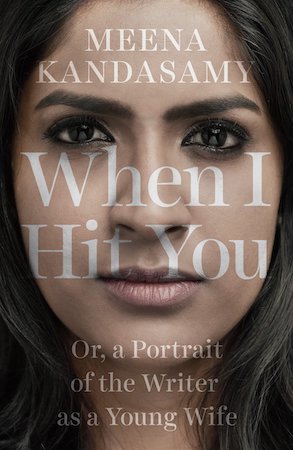
I’m definitely trolling myself by including Women’s Prize-shortlisted poet, author and translator Meena Kandasamy on this list, but I came to her work so late that I want to rectify a similar potential loss on everyone’s bookshelves. Her 2017 novel When I Hit You; Or, A Portrait of the Writer as a Young Wife is a gripping story of a young woman living with her abusive Marxist husband.
As someone who has wasted too much time in thrall to socialist men, I loved this exploration of gender, idealism, and the seductive draw of politically engaged men. For example: “To fight the evils of capitalism, we required the staunchest warriors. He was one, and he could make one out of me.” Hard relate. Above all, though, Kandasamy’s novel is a story of one writer’s struggle to create work within and against incredibly oppressive odds. As her narrator says, “The number one lesson I have learned as a writer: Don’t let people remove you from your own story.” Kandsamy—in her poems, books, and even her tweets—never does.
Aditi Patil
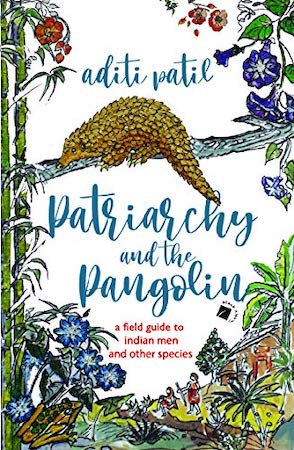
My friend who loaned me her copy of Patriarchy and the Pangolin: A Field Guide to Indian Men and Other Species described it as “perfectly capturing millennial Indian women’s climate angst”—something we both share, but rarely see so well represented. Conservationist Aditi Patil’s debut 2020 book is part-memoir, part-field research; the story of two women making their way through Gujarat’s farms, fields, forests, and bureaucracy. Here they’re faced with every species of intractable Indian man as they seek to uncover stones usually left behind by data: women farmers, nonhuman life, indigenous peoples.
Describing herself as “the poor woman’s David Attenborough,” Patil’s book sparkles with a delightfully Indian humor. Roadside cows ‘”wonder… what failed questionnaire sheets taste like” and more than one potential conflict is diffused because “The moment passed, like all the millions of moments that have historically passed when men haven’t noticed what women said.” In Patil’s own words, Patriarchy and the Pangolin is a book “about what it means to be alive in India. And to be alive to India.” And it is just that.
Sharanya Manivannan
“Some days you sparkle like a teenage vampire. Some days you feel as though you’ve walked through the remains of an exploded dhrishti pusanika, which is to say, fucked.”
Unlike the other writers on this list, poet and author Sharanya Manivannan—who grew up between Sri Lanka, Malaysia, and South India—leans deeply into cultural and spiritual specificity, and invites her readers to follow. She’s the author of two poetry books, a collection of short stories, a novel, and most recently, a graphic novel about mermaids that she illustrated herself(!). Across genre, all of Manivannan’s work glows with a luminous depth and a thorough relishing of language at every turn. This includes my favorite, The High Priestess Never Marries, a collection of short stories about women living on their own terms that shines long after the last page.
Manjima Bhattacharjya
Can feminism and fashion be allies? This is one of the many questions Manjima Bhattacharjya (one of the best feminists I know) explores in her intrepidly reported book Mannequin: Working Women in India’s Glamour Industry. From going backstage at India’s most prestigious fashion event (thanks to meeting two models outside the hotel toilets—what Bhattacharjya describes as “the most significant day in my Ph.D. life”) to interviewing countless working women from a wide variety of backgrounds, this debut book uncovers the lives of women in fashion as existing, consistently, “between spectacle and surveillance.”
Spanning body politics, labor protests and feminist ideas of “objectification,” Mannequin leads us through an unflinching analysis of how neoliberalism has deeply shaped India; an economic system in which models serve as the very embodiment of globalization. Except the thing about globalization is that not everyone can participate in it —including, often, the women themselves.
Nisha Susan
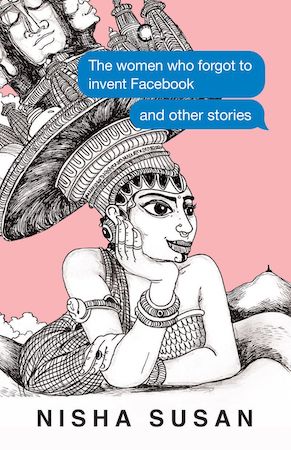
Co-founder of the award-winning feminist website The Ladies Finger, Nisha Susan is a writer who I first encountered as an editor. She was the first person who showed me how to make writing that endures, and most importantly, what an editor can do for a writer. When I went on to become an editor myself, it was her smart, guiding hand I tried to channel. All this to say that I was entirely primed to love her debut short story collection The Women Who Forgot To Invent Facebook and Other Stories—and it did not disappoint.
Susan writes millennial India the way it feels for many of us: funny, painful, violent, absurd, and in turns bound together and fractured by digital technology. This sharp, witty collection also manages to feature pretty much every variety of Indian fuckboy I’ve ever encountered, which, given their expansive range, is no small feat.
Priya-Alika Elias
Speaking of desi fuckboys, my favorite chronicler of their insufferable ways is Priya-Alika Elias (see: “DJs are the root canals of people”), the author of Besharam: Of Love and Other Bad Behaviors. A collection of funny, fierce, heartbreaking essays, Besharam (the Hindi word for “shameless”) ranges in topic from internet culture to “aunties” to the problem with telling your friends to just “dump him.” In it, Elias writes:
“How can I describe the specific wound left on online dating sites by white women who say ‘only white men’ or that left by white men who say ‘you’re attractive for a (X ethnicity)?… We know what happens to a wound when it festers.”
“I was a brown girl in a wasteland of blinding whiteness and it never occurred to me that I was worthy of being cherished and loved.”
At every turn in her debut book, Elias takes our faces between her hands and tells us we are worthy, worthy, worthy.
Urvashi Bahuguna
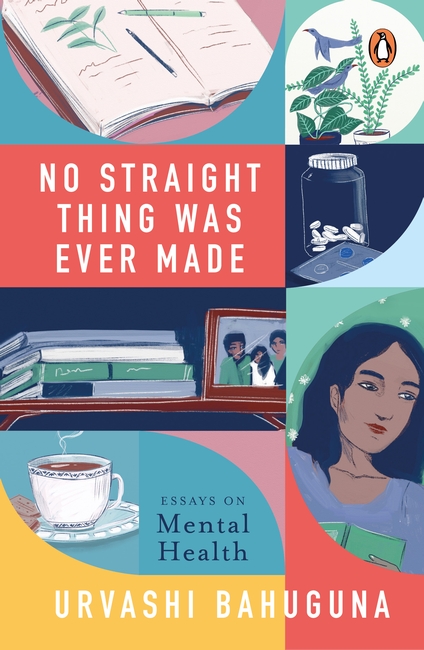
Poet and essayist Urvashi Bahuguna is the voice in Indian writing I feel I’ve always been looking for: graceful, sharp, and most importantly, rooted in India without insisting on cultural identity at every turn. The young author of an exquisite debut poetry collection Terrarium (whose launch I attended at an indie bookstore in Goa, the Indian state where I live and where Bahuguna is originally from), it’s her 2021 bookNo Straight Thing Was Ever Made: Essays on Mental Health that announces Bahuguna as a literary force to be reckoned with. In it, she writes:
“We knew respectability was no antiquated need for most people around us, and that stigma and judgment were a stone’s throw from where any of us stood.”
Simultaneously soft and crystalline sharp, Bahuguna’s essays range in scope from family to fear to writing to birds— the attempts of a young woman to trace the patterns of her mind and her life, all the while remaining firmly rooted where she stands.
With this note, I’m inviting all of you, our generous, thoughtful Electric Literature readers, to come with me on a small monthly sojourn. Starting today, I’ll be sending a monthly “from the editor’s desk” letter. The general purview is quite broad; topics will include anything from my pop-culture musings to my take on the latest discourse sweeping literary Twitter, to a recent book I’m loving, or illuminating the behind-the-scenes of our editorial thinking at EL. I’m excited to share this with you.
Just in case anyone is unaware, my name is Denne Michele Norris, and I’m the third Editor-in-Chief of Electric Literature, and the first Black, openly transgender woman to lead a major U.S. literary publication. I’m thrilled to be here, thrilled to contribute my vision to this amazing, boundary-breaking journal.
I am as much an editor as I am a writer—I think this job cements it—and that I am passionate about this duality.
I’m coming up on a decade post-MFA, and this entirely made-up benchmark has been, as the kids might say, living rent-free in my head. I keep asking myself: am I where I wanted to be—where I thought I might be—as a writer and person? After a decade of part-time and volunteer editorial work, I have my first full-time job in the literary sphere, a goal I’d set for myself (in rather vague terms) when I made the decision to make a serious attempt at “being a writer.” So that’s a yes, right? I also thought I’d have published two books by now, because in my youth it seemed so easy to sit down and just write a novel. So that must make it a no? The answer is complicated, one of those “both/and” situations my therapist is so fond of mentioning. What’s become clear, though, is that I am as much an editor as I am a writer—I think this job cements it—and that I am passionate about this duality.
But the reason I bring this up is far greater than those reflections. Last week, I noticed a few tweets reviving the ever-popular MFA discourse. The tweet that set this round off recounted a first-semester male student in a prestigious MFA program describing a female second year’s story as “competent.” I felt the dismissiveness of this comment in my bones, and what emerged was a long-hidden memory from my own MFA.
During my first workshop at Sarah Lawrence, on one of my stories (later published by Awst Press and nominated for a Pushcart), a classmate—a young white woman—advised me to let the reader know upfront that my characters were Black. The story in question was about 20 pages long, and the first time I mentioned race was around page 10. To be perfectly honest, I hadn’t thought I’d needed to, but I sat silent, ferociously scribbling my notes while my classmates talked around me. The story didn’t center race as a plot point, so it seemed strange to me that she had assumed the characters were white. But the critique was widely supported, both by my (white) professor, and the other students in the class—though afterward, the lone additional Black student approached me and advised me to ignore this criticism. She literally waved it away, as though it was nothing more than a nuisance.
Over the next few days, my white classmate’s critique continued to bother me. I began to understand it. My characters had Eurocentric names. Race didn’t play a part in the plot. I hadn’t mentioned hip-hop, or soul food, or any other easy—and often lazy—signifier of Blackness. I saw how a white reader might assume they were reading about white characters and then be jarred by the rather innocuous revelation that the family at the center of the story was a Black family living in a mostly white small town. I had not, by the way, intended this to be any kind of dramatic revelation. I had simply written a moment when a Black character acknowledged shared Black experience to another Black character.
What continued to baffle me about this moment was that I was sitting right there in the same classroom, at the same table, with my brown skin and kinky, dread-locked hair. Was I invisible? Was it—upon seeing me, indeed knowing me personally—so inconceivable that I might assume the centrality of people who looked like me in the context of my own writing, if not the larger world?
I had simply written a moment when a Black character acknowledged shared Black experience to another Black character.
That critique sent me into a spiral about how, and if, as a fiction writer, I should even attempt to write Black and queer characters. My takeaway from that workshop was that unless the plot was actively dependent on their Blackness or queerness, there was no value—only confusion and complication—in deviating from the white, cis-het norm. I turned to faculty and fellow students to find the most articulate ways of asking for guidance around this conundrum, one which no one else in my cohort appeared to be facing. I wondered: how could I incorporate my identity into the art I was desperate to create in a way that added value—rather than detracted from it? Were the nuances of the person I was merely potential plot devices, devoid of their own inherent value?
I’m grateful for two of my classmates, Nicole Dennis-Benn and Ursula Villarreal-Moura, both just a few years wiser than I, who pushed me to write characters who were undeniably non-white and non-straight. They read my writing assuming my characters were “raced,”—though I hadn’t intentionally “raced” them—because of the worldview they brought to my work. In their eyes, I found my freedom on the page. Ursula even referred me to VONA, a writers workshop and vast community that exists solely for writers of color. I took a summer workshop there, and came away understanding the value of my own visibility.
How could I incorporate my identity into the art I was desperate to create in a way that added value—rather than detracted from it?
I think of visibility now, as a Black woman of the trans experience, who occupies a role of some influence in her chosen industry. We tell young writers to look at the masthead of the publications where they might consider sending their work. Look at who the editors are, we say. Are there any visible POC? Queer folks? We give them this advice because we want them to have the opportunity to be read, evaluated, and published, by people who will see them as central—at the very least within the context of their own work—as opposed to marginal. Literature is an exercise in imagination, and it’s in that imagination that we get to lay the groundwork for the future that we want. And I want a future where no writer ever has to look at their skin color, or who they love, or the country they come from, and wonder if there is value in writing themselves onto the page. I am the Editor-in-Chief of Electric Literature, and I’m here to tell you that we are not sitting silent in the classroom any longer.
Warmly,
Denne Michele Editor-in-Chief, Electric Literature
Books and tattoos have one major thing in common: ink. Maybe that’s why book-lovers like getting literary tattoos so much. A few weeks ago, I asked our social media followers to send us their literary tattoos. I expected ten, maybe twenty responses. Instead, we got over 250. 250! Our feed was all skin and ink for days. There were so many great tattoos that it was hard to narrow it down for this piece, but ultimately these tattoos stood out in particular against a sea of (over 250) other pieces.
Below, you’ll find some of our favorite pieces, along with the artist’s information and further information about the tattoos from contributors. If you want to take a look at all of the other amazing tattoos (there are so many), check out the original thread here.
Langston Hughes
“My son is named Langston, after the poet. So, I got a tattoo with ‘Dreams’ by Langston Hughes. I’m all about making sure whatever his dreams are come true. (He’s 3 so we aren’t quite sure what those dreams are yet, but I’m sure one day he’ll tell us).” —@ericsmithrocks
“I always wanted a book tattoo but never wanted to commit to one book—I love ‘em all! This design was off of a tote bag I received from Avid Reader Press when they first opened their imprint. I thought it would look dope as a set.” —@BiblioReckah
“This beautiful stick-and-poke is an interpretation of Phillis Wheatley‘s iconic lithograph. She was a true genius in every sense of the word, as well the first Black poet to be published in North America. This tattoo reminds me that I am possible because of her keen mind and enduring heart.” —@NatashaOladokun
Wayside School written by Louis Sachar and illustrated by Adam McCauley
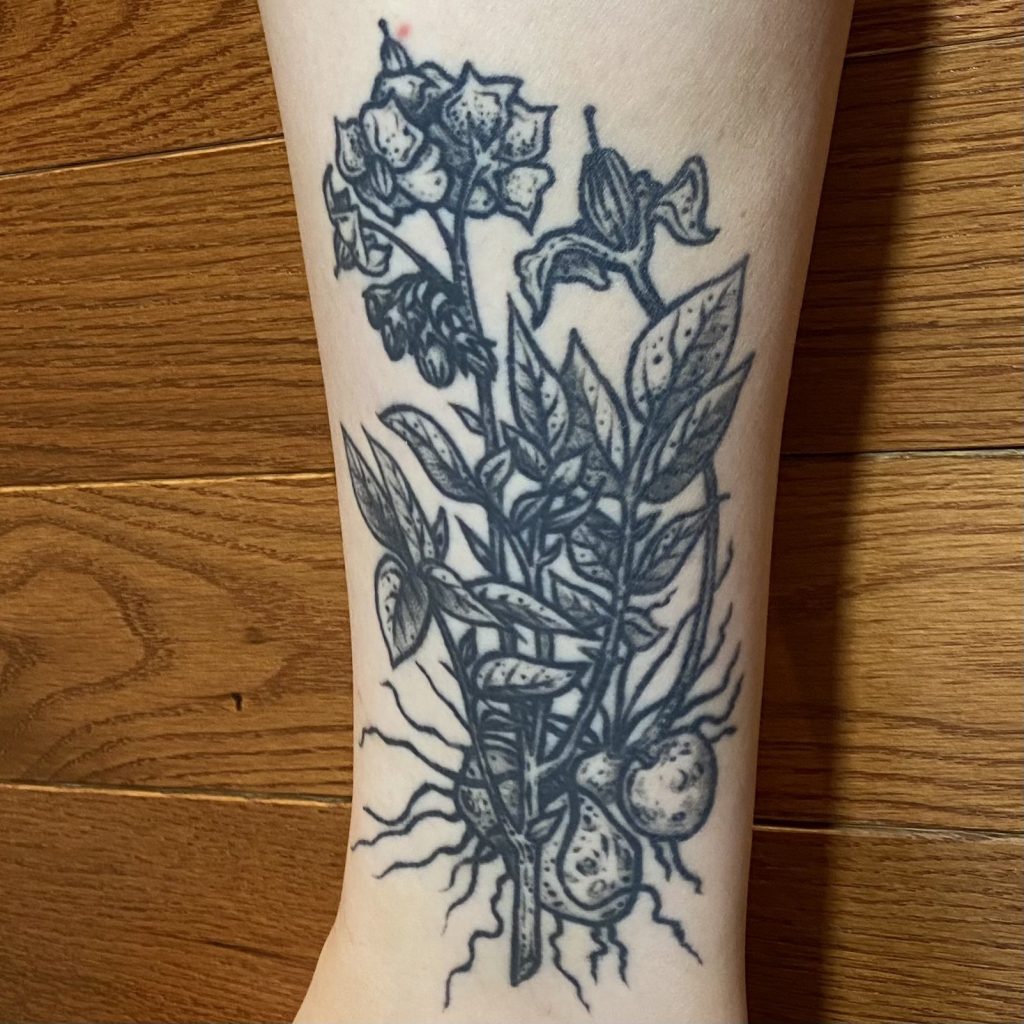
“My brothers and I all read theWayside School series in the fourth grade, and I’ve been telling them for decades that I was going to get a potato tattoo on my ankle like Calvin does in one of the books. It’s a little more elaborate than Calvin’s, but my potato plant has three potatoes, one for each of us siblings.” —@JanineZeeCheng
“Annabel Lee” by Edgar Allen Poe, illustrated by W. Heath Robinson
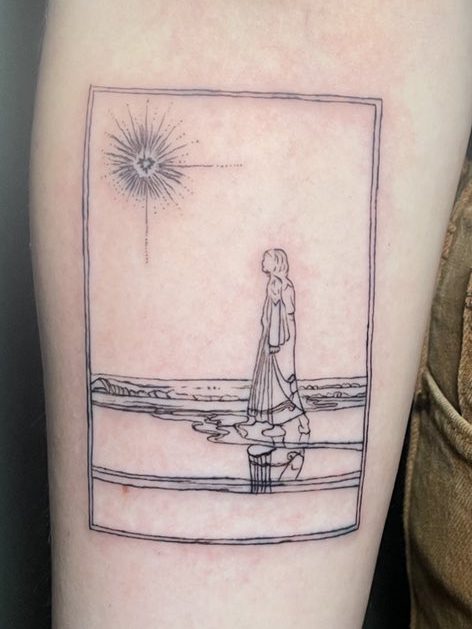
“The artwork is from a collection of Edgar Allen Poe’s poetry illustrated by W. Heath Robinson. This piece was created for ‘Annabel Lee’, which was one of my favourite poems to read when I was younger.” —@savetheblooms
Angels in America by Tony Kushner & Wolf Hall by Hilary Mantel
Angels in America tattoo:
“My heart stopped when I was 20, leaving me dead for six minutes. The appearance of the angel to Prior Walter in Angels In America has always resonated to me as someone who should have died but didn’t, and my subsequent struggle to find meaning in that.”
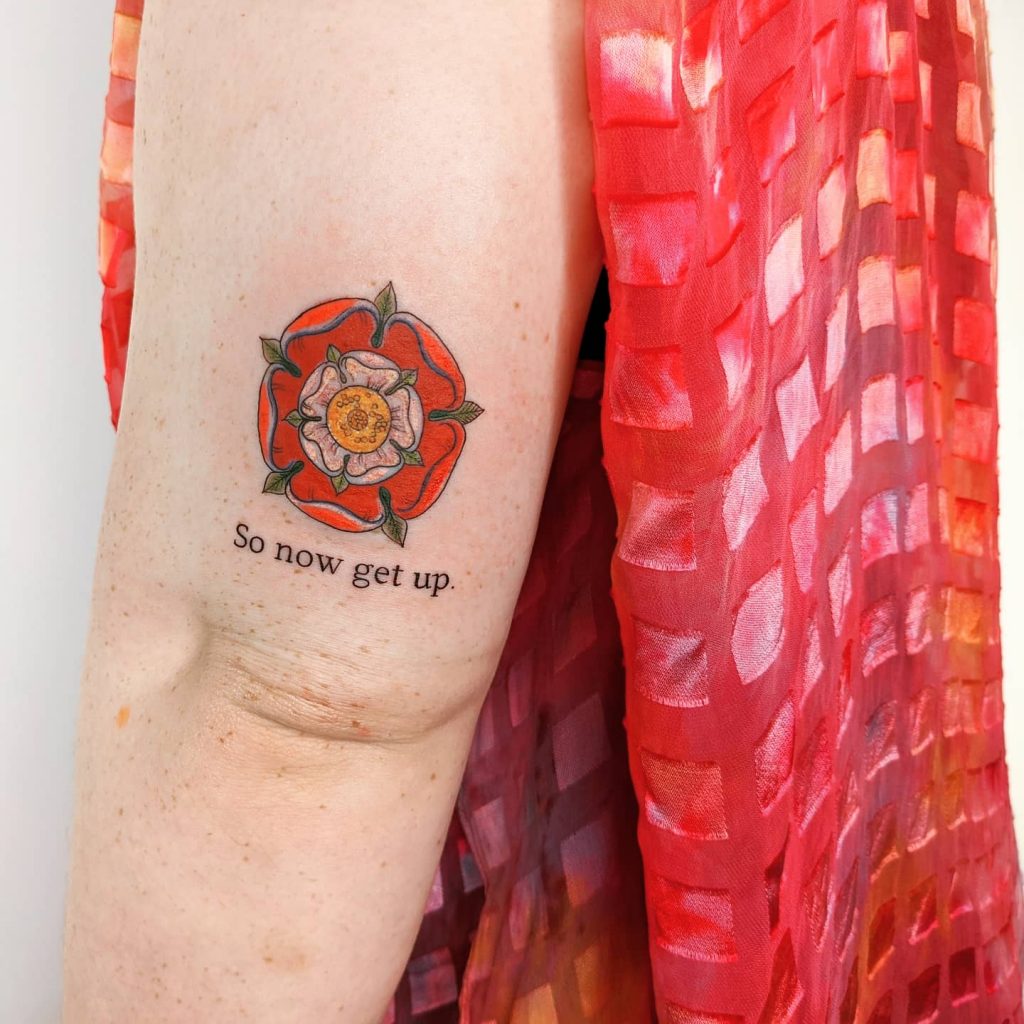
“It’s the first line from Hilary Mantel’s Wolf Halltrilogy (hence the Tudor emblem). I began the series at the start of the pandemic, and sinking into a character’s mind so fully, so vividly, kept me from coming to pieces during the nightmare of 2020. It was an achingly human thing to lose myself in a time so distant but so like our own, with its plagues, tragedies, loves, rivalries and resonant, tenacious hearts.”
“I started reading Love and Rockets in the ’90s—it’s one of the few series where the characters actually age in real time and I always related to Maggie, especially to her insecurities (not to mention that I think she was the first bisexual character I ever saw in fiction!) I liked this panel in particular because it reminded me of Roy Lichtenstein and I felt like it was kind of reclaiming that image for comic books.” —@wordnerdy
Bread & Jam for Frances by Russell and Lillian Hoban
“I have the bread and jam from the endpapers of Bread & Jam for Frances by Russell and Lillian Hoban. My daughter Josie has Frances. Why? Because the book is hilarious, suspenseful, warmhearted, and it contains the greatest lunch in all of children’s literature. When Josie was 16 we saw an exhibit about the Hobans’ work at the Beinecke Rare Book Library and Josie started asking if we could get matching Frances tattoos when she turned 18. I figured she’d stop asking by then. But nope. Josie found the lovely artist, Ocean Gao.” —@MarjorieIngall
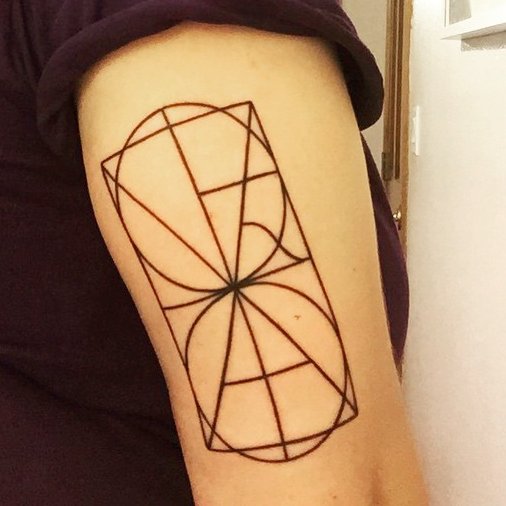
“It’s a monogram of the letters A-Z and numbers 0-9. Barring some special characters, every book I’ve ever read is in that tattoo and that’s why it means so much to me.” —@ewwwheather
We Have Always Lived in the Castle by Shirley Jackson
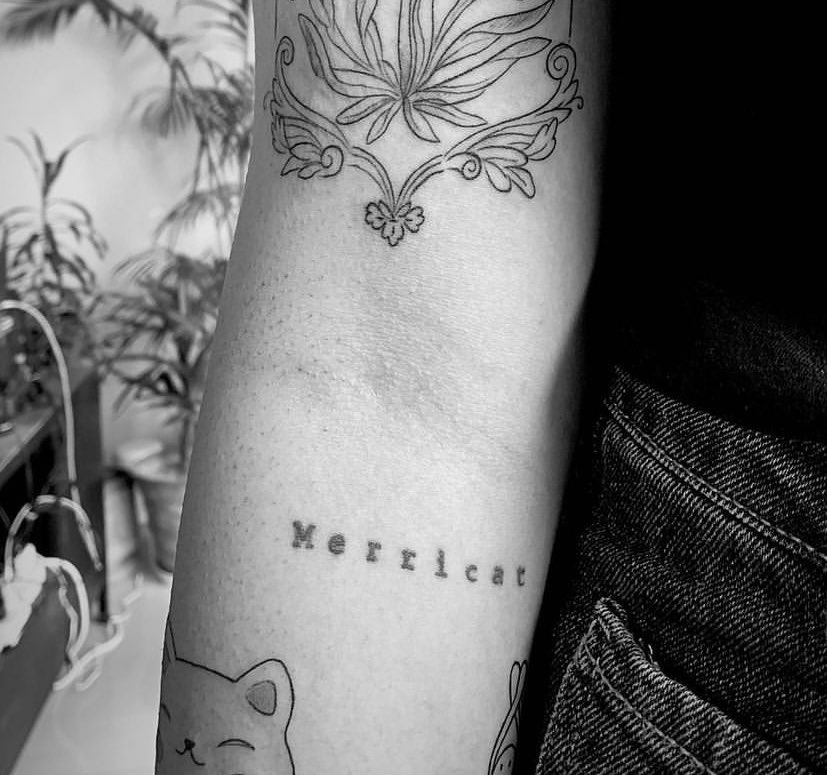
“We Have Always Lived in the Castle by Shirley Jackson is one my favourite books and I’ve always identified with the character of Merricat a bit too much, so it was only fair that I permanently imprint her into my skin to keep with me forever.” —@merricalico
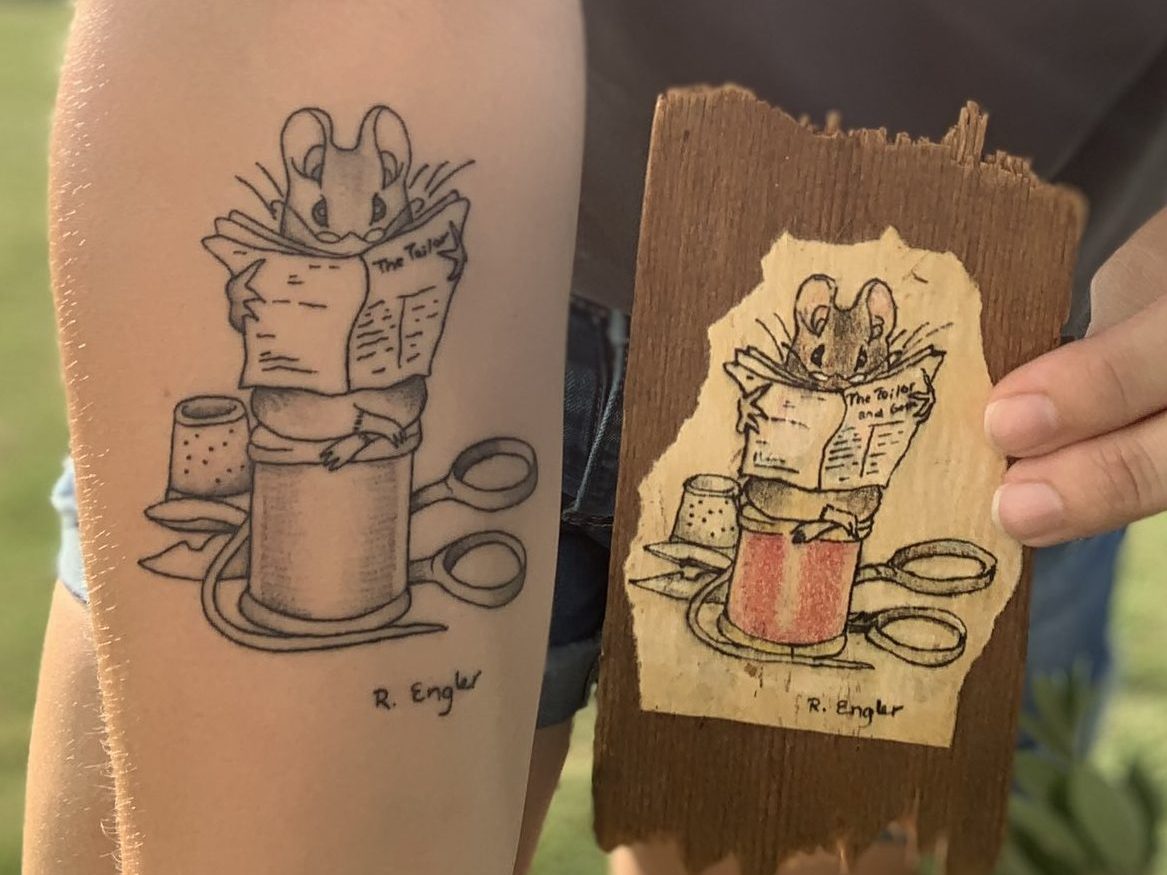
“The tattoo is from the Beatrix Potter book The Tailor of Gloucester. My mom was an artist who drew the original sketch and the tattoo is meant to honor her and her artwork and my grandmother, who inspired my love of reading.” —@ClaireRoehl
“This was my first tattoo; at the time I was very young and felt helpless and hopeless about the rest of my life looming ahead of me. The line of dialogue this comes from is in The Price of Salt by Patricia Highsmith when Carol says to Therese, “You’re about as weak as this match…But given the right conditions you could burn a house down, couldn’t you?” I got it to remind myself that even if I felt helpless, I wasn’t.” —@ghost_dyke
“My tattoo a tribute to The Dark is Rising sequence by Susan Cooper. I incorporated the mistletoe and hawthorn that are part of key moments in the books, and used a “flame-colored” dahlia to represent the Sign of Fire from the books, along with the inscription from that sign: Liht Mec Heht Gewyrcan.” —@shadowkatie
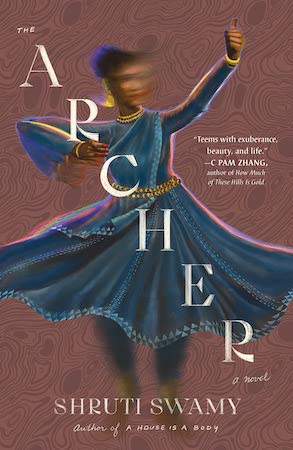
In Shruti Swamy’s lyrical debut novel, The Archer—a coming of age narrative set in 1960s and 1970s Bombay—Vidya’s formative years are upended when her mother disappears. However, once Vidya discovers the classical dance form Kathak, it becomes her life’s focus, an obsession that lasts even after she leaves for college and falls in love. In The Archer, Vidya grapples with universal questions—can one be devoted to both art and family? Can one transcend a flawed family legacy?
Author Shruti Swamy is a Kundiman fiction fellow, a Steinbeck Fellow at San Jose State University, the winner of two O. Henry awards, and the recipient of numerous residencies and grants. Her debut short story collection, A House Is a Body, was shortlisted for the PEN/Robert W. Bingham Prize.
Swamy and I spoke recently by phone and discussed writing about motherhood, publishing during the pandemic, and Swamy’s lifelong love of libraries. This conversation has been edited and condensed.
DeirdreSugiuchi: In The Archer, Vidya becomes obsessed with Kathak, a dance form that had a rebirth in post-colonial India. How did you become interested in Kathak? What made you focus on this time period? The world you built feels seamless. How did you conduct research?
Shruti Swamy: I was born and raised in America. My parents both grew up in Bombay in the 1960s and ’70s, and they left at the end of the ’70s for America. The time and place have been fomenting in my imagination since I was born.
I watched Hindi movies that were set in Bombay and made in the ’60s and ’70s—there were real city streets in the background. I heard stories from my parents, from my relatives. I visited Bombay, Mumbai now. It’s really different from the time I was writing about but it felt mythical and beautiful and romantic and familiar in a way that I wanted to keep exploring.
My mom is a classically trained Kathak dancer. She stopped performing by the time that I entered the age of memory. I’ve never really seen her dance. But there was always that kind of ambient in my household, beautiful pictures of my mother performing, books, and Indian classical music around the house. My dad is an Indian classical musician, trained in both North Indian and South Indian music. He plays the Bansuri, which is a bamboo flute, and he also sings. I grew up in, in retrospect, a beautiful, very rich environment of classical music and dance.
I find Kathak thrilling because, while there are narrative aspects to the dance, there’s also parts that are completely non-narrative, focused on the really rhythmic, intense, precise footwork and really fast, sharp, beautiful turns that felt kind of modernist, pre-narrative, pre-language. As a writer who’s always grappling with language and narrative, it was thrilling to be able to be in another art form that could transcend those limitations.
DS: The legend of Eklavya (a master archer who cuts off his own thumb to please his Guru Drona) is central to The Archer. Did you grow up hearing that story?
SS: There are these comic books called Amar Chitra Katha— my dad would stock up on them when we went to India—that depict these stories from Hindu mythology and Indian history. Some are plainly didactic stories, like Dharma trumps all. But even within that, there’s so much complexity, moral ambiguity.
Eklavya was always a story that I grappled with. I couldn’t understand how if you were a teacher, if you were a guru, that you would not respect your student. Many of the Hindu myths that have been troubling to me, I’ve had long conversations about with my mom, who is a feminist. She’s offered me a different reading on them. I got the ability to look at different angles of the story in part through those conversations.
DS: One of the themes you address is being a woman and a mother in a world which is rapidly changing.
SS: The beginnings of this book came from these stories I was hearing about my family and just imagining that world, but as I went deeper in, I realized what was sustaining my interest in the story was that it was a way of looking at questions that were pertinent to my own life, though the pressures on Vidya are different than the pressures on me.
How to lead a good life and have art at the center of your life? These are questions that I was grappling with as I was writing the book and still am.
Vidya’s very passionate about dance, but she’s not quite sure of how to make a life of art and what that looks like. Not even just in a way that’s fulfilling societal expectations of herself, but how to be a person in the world and make a life of art? How to be a woman in the world? How to lead a good life and have art at the center of your life? These are questions that I was grappling with as I was writing the book and still am, as I think about what our obligations are to each other. To me, that’s really what this book is about, and it explores it in a really specific time and place, and specific cultural expectations and demands, but also it feels, in some ways, close to my experiences in this other time and place.
DS: Vidya’s mother suffers from postpartum depression. There aren’t many depictions of postpartum depression in literature. What inspired you to write about postpartum depression?
SS: Early on when I was writing, I read a really sad New York Times article about a mother who committed suicide by jumping off the top of her building with her child in her arms. Studies show that you’re more likely to experience postpartum depression if you don’t have any child care, if you’re the only parent taking care of a newborn, and you don’t feel like you have a lot of emotional or physical labor support, that that really predisposes you to experience postpartum depression. I think of (postpartum depression) as a societal failure rather than an individual problem. It seems to me, if you were taking care of a child, a newborn baby, and you’ve just given birth, it’s very easy to imagine how somebody could quickly lose all sense of self and perspective and maybe even joy.
There’s other things going on with Vidya’s mother. This whole book, in some ways, is an acknowledgement about the complexity of motherhood and the things that are harder to talk about. This is also a book about a child who has been profoundly failed by both her parents and how that impacts her. I was thinking about it more broadly as what it means to be a mother and what it means to fail as a mother.
DS: I grew up in the Mississippi Delta and early on recognized how the caste structure of India and the deep South are similar. Can you discuss writing about caste and class structure?
I think of postpartum depression as a societal failure rather than an individual problem.
SS: Yeah, it was totally terrifying, but I wanted to tell the truth as I have observed and read about and researched. I also have to acknowledge that I’m American, and I wanted to be sensitive to my position.
I’ve had conversations with people where they’ve been like, “Oh, I didn’t know somebody could be poor and Brahmin,” about Vidya. At the beginning of the book, Vidya’s family is pretty much on the brink of poverty but she is in a position of privilege because she’s Brahmin, and that is something that is invisible to her.
There’s some characters I wanted to pay attention to, but I didn’t want to write outside of my experience. I didn’t want to purport to tell anybody else’s story, but I wanted to make sure that those characters were humans and that I, as the writer, looked at them and saw that those were human people doing these acts of labor.
DS: With the opening, you use language to convey a distance between Vidya and her mother. What were your decisions coming into that?
SS: One of the things that this book is about is how even before you form memories your parents kind of create this little protective structure around you, that you can build a self into, which, in a healthy situation, they take the structure away and then there’s the self, shining there that has been able to just grow in this way, protected. So much of what I feel like a parent does is just looking at that child and saying, “I see you, I still see you.”
If you don’t have that, how do you make a self? Vidya does it through dance.
That she/I switch is really important to me. I was trying to explore where you come into a sense of self. If we’ve been lucky, we come into it gradually, because we’ve had our parents, our caregivers, giving us this story of ourselves. But if you come into it yourself, you come into it all weird, almost violently. Maybe it’s scary, or exhilarating.
DS: I used to be a librarian. I heard on this podcast (with Daniel Handler) that you were once described on a news segment as a “library user” and you loved that, that being a library user was the first way you viewed yourself. Can you talk about libraries?
The library is the aspect of American society that brings me the most hope and the most feeling of real patriotism.
SS: How much time do you have? I could spend hours talking about how much I love libraries.
I was actually just thinking back to the beginning of the pandemic when I was like, “What did I do?” They’d sent an email in March 2020 saying, “The libraries are closing for two weeks.”
I literally ran to the library.
DS: Me too!
SS: I was just supermarket spreeing, grabbing books off the shelves… And then they closed and you couldn’t even return books, which was so wild. I was just living with these random books that I had panic-checked out for eight months or a year or something.
Now I have a horrible sense of what my life would be like without a functioning library system. This is the longest that I’d ever gone without having access to a library. If I bought all the books that I read, I would not have any money for anything else. I’m a voracious reader.
The library is the aspect of American society that brings me the most hope and the most feeling of real patriotism. My parents didn’t grow up with public library systems. They didn’t have those in India. I think they had lending libraries. My mom always talks about crouching down to read, frantically reading for a little while, a book in this lending library, but she couldn’t take the books home with her. When my parents got to America, they were both avid library users. Some of my earliest memories are at the library.
It’s beautiful to me that a governmental institution exists to say that, “Books matter, art matters. That everybody should have access.” If somebody wants to learn how to play the guitar, they should be able to teach themselves for free. If somebody wants to read James Baldwin, or work on their resume, or read a poem, or whatever, we agree this is a public good and that this information and knowledge and pleasure should be accessible to all of us.
It’s so precious to me, and I can’t even, sometimes, believe libraries still exist. Just. I can’t. Words fail me.
Within the confines of a few hundred pages, it can be difficult for a character to be read as bisexual unless explicitly mentioned. Too often, if a character is dating someone of the same sex they are seen as gay, and if not, they are assumed to be straight. These quick judgments further the erasure and harassment bi+ people face on an everyday basis.
In recent years, a growing number of books have openly celebrated the complexities of bi identities. This is in part because of an increasingly queer population and more frequent spaces for LGBTQ writers, but also because bisexuality is finally becoming visible. (GLAAD estimates that over half of all LGBTQ people and up to a third of all people under 35 identify as bisexual, pansexual, queer.)
While young adult, new adult, and genre books have embraced queer characters with open arms, literary books geared towards adults featuring bisexuality can slip through the cracks. The following novels discuss fluidity, love, and connection from the Gold Rush era to present-day New Zealand.
A stolen newspaper begins a lifelong love of journalism for Ivoe Williams, the Black Muslim main character of Barnett’s debut novel. Ivoe wants to change the world with her writing, and so she becomes the first member of her family to go to college. In college, she falls in love with a man, but the relationship falters when he grows jealous of Ivoe’s connection with her journalism professor, a woman named Ona. Together, Ivoe and Ona flee the Jim Crow South and found the first female-run Black newspaper. Set against the tensions of Jim Crow and the Red Summer, this novel explores the intersections of race, gender, and sexuality.
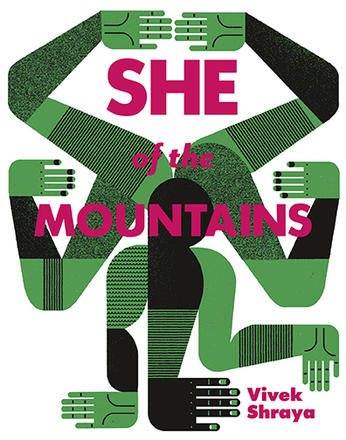
This illustrated novel follows the intersecting storylines of a young man in 1990s Canada exploring his sexuality, and the stories of Hindu gods. As the main character comes of age and tries to understand his gender and sexuality, he is rebuffed by both the straight and gay communities, especially as he begins a relationship with a woman who calls herself She. She of the Mountain is an experimental and nuanced fable about the complexities of identity.
Ava is working as an English teacher in Hong Kong when she meets Julian, an English banker from a posh background. She falls in with Julian and his elitist friends, and soon begins an undefined relationship with him that culminates in Ava moving into his spare bedroom. When Julian has to return to London for several months on business, Ava stays in his apartment, but falls in love with a lawyer named Edith. As Ava’s relationship with Edith deepens, she must decide if she’s going to stay with the dynamic, exciting Edith, or return to the quiet comfort of Julian.
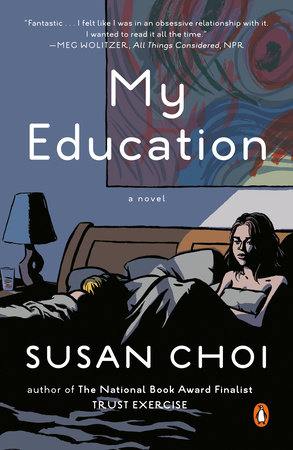
When Regina Gottlieb first arrives at grad school, she already knows the rumors about a handsome professor on campus, Nicholas Brodeu. He’s known for sleeping with his students. Curious, Regina enrolls in one of his classes, and when she’s offered a TA position, she’s suddenly immersed in the lives of Nicholas and his pregnant wife, Martha. Although it was Nicholas who first caught her eye, Regina becomes obsessed with Martha from the moment she sees her, and begins an affair that turns both women’s lives upside-down. This steamy campus novel offers readers an education on sexuality and power.
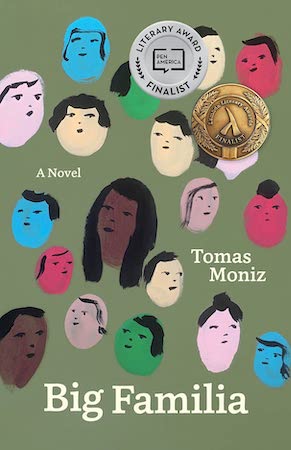
After a regular at Juan Gutiérrez’s favorite bar dies, it’s his final straw in a stressful year. His college-bound daughter has been increasingly defiant, his boyfriend, Jared, craves more commitment, and the bar is closing. That’s all without mentioning gentrification, the challenges of navigating his sexuality post-divorce, and his relationship with his incarcerated father. A unique tale of late-bloomer queerness, single-parenthood, and latine identity, Big Familia cherishes the families we are born with and the ones we find.
Three women road trip across New Zealand’s North Island for a beach vacation. The narrator is not-quite-dating, not-quite-not-dating Ilana, however, she worries that Ilana is harboring a crush on their third guest, Ashi. As the three women navigate their unique dynamic, the narrator also grapples with her recent break up with an abusive ex-boyfriend. Porter paints a complete picture of not only female friendship and sexuality, but also of modern New Zealander culture and post-colonial guilt.
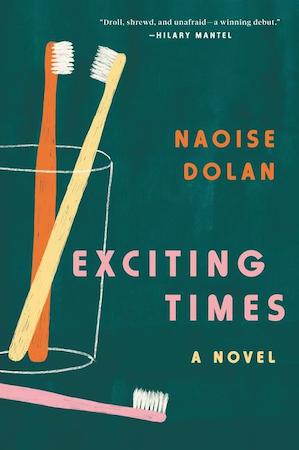
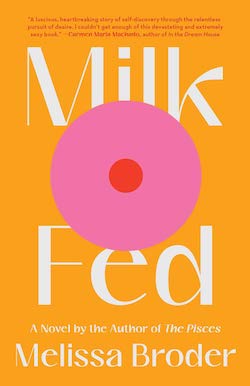
Rachel is a mid-20s, Jewish, bisexual woman who hates her job in the talent industry. The highlight of her day is sneaking away at lunch for a small cup of frozen yogurt, the only “cheat” in her rigid diet. But after her therapist advises she cuts off contact with her mother, and the cute Orthodox woman working the froyo counter asks her to dinner, her life gets flipped upside down. Full of second-hand embarrassment, steamy sex, and golems, Milk Fed is dedicated to sapphics who love the TikTok audio, “Mommy? Sorry, Mommy?”
When Mina is stopped at the George Washington Bridge by the police, she can’t convince them she wasn’t actually going to jump. Her husband, Oscar, decides that it’s best for them to leave New York behind for his hometown of London. Across the Atlantic, Mina decides that diving into her background in Classics might uncover a new answer for her mental health. But even mythology can’t solve her growing distance from her husband and her intensifying friendship with his childhood friend, Phoebe.
Lucy and Sam are Chinese American siblings living at the end of the California Gold Rush. After the death of their father, they must carry his body until they can find a burial spot. But at twelve and eleven, they also need to survive in a hostile landscape not built for working-class children of color. Zhang masterfully retraces their upbringing, while honoring their heritage and Sam’s queerness and androgyny.
For a time Vidya had not had a mother or a brother, she had only the idea of a mother and a brother: they were imaginary but real in the same way god was. For a time she had not had a mother but an aunt and not a brother but two cousins who had lived with her in the one room flat she shared with her father. The Cousins were girls, older than her, they were not cruel but it was clear they found her irrelevant. They did their schoolwork quietly in the kitchen, whispering to each other, glamorous secrets of movie stars and breasts. The Aunt had rough, worried hands, and yanked the comb through the girl’s hair, which got snarled even in braids. When Father Sir came home from giving tuitions she had gone to sleep but heard the door open and shut.
There was a woman in a room they went to visit every month, a woman with no voice and a face that turned toward the window, but that was not a mother, mothers lived at home with their children. And sang to them.
Now the Aunt-Not-Mother had been put away with the Cousins-Not-Brother, and the Room-Not-Mother had come to live in the house and answered Vidya’s question when is my mother coming home, which she asked out of habit more than hope, with the firm and sometimes angry response of I am your mother. The child put her hands curiously in the Room-Not-Mother’s hair but the Room-Not-Mother brushed her away as though she were a fly. She asked Room-Not-Mother to sing a song to her at bedtime (Aunt-Not-Mother did not sing to her at bedtime, as was expected: she was a not-mother) and Room-NotMother did not sing a song and instructed her to close her eyes. She closed her eyes. In the dark she could hear Father Sir talking to Room-Not-Mother, who answered his questions very simply with yeses and nos. Was the heat making her feel ill. No. Had she heard from her sister. No. Would she write to her again? Yes. Then her mind flattened like a coin and she was asleep.
Now Vidya studied (Room-Not-)Mother as she wiped her face again and again with her sari. Earlier she had been in a frenzy of chopping and frying, but she seemed not to know anymore what motion to provide her restless body. Her eyes were keen and dark and hard, like the eyes of a man. She wore a pale green sari with a pretty gold border, cotton, but her best. Skin pulled taut against the drum of her body, in the strip between blouse and skirt: ribs, like that of an unhappy dog. Outside she wore strange shoes of brown leather and real laces—shoes that made the neighbors whisper—inside her bare feet were big like Vidya’s were big, Vidya’s already three sizes larger than the other girls at school. Father Sir, emerging from his bath, gave a sharp glance to Vidya sitting idle on the divan, swinging her legs. “Are you helping your mother?”
She shook her head.
“Well?”
“I’m finished,” said the Mother.
“Before you sit down you must always say, mother dear, how may I be of service?”
“I said I’m finished,” said the Mother. “I don’t need help now.”
“The girl should learn.”
The Mother turned away. She was preparing the puja plate, and placed a whole laddu beside the tiny holy things necessary for the rite: a pile of uncooked rice, an oil lamp still unlit, kumkum and sandalwood paste to be smeared wetly, and a small brass bell. Vidya was glad that she had not been pressed into service in the kitchen, not because she disliked chores (though she did) but because the sight of so much food, so much food all at once, brought on a kind of fright in her. It was not time to eat yet and she had been scolded out of the kitchen several times—not even a taste—and sat on the divan swinging her legs with anxiety. Would there be enough? What would she eat first? What would this brother be like—would she know him? What if the Brother ate everything, and there was nothing left for her? Recently, the sight of food, food cooking in the stalls along the side of the road—jalebis, bhel, aloo tikki, sev puri—made her feel a wretchedness that was like falling ill. It was dulled only after the morning glass of milk, if she got the morning glass of milk, which, now that Aunt-Not-Mother and Cousins-Not-Brother’s hungry mouths had vanished, she was given every morning, and sometimes in the evening also. Father Sir left before she woke and returned after she was asleep, and on the weekends he would see her and say: well? This made her uncontrollably shy and she would mouse down into her dress and say yes sir.
“What time does the train get in?”
“One.”
“So go, na? You don’t want to make them wait.”
“I won’t make the train come any faster.”
But she was nearly pushing him out the door. He put his shoes on in the hallway. He was laughing and said again, “I won’t make the train come any faster.” Then there he was downstairs, walking through the dusty courtyard, straight through a cricket game of the chaali’s boys; they paused and watched him while he passed, in white, a dhoti and a clean kutra. When Father Sir was gone from the window, Vidya turned to watch the Mother again. She had forced herself down into stillness, sat with her hands folded and gripped hard on her lap. She was muttering something under her breath, barely audible, forbidding vowels. Then she fixed her eyes on her daughter and said, “Come here.” Vidya crossed the width of the apartment to the chair where the woman sat: a distance of no more than a few feet. The woman touched her daughter, fixing, smoothing what couldn’t be fixed or smoothed, the wild puff of hair that fuzzed up the girl’s neat braid, the wrinkles sweated into her good dress. “Do you love your brother?”
“Yes,” said Vidya dutifully.
“Then you must tell him. You must say, welcome home, my dear brother.”
Vidya nodded.
“And you must care for him like a mother.”
No. No. She was to be a not-mother. She looked at the woman with panic.
“I thought you were the mother.”
“Yes,” she said, her tone quickening. “I am the mother. But what I mean is you’ll have to help me take care of him.”
“Why?”
“Because he is your brother.”
“Will I be the mother?”
“No, no. I am the mother.” Then, exasperated, she stopped speaking. The apartment was filled with the smell of food. It was like a dream—or a nightmare—so many smells. Vidya had dreams where she was eating everything, kulfi and handvo and rotis and dhal and kheer. She fell upon her knees and ate like a dog, crying out with pleasure and joy. But in these dreams the food never filled her, it was like eating fistfuls of air. Woke with that hard pain in her stomach, and couldn’t sleep sometimes, until dawn.
She fell upon her knees and ate like a dog, crying out with pleasure and joy
Each minute ripened. It was incredible how much time could be contained in the increments measured by the clock. She thought she would ask again about the food but each time she looked at the Mother she was hushed by the look on her face—it was a terrible look. The Mother was folding herself inward and trying not to cry, and the effort to suppress this monumental emotion was making her eyes red. Vidya looked out the window. The cricket boys had resumed their game, they were calling to one another. Even the littlest ones would not play with her because she was a girl, and spoke to her, when they had to, with disdain. But brothers were different, she was confident of this. In fact, a brother could crack the world of the boys open, and invite her inside. They might never make her the batsman, but surely she could be a minor fielder until she proved her skill. They would rush her, chanting her, she would crow with them: king of the boys! But the Brother? The Brother was a blank, she had no notion of his face (there was a picture kept framed in the house of the Mother holding a baby, but the features were so indistinct it could have been any baby, including Vidya herself), yet she felt him in this moment looking up at her admiringly. King of the boys, she and her brother, but mostly she.
Then, there, on the far corner of her vision, a tonga dropped three passengers off in the street. They were as tiny as toys: the tonga pulled by a toy-donkey, and the three passengers—a man dressed in white, a dark woman in a parti-colored sari, and a child, an almost baby, carried in the arms of the woman. The girl watched them quietly as they crossed the courtyard. The game had to be paused, but it was paused good-naturedly. Father Sir called something out to the boys as he passed, a greeting of some sort, and there was joy in the sound of his voice if not the words it carried. The Mother heard Father Sir’s voice but remained where she was, as though calmed by it.
“Listen, now, when your mother’s sister comes you must tell her how much you love the beautiful dress she sent you.”
“But when should I kiss my brother?”
“After. Say my dress is very lovely auntie.”
“My dress is very lovely auntie.”
“Good, just like that.”
The Mother was smiling and wiping her eyes. The three toys were moving up the stairs but neither woman nor girl rushed out to greet them. The woman took the girl’s small hand and held it tightly, squeezing it. The feeling of being touched by the woman was so lovely, that the time that had moved for ages so slowly began, now, to quicken. Only moments, only seconds before she had a Brother, and her Mother touched her hair. The door opened. Slipping off their shoes in the hall—
The light coming from the doorway darkened them. They were just shapes. Then Father Sir stepped through the door and became himself, and the woman in the brightly colored sari holding the boy became herself, and the boy became himself. Who were they? Father Sir was self-evident, he was tall and thin with a high forehead and beady glasses like Gandhiji. The woman who must be her aunt had a dark face and was weeping. There was a stud of gold in her nose. The sari was checked with green and yellow, bordered in red, the colors that licked the eye. Before she got to the boy who was her Brother she performed her task to the weeping woman’s knees. “MydressisverylovelyAuntie.”
The Mother pulled Vidya away roughly. “Where is my sister?”
“Her son fell ill, madam.”
“So she sends a servant?” said the Mother.
“She didn’t want to leave her son, madam.” She had managed to stop weeping, but was holding tightly to the boy. The boy, the baby, the Brother. Vidya could see his little feet dangling down, bare feet, but he had folded his face into the chest of the woman and showed his sister only the back of his dark head. Sister. She said, “Welcome home, my dear brother,” and then looked at the Mother, now doubtful, to see if she had spoiled this task as she had spoiled the other one, perhaps she had muddled up the words, the order—an adult mystery. But the Mother did not seem to have heard her and was looking now at the boy, hard at the boy. On her face was a tightly concentrated fury. Fury at Vidya, at the Brother, at the other woman? Or, most unfathomably of all, at Father Sir? The Mother held out her arms. The expression on the other woman’s face trembled for a moment and the boy, who had been sleeping, began to wake, transferred from mother to mother: Vidya caught his face, gathering red and splitting open into a cry. He was saying ammu, ammu, as the dark woman relinquished him, twisting away from the woman his mother, back to the arms of the woman who had brought him, who cast her gaze down and squeezed her hands together. The Mother’s face became tender as she held the boy. She rocked him back and forth and whispered to him silly little rhymes, ones Vidya had never heard the Mother utter. He would not calm. He began to kick. Instead of setting him back in the other woman’s arms, which were stretched out to receive him, he was set screaming on the divan. Immediately the boy was up, tottering on his skinny legs, toward the parti-colored woman, who touched him, his head, and began to speak to him gently in a language that no one but he could understand.
The Mother was standing clenched, so upright. Her keen dark man’s eyes were full of red.
“Come, come, let’s eat,” said Father Sir. “We’re all of us hungry.”
Food! And Brother so small and fussy—he surely would not eat very much. But the Mother would not move from where she was standing to ready the meal and offer plates.
Father Sir said, “Wife!”
Fear—the room held it, that the Mother would crack. As she stood, holding her sari balled in each hand, so still, with only the vein at her temple flickering with pulse. Not a sound was made, even Vidya held her breath. And in an instant the room righted itself, an inexplicable shift in weather, the Mother said I forgot to do the puja, and the boy was held again by the woman, calm now, sucking his thumb, while his mother circled his face with the small flicker of light, ringing the small brass bell, then printing his brow center with a smear of red, and fragrant beige, and a single bead of rice, which fell off right away. She broke the laddu in two and pushed the sweet between the boy’s lips—he chewed at it distractedly with nubbly teeth. The other half was given entire to the woman who held him. Laddus: the ferocity of yellow sugar. If Vidya was given a laddu she broke it in her palm and ate each grain. The boy ate his oppositely, fast and unthinking. He looked calm now and didn’t seem to mind being at the center of so many’s attention, tugging the ear of the woman who held him, tiny, a baby, with none of the plumpness of baby, with none of baby’s glowing health. He looked yellow and somehow tough, his skin scaly with dryness.
“Are you hungry?” The Mother pointed her question at the other woman without seeming, exactly, to address her. Her voice was filled with a determined coolness, and she used the familiar, though not the most cuttingly familiar you.
The woman seemed to have trouble with the question and stood for some moments looking uncomfortably at the floor. Then she said,“No, no, please don’t trouble yourself.”
“Don’t be silly,” said Father Sir. “You’ve had a long journey. How many hours?”
“Thirteen.”
“Thirteen hours. Come, wash up, we’ll run some water for you. Then you can eat.”
The woman was brought a towel, she parted from the Brother with reluctance, pulling shut the curtain that demarcated the washroom from the kitchen. He screamed, the Brother, his eyes outlined in kohl: kohl gave his eyes the burning quality of a saint. The woman began to talk to him from behind the curtain as she washed—at the sound of her voice he quieted. The Mother was loath to leave him, but she did, immersing herself in the kitchen to prepare the food while Father Sir seated himself on the floor and waited for the plates to be brought to him. Vidya, reminded, rose to follow the Mother into the terrifying kitchen, which was filled with the noise of food. “Go give this plate,” and she carried it with care, heavy with food, sick with food, kadhi and raita and black chana, and shaak and rotis made fresh, one after the other, by the Mother who squatted by the stove with the shine of sweat across her brow and made them thin with the intelligence of her own fingers, thin as paper, puffed over the flame, fragrant of ripe wheat shined with ghee. Father Sir first, then Vidya was given her own plate, her own roti, while the Mother sat down by the boy and began to feed him with her own hand, food he accepted with a benign indifference. She was smiling now, the Mother, as the boy let her touch his face, though every once in a while he would turn away with an anxious look to the dark woman, who had emerged from behind the curtain and would smile at him, and then he would turn his face back toward the offered food.
Vidya was in an agony of indecision. Faced with so many dishes at once, she touched nothing on her plate, just stared at it—four little cups containing bright circles of food, the perfectly circular roti at the center, cooling. The smell of the food came up to her, it came into her, thrashed against her. Rice was brought out. But the food—her food. Her stomach hurt.
“Eat,” said Father Sir, who had already finished his rice. She knew better than to cry or say I can’t. She could see herself, her little brown hand, come quick down and tear the roti between her fingers, then dip into a dish—which dish, which food?—and bring the morsel into her mouth. But she could not will the hand to do it. She looked away from her plate, and then eagerly back at it, afraid that it had vanished. It was still there. She could not move.
“What’s the matter?” said the Mother. She shook her head.
“What’s the matter, don’t like?”
“No.”
“Don’t like? Don’t eat,” said the Mother, and lifted away the untouched plate.
The Mother did sing. Badly. But not to her. The notes felt curiously sour and wrong, even when there was no other music, and the voice that sang them was uncomfortably naked, like the voice one prayed with, or the body that one bared with honesty to the doctor. She practiced in the full light of day, loudly, after morning’s breakfast, and took lessons on Sundays at the Kalaˉ Sangam Bhavan Classical Music and Dance Complex, bringing the Brother and then Vidya to care for him.
Vidya discovered that the Brother was a good audience for jumping off the Bhavan’s steps; to him, even a jump from the first step was impressive. Gaining confidence she would climb, watching him watch her with admiration as she leapt down the second and then the third step, he laughing in delight at her neat landings. But the fifth was tall, as tall as her, she looked down over the edge. She had jumped from there last week but had forgotten how it felt to be so brave. The sixth! There was a thing called death: you went to another place. You jumped off the highest step in the world and were thrilled into flying. No, death was a bad thing, a lonely thing. A stern grandma had died, you didn’t see her anymore. The loved grandma remained. But death came for all, not only the very old. Death lived maybe on the tenth step.
Against the wall, half-dozing, a watchman in khakis and long wool jerked up and smiled at the Brother, and then at her. She didn’t return the smile. They looked at you like you were the same as other children, they always smiled at you as if you were the same: silly, clowning, social, unserious, playing make-believe or, worse, becoming precious for them. Some of her cousins behaved like this when trying to win the love of Grandma during summer visits and it disgusted her. Her Mother would whisper to her, with delicious scorn, look at that little liar; Grandma was never swayed, but aunties were, which made them not worth loving.
She thought it was the clapping and swirling of Navaratri, exuberant and ordinary.
She skipped the sixth step and went directly to the seventh, where she always stalled; she could climb no closer to death. She sat for a while with her feet over the edge. The Bhavan’s courtyard seemed to exist outside the city, borrowing only its birds, which crossed in lazy flocks the rectangle of sky that capped the compound. Parrots showed green against the blue, but their scribbling noise was muted by the assonant chorus of music lessons, each individual lesson weaving into a new whole that contained an element of the Mother she could not quite hear, but still somehow sense. Through the door, she had seen the Mother’s teacher wince at the sound of her voice, but the Mother had not noticed or cared, and plowed on, heedless. Yes, though, there was another noise, a sense of rhythm, the shivering sound of rain. It was nearer, and then voices too, on the ground floor, and Vidya, now curious, followed the steps toward the sound: the level half underground and half above it, with windows that looked onto the courtyard and the street, letting in a dim yellow light: there were girls moving with purpose in this new secret room; their movements were described twice, by the rhythm of finger and palm against drum (a man played the drums, pulling from it a range of tones both heavy and light, his fingers springing away from the dark cores) and by spoken voice (a woman recited the rhythm in a language of single syllables, mysterious, expressive words both odder and more familiar than English)—and a third time by the bells wound thickly around the ankles of the best girls, and thinly around the ankles of the younger girls, some almost as young as her, some teenagers or even young women, moving with varying grace and control, but all moving with purpose, their bodies taut with the effort of correctness, their feet speaking and their eyes driven inward. Vidya, in the doorway, was not seen, was only seeing, her body lifting unconsciously, straightening itself, wanting to stand and move correctly as she watched a girl at the front of the room moving in a whirling yellow kameez, with short, swift limbs, who made a phrase with her body and was scolded by the woman who had spoken it, who made the phrase again with her body, moving this time her arms in concert with her legs, her bells glistening with hard noise, and was scolded again by the woman, who, in the dim light, had the fierce, kohl-made eyes of a leader and a ferocious bearing, not unlike the Mother’s, even while seated. This woman was beautiful, magnetically so. Her hair, striped with white, was parted down the middle and pinned into a low bun in a plain style so that her opulent face stood out in relief to it, pale and richly colored, her eyes a glinting black as though jeweled. Her hand slapped against her thigh, marking the same rhythm she spoke through that strange language of single syllables, and the moving girl again tried the phrase slightly refined and this time was not scolded by the woman—not praised, but her bearing became prouder, as if she had been praised. The room was incredibly hot: there was no fan, in the corner was a small shrine to Shiva with his foot lifted in destruction, a stick of incense burned to the nub for him and the room smelled of it, and loudly of sweat, the girls’ and the percussionist’s, whose hands seemed to take a precise effort regardless of how quickly or slowly the rhythm was that issued from them, and he held his arms very heavily in order to let his fingers be light. She could be tiny in the doorway: just eyes. Watching the girl move now made her want to be nothing. A thought came to her and it was like the first thought she had ever had: I am nothing. How long she stood there, fixed—moth: flame. Then suddenly coming out of a dream she remembered her Brother and ran up the steps.
Evening had deepened outside but the Mother was not finished. The Brother was sitting by himself on the step she had abandoned, a cry starting to bubble into his face, and she snatched him up and stood in the courtyard listening now to the sounds coming from the building, trying to parse and understand them. What was the language the woman spoke? And to whom were they speaking, exactly? Not with that odd spoken language, not just. With their bodies that they made follow a set of grace rules.
“Ah, you must be a dancer,” said the watchman.
“That was dancing?”
“Of course. What else would it be?”
She thought it was the clapping and swirling of Navaratri, exuberant and ordinary. She sat on the step. To be small was to be comfortable with the world being constantly upended: oh, but she wasn’t. The sun was going and the sky began to bruise from its absence.
“Vidya!”
There she was, the Mother, so tall, in her funny outside shoes, men’s shoes made of brown leather, with laces and too large, in her gray and red sari, descending the steps. The hour’s music had left sweetness on her tongue. In the fading light the Mother looked familiar and fragile, and Vidya ran up the steps toward her, heedless of the trailing Brother: wanting the Mother, wanting no harm to come to her, wanting her hand. She took it, cool, in her hot palms.
In 2012, upon the publication of my first novel, Flatscreen, I was asked to write a short essay about Jewish identity for the website myjewishlearning.com. I chose, as my subject, a single line by the early 20th Century Russian Jewish writer Isaac Babel, whose short stories—particularly his autobiographical stories set in the Jewish part of Odessa where my family has roots—had greatly influenced my own work.
The line I chose to write about is Babel’s lovely and cryptic definition of the Jew as someone with “spectacles on his nose and autumn in his heart.” I liked this definition for its figurative vagary—that is, its poetry—but also for its secularity, for its cleaving of Jewish identity from notions of religious practice or faith. As an infrequently practicing non-believer, Babel’s definition reinforced my personal sense of Jewishness as something more closely related to feeling than to doctrine.
I wondered if there was something more intrinsically Jewish about autumn than, say, spring.
In my essay, I tried to unpack what Babel meant by “autumn in his heart.” I wondered if there was something more intrinsically Jewish about autumn than, say, spring. I suggested that perhaps it had something to do with the High Holidays’ occurrence during that season—the dying leaves, the open book of life, the dangling prospect of death—and also with our history as itinerant agrarians. I ended the essay with an anecdote about my favorite holiday, Sukkot, and the beautiful polka-dot sukkah my artist mother once built. I wrote about lying in that sukkah, feeling humbled by the cosmos. I concluded that this feeling was autumn in the heart.
Nearly a decade has passed since I wrote that essay, yet I find myself still thinking about Babel’s definition, and still attempting to parse it. And while, upon rereading that old essay, I’m not as embarrassed as I thought I would be, I’m not entirely convinced by it either. The essay’s ending feels slippery and evasive, offering lightweight mysticism in place of the concrete.
Julian is our first child, but he was not our first pregnancy.
It also occurs to me, upon rereading, that though I pay lip service to the connection between autumn and mortality, I don’t linger on the subject. I was 29 when I wrote the essay, and, with the publication of my novel, I was on the cusp of what felt like the beginning of a life. I had just moved in with my girlfriend, who would later become my wife. Death was not on my mind. I am 39 now and, along with the rest of the world, as we watch the global death toll increase each day, it’s in my thoughts more than ever. But the thing that has most affected my thinking about mortality, and by extension, my thinking about Babel’s definition, was not the death of a friend or loved one, but a birth. Specifically, the birth, three years ago, of my first child, my son Julian.
Julian is our first child, but he was not our first pregnancy. Almost a year to the day before his birth, my wife had a miscarriage. The miscarriage was early, just a few weeks into the pregnancy, but it was still devastating. We were living abroad at the time, in Amsterdam, which added to our feeling of profound vulnerability. We were in a strange place, far from family and community, far from home.
We spent the summer after the miscarriage traveling in Europe. We visited beaches in the South of France, ate pasta in Italy, and took the Game of Thrones tour of Dubrovnik. The last stop before returning to the States was my ancestral homeland of Poland, where we visited Auschwitz on a sunny August day. Maybe it speaks to the state I was in—after the miscarriage— that what upset and surprised me the most was how pretty it was there, at Auschwitz, on this particular day: how green and florid; how scenic its vista of trees. This was evidence, it seemed to me, of nature’s indifference to human suffering. I had always pictured the camps in winter, but it occurred to me, for the first time, that the camp’s prisoners must have seen days like this, beautiful days, even as they were starved, and tortured, and murdered.
The other image that sticks with me from my visit to Auschwitz, is a display case filled with suitcases, many of which had names and addresses handwritten on them. Some of the names were familiar—Adler is one I remember, the same surname as a friend of mine from college—and, in a different sense, the handwriting samples were too. One, with its whimsical curlicues on the tails of certain letters, reminded me of my mother’s. Another’s angled lefty scrawl reminded me of my own. These people had written their names and addresses on their luggage because they expected to one day return home.
When we found out we were pregnant again—we were back in Brooklyn by this point, without health care, or jobs, or an apartment—Sarah and I were understandably concerned about the possibility of another miscarriage. And though, as the pregnancy progressed, we breathed a little easier with each milestone passed—when we first heard the heartbeat, when we first saw our son’s human shape on the sonogram—we couldn’t completely shake the fear that the worst might happen at any moment. I’d hoped that my fear would subside after a healthy baby was born, but I now understand that the fear I’d felt, that omnipresent awareness of the fragility of human life, is simply a condition of being parent.
These people had written their names and addresses on their luggage because they expected to one day return home.
For the first week of his life, our son would only sleep while being held, not in his bassinet. So Sarah and I took turns sleeping in two-hour shifts, while the other sat on the couch watching Netflix and rocking the baby to sleep. When it was my turn to hold him, I’d lightly stroke his scalp, careful not to press too hard on the soft spot in its center which felt, to me, like a persistent reminder of that very fragility. And on one of those nights, at about five or six a.m., as the day’s first sun made itself known in my Brooklyn living room, creeping in shadow across the floor, I found myself reading aloud to Julian from the poem “Little Sleep’s Head Sprouting Hair in the Moonlight” by the definitively not Jewish, American poet Galway Kinnell. The poem, which is quite famous, at least for poem, is narrated by a father and addressed to his young child. It opens with the child’s scream as she wakes from a nightmare, at which point the speaker enters her bedroom to console her. Kinnell writes:
you cling to me hard, as if clinging could save us. I think you think I will never die
For Kinnell, the small child lives in a kind of perpetual spring, having never seen the leaves fall from the trees or the flower lose its blossoms. His child has not yet learned about death and its inevitability, and so moves, to quote Rilke, “already in eternity, like a fountain.”
It was not only my job, as a parent, I realized as I read this poem aloud, to protect the body of my child, but it was also my job to protect him from the horrible truth of my own mortality. It was my job to keep him, for as long as possible, alive in the illusion that I, his father, would always be there to protect him. And so perhaps, then, what I was faced with, as I cradled my son and read aloud, was not just Julian’s fragility, but my own, not just his mortality, but for the first time, in some deep sense, my own.
As I read on, I found myself weeping. Though I believed the words I was saying—I would “suck the rot” from my son’s fingernails, I would “scrape the rust” from his bones—I knew that these statements were also lies, that there were things in this world from which I could not protect him. And I felt, in that moment, that I understood what it meant to have autumn in my heart.
The question remains: what, if anything, makes this a particularly Jewish feeling? Kinnell was not Jewish, and I’d imagine that the experience I’ve just described—this reckoning with mortality—is a universal one. And yet, I’m not ready to abandon Babel’s definition of the Jew, to cede tribal claim on autumn of the heart.
The literary critic Northrop Fryeposits that the biggest difference between the Old Testament and The New Testament is that the New Testament is the story of an individual—Christ—while the Old Testament is a story of a people, The Israelites. From the beginning, then, there has been such a thing as a collective Jewish identity. And though we live in a diaspora that accommodates an increasingly broad range of Jewish experience, something of that identity remains. In part, that identity is rooted in what I’ve just been talking about—this pervasive awareness of mortality—not just on an individual level, but on a cultural one as well.
Babel wrote before the rise of Hitler, but he knew persecution—he was executed by Stalin via firing squad in 1940, at the age of 45. And before Stalin there were The Crusades, and before The Crusades, there was the Roman destruction of the Temples. And it’s not like Jewish persecution ended with the Holocaust either, as anyone who’s read a newspaper over the last few years is aware.
The Jewish condition, then, I might argue, is not so different from the condition of the new parent. It is a condition of anxiety, of omnipresent awareness of the soft spot on the infant’s skull. Only the skull, in this case, is our culture writ large, and we remain in perpetual wait for the next threat to its existence to make itself known.
It was my job to keep him, for as long as possible, alive in the illusion that I, his father, would always be there to protect him.
I keep thinking of another of my favorite Jewish writers, Grace Paley, and particularly of her story, “A Conversation with My Father,” which concludes with the line, “Tragedy, when will you look it in the face?” For the Jew, I think—the bespectacled and autumn-hearted Jew—the answer to this question seems to be: always. We are always looking tragedy in the face.
The day after Trump’s election, I found myself perusing the shelves of a used, English language bookstore in Central Amsterdam. We had arrived in the city a week before, and hardly knew a soul. Sarah was at a hair appointment that she’d made weeks before the election, planning to celebrate the commencement of our European sojourn by dyeing her hair lavender. She’d kept the appointment, not really knowing what else to do; radical stylistic transformation seemed as appropriate a response to the terrible election result as any.
I didn’t know what to do either, so I did what I usually do in such situations, which is to seek out the nearest bookstore at hand. I walked there in the rain, and arrived soaking wet to find a handful of other Americans quietly, mournfully browsing the shelves. This gave me some small solace. In my own browsing, I came upon a battered, mass market paperback edition of Nadezhda Mandelstam’s autobiography, Hope Against Hope, which chronicles her years in exile from Stalin’s regime alongside her husband, the Russian Jewish poet Osip Mandelstam, and then her many more years alone after Osip was arrested and sent to a work camp where he perished.
Osip Mandelstam is my favorite poet, and I had been interested, for a long time, in reading Nadezhda Mandelstam’s autobiography of their life together, but I felt daunted by the book’s length—not only is it nearly five hundred pages long, but the print is very small—and also by what I correctly presumed was its incredible store of pain and sadness. But finding it there, in this bookstore in Amsterdam, on that particular day, felt like fate.
The Jewish condition, then, I might argue, is not so different from the condition of the new parent.
Let me start off by saying that, despite the promise of uplift offered by its title, Hope Against Hope is an incredibly depressing book, even more depressing than I expected it would be, and I was not surprised when I later found out that Nadezhda Mandelstam had followed it with an even lengthier sequel called Hope Abandoned. I found the first few hundred pages of Ms. Mandelstam’s memoir demoralizingly bleak. But while I wouldn’t say that things lighten up after that—the lives of the members of her circle who weren’t murdered by Stalin, often ended in suicide, such as that of the poet Marina Tsvetaeva, who hung herself, leaving behind a note that said, “Forgive me, to go on would be worse”—still, I began to draw inspiration from the author’s endurance in the face of such despair.
Under Stalin’s rule, Osip Mandelstam’s poetry was banned. Any copies of his works that were found were to be destroyed by the NKVD. Mandelstam, for the most part, was not a political poet, but he did write one poem about Stalin, a satirical poem called the “Kremlin Highlander”, which describes, among other things, the fascist leader’s stubby fingers, which Mandelstam compares to live bait. It was for this poem that Mandelstam was arrested, and forced into exile, and later sent to the work camp where he died. Mandelstam wrote the poem —which incidentally, is not one of his great poems—knowing full well that it would lead to his arrest and his demise. He wrote it anyway, and he read it publicly at a number of small gatherings where Stalin’s spies were presumably in attendance, in what was, essentially, an act of suicidal resistance. During his exile in the Southwestern mountain town of Veronezh, Mandelstam would later write a poem that, it seems to me, addresses Stalin directly, and speaks to this act.
Having stripped me of my seas, my flight, my running start, And given my feet the platform of the violent earth, How’d you do? Just Great!: You couldn’t still my moving lips.
Even in exile, after his death, it was too dangerous for Nadezhda Mandelstam to keep copies of her husband’s poems, and due to the real threat that all known copies would be destroyed by Stalin’s forces, she set to memorizing the entire corpus of her husband’s work. She memorized the poems—three or four books worth—and she kept them there, safe in her mind, for roughly twenty years, until she was able to return to Moscow in the early 1960s, after Stalin’s death, and have the poems republished.
This act of devotion—devotion not just to her husband, but to his work, which, I might add, is the work, in my opinion, of one of the twentieth century’s great geniuses—seems to me, to also be a great act of resistance. It seems to me to be an act, in fact, of greater resistance than the poem itself. Because, while the writing of the poem may have been the greater sacrifice, leading, as it did, to its author’s imprisonment and death, Ms. Mandelstam’s feat of memorization provides the greater reward, the preservation of a rare and singular voice, a voice that offers comfort, and beauty, and more than a bit of mystery in its surveys of the human condition. Ms. Mandelstam’s act carried out her husband’s promise that no one still his moving lips. And because of this act, I will one day share these poems with my son, and we will read aloud, to better hear their music, to better feel their rhythm. And when he asks me the difficult questions that, one day, he will inevitably ask—when he asks about love, and when he asks about death, as he pushes the spectacles up off his nose, and looks up at me as if, in my fatherly wisdom, I might have an answer—I will be able to look to these poems, as others might look to scripture, and I will quote to my son:
And I will tell my son that resistance can take many forms, but that, ultimately, it is an act of endurance, the endurance of one’s singular voice. I will say to him that your voice, like your father’s voice, carries autumn in its heart, and that’s an okay thing, because, autumn leads to winter, and winter leads to spring, and in spring it will rain, and after the rain the flowers will bloom—let nothing, ever, still your moving lips.
Sign up for our newsletter to get submission announcements and stay on top of our best work.
YOUR INBOX IS LIT
Enjoy absorbing fiction from Recommended Reading on Mondays, strange, diverting work from The Commuter on Wednesdays, and a roundup of our best work of the week on Fridays. Personalize your subscription preferences here.