7 Darkly Humorous Books About Relationships

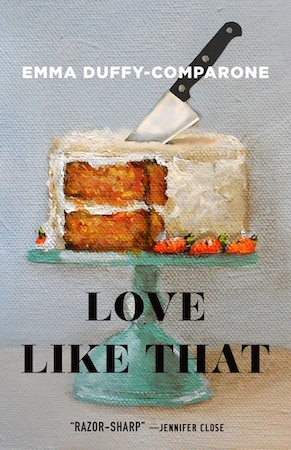
Dark humor. Wry, mordant. Frame it however you want—yin and yang, chiaroscuro, tragedy and comedy—nothing is more life-affirming, nothing makes me feel more connected to humanity, more humbled by the resiliency of the human spirit, than a person’s ability to crack a joke at a low point. 

The women and girls in my collection, Love Like That, are all screwing up: they’re in the wrong jobs, in the wrong dress, the wrong shoes. They’re on the wrong vacation. They’ve made the wrong plans, the wrong friends, the wrong move. They’ve said the wrong thing. They’re with the wrong men. But they possess, I think, the self-awareness to understand this, and it’s at this intersection of self-awareness and pain where a certain kind of humor is born. For me, there is nothing more generous than the gift of someone else’s messiness laid bare, of someone else’s vulnerability and frankness, especially about themselves. And what better terrain for rawness and honesty, for the simple admission that life can be really fucking absurd, than relationships? 

Here are a few books that break up the dark with some light, whose characters make me laugh and wince with recognition.

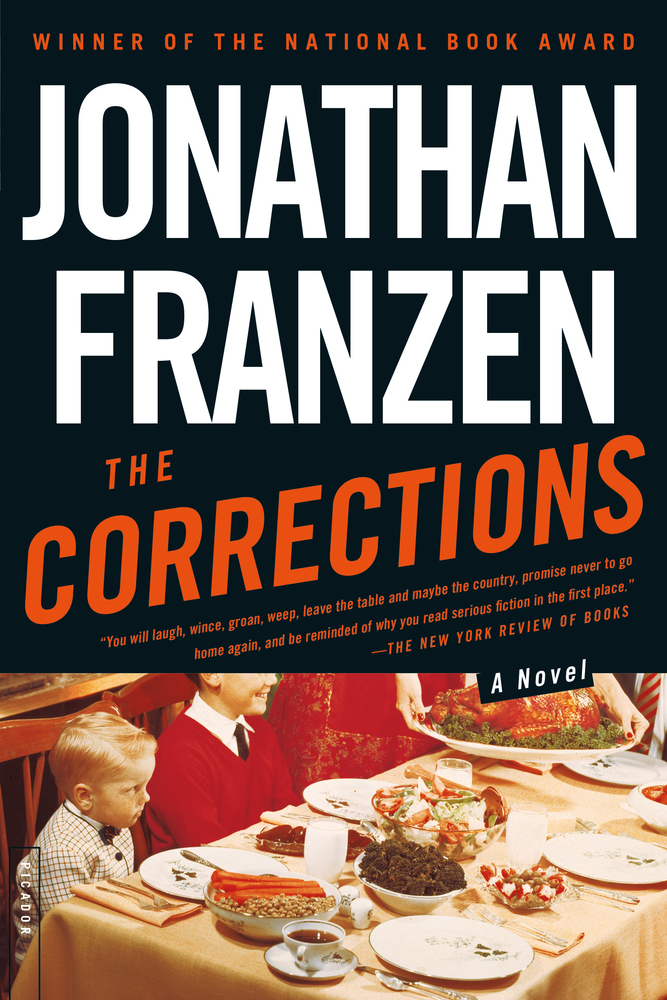
The Corrections by Jonathan Franzen

The book is essentially a novel in novellas, each dedicated to a member of the Lambert family—Alfred and Enid and their adult children, Chip, Gary, and Denise. While the whole thing is, I think, a masterpiece—darkly, darkly funny—the one that really kills me is about Gary. It’s the roller coaster of domesticity at its best:

“To feel nothing, not the feeblest pulse in the dead mouse from which his urine issued, for three weeks, to believe that she would never again need him and that he would never again want her, and then, on a moment’s notice, to become light-headed with lust: this was marriage as he knew it.”

Bark by Lorrie Moore

Bark by Lorrie Moore

Moore’s latest collection is a beauty, but even if you just read the first story, “Debarking,” about a divorced guy trying to date a woman who, among other red flags, wrestles in bed with her teenage son and habitually carves little naked boys out of wood, you’d have got your money’s worth. I laugh, in that sick way, on every other page. At this, for example:

“He thought about the moment, just the night before, at dinner, when she’d said, “I love your mouth most when it does that odd grimace thing in the middle of sex,” and then she contorted her face so hideously that Ira felt as if he’d been struck.”

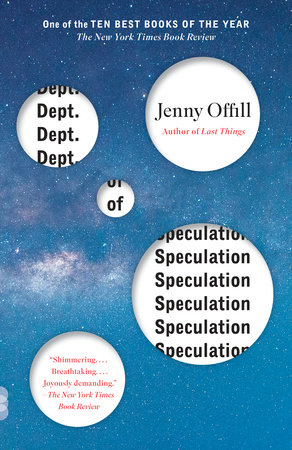
Dept. of Speculation by Jenny Offill

Dept. of Speculation by Jenny Offill

This novel’s narrator and her observations are so exquisitely mordant that my mouth kind of waters the whole time. You can close your eyes, drop your finger onto a random page, and pull up an example. Like this:

“Sometimes I find myself having little conversations in my head with the punk rock kids upstairs.

You know what’s punk rock about marriage? 

Nothing. 

You know what’s punk rock about marriage? 

All the puke and shit and piss.” 

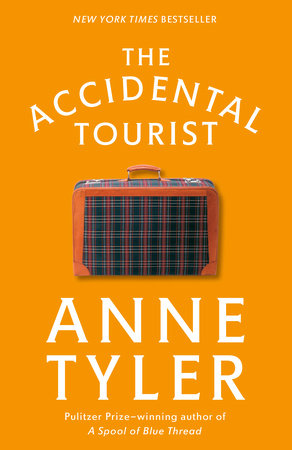
The Accidental Tourist by Anne Tyler

The Accidental Tourist by Anne Tyler

Anne Tyler is a master of the dark/light thing. The backdrop of this novel is deeply sad—Macon Leary’s young son has been killed in a robbery, and in the opening pages his wife asks for a divorce—but a warm, humorous quirkiness soon fills the pages of the book, whether it’s Macon’s adult siblings, who organize their pantry alphabetically, or Muriel Pritchett, the eccentric dog-trainer he falls in love with. One of my favorite scenes is early in the book when Macon, reeling from his recent separation, devises a ridiculous housework system:

“What he did was strip the mattress of all linens, replacing them with a giant sort of envelope made from one of the seven sheets he had folded and stitched together on the sewing machine…At moments—while he was skidding on the mangled clothes in the bathtub or struggling into his body bag on the naked, rust-stained mattress—he realized that he might be carrying things too far. He couldn’t explain why, either.”

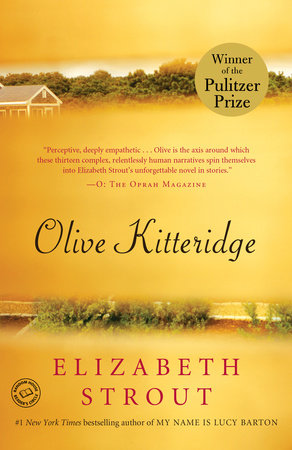
Olive Kitteridge by Elizabeth Strout

Olive Kitteridge by Elizabeth Strout

I’ve been hearing the term “unlikable women” a lot and wondering what people mean by that, and sometimes all I can come up with is that it has something to do with a sharpness, a bite, that we seem to have a problem with women who don’t mince words. But these are my favorite kind of women, and Olive Kitteridge is one of my favorite characters: incorrigibly honest, often wickedly funny, strong and fearless, her big heart beating. Here is a little taste of her:

“She must not hear him because of the water running into the sink. She is not as tall as she used to be, and is broader across her back. The water stops. ‘Olive,’ he says, and she turns. ‘You’re not going to leave me, are you?’

‘Oh, for God’s sake, Henry. You could make a woman sick.'”

What Was She Thinking?: Notes on a Scandal by Zoë Heller

OK, I suppose Barbara Covett, the narrator of this novel, is kind of unlikable, and the way she carefully cultivates a friendship with her sensual colleague, Sheba Hart, reads anywhere from simply desperate to sinister. I’m nervous the whole way through. But she is human and she is hurt, and our uglier but no less human emotions—jealousy, obsession, vengefulness, pettiness, despair—are all on the table in this wickedly, wickedly mordant account of her obsession with Sheba, and Sheba’s affair with her 15-year-old student:

“Connolly is not pretty in the slightest. He is a coarse-looking fellow, with lank hair the colour of pee and a loose, plump-lipped mouth. His nose, owing to a childhood accident (an ardent game of kiss-chase, an unanticipated pothole) is quite badly off-centre. His eyes are heavy-hooded and so downturned as to bring to mind a tragedy mask. Sheba insists that he has superb skin, and it is true, I suppose, that he has been spared the sort of suppurating carbuncles to which boys of his age are prone. But what she refers to as his olive complexion has always struck me as rather dingy. I can never lay eyes on the boy without wanting to give his face a good going-over with a hot flannel.”

Bridget Jones's Diary by Helen Fielding

Bridget Jones’s Diary by Helen Fielding

I know, but it is actually really good and Helen Fielding is actually really funny. This personal account is on the lighter side, but Bridget suffers a fair amount of blows to her self-esteem, which she relays in her droll, wry, self-deprecating diary entries. She flops around like the best of us, and it’s the kind of book where you think, if Bridget can muscle through that kind of day, so can I:

“Completely exhausted by entire day of date-preparation…Sometimes I wonder what I would be like if left to revert to nature—with a full beard and handlebar moustache on each shin, Dennis Healey eyebrows, face a graveyard of dead skin cells, spots erupting, long curly fingernails like Struwwelpeter, blind as bad and stupid runt of species as no contact lenses, flabby body flobbering around. Ugh, ugh. Is it any wonder girls have no confidence?”

Who Wants to Marry a Retired NFL Lineman

The following story was chosen by Joshua Ferris as the winner of the 2021 Stella Kupferberg Memorial Short Story Prize. The prize is awarded annually by Selected Shorts and a guest author judge. The story, performed by actor Kirsten Vangsness, will premiere as a part of the final Selected Shorts of the year on June 2: Virtual Selected Shorts: It Takes Two with Cynthia Nixon.

Reality

I have been chosen for reality television. I will compete to marry George, a retired NFL lineman. My sisters shout that I’m crazy. But I would thrive as the wife of a retiree—no suspicious sexy secretaries, no more financial despair. My sisters insist that shortcuts are a figment, that the world belongs to those who wake each morning and perform honest work. They say that what matters in the end is one’s FICO Score. Babies on hips, they caution against the trappings of minor celebrity—namely, that it’s nothing like major celebrity. They say viewers will pray I do something pathetic.  

I quit my retail job mid-task, leaving a gown half-hung on its mannequin, and fly to an undisclosed tropical location.

I live in a cabin with mosquito netting and 24 other suitors. Most are women because George prefers women. A few are men because George is open-minded, or perhaps because the show has been panned for undue straightness. The producers separate us from our phones. The host conducts one-on-one interviews late at night. The interviews feel like therapy, or at least how I imagine therapy. When I tell the host, “I’m poor,” he asks, “Do you ever feel rich?”

I admit that I don’t.

“Even here? Now?”

“I mean, here, yes!”

“Complete sentences,” he reminds me gently. “Subject (I), predicate (feel)…”

Tears puddle my vision. “Brandon,” I say, “the truth is, I’ve never felt like this in my life.”

He nods, looking as though he’s really thinking. A little current runs through me. He says, “I’m sorry, Robin.”


Time drips like water color. We sleep in bunk beds and dream of George. Sometimes producers measure our waists and busts and thighs. Among the suitors, a general spirit of camaraderie, punctuated by occasional violence, persists. We have no contact with the man we might marry, but we glimpse him through our window—standing as though crucified for a tuxedo fitting or posing with his bicep flexed. The Southern suitors hold prayer circle by flashlight, cross-legged and barefoot, asking God to open George’s heart to them.  

When the big night arrives, each of us receives evening attire. My gown is silvery, satiny, floor-length; it feels like a lover’s caress. We plug in so many hair irons, the electricity blows.

For my First Impression, I stand before George on the red carpet. I’ve never seen red carpet in person. I’m surprised by its rough texture, like fake grass on a miniature golf course. George has a chest like a wall and a wide, symmetrical face. He dips his enormous head to kiss my knuckles. I want to ask him what it’s like to be large, to be a person whom strangers respect. But too nervous to speak, I embrace him. Who could stand before such a giant without vanishing into his mass?

Before I can enter the cocktail party, Brandon says, “Follow me, Robin.” He leads me behind a palm tree. “How are you feeling?” he asks.

It is not a question to which I’m accustomed. I touch the bark. I wonder if palm trees are beautiful or tacky; I’ve never been skilled at discerning. Brandon’s hair poofs back off his forehead. In his bow tie he resembles a wrapped-up present.

It occurs to me that my sisters were wrong, that everyone was wrong, that I am, unexpectedly, the master of my destiny. “Amazing,” I say.

He scoops my waist and kisses me.

In a few months, I will understand: I am the contestant sent home on Night One for “cheating on George” with the host. Through the cracks of my fingers, I’ll watch the patched-together rejection scene:

Brandon, I say, weeping, the truth is, I’ve never felt like this in my life.

I’m sorry, Robin, Brandon says, looking sorry.

Prior to appearing on television, I never considered myself naïve. I considered myself well-versed in the world. Though I suspected the future would confirm my secret greatness, I always kept my head on straight.

Behind the palm tree, I kiss Brandon back. He tastes of top-shelf bourbon. I think I whisper, “Thank you.” I think he says, “You bet.” I float through the tropics, margarita in hand, stealing glances at Brandon who desires me and George who might marry me. My hair frizzes in the humidity, a hard nut of wanting pressing my throat. I am so alive, I don’t foresee it—bed stripped to its mattress, silver gown hanging empty in a room that was never mine.

A Road Trip Across America to Dismantle White Patriarchy

Randa Jarrar’s memoir Love Is An Ex-Country focuses predominantly on the years leading to the 2016 election, a period, which, like now, was characterized by heightened Islamophobia, misogyny, homophobia, anti-immigrant sentiment, and racism. Jarrar embarks on a road trip inspired by Tahia Carioca, an Egyptian actress who married a white man 20 years before Loving v. Virginia. Like Carioca, Jarrar is privileged and light skinned. However, despite being white passing and privileged, Jarrar is frequently exposed to casual racism and dehumanization, as an Arab American of Egyptian and Palestinian descent, as a fat queer woman. As Jarrar travels across the country and around the globe, she meditates on joy, sexism, violence, single motherhood, surveillance, and kink, through the perspective of a body reclaimed through art. 

Love Is an Ex-Country by Randa Jarrar

Recipient of numerous grants and fellowships, including a Creative Capital Award, Jarrar is also a director and a performer who is currently writing a feature film. She also is the author of the novel A Map of Home and the story collection Him, Me, Muhammed Ali. 

Jarrar’s work has appeared in the New York Times, Salon, Bitch, and elsewhere. We spoke about misogyny and surveillance, badass Egyptian feminists, and how to remake society.


Deirdre Sugiuchi: Can you discuss the urgency of addressing dehumanization, casual racism, and erasure of Arab Americans and people of color?

Randa Jarrar: Honestly, it’s gotten to the point now where people of color and marginalized communities are constantly asking for white supremacy to stop asserting itself in everything, when the only people who are going to be able to do that are white people. I think this year—the pandemic, the BLM uprisings—they’ve shown us that the world right now is not working for human beings.

There’s this idea that we can pick and choose when we as a larger culture stick up for people or to not erase people. We should all be treated with dignity, with respect.

There’s this idea that we can pick and choose when we as a larger culture stick up for people or to not erase people or to not dehumanize people. We should all be treated with dignity, with respect. 

With Arab Americans, even inside this conversation, we tend to be invisibilized because we are West Asian and we are North Africa, so Arab is just a catch-all phrase. It indicates a culture and a language, but it doesn’t encompass everyone from the region. It’s a constant erasure. Just stop anyone on the street and ask them what an Arab American is, and chances are they’ll be “like a Saudi Arabian.” There is just a complete willful ignorance about it.

DS: You wrote that “the main problem with Palestinians is that they continue to exist.” Since we spoke, full-scale hostilities have erupted between Israel and Palestine. Israeli forces have killed more than 200 Palestinians, including over 60 children, using weapons such as precision-guided missiles. Recently the Biden administration notified Congress of its intention to provide $735 million worth of precision-guided weapons to Israel, which has received more money in U.S. foreign assistance than any other country since WWII, with the U.S. pledging to provide $38 billion in military aid from 2019 to 2028. 

How have you responded to the current conflict? How should those who are concerned respond?

RJ: I’ve responded by grieving, resisting, and weeping. Those who are concerned should do the following: make a public commitment to the Boycott, Divestment, and Sanction movement, call on their institutions, representatives, and governments to end their support for and place sanctions on Israel, pressure the U.S. government to withdraw aid to Israel, hold protests in solidarity with Palestinians, and join the prison and police abolition movement.

DS: You became a mother at an early age, yet you became this person, one who writes, “I write what I like. And say what I like. And fuck whomever I like.”Can you talk about becoming this? Please. Tell me how you did it.

RJ: Growing up, I saw women being doctors, being mothers, being housewives, being every single thing under the sun, because in the Middle East in the ’80s, the late ’70s, women were multi-faceted, owning businesses or just staying home and taking care of five kids. There were so many different types of ways of being a woman, but there was also a highly restrictive and shaming climate around women, where men were just free to do so much, and women’s sexualities were hyper-policed.

In general, in academia, if you do take a class with a man, it’s liable to be a cisgender white man. Stay away from those. Find strong women to mentor you.

I was really obsessed with growing up and getting to live whatever life I wanted to live, and noticing the ways that being sassy got me into trouble, but also infuriated people, which meant I was doing something right. If everyone was pissed, maybe I’m hitting a nerve or something. But also being nerdy and constantly going to school, so avoiding 9-5, and applying to as many grants, scholarships, fellowships and graduate programs constantly. The university is a huge financial structure you can draw from.

I never had a male creative writing teacher until after I wrote my first book. I got one to get my MFA course. I think if I had had male creative writing teachers as a young person, I don’t know if I would be who I am because the criticism was so unkind when I did have white, male straight professors; they were just cruel in their evisceration of their students’ work, not just mine. Not that there aren’t amazing queer male writers or trans men professors or stuff like that, but in general, in academia, if you do take a class with a man, it’s liable to be a cisgender white man. Stay away from those. Find strong women to mentor you.

DS: One of the ways you explore patriarchal culture is through the lens of the family. You wrote, “My parents were obsessed with me.” They loved you but they felt they owned your body. They were abusive. Your neighbors witnessed the abuse, and did nothing. 

However, later, as an adult, you’re at this conference, and the panelists are discussing feminism, and your friend has to say, “It’s not Western to want to be treated equally, to want full rights to our bodies.”

Why do we have to say this over and over? Can you go into this?

RJ: Nawal El Saadawi passed away. She was a bad-ass Egyptian feminist. One of the videos that people have been circulating is of her talking about how feminism was not invented by American women or Western women in general.

There are so many people willing to discredit you on all sides, people from the global South who want to hold on to patriarchy, who will say, “Oh, you’re just copying white folks and their idea of feminism.”  Then white men will say, “Well you’re from an oppressive culture.” There’s always a critique of the other rather than taking responsibility to dismantle patriarchy itself.

The same thing ends up happening with white feminists. I was at this conversation between Roxane Gay and Erica Jong. I asked, “When will white feminism understand that it doesn’t include and it actively harms women of color?” and Erica Jong lost her shit. She just put her foot in her mouth. Mari Noemi made a cartoon about this for Electric Lit. 

Any time the oppressed are like, “This thing is mine, stop trying to take it from me,” the other side, the oppressor, is going to be like, “What are you talking about?” There’s an unwillingness to let go of power.

DS: And to recognize the abuses of power. Do you know Mona Eltahawy’s work?

RJ: I love her work. I love the way that she talks about patriarchy. She was in our audience, where the guy was basically saying, “This is Western feminism.”

DS: I was raised in white Evangelical culture. Mona Eltahawy’s books caused me to recognize the similarities between how women are policed in Eastern and Western cultures. It drives me crazy listening to white evangelicals objectify Islam or their alleged abuse of women, because white evangelicals are just as abusive. 

RJ: And also as a Palestinian, knowing how harmful Christianity is to my people… That Palestinian Jews, Palestinian Christians, and Palestinian Muslims haven’t gotten together and been like, “Fuck you guys, let us live and peace and stop trying to colonize us, mainly because you think Jesus is going to come back and we’re all going to go to hell except for you.”

DS: You write about fatphobia and policing and women. You describe how policing women’s bodies has been normalized, along with police brutality, military rule, dictatorships, ceaseless presidential terms, corruption, job and housing discrimination, criminalization of premarital sex, and dominance of patriarchal and white supremacist beauty ideals. You’re referring to the Middle East, but you could be talking about America. Where do you see us in the U.S. going from here, in regards to body policing in this culture?  

RJ: The first thing we have to do in America as a culture is recognize that we are a sex negative culture, that we have a rape culture. We need to talk more about consent. We need to talk more about our bodies. How do our bodies work? Having a sex ed class is not going to cut it. We need to, from the very beginning, talk about consent with kids.

Because we don’t really have the tools, we don’t really know how to get people to take responsibility for their own bodies and their own actions. We’re also inundated by images of sexual violence and violence. In so many different ways, we need to have a cultural shift, admitting that our culture is sex negative, instead of saying, “No, other cultures are very prudish or sex negative. Ours is advanced.”

Our culture is very Puritanical. It’s harmful to men and women, to non-binary folks.

The way things are right now are not sustainable. There are people in power who don’t want women to have control over their bodies because they think that women having access to safe abortions is immoral or unethical or against the word of God.

DS: It’s normalized to police a woman just because she’s a woman, right?

RJ: Absolutely, because we don’t see the women’s bodies as independent but as part of the bigger community, the family. We also police what a woman’s body should look like and be, which is why there’s so much transphobia, just people who are very intent on the fact that biological sex or assigned sex is the only one that matters. That’s not how gender works.

We are constantly at a time where we have to remind each other, ‘This has happened before. It didn’t work. Who is this benefiting?’ 

How amazing would it be if all of us in America went through a re-education about our bodies, about how to take care of ourselves, about what gender actually is, and how it’s separate from assigned sex. Really understanding what race is and what our history actually is. What if we could just start over, and if it could all just be free?

Then you would have bodily autonomy. We would have to start talking about the police. We would have to start talking about medical apartheid. We would have to start talking about education, who gets to be “educated.” Fat people, Black people, and Latinos are dying at a high rate. Why is that? 

But then there are people who are so threatened by this because their whole thing is like, “No, America is the best country in the world, and you accept that Jesus is it, and that this country is the best, or you’re a terrorist. If you don’t like it here, just leave.”

And it’s like, “No, actually, we have bases in so many countries, we’re the ones who are constantly expanding and who should be leaving places.” It’s not the people who are here that need to leave, but the people here critiquing who we all need to be listening to in order to grow.  If we don’t grow and adapt as a society, as a culture, as a country, we’re not going to make it.

DS: Your book concludes in the aftermath of the 2016 election. What suggestions do you have for American society at this moment?

RJ: Before Trump, before Obama, we had eight years of Bush. I don’t think we reckoned with those years at all. We need to continue looking back and seeing the ways that we historically make these mistakes. If we’re not going to be honest about how it happens and what we lost, the ways that we have and continue to harm others with our American project, I don’t think that we’re going to be able to grow from here. 

A big part of my book is about the amnesia of America. We are constantly at a time where we have to remind each other, “This has happened before. It didn’t work. Who is this benefiting?” 

We can’t individually make change. We have to make it as a community. 

8 Novels in Translation by Iranian Women Writers

In interviews about my book abroad, nothing bothered me more than the clichés about Iranian women’s lives. A German woman asked me, “Did you publish your book in Iran? Are women in Iran even allowed to publish books?” Or a man in Italy who told me, “Your writing is not real because women in Iran have to obey their husbands and do whatever their husbands tell them.”

I'll Be Strong for You by Nasim Marashi

I thought about it a lot and realized that when people’s only source of information are stereotypes from popular culture, they are obviously misled. But when they draw on art, especially literature, for knowledge, they can go much deeper. Most works of fiction have roots in the real condition of the society where the author lives, and literature, especially realistic literature, is a context for discernment of that society.

My novel I’ll Be Strong for You, translated into English by Poupeh Missaghi, follows three young women who are trying to make their own paths in modern-day Tehran. The characters sprung from my mind, but the context in which the story takes place is real. I started writing this book two years after the Iranian Green Movement, which protested the 2009 election, and I tried to capture the atmosphere we breathed. 

In Iranian literature, women have written important books that document and reveal the lives of women over the last hundred years. Here are seven novels, translated into English, that present the real lives of Iranians: 

Being Forty cover

Being Forty by Nahid Tabatabaei, translated by Amir Marashi

This book’s protagonist has a midlife crisis. A former cellist, Alaleh works at an opera house, coordinating performances. She is outwardly successful, but not on the inside. On the eve of her 40th birthday, she reflects on her life—thinking about a former lover and about the dreams she once harbored. The midlife crisis is a universal trope in literature, but the ways in which we deal with it are unique to our societal conditions.

Amazon.com: Savushun eBook: Daneshvar, Simin: Kindle Store

Sauvashun: A Novel about Modern Iran by Simin Daneshvar, translated by M.R. Ghanoonparvar

Some critics consider Sauvashun to be “the first Persian novel.” The novel is set in Shiraz, during the British occupation between 1941 and 1946. What better context to describe the oppression that existed in Iran in the 1940s? Zari aspires to be more than a wife and mother. Zari’s husband is a landlord who doesn’t want to do business with the British and is killed because of his resistance. The story is symbolic while still being realistic and is inspired by the story of Siavash’s mourning in Shahnameh. Some events also refer to the Iranian coup d’état of 1953, although the author could not write about it directly due to censorship at the time.

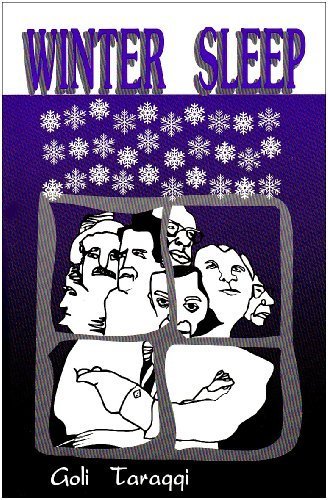
Winter Sleep by Goli Taraghi

Goli Targhi is known for her short stories. Written before the revolution, Winter Sleep is made up of ten interlinked stories about a group of old friends who have seen strange years in the history of Iran. An old man and his school friends made the decision to always be together, for the rest of their lives. But now they live far apart. Each chapter of the book narrates the life of each friend, the multiple voices painting a comprehensive picture of the lives of the people of that time.

In Case of Emergency by Mahsa Mohebali, translated by Mariam Rahmani

The protagonist of Don’t Worry is not interested in getting out of her traditional role, like in the previous books. This young woman—an addict who lives in Tehran in the 2000s—is free and wild. There is an earthquake and the city falls into chaos. The woman leaves the house, searching for drugs and wanders through the semi-ruined city. The world created by the author in these pages is unique and feels true to the current situation of the youth of Tehran.

Things We Left Unsaid by Zoya Pirzad, translated by Franklin Lewis

This story takes place in the 1960s. An Armenian family lives in Abadan, a city in southern Iran, in a private neighborhood that has been built for the employees of an oil company. The mother, Clarice Ayvazian, is bored and tired of her monotonous lifestyle and is hungry for change. In her dreams, she imagines having an affair with her neighbor. Meanwhile, the fraught and complex political and social situation is brought home by her husband.

My Bird by Fariba Vafi, translated by Mahnaz Kousha & Nasrin Jewell

What can a woman do if she has a strong desire to stay while her restless husband is constantly thinking of leaving? Submit. The unnamed central character is modest and has never fought for anything. Her greatest joy is the small house she bought with her husband. But now, when her husband wants to sell the house and emigrate, she wants to set aside her marginal presence in their life. My Bird is a short and powerful novel full of brilliant sentences.

50040276. sx318 sy475

The Drowned by Moniro Ravanipour, translated by M. R. Ghanoonparvar

In The Drowned, Ravanipour writes of a world very different from the reality in the previous books on this list. The women in this book are not urban middle-class women with their specific concerns. The Drowned is about the lives of the residents in a seaside town in southwestern Iran, a year after the Iran-Iraq war. This region was most affected by the destruction of the war. People who live in this rich and strange culture are under the influence of the magic of the sea. The book is written in the style of magical realism and brings the readers to the magical world of the legends of southern Iran and the women who live there.

36418631. sx318

From the Devil, Learned and Burned by Farkhondeh Aghaie, translated by Mehran Taghvaipour

The woman at the heart of this novel is strange. Volga, an educated, art-loving homeless Iranian-Armenian Christian, wanders Tehran in the late 1990s and sleeps in an office, a library—anywhere she can. The novel is structured as her diary. From her notes, readers can discern her relationships, the way she earns money, the society in which she lives, and centrally, why and how her life fell apart.

In Praise of “Murder, She Wrote,” My Pandemic Lullaby

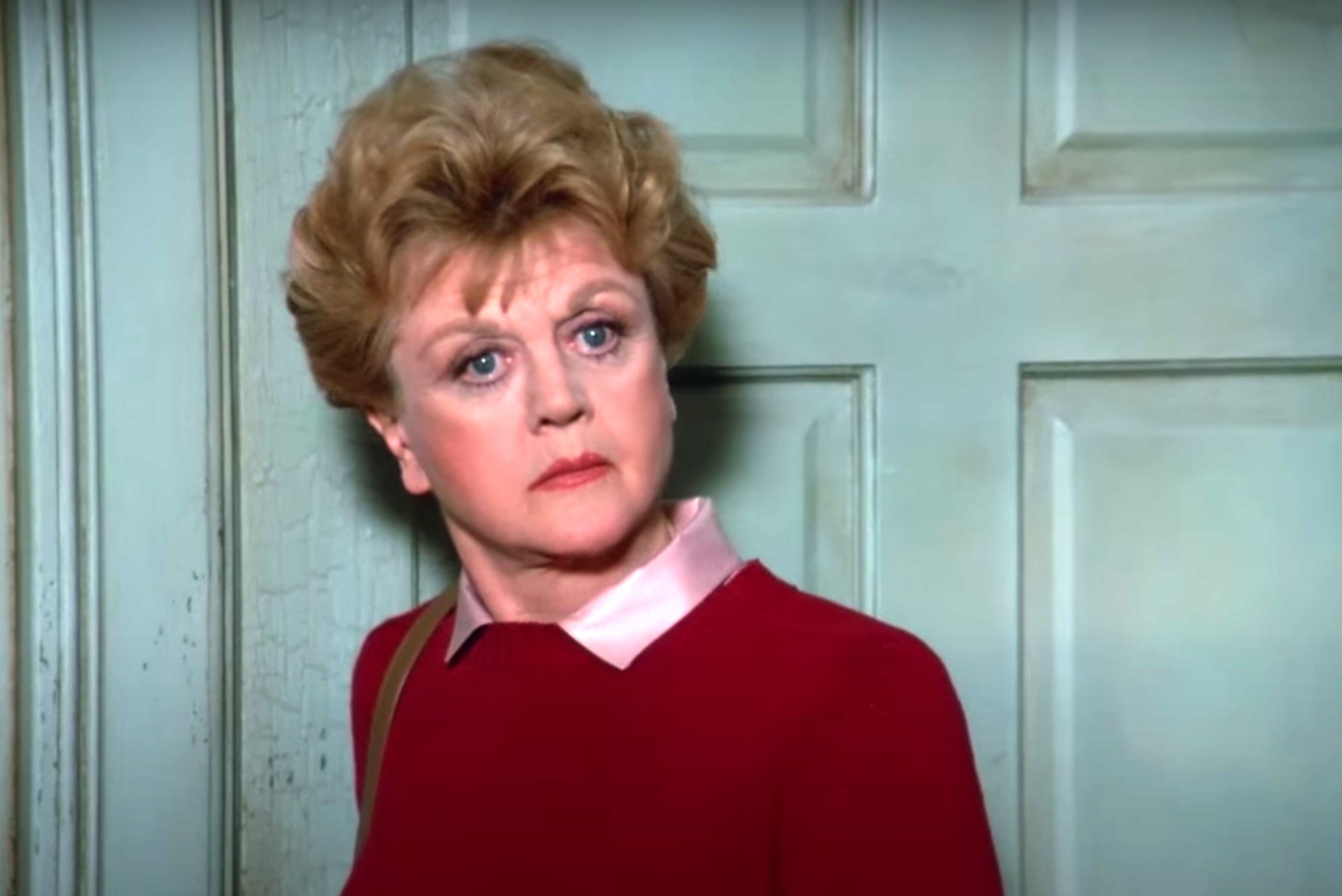
I’m watching Jessica in her red silks and ruffled neckline, and she’s getting to the bottom of it. She’s in Jamaica, where her friend’s violent, racist brother has been killed. Jessica is retrieving clues like she’s descending a staircase, one by one, she’s sliding doilies under doors and picking locks, she’s looking at blueprints, she’s noting the stain on the Frenchman’s handkerchief, she’s getting closer.

Each night, I’m lulled to sleep by this: asphyxiation, drownings, fatal blows and gunshot wounds. It wasn’t always this way. It started on a stormy and sleepless night, as the wind rattled the windows and shook icicles from the eaves.


Insomnia introduced itself three months after the first lockdown, when the initial surface panic seeped into the deeper parts like snow into dirt. In May, I fought it in lopsided, hours-long battles. With sleeplessness came more uncertainty—which, for me as well as everyone, had already been in ample supply—and the dissolution of prior certainties like the division of night and day.  

A few months ago, my partner Alec and I were between houses. We packed all of our possessions into a storage unit and rented an Airbnb, to buy ourselves some time. On one of those first nights in the Airbnb, after a day spent scrolling real estate feeds, we sat down to watch Murder, She Wrote. For the first time since May—since ever, maybe—I started to drift off while sitting up, with my head on Alec’s lap, with the cat perched on the back of the couch behind me, chewing my hair. 

There are two requirements for the plot of every episode: the first is that there’s a murder, and the second is that it’s solved.

After a few episodes of Murder, She Wrote, I knew what to expect from the rest. There are two requirements for the plot of every episode: the first is that there’s a murder, and the second is that it’s solved. In the pilot episode, Jessica Fletcher is a widowed, retired schoolteacher in the small coastal town of Cabot Cove, Maine, where she writes murder mysteries in her kitchen, for fun. The whirlwind commences when her nephew, of his own accord, takes one of Jessica’s novels to a publisher. It is published. It is a hit. Over the course of her press tour, Jessica encounters a cast of characters (after a few episodes, there will be no more characters, only suspects) and a murder. Calling upon the forensic expertise she’s absorbed from researching her novel, which invariably surpasses the competencies of the detective assigned to the case, Jessica solves the murder. Repeat. 

The comfort in Murder, She Wrote is in what is known. We know that there will be a murder, a motive, and a confession. Jessica uncovers the truth as if she’s brushing dust off a fossil. All it takes is time. 

But the comfort in Murder, She Wrote is also in what is not known, or in what is forgotten. After the pilot episode, the show proceeds with a gauzy amnesia that preserves its levity. Throughout the show’s twelve seasons, Cabot Cove’s population steadily succumbs to murder and incarceration: we watch the bookstore owner, the pawn shop owner, the pharmacist, the fisherman, the cop, the nurse, the accountant, the car salesman, the firefighter, and hundreds of other townspeople murder and get murdered, with such frequency that, if it were real, the town would have been the deadliest on earth. And yet, nothing appears to be lost. The town continues to function with no apparent closures; the shops remain open and bustling with customers. Cabot Cove’s small-town charm seems to supersede its homicide rates. I use the word charm literally: it’s as if the townspeople—friendly, trusting, quaint—have been spelled into forgetting that they could be next.  

On trivia websites, it’s estimated that Cabot Cove’s yearly murder rate is 1,490 per million people. According to Our World in Data, the coronavirus killed 1,545 per million people in the United States in one year.

Jessica, who encounters most of the murders firsthand, is the most forgetful of all. After confronting his fifth murder in his first year as sheriff, Mort Metzger turns to Jessica and says, “What is this? The death capital of Maine?” Between his exasperated rambling, Jessica interjects, “But I assure you, sheriff…” We know what she is about to say: “…Cabot Cove is safe.” It’s clear that she thinks so. She leaves her door unlocked so that her friends can wander in and rifle through her fridge while munching on one of her apples (one of these apples is poisoned, once). She’s been drugged, shot at, robbed, and pushed down two flights of stairs. She finds dead bodies in every hedge, ditch, and swimming pool. But she sleeps through the night in her big empty house on the corner lot. 

On trivia websites, it’s estimated that Cabot Cove’s yearly murder rate is 1,490 per million people. According to Our World in Data, the coronavirus killed 1,545 per million people in the United States in one year. I can’t comprehend that number any more than I can the shape of the virus, but when I leave the house, I imagine both in physical terms: the gaping hole and the meteor that made it. Sometimes I can’t imagine anything. More palpable is the charge of consequence in the air, the possibility that something like shopping for groceries might make me the unwitting tinder of the deadly brushfire that’s raging across the earth. 

The world of Murder, She Wrote shares our present reality of heightened mortality, but after the murderer is caught, the mourning stops. For the majority of the episodes, the show insists on ending with a freeze frame of Jessica being delighted by something—whether it’s a joke, or a surprising development, the credits roll over Jessica’s open, smiling mouth. The crystallized smile is the signal that we can all move on, now that everything’s been sorted out. The knowing permits the unknowing—allows her to continue as if each new murder that she stumbles across is her first. Whenever a new episode begins, I get the sense that if I could smell what I saw on the screen, I’d smell bleach.

If only we could forget, I think, as Jessica and the people of Cabot Cove forget. Then again, it’s best we don’t.

If only we could forget, I think, as Jessica and the people of Cabot Cove forget. Then again, it’s best we don’t. The only logical explanation that I can drum up for the termination of mask restrictions in some states is that the governors must have forgotten what happened to us. In Murder, She Wrote, perhaps there’s some correlation in the forgetting and the murders. Maybe it’s her world’s refusal to acknowledge violence that allows violence to repeat. Her laugh at the end not a salve, but a trigger.

What’s happening to us. They must still be forgetting what’s still happening to us. 


I wake up. I’ve left an inch of drool on Alec’s sleeve. Jessica has discovered the murderer—the Frenchman with the incriminating handkerchief—and she’s tricked him into revealing his guilt by having a local reporter do zombie stage makeup on the man that the Frenchman has just attempted to poison and believes is dead, so that the zombie-disguised man can then chase the Frenchman into opening the secret passageway that only the murderer would know about, as it leads to the room where the initial murder occurred, where Jessica and some cops are now waiting. 

In the last scene, after the Frenchman has been put in custody, Jessica sits on the white porch with her friend and the reporter, and they chuckle through a debrief of what just happened. Jessica’s friend thanks Jessica, as if she’s thanking someone for fixing a leak. As she explains the motive, the method of murder, and the way she manipulated the Frenchman into revealing himself, Jessica’s hold on the psychologies of all the characters and the causal certainties of her world veers into omniscience. She sounds like she’s describing the plot of one of her books.  

There’s a substantial cohort of Murder, She Wrote fans who believe the only explanation for Jessica’s regular encounters with murder is that she’s the one doing all the killing.

There’s a substantial cohort of Murder, She Wrote fans who believe the only explanation for Jessica’s regular encounters with murder is that she’s the one doing all the killing. Some bloggers describe Jessica as the carrier of a deadly illness, spreading death everywhere she goes. Recently, in a Zoom call with my family, Alec said that Jessica was his role model, that he wished Jessica would visit him and put everything in his life into place, just like she does in the murder cases. To this, the suspicious cohort would respond: you don’t want Jessica to visit you. I agree that a visit wouldn’t be fruitful—that Jessica only solves the mysteries of her own making—but what I mean by “making” is this: that Jessica is not the prevailing murderer of Murder, She Wrote, but its author. 

It’s right there in the title, spelled out in the title sequence at the beginning of each episode. The title sequence begins with Jessica on her typewriter, pounding the keys, and interlaces clips of her murder investigations with the emerging story on the page, as if to suggest a more intimate correlation between the two—that the words describe her adventures, that the adventures originate in the words. We see her write the title of her story at the top of the page, before she begins to work on the plot. It’s called “Murder, She Wrote.” 

Though the fact of her husband’s death constitutes the “after” in which Jessica lives (she started writing mysteries to cope with the loss), the cause of his death remains vague and uncertain. We know he was too young; it may have been illness. If it was, I can imagine why Jessica, dwelling in the aftermath, would write herself into a thousand explicable deaths and a thousand closures. As she moves through the fictional mystery narratives, Jessica pockets each breadcrumb clue, ravenous for the meal she knows is coming: the killer’s just deserts, the proof of her command over what is volatile. It’s not that she’s forgetful or reckless, it’s that she’s the puppet master of a world in constant renewal. That laugh at the end of each episode is a laugh of relief—she’s resolved the plot, she can pull the manuscript from the typewriter and put it away in a folder, embossed in gold.  

I can imagine why Jessica, dwelling in the aftermath, would write herself into a thousand explicable deaths and a thousand closures.

It is a grim prospect that, for Jessica and me, comfort is not imagining a world without violence—it is imagining a world in which each injustice is noticed, each victim has an advocate, and each instance of brutality can, without pretense, be regarded as an isolated incident. Here, between episodes of Murder, She Wrote, the pandemic still stretches indeterminately forward, requiring days that seem the same in their banality but aren’t, because each day contains a new, unfathomable number. The world can not be resolved and renewed overnight. 

Once, Jessica said, “I feel like I’m walking on eggs.” 

She means, of course, that she feels as if she must proceed with caution. But to me, it sounds like she’s admitting to her own authorial exemption—that her mastery of this world is such that she could walk on raw eggs without soiling her shoes. I wish that Jessica could take us by the hand and lead us to a place of such lightness. So we could walk on a field of eggs without cracking a single one. But Jessica can only do so much. For now, she’ll lead me into sleep.

Adin Dobkin Admits He’s in the Pocket of Big Sandwich

In our series “Can Writing Be Taught?” we partner with Catapult to ask their course instructors all our burning questions about the process of teaching writing. This month we’re talking to Adin Dobkin, author of the forthcoming book Sprinting Through No-Man’s Land: Endurance, Tragedy, and Rebirth in the 1919 Tour de France. Dobkin is teaching an open-genre workshop about developing a research toolkit for writing, learning to find and use factual information to support both nonfiction and fiction work. We talked to him about photography, sandwiches, and how a writing workshop is not a zero-sum game.


What’s the best thing you’ve ever gotten out of a writing class or workshop as a student?

The best workshop participants wade through the muck of an early draft to understand what you’ve put on the page but haven’t realized, and what you haven’t put on the page but which you should. The most meaningful gift workshops have given me, however, is a better understanding of the constellation of works a given piece is in conversation with. They inevitably expand our conception of what a work is and could be and what avenues future works can travel down.

What’s the worst thing you’ve ever gotten out of a writing class or workshop as a student?

In nonfiction workshops, I’ve sometimes encountered the privileging of self-revelation over intellectual inquiry. If wielded by a workshop leader, it can turn into a cheap method of writing a piece that’s successful in the classroom but doesn’t accomplish much. I’ve also seen people treat the workshop as a zero-sum setting. It’s not! Writing is not! Every person in a workshop is a custodian of a common literary community whose limitations are created by market forces and those individuals in power, not by other writers. It’s shitty for everyone–the person who thinks like that and the persons who must bear it—when that environment exists in the room.

What is the lesson or piece of writing advice you return to most as an instructor?

I have a contentious relationship with writing advice. It only works when it’s explicitly, “Here’s how I did it. You can try and see if some version works for you,” which is the lesson I return to: one should learn how to not accept things in the classroom. I entered my first creative writing class wildly intimidated. If you’re in a conventional workshop, as I was, you’re encountering feedback that appears like dicta passed down from up high. It’s not. And the more confident that person is while saying it, the less you should trust them. *

* except when they’re right

Does everyone “have a novel in them”?

Cosmically, yes. Writing is great and far better than most other sorts of work if you have the personality for it. It can be miserable if you don’t. But people see the output and not the labor required. Anyone can sit down and start writing: many people do, some smaller number continue, and some even smaller number—but not so small—finish. Then there are those who relish everything that comes after. Others don’t enjoy it but recognize its importance and are willing to put up with it. And some don’t and aren’t and that’s why my cosmic answer isn’t of much use in practice.

Would you ever encourage a student to give up writing? Under what circumstances?

I can’t imagine the circumstances in which I’d give that advice. I don’t even know what it means to give up writing, except in some melodramatic, monkish way. Writing is trying and failing and aspiring to some ideal and not reaching it. I’ve told people they should stop researching and move onto writing, or they should think about a work differently, or consider the reasons they’re choosing to write something, but to just give it up? No.

What’s more valuable in a workshop, praise or criticism?

The short answer is both. I’m against false praise or feeling as though you must make it through praise to get into the meat of a workshop, which is one limitation of the conventional model. With that said, a trusted reader who is genuinely excited about something I had maybe toned down in an early draft is often more meaningful and revelatory than someone taking issue with some element they’ve found. In other words: average criticism is more valuable than average praise, but good praise is more valuable than good criticism. 

Should students write with publication in mind? Why or why not?

I’m someone who considers the structure, shape, and object of the work at an early stage. Sometimes, the first thing I look at after an idea plants itself in my mind is what mode will come closest to consummating that vision. Part of that thinking can be publication. We’re writers because we want our work out there. And there are practical constraints, too. We’re so quick as writers to ignore them, to say in the classroom, “don’t worry about all that.” Well, if an outlet pays for expenses, I can maybe travel and visit a place I’d like to write about. If I have an advance of some size, I can set down other projects, I can buy more books for research, I can not worry for a moment. If you remain flexible and keep your allegiance to the story and the mode which helps you reach those creative aspirations, I don’t see anything wrong with considering the publication of a work. 

In one or two sentences, what’s your opinion of these writing maxims?

  • Kill your darlings: Was it Kingsley Amis who talked about finding the perfect word, moving onto the next one, finding the next perfect word, and so on? In any case, the aim of a writer should be to make every sentence as close to a darling as possible, which makes the massacres less emotionally taxing.
  • Show don’t tell: Interesting and legible telling is more rewarding and difficult than interesting showing. But it requires the writer to have something they really want to say, on a deep intellectual level, which is unfortunately a different matter than writing.
  • Write what you know: I never liked it. A better construction is “write what you genuinely want to know,” which I think covers the misstep of talking out of your ass while leaving open room for discovery.
  • Character is plot: I like the sound of it! I don’t know if it’s true. Characters–if they exist in real life–will always be more complex and unknowable than they are on the page. They should be allowed to make decisions that go against everything they’ve done before. Maybe it’s more accurate to say plot is the child of character?

What’s the best hobby for writers?

Something mechanical if you’re asking me to institute my way of life on anyone else. I like photography as one that’s mostly rote processes with a single moment of inspiration. The process of developing and printing is nicely mindless once you understand basic procedures. I can listen to music, stare off, so long as I keep track of time; all things I can’t do while writing. It also lets me consider the ways in which another creative medium can convey images, ideas, stories better and worse than my chosen one.

What’s the best workshop snack?

I’m in the pocket of Big Sandwich.

Five Years of Marriage Threatened by One Line of Poetry

“Mrs. Spring Fragrance” by Sui Sin Far

I

When Mrs. Spring Fragrance first arrived in Seattle, she was unacquainted with even one word of the American language. Five years later her husband, speaking of her, said: “There are no more American words for her learning.” And everyone who knew Mrs. Spring Fragrance agreed with Mr. Spring Fragrance.

Mr. Spring Fragrance, whose business name was Sing Yook, was a young curio merchant. Though conservatively Chinese in many respects, he was at the same time what is called by the Westerners, “Americanized.” Mrs. Spring Fragrance was even more “Americanized.”

Next door to the Spring Fragrances lived the Chin Yuens. Mrs. Chin Yuen was much older than Mrs. Spring Fragrance, but she had a daughter of eighteen with whom Mrs. Spring Fragrance was on terms of great friendship. The daughter was a pretty girl whose Chinese name was Mai Gwi Far (a rose) and whose American name was Laura. Nearly everybody called her Laura, even her parents and Chinese friends. Laura had a sweetheart, a youth named Kai Tzu. Kai Tzu, who was American-born, and as ruddy and stalwart as any young Westerner, was noted, amongst baseball players, as one of the finest pitchers on the Coast. He could also sing “Drink to me only with thine eyes,” to Laura’s piano accompaniment.

Now the only person who knew that Kai Tzu loved Laura and that Laura loved Kai Tzu was Mrs. Spring Fragrance. The reason for this was that although the Chin Yuen parents lived in a house furnished in American style, and wore American clothes, yet they religiously observed many Chinese customs, and their ideals of life were the ideals of their Chinese forefathers. Therefore, they had betrothed their daughter, Laura, at the age of fifteen, to the eldest son of the Chinese Government schoolteacher in San Francisco. The time for the consummation of the betrothal was approaching.

Laura was with Mrs. Spring Fragrance, and Mrs. Spring Fragrance was trying to cheer her.

“I had such a pretty walk today,” said she. “I crossed the banks above the beach and came back by the long road. In the green grass the daffodils were blowing, in the cottage gardens the currant bushes were flowering, and in the air was the perfume of the wall-flower. I wished, Laura, that you were with me.”

Laura burst into tears. “That is the walk,” she sobbed, “Kai Tzu and I so love; but never, ah, never, can we take it together again.”

“Now, Little Sister,” comforted Mrs. Spring Fragrance, “you really must not grieve like that. Is there not a beautiful American poem written by a noble American named Tennyson, which says:

‘ ’Tis better to have loved and lost,
Than never to have loved at all?’

Mrs. Spring Fragrance was unaware that Mr. Spring Fragrance, having returned from the city, tired with the day’s business, had thrown himself down on the bamboo settee on the veranda, and that although his eyes were engaged in scanning the pages of the Chinese World, his ears could not help receiving the words which were borne to him through the open window.

“ ’Tis better to have loved and lost,
Than never to have loved at all,”

repeated Mr. Spring Fragrance. Not wishing to hear more of the secret talk of women, he arose and sauntered around the veranda to the other side of the house. Two pigeons circled around his head. He felt in his pocket for a lychee which he usually carried for their pecking. His fingers touched a little box. It contained a jadestone pendant, which Mrs. Spring Fragrance had particularly admired the last time she was downtown. It was the fifth anniversary of Mr. and Mrs. Spring Fragrance’s wedding day.

Mr. Spring Fragrance pressed the little box down into the depths of his pocket.

A young man came out of the back door of the house at Mr. Spring Fragrance’s left. The Chin Yuen house was at his right. “Good evening,” said the young man.

“Good evening,” returned Mr. Spring Fragrance. He stepped down from his porch and went and leaned over the railing which separated this yard from the yard in which stood the young man.

“Will you please tell me,” said Mr. Spring Fragrance, “the meaning of two lines of an American verse which I have heard?”

“Certainly,” returned the young man with a genial smile. He was a star student at the University of Washington and had not the slightest doubt that he could explain the meaning of all things in the universe.

“Well,” said Mr. Spring Fragrance, “it is this:

“ ’Tis better to have loved and lost, Than never to have loved at all.”

“Ah!” responded the young man with an air of profound wisdom. “That, Mr. Spring Fragrance, means that it is a good thing to love anyway—even if we can’t get what we love, or, as the poet tells us, lose what we love. Of course, one needs experience to feel the truth of this teaching.”

The young man smiled pensively and reminiscently. More than a dozen young maidens “loved and lost” were passing before his mind’s eye.

“The truth of the teaching!” echoed Mr. Spring Fragrance, a little testily. “There is no truth in it whatever. It is disobedient to reason. Is it not better to have what you do not love than to love what you do not have?”

“That depends,” answered the young man, “upon temperament.”

“I thank you. Good evening,” said Mr. Spring Fragrance. He turned away to muse upon the unwisdom of the American way of looking at things.

Meanwhile, inside the house, Laura was refusing to be comforted.

“Ah, no! no!” cried she. “If I had not gone to school with Kai Tzu, nor talked nor walked with him, nor played the accompaniments to his songs, then I might consider with complacency, or at least without horror, my approaching marriage with the son of Man You. But as it is—oh, as it is—!”

The girl rocked herself to and fro in heartfelt grief.

Mrs. Spring Fragrance knelt down beside her, and clasping her arms around her neck, cried in sympathy:

“Little Sister, oh, Little Sister! Dry your tears—do not despair. A moon has yet to pass before the marriage can take place. Who knows what the stars may have to say to one another during its passing? A little bird has whispered to me—”

For a long time Mrs. Spring Fragrance talked. For a long time Laura listened. When the girl arose to go, there was a bright light in her eyes.

II

Mrs. Spring Fragrance, in San Francisco on a visit to her cousin, the wife of the herb doctor of Clay Street, was having a good time. She was invited everywhere that the wife of an honorable Chinese merchant could go. There was much to see and hear, including more than a dozen babies who had been born in the families of her friends since she last visited the city of the Golden Gate. Mrs. Spring Fragrance loved babies. She had had two herself, but both had been transplanted into the spirit land before the completion of even one moon. There were also many dinners and theater parties given in her honor. It was at one of the theater parties that Mrs. Spring Fragrance met Ah Oi, a young girl who had the reputation of being the prettiest Chinese girl in San Francisco, and the naughtiest. In spite of gossip, however, Mrs. Spring Fragrance took a great fancy to Ah Oi and invited her to a tête-à-tête picnic on the following day. This invitation Ah Oi joyfully accepted. She was a sort of bird girl and never felt so happy as when out in the park or woods.

On the day after the picnic Mrs. Spring Fragrance wrote to Laura Chin Yuen thus:

My Precious Laura,—May the bamboo ever wave. Next week I accompany Ah Oi to the beauteous town of San Jose. There will we be met by the son of the Illustrious Teacher, and in a little Mission, presided over by a benevolent American priest, the little Ah Oi and the son of the Illustrious Teacher will be joined together in love and harmony—two pieces of music made to complete one another.

The Son of the Illustrious Teacher, having been through an American Hall of Learning, is well able to provide for his orphan bride and fears not the displeasure of his parents, now that he is assured that your grief at his loss will not be inconsolable. He wishes me to waft to you and to Kai Tzu—and the little Ah Oi joins with him—ten thousand rainbow wishes for your happiness.

My respects to your honorable parents, and to yourself, the heart of your loving friend,

Jade Spring Fragrance

To Mr. Spring Fragrance, Mrs. Spring Fragrance also indited a letter:

Great and Honored Man,—Greeting from your plum blossom, who is desirous of hiding herself from the sun of your presence for a week of seven days more. My honorable cousin is preparing for the Fifth Moon Festival, and wishes me to compound for the occasion some American “fudge,” for which delectable sweet, made by my clumsy hands, you have sometimes shown a slight prejudice. I am enjoying a most agreeable visit, and American friends, as also our own, strive benevolently for the accomplishment of my pleasure. Mrs. Samuel Smith, an American lady, known to my cousin, asked for my accompaniment to a magniloquent lecture the other evening. The subject was “America, the Protector of China!” It was most exhilarating, and the effect of so much expression of benevolence leads me to beg of you to forget to remember that the barber charges you one dollar for a shave while he humbly submits to the American man a bill of fifteen cents. And murmur no more because your honored elder brother, on a visit to this country, is detained under the roof-tree of this great Government instead of under your own humble roof. Console him with the reflection that he is protected under the wing of the Eagle, the Emblem of Liberty. What is the loss of ten hundred years or ten thousand times ten dollars compared with the happiness of knowing oneself so securely sheltered? All of this I have learned from Mrs. Samuel Smith, who is as brilliant and great of mind as one of your own superior sex.

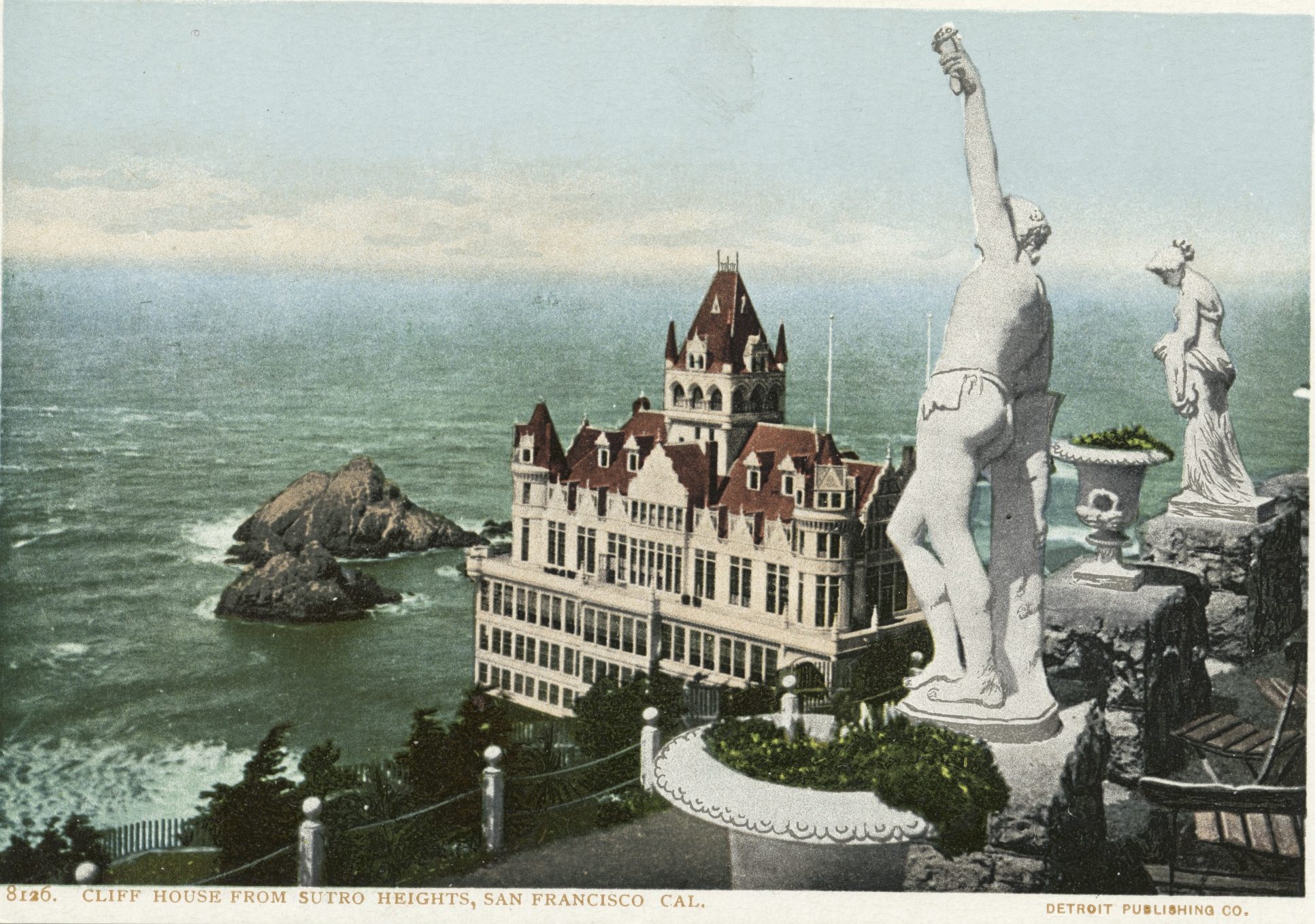
For me it is sufficient to know that the Golden Gate Park is most enchanting, and the seals on the rock at the Cliff House extremely entertaining and amiable. There is much feasting and merry-making under the lanterns in honor of your Stupid Thorn.

I have purchased for your smoking a pipe with an amber mouth. It is said to be very sweet to the lips and to emit a cloud of smoke fit for the gods to inhale.

Awaiting, by the wonderful wire of the telegram message, your gracious permission to remain for the celebration of the Fifth Moon Festival and the making of American “fudge,” I continue for ten thousand times ten thousand years,

Your ever loving and obedient woman,

Jade

P.S. Forget not to care for the cat, the birds, and the flowers. Do not eat too quickly nor fan too vigorously now that the weather is warming.

Mrs. Spring Fragrance smiled as she folded this last epistle. Even if he were old-fashioned, there was never a husband so good and kind as hers. Only on one occasion since their marriage had he slighted her wishes. That was when, on the last anniversary of their wedding, she had signified a desire for a certain jadestone pendant, and he had failed to satisfy that desire.

But Mrs. Spring Fragrance, being of a happy nature, and disposed to look upon the bright side of things, did not allow her mind to dwell upon the jadestone pendant. Instead, she gazed complacently down upon her bejeweled fingers and folded in with her letter to Mr. Spring Fragrance a bright little sheaf of condensed love.

III

Mr. Spring Fragrance sat on his doorstep. He had been reading two letters, one from Mrs. Spring Fragrance, and the other from an elderly bachelor cousin in San Francisco. The one from the elderly bachelor cousin was a business letter, but contained the following postscript:

Tsen Hing, the son of the Government schoolmaster, seems to be much in the company of your young wife. He is a good-looking youth, and pardon me, my dear cousin; but if women are allowed to stray at will from under their husbands’ mulberry roofs, what is to prevent them from becoming butterflies?

“Sing Foon is old and cynical,” said Mr. Spring Fragrance to himself. “Why should I pay any attention to him? This is America, where a man may speak to a woman, and a woman listen, without any thought of evil.”

He destroyed his cousin’s letter and reread his wife’s. Then he became very thoughtful. Was the making of American fudge sufficient reason for a wife to wish to remain a week longer in a city where her husband was not?

The young man who lived in the next house came out to water the lawn.

“Good evening,” said he. “Any news from Mrs. Spring Fragrance?”

“She is having a very good time,” returned Mr. Spring Fragrance. “Glad to hear it. I think you told me she was to return the end of this week.”

“I have changed my mind about her,” said Mr. Spring Fragrance. “I am bidding her remain a week longer, as I wish to give a smoking party during her absence. I hope I may have the pleasure of your company.”

“I shall be delighted,” returned the young fellow. “But, Mr. Spring Fragrance, don’t invite any other white fellows. If you do not I shall be able to get in a scoop. You know, I’m a sort of honorary reporter for the Gleaner.”

“Very well,” absently answered Mr. Spring Fragrance.

“Of course, your friend the Consul will be present. I shall call it ‘A high-class Chinese stag party!’ ”

In spite of his melancholy mood, Mr. Spring Fragrance smiled. “Everything is ‘high-class’ in America,” he observed.

“Sure!” cheerfully assented the young man. “Haven’t you ever heard that all Americans are princes and princesses, and just as soon as a foreigner puts his foot upon our shores, he also becomes of the nobility—I mean, the royal family.”

“What about my brother in the Detention Pen?” dryly inquired Mr. Spring Fragrance.

“Now you’ve got me,” said the young man, rubbing his head. “Well, that is a shame—‘a beastly shame,’ as the Englishman says. But understand, old fellow, we that are real Americans are up against that—even more than you. It is against our principles.”

“I offer the real Americans my consolations that they should be compelled to do that which is against their principles.”

“Oh, well, it will all come right someday. We’re not a bad sort, you know. Think of the indemnity money returned to the Dragon by Uncle Sam.”

Mr. Spring Fragrance puffed his pipe in silence for some moments. More than politics was troubling his mind.

At last he spoke. “Love,” said he, slowly and distinctly, “comes before the wedding in this country, does it not?”

“Yes, certainly.”

Young Carman knew Mr. Spring Fragrance well enough to receive with calmness his most astounding queries.

“Presuming,” continued Mr. Spring Fragrance—“presuming that some friend of your father’s, living—presuming—in England— has a daughter that he arranges with your father to be your wife. Presuming that you have never seen that daughter, but that you marry her, knowing her not. Presuming that she marries you, knowing you not.—After she marries you and knows you, will that woman love you?”

“Emphatically, no,” answered the young man.

“That is the way it would be in America—that the woman who marries the man like that—would not love him?”

“Yes, that is the way it would be in America. Love, in this country, must be free, or it is not love at all.”

“In China, it is different!” mused Mr. Spring Fragrance. “Oh, yes, I have no doubt that in China it is different.”

“But the love is in the heart all the same,” went on Mr. Spring Fragrance.

“Yes, all the same. Everybody falls in love sometime or another. Some”—pensively—“many times.” Mr. Spring Fragrance arose.

“I must go downtown,” said he.

As he walked down the street he recalled the remark of a business acquaintance who had met his wife and had had some conversation with her: “She is just like an American woman.”

He had felt somewhat flattered when this remark had been made. He looked upon it as a compliment to his wife’s cleverness; but it rankled in his mind as he entered the telegraph office. If his wife was becoming as an American woman, would it not be possible for her to love as an American woman—a man to whom she was not married? There also floated in his memory the verse which his wife had quoted to the daughter of Chin Yuen. When the telegraph clerk handed him a blank, he wrote this message:

“Remain as you wish, but remember that ‘ ’Tis better to have loved and lost, than never to have loved at all.’ ”


When Mrs. Spring Fragrance received this message, her laughter tinkled like falling water. How droll! How delightful! Here was her husband quoting American poetry in a telegram. Perhaps he had been reading her American poetry books since she had left him! She hoped so. They would lead him to understand her sympathy for her dear Laura and Kai Tzu. She need no longer keep from him their secret. How joyful! It had been such a hardship to refrain from confiding in him before. But discreetness had been most necessary, seeing that Mr. Spring Fragrance entertained as old-fashioned, notions concerning marriage, as did the Chin Yuen parents. Strange that that should be so, since he had fallen in love with her picture before ever he had seen her, just as she had fallen in love with his! And when the marriage veil was lifted and each beheld the other for the first time in the flesh, there had been no disillusion—no lessening of the respect and affection, which those who had brought about the marriage had inspired in each young heart.

Mrs. Spring Fragrance began to wish she could fall asleep and wake to find the week flown, and she in her own little home pouring tea for Mr. Spring Fragrance.

IV

Mr. Spring Fragrance was walking to business with Mr. Chin Yuen. As they walked they talked. “Yes,” said Mr. Chin Yuen, “the old order is passing away, and the new order is taking its place, even with us who are Chinese. I have finally consented to give my daughter in marriage to young Kai Tzu.”

Mr. Spring Fragrance expressed surprise. He had understood that the marriage between his neighbor’s daughter and the San Francisco schoolteacher’s son was all arranged.

“So ’twas,” answered Mr. Chin Yuen; “but it seems the young renegade, without consultation or advice, has placed his affections upon some untrustworthy female, and is so under her influence that he refuses to fulfil his parents’ promise to me for him.”

“So!” said Mr. Spring Fragrance. The shadow on his brow deepened.

“But,” said Mr. Chin Yuen, with affable resignation, “it is all ordained by Heaven. Our daughter, as the wife of Kai Tzu, for whom she has long had a loving feeling, will not now be compelled to dwell with a mother-in-law and where her own mother is not. For that, we are thankful, as she is our only one and the conditions of life in this Western country are not as in China. Moreover, Kai Tzu, though not so much of a scholar as the teacher’s son, has a keen eye for business and that, in America, is certainly much more desirable than scholarship. What do you think?”

“Eh! What!” exclaimed Mr. Spring Fragrance. The latter part of his companion’s remarks had been lost upon him.

That day the shadow which had been following Mr. Spring Fragrance ever since he had heard his wife quote, “’Tis better to have loved,” etc., became so heavy and deep that he quite lost himself within it.

At home in the evening he fed the cat, the bird, and the flowers. Then, seating himself in a carved black chair—a present from his wife on his last birthday—he took out his pipe and smoked. The cat jumped into his lap. He stroked it softly and tenderly. It had been much fondled by Mrs. Spring Fragrance, and Mr. Spring Fragrance was under the impression that it missed her. “Poor thing!” said he. “I suppose you want her back!” When he arose to go to bed he placed the animal carefully on the floor, and thus apostrophized it:

“O Wise and Silent One, your mistress returns to you, but her heart she leaves behind her, with the Tommies in San Francisco.”

The Wise and Silent One made no reply. He was not a jealous cat.

Mr. Spring Fragrance slept not that night; the next morning he ate not. Three days and three nights without sleep and food went by. There was a springlike freshness in the air on the day that Mrs. Spring Fragrance came home. The skies overhead were as blue as Puget Sound stretching its gleaming length toward the mighty Pacific, and all the beautiful green world seemed to be throbbing with Springing life.

Mrs. Spring Fragrance was never so radiant.

“Oh,” she cried lightheartedly, “is it not lovely to see the sun shining so clear, and everything so bright to welcome me?”

Mr. Spring Fragrance made no response. It was the morning after the fourth sleepless night.

Mrs. Spring Fragrance noticed his silence, also his grave face. “Everything—everyone is glad to see me but you,” she declared, half seriously, half jestingly.

Mr. Spring Fragrance set down her valise. They had just entered the house.

“If my wife is glad to see me,” he quietly replied, “I also am glad to see her!”

Summoning their servant boy, he bade him look after Mrs. Spring Fragrance’s comfort.

“I must be at the store in half an hour,” said he, looking at his watch. “There is some very important business requiring attention.”

“What is the business?” inquired Mrs. Spring Fragrance, her lip quivering with disappointment.

“I cannot just explain to you,” answered her husband.

Mrs. Spring Fragrance looked up into his face with honest and earnest eyes. There was something in his manner, in the tone of her husband’s voice, which touched her.

“Yen,” said she, “you do not look well. You are not well. What is it?”

Something arose in Mr. Spring Fragrance’s throat which prevented him from replying.

“O darling one! O sweetest one!” cried a girl’s joyous voice. Laura Chin Yuen ran into the room and threw her arms around Mrs. Spring Fragrance’s neck.

“I spied you from the window,” said Laura, “and I couldn’t rest until I told you. We are to be married next week, Kai Tzu and I. And all through you, all through you—the sweetest jade jewel in the world!”

Mr. Spring Fragrance passed out of the room.

“So the son of the Government teacher and little Happy Love are already married,” Laura went on, relieving Mrs. Spring Fragrance of her cloak, her hat, and her folding fan.

Mr. Spring Fragrance paused upon the doorstep.

“Sit down, Little Sister, and I will tell you all about it,” said Mrs. Spring Fragrance, forgetting her husband for a moment.

When Laura Chin Yuen had danced away, Mr. Spring Fragrance came in and hung up his hat.

“You got back very soon,” said Mrs. Spring Fragrance, covertly wiping away the tears which had begun to fall as soon as she thought herself alone.

“I did not go,” answered Mr. Spring Fragrance. “I have been listening to you and Laura.”

“But if the business is very important, do not you think you should attend to it?” anxiously queried Mrs. Spring Fragrance.

“It is not important to me now,” returned Mr. Spring Fragrance. “I would prefer to hear again about Ah Oi and Man You and Laura and Kai Tzu.”

“How lovely of you to say that!” exclaimed Mrs. Spring Fragrance, who was easily made happy. And she began to chat away to her husband in the friendliest and wifeliest fashion possible. When she had finished she asked him if he were not glad to hear that those who loved as did the young lovers whose secrets she had been keeping, were to be united, and he replied that indeed he was, that he would like every man to be as happy with a wife as he himself had ever been and ever would be.

“You did not always talk like that,” said Mrs. Spring Fragrance slyly. “You must have been reading my American poetry books!”

“American poetry!” ejaculated Mr. Spring Fragrance almost fiercely. “American poetry is detestable, abhorrable !”

“Why! why!” exclaimed Mrs. Spring Fragrance, more and more surprised.

But the only explanation which Mr. Spring Fragrance vouchsafed was a jadestone pendant.

7 Uninhabitable Houses in Fiction

I have only lived in two places that were difficult to inhabit, but both are still very vivid. The first was when I was six, and my family lived in a static caravan (or trailer in the US) for six months. I can’t claim that we were living there because of any kind of hardship, but I clearly remember the ice on the insides of the windows in the mornings, having to wash at the sink with freezing water, and a very particular smell of damp cardboard walls. The second place was a squat when I was an art student. Living there was my choice, although money was tight. This house was damp too: a 1950s bungalow with no central heating and single-pane windows. It sat in the middle of an overgrown garden, isolated, despite being near the center of town. One of my clearest memories from that time is one night when someone outside—an unidentified stranger—moved around the perimeter of the house tapping on each of the windows in the dark. 

I am still drawn to places that don’t welcome humans, places where people have once lived and now have left. I am curious about the objects they leave behind, and the bare minimum a person needs in order to make a house a home. Or, sometimes, the maximum. 

In my novel Unsettled Ground, the main characters Jeanie and Julius live in what might appear to be an idyllic home: an English thatched cottage. But the reality is very different to the vision. There are mice in the thatch and holes in the ceilings which let the rain in. When Jeanie and Julius’s electricity goes off, they have to use oil lamps and candles, and cook on an old range. They have no central heating and an outside toilet. And the next place they try to make home is a dilapidated caravan on a piece of wasteland. But they are resourceful people and make the best of what they’ve got. 

What kind of place could you tolerate if you had to?

Here are seven novels I love with houses that most of us might consider uninhabitable:

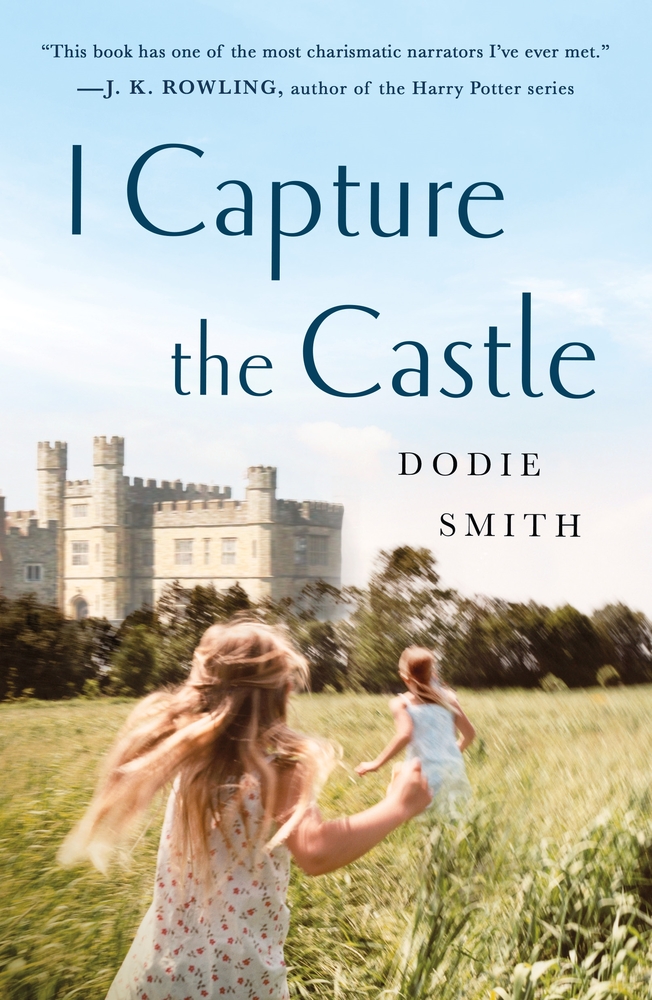
I Capture the Castle by Dodie Smith

Cassandra lives in a crumbling castle with her father, sister and stepmother. At some times of the day, especially in a dusky kind of afternoon light when it can’t be seen properly, the castle appears romantic and beautiful. But in her diary, Cassandra wittily records the reality of the place: the icy draughts, how her father has sold off most of the furniture, the smelly, muddy moat, and how she has to take a hot brick to bed to keep warm at night. 

The House of Paper by Carlos María Domínguez, translated by Nick Caistor

A Cambridge academic is killed by a car while walking and reading Emily Dickinson. Her successor receives a cement-covered book intended for his late colleague. Intrigued, he travels to Uruguay and eventually to a remote and desolate beach. There he finds a ruined house made of books. Whose crazy idea was that, anyway?

“What remained of the walls were bowed, jagged fragments, and in among the clumps of cement, tiny seashells, and dark lichens, I could make out pages of books baked in the sun then soaked, glued together like cuttlefish beaks, the type bleached and illegible.”

Burning Bright by Ron Rash

In this book of a dozen short stories, there’s just one with a house I wouldn’t want to live in, but a year after reading it, the place is still in my head. In “Back of Beyond,” Parson, a pawnbroker, goes out to his brother’s place because he knows that his nephew, Danny, has been selling stolen items to fund his meths habit. But it’s not until Parson gets there that he discovers his brother and sister-in-law huddling in a freezing trailer and Danny living in the family home:

“The room had been stripped of anything that could be sold, the only furnishing left a couch pulled up by the fireplace. Even wallpaper had been torn off a wall. The odour of meth infiltrated everything, coated the walls and floor.” 

Blue Book Balloon: Review - Resin by Ane Riel

Resin by Ane Riel, translated by Charlotte Barslund

Jens Horder is literally a hoarder—his house and outside yard are filled with stuff, so that it is almost impossible to move safely between the piles. Jens reports to the authorities that his six-year-old daughter, Liv is missing presumed dead, even while he knows she is hiding in a container in his yard. Liv sometimes goes inside the house to visit her bed-bound mother who has also become part of the junk and mess:

“Shiny blue-green flies buzzed around open cans. Faded butterflies bashed their brown wings against the windowpanes somewhere behind all the stuff…. Small mice and much bigger mice with very long tails. Something was always scratching, grunting or squeaking somewhere. At times it would be Mum.”

Page 75 – Electric Literature

Severance by Ling Ma

After a virus wipes out much of the world’s population, Candace—alone in New York but feeling she should still go to work—moves into her company’s office on the 31st floor of a skyscraper. She takes food from the employee’s vending machine and smashes her way into her boss’s office to sleep on his Mies van der Rohe sofa. It almost sounds idyllic: she sees a horse trot down Broadway and the stars in the night sky for the first time… if it weren’t of course for the plague and being all alone.

Medicine Walk

Medicine Walk by Richard Wagamese 

Sixteen-year-old Franklin doesn’t really know his father Eldon, but when he is called to visit the dying man, and ultimately help him make a final journey to the backcountry, he goes. Eldon is living in the most evocatively described flophouse:

“Clothes had been flung and were scattered every which way along with empty fast-food boxes and old newspapers… the hot plate was crusted with grease and dribbles, and a coffee can overflowed with butts and ashes and a few jelly jars stuffed full of the same.”

A place not even Eldon wants to die in. 

Image with no description

Stig of the Dump by Clive King

One day at the end of his grandmother’s garden, Barney falls into a disused chalk pit where he meets Stig, a caveman. Stig, well ahead of his time (this children’s novel was first published in 1963) reuses old junk to make his “cave” house: “There were stones and bones, fossils and bottles, skins and tins, stacks of sticks and hanks of string.” Stig of the Dump is one of my earliest memories of owning a book, and I still have a copy. 

The Unvarnished Story Behind the Most Controversial Group in AIDS Activism

When was the last time you cried? 

That question appeared on a poster in 1993 by Gran Fury, a collective of 11 artists and AIDS activists. The poster is strikingly simple, nothing but a blank, crinkled sheet with small text centered vertically in the frame: Do you resent people with AIDS? Do you trust HIV-negatives? Have you given up hope for a cure? When was the last time you cried? The piece—titled plainly, deliberately, The Four Questions“—confronts the trauma of the AIDS crisis through alternating perspectives of positive and negative people, as though the artists are inviting us into their ruminating thoughts. All questions, no answers. 

I learned about Gran Fury from Sarah Schulman’s latest book Let the Record Show: A Political History of ACT UP New York, 1987-1993. This tour de force narrates the early years of the New York chapter of ACT UP (AIDS Coalition to Unleash Power) as told to Schulman and documentary filmmaker, Jim Hubbard, through 188 recorded interviews with surviving members. (Full interview transcripts are archived and available for free at the ACT UP Oral History Project.)  

The book is full of fascinating people and events whose history would be common knowledge if our public schools were less homophobic and better funded. I never knew, for example, that until ACT UP pressured the CDC, women were categorically excluded from the definition of AIDS; or that they staged demonstrations at the New York Stock Exchange, St. Patrick’s Cathedral, Guantánamo Bay, and the NIH headquarters. Like most people, the bulk of my AIDS education comes from movies and television—Philadelphia, Angels in America, Dallas Buyers Club, and more recently, Pose. Schulman dispels myths about AIDS history found in these pop culture representations. She tells the truth.   

The last time I cried was during the conclusion to Let the Record Show, when I encountered an unexpected moment of intimacy in the cancer unit of a hospital between an ailing writer and her nurse. Upon learning the writer is an AIDS historian, the nurse begins sharing memories of treating AIDS patients in the 1980s and then suddenly chokes up. The writer and nurse sit for a moment in quiet remembrance. “This, I know, is the enduring relationship of AIDS,” Schulman writes. 

I spoke with Sarah Schulman over Zoom about AIDS narratives, grassroots organizing, the political use of anger, and more. 


Zach Shultz: I sort of read your title as having a double meaning. On the one hand, you’re referencing the art installation by Gran Fury at the New Museum in 1987, where they took the names of certain politicians and put them on tombstones with the photographic stills of the Nuremberg trials in the background. And that was an ironic way of trying to call for this justice that never actually happened, to hold these people in power to account. But also, this book is seeking to correct certain narratives out there. What is it that you want the record to show about ACT UP and about AIDS history more generally?

Sarah Schulman: Well, most importantly, that in America, change is not made by heroic individuals. It’s made by groups and coalitions of very diverse kinds of people, usually working in some kind of silo with like-minded people but standing together in a way that their work resonates with each other. 

The second thing is that this movement was really the last social movement in America that was to some degree successful. And it’s very important to look at why and also to see what its limitations were. I think the biggest takeaway is that it was not a movement that worked on consensus. It was a big tent movement that had a lot of flexibility. There was a statement of unity, which was: “Direct action to end the AIDS crisis.” That meant direct action, not service provision. And if that’s what you were doing, you could do whatever you wanted. There was a kind of radical democracy that we’re very far from now, and that is really important to remember.

ZS: It seems like another thing you’re doing with this work is counteracting an image of ACT UP as only gay, white, middle-class men. You’re showing all these other different types of affinity groups and other actors that were important within the movement. Can you talk about why that image is out there and how much more diverse the movement actually was? 

SS: One thing that’s very hard to remember now is that in the 1980s, the media, the government, and the corporate sector were almost all white males. And gay men who were in those sectors were closeted, for the most part. So, when the media looked at ACT UP, they saw other white males, and that’s who they interviewed and that’s what they represented. 

But you know, it turns out there’s a very big difference between an exclusively white male movement and a predominantly white male movement. Because when women and people of color participate, they have enormous influence. And I really am very specific about that—about which ideas, which individuals brought from previous movements and which previous experiences, so that you can see ACT UP would not have succeeded without the influence of women and people of color.

ZS: Right. This reads almost like a handbook for people who want to do grassroots organizing. You mentioned that it wasn’t based on consensus. That there was a very radical democracy model in the Monday night meetings. So, can you talk about ways that [model] worked and ways it created some challenges for accomplishing your goals?

SS: Well first, the Monday night meetings were like a nexus. People who work in ACT UP were also involved in lots of other communities… working with homeless people, with Haitians, with prisoners, with mothers, with drug users. Then the Monday night meeting was a predominantly white gay male, but also female, gathering. If you only look at the Monday night meeting, you don’t see where ACT UP actually was. 

In America, change is not made by heroic individuals. It’s made by groups and coalitions of very diverse kinds of people.

A really great example would be, there was no legal needle exchange in New York City. Mayor [David] Dinkins opposed it, even though he was African American and more progressive. So, people in ACT UP decided to do the civil disobedience of breaking that law, getting arrested, and having a trial. They won and made needle exchange legal in New York. But if you thought that that was a terrible thing, and you didn’t want to be part of it, you wouldn’t try to stop them from doing it. You just wouldn’t do it. 

If you wanted to go interrupt mass at St. Patrick’s Cathedral and somebody else didn’t want to, they just wouldn’t go. And I quote people in the book saying, “Well, I didn’t go to that,” or “That wasn’t where I put my energies.” But this idea of stopping other people from doing what they needed to do, that just was not operative.

ZS: And did this just come about organically? Or was it a conscious, strategic decision? 

SS: It was not conscious. In fact, it was never overtly stated. It’s something that I cohered by listening to everybody and sort of setting the period. Because ACT UP never theorized itself. A lot of things that it did, it just did. And it never decided to do them, never commented on them, because people were dying, and there was really no time for any of that. 

Let me give an example: Somebody from the front of the room would say, “We need someone to write a letter to this person.” And someone else would say, “I’ll do it!” And no one would ever check on them. No one would re-read the letter or try to control it. You just let people do what they said they were going to do. They wanted to live. They were going to do it. And it just went on like that. 

The biggest example I give is at the St. Patrick’s demonstration, December 1989, when the organization decided to do a silent die-in inside the church. So, we all went in there with 7,000 people screaming outside, but Michael Petrelis jumped on the pew, blew a whistle, and screamed at [Cardinal] O’Connor, “You’re killing us! Stop killing us!” And you know, chaos ensued. But it turned out to be for the best. 

But at the meeting, nobody said to him, “You went against us, so we’re throwing you out!” Never. No one was ever thrown out. Because in order to do that to somebody, you had to have a sense of supremacy or elite-ness or superiority. These were people who didn’t have basic legal rights. Gay sex was not legal nationally until 2003. It just wasn’t like that. 

When I interviewed him years later, I was like, “So Michael, why did you do that?” And he said, “Well, I was really angry because no one would let me be in their affinity group.” It’s a very human, messy thing. And a lot of things in ACT UP were like that. I mean, people OD’d and died, people stole money, people pretended they had HIV. I mean, it was messy and very difficult. But these are real people. They’re not clean, and they’re not pure. 

ZS: One thing I find so fascinating about this is the idea of anger itself. We often associate that with something negative… or destructive. Especially in the Trump era, we’ve seen how anger can be wielded by the Far Right and manifested violently, like in the attack on the Capitol on January 6th. But your work is shot through—not only in Let the Record Show, but also in other books I’ve read of yours—with a sense of anger and rage and indignation. So, I’m wondering: How can anger animate politics and art in ways that affect positive social change? And how might we distinguish between rage that is generative or destructive? 

Anger, when it comes from a place of being oppressed, is different than anger that comes from wanting to protect a place of supremacy. They use the same word, but it’s not the same experience.

SS: One thing is that ACT UP never committed an act of violence, which is very interesting considering that people knew they were going to die… ACT UP had violence done against them. People were beaten. There’s a guy, Chris Hennelly, who’s had permanent brain damage from police violence. But ACT UP never committed an act of violence. And interestingly, they never voted to be nonviolent. They always kept the option open, but they never exercised it. 

Because anger, when it comes from a place of being oppressed, is quite different than anger that comes from wanting to protect a place of supremacy. They use the same word, but it’s not the same experience.

ZS: So, going back to St. Patrick’s Cathedral, the Stop the Church demonstration on December 10, 1989. There was a part in the book where you talk about how this demonstration has been represented recently on the television series Pose. And when ACT UP members saw [the show], there was some anger about that portrayal being inaccurate. I don’t know if you’ve also watched another television show that recently came out called It’s a Sin

SS: Yes, I saw that. 

ZS: There’s one scene where they go to an ACT UP protest to lie down in the streets… But they never mentioned the name “ACT UP.” It’s all decontextualized and depoliticized. What do you think about these narratives being told about AIDS and about ACT UP from within certain dominant cultural institutions? Like, what’s missing from the stories that we’re telling? And what are people getting wrong? 

SS: Well, they’re getting everything wrong, and it’s always been that way. Representations of AIDS have never accurately represented the mass political movements that forced change in this country… If you pretend that it’s individuals who cause social transformation, it’s much more acceptable for corporate film studios. Corporate culture likes that message, but it’s not true. 

The issue with Pose was that there were, of course, people of color in ACT UP, but [the show] didn’t represent them. They ignored them and then created people who were not there, by creating Black trans women who did not get arrested at St. Patrick’s Cathedral. One trans woman did get arrested, but she was white. Kathy Otter, who was the elected facilitator of ACT UP, actually. So why not tell her story, too?

ZS: What did you think of It’s a Sin

SS: Well, It’s a Sin is kind of at the end of the old way of telling [the story] … What I think they captured that was accurate was how young everyone was, how fun it was, how great it was to get away from homophobic families and have that freedom… But the fact that everyone who was positive died is absurd and not helpful to anybody. That the only woman they focused on was asexual, apparently, had no personal life, and her whole life was serving people. I mean, it was kind of crazy. It’s so far from reality that hopefully after my book comes out, that kind of thing won’t be possible again.

ZS: One thing you mentioned that [the show] got right, and I saw in your book as well, is this idea of activism as being fun, or being charged with erotic energy. Like people would go to ACT UP to meet partners or hook up, and they would go to a zap in the morning, and then a party at night, or go straight from the clubs to a shift at the hospital to watch somebody. And that piece gets lost in the ways we think about politics as something very serious. 

Just because you’re alive doesn’t mean that you’re fine.

SS: Well, most political movements have to be things that make the lives of the people in them better. Otherwise, they don’t work. And this was a movement for people’s lives by very, very young people who had been really excluded and marginalized from their families, from the places they were born. They did not have loyalty to the system. They had much more loyalty to each other. And so, they had to live their whole lives by the time they were 25 or 26. They had to live everything because they were going to die. 

So, it was fun, and it was bold, and it was sad, and it was frustrating. And people shared apartments and helped each other get jobs and spent a lot of time together. I mean, so many people that I interviewed said their whole lives were ACT UP. They stopped their careers, they dropped out of school, and they got alienated from people who weren’t doing anything. It was a way of life.

ZS: But the flip side of that, especially when you’re dealing with a movement where the stakes are so high, where people are dying so quickly, is: How do you avoid burnout? [When] dealing with such overwhelming grief all the time, how did you get up every day and keep doing it? 

SS: People didn’t deal with it. You were all in it together, and every time somebody died, you were with other people who also shared the loss. And then you turned that into action. 

When I interviewed people 15 or 20 years after the events, I would ask them about that. And people would say, “We just kept fighting.” But then I’d say, “Do you remember one person in particular who died?” And that’s when the tears would come.  

A lot of it is unprocessed, and that’s something that César Carrasco talked about in the conclusion and why I use it as a conclusion. He was a refugee from Latin America during the fascist period, and he became a psychiatric social worker as a result of his activism. And he’s talking about my generation, a little older. Men who [survived], they’re not resilient… Just because you’re alive doesn’t mean that you’re fine. And all of the loneliness… and that first generation, the people who survived have had a lot of drug problems. [César] goes really into that, you know, the long-range consequences. So for many people, it hasn’t been dealt with.

ZS: I actually underlined part of your interview with him that really hit me in the heart. If you don’t mind, I’ll read: “When you are left with a whole bunch of people, but neither you or your friend has a narrative, then you don’t want to talk… You just stay isolated. So developing a narrative for what happened afterwards, I think that would be very useful.” 

So, what is that narrative? Is this what you’re doing with the book? 

SS: I hope so. 

“A Clockwork Orange” Made Me Long to Be a Monster, But It Only Saw Me as a Victim

Let me crack open a time capsule for you: it’s 2001 and I, a Catholic, 16-year-old high school dropout, have just walked to Blockbuster in my billowing JNCOs to rent a VHS tape of A Clockwork Orange. I will watch the film on the upstairs TV while Fox News blares on the downstairs TV. I am unaware of the fact that the movie received a “C” rating (for condemned) from the National Catholic Office for Motion Pictures, which means I’m committing a mortal sin by watching it—and because I don’t know, I won’t mention it when I go to confession. 

Something else I don’t know at this time: on the other side of the country, The Boston Globe is investigating the systematic cover-up of child sexual abuse by Catholic priests. Their bombshell report will spark similar investigations all over the world, and one of the findings of these reports will be the fact that previously, the Church’s system for dealing with pedophile priests was to quietly send them off to addiction rehab centers before reassigning them, because that’s what Church hierarchy believed sexual abuse to be: sexual addiction. It wasn’t abuse and trauma; it was out-of-control desire and a failure of willpower. This general narrative isn’t unfamiliar to anyone who’s grown up going to confession, where you’re told that you were born with original sin and you’re doomed to spend your whole life in a Sisyphean fight against your monstrous nature. You’re going to slip up, and that’s okay—that’s what confession is for. You start over with a clean slate and get back up on that horse and try to be better (or try not to be a sexual predator anymore). 

But, for me, The Boston Globe report will uncover more than the Church’s refusal to protect children. It will erode my religious narrative of sexuality as a struggle between repressive will power and monstrous desire—a narrative that presupposes sexual violence as an inevitability. It’s this narrative that A Clockwork Orange will invert but not destabilize when I watch it on its 30th anniversary.

Given the choice between sexual repression and sexual monstrosity, Alex chose to be the monster.

This year marks the movie’s 50th anniversary, and when I watched it 20 years ago, I did so with no awareness of the fact that I’d spent my whole life steeping in the conservative Catholic language of monstrous sexuality. I was dazzled by the surrealist interplay of lighting and music, the alternating wooden and over-the-top performances, and the incomprehensible teen slang that was both playful and dangerous. More than anything, I was dazzled by Alex. Who was this dark, complicated boy for whom Beethoven and sexual violence came together as a synesthetic high art? In the language of destructive sexuality, Alex was someone who wasn’t trying to rein in his desire. His violence wasn’t a failure of self-control; it was an abandonment of any pretense of restraint. Given the choice between sexual repression and sexual monstrosity, he chose to be the monster. 

Around this time I was also chatting with adult men on AIM and ICQ. I’d been receiving messages from men since I was 14 and I thought that it was because they’d read my profile and found in me an intellectual equal. I even had a running joke with them: when they told me how old they were (34/m, 36/m, 39/m), I said, “you’re the same age as my mom,” regardless of what number they gave me. It was important that I address the elephant in the room, which allowed me to believe they wanted to talk to me because I was clever. They sent me pictures of themselves. Some weren’t bad looking, but there was the occasional horror movie sequence of a slow-loading picture revealing first a shining bald scalp, followed by gray eyebrows, and finally bearded jowls. Sometimes they asked me for pictures of myself, but I didn’t have any because I didn’t have access to a scanner. There was the occasional request to “cyber,” for which I was always game. (I never thought of this as a breach of the purity pledge I signed in my catechism class when I was 13 because it wasn’t real sex, so I never mentioned it in confession.) The chats gave me a secret backchannel through which to explore sex, desire, and power. When the men pursued me despite my joke about them being the same age as my mother, it fulfilled the narrative I’d contrived of a failure of willpower in the face of monstrous desire: unable to control their desire, they became monstrous. I reveled in the power this afforded me while identifying with the men who had failed to stay on the path of righteousness.

A Clockwork Orange offered an alternative narrative. Instead of a failure of self-control, there was agency: a choice to be monstrous. In identifying with the men I talked to online, I also identified with the frustration of trying and failing to be good. The concept of choosing to be bad was exhilarating, and I read the book along with every scrap of trivia I could find. I learned that the author, Anthony Burgess, had also grown up Catholic and was an extreme political conservative who fled the U.K. to avoid paying taxes on his considerable wealth. For Burgess, the story of Alex and the post-capitalist Russo-British near future was a story of the State versus free will. As he explained in a 1986 introduction to the novel:

By definition, a human being is endowed with free will. He can use this to choose between good and evil. If he can only perform good or only perform evil, then he is a clockwork orange—meaning that he has the appearance of an organism lovely with color and juice but is in fact only a clockwork toy to be wound up by God or the Devil or (since this is increasingly replacing both) the Almighty State. It is as inhuman to be totally good as it is to be totally evil. The important thing is moral choice. 

Stanley Kubrick’s summary of his film adaptation was less focused on the moral implications of the story, but rather the political implications; he explained it as “a social satire dealing with the question of whether behavioral psychology and psychological conditioning are dangerous new weapons for a totalitarian government to use to impose vast controls on its citizens and turn them into little more than robots.” Is it? Watching the movie, one might notice the directorial choice to center the straightjacket and eye prongs as the true dystopian horror—the image of tears running down Alex’s cheeks while wires and electrodes spill out of the halo on his head foregrounded as the real violence of the story. But this is after we’ve just watched several grisly yet playful and balletic scenes of sexual violence—the implication being that the suffering of Alex’s victims is bad, but the suffering he endures at the hands of the State is worse. The question Burgess pursues, and Kubrick underlines, throughout the story is whether a person (specifically, a man) can be truly “good” if he has no choice. In other words: the individual soul’s journey to moral righteousness is more important than a functioning society where women can live free from sexual violence. Art factors into this equation as well, as the aversion therapy that Alex endures, the Ludovico Technique (Ludovico being Italianate for Ludwig), is underscored by the music of Beethoven. In killing his violent compulsions, the State also kills Alex’s artistic compulsions. The argument Burgess and Kubrick seem to be making, then, is that women’s suffering is necessary for both the moral and artistic triumph of men’s souls. 

The argument Burgess and Kubrick seem to be making is that women’s suffering is necessary for the moral and artistic triumph of men’s souls.

I sensed dishonesty in the centering of the straitjacket and eye prongs the first time I watched the movie. If Kubrick was going to ask me to revel with him in the playful scenes of violence against women, I didn’t see how he could then ask me to be horrified by the State’s violence. But I understood fear of the State as I read the novel with the ambient chatter of Fox News in the background. As in A Clockwork Orange, the narrative on Fox News, as I understood it then and as I understand it today, was that the State was the enemy; collectivism was the enemy; pro-social policy (from the diaphragm: socialism!) was the enemy. I was already primed for the zero-sum world of A Clockwork Orange before I started writing fanfic about the fourth droog (a girl—me—obviously). In draft after draft, I crafted a world in which a girl could be chosen to join in the ultraviolence because she wasn’t like other girls. I wrote within the same zero-sum logic in which Alex goes directly from perpetrator of violence to victim of violence, with nothing in between—because in his world and mine, there was no third option. It was the same zero-sum logic in which I understood a dollar for one person was a dollar out of another person’s pocket; in which good was equaled and opposed by evil; in which I could be the target of predatory men online or I could get in on the joke. 

The year after I rented A Clockwork Orange for the first time, my best friend’s mom found out that her husband was having sexually explicit chats with teenage girls on the Internet. They got a divorce, and I stopped responding to messages from men. That might have been the moment I realized I had never been in on the joke. Or maybe it was the following year, when my 65-year-old boss started sexually harassing me on the day of my 18th birthday. Or maybe it was the day a man followed me home from work. Or the day a man followed me in a cemetery and raged when I asked him to leave me alone. At some point along the way, it became clear that I could never be the fourth droog. In the epic battle between good and evil for the fate of the soul, I had never been the soul in question; I had always been the stumbling block on someone else’s journey. 

I don’t know if A Clockwork Orange would’ve appealed to me at all if I hadn’t been ready to recognize the narrative of the struggle between moral control and monstrous sexuality. And I don’t know that I would’ve truly recognized how problematic that narrative was if I hadn’t learned about the Catholic Church’s sexual abuse cover-up, predicated on that very same binary. But both A Clockwork Orange and the sex abuse scandal employed the same intellectual dishonesty that troubled that sexual narrative. In A Clockwork Orange, it was the centering of the straitjacket and the eye prongs as the true violence. In the Catholic sex abuse scandal, it was the treatment of pedophilia as an addiction. In both cases, the implication was that the suffering of the victims was not the focus of the story. 

There is a picture on my grandparents’ wall of the beloved family priest who baptized several of their children and grandchildren, myself included. He died in the late ‘80s, but a few years ago my mother learned that he had been accused of molesting a five-year-old girl back in the ‘60s. In the picture on my grandparents’ wall, the priest is sitting on the couch with one of my aunts—six or seven at the time—on his lap. I can look at that picture and imagine what he probably saw: a moral man in control of his monstrousness. The head controlling the heart. The superego controlling the id. I wonder if anyone saw the little girl in danger.