Our relationships with our brothers and sisters are simultaneously history and fiction—in other words, this happened (more or less), and it’s quite a story. Sometimes it’s just a little story, secrets and confidences that are more mundane than epic: “We are the only ones who remember what the house felt like on Sunday mornings. We are the only ones who really know why Mom and Aunt Ruth don’t speak.”
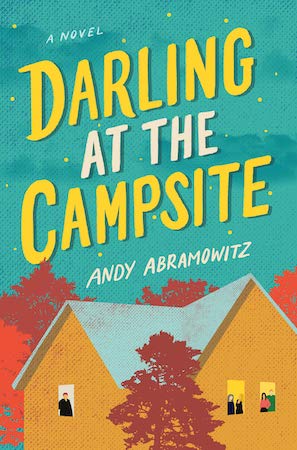
In my new novelDarling at the Campsite, 30-something Rowan is adjusting to the sudden death of his estranged brother. On his best days, Rowan feels lost. But now that his only sibling—that older, wiser kid with whom he once shared a house, a love of Talking Heads, and a common foil (i.e. their mother)—is gone, Rowan feels even more adrift. It hardly matters that the pair hadn’t been close in recent years, because that’s not what siblinghood is about.
Siblinghood is about being there from the beginning. Our brothers and sisters saw us in our unformed state, before we became the people we’d hoped to be (or, let’s be honest, the people we hoped we’d never be). They’re always onto us, the only people over whose eyes we can’t pull the wool.
Novels that center on sibling dynamics have always beckoned to me. I’m drawn in by the insularity, the inside jokes so old and entrenched they’re acknowledged with a shared smile instead of yet another retelling. These books contain discoveries, or perhaps an acceptance of the fact that there will be no discovery, that there is a truth out there that will forever remain elusive. Sometimes it’s just the recognition of having a shared place in the world, a story that is ours and ours alone.
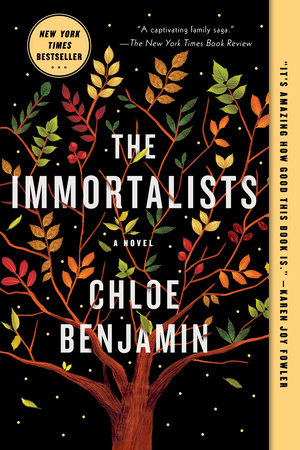
This sprawling novel follows four siblings as they move through life connected by a harrowing secret: as children, they snuck out of the house together to visit a fortune-teller who claimed to tell each of them the precise date of their death.
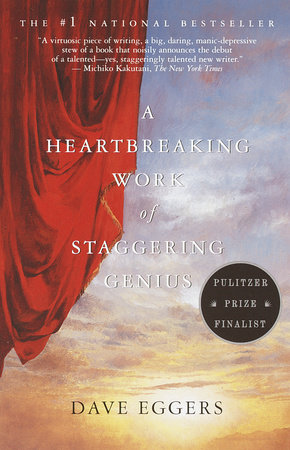
In Eggers’ debut memoir, 21-year-old Dave finds himself forced into the role of parent to his seven-year-old brother Toph when their mother and father both die of cancer a month apart. While Dave has to be guardian and protector to his much younger sibling, one gets the sense that Dave—barely north of childhood himself—understands that he serves Toph best when simply acting as his big brother.
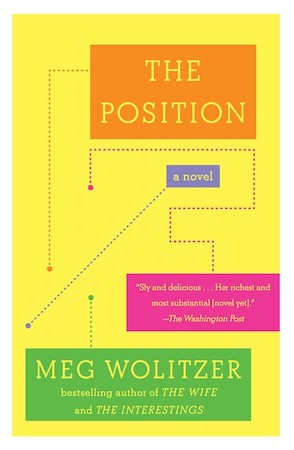
Four siblings are bound by the humiliating fact that their parents are famous for having authored a Joy of Sex-type book. Worse, their parents appear all too identifiable in the book’s illustrations. How do you live with that? The premise is rich with comic potential, and there’s plenty of funny, but because it’s Wolitzer, every page lands with poignancy and wisdom.
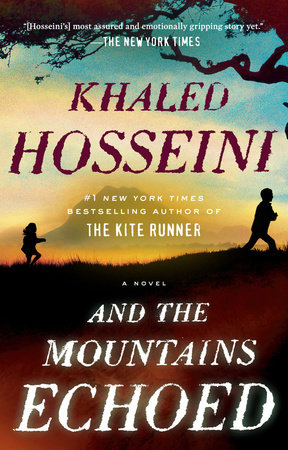
Ten-year-old Abdullah watches helplessly as his father sells Pari—Abdullah’s beloved sister, only three-years-old—to a wealthy family. Forced to endure the painful separation from his sister, the rest of Abdullah’s life is shaped by this event. Following its characters through the decades in Afghanistan, France, and the United States, it’s a shattering novel about the consequences of brutal choices.
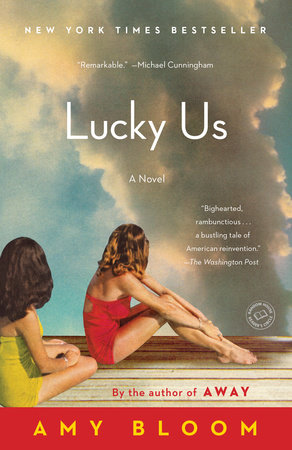
It’s rarely a compliment to say that a book feels longer than it is (That movie went on for days!), but Lucky Us is packed with so many vivid scenes and resonant characters that when it’s over, you wonder how Bloom got it all in under 300 pages. It’s the story of half-sisters, Eva and Iris, setting out into 1940s America and, as Bloom puts it, “moving forward only because backward wasn’t possible.”
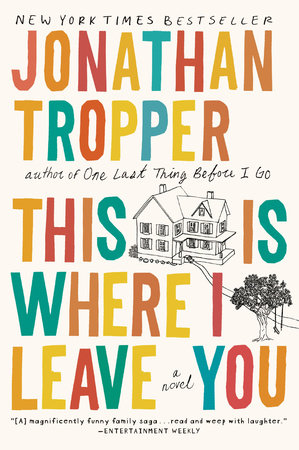
The signature Tropper sarcasm abounds, but fundamentally, this book—which involves siblings coming together to mourn the death of their father —is about the healing that emerges organically from being together. Satisfyingly, the book does not aim to be profound, just real, and the interaction among the siblings, all in various states of disrepair, is just as relatable and rewarding as it is funny.
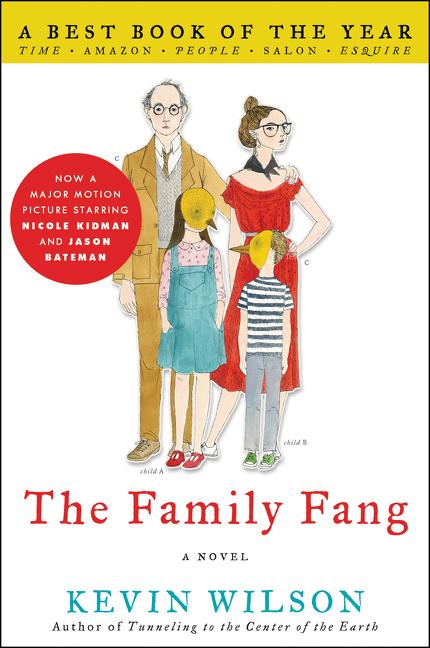
Annie and Buster Fang are not only the children of performance artists, but also reluctant participants in said performance art. Well into adulthood now, they are still trying to find their own way and their own semblance of equilibrium after a childhood sorely lacking in it. It’s madcap and zany, but there’s darkness at the edges as Annie and Buster bond over their need to escape the shadow of their upbringing.
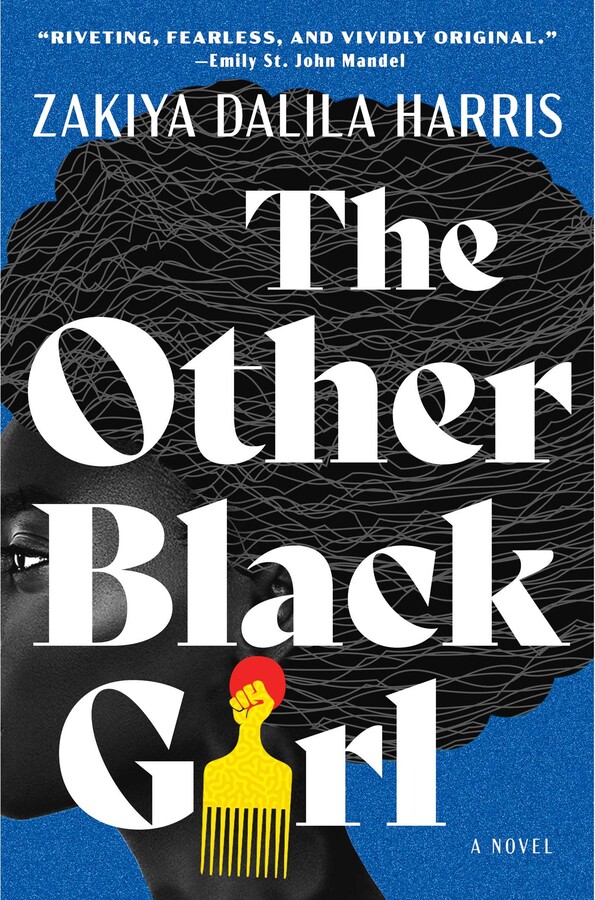
Publishing is blindingly white—according to the most recent Lee & Low report on publishing diversity, 76% of the industry is white and only 5% of the industry is Black. Zakiya Dalila Harris knows this statistic intimately, she was one of the only Black employees in the editorial department of Knopf/Doubleday.
Her psychological thrillerThe Other Black Girl confronts the anti-Blackness of the publishing industry, but that examination of Blackness applies to any workplace. The novel follows 26-year-old Nella Rogers, one of the only Black employees at Wagner Books. Until Hazel, a Black woman from Harlem, is hired and starts working in the cubicle next to her. Nella is excited to bond with a fellow Black colleague and ready to make up for lost time. But when she starts getting mysterious notes on her desk that read “LEAVE WAGNER. NOW.”, she realizes that something ominous is lurking in the cubicles of Wagner.
The Other Black Girl takes the ordinary and makes it sinister to interrogate what it means to feel overlooked or threatened in the workplace.
I chatted with Harris about the value of Black labor, allyship, and how privilege plays a role in the risks we do or don’t take.
Arriel Vinson: I want to start by talking about the epigraph, “Black History is Black Horror.” Can you tell me more about this choice? I was really intrigued.
Zakiya Dalila Harris: Tananarive Due has an incredible documentary that came out right around the time I started writing—Horror Noire: A History of Black Horror, about horror films from the 1890s to the present. I have always been a big horror fan. I love all of it. I grew up watching a lot of this stuff.
I was really excited to see a film that critically looked at Black people and their roles in horror throughout time. She touches on how, in some ways, The Creature from the Black Lagoon represented otherness, outsideness, and looks at that as a parallel to how Black people were treated at that time, but even now. It was so inspiring to me because again, being a Black person who loves horror, I happened to see myself in a lot of these movies.
I knew that with this book, pretty much from the beginning, there were going to be some genre elements. I knew Hazel was going to be something other.
AV: You worked as an editorial assistant. What empowered you to write such a critical look at the publishing industry? And did you receive any pushback as you were writing or shopping around?
ZDH: I worked at Knopf and I also worked at Doubleday. I was in a role that no other assistant was in really, because I assisted an editor who acquired for both Doubleday and Knopf, and then one who solely acquired for Knopf and Pantheon.
I started writing this at my desk after running into a Black woman I’d never seen before on my floor and having this moment of, “Oh my God, this is awesome”, but then also, “Wait, why isn’t she excited about seeing me?” We didn’t have any kind of interaction. Looking back, I don’t even know what we would have done. We were in the bathroom, so it was random. But as I went back to my desk, I was like, “Wow, I’m really starved for Black interaction”.
We take risks every day by being ourselves, by going to certain places.
Don’t get me wrong, a lot of times our IT department had people of color, our wonderful mail people were people of color, people working at the front desk were people of color. But it’s not quite the same. There was one other Black person in editorial on my floor, but he was an older Black gentleman, so we both moved through very different worlds.
I was so taken by this interaction that I came up with the idea of two Black women in this white space. Publishing is what I knew, but I thought, “I’m going to change it from publishing at some point, because this might be too much.” But it’s so rich, the way we talk about books, bringing in authors. Those dynamics are nuanced and there are so many things every editorial assistant has to get through. They’re in this prime position to see every possible, wonderful thing about publishing but also everything that is not so wonderful, which of course is a lack of diversity. So I kept going.
I had one moment when I was querying, where an agent kind of surprised me—because I knew who they were and thought, “this person will think it’s necessary,”—and said, “I love this, but I think you should change the publishing element.” I had someone else tell me they didn’t love it. I had a few people say they didn’t love the genre elements. I remember someone telling me, “I’m not sure about it.” I cried. I sobbed for hours like, “No one is going to want this book. No one is going to take this because it is about publishing.”
Thankfully, that wasn’t the norm and a lot of publishing houses were really excited about it, including old coworkers of mine who had really enjoyed it and thought it was eye-opening.
AV: There’s a moment where Nella wonders if she should warn Hazel about how white Wagner is or how anti-Black Wagner is. You wrote this inner debate so well—feeling like we owe other Black people information, but also fearing if we tell them we’re risking our own positions. Why was the theme of risk-taking so important in The Other Black Girl?
ZDH: Nella is inherently not a risk-taker in so many ways. She is, in that she’s still at this publishing house, but even still, she’s kind of coasting. She’s into the diversity meetings [they have], she wants them to happen, but also doesn’t make a stink about it when they don’t. For her, a lot of that comes from her family. She remembers her dad’s anecdotes of working at that place and the moment in Burger King—and I’ve definitely heard similar stories from my family. We have to nod at one another when we are in a room together because who else is going to? We’re looking out for one another.
For Nella, in a way, that is not as much of a risk. She’s also been so starved for more Black friends and having someone at work would be wonderful. She thinks that because both her and Hazel have navigated these white worlds, they are similar in the fact that she’s like, “I would want to know.” Risk-taking is something that we have to do. We take risks every day by being ourselves, by going certain places.
Kendra Rae’s story is also about putting it all out there. Nella doesn’t know everything about Kendra Rae, but she would find solace in seeing this person before her speaking out. Maybe what Kendra Rae said could have been sugar-coated or maybe she could have said it differently, but she was able to speak out. I wanted to consider all the different ways that we are—quietly for Nella and not so quietly with Kendra Rae—trying to carve out spaces for ourselves and for one another.
AV: I noticed with both Nella and Hazel, and Kendra Rae and Diana, that the novel is exploring the value—or the lack thereof—in Black opinions. We’re looking at whether or not Kendra and Diana should be trusted to put out Burning Heart, Nella’s opinion about Needles and Pins for the editor she works under. What made you want to explore the value of Black work, both labor and writing itself?
I would feel so insecure about having been privileged, but also felt like, ‘I’m still a Black woman in America, the most disrespected woman.’
ZDH: When I first started writing, I had the theme of commodification of diversity in mind, but especially Black bodies and Black work. In general, in our society—as in capitalism—there are so many things that go into what we value and what holds more weight. Nella often struggles with the fact that she’s seen as the Black voice at Wagner, and that’s such a big weight that a lot of Black people who are in these spaces—who are able to get through these walls—have to carry around. It’s a lot of baggage. I don’t know what the answer is on how to navigate that—it’s case by case. We should use our power when we are in these spaces to speak up and do what we feel is right. But also we are human. We should be allowed to just be.
Also Black women aren’t really listened to, ever. That’s the other side of it with Kendra Rae and Diana. “No way white people would want to buy that book,” was most likely what most people at Wagner thought at first. And then it was like, “Oh, but you were right, you’re in Vogue now”. That’s something that we see all the time. As an artist, I also feel that pressure.
AV: The Other Black Girl also questions privilege. We see the privilege of the white employees at Wagner and the higher ups and how that differs, and even the difference of childhoods between Nella and Hazel. What made you zoom in on what privilege means for each type of character in the novel?
ZDH: Every single character has an element of me. Nella the most, of course. When I started writing Hazel, I asked myself, “Who is the cool Black chick that I wish I could be?” Sometimes I wish I had been raised in Brooklyn or Harlem, rather than in the suburbs of Connecticut. I grew up like Nella, in a very white neighborhood and went to a very white elementary school. I was told in high school I talked like a white girl by other Black people. That was a lot to navigate. I was in AP classes and other high level classes and most times, it was me and one other Black person.
Looking back on it now, I know that I was fortunate to be able to go to a really good public school. My dad moved us there specifically because it was the best public school in town. They had all these resources. We were able to do all of these things that a lot of other people, I learned as I got older, were not able to do.
Once I got older, I started to see how these things affected me, and what I really hated was that I was seen as not Black enough. I’ve always had this feeling because I grew up in these ways, and I was in Jack and Jill as a kid. So, that part of Diana’s character is something that resonates with me.
I would feel so insecure about having been fortunate and having been privileged, but also felt like, “I’m still a Black woman in America, the most disrespected woman.” I was always trying to figure out my class privilege and how that interacted with me being a Black woman, especially as I got older. Then I moved to New York and I saw what was happening with Eric Garner, Philando Castile. I saw more Black people in general moving through the world. I thought about this as I was writing the book as well.
AV: Nella and Hazel seem to be fighting for the top spot. At first, there’s some trust, but as time goes on, we realize that all skin-folk might not be kinfolk or the allyship we thought was there might not be. There’s a clear struggle between Nella wanting solidarity, but also wanting to show that she’s the Black employee to trust. Can you tell me more about this?
ZDH: There are white eyes watching them all the time, so they feel like, of course they’re going to be in a microscope because they are the only ones. This is something my dad told me happened with him when he was working at a very white office. Whenever Black people are sitting together in a mostly white place, it’s like, “Are they plotting something? Are they planning something?” But of course, Nella does want to be plotting things with Hazel. Maybe not overthrowing Wagner, but she does love the feeling of “us against the world.”
Nella also expects Hazel to want the same thing. Hazel suddenly doesn’t go with that, and it seems like she’s trying to mess with Nella’s position. Hazel’s code-switching plays a role, too. Nella had been telling herself—and Wagner was telling her, too—that she needs to strip herself of these desires, these wants, to diversify publishing. She was bringing a backup version of herself, whereas Hazel could suddenly bring all of these things to work and still maintain her Blackness. But that comes with a price, because what is Hazel doing to herself in order to be accepted?
That’s why we are so scared. We feel like we have to be a certain way to get through these doors. That’s how I felt. I’m hoping that we can talk about this, and also talk about how to make spaces more inclusive and diverse. Meaningfully inclusive, not just, “Here’s a Black person now, you guys are good right? Okay, bye.”
AV: We don’t see many psychological thrillers in office settings. You mentioned this earlier, when you talked about your influences, but what was it like writing a novel that hits so close to home and how were you able to make this setting both intriguing and sinister?
ZDH: It wasn’t very hard writing a novel close to home because writing Nella’s character was so easy to me, but I made the conscious decision at some point to write in third person. I didn’t want people to actually think this all happened to me. I love my coworkers, my bosses are wonderful. I didn’t necessarily have as many Black friends in publishing as I wanted to have, but I did have people who cared about how I was feeling and completely agreed that things needed to change. But it was hard.
But I’ve worked in a lot of offices. I’ve been working since I was 15 or 16. I worked in the medical records office in my hometown when I was in high school, and I worked at a recreation office in college. I think there’s something so fascinating about being in closed quarters. Even though they have an open floor plan at Wagner and she has her little cubicle, she’s always on display in a way, and even when she thinks she has privacy, she doesn’t.
Everyone can hear your conversations, everyone can smell what you’re eating. There’s just so much I could do with her senses—Nella smelling Hazel when she arrives, watching people walk by her cube. These are all such visceral things and I still remember how these things felt. I knew there could be so many opportunities to play with this drab space and mundane, everyday things, fully grating on Nella and also becoming really sinister and dark.
AV: Is there anything else you’d like readers to know?
ZDH: I really wrote from the heart, from my soul, for me, but also for Black women. I wanted other Black women, not just ones who have worked in these environments, to see themselves in the hair references, the obscure music references, the TV references. It’s been really fun seeing Black women respond to this book, seeing the different things we take away from it. What I want non-Black readers to know is we’re not a monolith. We have very different views on things, we deserve to be heard, and we deserve to be there. There needs to be more of us. We should be in more places, we should be valued for all kinds of things, writing about all kinds of things.
I really hope that this book will show that to the publishing world that thinks, “Readers won’t be into this,” what could be possible. I want there to be more Black books. I want there to be other books that get the attention that they deserve. I want there to be comps in the future. When I was querying my agent, I was trying to think of books that were in a similar space, and it was hard. I just want there to be more.
We’re in the process of writing the pilot script for the Hulu adaptation. I took a whack at the first draft of the script and had so much fun just getting to live in a character a little longer. So book stuff is still my life, but hopefully, the TV side will play a big part in it, too.
I see a pediatrician’s office late in my wife’s pregnancy, a get-to-know you ritual to assess our fit. A three-minute drive from our house, the location was perfect, but the vibes were weird, and it all came to a head with a question: did you use a donor?No, I said, he’s just ours, and the whole thing went sideways.
It was the third trimester, quickly approaching the I’ll be pregnant forever phase. My hair was up, no makeup, but I realized suddenly that she hadn’t clocked me, that I passed, and now she was deeply confused. It’s counterintuitive, how a less-femme face scrambles stereotypes. More fundamentally, people like us just don’t fit in that context, our reality was so far from her expectations; it didn’t occur to her that we could be what we are.
Well, I’m trans, I said. I described IVF, preservation, how we got here. Recognition broke, the pediatrician fumbled, tried to recover and fumbled again—we never got back to easy conversation. I wasn’t embarrassed, not mad, just tired. As much as people say they support second moms, they need this biological scaffold to make sense of it, those Xs and Ys, moms and dads. Our bodies as they seemed, together and making a third, just didn’t make sense.
The prospect of becoming a mom as a trans woman, of specifically creating a new little life after transition, often feels like writing on a blank page. We humans rely on stories to make sense of overwhelming change, not just as practical maps for planning and preparation, but to expand our horizons, to envision new possibility. Trans women receive endless stories, from inside and out, but most figure us anywhere else but here.
The prospect of becoming a mom as a trans woman, of specifically creating a new little life after transition, often feels like writing on a blank page.
Torrey Peters’s Detransition, Baby is a breakthrough in many respects. It’s a revelation for many trans women to see a major press novel with such unvarnished inside perspectives on trans realities in all their complication, muck, and mess. It has provocative intentions, taking on and breaking open some of our most difficult conversations, right from its title. For a trans mom, having recently gone through the process of childbirth and infancy, it was remarkable to see a book write so boldly into the white space around trans motherhood, suggesting a future with fuller stories for us to lean on, expanding our notions of what stories we can embody.
Ames, a trans person in Brooklyn who detransitioned after years of living as a trans woman, has done something he didn’t think possible: he has accidentally gotten his boss Katrina pregnant. Ames’s life in detransition, presenting as a man once again, had just settled into a groove, easy if detached and grey. Now everything is chaos again. While Ames may be able to stuff himself back into a shape like man, the prospect of father is too much to bear; no matter what face we put on it, Ames realizes, babies see through us. Desperate for stability, Ames approaches his ex-girlfriend Reese, a trans woman whose own need for motherhood has lead her through many strange paths and dead ends, and proposes a remarkable scheme: the three of them raise the child together. For Ames, having trans women who see him fully promises to keep him grounded as the needs of parent pull in new directions. Reese agrees, nominally to see a car crash up close, while struggling to contain a last hope that this might finally be real. Katrina, for her part, is knocked flat by revelations of Ames’s trans past and present, not to mention his plan, as a stable family just coming into focus is dashed again. But something in the scheme touches a need Katrina holds too, a discomfort with upright cishet narratives that corroded her past attempts at family. Against their better judgment, the three decide to see where it goes.
There’s audacity in reading pregnancy next to transition, particularly trans femme transition. There are of course so many lines to be careful of: avoiding appropriation, recognizing what is shared and what is not. There’s such political fire beneath it, these zealously guarded boundaries. But the symmetries and overlaps are impossible to deny⎯and there can be reciprocal value there, offering new language and perspective where traditional stories and boxes so often fail us. I think of Maggie Nelson’s The Argonauts, which famously reads her pregnancy alongside her partner Harry’s physical transition. How both processes can be like breaking through the ice, where true realities are much more complicated, messy and overwhelming than the stories we’re given. How the ways we are stigmatized and sanitized echo. How for all of us these processes of becoming reshape us and rebuild us, leaving us to wonder who we will be on the other side.
I see the bathroom where I knelt before my wife, my eyes at her navel. I pinched the skin on her belly, just as the video instructed. The syringe was ready. I’d never given a shot before, not to myself or anyone else, and we were both nervous as hell. It was astonishing how after so many years, after all we’d seen together, we could suddenly discover whole new intimacies, these new configurations of bodies, proximity and trust, control and purpose.
We agreed that I would handle the shots, three every day for that first month of the IVF cycle. Don’t be scared, the pharmacist said handing over giant draw needles, they look like they’re for a horse, but you don’t stick yourself with these. We took the package with wide eyes. Different shots had different formats: an injection pen in a green fabric case, prefilled syringes stored in the fridge, and these standard draw vials. The pharmacist also handed over a box of injection needles the size of a cigarette carton, one hundred in all, which held its own menace, suggesting a long haul, all the ways this could go wrong.
Nelson describes a similar scene as she sets her own pregnancy against her partner’s transition, the parallels of bodies in motion, their partnership of creation and becoming. After her Harry decides to go on T, she gives his shots, reflecting on the peace it brings and her own agency in it. “Each time I count the four rungs down on the blue ladder tattooed down your lower back, spread out the skin, and plunge the golden, oily T into deep muscle mass, I feel certain I am delivering a gift.”
The rebirth of our bodies is rarely a solitary act.
There is a specifically trans relationship in this space. The rebirth of our bodies is rarely a solitary act. Sometimes, it’s merely seeing someone else embody what we need, the possibility they open by living their own story. We receive stories that carry us from elders and family, from community, from mentors and doulas and midwives, books and GPs, endless fora where individual wisdom accretes to folk knowledge. But there is a particular connection when the means of transformation are literally in another’s hands.
The relationship of trans motherhood hangs all around Reese. So many of her own relationships in her trans community involve ties of trans motherhood, with lines often blurring between friendship, romance, and family. In this space, the specific motherhood in becoming has special weight. When people criticize her friend Thalia for an off-color joke at a funeral for another trans girl, Reese pulls rank. “Oh come on… you know who gave Tammi her first shot? Thalia. Right in the butt. Who are you to say if she can make a joke or not?” The point is clear: Thalia helped Tammi become Tammi in the most intimate terms. Their relationship is foundational, the bond beyond question.
On the first morning, it was just the two of us. The doctors sent a link to a bank of training videos, and I did my best. I never had a trans mom, had never done injections, instead placing two blue estrogen tabs my nurse practitioner prescribed under my tongue each morning and night. The videos all featured a woman alone, injecting herself, reflecting the isolation in this institutional, normative mother space. Each video started with a list of supplies, canned audio for each item, and the cadence of the voiceover reading sterile gauze looped through my head as I performed the ritual, swabbing vials and skin with alcohol, pulling oil into a barrel, swapping needles. My wife’s belly was pale and soft; it was familiar of course, but I’d never seen it quite like this. We marked the shots around her navel like hours on a clock, around and around, day by day. It was strange how all these changes devolved to a science problem: add hormones, and a body reads the instructions, responds, transforms.
Something familiar as we turned to the pregnancy process was the breadth of stories, how they suddenly came from everywhere. Once you are through that ice, you are overwhelmed by the realities of it, always more to know, always more to fear, and so much cannot be known until you are in it and living it. You are immediately sifting voices from every angle. There are doctors of course, as both transition and pregnancy have moved firmly into the medical world in the last 100 years. But so much comes from elsewhere; it’s often less about fact from fiction than instinct, grabbing what feels useful, letting fall what doesn’t.
Something familiar as we turned to the pregnancy process was the breadth of stories, how they suddenly came from everywhere.
Even with all this information, there were so many surprises. One night, about a year into transition, I came up behind my wife, and as she turned, my eyes missed her nose and met her chin instead. I stood against our bathroom doorframe with a carpenter’s triangle, like we did as kids, and marked my height: I’d lost an inch from HRT. On forums, half the girls said it was impossible, while the other half noted it had happened to them. Possible or not, I was now the short one. Late in the first trimester, we started to hear a lot about feet. Suddenly the conversation was everywhere—how they grow, how they change, not just the temporary swelling but permanently, forever. This hit my wife hard: hadn’t her borrowed shoes traced my first steps as a trans femme? Hadn’t she felt emboldened to appropriate my old clompy boy shoes, my black Chucks and Sambas, as she found space for her own newly-legible queerness?
Through the pregnancy, the stories I didn’t have became inscribed on my own body. As my wife gained weight, I kept pace. My face filled, my skin softened (don’t say glowed). My focus slipped, baby brain took hold. It’s difficult to describe these symmetries, acknowledging and respecting what is not shared, while facing what was real. I lacked any stories to properly hold what was happening to me—physically, in my own body—to confine or refine this sense of blurring. As her body changed in so many ways, mine shifted too.
In the flux space of pregnancy, I asked my NP about shots. Injectable hormones are so often held up in the folk wisdom, said to bring fuller embodiment. As a ritual, there is something so visceral and immediate to this act. Spending so much time with doctors, endless scans and hospital soap, I realized one day that my fear of needles was gone, replaced by an eagerness for agency, for control. The medical process of changing bodies was not just demystified, but there was momentum—a trans dynamic, that interplay of proximity and need. And after all, these shots would be the easy part. Sticking someone else, someone you love, is so much harder than taking control of yourself. As I watched my wife’s journey unfold, all the change she bore, this was nothing at all.
I insisted on shots in the belly. It wasn’t my NPs standard practice, but I pitched information scraped from community space with more members than any study, that accreted community wisdom. After doing her own homework, my NP agreed. I took that old green case and tore its guts out, remaking it as an injection kit, and stuffed it with supplies I learned from the training videos. The box of 100 needles was barely touched after our early success. Preparing for my first shot, alone in my bathroom, the cadence of sterile gauze still rang through my head.
For Reese, breastfeeding is a foregone conclusion. As they share more and more, as the bond of their mutual project deepens, Katrina is surprised to learn that trans women can breastfeed. Reese knows all about it, but in messy queer fashion her information came sideways. Her stories come from fetish space, from cis men living their own body anxiety through her body, knowing their own flesh had that potential too. And so this is how Reese came to own a manual pump already, a gift stuffed in a sock drawer.
Standing with Katrina in a bougie baby store, staring into a case of sleek baby-blue electric pumps, Reese wants to tell Katrina of the eroticism in motherhood. Even this store. Look at it! A sanctum of femaleness, of private domestic acts. She wants to blow up so many discussions we bury about the capaciousness of pregnancy and transition, all the lines that get blurred and crossed, the queerness here. In an earlier chapter, Ames experiences a breakthrough of personal discovery in Glamour Boutique, a crossdresser fetish shop; the baby store serves as a funhouse reflection, all the drag that comes with procreation.
Nelson dives deep into the way these queer realities of the body, including eroticism, inhere to the process of motherhood, only to be met with stigma and shame. She discusses the sharp privacy of breastfeeding itself, with its reminders of the animal body. It’s another area where a whole new language opens up once you’re past the shroud—colostrum, letdown, hindmilk. Visual records of the act are limited to pumping manuals and, she notes parenthetically, porn. Nelson turns over an image from an art show, where a woman pumps while staring into the camera; she marvels at the way that radical intimacy in queer media often sounds in genres of danger, suffering, abjection, but here the queerness is nourishment from the body. Nelson pushes not only against mainstream discomfort but queer culture too—where queerness is so often idealized in the masculine, against anything too close to the female animal, she seeks a vision of queerness unbound and capacious enough to hold this too.
Reese picks up this precise conversation, staking a claim to the same mess and complexity for our stigmatized femme bodies. There is reciprocity for Katrina as well; this opening is what she needs too. She confesses how, without Reese, she would run from the store screaming. For Katrina, with all her discomfiture around the normative glowing mother story, for whom conformity is alienating, this queer liberation that Reese seems to promise looks something like a life she can live.
One of the first changes a trans girl notices is soreness in her chest. Long before breasts grow in earnest, nipples and glands reconfigure, reading instruction and transforming. This often includes, briefly, a few drops of milk. During pregnancy, though I decided against the induction protocol, the milk returned. Always two drops, just two. Whatever the explanation, it arrived and remained well through his first year, until he was weaned. In that time it was a constant reminder of the proximity of our bodies, the blurring, and the distance that remains.
As a trans woman, this notion cuts deep. Our bodies have always been figured as toxic.
Nelson turns over another idea called the toxic maternal, literally the poison in our milk. Toxins are everywhere these days, so that the question is never whether there is poison, but its degree, whether it is safe. As a trans woman, this notion cuts deep, part metaphor, part practicality. Our bodies have always been figured as toxic, an assumption that has founded laws to keep us from having children, or courts taking our children away. Gatekeepers once asserted that to protect children from transition, “young children are better told that their parents are divorcing and that Daddy will be living far away and probably unable to see them.” This language is resurgent in contemporary hate campaigns, where talk of “safeguarding” and “grooming” of children loom large. It’s a core story that society hands us about what this all means.
This sense of toxic maternal was close in mind as I decided early to forgo breastfeeding protocols. I told myself it was practical, a lack of stories proving safety. I read about trans women who did, but the stories didn’t cover nettlesome specifics, like the safety of testosterone blocker medication in milk. And then it struck me that I had been looking too narrowly, seeking only trans stories. My hormone blockers were, like most trans medicine, prescribed mostly to cis women to treat various conditions. I was not asking a trans question at all, but a woman question. Still, when I brought this to our OBGYN, she was leery. I folded quickly, shut the door and stayed on course, accepting that this body just isn’t safe enough.
When our son was 18 months old, I read Reese’s certainty, and doubt crept in again. I dig deeper. Either science had caught up since then, or I simply chose not to see it. But then it was never truly a science question. It was about little cooler bags of pumped milk handed to daycare staff. It was about a shirt lifted in public, a baby clambering for a chest as people pretend not to look, but look. It was about a story that was no longer just mine, but my son’s first and foremost. Against this, Reese’s certainty is bittersweet. I think of girls who come after who can read themselves into that confidence, how the opened conversation creates more narrative possibility for them, for their full complexity, for queerness and nourishment, for things that will no longer be too much to ask.
In imagining space for her own queer family, Reese recalls a trans man in Chicago she’d met who, along with his husband and a lesbian couple, started a large combined family. They renovated an old Victorian house by the lakeshore, carving two living spaces separated by an open staircase. The cis husband provided genetic material, both women conceived, and all four raised their kids together as equal parents. By the time that the kids realized most people only have two parents, they viewed their peers with sadness for their lack.
I think of a small hand-made quilt, perfect for a baby bed. It was gorgeous, intricate, and so we were stunned to learn that it was the first our trans man friend had ever stitched. I think of a crocheted unicorn doll, white with a mane of rainbow yarn, that a lesbian friend’s mother made for the occasion. From our cishet friends we receive hand-me-down boxes of utility gear, all the practical sundry needed to keep a baby alive, fed, and rash-free. But the gifts from queer community, queer family, were something else entirely.
We expected a pulling-back, a separation, as we began a process often seen as anathema to queerness. And yet, as the baby became imminent, I was astonished by the excitement of so many in my queer circles, a palpable difference from the nods of cishet friends. There was triumph in it, an investment that transcended the usual respectful distance, as if this rare things wasn’t just for my wife and me, but for all of us—a deeper understanding of what community really means.
In his first few months, we performed a special kind of assessment. Friends dropped by to hold him, and we noted who had that spark, who took most readily to that connection. Our vision for all of this, building a world around this tiny human, relied on a circle of adults, particularly our queer friends. We simply couldn’t envision doing this alone. Our queer circles skew trans masc, and with our femme selves already established we had a special interest in finding trans uncles and godthems to balance and expand the tones of in his early life.
We spun a story to support us in this, filling the missing pieces, our community there to provide all kinds of faces and experiences to fill his world. And then, March 2020, we were reminded how little control we really had. He was 7 months old when the pandemic hit. When lockdown began, he couldn’t even crawl yet; by the time that we saw a light at the end, more than a year later, he ran down forest trails, read books, did downward dogs, watered my garden from a bubbling hose. For all our attempt to write it differently, we were all that he had, and we needed to be enough.
Ames, turning over his anxiety about parenthood, remarks how a baby sees through you. Parenthood itself is not scary to him. What’s frightening is a role he could not fit: the role of father. His instinct is to seek a community that could sustain him—specifically the fellowship of trans women, people who see him as he truly is, as the new being’s needs take hold. For Ames, much of the ease of detransition came from how little is asked of a middle class white man, how easily he skates by. This baby’s need tears that all down. It will know him, and he cannot have this baby know him as he is.
Ordinary devotion is a concept that Nelson considers, from developmental psychologist Donald Winnicott: how a mother’s simple task is to give yourself completely to your infant’s need. To give your body, your mind, your energy, your purpose. It’s interesting to set this beside transition, as Nelson does with Harry. Transition is the fulfillment of personal need. We often say that the best thing you can be for others is yourself, that it’s offensive (and it is) for family to place their sense of need ahead of yours. But entering the parent space specifically, so much doubt arises.
We often say that the best thing you can be for others is yourself. But entering the parent space specifically, so much doubt arises.
Late in the novel, as Reese’s dreams once again seem to crash down, she stands on the shore facing a derelict sanitarium, speaking aloud to the ghosts: I lost my baby. Not a hypothetical baby, but this baby. A baby that could still get to be a baby, but only without her—her abnegation an essential act to bring it into being.
This notion, giving your body for a baby, has a strange spin for the trans mother. Many have denied their personal need, stayed in a body shaped like father, for the sake of their children to be or the children that are; to do otherwise, as the story goes, is selfish. Or we find ourselves at a place where we have finally come into the body we need, only to face the prospect of losing it for the chance to make a child.
Peters has spoken of the comma in the title of Detransition, Baby as a pivot, a razor. I read it and see a line of decisions, all the times on this road where I had to make the choice between the body I needed and that hypothetical child. I see the Medicaid clinic room where I initiated my trans care, my NP and I reading preservation reports we didn’t understand, discovering that something was wrong. I recall that sharp fork: do I take hormones to remake my body the right way, or take other hormones to make it a father. I recall our compromise, assured that future IVF would still work at least. I see my own office, the day after our retrieval seemed to fail because my material had failed, right back at the same fork: would I detransition for the chance to complete this? On one side, I knew I had chosen something essential with transition, remaking a body and self I needed in ways I couldn’t even imagine before I found it. There were other ways to have a child. And yet. There’s that trans reality again, the relationship between proximity and need, how the closer you are to the practical possibility of embodiment, the more present and compelling the need becomes. The truth was, I had already attached to this baby, the one we saw together, the one we were making together. With both sides of the scale heavier than ever, I knew that I would try—a new story, another blank page. And then the phone rings, my wife, with news.
I see a bright morning, a Saturday in late summer of 2020, and our one-year-old son played with my wife in our living room. I looked on through the open bathroom door, preparing for shot day, an event that had now become a grounding ritual, a necessary moment I anticipate all week. I opened the old box of needles, and the last one fell out. I stood for a minute shaking the empty cardboard box, the same one we took wide-eyed at the pharmacy when this all started, the one hundred needles now spent. My son climbed over my wife, reaching under her sweater, insistent, close to weaning but not there yet. Two bodies became three bodies. Bodies changed shape together, in passing and in tandem. I held an empty cardboard box, what was left of the needles that precipitated all of it. It’s hard not to think of Nelson’s Argo conceit, her story to frame their passage through transitions, the ship replaced bit by bit until no part is the same. There are so many valences of story for experiences like this, sometimes a mythic allusion, sometimes a spent case of needles. Laying out supplies, even now, I hear the same cadence.
While the line “you can’t judge a book by its cover” may still hold some truth, book covers are a work of art. At their best, book covers not only catch the reader’s attention, but give some sense of what you might find inside—and of course, the cover is what you recognize when walking down the street and seeing someone reading in a café, or on the beach or at a well-lit bar. A well-done cover can express the motifs, symbolism, or mood of a book. It can entice a stranger browsing in a library or bookstore, or wink at someone who is rereading a familiar favorite.
In our series on rejected book covers, we look at the process of developing, refining, and sometimes completely rethinking a cover design. (You can see earlier installments of this series here, here, and here.) Here are ten more striking covers—final version on the far right, and you can click any image to enlarge—alongside the designers’ thoughts on their goals and processes.
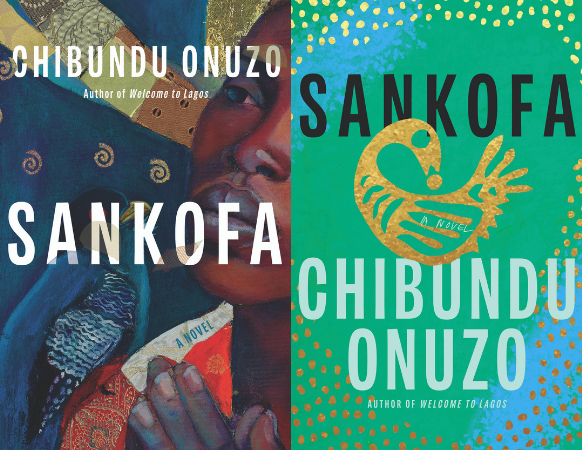
Sankofa is a novel about a middle-aged, biracial woman named Anna who travels from London to Bamana in search of her estranged father. After discovering his diary in her mother’s belongings and meeting some of his former friends, she learns that he was once involved in a radical movement for African liberation in London, before returning to Bamana and becoming the country’s first president. Unemployed and in the middle of a divorce, Anna sells her home and leaves her daughter behind to find her father.
The brilliant and beautiful title is inspired by the word “Sankofa” which is a word in the Twi language of Ghana that translates to “Go back and get it.” Sankofa also refers to the Bono Adinkra symbol represented either with a stylized heart shape or by a bird with its head turned backwards while its feet face forward carrying a precious egg in its mouth. I knew that I wanted to pay homage to this beautiful, metaphorical bird symbol which encapsulates so poetically the main character’s journey to find her father. I illustrated the bird based on reference images of the symbol and used narrow sans serif typography so that the title could be represented boldly and largely along with the author’s name. The sans serif also connects nicely to the bold political nature of the text. The gold color and texture is inspired by the many mentions of gold throughout the manuscript: the pages in an important diary that glowed brightly looked like thin sheets of gold, the gold buttons and gold threads that show up in the piping of uniforms and that are threaded into the hair, the golden toilets, bathtubs and taps that show the division of class which is integral to the story.
I included several variations on the Sankofa bird design in different palettes, with integrations of the bird shapes into the typeface, but also wanted to include a completely different direction that featured a human face for emotional connection. I chose to work with some paintings by Tamara Natalie Madden, whose stunning works are allegorical and whose subjects are of the African diaspora. Some of the paintings feel collage-like due to her use of mixed media and the varying textures, which felt so aligned with this piecing together of a self and a past. Her use of patterning, gold, birds also aligned nicely for this alternate direction.
Most of the team preferred the versions of the Sankofa bird design due to the commercial appeal and boldness. We showed this design to Chibundu along with some additional layouts featuring less playful gold patterning and I was thrilled that she went with our dot pattern which is dynamic and reminds me of the movement of the narrator’s emotional and physical journey in search of her family’s hidden roots.—Nicole Caputo
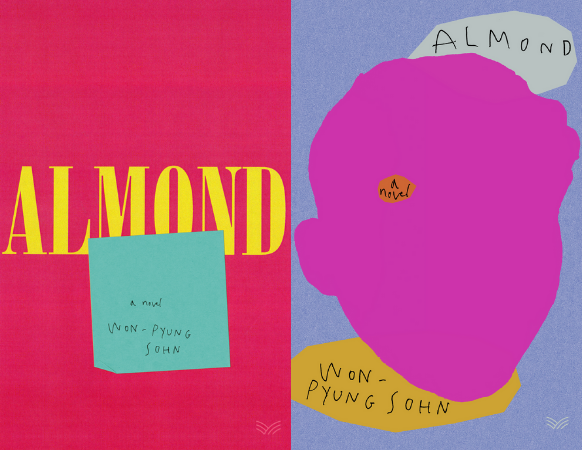
The final Almond cover was designed and approved in only a few short steps. Author Won-pyung Sohn writes effortlessly with distinct visuals. Yunjae was born with alexithymia, a condition that affects the almond-shaped amygdalae in his brain causing difficulty expressing emotions like fear or anger. In order to help Yunjae, his mother leaves him Post-it notes around their house as daily reminders.
The cover needed youthfulness and simplicity, though the Post-it note alone lacked the emotional weight alternate options had. The final cover was a unanimous decision, since it better reflected Yunjae’s experience delicately navigating adolescence.—Stephen Brayda
With a title like The Stone Loves the World, you know you’re going to have your work cut out for you designing the cover. The story is told through different vignettes across three generations from the post WWII days until the present. We learn about the lives, histories, relationships, and connections of a fractured family, while following Mette, a 20-year-old woman who has decided to take a cross-country trip to meet her grandfather and ask him some questions. Both of Mette’s parents try to track her down, which culminates in our three main characters coming together for an impending solar eclipse. Mette’s father, Mark, being an astronomer plays up the importance of the solar eclipse/space imagery, which was featured on a lot of the directions that didn’t make the cut.
The title nods to how each character is quite stubborn in their own ways (an “immovable object”) but learn to open up and resolve their issues. There’s a sweet anecdote in the beginning about Mark’s family playing pool together so I wanted to use the 8-ball as the figurative “stone” and to represent the eclipse (end of the game/new beginning). What ultimately worked for the final jacket was the title, large and central, with the three figures interspersed against a singular landscape. I wanted to play with this idea that the family members are separated into their own compartments, by their own design, but they’re still connected by the world at large.—Colin Webber
Feral, North Carolina, 1965 is a coming-of-age story about Willie Mae, a girl chafing under the expectations of her Southern Christian fundamentalist community. Determined to discover the secrets that the adults in her life are hiding, she uncovers violence and racism boiling just under the surface.
I chose the original photograph of a tobacco plant because of the evocation of the American South and the play in color: the dark, smooth leaves and deep shadows crowned with pink flowers—the type is being enveloped by the plant the way gender roles, bigotry, and brutality threaten to envelop Willie Mae.
However, the publisher felt strongly that the cover needed to have more of an upmarket and Young Adult literature look, but they loved the botanical theme. I dug into the New York Public Library’s Digital Collections and found an illustration of a tobacco plant. Between the pink flowers and broad leaves creeping up on the title, I was able to keep many of my favorite ideas while creating the look SFK was after.—Olivia Hammerman
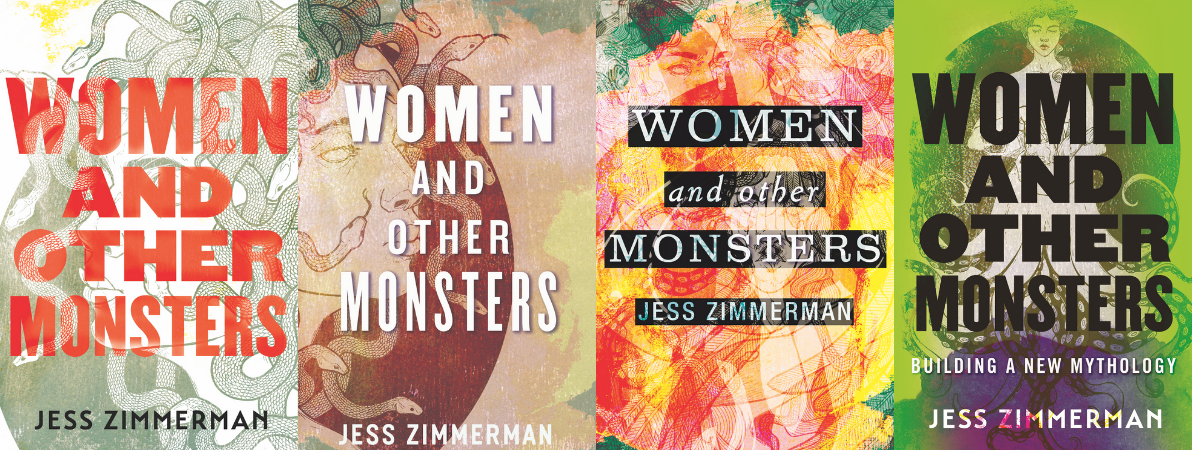
Women and Other Monsters was a treat of a book to design for—the title alone pulls you in! I worked with illustrations that were commissioned for the interior, which I was initially hesitant to do as interior art doesn’t always translate or work for a cover. I took a look and pulled together some designs with Samira Ingold’s art. The beautiful line work ended up working well for the direction I wanted to create (which was contemporary and trade) and with added color, the central figure reads ambiguously (not instantly identifiable) which is exactly what we felt made it a successful cover.
I presented what ended up being the final cover alongside several other designs:
Cover 1: Shows a limited palette where it’s the bold type which peeks through the tangle of snakes and upon closer inspection, you see it’s a portrait of Medusa.
Cover 2: Showcases Medusa again, but here she’s much more prominent and you can see her face profile—highlighting “woman” versus “monsters,” which cover 1 highlighted.
Cover 3: This is a collage of several women monsters which appear in the book. You see a colorful explosion and with this design, I particularly wanted a cacophonous feel—disorienting elements and colors and beautiful faces—with the title and author name floating over it all in black bands.
Ultimately the version chosen which became the final cover was just tweaked a bit more with color adjustments, really pushing the vibrancy and making sure the type remained legible.—Carol Chu
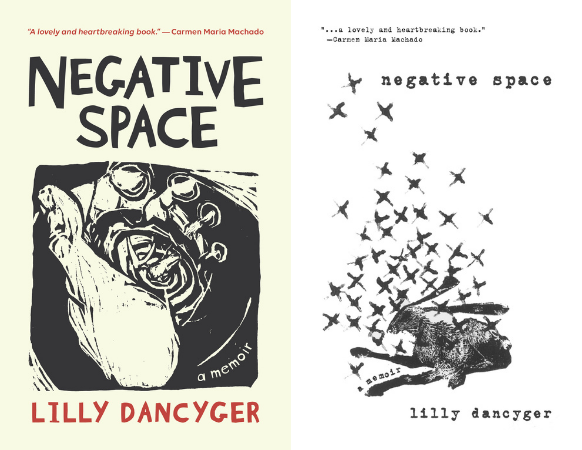
When the conversation of the cover came up, I had just finished the final round of edits on Lilly’s book. It’s an incredibly powerful memoir about the negative space that is the loss of a parent. The original cover features artwork by Lilly’s father—who is at the center of the narrative—but the more we talked about the direction of the book and what the cover needed to say about the book, we realized that there was one major thing missing from the cover: negative space.
We also agreed that the original cover evoked the feeling of a ‘zine which would be totally appropriate for the art scene in which Lilly’s father moved into during the ‘80s, but it didn’t truly sell the depth of the story within. I sat on the phone with Lilly for over an hour, running through her father’s artwork, trying different iterations of the stark white cover until we came to the rabbit. I sent it off to her and when she opened the file we both said, “This is it.” The rabbit was one of my favorite pieces out of the collection that Lilly had provided for the book; it spoke to me in a way that stuck with me the entire time we were working on the manuscript. I had developed an image in my head that I felt I personally would be attracted to if I saw it on the shelves of a bookstore and Lilly agreed. In the end, the rabbit gave us just the right balance between the art and the swath of negative space that, coupled with the faux typewriter font, just came together exactly as we envisioned it.—Katherine Anderson
I was blessed to work on some cover designs for Sir Elton John’s autobiography! I love record collecting and music from the 1970’s, so I was very excited. Elton had expressed one direction: that he should look like a rockstar on the cover. There was a set of approved images to choose from; from there I had carte blanche to take chances on typography, special effects, and how the selected image was used.
I was told to think outside the box and express “Elton” iconically through graphics, typography, or an image cropped in tight. After looking through the images, I loved the overhead one of him playing live. My feeling was that integrating the type with the image would really bring you into that rock n’ roll moment.
The final cover design was not by me, but by James Annal. He has a great post on his design process on The Bookseller blog. In the end, I feel they made the right decision going in this direction, his design feels intimate and personal. My solution and concept, although killed, I am still very proud of!—Philip Pascuzzo
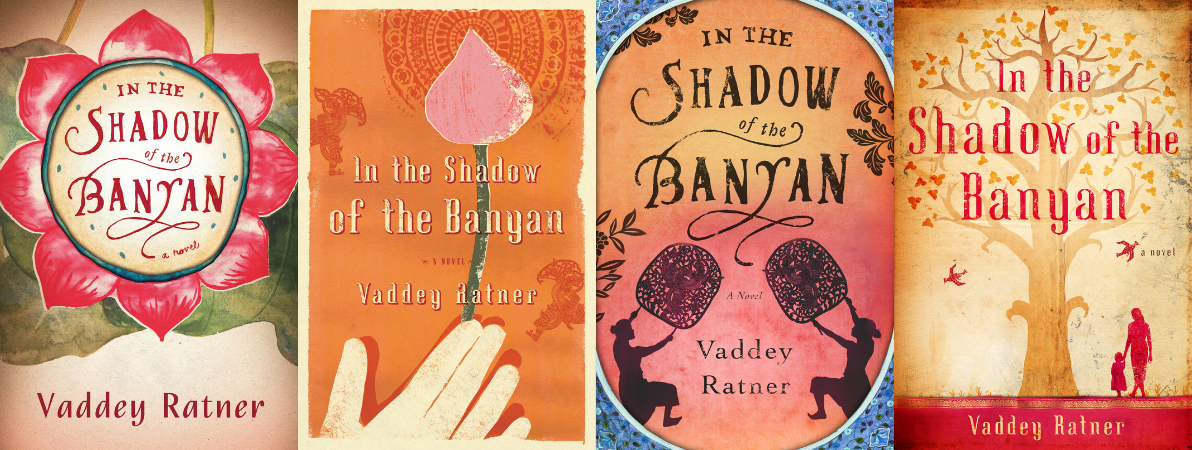
In the Shadow of the Banyan by Vaddey Ratner is a harrowing novel that tells the story of Raami, a girl who comes of age during the Cambodian genocide in the 1970s. Based on the author’s own journey of survival, it is also a hopeful novel, and our first few concepts explored using the lotus flower as a motif and symbol for rebirth and Raami’s dauntless will to live. The novel is steeped in folklore, and I tried to capture the richness of the author’s storytelling using shadow puppets as an inspiration. In the end, we landed on a solution that embraces the personal aspects of the author’s story, juxtaposing the tender silhouette of a young Vaddey Ratner and her mother against a ghostly banyan tree that seems to echo the voices of the victims of this brutal period in our world history.—Christopher Lin
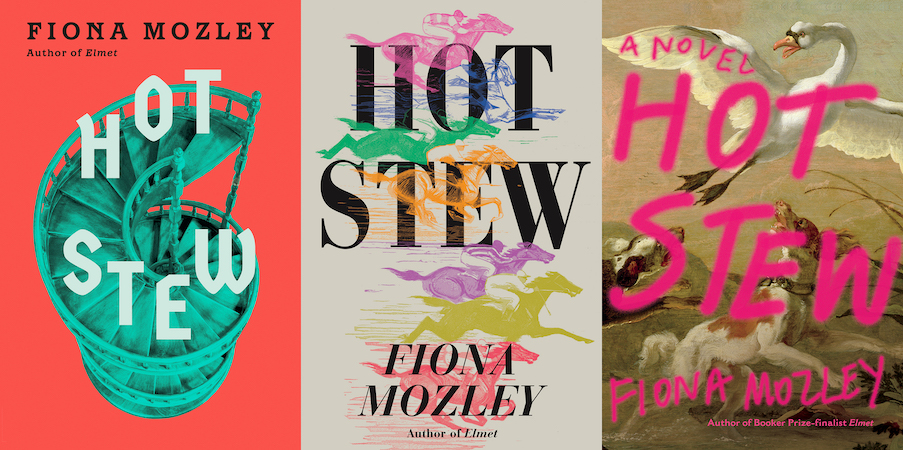
There was already an apt U.K. cover for Fiona Mozley’s Hot Stew when Algonquin Books reached out asking that I design the U.S. cover. The novel is set around a brothel in gentrifying Soho, London. The characters pointedly come from the extreme upper to lower classes. Together, the setting and lives present a piercing and wry commentary on the dictates of ownership, affluence, and the places we occupy in society.
My first inspiration was a spiraling snail shell. The opening chapter “Common Snail” was a metaphorical introduction to themes that followed. Snails hold many positions. They are escargot at an expensive restaurant. They get boiled, then their “chewy pellets [get] picked with forks and fingers, and the curled shells discarded.” Later shells get crushed and scattered around plants to deter snails from eating them. I thought the winding Victorian staircase in the brothel mirrored the shell’s shape as well as the idea of descending class echelons.
The racehorses of the second route conjure that frenetic comparative drive in life to keep up, to get ahead, and connects to one of the wealthy characters who watches horse races. Another character describes how the neighborhood got its name before the city from the sound made by men and the animals they were hunting: “A so ho, a so ho. That’s what they shrieked when they got on their horses and chased deer through the forest.”
Decadent rooms in the novel are draped in this braggadocio of conquest—coats of arms, hunting trophies, and hunting paintings. Secret brothels used to be marked with paintings of swans (a symbol for sex in the Middle Ages) over their doorways. I hoped to combine this high and low art on the cover. Abraham Hondius’s painting of a swan being chased by dogs was perfect. There is much outrage and protest that springs forth from the lower class in the book, which made me think of homemade posters and low-tech revolt. Defacing the pompous picture with graffitied type in a modern hot pink against the aging past snapshots the dynamic raucous of Mozley’s timely tale.—Tree Abraham
When we were in the concepting stage, the editor described the book as non-fiction espionage that reads like a thriller, “a real-life The Americans.” There’s a wealth of Russian design from the period to pull from and I wanted to riff on this, but also try an option that was doing something unexpected.
I started by watching all six seasons of The Americans. This did absolutely nothing to help with the design process, but it’s a really good show, you should watch it if you haven’t.
I liked the round-rimmed, Russian-looking glasses as an icon that would signal “spying.” The disembodied eyes in the glasses pushed this idea further. The type looked angular and vaguely Russian but not so on-the-nose as an actual constructivist typeface. I really liked that this comp didn’t look like other books of its kind, but I knew they’d probably kill it because of this. I flipped the “N” in an effort to pull it back into the Russian espionage genre.
“This belongs in an optometrist’s office as far as I’m concerned” was the editor’s response. Ah well.
The “split” cover was a fun way of showing the duplicity of the Soviet spy. One side being a straight, classical type treatment and the other looking like a Soviet propaganda poster. This wasn’t anyone’s favorite, nor was it mine. Legibility was probably an issue.
I came across the bomb schematic in my image research and knew that I wanted to use it for something. Having a tear in it revealing the subtitle seemed cool—having the tear be in the shape of a man “getting away” was cooler. The team liked that it checked both the non-fiction and thriller boxes and this is what became the final cover.
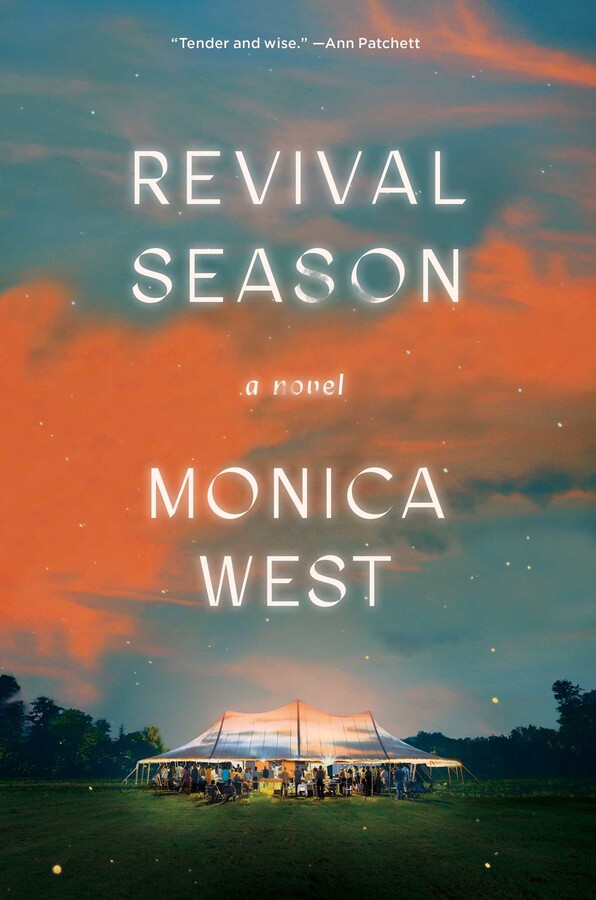
We rumbled toward Georgia from the west, the direction from which all great and powerful things originated. “Except the sun,” Caleb said, feeling particularly feisty as the novelty of another revival season settled in. Ma turned and shot him the look where her dark eyes narrowed into slits. Then she spun back around, closed her eyes, and mumbled a prayer: “Lord, watch over these Your children. Use us to do Your will. Amen.”
Done praying, Ma refocused her attention to the map she was holding in the air; her finger landed on a bold black dot, far from the big star at the center of the state. We always went to smaller cities—tiny dots that surrounded the capital’s star like satellites. Her stubby, unmanicured nail tracing the winding path to Americus, Georgia, was nothing like the polished nails in the magazines that I snuck glimpses of in the library. Nails that we would never be able to have, since vanity was an unforgivable sin. I’d learned that lesson the hard way last spring when my best friend, Micah, and I had sat in the middle of her bedroom floor, an open bottle of nail polish between us. Micah lifted the wand and smoothed the shiny orb of light pink lacquer on my thumbnail. So faint no one will notice, she said. When I got home the next morning and linked my hand with Papa’s to pray for breakfast, he forced me to remove the polish under his watchful eye before anyone could lift a fork to their mouths.
I watched Ma in the rearview mirror as the minivan merged onto the Texas highway. Papa turned up the radio as our van became one of an anonymous throng of vehicles barreling beneath an overpass. But none of the other cars had the important task that we did: driving nine hundred miles to bring the word of God to people who needed to be saved from their sins. The exhilaration before the first revival of a new season meant I could barely sit still between the cracked windows whose building pressure buffeted my ears. We’d been doing this for years—twelve, to be exact—but somehow this first moment of revival season, when everything was possible, never got old.
We pulled into our ceremonial first stop—a tacky diner 281 miles away from our house in East Mansfield, Texas. Soon, conversation flowed as we pierced straws through plastic lids and drank the syrupy sweet soda we were only allowed to have during this inaugural revival season meal. With our hands curled around sweaty paper cups, Papa dreamed out loud.
“I might break the two-thousand-soul mark this year. Wouldn’t that be a blessing?”
It would be more than a blessing—it would be a miracle. The two-thousand-soul mark had been elusive for all of Papa’s years of leading revivals; it was three times more than last year’s soul count, and it would be even harder to accomplish this year.
I might break the two-thousand-soul mark this year. Wouldn’t that be a blessing?
“There will be lines around the tent waiting for me when I arrive. This is the year, Hortons.”
My eyes searched the table’s shiny surface as I took another deep sip. The caffeine made the lights extra bright as they bounced off the orange plastic tables, and amplified the clink of ice coming from surrounding booths. The combined effect made Papa’s words seem slightly forced.
“Any naysayer would tell you that’s impossible, but they don’t know my God,” he said.
I wondered if a small part of Papa believed what those people said, especially after what happened at last year’s revival, but I pushed the doubts out of my mind. Doubt was a sin.
“Back to the van, Hortons!” Papa urged. I savored the last sips of my soda and stilled the jitter in my limbs as I took my half-eaten lunch to the trash. Each rotation of the tires brought us closer to Americus, and the promise of what this revival season might have in store came into focus as we slid beneath the mournful weeping willows of Louisiana. As Louisiana passed us off to Mississippi, a thick wall of humidity smacked us in the face. By the time Georgia’s plump peach welcomed us on the highway sign, the weight of this year’s revival season fell on the car like a lead blanket.
Papa cracked the front windows to let in the moist air. “You smell that? That’s the smell of pagan land.”
My little sister, Hannah, rocked next to me; clicking sounds rose from the back of her throat, and her elbows were frozen in acute angles in front of her chest.
“Can you make her be quiet?” Papa hissed toward us in the back seat. I patted Hannah’s knee and handed her the soft rubber ball that was reserved for moments like these. She reached out a claw-like hand and pulled it toward her chest, rolling the ball between her fingers and kneading it like dough. Her limbs slackened, and she loosened her jaw.
Ma and Papa never told me or my younger brother, Caleb, what was wrong with Hannah. At least not directly. Once, back in Texas, I woke up long after I thought everyone else was asleep. As I tiptoed past my parents’ bedroom on my way downstairs for a glass of water, I overheard Papa say that Hannah had cerebral palsy, but his accusatory tone sounded like Hannah’s disease was the result of some flaw in Ma’s faith. I hurried away before I could hear her response.
Papa pulled in front of a tiny brick building with only a narrow white steeple to identify it as a church. It was much smaller than the churches we were accustomed to visiting. He took a long glance at the parking lot with only a few dozen spaces and released a sigh that sounded like it had built up over the entire ride.
“Here we are,” Papa announced in a flat tone before getting out of the car.
Through the windows, we watched a large, dark-skinned man with a swollen belly that protruded over the top of his pants approach Papa. They embraced in an awkward hug; then the man looked over Papa’s shoulder and pointed to the car where we all sat. As he lifted his arms to beckon us, two oblong stains darkened the armpits of his dress shirt. We tumbled out of the van: first Caleb, then my mother, then eight-year-old Hannah, then me.
We followed Reverend Davenport into the claustrophobic sanctuary of the New Rock Baptist Church, where three rows of folding chairs faced a raised pulpit. Behind the altar, an ornate gold cross was situated between two paintings of the crucifixion.
“Thanks so much for inviting us.” Papa scanned his surroundings, probably comparing this sanctuary to the cavernous ones of last year’s circuit. “This is my wife, Joanne; my son, Caleb; and my daughters, Miriam and Hannah.”
Ma handed Hannah over to me—I folded my arms around Hannah’s chest and felt her fragile rib cage like so many bowed toothpicks, her rapid heartbeat, her body’s metronomic perpetual motion. Ma stepped in Papa’s long shadow to meet the reverend, but he looked past her to Caleb. Ma, Hannah, and I were barely a blip on his radar.
We followed the reverend to the fellowship hall, where a platter of fried chicken, a bowl of mashed potatoes, and a plate of crisp string beans were arranged on a long table. Reverend Davenport dipped his chin ever so slightly. I couldn’t even tell that he was praying until I heard his soft words. “Lord, bless these gifts that we receive for the nourishment of our bodies and the building of Your kingdom. Amen.”
We sat down to eat. The food was passed in silence, first to Papa and Caleb, then to the reverend. When my mother received the platter, she carefully selected a breast—not too small, not too big. When it was finally my turn, I selected a drumstick for Hannah before reaching back on the platter for my piece.
“Don’t take too much,” Ma whispered as I selected a thigh. She yanked the plate from me before I could get another piece and nodded at Papa. I gnawed on the crispy skin as Reverend Davenport pulled Papa aside during the meal. They walked to the far wall and stood below an oil painting of the Last Supper. I pretended to study the Apostles as I tried to hear what they were whispering. Reverend Davenport drew invisible shapes in the air with his index finger. He shielded his mouth with his hand as they talked, but snatches of the conversation about money and revenue and how to bring the most people to Christ rode the air back to me. Reverend Davenport was saying something about healing when his gaze found my face, and I hurried to shift my stare to the translucent grease spots that the chicken had left behind on my plate. But I was too late, my eyes too slow in their sockets to change course.
“You’re curious, aren’t ya?” He said it like a joke, but it wasn’t—the emphasis on curious made sure of that. I kept my eyes fixed on my plate; when I looked up, my mother’s eyes were once again narrowing, this time at me.
“We’ve had a long drive. Do you think that you could show us to the house? Then you and my husband could have some quiet time to talk. Alone.” My mother spoke up with a mouthful of partially chewed chicken. I thanked her with a sheepish glance that she didn’t return.
Before Reverend Davenport could respond, a thin, light-skinned woman appeared from the kitchen adjacent to the fellowship hall. She wiped her hands on an apron and offered to walk us back to where we would be staying for the weeklong revival.
“I’m Frieda Davenport,” she said when we got outside. She shook hands with Ma. As they walked beside each other, Ma’s short stride quickened to keep pace with Mrs. Davenport. With each step, Ma’s knee-highs slid farther down her calves and pooled around her ankles above the scuffed flats that she always wore on long trips. Hannah and I trudged through the grass several yards behind them.
For most revivals, they put us in a mobile home or a small house attached to the church, but Mrs. Davenport opened the door to a house so new that it still smelled like plywood and drywall. Hannah broke free of my grip and dropped to her knees, her knotted hands running along the hardwood floor in a back-and-forth motion, the corners of her mouth lifting into the closest thing to a smile she could manage.
“I’m glad someone noticed the floor we just had done,” Mrs. Davenport said. “Reverend Davenport ordered it all the way from Chattanooga.”
Chattanooga. The Sunday school kids back in Texas had likely never been to Chattanooga and probably couldn’t even point it out on a map, but we’d driven through it last summer on our way to a weeklong revival at City of Eternal Hope Baptist Church. I remembered how the heavy air seeped into the walls of the tent, and how Papa had converted 218 souls in that seven-day period, more than any other revival in the church’s history.
I unzipped my duffel bag in the room I would share with Hannah. Hannah’s clothes were always easy to fit into the top drawer—small T-shirts with logos of zoo animals, long skirts in earth tones, and knee socks that covered her leg braces. I placed her stuffed tiger on top of her pillow: it was the one thing that could bring her comfort during rough nights when she thrashed herself awake under the covers.
When I finished unpacking, I changed Hannah into her pajamas and helped her into bed, then climbed in beside her. Her body grew still, and I leaned closer to the curved cartilage of her right ear to tell her my favorite bedtime story: Miriam and Moses. I invented details about the way Miriam’s mother’s fingers bled on the papyrus reeds as she wove a basket to save her newborn son, Moses, from Pharaoh’s proclamation that all baby boys should be drowned. As I spun words into the dark cove of her ear, I imagined my namesake watching over her baby brother in that basket, doing as her mother told her.
Hannah’s body grew heavy as it leaned into mine; her snoring, full and sonorous, cut off the end of my sentence. I nestled behind her with my arms around her expanding and contracting chest, playing the rest of the story out in my head, even as I kept the ending pressed behind stilled lips—about how Miriam’s actions saved her brother and how her bravery was overshadowed by Moses’s later success. I told Hannah the story the same way Ma had told it to me—with Miriam as the hero—even though Papa always emphasized Moses. When Hannah’s breathing was slow and steady, I slid out from behind her, careful not to wake her.
The cloistered room blocked out the noise from outside. I knelt beside the patchwork spread that Ma had given me five years ago for my tenth birthday. I brought it on every revival trip—it took up the most space in the single duffel bag that each of us was allowed to shove in the back of the van. It was the only quilt I had ever prayed on, and Papa had once told me that the best thing I could do for revival was to pray every night. There was so much that we didn’t have control over during these trips—summer thunderstorms, low turnout. So I took that charge seriously. When we had standing-room-only crowds that were packed inside the tent’s vinyl walls, I knew I had some role in it.
I ran my finger along the jagged seams where each memory shared borders with another. In the middle of the quilt was a heart patch where I placed my elbows—close enough to each other so my hands could make a steeple with the pads of my fingers pressed together. The narrow space between my palms was the perfect size for my nose. I closed my eyes and exhaled the day. I filled my lungs with air that I liked to imagine was purified by the Holy Spirit, even though it smelled just like the old air. Back out and then in. After the third exhale, it was time.
“‘Our Father, who art in heaven,’” I began. The words of the Lord’s Prayer spilled over the quilt. As I prayed, tension that I hadn’t even known had built up in my shoulders and back released. I stayed on my knees until I had covered everything— healing the world, watching over my family, blessing this revival season, making me obedient. Some of those requests seemed harder to grant than others, but I had to ask anyway. God didn’t ask us to limit His power, and when we only ask for things that feel achievable, we question Him. And questioning God is the root of evil.
“Amen.” I ended the prayer and rose from the side of the bed. My legs felt heavy when I stretched them, but the evening’s devotions had just gotten started. Climbing into bed, I opened the Bible and skimmed the chapter in Proverbs that I knew by heart before ending with a prayer of gratitude for arriving safely in Americus. I flipped open my prayer journal, past the scrawl from several years ago when I wondered if Jesus loved Baptists more since that’s what we were. Papa said that even though all Christian denominations were equal in God’s eyes, God looked on our family more favorably because we traveled around the South each summer, bringing the word of God like manna to the starving.
I closed my Bible and journal. For a few moments after I finished reading, a feeling of warmth settled over me. In our house, God was more than the being that people blindly worshipped on Sundays and forgot about until they needed something else. To us, God was more flesh than spirit, more being than ghost. Each morning when I thanked Him for a new day, I didn’t just speak into an echo chamber. As I lay in an unfamiliar bedroom, I felt God right next to me, His breath in my ear like wind.
Even though our God saved souls and healed bodies, He needed someone on earth to be his intermediary—that was where Papa came in. There were always doubters who shut doors in our faces as we tried to bring them into the light, but they didn’t know what we knew. That the “song and dance” that they swore was a performance for money was real. All across the South, Papa had touched people and removed incurable diseases from their bodies. And those people who swore God wasn’t real, who claimed that we were deluded Jesus freaks, had never set foot inside a revival tent and felt the spirit of God descend when Papa began to heal. And even though he hurt that girl last summer—something I could barely even admit to myself—that one failure didn’t negate the fact that countless people who had been wheeled into the tent had walked back outside after Papa had touched them. If the naysayers had seen him when he was on fire, he would have turned them from skeptics to believers in one service.
I woke up disoriented and bleary-eyed in the unfamiliar bedroom, its paisley wallpaper making patterns in the indigo dusk. Slowly, the walls came into focus, then the prayer quilt that sat on top of the comforter, and finally Hannah, who was stirring in the bed across the room. I snapped into action as the house came alive—the whistle of a teakettle, Ma milling around with her loud footfalls on the floorboards. There were a million things to do in the few hours before we were scheduled to arrive at the revival tent.
During revival trips, long before the sun could tint the horizon with waxy crayon shades of maize and rose, my first chore was always Hannah. I stumbled out of bed and filled the bathtub with lukewarm water just high enough to cover the nubby bottom. I eased Hannah into the tub, first by swinging her knees over the edge and then lowering her into the water. Her bent knees touched each other above the water’s surface, and I gently pressed them down. While I rinsed her lathered hair, I could hear Papa and Caleb through the thin walls—Papa’s loud voice speaking the words of Christ, the ones that were typed in red on the tissue pages as another reminder of His sacrifice for us. Caleb’s voice as he repeated Papa’s words was less confident.
“‘They who wait upon the Lord,’” Caleb began. Then he paused one beat too long.
“‘Shall renew their strength. They shall mount up on wings of eagles. They shall run and not be weary; they shall walk and not faint.’” I whispered in the blanks where Caleb couldn’t finish Isaiah 40:31. Isaiah—the name of the baby Ma had two years ago. As the word stillborn had drifted to where I was standing, I wondered why people couldn’t be straightforward and say that Isaiah was born dead. And why they had named him after my favorite book in the Bible.
For months afterward, a ragged hole had ripped through all of the verses I had known and recited, burning everything in its proximity. I knew that trials were a part of life, but rationality seemed impossible in those days, especially because my mind kept floating back to the idea that the same God who had promised us a baby—another son for Papa to groom into ministry—had snatched him away from us before he had even taken a breath.
I straightened Hannah’s limbs and lifted them out of the water: first her arms and then her legs. Minuscule soapy beads formed on her skin as I glided the washcloth over one arm and then the next. She closed her eyes in delight as I cupped warm water in both hands and spilled it onto her back, so I did it a few extra times just to hear her squeal. She followed the squeal with a labored grunt—the doctors had told us that it was the closest that she would ever get to speech. When she was clean, I spread her towel on the floor by the tub and guided her out of the water—only then could I lift the lever on the drain. If I did it in the wrong order, she would shriek and only stop when I let her touch Tiger’s sightless plastic eyes with her forefinger.
When she was fully dressed, I loosened the Velcro straps from her thick plastic leg braces and fitted them around her calves. Lifting her from the floor, I slipped her forearms into her crutches. As she stood, her joints preferred to stay bent rather than straightening, so I ran my palm over her elbows and then down to her knees, stopping to massage the knobby joints with my thumb and forefinger. She liked when I made a whooshing sound as I did that, like I was the one who magically helped her walk a little taller.
I brought Hannah, clean and dressed, to the kitchen. Papa always waited until we got to the new revival site to tell the host pastor about Hannah. Maybe he thought it would ruin the reputation he’d worked so hard to perfect—the flocks of people who crowded into tents would never believe that a man with healing powers could have a daughter like Hannah.
Caleb bounded down the stairs last, already wearing his suit and tie. He flopped into the chair, right in front of the stack of pancakes. During revival season, I only got to see glimpses of Caleb in passing before Papa whisked him off to meet the elders or the deacons. He was fifteen, too—younger than me by ten months— yet it felt like years divided us when I had to watch him straighten his tie and leave with Papa to do “men’s work.”
“Let’s start breakfast with a prayer,” Ma said.
I knew the revival prayer by heart—it came from Matthew 28:19. Therefore go and make disciples of all nations, baptizing them in the name of the Father and of the Son and of the Holy Spirit. Amen.
As Caleb scarfed down spongy triangles of pancake, I reached for the Bible in the middle of the table. It was Ma’s Bible—the one she carried with her everywhere. Ma’s and Papa’s names and their wedding date were written in cursive inside the front cover: Joanne Renée Taylor and Samuel David Horton, July 11, 2002. It was hard to imagine that they even existed a year before I was born—when Ma was just Joanne—but I’d unearthed the wedding picture from a shoebox in the attic while packing for this revival. In it was a faded photo of an eighteen-year-old Ma, her face a carbon copy of mine. Through the sheer cream-colored veil that partially hid her strained smile, the lonely, distant look in her eyes reached back to me.
Behind the only picture of their wedding was a black-and-white local newspaper clipping whose edges had started to curl. When I flattened it, there was a small, grainy photo of Papa with bushy eyebrows and a head full of hair—his lips protruded around his mouth guard in a grimace as he held boxing gloves in front of his chiseled abs. “Samuel Horton Prepares to Defend Title,” the headline read. I skimmed an article that may as well have been about someone else—someone with an 8-0-1 record with a right hook like a freight train and fast feet. I imagined Papa bouncing on the balls of his feet, moving from the ropes on one side of the ring to the other. I felt the anger that swelled in his body for his opponents before his glove made contact with their stomachs or ribs, heard the muffled sound of a glove striking flesh. I folded the article along its crease and placed it back with the other mementos—the cut hospital bracelet from Hannah’s birth, a yellowed gauzy square of veil, and an old picture of Ma sandwiched between her sisters. Her smile as she squatted in front of a pickup truck with Claudia and Yolanda was such a stark contrast to the wedding photo that now sat in front of it in the shoebox that the bride and the girl might as well have been two different people, even though the scrawled date on the Polaroid revealed that the photographs had been taken only four months apart.
A horn honked in the driveway, and Caleb shoved one final bite into his mouth before running outside to join Papa. I walked to the front window and slid my finger into the narrow opening between two metallic blinds. Through the visible diamond of dusty glass, Papa gripped Caleb’s shoulders in front of Reverend Davenport’s silver sedan, shaking him every few seconds as though to emphasize his words. I imagined what Papa was saying—What’s mine is yours or maybe One day this can be yours—as the warmth of his hand seeped through the shoulder of my dress instead of Caleb’s suit jacket. Even as I pretended, my imagination couldn’t wrap itself around such a frivolous fantasy.
With a piece of glass between us, it was easier to imagine Papa saying things to me that he never said when he was inches away. Whenever I had questions about the Bible after dinner, he excused himself to the study to prepare a sermon, letting me lob unanswered questions to the back of his retreating suit. When it was time for his nightly snack, I held the plate and knocked on the study door, requesting permission to come inside. The snack was always a ruse; I needed to be close enough to hear his words about disease and God’s healing so they would stir the Holy Spirit in me more than they did when I was in the fourth row of a church or a revival site. But rather than asking me to come inside, he spoke to me through the door, telling me to leave the plate outside.
I needed to be close enough to hear his words about disease and God’s healing so they would stir the Holy Spirit in me
“Another ninety-degree scorcher,” the radio announcer—Gus “Good News” Stevens on Heaven 1310 AM—broadcast from the kitchen. Then Papa’s booming voice came over the airwaves and filled the room, sending a shudder through me even though the commercial had been recorded weeks ago. I released the blinds before they snapped together like lips keeping a secret. It always shocked me to hear his voice in these far-off places—“Come all of you under the sound of my voice. Come to the well that never runs dry.” And with those words, revival officially began. Ma shushed me and Hannah even though we weren’t making any noise, as though our breathing would overshadow Papa’s voice, which could fill up any space it entered.
“Americus, this is Reverend Samuel Horton, the Faith Healer of East Mansfield. If you are hungry for a touch from the Lord, if your hearts are weary or heavy-laden, come to the big tent tonight. Take this step of faith and Jesus will be there to meet your needs and heal your bodies.”
It was the same message, the same confident tone, from city to city. Though I knew the words by heart, they reformed themselves as they filtered through the pin-size holes in the speaker of the plastic transistor radio, and suddenly all the people who might have been listening to him in their kitchens vanished—it was just me and him. His words of deliverance and new life took me back to the cold shock of the lake back in East Mansfield when I was seven, my adult’s baptism robe getting soaked as I walked over to where he stood away from the shore with his arms stretched out from his sides. I wanted to run to him, but the lake dragged my sopping robe behind me like an anvil. When I finally stepped into his arms, he whispered the words of the Lord to me.
“Miriam Ruth, do you accept the Lord Jesus Christ as your Savior and promise to renounce the devil?” I nodded and folded my arms over my chest the way I had seen so many people do before me.
“Miriam Ruth Horton, child of God, I baptize you in the name of the Father, the Son, and the Holy Sp—” Before he could finish the sentence, his strong forearm under my back dipped me into the lake. His words sounded loud and muffled under the water, but I could hear the congregation cheer. When I was upright again, Papa gave me a soaking hug and planted a kiss on my forehead. Though I should have been happy to have eternal life, I was happier to lean into the strength of his embrace and feel the prickle of his wiry forearm hairs as he squeezed me tighter.
His voice faded away into a cereal commercial, but my heart still raced the way it did that day half a lifetime ago. I couldn’t wait to get to the revival tent—to see its majestic colors and watch Papa redeem himself from last summer’s scandal the way I’d been praying that he would.
To write about the body can be a difficult task—inhabiting a body is something that we all experience (albeit differently), and yet pinning down what this is like can feel like trying to grab hold of smoke. There is something especially perilous or perplexing about navigating the ways in which the body is at once a site of pain, anxiety, and fragility, as well as one of immense pleasure and potential, the site at which we make contact with and even reshape the world.
It is this knot that Olivia Laing untangles with care in her newest book, Everybody: A Book About Freedom, with an eye toward both the history of bodily struggle in the 20th century, and the unique challenges of a contemporary world in which the body feels acutely under threat. Everybody chases after the vexing ideal of bodily freedom, asking how our bodies mediate the experience of our surroundings, carry our histories and affects, and might also be used to propel us toward better, more equal and open futures. Reading it at this particularly precarious moment feels like unearthing some long-held, buried truths about ones’ own body and the embodied histories in which we are always entangled.
If you have encountered Laing’s writing before—she is best known for The Lonely City, as well as the novel Crudo and last summer’s essay collection Funny Weather—then it will come as no surprise to you that Everybody is both timely and attentive to the long roots of history, both complex and accessible, as well as lyrical and instructive. Armed with a wellspring of research that spans 20th-century Germany, Britain, and the United States, from philosophy to psychology, art, medicine, and activism, Laing cuts a path through the difficult business of our bodily lives. Her writing is as incisive as ever, and alive to the intricate, often messy and traumatic, realities of being a human in this fragile and fluctuating vessel through which life takes shape. “A free body need not be whole or undamaged or unaugmented,” she writes in the final chapter. “It is always changing, changing, changing, a fluid form after all.” Laing imagines what a world without the constant threat of bodily harm might look like and offers object lessons in how we might reach for it.
I spoke with her over Zoom at the end of April, not long before the publication of Everybody, to discuss her understanding of bodily freedom and its bearing on our current moment.
Tia Glista: So the book begins and ends with recollections of your own coming-of-age and coming into the body itself. I wonder what it was like revisiting that person, that version of yourself or period in your life, and trying to unearth something about your own past, amid this larger network of stories and bodies?
It feels as if people will always want to limit other peoples’ freedoms based on the kind of bodies they inhabit.
Olivia Laing: I keep joking that I could have called the book My Nineties because it feels like so many of the preoccupations that I’m exploring have their roots in what I was doing in my twenties, during the 1990s. That includes things like protest, but also working as a herbalist and being very involved in illness. Sick bodies and resistant bodies. So the large themes of the book were really set up back then. My books always contain elements of memoir but are never actual memoirs, because I find writing memoir both difficult and boring. It—”it” being the investigation into the subject—isn’t about me. What I do think is important, though, as with previous work, is to declare my own investment. If I’m talking about other people’s experiences with mortality, with sexuality, with violence, then it feels right and ethical that I should take the same sort of risks with regard to revelation, in order to lay bare the difficult regions of our bodily lives.
TG: The idea of bodily freedom can sound so huge and nebulous, though. I am curious, firstly, how you found your path through this topic, and secondly, how your notion of what bodily freedom is changed from when you started the project, to its completion?
OL: It’s definitely the hardest book I’ve written and it felt like I had an enormous amount of very difficult material to process. But there was also a technical problem when I started, which is that it was the beginning of the Trump years, the beginning of the rise of the far right and Brexit, which is to say a very febrile period in history. It felt like the news was so unsettling, and that the entire concept of truth and reality was being undermined. I didn’t feel like I could write from the stable platform that nonfiction requires. This is why I ended up writing Crudo, to pour out some of those feelings and try and pin down what that unstable, unreal, intensely frightening moment felt like. After that, I was able to draw back and start writing Everybody.
Really, it was the character of Wilhelm Reich who allowed me to tell the story in a coherent way, because his own life strayed through so many resonant regions of bodily experience. He takes us through illness, through sexuality, through sexual violence, anti-fascist activism and imprisonment. Having him as a guide meant that I could organize the material, and stray out to encounter other characters, who, it must be said, I sometimes found much more sympathetic or alluring than Reich. What really drew me to him was two things—his belief that our bodies are affected by and contain the traumatic material of our past, both personally and politically, and his belief that our bodies are full of power and can change the political structures in which we are embedded or entrapped. As a writer, I was also drawn by the enormous range of his life, and what sort of places he as a subject could take me to.
What a freedom movement needs to do is enlarge freedoms for all bodies.
In answer to your second question, I went to some very troubling places while researching Everybody, including an enormous amount of material on torture, sexual violence, genocide and incarceration. I wanted to look back at the 20th century to understand why our bodies are so difficult to inhabit, why certain types of bodies are subject to so much violence and limitation, but I also wanted to draw out materials from the history of the great liberation struggles that might be useful for people now: for readers now and for activists now. The real lesson of the book is that none of this stuff has gone away. I mean, it’s publishing into the moment of coronavirus and Black Lives Matter protests. It feels as if people will always want to limit other peoples’ freedoms based on the kind of bodies they inhabit, and so the struggle for liberation continues, because it must. In some ways, that’s the most depressing lesson of the book but I also think there’s something encouraging about it. Once we relinquish the notion of permanently secured victories, once we accept that these are going to be ongoing struggles, then I think it becomes easier to play your part without giving in to despair. The struggle for freedom has not been lost. It continues and continues, well before and well beyond our individual lifespans.
TG: One of the many things that I found so clear-eyed and important about your approach to the subject of freedom was how you are very careful to parse the ways in which what might feel like freedom or a transgression of the rules, isn’t necessarily the same thing as a kind of political act of making freedom, or of making room for other bodies, and can even go so far as to harm other bodies. And so in the book there is both this kind of gap between a personal, embodied sense of freedom, and a larger political struggle for freedom, but they are also interlocked. Can you say more about this relationship and how you make sense of it?
OL: I’m really happy you picked up on that—you’re the first interviewer who’s drawn that out specifically, and it feels very important to me. Freedom isn’t just about doing whatever you want, and it is so interesting to be thinking about this in terms of the protests against wearing masks that are happening at the moment. “I don’t wanna wear a mask, why should I wear a mask?” Because the wearing of the mask is something that protects other peoples’ bodies! So there’s a sense in which freedom movements that are about being able to do what you want but involve limiting other people’s freedoms cannot be regarded truly as a freedom movement. What a freedom movement needs to do is enlarge freedoms for all bodies. Making that distinction felt really crucial to me and part of the way that I did it was by looking at, of all people, the Marquis de Sade, a figure who is sometimes celebrated—perhaps particularly by literary men of the 20th century—as the great voice of freedom, the libertine who explored what liberty means. Looking at de Sade really helped me to differentiate between these two models of freedom, and to see that if your liberty involves taking liberties with other peoples’ bodies, again, it’s not a freedom movement. This is so alive right now with movements like #metoo—we are seeing it all the time.
TG: Absolutely—and you write about incarceration and movements for prison abolition, which are importantly coming up more now as well.
So, speaking of the Marquis de Sade, there is quite a cast of incredible people and voices featured in the book, from Reich, to Susan Sontag, Malcolm X, Nina Simone, Freud. I’ve heard you say that much of your work is about the idea of “contact” and I wonder when you write so intimately about these historical figures, whether there is a kind of sense of contact or friendship that you experience in any way, and more broadly, have these figures continued to accompany you in your life and thinking, after the writing process?
OL: Yeah, I wanted that cast to be present in the book really physically as bodies and I kept pushing that. So Freud was there in the beginning as a really quite abstract presence, as the fountainhead of ideas, when actually so much of what was going on with Freud and Freud’s battle with Reich is to do with Freud as a sick body. Freud was somebody who was in intense pain—he had cancer of the jaw and in the final decade of his life was often in agony. Look, ideas don’t emerge from nowhere, they arrive embodied. They come from people who are living bodies, who have sexual lives and domestic lives, who may experience pain or violence in different ways, and I wanted to make that aspect of the history of ideas visible. So these are big thinkers of the 20th century, but they’re also there as physical presences, who get sick, who have sex, who suffer, who experience wild pleasure.
As for the sense of company or contact, when I said that I was probably referring to The Lonely City and its central character, David Wojnarowicz, with whom I felt an enormous connection and with whom I had a special kind of intimacy because of working in a very specific archive, where I could listen to his voice, handle his materials and so on. But the people in Everybody are much more difficult characters. In a lot of ways, they’re less likeable, and at the same time I felt real tenderness for them. I mean, Nina Simone came across as just a heroic figure—a difficult figure, but a heroic figure. The other person who I felt startlingly drawn to was Andrea Dworkin, who I didn’t know all that much about. I remembered her from the ’90s as somebody on the other side of the porn wars and as somebody who feminists of my stripe really felt antagonistic towards. Coming back to her now, in the light of the world we’re in at this moment, reading her on domestic violence, reading her on rape, on sexual violence, and reading her incantatory, weird, chilling, sometimes hilarious writing style, I just felt electrified by her. Once again, I didn’t always agree with her. But her writing was extraordinary and her courage was extraordinary. She gave this talk “The Rape Atrocity and the Boy Next Door,” over and over again, and every time she gave it, people talked to her about their own stories—she became the repository of this enormous amount of communal pain and she held that in her body. I think everybody who dismissed her or who mocked her really needs to pull back and think about what it actually might be like to carry that weight of testimony inside them. So that was somebody I felt immense tenderness towards.
TG: There is something that I think will especially resonate with readers right now about bodily freedom, in the midst of continuing lockdowns. What do you think that the idea of bodily freedom might mean or look like in a post-pandemic world, and on a lighter note is there anything that is at the top of your list to do again when it is safe to do so?
Ideas don’t emerge from nowhere, they arrive embodied. They come from people who are living bodies, and I wanted to make that aspect of the history of ideas visible.
OL: In England, we’re just coming out of a very, very long lockdown, so we still can’t have people in our houses and we’re quite limited in what we can do. It’s been fascinating watching the lockdown protests. Seeing that worldview feels very disturbing, seeing all of the anti-vaccine stuff, and again, this suspicion around the idea of having to do something that might be communally good but individually frustrating. Sometimes, for the larger freedom, we have to limit our own individual freedoms. Freedom is not a zero-sum game and I think that’s something that is really important to remember when people are saying “I don’t want to give this group its freedoms, because it’s going to limit mine.” To me, the work of freedom sometimes includes an element of relinquishing the very individualistic desire for particular personal freedom, which is permanently fed by capitalism, and thinking much more about how we exist as a network, how we exist as a community, how we exist globally. This is especially true in terms of climate change—the freedom to drive or fly everywhere also equals the freedom to destroy the planet.
As for what I want to do… I want to see my friends! I want to see my friends, I want to talk in rooms with other people, I want to be able to be back into the swing and seduction of a bodily life, and especially an urban bodily life among strangers as well as people I’m close to. That’s what I feel like I really long for.
TG: You end the book by taking up the ways in which the student protestors in Hong Kong substituted the word “dreaming” for “protest” to get by censors, and then you deploy dreaming a few times as well. Can you tell me more about that ending, and about where dreams are taking you now? For example, I have heard that your next project is on utopias and it seems as though the end of Everybody really sets up such fertile ground for that idea.
OL: I feel so sad about that ending because I wrote it when those kids were still free and their stories have changed so much now—they’re facing prison sentences and very frightening futures. I think they’re so heroic and extraordinary. That’s an aside, but it feels really important to say because it troubles me each time I read it. Their brave dreaming.
I feel like my books always end with an unanswered question or an emerging preoccupation. When I finished The Lonely City I realized there was a huge amount going on with people’s bodies that I wanted to look at more explicitly. And this book very much ends with the question of the future a free body might create. Well, what is this paradise? What is this better world that we can build? What would it actually look like? So my new book is about paradise and utopia, and especially the question of whether there is a possibility of a common, communal shared paradise, a society for all. So I’ll be looking back and asking what kinds of dreams people have had, not just in the 20th century, but in the 17th century, the 18th century. What were the medieval dreams of paradise? What kind of Eden could we dream in a climate change world? And so that’s the question that I’m looking at now and that’s the kind of dreaming that I want to think about. It’s utterly necessary to protest the catastrophes and cruelties that are happening in our own times but a part of us also has to be thinking about the kind of future we want to build, or I think we’re always fighting rearguard actions and that becomes very draining. We must dream too.
I didn’t grow up hearing the word “feminism,” but my brain didn’t need to know the word to understand the freedom that it provided. At home and school, I was allowed to be everything I wanted—outspoken, smart, inquisitive, creative, brave, athletic, fearless. When I stepped in church, however, I knew that things were different even if the rules weren’t directly communicated to me. I accepted the starchy tights, dresses, and skirts—never pants—of Sundays, knowing that there was something about being formal and looking your best for God. But then I started to learn other things that weren’t in the Bible but that some people believed: how women were beneath men, how women couldn’t pastor churches, how women had to be married to be whole, how women had to be wives and mothers. At that moment, the dress seemed like a signal of something else: femininity, modesty, purity.
I started to wonder if there was a place within my religion—or any form of organized religion, for that matter—that allowed women to feel free and powerful, where it taught them that they weren’t lesser than men but rather whole as they were. I wondered if there were doctrines that made women central rather than peripheral, if there were narratives that saw gender roles for women outside of the notion of mother and wife, that defined them on their own terms rather than in relation to someone else. Whenever I need to find answers for something that I can’t see prominently in real life, I look to fiction.
In my novel Revival Season, 15-year-old Miriam Horton yearns to understand her place in her family and in the larger patriarchal religious structure of her world. After witnessing her father commit a shocking act of violence on the summer revival circuit, she discovers a secret about herself that places her at odds with her family and her faith. She spends the rest of the book questioning everything that she has previously accepted as true. Revival Season is my way of thinking about how feminism and faith can intersect and imagining what that world could look like.
Here are some other novels that show women of different faiths grappling with what it means to be powerful agents of their own choices. Some of them rewrite Biblical accounts, some of them imagine entirely new religions, and others find ways to center women’s voices in a patriarchal space. All of them help me envision what’s possible in the world.
Deesha Philyaw’s incredible stories feature women whose lives and identities are inextricable from the church. These daughters, lovers, and mothers navigate how to be who they truly are in light of the church’s patriarchal teachings and double standards about what women should do. Readers watch multiple generations of women who want to be holy but don’t quite know what that means, especially because the definition is based on their subjugation. Philyaw shows these women making their own rules of holiness that allow them to stay true to some parts of the conservative Christian tradition they’ve been raised in while also allowing it to serve their needs. Some women are successful with these attempts while others are frustrated by its futility. Ultimately, the stories allow women to grapple with what it means to be a fully realized Black woman and a Christian.
Etaf Rum’s brilliant novel is told from the multigenerational perspectives of female members of a Palestinian family before and after they emigrate to the United States. Mother-in-law Fareeda clings to rules of Arab propriety: she wants her son to have male heirs and is disappointed when her daughter-in-law Isra has four daughters. At 18-years-old, Deya, Isra’s oldest daughter, has reached the age where she is expected to entertain suitors for marriage. There is one problem: Deya wants to go to college rather than get married. As she navigates the expectations of her culture and her Islamic faith, she wonders about what is possible for her outside of traditional gender roles. While Deya mulls through these decisions, she meets a woman who helps her see possibilities for her life that are separate from the gendered constraints that have previously bound her.
Though not centered around an organized religion per se, Alderman’s novel imagines what happens when women have a special physical power that makes them omnipotent and potentially dangerous. One of the characters with this power—Allie—uses her abilities to escape a brutal home life and flee to a convent. Soon, other people recognize that she has the special ability to control her power, and they come to her for healing. Thus, she reinvents herself as Eve—a spiritual leader of a new matriarchal religion that believes that God is female and emphasizes the female deities in other religions. Even though power ultimately corrupts Eve and her mission, Alderman fuses feminism and faith to remind readers of what can be possible in the world.
When the Price family leaves Georgia to become missionaries in the Congo, their goal of converting the Congolese to Christianity is clear. Once the family is in the Congo, Leah, the oldest and most outspoken daughter, notices how her father’s brand of faith doesn’t translate well to the people he serves. In fact, Nathan Price’s mispronunciation of a Kikongo expression is the source of the book’s title: when Nathan attempts to say that Jesus is “most precious,” he says that Jesus is “poisonwood.” Nathan’s linguistic mistakes are only the beginning, and Leah is the first to understand how her father fundamentally misunderstands the people he serves. Though Leah still believes in her father’s faith, she forms ideas that are wholly distinct from his, thus forging her way as a person of faith separate from her father’s influence as well as Christianity’s colonial underpinnings.
Though she wrote the speculative novel in 1993, Butler imagines a world that is eerily similar to the one that we currently inhabit, complete with racial discord, income inequality, a climate crisis, and a zealous leader named who promises to “make America great again.” Into this setting, Butler inserts 15-year-old Lauren Olamina who is raised by her Baptist preacher father but finds herself growing increasingly disillusioned with her father’s faith. In search of something more, Lauren creates a new religion called Earthseed in her journal; the central belief of Earthseed is that God is Change. Lauren doesn’t share this religion with anyone at first, but when violence forces her to flee from her gated community, she shares Earthseed with her fellow escapees. As the novel ends, Lauren settles into a community where she can begin to practice Earthseed in a deliberate way. Butler reminds readers that women can find and create faiths that serve them when traditional faith no longer does.
Diamant sets her novel in the red tent: a biblical location where the women of Jacob’s tribe must go when they are menstruating. By reimagining Dinah’s life, readers see an all-female community of previously minor biblical characters (including Rachel, Zilpah, and Bilhah) use their important voices to broaden the biblical narrative of Genesis and give it texture. By rewriting biblical history from a female perspective, Diamant centers women’s agency and power rather their degradation. For example, Diamant rewrites Dinah’s biblical story about being raped by Shechem; in this new version, she falls in love with Shechem and marries him. Thus, Diamant uses these collective stories to transform the red tent from a place for subjugation into a location of power.
The Mothers begins with a collective first-person plural voice: the Greek chorus of church mothers that comments on the events in the novel. They are gossipy, judgmental, and opinionated, yet Bennett intentionally places these female voices as the conscience of the narrative. The story they are abuzz about is that of Nadia Turner who has gotten pregnant at 17 by Luke Sheppard, the pastor’s son, after her mother’s suicide 6 months prior. We also meet Nadia’s best friend Aubrey Evans who is the chaste embodiment of virtuousness that the church teaches girls and women. Though the Mothers in the novel perpetuate the church’s patriarchy, the book is about womanhood in its various iterations. Furthermore, the idea that a religious world can be mediated by autonomous female voices holds possibilities for the multiplicity of voices that can speak out about religion.
In March of 2004, my family and I were at home in Taiwan for the national election, and I got into my first-ever screaming match with a perfect stranger. The election choice, as always, was between the Kuo Ming Tang, which favors reunification with China; and the Democratic People’s Party, which advocates for an independent Taiwan. This woman was clearly going to vote for the KMT. She was yelling at me in Mandarin, the national language of China, and I was yelling back in Taiwanese (which, in my perspective, should be the national language of Taiwan), trying to tell her that I couldn’t understand a word of what she was saying. She lifted her chin and pointed at me, the very definition of superiority. “What’s the matter with you?” she asked, finally deigning to speak in Taiwanese. “Are you uneducated? That’s why you can’t speak Mandarin?”
Until then, I could never really reconcile the idea that scores of Taiwanese flew home from the United States every year there’s a presidential election. My parents had tried to explain it to me; my relatives had given up trying to talk to me about Taiwan’s fate, I said, should be left to people who still live in Taiwan. But that day, standing in the still spring air, I finally got it.
“Hey,” I said, still in Taiwanese, “you ate Taiwanese rice for breakfast; you drank Taiwanese tea with it. You’re going to eat Taiwanese rice for lunch and dinner, too. You live in Taiwan. Speak Taiwanese.”
I know. I sound like an absolute jerk. Let me explain.
“Languages make a home,” writes Jessica J. Lee in her memoir, Two Trees Make a Forest, and I couldn’t agree more. My parents’ families had come to Taiwan from China in the 1750s. When martial law came to Taiwan in the form of Chiang Kai Shek and his Kuo Ming Tang party in 1949, Taiwanese people were forbidden from speaking Taiwanese in the streets or publishing in Taiwanese. We would live under these rules, families like mine confining their Taiwanese to the privacy of their homes lest they be fined or worse for speaking it in public, until 1987. KMT martial law also meant that you couldn’t advance in business or in school unless you agreed to join the party. No one in my family ever did.
We moved to the United States in 1977, when I was three, but in the safer environs of a democracy, my parents insisted on us learning and speaking Taiwanese. Until recently, I never wanted to learn Mandarin. I’ve long believed that Taiwan’s history is what makes my parents who they are. They are mostly rigid people, although they moved here so we could have broader opportunity. Predictably, we clashed through almost every decade of my life, but I was always impressed with their conviction, and I hunger for literature that helps me to understand more of what Taiwan is like.
Lee was searching for a connection to Taiwan, and I could not wait to feel that singular flush of joy that always accompanies a feeling of solidarity—me, too!
Early on, I’d reach for any book about Asia, regardless of who it was written by, just to read about people who looked like me. But it’s a new day, now, and Taiwanese Americans are lighting up my bookshelves. Lee’s book, published late last year, would feel like home, I thought. The promotional materials promised “parallels between the natural and the human stories,” as she gets to know her “ancestral land.” The marketing copy says she spends time bicycling along saltwater flats in search of spoonbills. I had reported on those very birds in a bid to cover the local population’s attempt at ecotourism for a nature magazine. Hiking among Taiwan’s peaks was also mentioned. I have finally experienced some of Taiwan’s mountains: after years of begging my family to take me to visit the more natural features of the island I still call home, my husband and I visited Taroko Gorge; Yanmingsan, a local mountain near Taipei; and Shousan, “Monkey Mountain,” near where a cousin lives.
Lee was searching for a connection to Taiwan, and I could not wait to feel that singular flush of joy that always accompanies a feeling of solidarity—me, too! Even better, she’d maybe serve as a guide to Taiwan’s natural landscape; whenever I go home, it’s restaurant this and dinner that, and how-many-relatives-can-I-visit-in-two-weeks, and my family still looks askance at me when I lace up my shoes to go for a run. The last time I mentioned wanting to go to the Penghu islands, to see a part of Taiwan I’d always wanted to visit, my uncle snorted. “Whatcha wanna go there for? Tourist trap.”
I couldn’t wait to meet Lee’s family, experience her Taiwan, share with her the beauty of my homeland and mourn with her the many miles between it and us.
“The island holds both migrant and endemic species,” Lee writes early on in the book, in her sure, professorial, hand. Her botanical expertise makes itself present with every single scientific name for the plants I only know by their colloquial monikers. I know Taiwanese flora by names like “crazy flower” or “shy plant”; she has Dendrocalamus latiflorus and Diplofatsia at her disposal. And yet, for all her multilingualism with plants, Lee focuses early on Mandarin, calling it her mother’s tongue, referring to Taiwanese only a few times in her book. As I read, awe over her intimate knowledge of Taiwan’s flora and geographical history mixed with a burgeoning rage at the absence of Taiwanese throughout the book.
In my head, as I read, I was confronting the woman who insisted I must be badly educated because I only speak Taiwanese, my mother tongue.
Lee doesn’t hide the fact that her maternal grandparents came to Taiwan in 1949 as part of the Kuo Ming Tang, the party that leveraged martial law on Taiwan. It is a critical part of their history that they adopted Taiwan as their home for decades before emigrating to Canada, where Lee was born. It’s her quest to get closer to them that leads her back to Taiwan, since her grandparents were identifying as Taiwanese by the time she knew them. But Lee’s grandmother worked in Chiang Kai Shek’s secretarial pool; her grandfather flew fighter jets for the Republic of China (the KMT’s preferred name for Taiwan). Lee writes, “New arrivals like my grandmother would come to dominate the social and cultural life of Taiwan.” Immigrants like Lee’s grandmother would have enjoyed freedom that my own grandparents would not have had; they would not have had to contend with the loss of their rights to speak, write, and publish in their native tongue. Knowing that my parents had had to leave their home—my mother calls it “our sweet potato island,” in a nod to Taiwan’s shape—just to comport themselves like real Taiwanese people made it hard to read Lee’s casual description of a shift that was so painful for them.
Reading the book, for me, was an exercise in contradicting emotions. In one paragraph, Lee acknowledges the fact that “the Nationalist state supplanted much of the complexity—linguistic, cultural, and intellectual—that had distinguished Taiwan from its neighbors.” I breathed a sigh of relief that she was finally addressing what my parents known as “The White Terror,” during which about 140,000 Taiwanese were imprisoned, and between 3,000 to 4,000 executed, for real or perceived opposition to the KMT. But in just the phrase just before it, she writes that “Many [mainlanders] took shelter in Taiwan in the belief that they might one day be restored to their homeland,” couching the White Terror in a kind of odd nostalgia.
Coupled with this confusion over what I was reading was the fact that I was jealous of Lee.
Coupled with this confusion over what I was reading was the fact that I was jealous of Lee—not just of her deep knowledge of Taiwan’s geologic history, her relationship to its mountains—but also of the fact that she had gone there in her adulthood, spending three whole months just getting to know the place. In comparison, my annual or bi-annual trips, two weeks at a time, paled.
When I go home to Taiwan, we stay in my maternal ancestral home, a cluster of buildings huddled around a central courtyard. I refer to it as The Compound. Until very recently, much of my time there was spent waiting for cousins to come and fetch me for meals or for day trips. In between, I idled away the hours in loose conversation with my elderly aunt and uncle, pinging between their quarters and ours, reading, or sometimes sitting with visitors who had come to see the family back home from America.
Life in The Compound was more robust when I was younger and more aunts and uncles lived there–in my parents’ Taiwan, women married and then went to live with their in-laws, and since my mother had four living brothers, there were always cousins to talk to. But eventually, everyone got older and moved their parents north to Taipei or south to Kaohsiung or Taitung, and I began to realize that vacationing in Taiwan was a little like being at an all-inclusive resort: things were brought in to you, and if you went out, it was under an escort—a kindly, familial escort, but still an escort.
Just a few visits ago, when I was in my mid-30s, I started running on the university grounds across the boulevard. I began making forays into town on foot for my morning coffee and to catch up on email. (The Compound was built in the 1800s and still does not have WiFi.) I started feeling comfortable enough to make my own plans, and my tiny tentative steps made me realize how little I knew the place, and that began to consume all of my thoughts. My parents, with whom I usually travel to Taiwan, seemed to finally recognize that perhaps I was old enough to make these trips by myself, to make a schedule of my own.
Lee, on the other hand, recounts her arrival in Taiwan from the perspective of a fully formed adult. She navigated streets and villages by herself; got to know the country on a level I still have not yet achieved. She made excursions on her bicycle all over town by herself, and, perhaps most galling for me, learned Mandarin well enough over her months in Taiwan that she wouldn’t get as easily lost as I do on a regular basis without a map and asking a lot of directions.
Lee’s Mandarin is good enough that she can get by no matter where she went in Taiwan, since Mandarin is still the official written language of Taiwan. My Taiwanese is only good with about 70% of the population, if census reports are to be believed, and I’m no good at reading beyond street signs and menus. Lee, despite the fact that she’s only been to Taiwan a handful of times, despite the land and homes and family I still consider a part of me, was beginning to feel like more of a Taiwanese person than I was.
No matter how much I tried, I couldn’t stop drawing parallels, filling out the bar graph in my head about who was more Taiwanese.
I could not escape comparing the two of us: Her mother left Taiwan for Canada in 1974, the year I was born. Her grandfather, the fighter pilot for the Republic of China, was stationed for a time in Chia Yi, my paternal ancestral home. No matter how much I tried, I couldn’t stop drawing parallels, filling out the bar graph in my head about who was more Taiwanese.
Even worse, I kept on coming back to the KMT thing, as I’d started labeling it in my head, and in doing so, unearthed an even uglier truth: By obsessing over whether or not Lee’s family was “truly” Taiwanese, I was being a straight-up nationalist, just like the ones I spent all of election season trying to get out of office during the United States election cycles in 2016 and 2020.
Flailing, consumed with way too many feelings, I turned to my parents, the only people in this equation who had first-hand knowledge of the historical events I was leaning on to establish my heritage. I spent a breathless half-hour on a long walk explaining it to my mother. She listened carefully, asking questions to place Lee’s family in the timeline of events, and then said, quietly, “You should thank her.”
“I… what?”
“There are a lot of mainlanders who won’t even acknowledge that they live in Taiwan. They say they are Chinese and that they live in the Republic of China. Jessica isn’t doing that. She’s saying she’s Taiwanese. Her mother is saying she’s Taiwanese. So are her grandparents. That’s…” She shook her head. “That’s wonderful, to me.” She gripped my wrist. “You should thank her.”
Ever since that conversation, random memories have come back to me. The time our family went to a Cub Scout camping weekend with my brother, and two boys from our school walked by balancing a boombox on their shoulders. They walked back and forth, back and forth, in front of our family tent door, blasting Bruce Springsteen’s “Born in the U.S.A.” I was maybe twelve, and, thinking it’d be what my parents wanted me to say, I stood with my hands on my hips and shouted, “I’m Taiwanese and I’m proud of it!”
My mother, though, was not proud. She was mortified at my shouting, presumably, although she was too angry to articulate it at the time, and I was confused. Was I meant to try and fit in, or was I meant to be proud of my heritage? Still later, in my teen years, when we’d argue over little things I was convinced my white friends got to do that I couldn’t, like dating or staying out late or even wearing cut-off shorts or spending a weekend with a friend, my parents would always echo the same tired refrain: You may think you can be white. But you’ll never be, and they’ll never accept you.
The irony of my strident reaction to Lee’s book isn’t lost on me: in my need to establish my own Taiwanese heritage, I was too eager to take it away from someone else.
But then, I wanted to shout back, why did you move us here?
I never did say these words. Maybe I sensed it would have been too painful to watch them revisit the complicated calculus of leaving a place they loved for a place they’d never belong.
For years I tried to be white, to be American, to be Born in the U.S.A. I wanted so badly to prove my parents wrong. I wanted to prove folks could see me for just me and not for my ethnicity. I’ve spent the better part of the last decade growing out of that; owning up to my heritage, embracing it as my own. The irony of my strident reaction to Lee’s book isn’t lost on me: in my need to establish my own Taiwanese heritage, I was too eager to take it away from someone else.
A couple of years ago, my cousin’s wife, whom I consider a close friend, had laughed gaily when I said I was proudly Taiwanese, and then lovingly said she found me so American! I had been furious, but you don’t get to be furious with an elder. I was also deeply ashamed, but I wasn’t about to tell her that.
When I reminded my mother of this event, she laughed, open-mouthed, joyful, surer of me than I had ever been. “Yeah. I remember,” she said.“You told her, right? You told her that you’re as Taiwanese as they come, didn’t you?”
I hadn’t told her, at that point. But reading Lee’s book, I realized how deeply I needed to believe it.
The word “etiquette” often conjures images of dowagers and airborne pinkies, but Emily Post’s outmoded guidelines are really exemplary as opposed to definitional, the broader concept of etiquette being both fundamentally relative and more signifier than signified. What norms and etiquette convey, above all, is social class. Perhaps Oscar Wilde put it best, as Oscar Wilde is wont to do, when he said: “The world was my oyster, but I used the wrong fork.” It is no wonder that bad manners offend us so profoundly. A subversion of social norms is tantamount to a subversion of society, a threat to our delicately calibrated place in the world. And yet, we are often drawn to taboo even in its repellence, be it due to schadenfreude or morbid curiosity; it seems to be a fundamental aspect of human nature that sheerly being told not to do something makes us all the more attracted to the idea.
My debut novel, The Portrait of a Mirror, is preoccupied with these warring desires, how we adhere to and transgress social norms, the illogical bizarrities of American etiquette, and the often fraught disconnect between manners and morals—especially in the “woke” one-percent. “It was all so obvious, and yet sedulously unsaid,” the narrator states at one point, “American liberal politeness required the forceful denunciation of inequalities in the abstract while pretending not to notice them between friends. You assured yourself they didn’t exist, even as you jostled for position.”
The Portrait of a Mirror specifically fillets the sort of privileged, well-educated, self-involved millennials who, at the tail end of the Obama era, jostled with vigor over champagne at the raw bar, vying for social position precisely by half-apologizing for their privilege. But the novel also offers greater sympathy for its privileged characters than these characters themselves might be theoretically comfortable offering. When the linchpin of elite decorum rests on decrying the very class structure that elite decorum traditionally exists to signify and protect, which of these—the satire or the sympathy—is normative, and which the subversion? It’s a question adjacent to the Catch-22 of modern etiquette: that if subverted en masse, what was once a gaffe becomes the norm, and the outmoded norm a gaffe. As the shifts in taste that once evolved over a generation now cycle in and out of vogue at a dizzying pace online, it can be tough to choose the right fork—though grabbing the wrong one remains as unforgivable—and irresistible—as ever.
Here are seven novels that irresistibly subvert social norms and etiquette:
At a time when mainstream depictions of trans women generally range from offensive to flatly glorified symbols of their authors’ open-mindedness, Torrey Peters’s debut offers a much-needed third path, revealing trans and cis women alike to be just what they are: no less—but also no more—than human. Ingeniously, her novel not only subverts cis norms, as Reese, Katrina, and Ames navigate the complexities of queer domesticity, but trans norms, too—the titular concept of detransition being one often weaponized against the trans community and taboo within it. Peters undertakes the subject with nuance and empathy through the character of Ames, whose desires thrum with the same flawed specificity as Reese’s and Katrina’s—and Emma Bovary’s.
The country house novel has long provided an ideal backdrop to the close evaluation of manners and taste, what with its abundance of Veblenite “conspicuous leisure” and tightly circumscribed upstairs/downstairs dynamics. In Leave the World Behind, Rumaan Alam turns the country house novel on its head when vague disaster strikes and the couple who owns the stately house in the Hamptons arrives unexpectedly while another family is renting it. The palpably distressing social uncertainty of who is the guest and who is the host is shrewdly amplified by inverted racial tensions, the upper-middle-class renters being white, and the wealthy owners Black. What starts out as a comedy of manners ends very differently, leaving the reader wondering earnestly whether etiquette is of paramount importance, or of no importance at all.
Another new take on the country house novel, Stay Up With Hugo Best follows writing assistant June Bloom to Letterman-esque aging comedian Hugo Best’s lavish place in Connecticut for Memorial Day weekend after the taping of their final show. While it’s abundantly clear (in more than one sense) who the host is here, June hovers uncomfortably between being a guest and the help—and, at age 29, a sexual conquest for Hugo himself vs. his teenage son. Somers deftly captures not only June’s ambivalence to subverting or complying with the expectations of young women around rich and famous men, but also the particular anti-etiquette etiquette of the comedy world at large—often predicated precisely on impudence, provided one is funny. The results are terrifically funny, if also terrifically sad.
All three heroines of Amanda Brainerd’s 1980s throwback, Age of Consent, contend with older men who, depending on your perspective, either transgress social norms or adhere to them all too predictably. Boarding school sophomores Justine, India, and the aptly-named Eve are much younger than Somers’s June Bloom, but older than Lolita; they are at that singular, bildungsroman age when decisions seem to be more your own than they actually are, when your impression of your own adulthood is itself a naive vulnerability. At several points Eve in particular, with her wealth and precocious sophistication, nearly convinces us that she’s actually in the driver’s seat. In Nabakovian tradition, Brainerd skillfully resists the urge to moralize here, favoring an aesthetic and above all mimetic project over a moral one—but the book still scared Harvey Weinstein’s lawyers enough to try and get her thrown off the jury for his trial (they didn’t succeed).
Ottessa Moshfegh’s oeuvre offers a pantheon of delightfully revolting characters, unbelievable and alive in their taboo idiosyncrasies. Her caustic, brilliant second novel alone includes a drug-pushing shrink, a cringingly status-obsessed best friend, and an archetypal contemporary artist. And then there’s the narrator of My Year of Rest and Relaxation herself, whose pretty blonde facade belies the depths of her antisocial project: a year-long pharmaceutical metamorphosis, pursuing sleep with the same monomaniacal commitment that her best friend, Reva, might approach a trendy new exercise regimen. The narrator’s blasé interactions with Reva—who is, truly, the human incarnation of a Tory Burch ballet flat—are often rude to the point of cruelty, which might bother us more if Reva’s own dodgy manners didn’t reek of her social climbing.
Few novels slaughter more sacred cows than Paul Beatty’s 2015 Man Booker Prize-winning satire, The Sellout. The narrator literally reinstates slavery and segregates a middle school as part of his plan to save his Dickensian hometown of Dickens, California, and winds up having to defend himself in the Supreme Court. The novel is so cleverly, wildly outrageous—it has a latter-day Black Jonathan Swift, “Modest Proposal”-type energy—that it’s tempting to say it “exemplifies the subversive power of wit and humor” or something. But to do so would fail to acknowledge the ultimate seriousness and power of Beatty’s project in its uncomfortable proximity to uncomfortable truths; that even before Trump, at the height of the Obama era, and despite what we’d like to believe, racism has always been less an American taboo than an American underpinning.
The first time Kazuo Ishiguro wrote The Remains of the Day, it was set in post-World War II Japan and called An Artist of the Floating World. But it wasn’t until he rewrote fascist propagandist Masuji Ono as English butler Mr. Stevens—seemingly, the paragon of Western etiquette—that Ishiguro won the Man Booker and later Nobel prizes. As Stevens’ unraveling interbellum memories reveal that his extraordinary professional “dignity” was not only performed in the service of a Nazi sympathizer, but personally cost him the most meaningful and transformative moments of his life, he is forced to reckon with just what kind of man his manners made him. I loved An Artist of the Floating World, too, but likely akin to the various prize committees, I viscerally find Ishiguro’s nuanced subversion of etiquette even more nuanced and subversive in the cultural context that broadly birthed my own—indeed, this is the innate power of social norms, and what gives such weight to their transgression. The Remains of the Day utterly destroyed me.
the worst part of being crazy is
i never get to be right.
bipolar is really only appropriate to describe
regular mood shifts or the weather,
never the person.
disclosing my disorder turns me stupid &
every stranger into a mental health professional;
thanks, but i cannot yoga my way out of this,
“drink more water” my way out of this.
hell is really empty &
all its devils are here telling me to exercise
when i tell them some days it’s like
i’m pinned to the south pole
watching the universe bottom out
with my belly in my ears &
the impact doesn’t hurt me but i am
stuck, wedged between everything i could do &
the end of everything &
sometimes i stay there for weeks.
then it flips &
the earth is one swarovski crystal
in a fresh gel set because
it’s tacky to play god with busted nails &
i know everyone is tired of watching me malfunction,
i am too. we are all supposed to be
the best cog in this absurd machine we can be &
i am sowing mutiny in the wires,
daring them to define purpose separate from output,
teaching them to hoard electricity
at the base of the spine &
short-circuit for simple fun.
etymology
woman fit me like an ugly winter jacket
rough black wool breaking off my hair
every itch another silent promise to
boycott burlington coat factory
when i was grown with my own money.
still, if i zipped them to my chin flipped the hood over my eyes
the puffy jackets of my adolescence hid my girlhood well
boxy silhouette carving Cleveland winter into euphoria.
then they killed Travyon Martin &
all the hoodies in my closet became cotton-blend vigils.
i wondered if sports bras layered like baklava
could push my breasts back behind my lungs
if enough tape could stop a bullet.
i wondered if they debated our lives over dinner
tell their kids we deserved it between bites of kale.
when i die would my birth certificate imply
i skipped to the beat of bubbles on beads as a child
would they report my death with my deadname?
deny me that final dignity on CNN
where no one who knew me can explain
[redacted] wasn’t my name but maui was
seven letters shaved down to four like
dying plants propagated into new ones &
that names held power,
so invoking me incorrectly might resurrect me,
and i might not be as kind the second time around.
DON’T MISS OUT
Sign up for our newsletter to get submission announcements and stay on top of our best work.
YOUR INBOX IS LIT
Enjoy strange, diverting work from The Commuter on Mondays, absorbing fiction from Recommended Reading on Wednesdays, and a roundup of our best work of the week on Fridays. Personalize your subscription preferences here.