Anjali Enjeti’s essay collection, Southbound: Essays on Identity, Inheritance, and Social Change, is a discerning look at how to come to terms with the question “Where are you from?” It’s such a complicated discussion and Enjeti unearths the answer through her essays focused on her childhood in the South, her reckoning with racism, and her efforts as a social justice activist.
In the book, Enjeti writes “I am half Indian, a quarter Puerto Rican, and a quarter Austrian. I am an immigrant’s daughter and also a daughter of the Deep South. Despite an ever increasingly diverse United States, I remain a perpetual foreigner.” While her mixed-race identity became an easy target for racism and contributed to her feelings of otherness, she is also aware and confronts her personal complicity of not providing allyship to other marginalized voices. This is the strength of Enjeti’s collection—she is comfortable pointing out her flaws and showing how she chooses to learn and grow to offer support to those who need it the most. Her essays confront difficult subjects like white feminism, abortion, sexism, racism, the AIDS crisis, and the 2020 election.
As a South Indian girl who grew up in Texas, I found myself nodding my head at many of the essays in Enjeti’s collection. Enjeti and I conversed over Zoom for a few hours about our South Asian identities, what it means to define heritage, and the impact of this discussion on social justice and activism.
Rudri Bhatt Patel: The epigraph for Southbound is from Arudhati’s Roy My Seditious Heart: “Either way, change will come. It could be bloody, or it could be beautiful. It depends on us.” These particular words set the tone for your essay collection. Can you tell me about the choice to have this particular epigraph and its impact on how you examine identity, inheritance, and social change through your essay collection?
Anjali Enjeti: That quote in particular focused on the process, the sort of evolution of social change work, which was a really good analogy I thought for my own evolution. I talk a lot in the essay collection about how for a long time, I was very complicit in the oppression of other minority groups and I was not conscious of how I was complicit. I didn’t have the critical eye I needed to look at myself and my own actions until I was much older.
I thought about my own personal journey to trying to be more aware of how other people suffer, the ways that I contribute to that suffering and the ways that I’m working on myself to do better and I loved how that quote encompassed movement work in general. The process of building the coalitions and moving to a place of less harm and more love and more justice.
One of the things that I like to say is that a lot of the work we do is a verb tense, right? Solidarity is a verb and the work that one does to engage in solidarity is a verb.
RBP: In the chapter, “What are You? Where are You From?,” you carefully distill your identity in the following quote, “For others, my racial and ethnic identity is oftentimes a Rubik’s Cube to be solved. I am half Indian, a quarter Puerto Rican, and a quarter Austrian. I am an immigrant’s daughter and also a daughter of the deep South. Despite an ever increasingly diverse United States, I remain a perpetual foreigner.”
You end your collection with the essay, “Identity as Social Change,” and answer the question, “Who am I? I am a woman of color. I am brown. Mixed race. Indian. Austrian, Puerto Rican. I represent multiple souths — South Asia, southern India, and the Deep South. I am an immigrant’s daughter.” In this particular ending, you’ve made peace with your multifaceted identity.
Is this an epiphany that arrived as you were writing the collection? Was it a natural progression to end your collection with this particular essay?
AE: I started realizing that our identities are kind of our superpower. We have various perspectives and histories that are really intimately entwined with who we are, and this illuminates for us ways to help other people and ways to understand their struggles. I began quieting the trauma and looking externally, instead of thinking, “oh gosh, this is such a terrible experience and I don’t want to talk about it and don’t know what to do with this pain.”
This helped me shift my focus to the ways that I’ve been harmed because of my identity, to engagement with a wide coalition of communities, many of whom are far more marginalized and oppressed than I am. I feel like because of my background, I have a perspective that helps me to see where I can be most useful when it comes to social justice: Where I can be effective? How do I comfort people? How do I amplify their voices?
RBP: That’s commendable, Anjali. It’s vulnerable to transition personal pain into wanting to help others. When do you think this started happening for you?
Maybe I can use this pain for good: to get people in my community to the polls to vote, to really hear what other people are trying to say.
AE: Most of this started jelling for me, not necessarily in writing the book, I think it started probably a few years earlier, even before I knew this book was coming to be. I thought maybe I can use this pain for good. Maybe I can use this pain to get people in my community to the polls to vote. Maybe I can use this pain to really hear what other people are trying to say, who aren’t writers, who don’t have the platform, who are oftentimes erased from narratives. I wanted to take that energy, which is negative, and shift it into a more healthy, more positive, more empowering one where I’m not just alone on this island, but I am part of a coalition that actually goes far beyond even Indian identity and South Asian identity, a part of a group of people who are working to dismantle white supremacy, the patriarchy and fight bigotry. And how beautiful and wonderful this is, instead of me just thinking about all the ways that I’ve been traumatized.
RBP: Two vulnerable points of your personal trauma stand out for me in your collection regarding your willingness to call out your complicity. First, you lament that you didn’t do enough to defend fellow National Organization for Women intern, E., who was fired. And second, you’re haunted by your dentist, Dr. K’s suicide and that you didn’t do enough to be a better friend to him. Can you talk about how you were able to relive these moments and be vulnerable enough to point out your flaws?
AE: This took a lot of emotional work. Because when I feel guilty about something and when I feel ashamed about my behavior, my natural instinct is to be defensive and to justify it. In the case of the essay, “Fraught Feminism,” I was only 20 years old and the whole office leadership at the National Organization for Women, everyone in power, was white. So it was too intimidating at the time for me to say something publicly to defend my co-intern E. I had a mentor named Faith who taught me what to do in situations like this and it was my decision to ignore his teachings. I knew that I did the wrong thing pretty much right away. I realized I didn’t have to do anything bad to be complicit. Silence is complicity.
I had to do the work on myself in order to write the essay right. I had been carrying that guilt for so long and my complicity in it for a really long time.
My complicity in Dr K.’s situation, that I write about in the essay, “Treatment,” was more subtle. I loved him. I made it very obvious to him that I loved him, that he was important to me. And it took me writing that essay to really come to grips, to evolve enough as a human being, to ask myself why didn’t I ask him about his partner. Why didn’t I ask him about what they did for fun?
I could have very subtly opened the door, especially when dentists were being so scrutinized during the AIDS epidemic. To be a gay dentist must have been a really tough thing. So, it took me longer. It took me years as an adult to realize that kind of complicity is a lot more subtle but still harmful.
RBP: What do you hope readers take away from you calling out your complicity?
Understanding complicity is knowing that nothing bad has to happen for you to be complicit. Silence is complicity.
AE: I have learned that understanding some of the shame we feel about what we did actually can have some kind of productive use. It can have a value to it. Because once we share the ways that we feel like we’ve completely messed up and we’ve harmed people it allows us to grow, but it allows other people to grow. I’m hoping that other people reading it can sort of reflect on the ways that they have fallen short and engage in that grueling interior, mental, and psychological and emotional work. I feel like maybe me saying it first makes it safer for them to confront it themselves
RBP: In your need to be completely honest with yourself, I thought it was interesting you attributed your shift to social activism to your father’s compassionate treatment of HIV and AIDS patients. When did this realization arrive?
AE: I knew all along how difficult it was to be in that space in that time with other healthcare workers who were not as open to treating AIDS patients. From the beginning, I was in awe of my father. I was proud of him. I was in my pre-teen years during the early part of the epidemics. I didn’t understand the breadth and the depth, but I heard about it certainly on the news. You would hear about all the horrific discrimination that AIDS patients were experiencing and the horrible things that were said about it being a gay disease.
I understood the magnitude of the work he was doing at the time. What I did not put together until years later was that the work he did was another way of being an activist.
I had to step back from my own prejudices about who is an activist and who is not an activist, and what it means to engage in activism. I had to have this process where I removed my vanity as an activist and really looked at what it was that he did in order to appreciate that his treatment of AIDS patients early in the epidemic was also activism and that his work modeled activism for me.
RBP: Speaking of activism—and given the recent win of John Ossoff in Georgia’s recent runoff election—have you considered penning another essay reflecting on your experience in campaigning and how this has further impacted your conversation with identity and social change?
We have this romantic notion of publishing that if you work hard enough, you’re gonna get your day and I feel like that’s sometimes a disservice to writers.
AE: I am still processing that win to be quite honest. I sometimes text my fellow organizers and I’m like, isn’t this amazing? We won because we were so invested in the election. My whole life was that election. I was teaching in an MFA program. I was reporting on the runoff election. I was organizing for the election. I was canvassing and making phone calls. But I am still too close to it to write about it in the current moment.
RBP: A common theme seems to have developed in your activism and writing. Your perseverance is palpable.
AE: I’m lucky I have the support. I often say that I would not have persevered if I didn’t have a really strong support system. The majority of that strong support system comes from Black and Brown women and femmes, and they are the ones who are like, “we know it’s bad out here, keep going.” They cheer me on, let me cry on their shoulder, hear me out when I say, “I’m done, I’m giving up. I can’t do this anymore.” So if I had not had that support network, I wouldn’t have lasted as long in this industry because it’s too brutal, especially when you’ve been trying to get a book published for so long and you just can’t get your foot in the door. And I know too many amazing writers who are not writing or submitting anymore and it makes me so sad because this industry really does break people. It really does keep them from writing. We have this sort of romantic notion of publishing that if you work hard enough, you’re gonna get your day and I feel like that’s sometimes a disservice to writers because for a lot of people, it’s not true.
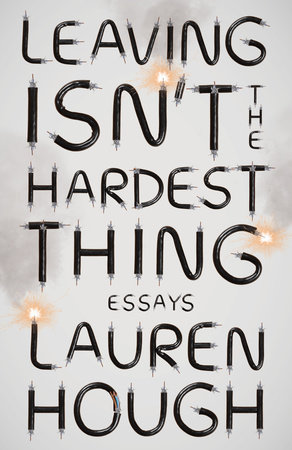
Lauren Hough grew up in The Family, an international doomsday cult that preached free sex as a means to bring you closer to God and corporeal punishment for difficult children—of which Hough was one. Often desperately poor, her parents dragged her from Chile to Argentina to Germany to Japan to Texas. After joining the Air Force, she was court-martialed for setting her own car on fire—and acquitted, as it wasn’t true. Shortly thereafter she was kicked out for being gay. After that, she found gigs as a bouncer in a gay club, a bartender, a barista, and a cable guy (she notably worked on the cable of Dick Cheney, to whom she made a quip about waterboarding). She’s lived out of her car, gotten into a few fistfights, spent time in jail, done a lot of drugs, and experienced her fair share of tumultuous romance. She’s also loved the hell out of her dog, Teddy, packing up her home in Texas and moving to Cape Cod because it was a better climate for his failing health.
In other words, Hough has been around the block. And has stared down misogyny, homophobia, and classism. Lucky for us, she’s here to tell about it.
Her collection of essays Leaving Isn’t the Hardest Thing is by turns vulnerable, outraged, riotously funny, heart-crushing, and hopeful. These bare-chested journeys into Hough’s life provide glimpses into worlds some will be familiar with, others not. Regardless, the emotional gut-punch will knock the wind out of you. But the sheer beauty of her unstinting tenderness for the world, despite the outrage, provides a new kind of solace.
Jane Ratcliffe: You write “sometimes what looks like depression is your brain slowing down enough to think” and “maybe depression’s the natural reaction to a world full of cruelty and pain.” We do seem to exhaust ourselves trying to be happy in this unstable world as if it’s our perceptions that are wrong, and not what’s actually happening.
Lauren Hough: You usually develop coping mechanisms with depression, and one is learning that your brain is lying to you; that things aren’t really that dark; and if you hold on, things will get better. But this year? It seems absurd to not be a little depressed about the world at large right now. And I think everybody’s experiencing the reality that is depression. We’re all in it. So weirdly I’ve been less depressed this year. I’ve talked to other people who have been battling depression for longer periods of time. Same. I think the coping mechanisms that you develop for depression have been useful, but at the same time… I’m not being very articulate here. Why wouldn’t you be depressed right now?
It seems absurd to not be a little depressed about the world at large right now. And I think everybody’s experiencing the reality that is depression. We’re all in it.
JR: Are you saying it’s almost a relief not to have to engage the coping mechanisms?
LH: Usually the societal demand is that no matter how depressed you are, you pretend to be all right. You pretend to be happy. And you get through your day. And that’s supposed to somehow help you. But, yeah, now there’s no pressure, you can just be depressed. It’s fine. You can not answer emails for a few days. Everyone gets it. We’re all starting emails with “I hope this email finds you… I just hope it finds you.”
JR: That’s how I start mine! You’re so good at articulating your despair and horror and fury and disappointment and it’s all so bang on. But all through the book I found myself wondering what gives Lauren hope. And does it counter any of the trauma you’ve lived through?
LH: It absolutely does. You really have two choices: you can have hope or you can have despair. With despair you can’t get out of bed, you can’t function, so you have to have hope. Where you find it? Hope is something I think you practice having. You work on it. It’s a physical effort sometimes to keep it. I think if you exercise it, if you fill your life when you can with the beauty that is in this world, then when you need it you hope it’ll be there
JR: You have this persona, in a certain way, of being such a hard ass. In fact, when I asked one of my friends if she had any questions for you she said, “No, she scares me.” Yet you strike me as so tender. I think you hold both. What you just said was tender and thoughtful. But then on Twitter, you are kind of this champion: you defend a lot of marginalized people, you speak truth to power, you take on a lot of bullies. And in return, you get a lot of abuse. I was surprised when I was reading your book to discover that you had spent so much of your life keeping yourself small and trying to dodge conflict. What changed? And are you really handling all the abuse that comes your way as well as you seem to be?
LH: It shocks me when people tell me I’m intimidating. But sure, we’re all a little braver online. That’s why people feel free to hurl weird abuse at me because I’m not standing in front of them. I know this is a ridiculous thing to say for someone who wrote a memoir, but I am a very private person. I am extremely sensitive. And, yeah, there have been days when the Twitter abuse made me cry and I had to shut off. But you learn to only look at it if you’re capable of laughing it off. If I’m feeling a little more touchy, I will not look at my mentions. You can pick a fight on Twitter, or one will come at you. And there’s sort of a demand that you stand there and take all of the abuse. If you go private, people think they won. But if they were standing on your lawn screaming at you, and you shut your door, that wouldn’t be a victory. That’s all it is, that sometimes you just have to shut the door and let them scream themselves out. They get bored and move on eventually.
Societal demand is that no matter how depressed you are, you pretend to be alright. You pretend to be happy. And that’s supposed to somehow help you.
At some point, I figured out there’s no point to having 60,000 followers if I wasn’t using that to try to help someone else. But I’m learning I need to start building a couple walls there and maybe not share everything because there’s a parasocial relationship that happens where people believe that they know you and they own you. They get very angry if you don’t match the expectation that they’ve built up you. They’ll see me make fun of a bully on Twitter and throw all manner of abuse at me and be shocked that it affects me. That I block them or lock the door. I don’t really understand the reaction I get from people entirely. I’m just being me. But just like you write a book and put it out in the world and have no idea how people are going to take it, what people are going to do with it. Once you let it loose, it becomes theirs.
JR: You swear a lot in your writing. What is it you love about that form of language?
LH: There are so many restrictions, especially on women’s speech. You’re told from the time you’re little to be more ladylike and speak softer. A lot of it developed in rebellion to that. I wasn’t going to speak more softly or edit the words that came out of my mouth. They’re useful words. I am absolutely sure I’m going to get Goodreads reviews that are solely about my profanity. I am really excited for them.
JR: You write:
“One thing I learned late in life is there are people who are shocked when bad things happen to them. More than that. They expect good things to happen. There are others who tell you to think positive thoughts and focus on something pretty and the universe will hand it to you…I’m not one of those people…I’ve learned, if not to expect the worst, to not be surprised by the worst.”
Positive thinking can seem woo-woo. But thinking negatively can be draining.
LH: That’s the journey of life really, figuring out the balance between what’s cynicism and what’s hope, and what’s protecting yourself and what’s closing yourself off. That’s why we’re all in therapy, right? What’s a wall and what’s a boundary?
JR: You have this unique lens through which to view Trump and QAnon. Could you talk about that?
LH: I don’t think we have the word for what’s happening. There was only so much of a reach for a cult before this. Unless you go back to Germany, but they weren’t sharing things on Facebook. There weren’t a thousand ways to get into it and a thousand recruiting methods. Yes, it’s cult-like. Yes, they get the same things that you get from a cult; they get the camaraderie and the brotherhood and feeling like they’re part of something and have a purpose. And the big-ticket item, thinking you have the secret to life.
But they don’t have to do anything for it. All they have to do is hit share on Facebook. They’ve done their part. You don’t have to go join a commune and you don’t have to give up everything you own. You don’t have to give your money to anybody even. Although I’m sure there are people who will take it. I don’t know that we have the vocabulary for this yet. It’s interesting, and terrifying. I know it’s providing the same high, but I don’t know where it ends. I don’t know what happens without Trump. Generally, when a cult leader dies off, it either becomes a religion or it disbands. I guess we’re about to find out.
JR: Do you feel like you’re reliving what you’ve already lived through?
LH: Yeah, every day. It is absolutely bizarre. I’m very proud that all we were in was a dumb little cult. And not storming a Capitol. It has been surreal to watch. How reasonably intelligent people buy into whatever the fuck this is. The recipe was there. It always has been in America. The desperation. Our lives revolve around work, and there’s no way to get ahead. And when someone offers you a golden ticket, it’s really easy to buy into that. We don’t have the sense of community we should. People just kind of live in the suburbs on their own. So someone comes and offers them a purpose and unconditional love and someone to blame for all their problems. It’s really easy to buy in. I’m stumped as anyone else.
JR: You write about the shame you experienced growing up, living out of your car, later getting kicked out of the military for being gay, and having to do whatever you needed to do to survive. You trained yourself to hide your emotions and smile and carry on. Firstly, you can articulate what you were ashamed of? Because, while it’s understandable, you weren’t actually causing anyone any harm in any of those situations. And secondly, can you speak to how shame can be used against people? Or possibly be beneficial?
There’s no way to get ahead. So someone comes and offers purpose and unconditional love and someone to blame for all their problems. It’s really easy to buy in.
LH: The great thing about shame as a motivator is it doesn’t really have to have a source. You can just install it by telling someone they’re supposed to be ashamed. You hear that enough and you start feeling it, internalize it. It’s the classic motivator of the abuser to perpetuate what they want to do. If you can get someone too ashamed to talk about it, they won’t talk about it, and you have control. Every religion that I know of uses shame as a control mechanism.
And shame has a place in society. We get into a whole lot of discussions about cancel culture, depending on who you are and how you want to word it. We used to just say, “that person’s an asshole. And they’re irrelevant.” They weren’t canceled; we’d all just agree they’re an asshole. So, yes, shame has its purpose in society. But anything that you use to control people can have bad side. Shame definitely has one.
JR: Do you still carry a lot of that shame that built up over the years?
LH: Nah.
JR: Oh, good!
LH: I don’t know when I lost that. I hang onto a little bit of it. I think writing about it helps. I liken it in the book to coming out of the closet and it’s pretty accurate. Once you come out it’s an almost instant release of that shame. It doesn’t survive the daylight.
JR: I love hearing that. Linked with that, I wondered what your thoughts were on forgiveness. If you feel like it’s necessary to heal or get to a better place in your life.
I’m hating like twelve people right now. It requires no energy whatsoever. I just hate them and move on with my day.
LH: It depends on if you want to keep someone in your life or not. If you want to have relationships with people, yes, you have to forgive because we all hurt each other, intentionally or not, constantly. We have a way of demanding forgiveness from people who have no reason to give it to us. I’m not a huge fan of it as a concept. I think if you love someone and you want to keep them in your life, you forgive them. And if you don’t, there’s no need to; you can just not deal with that person. And that’s fine, too.
JR: Do you feel like by not forgiving, it eats away at you in any way?
LH: Yeah, go on Instagram and there are hundreds of quotes about how hatred will eat your soul alive. But, I mean, I’m hating like twelve people right now. It requires no energy whatsoever. I just hate them and move on with my day. If you ask me about them it’s “yeah, I hate that fucker.” I think maybe it’s healthy for those of us who were taught you have to forgive everybody to learn to hold a little bit hatred in your heart because it keeps you from getting hurt again by that person. Like every other goddamn thing, there’s balance. And this is why we’re in therapy.
JR: Your essays are often laugh-out-loud funny yet you’re writing about such painful stuff. You write that this is a direct result of growing up in constant fear. What’s the connection between humor and fear?
LH: Humans are great that way. You can go through the saddest moment of your life and be laughing about it. The hardest I’ve probably laughed in the past year is when I was burying my dog. My nephew and I were discussing how to get the body out of the trunk in the back of my car. You know, is that the head and is that the feet and he might have pooped. He was wrapped in a blanket. We thought the person standing behind us was my niece. It was the pizza guy. Who took off. And that’s when we realized that we had just given a pizza guy a story about the time he showed up at a house and people were moving a body into a wheelbarrow. It’s still funny to me. It’s still funny that you can dig a grave in your backyard and your neighbor will come out and look and go right back inside.
We’re all just trying to hold it together.
I think humor is the way we learn to deal with things. I don’t know how you come out of that without a sense of humor and have any semblance of sanity or any hope whatsoever. You have to think it’s funny. And a lot of it is objectively funny. It’s a skill you develop. A defense mechanism, absolutely. It can get really grating if you’re trying to have an emotional moment with me and I’m cracking jokes. But it has its use. It releases tension. It gives you something to do with the pain until you figure out how to how to get rid of it.
JR: As you were writing about growing up in a cult and being kicked out the military and all these experiences, did you develop more tenderness for yourself?
LH: I think I developed more tenderness for other people. I was angrier when I started that book than when I finished it. There’s some argument I was having with a girlfriend at some point and in writing this scene—and it’s been a good 20 years where I’d been really damn sure who the asshole was in that situation—and it turns out it was me. I was completely fucking wrong. I hope she doesn’t read the book! I have more compassion for everyone involved, myself included. You know that morning where your aunts are like, “go play outside.” At some point you realize they were hungover as shit. That is a lot of noise that children make. You thought your parents were supposed to have answers; why the fuck would they, they were 20. We’re all just trying to hold it together. I think it takes a little bit of age to realize that your parents weren’t any different. Most of the people in your life weren’t any different. If someone is convinced they have all the answers, that’s not the first person you want to hang out with.
When I tell people about the idea behind my debut novel—a fictional town in Kansas is named the most homophobic town in the nation, and a queer task force is sent in to try to teach them acceptance—they usually say something like, “Wow! How on earth did you come up with that?” The simplest answer is that I, too, could have used a queer task force in the small Maine town where I grew up.
By “small,” I mean small. My childhood house was heated by a wood stove, and if you took a walk during deer hunting season, you had to don a neon orange hat and vest to not get shot. I’m sure my town wasn’t the most homophobic one in America, but it wasn’t the most aware or accepting, either. My house was across the street from my grandmother’s, and the woman who lived next door to her was short and stocky, with short gray hair. She lived alone, and drove a Subaru, and tended to wear Carhartt pants and turtlenecks. I never knew her name because my extended family only ever called her “the lesbian.” I found out recently she actually isn’t even gay, but the snide, jokey tone my relatives used when they referred to her let me know that being gay wasn’t condoned.
Reading books was a way for me to partially see past the rural confines of my town. Today, YA is known for being one of the most diverse genres, especially when it comes to LGBTQIA representation. But when I was young, there were no books like Pet by Akwaeke Emezi or Simon vs The Homo Sapiens Agenda by Becky Albertalli or Like a Love Story by Abdi Nazemian. In elementary school, we were largely assigned books like Hatchet, My Side of the Mountain, and The Cay—all centering young male protagonists who learn how to survive in the wild and, in the process, [cue cheesy music] learn about themselves. Stories about young women weren’t really assigned in school—boys got to learn how to understand themselves, and girls learned how to understand boys. So outside of school, most girls I knew read The Babysitters Club books, about an entrepreneurial group of female friends who, of course, start a babysitting service. While some of the books were about larger themes like family issues or illness, many of the stories centered on the various crushes the girls had on boys.
As instructed, I had crushes on all the boys that all the other girls had crushes on.
As instructed, I had crushes on all the boys that all the other girls had crushes on. I pinned pictures of Jonathan Taylor Thomas and Leonardo DiCaprio above my bed. In that same bed, a female friend and I invented a game called “nap time,” where we pretended to be asleep while we rolled around pressing our groins together. We pretended to be asleep because it wasn’t something we could possibly want when we were conscious. When we heard my Mom coming up the stairs, we would spring apart like a bomb had gone off.
When I hit puberty, I wondered why the thought of kissing boys (not to mention doing more) was mortifying. After a guy with spiky bleach-blond hair stuffed his tongue down my throat, I hid in my bedroom the entire next day, thinking I had the flu because I felt so sick. What I liked best was sleepovers with my female friends. We watched movies where the girl always got the guy, and sighed as we massage-trained and ate whole packages of Oreos. One night, we decided to play a game of strip poker—it was probably my idea. I had never wanted to win a game so badly. When most of us were down to our bras and underwear, everyone else agreed it was time to call it quits, but I wanted to keep playing. I still remember the uncomfortable, judgmental looks on their faces when they laughed and told me I was gross. At some point, my best friend Margo and I started taking showers together. We would wash each other’s hair and shave each other’s legs, but we never touched in a sexual way, and we wore bathing suits. Once, my mom busted in on us and took a picture. I remember the look on her face as she pulled open the shower curtain, braced for impact, like she thought she was going to see something shocking.
When my friends started getting boyfriends and I saw them less and less, I would sulk and go into private rages. Partly because I was jealous, and partly because I felt left behind, somehow knowing that I couldn’t have what they had. I was trying, but I didn’t understand why I couldn’t feel what I was supposed to. A boy started picking me up for school some mornings. On the days I knew he was coming, I would sit in front of my bowl of cheerios, watching the Os bloat in the milk, then dry-heave over the sink as his red Pontiac pulled into the driveway.
In high school English classes, we were assigned books like The Great Gatsby, The Sun Also Rises, Portrait of the Artist as a Young Man, and Catcher in the Rye. Much like what I read in elementary school, these books also centered male protagonists and their journeys toward understanding themselves. For many years I considered The Great Gatsby my favorite book, partly due to the intensely lyrical writing style, and partly because a book about a man obsessed with another man appealed to me in some way I couldn’t articulate. To a straight reader, Nick is simply interested in Gatsby because he represents the American Dream, but to a queer reader, Nick is interested in Gatsby for other, more private reasons. In The Sun Also Rises, our teacher didn’t tell us that a war injury rendered Jake impotent, and since the characters never speak about it directly, I assumed there were other reasons why he couldn’t consummate his relationship with Lady Brett. Jake’s body couldn’t allow him to be with Brett, much like my body couldn’t allow me to be with men.
I started to feel nauseous all the time. I convinced myself I had an ulcer, so my mom took me to the doctor and I swallowed a white chalky substance that made my insides glow. When they didn’t find anything, I went to counseling. My parents thought I was having a hard time because my dad had recently been diagnosed with Hepatitis C, and things at home were pretty rough. But I knew it was something else. I knew it was related to my fear of intimacy, but I couldn’t articulate any more than that. My counselor asked me a lot of questions about my mother. She never once asked me about being gay. It still didn’t occur to me, even in my diary, even in my most private, hidden thoughts, that I might be a lesbian.
I had never been shown the full range of what queer women looked like, so I had to rely on the paltry stereotypes I had been offered.
I went to Emerson College in Boston, drawn to the idea of a city where I’d be surrounded by different kinds of people. The ratio of gay men to straight men at my college was about three to one, but the only lesbians I could identify had slicked-back ponytails and popped collars and walked around like there was an apple stuck between their legs. This isn’t to say there weren’t others, but I couldn’t see them—I had never been shown the full range of what queer women looked like, so I had to rely on the paltry stereotypes I had been offered.
Even with this high percentage of queer students, Emerson didn’t offer an LGBTQIA literature course at the time. I took American Lit, Brit Lit, Latino Lit, Native American Lit, and the Contemporary American Novel, and none of them included queer authors or characters—at least not outwardly. When we read Mrs. Dalloway by Virginia Woolf, my teacher didn’t mention that Woolf was considered by many scholars to be queer, having a long-term relationship with a poet and writer named Vita Sackville-West. For my Contemporary American Novel class, I wrote an essay titled “Women As Shit in the Male-Dominated American Novel,” about how the women in all the novels we read were treated as completely worthless, a joke or worse. There was one scene in particular (from a novel I now can’t remember the name of) that tied the essay together, in which the main male character flushes a toilet on the second floor of his house and the plumbing explodes. His wife, who had been standing directly below the toilet on the first floor, bears the brunt of this explosion and is covered in feces. In the world of literature (and the world at large), if straight women were shit, then lesbians were something below shit, something not even worth mentioning, like a vague fart that dissipates into the air and no one notices it was ever there.
After I slept with a man for the first time, I puked until all that was left was foamy, neon-yellow bile. I wrote anguished entries in my diary questioning my intense fear of sex and relationships. I “fell” for completely unavailable guys and then cried about how they didn’t like me back. When they did like me back, I found some other reason to end it. I trapped myself in the perfect catch-22, ensuring my loneliness and sadness. I read books with titles like Kiss and Run: The Single, Picky, and Indecisive Girl’s Guide to Overcoming Fear of Commitment. I still had fiercely close relationships with my female friends, and I still felt inordinately betrayed when they found boyfriends. When I got so drunk that I didn’t know what I was doing, I would exchange prolonged pecks with my female friends, just lips pressed together with no tongue, but I remember feeling more in those pecks than I had ever felt from anything else.
It still didn’t occur to me that I might be a lesbian. I thought I was just really picky, or hadn’t met the right person yet, or was commitment-phobic, or had some kind of emotional problems, or just wasn’t a very sexual person, or was asexual, or had been molested when I was younger—all of these things occurred to me, but the simplest and most obvious option did not. Due to the dearth of queer representation, I didn’t know that a lesbian wasn’t only a woman with a slicked-back ponytail in cargo pants, and I knew I wasn’t attracted to that, so I assumed I wasn’t attracted to women.
After college, I moved to New York City. I started a job at an ad agency, where I met a woman named Ashley who had short brown hair, doe-like brown eyes, and a strong Roman nose—a trait I had always been attracted to. She wore a lot of designer sneakers and skinny jeans and striped t-shirts. She started flirting with me, which is another thing to note—a woman had never before in my life made a move on me. I was so consumed by my own closeted-ness that it never would have dawned on me that I could flirt with a woman. Someone else had to pull the metaphorical blindfold off for me to get there. I gchatted my friends from my receptionist computer, “A lesbian is flirting with me and I think I like it!”
Even when I was finally out of the closet and out of school and thus free to read books by whomever I wanted, I still didn’t read queer books.
Things moved very quickly and very seamlessly from there. The first time I called myself a lesbian out loud, my whole body vibrated with confirmation. The puking and the doubts and the fear stopped, and were replaced with comfort and happiness and pleasure. And then love. Ashley and I have been together for more than thirteen years now. She’s since told me that when we first met, her gaydar (which should be world-famous, it’s so spot-on) went off like an alarm.
But even when I was finally out of the closet and out of school and thus free to read books by whomever I wanted, I still didn’t read queer books. They weren’t the ones being presented to the culture at large, and it didn’t occur to me to seek them out on my own. So I read books by straight white men like Dave Eggers and Jonathan Lethem and Jonathan Franzen and Joshua Ferris and didn’t question if they were what I wanted to be reading. I can’t even remember what the first queer book I read was. It might have been We the Animals by Justin Torres, which was the first time I can recall a literary fiction book by a queer author making such a big splash that even straight people read it.
I was nervous to come out to my parents and my brother, but not afraid. I never questioned that they would accept me and keep loving me. I told them on Christmas Eve, about five minutes before my grandparents pulled into the driveway for blackberry pie and ice cream. Perfect movie snow was falling outside the windows. The look on all of their faces was like a google image result for “consternation,” but they were simply surprised, not upset or judgmental. I felt safe. My family was never a barrier to discovering my sexuality. Imagine how much harder it would be to realize you were queer and to come out if you knew that your parents would disapprove, or even worse, stop loving you.
I’ve shared all of this to show that someone who was so deeply, unquestioningly a lesbian still couldn’t figure it out. Men literally made me sick, and I didn’t think the problem could have been simply not desiring them. When society doesn’t allow you to see yourself, you stay hidden. Four of my closest friends, one from childhood, two from high school, and one from my early days in New York, are now queer. None of us were out until after college, and some for years after that. We all had different experiences coming to these realizations, but we agreed that the dominant heteronormative society suppressed our own recognition of our sexuality.
When society doesn’t allow you to see yourself, you stay hidden.
People think that if you’re “really” queer, you know from when you’re a young age. But this assumes that we live in a cultural vacuum where we’re not being bombarded by images of men and women kissing on TVs and movie screens, where the books we’re assigned in school are not 100% straight, where our parents and relatives don’t ask us, “Is there a boy you like?” or “Is there a girl you like?” instead of asking, “Is there someone you like,” where the successful people we see on the covers of magazines are equally queer and straight. It’s impossible to say what might have happened if I had grown up in a different world, but I think my chances of being happier sooner would have greatly increased in a world where queer people are visible, where our stories are just as valid.
To me, 2019 seemed to be the first year it was possible to read mainstream adult books that were by and about queer people: On Swift Horses by Shannon Pufahl, Delayed Rays of a Star by Amanda Lee Koe, Mostly Dead Things by Kristen Arnett, On Earth We’re Briefly Gorgeous by Ocean Vuong, In the Dream House by Carmen Maria Machado, Red, White, & Royal Blue by Casey McQuiston, A Year Without a Name by Cyrus Grace Dunham, Girl, Woman, Other by Bernardine Evaristo, Naamah by Sarah Blake, Lot by Bryan Washington, Long Live the Tribe of Fatherless Girls by T Kira Madden, How We Fight for Our Lives by Saeed Jones, and I could go on. So this is how straight people must feel, I thought to myself reading book after book. You can choose from a large array and see parts of yourself reflected in each one. But this was my particular reading experience as a lesbian—even with LGB sexuality more represented, there were only a few adult books from major publishers that were by openly trans or nonbinary authors, and none I knew of by openly intersex or asexual authors.
2020 continued in the same fashion, with my book being one of many that LBG readers could choose from, but there was still an overall lack in trans, nonbinary, intersex, and ace representation. I can only hope that with each passing year, wider and wider swaths of the queer community will see themselves represented, so the need for task forces in all the small towns of America will become less and less necessary.
soft purple yams and common talk past
expiration, sticky citron tea in thin glass
stewed daikon, wet miyeok in two black plaits
inverted nipples, pitted olives in a pinch pot
pinched beyond intent
armpits like split figs pink in the center, a dead wasp
in the center, cut into rounds the way she did it
no use for solitude today, come over pls
rice cakes suspended in cum soup, laced with raggy egg
soondae dotted with barley, the blood of whom
pinching at the edges is how much
these things cost and for what sustenance
to look at the surface
where pleasantries live and histories abbreviate
custom compels me to offer you
this poem by way of invitation
Leftovers for the End of Summer
1.
Yesterday was nothing on the street
the people sounds, you murmured. You.
The open window to hear the people sounds
drinking in the kitchen together, so important
you said. Me. Insistence fluctuating
between heart murmurs, co-pilot
toying with eject, with switch, end stop.
Earthy strawberries, small and fragrant,
part armpit held in aspic, a saucer of them
mulching down toward mold. You are so poor,
you said. Poor baby. Me. The pages of summer
ablaze against the white sheet of our window
but night. Glistening heat jellied to an
unctuous vein pulsing slower. Mulching. Swoon.
An organ surpassing the rack of confines.
You. This is why I steal the roses, you said.
Night murmurs an octave lower, moans
gleaming over tight complexes. Our city

2.
Outside the furthest reflexes of moon
a varnish of light sweeps the balcony
you are shaped from within, honey,
your pants laved with thrumming impulse
drawing back to bare teeth
slivering scallions lengthwise to make them curl
I think of this: springing, recalcitrant pussies
confessing their emptiness in the coolness of night
earthling approximation of divine rapture
tonight a bowl of rice heaped with tendrils
vibrissae of scallion and purslane, lovage and perilla
threading together an exquisite corpse
I ask you are you eating well have you called
your father and what of this debt
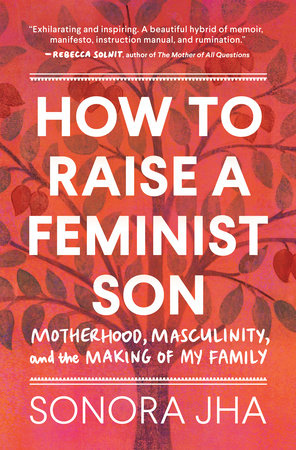
One of the things I try to drive home in my book, How to Raise a Feminist Son: Motherhood, Masculinity, and the Making of My Family, is the value of failure. Of slipping up, recovering, and apologizing. Feminism is replete with false starts and faltering steps, and if there’s one thing you can be sure of when you set out to live a feminist life or raise a feminist boy, it is that you will blunder. And if you are fallible, your boy will surely encounter failure over and over again.
But that’s where the magic (or the witchcraft, since we’re talking about feminism) happens. The spell is cast when we tell our boys cautionary tales of the patriarchy, give them rich stories that decenter masculinity to instead center women and other genders, and then give them the talisman of insight with which they may rescue themselves.
One of the ways I did this with my son was through stories—in movies, in nursery rhymes, and books. One big, yawning gap in literature and culture, though, is the tale of the man who encounters and overcomes his own male fragility and entitlement. We have heroes upon heroes going on journeys upon journeys. They must save humankind, they must rescue women, they must win battles, capture whales or conquer Wall Street, avenge ancestors, lead rebellions, come of age, surmount the wild, fall in love, thrash about venomously when heartbroken, and so on… but so few of them launch a quest to the perilous journey within, to slay the beast that lies there: toxic masculinity.
Here’s a list of seven novels and short stories in which we do encounter such men (and one teenaged boy). Their authors place their characters within the struggle and watch them squirm. Some of these characters make it to the other side and others don’t. The journey, the faltering, the failure, all make them memorable.
Akhtar’s 2020 novel reads like a memoir, and the author says he deliberately wanted to suspend his readers between fact and fiction. His protagonist, also named Ayad Akhtar, a Pakistani-American playwright, struggles with identity and belonging, capitalism and love. Through it all, we also have deeply-etched female characters who more or less transcend the role of props on a man’s journey and figure, instead, as major influences in the narrative of the complex, often unlikable, yet sympathetic Akhtar. His boyhood bears witness to his mother’s love for a man she cannot have. His youth is mentored by an aunt who tells him what books to read and later by a beloved professor who tells him to record his dreams. Akhtar the author does not flinch at skewering Akhtar the protagonist in his treatment of his lovers—a white woman who participates in role-play as a sort of receptacle for his sexual rage as a brown Muslim man, and a Pakistani-American woman with whom he experiences true love and loss. The author also focuses a glaring light on the man’s behavior toward his father’s mistress, his struggle with his father’s authoritative masculinity, with American masculinity and its obsession with money, wars, and Islamophobia.
Roy Hamilton and Celestial Davenport are a young Black married couple. Roy is dashing and ambitious, flirtatious but committed to his wife. Celestial is a little more ambivalent about their union. When Roy is incarcerated for 12 years for a crime he didn’t commit, he must reckon with what he believes he is owed by his wife. He believes he is a good man, faithful to his wife, not oppressive, so he should receive her undying devotion. He also believes that on account of his incarceration, he “should receive some sort of special consideration.” Celestial believes she is free to fall out of love and break free of a system of racism and also the patriarchal expectations of the long-suffering wife who awaits her husband’s release. Roy encounters his fragile masculinity in his desire to dominate his wife and also dominate a rival until he comes to realize that what he really craves is empathy and a shared sense of humanity.
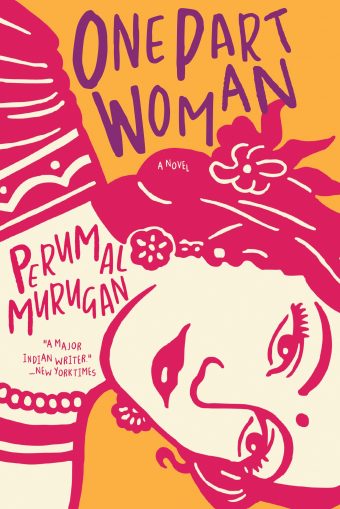
One Part Woman by Perumal Murugan, translated by Aniruddhan Vasudevan
This is the first book in a trilogy in Tamil by Dalit writer Perumal Murugan, translated into English by Aniruddhan Vasudevan.
In colonial India, in the southern state of Tamil Nadu, a young couple—Kali and Ponna—are trying in vain to have a baby. Ponna is shamed for being “barren,” and useless as a woman who cannot bear a child. They try modern remedies and indulge in ancient superstitions alike. Ponna is told she can get pregnant by having sex with another man, with the blessing of a deity who is one-part man and one-part woman, at an annual chariot festival. She believes her husband Kali has agreed to this, only to find out after the deed is done that he hasn’t. Kali loves his wife but is egged on by traditions of patriarchy, caste, and religion to rebuke her.
This story is about the oppression of women, yes, but also about the dehumanization of men under toxic masculinity. The author came under attack by right-wing Hindu forces in India after the book gained popularity. He swore never to write again, but swung back hard with two novellas that provide alternative endings to Kali and Ponna’s tragic love story. In A Lonely Harvest, Ponna comes home to find Kali dead by suicide, unable to confront the affront to his masculinity. In Trial by Silence, Kali turns oppressor against his wife and the marriage begins to fall apart. If you haven’t discovered Perumal Murugan, you are in for a treat from this author who challenges patriarchy while rooting his characters lovingly within their farmland, their animals, and their community.
This story places you on the edge of your seat, right by the plane seat of a man who tells the woman sitting next to him on the flight that he once raped a girl. The story creeps up on you (and him and her) slowly, like an uneasy flight, now turbulent now still. John Morton is a software salesman, attracted to the pretty young passenger next to him. The conversation starts off casually enough, and then something she says about being an alcoholic takes him through a suppressed memory. John resists and recoils against recognizing it for what it was. “No,” he said. “It wasn’t a real rape. It was what you were talking about—it was complicated.” He is left bereft when he realizes he cannot apologize to a woman deliberately faded by memory, even when what he did to her is rendered visible by the clarity of our times.
David Lurie is a divorced, middle-aged, white English professor in Cape Town. He preys on a young female student, Melanie, and is fired when he refuses to apologize in the wake of sexual assault charges. He seeks refuge on a small farm run by his lesbian daughter Lucy, in eastern South Africa. When Lucy is brutally gang-raped by three strangers while he is locked up in a bathroom, Lurie pushes his daughter to press charges, but Lucy refuses because she believes the rape to be racial retribution from oppressed Black men in apartheid South Africa.
Coetzee gives us a disturbing and layered story that becomes all-too-relevant in the #MeToo era with its critique of white male entitlement. Lurie is aware of his growing irrelevance as an aging man grasping at youthful sexuality (“Can they be blamed for clinging to the last to their place at the sweet banquet of the senses?”), but, much like the protests of “a witch-hunt” by the likes of Harvey Weinstein and Woody Allen today, he considers himself wronged and stops short of any real reckoning, leave alone an apology. The author presents to us an indictment of racism and misogyny through this unlikable, troubling character whose notions of disenfranchisement extend to himself but not to the other predatory men whom his daughter chooses to forgive.
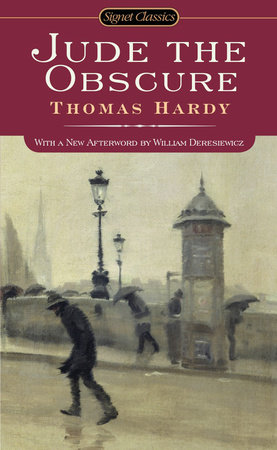
I have to throw in this classic, Thomas Hardy’s last finished novel, often hailed as indicative of the author’s feminist sensibilities. The story follows Jude Fawley, a working-class man in Southern England at the end of the Victorian age. Jude dreams of becoming a scholar at a prestigious university while he struggles through love, sex, and marriage first with the seductive Arabella Donn and then with the true love of his life, the rebellious Sue Bridehead. Hardy gives voice to the women in his novel, and his protagonist Jude is a willing participant in the progress. Sue Bridehead pushes against the institution of marriage as undermining the agency of women and making them subservient to their husbands. Sue and Jude’s union is presented as an example of equity and mutual devotion beyond the entrapment of marriage. Jude struggles with the expectations of his sexuality and his masculinity and responds with admiration and love to Sue’s rejection of social norms.
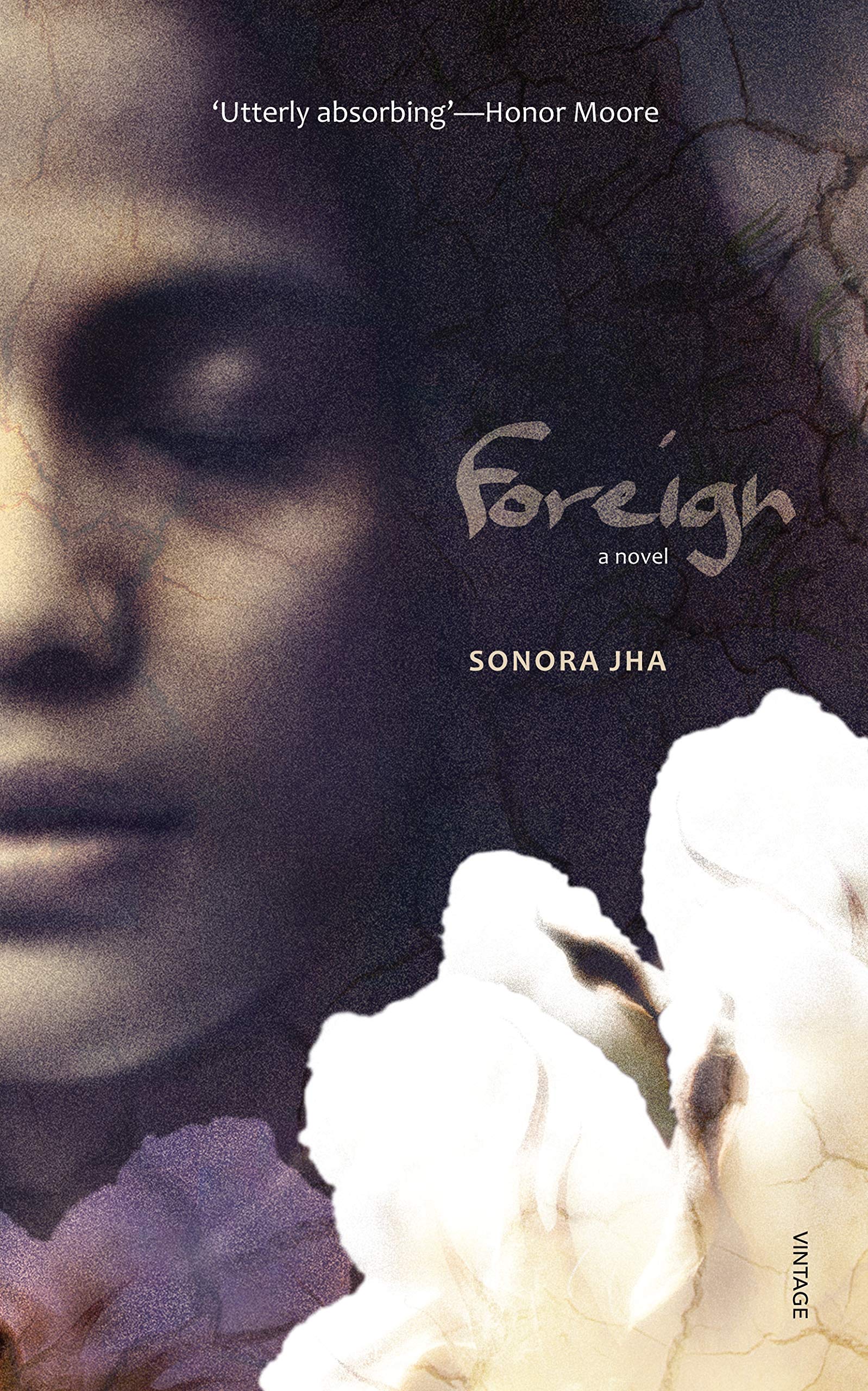
In Foreign, my novel from 2013, a 14-year-old boy named Kabir runs away from his grandparents’ home in India to find a father he has never met, a social worker in the villages of India where farmers are dying by suicide. His frantic and furious mother arrives from America to take him home, but they become entangled in the lives and loves of the farming community. Kabir pushes past the emerging patriarchal impulses and circumstances of the men around him—a father who abandoned him and his mother, a farmer who feels he has failed as “provider” for his family, a village official who threatens strong women with dire consequences, and the men who rape an emerging woman leader in the village, Gayatribai. Kabir sees Gayatribai as the true savior of her own people. He asks her, “What do you want”—turning on her a question she has asked the boy every morning to make him breakfast as a guest in her home. He then follows her on a quest to empower the dying men in the village through the protest marches and political actions of its formidable women.
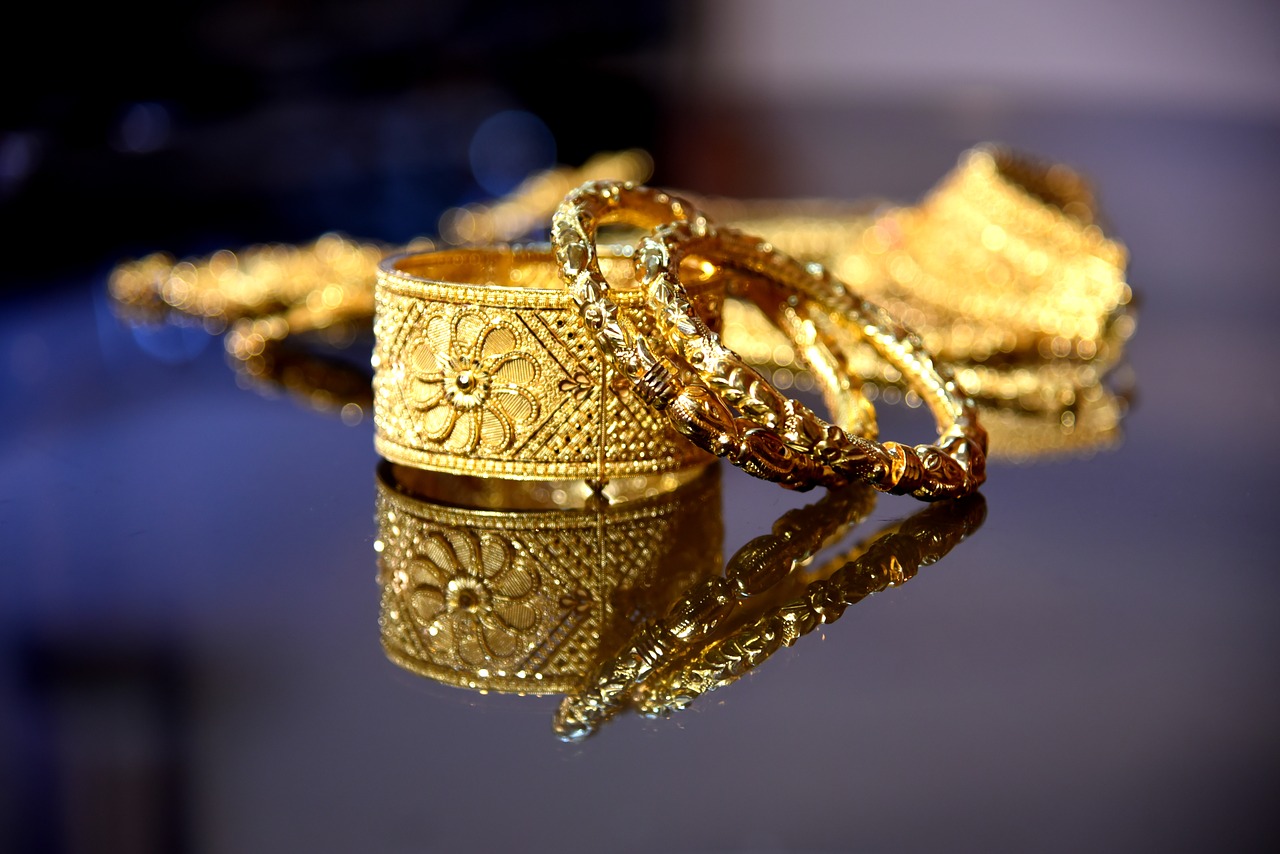
Sanjena Sathian’s debut novel Gold Diggers is set in the Indian American suburbs of Atlanta—a world of competitive debate and spelling bees, of racing to get into the most prestigious academic summer camps, of Miss Teen India pageants—all roads leading to the promised land of America’s most elite colleges and universities. (The book has already been optioned by Mindy Kaling for a TV adaptation.)
Neil Narayan, lacking the ambition to keep up and crushing hard on girl-next-door Anita Dayal, gets drawn into Anita’s mother Anjali’s scheme of stealing gold jewelry from members of the desi community to brew an alchemical potion that harnesses the powers of the original owners, with ultimately tragic results.
A decade later, Neil and Anita reconnect, having graduated from prestigious schools and still feeling directionless, wondering what it was all for. A history grad student at Berkeley, Neil ignores the work he should be doing to search obsessively for an Indian American spiritual forebear in the records of the California Gold Rush. Meanwhile, Anita has gotten herself involved in organizing elaborate Indian wedding expos she hardly seems to believe in. Neil soon realizes there’s more to this than meets the eye, and quickly gets drawn back into the world of her magical schemes.
Though I have long disappointed my mother by wearing the sorts of dangly silver jewelry I can get on Etsy for $20, I put on my hereditary gold before sitting down to chat with Sathian about giving second-generation desis our own unique brand of magic, looking back through history for Indian American forebears, and breaking open outdated and restrictive ideas of what Asian and South Asian lives in America can look like.
Preety Sidhu: One of the first things that interested me about this book is that, until I saw it, it hadn’t even occurred to me that second-generation Indian Americans could have our own highly specific brand of fictional magic. Is that where this story started for you? Or, at what point did you know that this uniquely tailored magic would become central?
Sanjena Sathian: I started with the conceit of the gold because, when I was growing up, there were a spate of gold thefts around Atlanta, and it happened everywhere there were Indians in the suburbs. My mom always said there’s got to be an Indian person involved, because they know where to go. They know exactly where the gold is located, they seem to know when people are gonna be out of the house, there’s something happening there. So I had thought about that for a long time, wondering who could be in the community but also stealing from other people in the community. That breaks a lot of my conceptions of who I grew up around. I had carried that around for a while and always wondered about who I could write. When I thought about it being a mother and a daughter, that’s when things fell into place for me around the conceit.
I grew up with a sense that magic realism had something to do with the immigrant experience—reading a lot of Rushdie and feeling like there was something about being displaced, or being migrant, or being separate from your roots, that made magical realism more fertile or more plausible. I was never gonna write a particularly great novel that was about India only, because this is the world that I came from. Once I was able to accept that writing about the suburbs was a legitimate choice and not inherently boring, things could get more playful.
PS: At one point a minor character who’s a white academic mentions “he heard of these kinds of things when living in the Indian hinterlands. Stories of kings drinking the plunder of their conquered subjects.” To what extent did legends and research about Indian gold and alchemy inform the creation of this magic, and to what extent did you craft it to suit your own storytelling purposes?
SS: The conceit, I built it for what I needed it to do. It would have been too great a burden to be beholden to the rules of magic according to myth. The conceit was entirely contemporary at the start. When I realized I did want to have some connection to an older world, both in India and America, I started looking into old myths of gold, just to enrich it and enliven it. I read a lot about alchemy and I realized that this is a universal idea that people have come into over years.
There’s a reason that gold is such a powerful—not just metal, or source of economic wealth—but it has taken on a disproportionate meaning in so many culture’s imaginations, because it doesn’t get messed up. You can shower in these gold earrings that we’re wearing, you can sleep in them, they don’t lose their luster. It’s really hard to make it from scratch. So all of these facts about this metal have made it carry all these metaphorical and magical connotations throughout history. I think it’s always nice, when you’re writing magical realism, to have mythical traditions to bump up against, when you want it to yield more. It’s fruitful to have it to draw on, but it’s not primarily from Vedic texts or anything like that.
PS: When Neil first encounters the idea of a Bombayan participating in the American Gold Rush in the 19th century, he feels an instant kinship, though he’s never taken much of an interest in his Indian ancestry as it took place in India. Later, he pursues this obsession as a grad student, at one point stating: “Isaac Snider [the Bombayan] was an unproven theory of history, formulated solely to explain me. I would never have a corollary in the past, never have a legible American ancestor to provide guidance on how to make a life.” Can you speak more to the idea of history—or missing history—as a second-generation immigrant, of what it means to look to the past and see no one—or almost no one—like you?
SS: I became really obsessed with South Asian American history in 2014, when I read Vivek Bald’s work on South Asian diasporic history before 1965—which is where the contemporary diaspora that makes us possible comes from. His work looks at the history of ship workers who jumped ship and integrated into communities of color in Harlem, in New Orleans. I became really interested in West Coast histories of Asian Americans. Everyone is now finally talking about Erika Lee’s book—which is amazing, really good scholarship—and other books like that.
I was living in California and I realized that there, Asian American history is American history, is California history. I had this sense of being cheated. I have studied American history and studied American literature—this was so important to me in my education—and I had managed to only learn about … Japanese internment was the only part of Asian American history that I’d ever learned in school, and that was skated by and taught in all kinds of problematic ways. So the experience of learning more about South Asian American history and Asian American history was both thrilling—in the way that Neil experiences that as this thrill and sense of recognition—and it’s also heartbreaking, because there’s never enough. There are people who lived these lives, who we just have no communication with, we have no sense of who they were.
I was living in California and I realized that there, Asian American history is American history, is California history.
I feel quite jealous of my friends who do understand their history more, who aren’t trapped in the untranslatability between generations. I have difficulty enough understanding the worlds that my parents and my grandparents came from, let alone dating back to the 19th century. It feels like we’re making it up anew. And there are so many communities in America who feel versions of this, who have had the right to a historical identity taken away from them because of colonialism or other forms of oppression, and genocide, and enslavement. I think that is another version of American history. I grew up with this story of American history as, like, “City on the Hill,” “the American dream.” I’m now coming to understand that alongside that stands all of these questions of the voices we haven’t heard before, those ghosts. That’s the reason I loveBeloved andThe Sympathizer and these other stories. These are great American novels that are of the minority voices and they’re obsessed with the same things.
I think there are stories waiting to be reclaimed. I don’t know if you’ve spent any time reading the South Asian American Digital Archive, but that has been an incredible resource for me personally, coming to understand all the textures of South Asian identity in the US. Like learning about the Ghadar Party, the revolutionaries who gathered and organized in San Francisco and Berkeley around 1914. These stories are there.
PS: Neil thinks that becoming a professional writer of English and writing himself into America is Snider’s way of making use of all he took, an idea that haunts Neil because he took too much from someone in his past. Can you speak more to this running theme for Neil and Anita, about whether they are making use of all they took?
SS: I think a lot about the transition that my family made, from feeling like outsiders to feeling like something closer to insiders. When my parents first got to the U.S., there weren’t that many Indian Americans, there were like half a million Indians living in the U.S. at the time. They were part of this lonelier, earlier generation of immigrants. I remember when we were growing up, my mom wanted us to buy our jeans out of Kmart discount bins. The idea that we would get jeans from American Eagle that cost $40 was abhorrent to her. She was like: absolutely not, that is not how we spend our money. We are immigrants, we scrimp and save.
Now, things feel more settled. There has been an upward mobility in terms of class and privilege that I’ve seen in my subset of Indian America. For me, that comes with a worry of: are we going to remember what it felt like to be an outsider? Will that ethically inform our stance in America? Will that politically inform our stance in America? So that’s the wider world that I think about around the Neil and Anita question.
In the space of the book, they go from similarly being outsiders to being insiders. They go from having to strive and save everything they can to try and make it into a college that they feel will be the promised land (of course, we know it’s not, but they think it is). On the other side, they’re like: well, we have won the game, in a lot of ways. What was it all for? What do we do now that we’re sitting pretty? I feel like that’s the challenge facing so many people my age, of my generation, my particular subset of the diaspora. What happens now? What was all that work for and what was all the pain for? What happens in the next stage of life? We have to invent it now.
PS: While Neil has some romantic and sexual encounters with East Asian and white women, the object of his lifelong obsession is another Indian American, and both she and his sister also have their more serious relationships with desi men. So often representation of second-generation desis has us aspiring to date white or across racial lines. Is this something you were consciously pushing back on?
SS: I wasn’t consciously pushing back on it. Just, this was the world that my characters were in. I had a lot of friends who lived in even more Indian enclaves than I did growing up, and they were a little more secure in their sexual and romantic identities, so they didn’t think twice about dating other brown people. I was writing in that world. I grew up in a slightly whiter world than some of the characters in Gold Diggers do, but as I’ve gotten older, so many more of my friendships are with other Asian Americans and South Asian Americans, with whom I take myself for granted and vice versa. In those spaces, all of a sudden, I feel like I can breathe a sigh of relief—you know, date who you want to date, connect with who you want to connect with—and it doesn’t feel so heavy.
There has been an upward mobility that I’ve seen in my subset of Indian America. That comes with a worry of: are we going to remember what it felt like to be an outsider?
Ayana Mathis was my advisor at Iowa, and when we were working through some of the early pages, she was like: so where are all the white people? It’s funny coming from her, she’s a Black writer, but she pushed me in a way that was important. She was like: I get that you’re writing about this particular bubble, but whiteness surrounds them and so you have to engage with it. And she was correct. So there’s a sense of the white world around them and of what that does to their identities, but ultimately their lives play out in more Asian bubbles, as a lot of people’s do.
PS: Neil observes attendees at an Indian wedding expo and thinks: “They believed they were planning weddings. Did any of them smell the ugly, world-inverting lusts undergirding the romantic ones? Everyone wants something from someone else.” Talk to me more about these ugly, world-inverting lusts.
SS: I feel a little bad about the second half of the book being so anti-wedding and marriage, because my brother’s getting married this year. I was like: I promise I wrote this before you were engaged, this is not an indictment of you!
But I have a lot of skepticism of the way societies think about marriages and home. There is something in a lot of Indian American culture that puts so much faith in wanting to literally house the next generation into couples. In Hindu ideas of the four stages of life, you’ve got the student and then you’ve got the householder, and you’ve got to go from one to the other pretty quickly. Obviously, there’s all kinds of burdens that women carry around this as well. So I had some criticism about that, that seeps through implicitly.
I also think Neil’s criticizing himself there, because he realizes that desire has been responsible for him committing the greatest evil that he has committed. Desire, lust, gold lust, ambition—all of these words swirl around together in the book. I’m exploring a bunch of facets of things that Americans lionize, and Indians also sometimes lionize, but it is a very American value: the great American dream is to go West to make your fortune, it’s to strive your way into the upper middle class. All of these things get conflated for Neil and in the plot, where all these kinds of lusts connect. Neil starts to see how any desire that large can both make and unmake you. And there’s no way around those desires for him, because they get him through life—they get his entire community through life—but he’s also obsessed with understanding the morality surrounding them and the costs of them.
PS: Neil’s roommate Chidi asks him: “Why do you devote your life to these institutions we invented for different times—universities, marriage?” And the immigrant culture we see throughout the novel is clearly steeped in prizing these things. Neil’s admittedly not much of a revolutionary and doesn’t linger on it, but can you speak more to your own views of these institutions, the opportunities and constraints they offer second-generation desis, our scope for pushing back on our own behalf or for the generations we might raise?
SS: I have so much personal anxiety around the fact that there are prescribed ways of being. It’s particularly there in immigrant life, but it’s just there in late capitalism. There’s a way to make it through the world and that way is to strive your way to a really good university. The characters in the first half of the book are correct, in that if you go to a fancy school and get a fancy degree, your life is often easier. It insulates you, makes you safer. It allows you to take risks, and I think that’s messed up. I wish that weren’t the case.
Particularly, though, I feel a lot of pain around the fact that it feels like there are limited ways of being, when your entire community has a restricted imagination for how you can go from childhood to adulthood. I feel this among a lot of my other friends who are children of immigrants. They, similar to me, sometimes feel this desire to break open the vessels that our lives are supposed to fit into. That feels easier now that there are more of us coming of age, as more and more of my friends of color and Asian American friends make it through our 20s and into our 30s. Now it seems like we are inventing new ways just by living them. But there’s this extra imaginative burden that we take on that I do not see in my white friends. Every single step—I’m gonna major in this instead of this, I’m gonna get this kind of job instead of this kind of job, I’m gonna live with a partner before marriage and risk my family’s scorn—these are not things that my white friends ever have to deal with. They’re not risking breaking something in the way that I, and other people who feel like this, are. We are at risk of losing something when we don’t follow the mold, and that makes me angry.
PS: Neil’s mother has this desire to protect him from “nonsense,” meaning any partying or alcohol or substance use, which is a path he goes down pretty hard. Almost like the lemonade was his gateway drug, and then he turns to study drugs or other substitutes when he can’t get that. So it doesn’t feel like that was “America” coming to get him. Can you speak to his engagement with the “nonsense” and lemonade’s role in getting him there?
When you’re gossiping, you’re testing against this imagined ideal of a community that is not actually true of anyone.
SS: She wants so badly to keep the bad stuff out, and it comes from a place of love. She wants him to be safe, she wants her kids to be safe. But what she doesn’t realize is that the implicit pressures of their community are unsafe. They are much more unsafe than if he were to smoke a little weed. The damage caused by not just pressures but again this restricted imagination, this flattened sense of selfhood, that is what causes the great tragedy of the book. That’s what ruins Neil’s life and thins Anita, and makes it so hard for them to just be people. That’s what sends them toward these substances, what sends Anita to a toxic relationship, and sends Neil to his substance abuse problems. That’s something that a lot of communities don’t think about: there’s something worse than immorality. There are things that are much, much worse than the things you think of as immoral.
PS: Gossip is a theme that runs throughout the book. It seems to come back in a lot of different ways. Is that related?
SS: I mean, I love to gossip. It’s a writerly instinct, to look around at other people and wonder what’s going on with them. But there’s an additional layer for Neil’s mom, and for a lot of the aunties in that world, which is they’re looking around at other people and they’re trying to see who’s doing it right, according to their moralities. It’s a little bit of prosperity gospel with a dash of goddess Lakshmi. There’s a sense that if you are moving up that upward mobility ladder—if you’re getting into fancy schools and you’re making a lot of money—that’s “doing it right.” Also, not getting divorced, that’s “doing it right.” Keeping your nuclear family together, that’s “doing it right.” It’s funny, but it’s also what causes that restricted sense of imagination, the idea that there are always eyes looking around. Or that thing that Hindi speakers always say, their parents say: log kya kahenge? What will people say? That sense that there is a community narrative at stake. That’s what you’re testing against when you’re gossiping, you’re testing against this imagined ideal of a community that is not actually true of anyone. That is what causes so much of the pain of the book.
There are as many different kinds of memoirs as there are novels, maybe more. The public-figure memoir. The witnessing-history memoir. The survivor’s memoir. The addiction memoir. The let-me-set-the-record-straight memoir. The travel memoir. The memoir about one specific family member. The gardening memoir. (Jamaica Kincaid has one of each of the last three! All are excellent, but let me especially recommend My Brother). There’s the year-in-a-life-bildungsroman memoir (commonly, but not always, a travel-memoir hybrid). The illness memoir. The year-I-got-divorced memoir. The birding memoir. The memoir-in-essays. The I-discovered-some-old-journals-in-the-closet memoir. The childhood memoir. The going-home memoir. The you-can-never-go-home-again memoir…
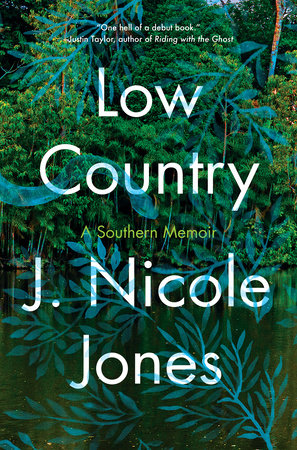
When I was writing my memoir, Low Country, I imagined it as a combination of the latter three. A story of an unusual girlhood in a place that I love, but that struggles with a violent history and uncertain future—the coast of South Carolina is as haunted as it is beautiful, and for good reason.
As I researched and wrote, I began to see my family’s own particular ghosts reflected in the hurricanes and folklore of the region, especially in the stories of my grandmother, who did what she could to hide the abuse she suffered at the hands of her husband. Even as my hometown of Myrtle Beach grew to welcome tourists from far and wide, the lives of the women in my family narrowed and faded away. I had to reconsider who I had been made by all of this history, and what I wanted to be. More and more, I turned to memoirs about family secrets not only for clues about how to approach my writing, but for comfort in the authors’ accounts of searching for unknowable answers.
In these seven memoirs, the authors untangle their family stories to find a place for themselves in history:
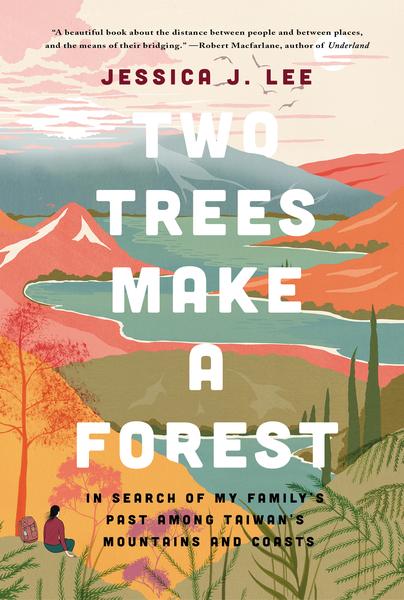
This memoir is nearly uncategorizable in the absolute best ways: part family saga and travel narrative, part nature writing and environmental history, part history of colonialism and the ensuing tragedies, part linguistic primer. A cache of autobiographical letters written by her grandfather, an immigrant from Taiwan, leads Lee to travel to Taipei and begin a search for his story. As she charts her family’s history, she is surrounded by the story of Taiwan and her family in China. Like so many family stories, the author is haunted by what’s been lost to history and time: people, places, language, all the potential selves contained in the infinite permutations thereof. Still, like a magic trick, it is forward-looking and optimistic. The prose is as lush and beautiful as the landscapes she hikes. Every paragraph is like picking up a natural treasure on a path: a shimmering shell, a fallen leaf, a beautiful flower.
Having grown up in New Jersey, the author begins with a childhood memory of her father introducing a photograph of unknown siblings. And that becomes the catalyst for retracing her paternal family in the South, while comparing her maternal family’s less-known journey. Jerkins’s search for her history and heritage becomes an inward journey, examining how the internalization of a “move forward and never look back” mentality shaped her, and what she missed by never looking back. She follows the “migratory routes of yesteryear” in writing that is compelling and propulsive, examining the traditions, anxieties, and lore that becomes history. I hope that this book replaces, or at the very least, supplements history books in classrooms across the country, but especially in the South.
J.R. Ackerley is most well-known for My Dog Tulip, a tribute to his beloved German shepherd (yet another memoir category: the life-with-a-dog memoir). This book is dedicated to Tulip, and I think of it almost as a prequel. His single-paragraph-long forward is a shrugging, mea culpa–lite that lays out the main dilemma of writing memoir more plainly than I’ve seen anywhere else: that of how to balance the unreliability of memory with the reality you’re searching for: “The apparently haphazard chronology of this memoir may need excuse. The excuse, I fear, is Art,” he warns.
Ackerley grew up in a modestly affluent English family, but upon his father’s death, he discovers that his father had a secret life and a second family. Ackerley must reexamine all the family history he took for granted, retracing memories of the father he thought he knew. Witty, self-deprecating, and confessional, a history that gets at the double lives we all live and the deceptive two faces of history: the real truth that is lost and what little we can ever truly recapture.
As a younger daughter of an impoverished aristocratic English family, Jessica Mitford must learn the family history propping up their country manor even as it falls to pieces around her in every sense, all while being in the unique position of watching her numerous older sisters create what has become one of the more infamous family histories of the era. Most famously, her sister Diana—a Helen of Troy-esque beauty, who was the brightest of the bright young things, until leaving her prominent husband for England’s most-renowned Fascist. Another sister declared herself in love with Hitler and shot herself. Another sister, Nancy, also among the cast of bright young things, becomes a famous writer. Jessica joins the Communist party and elopes with Winston Churchill’s nephew to fight in the Spanish Civil War. Ultimately, she becomes a footnote in 20th-history herself, emigrating to the U.S. and becoming a civil-rights activist and a journalist.
Reading anything by Dovlatov is the closest I’ve ever come to stepping in quicksand. The structure is wonderfully simple: with one exception, every chapter is centered around one family member. The literary aunt. The uncle in the red army. The cousin who can’t help himself. The family dog. The grandfather taken away and murdered in a labor camp. The exception is what’s become his most famous story, “The Colonel Says I Love You.” It’s about meeting his wife, and there are slightly differing accounts in The Suitcase and elsewhere, but that playfulness is what makes Dovlatov such a pleasure to spend time with. If there is a similarity between the sensibilities of Russian and Southern writing, that is it—the self-aware absurdity of mythologizing in real time on the page. There is a Netflix movie about Dovlatov that I’m too afraid to watch. If that’s not love, I don’t know what is… I defer to the colonel.
Like Dovlatov’s memoir, the structure of Broom’s is brilliantly and deceptively simple. It’s the story of her family as told through the history of her family’s house in New Orleans East. Reading feels like walking the halls, climbing the stairs, opening door after door looking for stories and secrets. One of the things I love about this book is the sense of extended family, and extended family history, that she connects in the lives of her neighbors and in the history of New Orleans. She describes how much of the interior of the house was left unfinished after her father’s death, and it feels as if her writing is an act of repair—before Hurricane Katrina. That a hurricane could change your whole life, could change your family history, is a fact I grew up with on the coast of South Carolina.
This extraordinary family-history memoir reads like a haunting, high-stakes detective story—Agatha Christie meets Stefan Zweig (both of whom wrote wonderful memoirs, as it happens). De Waal is an English ceramicist and artist, and this book is written in such elegance that it has the feel of one of the treasured heirlooms he writes about: his family, described as a wealthy Jewish banking dynasty, lost everything when the Nazis confiscated their property—except for a collection of small miniature sculptures. He begins to trace his family, the Ephrussi, from a patriarch in Odessa in the 1800s through expanding branches across Europe into the 20th century. The title of the book comes from their miniature sculptures, saved by a maid before the Nazis could take them, as they did everything else. De Waal describes making pottery with the same heartbreakingly fragility with which he handles his family’s stories. It creates a strange, unique tactile illusion of holding history itself in your hands.
“If I give you all of my recipes, you won’t have any reason to come home,” my mother used to joke.
It was a self-deprecating observation with a grain of truth. Food is home is family. But it took on a new meaning once my mother was diagnosed with cancer.
Michelle Zauner’s memoir, Crying in H Mart, recounts the abrupt and painful loss of her mother to cancer. Zauner, who also performs indie music under the name Japanese Breakfast, explores not only her grief, but her Korean American identity and how she reconnected with her roots through food. I read the book with a box of tissues by my side. For the first time, I fully connected the anticipatory grief I’d been hauling around with me—grief not only for my mother, but for the prospective loss of my connection to my Chinese culture.
The words that I could not bring myself to admit bubbled to the surface: I have been preparing for my mother’s death.
The words that I could not bring myself to admit bubbled to the surface: I have been preparing for my mother’s death. I do not want her to leave me without preserving what I can. Even though I know it is an impossible task, I am trying to protect myself against regret.
In October 2018, my mother was diagnosed with ductal carcinoma in situ (DCIS). I tried to mirror my parents’ calm demeanors as they broke the news to my sister and me over a laggy FaceTime video chat. They asked us to kindly hold our questions until the end, as if it was some conference call. They talked through the treatment options methodically, my mom flipping through a gigantic white binder they’d already started containing her medical records and test results.
In the grand scheme of things, DCIS—which is essentially stage 0 breast cancer—was the best possible outcome. It was caught in her routine mammogram and since it was localized, removing it via surgery had a high chance of success.
That FaceTime was a tactical call, one focused on immediate crisis management, so I didn’t cry. I could see how much preparation had gone into the agenda, and the desire to reassure us flickered across my dad’s face. But after, I dialed my partner and sobbed until all I could muster up were watery hiccups.
The hospital ended up having to push my mom’s surgery from before Christmas to after the new year. In the pre-operative check-ups, she was diagnosed with a rare blood cancer called polycythemia vera. Her overactive bone marrow made too many red blood cells, making her blood too thick and therefore too prone to clotting, especially during surgery. They had to do several phlebotomies in order to get her hematocrit—the percentage of red blood cells that make up the total blood volume—into a safe range.
I went with her once and marveled at how she barely winced as a nurse inserted a 16-gauge needle into her arm, roughly the same size of a pump used to blow up a soccer ball. They typically withdrew about half a wine bottle’s worth of blood, the bag sitting at our feet slowly filling up over the course of fifteen to 30 minutes like a dark red Capri-Sun. My mom joked that she could have a symbiotic relationship with a vampire.
Polycythemia vera is terminal, but the outlook for patients can be as long as 20 years if caught early and controlled with specific treatments. It felt like just when we had the tumor under control, we were now staring down the long barrel of an incurable disease. It has felt difficult for me to let these sit side by side in my head—“terminal” and “20 years.” Not immediate, but no longer the open-ended kind of life I had envisioned for her.
The few times I shared the news with friends, I felt bad about doing so because it wasn’t conventional grief.
I would be waiting on the subway platform, catching sight of a billboard that said Have you called your mother today? and I’d remember my mom had cancer. I went to work and tried my best to write code but suddenly publishing AMP articles seemed so dumb when my mom had cancer. When I caught up with people and they asked me how I was, I forced a smile and didn’t mention I was randomly bursting into tears every day because my mom had cancer. The few times I shared the news with friends, I felt bad about doing so because it wasn’t conventional grief. All I knew was that it was the refrain that haunted every moment.
But I didn’t know how to make space for it. I didn’t even know what to call it. I’d convince myself it wasn’t a big deal because she wasn’t actively dying. She had a treatment plan in place—regular phlebotomies and frequent blood work—and the outlook was good. Though 20 years wasn’t enough in my head, I knew we were fortunate. I felt trapped in this in-between space. Time, but not enough. Never enough.
It would take me until 2020 to learn the term “anticipatory grief” at a time when the whole world was thrown into this similar destabilizing state. It is the loss of safety, the feeling of uncertainty, and the mourning of lost futures. Because of the unknowability of what lies ahead, you start to conjure the worst outcomes.
Whether I realized it or not, these last few years I’ve been preparing for the worst. The way I’m attempting this is, like Michelle Zauner, to connect with my mother through food.
Crying in H Mart is also a food memoir filled with lovingly rendered images of piping hot jjigaes in earthenware cauldrons at grocery store food courts, refreshingly icy mul naengmyeon in a fancy restaurant in Seoul, and an assortment of homemade kimchi sitting in mason jars at various stages of fermentation in a small Brooklyn kitchen. As a second generation Asian American, I recognized myself in her descriptions of her adolescence and the sensation that one could “never be of both worlds.” Whether I’m in America or China, my belonging feels like something to prove. I related strongly to these descriptions of meals that were, above all, a means of easy, joyful cultural connection.
Although Zauner’s mother never taught her to cook, she nevertheless instilled a “Korean appetite,” which meant “reverence for good food and a predisposition to emotional eating.” My mother thought of Chinese food in a similar way. I initially shrugged off her attempts in high school to teach me how to cook, much preferring to scroll through Tumblr. Like Zauner, I always wondered why my white friends’ moms cooed over them when they got hurt, while my mother berated me as if “I had maliciously damaged her property.” Through my teenage years and then as an adult, her high expectations for me to take care of myself were often tested by food. “Emotional eating” took on a new meaning when I developed an eating disorder in college. At one point, my mom threatened to pull me out of school if I didn’t seek treatment. In her eyes, a successful treatment was synonymous with weight loss.
Whenever she tried to talk to me about therapy, I snapped at her because her judgment and disappointment was part of what made recovery both so important and so challenging. Our conversations would devolve into screaming matches because we were unable to find a common language to discuss this aspect of mental health. But after college, years of therapy, and repeated attempts at dialogue, I would come back to cooking, texting my mom from the grocery store and FaceTiming her over the stove. Food became a strong point of connection, but the tension between wanting to please my mother and to be immune to her judgment, good or bad, would linger.
What also struck me about the book was Zauner’s discussion of preservation. When talking about a potential trip to Jeju with her mother after her diagnosis, she suggests making a documentary of their time there. It is her “instinct to document,” but when she realizes she’s co-opting “something so vulnerable and personal and tragic for a creative artifact,” she feels ashamed. Yet later she calls her mother her “champion” and “archive.” There is the sobering acknowledgment that “knowledge left unrecorded died with her.” She begins learning to cook Korean food after her mother’s passing as a response to “the preservation of a culture that once felt so ingrained in me but now felt threatened.”
This tension around preservation is one I’ve also struggled with. I feel the impulse to document everything, but it clashes with the reflex of narrativizing my life through social media and how vulgar that can feel. Even though I’m not necessarily posting any of these pictures or videos, I worry that the act itself distances me from the experience, that I am so obsessed with documenting that I’m no longer present in the moment. But seeing Zauner wrestle with these similar messy feelings of shame helped me. Preservation can be the literal act of documentation. But it’s also asking questions and listening to stories. It’s sitting with a loved one’s words and letting them breathe.
Preservation can be the literal act of documentation. But it’s also asking questions and listening to stories.
In my camera roll, my mother teaches me to cut parchment paper like a snowflake to use in the bottom of a steamer. When narrating her technique for making egg rolls, her advice is to simply “fold it like a baby.” There’s the growth of our garlic shoots which we eat with scrambled eggs. I watch her chop hefty chunks of garlic, ginger, and green onions to be thrown into a wok with lobster. I note how many times she brushes baked chicken legs with a buttery soy honey glaze until they’re gleaming, reminding me of all the times we entertained guests with this dish as the centerpiece.
I stand by my mother’s shoulder as she cooks, taking notes on my phone while asking her for measurements even though just like Zauner’s mom, mine will also “disavow measurements and supply only cryptic instructions.”
Even though still she says that I have to keep tasting until the dish is ambiguously “right,” where she once refused even to provide estimations, she now obliges. I wonder if she knows why I’m doing these things, if it’s why she is willing to estimate teaspoons and convert portion sizes for me.
In several essays, Zauner learns recipes for various Korean dishes with the help of Korean cooking YouTube star Maangchi. She props up her laptop and follows the instructions for different types of comfort food. She makes steaming doenjang jjigae for her relatives after her mother’s funeral as a way of thanking them for their support. She makes jatjuk and finds that the plain porridge is the first thing to make her feel truly full. Each dish conjures the memory of her mother and nourishes her.
Over the last few years, I’ve been slowly trying my hand at recreating my own comfort food with my mom’s guidance and links to CCTV cooking segments. I worked my way up from relatively easy ones, like 鸡柳炒杏鲍菇 (chicken tenderloin with king trumpet mushrooms) and 醋溜白菜 (stir-fried napa cabbage in hot and sour vinegar) to more elaborate ones like 红烧肉 (red-braised pork). But by far the most intimidating thing was making dumplings from scratch.
Last Lunar New Year, I took the subway to Chinatown and filled an empty backpack with ingredients from Hong Kong Supermarket. I referred to the recipe my mom had given me over Christmas for the dumpling skins, pork and cabbage filling, and sauce. My finger hovered over my phone screen as I replayed the videos of my mother angling her cleaver through napa cabbage leaves to mince them and demonstrating how to mix the minced pork with a gloved hand moving clockwise. She narrated each step in a seamless blend of English and Chinese.
I used the dumpling seasoning she packed in my suitcase that she’d ordered from Yamibuy, waiting for the savory smell to emerge like she said it would. I frequently tasted the 蒜汁 (garlic dipping sauce), adjusting the levels of soy sauce, sesame oil, and zhenjiang vinegar until it matched my memory. I rolled out each dumpling wrapper, trying to apply pressure so that it would leave a bump in the middle to better support the filling.
Crying in H Mart made me realize how important it was to cook, to root myself in some form of action. Finally, here was something tangible I could do that wasn’t wallowing or weeping.
“像一个草帽,” my mother would say. “Like a little straw hat.”
Two of my friends came over and together, we folded dumplings, lining them up in neat rows on parchment paper to prevent sticking. There weren’t enough surfaces in my small apartment for all the trays. Even though the dough I’d made was too wet, the dumplings survived the boiling water without falling apart. (Luckily I’d also bought backup pre-made dumpling skins.) It felt strange assuming the roles that had previously only been reserved for my mother.
We sat down to eat the dumplings and miyeok guk, a Korean seaweed soup which my friend had prepared. The taste wasn’t exactly like home, but its familiarity filled me with a sense of pride and relief. This giant celebratory meal that always held a huge place in my mind now felt accessible in a new way. It was a taste of home and family, but was also a way of creating my own rituals and memories too.
Crying in H Mart made me realize how important it was to cook, to root myself in some form of action. Finally, here was something tangible I could do that wasn’t wallowing or weeping. Building muscle memory and a reference point for different tastes were ways I could hold onto my mom and by extension, my Chinese culture. In this limbo of anticipatory grief, there could also be joy.
After 2018, I started flying back to Atlanta more frequently, even if it was just for a weekend. My travel outfit was always a pair of Adidas sweatpants and a Japanese Breakfast sweater I got at her show at Brooklyn Steel in 2017. It has an illustration of a woman in a chair and around her are the lyrics: “you should try to do as little harm as you can to the woman that loves you.”
Every time I traveled back through airport security, I held my breath as my mom’s food was hand-checked by TSA agents. She always made sure I returned to New York with enough food to tide me over for a few days: a whole homemade beef shank, densely packed dumplings in tupperware, and red-braised pork that she sandwiched between layers of white rice so that the liquid would get soaked up and couldn’t be confiscated by security. Sometimes I also had salted duck eggs and packets of 榨菜 (pickled mustard root) in my suitcase, wedged between my rolled-up sweaters.
On one of these flights, a TSA agent gestured at my sweater as I stepped out of the body scanner, “Why does she have so many hands?”
I mumbled something about it being a band shirt and collected my things so I didn’t hold up the line. When I took a closer look, I realized that there were indeed four arms that I hadn’t ever noticed, but two of them were coming out of the chair the woman was sitting on. One enveloped the woman’s waist and another gripped her shoulder, as if comforting her.
I thought about how easy it was to take my mom for granted, that her arms would always be there to fall into.
The Japanese Breakfast song from which those lyrics come is about a toxic relationship, but when I looked at the sweater in isolation, I imagined the ghostly chair was the woman’s mother. I thought about how easy it was to take my mom for granted, that her arms would always be there to fall into. It reminded me that even though her perfectionist tendencies and high expectations could be grating, I couldn’t react like a pissy teenager anymore. I had to grow up and act like it. I blew up at my mom the easiest because we were so similar. I wanted to have the patience and understanding of an adult, not a child.
An obvious refrain around coping with anticipatory grief is to cherish the time you still have with people. But the Japanese Breakfast sweater would become my more realistic, more pitiful mantra: “you should try to do as little harm as you can to the woman that loves you.”
When the pandemic hit, I went back to Atlanta to be with my family. Living under one roof again as adults brought a lot of friction and frequent arguments. But every fight was now also laced with guilt.
One evening my mother and I got into a disagreement about scheduling. I encouraged her to get more consistent sleep, since she has a habit of revenge bedtime procrastination that makes her stay up until 6 am, but that only made her defensive. I came down to the kitchen and we regarded each other wearily, wondering if we would launch back into it or just continue to ignore each other. My mother had the Costco-sized egg container out on the counter.
“What are you doing?” I asked.
“Making 咸鸡蛋.”
Usually we bought preserved duck eggs that were vacuum-sealed from Great Wall Supermarket in Duluth, but it was always a treat when she made salted eggs at home. She began explaining each step, boiling water and salting it until you can’t stand the taste. We didn’t have enough regular salt, so we dipped into my sister’s fancy pink Himalayan salt. All my mother’s years of hoarding glass jars paid off and I stood on a stool to bring a selection of them out of the cupboards.
“Keep wide-mouthed jars,” she advised. Barilla jars? A little narrow but decent. Tostitos salsa jars? Shallow but a good width.
Once we filled each jar to the brim with salt water, we giggled at the eerie sight they made arranged on our kitchen counter. We joked that it looked like pink lemonade. If we were subtle about it, we thought we could prank my dad into drinking some. Unfortunately, we couldn’t contain ourselves and both my dad and sister quickly backed out of the kitchen at our conspiratorial grins.
We historically had a tendency to blow up, cool off, and then make some kind of wordless peace offering like a plate of sliced fruit or a cup of tea. I felt like we had reset once again over the salted eggs, but I wanted this time to be different. I didn’t want to take my mother’s forgiveness for granted.
The only way forward was to feel as much as we needed to, talking about it candidly over salted eggs.
As we waited for the brine to cool, I told her I was sorry. My mother paused as she wiped the counter, then waved her hand and brushed it off. I repeated my words and explained why I’d gotten so worked up over her sleep schedule. It wasn’t that her weird hours bothered me. It was that I’d read so many things about the importance of sleep in terms of health and building one’s immune system. I wanted my mother to have all the protection she could get.
Her face softened as I blurted this all out. Beyond asking for her hematocrit numbers and checking in on her doctor’s appointments, we hadn’t talked much about her illness. She pulled me into a hug and reassured me, “It’s okay. I’ll be okay.”
While reading Crying in H Mart, I tripped over the sentences of Zauner’s mother saying, “Gwaenchanh-a.” It’s okay. She wrote that her mother was “the only person in the world who could tell me that things would all work out somehow.” As my mom held me, I knew exactly what she meant.
I helped lug the jars down to the basement where they would sit for at least a month. The glass was still lukewarm from the brine. I let out a breath I hadn’t realized I’d been holding.
As difficult as it was to acknowledge the specter of death that loomed over us, it felt good to share it with my mother. Remaining silent and denying my own feelings wasn’t minimizing the harm I feared inflicting on her. The only way forward was to feel as much as we needed to, talking about it candidly over salted eggs. Perhaps that, too, could be a type of preservation.
That has been the difficult part about anticipatory grief. You spend so much of your time bracing yourself for death that you forget that in the meantime, you have to figure out how to live. Reading Crying in H Mart was an affirmation that love is “an instinct, a response roused by unplanned moments and small gestures, an inconvenience in someone else’s favor.” Preservation doesn’t mean staying stagnant, but creating new memories.
You spend so much of your time bracing yourself for death that you forget that in the meantime, you have to figure out how to live.
The book helped me come to terms with the cultural dimension of loss and the conflicting feelings that come with trying to preserve that culture. Perhaps it means resisting the urge to lace every moment with meaning while also trying to be more actively appreciative of them. To see this anticipatory grief as a guiding force, not a guilting one.
“The memories I had stored, I could not let fester,” Zauner writes. “Could not let trauma infiltrate and spread, to spoil and render them useless. They were moments to be tended. The culture we shared was active, effervescent in my gut and in my genes, and I had to seize it, foster it so it did not die in me. So that I could pass it on someday.”
I hold that passage with me now as I continue to cook with my mom or on my own. This Lunar New Year was the first one I’ve spent at home in eight years. My sister is now adept at filling and folding dumplings while I’ve continued practicing rolling out the wrappers. My movements are no longer clumsy and I enjoy losing myself in the rhythmic rolling motions.
“出徒了!” my mother complimented us. You’re no longer apprentices!
That we could now make dumplings ourselves was a bittersweet recognition.
To a point, I know I will never feel prepared for whatever will come of my mother’s illness. But I now embrace Chinese cooking as the best way to nurture my relationship with her. The culture we share is active and I will continue tending each moment we have together.
When I moved to Harlem in the summer of 2015, it was—and still is—in the midst of rapid change. Rent prices were skyrocketing, new cafes seem to emerge on every block, and the racial demographics were shifting.
As someone from a modest town in Southern New Jersey, my senses ran amok. Not only was I thinking about my vulnerabilities as a Black woman in a metropolis such as New York City, I was also thinking about cultural and physical displacement. There were times when I thought about who occupied the brownstone in which I lived for weeks on end, what secrets were safe kept within the walls and throughout the corridors. I thought about the larger context of Black people and our uprooting from place to place. From there, the seeds of Caul Baby began to take hold.
Caul Baby is a novel about a Harlem-based family of Black women who have created a lucrative enterprise off of selling their caul, an extra layer of skin that is believed to provide protection and healing. Their desperation to maintain their stake within this gentrifying neighborhood with the decisions they make towards their children put them at odds with not only each other, but also their neighborhood.
This story comprises of so much—a house that’s been in a family for decades, the downfall of a historical section of Detroit, and the haints that never leave us alone. Flournoy’s debut novel depicts a home that breathes along with its characters and teaches them the consequences of their dynamics with one another.
p.e. Moskowitz’s nonfiction book explores gentrification in some of America’s biggest cities—New York, New Orleans, Detroit, Seattle. Not only does Moskowitz expose the cracks of how gentrification has killed city life on the large scale, but they also give human portraits to show the ruin on an intimate, unforgettable level.
An insular novel, Red at the Bone grapples with the choices that our parents and grandparents make as history and community within a Brooklyn brownstone collide.
A biracial man returns from Europe to the Brotherly City of Love, Philadelphia, because his father left him a dilapidated mansion. He soon realizes that this home is haunted as he reckons with his own identity as it relates to Blackness.
A novel about return and reckoning, Coster’s debut centers on a woman coming home to a gentrifying Brooklyn where she gets a little too close to her wealthy white neighbors, with jaw-dropping consequences.
From the start of Survival Math, Jackson uses his lineage and family history to answer the siren calls of the past. Jackson renders Portland and its Black residents in all of their grandiosity while grappling with the impact of the city’s racist history.
This may seem like an outlier to the others but It Was All A Dream forced me to contend how much Black millennials have gotten the short end of the stick in terms of financial stability and long-term employment. The stakes for survival are much higher and the humanistic stories she reports on kept me glued to the page from cover to cover.
“Robinson Crusoe at the Waterpark” by Elizabeth McCracken
They had come to Galveston, the boy and his fathers, to look at the ocean and chaw on salt water taffy, but Galveston was solid November fog. As they drove down Seawall Boulevard, the Pleasure Pier emerged from the mist like a ghost ship: first the multicolored lights of the rollercoaster and Ferris wheel, then a billboard for a restaurant: BUBBA GUMP SHRIMP CO.
“Good God,” said Bruno, the older father, the old one. The sky was mild as a milk glass rabbit. He would have said this aloud but nobody else in the car would know what milk glass was. Instead he tried, “I hate the seaside. Where are we going?”
“You know where,” said Ernest, the younger father, who was driving.
Bruno had understood—when he fell in love with a young man, when they bought a house together, when he agreed to children (one child at least) —that his life would become narrower and deeper, fewer trips to Europe, more moments of surprising headlong love. He had never imagined that family life would mean this: a visit to an indoor German-themed waterpark in Galveston, Texas. The fog had done it. They were headed to a location called Schlitterbahn, where there was an artificial river, for their river-obsessed son.
“You’ll feel at home,” said Ernest consolingly. “Being German-themed yourself.”
“Darling, I’m German-flavored. German-scented. Only my mother.”
“A mother counts double,” said Ernest.
Bruno inclined his head toward their son—born to a surrogate, with an anonymous donor egg—in the backseat. They had forbidden him video games, so the boy had fallen in thrall to a pocket calculator, which he carried everywhere, calculating nothing: he could count, reliably, to 6. “Well,” Bruno said.
“I mean, your mother,” Ernest said. “Your particular mother.”
But that was something Bruno and their son had in common. Bruno had an adoptive German-born mother, and a presumably English biological mother who had left him at a public library in Nottingham, England. Not in the book deposit, as he liked to claim, but in the ladies room. In this way Bruno and the boy had the same mother: Anonymous. As in anthologies of poetry, she was the most prolific in human history. This particular Anonymous—Anonymous Nottingham—had left him behind like a beseeching letter to strangers; his parents had adopted him; his parents had divorced; his mother brought him to America. That was his provenance. He catalogued manuscripts for an auction house in Houston, other people’s beseeching letters, other people’s diaries. Provenance was everything, and nothing. The point was not to stay from whence you came, but to move along spectacularly and record every stop.
Still, he did hate the seaside. His beloved worked as a PR person for a technology company that specialized in something called Cloud Services, but Bruno was a person of paper, and the ocean was his enemy. The seaside turned books blowsy and loose. It threw sand everywhere. Its trashy restaurants left you blemished, oil-spotted. It drowned children, according to Bruno’s mother. She had few fears but drowning was one, and she had handed it down to her only son, like an ancestral christening gown that every generation was photographed in.
The fog made them drive slowly, as though not to break their car upon it. Down on the beach a wedding party walked towards them, bride, groom, six blue-clad bridesmaids, two men in tuxes, all of them overweight, one whippet-thin photographer walking backwards. In the lactic light they looked peculiarly buoyant on the sand. Above them, a line of large khaki birds flew parallel to the ocean, heads ducked to avoid the clouds.
“Pelicans!” said Ernest, then, in a hopeful, accusatory voice, “A wedding.”
“Pelicans?” said Bruno. “Surely not.” But there they were, single file and exact, military even, with the smug look of all pelicans. “Pelicans flock!”
“Well, sure,” said Ernest. “What did you think?”
“I thought they were freelancers,” said Bruno. “Pelicans!”
“They looked like brother and sister,” said Ernest, “the bride and her groom. Like salt and pepper shakers.”
“They did,” said Bruno.
The three people in the car, on the other hand, looked nothing alike, though strangers could tell they belonged together. Strangers were always trying to perform the spiritual arithmetic: the tall paunchy goateed near-senior citizen, the short hirsute broad-shouldered young man, the otherworldly child, who called now, from the back seat, in his thrillingly husky voice, his dreams filled with artificial rivers, “Schlitterbomb!”
“Bahn,” said Ernest, and Bruno said, “That’s right, darling, Schlitterbomb.”
Ernest and Bruno had not married, not legally and not, as Ernest would have liked, in a church, or in a friend’s backyard, or on a beach. Bruno did not believe in weddings, though he’d been married once, once for fifteen years, to a woman. He’d been the young husband then. Now when Ernest brought marriage up, Bruno said, “I’m an old hippie,” which was true insofar that he, unlike Ernest, had been alive in the 1960s and had done some drugs.
Why marry, after all. The boy stirring in the backseat was their marriage, even though, from the first, it was Ernest who had summoned him up, first as a dream and then as a plan and then as a to-do list. It was Ernest who wanted a child, and then specified a biological one, who found the donor egg, and the surrogate, and then offered what he thought was a compromise: they could mix their sperm together. “Oh God, how revolting,” said Bruno, and Ernest had pointed out gently that it wouldn’t be exactly the first time. “But not in a laboratory,” said Bruno, who ordinarily was the one with a sense of humor. And so the boy was Ernest’s child by blood, and Bruno’s by legal adoption. Ernest was Daddy and Bruno was Pop; Ernest believed in vows, Bruno in facts and deeds. The important fact was four years old. The fact was named Cody. The fact had never-cut red hair that hung to his shoulders and was so fair-skinned as to be combustible. Every day he was slathered in sunscreen; the first freckle would be a tragedy Ernest might never recover from. God knew when they’d manage a first haircut. When Cody and Bruno were out in the world together, they were generally taken for grandfather and granddaughter, and this thorough wrongness incensed Ernest, though Bruno had learned over the years not to take the mistakes of others too seriously, not when his own mistakes required so much analysis. He couldn’t explain to Ernest the real trouble with a wedding: Ernest’s shocking taste, which he, Bruno, would have to go along with, and smile, and declare himself happy. “I like peach,” Ernest would say, displaying a napkin. Or, “My family loves disco music.” Or, “We could have Beef Wellington.”
Once upon a time, Bruno had had opinions about everything—the politics of Eastern Europe, baby clothes, how airline stewardesses should comport themselves, interior decoration. Then: Ernest. Ernest, from a happy Cuban-American family, had grown up going to Disneyworld for vacations and watching sports on television and buying clothing in actual shopping malls. Ernest had quite the worst taste Bruno had ever encountered. Up-to-date, American taste. For instance: Bruno had never imagined that a person he loved could admire, never mind long for, the abomination that was an open-plan house. Proper houses had doors, had walls, had secrets. But as they watched real estate programs for tips on buying—neither had ever owned property, Ernest because he was young and Bruno because he was lazy—he was horrified to hear Ernest say, “Now see, that’s perfect. You can see everything from the kitchen.”
“Do you know who else likes to see everything from the kitchen?” Bruno asked. “The Devil. Hell is entirely without doors.”
“Heaven doesn’t need doors,” said Ernest.
Then Bruno had to remind himself that Ernest actually believed in heaven and hell, at least a little. So he said of the interior decorator on the television, “Look at that fool. I’m to trust him to arrange my furniture when he can’t even wear a hat at an appealing angle?” Look at that fool, yes, he thought to himself, of himself. That old fool would live in a panopticon, for love of Ernest.
Bruno had given up a lot for Ernest. He would not tolerate a wedding.
And so Bruno decided to treat his opinions like a childhood collection—decorative spoons, matchbooks—something comprehensive and useless. Put it all away, beneath the bed. Let Ernest decide; let Bruno feel superior. Now they owned a house in Houston, Texas, where when you walked in the front door you could see the kitchen, the dishes in the sink, the nook with the small offering to the gods that was the child’s breakfast: a stem end of baguette, split and spread with jam. The playroom, the backyard, all the ways you could bolt.
Bruno had given up a lot for Ernest. He would not tolerate a wedding.
Schlitterbahn was an enormous medical military arachnoid construction, candy-colored tube slides corkscrewing out of barracks. In the summer it was open to the air; in November, half the park was closed, and half covered against the weather. Bruno had looked up details on his phone; now he said aloud the fake German names in the most authentic German accent he could conjure, the voice of his mother. “Blastenhoff,” he said. “Wasserfest. Surfenburg.”
No matter what you renounced in this life, fate would provide the parody. At the Schlitterbahn box office they had to offer their wrists, and in a quiet ceremony they were braceleted, married to the park. The outdoor attractions—that was the word, attractions—were closed, but there were plenty of indoor attractions. “Most of my own attractions have been indoors,” said Bruno to the young officiant, a plump woman with calligraphed eyebrows, who brandished another bracelet and asked if they wanted splash cash. Do we, asked Bruno. Yes, said Ernest. He shifted Cody on his hip. The boy had already put on his orange goggles, and he rubbed like a robot cat against Ernest’s ear. “Honey, ouch,” said Ernest. “You take it, Gravy.” He stepped aside so that Bruno could offer his wrist to the young woman a second time.
“I’m a good swimmer,” the boy told her.
“Are you? That’s great!”
“Well,” said Bruno.
“I am,” the boy insisted. The rule of the household was to encourage, but Bruno wanted to say, No, sweetheart, you’re an awful swimmer. You suck. One of the things he hadn’t realized before having a child: how many ways there were to die of self-confidence.
In the locker room they crammed their clothing into a minuscule cubby. Only in a bathing suit did Ernest seem un-American: dark, furred, in a pair of unfashionably short but devastating red swim trunks, a 1960s movie idol from another country. Not a Frankie or a Bobby—a Francesco, a Roberto. “Handsome,” said Bruno, accusingly, but Ernest shook his head.
“Ah well,” said Bruno, and started to pull on his navy swimming shirt.
“You don’t need that,” said Ernest. “It’s all inside.”
“I need it,” said Bruno, touching his stomach. “What’s so German about this place? Apart from the nonsensical names?”
“I want a river,” said Cody, shivering in his lime green tights—ankle length, to protect him from the sun and cold both.
“And so you shall have one,” said Bruno.
Bruno took one hand, Ernest the other. They could feel the current flow through their little conductor.
One of the things he hadn’t realized before having a child: how many ways there were to die of self-confidence.
The boy and his rivers. At this, and only this, he was a prodigy. He was slow to walk, to talk, to eat solid food. He still wore a diaper at night, requested another diaper once a day to move his bowels, which he would only do in the kitchen, next to the cupboard with the lazy Susan. Bruno, according to his mother, had been entirely toilet-trained at one and a half, but Cody would be a kindergartener before the process was done. “It’s the sign of a genius,” said one of the mothers at preschool. “Coincidentally,” Bruno had answered, “also the sign of an idiot.” What the mother had meant was it could go either way, they were not yet at the fork in the road between gifted and special. But this mother had children who were toilet-trained at ordinary ages, who hit every milestone in excellent time. Modern parenthood: other parents examined your children for deficiencies so they could augur their own child’s future from your child’s psychic entrails.
They wandered down a plexiglass corridor, in and out of the warmth that fell from the overhead heatlamps. At a dead end a gothicky arrow captioned with gothicky letters pointed right, to something called Faust Und Furious.
“He was German, wasn’t he?” Ernest asked. “Faust?”
After a moment Bruno said, “Technically.”
Eventually they found a room filled with children and their parents, a pirate ship run aground in a shallow pool, hordes of insufficiently dressed humanity. The variety of swimming costumes! Chubby women in two-piece suits, middle-aged women in waterproof dresses, men in flowered trunks, speedos, ankle-length pants. And the navels: sinkholes, champagne corks, thumbprints. Bruno’s own belly button was inward; so was Ernest’s; the boy’s a little loveknot, a souvenir of the day he’d been delivered to them.
Children flew down slides and splash landed. Parents stood watching, or walked babies through the water, or lay on deck chairs as though sunbathing beneath the corrugated roof. Two lifeguards in pointless sunglasses wandered around mid-shin in the water, clutching long foam rescue devices to their abdomens.
The boy started to run in.
“Walking feet!” called Ernest. “Careful, honey.” He turned to Bruno. “Was this a terrible idea?”
“This was your idea.”
“We should get him a lifejacket.”
“It’s one foot of water.”
“You can drown in three inches.”
“I know all the ways you can drown,” said Bruno.
“Yes,” said Ernest, “I’m sorry.”
They looked back. The boy was already gone.
Dead, Bruno decided. He felt this any time he couldn’t locate Cody for more than a minute, even in games of hide-and-go-seek, when the boy wouldn’t answer his name: an absolute conviction that he was now looking for a corpse. This was something he had never told Ernest, who believed Bruno too laissez-faire to do any real parenting. Ernest was reasonable, logical, in his worry. He had a sense of proportion. For Bruno, there was nothing between uncertainty and catastrophe. That was his secret.
“Where is he,” he asked Ernest now.
“He’s somewhere—”
They ran sloshily through the water. Behind the pirate ship was a smaller slide shaped like a madcap gape-mouthed frog, and here they found the boy sliding down the frog’s great tongue. The goggles gave him the look of a scientist testing gravity.
They perched on the edge of the pool and watched the frog as it vomited toddlers. Toddlers, and Cody, who went up the steps along the frog’s spine and down its tongue as though practicing for later: that exactitude and joylessness. The air seemed made of screaming and flesh. Bruno was grateful for his swim shirt, which hid his gut. He had the urge to reach out with bent fingers and just brush the inside hem of Ernest’s swim trunks, imperceptibly, though it wouldn’t be imperceptible to Ernest, and Ernest wouldn’t approve.
He did it anyhow.
“Gravy,” said Ernest. But he hooked one pinky into Bruno’s Schlitterbahn bracelet and gave it a fond tug.
Then Cody was at their knees. “I want my river,” he said. “I want to tube on my river.”
“Of course,” said Bruno, and Cody smiled again. His teeth were even, loosely strung. Bruno had always been appalled by parents who lamented the passing of their children’s youth. If you could just keep them this age! And what would be the result? A child like a bound foot, a bonsai tree.
O Cody and his milk teeth: just a little longer, please.
The fact was Bruno was no better than anyone: he knew they’d got the best one. The best child, the most beautiful and distinct. The red hair out of nowhere, the ability to hail a waitress across a restaurant. The love of maps, and of birds, the obsession with Charlie Chaplin. The native slapstick. The way he liked to caress with his shoulders and the side of his head. His animal nature. Yes, he loved birds but he wanted to take them out of the sky, too. Sometimes Bruno worried that this was an inheritance from him, how they both wanted everything they loved twitching under the weight of one big paw.
A pair of double doors took them outside into the chill, where a heated pool spun steam from its surface as though it were the source of Galveston’s fog, on one side a swim-up bar advertising Bud Lite. A middle-aged woman sat on a half-sunk barstool and tipped blue fluid into her mouth from a statuesque glass.
“A bar,” said Ernest, in a voice of wonder, he who had given up bars for parenthood. (Bruno had given them up longer ago, for other reasons.)
“Have a drink,” Bruno said.
“Really?”
“Why not? We’re on vacation.”
They stepped, the three of them, into the slapping heat of the pool. The bartender was a young man with dark skin and dreadlocks, perhaps hired to match the island theme. He was dry, the bar itself a dam that kept back the water. “Under eighteen’s got to be on the other side,” he said in a Texan accent. He indicated a beaded rope stretched across the middle of the pool. “I’m sorry, guys,” he said.
“Oh well,” said Ernest, turning around.
“Sit,” said Bruno. “Shall we find the river, Code? While Daddy rests and has a drink.”
“Yes,” said Cody seriously, as though he’d been arguing this for hours.
“No,” said Ernest.
“Have a margarita,” said Bruno, who knew that to be granted permission was a kind of love for the long-partnered. Nothing major, not quitting your job to be an artist, not traveling solo for six months. A drink. Another slice of cake. An hour of foolish pleasure in bed with somebody else. The love of children was said to be unconditional, but it was nothing but conditions. I don’t love you anymore! Cody might shout, when refused more television, and Ernest—the disciplinarian and therefore the spurned—would say, You don’t mean it. But Bruno was a man of the world, Bruno could see that it was exactly true, just as in another hour it would be exactly false. That was the alarming thing about some people, how their love was like the beaded rope across the pool: the substance was continuous, but it was only the beads that kept it afloat. Some people could put love down and pick it back up and not know why your feelings were hurt by the loveless intervals, which in the end made no difference.
“Are you sure?” Ernest asked.
“What a nice grandpa!” said the lady at the bar. Her sunhat appeared, like its owner, intoxicated but doing its best.
“Not really,” said Bruno.
“I’m just being friendly,” the woman said, in a menacing voice.
“Me, too,” said Bruno. To Ernest, he said, “Sit and have a drink. For God’s sake, when were you last alone?”
Ernest took a seat around the corner from the woman, who swiveled on her stool to watch him pass. “I won’t know what to do with myself,” he said, and then shyly, gesturing at Bruno’s wrist, “you’ve got the money.”
“Of course!” He waded back into the pool. “Stay there, Cody.”
“Cold,” said Cody, and shivered dramatically. “Let’s go to the river.”
“You’re doing great,” Bruno said warmly. “Now, how does this work?”
The bartender took his wrist with a tender familiarity, a secret handshake, a pulse-taking. Just in case Bruno hadn’t caught his meaning, the bartender winked, in a cousinly way. He moved Bruno’s wrist past the register, which beeped.
“You could buy me a drink,” said the woman. Her glass was empty; her teeth were blue. “It’s Thanksgiving. It’s Thanksgiving tomorrow. I’m drunk.”
“I know,” said Bruno.
“Really?” said the woman.
“This isn’t, as I believe we say, my first rodeo. And for the lady.” He nodded at the bartender, but perhaps he only longed for another gentle handling of his wrist, the beep that acknowledged a transaction. There it was. “Magic!”
“There’s a transponder,” Ernest explained. “It keeps track.”
“Cloud services,” said Bruno.
“I don’t think so,” said the bartender.
“Cloud services,” said Bruno, more seriously, and Ernest said, “Yes.”
Back inside, around the corner, some poor soul in a dachshund costume talked—no, silently communed—with a tube-topped woman and her crewcutted preteen son. The dachshund costume wore a collar with a large round tag that said, Schatzie! Its mouth was open in a hideous permanent smile, filled in with a black net grill. Behind the grill glittered a pair of human eyes. Bruno tried to meet them. It was as misbegotten a creature as Hieronymus Bosch ever dreamt up. Bruno and Cody turned onto a bridge and looked over, and there it was: the river. Families floated along on single inner tubes, or on figure-eight shaped inner tubes built for two. In Texas, tube was a verb, meaning, to ride upon one. The chlorinated air smelled of infection being held just at bay.
“River,” said Cody.
The bridge led eventually to an artificial beach. The river was circular. On the right families pushed off on their journeys; on the left, they staggered out, pulling their inner tubes behind them. Bruno had the familiar sensation of having washed up himself on some shore, with no memory of his passage—not just how he got here, Schlitterbahn, Galveston, Texas, but his life, in which he lived with a man and had a child and loved both.
He found a double inner tube from a stack near the water, a doughnut on one side and on the other a ring with a plastic floor that said, BABY SEAT. MAX WEIGHT 25 POUNDS. He had no idea how much the boy weighed. That was Ernest’s department. Look at him, skinny thing, his ribcage an upturned rowboat. They waded in, and Bruno lifted Cody into the baby seat so he faced forward, could hold onto the handles on either side. They pushed out and the current took them. Bruno heaved his torso up and grabbed the tube on either side of the boy. They went around a corner, past a palm tree and a flotilla of fully dressed women in hijabs floating together.
He had the panicky, recurring feeling that he’d forgotten to remove his watch, but it was only the shackles of the waterpark around his wrists. Half the people in the artificial river were swimming it, a whirl of limbs, no vessels. Boys, mostly, of all ethnicities, pink and umber and tawny and brown and sienna. It seemed as though there’d been a shipment of boys, and their boat had crashed, and here were the survivors. The Raft of the Medusa at the Waterpark. There were a lot of them, shouting in petrifying pleasure at each other. The water got rougher. Bruno reached around Cody and grabbed the rings. “Are you all right?” No answer. He realized with alarm that this had been a rotten idea. Impossible to know how deep the water was. Deep enough to buffet them along. A baby seat? Who would take a baby on something like this? They ran over one of the swimming boys, who popped up choking, laughing.
Bruno knew all the ways you could drown because his mother had told him, and because of Eleanor, now ten years dead, his wife for fifteen years, Eleanor of the psychiatrists and misdiagnoses, Eleanor whom he loved as well as he’d ever imagined loving anyone, until he met Ernest, when he realized his essential trouble might also have been a question of extraordinary misdiagnosis, though he only had himself to blame.
Eleanor, had she been alive, would have made fun of Ernest, not because he was a man (which might have thrilled her) but because he was conventional. A terrible insult, from Eleanor. To not know Faust was the fiction and Goethe the German! They had never had children because she had a horror of a living thing inside her body, she said she couldn’t believe that modern science hadn’t figured out a less barbaric way to reproduce. One that might allow you to drink as much as you liked, for instance: the studies were just coming out, then, that suggested in utero alcohol was a bad idea. (So why, he imagined her saying now, surveying the Schlitterbahn crowds, did children ever since seem to be getting stupider?) She was the author of most of Bruno’s opinions. Holding them was his way of keeping her alive; not insisting on them was his way of doing the same for himself. She had started to lose her memory. Could be early Alzheimer’s, her doctor said, or arteriosclerosis, or more likely alcoholic insult to the brain, and Bruno hadn’t cared: you don’t worry about arson or faulty wiring till after the structure has fully burned to the ground. She’d died in the swimming pool at their apartment complex, drowned, full of vodka and Valium, she who’d once swum laps for an hour every morning. Maybe she’d forgotten how many she’d taken. Maybe she’d merely remembered the full measure of what she’d forgotten. You must have known, said Ernest, when they fell in love a year later, you knew all along about yourself, you liked men. Bruno could only say, I was waiting for you.
He and Eleanor had been married in a sad ritual. Her parents were dead; his mother, who was only ten years older than Eleanor, had hated her immediately. Eleanor had bought a white dress because Bruno had told her that his mother cared about such things. His mother had laughed in her face. “Well,” said Eleanor, afterwards, “we’ll never do that again, thank God.”
The current picked up. The banks of the river were made of tile. The palisades were tiled as well and studded with more bored lifeguards, standing like unemployed goats. He looked up and longed for the pelicans of the morning, their competence and precision. His biceps ached from holding on. He couldn’t see Cody’s face. At the next turn, a young park employee stood up to his waist in the crashing water. His job was to catch inner tubes as they threatened to bash into a wall, to send them in the right direction. How could so badly designed a thing exist at a place meant for children? Bruno paddled his feet. He wanted to avoid the guy, but instead they knocked right into him. “Sorry!” he shouted, and then they were shoved away, in the opposite direction, in front of the wave machine.
Now they were surrounded by loose boys and empty bobbing inner tubes. “Hold tight!” he commanded Cody as he heard a wave behind them. A woman in a neon pink swimming dress clung to a single inner tube. Clawed at it. They hadn’t seen this stretch of river from the bridge. Every few seconds some hidden mechanism slapped out a wave, which then lifted the flotsam—people, tubes, goggles, swim shoes—and dropped the flotsam, and smacked the flotsam on the head. Even artificial rivers are careless, Cody.
Survivors of the Whaleship Essex at the Waterpark. The Lusitania at the Waterpark. The Poseidon Adventure at the Waterpark.
He’d thought he hadn’t wanted children because Eleanor hadn’t wanted them. He hadn’t wanted them for that reason. Eleanor was already forty when they’d married, and she’d convinced herself she was too old. Perhaps he was too old, too, but here was his heartbreaker, screaming as they bounced along.
“Are you all right?”
The boy nodded the back of his head. You could hear the waves from the wave machine behind you before they lifted you up. That was good. They were just one turn from the beach. Now Bruno was holding Cody’s right wrist to the starboard handle of the inner tube. Every wave threatened to scupper them. What would happen then? Would it jolt a lifeguard into action? Would the boy be picked up by the passengers of another tube? Sucked into the filtration system? Bruno thought of Ernest drinking at the swim-up bar, Ernest who would never forgive himself, though he would forgive Bruno, and that would be the worst thing that could ever happen to either one of them. No, not the worst thing.
A bullying wave pushed the edge of their raft, tipped them, rushed overhead, and swept Cody away.
Above the river the burghers of Schlitterbahn saw the flash of pale flesh, the hair that streamed behind as though a cephalopodic defense, stay away. The last inhabitant of the lost city of Atlantis, washed into the waters of Torrent River—that was its name. A little boy, surrounded and then eclipsed by the bigger boys, the wild boys of the German-themed waterpark. “Look out!” shouted a blue-tongued woman from the bridge, but she was drunk, and already the other people doubted what they had seen, and besides, so what? Those feral boys would take him in. They never went home, those boys, they lived here, they circled and circled, howling and laughing and dreaming of home.
“Cody!” Bruno shouted. “Cody!”
The boys found the body and lifted it up, and then there was his own child’s stunned face, one hand out, and Bruno snagged it, and they were back in each other’s arms, bumping up onto the incline of the concrete beach. Cody coughed. He was alive. Not a lifeguard had shifted. They were surrounded by wild delight, shrieking, flesh, stove by a whale, but safe.
When they had staggered out—not onto dry land, there was nothing, nothing, nothing dry in all Schlitterbahn—Bruno realized that the water had stripped the swimming tights right off, that Cody now stood, naked, just as God had made him—though God hadn’t been anywhere near Cody’s conception, an event Ernest called a miracle. Quite the opposite, Bruno had thought. Ordinarily he hated God getting credit for Science’s good work. Yet here the boy was, the narrow naked awkward miracle.
“Jesus,” said a voice. A man, this new model they now made, tremendously fat from the hips up, an epidermic barrel, skinny as a kid from the hips down, such a precarious construction it hurt Bruno to look at him. “Cover that kid up!”
Their towels were back by the pirate ship. Bruno took off his shirt, and draped it over his son, to make him decent.
At the Wasserfest Bar, Ernest stirred the slush at the bottom of his drink. O Schlitterbahn! The freckled, the fat, the hairy, the veiny, the chubby girls in bikinis, the umbilically pierced, the expertly tattooed, the amateurishly scrawled on, the comely, the grotesque, all the Boolean overlap: Ernest thought he’d never felt so tender to the variety of human bodies. He loved them all. Every bathing suit was an act of bravery.
“Yes,” he said, to the bartender, whose name was Romeo, “I’d like another,” and there was his family: Bruno with water dripping from his beard, Cody wrapped in some black cape which he now flung off, saying, “Daddy! Daddy! I capsized! I capsized! I was saved!”
“You’re naked!”
“Naked!” said Cody.
“Marry me,” said Bruno, galumphing in.
DON’T MISS OUT
Sign up for our newsletter to get submission announcements and stay on top of our best work.
YOUR INBOX IS LIT
Enjoy strange, diverting work from The Commuter on Mondays, absorbing fiction from Recommended Reading on Wednesdays, and a roundup of our best work of the week on Fridays. Personalize your subscription preferences here.