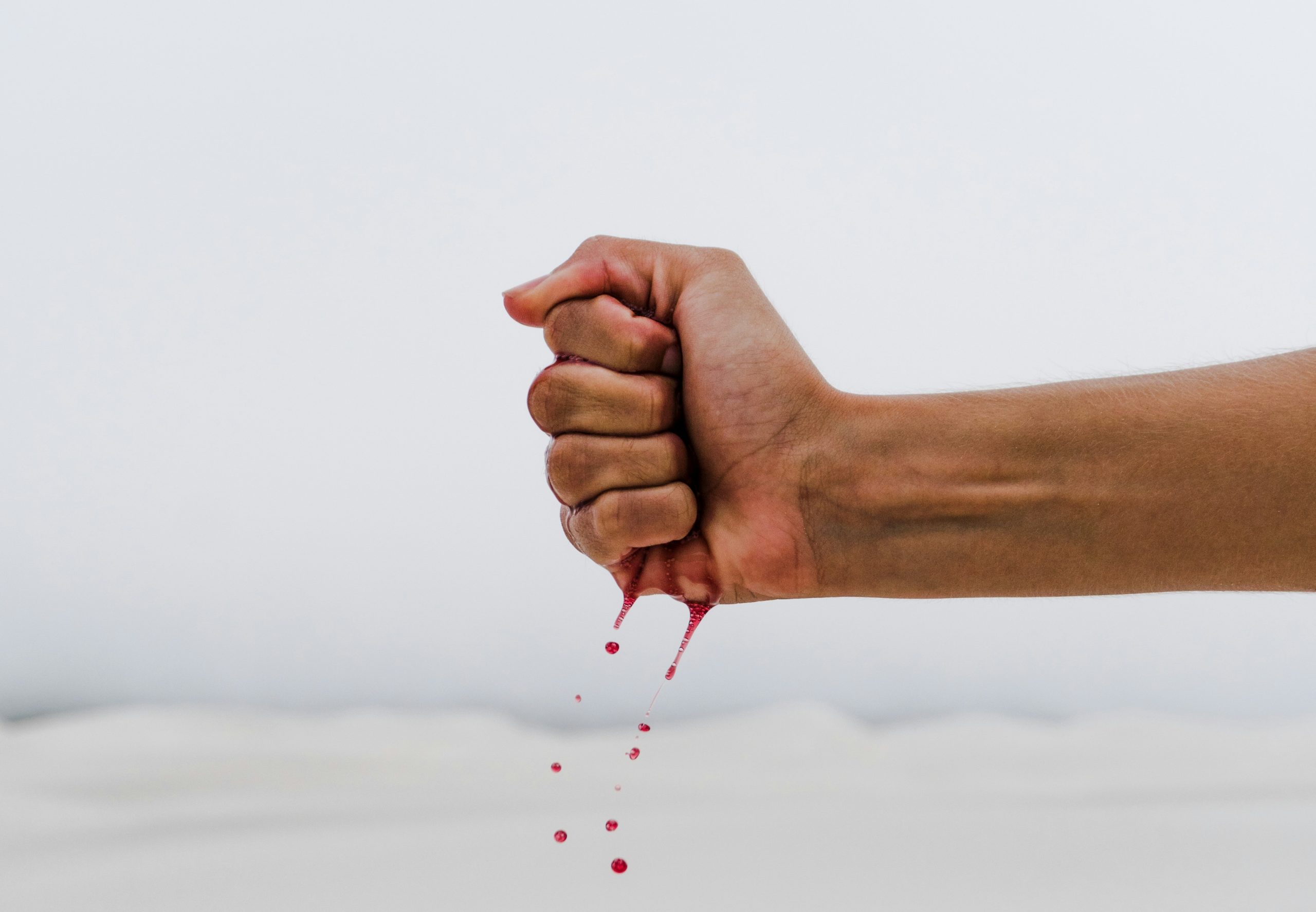
I.S. Jones is a writer I’ve long respected—her poetry, of course, with its immersive and enchanting qualities, but also her editorial eye and interview work in the series Legacy Suite, in which she speaks with early-career poets. Jones’s debut full-length collection, Bloodmercy—selectedby Nicole Sealey as the winner of the 2025 APR/Honickman First Book Prize—is captivating. From the very first line, “Violence is a failure of communication,” I was taken in by the possibility of poetry within such a direct statement. What solidified the work as one-of-a-kind was its propensity towards the grotesque, insisting on its relevance to girlhood.
Bloodmercy reimagines the story of Cain and Abel as sisters, a visceral chronicle of codependency and its consequences. Framed by a striking painting by Shawn Theodore of two Black girls with connected braids who do not look at each other, Jones’s lines never fail to discomfort and to transform. This is aptly captured in the poem “Sister’s Keeper” with the line “I peeled back my skin to unveil a body / Baba would find use in.” This understanding of the self through wound recurs throughout Bloodmercy. Speakers come to the reader in different registers, continually breathing new life into retold events. Jones deepens and complicates a long-known tale into a coming of age, a queer becoming, a processing of abuse, with reverence for the offerings of each player in the Biblical story.
Shortly after the release of Bloodmercy, I met with Jones over Zoom. She eagerly flipped through Bloodmercy as we spoke, quoting back earlier iterations of lines, building a strong genealogy of the work—each poem becoming as much of a journey off the page as they are already on it. We spoke about the grotesque, how she developed a voice for each of her characters, and the advantages of myth-making.
Summer Farah: Bloodmercy has now been out for over a week. How are you feeling?
I.S. Jones: I am feeling everything. I did not realize how emotionally demanding writing a book would be, even after? I always thought—erroneously, I realize—that the heaviest part would be finally getting the book out. When I got the paperback, for days I walked around with my book and just looked at it. From one editor to another, you understand: When you look at a book, you’re looking at one version that exists out of a thousand that didn’t. When I was almost done, I thought I had an ending, right? And then the book told me, no, this is not the ending that I want. Us artists, we’ve always had to claw and push to get the things that we need. I think I believed that once the book came out, I would have to do it a little less, and that’s not the case at all! It’s been a lot of relearning how to negotiate for myself. But also, learning to be perfectly fine walking away from the table if I have to. This book won a prize before it ended up winning the Honickman. I had only been sending it out for three months. I always assumed this would be a year and years, years, years long process. For it to happen so suddenly…When I was thinking about the life I wanted this book to have in the world, I thought to myself, I’m gonna do a big scary thing and pull the book from this prize. Summer, I was in shambles about it! Everything could have been different. I’m super fortunate to have had Elizabeth Scanlon as an editor, and to have the APR team behind me, which has been just so, so, so incredible and dreamy.
SF: I have been picking apart the implications of the opening line, “Violence is a failure of communication” so often since I first read it: violence as a result of failure, violence after communication, violence as a reaction. I like that the book begins with after. The first poem is titled “After the Offering Ritual”; it sets the book up to be a response, an aftermath in this failure. You mention the possible versions of this book, but I’m interested—what is this book the aftermath of?
ISJ: I love this question. It was important for me to capture [a reader] with the first line. A lot of poems that I love build tension very early on, either from the title or the first few lines. We, the audience, are made to feel like we’ve been entrusted with this very intimate moment. Because here’s the truth about human nature: Many of us like hot gossip, you feel me? We’ve been led into something that we weren’t supposed to see. It feels more evocative in that way. This book is heavily based on many movies that I love, that colored my interior world, [so] it was important that the opening poem felt cinematic. All the sections should be equally strong, everyone has different ideas about that, but, if you can’t hook them after the first section, most folks don’t have any incentive to read past that. So, the poems are shaped in that way to bring forth that sense of urgency. I grew up in the Celestial Church of Christ, and so I was trying at first to bring in artifacts from the church I grew up in.
SF: There’s a great payoff as a reader from the tension and discomfort in this book. You are so good with leaning into the grotesque. There’s the peeling of skin, the pulsing of the blood—it’s awesome. I love the cheekiness of the poem “A Lot of Blood But Not Much Mercy” that is quite literally about skin picking, and the undoing of the title through this opening of a wound. I’m interested in this impulse and propensity towards the grotesque—what are your influences in building that image?
Us artists, we’ve always had to claw and push to get the things that we need.
ISJ: I wanted to create a story of girlhood that mirrored my own, which was grotesque. I never killed live animals, but my mom taught me how to open up a chicken, to scoop out the innards. Same thing with fish, too. As I matured, I rejected the conventional expectations and totem poles of desire [of girlhood]—what I mean is that, I wasn’t interested in wearing mini skirts or dresses, or having purses. I hated purses. I wanted to learn how to build cars, and I wanted to have my hands in the dirt. My mom and I would garden together a lot, too. Rot is a large part of this book. I love rot in that it is a symbol of the inevitable aging of time, like, maggots come for us all, rot comes for us all.
There was a story, or a poem, that we read about a lynching my first year at The Watering Hole. This hideous, horrible thing to have lynched this body, but when the poem opened, it’s talking about the light, the early autumn light, and the crisp leaves underfoot, and the morning dew shining off of this recently deceased body. I thought about how marvelous, and how strange, and how delightful it is to find beauty in these places that one would assume would be devoid of beauty. I wanted to bring that to the book. There’s a delight I have in making language around the things that often bring us discomfort. Discomfort is not something that’s a deterrent for me. If anything, the things that make me the most uncomfortable is where the art-making for me begins. I also think about how the grotesque, at least in the context of this book, is a measure of survival. If I am the grotesque beast everyone believes I am, no one will try to hurt me. That way, grotesqueness is almost kind of like a shield.
SF: The joining of things is a major aspect of this book. It’s present in the cover and the title; the poem “Bloodmercy” has the melding of Cain and Abel into Cannibal, into Claimable, this sort of taking of, an adjoining and an ownership. I’m interested in how this phrase, “bloodmercy,” holds the book.
I wanted to create a story of girlhood that mirrored my own, which was grotesque.
ISJ: It feels woo-woo and prophetic, but it’s true that the book told me, this is my name. The name itself has kind of changed meanings. If we were to break down the word “mercy” by itself, it literally means divine gift, right? There’s an implication, etymologically, that mercy is something that only God could give. Blood, obviously, has multiple meanings to it, too, right? It means kinship; it can also mean history. When I think about the biblical implication of [blood], after Cain kills his brother, God says, your brother’s blood wails to me from the ground. Blood also means connection, and it means bond, but it is also a language on its own. What does it mean to always be bound to another person? Even families who maybe break contact still carry pieces of each other with them. No matter how much you might be in disharmony with your family, you are still of them, you know? Bloodmercy. In the book, it’s very clear that the sisters have a borderline codependent relationship. When I was thinking about how to differentiate the voices of Cain, Eve, and Abel, I was thinking about the three modes of poetry. Lyrical. Abel is narrative. Eve is dramatic. If we’re writing this same poem from Cain’s perspective, she’s gonna be rapping a little bit. If we’re writing this poem from Abel’s perspective, she has a lot to say, especially because, canonically, Abel does not have a voice in the original fable. I wanted a single word that evoked the suffocating nature of family. My enduring questions to God.
SF: Could you talk a little bit more about how you developed each speaker?
ISJ: Eve represents my adult womanhood. In the first two sections of the book where Cain and Abel are young girls, Eve interjects often in their sections. I [did that] because I wanted Eve evenly put throughout the book, so that way when we get to the end and we have her section, it doesn’t feel like it’s out of nowhere. There was [also] some connective tissue that was missing that I couldn’t yet see between Cain and Abel. I realized Eve is the crux of all the conflict between the sisters. I realized that that parallels my own life. None of the conflict, at least in Bloodmercy, happens without Eve, right? She’s the reason they’re banned from the Garden of Eden. She is the reason that the sisters repeatedly fight and triangulate, by her unintentional favoritism. By using Eve as the connective tissue, it helped me incorporate her, but also make those clear sections and make the voices different between Cain and Abel.
[With Cain], I wanted to have my childhood self move through this strange new world and make language around it. What is it like to watch the world quite literally form around you? Abel was really the hardest of the voices, because Abel’s only personality, canonically, is that he was martyred by his brother. We don’t know if he was an obnoxious little brother, even though I suspect that he was. Abel’s name quite literally means vapor. It means nothing. It means air. I thought about that immense loneliness. To be remembered as the sibling that got slaughtered. I wanted to take some of that second-born resentment and some of my own language around having been queer very young, but not yet having language for it. All the places where I wanted to negotiate my relationship to beauty, and to ugliness, and to labor, and to usefulness, all of that poured itself into Abel. I realized, oh my god, Abel’s gay! Oh my god, this little girl is gay, wow! It birthed some of my favorite poems in the book, too. What if Abel got to live long enough to see her childhood mistakes? What if Cain and Abel got to live long enough to be adults? I think, for me, that is more terrifying than the original version.
SF: The way you talk about building language as you come into awareness of the world reminds me of the poem “Juice or Milk”.
Myth seems to allow us permission to try to give ourselves a better story.
ISJ: “Juice or Milk” is the oldest story about myself that my mom tells me. A lot of this book, especially Section 1, is governed by my child logic. We would only pray in Yoruba, and so I thought, okay, obviously, we pray in Yoruba because that’s what the angels understand, and the angels send the prayers up to God. I wanted to, in a nostalgic way, capture the first few words I learned in Yoruba. It. Sometimes when people see non-English in a poem, they freak out. For a long time, I almost cut this poem because of that fear, but [I wanted] this book to have an almost home-movies vibe to it, like the intimate videos of someone’s childhood on a very old, grainy VHS. [“Juice or Milk”] is one of those core memories that are on the VHS in the back of my head. My parents would not teach me Yoruba as a child. In part, they were terrified of me having a thick African accent. My parents mostly spoke Yoruba [at home], so that’s what I spoke back to them. When I went to school, as my mom tells the story, during lunchtime, the teachers went around and asked all the kids, “Do you want juice or milk?” And then I said back, “Juice or milk?” Because I didn’t understand what they meant. They called my mom and said, “Hey, I don’t know what language you’re speaking to your child at home, but it’s really important that she learns English.” And so my parents stopped speaking to me in Yoruba after that. I think with most immigrant parents, because they want their child to have the best of everything, they seem to conflate the “best of everything” with being “as American as possible.” Those are not the same thing at all. But then also, my parents are more patriotic than me, and I get it. I didn’t have to labor for my citizenship; they did. Their relationship to America will always be different than mine.
SF: Could you talk about the role myth-making plays in processing these archetypical pressures of the eldest daughter, of womanhood, of specific visions for gender and sexuality, and on?
ISJ: If I imagine myself as Cain, which, technically, I am, I would want to ask my mother, “What was your life like before me?” She can’t say. I always imagined the land of Nod like Nigeria. Sometimes, this self-myth-making is a way of rewriting a history that both made me but had to come at a cost. I think about how there’s this whole part of my mother’s life that she will never tell me about. And poems, in some ways, are a way to make new space in that sort of darkness. Myth seems to allow us permission to try to give ourselves a better story.I think often about my mother in this book and about how she says things that my own mother would never say. But I remember when I had read an earlier version of some of these poems to her, she was really startled by how intensely I listened. When I think about myth-making, I also think about Zora Neale Hurston, as many women of my generation probably do, specifically about how much of her life was about archival work and record keeping. There are things that we have to pay attention to and keep track of. In the Bible, women were not trusted with record keeping. Women were not trusted with very integral parts of history. Even Peter’s hatin’ ass—in the non-canonical books of the Bible, Mary Magdalene was considered one of the apostles. Peter, who was a jealous hater, said to God, “God, you can’t let her be an apostle, you can’t trust her, she’s a woman.” Not like, oh, she did this and she’s a woman. Just, she can’t be trusted. I think about how powerful myth-making can be in that way, right? Not that we can bypass history, but myth-making gives us a new playing field with which to negotiate history upon.
Professor Fulton Mathis’s vehicular misadventure had been devastating for him, but the university had taken it in stride. As long as he could ensure that his duties would be completed with minimal accommodation, the administration would be more than happy to welcome him back to work. In exchange, the university would budget for a semester-to-semester research assistant who’d function more like a personal aid. It was also suggested—not unkindly—that he consider early retirement.
“Given the impressive scope of your professional achievements, I’d expect you to find great success on the lecture circuit,” the first research assistant, Kevin, read aloud to Mathis. It was an email from the dean. “Your precocious appointment to full professor last spring would also ensure a generous disability payout, should you choose to take that route.”
But Fulton was too busy taking in the sonic dimensions of Brodsky Hall to listen to Kevin, whose voice—still a bit reedy, though settling into its depth by the day—denoted a young man in the prime of his youth, the kind more inclined to be crushing opponents in beer pong than sitting through a philosophy lecture. Yet here he was, loping along next to Fulton in rubber-soled shoes with unthreaded laces whose plastic tips tapped the floor as they walked. Fulton regretted rushing his return to campus; if Kevin was to function as his “mobility aid,” then surely he should just refrain from motility altogether.
“Kevin, why did you apply for this job?”
Kevin paused his recitation mid-sentence. For some reason, this necessitated a pause in their walking as well: Fulton stood still, listening to Kevin breathe contemplatively through his mouth.
“I’m sorry, professor. Am I in trouble?”
“What? No. Of course not. I’m just curious.”
Kevin’s sigh was loud and a little fragrant. Fulton resisted a reflexive sigh of his own.
“I’ve never been, you know, the most academically gifted,” Kevin said. “But last year, I heard you on the Jack Render Show and I honestly had no idea that philosophy could apply to life like that. I actually switched my major because of you, Professor Mathis.”
Fulton nodded at the floor and made a noise like Mmh. This admission from a student like Kevin would have flattered Fulton in the past, even served as proof of the validity and far-reaching appeal of his message. But now he just winced at the memory of the “brain strength nootropics” Jack had paid him $2,000 to promote during his follow-up interview, and wondered if there was a young man alive who didn’t stream that podcast.
“So, when this opportunity came up—and I’m so sorry about your accident, professor—but yeah, when it came up I knew I needed to apply.”
Fulton made his affirmative noise again, having become so lost in thought that he’d barely noticed they’d resumed moving through space. Now, Kevin’s rubber plodding generated an echo far grander than its origins, as if the two of them had just shuffled underdressed and unshaven into a medieval basilica. Really, they’d arrived in Brodsky’s high-ceilinged auditorium: stately and uncarpeted, the largest on campus, and Fulton’s dedicated lecture home since the publication of Nonsense Autonomy. Not even fear of the Delta variant could keep students from filling the hall once they’d returned to in-person classes a few years ago. “It seems your flirtation with pop psychology may be the very thing that keeps this virus alive and mutating,” a jealous colleague had sneered at him. Fulton could have quipped back, but it would’ve been too easy: his colleague’s seminars on Jeremy Bentham hardly qualified as superspreader events.
“Here we are,” Kevin said. His voice had shifted into a minor key, the melancholic croak of a thwarted adolescent. “Do you need any help getting to the podium?”
Fulton knew this space better than any on campus. He relished the opportunity to let Kevin fall away, and with him any reminder of his own impairment. He gripped the edges of the podium and paid attention to the electric hum of energy in the room. Students greeted him as they walked past, spoke loudly about things they wanted him to overhear (what they’d read over break, how many of his YouTube videos they’d watched) and less loudly about things they didn’t (who was currently high, who was hooking up with who). His hearing wasn’t so much betteras varied: he cared more about what he heard now, which gave him the impression of hearing more than he had before. When his team of graduate teaching assistants had assembled, he made small talk with them, joked about his accident before they could try to console him over it, relished the opportunity to show up as their all-knowing, if slightly diminished, god. “If you’re going to fuck your life up, you might as well fuck it up to get famous,” Tatiana once said to him. Had she had any idea how prescient she’d been?
After the head TA introduced himself and Fulton and the bubbly chatter of the undergrads was silenced, Fulton began the class the way he always did in the Brodsky auditorium: “Tell me, which of you chose to come to class today?”
Chatter, giggling, a presumable show of hands. He pressed on. “And how many of you chose to take this class in the first place?”
Again, the chatter, the laughter. Fulton let it percolate for a moment, ignoring the head TA’s flutters behind him. “But surely none of you would claim that you’d chosen to be born?”
Now the auditorium was quiet, and Fulton dove in. This particular lecture was well-worn, an adumbrated version of the ninety-eight minute YouTube video that had been the first of his to go viral. The video was more of a rant than anything, its title eminently clickable: “Is Human Stupidity Proof of Freewill?” At first, the comments had been what he’d expected from modest viral fame: he was a pedant, he was a crank, he was saying something other academics were too chickenshit to say. But then had come the high-profile tweets—first from Joy Behar, whom he would never have guessed shared his interests in freewill and compatibilism, followed by another supposedly written by Oprah herself—and after that the praise, fast and strong like a fire hose pointed directly at his face. He was no more a saint than the next assistant professor (he wanted to negotiate an additional raise on top of his promotion; he wanted to stick it to Yale for cutting him loose pre-tenure), but no amount of vanity could make drinking from a fire hose possible. But he’d drunk, and he’d drowned. The affair with Tatiana would have been evidence enough of this, and yet things had turned out so much worse. “The uncoolest of all possible worlds,” as Tatiana liked to say.
But the undergrads couldn’t know the extent of his drowning. To them, this was yet another weird chapter in the life of Professor Fulton Mathis, a plot whose scope had rapidly expanded to accommodate the entire university. And that meant it had to involve more and more of their little lives, their half-formed ideas about books and art, their all-important grades and letters of recommendation. Fulton couldn’t let the enormity of his flagging brand stagger him, so he let the enormity of their youthful ignorance comfort him. The applause at the end of his lecture was no less robust than it had been before, and as the TA announced the homework and the students filtered out, thanking him as they left, Fulton turned to the hovering presence at his right shoulder with a smirk. “See how I can’t be vanquished, Kevin?” he almost said. But it wasn’t Kevin who stood at his side.
“That was wonderful.” It was a woman’s voice, deeper than a fawning girl’s and more even-keeled. “It’s such a treat to meet you in the flesh.”
The way she said in the flesh set the back of Fulton’s neck ablaze, something he would have much preferred to feel in private, though he’d be the first to admit that there was a certain eroticism to public exposure. He stuck his hand out into the void; a soft and slender feminine one received it. He suppressed a shiver.
“I’m sorry, I’m not sure we’ve met. Are you a student here?”
“I’m just auditing,” said the woman’s voice. “Artie. Short for Artemis, of all things.”
Fulton arched his eyebrows, smiling. “A huntress,” he said.
She laughed. “Maybe. I think of myself more as a single mom who wants to funnel her alimony into a humanities degree.”
“So the opposite of a huntress,” Fulton quipped, immediately regretting it. “I’m sorry. That was stupid of me.”
“No, it isn’t. It’s honest.” Self-deprecating laughter, then the breathy sigh of a beautiful person. He ought to punish himself for making a joke at her expense. “I know it’s foolish, but I’ve always loved philosophy. Not more than my son, of course, and he didn’t choose to interrupt my degree.”
“Then let me choose to be less of an ass,” Fulton said. “Again, I’m sorry. I’m so glad to have you here. I’m positive the students feel the same. Frankly, I find what you’re doing inspirational.”
“You think so?”
Her voice was silken, her question unashamed. No self-conscious avoidance of “vocal fry,” no obvious hesitation over appearances. Here they were: an adult man in conversation with an adult woman who had no qualms revealing the approval-seeking girl inside of her. It was hot, and perhaps she meant it to be. Or perhaps she didn’t. But for Fulton to leave the possibility unacknowledged would be a missed opportunity.
“I know so,” he said. “And my office door is open to you anytime. Really.”
“Well, you’ve certainly been busy for a philosophy professor,” Jack had said during Fulton’s first appearance on the podcast five years ago. “Aren’t you guys supposed to be in ivory towers writing jargon-filled papers no one reads?”
“I suppose so,” Fulton responded. He hadn’t had to force his laugh: the whole situation was so ridiculously surreal, such a delightful fuck-you to the academic middle class and its laughable pieties, the dissertation advisors who would have preferred he stayed a spineless peon trapped in shame spirals for the rest of his career. “I mean, I used to do all that. But I got tired of being forgettable.”
At this, Jack slapped the table between them and brayed his hoarse, muscular laugh. “That’s definitely not your problem anymore, is it?”
Not then it wasn’t. But a decade before, Fulton had been another fifth-year PhD student casting around for a dissertation topic. He wanted to be an ethicist, so he chose to write about freewill and determinism, the equivalent of wanting to become a chef and “specializing” in cheese. The topic’s too broad, his friends told him. That field’s too well-trod for a PhD candidate to say anything worth getting hired about, his advisor had chuckled.
But what none of them had counted on was Fulton’s need. Not just for a job, but for humans to have freewill. So potent was this need that he dug up a dusty old folio at his institution’s library in which were stuffed the letters of a virtually unknown philosopher, a contemporary of William James and John Dewey whose single contribution to the field had been to argue that our actions physically shape the world around us. The philosopher—Cassius Artemé-Feti was his oddly memorable name—hadn’t been saying anything terribly original, aside from a small footnote in which he suggested that “such creative capacity may be the basis for an inductive proof of freewill.” Fulton took this footnote and ran with it.
The ability to effect a material difference in the world through sheer force of will, in addition to the variety of nonsensical conflicts arising from these differences, is proof not only that we act of our own free will but irrationally so, he’d begun his dissertation. During office hours, Fulton’s advisor handed him the first chapter back with a sour expression. The papers were curiously empty of his jagged pen marks.
“It’s too risky,” he’d said. “Fly-by-night. Specious.”
It’s too original, Fulton translated in his head. Clearly written. A breakthrough. His subsequent hiring at Yale confirmed this.
Fulton was a philosopher and not a novelist precisely because he didn’t want to be on the hook to anyone for an explanation of his interests. He found it a strange and somewhat prurient thing, broadcasting to the world the details of one’s life, especially under the unconvincing veil of “fiction.” Had Fulton written a novel instead of that dissertation, it might have been about a thirty-two-year-old philosophy PhD with an impressive CV hired to an Ivy League university, and how that young professor’s sex addiction was fed by hours of porn consumption, and that porn consumption was fueled by dopamine-seeking fueled by the same sense of self-loathing that had likely made him want to get a philosophy PhD in the first place. The character would be named something other than Fulton Mathis, something asinine like Scott or Louis. At the beginning of the book, Scott-or-Louis would swear up and down that he was a great respecter of women, would go on normal dates filled with normal banter and ending in pleasant sex. When the date dressed to leave, she’d give him a peck on the cheek and say, “We should do this again.” Scott-or-Louis would agree enthusiastically, see her out the front door, and then hurry back inside to his office, where he’d strip off his pants and flip open his laptop to watch videos of women being choked and gagged and jabbed and ejaculated-upon. Women dressed to appear very young being assaulted by vile, brawny men and screaming how much they wanted it so bad before their assailants muffled their screams with pillows. Women being gang-banged and “forced to submit” (always the men’s words), women being fetishized and humiliated in every conceivable manner, women being kidnapped and handcuffed and trafficked (THIS IS A SIMULATION, read the title cards at the beginning of these videos, a phrase Scott-or-Louis might repeat to himself like a mantra), women being degraded on the basis of their race or sexuality or ability. The worst of the worst, for hours at a time, the Scott-or-Louis’s grip on reality slipping, his self-loathing increasing with every tortured shudder and soiled Kleenex. Papers ungraded, articles unwritten, faculty meetings missed.
The resolution to this novel would come not from Scott-or-Louis “safely and responsibly” living out his fetishes, as many an online forum member encouraged him to do, but from the application of his analytical skill to the problem of his desire. If he could prove his desires to be something other than brute facts—i.e. things that were inherently, unavoidably, a priori true about him—but choices he was making, however subconsciously, then perhaps he could will himself to choose differently.
In real life, Fulton couldn’t make these choices fast enough. One too many meetings missed, email chains un-replied to, parties unattended. He published his dissertation and then another book, a largely unread monograph about the life of Artemé-Feti, but it made no difference. Too much gooning, as the students would say, and not enough ass-kissing. He was denied tenure. “Of course, you’ve worked at Yale,” the department chair said with a razor-sharp grin. “So you ought to have no trouble getting hired elsewhere.”
It was a noxious thing to say—in the academy’s illustrious past, scholars had threatened bodily harm over much less—but it wasn’t untrue. Fulton was snapped up with tenure by a well-funded state school after just a few months on the market. The salary was generous and the hiring committee obsequious, but he missed the pleasure of teaching so many unrealized versions of himself. Also, his laptop was a wreck of m-preg and bukkake videos. He had made no progress towards claiming his agency. He feared addiction and compulsion were the best and only models for human volition. Addiction to God, compulsion to confess. Addiction to history, compulsion to revolutionize. Addiction to tits, compulsion to film oneself wearing a silicone rack and sending it to open-minded women on kink sites whom his r/NoFap interlocutors noxiously termed “like-minded community.”
There’s a Nietzsche quote about needing chaos in oneself to give birth to a dying star, a quote Fulton might have remembered had he not been busy going full nihilist-Superman less than a year into his second job. Sex with grad students. Sex with one undergrad, then another and another. One of them published an alternately scathing and adoring LiveJournal post about him and then swiftly deleted it; another left to “visit her grandma” after a semester and never came back. Glasses of gin, palmfuls of Adderall, night-long Pornhub binges: Eiffel tower; spit on dick; spit roast whores; workplace orgy; workplace abduction forced orgasm; DD/LG Thanksgiving; Mormon threesome; Mormon abduction; sissified bimbo bitch; castration sissy hypno; big ass hentai teen. For this state of affairs, he could’ve blamed the not-Yale-ness of his surroundings, the devaluation of reading among his students, the general decline of the humanities, the vitiation of liberal democracy, the obvious failure of the American experiment. But these things only further robbed him of his agency. In a just and free universe, the kind of universe Fulton actually wanted to live in, who else ought to shoulder the blame but himself?
It was in this mood that he began speaking truth to power on YouTube, decrying not his own content consumption habits but the state of political discourse and the “cultural chaos” that had taken grip over America: “We’re living in rubble, but there’s one good thing we can surmise from that fact. We made the rubble, which means we get to change it.”
By the time the Mischievous Will was under contract, he was a bestselling writer in several languages, a guest on popular podcasts and a wearer of bespoke suits. The university was struggling to keep him. And while fame didn’t cure his obsessions, he was happy to find it transformed them. The grimy laptop stayed closed, his home office unoccupied. In their place: well-compensated speaking engagements, multi-city book tours, over a million YouTube subscribers. No more student affairs or sex dungeons: such things struck him as boorish and adolescent, especially given the caliber of woman now available to him. Women who were themselves famous and influential, who brought up the chapters on sexual indiscretion in his books over drinks after his speaking engagements, who told him with knowing smirks that his research corroborated their lived experiences. Women highly adult and adventurous in ways he’d always dreamed of being. Women like Tatiana.
Tatiana Abramov was a decade older than Fulton and held an endowed chair at a prestigious university where she’d rubbed shoulders with many of his heroes. In fact, she was one of his heroes, a rockstar scholar of ancient philosophy who required all her PhD students to learn ancient Greek and then take her seminar on Plato’s Republic in the dead language. She and Fulton met at a sold-out event at her institution during which he wore a headset mic and shared with a young and restless crowd his Six Ideas About God and Authoritarianism. She’d just been profiled in the New Yorker, a story about how her ex-husband (and ongoing colleague) currently lived in the garden apartment beneath the house she now shared with a twenty-seven-year-old woman and a rotating cast of sexually available young idealists. Fulton had read the profile with a kind of sweltering thrill, and then dutifully purchased a copy of her latest book, The Ethicist’s Non-Monogamy.
When he saw Tatiana in the signing line, he thrilled again. She set both his books down in front of him, smiling demurely.
“If you could make both out to T-A-T—”
“I know who you are,” Fulton interrupted her. “What kind of philosopherwould I be if I didn’t know your name?”
Fame, or at least its implication, is a powerful seduction tool, one that worked both ways for Fulton. He signed her copy of his book, and she signed his copy of hers. Then they left the grad students to clean up the auditorium while they had dinner together, which became drinks, which became more drinks and two blunts with Tatiana’s wraithlike Czech girlfriend as Tatiana’s ex-husband watched what sounded like an episode of Home Improvement in the garden apartment. Then came the sex: first with the girlfriend, whom Tatiana referred to as “my little Soviet satellite,” and then without her (though not without the double-wide swing). Fulton missed his flight back home. Instead, he rented a car and drove five hours, arriving back just forty minutes before the start of his Monday seminar. Luckily, he didn’t check his phone until after he’d taught, because he had ten texts from Tatiana and none of them could be safely viewed in his place of work.
This cycle—the heated texts, the driving, the sex—repeated itself about once a month, sometimes twice if he was desperate, for a year. Fulton found himself both ferociously consumed by the intensity of it (a feeling he quite liked) and, perhaps stupidly, falling in love. Tatiana had assured him that she was a total relationship anarchist, meaning that she had no primary partner and placed no limit on the amount of partners she maintained nor the feelings she allowed herself to develop for them. But even then Fulton couldn’t quite ascertain his place in her web of connections. Would it throw a wrench in things to tell Tatiana that he loved her? Or would she say it back?
Towards the end of a particularly lusty summer, Fulton packed among the paddles and gags in his overnight bag a handwritten note in which he confessed his love for Tatiana.
Towards the end of a particularly lusty summer, Fulton packed among the paddles and gags in his overnight bag a handwritten note in which he confessed his love for Tatiana, his delicious obsession with her body and mind, and vowed to resolve the distance between them. He could wrangle a lectureship at her university, in her department, where they could duck into storage closets and empty offices after faculty meetings.
When he arrived at Tatiana’s brownstone, it was to find her at the kitchen table toggling between her phone, a lit joint, and a bottle of vodka. Her hair was unwashed, and she wore sweatpants and a faded sweatshirt that read BROWN CREW across the chest. Fulton set his bag down, and zipped his letter into the front pocket.
“It’s a travesty,” she said without looking up.
“What is?”
He sat down across from her and made to rub her back, but she shrugged him away.
“The foolish little satellite has broken off the mother ship.” She took a long, crackling inhale from the joint and then passed it to Fulton, who followed suit. “She says I’m bad for her. She’s gone to live with some pigheaded physics student.”
Fulton chuckled. “They’re all like magpies, aren’t they?”
Tatiana glared at him, eyes flinty even as they were filling with tears, and he realized he’d said the wrong thing.
“I love her, Fulton,” she said. “I left my husband for her. I gave her this.” She gestured to the exposed brick walls of the kitchen they were sitting in. “And for what? Little brat pisses it all away.”
I would make such better use of it, Fulton thought, but knew better than to say. “I hate to see you hurting,” he said instead. “What would make this better?”
Tatiana told him she needed a moment to consider. During this moment, they each consumed two shots of vodka and finished the joint.
“I want her back,” she said at last. “I want to go to that stupid apartment building and knock on her door and tell her to come out right now, because I love her.”
Fulton was pouring another shot. “A display of affection. Like in Say Anything.”
“What?”
“An American film, made during the perestroika years. But I’m saying yes, I know what you mean.”
He did his shot, and then poured her one, after which she looked at him giddily. “And perhaps we can say to her that we’re a package deal? That Fulton Mathis is joining our polycule” —she pronounced it pollicool— “and so she’s with you as much as she is with me?”
Fulton flushed and nodded. He was very pleased.
Tatiana clapped her hands together and fished her phone out of the pocket of her sweatpants. Fulton poured them each a final shot, listening as Tatiana said, “Hello? Melkiy satellite? Well, I’m glad you answered, because we’ll be over in the next fifteen minutes.” The girl was still making distressed noises as Tatiana hung up.
“Come on,” she said to Fulton. “We’ll take my car.”
Fulton understood then that he had a choice to make. He could have told Tatiana that she was drunk, and that that they ought to give up on the girl and stay home together. He could have begun kissing her, pulled off her sweatshirt and distracted her with the equipment in the overnight bag. He could have told her that he was drunk, and that she could do what she wanted but he would stay put, perhaps have a shower and a nap so he’d be fresh for her return. But maddeningly, none of these options presented themselves to him. Not as a mounting anxiety that cut through his intoxication, nor a nagging suspicion that there was something better he ought to be doing.
Instead he looked on in a state of dreamy hypnosis as the future folded itself into the present, feeling for all the world like he was watching a celebrity chef fold cheese into a soufflé instead of standing by as the greatest mistake of his life unspooled before him. By the time he’d decided to accompany Tatiana to her girlfriend’s house, he was already getting into her car. By the time he’d plugged the girl’s coordinates into his GPS, they were already knocking on her flimsy door. And then the girl had emerged onto the fire escape, her sweaty and shirtless beau behind her, and both of them were shouting that this had to stop, that they were going to call the cops. Tatiana stamped her foot, her rail-thin body quivering, and shouted back in a Slavic language only the girl could understand.
Should Fulton have said something? Done something? Of course. But could he? Debatable. These events seemed to be happening before he understood himself as part of them. Therapists would subsequently describe this as trauma and dissociation to him; he would describe it as unmitigated freewill and incoherent compulsion back to them. And it wasn’t until he and Tatiana were back in her BMW and she was hurling foreign-language insults out the window that the lag between the recent events of his life and his consciousness of them began to bother him. It would have been helpful, for instance, to know that Tatiana was turning the wrong way onto a one-way street instead of dimly realizing that she’d done it sometime before fishing for her phone, which he could see ringing persistently from the floorboard. It seemed an eternity after Fulton apprehended all this that he finally began saying, “Look up! Jesus Christ, look up!” But she didn’t. Instead: a mighty crack and a great spray of metal and glass and Tatiana’s voice distant, fading, vanished. And then Fulton saw nothing at all.
Of course Artie was the first to come to Fulton’s office hours. She wanted to meet outside of class regularly. He barely held office hours anymore—his TAs took care of all the administrative busywork of running a class for him—but now he informed Kevin that he wanted to be on campus at least three times a week, drafting the coltish young man into an arcane conflict. You know, they’ll put me out to pasture if I don’t make an effort to show my face around Brodsky as much as I can. Never mind that it wouldn’t be a few missed office hours that the university could use as justification for forcing Fulton into early retirement: if they really wanted to quarter his handsome salary, they could cite the dwindling speaking engagements, the stalled publication record, the fading-from-relevance, and then put him on “extended medical leave” until he died.
So Kevin arranged with his other (very irritated) professors to leave class early or arrive at class late so hecould unlock Fulton’s office door and then retrieve Fulton from his rideshare, after which Fulton sent Kevin to heavy-breathe in the hallway so he could have the pleasure of thrilling to Artie’s feather-light steps alone. Her greeting, “So good to see you, Professor Mathis!”, then a series of little scuffs against the hardwood: she must have been wearing ballet flats. Fulton was not so old that he hadn’t known plenty of women in his own generation who’d worn them; he’d just missed being an “elder millennial” by a handful of years, a fact he never would have known had Artie not told him. Apparently, she was only a decade his junior.
“Having a kid in your twenties ages you, I don’t care what they say,” she said with a laugh.
“But surely there are advantages to being a young mom, like having more energy?”
That glittering laugh again. He could see its contrails on the insides of his eyelids.
“Energy is about the only thing I still have going for me, against all odds. That and my looks.”
There it was: his helpless surge of arousal. She spoke like they lived in a different time and place. And most alluringly, she only did this when his door was completely closed. Then they were sealed off together, in a fish tank or a dreamworld, someplace unimpregnable and free of judgment. He asked her about her academic interests and she told him about the abandoned graduate degree, the dissertation-that-almost-was. After that, their conversations slipped into an easy intimacy: her divorce, his accident, the pitfalls of single motherhood, the academy’s bluster.
“I feel like people don’t take me as seriously as they should with all the makeup I wear, but I can’t help it, I love wearing it,” she said.
“I don’t know if this is weird of me to say, but I don’t want Joey to have any frail men in his life. Just decisive, strong ones. Smart ones. Of course you know the type,” she said.
“It took four years after the divorce until I finally felt liberated enough to start sleeping around. Is that a normal timeline?” she asked.
He was impressed with her that he hadn’t needed to solicit these statements, and with himself for not asking her to elaborate on any of them. Instead, he pushed breathlessly past each surge of arousal to professional matters, enjoying the game he was sure she was playing.
“Tell me about your academic interests,” he said. “I would love to help you return to dissertation work.”
Artie was ambitious, he was delighted to find. She wasted barely any breath on being deferential —So sweet of you, with your busy schedule!—and dove right in: she was interested in consequentialism. The best indicator of an action’s moral goodness was its outcome, she believed, and she wanted her research to concern outcomes. What was a “good” outcome, and who was its beneficiary? Could an immoral act be justified if its outcome were deemed “good” enough, as in utilitarianism? Was it better to measure outcomes on an individual basis, or could a standard code of conduct be inferred from a large sample size of acts and outcomes?
“Watch out, Kant,” Fulton joked. “The huntress is coming for your metaphysics of morals!”
When their dynamic turned overtly sexual, it took even Fulton by surprise. Artie said, “Do you think I have a shot of getting into the PhD program?” and put her hand on his knee.
“Any PhD program would be insane not to let you in,” he breathed, and twitched as she walked her fingers up his inseam. “We’d be very lucky to have you.”
“You don’t read the applications, right? So you could help me with mine?”
So charming that she was concerned with conflicts of interest even as she pressed her hand into his crotch. So sweet of her to think that even if he could read PhD applications, he still would.
He called Kevin in to tell him that office hours were over. Artie here was applying to the PhD program, and Fulton needed to help her get her application started over lunch. Silently, without so much as a mouth-breath, Kevin held open the office door and then locked it behind them.
“Should we get takeout?” Fulton asked as she led him to her car. He could have proposed going straight to bed, but maintaining the façade of gentlemanliness meant maintaining the façade of lunch.
“We should,” she said, which surprised him. “From the new Thai place. And let’s get wine.”
Had his life ever been this easy? Had he really lost so much, if this is what he gained? He felt as if he were living in a dream. Wine poured, pad see ew steaming, her knee kept brushing against his, her laughter like a windchime stirred by his humor and insight. Then there was her hand on his thigh again, her plate pushed aside, her mouth on his. He kissed back vigorously, led her ploddingly to the bedroom. She laughed again, he was practically sweating with how much he wanted her, how mercifully stuck-together the broken pieces of him now felt. To want and be wanted: that was the whole point of everything! The whole point of being alive!
Their congress was bubbly, even a little innocent. It reminded him of his adolescence, though not in a bad way. (He couldn’t remember the last time he’d been reminded of his adolescence in a good way.) Both of them spent and slippery afterward, he felt sure he was right about her. He’d held her hips, run his hands up and down her sides while she moved against him, cupped her breasts, groaned spectacularly and seen great, giddy bursts of light all the while empirically determining that she was slim, strong, hairless and about two or three inches shorter than him. Her face, which he traced as she slept in the crook of his arm, was soft-skinned, with a little upturned Protestant nose and lips full and moist. He guessed they were pink; all the most beautiful women he’d been with hadn’t rouged their lips, had known that it was pink and not red that commanded attention, that could melt the resolve of the most powerful figures in any room.
Eventually he slept, too. When he awoke, it was to her kiss. She wanted to do this again.
“I want that too,” he replied. “Very much.”
That semester, which Fulton in his sightless fugue had originally believed would be the first few months of the end of his life, proved instead to be the second time he ever fell in love.
He and Artie spent whole weekends together, eating at odd hours and having sex on odd surfaces. She liked many of the same films he did—Videodrome, Boogie Nights, No Country for Old Men—and spoke enthusiastically during the moments without dialogue, something he allowed her to do even though he could still remember each scene clearly: Ha, he drinks so much milk in this! Ugh, it’s so creepy the way the TV just seems to grow skin. Oh my god, this moment when Marky Mark just looks at himself in the mirror!
Fulton himself could have been Mark Wahlberg then, favorably assessing his youthful reflection. But then why assess, contemplate, analyze when he could feel, with every aspect of his being, Artie’s life-brightening presence buzzing around his home? She was beautifying things, she told him: a checkered throw for the couch, a milk glass vase with fresh-cut flowers, a piping hot tray of brownies (his favorite kind, with marijuana). All this was nice, but it was her appetite for kink that really mattered to him. She was more vanilla than Tatiana—another way to look at it would be “less deranged”—but still playful. He liked her tastes.
“I put a little mic next to the bed,” she told him, lips close to his ear. “A little one, so we can listen to ourselves again after the fact.”
Indeed she had, and what incredible recordings they were! What had he done to deserve such a gorgeous freak? Fulton considered all sorts of arcane possibilities: Was this some kind of cosmic rebalancing after his accident? An abstruse message that he ought to pursue the Good with more commitment and rigor? Could he actually have lived a past life before this one, in which he’d been a far worthier person than he was now? He had to pay it forward, of course, by satisfying her sexually and promising to meet her adolescent son and ensuring her entrance into the PhD program. He was reminded of the last line of a fairytale he’d read as a boy, in which an aging queen is turned into a withered witch after denying her subjects bread: One is never too old to learn that all actions have consequences.
Fulton was no witch; he knew that part of keeping a good thing going was evincing gratitude for it. A thing as good as this one might require a wholesale readjustment of his perspective, including his ethics. Was a world all that bad which could give rise to someone as good as Artie? His dim view of freewill, that it was only exercised stupidity, now struck him as crotchety and Hobbesian. Someone could choose, as Artie frequently did, to ambush her lover at work and kiss him in his office; someone could choose to learn how to cook a delicious risotto, or to apply herself to the study of ethics so that she might write sentences as incisive as this one: If a moral agent must choose among a peculiar set of hypothetical consequences without the benefit of a test case, then said agent may be inclined to recast both selfish and selfless behaviors as merely “original.”
The day he resolved to tell her he loved her was a crisp one in the depths of fall. He’d finally built up the confidence to walk with a cane to campus—Brodsky was only a quarter mile from his front door—and he imagined he was doing so among a small forest of changing leaves. With a vividness so sudden it shocked him, he saw the afterimage of a leaf he’d found in the yard years ago, its veins a deep mauve and the skin a highly saturated umber. He couldn’t remember the last time he’d thought about color.
He hadn’t realized he’d stopped moving until he registered the voice in front of him. His name, pronounced fool-ton. It was Mrs. Vazquez, his next door neighbor.
“My god, you scared me,” he said.
“I’m sorry, Fulton.” She was a cheerful old woman, with a granddaughter who’d be attending the university next fall. He wasn’t used to her voice sounding this dour.
“Is something wrong?” he asked.
She sighed, sucked her teeth. “Well, you know, I wasn’t going to say. My husband thinks I’m a busybody.”
Fulton laughed. He knew a thing or two about this dynamic.
“But if he isn’t here, and it’s just me bumping into you when I’m gardening, then he can’t judge, can he?”
Fulton rested his cane on his shoulder and folded his hands. “No, he certainly can’t.”
“Ah, well fine then.” He could feel Mrs. Vazquez approaching the short row of hedges that separated her yard from his. Her voice became low, a little strained. “Fulton, there is something wrong with the woman you’re seeing.”
Fulton’s eyebrows shot up. Had it been anyone else—a colleague, a conference friend, his speaking agent—he would have wanted to slap them. But this was Mrs. Vazquez, he reminded himself. Nothing more than a sweet elderly woman prone to old world theatrics. He would indulge her, he decided. Allow himself to be entertained.
“Oh?” he asked. “How’s that?”
She leaned in so close he could feel the sting of her peppermint mouthwash. “She comes around here in a car and just sits there. At the end of the driveway.”
“Well, she visits me often.”
“Ah, that’s it though! These times she doesn’t visit you. She sits there, doesn’t go in, drives away. And one time, Fulton, in the nighttime, I swear, she wasn’t alone.”
Now she had his interest. “Maybe she was with her son? He’s a sophomore at the high school.”
“No, no. It was another woman she was with!”
He knew it was eye-rollingly predictable of him to think it, a vestige of the goony manchild who would have given anything to be airlifted out of New Haven and dropped into his favorite porn, in media rut. But wasn’t it also a little hot, to be spied on by a woman? And with Artie and some mystery woman as the voyeurs?
But wasn’t it also a little hot, to be spied on by a woman?
“Do you spy on me?” he asked Artie later that day. They were working on her PhD application, and she had just finished reading aloud a section on marital infidelity that heavily cited The Mischievous Will.
“What?” The question was followed by a brusque rustling of papers.
“Are you into voyeurism? Is that something that might turn you on?”
“Jesus, Fulton, is there a way we can maybe not talk about sex right now? I know I’m the pot calling the kettle black here, but I really do want to make some headway on this today. The deadline’s in two weeks.”
“I’m sorry.” He sat up and forced himself to sigh noisily, which he did whenever he wanted to ignore his desire. “I was just thinking of it because Mrs. Vazquez next door said she saw you watching the house from the end of the driveway with some mystery woman. Of course I was curious. But it’s not a big deal.”
He would have dropped it then and there, would have happily dug back into speech acts and consequentialism, had he not heard a birdlike tremulous noise that he realized was Artie crying. He rushed to her, knocking his calf against the coffee table in the process, and felt supremely satisfied by the opportunity to hold her close, stroke her hair as she wept into his shoulder. When she finally peeled herself away, her voice was smaller than it had been before.
“I’m sorry. This is so stupid. I’m so embarrassed.”
“Not at all. You can tell me anything.”
“That’s Anita. My half-sister. We work together. She’s actually the one who got me the barista job at Barnes and Noble.”
All this time, and he’d never asked her what she did for work. In fact, he’d asked her very little about herself. Fulton felt naïve, self-recriminatory, and resolved to do his best to conceal his embarrassment.
“I wanted to introduce her to you, but I changed my mind.”
“Why was that?”
“Oh, Fulton, this is so pathetic. That was the night after her husband gave her a black eye. She’s been staying with me now, trying to get her kid back. He said he was taking Charlotte to his parents’ place in Pennsylvania, but she hasn’t heard from any of them in two weeks.”
“Oh my god.”
“Exactly.” She separated from him, drifting towards the fireplace. “It’s such a bad situation. I was so overwhelmed. The only thing I could think to do was come here and talk to you, because I trust you. But then I realized how that would look.”
“Would look? What do you—?”
“Come on, babe, you know what I mean. Your broke girlfriend telling you some sob story about her broke sister? You’d think I was trying to take advantage of you. I don’t want that hanging between us.”
He knew she’d said something after Come on, babe, but he didn’t hear it. Babe! The sweetest, sexiest, thing you could call another person. The kind of nickname he associated with young lovers, hands slipped into each other’s back pockets. What he’d be calling Tatiana now, if she were still alive.
He found his way to her again and shepherded her into another hug, this one more sensual than the last.
“You don’t need to worry about how anything looks, Artie,” he said. “I love that you trust me. I love you. Just tell me what your sister needs, and I’ll help.”
He felt her body melt into his before she began shaking harder with sobs than she had before. So smart and funny, so unbelievably sexy, and she trusted him with her vulnerability! Fulton was moved, but even more so, he was surprised. For not only had he told a woman that he loved her, a first in his adult life, but he’d promised to do something good immediately after. Something charitable and selfless. Had Aristotle been so right about love, that it has the power to completely transform the lover? Was it finally time to put musty old Artemé-Feti and his loathsome view of the human heart to bed?
When Fulton took $500 out of the bank later that day to give to battered Anita, it was Artie’s body he was thinking of: seducing it, holding it, petting it. And mere hours later, he was doing all three.
The semester sped by, something semesters rarely did in Fulton’s experience. He lectured. He helped Artie get her PhD application in on time. He listened to Kevin read his emails out loud and dictated curt responses to the various beleaguered administrators who now saw Fulton’s full-time salary as excisable overhead. He had sex, lots of it.
And he gave more money to Anita: $500 here, $700 there. It was the least he could do, and Artie was excited to tell him what a huge difference it was making in Anita’s life. That these small sums could do so much for someone else filled him with a vigor he didn’t know was possible, a kind of full-body relief at the idea that true ease and delight had been staring him in the face all along. And here he’d thought these things were permanently out of reach, the remit of the truly virtuous. Who knew that even he, erstwhile viewer of wretched content, slavering lover of the female form, could also access them? All he’d needed was for one of those females to step out of the screen and love him back.
A few days before winter break, he told Kevin to call him a rideshare to the credit union. In the spirit of the season, Fulton wanted to withdraw a cashier’s check of $5,000. A gift for Anita and Artie both.
Kevin’s response was an uncharacteristic grunt.
“Sorry, what was that?” Fulton made no effort to filter the severity from his voice.
“Sorry, Professor Mathis. I, um, I’m like, trying to get rid of all the spam here?”
“What spam?”
There was a tense semi-silence. All Fulton could hear was the soft ding of the web client deleting emails and Kevin’s grunts of embarrassment.
“What are you doing, Kevin? You’re deleting a lot.”
“We can also get a screen reader for your office desktop,” Kevin began, then caught himself. “I’m really sorry, Professor Mathis. I know you said that’s not a priority now. It was dumb of me to bring that up.”
“Just tell me what it is. You sound like someone’s hung you up by the toenails.”
Fulton waited while Kevin squirmed. At last, the boy caved.
“Penis enhancement, penis enlargement, dick performance juice,” Kevin said thickly, as though reading from a teleprompter at gun point. “Stay stronger harder faster longer. You’ll never be alone—”
“Okay, okay. Thank you, Kevin. I get it.”
“There’s like forty of them, Professor Mathis. And they keep coming. And it’s from a private account, weirdly?”
“What account?”
“Cassie one-one-eight at Gmail.”
That seemed odd. But then what did Fulton know about spam? He tried to recall the e-scam and fraud training he’d completed once five years ago. “Just block it. Report my account hacked.”
“I have, professor.” Kevin’s voice cracked. “Like, five times. But then it just comes from a new email. Some variation on the Cassie address.”
“I don’t have time for this, and neither do you.” Fulton hoped Kevin would be flattered by the idea that Fulton found his time valuable. “Just take it to campus IT.”
Later that evening, Artie was so excited about the $5,000 that she wept again. She planned a family dinner for after the holidays, one where Fulton could meet Anita and Artie’s son, both of whom already held him in very high regard.
“I just want to be able to introduce you all when I’m not so jumpy about getting into the PhD program,” she said. “I’ll be a nervous wreck until February.”
“There’s no need for you to be, but I understand,” he said. “Perhaps you and I can ease that stress together this Christmas?”
No such luck: Anita’s daughter had finally been located, and Artie and Anita were going to Pennsylvania to get her back. Fulton wasn’t about to get in the way of that, plus it was his money that was making such a crucial trip possible. So he spent winter break listening to their homemade audio porn on his phone, daydreaming about Artie’s body, and contemplating marriage. He would take on her student loan debt, her son’s college debt, if it meant he could spend the rest of his life being transformed by her love. And he would wait as long as she needed to hear her say I love you back.
There was little snow that year and even less ice, so he felt emboldened to take walks around the neighborhood whenever the need to be with Artie struck him. He lost all sense of time, his internal clock ticking loudest at the oddest hours, his body surging with animal cravings for her. There was something pleasurable about being lost in the funhouse of desire, something that appeased the submissive in him. He didn’t know where the night ended and the day began. He didn’t know where he ended and shebegan.
One evening after half-eating some microwaved chicken strips and doing nothing to escape the widening gyre of his carnal fugue, he was shocked to practically bump into Mrs. Vazquez on the street.
“Fulton!” she exclaimed, ever the worried grandmother. “You haven’t shaved!”
He rubbed his chin, chuckling. “Indeed I haven’t. But I like to grow out the beard in the colder months. I think you probably know this by now, Mrs. Vazquez.”
He expected her to laugh with him, but she just clucked. “It’s nearly nine at night.”
“That late?”
“My husband tells me not to say anything.”
There was something about the rare severity of her tone that made his shoulders stiffen. “Then maybe you shouldn’t.”
“He says you’re a famous man, I shouldn’t burst the bubble. We watched you when you were on the talk shows. So intelligent! You should go back on.”
He shifted from one foot to the other. “I doubt they’d have me now.”
He’d hoped the statement would make her pity him, give her a hitch of embarrassment, but she plowed on: “Fulton, I’m a God-fearing woman. I believe in doing what’s right. You are a great man, a thinker like Octavio Paz. You have the ability to help many people. So I will help you: the woman you are seeing is a thief.”
This again. “Mrs. Vazquez—”
“Ah, please wait for me to finish. I’m not saying she stole anything. She is a time thief.”
“Mrs. Vazquez, I’m getting cold,” he lied.
“She’s wasting your time, Fulton. Maybe she’s wasting your money, because you’re in love.”
“Alright, enough!” He stamped his foot, a juvenile gesture that he decided to pretend hadn’t happened. “I understand you’re concerned for me, and I appreciate your concern. But you have to understand that this is my private life, and I really would prefer my neighbors not being involved in it. When you stand at these hedges and look down my driveway and see my girlfriend sitting in the car with her sister, perhaps you’re the one spying on—”
“Sister?” Mrs. Vazquez’s laugh was loud and bitter.
“Yes, her sister. Half-sister, actually. Who happens to be in the midst of a very difficult situation with her ex-husband.”
“Not a sister, Fulton.” There was her peppermint breath again. “And not a woman with a husband. There’s a word for her in Spanish. Marimacha.”
“I’m going home.” Fulton was petulant. “I’m going inside. I don’t want to talk to you.”
“Not a wife, with a shaved head like that. Not a sister, the way she looks at your girlfriend.”
But Fulton had decided not to hear these words. In his mind he was already inside, pouring himself another Scotch.
And that was how he managed to get through the rest of the break: by imagining himself ahead in time, having already lived the less-important chunks of life that lie between him and the far more important swaths of life he was to live with Artie. This worked surprisingly well, for no sooner had he decided to do it than she was back from her trip to Pennsylvania, and no sooner were the two of them back in bed generating fantastic audio than she learned from the university that her PhD application had been among the most impressive they’d received that year, so impressive that the committee not only wanted to offer her early admission, but a generous fellowship as well.
“I can’t believe it,” she said over Thai that night. The pad see ew had become their go-to dish for both celebration and sentiment.
“Well I can,” he said. “And you should. I spoke to the chair, and he said yours was in the top one percent of applications we’ve ever received.”
He was lying about speaking with the chair. Last semester’s curt email about rectifying Fulton’s “spam problem” would be the last communication the two men would have outside of a disciplinary hearing. But Fulton knew her application front to back, and he knew it was true. Plus he loved feeling her warm to the statement, hearing her shy giggles from across the table.
She told him she felt bold. She wanted to “do things to him” now, things she’d been too timid to try before. Not only was he game, he had a few suggestions.
What followed was pure ecstasy, a scene that could have been ripped from the more tasteful annals of Fulton’s stash. She strapped him to the bed so tight he couldn’t move, with a hood over his head so snug he couldn’t speak, and spoke to him as he submitted helplessly to her ravishing: “You’ve shown me so much, babe. Given me so much. I just wanted to see what I could do, you know? How far I could take it. My education, that is. My joy, my growth. And you’ve given me that chance. You’re such a noble person. I’m so lucky to know you.”
When she was nearly done with him, she ripped the hood off and asked him if he was willing to modify his thesis. Was it in fact human virtue that proved the existence of freewill, not stupidity?
“Yes!” he shouted, but it sounded more like Mmf! from behind the ball gag. And he lay there prone, spread-eagled, waiting for release. But her hands leapt from his thighs, and she laughed.
“Be patient,” she mock-scolded him. “There’s no real pleasure in instant gratification.”
It was easier for the university to place Fulton on permanent leave when they had credible grounds for dismissal, and those credible grounds were as follows: first, an explicit home video emailed from his address to the sixty-four-students in his spring lecture class, plus the philosophy faculty and staff listserv. The video was filmed from above, Fulton gasping and naked-faced beneath a lithe woman in a fetish mask, one Artie had worn at his insistence. Next, Cassie118’s entire penis enlargement canon forwarded to the same set of addresses. And finally, Fulton’s insistence, less and less convincing with each repetition, that he’d been maliciously hacked.
Would Fulton have preferred to skip the endless inquests and investigations and college-wide Title IX hearings? Certainly. Would he have preferred that Artie answered his calls and texts, that Kevin vouch for him about the hacking, or that someone by the name of Anita was actually employed by the Starbucks in the Barnes and Noble? Yes, yes, and yes. Would he have preferred not to learn that the contents of his Roth IRA, managed via an app on his phone, had mysteriously dwindled from a high six figures to a low four? Obviously.
But what choice did he have? Who was he, the man who’d once told Jack Render’s fifteen million podcast subscribers to “kick fate in the ass,” to slink from the consequences of his own actions? Was he a real man, or a peepshow creep so fetid with the stenches of guilt and self-loathing the evidence of his perversion all but wafted off him? No, better to admit that he’d been an autonomous agent—a stupid autonomous agent, for there could be no other—who’d also been acted-upon, victimized by a criminal sociopath. His new obsession became understanding the warped contours of his situation. He would sit through hearing after hearing if only he could learn more about who she’d been, get some insight into her motives and methods. And, perhaps most stupidly, discern if any of what passed between them had been real.
Eventually the police department got involved, and as “Artie’s” aliases and SSNs proliferated, Fulton felt smug. What weighed heavier on the scales of Justice? The testimony of a public intellectual who’d just happened to be led astray by his all-too-human vice, or the actions of a criminal? A lesbian criminal who seemed to love hopping towns with her partner and running small cons, who hadn’t held a single real job in her life? Her real name was Martha Causwell, and having a son was pretty much the only thing she hadn’t lied to Fulton about.
“That and college,” the police chief told him.
“I’m sorry?”
“Yeah, weirdly enough, we were able to trace her back to the university. She spent a few semesters here, but it was years ago. I don’t know if it was your department.”
“Oh, god,” Fulton blurted, and pinched the bridge of his nose as if trying to occlude his memory. “Oh god!” he repeated, staggering from his seat and stumbling down a linoleum hallway, heedless of the police chief’s objections. Because as sudden and vivid as the leaf had been in his mind’s eye appeared the image of a girl’s face, young and blonde and sharp in class. Wholly devoted to him when he chose her. An undergrad, the one who’d gone to visit her grandma and never come back. Who’d cried in his car, he recalled now, over her missed period. Why hadn’t he bothered to find out why she left? Oh god. What was her name?
I’ve been following Sharmini Aphrodite’s work since 2016. Her fiction is redolent with a devotion to the role that faith, ritual, and desire play in how we move through the world. Sharmini’s debut collection, The Unrepentant, explores the lesser-known histories of the war for liberation in Malaya (now Malaysia). Its fourteen stories (one of which can be read in EL’s own Recommended Reading), ranging from the 1940s to the 2010s, explore how religious faith and personal experience come into conflict with each other amid ongoing anti-colonial political struggle, and how love and faith complicate an already fractured society.
At its heart, the collection grapples with the way acts of love and acts of faith reckon with the very human emotion of doubt. The men and women in these stories—communists, laborers, miners, guerrilla soldiers, priests—persist in their beliefs despite the risks they face. For them, following their convictions can mean exile from community and country; loss of a homeland; or being forgotten by history and their own people. In the face of these dangers, their courage and resilience indicate hope and desire for a future that has not yet arrived. They may not have seen the future they wanted in their lifetime, but their work stretches into the present and cuts across generations of labor movements. The Unrepentant doesn’t offer easy resolutions to these struggles, but rather honors the individual stories that continually shape the future.
Sharmini and I met via Zoom to talk about what drew her to memorialize figures forgotten by history, how different permutations of faith intertwine with the human tendency to doubt, and how enlivening this history speaks to current liberation movements.
Arin Alycia Fong: What drew you to write about the Malayan War and this particular period of history?
Sharmini Aphrodite: Over the years, there’s been much historical research on this period, historical secondary literature that is very strident, very robust, but I was interested to see how this might be manifested in personal experiences.
AAF: Is that why you were drawn to fiction as well?
SA: When I’m doing historical research and writing, there’s so much emotional residue that you can’t feed into an academic analysis. Fiction grants space to explore the interiority of certain characters or certain kinds of people, or even your own feelings related to the history. On the flip side, I actually think having objective distance in fiction has been an interesting thing to explore. A supposedly more “objective” and academic language, when woven into fiction, allows for the story itself to come before language. When you focus on sparse details, those details need to be powerful enough to stand on their own, without gimmick or flourish.
AAF: What comes through is how history is often very personal. Did you feel this growing up in Malaysia—how the past ripples into the present? How is your experience as a Malaysian shaped by this particular past?
SA: My experience as a Malaysian is colored by two fundamental points. In no particular order, one is the fact that I grew up in Johor Bahru. It’s the city that sits on the edge of the world’s busiest land border. Maybe more than 300,000 people cross daily. JB is Malaysia’s southernmost point and a causeway connects it to Singapore.
The context that we’re operating in today is so heavily shaped by the past to the point where the past is continually alive.
The next point is that I was born in Sabah—that’s where my maternal family is from and where they still are. A caveat is that the Bornean territories of Sabah and Sarawak have a very fractious history with West Malaysia, also known as Malaya. Malaya suppresses the Bornean territories culturally in order to extract resources from them. There is also an uneven relationship between Malaysia and Singapore because the developing Malaysia provides the developed Singapore with labor and resources that fuel its economy. These uneven relationships, they’re a product of colonial histories that stretch into the present day. This economic situation and the daily landscape of all three different places, “JB, Sabah, and Singapore,” colors my experience, because I sat at the nexus of all three of them and I saw these uneven layers.
AAF: You’ve mentioned that this collection is very indebted to historical inquiry. What is the most pertinent thing that you discovered when you were researching for The Unrepentant?
SA: What came up in a lot of the secondary literature were the attempts to forge solidarity between race, religion, and language, between all the different places that people came from in the past and where they end up, which in this case is Malaya. I was primarily driven by the fact that the context that we’re operating in today is so heavily shaped by the past to the point where the past is continually alive.
AAF: What are examples of secondary literature that bring this history to life in the present?
SA:Kaatu Perumal: the Folk Hero of Sungai Siput is a collection of oral histories by Dave Anthony. Kaatu Perumal was a real historical figure. He was born and raised around the plantation estates, and then he ended up joining the struggle later in life, and this collection is basically interviews that Dave Anthony did with the people who remembered Kaatu Perumal, whether they had grown up with him or whether they knew of him through secondhand memories, being descendants of workers from that plantation. There are so many small details that struck me, like the fact that he was an avid football player. It draws out that human dimension that we tend to forget.
AAF: The Unrepentant is about bearing witness to stories that were not memorialized by dominant narratives of history. How did you fill in the gaps? How did you come to know what you did not yet know?
SA: I had to first know what is in the historical record to be able to understand what is not. Archival records provide statistics, cartography, but they are produced by an elite class for whom it is integral that the people surveyed, that the landscape and events, remain merely statistics and cartography. All of these histories that we think are forgotten were not so much forgotten but deliberately excised from the historical record. If we understand that archives can only grant us the spine of history, then we also necessarily have to understand that a more complete history––never a fully complete one because I don’t think that’s possible––can only come from outside the archive. Things like weather reports, which might gesture to emotion, or maybe even a sheet of music, photographs. One has to read between the lines of statistics and cartography. What is not in the historical record is just as potent and perhaps even more so because there is a reason that it has been excised.
AAF: What also stands out in The Unrepentant is how love takes on different forms. Love for community, love across religious and ethnic lines, but also a love for this imagined country. For you, how does love shape the politics of liberation?
There is a ritual element to faith that makes it almost like a muscle memory.
SA: I’m thinking of the words of other thinkers and writers who have written about this much better than me. The late Father Gustavo Gutiérrez—he was the priest who penned this seminal text called A Theology of Liberation—said it best: “Love only exists among equals.” Love does come at a cost in the collection. It comes at the cost of belonging, both in this life and the next, but love is also generative.
AAF: Can you speak more to that, about love being generative?
SA: Che Guevara said that “the true revolutionary is guided by a great feeling of love.” To enter into a lot of these movements takes so much out of you. It comes at such a great cost, there’s so much sacrifice involved. You basically pull yourself out of the world that you know, out of the people and circumstances that you love, and you kind of wed yourself to this larger movement. It has to come from a place of love, a place of potentiality as a way to think about the possibility of a world that does not yet exist. It requires a great amount of hope. I think love underpins that hope because you can’t really be doing this for yourself—the cost of it is so high.
AAF: I think that largeness intertwines so much with faith and doubt. I see this in your work, that faith takes on many different shades. You have folk beliefs, and you also have institutionalized religions. What fascinates you about faith in the context of anti-colonial movements?
SA: I was raised religious, and I have found that faith and its language never really leave you, no matter how far you think you might have gone from it. For me, the syntax, the symbols…my touchstone remains, and I suppose will always be, Christianity. That’s the religion I was not just born and raised into, but inherited. Naturally, there is a ritual element of faith that makes it almost like a muscle memory. There’s language, there’s liturgy, there’s landscape and community. In a Southeast Asian context, this is true in terms of folk belief and institutionalized religion. The border between them is porous or non-existent in many cases. The key theme in the collection is how all faith is inherited. It’s the idea that faith is neither abstract nor isolated, but practical and communal. It binds you to both the past and the present.
AAF: How do you see The Unrepentant in conversation with existing literary works on the Malayan War? I’m thinking about Jeremy Tiang’s State of Emergency or Hai Fan’s Delicious Hunger, which Jeremy also translated.
SA: In all of these literatures, one of the key things that pops up is the jungle. It’s something that you cannot escape. The euphemism for joining the struggle was literally going into the jungle. It’s resonant even today, landscapes just beyond the urban border.
AAF: The spiritual ecology in stories like “The Pawang and the Miner” is really fascinating. How is this intersection between spiritual ecology and labor playing out?
Faith is a product. It sits at the intersection of land and labor.
SA: Tin mines are one of the central features of the land there. In Miracles and Material Life, Teren Sevea talks about the relationship between pawangs, these spiritual practitioners, and the tin miners. The tin miners, having come from China, would’ve been completely divorced from the landscape and everything that they knew, and the conditions of the mines were terrible. They would go to the pawangs for protection, and the pawangs would have all kinds of advice for them. So there’s this relationship that comes up that is based on this spiritual interaction between the miners who came from China and the pawangs who were thought of as local.
In all of this, the land is fundamental. Spiritual ecology, labor, and the land, they’re all inseparable. That brings me to the larger point of what was important to me about exploring the land as a sort of fulcrum. It’s crucial to the movement, because land and the labor that is engendered by working on it provides the material basis for anti-imperial movements in the book. The manifestation of imperialism is colonialism, which is often spurred by resource extraction. The land transcends modern nation states. It transcends modern realms. It has existed before them and will continue to exist after them. So it’s like faith as well. And I think faith, as it comes up in this collection, is a product. It sits at the intersection of land and labor.The land binds the past and the present, just like faith.
AAF: Going back to Catholic liberation theology, “Antipodal Points” explores this notion of faith and doubt. How is faith still relevant to liberation movements today?
SA: Faith binds the present to the past, but there’s a flip side where it binds the past to the present. The belief in something greater than yourself allows you to situate yourself as a small part of a much larger history, which encompasses not just the past, but also the potentiality of the present. Liberation may not arrive today or in your lifetime, but the work for it stretches across generations. Doubt is only human, right? But it also represents desire, desire for a better world. It also provides the impetus to reach that desire.
AAF: How do we transcend the many contentions you acknowledge in the book? How do we still have hope for a better world?
SA: Part of it is embracing the place of doubt. Things start going awry when people come into contact with doubt, but if we instead try to embrace doubt as a very natural thing, we can be less afraid of it. We can see it, perhaps, as a stepping stone, something generative. Of course, there’s going to be doubt when we are pulling together different faiths, different languages, all of these different backgrounds that people have. Of course, there’s going to be friction. But we can use that as a way to move forward instead of being stopped by it.
The movie begins in a high school locker room, camera panning over girls in various states of undress. They towel their hair and fiddle with lockers, skin slick down their backs, breasts bouncing. I almost turn it off. This isn’t what I expected when my husband went out and I decided to stay home to watch Carrie, the 1976 movie about a girl who gets her period in the shower and blood dumped on her at prom. When I was in high school, girls dressed with their backs to the wall and changed bras under tee shirts, but on-screen the girls are comfortable, even the one who has no friends, Carrie, alone under the shower’s stream. She takes her time washing her shoulders, her stomach, and between her legs. A gush of red slides down her thigh. Carrie holds a slick hand to her face and blinks. Suddenly everyone else in the locker room is clothed, and there is only Carrie, naked and bleeding. Carrie lunges at the girls, begging for help. They laugh, pelting her with pads and tampons as she stretches out her bloody hands.
The first time I learned to be ashamed of my body was on an evening in fifth grade when my mother said we should have a talk and my father left the room with his mouth in a flat line. On a piece of notebook paper, she drew a triangle with an opening at the bottom and circles connected by lines on either side.
“It isn’t like regular blood,” my mother reassured me. “This blood is already dead.”
I felt slightly sick. Something in my body was going to die every month. Blood would leak from a place I didn’t know was there. There was nothing I had done to cause it and nothing I could do to stop it. I nodded my grave understanding of the situation then padded back to the TV room to join my siblings, bumping into my father in the hall.
“Girl stuff,” he said sheepishly, and I felt my face flush.
When I bled for the first time, I kept it a secret. I snuck a pad from under the sink where my mother kept them and hid the blue wrapper under cotton balls in the trash. My insides felt scraped. At school, I crossed and uncrossed my legs, wishing I’d worn my navy uniform pants instead of the plaid skirt, afraid everyone could smell iron.
The next day, my mother asked about a pad I’d carefully rolled up and placed in the trash. It seemed to have unfurled on its own, exposing a dull spot of redness. My temples seized with embarrassment. She showed me how to wrap the pad in toilet paper so no one else would see.
Carrie’s house is dimly lit with pointed archways and faded images of Jesus, like the dusty back room of a church no one goes in. Carrie buttons her cardigan to her chin and tip-toes down the stairs to her mother, who has just come home. Later I’ll learn Stephan King’s inspiration for this story came from a former classmate who wore the same clothes to school everyday, and another whose house had a crucifix so large he thought it could kill a person if it fell.
Blood would leak from a place I didn’t know was there.
In our Southeast Minneapolis high-rise, Jesus watches over my shoulder from the olive wood cross he hangs on, perpetually dying. He was a present from my Catholic mother before my wedding five months ago, stuck to the wall above the light-switch with an adhesive strip. Now I resent the way he poses, straining for air, stomach sunken, reminding me of the daily pain I cause him.
Upset by the news of Carrie’s period, her mother slaps her. “You’re a woman now,” she tells the cowering girl. Carrie insists she’s done nothing wrong and asks her mother why she never told her about the blood that made the girls taunt her, that made her believe she was dying. “Don’t you know I can see inside of you?” her mother says, leafing through a book of prayers. “I can see the sin as surely as God can.”
When I was fourteen, a woman from church left voicemails on our home phone, saying she wanted to talk to me about the clothes I wore to Sunday mass. I remember the outfit: black dress pants, a gray cardigan, and a semi-sheer blouse with a tank top underneath. After three messages, my mother insisted I call her back and waited next to me in the kitchen as I dialed.
I’d never spoken to this woman before, but she wasn’t the first to confront me about modesty. My mother pinched the fabric around my thighs in dressing rooms, sewed the necklines of my dresses higher, and insisted I buy jeans two sizes too big. My body was dangerous, a temptation. Once, after an argument over a two-piece bathing suit, she sat me at the family computer to watch videos about how the male brain perceived the female body with lines that connected and shapes that filled themselves in.
On the phone, the woman told me the top was too revealing.
“Men are so visual,” she said in a sympathetic tone. “More than you or I will ever understand.”
I pressed my forehead into the tile kitchen wall as she tried to convince me to remove the blouse from my wardrobe altogether. I pretended to think about it, though the shirt was one of my favorites, bought from Forever 21 with babysitting money.
“Some people are more traditional,” my mother said after I hung up. She didn’t see anything wrong with that particular blouse, though she had an issue with another shirt I often wore, one that had a slight downward slope. She joked we should wear turtlenecks to mass the following Sunday as an act of passive aggression.
The back of my throat stung with frustration at both the caller and my mother. The following Sunday, and every Sunday after, I glimpsed the woman standing like a pillar a few pews behind me. The sight of her drained blood from my face as if I was freshly accused.
At school, a well-meaning gym teacher finds Carrie moping on the concrete steps and whisks her to a mirror. Gently, she brushes Carrie’s hair out of her face and lifts her chin, forcing Carrie to look at herself. “Look at those eyes,” the teacher says. “Those are pretty eyes.” She suggests adding mascara and lipstick. Maybe a curl to her hair.
I want Carrie to listen. I don’t like looking at her, shoulders slumped in a plain dress, hiding behind her hair. Pretty means palatable, pleasing to others. Even as my mother forced me to dress modestly, she still wanted me to look pleasing. I wore a new skirt with dangling earrings. My hair was combed. To combat my friendlessness in high school, I roamed the mall and ransacked makeup counters, wanting to believe there was some combination of goops and powders that would make me deserving. Pretty is an illusion. It must be constantly maintained so no one questions what’s underneath.
The corner of Carrie’s mouth pulls upward as the gym teacher prods. “You’re a pretty girl, Carrie,” she says with a soothing smile, but there is worry under her eyes.
In high school, my mother opted me out of sex ed and drove me to an abstinence retreat at a Catholic school in the suburbs, where I scanned the cafeteria of girls I didn’t know and my mother raved about the free bagels.
The retreat preached messages I’d heard before. My virginity was a sacrificial gift to my future husband. Premarital sex led to disease, unplanned pregnancy, and moral ruin. One woman pretended to cry while telling us about her “friend” who was careless with her body only to discover she was no longer attractive to the kind of good, church-going men she wanted to marry.
“You are all so beautiful,” another speaker said to a room of sullen teens. “You have beautiful legs and arms and stomachs and breasts, and you have to protect that beauty for your future husband.”
Even as my mother forced me to dress modestly, she still wanted me to look pleasing.
Most of the talks seemed unnecessarily dramatic. I kept to myself, waiting for it to be over, but during lunch, a group of girls ushered me into their circle. They were giggling over a retreat pamphlet, pointing to a line on the glossy paper, where the word “sex” was blotted out with a black bar.
“We can’t even read the word now?” I said, relieved to have someone to talk to.
“Apparently not,” the girl said, flashing a wry smile before turning serious. “I don’t even know why I’m here. I already told my parents I’m not going to have sex, but they’re like ‘we just want to make sure.’”
It surprised me how openly she said this, how the other girls agreed. In my public school, I tried not to draw attention to my virginity, though I felt the same as these girls. I enjoyed flirting with boys and was dating a guy on the wrestling team who made my stomach flutter when he kissed me, but there was no part of me that considered having sex. I barely understood the mechanics of what that would entail. Sex was blocked from my mind like that black bar.
Thunder rattles the walls when Carrie tells her mother she’s going to prom. Sitting across a candle-lit dinner table, a portrait of the Last Supper illuminated by flickers, Carrie explains that a boy, Tommy, asked her to the dance. She pleads for her mother to understand, “I want to be a whole person before it’s too late.”
I love her decisiveness, how she tells her mother rather than asking permission. The year after the abstinence retreat, I made out with boys in movie theaters, parked cars, and pressed against cold basement floors. I finagled my way around my parents and any rule that tried to stop me. One day, our jeans rubbing together, I discovered a pleasure that deepened and burst. I wasn’t having sex, but there was a sexual part of me that was thrilling, though wrong. Afterwards, alone in my room, I was wracked by guilt, resolving to go to confession and never do it again.
On the night of prom, Carrie fixes her makeup while her mother tears at her dress, shrieking, “We’ll burn it and pray for forgiveness together.” Carrie dismisses her with an edge of impatience. She’s been developing her own power, learning to shatter mirrors, explode light bulbs, and slam doors with her mind. When her mother blocks her path, Carrie flings her out of the way.
In college, I moved out of my parents’ house and spent my newfound freedom dancing with my roommates in our shared kitchen and drinking wine coolers until my tongue tingled. I was proud to have my life together, paying my own bills, attending weekly bible study. I was in a long-term relationship with a Catholic boy I intended to marry. No one told me what to do anymore.
But back with my family in the summer for our annual lake-cabin trip, I wore shorts over my swimsuit. My brothers pushed each other off the dock shirtless while I waded in green water, arms glued to my ribs. I told myself to strip off my shorts and get in the water, but as everyone splashed and yelled, I remained frozen in place.
One July morning, my mother confronted me in the kitchen of our rental cabin, saying my father saw me come out of the bathroom in a towel the day before. At first, I didn’t know what she was talking about, but then I remembered stepping from the bathroom to the bedroom I shared with my sister, wrapped in a thin towel after showering lake water off with hard water.
I wasn’t having sex, but there was a sexual part of me that was thrilling, though wrong.
“I didn’t know anyone saw,” I said, keeping my face blank while my stomach coiled. When I was younger, I pushed limits, testing how high I could lift my shirt to tan my back before my father went berserk. One inch? Two? But this time, I hadn’t meant to offend. I had only been trying to escape the humidity of the sunken-floor bathroom with rung bathing suits above the toilet.
“What if your cousins saw?” my mother asked, voice pinching with accusation. She brought up my uncle, a priest. “He comes in here to get beer or cards for euchre. What if it was him who saw?”
“I didn’t think anyone would see,” I hissed to get her to stop. A familiar blood-draining panic swept me back to my teenage body. I had found myself under my parents’ roof again.
The most excruciating part of Carrie is the brief moment she’s happy. The camera circles as she dances with Tommy, as they kiss, as she rests her head against his shoulder. She doesn’t know there’s a bucket of pig’s blood teetering in the rafters. She asks Tommy why he brought her to the dance. Pulling her face back to meet his eyes, she peppers him with questions, as if she can sense something wrong.
Weeks before my wedding I had a premonition and called my fiancé in a panic. “After we’re married, I won’t be a virgin anymore,” I said. “And everyone will know.” I burst into tears I couldn’t explain. Wasn’t it always the plan to lose my virginity after marriage? But the tears kept coming as I considered losing this arbitrary thing I’d clung to. My virginity was the only indisputable piece of goodness I had.
The blood falls in one huge splash, drenching Carrie in her prom queen sash and crown. Her mouth gapes, shoulders up to her ears. The whites of her eyes pierce starkly against the stickiness of her skin. For a moment, nobody moves. Then the laughter comes like a roar.
On my wedding day, I struggled to breathe under a cloud of organza and soft pink peonies. My uncle presided over the mass, and during the homily, he said the purpose of marriage was to have children. “Hopefully many children,” he added, and everyone laughed except the bride and groom.
At the end of the night, the white dress ballooned to the floor, and we arranged ourselves on the bed for the first time. But everything tensed up. The slightest penetration caused waves of pain. I rolled away heaving, apologizing, telling myself aloud “relax” and “breathe.” But I couldn’t relax or breathe, and the same thing happened night after night, me unable to stand an inch before I cried in pain, my husband giving me space and straightening the pillows, my skin jumpy like live wires.
A quick Google search revealed a condition that caused involuntary muscle spasms, a physical response to psychological stress. It could result from lack of sex education, negative attitudes about sex, and/or fear of pregnancy. I didn’t understand. I had done everything right—the Catholic wedding, waiting until marriage, confessing my sins. Back when we were dating, I drank up my husband’s touch, wishing I could stitch myself into his skin, but now no matter how gentle he was, the warmth of his body felt like a threat. I was broken. I’d been tricked. I cradled my head in my hands and cried until I threw up, bursting blood vessels in my eyes.
Doors close and lock of their own volition, and fire hoses unravel, spraying the crowd. Carrie stands rigid, arms tensed as everyone screams and runs. The principal gets electrocuted and the gym teacher crushed by a wood beam. Then the whole building goes up in flame.
Where’s my revenge? I wonder from the safety of my Ikea couch. During mass, I fantasize about storming onto the altar, pushing over candles and golden dishes. Acknowledge me! I’d scream. Instead, I swallow my anger, storing it deep in the pit of myself until it has gathered into a separate being. Anger claws at me from the inside out, leaving bitten nails, swollen eyes, and ground teeth. I glare around rooms and start heated confrontations that make family gatherings uncomfortable. No one knows the source of this churning undercurrent except me.
The slightest penetration caused waves of pain. I rolled away heaving, apologizing.
But when I look around, I can’t think of a specific place to pin blame. Shame among girls is mundane, daily, and not confined to religious spaces. At my public high school, an administrator threatened to photograph girls who wore rompers to class, “front and back,” before making them change. I draft bitter emails full of childhood resentments that don’t feel productive to send. There are countless girls like me, brought to abstinence retreats by parents enmeshed in a system, hoping to impart the only world they knew.
There are no buildings I want to burn, no lives I want to obliterate. Carrie drags her sticky limbs through her front door and sends kitchen knives flying at her mother, but I close my laptop, messages unsent. My anger is too broad, my complaints too trite, a collection of small, unspecial moments. I am Carrie in a blood-soaked dress, but the gymnasium is empty.
Things I’ve tried: yoga, alcohol, and hot baths. My husband massages my back while I visualize sinking into the bed. We listen to guided meditations and imagine inhaling the color blue and exhaling the color red. I lube up a plastic dilator I purchased off the internet and insert the hard wand on the couch with a towel under me. I spread my legs in front of a floor mirror and search for pressure points with my finger until I’m nauseous. None of these has had any noticeable effect.
The pain is compounded by my shame. Sex was supposed to be a gift to my husband, a reward for marrying me, and though I realize that thinking is harmful, I still feel unworthy because I can’t fulfill my role. The Catholic Church considers any form of sex other than vaginal penetration to be a serious sin, which means my husband and I are sinning and it’s my fault. I think if I were a better person, I would grit my teeth and bear the pain. I feel broken in a way no one else is, and I refuse to talk to anyone about it. I want to keep this shame wrapped within me, where no one else can see.
My husband insists he’s in no hurry. He’ll wait as long as it takes. “What if it’s never?” I ask, and I see the gears turning as he considers. “I would have to figure out if I can be okay with that,” he answers seriously. Later, he gently suggests that sex could be easier if I associate it with pleasure. Since childhood, I understood sex as a duty to my husband and the creation of children, an act that would happen to me rather than one I’d participate in. The idea of seeking out and defining my own pleasure is uncomfortable enough to make my vision blur.
If I were a better person, I would grit my teeth and bear the pain.
Nancy Allen, the actor who played Carrie’s bully, said in an interview that she performed her locker room taunts long enough to internalize her character’s emotions. “[I] did start to feel like I hated her and all of those feelings that you’re supposed to be feeling as a character,” Allen said. “But I remember shaking. It was very disturbing, very very disturbing.”
I learned to be afraid of sex long enough that my body won’t accept it’s safe. It’s like I’m trapped in a house of mirrors, crashing into my own reflection. Now, I’m running out of calming methods and can’t find a way out of the house.
At the end of the movie, Carrie haunts her only surviving classmate. In a dream, the girl walks slowly to Carrie’s grave, wearing a long white dress. She sinks to her knees and delivers a bundle of red and white flowers. Suddenly, a bloody hand rises from the earth and grabs her.
Our nervous rescue cat crosses from one hiding spot to another, and I wonder if I’ll spend the rest of my life haunting the world with my anger. Someday, I might find resolution, but first I have to remove Jesus’ corpse from the wall. I have to stop setting deadlines to get better—six months, one year, more years than I’ll admit. I have to excavate everything I thought I knew, stripping my mind down to the foundation.
But none of that can happen yet. Instead, I turn off the TV, and in the morning, my husband and I squeeze into the back church pew, holy water dripped on our foreheads. The kneeler creaks under my weight, but I am not there. This bodily revolt is the first thread-pull of an unraveling faith. Even as I sing the entrance hymn, I already know I’m leaving.
“Brotherhood,”an excerpt from Man Madeby Steve Majors
JIM
My search for a father figure begins long before I realize my father isn’t related to me. The man I call Pops, I learn too late, is just my mother’s husband. He’s also emotionally distant and physically unavailable to me—passed out drunk at home, locked up in jail, or out of town with a secret second family. That leaves my big brother, Jim, or Jim-Jim, to fill in. Unlike Pops, Jim-Jim can be counted on to do dad-like things. He mows our huge crabgrass-filled lawn and rakes the leaves into a pile, then burns them with kerosene. Ma depends on him to carry in the groceries when she can afford to buy them and takes on odd jobs when she can’t.
Because I’m little, Jim and I share a bed. I love the way the entire bed sinks under his football player body. At night, zipped into my footie pajamas, I roll toward him from the high outer banks of the mattress into the middle trench where he lies sleeping. I keep trying to skitter myself out of that hollow and toward the side of the bed that hugs the wall, but it’s no use. I always end up next to his body, a hot, heaving mass that feels like a furnace.
We are both mama’s boys. But we couldn’t be more different. I want to curl up on my mother’s lap for hours, stroking her face and twirling her hair. I lay my head into the crook of her neck, where I smell the talcum powder on her body and the mix of Juicy Fruit, Viceroy cigarettes, and black coffee on her breath. “Get down,” Jim yells when he sees me this way. Ma tells him to leave me be. Jim eyes me with suspicion. He knows I like burrowing my face into small spaces and sniffing hard. All little kids have their tics. But mine are odd. For a year, I line up everyone’s shoes near the kitchen door and go down the line, pulling the dark, dank shoe openings to my nose. I place my tongue across the roof of my mouth and then inhale hard. The snore-snorting sound makes everyone laugh at first.
But Jim only rolls his eyes at me. At least until I place my nose in one spot that finally earns my first punch from him. We are in the basement that day. The few bare bulbs on the ceiling throw weak pools of yellow light across the cement floor. The big kids play ping pong on a table Pops has impulsively and drunkenly bought with most of Ma’s work check.
I grow bored watching the back and forth, so I jump off the bottom step and walk toward a duffel bag in the corner. I recognize it. Every day, at the end of football practice, Jim throws it down the stairs leading to the basement so his sweaty gym clothes are closer to the washing machine. As the big kids follow the ping pong ball, I tug the duffel bag’s zipper back and forth on the bag making my own rhythmic sound. Finally, on the sound of “zuht,” the teeth lay open, and I plunge my tiny hand into the bag. I pull Jim’s cold and wet football jersey out and lift it to my nose and inhale deeply. It smells familiar, just like Jim-Jim after practice. My hands plunge in again and pull out some kind of slingshot. I hold the pouch of damp cloth in one hand and pull two elastic loops back with the other, stretching it like a rubber band. I’m confused by it. I place it back in the bag and pluck up an oval piece of white plastic. It’s shaped like a mask—narrow at the top for my nose and wider at the bottom for my mouth. Without a second thought, I place it over my nose and mouth, then inhale. I hear the paddle slam on the table. Jim-Jim is storming across the basement like a bear, and his fists are curled tight at his side. He snatches the mask off, whips it across the room, and places his face inches from mine. “WHAT THE FUCK IS WRONG WITH YOU?” He punches my shoulder hard, and the other kids burst out laughing. For the first time in my life, Jim-Jim is mad at me, really mad. I feel I’m supposed to be embarrassed by what I’ve done.
I cry for the boyhood that I have lost. He doesn’t because of the man he has become.
Still, he still refuses to let my siblings or anyone else make fun of me. On the following Saturday, he decides I need to understand football. He carries me on his shoulders while I hold his duffle bag, and we stalk across the practice field. He plunks me on a bench, where I shade my eyes against the sun. I swing my legs back and forth, watching him do drills and scrimmages with his high school football squad. At the end of one practice, a gaggle of white boys follows him to get their water bottles and bags. I sit with my little legs crossed at the knee. One boy sweeps his long, shoulder-length brown hair out of his eyes and looks me up and down. “This your brother?” he asks Jim. “What did you do, dunk him in bleach or something?”
Jim grits his teeth, then slams the helmet in his hand really against the boy’s shoulder pad. “Shut your fucking mouth,” he growls.
As I grow older, Jim begins to demand something for his protection. He tells me I need to defend myself and throws punches at me. “Clench your fists, goddammit.” I cover my face and cower. Boxing lessons are soon followed by sports practice. He drags me out to the front yard after school and hurls footballs at my chest over and over again. As they slam into my fingertips or right into my chest, I yell in pain and drop them. I back away from his pitched baseballs and wiggle ineffectively beneath his high school wrestling moves. I think back on the days his body cocooned me in sleep, but now it just tries to cow, crush, or suffocate me.
Jim gives up on his athletic dreams for me as the years pass. But he continues his goal of making me a man. There are constant offers to sip his beer, take a drag on his cigarette, have a hit of his reefer, or steer his muscle car from the passenger seat. Each time I fail, but I know better than to cry.
Decades go by, and our lives grow increasingly apart until we come together to watch our mother die. We are both still mama’s boys, wanting to please and protect her. But this time, we know we have failed. While we have grown over the years, she has shrunken under the weight of an abusive marriage, a demanding job, and far too many Viceroys and cups of black coffee to count. When she dies, I cry like a baby.
I sit down next to Jim at her funeral and we are shoulder to shoulder, closer than we have been in years. He takes a deep breath and grabs my arm hard enough for it to hurt. “Stop crying,” he demands. “Jesus Christ, be a man.”
In his eyes, thirty-three is too old to sob like a baby. At that moment, I am reminded of the differences between our definitions of manhood. I cry for the boyhood that I have lost. He doesn’t because of the man he has become.
RICK
Childhood declarations of “I wish you’d never been born” mature to teenage threats of “I’ll kill you,” and finally, adulthood vows of “you’re dead to me.” Hate is not too strong of a word to describe my feelings for my brother, Rick, and the man he eventually becomes. Now that he’s dead, I fear how much I might be like him.
There’s no saying what he thinks of me beyond the grave. But his feelings about me as a kid are fresh in my mind. In contrast to my darker-skinned brothers, I have white-looking skin and fine, straight hair.
Rick believes I am an outsider in our Black family. Even I must concede that. Before I was born, he and the rest of my older siblings had survived years of beatings with fists and belts by their father. I had been conceived during a separation in my mother’s marriage and a reprieve from the violence. During that time, she had a fleeting relationship with a white man and got pregnant with a baby who looked just as white as him.
My earliest memories are of Rick sneering at me, making snarky remarks about my effeminate mannerisms, and pointing out the favored status he perceived I was getting because my skin looked white.
Though he is ten years older and we have other siblings, he sets just the two of us up as lifelong rivals for the attention and affection of our mother. I win because his actions make him hard to love. Stolen money. Crashed cars. Run-ins at school. Drug and alcohol abuse. And angry words that cut my mother too deeply.
Slowly, he grows more and more estranged from our family. But I watch him from afar and strangely envy him. I am in awe of his good looks and masculinity. He stands well over six feet with a smooth, chocolate complexion, straight white teeth, and a sharp jawline.
In seeking to be desired, all we had ever really wanted was to be loved for who we were.
I watch with fascination how he uses his good looks and charm to make others like him. There are multiple marriages. First, there is the shy, quiet country girl who follows him everywhere in high school until he marries her and gets her pregnant. Then it’s the brash, bawdy party girl who pursues him until one day he even leaves her to raise their daughter by herself. Finally, it’s the pious, devoted Christian woman who sets out to save his soul only to have him abandon her and their children. He says he outgrew them all, although I believe it’s always because someone else has found him more attractive. New women are always ready to fall at his feet and into his bed. Even his male best buddy drunkenly professes a desire to sleep with him. As a kid, I am confused. How can this strange thing be true? How can a man desire another man?
The answer becomes clearer to me months later when I discover a framed photo of Rick in his apartment. He stands in tiny black posing trunks with legs spread shoulder-length apart, biceps flexed to the size of baseballs and chest glistening with oil. A bodybuilding trophy sits at his feet. I am proud to see my brother like this but also ashamed, embarrassed, and strangely intrigued.
I think of him many years later as I stand in front of a full-length mirror. I am shirtless and flex my biceps. Softball-sized, I note. Bigger than Rick’s. Years of dieting, weightlifting, and taking supplements have given me a body like his. I revel in how my muscled body can catch someone’s eye and lure them into my bedroom. There is power in being wanted, and for the first time in my life, I understood how addictive the feeling can be. For years, we rarely speak and see each other less. He is off looking for someone, anyone to admire him, and admittedly, so am I.
The final time I see him, he lies dying in the hospital of hepatitis—the result, doctors say, of the excesses of sex, drugs, and alcohol. His eyes and teeth are yellowed, and his frame is now shrunken to just bones under his skin.
But I cannot acknowledge to him how much we might be alike. Where once he had seen my privilege in the world and standing in our family, and I had seen his status as a good-looking man, we now see something else mirrored. We are living reflections of one another. In seeking to be desired, all we had ever really wanted was to be loved for who we were.
MIKE
There are no recovered memories, no flashbacks, no bad dreams, no hard-to-pin-down feelings when I think of my childhood relationship with my brother, Mike. But now that I know his history as a sex offender, a small suspicion emerges in the back of my head. It’s one I fight to grow into certainty. That fear is I may be one of his victims.
There is also no hard evidence leading me to this awful possibility, only the truth of what he’s done to other kids. Mike abuses our younger cousin when he is a teen and then, as an adult, his stepchild. Perhaps there are more victims, including me.
But all I can summon are a few childhood stories hinting at his interest in the young, the vulnerable, and anyone with low self-esteem.
Though we are eight years apart, we are evenly matched in interests and immaturity when I am seven and he is fifteen. We ride our broken-down bikes in front of our house, watch cartoons together, and build forts out of tents and chairs in the living room. We lie on our grubby bedroom carpet that smells like dirty sneakers and sweaty clothes for hours, thumbing through his comic books. It is here that I first see behind his eyes. Batman, Superman, and his favorite, Aquaman, consume his attention. He tells me they are bigger, stronger, and cleverer than everyone else. My eyes linger over their rippling muscles beneath skin-tight costumes and bulging metallic codpieces while I imagine that Mike pays the most attention to their interactions with women in distress and the masks they use to hide their identities. I wonder now if he saw in himself broken or misunderstood men who learn how to shape people and events to their will.
Soon, I see that these stories disappoint him. Something is missing. I find him hunched over his desk, writing his own fantasies. This time, I’m not allowed to read them. He tears pages of numbered notebook paper out and tries to hide them. I dig them out from the back of his dresser drawer, sounding out the big words and trying to follow the plots. There are heroes, villains, monsters, space aliens, and lots of young girls in peril. The superheroes of these stories want more than just a peck on the cheek in gratitude for rescue. These “do-gooders” want the women to take their clothes off and do things that sound strange to me. It’s only years later that I am old enough to understand these anti-heroes are really my brother in disguise.
As Mike grows more secretive, I grow more suspicious. I rifle through his duffel bag, closets, drawers, and even the case where he stores his band instrument. The magazine pictures are familiar yet alien to me. Women and girls with no clothes. Men with no clothes. And then men and women together naked. I puzzle over them before stuffing them back into their hiding places. One is a ripped-out picture of a man’s huge thing. I repeatedly go back to his hiding place to stare at it, though I’m unsure why. Finally, when I’ve grown tired of it, I take it to my mother.
She calls it dirty and nasty and makes me show her where I found it. I do more than that and take her to all his hiding places so she can burn all the magazines, ripped-out photos, and stacks of notebook paper that he’s been secreting away.
All I can summon are a few childhood stories hinting at his interest in the young, the vulnerable, and anyone with low self-esteem.
Later, he takes me aside privately to take both my arms and shake me furiously. His face contorts with rage. Looking into his eyes, I see that I’m no longer his little buddy but instead a dangerous enemy. My childhood hero’s mask slips for a moment, and I see his dual nature.
Other memories paint a picture of Mike. I am laying belly down on the floor to watch the TV while Mike holds our cousin, the same age as me, on his lap. I hear him say, “You’re going to be a looker when you grow up.” He tickles her all over, and she giggles and then makes odd noises. I scooch closer to the TV and then turn up the volume. I yell over my shoulder, “What are you guys doing?” Mike barks shut up and tells me I’m too young to understand.
Years pass, and my brother finally moves out on his own.
Then the mask slips again and we learn he’s abused one of his girlfriend’s daughters. In court, he casts his eyes down and takes a plea, agreeing to spare the victim the shame of testifying.
From prison, Mike sends me a book of essays written by prisoners and published by a criminal justice professor. Inside is the story he’s written about himself. I recognize his writing style, but the tone and topic are different. In this story, Mike toggles between victim and hero. He admits abusing his stepdaughter but laments how he is treated in prison. Expressions of remorse for his crimes are coupled with declarations of pride for how he has endured incarceration.
But his personal story ends in a shocking finale. Mike relays in a matter-of-fact way that my mother has told him he was abused as a child—rented out by his father to other men.
Mike is dead now, and along with him, the stories he would have told himself about his childhood and even mine. Without them, there is no one to cast as my possible villain and no way to know if I’m a victim of him or of Pops. For that, I’m strangely grateful. I supposed I’d rather live with the uncertainty than know the truth. After all, some things are better left at rest in the darkness.
Ha Jin was six years old when his father, a career officer in the People’s Liberation Army, was labeled “politically suspect” by the Chinese Communist Party and sent away for re-education. Jin was forced to leave the boarding school he’d attended since kindergarten and endure the chaos of the Cultural Revolution. At thirteen, he joined the People’s Liberation Army, because, he says, his other option was farm labor, and the military’s food was better.
After five years in the military, the Chinese authorities directed Jin to study English. He was in graduate school at Brandeis University when soldiers in the army killed unarmed student protesters in Beijing’s Tiananmen Square. Jin has said the Tiananmen Square massacre was the reason he became a writer. Since then, he has written nine novels and four collections of poetry and short stories. He has won many honors, including the National Book Award, two Pen/Faulkner Awards, and a Guggenheim Fellowship.
In his arresting new novel, Looking for Tank Man, Ha Jin revisits the Tiananmen Square massacre through the eyes of Lulu, a Chinese student studying history at Harvard in 2008. Prior to her time at Harvard, Lulu believed the official version of Chinese history, which omitted accounts of student deaths at the hands of the military, and depicted the protestors as revolutionaries. Despite growing danger from the Chinese authorities, Lulu persists in uncovering facts suppressed by the government, as well as personal experiences of the protest and massacre in her own family’s history. The book’s title is a reference to the unidentified “Tank Man”—a single, white-shirted protestor who, for an extraordinary length of time, blocked a line of eighteen tanks, and whose image has become an international symbol of peaceful protest.
I sat down with Ha Jin, my former professor in the Creative Writing MFA program at Boston University, to discuss his new novel, life under an authoritarian regime, and reasons for hope in a darkening political climate.
Heather Thompson-Brenner: I’ve been telling people about your book, and if they’re a certain age, they know who the Tank Man was immediately, but they don’t know what event he was protesting. Why do you think that is?
Ha Jin: People tend to forget, and a lot of people are eager to forget such a historical event. The Chinese government also urged people to look forward.
I don’t think that the Chinese government expected this, but somehow once the image appeared, it really became iconic, and people celebrated him as a hero. Really it became very public, to the shame of the Chinese government. So there was kind of a popular consumption of this image. But also, it evolved. Over time, it became something different.
HTB: How would you describe that evolution?
HJ: People would think this guy was really crazy, or just like a superhero, but in fact he was an average person. A very common person.
HTB: I remember watching the American coverage on television, of the protests and the massacre in Tiananmen Square. We’re all aware that visual media, photographic or video, breaks through our resistance to facing the horrors of violence. How do you do that in writing?
I didn’t expect that the Chinese government could be so brutal.
HJ: You know, I have to write patiently, because I provide a lot of details and make them connected. That’s the biggest problem. You have to find a way to link all these episodes and details together. Even the publishers don’t like it too bloody. I want people to remember this moment, and also to think about the implications.
HTB: You’ve said that your reaction to watching the protest on television was an important event in your life. Can you tell me about that?
HJ: I didn’t expect that the Chinese government could be so brutal.I had served in the Chinese army, and our first principle was to serve the people. Now, everything was reversed; I felt everything was upside down. For weeks afterward, I lived in a trance. I was in shock, a bit. It was very traumatic. That’s why I decided to stay living in the U.S., to immigrate.
HTB: In the book, Lulu is writing a dissertation about the Tank Man. She encounters a number of witnesses at Harvard who tell their stories about the Tiananmen Square massacre at the beginning of the book, and then there’s a later section of accounts from witnesses when she goes back to China.
HJ: Yes, because she was not aware that both her parents were participants. This was unexpected. So in a way, this is another way of encountering the violence first-hand. It becomes more personal. In the beginning, she was not as invested in it, but as she continues, she gets more involved.
HTB: Were any of these stories based on actual people’s stories?
HJ: Yes, there are a lot of books, such as the Tiananmen Square Papers. There are a lot of details, but they’re scattered. I prepared to write it for a long time. The question is, how to organize them, to make them connect? A lot of the details I couldn’t use. This is a narrow, personal perspective.
HTB: In the novel we also hear the point of view of a veteran, a soldier who was in a tank at Tiananmen Square. He makes a compelling argument that he could not have known what was going to happen, or what was really going on. I felt sympathetic to him. Did you intend that?
HJ: Yes, that’s the truth. A lot of the soldiers were basically confined in barracks and given a different kind of material. They didn’t understand what was going on. In a way, [the veteran character] adds nuance. There are [also] people who don’t regret what they did, and given the same situation, they might do it again.
HTB: Lulu is a student, and her friends are students, and the people who organized the protest and were killed were students. I was wondering, what are the qualities of being a student that are so compelling?
HJ: Students don’t have the baggage, so they are free to act. Also, they are more liberal. I have watched the video a lot with younger people, currently the millennials. They say, “It’s our turn now, we have to protest, we have to take over the life of our parents’ generation.” In other words, the younger ones, they are eager to participate. I was very encouraged.
HTB: One of the things I thought made Lulu’s situation so compelling is the gathering sense of threat. You also mentioned that some editors thought you could be in danger from writing such a book. What’s the danger?
As a dictator, there’s no limit. Your power is boundless. Some political figures in the West admire that.
HJ: This is in a way writing against the Chinese government. This book is a story about something they want people to forget. So that’s why absolutely this book won’t be printed in China. Some Americans thought it would be self-destructive [to write it]. But I have a lot of emotional investment in this.
HTB: Have any of your books been printed in China?
HJ: A few of them. They were published then, but at a book event, I spoke against Xi Jinping. So all my books got banned. All the books were pulled from the shelf.
HTB: I was really struck by how present surveillance was for the Chinese students in the book, even the ones who were here [in the U.S.], that anything that they were doing or writing was immediately noted. People whom Lulu knows, in 2012, are anticipating that technology will change the way people are watched, that everything will be watched in a cashless society, where your ID could be canceled and your bank account taken away. Has that come true?
HJ: Something like that. You can’t use cash to buy food, it’s just really impossible. Everybody uses digital. If you are labeled as some bad element by the government, you can’t buy a plane ticket, you can’t buy a train ticket, you can’t stay in a hotel. So it’s very hard, they make your life impossible.
HTB: Lulu is also afraid of being detained, and the result of being detained can be imprisonment.
HJ: The kind of imprisonment that would be for students, they put you among common prisoners, inmates. So basically, you suffer. They might also have a kind of special status for students; they call them political prisoners. I think the worst part is once you have become a different category, your life is basically over. You will always be treated as an unacceptable person.
HTB: Reading your book now, I naturally drew parallels between the events depicted, the encroaching authoritarian presence, and the current U.S. government and climate. Do you see the United States headed in the direction of totalitarianism?
HJ: Not exactly. We are still a society ruled by law. I can see there is oppression, especially the hostility to new immigrants, that’s more intensified. But it’s different—this society is different from China.
We shouldn’t make a book too sad, too hopeless.
In the U.S. we have democratic structures and a humanitarian society. But there are people in power who are willing, [who] are eager, whose minds are open to the possibility [of authoritarianism]. Honestly, some people, I think they have a kind of complex for dictators. As a dictator, there’s no limit. Your power is boundless. Some political figures in the West admire that. They want that kind of power, and the durability of the power, and they study how dictators have accumulated it. And a life-long term. That makes them admirable to some politicians.
HTB: There’s a way dictators start to be worshipped, like a religious figure would be. I think you said somewhere that patriotism had taken the place of religion in China.
HJ: That’s true. It’s dangerous. Patriotism becomes the very religion of the state, it becomes the common denominator. Once you say, “I did this out of love for my country,” that is totally justified. But it’s wrong. We know that, right? Because there are a lot of values bigger and greater than patriotism.
HTB: When I was in your class, you often talked about what makes a great novel. Do you have a few things to say about that?
HJ: First, tell [a] good story. There also should be some emotional intensity. It’s important to have something to say. That people feel really enriched by the experience.
HTB: You also told usthat when we were writing novels—and maybe any fiction—we should read great examples. Were you reading anything in that vein when you wrote this book?
HJ: I mentioned often in class the book called Silence[by Shūsaku Endō]. That book really showed me all the technical possibilities, like how to make use of a diary, records, official documents.
HTB: I can think of related stories that are tragedies, like 1984, or other stories where students become disillusioned and the story ends sadly. But this one ends kind of hopefully.
HJ: Yes, I do want to have a hopeful note. People survive and life continues. We shouldn’t make a book too sad, too hopeless. Then, why go on a book tour? [laughs]
As a little girl, I was that kid mashing up plants I found in the garden to make potions and using marbles as crystal balls. My mom, always eager to encourage my interests, even bought me a pocket book of spells from Barnes & Noble. But then a rumor spread around my very conservative, very Christian town that I was a witch. My best friend at the time pulled me aside in school one day to ask in hushed tones, concern and worry etched across her face, if it was true.
I wish I could say I had the moxie back then to proudly confirm their suspicions. Instead, I tucked that side of myself away in the broom closet, channeling my spooky energy into more acceptable outlets like Halloween and scary movies. It wasn’t until the year after I graduated college when I was gifted a tarot deck that I began opening myself back up to witchcraft. And it was another six years until I finally came out of that broom closet and declared myself a witch.
While writing my debut poetry book, I was thinking a lot about the figure of the witch and the ways in which she’s been identified (and so often maligned) in our culture. To me, the witch is the perfect symbol for anyone who’s been persecuted for existing outside the norm—whether because they refuse to uphold the role society dictates for them or because their traditions, language, clothing, body, art, lifestyle buck against convention. I wrote To Love a Fierceness so Brightin response to this, using the witch—as well as many other prominent female figures from history and religion—to explore themes of womanhood, identity, and reclamation. My poems wrestle with the names we’re given, the roles we reject, and the power in re-authoring our own stories.
The 7 poetry books you’ll find below all blur the line between poem and incantation. They resist the mainstream and carve out a space for the mystical, the feral, and the sacred on their own terms. Whether you identify as a witch, resonate with her archetype, or just want something a little spooky to read this Samhain, this list of witchy poetry books is the perfect familiar.
Thera Webb’s The Witch, A Play may open with a “Cast List,” but between its pages you’ll uncover a feverish collection of sparse, evocative poems told through the voices of characters we think we know: the Mother, the Beast, the Children, the Hero, and the eponymous Witch. But don’t let these familiar fairytale archetypes shape how you see them here. In Webb’s hands, the Mother understands that all lions have human faces; the Children arrive bleeding and already covered in the scars of their ancestors; the Hero is lost; the Beast is more prophet than monster; and the Witch just wants to be left alone. Like truths divined from a crystal ball, these poems speak to the wildness, the unknowable, the hunger, the hurt, and the need for resolution within all of us while offering no clear allegory or lesson learned. Like the archetypes themselves, Webb’s poetry shimmers in a liminal, dreamlike space that is both window and mirror.
There is sorcery at work in Kiki Petrosino’s Witch Wife, which delves deep into what it means to live in a body, especially a Black, female body. Through traditional and invented poetic forms, Petrosino weaves together memories, personal histories, myths, and dreams into an incantation to summon the dead and conjure the self. Filled with magical tokens and talismans, these poems explore all stages of womanhood—from the darkly magical times of childhood to the emergence of self in young adulthood, and its quiet erosion in marriage and motherhood. Petrosino’s writing is lyrical and expansive, blunt and concise, and faces issues of generational trauma, body shaming, and cultural violence to “wrangle life from the dirt.” These poems are not for the faint of heart. But for those willing to face the dark, Witch Wife offers light and the knowledge that you are not alone.
This one’s for the eco-political witches. Infused with verve and heart, the electrifying poems within Chelsea C. Jackson’s All Things Holy and Heathen will ignite the pyre of resistance inside you. Broken into four sections—Life, Death, Violence, and Resurrection—Jackson’s searing verse is both an attack on man-wrought violence and an invocation for us to reconnect with the earth that birthed us before it’s too late. For Jackson, this means beginning at the beginning, by rewriting the Christian myth of creation. In her telling, Eve is not a sinful creature, but a holy, natural being. It is mankind, the so-called “divinely chosen, [who has] breathed hot air onto glaciers / bled oil into oceans / burned holes into the heavens.” But Jackson knows the antidote. If we are to heal Gaia, we must “open [our] palms to what the sediment is saying”—we must commune with nature, follow our intuition, and remember the beauty and knowledge inherent within every body.
Woe to any man who tries to control this ferocious witch. With a freedom and fierceness that won’t be cowed, India Lena González’s fox woman get out! demands attention. Like a true witch, she bucks convention, letting these poems rage in all caps, simmer in fractured lines, and call across time in long, sweeping verses. The wanton abandon and feral power of these poems evokes skyclad witches dancing around a bonfire, howling at the full moon. González struggles to pin down her mixed identity in a world that glorifies whiteness and conformity. But like the poems themselves, González is expansive. With deep heartache and profound insight, González carves her indelible image onto the page. In poem after poem, she asserts herself as something larger, deeper, wilder than the structures of white society have laid out. She reveals herself to possess a truer knowledge of self and humanity, which she prophesizes like the Oracle of Delphi. This one’s for the witches who refuse to be silenced or forgotten.
Any good witch knows that healing is one of the oldest forms of the craft. In Rose Quartz, Sasha taqwšəblu LaPointe channels that power into the page. Under her pen, the past and present exist simultaneously—a sensation that is heightened by the absence of any punctuation. These poems, like time, are fluid, shifting, unstable. Here, the everyday is transformed into something magical, though it is a dangerous magic that could wound as easily as it heals. Yet healing is what LaPointe seeks—through color magic, tarot cards, herbs, crystals, moon water, salt baths, and even flying ointment. In these “spells of survival” she attempts to mend the wounds of her inner child, the scars of ancestral trauma, and the violence done to her body, while confronting the contradictions born of her Native American heritage, American culture, and the narrow expectations of womanhood. “Sometimes,” LaPointe writes, “to remember a wound is the way of healing.” And special shoutout to Fumi Mini Nakamura on the bewitching cover art!
If you’re in the mood for something darker, Hannah V Warren’s Slaughterhouse for Old Wives’ Tales delivers. In Warren’s words, this book is “gruesome and seductive.” Here you’ll find ghosts and skeletons, insects and rotting things, and an entire section devoted to apocalypse poems. Warren explores the unnaturalness of life, the monstrousness of our bodies, and the way those bodies continue to fracture and influence the earth’s story after death. Like a true necromancer, she divines meaning from remains, whether she’s stealing bones from the dinosaur exhibit at the Natural History Museum or reckoning with the South’s violent history. There’s something Frankensteinian in the way these poems are stitched together, an ongoing attempt to reanimate flesh in a decaying world. In the end, we’re left to confront and “live with the horrors of our own bodies.”
No list of witchy poetry is complete without Diane di Prima’s seminal work, Loba. This epic poem spans the ages as it conjures up the wolf goddess, drawing on female figures from historical and religious texts, as well as classic literature. She is Loba, but she is also Athena, Isis, Aphrodite, Nut, and Inanna. She is Eve and Lilith; Guinevere and Morgan le Faye; Helen of Troy and Mary Magdalene. In this way, Loba marks herself as ever-present and eternal. She is not one divine female, but all divine females that have been or ever will be. Di Prima’s goddess will hunt you down in the pages of this book, patiently following you “like some / big, rangy dog” until you turn to confront her. For those brave enough to do so, you won’t find the kindly mother figure of the patriarchy. More akin to Kali, Loba does not offer a refuge from tears, but what she does offer is protection and fierce loyalty. Loba stands “strong patient / recognizably / goddess. / Protectress / great mystic beast of European forest. / green warrior woman, towering. / kind watchdog I cd / leave the children with.”
I grew up in an all-girl household. Five girls in close quarters! Five girls in the bath. Five girls in matching dresses at holidays. Our identities were shaped in relation to each other. Over the years, we alternately despised each other and adored each other, we fought and reconciled, we were cruel and then compassionate. With five girls, there’s plenty of drama.
The first story I ever wrote was, not surprisingly, about rage: Two sisters have a physical altercation over a blob of mayonnaise purposefully spilled on the table. When I showed the story to my parents, they huddled in their room, mumbling as if concerned. In my story, the younger sister pins the elder to the slate floor, holding her by the hair, and bashes her head into the tile. Blood is spilled. Stitches are required. As I said: rage.
When I was ready to write Hello Wife, a novel about sisters, I realized that despite my ample personal experiences, I needed material from other sources. What is the nature of the intimate bonds between sisters? I did a deep dive into current novels that featured women and girls in various stages of development. I noticed some interesting similarities. Intimacy in fiction is often shown in distinct moments of grief, trauma, loyalty, resentment, longing, and dependency. The nature of those bonds, however, is harder to discern. How do sisters relate to one another psychologically? What is the unique dynamic that defines each sisterly bond, and how can we understand the process of creating passionate sister relationships in fiction?
Stories about sisters abound, but few capture the base, emotional nature of those relationships. The sisterly bonds in these nine novels explore the intricacies of trauma, love, conflict, and support between sisters; each story enhanced my own writing and expanded my understanding of sisterhood.
This novel follows Lucy, the younger of two sisters who grow up in an unstable and often chaotic household. Both sisters carry deep emotional scars, yet their bond remains true. Lucy tries to connect with her throughout their young adult years while Bea, fiercely independent, is drawn to danger. Bea’s recklessness is in contrast to Lucy’s need for stability. The intimacy between Bea and Lucy is based on kept secrets and unspoken understanding. The nature of their bond is fractured. Their lives diverge and then reconnect repeatedly. No matter the conflict, these sisters find their way back to one another. The relationship endures.
When her erratic sister disappears, the narrator in this story is unable to thrive on her own. She spirals into drugs, sexual experimentation, and crime. Before that event, the sisters share an adventurous and daring lifestyle, and their shared exploits create a sense of complicity between them. Debbie, the elder of the two, is especially reckless, while the younger sister, the narrator, feeds off of that magnetic energy. Like many younger sisters, she craves Debbie’s approval and attention. She admires her sister, and she also realizes that Debbie may well bring them both to disaster. The nature of their bond is toxic and magnetic and has a push-pull effect: The narrator is aware that the bond may, in fact, destroy her. And yet, she is unable to disconnect.
Enduring love is the nature of this sisterly bond. When her younger sister Julie dies suddenly, Kit’s sense of reality is fractured. She turns to drugs and self-destructive behavior to dull the pain of her loss. Kit wants only to regain the closeness she once cherished. She soon finds that closeness in memory. In fact, Kit is haunted by the memory of her sister. She revisits their stories, their invented worlds, remembering their jokes and the rhythm of their voices. This is a bond unbroken by death.
Elf and Yoli are sisters who exist in the shadow of their father’s suicide. Elf is a superstar concert pianist plagued by depression—she wants desperately to die. Her younger sister, Yoli, is devoted to her sister and to the intellectual and spiritual closeness they’ve created together. She will do anything to save her sister, and she also respects Elf’s wishes. This conflict is evidence of an extraordinary love that must span the divide between sacrifice and support. The nature of this bond combines nurturing and anguish. Also, check out Miriam Toews’s new memoir, A Truce That is Not Peace, and her latest interview in EL.
After their mother attempts suicide, sisters Edie and Mae are sent to live with their estranged father. While Mae clings to their father, Edie rebels against him, and against their new life. The sisters are pulled in opposite directions for the first time in their lives. Their allegiance is repeatedly tested: to their parents and to each other. Throughout the story, Mae and Edie remain connected, tethered through trauma and despair. The nature of the bond between them is based on loyalty. It can be twisted and bent, but it never breaks.
When June is diagnosed with cancer, her younger sister Jayne must come to her aid. Theirs is not an easy relationship: it is full of long-honed rivalry, judgement, and old resentments. But illness forces them together, and they find common ground in their Korean American upbringing and experiences. Caregiving solidifies their love. The differences between them recede, and a new closeness forms—one that embraces their imperfections and celebrates a newfound intimacy. This is the story of their sisterly reconciliation.
This is a psychological drama of twin sisters who are so enmeshed in each other’s lives, they cannot see outside of their own microcosm. Dara and Marie share a business, a dance academy they inherited from their deceased mother. Like ballet dancers in training, their relationship is about control: control over the body, control over the business, and control over each other. The story is rife with tension and kept secrets, and shows the deep emotional conflict of women in competition. The nature of their bond is characterized by intensity and claustrophobia.
Amy, the narrator of this novel, lives in the shadow of her sister Ollie, whose mental health is unstable. Amy is quiet and obedient, focused on academics and navigating the crises that Ollie brings to the family. The bond between them is very strong, and exemplifies the compassion and steadfastness they have toward one another. Amy’s devotion to Ollie is fierce even though her own life is often sidelined by her sister’s erratic behaviors. Hers is a story of endurance, understanding, and extraordinary patience. The bond between these sisters orbits around hope and duty.
When Jude returns home after the sudden death of her mother, she is forced to grapple with long-kept family secrets and face the unnamed tension that drove her siblings apart. This family drama examines how grief has the capacity to unite and also alienate family members. Theirs is a multi-faceted bond that is complex and strained. The narrator, Jude, reveals layers of discord from within their shared memories, and identifies sources of estrangement between them. The family dynamic in The Float Test is presented as a tapestry of opposites: closeness and estrangement, success and failure, impulse and purpose, intimacy and privacy. Love and tension are woven tightly together.
DON’T MISS OUT
Sign up for our newsletter to get submission announcements and stay on top of our best work.
YOUR INBOX IS LIT
Enjoy absorbing fiction from Recommended Reading on Mondays, strange, diverting work from The Commuter on Wednesdays, and a roundup of our best work of the week on Fridays. Personalize your subscription preferences here.