I’m carrying my mother’s guitar and her dead boyfriend’s clarinet as we walk down the hallway to storage unit CB09. Much of the morning had been spent deliberating what to take—a Santa Claus mug (leave), her father’s framed portrait from the New York State Supreme Court (keep), a set of camping chairs (leave), an air conditioning unit (keep). We leave behind the ashes of three dogs, but the musical instruments make the cut.
I’d been receiving the same texts from her landlord for over a year: “No rent paid.”“Ambulance in front of house; mom found unresponsive.” And I’d spent the last two months driving from my apartment in Brooklyn to the east end of Long Island to move her belongings—first, to the back garage that the landlord let her use to temporarily store her things and now to a 5’ x 5’ storage unit (“Closet Plus”) at Westy’s Self Storage on Jericho Turnpike. It was October and the eviction was official. We needed to get together what she wanted to keep of her life and find a place for it.
We needed to find a place for her, too.
On the drive from the state-funded physical rehabilitation center where she had been since her last overdose, Mom tells me Westy’s is stunning. “People want to get married there,” she says between drags of her cigarette. “No orange metal doors!” She repeats this unattractive detail of modern storage unit facilities like Faye Dunaway in Mommie Dearest: “No wire hangers!”
I’d been receiving the same texts from her landlord for over a year: ‘No rent paid.’
We pull up to what could be a Holiday Inn or a penitentiary. A large multi-story building with few windows, overly landscaped bushes and gated access. Westy’s logo is a sketched portrait of a West Highland White Terrier, its head cocked slightly to the right. I stare at the dog’s open mouth, tongue playfully hanging out, as Tim has us sign paperwork for the moving truck and the unit. Tim loves my mom’s Grateful Dead sweatshirt and tells us not to worry about refilling the tank. He’s got it covered. I can’t tell if this is a normal policy or if he’s being kind, but I choose to believe the latter. When in need of a sign of humanity or goodwill, I am capable of believing a lot of things.
II.
My husband and I witness a stranger abandon a bag of five-week-old kittens on the sidewalk while walking through a graveyard in Brooklyn. We hold their tiny bodies against ours and walk to the local shelter, but it is May and litter season and there is no room for them. We communicate to each other with a look that has been ours since the start and know they will be coming home with us.
Neither of us are good at saying no, but when our concerned family and friends see photos of the kitten’s faces covered in food and watch videos of them playing on our living room floor, even they agree that they would have kept them.
We learn things about kittens: how their eyes are blue at birth and change over time. We hold them up to the light and watch the pigmentation of their irises morph. Blue becomes green becomes yellow. We weigh them to make sure they are gaining enough body fat: 70 to 100 grams each week.
In bed at night, my husband and I discuss the practicalities of what we are taking on. We imagine the five of them at their full adult size, lounging on the couch or stretching on a windowsill. The inevitable stench of the apartment and the bulk purchasing of lint rollers.
But there is comfort in doing the absurd together.
III.
When I pull into the driveway of my mother’s house, the dilapidation is staggering: empty boxes line the driveway; the lawn is filled with trash and broken glass; the buckling floorboards of the front porch have corroded. It’s not the first time I’ve seen it like this, but it manages to surprise me every time. The inside of the house is uninhabitable—a historic signature of my mother’s addiction, which spiralled out of control again after the death of her boyfriend. They met in an addiction program, and while they never stayed sober, they were each other’s last remaining companions.
I had, months prior and after serious reflection (ignoring that Al-Anonic earworm “detach with love”), offered to hire a cleaning company. But when they arrived at the house, the cleaners called to inform me that it was not possible. The state of the place was beyond the level of services they provided. A still life of the moment before another ambulance would take her to yet another ICU. The kitchen counters were littered with the debris of addiction: half-empty pill bottles, a box of Sweet N’ Low resting against molded slices of bread, insects methodically crawling along the lip of a can of Diet Coke. Unopened bags of long-expired prescription medication could be found on nearly every surface of the room. The door to the pantry lay off its hinges, and a dried brown liquid ran down the panels. Exoskeletons of tiny beetles gathered in dusty corners, frozen in their final moments.
In between filling up bags of trash, I sit on the edge of the couch and take long, deep breaths—the kind I have my tenth-grade students do when I’m deescalating a classroom crisis. The task of going through all this stuff is impossible to complete between the two of us and after a few hours of coming to terms with this, we haphazardly comb through the remains.
We do not mention the amount of drugs in the house. We do not hold up the needles and pill bottles to shout, “KEEP?” or “TRASH?” from the top of the staircase. We just move around them, as if they are not the most important objects in the room, as if they are not the reason we are here doing this in the first place.
IV.
In September, my husband falls in love with a woman whose name is Peril. “It writes itself,” I tell a friend, knowing that eventually I will write it too. By December, I am moving out of our home of five years.
Divorce can be a kind of eviction.
On nights when he is out with Peril, I write and pack boxes. I turn my feelings into paragraphs, give them form, shape, a home. Madness becomes metaphor. Sometimes it floods out of the margins, off of the page entirely. On those nights, I focus on the packing. I pull books off the shelves, remove jackets from their hangers, wrap mugs in honeycomb paper. The candle we bought in Woodstock (keep), the guest book from our wedding (leave).
It is not the same as moving my mother. Things here are organized, though there is a similar sense of urgency. The house has become uninhabitable in a different way.
Divorce can be a kind of eviction.
I come across one of the boxes that I had taken back with me from my mother’s house. It contains Christmas miniatures for a village her father had made for her as a child and that she made for us every year until she lost custody. Some of the figurines date back to the 1940s—the paint having chipped from the hat of a caroller, a missing limb from an ice skater or branch from a tree. The more recent additions to the village feature an LED fire that lights up and a skating rink with magnetized parts that move the skaters in figure eights. I unwrap the Lemax resin houses from their bubble wrap, and notice tiny white pills scattered all over the bottom of the box. I almost mistake them for snow.
When I grant myself a break from packing, I press my flushed body against the yellow wall my husband and I painted together during quarantine—when home became a harbor for us, a hideout from the pandemic. When we became a team against the spread of an infection that would, it turns out, not be the cause of our marital demise.
It takes a few months, and somehow no guarantor, but I finally sign a lease for an apartment in a three-family house in Kensington. My students ask how the kittens are doing and I tell them, relieved that they are not inquiring the same from me. Boxes pile up as I remove the familiar objects and place them in their new home.
I light the candle from Woodstock.
I break the boxes down, but some are oversized, too unwieldy, and refuse to be held together by twine. I pull them out to the front of the house and try to fold them, but they are stubborn. I let out a loud sigh that is meant to be a scream.
Secretly, I admire their resistance.
The front door opens and my elderly landlord runs out. I am a person who always assumes I am in trouble and so for a second, I hold my breath. I notice, though, that she has on her winter coat, her house slippers, and before I can say hello, she is bending over to hold a flap of the cardboard down. Her hands remind me of my grandmother’s—sturdy and storied. She looks up at me and yells, “Get on!” Soon enough, the two of us are standing atop the obstinate boxes, jumping up and down. It is the first time I have laughed in weeks. The double wall of paper fiber gives way. We grab the rope and wrap it around the sides, our hands meeting in the middle to tie it together. A high five signals our success.
Winded and out of breath, my landlord says, “You can’t do everything alone.”
V.
I am on the phone with a social worker at the New York hospital that is trying to discharge my mother on the day that Jordan Neely is killed. Neely, a 30-year-old Michael Jackson impersonator and unhoused man, was strangled by a white United States Marine Corps veteran Daniel Penny on a Manhattan bound F train.
Mom had been detoxing in the hospital for two weeks but was physically well enough to go home; there was, however, no home for her to return to. I ask the social worker what our options are. He tells me there is a seven-year waitlist for the Section 8 housing in Suffolk County, and a four to five year waitlist for mental health housing in upstate New York. A silence ensues as I wait for more options that do not arrive.
I ask, “And until then?”
“She enters the shelter system.”
There is a lump blooming in my breastbone that I recognize as panic. The first time I noticed it was during tenth grade Earth Science. I spent the earlier years of my education in Catholic School and had not ever considered the formation of celestial bodies, fossils marking the passage of time, the Big Bang Theory—my first existential crisis. Here it was again, that tightness growing somewhere near my sternum, as the social worker compiled a list of available shelters.
Although the New York City Housing and Vacancy Survey shows that the city’s vacancy rate has dropped to 1.4 percent—the lowest it has been since 1968—the affordable housing shortage is still dire. Rapidly increasing rent, the defunding and gutting of social services, continues to put low-income individuals and families at risk.
Graffiti appears on subway platforms: “Justice for Jordan”. Friends on the internet share statistics of how many vacant apartments and office spaces there are in New York, criticize the housing crisis and criminalization of homelessness under Mayor Adams. The New Yorker publishes a profile piece on Neely, highlighting the fact that he spent most of his childhood in shelters and transitional housing, his own mother brutally murdered when he was only 14-years-old.
There must be room for us all in this expanding universe.
I am transferred to a nurse at the hospital who informs me that when my mom woke up, she was confused and agitated. They had given her a sedative, an injection of Haloperidol, to calm her down. She had to be physically restrained. When I see her next, a Milky Way of bruises adorn her wrists.
Before Neely was killed, witnesses report he had been screaming that he was hungry and thirsty, that he had been asking for a job. Penny was charged with manslaughter and criminally negligent homicide, but the state determined that it was justified for Neely to have been physically restrained—a six-minute chokehold that would end his life.
Textbook images of galaxies and nebulae flash before my eyes and I think: There must be room for us all in this expanding universe.
VI.
I remember the contradiction of the scene at my mother’s home after the eviction: She kept so much of the life she was trying to leave. I wondered if these objects—a Celtic cross that had been hung up in every place she’d ever lived (there were many), a pair of work heels (she had stopped working years ago as her addiction became less of the functioning kind), even her parent’s bed sheets—were tethering her to this life, were her attempt at staying. Hoarding as survival mechanism.
And what was my own survival mechanism? The writing of this, the getting it down? Even as I write and re-write the eviction and the divorce, I delete some scenes: the human details of my heartbreak, the initial hysteria of losing a home you thought was yours forever. I do not say, for example, that one day a few weeks after moving out, I returned to the house and cut up the art my husband hung on the walls that Peril had purchased for him (leave).
Or I do say it (keep).
What do we do when we keep losing home? We write ourselves one.
Home is a cardboard trampoline. It is a storage facility with no orange metal doors. A Christmas village or a subway car performance or a hospital bed. It is the place we make for ourselves when love has failed us.
We break and make it where we can: my mother in the shelter, the street kittens brought inside, and a room of my own on the top floor of a house in Brooklyn where I write about it all.
When the 20th-century Black intellectual and organizer W. E. B. Du Bois set out to rescue the Reconstruction era from the slander it had suffered, he felt the weight of the historical baggage confronting him. Across more than 700 pages of lush prose-poetry that composed Black Reconstruction in America (1935), Du Bois rewrote the story. He centered the agency of the recently emancipated – the Black men and women who threw off the “chains of a thousand years.”
Twenty-first-century historians have vindicated Du Bois’s take, with recent studies exploring Reconstruction as the nation’s second founding and a testimony of Black survival amid the campaign of white terror that ultimately ended the experiment in multiracial democracy. Yet Du Bois, who also wrote fiction, has found fewer followers among contemporary American novelists, who have more often trod the imaginative terrain of the run-up to the Civil War rather than its long aftermath. Toni Morrison’s Pulitzer Prize-winning Beloved(1987) represents an exception: even as we think of it as a story about slavery, the novel actually takes place in Reconstruction.
In the work of Nathan Harris, the 33-year-old Chicago-based writer with an MFA from the Michener Center at the University of Texas, that literary landscape is beginning to shift. His Booker Prize-longlisted debut The Sweetness of Water (2021), told the tale of recently emancipated brothers, Prentiss and Landry, as they imagine a world for themselves amid a Reconstruction Georgia occupied by US troops, hostile white Southerners, and the husband and wife pair who befriend the siblings. Amity, Harris’s sophomore novel, out this month, chronicles the relationship of brother and sister Coleman and June, who are legally free but must traverse boundaries and borders both personal and political to realize that freedom, reclaim their relationship, and construct a world for themselves without any guarantees of legal rights or protection.
Last month, I interviewed Harris via a shared Google Doc. It certainly outpaced the handwritten missives that 19th-century Americans sent to one another from the battlefield to the homefront. We spoke about narrative craft and historical content, Toni Morrison’s legacy for writers of Black historical fiction, and the links between the past and present US at a moment when news reports about ICE raids and legal challenges to birthright citizenship emphasize the abiding stakes of Reconstruction today.
Gregory Laski: Amity, like The Sweetness of Water, takes place in the Reconstruction era. What made you decide to stick with this historical period for your second novel?
Nathan Harris: Honestly, I never intended to return to this period. Part of me even wanted to avoid it. The postbellum South is so steeped in horror that, during research, there were times I felt like quitting. But there are two sides to that coin, because it was also the research that kept me going, kept highlighting parts of the past that just felt captivating to me. In this instance I came across stories of Confederate loyalists who fled to Mexico after the war, hoping to recreate the lives they’d lost. It was a kind of fantasy, this belief that they could reclaim their independence and find refuge from a United States that had rejected them. Alongside them were many of their formerly enslaved people, effectively marooned in Mexico. I had never seen that story told in fiction before. I thought maybe I could shine a light on that specific window in time, in that particular place, and that it might resonate with readers. Amity is what came out of that.
GL: You’ve mentioned, in other interviews, that you’d not been exposed to much fiction set in the immediate aftermath of the Civil War, and I wonder if that’s partly a function of how few contemporary novelists have grappled with the Reconstruction era?
NH: I have no idea. Maybe I’m just not seeing it! There’s so much great historical fiction being published these days, and I know I’m missing some incredible work. It’s certainly rich terrain to explore for novelists, and a very formative time in our nation’s history.
GL: Yeah, I hear you. I mean, Jayne Anne Phillips’s Night Watch(2023) is set in the 1870s, but in terms of books focused on the Black freedom struggle, I could only think of Beloved (1987) by the late, great Toni Morrison. I actually took to Bluesky to check myself, asking folks to name 21st-century novels set in Reconstruction, and a famous scholar of African American literature replied with a plot summary of a book whose title she couldn’t recall offhand. Turned out, it was TheSweetness of Water. I think that exercise confirmed my thesis! Do you have any ideas about why we don’t have more contemporary fiction set in this era?
It was a kind of fantasy, this belief that they could reclaim their independence and find refuge from a United States that had rejected them.
NH: Far be it from me to pathologize why authors might gravitate towards any time period, genre, subject. What I know is that Toni Morrison was there early on, as you said, and she made space for the rest of us. Nowadays, to our great fortune, there are an unending number of Black authors inventing their own fiction based on our collective pasts that might not be set in that particular moment in time but certainly are in conversation with it. We’re all working along the same historical continuum, and that sense of interconnectedness is what feels most powerful to me.
GL: Who are your models for writing historical fiction about this period, or historical fiction in general?
NH: There are many, but I’ll give you one to start, Edward P. Jones. My first editor, Ben George, gave me a signed copy of The Known World when my first novel was published. I couldn’t think of a better gift. He actually visited The Michener Center when I was in school and I was too terrified to take his workshop. Probably for the best; having my early work in front of him might have been a death knell before it had time to mature.
Another influence, especially on Amity, was Ishiguro’s The Remains of the Day. Mr. Stevens was a guiding light when I was shaping Coleman’s character. Both are dealing with repressed emotions in very fascinating ways. I can’t say I managed what Ishiguro did, not by any stretch, but that novel was a touchstone and an inspiration nonetheless.
GL: I’m curious about the creative timeline of the two novels, whose publication dates span four years. Was The Sweetness of Water already out in the world when you began what would become Amity? Or were you working on both simultaneously?
NH: My first novel took a rather slow road toward publication, and I used that time to start in on Amity. Nothing truly creative with The Sweetness of Water was taking place then. So there was definitely some overlap but it wasn’t like I was writing two novels concurrently. I’ve had other authors tell me that the best thing to do to get your mind right when you’re enduring the stress of publication is to write something fresh. The early pages of Amity were exactly that for me.
GL: In the acknowledgements to Amity, you cite a number of scholarly works on 19th-century US and Native history, calling the studies “instrumental in the writing of this novel.” How do you draw on facts from these historical sources to fuel the creation of fictional figures and worlds?
NH: I just try to immerse myself in the time period and use what I learn to enhance my work. The research shapes the language, the sense of place helps ground scenes. My novels would be impossible without the true scholars who came before me. I’m really indebted to them.
GL: You also mention that you did research at the border. Tell us about what that process looked like, and how it informed Amity’s concerns with geopolitical questions of territory and land rights, between Mexico and Texas in particular?
I’ve had other authors tell me that the best thing to do to get your mind right when you’re enduring the stress of publication is to write something fresh.
NH: I felt I needed to see the region firsthand. I had a wonderful guide who showed me around, took me on a tour of Big Bend, and shared, with me, the history of the area. It was such an intriguing melting pot, shaped by so many different indigenous tribes, settlers, nations, and shifting borders. But mostly the trip gave me the sense impressions I needed to imagine what it was like for my characters. It’s a very unique area. I can only imagine how daunting it must have been for someone encountering the desert for the first time.
GL: How did the physicality of Big Bend, and also its history, shape your portrayal of Amity as a place in the novel? As I read, I sort of had Morrison’s chronicle of all-Black towns in her brilliant novel Paradise (1997) in the back of my mind, and because you mentioned maroonage earlier, I am now thinking of it as maybe a maroon colony too.
NH: Regarding Big Bend, it was a very unique mix of tranquility – the absolute quiet at night was a sort I was not used to, having spent a great portion of my adult life in the city – alongside that daunting feeling I spoke of earlier, brought on by the epic scale of the mountains, the vastness of the desert. I could go on but suffice to say you’re hitting on exactly what I felt. That this was a place someone could escape to and find peace; a place where someone giving chase might have second thoughts.
I’ll just add that the Black Seminoles lived side by side with the Seminoles. They shared a great deal culturally and had a strong allegiance, but it was a complex social relationship that sets their communities apart from the all-Black towns I was used to reading about.
GL: When Publishers Weekly announced the deal for Amity, the book’s title was The Rose of Jericho. Both have rich symbolic meaning in the narrative, for June’s arc especially. Who made the change, and when?
NH: It was a mutual decision made fairly early on.
GL: Did you encounter Rose of Jericho, the tumbleweed that your characters call a “resurrection plant,” during your visit to Big Bend?
NH: It’s funny you ask, as I actually bought some! They sell Rose of Jericho as a souvenir around Big Bend. I still have it stored in the desk where I write. I had absolutely no idea you could bring some home with you but it’s sort of the perfect little memento of the trip and my time writing the novel.
GL: As I read Amity, I also was rereading Sweetness. What struck me was how sensitively you depict such complicated relationships between Black and white characters. In Sweetness, for example, the formerly enslaved brothers Prentiss and Landry should have little reason to desire any interaction with the white characters George and Isabelle Walker, much less to trust them – yet the story repeatedly underscores moments of “sympathy” among the cohort. As a writer, how do you craft relationships that at once recognize the historical realities that would close off routes to cross-racial alliance and reveal opportunities for unexpected openings?
NH: One reason I enjoy writing into the past is that I have these opportunities to play around with class and racial politics during very heightened moments between a diverse cast of characters. Prentiss and Landry might not desire to have interactions with George, or any white characters, but what choice do they have, really? The world they inhabit is a white one. They must navigate their newfound freedom amid the very people who once enslaved them.
I approach these relationships as I do any other. You search for the humanity in every single character, no matter how good, how evil, and relay it onto the page. As I delve further and further into the characters’ psychology, what comes to the surface is often unexpected even to me. When it’s pat, or if it feels like I am only doing what I want the character to do, as opposed to what they would do, is when the work becomes routine, and I know I need to dig deeper.
GL: Staying with questions about technique, Sweetness deploys close third-person narration spread across the book’s multiple characters. By contrast, Amity shifts to the first-person perspective of Coleman for the bulk of the chapters, but retains close third person for June’s story, which appears in intercutting sections. How did you arrive at that structure?
Prentiss and Landry might not desire to have interactions with George, or any white characters, but what choice do they have, really?
NH: The narrative dictates the requirements of the form. Coleman needed to tell his own story. There was no getting around that. To filter him through a third-person perspective would have diluted something essential about his person and something essential about his story. It didn’t feel as necessary for June, and I was able to explore her inner life with a bit of distance. The contrast also creates a dynamic element to the novel, more texture and breathability.
GL: I understood Amity as a bit of a supplement to – or maybe a refraction of – the more hopeful vision of Reconstruction that Sweetness offers, with the possibility of Black-white cooperation and economic equality. Amity trains its sights on the characters of color, especially the interiority of June and Coleman’s sibling relationship, and near the end of the novel, you write that June’s “store of sympathy” for the family that enslaved her “had gone dry.” It’s as if the two books, read together, chart various historical paths that Reconstruction might have taken – and, at least in terms of its defining ideal of interracial democracy, still might take. Does that reading resonate at all with you?
NH: I really do find it gratifying when people arrive at such articulate and thoughtful interpretations of my work! It resonates, yes, though it wasn’t something I consciously set out to do when writing Amity. Still, I love that there’s now an opportunity to consider the two novels side by side, and to see them in conversation with one another.
GL: You said in a 2022 interview that the Reconstruction era “reflects” current conflicts about race and class, and even contending ideas about “our nation.” Revisiting that statement now, and having published Amity, do you view the links between this particular American past and our present in 2025 similarly?
NH: Absolutely. If anything, those links feel even more urgent now. Which is a bit depressing. Nonetheless, authors like me keep reaching toward the past to try to make sense of the present climate. I will say there’s something grounding in it too, almost therapeutic, which is also perhaps why readers keep returning to historical fiction as well. The country endured then, with all its flaws and divisions, and somehow found its way to this moment in one piece. We have to hold on to some sense of hope, some belief that we can keep going. I think of Coleman or June on their journey, which feels endless, with so many obstacles, and yet they persist. That’s what we all must try to do. Persist in the face of so much darkness.
Electric Literature is pleased to reveal the cover ofReplicaby Lisa Low, which will be published on March 24th, 2026 by the University of Wisconsin Press. You can pre-order your copyhere.
Stand-up comedy, a celebrity non-apology, observations of racism, and the slipperiness of nostalgia underpin Replica. In poignant, witty poems, Lisa Low navigates the tensions of solidarity and hostility in white spaces as she sets out to write differently about race.
“The problem of being with a white man is also a problem of writing,” Low states in a prose poem that turns writing about identity on its head. She peers in from the outside, as if through an open ceiling: “Like any good girl, / I became good / at watching myself.” The poem itself becomes a site of investigation, reimagined as a dollhouse, a stage with props, an image the speaker wears like a bodysuit. These powerful and direct poems offer a counterpoint to constricting narratives about Asian American identity.
Sure to appeal to readers of Monica Youn and Claudia Rankine, Replica asks what it means to represent yourself and your experiences in a world where you are indistinguishable from the others.
Here is the cover, designed by adam bohannon, with original artwork by Yuqing Zhu:
Lisa Low: While searching for cover art, I stumbled on an old listing for a workshop led by Yuqing Zhu in 2021 in Chicago. I immediately loved the description—“Yuqing Zhu creates self-portrait collages to uncover a personal mythology, channeling her family’s past into an allegory to the future”—and all of her work I found online. Even though the workshop probably showed up in my searches because I live in Chicago myself, the geographical connection made it all feel a little meant to be.
I love Zhu’s “Celadon, Porcelain” and how it makes self-representation playful, surreal, even wistful, yet also an act of strength—mixed feelings that I also want to convey in my poems. In Replica, sidestepping readers’ racial expectations while writing about yourself becomes an impossible task. This alternative self-portrait—the jade green that makes me think of sickness (nausea, envy) and alienation, the nod to blue-and-white ceramics like dishes I grew up using, the open mouth—accomplishes so much of what I hope to do in Replica in creating new ways to be seen. I absolutely love the scale and off-centeredness in adam bohannon’s design that also adds to the tension. I’m so grateful to both Yuqing and adam for this cover that contextualizes my book!
adam bohannon: well, what a gift to be presented with the piece of art we’re using for the cover. i kinda couldn’t stop staring at it, which is always a good sign. several ideas immediately presented themselves. and the path to the final design was pretty quick, which i think is thanks to the fabulous art. like a lot of things in life, less seemed like more: simple type, work the color palette, enjoy the directness and intrigue of the one-word title.
i’m so happy that we went with the added visual hook of having our title type peek out + wrap around the art!
one of my favorite designs ever. and one of the happiest journeys.
Yuqing Zhu: I completed this piece, “Celadon, Porcelain,” back in 2017 when I was just a college student beginning on her artistic journey. I never imagined it would receive a second life on the cover of a poetry collection, and I’m so deeply grateful to Lisa for selecting it. Like most of my work, this piece is a self-portrait that taps into my cultural heritage. The title and imagery reference the two most enduring forms of earthenware originating in China — celadon, which is glazed in a jade green color, and blue-and-white painted porcelain. I adore how bowls and other vessels are means of asking for and receiving, and also of offering. Here I depict myself as a vessel with the capacity to hold anything the world has to give and also perhaps offer something in return.
In Little Movements, debut novelist Lauren Morrow delivers a deeply felt, emotionally intelligent story about the quiet ruptures that reshape our lives through dance and desire. At the heart of the novel is Layla Smart—a Black choreographer in her thirties who temporarily leaves behind her life in Brooklyn, including her husband, to accept a prestigious residency at Briar House, an elite arts institution nestled in a predominantly white, rural Vermont town. What unfolds is a layered exploration of what it means to pursue artistic fulfillment while navigating systemic bias, personal transformation, and the unpredictable choreography of marriage, identity, and ambition.
Morrow’s prose moves with the same deliberate grace and tension as her protagonist’s work. Through Layla, she captures the nuance of being a Black artist in a space not built with you in mind, and the toll of constantly having to prove your value—on stage, in institutions, and in love. As Layla wrestles with microaggressions, institutional expectations, and the surprise of pregnancy, Little Movements doesn’t offer easy resolutions. Instead, it opens up space for vulnerability, questions, and the many ways ambition and intimacy can coexist—or collide.
Morrow, herself trained in dance, brings a rare physicality to the page. The novel’s central dance—both literal and emotional—is about how to keep moving when the ground beneath you shifts, and how the smallest choices can lead to the most profound changes.
Morrow and I corresponded via email about the novel’s genesis, writing across race and class, how choreography shaped her approach to fiction, and why Little Movements is, above all, a story about agency, embodiment, and the courage it takes to step into the center of your own life.
Cherry Lou Sy: One piece of advice I heard growing up was not to marry an artist. I was reminded of this at the beginning of the book, when Layla steps away from her marriage with Eli, a white man and an unfulfilled artist, in order to pursue this lifelong dream long delayed. What drew you to write about ambition and its conflict with intimacy, especially with another artist who is unable or unwilling to pursue their own aspirations? Do you agree with the advice of not marrying or dating a fellow artist?
Lauren Morrow: Advice is a tricky thing, particularly when it comes to art and relationships. I’ve started to avoid giving and taking it, because everyone’s experience is completely different. I certainly don’t think any rules blanketly apply to everyone. No doubt, there is something romantic and bohemian about the idea of an artistic partnership, and there are so many examples of successful creative couples (and just as many failed; same as couples who aren’t creative). For Layla, though, her desire for comfort and her passion for art have been at odds for her entire life. There are times when the need for financial stability is strong enough to overtake her artistic drive, which I think is a common experience for many, particularly those who don’t come from privilege. Of course, someone with different circumstances or simply a different mindset might be able to dedicate herself to art without hesitation.
Money and love and ambition are such complicated bedfellows.
And, if Eli’s creative pursuits were more promising, that would change things quite a lot too. One issue is that they’re both starting from the lowest level and trying to work their way up, and her gains, incremental as they are, quickly surpass Eli’s. Plenty of people build successful lives as artists, but I think the struggling artist idea is one that Layla fears.
Money and love and ambition are such complicated bedfellows. There was a time when I envied my artist friends who had partners with high-earning jobs who could support them. I thought that allowed them a freedom that was quite distant from my own experience—particularly over the past five years, as a single person—of hustling and grinding to make it all work. But I’ve come to understand the freedom of being a single, childless artist as well. Your time is your own, to an extent, and if that’s not a privilege, not an opportunity to pursue your ambitions, I don’t know what is.
CS: Another of the oft-repeated words of advice I’ve heard from writing professionals was not to write a prologue. I actually love prologues even though I myself have been advised against them. What made you decide to begin the novel with a prologue? Was it always there?
LM: Ha! Funnily enough, I think I was given the opposite advice (hence my rejection of the idea of advice). The prologue was not always there, and it was not always the prologue that’s now in the book. An early draft began with a scene that takes place in the middle of the book, when the character is back in her Brooklyn apartment, and she’s considering where things are now as compared to when the novel/the residency began. I thought it was interesting, but I don’t know that it worked. A big part of writing (and editing, and editing, and editing) this novel was distinguishing between the two. The current prologue offers a very quick snapshot of where Layla has come from, why she functions in a very particular way, and I hope that makes for a smooth onramp into the narrative. I considered cutting it at a certain point, but so much would need to be changed and explained in order to account for that removal that its value became quite clear.
CS: In many ways, this is a novel about dreams and how expansive or restrictive they can be, depending on whether they are perceived in a positive or negative light. Layla’s mom tells her to “dream medium” after all. But the kind of desire that Layla has—to make it as a Black choreographer on her own terms—means that she has to not only dream big, but negotiate relationships along the way. How did you approach writing relationships between characters, especially Black characters, that are layered, imperfect, and not always about shared identity?
There can be a knowingness involved with being one of just a few Black people within a white space.
LM: No two humans have the same life experience, and that’s what makes this place interesting (and often terrifying). I knew there needed to be tension moving in all directions, especially between Layla and her dancers, and between the dancers and one another. The dancers are younger, and they’re all from different parts of the country with different backgrounds in every way. So, while they’re all Black, each of them has a different view of the situation they’re in and how they should move forward, which complicates things even more for Layla, who sees them as allies in this isolated Vermont town. It was crucial to have tension and conflict between the various members of the group, to highlight the complication of their situation. There’s no universally right answer, and that’s okay.
CS: There’s a moment in the book where Layla meets Marcus, a Black journalist from the NY Times who’s at Briar House specifically to interview her. He’s doggedly pursuing uncomfortable questions until she confronts him about his race baiting. He shrugs and says—I’m paraphrasing here—that it’s part of the game. Do you think this type of encounter happens often when Black artists and professionals encounter each other in white spaces?
LM: This is a particularly challenging moment for Layla, and I don’t know that this exact exchange is something that happens often. But, I thinkthere can be a knowingness involved with being one of just a few Black people within a white space. I’ve been at events or activities where I find myself walking up to another Black person, and we’ll blatantly say, “Hi, couldn’t help but notice you’re Black!” Then we laugh, and introduce ourselves, and learn what brought us here. I’ve also been in situations where there is an assumed connection—on our part or, sometimes quite clearly, by the non-Black people present—but then it’s a flop. You either do the head nod and they don’t, or you start to talk and realize you have nothing in common, nothing at all to talk about. As I mentioned when speaking of the dancers, every single person on the face of the planet is different from the next, and assumptions can sometimes lead us in an uncomfortable direction.
Regarding that first encounter with Layla and Marcus, that sort of confrontation probably happens on occasion, but it might be somewhat rare in person. I’d bet this sort of thing probably happens a lot online.
CS: Often, Black art glorified by institutions tends to be trauma-filled and is expected to be so, just as the Board of Briar House expects from Layla in your novel, even though her work doesn’t address racism and trauma directly. Do you see this ever changing?
LM: I do see this changing! There’s been so much conversation around this very issue in recent years that I think it has to. One of the sparks for the book was Erasure by Percival Everett, which I read in 2019 and sort of blew the lid off what I thought I knew about writing. That, of course, became [the movie] American Fiction, which was huge, and I hope between that and [Everett’s latest novel] James, that people are going back to Erasure, because it’s so big and bold. It puts the publishing industry on blast in the most brilliant way, and I think publishing through a small press is how he got away with it (in 2001, no less). This is a roundabout way of saying that a book like that being turned into an Oscar-winning film feels like an indication. And of course, we’re seeing lots of great Black art in every medium—and it’s not just addressing the peaks and the valleys. So many great TV shows, films, plays, dance works, that aren’t rooted in historical trauma—some of these are smaller projects, but I hope their quality and beauty will lead to more resources being put into these works. There’s space for all of it, of course. We can’t deny the past and how much incredible art has been created from unthinkable tragedy. Some of the best art, in fact. Butit’s really nice to see the Black mundane being celebrated too.
CS: As someone trained in dance, how did your background in movement shape your writing process—on a sentence level or in terms of structure?
It’s really nice to see the Black mundane being celebrated.
LM: I think about rhythm a lot when I write. Sometimes, I’ll write a sentence that contains the right ideas but isn’t rhythmically aligned with what I had in mind. I like long, run-on sentences followed by fragments and dialogue that sort of leapfrogs. I try to read out loud, though I don’t do it as much as I should. When I do, I hear what’s working and not. This doesn’t always work. Occasionally a more reasonable figure (agent, editor, copyeditor, etc.) will encounter something that feels like a perfect combination—to use a dance term—to my ear. But it actually makes no sense. It takes a village!
CS: You work as a senior publicist for one of the Big Five imprints. How has this informed your own work as a writer? Do you think they complement each other or do they clash?
LM: The big reveal! Yes, after a decade in performing arts publicity, then running off to get my MFA in creative writing at the University of Michigan, I started working in publishing just over three years ago. I like to think I’m good at compartmentalizing, but my innie and outie are not totally divorced from one another. I hope, and believe, these two parts of myself complement each other. I find it so fulfilling to work with other authors, and I think the fact that I’m a writer myself often allows me to understand their perspective—questions, anxieties, etc.—at least to some extent. On the reverse side, I think my role in publicity has been helpful in understanding how to position the book within the larger publishing landscape.
I began the book while in my MFA program and so wasn’t thinking about the industry side of things yet. When I started in my role, I was in the middle of, probably, the third big revision and beginning to query agents. Being immersed in books—specifically the types of books I might not ordinarily pick up—unlocked something for me. I’ve read more thrillers over the past three years than in my entire life, and I started to see how the authors propelled the reader forward. My natural tendency, at the time, had been a quieter, subtler style, but in one round of revision, I remember tasking myself with ending every chapter in such a way that the reader had to keep going. Not a cliffhanger, necessarily, but a moment that sort of made it impossible to turn away. I certainly think that added challenge—inspired by what I was newly encountering—pushed me forward.
Also, I think working in this industry has prepared me for what it’s like to be a debut author, which is a strange place to be. There are so many expectations, and because people in your life are excited, they can plant so many ideas in your mind about what life as a debut author is supposed to be. Because I have a pretty clear view of the realities of what it means to be a debut author, I think I’m moving forward with a calmness I might not have if I hadn’t made this career shift. I know what might happen and what might not, and all of it is okay. I’m crossing my fingers but not holding my breath. I’m sleeping pretty soundly.
CS: What do you hope readers carry with them after finishing the book?
LM: I hope readers leave this feeling like it’s okay to take a big swing. It’s okay to step out on a limb and go for whatever it is you want—or to step away from the thing that isn’t serving you. Change is hard and scary, but what are we doing if we don’t honor who we truly are?
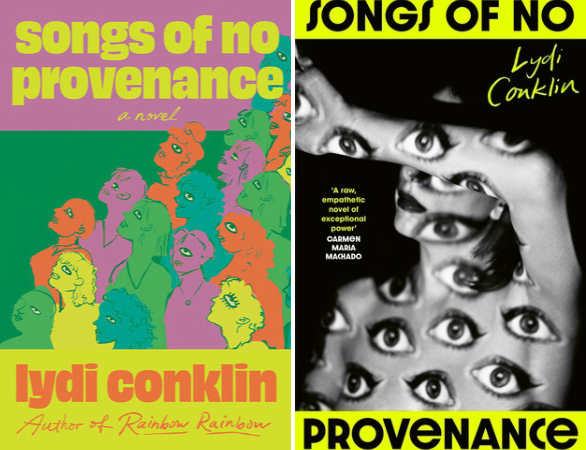
We’re all in the business of judging books by their covers. Admit it — when you’re in the throws of writing your novel (or short story collection, or poetry collection, or memoir, etc. etc.), you too spend your breaks daydreaming of a beautiful, captivating cover that will capture the essence of your book perfectly and also convince every single passerby in the bookstore to purchase their own copy. But had you ever thought to dream up two different versions of it?
Love it or hate it, the publishing world has decided that book cover styles should vastly differ, depending on what side of the Boston Tea Party you were on. Now is your chance to help us find out whose taste is better! We present to you: The 2025 Battle of US vs. UK Book Covers!
Voting starts NOW. Vote for your favorite covers before Wednesday, September 9 at 12pm Eastern to have your vote counted!
Love letters are a romantic gesture that are disappearing from our relationships. Today, we can shoot a text or an email within seconds, and we don’t have to think about the language we employ or the sentiment we’re trying to express. Emojis do all the work. But for centuries, we wrote letters to our loved ones. And because these letters could take weeks or even months (especially during wartime) to arrive, lovers had to use every word and sentiment at their disposal. They’d write on both sides of the page, up the margins, and even on the envelope, to let their lover know the depths of their heart and affection. When it comes to the love letters of famous authors, we can get a glimpse into the secrets of our favorite novelist’s heart. Was Franz Kafka as misanthropic as his Metamorphosisprotagonist Gregor Samsa? Did Jack Kerouac really believe in the free love/zero attachments romantic style of the 50s and 60s?
I’ve always been a collector of old love letters. Before writing my forthcoming historical fiction novel, Letters to Kafka, I was known about town as the gal who bought old love letters. I bought stacks of them at flea markets in Europe, had them framed, and hung them with pride on my bedroom wall. In Canada, I bought a stack of love letters sent during the Second World War from a Royal Canadian Air Force officer stationed overseas to the sweetheart he left behind in Toronto, and was so besotted by their story, I tracked down a living relative to learn the rest of the story. When I came across the love story of famed 20th century author Franz Kafka and his first translator, Czech writer Milena Jesenská, I thought to myself, “Wow, someone should write a novel about this.” And then I realized, “Wait a minute … I’m someone.”
Kafka, although from Prague, wrote exclusively in German. Jesenská, also from Prague, wrote to him seeking permission to translate his works into their native Czech. Their letters quickly turned romantic, and despite his frequent illness and her marriage, they met twice for lovers’ trysts. Kafka’s letters to her were posthumously published in the 1950s in the book Letters to Milena. However, Jesenská’s letters to Kafka were never found; they have been lost to time. In my novel, Letters to Kafka, I imagine what her letters to him might have said, and what might have happened on those trysts. Old love letters aren’t just full of saccharine sweetness and misguided devotion (although those elements are fun), they are also a snapshot into a time period long gone. For Kafka and Jesenská, theirs was a time of telegrams and inkwells, Poste Restante addresses, and horse-pulled carriages outnumbered the motorized vehicles. Like an eyewitness news report from the front lines of today, old love letters can give us a window into the particulars of a world forgotten.
Kafka and Jesenská’s epistolary love affair exists amongst great company; many literary icons of the past have pursued the object of their desire through the written word. If you’re jonesing for more historical letters from literature’s finest, here’s a list of my personal faves.
Beginning in 1920, Kafka’s letters to Milena very quickly become amorous, and the frequency at which they’re sent is fast and furious. In his letters, Kafka is consumed by her charm, wit, and intelligence, but also petrified she might reject him because of his illness, his small frame, and because he is Jewish. His words are so passionate, it’s easy to see why she was willing to risk her marriage for him. Some of the most famous declarations of love are found in his turns of phrase, including “You are the knife I turn inside myself. That is love. That, my dear, is love.”
The “greats” of the 1950s Beat Generation, like Jack Kerouac, Allen Ginsberg, and William S. Burroughs are all notably men. Before Kerouac made it to the big time with his book On the Road, he had a love affair with one of the women populating the scene in Greenwich Village: Joyce Johnson. As Johnson reflects in this epistolary memoir, she was a young 21 year-old trying to learn how to love in an era of emotional detachment ruled by men, while also figuring out her own voice and style. Their relationship was marked by passion but also distance as Kerouac was a largely peripatetic waif before On the Road hit the bestseller list. Their endearing and intimate letters capture both the thrill and the pain of a young affair but also how Kerouac, bit by bit, became more restless, more booze-dependent, and refused to commit to a besotted Johnson.
In the 1960s, before famed Canadian folk singer Leonard Cohen became a household name, he was a down-and-out writer and poet of universally ignored books like Beautiful Losers. He had taken up residence on the Greek island of Hydra to focus on writing when he met Norwegian author Marianne Ihlen, and embarked on a tumultuous, bittersweet love affair that lasted a decade, and is memorialized in “So Long, Marianne” and “Hey That’s No Way To Say Goodbye.” The eponymous book draws on the pair’s intimate love letters to tell their story.
An ocean of ink has been spilled trying to dissect the turbulent love affair between these two literary icons, but “dissect” might be the tamest word possible to describe the NSFW erotica their letters contain. You don’t have to take my word for it. Take Miller’s: “I love your loins, the golden pallor, the slope of your buttocks, the warmth inside you, the juices of you. Anaïs, I love you so much, so much! […]I am sitting here writing you with a tremendous erection.”
Martha Gellhorn was one of the first women war correspondents of the 20th century. She roughed it out in the trenches of the Spanish Civil War and was on the ground during the liberation of the notorious German concentration camp, Dachau. But when it came to love, her affair with literary giant Ernest Hemingway, which resulted in a doomed marriage of less than five years, takes the cake. Canadian author Somerville incorporates not only Gellhorn’s love letters to Hemingway (via ongoing access to Gellhorn’s restricted papers located in Boston), but also, quite often, his responses. It’s an unfiltered glimpse into their love, their marriage, their struggles, and ultimately, what separated them.
Letters to Felice by Franz Kafka, translated by James Stern and Elisabeth Duckworth
In order to understand the true nature of Kafka, one must look to his intimate letters to the women he loved. Kafka was famously engaged three times—twice to the same woman, Felice Bauer—however he never married. In a letter to Milena Jesenská, he once claimed that he loved Bauer because she “was good at business.” But his letters to her reveal much more. There is nothing Kafkaesque here—his letters convey a relationship that is sensitive and sweet. Readers may not associate Kafka with a wicked sense of humor, but his self-deprecation in these letters even veers into slapstick.
When famed director Jane Campion released her John Keats and Fanny Brawne biopic Bright Star in 2009 (which you must watch), she also released this book which compiles some of Keats most lovelorn letters. Despite the fact that Keats died at the age of 25, his letters to Brawne have been canonized as the gold-standard of epistolary love. “You are to me an object intensely desirable—the air I breathe in a room empty of you is unhealthy.”
Furious Love by Nancy Schoenberger and Sam Kashner
In the weeks leading up to her death, Elizabeth Taylor granted access to the love letters she exchanged with Richard Burton for this book. The two had famously caused an adulterous scandal on the set of Cleopatra as co-stars, and ultimately married, and divorced, twice. Although neither were writers, their love letters are second to none. Burton wrote to Taylor, “I am forever punished by the Gods for being given fire and trying to put it out. The fire, of course, is you.” And later, “My blind eyes are desperately waiting for the sight of you.” Taylor wrote in return that Burton “was magnificent at making love… at least to me.”
In 2020, Nino Haratischwili was nominated for the International Booker Prize for The Eighth Life, an almost 1000-page-long historical epic telling the history of the twentieth century in Georgia. For her follow-up, The Lack of Light, she turned to a period closer to her heart: the wake of the collapse of the Soviet Union in 1990s Georgia. As Haratischwili, who lives in Germany and writes in German, told me, “It was very difficult to explain my youth and my childhood to friends here, because when they talked about the nineties, they were talking about MTV and going out. For me, the nineties were Kalashnikovs and civil war—very harsh times.”
The Lack of Light is told through the eyes of four close female friends who live in the same apartment complex in Tbilisi: Keto, the narrator, whose brother Rati becomes involved in organized crime; Dina, her best friend, an iconoclastic photographer who is romantically involved with Rati; Nene, the daughter of the city’s leading crime family; and Ida, a closeted lesbian who pines for Nene but can never express her feelings due to the period’s regressive politics. In the first pages of the book, we learn Dina has died by suicide, and the three surviving friends have reunited after decades of separation at a retrospective honoring her work. Over the course of the book’s 700-plus pages, Haratischwili lays out the complex relationships between the girls, their families, and the men they love, who are doomed by corrosive masculinity and organized crime.
“At some point I felt, Okay, this is a little bit bigger than I may have planned in the beginning,” Haratischwili tells me of her epic novel. “But for me as a reader, it really doesn’t matter how long the book is, as long as it is good.” The Lack of Light is more than good, it’s a universe in and of itself that captures the nuances of a society that led the young men to violence and forced women to contend with that brutality. As the book makes clear from the beginning, not everyone makes it out alive.
In our Zoom conversation, Haratischwili and I discussed nostalgia for hard times, post-Soviet corruption, the novel’s reception in her native Georgia, and more.
Morgan Leigh Davies: You use a framing device of the surviving friends reuniting at an exhibition of Dina’s photography throughout the novel. How did you decide to structure it that way and use photography as the center of the book?
Nino Haratischwili: I was looking for a structure that would help me to get some distance. I always need distance—in time or geography—to be able to write. It’s a fictional book, but a lot of things in it are very personal to me. So I needed the distance.
I decided to structure the book so it has two timelines. It felt more natural to describe the nineties from a distance. I thought about using a funeral, but then I thought, they would just go there, say hi to each other, and then separate. I had already started that book, and one day, I had the idea of this exhibition where they would be forced to remember.
I was looking for a structure that would help me to get some distance. I always need distance—in time or geography—to be able to write.
I really do like photography as a medium. So I thought, Okay, let’s try to invent some photos. I was inspired by the nineties: we had a lot of great photographers. I tried not to copy them, but to get inspired by their aesthetics—I had fun creating the photographs. After I had this idea of exhibition and the two timelines, the writing process became much easier. It was like a puzzle that came together.
MLD: Reading the book, there’s such a feeling of nostalgia, but also a strong feeling of ambivalence—a lot of what happens is horrible and traumatic. But I think it’s hard for anyone to look back on the past without some form of nostalgia coming up.
What was the process of conjuring this place you love while writing about really violent and complicated things that took place?
NH: You’re right, of course—I’m not really sentimental about that time because it was too harsh, too dark. I was lucky enough to be younger than the girls in my novel, so I was not really aware of what was going on. I was just a kid, I still felt protected by my family, by my parents. As a kid, you can easily get used to things. You don’t have anything else to compare it to, so it’s easier. For the older generation, like my parents, it was terrible. It’s a nightmare imagining being as old as I am right now, having kids and responsibilities, and living back then.
Some years ago, before writing this book, I went to see a great film from a female Georgian filmmaker, called In Bloom. It’s about two girls growing up during that time. I was invited to a preview during a festival here in Germany. It was a very nice summer night in Hamburg, and we went out in the yard afterward. There were some tables and wine, and there were a lot of Georgian women between 30 and 50. I hadn’t met them before; we didn’t know each other.
Everybody was inspired by the movie. Everybody was remembering, talking, and sharing their experiences. They started saying, Oh, do you remember this and that? Do you remember the lack of electricity? Do you remember the violence? Do you remember the tanks? Do you remember the robberies? It got more and more terrible somehow. Very violent stories. I was observing and listening more than sharing my experiences, and I was observing the faces of the Germans. I realized, Okay, they’re shocked and becoming more and more shocked. But the very funny thing—I mean, not really funny—was that all the Georgian women were talking with excitement, with smiles on their faces, laughing a lot. It was like, Yes, yes, you remember, yes, I remember, and do you remember? If you didn’t know what they were talking about, you could think it was a party.
Then I realized, they’re talking about their childhood or youth. This period of life shapes you so much. Everything happens for the first time. None of the other phases in your life are as important. The first disappointment, the first excitement, the first love—first, first, first. You have this one childhood, this one youth—even if it was terrible and dark and violent—and you kind of miss the way you were back then.
The Germans were like, Oh my god, they all need therapy. I think this describes the mixed feelings I have about that time. I do remember a lot of very, very good stuff from the nineties, like empathy, being together, helping each other. I never experienced that later. I think everybody was aware we were depending on each other so much. Maybe because you never knew what would happen tomorrow, or if tomorrow would even come. You long for this feeling of being alive and being together and sharing things. I remember a lot of friends of my parents came every evening, and each of them would bring some food. They were drinking wine, laughing a lot, telling jokes, even singing, sitting with candles like they were in the eighteenth century. Of course it was a little bit absurd, but it’s a very human condition. When you feel in danger, you start to become more and more aware of things that you appreciate.
MLD: To that point, the relationships between the girls are so beautiful and moving, but at the same time there is always the weight of violence pushing down on them. It’s from their neighborhood but also from the unfurling national crisis. How did you write that conflict?
NH: It’s easier for me, as a reader, to understand huge political, historical stuff when I focus on characters. It’s easier to understand when it’s not a statistic. When you read, “20,000 people died,” it’s unimaginable. If I can follow a character, experience what he or she is experiencing, it becomes touchable.
You have this one childhood, this one youth—even if it was terrible and dark and violent—and you kind of miss the way you were back then.
The other thing that was really important to me was telling the story from a female perspective, because that period was very masculine—there was this toxic, mutated, degraded masculinity myth. When I think about it in hindsight, I really feel pity for them. They were very young guys. I was surrounded by them at my school, and a lot of them didn’t make it; they’re not alive anymore.
During that period, a lot of men had drug problems, went to war, had this criminal stuff going on, and didn’t survive. Women had to hold everything together. A lot of them went abroad to survive. They could not afford to be depressed. Men like Keto’s father were paralyzed for years because they could not cope and could not adjust, but women couldn’t afford that. For me, it was a tribute to tell this story from a female perspective.
Now, when I go to Georgia and meet teenagers, they’re so Western-orientated and open-minded. For them, it’s unimaginable that we had these values back then. In writing this book, I understood that these values were mutated and degraded because the whole society was. Everything collapsed and nothing worked, it was completely anarchistic.
MLD: In the book, you draw connections between larger problems in Georgia and these smaller instances of male violence. How were these things connected?
NH: Back then, I was not thinking about this—I had no space for empathy for the men. But while writing, I realized that a lot of them were victims of that system. I don’t think everyone who ended up in the criminal world was born a criminal; they were totally normal guys from totally normal families.
It was a sick time, a sick environment, a sick society. That is what happens when people don’t fear any kind of consequences for their behavior. It was rooted in the Soviet system, which was so corrupt that nobody had any kind of trust or belief in it. Everybody knew the state was stealing. You could buy everything, diplomas, status, whatever. So the thinking was: The biggest criminal is the state. When something bad happened, nobody would call the police because they knew they would get in much bigger trouble.
A parallel system arose where you had to steal. It was presumed to be better because it was a Robin Hood thing. Okay, you steal, but you steal from the biggest monster, you steal from the state and you share it with poor people, or you help somebody. This kind of thinking was already in their bodies and their flesh and their bones. They were completely used to it. It had started long before and climaxed in the nineties.
MLD: Women who are related or romantically involved with these men are treated like objects, yet still have emotional attachments to the people hurting them. The conflict really destroys these women; we see Keto self-harming, and Dina eventually dies by suicide. How does that dynamic work and what are the ways out?
NH: It’s a sadomasochistic chain. I know a lot of families in Georgia who lost everything due to their drug-addicted sons; who sold houses, apartments, even jewelry to rescue them. There was no rehab, no awareness. This was combined with shame. Somebody died at 23, 24, 25 and it was always, Oh, it was a heart attack, but everybody knew exactly what happened—it was heroin and so on.
Keto and Dina realize there is no healthy reaction. There cannot really be harmony in that kind of relationship, because there is hierarchy and they are objects. Even if these guys are in love, still, the system does not allow them to be free and to live the lives they want to live.
It’s impossible to do the right thing as long as you stay inside the circle. It was like a curse, and it lasted over a decade. I really do know a lot of people from my school and neighborhood who experienced these stories, lost their kids, lost everything. In our society, family is so important—you have to do everything for them. If your family member is jumping into the abyss, you’re following him. Mostly, of course, you couldn’t rescue them.
If you examine this from the point of view of love, it becomes clear that the women end up the way they do with these guys because the environment is a jail. You can only break out by leaving. There’s a scene where Dina is saying to Keto, just leave the country, go, because I cannot, but you can. Keto gets angry and asks why, what’s the difference between me and you. And Dina says, I cannot overcome this. She feels a duty. You cannot say she’s only a victim. I follow you, even if you jump. That is what happens to her.
MLD: One of the most interesting moments in the book is when Ida goes after the whole system in her role as a prosecutor, and her friends treat her like a traitor. Decades later, in the frame narrative, they make peace. Why did you decide to end the book on this moment of hope?
NH: That’s a very good example of what I meant about the system being so damaged and sick that it’s impossible to do the right thing. The different reactions I received about Ida and her decision from Georgians and Germans were very interesting. Of course, the Germans were all like, it’s like the best thing she could do; but a lot of Georgians were wary. It’s still kind of a betrayal.
Because there is so much suffering in the book, so in the end, I thought, we need some hope. As a reader, if I read this book, I would need, not a Hollywood-style happy ending, but the kind of hope that allows you to think, This is something and it’s over. It’s really over. At the end, it’s up to the women to see if they can reinvent their friendship and somehow stay connected. There is a moment… I felt huge relief while writing it, and it was very emotional for me. The women are sitting in a bar, drinking and talking, and Keto starts observing them. She says that they share this dinosaur love and that the way they loved and lived is not possible anymore. Nobody else really understands—after Keto moved to Germany she expected sympathy and wanted to be liked, but never expected love. At that moment, she feels a really strong connection to Ida and Nene. I think it is the beginning of her starting to let go of the past.
MLD: What has the reception been like in Georgia in general?
NH: I often get feedback like, It’s about me, it’s about my youth, it’s about my neighborhood, it was how I grew up. Not from my generation, but my parents’. They often mention that it’s too painful and they had to put it away for a while. One thing that my mother said after she read it was, Oh, how I hate remembering that time. I think the book feels very personal to some Georgians. It makes me humble if they feel represented by it.
My first panic attack came from the brain. I don’t mean that it was the product of my neurons, though of course it was, but that it was triggered by the spectacle of a human brain, cut in thick, soft slices like triple-cream brie.
I was sitting in the auditorium of NS101: Brain Anatomy & Physiology. It was my freshman year at Brown, where I had been accepted into a premed fast track program. The professor called on a girl in the front row to come take a look at what was inside the white bucket near the lectern. I had assumed a janitor had left it there.
“Nooope,” the girl said after looking in, shaking her head and then exhaling loudly before sitting back down.
“Those are slices of a human brain,” the professor said. “I don’t always have brain samples on hand, so today is your lucky day. I want each of you to come up, two or three at a time, and take a look. Come, come, don’t be shy.”
There was a constriction in my ribs, a tickle traipsing up my throat, and I kept taking sips from my water bottle to wash it back down, not unlike the rain washing the itsy-bitsy spider down the waterspout. Then I stopped being able to swallow. I tried to look calm, like I was leaving to take an important phone call. I bumped past the rows of knees, walked up the aisle, out of the lecture hall, and then broke into a sprint, trying to outrun it.
I had applied to the premed program at my father’s urging. I liked the idea of being someone who could make things right. I imagined an office with piles of medical journals and thank-you cards, happy patients and their bright faces opening at me like so many sunflowers. But now the years of anatomy and physiology courses, of organs in formaldehyde and my hands slicing through them, became real. I dropped the neuroscience class, losing my spot in the program. To fill the hole in my schedule, I enrolled in PL130: The Evolution of Angiosperms. The Plant Sciences Building was next to my dorm and it was one of the few classes that still had open slots.
The professor was a petite woman who often wore brightly colored scarves and silk ascots around her throat. She looked like a hummingbird and sometimes when she talked, I imagined the first flowers opening tiny and yellow, lighting up the dark ground like stars in the sky.
When people asked why I was studying plant biology, I talked about plants as a foundation of animal life, about taking energy directly from the sun without violence, about the color green. It was all true but I never told them the other truth: that I didn’t want to know the body’s secrets. I preferred to think of human bodies as something like claymation. I couldn’t take the idea that we were wet and hot just under the skin. That we were spotted with organs like a Jell-O mold with grapes.
Most of all, I didn’t want to learn what the brain did: if I knew where it all came from, thoughts and movement, memory and math and dreams and speech and even love, then I would know, really know, that a human was just mud, briefly shot through with lightning and then extinguished back into the earth.
I was doing research in the campus greenhouse when I first saw Megan. She was pale, freckled, and lanky as a giraffe, and her silky brown hair fell over her face as she bent to water a large orchid. She looked like a young Jane Goodall and moved with a precision that suggested deep intelligence.
“Wanna buy me coffee?” she asked, catching me watching her.
It was a miracle that she fell in love with me. And when she put her hand over mine so I could get the touch just right, and when the blush rose up her chest and neck and into her cheeks, and when she looked me in the eye, and when she made that sound like something was being torn from her, that was a miracle too.
I couldn’t figure out what it was she liked about me but had the sense to know nothing would be more unappealing than my own lack of confidence, so I only asked her once, a few months in.
“I like your big nose,” she said, tracing down the bridge with the tip of a finger. “And your big dick,” she said, playfully squeezing my groin through my pajama bottoms.
We kissed for a moment, and then she got serious, looking at me with eyes the color of diner coffee. “I like how gentle you are with the plants,” she said. “When you need to move a pot, you get all nervous and serious. When they need water or fertilizer, you measure just the right amount. When you touch the leaves, it’s like the way you stroke my hair.”
I pulled her close, her head pressed against my chest. I wanted to believe everything she said.
It turned out Megan was only working in the greenhouse until she could find a research gig in an entomology lab, which she did soon enough. And so our lives took on a pleasant rhythm: classes in the first part of the day, research for our respective labs after, and then dinner together at the same corner table in the dining hall. We would always split a wretched little dessert: say, a pumpkin and cream cheese Swiss roll or strawberry sponge cake with frosting of a questionable gray color. This was followed by studying, sex, and sometimes sleep with her back pressed against me, the xylophone of her ribs palpable under the skin. Megan had an ability to create habit and routine, and in doing so, carve shape into my life.
I liked my classes and my research, but most of all I liked telling her about it, watching her mind go taut and dart around ideas, weaving threads between them. Through her, I could see that behind the seeming randomness of the world, an intricate, beautiful, and almost geometric pattern held everything up.
Sophomore year we got solo dorm rooms in the same building, allowing us to practically live together without the hanging of socks on doorknobs and other roommate negotiations. And then junior year we did live together, in an apartment off campus. Seeing Megan munch on nuts or granola I had picked up at the co-op gave me the same warm feeling as watching house sparrows and robins eat at our little suction-cup bird feeder. I started teaching myself to cook from online recipe blogs. Megan had no patience for cooking—“Following a recipe is like doing lab work”—so she was gracious and appreciative, even with my fumblings. When the chicken I roasted was still pink near the bone, she smiled, gently removed the carving knife from my hand, popped it back in the oven, and gave me a kiss on the cheek.
I kept at it, keeping a notebook to track my kitchen experiments. I got better and then I got good. I loved the way Megan would go quiet sometimes, taking obvious and almost sexual pleasure in a meal. I teased her about it once—“Babe, I’m not sure you heard what I just said.”
She gave me her most winning smile.
“Your fault, you know how I feel about your sirloin.”
Fall of our senior year, we applied to the same graduate schools. California was where the most exciting research was happening, most of it around climate change. “Climate disaster,” she would correct me, mildly annoyed by the euphemism. We fantasized about collaborating on projects that spanned our fields: how early blossoming in figs was affecting honeybees or how increasing atmospheric CO2 was changing the relationship between aphids and apple trees. We would know it all.
In April, Megan sat me down on the saggy yellow couch in our off-campus apartment.
“I am pregnant and I’m going to keep it,” she said. I didn’t understand. We were always careful. I didn’t understand her voice, clear and level, her face, blank, while the spider came back up my throat with its too-many legs. “You have a choice to make. I’m going to go stay with my mom for a few days to give you time to decide.” She squeezed my hands, grabbed her backpack, and walked out the door.
My ribs were starting to squeeze. I had never seriously considered parenthood, but I had considered losing her. Mainly that I couldn’t. When we were apart for more than a couple days, the pattern started to go faint and I had to close my eyes and smell her pillow to get it bright again.
I took a long gulp of water and sprinted down the hallway after her.
“Let’s get married.”
Pregnancy made it hard to avoid knowing what bodies were made of. Megan was badly nauseated in the first trimester. Cheese and garlic were verboten. She brought a white plastic CVS bag with her to finals, retching into it without embarrassment.
When we moved to California, she was twelve weeks pregnant and the nausea was finally lifting. In our apartment in Davis, she liked to lie on the IKEA couch and read pregnancy books while I read research articles or did sudoku at our Craigslist kitchen table.
“Did you know my blood volume has already doubled?“ She would say. “Did you know I’m probably going to shit myself during labor?“
There were also the facts of the baby itself.
“It’s still inside of me, it’s still a fetus,” she would say, furrowing her brow, and I would wince at the word. After the initial shock burned off, I had grown attached to the idea. The baby would add something new to the pattern, a splash of hexagons or an iridescent sheen. We came to call it the seedling.
Megan liked to tell me about the stages of the seedling’s development: the appearance and disappearance of a vestigial tail by week eight, fingerprints at week 14, meconium at week 22.
“Did you know the brainstem—”
“Let me make you a snack, babe,” I’d say, interrupting her flow. The same spider would come up when she talked about brain development, so I’d take a long drink of water and calm myself by peeling jicama and then using the chef’s knife to cut it into white half-moons, or making the anchovy toast she seemed to crave constantly now: a thick slice of crusty bread slathered with unsalted butter and then covered in arugula, chili flakes, and tiny, pungent fish.
That summer was the first time in my life I had a span of open time. As a child, summer vacations were always spent in some kind of edifying camp. Summers during college I had done double duty, working minimum wage research jobs at Brown and a slightly above-minimum wage job as a line cook at Louis’s diner near campus.
Megan and I had saved money, planning to travel to Burma and Thailand during the summer. I was privately relieved that was no longer possible, happy to trade adventure for the novelty of three months stretching open like a meadow.
We spent the time reading or playing Scrabble in our apartment in the heat of the day. On Sundays, we went to the farmers’ market and drank fresh grassy green juices. I baked bread late at night, the only time cool enough to turn the oven on. Sometimes in the early mornings we went for easy hikes. Once we got caught in a rare summer rainstorm and Megan tipped up her face, letting the water wash over her. Her slim frame was rounding out and I had a strange, erotic urge to suffocate myself between her breasts, her thighs, under the growing curve of her belly. Happy anticipation hummed between us, a rosy new thread in the pattern.
It was like my life had finally started. The scrapes and humiliations of childhood—the time my father had for his work but not for me; the acne so bad I’d needed Accutane; the varsity teams I was never quite good enough to make; the girls who turned me down; my failure to become a doctor; the hours frying eggs at Louis’s while my rich friends padded their resumes with unpaid internships; the anxiety that sometimes seized my throat—it was finally over. I had Megan, and the seedling, and it was my turn for happiness. Back then, I thought that was how things worked.
When Megan was about six months pregnant, my program started and I began my thesis work on adapting pome fruits to the hotter, drier climate that was coming. The plants breathed out oxygen and water through tiny apertures in the leaves. Under a microscope, an aperture looked like a frog mouth with two fat lips. I was changing the numbers and size of the apertures to make apples and pears that could grow in the desert California would soon be.
On campus, I fell deep into it, absorbed in my micrographs, or dissecting protoplasts, or tending to seedlings and plantlets and then graduating them to the greenhouse. At home, I worried my excitement would remind Megan that her own program had been deferred, though she had seemed very matter-of-fact about the decision.
“You’re sweet,” she said. “But I’m busy with the seedling.” She touched her belly. “The bugs can wait.”
Everything was growing, growing, green.
I was glad Megan chose an epidural and I was glad she wanted me up by her head, holding her hand, and not down near the blood and Jell-O. Megan was by turns determined, exhausted, laughing from the exhaustion, and then riding another wind. When the baby was finally in her arms, a girl we called Poppy, she cried silently.
“I miss feeling her inside me already,” she said. “I feel like something’s missing. Like she’s lost and I have to find her.”
“Smell her head,” I told her. Our OB/GYN had told me about the sweet, soft, clean-laundry scent of babies’ heads. “She’s there. She’s okay.”
Megan and Poppy were together in a world I didn’t understand.
I had always thought of it as we were having a baby. We were becoming parents. But Megan and Poppy were together in a world I didn’t understand. I was in awe and envy and there was nothing I could do those first weeks except change diapers, do laundry, and feed Megan so she could feed Poppy with breasts that were no longer for me. We had gotten a marriage certificate at City Hall planning to do the big wedding later, but it was in watching the delight in Megan, in my uselessness and need to feed her, to see her eat, to nourish her, and to watch her nourish Poppy, like I was Adam and she was Eve and Poppy was the first baby on the face of the earth and no one, no one, knew about this joy or this mystery, that I became a husband.
Poppy was happy and calm and her big eyes rolled around and around tracking me and Megan and birds, dogs, squirrels at the park. She laughed early and often, a short little giggle of delight at the world around her. I loved to watch her, and to watch Megan watching her: her eyes soft, love dripping off her like honey. Poppy slept well and for long stretches that allowed us our own sleep and sleepy sex. At night, Megan fed Poppy in bed and I did the overnight diaper changes. Even the changes had a pleasing rhythm: the front to back movement with the warm water wipe, the gentle pats dry, pulling the new diaper up, securing the left tab and then the right, bending over to kiss her forehead, left cheek, right cheek, perfect button nose.
In the mornings, I packed my lunch and made one for Megan. In the evenings, I read to the both of them: newspaper articles, contemporary fiction from the library, drafts of the fellowship proposal I was working on. We bathed Poppy together before bed, admiring her chubby thighs, her big dark eyes. “We should’ve called you Black-Eyed Susan,” Megan would say, gently working detangler through Poppy’s blond waves.
I knew where I needed to be every moment of the day. I knew what I needed to do. I had no free time and I was happy. The decisions—the big ones, anyway—were made and I didn’t have time to worry anymore anyway.
Maybe it wouldn’t have happened if I had worried. If I had said a prayer of thanks every night on my knees. If I had called every lonely friend on their birthday. If I had invited every orphan for Thanksgiving. If I had given money to St. Jude’s at every grocery counter and movie theater. Maybe the pattern needed my fear to hold it steady.
Poppy was two years-old when it started, just getting the hang of handles and doorknobs, just starting to practice balancing on one foot for fun, her arms out while she made a brrrrr-ing airplane noise, and then a burst of giggles when she would start to tip. Megan was substitute teaching in an elementary school and working on getting a certificate to teach science. On that particular day, she’d worked a half-day and spent the afternoon with Poppy.
“Something weird happened,” she said over our dinner of harissa-roasted chicken and vegetables. “She was asking to see the elephants again, so I took her to the zoo. She was in the stroller watching them and then I noticed she sort of wasn’t there for, I don’t know, maybe half a minute. Like, she wasn’t asleep and her eyes were open, but she just wasn’t really there.”
Poppy was here now, picking up chunks of roasted sweet potato with her small hands and happily gnawing on them, humming to herself.
“Maybe she was daydreaming,” I said. “Poppyseed, were you daydreaming? Do you have the biggest imagination ever?”
She giggled at me, reaching for another sweet potato chunk.
And then a week later, I saw it happen: we were on the floor with the wooden alphabet blocks and she went dreamy, slipping inside herself for 10 or 15 seconds. She was an imaginative kid: she loved stories about talking animals, mermaids, unicorns, and anything that could fly.
“Poppyseed has got her head in flowers again,” we’d say and wonder what she was daydreaming.
For a year, it was only the daydreaming. And then I got a call from the preschool while I was harvesting leaves from a plantlet.
“We tried your wife first?” The young teacher said. “There’s been an incident? Poppy is at the hospital?”
An incident? What did they mean, an incident?
“Poppy felt a little warm? We were going to take her temperature? Then something happened? I think it was a seizure?”
And I was groping the lab bench for my keys, I was sprinting to the car, I was ripping out of the parking lot without looking, I was calling Megan on repeat. The pattern had cracked open under my feet. The spider spread its arms and legs up the whole length of my throat, and I couldn’t fucking breathe.
When I got to the ER, Poppy seemed to be sleeping, an oxygen cannula positioned gently at her nostrils. The doctor, an older Black woman with tired eyes, said she had been seizing for at least 10 minutes by the time she got there. They had gotten it under control with two doses of lorazepam, administered through an injection into her tibia.
“It’s not unusual for a fever to trigger a seizure in a small child,” the doctor said. “Has this happened before?” The doctor asked.
“Of course not.”
“Have there been any other kinds of seizures? They don’t always look like what you expect,” she said. “Sometimes a seizure can show up as just a twitch or a repetitive motion. Sometimes they can show up as a brief loss of consciousness where the eyes stay open. Have you seen anything like that?”
So that was it. My baby girl had been seizing for a year and I was so fucking dumb, so doped up and myopic with happiness, that I thought she was dreaming. We left the ER with a referral to a pediatric neurologist. Around the fissure, the pattern was limp and wavy.
Our appointment was a few weeks out, and Megan and I had decided not to worry until we had to. A week after the incident, I was making dinner, stretching pizza dough I had been cold fermenting in the fridge for 3 days, folding it over itself to coax the gluten into networks. At the kitchen table, Poppy was working as a ventriloquist for two of her stuffed animals who were engaged in a lively debate. Suddenly she was at my leg, holding onto it, looking up at me with her coffee-brown eyes wide and fearful.
“No, no,” she said, sounding close to tears. I wiped my hands on a dish towel and picked her up, holding her small, warm body against me. Her legs were getting longer and she had been losing her baby fat over the previous few months. In the odd moment or movement, I could see a rotation of spirits: her kneecap in the shape of Megan’s, her wrists turning knobby like mine, the line of her chin my grandmother’s. Poppy was made of pieces of her relatives, like each had given just 1/8 of their soul, to recombine into something, someone, new.
“What’s wrong, Poppyseed?” I asked her, holding her close and stroking her back with my thumb. I kissed the top of her head. Her hair smelled sweet and clean, like fresh laundry. She bucked against me into a stiff line and then began jerking, like a snap bracelet going taut and then curling, taut and curling, the recoil, the inevitable motion, rhythm, and storm. We took her back to the emergency room.
“Seizures are not actually that uncommon in young kids,” the friendly young resident told us after treating her with lorazepam. “Most of the time it’s a one-time thing and we don’t really know why it happens, but it never happens again.”
“She had one two weeks ago,” said Megan. “And she’s been having absence seizures for longer.”
The resident’s mouth kept smiling while a wince passed over her eyes. She sent us home with a prescription for nasal diazepam.
The absence seizures—what we had thought was daydreaming—continued. And after pizza night, the big new addition, the tonic-clonic seizures, continued two or three times a week, going for up to 10 minutes at a time: her body would go rigid (tonic) and the right side of her body would jerk and shudder (clonic). These are the seizures that used to be called grand mal: French for “big bad.” It seemed like the right term for the thing trying to blow our house down.
“During a seizure, it’s like she’s underwater,” the neurologist said. “Her brain can’t get the oxygen it needs and that can lead to cognitive problems.” During the big bads Poppy would start to fade, her rosy cheeks desaturating, her lips going from posy pink to violet.
Of course, I had to learn about the brain after that. I took 30 mg of propranolol before every neurology visit to stop my blood pressure from rising and the spider from creeping up my throat. I dug my nails into my palms to steady myself while the doctor explained about the synapses and the physiology of seizures and the parade of drugs with polysyllabic names. During a big bad, it looked like her soul was trying to leave her body. But I knew that it was not soul that she had gotten from us, but only DNA, a minute ladder of chemical information twisting in on itself and wrapped in coils and knots so its implausible length could fit in each one of her cells. The seizures were just misfirings in her brain, and her brain was just a jiggly half-dome of cells connecting end to end, wet and electric, with fat red worms of vessels resting in the grooves. She was full of Jell-O. It was the worst thing I had ever learned.
The crack in the pattern had split into a hole, to the back and right, big enough to stick my fist through. The rest of the pattern had contracted around it and was throbbing with right angles. Most of the time I was too busy to think about how Poppy was just plain matter, and so was I, and so was Megan, and so was every other person that I had ever cared about, small and erasable as an ant before an aardvark’s tongue. But in the mornings, my head hurt in a specific pinpoint spot, to the back and right, where this new knowledge lived.
The seizures could be triggered by a cold or flu, a hot day, too much sunlight. Megan thought they could also be triggered by too much excitement, too much sugar, not enough sleep, though I wasn’t sure.
“Even if you could identify every trigger, she would still get seizures,” the neurologist told us. “The triggers don’t cause her seizure disorder. Her seizure disorder causes normal things to be triggers.”
This was meant to comfort us, but it only made Megan more vigilant. She’d arrived at the ER that first day 15 minutes after me and immediately started writing things down on the back of a lesson plan, the only paper in her purse: the names of the doctors, the medication given to Poppy, the times and doses, unfamiliar terms like status epilepticus and soodep(?). After the second seizure, she began tracking Poppy’s medications, attacks, and everything she ate in a spreadsheet, doing regression analyses after Poppy went to bed. She didn’t seem to notice as the sun set and the room grew dusky and then dark, the blue of the computer screen illuminating her face like frozen moonlight. Sometimes I tried to kiss her or rub her shoulders but she would dip away from me, her eyes never leaving the screen. I wanted to pull her back to me, but she belonged to Poppy now.
Megan and the neurologist decided that we should start Poppy on Depakote. She portioned it out into a sparkly pink pill organizer. But when the Depakote didn’t stop the seizures, even with Megan’s regime of sun hats that Poppy tried to pull off and cool baths that Poppy whimpered through and the low-sugar diet without cookies or juice or even fruit, we tried Clobozam. Then Topomax, and then Zonisamide. Diamomit. Keppra. Fintepla, after an appeal to insurance, and a second appeal, and on our third appeal, a decision from an independent medical review panel who was swayed by a letter—written by Megan but signed by the neurologist—explaining the risks of sudden death in uncontrolled epilepsy. The drugs sometimes didn’t work at all and sometimes gave us a reprieve and then in two weeks, three weeks, six weeks, Poppy was seizing again.
We got used to the big bads, in a manner of speaking. The way palm trees are used to bending in category four hurricanes; the way South Beach is used to breakers that leave a path of Portuguese man o’wars, blue-black, iridescent, and venomous. Poppy would typically get a scared look on her face before one came on and run to us for comfort. We would lay her on her side on her bed or any soft surface nearby—in the green grass under the Jacaranda tree on campus, grass that was watered every night and should’ve been illegal given the drought; the backseat of a car; the woodchip playground mulch once; the ball pit at Chucky Cheese. We would put a pillow, towel, sweatshirt under her head and make sure her little red rosebud mouth was pointed down. You cannot swallow your own tongue during a seizure, but you can aspirate saliva or vomit into your lungs and get pneumonia. I got used to my spider, in a manner of speaking, which would spin up my throat every time Poppy gave me that particular frightened look. When a seizure went on too long, we administered her rescue meds, a two-person effort that reminded me of trying to shove a rabid cat into a tube sock.
I woke up often during the night, the spot in my brain alight with pain, telling me we were nothing but matter.
By the time Poppy was four, she was losing words, her tongue aging in reverse. She began to navigate in perimeters, hand pressed to the wall like a blind man, or holding the edge of the table with each step to steady herself. We had taken her to the pool every Saturday since she was six months old and she could tread water, swim breaststroke, go the length of the pool five times freestyle. And then her stroke started unraveling. In her inflated swim training vest, she would arc one arm overhead while her legs hung down in the water motionless. When the arm was back by her side, she would lift her legs to the surface and kick. When the kicking finished, she would arc the other arm. She could no longer braid the motions together but had to give each strand her full attention. Megan and I looked at each other and though her eyes, so like Poppy’s, were wide and fearful, she tilted her head towards the exit, silently agreeing to let me wait this one out in the car. The pattern cinched in tighter, angles compressing into barbs around the sinkhole. I woke up often during the night, the spot in my brain alight with pain, telling me we were nothing but matter. I knew now that words and bones are the only things that can last.
Poppy’s MRI showed cortical dysplasia: a spot where the outer part of her brain hadn’t formed correctly. To the untrained eye, it looked like a blur in the images, a place where the brie had melted. Genetic testing revealed a mutation in the gene HCN1. HCN1 makes up part of a channel in the cell membrane, critical to propagating electric signals within the brain. The channel was like an aperture that can open and close, like the apertures that breathed for my apple plants. It was inordinately hard for me to retain this information; Megan would explain it to me and then it would slip through the hole and I would have to ask her again until finally she wrote it on an oversized Post-It that she stuck to my desk. The mutation was unknown, something Poppy had not inherited from either one of us but that had gone wrong early, when she was smaller than a seed. It was mentioned nowhere in the medical journals that Megan scoured on PubMed. Poppy was singular. The young doctors regarded her as an interesting challenge. The old doctors shook their heads imperceptibly, their faces long with knowing.
Megan and I attended a meeting of an online support group for parents of kids with Dravet syndrome, which was the closest thing to what Poppy had. I had imagined they might be possessive of the diagnosis and wouldn’t welcome interlopers, but they were too sad to care. As they spoke, it was like someone was putting layer after layer of wet newspaper over my mouth and nose. I was getting less and less air, but I was in some kind of trance, too. I was captivated by their suffering; literally, captured. When the meeting ended, I looked over at Megan. Her brown eyes were glossy and half-closed. She was shallow breathing under newspaper, too. We never went back.
I longed to fall into my work but I stumbled through it, making bad mistakes, wasting my own time for months on end. I avoided my advisor out of shame. Megan stayed home taking care of Poppy during the day. At night, she stayed up late sucking on Swedish fish and reading neurology textbooks and medical journals and making complicated treatment plans with dependencies: if, then. She didn’t eat much in those days, said she couldn’t. Her face had become drawn and her eyes were pale and hard, the color of watered-down coffee. We used our hands and knees to push our grief down, but sometimes it came up through the ground anyway, like sewage after a rainstorm.
I still cooked dinner most nights though I was embarrassed to eat much around Megan, like it meant my grief was smaller than hers. When I was apart from her, I would sometimes eat three fast food hamburgers at once, or an entire Styrofoam carton of fried rice and General Tsao’s chicken from the food court at the outdoor mall. When I was eating, I was just fingers and mouth, a monster reminiscent of the cortical homunculus from her textbooks.
I still read to Megan and Poppy in the evenings, too. It was the only time Megan would really take a break from taking care of Poppy and her reading and studying and planning around Poppy’s disease. We’d all snuggle up on the couch together, the IKEA number with a chaise lounge, and Megan would close her eyes and fall half asleep. Poppy had a particular fondness for Dr. Seuss. I recognized in his illustrations the California flora that was so new to me: bottlebrush, torch lily, orange clock vine. All my life I thought he had just dreamed up these strange plants, but they were depictions, barely exaggerated, of what was growing around us in Davis.
As Megan grew thinner, thinner than she was even at 19, my belly grew bigger, into the paunch I recognized from my father and grandfather. Where Megan had once carved meaning out of randomness, she was now simply trying to wrangle some small order from chaos. Megan had always been stronger and smarter than me, so I let her lead, relieved that someone else was in charge, that someone else was making the decisions, and therefore someone else was ultimately responsible for the outcome. My job was to help her, and I did my best to be good help, loyal, dedicated, hard-working.
But even on the Fintepla, the seizures were continuing to starve Poppy’s brain of oxygen. A year before, she had sentences. Now she would say, “Mama, apple,” leaving out the implied subject, verb, article. She had taken to getting around by sitting on her butt and then pulling herself forward with her hands. “Dada, up” she would say, motioning for me to carry her up the stairs. She began to have tantrums and rages. It was not clear what of this was attributable to brain damage, or to physical pain, or to frustration at a body that was failing her. She would scream and thrash, a sort of loud caricature of her body in seizure, and Megan would sit down next to her, cross-legged like a Buddha, until Poppy finally went still.
Megan said now that Poppy had failed all the medications, brain surgery was the only thing left to try. The idea was to get a detailed map of the spot in her brain where seizures started and then cut it out, like paring bruised spots off an apple. “Okay,” I said.
Megan said that Poppy would have to stay at the hospital for three days with a thin electrode grid stationed under her skull, on the surface of her brain, to map the melted spot in micrometer detail. “Okay,” I said.
At the hospital, while Megan sat vigil, I brought her coffee and sandwiches she didn’t eat and magazines she didn’t read. In the evenings, I took her home and made her toast and then pulled her into the shower with me. She was so exhausted she would lean against the wall while I gently shampooed her hair and ran soapy hands over her body. We hadn’t had sex in months and it was a shock to see her nude body, her skin almost translucent and pulled taut over her points and knobs, her nipples bigger than before the pregnancy but her breasts shrunk to a suggestion. I wanted to gather her up in my arms like she was a wounded animal and rock myself into her, sweet and soft and slow, until my semen made her well again, until pleasure brought her back to me.
The brain mapping revealed not only the precise topography of the spot we’d seen on MRI, but three more melted spots in Poppy’s brain which had been too small to see. The surgeon said he could operate on the large spot, but the small spots were too close to her language and motor function centers.
“Will that be enough to stop the seizures?” Megan asked.
“Stop, no. Reduce, yes,” the surgeon said. “And the medications may be a little more effective if we can reduce the seizure activity.”
“And her speech problem and movement problems, will they improve?” Megan asked.
“If the surgery reduces seizure frequency, we should see some improvement in her cognition and coordination. But without being able to reach the smaller spots, we expect that she will still have major deficits.”
“Okay,” I said.
Megan slouched in her seat. There was an angry set to her jaw and a wet mark on her cheek was just visible under the fluorescent lights. She didn’t talk the whole ride home.
I ran a bath for my girls, who were both tired and silent. I undressed them gently. Megan got in the tub. I put a shower cap on Poppy to keep her bandages dry, and then lifted her in, leaned her back against Megan’s abdomen. Megan held her close and I sat on the toilet lid, reading to them both softly from Roald Dahl. Periodically I checked the water temperature, letting some run out, and then adding more hot water, testing the temperature against my wrist like breastmilk, until Poppy was fully asleep, her limbs relaxed and her face peaceful.
Finally, I lifted Poppy off of Megan and over my shoulder. Megan wrapped a towel around herself and then we both patted Poppy dry as softly as we could, like we were dusting a china doll. She stirred a little but did not wake. I put her on her bed to nap and then Megan and I stood over her, shoulder to shoulder, watching her sleep. Her arms were covered in soft golden down. There were pale freckles across the bridge of her nose and she was snoring very gently, like a nursed kitten. Her eyelashes were fluttering and behind her eyelids, her eyeballs darted back-and-forth. She was dreaming.
I went to the kitchen and began to make dinner. I rubbed rosemary and salt into lamb chops. I scrubbed dirt off new potatoes. I made a vinaigrette for baby greens for Megan and I and prepped baby carrots with butter and brown sugar to roast for Poppy.
Megan sat at the kitchen table watching my hands as I worked. I put a bowl of grapes in front of her but she shook her head.
“We need to talk about Poppy,” she said.
“Okay,” I said. I rinsed my hands clean and then sat down across from her.
She was quiet, gazing into the grapes, worrying her wedding ring. I wasn’t sure if she was waiting for me to say more or just gathering her thoughts. Finally, she closed her eyes and said, slowly, with her face very still, “What are we going to do?”
“Well, the doctor said surgery is the next step,” I said.
“Even in the best-case scenario, she’s sick.”
She was speaking in a measured way, the effort of her calm showing in pinpoints of sweat on her brow.
“I know it’s hard,” I said, “But what else can we do?”
She looked up from the grapes and studied my face. “Maybe we need to stop waiting for her to get better.”
I didn’t know what she meant, but when in doubt, I went for supportive: “I know you’ll figure out the right thing to do,” I said.
“Jesus,” she said. Her face broke open and she was glowering at me. “I’m asking you to make a choice with me. Everyone thinks you’re dad of the year because you make dinner. But all the real shit is my fucking job.”
I woke up in the night. Cold air was coming in through the open window and the perfume of the yellow trumpet flower outside wafted in. My head hurt in the same spot and I put my arm out to pull Megan close, but she wasn’t there. I rolled over, yawning, and swung my legs out of bed. I would tell her I was sorry we fought. That she just had to name it and I would do it. And that she had to sleep. That we both needed sleep to take care of Poppy.
But she wasn’t on the living room couch with blue light illuminating the very beginnings of crows’ feet. She wasn’t standing at the stove, waiting for water to boil for tea. The bathroom door was open and it was dark inside; she wouldn’t be there either.
The door to Poppy’s room was closed. I opened it just a little, careful to lift the knob and then push to avoid the creaking sound. Megan was bent over Poppy’s bed, motionless. She was holding a pillow over Poppy’s face and Poppy was still as a board.
Quietly, I pulled the door shut. I got back in bed. I slept. I slept like I used to; like a teenager; like someone who is busy eating and growing, eating and growing, cells constantly in a state of division. Poppy was out of danger and I could finally sleep.
I don’t know when Megan came to bed. I didn’t feel the mattress dip or disturb. I woke up before her, hearing the early morning bird song and the circling guh-guh-guh of a sprinkler.
I made coffee. There were no words in my head, no feeling in my body except a deep humming calm and the heat of the cup in my hands. I sat on our tiny patio in a ladder-back IKEA chair and watched a dark-eyed junco make a nest, gathering each small twig, one by one.
Megan came out a couple hours later. She looked at me, hesitating. She said my name, her voice breaking in the middle.
“Okay,” I said.
I stood up and embraced her. She sobbed and her body against me was hot and fragile and bony as a bird. I could feel the pattern of her skeleton through her thin cotton T-shirt and jersey bottoms.
“Okay. Okay,” I said.
After Megan made the necessary phone calls to tell Poppy’s doctors that she had passed in her sleep, to arrange the burial, to tell her parents and sister, she got in bed and stayed there for a week. I slept 10 hours a night, waking without head pain. She slept 12 or 16. We were too tired to talk, so when she was awake, we watched old Cheers reruns from bed. People sent gift baskets of dried fruits and nuts or left ceramic dishes of mac and cheese or homemade garlic noodles, which she ate, suddenly voracious.
There would be no funeral. Megan had her buried in a plain pine box, unfinished. She couldn’t bear to go to the grave site, so I went by myself after it was done. It was an overcast morning. I scattered wildflower seeds on the fresh earth above her and left her favorite books in a stack. The rain would come down on them, soak the pages. The words would mold and mulch.
In public, people either avoided me or said, “But how are you?” They thought Poppy’s death was the tragedy, but every day the pattern was knitting itself back over the hole, the weave softening from wire to wool. We had grieved while she was alive, a dozen times over. Now we could rest. Now we could work: Megan began taking as many substitute shifts as she could get. I could think about growing things again; about creating things for people to plant and harvest and consume. I could breathe. I could sit in the greenhouse and close my eyes and pretend I was in a Korean bathhouse and let the heat work its way through my clothes and release me. Every day the new sunlight ran an iron over the pattern, smoothing it out.
As the news spread out in ripples, the cards began to come. Hallmark cards from people we knew in high school and college, family friends, cousins, in the cursive script of mourning, in silver and white and celestial blue. She was in a better place, at peace, at rest, with God now, we cannot begin to imagine, so sorry, praying for you, thinking of you, all part of a plan, happens for a reason, take comfort, if you need anything.
But she was not in the sky. The wild lightning was gone from her. She was in the ground. In the ground, with fat earthworms and tunneling beetles and fungal spores blooming green on her cheeks. Poppy was over and so was our suffering. Poppy had no soul, but her teeth, her skull, her long bones: I pictured them sometimes, white in the box six feet under fresh black earth. They would last at least the length of my own lifetime.
Megan and I stacked the cards on the kitchen table, not wanting to open them after the first dozen or so. And then one evening, drinking wine after dinner in companionable silence, she started idly building them into a house of cards. I joined, leaning and stacking them into a big Jenga dare on the kitchen table. When it finally toppled, Megan shrugged, pushed off from the table, and left the room. I gathered the cards up into a stack and then dropped them one after another into the blue recycling bin.
I held Megan close that night, and we kissed deeply for the first time in many months. Though so much had changed, her mouth tasted like it always had: apricots, honey, seawater. She was coming back to me and relief washed through me like a cold and rushing river. I let it pull me down, down into a dreamless sleep.
In the morning, I found Megan sleeping in Poppy’s bed, a pillow pressed to her breast like a baby.
Enthusiastic readers of books from around the world often crow about how those stories transport them to exotic locales to experience a new culture, new people, and new adventures without the annoyance of lost luggage or language barriers. As a translator of prose and poetry from Central Asia, a place the vast majority of my English-language readers have never visited in person, I’m happy to help readers achieve that goal. But it wouldn’t be fair to the writers of the world to expect them only to portray places that we’d personally like to visit. Tourism aside, there is plenty to learn from unpleasant places, both in life and in literature.
The most unpleasant place of all is the wasteland—a landscape, either geographical or mental, where human visitors instantly find themselves unwelcome. It is a place where time stands still, hope is lost, and human beings cannot possibly thrive, even if they once did inhabit it or still, impossibly, do inhabit it.
In Sultan Raev’s novel Castigation, released this September in my translation by Syracuse University Press, a ragtag crew of seven people escapes a mental hospital and sets out across a post-Soviet desert to find redemption in the Holy Land. They don’t make much progress, but as they struggle across the inhospitable landscape, we readers learn each person’s backstory in two ways: from direct flashbacks of their lives (or past lives), and through their encounters with a surprisingly large number of other people and creatures who are living, working, or waging protests in the wasteland. This desert, then, paradoxically serves as fertile ground for revelation and understanding…up to a point. Spoiler: for most of them, it doesn’t end well.
To make your own pilgrimage through the wasteland, and see what it can reveal to you, I recommend exploring the barren reaches described in the novels and memoirs listed below. No two wastelands are the same, but here, in translation, they’re all open to exploration. The landscapes are harsh and unforgiving, but in each case, you can trust the translator to guide you safely to the other side.
Radiant Terminus by Antoine Volodine, translated by Jeffery Zuckerman
Much like Castigation, Volodine’s novel opens with a bedraggled, sick group of people wandering hopelessly through a wasteland that is slowly killing them. This particular wasteland is post-apocalyptic, the result of numerous nuclear disasters accompanying the fall of the fictional (so far!) Second Soviet Union. The cows, the spiders, and most of the people have been killed off, but a few human specimens remain oddly unscathed, which is not to say unaltered. These travelers—quite human, sympathetic characters—make it through the wasteland to a settlement where a pair of unsympathetic survivors rule a tiny community through psychological terror and inexplicable rituals.
In a startling and effective contrast to its bleak landscape, Zuckerman’s language in Radiant Terminus is radiant itself, skillfully channeling Volodine’s imagination into English with hypnotic results. It’s even occasionally funny. Laughter can be powerful medicine in the wasteland.
Kolyma Diaries by Jacek Hugo-Bader, translated by Antonia Lloyd-Jones
Elsewhere in the former USSR, Polish author Hugo-Bader charts his travels around one of the most harsh and remote regions in the Russian Federation. Kolyma is a place that many write off as a wasteland due to its absolutely unforgiving climate and painful history as home to brutal Soviet prison camps, yet this foreign traveler finds it curiously full of survivors.
Determined to explore this wasteland, the author recounts his experiences in large part through his conversations with local residents. The population is dwindling as young people escape and old people die out. Many of those that remain have harrowing memories of persecution and imprisonment, and most drink far too much vodka. Yet they persist, content to tell their tales, and we discover that a land holding the bones of so many dead in fact radiates a strange “positive energy,” as the author puts it, an energy readers can sense through Lloyd-Jones’s sensitive translation. We may not understand why these survivors are so attached to their wasteland, but we are rooting for them.
This novel was a shoo-in for inclusion in this list just by virtue of its front cover, where its Icelandic title, Öræfi, appears just above its translated title, The Wasteland. Ófeigur Sigurðsson’s disorienting tale plunges us into another northern-climate wasteland, one where the deadliness of the landscape is a result of the sheer unreliability that erupting volcanoes and shifting glaciers constantly produce.
That landscape is the perfect environment for the novel’s equally unreliable narrator, a man who stumbles out of the wasteland (or does he?) mortally wounded and eager to talk about his adventures. But the truth keeps shifting, blinding us like a snowstorm, as the story is sifted through an interpreter who speaks to a doctor who writes a report from which the entirety of the story is transmitted to a friend in a letter. “I have no option but to believe you, what you’re saying, or else the ground beneath my feet will open up,” the helpless doctor tells her interpreter, according to the letter-writer, as reported by real-life translator Lytton Smith. This Icelandic wasteland is easily the most aggressive geographical environment on this list. Keep your eyes open as you plunge into its rambling sentences and diverging trails, because this journey is a perilous one, but worth every moment.
Not Even the Dead by Juan Gómez Bárcena, translated by Katie Whittemore
Continuing west across the Atlantic and back several centuries, we join a hapless man named Juan on his reluctant quest across the jungles of the Spanish colony of Mexico to hunt down another man named Juan who is leaving death and ideological confusion in his wake. Juan’s pursuit of Juan runs north through the jungle, across the desert, and incidentally across many centuries to the present day.
There are dual wastelands at work in Not Even the Dead. The first is a wild landscape inhabited by a plague, sullen and possibly dangerous natives (they have their reasons, of course), and deranged missionaries (same). But as Juan crosses this geographical or cultural wasteland, our hero also finds himself wandering a historical and chronological wasteland, always two weeks behind his goal, moving in a trance through the ruins of one empire and the beginnings of another one to the north. Given that this history is also a wasteland, no improvement or progress is possible. Instead, what readers gain is a mesmerizing story told in beautiful prose, intricately styled, by our translator and guide Katie Whittemore.
Lojman by Ebru Ojen, translated by Aron Aji and Selin Gökçesu
Ojen’s terrifying, short novel, in contrast, refuses to let us wander. Here, the wasteland is not traversable, but rather all-encompassing and immobilizing. Selma, the woman at the heart of the story, already feels stranded in the countryside with nothing to do thanks to her husband’s job. She sinks deeper into depression when her spouse vanishes during a snowstorm, leaving her trapped in their government-issued lodgings with two children and a third very much on the way.
Having nowhere to go and nobody she is willing to turn to for help, Selma brings another life into the wilderness, translated in this book into the most stunningly, viscerally accurate scenes of childbirth and breastfeeding I have ever read in English. But the baby does not signify hope, because they are all in an emotional wasteland. Gradually, the members of this abandoned family—even the newborn—turn on each other as madness descends in a quite palpable form.
Suddenly by Isabelle Autissier, translated by Gretchen Schmid
The collapse of human relationships is also key in this novel, which features an Antarctic polar wasteland. Two adventurers and lovers, careful Louise and brash Ludovic, leave a comfortable life in Paris to sail around the world. They stop on a currently-uninhabited island for a hike, but their ship is destroyed in a storm, along with their radio and most of their supplies.
When the two of them run out of penguins to eat, and life in the abandoned research station they find becomes increasingly untenable, they must decide whether to stay stranded or set off across the hostile, frozen island in hopes that a better-equipped, and maybe even populated, research station might provide their salvation. Their troubles have changed their personalities, they can’t agree about what to do, and Louise ends up wandering this wasteland alone. Her desperate voyage occurs only halfway through the book. The second half of this page-turner finds her navigating another wasteland, one of guilt and recovery.
Seeing Further by Esther Kinsky, translated by Caroline Schmidt
The memoir by this noted writer provides a much-needed rest on our journey through unforgiving wildernesses. Kinsky’s book is a calm meditation on the wastelands of memory, as seen through the alternate universe of the movie screen. Kinsky becomes increasingly interested in a small village in rural Hungary that boasts an endlessly flat landscape, shrinking population, and abandoned movie theater. Though the town seems stuck in time, refusing to change, she recruits an ally or two to bring the cinema back to life, positing that the camera’s eye, and the universe on the big screen, could be a positive alternative to the bleak physical landscape and historical moment in which the local community has been stranded.
This is the only landscape in our list where violence plays merely a distant, background role, present in people’s memories of Jewish residents who fled or disappeared during the Holocaust and occasional references to life in the Soviet bloc. But Kinsky is also aware that the cinematic landscape she is trying to resurrect is gone, left in the twentieth century, when people didn’t have the option of exploring alternative universes on their own tiny, individual screens. Her efforts to purchase and refurbish the theater building, and then to draw an audience for the films she shows, produce results only slowly, and she has difficulty explaining her determination to herself or her friends back home in the city. But when a wasteland isn’t actively trying to kill us, and when it’s described with such insight, it can be a very alluring place to spend some time.
Moving back to Central Asia to wrap up our list, Seisenbayev’s epic work of historical fiction charts the gradual degradation of culture and community in late Soviet Kazakhstan through the individual stories of people struggling to either adapt or resist to changes dictated from on high. Seisenbayev’s large cast of fishermen, teachers, and local political leaders do not seek the wasteland, but look on in horror as it comes to them, until they are finally stranded inside it like the iconic ship on the book’s cover.
Today’s Kazakhstani wasteland was born of two Soviet-era projects resulting in environmental catastrophe: the draining of the Aral Sea for irrigation and the nuclear tests conducted at Semipalatinsk. Both activities poisoned the air and water, caused skyrocketing rates of cancer and birth defects, and slowly tore communities apart throughout the region. That means this novel is also set in a bureaucratic wasteland, where rigid Soviet hierarchies and ideologies prevent problems from being acknowledged or addressed, with devastating results. Farndon and Nakston’s patience with the text and careful handling of all its poetry, folk legends, and human emotions allow readers a glimpse into what existed and thrived before the wasteland claimed its victory.
DON’T MISS OUT
Sign up for our newsletter to get submission announcements and stay on top of our best work.
YOUR INBOX IS LIT
Enjoy strange, diverting work from The Commuter on Mondays, absorbing fiction from Recommended Reading on Wednesdays, and a roundup of our best work of the week on Fridays. Personalize your subscription preferences here.