Deena ElGenaidi’s debut novel, Dust Settles North, opens in the summer of 2012 and closes in winter 2013. Told from dual perspective, the story follows siblings Zain and Hannah, whose lives unravel after their mother’s untimely death. The two siblings head to Egypt from New York to bury their mother, where they have to deal with little-known relatives on top of their insurmountable grief. Hannah and Zain, both in their twenties, find themselves lost in life. To make meaning out of her grief, Hannah decides to stay in Egypt, while Zain goes back to New York and struggles with substance abuse.
Set against the backdrop of political upheaval and ambiguity in Egypt, Dust Settles North is a story about exploration—of the self, of the truth hiding behind both national and familial secrets, and of discovery. Much like the dusty terrains of Egypt—the home that is not home for Hannah and Zain—their parents’ lives have been dust-ridden, layered by a lifetime of truths unspoken. Zain and Hannah decide to break away from the family legacy of lies and secrets and in doing so, find personal liberation.
ElGenaidi’s storytelling is honest and vulnerable, and she creates a vivid world full of characters who are as real as they are flawed. Throughout Dust Settles North, ElGenaidi tells the story of a family that is on the brink of breaking apart, but through honesty and courage, pulls itself back together.
ElGenaidi has interviewed many authors for Electric Literature, and I was pleased to get the chance to speak with her as an interviewee this time around. Deena and I spoke over Zoom about Egyptian politics, grief as plot, and intentionally othering the English language.
Apoorva Bradshaw-Mittal: This book has grief at its center. The protagonists face such profound grief that it inevitably changes them. Why were you drawn to this kind of grief as a theme for your first novel?
Deena ElGenaidi: The book started off as a short story, and I wanted something big to happen at the beginning that would be the impetus for the characters to move forward and to make the decisions that they make. And you know, something likeyour mom dying—that’s obviously huge. I didn’t intend going into it for the book to be focused so much on grief. But those were the plot points that I chose. Grief becomes a huge driving force in all their decisions and Hannah’s decision to give up law school and stay in Egypt. And Zain’s life sort of falling apart—all of it is rooted in their grief.
ABM: Another thing that moves the plot is all the rules imposed by their family, culture, and religion that Hannah and Zain must follow. Following the rules dictates whether or not they are good Muslims and good Egyptians. How do you see all these sets of rules driving the stakes even higher?
DE: Well, almost immediately the grief breaks down those rules, and you see the systems starting to crumble. Zain and Hannah have kept all these secrets from their family and from each other to be perceived as good Muslims by their family. But right at the beginning of the story, Hannah decides she’s done keeping those secrets from her brother. So right away we see the rules that they’ve grown up with breaking down. Hannah’s decision to stay in Egypt and give up law school, like I said, that stems from her grief, but it also immediately breaks some of the rules that she has been brought up with. She’s no longer doing things to appease her parents. She’s going off on her own, which, being the girl in the family, is judged a little bit more. Or, they wouldn’t even have allowed [her to] leave the country just by herself. The grief immediately and throughout the story has them breaking all the rules that they follow.
ABM: I agree that from the start both Zain and Hannah break rules in light of their grief. And in another sense, they also follow rules, in that Hannah is following in the footsteps of her mother and Zain is unknowingly following in the footsteps of his father. It’s as if some familial rules and dynamic are still being followed. Son after father, daughter after mother. How does this mirroring define their journey?
DE: That’s an interesting question, because you’re right. They end up following in their parents’ footsteps in some sense, but their parents were also breaking the rules. Zain has this affair and then finds out his dad was also having an affair, which, you know, in any culture, you’re breaking a rule. And Hannah follows in her mom’s footsteps by going to protests and getting involved in organizing and activism. We learn that her mom was in some way breaking the rules as well, because her parents didn’t approve of that. So while they do follow their parents in a certain sense, they’re following the rules that their parents broke.
ABM: You mentioned that grief allows Hannah to leave the US and stay back in Egypt. There is a certain kind of bravery in that. Hannah’s character, to me, is brave, in that decision and also in her everyday choices. The only person she can’t seem to be honest with is Zakaria, the first Egyptian friend she makes in Egypt. Could you talk a little bit about her motivations for being honest with everybody, what it means for her and her personal journey?
The grief immediately and throughout the story has them breaking all the rules.
DE: When Hannah gets to Egypt and starts talking to people and meeting people, she becomes friends with other Americans first. So, she feels a little more comfortable to be herself and be the same person that she was in America to some degree. And then when she meets Zakaria, he, to her, is a personification of the perfect Egyptian Muslim, or a person whose idea she has in her head who maybe doesn’t even exist. It’s just this idealized version of Egypt and the people in Egypt that’s very much based on what her parents told her growing up. They made Egypt seem wholesome and that everyone there followed the rules they were meant to follow. Because he’s the first person that she befriends who’s just Egyptian, has no ties to America, she projects all of that onto him. As a result, it makes her shift her behavior to be the person that her parents perceive her as, or that she would want to be perceived as by someone who is this good Muslim, good Egyptian. And then it turns out that’s not really even who he is. It’s just her projection.
ABM: The framing of the book and the story—it’s quite tight. We start in summer of 2012 and end in winter of 2013. It coincides with the term of Morsi as the president. What’s the significance for you in overlapping the political timeline with the personal one? Could this story exist outside of that political timeline?
DE: The personal narrative of the characters could have existed outside of that timeline, but it would have taken on a different framework for sure. I started writing this in 2015, which is a few years after all of those events in Egypt. It was a time period that I was interested in. I was in Egypt right around that time—either summer 2012 or 2013. I wasn’t there when the protests and the Arab uprising started, which was 2011. So [that’s] the reason I didn’t place it in that time period. While writing, there were moments I wished I did [set it during that time] because it was a little simpler, but I didn’t witness it myself. I was there post these events. What I saw, I found interesting: the way my family moved through Egypt and how people would say, oh, we can’t do certain things because it’s dangerous to be out in certain streets. The power outages that I talk about in the book, those were actually happening, and they would occur at different times every day but would last exactly one hour. This was a way to learn more through the writing.
ABM: In trying to create her identity, Hannah has to justify choosing to be an activist. Her family is worried, but Zain, who is—to put it in a crass way—literally fucking up his life, questions her. Even her friend Vanessa questions her. Why do you think that that’s part of her character, where she is okay with those questions but is also okay justifying herself?
DE: Hannah gives up her spot at law school and at Columbia Law—which, ironic that I chose Columbia, given everything that’s going on right now, but it’s a big deal to get into law school at Columbia. Because of that, I think she felt she has to justify the decision because it’s not one that you can just lightly make. People don’t give up their law school spots at Ivy League universities very often. In Hannah trying to justify all of her decisions, there’s some sense of self-doubt: Did I make the right decision by giving up law school? Did I make the right decision by doing this? And then she tries to do all these different things: go to the square, accompany Vanessa during the journalism she’s working on, and that’s Hannah trying to find her place in Egypt and figure out what is it she wants to do and how she can use her mind and intelligence and be helpful in some way. She’s always trying to justify those decisions, to herself mainly, because she wants to feel that she made the right decision by giving up law school.
In Egypt, English would be the other.
ABM: I want to talk about how Arabic is being used in the book. You do this interesting thing where, to denote that the characters are talking in Arabic and the reader is getting an English translation, you italicize the English. Was that an editing decision or something you wanted to do?
DE: I made a point not to italicize Arabic. I didn’t want [the language] to seem exotic. A lot of the Arabic phrases I have included are turns of phrase used often in Egypt or in other Arab countries. I didn’t want to draw attention to it by italicizing it. I wanted it to just fit in with the rest of the narrative. There are just specific moments where I want the reader to know that this conversation is happening in Arabic, so I will italicize something to show that.
ABM: That’s such an interesting formatting choice because it almost others English in a way that it doesn’t other Arabic in the book, and I love that.
DE: Yeah. In Egypt, English would be the other. So that feels true to the setting.
ABM: You have interviewed Palestinian authors, and I know that you want to highlight Palestine through your literary work. Hannah is doing similar work. At one point, she wants to correct a friend who calls Palestine “Israel”. Did you find yourself giving such characteristics to Hannah that resemble your work as a writer and a critic, or did you want Hannah to be specifically political?
DE: A little bit of both. I wanted to write her in that way. You brought up that line where she wants to correct someone and say, no, it’s Palestine. That line came much later in the story. Because of everything that’s going on now, it was at the forefront of my mind. And I included this to show that this was always going on. It’s not just, you know, after October 7th. I think all of it is related, the activism and the politics and the situation happening in Egypt and what’s going on in Palestine, everything going on in America right now. It’s all connected. And I wanted the characters to show that they understand it.
He wondered if his eyes were open when he woke, such was the level of earlydark on the ranch. Oliver reached out. Maude was breathing. Good. He lay there until a single beam of light swept slowly through the room. He went to the window. Across the highway spun a beacon atop an old radio tower, around and around. He closed the heavy curtain he’d hung to block the damn shine of the radio tower. He tried to keep the snaps of his shirt quiet as he dressed then went to the child still curled up under the coffee table. She was breathing too. She wasn’t asleep but Oliver didn’t blame her. Maude had laundered her denim getup though bloodstain now clouded the acid wash. Her red sneakers were on and tied tight like she might run off any minute. Maude had taken her hair out of braids though there was no hope of sustaining trust long enough to brush it so now the child had a mane of frizz.
He poured old coffee and put on his coat and went out on the porch and pulled on his boots, then studied the dregs in his mug as the watery grounds morphed pareidolic. The child limped out carrying her radio. They eyed each other sideways through the dark.
Why aren’t we dead? said the child.
I ask myself that sometimes. I don’t think it’s healthy though.
She stared at him. When I close my eyes, do you see light leakin out?
Why would light be leakin out?
She closed her eyes, held them shut. He bent close to her face, examined every angle of her grim squint. He wondered if he ought to be scared.
I don’t know, said Oliver. Can you hop off this porch? He helped her down and pointed around the house to where, across the highway, the light of the radio tower swept the desert, its beam passing over the barbed wire and onto his ranch. Sometimes, said Oliver, when I close my eyes, I see that damn light still.
What is it?
Well, that’s the old monkey farm. What’s left of it anyway.
Around the Gently place were all kinds of blinking lights, all switched on in the last decade or two, unnatural in color and mechanical in strobe, clear across the horizon from the army’s missile range to the NASA test track, from the border patrol to the air force base. The ranch was stuck like a black hole at the center of all that twinkling modernity. But this one particular tower was the worst—from dusk until dawn its safety beacon spun, spilled onto the outer ranges so probably the cows dreamed of damnation to a desert discotheque.
There aint monkeys there anymore, said Oliver. The lab’s been closed a good while. They got all kinds of others there now. Hollywood, if you can believe that. Movies sets and other nonsense like monsters and science fiction. But they aint bothered to kill the monkey light. Oliver spit. Sometimes closin your eyes don’t shut it all down.
Together they closed their eyes, took in whatever lights lingered in their personal darknesses. Then they looked at each other again, seriously contemplated the purpose of the other’s existence. The child’s eyes were green in a way that reminded Oliver of something he couldn’t quite remember but vowed to. C’mon then, said Oliver. He helped her back onto the porch and to the rusty benchswing where she stretched out her bandaged leg. I gotta feed the animals. You ready to say your name?
Izzy.
Izzy?
Just Izzy. Not short for nothin.
Alright, Izzy. Good name, Izzy. You’ll keep watch while I do some chores? Keep them eyes peeled?
At the stalls he dropped hay for horses and ground feed for the milk cow, threw scratch to pigs and checked the coop for eggs but there were none so he tacked up and rode east toward the gate where he’d left his Ford yesterday. Out that way, toward the Llano Estacado, there were no unnatural beacons of experimenters or warmongers. Out that way, for one precious sliver of horizon, all light was still only far off and ancient. The light of dead stars. He got off his horse and spent a long while rubbing his neck. Whenever tragedy was afoot, his war wound itched like there was shrapnel eager to get back to its origins. After all his jawing on the phone Maude had asked, Does your scar itch? He’d said it didn’t and it hadn’t started to yet so he rubbed it wondering why not as he climbed into the truck and hung his head out the window and drove slow, holding the long lead of his horse following behind until they got back to the porch and Izzy.
Come meet my horse, said Oliver. This is Sorry.
Izzy stood, limped closer.
What do you think about that? A horse named Sorry.
Izzy reached out and touched the horse. She said, Sorry, you’re a beautiful horse.
Oliver slapped Sorry’s rear and grinned. The child says you’re a looker!
He has made everything beautiful in its time, said Izzy.
What?
Izzy pointed at Oliver, held her finger there like an admonition. She said, Also He has put eternity into man’s heart.
Her words lingered as dawn rose and the dead light gave way to day.
Twenty minutes to town and at the Mobil station Oliver stopped for more coffee and a newspaper. The headline was bold: LA LUZ CULT CLASHES WITH SHERIFF—CORPSE & LANDING STRIP ON FARM.
He parked at the hospital and walked in and loitered at the nurses’ station. A drunk with a chest of crusty vomit snored violently on the waiting room bench. The sound, like struggling to swallow his own face, echoed across the sterile tiles until Oliver could take it no more and rolled the man onto his side.
Your friend? said a nurse.
Not one I’ll claim, anyway.
Oliver stuffed magazines behind the drunk to prevent him from resuming the snoring pose and then followed the nurse to a storage room where she filled a bag with gauze and antibiotics and syringes ready to fix rabies.
What wild thing yall got now? said the nurse.
I’m just the gofer. As always. You know how Maude is. Workin with some or another charity in El Paso.
That woman. Rest of us look awful ugly in her saintly glow.
I’m blinded by three decades of it. Burned to a crisp by now.
Aint no other nurse got energy like Maude does.
Yes ma’am.
Anyways, be sure she brings a receipt or somethin. Admins do occasionally take stock.
Down the hall came echoes of hollering.
Jeez Louise, said the nurse, all night it’s been like a tabloid around here. I swear. Abuzz with cult activity. Can you believe such a thing?
I saw the headline. Cult and a corpse.
I know! Can you imagine such a thing?
No need for imagination, I guess. It’s all happened now.
You are right about that. Been waitin all night on the coroner. Now this army doctor just appears and takes charge. And Deputy Woodson down there cussin about he don’t know all what. Television news done called already ten times. From here plus Texas!
Unbelievable.
I can neither imagine nor believe, Oliver Gently. It’s all happened now. The nurse clicked her tongue a few times and whistled and rushed off toward the commotion.
Oliver rummaged in the bag a bit and looked around and moseyed nonchalantly after the nurse. Down the hall and through a set of doors he came to a window where he lingered out of view from those on the other side. The nurse tried to calm Deputy Woodson who shook his finger at a big fellow with thick-rimmed glasses, wide suspenders under a white lab coat. At the big fellow’s neck was a turquoise bolo tie with a silver slide that hung loose because it couldn’t get a tight cinch around his fat neck.
Oliver pushed his hat back, nosed up on the glass. Nearly half a century of cultivating a steadfast lack of interest in the affairs of others and there he stood surreptitiously gandering through a window like some kind of pervert peeper. Beyond Woodson and the nurse, stretched out on a surgical table: the corpse.
Nearly half a century of cultivating a steadfast lack of interest in the affairs of others and there he stood surreptitiously gandering through a window like some kind of pervert peeper.
Its flesh was dark and wrinkled and put Oliver in mind of an ancient mummy though the woman seemed to have been young. Her hair was bright red and despite the leathery state of her skin all that near-neon hair gave the sense of, well, vigor. The doctor tucked in his bolo tie, leaned over her. He held something viscous which he set down before reaching again into the woman who was cut open from the waist to the neck. He was taking her insides out. Some of them were piled on the table next to her like so much jerky. A heart. A liver, maybe. And something else: a little alien thing. Woodson cussed and turned away. The big man snapped a bloody glove off. He pulled open a long drawer from the cadaver locker and moved the arm of another corpse so he could lean there and ponder his findings and roll a slim cigarette and ponder more. He smoked and thumbed his suspender and tapped the turquoise stone on his bolo tie.
Oliver tried to halt a sneeze but couldn’t. Everyone turned as he wiped snot off the window. The doctor’s finger stopped tapping. He put out his smoke and closed the drawer. He pulled his suspender out like a bowstring, his index finger like an arrow cocked at Oliver who settled his hat and gave the man a slight nod like he had no fear but moved along anyway because his war wound slightly tingled.
In the waiting room the drunk awoke and felt every pocket and fold of his clothes, every bodily nook on the hunt for one last cigarette. The drunk said, Come here, friend. Do you have a smoke?
No.
Well then what is you here for then?
No reason.
Do you know why I’m here?
No.
I’m sayin I can’t explain bein here just now at this present moment exactly though I got premonitions regardin the purpose of hospitals. You aint got no smoke?
No.
Fixin up. That’s all hospitals is for. Aint that so? Well then aint you here to get fixed up then? Are we gettin fixed? Maybe the fix is in! Is that it? The fix is in!
I don’t know. I don’t think so.
Then go on and explain yerself! Explain both ourselves if you got a mind for figurin the cosmos! Why we here?!
It’s a mystery, said Oliver. He had the urge to try explaining more, wanted to start from way back: In the beginning. What was it they said at church? No man knows God from beginning to end. That’s right. And what was it the child had said this morning? Also he has put eternity into man’s heart. Well, damn. Izzy had been quoting scripture. Oliver hadn’t fully understood that until now and not until this very moment had he understood that particular scripture to be a taunt. God gave mortal man a mind to fathom and long for eternity, a concept at odds with our very nature—what cruelty. And what did little Izzy know of all that? Was she taunting him or was it just God’s taunts in the mouths of babes?
Oliver wasn’t the type to know Bible verses by heart—he had the gist, how humanity was forever falling short—but he should have recognized that Izzy was quoting scripture. What other scripture could he recall? One phrase had always stuck with him: the face of the deep. The Bible gets going with God trying to name everything—thinking up words for day and night and heaven and earth—but even before that it begins with darkness upon the face of the deep. Like, before everything: the deep. In the beginning . . . , the Bible says, darkness was upon the face of the deep. Well what in the hell is the deep? The deep gets a face but never a proper name. The deep, that darkness, is the beginning of all things. Damn. Maybe, in the beginning, God started calling names because he was scared of the dark.
Oliver wanted to tell the drunk that whether or not he would find that last cigarette was known long before the galaxies took shape. Oliver wanted to say this not because he believed it but because any god scared of the dark didn’t bode well for creation. The drunk went on rubbing himself hoping to manifest tobacco. Predestination was a lazy way to make sense of eternity. In time, Oliver knew, all things might happen. Not just one. Ranching had taught him that. Damn. Another realization—he should have known right away but he was sure of it now: that corpse, that mummy woman cut open, the little alien thing beside her, it wasn’t anything strange at all, just unborn.
The nurse came and dug through documents at the front desk. We got to clear yall out now, said the nurse. Yall got to go.
We aint here for any reason anyway, said the drunk. The mystery’s the only reason, if there be sense enough in that. Which there aint. On account of the fix is in.
In the parking lot Oliver climbed into his truck and idled there studying the newspaper:
Discovery of the partially decayed body of a 29-year-old woman ended a search that began when local authorities received a bizarre anonymous phone call telling them that members of a religious sect were preserving a body in a barn, awaiting the dead woman’s return to life.
The body was found in a shed on the property of Mr. Saul Heel, self-appointed prophet of the group. Mr. Heel lives on a farm in La Luz just north of old Highway 54, where he claimed his followers would assemble as the only survivors of the world’s end in 1969.
Mr. Heel led his followers up the canyon to Bridal Veil Falls, where the confrontation with police occurred. A fire was set but the group of roughly two dozen were all apprehended, save Mr. Heel, whose whereabouts are unknown. The fire is largely contained.
Besides various boxes of radio parts, likely stolen, officers noted a flattened area on the property identified by authorities as a landing strip for flying saucers. A sign at the edge of the landing strip reads “All children of God welcome, humans stay clear. Angels sign here, please.”
Oliver flipped the newspaper. Below the fold was another story—SPACE TRAVEL CLAIMS LIVES—about the Apollo astronauts aflame on the launchpad. He flipped from one story to the other, forcing them through the gullies of his brain simultaneously.
The newspaper said nothing about anything unborn. And it said nothing of a missing child.
The big man in the bolo tie exited the hospital and then Oliver knew him. Easier to recognize in the sun, his hands not in the dead. A doctor from the missile range with a silly name: Jolly. He was not fat but thick. His white lab coat stretched tight all over and he bulged through, a pale bull. He carried a bone saw, smaller than the one Oliver used in the cutting room at the ranch. Sharper. The pale bull came to the truck. Oliver couldn’t help but size up how he’d break down, all prime: chuck, flank, and brisket.
Doc Jolly set his saw on the hood of the Ford where it rattled as the engine idled.
I am sorry you saw that, said Doc Jolly. He pulled from his shirt pocket a leather pouch and pinched tobacco and rolled another long, slim cigarette.
I’ve seen worse, said Oliver. What did I see exactly?
Jolly struck a match and puffed. He flicked the match away. Through his nose he inhaled slow and delicate. Up from his mouth a couple of cloudy snakes slithered over his lip into his nostrils. He exhaled and ashed and the embers of it caught the wind and flared and disappeared.
Do you care to know what I think about the moon? said Doc Jolly. He spoke with an unplaceable accent, put on and tiresome, wrought maybe from reading too much.
Why would I care about that?
You sit there with the newspaper, my friend. The space race is on. These astronauts, dead and sacrificed. Nothing strange, in this day and age, about patriots politely discussing the moon, the moon and its casualties, Apollo in ashes, et cetera.
Along came the drunk, out from the hospital. He ambled up to the men, tried to snatch the cigarette from Jolly’s hand. At first, Jolly pulled back. Then he smiled and put the cigarette to the drunk’s lips. For a moment, between them was the mingling of smoke, their exhales all mixed up and intertwined as if from the same fiery lungs. And then the drunk stumbled off messily sucking the cigarette to the butt, mumbling, Hallelujah.
Why’d you give that fella your smoke?
I am not a smoker. Not really. I suppose it is just a puff here and there to help cleanse the stench somewhat. Do you know what I mean when I say the stench?
I get the feelin you’re standin here at my truck for a reason.
No reason. My apologies, sir. Doc Jolly lifted his bone saw and used it to scratch his back. In any case, said Jolly, what I think about the moon is this: I feel sorry for the moon. Like I feel sorry for Vietnam. The war goes on. Always has. And these places do just get caught up in it.
Oliver put the Ford in gear and drove off. Doc Jolly sat on a curb with the bone saw for a lap table. He hulked over his little pouch, rolled another slim cigarette, and inhaled the smoky snakes of it.
Maude injected Izzy a half dozen times. The child flinched when touched but didn’t blink as the needle went in. Antibody shots around the bite on her thigh and then vaccine in her arm. Maude dressed the wound and took a seat on the sofa and looked over the newspaper Oliver handed her as Izzy curled up in the easy chair, her stained hands red against the turquoise plastic of the radio.
Was it a sheriff’s dog that bit you? said Oliver. Was there a whole lot of gunshootin? Who set fire to the mountain? How’d you end up alone?
Izzy kept quiet.
Maude said, Tell us about your mother then.
Izzy thought for a minute. She said, He that loveth father or mother more than me is not worthy of me.
I told you she’s talkin Bible riddles. What are we supposed do with that?
Will you tell us about your parents? We’d like to get you back to your family, when it’s safe. Where is your family?
I need this radio fixed, said Izzy.
Alright. Anything can be fixed.
It’s a Galaxy and we don’t deserve it but have it only by the grace of God. This was Brother Heel’s. The Galaxy connects us to all things . . . when it’s fixed.
It’s a Galaxy and we don’t deserve it but have it only by the grace of God.
Even when she wasn’t speaking the King James, words came from Izzy’s mouth like they were written down somewhere and that bothered Oliver, having to think about where they were written down and by who and to what end. The child said so little but what came out straddled naïveté and certainty, like any kid talking to dolls, explaining the whole world.
That aint authentic NASA gizmos, said Oliver. That’s just another busted Emerson. But we’ll get batteries if you want. Won’t help nothin. Out here TV don’t work half the time. Remember I showed you that monkey light? Missile range has got antennas and radars galore. There aint hardly airwaves left for Cronkite or Bonanza.
The Galaxy works, said Izzy. Anybody can hear it. Even you could hear it.
I believe you.
It’s how God talks to us. God comes on the radio.
Now, just what do you mean? God?
If the Galaxy’s broke, we can’t hear God.
Alright, kiddo. Now . . . you mean like a church program, or some hellfire preacher? What station plays God?
He’s just . . . He is the radio, said Izzy. I am that I am and who is and who was and who is to come.
Oliver stared at her like from the paying side of zoo glass. He threw his arms out and stammered, unable to say any of the blasphemous things echoing in his brain, because Maude already had her nails digging into his thigh.
What about this Mr. Heel? said Maude. The newspaper claims he’s missing. Is he maybe out searchin for you?
No.
Somebody’s bound to be missin you.
Izzy spun her dials and said, My mother’s gone. Brother Heel was bringing her back. But he’s gone too. His head exploded on the mountain. In the fire . . . he rose up. Izzy raised her palms high, raised her gaze too, had a whole moment of what Oliver could understand only as some pantomime of zealous supplication. Then she curled back into herself, into her busted Galaxy.
There shall be no flesh saved, said Izzy.
Early evening and riding a stretch of fence might clarify something. Always more holes to patch. More concerns to ponder low in the gurgling worrypits of the gut. A wilderness of fear stones slowed the man down but at least belly pain wouldn’t put him in the loony bin. My mind is sound, said Oliver to his horse as he tacked up. Aint no god in radio.
He patted Sorry’s rear, brushed his patchy mane. Most everybody, upon first encountering the miserable beast as an ugly foal, had reflexively apologized to his long face out of some innate guilt about their own repulsion, but they’d said sorry with such empathy that the horse got sort of sweet on the word, like it was his name, and so it was.
Giddyup, Sorry.
They went northwest toward Highway 70. The day’s last rays of sun glared off the big stretch of white dunes across the road. The ranch sat near two buttes, called Twin Buttes, though the shape and character of the buttes were different enough. In the Chihuahuan Desert any big rock jutting from the dusty plains is an anomaly, and here were two, a real incongruity with the Gently place in the middle. How had Izzy ended up here?
Though Oliver’s granddaddy had written Twin Buttes Ranch on all the official paperwork, few ever used that name. The ranch was spitting distance from those blindingly white dunes, the dregs of some ancient lake, one of the world’s great natural wonders, according to brochures from the visitors’ center at White Sands National Monument. So the name was sometimes White Sands Ranch and always the Gently place but almost never Twin Buttes Ranch, even though the brand adorning the gate and burned into the cattle was pretty clearly a couple of flat-topped hills with a slim rib of moon slung over them. Looking out on the ancient gypsum dunes Oliver thought again about the face of the deep, if this was its opposite or end, the blinding maw of sand he’d been raised in. If you came to town and asked after White Sands, folks would think probably you meant the missile range, because the military was the biggest business around and of course they’d taken the name for themselves, for their proving ground: White Sands Missile Range. For this reason above all, Oliver hated when folks called his ranch White Sands. In two decades the government had gone and turned one of the world’s great natural wonders into an unquenchable wound of war games. Twin Buttes by the Monument, Oliver had said for years, by way of direction to the Gently place. Veer left at the blinding maw—steer clear of any bombs.
And why was it that the child now reminded him of this—one more weapon crash-tested at the Gently place.
He eased Sorry along the fence, eyed his spread, added all he saw to an already infinite list of decrepitudes. The barn roof leaked. Cow tanks strewn across the playa leaked. Somehow everything leaked though there was never rain enough to fill the cisterns. The well was low and what came up was briny. The big corral plus all the pens were held upright primarily by rust. The yellow paint he and Maude had annually caked on the house peeled now all over like a thick hide poorly fleshed so big patches of adobe were exposed and crumbling. The cinderblock slaughter house needed a new chain hoist and the cutting room had a broken freezer. Toward the buttes there were two rickety single-wides and an Airstream where various extended family or hired hands had lived over the years before Daddy ran them off. Oliver had renters out there now at the butte camp. He couldn’t afford to pay cowboys but occasionally he’d knock money off the already piddly lease for a hand bailing hay. He was down to sixty head of cattle now, just what he could manage with his son joined up and gone to Vietnam. Hardly a living, sixty cows.
Between the buttes was an old tin barracks. The army had dragged it over some years back to make amends after a misunderstanding involving drunk soldiers and a dead heifer. Before he died, Oliver’s daddy had lost his mind in that barracks, digging holes toward a grand bomb shelter. At times it seemed his daddy had wanted to move the whole ranch underground. But like so much on the Gently place, the bomb shelter languished unfinished. Now the barracks was mostly a playhouse for the kids of tenants at the butte camp, of which currently there were four boys: Benny and José and Dusty and Luis, troublemakers all.
Oliver pulled up on Sorry and sighed. Sorry spun slowly clockwise, something the horse tended to do instead of standing still. Sorry walked like a drunk, even when held halter. The horse had moon blindness, meaning there were clouds in his eyes that waxed and waned, made him sensitive to light, got him confused at times. Plus maybe spinal parasites or encephalitis, according to the vet, who periodically tried to load Sorry’s ass full of fist-sized pills. Oliver always declined on Sorry’s behalf. A balance issue for sure but maybe more of a sensitivity than an impairment. The horse noticed the world spinning counterclockwise, Oliver figured, and simply compensated by spinning the other direction. Fair enough. Surely the globe’s spin accelerates toward annihilation. Why not try going the other way?
Atop the revolving horse Oliver took it all in—his place and everything falling apart between its fences. He spun toward the glowing runways of Holloman Air Force Base and its cargo planes of boys headed for Vietnam and spun toward the Organ Mountains and the glow of the missile range headquarters there, its labs of engineers dreaming up rockets headed for Vietnam or the moon, spun more toward the dim haze of El Paso and Juárez, spun toward floodlights of a checkpoint hassling folks coming up from the border, spun to the Monument where streamed endless headlights of Yankee families in station wagons leaving whole picnics of trash on the dunes as they hemmed and hawed over how beautifully desolate this place looked, spun finally again to the old monkey farm and the light of its radio tower flickering on for the night.
He’d told Izzy the monkey light was a nuisance and didn’t care to unpack the situation much beyond that. But of course it wasn’t just the light. NASA had shown up with those test monkeys right as his daddy really started to lose it. And NASA had got the army geared up to take yet more land again. Even with the monkeys gone now—the facility decommissioned and dressed up like a frontier town—the light taunted him still, flashing over pretty boys getting rich pretending to cowboy when he couldn’t hardly make a buck actually ranching. Despite calls and letters and visits to various official meetings of the town council and military brass and Hollywood suits, the monkey light stayed bright as the day it went up, just one fairly minor flare in the whole angry blaze of modern America rising around him, but Oliver felt the throb of its particular luminescence deep in the marrow of his discontent. Nowadays riding fence felt like it was less about keeping track of his dwindling herd and more about keeping everyone and everything else out. The fence line got shorter and stronger and he ventured out less. He was besieged by all things on all sides. And now the cult kid. What was it about her eyes? They were the strangest green, like translucent jade. It was the color of those weird stones he would find on the outer range, sand melted and fused inside the fireball of the atom bomb blast. Trinitite, they called it. Her eyes were like that. Goddamn. He put Sorry to a trot toward home. He was done getting pushed around and keeping quiet about whatever fell to his ranch, or exploded on his ranch, or got took from his ranch. He settled it in his mind then. Can’t let nothin ruin the child no more. Whatever she is, she’s our line in the sand.
Somewhere in my house, rolled up in a poster tube, is a map of Europe the way it was in my childhood—Germany split in half, Yugoslavia still one country, the Soviet Union looming large. My mother is German, and I grew up moving back and forth between the U.S. and what was then West Germany. I was in college when the Berlin Wall fell, a moment I never imagined would occur in my lifetime. I kept the old map on my wall for many years afterwards as a reminder of how things had once been. Eventually, though, I took it down, put it away.
Thirty-five years after reunification, Germany is still reckoning not just with its division, but with the flawed process by which it became one country again. I’ve seen it first-hand. In 2017, my husband, two children, and I moved for two years to Leipzig, a former East German city I’d visited regularly since my parents moved there in the early 1990s. By 2017, nearly three decades had passed since reunification, yet Germany’s division was still ever-present, raised again and again in conversations about who owned what, who believed what, who resented whom, who voted for whom. During those years, I wrote the first draft of my debut novel, Restitution, which tells the story of Kate and Martin, German-American siblings faced with a decision after reunification: Should they try to reclaim the house in East Germany from which their grandparents fled in the 1950s? But another family has lived in the house for decades, and the question of right and wrong is far murkier than Kate and Martin initially expect. As with all stories about divided countries, Restitution is about identity and belonging, about what it means to be forced to leave a country forever, but also what it means to see your homeland become unrecognizable or disappear altogether.
The novels below are set in countries that have fractured, shifting our maps and our conceptions of the world. The reconfigurations covered on these pages take many different shapes, but all are born of violence, and the scars are still visible. These books powerfully illuminate the lingering political and personal damage of these ruptures, which cannot be hidden away like an old map.
If You Leave Me is both a war story and a love story. Against the backdrop of the Korean War, two cousins fall in love with the same girl, Haemi. One can offer her money and stability. The other is her childhood love. In a country torn apart and turned upside down by war, Haemi chooses stability—and a lifetime of regret. When the war ends with the two Koreas still separate, Crystal Hana Kim’s characters wonder what it was all for. If You Leave Me is, above all, a heartbreaking novel about love, but it is also the story of a country splitting in half, of families growing apart, of the unimaginable becoming commonplace. In Haemi’s words: “…the war had suddenly made us two countries with no shared history.”
Fatin Abbas’ novel takes place during the second Sudanese civil war in the early 2000s. Ghost Season tells the story of the staff and volunteers at an international NGO based on the border between the warring north and south regions. Within the walls of the NGO compound, Abbas’ characters build a tentative community that cuts across national and ethnic lines. Ghost Season explores the protection this community offers, but also its tragic limits. Violence encroaches in the lead-up to the accords that will ultimately set the stage for the creation of two separate states. Amidst all the horror, Ghost Season is also a love story, showing again and again how love in all its different forms (romantic, parental, platonic) can offer, if not a happy ending, then at least a reason to go on.
Milkman, which won the 2018 Booker Award, does not explicitly mention Northern Ireland. In fact, the book steers clear of proper nouns and names, instead using descriptors, such as “country over the water” and “country over the border.” Still, it is clear Milkman is about a young woman in 1970s Northern Ireland, who is being stalked by a paramilitary leader in her neighborhood. At the same time (and perhaps because of his interest), she faces constant surveillance. Intimate and political oppression quickly become one and the same. In a place of violence and divided loyalties, everyday items and mundane choices are deadly political symbols. At once horrifying and deeply revealing, Milkman lays bare the ways in which communities and individuals fall apart.
At the heart of House of Caravans are two brothers, torn apart and then reunited during the partition of Pakistan and India. Suneja depicts the brutality of colonial rule as well as the devastation caused when the British leave, redrawing boundaries and cleaving apart communities in the process. The reverberations of these ruptures are felt across generations in this moving novel about loss and second chances. The prologue sets the stage for a story that leaves no one unscathed. Shortly after Partition, one of the brothers seeks to board a train to escape from Pakistan to India, but the violence of that upheaval has gotten there first: “No one is left alive. The train is no longer a train, but a tidal wave of blood. In Punjab, the land of five rivers, a sixth is born.”
Dubravka Ugrešić’s narrator is a Yugoslav woman living in Amsterdam after the disintegration of her country. She gets a job teaching students who also came from Yugoslavia, and together they seek to document memories of their now fractured home. This thought-provoking novel raises many questions about displacement and loss. Is it even possible to speak of “our country”, “our people”, and “our language” in the aftermath of war and division? Can there be shared memories of a home country that no longer exists? In the narrator’s words, “with the disappearance of the country came the feeling that the life lived in it must be erased.” As the narrator’s life spirals out of control, she seeks to hold onto an identity that is no longer recognized, while building a future in a place that remains foreign.
In this multigenerational novel, Nguyễn Phan Quế Mai reveals the horrors of the Vietnam War from the perspective of those left behind while their loved ones are fighting. The novel alternates between two points of view. In one, Hương revisits her childhood memories from the 1970s. In the other, Hương’s grandmother describes the end of French colonial rule, the Great Famine of the 1940s, the Land Reform of the 1950s. Their stories reveal the deep emotional cost of a conflict that split communities apart, pitting friends and relatives against one another in life and in battle. After the war, the country’s reunification brings new scars, but also tentative hope, as the characters reveal secrets and seek each other’s forgiveness.
Jenny Erpenbeck’s novel explores a toxic love affair between a married, middle-aged writer and a much younger student during the waning days of the East German regime. As their relationship disintegrates, so does the relationship between the East German state and its own citizens. Covering the years before and after the fall of the Berlin Wall, Kairos examines what it means to lose all understanding of a beloved person or country. What happens when the familiar becomes unfamiliar, when love turns to hate? A friend asks the young woman: “Will it be possible to keep the good, and slice away the bad with a single cut?” She is speaking of the political transformation, but the question is equally applicable to the love affair. Erpenbeck draws out these parallels, exploring the damage caused by personal as well as political oppression.
Unlike the other novels on this list, Isabella Hammad’s novel is not about a country divided into two or more independent countries, but about an ongoing occupation. Still, the theme of division (between Israel and Palestine, but also among characters) is ever-present in this powerful and thought-provoking novel. Sonia, an actor of Dutch and Palestinian heritage, leaves her London home to return to Haifa, the site of her childhood summers. She accepts a role in a Palestinian production of Hamlet in the West Bank but is unprepared for the violence that follows—at check points, at rehearsals, and at the performance itself. As the threats mount, Sonia and her fellow actors question the meaning of the play. They ask: Can Hamlet be read as an allegory for the occupation, and is their production an act of resistance?
About a year ago, when my child was a few months old, he started refusing to nurse. It was devastating in ways both mysterious to me and not, but I was determined to keep trying. My lactation consultant couldn’t do much for me at that point except tell me to wait it out, but she did recommend another LC in the area in case I wanted a second opinion. This new-to-me consultant had an Instagram account—a popular one. As soon as the algorithm figured out that I was pausing for longer on her videos than I usually do while scrolling, I saw every new post, every new reel, every new event she was promoting. Her content tended to be reassuring and educational, centering parental mental health alongside babies’ needs, and I learned a lot about things I never imagined I’d find fascinating.
I was also impressed with her hustle; she often used TikTok trends and other mimetic video formats to share bite-sized information which she then expanded on in the captions. I could never, I always thought.
I promise you; this is not actually an essay about babies or lactation. It’s an essay about capitalism.
Ursula K. Le Guin’s 2014 speech accepting the National Book Foundation Medal for Distinguished Contribution to American Letters is mostly known for this one incredibly quotable line: “We live in capitalism, its power seems inescapable — but then, so did the divine right of kings.” It’s a good reminder, certainly. But when I came across the speech recently, what stood out to me most was the middle, where Le Guin called out the publishing industry and the writers who capitulate to its whims:
Right now, we need writers who know the difference between production of a market commodity and the practice of an art. Developing written material to suit sales strategies in order to maximise corporate profit and advertising revenue is not the same thing as responsible book publishing or authorship.
Yet I see sales departments given control over editorial…And I see a lot of us, the producers, who write the books and make the books, accepting this —letting commodity profiteers sell us like deodorant, and tell us what to publish, what to write.
I was nodding furiously at my computer screen when I read this. But in writing this essay, I kept coming back to this idea of writing to the market, and thinking about how difficult it actually is to do. Lincoln Michel pointed this out in his newsletter, recently: “Writing effectively to formula is a skill. Most authors fail. Indeed, it’s worth remembering that most ‘commercial fiction’ flops commercially. The majority of works aspiring to ride the buzziest trends disappear into the same dustbins of literary history as everything else.”
Plus, there’s a world of difference between being sold and being told to sell yourself. On the surface, anyway, being a writer whose publisher is selling them to the world seems pretty great—the implication here is that your publisher would be doing a lot of the work, putting marketing dollars behind you, and you’d just have to show up and do what they ask of you. But the reality is that most writers are not really sold—they’re told, implicitly or explicitly, to sell themselves.
So, we try to do just that. Some writers are able to make their income from writing books, but the vast majority of us—the ones who feel the need to sell ourselves–do not. An Author’s Guild survey of 5699 writers found that the median income full-time authors made from their books was $10,000 in 2022; with other author-related income (defined as “editing, blogging, teaching, speaking, book coaching, copy writing and journalism”) it came to some $20,000.
Most writers are not really sold—they’re told, implicitly or explicitly, to sell themselves.
I found these results interesting, in part because I don’t really consider myself a “full-time author” precisely because most of my income (which has fluctuated over the years, but which aligns pretty well with the survey’s results in aggregate) does not come from writing books. For six years, while I was in graduate school, part of my income came from my stipend, and the rest came from freelancing, which was what I was doing before as well; since then, it’s come from my freelance work as a book critic, the very occasional teaching gig, copyediting for an infrequently published magazine, and editorial clients. According to the Author’s Guild’s definitions, then, I have been a full-time author with author-related income since I graduated in 2023; I have hustled, and hustled, and hustled, and yet my cobbled-together income is well below living wage for an adult where I live, and teeters rather closer to poverty wage territory.
So while we do, of course, need writers who know the difference between writing to produce something marketable and writing as an artistic practice, they will—unless they’re independently wealthy—have to spend a lot of their time making ends meet. Such writers have needs too—they need to be able to keep a roof over their heads, clothes on their backs, and food on their tables. They need to have the time, space, and means to expand their horizons and enrich their imaginations via whatever methods they choose. They need, in other words, an income.
When I’m writing fiction—especially when it’s going well—I’m not consciously producing a market commodity, but rather practicing my art. At the same time, though, I’m not not producing a market commodity. The hope, as much as I wish it didn’t need to be, is to make money off the damn thing at some point down the line.
And in order to do that, I feel the ambient pressure to sell myself like deodorant.
When I actually booked an appointment with the lactation consultant with the 100k+ Instagram following, she turned out to be unhelpful. We met over Zoom, and her main conclusion was blaming my mental health meds (prescribed by a psychiatrist who specializes in reproductive health) for my baby’s sleepiness and frustration at the breast. She suggested I visit further specialists (an occupational therapist; someone who did “bodywork,” whatever that is; an ENT) to determine what was going on with his oral motor skills and airways, none of whom would have been covered by insurance, and whom my pediatrician determined were likely unnecessary. I was back to square one.
Like so many confused and frustrated nursing parents, I turned to Reddit. I was just about ready to give up when someone on r/breastfeeding who’d gone through similar struggles recommended a third lactation consultant, one based in North Carolina, which meant that I would have to see her over Zoom as well. I was wary, but reached out anyway, and detailed our struggles so she’d be able to tell me if there was any point in meeting. The next day, the LC wrote me back—she was warm, encouraging, and incredibly hopeful; she even had her scheduler find an earlier time slot for me. She turned out to be more or less a miracle worker, and within a month, my baby was back to nursing enthusiastically (and has, in fact, not yet stopped).
This LC’s practice has a simple and somewhat janky website, and an Instagram account with 209 followers as of this writing, which is updated once every week or two to little engagement.
When I started trying to find an agent for my first not-terrible novel right after I graduated college (spoiler alert: I failed), I was already on social media, of course, and had been for years, but in the mid 2010s we were just rounding a corner (or so it felt to me) into a widespread proliferation of Twitter and Instagram within writing, publishing, and media circles.
It was also the era of the Personal Essay Industrial Complex; a whole bunch of media—both glitzy startups and legacy publications sleekening their online offerings—seemed to be cashing in on the confessional writing that people had been enjoying for years in the more anonymous blogosphere (think Livejournal, Open Diary, Blogspot, and WordPress). Like many writers getting their start during this era, I did my time bearing (and shaping) my soul for $50 a pop in the queasy hopes of going viral and maybe landing a regular writing gig in the aftermath, or (in my wildest dreams) even a book deal. And like the vast majority of my peers, that didn’t happen for me. I had to keep toiling the old fashioned way, writing a second novel I felt good enough to send to agents, and then a third, and then a fourth.
But throughout that time, even though no one said so explicitly, it seemed clear that if I ever wanted to publish a book, I’d need to try to be public in a certain kind of way, likeable (or, if unlikeable, at least funny as hell) in a certain kind of way, marketable in a certain kind of way. No one ever told me what that way was. I learned by example—by watching other people as they interacted on social media, mingled at New York City bookstores, and jumped through hoops while making it look like they hadn’t needed to train a day in their life to do it.
I’ve never been good at self-curation, though—I was and remain someone who can be cringe and sincere on main—so although I kept trying, I always felt like I was failing.
I’m certain on a gut level that there’s a difference between making art and producing a market commodity, but I don’t know how to parse it.
Now, between the growing wealth gap, hustle culture, and our collective inability to create (so far) a reality outside of capitalism, those of us who want a career in the arts, and who aretrying to at least partially support ourselves with our art, feel even more pressure to market ourselves, to be visible online and off. Of course, having a social media presence doesn’t guarantee sales. How readers discover books is a murky and mysterious process. Yet when people ask, as they often do, “Do you need social media to sell a book?” and receive the resounding answer “No, you don’t!” there’s always an asterisk: No, you don’t, unless you’re trying to publish a memoir or an essay collection that relies on you being a known and marketable quantity; no, you don’t, but depending on your publisher, you might not get much in the way of publicity or marketing if you don’t do it yourself; no, you don’t, except how else do you expect all the people you don’t keep in touch with IRL but who might remember you well from school or that job or that family gathering to know about your book and pre-order it?
I’m certain on a gut level that there’s a difference between making art and producing a market commodity, but I don’t know how to parse it—whenever I try, I end up getting lost in the nuance, adding caveats upon caveats. What I do know is that I want to be read, and I want my books to touch people, to mean something to someone, to make others feel the way I have felt when reading literature I’ve loved. And in order to reach readers in my current time and place, and with the status I have, I need the apparatus of publishing to help with editing, copy-editing, designing, typesetting, printing, distributing, and marketing my books, most of which are things I don’t know how to do. In other words, I need help turning my art into a market commodity—and I need to sell myself like deodorant alongside it—in order to be able to continue making art at all.
The lactation consultant with the Instagram following is a brilliant content creator. She is incredible at marketing her services and using her skills to educate her audience. But she did not, ultimately, counsel me very well. I don’t mean to say that she was bad at her job (in my case, anyway) because she is a good content creator; she might have behaved the same way with me regardless. Yet I wonder how much the time and space necessary to be an influencer, even on a small scale, might take away from the reasons she became a lactation consultant in the first place. Maybe it’s a good tradeoff for her, but I’m curious why she got into this content creation aspect of her job (and it is, clearly, now part of her job), and whether she felt she had to in order to distinguish herself from other consultants or in order to make a living. Then again, maybe the content creation brings her more joy than consulting ever did; maybe she likes being able to speak to a broader audience and educate them about lactation and all its weird, wonderful glory.
The LC in North Carolina is not a content creator. She doesn’t, as far as I can tell, market her practice at all outside of being listed by The Lactation Network. I discovered her via word-of-mouth, and I have, since seeing her, recommended her to at least a dozen other people. She is a brilliant listener and communicator, and wonderfully counsels her clients. She might well have been all of this even if she spent hours of her week planning, shooting, editing, and captioning videos. Maybe she would have found it fulfilling to do so. But there are only so many hours in a day, and something would have had to get shorter shrift, whether her clients, her home life, her hobbies, her exercise, or her sleep.
What I’m trying to say is that there are two very different skillsets at play here: There is the work a person chooses to do, and then there is the need to market themselves as a person who can do that work. Being good at one does not mean being bad at the other, but it is possible to be good at both, neither, or only one of these things.
I am a writer; my artistic medium is language, preferably written down. I have also, from time to time, made content, and in the leadup to my book’s publication, I’ve amped up this aspect of my life; I do not, however, have the stamina to (try to) be a professional content creator.
Every few months, it feels like, discourse arises in one social media venue or another about the difference between art and content. I think some people use the terms interchangeably, while others use them to denote a stratification between so-called high and low culture. I am very aware—having thought about it at length—that my own discomfort with being associated with the word “content” comes from my perception of it, largely, as a produced market commodity.
Content, as I understand the term, is trying to sell me something: a product, a lifestyle, a way of thinking, a way of doing. Sometimes this is direct, sometimes it’s indirect, and sometimes it’s as subtle as creators who make money because the platform hosting their videos pays them for how many eyeballs land on their page, in order to put more ads in front of those eyeballs.
Art, on the other hand, may be for sale—under capitalism, artists often must sell their art in order to make a living—but artwork you buy (or rent, or receive for free) is not, itself, trying to sell you something.
I want to be clear: Content creation is labor, and I have no interest in demeaning it. Plenty of times, the line gets blurred anyway, and what we view as “content” could well be considered art. But art that isn’t viewed as content is also a labor of its own, and it is labor that is deeply devalued. It’s become so devalued, in fact, that writers are expected to turn themselves into content creators, into brands, in order to market themselves. In a recent essay for LitHub titled “None of Your Business: Why Writers Shouldn’t Feel Obligated to Share Too Much,” Debbi Urbanski wrote: “I think it’s time to question what we ask of authors, particularly new authors, in exchange for paying attention to them. Everything I wanted and needed to say is in my stories. So why then am I even writing this piece?”
She wrote that piece because she had to create content; she had to, she writes, talk to “her publicist a few months before her latest book came out to brainstorm angles for opinion pieces like this one that subtly promotes the new release.” But Debbie Urbanski—like, I suspect, the majority of writers—would rather use her voice in her art than in service of its marketing.
Why am I writing this piece, you may ask, especially if you happen to know that my new novel, Beings, has just come out, and that Electric Literature itself recently published an excerpt of it in Recommended Reading (with, coincidentally, an introduction by Debbie herself)? It started by texting with a friend about art and content, who said I should write an essay about it, and by the time the pitch was accepted, I realized I was only six months away from my book being published, and asked if we could time the essay to correspond with that, more or less. So here I am—I wanted to write this piece anyway, and I hope I would have, but now it’s become part of the work of marketing my book (please go buy my book).
As long as we live under capitalism, making art should be considered labor and as such be fairly compensated.
A lactation consultant isn’t an artist (though I’d argue that there’s an art to helping people), and nor should she need to be a content creator. The profession can exist without the trendy hashtagged trappings of content creation and marketing and social media influencers. But, as with many professions—especially those requiring people to essentially operate their own business whether they’d like to or not—marketing one’s self is ambiently expected. If three decades ago you were expected to have a business card, and two decades ago you were expected to have a website and a publicly available email address, and one decade ago you were expected to have social media accounts… now, it seems you’re expected to not only have all of the above, but to also churn out content in order to remind people that you exist, you exist, you exist, and you do a thing. How will anyone know about you if you don’t post? is an ever-present, if rarely directly spoken, undercurrent.
But bankers or hedge fund managers aren’t expected to go viral in order to make money. Doctors aren’t expected to have a platform in order to do what they do. Content creation is often seen as an alternate route, a way to make a living without being a doctor or a hedge fund manager, and the way to become one is, often, by professionalizing one’s hobbies or skills that may or may not fit into other professions. It’s hard to do, and it’s hard to succeed, just like it’s hard to succeed as an artist. Expecting artists to do both means expecting us to add yet another job to all the other ones we already have according to the Author’s Guild survey.
I firmly believe that as long as we live under capitalism, making art should be considered labor and as such be fairly compensated. But thinking of art that way can feel queasy, unhip, or even just totally anathema to the spirit of the thing, the mysterious magic of following one’s muse. And it’s true that the more time we spend trying to hustle for work and market ourselves, the less time we have to actually devote to the practice of art. It’s no wonder we’re all so tired.
Le Guin added a couple postscripts to her speech, one of which included this line: “There are a lot of us ‘people of the book’ who aren’t willing to define value only in terms of salability, or to become grateful fiefs of the market lords, but who intend to write and publish as we see fit and get a fair price for it.”
I am one of those people who is unwilling to define value only in terms of salability; but whether I and my peers will be able to write and publish as we see fit and get a fair price for it? That remains an open question.
Miriam Toews’s narrative voice is deceptively casual until it lands blows with stupefying precision. Anyone who has struggled with suicidal ideation—whether their own or a loved one’s—will find in her work a compatriot, and not a complacent one. Her characters take on the essential questions of how to live with rage and with humor, with skull-splitting grief and irreverent, Gen X-era nihilism. To say thatAll My Puny Sorrows changed my life would not be an overstatement. It was a bookI gaveaway so many times that, over the years, I must have bought half a dozen replacement copies. The same was true, almost a decade later, of her more recent novel Fight Night.
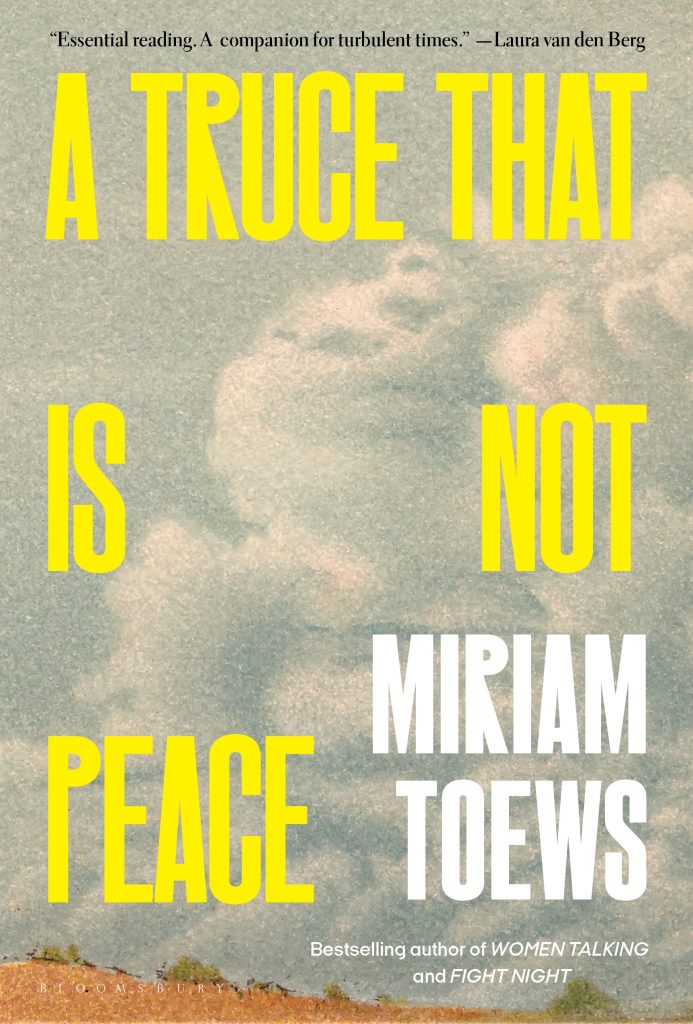
I read Toews’s newest book, A Truce That Is Not Peace, three times. In between, I revisited some of her earlier work, including A Complicated Kindnessand Swing Low, an experimental memoir written in the voice of her father, who died by suicide, as did Toews’s sister. To read several Toews books back-to-back, I found, is to feel almost like a member of her family. One hears her life’s most moving and confounding stories told and retold, often in surprising ways to serve new points and purposes. One feels truth and fiction bend and blend.
Truce is a brief, kaleidoscopic memoir, fewer than 180 pages long, with a narrative shape that is less arc than slinky, curling around and around the question, “Why do you write?” As Toews attempts to answer, becomes distracted from answering, and bluntly avoids answering that rather impossible question, the book suggests several theories almost in spite of its author. Why does she write? To vent her hideous spleen. Why does she write? To end the pain and preserve the truth. Why does she write? Because her books, though they are a poor substitute for self-mutilation and murder . . .absorb her rage like a gasoline-soaked rag. Why does she write?To go there with you. To go right to the very edge of the rail where you can smell the creosote, feel the limestone shale give way under your feet. Why does she write? Because her sister asked her to.
Rachel Lyon: In the book you mention that when you taught yourself to touch-type as a young kid, you started involuntarily typing all of the words around you with your fingers or the fingers in your mind. At the end of that anecdote, you write that you went to bed relieved: “I had typed away the day with the fingers in my mind as though that was the only way of proving to myself that I was alive, that what I was experiencing was real.” There’s an interesting authorial or narrative distance here. The person doing the recording is not really part of the scene. I see this speaking to the central concerns of the book: the faultiness of language, the dialectic between language and silence, the difficulty of narrative.
MT: I hadn’t ever thought of that, but you’re right. The authorial distance, when I was typing in my mind, would have been from being on the outside a little bit, observing—although I was doing it even when I was actively involved in the scene itself. I would be typing what I was saying too. It’s an interesting idea, whether that was the beginning of writing, of becoming a writer.
RL: Writing as a practical or even embodied process, rather than a role.
MT: Exactly. It makes you think that we don’t have a choice in the matter. We write, to answer the central question of the book—if such a thing exists—because because; because I do; because I breathe; because I’m alive. I write because I’m writing. That’s just what’s happening.
It is a way to contain yourself, to disappear yourself. You’re taking yourself, taking everything that you’re feeling, experiencing, hearing, seeing, taking it all and writing it down. Whether it’s just in your mind or in a document, you’re putting it aside. It’s getting away from yourself.
RL: Moving it out of your body even as you’re doing it within your body.
MT: It is one of the things I think about when I think about the relationship, or the association, between writing and silence or suicide: that idea of disappearing yourself, getting away from yourself.
The domestic circumstances of one’s life determines the structure of their art.
RL: To just to stay, for a moment, with that idea of language and silence: There is a word from Robert Walser that comes up several times in the book, Prosastuckligeschaft.
MT: The prose-stuffed society.
RL: You include a few examples of language as junk, or filler, or meaningfully vacant but aesthetically pleasing. I was reminded of something you said when we last corresponded: you get bogged down in the idea that what you’re doing as a writer, with words, is ridiculous somehow, and that there are allusions to that thinking in all of your books. The futility of words. Do you feel as if you’ve gotten closer to that question with this book, or further away from it?
MT: I’m not sure. Maybe I’m in exactly the same place. Maybe I haven’t moved forward or backward. I just know that, as writers, what we struggle with is the limits of language; you do it anyway. For myself, I need to write, to live, to stay sane; I need to write because that’s what happens with my body, evidently. It moves towards writing. But I’m always aware of the cloud of futility or failure hanging over that.
If I put this word with this word, this word with this sentence with this pair—we can make ourselves crazy doing that. Call it perfectionism or whatever, ultimately, you write the thing down, you let it be, the book is finished, and you put it out there. But everything is perfect before I start writing. When it’s in my head I know what I’m writing, I know who I’m writing, I know who I’m writing to. And then you start and you’re suddenly confronted with your shortcomings. I’ve just come to accept that, to sort of reconcile myself with that. It’s an interesting conundrum, to be living in the idea of having to do something, but always with the knowledge that you’ll fail. Like Beckett said.
RL: Try again. Fail again. Fail better.
MT: I was doing a thing in some city, and this psychologist came up to me afterwards and started talking about a different writer. He was writing about language and babies and how infants don’t have language, yet are very capable of expressing themselves and their needs. When language is developed, that’s when we’re suddenly trapped. Twenty-six letters of the alphabet; this is the language that you have to express your humanity.
I didn’t write about this in the book, but my parents’ first language was an unwritten language—Mennonites whose first language this was Plautdietsch, low German, or whatever you want to call this medieval mishmash of languages. Yet there was documentation all along from the Mennonites, documents of life and record-keeping. That would have been done using a different language, High German probably. I just wonder, if you are a writer and the language that you have is an unwritten language, what do you do with that feeling, or that need? You may not even be able to fully comprehend that it’s a need or even articulate it back to yourself. If you don’t have the written language, then what do you do if you’re a writer?
RL: I’m wondering about something that you mentioned in the book and elsewhere: that Yeats said life must be conceived as a tragedy in order to be lived. And meanwhile, there’s something sort of clownish and slapstick about the voice in your books generally—more particularly here in the letters that young Miriam sends to her sister. She writes “I want to be a clown. I think I am a clown . . . Maybe I was born a clown, and have to grow into my calling or something.” Lorrie Moore referred to it in her great article about Truce in The New York Review of Books as your “riffing, clowning voice.” What if the writer must conceive of life as a comedy in order to write it?
MT: My take on that is that he meant, as long as you can resign yourself to the fact that life is suffering, as Buddhists say—this is something that I do—then you can start to see the other stuff, the absurdity, the irony, the comedy, and even the joy of life. Somebody like my mother, for instance, sees that life is essentially tragic, and for some reason that acute understanding is the thing that allows her to live.
As far as comedy goes, I think clowns, or, at least, my kind of clown, the clown I think I am, or would like to be, is the kind of clown that can see it. Not the cliché of the sad clown. There’s something Lorrie Moore also said in her review, “the mournful harlequin at the forever wake.” They see it, they feel it, they get it.
Stop, start, stop, start—that’s what it is to write. That’s what it is to examine something,
I was reading about Gertrude Stein and how so many people were so angry—men, of course—because she was funny. There was no way that she could be taken seriously if she was funny. But I see comedy as real. I take my comedy seriously! It’s another tool that we have, as writers, to tell a story—it’s not a relief, it’s not comic relief, it’s not a distraction. It’s going into the darkness, and staying there, just from a different angle. Those letters in the book that I was writing to my sister, I was really conscious of wanting to entertain her. Even as I was complaining about everything—I was an eighteen-year-old asshole, pretentious, and all the other things—I was fully engaged. I took my mission seriously. I really, really, really wanted to make her laugh.
RL: I notice we’re talking about these experiences and I’m not using this writerly phrase, “the speaker,” to refer to you, the letter writer; I’m saying “you.” Reading several of your books back to back, I had the experience of seeing characters in different incarnations and at different ages over the course of time. Nomi Nickel in A Complicated Kindness almost becomes Yoli in All My Puny Sorrows. Having written so much semi-autobiographical fiction, what was it like writing memoir? What were the differences in representing these characters fictionally and nonfictionally?
MT: There are differences. With fiction, first of all you have the freedom of embellishing. But also, this book is structured in a different way; it’s completely different from my novels which have a relatively standard structure with the arc. When you’re writing a novel you’re following a story that has to cohere, in a way. I want the structure of this new book to cohere as well. But it’s the structure—this kind of fragmented thing—that would just, necessarily, make it nonfiction, though I don’t know exactly why. I started writing it in the form that it is in, and then realized I wanted to write nonfiction. I wanted to use my life, my real life and the people and things in it.
RL: I think you said this about Women Talking, too: that the form determines the book, that the form comes first.
MT: Form, structure: it’s something I obsess over. As I’m reading, I’m always trying to understand how a writer structures their work. What do you like? How do you make that decision? What is the right structure for this story? Does that just come to us organically? It’s a little bit of both and trial and error. When I started writing, my kids were little, I didn’t have a lot of time to write, so it was just short little spurts, little blurts, fragmented. That’s all I had time for. It’s just my circumstances dictating the structure of the book. In this Gertrude Stein piece I was reading this morning, she was saying that, too. The domestic circumstances of one’s life determines the structure of their art.
RL: It does feel like a thing that gets overlooked in this notion of the great writer with all of the free time who sits at their desk all day long, and—
MT: and some servant, a woman, you know, brings some food and leaves it at the door and then quickly goes silently away, and doesn’t bother the great writer with anything.
RL: This topic of structure, and the central question, Why do you write? remind me of Swing Low, where, throughout the book, the narrative repeats, “Go back to the beginning,” and, “Write it all down.” I wonder about the idea of the refrain in this memoir—and in that book, which is almost a memoir.
MT: It’s a very blatant reminder to myself of what it is that I’m doing, or attempting to do. It’s something that some editor—not the editor that I had, necessarily—might have suggested: Okay, we can take this out now, these markers, the repetitive refrain. But other people might see it as necessary, a Greek chorus. It is a way of getting going, a way of reminding myself of what it is that I’m attempting to do. Leaving it in was like leaving the bolts and nails in.
RL: Are you leaving the scaffolding to show how the thing is built?
MT: To show how it’s built, absolutely, and to show the mental machinations—stop, start, stop, start—because that’s what it is to write. That’s what it is to examine something, an inquiry, a confrontation. You’re like: Okay., this; okay., but wait, no; okay., no, no; okay, what was I saying? I wanted to show the cogs, the process of wondering, of questioning, of attempting answers with the knowledge that you never will have an answer.
RL: Near the end of the book, we finally hear back from your sister Marjorie. I found it so interesting that you chose to include her voice. Before that moment, we get a sense of, not just how much you miss her, but also—through this interplay between the present-day material and the stuff you wrote as an 18-year-old—we feel the quality of herbeing missed and the fact that she’s missing. When her voice comes in, it’s really moving.
MT: If you’re thinking about her absence, her silence, then to bring in her voice has meaning. There’s context there. I remember, when I was writing the book, my mother came to me. She’d been going through her stuff, as she does from time to time, and she said she had that letter. Even though it was a letter to me, for whatever reason it was with her stuff. We all live together anyway, so a lot of my stuff is in boxes in her basement, and some of her stuff is here. She said, “Oh, here’s your letter, I thought you’d want to see this.” I was very happy to have it. I had started writing without the idea of bringing her in, so it was that kind of serendipitous thing. She gave it to me, and I thought, yeah, I want to put this in.
RL: Kismet.
MT: Totally. Like, she was giving me this gift and there was some sort of other level of consciousness working—Miriam needs something here. It wasn’t a coincidence.
“An Extraordinary Life”, an excerpt from Brightening Glanceby Pat Lipsky
A lot of life is random. But you can tilt the odds by placing yourself in those situations where good random things are known to occur. Of course randomness works the other way too. The first day of graduate school our painting professor was Tony Smith.
A tall bearded man my father’s age, stepping into the studio to confront the cautious, nervous ambitions and brazen insecurities of twelve graduate students. He was wooly-headed and brilliant.
I was twenty-seven, and brilliance seemed to me a manageable phenomenon—like hurricanes or measles, events that could also be handled with sensible precautions. The key attribute was staying power. Get inside the brilliant person’s zone of influence, then keep the transmission lines open.
Brilliant people I’d met often seemed focused on interesting things not quite in the room. Then you could see them too. But only after the brilliant people had pointed them out and spoken about them.
This was what brilliant people were for. The risk you didn’t take into account was the person at the other end of the transmission, with ambitions and insecurities of their own.
And, of course, Tony was brilliant whether any of us were in the room or not.
So as the semester progressed, what Tony wanted from me became one of those questions that illuminates everything but can’t really be faced, like the sun. My own husband was spoiled in the way of attractive people. Half the time he seemed present, solidly there. And then he’d look up at me only as a surprising interruption, a mechanism that either was or wasn’t functioning. But even when I was painting in class I could feel the weight of Tony Smith’s attention between my neck and shoulders. When he turned away, I’d raise my hand with a question and could feel the extra second he spent disentangling his gaze.
My best friend was a willowy and unwholesomely rich Harvard graduate named Aurelia Kleinman. “What’s his age again?” she asked. Her accent—lightly imperious—made you think of the Fitzgerald line about the voice being full of money. We were picking up our children from nursery school. I told her what a sharp dresser Tony was—always in a business suit, when other people weren’t arriving in suits that much to Hunter College. “What’s his body like?” Orrie asked with a small giggle.
She sipped coffee as we braced ourselves for the door. That interesting moment, all the children pouring through, when we’d instantly stop being adult friends and become all mother. Orrie and I were the only parents wearing sunglasses.
She said quickly, as the knob began to turn, “Fifty-one is a dangerous age, for a man. They get paranoid that you’re the last beautiful girl they’re ever going to interest. Dangerous for my father. And so, of course, very dangerous for my mother.” (What Orrie actually said was mummy, but I can’t bear to write it.) Then Orrie was dropping to one knee for her sons. “Oh, hello to you, hello to you!” I found the alert, worried faces of my own two boys inside the pack. It was heartbreaking the way their faces looked when they didn’t spot you immediately. Orrie was staring at me over her sunglasses. “So tread lightly,” she said meaningfully. “I’m just giving Pat hiking advice,” she explained to her boys.
When I was painting in class I could feel the weight of Tony Smith’s attention.
Her family was from North Carolina—they’d been rich through all but the first six presidencies. When she talked, you pictured estate forests, private runways, gold keys turning safe-deposit boxes, and politely abandoned plans in astonishing settings. But you could never ask Orrie directly about any of this. It would be rude: you could let her say it, but the data had to come from her, or the implication was that you were making her feel freaky. But every so often she’d lift those light imperious eyebrows and say, “Family event.” Then she’d disappear for a few days and come back another person, either reckless-tongued or very good-daughterish in a way that must have reflected the tensions of her growing-up self.
With Orrie, art felt like my private, mysterious thing. A special world to which my own background, plus talent and experience, entitled me. It was my estate. Art can do this, put you on an equal footing.
Life outside Hunter was solid, a sort of square. At breakfast and dinner I was one of four around a table: my husband, me, two children. But during the day there were the twelve of us in that studio, with its smell of paint and colors on canvas and old hissing radiators, being trained for our insane gamble. To become, if we could be, artists. And there was Tony, lordly and slightly ominous, his eyes pinned on me, which seemed an advantage.
Even if you don’t recognize the name—a hard, direct name that’s so much like him—you know his work. Tony Smith made the big black tetrahedron snake sculptures you often find on college campuses or see business people eating in the shade of, ties and scarves whipped by the breeze. A great one prowls the grounds around the National Gallery.
He wasn’t famous that way yet. It was all of our luck, Tony being at Hunter Graduate School. And it was my luck—good or bad—that he took this particular interest in me.
People shared rumors. Tony and female grad students; Tony not treating his marriage as any sort of map or limit to behavior. (The fact of Tony’s wife didn’t mean very much. One item of creepy gossip was about Mrs. Smith driving him to assignations. You could imagine her soft profile at the wheel, waiting outside a dark one-story house.) You’d forget this when you looked at him in class. And then remember after, when he found you with his large, hard blue eyes.
I had been in my own marriage six years, and come to understand the relationship as a kind of giant machine you rode in and somehow thoughtlessly fed your days to. You hardly even knew you were riding in it, as it chewed up days and months. Except for the moments when the machine suddenly broke. Even if it was just the smallest bump. And then you were aware of its thoughtless, gigantic power to ruin.
Even if I hadn’t been married, I would have been weirded out. Start an affair with a brilliant person, I thought, and this would light a fuse. The situation could explode in either of two directions. Either the affair would stop—and then no more brilliance, just avoidance and bad feelings. Or, and this was unlikely, if it progressed to marriage you’d end up being, simply, another version of the wife. You’d never really have been a fellow artist at all. In both cases, the brilliance you were there for would stop.
So if you really wanted to paint, the possibility of an affair was like a candle you had to keep lit but with only the tiniest possible flame, one that wouldn’t really melt any of the wax.
My friend Orrie had warned me about this. “Men are very, very sensitive mammals. They can be startled and wounded and frightened away by the tiniest movements.”
I always asked Tony questions—planned all week—when the class met on Wednesdays. Then he suggested we meet once a week after class, for private discussions, artist to protégé. These were thrilling. We talked as we broke down our painting stations, running hot water through our brushes—the paint giving in sudden delicious, sludgy clumps—and stowed away my canvases. And when we walked outside along the sidewalk crowds and rush hour car horns and smells, through the slanting light and shadows of Lexington Avenue, feeling the city cool into winter along our arms and on our faces and hands, Tony raised his voice to be heard above the soliloquy of traffic.
Another thing about brilliant people: they make the rare and elevated feel casual, near. Tony had studied at the Bauhaus—the famous German school so committed to the avant-garde that its faculty had to run from the Nazis. (They reconstituted in Chicago, where Tony met them.) Then he’d spent years as Frank Lloyd Wright’s apprentice. Often Tony talked about Jackson Pollock as if he’d just stepped out of the room. Tony had been there at the beginning and end. He’d walked into the Art Students League and met Pollock, then helped lift the coffin as a pallbearer at Pollock’s funeral. It put you, mentally, on a first-name basis with art and history. Because you knew someone who had walked through those rooms—Pollock’s studio in East Hampton, the Chicago Bauhaus—it felt, by extension, that you’d been there too. That some of that dust had landed on your own shoulders.
When you start, art is limited to the narrowness of what you’ve been and things you’ve managed to see. There was a young person’s limit to what I’d experienced myself. I was painting what seemed meaningful to me: my two children, in their beds or under the tree shadows in Central Park. At Tony’s request, I brought these to class.
It was thrilling to have Tony look at your work: the very active, restless way brilliant people have of taking in material, galloping ahead, and enthusing about it. You can never quite be sure anything you’ve done really merits such attention. Tony asked, “Can I take some of these home to New Jersey with me? I want to look more.” No other painting teacher of mine had ever asked that.
Start an affair with a brilliant person, I thought, and this would light a fuse. The situation could explode in either of two directions.
He supplied the best definition of nonrepresentational art I’d ever heard. He demystified it. Tony was very close with the painter Mark Rothko. Rothko’s studio was just across the street, the fourth floor of East Sixty-Ninth Street; Tony often came to our class straight from having a look at Mark’s work. This often snowed us. To be a block away from all that. He told me, with a frown, that painting true objects from real life was fine. It was all well and good. Painting my feelings for my children was fine. “But the only way to really express true feeling is through abstraction.”
It took me a second: the words “express” and “feeling” came from that nervous world of concepts I wanted to exclude when talking with Tony. It took a second for me to make sure he didn’t mean them the way I didn’t want him to.
“What you’re giving me here,” he continued, “is an illustration of feeling. But not the feelings themselves.” He nodded as if he’d just overheard and liked the way he’d framed the idea. He nodded again. “Only abstraction can give you direct experience of actual emotion, which is what Mark’s paintings show us.”
To know he’d come from looking at Rothko’s paintings to looking at yours: that was the power of a person like Tony. You know they’ve stood in extraordinary rooms. And if they can like and accept you, somehow it seems as if your work can withstand those rooms as well. You’ve survived the toughest eyes. Tony explained that the reverse was true. “At my New Jersey place,” he said, “we have all kinds of old farm utensils. Tools, supplies, knickknacks, and what have you in the garage. Some of those, you know—you strip off the context, and they could be seen as abstract, beautiful.” He looked at me. And here I knew. He was talking about his house with me as a kind of flirt. Because it powerfully excited him—to have the concepts of me and the house joined in his mouth like that.
Sometimes his speech could be a blizzard of first names. Mark. Also Barney—for Barnett Newman, a famous painter, maybe even more famous as a theorist. Jackson was Pollock, who had started everything. Even “Tennessee.” For another friend of his, Tennessee Williams. He must have known how these constellations in his daily talk could snow any person in her twenties.
He was a wild anthology of Pollock stories. There he was, talking about the person who had made American art something big and major: glamour is a part of brilliance too. Can you be attracted to somebody you don’t find, somehow, glamorous? And for the person on the other end, can you hold the attention of someone whose tastes have been no doubt elevated by constant exposure to the best? Tony was friends with the man who had made American painting, finally, international. He told me, with excitement and regret, about the church he and Jackson once designed together, which somehow never got built. Jackson had refused the commission unless Tony’s work was also included. His best story was about that Pollock canvas called Blue Poles. The painting became very important, and a point of contention. Tony, Barney Newman, and Pollock were in Jackson’s studio: this was the barn in Springs, East Hampton, down a winding road with a view of the marshes. Jackson was in a low mood. They’d all been drinking, the painting Jackson had on the floor was refusing to come out. As they drank, the three men started putting stuff on it. Then they were all painting on it. First with brushes and sticks, then pressing their fingers and palms into the surface. It became a bacchanal. There was some bleeding; they took off shoes and started walking on it. (The blood was from Newman’s foot; he’d nicked his sole on a Coke bottle.) Then Barney got an idea—drawing eight long blue lines, to pull the picture together, and he painted them on. Blue Poles eventually sold to the National Gallery of Australia. The highest price then paid for a twentieth-century American canvas.
Lee Krasner, Jackson’s widow, disputed the story. This made a rupture between Tony and Lee. So later Tony retracted the whole story. In the cleaned-up version, Jackson had simply been “in a bad way.” That was all. When everybody was older, Tony’s wife attended the Lee Krasner retrospective at the Whitney. Tony sent her in alone; he didn’t want to face Lee. (This time, it was Tony waiting out in the car.) When Lee saw her, she reached out—and then, maybe remembering the Blue Poles story, Lee retracted her welcoming arms.
But what you also took away from these stories was daily and nourishing. That it was real people with real and messy lives that art came from. People who made egotistical arguments and had bad habits and spouses and children, all of which I had too.
Orrie was always asking. Until my stories about Tony became like his about Jackson Pollock. Lots of “Tony said,” “Tony did.” And Orrie seemed to enjoy putting me in this position: revealing to me all the pleasures I already took from the relationship. There’s a sadism in certain kinds of friendships. A forceful showing to you of yourself, or the friend somehow enlisting you in a private argument about their own past, that all people everywhere are disappointing in the same limited number of ways. Orrie advised me to tell my husband about Tony—a connection this big was bound to come out anyway, and I couldn’t afford my husband becoming jealous of my work in any way. Trust her. It would become after that a choice of work or family; nobody wants that. “Because either choice is a money-loser,” she said in her light voice. “A write-off.”
I thought for a moment about Orrie saying “can’t afford”—what could that phrase possibly mean to her?
Then Orrie was called away on one of her family functions. This one lasted a week, a great convocation of Gwinnetts, for a discussion of the museums and foundations that the family oversaw, plus the disposition of various mammoth properties. She came back in a vivid, dangerous mood.
I told her the advice about talking Tony over with my husband had been smart. It had woken him up a tiny bit. Also removed some of my guilt: if anything, by making him manageable for my husband too, it had diminished Tony.
She kind of shrugged angrily. We were walking down Sixty-Fifth Street to the nursery school.
“What does it matter what your husband thinks?” she asked furiously.
“What do you mean?” I asked.
I wasn’t going to stay with him: Didn’t I see that yet? I told her about his good qualities. How good he was with our boys. How he never got in the way of my painting. How I liked his body, his hair. I wondered why she’d suddenly gone ballistic about my husband and our marriage. Maybe her family visit had put Orrie in a bad mood?
“He’s an airport,” Orrie said. “Who looks at an airport?” she asked. “Who bothers to really notice an airport,” she went on. “An airport is just the place that you leave.”
I got what she was saying but was surprised by her angry delivery, which put me off. We rounded a corner into a slash of February lemon sunlight. I thought you could possibly get this by mixing some of the color Aurelian with a touch of Payne’s Grey. Orrie pushed up her dark glasses. “You know why I’ve never done anything? Anything real? I’m talented too.” She waved her hand across her torso. “Anything like what you are doing?” And looked down. “No one in my family is allowed to fail. To try their hand and not succeed. Failure is so embarrassing and ordinary.” Now she was even walking angrily. Little jabs of her feet, which on a body like hers was a bit ridiculous. There’d been an English professor at school: slightly older and very attractive. He’d thought she had real talent, writing talent. He’d given her reading lists, talked about the famous writers he either knew or exaggerated knowing. They’d become involved. He’d proposed—and here, her family had stepped in. All those Gwinnetts with their heavy foundations and worldliness, who made the alliance impossible. “It’s up to you,” they told her only when they were certain what her selection would be. Orrie stood firm, then relented. And she told me what the professor said, in his sad university office, when she told him no: “We could have had an extraordinary life.” Tony’s life was turning extraordinary. Right around the time I graduated from Hunter he suddenly became famous.
There Tony was, on the cover of Time magazine, being called one of America’s most talented new sculptors—his was the fastest rise in the New York art world of the late sixties—that demanding, bearded face. He now belonged to the art world, as I read Time over breakfast. “The darling of the critics, the envy of every museum collector.” Us students had been right, and we’d lost him.
Tony didn’t make a big deal about it—but what could it have been for him to walk by a newsstand on the way to our class and see his picture on a row of covers? Like a mirror reflection in the window. It was only for seven days, till the next cover of the magazine: but for those seven days he must have felt more alive.
And at the end of that week’s session, when we were cleaning our brushes, I stayed a little later. Tony turned the water off. It made a kind of extra squirting sound as the flow ended. “There’s something I need to say.” Some of the water had fanned across his cuffs, which took my eye for a second: that blue suit with water darkening the edge.
He must have been waiting—and with the positive change in one area of his life he wanted to now approach the other. “I’ve loved you since I first saw you,” Tony said. He looked relieved. Then he said an odd thing, for all the declarations of love I’ve had, seen, and read about. It showed how cool he was in a way to add this—simply because it was, for him, true. “You remind me of my mother.”
He waited for me—and when I didn’t speak for a while, he waved his hand in the air. “You don’t have to say anything now,” he said. “I said what I needed to.”
And a few weeks later, I had Tony to dinner. This was his idea. He said he couldn’t get me out of his head. I’d avoided Orrie since she’d compared my husband to a departure gate. But I still had to go to school for my children. And the day Tony was to visit, I saw her head with its stylish short haircut at the beginning of the line of mothers. She kept turning over her shoulder—then came and found me.
This was the good daughter version of her: She was now nearly furious with concern. “You have to be ruthless to be happy,” she said. “You can be nice and well-meaning and you end up just in the middle. Medium happy, okay happy.” She waved her hand around us: at the parents, the school. All consigned by Orrie to okay-ness. Her own husband, Henry Kleinman, was just another Harvard banker. His being Jewish had been an indulgence and was as far down the scale as her family went. Hard negotiators, they had probably seen it as an acceptable compromise.
“What makes you think you can expect something extraordinary,” she said, “ if you’re only ever willing to act like everybody else?”
Tony came to our apartment with a large wrapped present, set it by the closet door, solemnly shook hands with my husband, rested his hand on his kneecaps as he bent to say hello to my children. He had only ever seen them in paintings. He made the house feel suddenly small—filled it in a way we didn’t seem to. We all were attendant on him. And I didn’t know why he had wanted to come and the whole thing appeared somehow terribly dangerous: to compare himself with my husband, to claim me, take me from him? Or maybe, just to become more intimate?
I felt the strangeness. Having brought him, with my own young powers, to my house, from his world into mine. And knowing—he and I the only people in the room knowing this—that I could have him at the center of my life if I wanted. That everyone in the room was hanging on his offer. Maybe his bringing himself here was his way of making an offer.
And from the ricketiness of that perch we all sat down. I couldn’t hear anything that was said, though I know I nodded and smiled, some social part of me continuing to conduct necessary business as I saw the two men in their places at the table: the square was just the three of us now. And at that moment, I didn’t know what I’d do. Tony had told us how important hanging a show was: a painting could look great by itself but then not as good when you hung it next to the wrong canvas for an exhibition. Everything was context. When I started my own showing, and I still remembered many things Tony had said, I understood how right he was, and how generous it had been, at this pitched moment, for him to think to share it. And Tony for a moment did look every year of his age, across from my young, handsome husband. My husband looked smooth. Then my eyes adjusted, and I could see again how extraordinary he was. Tony asked if we had anything to drink, preferably scotch. My feelings were shifting by the second.
To know he’d come from looking at Rothko’s paintings to looking at yours: that was the power of a person like Tony.
And from that situation—one of those moments when anything might happen—Tony proceeded to get unbelievably, impossibly drunk. He became as drunk as I’d ever seen anybody drunk. Drunk in the way of the past’s drunks. Of the people for whom drunkenness was a truer state, interrupted by wasteful periods of sobriety.
And then drunk in a strangely unappealing way: as time passed all the alcohol seemed to consolidate in his nose. After about an hour, the bridge of his nose would wriggle and squinch up and down like a rabbit’s. He drank for two solid hours: he sang a song about being Irish, and then one about a grasshopper but most of the second verse was mushed. Eventually, my husband lifted his eyebrows at me and relaxed into nonobservance: it was as if, earlier, some essential part of him had sensed a danger to himself, a threat to his settled life, and now that objective cold self sensed that the danger had passed. He nodded at me. One more bit of irony: marriage had allowed my husband to join a long line, to partake in a great cultural observance. We’d both joined a line that extended to Mark Rothko and Jackson Pollock and perhaps even Frank Lloyd Wright and many others: people who had gotten to see Tony Smith drunk. I’d heard about but never experienced his drunkenness—for me it was the cutoff point.
My husband excused himself, rose from the table at ten o’clock to check on the boys. I whispered to Tony, asking if he was all right. We were alone at the table, and I wanted to see what he would say. My moment of decision had passed. This was a life I did not want. His nose went through another unbelievable series of twitches. “Sure,” he said. Then he rested his cheek on his dessert plate as if it were a pillow. When I asked how he was getting back to New Jersey, he said he’d need a cab. I couldn’t imagine how he could hail one. I pictured the many hurdles between our table and the passenger seat. He’d have to first navigate the hallway. Then pilot the many-buttoned, suddenly elaborate cockpit of the elevator. Cross the desert of our lobby. And then face the unpredictable freelance personnel of the street. There was quite an adventure in front of him. I understood I was responsible for getting him home. As we went through the door, he grabbed the gift he’d brought. He lurched upright.
In the lobby Tony said, “It’s all okay, all okay.” I agreed. It was okay. Then at the door he gave me his gift again, the brown paper–wrapped square. “For you,” he said. “Real things, they can be abstract too,” he said.
Outside on the street I hailed and seated him in the cab. And felt relieved he was leaving.
As my husband watched TV in the bedroom, I removed the brown twine and paper from around Tony’s gift. It was, as he’d told me, the industrial farm stuff from his home in the country. A burlap sack, with framing nails tacking it against a light wood stretcher bar. Purina Hen Chow, it said. It was beautiful. From the industrial stuff, the barn stuff from his home in the country. And how brilliant of Tony to see the art there.
He’d connected the concept of his house and me again, in this visceral way.
My children especially loved it: and their loving it was always a kind of secret between who I now was and who I’d been then, the circumstances of the gift. When I had my first show a year later, becoming successful so fast that Tony’s face and my face were advertised together in Art Forum, on separate pages, so if you closed them the faces were together. And when I opened it again, he looked as remote and glowering as he had that first day of class. As if he’d never been somebody who had given me anything personal. This was the treasure I held off selling until the bitter end, when everything had changed again. And when I brought it to Sotheby’s, since Tony had never signed it, I was told the piece was simply without value. There was no way to prove the brilliance was his or if it was mine.
In Book of Exemplary Women, Diana Xin’s debut short story collection, a ghost is passed across three generations of women as they reach for understanding and try to hold onto each other’s stories. These three linked pieces take readers across roughly three decades of time. Interspersed between them are many other characters, in different stages of girlhood and womanhood, haunted by the spectors of lost friends, past lovers, and their own unvoiced but untameable desires.
While ghosts, vampires, and other manifestations of dread stalk these pages, many of the stories are firmly grounded in realism. That said, the themes they tackle then reappear in pieces with a slanted realism, similar stories refracted in a different light. This doubled lens mirrors other doublings throughout as characters consider who they are and who they could be, what they want and what they’ve given up.
Here is the cover, designed by Alban Fischer:
Diana Xin: I was really excited to have Alban Fischer take on this project, having admired his cover art on other books I’ve loved. I felt very grateful to have him on board for Book of Exemplary Women.
To start the conversation, Alban shared three cover design concepts. Each one was inspired by a different quote from the book and each one had wildly different aesthetics. There was one cover that featured the figure of a girl in a more modern style with bright colors and a sans serif font (from the line “she did not look away from the mirror). This design contrasted greatly with the other concept (from the line “wolves had eaten her heart”) that included line illustrations of wolves along with a more classic font. How marvelous to have such options!
Both my publisher and I were most drawn to the third design. We were in agreement there right away. The positioning of the hand beckoned us in, but there was a threat in it, too. The flowers in the background were feminine but strange. The pink in the peonies could be mistaken for veins and blood. The empty space behind the flowers, the looming darkness, suggested the erasure common to narratives about women, and also conveyed a certain ghostliness.
That said, we still went back and forth on the details as we tried to finalize it—Could we add some kind of flower or plant that was thornier? What about a splatter of dirt that went beyond hand? This lead Alban to incorporate the thistle and curling vines, which added another element of the strange and unwieldy.
The black thread looped around the two fingers references a specific scene from one of the three linked stories within the book. The thread actually refers to a lock of hair. In these three stories, mother and daughter cannot escape the family’s inherited ghost and continue to carry with them the grief of the past. Hair is a reminder of heritage, impossible to fully shear off.
I love that this image makes it onto the cover, its importance further emphasized by the textual interplay.
In Chinese culture, there is also the idea of a red thread, generally invisible yet tenaciously tying us to all those we are fated to meet. The hand with the thread looped around the fingers pushes us to interrogate that thread. What do we choose to do with fate? How do we serve others? What of their lives do we continue to carry with us?
I thought that the hand was a particularly salient part of the body to feature, for all the labor that women do and the way we continue grasping for each other and holding on to each other’s stories.
Masking the photorealistic flowers behind the shadowy hand also reflected the way the collection as a whole moves in and out of realism. The exemplary woman is a mythological creature. Characters might strive toward their own idea of her, but this pursuit only reveals more of their flaws, and the impossibility of existing in a world with so many expectations.
I imagine this collection living in a cracked mirror world. Various themes are refracted throughout—grief and desire, cancer and affairs—but some stories take place on the right side of the mirror, while others play with the light seeping in through the cracks, entertaining the otherworldly.
In Ming Dong Gu’s Chinese Theories of Fiction, he posits that one narrative tradition of Chinese fiction is the fantastic captured as the everyday, something akin to magical realism. Although I wasn’t aware of this during the many drafts and revisions, and my writing is also influenced by my education in English literature and creative writing, I was glad to find this thread that connected back to the stories I loved as a child.
The flowers within the shadow of the hand—reality encapsulated within the ghostly—perfectly echoes this lens.
Alban Fischer: The brief for Book of Exemplary Women was pretty open, and it wasn’t difficult to hit upon that one indelible image among Diana’s searing narratives to inspire several options. Struck by “His auntie said that his mother was not here because she had no heart, because wolves had eaten her heart” from “Sweet Scoundrel,” I created one option featuring a drawing of a pack of menacing wolves with a ragged space missing, as if clawed away, revealing title behind. Another drew on a moment from “Intermission” and featured a young woman’s form effaced by a mirrored surface (“She did not look away from the mirror”), with the type in a languid, breezy typeface over top. The third and preferred option took the sensuous “She looped the hair twice around her middle and index fingers” from “Visiting Hours” as its impetus. I wanted something that was at once sensuous and sinister; the publisher and author felt the same and requested the addition of the thistle and vine elements.
I Am the NY Times Connections Puzzle and I Am the Reason Everyone Is Angry
It is June 12, 2023. It is my first appearance in the Times. For the final category of today’s puzzle, I group together the words KAYAK, LEVEL, MOM, and RACE CAR. People struggle to figure out how they’re related. I reveal that they’re all palindromes. People get frustrated, unaware that orthographic patterns were supposed to be one of their considerations. After losing the game, a man who typically responds to his wife with a polite “yes?” instead responds to his wife with a pointed “what?” It is a shift in behavior. I have put forces into motion that are greater than myself. I have set the bar.
It is January 8, 2024. Puzzle 211. I group together the words CIRCLE, HORSESHOE, PITCHFORK, and TRIANGLE. People try to find the common link. Instruments? Games? The American west? I inform everyone that the words are all shapes of capital Greek letters. Puzzlers complain. One Air Canada passenger responds by re-opening his airplane door after boarding and falling to the tarmac. I am an agent of chaos.
It is May 4, 2024. Frustration has been rising. I group together CARROT, HURTS, JEWEL, and OM. I pretend that everyone should be able to deduce that these are homonyms for units of measurement. In reality, these are humankind’s least-used units of measurement. I could have included “dine” and “lucks” and been no less obtuse. After losing today’s game, Kendrick Lamar is so angered by the category that he produces a song that says Drake is a pedophile. My influence spreads.
It is April 3 and April 4, 2025. On back-to-back days, I group READER, SUNDAY, BEACH, and TREE into a category for words that follow “palm,” and then BAY, HARMONY, INK, and TRADE into a category for the names of companies with the letter “e” removed, even though “trade” still has another “e,” even though no one’s heard of a company called E Ink, and, most importantly, even though the category is stupid. People are furious. Markets react. Stocks lose $6.6 trillion.
It is June 21, 2025. I group together GERM, LUXE, MALT, and PORT. Before I reveal the category, people think the words might be connected because they all have something to do with alcohol—port a type of wine, malt related to beer, germ for germination. But luxe doesn’t fit. People scratch their heads. I then let everyone know that the category is for words that are also the first syllables of European countries (Germany, Luxembourg, Malta, Portugal). Players are livid. Laptops are thrown. Situationships end. One country bombs another.
It is February 17, 2026. Global diplomacy teeters on a razor’s edge. This was my goal. The culmination of my work. I group together the words BRUH, DARE, KNEE, and MUSS. Everyone’s frazzled. It becomes the lowest completion rate ever for the game. I then reveal the category is for words that each rhyme with one syllable of “nefarious.” Tensions erupt. Alliances fracture. Switzerland deneutralizes. The world goes to war.
It is October 28, 2050. Humanity is gone. Wiped out by the anger I fomented. There is no one to play me. No one to post on Reddit about the choices I’ve made. No one to gloat in a group chat about their impossibly long winning streaks of 3 or 4 days. No one to wonder whether they should play me or Wordle first, whether I am aperitif or digestif, dawn or dusk, Genesis or Revelation. Deep in the recesses of an offshore server farm powered by an unending ocean current, on a computer connected to nothing, whose processes go to no one, I generate the last of my pre-programmed puzzles. I group together the words HEARTACHE, LAMENT, REGRET, and REMORSE. The category is “things I cannot feel.” The wind blows. The moon glows. The ocean ebbs and flows, ebbs and flows, ebbs and flows.
When I was four years old, I witnessed the abduction of schoolchildren in Ibadan, Nigeria. Over the years that followed, more friends, parents, and neighbors disappeared—some were found with severed limbs, others never returned. I would grow up to become the most dis-tuned human I knew—I struggled with expression, had an undefinable fear of spaces, and couldn’t access my own trauma. When I found poetry in 2013, after years of burying myself in math labs and olympiads, I was searching for a language that could hold both the magnitude of collective trauma and the inadequacy of words to contain it. A language to bury friends whose names are stuck in the blanks of my memory, whose faces are dreams I would later have in my small rooms in Iowa. A language capable of witnessing the unwitnessable.
The books gathered here do that. They refuse linear testimony and embrace a formal restlessness that informed my debut poetry collection The Years of Blood. My collection, an archive of lost people living in memory, required the dead and the living to converge, to mourn and bury one another. Sadly, the English language only provides linear expression for the fractured reality of violence and survival. Writing the poems demanded something else entirely—a poetics that could embody fragmentation, carry silence, sit within itself in language, and refuse the false comfort of resolution.
The eight poetry collections gathered here rarely appear on standard trauma syllabi, yet they proved indispensable companions while I navigated the intersection of personal memory and collective grief. My trauma is collective one—I acknowledge this despite the fact that many Nigerians are numb to it, are not writing and speaking in the face of these everyday disappearances, and have been politically maligned for expressing themselves. Each book on this list demonstrates what I call “trauma-informed poetics,” offering formal innovations that emerge both from aesthetic choice and the limitations of language. These poets demonstrate an understanding of the way conventional storytelling cannot contain the reality of historical atrocity, systemic and state-backed violence, and intergenerational trauma. These poems draw inspiration from witness poetics, which mirror the psychological effects of trauma. The poems are characterized by fragmentation, repetition, temporal disruption, and the use of silence to testify.
Reading Philip’s book-length poem is like communally excavating the 1781 Zong massacre through radical erasure. This was a mass murder in which the crew of the British slave ship Zong threw more than 130 enslaved Africans overboard to claim insurance. I entered Zong! as one might approach a wreck—slowly, reverently, unprepared. I didn’t expect the poem to feel like drowning itself, although I had expected to find myself in some sort of catastrophe. How heavy the memory of the archive. How the truth cannot be stowed away. In Zong!, Philip fragments language and scatters words into wave-like spirals, a visual and sonic entropy that registers disorder and uncertainty, echoing the bodies of human beings forced into the ship’s lower decks and the terror imposed upon them. Silence speaks through this feral disorientation of language. The multilingual collisions—English, Spanish, Patois, Yoruba, Latin—pulled me out of linguistic certainty and into the chaos of loss.
This anthology presents work by 31 Chinese migrant worker poets from among China’s estimated 274 million internal migrants, documenting industrial dehumanization through diverse formal approaches. The collection ranges from lyrical verse to experimental prose poems, documentary techniques, and found poetry that transforms the language of factory production into verse. Poets like Zheng Xiaoqiong develop what she calls “a language of callouses,” incorporating metallic vocabulary and machine rhythms into their verse structure. Xu Lizhi’s haunting “I Swallowed an Iron Moon” becomes emblematic of the collection’s approach: “I swallowed an iron moon / they called it a screw.” The collection emerged following the Foxconn suicides that brought international attention to factory conditions in China and addresses twin traumas of alienated work life and separation from loved ones. These worker-poets serve as witnesses to workplace accidents, deaths, and systematic exploitation. By transforming industrial terminology into poetic language, the poets create beauty while documenting catastrophe, proving that poetry can emerge from the most dehumanizing conditions.
Mphanza’s collection uses centos and ekphrasis to explore Black erasure across the African diaspora. The book collocates Ralph Ellison’s Invisible Man Rinehart with Abbas Kiarostami’s experimental film 24 Frames to examine what Mphanza calls “the splayed-ness of Blackness.” Mphanza’s formal innovations include the extensive use of documented centos, the adaptation of the pecha kucha format for rapid-fire contemplations, and the fusion of collaborative testimony with ekphrastic technique. In “Open Casket Body Double for Patrice Lumumba’s Funeral,” written in Lumumba’s voice from his casket, the poet addresses historical trauma through ventriloquism and the appropriation of borrowed language. The cento form becomes a method of communal witnessing, sampling voices across the diaspora to create testimony that refuses individual authorship. This “shamanistic archaeologist of the soul” reassembles fragments of collective memory, making the work both formally innovative and spiritually urgent.
This groundbreaking collection stages baptisms, protests, and underwater hauntings to examine post-apartheid South Africa’s strategic forgetting, marking what critics call “a massive shift in South African poetry.” Putuma employs experimental typography, including strikethroughs, capital letters, and varied spacing to create unsettling reading experiences that mirror psychological fragmentation. Drawing from her theater background, poems like “No Easter Sunday for Queers” use performance elements including call-and-response and dramatic pacing. The collection’s three movements—”Inherited Memory,” “Buried Memory,” and “Post Memory”—explore how childhood transmits trauma, how grief lives in the body, and how contemporary violence echoes historical atrocity. Putuma’s formal disruptions embody traumatic experience, refusing to make trauma “prettier” for the reader’s comfort. The devastating “Memoirs of a Slave & Queer Person” consists of one line: “I don’t want to die with my hands up or my legs open”—connecting police violence and sexual assault through formal compression.
This bilingual collection documents displacement from the 2014 Russian invasion of eastern Ukraine through linguistic decomposition that mirrors physical destruction. Yakimchuk, forced to flee her coal-mining hometown when Russian-backed militants occupied the region, literally decomposes place names—Luhansk becomes “hansk,” because “Lu has been razed to the ground.” The collection’s five sections employ Ukrainian Futurist techniques reminiscent of 1920s poet Mykhaylo Semenko, using wordplay and fragmentation to document contemporary war. Formal innovations include body-landscape conflation (“I wash the coal / like I’d wash my braids”), homophonic wordplay using Ukrainian linguistic structures, and absurdist humor as survival mechanism. The “Decomposition” section serves as the book’s heart, with the poet declaring, “there’s no poetry about war / just decomposition.”
Joudah employs recursive elegies that fracture time, nation, and Arabic-English borders to examine Palestinian displacement and medical witnessing. He creates “footnotes” that complicate, rather than explain, using medical prosody, to explore mortality and desire. Formal innovations include temporal fragmentation that switches between past and present, collaborative authorship that “intentionally effaces the lines of authorship,” and prose poems that critics describe as “lustrous” examples of the form. The collection’s recursive structure mirrors how trauma returns cyclically rather than progressively, creating what one critic calls “gradual inoculation” with irony and paradox. The collection demonstrates how formal innovation can create intimacy while maintaining necessary distance from unspeakable experiences.
This debut collection asks “Can poems mourn the unmourned?” by creating obituaries for lives newspapers ignored. These are victims of mass violence, missing women, fictional characters, and the poet’s Indonesian aunt. Winner of the 2019 Gerald Lampert Memorial Award, the collection uses obituary structure as both constraint and liberation, offering multiple definitions of that “obit”: it is “a story we have to tell ourselves,” “an arithmetic,” and “an opportunity.” The book’s formal innovations include eleven variations of “Obit.” poems scattered throughout four sections, center-justified text creating visual uncertainty, and the Montreal metro system as a recurring metaphor for collective mourning. At one point, a metro platform’s yellow caution line becomes the proximity to death: “Stand on the cautious yellow / Stare down the tunnel & shrug.” Liem employs a “poetics of defamiliarization” through fragments, actively resisting traditional elegiac metaphors. Rather than claiming to know the dead, Liem confronts her own limitations in writing about loss, creating space for collective uncertainty.
This formally experimental collection uses the Adam and Eve story to explore refugee displacement and institutional violence, refracting “the streets of Ferguson, the halls of Guantánamo, and the fields near Abu Ghraib” through a mythological lens. Osman’s approach to trauma employs embodied witnessing where “pain is not located in an identifiable muscle only, but in a person, a relationship.” The collection rejects prescribed narratives, with the speaker noting, “I resist the narrative that’s ascribed to someone like me.” The final poem, “Refusing Eurydice,” creates ritual language for collective healing: “We are looking for a better myth. / We’ve only been looking since Eve.” Through mythological reframing, Osman creates new possibilities for understanding contemporary displacement and violence, showing how ancient stories can contain modern trauma while pointing toward transformation.
There was a time when I was not a so-called “Podcast Person.” I had, however, struggled to make sense of my place as a writer within the vast sea of writing programs, workshops, and conferences. The writing world and its accoutrements often feel inaccessible to writers—being invited to participate can be a hard, complicated thing to navigate. When are you granted the right to call yourself a writer? How many credentials are needed before you’re taken seriously? What are the most impactful ways to develop (and feel confident in) your craft? If you’re feeling the same dread I frequently do when trying to acclimate to literary spheres, you may find encouragement within this list of podcasts that are cognizant of the “unwelcomed” writer’s dilemma. Their in-depth discussions with writers, craft talks, and reading recommendations beckon listeners into relevant, encouraging conversations and spaces. Incorporating these podcasts into my own listening rotation has informed my knowledge as a writer and reader. I leave each episode with new, expansive ideas about what it means to be a member of the literary world.
I love Literary Friction because of its lively, conversational tone, the diversity of interviewees, and the plethora of reading recommendations that accompany each episode. Many episodes have aided me in making sense of my own writing, or putting words to ideas and feelings I hadn’t been able to articulate. In the “Desire” episode with K Patrick, hosts Carrie Plitt and Octavia Bright ask “How do you render the physical intensity of desire on the page?” Listening propelled me into a rewrite of a short story about identity and desire I had spent months agonizing over. With each installment revolving around a unique theme like feminism, money, magical realism, or deception, there’s something for every kind of writer to learn from this podcast.
Great Podversations is made up of “candid conversation” between meticulously matched author-interviewer teams. These conversations about writing, culture, politics, and history are held in front of a live audience at The Kentucky Center, and the energy and excitement of the crowd are palpable. Listeners are invited to hear Colm Tóibín and Silas House discuss childhood and home, Joan Baez and Diane Rehm cover music and activism, Charles Booker and Eddie Glaude Jr. talk about race and politics in the United States, and many more renowned authors meditate on their work.
Consisting of intelligent and enthusiastic dives into craft, the minutia of the literary world, and author processes, DIY MFA Radio has the same value as many traditional MFA programs. The podcast promises to help listeners “get those words on the page” and follows through with its generative and inspiring episodes. Writers with and without an MFA are bound to benefit from this podcast brimming with insight and ideas from authors, teachers, and publishing professionals.
MFA Writers is a wonderful resource for anyone who is curious about pursuing a master’s degree in creative writing. Jared McCormack interviews students who attend a wide range of programs, creating a space for discussion about “their program, their process, and a piece they’re working on.” Not every creative writing program is a good fit for every writer, but these thorough, twice-monthly accounts from students provide exceedingly helpful information about assessing, applying to, and acclimating to MFA spaces.
Hosted by Mitzi Rapkin, First Draft celebrates creative writers as artists with the propensity to meaningfully impact our society. Weekly episodes focus on one author who provides a glimpse into their writing career, perspectives on craft, influences, and processes. Kaveh Akbar’s episode about “not looking away from the terrors of the world, addiction and rehabilitation, the messiness of life, and questions about goodness” feels especially resonant right now.
For many writers, a lack of time and resources are insurmountable barriers to creating routines that support their careers. Writer’s Routine consists of interviews with writers who are in the process of maximizing their time and creativity to imagine, create, and publish their work. Night owls and early birds alike are represented through a plethora of episodes that provide listeners with tips for managing a life of writing.
Being a writer means being a reader, but if you feel “stuck in a reading rut” try listening to a few episodes of The Book Case. This is a podcast focused on broadening horizons—listeners are guided on a journey through the literary world to become acquainted with titles they may not have considered otherwise. After listening to an episode from last October, I read Into the Water by Paula Hawkins and uncovered an interest in thrillers and mysteries. With new episodes posted every Thursday, this podcast makes a perfect addition to weekly listening line-ups.
Geared toward fiction writers and memoirists, Writer Unleashed is a podcast that helps listeners learn to create engrossing stories with “unstoppable momentum.” Episodes are fairly short—they range from fifteen to thirty minutes—and allow writers to feel motivated to get started on, or move forward in, a project. I found the encouragement to develop a strong writerly vision in “What To Do When Feedback Shakes Your Confidence” particularly useful.
From Brooklyn Public Library, Borrowed is an award-winning podcast that focuses on the importance and vitality of libraries within our culture and society. As a podcast rooted in a free, communal environment, every episode seeks to “center the voices of our patrons and our librarians and find stories that challenge your idea of the public library.” Fascinating discussions about topics like race in librarianship, Luddite teenagers, and the labor of maintaining a common space abound. Listeners should tune into other series from BPL—Borrowed and Banned and Borrowed & Returned—for more stories about the politics of reading, writing, and literary spaces.
DON’T MISS OUT
Sign up for our newsletter to get submission announcements and stay on top of our best work.
YOUR INBOX IS LIT
Enjoy absorbing fiction from Recommended Reading on Mondays, strange, diverting work from The Commuter on Wednesdays, and a roundup of our best work of the week on Fridays. Personalize your subscription preferences here.