Back in May, I signed an embargo agreement on behalf of my bookstore stating that I would “ensure that [The Testaments by Margaret Atwood] is stored in a monitored and locked, secured area and not placed on the selling floor prior to the on-sale date.” The idea behind such agreements is that retailers must sign them in order to receive their inventory in a timely fashion, a common practice for newsworthy, highly anticipated books with huge print runs. This was certainly the case when I was responsible for getting these affidavits signed on behalf of Simon & Schuster, where I worked in sales from 2003–2005.
On Tuesday, September 3, customers began reporting that Amazon.com was shipping copies of The Testaments already, and in fact that many have received their orders that day. The official on sale date for this book is Tuesday, September 10, a rare international embargo date. Most books go on sale on Tuesdays in the U.S. and on Thursdays in the U.K., and a universal date only happens for the highest of profile authors. Breaking such a significant embargo is a newsworthy event in the weird world of bookselling.
It’s hard to imagine Jeff Bezos getting too worried about a financial penalty.
I do not expect that Nan A. Talese, the imprint that publishes Margaret Atwood’s books in the U.S., or Penguin Random House, the corporate entity behind that imprint, will pursue any of the theoretical consequences Amazon.com might face. Even for smaller retailers, the effects of breaking an embargo are generally practical rather than legal: publishers may hold back future sensitive shipments, forcing the bookseller to turn people away when they come looking for the hottest new book on release day. The terms of the agreement I signed state that if the embargo is broken, the publisher has the right to withhold “resupply” of the book, meaning they would not ship any more copies for a period of time. But even if PRH did hold back reshipments of The Testaments, that would do nothing to stop third party vendors who use Amazon.com as a marketplace from selling copies, so it seems unlikely that it would ever be completely unavailable on the site. The agreement also refers to remedies “in equity or otherwise,” and “injunctive relief.” My employees who formerly worked for Borders (RIP) and Barnes & Noble both were told in the past that their employers would be fined monetarily if they sold books prior to embargo dates. It’s hard to imagine Jeff Bezos getting too worried about a financial penalty.
For smaller booksellers, embargos are serious business. I once posted a photo of a SEALED carton of Harry Potter and the Cursed Child on social media, which was in fact (bafflingly) in violation of the embargo agreement I had signed with Scholastic in order to receive the books in time for a midnight release party. I got a call from my sales rep on a Sunday morning asking me to take down the photo, which I did immediately. I was terrified that the publisher was going to punish me through delayed shipments of key titles after that, which was how I had been made to understand the consequences of violating embargo agreements. But I’m betting there will be ZERO consequences for Amazon violating not just the fine print but the entire basis of this agreement, which some exec surely signed digitally through Adobe Sign just like the rest of us did.
The real problem is that even a publisher the size of PRH can’t afford to muddy its relationship with Amazon.
The real problem is that even a publisher the size of PRH can’t afford to muddy its relationship with Amazon. Preventing its biggest customer from selling what might turn out to be the biggest book of the year would only hurt the publisher in the long run. Amazon.com has taken retributive measures in the past against even large publishers who tried to fight their policies. And when a company gets this large and this powerful, too powerful to punish or risk alienating, the contracts the rest of us live by become meaningless. The best I can hope, as the owner of a small bookstore hoping to sell a good number of this book, is that The Testaments is a high enough profile publication that federal anti-trust lawyers will finally see exactly how unlevel the bookselling playing field is. (And in fact, the American Booksellers Association has reached out to the Department of Justice and the Federal Trade Commission about this incident and the patterns of which it is indicative.)
The kicker is that Amazon will make hardly any money selling this book. Books (especially big splashy publications like this) have always been a loss leader for them—whereas I and many other independent retailers are counting on this release to pay our bills. Penguin Random House has made a public statement to the effect that it was only “a very small number of copies” were released early, but The Guardianreports that it was around 800 copies—a small number in terms of the expected print run, but huge to a small retailer like me. If I were to sell 800 copies of this book, the income would pay nearly a year of wages for one hourly full-time employee at my store. “A very small number” is a relative term.
I understand the marketing strategy behind strict on sale dates, and as a member of the book industry, I respect it. For the most part it’s a ploy to push books onto the elite New York Times Best Sellers list, by concentrating initial sales into one calendar week. But you can’t argue that embargo agreements matter if your biggest account gets to be the exception. As Tom Stoppard wrote in Rosencrantz & Guildenstern Are Dead, “There may be nothing behind it, but it doesn’t make any difference so long as it is honored.” Don’t tell me to honor something and then look the other way when the big dogs spit on that agreement.
He was a peculiar man, certainly. He was not peculiar for his stature, nor his gait, nor his standing in society. Yes, he held an interest in astrology, but that was not peculiar either. Nor was it peculiar that he did receive fifteen hundred a month, as was the custom of the day. He did, however, from time to time, entertain a close friend in his flat, and hopefully by now one gets the gist of the exact way in which he was “peculiar” without having to come out and say it.
A Fabulous Socialite
A woman of style, Miss Hughes delighted the less adventurous with her daring taste. Sometimes she appeared as a coquette, with a curl of hair daintily askew. Sometimes she appeared as a dandy, in colorful suits and a handsome boot. She was known as a socialite, with a surprising array of close friends, both men and women, and everyone agreed she was incredibly brave for it. Also brave? This author, for including Miss Hughes in the narrative at all.
A Most Amiable Correspondence!
Miss Whitlock and Miss Davies composed each other letters throughout the month: “I do so admire you,” “no I do so admire YOU,” “I find you quite admirable,” “perhaps we should admire one another in person, at Mrs. Shaw’s salon this coming fortnight,” and so forth. They were friends, but not yet close friends, and that made it all the more exciting, especially given that at any point they could be tried for profanity for using the word “admirable.”
On Matters Of Public Perception
Beverly opened the closet with a great deal of incredulity. How was one to choose between dandy, gentleman, ruffian, spinster, lonely governess etc. for the day’s appearance? In fact, it was all so overwhelming that Beverly didn’t dress or go outside at all, and became a side character who was always wandering indoors in a nightgown.
A Web Of Close Friendship
“Previously,” said Mr. Ashley, “I was close friends with Mr. Chattermore, however our close friendship grew more distant when he became even closer friends with Mr. Allen and Mr. Griffiths, who are themselves close friends of each other but the latter of whom also previously had been a close friend of mine, because their friendship is an open close friendship. But the thing is, recently Mr. Chattermore has been insisting that we revive our close friendship, collectively, hence my confusion.” In a sobering turn of events, they were all arrested for indecency later that day after being accused of having wrists.
The Ladies Who Cross-Stitched
The women spent the night sitting chastely side by side, making small cross-stitch patterns with unmentionable sayings on them, a twinkle of close friendship in their eyes, and nothing else happened. At all.
The Leather Shoppe
Upon noticing Mr. Phillips had taken interest in the hardware, the leather thonger, eager for a sale, approached.
“Perhaps you’ll find these useful in entertaining a close friend or two.” said the craftsman, gesturing to several sturdy riding crops.
It’s actually more of an acquaintanceship that happens once a month. Even though we all know it shouldn’t, because of God.
“Oh,” said Mr. Phillips, flushed by the brazenness of the leathersmith, whose strong arms seemed so assured, in both the crafting and sale of goods, “It’s not a particularly close friendship. It’s actually more of an acquaintanceship that happens once a month. Even though we all know it shouldn’t,” he added, nervously, “because of God.”
La Douleur… De L’amitié Intime
Miss Wood returned from her studies in France quite distressed. Though she had enjoyed the countryside and the cuisine, she had developed a close friendship with a French countrywoman, Miss Chevalier, with whom she had explored the streets and coffeeshops of Paris, and, upon their parting, had become quite inconsolable.
“Aah, well, there is no greater delight than going to Paris with a close friend,” said Madame Clarke, who had herself taken a semester abroad in France in her younger years.
“Oh yes,” said Miss Wood, gripping the arm of the settee rather strongly, “We went to Paris over and over. It seemed we would never tire… of the sights of Paris.” Miss Wood eventually succumbed to hysteria, and the author’s manuscript was finally seen by a publisher.
Close Friends Indeed!
The two men, both unmarried professors, were buried in a single grave, literally on top of one another. They were close fr— in fact, they were barely even that, one might say they were more like roommates.
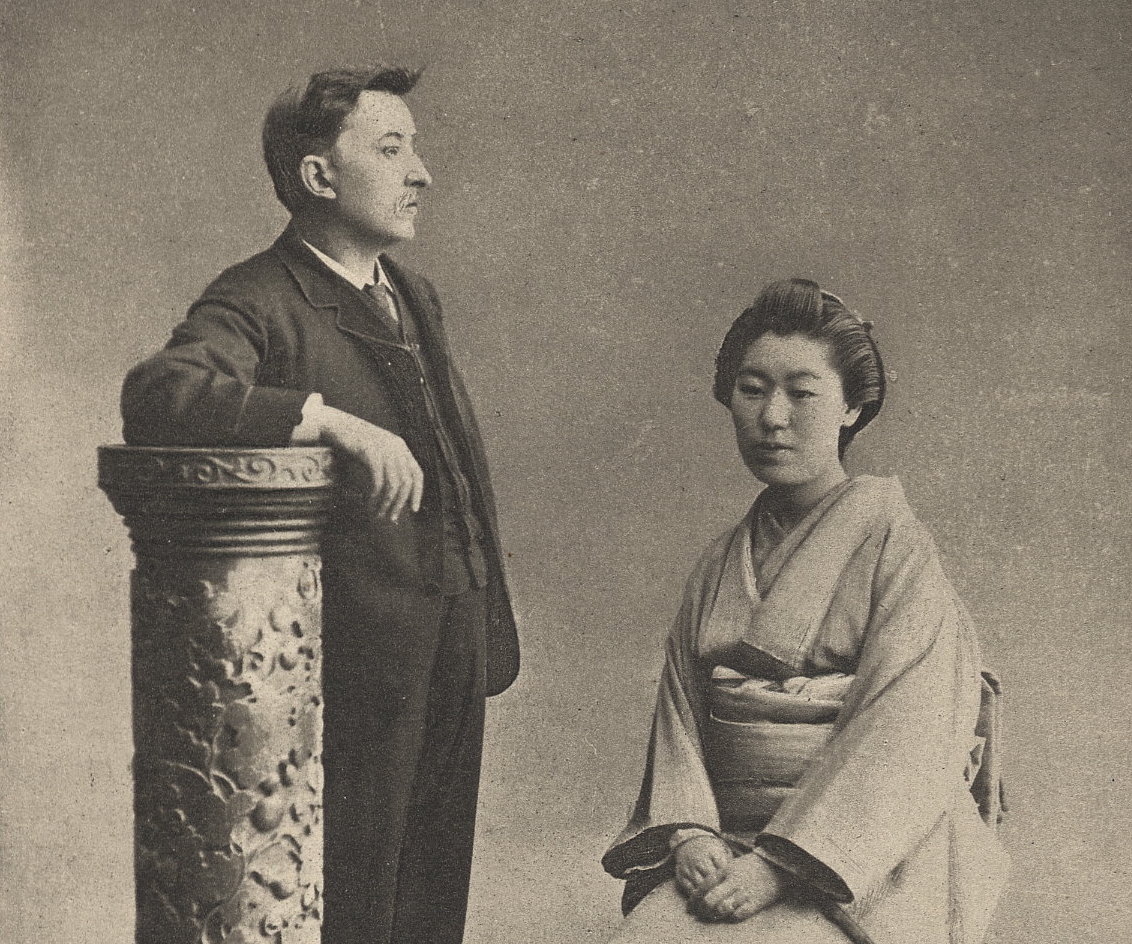
In The Sweetest Fruits, Monique Truong ventures around the world with Lafcadio Hearn, the Greek-Irish writer who was famed for his chronicles of Japan and New Orleans—reimagining his stories through the eyes of the women who journeyed with him and who undertook epic adventures of their own.
Buy the book
Truong begins in 1854 with the voice of Hearn’s mother Rosa Antonia Cassimati, relating his origin story. She moves forward to 1906, west to Cincinnati, and Alethea Foley, a formerly enslaved African American woman who was Hearn’s first wife. Foley offers the story of her life with him to white reporter. The final character is Koizumi Setsu, Hearn’s second wife and literary collaborator of his Japan works. Truong weaves in the voice of Elizabeth Bisland through excerpts of her biography of Hearn. The novel forms a glorious imaginative reclamation of the stories of those who loved and nurtured Hearn and his storytelling.
I spoke to Monique Truong about who gets to tell stories, the missing voices in history, and why she resists pinning the concept of home to a particular country.
JR Ramakrishnan: From your acknowledgments section, it almost sounds like Lafcadio Hearn himself thought you should write this book. How did it begin for you?
MT: I was fact-checking my second novel, Bitter in the Mouth, and looking through the pages of The New Encyclopedia of Southern Culture, Volume 7: Foodways. I saw an entry for “Hearn, Lafcadio (1850-1904),” identified as a “journalist, author, and illustrator.” The entry began with Hearn’s birth on the Greek island of Lefkada, then a lonely childhood in Dublin, Ireland, followed by emigration to Cincinnati, Ohio, as a young man, and then migration to New Orleans, where this Greek-Irishman’s contribution to the history of Southern food was described this way:
[Hearn]…opened the short-lived 5-Cent Restaurant and collected recipes of local dishes. Hearn published these recipes in 1885 as La Cuisine Créole, which became the earliest published collection of New Orleans and Louisiana recipes…[, which] continues to serve as an invaluable record of the history of Creole food, New Orleans, and Louisiana.
The entry then offered up this unexpected concluding act:
Hearn moved to Japan, taught English, changed his name to Koizumi Yakumo, married a Japanese woman who was the daughter of a samurai…and continued his voluminous writing…. Hearn secured a place in history after publishing numerous volumes…particularly Japanese fairy tales.
I was intrigued by the cookbook Hearn had authored—I’m a cookbook collector and avid reader, more reader than user of cookbooks—but none of the disparate parts and geographies of the author’s life made sense to me. When things don’t make sense is when I want to know more. I know more by writing a novel.
JRR: I used to live in New Orleans and he was quite a presence there. I thought of him as an Orientalist (of New Orleans and Japan). Your book turn the gaze on to the Orientalist through the stories told by the women in his life. What was your impression of him as you got to know him?
MT: I too thought of Hearn as an Orientalist, a purveyor of the exotic and the Other. Has my sense of him changed after spending eight years with him and the women in his life? Yes. He is a purveyor of the exotic and the Other, and he is a man who gravitated to the margins of society because he felt most at home there. He felt himself to be among the Other because of his “Oriental” mother, his “olive complexion,” his lack of family ties, his poverty, and his blind eye. The operative word for Hearn is “and,” as it is the operative word for us all. We are not merely one thing. We are each motivated by a complicated, complex set of desires and wants. That is what I came to understand about Hearn as well.
As a former refugee, I resist the idea of pinning home onto a particular country because I know that countries can disappear, nationalities taken away.
As I was researching Hearn, those around him who caught my attention were the women in his life. Taken as a group, their stories span the globe. What I wanted to consider was not only Hearn from multiple points of view, but also how the written word and the lack thereof can determine whose stories and memories are known, documented, and re-documented. Women’s access to education, to the written word, and to publication have been proscribed and suppressed. With rare exceptions, what we know of the past is missing their memories, experiences, and voices.
Elizabeth, Hearn’s first biographer—and I’m rather convinced the love of his life—and Setsu, his second wife, both wrote books about him, a biography and a memoir respectively. Their works, in my reading of them, had a clear agenda, which was to preserve the prestige and legacy of Hearn as a great man of letters and as a great man. Elizabeth’s biography, in particular read, like a hagiography.
Rosa and Alethea, on the other hand, could not read and write, so they did not leave behind a direct documentation of their lives with and without Hearn. His biographers, however, were able to provide damning characterizations of them both: Rosa as childish and petulant toward Hearn’s father, and Alethea as impatient and willful toward Hearn. Who were the sources for these characterizations? Hearn’s father? Hearn? What were their agendas toward these subjects?
As for Setsu, biographers often note that she was illiterate in the English language but fail to acknowledge that she could read and write in Japanese, her mother tongue. In this respect, she had the clear linguistic advantage over Hearn, who by the end of his fourteen years in Japan, could not claim fluency in Japanese. He relied on interpreters and translators throughout, and he could write brief, simple, childlike letters to Setsu and only to Setsu.
JRR: There seem to be many gulfs of understanding between men and women in the novel. You have Hearn’s father and Rosa (and the perfect line: “As it often happened between us, Charles and I agreed not to understand each other”) and then Hearn and Setsu, his Japanese wife. Both couples barely share a language. Hearn and Alethea, his first wife, who’s African American, have English as a common tongue but there is the separation of race in America. Could you talk about language in the novel?
MT: Though I am a writer, I am a skeptic about our ability to use language as a form of effective communication. To me it’s a miracle that any of us can make ourselves understood even to those closest and dearest to us. My previous two novels also explored these gulfs of understanding, as you say, either because of lack of access to the dominant language (Binh in The Book of Salt) or because of a subjective relationship to language (Linda in Bitter in the Mouth).
In TSF, especially between Hearn and Setsu, language is re-structured out of necessity and desire. Hearn’s biographers write about how he devised a language for the two of them—a mix of simple English and Japanese—that was used only within their household. My mind exploded when I read about this creation of a language for the domestic and matrimonial sphere.
As a writer, I thought about which words were integral to the day-to-day and which were not. I thought about which words would form the first bridge between the two speakers, who had no shared languages. I thought about the inventiveness of this new language, the nuances of it, and the mechanics of it. I also thought of its inevitable failures.
As a wife, I knew that it was false that Hearn alone devised this language. Setsu and Hearn would have created it together. The biographers who credited Hearn alone for the language had dismissed Setsu and her intellect and, most importantly, her will to survive. I did not.
When I went to Matsue, Japan, and to the museum there devoted to Hearn, I found a biography, A Walk in Kumamoto, by Hasegawa Yoji that illuminated Setsu’s life fully, her years prior to Hearn and those after his passing. In Kyoto, I met Japanese scholars who, like Hasegawa, regard Setsu as Hearn’s literary collaborator for she was the one who told him the Japanese ghost stories and fairytales, which he then re-wrote in English which then launched him toward literary renown.
I agree with these Japanese scholars that Hearn was an excellent listener. He knew what to listen for. He knew not to dismiss the stories of women, children, and the common man. He listened to Setsu as she told and retold him these stories in their language, until he finally heard within these stories the reasons for their persistence and longevity. Then he wrote his version of them. That patience paid off, as these narratives were documented in written form, not left behind or forgotten as Meiji Japan (1868-1912) turned toward the West with breakneck speed.
JRR: Alethea is basically dismissed in Elizabeth Bisland’s account of Hearn’s life. In the novel, you have Alethea telling her story to a white reporter, who’s is condescending and racist. I appreciated how Alethea pushes back in your text, as in the moment when she refuses to use the phrase “smart as a whip.” You center her in a way that other accounts of Hearn’s life have not. How much information was out there about her life?
MT: Alethea Foley—a young biracial woman, who was formerly enslaved in Kentucky—met Hearn in Cincinnati, Ohio, where she was working as a cook in the boarding house where he roomed. What I know of Alethea comes from two documents, which I considered “scrimmed,” meaning that the documents profess to be a representation of her voice but are, in fact, mediated by the writer in question.
It has been white men who get to publish, who can claim the status of author and expert, and make their living from writing books.
The first document is a feature that Hearn wrote for the Cincinnati Commercial, after he and Alethea had already married. He didn’t identify her by name but only as a boarding house cook who was a “ghost seer” and a compelling storyteller. He describes the “low, soft” melody of her voice and the “enthralling charm” of her conversation. Hearn then writes that he can’t “attempt to do justice” to her storytelling gifts. He places quotation marks around most of the article, signaling that it is she who is speaking and not the reporter. What follows is a jumble of eerie, atmospheric stories. What is remarkable about this feature is that Hearn did not assign to the cook the exaggerated parlance and pidgin of “Negro” subjects in his other articles. In short, he did not reduce her to a racialized caricature. Given the ghostly subject matter of her stories and her storytelling gifts, it was clear to me why Hearn was attracted to Alethea. It took more time to imagine why she would be attracted to him.
The second of the scrimmed documents is an interview that Alethea gave to the Cincinnati Enquirer in 1906. The headline of the article read, in part, “Claim…Made by a Negress” and “Ex-slave says she was married to gifted author.” The article didn’t have a byline, and I thought it plausible that the newspaper would have sent a young white woman, ambitious and hungry for scandal in order to make a name for herself as a reporter, to interview Alethea. The majority of the events that I include in the Alethea section of the novel were taken directly from this interview, which was dense with information about their meeting, their marriage, and Hearn’s demeanor and expectations as a young husband.
The reason for the 1906 interview, given two years after Hearn’s passing, was Alethea’s claim in Probate Court that she was married to Hearn and therefore has a legal right to his estate. The resolve, the will, and the inner strength that Alethea must have possessed in order to say to herself and to the court that she would fight for what was rightfully hers in a court of law. That plus giving the interview, where she was clearly taking her claim into the court of public opinion? I was beyond impressed. I wanted to spend time with this Alethea. I wanted to imagine what and who in her life had shaped her. Alethea is employing her skills as a storyteller to keep the young white woman reporter intrigued enough and in front of her long enough to hear her story, not only Hearn’s role in it.
JRR: I was so affected by how Rosa and Alethea were both illiterate. Still, they are formidable despite not having the skills that most of us today would take for granted. As someone who’s obviously read an immense amount and written books of your own, how did you inhabit these women who didn’t have the ability to read or write?
MT: I write my novels in the first-person voice because it requires that I enter fully into the language of my narrators. It requires me to let go of my own vocabulary, syntax, and relationship to language, written and otherwise. When I shed my own language and attempt to imagine and inhabit another’s is when I truly begin to understand a character.
While it’s true that Rosa could not read and write, her relationship to language was not impoverished or diminished. She spoke two languages, Venetian and Romaic. Venetian, in particular, came with it the hallmarks of power, privilege, Empire, and assimilation. I imagine how she must have spoken Venetian better than her Irish husband. How she critiques his pronunciation. How she calls it his “shadow language,” meaning that she could make out only the basic shapes of what he intended to communicate but not the finer details. How she hangs on to both of her languages, when she is living in Dublin with young Hearn. How she regrets that her son is slipping away from her as he is learning English, the language that would divide them.
As for Alethea, her relationship to language also cannot be characterized as impoverished or diminished. As I’ve noted earlier, according to Hearn himself, she was a gifted storyteller.
I suppose the answer to your question is that I never assumed that these two women had a lesser or diminished relationship to language or to storytelling because they could not read and write. I never assumed that I was a better storyteller than them because I have access to the written word.
I acknowledge, of course, the excruciating and frustrating limitations placed upon Rosa and Alethea by their illiteracy. To document their stories, they needed an intermediary, a scribe. The storyteller and the scribe, who ultimately has control over the narrative? The desire to control and to maintain the integrity of what is written and what is documented plays itself out in different ways in Rosa and Alethea’s sections and is as much a part of their stories as the stories themselves.
JRR: All three characters are telling their stories to other people to be recorded. Hearn himself was a reporter. In some ways, fiction is a form of reportage and your book is a document. Hearn was known for taking liberties with his reporting, and certainly the way he obtains and tells the stories from Alethea and Setsu might be considered appropriation in 2019. He was a white (or shall we say white-passing man in today’s terms?) man. I would love to hear your thoughts on the issue of to whom stories belong, and who gets to tell them?
With rare exceptions, what we know of the past is missing the memories, experiences, and voices of women.
MT: Who do stories belong to? All of us.
Who gets to tell stories? If by that we mean who gets to publish books? Then the answer in the U.S. is clear. It has been white men who get to publish, who can claim the status of author and expert, and make their living from writing books.
JRR: In your book, you—Monique Truong, novelist, former refugee, lawyer, Vietnamese American from the U.S. South—tell all of their stories. What would Hearn think of you and this work?
MT: I think Hearn, as a fellow writer and traveler, would be intrigued by how I had made the reverse journey that he did, that I went from the proverbial East to West. I would share with him my own difficulties with learning Japanese, and how my first languages—Vietnamese and French—haunt my written English. I would give him a copy of TSF, along with a very strong magnifying glass or a more modern pair of reading glasses so that he can make out the text. I know that he misses Rosa, Alethea, Setsu, and Elizabeth dearly. I think that he would recognize them on the pages of my novel and also see them in a new light.
JRR: Hearn’s life was defined by movement. You seemed to have travelled a lot for this book, and I’m sure in general too. I was struck by this line in Rosa’s section, when she’s talking to the family cook Kanella, and notes: “She had never travelled afar. She did not know how easy it could be to leave, how cowards always depart.” Later on, you have Setsu talk about her and Hearn’s moving around Japan and of “weak roots.” Did he find home, do you think? Does anyone?
MT: I think “home” or rather the feeling of being “at home” can fluctuate from moment to moment, day to day, year to year. It seems to me less dependent on geography and locale and more so on finding a community of friends and beloveds. As a former refugee, I suppose I resist the idea of pinning my concept of home onto a particular country because I know that countries can disappear from maps, nationalities can be taken from you.
Absolutely, I believe Hearn felt “at home” with Setsu and their four children, but as I explore in the novel the Koizumi home or domestic realm was a country apart—the “country inside” I called it—a country that they together created, like the language that they together created. In the novel, I call Japan the “country outside,” and Hearn’s relationship to that country was much more complicated and fraught than he would wish or choose to believe. Right before his death, Hearn was attempting to secure a teaching position in the U.S. so that his eldest son, Kazuo, could study here. He had made no plans whatsoever for Setsu and the other three children. It saddens me to think what would have happened to the “country inside,” if Hearn’s heart had gone on beating. What would have happened to that fragile “home” that he had traveled so far to find?
When I turned 14 years old away at boarding school, I paid for my meal with a credit card for the first time. I’d been authorized to use this new parent-issued credit card, given to me for purchasing train tickets and pre-approved supplies, to have a nice lunch on my birthday with a few of my brand-new school friends. We ate at a place people seemed to like, charmingly in an old firehouse, and when the bill came I paid it—wrote in the tip, totaled the bill, signed, kept my copy and so on. My new friends sort of blinked at me. Later, at the dorm, one asked how long I’d had my own credit card.
“A week?” I answered. “It just came.”
“Oh,” she said. Later in the year she confessed that she’d asked because I had handled it all quite smoothly and she was very impressed by me in the moment. The truth was I hadn’t been concerned about what to do. For good or ill—and sometimes for both—I just did it how my father did. Since I was, at the time, understood by the world to be a 14-year-old girl, having mannerisms and habits that were suitable to a 45-year-old businessman caused consternation at frequent intervals. I addressed clerks and shopkeepers with his bumptious charm, I put on my coat and crossed my legs and settled myself in chairs with his movements, the wide-angled grace of the big guy I eventually became; I shook my head reprovingly when I didn’t like what the speaker was saying. I still do all of these things, but having transitioned into a man, it seems less off-puttingly incongruous now. One trait seemed somehow to fit all and none of the categories, though: my father’s skill, which I also grew into, as a storyteller.
Every night at dinner, my father would tell stories from his day. They were mostly small, quotidian workday stories, but sometimes if he was in a good-enough mood, my brother and I could coax him into telling family stories or favorites from his work life or from college. What we noticed was that it improved his mood, too. To fall into the cadences of story, even grumpily at first, is also an experience I have now and it remains an incredibly satisfying one. And at every gathering, whether a holiday dinner or Shabbat collation, at a cookout or a birthday party, on line at the store, waiting for a train, while taking a tour of my future high school when the tour guide was talking and we were supposed to be listening—Dad, come on— there were always stories.
My dad, who’s a numbers guy, can’t write at all. But that’s on paper. In person, it’s a different ballgame.
My dad, who’s a numbers guy, can’t write at all. My uncle—my father’s brother and only sibling—can: He’s a well-regarded gay writer and poet with a long and distinguished publication record. We move in some of the same circles now, and depending on their generation, people might ask me if I might be related to him or occasionally whether he’s related to me. But my father can’t write at all; his attempts to prepare a speech for some occasion are inevitably an unrelieved block of short, simple, declarative sentences that read like an intermediate English Language Learner writing a final assignment for a communications class. But that’s on paper.
In person, it’s a different ballgame. In exactly the way that children of English professors effortlessly learn perfect grammar and never to misuse lie for lay, I learned perfect comedic timing and the lapidary art of composing a story. To compose a story is quite like composing a photograph—there’s art and craft in what one chooses as the center of the image, what’s kept in and what’s cropped out, the angle, the light. I learned from a million hours of observation of the kind that only a child can lavish on a parent how to string together a scatter of details to make a coherent narrative, how to pace the action from beat to beat, how to read the room to make sure people were following and not move too quickly but neither too slow; how to show the heart of a story—the actual message, the flaw that reveals the perfection—at just the right moment.
I learned the facial and bodily grammar that adds a layer of depth and nuance to the story as well, modifiers and limiters and intensifiers and even the complex linguistics of contradicting my words with my face to show the listener that I am, briefly, reporting rather than telling. That’s why my father’s attempts at writing seem so rudimentary—because the page only tells a portion of the story. Without the tone, inflection, pacing and other communicative information that come when he tells a story to a group, the words themselves seem like struggling seedlings outside a new house, bare and stunted. For my part, I solve the same problem in the exact opposite way: I use punctuation in all type and manner of off-label ways in order to introduce some of those elements back onto the page, as you can clearly see (unless our stalwart copy editor of this volume has cleared them away and returned me to Standard Correct American Punctuation, the floor around her desk positively littered with commas and em-dashes she’s banished with prejudice).
My father’s attempts at writing seem so rudimentary because the page only tells a portion of the story.
I pace my sentences on the page as they are in my head and experience no greater compliment than to be told an essay or chapter sounds just like how I talk. Natively, I am a talker, just like my father is. I love storytelling for the opportunity to be in the room with just the people I’m with, to watch how they’re hearing me and give them exactly the right mix of nuance and boldness, just the perfect cocktail of illuminating explanations and flip, you-know-the-rest-of-that hand gesture. Like a high-performance engine that gets tinkered with before each race for the optimal mix of oxygen and gasoline to the track and weather, the storyteller makes thousands of tiny instinctual judgment calls in every rendition. On the page, I can only choose once and then every reader has an off-the-rack experience. But live, in front of an audience—no matter how small—that’s where I am most completely happy in my work.
My experiences of trying to study storytelling, formally, were similar to my experience of trying to study English grammar. My parents, though not professors, are well spoken in Standard American English, so I found it paradoxically difficult to reveal the process pieces behind my mastery. I’d learned it all of a single piece, and not in stages. I could spot the error and correct an ungrammatical sentence easily during my sixth-grade Language Arts classes, but I struggled for years to understand tenses and cases and which the hell was the adverb (I finally got that part down, but I still don’t understand gerunds, not really, not even with Dorothy Parker’s help).
In the same style, I took workshops and classes in storytelling as I deepened my theater practice (my father found the idea hilarious, as though I’d confessed to taking an eight-week instructional program in Duck Duck Goose) but found them frustrating beyond words. I could never articulate well why I had made a particular choice or what my rationale was for encouraging a classmate to skip a bit or move something to the end, it just felt Correct to me that way. Certain constructions or compositions had an ineffable rightness about them that others didn’t. Some sentences felt finished, satisfied and satisfactory, and others either unfairly truncated or extended beyond their capacities, like single parents trying to manage an unreasonable number of tasks. In my head, or maybe in my blood, there exists a metronome for how a sentence should unfurl itself and it’s so deeply ingrained I’ve never been able to go against it, not even to save an essay or a story from being cut out of a book or a show.
Some of that is repetition. As a parent I have learned that children sometimes have to be specifically taught a thing, like riding a bicycle or addressing an envelope, a process during which you correct them and guide them and encourage them and eventually celebrate the success as a shared project. In other cases, they have to be reminded approximately eleventy million times—like saying “please” and “thank you”—before they eventually internalize it (they do eventually, right?). Those are rituals of parenting, and we do them over and over with full recognition that they’re a part of the job even though it can be exhausting. They’re a part of the job that many of us knew to expect, having seen other parents engage in them. But there’s another entire class of learning in which children just watch and listen to you every day, day upon day, and then one day reproduce exactly what you do. Sometimes this is very exciting, like when they spontaneously pick up a spoon and eat or spontaneously critique a billboard for being sexist and ridiculous, and sometimes might cause a person to swiftly reevaluate the kind of language they use in traffic, but my father and his friends told stories so often and with such craft, with so unimpeachable a sense that this was a foundational skill of life that I simply picked it up and ate.
Once, an interviewer asked me where I’d studied storytelling. I told her I’d studied with Arnold Friedlander, one of my dad’s friends and the owner of a building supply business.
(Once, an interviewer with whom I was annoyed and frustrated because of the way she constructed her questions about my gender asked me where I’d studied storytelling. I told her I’d studied with Arnold Friedlander, one of my dad’s close friends and owner of a building supplies business; a gifted natural storyteller who would have hooted helplessly with mirth if anyone had suggested that storytelling was a thing a person could go to school for. The interviewer made affirmative, approving noises as if I had identified myself as having attended the Harvard of storytelling and printed this tidbit of my pedigree in her magazine.)
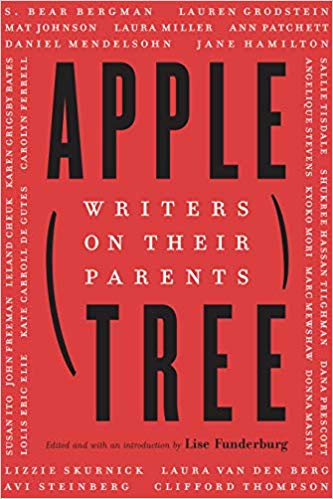
There are more ways that I am like my father; they are so many and myriad and idiosyncratic that when he expresses (about me) the sentiment that gives this volume its title he does not refer to the wholesome apple but says instead the nut doesn’t fall far from the fucking nut tree,and I assure you he means this fondly. I have his wide and friendly cheekbones and large head, his generous mouth, his mesomorphic broad-shouldered body and his wide, flat feet. I have his sense of humor and his sense of duty, more of both than a lot of people, his easy gregariousness and his work ethic and his mile-wide judgmental streak. We are both a lot, in every regard. There are things we don’t share, too, from his disdain for beaches to his suspicion of live theater, but if I could include a video with this essay, here’s what you could see if I showed both of us side by side at the beginning: both of us opening our hands up and outwards, both cocking our heads slightly to the side, both pursing our lips slightly with the lower lip pooched out fractionally more, both nodding in a sort of acquiescence with a brief close of our eyes at the nadir of the nod, both looking at you, both breathing in, both beginning the story.
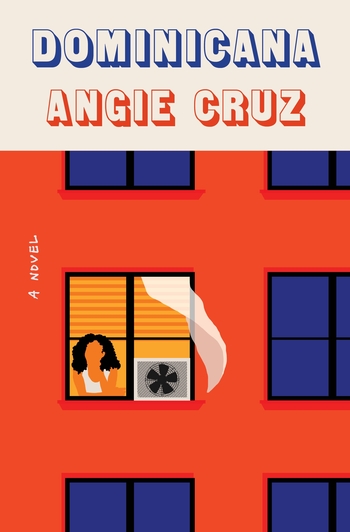
Dominicana takes place in the 1960’s, following 15-year-old Ana Canción as she marries a man twice her age and immigrates to New York City from the Dominican Republic. Though Ana doesn’t love him, and never truly dreamt of the U.S., she knows it’s an opportunity to help her family.
In this novel, Angie Cruz follows Ana as she grows older and lonelier, as she finds freedom in her husband’s absence. Domicana is a novel about immigration, womanhood, and coming of age. It is a novel about unlearning silence but learning survival. It’s about living in a place that doesn’t love you—but loves your labor—and finding a way to love it anyways.
Arriel Vinson: What jumped out at me first were the themes of womanhood/motherhood vs. manhood in the novel. Ana was a 15 year old being prepped for marriage and taking care of a husband. Why did you want to depict this?
Buy the book
Angie Cruz: Before this was a novel I had started writing what I thought wasa nonfiction book about my mother’s marriage as a way to answer questions that I was having around womanhood and the way women in my family sacrificed for the sake of the family. I was very inspired by Dorothy Allison’s book, Two or Three Things I Know for Sure both thematically and stylistically, where she looks into her family’s history to explore the impact of one generation to the next. So with that in mind, I interviewed numerous family members about what their life was in the ’60s and ’70s and I was struck by the evasions, silences, the inconsistency in the telling, all in an effort not to admit or say what was obvious in my eyes, that my father was an abusive man.
At first, I thought my grandmother’s ambition for a better life was prioritized over the well-being of my mother but while writing this novel I am coming around to the fact that my grandmother was probably trying to save my mother from possibly a worst fate. Women are vulnerable to sexual assault, unfair wages, abuse, femicide, all over the world, but specifically, in Dominican Republic, the Trujillo dictatorship instilled, in the fabric of the culture, the notion that women are inferior to men. And this translates into a host of legal, physical, emotional, financial, vulnerabilities for women. But the reality is that women are presumed incompetent constantly in our culture here in the United States too. And Ana’s prepping to be married is not so different from so many women who get married thinking they have to perform the role of wife. Ana’s plight, one full of agency and desire to make something for herself, despite having multiple obstacles, feels to me like so many women’s stories. She already understands the trades one makes in a marriage, what she needs to do to get what she needs or wants. For Ana she wanted to bring her family to New York.
AV: The novel is set in the 60s. How did that influence the themes in the book, and Ana’s story in general? You use historical events to ground the reader in time. Tell me more about this decision.
All my books deal with informal economies that are born from the need to have a side hustle, especially when many jobs are below a living wage.
AC: This book has had many incarnations. A previous version was set in the 70s. But I became interested in 1965 for this particular book because the window in Ana’s living room faced the Audubon Ballroom. And in that building Malcolm X was assassinated. I was interested in what it might have been like for someone newly arrived not knowing the language or culture to be looking out her window and witnessing this historic event. Ana doesn’t yet know that as a member of the African diaspora—being that Dominican and African American ancestors both took the same trip across the middle passage—that Malcolm X’s platform, the civil rights act, the struggle for black liberation would eventually make it possible for her and her family to have access to education, employment, housing, etc.
So to write her story in the 60s made it possible for me to juxtapose the upheaval in New York and also the occupation of the Dominican Republic by the United States. To show the marches and acts of resistance out on the streets, but also to correlate this moment of revolution and multiple forms of resistance in the world that were also happening inside Ana’s apartment, inside her body too, was intentional.
AV: There’s some physical abuse in the novel as well (although sometimes it’s not explicitly stated). Why was this important to include for Ana’s story? Would you say this is a reality some immigrant women experience?
AC: I have found it interesting how difficult it has been for readers to say Ana was raped. Call it marital rape, spousal rape, but I think the book makes it clear that she did not want to have sex with Juan. Aside from the fact that she was a minor, she also did everything to avoid it, and when it happened, he choked her. He slapped her. He didn’t give her the key to the apartment. In fact, one reviewer called it unwanted sex. It’s rape. So to answer your question do I think Ana’s story is a reality for some immigrant women. No, I think it’s the reality of 1 in 5 women who will be raped at some point in their lives in the United States. 1 in 4 women will be sexually abused.
AV: This novel is also about Ana learning survival, not just Ana learning herself. She uses the pigeons who visit her window to imagine she’s at home, finds a way to make money on the side. Why was this an important balance to strike?
Even in a bad situation, even when we don’t have resources, if we have imagination, there is a feeling of freedom.
AC: I think all my books to some extent deal with informal economies that are born from the need to have a side hustle, especially when many jobs for the struggling class are below a living wage. For many keeping one’s head above water requires inventing ways to make money. Without her pigeon friends, her memories of what may have seemed like a more idyllic life in the country back home and her saving up for her necessities, I think the book would be unbearable to read. She was in a bad situation, but even in a bad situation, even when we don’t have resources, if we have imagination, there is a feeling of freedom.
AV: At the end of a lot of the chapters, Ana imagines different scenarios (whether with Juan, Caesar, or her family back in the D.R.). Can you talk more about her using imagination as an act of resistance?
AC: I’ve been thinking a lot about imagination and why I write fiction. Every time I dare look at the news I find myself more horrified but not because anything that is happening is that different than what has been happening in like forever but more how no matter what happens I find myself sitting with folks and they will say with certainty that Trump will get reelected again, or how nothing can be done about the climate crisis that awaits, as if a dystopic future is inevitable or all beyond our control. This I find is where we are failing to imagine another reality.
Ana is in a tough reality with very little room to move, to find moments of joy, to dream, to imagine is one way for her to potentially actualize another reality. I’ve been thinking about what it must have been like to be at the height of the Vietnam war and come across the Yoko Ono poster, The War is Over. What if we all agree the war is over, do we stop the fighting and move from destroying things to building things? Who knows?! I think that’s why I write fiction because it allows for things that may feel impossible in “real” life but in fiction anything can happen.
AV: The theme of strength is also strong in this novel. Even after having a baby, Ana is consumed with the idea of strength. Tell me more about this decision, but also what strength has meant for women around you.
AC: I grew up with women who didn’t even think they had a choice but to be strong. If it comes up in the novel it’s because it’s the expectation women I know have for themselves and each other. But being strong all the time also is exhausting. I try to be strong for everyone even when I need help. But I want to feel and believe that asking for help is also strength. It’s like that moment in the book when Ana gets help nursing the baby, sometimes letting someone help is showing strength.
AV: What are you working on now?
Often as people of color we are invited to places to perform our identity, or we feel like we must, how do we liberate ourselves from that?
AC: Right this minute I am working on so many things simultaneously but mostly on my next novel tentatively titled The Immigrant Handbook about a recently unemployed middle-aged woman who is trying to find work during the great recession of 2007. At the moment the book is a long monologue of a job interview she is doing, answering the questions candidly. I am also co-editing The Ferrante Project that will be done in two parts for the journal I edit Aster(ix). We have invited sixteen established writers and visual artists to submit works anonymously, providing a space for them and us, to try something we wouldn’t do if we had to put our names on it. Often as people of color we are invited to places to perform our identity, or we feel like we must, how do we liberate ourselves from that? That’s the experiment. The submissions have been interesting for sure.
AV: Lastly, you mentioned Ana’s freedom, and one thing I loved about the novel was that freedom meant something different for each character. Can you tell me more about that decision?
AC: I think a lot about what it means to be free and the borders of freedom, imagined or very real. And through fiction I can play out the possibility of it/them. For Ana to fall in love or allow herself to fall in love, was a space of freedom. And for Juan, marriage gave him the permission and a kind of freedom to do with Ana as he wanted. For Cesar, to walk around in Harlem where he didn’t feel feared because he was black, allowed him a taste of freedom. To have a key to an apartment. To make some money. To learn English. To choose who you fuck. To chop off your hair. To feel joy. All acts of resistance, reclaiming power and space, even if momentarily.
Listen, adult responsibilities are hard. Between work, debt, dating, and all that other Life Stuff, nobody would blame you for fantasizing about walking away and reinventing yourself with a new identity in another state, maybe another country. But vanishing can be harder than you think—and starting over doesn’t always mean your problems don’t follow you. Instead, live vicariously through these fictional characters who—voluntarily or not—left it all behind.
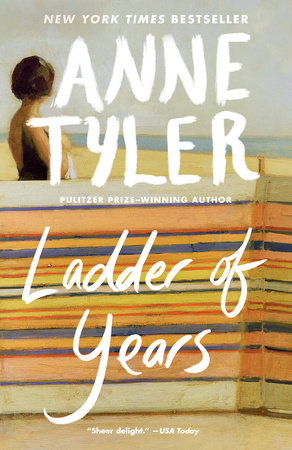
Delia, a 40-year-old mother of three, impulsively abandons her family during a beach vacation, with little besides the swimsuit on her back. Reinventing herself in a new small town, Delia gradually figures out who she is without the context of her family.
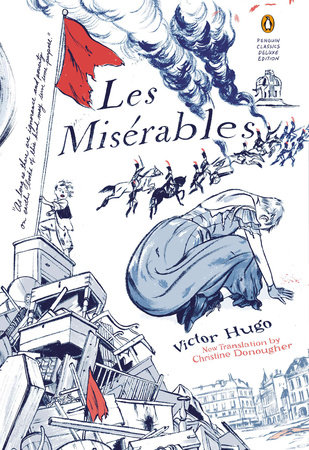
This French classic is a legitimately sprawling novel, but the central one of its many threads concerns the ex-convict Jean Valjean, who recreates himself multiple times—including as a mayor, a convent groundskeeper, a devoted but reclusive father, and a reluctant revolutionary—in an attempt to shed his history of (wrongful) imprisonment and escape.
It might be fun to meet your doppelganger—until he steals your identity and your life, forcing you to pretend to be him in turn. In Du Maurier’s thriller, English academic John is thrust into an intrigue-laden life as a French count.
In Atwood’s second novel, Joan Foster leads a double-double-double life: as a writer of “trashy” romance and a feminist poet, as an unfulfilled wife having a ridiculous affair, as a former fat girl who doesn’t know how to live in the new body she’s built herself. When the weight of these duplicities threatens to crush her, she fakes her own death to escape.
Samson Greene doesn’t exactly leave his life—his life leaves him. The Ivy League professor disappears from New York and turns up wandering in the Nevada desert with no memory of how he got there, or even who he is. His fugue turns out to be the result of a brain tumor, but even after surgery Greene only remembers his life up until age 12. This one’s less about creating a new identity, and more about what identity even is.
In Wright’s confrontational, existential novel, unhappy outsider Cross Damon finds himself fortuitously reported dead, and sets out to create a new personality—in the process rejecting most of the things that people build identities on, including conventional morality (he murders several people over the course of the book).
By the middle of Vonnegut’s beloved but frankly still underrated novel, everyone hates Malachi Constant. He’s so universally reviled that an entire religion has been built around mocking him. So what would happen if you found out you were Malachi Constant, except you didn’t remember anything about your life? That’s only one of the perfect twists in this book, which among many other things is an investigation of what you can—and can’t—leave behind.
After a Vietnam War protest gets out of hand, Bobby and Mary have to abandon their radical values, their pasts, and each other. The novel follows their separate paths 20 years forward, into the ’90s, where the two have new names and new lives but still retain scars from what they left behind.
Now when Eric was born in Washington, D.C., I was eighteen, and most people thought I was too young to be having a baby.
I went down there two months before it was going to come, to stay at my mother-in-law’s house. She was crazy for the baby to be born in Washington, and I was just as glad to get away from New York. My father had been divorced from my mother, and she had gone abroad, and he was getting married to Estrella, so I couldn’t go there, and I had got so I couldn’t stand that first awful little apartment, with the ivory woodwork and a red sateen sofa; I didn’t know how to make it look attractive, and it depressed me. Tom, Eric’s father, stayed on in it after I went to his mother’s; I remember he used to work in a bond house.
It felt strange, staying with my mother-in-law. She had a big house, right opposite to the old British Embassy. That makes you realize how long ago this was, and yet I am still, all these years later, wondering about why it was the way it was. Mrs. Tompkins’ house was a real house, with five stories and four servants, and meals at regular times and a gong that the colored butler rang to call you to them. I had never lived in a real house. My father always had apartments with day beds in them, so we could open the whole place up for parties, and we ate any time. My father was an art critic on the Tribune. Nobody remembers who he was any more; everybody forgets things so fast.
Nobody remembers who he was any more; everybody forgets things so fast.
My room in Washington was in the front, on the top floor, looking out at the rambling, old, mustard-yellow Embassy. Sometimes at night I would lean on the window sill and watch the cars draw up and the people in evening dress get out and walk up the strip of crimson carpet they rolled out across the sidewalk for the Embassy parties. And I would weep, up there on the fourth floor, because I was so big and clumsy, and I felt as if I would never, never go dancing again, or walk along a red carpet, or wear a low-cut dress. The last time I had was one night when I went dancing at the old Montmartre with Tom and Eugene—I was in love with Eugene— and I had seen myself in a long mirror dancing and realized how fat I looked, and that was another reason I wanted to get away from New York and go and have it in Washington. I had two black dresses—one plain wool and the other with an accordion-pleated crêpe skirt—and one velours hat, and I wore them and wore them and wore them all those last weeks, and I swore to myself that when it was born I would burn them in the fireplace in my room there. But I never did.
I used to live in a kind of fever for the future, when the baby would have come and I would look nice again and go back to New York and see Eugene. I took regular walks along the Washington streets—N Street, and Sixteenth Street, and Connecticut Avenue with all the attractive people going into restaurants to lunch—in my shapeless black dress and my velours hat, dreaming of the day when I would be size 12 and my hair would curl again and I would begin to have fun. All those days before Eric was born were aimed frontward, hard; I was just getting through them for what it would be like afterward.
All those days before Eric was born were aimed frontward, hard; I was just getting through them for what it would be like afterward.
My mother-in-law was the one who was really having the baby; she was full of excitement about it, and used to take me to Washington shops to buy baby clothes. Looking back all these years later, I remember those sunny afternoons in late winter, and the little white dresses and embroidered caps and pink sweaters spread out on the counter, and stopping to have tea and cinnamon toast at the Mayflower, with the small orchestra playing hotel music, and they seem beautiful and tranquil, but in those days I was just doing any old thing she suggested, and I was living to get back to New York and begin having fun again.
I remember she gave a ladies’ luncheon for me, to meet some of the young mothers she thought I would like to know. I suppose they were a couple of years older than I, but they seemed middleaged to me and interested in the stupidest things; I wanted to cry because nobody was anything like me.
But now I remember that the luncheon was really beautiful. The dining room was big and long, and on the sideboard was Mrs. Tompkins’ silver repoussé tea service. The table was laid with a huge white damask cloth, and the napkins had lace inserts. It was a real ladies’ lunch party, with twelve ladies and a five-course luncheon; I had never been to one before in my life, and I seldom have since. I remember the first course was shrimp cocktails in glasses set in bowls filled with crushed ice. And for dessert there was a special confection, which had been ordered from Demonet’s, the famous Washington caterer; it was a monument of cake and ice cream and whipped cream and cherries and angelica. But all I could think about was how food bored me and how I wanted to get back and begin living again. I felt in such a hurry.
Later that day, Mrs. Tompkins gave me a lot of her linens. It was before dinner. We used to sit in the small library and listen to Amos ’n’ Andy every night at seven. And this night she brought in a great armful of linens to show me, and everything I admired she would give me. There were damask tablecloths with borders of iris and borders of the Greek key, and round embroidered linen tea cloths, and dozens and dozens of lace and net doilies to go under finger bowls, and towels of the finest huck with great padded monograms embroidered on them. “Dear child,” she said, “I want for you to have everything nice.” I ended up with a whole pile of things. I wonder what ever became of them. I remember imagining what my father would have thought if he could have seen me with a lot of tablecloths and towels in my lap. “The purchase money of the Philistines,” he might have said. But I have no idea what happened to all that linen, and my father is dead long ago and nobody remembers him any more. I remember when I went up to my room to change into my other dress for dinner I wept, because I was so big and ugly and all surrounded with lace doilies and baby clothes and Eugene might fall in love with somebody else before I could get back to New York.
That was the night the baby started to come.
It began about ten o’clock, just before bedtime, and when I told my mother-in-law her face lit up. She went and telephoned to the doctor and to the nurse, and then came back and told me the doctor said I was to rest quietly at home until the pains started to come every fifteen minutes, and that the nurse, Miss Hammond, would be right over. I went up to my room and lay down. It didn’t hurt too much. When Miss Hammond arrived, she stood by my bed and smiled at me as if I were wonderful. She was tall and thin with sallow hair, an old-maid type.
About one o’clock, Mrs. Tompkins telephoned the doctor again, and he said to take me to the hospital. Mrs. Tompkins told me she had wired Tom to take the midnight down, but I didn’t care; I was having pains regularly, and the difference had begun, the thing I have always wondered about.
We all got in a taxi, Mrs. Tompkins and Miss Hammond and I, there in the middle of the night, and drove through the dark Washington streets to the hospital. It was portentous, that drive, significant; every minute, I mean every present minute, seemed to matter. I had stopped living ahead, the way I had been doing, and was living in right now. That is what I am talking about.
I hadn’t worn my wedding ring since I fell in love with Eugene. I’d told my mother-in-law that I didn’t like the feeling of a ring, which was true. But in the taxi, in the darkness, she took off her own wedding ring and put it on my finger. “Dear child,” she said, “I just won’t have you going to the hospital with no ring.” I remember I squeezed her hand.
I was taken at once to my room in the hospital, where they “prepared” me, and then almost immediately to the delivery room, because they thought the baby was coming right away. But then the pains slowed down, and I stayed in the delivery room for a long time, until the sun began to stream through the east window. The doctor, a pleasant old man with a Southern accent, had come, and he sat in the sunshine reading the morning newspaper. As I lay on my back on the high, narrow delivery cot, the pains got steadily harder, but I remember thinking, There’s nothing scary about this. It just feels natural. The pains got harder and harder.
There was the doctor, and a nurse, and my own Miss Hammond, whom I felt I had known forever; occasionally she would wipe my forehead with a cool, wet cloth. I felt gay and talkative. I said, “I know what this pain feels like. It feels as if I were in a dark tunnel that was too small for me, and I were trying to squeeze through it to get to the end, where I can see a little light.”
The doctor laughed. “That’s not what you’re doin’,” he said. “That’s what that baby’s doin’.”
But that was the way it felt, all the same.
“Let me know when you need a little somethin’,” he said.
After a while I said, “This is bad.” And instantly he was at my side with a hypodermic needle, which he thrust into my arm, and the pain was blunted for a time. “Let me know when you need a little somethin’,” he said again. But I was feeling very strong and full of power. I was working my way down that long, dark tunnel that was too tight for me, down toward the little light that showed at the far end. Then I had a terrible pain. That’s all I’m going to stand, I thought calmly. Deliberately I opened my mouth and screamed.
That’s all I’m going to stand, I thought calmly. Deliberately I opened my mouth and screamed.
At once, they put a mask over my face, and the doctor’s voice said, “Breathe deeply.”
And I was out.
I would come back into the brilliant sunshine of the room and the circle of faces around me, and smile up at them, and they would smile back. And then a fresh pain would approach, and I would say, “Now.”
“Bear down,” the doctor’s voice said as the mask covered my face and I faded away from the room. “Bear down.”
So I would bear down, and be gone.
Back into the sunny room and out again, several times, I went. And then, on one of the returns, to my astonishment, I heard a small, high wail that I nevertheless knew all about. Over to one side of me stood a crib on stilts; it had been standing there all along, but now above its edge I could see two tiny blue things waving faintly.
“It’s a boy,” I heard my darling Miss Hammond’s voice saying. “You’ve got a beautiful boy, Mrs. Tompkins.”
And then I felt a fearful pain coming. They put the mask over my face for the last time, and I went completely out.
When I woke up, it was in my own room. Mrs. Tompkins was there, and Miss Hammond, and Tom. They kissed me, and beamed at me, and Tom kept pressing my hand. But I was immune from them all.
I was inwardly enthroned. Seated on a chair of silver, sword in hand, I was Joan of Arc. I smiled at them all, because I might as well, but I needed nobody, nothing. I was the meaning of achievement, here, now, in the moment, and the afternoon sun shone proudly in from the west.
A nurse entered bearing a pale-blue bundle and put it in my arms. It was Eric, of course, and I looked down into his minute face with a feeling of old familiarity. Here he was. Here we were. We were everything.
“Your father’s come,” Mrs. Tompkins said.
My father’s head appeared round the door, and then he came in, looking wry, as he did when people not his kind were around. He leaned down to kiss me.
“Brave girl,” he whispered. “You fooled ’em.”
That was right. I had fooled them, fooled everybody. I had the victory, and it was here and now.
Then the nurse took the baby away, and Miss Hammond brought a big tray of food and cranked my bed up for me to eat it. I ate an enormous dinner, and then fell asleep and did not wake up for fifteen hours.
When I woke, it was the middle of the night, and the hospital was silent around me. Then, faintly, from somewhere down the corridor, although the month was February, someone began to sing “Silent Night.” It was eerie, in my closed room, to hear singing in the darkness. I looked at where the window showed pale gray and oblong. Then I realized what the tune was that was being sung, and felt horribly embarrassed. I could hear my father saying, “These good folk with their sentimental religiosity.” Then the sound of the singing disappeared, and I was never sure where it had come from, or, indeed, whether I had really heard it or not.
Next morning, bright and early, a short, thin man with gray curly hair walked into my hospital room and said, “What’s all this nonsense about your not wanting to nurse your baby? I won’t have it. You must nurse your child.” He was the pediatrician, Dr. Lawford.
Nobody had ever given me an order before. My father believed in treating me as if I were grown-up. I stared at the strange man seating himself by the window, and burst into tears.
“I tell you what, my dear little girl,” he said after a few moments. “I’ll make a bargain with you. I believe you have to go back to New York and take up your life in six weeks. Nurse your baby until you have to go, and then you can wean him.”
I nodded. I didn’t know anything about any of it—only what older women had said to me, about nursing ruining your figure —and all of that seemed in another life now.
Flowers began to arrive, great baskets of them from all Mrs. Tompkins’ friends, and they filled up my room until it looked like a bower. Telegrams arrived. A wire came, late one day, from Eugene. It read, “aren’t you something.” But Eugene no longer seemed quite real, either.
I would lie in that hospital bed with the baby within my arm, nursing him. I remember it with Dr. Lawford sitting in the chair by the window and tall, old-maidish Miss Hammond standing beside my bed, both of them watching me with indulgent faces. I felt as though they were my father and my mother, and I their good child. But that was absurd, because if they were taking care of anybody, it was Eric.
I stayed in the hospital ten days. When we went home to Mrs. Tompkins’, it was spring in Washington, and along every curb were barrows of spring flowers—daffodils and hyacinths and white tulips.
Miss Hammond and Eric had the room next to mine on the fourth floor. Miss Hammond did what was called in those days eighteen-hour duty, which meant she slept there with the baby and went off for a few hours every afternoon. It was Mrs. Tompkins’ delight, she said, to look after the baby while Miss Hammond was out. Those afternoons, I would take a long nap, and then we would go out and push the baby in his father’s old perambulator along the flower-lined streets, to join the other rosy babies in Dupont Circle, where the little children ran about in their matching coats and hats of wool—pink, lavender, yellow, and pale green.
It was an orderly, bountiful life. Breakfast was at eight, and Mrs. Tompkins dispensed the coffee from the silver repoussé service before her, and herself broke the eggs into their cups to be handed by the butler to Miss Hammond and me. We had little pancakes with crisp edges, and the cook sent up rich, thick hot chocolate for me to drink, because I had not yet learned to like coffee. In those days, a thing like that did nothing to my figure. When we had gone upstairs, I would stand in front of the mahogany mirror in my bedroom, sidewise, looking at my new, thin shape, flat as a board again, and then I would go in to watch Miss Hammond perform the daily ceremony of the baby’s bath—an elaborate ritual involving a rubber tub, toothpicks with a cotton swab on the end of them, oil, powder, and specially soft towels—and the whole room was filled with the smell of baby. Then it would be time for me to nurse Eric.
I used to hold him in my arm, lying on my bed, and it was as though he and I were alone inside a transparent bubble, an iridescent film that shut everything else in the world out. We were a whole, curled together within the tough and fragile skin of that round bubble, while outside, unnoticed, time passed, plans proceeded, and the days went by in comfortable procession. Inside the bubble, there was no time.
We were a whole, curled together within the tough and fragile skin of that round bubble, while outside, unnoticed, time passed, plans proceeded, and the days went by in comfortable procession.
Luncheon was at one-thirty, Amos ’n’ Andy was at seven, dinner was at seven-thirty, bedtime was at ten-thirty, in that house. The servants made excuses to come up to the fourth floor and look at the baby, and lent unnecessary helping hands when the butler lifted the perambulator down the steps to the street for our afternoon walk among the flowers. The young mothers I had met came to see the baby, and Mrs. Tompkins ordered tea with cinnamon toast served to us in the drawing room afterward; they talked of two-o’clock feedings, and the triangular versus square folding of diapers, and of formulas, and asked me to lunch at the Mayflower, early, so that I could get home for the early-afternoon feeding. But the young mothers were still strangers to me—older women. I did not feel anything in common with their busy domestic efficiency.
The spring days passed, and plans matured relentlessly, and soon it was time for me to go home to New York with the baby, to the new apartment Tom had taken and the new nurse he had engaged that Mrs. Tompkins was going to pay for. That was simply the way it was, and it never occurred to me that I could change the plans. I wonder what would have happened if a Dr. Lawford had marched in and given me an order. . . . But after all, I did have to go back; New York was where I lived; so it’s not that I mean. I really don’t understand what I do mean. I couldn’t have stayed at my mother-in-law’s indefinitely.
I don’t remember starting to wean Eric. I remember an afternoon when I had missed several feedings, and the physical ache was hard, and Mrs. Tompkins brought the baby in for me to play with.
I held him in my arms, that other occupant of the fractured bubble, and suddenly I knew that he and I were divided, never to be together again, and I began to cry.
Mrs. Tompkins came and took the baby away from me, but I could not stop crying, and I have never again cried so hard. It never occurred to me that anything could be done about it, but we were separated, and it was cruel, and I cried for something. I wish I could remember exactly what it was I did cry for. It wasn’t for my baby, because I still had my baby, and he’s grown up now and works in the Bank of New York.
After that, time changed again for me. It flowed backward, to the memory of the bubble and to the first high moment in the hospital when I was Joan of Arc. We left Washington on a morning with the sun shining and barrows of flowers blooming along the curb as we went out the front door and the servants lined up on the steps to say goodbye. Eric was in a pink coat and a pink cap to match, with lace edging. But he didn’t really belong to me any more—not the old way. I remember Mrs. Tompkins had tears in her eyes when she kissed us goodbye in the Union Station. But I felt dry-eyed and unmoved, while time flowed backward to that night we drove to the hospital in the middle of the night and she put her ring on my finger.
Of course, when we got back, New York looked marvellous. But even while I was beginning to feel all its possibilities again, time still flowed backward for me. I remember when it was that it stopped flowing backward. I was in someone’s room in the St. Regis, where a lot of people were having a drink before going on to dance. I sat on the bed. A young man I had never seen before sat beside me. He said, “Where have you been all my life?”
And I said, “I’ve been having a baby.”
He looked at me with the shine gone out of his eyes, and I realized that there were no possibilities in a remark like mine. I laughed, and reached out my glass to whoever the host was, and said something else that made the young man laugh, too. And then time stopped flowing backward and began once more, and for always, to hurry forward again.
And what is it that can make it stop, so that you can live in now, in here?
So that is what I wonder about, all these years later. What is it that makes time hurry forward so fast? And what is it that can make it stop, so that you can live in now, in here? Or even go backward? Because it has never stopped or gone backward for me again.
It isn’t having a baby, because I’ve had four, God help me—two by Tom, counting Eric, and two by Harold, not to mention that miscarriage, and although I hoped it would, time never did anything different again, just hurried on, hurried on.
It isn’t, as it occurred to me once that it might be, getting free of men in your life as I was free of them long ago with Mrs. Tompkins. Here I am, rid of my husbands, and the younger children off to school now, in this apartment. It isn’t big, but I have day beds in the bedrooms so that every room looks like a sitting room for when I have a party. I’m free, if you want to call it that, and my face isn’t what it was, so that I’m not troubled with that kind of thing, and yet, when you might think life would slow down, be still, time nevertheless hurries on, hurries on. What do I care about dinner with the Deans tonight? But I have to hurry, just the same. And I’m tired. Sometimes I imagine that if Mrs. Tompkins were still alive, or my father, even . . . But they’re dead and nobody remembers them any more, nobody I see.
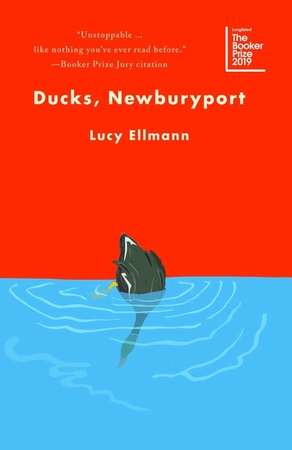
There’s so much to say about Lucy Ellmann’s wondrous novel, Ducks, Newburyport: ostensibly it’s about an Ohioan housewife deep in thought while peeling apples and prepping to make a tart. It’s also about a mountain lioness searching for her cubs and attempting to survive in her shrinking natural habitat. But even more than that, it’s about tackling the novel as a form and modernism as a lens for the human condition.
Buy the book
At over a thousand pages, it’s a stream-of-conscious narrative that reads so freely, it takes on eerie similarities to how we scroll through our social media newsfeeds. The book is a perfect example of publishing as an art, a medium based on amplifying voices and social issues rather than the all-too-often trade fixation on bottom-line sales and marketability of a book and its author. It’s also grabbing the attention of critics and readers everywhere, perhaps most important of all—it has been nominated for the 2019 Booker Prize.
Ducks, Newburyport is a complex book about a complicated time. It reads like an outpour of humanity beckoning to be heard. I spoke with Lucy Ellmann about narrative rhythm, ecological disaster, the meaning of “big books,” and more.
Michael J Seidlinger:It will come as no surprise, and I normally hate asking this question, but I got to ask, how long did it take you to write the book?
Lucy Ellmann: Seven years. And throughout, I wondered if I’d ever finish it. The work got more and more intense. I saw no one, barely even saw my own husband! (I think he was the guy cooking the meals.) I did nothing else but work on the book, if I could help it – or worry about it when I wasn’t doing it… Oi veh. What a mug’s game.
All real writing is literature and men don’t own that. It belongs to us all.
There’s this anxiety that you’ll die before you finish writing a book—I think everyone has it. Those 3:00 a.m. jitters. It just means you must work even harder on it.
My father once told me that when you reach a tough juncture in what you’re writing, it’s actually a sign that you’re on the verge of a breakthrough. This advice, correct or not, serves me well through many a tough juncture.
MJS:The structure is so compelling, an outright onslaught of text. Did you instill any specific constraints or writing techniques to keep the thread moving and, more importantly, evolving into its attentive monologue?
LE: No. Constraints are no help when you’re trying to figure out what the novel you’re writing is going to be. It’s got to be as venturesome a process as possible.
I wanted to blanket the reader in stuff, American stuff. Minds are full of stuff, and that seems to me the most interesting thing in the world. External beauties are just an added bonus. But even they are reached through the mind. So let’s look at the mind.
MJS:1040 pages. It means dropping the book on your face while reading it can be painful. (Don’t ask me why I know this). The physicality of the book informs its structure. The “big book” is so often attached to the “big serious” author, usually male, with their warrior-like obsession with tackling and “succeeding” in creating formally inventive, innovative, experimental works. At its worst, it borders on masturbatory; at its best, like in your book, it acts as a reminder of the importance of literature. Ulysses, Infinite Jest, Life: A User’s Manual—why do you think it more common to see these “experimental works” attached to such an obsessive, “hero” intent?
LE: A friend of ours, Abe Steinberg, once saw a NYC cop writing himself a ticket for parking in a no-parking zone. Abe’s comment: “So he’s a hypocrite and an onanist.”
You rightly assign an Oedipal flavor to the contest some men make of writing: superseding the father, fucking the mother… Yeah, yeah, yeah. Men have long placed the goal posts and then proceeded to hand themselves awards for getting the ball in. Or just for having a pair of balls. Time to invent some new games. New myths too. And some respect for what women have to offer. All real writing is literature and, as you say, men don’t own that. It belongs to us all.
My books are sincere efforts to contribute to that. I really don’t concern myself with what male writers are up to, unless they write something good. That’s always welcome. As for Ulysses, whatever amount of testosterone may have fueled it, it is a beautiful work of art. I would not class Joyce as a conscious member of the macho brigade. He wasn’t that proud of himself. He could barely find the means to live – but hoo boy did he have what it takes to write. And he stuck up for it, as you must at some stage. Good writing emanates from a peculiar combination of self-hatred plus chutzpah.
Some male reviewers seem affronted by the book’s length. They also resent having to read such a long book written by a woman about a woman. But most men don’t even read, so who cares?
I never set out to write a big long book, but nor did I set out to censor myself. I just did what I wanted. Some male reviewers seem affronted by the book’s length. This seems a pretty petty form of criticism. You can see the book’s long just by looking at it, so don’t agree to review it if you or your biceps are not up to the job.
They also resent having to read such a long book written by a woman about a woman, two points against it in terms of their criteria for seriousness. But most men don’t even read, so who cares? I’m interested in readers who can read, not people suffering from pride and prejudice. (Good title!)
For the record, my book is not an “experiment,” it’s a novel. Experiments are for scientists. Of whom I take a dim view. Sure, it’s nice to know a bit about the galaxy and all, or investigate a curiosity here and there and whatnot – but these contributions don’t make up for vivisection, IVF gender selection, heavy industry, factory farming and the hydrogen bomb. I see art as a vital moral check on the unbridled extravagances, patriarchal illogic, and often outright malevolence of science. Not “the science” that the great Greta Thunberg’s talking about, but much else that goes merrily on.
(NB Sorry you had a physical collision with my book; all clonkings were meant to be intellectual.)
MJS:Haha, and the clonking was indeed intellectual! About 20 pages in, something uncanny happens: the book becomes as readable as scrolling through Twitter, reading a sequence of facts and headlines. Propulsion of excess, the very thing we deal with in our 24/7 news cycle, forever-online, modern day: I’m curious about how you balanced this effect.
LE: Rhythm decides a lot of the order of things, plus juxtaposing inner and outer life, or output and input. The narrator naturally drifts between private thoughts and what’s going on in her day, or in the wider world, which she’s exposed to by her fact-addicted son, and other people she talks to, along with various media services of varying objectionability.
The action takes place over the course of a few months in 2017, and there is also a gradually emerging plot; it’s not reported in the habitual style of conventional narrative, but it’s there all the same. I wanted to see how a novel can stand on its own two feet and start developing narrative tension almost of its own accord. As a reader, I think one constantly raises questions, and from that springs suspense. You don’t actually need cliffhangers or a “once upon a time” approach. Readers are much more sophisticated than that.
MJS:That being said, the absence of a “traditional narrative” in the book almost enforces the reader’s search for one, and that’s where maybe the lioness, a sort of side story to the stream of text, comes in. Why did you choose the lioness over, say, a fox, or vixen? Both of their natural habitats are being destroyed by humans, and both are under threat of being endangered.
Good writing emanates from a peculiar combination of self-hatred plus chutzpah.
LE: The first idea of the lioness came from reports in Palo Alto, California, of mountain lions venturing near schools. Utterly unnecessary anti-lion measures were of course employed by hysterical humans. We own everything, and we can’t bring ourselves to share one single inch of space with fellow creatures without our permission.
Animals are the ultimate illegal immigrants. That’s why we get to confiscate their offspring, and look at them caged in zoos. It’s amazing how little people question their right to have things all their way – at the risk of destroying the whole ecosystem.
MJS:The book’s facts function as memories and, when taken as a whole, it almost suggests that our memories are impermanent, lost in the haze between news and novel, gossip and guilt. Do you think our memories are being rewired into a dispensary of everything we consume daily? Maybe we’re confusing documenting our lives online as memories.
LE: I just began thinking how weird memory is, its occasional precision, its eagerness, like dreams, to slip into oblivion. So much gets lost, even the byplay of a conversation you just had one goddam minute ago! I hate that. Writing acts as an enemy of lost ideas, because they can be retrieved – to some extent – through words. As prods at least, that can trigger memories.
I find dreams really funny if you write them down. Not the endless ones – oh, so dull, always to be avoided, either in literature or in conversation – but a nice short snappy crazy dream works well on the page.
MJS: The fact that there’s so much here, the stream could have gone a whole lot longer, the fact that you’ve squarely cut a slice of modern life, with all its hues, the fact that I feel there really isn’t an end, I ask if you had a veritable end to the narrative stream, or maybe it’s that there are no ends, only deaths, the fact that believing that to be true can make a person sad, the fact that I’ve taken this interview to a depressing place, maybe it’s time to, at least in this interview’s case, have it end.
LE: Death is our shockingly crummy fate. But depression is a cop-out. What the world needs now is action, sweet action—as Dionne Warwick might have sung. Is none of this stuff we have worth saving? The natural world? Human culture? The stuff we’ve made. The sights we’ve seen. Greek vases. Jane Austen. We have to fight for these things! Fight against the destroyers in our midst who want to take everything from the earth and leave nothing behind but radioactive waste. Do they have another planet lined up for themselves already? Just for them and their philistine buddies, a Lolita Island in the sky somewhere. They sure act like it.
For those familiar with Japanese literature, there are a few names that inevitably crop up in conversation: Yukio Mishima for his beautiful writing, shocking suicide, and extreme political leanings; Kenzaburo Oe and Yasunari Kawabata for winning Nobel Prizes; and Haruki Murakami for being Haruki Murakami. In the last few decades, Murakami’s work has eclipsed that of many other Japanese writers, particularly for readers in the West. Many avid fans use his name as a synecdoche, claiming to love Japanese literature as a whole, yet when pressed admit that their only exposure is through Murakami’s work.
That isn’t to say Murakami is not a compelling writer. He has a unique ability to evoke an urban loneliness and ennui, particularly through the experiences of “everyman” male protagonists who struggle with ambivalence in love, work, and even life. When he hits on themes he knows well his work can be an engrossing and fun ride. But one of the most common criticisms of his work—one that even the most avid of Murakami devotees will admit to—is the flatness of his female characters. The bulk of women exist as points of departure for the male protagonist to understand something about himself, with little else fleshing them out within the narrative. In the interest of the plot these female characters will die unceremoniously off the page, will be a sexual object the protagonist fixates on, or will be the passive partner that the protagonist returns to once he has his necessary epiphany.
Many avid fans claim to love Japanese literature as a whole, yet when pressed admit that their only exposure is through Murakami’s work.
The type of women in these novels tend towards a gendered stereotype. Even the single female protagonist in his extensive body of work falls into stereotyping: Aomame from 1Q84 is a cold, calculating assassin—a prime example of a woman needing to be physically powerful in order to be a protagonist. But even this character can’t stand alone, as she is one of two protagonists within the same novel, the other being male.
In most cases, there is little by way of desire or motivation behind the women Murakami writes, nor any agency beyond how they function in relation to the male protagonist. If this is the prime example of Japanese literature in the minds of Western readers, what does that say about how women are viewed within this narrow context?
Thankfully, there has been a push to translate more Japanese literature written by women for English-reading markets, such as the Akutagawa Prize-winning Convenience Store Woman (translator Ginny Tapley Takemori) by Sayaka Murata and the more recently translated Tokyo Ueno Station (translator Morgan Giles) by the Zainichi writer Yu Miri. Both authors write complex female characters with their experiences at the center of the narrative, rather than as an auxiliary add-on to men. But while it has become easier for readers to name current Japanese female authors, many would be hard-pressed to name female authors writing before the 1980s who were contemporaries of the men mentioned above, and who were just as commercially successful.
Though there are multiple authors to draw from, three female authors who crafted worlds around the same themes that have become heavily associated with Murakami’s work are Takako Takahashi, Taeko Kōno, and Fumiko Enchi. Each writes stories that consider female action and desire, while pushing the limits of artistic convention. In many ways, they take the feelings of isolation, ennui, and atmosphere that many love in Murakami’s writing and push it to the, sometimes uncomfortable, extreme.
Outside the surreal elements of Murakami’s stories, one of the more consistent markers of his style is the “Murakami protagonist”: a loner, almost always male, apathetic, and usually heavily burdened by the weight of urban living. Readers during Japan’s 1980s bubble economy and the devastating post-bubble crash found resonance in this detached figure, and he continues to speak to readers both inside and outside Japan.
Like the stock Murakami protagonist, Takako Takahashi’s female protagonists are isolated and apathetic with their lives and their frustration is linked to pressures from larger social structures, like the limited work opportunities and the entrenched familial expectations for marriage by a certain age. Takahashi belonged to a generation of young female writers coming to terms with the effects of the post-war era where women were afforded more personal and political freedom in theory, though in practice many of the cultural limitations still remained firmly in place. The women of Takahashi’s work, particularly her short story collection Lonely Women(translator Maryellen Toman Mori), are often straining against their limitations and skirting the line between occupying their expected role as a woman in society and acting on their unconventional desires.
The character Sakiko, for instance, toys with men by beginning conversations with them, testing how outrageous she can be with her comments before the man asks her out. Once they do, she selects a meeting place across from a coffee shop, where she sits and watches the men wait for her, seeing how long they wait before they give up. Yet, rather than heartless, Sakiko’s behavior is presented as a sort of intellectual exercise of putting men under a microscope in ways women so often are. Takahashi writes, “Sakiko was inordinately interested in observing men in this way. How much more exciting this sort of encounter was for her than actually meeting a man and conversing with him! She wished that she could go so far as to gaze at a man through binoculars.” These moments of Sakiko harmlessly playing with men juxtapose other darker scenes involving a series of mysterious arsons happening in her neighborhood. It isn’t clear whether Sakiko herself is the arsonist or whether her interest is sparked by a macabre fascination. But Takahashi makes it clear that Sakiko’s fascination with fire, as well as her tendency to toy with men, stems from a desire for a different type of life than the one she finds herself in—one she can control, one she can have agency over.
While Lonely Women includes women awakening to the limitations in their lives and acting out when possible, there are also characters who are trapped in mediocre marriages in spite of wanting something more passionate or liberating. In “The Suspended Bridge,” Haruyo finds her routine married life shaken by the reappearance of an ex-boyfriend who had been working abroad. As she struggles to make sense of her sudden heightened discontent, she seeks acknowledgement from her detached husband, Eizō. Throughout the story, Haruyo behaves uncharacteristically, trying to get a reaction out of her emotionally unavailable husband. She acts out to prompt her husband to ask what is troubling her, but he never asks and her desires are never acknowledged.
There is always an uneasy open-endedness to her stories, as if there is simply no way for her characters to have what they crave.
Like Takahashi’s work, Taeko Kōno’s stories in Toddler-Hunting and Other Stories (translator Lucy North) focus on the disconnect between what women are expected to want out of life, usually marriage and motherhood, and what their desires actually are. The dissonance between external expectation and internal desires produce characters who are neurotic, isolated, and even brutally violent—even if the violence remains within the realm of fantasy or consensual sexual encounters. But the dissonance in Kōno’s work also finds no resolution. Rarely do the characters find greater self-realization or fulfillment. There is always an uneasy open-endedness to her stories, as if there is simply no way for her characters to have what they crave reconciled with the real world.
Kōno’s open-endedness is clearest in the story “Snow,” which chronicles Hayako coming to terms with her adoptive mother’s death. Initially, the story follows a fairly traditional route: the death of Hayako’s mother, though understandably painful at first, will simply be part of the story and Hayako will continue on with her life. But a sudden narrative shift uncovers bits of Hayako’s childhood through her recollections. We find out her mother was physically and verbally abusive to Hayako as a child because Hayako is the result of an affair between her father and a mistress. Falling snow is one of the markers of their relationship as it’s tied to a mutual experience of trauma between adoptive mother and daughter; the two of them even suffer from painful psychosomatic migraines when the snow falls, which comes to represent the pain they both carry because of the fraught family situation. At her mother’s death, Hayako is hopeful her debilitating migraines will cease. Instead, her migraines remain, culminating in a scene where she attempts to bury herself alive in the snow.
The stories in Lonely Women and Toddler-Hunting tend to focus on a single protagonist, whose internal struggles make up the bulk of the conflict. Readers stay within the minds of Sakiko, Haruyo, and Hayako as they think through their experiences, obscuring the external realities of their internal struggles. We never know if Sakiko is truly the arson or if Hayako makes it out of the snow alive. What is clear is that these experiences— whether fantasies or not—are very real to them.
In her famous novel, Masks (translator Juliet Winters Carpenter), Fumiko Enchi presents what happens when women are able to enact change on the worlds they inhabit—and the harm that can come about from gaming an oppressive system. Like the women in Lonely Women and Toddler-Hunting, Masks centers characters who are not clearly and unquestionably “good.” The novel’s protagonist is a middle-aged widow, Mieko Togano, whose convoluted scheme to take revenge on her long dead husband through usurping his family line ends up pulling other women into the fray, with some losing their lives for the sake of Mieko’s obsessive mission. Some elements of the novel could be read as pushing against an oppressive patriarchal system, with women acting together to maintain their autonomy at a historical moment when men were given more legal rights. Yet Enchi points out that acts of resistance might sometimes perpetuate oppression or even further oppress other women. Enchi brings these difficult questions to light but, like Takahashi and Kōno, never truly gives us definitive answers.
These are the characters I wish moved through the urban landscapes of Murakami’s books: women who are more than a function of a narrative.
These are the characters I wish moved through the urban landscapes of Murakami’s books: women who are fighters, women who are messy, women who are more than a function of a narrative. While none of these texts provide the same surreal worlds that have become a hallmark of Murakami’s work, they do provide a new spin on the psychological landscape Murakami is known for. Delving into the psyche of women trying to navigate a world marked off by social limitations means readers encounter female protagonists who are them troubling at times, but lead us to question the impact of oppressive systems on certain generations or groups of people. The women who inhabit these stories are just as historically situated as the disaffected Murakami protagonist is to his era. Neither exist in a vacuum.
Takahashi’s, Kōno’s, and Enchi’s work—along with their other female contemporaries—is accessible to a significant portion of Murakami fans. When Murakami becomes the sole marker of Japanese literature, there is undue emphasis on a specific image of Japanese cultural output; the surreal, pop-culture steeped world of Murakami novels inadvertently becomes ‘Japanese literature’ as a whole and that has lasting consequences beyond literature. Japan has a long, fraught history with sexual discrimination and gender disparity at the expense of women and other marginalized groups so representations of characters from these groups matter. In a 2018 Op-Ed for the New York Times, Viet Thanh Ngyuen writes on “narrative plentitude,” saying “we live in an economy of narrative scarcity, in which we feel deprived and must fight to tell our own stories and fight against stories that distort or erase us.” Though he is speaking in the American context, the same is true for the canon of Japanese literature. For so long the work available in the West through translation privileged a particular type of author and set of character archetypes. In a world where discrimination and bigotry leans heavily on harmful stereotyping, it is crucial to push back by making space for more voices, including those that have been historically limited. These women created a space for other women to participate in literary culture, providing a language for the frustrations, ambivalence, and rage that they experienced. Murakami is an important figure in the Japanese canon, but he is just one in a long line of authors; to understand the world the Murakami protagonist moves through, it’s necessary to see who came before him.
I liked the picture of Him—and in the religion of my childhood, it always was a Him—in my head: an avuncular humanoid drifting among yellow-green clouds, something like Einstein by way of Jim Henson, white-browed and warm and ready to listen. I liked the sensory rituals of religion: the dark wooden walls of the church, the organ’s gleaming pipes rising above the altar, the battered blue hymnals with their pleasantly steadfast Protestant harmonies. I liked the annual Christmas pageant, from the nursery class dressed as sheep to the sorrowful grandeur of a story in which the glory of salvation is birthed somewhere dirty and cold. I liked well enough what trickled into my awareness about Jesus, the stuff about love and kindness, and I liked more the sense of virtue and maturity I could access by pulling the Bible off the shelf.
I liked other things, too. The belief of childhood is promiscuous, the line porous between imagination and faith; the best game, after all, is the one you trick yourself into forgetting you made up. I played in a world populated with deities and demons from a hodgepodge of sources: the sanded-down version of the ancient Greek pantheon to which we introduce children, depicted in a big book with beautiful pencil illustrations; the heroes of Star Wars and Sailor Moon, stories not unlike the Christianity I knew in which love is elevated to the realm of magic; witches, especially as classified by Roald Dahl, whose definition spurred furtive lunchtime discussions about whether we had spotted a hint of blue around the teeth of our wicked gym teacher; and the myriad invisible creatures my friends and I willed ourselves into seeing, from girls trapped in gemstones to stray cats with mismatched eyes, always carefully described as having been not invented but found.
The gradual encroach of what we will one day know as adulthood settles myth into metaphor.
Growing up is not precisely a matter of abandoning this world. Rather, over time you find yourself planted more firmly on one side of the line, viewing the denizens of your personal mythology in relation to reality. You outgrow the habit of peeking under a dew-spattered leaf for traces of last night’s faeries even when no one is looking; your private companions become, perhaps, the characters in your stories. The Force is no longer a cosmic linkage between all living things but a shorthand for the discipline it takes to turn the other cheek. The gradual encroach of what we will one day know as adulthood settles myth into metaphor, and generally we miss the strength of our childhood convictions no more than we miss our baby teeth once lost.
And so it went for me, with one exception: I never suspected that growing up would take from me my belief in God. When it happened, it was a loss I felt like a wound that would not heal.
The transition from childhood to adulthood is a decent capsule summary of Philip Pullman’s His Dark Materials trilogy, which consists of The Golden Compass, The Subtle Knife, and The Amber Spyglass. You could also say: an action-packed adventure spanning the multiverse. A pointed critique of institutionalized religion and the legacy of imperial Christianity. A set of children’s novels inspired by Milton and quantum theory. A bittersweet recounting of first love found and lost. A subversive telling of the Fall, as in of man. It’s a story which awes less for its sprawl than for its intricacy, a story which includes armored bears, centuries-old witches, miniature spies who ride giant dragonflies, the ghosts of the underworld, vampiric spirits, and incorporeal angels, among others. But it begins with a child.
Lyra Belacqua lives in a world like and unlike ours. Oxford University exists, but within it is the fictional Jordan College in which she makes her home; there is electricity, though it’s called anbaric current, but no movies. It gradually becomes clear that the heightened global reach of a consolidated and self-protecting church has slowed the progress of science, or, as they know it, experimental theology. When we meet Lyra, she is, like many of children’s literature’s greatest heroes, not where she is supposed to be, having snuck into a forbidden room before a scholarly presentation led by her intimidating uncle. As Lyra waits out the meeting by hiding in a closet, we encounter two of the innovations most central to the books. The first are dæmons, closely linked animal counterparts embodying a piece of every human’s self; everyone has one, the idea goes, but unlike us the people of Lyra’s world can see and speak to theirs. The second is Dust: elementary particles, visible using special kinds of film, which fall from the sky, interacting with nothing but gathering thickly on people.
Dæmons and Dust are linked through one of the series’ major thematic concerns: the moment in which the child self begins to recede to make room for the adult. The dæmons of children change form on any whim, skittering around as mice or flying silently as moths; around the start of puberty, dæmons settle into a final form. It’s also at this time that humans begin to attract Dust, which drops occasionally on children but gravitates towards adults. There are many ways of identifying this dual transformation in real-world terms: it’s the age of novel bodily experiences and nascent rebellion, of exploding emotions and the first stirrings of conscious thought, of sweaty palms and puppy love. It was also, for me, the age at which I suffered my crisis of faith.
Often I tell it like a joke: Six years of Christian school made an atheist of me! It’s a good line, but misleading; it implies something like my mother’s Catholic school experience, tormented by nuns and spending Sundays kneeling and quaking in terror of hellfire and damnation. My school practiced a gentle Episcopalianism in which chapel talks were as likely to celebrate goal-setting or poetry as the particularities of the faith. I was not, in other words, traumatized out of faith.
Often I tell it like a joke: Six years of Christian school made an atheist of me! It’s a good line, but misleading.
Nor was I argued out of it, exactly, despite lively debates with my best friend over whether the concept of a male savior was inherently sexist. In fact, to this day I’ve yet to hear an argument against the existence of God I find any more convincing than the arguments in favor. Rather, I think the religious education I received accomplished what it set out to do: it encouraged me to examine seriously my own faith. In fifth grade, we studied the book of Genesis in Religious Knowledge and wrote reports on Greco-Roman gods in Social Studies. I asked myself earnestly the question: what had brought me to my God beyond the same accident of birth that had once led women to become priestesses of Zeus? Peering closely at the deepest parts of me — and I must emphasize that this is not a theological proposition but rather a description of one child’s heart — I found my answer: nothing.
And oh, how I looked. How I prayed and bargained and grasped for ideas which might restore my belief. How I searched for signs and felt in the dark for the same listening warmth I had once taken for granted. My reluctant atheism gave me no sense of superiority or pride in my intellect; to the extent that it separated me from others, it made me feel horribly alone. I had stepped into a world drained of comfort, of hope, of meaning. I stayed up at night rocked with a full-body terror of the approaching void, and wore myself anxious with the existential vertigo that accompanied the dissolution of my apparent moral foundation. What scared me most was the newfound emptiness of the world: without the invisible thread of faith that had once bound existence into something legible, what could reality be beyond an infinitude of atoms senselessly colliding? Where was I to find not only love, morality, and purpose but even a justification for seeking those things?
There’s a genre in which this state of mind recurs with some regularity: conversion narratives. The convert, reaching the end of a road of trials and exhausted by despair, picks up a Bible or meets a preacher or wanders into a sermon; then, having received the gospel, he feels the emptiness in him begin to heal, filling him with such joy that his life is forever changed. Well, I had already read the Bible and heard many sermons. Instead I met Lyra. But the ending holds up: I was never the same.
After years surrounded by a belief system to which I had long since lost access, I took high school as an opportunity to flee for more secular environs. In retrospect the magnitude of the transition stemmed from a host of things I was leaving behind — religion, sure, but also an insular community, plaid skirts, the chafing sense of being considered a known quantity, childhood itself. But at the time I had an easy line to explain my relief to my new friends: Listen, I went to Christian school, okay? It fit with the persona I was trying out: foul-mouthed and free-minded, artistic and ambitious, smugly disdainful and fond of what we in those days called snark. This version of me loved His Dark Materials in the distanced, intellectual way I was trying to love everything. Explaining why I’d named the books my favorites, I leaned into their more overtly unorthodox aspects, announcing they kill God! with a gleeful teenage thrill.
The questions I was struggling with could not be answered with dispassionate reason. They were questions of purpose and meaning.
But when I go back to the kid who lay trembling in bed at the thought of what death could mean in a world without God, I know that’s not what she needed then. She needed what we always give to children in the dark: a story. The questions I was struggling with were not questions that could be answered with dispassionate reason. They were questions of purpose and meaning and what it meant to be alive — the same questions myth and metaphor have so often been called on to resolve or to illuminate. Pullman’s text resonated because he took as his material the stuff of myth. And like many myths, it was at heart the story of heroes.
Our first hero is Lyra: an orphan, eleven years old, rude, impatient, charismatic, fiercely loyal, quick to anger and deep in her love, stubborn, bright but incurious, bold, not always kind but basically decent, and prophesied to make a choice on which the fate of several universes will hinge. One of the academics to whose loose care she’s been entrusted calls her “a healthy, thoughtless child,” a phrase I love as a teacher of young children who worries often about the ill effects of premature self-consciousness on my pupils. The other, from our universe, is Will. Will is not a thoughtless child; growing up alone with a mother suffering from untreated mental illness, he’s learned to take care of her when she needs it while living with the constant anxiety that should her situation be found out, someone will come to take her away. He’s lonely but loyal, better than Lyra at thinking ahead but aching for the wholehearted friendship she can offer.
Pullman is not precious or preachy about what it takes to survive, and the tools Lyra and Will bring to the trials before them are the tools you will find in our oldest tales: wits and fists. Lyra, true to the resonances of her name, is a skilled and enthusiastic liar whose gifts for telling tales keep her and others alive in hostile territory. Will Parry, his name suggesting the force of mind to counter a blow, learned in the face of schoolyard ridicule for his mother’s troubles to fight like he means it; one of the first things he does is to kill an intruder in his home, an accident which nonetheless sets the course for the teeth-bared ferocity he brings to the fray. Together the two of them, fabulist and fighter, form a matched set out of Homer: a prepubescent Odysseus and Achilles.
In another trope inherited from myth, each receives a tool to aid them in their travels. Lyra complements her talents by using a golden disc named the alethiometer, from a Greek word sometimes translated as “truth,” which answers honestly any question posed by one who can read its complex symbolic system. Will bears a knife which can cut not only any physical substance but the space between atoms that opens a door between dimensions. Taken as a pair, these fantastical items offer exactly what I was craving so desperately when I found them: a path to a deeper truth, and the sharpness it takes to undo your reality and leave the world you know behind.
The Church of Lyra’s world interprets Dust as physical proof of original sin: evidence that humanity was scarred when the woman in the garden ate from the forbidden tree. Their obsession is that pivotal moment of becoming no longer quite a child, the moment which recapitulates for the individual the consequences of the Fall: knowledge and shame, toil and death. A small but powerful group begins a terrible experiment: they sever children from their dæmons before they have a chance to settle, hoping to free them from the burden of Dust. This operation renders adults unsettlingly placid and incurious; it leaves children hollowed out, dead in a few days’ time.
In the name of protecting children, they remove that which contains their deepest selves. Dæmons are linked to both the desire to receive and the need to give love; Lyra and her dæmon comfort themselves by comforting each other so often that she pities the loneliness of worlds like Will’s, where people can find themselves truly alone. They’re manifestations of identity; a dæmon settles at the moment you begin to know who you are. They’re connected to sexuality, seen most viscerally in the brutal shame and disgust Lyra feels when an agent of the Church breaks the taboo of touching her dæmon. And they’re a way of understanding: it’s Lyra’s dæmon who suggests, after the atrocity of the severed children, that if people will do such terrible things out of hatred for Dust, it must be the case that Dust is good.
It’s against this backdrop that angels, creatures of Dust, instruct a nun-turned-physicist named Mary that she “must play the serpent,” placing her in the crosshairs of a priest sent to assassinate her before she can precipitate another Fall. And it’s in this context that we learn the secret name the witches use for Lyra when they prophesy: Eve.
Years later I would find that David Foster Wallace in his famous commencement speech at Kenyon College had captured the dilemma in which I found myself:
In the day-to-day trenches of adult life, there is actually no such thing as atheism. There is no such thing as not worshipping. Everybody worships. The only choice we get is what to worship. And the compelling reason for maybe choosing some sort of god or spiritual-type thing to worship–be it JC or Allah, be it YHWH or the Wiccan Mother Goddess, or the Four Noble Truths, or some inviolable set of ethical principles–is that pretty much anything else you worship will eat you alive.
I could sense but not articulate this: that without some kind of framework I would be subject to a long inner unraveling. And this is what the books gave me: permission to worship.
It’s a funny thing to say about the most famously atheistic work of children’s literature. If you know nothing else about the His Dark Materials series, you may know that Lyra kills God (or allows him to die) and the book celebrates her for it. But the God of the books is in fact revealed to be no God at all but merely a very old angel, who pretended he was the Creator of all things in order gain power. A straightforward attack on religion, as the books are sometimes accused of being, would leave the story there: God as a wicked and false idol needing to be destroyed. But Pullman’s myth is more nuanced than that; when Will and Lyra find him, “the Authority” is an old and feeble creature, imprisoned by a younger and more ambitious angel, shaking with terror in a crystal cell. Their impulse, knowing only that he is old and afraid, is to help him; his death comes not as a violent attack but a gentle dissolution as he follows their kindness into the wind, scattering such that “their last impression was of those eyes, blinking in wonder, and a sigh of the most profound and exhausted relief.”
Wonder and relief: this was how the story healed me.
Wonder and relief: this was how the story healed me. Wonder first at its rich texture, from the corridors of Jordan College to the witches of the north, the alethiometer’s prophecies and the dignity of the armored bears, cliff-ghast attacks and abandoned cities by the sea. These imaginings are imperfect; the author Lo Kwa Mei-en has delineated some of the stereotypes that mark the text. People of color are often exoticized, and the homogeneity of the main cast juxtaposes disappointingly with its ambitions: we’re meant to believe the fate of not just one but all universes hinges on the choices of some white people from England? Even so, the vibrancy of the world is its own argument for the beauty of life. When Lyra and Will, following in many mythic footsteps, journey to the land of the dead, they are struck by the colorless stagnation of the ghosts. They decide to free them — a freedom which will dissolve the forms they have, but return them to the fabric of life. Listen to how one ghost convinces her brethren to follow her to this undoing:
Even if it means oblivion, friends, I’ll welcome it, because it won’t be nothing. We’ll be alive again in a thousand blades of grass, and a million leaves; we’ll be falling in the raindrops and blowing in the fresh breeze; we’ll be glittering in the dew under the stars and the moon out there in the physical world, which is our true home and always was.
Reading this for the first time, it was like someone had reached into the abyss inside me and gently sutured it closed. And so came relief: that life on its own was enough to love. That poetry, beauty, grace — these things could still give shape to the roiling world. That there were still things worth worshipping, things like courage and truth and kindness and love, and whatever else aided the work of spreading joy and easing pain. In crafting a universe both godless and divine, Pullman freed me to see my own in exactly those terms.
After their journeyings, Will and Lyra come across Mary, who has befriended a settlement of wheel-riding quadrupeds whose existence is threatened by the slow leaching of Dust from their world. Mary tells the story of why she stopped being a nun: she met a man at a conference, and remembered what it was once to have danced with a boy she liked. And when she looked for the belief that would justify abandoning the world of these feelings — I know this well — she found nothing there.
So Mary has played her part: she’s gestured toward the place where knowledge takes root and blooms into the sky. And Lyra plays hers: in a moment alone with Will, she lifts to his mouth a little red fruit, and the two of them fall — into love, into kisses and touching each other’s dæmons, into the joy of knowing themselves and another in this new way. It’s a knowledge powerful enough to bring Dust drifting back to where it belongs, covering them in its shine until they appear “the true image of what human beings always could be, once they had come into their inheritance.”
This is the trilogy’s most radical idea: that original sin is not a burden but our birthright.
This is the trilogy’s most radical idea: that original sin is not a burden but our birthright. That Eve is a holy figure. That the acceptance of labor and death is the price we pay for cherishing knowledge and pleasure. That we should cherish these things, the wild abundance of the world and how beautiful it becomes looked at truly.
Like Eve’s choice, Lyra’s comes with a price: she loses the ability to read the alethiometer. An angel confirms: what once she did by grace, she must now regain, if she wants to, from a lifetime of work. Her reading will be better then, when it comes from “conscious understanding,” but it will be long before she reaches it. The healthy, thoughtless child has become — must choose to become — a deliberate, thoughtful adult. As a kid this made me rage; now it means more to me than almost anything. It’s a lesson I come back to whenever I fall prey to the idea that effort and uncertainty are evidence of injustice rather than proof that I’m alive.
I think I always would have come to love this story best of all: the story that teaches us that the best things in life are worth the effort with which they are entwined, that shows us the pains of growth are better than the false security of fantasy and fear. That tells us nothing real can be as terrible as a life wasted running from the world. I think I always would have come to seek this story again and again, because it’s the story I am always needing to learn. But Lyra told it to me first: how to brace yourself for the lifelong project of finding your way to the truth.
Some books earn their place in your heart by telling you the story you’ve already lived. Others become cherished because, through some happy accident of fortune, they reach you in time to guide you through the next stretch of your path. And sometimes, if you’re very, very lucky, you find just the right book at just the right time for it to do both.
The Amber Spyglass was released on October 10, 2000. Three months later, two things happened which ended the childhood to which the book had provided such a sweet coda: I turned thirteen, and George W. Bush became president. Coming of age in the political climate engendered by that administration shaped the development of everything from my political consciousness to my sense of humor. It also deepened my relationship with Pullman’s story, which gained new shades of relevance with every upsetting headline.
This story restored my faith by showing me what my faith could be: not the source of all answers, but a tool for finding them.
When debates raged over non-questions like the personhood of stem cells or the existence of climate change, I thought of experimental theology and the limits denial places on human ingenuity. When I learned about purity balls or the push for sex education that included neither sex nor education, I thought about the Magisterium severing children from their daemons in an attempt to save them from the messiness of the adult world. When I read a description of what one journalist called the faith-based presidency, in which a “writ of infallibility” underscored the mounting death toll overseas, I thought about the assassin priest receiving preemptive absolution to murder Mary in God’s name. And during all those eight long years in which I tried to develop both a nascent feminist consciousness and a sexual self while learning repeatedly the extent to which my body was culturally marked as grotesque, impure, and subject to the governance of other people’s laws, I thought again and again about Lyra and Eve.
It helped, to recognize in these new dangers currents I understood were not unique to the present moment. To have learned first as myth what I was coming to reckon with as politics. It fortified me to have absorbed a story which celebrated pleasure and knowledge and complexity as things worth defending in a world which feared them. And it grounds me now, as despair threatens to swell like the seas, to remember again that we are fighting new battles on ancient ground. It helps still to return to the way this story restored my faith by showing me what my faith could be: not the source of all answers, but a tool for finding them. Something which frees rather than constricts; something flexible, adaptable, deeply of the world instead of always set apart, growing and changing as I grow and change. It helps to remember what I chose to believe in: truth, and love, and that anything is worthwhile which works in some way to heal the world.
DON’T MISS OUT
Sign up for our newsletter to get submission announcements and stay on top of our best work.
YOUR INBOX IS LIT
Enjoy strange, diverting work from The Commuter on Mondays, absorbing fiction from Recommended Reading on Wednesdays, and a roundup of our best work of the week on Fridays. Personalize your subscription preferences here.