The Day is a Manhole

 The day is a manhole you drop into
 in broad daylight. Everything had been
 quite fine, though
 the electronic chirps of birds from the far east
 roused you from an early dream in which
 women were heaving their bodies
 like Rusalkas into the sea. The way he squeezed you
 was criminal. The way your future looks from here
 is very small. Through a telescope
 you can see him by the pool, his pale children
 in their suits. He cannot hear Jeanne-Marie Darré
 playing Chopin’s waltz
 or Rimsky’s Scheherazade popping with age
 on the record player by the open window.
 And outside? Miles
 of trees, reddish crowns you are too late
 identifying as fire, an emptiness both familiar
 and penitent, like wondering
 about a particular sign that says CAUTION
 as you’re falling.
Birds in Space

On the list of things I can live without:
tomato slicers, wedding speeches,
miniature replicas of the world’s majestic structures.
The towering Cyclone with its 60-degree
plunge. Everything starts somewhere, most obviously
in the body where the multiplicate cells split
and copy, 50 billion of them a day, while the nerves leap
and desist in turn. So many things designed
to prompt them! The Romanian sculptor and his birds
in space. Subjective sensations argued
by Schopenhauer. Artificial lights;
county fairs. I don’t want to get stuck
in a car chain-linked to other cars, creeping up the back rail
of a trestle. I don’t want to be taken inside any
leery version of something else, debating the Principle
of Sufficient Reason, thrown into space
and held there in a rusty portal
to bliss. At Coney Island, the benches line the boardwalk
like Neolithic stones to the Fun House.
In the Hall of Mirrors, your actual body cannot
be found. Each convexed figure peers out from the infinite,
the thrill in the ad infinitum, the fun a vacuum
of your own repeating face.
Melanie Hatter’s Malawi’s Sisters depicts an event taken straight from the pages of our national news. Malawi, a young Black woman from an affluent family in Washington D.C., gets into a car accident in Florida. She stumbles onto the property of a white man in search of help but is shot and killed. Through this murder, Hatter explores race, guilt, grief, confronting one’s own bigotry, and respectability politics, but mostly the inner workings of a family left to contemplate what it means to lose someone in such an inexplicable way. In choosing this book as the winner of the inaugural Kimbilio National Fiction Prize, Edwidge Danticat said, “This story is both timely and well executed. We rarely see the private side of the devastating aftermath of police/vigilante/help-seeking and shot-related deaths that this writer describes here in such a suspenseful and nuanced manner. This is the kind of book that might encourage and inspire in-depth conversations and discussions, and help readers think more deeply about a subject they might have mistakenly thought they knew all about.”
Buy the book
Melanie S. Hatter is the author of two novels and one short story collection. Her book, The Color of My Soul won the 2011 Washington Writers’ Publishing House Fiction Prize. She is a participating author with the PEN/Faulkner Writers in Schools program in Washington D.C., and serves on the board of the Zora Neale Hurston/Richard Wright Foundation.
I spoke with Melanie about how to write about grief, how class operates within the Black community, and what Black writing organizations provide for aspiring and published authors.
Tyrese L Coleman: Malawi’s Sisterscomes straight from the headlines. You mention it in the back of the book that Renisha McBridewas the push you needed to complete the novel. What, specifically, about her story made you want to get into this issue?
Melanie Hatter: It was a year after Trayvon Martin and there were a lot of headlines about shootings—vigilante and police shootings—and I think what horrified me the most was that this man thought that it was okay to just shoot someone through his door. It wasn’t someone who was climbing through his window, not someone who had broken in, not someone who was inside his home. Renisha McBride was someone who was knocking on his door. I don’t know. It just sort of hurt. It was one of those stories that stuck with me. My son is a little older than Trayvon would be, and so when that happened it felt like it could have happened to my son. And then with Renisha, I thought about myself as a young woman. I remember my car breaking down on the side of the road and seeking help. You don’t think, “Well maybe I shouldn’t go and knock on the door because they might shoot me.” You just think, “Hey, I’m in crisis and I need help.” It’s just not the way the world should be.
A couple of years prior to that, I had started a story about these two sisters, but I couldn’t quite figure out what the story was. I knew one was in a troubled marriage, and I knew that the other one was also having trouble, but I just couldn’t quite figure out what the story was. In the months that followed after Renisha’s shooting, these two characters talked to me, and I could hear them saying, “This was our sister.”
TLC: Do you see any changes with the way our country responds to incidents like police and vigilante shootings since that time?
MH: Renisha’s shooting took place in 2013, but the book is present day. In terms of the news that inspired the book, it felt like, at least at that time, it was incessant. You would see something every other day. Almost every other week we were hearing about a police shooting. I feel like we don’t see those headlines in quite the same way. As a society, we’re dealing with so much trauma in terms of the [presidential] races and the hatred. There’s so much of it. Some of those shootings are not getting the same kind of coverage because it’s not news anymore, unfortunately. We’re dealing with even bigger things. Mass shootings are happening and even those are starting to become part of today’s society.
I’m hoping that, through fiction, we can reawaken to reality.
What I’m hoping is that, through fiction, through this novel, we can re-awaken. Through fiction, we can awaken to reality. I’m hoping that people will read the story and start to think about the world we’re in right now and what needs to change.
TLC: That brings me to one of the things that I thought was well done, which is the different ways each character approaches their grief. What you’re saying in terms of being desensitized is that we’re all just kind of tired of grieving, a kind of grief fatigue. I see that in your character Bet where she is tired and depressed, but it feels like she’s so exhausted that she can’t even grieve. What did it take for you to get into that mind space? I would imagine that writing four characters who are all suffering from so much grief would have some effect on you.
MH: That’s an interesting question. I was IN this for a couple of years. I took a month and went on a writing retreat in Bali and this was where I wrote the bulk of the first draft. I was in this oasis, really, in Bali. I was there with about 30 other writers, mostly women, and we created this sisterhood and it was such a warm and nurturing and caring environment that I was able to kind of go into this darkness. But then, at the end of the day, come out of it and be with this sisterhood and be in this beautiful place. I think initially, at least through that first draft, I was able to have that kind of balance.
When I came back to the U.S., of course, there was this heaviness and sense of urgency around getting the story finished because there were so many headlines. It just seemed that every time I turned around, there was some version of my book happening in the news. How I emotionally got through that? I tried not to watch the news. I really found myself not tuning in. I don’t really watch the evening news anymore. I just stopped because the visual of it was just overwhelming, and I would be in tears at the end of the day, so I stopped.
The day my book was released was the same day of the massacre in New Zealand. It was supposed to be this great day of joy for me, and yet the headlines were coming out from New Zealand. It was a challenging day for me because I wanted to celebrate but at the same time it’s tough to celebrate a book talking about hatred and grief and how to deal with that.
It seemed that every time I turned around, there was some version of my book happening in the news.
TLC: The reality of the United States is that one part of the country is completely different than another. Malawi is murdered in Florida but she is from Washington D.C. and that is where her family lives. Most of the book takes place in D.C., formerly known as “Chocolate City.” A lot of us in the Washington DC area, and I assume New York and other large cities, feel incubated from other parts of the country we often see portrayed as having a “less than enlightened” look at the way society should work. In D.C., a Black family can be affluent, but that same person can go somewhere else and not be respected in the same way.
MH: This was Chocolate City. It is changing now, of course, but I think in many ways Black D.C. was insulated because the majority of residents were Black. There was this culture of Blackness. There were all levels of economic status. You could easily grow up in D.C. and feel very privileged and that all the bad things that happen in the world don’t affect you. That was what I was looking at with Kenya, specifically. She has that sense of “we’re good people, bad things shouldn’t happen to us.” But this city is changing. Things are not quite as they were.
The shooting, of course, doesn’t happen here. It happens in Florida. The reason I put it down there was a nod to Trayvon. But it also had to be in a Stand-Your-Ground state. Florida was a place that I thought Malawi would go to. I wanted to have a Black, well-to-do, D.C. family deal with what so many communities are dealing with across the country.
TLC: For people who aren’t used to the Black affluence in the D.C. area it can be quite shocking, especially when you go to certain parts of Prince George’s county because it’s mostly Black people living in mansions and you think these people are insulated. But toward the end, Kenya and Ghana, Malawi’s sisters, create an organization that is meant to be a support group for families who have suffered from police and racially motivated violence. Part of that is how you confront respectability politics. The idea that, if I am respectable like Kenya these things won’t happen to me. And there’s one particular scene where Kenya is involved in a very minor accident, and she is afraid of the guy who gets out of his car. Can you talk about the contradictions in that scene and what you were trying to express?
MH: The thing about Kenya is that it’s all about presentation. She’s very caught up in how she looks. She really has trouble getting below that surface to the real stuff. I wanted to explore that, even in the Black community, whether we want to admit it or not, there is this bias and some feel very privileged and look down on fellow African Americans who are poor, who are not as well educated. Here, Kenya is faced with someone who has a stereotypical “Black thug look,” and it scares her because it’s not the world she knows.
It’s part of humanity. We get in this clannish kind of mindset and want to separate ourselves.
I think that often times within communities we have that sense of you’re not the same as me because you live in Southeast [D.C.] versus Northwest or because you drive this kind of a car, or because you live in that kind of neighborhood. I think it’s part of humanity. We get in this clannish kind of mindset and we want to separate ourselves. So, for Kenya, she’s suddenly aware of her own fear. It’s an irrational fear. This guy wasn’t packing a gun. He wasn’t threatening her. He had a look and that was pretty much it.
TLC: Essentially, it’s a very similar situation to Malawi’s murder. The person on the other end made assumptions and reacted without considering the situation further and then she lost her life.
MH: Entirely based on race. And again, you were talking before about rich versus poor. Well, here’s someone who comes to your door, he’s got his gun, he’s not thinking “what if she is well off” or if she is rich or poor. He’s not thinking about economics. It’s entirely race.
TLC: But it sounds like it’s also race for Kenya too.
MH: Absolutely. She’s forced to confront her thinking around how she feels about her own people, and how to manage that and deal with her own judgments, her own bias. Because it’s not just race, right? She’s also homophobic. She really is making judgments about same-sex couples, but then she’s sort of forced to think about that in a much deeper, more personal way than she might have if not for her son.
TLC: Ghana, dates a white cop (Ryan). I like the different arguments both Ghana and her boyfriend present regarding Black Lives Matter. And I thought it was interesting how Ryan calls her out on whether or not she has a real connection to the movement or if she is caught up in it because she is Black. Do you think that’s what Ghana’s doing? Do you think that people do that?
MH: Ghana is much more open-minded, but she grew up privileged. She likes to think of herself as “down with the people.” But she has to look at herself a little more closely. Are you really “down with the people” or is it just easier to be that way than to really delve into social justice? Are you really working for the people or just paying lip service? For most of her life, it’s really just been lip service but now Ghana is in a place where she’s starting to realize, wait, I really could do something that could change people’s lives.
She starts to question this concept of interracial couples. She always had a question around it. She had to check with Malawi like, “are you cool with this,” “is this okay,” because she wasn’t really sure. Now it’s coming back to her that maybe this wasn’t the right decision because Ryan represents something that “I don’t want to be a part of because I want to be down with the people and you’re not it. You’re representing the oppressive police.” What wins out? Is it, “I’m going to stand with the people and my social justice thing and push away what it is I’m feeling for this person?” Or is there a way to embrace him as this white cop and still be part of the bigger movement?
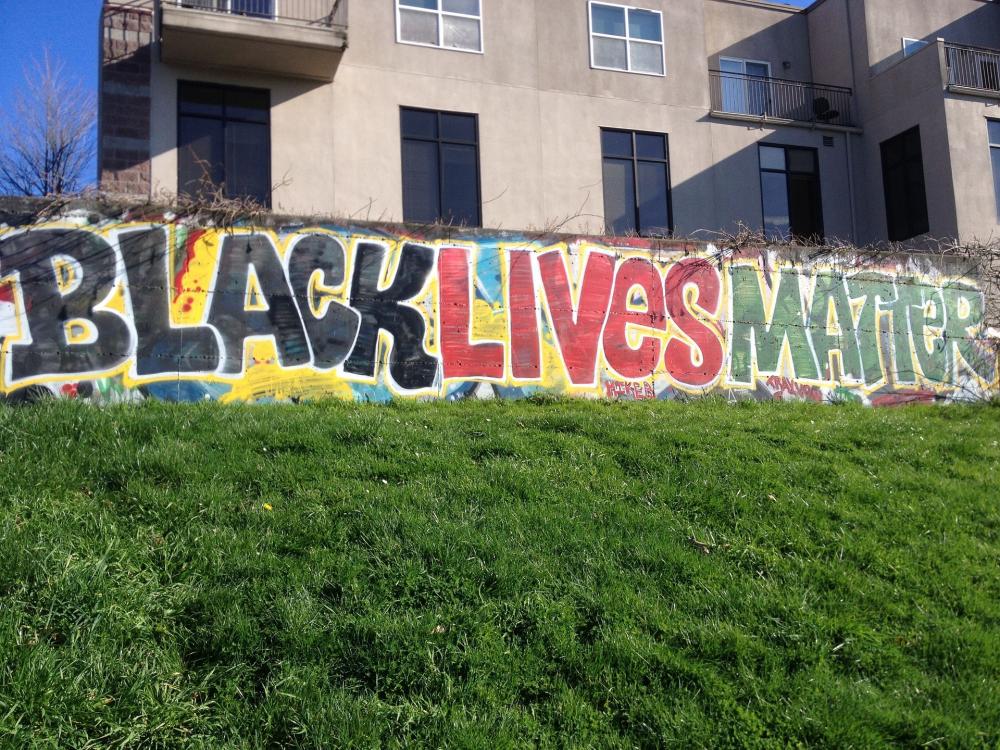
In this world that we’re in right now, you can’t write a story like this and not talk about Black Lives Matter.
The book wasn’t supposed to be about Black Lives Matter. I wasn’t writing about the movement, but in creating a story like this, in this world that we’re in right now, you can’t write a story like this and not talk about Black Lives Matter.
TLC: You work with the Hurston/Wright Foundationand this book is also a Kimbilio FictionPrize winner. What do organizations like these do to elevate Black writers and put forth energy behind us?
MH: Organizations like ours are vitally important, even more so in these times of discord. There are so many amazing Black writers out there and there are so few opportunities to really give them the kind of platform that they deserve. I think both give that opportunity for Black writers to be in a community where they are nurtured, where they feel respected, where they feel heard and valued. There are so many amazing writers who are not getting the kind of respect at the national level that they deserve.
I love working with Hurston/Wright. I’ve been with the organization since around 2012-2013. I started out teaching the teens writing workshops and eventually joined the board. I served as chair for a couple of years. It’s a privilege to be in a position to create that kind of community and to honor some of these amazing writers. The Legacy Award is such an amazing experience. Every time I’m there, I’m just so wowed by seeing a space full of primarily Black writers. The array of talent in the room is inspiring for me as a writer.
In the popular imagination, the idea of Canadian literature is overwhelmingly dominated by imposing landscapes: the vast emptiness of the prairies, a cruel wilderness that tests the limits of human survival. It makes sense that such settings would loom large––many of the country’s most influential works of literature have pitted their characters against powerful, indifferent forces of nature. And it can get dangerous out there.
But Canada’s cities are vital literary spaces, too; none more than Toronto. Smaller than the favored literary settings of New York or Boston (and with a much more easily mastered subway system), the city’s geography has received loving treatment from some of Canada’s leading writers, both past and contemporary. The following list keeps its focus to the 21st century, giving the most cutting-edge look into the streets of the literary city. Here are seven novels that immerse us in the geography of Toronto.
Brother, Chariandy’s second novel, is a taut and elegant depiction of Black masculinity. The story follows two brothers, Michael and Francis, as they come of age in a suburb of Toronto. The novel’s setting is a character all its own: it takes place in Scarborough, a suburb to the east of Toronto predominantly comprised of South Asian, Chinese, and Black communities. Chariandy’s sentences are tense and precise as he takes you through the streets and housing complexes of Scarborough, with the novel building to a devastating act of police violence. The opening section, with follows the brothers as they climb a hydro pole into the sky, offers a stunning vantage from which to regard one of Toronto’s most culturally vibrant areas.
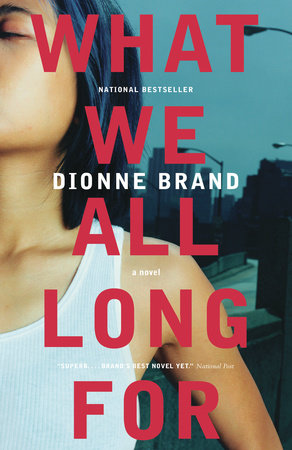
Brand is an icon in Canadian literature, and this is a strong contender for the definitive Toronto novel. A poet, nonfiction writer, novelist, and teacher, Brand has produced seminal work across multiple genres. What We All Long For follows a diverse group of four young friends––an artist, a poet, a courier and a retail worker––as they pursue their passions (which often include one another) in early-aughts Toronto. The novel is alive with the rhythms and sounds of the city; the mechanical music of the subway train. Following Carla, the bike courier, as she tears across the city’s paths is a vivid way to navigate Toronto’s streets.
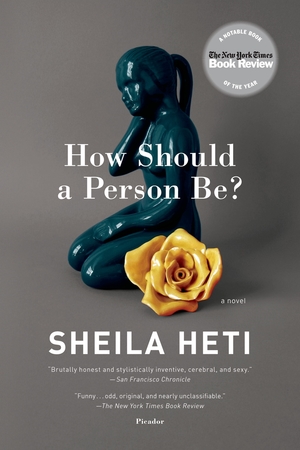
Subtitled “A Novel From Life,” Heti’s autofictional novel received considerable attention in the US upon its publication. The book, though, is distinctly Torontonian. It follows the narrator, Sheila, as she attempts to answer the novel’s titular question, one that gives rise to a host of others: what does it mean to authentically create art? How far can you go in turning the material of your own life into fiction? What about if that material is drawn from the life of your friend, an artist in a different medium? How far is too far? The novel generously borrows from the lives and words of Heti’s friends, a group of artists in Toronto, and turns the same keen, inquisitive eye on the city that is home to them all.
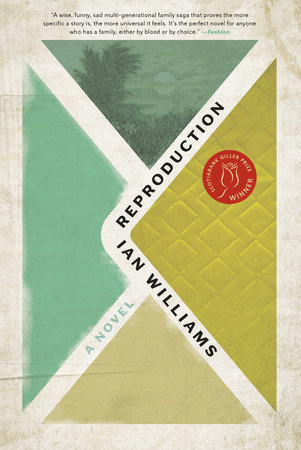
Recently shortlisted for the 2019 Toronto Book Award, Williams’s debut novel––though he’s previously published poetry and short stories––traces the making, breaking, and remaking of a multigenerational family over decades in the suburbs of Toronto. The novel begins with a central couple––Felicia, a teenager from an unnamed Caribbean island, and Edgar, the much-older heir of a wealthy German family—who meet in the hospital room where both their mothers lay dying. Their unlikely coupling is the catalyzing event for decades of interpersonal mishaps. Williams is interested in the question of what makes a family; how choice can be more important than blood. Polyphonic and big-hearted, the novel cycles between the center of Toronto and the suburbs around it, giving a geographical picture as kinetic as the story it tells.
Alexis’s novel opens in Toronto’s oldest bar, the Wheat Sheaf Tavern—currently closed for renovation, to the concern of its local regulars––where the gods Hermes and Apollo are out for a drink. Their banter about the nature of humanity and the merits of human language culminates in a divine challenge: “I’ll wager a year’s servitude,” Apollo says, that “any animal . . . would be even more unhappy than humans are, if they had human intelligence.” They settle on dogs and decide to grant them the questionable favor. What follows is a brutal, comedic adventure as the title’s fifteen dogs wander the streets of Toronto, grappling with an ability they never asked for. The text is even prefaced by a two-page map, which helps orient the reader within Alexis’s street-corner-level specificity.
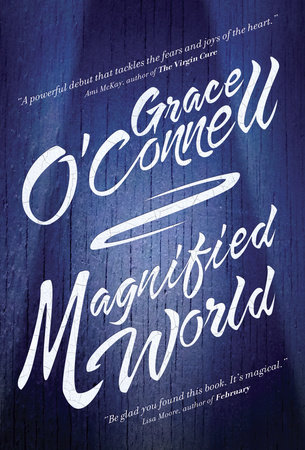
O’Connell’s debut centers on Maggie, whose mother has recently taken her own life by filling her pockets with zircon stones and walking into the Don River. In the midst of their grief, Maggie and her father are left to run the family shop, a New Age store located on Queen Street West––one of Toronto’s most vibrant art and design districts. Shortly after losing her mother, Maggie starts to experience blackouts and encounters with a mysterious, slightly menacing stranger who seems to know something about her mother’s past in the American South. For water-clear prose, a sensitive depiction of grief, and fine-grained local detail on one of the city’s most distinctive neighborhoods, O’Connell’s novel delivers.
The two volumes of The Unpublished City anthology are curated by different writers—Dionne Brand for the first; Canisia Lubrin and Phoebe Wang for the second––but each brings together the work of several emerging Toronto writers. Collecting poems and short prose pieces across a diverse range of contributors, the collection highlights both the city’s range of underrepresented literary voices and the impossibility of characterizing Toronto through a single pair of eyes.
On the top floor of the Strand is the Rare Book Room. In addition to housing the New York store’s signed first editions, the Rare Book Room also plays host to the Strand’s event programming. There are book launches and panel discussions, and there are events too that depart from the standard reading-interview-Q&A-signing format: live music, book clubs, in-person podcast episodes. A few times a week, above all but a few of the Strand’s famed 18 miles of books, an audience gathers, of people who care about stories.
On August 12, 2019, a writer stands at the podium. The story is one he’s had in his mind for five years or so. Today it was released to the public. In the audience, we sit in rows of folding chairs and listen to the opening lines: “I had a dream this morning, but I can’t remember what it was…” The voice, though, isn’t the writer’s, but an actor’s, coming through speakers. In the background, we hear the ambient noise of a train car, and then on a TV screen next to the podium an illustration of the car’s interior appears. The image is still, apart from the scrolling text notifying passengers of the next stop, and the rubber straps slowly swinging from the handrails. There’s a cursor on the screen too, and the writer moves it, pausing over the next-stop announcement. Text appears below the image, voicing the narrator’s thoughts: “I forgot how difficult getting around this city can be sometimes.”
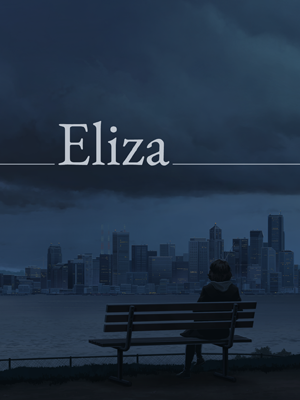
This is not exactly a reading, then. The Strand billed it as a “live playthrough”: an in-person demonstration of gameplay from Eliza, a videogame about artificial intelligence, mental health, and the gig economy, written and directed by Matthew Seiji Burns and released by indie game developer Zachtronics. The obvious question, then: why launch a videogame at a bookstore?
Some of my favorite moments on Twitter are the ones when I’m reminded that my interests aren’t as disparate as it’s easy to assume. In real life, I know that all my friends don’t just care about one thing—that one person can very easily care deeply about both the machinations of the improv comedy world and speleology—but on Twitter, most of the people I follow tend to tweet about one thing. The literary people tweet about books, the fashion people tweet about clothes, the academics about their fields, and sure, everyone tweets about politics, but for the most part my feed consists of a half-dozen parallel conversations.
Which makes the unexpected points of connection—say, when the person I follow for their menswear memes posts about a continental philosopher—all the more memorable. They remind me not just that people have wider sets of interests than glancing at their social media might suggest, but also that the conversation around these interests is more capacious than I often realize. So I appreciate it when writers I love—like Tony Tulathimutte, or Hanif Abdurraqib, or Eve Ewing, or Carmen Maria Machado—tweet about video games. It’s a useful reminder that, whether it’s told via a game or a novel, a good story can provoke a broad conversation, and in doing so create—however fleetingly—a new community.
Whether it’s told via a game or a novel, a good story can create––however fleetingly––a new community.
Eliza deserves to be the subject of that kind of border-crossing conversation. In fact, it’s a game that itself crosses those borders: it’s a videogame, yes, but it’s gaming at its most novelistic, and it’s a game that’s seriously engaged with art across different media, from music to comics, film to poetry. It’s a game that makes the case that storytelling can benefit from bringing together fiction-writers and coders, actors and musicians, visual artists and poets.
The game is about an AI-driven therapy service called Eliza: think Alexa for mental health. (One reason why it makes sense to launch the game at an independent bookstore: Eliza is at some level an anti-Amazon satire). But here’s the twist: rather than using an onscreen avatar or a digitally generated voice, Eliza uses real people—“proxies”—to deliver the lines the AI produces, so as to provide the patient with something approximating person-to-person conversation. The game’s protagonist, Evelyn, works as one of these proxies. Throughout Eliza’s runtime, Evelyn grapples with what Burns describes as “the thesis question of the entire game”: can an AI-driven therapy program ever be an ethical good? The story Eliza tells, then, is more or less sci-fi—in the low-key, near-future/tweaked-present way of movies like Her (one of Burns’s stated influences) or books like Jeff VanderMeer’s Southern Reach Trilogy.
In terms of how it goes about telling that story, Eliza is a visual novel. That means that it belongs to a category of video game that’s more focused on story, dialogue, and character than most big-name, big-budget games. It’s not—like, say, Super Smash Bros.—about combat, nor—like Dark Souls and its kin—about difficulty. One way to put it would be to say that it’s a novel (or short story) with added onscreen images (a kind of digital graphic novel), plus voiced dialogue, some music and sound effects, and a certain degree of player choice. You could call it a multimedia choose-your-own-adventure, or interactive sequential art. Either way, it’s a hybrid, taking elements from different forms and using them to tell stories that couldn’t be told in the same way otherwise. The genre is still most popular in Japan, but—partly because visual novels are relatively cheap to produce, at least compared to AAA titles like Call of Duty or Red Dead Redemption—it’s a type of game that’s increasingly being made across the world, by small, independent developers. Those fairly low barriers to entry also contribute to the fact that it’s a relatively diverse genre: in terms of both the creators and the content, you’re more likely to find people who aren’t straight and male in visual novels than in AAA games.
As a visual novel, then, Eliza feels more at home in a bookstore than a less narrative-oriented, less textual game would. But it’s also, even within the genre, an unusually bookish specimen. It’s a game that resists feeling like a game for as long as it possibly can, because it’s a game that’s unusually cautious about letting the player control the action.
As an Eliza proxy, Evelyn doesn’t have any choice as to how she conducts the therapy session. Her job is simply to deliver the lines that appear on her Google Glass–like headset; deviating from the script is strictly off-limits. And as Evelyn, when you the player play through a therapy session, you don’t have any choice either. You click on the lines that Eliza projects on to your display, and Evelyn delivers them. No room for deviation—at least for the majority of the game. This is worth emphasizing, because it’s something that makes Eliza a decidedly un-game-like—or alternatively, a decidedly novelistic—kind of videogame. A choose-your-own-adventure with relatively little in the way of choice. And that lack of power isn’t, as the saying goes, a bug. It’s a feature.
It’s easy to think of videogames as being distinguished by the element of player choice. Control is a big part of what separates a videogame from a book or a movie or a comic. Hence the common view that, as Evan Urquhart puts it, “the point of a game isn’t its narrative, but its interactive nature.” But the reality of how games exist in the world is a bit messier, not least because in 2019 the videogame community contains as many people who watch games as play them. Watching a game being played is a different, much less interactive way of consuming the same piece of content. But as the audience reaction to the Eliza playthrough at the Strand demonstrates—moments of laughter, an audible “oh my god!”—not having a choice over how the game plays out doesn’t stop people from enjoying it.
In Eliza, choices don’t matter, until suddenly they absolutely do.
Eliza gets this. The game knows and plays with the fact that some choices are important and impactful, but a lot of the time choice is nonexistent or inconsequential. Evelyn isn’t Oedipus or Lily Bart, for whom individual decisions are always subordinated to a preordained fate. Yet for the majority of the game, she has little to no agency: she goes to work and does what she’s told. Eliza tells a story about the ways technology can condition and limit users’ degree of control, and about the rare opportunities we have to evade those restrictions and reassert ourselves, whether by deleting social media accounts or switching careers. And the gameplay mechanics echo the plot and themes of the story. As the player, sometimes you have no control over events—you’re observing things play out as you would when watching a Twitch stream or seeing Oedipus Rex, or you’re reading recounted events as you would when sitting down with The House of Mirth. At other times, you’re deciding between one dialogue option and another, but either way the conversation ends up in the same place. And on a few rare but impactful occasions, you’re making choices that really do have a major influence on the plot. Choices don’t matter, until suddenly they absolutely do.
But of course Eliza isn’t just a short story with an element of interactive choice. Its overall effectiveness as a piece of storytelling relies also on the cast of voice actors, the illustrations, the music, and more. Matthew Seiji Burns’s labor is central to the game (as well as writing it, he directed the voice actors, recorded the soundtrack, and even edited the dialogue), but it only exists as a result of the contributions of a wider community of creatives, spanning a range of media. This too is reflected in the game’s story: the characters we meet in Eliza’s Seattle are a cross-section of artists, storytellers, and consumers of multiple media. There’s Evelyn herself, who’s just coming from a three-year stint as a bookstore employee (one more point of connection between the game and its launch venue). Her friend Nora makes electronic music. Rae, her supervisor, used to work in theater (look out for the poster for a production of Ionesco’s Rhinoceros). Rainer the tech CEO has a poetry obsession, and Maya the patient is a comics artist. And as the game’s fourteen therapy sessions make clear, everyone here is a storyteller, piecing together narratives to make sense of their lives.
When it comes to Eliza’s central question—the ethical status of AI-driven therapy—the game doesn’t push its players towards any one answer. The pitfalls of the program are very evident. But the game holds on to one potential benefit to the work that Eliza does. That’s the idea that a room in which one person tells a story, and another person (even one hooked up to an AI) listens, is a room that holds out the promise of meaningful consequences, for storyteller and listener alike. And this is one final reason why it made sense to launch Eliza with an event in a bookstore. The Rare Book Room at the Strand is a room in which, at book launches and readings every week, stories are told and listened to. And when the session is over—when the audience dissolves and we each go back out into the summer night—there remains the possibility that, in a small but important way, something’s changed.
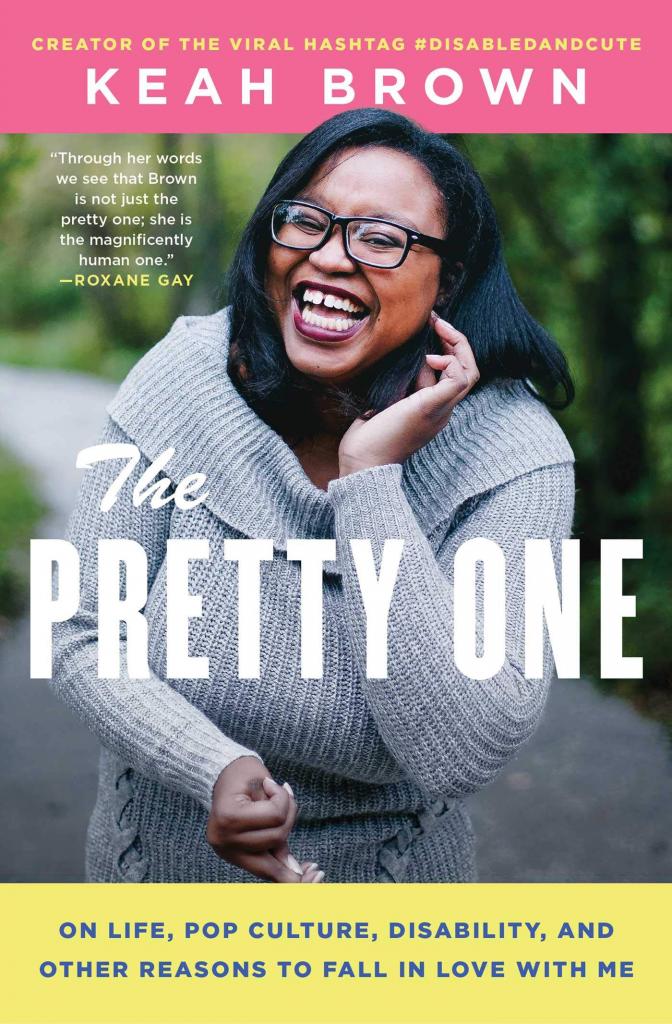
In The Pretty One, Keah Brown invites readers on a journey as she comes into her own, not just in who she is and how she sees herself but in the ways she discusses that evolution and the growth still to come. Online and in print, Brown has openly written about having cerebral palsy, being a disability advocate, what she loves—her fondness for cheesecake is legendary—and loathes, and the ways that ableism continues to impact the disabled community and be a consistent part of the conversation on representation.
But these topics are not all that Brown is about. In The Pretty One, Her discussions of pop culture, crushes, rom-coms, and our news cycle emerge in parallel with her own life. With humor and grace and humility, Brown opens up on life and what she sees as being necessary to the broader cultural conversation. Many may know Brown from her online work, including interviews and feature writing, as well as for the viral hashtag #DisabledandCute. Now we’ll know her, rightfully, as The Pretty One.
Jennifer Baker: You mentioned you weren’t really writing about disability when you first started, or maybe you weren’t writing as much about it?
Keah Brown: No.
JB: So when did that trajectory happen for you, where your writing started to get more personal?
KB: I think the first personal essay I ever wrote was for Femsplain in 2015. It was about me being jealous of my sister. I think for me what happened was that when I first started writing about disability it was simply because “I need to get this off my chest. I need to talk about it because if I don’t it’s going to fester.” So it was more a survival thing for me than the need to explore it and see what it means. And so the first bits I wrote about disability were really negative and I was still trying to come to terms with being disabled and being in my body. A lot of it was, “I don’t like myself, hopefully I will one day, maybe I won’t.” So what I do like about my earlier work was that you can kind of parse through it to see how far I’ve come now. A lot of that earlier disability work was just really depressing and really sad, but that’s where I was at; and I think that was important for me to be honest about as well. I felt like if I didn’t start writing about disability, I was not going to be okay. It was for survival. Not for any survival professionally, but survival for my own being.
I felt like if I didn’t start writing about disability, I was not going to be okay.
JB: And do you feel like you got decent guidance from editors in regards to writing those essays?
KB: I think I was very lucky because, especially as a Black woman, I’ve heard horror stories about people having editors—specifically white editors—who don’t understand their experience and sort of try to exploit them for advertising money or clicks. I had the opposite experience. My editors would say, “Are you sure you want to put that specific thing out there? We just want to make sure that you’re not exploiting yourself. We don’t want you to feel like you have to say XYZ thing.” So a lot of times, my editors would pull me back so I wouldn’t give too much. They said, “We want you to be able to feel free to tell your story. But also be aware that this is going out to other people, so once it’s out there you can’t take it back. Once you tell this story, you’ll have to atone for it later on.”
I think with a lot of young writers don’t have that same sort of protection that I had, so I was lucky in that way because it wasn’t like any of my editors were trying to exploit me to get clicks or try to make nothing out of something. I feel really good about that aspect. But I really did luck out because, like I said, I’ve heard so many horror stories.
JB: Or editors don’t understand the work at all and try to make it something it’s not.
KB: Right, trying to find their own entry point and you lose the entire thing in the process.
JB: Yeah. That is very nice to hear this wasn’t your experience.
KB: It’s so rare. I think there’s only been one or two times where something came out and I was like, “This doesn’t feel like me. I can see bits and pieces of myself in it but it’s not me.” And I’ve written a lot between 2015-2016 to 2019. So I feel very lucky that I was able to only have it happen a couple times. It took a lot for me to reach out to those editors and say, “No, this isn’t what I wanted at all, can we rethink this?” Because I think that’s hard too, especially when you’re first coming up and just getting your feet wet. You don’t want to ruffle any feathers. So saying no, “ giving feedback is so hard at that stage in your career because you don’t want to burn that bridge.
JB: Did you have a breaking point?
KB: It was during edits, so the piece hadn’t even come out yet. I messaged the editor and I said, “This isn’t like me at all, this looks completely different from anything that I would ever write, I can’t have it go out like this.” Because I had just started to pick up a bit of an audience and I was so scared to tell the editor that I was unhappy with it, but my best friend was like, “You have to do what’s best for you because at the end of the day, your name is on it, not the editor’s.” And thankfully the editor wasn’t combative or angry about my pushback, they were like “Okay, that’s fine, we can fix it. How would you like it?” And that’s very rare for a lot of people.
JB: And prior to the book, you had the viral hashtag #DisabledandCute, which is prominently on the cover as well along with your beautiful face. Through The Pretty One you show your reality, because one of your first essays was a dark place, like the piece was. And what I thought about your book especially was that Keah is not trying to write inspiration porn. Here she is writing her honest truth.
KB: Yeah, and I was very adamant about that because when I made #DisabledAndCute in 2017, that was the first time that I was genuinely genuinely happy in my body. I felt good about myself, both professionally and personally. I was like “I look cute” and so I wanted the hashtag to celebrate that, but also not just celebrate me you know? That’s how it started. I wanted to kind of memorialise—if that’s the right word—feeling really good in my body, but then I realized this isn’t just about me, this is about a place other disabled people can celebrate themselves and each other and find a place to feel like they can say “I like myself in my body” full stop. So for me it was, “Okay, I feel great, and I want everybody else to feel this way because I don’t want anyone else to feel like I once did when I first started writing professionally.”
I’m on the cover, so people can’t pretend they don’t see me.
Writing this book, I wanted to say “I’m not here to make you feel better about yourself because you’re not disabled. I’m here to tell you that I feel good and that you should too, not because you aren’t me but because we should want to feel good in our bodies. And we should want to feel good and we should want to learn about other people in the world in general.” I hate inspiration porn so much because even well-meaning people send it to me and are like “Look at this, so amazing! This disabled person did XYZ thing!” And it’s great that they did that thing, but it’s under the guise of making you feel good because you don’t live like that. That’s not okay and that’s not helping anything. It’s just further causing us harm because we have to always be seen as the people who make you feel good because you’re not us, while you strip us of our rights and livelihood because you don’t think we deserve it. So yeah, I was very adamant that this wasn’t about making people feel better because they aren’t me, but just giving them a window to a life that they might not know of or just an idea of what it’s like to live in a body that’s not like theirs, but still valuable nonetheless.
JB: Your face on the cover also made me think that it forces you to be reckoned with. As in, “I’m here at the table. You have to reckon with me, I am here, I am present. You can ignore me, you can say I’m not here.” But simply by the existence and presence of your joy emitting from your body, in your full body, it means we have to reckon with that every time you look at the cover, every time you’re reading the inside and you close it and you look at the front. It’s: I have to reckon with who this person, who this writer is, what their experiencing with and maybe that might, in my narrow mindset, conflict with my thinking or how I’m interpreting things.
KB: I agree. I think that it was very intentional for me. I’m on this cover, so people can’t pretend they don’t see me, and people can’t pretend they don’t see my hand. For me that was a really big deal because I spent so long being uncomfortable, being disabled and uncomfortable showing my right hand. For it to be on the cover of this book is revolutionary for me as a person because you don’t often see disabled bodies on book covers.
You just don’t. I just wanted to challenge the idea that disabilities are an eyesore—because I’m not an eyesore, I’m a sight for sore eyes. And not only is she smiling and happy on the cover, but when you get to the back of the book and you see my author photo you’ll see another photo where I’m smiling and joyful and alive. And I think because we see so much in popular culture and in mainstream media in general, disabled people never make it to the end of movies or books. So not only am I making it to the end of the book, but you’ve got me on the front of it too. So you can just always be reminded that I’m there every time you flip a page—every time you close the book like you said—it’s just a reminder that I’m here and I’m not going anywhere whether that makes you uncomfortable or not. Either get on the train or get off. I feel like I spent so much time trying to tuck myself away and not make too much noise or not bring too much attention to myself but now it’s like “No, you’re going to get all of me,” and I don’t think there’s anything wrong with that.
We pass the house on our way to the park. It is two-story, brick, with concrete steps leading to the front door and a crepe myrtle extending vibrant armfuls of pink. The biggest difference from our house, just down the street, is that this one no longer has a roof. The jagged top of the façade is blackened, like burned paper. Through bare windows, you can see the house’s innards, the raw wood and tangled wires and tufts of insulation. There is a Dumpster out front, cordoned off. From one corner peeks the floral arm of a couch.
I am glad, every time we pass, that my daughter is too young to register the strangeness of this house, lightning-struck. Without a roof it looks fake, like a stage set. Four collapsible walls that might be folded up and carried off in the night. When she points her delicate finger, it’s at the crepe myrtle.
“Yes, baby,” I say. “Aren’t the flowers beautiful?” When what I’m thinking, every time, is: It could have been us.
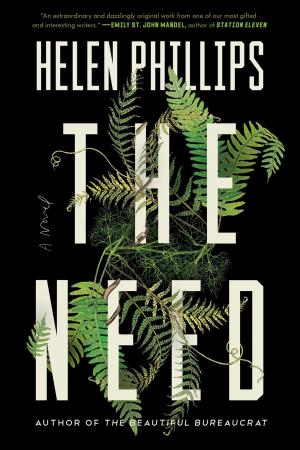
It could have been us is the unspoken refrain trembling beneath every scene in The Need, the brilliant, unsettling new novel by Helen Phillips. The speculative thriller opens with Molly clinging to her two young children, Vivian and Ben, after hearing an intruder in their living room. Or rather, she thinks she heard an intruder. Lately, Molly’s been mishearing things: “A passing ambulance mistaken for Ben’s nighttime wail. The moaning hinges of the bathroom cabinet mistaken for Viv’s impatient pre-tantrum sigh.” Her husband is out of town for work. Her phone is in another room. It is just Molly and her children and the footsteps she may or may not be hearing.
Molly’s self-doubt thrusts us into a fever dream where things might not be as solid, as definite, as they seem. The book’s short, agonizingly propulsive chapters initially alternate between Molly’s hyper-vigilance and a description of her earlier workday. Molly is a paleobotanist who has recently found several strange items at the fossil quarry she and her coworkers call the Pit. The artifacts are recognizable but “slightly and yet fundamentally off.” Most notably: there is a Bible in which every pronoun describing God is not He, but She. In the wake of these inexplicable discoveries, the Pit has become a tourist destination—and the target of hate mail from religious extremists who want to see the Bible destroyed.
This is the eerie world of The Need: recognizable and yet fundamentally off. The familiar is laser-focused on motherhood; the grinding, exhausting daily routine of caring for small children. These scenes are exacted with perfect verisimilitude: the incessant wiping of dirty bottoms, the rocking, the singing, the cajoling, the feeding. There is standing in the living room after the kids are asleep, desolate at the chaotic aftermath of their play. There is the letdown of milk in moments of high emotion, the inconvenient public dampening of the bra. There is work, where concentration and fascination sometimes make it possible to forget motherhood, to cease to exist at all, “except as a pair of eyes and hands.”
These scenes of “hypnotic monotony” shouldn’t read like a thriller, but they do, in part because of the seamless, yet almost fragmentary way that they capture the moment-to-moment giving of motherhood—and in part because underlying them all is a sickening foreboding. With toddler Viv on the toilet, demanding Molly read to her, and infant Ben in her arms, his sharp baby nails at her neck:
“She wondered if other mothers experienced it, this permanent state of mild panic, and worried that perhaps they didn’t, that perhaps there was something wrong with her. What a phenomenon it was to be with her children, to spend every moment so acutely aware of the abyss, the potential injury flickering within each second.”
It might seem incongruous, even absurd, that Molly could feel the shadow of the abyss in such an innocuous moment, but I recognized it immediately: the ultimate contradiction of motherhood. Bringing a child to life means the constant risk of their death. Every moment of love is superimposed with the unbearable possibility of loss.
Bringing a child to life means the constant risk of their death.
It’s this possibility that the intruder in Molly’s living room represents. The what-if, the nightmare, the seam ripping through The Need’s recognizable world—proof that the abyss is only ever a small series of coincidences, accidents, and missteps away.
When I was a child, I sometimes used to worry about the people I loved dying. One by one I lost them beneath the covers at night, my mind a carousel of loss: my parents, my brother, my sister, my Ñaña, who was somewhere between a mother and a grandmother to us all. Later, once I was an adult and the list of the lost had grown, along with my understanding of danger, I imagined losing my husband. I imagined my own death.
It sounds morbid and overly anxious, though before becoming a mother, I never considered myself an anxious person. I’ve simply always felt, when I tune in, a thrumming awareness of how temporary life is, how tenuously we hover on the precipice. Never, though, did this awareness haunt me as constantly and intrusively as when I became a mother.
In the early months, my daughter breastfed every other hour around the clock. I did not produce enough—nor was there time to pump enough—to store more than one extra bottle of milk per day. A milk protein and soy allergy made formula a near-impossibility. Her life depended entirely on me, on my body, on my will.
Until the allergy was under control, she was colicky. Her yowl catapulted me from bed, always, it seemed, the instant I fell asleep. It would take time for my heart to decelerate, for us to settle into a rhythm together in the chair, drowsy and peaceful, moments Phillips renders beautifully: “There is no safety like this safety. The oxytocin charging through them. If the world must end, let it end now, when we are here, like this.” Then a diaper change. Legs cycled to work out the gas. Back in the crib for her. Back in bed for me, an eye on the clock.
We usher our children into a world of unimaginable violence.
Eventually, I couldn’t sleep in those alternating hours. I felt sick with adrenaline and exhaustion, the wave and the rock, crashing. Instead, my mind reverted to old midnight habits, fantasies of loss fueled by my baby’s devastating vulnerability. My love for her was cataclysmic, an eruption, and it unearthed an obsessive fear of losing her. I cried beside my husband—and sometimes beside my daughter, when she still slept in the bassinet—mourning her even as her grunts and kicks made it impossible not to know she was alive.
Like Molly, I wondered if this was normal, the fact that “any serene image bore within itself the opposite of serenity, the possibility of the shattering of the surface.” If I was holding my daughter, I imagined dropping her. If she was sleeping peacefully in her car seat, I imagined forgetting her in the car. If she was cooing in the bath, I imagined her face submerged. I read essays by parents who had lost children: a three-month-old on the first day of daycare; a two-year-old sitting outside with her grandmother when, eight stories up, a loose brick dislodged. Once, I logged in to my April 2018 Babies message board to see a mother wishing us well; she’d no longer be on the board because her infant had simply not woken up one morning.
The Need made me shiver with recognition. In Molly, I saw myself, and in the intruder, who knows and covets Molly’s life so intimately, I saw the version of me who might exist should the worst come to pass. The Need felt like one of my terrifying midnight ruminations, only extended, exaggerated—the potential for catastrophic loss the very heartbeat of this book.
“Vivir con miedo es vivir a medias,” Molly’s boss, Roz, tells her in response to Molly wanting to hide the Bible for fear of religious extremists. Molly’s coworker, Corey, asks Roz what that means. “‘A life lived in fear is a life half-lived,’ Molly translated. ‘But I have kids.’” The implication is that, as parents, it’s impossible not to fear. For every ordinary moment of exhaustion, depletion, and cynicism, there is a counter-moment of love so extreme it can only be terrifying. After all, we usher our children into a world of not just accidents and illnesses but also unimaginable violence. If we are tempted to think we can keep them safe, we must remember that lightning can strike us at home, setting the roof on fire while we sleep.
On Saturday, August 3rd, a mother and father dropped their five-year-old daughter off at cheer practice before going to shop for her school supplies. They took their two-month-old son with them.
A couple was buying their nine-year-old granddaughter a present.
A young girl and her father and grandfather were standing in the south Texas heat, raising money for her soccer team.
A grandmother on the phone in the checkout line.
A boy, 15, perhaps looking for a new soccer ball.
A tableau of ordinariness—hands reaching for spiral notebooks and glittered binders, pulling credit cards from wallets, cradling the soft boneless weight of a baby. Voices calling out, Excuse me, would you be interested in—Which toy do you want?—I’ll talk to you soon, mijo. The kind of moments that feel safe, a bridge you take for granted will hold.
It didn’t.
I was in my hometown of Laredo, Texas, during the massacre in El Paso. Laredo, a border town, whose population is almost 96% Latino.
We had recently gone to Target, my sister and her three-year-old daughter, my 16-month-old and me. We were shopping for a baby shower gift. We pushed the girls in red carts, debated the merits of different baby soaps, picked a diaper bag with plenty of pockets.
In a slightly different reality, the man chooses Laredo instead. He enters the cheerful brightness of Target. We don’t know what we’re hearing at first. We talk ourselves out of it. Then there is no choice but to acknowledge the panic searing in our chests, to grab our daughters, to tell them everything is going to be okay, to shield their flesh with our flesh.
It could have been us. It could still be us. In this country, it could always be us. How do we live with this, as parents? How do we move through a world where the familiar can turn surreal at any moment?
It could have been us. In this country, it could always be us.
In the wake of El Paso, I find The Need oddly comforting. Yes, the book says. It is profoundly terrifying to be a mother, and it always will be. You will feel the twin velocities of love and loss swirling within you, and they will knock you breathless. You will sometimes be “paralyzed by the what-ifs, the swiftness with which anything can change, the ever-present split second that is the difference between blood spilling or not, the difference between one future and another.” But you will have children who need you to pretend this isn’t so.
And while there may be no overcoming maternal (or parental) anxiety, we should also be wary of what it might become. As Molly crouches with Viv and Ben in the opening chapter, “her desperation for her children’s silence manifested as a suffocating force, the desire for a pillow, a pair of thick socks, anything she could shove into them to perfect their muteness and save their lives.” Our anxiety, the novel warns, can swell into something grotesque, as capable of destruction as the thing it fears.
So, while I try to galvanize my fear into something like action, I will continue to grocery shop. I will let dread “cast the light of the sacred on the mundane.”
I will walk my daughter to the park, and when she points to the crepe myrtle, I will say, “Aren’t the flowers beautiful?” And I will lift her to touch the blazing petals.
Téa Obreht’sInland is a more than worthy follow up to her breakout debut, The Tiger’s Wife. Her smart new novel plays with narrative destiny while raising massive questions about settlements, journalism, and law servants. The book, which follows the narratives of the low-key homemaker activist Nora and the haunted journeyman, Lurie, deals with frontier-era aspects of life and cultural politics that are oddly prescient in today’s era of fake news and flim-flam.
We spoke by phone on a quiet Thursday afternoon and quickly dove into the whys and wherefores of the novel.
Eric Farwell:It’s been about eight years since your debut novel, The Tiger’s Wife, came out. I’m curious about how the success of that novel impacted your feelings about this book. Since your debut made you kind of a literary star, did you feel pressure or raised stakes for Inland? Did you feel hindered at all by the success of the first book?
Buy the book
Téa Obreht: I was pretty surprised, and I continued to be surprised by all the positive reception The Tiger’s Wife received because I tend to be a pessimist. As for pressure, let me put it this way: I’d never written a first book before The Tiger’s Wife, and then I’d never written a second book before Inland.
The most challenging thing about it was the fact that, maybe six months after publication, my writing style had begun to move in a different direction, into something more distilled. I didn’t know what to do with that. I didn’t know if it was normal, or if it was something that happens as a result of still touring and being in the mind-space of the previous book and therefore being unable to totally sink into the new one. A lot of the pressure probably came from wandering into this unknown territory and not knowing that it was okay to just wait for the stylistic changes to happen, and for the brain to get used to a different mode of writing.
Going from the first-book mode of “this is something I’m writing in secret and no one will ever read it,” to second-book mode, wherein you realize, “oh, this is a project that might actually have an audience”, is a bizarre psychological shift, one that naturally affects your relationship with your work, and it just took forever to get through it. I’m a very trial and error type of writer, and I’ve become more and more of one in the last eight years. I’d try my hand at something, and get two-thirds of the way through, and realize that it wasn’t anything—which was a good sign, of course, and meant that progress being made, but it didn’t feel that way at the time.
EF: That makes sense. I’m curious how much research went into getting this novel historically accurate in both language and behavior? I mean there’s the writing part of the novel, but what was the gestation like for research and development in context to making sure it made sense and felt right historically?
TO: I was extremely lucky to have been doing some research in the West for a little while, working on what I thought was going to be a completely different novel. In the course of that research, I stumbled upon this episode of a podcast I love, Stuff You Missed in History Class, which detailed this Arizona campfire tale about two women who encounter a beast of possibly supernatural provenance on their homestead one evening, and how this yarn is connected to the true history of the Camel Corps. And I remember hearing it and going, “how do I not know this?” And as I began delving deeper and deeper into the research, I realized a couple of things. The first was that the story’s grounding in history confines the novel structure to a very particular state. I knew that it had to have two narratives, two points of view: one was going to take place over a single day in Nora’s life, and one was going to take place over the forty years that Lurie needs to arrive at the novel’s present day. Everything else was a matter of exploration. I didn’t know who the characters were. I didn’t know what they were doing there. I didn’t know who Lurie was, or anything about him.
The kind of research it required allowed me a tremendous amount of freedom to nerd out on the minor details of the era: technological innovations, how people spoke, how they ate, how they sourced their water, etc. Since none of the research could ever go into affecting the foundational narrative, I realized it could only impact the characters and how they relate to one another, and what’s going on with Nora over the course of this chaotic day and the political situation in town. It was a really, really fun process, and I adored having to be hemmed in, one the one hand by narrative, and on the other hand by the facts of the time that limited how characters interpreted and processed the world.
EF:Both Nora’s domestic narrative and Lurie’s more outlandish one are deeply political. Nora’s starts off with her having to navigate her marriage, and increasingly spools out to be about local politics. Lurie’s focuses on the politics of outlaw gangs and motivations. Even though they’re different, their political concerns don’t seem that distinct from one another. I was wondering if you could speak to that at all, the fact that though they’re different, there’s a lot of commonality there?
TO: I think their commonality hinges on powerlessness and placement in society. Speaking from the point of ingress into a narrative: my grandmother, in her declining years, had gotten very open about certain facts of her life, and I was struck by how much rage she had been carrying. Despite the fact that she loved her family, and loved my grandfather, she spoke about what it had been like to be a woman in her time, to be born to an ethnically Muslim family and then marry into a culturally Christian one, and struggle with heart disease, and live in a nation that tended to cast aside its Muslim citizens; basically what it had been like to be a young woman having her life dictated by everyone around her. And because of the war, and the scattering of her family, she also struggled with a great sense of displacement. All that came up in our conversations about life, and identity, and what home meant—which we were having more and more as she was fading—and the way it invaded the narrative truly surprised me.
The freedom to reinvent, to be anything or anyone on a whim, was the province of white men.
And of course you don’t know that while you’re in the thick of writing, but it’s interesting, now, to look back and consider why I trapped Nora in these circumstances, and why she’s trying, in every possible way, to wrest whatever control she can out of an environment that doesn’t position her to have power, all of which leaves her very rage-filled. On the other hand, there’s Lurie, who suffers from this initial displacement when his father brings him over from Bosnia as a child, and is then constantly trying to parse not just who he is, but what he is in connection to society through a haze that always seems to be pulling him in different directions. And his relationship with Jolly, with Hadji Ali, the cameleer with whom he bonds most, centers him a little, clarifies that through commonality of language, commonality of expression, a sense of belonging he doesn’t really know he lacks.
EF:In Nora’s case, you have the small citizen crusading against the corrupt politician. I was struck by how this isn’t something we’re seeing a lot of in fiction, and was curious if you were influenced at all by how you’re feeling now about the political situation here?
TO: So, it was interesting. I had a very particular sense of the Western as a genre when I began researching this book. And the more I studied about the period, the more I realized there would be no getting away from this narrative of land-grabbing, and boom and bust cycles, and range wars, all these tropes we’ve come to associate with the genre in modern times. The range war, in particular, interested me, because I hadn’t realized what a significant role newspapers played in the conflicts between cattle barons and small communities, and how publication affected the way those narratives came down in the historical record.
The first draft of the book was completed sometime in September of 2016, and shortly thereafter things changed. And I was surprised then to find myself editing the book while watching our country slip back into some of these patterns, and recognize the degree to which warring newspapers moved to prominence, and to see these age-old cycles being played out again in 2018, 2019. It was deeply terrifying and hilarious in the worst way, after having done all this research, to see it play out, in particular because so much of Nora’s small-guy-in-a-big-world fight ended up being about the way we push our individual goals, even when we’re blind to the advantages of our own position and the consequences of our personal aims.
EF: To pick up on that a bit, the novel, to some extent, covers truthiness, flimflam, and sensationalism in local news as it pertains to local politics. What research went into understanding how that played out on the frontier, and how do you feel it’s changed since? Has it changed that much?
TO: Shockingly, I think no. It’s bizarrely similar, and when you stack up newspapers from the Johnson County War, or the Pleasant Valley War, and you have a situation in which one newspaper is actually owned by a powerful, land-grabbing party, and the other is run by a person who just lives nearby and pinches pennies to churn out copies on a tiny little old printing press, and you pit the two against each other, you see familiar dynamics playing out over and over again.
Even at that time, the confirmation of what you already believe completely entrenches your response to a situation, and how you write the editor, and whom you stand with, and what you tell authorities when the going gets tough. It’s shocking. It’s unbelievable how little things have changed. Even the way products are sold. One of my favorite things to do while researching Inland was to go through old ads and sit there for hours, lost in the way people sold tonics, and medicines, and the newest irons that are going to help you finish your work twice as fast, and the corsets that can tighten like no other. It’s literal snake oil. And it’s not all that different from the fact that now, every third photo on my Instagram feed is trying to sell me some new product, some snake oil. The form has changed, and perhaps the concept, and there are more rules about how to regulate, how to advertise, how to create mass hysteria, but the tone is still the same.
EF: I agree. Myth-making, and this American idea of inventing the self are a big part of Lurie’s story, and give him a lot of agency. What kinds of things were you thinking about when you decided to explore that idea through Lurie?
TO: I was thinking about the contrast between the freedom that certain individuals who occupy this society had and the freedoms that others did not. It’s interesting how often the memoirs of homesteading women, or just the historical accounts of the time, list these professions that the husband had taken on. And it would range from, you know, woodcutter, to assayer, to prospector, to bank manager, to schoolteacher. There was this great sense that you had the ability to go anywhere and land on your feet if you had half a brain. That possibility, I think, is one of the primary lures that called a lot of people westward. This notion of, you know, “things aren’t so great for me here, let me go, I’ll get my acreage, I’ll stake my claim, I’ll prospect, and if that doesn’t work out, I’ll do this other thing.”
Women and immigrants of color—their place in society was fixed and regulated, and their ability to reinvent or just exist was utterly curtailed.
It also applies to lawmen, who often vacillated between enforcing the law and breaking it. You could be a marshall in one territory, and an outlaw in another. People wouldn’t know. They’d have no way of identifying you—unless your bounty followed you, or you had a particularly low reputation. For the most part, that prospect, that freedom to reinvent, to be anything or anyone on a whim, was the province of white men. Women and immigrants of color, former citizens of Mexico who just woke up north of the border one day, the descendants of people who moved West after Emancipation, to say nothing of Native American people—their place in society was fixed, and very carefully regulated, and their ability to reinvent or just exist was utterly curtailed.
The canvas was blank for a very specific kind of person, and set for everybody else. And how people navigated that is the primary tension between what is true and what we mythologize about the West. In particular, thinking about the Camel Corps, and the drovers, you have Lurie, who is an outlaw but can still remake himself a little. And then you have Hadji Ali, who came over as a young man and was already a convert, already an outsider twice over, and who came here with the camels and worked for the army and tried his hand at prospecting for forty years before dying penniless in a town in Arizona, only having become a citizen as a result of petitions to the government his friends took the trouble to make. And his job list was scout and mule-packer, and that’s it.
EF: In the background of the novel is the conflict between white settlers and native peoples or non-white immigrants. Did that aspect of the book change shape over the last few drafts? I mean, as you started honing in on how that would play out and be a heartbeat in the novel, how did that crystalize and take shape in the project?
TO: It was a tricky thing to navigate because I wanted to make sure that I didn’t apply 2019 politics to the minds of 19th-century characters, some of who are illiterate and have no clue about the bigger picture of nation or globe. I knew Lurie, like Nora, would have a great deal of blindspots, and wouldn’t really have a frame of reference for his role in this conflict, at least in historical terms. I think his primary mode is to always be wondering about the world, learning as much as he can, and his starting position is that he doesn’t know much, but he’ll always figure it out. I knew that he would be marginally clear on what was going on, but still drink the Kool-Aid, and carry this fear of Native people, and this excitement about the nation-building project in which he was participating. His doubts about this would have to come through Jolly, who, having grown up as an occupied person himself, would recognize the gestures of empire, but would still, as I think many people do, find a way to justify the continuation of his role in it.
EF: One of the things you don’t waste any time setting up are these building blocks for Nora and Lurie of this sense of being haunted by history, and the connection between feeling haunted and the passage of time. Why did this interest you?
TO: The sense of upheaval in the west, and in the Southwest in particular, and its very turbulent, very violent, often horrific history, has never made it feel, at least to me, a place of rest. In a mythological sense, so many cultures frame death as a sacred passage, and think of the afterlife as this paradise field, this homecoming. In a place that’s seen so much upheaval, so much renaming, and so much individual and historical agony, the idea that afterlife wouldn’t be as turbulent as life felt impossible to me. And the idea that these two isolated people, Nora and Lurie, would not be haunted, would not be touched by that unrest, seemed impossible, too.
If there was one way for them to square with the turbulence of what was happening, and to access their own place in history, it had to be through their relationship with the dead. That landed on the page in an early draft: Lurie starts out being able to see the dead, and Nora right away is talking to her dead daughter. And I can talk about it now that the book is finished with a little more understanding, maybe some recognition of why it ended up on the page, but it wasn’t planned. It just happened.
EF: You write of using legacy and a sense of history to stir political action. Do you think that there was something distinct about 1893 that made legacy and decorum more valuable than it is today?
TO: I think every society’s, every generation’s center of power places a value on what they deem to be “decorum” and “legacy” only insofar as its useful to maintaining the status quo. The content is different, but the tone is the same. We can only hope that our ability to see through the bullshit to what really matters grows with each passing generation.
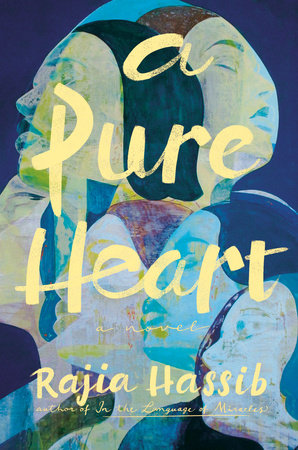
Rajia Hassib’s second novel A Pure Heart lands in the reader’s hands as a prayer and an interrogation. It’s about two sisters, Rose and Gameela, who were close in their childhood in Cairo. Then Rose meets and marries Mark, an American journalist for the New York Times. Gameela is the only family member not thrilled with this news. Mark converts to Islam, but Gameela wonders if it’s in name only. Is he—can he be—a true believer?
Buy the book
From here the sisters’ paths diverge: Rose immigrates to the U.S. with Mark, where she does a PhD in Egyptology and works for the Met. Gameela gets involved in the Arab Spring. Her decision to wear a headscarf is part of her journey into traditional Islam, where she finds a system that engages with her longing to live a moral life. Gameela judges her upper middle-class parents for their distance from the protesters at Tahir Square, and the “bread and social justice” the protestors demand.
The book opens with the news that Gameela has been killed in a terrorist explosion. Rose grieves by investigating her sister’s death the way she would approach an Ancient Egyptian excavation, collecting “artifacts” from Gameela’s room that Rose sifts through, discovering secrets.
Rajia spoke to me on the phone from her home in West Virginia. We talked anti-Muslim prejudice and self-colonization.
Sunisa Manning: How did this novel come to you?
Rajia Hassib: I thought of the last scene first—not the last, but the climactic scene. And I don’t want to spoil the book, but it was 2014 and Egypt was going through all the aftermath of the Arab Spring. There was a lot of divisiveness going on because of politics. So I had all of that in the back of my mind. I also wanted to write something that directly addresses terrorism committed by someone who thinks that they’re doing this in the name of Islam. I wanted to explore that more directly. All of that came together in that moment that I had—when someone would commit a lone wolf act of terrorism, and someone else would happen to be there. It started from there.
SM: In the book, you have a cast of characters who inhabit the political spectrum. There’s Rose and Gameela’s parents, who are upper middle-class Cairo residents: educated, enamored with the West. Rose stays out of politics and concerns herself with her PhD study of Ancient Egyptians. Gameela’s sympathies take us into the Arab Spring. We come into contact with Saaber, who is described as a sympathizer to the Muslim Brotherhood.
From this range the reader gets a sense of the multitudinous Egyptian responses to the protests at Tahir Square. This mirrors how Rose’s husband Mark, the American journalist at the New York Times, writes profiles of different Egyptians so that those in the West gain a composite portrait of Egypt, not just one of radicalization and revolution.
Did you think about selecting a spectrum of characters when you conceived of the book? How much did the Western gaze inform how the novel was developed?
RH: The Western gaze informed it tremendously, specifically the tendency to classify people very clearly into different groups, or opposing groups. And just knowing people, growing up in Egypt, and still being in contact with people in Egypt, I always found that a little bit too simplistic.
I intentionally show a varied cast of characters. Yes, I try to demonstrate that you cannot easily say people are on that side or on this side and they have nothing in common. But sometimes they fall on a specific side of a political argument or something like the uprising and revolution that happened in Egypt. But it’s much more complex than the simple classification that their political attitudes can imply.
SM: Building on the last question, I enjoyed how you explored the intricacies of self-colonization in A Pure Heart.
Rose’s parents love that a Westerner, and a journalist at the New York Times at that, has fallen in love with their daughter. This contrasts painfully with their reaction to the man Gameela loves, Fouad, an older farmer and socialist with an arrest record from his political youth. Rose’s real name is Fayrouz, but only Gameela called her that. Gameela, on the other hand, didn’t use her nickname Gigi. The sisters seem to inhabit the spaces of self-colonization and nationalism, Westernized and Egyptian, migratory and local. Would you agree with that? Tell us about the sticky places each sister’s stance gets into.
RH: They get into something that I’ve observed– the postcolonial attitude of inferiority is still very much there. Even now, I see it sometimes when I talk to people. There’s a sense of fascination with everything that is Western. And I trace that back partly to the implied assumption that Western is almost always better. The problem with that is that the things that are seen as better are very superficial—it’s a fascination with things that don’t even define Western culture. It’s not fascination with the advances in technology, it’s fascination with the way people dress.
We manipulate our beliefs and our ideologies and use them to justify whatever we want to do.
And I think that part of Rose and Gameela and their differences—what I was trying to demonstrate with that is that one way people have reacted to that was to embrace ethnic and religious roots. That sometimes comes as part and parcel of becoming more religious, which is a trend that happened in Egypt starting in the ‘80s and ‘90s. People would identify as religious and embrace Islam more openly are definitely larger numbers now than they were in the 80s. And part of that is, I think, a reaction to this kind of self-loathing, when people are just fascinated by everything that is not ethnically Egyptian or that is not traced back to Islam or to the ethnic origins of whoever they come from, like Arab or ancient Egyptian or whichever way you want to classify Egyptian.
So part of that is the reason I wanted to have Gameela the way she is. Rose is a little bit more complex. I don’t think she has the same amount of self-loathing. She embraces both in a way that her parents, for example, can’t.
SM: Through the sisters, you’re able to explore the nuances in the spectrum between faith and secularism. It’s important to Rose that her husband be Muslim; she fasts for Ramadan and prays five times a day, but is also comfortable marrying an American. Faith, to Gameela, becomes something more. Even as I formulate the question I hear how I seem to be implying that Gameela radicalizes into a terrorist, but that’s not what I mean. So this is the question: are you concerned about the challenges of writing from a place of Muslim faith in this time of bigotry?
RH: I’m not concerned. I think it is very important to write from the point of view of someone who identifies very clearly as faithful in this time, specifically because of what you are saying–that people tend to wonder right away whether being an observant Muslim who identifies as such is something dangerous. It is not. And that’s precisely why I think it is very important to write characters that are very clearly Muslim without making them into this.
You can go back to that scene I was talking about, where I knew there would be a terrorist attack and someone would die–that’s why I wanted that main person who dies to also be a Muslim, because it’s a way to address the violence without blaming it on religion.
SM: Complicate the picture.
RH: Look at it in a more complex way by including characters who embrace the same faith, but have totally different attitudes toward how they make that level of religiousness work for them. Because at the end of the day, we manipulate things. We manipulate our beliefs and our ideologies and use them to justify whatever we want to do.
SM: Gameela’s fixated on what it means to live an ethical life. She tries to live her life as “jihad,” which she defines as “constant striving to do good in the world.” That’s beautiful. And of course to your typical Western reader, it’s not our first understanding of the term.
Tell us about the moral thread running through the book, and what you were doing using “jihad” in this definition.
RH: I specifically used jihad in that definition because that’s the definition Muslim clerics will refer to, if you ask them. The Western default definition that has very clearly tied jihad to terrorism is, of course, a result of the fact that terrorist groups have clearly tied whatever atrocities they’re committing to jihad. They’re claiming that they’re doing this because they’re participating in jihad, that they’re pleasing God.
In the theology, one of the definitions of jihad is trying to fight against your own soul. It’s fighting against your inclination to do bad things.
But if you look at the theology, there are many things that fall under jihad. And one of them is the definition that Gameela is embracing, which is: trying to fight against your own soul. In a way, it’s fighting against your inclination to do bad things. You’re trying to tame yourself during your life in order to become a better person. And that is very hard to do. I think it’s much harder to do than to believe that others are enemies and– “if I can just conquer the enemy, then I will know everything will be better.”
I know it’s tricky to talk about morality, but it’s harder to identify the errors in one’s own attitudes and try to rectify them, or to pluck away hate from within ourselves, which is also part of trying to become a better person. So I wanted to explore that. But also in terms of fiction, of character development, it’s important to understand people’s motives, always. And that’s one thing that I’m always interested in—to understand how people come to act the way they act. To me, it’s one of the basic elements of building believable characters in fiction. And then those motives are so often driven by doing what the character thinks is the right thing and or what the character wants to do. Then in order to justify doing what the character wants to do, they have to convince themselves that this is the right fit, and that dynamic, specifically, that tendency to find a higher moral justification for one’s actions—it’s very interesting to me, and that’s something I wanted to explore.
SM: When Mark’s trying to make Rose comfortable in New York City, her new home, he says: “Places are always more welcoming. Places don’t care where you were born or how long you’ve lived in them. If you like them and make the effort to know them, they make you feel like you belong there. It’s their gift to you. It’s their way of liking you back.” This idea of place is significant to Gameela, too, who says she’s more at home on the farm than anywhere else. How do you think about place, and how people make homes in new places?
RH: That’s a personal attitude of mine as well. I’ve lived in so many different places, whether it’s in Egypt or when I moved to the U.S. I was in New York and New Jersey and California and West Virginia. I have come to experience this peace that you get somewhere when you become familiar enough with the place that you feel at home. That peace is interrupted only when people start making you feel less at home. I wanted to express that. It’s that power that people have over others, of making them feel Other, making them feel alien. It partly comes with having lived in a place before, or having roots there when others don’t.
But as an immigrant, and as someone who has lived in multiple places, I just wanted to explore that dynamic. How you can feel at home somewhere until the people who have claimed this home before you make you feel like you don’t belong there. But if you can shut that out, it becomes a source of peace. If you can enjoy the place where you’re living, if you can enjoy your relationship to it, it becomes a source of peace. And it’s anchored in a place. It makes you feel like you have a home.
The receiving line snaked through the chapel, its center aisle a corpus of grief, clutched purses, dark jackets. Miss Florence had insisted on cremation and a rented casket, had made her nieces promise only minimal fuss, because why spend good money on old bones? But then everyone showed up to pay respect, because they or their children had all spent time under Miss Florence’s care at the early childhood center. After forty years of wiping noses, Miss Florence always liked to say, everyone in town was her baby. Even the pastor had been one of her babies, a long time ago.
The service had been packed, and now hundreds pressed together in the best of gluts, waiting to offer condolences to Miss Florence’s family. It was early autumn, that hushed, forthright season, and the chapel hummed with good, clean, true grief.
It was early autumn, that hushed, forthright season, and the chapel hummed with good, clean, true grief.
Samuel Ammons brought his eldest granddaughter Alison, who had not been one of Miss Florence’s babies. Alison was only visiting, and she was not a churchgoer. She wore a borrowed dress, collared and polka dotted, which aged her. The dress clung to her back, and sweat dampened the dark curls on her neck. Alison looked feeble compared to everyone else—a mountain girl startled and shied by the flatland’s October heat, the only unsmiling mourner.
“No, this is my grand daughter. This is Bryce’s girl,” Samuel said to the small knot of people around him in the receiving line. “Down from the hills.” He touched his fingers to Alison’s narrow shoulders. “We sure like having her visit with us. She’s all grown now.”
Everyone nearby in line nodded.
Well now, young lady, the mourners said, I expect you’re in school.
“She’s studying agriculture,” said her grandfather.
Everyone approved. There were still farms in this town.
“Alison works in the university dairy,” Samuel said. “Bet you didn’t know App State owns that outfit over in Statesville? Milks a-hundred-sixty cows every morning, don’t you, Alison?”
Alison kept her lips shut and nodded. Everyone approved again.
The front of the church was cluttered with lilies, ribbon-bright bouquets, an ornate easel with a photograph of Miss Florence, mementos, the sleek casket. Someone had parked a rusty tricycle under the easel.
“They switched her out from the hog farm this summer,” Samuel said. “She had to go back home a while to rest.”
Oh, was it the heat? the mourners asked. You won’t be used to that, they said. Poor thing.
People here did not think of the Blue Ridge Mountains as the South, or of Alison as anything but a stranger. She came from a wet, unknowable labyrinth of hollers, and she had been confused by the order of hymns during the service. The mourners peered at her as if they were thinking of snow, or of wildcats slinking low to the ground.
Samuel shook his head, lowered his voice. “She didn’t like the slaughterhouse.”
Everyone sighed. Ah. They wrinkled their noses compassionately. They knew the industrial hog facility just a few miles from here. They knew its smells, its lagoons of dung and chemical runoff that festered in the sun. They knew the cages, the livestock trucks rattling down the cracked county highway every day, each one packed with terrified, pink bodies.
Alison crossed her arms and dipped one hip towards the casket, which loomed nearer as the receiving line inched forward.
For a whole month, she had worked in the main hog barn. The barn was the largest of five metal tubes at the end of the facility. Its ceilings were thirty feet high, rounded. Metal. Metal walls, metal roof, metal gestation cages. Metal fans whirred constantly above, but the barn stayed hot. The air was thick with sweat and shit and the tang of aluminum and scalding summer humidity. Everything echoed and reeked.
She was the only student intern. For everyone else, the place was a job. So they gave Alison the worst duties: scraping muck and sludge, culling dead, filthy piglets from cages where they’d starved or been trampled.
The noise. The smell. Alison was small, and the workers joked she was so skinny she would slip through the gratings in the floor if she wasn’t careful. The animals bit her. They screamed. Her skin cracked open in the heat. The hogs’ skin cracked open in the heat. Sows clamored and writhed, sometimes six to a cage. Nothing was clean. Even the ceiling was coated in grime.
She had been glad, at first, when the place was destroyed.
“It’s tough work,” said Samuel. “Wasn’t for her.” He patted his belly. “So she went back up the mountain a while, finished her credits. Tested out of a bunch of classes, didn’t you?”
Alison nodded again, moved her tongue around to loosen the thick spittle in her mouth.
“Then they switched her to the dairy. Inspections, monitoring.” He chucked his chin towards her. “She knows all about milk and eggs now, don’t you honey?”
Is that right? said the people in line.
“She’ll do all right for herself,” said Samuel. “She could work for Jimmy Dean. She could work for Dairy Maid.”
The air in the church was dense with flesh. So many people, good country people, a line of them ambling past the body, the pulpit, to Miss Florence’s family, then out the church’s side door, to the parking lot, to home, to their hot suppers elsewhere.
They moved like sows. Like animals. Alison had seen it. She had seen this same slow movement in milk cows on their way to be pumped, in heifers corralled for tagging, and ewes heavy with mud-caked wool.
She had seen this same slow movement in milk cows on their way to be pumped, in heifers corralled for tagging, and ewes heavy with mud-caked wool.
Her grandfather was wrong. Alison had not switched to dairy studies, but to crop science. Her dairy internship was only temporary, a two-week stint to make up the required hours she lost over the summer. And it had not been the slaughterhouse that made her change majors. Her sows had burned.
The morning of the fire, she had arrived for work at seven thirty. She wore thrift store clothes—all her own t-shirts had acquired an eye-watering, unwashable funk after just one shift in the barn, or been badly torn, so at the end of each day, she trashed whatever she was wearing. Soon her suitcase, which sat in her grandparents’ spare room, was empty. Her closet at home, full of white skirts and thick sweaters, felt far away, and she often wondered if she’d ever be clean enough to wear them again.
She turned in to the hog facility’s long gravel drive that morning and found the whole compound strewn with fire engines. First responder trucks were parked haphazardly in the grass. The smell of charred filth seeped through the vents of her tiny car. She pulled over and parked by the maintenance trailer where workers went to collect their weekly paychecks. When she got out, the burned air stuck to her like some unseen tar. The roof of her mouth itched.
Someone called to her. “Hey runt!”
Alison ran up to a group of coworkers. They were walking towards the barns, the largest of which was gone. In its place was a black, smoking ruin. She asked what happened.
“Fire,” they said. “Main barn caught fire last night.”
How did it start?
“Electrical, is what they told me,” someone else said. “All them old wires caught light, then the timber framing, I guess. And the supply lofts. Would have been fast.”
“It’s almost out,” said a woman who had laughed at Alison on her first day when she learned she was a college student. “They better let us help with the cleanup. I need my check.”
It was hot. The morning sun was already a knife. Alison asked about the animals.
“Cooked,” someone said, nodding at the barn. “They cooked in there.”
“It’s a mess,” said the woman who had laughed at her. “I saw it happen one time when I worked for this big outfit down east. All that metal. Once a spark gets going, the whole thing’s an oven.”
As they walked towards the massive black hull, Alison almost went back to her car and drove home. Not home to her grandparents, but back home to the mountains, all the way up the interstate, through that channel of hills, to her parents’ house, or better still to her dorm room on her hilly campus, to white skirts and thinner air. She wanted to quit, run away, but she still needed two hundred more internship hours to graduate.
Alison asked if they would be laid off.
A few people laughed. “There’s four other barns,” they told her. “Always plenty more hogs coming in, going out. Plenty of work, always.”
Her supervisor approached the group and told them the fire was mostly extinguished, and that they should come back that afternoon to start the cleanup effort. His face looked grey.
Alison asked him, is it bad?
“Come back after lunch,” he said.
In the afternoon, the workers walked to the main barn together. All that metal, so much heat. Flesh. Hogs are just flesh, and they had indeed cooked, alive in the fire, through the night. As they approached, the scent of smoke and carnage made a wall Alison could almost lean into.
Someone handed her a dull pick axe and walked into the barn. The great curved roof above them was warped and black, and parts of it had collapsed. The floor was lifeless chaos: ash, charred beams, mounds of black tissue, bloodied bone. Stillness. She closed her eyes and pictured the living barn, before the fire. A thousand pink ears twitching under those giant fans, the hogs’ grunts and screams, her own body alive among them. She gripped the pick axe and backed away.
The floor was lifeless chaos: ash, charred beams, mounds of black tissue, bloodied bone. Stillness.
It took six days to clean out the main barn. The workers shoveled and scraped, mostly without safety equipment. Rotating shifts gutted the place so a construction crew could later rebuild the timber framing, rewire everything. Alison did what she could, but after a few minutes’ effort, even with a respirator, she would retch and have to go outside. Her supervisor finally put her on hosing duty.
“Just wash it down,” he said, pointing to the concrete drive behind the barn and some machinery scattered around. “Wash everything down.” There was a river nearby that could carry away almost anything.
They found the sow on the second day. No one knew what to do about her.
She was huge, alive, rustling under the grate. No one could figure out how she got there, how she’d survived the flames. Alison dropped her hose and followed the crowd to investigate. She peered down into the underfloor, the only part of the main barn that hadn’t burned or been left in tatters. The underfloor was a crawl space below the grates, where all the piss and muck and death from above dropped down.
The sow was huge. The biggest Alison had ever seen. Her back was badly burned and cut open. The deep wounds looked like gashes from a whip.
They called her supervisor, who stared down at her and nodded.
“It happens,” he said with a shrug. “She probably fell between some grates when she was a little piglet.”
Alison asked how the sow had lived.
“There’s plenty to eat down there,” he said. “Just catch what falls. No one to bother you. We only muck it out every couple of months.” He cocked his head, sizing her up. “She’s mature,” he said, impressed. “Bet she’s been down there a year.”
Her supervisor continued staring at the sow. They all did.
“It’s a good place to hide.” He pointed vaguely east. “We’ll have to open that side fence, over by the drainage pipe. Try to coax her out.”
The sow grunted, sloshed a hoof in the black muck. Alison knelt down. Its eyes, she noted, looked like a child’s. Round and aware.
Its eyes, she noted, looked like a child’s. Round and aware.
“I guess she heard it all,” he said. “Just stayed hid; found someplace wet and waited it out. She was smart.”
It took six workers to extract the sow. After she was caught, her supervisor let them eat her.
One of the older workers, someone who knew how, slaughtered her so they could have a barbecue. Alison did not watch the slaughter. She knew it would be swift if not merciful, and she was grateful for his expertise. After the sow was butchered and bled out, two men loaded her carcass into the back of his truck, then drove her to a meat locker on the other end of the facility, where she would hang for a few days to tenderize.
She knew it would be swift if not merciful, and she was grateful for his expertise.
The barbecue was held to celebrate finishing the cleanup. They pit roasted the sow under a heavy black drum. The wafting smells brought every last worker out for the meal. All the supervisors came, plus the administrative assistants in the payroll trailer, and even a few of the first responders and firemen who had helped put out the blaze.
They ate her off Styrofoam plates, down by the river on the seventh day.
Alison ate only a cob of corn, nothing else. Gristle and marrow churned inside her. The next day she quit. She emailed her advisor, filled out the change-of-major forms online, and told her grandparents she wouldn’t be back until the fall.
She carried it all summer, carried it still. The cleanup, the smells and screams, the whole experience of the hogs weighed on her, silenced her. Before this, she had had no idea.
“I’m so sorry,” said Alison as she approached Miss Florence’s family.
She moved down the funeral receiving line, where no one recognized her. Her grandfather kept a gentle hand in the middle of her back, piloting her towards the nieces of Miss Florence, who were huddled together against a white wall. People leaned over them, sighing, embracing, blocking their view. The nieces looked dazed and trapped.
Ahead, beyond the murmuring bodies, people took their leave and passed, one or two at a time, to the side door of the church, which led out to the parking lot. The exit flapped open, pierced Alison with hot afternoon light, then closed again. Flapped open, pierced with light, then closed.
“For your loss,” Alison said, nodding at one of the nieces. “I’m sorry.”
She moved along, nodded again.
“I didn’t know her,” she said. “Nice to meet you. I’m so sorry.”
I’m a bit of a prepper. I don’t always mean to be, but I grew up in the mountains of southern Colorado, where every winter required a certain degree of readiness. We never knew when we would get snowed in and lose all access to fresh fruit, vegetables, or dairy. We lived two hours outside of the nearest town and kept our freezers filled with milk and salvaged road kill. (My dad once saw someone hit an elk on the highway. After dropping off me and my sister at home, he went back and cleaned and packed the dead bull. We ate off that beaut all winter.)
By prepping, I don’t mean I’m stocking up on guns or preparing for a violent overthrow of the government. Actually, I’m preparing for when other people do that, or when zombies explode onto the scene because we keep messing around with ancient mummy juice. And even if none of that happens, we’re headed for some serious climate crisis fallout in the next couple decades. Very few people seem to be taking seriously how bad things are going to get, except for feminist science fiction and fantasy authors.
These writers seem to understand my somewhat-founded anxiety better than anyone else, so I find myself turning to the pages of their novels for advice on how to prepare. While defensive perimeters and water capturing devices are important once you reach a stable location, getting there is often more than half the battle in these apocalyptic tales—and how prepared you are for difficult, even deadly migration often determines if you will make it or not.
If you’re anything like me, you’ve at least thought about putting together a go bag (AKA “bug out bag”). Today, some of the coolest feminist minds in science fiction and fantasy are going to help me give you a starting list—because in 2019, everyone should be prepared for the apocalypse.
First and foremost, you’re going to need a bag to hold your various supplies, as readers quickly learn in N.K. Jemisin’s bleak, apocalyptic Broken Earth trilogy. The first book, The Fifth Season, drops us right into the cataclysmic action alongside Essun, a person with the ability to manipulate tectonic activity. In her society, people like her (orogenes) are seen as unwanted troublemakers. Essun carries the same runny-sack throughout most of the trilogy, the bag being pretty much her only consistent companion as she faces trial after devastating trial. Though it’s safe to assume her bag is made of a natural material such as canvas, I don’t think Essun would mind if you used a backpack instead.
In her post-apocalyptic novel about the emergence of the Sixth World, brought on by human-caused flooding due to fracking, Rebecca Roanhorse arms her protagonist––the monster-slayer Maggie––with a very cool weapon: a Böker machete. The Böker comes in handy when Maggie uses her clan powers against her enemies, turning her into a super-fast killing machine. For general survival purposes, it would also be helpful for clearing paths, gutting animals, and other activities. Maggie just so happens to be particularly adept at murder.
In the not-so-distant future when a presidential candidate runs with the slogan “Make America Great Again,” Lauren Oya Olamina lives through the collapse of civilization in the U.S. Drinkable water is running out, sea levels are rising, and humanity is battling disaster. In Octavia E. Butler’s Parable of the Sower, Olamina faces the end of everything by packing her go-bag with viable seed packs. She changes out the seeds regularly to make sure they stay viable, with the goal of eventually being able to grow food once she reaches a safe place to garden. Seeds are at once the most practical and most hopeful item in your go bag. Planning for future nourishment is important, as is maintaining hope that there will be a future where you will need to eat, so make sure you have (viable) seeds in your bag.
Twenty-five thousand years in the future, siblings Mara and Dann live on the only continent not covered in ice: Ifrik (modern day Africa). As they journey north in Doris Lessing’s novel, they are confronted by climate disasters, terrifying wild animals, and hostile humans who slit travelers’ throats over a piece of dried fruit. Starvation is an imminent and constant threat and the siblings find themselves facing danger time and again to search for food. During their trek, Mara’s hunger for knowledge (and old technology) takes precedence over her actual hunger, which puts both her brother and her at risk. Where most of the novels on this list provide a positive example of what to carry, Mara and Dann offers a lesson in not making the same mistakes. Any physical migration will require stamina and carrying sufficient dried rations will certainly make the journey easier, so make sure your go bag has ample dehydrated food—which is lighter than fresh items and easier to stock up on.
After fungal spores spread a zombie-like virus across the planet and devastate society, Candace Chen, going against popular post-apocalyptic wisdom, remains in New York. When the municipal infrastructure breaks down, she wanders the city taking photos with her camera and posting them to her blog. Ling Ma’s Severance depicts two timelines: the present of the collapsed world and the past that brought Chen to this point, adding another identity-driven aspect to her photographic documentation, as readers learn about Chen’s experiences as an immigrant. Chen is at once discovering and creating her identity in this new world—and a camera becomes an essential part of her process. The apocalypse is a natural time to go through an identity crisis––having a camera in your go bag is a great way to document your journey and your self-discovery alongside humanity’s descent.
Evolution on Earth has begun to run backwards and as babies begin to appear more and more primitive, fertility and pregnancy have become matters of the State. As you can imagine, this is a less than ideal time for Cedar Hawk Songmaker to realize that she’s pregnant. Despite bludgeoning swarming rats to survive and living in hiding to avoid abduction, Songmaker remains relatively hopeful. Erdrich’s novel takes the form of a series of letters from Songmaker to her unborn child. In the letters, Songmaker seeks to make sense of world events, her own identity, and her pregnancy. Whether or not you’re pregnant during the apocalypse, carrying a notebook in your go bag is important both as a tool for recording events and as a way to reflect and process trauma.
A physical connection to life before: Station Elevenby Emily St. John Mandel
In Emily St. John Mandel’s Station Eleven, a dark exploration of celebrity, memory, and tragedy, Kristin Raymonde is among the remaining one percent of the population that survives a super-flu outbreak. Raymonde is performing in King Lear when the flu hits, and the virus kills Arthur, the lead of the production. As Raymonde travels with her new post-apocalypse troupe, she collects clippings about Arthur, preserving his memory. The clippings also act as a touchstone for Raymonde, who cannot remember the year of the collapse, and she uses them to help her feel safe and connected to the past. While there’s no going back after a cataclysmic event of that scale, Mandel seems to suggest there’s something important about remembering the before—even if it’s remembered imperfectly. Clippings of celebrities you once knew may not be the ticket for your go bag, but you’ll want to include some memorabilia to tether you to your existence now.
OK, so this one can’t really fit in your bag, but Charlie Jane Anders’ All the Birds in the Sky makes it clear that the only way to survive the apocalypse is with a friend who has your back. In a novel that blends science fiction and fantasy, Anders explores what the end of the world will be like for a witch, Patricia Delfine, and a genius scientist, Laurence Armstead, who live in San Francisco. As the birds cry out, “Too late,” and the streets crack and crumble, these BFFs have to heal their friendship to survive. Make sure you’ve got a friend who’s got your back when the world tips on its side—and it doesn’t hurt if there’s a spark there, too. The end of the world will be lonely, after all.
DON’T MISS OUT
Sign up for our newsletter to get submission announcements and stay on top of our best work.
YOUR INBOX IS LIT
Enjoy strange, diverting work from The Commuter on Mondays, absorbing fiction from Recommended Reading on Wednesdays, and a roundup of our best work of the week on Fridays. Personalize your subscription preferences here.