“How to Sit” Is Part Fiction, Part Essay, and All Black

Tyrese L. Coleman’s How to Sit: A Memoir in Stories and Essays, follows a young Black woman’s coming of age in America. A finalist for the 2019 Pen Open Book Award, How To Sit  blurs the line between fiction and nonfiction. In some sections, it is clear one is reading about the author Tyrese as she analyzes her DNA results, navigates a predominantly white institution, and endures a high risk pregnancy. In other selections, the protagonist is nebulous. Throughout Coleman’s voice is raw and real and powerful.

In addition to being an author, contributing writer at Electric Literature and the reviews editor of Smokelong Quarterly, Tyrese L. Coleman is also a wife, mother, and attorney. We spoke about writing as escapism, the benefits of acknowledging shame, and the perks of publishing on small presses like Mason Jar.


Deirdre Sugiuchi: In the author’s note, you write that How to Sit “plays with the line between fiction and nonfiction as it explores adolescence, identity, and grief, and the transition between girlhood and womanhood for a young black woman seeking to ground herself when all she wants is to pretend her world is fantasy.”

In some ways How To Sit reminds me of bell hooks’ Wounds of Passion. Can you discuss the decision to play with this line? Did you have any models?

Buy the book

Tyrese Coleman: I don’t know if it was a conscious thing, a switch where I decided at some point that this was what I was going to do. I was just starting to write professionally, or rather, more than just for myself and my own self-enjoyment, and what came out were these pieces of auto-fiction or essays that related to these topics of identity and maturing and childhood. When the first couple of iterations of this book wasn’t going anywhere, two things happened: one, I discovered that there had been collections from famous writers that included fiction and nonfiction in the same space. And second, I was reading The Things They Carried for the millionth time and realizing that what I was creating was similar.

Ultimately, though, I really wanted to create a version of Jean Toomer’s Cane, which has always been my favorite book because of the risks Toomer took in writing something seemingly inaccessible, dense, and genre-bending. A modern version of that, for me, was Citizen by Claudia Rankine. When I realized that, yes, I do want to play with what the word “memoir” means and what is fiction and what is non-fiction, those were the two books that I carried around with me everywhere—the things I carried (sorry, couldn’t resist). Those were my models.

DS: Can you talk about the need the narrator has to pretend that the world is a fantasy in order to survive?

TC: Other than the obvious feeling of wanting to be someone other than yourself, the escapism from books, television, movies, art comes in the brief exodus from whatever is happening in the outside world. The escape is where the pleasure lies, at least for me, and it’s a world that I often think is better than reality, even if I’m reading a dystopia. There is the reassurance that you can get up and walk away from your consequences. If you are in the hands of a capable story-teller, then it’s almost as if you are being cradled, like a child secure in their parent’s embrace, there are no worries, and in this space, you don’t look like you, you aren’t poor, you aren’t traumatized, and at any moment, when those things start to happen and the tension becomes too much, you can close the book until you are ready to deal with it. What a wonderful life that must be! I want that. I want to be a part of a story. Or rather, I want to be the character in the story that is being read. Because there is the option to dip in and out of the stakes. Real life is continuous stakes. There are no page breaks, no white space, no chapter endings and a brand new scene on the next page. You must deal. Sometimes you have to go through life pretending that, in the morning, there will be another scene.

DS: You write about the sexual abuse of young girls, particularly young black girls, and the continuing impact of abuse on a woman’s life. It’s something I think about a lot, the impact of trauma, both as a survivor and as a public school educator. You created art out of horrific situations. Can you talk about the importance of breaking this silence and your process?  

TC: I don’t know, I don’t want to talk for everyone, but for me, my trauma is a part of who I am. I carry it around in my body because it happened to this body and this is the only body I have. It was never about breaking a silence, because everyone who knows me understands this about me. My friends have known this since we first met. I’ve been talking about it for years. It’s one of the first things I told my husband when we started telling secrets. I am not ashamed of what happened to me because I understand it is not my fault, though, that revelation took time and years of me punishing myself in various ways.

I am not ashamed of this body and everything it has suffered.

But, yes, I am not ashamed of this body and everything it has suffered so what is it but a thing for me to speak about it or write about it. This is fact. I was molested. For other women who do feel shame, though, that is what I would challenge them to confront first, rather than the idea of breaking the silence. Because if you aren’t addressing the shame, then speaking on it isn’t going to be from an authentic source or frame of mind. And then, in essence, you’re going to perpetuate the same trauma on to yourself. You have to be able to confront the bold-faced truth of what happened to you in the most frank terms. And then understand, that you did not do this to yourself. Someone did this to you. Then maybe, you can talk about it.

DS: At your AWP panel, “My Memoir’s First Year,” you mentioned that one of your goals in writing was to create art.  Can you expound on this?

TC: Like I mentioned briefly, Cane is my favorite book. It’s hard to read, at least it was for me. I didn’t understand it, really, until I’d read it many many times. It was one of the first books that required that much work from me. And I immediately recognized that it wasn’t for every one. I always wanted to create something that felt special in that way. It is my own skewed interpretation of what art is. A beautiful piece that gives you something new with each enjoyment of it, though it may not be to everyone’s taste.

Small presses are putting out the work that the big publishers were afraid to back.

Art, though, is not commercially viable because it is not universally palatable. I knew that this book was going to be that, especially since I never told people whether they were reading fiction or nonfiction. I knew that people would be like, “what the hell is a memoir in stories and essays?” or “no, honey, that’s just a collection of stories and essays, it is not a memoir.” This was the goal for this book, but it may not be the goal for another project.

And, I hope I haven’t walked myself into a corner with this, because I don’t think that just because a lot of people like something it cannot be art or artistic. I just think I want to write something that withstands universal taste, that can be read at any time and any place and be relatable in some respect. I hope that is what I did.   

DS: At that same panel, you said that “Small presses are really doing the hard work of diversifying literature.” Can you discuss this?

TC: When I first had the concept for this book, an agent asked me “but, what shelf would that go on?” and I knew that attempting to publish through the traditional route would be a waste of time. One, this is a book that discusses sex, masturbation, health, bodies, grief, and reads very very Black. Two, it is lyrical. I’ve never seen a book like mine ever commercially available and the closest I’d seen to it was published by an indie press.

When I took a survey of who was publishing what, I saw my friend Donald Quist publishing with a small press. I saw Feminist Press publishing our voices. I knew Roxane Gay’s and Alexander Chee’s first books were with small presses. And I realized that small presses were putting out the work that the big publishers were afraid to back because there is no guarantee that the risk would be worth it. Most of us publishing with small presses are used to rejection. I’ve learned that a lot of times when things are rejected, it’s not based on quality, but rather the “I don’t get it.” To me, when those are the words they use when rejecting you, it means you are doing something innovative and special. Those folks rejected with the “I don’t get it,” are the ones small presses embrace. They get it.

Now, I will say that there are risks. We all know what just came out about Curbside Splendor not paying royalties. And that is not the first instance of a small press being called out for not paying their writers, so we do have to be cognizant of who we give our art to. And, because small presses are publishing writers who are from the most vulnerable groups, it is even more important to be diligent when it comes to these matters. Join a local union, hire an attorney if you don’t have an agent, question the contract, damn it, READ the contract and know what is up and what is owed to you. Don’t just be grateful that someone is publishing you. Expect to be published. Look, the white lady being served poorly is going to call the manager. Damnit, we got to learn not to just be happy we’re getting service. We need to learn how to ask for the manager too!

DS: Social class is often ignored in America, but you do an incredible job of highlighting social class differences throughout How to Sit. Can you discuss writing about social class?

TC: I grew up on a dirt road in a house that was smaller than my first apartment out of college with three generations of my family. I found a mouse in my shoe once, a snake in my drawer, and many a bird would fly into our home. There were times we had to boil water for washing and for a long time, my mother made below the poverty line though she had and still works for the same company for many decades. You know, when you live in this world, you don’t know how bad it is until you experience something else. So, does that mean it was bad at all? I didn’t have a whole lot, but at the time, it wasn’t as big of a deal, so was it actually a problem? Yes and no, I guess is the answer to that. Yes when I need to go to the doctor and almost fall out from walking pneumonia because we couldn’t afford a doctor bill. No when I had a roof over my head, food to eat, and water to drink.

Real life is continuous stakes. There are no page breaks, no white space, no chapter endings and a brand new scene on the next page. You must deal.

When I left the country, went to college and saw the world I grew up in with fresh eyes, that is when I saw what others must’ve seen. This is when I saw what I saw…what I was starting to think about that world and the people I left back home. At some point, I had to admit to myself that I became judgemental, became “cute” and “bougie” and all the things other people had called me in the past when I did things they deemed stuck up. I gave into those class distinctions. It allowed me to write from both perspectives after the fact. I am ashamed of the college version of me who felt shame over where she came from and thought she had lived enough to judge anybody. But, because I thought those things, I was able to translate them into my stories. And I think it takes removal from the situation in order to write about it honestly.

DS: V-Day was such a powerful essay! I wanted to hug you and tell you “It’s not your fault!” I’m a mother too. I constantly feel guilty. Can you discuss writing about mother guilt?

TC: Parenting is just an exercise in overcoming daily guilt. As long as I’m a parent, I will always have a well of guilt to pull sustenance from. I’m the type of person who would rather confront these things than let them linger. Every parent feels guilty about one thing or another. Might as well talk about it.

DS: Who are your favorite authors? What writing excites you?

This is a book that discusses sex, masturbation, health, bodies, grief, and reads very very Black.

TC: I have like 8 million favorites, but I am partial to Southern writers like Kiese Laymon and Jesmyn Ward. Heavy and Sing Unburied Sing were two books that made me feel simultaneously overwhelmed by jealousy and so inspired that I needed to write something  immediately. I’m excited by voice and my ability to relate to the text in some ways. I am also really into Romance these days. I highly recommend pretty much every book written by Alyssa Cole.

DS: Can you talk about your next project and your shift to fiction?

TC: I don’t know if its a shift to fiction. I’ve always written fiction. Maybe a shift to less autobiographical fiction, though, I’m sure when my book comes out people will find a way to ask me whether or not its based on my life because, well I’m a woman and that’s what they do to us. But, I am working on what I like to call a “literary romance novel.” My goal is to write a book that makes you happy at the end of it, but isn’t dictated by genre. As you can tell about me, I hate rules.

I want to write a book about love, about race, about grief, about family, about the South and about good sex (because goddamn, why is sex so damn awful in literature outside of romance novels…?). So, that is what I’m going to do.

7 Books about What Happens when Your Identity Falls Apart

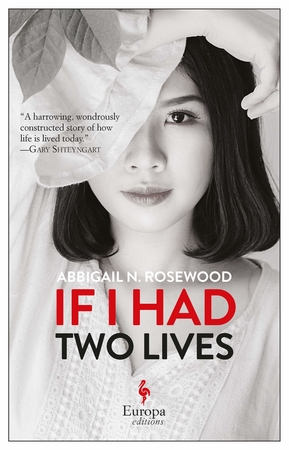
I like to think that I’ve become more whole having written my first novel If I Had Two Lives. After moving to the United States at twelve years old, I’ve not lived anywhere for longer than five years, moving from one state to another. My connection to place is tenuous, my relationship to people transitory due to geographical circumstance; my ability to hold together the various fragments of my identities loosens with time. I am perhaps lucky to have lived more than one life, yet as my life experiences gain in layers and textures, my sense of self grows all the more opaque.

Buy the book

If I Had Two Lives is a work of the imagination that has autobiographical consequences. I wrote it in bursts and out of order. When I had all the crucial moments, I began stitching them together, writing into the empty spaces, between voids, assembling coherence. Meaning is the magic potion that unites seemingly random series of events. Narrative gives meaning. I’ve not suddenly become surer of myself, but I’m more comfortable living with stitches, breathing in the seams.

Below are seven works of art that investigate powerful psychic ruptures. Often it is the protagonists themselves who undergo this split. They are not easy books and they shouldn’t be. Like most great works of literature, they ask difficult questions⎯How does a psychic split happen? Can a person survive it? How many masks can one wear before getting crushed beneath their weight? Is coherency an illusion?

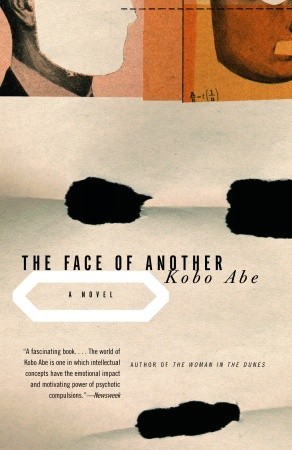
Image result for e Face of Another by Kōbō Abe, translated by E. Dale Saunders

The Face of Another by Kōbō Abe, translated by E. Dale Saunders

An accident burns off the face of a scientist. Disfigured, he loses his connection to his wife and the world. To find his way back into society and win back his wife’s love, he creates a mask⎯a dangerously convincing mask that manifests its own destiny. An intellectual exploration of what it means to lose one’s identity and the perils of living with a crafted identity.

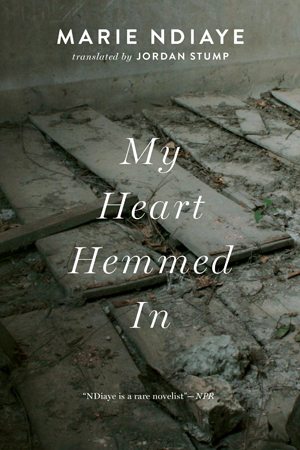
Image result for my heart hemmed

My Heart Hemmed In by Marie NDiaye, translated by Jordan Stump

Nadia and her husband Ange are bewildered to find that they are loathed by everyone, their neighbors, their friends and family. Their world begins to deteriorates physically and mentally. The more they seek the reason for their ostracism, the more punishing their reality gets. As Nadia retraces her steps into the past, it becomes apparent that she has been keeping ugly secrets⎯lies that are soul-severing.

Image result for notebook trilogy agota kristof

The Notebook, The Proof, and The Third Lie by Ágota Kristóf, translated by Alan Sheridan, Marc Romano, and David Watson

The trilogy follows twin brothers Claus and Lucas who were torn apart in World War II as were Western and Eastern Europe. The brothers abuse as much as they are abused by others. Cruelty is weaponized as a survival necessity. This postmodern saga dives into the ruthless products of psychic fracture and the consequence of political division in private lives.

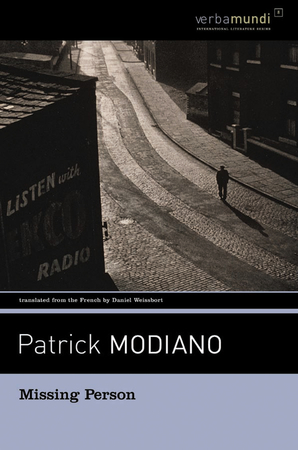
Missing Person by Patrick Modiano, translated by Daniel Weissbort

A psychological detective novel. Guy Roland, a detective who has no memories of his own past, is on a search for a man named Hutte. Guy follows directories, yearbooks, photographs, clues that lead to other clues, birthing more mysteries than conclusions. As Guy chases the trail of another man’s life, he meanders deeper into the mazes of his own repressed memories.

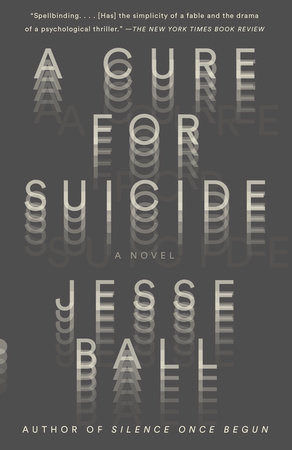
A Cure for Suicide by Jesse Ball

A Cure for Suicide by Jesse Ball

In this dystopian world, there is a cure for those who have lost the will to live. Like children, suicidal patients will be born again without past pain and disappointment. A voluntary amnesia⎯their memories are erased so that they have another chance at a life they might actually want to live. The novel asks potent questions about the nature of memories, and the cost of forgetting as well as remembering.

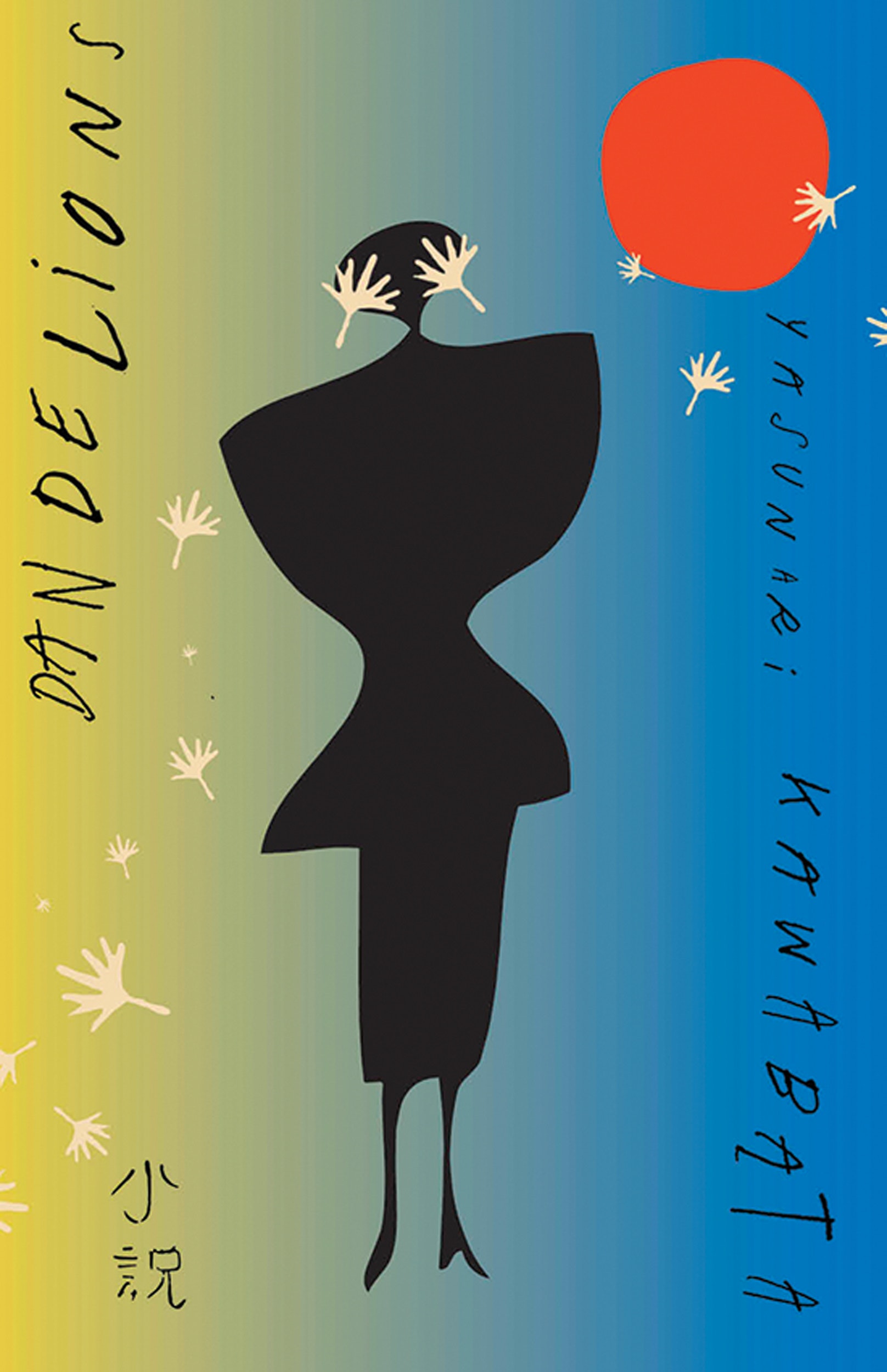
Image result for kawabata dandelions

Dandelions by Yasunari Kawabata, translated by Michael Emmerich

Ineko suffers from somagnosia, a condition that makes her unable to see the bodies of others. Her mother and her boyfriend commit Ineko to a mental hospital. This final and unfinished work by Kawabata who himself committed suicide is a philosophical contemplation on the nature of madness and the disappearing self.

Image result for no longer human book cover

No Longer Human by Osamu Dazai, translated by Donald Keene

Oba Yozo always wears the pasted smile of a clown. He has learned this trick early on in his childhood and realizes its power to fool those around him. Yozo’s inner life is starkly different from the face he shows everyone⎯anguished, resentful, alienated from others and from himself. Yozo’s mask serves as powerful reminder of a person’s inner and outer self, which when lacking congruency could prove deadly.

How “Hadestown” Turned an Ancient Story Into This Year’s Best Musical

The road to hell is a lengthy passage in Hadestown, but the journey of Anais’ Mitchell’s re-envisioning of ancient Greek myths to Tony-winning victory on Broadway seems even longer and more transformative. Somehow when diving into the two of the most well-known tales from the ancient Greek canon, the singer-songwriter discovered new truths in the timeless dramas. Stories of doomed love at first sight became sprightly duets of flirtatious teasing, while Hades himself was transformed into an imposing politician and businessman in Mitchell’s self-proclaimed “folk opera,” one of the most inventive scores to play on Broadway in years.

It’s hard to describe exactly what Hadestown is. It’s two Greek mythsHades and Persephone and Orpheus and Eurydice—adapted into a musical. It’s a classic story with startlingly modern themes. It’s an ancient tale told in one of the most inventive new musicals Broadway has seen in years. It is also the only musical of the 2018–19 Broadway season directed by a woman and written by a woman—one of the few women ever to have written the entirety of a new musical, both book and score, on her own.

The best Broadway musical of the year had humble, DIY beginnings. It began performances in 2006 at a community theater in Vermont, with Mitchell herself playing Eurydice. In 2010 she released a concept album, featuring Bon Iver’s Justin Vernon as Orpheus and singer-songwriter Ani DiFranco as Persephone. (The album was released by DiFranco’s label Righteous Babe Records.)

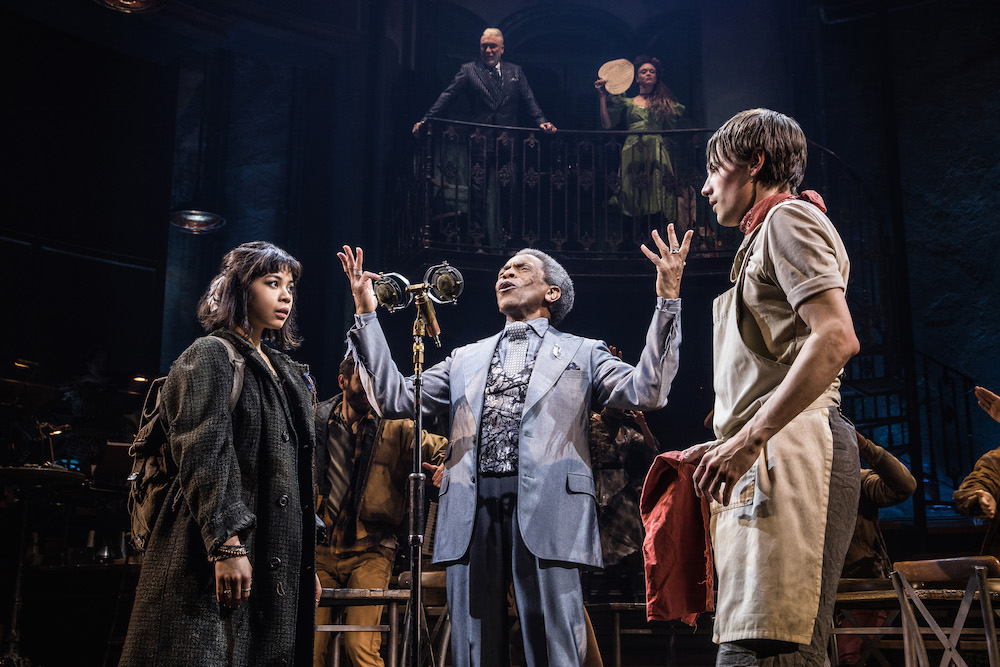
Hermes presides over the meeting of Orpheus and Eurydice. Photo by Matthew Murphy

When Mitchell and Chavkin first met in 2012, Chavkin had heard Mitchell’s concept album, and Mitchell had  admired Natasha, Pierre and the Great Comet of 1812, the wildly imaginative and unconventional musical Chavkin was directing Off-Broadway. They started collaborating soon after, combining their respective talents for songwriting and musical direction to develop Hadestown as a musical. Their work was first seen Off-Broadway in 2016 when Hadestown opened at New York Theatre Workshop. It then played Canada in 2017 and London’s Royal National Theatre in 2018, undergoing significant revisions along the way. The sets changed, as did the staging—from theater in the round to proscenium style—and Chavkin and Mitchell strove to strengthen the story’s connective tissue—a challenging attempt for Mitchell, who was encouraged by Chavkin to encourage the audience’s comprehension of the story by writing it into the text. It was tough, Mitchell admitted, to communicate in a “practical storytelling level” while still striving for the “mystical poetic level” of the story.

“[Rachel] often felt that if I truly wanted the audience to grasp something in the storytelling, I should put it in the text, which is all musicalized / underscored anyway,” Mitchell said. “That is, I shouldn’t assume that it could be represented or grasped visually. It really pushed me to go further as a writer than I ever thought possible.”

Hadestown, according to Mitchell, is set in a “set in a darkly political, Americana dreamscape.” Onstage, the story takes place in two distinct settings: aboveground and underground. Above, the characters converge in a New Orleans-style café inspired in part by the famous jazz venue Preservation Hall, whose aesthetics also inspired the costume designs, Chavkin said. Underground, Hadestown is dark, dreary and mechanical—a factory from which there is no escape.

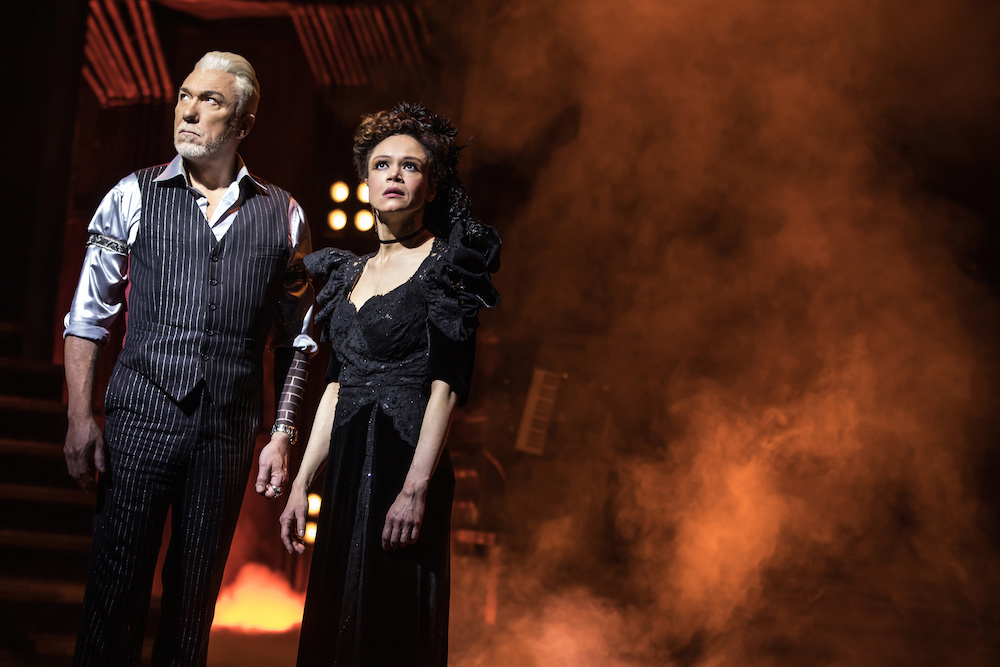
Patrick Page as Hades and Amber Gray as Persephone. Photo by Matthew Murphy

Eurydice soon finds herself trapped in the wasteland underground. Finding herself lonely and hungry after falling in love with Orpheus, as her poetic husband strives to compose his perfect song, she is tempted by Hades with ideas of security and prosperity and travels to the titular factory underworld where she is locked in never-ending toil to build a wall surrounding the town.

The workers march in an endless circle, muscles strained and sweating, and their ruler delivers a speech on “Why We Build the Wall,” which Mitchell wrote long before Donald Trump had declared his campaign promise of a border wall. Thoughts of modern-day America are inevitable; Hadestown represents industrialization, climate change, and, obviously, a wall to shut out the impoverished.

The first audiences loved the music, Mitchell said, but they had trouble following the plot. To those unfamiliar with the ancient tales, it wasn’t clear what was happening and why.  

“We were sort of assuming a lot of knowledge about Greek mythology on the part of the audience,” Mitchell said of the early stagings. “The idea that Persephone lives above ground for half the year and below ground the other half—there was nothing in the show to explain or indicate that to folks. They just had to come into the theater knowing it.”

To those unfamiliar with the ancient tales, it wasn’t clear what was happening and why.

So during workshops they introduced the character of Hermes, played in the current show by Broadway veteran André De Shields. Dapper in a shining silver suit, the god of oration welcomes the audience and remains onstage for much of the musical, a jaunty and impish emcee and narrator. Essentially, Chavkin and Mitchell solved the problem of audiences being unfamiliar with ancient Greek mythology by turning to ancient Greek drama: Hermes and The Fates—Jewelle Blackman, Yvette Gonzalez-Nacer, and Kay Trinidad, three sister deities—serve as a musical Greek chorus, keeping the audience aware of both the details and the stakes.

Jewelle Blackman, Kay Trinidad, and Yvette Gonzalez-Nacer as the Fates. Photo by Matthew Murphy

Even with Hermes available to explain the basics of the myth, though, there remained the challenge of bringing ancient characters into a modern context and giving them plausible emotional motivations. Early audiences didn’t understand why Eurydice, played on Broadway by Eva Noblezada, would fall in love with Orpheus, currently played by Reeve Carney. He’s an idealistic aspiring songwriter, and she’s a vagabond, a solo survivor wandering the Earth—what draws them together? What makes her love him, what takes her away from him, and what sends him to find her? In the myth, the answer is basically “that’s just how the story goes,” but audiences wanted more. Both characters underwent significant development as the show progressed, Mitchell said, especially when developing the motivation of the soulful, artistic Orpheus: “There has been a lot of digging in over the years to who this character of Orpheus is. What motivates him, besides his love for Eurydice? Finally it felt like it satisfied at both a story and a poetic level that he believed he could ‘bring the world back into tune’ with his music.”

Orpheus travels though that darkness to find Eurydice and bring her home, inspiring Hades with his song to offer the young lovers a chance to escape and setting in motion the inevitable tragedy. But their story isn’t over: The musical travels full-circle. After Eurydice is forced to return to Hades, the show immediately returns to its opening number, with Orpheus and Eurydice meeting each other again as if anew. It’s an old song,” Hermes sings in the show’s opening moments, and again at the end. “And we’re gonna sing it again . . . Maybe it will turn out this time.”

‘It’s an old song,’ Hermes sings in the show’s opening moments, and again at the end. ‘And we’re gonna sing it again.’

Bringing the story full circle to its beginning first took root at New York Theatre Workshop but didn’t come to life, with the characters returning to the stage in their Act One costumes, until the London production—a technique that Mitchell said “really tugs [her] heart.”

This moment, moving from tragic loss to a glimmer of hope, inspired some gasps from audience members as the two characters doomed to spend eternity apart reappear and begin the story again. The promise of another chance also offers some insight into the two lovers’ instant, otherworldly connection. Such immediate, intense love inspired skepticism to audiences watching the dreamer Orpheus romance the pragmatic Eurydice singing, “I knew you before we met/I don’t even know you yet… All I know is you’re someone I have always known.” Even less plausible is his decision, after learning she left him for Hadestown, to travel the road to hell to save her. But upon witnessing them meet again for the first time, a bittersweet truth is infused into their melody.

“That was an interesting evolution,” Mitchell says. “It felt like a very full-circle moment for the narrator to reflect on the meaning of having told the story and the sort of passing of the torch of hope from the artist Orpheus to the storyteller, who’s going to tell it again.”

A Queer Albanian Refugee Creates a New Self in Every City

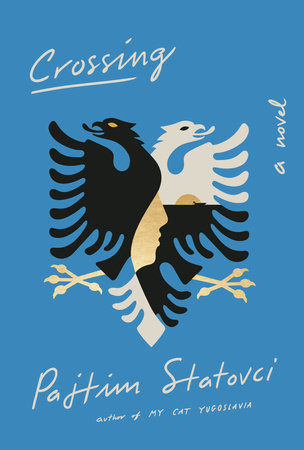
The plot of Pajtim Statovci’s latest novel Crossing is set in motion when a young man and his friend (and sort of lover) flee war-torn Albania by sea for refuge in Italy. There the two explore what it means to live in a place that doesn’t want them.

Crossing by Pajtim Statovci
Buy the book

The choice of following in the expected footsteps of those who came before them, or creating a new path comes up frequently on the pages as the Albanians adjust to their new lives as refugees. His characters yearn for belonging; both in their new countries and within their own bodies.

Born in Kosovo in 1990 to a Kosovar Albanian family, Pajtim Statovci and his family fled to Finland two years later during the outbreak of the Yugoslav Wars. His first novel, My Cat Yugoslavia (featuring a self-hating talking cat) was first published in 2014 in Finnish then translated into English in 2017 to wide acclaim. The novel won the Helsingin Sanomat Literature Prize for best debut novel written in Finnish. His second English-translated book, Crossing won the country’s Toisinkoinen Literature Prize, which is given out to an author’s second book.

I talked to Pajtim Statovci via email about writing about people who refuse to be defined by others.


Adam Vitcacavage: I have been talking to writers a lot about place recently. Some say their history with cities play a major role in how they think about setting in their works. Others have a more nonchalant relationship with how their hometown or current city plays a role in their literature. How has your history from Kosovo to Finland played a role in your writing?  

Pajtim Statovci: My background has affected my writing immensely—because where I come from, where I’ve lived and what I’ve experienced in the past has everything to do with who I am and what I do now. I write about dislocation, loneliness, racism, people that are in between places and beliefs. Like one of my protagonists, I, too, fled Kosovo and moved to Finland with my family at a very young age. The writing about these topics stems from my own life and my personal history–as well as from the lives of people around me.

In Crossing, the protagonist is a pathological liar, and ends up living in many different cities – Tirana, Rome, Berlin, Madrid, New York and Helsinki–experimenting with life as someone new in each of them. He does this because, ultimately, he’s ashamed of who he is and where he’s from, wishing to escape the stereotypes people have about his background. Although I have not lived in all of these cities myself, to my protagonist they represent and present a possibility to start again, from a clean slate.

AV: Your characters in this novel are seeking a sense of home and belonging. My Cat Yugoslavia also dealt in some ways with similar topics. Why do you find yourself returning to these themes?

PS: I respond and relate to stories that explore questions of identity, belonging and home, perhaps this is because to me there is no clear concept of home nor an explicit idea of a national identity. I wanted to express this with both of my books (among other things).

I relate to stories that explore belonging because to me there is no clear concept of home nor national identity.

I deliberately write about people who refuse to be defined by others. People whose actions and words are not always filtered through their backgrounds. People who don’t want their backgrounds to matter. Because do we actually think about where we come from that much? I certainly don’t go to sleep at night thinking about my relationship to the country I was born, or thinking about my relationship to Finland or the languages I know how to speak. I never explain my behavior with any nationality in mind.

Still, I frequently get asked whether I feel I’m more Albanian or Finnish. If I am being completely honest, I really don’t care whether I am considered Finnish or Albanian because my relationship to Finland and to Kosovo is like no other person’s relationship to their home country or home countries. I want my protagonists to find themselves in the same freedom of self-definition.

AV: What was your relationship like with your translator David Hackston for this book and My Cat? How involved are you in that process?

PS: I am very lucky to have a translator like David Hackston, and I admire his work most profoundly. He has translated both of my novels with uncompromising diligence and grace. I have a really good relationship with David. Until fairly recently, we both lived in Helsinki, so it was easy for us to meet, discuss and change ideas. I try to be as involved as possible, help in any way that I can because David puts a lot of time and effort into translating my work. Simultaneously, however, I have to keep in mind that David is an English native, and I am not.

David is also an artistic soul, so I want him to be able to have the freedom to create art based on my art in his own way. Because a translator is never just repeating the words that I have written in another language. He’s conveying symbols and allegories, creating interpretations. David is also very interested in and knows a lot about the history of the Balkans, and speaks some Albanian, too, which only emphasizes the fact that we’re a match.

AV: An example of what I mean is that (according to my use of Google Translate) your novel’s original title translated to either “The Heart of Tirana” or “Hearts of Tirana.” (Tirana is the capital of Albania.) The English title  is Crossing. What do the different titles allude to about the work?

Where I come from, where I’ve lived and what I’ve experienced in the past has everything to do with who I am and what I do now.

PS: The decision to change the title of the book was a sum of many things. We all – I, David, my agents, English publishers–agreed that the original title (Tiranan sydän, “Heart of Tirana”) didn’t express enough ambiguity in English, although the word “heart” has many meanings in both languages. Since this book is about constant change and shifting borders, we felt like the title should be as representative of that as possible. For a long time, we called it “Heartlines”, but then one day my US editor at Pantheon Books, Tim O’Connell, called and told me that he has a title in mind. “Crossing”, he said, and I said yes–because I truly think that this word in all its meanings truly captures what this book is about.

AV: Crossing was originally published in Finland in 2016. What is it like revisiting a work again three years later as a new audience discovers the book?

PS: I have to admit that revisiting my past work is not my favorite thing in the world. Because when I’ve finished a novel, I like to set it aside as much as possible and let it live in the minds of others. This being said, I do give interviews and will gladly speak publicly about my work because feel like I owe it to my readers. I want to acknowledge and respect my audience by answering any questions they may have for me and or about my work. Because I wouldn’t be here without my readers, and I am very grateful for each and every one of them.

Finnish is a small language, so to have my work translated into English and published worldwide means everything to me. The occasional discomfort that I may feel about going back to something I might not write or say the same way today, is completely pushed aside by the joy of my work being available in other languages.

AV: Looking forward, what are your next plans? What do you want your writing to explore next?

PS: I am actually finishing up my third novel, and it’s being published in Finland in August 2019. I’m also in a Ph.D. program at the University of Helsinki, and working on my dissertation on non-human representations in selected works of Toni Morrison, Ernest Hemingway and Franz Kafka. I’m very interested in teaching, too, so hopefully, in the near future, I get to do both.

Reading “Good Omens” at the End of the World

In the beginning, there were volcanoes. Ruthless, sulfurous vents that blew rock and ash sky high and that oozed magma into the sand that was once the floor of an ancient ocean.

Thousands of years later, I walked into Big Bend National Park and found a paradise of sorts. Cradled in the bowl of the Chisos Mountains lies a deciduous forest, encircled by scrub desert mountainsides. At the top of these giants are grassy plains, an Eden-like harbor of life in the West Texas desert. I hiked to the top and watched the sunset over the mountains of Mexico on the other side of the Rio Grande.

Hundreds and hundreds of miles north and west, along the shores of the Columbia River that divides Oregon from Washington, and all throughout the long mass of California, forests and tree-lined ridges are blackened and scarred from months of fires. Fires caused by years of drought, caused by changes in the climate. And all over the country, the world, there are few natural refuges or idylls that are unscarred. There are a thousand little ways that we’ve made this world worse.

It’s all around us, the splendor of nature and the evidence of the harm we’ve done. And the more I see, the more I think about Adam Young.

Over this last year, I’ve been all over the U.S., driving from national park to national park. I’ve seen subterranean caves, primordial cypress swamps, canyons cut by the Rio Grande, the breathtaking grandeur that is the Redwood tree. But I’ve also seen skylines of belching smokestacks, pesticides rained down upon fields, more street corner litter than you could fill a small rare books shop with. It’s all around us, the splendor of nature and the evidence of the harm we’ve done. And the more I see, the more I think about Adam Young, the boy protagonist of Neil Gaiman and Terry Pratchett’s 1990 comic novel Good Omens, and also the Antichrist.

Adam Young has been on my mind because of his anger about the environment. My anger has been a slow, boiling thing, while Adam’s ignites quickly and burns bright. Before he turned 11, “no one had even used the word environment in Adam’s hearing before.” And then he meets occultist Anathema Device, who opens his eyes to the world outside of himself in a single conversation. She tells him all about the hole in the ozone layer and dying whales, gives him some New Age magazines to read, and she’s unwittingly made an antinuclear environmentalist. He wants a better world to grow up in.

Good Omens hasn’t just been in the back of my mind, but in the forefront of a lot of other people’s too. The long-awaited miniseries, written and produced by Neil Gaiman, was released on Amazon Prime at the end of May. The show’s popularity has also put the book on the New York Times best sellers list for the first time.

Image result for good omens book cover

To be alive in 2019 means having the world’s end, or at least its destruction, on your brain’s back burner. It’s difficult to read Good Omens and not see our contemporary world. In an interview with The Guardian about the Good Omens miniseries, Neil Gaiman noted that “the weirdest thing is how a novel that was written literally 30 years ago feels really a lot more apt now than it did then … I mean, if I could trade, I would have a much duller world in which we had to try and convince people that an apocalypse was likely, instead of having the world that we’re in, where the nuclear clock is ticking closer and closer.” The jokes and tactics that Pratchett and Gaiman used to convince their readers that the end of the world could be nigh hit much harder as the world around us is starting to look even worse than an imagined, if comical, Armageddon.

Good Omens is not about the world ending through man-made climate change, though environmental concerns are always present in the book. It is more directly focused on the angel Aziraphale, the demon Crowley, and the final battle between Heaven and Hell—which is to be brought about by Adam Young, the Antichrist. Through a series of errors (Crowley lost him), Adam has grown up without any influence from his Satanic parentage. Aziraphale and Crowley, who like the world very much and don’t want it to end, race to find the misplaced Antichrist and head off the end, while the infernal and ethereal legions gather, and the Four Horsepersons of the Apocalypse ride to ground zero. The clock ticks down. The threads of plot and prophecy and people are woven together and pulled tight as all converge at a military base in Tadfield where the apocalypse is supposed to happen.

Still, part of the genius of Good Omens is that it never portrays humanity as the helpless victim. Even with literal angels and demons abroad, it’s humans who have to save themselves—and humans who are responsible for most of what’s gone wrong, at least everything that’s not being directly driven by an occult hand. Early in the book, it is observed through Crowley’s perspective that people “were born into a world that was against them in a thousand little ways, and then devoted most of their energies to making it worse.” Crowley is often at a loss for how tempt humans to do evil because “but nothing he could think up was half as bad as the stuff they thought up themselves.”

We may not have meant to destroy our planet, but we’re doing it anyway.

This is because humans are good, bad, and everything in between. And, of course, human morality is never just that black-and-white binary. Unspeakable things (like the Spanish Inquisition) have been done in the name of ostensibly benevolent religion. Industrialization that made goods cheaper and more available started the descent into global warming. Experiments done in the name of scientific progress gave us nuclear weapons. In Good Omens, humanity made these things and now they are available for Heaven and Hell to use for world’s destruction. We don’t really know how the world will end, and neither do Crowley and Aziraphale—though Aziraphale does note that “thermonuclear extinction has always been very popular.” The scary part is that the pieces are in order and, whether with good intentions or not, we put them there. We may not have meant to destroy our planet, but we’re doing it anyway. Good Omens points this out with particular clarity.

In a 2006 interview with Locus Magazine, Gaiman commented that “you can actually tell [readers] things, give them messages, get terribly, terribly serious and terribly, terribly dark, and because there are jokes in there, they’ll go along with you, and they’ll travel a lot further along with you than they would otherwise.” I can’t think of a better book to comment on the direness of our environmental situation than Good Omens.


Pollution waits by the riverside. He is the youngest harbinger of the apocalypse, born from humanity’s ability to advance in medicine and their inability to clean up their plastic or stop pumping carbon into the atmosphere. The banks of the sluggish, fetid river are barren, except for the pale, languid figure. This river was a popular spot for fishers and lovers, but that was before Pollution lent an artistic hand: “Now white and brown sculptures of foam and sludge drifted serenely down the river, often covering it for yards at a stretch. And where the surface of the water was visible, it was covered with a molecules-thin petrochemical sheen.” Only the sunrise is beautiful.

Pollution is the culmination of humanity’s efforts to, as Crowley might say, make the earth worse. Climate change has been part of the human story since we started cutting down forests for fuel and fields and redirecting rivers for irrigation. A side character, Jaime, observes that, “the shame of it … was that his children were growing up thinking of trees as firewood and his grandchildren would think of trees as history.” Environmental destruction is something that we’ve passed down from generation to generation, but that is coming to a head. The responsibility to stop this destructive ecological inheritance rests on the shoulders of today’s youth, just like the responsibility to start Armageddon rests on the shoulders of Adam Young.

He may be the Antichrist, but Adam is the book’s most committed voice on the environment.

Or the responsibility to stop it. He may be the Antichrist, but Adam is the book’s most committed voice on the environment. His powers, unimpeded by the directives of Heaven or Hell, instead latch onto concerns he encounters in New Age magazines: the rainforests, the whales, nuclear power. (A nostalgic, late-’80s set of worries—were we ever so innocent?) In the run-up to Armageddon, we see Adam remove the nuclear material from a power plant, which keeps pumping out clean energy. He destroys whaling ships by raising the Kraken. He causes the South American rainforest to grow back at time-lapse speed. (Not all of these scenes make it into the TV series, in which Adam’s role is reduced to give more space to the relationship between Crowley and Aziraphale—a curious choice, given how much more crucial these worries are to an 11-year-old today.)

At the point where the wheels of the Apocalypse are in full motion and Adam understands his place in it, his eyes have just been opened to how big and grand the world is, but also to all the people and powers at work destroying it. “It’s all very well for them,” Adam says. “Everyone’s goin’ around usin’ up all the whales and coal and oil and ozone and rainforests and that, and there’ll be none left for us.” He understands—both because he’s a precocious child and has the knowledge and power of the son of Satan—the need and the urgency to do something to stop the end. He hears the ominous ticking.

The apocalypse in Good Omens is not our apocalypse, but Adam holds up a metaphorical mirror to show readers the state of the real world—or, at least, to understand the gravity of their actions. He does not stop the apocalypse using environmental means, but he is motivated by the environment. He admonishes Heaven and Hell (and religion) for “tellin’ people it’s all sorted out after they’re dead.” If people stopped worrying so much about the afterlife, Adams says, “they might start thinkin’ about the sort of things they’re doing to all the environment and ecology, because they’ll still be around in a hundred years’ time.” Religion aside, the tactics for which Adam criticizes the bureaucracies of Heaven and Hell are remarkably similar to those of modern politicians—particularly in the United States—who create so much noise through argument and what-abouting to distract us from the reality of climate change and muddy that reality with cherry-picked or false science.

In the pages of Good Omens, Adam Young speaks for the generation of children and young people that will have to heft the consequences of the abuse that their elders heaped upon the planet. In many ways, he echoes contemporary teen activists like Greta Thunberg. Adam tells his friends that “It makes me angry, seeing the way those old loonies are messing [the world] up.” “People’ve been tryin’ to sort it out for thousands of years,” he says, “but we’ve got to sort it out now.”

In many ways, Adam echoes contemporary teen activists like Greta Thunberg.

In a recent speech before U.K. Parliament, Thunberg tore into her elders, saying, “You lied to us. You gave us false hope. You told us that the future was something to look forward to … You don’t listen to the science because you are only interested in solutions that will enable you to carry on like before.” Or the teenage climate-change activists called to testify before U.S. Congress, among whom was 18-year-old Aji Piper, one of the plaintiffs suing the government for using a “national energy system that emits prodigious amounts of heat-trapping greenhouse gases into the atmosphere, and ultimately threatening their right to a prosperous future.” All of these children, fictional and otherwise, demand to be listened to. (But only Adam can fix it by himself, effectively by magic. Other child activists have a more difficult road.)

Adam is an effective mouthpiece because he was written with the wisdom of men who have seen the world’s evils, but his voice is still innocent (well, as innocent as the spawn of Satan can be) and apolitical. Wisdom and innocence together are potent.

In the end, he subverts his destiny and saves Earth—from the imminent danger, but not from everything that’s wrong with the planet or humanity. The cosmic powers decamp to regroup— they will still have their war, at some point. And the humans are left with all the harm they’ve wrought, and the self-destructive impulse that makes them keep doing it. There is so much more to be done in the real world, if we’re going to make things better. The weight of this knowledge can feel like too much. So what do we do? Go to the coast and admire it while it’s still there?


For 35 days across December 2018 and January 2019, the U.S. government was shuttered in a record-breaking shutdown. During that period, national parks were left open, but were largely unmanned while workers were furloughed. Chaos held sway at Joshua Tree National Park, where visitors off-roaded across the delicate expanses of desert, knocked over signs and gates, and even cut down some of the precious Joshua trees. Three weeks after the government returned to work, I visited Joshua Tree. I witnessed the desert park that is a forest of Gaudi-esque gneiss rock palisades peppered with cholla and prickly pear and, of course, groves of Joshua trees. I even got to see the desert landscape washed clean under a blanket of snow. National park officials announced that the damage done at the park would take 300 years to heal. Knowing this gave me a deeper appreciation of the finiteness of life around me. As Adam Young says, the only thing that might help is for people to know that “if they kill a whale, they’ve got a dead whale.” The chopped down Joshua trees won’t come back; if we kill the Earth, it won’t come back.

But while the trees continue to grow and the snow to fall, there’s some hope, isn’t there?

Why Khaled Khalifa Chose to Stay in Syria

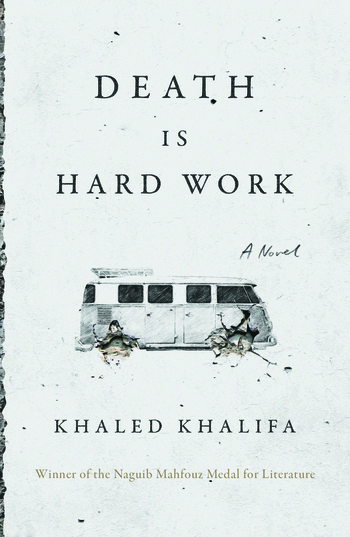
Khaled Khalifa’s Death is Hard Work is a searingly intelligent novel told from the perspective of the adult children of Abdel Latif as they transport their father’s corpse from Damascus to his ancestral village of Anabiya in the midst of the Syrian war.

Death Is Hard Work
Buy the book

Like the best absurd or picaresque novels in the Arab literary tradition, Death is Hard Work is a tragic-comic exploration of the arbitrary logic of tyranny and its effects on memory, landscape and identity across generations.

I got to speak with Khaled Khalifa via email about the aesthetics of absurd literature, the role of the writer during times of geopolitical crisis, the brutality of the ongoing Syrian war, and his day-to-day life as a writer in Damascus. Death is Hard Work is a novel worth paying close attention to, a book we will likely be talking about for years to come.

Khaled Khalifa’s response has been translated from Arabic to English by Bennett Capozzi.


Azareen Van der Vliet Oloomi:  Though Death Is Hard Work is written in a realist mode, it is also a life-threatening epic quest rendered absurd due to the ongoing civil war, a war that is operating with an arbitrary logic. What can we learn from this method of telling stories about historical and present tragedies?

I wrote Death is Hard Work because I felt that I did not have a lot of time, or a surplus of life.

Khaled Khalifa: In war things take on a new meaning. The meaning of everything changes: life, hope, frustration, despair. Things lose their value, humans become killers and the killed, and time becomes ongoing, tied to a mysterious chord called the hope of survival. Thus the writer’s narrative or way of seeing stories is subject to unintended intensification because of what was happening at that time. Because it might be the last time that you are able to write, you do ordinary and regular things for the last time. You drink your coffee, hold your lover, go to work, and write for the last time.

I wrote Death is Hard Work because I felt that I did not have a lot of time, or a surplus of life, therefore I was tied to the table thinking that I must do what I can do to write something different from my other works as well as other stories about war, and I didn’t know if I would be successful in writing this unique story.

AVdVO: One of the qualities of Death Is Hard Work that I immediately recognized as part of the Arabic narrative tradition is that the story’s plot—its propulsive energy—comes from an examination of the characters’ memories of place. In your novel, there is a total superimposition of the body and the landscape. Abdel Latif ’s corpse is decaying as his adult children transport his dead body from Damascus to his ancestral village of Anabiya; the country itself has been gutted by war and is in the process of collapse. The body and the land are atrophying simultaneously. How did writing the body help you to navigate the process of writing about an ongoing war?

KK: Syria became a corpse not only during the war, but it was also becoming that corpse slowly and day by day during fifty years of dictatorship. The idea came to me through personal experience, and from repetition of the daily contemplation of death and the way Syrians buried their loved ones. Throughout 2012 and afterwards endless stories spread through social media about the need for Syrians to bury their loved ones in the garden, in the house, and in the streets because of the difficulty to get to the cemetery, or because the amount of death does not give you the opportunity to respect rituals or the meaning of death and the body. The body of a loved one becomes a project and certainly an epidemic.

The personal experience that is the most telling for me was in 2013 when I had a stroke and spent three nights in the hospital, and while I was there I thought about how to respond to the question: if I die right now and give up, how will they come to transport my body? These moments were comedic, tragic, touching, and funny. Truly facing death turns you into an absurd being.

AVdVO: Do you think the novel as an art form can serve to reveal structures of tyranny?

Syria became a corpse not only during the war, but slowly and day by day during 50 years of dictatorship.

KK: I consider the novel to be the most effective art form for dismantling the narrative of tyranny and dictatorship, as the novel informs a wide space. Within it is a large capacity for flexibility and renewal and concealment at the same time, and the novel can become a history that is not the history tyrants always contrive in their books, an often falsified history. We watched in history the success of many attempts of these falsified narratives by tyrants and dictators, but in the modern era these projects by dictators have become more difficult.

AVdVO: Bolbol, one of the novel’s main characters, often imagines “whole communities committing suicide in protest against a life so soiled.” In contradistinction, his father’s mantra is “the children of the revolution are everywhere.” Did writing Death Is Hard Work help you to interrogate what it means to live with death so near at hand?

KK: It is necessary to remind yourself that this was not a civil war, this revolution turned the world into war and then a war of settling scores on Syrian land. The amount of lack of understanding does not indicate its complexity, but a lack of desire to acknowledge that the whole world was contributing in defending this revolution, and stopping the regime.

AVdVO: Like Abdel Latif, Bolbol spends his life yearning for his first love. And yet father and son never discuss their common nostalgia for a life and a love that could-have-been. Instead, the novel foregrounds their differences when it comes to politics. In what ways did this choice serve the novel? What did it allow you to reveal and/or conceal?

KK: While writing I was trying to find any points of similarity between Bolbol and Abdel Latif but I could not. Abdel Latif represents the generation of the ‘50s in Syria, the jumping-off point for national ideas that infiltrated within them the military into the government under the pretext of the liberation of Palestine, and they remained for half a century ruining everything in there. But Abdel Latif was part of a big group that represents this romanticization of revolution in that generation. Of course it could be a coincidence that the remaining members of this generation are everywhere, living in desperation and despondency from the coup of their comrades and they turned from activists to thieves.

I had to hide the draft of my book because each computer was being inspected and if they read even one sentence, it would have been a huge problem for me.

Meanwhile Bolbol is considered to represent a model of humanity more broadly: the man that is afraid of everything. Today we can find Bolbol walking on the streets of New York, an urban person, modern. Deep down he is afraid of losing his job and privileged existence, and also he is afraid of marriage and love. Life is complicated in this era as we see in it the savage features of capitalism ruling the world and wanting to turn humans into robots. I certainly failed in the attempt to find points of similarity between the two characters but I was happy with this failure because I wrote Bolbol completely and I thought about him for more than a quarter of a century.

AVdVO: There are hints of the comic in the novel that help to make the darkness darker. Early on, at one of the check-points, Abdel Latif’s dead body is arrested. The officer explains that according to their records “Bolbol’s father was still alive and still wanted. It didn’t matter if he had in the meantime turned into a cadaver.” A few passages later, Bolbol reflects on his fear which “increased every time he thought of the possibility that a person might be nothing more than a collection of papers.” As a writer, what is your relationship to this type of official papers? I ask this as someone who has spent the majority of her life chasing identity papers, deeds, death certificates and who has, along with my family members, been sent on endless errands to have this or that paper stamped only to have to do it all over again. What do you think about the fact that every war elicits an obsession with ink and paper?

KK: My relationship with official papers is funny. I will tell you something, I have two surnames, Khalifa and Abdel Razak, and the official one on the papers is Abdel Razak, and I have kept the name Khaled Khalifa all my life.

When it was necessary to choose a name when signing my book, I chose the unofficial name, the name not registered on paper, as a result of my laziness, and because it is not likely in the records of the bureaucratic Syrian state that is always trying to find people that writes these kinds of works.

For the past eight years, it has not been possible for anybody to go into the street without their personal identification, so my ID is stuck in my pocket, and I feel its weight constantly, naturally afraid of losing it because I will have a big problem at the checkpoints and everywhere else. Today in Syria there are hundreds of thousands of cases in the courts regarding people’s papers, there are people missing and their families want certificates of their deaths to continue on with their lives. And there are dead people and the system has notified their families, but will not hand over the body until they sign a paper that this person has died as a result of illness and not under torture. Yes, papers are heavy and we do not think about them except when we encounter them.

AVdVO: Where do you write in Damascus?

KK: I write in my cafe, and I cannot write in the house or the office, despite having a nice furnished office. In Damascus I had kept my table reserved for thirteen years in the cafe The Journalists Club. It was a wonderful place that I was linked to by a close friendship with the employees there, but I lost this place as the unfortunate result of the strict security constraints during the beginning of the revolution, when the place turned into a crowded gathering point for intelligence officers. And afterwards it was given to a tacky manager close to the regime who turned it into a tacky cabaret that was unfit for its long history.

I was writing secretly, often forced to erase it from my laptop and put it on a flash drive that made it easier to hide it.

I continue to remember those years fondly, it was the employees and staff there who brought me the best coffee, and my table was exceptionally meaningful to me. My mail was brought there and they worked for my comfort, and I know a lot about their lives, we talked about everything, they share with me their fears and joys, most of the employees were Kurds without paperwork, surrounding me with every care. I still remember their nobility and generosity with me.

Five years ago I traveled between a lot of cafes until I settled down again in a cafe Connected Coffee that is in the center of the city and is owned by one of my close friends, and often I write in a very small cafe in the area of Al Qasa’.

AVdVO: And what is the process of getting from your home to your preferred writing spots?

KK: After 2012 the journey from my house to the cafe became hard work, ten minutes by car became an hour or two hours. On the route, I passed two or three checkpoints, and usually these checkpoints were crowded, and often I would get there exhausted and I would not have the energy to write, especially in the hot summer.

In the city throughout the past eight years, the terror has not stopped, everything is scary. There’s no electricity, no heat, and the threat of abduction and disappearance at every moment. Everything bad happens to us in the war, and everything unexpected can happen in the war, thus I was stealing time to write. Even if you stayed in the house, it didn’t do you any good. In the winter there was no heat, and most of the time no electricity, the whole process was stressful for the nerves.

I feel the terror strongly, but I did not feel afraid. When I was writing Death is Hard Work I was putting the novel [in a folder] on my laptop [with] a dramatic television series about love, because each computer was being inspected and if they opened the folder and even read one sentence, it would have been a huge problem for me. To an extent I felt like I was writing secretly, and often I was forced to erase it from my laptop and put it on a flash drive that made it easier to hide it. But in every circumstance, despite the difficulty, I felt that I was being defiant.

AVdVO: How do you stay grounded given the day-to-day situation in Syria? How do you hold on to hope?

KK: I learn perseverance and hope every day. I do not think about fear. For five years the shelling did not stop at all, from the window of my house I saw where the missiles left from and where they landed.

For me, departing Syria was equal to death. It is not possible to bear it.

I gave up all of the forms of life that were there before. Now there is no electricity, no friends because most of them emigrated, the streets of the city are dark. Every morning I was checking my house and my body, checking on my friends who stayed, and not thinking about going out. Thinking here is my fate and it is necessary to belong to my new tragic world. Basically I became a different person living in a different place, I can live for days on a loaf of bread. And I have a new memory. But in every circumstance I did not lose hope for one moment despite what I have suffered, and I was measuring it against people around me who had much more severe loss, who lost their children, their house, their husband, their limb. I was always thinking that it is necessary to think that departing [Syria] is difficult to the extent that it is not possible to bear it, that departure was equal to death. I can write pages, but always it was hope that was my angel, that I watered each moment so that it did not wither away.

AVdVO: Do you feel optimistic about the Arab Spring’s aspirations of reformation, its desire for an Arab Renaissance?

KK: Yes, I remain optimistic despite the ferocity of the counter-revolution, and the prevalence of new regimes that possess the approval of the Western world, and do nothing to hold them accountable. For example, until now there has not been a conversation about an independent international tribunal for the fiercest dictators that the world has ever seen. This reinforcement of dictatorships and nepotistic forms of governance does not mean that revolutions from the eruption will be renewed. The ancient world in Arab countries has collapsed, but the new world that defends Arabs (and Syrians especially) has not formed, all of these are the costs for it.

A Mother With Grown Children Is a Controlled Experiment

 Night of the Living 

 If the constellation of stars 
 above your house looks like
 a woman skating across a lake 
  
 you could name it that. If someone
 long before you called it warrior with a sword
 or dragon at the gate, it doesn’t matter, 
  
 it’s your sky now. If you’re lost in the evening 
 fog all your former selves line up by the side 
 of the road to show you the way home. 
  
 If you want to pry open the moon
 and crawl inside, remember the sky 
 waits like a clock for you to unwind. 
  
 The planets contain the fur of wooly  
 mammoths and fossilized ferns
 that never got to be trees. Your position 
  
 relative to them is what you think about 
 when night is a rabbit hole and sleep
 is a coin toss. A hand moves across your face 
  
 in a dream you are having about being alive. 
 When you wake up the hand disappears 
 along with the way it felt to be dreaming, 
  
 on the edge of some great adventure. 
 The shadows of owls against the trees 
 are not owls but you can pretend 
  
 the sound of branches against the window 
 is someone trying to get in. You can breathe 
 and imagine the night breathes with you.  
 
 Taxonomy
  
 A group of mathematicians is an equation.  
 Unless they are at a party and then they are 
 a problem. Two or three architects is a situation. 
 More than that and the building collapses.  
 A subdivision snakes through property 
 that used to be farmland. Part of the field 
 remains and a few rusted tractors linger like men 
 at a grange hall gathering who would rather mumble 
 to each other than dance. My son worries about gentrification  
 in the old neighborhood. He thinks no one will have 
 a place to live.  Neighborhood meetings with city planners 
 are not funerals. No one sings and prayers are offered silently. 
 Pray for the view of the mountain that will soon be obstructed 
 by condominiums. Unless you find tall buildings beautiful. 
 Then rejoice at the way concrete obliterates the field.  
 A group of condo dwellers is the answer to a question 
 posed by developers everywhere, but no one knows the question 
 or how to measure its importance. When I was seven I lived 
 across the street from a horse and fed it apples from a tree nearby. 
 Its mouth scared me. I thought it  might devour my hand 
 if it had the chance, thinking my hand was part of the apple. 
 A horse behind a fence is progress, but only if you’re not the horse.  
 The first time I let my kids walk to school by themselves 
 I went with them to the end of the street and watched 
 until they arrived at the top. They turned and waved at me, 
 standing  at the bottom of the hill. Did I tell them I would 
 stand and wait? Or did they just know. Then they turned 
 the corner, out of my sight, to walk the few remaining blocks  
 to school alone. Now my children are adults. A mother 
 with grown children is a controlled experiment. How long 
 can she go without thinking of them and how she used 
 to hold their entire bodies in the width of her arms.   

What to Read After Watching “Fleabag”

From the moment that Phoebe Waller-Bridge’s gaze first penetrates the camera, it’s evident that Fleabag will be one emotional gut-punch after another. The series follows the unnamed titular character as she copes with the death of her mother and the unexpected loss of her closest friend, poking fun at the bleakness of her situation, and the destructive coping mechanisms it has drawn her to along the way.

The appeal of Fleabag comes from the tension between the audience’s external perspective on Fleabag and her behavior (frequently awful!) and the vulnerable glimpses we’re afforded into her internal world when she breaks the fourth wall and addresses the viewer. Whether she’s falling in love with a (hot celibate) priest, trading passive-aggressive barbs with her former godmother (now stepmother-to-be), or punching her brother-in-law in the face (he deserved it), Waller-Bridge balances keenly-observed interpersonal dynamics with an almost unparalleled intimacy between the audience and the main character.

If you’re looking for something to do in between rewatches of Fleabag, these books will fulfill your desire for narratives exploring complex relationships, self-awareness, and grief.  

Image result for things to make and break by may lan tan

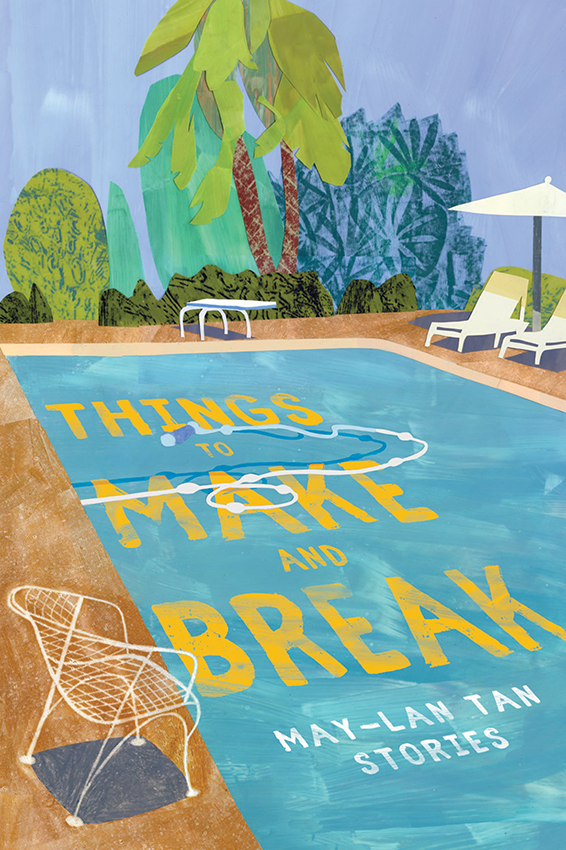
Things To Make and Break by May-Lan Tan

May-Lan Tan’s short stories are about the dynamics of interpersonal relationships. A couple stays the night in a hotel together as something of an endurance exercise, recommended by a therapist after one partner discovers that the other sees a professional domme. Twin brothers who are sleeping with the same girl attempt to navigate her memory loss after a car accident. A woman seems to finds her boyfriend’s ex-girlfriends the most interesting thing about him, reveling in the fact that she’ll one day be among them. Tan’s writing style enlivens even the most mundane of observations and makes the most bizarre of premises seem quotidian.

Image result for poster

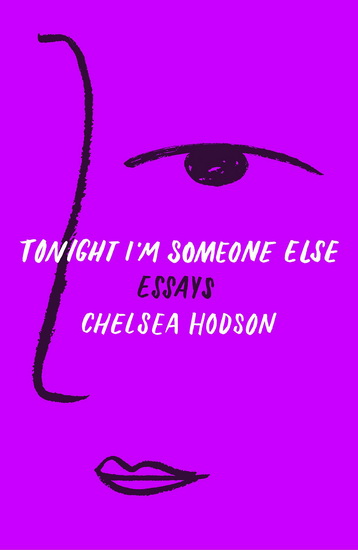
Tonight I’m Someone Else by Chelsea Hodson

Throughout her first collection of essays, Hodson interrogates the relationship she has to beauty, money, lust, and the intersection of the three. “A theory my friend has: sleepovers are where girls learn to wake up in love. Remember when we knew our friends’ bodies as well as our own?” writes Hodson, articulating the unique discomforts of womanhood, without ignoring the rewarding moments, too.  

The Guardians by Sarah Manguso

“What do I regret—that in the end he didn’t need me, and now I can’t need him?” Sarah Manguso asks, succinctly articulating the grief she feels after the death of a friend that is the root of the book. Through the course of The Guardian’s 122 pages, Manguso tosses and turns over this loss, questioning whether or not the death really was a suicide or the result of a faulty medication’s side effects. Much like Fleabag, or any good eulogy, this grief isn’t grounded only in ruminations on the death and its aftereffects, but through vignettes of what made their friendship so strong. These memories are just as humorous as her recollection of his struggle with mental health is harrowing—at one point she recalls his infamously large dick, which she’ll never have the chance to glimpse now.

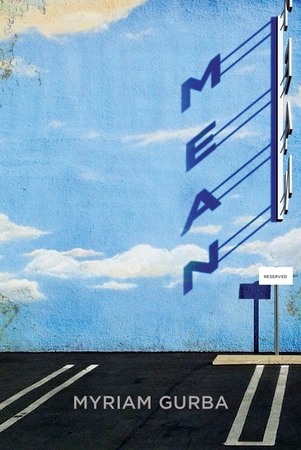
Image result for mean myriam gurba

Mean by Myriam Gurba

Crafted with a specificity of language that only a poet could muster, Mean is a reckoning with racism, misogyny, and homophobia by way of a coming of age tale. Though these are heavy subjects, Gurba approaches them with her striking dark sense of humor, as when she describes her period as “birthing blood clots”and worries that she’ll burn in hell for finding Anne Frank’s Diary boring. Just as Waller-Bridge’s accomplishes with Fleabag, Gurba’s sharp wit draws you in, giving her room to candidly consider the way her identity as a queer, mixed-race Chicana has shaped her life.

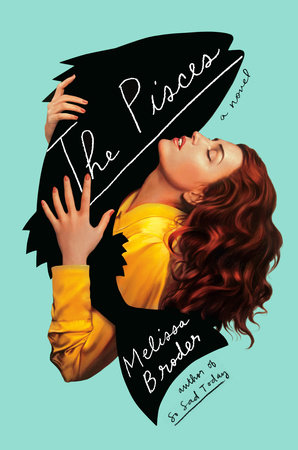
The Pisces by Melissa Broder

The Pisces by Melissa Broder

When I first picked up The Pisces, a novel about a depressed woman who falls in love with a merman, I was expecting to be dropped in the story of a life unimaginably different from mine. Yet even by the first page, it was clear that this wasn’t the story that Broder had written. I wound up underlining half of the book, so stricken by Broder’s ability to so skillfully nest the universal experience of loving what’s wrong for you within such an outlandish outer shell. The pull of Broder’s merman is not so much a result of his supernatural form but of his undeniable unavailability. Sound like a hot priest we know?

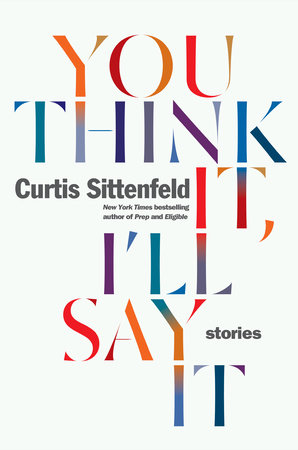
You Think It, I'll Say It by Curtis Sittenfeld

You Think It, I’ll Say It by Curtis Sittenfield

In her story collection You Think It, I’ll Say It, Curtis Sittenfield adeptly explores power dynamics and the minute indignities that result of them. A Regular Couple, one of the shining stars of the collection, zeroes in on an adult woman’s chance run in with a high school bully as she attempts to enjoy her honeymoon at a resort. As you wait for the expected explosion between them, Sittenfield heightens the tension between the protagonist and her husband. While she’s a morally corrupt money-making lawyer who made the news for representing a rapist, he works as a nonprofit immigration lawyer. The story hits its crescendo as the two relationships crumble, if only momentarily. Sittenfield presents such nuanced characters that you leave a story not sure who exactly you were rooting for, if only because you were made to root for every character.

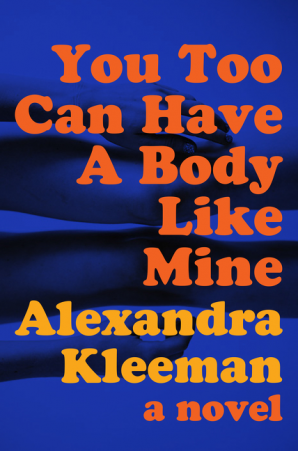
Image result for Alexandra Kleeman

You Too Can Have A Body Like Mine by Alexandra Kleeman

The main characters of Kleeman’s debut novel are named A, B, and C—the protagonist, her best friend, and her boyfriend, respectively—because of this, there’s no choice but to immediately acclimate within their peculiar, expertly crafted world. Everything in the book seems as though it’s taking place in an alternate dimension, a just slightly heightened version of our own reality. In reading the book, one becomes addicted to Kleeman’s style, just as the characters are addicted to ideal beauty standards and being an active member of consumerism (if those two aren’t one in the same). We follow A, B, and C as they gravitate closer to porn obsessions, a corporate cult, and reality TV, among the myriad other distractions that populate our everyday lives.

A Gay High School “Tess of the D’Urbervilles” Featuring Kurt Cobain

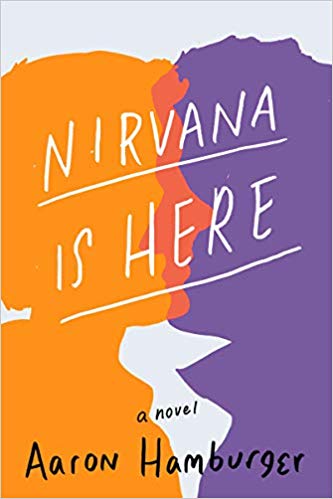
Among the myriad charms of Aaron Hamburger’s second novel, Nirvana is Hereis his protagonist, Ari Silverman, a medieval historian trying to reconnect with his high school crush, Justin. Ari’s search leads him to recall the events that led them to become friends—and more. By turns, Hamburger is tender and provocative in his examinations of sexual abuse, racial strife in ’90s Detroit, and the way that discovering Nirvana changes everything about Ari’s world. The complexities of this novel are deftly handled by Hamburger, whose sensitive and observant prose is a pure joy to read on every page. He’s the winner of the American Academy of Arts and Letter’s Rome Prize and a nominee for the Lambda Literary Award, and he and I spoke about his novel last week over email.


Kristopher Jansma: Aaron, your novel Nirvana is Here is in some ways a timeless story of coming-of-age. Young Ari struggles to find safety and love as a queer Jewish boy in ’90s suburban Detroit. And yet it also feels quite timely because you also delve into Ari’s life in middle-age, still processing his abuse, in the #metoo present day. To start, I wondered, is this a story you’ve wanted to write for a long time, or was it perhaps inspired by these conversations around rape and abuse that have begun happening more recently?

Aaron Hamburger:  This is in many ways a story I’ve been attempting to write my entire life but it took me a while to find the right frame. My initial motivation was to write something that would force me to delve into the emotional realm, so I began doing various disconnected and fairly autobiographical pieces on the same theme, attempting to find my way into a story. And then I was talking to a fellow writer, Elizabeth Searle, with whom I teach at the Stonecoast MFA Program, about all these “reboot” type stories, like the novel Emma becoming the movie Clueless, and I was saying how I wanted to write a gay high school version of Thomas Hardy’s Tess of the D’Urbervilles, and she said, “Do it!” And that gave me the permission I needed to really launch into a larger plot line and take real events but transform them to make a more satisfying and more richly textured story. It took me a good six years to write it, and it’s striking that when I was finished, so much of what’s in the novel has now become so timely. Maybe the world is catching up to me? Or, in all seriousness, a lot of the issues the book raises, like the #metoo movement or race, are ones that have always been present in American life, and now for a whole host of reasons we’re having what feels like a very different national conversation about them than what’s gone on in the past.

KJ: Yes, absolutely, and can I add that “Gay high school Tess of the D’Urbervilles” is surely exactly what we all need right now? So there’s some classic Hardy in there and also, as the title suggests, some classic Nirvana. I’m curious why you centered Ari’s development around that band in particular?

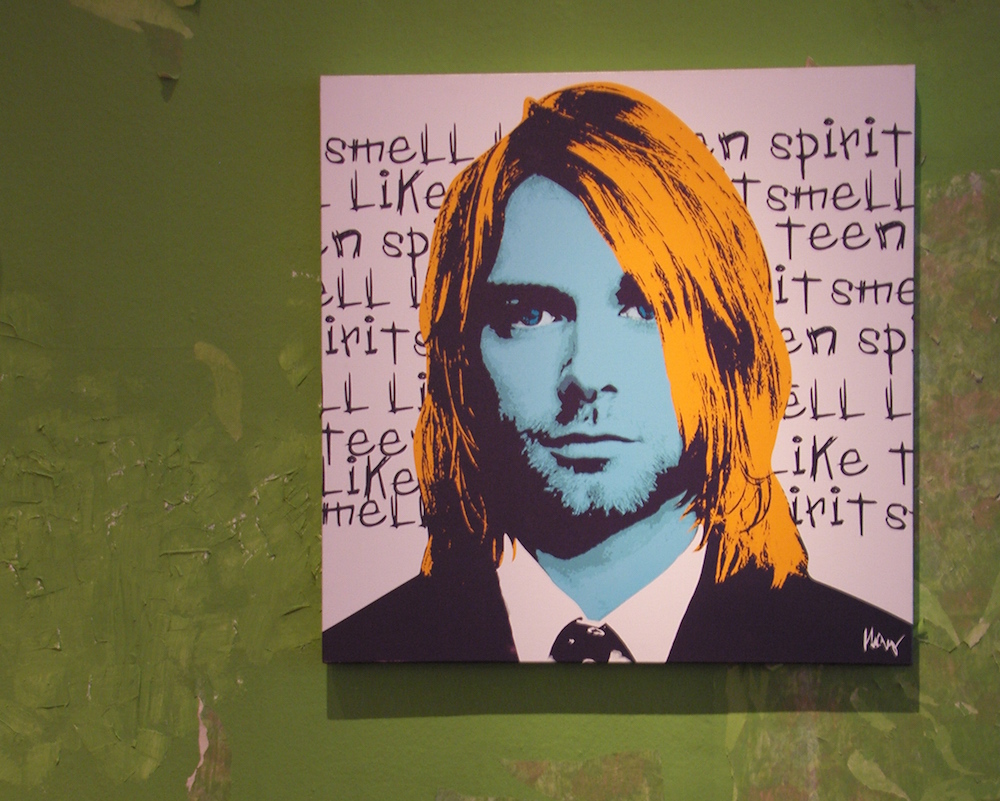
AH: I recently wrote a piece in The Washington Post about Kurt Cobain’s support of gay rights, which is more substantive than I think is generally known. In the book, Ari is not completely aware of all the things Cobain did and said regarding gay rights, yet he does feel a spirit of acceptance coming through the sound, the lyrics, and the image of Nirvana. Cobain and Nirvana positioned themselves as advocating for people to be different and find their own voices. While Cobain may have been an imperfect messenger in some ways, he had the right message for the right time, coming as he did at the end of the 1980s, when so much of the music that had their sound was associated with hetero-forward hair metal bands singing about bagging babes, “cherry pie.”

I was inspired by Kurt Cobain because he made it seem okay, cool, and defiant not to conform.

I too was inspired by Kurt Cobain because he made it seem okay, cool, and defiant not to conform, which maybe is not so original to him, but at the time it was original to me. Until Nirvana became popular, which was actually during my college life, not high school, I was unaware of what became known as “alternative” music and culture. As I explored that aspect of pop culture, I found a lot of personal liberation there, and I wanted to delve into that in this story. 

Another reason I chose the Cobain story as a backdrop was that I liked the narrative frame that it provided: the book takes place during the three years between the unexpected success of Nirvana’s Nevermind and their quick rise in 1991 to Kurt Cobain’s death in 1994, which coincide neatly with Ari’s three years at Dalton and his three-year relationship with Justin.

I’ve noticed that in some reactions to the book, people note the title refers to the band, not the spiritual state of Nirvana, but I think they’re wrong. It’s both! The idea of the title is that we can find “nirvana,” aka what we need, right here, right now, in every moment. Even in moments that are painful, because they have the potential to teach so much. Or even if they don’t, we are lucky because they always end. If someone punches me in the face, as soon as that happens, it’s over. Isn’t that wonderful? Now I don’t have to be punched again unless I do it to myself in my own mind by reliving that moment and dwelling in it. Which is not to say I want to deny that it happened, but rather, to acknowledge the painful episode without having to feel the pain of it the way I did the first time.

KJ: Yes, and you connect those two nirvanas in the novel really well, which impressed me because I recall that Cobain, even, had only a pretty loose understanding of what “nirvana” meant in the Buddhist sense when he chose it as the band’s new name. But there’s a meaning there that listeners can find on their own–certainly much more than if they’d stuck with Fecal Matter or The Stiff Woodies or something like that. It speaks to what you bring up in the Post article, about how vocally political he was, that his anti-establishment raging was sort of wedded to a love for those that society was forcing to the margins, like Ari.

There’s a scene early in the novel I loved, where Ari finally gets the actual Nevermind album so he can study the words better than on the mix tape Justin’s played for him–only to find that there aren’t any liner notes, so he’s still left to just interpret the bursts of words he can make out. You call it a “sound collage of resentment”: “Pick me, please pick me. I’m ugly, but that’s okay. No, stay away. A little group of self-assured pricks. A dream, a horny dream. I know it’s wrong, but there’s nothing I can do. Just stay away. Something’s in the way.”

You mix actual bits of lyrics together with Ari’s own thoughts, and it emphasized nicely how the incoherence oddly makes the music more relatable. I remember hearing the Tori Amos cover of “Smells Like Teen Spirit” for the first time in college and realizing I had sung along to that song in my car probably a thousand times and never once gotten 3/4 of the words correct! But it doesn’t really matter because there’s something in the tone that carries it all. You describe his “quivering voice a hair above a whisper, as if it were too painful to speak. As if he’d survived something worse than I had. As if he needed my sympathy, not the other way around.” 

That line made me wonder—Ari has, actually, a surprising amount of sympathy in his childhood. His parents seem supportive, they put him in therapy after his assault, and send him to a private school away from his tormentor. Ari’s brother tells him about his gay roommate and suggests that things might get better when he gets to college. And then there’s Justin, who at times goes out of his way to be kind to Ari. Of course Ari faces a lot of cruelty, but there’s still a lot of genuine love in Ari’s life, which made this feel very different from other stories of queer youth I’ve read, where protagonists are surrounded with bigotry and hatred from all quarters… was it your intention here to tell a different kind of story?

I think at base, all of us want to be liked and want to like each other. It’s our true nature.

AH: That’s a really interesting question. My primary motivation in embarking on this book initially was to make use of emotion in my work, to practice what the writer Breena Clarke calls “radical empathy.” Or as George Saunders says, “Revision means asking myself, what could I know about these characters that would enable me to love them more.” Notice he does not say “like” them more, which is a very different thing. I don’t need to like someone like, oh, I don’t know, Donald Trump to recognize that he is a fellow human being just as I am. I think at base, all of us want to be liked and want to like each other. It’s our true nature, and when we go away from that, it causes us pain. And I don’t know if this is true or not, I’m just theorizing here, but maybe literature that doesn’t recognize this, that writes off its characters as being less than fully human, just isn’t deep or interesting enough. I’m sure I’ve done that in my work, but it’s an impulse that I want to get away from. Think of how Anne Frank famously wrote that deep down she believed all human beings were basically good. If she could write that from such a deeply dark place, then who are we to say we can’t find the humanity in those around us now?

Thinking about the plot of this book, I think you’re right that Ari gets a lot of sympathy. But I also think there’s quite a bit of misunderstanding of Ari’s situation, or well-intentioned moves that don’t work, and those have the potential to cause pain. Sometimes our best intentions aren’t enough when we want to help someone in pain. Sometimes that person has to do some work on his own, as Ari does. I think that’s what makes his relationship with Justin so special. Justin doesn’t necessarily treat him with sympathy or not with sympathy. He just takes him at face value, meets Ari where he is, without a story or judgment, which is incredibly attractive. Who wouldn’t want that?

KJ: Justin was such a fascinating character. He and Ari are from different worlds and yet Justin’s sincere curiosity allows them to connect. The way he praises Ari’s Israeli candies and tries to learn Hebrew words and Jewish holidays. And Ari, in turn, learns something about Justin’s community in Detroit. They, and you, are really working against a lot of long-standing racial divisions—was that a challenge?

AH: As I wrote about this subject, I knew it was something requiring work and thought. I wanted to address race in this story because to write about Detroit and not address race would be to write science fiction, and maybe that’s true of America as well. So I did my homework as much as I could. Research was invaluable, and I learned quite a bit about the complicated legacy of race in the history of Detroit. For example, I was reading interviews with African Americans living in Detroit describing the largely white suburbs surrounding the city as “the white noose.” That tells you something.

The advantage of writing about younger people is that they will do and say things that adults have learned not to do and say openly.

The advantage of writing about younger people in this context is that they will do and say things that adults have learned not to do and say openly when addressing issues of identity. I remember several frank discussions that took place in my high school about these issues, including a non-Jew who told me that we Jews should consider spreading ourselves around more instead of isolating ourselves in certain pockets of the Detroit suburbs, to show we were human beings just like everyone else, and that I had no idea the terrible things people said about us. Or I recall another conversation in which another student said, “I have no problem with homosexuality. It’s bisexuality that weirds me out. It’s like, make a choice one way or the other!” Those kinds of conversations always stuck with me, and that came through in the book.

KJ: Another very lively character is Ari’s present-day ex-husband, another professor who goes by “M”—”Not an initial, just the letter, to express solidarity with the transgendered.” He comes off as a comic character at first, teasing Ari to go online to reconnect with Justin. Meanwhile, Ari has been put on a committee at the college to review M’s potentially inappropriate interactions with a student at a party. At first this struck me as kind of comedic—and yet, as the book progresses it becomes a bigger question for Ari and for us. He’s gradually reflecting on his own rape, and suddenly he seems to be looking at his own former husband’s actions in a more serious light. “Who the hell is this treacherous predator?” Ari asks himself at one point—but then when he suggests that the committee should actually speak to M and the boy to get their versions of the event before drawing any conclusions, some of his colleagues get upset with him, as if he’s looking to excuse or defend M’s problematic behavior. Were you hoping to draw parallels between those parts of the story? Is there a sense of how those situations are, or aren’t different from one another, and how they should be addressed?

AH: The “#metoo” themes of this book may seem timely but in fact are an age-old question: How do we draw firm lines around the business of desire which is by nature slippery, formless, and shape-shifting? I think it was the Roman poet Catallus who compared love to a piece of ice held tight in your fist. You see this too in Ari’s specialty, the rules of courtly love, which were an attempt to get medieval knights to behave by a code that would constrain their awful behavior around women. The two situations in the book—Ari’s assault and M’s behavior—are linked by their sexual nature as well as issues of power and consent, but they are not the same. In our contemporary life we too often gloss over nuanced distinctions. These problems need to be addressed with thoughtfulness and care, not social media status updates, slogans, or quick fixes. And I will also say I do not believe universities should be in the business of judging crimes. Crimes should be handled by the judicial system.

KJ: As you mentioned earlier, the end of the novel comes to deal with the suicide of Kurt Cobain. Without giving too much away, we get to see what that meant to Ari at the time, and how he thinks about it all these years later. To wrap things up here, I wondered if you could talk a little bit about what Cobain means to you, as a fellow artist and writer. Is there something you’d want someone—perhaps a younger person like Noah at the end—to know about his music or his life?

AH: Kurt Cobain was an extremely talented and troubled man, one of those people who appear to the outside world to be bent on self-sabotage but during his short time on earth created great beauty. What struck me as I researched his life for this book is how controversial and outrageous many of the things he said and did at the time were and how routine they are now becoming. For example, there’s a picture of Kurt Cobain on the cover of a magazine in a dress and with painted fingernails—a gender-fuck pose that in the early ’90s was a good way to get yourself beaten up badly. Recently while on book tour, I met up with two friends of mine from those days each of whom lives in different cities and each has an adolescent boy who paints his nails, and it’s just the way it is. And their dads, if they have a problem with it, it’s their problem, not the kid’s. In my day, it would have been the other way around. That shift didn’t just happen out of nowhere. It took bold and brash people like Kurt Cobain who when thrust unexpectedly and uncomfortably into the limelight took the opportunity to rudely shove the rest of us into a better and more accepting future.

The New Generation of Latinx Literature Will Have Room for Everyone

I grew up with a vigorous love for reading and storytelling. There was (and still is) a sense of ethereal magic that occurs when reading about other people, real or fiction, other worlds, other perspectives. At the time, I wasn’t looking to books for people who looked like me; I was looking for something outside myself. Eventually, though, I wanted to see myself reflected in the works I read—or at least know that it was possible, that other people reading fiction for other perspectives might find a perspective that looked a little like mine. What I found was that it was possible, but very rare. The great Sandra Cisneros and Julia Alvarez were some of the very few Latina authors that had pivotal works with Latinx characters heavily represented.

Over the last few years, Latinx representation in literature has slowly but surely increased. Among these new voices is Kali Fajardo-Anstine, whose debut short story collection Sabrina & Corina was published this year. Centered around multiple Latinas with indigenous ancestry and the trials they face, while also having their lives interwoven through their shared home of Denver Colorado, Sabrina & Corina features complex Latina characters that fall outside of the stereotypes that are normally attached to this community in various media. This has been something that felt so out of reach for a long time in my eyes, but reading the stories of these women, women whose cultures and struggles are similar to mine, has given me a feeling of fullness I longed for since realizing the need for representation of the community I’m a part of in the stories I read. Latinx representation in literature has been increasing, but now it’s time for us to ask for something more than representation. It’s not enough for Latinx characters to exist, instead of not existing; we’re ready for a range of Latinx characters as varied and vital as the white characters we’ve been reading for so long. With its cast of challenging and admirable Latinas, Sabrina & Corina has the potential to be the start of a new generation of Latinx literature.

This is not to diminish the work of iconic Latina authors like Cisneros and Alvarez. In previous decades, transcendent and remarkable works, including In the Time of the Butterflies, The House on Mango Street, Esperanza Rising, and Like Water for Chocolate, gave us deep insight into Latina characters from various generations. The problem has always been one of numbers. There have always been very few Latina authors with work in mainstream literature, compared to the number of white authors who have their narratives widely and continuously available.

I don’t want to have to only expect these stories one in a while.

The women in Sabrina & Corina are complex and imperfect, three-dimensional in a way Latina characters don’t always get to be (especially when written by white authors). In a recent interview, Fajardo-Anstine stated that she “was trying to portray a community that, often times, is invisible in the greater Latinx narrative. Southern Colorado, Northern New Mexico, mixed Latinx communities here in Denver—I was trying to create characters that were very individualistic, very human, in a way that I haven’t seen rendered before.” Her characters deal with traumas and intense situations, some of which are unique to the community and indigenous ancestry they come from, but many more of which face not only the broader Latinx community but humans everywhere: racism, classism, general and intergenerational trauma, and gentrification, among others. Fajardo-Anstine goes past the surface of her characters and digs deeper, pulling all the complexities, aches, doubts, and struggles, both internal and external, to the forefront. There’s no sense of hindrance in the way that Fajardo-Anstine writes so relentlessly raw, especially through the voices of the Latinas she’s manifested. These were stories that I had to sit with after finishing each one, ruminating on each of their unique and detailed environments and narratives.

Even though I was absolutely overjoyed that Sabrina & Corina exists just as it is, I couldn’t help but wonder how the literary world could better itself if Latinx narratives like Fajardo-Anstine’s became commonplace. In glimpsing into these lives, I gained a sense of comfort, a camaraderie between myself and the women of many generations in the book, especially knowing that we share similar experiences with many of the hardships faced by our community. To feel these things, especially in a time where we are seen as less than, is phenomenal, but I don’t want to have to only expect these stories one in a while.

In literature that I’ve read prior, there weren’t many characters like me that I could relate to and identify with in regards to their described viewpoint as a Latina. The Latinas in Sabrina & Corina display the layers of experience, both good and bad, that come with being a Latina in an ever-changing society. Social pressures, machismo, colorism within our own community; there was a sense of comfort in knowing that I was reading about Latinas that I could connect with if they existed in real life, that I could share an unspoken mutual understanding with them. This is a feeling that white readers get all the time, so often that they probably don’t even notice. I, and undoubtedly many other Latinas, deserve to experience it more often. Our voices are often silenced and disregarded as unimportant in mainstream literature. When we do get narratives in literature and in U.S. media, especially, they end up warped into unrealistic, exaggerated versions of us. Having our narratives be written by us and for us allows us to reclaim and strengthen our voices, while also emphasizing to the public that we aren’t the sidekicks, the gang bangers, or the maids.

In the next generation of Latinx literature, Latinas won’t need to search for the stories we can connect with.

Other Latina authors have preceded Fajardo-Anstine into the mainstream, including Elizabeth Acevedo (The Poet X), Lilliam Rivera (The Education of Margot Sanchez), Erika L. Sanchez (I Am Not Your Perfect Mexican Daughter), and Ingrid Rojas Contreras (Fruit of the Drunken Tree). It’s apparent that what’s been happening in Latinx literature lately can easily be called a cultural renaissance. I can already tell, or at least truly hope, that this next generation of Latinx literature will be vast, full of a wide variety of voices within our community. There will be a multitude of voices from so many diasporas, a constant stream of thoughts, discoveries and rediscoveries of the depths of our cultures, contemplations on what it means to be Latina and what those who came before us suffered through in order to have us exist today. In the next generation of Latinx literature, Latinas won’t need to search for the stories we can, as a community, connect with.

Signs of a new era have been showing through, filled with narratives that allow Latinas to be even more proud of our cultures and roots, where we came from and what lies ahead. Fajardo-Anstine has created multidimensional Latinas who have shared paths with those who came before, who have shared griefs and devastating cycles of abuse, who haven’t had the ability to voice their stories. She and other new Latina authors are reclaiming these real narratives we’ve been used to going without during our experiences reading mainstream literature. I only hope that other Latinas who are yearning to have their writing out in the world see that there is still a demand for the stories they are holding on to, their potential contribution to this exciting moment and movement that’s happening. I hope for this influx of literature written by us to inspire more undiscovered and upcoming Latina authors to grow and join this reclamation of our narratives and true depiction of ourselves, imperfections and all. It is more than possible to have our narratives be easily and readily accessible in mainstream literature, and this renaissance we’re in the middle of is only the beginning of what’s to come. Let it continue to thrive further, for the sake of the generations currently here and the ones yet to arrive.