I just finished writing a novel and am dreaming up a new one, and while I chafe at writing rules, your piece on moves in contemporary poetry gave me a fresh way of thinking about writing—challenges to meet, rather than rules to adhere to—but I’m not a poet! What are some moves in contemporary fiction?
That list of moves (which I cowrote with the poet Mike Young) has an enduring popularity. Almost every time I go to AWP, someone tells me they still use it as a teaching tool. Of course, it pissed some people off, as if I was trying to kill the “magic” in poetry. I wasn’t! And it wasn’t meant to be an indictment of recognizable moves. (A move is not necessarily a cliché, though it can be.) I just enjoy (some forms of) classification. The challenge, as you say, is to use moves well and surprisingly, as in dancing.
So here is a big, arbitrarily arranged list of recognizable moves in short and long fiction—some small (occurring at the level of the phrase or sentence), some large (occurring at the level of character or structure or narrative).
A few “duh” disclaimers: Some of these moves I like more than others; they are not limited to fiction, much less contemporary fiction (nothing is ever really new!); and the list is not meant to be in any way exhaustive.
Explicit symbolism via the “as if” or “as though” or “like” construction – A character does X, as if X (the author spells out the symbolism of the gesture or what it’s meant to suggest), e.g., “Her eyes darted around the room, as if she were looking for an escape hatch.” That’s a made up example, but here’s a real one from the Sally Rooney story “Color and Light”: “She looks around vaguely, as if she doesn’t know what he means by ‘here.’” Another, from My Name Is Lucy Barton: “My mother closed her eyes as though the very question might drop her into a nap.”
Filler lists – This is what an old antique shop is like, this is what a party at a rich person’s apartment is like, dusty clocks, platters of sushi, you get the idea. See the antique shop in The Goldfinch or the opening party scene The Heavens. Or, going further back, Orlando.
The “everything happens so much and so fast” – Evoking the fullness of life or history in a brief list (“The continents shifted, wars raged, factories were built, a plane flew into the north tower”).
Character looks in a mirror – They consider their reflection, so we can know what they look like. Or they don’t recognize themselves.
The move of no causation – A character “finds herself” somewhere or doing something, without having made the decision, as if they woke up there. Usually occurs at the opening of a chapter or section.
Unconscious action – A character does something for a reason, but they don’t know what the reason is. This is slightly different from the above, in that there is no gap in awareness.
Action against one’s will – A character seems to do the opposite of what they want (as in “Cat Person” or “Color and Light”).
The first sentence tells us a main character’s name – Rampant everywhere and everywhen but for old-school examples see Moby-Dick and Mrs. Bridge. More recently, Crudo.
The narrator has the same name as the author – Especially a first-person narrator (autofiction alert).
First-person narrator has no name(that we know of) – We can only refer to them as “the narrator.” E.g., The Sellout.
First-person narrator is obviously self-deluding – A variation on the unreliable narrator in that we’re not meant to trust them. See Sorry to Disrupt the Peace.
The Stranger – The protagonist’s spouse or partner suddenly seems like a stranger to them; are they a doppelganger or just being a dick or is the protagonist the one who has changed, does she have Capgras syndrome, etc.?
The Google – A character performs an internet search.
Art imitates art – A character or occurrence is compared to someone or something on TV or in a movie, or in another book.
Essayistic theorizing – See Flights, The Third Hotel, Pond.
Aphoristic, tweet-like fragments – See How to Be Safe, Literally Show Me a Healthy Person.
Protips – First-person narrator offers helpful tips to the reader for life and living. I associate this move most with A Far Cry from Kensington, but for a more contemporary example see The Anthologist, which actually has some good writing tips.
The long, detailed, “boring” digression.
Detailed sex acts or sexual fantasies – especially played for humor value (as in The First Bad Man).
Key to everything – A flashback to a moment that explains the protagonist’s whole worldview/personality (as in Tai Pei).
Extreme overreaction – A character decides to ruin his own life to punish someone/everyone.
The throwaway “times are dark” detail – The weather is always “unseasonably warm” (10:04), there’s war footage on a background TV.
Pathetic fallacy variation – Weather imitates scene. For example, in a moment of uncertainty, it may seem like it’s about to rain, but does not rain.
Full-on climate dystopia.
Ambiguous attribution – Requires dialogue with no quotation marks, but goes a step further to blur the line between dialogue and unspoken narration/free indirect, or between verbatim dialogue and paraphrase. See Outline.
The metanovel – A storyline that seems at first to be THE novel is revealed to be the creation of another character, a novel within the primary novel (see Trust Exercise; Eleanor, Or, The Rejection of the Progress of Love).
Ouroboros metafiction – The process/practice of writing the book is part of the book (as in Motherhood).
The withholding narrator – The narrator knows something you don’t, until they decide to reveal it at the end.
The extremely “unlikeable,” misanthropic narrator – See Ottessa Moshfegh.
Nicknames – Characters go by epithets instead of regular names. See “Pussy Hounds.”
He said, she said – Same story is told twice from two different viewpoints (see Fates and Furies).
The homage or “cover” novel – A retelling of a classic (see Paul Takes the Form of a Mortal Girl), sometimes corrective (Pym).
Extremely online – Inclusion of emails or texts or online chats, often preserving similar formatting to the original medium (Leaving the Atocha Station, The Idiot).
Rotating narrators – as in Boy, Snow, Bird.
Every chapter has a radically different form or voice/style – even if the narrator doesn’t change (Broken River, A Visit from the Goon Squad).
Unnumbered chapters – This has the effect of making chapters feel less chapter-y.
Narrative movement through a succession of encounters – See Rachel Cusk, Teju Cole; a non-comic version of the picaresque.
Unresolvable ambiguity – For example, is this character having a mental breakdown in response to trauma or grief, or is she living in an alternate reality? See The Heavens, Familiar, The Third Hotel, A Pale View of Hills.
The amalgam or stand-in setting – Action occurs in a familiar but made-up place.
Huge jumps forward in time – Especially entailing entirely new sets of characters (The Stranger’s Child, Comemadre).
Whole novel in a day – Action takes place over 24 hours or less, as in Lillian Boxfish Takes a Walk, The Mezzanine.
A theme is established through a narrator’s obsession or project – See the Jonestown research in New People.
Theme is extremely foregrounded via constant reminders – as in You Too Can Have a Body Like Mine.
First-personal plural POV – as in Then We Came to the End.
Second-person POV – as in How to Get Filthy Rich in Rising Asia.
Nonfiction and fiction published in the same volume – Blurring the distinction between essay and short story (see recent collections by Geoff Dyer, J.D. Daniels).
Story in the form of a list – See Carmen Maria Machado.
The modern epistolary novel – See We Need to Talk About Kevin.
Ending a chapter with a question – See Find Me.
Ending a chapter with the main character going to sleep.
It takes real skill to speed down the packed streets of the Zhongguancun district of Beijing, but the singer with the mohawk is handling it like a pro. His asymmetrical spikes are poking the roof of his dad’s sedan, so he’s compensating by tilting his head slightly to the left.
We are meeting with a new band to talk about shooting their music video. Sara is here to deal with the script details and she is leaning all the way forward to talk concept with the two guys up front. Sara’s long platinum blond hair is wavy and tumbling down her skinny back and Benji’s got his fingers in her curls. His other arm is pinching a cigarette out the window.
I’m staring at the women rhythmically patting their babies while selling counterfeit receipts and listening to taxi drivers ask about one another’s families as their cars slide back and forth.
Teenage part-timers are throwing advertisements in the air like confetti and somehow we’re managing not to kill anyone.
The band’s name is Brass Donkey and they’re blasting their music from the tiny speakers of the sedan. They sound a lot like Jump In on Box, the all-girl orbit-pop band that just got signed to Modern Sky Records. I’m digging the sound, but nobody asks for my opinion.
We finally make our way to the singer Dao’s apartment and more band members show up. He sits us down on the couch, and even though it’s only noon, he offers us Jack Daniel’s and Lucky Strikes. There are piles of discs everywhere and stacks of DVD players that the bootleg DVDs keep breaking.
“So this video, we want it to really stand out. We’re really into Talking Heads right now, you know them? Talking Heads?”
The drummer turns on the TV and David Byrne appears, jerking his head back and forth to his own beat. All the band members are talking to us at once.
“We’re no-wave Funstrumental, but we sound Brit pop.”
“For this video we want something perversely sexual, like really obscene.”
They look expectantly at Benji and Sara.
“Yeah, like really fucking sick, you know?”
“The more perverted the better!”
“Then we want this video to be blasting in the background during our debut performance at the next Strawberry Festival, on the big monitors.”
I smoke their cigarettes. “Aren’t you afraid of the police coming in and shutting it down?”
“That would be spec-fucking-tacular! It would be great to be shut down, even better if you could get us banned. Actually, let’s make that a goal,” says the singer, sinking back into his chair and turning up the music.
I watch Sara look down at her notes and then look up at me. I shrug. Benji stands up to leave and shakes everybody’s hand. Then we’re out of there. I can’t wait to tell JJ and Granzi, they’d definitely get a kick out of this story.
As for the video, we’ll do it if we feel like it, see how it goes.
We are what the people called Bei Piao—a term coined to describe the twentysomethings who drift aimlessly to the northern capital, a phenomenal tumble of new faces to Beijing. We are the generation who awoke to consciousness listening to rock and roll and who fed ourselves milk, McDonald’s, and box sets of Friends. We are not our parents, with their loveless marriages and party-assigned jobs, and we are out to prove it.
We come with uncertain dreams but our goal is to burn white-hot, to prove that the Chinese, too, can be decadent and reckless. We are not good at math or saving money but we are very good at being young. We are modern-day May Fourth– era superstars, only now we have MacBooks. We’ve read Kerouac in translation. We are marginally employed and falling behind on our filial-piety payments, but we are cool. Who is going to tell us otherwise?
Five of us live in part of a reconverted pencil factory outside of the fourth ring, smack in the middle of the 798 art district. We call our place The Fishtank and it covers four hundred square meters of brick and semi-exposed wall insulation. Before it became our home, it used to function as the women’s showers for the factory workers. As a result, it is cheap and it is damp. The real Beijing, with its post-Olympic skyscrapers, stadiums, and miles of shopping malls, rests comfortably in the distance, where we can glance fondly at the glow of lights while eating lamb sticks.
We are not our parents, with their loveless marriages and party-assigned jobs, and we are out to prove it.
Our roommates include JJ, the tall, dark-skinned half-Nigerian from Guangzhou, who is loudmouthed and full of swagger. He keeps his head shaved, favors monochromatic denim ensembles, and is either drinking or playing with his own band Frisky Me Tender. The resident cinematographer is Benji, who is so handsome waitresses burst into fits of giggles when taking his orders. He is working on a series about migrant workers whom he dresses in designer labels. Benji, whose Chinese name we’ve forgotten, was renamed by his white girlfriend, Sara, a former research scholar who has since found it impossible to leave. Sara, with her green eyes and blond hair, speaks with an authentic marbled northeastern Chinese accent, and somewhere along the line she became one of us as well. There is Granzi from Wenzhou, the photographer who shoots product photos of new consumer electronics as well as an ever-rotating roster of models from Russia and Hong Kong. Some of them keep us company when they are sufficiently drunk. Then there’s me and I’m short like Granzi, but sometimes I can’t help but feel like someone accidentally photoshopped me into this picture.
I’m a so-called producer and what that really means is that I just have more money than the rest of them. Actually my dad does. My family’s from Chong Qing, where my dad made a fortune in real estate and has more money than he can spend. After I dropped out of the Beijing Film Academy, I’ve been hiding from my dad for more than a year and living off the money I got from selling the BMW he gave me. I said I’d try to make it as a filmmaker, but I’m low on talent. Lately, I’ve been watching a lot of porn.
Our apartment is just around the corner from our new favorite bar See If, and that’s where Benji, Sara, and I go after our meeting. See If is three stories of homemade wood furniture and plexiglass floors. The drinks are named If Only, If Part, If Together, If No If, and so on. The alcohol is supposed to supplement your mood, but it basically all tastes the same. JJ and Granzi and a bunch of part-time male models are all there jamming together. JJ is walking around suggestively strumming everyone’s guitar.
Benji says to the group, “Hey, you have to hear the story about our meeting with the Brass Donkey guys. I think they want to get publicly flogged.”
I get passed a pipe and smoke something that makes me feel like I’m vaguely in trouble. I concentrate on looking at my friends and feel swell again.
JJ cuts in. “Dude, today a cabdriver point-blank asked me how big my dick was.” We listen to that story instead. Being a half-black Chinese guy, JJ is used to attention.
With the 2008 Olympics finally behind us, Beijing is getting its loud, openmouthed, wisecracking character back. The cops stopped checking identity papers on the street and all of us Bei Piao are letting out a collective sigh of relief as life goes back to normal.
But then this thing happened. Last week I received an email from my father. He was going to give me, his only son, the opportunity to make my own fortune. He purchased a dozen oil rigs in Louisiana and is getting the L-1 investment visa ready for me to move there and manage them. It has been decreed that my piece-of-shit ass is going to move to the United States and make use of itself. In his mind, what was I doing drifting around in Beijing with hipsters when there’s an oil field in Louisiana with my name on it?
I said I’d try to make it as a filmmaker, but I’m low on talent. Lately, I’ve been watching a lot of porn.
In the spring, we test-shoot the music video on our roof and even though it’s a Wednesday, I make a few calls to modeling agencies and within the hour half a dozen models are strutting across our tiles wearing nipple pasties and fishnets. Sara’s the one posing them in obscene variations, asking them to take their clothes off. She can get away with almost anything because she’s a white girl who speaks Chinese and everybody likes her. Benji’s doing the actual filming while Granzi takes stills. Sometimes I load some film, but mostly I just drink beer and enjoy the atmosphere.
Just as the sun is whimpering its way down the side of the sky, the last girl shows up. She is a model from Hong Kong who renamed herself Zi Yang, The Light. She’s got a good face, but like most girls who assume they deserve nice things, she is extremely unfriendly. Then, just as everyone is packing up to go, she emerges naked from the apartment wrapped in Granzi’s blue bedsheet. Her waist-length black hair licks at her face, her arms gather the bouquet of fabric against her small breasts, and the sheet clings to the silhouette of her long legs. Sitting among our coffee cups and cigarettes, the rest of us hardly notice her; we smile at her but not much more.
Not Granzi.
He ties his hair into a ponytail, picks up his medium format lens, and follows her onto the tile roof like a puppy. He takes her hand and helps ease her bare feet onto the chimney.
With the sheet dripping around her, she looks ten feet tall and glorious. She lowers the sheet and ties it around her waist, covers herself with her hair, and looks away, purring like a cat, in a halfhearted bargain for attention.
So there’s Granzi, from whose lips escapes a “My God,” and he fumbles with filters and straps to get the perfect photo of her. The loose tiles creak beneath his feet.
“You’re gorgeous, too gorgeous,” he said. “You should father my children or marry me, whatever comes first.”
Sara whispers to me, “I think this is going to be trouble.” And I know just as well as everyone else that Granzi’s falling for this girl and it isn’t going to be pretty.
If we could grant Granzi one wish, he’d probably wish to marry a tall girl. A very tall, very hot girl. He claims that he wants to give his children a fighting chance. Can we really blame him though? Even if he only claimed to be of average size for a man, he’s probably only five three—in the morning, after he’s taken a big breath and holds it. Most of the time the poor guy has to buy shoes in the children’s department.
But all that is bullshit, it’s just for show. Granzi, perpetually heartbroken Granzi, is the only one of us who can still memorize Tang Dynasty poetry, is always the first to notice if sorrow crosses any of our faces. I guess deep down we could all see that his wants were so simple—to be loved, respected, and not tossed away, for his meager holdings on this earth. It was all the wrong in him that made him so special and we were all protective of him, ready to hurt for him like we would hurt for no one else.
After the shoot is over, we go across town to D-22 to hear JJ’s band perform. D-22 is the first underground punk rock club literally screamed into existence by foreign exchange students in the university district. JJ is opening for Car Sick Cars whose hit song is five-minute repetitive screaming of the words “Zhong Nan Hai,” which is both the Beijing capitol building and the most popular brand of cigarettes among locals. Foreigners love it, and the audience throws cigarettes on the stage like projectile missiles.
When JJ and his band hit the stage, it’s obvious that he’s wasted and he tips over the mike stand as he gyrates in his Adidas tracksuit. He is singing in English, “I trim girls all night long, white and black, I know how to trim those.” It’s Cantonese slang for “hit on girls,” coarsely translated into English, being yelled through a broken mike. These lyrics are new, probably bits of conversation he’d heard earlier that day, grammatically Chinese with clauses that don’t finish, lyrics that don’t make sense. We all know he kind of sucks, but so does everybody else and everyone’s liking it. The Chinese groupies who took day-long buses into the city just to see the show are thrashing their heads from side to side as if they’re saying “No no no” when they’re really saying “Yes yes yes.” JJ finishes the set by jumping off the stage and feeling up a drunken Norwegian girl who doesn’t seem to mind.
Like everyone else I know, JJ drinks a ton. Unlike everyone else, he doesn’t seem to want to make it big. He says he just doesn’t see the use of being a hardworking citizen. I can’t argue with that. I know most ordinary people will work their whole lives at some stable job and yet they’ll never be able to afford so much as a one-bedroom in Beijing proper.
When the next band starts plugging in their instruments, Sara goes to mingle with the Canadian bar owner while JJ joins Benji and me by the bar.
“I am not writing for record labels. I just want to write music for the humiliated loser, the guy that gets hassled by the police, the night owl with no money who loves to get drunk,” he says. I don’t know if he knows that his description doesn’t include someone like me, but we toast to it anyway.
We all go clubbing in Sanlitun at a place called Fiona. A once-famous French architect purportedly designed it in one hour. Every piece of furniture is a unique creation, and as a result, it looks like a Liberace-themed junkyard. Rainbow, an old acquaintance who runs a foreign modeling agency, is throwing a birthday party for herself.
“Can you believe I’m turning twenty-nine again?” she says as a greeting while she ushers us into her private room. She kisses everyone on the mouth and presses tiny pills into our hands.
“Oh, to be young and charming, I can’t think of anything more fabulous,” she says in her signature mixture of Chinese and English as she drapes her arms around a new model boy- friend. His name is Kenny or Benny, and he looks like a skinny Hugh Jackman. He is obviously a homosexual, but that’s just not something Rainbow has to accept.
The DJ spins funky house tracks and the springboard dance floor floods with sweaty people who pant and paw at each other. Old businessmen drool at foreign girlfriends who lift up their skirts on elevated cages. Rainbow buys the drinks and toasts herself into oblivion, grooving around the dance floor yelling at the foreigners to “go nuts to apeshit!”
I can’t find Granzi or Benji, so instead I try striking up a conversation with the skinny Hugh Jackman. He asks me to teach him Chinese so I start by pointing to the items on the table.
“This is a bowl,” I say.
“Bowa! Ah bowl!” he says with a shit-eating grin on his face.
“Shot glass.” I push it across the table toward him.
“Shout place,” he slurs, laughing. “Oh yeaah, shout place!” It’s a good thing he’s handsome, I think. I want to leave, but I’m too high to wander around looking for my friends. I stick by the bar for a bit and talk to the attractive waitresses who swear they’ve met me before, in another city, in another life, and I am sad that they have nothing to say to me but lies.
Beijing is a city that is alive and growing. At any given moment, people are feasting on the streets, studying for exams, or singing ballads in KTVs. Somewhere a woman with a modest salary is buying ten-thousand-yuan pants from Chloé to prove her worth. Even though I couldn’t cut it at the Beijing Film Academy, I knew the city itself was for me. The dinosaur bones found underneath shopping malls, the peony gardens, the enclaves of art—these things were all exhilarating for me. I walk through new commercial complexes constructed at Guomao, which look at once like big awkward gangsters gawking at one another, as if hesitant to offer one another cigarettes, and I think, I belong here.
Tonight, somehow I end up crawling out of a cab to throw up by the side of the freeway. Traffic swirls around me even though the morning light’s not fully up. Then out of the blue, Sara and Benji appear, apparently because they happened to see my big head with the grooved patterns shaved into it projectile-vomiting as their cab was passing. They pat me on the back and we eat hot pot on the side of the road from an old Xin Jiang lady. I am so happy to be with them. It’s at this moment I realize that what’s going on is already slipping away, and while the cool air blows against my damp face in the taxi home, I can’t help but miss it already.
One night, my last real girlfriend He Jing calls me.
She says, “I’m moving to Shanghai next month, and I’m wondering if you could lend me some money to get settled. You know I’m good for it.” She knows more about me than anyone and there’s not even a hiccup of hesitation in her voice.
That’s just how He Jing did things, the girl couldn’t just sit on a chair, she had to lie in it, with her head cocked to the side and a cigarette dangling dangerously. She is a sound mixer I met at the academy and always dressed as if she had a Harley parked out back. Her playground was Mao’s Live House, where she rejoiced in the last blaze of China’s metalhead scene.
It’s at this moment I realize that what’s going on is already slipping away, and while the cool air blows against my damp face in the taxi home, I can’t help but miss it already.
There was never going to be a future for us, my father would never have accepted a poor musician into the family. Yet it was she who dumped me, simply saying, “I wish I could give you more, you should have more.”
I meet her for coffee and hand her an envelope of money and she accepts it as though it’s a book or a CD. She has cut her hair like a boy but is still fiercely radiant with confidence.
“We’re doing well, you know,” I say. “Benji’s trying to get British art dealers to buy his photographs and Sara’s in talks with a Dutch museum to exhibit her media installation. And Granzi just got published in a Finnish fashion magazine.”
She goes, “That’s impressive, but what are you doing?”
My throat is dry, and I’m not sure what to say, so I go, “I’m in between projects.”
“Right,” she says, reaching over and messing up my hair.
Granzi’s relationship with Zi Yang isn’t exactly normal either. Two days after they met, she moved into his room and began spending all her time in his bed. It is so weird in there even the pets stay away. For one, she would walk around topless, one minute laughing, the next waking us up with bawls.
“That girl should be taking antidepressants,” Sara said.
In the mornings Zi Yang tells Granzi she loves him and he believes it. In the afternoons she says he is disgusting to her and he believes that, too. “You can’t just pick and choose,” he tells us. “When you’re trying to get someone to love you, you have to take everything.” When she sleeps with him, he marvels at all the soft places on her body he can kiss. It amazes him how easily he bruises when she kicks him away.
Granzi’s website quickly becomes a shrine to Zi Yang’s face. She is so crazy it’s as if she stole his eyes and hung them above her at all times. Gone are all the projects he’s been working on and we hardly see him without her. It is only Zi Yang, her in the bathtub with goldfish, her on his bed with broken liquor bottles, lovingly captured and rendered over and over again.
We send one another his links over QQ. “This is kind of obsessive,” JJ types.
“It’s just a major muse mode,” responds Benji as he leans over to kiss Sara behind her ear.
More than anyone, Sara is the woman who helped all of us get over our shyness with and general distrust of white people. With Sara we learned many of her American customs, like hugging, and that took months of practice. “Arms out, touch face, squeeze!” We learned that Americans are able to take certain things for granted, such as the world appreciating their individuality. That they were raised believing they were special, loved, and that their parents wanted them to follow their dreams and be happy. It was endlessly amazing.
We also learned English. We realized how different it really was to speak Chinese. We didn’t used to have to say what we meant, because our old language allows for a certain amount of wiggle room.
In Chinese we can ask, “What’s it like?” because “it” can refer to anything going on, anything on your mind. The answer could be as simple sounding as the one-syllable “men,” which means that you’re feeling stifled but lonely. The character drawn out is a heart trapped within a doorway. Fear is literally the feeling of whiteness. The word for “marriage” is the character of a woman and the character of fainting. How is English, that clumsy barking, ever going to compare?
But learn we did, expressions like “Holy shit” and useful acronyms like DTF (Down to Fuck), and we also became really good at ordering coffee. We learned how to throw the word “love” around, say “LOL,” and laugh without laughing.
That afternoon, I buy He Jing a parting present at an outdoor flea market. A guoguo, a pet katydid in a woven bamboo orb. They were traditionally companion pets for lonely old men, and the louder their voice, the more they were favored. He Jing picks out a mute one. The boy selling it to me says it will live for a hundred days.
“A hundred days?” she says as she brings the woven bamboo orb up against her big eyes. “This wee trapped buddy is going to rhyme its own pitiful song for a hundred whole days?”
I tell her, “That’s not so long, it’s the length of summer in Beijing. That’s the length of a love affair.” I realize I am giving away all my secrets. I think, I want to roll you into the crook of my arm and take you somewhere far and green. When she turns back toward me, I know the answer to my question before I even ask it. I realize it is a mistake, the gesture, everything about me. She isn’t going anywhere with me.
The only thing I have to offer her is money, and she has it already. I want to tell her that there’s a lot of good shit about me that she would miss out on. But there’s no art in me and she sees it plainly in front of her. Instead I kiss her fingers goodbye. They smell like cigarettes and nail polish, and I swear I’ll never forget it.
How is English, that clumsy barking, ever going to compare?
By autumn, the trees shiver off their leaves and Zi Yang, too, becomes frigid and bored with Granzi. Our old friend Xiu Zhu comes back from “studying” abroad in Australia. She is a rich girl who looks like a rich boy. She has a crew cut, taped-up breasts, and an Audi TT, which she drives with one muscular arm on the steering wheel. Within an hour of meeting Zi Yang, we can all tell that she is stealing her. By the time they finish their first cocktail, Xiu Zhu is already whispering English love songs into Zi Yang’s ear.
We see less and less of Granzi after that. He still hangs out with both of them, going to lesbian lala bars and getting hammered. The girls hold hands and laugh while he drinks whiskey after whiskey. He mournfully watches them kiss as if he’s witnessing an eclipse. A group of confused lesbians politely ask where he got such a successful gender reassignment surgery and he drinks until he passes out.
For my part, my father stops writing me emails asking about my wellbeing and just sends me a plane ticket. I don’t tell anyone, but I go to get my visa picture taken. The agency makes me take my earring out. Within the hour, the hole closes and now it’s just a period of time manifested as a mole.
In winter, Zi Yang moves back to Hong Kong and breaks two hearts. Shortly after that, Granzi packs up his things as well. He tells us that under Beijing, beneath the web of shopping malls and housing complexes, lay the ruins of an ancient and desolate city. And beneath that there are two rivers, one that flows with politics and one that flows with art. If you drift here, you must quench your thirst with either of its waters, otherwise there is no way to sustain a life.
“I realize there is nothing for me here,” he says, “no love, not for a guy like me. It’s waiting for me back in Wenzhou, that’s where it must be.”
He sells his cameras, his clothes, even his cellphone.
“I don’t want to leave a road to come back by,” he says.
We all take him to the train station where he is leaving with the same grade-school backpack he arrived with. It’s as if a spell has broken and suddenly we feel like jokers in our pre-ripped jeans and purple Converses. We remember years ago, after having borrowed money from relatives, those first breaths taken inside that station. How timidly we walked forward with empty pockets and thin T-shirts. We had been tu, dirt, Chinese country bumpkins. And now one of us was giving up, but what could we have said to convince him he was wrong? What could have made him stay?
Everyone on the platform has his or her own confession to make, but when we open our mouths, the train arrives, just in time to keep our shameful secrets to ourselves. Someone is about to give away the mystery of loneliness and then the train comes. A reason for living, the train comes, why she never loved him, the train comes, source of hope, train, lifetime of regret, train, never-ending heartache, train, train, train, train, train.
Afterward we huddle inside the station’s Starbucks, quietly sipping our macchiatos. Our cigarette butts are swept up by street sweepers whose weekly salaries probably amounted to what we paid for our coffee. The misty mournful day is illuminated by the pollution that makes Beijing’s light pop, extending the slow orange days.
Out of nowhere JJ says, “I’m not sure if I actually like drinking coffee.”
Sara says something about leaving soon to go home, and from the look on Benji’s face it is clear to me that this time she might not be returning.
I want to say that I might be leaving, too, but instead I focus on an American couple sitting across the room from us. The woman holds in her arms a baby who doesn’t look anything like her. They are an older couple, ruddy-cheeked and healthy, and they order organic juice and cappuccinos in English. As we sit together in those chairs, their Chinese baby starts scream- ing and banging his juice on the table. The couple is starting to look despondent. The woman catches us staring, and the four of us look encouragingly at the baby. It’s going to be okay, Chinese baby. You’re a lucky boy. Such a lucky boy. Now please, please, shut up, before the Americans change their mind and give you back.
We somehow finish the Brass Donkey video and it’s a semi-pornographic piece of garbage that gets banned immediately, of course. The band is happy because they’re stamping “Banned in China” on their CDs and are being invited on a European tour. Without telling my friends I go to the embassy to pick up my visa, secretly building the bridge on which to leave them. As I get out of there, I push back swarms of shabbily dressed Chinese people just trying to get a glimpse of America, and it makes me feel lightheaded with good fortune.
The crowded scene reminds me of waiting at the ferry docks when I was a little boy, before my father had any money. Our region was very hilly and in order to get any kind of shopping done, we took ferries to reach the nearest shops. The rickety boats were always so overcrowded and flimsy that they would regularly tip over into the river, spilling both young and old into the river’s green waters. What I remember most were those brief moments of ecstasy, when the small, overloaded boat gave in and the waters were met with high-pitched screams. And we’d all swim to shore, resigned to and amused by our rotten luck. Everybody would then simply get on another boat dripping with water, letting our wet clothes dry in the breeze.
Brass Donkey’s now-banned song is playing loudly in my head. It’s actually pretty good, a protest song hiding behind a disco beat. “We have passion, but do not know why. What are we fighting for? Where is our direction? Do you want to be an individual? Or a grain of sand.”
Conspiracies have long been a point of fascination in America, but lately it feels like you can’t spend a day on the internet without encountering the work of a conspiracy peddler or a fake news controversy. In Anna Merlan’s new book Republic of Lies, the reader gets more than this daily sprinkling of the edges of conspiracy thinking: we’re able to gain a fuller understanding of why conspiracies happen, how conspiracy theorists think, and what their prevalence says about life in America today.
Buy the book
Merlan’s book is far more than a guide to the modern conspiracies of America. Through reporting on conferences with all types of conspiracy theorists: new age devotees, UFO enthusiasts, and even white supremacists, Merlan’s dedication shows through in the book’s fastidiousness. Her conversations with believers in the conspiracies she covers show a deep sensitivity and careful approach to an increasingly volatile subject. Merlan’s work toes a careful line: she never asks the reader to empathize with the most dangerous types of conspiracy, but she does make us understand how a broken social system creates a distrust that can lead to conspiratorial thinking, and in turn how everyone engages in questioning power.
We spoke on the phone about talking to conspiracy theorists, the roots of conspiracy thinking, and how conspiracy entrepreneurs came into being.
Rebecca Schuh: Something I thought about from the beginning of Republic of Lies was imagining you in these scenarios, talking to all your sources at the conferences where you went to interview conspiracy theorists, and how you navigated as though you were having normal conversations with normal people.
Anna Merlan: Most Americans believe in at least one conspiracy theory, so they are normal people. They are definitely in a deeper end of the pool than you or I, but fundamentally, conspiracy theories are not that strange. They’re not foreign to us in our everyday lives. Talking to people about their beliefs is not a huge challenge.
RS: Were you always talking about the topic at hand or did you end up talking about other things?
Most Americans believe in at least one conspiracy theory.
AM: People were pretty focused on talking about whatever we were there to discuss. But something I always try, with people who were in more extreme communities, is seeing if they will tell me anything about their day to day lives, or what they’re doing, when they’re not pursuing some of this stuff. I often find people either don’t have other interests that they really want to talk about, or at least don’t want to share them with me. A lot of times people are really focused, you know, if we’re at the UFO conference they want to talk to me about UFOs.
RS: That makes sense, I think about going to writing conferences and we end up talking a lot about writing and reading.
AM: A big theme of the book is that people believe in conspiracy theories, especially in the U.S., both because they believe they feel locked out of a sense of power, our financial system, our economic system, our medical system, and they find these systems really opaque, really hard to understand, really unjust, and so when people are talking about those feelings, even when I don’t agree with the conclusions that they’ve reached, the sentiment is not unfamiliar to me. It’s not hard for me to understand. It’s pretty easy to find some kind of common ground from which we can start talking about things. I would say the only real exception to that, besides obviously white supremacists, is people who are mass shooting truthers. Those people are not starting from the same vantage point as me or anyone I know, and it’s often hard for me to understand where they got onto that track. It’s one of the only conspiratorial beliefs that I’ve had a really hard time understanding what it is that people leads that people to become crisis actor truthers.
RS: I knew that [crisis actor truthers] existed but I hadn’t really known anything about the reasoning behind it. And then realizing that it came from this idea that shootings were staged by liberals trying to promote gun control and I was like wait…no gun control has happened! Why would this continue!
AM: There’s a big fear, especially on the far right, of government control, of government overreach, so it’s fundamentally about the government taking control and confiscating guns. The interesting thing about conspiracy theorists is that they react more or less the same way every time a mass shooting happens, even though no gun reform ever actually comes. They’re sort of stuck in this amnesia washing machine cycle. Where they can make the same proclamations and have the same warnings over and over again.
RS: That reminds me of the section in the book where you write about that study where it links conspiracist thinking to a belief that the world is getting worse, and you shouldn’t bring a child into the world.
People in the U.S. believe in conspiracy theories because they feel locked out of a sense of power.
AM: That’s a really cool study from a New Jersey researcher about anomia. It’s from November 1994 by Ted Goertzel. It’s less than 350 people, but it found that people who believed in one conspiracy theory believed in others, that people who believed in conspiracy theories had a lack of interpersonal trust, insecurity about employment, and generally a lack of optimism about their own lives, or about the future.
RS: I found the part about that study really interesting because I could identify with a lot of what it was positing, and I normally wouldn’t think of myself as someone susceptible to conspiracy theories.
AM: It’s also important to look at what our cultural and political and economic backgrounds are when figuring out what conspiracies do and don’t have an impact on our own lives. As someone who’s white and has more or less always been middle class, I’ve had access to a lot of privilege and education so conspiracy theories don’t serve the same purpose for me than they do for people who have had a different experience of how the United States works. So one sort of ugly thing about a lot of writing about conspiracy, is that it tends to be white, middle class journalists, sort of making fun of beliefs that people have enacted or developed because they are a lot more pessimistic about the ways that America is going to work. Which is not to say that every conspiracy theory is sympathetic or reasonable. There are a lot of conspiracy theories on the far right that are fundamentally Islamophobic, anti-semitic, that are not in any way excusable or understandable.
RS: You approached all of it in such a careful way.
AM: I think there is no purpose in going to talk to people if you’re only going to ridicule them. Fundamentally I think why we’re so interested in conspiracy theories is because they are about a process of deciding what to believe and what to trust in how we view the world. One of the only ways we figure that out is talking to people who are not like us. There has to be some level of being able to listen to people while fact checking them while also resisting the urge to make fun of beliefs that are not like yours. It’s a balancing act.
RS: There are things in the past that you mention throughout the book, Iran-contra, government conspiracies that did turn out to be actual conspiracies, and I was curious about the line between something that ends up being a true conspiracy. Is that just an evidentiary line?
Conspiracy theories are about a process of deciding what to believe and what to trust in how we view the world.
AM: True conspiracies, especially involving the federal government, do not tend to stay secret forever, because of the number of people involved. There’s a really famous study that’s sort of about that, about the likelihood of conspiracies staying secret goes down as more people are involved. And so, some of it is about the legal and judicial process that brings these things to light, some of it is about real reporting, there are some examples of things that sound too crazy to be true being brought to light and being shown to be real. Iran-Contra is one, Watergate is another. At the start of the Watergate investigation it just sounded completely absurd, that the president could have been directly involved in something like this. The FBI harassing civil rights leaders and other activist groups throughout the ’60s and ’70s —these are things that sound crazy, but are true.
RS: Kind of on the opposite end of that, while reading I was thinking about the conspiracies that have become jokes in a certain subset of modern culture. In the section of your book about Bush and 9/11, I kept just hearing in my head, “Bush did 9/11” because of how many people have latched onto that as an online joke format. Taking a conspiracy and taking it on in an ironic way. What’s the relationship there, between irony and conspiracies?
AM: I think the fact that we make jokes about Bush did 9/11, jet fuel can’t melt steel beams, tin foil hats—I think these are signs of how ingrained humor and irony in the culture, and how ingrained conspiracies and conspiracy culture is in America.
I think a lot of people, especially younger left leaning people, see the way the Bush administration used the 9/11 attacks to their political advantage, and saying “Bush did 9/11” is a shorthand for a bunch of different things. One is the political utility of the attack, the other end of the spectrum is people who are saying that they literally believe that. It serves a wide variety of purposes.
RS: That’s a great way to put it. Something I had not heard of before I read about it in your book was the fact of conspiracy entrepreneurs. Do you have a sense of when that began?
AM: When we talk about conspiracy entrepreneurs (and that’s not a term that I coined, it’s a term that’s been in use for a while), we’re talking about people who make money promoting conspiracy theories either directly or indirectly. The most famous example is Alex Jones who has a pretty profitable media platform and also sells supplements through his Infowars store. A growing number of people are trying to monetize conspiracy theories, whether it’s monetizing Youtube videos, Periscope, or peddling e-books, lifestyle products, there’s any number of ways that people are trying to make money off of the practice of spreading conspiracy theories. Increasingly it is people like Mike Cernovich, who was previously a men’s rights activist, then dabbled in a bunch of really odious movements, who is now presenting himself as a journalist. They’re deciding that is one of the more straightforward ways to peddle their wares.
RS: I’m interested in the connection between health supplements and conspiracies. I sense that they’re connected, but also it seems random at first glance.
Conspiracy culture has a huge overlap with classic new age culture and far right natural health stuff.
AM: A lot of conspiracy theories are fundamentally about a fear of outside contamination. Outside influence or contamination. A lot of supplements are based on the idea that you need help being physically protected or guarded. The other thing is that most conspiracy theory peddlers will tell you that mainstream institutions, including mainstream medical institutions, are not trustworthy, so you need to be looking elsewhere for ways to be healthy, which obviously creates a really big market for them. And the last thing is that conspiracy culture has a really huge overlap with classic new age culture and far right natural health stuff. So there’s all these different places where the interest in supplements and natural health products come together.
RS: Given the current political climate and people holding onto the Russia stuff, do you think that you’re going to keep covering this type of thing as it’s so ingrained in the current conversation?
AM: I don’t see conspiracy culture dying down anytime soon. I see it growing in different ways on the right and the left. There will be space to cover it and to cover new information, fortunately or unfortunately.
RS: I’ve always thought of it as more of a right wing thing, but we really see in your book how conspiracy theorizing pendulums back and forth between the left and the right.
AM: It does, and there’s a tendency among folks on the left to say that conspiracy culture is for other people and not for us. But I think we know that that’s not true. When we examine some of the more extreme ends of the Russiagate stuff, we see that people do it because anyone who is not part of the dominant power group or dominant political party will find themselves more party to conspiracy thinking.
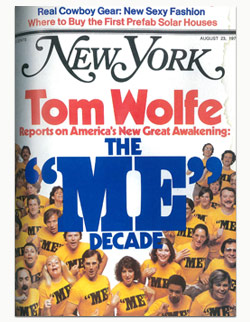
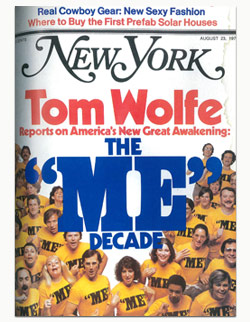
“The ‘Me’ Decade and the Third Great Awakening,” Tom Wolfe’s very long and very middling 1976 cover story for New York Magazine, might be the most famous essay comparing Jimmy Carter to a woman screaming about hemorrhoids. Wolfe argues, too many times, that all Americans spent the ‘70s proudly yelling about their hemorrhoids, or whatever equivalent. And they turned this viewpoint—up their own asses—into a movement.
According to Wolfe, “they”—Baby Boomers entering adulthood, a flock of whom appeared on the cover of that New York Magazine issue in yellow “Me” t-shirts looking bold, self-actualized, and all the same—twisted a harmless Freudian term into a political act to fight the failed ‘60s counterculture and the ‘70s crisis of confidence. The term was “narcissism.” The burnout “Me” generation now used self-care to fight Nixon and their parents.
Whether or not Wolfe was joking doesn’t matter anymore. For better or worse, his influential, and outrageous, essay helped define this new narcissism for the mainstream. And after 40 years of political unease, and an Information Revolution as unprecedented as the late 18th century Industrial Revolution, Wolfe’s twist on narcissists still rings true. On the first anniversary of his passing, rereading “The ‘Me’ Decade” can show us how the world has changed both completely and not at all.
The 12,000-word, multi-chapter essay, published during America’s bicentennial, would have been most other writers’ career-defining Big Important Statement. For Wolfe, it was just his latest one. Already a prolific and influential writer on a hot streak—he would publish The Right Stuff four years later—Wolfe knew he had an audience that would read whatever he wrote. Taxi Driver and All The President’s Men, both released earlier that year, had reinforced how Watergate and Vietnam had set a new low for America’s self-image. He wanted to name that low. The mind behind “Radical Chic” and “New Journalism,” always looking to coin some snappy new phrase, offered his most famous one: “The ‘Me’ Decade.”
With his trademark style—funny, flashy, desperate to get your attention—Wolfe opens his essay with an anonymous female “explorer” at an LA Erhard Seminars Training (EST) session, followed by Jimmy Carter on the presidential campaign trail. According to Wolfe, these two embodied all Americans in the ‘70s. They saw something they didn’t like and attempted to squeeze it out through some communal, quasi-religious experience. One saw low morale in American politics and injected Baptist Jesus into his campaign. The other tried screaming out her hemorrhoids in a hotel lobby. It is a ridiculous introduction. A lesser writer would have fumbled such a leap. A better writer would not have talked down a woman for having self-interest while portraying Carter as misguided but at least guided. Wolfe was laughing either way. And that’s just the first 2,000 words.
The desire to achieve a higher self was not new in 1976. Instead, Wolfe explores the new reasons and methodologies. He spends the rest of his essay tripping over faddish examples of Americans trying to find themselves to underline a lofty, decade-defining thesis: Baby Boomers, hungover from Woodstock, out of college, and starting families, traded heavy psychedelic drugs and “we’re all in this together” marches for religion, or new insular niche communities. The hippies had jobs, but they still wanted a trip. The Jesus People, Maharaj Ji communes, Scientology, and more, all promising different freedoms, became the rage. Church and communal human farms were the new protests. In a decade of more visibly corrupt politics, rotting cities, stagflation, increasing environmental worries, continued racial violence, too many Jesus freaks, not enough Jesus freaks, and pet rocks, there was a lot to protest.
What’s the one thing you want to eliminate from your life? Now you can fix it. Go to your nearest store and find a cure.
If God or gods weren’t your thing, you could still buy your peace. Wolfe argued that, like the EST woman, more Americans were also now paying professionals to ask what they could never ask themselves: What’s the one thing you want to eliminate from your life? Your unsupportive partner? Your sexuality? Your self-hatred? Your inability to communicate? Your privilege? Your guilt? Your thinning hair? Now you can fix it. Go to your nearest store and find a cure. Mineral oil, softener tablets, prunes, coffee, more coffee (never less), TV, newspapers, magazines, self-help books, and yoga mats: mindful consuming is an easier, more personal protest. Not having any product is a net loss, for everyone. Wellness will save the world and your skin.
Wolfe’s next thesis attempts to define the economics of the decade: By 1976, the post-WWII “go-getter bourgeois business boom” finally killed off the working class. (“The word proletarian can no longer be used in this country with a straight face.”) That didn’t matter, because these workers, now a middling class, could join the wealthy to buy more stuff. Workers were not richer, but they were free. To Wolfe’s horror, they used their money to move to the suburbs.
According to Wolfe, the American socialist promise was freedom from metaphoric wallpaper: freedom from consumerism and a need to buy and surround yourself with useless, distracting “stuff.” (Wolfe also wanted Americans to be free from literal tacky decor.) We had a shot at being free. Instead, we went out and bought nicer wallpaper. Bauhaus be damned.
Wolfe brings it all home with Shirley Polykoff’s famous Clairol hair-dye slogan: “If I’ve only one life, let me live it as a blonde!” He argues that in this decade, with your one life, it’s your responsibility to be whatever blonde you wanted to be, as long as it’s your best blonde. Whoever “you” were, self-care was your key. The ‘60s were a lie, and we clearly live in a broken world. You can’t fix Nixon. But you can fix you. So let’s focus on making you better. Rich or poor. Silent majority or not. Let’s talk about Me, to make us all better. Me, Me, Me.
We had a shot at being free. Instead, we went out and bought nicer wallpaper.
It’s a lot to unpack in one magazine article. Not all of it works, especially the economics lesson. Not all of it worked even then. But it was entertaining. Wolfe didn’t set out to write an academic paper but to capture and define a mood. “The ‘Me’ Decade” is famous for being so famous, which was the point.
There is some genius here. Or, at least, there is a lot of excellent writing. A longtime and credible on-the-ground reporter, Wolfe mostly shows his case with his readable “you are in this room” style, which he was close to perfecting and would later perfect with 1987’s The Bonfire of the Vanities. He aw-shuckses his way through cults and shampoo ads with ease. And when he wanted to, he could write a perfect sentence. (“Out with the truth, you ridiculous weenie.”)
The most well-known section, where Wolfe offers his most genuine insight, is the shortest. In “The Holy Roll,” he famously depicts Jimmy Carter as your weird uncle, pounding a used Yamaha electric keyboard in a church basement for the Lord. God in C-major. Here, Wolfe goes into how politicians now tried to reach the “awakened vote” through what he called “enigmatic appeal.” You were saved and born again so that you could save others, which was the direct response to a numbed America wanting to believe in literally anything that could work. This “grim slide,” Wolfe’s catch-all cry for the world’s constant demise, brings about new kinds of movements and leadership. Each era has its own slide. To fight the ‘70s slide, Wolfe argued, you had to be an evangelical Baptist of the secular world. The new reborn Me must stop the madness. Righteous narcissism—this “Third Great Awakening”—will save us all.
The most immediate effect of Wolfe’s essay was highlighting this new form of religious and consumer narcissism. Before the ‘70s, “narcissism” was Freud’s explanation for how we try to self-manage expectations and deal with our failure to live up to family and societal expectations – the “ego ideal.” Throughout the early ‘70s, influential essays by the likes of Heinz Kohut and Otto Kernberg framed narcissism into something more accessible and alarming; it evolved from a natural coping mechanism into a condition. In Freud’s conception, to be human was to have some level of narcissism. Now you could have it or not, like a cold. It was a sickness, but you could cure it. You could transcend—if you tried hard enough to fix yourself.
In Freud’s conception, to be human was to have some level of narcissism. Now you could have it or not, like a cold.
Wolfe only uses the word “narcissism” once in “The ‘Me’ Decade,” towards the end as a throwaway, and yet he helped bring this new view of narcissism to the masses. After Wolfe’s essay, more people than ever were talking about this new “Me.” A few weeks later, the New York Review of Books published Christopher Lasch’s even more influential “Narcissist America.” Annie Hall came out a year later. Narcissistic Personality Disorder (NPD) became a recognized medical condition in 1980.
“The ‘Me’ Decade” was a hit, both as Wolfe’s desired decade-defining phrase and as a punchline for any self-proclaimed “important male writer” speaking on behalf of all Americans. Neither attention lasted long. When Carter’s infamous 1979 malaise speech made moralizing unsexy again, America more or less agreed to leave “The ‘Me’ Decade” behind. Wolfe also moved on; for defining the ‘80s, he settled on “Plutography,” a more vicarious form of narcissism for when Baby Boomers discovered cocaine and money. To talk about Me was to save the world. Now you were the world. It was your right to become rich and stay rich and enjoy being rich to achieve the best You, because that’s all there was. Master of the Universe. Throughout the rest of the 20th century, this evolved narcissism more or less stayed true for the “Me” generation, who still believed that they were saving the world through buying stuff. (“[The] Protest Generation comes of age as the Generation of Super-Consumers,” said Faith Popcorn in 1991.)
Wolfe’s essay never really went away, though. Its message disappeared, yet people still remembered that there was a “Me” decade, whatever that meant. Writers and historians loved the essay’s simplicity and took any chance to bring it up, even just to argue its logic. In 2013, a Time cover story tried to explain away Millennials as “The Me Me Me Generation,” which is less groundbreaking considering that “Me Me Me” kids were raised by “Me” parents. Wolfe’s essay is still famous for being famous, and We – now the Internet We – don’t like to forget famous things.
Two points are hard to ignore upon rereading this essay. First, it’s too long—you could start a brand in the time it takes to finish it. Second, Wolfe, intentionally or not, sometimes comes across as an open-minded bigot. He listed feminism as a “Me” trend and not a movement with an already-rich history, and he was mostly writing about affluent white Americans, and their relation to “the common man,” to an affluent white audience. Critics pointed this out in 1976, but it’s even more glaring now.
Essays like “The ‘Me’ Decade” have also grown more out of style in our post-blogging world. Shortcomings and all, it is interesting to read a popular writer from the ‘70s not openly taking sides but focusing more on observing and reporting. Wolfe highlighted a lot of good and bad takes, yet he never claimed them as his own. This kind of writing is getting harder to justify in an age of identity writing, in which a writer’s identity is woven into, and is inseparable from, one’s argument. Every Me is speaking for a specific We. If Wolfe covered this awakening now, his magazine cover would be more diverse, but everyone would now be wearing “We” T-shirts.
This is mostly for the better. At its best, identity writing allows marginalized voices the long-overdue chance to tell their stories without a patriarchal or white funnel. And more white people (including this writer) are realizing that they have an identity and aren’t just default people. At its very worst, which is becoming more common, it also gives a platform to hate groups claiming to have a “misunderstood” identity. Everyone has a We.
We don’t know how to act, so we act like our parents.
Rereading Wolfe’s essay now also feels eerie, as a new awakening has taken hold of America over this past decade and beyond. A so-called Burnout Generation, with its youngest members now entering adulthood, is facing new extremism in work-life balance, politics, art, the politics of art, and climate change. (There’s also the valid argument that this awakening is not new, even among Millennials.) These are specific challenges to this specific age. Yet at its core, our popular culture has embraced the current widespread political unrest and division in the same manner as the ‘70s: it is in vogue to feel numb. Electing Obama did not fix all our problems. Now Mueller isn’t going to save us. We don’t know how to act, so we act like our parents. No matter how many times we march, we still can’t fix our government or our racist uncles. So we are all back to focusing on Me, together online with our own We. And We are pissed.
Playing on Wolfe’s phrase, we are perhaps still in a sort of “We Decade,” a term this writer first heard from Marilynn Preston. In Wolfe’s ‘70s, you were born again, or you bought “stuff,” to find your new Me. The internet and social media also encourages you to find your new Me, but less from buying the right products and more from sharing the best parts of you: your photos, your videos, your music, your favorite movies, your humor, your beliefs, your politics, your friends, and so on. Your value and identity comes from who else values—literally “likes”—the stuff you already own. In a sense, you are your own “wallpaper,” or what we now call your brand. And if you surround yourself with likeminded Me people who are also projecting the best versions of themselves, there’s no need to transcend. Your We—your online communal human farm—is already perfect. In the 2010s, you are already your best self; you just need to find your audience.
All you need to do is find your We to be the best you. Look at all of We, through Me.
This isn’t automatically good or bad, in theory. An optimist—someone like Wolfe—would probably chalk this up to “same story, different age.” (Millennials did not invent narcissism.) On the flip side, you could counter that we now are the products or that art has turned into literal wallpaper. In either case, as it was in Wolfe’s ‘70s, narcissism is again the weapon to fight the grim slide. You can’t fix the President. But you can fix you. Wellness can save your world and your skin. All you need to do is find your We to be the best you. Look at all of We, through Me. We, We, We. Me. Me. Me.
Wolfe once believed we had a shot at freedom from our wallpaper of mindless “stuff.” Instead, the Internet gives our wallpaper more value, and we gain more value the more we share. Who has the prettiest, nicest, most interesting, most real wallpaper? “The ‘Me’ Decade” didn’t reflect the world in 1976, but it remains a fascinating and frustrating time capsule of an era when the dream was just to get nice wallpaper. Now we are our wallpaper; we are turning into our bunch of stuff.
Rereading this essay can bring on the groans, but it can also be a source of odd comfort. It’s a strange sort of relief knowing that Millennials did not invent the grim slide. These days are polarizing and extreme, and that should not be discredited. They are also not new. It is human to want to protect “me” and to connect with “we.” One’s identity and history should not be erased. It is also human to be more complex than “Me” or “We.” In real life, we are not our stuff. We also did not invent the grim slide, so we can look to the past to see how we can change and fight it in real life today. We don’t have to be wallpaper.
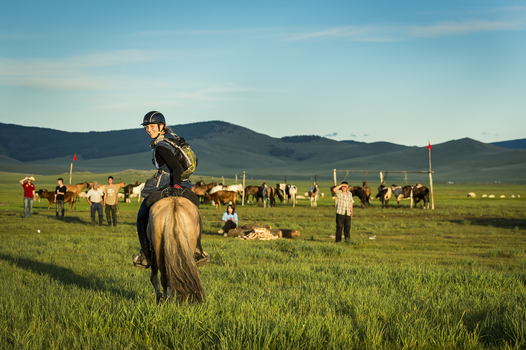
From the opening pages of Rough Magic, readers understand they are entering the mind of a unique personality. First, there are the superlatives. Lara Prior-Palmer was the youngest and the first woman to win the world’s longest and toughest horse race—25 segments totaling 1,000 kilometers on the Mongolian steppe, each ridden on a different semi-wild horse. (With a $6,000 entry fee in 2013, the year Prior-Palmer ran, and a nearly $15,000 entry fee for the 2020 race, one might also call it the most expensive.) And lastly, the subtitle of her memoir calls it the loneliest; many of those kilometers were spent without another human in sight, with only a horse to talk to.
Buy the book
Prior-Palmer describes the Mongol Derby as “a perfect hodgepodge of Snakes and Ladders and the Tour de France on unknown bicycles.” As a former horseback rider with and adventurous streak (who also happens to appreciate the Tour de France), I was predisposed to enjoy this book. But it was turns of phrases like that, I quickly realized—surprising, playful, unexpected—that were going to make me love it.
Six years have passed since her victory, secured at the audacious age of 19, during which she was able to write and publish a truly remarkable book. But the thrill of the story comes not from the fact that she won but how she did it. “Accidentally—or rather, fully intentionally,” she writes, phrasing that embodies the texture of Prior-Palmer’s storytelling: engaged, yet passive; present, yet dreamy; fierce, yet congenial.
The most popular adventure stories, to which Rough Magic has been compared, are often structured around emotional obstacles—to grieve, to overcome, to escape. Worthy projects, certainly, in memoir and in life. But the purpose of Prior-Palmer’s journey is less about the weight of the past then it is about the challenge of the present. It’s about committing fully to what’s in front of you and the emotional, physical, and spiritual requirements of going all in.
We spoke in Electric Literature’s Brooklyn office when Lara Prior-Palmer was in town for her New York book launch.
Halimah Marcus: You signed up for the Derby, as you describe it, on a whim. What do you think it is about your life experience and your personality that compelled you first to do that, and more so to actually follow through?
Lara Prior-Palmer: I was in a very constricted space in that year. I was going to university in the autumn, so I couldn’t commit to anything proper, and the pattern of my friends and I to work and then travel just felt bizarrely self-serving and to no end. I really had this urge to explode myself out of everything, and so, with that impetus, the race just walked into the stencil that I was holding. It’s a short race. It wasn’t going to take up my life.
It’s difficult because it’s a dangerous part of my personality that’s wrapped up in the potential for total lack of self-care. There’s also that part of me that doesn’t feel protective of my physical self, but is very protective of other parts of my inner psyche. But I didn’t realize the race was going to be so horrible, actually. I had no idea.
HM: What was the most horrible?
LPP: The relentlessness of it.
HM: The monotony.
LPP: Yes, monotony. Riding one horse from A to B, 25 miles farther than I had ever ridden—that’s something I would have to do 25 times in a race. So I did it once, I felt like the whole race had already happened. And it was horrible being alone and feeling neglected or self-neglected. Or like, ‘Why did I want to do this? Why did I want to put myself into this position?’
HM: I love this paragraph early on where you kind of fess up to the project of the book:
I’m telling the story about myself. There’s a British disease called modesty, which nearly stops me from sharing what I’ve written. After all, this is about an event that seemed to go well. Somehow, implausibly, against all the odds, I won a race labeled the longest and toughest in the world—a race I’d entered on a whim—and became the youngest person, and first female ever to have done so.
Given that this paragraph admits a disinclination to tell your story because of this modesty you’re culturally conditioned to have, what role did being the youngest and first woman to win play in giving you permission or an excuse to write this book?
LPP: The state of being that the race put me into that was so shocking, having grown up in London, never feeling like my life had cohesion and never having put the whole of myself into anything. The race demanded all those things. And I had such a clear memory. I just wanted to write down every sight I saw, every thyme bush I could smell.
The fact it was being written about in the media—because people love the idea of the first woman and the youngest—meant that I felt legitimate in making this an outward project rather than an inward project. I didn’t ever particularly trust the first woman thing just because, frankly, it was the horses. Why is it impressive that a woman should win it? [The equestrian sport of] eventing, as you know, is mixed. Women are often winning. My aunt was winning in the seventies.
Lara Prior-Palmer at the 2013 Mongol Derby. Photo by Richard Dunwoody.
I felt very proud that I was the youngest because I had always a faith in my naiveté and my innocence. There’s something in children that is far more mature than anything that adults have. [I believe] life is an inverse journey, and we’re eroding into something rather than the other way around. Not that we begin pure. I don’t believe that either.
One of the things that I went into the race knowing is that if I finished I would become the youngest to finish it. I really liked the idea of that because I think young people need to reclaim their authority and their power. We go to school and we get taught to listen and oftentimes we are told we don’t know anything, and I really disagree with that. I think we know so much, and we are so much.
HM: Most people don’t realize that equestrian sports are one of the few sports where men and women compete equally at the highest levels. Your aunt, Lucinda Greene, was the World Champion and the European Champion of eventing, and that’s just full stop. She wasn’t the “Women’s World Champion.” Then at the same time, there are these condescending stereotypes about “horse girls,” or girls and their horses. Your aunt was featured a photographic book called All Those Girls in Love With Horses. It wasn’t “All Those Boys in Love With Horses,” of course. Here’s what you write about that:
They intrigue me, these mini republics of equestriennes. Do women really love horses? Or do horses love women? There’s the Freudian theory that women direct their erotic energy towards horses, whereas men often relate to them through dominance . . . If horses can make us powerful, they can also make us feel powerless—it’s the persuasion required to access their power that I find compelling.
Could you expand on that? Is anything to the “horse girls” stereotype? Is it just like patriarchal bullshit, or is there something there? Is your relationship to horses different as a woman?
LPP: I’m excited to think [on this topic] with you because I felt lonely writing those parts of the book. I couldn’t find much literature out there to bounce off. Women in the horse world aren’t writing about this much. I went through that paragraph many times, trying to work out what I really meant and felt. I’m still not sure I know.
There is that horrific and condescending male voice that associates pink, purple, horses, girls, glitter, as though it’s sickening. Whereas I think anyone’s relationship with animals is a beautiful thing.
But I also mistrust when the horse is somehow filling in for something that the person can’t give to a human being because it would irritate a human being. Or it allows the person into a complete monologue because to influence a horse you don’t have to listen. You have to listen to their body, but you don’t have to listen to their words. It does allow you to love them in weird ways.
HM: I want to ask about your transformation from kind of hapless entrant to fierce competitor. How did you experience that transformation?
I really had this urge to explode myself out of everything, and the race just walked into the stencil that I was holding.
LPP: Well there’s a plumb line going through all of it which is a sort of awareness that none of it matters—if it all goes wrong, it’s okay—and that giving me faith in myself, somehow. I didn’t feel hapless really until I spoke to someone on the phone who told me I sounded hapless, a past competitor who said that you don’t have any of the right attitudes, not to mention equipment. So maybe I did feel a bit hapless, but I was used to being classified as hapless. That was something that teachers had done, that my family had done. So I knew how to inhabit it without fully believing it, I guess.
The fierce competitiveness was very human-centered. I felt very perturbed by the person who was in the lead of the race, and she lit the fire in me to go get ahead. Whereas prior to that moment of finding out she was in the front, I was just trying to get through it and not quite having a good time of it, imagining that that was the idea. Then, I just wanted to overtake her.
HM: That rival was Devan. What did she symbolize to you that stoked this competitive fire. What was it about her that made you want to win against her, specifically?
LPP: Now it all seems a bit false to me; everyone’s a human and no one wants to be irritating. At the time, I was very disaffected by what I perceived as a blindness to any other dimension of the race other than getting ahead. Someone said, “Can I ride with you?” in the beginning—because we were all trying to make partnerships—and she said, “If you can keep up.”
I was convinced she would win and she was very capable of talking about herself, and I think I got the most upset when it involved me, which is slightly, you know… That’s what it all ends up being about—me—doesn’t it? I asked her some questions one night at start camp because I wanted to find out more about her, and she didn’t ask me any questions back. I felt really unseen by her. I think I probably was quite unseen all the way until the end.
HM: Perhaps you needed to have that rival to find the strength within yourself to finish or to push.
LPP: There’s a line in the book somewhere which asks why can’t I just want to win for myself, not for the steward I have a crush on nor to beat Devan, but just my own volition and desire to put the whole of myself into something and do it as best I can.
HM: Going back to your aunt, Lucinda Greene, there’s some great kind of comic relief in the book when you ask her for advice about the Derby and she’s like, Hell if I know, you got yourself into it. What lessons did you learn from her, growing up with her, and how did you take them into the race?
I think we can all be brave if we just have the right inspiration.
LPP: I always absorbed by osmosis her way of being around [horses] and also loved to watch her riding cross-country. She just didn’t ride like anyone else and moved with the horse almost as though she wasn’t there. I was often trying to imitate her. She was my absolute idol and she just knew how to get on with it.
But also, I came to horses of my own volition and I don’t feel she has total ownership of my relationship with them. She was an idol, like a light in the distance. It’s easy to sort of say that it all harkened from her because I wanted to be her.
HM:Speaking of this instinct that she has for riding and that you learned from her and through your own riding, did that translate across all these borders? You’re in Mongolia, you’re a foreigner, you’re dealing with different kinds of horses. Was there a universal language that you found when it came to riding?
LPP: Lots of people see a horse in a field and want to be near them. Whether you’re privileged enough or can afford to do so is a whole other matter. So is there a universal horse language? There is. When I get on a horse I drop all of the sound out of my body. Because I know what the horse needs me to be and I know what horse is not going to respond to in me. It’s not utilitarian. It’s not like I want the horse to like me. It’s like the horse just puts me into another mode and I become more like a fairy around them.
[People think] these are inanimate or non-speaking beings and they don’t have voices and I think they absolutely do. That’s one of the things that I was trying to extract in the book: what all of these creatures have been saying. It’s quite easy to forget to ask them what they want or ask them what they think of you, in your head or aloud.
I remember a really scared friend; she’d come to ride recently at a place that I go to in California and she was terrified. When you’re terrified you’re trapped in yourself. Weirdly it came out of me, and I was quite forceful about it, but I just said, “Just thank the horse! He’s carrying you or she’s carrying you right now. Just say thank you.”
HM: The epigraph and the title for Rough Magic are from the Tempest,which you carried with you for the derby. Why that book?
LPP: So weird, isn’t it? In these lines like, “The isle if full of noises, Sounds and sweet airs,” there’s some musical tenor in there that felt to me like piano, a traveling adventurousness with a sort of delicate song. When I was preparing for the race I wanted things that I felt like came from the heart, because the heart is where bravery comes from and I knew that I was going to need to be brave. I think we can all be brave if we just have the right inspiration.
Last spring, I was flown to Seoul to launch the Korean edition of my debut novel, Dark Chapter. My publisher Hangilsa Press had astutely monitored the growing public response to #MeToo in Korea and had decided to not only bring forward my novel’s publication date, but also set up a full promotional “tour” for me with multiple TV interviews, public talks, and a press conference. In some ways, it was every debut author’s dream: a round-trip flight halfway across the world, five nights in a luxury hotel, guest of honor treatment throughout. It was also completely exhausting, requiring nonstop eloquence and enthusiasm about a difficult topic (my own rape)—and all this while jet-lagged, surrounded by translators. (I am Taiwanese American, not Korean American, and I don’t speak any Asian language fluently, but my Korean publisher, media, and audiences were unfazed by the language gap.)
It was simultaneously exhilarating and lonely, yet also the kind of publicity platform any ambitious novelist would love to have. But throughout most of this, a question popped up, the inverse of a more familiar one: Would my Korean publishers have done this if I were white?
I imagine most people of color living in the West have internally teased a question like that at various points in their lives: Would I have been treated like that if I weren’t Black? Would those strangers have said that to me if I weren’t Asian? Would I have gotten the job if I fit more easily into the mainstream culture—i.e., if I were white? Writers of color are accustomed to this question, too, and indeed, I asked it of myself many times while trying to find a U.S. publisher for Dark Chapter. Would this be so difficult if I were white, I wondered, or if I conformed more stringently to the narratives that white readers expect of Asian stories?
Dark Chapter struggled to find a U.S. publisher. In 2015, when it was on submission, many publishers were disturbed by its portrayal of sexual violence, which some editors considered “too real” or “too unflinching.” (An ironic comment, given how much some genres rely on sexual violence as a trope.) But the exact opposite happened in Taiwan in Autumn 2017, after my novel won The Guardian’s Not The Booker Prize. There, a five-way auction for Complex Chinese rights led to my biggest advance thus far. The Taiwanese edition of my book has just been published in April 2019. Rights for a mainland Chinese edition sold for more than twice the Taiwanese advance. Why this difference between U.S. and Asian publishers’ reactions to the same book?
You could argue Dark Chapter still falls within a tradition of “pain narratives” expected of writers of color by Western readers. But my book doesn’t directly address issues of race, even though the heroine’s identity as Asian American informs her experience of the world. It is more a story of gender and class, following the well-educated heroine’s encounter with the feral, illiterate Irish teenager who rapes her in Belfast. If my book were more overtly Asian (instead of inhabiting the amalgamated, international background that I come from), would American and British publishers have known how to market it more easily as literary fiction? If writers like Lisa Ko, Chang-Rae Lee, and Amy Tan address the immigrant experience, are all writers with Asian last names expected to as well?
The total advances from my three Asian publishers exceed the total advances from my nine Western publishers.
It seems to be a very different experience for Asian American writers in Asia. While on my Korean book tour, I encountered a very unfamiliar notion of privilege: in addition to losing out on opportunities because I wasn’t white, I was also getting new opportunities precisely because I was Asian American. The total advances from my three Asian publishers exceed the total advances from my nine Western publishers. And like my Korean publishers, my mainland Chinese publishers are hoping to fly me to Beijing to promote the novel. I can’t help but notice that the only publishers to have invested in a promotional tour thus far are Asian.
The cynic in me focused on the “optics” of marketing authors, but when I got to Seoul, I realized there may be some deeper emotional truth in promoting an Asian American female author to other Asian women. Since my book deals so directly with the painful, often private trauma of rape, I believe it meant something to potential readers in Korea—specifically female readers—to see an author who looked like them. As if our shared experience of womanhood, gender inequality, and (for some) sexual assault, somehow felt closer to theirs, because we were the same race.
Nominated for an Edgar Award in 2018, Dark Chapter is a fictionalized retelling of my own real-life stranger rape, but imagined equally from the perspectives of both the victim (a character with strong parallels to myself) and the perpetrator (in real life, an Irish teenager who stalked me in a park). It is set largely in Northern Ireland (where my rape took place) and London (where I lived at the time, and still do do now), so there is no direct connection with contemporary Korean or Asian culture, save for the fact that the victim, Vivian, is Taiwanese American.
But even this representation of Asian womanhood seemed to be something Korean women readers identified with, particularly around a subject that carries such a cultural taboo. During my promotional tour, Korean women lined up at the signing table, some of them sharing their own stories of sexual trauma with me. Some would cry, telling me how grateful they were I had written this book. My literary translator, Byeol Song, is herself a rape survivor and public about this—and I, in turn, was grateful for the emotional authenticity she gave to the Korean edition. Elsewhere on my tour, I conversed with leading feminist scholar Dr. HyunYoung Kwon-Kim, participated in a special discussion with women journalists, gave a lecture for Women’s Studies Masters program, delivered a TED-style televised talk. At night in my hotel room, I cried on my own—partly out of sheer exhaustion, partly out of the chance to connect with these women living on the other side of the world, Korean readers I wouldn’t have otherwise met.
If I were white and talking about my rape, would Korean readers have thought my life experience was too different from theirs to relate to?
My professional life in London often involves enabling conversations among rape survivors. Predominantly, participants in these conversations are white, although there is certainly ethnic diversity. But my experience in Korea raised another question. Because sexual assault is so deeply personal, do people naturally feel drawn to someone whose experience seems closer to theirs—because of how they look? If I were white and talking about my rape, would Korean readers have thought my life experience was too different from theirs to relate to, despite also being a rape survivor?
Strangely, I, too, found myself being more honest about being an Asian American author in the West, when Korean audiences asked me about it. I said that writers who looked like me were often expected to write about “being Asian,” rather than a more “universal” experience like gender or sexual assault.
It was the first time I felt I could even mention that publicly when discussing the book. To a more general, Western audience, I worried that such thoughts might label me a whiney or ungracious minority writer. But in Korea, I sensed a duty to be honest about the kinds of unspoken discriminations that still happen to women of color in the West. Perhaps I myself perceived a sense of kinship with these Asian women. Perhaps the optics affect all of us—even the most cynical—into an imagined sympathy with those who look like us. And yes, visibility matters. Even a symbolic visibility enables an author to connect with an audience.
Even a symbolic visibility enables an author to connect with an audience.
I am glad my Korean publishers recognized the value of promoting an Asian American female author to Asian women readers, but our readerships shouldn’t be limited by race. It is truly a shame if Western publishers perceive a problematic gap between the race of an author and the race of a book’s intended readers—because there are readers of all ethnicities in the West, and we are all capable of empathy. And literature, after all, is meant to transcend such human particularities. As a Taiwanese American girl growing up in the U.S., I certainly identified with characters who didn’t come from a world anything like mine: Scout Finch, Holden Caulfield, Bigger Thomas. And indeed, it works the other way around. I’ve had white male readers say that reading Dark Chapter made them understand a bit better what it’s like to be a woman, who cried reading the scenes of the heroine’s experience of the criminal justice system. So if they can identify with a Taiwanese American heroine, then that’s already one step towards progress.
Looking ahead, I am curious to see how my Taiwanese and Chinese publishers will handle Dark Chapter. (Of the ten book covers finalized so far by international publishers, only the Dutch one explicitly shows an Asian face in the cover design). My mainland Chinese publisher will roll out the Simplified Chinese edition to billions of potential readers later this year. A British-Vietnamese producer is optioning the film rights. And, as I write my second novel, I also wonder if it’s a disadvantage with Western publishers that my work doesn’t address ethnic identity more explicitly. Should I write what’s easier to market by an Asian American author, or what truly interests me? Of course, it’s the latter. As I’ve been told time and time again by other writers, you just have to hope your work will find its readers. Regardless of your race and theirs.
Novel Gazing is Electric Literature’s personal essay series about the way reading shapes our lives. This time, we asked: What’s a book that changed your mind?
My first night in the hospital, I sleep on a gurney in a room imbued with the scent of hopeless men, the sounds of adults bawling in agony. The man adjacent to me, doughy and pallid, a homeless schizophrenic who has ingested some bad drugs, keeps muttering about humus and the mysteries of women’s bodies, about how he’s Jesus, how he’s going to kill the people that only he can see. Quiet finally comes when he’s tranquilized into insentience.
I curl up, feeling prenatal and pathetic, and face the wall. The hospital thrums all night, bodies in perpetual motion. A young girl on suicide watch tries to walk out the door and is apprehended. As two men escort her back to her room, leading her past my gurney, I can see her forearms mottled with scars, her eyes dark and sunken into her head.
In the photograph on my hospital bracelet, I’m snarling.
In the morning I go to the in-patient psychiatric unit, still wearing the clothes I arrived in. It’s a place of penitentiary gloom, free of lusts and luxuries. A blue gauzy shirt, three sizes too big, is draped over me; all of my things are locked up.
It takes a day to really assimilate into the unit. I’m initially hostile to the staff, and one of the patients, a bearded and garrulous man who’s been here for two weeks and will remain here for another three (this is his seventh or eighth stay in the unit), comes up to me and asks, sharply, “What are you doing here? You don’t belong here.” I threaten to break his face. I’m escorted to my room.
The unit can be broken down into three sections: the bedrooms, which I avoid because sharing quarters with three noxiously flatulent psychotic men who thrash in their sleep and openly masturbate is not conducive to a good night’s rest; the hallways, in which patients pace and lurk and occasionally sleep, all furled and exposed and uncaring; and the Dayroom, in which a television acts as electronic idol—it is to the patients what the Monolith is to David in Kubrick’s 2001.
With its hermetic atmosphere and unusual internal logic, the unit feels like the setting for a chamber drama, replete with a cast of tragicomic characters. Some patients burst into chortles, bouts of unending histrionics, for no discernible reason. Other patients sleep their days away, emerging only to eat, then receding back like the tide. Some amass trays of food in their rooms, flies doing curlicues over the remnants. One woman, with the sallow complexion of a nun, has revealed—during a movie about alien abductions, apropos of nothing—that she was raped by her uncle, and that her swollen belly may, in fact, contain his child. The older men in the room respond with skepticism and mirthless chuckles.
Being a city hospital, the unit lacks most amenities: salt, internet, phones, deodorant, shoelaces. You don’t realize how much you’ll miss these things until they’re gone. Garishly lit, and locked at both ends, the long halls have a sealed-off feeling. They’re the color of dirty teeth, often fetid, filled with the effluvia of bodies losing control.
The in-patient psychiatric unit of the hospital is a place of rigorous regulations. Maroon tape sections off the nurse’s station, sequestering the patients. The chairs are surprisingly heavy, so that patients can’t throw them. The mirrors are dented plates of aluminum. Patients adhere to strict routines; if dinner is served several minutes late, tantrums are thrown. When the food arrives, it’s all complaints about the blandness—every day, with little alteration.
Wall-eyed and languid, sapped of energy by exhaustion and medication and sleep deprivation from sharing a bedroom with volatile and vociferous men, I spend my first day wandering the halls.
My lone, loyal companion during my stay is a book, a copy of William Styron’s Darkness Visible, which I picked up the day of my unwitting arrival from a bookstore in SoHo. I had spent the previous two weeks sleeping on friends’ couches and working as a customer service representative for a meal delivery company, spending my days answering emails and phone calls from customers vexed over the quality of their avocados, and doing cheap cocaine by myself in dive bar bathrooms to mitigate the feeling of failure that clung to me like stale cigarette smoke. The job numbed me; the drug obliterated the haze like a great beam of light from a lighthouse. When my boss, a stoical, laconic man who had been with the company since its embryonic stage, called me into one of those homogenous glass conference rooms, I knew what was coming. He asked me if I was happy. I said, Yes. He said, No you’re not. He said, We want our employees to be happy. So, after assuring me that my work had been very good, he nonetheless fired me for “being unhappy,” for bringing down the morale of the team.
When I found Styron’s memoir, I felt an epiphanic pang: this should be the last book I ever read.
The emasculating feeling of having been fired from a minimum wage job for being “unhappy,” and the more pragmatic problem of now having no source of income, commingled with the still-lingering malaise of having been dumped by my on-again off-again girlfriend several weeks earlier. An aphotic darkness, heavy and impermeable, pervaded my mind. A coterie of friends met up with me at a bar, where I, ripped on my favorite palliative, I desperately, futilely tried to use a torn can of Modelo to carve up my forearm in the sordid bathroom, an inane idea whose Sisyphean hopelessness seems, in retrospect, sort of silly. The next day, compelled by notions of self-destruction, I went to the bookstore, where I spent many afternoons typing fervently, thinking of myself as a writer, seeking solace in the pages of books. I was flummoxed, unsure of what to do with myself as I felt the end encroaching. I perused the great variegation of books. When I found Styron’s memoir, I felt an epiphanic pang: this should be the last book I ever read. I bought the book and shoved it into my bag, ensconced between an antiquated iPad and a notebook rife with the scrawlings of coke-induced mania.
That night, I went to a friend’s apartment, where I was ambushed by a gaggle of friends who, after an intense confrontation during which I almost punched one of them in the face, put me in an SUV and took me to Bellevue.
At the hospital, a man searched my bag, cataloging everything so they could store my stuff in a giant paper bag in a room rife with evidence of an outside world. When I saw Styron’s book sitting there amid the miscellany of items, I asked if I could bring that with me, so I at least have something to read. After a prolonged moment, they said yes.
For the duration of my stay, I carry the book everywhere, tracing the letters on its cover with the bulb of my thumb, flipping its pages and listening to the paper rustle. (There is a tiny library in the recreation room, though most of the books are bedraggled and battered, pages torn out, books left disemboweled, which contains, inexplicably, a pristine copy of Jonathan Franzen’s The Corrections, Oprah’s seal of approval adorning the cover, as well as a bevy of coloring books whose pages are already violently mottled with crayon and marker. Seeing the carnage, I keep my own book close.) Like Andrew Solomon’s The Noonday Demon, Styron’s splinter of a memoir taps into specific but familiar feelings of despondency, and, eventually, hope.
Initially, reading it is difficult, my brain not yet used to the drug they’re feeding me. My thoughts are soupy, a fog of confusion; words waver and swirl around the page. “The madness of depression is, generally speaking, the antithesis of violence,” Styron wrote. “It is a storm indeed, but a storm of murk.” But Darkness Visible cuts through the brume. As nothing sharp is permitted here, I feel a twinge of satisfaction at having snuck writing so lacerating into the unit. I chose Styron’s memoir as the last book that I would buy, the last I would add to my shelf, surrounded by wayward piles of hardcovers and softcovers and dog-eared mass markets, hundreds, some unread, some read repeatedly, but in the hospital, the book becomes something more, something almost transcendent: a source of familiarity, a relic from my outside life; it reminds me that I want to write, and that if I let the life drain from me, I will not be able to. In this sense, William Styron helps keep me alive.
The book reminds me that I want to write, and that if I let the life drain from me, I will not be able to.
If the stigma surrounding depression has been ameliorated in the almost 30 years since Darkness Visible, there still comes with the disease, like a parasite attached to a host, a sense of embarrassment and shame. You can see it on the faces of your friends when you try to tell them how you feel, their mouths contorted into looks of discomfort, their reticence exuding an air of apathy. The disquieting silence can make the depressed feel even worse for having become a burden. Reading Styron, I feel as though I’ve gained a new, caring friend, someone who understands. When I try to write about my own emotions, I don’t feel as narcissistic or melodramatic because Styron felt that same compulsion. Once the fog in my head started to dissipate, the medicine (an antidepressant, of course, and a small dose of an antipsychotic to mollify the mania to which I was occasionally prone) now working, I was able to luxuriate in Styron’s writing, able to write myself.
In 1990, during a radio interview, Styron described the disease: “I think the closest I’ve ever been able to hit upon an analogous pain is that of suffocation or of being in prison in an intensely hot room from which there’s no escape. It’s that kind of sort of diabolical discomfort.” I feel such a diabolical discomfort in a small, hot room, sudorific, the air stagnant and room suffused with the smell of sweat and flatulence. I want to cover my head with a pillow, but it’s too hot. I lay furled on the long, narrow bed, trying to ignore the sound of slick skin and enlivened breathing. My roommate hordes his food, leaving a pile of partially-eaten sandwiches, cookies, apples on the small table between our beds. A flotilla of flies accrues. I take one of the half-dozen wrapped cookies he’s stored in a pile. When he returns to the room, vexatious, bellicose, screaming about the missing cookie, they move me to a different room, one with four other roommates, none of whom ever leave their bed. In order to read, in order to live, I have to escape the hot room.
From the book:
A phenomenon that a number of people have noted while in deep depression is the sense of being accompanied by a second self—a wraithlike observer who, not sharing the dementia of his double, is able to watch with dispassionate curiosity as his companion struggles against the oncoming disaster, or decides to embrace it. There is a theatrical quality about all this, and during the next several days, as I went about stolidly preparing for extinction, I couldn’t shake off a sense of melodrama—a melodrama in which I, the victim-to-be of self-murder, was both the solitary actor and lone member of the audience.
Depression expunges from my mind any sense of lucidity; it is a roiling fog permeating my skull, leaving me unable to write. Words elude me, seem to evanesce. Styron’s writing cuts through the brume, and I am able to write again, scribbling my thoughts on anything I can find—paper plates, napkins, the cardboard sleeve from my doctor’s coffee. They give me a felt-tip pen, so I can’t stab anyone, and eventually some sheets of paper, which I festoon with slovenly handwriting, words fervidly scrawled before they disappear into the bog in my mind. According to James Salter’s review of Styron’s collected letters, the bibulous writer, who penned all of his works in longhand on yellow legal pads, found writing to be the hardest thing in the world, each word “sheer pain.” Yet it was the only thing that made him happy. Writing about my time in the hospital, about the influence of Styron’s book, makes me feel like I have a second self, like I’m writing about a character conjured from my imagination. There’s a sense of distance, of dislocation.
In Styron’s exacting lyricism, I find hope, a companion to my pain.
My hasty scribblings and Styron’s book are the only things I take with me when I leave the hospital, my hair an oleaginous mess, my friends relieved that I’ve seemingly climbed out of that dark pit of despair. I usually find Styron’s prose irritatingly loquacious (e.g. Lie Down in Darkness), but his writing about depression touches me, cuts me deep. In Styron’s exacting lyricism, I find hope, a companion to my pain. Depression is a selfish disease. You succumb to solipsistic thoughts, luxuriate in self-pity. It is a malady you can never truly mitigate, an affliction of histrionics and hyperbole, that sense of “melodrama” which Styron couldn’t shake off. Reading Styron’s descriptions of something I had tried but failed to articulate so many times, I feel less alone. All of the ineffable feelings I’ve felt are articulated with eloquence and precision and empathy in Styron’s book. I have wanted to be a writer my entire life; in my second grade yearbook, where it asks what I want to be when I grow up, I wrote, “A writer.” But everything I write seems to return to depression, the most loyal partner of my life; in Styron, I find, for the first time, writing that earnestly, honestly captures how I feel. It gives me an impetus, an inspiration.
The book now resides on the top shelf of my bookcase, nestled between similarly lissome paperbacks by Paula Fox and Renata Adler. When I feel, as Melville said, grim about the mouth, I turn to Styron’s memoir, as some turn to prayer. It is a beacon of hope for me, the light in the darkness.
There is an area of Central Park called Cherry Hill, located just above the Lake and east of Strawberry Fields, that is covered in a ring of its namesake trees. Ignored most of the year in favor of bigger, flatter picnicking spots like Sheep’s Meadow or the Great Lawn, Cherry Hill is overrun with visitors for a few weeks each spring. On a recent walk, I saw an engagement shoot, a couple taking wedding portraits, and a dozen tourists crowded under the pink boughs, all angling for a photograph that didn’t include someone else’s head. But soon the trees shed their petals for leaves, and now people indifferently pass by the slope, looking for the next Instagrammable shot.
The drawbacks of treating life like a highlight reel are becoming increasingly obvious, and not just to the people who have tried to do yoga in the Central Park rowboats. Many of us are trying to be more “present,” a term beloved by wellness blogs but which can be frustratingly hard to enact. What does being present look like? How do we attain this kind of tuned-in mentality? There are answers in a niche type of nature writing which I think of as field guides to being present.
Put simply, these books do what great literature does best: blend form and function. Their language is evocative and poetic, their writers generous, inquisitive, and open. For most us, it’s impossible to move to a secluded landscape and closely observe it for a year, but we can all be more engaged in the world around us. We can ask questions and observe, because the more we notice, the more we get in return.
Like much of contemporary nature writing, this genre has strong ties to Henry David Thoreau. When Thoreau wrote Walden, his famous memoir-cum-manifesto about the two years he spent living at Walden Pond near Concord, Massachusetts, he obsessively detailed the natural world around him, tracking the changing colors of the pond water to the migration patterns of local birds. By capturing this “raw” wilderness (which actually wasn’t that far from town), Walden famously helped spread the idea of Transcendentalism, a social and philosophical movement that emphasizes the individual’s connection to nature. But Walden also helped popularize a literary genre in which a writer carefully observes a specific environment over a limited amount of time, usually one year.
Thoreau’s experiment at Walden Pond has inspired many nature writers, though the beauty of examining such a specific, and therefore unique, landscape, is that each writer inevitably comes to the format in their own way. Take Annie Dillard. Dillard won the 1975 Pulitzer Prize for her book Pilgrim at Tinker Creek, which captures a year spent at her house in Virginia’s Blue Ridge Mountains. Dillard combines David Attenborough’s passion for natural dramas with the voice of a poet; her prose is lyrical yet raw, and her description of the creeks—“an active mystery, fresh every minute”—could actually describe the book itself. The race to capture cherry blossoms would be anathema to Dillard, who is electrified by every aspect of her environment, and who keeps her eyes open for its surprises. For example, on the night that Dillard goes looking for muskrats, she fails to find any, noticing instead a small insect’s unlikely and inspiring escape from a spider’s web. Dillard is free from the constraints of expectation, which allows her to appreciate life’s many surprises.
Henry Beston was also trying to free himself. The year he spent living on a beach in Cape Cod was a respite from a country that was between World Wars and “sick to its thin blood for lack of elemental things, for water, for air, for the dear earth itself underfoot.” Beston recorded his observations from his isolated beachfront cottage in The Outermost House. Without a schedule or concern for time in a conventional sense, Beston’s work feels expansive and elemental. A pattern of waves might interest him for pages whereas his lunch is briefly mentioned, if at all. Of spring sand he writes, “it has entirely resumed its looseness, its fluidity, but the color still tells of winter in the faintest hint of grey.” Turning this kind of lens on something as seemingly mundane as sand is a lesson for the reader. After reading The Outermost House, it’s hard to step on a beach without thinking about how sand changes throughout the year, and then noting that day’s weight, color, and feel underfoot. To see just how much of an impact Beston had, you only have to look at the land he wrote about. The Outermost House is credited in the establishment of the Cape Cod National Seashore by John F. Kennedy, and Beston’s cottage was a national literary landmark until the 1970s, when it was tragically washed away in a storm.
What if instead of waiting for the next big event, you carefully noted the progress of everything around you, down to a single plant? That’s what David Haskell did in his Pulitzer Prize-nominated book, The Forest Unseen, A Year’s Watch in Nature. Haskell marked off a one square meter plot of land in Tennessee’s Smoky Mountains and obsessively monitored everything that went on in this small ecosystem. As the Professor of Biology and Environmental Studies at the University of the South, Haskell is well-versed in the science of the forest floor, and his goal is to show us how nature is constantly in flux (lichen, for example, may look like a smear on a rock, but in some ways it’s actually busier than a tree, constantly altering its appearance based on the weather.) We might not all be scientists, but we can all benefit from this scientist’s mentality, and celebrate small changes rather than waiting for something huge.
During the 1950s, Edward Abbey worked as a seasonal ranger for the United States National Park Service at Arches National Monument in Utah. His account, Desert Solitaire: A Season in the Wilderness, is a series of vignettes, including beautifully rendered descriptions of the unusual, arid landscape. Abbey, like Haskell, has a keen eye for what’s changing in his landscape, especially when it comes to what’s in decline or already gone. When he realized he wasn’t spotting as many bobcats or other large predators that historically ruled the park, he tracked their loss to the Department of Agriculture’s policies, which not only endangered some species but led to an explosion of rabbits and deer that threatened the park’s whole ecosystem. Abbey’s critical probing of what he sees is an important reminder of the reason why being present matters at all; it allows you appreciate what we have before it’s gone.
The Boundary Waters is a one million-plus acre wilderness area in the Superior National Forest in Minnesota. Despite some government protection laws from 1964, it’s seen years of disputes over actions that would destroy the landscape, including mining, vehicle use, and pollution. When Amy and Dave Freeman learned that toxic mining had been proposed for the area’s watershed, they decided to call citizens to action by spending a year in the area and documenting their experience in its wilderness. The resulting book combines both nature writing and activism; it beautifully captures the flora and fauna which are so at risk—loons skating on misty water, the wolves who trailed them through the forest—and helped spur an ongoing, organized effort to save the Waters and ensure their permanent protection.
When Michiko Kakutani named an English shepherd’s farming memoir one of her best books of 2015, people took notice. In fact the book had already been a success in Britain thanks to its incredibly honest, authentic, and moving portrayal of an ancient way of life. James Rebanks herds his sheep in the Lake District, a unique mountainous landscape which has been farmed by small homesteads for generations. Rebanks himself is an unlikely character, a man who comes from a long line of shepherds and loves his work, but also found his way to Oxford and writes as well as any experienced nature writer. What comes through most in this book is Rebanks’s deep appreciation for what he has, even through its many hardships. Every season presents new challenges, but that only means more moments of success.
for a snow that didn’t come – instead, the clouds grew
varicose with rain.
I turned twenty-one and my father watched me drink
a glass of wine with his best friend,
at a table worn rough by years of dinner. This friend had trouble sleeping, and when he died
we read his journals: read catalogues of light,
the position of his head, the weight of blankets; he’d kept volumes to determine
what might let him pass into that state –
yet in Vermont, he claimed he slept like a dream, the four nights we stayed.
Remember, he wrote, in a journal we found,
the image of Natalie and Beatrice hugging in the morning. They were so beautiful. They had such ease and acceptance. Something I have never felt. Reminds me of my mother when I was young. I’m crying on the flight from Spain to Paris.
When I was ten, and flying into Iceland,
we saw below us a flaming house in the midst of a black field,
and the lights of fire trucks, too far away –
I imagined I could hear them wailing as they crawled their tiny way across the earth.
Loneliness is not a passive feeling;
it has teeth, it chews, and I believe we take some power from it,
from how it puts its mouth around our heads
and forces us to stare into the complicated tunnel of its throat.
We cannot hide if there is no one looking,
and the lonelier we are, the more we ask, who am I, to myself? Though perhaps the question ought to be,
who am I, to the winter?, and the answer – in its coldness – nothing –
might hold the truth to shrink our grief.
Vinegar Ghazal
To preserve this sight, please drop my eyes – like spring’s green fruit – in vinegar.
I’d put aside my wine for memory, and drink only thin vinegar.
New owner of antique furniture: do chairs remember bodies once held,
Do beds remember dreams of falling, or the taste of love’s skin-vinegar?
At the carnival of my ex-lovers, I watched you toss a ring: your prize?
An oak barrel of satisfaction, while you watched me win vinegar.
How did I come to be? I was distilled from yeast and sugar, heated
To a potent soul. If left too cold and still, I’d have been vinegar.
A doctor came to town and drew the crowds, crying Cure Your Loneliness
With this proprietary blend of blackened oats and Berlin vinegar!
At the café by my house, where I am known, they give me bread and oil
When I sit. They bring me salt. But they withhold my passion: vinegar.
Attic-bound, I write a drama for four sisters – wool blankets gown us,
Bittersweet piano trails the sour flute, the violin vinegar.
To make a sword that’s forged from blood, extract all iron from the body’s Veins.
To make a knife from wine and ire, harvest grapes and smelt tin vinegar.
I walked across a grassy field to find the marble entrance of your
Crypt, and moved the stone. A dark room; your casket; and therein, vinegar.
Let me tell you what I look like with my clothes off. My eyes are rabid
Mice, and above the unset table of my chest, my grin’s vinegar.
Sanded down with thirst, how I long to be invited – Dear Emma, drink
This vintage and ascend, do not content yourself with maudlin vinegar!
Tim Maughan is a technology reporter and fiction writer whose first novel, Infinite Detail, is about an apocalypse many of us dream about. A group of radicals in Bristol use a computer virus to destroy the entire internet, sending our hyper-connected society back to the pre-information age. We follow several characters in the U.S. and England as they cope with what often feels like civilizational collapse, and try to rebuild. Angry, keenly observed, and satirical by turns, the novel explores where contemporary digital politics might lead us. I talked with Tim over the internet, using a device he’s destroyed in his novel, to talk about political science fiction, smart cities, and why dystopia has hope at its core.
Annalee Newitz: As I was reading this novel I kept thinking of the term “cyber-communism.” There are a lot of little strands of cyberpunk in this novel, but it’s really quite different from what’s gone before in the genre because of this really strong focus on leftist politics that are named as such. These aren’t allegorical politics; they grow out of what’s happening politically right now. What are the kinds of political issues that you wanted to tackle, and how do you see them growing out of current issues?
Buy the book
Tim Maughan: It’s not because I want to be disrespectful to the kinds of science fiction that uses metaphor and tropes to discuss current political issues, because science fiction does that, even inadvertently. But that doesn’t appeal to me as a writer. I do enjoy reading books by [Ursula K.] Le Guin and classic science fiction books that tackled social and political issues through metaphor. But I want to write stuff about now that’s explicitly about now, that is kind of putting that out on the table and saying that this is what I’m doing. William Gibson had a tweet a few years ago, after I had already started this book, and he just summed it up perfectly. He said, cyberpunk isn’t particularly relevant anymore, but the tools that cyberpunk created—those narrative tools—he said he would like to see literature use those tools to explore our current situation. I thought, “Ah, that’s what I’m doing!”
AN: So I want to tease this out a little bit. What are the specific political movements you’re thinking of? We have this autonomous community in Bristol, where we spend a lot of time in the book. Are they anarchists? Are they cyber-communists? How would you describe the politics of that group?
TM: Kind of all of the above, really. And that idea came out of the community that I’ve been knocking around in for the last few years. I get invited to events that are this weird mixture of academics and people who call themselves futurists and artists. And it really came out of seeing artists in Europe, going to events in places like Amsterdam and Berlin, or Eyebeam in New York City where I used to hang around a bit. It was really exciting to see artists engaging with these issues, sometimes in very direct and forthright ways.
A person who is a huge influencer on the ideas behind this is Julian Oliver. He’s a New Zealand artist based in Berlin. A lot of his stuff has to do with jamming the internet, disabling WiFi networks, or replacing WiFi networks with other content in public spaces or in gallery spaces. He did a piece that’s like a remote control tank and you can drive it round and it blocks all the WiFi networks within range. He was trying to get people to confront and look directly at these infrastructures that are affecting and monitoring and essentially controlling them.
That was the core inspiration behind New People’s Republic of Stokes Croft—which is a real thing, I should point out. There is an organization in Bristol on Stokes Croft called the People’s Republic of Stokes Croft who are a local anarchists and community group, who do a lot of work in that area. So part of it was growing up in Bristol and seeing that conflict between community groups and social justice groups and anarchist groups and the local community around them. Because Stokes Croft used to be a very working class and very non-white neighborhood traditionally in Bristol.
AN: Cities themselves become characters in this book, and I love the fact that you have city hackers instead of traditional computer hackers. Of course they’re hacking the internet, too, but it’s ultimately city infrastructure hacking. Bristol does become a kind of character, especially as the novel goes on, as we come to understand how it’s changed and how it’s survived the apocalypse. I wondered if you could talk about why you wanted to really hone in on city hacking as opposed to looking at, let’s say, Twitter or other social media.
The crux of the book is that this technology affects people who don’t understand it or even know that it exists and then abandons them.
TM: I was writing this book for a long time, and it changed thematically early in its conception. I personally became very focused on the concept of smart cities and then looking at and writing critiques of the smart city model. It’s interesting that you talk about the cities as characters because the critique of smart cities that interests me the most is that smart cities are generic solutions. They view cities as problems and that there is a generic, off-the-shelf solution for them. That’s kind of the smart cities philosophy. But cities aren’t all the same, in terms of their communities and conflicts. So partly my aim was to give Bristol, and Brooklyn to a lesser extent, a kind of feeling that it was a unique place and couldn’t be pigeon-holed like that. And secondly, it’s a good literary device to get away from boring hacking scenes. People complain that hacking does not translate to the screen, but it translates to novels even worse now. Anyone who tried to read that terrible Bill Clinton hacking novel that came out last year can tell you that.
AN: Wow, did you actually read that? Good job. [laughter]
TM: No! I didn’t, I didn’t. A friend of mine did, and screen-grabbed lots of pages of it to Twitter and it was like, “Oh my god. I hope my book doesn’t read like this.” Because it’s hard to explain hacking concepts, right? And there’s a couple of times in the novel I have to do an infodump and explain what ransomware is, or what the internet of things and backdoors are. And it’s not fun writing that stuff. It’s very hard to do it.
AN: One of the images that really stuck with me from the novel is quite early on when one of our hacker characters, Rush, is in Brooklyn, and he is helping a homeless guy who’s collecting cans. All the cans have RFID tags, and the guy can’t turn them in for money anymore because he can’t prove that he bought them. So Rush takes basically a magic wand out of his pocket, which is an RFID hacking device—it’s an antenna—and he waves it over the cans and quickly resets all of their IDs. And as you’re reading the scene and imagining it—he looks like a wizard, and he is part of, I think, this strong current in the novel of magic realism, where we’re seeing a lot of characters respond to technology as magic or describing it as magic. They even describe branding as magic. There’s a lot of imagery of magic in the novel, and I wonder why did you want to do that? Is part of your point that we have to have this apocalypse partly because we are getting caught up in seeing this technology as magic, or is magic actually a kind of hopeful way of looking at technology? Tell me all about techno-magic.
Spoiler alert! There’s a glimmer of hope in all my writing.
TM: Exactly. Yes is the answer to both those things, I think. Some friends of mine, Natalie Kane and Tobias Revell, created a piece of work called Haunted Machines. Their interest is in how technology is perceived in magic, and what the intentions are for that. It’s something that goes back to the Apple catchphrase: “It’s just magic. It just works.” The idea of technology being magic also obscures how it works and where it is in the environment—it gets back to all those issues we have with urban infrastructure, especially surveillance.
What’s important about that scene where Rush is playing the wizard and magically fixing these cans is that the canner Frank doesn’t understand what the hell he’s doing and thinks Rush is crazy, right? And that’s the crux of the book, that this technology affects people who don’t understand it or even know that it exists and then abandons them. I kind of wanted the reader to be introduced to this character of the canner Frank, maybe have some empathy for him or maybe not because he’s a bit old and crotchety and maybe a little bit racist, even, if you read between the lines. But I wanted readers to see that he’s a person who has a role in society who has just been abandoned because of technological progress. And I think the magic thing plays into that. Magic is an interesting way of explaining technology as a metaphor, but it’s also a way of obscuring and denying us understanding of how it works and its implications.
AN: One of the ideas in the book is the radicals have destroyed the internet through what is basically a magical piece of technology. We have this magical reset where we don’t have the internet anymore, and then one of the themes that we see again and again in the book is that even though there has been this huge change, people keep making the same mistakes and trying to rebuild the machines that caused their problems in the first place. This fits in with your idea of magic, because it appears that we never really understand what the problems were in the first place.
TM: Yes, exactly. And it’s that lack of understanding about what we’re doing that leads to [the radicals] not having a plan for afterwards.
AN: Yeah, that was so interesting to me. I wonder if you could talk about that idea of not having a plan for afterwards.
Dystopias are about imagining change because the characters are trying to imagine something different to what’s being presented.
TM: So, as I was coming towards finishing the book, I wasn’t quite sure how to tie it up at the end and I knew I wanted to make a point about failed revolutions and stuff. Around that time, Astra Taylor wrote this fantastic article for The Baffler called “Against Activism.” It was about the difference between activism and organizing, and it was just brilliant. Everything clicked into place, and I said, “This is what the ending of my book needs to be about.” Protesting is important, it’s vital, it’s empowering, but without organization alongside it, without long-term organization, it doesn’t often count for much. A similar argument was made by Adam Curtis in his last film. He makes the argument that in the sixties, a lot of bourgeois white people dedicated their lives to the civil rights movement. They dropped out of their careers, they turned their academic and legal practices over to just the Civil Rights Movement in the U.S. Because they were able to have the white privilege to go to do that. But he argues that now, because of network culture, we’ve moved away from that. You can easily be involved in protests, but it doesn’t have a lot of the same long-term impact.
I was at an event giving a reading last year, and someone asked, “Do you consider yourself an activist?” I said no partly because of Astra Taylor. I’m not an activist. I write fiction, which is an incredibly selfish and narcissistic thing to do. Real activists, real organizers, dedicate their lives to these issues and I think that’s a really important distinction to make. In the Curtis documentary, he talks about “Occupy” a lot and how “Occupy” was incredibly exciting at the time. I was back in the U.K. when it was happening but little Occupy movements were springing up over there and it was very exciting to see people come together and kind of give up their lives to a certain extent. But the lack of focus and organization beyond that is why it didn’t work. That’s the argument Adam Curtis makes. I wouldn’t want to be as dismissive to Occupy as he probably is, but what he says rings true to the larger extent. Occupy is criticized a lot for not having a firm set of demands. And what came next? Well, what came next was a few people, the leaders of the movement, have lucrative speaking careers or work at Google. So I kind of wanted to tap into that a little bit and say, “Look, it’s exciting for us to have moments we can participate in activism through the internet, but unless we have a long term plan about what we want to see as a replacement for it, it’s almost as useful as being apathetic.”
AN: I want to circle back to something that you said just earlier. You said fiction is navel-gazing. But at the same time, you’re saying, well the problem of these movements is that they want to tear something down, but they don’t have this long term plan. Don’t you think fiction is part of the process of coming up with the long term plan? You first have to imagine something coming next. You can’t—
TM: Yeah, I think you’re right. And the aim of the book wasn’t to do that specifically, but it is there, right in the very end, on the final pages. Spoiler alert! I think there’s a glimmer of hope in this book. There’s a glimmer of hope in all my stuff. I get called dystopian a lot which is a term I don’t feel particularly comfortable with.
AN: Yeah, I always tell people it’s more like “topian.” There’s some good and some bad, just like the present. [laughter]
TM: Yes, exactly. I think that there’s a glimmer of hope in dystopia from the start if you’re going to use that term. Dystopias are always about someone trying to push back against the system even if they fail and that is hopeful. Dystopias are about imagining change because the characters are trying to imagine something different to what’s being presented. So yeah, I think fiction’s incredibly important in doing that and, like you say, it’s a really good structure for exercises about alternate futures. Will I write one specifically like that? I don’t know, maybe. I might have a book somewhere down the pipeline that’s almost explicitly doing that but right now it feels like the urgency is on pointing out problems. The point of Infinite Detail is that it’s vital that we have alternatives.
DON’T MISS OUT
Sign up for our newsletter to get submission announcements and stay on top of our best work.
YOUR INBOX IS LIT
Enjoy strange, diverting work from The Commuter on Mondays, absorbing fiction from Recommended Reading on Wednesdays, and a roundup of our best work of the week on Fridays. Personalize your subscription preferences here.