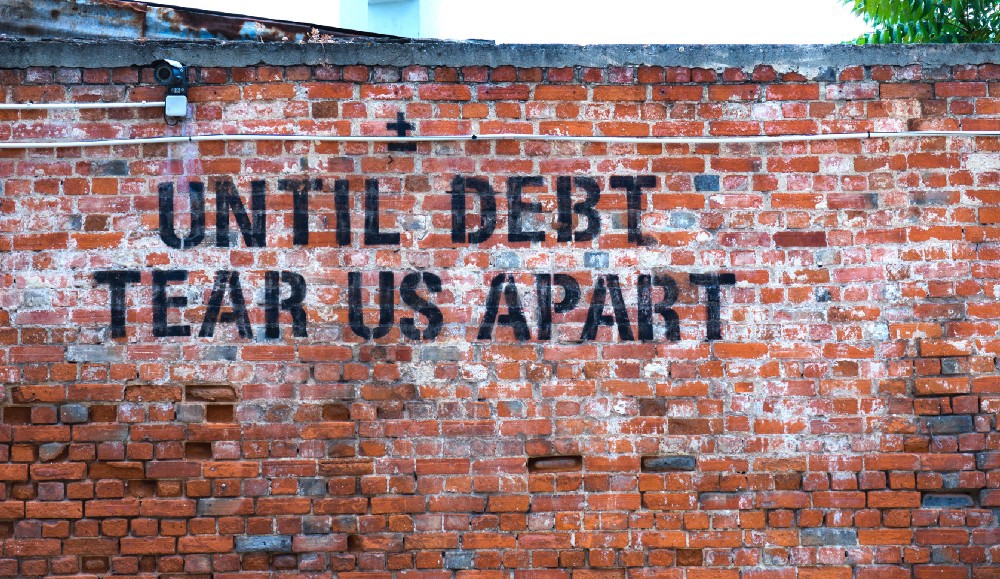
When I was young I used to play the Bank Game. I don’t remember the rules, only that whenever my parents took my sister and me to the house of certain family friends for dinner, us kids would run upstairs and form two competing banks. At some point during the game, the boys’ bank would become indebted to the girls’ bank, or vice versa, and a winner was declared.
Purchase the book
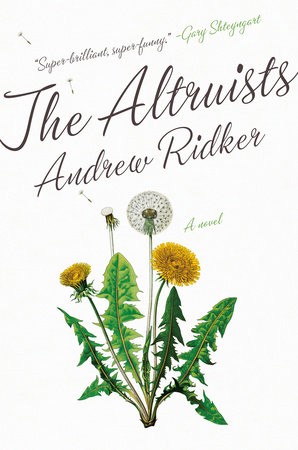
In retrospect, the notion of four suburban Jewish kids play-acting as bankers while their parents eat dessert downstairs strikes me as a little on the nose. Nonetheless, I’ve always been fascinated with money — who has it, who doesn’t, and what people do when they get it. It’s a fascination that animates my novel, The Altruists, in which a father invites his estranged children home in an effort to recapture the inheritance left them by their late mother.
The Altruists belongs to a tradition of novels in which money, or its absence, is not only a plot point but a central theme. In Little Dorrit, Charles Dickens took readers inside Marshalsea, the London debtors’ prison where his own father had done time. Fred Vincy’s debt in Middlemarch threatens his relationship with Mary Garth, while Rosamond Vincy’s spending forces her husband, Dr. Lydgate, to take on debt of his own. But the Victorians don’t have a monopoly on debt. Here, right on time for tax season, are seven works of fiction that all explore what happens when the bill comes due.
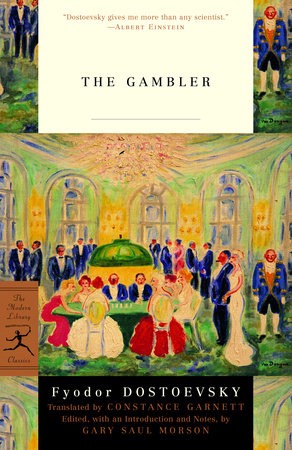
Gambling debts lie at the center of this slapdash work by the Russian master. But Dostoevsky’s novella is not just about debt; it was written in order to pay one off. In 1865, pursued by creditors, Dostoevsky sold the rights to his collected works to an editor. The contract stipulated that he would produce a new novel for the editor by November 1, 1866, or else the editor would acquire, for nothing, exclusive rights on all future work for the next nine years. Dostoevsky hired a twenty-year-old stenographer, Anna Grigoryevna Snitkina, and dictated The Gambler to her over the course of twenty-six days. (The two were later married.) The resulting work, which engages a subject with which the author was intimately familiar — roulette addiction — is messy, but remains memorable for its depiction of the gambler’s psychology. “At that point I should have walked away,” our narrator explains, “but within me was born a strange sort of sensation, a sort of challenge to fate, a sort of desire to give it a flick, to poke my tongue out at it. I bet the highest stake permitted, four thousand guilders, and lost.”
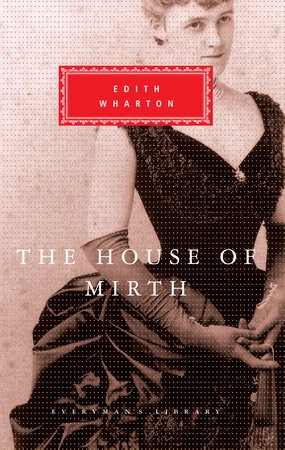
Lily Bart also has gambling debts — and that’s not counting the money she owes Gus Trenor, the “red and massive” husband of her best friend Judy. For Lily, playing bridge “was one of the taxes she had to pay for [her hostesses’] prolonged hospitality.” She soon finds herself in the unusual position of being a broke socialite, desperate to maintain her lifestyle by marrying rich. Her friend and potential suitor Lawrence Selden sums up the situation: Lily is “so evidently the victim of the civilization which had produced her, that the links of her bracelet seemed like manacles chaining her to her fate.” Wharton’s breakout novel brilliantly, ruthlessly depicts Lily’s attempts not to succumb to that most unspeakably humiliating fate: downward mobility.
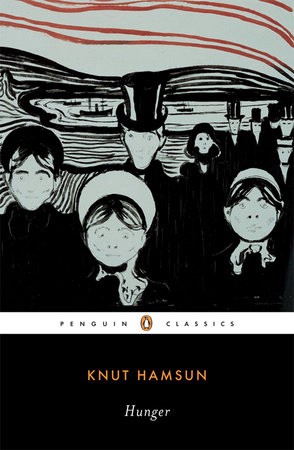
After being turned down for a number of jobs, including debt collector, the nameless protagonist of Hunger sets out wandering the streets. His clothes are shabby, he’s pawned his possessions, and he owes the landlady rent. He longs to write an article “about the crimes of the future or the freedom of the will, anything whatever, something worth reading, something I would get at least ten kroner for.” Eventually he sells an article, but the money spends fast, and soon he’s hungry again. Notable for its psychological acuity and its break with social-realist tradition, Hunger remains a compulsively readable novel, by turns humorous and harrowing, about the trials of a starving artist.
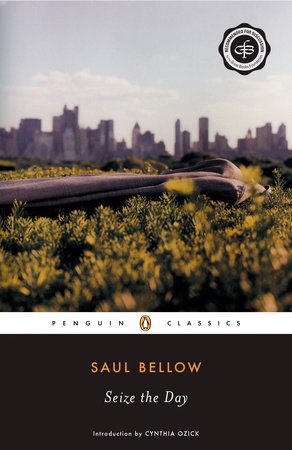
Tommy Wilhelm is a failed actor, a failed salesman, a college dropout, and has recently separated from his wife, to whom he owes child support. “In the old days,” Wilhelm thinks, “a man was put in prison for debt, but there were subtler things now. They made it a shame not to have money and set everybody to work.” Wilhelm’s father refuses to support his son financially — “Why didn’t he? What a selfish old man he was! He saw his son’s hardships; he could so easily help him. How little it would mean to him, and how much to Wilhelm! Where was the old man’s heart?” — leading Wilhelm to hand over the last of his savings to Dr. Tamkin, a psychologist who plays the commodities market. But when Wilhelm takes a loss, Tamkin disappears, and Wilhelm finds himself in the midst of a great crowd on Broadway, seeing “in every face the refinement of one particular motive or essence — I labor, I spend, I strive, I design, I love, I cling, I uphold, I give way, I envy, I long, I scorn, I die, I hide, I want.”
In a time of runaway inequality, subprime mortgages, and student loan debts so massive they can only be thought of as fictitious, it’s a wonder more contemporary American literature doesn’t engage directly with the question of money. One writer working to correct this oversight is Rebecca Curtis, whose excellent collection Twenty Grand (subtitled And Other Tales of Love and Money) is full of clear-eyed, unsentimental stories of bankrupt theme parks and bad waitressing gigs, told with biting humor and occasional forays into the fantastical. In the title story, the narrator’s mother spends an old Armenian coin, a family heirloom, when she can’t find any other change with which to clear a tollbooth. The coin, it turns out, is worth $20,000. The story’s brilliance lies in its fusion of a 19th century plot — the twist is like something out of Guy de Maupassant — with closely-observed depictions of contemporary middle-class life.
In 2008, as the country undergoes a financial meltdown, Lelah Turner finds herself evicted. Stuffing underwear into trash bags, she takes a quick inventory of her life. “Furniture was too bulky, food from the fridge would expire in her car, and the smaller things — a blender, boxes full of costume jewelry, a toaster — felt ridiculous to take along. . . . Where do the homeless make toast?” She moves into her mother’s empty house, which is worth one tenth of the $40,000 her family owes on the mortgage. Her siblings are torn on what to do with it: hold onto the property in case the market rebounds? Stop making payments and walk away? Flournoy’s National Book Award-nominated novel follows the Turners as they navigate a city in decline, from their house on Yarrow Street to the unemployment department’s “Problem Resolution Office” to a pawn shop called CHAINS-R-US where Lelah sells her childhood flute. The house itself functions as setting, character, and metaphor — for the Turners, Detroit, and the haunted American Dream.
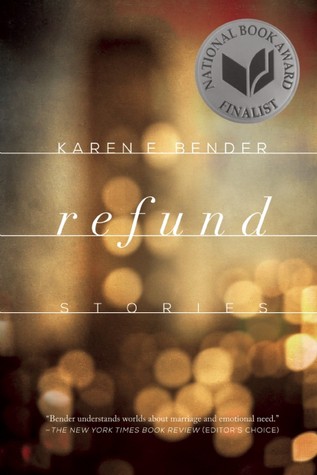
Bender’s collection, a National Book Awards nominee, tackles financial precarity in all its forms, but debt takes center stage in the standout title story, in which a couple sublets their subsidized Tribeca apartment for far more than it costs them to live there. When the Twin Towers fall, the couple’s traumatized tenant demands a refund. The negotiations soon get out of hand. “I am requesting $3,000 plus $1,000 for every nightmare I have had since the attack,” she writes. “You owe me U.S. $27,000, payable now.” The story’s startling climax ponders the debt of survival. “What did one owe for being alive?”
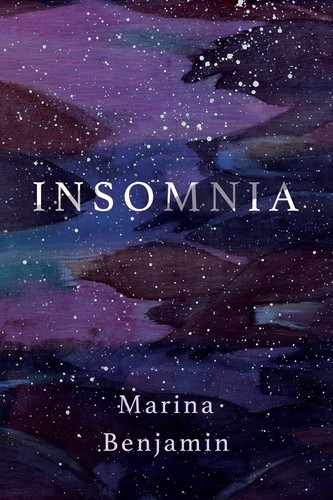
When I’m deep inside a writing project I have no time to read for pleasure. All my reading is about shoveling in fuel to power the work in progress. With Insomnia I decided to let my gut lead the way, which is how I came to end up feeding (at first, largely unconsciously) a psychic itch that expressed itself in an attraction to unstable narrators. Time and again, I’d find myself drawn to books where the narrative “I” qualified not so much as unreliable as deformed, handicapped from the start, or squished out of shape at some significant originary moment in the story. I was intrigued by the various ways in which a narrator’s reasoning got derailed or was uncomfortably pinched, or strayed down strange pathways, or was painfully present one moment, before dissolving. In such books, the author’s interest, whether primarily formal or made to subserve some other end, lies in manipulating the reader’s sense of what is real and what hallucinated. Although I’m generally not fond of being manipulated, when the stage-managing is achieved on the quiet and the effect is more like a seduction, I’m game.
Purchase the book
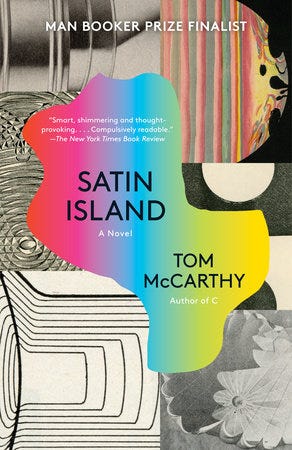
Of the works I read while writing Insomnia, I loved the extreme and increasingly deluded subjectivity that was overlord in Tom McCarthy’s Satin Island, and the commitment to collage-as-method in Charles Simic’s fractured and poetic Dime-Store Alchemist. Mostly, though, I was interested in the perceptual spaces that narrative instability opens up (and plays havoc with), not least because that echoed what was taking place in my insomniac head. Demented with exhaustion at the time, my life had become unwieldy, day and night turned upside down, sense and non-sense intermingling; and there was a fault line of anxiety running through everything. I wanted to write a book that stayed — really stayed — with this unstable state, with difficulty and uncertainty and ambiguity, even if I wasn’t sure I’d last the duration. Plus I didn’t yet know if, whether amid all the instability, it would be possible to remain a trustworthy narrator.
Insomnia eventually emerged as a journey into darkness. It seeks to peer into the abyss — the dark night of the soul, forcing us into a reckoning with our shadow selves, yet it also trips lightly through the lucid experiences of being sleepless, from its edgy, often distorted highs, to the lighting glimpses insomnia gives us into the complexities, and contrariness, of our longings and our urge towards creativity.
Some of the books listed here I read while writing and I think their mark is visible in my book. But I read some of them later, because my head remained in that febrile, slightly fevered mode once I’d finished and I wanted my instability mirrored back at me.
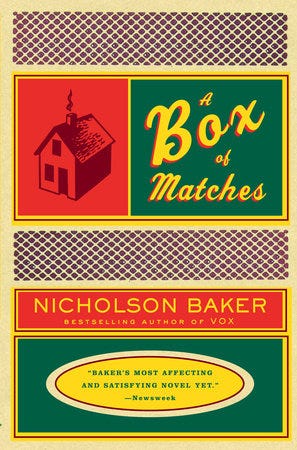
Leaving aside the cloying conceit around which the novel is structured (a fire lit every dawn until the last match in the box has been struck), Baker is the laureate of banality. His character’s night-thoughts chunter along like trains (rolling, visceral, mundane: we hear about the Cheerios he eats, the book he’s reading or program that’s on TV), and then they evaporate like steam. Baker evokes the unremitting ordinariness of insomnia through his middle-aged father of two’s pre-dawn mental meanderings. Life, for this character, is small-town good: there is friendship, activity, community. But it’s not good enough. He feels life is passing him by, that all is motion. Baker conjures this mild dissatisfaction very well, but at the same time he seems to be saying that the business of trundling through the everyday, enriching it with hope and memory, is what life is.
This intense novel asks what wellness might look like if viewed in a morbidly literal light. Its 20-something narrator, blonde, pretty and bored, ducks out of the world in into herself, aspiring through medication, to achieve round-the-clock sleep. Moshfegh has effectively re-invented neurasthenic confinement for the 21st century, with a narrator who refuses to follow cultural prescription (except when she has blackouts and gets a bikini wax, or goes clubbing), and who is broken by impossible gender expectations, while contemptuous of friends who keep striving to meet them (like Reva, stuck in a joyless affair with a married man, and sucking it up working as an insurance-broker). Yet the best she herself seems able to do is shop online. Because she’s medicated, her grasp of things is often fuzzy. An inner grief is hinted at but never developed, smothered by a talent for acid observation. No one does dark like Moshfegh.
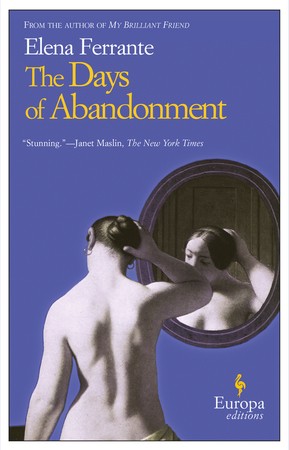
Ferrante is a genius — and in this novel her particular genius is for atmosphere. In charting a wronged woman’s descent into despair and loss of self, she generates so stifling a feeling of urgent, claustrophobic, raging madness that I found myself desperate for her to let me go, even as I was addictively turning pages. The book is darkly comic. In one unforgettable scene, the woman accidentally-deliberately feeds her cheating husband ground glass in his pasta; in another she attempts angry revenge sex with her hapless neighbor, straddling him in his apartment, but then limply wailing about her wretched husband. Ferrante is wonderful at women falling apart, painting the inside of their heads as crazed thoughts whirr, and almost convincing you with their bizarre rationalizations. Taut, tense, and full of very human pathos, Days of Abandonment is a superb study in altered states of being.
McCarthy’s novel follows a corporate anthropologist, known only as U, as he tries to map the way the world is trending for a super-secret mega-project designed to give an anonymous corporation a stranglehold over its competitors. “The Company” pays U handsomely for his consulting work without ever disclosing exactly what his report will be used for; while readers are given no more bearings than U, for whom, without guidelines, anything and everything feels relevant. Cue fascinating digressions on how memes work, on oil spills, parachuting accidents, the pros and cons of remote sex, museology, and much more. There is no plot building here, but McCarthy does build tension and hints vaguely at impending doom – and so while U becomes increasingly convinced he’s close to finding some grand unifying theory of everything, the reader is simultaneously convinced he’s losing his grip. It’s a very smart trick to pull off.
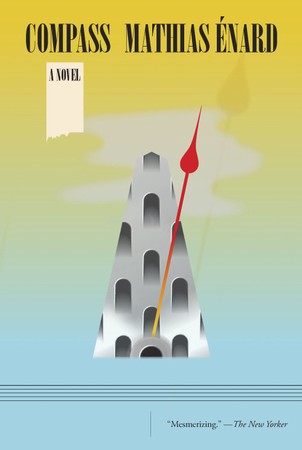
This weighty novel from the internationally-feted author of Zone, is set over the course of a single night, as its sleepless narrator revisits scenes from his academic career while pining for the unrequited love of his life — a protégé who overtook him. The novel consists entirely in reporting past events: their encounters with quirky scholars at European conferences, their late night tête-à-têtes in brasseries, their mutual love for the literature and music of the East, yet at the same time it offers a critique of Orientalism — the collective hallucination of an ‘other’ to set against our understanding of ourselves. Subtextually, Énard intimates, both in language and plot, that insomnia is all about bridge-building: between East and West, day and night, consciousness and the unconscious, and finally, with its persistent regurgitation of painful memories, past and present.
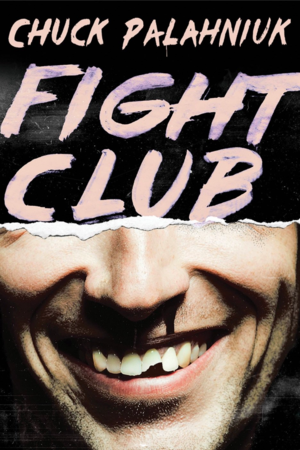
Brilliant as it is, the movie (which I came to first) doesn’t dampen the kooky, brazen feel of this book. It still feels fresh to me. Plus the prose drips sleep-deprived mania: “Three weeks without sleep, and everything becomes an out-of-body experience” says the unnamed narrator. In this insomniac phantasmagoria of a book, the reader is kept unsure who is who, and who is real, and whether is happening is or isn’t being dreamed up in the narrator’s hyped-up brain. I prefer Palahniuk’s bleakly comic depictions of support groups for the terminally ill (the narrator, who is not sick, attends them in order to feel something) to the anarchic goings-on around the novel’s eponymous club, where white-collar pen-pushers get beaten to pulp so they don’t walk through life numb, but where the dialogue can lapse into action-movie machismo.
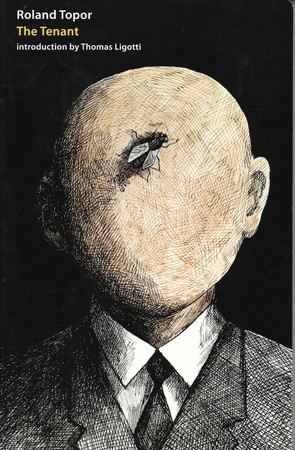
A man known only as Trelkovsky rents a top-floor room in a Parisian tenement and is convinced his neighbors — knocking on walls, leaving shit on his doorstep — are out to get him. Waking in torment every night, he wonders at “the fragility of his existence.” Under the covers, he stares wildly at his body, cowering in the gloom, looking massive in its (hypnagogic) proportions. He thinks the room is shrinking: objects move, taps drip, heads thrust themselves through walls and sneer. One morning he wakes up dressed and made up as a woman. A parable of alienation and persecution (as though Torpor were re-working into fiction his real-life experience of Nazi oppression), this chilling tale slips seamlessly beyond the world of nightmare into horrifying supernaturalism.
“Let’s note that I write this while experiencing psychosis,” begins Esmé Weijun Wang’s essay “Perdition Days.” The specific variety of psychosis, she explains, is called Cotard’s Delusion, “in which the patient believes she is dead.” Somewhere in the confusing landscape of psychosis is the writer. This, she says, is the point: cogito ergo sum.
In both her essays and fiction, Wang undoes and re-establishes how mental illness is discussed in contemporary society, revealing the many ways in which it is possible to survive one’s diagnosis (or diagnoses), the ways it’s possible to love and to write, to appreciate life. Her novel, The Border of Paradise, begins with the foretelling of a suicide, one that haunts the characters of the novel for the rest of their lives. The novel, recognized in numerous “Best of 2016” lists, is followed by her much anticipated, and best-selling, collection of essays, The Collected Schizophrenias. Winner of the 2016 Graywolf Nonfiction Prize, these robust essays braid personal experience with the analytical rigor of a scientist. A former lab researcher at Stanford, Wang unravels the diagnosis of schizophrenia and reveals its multiplicity, its altering faces, addressing a broad range of subjects, from the impacts of rare strains of psychosis on everyday life to the question of child-bearing, knowing there’s a good chance they’ll inherit the schizophrenias.
For the first couple of years after college I was a special education teacher, working with students with such diagnoses as complex PTSD (or “emotional disturbance,” according to Special Education law), bipolar disorder, autism and a host of learning and behavioral differences. Wang’s essays are at once piercing and illuminating, and raised so many questions, for me, about the treatment of mental illness in our country, especially its institutions. I was thrilled to talk to the perennially stylish Wang about fashion, fiction, and the responsibility of higher education institutions to their students with mental illness.
Roberto Rodriguez-Estrada: Both The Border of Paradise and The Collected Schizophrenias address the legacy of the schizophrenias. Border is a gothic family drama that follows the lives of David Nowak and his wife Daisy, and their children, and how the legacy of schizophrenia impacts their lives. In one of your essays in the collection, “The Choice of Children,” you discuss the possibility of having a child with your husband, knowing the schizophrenias are likely to be passed on. How did your experiences as a researcher, an essayist, and a survivor of your diagnosis shape the writing of your novel?
Esmé Weijun Wang: One of my biggest hopes in writing Border was that it would be able to portray mental illness in ways that hadn’t been seen in fiction before. You can see that, I hope, in passages such as the ones about David and what he calls vitaphobia, or his experience of hallucinations, or the “Knifeless” chapter, in which his wife lives in fear that he’ll kill himself. I tried to do something similar, in terms of taking the abstract and turning it concrete, in The Collected Schizophrenias. Such passages are only a small part of the book, but they are some of the passages of which I’m most proud.
RRE: How did you write about the experience of psychosis without finding yourself slipping into it? Were you very far in the writing of the book when your wrote these passages?
EEW: Describing psychosis is not one of the triggers for psychosis, for me; stronger triggers include things like convincing descriptions of alternate realities, as described in “Reality, Onscreen.”
RRE: I’m glad you mention “Reality, Onscreen.” You write in that essay about being afraid of watching the Hunger Games movie Catching Fire, worried that you’ll find yourself lost in the film. And yet, you’re a fiction writer: you create characters and worlds, set in different places and time periods. How do you experience fiction writing — or even reading — and how is it different for you from watching a film?
EWW: Fiction is only tricky for me if I’m in a fragile mental state. I don’t lose my sense of reality if I’m not psychotic, or near-psychotic; if I am, my psychiatrist warns me to stay away from reading or audiobooks because I will quite literally begin to believe that I am in that fictional world. It’s very similar to what happens to me when I watch certain kinds of movies. The major difference is that movies can be tricky for me even if I’m not psychotic, depending on the subject matter; movies that present an alternate reality can be hard for me in a stable way of being.
If I am psychotic, my psychiatrist warns me to stay away from reading because I will begin to believe that I am in that fictional world.
RRE: In “Yale Will Not Save You,” you describe your last night at Yale, the ultimatum you’re ultimately given — leave voluntarily, or have an involuntary medical leave blemish your record — and the urgency with which you’re made to leave. I’ve been thinking about the competitiveness of college admissions, and how the number of applicants is ballooning yearly, just as the percentages of admitted students wane into single digits. The pressure on high school students to excel is a phenomenon specific to our times. At the end of the essay you say Yale owed you nothing, and that you owe it nothing in turn. But still — what responsibilities do you think educational institutions owe to the students they admit? Their mental, physical, emotional wellness? Their families?
EWW: I think you’ve pointed to where I may have been lying through my teeth in that essay, or, at least, lying to myself. I say that Yale owed me nothing, but much of what that essay includes is an argument about precisely that: because I had a disability, and because they were in a position to accommodate that disability, one might say that they actually did owe me the opportunity to get back on my feet — to be able to finish my education. (I did finish my BA, though I finished it elsewhere.) I don’t know what that looks like, in actuality. I don’t know what the best practices for educational institutions and their mentally ill students would look like. But we need to keep talking about it. Many of the most severe mental health disorders, such as bipolar disorder and schizophrenia, first appear in the late teens and early twenties — right when students typically begin their college education. This issue is not going away.
RRE: In what ways was your experience different once you transferred? I know it’s around then that you started working at a research lab for mood and anxiety disorders, in addition to a bipolar disorder lab in the psychiatry department at Stanford. Were there any differences in how either school addressed mental illness among their students?
EEW: When I got to Stanford, I was asked right away if I wanted to register as a student with a disability, which was not something that I could remember happening when I was at Yale. I was given accommodations, too. I know many students who had negative experiences with student health at Stanford, but I can’t speak to those, because I was being treated off-campus.
Many of the most severe mental health disorders first appear in the late teens and early twenties — right when students typically begin their college education.
RRE: You return throughout your essays to the idea that dividing illness from self is impossible. “When the self has been swallowed by illness,” you write in “Perdition Days,” “isn’t it cruel to insist on a self that is not illness?” After, you list simple facts about yourself in your journal — your name, occupation, height, family details, your favorite flowers — anchoring yourself into the small but significant details that populate your daily life. Have your thoughts on the division of illness and selfhood changed since writing this book?
EWW: No, not really. I continue to see illness as inseparable from self. It’s a series of complicated relationships, particularly between my physical illnesses and self, but that word, “relationships,” also means that I’m always negotiating the connection between them.
RRE: You also write about fashion as a sort of armature, a way of articulating the part of the self that’s unencumbered by illness; but this “weaponized glamour” — as you coin in your Twitter profile from that time — isn’t always successful. At an Alexander McQueen exhibit, you appreciate the terrifying beauty of his pieces, just as you begin to duck away from “shadowy demons darting [at you] from all angles.” “There are things,” you conclude, “good costuming can’t hide.”
EWW: Just to clarify: I didn’t coin “weaponized glamour.” That’s from the writer Chaédria LaBouvier, who is absolutely brilliant. It’s a phrase that I find useful for myself — I love glamour, and I love the trappings of glamour, which help me to feel protected. I talk a lot in the book about fashion as costuming, or as armor, and that’s very true when it comes to glamour in particular, which is inherently over-the-top.
RRE: Do you think armature is inherently physical or are there other forms of protection you turn to that don’t necessarily have anything to do with style or self-presentation?
EEW: Yes — I speak to a number of them in the book, such as referring to my education, or making sure that I present as intelligent. This kind of defensive behavior isn’t something that I’m proud of, as it relies on privilege and excludes a lot of people who have the same diagnosis as I do, but I wanted to mention it in the book so that the reader could see me grappling with it, and grappling with that inner conflict.
RRE: A few weeks ago, on New Year’s Eve, I was in New Mexico and went to el Sanctuario de Chimayo with two friends. I had not yet finished The Collected Schizophrenias, or else I think my experience there might have been different, colored a bit by your essay “Chimayo.” Nevertheless, I keep coming back to the insistence of faith. We anoint ourselves with the sacred dirt of el posito (the Spanish word for well), repeat our prayers with earnestness, trust that we’ll come away healed in some way. Thousands of people make pilgrimage to Chimayo for Easter every year. “Hope,” you write in a journal entry, “is a curse and a gift.”
EEW: Oh, I love that you went there, too. Yes — faith is such an amazing thing. When I talk about hope in that piece, I’m expressing frustration that hope can lead us along a faulty path. But I’m also so glad that hope allows us the gift of continuing to keep going, to keep trying. I’m known for saying that often: keep going; you’re doing great.
RRE: I noticed that your restorative journaling course, “Rawness of Remembering,” promotes a similar sort of faith, faith in our abilities to use our journals for self-healing. Where did the idea for the course come about and how did you end up designing it?
EEW: Journaling is something that I’ve been doing for decades, and I realized after a while that I was developing specific methods and skills related to journaling that helped me get through difficult times. I put together a curriculum and taught a class over six weeks over the Internet; right now, people can purchase the class online on my website and work through it at their own pace. It’s the signature online course on my website, I really love it, and I know it’s helped hundreds of people over the last few years.
“Someone Who Will Feed Me Cherries” by Emily Brout
I felt the cold of my cherry-flavored seltzer in my palm. Cherries are the fanciest fruit. When I feel really sad, I spend my money on a jar of maraschino cherries. I just pop them into my mouth three at a time in public libraries and on subway platforms, and I know everyone is thinking, This bitch made it. I rest my hand on my floppy overused brown bag. When I walk I always look like I’m scared someone’s going to rob me. Joke’s on them. All I have in there are jars of maraschino cherries and paintbrushes. Debbie and I are in the park. She is questioning me hard because I got laid off, again. The guy whose sandwiches I have been sitting on for money found a new girl, but I can’t tell her that.
“I mean, I just worry because you’re getting old, and it doesn’t seem like you’ve ever committed to a real path. Also, honey, someone has to say it. Your belly pouch is starting to look like a peach fanny pack. You have to stop eating those cherries, it looks ridiculous anyway.”
My other friends tell me I should cut her out because she’s judgmental, but they do not live in the city. They don’t know how hard it is to get someone to show up.
When you sign up to be Debbie’s friend you have to be your best self. Debbie’s the kind of person that worries that one association with the wrong person will strip her of all she’s worth, which isn’t that much because she’s a swim instructor. But still, it’s good to have her around because I know when I get really embarrassing she’ll start to cancel brunch plans, and I’ll know I have gone too far.
Debbie smells like chlorine. She must have taught an early class. I tell her that, and she tells me I smell like burnt dust, and the musky carpet of the back room of her church, but then she takes out her chapstick and makes circles around the rim of her lips counterclockwise. She does this when she knows she has gone a little too far with her criticism. She uses the chapstick to keep herself from saying hurtful things, and she purses her lips to offer me a peck. She knows I am attracted to her.
Once, she got really drunk while we were in a club and she said there was not enough music in the world to drown out my disgusting breath. She could tell she really hurt me. So she tried to make up for it by saying that she wanted “to be stuck in a knot of our naked and dislocated bodies.” I thought it was really sweet.
A crunchy leaf smacks me in the face before I get Debbie’s kiss. She won’t do it now that the leaf’s touched me. She is terrified of “pathogens.” Instead of the kiss, she keeps talking. She asks me if I’ve started my job search. I answer that I have not.
“What kind of work are you even looking for? Whenever I ask you about your work experience you just freeze. I have never met someone that talks so much about wanting to be employed without actually taking some realistic steps to make it so.”
I apologize for being a frustrating person. We stop talking because she stops asking me questions. We sit on a bench and she updates me about her children. I space out and think about my work history. I was working for a dating service, and part of my job was to ask the clients what they were looking for in a partner so my boss could fix them up with a successful on paper person. The service was called Successful on Paper Dating. I was supposed to write down notes of what the clients wanted and give them to my boss. A simple enough task, you would think. It is actually how Debbie met her husband. When I asked her what she wanted she said, “Someone that knows my opinions are always right.”
But not everyone is like Debbie. The thing is, most people don’t know what they want. Every other client would inevitably answer my question with the question, “I don’t know, what do you look for in a partner?” and they would have this look in their eyes that maybe I possessed some grand wisdom, because I worked for one of the most successful on paper dating services. I don’t have wisdom, so I would be honest and say things like, “Someone who will feed me cherries on the subway.”
After my grandma died — she was the only one who ever told me my art was good — I had a little outburst at work, and got fired for telling someone I couldn’t find them a successful on paper date because their personality sucked. I think it was more about Debbie than it was about her. She had flaked on our brunch for the second time.
I got a little desperate for some fast cash, so I answered one of those weird Craigslist ads, and before I could blink I was employed by a porky man to sit naked on his grilled cheese sandwiches and then watch him eat said sandwiches. Why this particular sandwich? I still wonder sometimes.
I know it was sexual for him but for me every time I watched I would have the most interesting thoughts and get inspired to sketch in my journal because when you think about it, a naked person sitting on a grilled cheese sandwich is a great way to think about the creative process. The author is a sensing creature and to sense what he could pull out of his ass he must be vulnerable and take off his pants. When he is vulnerable, he can only speak in his voice. He doesn’t have time to distort it, and yes, the whole process is ridiculous, but that’s what makes it special.
When people asked me what I did for a living, I would just say I ate sandwiches. When word got around, my friends started thinking I was a food critic. My family began to treat me differently because they were proud to have produced loin fruit with a talented tongue. At first this fake job was great. It was so easy to pretend to be a food critic. I was making so much money. I could go to these fancy restaurants and delis, and I would post all these pictures of myself tasting sandwiches with weird statements like “Everyone knows to live in something it must be hollow. Why won’t anyone live inside me?”
My parents would like it on Instagram and I would feel ashamed for neglecting to tell the truth. I never told Debbie what I was up to.
We are still sitting on the bench. I’m feeling pretty hopeless, full of shame for deceiving my parents. I want to know my shame is wrong. I need Debbie to tell me. I put my hand closer to hers, I just want to hold it, and she slaps it like it is a spider. I don’t know if it is because of the slap, or because the peach pouch comment really hurt me, but I blurt out my shame. I tell her all about the porky man, but mostly about the guilt I have about misleading my parents. Her face goes from judgmental to amused. It is not the reaction I expected. She starts to laugh, a laugh that makes me feel like my throat is full of thumbs, and I have swallowed a baby’s hand. Finally, she explains, “I just think it’s funny that your parents can make you feel more shame than a naked man paying you to sit on grilled cheeses.”
I am confused by the comment. How could the porky man make anyone feel shame? Ridiculous people can’t cast shame — the problem is if you look long enough, everyone is ridiculous. I mean look at Debbie. She is a swim instructor for children and she is terrified of germs. The guy passing in front of us is eating a potato out of tinfoil. There is a woman going to the bathroom behind a tree, but people like Debbie don’t consider why. The guy eating a potato is afraid to use anything that is not a microwave because when he was thirteen he almost died in a fire. The woman going to the bathroom behind the tree has an important interview, but she can’t use public restrooms to change because once she starts she can’t stop counting tiles, and Debbie, Debbie might be afraid of germs, but she loves yelling at children.
Debbie sneers at the woman. She says she wants to go over to her to tell her she is disgusting. “I hope her children get mono,” she says.
It doesn’t bother me when she says things like that to me, but to other people? I don’t say anything, because I am not comfortable with expressing my anger or disapproval, because who am I? But I can feel myself wanting to say it. I know it’s going to come out. So I get up off the bench, say nothing, and start running away.
On the street, I run into the porky man. He is eating a grilled cheese sandwich over a trashcan. I can see that he has just met with his new girl. There are pubes on top of the bread that are red and shiny. I guess he could tell I was upset, but I was still surprised when he invited me up to his apartment and made me a cup of coffee.
I tell him what my friend Debbie said — that I should be ashamed of what I did with him. He laughs at this and tells me to just relax and enjoy the beans, they are from Costa Rica. Then he hops into the shower. I watch the steam come out from under the crack of the bathroom door. When he walks out he is already in a suit. He tells me he has to go to work, so I leave, but I end up following him to work. I want to know what he does for money. As I follow him I realize we are near Debbie’s place. Then he walks into her building and reaches behind the lobby’s desk, puts on a cap, and stands by the door. He’s Debbie’s doorman? I watch him as he smiles and greets everyone, even when they ignore him. He lets Debbie’s kids ride the luggage carts when they walk in puffy-eyed because she has yelled at them for tying their shoelaces incorrectly. He makes his body stiff and triangular. He has to pretend to be a traffic cone when the children go too fast.
About the Author
Emily Brout lives and works in New York City like Cyndi Lauper or Giuliani. As a teenager, she was occasionally known as the vocalist in the rock band The Indecent. More recently, she has written many short stories one of which was recommended by Etgar Keret, translated into Hebrew, and published in Maaboret. She thinks this is pretty damn cool and may act as a psychic atonement for never having been Bat Mitzvahed. She has also written for Tom Tom Magazine, Feminine Collective, Flock, Pigeon Pages, and the New York Observer.
How much do you love your favorite book? Do you love it enough to get an image or passage from it permanently inked on your skin? Well, judging from the response to our #ElectricLitInk hashtag: yeah, lots of you do. (Including at least three Electric Lit staffers! Maybe more, but they’re not admitting it.) If you don’t yet have a literary-inspired tattoo and you’re looking for inspiration—or if you’re just thinking about what you want next—here are some of the highlights from the hashtag, paired with artist information and a little more explanation from contributors who wanted to share why they got their book-related ink.
Woodpecker, moon, blackberry brambles, and pyramid from Still Life With Woodpecker for #ElectricLitInk
“Throughout undergrad, Tom Robbins was a reminder of my love of language and of wordplay in literature, while I was struggling through dry textbooks and assigned reading. This tattoo has sparked a lot of interesting events, like the time I took my pants off in a coffee shop to compare Tom Robbins tattoos with the barista (I asked first).”
Artist: Lauren Toohey at Wyld Chyld Tattoo in Pittsburgh
@ElectricLit ooh! i have two jules verne ones: an illustration on my leg and the text on my thighs. the "tout bien ou rien" is from a publisher's device, too! #ElectricLitInk
Artist: Deirdre Doyle at Redemption Tattoo in Cambridge, Massachusetts
@ElectricLit Didn't get the bowler hat, but DID get "Lehkost" and "Tize" - the original title for the first chapter in Czehc (lightness and weight). Also have a Tolstoy-inspired diptych in homage to the mowing scene from Anna Karenina and the Comet of 1812 in War + Peace. #ElectricLitInk
“I like carrying some of my favorite works of art with me as we use art as a guide for how to live a more meaningful, rich life. My two tattoos in homage to Tolstoy remind me of two of my favorite passages in literature — the mowing scene in Anna Karenina is one of the greatest moments of mindful presence, and the comet scene in War & Peace reminds me of how divinity and wonder manifest in each of us (entelechy like whoa). My forearm tattoos are a link to both Kundera and my marriage: The olive branches on my left arm link to my name, and the laurel branches on my right are a nod to my husband’s name (Lawson, which means ‘son of the laurel bearer’). I combined this with the original Czech for the first chapter of The Unbearable Lightness of Being. It’s a balance of opposites for me, and I like the idea of combining the knowledge represented by laurels with a sense of lightness and the peace represented by olive branches with the weight of ‘tize.’ That’s pretty much what marriage is all about, right?”
@ElectricLit if you squint here you have Berryman, Bukowski (I know), a Pynchon horn (I know again), Rilke, Cummings, and part of an Eileen Myles-inspired snake because "Snakes" is a killer poem
“I love books and I love tattoos. I’m working on growing a third arm so I can get pictures of the rest of them, but here are my hands and a semi-nsfw Coleridge chest piece to prove that I do, in fact, have literary tattoos. the books on my hands were kind of a no-brainer. the Coleridge quote comes from The Rime of the Ancient Mariner: “O let me be awake, my God! / Or let me sleep alway.” it reminds me to be present for people and for experiences in life since the only real alternative is to sleep the Big Sleep.”
Artists: Jason Ochoa at Greenpoint Tattoo Company and Jim Gentry at Hand of Glory Tattoo, both in New York City
@ElectricLit "Oh no, not again." (I grew up on SFF and wanted to honor the influence Douglas Adams had on young me. A Le Guin tattoo in next!) #electriclitink
“I grew up on SFF, and the giant, gilt-edged More Than Complete Hitchhiker’s Guide was hugely influential on my sense of humor — and my certainty that the universe has its own sense of humor. Ages ago, I saw a few tattoo versions of the whale/petunias scene, but it wasn’t until I saw Betty Rose’s kinetic kitties that I knew what I wanted it to look like: all one piece, petunias inside the outline of the whale. To me, the image means a lot of things, but I look at it a little like the glass half full/glass half empty question: Would you rather respond to the universe like the whale, or like the petunias?”
“This is Narsil, Aragorn’s broken blade from The Fellowship of the Ring. It’s a cool-looking sword tattoo, and can be just that, but for me it’s about coming into grace and power. It’s that old, simple metaphor of a thing becoming stronger after it breaks, that Leonard Cohen quote about a crack in everything, that imperfect person rising to the occasion. My tattoos punctuate my life, not like commas or periods, but like question marks: they indicate the points where I felt lost, unsure, ‘broken.’ When some tragedy happens, the tattooing ritual is the first step of putting myself back together. That sword is tattooed along a nerve, and the gnarly, needling pain of the experience woke me up, reminded me not to neglect my calling, my purpose, my life.”
Artist: Billy Bracey at Downtown Tattoos in New Orleans
@ElectricLit I have a labyrinth on my back. It comes from the first line of the last paragraph of @johngreen's Looking for Alaska - "And I wrote my way out of the labyrinth." It was my favorite novel growing up & as a writer myself, the quote has become my personal mantra.
“I got this tattoo because I love thinking about geology and deep time, and I love narrative nonfiction. (Clearly I’m also a big John McPhee fan.) The slightly hokier reason is that I was feeling stuck in my life and in New York, where I’d been living for several years, and I hoped the design itself would serve as a reminder that I could always change my life. And I guess it worked. It’s funny, too, that it’s from Assembling California, since I live in California now.”
“While reading about the bugler girl symbol, used in the suffrage movement to advertise suffragette meetings, she immediately struck me as the perfect symbol to go with Atwood’s famous Handmaid’s Tale quote, letting her continue to inspire strength with words.”
The quote that inspired this tattoo: “I saw my life branching out before me like the green fig tree in the story. From the tip of every branch, like a fat purple fig, a wonderful future beckoned and winked. One fig was a husband and a happy home and children, and another fig was a famous poet and another fig was a brilliant professor, and another fig was Ee Gee, the amazing editor, and another fig was Europe and Africa and South America, and another fig was Constantin and Socrates and Attila and a pack of other lovers with queer names and offbeat professions, and another fig was an Olympic lady crew champion, and beyond and above these figs were many more figs I couldn’t quite make out. I saw myself sitting in the crotch of this fig tree, starving to death, just because I couldn’t make up my mind which of the figs I would choose. I wanted each and every one of them, but choosing one meant losing all the rest, and, as I sat there, unable to decide, the figs began to wrinkle and go black, and, one by one, they plopped to the ground at my feet.”
“A lot of my tattoos have been based on my love for books, and I wouldn’t have it any other way. My right arm is a collection of paintings from the Abarat series by Clive Barker, I have a Shakespeare-esque skull on a pile of books, I have the (very faded) bird from the cover of Chuck Palahniuk’s Lullaby, Rogue & Wonder Woman to show my love for Marvel and DC comics, and an Alice in Wonderland and Velveteen Rabbit piece as well.”
Artist: Shaun Evans at New Horizon Studio in New York
Since it was first launched nearly 100 years ago, The New Yorker has published countless wonderful fiction writers, but only a handful of them appeared very early in their careers — before even publishing a book — and went on to have the magazine be the main showcase for their work over the course of several decades. John Cheever, Ann Beattie and Donald Barthelme all come to mind. George Saunders first published a story in the magazine in 1992, when he was 34 years old supporting his family as a tech writer in Rochester, New York, and he has published more than 20 stories in the magazine, as well as several pieces of journalism and satire, since then. Anyone who has read George’s work knows how as a writer he is humane, profound and hilarious — as you’ll see from the interview, he has those same qualities, in equal measure, in person.
What follows are transcripts from a recent special episode of the podcast, Dan & Eric Read the New Yorker So You Don’t Have To, in which co-host and writer Eric Rosenblum interviewed fiction writer, George Saunders, about his history of contributing to the magazine. Dan & Eric, launched earlier this year, is a weekly podcast in which writers Daniel Torday and Eric Rosenblum discuss the contents of the current issue of the New Yorker. The interview with George Saunders is one in an ongoing series of episodes in which Dan and Eric excavate the history of the magazine by speaking with past and present contributors, including editors, writers and illustrators.
Eric Rosenblum: What was it like when you first got into The New Yorker?
George Saunders: It was a huge thing. I had sent them something before I even came to Syracuse as a student, so like ’85, and they sent me a really nice rejection. I was such an idiot that I didn’t know it was kind of an invitation to rewrite the ending of the story, and I was also cocky enough to be like, “Oh, I’m not rewriting anything,” so I just sort of rejected their semi-acceptance and a couple of months later rewrote it for a smaller magazine. So I had that contact and really my whole thing went dark. I lost whatever mojo I had. Really, the whole time I was at Syracuse, I didn’t write anything I liked or that they would respond to. And then, years later, when Paula and I were married and we had the kids and everything, I wrote “The Wavemaker Falters” from the first book, Civilwarland In Bad Decline, and I got a really nice rejection that was overt about saying “send us something else.” And that was really exciting. Finally, maybe within a year, I got that story called “Offloading for Mrs. Schwartz” accepted. That was just a life-changing thing. I remember I was working at this environmental company and we were doing a job up in Watertown, New York. We were doing this groundwater investigation and staying at this Microtel and I got a little note at the front desk, and it was sort of mis-transcribed like, “So-and-so from The New Yorker says ‘Okay, yes, maybe.’” At the time, my agent said it was statistically harder to get a story in The New Yorker than it was to publish a novel. I finished the job up there and then came home and Paula had gone around to all these dentists’ and doctors’ offices and found New Yorker covers and made a kind of a banner and we had a little cake and a little party.
They sent me a really nice rejection. I was such an idiot that I didn’t know it was kind of an invitation to rewrite the ending of the story, so I just sort of rejected their semi-acceptance.
ER: That’s amazing. What was the story that got rejected in 1985?
GS: It was a story that ran in Northwest Review. It was funny because it would have fit right into Civilwarland in Bad Decline years later. It was maybe a three or four page kind of nutty thing and I just could never figure out how to sustain that energy for anything longer. When I got to Syracuse [as an MA student] I kind of dropped that and repented a bit and started trying to do more normal realism. But that story in its tone and in its energy is very much like the first book ended up to be. Wah-wah.
ER: My first introduction to your work was reading “Sea Oak” in 1998, but shortly thereafter I heard you read “Offloading for Mrs. Schwartz” on This American Life.
It’s a story about a guy whose wife has died and he’s taking care of an older woman and he takes her memory to use it as historical educational video. Did that require a lot of editing?
GS: Yes. That story got accepted at a really interesting time. Tina Brown was just coming on as an editor, and it was a fraught moment and there was a lot of worry about what the magazine was going to become. I think her whole thing was that we’re going to be a mix of the new and the old and so the cover had a picture of like a Central Park hansom cab driver, a real old guy in a tuxedo, and then a young kind of punk guy sprawled in the back of the carriage. And then the two stories were mine, which at the time it was sort of unusual to see something so sci-fi in the New Yorker and then a really beautiful story by John Updike called “Playing with Dynamite,” which is a real classic New Yorker story. So that was a set-up. There was a lot of worry about getting that story right. Dan Menaker, who was the fiction editor, and I, and a guy named David McCormick, who’s now a really wonderful agent, and at that time was Dan’s assistant — we just labored over that thing. And there was all kinds of stuff about, believe it or not, at that time — were contractions allowed in a work of fiction? Back and forth. “I cannot, I can’t,” all that kind of stuff. Also I think I had the word “fuck” in there. So there was a lot of back and forth, a lot of actually pretty energetic disagreement. At one point there was somebody at the magazine who’d been there a long time and Dan told me this guy said, “Ah, the barbarians are at the gate.”
E: On to “Sea Oak.” It’s funny, you’d given all the drafts of “Sea Oak” to Keith Gessen, who was a year ahead of me at Syracuse, and he gave them to me. I had them in my possession for a year and a half or something and you’d forgotten about it, and then I was like, “I’d better give these back to George,” and I did. Can you talk about writing “Sea Oak”?
GS: That must have been a pretty big pile of papers.
E: It was a big pile of papers. I think the first one was hand-written and it was kind of marked up. And there was a series of typed pages. I was really excited to have it in my possession.
GS: Okay, you know the [Syracuse] Carousel Mall? That story has a debt to that place. If you remember the titular carousel was there. It’s kind of an old-fashioned double-decker merry-go-round sitting right in the food court and then weirdly, at least at that time, right adjacent to it was a Hooters. So, we’d take our little daughters there and we were kind of like, “Why did they put it right by the Hooters?” It started to seem like a part of this weird American tableau. First of all, it’s a fake old carousel, it’s not original, I don’t think, but you you know this kind of nostalgia this kind of Norman Rockwell thing, right next to Hooters, where you can literally on the merry-go-round look into the Hooters. I remember just thinking, “What would it be like, what would the equivalent of Hooters be if the world was run by women instead of men? If it was a matriarchy, would there be a Hooters? The short answer is there probably wouldn’t. But if there was, what would it be like?” And it just popped into my head the name of the place, “Joysticks,” and then I thought what’s that? It’s like an aeronautically themed restaurant where the guys are in ripped pilot suits or something. So that was one element of the story.
I remember just thinking, “What would it be like, what would the equivalent of Hooters be if the world was run by women instead of men? If it was a matriarchy, would there be a Hooters?”
Then at another visit in the mall I was walking along and there were these two kind of Syracuse working class young women walking near me and I could hear them talking to each other in this really interesting argot. It was this beautiful almost Shakespearean kind of a complaint-fest with lots of swearing and anger. So, at one point I went home and I just said I’m going to try to imitate those girls. I typed up a couple of pages of some simulation of how they’d been talking. I don’t remember the exact details but somehow those two wires got crossed. So I had some material about “Joysticks,” what would that be like, and that used to be, in those days anyway, I would just type a series of jokes, well what do the booths look like? What do the people say? What are they wearing? And then on the other thread was just these two girls talking in that mode, and at some point, as I used to do in those days, I was just like, well, these are the two things that are vital to me, I’m going to cross the wires and put them into the same story. And, then it kind of went from there.
ER: How long do you think you were working on it before you sent it to The New Yorker?
GS: Oh my god — that was a change in mode, because all the stories in Civilwarland I kind of just worked on them for maybe four or five months. I was doing it at work. I would just work in a straight line. I would just polish up what was behind me and move a paragraph or two or a page or maybe a page or half a page ahead. Steady forward progress. And partly that’s because all those Civilwarland stories are basically following the same trajectory. A guy has a bad life and it gets worse. I think “Sea Oak” might have been the start of this pattern, I would start writing stories and then get into them with a lot of energy and a lot of fun and a lot of joy and then halfway through they would lock up. I couldn’t figure out how to get it to move forward. I would end up writing a lot of scenes that were just duplicating beats.
That happened with “Sea Oak.” I was writing several stories at once. But I got locked up right after Bernie’s funeral, and I couldn’t figure out what was next. I kind of had the idea that — you know, it was a story about them trying to get out of that housing complex after the death of their aunt. I just wrote every version of that I could think of. They seek and find and kill her. She comes back to them in dreams and tells them who the killer was. Or he plays the lottery. It just wasn’t going anywhere. I literally couldn’t get past that scene. I would write stuff and throw it away, write stuff and throw it away.
So we went on vacation at one point and you know how that kind of clears your mind out. I came back and read the story to that point and I think I was taking a walk or taking a shower and I thought, “Man, you’re such a faker. You teach writing, you can’t even finish a stupid story.” At one point in this little inner berating of myself, I said, “I don’t know why it’s so hard for you, you know she has to come back.” I did know that. She was the most interesting person in the story and I killed her off. And in that moment I said, “You know she hast to come back. “ And my mind completed the sentence, “from the grave.” And it was like a lightbulb went off. Oh my god.
I finished the story in like two weeks after that. It just felt like from all my years of watching the Twilight Zone and Night Gallery, I knew that story, I knew the zombie trope. It was the first time I realized that if you’re writing a good story, it rebels a little bit, and it rebels mostly against your early and too-simplistic version of it. There’s that Einstein thing I always quote, “No worthy problem was ever solved on the plane of its original conception.” The story just locked up until I was willing to stop dictating to it and start listening to it.
It was the first time I realized that if you’re writing a good story, it rebels a little bit, and it rebels mostly against your early and too-simplistic version of it.
ER: A few years later, maybe it was 2001, I had just been accepted into Syracuse. I went to one of those Stories on Stage things in Chicago. Bill Buford talked about that story. He said that you rewrote the ending 20 or 30 times. Do you know what he was referring to?
GS: I think he was talking about the same thing — I got stuck halfway. And wrote the second half 20 or 30 times. Bill was a great guy and a great editor. After this four year trial, I finally had it done and I’m so happy with it and it seemed like something. For me the dream is to have a story that rewards your attention to it by shocking you. Suddenly you’re writing stuff and you don’t even know where it’s coming from or what you mean, and then when you look at it at the end, you go, “yeah, I’ve meant that all my life, I’ve just never been able to say it before.” So it happened with that story. Then you send it to The New Yorker. Another victory, they take it. You’re so happy.
Then, for some reason we get a late start on the edits. I don’t remember what the actual time was but it was about half the time you would usually have to work through the changes. Bill came back with some pretty major things. They were good. In one case I had two scenes that were adjacent that were set in the same place. There was only a time jump. Which I don’t usually do and it was a little evident and awkward and he pointed it out and he suggested that I meld two scenes together. After you have a story accepted there, you’re kind of hesitant to change it, at least your first mind is: “You got in The New Yorker!” Even if The New Yorker is saying you need to cut this, you’re like, “No!” We worked on it really hard and at one point my confidence was a little shaken. I kind of went fishing for a compliment. I said, “Bill, what do you like about the story?” He’s a very quiet kind of guy and very precise in his speech. So there was a long silence. And he goes, “Well, I read a line and I like it….enough to read the next.” And that was it. That was the whole ethos of The New Yorker — which is so deep and so perfect. Fiction is a linear, temporal phenomenon. You go through it a sentence at a time and the moment that you shut the magazine and walk away is when the sentences have ceased to compel you. That was great Zen writing advice. And I’ve always thought that was maybe sort of a perfect condensed version of what I had discovered about writing up to that point.
Fiction is a linear, temporal phenomenon. You go through it a sentence at a time and the moment that you shut the magazine and walk away is when the sentences have ceased to compel you.
ER: Have there been others like that?
GS: “Tenth of December” was just way too long to run, so Deborah [Treisman] and I agreed that we would cut it down below that upper limit. At the time I thought, okay when its ready for the book I’ll put it all back in. We cut out a bunch — at least 500 words — of a story that I thought was drum-tight. We got it cut down and I never put it back in. Most cuts, I think if you make ’em, you never miss ’em. And it just makes a beautiful, dense, but spacious feeling or airy feeling. What you’re doing when you’re cutting, you’re actually saying with every cut, “Dear Reader, I trust you’ll get this without me hitting you over the head.”
ER: Another story in Pastoralia I remember being really excited by before I ever met you was “The Barber’s Unhappiness.”
GS: It was about the same time as writing “Sea Oak.” I have a vivid memory of sitting at our dining room table at Rochester. It was a Monday. The kids were at school, and Paula was out, and I was just sitting there like a real writer. There was a guy in the town where we were living, this barber, and he had this really obnoxious habit of ogling women when they would walk by his shop. I used to wait for the bus across the street and I just noticed him doing this all the time. I just started thinking, “Oh, I’ll crucify him in a story.” And it was fun. Lots of fun misogynist jokes told from inside the mind of a misogynist and mocking him, holding him up for scorn. Then a similar thing happened as with “Sea Oak,” where I got about halfway through it and it just locked up on me. I think it was because I was having so much fun kicking that guy and painting him as a Very Bad Person beyond all hope of decency. The story form is, I think, mostly based on the assumption of the possibility of transformation, and I had painted that guy into a corner, as such a dick that he wasn’t going to be able to get out. So I wrote a bunch of scenes that didn’t end up getting used and I later repurposed some of them. It was just a matter of realizing that I had given the reader so many facts about what a jerk this guy was that no reasonable reader would believe he could be saved. So then it was a matter of backing out of that and trying to remake him in the first half of the story so that there was at least the possibility that he could transform into a different kind of guy.
ER: So you had to go back and make him sympathetic in the first half?
GS: I just introduced the idea that he didn’t have any toes on one of his feet. It totally did the trick. He’s a real judgmental guy. He’s no big winner himself, he’s not great-looking, he’s a little older guy, lives with his mom, but he’s always doing that thing that guys do where he’s always assessing women on how attractive they are, very dismissively. So that made him very unsympathetic. Well then you give him this secret dark thing which is that he’s missing toes on one of his feet and he’s very ashamed of it and suddenly he kind of opens up. He’s still a jerk and he’s still obnoxious and yet you get a chance to go into his head and show him having these very pathos-ridden fears about his toes and it kind of gives you a little hope for him. Yeah, that was a sort of a mechanical fix.
I just introduced the idea that he didn’t have any toes on one of his feet. It totally did the trick.
ER: In “Sea Oak,” Aunt Bernie saying, “Show ’em your cock” — was that controversial?
GS: No. It was one of those things it just seemed exactly right at the time. I think in person, as a person I don’t think I’m a particularly outrageous guy. On the contrary. But when I type something like that in the heat of it and it’s funny or good or necessary, I just can’t worry about it too much. One of the funny things was I wrote that story and I just was inside of it. Especially after going through that long struggle of trying to finish it, it’s like you’re fighting for your life a little bit, and if something works you don’t care and you get so deep inside of it that it starts being very specific about what it needs. And when you get it, you just deliver it. There’s no moral judgment.
ER: In 1999, there’s this great photo of you and all these wonderful writers — David Foster Wallace, Junot Diaz, A.M. Holmes and Edwidge Danticat — you guys were all chosen as 20 under 40. Could you talk about that experience?
GS: I think I was just over the age limit but they grandfathered me in. I got a letter from Megan O’Rourke saying, “Do you have anything that’s like two pages. Or three pages.” And I sent a few things and they were not my best. And I’m like, “Why do you need that?” And she’s like, “Well, we’re doing this under 40 issue and we’d really like to put you in there but we need some new work.” I’m really slow as I’ve been indicating. I kind of freaked out about it. I really wanted in there. I’m a big fan of the subconscious being kind of willing to work with you. So one night I dreamed that this old girlfriend that we had parted and it had been my fault basically and she came to me and said, “I just want you to know, I’m fine.” And I’m like, “Oh, good,” and she goes, “No — I’m fine.” She said, “You don’t talk, you listen. I’m fine. I have a beautiful baby.” I said, “Oh, I’m — “ “No. I have a beautiful baby and he’s so smart. He’s a genius.”
Just then this little baby crawls in and the baby is really smart. He’s talking about Einstein and he’s reciting the periodic table of elements. And I’m like, “Wow, that’s amazing.” And then as he’s talking I notice that there’s a zipper on the back of his head like he’s wearing a mask. And I realize in that dream logic that he’s not that smart but he’s got a computer face mask on that’s causing him to say these smart things. So, anyway, welcome to my dream life. But I get up and I’m like, “Oh, yeah,” and I wrote that up. And that was a really quick story called “I CAN SPEAK!” based on that dream. And that was the story that The New Yorker took.
So we all went to New York. I was there with David and Junot Diaz and Jeff Eugenides and Edwidge Danticat. They had built this kind of weird carousel thing on one of the islands off of Manhattan. They would spin it real slowly and the camera was mounted on the thing so that we would be in focus but the background would be blurred. So we spent this really wonderful day out there talking. I think for most of us it was the first time we ever met. That night I think Bill Buford had a big party in his apartment. I seeing Don DeLillo on the elevator on his way out, and walking in and there’s Steve Martin, Mary Karr, Norman Mailer, and Rushdie all sitting at the same table or something like that.
Our kids were little, I was teaching at Syracuse and we’d never been to any of those kinds of things before. At one point Paula and I went in and it was kind of too much and there’s a little backroom. We thought, “Let’s just sit down away from all the famous people and collect ourselves.” So we sit down and we look up and Salman Rushdie is there with Padma Lakshmi. Right there at the table. This was right after the Fatwa. There was a real long awkward pause. And finally Paula goes, “So where you living now?” A good icebreaker. But those were really sweet days because our lives were still fairly hardscrabble and we didn’t have any money. I had one book out. Paula was working, I was working. It was almost like Cinderella going to the ball a little. I always just remember trying to just listen to them and see what they knew that I didn’t and see what they thought about their work and how they talked about their work and how they related to each other and the world.
ER: Did you connect to any of them that night do you remember?
GS: Jeff Eugenides and I are still friends. And David Foster Wallace and I — we were friends forever after that. It’s a close-knit fraternity in the sense that you may not see somebody for a few years but when you do, there’s a kind of a team feeling or a camaraderie. And likewise with the editors and the people who work at that magazine. It’s really sweet.
ER: Were you pretty close to Dave?
GS: Yeah, I think in that sense that we probably met in person four times or something. One time he came to Syracuse and we went over to a house of a mutual friend and had brunch over there. I visited him in Pomona and read there. I interviewed him on stage at the Public Theater when Oblivion came out. So I think we were friends in the sense that I think we really liked and respected each other and we were pretty frank with each other when we got together. As I remember we didn’t waste a lot of time on small talk; we got around to talking about fiction and talking about what it was supposed to do. And my memory is, and of course I’m probably projecting because this was certainly my interest at the time, but my memory is that we were talking a lot about a mutual restlessness about how ironic fiction was or how kind of hesitant we were to partake of sincerity maybe, something like that. And at least on my part, the feeling was that it was constricting to have to affect a certain world-weary or cynical stance was limiting. And then for me a lot of that is authentic and real and philosophical but there’s also a certain part that is — you know, it’s a phone-in, it’s habitual. So I think we were directly or indirectly talking about that. And you can see that interest — it’s in his essays and also I think in the Pale King you can see him really trying to figure out how to be as masterful and virtuosic and funny as he was and at the same time, the way I would put it is somehow honor the simpler, more virtuous aspirations that people have. And that’s a real high-wire act. And I think he was getting there. He’d have done it with that great mind of his and great heart.
ER: I always remember in grad school the day that “Jon” came out. There was a huge buzz. All the students were so excited. I wonder what that was like for you.
GS: It was great. To have something in the magazine that you’re proud of. This is probably an indictment of my low self-esteem, but it really helps my teaching. Because you feel like, okay, I may not be able to explain it to you, but I think I know how to do this shit. I always felt — I’m kind of an anxious person and as a teacher, I was an anxious teacher. I did a lot of prep and I would really obsess over a class that didn’t go well. With students like you guys you cannot phone it in. You guys are too smart and too talented. A phone-in will not get you what you need. You have to be really prepared and sharp and honest and in the moment when you’re teaching students at that level. So, when you’re me and you’re not that well-educated and you’re kind of working class and you go into a class like that, I always feel like my imitation of an academic person is stupider than I am as a writer. So when you have a piece in The New Yorker it’s nice to just sort of go, look, I’m not smart enough to explain this exactly, but here’s some evidence that I do at a visceral or intuitive lever I kind of know what to do. And when I’m editing your work I kind of say to the class, implicitly, this guy, the one who wrote the story is the one who’s editing your work. It’s not this bumbler in front of you in class, it’s another mind that I can bring. You get a story in The New Yorker and you’ve got sort of continued demonstrated viability.
When you have a piece in The New Yorker it’s nice to just sort of go, look, I’m not smart enough to explain this exactly, but here’s some evidence that I do at a visceral or intuitive lever I kind of know what to do.
ER: I always remember this one moment. We were sitting at the place we used to go for dinners with visiting writers. You and Adam Levin and I were talking, and Levin said something about Philip Roth. For some reason I couldn’t reconcile the idea that you would like Philip Roth. I had this idea that you guys were very opposite aesthetically, and, not morally, but sensibility-wise. And I was like, “George doesn’t like Roth.” And you said, “No, no, no, I do. I love Roth.” But for some reason I couldn’t grasp that.
GS: I think you can have the opposition and still love somebody’s work. Maybe it’s like there’s kind of two reading minds. One is the one that you publicly, in your functional, real human life, you say, “God, who doesn’t admire Roth, it’s just amazing what he’s accomplished.” And then I think there’s a second thing where you have to say of every writer, “Okay, what do I know, or what can I do, or what can I bring to the table, that this person can’t.” It’s not because of any defect in the person it’s just because they’re a particular person who’s trained themselves to accentuate certain things in themselves. So, I will take writers who I just dearly love like Chekhov, even, and Gogol, and I think at some point in a very quiet place in your mind, you have to say, okay, is there any tiny fragment of human life that I might know one percent more about than that person does. And then you try to do that thing.
I think of it as a working class or maybe even a punk sensibility. Which is to say, “When they go high, I go low.” I can’t do Edith Wharton — I love her work, Paula and I are listening to an audiobook of hers, she’s amazing — but I can’t do that. If I did the reader would feel the fakery. So then you think, “Let me look at my life and look at my personality and try to do something that’s true and that’s authentically from where I’m from.” Then that’s why it’s possible to love every writer, every accomplished writer. And at the same time keep yourself a little aloof in a certain way.
I think that was true of Roth, too. It’s not about liking or not liking. It’s about not trying to stand in the same square as that person. In terms of personality, or personhood, nobody stands in the same square as anyone else. So then you can see craft as that which allows us to make and stand in our square, which is hard work. It’s uncomfortable. It sometimes means you have to be a different kind of writer than you set out to be. In my case maybe a lower writer, maybe not as polished or as masterful, but, I hope, vivid and intense and passionate about the small number of things I know.
This week Philip Roth’s apartment on the Upper West Side of Manhattan was put on the market for a casual $3.2 million. Roth bought the apartment in 1989 to use as a writing studio while he lived a few blocks away with his then-wife, the British actress Claire Bloom. In 2004, after his divorce and a personal hiatus in Connecticut, Roth bought a second unit in the building and merged them into one 1,500-square-foot apartment where he lived full-time until his death last year. (Altogether Roth owned four units in the building — one sold to another resident and the last is listed separately for a comparatively cheap $675,000.) The apartment is still covered in small mementos of Roth’s life — there is the stand-up writing desk which he used because of his chronic back pain, the fax machine he stubbornly clung to until he gave into email just before his retirement in 2010, and the 1998 Pulitzer he won for American Pastoral. A map of Newark, New Jersey, where Roth grew up and which inspired books like Goodbye, Columbus, hangs on the wall.
The listing for Roth’s apartment is so full of his personal details that it practically reads like a passage from one of his books. Normally real estate brokers try to make houses seem like blank slates, open to new futures, but in this case someone clearly hopes to make a premium on Roth’s apartment because he wrote Nemesis there, not because it has three balconies in spitting distance of Zabar’s. It’s a good bet — if my friends and family are anything to go by, the public doesn’t know much about the actual process of publishing a book (“What’s an agent?” “Who’s royalty?”) but they are certain there is a special bond between a writer and the place where they work.
Someone clearly hopes to make a premium on Roth’s apartment because he wrote Nemesis there, not because it has three balconies in spitting distance of Zabar’s.
You can visit the homes of many famous writers: Emily Dickinson, Jane Austen, Louisa May Alcott, Victor Hugo, and Robert Frost, to name a few that I’ve been to and recommend. The allure of these museums is generally not the collections, which can be sparse, but to see the place where the magic happened — even if it didn’t, exactly. For example if you make the pilgrimage to Hemingway’s home in Key West hoping to see where he did his great work, you’ll have to ignore that The Sun Also Rises was written in Europe, while A Farewell to Arms was penned at a guest ranch in Wyoming’s Bighorns, his wife’s house in Piggott, Arkansas, and a rental in Mission Hills, Kansas. In a way, the authenticity of the place barely matters. The house in Orlando, Florida, where Jack Kerouac lived for less than a year between 1957 and 1958 now hosts a writer’s residency, and the project freely admits on their website that the house wasn’t exactly seminal in Kerouac’s life: “Few people knew exactly where in College Park he lived, and nobody seemed to be aware of the historical significance of such a place. In fact, none of Kerouac’s biographers had even mentioned the house.” Legions of Harry Potter fans, again myself included, have visited the coffee shop in Edinburgh where J.K. Rowling wrote part of one of her books, even though there’s nothing left of her presence and nothing to do but buy a scone. (At least from a price perspective it’s a steal; she wrote the last Potter book in a suite in a luxury hotel.)
The truth is that writing is a peripatetic job and few writers can afford a grand house or multi-million dollar apartment in which to write all their masterworks. The reality of writing life is cafes and residencies and rentals. Even if a writer did primarily work in one place, how much would that place really matter? Writing isn’t a kind of transcription of your environment. Great writers can conjure the sea from a desert tent. Even when writing in situ, you can’t write with your eyes staring out the window; writing is what happens when you look down.
Even if a writer did primarily work in one place, how much would that place really matter? Writing isn’t a kind of transcription of your environment.
But the appeal of these places is the harmless fiction that a great writer might leave something behind in the atmosphere, like the invisible yeast that hangs in the air and turns out delicious loaves of sourdough bread. For $130 a night you can stay in the house in Montgomery, Alabama where the Fitzgerald’s lived while Scott was working on Tender is the Night, and I would love to go and sip whiskey under the magnolia tree on the front lawn until the world felt suffused with a kind of melancholy romance. If that makes me a sappy fan I don’t really care because his books mean something to me.
That’s also why hyping up Philip Roth’s apartment and trying to sell it as a place where literary genius happened doesn’t bother me at all. It’s rare for the public to focus on the writing process, so an interest in where and how authors work is a step towards legitimizing writing as a career endeavor, and if someone can stand where he stood, under his map, near his fax machine, and feel inspired, then why sneer? Besides, there is something hilariously Roth-ian about someone paying 3.2 million dollars for the space where Roth experienced what he called the “daily frustration, not to mention humiliation” of writing. Books may be dying, but at least they can come back as real estate.
The world is embroiled in a devastating war. Income inequality — all inequality, in fact — seems insurmountable. The planet is dying. Tech addiction is making humans frazzled and disconnected. So who can blame us for looking for a savior, someone to believe in, who can make life better, or at least bearable?
That’s the world of Sam Lipsyte’s Hark, a slightly dystopian New York that nearly mirrors our own. In it, a would-be comedian named Hark Morner becomes instead a self-help guru. He preaches “mental archery,” a nonsense combination of yoga, junk history, and motivational speaking that purports to simply help people focus. The book follows his closest disciples, who place their problems on him and pull out answers, whether or not he actually offers them. No one knows exactly what they want, but it’s…something. Something to make living a little easier.
In true Lipsyte fashion, Hark is darkly funny — the characters are clueless and the dialogue is over-the-top. It satirizes wellness culture, the likes of Goop and Oprah-fueled actualization hucksters, all of which is ripe for satire. But there’s a deeper, universal truth here: the desire for guidance and comfort, for someone to say “here’s what to do” and “you’re doing it right.” Hark is about people’s quest for happiness, and that’s something Lipsyte told me he’d never make fun of.
We talked by phone and email about the monetization of enlightenment, the world falling apart, and whether there’s a savior for our era.
KH: As a well-known writer, and particularly as a teacher, you’re sort of a guru for young writers. How does that feel? What kind of guru would you like to be?
SL: I’m no guru. I’m a teacher, a mentor, a coach to my students. And when they begin to make their way into writing, I am thrilled to become a colleague and friend, a supporter, and student of their work. The idea of a guru connotes to me a static dynamic. It’s destructive and boring. Also, I don’t really have the energy. Gurus have to work hard.
The idea of a guru connotes to me a static dynamic. It’s destructive and boring. Also, I don’t really have the energy. Gurus have to work hard.
KH: The question of commerce, of capitalizing on Hark’s message, is a big theme throughout the book. Do you think gurus or spiritual leaders have to be marketers?
SL: That’s definitely a big thread running through the book. I don’t think anybody has to be a marketer, but our system puts enormous pressure on us to sell ourselves, to brand ourselves, whether we are hawking a spiritual system, or a medical technique, or just trying to land a job. It’s just a way for the forces of commerce to turn the idea of the individual against each of us, to put all the stress on us. All of this hustle is ultimately us pitching ourselves as people worth keeping alive. That’s the pitch. Let me live a little while longer, eat decent food, have shelter. In the book there is tension among those trying to monetize mental archery and those who see it as existing in a separate, more sanctified realm, as well as those who view it as a place from which to resist the aforementioned forces.
KH: Particularly at the beginning of the book, Hark is a bit of an enigma, which is fitting for a sort of savior. Even if what he says is nonsense, he seems committed to it. He doesn’t seem exactly like a con artist, even if the product is bullshit. How much do you think Hark knows or believes what he’s doing?
SL: Part of the narrative movement of the book, I think, is Hark coming to terms with what this might all be about, and exactly who he might be. It’s not clear to him at first, but eventually it comes into, well, focus. He is certainly designed as a character we don’t know that much about, and he’s somebody the other characters project their fears and desires onto. He’s not really a con artist because he believes in what he’s saying, especially because at first it’s a simple and fairly innocuous message. Later this changes.
Our system puts enormous pressure on us to sell ourselves, to brand ourselves.
KH: Even though it’s a comedy, all of the events of the book take place against the world falling apart, which is sort of a familiar refrain these days. But you started writing this book in 2012, when the world was a very different place. Do you think there’s always a feeling of being in the worst era yet, no matter what era that is?
SL: I don’t see the comic elements of the book being in conflict with the dire state of the world it depicts. Humans have always used humor as part of their psychological survival kit. The book is definitely tilted to the funny, but I’m also interested in the vulnerability of these characters, and the tragic predicaments they face. It all comes out of the same swirl for me.
In 2012 people were talking about a lot of the problems we talk about now, the ever-rising inequality, the stagnant wages, climate change, the ascendancy of technology as a mode of surveillance and control. Maybe it wasn’t at the same volume, but it was there. We were only four years from the crash. Wars were dragging on. We were lucky to have better leadership than we do now, but the boat had already begun to sail. But you have a point. It’s so hard to know whether you are on the brink or it just feels like it. But in the past maybe people did think: “Well, spring will come, the flowers will bloom,” etc. But I’m sure watching a Roman legion coming over the hill, or seeing your village wiped out by plague, was no picnic. But I’m not a historian. I have a hard enough time imagining myself in my own time.
KH: I waffled between feeling like this book is entirely contemporary, that the world is the same as ours now, and that it’s dystopian, an apocalyptic moment with a new savior. Did you intend it either way?
SL: I’m glad you said “waffled,” as waffles figure somewhat prominently in the book! I did intend that feeling you describe, that “now but not now” sensation. It creates space to invent, but also anchors the story.
All of this hustle is ultimately us pitching ourselves as people worth keeping alive. That’s the pitch.
KH: There’s a line in the book, “Every age gets the savior it deserves.” Do we have one now, and if so, who do you think it is?
SL: I’m still waiting. Any day now.
KH: The response to wellness trends, religion, fad diets, get-happy-quick schemes, etc. seems to be “it’s fine as long as it makes them happy.” Do you think that’s true? Or could there perhaps be something darker at work?
SL: It’s not the darkness so much. I mean, whenever people gather together there is the danger that certain more aggressive personalities will try to exploit the situation to their benefit, rather than work toward some kind of collective well-being. That’s the eternal darkness that comes with our species, I guess. But what I tend to think about is how these practices, whatever they end up being, which are in some sense totally understandable last-ditch efforts to not go completely crazy in a system bent on crushing the many for the luxury of the few, distract us from facing the truth of what we do to ourselves and the planet. And I’m as guilty as anybody in terms of distracting myself. But I guess that’s how I see it. Sort of an opiate of the masses argument. Of course, the deeper spiritual practices can and often are channeled to real change on the ground.
KH: Characters in the book talk about rich people and hot people being better than other normal people, but nothing about mindful or enlightened or focused people being better, even if that’s what everyone is searching for. Why is that?
SL: Mostly I think they’ve internalized some of the shame our society throws up around not achieving material success. I’ve run across a few people who might be a tad smug about their supposed enlightenment, it’s true. But such attitudes have no place in mental archery!
KH: I’d love to talk to you about wellness and gurus. Have you ever had a guru?
SL: I wouldn’t say I’ve had a guru, but I’ve had some wonderful guides over the years. Going back to some very wise summer camp counselors, and including English teachers, college professors and writing instructors. I’ve always looked to absorb as much from them as possible. I studied with Gordon Lish in New York in the mid-’90s. He was generous with his time and knowledge and rigorous with his criticism. It was a great gift and I am indebted to him. He taught me and others how to write, but also how as an artist you have to move on from your teachers. Not past them, just in your own direction.
For our latest installment of Read More Women, author Liska Jacobs has put together a list of books by non-men specifically designed to help you process a difficult world—which lord knows we all need right now. Jacobs’s debut novel Catalina was compared to Madame Bovary, Anna Karenina, Charles Bukowski, and Bret Easton Ellis in the same review, in the same sentence. That’s a feat! But also, all of those books are written by men, so read these ones instead.
Read More Women is Electric Literature’s series, presented in collaboration with MCD Books, in which we feature prominent authors, of any gender, recommending their favorite books by women and non-binary writers. Twice a month, you’ll hear about the five non-male authors who most delight, inspire, and influence your favorite writers.
A friend of mine was instructed by her doctor to avoid the news one day a week. He wrote it out on a piece of paper along with a prescription for anti-anxiety and anti-depression medications. I think his point was that the headlines have become a kind of trauma, a relentless anguish. Reading a book can be an act of escape, but it can also help us process the world. The pain and confusion, the glimmers of hope and love too. Many books tackle difficult topics such as racism, motherhood, loneliness, sexual violence — and enrich their art by doing so. That, and my friend’s prescription, was my thinking behind this list, which I call Essential Reading for Right Now, although I think they will remain in rotation after these headlines have faded.
This book cuts deeper and deeper each year since publication in 2014. Every time I tune into the news I feel it twist closer to the bone. America is complicated — easy to state, but difficult to understand. Citizen uses a variety of mediums to get at its subject: poetry, artwork, lyric essay, even scripts from films. It is a master work of self-expression on what it means to be Black in America, and a vital exploration of the pervasive racism that has gotten us to where we are now.
No matter how many times I reread Kane’s work, it always leaves me shattered. She writes about the darkest parts of our humanity with casual yet calculated prose. It slips in easy but is hard to shake. Like a tick. Her depictions of violence, pain, torture, and sexual desire can be shocking, but it makes the moments of redemptive love all the more powerful. Start with her debut play, Blasted, which scandalized London theater goers when first performed in 1995. Or Phaedra’s Love, a provocative reimagining of Euripides’ Hippolytus — or 4.48 Psychosis which Kane wrote in an unflinching exploration of her own severe depression before committing suicide in 1999. Kane lived a short life, but her five plays resonate with new meaning and haunting foresight as our exposure to brutality and unrest increases via the internet and the 24-hour news cycle.
I don’t care about Ferrante’s identity. And her Neapolitan novels are fine — but this slim novel is a triumph. It’s depiction of motherhood as complexity, as failure, as muted rage is nothing short of radical. I read it straight through in one sitting. The word breathless comes to mind. Madness too. I found myself thinking in her prose style for three whole days. It’s a simple story about a woman named Olga and what happens after her husband unexpectedly leaves her — but Olga’s rage has unforeseen consequences on both her psyche and her children. Essential reading for anyone looking to understand this current wave of revolutionary feminism.
All of Rhys’s short stories in one volume, you lucky little darlings. Thirty-six stories, spanning her lifetime. Read this because her language is the kind of concise minimalism that fills the lungs, gives you room to breathe. Like walking into a museum gallery, the air conditioning on full blast, paintings perfectly, evenly, spaced on the walls. Yes, the world is on fire; yes, we are all going to die alone. But look at that — there it is on the page, loneliness, rage, violence, even political unrest — and these stories were written over the course of the 20th century. Some nearly a hundred years ago. There’s a strange comfort in knowing nothing ever really changes, that we go on and on and on in spite of it all.
Levy’s magnificent novel touts itself as a response to George Orwell’s essay “Why I Write,” but it’s also a vivid mini memoir, a treatise on how writing can be a profound act of transformation. A vessel in which to process life’s traumas, to render beauty from grief, sense from the absurd. Each book I’ve listed here is testament to this. Their authors have translated their anger and confusion about the world through their work. Over the last year I’ve reached for Levy’s book often. How do we survive these perilous times? I search its pages. Pen to paper, Levy replies. Pen to paper.
Let’s start with a cliche: the journey of a thousand miles begins with one step. The problem with that sentiment is that your first step could go in any direction — and that can often be paralyzing. Indeed, the question that every writer has faced at least once is what do I write about? But beyond the tried-and-true approaches of writing what you know and using writing prompts to spur your imagination, where else can writers find inspirations for a story?
In this post, we’ll look a few unorthodox approaches to finding inspiration that writers can use to jumpstart their next big project.
Head to your local art gallery
A number of bestsellers found their inspiration in works of art. Just to rattle off a few, think about Tracy Chevalier’s The Girl with the Pearl Earring, Donna Tartt’s Pulitzer-winning The Goldfinch and, er, The Da Vinci Code. However, a story doesn’t need to directly reference a painting in order to take inspiration from it.
In the film Amélie, the title character’s neighbor is an amateur painter obsessed with recreating Renoir’s Luncheon of the Boating Party. In particular, he struggles to recreate one woman in the crowd, as he’s unable to fathom why she is there and what she is thinking. Perhaps if he were a writer, he’d be better suited to imagining her circumstances and bringing her to life?
As an exercise, take your notepad to an art gallery — ideally, one that exhibits works that feature large crowds. Focus on those elusive characters in the background and ask yourself, “who are they, and why are they there?” The answers you give are likely to be informed by your own experiences than the intentions of the artist — but what a great way to get those mental cogs turning!
Focus on those elusive characters in the background and ask yourself, “who are they, and why are they there?”
Take an Improv Class
In the past decade, improv has evolved beyond a staple of college theatre majors and Drew Carey TV projects. In just about every city in America, you’ll find folks from all walks of life taking improv classes to improve their confidence, have fun, and make friends. But for the writer, the skills inherent to improvised theatre can be easily translated to the written word.
For one, improv teaches you that anything can be the starting point of a story. From a single-word suggestion, next to anybody can develop a scene with a beginning, middle, and end that features some amount of character change.
The core principle of “yes and” is also something that helps any storyteller quickly build upon their ideas. The simplest example would be if one character says, “Isn’t it a lovely day?” then the other character says, “YES it is. AND isn’t it great that we’re having a picnic today.”
It’s a way of logically building up a story that asks if this is true, then what else could be true? Of course, if “yes and” is used recklessly, all of your stories might end up on a moonbase — but with some practice and discipline, it will wire your storytelling brain to remember what’s come before and consider its consequences.
But, if you can only take one thing away from improv, it’s that you should always start your scene with a gun. (Not really.)
While the other suggestions here are designed to organically generate ideas, some writers might prefer a more cerebral approach to finding inspiration. For example, a common gripe of many book fans is how certain genre tropes seem to appear in every book they read. If this sounds familiar to you, why not dig into these tropes and see what inspiration jumps out at you?
For example, if you’re writing in the realm of fantasy, you might choose to look at some of the most popular books in that genre and keep a running tally of common tropes. You might notice the incredible number of orphan protagonists and think, “what would it be like if an epic fantasy hero had a huge extended family with crazy uncles and forgetful aunts?” How would that story play out?
And while some people may argue that the subversion of too many expectations can undo the things that they enjoy about a certain genre (or stretch the credulity of the plot), a single twist of a trope might be all you need to find a fresh angle on the kind of stories you love to read.
A single twist of a trope might be all you need to find a fresh angle on the kind of stories you love to read.
Browse through Craigslist
When Craig Newmark started his online classifieds site in 1995, he probably didn’t imagine it would become a window into the eccentric lives of everyday people. If you browse through its pages long enough, you’re likely to discover mysteries ranging from people giving away haunted dolls (great fodder for a horror story) to folks looking to sell their entire life (which sounds like the making of John Cheever short).
Of course, the items for sale don’t have to be as outlandish as those examples in order to spark your imagination. Sometimes, simply asking why someone would buy something — or why they want to sell it — is all you need as a starting place for a story. Just remember, one of the most famous examples of super-short fiction takes the form of a classified ad — “For sale: baby shoes, never worn.”
About the Author
Emmanuel Nataf is the CEO of Reedsy, a marketplace that connects authors and publishers with the world’s best editors, designers, and marketers. Over 5,000 books have been produced via Reedsy since 2015.
DON’T MISS OUT
Sign up for our newsletter to get submission announcements and stay on top of our best work.
YOUR INBOX IS LIT
Enjoy strange, diverting work from The Commuter on Mondays, absorbing fiction from Recommended Reading on Wednesdays, and a roundup of our best work of the week on Fridays. Personalize your subscription preferences here.